SEE PAGE 3 for competition for national civics program
SEE PAGE 2 FOR chiang looking for probate referees MONDAY, SEPTEMBER 22, 2014 - SEPTEMBER 28, 2014
cypressnewspress.com
VOLUME 1, NO. 13
Safer roads for bicyclists in California Rep. Adam thanks to mandatory 3-feet buffer zone Schiff votes by Jennifer schlueter for the plan to arm the moderate Syrian opposition forces
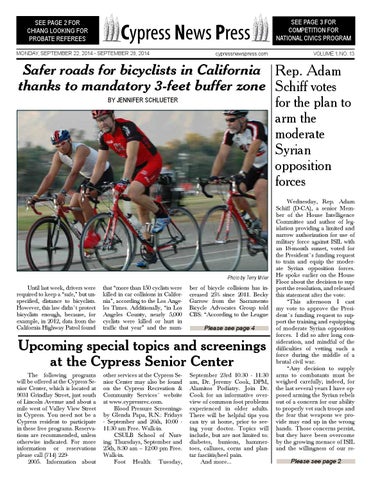
-Photo by Terry Miller
Until last week, drivers were required to keep a “safe,” but unspecified, distance to bicyclists. However, this law didn’t protect bicyclists enough, because, for example, in 2012, data from the California Highway Patrol found
that “more than 150 cyclists were killed in car collisions in California”, according to the Los Angeles Times. Additionally, “in Los Angeles County, nearly 5,000 cyclists were killed or hurt in traffic that year” and the num-
ber of bicycle collisions has increased 25% since 2011. Becky Garrow from the Sacramento Bicycle Advocates Group told CBS: “According to the League Please see page 4
Upcoming special topics and screenings at the Cypress Senior Center The following programs will be offered at the Cypress Senior Center, which is located at 9031 Grindlay Street, just south of Lincoln Avenue and about a mile west of Valley View Street in Cypress. You need not be a Cypress resident to participate in these free programs. Reservations are recommended, unless otherwise indicated. For more information or reservations please call (714) 2292005. Information about
other services at the Cypress Senior Center may also be found on the Cypress Recreation & Community Services’ website at www.cypressrec.com. Blood Pressure Screeningsby Glenda Papa, R.N.: Fridays - September and 26th, 10:00 11:30 am Free. Walk-in. CSULB School of Nursing: Thursdays, September and 25th, 8:30 am – 12:00 pm Free. Walk-in. Foot Health: Tuesday,
September 23rd 10:30 - 11:30 am, Dr. Jeremy Cook, DPM, Alamitos Podiatry. Join Dr. Cook for an informative overview of common foot problems experienced in older adults. There will be helpful tips you can try at home, prior to seeing your doctor. Topics will include, but are not limited to: diabetes, bunions, hammertoes, calluses, corns and plantar fasciitis/heel pain. And more...
Wednesday, Rep. Adam Schiff (D-CA), a senior Member of the House Intelligence Committee and author of legislation providing a limited and narrow authorization for use of military force against ISIL with an 18-month sunset, voted for the President’s funding request to train and equip the moderate Syrian opposition forces. He spoke earlier on the House Floor about the decision to support the resolution, and released this statement after the vote: “This afternoon I cast my vote to approve the President’s funding request to support the training and equipping of moderate Syrian opposition forces. I did so after long consideration, and mindful of the difficulties of vetting such a force during the middle of a brutal civil war. “Any decision to supply arms to combatants must be weighed carefully; indeed, for the last several years I have opposed arming the Syrian rebels out of a concern for our ability to properly vet such troops and the fear that weapons we provide may end up in the wrong hands. Those concerns persist, but they have been overcome by the growing menace of ISIL and the willingness of our rePlease see page 2
2 | SEPTEMBER 22, 2014 - SEPTEMBER 28, 2014
Controller Chiang looking for Probate Referees State approved official will appraise most assets in a probate estate State Controller John Chiang announced Tuesday that his office will be conducting qualifying examinations for Probate Referee appointments in Northern and Southern California on October 18, 2014. The probate referee is a stateappointed official whose job is to appraise most assets in a probate estate. The probate referee appraises all property and assets except cash. There is a minimum of one probate referee in each county, while larger counties have more than one. “I want to make this public service opportunity available to as many financial professionals as possible. We are looking for candidates with diverse backgrounds who want to help their communities by providing this important service,” said Chiang. “Please encourage your friends and colleagues who are interested in becoming a Probate Referee to apply and take the exam.” Probate Referees have been proudly assisting the courts, attorneys and the public for more than 68 years. A Probate Referee is appointed to a panel in the county of his or her residence by the State Controller for a term of four years. Applicants must possess threshold academic and/or relevant professional experience
in order to take the examination and be considered for appointment. Applicants must meet at least one of the following: •Bachelor’s degree plus at least 30 class hours in appraisal/valuation classes; or •2,000 hours of experience within the last four years appraising real and/or personal property; or •Certified as an appraiser by the California Office of Real Estate Appraisers, the Appraisal Institute or the American Society of Appraisers; or •Attorney with a minimum of three years as a member of the California State Bar, or •Certified Public Accountant with a minimum of three years as a licensed CPA in California. There are about 114 Probate Referee positions on county panels statewide; currently, approximately 25 of these positions will be available for reappointment. All applications must be received by October 10, 2014. Applicants must also submit five letters of recommendation from references listed on their applications. Those letters must be received no later than October 24, 2014. Individuals interested in becoming probate referees may obtain an application by emailing probateinfo@cpshr.
us, or call (916) 263-3624 and select option #7 and then #5. The application and testing information is available at www. cpshr.us or www.sco.ca.gov. Please return completed applications, along with a nonrefundable check or money order for $75 made payable to the State Controller’s Office, to: CPS HR Consulting Attention: Probate Referee Program 241 Lathrop Way Sacramento, CA 95815
The five letters of recommendation must be received by the State Controller’s Office by October 24. Please send the letters to: State Controller’s Office Probate Referee Program Attn: Amber Camarena 300 Capitol Mall, Suite 1850 Sacramento, CA 95814 For more news, please follow the Controller on Twitter at @CAController, and on Facebook at California State Controller’s Office.
Arm moderate Syrian opposition forces Continued from page 1
gional allies to play a greater -and open -- role in the support of these forces. “ISIL now controls about a third of Iraq and a like portion of Syria. It has been unsurpassed in its brutality, committing mass executions, forced conversions, trafficking in women and beheading its hostages -- including Americans James Foley and Steven Sotlof. If ISIL is allowed to consolidate its territorial gains, or expand them, it will be able to act on its stated intention of serving as the platform for attacks on the United States. The thousands of foreign fighters, including Americans, who have flocked to join its ranks will one day attempt to return to the west and attack us on the homeland. The longer ISIL can draw new recruits, the longer the United States will have to confront the threat that these fighters will return home, many with visa-free travel to our shores. “Our response must be proportionate to the threat. It does not justify American occupation of Iraq or Syria, or the introduction of American ground forces -- all of which are likely to be counterproductive. It does justify the use of American air power, intelligence, financial, diplomatic and military support. And
since air power alone will not be sufficient on the battlefield, it will necessitate the assistance of local ground forces. In the case of Iraq, those ground forces will be provided by the Iraqi military and Kurdish Peshmerga. In Syria, with rigorous vetting, training and support, the rebel opposition may provide the raw material for a credible military force. There is no guarantee that the Syrian opposition can form a cohesive fighting force, something that has thus far eluded them, but the open support of Gulf nations in housing and funding this opposition holds the promise of consolidating regional support behind them. “The threat posed by ISIL is an outgrowth of the disastrously sectarian policies of the Nouri al-Maliki regime in Baghdad and the ruthless dictatorship of the Bashar al-Asad in Damascus. Our military efforts and those of our allies alone cannot succeed without addressing the political fractures created by both. I applaud the Administration for its role in urging the Iraqis to form a new and more inclusive government and look forward to the day when a representative government can take shape in neighboring Syria and this carnage can come to an end.”
SEPTEMBER 22, 2014 - SEPTEMBER 28, 2014 | 3
hlr media EDITORIAL
jschlueter@hlrmedia.com
Editor
Jennifer Schlueter
Publisher HLR Media
Advertising
advertising@hlrmedia.com
Submissions:
Please send all press releases to: jschlueter@hlrmedia.com HLR Media, LLC .All contents herein are copyrighted and may not be reproduced in any manner, either in whole or in part, without the express written consent of the publisher. The views and opinions expressed in this paper are not necessarily that of the management and staff at HLR Media, LLC
Phone: (626) 386-3457 Fax: (626) 600-4452
Alhambra PRESS
Baldwin Park
INDEPENDENT
INDEPENDENT
State Schools Chief Tom Torlakson announces competition for National Civics Program Principals can nominate their high school students State Superintendent of Public Instruction Tom Torlakson announced today that high school principals have until October 1, 2014 to nominate students for the prestigious United States Senate Youth Program (USSYP), which sends students to Washington, D.C. to learn about the federal government. “Civics education helps students become engaged citizens and critical thinkers who can solve difficult problems,” Torlakson said. “These are important skills that will help students in college and throughout their lives.” The California Department of Education (CDE) coordinates the competition in California. Students must be nominated by their high school principal to participate and they have to be juniors or seniors currently enrolled in any California public or private secondary school. In addition, they have to be serving in an elected or appointed capacity in student government or a civic or educational organization. Torlakson will select four finalists, including two delegates, a first alternate, and a second alternate. The two delegates will participate in an intensive study of the federal government as guests of the U.S. Senate from March 7–14, 2015, in Washington, D.C. The Hearst Foundation, which sponsors the program, will pay all expenses for the delegates, including transportation, hotel, and meals. In addition, each of the delegates will receive a $5,000 college scholarship from the Foundation. Alternates attend the events only if the delegates are unable to participate. The two delegates and two alternates will be introduced at the State Board of Education meeting in Sacramento next January. Torlakson, as part of his Civic Education Initiative, teamed up with California Chief
Justice Tani G. Cantil-Sakauye last year to convene a California Task Force on K-12 Civic Learning. Last month the task force produced a report, Revitalizing K–12 Civic Learning in California: A Blueprint for Action (PDF; 2MB), which highlights the importance of teaching students civics skills so they can become informed and engaged community members who help keep our democracy vital. For more information on the nomination process, go to CDE’s United States Senate Youth Program Web page or contact David Carriker in the Of-
fice of the State Superintendent of Public Instruction at 916-3190173 or dcarriker@cde.ca.gov. Hard copies of the application are available upon request. The completed application packet must contain an original and one copy of the California Student Application, California Qualifying Examination, and an unofficial student transcript. The packet must be mailed to the California Department of Education, 1430 N Street, Suite 5602, Sacramento, CA 958145901, and must be postmarked before Wednesday, October 1, 2014.
Long Beach Office 3780 Kilroy Airport Way Suite 360 Long Beach, CA 90806 Ph. (562) 472-0071 Fx. (562) 689-0071 Los Angeles Office 5701 South Eastern Avenue Suite 100 Los Angeles, CA 90040 Ph. (323) 727-1144 Fx. (323) 727-9198 www.heger-industrial.com Lic. #00814086
4 | SEPTEMBER 22, 2014 - SEPTEMBER 28, 2014
Spend or invest? New thoughts on an age-old dilemma A familiar experience for many Americans is that as fast as money comes in, it goes out the door again in pursuit of the next “must have” purchase. Such spending habits can take a toll on plans to build up savings for the future. The key is finding a balance between immediate gratification and longterm financial security. In many instances, we can all find ways save on daily purchases to set more money aside to help meet goals like saving for retirement or a child’s education. The bigger challenge comes when it is time to make a major purchase – a home, a car, appliances or home improvements. These expenditures can require the immediate outlay of thousands of dollars. You may have to drain money from savings or at the very least reduce available funds to invest for your future. When is the expenditure worth it, and when is the cost too prohibitive relative to your financial future? Judging the “real” cost There are a variety of ways to assess the financial value of a major purchase. The approach
you choose can vary depending on the type of expenditure you make. Here are three ways to think about it: 1. Opportunity cost Whenever you’re making a significant purchase on a product or service, you need to look at how it will impact your financial future. It is important to assess the opportunity cost of making a cash purchase today. For example, consider what could happen if instead of spending $5,000 on a home entertainment center, that money was invested for 20 years earning 7% per year. Over time, that $5,000 could grow to more than $19,000 (not accounting for taxes or investment fees). Assessing potential opportunity cost is one way to better evaluate the real cost of making a significant purchase. 2. A “return on investment” Another consideration is whether there is a payback on the purchase. For example, paying for a class or a college degree may provide a future return in the form of the potential for increased income. Any-
body who has spent (or taken loans for) $100,000 or more for a medical or law degree likely does so with a reasonable expectation that future income will more than make up the difference. A home improvement may be looked at in the same way – an investment that may be recouped in the future. 3. Borrowing the money to cover purchase costs While it may be tempting to pay for purchases with credit cards, home equity loans or other types of financing, you have to think about how much borrowing the money will cost in the long run. The key here is to limit interest charges as much as possible. It’s not that you necessarily need to avoid all debt. In some instances you can incur “good debt,” which is used to purchase an asset that has a long lifespan, increasing value and other potential benefits such as tax deductibility of interest. Mortgages and student loans are typically considered good debt. Major expenditures aren’t just about the immediate benefit. You should consider
whether the current cost would become more significant over time because the money was not invested for your future. Jean D. Koehler is a Financial Advisor with Ameriprise Financial Services, Inc. in Arcadia, Ca. She specializes in fee-based financial planning and asset management strategies and has been in practice for 14 years. To contact her, call 626-254-0455, 55 E. Huntington Drive, #340, Arcadia, CA 91006 or http:// www.ameripriseadvisors.com/ jean.d.koehler. Jean Koehler is licensed/ registered to do business with U.S. residents only in the states of CA, SC, FL, NM, AK, WA, PA, AZ, IL, MN, NY, NC, TN, and NV. Ameriprise Financial and its representatives do not provide tax or legal advice. Consult with your tax advisor or attorney regarding specific tax issues. Ameriprise Financial Services, Inc. Member FINRA and SIPC. © 2014 Ameriprise Financial, Inc. All rights reserved.
Safer roads for bicyclists in California thanks to mandatory 3-feet buffer zone Continued from page 1
of American Bicyclists, approximately 40 percent of cyclist fatalities were rear-end collisions.” To make roads a safer place for bicyclists, California
legislation last Tuesday passed a law stating that drivers now must keep a 3-feet buffer zone between them and bicyclists. If a driver does not obey this law,
s/he could be confronted with a warning or a $35 fine. An accident injuring a cyclist because the buffer zone was disregarded would result in a $220 fine. Should drivers not be able to stay out of the buffer zone due to traffic conditions, they are required to drive at a “reasonable and prudent” speed, have patience, and pass the cyclists only when it is safe. The California Highway Patrol’s Southern Division reminded drivers in a news release: “Be aware that when a lane is too narrow for vehicles and bikes to be safely side by side, bicyclist should ride in or near the center of that lane to discourage motorists from unsafe passing.” Rather than the law being
“a way of penalizing drivers,” as Assemblyman and avid cyclist Steven Bradford (D-Gardena) explained, it should be viewed as an education measure for “drivers and cyclists alike about sharing the road,” the LA Times suggested. Garrow agrees: “We’re excited about this law because it gives drivers better information on how to safely pass cyclists.” A USC student interviewed by the Annenberg TV News has his doubts about how the law will be enforced: “I’ll be curious to see how that really works in practice,” said Jake Porter. “Because some of the bike lanes are in such close proximity to the car lanes that I don’t really know if they have much room to move away.”