SEE PAGE 2 for: garth kemp to emcee quilter’s ball
ANAHEIM PRESS
MONDAY, SEPTEMBER 22, 2014 - SEPTEMBER 28, 2014
anaheimpress.com
SEE PAGE 3 for competition for national civics program VOLUME 1, NO. 21
Safer roads for bicyclists in California Test Of The thanks to mandatory 3-feet buffer zone Alert OC by Jennifer schlueter system to take place on Tuesday
“We cannot forget that for everyone who’s visible in our classes, there are those who may be invisible,” he said. Matsuda knows what it is like to be excluded. A few doubtful school trustees voted against him because he had not served in a position of that magnitude before. However, the majority of
In conjunction with National Preparedness Month, Anaheim residents will receive a TEST call of the emergency notification system, AlertOC, on Tuesday, Sept. 23 at 10 a.m. This will be a TEST only, and identified as such. AlertOC is a part of Orange County’s regional mass notification system. The test will replicate a large scale, multi-jurisdictional emergency requiring thousands of numbers to be called simultaneously across 24 cities and unincorporated areas. Anaheim residents with a landline phone line may receive a recorded voicemail message indicating this is only a test. Residents will notice that the caller ID phone number will be (714) 000-0000. AlertOC is Orange County’s mass notification system that alerts residents in Anaheim via landline phone service, also known as reverse 911, when there is an emergency. During a citywide emergency, the City of Anaheim may use AlertOC in conjunction with Anaheim Alert. To update your information in the countywide system, please visitwww.alertoc.org. Anaheim Alert is the City’s notification system, and offers customization according to geographic location, types of messages received, and preferred mode of communication (e-mail and/or text message to mobile phones). To sign up for Anaheim Alert, please visit www.AnaheimAlert.net,
Please see page 2
Please see page 2
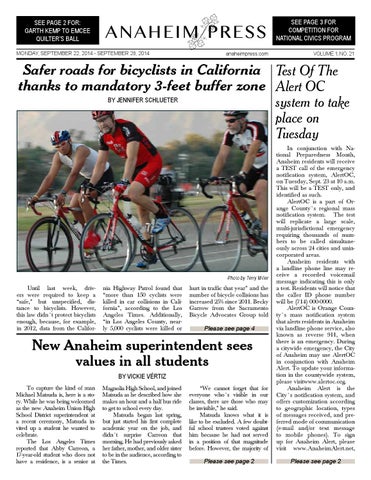
-Photo by Terry Miller
Until last week, drivers were required to keep a “safe,” but unspecified, distance to bicyclists. However, this law didn’t protect bicyclists enough, because, for example, in 2012, data from the Califor-
nia Highway Patrol found that “more than 150 cyclists were killed in car collisions in California”, according to the Los Angeles Times. Additionally, “in Los Angeles County, nearly 5,000 cyclists were killed or
hurt in traffic that year” and the number of bicycle collisions has increased 25% since 2011. Becky Garrow from the Sacramento Bicycle Advocates Group told Please see page 4
New Anaheim superintendent sees values in all students by Vickie Vértiz To capture the kind of man Michael Matsuda is, here is a story. While he was being welcomed as the new Anaheim Union High School District superintendent at a recent ceremony, Matsuda invited up a student he wanted to celebrate. The Los Angeles Times reported that Abby Carreon, a 17-year-old student who does not have a residence, is a senior at
Magnolia High School, and joined Matsuda as he described how she makes an hour and a half bus ride to get to school every day. Matsuda began last spring, but just started his first complete academic year on the job, and didn’t surprise Carreon that morning. He had previously asked her father, mother, and older sister to be in the audience, according to the Times.
2 | SEPTEMBER 22, 2014 - SEPTEMBER 28, 2014
“Faces” Garth Kemp, ABC Eyewitness News weather anchor, to emcee Quilters’ Ball Photographic The MUZEO Museum in “We are very grateful to receive Councilman Jordan Brandman portraits of Anaheim invites the community continued support from our spon- and Shaheen Sadeghi, president to its 8th annual Night at MUZEO sors and the community.“ and CEO of LAB Holding, LLC. people and Visionaries Gala “Quilters’ Ball,” The evening’s festivities coordinated decor with event on Saturday, October 11th, 2014. will begin with a cocktail recep- producer and designer Michael The gala is the biggest fundraiser tion at sunset, where guests have Mora to transport guests to a friends of the year and will be emceed by a chance to mingle, bid in the “Quilters’ Ball,” - to celebrate ABC Eyewitness News weather anchor Garth Kemp. The money raised from this event will help to fund another year of educational programs, special events and renowned exhibitions at MUZEO. “Our mission is not only to bring renowned exhibits to the area but to provide access to the arts for students and at-risk youth and your contributions are vital to these programs,” said Curt Pringle, Chairman of the MUZEO Museum’s Board of Directors.
silent auction, and participate in a wine pull and restaurant tree. The cocktail reception will be followed by a four-course gourmet meal in the main gallery, a live auction, and an evening of dancing. Silent auction items feature baskets from Anaheim Police Department, Disneyland Resort, and Starbucks Coffee Company. Live auction offerings include unique vacations, exclusive experiences and rare sports memorabilia. Gala co-chairs Anaheim
the coming of MUZEO’s newest exhibit,QUILTS, which will open in November. The evening will be a time to share in this spirit with fun and revelry. Last year’s event successfully raised $184,000 for programs and exhibits at the museum. For more information about the event or to purchase tickets and tables, please visit www.muzeo.org/gala. To learn more about MUZEO Museum, please visit www. muzeo.org.
MUZEO Museum and Cultural Center is pleased to announce a new addition to its line up of community events. A pop-up gallery featuring photographic work by Renee Stewart Jackson will open for one-day on Sunday, September 28, 2014 in MUZEO’s Carnegie Galleries from 10 am to 5 pm. Admission is free and a portion of sales will benefit ongoing programming and exhibitions at MUZEO.
Superintendent Matsuda values all students Continued from page 1
his 21 years in education were as a teacher, for a junior high school and at Oxford Academy preparatory school, said the Times. But his experience with exclusion runs deeply. His mother Ruth Akiko Matsuda was forced into internment camps with her family and out of her Anaheim high school her freshman year because of Executive Order 9066. The order created relocation centers across the country in an effort to divide
families and communities, but Ruth and her family ended up in Arizona at the largest of the internment camps. According to the Times, once Matsuda developed programs for rookie Anaheim teachers, his mother, with his encouragement, got her high school diploma with one condition: that her former principal at Anaheim High School be honored by the district. She told the Times that Paul Demaret had denounced that he would
not allow any intolerance toward Japanese American students in the district. And so, when it came time for Matsuda to become superintendent, said the Times, he arranged to have dinner with a student and her family from the district who are challenged by housing instability. The Times also stated that the district counts 4,200 students in Anaheim Unified as homeless according to the McKinney-Vento Act, which ensures that students without permanent homes continue to attend the same school regardless of their address. Carreon told the Times she was shocked that the superinten-
dent took an interest in her. During their meeting, she told Matsuda about her routine, going to the library after school to use their computers, and then traveling by bus to her family to all the different places where they were staying. “He’s a careful listener,” she told the Times. Her parents also never expected to talk so intimately with the superintendent. Faith Takahashi, her mother, said that he was not “offering sympathy. He’s interested in how learning can improve.” These encounters speak volumes about Matsuda and, hopefully, the legacy he will create as he leads the district.
AlarmOC system test Continued from page 1
or text the word “register” to 311ANA (311262). Residents are encouraged to sign up for both Anaheim Alert and AlertOC. An emergency can happen at any time. Preparedness is the key to a quicker recovery.
September is National Preparedness Month, and the City of Anaheim encourages its residents to learn how to be prepared in the event of an emergency incident. Visitwww.anaheim.net/prepare to learn more.
SEPTEMBER 22, 2014 - SEPTEMBER 28, 2014 | 3
hlr media EDITORIAL
editor@anaheimpress.com
Editor
Jennifer Schlueter
Publisher HLR Media
Advertising
advertising@hlrmedia.com
Submissions:
Please send all press releases to: editor@anaheimpress.com HLR Media, LLC .All contents herein are copyrighted and may not be reproduced in any manner, either in whole or in part, without the express written consent of the publisher. The views and opinions expressed in this paper are not necessarily that of the management and staff at HLR Media, LLC
950 N Tustin Ave Anaheim CA 92807
Phone: (626) 386-3457 Fax: (626) 600-4452
Alhambra PRESS
Baldwin Park
INDEPENDENT
INDEPENDENT
State Schools Chief Tom Torlakson announces competition for National Civics Program Principals can nominate their high school students State Superintendent of Public Instruction Tom Torlakson announced today that high school principals have until October 1, 2014 to nominate students for the prestigious United States Senate Youth Program (USSYP), which sends students to Washington, D.C. to learn about the federal government. “Civics education helps students become engaged citizens and critical thinkers who can solve difficult problems,” Torlakson said. “These are important skills that will help students in college and throughout their lives.” The California Department of Education (CDE) coordinates the competition in California. Students must be nominated by their high school principal to participate and they have to be juniors or seniors currently enrolled in any California public or private secondary school. In addition, they have to be serving in an elected or appointed capacity in student government or a civic or educational organization. Torlakson will select four finalists, including two delegates, a first alternate, and a second alternate. The two delegates will participate in an intensive study of the federal government as guests of the U.S. Senate from March 7–14, 2015, in Washington, D.C. The Hearst Foundation, which sponsors the program, will pay all expenses for the delegates, including transportation, hotel, and meals. In addition, each of the delegates will receive a $5,000 college scholarship from the Foundation. Alternates attend the events only if the delegates are unable to participate. The two delegates and two alternates will be introduced at the State Board of Education meeting in Sacramento next January. Torlakson, as part of his
Civic Education Initiative, teamed up with California Chief Justice Tani G. Cantil-Sakauye last year to convene a California Task Force on K-12 Civic Learning. Last month the task force produced a report, Revitalizing K–12 Civic Learning in California: A Blueprint for Action (PDF; 2MB), which highlights the importance of teaching students civics skills so they can become informed and engaged community members who help keep our democracy vital. For more information on the nomination process, go to CDE’s United States Senate Youth Program Web page or
contact David Carriker in the Office of the State Superintendent of Public Instruction at 916-3190173 or dcarriker@cde.ca.gov. Hard copies of the application are available upon request. The completed application packet must contain an original and one copy of the California Student Application, California Qualifying Examination, and an unofficial student transcript. The packet must be mailed to the California Department of Education, 1430 N Street, Suite 5602, Sacramento, CA 958145901, and must be postmarked before Wednesday, October 1, 2014.
Long Beach Office 3780 Kilroy Airport Way Suite 360 Long Beach, CA 90806 Ph. (562) 472-0071 Fx. (562) 689-0071 Los Angeles Office 5701 South Eastern Avenue Suite 100 Los Angeles, CA 90040 Ph. (323) 727-1144 Fx. (323) 727-9198 www.heger-industrial.com Lic. #00814086
4 | SEPTEMBER 22, 2014 - SEPTEMBER 28, 2014
Spend or invest? New thoughts on an age-old dilemma A familiar experience for many Americans is that as fast as money comes in, it goes out the door again in pursuit of the next “must have” purchase. Such spending habits can take a toll on plans to build up savings for the future. The key is finding a balance between immediate gratification and longterm financial security. In many instances, we can all find ways save on daily purchases to set more money aside to help meet goals like saving for retirement or a child’s education. The bigger challenge comes when it is time to make a major purchase – a home, a car, appliances or home improvements. These expenditures can require the immediate outlay of thousands of dollars. You may have to drain money from savings or at the very least reduce available funds to invest for your future. When is the expenditure worth it, and when is the cost too prohibitive relative to your financial future? Judging the “real” cost There are a variety of ways to assess the financial value of a major purchase. The approach
you choose can vary depending on the type of expenditure you make. Here are three ways to think about it: 1. Opportunity cost Whenever you’re making a significant purchase on a product or service, you need to look at how it will impact your financial future. It is important to assess the opportunity cost of making a cash purchase today. For example, consider what could happen if instead of spending $5,000 on a home entertainment center, that money was invested for 20 years earning 7% per year. Over time, that $5,000 could grow to more than $19,000 (not accounting for taxes or investment fees). Assessing potential opportunity cost is one way to better evaluate the real cost of making a significant purchase. 2. A “return on investment” Another consideration is whether there is a payback on the purchase. For example, paying for a class or a college degree may provide a future return in the form of the potential for increased income. Any-
body who has spent (or taken loans for) $100,000 or more for a medical or law degree likely does so with a reasonable expectation that future income will more than make up the difference. A home improvement may be looked at in the same way – an investment that may be recouped in the future. 3. Borrowing the money to cover purchase costs While it may be tempting to pay for purchases with credit cards, home equity loans or other types of financing, you have to think about how much borrowing the money will cost in the long run. The key here is to limit interest charges as much as possible. It’s not that you necessarily need to avoid all debt. In some instances you can incur “good debt,” which is used to purchase an asset that has a long lifespan, increasing value and other potential benefits such as tax deductibility of interest. Mortgages and student loans are typically considered good debt. Major expenditures aren’t just about the immediate benefit. You should consider
whether the current cost would become more significant over time because the money was not invested for your future. Jean D. Koehler is a Financial Advisor with Ameriprise Financial Services, Inc. in Arcadia, Ca. She specializes in fee-based financial planning and asset management strategies and has been in practice for 14 years. To contact her, call 626-254-0455, 55 E. Huntington Drive, #340, Arcadia, CA 91006 or http:// www.ameripriseadvisors.com/ jean.d.koehler. Jean Koehler is licensed/ registered to do business with U.S. residents only in the states of CA, SC, FL, NM, AK, WA, PA, AZ, IL, MN, NY, NC, TN, and NV. Ameriprise Financial and its representatives do not provide tax or legal advice. Consult with your tax advisor or attorney regarding specific tax issues. Ameriprise Financial Services, Inc. Member FINRA and SIPC. © 2014 Ameriprise Financial, Inc. All rights reserved.
Safer roads for bicyclists in California thanks to mandatory 3-feet buffer zone Continued from page 1
CBS: “According to the League of American Bicyclists, approximately 40 percent of cyclist fatalities were rear-end collisions.” To make roads a safer
place for bicyclists, California legislation last Tuesday passed a law stating that drivers now must keep a 3-feet buffer zone between them and bicyclists. If
a driver does not obey this law, s/he could be confronted with a warning or a $35 fine. An accident injuring a cyclist because the buffer zone was disregarded would result in a $220 fine. Should drivers not be able to stay out of the buffer zone due to traffic conditions, they are required to drive at a “reasonable and prudent” speed, have patience, and pass the cyclists only when it is safe. The California Highway Patrol’s Southern Division reminded drivers in a news release: “Be aware that when a lane is too narrow for vehicles and bikes to be safely side by side, bicyclist should ride in or near the center of that lane to discourage motorists from unsafe passing.” Rather than the law being
“a way of penalizing drivers,” as Assemblyman and avid cyclist Steven Bradford (D-Gardena) explained, it should be viewed as an education measure for “drivers and cyclists alike about sharing the road,” the LA Times suggested. Garrow agrees: “We’re excited about this law because it gives drivers better information on how to safely pass cyclists.” A USC student interviewed by the Annenberg TV News has his doubts about how the law will be enforced: “I’ll be curious to see how that really works in practice,” said Jake Porter. “Because some of the bike lanes are in such close proximity to the car lanes that I don’t really know if they have much room to move away.”