SEE PAGE 4 for civil oversight rejected by board of supervisors
SEE PAGE 3 for ER closures increase risk of death MONDAY, AUGUST 11, 2014 - AUGUST 17, 2014
cypressnewspress.com
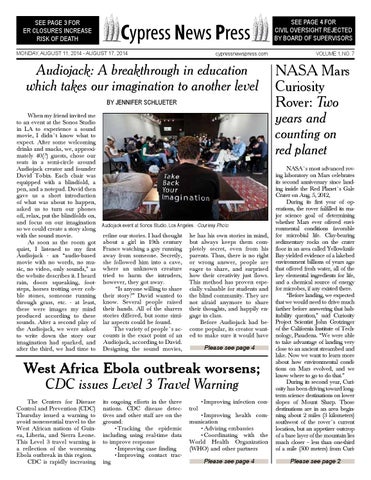
Audiojack: A breakthrough in education which takes our imagination to another level by jennifer schlueter When my friend invited me to an event at the Sonos Studio in LA to experience a sound movie, I didn’t know what to expect. After some welcoming drinks and snacks, we, approximately 40(?) guests, chose our seats in a semi-circle around Audiojack creator and founder David Tobin. Each chair was equipped with a blindfold, a pen, and a notepad. David then gave us a short introduction of what was about to happen, asked us to turn our phones off, relax, put the blindfolds on, and focus on our imagination Audiojack event at Sonos Studio, Los Angeles. -Courtesy Photo so we could create a story along refine our stories. I had thought he has his own stories in mind, with the sound movie. As soon as the room got about a girl in 19th century but always keeps them comquiet, I listened to my first France watching a guy running pletely secret, even from his Audiojack - an “audio-based away from someone. Secretly, parents. Thus, there is no right movie with no words, no mu- she followed him into a cave, or wrong answer, people are sic, no video, only sounds,” as where an unknown creature eager to share, and surprised the website describes it. I heard tried to harm the intruders; how their creativity just flows. This method has proven esperain, doors squeaking, foot- however, they got away. “Is anyone willing to share cially valuable for students and steps, horses trotting over cobble stones, someone running their story?” David wanted to the blind community. They are through grass, etc. - at least, know. Several people raised not afraid anymore to share these were images my mind their hands. All of the sharers their thoughts, and happily enproduced according to these stories differed, but some simi- gage in class. Before Audiojack had besounds. After a second play of lar aspects could be found. The variety of people’s ac- come popular, its creator wantthe Audiojack, we were asked to write down the story our counts is the exact point of an ed to make sure it would have imagination had sparked, and Audiojack, according to David. Please see page 4 after the third, we had time to Designing the sound movies,
its ongoing efforts in the three nations. CDC disease detectives and other staff are on the ground: •Tracking the epidemic including using real-time data to improve response •Improving case finding •Improving contact tracing
NASA Mars Curiosity Rover: Two years and counting on red planet
•Improving health communication •Advising embassies •Coordinating with the World Health Organization (WHO) and other partners
NASA’s most advanced roving laboratory on Mars celebrates its second anniversary since landing inside the Red Planet’s Gale Crater on Aug. 5, 2012, During its first year of operations, the rover fulfilled its major science goal of determining whether Mars ever offered environmental conditions favorable for microbial life. Clay-bearing sedimentary rocks on the crater floor in an area called Yellowknife Bay yielded evidence of a lakebed environment billions of years ago that offered fresh water, all of the key elemental ingredients for life, and a chemical source of energy for microbes, if any existed there. “Before landing, we expected that we would need to drive much farther before answering that habitability question,” said Curiosity Project Scientist John Grotzinger of the California Institute of Technology, Pasadena. “We were able to take advantage of landing very close to an ancient streambed and lake. Now we want to learn more about how environmental conditions on Mars evolved, and we know where to go to do that.” During its second year, Curiosity has been driving toward longterm science destinations on lower slopes of Mount Sharp. Those destinations are in an area beginning about 2 miles (3 kilometers) southwest of the rover’s current location, but an appetizer outcrop of a base layer of the mountain lies much closer -- less than one-third of a mile (500 meters) from Curi-
Please see page 4
Please see page 2
West Africa Ebola outbreak worsens; CDC issues Level 3 Travel Warning The Centers for Disease Control and Prevention (CDC) Thursday issued a warning to avoid nonessential travel to the West African nations of Guinea, Liberia, and Sierra Leone. This Level 3 travel warning is a reflection of the worsening Ebola outbreak in this region. CDC is rapidly increasing
VOLUME 1, NO. 7
trol
•Improving infection con-
2 | AUGUST 11, 2014 - AUGUST 17, 2014
NASA Mars Curiosity Rover: two years and counting on red planet Continued from page 1
osity. The rover team is calling the outcrop “Pahrump Hills.” For about half of July, the rover team at NASA’s Jet Propulsion Laboratory in Pasadena, California, drove Curiosity across an area of hazardous sharp rocks on Mars called “Zabriskie Plateau.” Damage to Curiosity’s aluminum wheels from driving across similar terrain last year prompted a change in route, with the plan of skirting such rock-studded terrain wherever feasible. The one-eighth mile (200 meters) across Zabriskie Plateau was one of the longest stretches without a suitable detour on the redesigned route toward the long-term science destination. Another recent challenge appeared last week in the form of unexpected behavior by an onboard computer currently serving as backup. Curiosity carries duplicate main computers. It has been operating on its B-side computer since a problem with the A-side computer prompted the team to command a side swap in February 2013. Work in subsequent weeks of 2013 restored availability of the A-side as a backup in case of B-side trouble. In July, fresh commanding of the rover was suspended for two days while engineers confirmed that the A-side computer remains reliable as a backup. To help prepare for future human missions to Mars, Curiosity incudes a radiation detector to measure the environment
- Courtesy Photo
astronauts will encounter on a round-trip between Earth and the Martian surface. The data are consistent with earlier predictions and will help NASA scientists and engineers develop new technologies to protect astronauts in deep space. In 2016, a Mars lander mission called InSight will launch to take the first look into the deep interior of Mars. The agency also is participating in the European Space Agency’s (ESA’s) 2016 and 2018 ExoMars missions, including providing “Electra” telecommu-
nication radios to ESA’s 2016 orbiter and a critical element of the astrobiology instrument on the 2018 ExoMars rover. Additionally, NASA recently announced that its next rover going to Mars in 2020 will carry seven carefully selected instruments to conduct unprecedented investigations in science and technology, as well as capabilities needed for humans to pioneer the Red Planet. Based on the design of the highly successful Mars Science Laboratory rover, Curiosity, the new rover will carry more sophisticated, upgraded hardware and new instruments to conduct geological assessments of the rover’s landing site, determine the potential habitability of the environment, and directly search for signs of ancient Martian life. Scientists will use the Mars 2020 rover to identify and select a collection of rock and soil samples that will be stored for potential return to Earth by a future mission. The Mars 2020 mission is responsive to the science objectives recommended by the National Research Council’s 2011 Planetary Science Decadal Survey. The Mars 2020 rover will help further advance our knowledge of how future human explorers could use natural re-
sources available on the surface of the Red Planet. An ability to live off the Martian land would transform future exploration of the planet. Designers of future human expeditions can use this mission to understand the hazards posed by Martian dust and demonstrate technology to process carbon dioxide from the atmosphere to produce oxygen. These experiments will help engineers learn how to use Martian resources to produce oxygen for human respiration and potentially as an oxidizer for rocket fuel. The Mars 2020 rover is part of the agency’s Mars Exploration Program, which includes the Opportunity and Curiosity rovers, the Odyssey and Mars Reconnaissance Orbiter spacecraft currently orbiting the planet, and the MAVEN orbiter, which is set to arrive at the Red Planet in September and will study the Martian upper atmosphere. NASA’s Mars Exploration Program seeks to characterize and understand Mars as a dynamic system, including its present and past environment, climate cycles, geology and biological potential. In parallel, NASA is developing the human spaceflight capabilities needed for future round-trip missions to Mars.
AUGUST 11, 2014 - AUGUST 17, 2014 | 3
hlr media EDITORIAL
jschlueter@hlrmedia.com
Editor
Jennifer Schlueter
Publisher HLR Media
Advertising
advertising@hlrmedia.com
Submissions:
Please send all press releases to: jschlueter@hlrmedia.com HLR Media, LLC .All contents herein are copyrighted and may not be reproduced in any manner, either in whole or in part, without the express written consent of the publisher. The views and opinions expressed in this paper are not necessarily that of the management and staff at HLR Media, LLC
Phone: (626) 386-3457 Fax: (626) 600-4452
Alhambra PRESS
Baldwin Park
INDEPENDENT
INDEPENDENT
ER closures increase risk of death at surrounding areas Washington, DC—Patients who were admitted to hospitals in the vicinity of a hospital that had closed its emergency department had 5 percent greater odds of inpatient mortality than patients admitted to unaffected hospitals. The risk of death was more pronounced for non-elderly patients and patients with time-sensitive conditions such as acute myocardial infarction (AMI or heart attack), stroke and sepsis. The results of the California study are published today in the August issue of Health Affairs (“California Emergency Department Closures Are Associated with Increased Inpatient Mortality at Nearby Hospitals”) http://content.healthaffairs. org/content/33/8/1323.abstract. “The shrinking number of emergency departments combined with a growth in emergency patients is having a demonstrably dangerous effect on the people of California,” said senior study author Renee Hsia, MD, FACEP of the University of California San Francisco in Calif. “Furthermore, emergency departments and trauma centers – which often experience greater financial pressures than their parents hospitals overall – are more likely to close at hospital with negative profit margins. Therefore, ER closures may widen disparities by further reducing access to care in communities that are already characterized by having vulnerable patients and underpaid hospitals.” Between 1999 and 2010, 48 emergency departments closed in California. During that time, 16,246.892 patients were admitted to California hospitals from the emergency department, onequarter of them near a recently closed ER. Patients admitted to the hospital in the geographic vicinity of other emergency department closures had 5 percent higher odds of inpatient mortality than patients who were admitted in areas where no emergency department had closed. Odds of morality increased by 10 percent for non-elderly adults, by 15 percent for patients
with AMI, by 10 percent for patients with stroke and by 8 percent for patients with sepsis. Researchers speculate that the closure of emergency departments increases pressure on surrounding emergency departments as well as on patients who depend on them. The increased mortality may be attributed to increased travel time to farther emergency departments as well as increased wait times or crowding in ERs with bigger populations dependent on them. “Emergency department closures have ripple effects on patient outcomes that should be considered when health systems and policy makers decide how to regulate ER closures,” said
Dr. Hsia. “As it stands now, the people who are most put at risk are those who are most vulnerable – the poor, the underinsured and the very sick.” ACEP is the national medical specialty society representing emergency medicine. ACEP is committed to advancing emergency care through continuing education, research and public education. Headquartered in Dallas, Texas, ACEP has 53 chapters representing each state, as well as Puerto Rico and the District of Columbia. A Government Services Chapter represents emergency physicians employed by military branches and other government agencies.
Long Beach Office 3780 Kilroy Airport Way Suite 360 Long Beach, CA 90806 Ph. (562) 472-0071 Fx. (562) 689-0071 Los Angeles Office 5701 South Eastern Avenue Suite 100 Los Angeles, CA 90040 Ph. (323) 727-1144 Fx. (323) 727-9198 www.heger-industrial.com Lic. #00814086
4 | AUGUST 11, 2014 - AUGUST 17, 2014
Ebola virus travel warning Continued from page 1
•Strengthening Ministries of Health and helping them establish emergency management systems “This is the biggest and most complex Ebola outbreak in history. Far too many lives have been lost already,” said CDC Director Tom Frieden, M.D., M.P.H. “It will take many months, and it won’t be easy, but Ebola can be stopped. We know what needs to be done. CDC is surging our response, sending 50 additional disease control experts to the region in the next 30 days.” CDC expects its efforts not only to help bring the current outbreak under control, but to leave behind stronger systems to prevent, detect and stop Ebola and other outbreaks before they spread. In addition to warning travelers to avoid going to the region, CDC is also assisting with active screening and education efforts on the ground in West Africa to prevent sick travelers from getting on planes. On the remote possibility that they do, CDC has protocols in place to protect against further spread of disease. These include notification to CDC of ill passengers on a plane before arrival, investigation of ill travelers, and, if necessary, quarantine. CDC also provides guidance to airlines for managing ill passengers and crew and for disinfecting aircraft. Earlier this week,
CDC issued a Health Alert Notice reminding U.S. healthcare workers of the importance of taking steps to prevent the spread of this virus, how to test and isolate suspected patients and how they can protect themselves from infection. At this time, CDC and its partners at points of entry are not screening passengers traveling from the affected countries. It is important to note that Ebola is not contagious until symptoms appear, and that transmission is through direct contact of bodily fluids of an infected, symptomatic person or exposure to objects like needles that have been contaminated with infected secretions. Over the next five years the United States has committed to working with at least 30 partner countries (totaling at least 4 billion people) to improve their ability to prevent, detect, and effectively respond to infectious disease threats -whether naturally occurring or caused by accidental or intentional release of pathogens. Improving these capabilities for each nation improves health security for all nations. Stopping outbreaks where they occur is the most effective and least expensive way to protect people’s health. The President’s FY 2015 budget includes a request of $45 million to fund this global health security effort.
Civilian oversight rejected by Board of Supervisors With a 3-2 vote, the Board of Supervisors Tuesday prohibited a proposal to create a civilian oversight commission for the Los Angeles County Sheriff’s Department, urging advocates to give the inspector general a chance to do his job. In response to the Los Angeles County Board of Supervisors vote on Civilian Oversight , Sherrif John Scott issued the following statement to the press: “I concur with the Board’s decision regarding civilian oversight of the Sheriff’s Department. As stated in my June 30, 2014 letter, the best way to respond to concerns of the Board and the public regarding the Department’s operation is to complete the plan and development of the Office of Inspector General before con-
sidering the creation and implementation of a potential Citizens’ Oversight Commission. “ Office of Inspector General concurred saying: “I support the Board’s approval of the Office of Inspector General ordinance, in substantial part. As stated in both my June 2, 2014 and August 1, 2014 letters, we will continue to work with Max Huntsman and his office in an effort to build a climate of trust and transparency within the organization and the public. To that end, we have formed a committee to establish working guidelines to ensure maximum cooperation and have requested a formal County Counsel opinion about legal access to confidential/privileged information.
Education breakthrough Audiojack Continued from page 1
a lasting impact, and not just be something fun. Inspired by his mother, a teacher, education has always been of utmost importance for David. Audiojack lesson plans for different markets and countries were developed, and thoroughly tested for years. When this confirmed a huge success, David brought his company to the large scale where it is today: The website www.audiojack.com has been translated into 30 languages, and is also usable for the blind. Audiojack lessons adhere to Common Core Standards and are used in k-12 education. Because the sound movies have no language barrier, the whole world can access, use, and profit from them. Individuals, schools, and other organizations can subscribe to the program on the website. For the near future, David plans on launching a program with which people are able to create their own Audiojacks. It still stuns David that he created something that improves people’s quality of life,
stimulates their creativity and develops their critical thinking skills. He goes to schools and education conferences to introduce Audiojack and the positive feedback he is getting is incredible: “A blind girl told me that through Audiojack she felt as if she was able to see for the first time,” he recalled. On another occasion, at the renowned Perkins School of the Blind in Massachusetts, an official told David that he had cracked the code for the blind, that they had been waiting for something like Audiojack. David described this moment as “sobering,” because it charged him with even more responsibility. These events make him work harder and are his drive to continue his mission to give back to people. Audiojack is more than just a job to David; it’s his passion. For more information, i.e. on how you, your school, or your organization can subscribe and profit from Audiojacks, contact Audiojack on www.audiojack.com