SEE PAGE 4 for tips on how to start a small business
SEE PAGE 3 for california’s new paid sick leave law MONDAY, JANUARY 5, 2015 - JANUARY 11, 2015
cypressnewspress.com
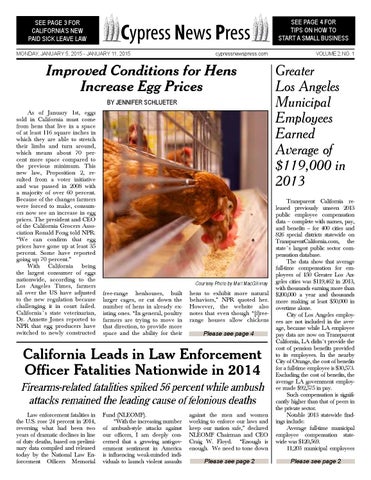
Improved Conditions for Hens Increase Egg Prices By JENNIFER SCHLUETER As of January 1st, eggs sold in California must come from hens that live in a space of at least 116 square inches in which they are able to stretch their limbs and turn around, which means about 70 percent more space compared to the previous minimum. This new law, Proposition 2, resulted from a voter initiative and was passed in 2008 with a majority of over 60 percent. Because of the changes farmers were forced to make, consumers now see an increase in egg prices. The president and CEO of the California Grocers Association Ronald Fong told NPR: “We can confirm that egg prices have gone up at least 35 percent. Some have reported going up 70 percent.” With California being the largest consumer of eggs nationwide, according to the Los Angeles Times, farmers all over the US have adjusted to the new regulation because challenging it in court failed. California’s state veterinarian, Dr. Annette Jones reported to NPR that egg producers have switched to newly constructed
against the men and women working to enforce our laws and keep our nation safe,” declared NLEOMF Chairman and CEO Craig W. Floyd. “Enough is enough. We need to tone down Please see page 2
Please see page 2
hens to exhibit more natural behaviors,” NPR quoted her. However, the website also notes that even though “[f]reerange houses allow chickens Please see page 4
California Leads in Law Enforcement Officer Fatalities Nationwide in 2014 Firearms-related fatalities spiked 56 percent while ambush attacks remained the leading cause of felonious deaths Law enforcement fatalities in the U.S. rose 24 percent in 2014, reversing what had been two years of dramatic declines in line of duty deaths, based on preliminary data compiled and released today by the National Law Enforcement Officers Memorial
Fund (NLEOMF). “With the increasing number of ambush-style attacks against our officers, I am deeply concerned that a growing anti-government sentiment in America is influencing weak-minded individuals to launch violent assaults
Greater Los Angeles Municipal Employees Earned Average of $119,000 in 2013 Transparent California released previously unseen 2013 public employee compensation data – complete with names, pay, and benefits – for 400 cities and 826 special districts statewide on TransparentCalifornia.com, the state’s largest public sector compensation database. The data show that average full-time compensation for employees of 150 Greater Los Angeles cities was $119,462 in 2013, with thousands earning more than $200,000 a year and thousands more making at least $50,000 in overtime alone. City of Los Angeles employees are not included in the average, because while LA employee pay data are now on Transparent California, LA didn’t provide the cost of pension benefits provided to its employees. In the nearby City of Orange, the cost of benefits for a full-time employee is $30,573. Excluding the cost of benefits, the average LA government employee made $92,575 in pay. Such compensation is significantly higher than that of peers in the private sector. Notable 2013 statewide findings include: Average full-time municipal employee compensation statewide was $120,569. 11,203 municipal employees
-Courtesy Photo by Matt MacGillivray
free-range henhouses, built larger cages, or cut down the number of hens in already existing ones. “In general, poultry farmers are trying to move in that direction, to provide more space and the ability for their
VOLUME 2, NO. 1
2 | JANUARY 5, 2015 - JANUARY 11, 2015
Transparent California Reveals Municipal Employees Earnings Continued from page 1
took home over $200,000 with 3,661 making over $50,000 in overtime. Average full-time special district employee compensation was $106,592. “Los Angeles civil servants averaging $119,000 a year in com-
pensation means that the term civil servant is no longer appropriate,” said Mark Bucher, president of the California Policy Center. “Meanwhile, comparable workers in the private sector have seen their compensation stagnate as an ever-greater amount of their take
home pay is diverted to fund these lavish government compensation packages.” Transparent California also released summary pages for individual cities and counties, which include median government employee and cost per resident.
Those pages are available by going to a city or county page and clicking the “View Summary” link. Transparent California is the largest database of California public employee and retiree compensation with names and now contains over 7.7 million records.
Law Enforcement Officer Fatalities Continued from page 1
the rhetoric and rally in support of law enforcement and against lawlessness.” According to the NLEOMF report, 126 federal, state, local, tribal and territorial officers were killed in the line of duty this year, compared to 102 in 2013. The number of officers killed by firearms in 2014 (50) was 56 percent higher than the number killed by gunfire in 2013 (32). Ambush-style attacks, as evidenced earlier this month by the shooting deaths of New York City Police Officers Wenjian Liu and Rafael Ramos while sitting in their marked patrol car, were the number one cause of felonious officer deaths for the fifth year in a row. Fifteen officers nationwide were killed in ambush assaults in 2014, matching 2012 for the highest total since 1995. Forty-nine officers were killed in traffic-related incidents
this past year, which was an 11 percent increase from 2013. Twenty-seven officers died due to other causes in 2014, including 24 who suffered from job-related illnesses—such as heart attacks— while performing their duties. In 2011, officer fatalities spiked to 171, which led to a number of new initiatives and policy changes aimed at promoting law enforcement safety. The result was a sharp decline in lineof-duty deaths to 123 in 2012 and 102 last year—the lowest fatality figure since 1944. Over the past decade the average annual number of officer deaths has been 151. The deadliest year ever for law enforcement was 1930 when 300 law enforcement officers were killed in the line of duty. The deadliest single incident was the terrorist attack on September 11, 2001, resulting in 72 officer deaths. There are more than
20,000 names of officers killed in the line of duty inscribed on the National Law Enforcement Officers Memorial in Washington, DC, dating back to the first known death in 1791. “We issue this report each year as a stark reminder that some 900,000 sworn law enforcement officers go out each and every day putting their lives on the line for our safety and protection,” explained NLEOMF Chairman and CEO Craig W. Floyd. “These brave men and women are willing to lay down their lives for us. The least we should do is honor and remember their service and sacrifice, support their families and do all that we can to make it safer for those who continue to serve.” The statistics released by the NLEOMF are based on preliminary data compiled and do not represent a final or complete list of individual officers who will be added to the National Law Enforcement Officers Memorial in 2015. For a complete copy of the preliminary report on 2014 law enforcement fatalities, go to:www.LawMemorial.org/FatalitiesReport. Key Data as of December 29, 2014: Firearms-related incidents were the number one cause of officer deaths in 2014, with 50. This was a 56 percent increase over the 32 officers shot and killed in 2013. Ambush attacks resulted in 15 officer deaths, the leading felonious cause of deaths among
officers in 2014 and for the fifth straight year. The other leading categories of felonious deaths in 2014 were traffic stops or pursuits (8), investigating suspicious persons or activities (7), disturbance calls (6), attempting arrests (4), investigative activities (3), accidental shootings (2), burglary in progress (2), investigating drug-related matters (1), robbery in progress (1), and tactical situations (1). Traffic-related incidents were the second-leading cause of officer fatalities in 2014, with 49. This was an 11 percent increase over the 44 traffic-related deaths in 2013. Of these 49 officers, 35 were killed in automobile crashes, nine officers were struck and killed outside their vehicle and five officers were killed in motorcycle crashes. Of the 27 officers who died due to other causes this year, 24 were caused by job-related illnesses; one officer was strangled to death; one officer drowned; and one officer was killed in a fire-related incident. During the past year, more officers were killed in California (14) than any other state; followed by Texas (11); New York (9); Florida (6) and Georgia (5). Six officers killed in 2014 served with federal law enforcement agencies. Two of the officers who died during the past year served with correctional agencies, two were tribal officers and one was a military officer. Three of the 126 fatalities were female. On average, the officers who died in 2014 were 41 years old and had served for 12 years.
JANUARY 5, 2015 - JANUARY 11, 2015 | 3
hlr media EDITORIAL
jschlueter@hlrmedia.com
Editor
Jennifer Schlueter
Publisher HLR Media
Advertising
advertising@hlrmedia.com
Submissions:
Please send all press releases to: jschlueter@hlrmedia.com HLR Media, LLC .All contents herein are copyrighted and may not be reproduced in any manner, either in whole or in part, without the express written consent of the publisher. The views and opinions expressed in this paper are not necessarily that of the management and staff at HLR Media, LLC 5252 Orange ave, Suite 203 cypress, CA 90630
Phone: (626) 386-3457 Fax: (626) 600-4452
Alhambra PRESS ANAHEIM PRESS
Baldwin Park
Belmont Beacon INDEPENDENT
INDEPENDENT
Pasadena Press
San Bernardino Press
California’s New Paid Sick Leave Law Widely Misunderstood; Spells Trouble for Small Businesses California’s new paid sick law goes into effect January 1, but many small businesses don’t understand the law or its impact for their operations. Lonnie Giamela – a partner at national labor and employment firm Fisher & Phillips LLP – is counseling his clients to educate themselves and prepare. “Small businesses are going to be the most heavily impacted by this new statute, something most don’t even realize,” said Giamela. “There’s a real lack of clarity, so many small businesses are ignoring the new statute. That’s a big mistake.” Giamela is seeing three primary misconceptions: 1. “I don’t need to comply until July 1, 2015.” There is no time to waste. California employers must post a new poster and distribute a new Wage Theft Protection Act Notice by January 1, 2015. Failure to do so may subject the employer to unnecessary penalties. 2. “Small businesses aren’t covered by the statute.” This is just wrong. Every California employer is covered by the new statute. Moreover, all employees, regardless if exempt or non-exempt, full-time or part-time are covered by the statute so long as they work 30 days and do not qualify for one of the limited exemptions. 3. “I already have a sick leave policy so I don’t need to worry about the statute.” Many small businesses already have a PTO or sick leave policy that provides for at least six days annually of PTO, but that is not enough. The law also requires that policies be modified to notify employees that they can take leave for a number of situations. For example, most sick leave policies do not permit an employee to take leave for matters related to being a victim
of domestic violence. The new paid sick leave does. About Fisher & Phillips LLP (www.laborlawyers.com): Fisher & Phillips LLP is a national law firm committed to providing practical business solutions for employers’ workplace legal problems. Labor and employment law is all the firm does, offering deep and broad knowledge and experience in the area of the law the attorneys know best. Fisher & Phillips attorneys help clients avoid legal problems, are dedicated to provid-
ing exceptional client service, and are there when you need them. The firm has 300 attorneys in 31 offices. In addition to Los Angeles, the offices are in Atlanta, Baltimore, Boston, Charlotte, Chicago, Cleveland, Columbia, Columbus, Dallas, Denver, Fort Lauderdale, Gulfport, Houston, Irvine, Kansas City, Las Vegas, Louisville, Memphis, New England, New Jersey, New Orleans, Orlando, Philadelphia, Phoenix, Portland, San Antonio, San Diego, San Francisco, Tampa, and Washington, D.C.
Long Beach Office 3780 Kilroy Airport Way Suite 360 Long Beach, CA 90806 Ph. (562) 472-0071 Fx. (562) 689-0071 Los Angeles Office 5701 South Eastern Avenue Suite 100 Los Angeles, CA 90040 Ph. (323) 727-1144 Fx. (323) 727-9198 www.heger-industrial.com Lic. #00814086
4 | JANUARY 5, 2015 - JANUARY 11, 2015
So You Want to Start a Small Business? BY Jean D. Koehler The United States is home to millions of small businesses. While many thrive, there are certain risks and challenges that often accompany operating an independent company. If you’re thinking about starting a small business, keep these considerations in mind. •Create a business plan. When you’re fired up about an idea, it’s easy to overlook the details. A business plan forces you to define your business goals and how you plan to achieve them. It also helps you examine your competition and identify where your products or offering fit in the mix. Lastly, a thorough plan includes the strategies and tactics you will employ to move from ground zero to profitability and the costs and timeframe for getting there. •Beware of going “all in.” You may have read about people who maxed out their credit cards or mortgaged their homes to fund a business that brought them quickly into wealth. Unfortunately, this is not the norm and
the odds are stacked against this financial house of cards. Think twice before putting everything on the line for your business. Invest as much time and energy as you can afford, but avoid overextending yourself financially as you pursue your business plan. •Test the waters. To minimize your financial risk, consider launching your new business on a small scale before quitting your day job. Many small businesses have been started on the side while entrepreneurs maintain a fulltime job. The idea here is to keep income flowing until your business is viable and you can pull a salary without compromising your income. •Save for a rainy day. Even the savviest entrepreneurs can get caught in a market down cycle. And no one can predict all the things that might affect your bottom line. Individuals who are in business for themselves are doubly in need of a financial buffer should things take a turn for the
worse. If sales falter, you’re still on the hook for your business expenses, and you need to pay yourself too. Build savings into your business plan and keep your credit in good standing so you have access to cash if and when you need it. •Invest wisely. When you do need to put money into your business, be smart about spending so that your dollars multiply down the road. Hire competent people who are as passionate about the business as you are. •Protect yourself. Every business is vulnerable to potential risks, and it’s important to think about the worst case scenarios and how you’d handle them. What if a fire destroyed your office? Would your company collapse if you or a key employee were injured? If a customer, vendor or employee sued your business, could you afford your day in court? There are insurance products made to address all of these risks. Factor in adequate protection as part of your cost of doing business.
•Create an exit strategy. When you’re just starting out, it’s hard to envision the day you’ll turn the reigns over to someone else. Succession plans are an essential part of a sustainable business, especially if you hope to sell and use the proceeds to fund part of your retirement. •Seek financial advice. If you’re serious about starting your own business, get on the right track with financial guidance. Find a qualified financial advisor to look over your shoulder as you develop your business plan and launch your new career. Their financial acumen and fresh perspective can help you steer clear of financial trouble. Jean D. Koehler is a Financial Advisor with Ameriprise Financial Services, Inc. in Arcadia, Ca. She specializes in fee-based financial planning and asset management strategies and has been in practice for 14 years. To contact her, call 626-254-0455 or http://www.ameripriseadvisors.com/jean.d.koehler.
Improved Conditions for Hens Increase Egg Prices Continued from page 1
to move around freely, … critics say the birds are more frequently injured than those in cages.” On the other hand, the LA Times claims that “animal advocates say [squeezing chick-
ens into cages] causes needless suffering and boosts the likelihood of salmonella contamination.” Representing almost all of the US’ egg farmers, president
of the Georgia-based United Egg Producers Chad Gregory, told the LA Times that egg farmers are adapting to consumers’ demands of more farm-animal-friendly conditions in several states. Lon Allan, questions the new law in his piece in the San Luis Obispo Tribune: “Come on, folks, they’re only chickens. […] you can fool them into laying more eggs by turning the lights on in the hen house so the day seems longer to them. “Come [Jan 1], all that is supposed to change. Backers of the law reasoned we’d have healthier chickens if they had more room to literally spread their wings. “I do not know whether happy chickens lay more eggs. How do you know if a chicken
is happy?” The LA Times visited Frank Hilliker’s egg ranch in San Diego County, a thirdgeneration family business established in 1942, which underwent layout changes to conform to the new space regulations. Since these changes, Hilliker’s hens are now able to move more freely and “exhibit behavior he had never seen before — like a pecking order when it comes to feeding or their playful beak-tapping on old CDs and colorful string he’s hung from the beams,” reported the LA Times. The egg farmer himself feels “reinvigorated” about this “new challenge” and said: “I don’t know if the chickens know any better, but it’s made farming fun again.”