Fall/Winter 2026
Reel Fun:
ACADIA HOOKS YOUNG ANGLERS WITH NEW PROGRAM
FRISTAD TRAILS:
WHERE EVERY DOG HAS ITS DAY
THE FIN & FEATHER CLUB:
Guardians of Maine’s Wild Places
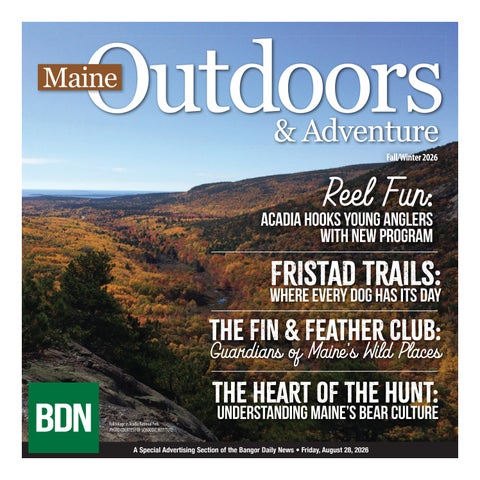
THE HEART OF THE HUNT: Fall foliage in Acadia National Park. PHOTO COURTESY OF SCHOODIC INSTITUTE
UNDERSTANDING MAINE’S BEAR CULTURE
A Special Advertising Section of the Bangor Daily News • Friday, August 28, 2026
2
MAINE OUTDOORS • FALL/WINTER • Bangor Daily News Special Advertising Section • August 28, 2026
BY ANNE GABBIANELLI
T
“This idea goes way back,” he said. “I have an agreement with the city of Belfast hat’s what one sign reads at the start of Fristad Trails in Belfast. The dog-friendly that this land will be gifted when I am ready to give it up.” network of trails truly has gone to the dogs. He said his goal is to make sure the land and the freedom it offers never disappear. “It’s what I dreamed of,” said Charles Beck, owner of 94 acres tucked off Route 1. “I’m not getting any younger, and I would hate to see it developed when I’m not here. “I grew up in Stockholm, Sweden, where there were public lands everywhere, dogs I’d like to see it continue in its present state into the future for the community.” running around, and it was just great.” With a chuckle, he added, “I am still the king and ruler for now!” Beck has worked on his project for more than 10 years, first For Katy Day of Belfast, it’s a fun time for her and her dog. acquiring 80 acres of land and then an additional 14 acres. “The primary reason I like it is that my dog can be a dog. Fristad means sanctuary in Swedish, and it is, in fact, a dog Dogs can run, sniff, get wet, meet other dogs, and do their doggy haven that Beck has created. things. There is no worry about picking up the poop because “I have a dog and was always told to leash and pick up after my they can go in the woods, and there are no little plastic bags all dog. When I lived in Monroe, I put trails around my house,” said over the place.” Beck, who retired from Maine Public after a career in broadcasting. “It’s a word-of-mouth kind of place,” said Sophie Garmon of His retirement project, a labor of love shared with his faithful Searsport, who calls herself and her dog, Dash, part of the “7:15ers.” canine, Blue, began in April 2016. Today, there are about 4 miles “I could not believe something like this existed right down of an intricate network of trails, ample places to sit, a stream, the street from me. It’s such a nice place. There is no stress, and and a wading area for dogs. there is no other place like it,” she said. The property also boasts a sense of humor, with trails labeled There are many trail options, looping and overlapping in “Fjord Fido,” “Fir Ever,” “Quickenlazy” and “Pharahnuff.” places. The trails are also popular with people for hiking, Even the literature reads: “If your dog doesn’t play well with snowshoeing, cross-country skiing, and bird-watching. The others, having the dog on a leash is not an acceptable solution, Charles Beck and his dog Ace. trails are mostly flat. as other dogs will be running up to say hello.” Access to Fristad Trails is wedged between the Gull Motel and Seascape Motel and While Beck’s vision has come to fruition, he is not done yet. “I still have fine-tuning things to do. I walk it myself and think I did quite a bit of Cottages on Route 1. The property is open to the public and welcomes well-behaved, work here. I know every piece of that land and am working on irrigation now,” he said. off-leash dogs year-round during daylight hours. As the sign reads: “Fristad: the way life should be.” The future is also on Beck’s mind, so he has a plan in place.
MAINE OUTDOORS • FALL/WINTER • Bangor Daily News Special Advertising Section • August 28, 2026
BY BRITTNEY NICKERSON
A
cadia National Park has received funding from the National Park Foundation for its new Junior Ranger Angler program. The program is one of 57 projects nationwide intended to encourage fishing. Partners include Camp Beech Cliff, Friends of Acadia, the Maine Department of Inland Fisheries and Wildlife, White Pines Programs, the BIPOC Naturalists Program, and Registered Maine Guides. The program is expected to span multiple seasons, beginning in summer 2026 and continuing through the end of 2027. It includes several smaller programs and single-day community engagement events. WildQuest! is a weeklong immersive summer camp for Black, Indigenous, and other teenagers of color. Additional events include a BIPOC Naturalists squidfishing event in September; fishing programs during Camp Beech Cliff’s Adult Outdoor Skills Day on Sept. 20 and Family Outdoor Skills Day on Oct. 17; and a family ice-fishing event to be announced. The Junior Ranger Angler program focuses on fishing because the activity can be accessible to people of all ages and experience levels. Program representatives say fishing offers an approachable way to get outside and engage with wildlife, supporting the National Park Foundation’s broader goals. The skills-day programs create opportunities for families and communities to come together. Programs such as WildQuest!, which is designed for teenagers, seek to foster that engagement early in participants’ lives. Program organizers acknowledge that teenagers can be difficult to reach because of after-school commitments, so the programming is scheduled during the summer. “Teenagers are at an important point in their development, gaining independence, deciding which communities they belong to, and beginning to see themselves as capable adults and potential leaders,” said Nicole Rawlinson, the National Park Foundation’s senior program manager who oversees Junior Ranger Angler grants.
The program aims to help more teenagers see themselves not only as future anglers but also as future stewards of the land. Its activities “can serve as an open door — whether that young person continues building skills around fishing, explores other outdoor activities, or simply begins to see parks as places where they feel truly connected,” Rawlinson said. The Junior Ranger Angler program has also developed programs for Black, Indigenous, and other people of color, with the goal of expanding access and creating a sense of belonging among communities historically underrepresented in outdoor recreation and conservation professions. “As a Black Registered Maine Guide and professional outdoor educator, that distinction matters deeply to me,” said Kareem Dieng, Camp Beech Cliff’s director of outdoor education. “Representation is not a superficial consideration. It can be transformative for a young person or first-time participant to learn from someone with whom they identify and who understands the practical, cultural, and historical barriers that can affect access to outdoor recreation.” The program provides mentors from across the state, including Registered Maine Guides, BIPOC naturalists, anglers, and outdoor educators. Participants will learn fishing fundamentals such as casting, safely handling hooks and fish, and practicing responsible harvesting and release. They will also develop transferable skills, including trip preparation, risk assessment, and navigating unfamiliar environments with confidence. WildQuest! participants will also learn sea kayaking, rock climbing, campcraft, teamwork, and outdoor leadership. Many of the programs will take place at Camp Beech Cliff on Mount Desert Island. Those interested can learn more at campbeechcliff.org or visit bipocnaturalists.com for information about the BIPOC Naturalists Program.
3
4
MAINE OUTDOORS • FALL/WINTER • Bangor Daily News Special Advertising Section • August 28, 2026
the Fin & Feather Club of Maine BY ANNE GABBIANELLI
T
PHOTOS COURTESY OF FIN & FEATHER CLUB OF MAINE FACEBOOK PAGE
he question in the Millinocket region is: How do you keep a sportsmen’s club of 75 years alive? “It’s not easy,” said Bryant Davis, president of the Fin and Feather Club of Maine. “We’re not getting any younger. I think, in general, the public is aware of us and what we do, but getting them motivated is a bigger challenge.” The club’s founding meeting was held in Millinocket in May 1951. Officers were selected, and the agenda included conducting environmental surveys of lakes and ponds, stocking lakes with fish, stocking fields with pheasants, and preserving wildlife. Its early business included establishing committees and “getting as large a membership as possible.” A proposal to admit women as members was also brought to a vote. After a “long discussion,” the measure was defeated. The club’s membership has since evolved, and women are now welcomed as members. Today, the club has 125 life members and about the same number of annual renewals. “About a quarter of our membership is women,” Davis said. He added that while the numbers might be impressive, it is difficult to find volunteers. Davis said his role with the club came naturally, having grown up in Millinocket. “My father was a big influence on me, as he was an outdoorsman,” Davis said. “He enjoyed hunting, fishing and camping and took the whole family for rides into Baxter State Park.” Davis first became involved with the club in the early 1990s. “First by becoming a member, then a life member, after which I started to help out as a volunteer at different club events,” he said. Fin and Feather clubs are scattered across the nation with a common purpose: conserving fish, game, and natural resources. Over the years, Millinocket’s club in particular has taken a strong advocacy role and, at times, a political one. Davis said the club opposed a national park proposal for Maine’s North Woods in an area that is now part of a national monument. “We’re not against parks,” he said. “In fact, Maine has done a fantastic job and set up a good model for how parks are managed. But working with the federal government, with its regulations and sportsmen’s loss of access to land, can be difficult.” Club co-secretary Lynn Bernard said advocacy remains an important part of the organization’s work.
“I’m concerned with us being able to harvest food from the woods and waters, and we should be able to access it without government interference,” Bernard said. “We keep an eye on town, state, and national laws for our woods, like bear baiting and gun referendums.” Grace Trudel and her husband joined the club a year ago. “I love where I live, I love the outdoors and the club’s mission,” she said. Her husband, Paul Trudel, said one of his goals as an active club member is to get children outdoors. “Kids should be outside every day, and Millinocket is a great area for outdoor activities,” he said. The couple’s 3-year-old daughter is the club’s youngest member. As part of its continuing effort to introduce young families to the club, the organization hosts an annual fishing derby at Jerry Pond, a kids-only fishery. “We have been holding fishing derbies for kids for close to 40 years, and about 20 years at Jerry Pond,” Davis said. At a recent meeting, club members also discussed hosting a children’s day camp at Knife Edge Campground that would provide instruction in hunting, fishing, and foraging skills; hunter safety; snowmobile and ATV safety; and first aid. Bernard noted that the word “recreation” contains the idea of re-creation — coming more in touch with nature, a goal that reflects the mission of the Fin and Feather Club of Maine.
MAINE OUTDOORS • FALL/WINTER • Bangor Daily News Special Advertising Section • August 28, 2026
5
Winter Lives Here: Discover Rangeley COURTESY OF THE RANGELEY LAKES REGION CHAMBER OF COMMERCE
When winter blankets the western mountains of Maine, Rangeley transforms into one of New England’s most memorable family playgrounds, where adventure and small-town charm come together in every snowfall. Adventure seekers will revel in Rangeley’s extensive snowmobile trail network. Hundreds of miles of interconnected, groomed trails wind through pristine forests with stunning mountain vistas. Local rental shops provide equipment and guides to help first-timers navigate, while experienced riders can explore the vast trail network on their own. Just 15 minutes from downtown, Saddleback Mountain offers 600+ acres of terrain. With a 2,000-foot vertical drop, there’s something for every skier and snowboarder: beginner slopes, challenging intermediate runs, and the legendary Kennebago Steeps and Casablanca Glades for experts. Every turn reveals another postcard-worthy view of snow-covered mountains and frozen lakes. Rentals, lessons, and a full lineup of events make it easy for first-timers to get started while giving seasoned skiers and riders plenty of reasons to come back.
PEACEFUL PURSUITS FOR ALL AGES
Prefer a more mellow pace? The Rangeley Lakes Trail Center welcomes families with cross-country skiing, snowshoeing, and fat biking trails. Kids can discover whimsical gnome homes hidden throughout the property, and everyone appreciates warming up in the cozy yurt with hot soup. The Rangeley Skating Club maintains an ice rink on Haley Pond which is perfect for families to glide together, surrounded by mountain views. Skates are available to borrow at Rangeley Adventure Company, so no need to pack your own.
SMALL-TOWN FUN AND FAMILY TRADITIONS
Saturday afternoons, enjoy a horse-drawn wagon ride through downtown. Follow up with a movie at the Lakeside Theatre or bowling with your crew at Moose Alley. When the weather turns too chilly, explore Rangeley’s adorable downtown shops, perfect for finding unique souvenirs and warming up with hot chocolate.
COMFORT AND CUISINE
After busy days outdoors, families can choose from trailside cabin rentals that feel like home, charming inns with genuine hospitality, or slopeside condos for ultimate ski-in/skiout convenience. Rangeley’s dining scene includes cozy coffee shops for breakfast, familyfriendly restaurants for casual dinners, and fine dining for special evenings out. Don’t miss exploring Oquossoc, a picturesque village that offers several exceptional dining options. With choices to satisfy even the pickiest eaters, everyone finds something they love.
THE HEART OF A MAINE WINTER
The best family vacations aren’t measured by how much you fit into a schedule; they’re remembered by the moments between. Laughing together on the ski lift. Following animal tracks through fresh snow. Sharing hot chocolate after an afternoon on the trails. Watching the sun set behind Saddleback before heading back to a warm cabin. That’s the magic of winter in Rangeley. Whether your family comes for skiing, snowmobiling, skating, or simply to unplug together, you’ll leave with memories that last long after the snow melts.
6
MAINE OUTDOORS • FALL/WINTER • Bangor Daily News Special Advertising Section • August 28, 2026
An Outsider’s Understanding of Maine’s
Bear Hunting Tradition BY DYLAN SAVAGEAU
I
’ve hunted plenty of things in Maine over the years. I’ve sat from dawn to dusk quietly in the woods waiting for deer, spent cold mornings on the water hoping I’m somewhere in the flyway for ducks, and put more than a few miles on my boots chasing fish and game across countless terrains.
But I’ve never hunted bear. It isn’t because I’ve had anything against bear hunting. I simply never found myself drawn to it the way I have to other types of hunting. So when I was given the chance to look into what makes bear hunting so appealing to other Maine hunters, I found myself asking a simple question: What am I missing? To better understand the answer, I spoke with James Cote, executive director of the Maine Professional Guides Association. I went into the conversation knowing bear hunting had to be about more than the animal itself. Every serious hunting pursuit I’ve experienced has been. What I wanted to understand was why this particular pursuit has developed such a devoted following in Maine and beyond. The first thing that stood out to me was the role bear hunting plays in Maine’s wildlife management. “Maine’s bear management program at the Department of Inland Fisheries and Wildlife is among the most successful and sophisticated anywhere in North America — in the world, quite frankly,” Cote said. “We have decades of data and research that continue to lead to one of the healthiest black bear populations anywhere. The passion and experience of the biologists that lead that program here in Maine is second to none, and I believe a huge reason for our success.” Cote also pointed out something that can be easy to forget about black bears. They are smart, athletic, and elusive, and their powerful sense of smell gives them another advantage when it comes to staying one step ahead. Maine has a healthy bear population, yet plenty of Mainers can spend their entire lives here without ever seeing one in the wild. For the hunters who pursue them, that’s part of the appeal. The more I learned about bear hunting, the more I realized that some of the experience is familiar territory. The work starts well before the season, with scouting, learning the land, paying attention to weather and conditions, and preparing for the opportunity when it finally comes.
Bear hunting, however, adds its own unique layer. Hunters may maintain bait sites and, for those who hunt with dogs, raise and train them specifically for the pursuit. Those are parts of the process I haven’t experienced firsthand. Cote described bear hunting as a multigenerational activity. “Those families and groups of friends that live that life together and hunt together build a tremendous amount of memories together,” he said. “And bear hunting also lends itself to inviting new friends and family into the experience — and as that happens, the tradition only gets stronger.” Families and hunting partners can be involved long before the season begins, raising dogs, maintaining hunting sites, scouting land, and preparing for the season together. Younger hunters have opportunities to learn from older generations, while friends and family build years of memories around the pursuit. The commitment itself wasn’t necessarily different from other forms of hunting. What struck me was how deeply that commitment had become part of the culture surrounding bear hunting. The other difference is the animal itself. Bear hunting requires hunters to understand a species that most people rarely encounter firsthand. It means learning bear behavior, understanding the landscape, and developing strategies around an animal that is smart, powerful, and capable of remaining remarkably hidden. I learned that appreciation extends beyond the harvest. There is a distinction between someone who happens to harvest a bear and someone who truly embraces bear hunting as a pursuit. The latter invests time in understanding the animal and the process while approaching the hunt with patience and an appreciation for the work involved. I may never find myself sitting over bear bait or following a pack of hounds through the Maine woods. But I can appreciate why someone else does. I went looking for the reason bear hunters feel the pull. I think I finally understand it.
MAINE OUTDOORS • FALL/WINTER • Bangor Daily News Special Advertising Section • August 28, 2026
7
8
MAINE OUTDOORS • FALL/WINTER • Bangor Daily News Special Advertising Section • August 28, 2026
Wherever Adventure Takes You
T
COURTESY OF FOREST SOCIETY OF MAINE
hink back to the paddle you took across an open lake, sunshine on your face as the water sways your boat. Or maybe it was a hike on a remote trail, the climb smelling of Maine pine trees and the view at the top breathtaking. Perhaps a fishing trip with family and friends, waiting for the next bite. While enjoying these adventures you may not realize that in many parts of Maine, you have been on privately owned lands.
Maine has a long and unique history of public access to private lands. With approximately 94% of the land in Maine being privately owned, there’s a good chance that the areas where we choose to enjoy these activities are on such land. Outdoor recreation in Maine accounts for more than 4% of Maine’s economy, supporting more than 30,000 jobs, and it would not be possible without landowners allowing public access to their land for recreational use.
However, as private land in Maine continues to be converted to non-forest uses, the future of these extraordinary places, and the adventures that take place there, are uncertain. Forest Society of Maine (FSM) works with willing landowners across Maine to permanently conserve Maine’s forest, ensuring that the recreational opportunities we enjoy now will remain available for future generations. Having completed more than 50 conservation easements, FSM has in the past, and will in the future, ensure that public access on these great lands remains, as well as sustaining the ecological, economic, and cultural values of Maine’s forests. FSM projects differ slightly from one another as we work with different landowners and partners to accomplish these goals, whether it’s ensuring sustainable management to support Maine loggers and mills into the future, requiring special protections for important habitats, or supporting land return and access for Wabanaki tribal communities. With more than one million acres conserved, Forest Society of Maine’s work has become a vital part of ensuring access to lands well known in Maine for their trails, waters, hunting, and fishing. FSM recognizes that public access to Maine’s private forestlands, while long standing, is maintained through the goodwill of the landowners, and asks that all who visit treat the land with respect. Enjoy the fresh air, the beautiful views, and the privilege of access to these lands, knowing that conservation helps make it possible.