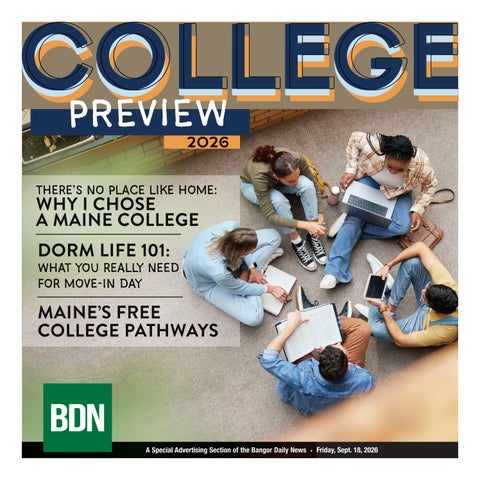
2026 THERE’S NO PLACE LIKE HOME:
WHY I CHOSE A MAINE COLLEGE DORM LIFE 101:
WHAT YOU REALLY NEED FOR MOVE-IN DAY
MAINE’S FREE COLLEGE PATHWAYS
A Special Advertising Section of the Bangor Daily News • Friday, Sept. 18, 2026
2
COLLEGE PREVIEW • Bangor Daily News Special Advertising Section • September 18, 2026
Why I Chose a
MAINE COLLEGE BY JACK MORRISON
A
FEW MONTHS AGO, I decided to attend the University of New England. It wasn’t an easy decision. In fact, it was difficult and came down to the wire. Before choosing UNE, I was seriously considering St. Michael’s College in Vermont, about six hours from home. There was just one problem: when I toured the campus with my parents, it didn’t feel like home. When I stepped back and tried to figure out why, the answer became clear. Maine is the only place I have ever called home. I can already imagine some readers diagnosing my problem: “This kid just needs to get out of his comfort zone and see the world.” I understand why it might sound like I’m afraid to leave, but I’m actually no stranger to traveling. I’ve been fortunate to grow up in an adventurous family. In 18 years, I’ve visited nearly half of the United States and several other countries. Still, there’s something about the Maine air that always draws me back.
Over the summer, I spent some time trying to understand why I’m such a homebody. Part of the answer came while I was attending a leadership symposium in July. A fellow participant said something that struck a chord. “I think a lot of people take living in Maine for granted,” they said. “So many people come here to vacation, but we get to live here.” Bingo. There’s a reason “Vacationland” appears on Maine license plates. It’s easy to forget just how beautiful the state is. Summer feels idyllic, and while the winters are long and cold, I’ve always seen them as a kind of winter wonderland. That’s the beauty I saw at UNE, and it’s what set the school apart from the others I considered. For those unfamiliar with the Biddeford campus, it sits on a bay about 10 miles from Old Orchard Beach. The campus includes beaches, scenic trails, and a 363-acre forest. It is also a center for innovation in medicine, health sciences, and research. I knew I wouldn’t find that exact combination anywhere else. Now, trust me, I realize this is a lot of confidence from someone who hasn’t attended his first college class yet. Like everyone else, I have concerns about the transition. I know there will be an adjustment period. The difference is that there’s nowhere else I’d rather make that adjustment because the people I love aren’t too far away. Recently, I traveled to the Big Apple—and not the gas station. New York City was a completely new experience for me. For a place many consider the greatest city in the world, I found myself a little disappointed. The crowds were overwhelming, and there were simply too many people to take in. Almost from the moment I arrived, I found myself longing for that fresh Maine air. When I finally returned home, even the people felt like a breath of fresh air. Dorothy says it best in The Wizard of Oz: “There’s no place like home.”
COLLEGE PREVIEW • Bangor Daily News Special Advertising Section • September 18, 2026
FREE COLLEGE AND HANDS-ON TRAINING: What Maine’s Community Colleges Offer
R
BY JOSHUA ARCHER
ECENT MAINE HIGH SCHOOL GRADUATES can attend any of the state’s seven community colleges tuition-free, thanks to the Maine Free College Scholarship. But what exactly does the program cover, and what opportunities await students beyond the classroom? Recent legislation made the Maine Free College Scholarship permanent for the class of 2026 and beyond. The scholarship covers 100% of tuition, though housing and other expenses are not included. To qualify, students must have a high school diploma or equivalent, enroll within two years of graduating, pursue an associate degree or one-year credential, and be Maine residents who live in the state while enrolled. According to the Maine Community College System (MCCS), the scholarship is a last-dollar program, meaning federal and state grant aid is applied first. The scholarship then covers any remaining eligible tuition and fees. If saving money isn’t enough of an incentive to enroll in a Maine community college, the opportunity to begin hands-on training from day one might appeal to students eager to begin their careers. While the state’s community colleges share similar programs of study, each of the seven campuses also offers unique career paths and learning opportunities. Students in forensic science and public safety programs at Central Maine Community College (CMCC) in Auburn have access to a 4,500-square-foot public service simulation center. “Students learn by doing, not simply by sitting in a traditional classroom,” said Andrew Morong, dean of enrollment management at CMCC. Training emphasizes the full range of skills required for public service careers, including administrative responsibilities, tactical patrol operations, crime scene processing, interpersonal communication, problem-solving, physical fitness, and professional decision-making, according to Morong. “These hands-on experiences allow students to make mistakes, receive immediate feedback, and build confidence in a controlled learning environment before encountering similar situations in the field,” Morong said. Fire science students at Eastern Maine Community College (EMCC) in Bangor can take their training a step further: They actually get to live in a real firehouse. “On campus, you learn a skill. In a station, you might use it that night. The classroom builds the foundation. The station is
where it holds up under pressure,” said Michael Hambrock, EMCC’s public relations director. Kennebec Valley Community College (KVCC) in Fairfield is home to Maine’s only electrical lineworker technology program, where students train to support the state’s power grid. Up in The County, Northern Maine Community College (NMCC) in Presque Isle offers the only postsecondary automotive collision repair program in northern New England. Southern Maine Community College (SMCC) in South Portland is home to Maine’s NMCC’S AUTOMOTIVE only postsecondary culinary COLLISION REPAIR PROGRAM. program certified by the American Culinary Federation. Public student-run luncheons at the campus’ Culinary Arts Dining Center offer students hands-on experience while overlooking Casco Bay. For prospective students who are mechanically inclined and want to live near the coast, Washington County Community College (WCCC) offers Maine’s only powersports equipment and small engine technician program. Students who want to serve Maine’s pet population can find the state’s only accredited veterinary assistant certificate program at York County Community College (YCCC) in Wells. Maine’s community colleges offer on-campus housing to support students. Support services for students include tutoring, counseling, professional clothing for job interviews, and emergency funds for students in need. These resources are designed to help students worry less about immediate challenges and stay focused on their education. “As soon as we hear about a student’s need, we try to address it. Our top mission is to serve our students,” said Noel Gallagher, MCCS director of public affairs. “The measure of our success is the success of our students.” The Maine Community College System is a public institution created by the state to train Maine’s workforce. With free tuition, hands-on career training and a wide range of student support services, the state’s seven community colleges offer Maine students an opportunity to build a career without leaving home.
FOR MORE INFORMATION, VISIT MCCS.EDU.
3
4
COLLEGE PREVIEW • Bangor Daily News Special Advertising Section • September 18, 2026
DORM LIFE 101: What You Really Need for Move-In Day
B
BY EMILY BAER
ETWEEN SUMMER AND FALL LIES A SEASON ALL ITS OWN: back-toschool season. For students heading to college—especially for the first time— it can be one of life’s most exciting transitions. Beyond making new friends, taking interesting classes, and exploring life beyond home, there’s also the thrill of having a space to call your own, even if that space is a dorm room. In 2024, the National Retail Federation estimated that U.S. consumers would spend $12.2 billion on dorm and apartment furnishings. Major retailers such as Target, Walmart, and Amazon dominate much of the market, but an entire industry also caters specifically to college students and their families. It’s big business for a reason. Moving into your first dorm room is a major milestone. In the midst of so much change, creating a comfortable, welcoming space can help ease the transition. Deidra Davis, associate vice president of enrollment management at Maine Maritime Academy, has worked in student affairs for more than 30 years. She has helped thousands of students settle into campus life and understands the pressure many feel to create the “Pinterest-perfect” dorm room. Still, Davis says college is ultimately about personal growth, expanding your horizons, and meeting new people. One way to do that is by bringing your hobbies and interests with you. “Don’t stop doing the things you enjoy just because you’re at college,” she says. “It’s a great way to introduce yourself.” Beyond the packing list, Davis’ best advice is to establish boundaries and expectations with your roommate from the start. “Discuss sleep schedules, guests, noise, borrowing things, and cleaning,” she says. If problems arise, address them early. “Don’t let it fester.” Davis also recommends taking a wait-and-see approach if you’re unsure whether to pack something.
“With the ease of Amazon delivery, you can order what you need after actually being in your room and seeing what the space can handle,” she says. If you find yourself without something you need—or unable to afford it—check with your residence hall staff. Most colleges offer resources for students who need assistance, and there’s no shame in asking for help. One of the greatest benefits of campus living is being part of a community that wants to see you succeed. Most importantly, remember that your dorm room doesn’t have to be perfect. A comfortable place to sleep, study, and relax is enough. The one thing you can’t afford to leave behind, Davis says, is an open mind. THE ESSENTIALS: Whether your dorm style is carefully curated or strictly practical, there are a few essentials every student needs. Your college will provide a detailed packing list, and it’s wise to follow it closely. After all, they know the space better than anyone. BATHROOM AND PERSONAL CARE: Taking care of yourself is an important part of college life, so make sure you have the essentials. Pack your toiletries into a shower caddy or organizer before move-in day to see exactly what you have and what you still need. If you have room, a comfortable robe can make shared bathroom trips much easier. STAY ORGANIZED: Dorm rooms are often small, and staying organized can help reduce stress. Under-bed storage bins, over-the-door hooks, desk organizers, and a small handheld vacuum can make a big difference. Disinfecting wipes and paper towels are also useful to keep on hand. KNOW THE RULES: Residence halls often have specific policies regarding microwaves, coffee makers, refrigerators, air fryers, extension cords, and candles. Be sure to review your school’s housing guidelines before you pack. In many cases, a reusable water bottle, travel mug, and a few favorite snacks may be all you need.
COLLEGE PREVIEW • Bangor Daily News Special Advertising Section • September 18, 2026
THOMAS COLLEGE: DOING SUCCESS DIFFERENTLY
F
COURTESY OF THOMAS COLLEGE
OR NEW LIMERICK NATIVE MACY CRAM, THIS SUMMER BROUGHT AN OPPORTUNITY SHE NEVER EXPECTED.
Cram, a psychology and biology student at Thomas College, was one of only 11 students nationwide to be selected for the University of Florida Health Cancer Center’s STRONGER program, an immersive 12-week summer internship. “I honestly did not think I would get into such an advanced program. I am very grateful to have been afforded this opportunity and for those who helped me get here,” said Cram, who spent the summer conducting cancer research under the mentorship of Samantha Ali Ghandour, a PhD student in Pharmaceutical Sciences. Cram credits Thomas College faculty, including Dr. Allison Moloney and Dr. Julia Saloni, for encouraging her to apply and supporting her throughout the process. Cram hopes to combine her interests in biology and psychology in a field like neuropsychology after she graduates in spring 2027. Cram’s experience reflects a broader approach to student success at Thomas College. Through its Guaranteed Job Program™ and career-focused academic programming, the college emphasizes connecting education with career outcomes. Thomas College reports a 99 percent job placement rate, and while the national average for internship participation is approximately 40 percent, about 80 percent of Thomas students take part in internships. The college integrates career preparation throughout the student experience. Beginning in their first year, students connect classroom learning with internships, hands-on experiences, and opportunities to develop practical skills that align with employer needs. Other students like digital media student Bismark Akoto gained hands-on experience this summer through his Bangor Savings Bank internship, and while taking photos
at games and practices FIFA World Cup Fan Festival 2026™ on weekends, gaining professional connections from around the world. Historically, 73 percent of Thomas graduates remain in Maine to live and work after graduation, fueling the state’s workforce and economy. Like 2017 graduate Reilly Kons. As Executive Director of the Brunswick Downtown Association, Kons leads initiatives that strengthen his community while continuing to do meaningful work that excites and inspires him. As a student, Kons felt supported by the Professional and Career Development staff to find his path. With their support, Kons completed three internships while at Thomas, each helping him build real-world experience and professional confidence. “At Thomas, I learned how to experiment, adapt, and turn experiences into opportunities,” he says. “That spirit of exploration has become a defining pattern throughout my career so far.” Some Thomas College graduates receive job offers before they even graduate. For students in Thomas College’s new education residency program, the Thomas Teaching Cooperative, Thomas students are filling k-12 classroom vacancies in the state while completing their studies. Education students spend the final two years of their degree working in paid full-time positions in Maine schools, which provides them with extensive classroom experience and faculty mentorship while helping strengthen Maine’s teacher pipeline. “Our focus on career preparation, experiential learning, and the Guaranteed Job Program™ ensures students have opportunities to gain real-world experience and develop the skills employers are seeking, helping them transition successfully from college to career,” said Thomas College Provost Jeremy Qualls.
5
6
COLLEGE PREVIEW • Bangor Daily News Special Advertising Section • September 18, 2026
START SMART
At a Maine Community College
COURTESY OF MAINE COMMUNITY COLLEGE SYSTEM
A
NYONE LOOKING TO LEARN BY DOING IN A HIGH-QUALITY, LOW-COST COLLEGE PROGRAM CAN’T GO WRONG AT MAINE’S COMMUNITY COLLEGES.
“We’re here to help Mainers get good jobs,” Maine Community College System (MCCS) President David Daigler said. “Maine’s community colleges offer an incredible array of hands-on programs with plenty of student support so graduates can step confidently into good jobs and growing careers right here in Maine.” The seven colleges offer more than 300 degree and certificate options, 200 no-cost short-term workforce programs, and work with more than 2,000 Maine employers to identify which skills matter most in today’s job market. Most Maine community college students are enrolled in either healthcare programs (including nursing, medical assisting, and emergency medical services, among others) or industrial technology programs (including plumbing and heating, electrical, construction, automotive technology, and precision machining.) About 80% of all community college students are enrolled in technical degree programs. The community colleges also offer many programs that are a smart start to pursuing a four-year degree, thanks to seamless guaranteed transfer and block transfer agreements with the University of Maine System. Of course, choosing the right college is all about finding the right fit. Outside the classroom, Maine community college students enjoy vibrant campus communities with endless opportunities to connect with fellow students. Smaller class sizes mean students get to know their instructors and fellow students, and the colleges offer plenty of academic and advising resources to help students succeed in reaching their goals.
For people looking for a faster route to starting work, the colleges offer short-term workforce training programs that take just weeks or months to complete and are offered at no cost to the student. Some programs offer weekly stipends, housing, or guaranteed interviews with companies that are hiring. These programs prepare students for entry-level jobs in the trades, healthcare, hospitality – or logging, small engine repair, emergency medical technicians, and CDL licensing. These stackable programs get you to a great job fast and under budget, and set you up to keep learning to grow in your career. Annual tuition and fees for a full-time in-state student pursuing a degree or certificate is just $4,156, and recent Maine high school graduates pay zero tuition (worth $2,880) under the Maine Free College Scholarship. No matter which path you choose, or what onramp or offramp you find yourself, students have a wide range of promising options at Maine’s community colleges. Learn more at MCCS.me.edu or the colleges’ websites or follow them on social media. Maine’s community colleges provide high-quality, relevant, hands-on learning at a fraction of the typical college cost. Build your future here, choosing from a diverse mix of programs offered through short-term training in under a year, one-year certificates, two-year associate degrees, and advanced certificates.
COLLEGE PREVIEW • Bangor Daily News Special Advertising Section • September 18, 2026
7
8
COLLEGE PREVIEW • Bangor Daily News Special Advertising Section • September 18, 2026
THREE BANGOR PROGRAMS, THREE CAREERS MAINE NEEDS.
M
COURTESY OF UNIVERSITY OF MAINE AT AUGUSTA
AINE’S ONLY PUBLIC DENTAL HYGIENE PROGRAM, only
bachelor’s degree in veterinary technology, and only accredited dental assisting program are all located at the University of Maine at Augusta’s Bangor campus. Each prepares students for licensure or national certification and careers in fields where Maine needs more trained professionals. Two of UMA Bangor’s signature programs prepare students for careers in oral health. UMA offers Maine’s only public Dental Hygiene program and its only accredited Dental Assisting program, which is also available at the Lewiston Center. Both give students hands-on experience in clinical and community settings while preparing them for licensure or national certification. Dental Hygiene students provide low-cost dental services to members of the community and gain additional experience through internships. The program reports excellent board exam pass rates, and 98% of its graduates stay in Maine to practice. Dental Assisting recently earned the highest accreditation status from the Commission on Dental Accreditation, affirming the program’s quality and rigor. Students complete externships in community dental practices and are prepared to sit for the national Certified Dental Assistant exam. They can earn a certificate in three semesters and continue for two additional semesters to complete an associate degree.
UMA’s Veterinary Technology graduates also see exceptional placement, with every 2025 graduate either working in the field or continuing their education. Students develop their skills in facilities that include a surgical suite and digital radiology, then complete two seven-week externships in settings such as research labs, wildlife rescues or largeanimal practices. Students can begin with an associate degree that leads to licensure and continue into the bachelor’s program to prepare for opportunities in veterinary practice management, research or further study, including veterinary school. Together, the Bangor dental clinic and Veterinary Technology program provide care to community members, shelters and rescues. UMA students learn by doing work Maine needs done. These programs are also part of something larger. Bangor is one of UMA’s two campuses, connecting students to more than 60 degrees and certificates offered through the Bangor and Augusta campuses, online and at UMA centers across the state. Students can explore programs ranging from nursing and aviation to business, cybersecurity, education and the arts, while choosing from in-person, online, hybrid and other flexible learning options. For Bangor-area students, that means the personal support and hands-on opportunities of a local campus, with the programs, resources and pathways of the full university behind them.. Tuition is the lowest of any public university in Maine, and first-time, full-time students who qualify for the Pine Tree State Pledge may be eligible for zero tuition.
IT’S EVEN FREE TO APPLY. VISIT UMA.EDU/HANDSON TO LEARN MORE.