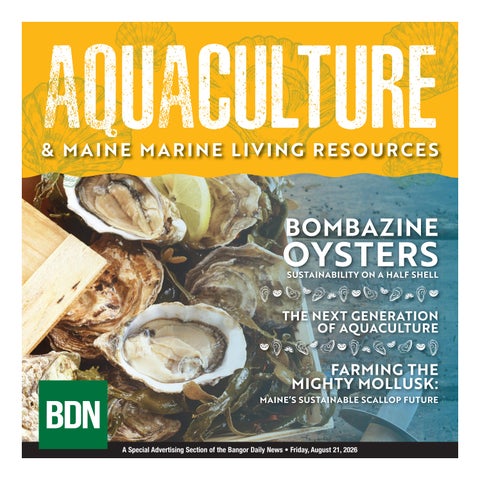
AQUACULTURE
& MAINE MARINE LIVING RESOURCES
BOMBAZINE
OYSTERS
SUSTAINABILITY ON A HALF SHELL
THE NEXT GENERATION OF AQUACULTURE
FARMING THE MIGHTY MOLLUSK:
MAINE’S SUSTAINABLE SCALLOP FUTURE
A Special Advertising Section of the Bangor Daily News • Friday, August 21, 2026
2 AQUACULTURE • Bangor Daily News Special Advertising Section • Friday, August 21, 2026
BOMBAZINE OYSTERS: Sustainability on the Half Shell
BY JULIA BAYLY
W
hile hiking or driving alongside the New Meadows River in Brunswick, you might miss the active farming operation just beneath the tidal waters at the end of Casco Bay. But if you look closely, you will spot yellow corner buoys just offshore, tucked between Bombazine and Lower Coombs islands. Those buoys mark and hold in place lines of oyster cages containing thousands of fresh oysters destined for dinner plates, picnics, and seafood boils around Maine. Welcome to Bombazine Oysters, home to some of the state’s tastiest oysters and sustainable aquaculture practices. The company’s roots go back to co-owner Max Burtis’ childhood, when his high school football coach introduced him to oysters. By his senior year, Burtis and two friends were active in student shellfish farming. “We thought, ‘You know what? This oyster farming thing is a good idea,’” Burtis recalled. “We didn’t know where the clams were going, and we liked working on the water.” An oyster farm, they figured, would allow them to stay on the water with the added security of a reliable farmed product. “My dad fished for oysters on Chesapeake Bay when he was 18,” Burtis said. “We were 18 at the time, so we roped him into our hobby farm here.” After graduating from high school, Burtis attended the University of Maine, where he earned a degree in mechanical engineering. His former oyster farm partners went in different directions, leaving Burtis and his father, Chris Burtis, with the farm. “It’s what I’ve been doing with my dad since 2022,” he said.
While the younger Burtis still actively harvests clams, he said running an oyster farm is less backbreaking and more mentally stimulating than digging for clams. Farming also gives him a great deal of control over his mollusk crop. “When you ‘hunt’ shellfish in the wild, every day is a harvest, and you count on Mother Nature to do the husbandry and grow the shellfish,” Max Burtis said. “With farming, you actually control the organism throughout its different life phases.” The process starts with purchasing tiny oyster larvae, which Burtis proudly refers to as “his babies,” and then spending the next several years raising them to adulthood in specialized containers protected from predators. Each cage holds six bags. “When it comes time to harvest farmed oysters, it is so much easier,” he said. “You know exactly where they are, separate from the smaller ones.” The father-and-son team spends a great deal of time tending the oysters, but Max Burtis said there is no chance either of them will become emotionally attached to their shellfish charges. “They are more like rocks to me,” he said with a laugh. “Oysters don’t have much going for them in terms of personality, and there is no central nervous system, so they are really just a shell with some meat inside.” In fact, oysters are so devoid of animation that Max Burtis said he even knows vegans who enjoy eating them. A key tenet at Bombazine Oysters is sustainability. “I define sustainability as the ability to do something continually for generations,” Burtis said. “The Gulf of Maine is a good place for that.”
The Bombazine Oysters processing facility is powered by solar energy. That means workers are not hauling around gasoline or diesel fuel that could leak or spill into the coastal ecosystem. For their part, the oysters help the environment by sequestering carbon in their shells. “We are able to provide local jobs with a living wage,” Burtis said. “So we are able to contribute to the economic sustainability of this working waterfront area.” That working waterfront culture is near and dear to Max Burtis’ heart. “It’s a lifestyle where you work on the water, waking up with the sun, working all day, and bringing in a harvest that makes people happy,” he said. “People feel good about the work, and it helps provide a sense of place and a sense of community in this area.” Visitors can learn about this way of life by taking part in a farm tour that lasts about 90 minutes. During the tour, they take a boat to Bombazine Island, learn about the farming process, sample oysters fresh from the water, and even learn how to open — or “shuck” — oysters. The Burtises are more than happy to share their products with guests and visitors. “Maine oysters are the best,” Burtis said. “There are so many varieties with so many different flavors.” Oysters can be fried, sautéed, grilled, baked, roasted, broiled, or steamed. But as far as Max Burtis is concerned, the best preparation is no preparation. “I like them raw on the half shell with a little squeeze of lemon,” he said. “I really want to taste the oyster.”
AQUACULTURE • Bangor Daily News Special Advertising Section • Friday, August 21, 2026
BUSINESS SUPPORT PROGRAMMING AT THE MAINE AQUACULTURE INNOVATION CENTER
3
COURTESY OF MAINE AQUACULTURE INNOVATION CENTER
W
hether you’re just thinking about starting your own aquaculture operation or if you’re an established business, the Maine Aquaculture Innovation Center (MAIC) has a suite of business support programs and tools to assist you. MAIC also works closely with Maine’s broader business support ecosystem to link aquaculturists to resources across the state. We encourage you to reach out and connect with us!
BUSINESS INCUBATORS MAIC co-manages incubation spaces with the University of Maine at two coastal locations: the Darling Marine Center in Walpole, ME and the Center for Cooperative Aquaculture Research in Franklin, ME. Working primarily with startup firms seeking land-based pilotscale research and culture facilities, the business incubators provide tank space with flowing and recirculating fresh- and salt-water culture systems to test new culture methods or products. The incubators also provide office space, direct access to University researchers and student interns, business counselors, and access to workshops and entrepreneurship training programs. Additionally, MAIC works with other organizations to connect businesses to other wet labs and specialized infrastructure across Maine.
FUNDING OPPORTUNITIES MAIC supports new and existing aquaculture farms by providing opportunities for social, economic, and technological innovation in aquaculture spaces. MAIC has created funding opportunities for Maine aquaculture farmers to connect with farmers around the world and with members of their local communities, helping to inspire innovations across a wide range of practices and applications. The Business & Economic Research Program delivers customized market research to identify new target markets and
support the development of new marketing strategies, helping aquaculture businesses expand access to local and regional markets. Community Engagement Grants are grants intended to provide financial support to farmers who are hosting community engagement events to build social license for their farms. The Farmer to Farmer Exchange Program provides funding for farmers to undertake technology and knowledge transfer by visiting other aquaculture operations elsewhere in the US or internationally. Lastly, Business Development Grants are intended to build upon the Business & Economic Research Program and the Farmer to Farmer Exchange Program by providing funding for businesses to further explore market research, the transfer and/or adoption of new technologies or practices into their business, or to trial innovative gear types or emerging aquaculture species.
INNOVATION NAVIGATOR MAIC is collating the business support resources that exist for aquaculture businesses in Maine to help startups navigate Maine’s business innovation landscape. Whether you’re looking for physical space to prototype, grant opportunities, technical expertise, or business planning, use this tool to start your planning!
SEA FARMER LENDING LIBRARY MAIC’s sea farmer lending library enables aquaculturists to borrow scientific monitoring equipment to better understand environmental conditions on their farms. MAIC staff will help you identify the most appropriate piece of equipment based on your objectives and equipment availability and will work with you to deploy the equipment. Monitoring data collected during the deployment will be available to the user and MAIC.
Visit our website at https://maineaquaculture.org/business-support/ to learn more or reach out to Sydney Avena, Applied Research & Industry Partnerships Manager, at savena@maineaquaculture.org.
4 AQUACULTURE • Bangor Daily News Special Advertising Section • Friday, August 21, 2026
THE Next Generation
OF AQUACULTURE
BY WANDA CURTIS
T
he Gulf of Maine Research Institute has trained 14 new employees for Maine’s aquaculture industry since 2018. The employees completed the GMRI Aquaculture Apprenticeship Program and are now employed by aquaculture businesses across Maine in shellfish and seaweed operations, according to Aquaculture Program Manager Carissa Maurin. Two more cohorts are currently enrolled in the program, she said. “Aquaculture is one of Maine’s fastest-growing food production sectors and plays an important role in supporting working waterfronts, coastal communities, and the state’s blue economy,” Maurin said. “As the industry grows, employers need a skilled workforce to meet increasing demand.”
BUILDING A STRONG, SKILLED WORKFORCE
The goal of the apprenticeship program, Maurin said, is to build a strong, skilled workforce that supports the continued growth of Maine’s aquaculture industry. She said GMRI wants to increase awareness of aquaculture careers among students, people changing careers, veterans, and individuals from communities that historically have had limited access to these opportunities. GMRI also wants to make aquaculture careers more accessible by creating clear pathways into the industry and assisting employers with recruiting, training, and retaining employees, she said. The apprenticeship program is one clear pathway into the aquaculture industry. “The Maine Aquaculture Apprenticeship Program is a Department of Labor-registered apprenticeship that provides paid, on-the-job training combined with classroom instruction for individuals interested in careers in Maine’s aquaculture industry,” Maurin said. “The program is designed to help apprentices develop the technical knowledge, practical skills, and professional competencies needed to succeed while earning a paycheck.” According to Maurin, apprentices must complete 2,000 hours of paid, onthe-job training and 144 hours of related technical instruction, or RTI. The instruction combines classroom learning with hands-on field experiences to reinforce skills learned on the job. She said the 144 hours of RTI provide the scientific knowledge and technical foundation behind the work apprentices perform on the farm. “The RTI includes an intensive aquaculture boot camp covering topics such as aquaculture in Maine, first aid and CPR, water quality, regulations, biosecurity, record-keeping, vessel safety, and basic nautical skills,” Maurin said. “Apprentices also participate in shellfish and seaweed aquaculture courses that explore species biology, hatchery production, husbandry practices, equipment, harvesting, processing, and emerging research and technology.”
(Left) An aquaculture apprentice examines bivalves as part of hands-on training through the
(Right) Aquaculture apprentices
Gulf of Maine Research Institute’s
participate in hands-on training
Aquaculture Apprenticeship
aboard a boat through the
Program.
Gulf of Maine Research Institute’s Aquaculture Apprenticeship Program.
ENTRY REQUIREMENTS
According to the Maine Aquaculture Association, applicants for the apprenticeship program must meet the following requirements. See maineaqua.org for more information. • Must be at least 18 years old • Must have a high school diploma or the equivalent • Must be able to lift 50 pounds and be comfortable working on boats and floating structures • Must have a strong work ethic, mechanical aptitude, and problem-solving ability • Must be physically capable of performing the essential functions of the apprenticeship program, with or without reasonable accommodations, and without posing a threat to their own health and safety or that of others For information about applying for the apprenticeship program, see the Maine Aquaculture Apprenticeship Program page on the Maine Aquaculture Association website.
AN INVESTMENT IN MAINE’S FUTURE
“The apprenticeship program is more than workforce training; it is an investment in Maine’s future,” Maurin said. “By bringing together employers, educators, and workforce partners, we’re helping create sustainable career pathways while ensuring that Maine’s aquaculture industry has the skilled workforce it needs to continue growing responsibly.”
AQUACULTURE • Bangor Daily News Special Advertising Section • Friday, August 21, 2026
5
SHELL-EBRATE BIVALVE AQUACULTURE!
I
COURTESY OF MAINE AQUACULTURE INNOVATION CENTER
magine a tank filled with 50 gallons of seawater– the same volume as 50 jugs of milk. That is the amount of water a single Eastern oyster can filter in one day. Just consider how much water a whole reef– or farm– of oysters could process during that time! It is these amazing creatures, along with Maine’s other farmed bivalves, blue mussels, sea scallops, and soft-shell clams, that take center stage in the Maine Aquaculture Innovation Center’s (MAIC) new K-12 bivalve curriculum. Bivalve farming, also referred to as shellfish aquaculture, presents a significant opportunity for Maine’s coastal communities. In a recent report published by the Maine Aquaculture Association, shellfish aquaculture contributed over 1,000 jobs and $85.5 million to the Maine economy (Maine Aquaculture Economic Contribution Report). Maine’s shellfish aquaculture industry provides many ecological benefits to the Maine coast while also creating working waterfront jobs. By introducing aquaculture concepts to students early and often in their education, we provide our youth with the opportunities, tools, and pathways they need to launch into a career in aquaculture in their home state. MAIC is working with partner organizations to bring ocean farming into the classroom through hands-on, aquaculture-centered curricula. Most recently, the MAIC Education Team (which includes two Maine classroom educators) has created a Bivalve Curriculum for 6-12th grade students that can also be easily adapted to lower grade levels. This curriculum covers everything from basic bivalve biology to the economics of running a bivalve farm in Maine. Each lesson includes place-based, hands-on activities and is designed to be affordable, easy to understand for teachers, and accessible right off the website with minimal additional prep. To help launch this new curriculum, MAIC hosted two teacher “summer camps” in July to introduce the activities to classroom educators in a hands-on setting. 24 teachers came together at the Darling Marine Center on the Damariscotta River to discover the
anatomy of bivalves, experiment with building their own models of farm equipment, and try oysters. Later, 12 more teachers gathered at the Downeast Institute on Beals Island to tour a bivalve processing facility, visit an oyster farm, and discover a shellfish hatchery. By bringing professional development experiences to Maine teachers, MAIC is supporting classroom engagement with our communities, environment, and the future of our state. Teachers left the experiences glowing, saying “many connections were made and passion ignited” and that they can’t wait “to share the importance of bivalves in our ecosystem” with their students. This school year, MAIC is excited to continue our education work with a focus on “living water” and the science behind creating healthy aquatic environments to grow healthy food. We continue to encourage teachers to get involved with our aquaculture programming by reaching out to learn@maineaquaculture.org and keeping an eye out for our annual educators’ workshop and other events. This work is supported by a grant from the US Department of Agriculture. For more information about MAIC’s education work, visit learn.maineaquaculture.org or reach out to us directly at learn@maineaquaculture.org.
6 AQUACULTURE • Bangor Daily News Special Advertising Section • Friday, August 21, 2026
Feeding the Future HOW MAINE IS SHAPING THE NEXT GENERATION OF SUSTAINABLE AQUACULTURE A
BY ANDREW BRADLEY, PE | COURTESY OF SMRT ARCHITECTS & ENGINEERS
s the global demand for sustainable, high-protein food sources accelerates, the conversation around how we harvest our oceans is undergoing a massive transformation. For generations, Maine has looked to the Gulf of Maine as a boundless provider of seafood. Today, a new frontier is emerging along our coastlines and inland communities, one that marries marine biology with advanced engineering. Land-based and high-performance aquaculture is a critical pillar of modern food security, economic resilience, and environmental stewardship. For a state with a proud maritime heritage, Maine is uniquely positioned to lead this movement. But realizing the true potential demands a sophisticated, crossdisciplinary approach to how we design the physical infrastructure that houses these delicate ecosystems.
UNDERSTANDING THE PROMISE OF AQUACULTURE
At its core, aquaculture is the farming of fish, shellfish, and aquatic plants in controlled environments. While traditional open-water pen farming remains vital, land-based aquaculture, particularly facilities utilizing Recirculating Aquaculture Systems (RAS) with sophisticated monitoring of systems and livestock, has changed the game. These systems filter and recycle up to 99% of the water used, dramatically reducing environmental impact, preventing the transfer of disease to or from wild populations, and bringing production closer to population centers. However, taking aquatic life out of the ocean and placing it inside an engineered building is an extraordinarily complex undertaking. The margin for error building a successful venture is razor-thin. Unlike a standard manufacturing plant or warehouse, an aquaculture facility must function as a living, breathing ecosystem where the biology of the fish dictates every architectural and engineering decision.
THE ARCHITECTURAL AND ENGINEERING CHALLENGE
Designing a high-performance aquaculture facility requires an intricate alignment of science and structure. Success depends on several critical layers: 1. The Bioplan as the North Star: Everything starts with the fish. A successful facility relies on a rigorous bioplan that dictates species selection, production goals, tank sizing, and waste collection. Every square foot of process space and every kilowatt of power must answer the specific biological needs of the livestock as they move from hatchery to harvest. 2. Battling the Indoor Elements: Indoor aquaculture creates a brutal internal climate. High humidity meeting cold temperatures above open-top tanks creates the risk of indoor “rain” and hidden condensation that can compromise building envelopes from the inside out. Designing these structures requires advanced hygrothermal modeling to ensure the building withstands the marine environment it houses. 3. Navigating Underground Infrastructure: Beneath a quiet exterior lies a dense maze of piping, water treatment systems, and mechanical supports. Furthermore, fish are extraordinarily sensitive to vibration and noise, meaning site selection and structural isolation are paramount to protecting growth rates and bottom lines. 4. Engineering for ROI: Because products like salmon are staples, design choices must respect the bottom line. Innovations like capturing heat from wastewater streams to condition building spaces turn sustainability into profitability.
5. Sustaining the Ecosystem and Supply Chain: Beyond structural and waterfiltration engineering, land-based systems unlock massive environmental benefits. They require significantly less feed than traditional open-pen operations and eliminate the need to broadcast medicines into the ocean that can harm non-target species. Siting these facilities close to major population centers results in drastically reduced shipping footprints and a much fresher product for consumers. Looking ahead, the industry is also investigating feeds that shifted away from ocean-based products toward insect-based alternatives, further shrinking environmental demands while tapping into sustainable alternative proteins.
MAINE AT THE CENTER OF THE AQUACULTURE REVOLUTION
Maine is rapidly becoming a national epicenter for this evolution, proving that environmental sustainability and economic development can go hand in hand. Across the state, here are some of the visionary projects we are a part of that are bringing this complex engineering to life: • Great Northern Salmon in Millinocket: Demonstrating the power of adaptive reuse, this project repurposes a former paper mill’s infrastructure, cleverly tapping into existing water rights, power systems, and a skilled local labor pool. It serves as a masterclass in navigating underground infrastructure while breathing new industrial life into a historic Maine community. • The University of Maine’s SAWIC Facility: Alongside commercial production, the workforce and research engine driving this sector is receiving a generational upgrade through the University of Maine’s Sustainable Aquaculture Workforce Innovation Center (SAWIC), which is on track to open this year. Designed to advance aquaculture talent, training, and applied research, SAWIC provides students, faculty, and industry partners with hands-on experience using systems that mirror high-production commercial facilities. As the designers behind cutting-edge aquaculture environments, projects like SAWIC and Great Northern Salmon require a unified strategy where biologists, process engineers, and architects sit at the same table from day one.
BUILDING A RESILIENT FUTURE
The protein race is well underway, and the choices we make today will define our food security for decades to come. By combining Maine’s unmatched marine expertise with world-class engineering, resilient facility design, and visionary academic training, our state is charting the course in the aquaculture revolution. When biology and intelligent design intersect, we create enduring assets that protect our environment, energize our local economies, and feed a hungry world. Andrew Bradley PE, Senior Principal, Senior Structural Engineer at SMRT Andrew Bradley, PE, is a Senior Principal and Senior Structural Engineer at SMRT Architects & Engineers, where he has spent more than 30 years leading complex, multidisciplinary projects. He has been part of the design team behind several of Maine’s most significant land-based aquaculture facilities, including the University of Maine’s Sustainable Aquaculture Workforce Innovation Center and Great Northern Salmon in Millinocket. SMRT Architects & Engineers SMRT Architects & Engineers is a Portland, Maine-based integrated architecture and engineering firm founded in 1884. With experience across land-based aquaculture, higher education, advanced manufacturing, and health and wellness, SMRT brings a unified design and engineering approach to complex, performance-driven facilities. Learn more at smrtinc.com.
AQUACULTURE • Bangor Daily News Special Advertising Section • Friday, August 21, 2026
D E S I G N F O R W H AT ’ S G R O W I N G
Architects & Engineers smrtinc.com
7
8 AQUACULTURE • Bangor Daily News Special Advertising Section • Friday, August 21, 2026
FARMING THE
Mighty Mollusk: MAINE’S SUSTAINABLE SCALLOP FUTURE BY JOANNA O’LEARY
C
onfession: As a food critic, what I usually think about when I think about scallops is whether I will receive three or four in an entrée course and how they’ll be dressed. Lemon beurre blanc is a favorite. Since relocating to Maine, however, my thoughts about scallops have focused more on production and sourcing. Our oceans are not a perennial all-you-can-eat buffet, and protecting this resource is increasingly important because of ecological threats, namely climate change. Maine is one of a handful of states prioritizing sustainable aquaculture, loosely defined as the controlled farming of aquatic plants, fish, and shellfish in a way that maintains or increases production while minimizing harmful effects on the environment and maximizing species viability. Thus far, most sustainable aquaculture ventures have focused on mussels, clams, and oysters. Many commercial lobster fisheries have also “come on board” with integrating sustainable practices into their businesses. The Maine Aquaculture Innovation Center, or MAIC, is helping the sustainable aquaculture movement expand to include another mighty mollusk: the scallop. MAIC’s Sea Scallop Hatchery Development project specifically aims to expand hatchery-level
knowledge through approaches such as public outreach, stakeholder engagement, and the establishment of industry best practices. Hatchery experimentation is also central to the project. Because the larval phase of the Atlantic sea scallop is relatively long — about 45 days — and cultivation is sensitive to environmental fluctuations, results at these hatcheries have so far been modest. For example, Mook Sea Farm saw an 88% increase in scallop larval development over five years, along with a nine-day reduction in the time required for the larvae to set. Such findings indicate the potential for the long-term economic viability of hatcheries. But significant regulatory, environmental, and social challenges to the long-term viability of such initiatives remain. “Maine’s leasing and permitting pipeline is incredibly rigorous, involving multiple state and federal agencies,” said Anne Langston Noll, MAIC’s executive director since 2024. “Streamlining this process while maintaining public trust rights, strict biosecurity, and environmental safety is a delicate balance. “Currently, it is taking more than two years for farmers to get through the lease process, and that is too long. We are working with our colleagues at the Department of Marine Resources to help navigate these challenges.” In addition to being stymied by red tape from Uncle Sam, sustainable scallop farming and similar aquaculture projects face obstacles from Mother Nature. These include changes in Gulf of Maine ocean chemistry, warming waters, and volatile storms, all of which pose physical risks to both equipment and crop cycles. Finally, there is the elusive but crucial matter of community support. “We know from research and our work with communities that Maine people love working waterfronts and local seafood, and that public perception of aquaculture is greatest once people meet our aquaculture farmers,” Noll said. “But despite that, navigating ‘social license,’ coupled with very active anti-aquaculture activists, remains a primary hurdle.” Noll remains hopeful, and for good reason. Institutions such as MAIC and other organizations are making significant advances in bringing sustainable aquaculture ventures into the mainstream and, perhaps even more importantly, getting Mainers excited about their products.
OCEAN FARMING TRAINING THROUGH AQUACULTURE IN SHARED WATERS
O
COURTESY OF MAINE AQUACULTURE INNOVATION CENTER
ver the past 13 years, more than 500 people have joined the Aquaculture in Shared Waters (AQSW) programs, a series of trainings across Maine focused on launching careers in ocean farming. These programs cover everything from the basic ‘what is aquaculture’ to business resources to help take your ocean farm to the next level. Needless to say, you don’t need to go far in Maine’s aquaculture community to find someone who has benefited from an AQSW training opportunity! So what makes AQSW stand out as a training program? First of all, it was started by a collaborative group of industry experts. The Maine Aquaculture Innovation Center (MAIC), the Maine Aquaculture Association (MAA), Maine Sea Grant, and Coastal Enterprises Inc. (CEI) came together in 2013 to identify the most important aspects of launching an aquaculture business in Maine and created a curriculum. With ongoing feedback from program participants and industry members, this curriculum has become the most robust introductory aquaculture training program in Maine: AQSW 1.0: Entry-Level Training! With growing interest in aquaculture and identification of ongoing industry training needs, the AQSW program has expanded to now offer five different training courses focused on a wide variety of topics. AQSW 1.0 continues to support entry-level farmers, while AQSW 2.0, AQSW Bootcamp, AQSW Strong Bodies/Strong Minds, and AQSW Workshops have been added. AQSW 2.0 is a special topics course designed for farmers with 1-10 years of experience looking to grow their business while AQSW Bootcamp is a good fit for farm hands coming on for a summer of fieldwork on an aquaculture farm. AQSW Strong Bodies/ Strong Minds is a cohort building training that centers on a strong and supportive community, and AQSW Workshops are one-off gatherings for former AQSW participants that cover emergent industry topics. We strive to make AQSW programs accessible to all Mainers interested in starting an aquaculture operation, meaning we make these trainings FREE and allow hybrid participation for AQSW 1.0 and 2.0. Regardless of where you are in the state or what your budget is for attending a professional training, AQSW is an opportunity for you to explore your aquaculture dreams, take your business to the next level, and network with others in the industry.
WE PLAN TO OFFER THE FOLLOWING AQUACULTURE TRAINING OPPORTUNITIES IN THE COMING YEAR: WORKSHOPS: • Damariscotta River Cruise aquaculture (in-person networking), August 28, 2026 • Business Succession Planning (online),September 24, 2026 • Lease Application Preparation (in-person), October 23, 2026 • Lease Hearing Preparation (in-person),November 13, 2026 AQSW 1.0: ENTRY- LEVEL TRAINING: • January-April, 2027 • 15 online classes • 5 in-person field days
AQSW 2.0: WATER QUALITY MONITORING: • February-April, 2027 • 6 online classes • 2 in-person field days AQSW BOOTCAMP: • May 2027 • 5 in-person field days
Photo courtesy of Jack Sullivan, Maine Aquaculture Association
For more information about AQSW programs and to sign up to receive program announcements, visit our website at www.aquacultureinsharedwaters.org or email learn@maineaquaculture.org. This work is supported by a grant from the US Department of Agriculture Beginning Farmers and Ranchers Development Program.
AQUACULTURE • Bangor Daily News Special Advertising Section • Friday, August 21, 2026
9
10 AQUACULTURE • Bangor Daily News Special Advertising Section • Friday, August 21, 2026
THE EXPERT DOWN THE ROAD T
COURTESY OF MAINE SEA GRANT
wo years ago, Neil Stanton, owner of Scruffy’s Cove Oyster Farm, noticed some odd black lines on his oysters’ shells. He didn’t know what they were, so he called Dana Morse, the guy who helped him get into oyster farming back in 2020. “I sent him a picture, asking, ‘What’s this?’” says Neil. “He said it was mud blisters.” Mud blisters, a type of shell-boring marine worm common in Maine, aren’t harmful to people, but they aren’t appetizing either. They also slow an oyster’s growth, since it must fend off the parasite, and weaken its shell. “It turns out that Dana is a real expert,” says Neil. Dana, a member of the Maine Sea Grant Marine Extension Team, has worked in aquaculture on the Maine coast since 1998 and has studied mud blisters, even publishing a paper on them. To assist Neil, Dana brought in marine scientist and geneticist Dr. Paul Rawson, a University of Maine Professor. The two visited Scruffy’s Cove, and a plan emerged. Paul recommended pulling Neil’s intertidal farm further up the shoreline to dry mud blister larvae in the sun. Dana suggested pulling the oysters from the water and refrigerating them for a few weeks to kill the worms. (Oysters enter dormancy and can live for months when cooled.) Dana and Paul weren’t sure the methods would work on his farm. They gave Neil their best research-backed guesses. “All I know is that I did those things, and I haven’t had mud blisters the last couple years,” says Neil. For the record though, he’s selling them more quickly than before. “People wanna buy them as soon as they’re big enough,” says Neil, giving the worms less time to set up shop. Whether it’s the science or the market keeping Neil’s oysters blister free, he never felt like he had to tackle the issue alone. “The oyster community is really super supportive in Maine,” says Neil. “Lots of people are hoping for your success.” In a sea of supportive voices, he came to rely on Mr. Morse the most. “ Everybody knows Dana,” says Neil. “He’s helped many, many, many farmers in Maine get going and maintain things over the years.” Along with nearly 30 years of experience in the oyster industry, Dana’s worked with scallops for two decades and is now looking into other profitable species like razor clams and urchins. As Neil puts it, “he’s an unbelievable resource for farmers in Maine.” As for Dana, well, he’s serious about his work. “We realize that people and communities depend on healthy natural resources for their jobs, their livelihoods, their identity and their culture. And really, we just wanna make all those things work to the extent that we can.” Dana is just one of Maine Sea Grant’s aquaculture research extension and community support experts. Their job is to help establish or improve your business, working with you to identify the hurdles standing in your way and how to overcome them. Maine Sea Grant provides similar support across a range of coastal and marine ecosystems and economies. We make marine science work for you.
AQUACULTURE • Bangor Daily News Special Advertising Section • Friday, August 21, 2026
OUR COASTAL FUTURE IS IN THE BALANCE.
AQUACULTURE PRESENTS OPPORTUNITY. COURTESY OF MAINE AQUACULTURE ASSOCIATION
M
aine stands at a crossroads, and the decisions we make today will determine what our coastal communities look like for the next generations. Working waterfronts have always been the iconic center of these communities. A changing ocean environment and dramatic demographic shifts are challenging those communities’ ability to maintain their maritime heritage. Coastal real estate prices lower than the states to our south and the ability to work remotely have dramatically accelerated the rate and depth of gentrification in these communities. Working waterfront families and property owners are being forced to make hard choices and are worried about their future. Municipalities are being caught in the middle of a clash of values between those that go down to the sea to make a living and those that want to view a pristine ocean with little human activity. That tension is not new to Maine, but it has begun to be a profit center for several professional “campaigners” seeking to decrease waterfront access, disappear marine industries from their clients’ viewsheds and turn Maine’s coast into a series of exclusive gated communities where only wealthy folks can afford to live. These groups are not just funded by local wealthy landowners but are attracting significant funding from out of state (and in two cases out of country) activist groups. Opposing working waterfronts—especially aquaculture—is becoming ‘big business’. Maine has had a long tradition of coexistence between wealthy summer residents and local working waterfront families. Part of the reason summer folks and tourists come to Maine is our iconic working waterfronts. That tradition is under threat by a few vocal well-funded hired opponents. The impact of these professional campaigners will be much broader than aquaculture and threatens the viability of Maine’s working waterfront traditions. Maine’s coastal communities and their working waterfront families have always found a way to adapt to change. Aquaculture is not a ‘silver bullet’ and will not replace existing working waterfront activities; it is just another way to make a living on the water. Fishermen on our coast are recognizing aquaculture as a tool for income diversification and a hedge against environmental change and regulatory uncertainty. Almost 200 commercial fishing license holders also hold aquaculture leases or licenses. Maine also has strict laws that protect the public trust and the environment. These laws give municipal residents an elevated voice in the review process which is complicated, thorough, and lengthy. Applicants often must wait two or three years before they know if they will get permission to start their farm. If Maine’s coastal communities aren’t going to turn into gated communities for the wealthy, the young people in those communities must find a way to make a yearround living. Maine aquaculture provides good jobs while growing healthy local food sustainably. Intentionally misleading local officials and using scare tactics to pit one working waterfront group against another is disingenuous and not helping Maine coastal communities find the solutions they need to face a rapidly changing world.
11
12 AQUACULTURE • Bangor Daily News Special Advertising Section • Friday, August 21, 2026
C
Gratitude FOR OUR SEA FARMERS COURTESY OF MAINE FARMED SEAFOOD COALITION
ultivating food for human consumption is among the most noble and important jobs in society. Harnessing the resources gifted to us by nature and turning them into delicious meals for our neighbors and visitors is a challenging task, and farmers—of both the land and sea—deserve our gratitude. Our pristine waters produce the most exquisite seafood on the planet. The flavors of our farmed oysters, mussels, and salmon are desired by the finest chefs in America and envied by seafood producers all over the world. Maine’s sea farmers are the ones who make it possible for us to be nourished by this local, sustainable, and delicious food. The Maine Farmed Seafood Coalition consists of over 50 businesses and industry support groups—including seafood farmers and dealers, banks, educational institutions, and nonprofits. Our goal is to tell the authentic stories of sea farmers and educate the public about the opportunities aquaculture presents for our economy, communities, and ecosystems. While our wild-caught fisheries continue to feed us and sustain our communities, there is limited economic growth in these heritage industries. Maine aquaculture has grown significantly over the last decade, producing more food and doubling the number of jobs it contributes to Maine’s economy. Aquaculture employs young Mainers from fishing families and attracts new Mainers who are starting their careers working on our waters. Our working waterfronts are more vulnerable than ever, facing pressure from gentrification and real estate development, and they are more secure when utilized by a variety of marine users. The sector is stronger as our farmed and wild fisheries work together.
Learn more at MAINEFARMEDSEAFOOD.ORG @MAINEFARMEDSEAFOOD MAINE FARMED SEAFOOD COALITION
Our communities are supported by aquaculture in profound ways. Sea farmers support families—putting meals on tables, directly supporting local goods and services companies, and helping kids through trade school or college. Oyster aquaculture has become inextricably connected to the Damariscotta River region, turning it into a major culinary tourism destination and fostering a community and culture of sea farming. Further up the coast, Washington County, a region with strong generational ties to the sea, has experienced a drain of young people seeking job opportunities elsewhere. As traditional fisheries face pressure from regulatory and environmental changes, salmon aquaculture is allowing more people to keep working on the water, and it has become one of the largest employers in Washington County, helping to preserve Downeast Maine’s marine heritage. This is all possible because of our relationship with our natural resources, the cold clean waters which our sea farms rely on. This dependence is not lost on our aquaculturists. Sea farmers are environmental stewards. Our shellfish actively clean our waters, sea farmers along the coast host regular coastal cleanups, and Maine’s high standards for ecological impact mean our salmon farmers are leading the world in the development of sustainable fish farming methods. Maine farmers are showing the rest of the world what sustainable food production can be. At the Maine Farmed Seafood Coalition, we are proud to represent the hard working aquaculturists who are driving innovation and preserving our marine heritage.