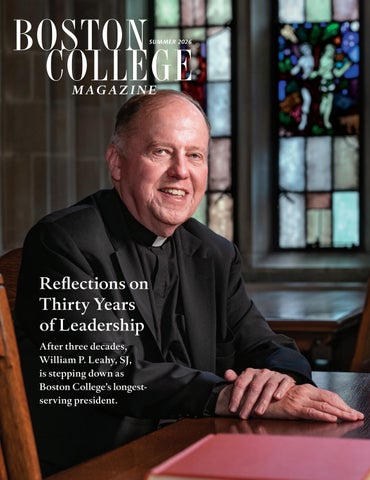
SUMMER 2026
Reflections on Thirty Years of Leadership After three decades, William P. Leahy, SJ, is stepping down as Boston College’s longestserving president.
Contents // Summer 2026
FEATURES
The art advisor Gabriela Palmieri ’97 photographed in her New York offices with Jean-Michel Basquiat’s Rusting Red Car in Kuau, 1984, and John Chamberlain’s Diettelephone, 2007. Art © 2026 Estate of Jean-Michel Basquiat, Licensed by Artestar, New York; © 2026 John Chamberlain/Artists Rights Society (ARS), New York Courtesy of Michael Altman Fine Art & Palmieri Fine Art, New York
22
32
38
Looking Back on Three Transformative Decades
It Came from the Lab of Dunwei Wang
The Woman to See
After successfully guiding the University for thirty years, Boston College President William P. Leahy, SJ, is stepping down on July 31. We explore how the Leahy presidency has transformed Boston College.
One of BC’s most prolific researchers was just named interim director of the Schiller Institute. He’s as committed as ever to making the world a better place by harnessing the power of chemistry.
By Jack Dunn
By Alix Hackett
How Gabriela Palmieri ’97, daughter of the Latin jazz legend Eddie Palmieri, bet on herself and became one of the art world’s most influential advisors. By John Wolfson Photography by Jai Lennard
Photography by Caitlin Cunningham
CV2
bc m v su m m e r 20 2 6
photo: Jai Lennard
10
13
17
LINDEN LANE 4
Meet the Leader of the World’s Largest Law Firm As CEO of Dentons, Kate Barton JD’87 oversees thousands of lawyers in nearly ninety countries.
6
Campus Digest
8
Reimagining Carney Hall The largest commitment in BC history will transform middle campus.
10 The Wild World of
CLASS NOTES 14 Up for Debate For generations, BC’s Fulton Debating Society has been winning the argument.
17 Driving Innovation The company PlusAI plans to roll out self-driving freight trucks next year. Earl Adams Jr. JD’02 is making sure it happens safely.
18 The Dropkick Murphys
James Ward ’96
Just Wrote a Song about Welles Crowther
From the Amazon to Australasia, Ward organizes safari adventures that help people explore wildlife around the planet.
Lead singer Ken Casey on taking the stage with the Screaming Eagles to salute the 9/11 hero, and his band’s love for BC.
12 Cooking for the Cameras How Krissy Downey ’17 became a Today show culinary star.
13 Megan Keller ’19 Scoring the gold medal–clinching goal at the 2026 Winter Olympics was a dream come true.
44 Alumni News and Notes 56 Weddings 64 Baby Eagles 67 Fond Farewells 70 Advancing Boston College
72 What I’ve Learned Sebastian Bonaiuto
73 Parting Shot
19 Introducing Councilor
Naren Briar ’20
After winning a seat on the Bellevue, Washington, City Council, she became the nation’s first Kurdish American to hold elected office.
20 Channeling Jane Austen In her debut novel, Kyleigh Leddy ’19 refreshes a nineteenth-century masterwork. Cover photograph by Gary Wayne Gilbert
photos: Courtesy of Rewild Safaris (Ward); Sarah Stier/Getty Images (Keller) photo illustration: Dana Smith
s u m m e r 20 26 v bc m
1
Conversation
footprint. While that may be true for some people, the way to get more people on board is to highlight the negative health impacts of the plastics and chemical dyes used to produce the clothes. Clearly showing how fast fashion puts your health in danger, while making it easy to find natural alternatives, is the most promising pathway to change. Andrew Ireland ’14 Washington, DC
Welcome to the Age of Fast Fashion
In our Winter 2026 cover story, BC researchers explained how the $150 billion fast-fashion industry, which rapidly produces incredibly cheap clothing, is having devastating consequences on the environment and our health. Thank you for the illuminating article. As a 1970 BC graduate, I am grateful and proud that BC is addressing this issue (with cover status) about which most people are probably only marginally aware. While without malice of intent, in many ways we have individually and collectively become slaves to convenience. However, it is dangerous when our vision is focused only on the short-term benefits of how we live but lacking in awareness of the longer-term consequences. I hope BC will continue to be an active and effective player in raising attention to this and similar issues. Paul H. Larkin ’70 Palm Coast, Florida Such an interesting perspective on how fast fashion, digital trends, and consumer behavior are all connected. It really shows how much the industry is evolving and the importance of being thoughtful about how we move forward. Ana Victoria Mellado New York, New York via LinkedIn Thanks for the comprehensive article on fast fashion’s many issues. I couldn’t help but notice that the solutions assumed that most people will change their behavior based on the desire to reduce their environmental 2
bcm v su m m e r 20 2 6
When Hollywood Came to the Heights
This article from our Winter 2026 issue told the story of how a number of scenes from the 1946 movie 13 Rue Madeleine, starring James Cagney, came to be filmed at BC’s O’Connell House.
I was most pleased to discover the article “When Hollywood Came to the Heights.” The mentioning of Father John Louis Bonn, SJ, teacher of drama, English, and the classics at Boston College, was likewise of great note and interest to me. Fr. Bonn was prominently mentioned in the 2012 Boston University College of Fine Arts convocation address delivered by Boston West End native Leonard Nimoy, who went on to achieve fame as Spock in Star Trek. In his remarks, Nimoy gave heartfelt thanks and praise to Fr. Bonn for providing to him, at the age of seventeen, a summer scholarship to the Boston College theater program, which Nimoy indicated forever changed his life. James Nelson ’65 Arlington, Massachusetts I loved reading “When Hollywood Came to the Heights” by my former professor John Michalczyk. He probably has forgotten, but I completed my senior thesis in 1991 covering twenty-five World War II films and their impact on the homefront. One of the films was 13 Rue Madeleine. In all my research, I
failed to uncover that the film was partially filmed at BC. I hope Professor Michalczyk will not lower my grade retroactively! Harry Patz Jr. ’91, P’28, ’30 Mount Vernon, New York Great to read the story of O’Connell House being featured in the movie 13 Rue Madeleine! Brought back memories of the time when I was at BC and O’Connell had the only TV on upper campus (where the dormitories were built). We “dormies” from away would gather there on Sunday afternoon to watch football. Dave Maloney ’66 Denver, Colorado John Michalczyk informs us that Sy Bartlett “came up with an idea for a movie” and worked with John Monks Jr. on a script that would become 13 Rue Madeleine. The real inspiration for that movie was the extraordinary true-life exploits of Pierre “Peter” Julien Ortiz. He joined the French Foreign Legion and served five years in North Africa, where he fought in Morocco, received several awards for bravery, and was offered a battlefield commission. He declined and instead went to Hollywood to be a technical advisor on war movies. Ortiz eventually had small roles in several famous movies, thanks to his friendship with the prominent director and fellow OSS veteran John Ford. John Berry ’81 Ponte Vedra, Florida
“
How great it was to open the Winter 2026 issue and see three articles featuring our Class of ’82 classmates! Cindi Bigelow, Frank Smyth and Paul A. Reynolds are outstanding examples of how professionalism and social consciousness can and should intersect.” John Feudo ’82 Hampton, New Hampshire
shows that those in the top 1 percent earned 20.6 percent of all income while paying 38.4 percent of all federal taxes. Stephen Cassiani ’67, MS’69 Houston, Texas
Icon of the Ice
Our Winter 2026 Parting Shot was a 1972 photo of Fred Ricci, a former BC Zamboni driver who was beloved by BC hockey fans for the eccentric costumes he wore while driving.
We Wrote a Book with Pope Francis
A Winter 2026 story chronicled how Paul A. Reynolds ’82 and his twin brother, the acclaimed illustrator Peter H. Reynolds, cocreated a new children’s book with the late Pope Francis. I’m so happy for Paul and his brother. I met both of them when I was doing some work with satellite-based distance learning. I didn’t know about our BC connection then. I have read the book and I think it really speaks to kids. Kathleen Buckley ’63, DEd’89 Boston, Massachusetts via Facebook
Four Things Smart People Don’t Know about America’s Tax Code (and How It’s Driving Inequality)
A Winter 2026 piece highlighted BC Law Professor Ray Madoff’s new book about how the ultrarich are gaming America’s tax system in their favor. Point number four said “philanthropy is a rich person’s game.” I feel that the author is discounting the tremendous benefit that many people, especially those less fortunate, get from the generosity of wealthy members of our community. Boston College itself has benefited from wealthy benefactors who attended BC and have given back to help those who can’t afford a BC education. Craig Tashjian ’79 Wellesley, Massachusetts
I was delighted to see the picture of Fred Ricci on the Zamboni in a recent issue of BC Magazine. Fred was my great-uncle! I always knew him as a talented trumpet player, so learning that he also worked at BC was a fun surprise. Thank you for sharing such a great piece of history!! Jill Frawley, P’28 Administrative Assistant, BC Alumni Relations
Keeping Journalism, and Journalists, Alive
The Winter 2026 issue profiled Frank Smyth ’82, an investigative journalist who teaches reporters survival skills for working in dangerous places. I am in awe of all that Frank has accomplished through his courage, humanity, and perseverance. He truly exemplifies the Jesuit mission of working for justice in service of others. Keep fighting the good fight, Frank! Joanne Guinan Seavy ’82 Ridgefield, Connecticut
Boston College Magazine welcomes letters from readers. Letters may be edited for length and clarity. Please include your full name and address. EMAIL: bcm@bc.edu MAIL: BCM, 140 Commonwealth Ave.
Chestnut Hill, MA 02467 Connect with @BostonCollege
This is another trip down the “wealthy don’t pay their fair share” road. What the author neglected to write is that the latest IRS data
VOLUME 86
//
NUMBER 2
//
SUMMER 2026
EDITOR
John Wolfson DESIGN DIRECTOR
Keith Ake DEPUTY EDITOR
Scott Kearnan STAFF WRITER
Elizabeth Clemente DIRECTOR OF PHOTOGRAPHY
Caitlin Cunningham SENIOR PHOTOGRAPHER
Matt Healey
Please send address changes to: Development Information Services Cadigan Alumni Center 140 Commonwealth Ave. Chestnut Hill, MA 02467 (617) 552-3440, Fax: (617) 552-0077 bc.edu/address Please send editorial correspondence to: Boston College Magazine 140 Commonwealth Ave. Chestnut Hill, MA 02467 (617) 552-3350 bcm@bc.edu Boston College Magazine is published three times a year by Boston College, with editorial offices at the Office of University Communications. ISSN 0885–2049 Standard postage paid at Boston, MA, and additional mailing offices. Postmaster: Send address corrections to: Boston College Magazine Development Information Services Cadigan Alumni Center 140 Commonwealth Ave. Chestnut Hill, MA 02467 Please direct Class Notes queries to: Class Notes editor Cadigan Alumni Center 140 Commonwealth Ave. Chestnut Hill, MA 02467 email: classnotes@bc.edu phone: (617) 552-4700 Copyright © 2026 Trustees of Boston College. All publications rights reserved. Printed in USA by Royle Printing.
s u m m e r 20 26 v bc m
3
Linden Lane
4
bcm bc m v su summer m m e r 20 20226 6
Meet the Leader of the World’s Largest Law Firm
As CEO of Dentons, Kate Barton JD’87 oversees thousands of lawyers in nearly ninety countries. BY SCOTT KEARNAN
It might seem as though Kate Barton JD’87 was destined to become a corporate lawyer. “I always had a fascination with understanding how rules work, and solving complex puzzles,” Barton said recently. Good thing, because as CEO of Dentons, which is generally considered the world’s largest international law firm, every moment presents a different challenge that demands her attention and expertise. Consider, for instance, the events of April 2, 2025, when the Trump administration announced sweeping new tariffs on imports from more than 180 countries, an upending of longstanding trade policies that sent international supply chains reeling. On that day Barton was in Jakarta, where a client was trying to get goods into the US. With the client’s profit margins at stake, Barton, who happens to be a leader in international tax law, triaged the urgent situation with the team at Dentons’ Indonesian office. In short order, she devised a plan that allowed the client to avoid the regulatory confusion by temporarily rerouting the goods to Canada. I recently spoke with Barton via a video call. She was at the Dentons office in New York City, having just arrived there after three weeks working in London, Istanbul, and Washington, DC. Dentons operates in eighty-seven countries—that’s thirty-five more countries than the next-largest firm, Barton pointed out with evident pride—and employs more than 5,900 lawyers. “There is no typical day for the CEO of a global firm,” Barton said. “What I love about this job is the tremendous variety.” Variety that lately involves the very business of doing law in an era when a number of disruptive forces— from geopolitical instabilities to exponential advancements in artificial intelligence—are forcing law firms to rethink how they work with clients and grow their own market share and profits. “It’s a very competitive world out there,” Barton said, “and we have to be on our toes.” Barton didn’t get to the top job at a legal photo: Caitlin Cunningham
giant without pushing herself to always be at her best. Her father was a police officer, and her mother a nurse, both of them firstgeneration Irish Americans who raised their family in the Brighton neighborhood of Boston. Barton earned a full scholarship to Boston University, where she majored in accounting, and later excelled at BC Law. She wound up a member of the Order of the Coif, which recognizes the top ten percent
“
Getting promoted to partner was probably the most difficult thing I had to do. I was maybe a bit naïve in thinking that just hard work would get me there. I had to do more self-advocacy.” of law school graduates. “BC Law is where I feel I came into my own,” said Barton, who these days serves on the BC Law Dean’s Advisory Council. While at the Law School, Barton met a law fellow who introduced her to an internship opportunity at Ernst & Young, where she would go on to become the Boston office’s first female tax partner in 1996. “Getting promoted to partner was probably the most difficult thing I had to do,” Barton recalled. She was bringing a lot of lucrative business through the door, so she was shocked when she heard whispers that her name wasn’t coming up in meetings about
selecting new partners. “I had good mentors, but none of them were drumming on the table, saying, ‘It’s her time,’” Barton said. “I was probably a bit naïve in thinking that just hard work would get me there. I had to do more self-advocacy.” She directly confronted a managing partner to make her designs known. “He said, ‘You want to be a partner?’ I said, ‘Hello, sunshine! Yes, I do.’” Barton spent nearly three decades at the firm. By the time she reached Ernst & Young’s mandatory retirement age in 2023, she had ascended to global vice chair and was CEO of the firm’s tax advisory services, which generated $12.5 billion in revenue. Barton took the next year off—she calls it her “gap year”—but then a headhunter presented the opportunity at Dentons. Her overarching goal, she said, is to make Dentons not only the biggest law firm, but the best at everything it does. A big part of that, she noted, is embracing revolutionary technology. She’s all in on AI to “augment, not replace” the work of lawyers, she said. “We’re spending more on technology than ever before,” she said, pointing out that it is not uncommon nowadays for it to be a law practice’s second-largest expense after staffing. There are challenges with AI, she acknowledged, and clients are demanding transparency as to how and when it is used, but she said she’s excited about the technology. “I love to go fast,” she said. “Many people feel like it’s a lot to absorb. Whether you see risk or you see opportunity depends on your framing. I think the opportunity outweighs the risk.” What does the future look like for the increasingly tech-infused business of law? Barton said it’s most important for lawyers to master the same skill set she credits BC Law for cultivating within her: emotional intelligence. “That’s what’s going to differentiate you from a machine,” she said. “They might be able to spout answers, but they’re not going to be able to build a relationship with a client that wants to be heard and understood.” n s u m m e r 20 26 v bc m
5
Linden Lane // Campus Digest
Visit Campus, Virtually
BC Researchers Attend Vatican Climate Conference Three BC researchers were among an international cohort of experts who were invited to contribute to the inaugural meeting of the Global Alliance for Integral Ecology, an initiative launched by the Vatican to create an action plan for a sustainable climate future. The convening, held in March at the papal summer residence outside of Rome, was attended by School of Social Work Dean Gautam Yadama; Phil Landrigan, director of BC’s Program for Global Public Health and the Common Good; and Hanqin Tian, director of the Center for Earth Systems Science and Global Sustainability. “We have a new working group that will focus on the complex dynamics of food, energy, and water for the world’s most vulnerable and poor,” Yadama said, describing one key outcome of his participation. The work of the alliance to mitigate the effects of climate change is critically important, Tian added, because it helps to “bridge science and values, while encouraging solutions that are both evidence-based and socially meaningful.” —Elizabeth Clemente
More to Explore from BC Magazine
Our web and social channels are full of extras you don’t want to miss. BostonCollegeMagazine @bostoncollegemagazine bcm.buzzsprout.com bcm@bc.edu
6
bcm v su m m e r 20 2 6
Wherever you live, you’re never too far away to visit the Heights thanks to Boston College’s new self-guided virtual tour. The tour (found at bc.edu/virtual-tour) opens with a stunning 360-degree photo offering a bird’s-eye view of the University’s campuses. Users can then click on different areas of campus—from Bapst Lawn to O’Neill Plaza to Beacon Street—to zoom in and further explore the history and features of specific academic, residential, and athletic facilities, as well as other sites such as the Chestnut Hill Reservoir. Each location includes exterior and interior photos, informational videos, and first-person social media clips created by students. The tour was designed by the Office of University Communications in partnership with Undergraduate Admission to give prospective students from around the world a convenient way to explore BC’s renowned campus, but it’s also a fun way for alumni to keep up with what’s new on the Heights since their dorm days. —E.C.
57
Stops on the virtual tour
44
360-degree panoramic photos showcasing the interiors of academic buildings
114
First-person videos created by students
READ
LISTEN
SHARE
What happened when three intrepid My Mother’s Fleabag members found out that superstar comedian Amy Poehler ’93 was visiting the Heights with her sons? Check out their heartwarming story on BC Magazine’s Instagram account.
On the Boston College Magazine podcast, rising social media star Shan Rizwan ’21 explains how asking one simple question in his videos has taken him everywhere from the Academy Awards to the Paris Olympics.
Mark Rudnick ’75 shared this 1975 photo he snapped of the University’s colorful former Zamboni driver Fred Ricci. We’d love to see images from your BC days. Send us photos by email, or tag us on social media, for consideration in a future issue.
photos: Gautam Yadama (Vatican); Shutterstock (laptop); Ella Lowe (Poehler); Ari Elgharsi (Rizwan); Mark Rudnick (Ricci)
EAGLES
CAMPUS NEWS Three BC graduate schools have moved up in the 2026 U.S. News & World Report rankings. BC Law rose five places to twentieth overall, while the Lynch School of Education and Human Development climbed one spot to land at number nineteen in the ranking of best education schools. The Carroll School of Management, meanwhile, rose one place to sixteenth on the list of part-time MBA programs.
EAGLES #25
ay, I Hometown: Galw /Pun Position: Kicker Major: Finance
After graduating in May, more than forty students from Messina College’s inaugural class
have been accepted to BC to continue their studies toward a bachelor’s degree. The residential, two-year junior college for first generation, low-income students was launched by BC in 2024.
Vittorio G. Hösle has been appointed the Fred-
Age: 21 mpl Biggest BC acco 3y in nt pu t Longes ing Unique skill: Milk
ANDY QUINN ’28
erick J. Adelmann, S.J., Chair and Professor in the philosophy department. A philosopher, Hösle is the author, editor, and translator of more than fifty books, and previously spent twenty-seven years teaching at the University of Notre Dame.
David Nelson ’27 was named ANDYa 2026 recipient
QUINN ’28
of the prestigious Harry S. Truman Scholarship, one of just fifty-five winners nationwide. Nelson is a psychology major on the pre-med track and is concurrently pursuing a master of public health degree in epidemiology and biostatistics at the Tufts University School of Medicine.
Solomon Friedberg, the James P. McIntyre Professor of Mathematics, has been elected
to a leadership position in the American Association for the Advancement of Science. Friedberg will serve as nominations and leadership development chair of the AAAS Section on Mathematics, one of the world’s largest general scientific societies.
Michael Bourque, vice president of Information Technology Services, retired in March after
twenty-three years at BC. Scott Cann, formerly the associate vice president for systems and services in ITS, succeeded Bourque on April 1. photos: Courtesy of BC Athletics
KICKER/PUNTER
KICKER/PUNTER Hometown: G alway, Irelan d Position: Kic ker/Punter Major: Financ e Age: 21 Biggest BC ac complishmen t: Longest punt in 3 years Unique skill: Milking cows
This Irish Rugby Player Became BC’s Football Kicker Five years ago, Andy Quinn ’28 was living on his family’s beef farm in Galway, Ireland, and had never touched an American football. Today, he’s the place kicker and punter on the BC football team. His journey to the Heights was quite the whirlwind. In 2021, Quinn, who played high school rugby and Gaelic football, was living with his grandmother while his brother underwent cancer treatment. He began visiting a local rugby field to practice kicking for several hours daily “to clear my head,” he said. The following year, Quinn won a contest by hitting two forty-five-yard field goals during halftime of the Aer Lingus College Football Classic in Dublin. It was the first time he’d ever kicked a pigskin, and the feat led to an offer to train for a year at England’s NFL Academy, after which he earned a full scholarship to BC. In 2025, his first season as an Eagle, he enjoyed showing the former Prime Minister of Ireland around campus, living in Boston (which is not so different than Dublin, he said), and nailing a sixty-eight-yard punt (BC’s longest in three years) against the SMU Mustangs during the annual Red Bandana Game. “That was really special,” he —E.C. said, “It felt like me realizing that I’m able to compete at this level.” s u m m e r 20 26 v bc m
7
Linden Lane An architectural rendering of a renovated Carney Hall, to be renamed Cadigan Hall in honor of the late Patrick F. Cadigan ’57, P’91, pictured below with BC President William P. Leahy, SJ.
Reimagining Carney Hall
The largest commitment in BC history will transform middle campus. BY JACK DUNN
Boston College has received a $125 million philanthropic commitment, the largest in University history, from the Patrick F. Cadigan Family Foundation, funded by the estate of the late Patrick F. “Pat” Cadigan ’57, P’91. Pending approval by the BC Board of Trustees, the commitment will help support the renovation of Carney Hall, including a fifty-thousand-square-foot addition that will create a central location for the social sciences—featuring the departments of economics, political science, psychology and neuroscience, and sociology—and the Office of Campus Ministry. It is the latest contribution from the former high-tech leader and real estate investor, who died in 2020 at the age of eighty-five. It follows his $15 million gift that established the Cadigan Alumni Center on the Brighton Campus in 2012. Upon the building’s reopening, Carney Hall will be renamed Cadigan Hall. Cadigan, who served as CEO and president of the Electronic Engineering Company of California (EECO) and became one of the largest private real estate holders in Orange County, cited his Jesuit education as a crucial 8
bcm v su m m e r 20 2 6
influence in his personal development and professional success. “My education at Boston College was a great experience that taught me the importance of hard work and instilled in me values and discipline that stayed with me throughout my years,” Cadigan said in a 2012 interview with Boston College Chronicle. University President William P. Leahy, SJ, said he was grateful to Cadigan for his generosity and unwavering commitment to Boston College. “Pat was a person who appreciated his Jesuit education and the role it played in shaping his life,” Fr. Leahy said. “He loved BC, and his philanthropy will have a lasting effect on the University.” David Quigley, the Robert L. and Judith T. Winston Provost and Dean of Faculties, said the facility addresses key academic aspirations while providing a major upgrade to BC’s middle campus. “Cadigan Hall will bring beautiful collegiate Gothic architecture to the Beacon Street end of middle campus,” Quigley said, “and provide a state-of-theart home for the social sciences, which will encourage deeper connections to campus neighbors in the humanities, management, and the sciences.”
The son of Irish immigrants, Cadigan worked nights in his family’s Irish pub in Cambridge while a student at BC to help defray the cost of his tuition. Upon graduating, he worked as a product manager at Sylvania Electronic Systems in Waltham before being recruited to the West Coast to oversee sales and marketing for EECO. He rose rapidly to become its president and CEO, running the company for twenty years and expanding it both nationally and internationally before retiring in 1986. “My parents were not able to obtain a formal education, so I felt a very personal responsibility to give back to the schools that educated and shaped me,” Cadigan said in the 2012 interview. Maria Cadigan ’91, his youngest daughter, said she was proud to see that her father’s gift will have such an important impact on their alma mater. “My father had a close personal relationship with Fr. Leahy for more than twenty-five years and he felt very committed to make such an impactful gift during his presidency,” she said. “This gift will affect so many great minds that will be coming through the doors of Cadigan Hall. It is exactly what my father would have wanted.” n rendering: Suffolk Design photo: Gretchen Ertl
How Jack Bittner ’92 Became a King of Napa Valley He started out giving vineyard tours. Now he runs acclaimed wineries. BY ELIZABETH CLEMENTE
California’s Napa Valley is one of the world’s preeminent wine regions, and you’d have a hard time finding a wine brand, vineyard, or vintner from the region that Jack Bittner ’92 hasn’t influenced. Over more than thirty years, Bittner has worked in virtually every facet of Napa Valley’s $13 billion wine industry, from growing grapes in vineyards to leading critically acclaimed fine wine brands as an executive. He’s the former chairman of the Napa Valley Vintners trade association, and last year became managing partner of Accendo Estate, one of the most highly regarded producers of Cabernet Sauvignon in a region that is practically synonymous with the varietal. Lauded by Forbes as a “jack of all trades” in the wine world, Bittner fell in love with fine wine while working part-time at a liquor store during his student days at BC, where he studied English. Unsure of his plans after graduation, he moved to California in the mid-nineties and eventually found a job working as a winery tour guide. “I had a bit of an if I can make it there, I can make it anywhere perspective,” he recalled. He found himself inspired by the book Let My People Go Surfing by Yvon Chouinard, founder of Patagonia, which espoused the importance of always developing new skills. “I embraced that,” Bittner said, “and took it as a personal goal to have a level of fluency in all elements of the wine business.” As his career progressed, he would learn to grow grapes for Napa Valley vineyards, lead marketing efforts for a Disney family–owned winery, and, after obtaining his MBA from the University of California– Davis, become the president of Cliff Lede Vineyard, a premium label that under his decade-long leadership began receiving near-perfect ratings from wine critics. Along the way, Bittner also worked to address the economic and climate-related stressors on the region and his industry. As chairman of the Napa Valley Vintners, he stewarded the trade association through the aftermaths of the Covid-19 pandemic and a devastating 2020 wildfire that destroyed more than sixty-seven thousand acres in Napa. Bittner helped raise money to create miles of new emergency access roads for faster fire response in the future, and facilitated educational forums with vintners about forestry management techniques that can help prevent fires from starting and spreading. In recent years, as Americans have begun to consume less alcohol, the California wine industry has seen a downturn in sales. But Bittner remains optimistic. Last summer, he became a co-owner in Accendo Estate, a premier Napa Valley winery where less than 2 percent of the grapes it grows across its nearly 250 acres of vineyards are selected for its acclaimed Cabernet Sauvignon. Bittner believes there will always be a market for fine wine because it provides a special way for people to share an experience and bond. “It’s about conversation at the dinner table, reaching over and topping somebody’s glass up, asking about their day,” he said. “Those things are ultimately deeply ingrained in the human experience.” n photos: Jimmy Hayes (Bittner); Courtesy of Accendo Cellars (bottle)
Where the Grapes Grow Jack Bittner’s renowned Accendo Estate winery gets its fruit from five partner vineyards with distinct qualities.
Ecotone Vineyard
Grapes from thirty-seven-yearold vines grow in rare volcanic tuff (porous rock) from Napa Valley’s Mount Saint Helena.
Sleeping Lady Vineyard
Prestigious grand cru-quality grapes with intense flavor are the product of well-drained soil.
Mitchell Vineyard
The latest vineyard to grow for the winery last year produced its first grapes for Accendo.
Mast Vineyard
Vines emerge from a gravelly loam called Cortina, unique to the region.
Upper Range
A rocky vineyard on a former cattle ranch with varying soil types for distinct terroirs.
s u m m e r 20 26 v bc m
9
Linden Lane
The Wild World of James Ward ’96
From the Amazon to Australasia, Ward organizes safari adventures that help people explore wildlife around the planet. BY SCOTT KEARNAN
When James Ward ’96 was fifteen years old, a mountain gorilla tried to steal his hat. It was 1989 and, as part of his first safari in Africa, Ward and his family were in Rwanda to see the great apes. “We spent an hour sitting among a family of mountain gorillas,” Ward recalled recently. It was awe-inspiring, he said, to have such close encounters with wildlife in their natural habitat. “I will never forget it. At the time, I wasn’t saying that I wanted to make a career out of it, but I knew I wanted it to be part of what I do.” As it turned out, Ward’s life and work now revolve around his personal experiences with wildlife. Today he is cofounder and CEO—that’s Chief Explorations Officer—of Rewild Safaris, which organizes private adventures all around the world. Travelers with Rewild might find themselves observing herds of giraffes from a hot air balloon in Tanzania, being serenaded by howler monkeys while on a boat tour in Belize, soaking in rare blue whale sightings off the coast of Sri Lanka, or tracking black rhinos on foot in Zimbabwe before suppering under the stars and retiring to their campsites. Rewild Safaris was born in 2021. The business, which has grown in that time from a
few dozen travelers a year to more than seven hundred booked in 2026 alone, has now led travelers across twenty-three countries on five continents on two-week-long safaris. Ward said the company is committed to conservation efforts and to responsible ecotourism in the delicate environments where it operates. Rewild partners with local business owners and conservationists who share a belief that, when done right, safari operations can help to protect endangered species and threatened habitats while simultaneously bringing economic opportunity to places where some people may be living on a few dollars a day. For example, Ward said that in India, where Rewild develops safari experiences with an organization called the Snow Leopard Conservancy, poor ranchers who used to kill snow leopards that preyed on livestock are now protecting the scarce wild cats to encourage ecotourism. Rewild also works with zoos and aquariums to bring major donors on wildlife journeys that Ward said inspire them to financially support such institutions and their conservation efforts. “I want the experiences to be intimate,” Ward said. “The closer you are to wildlife, the more you’re going to appreciate it.”
A Global Menagerie
In addition to running a safari company, James Ward is a seasoned nature photographer. Here are some of his favorite photos he’s taken from around the world.
10
bcm v su m m e r 20 2 6
That’s a lesson Ward has been learning since his first teenage meeting with that mountain gorilla. After graduating from Boston College, where he majored in mathematics, and the NYU Stern School of Business, where he studied management, Ward went on to run his family’s Connecticut-based business, which managed retail operations for zoos, aquariums, and museums, from designing their on-site gift shops to producing the stuffed animals that sat on store shelves. It was work that allowed
ARGENTINA
NKA
SRI LA
While in Sri Lanka, where Rewild visits elephant conservation projects founded by the Oklahoma City Zoo, Ward captured this shot at Minneriya National Park. Up to three hundred elephants congregate there annually in a natural spectacle known as The Gathering.
Efforts to restore Magellanic penguin populations killed by chronic oil spills are underway in the Patagonia region, which Ward, who shot this in Tierra del Fuego, called one of the top destinations for wildlife tourism.
In addition to being CEO of Rewild Safaris, James Ward, seen here with a meerkat in Botswana, is a professional wildlife photographer.
Ward to travel the world on research trips, develop his skills as a professional wildlife photographer (which he continues to employ today, separate from his work with Rewild), and spend time with his father, Gerry Ward ’63, the star BC basketball player. “On one of our first trips together, we didn’t even sleep in tents,” Ward recalled. “We slept on cots in a gazebo, with lions a quarter-mile away at a watering hole. To spend eighteen days alone in the bush with somebody, that’s time that most people don’t get.”
Now that he stewards a safari business, occasionally even leading tours himself, Ward likes to emphasize that the name Rewild doesn’t just refer to the company’s conservation projects, which can include reintroducing native species to habitats where their numbers have disappeared. “There’s a second meaning,” Ward said. “We want to rewild the traveler by getting them back into nature.” Ward said he’s keen to formulate safari opportunities for travelers who are not the
B OT S W A N A
affluent retirees that the company typically works with. To do that, Rewild recently launched a series of one-week safaris aimed at mid-career millennials, and Ward said that he is also exploring new experiences in North America, which could be even shorter and less expensive while introducing clients to the species and conservation stories in their own backyards. Ward said that being exposed to extraordinary wildlife, different global cultures, and the work of dedicated conservationists has been a humbling experience. That’s why, decades after his first safari with his parents, he makes a point these days to share some of his travels with his three daughters. “You gain a totally different respect for wildlife and where you fit in the chain,” he said. “You see yourself as part of a bigger ecosystem, rather than as something above it.” n
Z AM B IA
INDIA Ward snapped this photo of hippopotamuses over breakfast at a water hole in the remote Linyanti Reserve. The birds are oxpeckers, which clean hippos by feeding on ticks, fleas, parasites, and dead skin.
photos: Courtesy of James Ward/Rewild Safaris
Ward said that in parts of India, “people live with tigers coming into their backyards.” Yet, he said, there’s strong support for conservation efforts. “Compare that to how Americans react to wolves or black bears,” he said. “It’s a very different attitude.”
Ward photographed this painted wolf in Zambia. The African wild dogs, considered endangered since 1990, are some of Ward’s favorite animals. He is a trustee of the Painted Wolf Foundation, and has helped to collar wolves in conservation efforts.
s u m m e r 20 26 v bc m
11
Linden Lane
Cooking for the Cameras How Krissy Downey ’17 became a Today show culinary star. BY ELIZABETH CLEMENTE
On any given day, Krissy Downey might find herself baking brownies for Martha Stewart and Snoop Dogg, cooking a dumpling lasagna with Jenna Bush Hager, or assembling a tuna melt with Connor Storrie—and all before nine o’clock in the morning. Downey is a multitasking chef, food stylist, and recipe tester on the long-running Today show, working on the program’s food segments, which are shot five days a week, often in front of a live studio audience. If, for instance, a
celebrity chef guest appears on the show to showcase a roast chicken recipe, Downey’s team might cook six different chickens in advance to reflect various stages of completion. That allows the segment to clearly demonstrate the entire process, from start to finish, in mere minutes. “The goal is that when someone is watching the show, they don’t realize that someone else made everything,” Downey said. Most mornings she arrives at the show’s Rockefeller Center studio, in New York City, around 6:30 a.m. to begin preparing the day’s dishes, rehearse a food segment with the Today hosts, and beautify anything edible before cameras start to roll by using one of the many tricks of the trade she’s developed. “If we’re about to go live and something looks dull, Downey said, “I’m like, ‘Spray it with Pam, it’ll come back to life.’”
Downey, who grew up in Georgia and studied communications at BC, worked as a freelance food stylist for shows like Beat Bobby Flay before joining Today two years ago. She started out with the program as a food stylist but is now an associate culinary producer. Her role expanded again when the show’s producers discovered the casual cooking videos she posts to her TikTok and Instagram accounts, @acrosskrissystable, which have more than 235,000 followers. Impressed, the producers approached Downey about appearing in Today cooking segments. For her first on-camera appearance, in January, she prepared her original recipe for the dish pastina alla vodka. “It solidified for me that that’s what I want to do,” she said of the experience, “talk about food in my own way. I’m just having so much fun.” n
ASK
Downey’s Pro Tips for Stunning Food Photos 12
1 Use natural light.
“Position food near a window, don’t use a lamp. Natural light makes the colors in food look brightest.”
bcm v su m m e r 20 2 6
2 Add some green.
“A lot of food is really brown. A sprinkle of parsley offers a pop of color.”
3 Embrace imperfection.
“Food shouldn’t look perfect. A photo of picnic sandwiches and chips falling everywhere looks delicious because it’s real life.”
photos: Dana Samuel (Today show set); Shutterstock/Downey (phone/photo)
Lighter or white background color
AS TOLD TO
Megan Keller ’19 Scoring the gold medal–clinching goal at the 2026 Winter Olympics was a dream come true.
685
I grew up in Farmington Hills, Michigan. My older brother got into hockey, and being the annoying little sister, I wanted to follow him everywhere he went. He graciously let me tag along. I’d watch him play and say, “That’s what I want to do.” My parents signed me up for skating lessons, but I said I’d only take them if I could wear full hockey gear. My first time on the ice at the local rink, I fell and came off crying. My parents said, “You signed up for this, so get back out there.” I figured out that wouldn’t be the last time I fell, and I’ve been in love ever since. I played on boys’ teams, and they treated me with respect. Some parents and other teams had things to say when I was out there, but that was just more fuel for me to go out and prove that I was just as good. Because there was no professional league, we only got to watch women’s hockey every four years during the Olympics. It became my dream to one day represent my country and win a gold medal. At the moment when I made the goal [in February], it was quiet in my head. I was back to my youth hockey days, where you’re not thinking too much, just playing. The best part of winning is meeting young fans now after games, tossing them a puck or seeing their eyes light up when they touch the gold medal. Getting to share that excitement with the next generation of girls who are going to carry this sport forward. I think it’s in pretty good hands, and every single day, I’ll be working to build a better future for them. —Scott Kearnan photos:Sarah photo: Jordan Stier/Getty Galiano (Dalla Images Riva); iStock (records); Ari Elgharsi (Rizwan)
s u m m e r 20 26 v bc m
13
Linden Lane
Up for Debate
For generations, BC’s Fulton Debating Society has been winning the argument. BY SCOTT KEARNAN
Inside Gasson Hall’s historic Room 305, there are 133 names hand-painted on a large trompe l’oeil plaque on the wall. Lindsay Marquis ’28 will soon become the 134th. In April, Marquis won the most recent Fulton Prize Debate, the annual student competition of the Fulton Debating Society of Boston College. The society is nearly as old as the University itself. In fact, when BC moved from the South End to Chestnut Hill in 1913, the first building constructed on the new campus, University Hall (which would later become Gasson), included a room designed with an auditorium for the society. Jesuit Brother Francis Schroen, a renowned painter, graced the arched ceiling panels of what is today Gasson 305 with quotes by figures such as Cicero, Saint Paul, and Demosthenes about the importance of oratory. Schroen also created numbered slots on the trompe l’oeil plaque to record each year’s winner of the Fulton Prize Debate, all the way through to 2104. The form of competitive debate practiced by the society is known as policy debate. It emphasizes rigorous advance research on a topic and the technical delivery of logical arguments, making it different from parliamentary debate, which rewards the ability to spar cleverly over topics issued on the spot. In an era when informed and civil public dialogue sometimes seems in short supply, policy debate is a craft that can teach us all a lot, said Marquis, who is double majoring in marketing and philosophy on a pre-law track. “In this form of debate, you have to become as well-versed as possible in a topic and then argue it from both sides. It requires you to see different points of view,” she said. She won the Fulton Prize for her debate performance arguing the affirmative side of the question of whether to allow the formation of labor unions in prisons. The Fulton Prize Debate, in which BC students compete against each other, is just a small part of the society’s activities. Most of their debates are at weekend-long tourna14
bcm v su m m e r 20 2 6
ments where they challenge multiple schools. During the just-concluded academic year, for instance, BC debaters traveled to host universities in states including Texas, West Virginia, and Georgia to take on students from around the country in debates focused on this year’s topic, labor rights for incarcerated people. Every year, a different policyrelated debate topic is determined by vote of an intercollegiate committee. The students score points based on their debate strategy, reasoning, research, and delivery. Along the way, they also practice sportsmanship, something Marquis said is missing from a lot of civic discourse lately. “As soon as the debate is over, you’re shaking hands, chatting and laughing,” she said. “Having argumentative conversations does not mean developing hatred toward people.” John Katsulas, the longtime director of the Fulton Debating Society, said that competitive policy debate develops a wide range of skills that serve students well, whatever their major and wherever they
take their careers. “The methods that go into debate apply to real-word decisionmaking,” Katsulas said, pointing to skills such as organization, research, and the construction of a persuasive argument. In the foyer just outside Katsulas’s office in St. Mary’s Hall, which houses the University’s communication department, is a glass case lined with trophies earned by Boston College’s debating team over the decades. Katsulas showed them off like any proud coach. All in all, he said, the 2025–2026 debate season was a good one for the team, which placed second at the annual ACC Debate Championship, hosted this year by Southern Methodist University. Katsulas, who started as a debate coach at BC in 1987 and became director of debate in 1994, has announced that he will retire next year. Whoever succeeds him will join a storied program. Debate began as an activity at BC in 1868 with a society formed by the University’s first academic dean, Robert Fulton, SJ, who later twice became
Members of the Fulton Debating Society gather with Director of Debate John Katsulas (center) in the historic Fulton room at Gasson Hall for the annual Fulton Prize Debate. From left: Matthew Bruce ’29, Fulton Prize winner Lindsay Marquis ’28, Joseph Cutting ’27, and society cocaptain John Sexton ’26.
president of Boston College. (The society’s first debate topic: “Is the art of printing productive of more good than evil?”) Students voted to name the society in Fulton’s honor in 1890, the same year the Fulton Prize Debate was introduced. Five years later, BC hosted its first head-to-head debate, against Georgetown University. In the decades that followed, the society continued to challenge other universities on campus as well as in public. One legendary example came in 1928, when BC debaters defeated Harvard in front of a crowd of thousands at Symphony Hall in Boston, successfully arguing that New York Governor Al Smith, the first Catholic presidential nominee of a major US political party, was “eminently qualified” for the Oval Office. As time went on, intercollegiate debate in the US evolved into the tournament format practiced today. Boston College emerged as a formidable force, particularly during the sixties and seventies, when the University regularly qualified for elite national tournaments. photo: Matthew Healey
It is believed that there are more than five hundred living alumni of the Fulton Debating Society. “It was such an exciting activity,” said Wenyu Ho Blanchard ’95, JD’99, who today is general counsel for the workwear retail giant Duluth Trading Company. “It felt like your brain was in overdrive all the time, because you’d be talking at breakneck speed to really intelligent, clever people.” Blanchard won the Fulton Prize Debate in 1994 and was separately inducted into the society’s Hall of Fame for her victories at national tournaments. She said her debating experiences at BC taught her how to approach an issue with dispassionate logic, consider it from every conceivable angle, and put her ego aside when a better argument is made, all of which are critical in her professional life. Equally formative, she said, was the camaraderie she built with her teammates and her mentors, Katsulas and the late Dale Herbeck, an esteemed national expert in communication law who preceded Katsulas as director of the society. “Dale loved coun-
try music,” Blanchard recalled, “so there’d be ten of us in a van, driving for hours to a tournament, singing along to ‘Friends in Low Places.’ Then we’d be sleeping four to a room in a hotel. Between the intellectual and social aspects, the society was probably the most important part of my experience at BC.” Blanchard described Katsulas as an extraordinarily dedicated steward of the society. “He’s upheld tremendous academic excellence and success and built a strong community of society alumni,” she said. “I don’t know how they’ll replace him.” Katsulas said a search for his successor will begin in the fall. One relationship he said he’s particularly proud of, and hopes to see continue, is the partnership he forged in 2016 between the society and what would eventually become the National Prison Debate League (NPDL). It started when Katsulas received a letter from Daniel Throop, a man incarcerated at the Massachusetts prison MCI-Norfolk, challenging BC students to take on the prison’s moribund debate society, which Throop was trying to revive. Katsulas accepted Throop’s invitation, intrigued by his idea of providing intellectual and social stimulation for people in isolating circumstances while simultaneously breaking down the stereotypes that students might have about incarcerated people. BC was the first university to accept a challenge to debate the prisoners, and was integral to the founding of the NPDL in 2022 as a nonprofit, Throop said. Since then, BC has debated prisoners at correctional facilities in Maine, Connecticut, Ohio, and Washington, DC. Terrence King ’26, cocaptain of the Fulton Debating Society in 2025–2026, said the events at prisons were the experiences that most impacted him during his four years in the society. “Debate is an exercise that can help us lessen divides,” said King, who majored in operations management and math and has a post-graduation job lined up at an asset management firm in New York City. “Debate provides a really good space for building empathy, and for making sure that we’re not all talking past each other.” n s u m m e r 20 26 v bc m
15
Linden Lane
Shark Tank Success Stories
The latest season of the hit invention-competition show spotlighted two entrepreneurial BC alumni. Here’s a look at the products they pitched, and the investments they secured. —Scott Kearnan
THE WHAT
An Anti-Cancer Breakthrough Boston College researchers have developed what may be a minimally invasive method to kill cancer cells. BC Ferris Professor of Physics Michael J. Naughton, Research Professor in Physics Timothy Connolly, and postdoctoral research fellow Adam Vanasse discovered they could trigger the body’s immune response by injecting microscopic nanoparticles of the compound barium titanate into immune cells called macrophages (pictured above). The researchers found that using ultrasound technology to stimulate the nanoparticles activated the macrophages’ diseasefighting response, including the ability to attack cancerous tumors. The team then realized that if the nanoparticles were administered directly to tumors and stimulated by high enough levels of ultrasound, they could kill cancer cells outright. The team members published their early findings in Scientific Reports last fall, and have since received funding from the Mathers Foundation to pursue their method as a cancer-fighting therapy. They’ve also teamed up with Yale researchers, who created a way to track the nanoparticles inside cancer cells using diagnostic imaging. Although it’s too early to say when the treatment might be available to cancer patients, Naughton said it’s possible the team’s discovery could also be used to fight long-term infections or autoimmune diseases. “This could lead to dramatic improvements in nanoparticle-based —Elizabeth Clemente treatment of disease,” he said.
EV Charging for Everyone Charging stations for electric vehicles have a long way to go before they are as ubiquitous as gas stations. But Voltpost, a five-year-old startup cofounded by Luke Mairo ’17, wants to help close the gap. Voltpost makes charging ports that can be mounted on existing streetlights and utility poles within hours, saving the cost of constructing new installations, while making charging available to city-dwelling EV owners who lack the 16
bcm v su m m e r 20 2 6
The Chair Blanket
Outdoor chair wet with rain? These waterproof and windproof covers are designed to attach to everything from Adirondacks to stadium seats, preventing soggy pants.
The Rip Tie Hair Tie
These nylon and rubber ties wrap tightly around ponytails, keeping long hair from becoming snarled and tangled during outdoor adventures.
THE WHO
Tiffany Anzalone McCasland ’02 The Chair Blanket is McCasland’s second invention with her husband Timothy. They previously created City Bonfires, portable mini fire pits and s’mores kits.
Sarah Fox ’04
While working at a scuba diving operator on Guam, Fox, an avid diver and surfer, came up with the Rip Tie to keep her hair from knotting in the ocean.
THE DEAL Robert Herjavec offered the McCaslands $200,000 for a 20 percent stake in Chair Blanket.
space for home setups. “We realized it was both an equity issue and a massive, largely unsolved market opportunity,” said Mairo, who studied business and financial analytics at BC before cofounding Voltpost. Drivers use an app to locate Voltpost chargers and unlock their charging cables. Voltpost isn’t the only company rolling out EV charging stations in urban areas, but its use of
Lori Greiner and guest shark Allison Ellsworth jointly offered $250,000 for 20 percent equity in Rip Tie.
existing infrastructure like streetlights makes it novel. The company, which was recently named one of the most innovative companies of the year by Fast Company magazine, has projects installed or underway in seven states and Washington, DC, and said it plans to deploy thousands of chargers across the US. “Transportation electrification is genuinely one of the most important levers we have for reducing emissions and fighting climate change,” Mairo said. —Elizabeth Clemente images: Boston College (macrophages); Voltpost (charging car)
Driving Innovation
The company PlusAI plans to roll out self-driving freight trucks next year. Earl Adams Jr. JD’02 is making sure it happens safely. BY SCOTT KEARNAN
PlusAI, a tech company specializing in software that controls driverless freight trucks, is currently testing self-driving semis (with human safety monitors on board) on highways in Texas and in Spain. The company plans to roll out its first fully autonomous trucks in Texas in 2027, and it’s the job of Earl Adams Jr. JD’02, PlusAI’s vice president of policy and regulatory affairs, to make sure that the whole thing is done safely. Adams, who works with government regulators, software engineers, and vehicle manufacturers to get the technology in self-driving trucks up to every safety standard, believes we’re on the precipice of an important transformation in how we move goods around. “The autonomous trucking industry,” he said, “is in a great moment right now.” Not everyone is as excited as Adams to see driverless eighteen-wheelers cruising down the road, and when he needs a reminder that there’s a lot of anxiety out there about autonomous vehicles, he need
look no further than a recent conversation with his wife, Tamara Devieux-Adams JD’00. During one family trip, she declined to get into a robotaxi. “I trust you that you believe this is safe,” Devieux-Adams told her husband, “but I’m not there yet.” Adams describes himself as an “evangelist” for self-driving technology. In his job, he meets with officials in the places where PlusAI is planning to deploy trucks—in Texas, for instance, he shares updates on software developments and safety tests with state lawmakers and chambers of commerce—and he regularly speaks about safety at industry conferences. And yet, he said, “If my own wife is unsure, that tells me I have a lot of convincing to do.” Before joining PlusAI in 2025, Adams spent nearly a decade as the head of the Metropolitan Washington Airports Authority, and he later became chief counsel, and eventually deputy administrator, at the Federal Motor Carrier Safety Administration. Adams said that agency’s
photos (opposite): Courtesy of The Chair Blanket and Rip Tie photo illustration: Dana Smith
research suggests that autonomous trucking will result in fewer crashes and less serious injuries on our roadways. At PlusAI, Adams, a former president of the BC Law Alumni Board, has to navigate a maze of regulations, many still emerging, to get trucks equipped with the company’s software on the road. “There are no federal rules specifically for autonomous trucks, so we are dealing with a patchwork of states who approach regulation differently,” he said. In an effort to change that, Adams is part of a lobbying effort to create a national framework of autonomous truck regulations. In the meanwhile, he helps to find solutions to meet existing safety requirements. For example, he said, when a driverless truck is pulled over on the side of the road, there is no one in the cab to get out and set up the mandated orange warning triangles. To get around this problem, the industry recently convinced the US Department of Transportation to allow autonomous freight trucks to use light beacons instead of the triangles. At the same time, PlusAI is partnering with major truck manufacturers—including the Traton Group, one of the world’s largest commercial vehicle makers—to integrate its software into fleets of new trucks as they are built at the factory. “This isn’t Star Trek stuff,” Adams said, “the future is now.” n s u m m e r 20 26 v bc m
17
Linden Lane
The Dropkick Murphys Just Wrote a Song about Welles Crowther Lead singer Ken Casey on taking the stage with the Screaming Eagles to salute the 9/11 hero, and his band’s love for BC. BY SCOTT KEARNAN
The courage of Welles Crowther ’99, who died in the World Trade Center during the September 11 attacks after guiding as many as eighteen strangers through stairwells to safety, repeatedly turning back to help others in the burning South Tower when he could have saved himself, has inspired many people. That includes the members of the popular Celtic punk rock band the Dropkick Murphys. The group’s frontman, Ken Casey, said he learned of Crowther from BC alum Christina McMahon ’01, the executive director of the Boston band’s charitable foundation. To pay tribute to the Man in the Red Bandana, as Crowther was initially described by the survivors he guided to safety, the Dropkick Murphys wrote a song about him, “A Hero Among Many,” for their latest album. They also dedicated a recent Boston concert to Crowther. A portion of the ticket sales for Red Bandana Night, as their typically rollicking show at MGM Music Hall was called, went to the Welles Remy Crowther Charitable Trust, which benefits youth education and social wellness programs. At one point, Crowther’s mother, Alison Crowther, joined the band on stage to toss red bandanas to the energetic crowd. And BC’s marching band, the Screaming Eagles, helped perform the Dropkick Murphys’ anthem “I’m Shipping Up to Boston.” We asked Casey about how Crowther’s bravery inspires him, and about the band’s longstanding affinity for BC. 18
bcm v su m m e r 20 2 6
What was it about Welles’s story that moved you to write a song about him? He could have walked out of the tower and not gone back up those stairs. This is someone who could have thought about himself. That’s humanity in action. The BC marching band has played with the Dropkicks a number of times over the years. What shows stand out? One of the first times was when they joined us when we were opening for Aerosmith. Truth be told, Steven Tyler got a little uptight that we were going to show up Aerosmith by having the BC band join us. I thought that was ironic, because—it’s Aerosmith! If the BC band can make Aerosmith quake in their boots, they must be doing something right. What explains the special relationship between the Dropkicks and BC? There’s a ton of great universities in Boston, but being introduced to Boston College through sports, growing up during the Doug Flutie era, it’s just always seemed, as the name would say, like Boston’s college. Then you add in the Jesuit experience. I went to Catholic Memorial, and most of my friends photo: Jenny Krasic
Introducing Councilor Naren Briar ’20 After winning a seat on the Bellevue, Washington, City Council, she became the nation’s first Kurdish American to hold elected office. BY ELIZABETH CLEMENTE
Alison Crowther, mother of Welles Remy Crowther, tosses red bandanas to the crowd at a Dropkick Murphys concert honoring Welles.
went to BC High. That’s where the synergy comes from. . . . And both my grandfathers went to BC after World War II. Neither of them graduated. In my family we get kicked out of a lot of things, but they didn’t get kicked out. They just didn’t finish because they were trying to go at night and still work and raise a family. I’ve got one kid left, and I’m hoping he can get into BC. Pass that along to admissions. I’m kidding!
Last November, Naren Briar ’20 made headlines when she won a city council seat in Bellevue, Washington, that had been occupied by the same incumbent for more than thirty years—longer than Briar has been alive. But Briar's victory was significant for another reason: She is believed to be the first Kurdish American to hold elected political office in the nation’s history. Briar’s parents were Kurdish Iraqi refugees who came to the US in 1996 after fleeing the regime of Saddam Hussein. “They faced a lot of prejudice and racism for being Kurdish in the Middle East, and for not being Muslim,” Briar said. “To know they came from that, and then to witness their daughter, a first-generation American, elected to public office . . . was really surreal.” A Dallas native, Briar majored in political science at BC and then moved to the Seattle area to work at Meta. She was inspired to run for city council after attending meetings as part of a civics class offered by Bellevue, a city of about 150,000 people that neighbors Seattle. The meetings helped her realize that despite the political polarization happening nationally, it’s possible to find common ground to enact change at the local level. Indeed, although she received high-profile endorsements, including an Instagram shout-out from Jane Fonda, Briar believes campaigning on day-to-day issues, such as public safety and affordability, is what won her the race. “My neighbor could be a Trump supporter, I could be a center Democrat, and my other neighbor could be super progressive,” she said, “and at the end of the day, we're all super annoyed we have to pay a lot for our water bill.” n
Is there anything punk about being Catholic? I think Pope Leo’s being pretty punk right now, speaking truth to power, and I love that. The identity of the band is tied closely to our Catholic upbringing, for sure. A lot of the band members went to Catholic school, and obviously there’s a big effect on how you learned to carry yourself in the world. What do you hope people will learn from Welles’s story? When you’re talking about the world today, the work world and chasing the dollar, I just think humanity and caring for others is still the most important thing. Obviously, I hope none of us will be faced with a day like the one that Welles had and the decision he had to make. But I think that, hopefully, we would all make that decision to put others before our own needs and safety. I don’t think any of us will know until we get there, but getting back to that idea of upbringing and being taught to care for others—it’s part and parcel of meeting the moment when called upon. n photos: Jenny Krasic (Crowther); Courtesy of Naren Briar
s u m m e r 20 26 v bc m
19
Linden Lane // Books
Channeling Jane Austen In her debut novel, Kyleigh Leddy ’19 refreshes a nineteenth-century masterwork. BY ELIZABETH CLEMENTE
“Now they were as strangers; nay, worse than strangers, for they could never become acquainted. It was a perpetual estrangement.” Jane Austen wrote that in her final novel, Persuasion. The line, of course, refers to the complicated relationship between protagonist Anne Elliot and her ex-fiancé, Captain Frederick Wentworth, who unexpectedly meet eight years after their breakup. Two centuries later, Kyleigh Leddy ’19 quotes Austen’s words to open her novel Worse Than Strangers, a modern reimagining of Persuasion that reunites not two but four exlovers amid the heat of a Nantucket summer. Leddy, who teaches creative writing at BC’s Woods College of Advancing Studies, is a lifelong Austen fan, but she didn’t set out to reenvision the legendary author’s story. Leddy’s first draft of what would become Worse Than Strangers, her debut novel, was simply about a mother and daughter on 20
bcm v su m m e r 20 2 6
separate journeys of love, longing, and regret. Soon, however, Leddy noticed similarities between the themes of her story and her favorite Austen novel. Persuasion chronicles Anne’s emotional turmoil as she becomes reacquainted with Captain Wentworth nearly a decade after being pressured into ending their engagement by her family of nobles, who have since lost their wealth. It’s a story that explores the power of influence, the loss of youthful optimism, and the long-term consequences of past decisions, and Leddy decided to apply these timeless topics to her own novel as well. “It was interesting to play on the idea of regret and longing,” she said. “My idea was, what does that look like nowadays?”
Leddy’s contemporized version of the tale follows Rose and Lily Gardner, a mother and daughter who find their summer upended when they encounter exes on Nantucket. Lily is a down-on-her-luck twentysomething who has fled New York City for her family’s island home after being fired from her job. Upon arriving, she is devastated to see her first love, Henry, in the grocery store accompanied by a fiancé she didn’t know existed. Lily soon finds herself wrestling with regret over the past, navigating a clandestine connection that she and Henry still share, and yearning to rekindle their relationship in between pickleball games and beach bonfires. At the same time, her mother, Rose, is struggling with reignited feelings of affection for Thomas Wentworth, a former flame who she is shocked to find renting the family guest cottage. His last name is one of a number of “nods and winks” to Persuasion that will appeal to Austen lovers, Leddy said, but other references are less obvious. “It’s a little cheekier,” she said of her novel. “You might recognize some characters and a lot of them will be brand new, and that’s fun as well.” In addition to Austen, Worse Than Strangers takes inspiration from Leddy’s personal and professional experiences. For one thing, she grew up visiting Nantucket, where her mother now lives, and sneaks plenty of local references and summerseason traditions into the story. And Leddy, a practicing therapist, made Rose one as well. The author said she used her clinical background to give readers a glimpse into her characters’ psychology, including Lily’s struggle with anxiety. The exploration of human psychology was also an important component of Leddy’s first book, The Perfect Other: A Memoir of My Sister, about her late sister’s struggle with schizophrenia. The timeless human emotions showcased in nineteenthcentury literature such as Austen’s novels are part of what continues to make the material so ripe for adaptation by authors today, said Leddy, who will teach in the Woods College’s new master of arts in writing and the human condition program, which she cofounded, when it launches this fall. “The plots are immersive, fast paced, funny, and emotional,” she said. “They feel real. No matter where you are in time, I think that’s true.” n photo: Kerryann Leddy
BRIEFLY Concert Black By Michael O’Donnell JD’04 This thriller, the second novel from best-selling author O’Donnell, follows an intrepid biographer named Ellen Wroe as she doggedly pursues Cecil Woodbridge, a legendary but secretive conductor with a dark past. O’Donnell’s story about ambition and obsession traces the pair for years as Woodbridge evades the ambitious Wroe and her prying pen from London to Chicago, until he finds he can’t run any longer. Demonstrators march on Washington during the Poor Peoples’ Campaign Solidarity Day in June 1968.
A Turning Point in Time
In his new book, a BC-trained historian considers why the events of 1968 reverberate today. BY SCOTT KEARNAN
The assassinations of Martin Luther King Jr. and Robert F. Kennedy. The Tet Offensive. A massive general strike, one of the largest in history, in France. These are just a few of the seismic events from the single year of 1968. In his new book 1968: The Year the World Shook, the historian Alexander Bloom MA’73, PhD’79 examines a series of watershed moments from the twelve-month period when, he argues, various political movements and sociocultural shifts coalesced in a manner unique in modern history, and had long-lasting ramifications for the US and the entire globe. “All these streams—political, personal, and cultural— came together and interacted,” Bloom said recently, citing the convergence of the anti-war, civil rights, and women’s liberation movements, plus technological changes and what he called the “centrality of youth culture” in the 1960s zeitgeist. Bloom himself was coming of age during the tumultuous year of 1968, when he graduated from the University of California–Santa Cruz photo: AP Photo/Charles Tasnadi
with a degree in history. He then earned his master’s and PhD from Boston College, where he taught history at the Woods College for years. Today he’s a professor at Wheaton College. Bloom said that 1968 became a year of catalytic change in part because a rapidly evolving media ecosystem allowed for powerful images of protest to be broadcast around the world faster than ever before, helping to amplify the grassroots energy that powered a surge of student-led uprisings, from Vietnam War protests in America to the anti-authoritarian Mexican Student Movement to the mass demonstrations of the Prague Spring. Bloom said he was interested in reexamining the past in 1968, his third book about the sixties era, to help explain how we’ve arrived at so many similarly significant political inflection points today. “I don’t want to think that history repeats itself,” he said, “but history does tell us how we arrived at a moment.” n
Christopher Bruell: Essays of Five Decades on Philosophy and Philosophers Edited by Eric Buzzetti PhD’98 and Devin Stauffer PhD’98 This anthology includes nearly all of the essays, lectures, and book chapters ever written by Bruell, a revered BC political science professor and scholar of political philosophy who died in 2024, including three previously unpublished essays. Edited by two college professors, the collection covers topics ranging from the nature of citizenship to the question of happiness, with an overarching theme of reexamining classical political philosophy.
Ways of Virtue by Liz O'Neill, marketing director at BC’s Center for Corporate Citizenship Set in 1950s Martha’s Vineyard, O’Neill's romantic novel concerns Sabrina McTigue, a young socialite whose domineering Aunt Poppy has orchestrated every detail of her life, including the man she’ll marry. Those plans become complicated by Sabrina meeting Colin Hatch, a roguish pilot and notorious island bachelor. As a summer hurricane bears down on the island, Sabrina navigates coming-ofage chaos, a dramatic love triangle, and her —E.C. scheming, parochial peers. s u m m e r 20 26 v bc m
21
22
bcm v su summer m m e r 20 20226 6
Looking Back on Three Transformative Decades After successfully guiding the University for thirty years, Boston College President William P. Leahy, SJ, is stepping down on July 31. His leadership has enabled BC to thrive by every significant measure, from the quality of its students, faculty, and research to the size of its endowment, financial aid commitments, and campus footprint. In the pages ahead, we explore how the Leahy presidency has transformed Boston College. by jack dunn
photo: Lee Pellegrini
s u m m e r 20 26 v bc m
23
T
he past thirty years have been a time of profound growth for Boston College. Under the leadership of President William P. Leahy, SJ, BC has evolved from an emergent national university to an internationally respected institution that is consistently ranked among the nation’s best schools. Boston College has steadily enhanced its academic reputation and today competes for the best and most accomplished students from all fifty states and more than eighty countries. At the same time, the physical footprint of the University’s campuses has more than doubled, its sponsored research quadrupled, and its annual financial aid commitments have increased fivefold, in addition to extraordinary growth in applications, annual gifts, faculty, and endowment. One thing that has not changed, however, is BC’s foundation as a Jesuit, Catholic university committed to formative education. Each of the more than one hundred thousand undergraduate, graduate, and professional students who have earned a degree during Fr. Leahy’s presidency has done so with the Ignation exhortation to “go set the world aflame” by developing their gifts and talents to use in the service of others. As he prepares to step down from the position he has held for the past three decades, we asked Fr. Leahy about leading BC through an era of transformation, the challenges and opportunities that lie ahead for the University, and the enduring role of higher education in an uncertain future.
24
bcm v su m m e r 20 2 6
Y
ou were the Executive Vice President at Marquette University in 1994 when you were contacted regarding the search for a new president at Boston College. Looking back, what was your immediate reaction? During interviews with a group of BC trustees in New York City in 1995, I remember telling them that they really ought to select a Jesuit from the East Coast. I’m from the Midwest, and the culture is different. But when the invitation came in early September of 1995, I said: It’s a Jesuit school. It’s an apostolate of the Society of Jesus, and it’s for the greater good.
What are the biggest challenges that Boston College and higher education face today? I think the key issues concern mission and resources. To have impact and thrive, institutions must have a clear, compelling vision and widely accepted sense of purpose. That is not easy when enrollment and morale have first call on the energy and time of leaders. The tendency is to change the curriculum from a focus on liberal arts and formative experiences for students to a more vocational emphasis and preparing students for a job after graduation rather than for a healthy, productive life. I believe the liberal arts are more important today than ever because our world needs people who can analyze the validity and value of arguments, who are able to articulate what they believe and why, and who are rooted. At BC, the curriculum carries the mission, and the faculty must be knowledgeable about and committed to BC’s mission, heritage, and culture. I also think that we need to ask: How does education touch the greater good and the larger human condition? Having people explore what it means to be a human being, to make ethical decisions from a Judeo-Christian framework, through a Jesuit, Catholic background, is what our world needs today. We live in a time of unprecedented intrusion and criticism from the federal government, coupled with rising tuition costs, which have led many to question the value of a college education. How do you respond to that criticism? Well, first of all, I think the federal intrusion and lack of support is a huge error in the thinking in Washington. It is clear that most parents and families value higher education immensely. It is also clear, however, that public opinion research suggests that colleges are not as respected as they were years ago. Some people say colleges are out of touch, or believe they are too liberal and need to bring things back to the center. Others say photos: Gary Wayne Gilbert (Leahy in office); Stephanie Mitchell (Faust)
It was my great fortune that my 11 years as president of Harvard overlapped with a portion of Father Leahy’s remarkable 30-year term as president of Boston College. I first got to know him through an annual dinner of Boston-area college and university leaders, where his wisdom and experience benefited us all. I am particularly grateful to Fr. Leahy for his generous support and advice on one particular occasion when I called him during a difficult Harvard moment. He did not hesitate for a second in turning his attention to my problems and doing a great deal to help me solve them. Fr. Leahy made Boston College academically stronger, more accessible to students of all financial backgrounds, and more influential at home and around the globe. All of higher education is the better for it.
Fr. Leahy at work in his office in the fall of 1996, a few months after taking over as Boston College’s twentyfifth president.
—Drew Faust president emerita, harvard university
s u m m e r 20 26 v bc m
25
A timeline of major events 1996–2026
1996
2005
BC launches a Jewish Studies program, among the first of its kind at an American Catholic university.
2016
2007
William P. Leahy, SJ, is inaugurated as the 25th president of Boston College.
1999
The Lynch School of Education is named for Carolyn and Peter Lynch after a major gift.
2000
Boston College unveils a 10-year strategic plan with a goal of adding 100 new faculty and $300 million in academic facilities.
2008
Undergraduate applications top 30,000. The School of Theology and Ministry opens on the Brighton Campus.
2012
Undergraduate applications for the Class of 2004 surpass 20,000.
2001
Fr. Leahy celebrates Mass in New York City to honor the BC alumni and parents killed in the September 11 attacks.
2002
The College of Advancing Studies is named for former Dean James Woods, SJ, through a gift from Katharine B. and Robert M. Devlin. Fr. Leahy establishes the Church in the 21st Century initiative to help renew and revitalize the Catholic Church following the clergy abuse crisis.
Boston College launches its Sesquicentennial celebration with a Mass at Fenway Park.
Boston College is recognized as an R1 Institution, the highest designation for research, by the Carnegie Classification of Institutions of Higher Education.
2017
The University releases “Ever to Excel: Advancing Boston College’s Mission,” a 10-year strategic plan that includes a commitment to liberal arts education, student formation, research, and an increased national and global presence. The University announces the Schiller Institute for Integrated Science and Society, through a gift from BC Trustee Phil Schiller ’82 and his wife, Kim Gassett-Schiller.
2018
2013
2003
Boston College accepts an invitation to join the Atlantic Coast Conference. The Ever to Excel campaign concludes, having raised $441 million.
2004
Stokes Hall, BC’s home for the humanities, opens on the Middle Campus through a major gift from Patrick Stokes ’64 and his wife, Aja.
2015
The Morrissey College of Arts and Sciences is named in honor of trustee and benefactor Robert J. Morrissey ’60.
The University purchases land from the Archdiocese of Boston that will become the Brighton Campus.
26
bcm v su m m e r 20 2 6
BC concludes the Light the World campaign, having raised a recordbreaking $1.605 billion for academic programs, financial aid, faculty research, and capital projects.
BC opens the Fish Field House indoor practice facility and the Harrington Athletics Village, home to baseball and softball.
2020
BC is invited to join QuestBridge, which helps place high-achieving, low-income high school students in the nation’s top colleges. Boston College sends students home in March due to the Covid-19 pandemic, shifting the spring semester to online classes.
2021
The University enrolls the first cohort of students in its human-centered engineering program.
photos: Gary Wayne Gilbert (1996, 2004, 2012); Lee Pellegrini (2013, 2016); John Quackenbos (2018);
today’s students are too soft and do not have sufficient resilience. But to me, higher education and its collegeage students represent the best hope for the future. We as a nation need to invest in higher education. It has been part of the greatness of America, and it needs our continued support.
2022
Fr. Leahy announces the Pine Manor Institute for Student Success, featuring The Academy and Messina College, to enhance educational opportunity for first-generation students.
Boston College opens 245 Beacon Street, a 150,000-square-foot facility for integrated sciences, engineering, computer science, and entrepreneurship.
2023
BC launches the $3 billion Soaring Higher campaign to raise money for financial aid, academics, and student life.
2024
The Clough School of Theology and Ministry is named following a major gift from Charles “Chuck” Clough Jr. ’64 and his wife, Gloria L. Clough MDiv ’90, MS ’96. BC is named among the “New Ivies” by Forbes magazine. Messina College, BC’s two-year residential college for first-generation students, opens on the Brookline Campus.
2025
The Board of Trustees elects John T. “Jack” Butler, SJ, as the 26th president of Boston College.
2026
Undergraduate applications reach a record 41,898 for the Class of 2030. BC receives a $125 million commitment, the largest in its history, from the Patrick F. Cadigan Family Foundation to support the expansion and renovation of Carney Hall into a center for the social sciences and campus ministry.
Caitlin Cunningham (2022); Loyola University Chicago (Reed)
What can colleges do to assure respect and support? Modern life requires individuals who have thought about difficult issues, and a college or university experience enables students to engage in discussion and learn from one another. It is sad that we are a nation divided. My regret is that we do not have great clarity and commitment to our founding principles about the importance of life and liberty and how everyone should be treated with respect and regarded as equal. I see it particularly regarding immigration. We are a nation of immigrants, and yet we have not figured out how to fully integrate our immigrant population. Obviously, immigration is a complicated question, but to do what the ICE agents did in Minneapolis, that is not us. That is not who we are as a country. We have to work through these and other issues that divide us. Higher education is about community building, helping to open minds and hearts, and then inspiring people to realize they have a calling from God to do good in this world. As a Jesuit, Catholic university, we encourage our students to ask themselves: What is your mission in life? How do you intend to use your gifts in the service of others? I think that can go a long way in assuring respect.
Fr. Leahy has been an ardent and steadfast advocate and supporter of Catholic higher education in the United States and globally, and, in particular, of Jesuit higher education. He has been an active participant in ACCU and AJCU and held all the leadership roles possible. He has made himself available to fellow college presidents and is always willing to listen, offer advice, or help anyone who seeks it. We will miss him as a colleague, friend, mentor, and priest—along with his wisdom, example, candor, and pastoral heart. Congratulations to Boston College and Fr. Leahy for 30 remarkable years! —Mark Reed, MEd ’99 president, loyola university chicago
s u m m e r 20 26 v bc m
27
BC has always been strong in the humanities, but its reputation has grown in the natural sciences. How has Boston College succeeded in the competitive area of scientific teaching and research? Natural sciences have always been a hugely important aspect of university life. It is true, BC started with a classical education emphasis. Our focus was the liberal arts, philosophy, literature, and languages. In our day, however, the scientific world is much more prominent. BC has invested significant energy and money in biology, physics, chemistry, and engineering, with good results. I would say it is very evident that a university in the twenty-first century must have a niche in some part of the sciences. How to do that requires real judgment and careful consideration of resources.
During Freshman Welcome Week in 2009, Fr. Leahy enjoys a moment with members of the Class of 2013.
Why in your view is athletics such an important component of the University, and where do you see college sports heading in the wake of court cases that have enabled revenue sharing and name, image, and likeness money for student athletes? In American culture, athletics generates a great deal of attention, engagement, and publicity. It is an important part of university life. More so than in Europe, Americans identify with their college sports teams. So, it is clear to me that athletics builds interest on campus among students, and it generates enthusiasm and commitment from alumni. Athletics also helps differentiate us from other institutions of higher education. So, it adds a lot. Today, however, college athletics are in great turmoil. There are funding and ethical issues around rules that are going to require huge changes in the overall governance of college sports. Right now, we do not have a viable system, which is an unfortunate reality. The settlement of the House
In 2017 I led the accreditation review of Boston College. Our team looked carefully at BC’s academic standards, as well as its administrative leadership. It was clear to us that Fr. Leahy’s presidency transformed BC into the top ranks of American higher education. Most impressive was the infusion of values throughout the curriculum that we witnessed in every school and college within the University. St. Ignatius himself would have approved of this remarkable leader. Congratulations on 30 impressive years! —Donna E. Shalala president emerita, university of miami
case in 2023 has resulted in a severe diminishment of the NCAA’s authority and image. We have major issues around student eligibility—how long can a student play? What about the unlimited opportunities for student athletes to transfer and the increasing number of them who are not graduating as a result? What does that say about the value of college education? What do you see as the future of college athletics? The federal government needs to grant limited antitrust immunity to the NCAA. We need what is called preemption, which is a federal law prescribing rules for portal transfer or eligibility that would preempt state laws. We have seen states pass laws that prevent limitations on the number of years of student-athlete eligibility, or the number of times they can transfer from one school to another. So, I think we need limited antitrust protection and we need preemption. I would also say the NCAA has to develop some enforcement mechanisms. If not, I would love to see like-minded schools form a national conference that places priority on academic success and the formational experiences of their student-athletes. Do you see that happening? Not at the moment. The Pine Manor Institute for Student Success and Messina College have earned national attention. What prompted you to establish them? The Pine Manor Institute for Student Success and Messina College have their origins in BC’s history and desire to help disadvantaged students. We have a long
28
bcm v su m m e r 20 2 6
photos: Lee Pellegrini (Welcome Week); University of Miami (Shalala); Gregory L. Tracy (O’Malley)
tradition of educating children of immigrants, and children of individuals who were not part of the elite in their community. In the higher ed world of 2020, there was a growing disparity in access to a quality education, and many on the outside were from Catholic immigrant families. BC was doing a lot with its financial aid and helping students from a range of backgrounds obtain an education, but much more was needed. In thinking about BC’s heritage, we wondered, how might it be translated into our contemporary circumstances? When we learned that Pine Manor College in Brookline was planning to close due to declining enrollment, we had an opportunity to assist a deserving but financially needy element of the community who had ability. So, we launched a residential associate’s degree program for first-generation students that graduated its first class in May. In addition, we created an initiative within the Pine Manor Institute for Student Success called The Academy, to support and mentor children starting in eighth grade through high school to prepare them for college and a better life. So, there was a concept, a location, and philanthropic support. Putting all of that together with strong leadership under people like Pine Manor Institute Executive Director Joy Moore and Kraft Family Dean of Messina College Fr. Erick Berrelleza, SJ, resulted in good things happening.
It is often noted that the best means of understanding a person’s character and commitment to helping others is to observe what they do rather than what they say. For the past 30 years, Fr. William Leahy has consistently focused on the needs of Boston College and its students, faculty, and personnel. He has done much and rarely cited any of the achievements, other than to give credit and recognition to others. From a modest office at Botolph House, he lifted the University to new heights, to the good of local communities and many others throughout the country and the world. Throughout my time as Archbishop, Fr. Leahy was always there, ready to help with the work of the Church. We are all beneficiaries of his quiet, unassuming service and selfless concern for others. Ad Multos Annos, Fr. Leahy, and thank you. —Cardinal Sean O’Malley, OFM Cap archbishop emeritus of boston
Hallmarks of Excellence These key indicators tell the story of BC’s growth since 1996.
1996
2026
Endowment
$590M
$4.9B
Full-time faculty
586
932
Student applications
16,501
41,898
Acceptance rate
41%
12.7%
Students in top 10% of high school class
69%
92%
Average SAT scores
1248
1471
Percentage AHANA students
17%
38%
Need-based undergraduate financial aid
$35M
$197.7M
Total annual gifts received
$24.6M
$260M
Total acreage of BC properties
185
430
Campus buildings
88
197
Sponsored research
$18M
$84.8M
s u m m e r 20 26 v bc m
29
As a Boston College graduate, I am grateful to Fr. Leahy for all he has done to grow the University during his remarkable presidency. BC is a much better school because of him and his leadership. When I was mayor of Boston, I always appreciated how many things he did behind the scenes to help people, without ever seeking credit. He was a trusted advisor on higher education matters and a wise person to talk to on any subject. Congratulations, Fr. Leahy, on 30 exceptional years. —Marty Walsh ’10 executive director, national hockey league players’ association
Fr. Leahy thanks facilities staff during a 2015 reception to recognize their efforts in keeping the University running after a winter with a record 110 inches of snow.
The Soaring Higher campaign has three priorities: financial aid, academics, and student life. Why are they so important to BC? These priorities reflect Boston College’s commitment to be the best possible Jesuit, Catholic university it can be. We want to educate talented, caring students who desire to develop their gifts, have meaningful lives, and help make our world better, more at peace. Choosing BC means making a major investment, and increasing financial aid lightens that burden and can make it possible for deserving students to enroll. Recruiting and retaining top faculty requires paying competitive salaries and having necessary facilities. The same is true for students living in residence halls and participating in extracurricular activities, such
as religious retreats, intramural sports, theater, and dance. Providing all that requires both financial and human resources. From your experience, what is it about Boston College that excites parents and alumni most? Well, they want their sons or daughters to benefit from an education that is focused on helping them to grow in wisdom and understanding and to flourish as human beings. They also believe there is a distinctive heritage at BC that has value, and that heritage includes the liberal arts and a core curriculum. Parents want a university experience that will help their children to develop their gifts, and to understand the importance of relationships, including relationship with God. What resonates with so many of our parents is the idea of formative education, in which we strive to integrate the intellectual, spiritual, social, and affective dimensions of our students’ lives. Parents want the best for their sons and daughters. We do too. Parents, I think, trust BC. We have expectations and an ethos that is attractive to them. Conversely, what is it that parents and alumni tell you they wish BC had more of? Financial aid. They would like BC to be more affordable. In addition, some say they would like to see more intellectual balance in the classroom. Others would like to see the admission standards be less demanding. It really bothers them if they are a graduate and their son or daughter is a good student but gets rejected by BC.
My Boston College journey as a student and alumnus has coincided with Fr. Leahy’s presidency. During that time I have seen our academic profile evolve into one of the world’s best, our prospective student applications more than double, and our physical campus grow exponentially. What was once a contained community has blossomed, a direct result of his strategic vision and tireless dedication. I am incredibly proud to call Fr. Leahy “my president.” Boston College’s continued growth and expansion have been nothing short of amazing. Thank you, Fr. Leahy, for your historic leadership; job well done, humble servant. —Wynndell Bishop ’00, MBA’07 president, boston college alumni association board of directors 2023–2026
30
bcm v su m m e r 20 2 6
photos: Chris Tanouye (Walsh); Lee Pellegrini (2015 reception); Boston College Alumni Association (Bishop)
Early on, Fr. Leahy’s commitment to graduate education at Boston College helped attract high quality scholars who mentored students at all levels and assured that BC would be a university that produces, rather than simply transmits, new knowledge. It dramatically improved BC’s standing among peer institutions and provided the base for today’s strong endowment. Similarly, his decision to establish the Church in the 21st Century Center and to reaffiliate with the Weston Jesuit School of Theology to create what is today the Clough School of Theology and Ministry has enabled the University to meet its strategic goal of becoming one of the world’s best Catholic universities. His visionary leadership has helped to transform Boston College. —Charles “Chuck” Clough Jr. ’64 former bc board chair, chair and ceo, clough capital
You won praise for your actions in 2001 in establishing the Church in the 21st Century initiative to help renew and revitalize the Catholic Church. How is the Catholic Church doing and what does it need to do to achieve that renewal? The Catholic Church has met challenges and gone through periods of decline and revitalization for the last two thousand years. We are still working through challenges today. During the last twenty years, I think we have addressed a lot of tough, tough issues, but we have lost the confidence of many people that we used to have as a Church. We are not as clear as we need to be on mission. As I have often said in Jesuit circles: No men, no mission; no mission, no men. That is where the uncertainty has cost Catholicism. As a Church, we need to ask, “What are we trying to do in our world today? What does it mean to be countercultural? How do we adapt?” More people are attending Church today than five years ago, but we still have much more to do. If you had not been a university president, what path do you think you might have chosen? I did not think when I was a Jesuit novice about being a college president. When I finished my regency, the idea of working in a high school was appealing. So, I likely would have done that. I often said when I was at Marquette University that I would retire to the Jesuit parish in Prairie du Chien, Wisconsin, where I taught at Campion Jesuit High School. photos: Clough Capital (Clough); Lee Pellegrini (Messina inaugural class)
Would you recommend a college presidency to someone today? Definitely. It is a great opportunity to do good and to direct an institution on a path that makes it better. A college president today has to be a catalyst. I think of the three words: mission, vision, and decisions. College presidents have to have a strong sense of mission, they have to provide a vision, and they have to make decisions. Presidents who can combine these three skills and find the right people to be able to do the work with them have great possibilities to make a difference. I would have no hesitation in encouraging a person to become a college president. Doing so offers many opportunities and pluses.
At an admittedstudents day in 2024, Fr. Leahy speaks with a member of Messina College’s inaugural class.
What will you miss most about Boston College? The people. BC is a great institution with a wonderful community. What gives you the most hope regarding the future of Boston College? Boston College’s best days are ahead of it. I think that because BC is a university that understands its mission and heritage. We have a very vibrant, caring culture that differentiates us from other colleges and universities. We are a higher ed institution focused on undergraduate education with an emphasis on the liberal arts, along with selected graduate and professional programs, all provided in an atmosphere of caring and faith consistent with being a Jesuit and Catholic university. Today, people expect a lot from BC, and they should, because of our mission, heritage, and culture. We need to share our strengths and acknowledge them and their importance in today’s world. Boston College is more vital now than ever before, and I am confident that Fr. Jack Butler is the right person to lead it as our next president. n s u m m e r 20 26 v bc m
31
It Came from the Lab of Dunwei Wang
One of BC’s most prolific researchers was just named interim director of the Schiller Institute. He’s as committed as ever to making the world a better place by harnessing the power of chemistry.
By Alix Hackett
Photography by Caitlin Cunningham
32
bcm v su summer m m e r 20 20226 6
sum s u mm meerr 220 0 26 v b bc cm m
33
D
Dunwei Wang often jokes that if you choose a problem that’s easy to solve, you’ll be out of a job in two years. Luckily, the celebrated chemistry professor and newly appointed Interim Director of the Schiller Institute for Integrated Science and Society has chosen to focus his twenty-year career on some of the biggest challenges facing our planet, pushing the limits of chemistry to unlock new discoveries in clean energy storage, toxic waste recycling, and plastic manufacturing. Originally from China, Wang earned his PhD at Stanford University and completed two years of postdoctoral study at the California Institute of Technology before decamping to the East Coast with his wife, also a researcher at BC. He finds inspiration everywhere, whether it’s outside in nature, at the dinner table with his eleven-year-old son, or in the pages of The New York Times, and delights in interdisciplinary collaboration (he once co-taught a seminar on materialism with an English professor). Many of his projects begin as conversations with student researchers, 110 of whom have passed through his lab during their time at BC and worked alongside Wang to change the world for the better, one molecule at a time. Here’s a closer look at Wang’s many roles and research projects at Boston College.
34
bcm v su m m e r 20 2 6
Overseeing the Schiller Institute Wang has spent the entirety of his career at Boston College, joining the faculty in 2007 and taking over as chair of the chemistry department in 2019. This past January, he was appointed interim Seidner Family Executive Director of the Schiller Institute for Integrated Science and Society, a hub of interdisciplinary research centered around energy, health, and the environment. The Institute, which opened in 2021, offers courses, hosts events, and provides research grants to faculty, with an overarching focus on generating knowledge that serves the common good. Wang, who has been involved in the Schiller Institute since its inception, said
Solar energy storage
he identifies strongly with its mission of addressing society’s most pressing challenges. “When I think about scientific research, I always start with the societal impact,” he said. “What are the biggest problems the world faces, and with my expertise, what can I do to contribute?” In his new role, Wang hopes to leverage the Schiller Institute’s impressive resources to encourage more faculty and students to collaborate across disciplines. Its state-of-the-art laboratories, for example, could become shared spaces for student researchers in the humanities, STEM, and social sciences, Wang said, leading to the natural cross-pollination of ideas. He’d also like to make the Institute’s seed grant program more valuable to faculty by offering constructive feedback on all research proposals, similar to the peer-review process at academic journals. “The way I see it, the Schiller Institute is a long-term investment,” he said. “I want to get back to its essence, which is the collage of ideas and the honest exchange of thoughts.”
On a clear day, the sun delivers enough energy to the Earth in just one hour to power the planet for an entire year, so why do we remain reliant on fossil fuels to heat our homes, run our appliances, and drive our vehicles? One answer is that while solar panels are effective at capturing the sun’s rays and converting them to electricity, the process of storing that energy for future use remains costly and inefficient. Currently, most homeowners with solar panels sell excess power back to the grid, and rely on nonrenewable energy sources at night or whenever Mother Nature gives us a cloudy day. “It’s unpredictable, and that’s the biggest problem,” Wang said. “We need a solution that can help us smooth out the intermittency of renewable energy.” The solution Wang is most excited about is inspired by a process that takes place (for free) right outside our windows. Photosynthesis, taught in every middle school science
class, allows plants to convert sunlight into stored energy. Recreating this process in a lab—using abundant materials like iron and silicon—could unlock a future where solar energy produced on the roof of your home is stored on-site in chemical bonds, available whenever you need it. Wang’s lab has been working to develop artificial photosynthesis for more than a decade, funded by grants from the National Science Foundation and the US Department of Energy. The project is hugely ambitious, requiring constant experimentation to create a system that is both effective at harvesting and storing energy and inexpensive enough to produce at scale. “The majority of the time we’re evaluating different options and finding the challenges,” Wang said. “Most of the time it’s failures, that’s just the way of the lab, but my job is to help students see those as part of our success.”
“When I think about scientific research, I start with societal impact. What are the biggest problems the world faces, and what can I do to contribute?”
s u m m e r 20 26 v bc m
35
Recyclable single-use plastic
Bacteria that enable lithium-ion battery recycling They power almost everything around us, from laptops to lawnmowers, but the chemistry that makes lithium-ion batteries so effective is also what makes them so difficult to dispose of. Unlike their alkaline forebears, which can be tossed in the trash, lithium-ion packs contain potentially hazardous heavy metals like nickel, manganese, and cobalt, which can leak out of spent battery casings and into the environment. Recycling depleted lithium-ion batteries today requires large amounts of toxic chemicals, but that could change thanks to a recent discovery made by Wang and BC Associate Professor of Biology Babak Momeni. Last fall, the researchers cultivated a new bacterium, called Acidithiobacillus ferrooxidans (Atf), that feeds off of spent battery waste, naturally leaching toxic materials from iron or stainless steel casing. “Our results showed that the bacteria can actually thrive with this new food source,” Wang said, “and the resulting solution is highly active for recycling spent batteries.” Wang and Momeni aren’t stopping there. With help from student researchers, they’re building a prototype battery out of the recycled materials produced by Atf, to see if it functions as well as existing ones. The hope is to eventually develop a pack that can be recycled again and again without sacrificing performance. “It’s all centered around sustainability,” Wang said.
36
bcm v su m m e r 20 2 6
Few materials have received more scorn in the past decade than single-use plastics, most of which take centuries to decompose in landfills and often end up polluting our oceans and communities. But when Wang’s son became passionate about the topic after a class debate in elementary school, Wang found himself playing the unlikely role of plastic-defender. “If you go to a hospital, single-use plastic saves lives,” he explained to his son, also pointing out that plastic wrapping, when used correctly, reduces food waste by preserving perishables. “Kids tend to accept ‘this is bad,’ but like anything, it’s multi-dimensional.” Instead of eliminating singleuse plastic, Wang wants to chemically alter the material to make it easy to break down and recycle, lessening its environmental impact. Unlike aluminum, a raw material that can be melted down
repeatedly, plastics consist of multiple components that can degrade when mixed and are often difficult or costly—if not impossible—to separate, making recycling them a significant challenge. Wang’s team is exploring a solution that involves introducing chemical modifications during the recycling process that bind the components of plastic together in a way that doesn’t compromise their integrity. The team published a proof of concept earlier this year, and while research is still in the early stages, Wang is excited by the potential impact. Plastic—both single- and multi-use—is everywhere in our society, but only about 6 percent of plastic waste is actually recycled. The rest gets tossed in landfills, burned, or shipped to other countries, where it typically meets the same fate. “I don’t want to challenge medical professionals or manufacturers, I just wanted to challenge myself,” Wang said. “You give me your waste. Can I develop chemistry that can turn that waste into treasure?”
Wang and his researchers use a coin cell crimper, seen at right, to create experimental batteries, including lithium ones made from the waste produced by bacteria that feed on the material in spent batteries. Once the batteries are created, the researchers test them using the equipment at left.
photo (opposite page top right): Gary Wayne Gilbert
Recyclable plastic made from wood As a chemist, Wang will admit to having only one area of expertise: breaking and forming chemical bonds. It’s a skill he applies in a wide range of creative ways, including transforming low-value materials into useful ones. Several years ago, he turned his attention to lignin, one of the most abundant but underutilized byproducts of paper and wood milling. “It accounts for about 30 percent of biomass that’s thrown away,” Wang said, “so we thought, why not find ways to use it?” Working with Associate Professor of Chemistry Jia Niu, Wang developed a catalyst that uses light to break specific chemical bonds in lignin, converting it into smaller molecules called oligomers. He then combined these oligomers with molecular “glues” known as crosslinkers to create a sustainable plastic that can be continually recycled. (Most of the plastics we use can’t be recycled at all.) Wang and Niu published their findings in ACS Central Science, in an article that has been cited more than forty times. Two former lab members are listed as coauthors on the ACS report, including Rong Chen, who pitched the original idea. “We get in debates all the time and it’s one of the parts I love most,” Wang said. “Students come here to learn but it’s really a two-way street—their questions prompt me to think more deeply about my own work, and the meaning of the things we’re doing.”
Wang in 2012 with Rui Liu MCGS’13, one of the 110 student researchers who have worked in his lab since he joined BC in 2007.
A more sustainable fertilizer Feeding a global population of eight billion would be impossible without fertilizer, which provides plants with nutrients like nitrogen, phosphorus, and potassium that enable farmers to double their crop output and keep grocery shelves stocked. Unfortunately, current methods for creating fertilizer are bad for the environment. The process of making ammonia, the central ingredient in most fertilizers, has been around for more than a century, and involves mixing nitrogen from the air with hydrogen derived from natural gas. “It has to be done at 700 degrees, under very high pressure, generating a lot of carbon dioxide,” Wang explained. “The reaction is ingenious but it is not clean.” But what if fertilizer could be made in a better way? Chemical synthesis—when two or more chemicals are combined to form a new material—almost always requires heat, but we shouldn’t have to burn fossil fuels to generate it, Wang said, when the sun produces it already, and for free. “In the winter when you go out, the sun makes it feel warm, and the science is not that different,” he said. The heat we feel is caused by tiny particles called photons, which carry electromagnetic energy from the sun to Earth. Wang is working to figure out a method to harness that same energy to drive chemical reactions, like the one that produces ammonia. Doing so could transform the chemical industry. “The chemical plants wouldn’t have to be so large, or have huge chimneys, or burn all that natural gas,” he said. Smaller manufacturing sites could be more widely distributed, reducing the need for transportation. “Right now we use big trucks, eighteen-wheelers, to transport fertilizer from where it’s synthesized,” he said. “That, in and of itself, is a huge waste.”
s u m m e r 20 26 v bc m
37
38
bcm v su summer m m e r 20 20226 6
The art advisor Gabriela Palmieri, photographed in her New York offices, which are adorned with the works of many renowned artists. Frank Stella’s Scramble: Descending Spectrum/ Descending Orange Values hangs behind Palmieri, while Simone Leigh’s 104 (Face Jug Series) sits on the credenza to her left. Art © 2026 Frank Stella/ Artists Rights Society (ARS), New York; © Simone Leigh, Courtesy of Matthew Marks Gallery
The Woman to See How Gabriela Palmieri ’97, daughter of the Latin jazz legend Eddie Palmieri, bet on herself and became one of the art world’s most influential advisors.
by john wolfson photography by jai lennard sum s u mm meerr 220 0 26 v b bc cm m
39
I
It was 10 a.m., hours to go yet, and nervous anticipation was already building throughout the exhibition spaces. For the past two weeks, the famed New York auction house Christie’s had opened its galleries each morning for public viewings of prized works of art that would be sold during its 2026 spring sales season. The star attractions of the sales, two dazzling collections belonging to two of the art world’s most influential figures, had been drawing overflow crowds eager to view rarely displayed works from such luminaries as Jackson Pollock, Pablo Picasso, Constantin Brâncuși, Mark Rothko, and Roy Lichtenstein. And now, on a Monday in the middle of May, the day on which they would all be sold had at last arrived. “These walls, in the last two weeks they have seen everyone from celebrities to the wealthiest individuals in the world,” said Gabriela Palmieri, who after a long career at Sotheby’s, Christie’s rival auction house, is today one of the industry’s most sought-after art advisors. “From Jeff Bezos to George Economou, they’ve all been here.” It had been a hectic stretch for Palmieri, who at that very moment had at least one client already wandering Christie’s meticulously choreographed, museum-like galleries, with another set to arrive from Israel at any moment. Over the two weeks of the spring sales, she was also overseeing three complex art installations, volunteering as an auctioneer at a charity event, and participating in a panel event on the Latin American art market organized by the Aspen Institute and El Museo del Barrio. And through it all, she was finalizing her strategy for that night’s auction, at which she would be bidding for clients on a few works, though she declined to reveal precisely which ones. “I just came from some acupuncture,” she told me, laughing, “I’m trying to balance my chi.” In a blue pantsuit and colorful blouse, her iPhone glowing constantly with text notifications, she spoke rapidly, her sentences often stretching to include narrations of the texts she kept receiving from clients, employees, and colleagues. The art world is notoriously secretive, with collectors for the most part insisting on anonymity. It is also notoriously competitive, with everyone trying to figure out who is up to what. For this reason, Palmieri enters clients in her phone using code names, making it harder for anyone peeking at her screen during auctions to figure out who she’s bidding for, or whether she’s bidding at all. Her clientele is rumored to include a number of highly regarded collectors but, of course, she wouldn’t say much about that. How many clients does she have? “That’s an interesting question,” she said without ever quite answering it. Palmieri is the daughter of the visionary Latin jazz composer and pianist Eddie Palmieri, who passed away in 2025, but she has created a professional identity that is entirely her own. “There are few people in the art world who are as strategic as she is,” said Alma Luxembourg, Palmieri’s onetime colleague at Sotheby’s who today runs the Luxembourg + Co. galleries in New York and London. “A lot of art experts are very much specialized in seeing the details and nuances within a specific artist’s market. Gabby has the ability to both know the detail and to think about the larger picture.” While at Sotheby’s, Palmieri rose to become the first-ever Latina auctioneer at a major auction house, and by the time she left the company in 2016, she held the position of chairman, contemporary art Americas. “She 40
bcm v su m m e r 20 2 6
knows art history better than any advisor, and as much as any museum curator,” said Lisa Dennison, formerly the director of the Guggenheim Museum in New York and today a Sotheby’s executive. Just as crucial to her success, Dennison said, is Palmieri’s wit, love of fun, and cosmopolitan sophistication. “It’s a job where glamour is important, and she has that glamour—let’s call it more of an aura. Her clients adore her, so much that they give her gifts. She has the best handbag collection in probably all of New York City, because her clients give her the best bags. I’m quite envious.”
L
eading me through the Christie’s galleries in the hours before the auctions, Palmieri nodded at a tall man in jeans and a sport jacket who was admiring the 1964 Roy Lichtenstein painting Anxious Girl. (It would go on to sell for $46 million that night.) “That’s David Lenhardt over there,” she said. “He’s the ex-CEO of PetSmart.” Lenhardt, seeing Palmieri, immediately greeted her with a warm hug. He told me that he’s been working with Palmieri since 2006, when he first became interested in art and she was still at Sotheby’s. When she founded Palmieri Fine Art in 2018 to help collectors with the buying, selling, transporting, installing, and storing of art, Lenhardt came along as a client. “I consider her a friend first,” he said. Though Lenhardt had no intention of bidding on any of the art that night—“let’s be clear, at these prices, none of this stuff is going anywhere near my collection”—he’d flown in from Arizona just to be able to see it. The works being auctioned were from the personal collections of the late S.I. Newhouse, the former chairman of the Conde Nast magazine empire, and the late Agnes Gund, the longtime president of New York’s Museum of Modern Art. Because their artworks had remained primarily in private residences, rather than in public spaces, the Christie’s viewing represented a rare and fleeting opportunity to see them. “Some of them, like the Jackson Pollock, the Brâncuși, they’re works that just aren’t around,” Lenhardt said. “So, for me, this is not about acquisition, it’s about the fact that you can get this close to them and learn. And having Gabby teach you about them is a joy.” Palmieri regarded the Pollock in question, the 1948 drip painting Number 7A (it would sell for $181 million a few hours later), and explained how its ownership had transferred through the years from the influential photographer and artist Herbert Matter to the collectors John and Kimiko Powers to the disgraced former Sotheby’s owner A. Alfred Taubman, who at last sold the painting to Newhouse in 2000 for more than $30 million in the wake of Taubman’s conviction related to a pricefixing scandal involving Sotheby’s and Christie’s. We continued on through the galleries, passing masterpiece
after masterpiece as Palmieri shared a seemingly endless knowledge of the provenance, style, and historical significance of each. In time we arrived at a small room where another of the collection’s prize works was on display. “This is the girl. This is her,” Palmieri said, pointing to Danaïde, Brâncuși’s bronze sculpture of a sparsely featured woman’s head. “This sculpture was 1913, the birth of modern sculpture,” Palmieri explained. “Go take a look, because this is seismic.” (Bidders quite agreed, as the work would sell that night for $107.6 million.)
O
utside the rarefied world of art collecting, what Gabriela Palmieri is perhaps best known for is being the daughter of Eddie Palmieri. She describes her father as a supportive and loving man who could sometimes become overly focused on his music and career. Palmieri, the youngest of five children, was born on Long Island. When she was seven, her father overhauled his orchestra and moved the family to Puerto Rico. She attended private school alongside the children of diplomats and business executives until the seventh grade, when the family returned to New York, settling in the Forest Hills section of Queens. “My father, honestly, it was always chaos,” she
recalled. “Whether Celia Cruz was over and we were picking out her wigs, or Tito Puente was around, it was a big life, music blaring, and I’m like, ‘I have to study!’” Palmieri said her father was constantly on the road, often joined by her mother, Iraida, who passed away in 2014. Who looked after the kids while her parents were traveling? “It was like Maggie Simpson, I was changing my own diaper,” she replied, laughing. “They say the youngest is babied—I was the anti-babied. I was fiercely independent. I was always lost in my books. I used books and studying to block out the chaos. But at the same time, my mother really wanted us to be good students, get good grades, and get a good job.” Palmieri attended Dominican Academy, an all-girls Catholic high school in Manhattan that sends graduates to top universities. Looking to avoid calculus during her senior year, she wound up in an art history class. “That changed my life,” she recalled. “I could look at history and the history of civilizations through pictures and through storytelling.” After enrolling at BC in 1993, she set out to study political science. Before long, though, she realized her academic passions were leading her elsewhere. “I would go to Bapst Library,” she said, “and I would get lost in pictures and history and understanding where art and power and politics converged in such
Palmieri at a table in her office at Palmieri Fine Art, which she founded in 2018. Behind her hangs Elizabeth Peyton’s Kurt Cobain at MTV Taping, 1995. Art © 2026 Elizabeth Peyton, Courtesy of David Zwirner Gallery
s u m m e r 20 26 v bc m
41
Clockwise from top left: Palmieri and her father Eddie Palmieri at a 2013 Casita Maria Center for Arts & Education gala honoring the acclaimed musician; during her BC days as a member of the crew team; leading a 2019 charity auction in support of El Museo del Barrio.
a fascinating way.” But when she told her mother that she’d decided to major in art history, the reaction was hardly enthusiastic. “She was horrified,” Palmieri said. “What are you going to do with art history? This isn’t what we sent you to BC for.” Palmieri stuck with the major—and with the BC crew team—while excelling at Boston College. “We both had Professor Claude Cernuschi,” recalled Nicolai Frahm ’97, who also went on to become an art advisor. “She was so smart, and she remembered every line in every book.” Also graduating in the class of 1997 was Palmieri’s husband, Scott Harford, though the couple wouldn’t connect until three years later, in a New York restaurant. After BC, Palmieri earned a full academic scholarship to the University of Chicago, where she enrolled in the art history PhD program. That proved a disappointment, however. “It was all theory,” she explained. “I just wanted more of that excitement that art gave me that I wasn’t getting in the classroom.” She stayed for a year and a half, earning her master’s degree, then took a leave and moved back to New York when her mother was diagnosed with cancer. She eventually decided not to resume her studies. 42
bcm v su m m e r 20 2 6
In 2000, Palmieri began putting her art history background to work. She was hired as a junior cataloguer at Sotheby’s, researching artworks that were to be sold by the house, and then writing essays about them for the auction catalogues. From there, she was promoted to cataloguer and then senior cataloguer in Sotheby’s Latin American department. Over the next decade and a half, she rose through the ranks, moving to the contemporary department and taking on an ever-larger role with Sotheby’s clients. “I was really the relationship person,” she said. “An auction house is a big thing, so I would be on the phone with the clients and let them know that they were working with my team and me. They trusted us. That’s how they want to feel.” As the years passed, she became a renowned auctioneer, began overseeing prestigious evening and single-owner sales, and was eventually promoted at Sotheby’s to overseeing contemporary art in the Americas. She was making an excellent living doing what she loved. “I had it all,” she recalled. “I had all of the things that I had worked for.” Then, as sometimes happens, things came apart. In 2016, Palmieri had a falling-out with Sotheby’s management. She and her Sotheby’s colleague Alex Rotter had for some time been working with the Long Island heiress Pamela Sanders on the sale of more than one hundred works. Rotter departed for Christie’s in the spring of 2016, and Palmieri grew uncomfortable with Sotheby’s dealings with Sanders. “I took the client’s side,” she said. In November 2016, she left the company after sixteen years, taking the Sanders collection with her. Arthur Sanders, Pamela Sanders’s husband, explained at the time that the family was invested in a relationship not with Sotheby’s but with Palmieri and
photos: Courtesy of Gabriela Palmieri (with father, crew team); Krista Kennell/Getty Images (auction)
Rotter. “We weren’t hiring the building,” he said. “We were hiring the people in the building.” Sanders made Palmieri her art advisor, and Palmieri then negotiated a deal to move the sale of the collection to Christie’s, where it surpassed expectations by recording some $135 million in total sales at auction. “When I brought the collection to Christie’s, and it was such a tremendous success, it really gave me confidence,” Palmieri said. Her assumption upon leaving Sotheby’s was that she’d take a position at Christie’s or another auction house. “But following that sale,” she recalled, “I said, I’m going to hang out in this art-advisor space. Let’s see how this goes.”
H
aving completed our tour of the Christie’s galleries, Palmieri led me back to the building’s lobby, which was abuzz with excitement for the night’s auctions. Leaning against the front desk, wearing earbuds and typing furiously into his phone, was Max Carter, a Christie’s executive who is the son of the former Vanity Fair editor Graydon Carter. Seeing Palmieri, Carter smiled and put away his phone. In 2024, they’d collaborated on what would become one of the signature deals of Palmieri’s career as an art advisor. That year, Palmieri learned that a René Magritte painting from the Belgian surrealist’s L’empire des lumières series was going to be auctioned at Christie’s. The Magritte market was red-hot, and Christie’s auction of the painting was expected to fetch $100 million or more. Palmieri recognized an opportunity for a client whose family had for decades owned a gouache of the same painting, a version Magritte had done on paper rather than canvas. Palmieri calculated that her client’s gouache might never be more valuable than it was in that moment, and together they decided to sell it at the same auction as the canvas version. Ahead of the auction, Carter called Palmieri with the rather staggering news that a Christie’s client had offered a guaranteed $10 million for the gouache. Auction guarantees are a tricky business. They provide security to people who are selling their works, assuring them of a minimum amount they will receive, but they also have the potential to suppress overall bidding. Accepting a guarantee, in other words, carries the risk of restricting how much an artwork will bring back when it’s auctioned. Still, Palmieri and her client were tempted. The Magritte market may have been roaring, but the $10 million guarantee was astounding. Palmieri solicited opinions from Magritte specialists that she trusted. “I’m calling the Magritte mafia, all of the surrealists, bending their spoons in a corner,” she told me. “I’m like, ‘What do we think this thing is worth?’ They’re like, ‘Everyone’s talking about it—this thing is gonna go big, but $10 million already is crazy.’” “At the start of the process, we knew that we didn’t
want a guarantee,” Palmieri continued. “And then, finally, the guarantee became a number where saying no is like, ‘I’m gambling with someone else’s fate, someone else’s money.’” Still, she was confident that the market would support an even higher value for the painting, especially because she believed that bidders at the auction who lost out on the canvas version would turn their attention to the gouache. Palmieri and her client decided to reject the guarantee and go to auction “naked.” This decision carried risk for Christie’s, too, since the auction house stood to make less money in commissions if the painting didn’t sell for at least the level of the guarantee, but Carter gave Palmieri his full support. “So,” Palmieri said, nodding at Carter and laughing, “we decided we were going to Thelma-and-Louise it off the Fifty-Ninth Street Bridge if it didn’t hit the guarantee at auction.” “I can’t remember who was Thelma and who was Louise,” Carter said. “I was your junior partner…so I guess I was Louise.” When the gouache was finally auctioned, the bidding soared past $10 million and kept climbing until it appeared to stall out at $14 million. “And then at $14 million,” Palmieri recalled, “new bidder! It ends up hammering at $16 million and change.” With the typical auction fees tacked on, the final price was $18.8 million. “My client was ready to pass out,” Palmieri said. Carter marveled at the expertise and conviction required to say no to the $10 million guarantee. “The client trusted her and they were right to,” he said. “You only make a decision like that if you’ve been in this market a long time, if you know what you’re doing, and you understand how this all works. Gabby did that.” “We did that,” Palmieri said. “OK, we did that,” Carter replied. He told me that Palmieri’s collection of talents stands out in a crowded industry. “If she didn’t want to do this, she could be a museum curator or teach,” he said. “And look, not everyone who has her knowledge also has her great charisma, or her wit and humor.”
W
hat the Magritte sale reveals as much as anything is Palmieri’s willingness to accept risk when she believes the circumstances favor her. Setting out on her own after leaving Sotheby’s, for instance, rather than taking a high-paying job at another auction house, was quite a gamble. I asked her about the compensation she left behind as an auction house executive to instead start Palmieri Fine Art. “Well over seven figures, comfortably, every year,” she said. “I just had this confidence that I could do even better. I had standing offers to go to galleries, to go to auction houses. But I think the best advice for anyone is, bet on yourself.” Another bet on herself that paid off was sticking with art history rather than choosing a different major that others might have imagined as more sensible or offering greater financial reward. Palmieri encouraged Boston College students to follow their passions when charting their academic and career paths. That, she said, has always been her approach. “I think I have my father’s love for what I do, and that was his superpower,” she said. “He so loved his music. But where my father was like freestyle, my mother was about building blocks of stability as best she could within that kind of whirling vortex of energy and dynamism. I recognize this at fifty-one years young: I am a combination of both of them.” As I prepared to leave, Palmieri stopped for just a moment to take in the many artworks that surrounded her, works that after that night would be packed up to join the collections of their new owners. “I’m going to be so sad,” she said. “I’ve been here every day for the past two weeks, and this is the last time to see these works.” n s u m m e r 20 26 v bc m
43
An Easy Solution Planned giving sounds complex, but like a crossword puzzle, it comes together one answer at a time. Discover how easy it can be to make a lasting impact at Boston College. Scan the QR code below for answers to the puzzle.
1
3
ACROSS
2
3. Call this BC office to start your legacy conversation
4
5. Future leaders shaped at the Heights 6. What to name BC as in your estate plan
5
7. This planning vehicle puts someone you TRUST in charge of your legacy 6
10. What the Office of Gift Planning helps you build at BC 12. Everything you own, and what you choose to do with it 13. What some Eagles deed to the future 7
8
9 10
11 12
DOWN 1. Naming BC on this account costs nothing and avoids taxes 2. Charitable vehicle that pays income for life while supporting BC 4. What Eagles call their campus
13
14
8. Financial incentive tied to charitable giving 9. Planned giving vehicle written into a will 11. Those who teach, mentor, and inspire Eagles 14. A nickname for Boston College students
To learn about all the easy ways you can make a difference in the lives of future Eagles, contact the Office of Gift Planning at 877-304-SHAW or giftplanning@bc.edu. We’re here to help (and provide the answer key!), every step of the way.
Class Notes
Alumni Class Notes
for two years. Marge is still traveling and playing golf, and she retired after 39 years of teaching.
PMC 1956
STAY CONNECTED Submit your news and updates for inclusion in Class Notes at bc.edu/classnotes Follow us on social media at bc.edu/socialmedia View upcoming chapter, class, and affinity group events at bc.edu/alumni To get the latest info on programming and to stay in touch with your BC family, update your profile in our alumni directory at bc.edu/update Some alumni notes have been edited for length and clarity. The statements shared by alumni in class notes are their own. They are not endorsed by, and should not be ascribed to, Boston College or University Advancement. To view the full notes, visit bc.edu/bcmnotes or scan this code:
1949
COURTESY OF CHARLIE COSTELLO ’55
civil service. He’s participated in a lot of civic engagement and community service. He is especially blessed to have seven children, eight grandchildren, and six great-grandchildren, and he has welcomed their spouses into the family. Anne is Charlie’s love of 70 years. Class correspondent: Mary Lynn StrovinkDaukas // strovink.geo@yahoo.com
1956
70th Reunion Marge Callahan is a proud member of the pioneering Class of ’56 at the School of Education. She notes that they faced many hurdles but have wonderful memories. She gratefully remembers Fr. Leonard, whose homilies inspired her to become a lay apostle at the Navajo Nation
Peter Rogerson passed away on January 3, 2026, at the age of 100. A US Navy veteran of World War II and the Korean War, he was very active in the alumni association and was a longtime season ticket holder for football and basketball. He was even present for the Doug Flutie “Hail Mary” pass against Miami.
1953
Guy Brigida has been married to Ann Larkin for 69 years. They have three boys: Michael, James, and Robert. Guy retired from the computer field and is residing in Hyannis.
1955
Charlie Costello reflects on his interesting 35-plus-year career in military and federal To submit your note, visit bc.edu/cla ssnotes.
Joyce Samuelson Pulitzer earned a bachelor of arts from Loyola University New Orleans in 1979. She held leadership roles with the Anti-Defamation League, Touro Synagogue, and Hermann-Grimma + Gallier Historic Houses. She and her husband, Sidney, still actively manage real estate. More recently, she cowrote and produced Cherries Jubilee, an awardwinning stage hit that ran three months at Southern Rep and returned May 2026 at Jefferson Parish Westwego Performing Arts Center. She seeks theatrical representation for future productions.
1957
David Rico is aging in place at his home in Pompano Beach, Florida. His wife passed three years ago, so he is taking care of himself. His 91st birthday was on March 18. David just got a renewal for his driver’s license—good for six years! He would love to hear from his classmates. // Anne Gagnon Moran ’57, MS’61, gives a shout-out to the nurses of the Class of ’57! She was happy to connect with Barbara Higgins Cosgrove last June at her 90th birthday celebration. Anne tells her class that as they prepare to enter this next decade of their lives, they should be thankful for their blessings and their great education at the BC School of Nursing! // Joe Berkeley, a Double Eagle who graduated from BC High in 1953, died peacefully at home in Darien, Connecticut, on March 16. Joe received a master’s degree in business from Suffolk University and enjoyed a successful career in finance before retiring early and spending many years on Cape Cod, where he would occasionally enjoy a cup of coffee with Fr. Leahy in Osterville. Joe is survived by five children and eight grandchildren, all of whom benefit from the education and values instilled in him at BC.
1958 COURTESY OF MARGE CALLAHAN ’56
Billy Monahan made it to his 65th Reunion in 2023, and he got a shout-out from Fr. Leahy there. He didn’t see other 1950s graduates, but he enjoyed meeting s u m m e r 20 26 v bc m
45
Class Notes
NC 1960
those from the 1960s. He writes that he “never appreciated the tension over the draft lottery.” Billy’s son, Mark ’01, and his wife, Teresa Lin ’01, had their 25th Reunion in May, so Billy attended as a babysitter for their daughters Kaia and Sydney. // Ellen Every Yavel writes that she and her husband of 60 years are well. They spent February in Puerto Rico and are now spending the summer in their home in Harwich Port, Massachusetts. They would love to see any graduates who’d like to visit them there.
NC 1958
Patty Schorr added a choral group, The Windrows Warblers, to her retirement activities. The arrival of her greatgranddaughter, Rose Evangeline, brings the total number of grandchildren and great-grandchildren to 17. Her grandson, Daniel James Schorr ’26, just graduated from BC. Patty continues to attend Army football games at West Point and ArmyNavy games. She offers blessings and love to all. Class correspondent: Patty Schorr // dschorr57@verizon.net
1959
Hon. Ed Reynolds is happy to report that his fourth great-grandson, Jack, has arrived; he now has 31 grandchildren and great-grandchildren in all. Also, Ed has been inducted into the USA 80+ Hockey Hall of Fame. He still works full-time in law, in addition to skiing and playing golf and hockey (jersey #24). // Patricia Z. Middleton writes with the sad news that Beatrice Rae Love passed away last summer. They were friends from day one of their journey through BC. Bea helped and supported Patricia a great deal, and her humor got them through tough times. // Madeline Collins Plansky passed away on July 1 last year, surrounded by her family, after a short illness. One of her proudest moments was accepting the diploma on behalf of the School of Education graduates at the 1959 Commencement ceremony. She joins her husband, Bernie Plansky ’60, whom she met at an Irish cèilidh at the Heights. They had seven children, all of whom can sing the BC fight song by heart. // Concetta “Tina” Tenaglia Fitzgerald, a 1963 graduate of Regis College and the wife of John Fitzgerald for 62 years, died on January 28, 2026, after a massive stroke in Walnut 46
bcm v su m m e r 20 2 6
COURTESY OF PAULINE LEONARD ’60
Creek, California. She was the mother of five and grandmother of six. John says it was a 62-year love story. // Peter McLaughlin passed away on December 25. He was a deeply beloved alumnus and devoted volunteer leader who served as president of the Boston College Alumni Association Board of Directors and was a member on several Reunion committees. He served as board chair of St. Columbkille Partnership School and held key appointments within BC University Advancement and the Office of the President. Peter had a profound impact on the alumni community and will leave a lasting legacy for generations. Class correspondent: Bill Appleyard // bill.appleyard@verizon.net
1960 Tom Cunnally, a Double Eagle, attended a recent event at BC High and the Veterans Day event at BC. At both events, students thanked him for his service and were interested in what he did as a marine. It was very special to Tom and the other veterans. // Pauline Leonard, who is originally from Boston, married her first husband, Gordon, and lived with him in Riverside, Rhode Island. Gordon passed away in 1990, and a few years later, Pauline married her second husband, Bob, and moved to Barrington. After the loss of Bob, she moved to Virginia. She now lives in a senior living apartment with her dog, Koto, near her eldest son. She has met some amazing people there and loves the area.
Jeanne Hanrihan Connolly, who began singing in a choir at Newton Country Day School and at the Newton Glee Club, now sings in her church choir. She lives on the Cape, in Marston Mills. // Blanche Hunnewell, a quilter who exhibited in quilting shows and parish fundraisers in Charleston, South Carolina, has moved to Harwich Port, Massachusetts. Her skills include micro–tea cozies, table runners, and totes. // The 29th Newton College/ Boston College Alumni Tea was held on April 19 at Stone Ridge School of the Sacred Heart. Pat Winkler Browne and Patty Prince ’80 were chairs of the event. Pat has been working with Susan Power Gallagher NC’69 on plans for a Newton College Reunion for all classes. Class correspondent: Pat Winkler Browne // enworb1@verizon.net
PMC 1960
Janet Bouteiller Moorman writes that after 35 years of teaching and 15 years of living in Florida, she is back home and living in Monson, in western Massachusetts.
1961
65th Reunion In February, Jerry Long sold his home in Martinez, Georgia, where he lived for 18 years with many happy memories. Since February 2025, he has been living at Revela at Evans, an assisted living place. It’s a very nice and well-run place, with good activities, and he has met many other happy residents. He highly recommends it! // Anthony Bertolino passed away on November 19. He was the husband of Patricia E. Bertolino, and they had celebrated 65 years of marriage together. He is survived by his daughters, Ina “Missie” Bankes ’87 (the wife of Rowland “Chip” Bankes) and Elizabeth H. Aylmer ’91 (the fiancée of Brett DeGayner). Anthony’s grandchildren are C. Bankes (fiancé of Megan Pitts), Jennifer P. Bankes (girlfriend of Robert Holberg), John A. Aylmer (partner of Sidney Moore), and Patrick T. Aylmer Jr.
1962
Carol Dougherty Hollyday just celebrated her 42nd year as a realtor at William Pitt Sotheby’s International
Real Estate. Her office is in New Canaan, Connecticut. She covers the markets in New Canaan, Darien, Wilton, Stamford, and Norwalk. She is married to Jim Hollyday, and together they have 10 children, 10 grandchildren, and six greatgrandchildren. // William Lundregan ’62, JD’67; Paul Deeley; Ronald Dyer; Sam Fardy; and Robert Capalbo ’62, MA’74, PhD’90, are several of the classmates who gather on most first Fridays of the month at the Venezia Restaurant in Boston. All are invited. If anyone is interested in attending, email Eileen Corazzini Faggiano. // Bill Donovan, an outstanding scorer and captain of the Boston College basketball team, died in Gainesville, Florida. He and Joan, his high school sweetheart, were married for 63 years and had three children. Our condolences to all. Class correspondent: Eileen Corazzini Faggiano // efaggiano5@gmail.com
1963
Roger Breen received a master of arts at Teachers College, Columbia University, in 1969. He taught mathematics and English at the Windward School, in White Plains, New York, from 1963 to 1968. He then taught the same subjects at Southside Country Day School from 1968 to 1976. He later taught at FJC, FCCJ, and Florida State College at Jacksonville, where he was an adjunct professor in mathematics from 1970 to 1976 before becoming a full-time professor in mathematics and composition from 1976 to 2008. He then worked there as an adjunct again from 2008 to 2020. // Bill Shaw taught at Le Moyne College and North Carolina State University for a combined 52 years. He retired three years ago. Since then, he has published a memoir of his godfather’s World War II experiences, titled Fellowship of Dust: The WWII Journey of Sergeant Frank Shaw, as well as a novel dealing with an Irish family’s trauma and recovery during the Troubles, titled On the Run. Bill also regularly publishes a Substack newsletter called Wormwood: Reflections on a Shattered Nation. // George “Dizzy” Desnoyers is tickled to have Desnoyers’ Law: A Universal Law of Metaphysics named after himself. Although he has always enjoyed his nickname of “Dizzy,” he says he’s now considering changing it to “Plato.” // Robert “Smitty” Smith To submit your note, visit bc.edu/cla ssnotes.
writes that he is fortunate at 85 to be spry enough to continue competitive rowing. He raced in Monaco with Prince Albert and sits the seven-seat in the USMC eight. Smitty and Linda just celebrated 62 years of marriage. The last of their nine grandchildren have graduated from college and are gainfully employed, and life is good. He misses his BC classmates and hopes all is well. // Gerald “Jerry” E. Farrell Sr. ’63, JD’66, retired in January as town attorney of Wallingford, Connecticut. He spent 42 years at the town’s law department: 28 as assistant town attorney and 14 as town attorney. Jerry continues in private practice in Wallingford with his twin daughters, Ann Farrell, JD’94, and Christine Farrell Grochowski, JD’94. Class correspondent: Ed Rae // raebehan@verizon.net
1964
Richard “Dick” DiMase ’64, MEd’66, was honored by the Boys & Girls Club of Northern Rhode Island (BCGNRI) with the Edward R. Alger, Jr. Lifetime Achievement Award. A cornerstone of the BCGNRI since 1982, Dick has served on its executive committee for over 40 years. He and his wife, Mary Lu, will celebrate 60 years of marriage in 2026. They are blessed with two children, Donna ’89 and Robert ’91, and four grandchildren: Serena, Chloe, Nicolas, and Sofia. // Bob Fuicelli and crew are celebrating 40 years in “The Mile High City” [Denver]. Everyone is aboard there except two grandsons in Canada, who are in high school and playing hockey. A big event is coming: the boys and dad are playing Pebble Beach in June. Dick watched the Beanpot with Denver BC alums. He saw lots of young sparkling faces. “Carrying on, carrying on,” he concludes. // Marshall Hoffman, president of Hoffman & Hoffman Worldwide, placed a 30-page cover story in the November National Geographic on the International Thermonuclear Experimental Reactor (ITER), the $27 billion fusion demonstration plant being built in southern France by 35 nations. Marshall and Birgitta, his Swedish wife of 57 years, will spend the summer in southern Sweden. // Joan and Brian Condon proudly share that their son, Matt Kraft, has been selected as a recipient of a Guggenheim Fellowship. Matt is a full professor at Brown
University who received his doctorate in education from Harvard University. Matt served as an economic advisor in the Biden administration. His Guggenheim Fellowship will allow him to continue his pursuit of rational improvements to our country’s evolving educational policies. // James Spillane, S.J., ’64, MA’68, MDiv’76, writes that on April 24, his university and Gramedia publishing launched “Spirituality and Work,” held at the graduate studies building’s indoor badminton courts. At the event, a Jesuit economics professor lectured to colleagues and friends working in tourism. // Gerald S. Pierce passed away in Boston on January 17. In the 1960s, Jerry was on the faculty at Newton College of the Sacred Heart before owning and serving as head chef at the Peasant Stock Restaurant in Somerville starting in 1970.
Graduate Programs 1964
Bob Daly, S.J., STL’64, celebrated the 75th year of his entrance into the Jesuits. He now resides happily at Campion Center in Weston.
NC 1964
Mary Lou Cunningham Mullen and her husband, Pete Mullen ’61, are pleased to share that their grandson, Petey Winslow ’30, has been accepted to BC and begins his first year this fall. Petey is the 15th member of the Mullen family to attend BC. His parents, Tracy ’95 and Ward Winslow ’92, are both alums. In addition, uncles, aunts, and cousins are also graduates. Great news, Petey! Class correspondent: Priscilla Lamb // priscillawlamb@gmail.com
1965
Rick Fortin sold his house in Bedford, New Hampshire, and moved into what had been a six-month home in The Villages, in Florida. Rick is still working for H&R Block, and Betty is still working for Walmart. // John Feeney is now 13 years into retirement from the Foreign Service. He sees fellow DC-area resident Paul Belford regularly. // Mike Jones spent three weeks in Bulgaria and Romania in September to complete his European journey, after having already completed s u m m e r 20 26 v bc m
47
Class Notes
journeys in Asia and North America. The food and people were great, and it was a wonderful experience. He also had a great time at the Class of 1965 Reunion with his old friends. Mike is paying close attention to the BC baseball team! // Nina Kilimnik has retired from her work as a nurse practitioner in community health and veterans affairs. She loved her career. She now lives in a retirement community: Great Island at the Pinehills, in Plymouth. Nina keeps busy with her friends and various activities. She has six wonderful grandchildren. // Mr. Jean Gérard Dolan of Englewood, Florida, passed away peacefully on February 18. Jean was a proud Double Eagle who graduated from BC High in 1961 and BC in 1965, with a bachelor’s in economics. Jean served in the US Coast Guard from 1965 to 1970, and he married Faith Ann Elliott Burdette-Straw. They had two children, Thérèse-Marie and Gérard Elliott, and four grandchildren. Faith passed away in 2022. Jean worked for 35 years as an IT specialist, programmer, analyst, and manager. He and Faith retired to Englewood in 2001. Class correspondent: Patricia Harte // patriciaharte@me.com
1966
60th Reunion Dan Madden now lives in Sun City Center, Florida, with Judy and their lovebird, Sunshine. He hopes to hear from classmates. After a career in economic development work, he returned in 2018 to his love for history. Since then, he has written books on ancient and American history aimed for a general audience. This led to him teaching classes for seniors, and having a blast doing it. A late bloomer, he has published short plays for seniors on the Greek hero Alcibiades and the Battle of Saratoga. You can find them on Amazon. // Tim O’Leary ’66, JD’69, has published his fifth novel in the Connor McNeil mystery series. Parts Unknown draws readers deep into the traditions, haunts, and pleasure spots of South Boston, with an explosive side trip to Chicago and the deadly underworld of mobsters and hired killers. This mystery is laced with sharp humor, memorable new and familiar characters, rich local color, and enough twists, secrets, and shifting loyalties to keep you turning pages late into the night. // Rick Blasser’s 48
bcm v su m m e r 20 2 6
COURTESY OF DEBORAH “DEBBY” BESSONNY GILDEN, MED’66, PHD
granddaughter, Kate Ham ’26, has graduated from the Carroll School of Management. Kate was a member of the Boston College women’s hockey team and played in 141 games for the Eagles, who finished third in the 2026 Hockey East conference. // Robert Gair reflects that the most humbling and rewarding elements of our time on Earth are to be a servant for Jesus; to visit prisons and convert their residents to the Catholic faith; to bring communion to the elderly; and to serve as a lector at Mass. God Bless. // Lorraine and Ed Manning have moved from South Carolina to Massachusetts, on Plum Island. They have been blessed with their first grandchild, beautiful Charlotte Lorraine. The wait was worth it!
Graduate Programs1966
Bill Watters, S.J., STB’66, founded three Jesuit schools in Baltimore: St. Ignatius Loyola Academy (1993), Cristo Rey Jesuit High School (2007), and the Loyola School (2017). He continues as an active member of the boards of trustees at all three schools. The schools have a combined student population of more than 650 pupils on full scholarships. Rev. Watters will receive an honorary degree at Le Moyne College’s graduation exercises this May. // Peter Norstrand,
JD’66, writes that this year marks the 60th anniversary of the Capital Punishment Survey sponsored by the Legal Defense Fund of the NAACP. For the survey, 28 law students from around the country, including Peter, spent the summer of 1965 in the South researching the discriminatory application of capital punishment in rape cases. Peter’s team covered the states of Arkansas, North Carolina, and Virginia. Other teams covered the remaining states of the Confederacy. The results of this survey were presented to the Supreme Court. // Peter Myerson, JD’66, has a new novel available on Kindle, Illusions of Escape, a thriller set in Vietnam and Martha’s Vineyard in 1965. It follows his earlier novel Heroes in a Different Time, which describes the difficulty of knowing friend from enemy during the Vietnam War. Peter is retired from his law practice but happily continues to write his stories. // Deborah “Debby” Bessonny Gilden, MEd’66, PhD, gave a talk on cerebral visual impairment at the California State University Northridge Assistive Technology Conference in March. Her audience was engaged by the condition’s unusual and paradoxical manifestations, along with Debby’s entertaining PowerPoint. She is spreading the word about this “hidden” visual impairment that has the dubious distinction of being the number one cause of bilateral visual impairment among children in developed countries.
NC 1966
Cathy Hurst writes that the Newton College Class of 1966 is planning a get-together on September 26 and 27 in Rhode Island. It will include a Zoom component so that classmates who aren’t able to travel can participate. (Cathy notes that they had a great Zoom discussion in 2021 when her class’s Newton College 55th Reunion was postponed.) If you are not already on Cathy Hurst’s mailing list for this event and want to be, please let her know. // Dorothy Feeney Lynde died on December 18 from Parkinson’s complications. Dottie earned an MEd from Boston State College and an MA in TESOL from Boston University. She then served as a foreign service officer in Honduras and Ecuador and taught bilingual Spanish/English and ESL classes.
After her children were in school, she taught ESL at Harvard Extension School and at BU. In retirement, she continued teaching as a gallery instructor at the Museum of Fine Arts. She leaves her husband, David, and son, Peter; her daughter, Kathryn, predeceased her. Class correspondent: Cathy Hurst // catherine.b.hurst@gmail.com
1967
Peter Lincoln is enjoying retirement in Scituate and Truro, Massachusetts, although he’s still spending time as a director at Liberty Bay Credit Union. He had dinner in Washington, DC, with Rep. Stephen Lynch, JD’91, while there for the national credit unions conference. He was also fortunate to see Joe Cappadona ’67, MSW’75, in Scituate. Peter has started skiing again this year, and after an awkward start, it’s been a blast. He recommends visiting the McMullen Museum of Art on the BC Brighton Campus for great speakers and art presentations! // Gerard Gaughan, MD, is the recipient of the 2025 Tufts University Lifetime Service Award. Dr. Gaughan has been a teacher and mentor at the school for more than 50 years. // The Class of 1967 offers its condolences to Peter Gately on the passing of his wife Carol, MEd’68. Both Peter and Carol were very active and supportive of the Great Class of ’67. Class correspondents: Mary-Anne and Charles Benedict // mainside55@gmail.com
NC 1967
Maria Vitagliano continues to serve as a guest lecturer and instructor in restorative arts in the funeral service program of Cape Cod Community College, located at Bridgewater State University. She is also a member of the program’s advisory board. Class correspondent: Adrienne Free // thefrees@cox.net
1968
Jim Boucher was employed for 30 years in pension administration, then 15 years at a library. Now he writes poetry. His poem “traverse” celebrates the process of endeavoring, whether it be hiking a mountaintop, studying for a college degree, making a marriage proposal, experiencing pregnancy, or engaging in To submit your note, visit bc.edu/cla ssnotes.
any creative pursuit: Reliant says sure / Watchful someday ensuing / Beckoned with pleasure / Hopeful somewhat enduring / Reckoned to measure / Faithful somehow ensuring / Radiant treasure // Don McCartney and Ed McDonald attended a luncheon where classmate John Feore was inducted into the Library of American Broadcasting Hall of Fame as a “Giant of Broadcasting and Electronic Arts.” Bill Whitaker of 60 Minutes presented the award at Gotham Hall in New York City. John recently retired from a distinguished career in communications law, in which he represented many of the nation’s leading TV broadcasters. // Russ Mojcher and his wife recently moved to Lewes, Delaware, following a 40-plusyear career with the State of Connecticut. They were delighted to learn that their next-door neighbor is also a BC alum. Russ passes along greetings to the whole gang of Roncalli. // John Young and his wife, Pat, welcomed their 18th grandchild, Cecilia Pearl, last Father’s Day. How very apropos—heartiest congratulations! Class correspondent: Judith Day // jnjday@aol.com
1969
Patricia L. Lyndell Cassidy ’69, MA’70, a resident of Reading, Massachusetts, for 48 years, passed away at the Lahey Hospital & Medical Center in Burlington on January 20, 2026. She was 79 years of age. Patricia was born in Cambridge on January 13, 1947. She was the daughter of the late Harry K. and Mary G. Mader Lyndell. Patricia grew up in Somerville and then Malden, attending Malden Public Schools and then Boston College. She was the beloved wife of Terrence A. Cassidy of Lincoln, whom she married in 1977. Class correspondent: Jim Littleton // jim.littleton@gmail.com
Graduate Programs 1969
Mary Cabrini Nellis, R.S.M., MEd’69, (née June Elizabeth Nellis) died on May 7, 2025, in Albany, New York. A Sister of Mercy for 79 years, she was a dedicated reading specialist. She spent 50 years teaching in Albany and beyond. Known for finding God in nature, Sr. Cabrini was a gifted gardener and bird enthusiast. She is survived by five siblings and
predeceased by two. A proud Daughters of the American Revolution member, her contagious joy and ministry of presence touched many lives.
1970
Pat Louzan McGrath is happily splitting her time between Hull and Key West, Florida. Working for Keller Williams Realty in both Massachusetts and Florida, she finds her days on the beach(es) very busy and fulfilling! // Dennis Daly lives in Salem with his wife, Joanne. They have four adult children. He has worked as the union leader of a 9,000-member industrial union at General Electric. He has also worked as a department head and purchasing agent for the City of Salem, and as a director of community corrections for the state of Massachusetts. He has published 11 books of poetry and poetic translations. // Tony Bryk ’70, H’10, participated in BC’s new lifelong learning program, Boston College Companions. He enjoyed being in classrooms with bright, committed young people and being a part of the engaging Companions community that formed. He is continuing this year as visiting scholar in the Lynch School of Education and Human Development. // Mark Nelson Fohlin, of Gorham, Maine, died on March 26 from multiple system atrophy. He was in hospice and was with his wife and three daughters when he passed. He lived a full life with rewarding work and travel, a devoted family, friends, and a camp in Maine that he loved. He faced the challenges of his last several years with strength and determination to live each day to its fullest. At the end, he knew he had lived a wonderful life, and he was thankful for everything he had experienced. He was loved. Class correspondent: Dennis “Razz” Berry // dennisj.berry@gmail.com
NC 1970
Barbara Coveney Harkins’s husband, Tom, was honored at Fenway Park before the game for being a 40-year season ticket holder. Their grandsons Emmet (7) and Callum O’Brien (5) and their mother, Colleen Harkins, were on the field for the announcement. Barbara and her daughter Caitlin ’07 viewed the ceremony nearby. In June, Barbara’s son, Cormac Harkins, s u m m e r 20 26 v bc m
49
Class Notes
COURTESY OF HON. GERARD J. BOYLE ’71
MEd’16, along with his children Didi (4) and Rocky (1) and Cormac’s wife, Jennifer Staller, visited from Oakland, California, to celebrate Tom’s 80th birthday. // Hon. Barbara “Chickie” A. Villano, the Newton College 1970 senior class president, passed away in Florida in February from cancer. After Newton, she went to Seton Hall Law School and had a wonderful legal career in New Jersey, retiring from her long judgeship on the Ocean County Superior Court in 2009, although she returned to serve there when needed on recalls. Her funeral service in New Jersey was attended by several full benches of Ocean County judges and many dear friends and family who treasured her life and service.
PMC 1970
Jane Geltman Gordon of Minnetonka, Minnesota, is thrilled that her grandson Jack was accepted early decision to the University of Pennsylvania for next fall! He joins Olivia, his sister, who is at Vanderbilt University.
for outstanding service to youth on a national level. // Tom Burke ’71, MBA’81, reached the end of his 50-year career as a BC sports announcer at the final home hockey game of the season. He started in football in 1976, when BC beat Texas 14–13 in the home opener. He announced football for 42 years. In hockey, he announced the last two seasons of McHugh Forum’s existence. He then moved to take the mic at Conte Forum. At his final game, former coach Jerry York presented him with a BC jersey with number 40, representing his years as BC hockey announcer. // Rita Mullane ’71, MST’80, and Bill Cashman recently celebrated their 50th wedding anniversary in August. Bill and Rita met at BC. Bill would always come late to class and Rita’s friends, unbeknownst to Bill, would always save a seat right next to Rita. Bill finally caught on and asked her out. Rita thanks all of her friends for saving Bill a seat. They now have two kids and seven grandkids. Class correspondent: Jim Macho // jmacho@mac.com
NC 1971
Eileen McIntyre, a board member of the Friends of Old Ship Meeting House in Hingham, Massachusetts, researched and created the script for “Spirits of ’76,” a Revolution 250 event presented at Old Ship and Hingham Cemetery on June 6. The stories of more than 30 Hingham men and women of the Revolutionary War period who are interred at the cemetery were told in a docent-led walk. A documentary version is being produced
1971
55th Reunion Hon. Gerard J. Boyle has been appointed by the Governor of New Hampshire as the administrator of the Youth Detention Center Settlement Fund. Boyle is a retired circuit court judge and retired US Marine colonel judge advocate who is extremely active on numerous nonprofit and civic executive boards. Last year, he was awarded the Silver Buffalo Award, Scouting America’s highest recognition 50
bcm v su m m e r 20 2 6
COURTESY OF BILL CASHMAN ’71
COURTESY OF BRIAN VAN LINDA ’72
in collaboration with Hingham’s Harbor Media. Class correspondent: Melissa Robbins // melissarobbins49@gmail.com
1972
After a wonderful 40-year career practicing medicine in Connecticut, Brian Van Linda and his wife have retired to Martha’s Vineyard and the west coast of Florida. Their three children and four grandchildren are healthy and happy. Brian is still hoping one of the grandchildren finds their way to Chestnut Hill. He maintains contact with Paul Bevilacqua, Larry O’Reilly, Jim Hyfantis, and Pat Segerson. He is grateful for all his good fortune and for his time at BC. // Arthur Makar has been elected to the Theatre World Awards board of directors. These awards have been given in recognition of outstanding Broadway
debuts since 1945. Arthur completes his three-year term as co-chair of Boston College’s LGBTQ+ Alumni Council in June. // Arlene Dolan Tierney Lynch, a graduate of the School of Nursing, returned there 25 years later and graduated from the FNP program. She is the very proud mother of Brendan Tierney and Shauna Lynch. She enjoyed a rewarding career in behavioral health at McLean Hospital, and retired from the Veterans Affairs Medical Center in Bedford in 2016. In 2025, at age 75, Arlene was blessed with the birth of her first grandchild, Rowan! // Bob Carlson and his wife, Linda, recently celebrated their 50th wedding anniversary. Bob is retired from the Social Security Administration. He splits his time between Maine and upstate New York. // Exploring the Thought of Jane Jacobs: The Conversation of Cities, by Richard Keeley ’72, MA’78, MBA’89, was published by Hamilton/Bloomsbury in January. // Larry Edgar attended the BC-Stanford football game last September along with his wife, Suthy, and Jim Fallon ’73 and his wife, Ruth. Larry has attended BC football games in 17 different stadiums. // Bob Rheaume ’72, MBA’80, died in January 2025. A group of his classmates gathered in Elkridge, Maryland, in July 2025 to reminisce and celebrate Bob’s life. Bob self-published several Boston photo books, including two that celebrated immigrant communities. A compilation of his works was displayed in a continuous slideshow during the event. In attendance were Al Duda, Tom Murphy, Andy Brown, Jerry Riley, Drew Dowdell, John Cullen, George Fredericks, Pete Maher, Jack Looney, and Bob Rapoza. // A proud graduate of Boston College, Arthur J. DeBlois III entered eternal life on January 8, 2026, after a life lived with quiet strength, deep devotion, and steady purpose. Born in Providence, Rhode Island, and raised in Pawtucket, Art carried New England in his bones—its work ethic, loyalty, and understated sense of honor. He was a man who did not seek attention, yet whose presence was unmistakable: confident in leadership, and unwavering in character. Class correspondent: Larry Edgar // ledgar72@gmail.com
To submit your note, visit bc.edu/cla ssnotes.
1974
COURTESY OF ANNE CAMILLE MAHER TALLEY ’75, MBA’82
NC 1972
During the holidays, Norma Tanguay Frye, Nancy Brouillard McKenzie NC’72, MEd’75, and Frances de la Chapelle, RSCJ, met for lunch in Sudbury, Massachusetts. Sr. Fran was the dean of students at Newton College and is now the superior of the Carmel Terrace community at St. Patrick’s Manor in Framingham. // Lisa Kirby Greissing writes that she and Ed sold their home in McLean, Virginia, and moved into a smaller home in the area. // Gail Hegarty Fell and Greg went to Southeast Asia. In Bangkok, Gail at last met her nephew’s Thai wife and two children, who are fluent in Thai and English and are studying Mandarin. In 2006, Gail took her kids to Angkor Wat while one was studying in Chiang Mai. Class correspondent: Nancy Brouillard McKenzie // mckenzie20817@comcast.net
E. Paul Colella, PhD, recently retired after a 43-year career in the philosophy department at Xavier University in Cincinnati. He was encouraged to pursue graduate studies in philosophy by his Boston College mentors Dr. Joseph, Dr. Thomas Blakely, and Fr. John Rock. His professional focus was classical American thought from Emerson to William James. Class correspondents: Jane Crimlisk // crimliskp@gmail.com, Patricia McNabb Evans // patricia.mcnabb.evans@gmail.com
NC 1974
“BA” Cagney retired from teaching but continues her commitment to Loaves and Fishes in Trenton, New Jersey. // Deirdre Romanowski enjoyed a ski vacation with her son and her grandsons. // Marcia Picotte Floyd worked with House & Garden magazine, married Fred, moved to Ohio, and raised Kate, Freddie, and Charlie. Class correspondent: Beth Doktor Nolan // menolan510@yahoo.com
1975
Michael Redmond retired after seven years as executive director of the Upper Valley Haven, which provides shelter, housing, and food to people in need living in the Upper Valley of Vermont and New Hampshire. It was the best job ever! // In the Fall 2026 semester, Tom Kniffen will start as an adjunct professor of law at the University of Connecticut School of Law. He will teach Veterans
1973
Maureen Kelley spent 46 years as a registered nurse and nurse practitioner before retiring in 2019. She couldn’t totally give it up and volunteered with the Howard County, Maryland, Health Department in its Medical Reserve Corps. She supports the Village in Howard, doing home/client assessments and friendly visits: “It takes a village to keep a senior in their home.” The organization started in Boston and is now countrywide. Her four grandchildren also keep her busy, but there is always time to come up to New England to see old friends and family. Class correspondent: Patricia DiPillo // perseus813@aol.com
COURTESY OF MICHAEL REDMOND ’75
s u m m e r 20 26 v bc m
51
Class Notes
Law and Theory, which involves litigating in federal courts on behalf of veterans and their dependents. He is a veteran of military service in the United States Air Force as a staff judge advocate. // As if Joe Zornik needed something else to do, he added pickleball to swimming three times per week, playing tennis twice per week, going to the gym three times per week, and a little work here and there. There is a nice pickleball complex 15 minutes from his house, with indoor courts and a nationally ranked teaching professional. It’s an interesting game. // Anne Camille Maher Talley ’75, MBA’82, has been elected to serve as secretary and a member of the executive committee of the board of the American Association of Pro-Life Obstetricians and Gynecologists. This continues her volunteer work to end abortion and support young families, work she has done since retiring from Merck in 2012. // On May 3, Bob Casey and C-61 roommate Bill Conley participated in the “Bike the Boros” in New York City with their friend Glen Crevier and Bob’s two sons, Matt and Brian. Bob will be riding in his fourth Pan-Mass Challenge on August 1 and 2 to raise money for the Dana-Farber Cancer Institute and the Jimmy Fund. The ride will be 177 miles, over two days, from Holy Cross (for the first time) to Provincetown. // Mark C. Kiley recently published Jesus and the Reign of God in John. // Marianne Riggio ’75, MEd’76, passed away on February 4. For more than 40 years, she served as a dedicated and accomplished educator at the Perkins School for the Blind. Her influence extended far beyond the classroom. She worked both nationally and internationally to design and advance programs for deafblind individuals. In recognition, she received the Anne Sullivan Medal from Perkins and the Lifetime Achievement award from Deafblind International. Class correspondent: Hellas M. Assad // hellasdamas@hotmail.com
Graduate Programs 1975
Jill Tapper, MSW’75, was on campus recently after 50 years for a medical study. Since retiring in 2021, after 50-plus years as an independently practicing social worker, she now participates as a “lab 52
bcm v su m m e r 20 2 6
rat.” One of the more recent medical studies was in McGuinn, and that building was familiar, but much of BC looked new! // Arnold Goldstein, MEd’75, shares that his wife, Sandra Ziman Goldstein, MEd’75, passed away on August 25 last year. She grew up in Newton and became a lifelong educator who dedicated herself to teaching adult students studying for their GED diplomas in Broward County, Florida.
NC 1975
Barbara Drake Glass, the Newton College classmate who took a leave to London and finished up at Syracuse University, passed away from primary progressive aphasia/frontotemporal dementia and Alzheimer’s disease in July 2025. She was married to Dik Glass for 43 years and was the mother to a son and a daughter. She had an amazing career in sales, which she attributed to Newton College, where so many women were becoming professionals in the ’70s. One of her best friends was her Newton roommate, Janet Braunstein, who lives in Halifax, Canada. As Dik wrote, “Barb was loved by many people all over the world.” May she rest in peace. Class correspondent: Karen Foley Freeman // karenfoleyfreeman@gmail.com
1976
50th Reunion John Strollo says hello to the BC community. // Robin Cook-Nobles retired in July 2024 from Wellesley College, where she worked for 38 years, including as director of the counseling service for 33 years. A Camellia Student Leadership Award was named in her honor: the Dr. Robin Cook-Nobles Resilience in Leadership Award. Also, in September 2024, the Wellesley Centers for Women honored her with the Capstone Award for leadership of the Stone Center Counseling Service for over three decades of work and achievement in translating relational-cultural theory into action. // Ginny Greeley Champagne retired in 2013 after 35 years as a speech/language pathologist in Andover, Massachusetts. She now lives in Falmouth and is enjoying family and friends. She has traveled to several countries and loves experiencing other cultures, history, and ways of life. She is the proud nana of
COURTESY OF DOXIE A. MCCOY ’77
one child, Henry, who will have a new brother or sister in the fall of 2026. Ginny reflects that occasional gatherings of alumni are always fun, and catching up with each other’s lives continues long friendships and connections. // As the new class correspondent, Ginny Greeley Champagne is excited to begin sharing notes, memories, and experiences of the Class of 1976! She hopes to hear from you with your personal life experiences, accomplishments, meetups with classmates, and news to share with ’76 alumni. She also reminds her class that the inauguration of John T. “Jack” Butler, S.J., will take place on campus October 15–17. Representation from the class is welcomed and anticipated at the event. Class correspondent: Ginny Greeley Champagne // vchampagne76@gmail.com
Graduate Programs 1976
Timothy E. Gillane, MA’76, was reelected to the Pomfret, Connecticut, Public Library board of trustees in November; he had already served a six-year term. He is also a member of the Pomfret Democratic Town Committee.
1977
Doxie A. McCoy received the President’s Award from the Washington Association of Black Journalists at the Special Honors Gala of the Washington, DC,
Catherine was born on February 24. Kim was the eldest of Joe’s five children, and she had bachelor’s and master’s degrees in nursing. She met Our Lord on December 10. Joe says he is sure that Kim is in heaven, in the arms of her mother, who passed away at age 37 when Kim was six. Joe is blessed with 10 grandkids: the eldest is 10, and the youngest is nearly a year old. Class correspondent: Nick Kydes // nicholaskydes@yahoo.com
1979 COURTESY OF MANDY JONES PISANI ’77
chapter of the National Association of Black Journalists. Doxie, a seasoned communications professional and former broadcast journalist, was recognized for making significant contributions to journalism, communications, and the community. She is the public information officer for the DC Office of the People’s Counsel. // Mary Ann Finley Bond’s son, Roman, got married in late 2025 to Caroline Van Son. Mary Ann’s husband, Jeff, unfortunately passed away six years ago, but he was there watching over from above! // Chris Cronauer and his high school sweetheart, now his wife of 45 years, have five children, and their 10th grandchild arrived a year ago. They are traveling as much as possible, sometimes all 22 of them. // Ann Brandewie Manaster and Mandy Jones Pisani rendezvoused in Spain last September to walk the Camino de Santiago. Their advice to Eagles looking for a beautiful and downright awesome adventure: “Just do it!” // Jeff Sennott and his wife, Donna ’80, are celebrating 50 years of marriage in Murrells Inlet, South Carolina. John “Jack” J. Hanwell, S.J., THM’91, is attending and concelebrating the anniversary Mass with vow renewal. Jack and Jeff were classmates and best friends from the BC High class of ’74. // Joe Ramos, MD, is practicing anesthesiology full-time at Cooper University Hospital in Camden, New Jersey. His family and friends are grieving the passing of his angel, Kimmie, who was 40 years old and the mom of three girls. She was three months pregnant when she was diagnosed with stage IV colon cancer. To submit your note, visit bc.edu/cla ssnotes.
Jim Curtin wrapped up his 41st year with Boston Development Group on April 16 and can’t believe how the Latin phrase tempus fugit has such meaning when you look back 47 years since graduation. He offers a prayer to all those classmates who have passed and a warm wish for health, wealth, and happiness for those who are still here. “Ever to Excel is our credo; live it and breathe it each and every day,” he concludes. // Peter C. Geromini is retired and still making good use of his degree in history. Recently, he and his son, Paul, toured battlefields of Europe, including a visit to the Lion’s Mound monument overlooking the 1815 battlefield at Waterloo, Belgium. Class correspondent: Peter J. Bagley // peter@peterbagley.com
1980
Sheila Curry Cole writes that she would like to reconnect! // Cheryl GloverHuckabey retired from law enforcement as a master sergeant in the State of Connecticut. She now lives in Charlotte, North Carolina. She’s also retired as a driver’s license examiner. Her adult children are James Jr., Ashleigh, and Nia Huckabey; they are college graduates. Nia works in human resources at New England Donor Services. James Jr. is a children’s counselor and youth basketball coach. Ashleigh ran her own vintage shop and works in sales. Cheryl has three grandsons: Levy, Grayson, and Myles. Her BC contacts are Debra Glover McEwen (her sister), James “Huck” Huckabey and Izear Hogan (former BC football players), Doreen Pina ’81, and Jilda Hazzard ’79. // Pete Gedraitis recently retired as Air Force chief counsel for AF Services. In that capacity, he served as special legal adviser for sports, fitness, lodging, and food for the Department of Defense and Air Force. His role in a military capacity
COURTESY OF CHERYL GLOVER-HUCKABEY ’80
was senior Air Force Reserve staff judge advocate (judge advocate general) for airlift operations and deployments. He’s a 40-year resident of San Antonio, Texas, and he has four kids and seven grandkids. // After 14 years serving as a Rhode Island state representative, Deborah Ruggiero is enjoying her time away from the State House. She is traveling and working remotely as the advertising consultant for Nucar Automotive between her home in Jamestown and her place at York Beach, Maine. Deb is still in touch with her BC roommate Dara Blenderman (who married her college sweetheart, Larry Casey); they are getting together this summer in York to recall those BC memories! // On St. Patrick’s Day, classmates Midge and Steve Galligan, Judy Jennings and Bill Inglese, Jane and Matt Kane (birthday boy), Katie and Tom Lamb, Julie and Billy Lees, Anne and Mike Loftus, Kim and Bill Mangan, Kathy and Tom Saxton, Virginia Voss and Chris Simmons, and Sue Sweeney and Jay Walsh traveled to Bonita for a time-honored BC tradition—celebrating the patron saint of Ireland. Kevin Grimm joined in via FaceTime. // At the aforementioned trip to Bonita, Tee and Captain Mike Devine hosted the group at the beach and for dinner, March Madness, and a double-decker pontoon boat trip. Nancy and John Frates hosted a pool barbecue and brunch. There were great stories—a few classic repeats, and a few new ones too. Thankfully, no injuries s u m m e r 20 26 v bc m
53
Class Notes
or missing persons were reported! Saints preserve us! Class correspondent: Michele Nadeem-Baker // michele.nadeem@gmail.com
Graduate Programs 1980
John Halpin, MBA’80, retired in 2024 and moved to Providence, Rhode Island. He is currently a tour guide with Boston Symphony Hall and Tanglewood.
1981
45th Reunion Members of the Class of 1981 continued their storied tradition on December 4, gathering in Morristown, New Jersey, for their annual Christmas dinner. This festive evening proved that decades later, the bonds remain as strong as ever. In attendance were Jim Gorga, Joe Harkins, Greg Clower, John Graham, Gary Raymond, Ed Fogarty, Tom Cingari, Michael Connelly, Peter Hoyt, Phil Murray, Bob Cucuel, Greg Bowerman, Jim Reilly, JT Fucigna, Geoff Grant, and Dan Conti. // Mike Fasulo reached semiretirement. As a certified public accountant for the last 45 years, he now only prepares personal tax returns during tax season and plans to coast the remainder of the year. He is still settled in his hometown of Southington, Connecticut, and spends much of the summer at his vacation home in Old Saybrook. He has been married to Cheryl for 26 years and speaks regularly with Jon Agger ’83 and Michael Kamp. Class correspondent: Alison Mitchell McKee // amckee81@aol.com
Graduate Programs 1981
Pete del Vecchio, JD’81, a partner at Mainsail Renewables LLC since 2022, has helped the company to successfully transition its infrastructure project development business from solar photovoltaics to stand-alone batteries to hyperscale data centers and edge computing projects while navigating the legal, tax, and regulatory changes buffeting these industries at the federal, state, and local levels. He draws heavily on the legal toolkit that BC Law provided. 54
bcm v su m m e r 20 2 6
COURTESY OF PATTI SANTELLE ’82
1982
James Leach retired from 26 years of teaching at Burrillville High School in Rhode Island. He taught biology, physics, and biotechnology. He spends his extra free time at his home in Smithfield with his wife, Liz, and engaging in his hobbies (genealogy, woodworking, and coin collecting). His daughter Sarah teaches multi-language learning at Achievement First in Providence, and his daughter Patricia is a project engineer at Pratt & Whitney in Hartford, Connecticut. // Grace Carreras and Tom McCallen hosted a Mod 40B reunion with Sally Higgins Dillenback, Marianne KellyVivenzio, Ginny Phillips Ertl, and Patti Santelle. Married for 40 years, Grace and Tom have two grandchildren. Also married for 40 years to Bob, MBA’85, Sally works at Marsh in Texas and has three children and five grandchildren. Married to Robert ’80, Marianne had a career as a Fortune 100 executive, has three children, and awaits her first grandchild. Ginny has her own practice as an executive coach in Stamford, Connecticut. Patti is chair emeritus of a large law firm based in Philadelphia and also resides in Cape May, New Jersey. // Lisa Ford Walsh, Barbara Heep-Richter, and Audrey Duva-Frissora had a New Year’s Eve reunion toast in New York City. Cheers! // Vincent Benefico retired from a career in financial services in 2024 and published his first novel in 2025. Hurricane Julie is the story of a girl visiting her grandparents in Florida. She has the crazy idea that pirate treasure is buried
nearby. It’s an adventure for the entire family to enjoy. Vin is especially grateful to the BC community for their support of this endeavor. // Susan Lapierre Landry retired at the end of March, ending her 44-year career, which was spent entirely in the insurance industry. She’s looking forward to spending more time with her one-year-old granddaughter who lives nearby, being outdoors more, and enjoying time with her husband, Peter, who retired a few years ago. They’ve lived in Little Compton, Rhode Island, for 38 years and plan to stay there for retirement. // Bob Calobrisi recently retired from the Boston Fire Department as chief of operations, field services, after having served in the department for over 38 years. // Fran Cipriano Newton and her husband, Mark, spent a month in Italy last fall to celebrate their 40th anniversary. They were married at Trinity Chapel on the Newton Campus by Msgr. Thom Sandi, MEd’89, the brother of Yvonne Sandi Racine ’82, MEd’14. Fran’s grandparents were born in Italy. Fran and Mark swam in the sea off the mainland, off the coast of Sicily, and in Lake Bracciano, outside Rome. They spent a week visiting relatives in the town of Santa Marinella near Rome. They also visited Cinque Terre, Varenna, and Sicily. Class Correspondent: Mary O’Brien // maryobrien14@comcast.net
1983
Anthony Onofreo shares that he has retired from dentistry and recently sold his practice. He and his wife—and scuba
using points and miles to maximize travel opportunities. Class correspondent: Carol A. McConnell // bc1984notes@optimum.net
Graduate Programs 1984
COURTESY OF TJ KOZIKOWSKI ’84
buddy—Pam are looking forward to exploring new travel adventures above and below the surface. // Barbara Kerr retired as director of the Charlotte and William Bloomberg Medford Public Library at the end of April 2026. She has been at the library since 1984, where she first worked as head of technical services, then as assistant director, and then as director for the last 10 years. She’s looking forward to what comes next! Class correspondents: Cynthia J. Bocko // cindybocko@hotmail.com, Marianne Lescher // malescher@aol.com
1984
Blair Heavey’s daughter, Kelsey Heavey ’13, married Dave Grotz ’12 in Kennebunkport, Maine, in July 2023. Many BC classmates attended, including Class of 1984 grads Barb and Dan Cunningham; Ken Fogarty; and Brian Ryder ’84, MS’94, as well as Tammi Grotz ’83 (the groom’s mother), Dennis Heavey ’88, and many others. It was fabulous to have so many Eagles attend. // TJ Kozikowski recently returned from an exciting trip to Thailand, marking another milestone in his passion for global exploration. For TJ, the world of award travel has opened doors to unique international experiences that were once out of reach. Leveraging his expertise in the field, he has become a featured speaker at seminars and on industry podcasts, where he shares strategies on
To submit your note, visit bc.edu/cla ssnotes.
Carol Rosa Sabia, MBA’84, leveraged her Boston College MBA in a 30-year, high-tech career with roles in finance and manufacturing plant management and as director of operations and vice president of talent management. She continues to love her work as a C-suite executive coach. Her purpose in executive coaching is to “Build Healthy Organizations, One Leader at a Time.”™ Carol spends summers in the Belgrade Lakes region of Maine with her husband, Russ, and they enjoy visits from their 24-year-old daughter and her friends. // Rev. Francis X. McGerity, MTS’84, is a retired priest of the Diocese of Corpus Christi, Texas, residing in Port St. Lucie, Florida. He is writing his autobiography, A Victory for God. He shares his interesting and unusual journey to the priesthood and how God can truly write straight with crooked lines. Readers will accompany him on his journey meeting people, places, and things that have shaped him to be the man and priest he is today, and will witness that God can do for us what we could not do for ourselves.
1985
Michael P. Cronin has published a collection of translated essays by the major Japanese author Junichiro Tanizaki (1886–1965), In Praise of Shadows and Other Essays. Michael previously published a translation of Tanizaki’s final novel, The Maids. He is an associate professor of Japanese Studies at the College of William & Mary in Virginia. // Barbara Ward Wilson writes that Mod 40B roommates Pete Sulick, Bob Radie, Jim Tyma, Anthony Solomine, and Rob Pitney got together in New York City to toast their good friend Billy Glos, who passed away in October 2023. They had dinner at Patsy’s, by the park, and shared a lot of great old stories! // Ann Koehne Barres died in October, leaving her Boston College–sweetheart husband, Bill, to whom she was married for over 37 years and with whom she had two
beautiful daughters, Katherine (Holy Cross ’20) and Elizabeth ’24. // William “Bill” Harry Brox, age 64, of Waterville Valley, New Hampshire, died on December 29. Bill was captain of the Boston College ski-racing team and brought them to the Nationals. He was married to fellow BC grad Julie Santaniello Brox ’84 and had two remarkable daughters, Georgia (25) and Sophia (22). Class correspondent: Barbara Wilson // bww415@gmail.com
Graduate Programs 1985
Richard DeBona, MA’85, has retired after decades of service to our Catholic Church here in the US as a religion teacher, campus minister, and director of social justice ministry.
1986
40th Reunion Gloria Monaghan’s recent book, The Diary of Saint Marion, was featured at the Association of Writers & Writing Programs. She has been nominated for the Pushcart Prize, the Massachusetts Book Award, the Griffin Poetry Prize, and the Sheila Margaret Motton Book Prize from the New England Poetry Club. She is currently working on a film about the Dominican painter José Rincón Mora, due out in 2026. // Stephen R. Flatley has just retired from the FBI after 20 years of service. Steve was a digital forensic examiner in the New York office for 17 years, where he worked on many highprofile cases. He then went to the Digital Evidence Staffing and Education Unit (DESED) in Huntsville, Alabama, where he trained special agents, task force officers, and professional support in collecting and processing digital evidence. It was an honor and privilege to serve. He has returned home to New Jersey. // Paul McDermott retired from the Foreign Service in December, having served full tours in Angola, Nigeria, Pakistan, and Washington, DC. // Dave O’Connor, Chris Massaro, Phil Jennings, Leenie Kelley, Jim Walsh, Bob Duran, Jimmy Thomas, and Ron Murphy had a Keyes ’86 reunion at Sea Island, Georgia. // Julie Ambrose passed away from a glioblastoma, with her Boston College friends by her side every step of the way. Julie McMahon Borge, Jo-Anne Herina Jeffreys, Kristy
s u m m e r 20 26 v bc m
55
Class Notes // Weddings
Juliette San Fillipo ’13 to John Daniel Rupers ’13, 11/8/2025 // Many Eagles in attendance
Kirstan Brodie ’18 to Tristan Thornton ’18, 10/11/2025 // Many Eagles in attendance
Celia Camacho, MED’14, to Joshua Walter Kowalczyk, 8/2/2025
Sarah Pilgrim ’18 to Alexander Lesley ’18, 8/16/2026 // Many Eagles in attendance
Keila Munz ’15 to Adam Minuto ’16, 7/26/2024 // 25 Eagles in attendance, including Greg Minuto ’74 Marie-Claire Guidoux ’16, MEd’24, to Luke Stephens ’16, 8/23/2025 // Many Eagles in attendance Victoria Crawford ’17 to Stephen Trudeau ’16, 6/7/2025 // Many Eagles in attendance Allison Henry, JD’17, to Mohamed A. Elfarra, JD’18, 2/25/2023
COURTESY OF CELIA CAMACHO, MED’14
COURTESY OF SARAH PILGRIM ’18
56
bcm v su m m e r 20 2 6
Rachel Hoyle ’20 to Noah Jussila ’20, 4/17/2025 // Many Eagles in attendance Kit Popolo ’20 to AJ Kelly ’20, 10/4/2025 // 29 Eagles in attendance Abbie Allhusen ’21 to Nicholas Temple ’21, 9/4/2025 // Eagles in attendance: Mike Woglom ’21, Brooke Kaiserman ’21, Mandi Alberda ’21, Lizzie Sarian ’21, Shannon Lyons ’21, Liv Sell ’21, Nelle Douglas ’21, Nhan Nguyen ’21, Laura Stehler ’20, Katie LeBlanc ’21, Kat Figueroa ’21, Myles O’Brien ’21, Despina Georgiadis ’21,
Harrison Georgiadis ’27, Maddy Finlayson ’21, Rohan Dixit ’20, Joey Birdsall ’21, Brian Strand ’21, Jared Goodfriend ’21, Jack McCahill ’21, Christiane Paulhaus ’21, Eddie Sanchez ’21, Chris Assad ’21 Ellie Rueve ’21 to Drew Cappel ’21, 7/12/2025 // Eagles in attendance: Jenny ’98 and Matthew Mitchell ’98; Mallory Hasselbeck ’25; Matthew Rueve ’24; Katie Gebhardt ’21; Martha Callaghan ’21; Addie Kent ’21; Michaela Gillis ’21; Olivia Spar ’21, MEd’22; Megan Kern ’21; Sarah ’97 and Matthew Hasselbeck ’97; Erick Berrelleza, S.J., MDiv’15; Hunter Tracey ’21, JD’23; Annabelle Hasselbeck ’24; Michael Finucane ’21; Cristina Lee ’21; Erik Andrade ’21; Emma McGowen-Henderson ’21, MS’23; Jack Hepburn ’21; Abby Riley ’21; Nathanael Hasselbeck; Elisabeth ’99 and Tim Hasselbeck ’00
COURTESY OF ABBIE ALLHUSEN ’21
COURTESY OF ADAM MINUTO ’16
COURTESY OF ELLIE RUEVE ’21
COURTESY OF KIRSTAN BRODIE ’18
COURTESY OF MARIE-CLAIRE GUIDOUX ’16, MED‘24
To submit your note, visit bc.edu/cla ssnotes.
COURTESY OF JULIETTE SAN FILLIPO ’13
COURTESY OF KIT POPOLO ’20
COURTESY OF VICTORIA CRAWFORD ’17
s u m m e r 20 26 v bc m
57
Class Notes
Cardellio, and Deborah Magnotta Hargraves ’85 joined together with Julie’s daughter, Bella, to celebrate Julie’s life on March 28 in Sarasota, Florida. She will be forever missed. Class correspondent: Leenie Kelley // leeniekelley@hotmail.com
Graduate Programs 1986
Michael Hickey, MDiv’86, has published his eighth book, titled Real Presence, which highlights the real presence of Christ in the Eucharist, alive within the church in the modern world, and especially in the family. His entire family is pictured on the cover of the book.
1987
Meg Pechilio Mackey now lives in Naples, Florida. She has met some fellow Eagles through the Southwest Florida Chapter and went to the Red Sox spring training vs. Tampa Bay game with them. She could not participate in the St. Patrick’s Day parade this year, but she looks forward to seeing those folks again. She’s living at Wyndemere, where she plays a lot of golf. She would love to see some other ’87 grads who are close by. She is now an empty nester and a recent widow, and she is still adjusting to that. // Joanne Tetreault Eldridge retired from serving as a federal government attorney in 2025. After graduating from the George Washington University Law School in 1990, she served as a US Army judge advocate general’s officer and then worked for county government in Colorado before returning to Washington, DC, where she spent the last 15 years. She and her husband relocated from Arlington, Virginia, to Peterborough, New Hampshire, and are enjoying New England and retirement with their three German shepherds. // Tenny Frost shares that she retired last summer from a very rewarding and fun 31-year career as executive director of development and alumni relations at the Haas School of Business at UC Berkeley. To celebrate her retirement as well as milestone birthdays for all, Tenny met up with BC friends in Colorado last summer, including Monica Rose Hustead; Joie Piderit Morrison; Kathleen Burke ’87, JD’94; and Tracey Thiele. // Len Bruskiewitz lives in Westford with his wife, Jennifer, 58
bcm v su m m e r 20 2 6
COURTESY OF BARB CULLEN ’88
and runs Greater Heights Coaching. His focus is helping small business owners aged 55-plus get themselves and their companies ready to transition to their retirement, whether that is by selling to a third party, passing along to a family member, or transferring to employees—all so they can move on to their next great adventure. // Christopher Schmitt writes that because of Covid, the diploma of his daughter Christine ’20 landed on their front porch in an Express Mail envelope … in the rain! Still, they were so proud of her accomplishment: a double major in communications and theatre. His other daughter, Mary, was the first music major to graduate—magna cum laude, no less— from Northeastern University. And she is great at making grandsons too!
1988
Gina Giere Bjornlund founded Democracy Journeys from a simple but powerful idea: that travel can deepen understanding, bridge divides, and remind us of our common stake in democratic values. Drawing on over 20 years of experience in international democracy work, she curates trips to places where democracy is being shaped in real time—from the western Balkans to Armenia, and from Mexico to Washington, DC. // Barb Cullen lives in Newburyport, Massachusetts, where she has raised two daughters and been part of the community for 28 years. After two decades in corporate sales and operations roles across several industries, she transitioned to residential real
estate 12 years ago and is now a realtor with Keller Williams. In 2025, she was voted Newburyport’s best realtor and was ranked among the top 10 of 6,500 individual Keller Williams agents in the New England region. // Donna Graham is the manager of administrative support services at the MIT Computer Science and Artificial Intelligence Lab (CSAIL). She manages 27 staff, who provide support for over 150 faculty. At CSAIL, they focus on developing fundamental new technologies, conducting basic research that furthers the field of computing, and inspiring and educating future generations of scientists and technologists. // Stephen Paul Sayers’s fifth novel, Beneath Still Dark Water, will be released by Sunbury Press in May 2026. It’s a historical thriller centered around a series of disappearances and murders occurring prior to the flooding of Massachusetts’s Swift River Valley in 1938. Class correspondent: Rob Murray // murrman@aol.com
1989
Tim McNerney was in attendance at the closing bell ceremony on the Nasdaq exchange with Aptera Motors in October to celebrate the first day of public trading of their solar electric vehicle, which is so radically efficient—100 watt-hours per mile, equivalent to 350 miles per gallon—that it may never need to be plugged in. // Paula Klim Finnerty has taken on the role of senior vice president of advancement at Catholic Charities Boston, and she is responsible for the oversight and execution of a sustainable fundraising program to help enrich and expand the life-changing services and programs that Catholic Charities delivers to thousands of families in Greater Boston. // Joe Popolo and his wife, Chris, are enjoying life in the Hague. Joe was confirmed as President Trump’s ambassador to the Kingdom of the Netherlands in October. Their youngest son, Connor ’25, recently graduated from BC. Joe will miss BC home football games but is watching lots of Dutch football. // Jennifer Horan is teaching literature and philosophy at Bryant University and loves what she does! These are vital and crucial times to teach the Humanities! She gives a special thanks to Fr. Tacelli, Fr. Madigan, Professor Cobb-Stevens, and
1990
COURTESY OF GERARD COLLINS ’89
Fr. Sebastian Moore for allowing her to keep the torches lit! // In January, Class of ’89 Hillsides D22 & D23 roommates had brunch at the Wollaston Golf Club in Milton, Massachusetts. Attendees included Gillian Fucigna Langton, Janet Russell Collins, Ann Murray Buck, Ellen Foley, Sally Driscoll, Becky Doyle Wade, Mary Pat Furey Dooley, Katie Foley Graham, Debbie Fitzpatrick Phillips, Layni Carmichael Ratcliffe, and Phyllis Murphy. // Boston College alumnus Gerard Collins has been promoted to partner at Kaufman Dolowich LLP, based in its Fort Lauderdale, Florida, office. Gerard represents Florida condominiums, homeowner associations, cooperatives, and directors and officers in commercial and complex litigation and professional liability defense, with nearly three decades of experience spanning Florida and the Northeast. // Micaela Dullea of Stoughton passed away on April 27 last year after a long illness. The mother of Benjamin Parsons and Tiffany Parsons and grandmother of Bella Paige (15) and Maxwell D’Angelo (7), she was the daughter of Mark Dullea ’62; granddaughter of Ned Dullea, who graduated from BC in 1923; and grandniece of Maurice Dullea, S.J., who graduated from BC in 1917. She studied in France after graduation, worked in marketing, and was in her element on the ice skating rink, where she skated like a pro!
To submit your note, visit bc.edu/cla ssnotes.
Dr. Bob McGrath ’90, MBA’92, recently published an article for the Eastern Academy of Management entitled “Cognitive Levels of Development in Case-Study Pedagogy.” Dr. McGrath presented at the Annual Conference of the Eastern Academy of Management in Atlantic City, New Jersey, in May. Bob is an associate professor of business at Lesley University in Cambridge, and his interests are business education, ethical leadership, and strategic management. // Since 2000, Rich Lee has been a professor of psychology and Asian American studies at the University of Minnesota, Twin Cities. He lives in Minneapolis with his wife and two teenage sons. For the past five years, he has also been cocreating with his artist brother, Martin, a daily online comic strip called The Other Ones by Lee. // Alison Mosher Birmingham is living in Dover, Massachusetts, with her husband, Stephen ’87. She worked as a media producer for many years, and those communication skills transferred seamlessly into home sales. She is now a realtor in the MetroWest area of Boston. Her youngest daughter, Liza ’26, is an Eagle, and it’s been wonderful attending so many BC events over the last four years. Alison’s family is so grateful for all BC has offered them and for the network of friends Liza now has going forward! // Katy Ryan is director of the new West Virginia University Center for Prison Education and Research. In 2004, Katy founded the Appalachian Prison Book Project, a nonprofit that sends free books to people incarcerated in six states. She is coeditor of This Book is Free and Yours to Keep: Notes from the Appalachian Prison Book Project, awarded the 2024 Weatherford Prize for Nonfiction. Katy recently served as director of education at Georgetown University’s Prisons and Justice Initiative. // After a rewarding 34-year sales career at Procter & Gamble, Mark Komanecky retired last July. He embarked on a five-and-a-half-week pilgrimage walking with friends across Spain on the Camino de Santiago to Fisterra. After returning home, he became the head of sales for SPRINTS, a running apparel company. He loves leveraging his years of running, sales expertise, and mentoring young sales teams with this fast-growing company. Check out
SPRINTS in your local running store! // Bryan Dumais shares that his daughter, Katy ’25, is currently working for Casey Beaumier, S.J., STL’05, PhD’13, [Haub Vice President for Mission and Ministry] at Boston College. Go Eagles! // Wendy Willman, a longtime resident of Atlanta, Georgia, passed away at home following a 14-month battle with leukemia at age 57. She was surrounded by her children and her parents. Wendy fought her battle with grace, courage, and positivity. There is no way to truly put into words the gift that Wendy was to everyone who was lucky enough to know her. She will be sorely missed. // Melissa Campbell Reid ’90, MEd’94, hopes that her classmates are having a healthy, peaceful, and loving year. She hears that some of them are retiring, downsizing, traveling, and even becoming grandparents! Do share your news with her! Class correspondent: Missy Campbell Reid // MissyCReid1@comcast.net
Graduate Programs 1990
Charmaine McPherson, MS’90, RN, PhD, would like to reconnect with her former classmates. She is working with the National Research Council Canada and can be reached at charmaine. mcpherson@nrc-cnrc.gc.ca. Charmaine has had an interesting career spanning academia, private sector community care, consulting, and provincial and federal governments. She completed a PhD in 2008 and a postdoctoral fellowship in 2010. She’s the proud mother of four adult kids and three granddaughters!
1991
35th Reunion Boston College bands alumni Elaine ’91, MA’93, and Michael Antonellis; Kate and Steve Leavey; Gene Hart; Tim Murphy; Lisa Kochol; and other Boston College Marching Band and BC bOp! members arrived on campus in February to celebrate the retirement of former Director of Bands Seb Bonaiuto, MBA’89. All had a fun time sharing memories, telling stories, looking at photos, and reliving many of their fantastic experiences with Seb and their bandmates. Class correspondent: Peggy Morin Bruno // pegmb@comcast.net s u m m e r 20 2 6 v bc m
59
Class Notes
1992
Shamael Mustafa retired in December from Truist Financial Corporation, where he was a retail consumer banking vice president, to spend more time with his spouse, Dr. Abeer Mustafa, his twin boys, Imaad and Adeem, and his mother, Mary Mustafa. They currently reside in Henderson, Kentucky. // Monique Brinson greets her fellow Eagles and expresses appreciation for the foundation provided by her undergraduate studies at BC. Her heart remembers the warmth and the smiles of both Fr. Monan and Fr. Neenan as she traversed the campus to class. Having the spaciousness to figure out her purpose and task in life led her to education. Monique has spent 32 years as a servant leader on both coasts, and in May last year, she earned her second master’s degree, an EdM from the Harvard Graduate School of Education. Peace and many blessings! // Donna Carr Leclerc ’92, MA ’97, was recently promoted to director, technical programs, at the Cambridge-based energy software startup Sense. // Serge Georges Jr., associate justice of the Massachusetts Supreme Judicial Court, was honored twice in 2026, with the Trailblazer Award from the Massachusetts Black Lawyers Association on April 10 and the Chief Justice Edward F. Hennessy Award from the Massachusetts Bar Association on May 7, recognizing his exceptional leadership and dedication to justice and public service. Class correspondent: Katie Boulos-Gildea // kbgildea@yahoo.com
Graduate Programs 1992
Dr. Tanya Fitzpatrick, DSW’92, recently published a book titled Longevity and Cognitive Health Among a Group of Canadian Centenarians.
1993
Sherry Mayo has wonderful news to share: Her book, Co-creating the Futures: Designing Art Education with AI, is officially published worldwide. Whether you’re passionate about AI or art education or you’re just curious, she’d love for you to share your thoughts. Your support means the world to her. Class correspondent: Laura Beck // laurabeckcahoon@gmail.com 60
bcm v su m m e r 20 2 6
COURTESY OF MONIQUE BRINSON ’92
COURTESY OF GAIL MARTINO, PHD’95
Graduate Programs 1993
Graduate Programs 1995
Deborah Michienzie, MEd’93, earned an EdS in reading and literacy instruction from Bay Path University in May 2024, and she is currently employed as a literacy specialist for Norwood Public Schools.
1995
Emily Ball Jabbour was elected the 40th mayor of the City of Hoboken, New Jersey, on December 2 last year. Emily was previously elected to the Hoboken City Council as a council member at large in 2017, and she was reelected to a second 4-year term in 2021. Emily has lived in Hoboken since the fall of 2008. // Zach Shankle had a great weekend in March with the Southwest Florida Chapter. On Saturday, they watched the Red Sox beat Tampa Bay at JetBlue Park in Fort Myers. On Sunday, they attended a Mass celebrated by Fr. Leahy, followed by brunch at the Ritz-Carlton in Naples. // Roshan Rajkumar was elected to a fifth term as managing partner of the Minneapolis office of Bowman and Brooke LLP. He was also recognized for 10 years of volunteer service to the United States Tennis Association at its annual meeting in Orlando, Florida, in March. He is happy to be singing “Democracy 250” with the Together in Hope Project Choir, with concerts in Minneapolis, New York City, and Washington, DC, this year. Class correspondent: Kevin McKeon // kevin.mckeon@ridgewaypartners.us
Gail Martino, PhD’95, a board member of the Connecticut Audubon Society, has published a new book, Feathered & Famous: Meet America’s All-Star Birds. Timed for America’s semiquincentennial anniversary, the book celebrates the national bird and the state birds that symbolize the country’s history, heritage, and regional identity.
1996
30th Reunion Tony Wolfe was just tapped to lead commercial banking for JPMorganChase in the mid-Atlantic region, based out of the firm’s Washington, DC, headquarters, a few blocks from the White House. It’s quite a journey from his finance classes in Fulton back in the mid ’90s.
Graduate Programs 1996
Maura Fitzgerald, MS’96, retired in January after 44 and a half years as a registered nurse and 39 and a half years as an obstetrics nurse at Beth Israel Deaconess Medical Center. She misses the babies, families, and colleagues, but is glad she didn’t have to go to work during the “Blizzard of ’26.” She is finding things to do: serving at a food pantry and as a Eucharistic minister, seeing her grandnieces’ and grandnephews’ games, traveling (most recently to Tuscany and Cinque Terre), and spending time with family and friends.
1997
Richard Corner was promoted to major general in the army last week and assumed command of First Army Support Command in Rock Island Arsenal, Illinois, on November 20. In attendance was his spouse, Nicolle. // Colleen Brown ’97, MA’03, first visited Ireland through the BC Summer Abbey Theatre Programme in ’95, with an interest in the role of the arts in healing. She spent the next 12 years in Dublin, Belfast, Boston, South Africa, Mozambique, Peru, and Australia, moving to Ireland to stay in 2007. Colleen and her husband and two children live in Dublin. She volunteers with a peace-building NGO and works as the assistant national lead of a bereavement service within a children’s charity. Class correspondent: Margo Gillespie // margogillespie@gmail.com
Graduate Programs 1997
Stephen M. Kapulka, MEd’97, became principal of the Teaticket Elementary School in East Falmouth. Prior to that, he was an assistant principal at Community School in North Attleborough. This is his first principal job.
Graduate Programs 1998
The most recent book by Dr. James J. Donahue, MA’98, Indigenous Comics and Graphic Novels: Studies in Genre, was short-listed for the Charles Hatfield prize for best book by the Comics Studies Society.
Graduate Programs 1999
Mary Jane McDermott Rosenfield, MSW’99, formerly a psychiatric social worker, is now an artist and gallery proprietor in Bath, Maine.
2000
Tom Gallagher recently started a podcast called The Black Box Aviation Podcast. Tom shares his experiences as a retired naval aviator and Air Force lieutenant colonel. With fellow airline captain “Mike,” he discusses various aviation
To submit your note, visit bc.edu/cla ssnotes.
topics, from high-profile interviews, career development, and conquering fears of flying to current events and accident investigations. The podcast is available on audio and video on YouTube, Spotify, Apple Podcasts, and Amazon Music. Class correspondent: Kate Pescatore // katepescatore@hotmail.com
Graduate Programs 2000
Liz Perry Williamson, MEd’00, is so excited to be traveling around the world this year to watch her son, Holden ’27, as he attempts to run all of the Abbott World Marathon Majors before he graduates. He completed Boston last spring, Berlin in the fall while he was studying abroad in Madrid, Tokyo this March, and London in April. He has been doing this with his friend and BC classmate Elizabeth Kane ’27. They are so fun to watch and cheer on!
2001
25th Reunion Jeffrey Carroll, PhD, associate professor of political science and chair of the Center for Data & Society at Chestnut Hill College in Philadelphia, is completing a full term as the president of the Pennsylvania Political Science Association. It is the nation’s oldest state political science association. Jeffrey is the first person of color to hold the position in its 86-year history. // Matthew Hayes has joined Venable LLP as a partner in the Transactional Tax Group in its Chicago office. // Greg Hagin was promoted to managing partner at CCS Fundraising, the leading strategy consulting and fundraising management firm to nonprofit and social impact organizations worldwide. Greg joined CCS in 2002 and credits his BC education, with its emphasis on serving others and “Ever to Excel,” as foundational to his purpose and service. Class correspondent: Sandi Kanne // bcbubbly@hotmail.com
Graduate Programs 2001
Eli McCarthy, MTS’01, is a professor at Georgetown University in the theology and religious studies department, as well
COURTESY OF LIZ PERRY WILLIAMSON, MED’00
as the justice and peace studies program. He has published two books, including A Just Peace Ethic Primer. He is a just peace fellow with the Franciscan Action Network, engaging in federal advocacy and activism on international conflicts. Eli also cofounded the DC Peace Team in 2011, which offers nonviolent skill training, unarmed civilian protection deployments, and restorative circles. // Martie Guerrettaz Evans, JD’01, was promoted to partner at Koya Law LLC in Chicago in 2024. Martie focuses her practice on the counterterrorism financing, anti-money laundering, and “know your customer” and regulatory compliance of her hedge fund clients. She has managed the growth of teams as assets under management grew from $8 billion to over $20 billion. // Dennis Gunn, C.F.C., MEd’01, completed his PhD in religious education at Fordham University in 2014. After 10 years teaching at Iona College in New Rochelle, New York, he took a position at the University of Notre Dame in 2024 as the rector of Alumni Hall, one of Notre Dame’s 33 residence halls.
2002
Farah Bernier recently published her first book, Joy Manifesto! // Brendan Brady was recently inducted into his high school’s hall of fame. In addition, his year began with a bang when he was sworn in as the comptroller of his local township. Congrats, Brendan. // Tiffany McCasland recently appeared on ABC’s Shark Tank with her husband, Chris McCasland, to pitch the Chair Blanket, a patent-pending s u m m e r 20 26 v bc m
61
Class Notes
2005
outdoor chair cover and blanket designed to keep seats clean, dry, and comfortable. During the episode, the couple secured a deal with investor Robert Herjavec. Class correspondent: Suzanne Harte // suzanneharte@yahoo.com
Graduate Programs 2002
Fr. Bill Kelly, MA’02, retired from the Diocese of Camden, New Jersey, in July 2024, due to health reasons. His last assignment was as pastor of St. Brendan the Navigator Parish in Avalon/Stone Harbor, where he was also the vicar forane (dean) of Deanery 5 in the Diocese. He is doing well being actively retired and assists with weekend Masses at his home parish of St. Matthew in Conshohocken, Pennsylvania. He is also active as a cruise ship priest for the Apostleship of the Sea of the United States of America.
2003
Anne Batchelder defended her dissertation, about community building in group antenatal care in Malawi, at the Johns Hopkins School of Nursing and graduated with a PhD in May. She also gave birth to her second child, Simon, in February. // Kelly B. Castriotta ’03, MA’08, recently founded Ardiga, Inc., a Chicago-based specialty insurance platform focused on emerging litigation and liability risks. She serves as the company’s CEO and is developing technology designed to help insurers better identify and price complex corporate exposures. Class correspondent: Claudia Pouravelis // claudiapouravelis@gmail.com
Graduate Programs 2003
Lance Neff, MTS’03, was appointed by Governor Ron DeSantis to Florida’s First District Court of Appeal in March. Lance previously served as a circuit judge in Florida’s Second Judicial Circuit. He was also recently selected to be the staff judge advocate of the Florida Army National Guard and will be promoted to colonel later this year.
62
bcm v su m m e r 20 2 6
COURTESY OF FARAH BERNIER ’02
2004
Andrew Goldberg ’04, MS’08, has launched Andrew Goldberg Realty Inc., a real estate brokerage focused on residential and investment properties in the Greater Boston area. Active in real estate since 2008, Andrew specializes in sales, leasing, and investment opportunities throughout Boston and surrounding communities. Earlier in his career, he served as vice president and controller at Redgate Capital Partners in Boston, where he oversaw financial reporting and investment operations. // David Clark was recently promoted to senior director of production finance for nonfiction and animated series at Netflix, where he oversees financial strategy and operations across a broad slate of programming. // Sarah Kozik has been promoted to vice president of engineering at SkySafe, a leader in airspace security and drone defense technologies. She oversees the engineering organization and development of the company’s drone detection platform and forensics capabilities. // Chris Glennon has launched two podcasts that he also hosts: Oz and Effect, a discussion of The Wonderful Wizard of Oz book series, and The Midnight Slipper, an analysis of the fairy tales collected in Andrew and Leonora Lang’s Fairy Books. Class correspondents: Allie Weiskopf // allieweiskopf@gmail.com and Elizabeth Abbott Wenger // lizabbott@gmail.com
At the 2025 Chicago Marathon, Maria Cicero Lindberg ’05, MA’07, qualified for the 2028 US Olympic Marathon Trials. She placed 17th overall, with a time of 2:34:59. The Olympic trials will take place in March 2028. Maria was a four-time All American in cross country and track and field while at Boston College, was inducted into the Boston College Hall of Fame in 2012, and has completed 22 lifetime marathons. She resides in Elmhurst, Illinois, with her husband and three children. // Jon Messier was recognized as an emerging leader in the insurance industry by the American Property Casualty Insurance Association and received the Leadership Innovation Award for his work on building and expanding innovation in the field. // Elizabeth Reeves Messier received the Teacher of the Year Award for the Cedar Hills School in Basking Ridge, New Jersey. // Class of ’05 lifelong pals Andrew Grillo, John Curley, Drew Locke, and Justin Barrasso went on a new adventure— which brought them to their density in Western Mass. The Back to the Future fanatics traveled on an 88-mile-per-hour odyssey to a farm in Hubbardston that stores nearly every prop and vehicle from the trilogy. They tried to keep up as Curley played a blues riff in B on his guitar, bought Calvin Klein underwear, and did some bird watching. They even watched Jackie Gleason while they ate. Class correspondents: Justin Barrasso // jbarrasso@gmail.com and Joe Bowden // joe.bowden@gmail.com
Graduate Programs 2005
Kate Volpe, MSW’05, is proud to announce that her first children’s book, Then You Don’t See Me, which is about racism, was published under her pen name, Kate Fox. // Leanna Bridge Rezvani, PhD’05, a lecturer in the global languages department at MIT, recently published her book, Hagiography in Marguerite de Navarre’s Heptaméron: Saints and Debates in Renaissance France.
2006
20th Reunion Classie Colinet ’06, JD’09, an attorney focused on social and family justice, is proudly celebrating four seasons of a podcast entitled Torn, which she cohosts with her friend Sonia Johnson. The podcast delves deep into the systemic challenges present in the child welfare system and advocates for much-needed reforms. // In September, Justin Galacki was promoted to director of business strategy for Microsoft AI, focusing on compensation strategy. On January 12, Justin and his wife, Laurel, welcomed their second son, Graham Andrew. Everyone is doing well—just a bit tired. Class correspondent: Cristina Conciatori // cristina.conciatori@gmail.com
COURTESY OF KRISTINA LIBURD ’07
COURTESY OF KAREN A. DALEY, MS’04, PHD’10, RN, FAAN
Graduate Programs 2008
J.D.H. “Bo” Lamb, JD’06, has founded his own law firm, Invictus Law, PLLC. Based on Boston’s North Shore and in northeast Massachusetts, the firm’s focus is estate planning for families. He will open to new clients this summer.
Karen Maccaro, PhD’08, recently cofounded Red Ink, an enterprise manager development platform tackling one of the most expensive and overlooked problems in the workplace: the failure of new managers. Karen is always open to connecting with alumni of BC.
Graduate Programs 2009
2007
2009
2010
Graduate Programs 2006
Kristina Liburd spoke at SXSW 2026 about creator ownership and launched her book, MINE: The Creator CEO Code, a decision framework for creators and founders who want to leverage their intellectual property as a business asset. She is the founder of Legal Stack Studio and Creator Law School, where she advises creators and founders on IP strategy and business structure. She also recently celebrated the first birthday of her second child, who, by all accounts, is her most opinionated client yet. Class correspondent: Lauren Bagnel // lauren.faherty@gmail.com
In January, Vanessa Vacante Healy, a former federal prosecutor, joined Calfee, Halter & Griswold LLP’s litigation group as senior counsel in the Cleveland office. Her practice will focus on white-collar defense and investigations, health care litigation, and corporate compliance. Class correspondent: Timothy Bates // tbates86@gmail.com
To submit your note, visit bc.edu/cla ssnotes.
Thomas Nolan recently started as director of sales and accounts at Globaledit, a SaaS platform for the creative production industry. Thomas was placed in the role by boutique placement agency Resourceful Talent Group, led by fellow Eagle and former tennis teammate Jonathan Raude ’14.
Graduate Programs 2010
2008
After 14 years working for Congress, Michael Sinacore has taken a new job as chief policy officer at the Pension Benefit Guaranty Corporation (PBGC). Here he will continue with his passion of ensuring all Americans have a secure and dignified retirement. Class correspondent: Maura Tierney Murphy // mauraktierney@gmail.com
Articles written by Rev. Sandra Dorsainvil, MA’09, on various ministryrelated topics have frequently been published in The Christian Citizen over the past three years. The Alliance of Baptists has also published one of her articles about the need faith leaders have to take a breath and pause as they serve in chaotic times.
COURTESY OF MICHAEL SINACORE ’08
In her memoir, Overcoming: Stories of Leadership, Resilience, and Action, Dr. Karen A. Daley, MS’04, PhD’10, RN, FAAN, tells a story spanning 50 years of service. It is a powerful narrative that describes her personal determination and resilience, from her early home life to an injury that ended her clinical career and led to public advocacy that redefined national healthcare policy. The book offers compelling lessons on perseverance, purpose, and the impact one voice can have on millions. // Brooke Dusoe, MBA’10, won the Mrs. US Nation 2023 s u m m e r 20 26 v bc m
63
Class Notes // Baby Eagles
Laurel Daly and Justin Galacki ’06, Graham Andrew, 1/12/2026
Deborah Lipman ’13 and Matthew Byrne, Miles Martin, 12/08/2025
Yasin Akbari, JD’15, and Isaac Kalish, JD’14, Dashiell Amir, 8/15/2025
Adrienne Hunter ’07 and Steve Pomerantz, Margot, 11/03/2025
Allison White ’13, PhD’20, and Tyler Mertens, Sophia Elizabeth, 1/18/2026
Jessica Pesce, PhD’15, and Dan Ullucci, Aurelia Rose, 9/13/2025
Jen Thomasch ’10 and Ben Applegate ’10, Cameron Bennett, 8/21/2025
Elizabeth Floriano ’14 and Ryan Miller, Henry Van Wyck, 11/12/2025
Bridie Lawlor ’17 and Tom O’Boyle ’17, Niamh Máire, 12/14/2025
COURTESY OF JUSTIN GALACKI ’06
COURTESY OF ALLISON WHITE ’13
COURTESY OF YASKIN AKBARI, JD’15
COURTESY OF JESSICA PESCE, PHD’15
COURTESY OF ELIZABETH FLORIANO ’14
COURTESY OF ADRIENNE HUNTER ’07
COURTESY OF JEN THOMASCH ’10
64
bcm v su m m e r 20 2 6
COURTESY OF BRIDIE LAWLOR ’17
COURTESY OF SHAUNTE KEE, MSW’12
COURTESY OF KADIAN JAMES, MSW’13
COURTESY OF TIM KOCHEMS, PHD’13
pageant as Mrs. Massachusetts, and she also won the Mrs. Nation Universe 2024 modeling pageant. Brooke was recently awarded the pageant title Ms. Model Beauty USA 2026 for the local, state, and national pageant titles in the Holiday Beauties competition. She modeled in Boston and at New York Fashion Week in 2023 and 2024 through her modeling agency, and she plans to return to MBA work. Class correspondents: John Clifford // clifford.jr@gmail.com and Kathryn Phillips // Katyelphillips@gmail.com
subsequently served as a Henry A. Kissinger Postdoctoral Research Associate with the Jackson School of Global Affairs and the Johnson Center for the Study of American Diplomacy at Yale University until 2025. Sean’s writing has appeared in H-Diplo/The Robert Jervis International Security Studies Forum and Lawfare.
Suffering Through Gospel Stories, Prayer, and Love. // The Massachusetts Department of Elementary and Secondary Education (DESE) named Jenny Staysniak, MAT’13, the 2025 Massachusetts History Teacher of the Year. This prestigious honor is part of a national program coordinated by the Gilder Lehrman Institute of American History. Following her state-level win, Jenny was named one of the top 10 finalists for the National History Teacher of the Year award. // Since Kadian James, MSW’13, graduated, her life has been a journey of resilience and rebuilding. She’s now a single mother of three daughters and the founder of Freedom Happy Counseling, a psychotherapy practice supporting individuals and families. Recently, she and her daughters coauthored a children’s book, What’s the Weather Inside of You?, which helps kids understand the big emotions. She is grateful that BC’s commitment to service and community continues to guide her work and life. Go Eagles!
2011
15th Reunion Christopher Griesedieck Jr. was elevated to partner with Venable LLP. Based in Venable’s Washington, DC, office, he focuses his practice on government contract and grant-related matters, including claims, requests for equitable adjustment, and bid protests.
Graduate Programs 2011
Paul J. McLoughlin II, PhD’11, Colgate University’s vice president and dean of the college, received the Pillar of the Profession Award from the National Association of Student Personnel Administrators (NASPA) Foundation. The award is one of NASPA’s highest distinctions, honoring individuals who have excelled in scholarship, mentorship, and service. // Sean M. Case, MA’11, earned a doctorate in American Studies from Boston University in 2023. He
To submit your note, visit bc.edu/cla ssnotes.
2012
Yvette Ramirez is excited to share that her bilingual children’s book, Mi Familia Cubana con Kuro, launches in September 2026. It’s a story centered on family, culture, and identity for young readers. She would love your support along the way by following @Kurolibros on Instagram. Class correspondent: Riley Sullivan // sullivan.riley.o@gmail.com
Graduate Programs 2012
Shaunte Kee, MSW’12, is thrilled to announce the launch of Keenly Advised, a company dedicated to mental wellness, providing outpatient therapy, workshops, and consulting services to individuals, communities, and organizations. Independently licensed in Massachusetts and Rhode Island, she is looking forward to pursuing a PhD in efforts to further her career.
Graduate Programs 2013
Tim Kochems, PhD, is a new author! His book is For Crying Out Love: Transform
Graduate Programs 2014
Mark Benson, MBA’14, has, for more than a decade, successfully guided entrepreneurs at a number of accelerators and incubators, including the Boston College Edmund H. Shea Jr. Center for Entrepreneurship. He has also served as director of lifetime learning and career development at Harvard Extension Alumni Association, helping its community of scholars realize educational and s u m m e r 20 26 v bc m
65
Class Notes
Graduate Programs 2015
COURTESY OF KWANI LUNIS ’15
occupational dreams. He continues as course mentor, project manager, and team leader at the University of Illinois Urbana-Champaign.
2015
Alexia LaFata announces the publication of her debut novel, She Used to Be Nice. The novel follows a young woman forced to confront the man who sexually assaulted her in college when they reunite at her best friend’s wedding party. // Kwani Lunis was recently promoted to cohost of NBC 10 Boston’s entertainment and lifestyle show The Hub Today. She started her career at NBC Sports Boston as a production assistant, and this year she celebrates her 10-year work anniversary with the media company. // Amanda Loewy has joined Nielsen, the world’s largest audience measurement company, as senior program manager. Previously, Amanda was an award-winning senior project manager at an international learning management system company, where she earned recognition for leadership and for introducing AI-driven initiatives to advance project execution. She continues to live in Boston and welcomes connections from fellow Eagles. // Joseph Tower ’15, MS’20, joined Foster Garvey PC as an associate in the firm’s investment management practice, based in Seattle. He represents institutional investors in primary investments, secondary transactions, and coinvestments, and will play an integral role in supporting Foster Garvey’s Investment Management practice in advising clients on a wide range of investment structures. Class correspondent: Victoria Mariconti // victoria.mariconti@gmail.com 66
bcm v su m m e r 20 2 6
Melanie A. Foley, Esq., JD’15, is celebrating her one-year anniversary at Stichter, Riedel, Blain & Postler, P.A. Melanie is also recently engaged to Kevin F. Coleman, Esq., whose father, Robert J. Coleman, Esq., ’77 is a magna cum laude alumnus of Boston College. // Jessica Pesce, PhD’15, has been named assistant provost of faculty affairs at Wellesley College. She began this new role in January, after having served as associate dean for faculty affairs, development, and planning at the Harvard Graduate School of Education for the past eight years. In addition, she welcomed her second child, Aurelia Rose Pesce Ullucci, granddaughter of Joe Pesce ’70 and niece of Stephanie Pesce Kraft ’97, in September.
2016
10th Reunion Dr. Heather Roman-Stork received the National Oceanic and Atmospheric Administration’s David Johnson Award, presented by the National Space Club. This award recognizes earlycareer scientists who have developed an innovative application of Earth observation satellite information for operational purposes. Dr. RomanStork is recognized for her work on the MUltiparameter Near real-time System for Tracking Eddies Retroactively (MUNSTER).
Graduate Programs 2016
Magalie Torres-Rowe, MA’16, has been honored as an Essex Media Group 2023 person of the year. Magalie continues to do incredible work with her organization, Latina Center Maria.
Graduate Programs 2017
Siobhan Araya Sullivan, MS’17, is the director of career and technical education at Everett (Massachusetts) High School, where she oversees state-approved programs in the trades, business, and health fields. Siobhan lives in the Greater Boston area with her family. // Fr. Peter Kaboggoza, MEd’17, grateful for his master’s in education leadership and
COURTESY OF MAGALIE TORRES-ROWE, MA’16
the spirit of service instilled in him, founded the Peterpol Friends of Jesus Disabled Foundation and Peter and Paul Skills Training Center in Uganda. He invites classmates and alumni who share this passion to join this mission of dignity, opportunity, and hope. // Jay Megaro, MS’17, MBA’17, has recently been appointed as vice president, head of product and strategy at Fidelity Labs, the research and development division of Fidelity Investments.
2018
Jake Marano defeated Jack Cushing in the fifth Mickey Mouse Cry Baby Sickos College Fantasy League championship 311.96–306.84. It is Marano’s first championship in a league that has featured illustrious champions including Mike Knoll; Jack Schwab; Oliver Shih ’18, MS’24; and Jack Cassidy.
Graduate Programs 2018
Mohamed A. Elfarra, JD’18, arrived at BC Law as a Muslim Palestinian-American searching for direction. He was challenged to think deeply and he found answers to some of life’s most profound questions. The spirit of Rumi echoed in his journey: “What you seek is seeking you.” He met his wife, Allison Henry, JD’17, herself a thoughtful Catholic law student, and together, following in the spirit of St. Ignatius of Loyola, they “go forth and set the world on fire.” That chapter shaped Mohamed’s faith, his life, and his heart forever. He thanks Boston College.
COURTESY OF MOHAMED A. ELFARRA, JD’18
Graduate Programs 2019
Jim Kelly, MTS’19, THM’20, became an assistant professor of theology and a core fellow at the University of St. Thomas in Houston.
Graduate Programs 2021
first-principles thinking—a mindset sharpened at BC—to reframe her career as a market entry and localization consultant. By auditing local demand for reliability, she developed the “event to growth” framework to transform volatile variables into predictable metrics. Complemented by her degree in corporate communication, marketing, and public relations, this structural repositioning turned her 10-year global experience into a high-demand asset. BC’s true value was the inward leadership to rebuild her professional operating system, Tia reflects.
Graduate Programs 2022
Jordan L. Michelson, JD’22, MA’24, joined the United States Department of Justice, Civil Rights Department. As a trial attorney, he will conduct investigations into civil rights violations and will represent the United States in litigation.
Xinyue “Tia” Wei, MS’21, navigated the US market as an immigrant, applying
COURTESY OF NURUDEEN ALABI ’25
2025
Nurudeen Alabi, a graduate of the Woods College, was part of the Boston College Prison Education Program, where he was recognized for his resilience and dedication to his education. He was featured on the Roadtrip Nation documentary series, which aired on PBS in April. He spoke at SXSW EDU in March about the importance of access to quality education, especially for those who are system impacted.
Class Notes // Fond Farewells
1930s
William McDonnell ’53
John Walsh ’56 MEd’57
Paul Bongiorno ’59
Robert Carr ’54 MSW’61
Joseph Berkeley ’57
Carolyn Whittaker Carey ’59
Louis Casale ’54
John Bride ’57
Joseph Connolly ’59
Frank DiMasi ’54
Sheila Whalen Caty ’57
William Lyons ’59
Paul Henneberry ’54
Charles Crisafulli ’57
Ruth McGoldrick ’59
Robert Little ’54
Arline Halpin Gove ’57
Peter McLaughlin ’59
Douglas Macmillan ’54
John Hennessey MA’57
James Muldoon MA’59
George Parsons ’54 JD’57
John McLaughlin ’57 MA’68
John Nolan ’59
Peter Weiss ’54
William McManus JD’57
Mary Alyce Gilmore Pardo ’59
Laura Booth PMC’50
Robert Lordi MA’55
Cornelius Murphy JD’57
Thomas Phelan ’59
James Kenneally ’50 PhD’63
Robert Patterson PHL’55
Eugene Sullivan MSW’57
Richard Roche ’59
Warren Lewis ’50
Mary Roche Sullivan MA’55
Francis Kearney ’58 MBA’69
Leo Schofield ’59
John O’Donnell ’50 JD’53
Robert Cahill ’56
Frederick Kelley MA’58
Robert Thomson ’59
John Sullivan ’50
Thomas Costello ’56
Paul Kingston ’58
Posie Weaver PMC ’59
Joseph Dobbratz ’51
Joan Carroll Donovan ’56
Patricia Kodzis MEd’58
Bamby Philbin PMC’51
David Gill ’56 MA’60
Francis Lydon ’58
Richard Callahan ’52
John Harney ’56 PHL’60 MEd’63
Jim Lynch ’58
1960s
Edmond Bemis ’52
Joe McCarthy ’58
Katherine Bradley ’60
Carolyn Caswell PMC’52
Robert Jennings ’56
Leo McCormack ’58
Kate Campbell PMC’60
Bruce Desrosiers ’52
William Lynch ’56
John Murray ’58
John Connell ’60
Arthur O’Shea ’52 PHL’53
Caroline DeLuca Mahoney ’56
Sheila Pliakas ’58
Pat Carty DeLello ’60
MEd’63 PhD’67
Edward McDermott ’56 JD’63
Marjorie Shyne ’58
Coley Foley ’60 MBA’70
Mousie O’Brien Clifton ’53
Christine Leclaire McKay ’56
Cynthia Sifers PMC’58
Mary Donovan Gilligan ’60
Harold Hannaway ’53
Jeremiah Sullivan ’56
Arthur Tobin ’58
Tom Kelly ’60
Kokichi Yokoyama ’38
1940s
Pam Gores PMC’42 Ellen Snyder PMC’43 Peter Rogerson ’49
1950s
To submit your note, visit bc.edu/cla ssnotes.
David Bernard ’60
s u m m e r 20 26 v bc m
67
Class Notes // Fond Farewells
Mary Carnes McIsaac NC’60 MEd’78
John Hayes ’64 MBA’72
Thomas Power ’67
Maurice Aubuchon ’71
Carolyn Duffy Winer ’60
Stan Jakimczyk ’64
Laurie Carmody NC ’71
Ruth Craddock Jennings NC’64
Annette Roach MA’67 MEd’71 John Traverse ’67
Walter Fisher JD’71
Anthony Brawley ’61 Anne Sheehan Cullen MA’61 David DeNuccio MS’61 Robert Derba ’61 Georgette Magassy Dorn ’61 David Driscoll ’61 Evelyn Hayes ’61 MS’66 Robert Kelly ’61 Frances McCauley ’61 Robert Mulligan MA’61 Bob Ritchie ’61
Kathe Lingamfelter PMC’64 James Loughran ’64 Anne Vogel Miller MAT’64 Ann Bohnen Mommsen ’64 Michael O’Connor ’64 Gerald Pierce ’64 Jack Schmid ’64 Allyn Sullivan ’64 Chuck Sullivan ’64 JD’67 John Trodden ’64 Finton Wallace ’64
Timothy Trost JD’67 Carol Armistead ’68 John Becker MA’68 Patricia Cassidy ’68 MA’70 Terrence Erwin ’68 Harold Fish ’68 Michele Lentine Gerety ’68 Rosemarie Weisz Heinegg MEd’68 James Kernan ’68
William Devine MBA’71 Michael Griffin ’71 Marne Hadden PMC ’71 Raymond Kelly JD’71 Jean Labutis MSW’71 James Lyons ’71 Joan Fallon Maher ’71 MEd’75 Rosalie Pulverenti MEd’71 Janice Randolph MSW’71 Mary Rice PhD’71 Robert Shurtleff ’71
John Whelan ’64
Norman Limoges MEd’68 DED’87
Victor Ciardello ’65
Barbara Scanlon Loughman MA’68
John Walsh MEd’71
Philip Collins ’65
William Lynch MA’68
Barbara Ann Rivers White ’71
Paul Connolly ’65
James Messina MA’68
Francis Connors ’72
Francis Coughlin ’65
Frank Rose ’68
Art DeBlois ’72
Myles Dempsey MA’65
David Skerry JD’68
Thomas Finn ’72
David Derosier ’65
Robert Gilmore ’72
Richard Greeley ’62
Sue Stealey MEd’68
Jean Dolan ’65
Michael Hackett ’72
Don Harney ’62
Jan Wojcik ’68
Henry Frascadore MEd’65
William Kelly ’72
Liz Keyser NC’62
Lionel Anthony ’69
Joyce Greenwald PMC’65
Chris Mansfield ’72 JD’75
Dick O’Neil ’62
Anthony Caliri ’69
Robert Kennedy MA’65
James May ’72
Katherine Pasquariello ’62
Kevin Donovan ’69
Maureen Aherne Loukas ’65
Joann Merry Fitzpatrick ’69
Virginia Kahler McIntyre ’72
John Savage ’62
Anne Barry Pleines ’65
Kathy Burke Greene NC’69
John Noone ’72
Mary O’Connor Sears ’62
Mary Riffle ’65
Gary Grolle JD’69
Robert O’Brien ’72
Margaret Shaughnessy ’62 MEd’65
Thomas Sullivan ’65
Barbara Hannon-Vishio ’69
Ray Rippman ’72
Roy Tilsley ’62
Chuck Artesani ’66
Cynthia Hurley MEd’69
James Chetwynd ’73
James Autio ’63
John Brandt JD’66 Denise Dummer NC’66
Alice Connolly Kelleher ’69 JD’72
Edward Connolly ’73
Yessayan Bazarbashian ’63 Jack Callahan ’63
Charles Eagan ’66
Mary Nellis MEd’69
Mohammad Mojdehi PhD’73
Edmund Connolly ’63
Joseph Harrington ’66
Richard Small ’69
Thomas Murray ’73
Patrick Curley ’63
Charles Heffernan ’66
Dan Zailskas ’69
Ki Suh MSP ’73
Normand Darsney MBA’63
Dorothy Feeney Lynde NC’66 Bill McDonald ’66
Michael Flaherty ’63
1970s
Robert White MA’73
James Fitchett ’63
Peter Melchiono MA’66
George Adames MBA’70
Shih-Lieh Fang DOCT’74
Faine Bride Gauthier ’63
Joseph O’Connor ’66
Deborah Bigham ’70 JD’91
Brian Feeney ’74
James Higgins MA ’63
Susan Safford MSW’66
Joseph Croak ’70
Dennis Kelly ’74
Mary Little King ’63
Richard Sluben ’66
William Durkee MBA’70
Carole LeBlanc ’74
John Lebrun MA’63
Thomas Souza MSW’66
Arlene Ellenberg MEd’70
Gary Lefkowitz JD’74
John Levis ’63
Harry Walker MSW’66
John Fitzgerald ’70
Barbara Mahoney MS’74
David Reid MSW’63
Carol Fronc Bejtlich ’67
Mark Fohlin ’70
John Mulvihill ’74
John Reilly ’63
Louis Esposito MA’67 PhD’68
Malcolm Foster ’70
Neal Thompson ’74
Timothy Sullivan ’63 JD’66
Joan Musumeci Foley ’67
Donald Keeley MEd’70
Donna Tramontozzi ’74
Norma Thomas MS’63
Terrence Griffin ’67
Dan Lammon ’70
Jay Tully ’74
Gerry Ward ’63
Brendan Hoyt ’67
Stephen Lombardozzi MBA’70
Kathleen Woods ’74
Barry Wieder JD’63
James Karpick MS’67 PhD’71
Edward Martin ’70
Joyce Bamford Barker MS’75
Ray Burke ’64
Daniel Kulak JD’67
Mary McLean ’70
Jerry Carson ’75
Marie Doherty ’64
John Leary ’67
Emma Middendorf MEd’70
Lawrence Chiappetta ’75
Bill Elder ’64
David Maroney MBA’67
Patricia Plimpton MA’70
Barbara Drake Glass ’75
Jean Murray Finnerty ’64
Peter McCabe ’67
Raymond Smith ’70
Marianne Riggio ’75 MEd’76
Kathy O’Donnell Greenleaf ’64
Ann O’Brien ’67
Chickie Villano NC ’70
Ruth Outhout Azeredo ’76
Porter Starratt ’61 Rita Bielskis MS’62 Roger Bougie JD’62 John Day ’62 MA’63 PHL’63 William Donovan ’62 Christine Ellis MA’62 Charlotte Fennessey Fontaine ’62
68
bcm v su m m e r 20 2 6
James Vaden ’71
David Johnson ’73
Matthew Birmingham JD’74
Rich DiMartino ’76 Lisa Gallagher Macauley ’76 Karen Prince PMC’76 Cecile Quinlan ’76 Ron Sinkovitz ’76 Mario Trofa ’76 Mary Aluisy Vaughan ’76 Jeannette Ashe ’77 Anne Ford ’77 MEd’81 Marie Pierson MEd’77 Mary-Jo Breitfeller ’78 Joseph Nicholson DED’78 Thomas Noonan ’78 Lillian Struckus MSW’78 Charlene Uhler MEd’78 Sandra Ziman MEd’75 Russell Butkus MEd’79 PhD’85 Elmer Freeman MCP ’79 Marie Jennings MSW’79 Tom O’Keefe ’79 JD’82 Barbara Rich MEd’79 Janet Martin Swallow ’79
1980s
David Ames JD’80 Camilla Depaull Duffy ’80 Richard Kelley ’80 Clare Lorenzatti MBA’80 Louis Modini ’80 Mary Moran MEd’80 Lois Tibbetts MEd’80 Carl Anderson JD’81 Gregory Golazeski JD’81 Margaret Monahan ’81 Douglas Penta ’81 Susan Sommer MBA’81 Mark Sullivan ’81 Mary Neitlich Harkins ’82 Patricia Thomas MS’82 Mary White MEd’82 Mary Merrigan Collins MEd’83 Mal Salvadore MBA’83 JD’83 Kathryn Brode ’84 Joe Bouvier ’85 MS’88 Bill Brox ’85 Lisa Cristadoro ’85 Bill Glos ’85 Kathleen O’Connor Localio MA’85 Maureen Moisson ’85 Kathleen McAuliffe Radcliff ’85 Julie Ambrose ’86 David Bates ’86 Onalee Johnson Corrigan MSW’86
Mark Haley ’86 Philip Smith MBA’86 Timothy McDonough ’87 Donna Duggan Edwards MEd’88 Patrick Haskell ’88 Genaro Aguilar MSW’89 John Costello ’89 Paul Marshall ’89 Diana Sklar MSW’89
1990s
Peter McLaughlin MSW’90 Robert Solow LLD’90 Wendy Willman ’90 Maryanne Mackusick MS’91 Jennifer Pomerantz Minson ’91 Marie Regan MEd’91 Paula Doress-Worters PhD’92 Laurie Esposito ’92 Christopher Kirk ’92 Christopher Lynch ’92 John McCarthy MBA’92 Frederick Zagone MDiv’92 Jeffrey Buckley ’93 Helene Gagliano MSW’93 Melvin Mazier ’93 David Duffy ’95 Christine Crowley Cunningham ’96 MSW’99 Jason Felipe ’96 Peter Caruso MA’98 Patricia Ryan MSW’98 Michael Monaghan MSW’99 David Stephens PhD’99 Katarina Okalova Tkacik MBA’99
2000s
Steve Dapra ’00 Peter Concannon ’01 Kristine Leone MSW’01 Tom Broffman PhD’02 Sue Bonaiuto MA’04 DED’12 Kate Coakley Vitt ’04 Stacy Allen Elliott MA’04 Christian Rivera JD’05 Thomas Burger ’08 Brenda Haraldstad ’08 Tyler McNeil ’08
COMMUNITY DEATHS Hamilton Araujo, of Taunton, MA, on April 15, 2026. He was Patrol Officer, Boston College Police Department, from 2015 to 2026. Kevin Bedell, of Deep River, CT, on April 17, 2026. He was Professor Emeritus and Professor, Physics Department, from 1995 to 2024. George Brown, of Wellesley, MA, on March 13, 2026. He was Professor Emeritus and Professor, Boston College Law School, from 1971 to 2021. Peter Caruso, of Auburndale, MA, on April 7, 2026. He was Assistant Director, Admissions, from 1996 to 2001, and Associate Director, Undergraduate Admissions, from 2001 to 2026. David Gill, S.J., of Weston, MA, on January 25, 2026. He was Associate Professor, Classical Studies, and Head of the Honors Program, from 1969 to 2007. Michael Malec, of Newton Highlands, MA, on March 13, 2026. He was Associate Professor Emeritus and Associate Professor, Sociology Department, from 1968 to 2018. Peter McLaughlin, of Chestnut Hill, MA, on December 25, 2025. He was President, Boston College Alumni Association (BCAA) Board of Directors; Interim Executive Director, BCAA; Fellow, Office of the President; and Chair Emeritus, St. Columbkille Partnership School. Joseph Tecce, of Wellesley, MA, on April 16, 2026. He was Associate Professor, Psychology Department, from 1980 to 2019.
The “Fond Farewells” section is compiled from national obituary listings as well as from notifications submitted by friends and family of alumni. It consists of names of those whose deaths have been reported to us since the previous issue of Boston College Magazine. Please send information on deceased alumni to Advancement Information Systems, Cadigan Alumni Center, 140 Commonwealth Avenue, Chestnut Hill, MA 02467 or to infoserv@bc.edu.
2010s Sarah Noah ’11
Susan Carr Diffley ’86
To submit your note, visit bc.edu/cla ssnotes.
s u m m e r 20 26 v bc m
69
Class Notes // Advancing Boston College
A Night of Gratitude, Greatness, and Giving
Tribute Dinner’s return to the Waldorf Astoria inspires record support for Presidential Scholars at Boston College. It had been 3,654 days since a maroon and gold Boston College flag flew at the Waldorf Astoria in New York City. But it was worth the wait. After an eight-year restoration project on the iconic building that hotel magnate Conrad Hilton called “The Greatest of Them All,” BC returned for the 36th annual Wall Street Business Leadership Council Tribute Dinner on April 23. The fundraiser that provides scholarships for students in the Gabelli Presidential Scholars Program generated $4.4 million, the most money in the event’s history and more than double what it had raised in 2016, the last time it was held at the Waldorf Astoria. In total, gifts made to the Tribute Dinner have surpassed $60 million. Wall Street Business Leadership Council Co-Chair and University Trustee Jacqui Canney ’89, P’21, shared the good news while thanking the 850 guests in attendance. “Countless individuals are responsible for our prolonged success. They are in the audience tonight and afar. What they have in common is a desire to support greatness and provide the kind of transformative education that only Boston College can offer,” Canney said. Gratitude was a recurring theme throughout the evening, particularly in remarks from University President William P. Leahy, S.J. “I feel deep gratitude this evening for the mission, heritage, and culture of Boston College. BC is a vibrant, cohesive community and a special place—more needed today than ever, committed to the liberal arts, formative education, quality teaching, research, scholarship, global outreach and impact, and its distinctive Jesuit, Catholic intellectual and religious traditions,” Fr. Leahy said. In his remarks, Wall Street Business Leadership Council Co-Chair and University Trustee Jon Rather ’82, P’10, ’12, ’14, ’17, gave special recognition to notable guests such as Clement and Elizabeth Izzi Family Head Men’s Basketball Coach Luke Murray; Women’s Basketball Head Coach Kate Popovec-Goss; and Alison Crowther, P’99,
70
bcm v su m m e r 20 26
’01, mother of Welles Crowther ’99. But he saved his most important shoutout for Fr. Leahy, urging the audience to give the outgoing University President a prolonged ovation. “On behalf of the BC community, we would all like to thank Fr. Leahy for his 30 years of outstanding service and deep commitment to the Jesuit values,” Rather said. In a video presentation, Presidential Scholars from the Class of 2026, who were among the night’s special guests, shared insights into how the program and the members of their cohort impacted their time at BC. “Thank you for your contributions and your endless support. It’s enabled me to pursue my academic interests, build a community and lifelong friendships, and to grow—not just intellectually but emotionally,” said Beacon Group Presidential Scholar Caroline Ahn ’26, from Fulton, Maryland, who next year plans to enroll in a public health master’s program at the Columbia University Mailman School of Public Health. “There’s nothing like the support for discernment and for personal and academic and career freedom that this kind of opportunity provides. I’m really excited about where I’m headed, and I cannot imagine being where I am today without all that this program afforded me,” added Gabelli Distinguished Presidential Scholar Jared Aimone ’26, an economics and mathematics major from Long Beach, California. Boston College Presidential Scholars come from the top two percent of the national pool of freshman applicants. On top of that, they possess outstanding academic records, hold leadership roles in their school, and have a demonstrated interest in community service. There were 11 Presidential Scholars in the Class of 2026 and more than 400 alumni, including Patricia Noonan ’07, Aidan O’Neill ’23, and Charlie Viehl ’23, who entertained guests with musical performances throughout the evening.
In addition to supporting BC’s best and brightest students, the Tribute Dinner hosted the presentation of the President’s Medal for Excellence. The honoree was John F. Fish, P’13, ’18, ’23, chair of the Board of Trustees and co-chair of Soaring Higher: the Campaign for Boston College. Fish, who is chairman and chief executive officer of Suffolk, was recognized for his life’s work and contributions to society. Suffolk was the leading contractor that restored the Waldorf Astoria to its art deco opulence. During his acceptance remarks, Fish drew parallels between the project and BC. “This restored building represents history, an important moment in time,” he said. “But the Waldorf Astoria restoration also symbolizes something deeper—a commitment to preserving this building’s soul and boldly defining its future. In many ways, this is exactly what Boston College has done.” A graduate of Bowdoin College, Fish was first introduced to BC in 2006 by the legendary Jack Connors ’63, H’07, P’93, ’94, and invited to join the Board of Trustees by Fr. Leahy. He has been a member of the executive, nominations and governance, finance, and buildings and properties committees of the board. In 2014, he became the board’s first non-alum chair. This summer, his term will conclude. “As I prepare to finish my term as chair, I do so with immense respect for the entire BC community: the faculty, staff, alumni, and students,” Fish said. “I began my relationship with Boston College as an adopted Eagle. I leave the role of chair as something far more meaningful: a grateful Eagle, a proud Eagle, a lifelong Eagle. “Boston College changed my life. Boston College formed my conscience. Boston College gave me belonging and a true sense of community. And most importantly, Boston College gave me purpose and meaning, which has been its greatest gift of all.”
The Wall Street Business Leadership Council is a formal network of Boston College alumni, parents, and friends in the business sector. The council provides opportunities to strengthen connections with BC and with other Eagles through programming.
Wall Street Business Leadership Council Co-Chairs Jacqui Canney ’89, P’21, and Jon Rather ’82, P’10, ’12, ’14, ’17 (center) with the Class of 2026 Gabelli Presidential Scholars Garret Eichlin, Le “Sarah” You, Joshua Gorniak, Courtney McDonald, Lauren Heinzelman, Duy-Tan Duc “Evan” Dao, Caroline Ahn, Samiksh Jain, Amelia Gaffney, Jared Aimone, and Martin Kentas (left to right)
John F. Fish, P’13, ’18, ’23, recipient of the 2026 President’s Medal for Excellence
su m m e r 20 26 v bcm
71
I remember one group of student leaders early on who were a bit more self-confident and independent-minded. They were very, very good musicians who did not take themselves all that seriously. I would observe their behavior, and it struck me, Wow. That’s a really good way to be: to not take yourself too seriously but to take the work seriously. That was a wonderful lesson for me. There is power in silence. Musicians are fond of saying that silence is also a musical event. We recently performed a very emotional piece called Requiem for the Unarmed, which is by a Black composer, Kevin Day, who wrote the piece after the murder of George Floyd. He does something in the middle of the piece that is absolutely brilliant for what it does to the audience. He wrote a prolonged section where it’s just a drum and bass solo, then silence, then another drum and bass solo, and then silence, and so on. It takes a while to build and creates so much silence. Humans are not comfortable with silence. They feel awkward and start looking around. He created it specifically for that. Experience this awkwardness for yourself. It was really, really powerful.
WHAT I’VE LEARNED
Sebastian Bonaiuto When he was in fourth grade, Sebastian Bonaiuto picked up his first instrument, the trumpet, and threw himself wholeheartedly into the demanding private lessons facilitated by his father, a former trumpeter himself. Bonaiuto has been the one teaching and inspiring students at Boston College since 1989, when he became the University’s first full-time director of bands, overseeing a comprehensive program that today encompasses more than 250 student musicians across six performing ensembles. Under his leadership, the Screaming Eagles Marching Band performed everywhere from the Macy’s Thanksgiving Day Parade to a presidential inauguration, and the BC bOp! Jazz Ensemble graced stages nationwide, including the legendary Carnegie Hall. Newly retired, Bonaiuto reflected on what playing, conducting, and teaching music taught him. —Scott Kearnan Embrace exacting standards. I learned early on the importance of achieving a high level of proficiency. My father insisted that I practice trumpet when he was home, so he could hear me and critique what I was doing. I’ll never forget one time when I stopped practicing and walked out of my room, and he said, “Why did you stop?” I said, “I’m done.” He said, “I’ll tell you when you’re done.” Back I go, into my room. But I never minded it. I thought, He cares about what I’m doing. Music education teaches lessons for life. There’s a lot of technical instruction in creating music. But really, you’re teaching 72
bcm v su m m e r 20 2 6
way more than music. You’re teaching values that students will take with them forever. You have to promote to students the value of quality and achievement. You have to promote a sense of responsibility, accountability, teamwork, and community. In a band, all the roles are different and complementary, and you have to understand that what you do affects what the person next to you is doing—and the person in the front row, and the person in the back row. It’s all interconnected. Commit to your work, not your ego. All our ensembles have student executive boards.
Perfection is an illusion. One of the more exciting things about the nature of live music is that there are unexpected moments. One hopes that they are all positive. But sometimes they’re not. That’s when one realizes that perfection is not built into the human experience. Human beings are not wired to be perfect, no matter how you use that word. Perfection is a concept, not something real, and we have to learn to accept that. You know, as long as you don’t crash and burn. I’ve certainly experienced some ensembles crashing and burning. But not mine! Music comes from the body, the mind, and the soul. Playing a musical instrument is very physical. When you watch an oboist, it looks like a very gentle exercise until you realize that they’re generating thirty-five pounds per square inch of pressure inside their heads and have to sustain that over a period of time. Music is also intellectual. A page of sheet music is only a set of symbols. A human being makes music by making meaning out of those symbols, and we all make meaning differently. Then there’s the spiritual component. Music is a gift, the source of which we may not really understand. But musicians know that we were, for lack of a better word, chosen. That has to have an impact on you. Why was I chosen? Why was I given this gift? Part of the spiritual journey is embracing that mystery. n
photos: Caitlin Cunningham (Bonaiuto); Ariana Cho (Lion Dance)
Parting Shot
Ready to Roar Wonbin Choi ’27 gets up close and personal during a lion dance at the BC Arts Festival Cultural Showcase in April. The dance was performed by Boston College Lion Dance, a student club formed last year to celebrate the traditional Chinese dance, which goes back thousands of years and is said to bring good luck to all who witness it. —Elizabeth Clemente
Homecoming Weekend at the Heights October 16–18
Once an Eagle, always an Eagle!