Bakery, Confectionery, Tobacco Workers and Grain Millers International Union
September/ October 2012
Volume 14 Number 5
the
PRESIDENT’S MESSAGE
A FIGHTER for WORKING People
I
I am sure a lot of our members wonder why we say every two years that, “This election is the most important election of our times.” In the last 30 years since Ronald Reagan fired the Air Traffic Controllers, there has been an unholy alliance between powerful corporate interests and extreme right-wing politicians to chew away at the rights and interests of workers and their unions. The only way to combat this assault is to elect more politicians who will represent working people and not just the corporate bosses and wealthiest in our society. This year’s presidential election provides working people with the clearest choice we have ever had. The differences between the two candidates on the issues and values that matter most to our members are extraordinary. President Obama has spent the past four years— and in fact his entire public life— fighting to level the playing field for every American. Mitt Romney has spent his career trying to maximize his own wealth, and that of his fellow multimillionaires, off the backs of working people. As President, Barack Obama took on Wall Street powers and the big banks so that their greed could never again wreck our economy and bring enormous hardship to our citizens. Mitt Romney’s business career represents the very worst of Wall Street and corporate excess. The company he ran used the big banks as accomplices in the cut throat, job destroying world of private equity and high finance. President Obama risked his presidency by taking on the health insurance industry and fighting for health care reform because he believes that health care is a basic right of every citizen, not just the wealthy, and that no family should go broke because someone gets sick. Mitt Romney apparently used to believe this, then sold out his principles to curry favor with the Tea Party Republicans. Then, a month before the election, Romney decided that he supports many of the key components of the President’s health care law, which he has spent the last 18 months lambasting. President Obama has taken on China’s unfair trading practices that have destroyed good American jobs. He filed and won more unfair trade cases against China than any president before him. Mitt Romney talks a good game on China a month before the election but the company he used to run, Bain Capital, invested heavily in China and helped American companies ship U.S. jobs to China. As President, Barack Obama has stood with the labor movement time and time again on workers’ rights, workplace health and safety, job creation and economic growth. He has filled senior positions in his Administration with people who share labor’s values and goals. Mitt Romney sees unions as adversaries, proudly promising to “battle the unions”. He is in favor of a
2
VS
A VULTURE CAPITALIST
national right-to-work for less law and has declared that he would “use the bully pulpit to encourage states to adopt right-to-work laws.” Every working person, union and non-union alike, should be alarmed at the possibility that the next President of the United States might be a man whose most significant life experience is being a “vulture capitalist”; who became enormously wealthy by buying, selling and closing American companies in a cold, calculated manner; whose only interest in every business transaction was to maximize his own profit with no concern for the people who worked for those companies; who cannot possibly understand and appreciate the challenges faced by average working families. I believe working people know that what a multimillionaire candidate says behind closed doors to a room full of other multimillionaires is what he truly believes – that 47 percent of the American people – seniors, veterans, students, the disabled and disadvantaged – are just takers, not worthy of his concern. Yes, this election is the most important election of our lifetime. As is always the case, the votes of working people will decide the outcome of the election and the future of our great country. President Obama, by word and deed, certainly has earned the trust and support of the members of the BCTGM. Mitt Romney certainly has not. Frank Hurt BCTGM International President
BCTGM News
Official Publication of the Bakery, Confectionery, Tobacco Workers and Grain Millers International Union 10401 Connecticut Avenue, Kensington, Maryland 20895-3961 (301) 933-8600 www.bctgm.org Frank Hurt, Editor Corrina A. Christensen, Assistant Editor BCTGM General Executive Board President Frank Hurt • Secretary-Treasurer David B. Durkee Vice Presidents Steve Bertelli • Sean Kelly • Arthur Montminy Robert Oakley • James Rivers • Randy Roark BCTGM General Executive Board Members Joyce Alston • Thomas Bingler • Edward Burpo • Butch Henley Barry Jenkins • Johnny Jackson • Paul LaBuda • Richard Lewis Vester Newsome • Ron Piercey • Donna Scarano Brad Schmidt • Doyle Townson BCTGM News (ISSN 1525-4860) is published bi-monthly by the Bakery, Confectionery, Tobacco Workers and Grain Millers International Union, 10401 Connecticut Avenue, Kensington, MD 20895-3961. Periodicals postage paid at Kensington, MD and at additional mailing offices. Subscription to new members only. Postmaster: Send address changes to BCTGM News, 10401 Connecticut Avenue, Kensington, MD 20895-3961.
BCTGM News
President Hurt
A
At the 87th Session of the BCTGM International Union’s General Executive Board (GEB) on September 22, 2012, International President Frank Hurt announced that he will retire at the end of the year, after 20 years at the helm of the union. Following his announcement to the Board, Hurt nominated International Secretary-Treasurer David B. Durkee to replace him as International President. The Board unanimously elected Durkee and he will take office on January 1, 2013. The GEB also unanimously elected Third Region International Vice President Steve Bertelli to replace Durkee as International Secretary-Treasurer and Third Region International Representative Jethro Head to replace Bertelli as Third Region Vice President. Brothers Bertelli and Head will also assume their new positions on January 1, 2013. In announcing his retirement, Hurt said, “It has been the ultimate honor to serve as the President of this great
announces
Retirement
organization. Every day for the past 20 years I have been grateful that our members afforded me the privilege of serving as their International Union President. For me, there could not have been any greater calling. “I will leave knowing that In Feb. 2009, Intl. Pres. Frank Hurt (center), now retired the Union will be Exec. V.P. Joseph Thibodeau (left) and Intl. Sec.-Treas. David B. in good hands. Durkee (right) march outside the White House during a rally Brother Durkee for the Employee Free Choice Act. has served at my side as International SecretaryPension Fund for 19 years. Treasurer for 15 years. He is Hurt has served as a Vice one of the finest, most dedicated President of the AFL-CIO for trade unionists I have known. He 19 years, rising to the number has the experience, intellect and two position in seniority on the character to lead the BCTGM Federation’s Executive Council, very effectively for years to as well as on numerous AFL-CIO come. Brother Durkee will do an committees and task forces. outstanding job.” Hurt also served for five years In addition to serving as as President of the International BCTGM International President, Union of Food Workers (IUF), Hurt has served a global labor organization as the Chairman comprised of 336 unions in 120 of the Bakery and countries representing more than Confectionery 12 million workers in the food and Union and Industry allied industries.
In Feb. 1993, Intl. Pres. Frank Hurt was elected as an AFL-CIO Vice President and member of the Exec. Council. Pictured here at his first Council meeting is Hurt (left) conferring with then UMWA Intl. Pres. Richard Trumka. In March 1994, Intl. Pres. Frank Hurt (center) leads a rally outside the U.S. Capitol to protest the Clinton Administration’s proposed cigarette excise tax to help finance health care reform. September/October 2012
www.bctgm.org
3
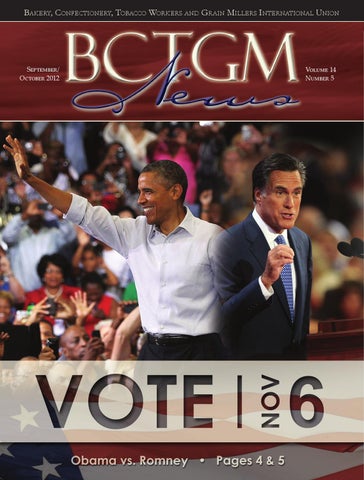
On November 6, Americans face a decisive choice about the direction of our country.
Four years ago working families chose a different direction—we chose to stand for fairness, a voice for all at work and in our economy, shared prosperity and opportunity for all, not just some. The BCTGM is committed to helping to re-elect President Obama and Vice President Biden to continue the change we started. We’re committed to strengthening majorities who will stand with working people in the Senate, in 4
the House and state legislatures undermine Medicare and Social throughout the country. Security, cut taxes for the richest The Romney-Ryan team people and widen income advocates inequality. “I never thought of for the kinds of policies what I do for a living as ECONOMY perfected by job creation. … The companies President primary goal of private like Romney’s Obama is equity is to create wealth Bain Capital fighting to grow that offshored the economy for your investors.” jobs, shuttered from the middle –Marc B. Wolpow, former managing companies class out, not the partner at Bain Capital, who worked and created top down. This closely with Romney for nine years massive election presents Los Angeles Times, 12/3/11 wealth for a choice between a few at the two fundamentally expense of working families. Their different visions of how to grow proposals would lower the incomes our economy and create good of average Americans, increase middle-class jobs. unemployment and foreclosures, Before President Obama took BCTGM News
Romney Economics Mitt Romney ran for governor of Massachusetts promising more jobs, less debt, and smaller government. Here’s what Massachusetts got instead:
• • • • •
Jobs: 47th out of 50 states in job creation Taxes and fees: Increased by $750 million per year Long-term debt: Increased more than $2.6 billion Outsourcing: State jobs outsourced overseas Manufacturing: Jobs declined at twice the national rate
office, the economy was losing 800,000 jobs a month. Now, we’ve seen 30 consecutive months of job growth and 5.1 million new private sector jobs. Mitt Romney opposed the Recovery Act, opposed the auto industry rescue, and said that we should let the housing market “hit the bottom.”
manufacturing, and while he was governor of Massachusetts the state lost manufacturing jobs at a rate twice the national average.
MADE IN AMERICA President Obama has a plan to bring jobs back to the U.S. by eliminating tax breaks for
companies that ship jobs overseas, and creating incentives for businesses to bring jobs back to America. Mitt Romney has no plan to get rid of tax breaks for companies that ship jobs overseas, and wants to eliminate taxes on American companies’ foreign profits, which would actually encourage more outsourcing.
WALL STREET REFORM President Obama passed Wall Street reform to make sure that Americans would never again have to pay to bail out big banks. Mitt Romney has promised to repeal Wall Street reform, allowing big banks to once again write their own rules.
RESCUING THE AUTO INDUSTRY President Obama took a principled stand to reinvest in the American auto industry. More than 1 million jobs were saved, the U.S. auto industry is adding jobs and all government loans were paid back ahead of time. Mitt Romney famously said that we should “Let Detroit go bankrupt.”
REVIVING U.S. MANUFACTURING U.S. manufacturing has added more than half a million jobs under President Obama since January 2010—the most growth in a decade. Mitt Romney mocked the President for encouraging young people to pursue careers in September/October 2012
Romney/Ryan plan would create 800,000 jobs • The overseas by giving companies incentives to outsource. [Hanlon, Seth. “Romney’s New Tax Incentive for Outsourcing U.S. Jobs.” AmericanProgressAction.org, 7/16/12; Hamburger, Tom. “Romney’s Bain Capital invested in companies that moved jobs overseas.” The Washington Post, 6/21/12]
Romney/Ryan plan would result in America losing • The 4.1 million jobs in the next three years. [Pollack, Ethan. “Ryan’s budget cuts would cost jobs.” EPI.org, 3/21/12]
Romney/Ryan plan would end Medicare, costing • The families thousands of dollars in additional premiums while lowering the quality of care.
[Wolf, Z. Byron. “Romney Talks to ABC News About Health Care, Jobs, Ties and Red Sox.” ABC News, 6/2/11; ”Ryan’s Budget Would Undermine Economic Security for Millions.” Economic Policy Institute, 4/7/11]
Romney/Ryan plan would raise taxes on the middle • The class by $2,000 to pay for an average of $187,000 in annual tax cuts for millionaires.
[Linden, Michael. “Paul Ryan’s Hidden Middle-Class Tax Hike.” Center for American Progress, 4/5/11; The Tax Policy Center, 8/1/12; “Ryan Budget Plan Would Cut Income Taxes for Millionaires by at least $187,000 Annually and Facilitate Corporate Tax Avoidance.” Citizens for Tax Justice, 3/22/12]
www.bctgm.org
5
DIANDA’S BAKERY
50
Celebrates
U
nion bakers at San Francisco’s famous Dianda’s Italian-American Pastry Co. have been creating some of the city’s most loved cakes and pastries since the Mission district bakery opened its doors in 1962. What is the secret to their long success? Happy workers, time-honored recipes and loyal customers. This well-loved neighborhood bakery is renowned for its immense and beautiful St. Honore cakes, panettone, leche cakes, elaborate wedding cakes, almond torte, as well as more than 20 different Italian pastries and 35 different kinds of cookies. All of the bakery’s products are handmade by BCTGM Local 24 (San Francisco) members, using recipes passed 6
of Honored Traditions down from generations of bakers. The Italian Dianda family sold the bakery in 2003 to three long-time Local 24 Dianda’s bakers, Sergio Flores, Luis Pena and Floyd Goldburg. The three bakers kept the same
employees, the same routines and the same Italian recipes. Today, you can find Flores, Pena and Goldburg at the shop baking as early as 2 a.m. The family business began when Elio Dianda left his hometown of Lucca in Tuscany after World War II and brought his skills as a pastry chef to America, according to Pasquale “Pat” Dianda, the son of Elio. His father bought a bakery that had existed since 1906 – a time Local 24 member and Dianda’s coowner, Luis Pena, adds chocolate to a tray of Italian butter cookies.
BCTGM News
when trains still ran through the Mission District. Using the recipes he carried with him from Lucca, Dianda opened the bakery doors using all union workers. “In those days, you’d be shut down if you weren’t union. We’ve had union contracts covering our
workers from the very beginning,” Pat told the BCTGM NEWS in 2004. “We’ve always believed that you take care of the people who work for you.” According to Pat, when the Dianda brothers where ready to sell the family bakery, they made it
Union member and co-owner Sergio Flores, has been a baker at Dianda’s for more than 30 years.
possible for their employees to buy the business. “Our traditions will be kept with these guys,” said Dianda, who continued to bake at the shop for more than nine years after the sale. He has officially retired but still comes by the bakery on occasion.
Saturnino Gonzalez Villa decorates a St. Honore cake.
Ronoldi Omar Valencia removes freshly baked cakes from the oven. Francisco Gomez adds blue flowers to a St. Honore cake. The renowned specialty cakes are an original Dianda family recipe.
Javier Luis Ramos glazes panatonne. Dianda’s freshly bakes the traditional Italian Christmas cake throughout the year.
September/October 2012
www.bctgm.org
7
What’s
WRONG
with the U.S. ECONOMY? If the short answer is “we’re still recovering from the Crash of 2008,” the long answer is “there was obviously something wrong with the economy long before the Crash of 2008.” There were obvious warning signs during the Bush years that should have set off alarm bells. Most importantly, wages and middle-class family incomes were dead in the water. The median income for working families started falling in 2000 and never recovered during the 2001-2007 recovery. By virtually every measure, the economic expansion of 20012007 was the weakest on record since World War II. The Bush expansion ranked dead last in terms of growth in wages and salaries, employee compensation (including benefits), jobs, the employment rate, business investment and GDP. It was the first and only expansion on record in which the employment rate actually declined. But if the U.S. economy was so unsound during the Bush years, why didn’t more people notice cracks in the foundation? The answer is the fundamental weakness of the economy was papered over temporarily by the bubble in real estate prices—for both residential and commercial real estate. By 2006, housing prices had risen 70 percent above their historical trend level, creating more than $8 trillion in phantom bubble wealth. It should have been obvious to everyone that this was a speculative bubble. The bubble allowed families to maintain standards of living by borrowing against the value of their homes and going deeper into debt, but this was not a sustainable situation. As wages and family incomes stagnated, household debt rose from $7 trillion to $14 trillion between 2001 and 2007—its highest share of the economy since 1929. Families could not keep increasing their debt loads forever, and housing prices could not keep soaring indefinitely. Sooner or later something had to give, and the bubble had to burst. The Bush economy was a house of cards waiting to collapse. Yet if the real estate bubble masked the fundamental weakness of the Bush economy, the question still remains: why was the U.S. economy so weak in the first place? 8
BCTGM News
How do we FIX IT? To fix what’s wrong with the U.S. economy, we have to replace the failed low-wage economic strategy of the past 30 years with a high-wage strategy for shared prosperity. The first step in such a highwage strategy is to put America back to work because high unemployment keeps wages down. Our goal should be “full employment,” meaning everybody who wants to work should be able to find a decent job. We can’t allow the unfounded fear of inflation to be used as an excuse to keep unemployment high and wages low. Full employment will require much higher levels of investment in education, clean energy and infrastructure, which is the foundation for long-term economic productivity and growth. This level of investment will require more revenue from the people and corporations that benefited from the failed economic policies of the past 30 years. We can do that by allowing the Bush tax cuts for the richest 2% to expire; taxing overseas corporate income the same way we tax domestic income, so corporations no longer can lower their tax bills by shifting jobs and income overseas; imposing a modest tax on financial speculation; taxing investment income (capital gains and dividends) the same way we tax labor income (wages and salaries); and allowing estate and gift tax cuts to expire.
The second step of a high-wage strategy is to restore workers’ ability to bargain collectively, which will raise wages, reduce economic inequality, fuel consumer demand and help rebuild the middle class. To guarantee that workers who want to join a union and bargain collectively can do so, we need urgent reform of our unfair labor laws. We also can reconnect wages with productivity by ensuring that every job is a good job, raising and indexing
the minimum wage, extending minimum wage and overtime protection to more workers and strengthening investment in workers’ education and skills training.
The third step of a highwage strategy is to make things in America again. We can do that
by eliminating our trade deficit, ending overvaluation of the dollar, combating currency manipulation by our trading partners, eliminating all incentives for offshoring in our tax code, enhancing Buy America safeguards, aggressively enforcing our trade laws and promoting a Global New Deal to help our trading partners rely on domestic incomes, rather than trade surpluses, as their source of economic growth.
The fourth step of a high-wage strategy is to shrink our bloated financial sector and make it serve the
real economy again. We can do that by reregulating Wall Street, eliminating the tax benefit for leveraged buyouts and imposing a modest tax on financial speculation. Doing all these things would restore a “virtuous circle” in which wage growth leads to healthy consumer demand…which encourages business investment…which drives productivity growth…which (if we have strong unions and low unemployment) leads us back to dynamic wage growth. Obviously, such a strategy will encounter intense opposition from Wall Street and the 1%, who benefit economically from the status quo and wield outsize influence in our political system. Fixing our economy also will require political reform to loosen the stranglehold of money over our politics and breathe new life into our democracy. We must forge a new model of economic growth—one in which everybody who wants to work can find a decent job, everybody who wants to join a union is able to do so, working people can afford to buy the things they make, we make things in America again, the U.S. economy produces as much as it consumes and prosperity is broadly shared.
This piece is part of a four-part series by the AFL-CIO examining the problems with the U.S. economy. Read the entire series at www. aflcio.org/Blog/Economy.
September/October 2012
www.bctgm.org
9
Local 68 Stewards Yearn to Learn
L. 68 Executive Board members and stewards pose for a photo following the educational conference.
F
or more than 30 years, BCTGM Local 68 (Baltimore) union stewards from some of the Baltimore area’s premier baking companies have been attending union steward educational conferences sponsored by the International Union. The stewards meet to sharpen old skills, hone new ones, and share stories and experiences with one another. This year’s Local 68 steward training was led by the International’s Research & Education Department and held in Linthicum, Md. More than 25 stewards attended the educational conference, ranging in experience from a few months to some union members with more than 20 years. The morning session centered around a discussion of income inequality, how the political process has been unduly influenced by corporate interests, and the ways in which certain laws and regulations have allowed the top 1% to thrive
while the rest of society stagnates. The stewards engaged in a lively dialogue about ways to change the current economic situation. Discussion centered around tax reform, limiting the influence of money in the political process, subsidizing childcare and healthcare, electing politicians that support working families, and organizing non-union workplaces. The second half of the session focused on many of the issues that union stewards are forced to face on a daily basis. Attendees examined the laws and regulations that govern the workplace, discussed ways to communicate with the membership, and discussed some of the problems and issues that come up routinely in the workplace. “This training is always valuable to our stewards,” notes Local 68 Financial Secretary/ Business Agent Gary Oskoian. “The lively discussions about workplace safety, rules and daily issues are something everyone learns from. It is an annual event that helps our members go back to their plants and better represent the workers.”
L. 68 stewards participate in a detailed discussion of workplace health and safety issues.
Chicago Stewards Continuing its long-time focus on education, BCTGM Local 1 (Chicago) conducted its annual two-day education conference this spring. Led by BCTGM Intl. Rep. Jethro Head, the educational conference included both new and seasoned union stewards and covered such information as arbitration and grievance handling, communicating with management and health and safety issues in the workplace. Pictured here is the L. 1 officers and stewards who completed the annual training. 10
BCTGM News
“No country not experiencing a revolution or a military defeat with a subsequent occupation has probably ever had as rapid or as widespread an increase in inequality as has occurred in the United States in the past two decades.” —Economist Lester Thurow writing in 1996. The income gap has grown exponentially since then due to rounds of tax cuts for the rich and for corporations, the bursting of the housing bubble and the Great Recession.
“This election is in your hands, as activists and people who care, people who are fighting for our future, you can make a huge difference.”
—Ohio Senator Sherrod Brown (D) on the campaign trail.
“Widely unequal societies “Scott Brown needs do not function efficiently, to explain to these and their economies are neither stable people why he voted nor sustainable in the long term.” against three jobs —Joseph E. Stiglitz, Nobel Prize-winning economist, bills a year ago that from his new book, The Price of Inequality. would have supported “The largest corporations are able to thousands of jobs here dominate virtually every phase of economic, in Massachusetts. He political and cultural life; they set the agenda had a choice – to for nearly every dimension of public policy.” support jobs here —Political scientist, Carl Boggs. The number of corporate at home or to stand lobbyists on Capitol Hill is at an all time high, with up for tax breaks for corporations and corporate controlled Super PACs set to millionaires – and he spend a record-setting amount of money in the 2012 election. turned his back on working families.” “Scott Walker discovers the value —Elizabeth Warren, running for the U.S. Senate against current Massachusetts Republican Senator Scott Brown. Warren is attempting to win back the seat Brown won in a special election after the death of Massachusetts Senator Teddy Kennedy.
September/October 2012
of union workers”
— Tweeted AFL-CIO President Rich Trumka after the Republican governor of Wisconsin, Scott Walker, complained about the lockout of NFL referees and the use of replacements that cost the Packers a game. Walker is best known for gutting the collective bargaining rights of Wisconsin public employees. www.bctgm.org
11
AFL-CIO endorses CRYSTALsugar
T
he AFL-CIO has endorsed a nationwide consumer boycott of American Crystal Sugar products to begin on October 15, in response to Crystal’s Sugar 14-month lockout of 1,300 BCTGM members. The AFLCIO noted that the boycott will be called off if the management of Crystal Sugar, which has denied its workers the opportunity to do their jobs, returns to the bargaining table in good faith and concludes a contract. This consumer boycott is part of the broader labor movement’s continued support for the locked-out members of the BCTGM. American Crystal Sugar management locked out the workers from their jobs more than a year ago, denying them incomes and healthcare benefits. The national labor movement endorses
12
boycotts cautiously and only in instances of grave injustice. “The twelve million union families of the AFL-CIO are proud to stand with the courageous locked-out workers who are responsible for American Crystal Sugar’s profitability and previously strong reputation,” AFL-CIO President Richard Trumka said. “As we saw with the lockout of the NFL referees, locking out skilled workers who do important, unglamorous work hurts not only the workers, but the product and the bottom line. We hope that this boycott will encourage Crystal Sugar to finally respect its workers, who worked so hard every day to make Crystal Sugar a highly profitable industry leader.” Trumka continued, “Crystal Sugar workers have been locked out since August 1st of last year
because Crystal Sugar’s CEO, after rewarding himself with a fifty percent pay increase for his union workers’ increased productivity, decided to try to break the workers’ union. Berg’s actions have endangered the generation of labor peace that made Crystal Sugar an industry leader. We hope that American Crystal Sugar will return to the bargaining table to conclude a contract and end the corporation’s sliding reputation and bottom line. With good faith by Crystal Sugar’s management, the corporation can return to its previous course of harmonious labor relations and profitability.”
Tell Dave Berg and American Crystal Sugar to End the Lockout! Sign the online petition: aflcio.org/EndTheLockout
BCTGM News
Government Policy on Job Creation Misguided
O
On the heels of another lackluster job’s report in early October, it appears that the Conservative government’s gamble of lowering corporate taxes to create jobs was misguided and ill-advised. The Canadian Labour Congress (CLC) states that the Harper government is allowing corporations to hoard billions of dollars received in tax breaks, which in turn is hampering the country’s ability to create good jobs. Since Stephen Harper became Prime Minister in 2006, the federal government has given away billions of dollars in tax breaks to corporations in the hope that they would use the money to invest in job creation. However, according to several sources, this has not happened. A CLC study released early in 2012 shows that 10 of Canada’s largest companies have hoarded $30.7 billion in short and long term cash assets over the previous decade. The Governor of the Bank of Canada has also criticized corporations for hoarding money rather than investing it in the economy. “We can create a lot more jobs in Canada but only if the federal government is prepared to change policies that clearly have not worked,” notes CLC President Ken Georgetti. According to Georgetti, the federal government needs to make critical investments in Canada’s crumbling infrastructure. “If corporations refuse to invest the money they have been given in tax breaks, the government should take it back and use it to create strategic infrastructure. They can make valuable investments in urban transit, in social programs such
September/October 2012
as child care, and in training and apprenticeship programs for workers. That would put our tax money to much better use,” says Georgetti. The President of the CLC was commenting on the release by Statistics Canada of its Labour Force Survey for September 2012. There were 1,393,800 unemployed Canadians in September and the unemployment rate was 7.4%. “Our economy is sluggish and there is very little prospect on the horizon for real job growth,” says Georgetti. “We have five unemployed workers in this country for every job vacancy. For this situation to improve, the government has to move away from its failed policies.”
A CLC study released early in 2012 shows that 10 of Canada’s largest companies have hoarded $30.7 billion in short and long term cash assets over the previous decade.
2013 BCTGM International Scholarship Program The BCTGM International Scholarship Program will award ten $1,000 one-time scholarship awards in 2013. One of the scholarships is reserved for a Canadian and up to three of the 10 are designated for active members of the BCTGM. The deadline for applications is January 31, 2013. To learn more about this special BCTGM membership feature, you can find the official rules and regulations for the 2013 BCTGM International Scholarship Program and the application on the International’s website,
www.bctgm.org.
www.bctgm.org
13
BCTGM PAC: Supporting
Workers’ FRIENDS in Congress
W
hile few worker-friendly laws have been enacted in the 112th Congress, BCTGM members throughout the U.S. have generously supported those policy makers who continue to fight for working families. In the last several years, Republican-controlled legislators and governors have boldly attacked the collective bargaining rights and protections that workers have fought for and won throughout history. This makes the BCTGM-PAC program more important than ever. Union member’s voluntary contributions support candidates who are fighting big business’ attempt to destroy the middle class through fictitious budget-
saving measures. BCTGM-PAC helps workers level the political playing field by activating and amplifying their political voice. BCTGM-PAC supports only pro-worker candidates and incumbents. It is the only political action committee that is dedicated to advocating for and protecting the interests of BCTGM members. “The BCTGM will only support those members of Congress who have consistently supported and fought for the workers of this country,” says BCTGM International President Frank Hurt. Pictured here are BCTGM representatives presenting BCTGM-PAC donations to aid in the campaigns of pro-worker candidates.
Congressman Keith Ellison represents Minnesota’s 5th Congressional District in the U.S. House of Representatives. He has been an active supporter of the locked out BCTGM members at American Crystal Sugar. Ellison has a long record of support for Minnesota’s working families. Pictured here presenting the Congressman with a BCTGM-PAC donation to aid in his re-election is (from left to right) Local 22 (Twin Cities, Minn.) Vice President Bruce Peglow, Ellison and Local 22 President Ron Mohrland.
“Our goal is to elect candidates up and down the ballot who value work and condemn greed,” says North Carolina AFL-CIO president, James Andrews. “We have learned since the last election what happens when politicians with backward priorities seize power – tax cuts for the rich and budget cuts for the rest.” Pictured here presenting Andrews (left) with a BCTGMPAC check to aid in the state federation’s 2012 political efforts is Intl. Rep. Randy Fulk (right). 14
BCTGM Local 280 Bus. Agt./Fin. Secy.-Treas. Marlin Esche (right) presents a BCTGM-PAC donation to Dave Crooks (left), the Democratic Candidate for Congress in Indiana’s 8th District. Crooks grew up in a working-class household and as a former State Representative, maintained a strong record of fighting for middle-class families. His mother was a factory worker, and his father worked in the maintenance department of a local power plant and served as President of his local Machinists union. BCTGM News
Benefits for
UNION Pets If you have a pet, think about how much money you spend. Wouldn’t you like some discounts to help curb your costs? Union Plus Pet Savings is a pet health care savings program providing discounts for all veterinary services, including routine pet health care and coverage for all animals. Union Plus Pet Savings program may be used in conjunction with traditional pet insurance to save you even more money on all veterinary bills.
Cut the cost of routine veterinarian services for all the pets in your household. Join BCTGM Power/ Union Plus Pet Savings through Pet Assure and save 25 percent every time you visit a veterinarian in PetAssure’s growing network of participating vets. Save up to 30 percent on other pet services such as pet boarding, pet training and more. Order pet food, medication, toys and receive other discounts through the online Union Plus Pet Store: store.unionpluspets.com
For more information on the services listed above call
1-888-789-PETS 9 am - 5 pm ET M-F, use program code UP2003
or go to UnionPlusPets.com.
September/October 2012
www.bctgm.org
15
Printed in the U.S.A.
M A K E S U R E YO U R
VOTE COUNTS
Here are SIX SIMPLE STEPS you can take on Election Day to protect your voting rights.
1
?
PROVISIONAL BALLOT
MAKE SURE YOU KNOW THE LOCATION of your polling place and your correct precinct. Many have changed, and a vote at the wrong place may not be counted.
3
ASK FOR HELP from poll workers and check posted signs if you have a question or need assistance.
5
If you are offered a provisional ballot, ASK IF YOU MAY CAST A REGULAR BALLOT by providing additional ID or going to another polling place. If no alternative is available or practical, cast a provisional ballot and follow up after Election Day. You can call the election Protection Hot Line before you leave the polling place.
2
ID
!
BRING IDENTIFICATION TO THE POLLS, preferably a government-issued photo ID with your registered address. Check your state’s website NOW to ensure you have the proper ID. Several states have passed strict photo ID laws and require a government-issued ID.
4
Make sure you cast a vote. If you are in line when the polls close, you are entitled to vote and should STAY IN LINE.
6
If you have a voting rights problem, TALK TO THE CHIEF ELECTION OFFICIAL OR A VOTING RIGHTS VOLUNTEER AT THE POLLS, or call the toll-free nationwide ELECTION PROTECTION HOTLINE, 1-866-OUR-VOTE, a project of a coalition of groups promoting voting rights, including the AFL-CIO.