Bakery, Confectionery, Tobacco Workers and Grain Millers International Union
March / April 2010
Volume 12 Number 2
the PRESIDENT’s MESSAGE
P
Health Care Is Now A Right For All Americans
and physical assaults on lawmakers who Perseverance and determination are supported reform legislation by “Tea Party” qualities we admire and respect in our “And we have now just activists led by the phony patriots Dick Union. As trade unionists, we know that Armey and Sarah Palin and egged on by advancing the cause and defending the enshrined…the core a number of cowardly and hypocritical rights of working men and women are Members of Congress. The despicable lack never easy assignments. principle that everybody of civility displayed throughout the process After watching President Obama sign should have some basic stands as a dark cloud hanging over an the health care reform legislation into law otherwise inspiring historic moment. after a brutal legislative struggle, any fairsecurity when it comes to This type of politics based on minded citizen has to have greater respect threat, intimidation and violence must and admiration for this president. their health care.” be renounced by political leaders of both Throughout the year-long health care parties and scorned by all who cherish reform ordeal, the President never gave President Barack Obama freedom. up and never backed down. He refused upon signing landmark health care Despite these outrageous actions and to scale back the scope and quality of reform legislation, March 23, 2010 refusal by the “Tea Party” crowd to accept reform when the going got tough. And, he the legitimacy of the governmental process, stood strong against the relentless pressure health care reform is now the law of the land. and vicious attacks from the powers that have profited so The tea partiers’ political “ancestors” wanted to repeal handsomely for so long from a broken health insurance system. Social Security. They failed. They wanted to repeal Medicare. This new law marks the beginning of the end of excessive They failed. They wanted to turn the clock back on Civil Rights profitability coming off the backs of the neediest and weakest in progress. They failed. Now, they want to repeal health care our society. reform. They will fail again because our nation is not turning By assuring health care security for all Americans, back! President Obama has accomplished a feat that eluded The BCTGM salutes those House and Senate members who presidents for nearly a century, including domestic policy had the courage of their convictions to vote for the legislation. giants such as Teddy Roosevelt, Franklin Roosevelt and But, for those politicians who chose to align themselves with the Lyndon Johnson. He prevailed despite a political and legislative insurance companies and wilted under the pressure of the thugs environment more toxic and corrosive than at any point in my who showed up at town-hall meetings and right-wing extremists lifetime. on talk radio, the BCTGM will remember their votes to betray Today, the United States finally stands proudly with the American people. the rest of the world’s industrialized nations in guaranteeing Frank Hurt medical services to each and every citizen of our country BCTGM International President without anyone having to go bankrupt or without food, clothing or shelter in order to receive care. The legislation certainly is not perfect. Throughout the long process, the labor movement successfully worked to strengthen the legislation. Even with its flaws, the legislation is still a giant step forward on the path to greater social and economic justice and improved health for the American people. Moreover, we know that similar monumental legislative Official Publication of the Bakery, Confectionery, Tobacco accomplishments that have become bedrocks of our society— Workers and Grain Millers International Union Social Security, Medicare and Civil Rights—were improved 10401 Connecticut Avenue, Kensington, Maryland 20895-3961 upon over time. The labor movement was instrumental in the (301) 933-8600 passage and improvement of those laws and we will be so again www.bctgm.org with health care reform. Frank Hurt, Editor While most Americans take great pride in this historic Corrina A. Christensen, Assistant Editor achievement, there should be great concern over the unseemly and dangerous activities of many of those who opposed health BCTGM General Executive Board care reform. We witnessed an orchestrated, incredibly wellPresident Frank Hurt • Secretary-Treasurer David B. Durkee financed attack from the insurance companies, Chamber of Executive Vice President Joseph Thibodeau • Vice Presidents Steve Bertelli • Anthony L. Johnson • Sean Kelly Commerce and other corporate powers that was designed to Micheal T. Konesko • Arthur Montminy manipulate those who would be most helped by the legislation. Robert Oakley • Randy Roark The cynical attack was built on a foundation of lies, distortion, deception and greed. BCTGM General Executive Board Members The ability of corporate America to spend hundreds of Joyce Alston • Edward Burpo millions of dollars to influence important public policy matters Butch Henley • Barry Jenkins • Johnny Jackson • Paul LaBuda Richard Lewis • Narcisco Martas • Danny Murphy in this deceitful manner truly is a threat to our democracy. Vester Newsome • Ron Piercey • Donna Scarano Unfortunately, this will only get worse as a result of a recent Brad Schmidt • Doyle Townson decision by an ultra-conservative Supreme Court majority BCTGM News (ISSN 1525-4860) is published bi-monthly by the Bakery, Confectionery, Tobacco Workers and Grain allowing corporations to spend unlimited money on political Millers International Union, 10401 Connecticut Avenue, Kensington, MD 20895-3961. Periodicals postage paid at Kensington, MD and at additional mailing offices. Subscription to new members only. Postmaster: Send address radio and television ads. changes to BCTGM News, 10401 Connecticut Avenue, Kensington, MD 20895-3961. Of even greater concern however, were the vile verbal 2
BCTGM News
Wall Street Pay
Make to Restore Jobs
S
houting, “We want our jobs back,” BCTGM Local 253 members were among hundreds of union members and community allies who rallied and marched in Cincinnati on March 24 to send Morgan Stanley the message that if it can thrive on taxpayer bailout money, it needs to make sure the community prospers as well. BCTGM International Representative John Price joined the Local 253 officers and members at the rally which was part of the AFL-CIO’s more than 200 “Make Wall Street Pay” events taking place in late March. Speaking to the crowd, AFLCIO Executive Vice President Arlene Holt Baker blasted the selfish actions of the Big Banks. “At a time when young people across the country are worried about whether they will lose their jobs or whether they will find a job when they graduate, Morgan Stanley paid—get this—$3 million to their lobbyists to kill financial
reform. While Morgan Stanley refuses to lend money to small businesses here in Ohio, they’re keeping the company afloat with $10 billion of your hard-earned money. We bailed out these Big Guys Pictured here (left to right) are L. 253 Fin. Secy-Treas. Shawn behind us, so now Turner, Kellogg Stew. Ron Powell, Kellogg Chf. Stew. Greg Sutton it’s time to take and Pres./Bus. Agt. Doug Walters. that money and give it to the community and the following actions: local banks so that bank will start • Pay their fair share to restore the to hire people,” said Holt Baker. jobs their actions destroyed. As the crowd began its march • Stop their multimillion-dollar to Morgan Stanley, Holt Baker lobbying blitz to kill financial shouted, “Stop refusing to pay your reform. fair share to create the jobs that • Start lending to communities, you destroyed!” small businesses and others Union members and allies starved for credit. are demanding the Big Six Wall Information on the activities Street banks—Bank of America, is available at www.aflcio.org/ Citibank, Goldman Sachs, createjobs—the AFL-CIO’s JPMorgan Chase, Morgan Stanley online organizing hub for the jobs and Wachovia-Wells Fargo—take campaign. From the site, people
AFL-CIO Executive Vice President Arlene Holt-Baker rallies the crowd outside of Morgan Stanley in Cincinnati.
March/April 2010
www.bctgm.org
can find events to attend, write letters to banks and read and submit job stories and photos. In addition to these efforts, Working America, the 3 millionmember community affiliate of the AFL-CIO, has kicked off a campaign called “I am not your ATM.” People across the country are submitting photos of themselves in front of ATMs, asking “where’s my bailout?” and delivering the message to Wall Street: “I am not your ATM.” To see some of the photos collected so far, go to www.notyouratm.com.
3
Job Safety
Gets New Boost from Obama, Solis
A
little more than a year after taking office, the Obama Administration and Labor Secretary Hilda Solis have taken significant steps to repair the damage to workplace safety and health left behind after eight years of the Bush administration. With Workers Memorial Day April 28, this is a good time to look at the progress made under the Obama Administration. For eight years under the Bush Administration, corporate officials and management representatives headed the Occupational Safety and Health Administration (OSHA) and the Mine Safety and Health Administration (MSHA). Bush’s first MSHA head, David Lauriski, was chief safety officer at Emery Mining’s Wilberg, Utah, mine in 1984 when an explosion killed 27 coal miners. The blast was later attributed to numerous violations at the mine. Seventeen years after the disaster, Lauriski became George W. Bush’s first mine safety chief, a position he used to halt a dozen safety regulations initiated under the Clinton Administration, Today, MSHA is headed up by Joe Main who began work in the mines when he was 19, became a local union safety committeeman, a safety inspector in the Mine Workers (UMWA) Safety and Health Department and eventually is director. At OSHA, Bush’s last administrator, Edwin Foulke, was former partner at the notorious anti-union law firm Jackson Lewis. He so strongly opposed workplace 4
safety and health laws The New York Times labeled him “an antiregulatory ideologue.” Contrast Foulke with David Michaels, Obama’s choice as OSHA administrator. Michaels is an occupational safety and health expert, co-founder of the New York Committee on Occupational Safety and Health (NYCOSH) and epidemiologist at George Washington University.
Under Bush, OSHA and MSHA emphasized voluntary compliance programs over strong enforcement of workplace safety and health regulations. When they issued penalties, the employers often negotiated down the fines, which were negligible to begin with. Now, both OSHA and MSHA have stepped up enforcement, assessing large penalties against employers with serious, repeated
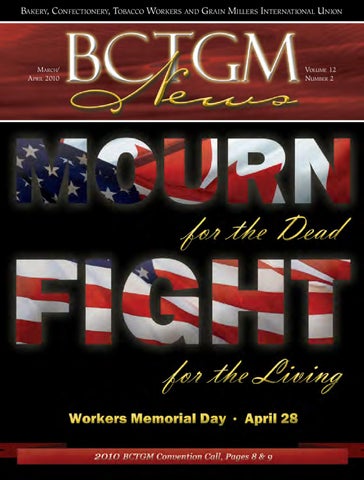
GOOD JOBS. SAFE JOBS.
nOW. APRIL 28
OBSERVE WORKERS MEMORIAL DAY
The BCTGM has been actively involved in several important occupational safety and health issues over the past few years, including: • Under-reporting of recordable injuries. In conjunction with the AFL-CIO Safety and Health Committee, the BCTGM developed a survey on the under-reporting of injuries in the workplace, which was distributed to dozens of BCTGM local unions. The results of the surveys were tabulated and shared with the AFL-CIO, which analyzed the data from dozens of affiliates and compiled a detailed report. The AFL-CIO, along with the BCTGM, continues to press for more stringent reporting requirements and an end to corporate programs designed to stifle the reporting of injuries. • Diacetyl – With the change in Administration, and new leadership at OSHA, diacetyl has become a high priority for the federal government. OSHA conducted several stakeholder meetings during the year in which the BCTGM participated in. The BCTGM also submitted a joint comment to CalOSHA concerning California’s effort to write and enact a diacetyl standard. Diacetyl is a butter flavoring that has been found to cause irreversible lung failure in workers that are exposed to it in certain conditions. • Combustible Dust – In 2009, OSHA announced an Advance Notice of Proposed Rulemaking (APNR) setting the stage for the creation of a general industry combustible dust standard. The BCTGM participated in several stakeholder meetings and recently filed a joint comment to OSHA outlining organized labor’s position about a future combustible dust standard.
BCTGM News
Massey Mine Cited for 450+ Safety Violations Before Deadly Blast and willful violations. OSHA also is strengthening its enforcement program to focus more on repeated violators and to develop corporatewide approaches to enforcement. It has launched a national investigation in the under reporting of injuries and employer practices that discourage workers from reporting job injuries. During the eight-year run of the Bush Administration, not only did OSHA and MSHA put the brakes on new safety and health rules laws in the pipeline when they took office, neither agency issued any new standard unless forced by the courts or Congress. OSHA is now moving forward with rules on silica, cranes and derricks, hazard communication, combustible dust and other workplace hazards. The Bush Administration presided over the repeal of the nation’s first ergonomics standard and made it so that OSHA’s hands tied to set a new ergonomics rule. But the agency now has proposed changes in the injury recordkeeping rule to reinstate a requirement, repealed by the Bush Administration, for employers to identify musculoskeletal disorders (MSDs) on the workplace injury log. Both safety agencies suffered drastic cuts in budget and personnel (especially in inspection and personnel) under the Bush Administration. The Obama Administration has restored those cuts and its FY 2011 budget includes some modest increases. The Obama Administration also is backing congressional efforts to improve workplace safety and health laws, including March/April 2010
T
he Massey Energy Co. mine where 29 coal miners were killed following an explosion on April 5, was assessed nearly $1 million in fines for safety violations last year including violations concerning escape routes and ventilation, according federal records and news reports. The mine is owned by Massey and operated by its subsidiary, Performance Coal Co. It is a non-union company. Early indications indicate the blast was caused by highly explosive methane gas leaking from sealed-off areas of the Upper Big Branch Mine in Raleigh County, W.Va.—the same cause of the 2006 Sago mine disaster that killed 12 miners. New federal mine safety rules enacted after the Sago disaster included tougher new requirements for sealing off worked-out areas. CNN reports that in 2009, the Mine Safety and Health Administration (MSHA) proposed nearly $1 million in fines for more than 450 safety violations at the Upper Big Branch mine, including penalties for more than 50 “unwarrantable failure” violations, which are among the most serious findings an inspector can issue. Among those were citations for escape routes for miners and air quality ventilation. According to ABC News, Massey was fighting the MSHA fines, including those for 57 infractions in March for violations that included repeatedly failing to develop and follow ventilation plan. The federal records catalog the problems at the Upper Big Branch mine and show the company was fighting many of the steepest fines, or simply refusing to pay them. MSHA records also show that at in least six of the past 10 years, the Massey mine’s injury rate has been worse than the national average for similar operations. AFL-CIO President Richard Trumka, a former Mine Workers (UMWA) president and third generation coal miner, says “The thoughts and prayers of America’s workers are with the families” of those killed and for the safety of the “courageous” rescue teams. “However, this incident isn’t just a matter of happenstance, but rather the inevitable result of a profit-driven system and reckless corporate conduct. Many mining companies have given too little attention to safety over the years and too much to the bottom line,” says Trumka. Tony Oppegard, a lawyer and mine safety advocate from Kentucky told The New York Times, “Massey’s commitment to safety has long been questioned in the coalfields.” The Times notes a 2006 internal memo from Massey CEO Donald Blankenship. In the memo, Blankenship instructed the company’s underground mine superintendents to place coal production first. “This memo is necessary only because we seem not to understand that the coal pays the bills,” he wrote. the Protecting America’s Workers Act (H.R. 2067 and S. 1580), which toughens penalties, expands OSHA coverage to public-sector workers, strengthens anti-discrimination protections and expands workers’ rights. So this Workers Memorial www.bctgm.org
Day, along with honoring workers killed and injured on the job and demanding good, safe jobs with decent wages, health and retirement security and a voice on the job, workers will continue the fight for strong new safety and health protections.
5
Utah Dannon Workers Ratify First Contract
O
n February 6, BCTGM Local 401 (Salt Lake City, Utah) members at the Dannon plant in West Jordan, Utah overwhelmingly ratified their first union contract. BCTGM International Representative Jim Condran, who served as the union’s chief spokesperson during contract negotiations, was assisted by International Representative Marco Mendoza. Other negotiating committee members included Local 401 SecretaryTreasurer/Business Agent Steve Wolfe and Local 401 Chief Shop Stewards Rick Durrant and Boyd Russell. According to Condran, the committee worked extremely well together. “The committee remained focused on the needs of the workers. After two elections and five months of negotiations, it feels great to report that the Dannon workers in West Jordan have a legally binding contract in place,” says Condran. “I am extremely proud of the employees and the negotiating
6
committee for standing up for a true voice in the workplace and fighting for their right to become members of the BCTGM International Union family,” he adds. Such union pride was echoed by the Local 401 committee members. “I have been waiting for this day to arrive at Dannon,” said Durrant, who also played a vital role in the campaign to organize the West Jordan workers. “Having a good legal contract to replace the employer’s handbook gives the workers and our families the job security we need,” he added. “Now that we are union, we have a real voice in the workplace,” said Russell, who was also instrumental in the organizing campaign. “Being part of the negotiating team allowed me to witness firsthand how important every article in our contract is. I am proud to say we are members of the BCTGM international Union!” According to Condran, the most important gain of the contract was the guarantee of 40 hours per week. “This was a major issue at
the plant because management consistently reduced worker’s hours,” notes Condran. The contract further includes successors language, stewards training, job security, improvements in attendance policy, job vacancy procedure, grievance procedure, strong language addressing seniority and layoffs, bumping, switching shifts, job training, shift differential, payfor-skill program for Maintenance, and an overtime procedure. The agreement further provides for tuition reimbursement, health benefit improvements, a higher tool allowance, increased safety wear allowance, and severance pay language. The workers also received an increased wage package and a new Dannon Retirement Pension Plan with improved multiplier, as well as improved 401K contributions from the employer. “At our ratification meeting these new members were excited and feel job security has been addressed as a result of these negotiations,” concludes Condran.
BCTGM News
Richmond, Va. Dairy Workers
Ratify First
BCTGM Contract
O
n March 13, Land-O-Sun Dairy workers in Richmond, Va. voted overwhelming to ratify their first contract as members of BCTGM Local 358 (Richmond).
In April 2009, more than 100 dairy workers employed at LandO-Sun Dairy (a subsidiary of dairy giant Dean Foods) withstood fierce opposition from the company and its union busters to vote “Union Yes” in a National Labor Relations Board (NLRB) election. This dairy produces all varieties of fresh milk under private label brands. Additionally, while in contract negotiations, a second group of workers, who were not included in the original bargaining unit or negotiations, expressed a desire to become BCTGM members. After forming an organizing committee and signing authorization cards, an NLRB election was held and all votes were cast for the BCTGM. As a result, the Land-O-Sun Local 358 bargaining unit now includes March/April 2010
the production workers as well as the molders, who make all of the plastic milk jugs and containers for the plant’s dairy products. International Representative Jim Condran and Local 358 Financial Secretary Ted Constable led contract negotiations for the workers’ first contract. According to Condran, the dairy workers are relieved to have the benefits of the BCTGM after an extended struggle to negotiate a fair agreement. “This contract was about having a real voice in the workplace,” says Condran. “The workers took action against this employer, which included picketing outside the plant before and after their shifts to send a message to the employer: negotiate a fair contract.” www.bctgm.org
Part of the worker’s campaign for a fair contract included the distribution of informational fliers to Land-O-Sun customers, telling store managers that workers may picket outside the establishment if a fair settlement for the workers was not reached with the company. “This is a good example that proves when workers unite and stand together, they are a force to be reckoned with—and most importantly—respected,” notes Condran. “These workers refused to allow employer fear tactics overcome their desire for a better life.” Highlights of the new contract include safety shoe allowance; paid bereavement leave; shift differential pay; improved vacation and holiday language; sick leave; a severance package; an attendance policy; paid time off for steward training; seniority language; job bidding provisions; and grievance procedures. Workers also maintained and improved health care coverage and a continuation of their 401(k) program. According to Condran, after voting to ratify the agreement, one BCTGM Local 358 member said, “Having a legal contract protecting my rights as a worker and the well being of my family, I can sleep better knowing the company cannot take away my benefits.” 7
Bakery, Confectionery, Tobacco Workers and Grain Millers International Union 10401 Connecticut Avenue • Kensington, Maryland 20895‑3961
CONVENTION CALL April 1, 2010 TO ALL AFFILIATED LOCAL UNIONS: GREETINGS: The International Constitution provides, in Article III, Section 2: “The regular Convention shall be held every four years. It shall convene on such date and in such place as the International President, with the approval of the General Executive Board, shall designate.” “The International Secretary‑Treasurer shall issue a Convention Call to all local unions in the third month immediately preceding the convening of the regular Convention.” “The Convention shall not extend beyond ten days of sessions, except by two‑thirds vote of the duly accredited delegates.” In accordance with the above, you are hereby notified that the Thirty‑Eighth Constitutional Convention of the Bakery, Confectionery, Tobacco Workers and Grain Millers International Union will convene in the city of Las Vegas, Nevada, beginning at 10:00 a.m. on Wednesday, July 28, 2010, and concluding on Tuesday, August 3, 2010.
QUALIFICATIONS OF DELEGATES Article III, Section 5 of the International Constitution states that: “Every delegate to the Convention must (1) have been a continuously good-standing, dues-paying member of the International Union and local union the delegate represents for at least two continuous years next prior to election; (2) be provided with properly attested credentials from the local union the delegate represents; (3) have worked at least two years immediately preceding the Convention as a wage earner in any branch of the trades, except for periods of layoff (including layoffs arising from plant shutdowns) and terminations being grieved, not to exceed twelve (12) continuous months, under the jurisdiction of the International Union or as an officer or employee of the International Union or a local union; (4) be able to show such number of Union labels as the General Executive Board may require.” (The General Executive Board has waived the requirement of showing union labels.) “Exempted from the requirements of (1) and (3) above shall be delegates whose local unions have not been in existence for two years, provided that the continuously good-standing, dues-paying and wage-earning period of such delegates are not less than six months.” Article III, Section 4 provides: “Each local union may elect an alternate delegate at the same time the regular delegates are elected. Alternates must have the same qualifications as delegates. In the event of the inability of any delegate to attend the Convention because of an emergency, the alternate may replace the delegate, provided that the local union notifies the International Secretary‑Treasurer of the change.”
ELECTION OF DELEGATES The election of delegates is subject to provisions of the International Constitution and the Labor‑Management Reporting and Disclosure Act of 1959 (Landrum‑Griffin Law).
REPRESENTATION OF DELEGATES The International Constitution in Article III, Section 4, provides: “Local unions in good-standing including those which have been organized under the jurisdiction of the International Union six (6) months previous to the Convention shall be entitled to representation. Local unions with a monthly average International per capita tax on its dues-paying membership of
less than 251 shall be entitled to one (1) delegate from 251 to 500 to two (2) delegates; from 501 to 750 to three (3) delegates; from 751 to 1,000 to four (4) delegates; from 1,001 to 1,400 to five (5) delegates;
from 1,401 to 1,800 to six (6) delegates; from 1,801 to 2,200 to seven (7) delegates; from 2,201 to 2,600 to eight (8) delegates; from 2,601 to 3,000 to nine (9) delegates; over 3,001 to ten (10) delegates;
but in no case shall a local union be entitled to more than ten (10) delegates. Any two or three locals having less than one hundred members each located within an area of 250 miles may combine in the selection of a delegate. No other local unions may combine in the selection of a delegate and no delegate shall represent more than three such local unions.” “The number of members of a union shall be the average monthly per capita tax that it has paid to the International Union on its duespaying membership for twelve (12) months inclusive of the fourth month (March) previous to the Convention, as certified by the International Secretary‑Treasurer to the Credentials Committee.” “Delegates representing up to twenty‑five (25) members shall be entitled to one vote, and to one additional vote for each additional twenty‑five members or major fraction thereof they represent. The number of votes of local unions which are represented by more than one delegate shall be equally divided to the nearest whole number among all their delegates.”
8
BCTGM News
CREDENTIALS OF DELEGATES Article III, Section 6 provides: “At least forty (40) days prior to the opening of the Convention, duplicates of credentials on blanks furnished by the International Secretary‑Treasurer from the authorized local union officer shall be received by the International Secretary‑Treasurer, or shall be postmarked not later than forty‑five (45) days prior to the opening of the Convention, in an envelope properly addressed to the International Secretary‑Treasurer.” “The International Secretary‑Treasurer shall cause to be published in the official journal of the International Union, in the last issue before the Convention, but not less than fifteen (15) days prior to the convening of the Convention, a list of all the delegates‑elect and the local union each delegate represents.” “Delegates to the Convention shall present the original credentials bearing the seal of the local union and signatures of the authorized officers of their respective locals to the Committee on Credentials. Protests against the delegates must be in written affidavit form, stating the specific grounds for protest and signed and sworn to by the party objecting to the seating of the delegate. These affidavits must be transmitted by registered or certified mail to the International Secretary‑Treasurer (with a copy to the local union) and the envelope, properly addressed to the International Secretary‑Treasurer, must be postmarked at least ten (10) days prior to the convening of the Convention.”
COMPENSATION OF DELEGATES Article III, Section 7. “The International Union shall pay each delegate in attendance at the regular Convention as compensation $595 and an amount equal to the cost of regular coach transportation by air from the delegate’s home city to the Convention city and return by direct route”, except as negotiated in the BC&T/AFGM merger agreement”; provided, however, that such delegates remain in attendance upon the Convention commencing with its first day’s session until its adjournment. Compensation and transportation for special convention shall be set by the General Executive Board.” “Transportation and compensation of protested delegates shall not be furnished unless and until such delegates have been seated as accredited.”
CONVENTION RESOLUTIONS Article III, Section 10. “All resolutions by local unions to be submitted to the Convention either must be received at International Headquarters at least forty (40) days prior to the opening of the Convention, or must be postmarked in a properly addressed envelope at least forty‑five (45) days prior to the opening of the Convention. Each resolution must deal with but one subject matter, be submitted in triplicate and each copy signed only by all delegates-elect, or a majority of the Executive Board.” “Resolutions by the General Executive Board may be introduced at the Convention, provided such resolutions have the approval of a majority of the General Executive Board. All other resolutions may only be introduced with the approval of a two‑thirds vote of the Convention.” Local unions are urged to forward all resolutions as soon as they are formulated in order that they may be printed for distribution to the delegates. In order to facilitate the printing of resolutions, each resolution must deal with only one subject, be typewritten, and only one side of each page should be used.
HOTEL ACCOMMODATIONS Information with reference to hotel accommodations, etc., will be forwarded upon receipt of the delegate’s certified credential.
GENERAL We hope that your local union will have full representation at the Thirty‑Eighth Constitutional Convention of the Bakery, Confectionery, Tobacco Workers and Grain Millers International Union, AFL‑CIO, CLC, in Las Vegas, Nevada. Your participation is essential in assisting us in setting priorities during the ensuing four years in important activities relative to economic advancement of our membership, political action activities, and the organizing of the unorganized workers in our jurisdiction. Fraternally yours,
Frank Hurt International President
David B. Durkee International Secretary‑Treasurer
GENERAL EXECUTIVE BOARD Joseph Thibodeau Steve Bertelli Anthony Johnson Sean Kelly Micheal T. Konesko Art Montminy March/April 2010
Robert Oakley Randy Roark Joyce Alston Edward Burpo Linwood “Butch” Henley Barry Jenkins
Johnny Jackson Paul LaBuda Richard Lewis Narciso Martas Danny Murphy Vester Newsome
www.bctgm.org
Ron Piercey Donna Scarano Bradford Schmidt Doyle Townson
9
, I m here to tell you that your president, your secretary of labor and this department
d his or h ie n e d e b to e allow anyon
I
will not l pay
er rightfu
New DOL Drive Sets to
n a 180-degree turn from a Labor Department under the Bush administration that tried to gut overtime rules for millions of workers, Labor Secretary Hilda Solis has unveiled a new campaign to inform workers about their pay rights and to put a stop to wage theft. Speaking before a group of union, community and faith activists in Chicago Solis said, “I have a message for those employers who break this nation’s labor laws and prey on vulnerable workers: It ends today. I’m here to tell you that your president, your secretary of labor and this department will not allow anyone to be denied his or her rightful pay—especially when so many in our nation are working long, hard and often dangerous hours.” The Labor Department’s “We Can Help” multi-lingual campaign is aimed at low-wage and vulnerable workers with a special focus on reaching employees in such industries as construction, janitorial work, hotel/motel services, food services and home health care. It also will address such topics as rights in the workplace and how to file a complaint with the Wage and Hour Division to recover wages owed. Last year, an investigation by the Government Accountability Office (GAO) found the department’s Wage and Hour office, under former Labor Secretary Elaine Chao, had failed miserably in enforcing minimum wage and overtime laws. The division’s failure to act, says the report, “left thousands of actual victims of wage theft who sought federal government assistance with nowhere to turn.” A 2008 GAO report found that under the Bush administration, the number of wage and hour inspectors dropped from 942 to 732. At the same time, the number of investigations into employers’ refusal to pay minimum wage, overtime—or even any wages at all—has dropped from 47,000 in 1997 to 30,000 in 2008. Since taking office, Solis has added 250 new inspectors to the wage and hour division, bringing the total to 949. Solis said the “We Can Help” effort will work with unions, faith groups and community groups to get the information into work places and neighborhoods. Interfaith Worker Justice (IWJ) also offers a Wage Theft Online Resource Center, which includes a list of resources and information about the wage theft crisis. “If someone is stealing your wages, you can and should call the Department of Labor….We can help, and we will help. If you work in this country, you are protected by our laws. And you can count on the U.S. Department of Labor to see to it that those protections work for you,” says Solis. There are also efforts on the state and local level to put halt to wage theft. Earlier this year, the MiamiDade County Commission approved a country-wide wage theft ordinance. In New York State, a bill to toughen penalties for employers who steal workers wages is before the legislature. In a column in Albany Times Union, Amy Traub of the Drum Major Institute (DMI) and Andrew Freidman of Make the Road New York write: “Enforcement of workplace laws is so inadequate, and penalties are so low, that corrupt businesses often come out ahead. Unscrupulous employers simply factor the risk of getting caught breaking the law into their cost of doing business. Responsible business owners are put at a competitive disadvantage by rival companies that cut costs by cheating their employees.”
10
Stop Wage Theft
BCTGM News
Notable Quotes
Thousands Tell Whirlpool: Keep It Made in America
“ On average, unionization raised immigrants’ wages by 17 percent—about $2.00 per hour—compared to non-union immigrant workers with similar characteristics. The union impact on health insurance and retirement coverage was even larger. Among immigrants, union workers were 50 percent more likely to have employer-provided health insurance, and almost twice as likely to have an employer-provided retirement plan, as non-union immigrants.”
“ If you care about defending our country against the apostles of hate, you need to be part of the fight to rebuild a sustainable, high wage economy built on good jobs—the kind of economy that can only exist when working men and women have a real voice on the job.”
— AFL-CIO President Rich Trumka on April 7 speaking at Harvard University’s Kennedy School of Government.
— Unions and Upward Mobility for Immigrant Workers, John Schmitt, Center for Economic and Policy Research, March 2010
“ I don’t want to run auto companies. I don’t want to run banks. I’ve got two wars I’ve got to run already. I’ve got more than enough to do.”
“Our creativity on safety is second to none.”
— Massey Energy Co.’s CEO Donald Blankenship in denying that the April 5 explosion at the Upper Big Branch Mine in W.Va. that killed 29 miners was because the mine was “improperly operated.” In 2009, the Mine Safety and Health Administration (MSHA) proposed nearly $1 million in fines for more than 450 safety violations at the nonunion mine.
“ You can’t get back to a robust economy without putting Americans back to work. The economy needs to be rebuilt on a solid foundation of good jobs at good pay, and many of those jobs will have to come from thriving new industries. This is a long-term project that demands big-time government involvement. It will require the kind of commitment—over an even longer period of time—that President Obama and the Democrats in Congress gave to their health care initiative.”
— President Barack Obama, attempting to allay fears about the federal government exercising significant and lasting control over companies in which it is now a major shareholder because of the federal bailout.
“Like everything on Wall Street, they’re starting to sin again. As you see a recovery, you’ll see everybody’s compensation beginning to rise.”
— Banking analyst Brad Hintz, on news of ballooning bonuses in the financial sector
—New York Times columnist Bob Herbert March/April 2010
www.bctgm.org
11
Obama Uses Recess
Appointments for NLRB
and Other Blocked Nominations
P
resident Obama announced in late March he will use recess appointments to fill 15 important positions that Republican senators have blocked for an average of 214 days. Two of those appointments are Craig Becker
announcing today were approved by Senate committees months ago, yet still await a vote of the Senate,” explains President Obama. Becker and Pearce, two highly qualified and respected labor lawyers, were nominated in July
FACT
The National Labor Relations Board, created in 1935 to remedy unfair labor practices and certify union elections, has had three vacancies since 2008. With one Democrat and one Republican, it has been unable to act on divisive issues.
and Mark Pearce to the National Labor Relations Board (NLRB). “The United States Senate has the responsibility to approve or disapprove of my nominees. But if, in the interest of scoring political points, Republicans in the Senate refuse to exercise that responsibility, I must act in the interest of the American people and exercise my authority to fill these positions on an interim basis. Most of the men and women whose appointments I am 12
and received Senate Judiciary approval, but Senate Republicans blocked final approval. Activists made thousands of calls to the White House asking the president to overcome the Republican obstruction in the Senate with recess appointments. Also, AFL-CIO President Richard Trumka urged President Obama to use recess appointments to put the two on the board, which has been operating with just two members since 2008.
“America’s working women and men have been waiting for National Labor Relations Board appointments for too long,” notes Trumka. Following the announcement, Republicans loudly complained about Obama’s use of the recess appointments. But as the White House statement points out: President Bush had made 15 recess appointments by this point in his presidency, but he was not facing the same level of obstruction. At this time in 2002, President Bush had only five nominees pending on the floor. By contrast, President Obama has 77 nominees currently pending on the floor. Other appointments include four positions on the U.S. Equal Employment Opportunity Commission and posts at the departments of Homeland Security and Treasury.
GEB Elects Jenkins
Barry Jenkins
D
uring the 80th session of the BCTGM International General Executive Board (GEB) in Las Vegas March 25-29, Local 317T (Greesboro, N.C.) President Barry Jenkins was elected as the GEB member from the Tobacco Sector.
BCTGM News
Weston Workers in Toronto
I
n early April, George Weston Limited workers at a Toronto baking plant overwhelmingly voted to join BCTGM Local 264 (Toronto, Ontario). Weston’s Ready Bake production plant in North York, Ontario, a suburb of Toronto, produces frozen products including buns, kaiser rolls, baguettes, and other bakery products. The plant currently has four production lines and runs an average of 3 lines per day. The BCTGM represents workers at eight Weston facilities across Canada. The Local’s first challenge was putting together an organizing committee that reflected the diversity of the plant’s workforce. The committee included bakers from Canada, India, Pakistan, China, and Jamaica. The organizing committee worked diligently with Local 264 Financial Secretary Ron Piercey and Business Agent Tim Rock and International Representative Karl Walker in contacting workers, educating them about unionization, and dealing with their many workplace concerns. Local 264 filed for an election on March 30. Under the expedited
Vote to Join BCTGM
union election laws in Ontario, the election took place five business days after the filing of the petition. According to International Vice President Sean Kelly, a quick election was important. “We know what employers will do to keep workers from voting for a union: harassment, intimidation, threats of closing, firings. A quick election allows workers to make an informed decision without undue employer pressure,” said Kelly. Several recent academic studies have documented how far companies will go to keep their businesses union-free. The BCTGM is involved in many organizing drives where employers have been found guilty of gross violations of U.S. labor law and yet the employer continues to break the law, or cases remain mired in the courts. Local 264 officers prepared for a fierce anti-union campaign by Weston’s after witnessing the behavior of the company during BCTGM Local 68’s (Baltimore) organizing campaign at a plant in Virginia several years ago. During
that campaign, Weston’s waged a vicious anti-union campaign in the months leading up to the election. The union and company have been tied up in litigation ever since. While Weston’s management in North York tried to persuade employees from voting yes, the Local was not required to file charges against the company for illegal actions. According to BCTGM International President Frank Hurt, the organizing victory at Weston’s in Canada illustrates why labor law reform in the United States is absolutely essential for the American workforce. “These workers were allowed to make the decision on their own and in a timely manner. The fact they voted yes is not a surprise at all,” said Hurt. BCTGM Secretary-Treasurer and Director of Organization David B. Durkee was especially pleased by the results. “This is a wonderful and very important victory for Local 264 and the International Union,” said Durkee.
A quick election allows workers to make an informed decision without undue employer pressure.
March/April 2010
www.bctgm.org
13
Thousands Tell Whirlpool:
Keep It Made in America
O
received no advance n February 28, notice of the closing the BCTGM announcement and was among had no opportunity the more than 5,000 to try to save the workers, community plant. The local has and religious activists since filed an unfair from six states who labor practice charge converged in front of with the National the Whirlpool plant in Labor Relations Evansville, Ind., to say Board (NLRB) against with a unified and loud Whirlpool, alleging the voice: “Keep It Made in company interfered America.” with workers’ rights by Whirlpool threatening employees announced earlier this if they participated in year that it is shutting Telling Whirlpool to “Keep It Made in America,” is Sharon Durkee (left), a former CWA member, and L. 280 member Marlin Esche (right). the march and rally. down its world-class Speaking at manufacturing facility the rally, Trumka said, “What’s in Evansville and building a new were delivered to the Whirlpool happening here in Evansville facility in Mexico. More than 900 headquarters in Michigan. is a head-on collision between good-paying U.S. manufacturing The petitions urged Whirlpool corporate greed and failed jobs will be lost. executives to reconsider their economic policies—and it’s BCTGM Local 280 (Evansville) decision to shutter the Evansville happening all across our country.” Financial Secretary/Business Agent plant, laying off 1,100 people and Trumka pointed out that even Dennis Howard and Local 280 moving jobs to Mexico. As the though we need to create new jobs member Marlin Esche, also a Local petitions were delivered, marchers by helping out small businesses, 280 Executive Board member, chanted in unison “USA,” “USA.” rebuilding our infrastructure and attended in the rally and march. IUE-CWA investing in manufacturing wind Also participating was Sharon Local 808, which turbines and solar cells, we also Durkee, wife of International represents 900 of need a plan that keeps good jobs Secretary-Treasurer/Director of the Evansville here at home. Organization David B. Durkee. workers, Whirlpool had revenues of Sharon, who was a member of more than $4.8 billion in the past the CWA for 19 years, is active in quarter alone. The company also Working America, the community recently received $19 million as affiliate of the AFL-CIO. part of the American Recovery and AFL-CIO President Reinvestment Act: Yet, the company Richard Trumka along with 40 is spending $110 million to build people, including children and a new plant in Mexico. Whirlpool grandchildren of workers, clergy sells the refrigerators, and retirees, used a Whirlpool L. 280 Fin. Secy./Bus. which have freezers refrigerator to wheel petitions Agt. Dennis Howard on the top, under the with 70,000 signatures to the marches outside the Evansville, Ind. Amana, Roper, Maytag, plant’s locked front gate. At Whirlpool plant. KitchenAid and Kenmore the same time, more than brand names. 40,000 signatures on petitions 14
BCTGM News
New Grants Help Union Members
Save for College
T
he rising cost of a college education is putting many working families in a financial bind. However, if you open a new college savings account, your union may be able to help. College savings grants are available to help you start saving for your child or your grandchild’s education. Grants of $500 are available to union members or retirees who open a new 529 tax-free college savings or pre-paid tuition account and contribute at least $1,000. You must have opened the 529 account on or after July 1, 2009, to be eligible. Also, the age of the 529 account beneficiary must be 12 or younger. The 529 savings plan is one of several savings programs that can help you afford a college education, which is becoming more and more important in our information-fueled economy. The 529 plans, operated by each individual state, encourage people to save for future college costs. The BCTGM Power/Union Plus College Savings Grant underscores the importance that unions place in higher education. The college grant is part of a $3 million initiative introduced by Union Plus to assist union members facing financial hardship during the current recession. The program—called Union SAFE, for Security, Assistance and Financial Education—provides a wide array of benefits for qualifying members—from financial counseling to help with hospital payments to job loss protection to help avoiding foreclosure.
For more information or an application, please visit UnionPlus.org/CollegeSavings March/April 2010
www.bctgm.org
College Saving Tips Education is an investment in a career and helps to increase future earning potential. With the cost of education increasing by nearly 6 percent each year, financing that investment can be overwhelming. But with careful planning you’ll be well on your way to affording that education. Start your plan now by looking into these resources: • U nion members may be able to get a $500 grant by opening a 529 college savings account. • C onsider a state prepaid tuition account to lock in current tuition prices and avoid future inflation. • P ut away $2,000 each year and use the money, tax-free, to pay for college expenses with a Coverdell Education Savings Accounts (ESAs). • L earn what the benefits of Roth IRA plans are. As long as you only withdraw contributions and not earnings, you can pay for college expenses without having to pay income tax or an early withdrawal fee. • R esearch all available grants and scholarships, including federal Pell Grants aimed at assisting low-income families. • A s a union member, you also may be eligible for special union scholarships, including the Union Plus Scholarship Program. Visit UnionPlus.org/Education for more information on ways to save money for higher education.
15
Printed in the U.S.A.