Bakery, Confectionery, Tobacco Workers and Grain Millers International Union
January/ February 2012
Volume 14 Number 1
the
A
PRESIDENT’S MESSAGE
2012 | IMMENSE CHALLENGE a year of
As we begin the new year, has squandered the talents and experience of a “I know that corporate the immediate challenges that dedicated, skilled workforce. lie ahead for the BCTGM are The hedge funds and private equity firms greed and immorality cannot as daunting as any this Union that gain control of companies like Hostess have has faced in its long and proud no loyalty to the employees, active or retired. break the iron will and history. Many employers in They could not care less that the employees of our industries are pursuing battle-tested solidarity that Hostess will have to endure the consequences a destructive strategy of “my of their greed. They only care about making bind this Union together.” way or the highway” in their money. relationship with our Union. I want to assure all of our members at Tragically, the 1,300 BCTGM members at American Hostess that we will do everything possible to represent Crystal Sugar remain locked out of the jobs they want to your interests and those of this International Union during return to; jobs they so ably performed with professionalism this painstaking process. and diligence for many years. And to our members at companies with which we will For more than six months, Crystal CEO Dave be in negotiations this year, such as Kraft and Kellogg, Berg has thumbed his nose at our members and their I want to assure you that the leadership team heading up communities, as well as the Minnesota governor, the state’s these negotiations will uphold the highest standards that two U.S. senators and numerous U.S. representatives. Berg are the hallmark of BCTGM contracts, regardless of any is presiding over a company that has now joined the ranks adverse bargaining tactics companies might employ. of this nation’s worst corporate outlaws. The impact on our Union of this new, renegade Through the years, lawmakers have realized that corporate mentality has been harsh, inflicting enormous workers standing together in solidarity will lead to pain on many of our members. In all honesty, I must say greater fairness and justice in the workplace. Therefore, that the road ahead will likely get more difficult for a while. lawmakers— the majority of whom are controlled by Nonetheless, I am certain that our Union will corporate money— use every bit of influence they have effectively meet these immense challenges and emerge to impede labor solidarity and skew the laws in favor of from this storm intact and, in some ways, as an even management. stronger Union. While our members at Crystal Sugar remain strong I am confident in this outcome because I have the during their bitter struggle, more than 5,000 BCTGM greatest faith in our members, our local union leadership members employed at Hostess Brands face a very uncertain and our International Union officers and staff who stand future. The recent bankruptcy filing by this company, by my side. the largest employer of BCTGM members, will clearly Above all, I know that corporate greed and immorality show before the process is over that the bankruptcy laws cannot break the iron will and battle-tested solidarity that in this country exist to protect the bankrupt company, its bind this Union together. executives and Wall Street investors with no regard for a Frank Hurt company’s active or retired employees. BCTGM International President Knowing that it has the upper hand in bankruptcy proceedings, Hostess has put forward demands to radically alter the present collective bargaining agreements. These demands are outrageous and unnecessary. We have been left with no choice but to stand and fight for the benefits and standards that we have negotiated since the beginning of our collective bargaining Official Publication of the Bakery, Confectionery, Tobacco relationship with Hostess and its predecessor companies. Workers and Grain Millers International Union 10401 Connecticut Avenue, Kensington, Maryland 20895-3961 In every set of negotiations with this company (301) 933-8600 throughout the years, workers have deferred wages in order www.bctgm.org to build a secure future in their retirement only to see Frank Hurt, Editor Hostess make a unilateral decision to cease its contractually Corrina A. Christensen, Assistant Editor obligated contributions to every pension plan in which its employees participate, including the B&C Fund, the largest BCTGM General Executive Board of these pension funds. President Frank Hurt • Secretary-Treasurer David B. Durkee Vice Presidents Steve Bertelli • Anthony L. Johnson • Sean Kelly The BCTGM is deeply offended by the company’s Micheal T. Konesko • Arthur Montminy • Robert Oakley • Randy Roark false claim that its financial woes are the result of its union contracts and pension obligations. This company is in BCTGM General Executive Board Members Joyce Alston • Thomas Bingler • Edward Burpo • Butch Henley dire financial shape because of a string of failed business Barry Jenkins • Johnny Jackson • Paul LaBuda • Richard Lewis decisions made by a series of ineffective executives who Danny Murphy • Vester Newsome • Ron Piercey • Donna Scarano have been running this company for the past decade. Brad Schmidt • Doyle Townson Multiple CEO’s with no experience in the bread and BCTGM News (ISSN 1525-4860) is published bi-monthly by the Bakery, Confectionery, Tobacco Workers cake baking business implementing constantly-changing and Grain Millers International Union, 10401 Connecticut Avenue, Kensington, MD 20895-3961. Periodicals postage paid at Kensington, MD and at additional mailing offices. Subscription to new members business plans that lack creativity and vision is the heart only. Postmaster: Send address changes to BCTGM News, 10401 Connecticut Avenue, Kensington, MD 20895-3961. of this bankruptcy. For more than a decade, this company
BCTGM News
2
BCTGM News
The
RISE
F
rom the Roquette corn milling facility in Keokuk, Iowa, to American Crystal Sugar in the Red River Valley of Minnesota and North Dakota and Cooper Tires in Findlay, Ohio, employers are turning to lockouts as a tactic to force union workers to accept major concessions when contract negotiations deadlock. For the BCTGM, the lockout of 1,300 workers at American Crystal Sugar is the most glaring example of the lengths to which employers will go to bust the union. On August 1, American Crystal – the nation’s largest sugar beet processor – locked out BCTGM members at facilities in Minnesota, Iowa and North Dakota. Despite nearly $2 billion in profits over the last three years, the company continues to demand that workers agree to higher health benefit payments, outsourcing jobs and the elimination of other benefits. When workers refused, the company locked its doors, hired 900 replacement workers and the lockout is now in its seventh month. But American Crystal isn’t alone in its use of the lockout as a bargaining tactic. In 2010, 240 members of BCTGM Local 48G (Keokuk, Iowa) were locked out by Roquette at its corn milling facility. The lockout lasted 10 months before a new contract was reached. Cooper Tire & Rubber Co. locked out 1,050 United Steel Workers (USW) November January/February 2012
of the
28 after they rejected massive concessions. Cooper Tire workers had taken $31 million in pay and benefits cuts years earlier to keep the company running through the recession. When the economy improved and Cooper Tire started to rake in hundreds of millions of dollars in profits, the executives gave themselves huge raises and bonuses. The workers were asked to give up more, and when they refused, were locked out. “Give in to us, or lose your paycheck. The lockout is as simple and as complicated as this,” notes BCTGM International President Frank Hurt. “When workers won’t give up their pensions, pay more for health care, accept pay cuts or sacrifice job security – they are locked out. It is a vicious tactic used by companies that want to bust the union and gain greater control over its workers. The lockout is a power play,” Hurt adds. Gary Chaison, a professor of industrial relations at Clark University in Worcester, Mass., told the New York Times that the lockout “is a sign of increased employer militancy. Lockouts were once so rare they were almost unheard of. Now, not only are employers increasingly on the offensive and trying to call the shots in bargaining, but they’re backing it up with action – in the form of lockouts.” According to New York Times writer Steven Greenhouse, lockouts have grown to represent www.bctgm.org
a large percentage of the nation’s work stoppages. Last year, at least 17 employers imposed lockouts, telling their workers not to show up until they were willing to accept management’s contract offer. “Lockouts are, and will always be, things willed into being exclusively by management. They are not natural phenomena. They are never truly unavoidable. They don’t ‘just happen,’ and they certainly do not occur because ‘both sides’ are at fault. Lockouts occur when management believes that unions are too strong, and they occur when management believes that unions are too weak, and they occur when management doesn’t want a union to exist at all. Lockouts are not devices of economic correction. That’s just a byproduct. Lockouts are attempts by management to exercise control over their workers,” writes political journalist Charles Pierce. 3
WAR ON
WORKERS CONTINUES in 2012...
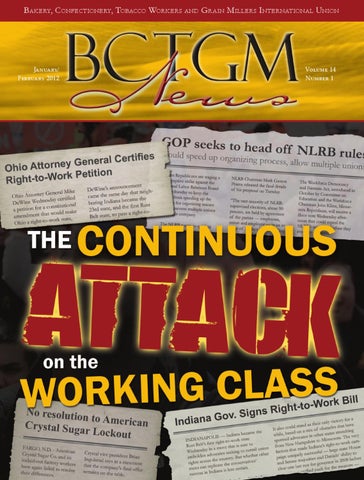
n February 1, Indiana became the 23rd state—and the first manufacturing state—to institute a “right to work-for-less” law. Across the United States, these laws have depressed wages for union and non-union workers alike, and have contributed to unsafe working conditions. And the attacks on workers and their unions that began in full force in 2011 continue with several other states attempting to follow Indiana’s lead.
O
On the same day Indiana passed the right-to-work-for-less measure, an anti-worker group calling themselves Ohioans for Workplace Freedom proposed an amendment to the state’s constitution. Attorney General Mike DeWine certified a petition for the constitutional amendment that would keep workers covered by labor contracts from having to join a union or pay dues.
4
However, Ohio’s Governor John Kasich has not expressed interest in making right-to-work a priority, after his similarly anti-worker Senate Bill 5 got overwhelmingly rejected last year at the polls. IN MINNESOTA
A right-to-work constitutional amendment has been introduced in the Republican controlled Minnesota State House. A constitutional amendment does not need approval of Democratic Governor Mark Dayton; instead, if the House and Senate
approve the measure it heads to voters in the November 6 election. However, Minnesota working families have an ally in Governor Mark Dayton, who opposes right-to-work although he doesn’t have the power to veto constitutional amendments. IN MICHIGAN
Right-to-work-for-less talk historically has never taken root in Michigan, a union stronghold where roughly 18 percent of employed workers now are represented by labor unions. However, Republicans control both chambers of the Michigan Legislature and the state’s administration with Governor Rick Snyder. Snyder calls the right-to-work debate “divisive” and says he doesn’t want legislation sent to his desk. And if Democrats unite against the measure, it would be more difficult to pass.
BCTGM News
IN ARIZONA Arizona’s attack on unions goes above and beyond all of the above measures. In fact, recent media reports say that Arizona’s Republican Governor Jan Brewer’s union-busting efforts make those in Ohio and Wisconsin look harmless.
Arizona’s teachers and first responders are under full-frontal attack, as union-stripping bills that have been called “Wisconsin on steroids” are being shuttled through the legislative process at whirlwind speed. These bills would prohibit public-sector unions from negotiating pay and benefits, ban paycheck deductions for union dues, and ban compensation for
union activities. It’s expected that they will pass through both chambers easily due to the anti-labor GOP majority in both. Governor Jan Brewer will undoubtedly sign them into law. A Phoenix-based right-wing pressure group, the Goldwater Institute, and the American Legislative Exchange Council (ALEC), are behind the measures.
The Truth About Right to Work for Less Laws
- -
- -
RIGHT-TO-WORK-FOR-LESS HURTS EVERYONE Workers in states with right-to-work-for-less laws have a consistently lower quality of life than in other states—lower wages, higher poverty and infant mortality rates, less access to the health care they need and poorer education for their children. LOWER WAGES The average worker in a right-to-work state makes about $5,333 a year less than workers in other states ($35,500 compared with $30,167).1 Weekly wages are $72 greater in free-bargaining states than in right to work states ($621 versus $549).2 FEWER PEOPLE WITH HEALTH CARE 21 percent more people lack health insurance in right to work states compared to free-bargaining states.3 HIGHER POVERTY AND INFANT MORTALITY RATES Right to work states have a poverty rate of 12.5 percent, compared with 10.2 percent in other states.4 Moreover, the infant mortality rate is 16 percent higher in right to work states.5 LOWER WORKERS’ COMPENSATION BENEFITS FOR ON-THE-JOB INJURIES Maximum weekly worker compensation benefits are $30 higher in free states ($609 versus $579 in right to work states.6 MORE WORKPLACE DEATHS AND INJURIES According to the federal Bureau of Labor Statistics, the rate of workplace deaths is 51 percent higher in states with right to work, where unions can’t speak up on behalf of workers.7 1. Average Annual Pay, 2001 from Bureau of Labor Statistics, State average annual pay for 2000 and 2001and percent change in pay for all covered workers. URL: http://www.bls.gov/news.release/annpay.t01.htm. 2. Bureau of Labor Statistics. 3. Percent of population lacking health insurance from Current Population Survey, March 2002. Table HI06. Health Insurance coverage status by state for all people: 2001. 4. Poverty Rate in 2001 from U.S. Census Bureau, Current Population Survey, March 2002. URL: http://ferret.bls.census.gov/macro/032002/ pov/new25_001.htm. 5. O’Leary Morgan, Kathleen, and Scott Morgan, State Rankings 2001. Morgan Quitno Press, 2001. 6. Workers’ Compensation data from the AFL-CIO Department of Safety and Health. 7. Workplace Fatalities from Death on the Job: The Toll of Neglect. AFL-CIO. April, 2002. (Photo credit, opposite: Lauren Casey, The Statehouse File)
January/February 2012
www.bctgm.org
5
Union Membership HOLDS STEADY in 2011
W
orking men and women The middle class is clearly economy depends on a strong and want to come together stronger when workers join growing middle class. to improve their lives: together in unions. The power “Ensuring that all people have That’s the message from January’s of unions to create prosperity a voice at work and protecting report on 2011 union membership. for all working families is well their right to organize and bargain Despite an recognized: Organized labor is one collectively are Today’s numbers unprecedented of the few voices for the economic essential for an volley of partisan interests of the middle class in our America that’s make it clear that political attacks government. Unions were key to built to last, where union jobs are critical on workers’ rights creating and protecting the social everyone gets a and the continuing to a strong economy. fair shot, everyone safety net (including Social Security insecurity of and Medicare) and winning major pays his or her America’s economic crisis, union legislative victories for working fair share and everyone plays by membership increased slightly last families such as the Equal Pay the same rules,” says Secretary of year. Act, the Civil Rights Act, and the Labor Hilda Solis regarding the On January 27, the Bureau of Family and Medical Leave Act. union membership report. Labor Statistics announced that in 2011, the unionization rate of employed wage and salary workers was 11.8 percent, up slightly from 11.9 in 2010. Among private sector • In 2011, 14.8 million people were in unions. employees, the rate remained at 6.9 percent. • Overall union membership increased by 49,000, The data also show that including 15,000 new 16- to 24-year-old members. An among full-time wage and salary increase of 110,000 in the private sector was partially workers, the median weekly offset by a decline of 61,000 in the public sector. earnings of union members • Public sector density increased from 36.2% in 2010 to were $938, compared to $729 37.0% in 2011. for nonunion workers. Union women earned median weekly • Private sector density remained at 6.9%. earnings of $879, an amount 34.6 • The largest increases in union membership were in: percent higher than their nonunion counterparts, who earned just $653 • Construction by comparison. • Health care services Prior reports prove that union • Retail trade members have greater access to • Primary metals and fabricated metal products health care, retirement and leave • Hospitals benefits. The recent numbers make • Transportation and warehousing it clear that union jobs are critical to a strong economy. And a strong Source: Bureau of Labor Statistics and Center for Economic and Policy Research.
By the Numbers:
6
BCTGM News
2012 International Staff Meetings Held at Headquarters
Organizing, 2012 contract negotiations and the political landscape in Washington topped the agenda during staff meetings held at BCTGM International headquarters in January. Regional Vice Presidents and Representatives from the First, Second, and Fifth Regions attended the meetings that were led by International President Frank Hurt and assisted by International Secretary-Treasurer/Director of Organizing David B. Durkee. The purpose of the meetings is to develop a region-by-region game plan for maximizing organizing opportunities, maintaining high-quality local union service work and implementing an effective grassroots political action program in this crucial election year. Each International Vice President reviewed the past year, including local union mergers, contract settlements, arbitrations, strikes and lockouts. Additionally, the group discussed upcoming negotiations in each region. Both Hurt and Durkee stressed the importance of maintaining solidarity in the face of fierce employer opposition during contract negotiations. Hurt discussed the present lockout of 1,300 BCTGM members at American Crystal Sugar and the uncertain future of 5,000 BCTGM members employed at Hostess Brands. Discussing 2012 contract negotiations, Hurt said, “We will continue to uphold the highest standards that are the hallmark of BCTGM contracts—regardless of the bargaining tactics companies might employ. We will not back down,” said Hurt. Similar staff meetings will be held for the Third, Fourth and Sixth Regions later this spring.
ATTENTION
Scholarship Applicants
The deadline for applications to the BCTGM 2012 International Scholarship program has passed. All those who submitted an application prior to the January 31 deadline date are reminded to submit the following requirements prior to the March 31 deadline for requirements: Personal Profile – completed by the applicant. Academic Report – completed by the high school (or college, if a member). The report should reflect the first semester grades for the senior year (or more recent academic performance, if a member). Essay – Each applicant is required to write and submit an essay (250500 words) to demonstrate your ability to organize thoughts and express yourself. Your essay may be one of the following: Same essay as the essay requirement from your college application. Same essay as the Union Plus Scholarship application (U.S. applicants only). Essay on “Organized Labor’s Contribution to the Welfare of the People of North America.” SAT or ACT Scores - (if applicable) For more information contact the BCTGM International Scholarship Office:
(301) 933-8600 January/February 2012
www.bctgm.org
7
The Pride of Philadelpia:
B
CTGM Local 492 (Philadelphia) members take tremendous pride in Tasty Baking Company’s rich heritage and bright future. Tasty Baking products have been well known throughout the company’s nearly 100 year history for consistent taste, quality, and freshness. And in 2010, the BCTGM Union Label brought added quality to every product made at the company’s Philadelphia bakery.
8
In 1914, a Pittsburgh baker, Philip J. Baur, and a Boston egg salesman, Herbert T. Morris, went into business in Philadelphia to produce baked goods using only the finest ingredients delivered fresh daily to the bakery. They insisted on farm fresh eggs, Grade A creamery butter, real milk, cocoa, spices, and natural flavorings. The products were so good that Morris’ wife, after trying some of the samples, said they
were “tasty,” so they eventually named the business Tasty Baking Company and came up with the catchy name, Tastykake. At ten cents a cake, Morris sold $28 worth the first day, $222 the first week. By the end of 1914, gross sales were $300,000. Machinery was built, employees were hired, and routes were expanded. Chocolate Juniors were the first new product developed, then they put in electric ovens for cupcakes. By
BCTGM News
TastyKake Fun Facts It would take 14,080 Tastykake individual pies laid end to end to form a mile. If one chicken were to lay all of the eggs used for one day of production at Tastykake, it would take that chicken 572 years to lay enough eggs. To build a 3-foot wide sidewalk of Butterscotch Krimpets from Center City, Philadelphia to Atlantic City you would need 30,412,800 Krimpets. To completely cover the Philadelphia Flyers ice hockey rink (60’ x 200’), it would take 172,800 Tastykake Juniors. Tastykake’s oven is half the length, 150 feet long, of a regulation football field (300 ft). Tastykake bakes 250,000 pies each day. You could make almost 8 million peanut butter sandwiches with the same amount of peanut butter that is used in Kandy Kakes in a year. Tastykake products use sugar cane and cocoa from Africa’s Ivory Coast; Vanilla from Madagascar; Cinnamon from Indonesia; Nutmeg from the East and West Indies and Banana Puree from Ecuador. The first day of operations in 1914, Tastykake bakers produced 100 cakes. Today, they bake over 4.8 million cakes, donuts, cookies, and pies each day. *The above material was reprinted from Tasty Baking Co. website: www.tastykake.cm/aboutus/funfacts
1918, sales reached $1 million. individually packaged By 1930, with the introduction lunchbox-sized pies. And at of Butterscotch Krimpets and a nickel each, they became the expansion to immediate hits. “We take tremendous five buildings, Workers at Tastykake was Tasty Baking were pride in the quality selling $6 million without union products we produce representation worth of these new snack cakes. and the BCTGM Union throughout the Krimpets and company’s history Label is proudly cupcakes were the they voted to displayed on all goods until two best sellers at become members that are baked in two packs for a of BCTGM Local nickel. 492 in August Philadelphia.” In the 1930s, 2010. as Americans looked toward “We take tremendous pride in economy, Tasty Baking Company the quality products we produce came up with a revolution: and the BCTGM Union Label is January/February 2012
www.bctgm.org
proudly displayed on all goods that are baked in Philadelphia,” notes BCTGM Local 492 Tasty Baking Chief Shop Steward Greg Sadowski, who sent the photos of Local 492 members at work in the Philadelphia bakery featured here to the BCTGM NEWS. 9
Steward Education
Community Activism In Frisco, Texas, BCTGM International Representative Cesar Calderon led a group of BCTGM Local 111 (Dallas) members and community activists in distributing fliers about the American Crystal Sugar Lockout outside the stadium where American Crystal CEO Dave Berg was attending the North Dakota vs. Texas College football game. Calderon was interviewed by a local newspaper and gave an extensive interview concerning the lockout of 1,300 BCTGM members at American Crystal Sugar. Pictured here, from left to right, is a local reporter, Local 111 Financial Secretary-Treasurer Richard Lewis, Calderon, Local 111 Exec. Board Member Jeff Randall, and Maria Ocampo, a community activist.
BCTGM Local 334 (Portland, Maine) held a shop steward training in December 2011. Stewards from Hostess Brands, B&M Baked Beans and Tate & Lyle Starch completed the training, which was taught by Region 1 International Vice President Art Montminy. Pictured here is the Local 334 shop stewards.
50 Year Celebration BCTGM Local 4 (St. Louis) President Russell J.Yates recently presented member Sandra Miller with her 50-year union membership gold card and certificate. The local union also helped Miller celebrate with a union-made anniversary cake. Miller, who became a member in July 1961, was a baker for Schnucks Bakery.
40 Years Strong BCTGM Local 22 (Minneapolis) members recently honored Mark Carlson for his 40 years of union membership. Carlson went to work baking for Denfeld’s Supervalu in Duluth in 1971 and became a member of B&C Local 58. Carlson still works at that same in-store bakery, now known as Mount Royal Fine Foods. “I have always enjoyed my work and I’ve always been around great people,” reflects the Local 22 member. Carlson was presented with his 40-year certificate by Local 22 Vice President Bruce Peglow at the local membership meeting. Pictured here, from left to right, is Local 22 members Ray Waldron (bakery manager), Carlson, Barb Bakke (Cake Decorator), and Cheryl Bloomquist (bakery merchandiser/head wrapper). 10
BCTGM News
Local 58G Members Inspire Hard Work, Confidence BCTGM Local 58G (Toledo, Ohio) members Michael Duhart, Business Agent for Local 58G, and Brenda Pasker-Duhart, a production technician at J.M. Smucker Co. in Toledo, are proud of the life they have been able to provide their family. Their hard work and dedication have been an inspiration to son Gerren, who has become a star football player at Wayne State University (WSU) in Detroit. Gerren, a red-shirt freshman, is highly motivated and works hard to become a better individual as well as and team player. “I count it a great blessing to have been a part of the Local 58G BCTGM union for more than 24 years,” notes Brenda. “Our children grew-up in a household with a strong work ethic. I’ve told my kids throughout their lives:Your dad and I go to work every day. We work hard and give our best on our jobs. Your job is to go to school every day, put forth your best effort to get good grades, help others, and be the best person that you can be.” Gerren wears the number 27 jersey and plays cornerback, punt return, punt coverage, kick-off coverage, and kick-off return. In 2011, DuHart was the recipient of the WSU Defensive Rookie of the
Year award and was selected as WSU’s Scout Team Defensive Player of the Week following the school’s victorious game against Indianapolis. In 2011, against all odds and for the first time in history, the WSU Warriors earned a seat in the playoffs for the national championship title in Florence, Alabama. In the championship final against Pittsburgh State University, Gerren made several significant plays, including a number of tackles, four pass breakups, and one interception. Michael, who has been a union member since 1976 notes, “Being part of the union for almost 45 years has taught me about ‘brotherhood’ and how you can accomplish great things if you stick together. I’ve taught my kids about solidarity and how important it is to look out for one another.” Gerren is majoring in Graphic Design and will pursue a job in a creative field after he graduates. He has worked with junior high and high school athletes in his free time to give inspirational guidance on “How Character Counts.” He also coaches younger kids on defensive back football positions. “I am very proud of Gerren both on and off the field because as a student athlete, he is aware of how much one’s character plays in defining a whole person. He also sees how important it is to be a role model to the kids who are watching him and who want to follow in his footsteps. “Our outstanding union contracts have provided us with excellent benefits and wages that have afforded us the means to send Gerren to great schools. This in turn has reinforced our values in character, strong work ethic, and the importance of supporting the community. I’m a witness that unions are good for families,” concludes Brenda.
Honoring MLK On January 14, BCTGM Local 103 (Orlando) sponsored its annual float in the Orlando/Eatonville Dr. Martin Luther King celebration. Local 103 children and grandchildren accompanied the float and threw union-made candy and cake to the crowd while union members followed behind distributing bread from the Hostess Orlando bakery to spectators. Pictured here (from left to right) is Local 103 Executive Board member Ron Hopkins, Business Agent Jason Davis, Trustee John Johnson, member Lottie Williams (Hostess), Sergeant at Arms Alvin Campbell, member Sam Lawson ( Hostess), and Local 103 President Brian Batchelor. January/February 2012
www.bctgm.org
11
“Now you can call this class warfare all you want. But asking a billionaire to pay at least as much as his secretary in taxes? Most Americans would call that common sense.” —U.S. President Barack Obama, in his State of the Union address on January 24
“President Obama spoke to the confidence of working people that if we are determined and committed, we can revitalize ‘Made in the USA.’ That commitment to American manufacturing, made possible in part by enhanced enforcement of trade laws being violated by China, is welcome news to the too many productive, hard working Americans sitting idle unnecessarily.” —AFL-CIO President Richard Trumka, in response to President Obama’s State of the Union address on January 24.
“One of the things the Congress should do immediately is defund the National Labor Relations Board which has gone into South Carolina to punish Boeing, which wants to put 8,000 American jobs in S.C., by fundamentally eliminating right-to-work at the National Labor Relations Board.” —Republican Presidential Candidate Newt Gingrich during the New Hampshire Republican Debate on defunding the NLRB and why there should be a national right-to-work law.
12
“We can’t afford to have super wars over issues that might divide us….I have said it over and over again, and I’ll say it again tonight: I’m a supporter of the labor laws we have in the state of Indiana and I’m not interested in changing any of them—not the prevailing wage law and certainly not a ‘right to work’ law…” —Indiana Gov. Mitch Daniels in 2006 at a union sponsored campaign fund raiser. Daniels teamed with statehouse Republicans to pass a “right to work” for less bill even after voters made clear that they want a public referendum on the controversial anti-worker measure.
“Congress was willing to make this affirmation of a fundamental and basic statement, ‘You don’t get to discriminate against people in their pay, in their work based upon these arbitrary standards of gender or race or ethnicity.’” —U.S. Rep. George Miller (D-Calif.) on January 29 marking the three-year anniversary of the passage of the Lilly Ledbetter Fair Pay Act. The law reverses a Supreme Court ruling that made it more difficult for women to pursue pay discrimination claims.
BCTGM News
Corporate Tax Cuts DO NOT Benefit Working Canadians
January/February 2012
www.bctgm.org
2012
2011
2010
2009
2008
2007
2006
2005
cuts are starving the federal government of needed revenue. In 2012-13, the federal government estimates it will collect $33.1 billion in corporate tax revenues (at the 15 percent rate). Yet if the tax rate was still at 21 percent, government revenues would be $13 billion higher. The loss of $13 billion in revenue means less spending on social programs, job training programs, environmental programs, and many other important services. According to BCTGM International President Frank Hurt, it is inexcusable that successive governments have allowed the corporate tax cut sham to continue. “Canadian companies promised to invest their savings into their companies and they have not. They lied. In turn, the federal government, without the needed corporate tax revenue, has slashed social programs that working families depend on. That was not supposed to be the deal and it needs to be rectified immediately.”
2004
2003
2002
2001
2000
1990
1980
1970
with their increased after-tax profits? According to the report, publically-traded companies have used their increased profits to boost dividends paid out to shareholders. Dividends as a percentage of after-tax profits rose from 30 percent in 2000 to more than 50 percent in recent years, to as high as 70 percent in 2009. Much of these dividends went to large institutional investors and the very wealthy. At the same time, corporations are saving more and more of their profits, rather than investing them in new technology, jobs, and factories. According to the CLC report, instead of investing the savings from the lowered tax rate, Canadian companies have locked it away, while increasing their financial assets and cash reserves. While Canadian companies and their investors have enjoyed the benefits of the decreased tax rates, the impact on working Canadians has not been so rosy. Simply put, the corporate tax
1960
For years, corporations in Canada have complained about high corporate tax rates. Despite the fact that the Canadian corporate tax rate was on par with other industrialized nations, corporations lobbied Parliament relentlessly to lower their rates. They argued that if only their tax rate was lower they would be able to add jobs, increase productivity by investing in new technology, and open more Canadian-based facilities. Unfortunately for working Canadians, successive federal governments—both liberal and conservative—have listened to these business lobbyists. In 2000, the general federal tax rate was 28 percent (down from 41 percent in 1960). The governing Liberal Party cut the rate to 21 percent. It was cut further by the Conservative Party between 2008 and 2011, culminating in the final cut to 15 percent effective January 1, 2012. Did the increase in after tax profits lead to an increase in corporate spending on new plants, machinery and investment? 40% Not according to a new report by the Canadian Labour Congress (CLC), 30% “What did Corporate Tax Cuts Deliver?” Real investment has been 20% neglected while profitable corporations have paid out more in dividends to 10% shareholders and increased their cash reserves. So what have Canadian companies done
13
Happy
100
h tBirthday to the
o e r O
Cookie
1912 - 2012
The Best Selling Cookie of the 20 th C entury
I
n 1898, several baking companies merged to form the National Biscuit Company (NaBisCo), and opened a large industrial bakery in New York City on Ninth Avenue between 15th and 16th Streets at the Chelsea Market Building. By 1902, the company had its first nationwide success in Barnum’s Animal crackers, which were sold in boxes painted as animal cages. In 1912, Nabisco had an idea for a new cookie – two chocolate disks with a sugar creme filling in between. That year Nabisco sold its first package of Oreo Cookies to a store in Hoboken, N.J. Today, more than 12 billion Oreo cookies are consumed each year. In order to keep up with this voluminous demand, BCTGM members use 22 million pounds of coca and 64.1 million pounds of cream filling. So how did the Oreo get its name? The people at Nabisco aren’t quite sure. Some believe that the cookie’s name was taken from the French word for gold, “or” (the main color on early Oreo packages). Others claim the name stemmed from the shape of a hillshaped test version; thus naming the cookie in Greek for mountain,
14
“oreo.” Still others believe the of the 20th century. Nabisco moved out of the name is a combination of taking Chelsea Market building in 1958 the “re” from “cream” and and now produces Oreo Cookies placing it between the two “o”s in in BCTGM bakeries throughout “chocolate” —making “o-re-o.” the U.S. and Canada. And still The original bakery others “Health food may be building now houses believe good for the conscience cafes and shops that the cookie was but Oreos taste a hell and 15th Street and Ninth Avenue in named Oreo of a lot better.” New York City was because it renamed Oreo Way. was short —Robert Redford Oreo is just and easy to one of the popular treats made pronounce. by BCTGM members at KraftNo matter how it got named, Nabisco. BCTGM-made more than 362 billion Oreo Kraft-Nabisco products, including cookies have been sold since it the Oreo, are found in more than was first introduced in 1912, 145 countries. making it the best selling cookie
BCTGM Makes Kraft-Nabisco Kraft-Nabisco products are manufactured by BCTGM members employed at these Kraft Foods/Nabisco plants: • • • • • •
Chicago (Local 300) Fair Lawn, N.J. (Local 719) Portland, Ore. (Local 364) Philadelphia (Local 492) Richmond, Va. (Local 358) Montreal, Canada (Local 350)
BCTGM News
SHAPE UP and et the lowest rates on new memberships at your choice of over 8,000 fitness clubs, including Total Fitness, Curves, World Gym, and Lady of America locations. BCTGM Power/Union Plus has partnered with GlobalFit to provide these healthy living programs for you.
Fitness Clubs • Check out any club before joining with a free guest pass. • Freeze your fitness club membership, and visit another participating club while traveling, when you commit to your health with GlobalFit’s Commit Membership option. • Family members are eligible for this program. • Get no-hassle billing to your credit card or bank account.
NutriSystem Program Discount • Get a special low price on NutriSystem through GlobalFit. • Enjoy NutriSystem's confidentiality and convenience. With NutriSystem there's no counting, no meetings, and no public weigh-ins. • Get online and phone support from NutriSystem's nutritionists and counselors.
B
$AVE GM CT
POWER Healthy Living Programs
• Health Coaching provides one-on-one guidance from a trained professional to help you lose weight, de-stress, or meet any other health goal. • Smoking Cessation classes can help you quit for good with a convenient, guided program that includes free educational materials.
NOTE: To receive your union-member rates on any of these programs, you must enroll directly through GlobalFit. These rates are not available to the general public. Fitness club participation is not available for current club members.
Call
1.800.294.1500 to speak with a GlobalFit fitness representative
For more information about these benefits available to union members go to:
www.UnionPlus.org/HealthClubs January/February 2012
www.bctgm.org
15
Printed in the U.S.A.
LIKE BCTGM? BCTGM!
acebook.com/BCTGM