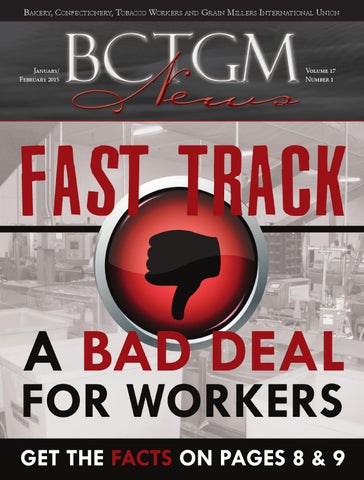
Bakery, Confectionery, Tobacco Workers and Grain Millers International Union
January/ February 2015
Volume 17 Number 1
the
PRESIDENT’S MESSAGE
DEFEATING “Fast Track” Key to Stopping
T
DESTRUCTIVE “Free Trade” Deals
The record is clear, convincing and indisputable. For more than two decades, “free trade” agreements have had a disastrous impact on American and Canadian working families and devastated communities throughout North America. The BCTGM and our members know firsthand the hardship that results when multinational corporations, Wall Street and their political allies in Washington, D.C. team up to enact “free trade” agreements. In the last 20 years, many thousands of our BCTGM Brothers and Sisters have lost their good, middle-class jobs because the North American Free Trade Agreement (NAFTA) has made it easy and profitable for companies like Nabisco, Hershey and Kellogg to close plants in the U.S. and Canada and move production to low-wage factories in Mexico. NAFTA and the numerous “free trade” agreements that have followed are a root cause of the income inequality crisis that is staggering the middle class and undermining the economic and social fabric of our two countries. They have played a central role in the dramatic transfer of wealth and power from working families to corporations and the richest one percent and one-tenth of one percent in society. And now, as more and more families are falling out of the middle class, American workers are once again up against congressional leaders and, disappointingly, a President who are intent on forcing another round of “free trade” agreements through Congress. As was the case with all previous “free trade” agreements, corporate, financial and Wall Street executives and their allies in government are promising that these new agreements will create hundreds of thousands of good jobs for American workers. The most dangerous of the new batch of trade deals is the Trans-Pacific Partnership Free Trade Agreement (TPP), also known as “NAFTA on steroids”. It would be the largest free trade agreement in history involving 12 nations, including the U.S. and Canada, which account for 40 percent of the global economy. The deal is being negotiated behind tightly closed doors. While elected officials and representatives from organized labor have been excluded from the negotiations, leaders of powerful multinational corporations and financial institutions have had a comfortable seat at the table and are involved in the writing of this trade agreement. TPP is really about advancing the corporate and Wall Street agenda of increasing profits by reducing labor costs and eliminating legitimate regulations that protect workers, consumers, the environment and democracy. U.S. Senator Elizabeth Warren (MA) was right on target in her assessment of TPP negotiations when she stated, “Americans are deeply suspicious of trade deals negotiated in secret, with chief executives invited into the room while the 2
workers whose jobs are on the line are locked outside.” Before congressional leaders move forward on approving more destructive “free trade” agreements, they will first attempt to pass Trade Promotion Authority (TPA), better known as “fast track”. “Fast-track” legislation is designed to pave the road for new trade deals by forcing Congress to relinquish its constitutional authority to review and amend any trade agreement negotiated by the President. With “fast track”, Congress essentially is forced to take a quick up-or-down vote on broad, complex trade agreements with no opportunity for amendments. As such, citizens are left with no ability to demand from their elected representatives that changes be made to provisions of trade agreements that hurt working people. No trade deal has ever been defeated when considered under “fast track” procedures no matter how bad it is for wages, jobs and working families. Trade policies adopted under “fast track” have cost the United States well over a million good, middle-class jobs and contributed to the shuttering of more than 60,000 factories. For these reasons, AFL-CIO President Richard Trumka has declared, “The AFL-CIO doesn’t just oppose ‘fast track’, we’re fighting to kill it. And we’re fighting to win.” I have personally assured President Trumka that the BCTGM will be standing shoulder to shoulder with the AFL-CIO in this historic fight. I was fully confident in making this commitment because I know that BCTGM members will always stand strong and fight hard when the well-being of our families, communities and country is threatened. — David B. Durkee, BCTGM International President
BCTGM News
Official Publication of the Bakery, Confectionery, Tobacco Workers and Grain Millers International Union 10401 Connecticut Avenue, Kensington, Maryland 20895-3961 (301) 933-8600 www.bctgm.org David B. Durkee, Editor Corrina A. Christensen, Assistant Editor BCTGM General Executive Board President David B. Durkee • Secretary-Treasurer Steve Bertelli Vice Presidents Jethro Head • Arthur Montminy Robert Oakley • Ron Piercey • James Rivers • Randy Roark BCTGM General Executive Board Members Joyce Alston • John Bethel • Thomas Bingler • Edward Burpo Butch Henley • Paul LaBuda • Stephane Langlois Terry Lansing • Earl Lublow • Letitia Malone Gary Oskoian • Paula Steig • Doyle Townson • Jeff Webb BCTGM News (ISSN 1525-4860) is published bi-monthly by the Bakery, Confectionery, Tobacco Workers and Grain Millers International Union, 10401 Connecticut Avenue, Kensington, MD 20895-3961. Periodicals postage paid at Kensington, MD and at additional mailing offices. Subscription to new members only. Postmaster: Send address changes to BCTGM News, 10401 Connecticut Avenue, Kensington, MD 20895-3961.
BCTGM News
HOSTESS MEMBERS
RATIFY First Contracts
S
even months after organizing On May 30, workers at the According to Head, who also newly-opened Hostess Columbus Hostess bakery voted to led negotiations in Indianapolis, snack cake bakeries, workers in join BCTGM Local 42. both sides were eager to negotiate a Indianapolis and Columbus, Ga. Negotiations on the collective bargaining agreement that voted overwhelmingly to ratify new contracts began almost would benefit BCTGM members first contracts. immediately at all three locations. and allow the company to continue Private equity companies Unfortunately, the company its successful re-emergence into the Apollo Global market. Management and “The company understood Metropoulos & Co. that to maintain highly efficient and acquired Hostess’ cake productive operations it needed our assets when the old members,” said Head. Hostess Brands was The new contracts contain liquidated in early 2013. significant wage increases, health and Apollo and Metropolous welfare benefits and pension benefits. initially acquired five The agreements also contain bakeries (four of which excellent language normally found were opened) and snack Local 42 members Erica Wesley (left) and in BCTGM collective agreements cake brands including Rebecca Bellamy (right), members of the such as a grievance procedure, job Twinkies, Ding-Dongs, negotiating committee, sign the newly ratified collective bargaining agreement. bidding, seniority, work rules and Snoballs and others. overtime language. “The BCTGM BCTGM Southern Region remains focused on ensuring that announced the closing of the International Vice President James the new Hostess Brands ownership Schiller Park bakery while Rivers, who led negotiations in understands that the snack cakes contract negotiations were already Columbus, said, “Many of these at the center of this new company underway. BCTGM Midwest are inextricably linked to the Region International Vice President members had been protected by a hands that make them – and Jethro Head, who led negotiations, collective bargaining aggreement for decades until the liquidation. have made them for generations. was able to secure a fair plant They know the benefits and We always knew that by rehiring closing agreement that would not understand why a union contract is former BCTGM workers the have been possible without their so important,” said Rivers. brands would prosper and endure. new union membership. It’s a win-win situation,” reflects BCTGM International President David Durkee. In March 2014, workers at the Hostess Brands LLC plant in Indianapolis voted overwhelmingly to join BCTGM Local 1 (Chicago). Two months later, Hostess workers in Schiller Park, Ill. also voted to join BCTGM Local 1 – the local union that represented them for many Hostess negotiating committee members (left) Jayne Cannon and Charles Larry years prior to the bankruptcy and Robinson (right) review the agreement with L. 1 Pres. Donald Woods (center). liquidation of the former Hostess. January/February 2015
www.bctgm.org
3
As part of a select panel, BCTGM Intl. Pres. David Durkee (center) explains how U.S. bankruptcy laws failed Hostess workers. Sara Nelson, President of the Association of Flights Attendants-CWA (left) and Grant Crandall, General Counsel for the Mine Workers (right), were also part of the panel discussion.
PRESIDENT DURKEE SPEAKS at AFL-CIO
Bankruptcy Conference BCTGM International President David Durkee was a featured panelist for a conference on corporate bankruptcy in the United States held at the AFLCIO Headquarters in Washington, D.C. in early February. The two-day conference, titled “Union Responses to Employer Bankruptcy,” was organized by the AFL-CIO’s Office of Investment and featured panels on bankruptcy case studies, the role of financial analysis in union decision-making, legal developments in Chapter 11, reforming the bankruptcy code and protecting retirement from employer bankruptcy. Joining Durkee on the featured panel was Sara Nelson, President of the Association of 4
Flights Attendants-CWA, Robert Roach, SecretaryTreasurer of the International Association of Machinists, Grant Crandall, General Counsel for the Mine Workers and Michael Artz, General Counsel for AFSCME.
BCTGM Intl. Pres. David Durkee (right) updates AFL-CIO Secy.-Treas. Liz Schuller (left) on the Union’s successful efforts to organize workers at former Hostess bakeries.
BCTGM News
Durkee focused his presentation on the Hostess to corporate bankruptcy and several themes bankruptcies of 2004-2009 and 2012. Giving resonated throughout the conference. A number of a detailed history, Durkee explained how U.S. panelists described the ways in which bankruptcy has bankruptcy laws failed tens of thousands of Hostess become a business plan for employers to get out from workers by allowing the company to emerge from its pension obligations and reject collective bargaining initial bankruptcy with more debt than when it had agreements. entered bankruptcy, and without There was also spirited iron-clad promises to invest in discussion of how best to ...the Hostess new technology and increased reform the broken system. bankruptcies are perfect capital expenditures. Participants noted new Durkee then discussed the examples of how the U.S. legislation introduced in the role private equity played in House of Representatives, bankruptcy code fails the eventual demise of Hostess the “Protecting Employees Brands. “Hostess, under the and Retirees in Business workers. “Banks and control of private equity and Bankruptcies Act of 2015.” lenders walk away with hedge funds, stopped paying The legislation states that, into the workers’ pension fund, their money, but workers “While protections for squandered $100 million in employees and retirees in lose everything.” concessions from the original bankruptcy cases have eroded, bankruptcy, enriched senior management compensation executives while demanding more plans devised for those in concessions from workers, and ignored long running charge of troubled businesses have become more distribution problems,” he reflected. prevalent and are escaping adequate scrutiny.” Durkee noted that the Hostess bankruptcies are The Act would reduce the losses for employees perfect examples of how the U.S. bankruptcy code and retirees, make it more difficult to reject collective fails workers saying, “Banks and lenders walk away bargaining agreements, protect the integrity of with their money, but workers lose everything.” pension and health plans and limit executive Other panels focused on specific issues pertaining compensation in bankruptcy cases.
BCTGM Intl. Dir. of Research & Education Matthew Clark (left) and Asst. to the Intl. Pres. Harry Kaiser (right) listen intently to the panel’s recommendations on bankruptcy reforms needed to protect workers.
January/February 2015
www.bctgm.org
5
AFL-CIO Holds National Summit on
RAISING WAGES
O
n January 7, the AFL-CIO held the first National Summit on Raising Wages and set the tone for political and economic action in 2015. The event was attended by more than 300 union leaders and activists. BCTGM International President David Durkee and International Secretary-Treasurer Steve Bertelli attended the Summit, accompanied by Assistant to the International President Harry Kaiser and BCTGM International Director of Research and Education Matthew Clark. The event was also broadcast online through livestreaming video. Sen. Elizabeth Warren (D-Mass.)
6
The core of the Summit was a panel discussion that included workers, academics, business owners and progressive and political leaders. Panelists detailed how the raising wages agenda made progress and confronted challenges in 2014, including major organizing wins at American Airlines, multiple state legislative victories on the minimum wage and innovative campaigns conducted by carwash workers. The panelists also recognized, however, that right-wing billionaires’ extremist politics, a rapacious Wall Street and insufficient advocacy from political leaders thwarted further progress. Additionally, the Summit outlined the AFL-CIO’s national Raising Wages campaign for 2015. State federations of labor will hold Raising Wages Summits in the first four presidential primary states—Iowa, Nevada, New Hampshire and South Carolina— beginning in Iowa this spring. Secondly, the AFL-CIO will take the Raising Wages campaign to seven cities around the country: Atlanta, Columbus, Washington D.C., St. Louis, Philadelphia, Minneapolis and San Diego. These
cities will be the starting points of a long-term effort to concentrate work where it can have the most impact. In major speeches highlighting
the Summit, Sen. Elizabeth Warren (D-Mass.) and Secretary of Labor Tom Perez outlined the defining economic fact of the past generation: productivity has gone way up and wages have stayed flat. In opening comments to the Summit, Perez said, “There is no more powerful force for shared prosperity than the American labor movement. And one of the reasons is that the labor movement fights for more than just its own members. You’ve led the struggle for a higher minimum wage even though most minimum wage workers don’t belong to a union. You’re standing with fast food workers and retail BCTGM News
workers who want a raise, who want a say. You’re standing up for immigrant workers, for paid sick days. Why? Because you measure success not simply by the size of your membership, but by the number of people you help. Because your commitment is to empowering all working people — to shared prosperity in the broadest sense. Because an injury to one really is an injury to all. Because you know that we all succeed only when we all succeed,” Perez declared. Elizabeth Warren opened her remarks saying, “America’s middle class is in deep trouble.” The Massachusetts Senator noted that pay has stagnated for all but the richest Americans— and “trickle-down voodoo economics and loose Wall Street regulation are to blame.” She noted that the current economic recovery, while real, hasn’t helped most Americans. The stock market’s up, but half the country doesn’t own any stocks. Inflation is low, but that doesn’t matter for millennials burdened by overwhelming student debt. Corporate profits
Secy. of Labor Tom Perez
have risen, but that hardly matters to people who work at Walmart and are paid so little that they still need food stamps, Warren said. Warren closed on a somber note, recalling how, after her father suffered a heart attack, her family got by on her mother’s minimum-wage job at Sears. “I grew up in an America that invested in kids like me,” Warren said, “an America that built opportunities for kids to compete in a changing world, an America where a janitor’s kid could become a United States senator. I believe in that America.”
AFL-CIO President Rich Trumka closed the Summit by highlighting the enormous progress, remaining challenges and real steps the labor movement plans to undertake in order to create an economy based on raising wages. “The collective voice is a powerful tool and in America, it is the only tool to bring about lasting justice. Let’s remember that raising wages is not a hobby – it is our mission. This is a beginning, not an ending. Let’s make it a beginning that all of America will feel the impact of,” concluded Trumka.
The Summit held a panel discussion that included workers, academics, business owners, progressive and political leaders.
January/February 2015
www.bctgm.org
7
IS THE
FAST TRACK WRONG TRACK
WHY WORKERS SHOULD BE CONCERNED Republican leaders in Congress and the Obama Administration have declared that trade is a potential area of compromise this year and working people should be concerned. New trade deals like the TransPacific Partnership (TPP) are being negotiated in the same failed North American Free Trade Agreement (NAFTA) model. The negotiations are focused on padding corporate profits not increasing workers’ paychecks. Before any trade deal comes to a vote, the administration will
8
ask Congress to pass “Fast Track” legislation.
What is “Fast Track”? “Fast Track” is a policy that gives the executive branch the opportunity to negotiate—out of public view—as many trade agreements as it can during a given time period and send them to Congress, which may then only vote yes or no on the agreement; it may not amend the agreement or its “implementing bill,” nor may it send the agreement back to the executive branch with instructions for improvement. “Fast Track” is dangerous because it forces Congress to make a take-it-or-leave-it decision on a 29 chapter, 1,000 page agreement no matter how bad it is for wages, jobs, small business and the environment. Instead of exercising its constitutional authority to review and amend a trade deal, Congress is unable to improve any section that hurts working people. A fast track bill was introduced last year but it never came to a vote thanks,
in part, to strong opposition from labor, led by the AFL-CIO. That’s because nearly two-thirds of American voters oppose granting the President fast track authority. They believe it gives too much power to one person.
Why is “Fast Track” bad for workers? No trade deal, no matter how bad, has ever been defeated under “Fast Track” procedures. The minute the negotiators have the “Fast Track” ticket in their hands, they know they are free to agree to provisions that will send jobs overseas, reduce the bargaining power of workers, jeopardize important environmental, health and safety regulations and give global corporations even more influence over our economy. While it’s possible to influence the Administration to reverse course and create a new, proworker trade policy, it will be nearly impossible to defeat global corporate interests if “Fast Track” is approved. Tell Congress to say NO to “Fast Track” because it harms workers:
Call: 1-855-712-8441 BCTGM News
TEN FACTS ABOUT FAST TRACK Costs Jobs: Trade policies adopted under Fast Track have cost us more than 1 million jobs and contributed to the shuttering of more than 60,000 factories. Benefits the 1%: Fast Track ensures trade policies are made by and for multinational corporations and the wealthy, making income distribution even more unequal and making it harder to get a raise. Undermines Democracy: Fast Track doesn’t allow adequate public scrutiny of trade deals while they are being negotiated, and permits only a simple up-or-down vote—no amendments. Gives Power to Foreign Corporations That Invest in the United States: Fasttracked trade deals almost always give mind-boggling legal rights and privileges to foreign investors—rights and privileges home-grown U.S. businesses don’t even have. Prevents Amendments: Fast Track doesn’t allow our representatives to amend trade deals, no matter how problematic some provisions might be. Permits Foreign Currency Manipulation: Current Fast Track legislation doesn’t require trade agreements to contain adequate provisions addressing currency manipulation, which economists estimate has cost up to 5 million U.S. jobs. Neglects Jobs: The current Fast Track legislation doesn’t include negotiating objectives on job creation, reducing the trade deficit or protecting “Buy American” policies. In fact, it promotes offshoring of jobs through “global value chains.” Encourages Higher Drug Prices: The current Fast Track legislation includes objectives that empower foreign drugmakers to challenge drug pricing and preferences in programs like Medicare, Medicaid and TRICARE—raising costs for these programs, patients and all American taxpayers. It also could delay when generics come onto the market, raising drug prices for all of us.
“Bad trade deals negotiated through fast track only succeed in padding the pockets of giant corporations and destroying good, middle-class jobs and communities. Thousands of our BCTGM Brothers and Sisters have lost their jobs, houses and quality of life. There is no such thing as ‘Free Trade. The truth is the price is high. ” — Joyce Alston, BCTGM L. 53 Pres. & GEB Member
Hurts the Environment: Previous trade deals negotiated under Fast Track have weakened environmental protections. Harms Communities: Fast-tracked trade agreements have shut factories and devastated communities—harming even those who still have jobs by forcing cutbacks in such important public services as schools, libraries, road repair, and police and fire protection.
January/February 2015
www.bctgm.org
9
BCTGM International Hires NEW Research Specialist “We continue to build and strengthen the services we provide to the BCTGM membership. With this in mind, I am pleased to welcome Paul Lechtenberg to our International staff,”
and health. His experience and safety training materials in includes working with restaurant Spanish and English, and worked and warehouse immigrant with Latino immigrant worker workers, organizing and training communities around the US. manufacturing and slaughterhouse Paul and his wife Renee live in workers in health and safety. Most Washington D.C. and are expecting recently, he their first child taught OSHA this summer. said BCTGM International rights and “I am President David Durkee in construction confident that announcing the newest member of trades to young Paul’s addition the BCTGM International staff. immigrants and to our staff will Lechtenberg, 32, began his significantly work as the BCTGM International’s inner city youth in an alternative benefit our Research and Education Specialist membership, on February 2. He replaces Matthew school in the especially in Clark, who was named the Director nation’s capital. His work our organizing of the Research and Education experiences and education Department November 1, 2014. include efforts. He Lechtenberg grew up in organizing brings a Middleboro, Mass. and studied for UNITE Local 631 in Phoenix, strong activist background and Sociology and Spanish at Boston Arizona. Lechtenberg also served will be particularly helpful in College. Lechtenberg is bilingual as the Bilingual Health and Safety communicating with our Spanishand completed some of his degree Trainer/Grant Administrator speaking membership and at Universidad Alberto Hurtado in for the UFCW International non-union workers within our Santiago, Chile. Lechtenberg has Union where he developed health traveled extensively throughout industries,” concludes Durkee. Latin America, including a six-month stint working in Managua, Nicaragua and has Applicants to the 2015 BCTGM Scholarship Program also lived in Bolivia, where The deadline for applications to the BCTGM 2015 International Scholarship he produced a documentary program has passed. All those who submitted an application prior to the film about a rural college. January 31 deadline date are reminded to submit the following requirements Lechtenberg has worked prior to the March 31 deadline: as an activist on migrant Personal Profile – completed by the applicant. issues in the Mexican states of Oaxaca and Chiapas, and Academic Report – completed by the high school (or college, if a member). has provided community The report should reflect the first semester grades for the senior year (or more outreach to indigenous recent academic performance, if a member). and Zapatista communities Essay – Each applicant is required to write and submit an essay (250-500 with the Jesuit Misión words) to demonstrate the ability to organize thoughts and express oneself. de Bachajón. Here, he The essay may be one of the following: participated in sessions on • Same essay as the essay requirement used in your college application. conflict resolution and public • Same essay as the Union Plus Scholarship application (U.S. applicants health discussions, and only). assisted in emergency relief • Essay on “Organized Labor’s Contribution to the Welfare of the People after natural disasters. of North America.” Lechtenberg specializes in bilingual labor training SAT or ACT Scores (if applicable) and education, bilingual For more information contact the BCTGM International materials design, videography Scholarship Office at (301) 933-8600. and occupational safety 10
BCTGM News
Cellone's Italian Bakery
Editor’s NOTE: Ed Thomas, Vice President BCTGM Local 19 in Cleveland, provided the following article about Cellone’s Bakery where Local 19 bakers proudly make some of the region’s most renowned Italian baked goods.
Cellone’s Bakery is a small, but growing “Mom and Pop” bakery, located in Carnegie, Pa. Now in it’s fourth generation of family ownership, the Cellone’s tradition of baking began in the Northern Italy town of Torino. The original owners immigrated to America in 1911. Bringing their old-world style of baking with them, the owners started out baking in their home and delivered their Italian baked goods throughout the neighborhood, door-to-door, by a horse drawn wagon. Soon, the family business grew out of the home and moved into several larger buildings to meet the demands of the growing number of customers in the Pittsburgh area. Renowned for authentic Italian baked goods, Cellone’s has also been innovative in developing new lines of products. Cellone’s was the first bakery in the United States to produce the Egg Bun, which has become an American favorite. Today, Cellone’s is a fully automated bakery, combining state-of-the-art technology with more than 100 years of Italian-style baking. The bakery is run by the family and 57 proud Local 19 members (who merged into Local 19 from Local 12 in March 2004). Cellone’s is one of the leading wholesale bakeries in the industry that delivers fresh baked products daily and frozen products nationally. Cellone’s bakery workers are preparing to move into a new 130,000-square-foot facility in Crafton, Pa.
January/February 2015
www.bctgm.org
11
“Too many Americans are working longer and harder without anything to show for their efforts in their paychecks. These long hours are straining middleclass workers and their families. Since the 1970s, average salaries for middle-class individuals have dropped even while salaried workers have increased the hours they spend on the job. Strengthening overtime protections will help millions of middle-class families.” — Letter from 26 U.S. senators to President Barack Obama to quadruple the number of U.S. workers eligible for overtime pay.
“A few decades ago, executives were paid mostly in cash. Today, the typical executive receives two-thirds of his or her pay in stockbased compensation. With the vast majority of pay based on the stock price, all the noise in the boardroom and executive suite is about the stock and total shareholder return, not the long-term investments that are key to achieving goals aligned with environmental and social sustainability—and to identifying future risk.” — Judith Samuelson, executive director of the Business and Society Program at the Aspen Institute 12
“The decline in unions is a huge factor explaining what’s happened to middle-class wages.” — Lawrence Mishel, president of the Economic Policy Institute
“Now more than ever, the struggle for civil rights must include good jobs that raise wages and an economy that works for all. Without good jobs, there is no real freedom. While African-American union members are weathering the economic downturn with the aid of collective bargaining, our non-union brothers and sisters are suffering. Today African-Americans have a 10.4 percent rate of unemployment in the United States compared to a 4.8 percent rate for white Americans.” — AFL-CIO Vice President Tefere Gebre, 2/9/15 Huffington Post blog celebrating Black History Month and honoring the African-American labor leaders who have inspired him in his work.
“I’m just old enough to remember when strikes were big news. There was conflict and great visuals of picket lines. Now, though, the coverage of these things has been handed over to the crooked racetrack touts of the ‘financial press.’ Hardly any newspaper, and certainly no local television station, has a reporter full-time on the labor beat, which used to be a golden staircase to the Pulitzer Prize. This is the great failing of my industry in the past 40 years.” — Jouirnalist Charles P. Pierce, 2/5/15 article OIL WORKERS ON STRIKE: THE INVISIBILITY OF LABOR NEWS on the USW strike against Royal Dutch Shell that includes 4,000 workers at nine plants in California, Kentucky and Texas. USW haven’t called a strike nationally since 1980. BCTGM News
Member Recognition
Local Union Pride
Recently, BCTGM Local 62G (Mankato, Minn.) member Nick Frederick (right) was presented with an appreciation plaque for his many years of service by Local 62G President Kent Williams (left). Frederick, who has been employed by Cenex Harvest States Oilseed since 1974, has served on the Labor Relations Committee for 30 years, served as shop steward for 14 years and served as the local’s vice president for four years.
In late December 2014, BCTGM Local 24 installed a dedication plaque into the Local’s new office lobby in San Carlos, Calif. The special plaque dedicates the building to the hardworking men and women of Local 24. Pictured here proudly displaying the plaque which honors Local 24 members and lists the current and retired Officers of Local 24 is Local 24 Financial Secretary-Treasurer Joe Biringer.
HEALTH & SAFETY NEWS & NOTES Court Upholds Inclusion of Combustible Grain Dust Hazards In an October 2014 decision on the National Oilseed case, the District of Columbia circuit court upheld OSHA’s revised Hazard Communication standard as it applies to combustible grain dust hazards. The standard was updated in 2012 to align with the Globally Harmonized System of Classification and Labeling of Chemicals. “Combustible grain dust fires and explosions have killed and injured thousands of workers. The court determined that employers such as grain elevator owners with combustible dust hazards in their workplaces who are subject to the Grain Handling standard must also comply with the HazCom standard. Under the HazCom standard, employers must communicate the hazards of a chemical regardless of the level of exposure to the chemical in a particular downstream January/February 2015
fatalities within 8 hours and workrelated in-patient hospitalizations, amputations and losses of an eye within 24-hours of finding out about the incident. Previously, employers were required to report all workplace fatalities and when three or more workers were hospitalized in the same incident. The updated reporting requirements have a lifesaving purpose: they will enable employers and workers to prevent future injuries by identifying and eliminating the most serious workplace hazards.
workplace and requires warnings even where the evidence about the chemical’s hazardous qualities does not meet the threshold that would be needed to justify an OSHA standard.” The BCTGM has been a leading advocate for a comprehensive combustible dust standard that would include more extensive training on the hazards of combustible dust, increased employee participation in hazard analysis, more robust housekeeping OSHA Reminds Employers to requirements, Post OSHA 300A Injury/Illness and stricter fire Summary February - April prevention controls. OSHA is reminding covered employers to post OSHA’s Form 300A, which summarizes the total New Reporting number of job-related injuries and illnesses Requirements that occurred during 2014 and were logged As of January on OSHA’s Form 300, the log of work-related 1, 2015, employers injuries and illnesses. The summary must be covered by federal posted between February 1 and April 30, 2015, OSHA are now and should be displayed in a common area required to report where notices to employees are usually posted. work-related www.bctgm.org
13
Illinois Local Union Officers and Stewards
Train for the Future
On January 17, BCTGM Local Union stewards and officers gathered at the Local 103G union hall in Decatur, Ill. for a full day of education. Union members and leaders from Local 103G in Decatur represent workers at the ADM facilities in Decatur; Local 303G from Bloomington, Ill. represent workers at Cargill; and Local 325G from Gibson City, Ill. represent members at the DuPont plant. BCTGM International Vice President Jethro Head led the training assisted by International Representative Dennis Howard. According to Local 103G President Joe Lee, the locals enjoyed the combined educational opportunity and felt united in purpose. “It was good to hear from the other local unions. Many shop stewards were unaware of the rights they have when representing a union member in today’s workplace. The training brought us all a wealth of information to be able to help our union stewards and as officers, to be more knowledgeable and helpful when a member has a problem or needs representation,” reflects Lee. According to Local 303G President Brad Williams, the instruction by Vice President Head was outstanding and covered many topics important to both union workers and leaders. Williams noted that Head provided very informative answers to questions with real-life examples of how similar issues have been handled. “With educational training like this all local unions can become stronger, knowing how to handle situations in on the plant floor as well as understanding how to approach the company and deal with issues. Educated members and leaders make for a stronger union,” says Lee. 14
Local 103G represents workers at the ADM facilities in Decatur, Ill.
Local 303G represents workers at Cargill in Bloomington, Ill.
Local 325G from Gibson City, Ill. represents union workers at the DuPont plant.
BCTGM News
SHAPE UP and $AVE G
et the lowest rates on new memberships at your choice of over 8,000 fitness clubs, including 24 Hour Fitness, Curves, Anytime Fitness, Sport & Health and Bally’s Total Fitness. BCTGM Power/Union Plus has partnered with GlobalFit to provide these healthy living programs for you.
Fitness Clubs
Healthy Living Programs
• Discounts on initiation fees and lowest price guarantee on monthly fees.
• Health Coaching provides oneon-one guidance from a trained professional to help you lose weight, de-stress, or meet any other health goal.
• 15% off The Mediterranean Wellness Program — in addition to promotional offers. • Savings on home fitness videos and equipment — including Zumba DVDs and Total Gym. • Check out any club before joining with a free guest pass. • Transfer membership between participating health clubs for a $10 transfer fee. • Freeze your fitness club membership up to 2 monthS
• Online exercise & nutrition programs. • Smoking Cessation classes can help you quit for good with a convenient, guided program that includes free educational materials.
Call 1.800.294.1500 to speak with a GlobalFit fitness representative For more information about these benefits available to union members go to:
www.UnionPlus.org/HealthClubs In December 2015, retired BCTGM Research & Education Director Ray Scannell was honored by Union Privilege for his 28 years serving as the BCTGM’s liaison to the AFLCIO program. Pictured here presenting Scannell (center) with the achievement award is Union Privilege President Leslie Tolf (left) and Union Services Representative Brea Ellis.
January/February 2015
www.bctgm.org
15
Printed in the U.S.A.
for P A M ROAD Ra sing Wages Restore Freedom of Association
Restore and Strengthen Labor Standards
Restore workers’ freedom to form and join unions
Increase and index the minimum wage
Restore and protect workers’ freedom to bargain collectively
Enact comprehensive immigration reform with a road map to citizenship
Support union organizing campaigns
Restore overtime protections Ensure equal pay for equal work Provide paid sick days and expand access to paid and unpaid family and medical leave
Increase Productivity Growth for Higher Wage Growth
Strengthen private and public pensions
Adopt monetary and fiscal policies that promote full employment Strengthen “Buy America” and local procurement standards
Reform the Global Economy Oppose “Fast Track” Trade Legislation
Invest in infrastructure
Stop currency manipulation
Invest in public education
Reform Wall Street
Invest in workforce development
Re-regulate the financial sector
Rebuild domestic manufacturing
End tax breaks for stock-based executive pay
T o le
Ensure Full Employment
Oppose trade agreements that promote corporate rights over good jobs Protect workers’ rights globally and raise labor standards in the global supply chain End lower tax rates for companies that ship jobs overseas
arn more about the AFL-CIO’s proposed road map to raising wages in America visit aflci o.org.