Bakery, Confectionery, Tobacco Workers and Grain Millers International Union
January/ February 2016
Volume 18 Number 1
the PRESIDENT’S MESSAGE
Celebrating Our PROUD History
O
One of the BCTGM’s greatest negotiated defined benefit plans should be “Steeped in the principles and objectives strengths is the solid respect we maintain of its founders, and mindful of the proud assured that this challenge is being confronted for our Union’s long and proud history. with the same vigor and determination that this history and traditions of the organized Having worked closely with both of my Union has displayed throughout our history bakery, confectionery, tobacco workers predecessors as International President, whenever we have been tested. A great deal of and grain millers, we declare it our John DeConcini and Frank Hurt, I hard work has already taken place. Much more purpose to provide for these workers an had the tremendous opportunity to see will be done in the months and years ahead. organization completely dedicated and firsthand the many ways they honored We will continue to staunchly resist the faithful to the ideals and principles of free the hard work and dedication of those hollow proposals from employers who falsely trade unionism.” generations of leaders and members claim that 401(k)s and other risky, inferior plans — From the Declaration of Principles are legitimate replacements for the defined who founded, built and sustained this of the BCTGM Constitution benefit plans that have been negotiated. They Union during times of challenge and opportunity. are not. Defined benefit plans remain the very This year marks the 130th anniversary of the founding best vehicle for achieving retirement security for working men of our Union. In the spirit of our predecessors, Secretaryand women. We will succeed in this endeavor because retirement Treasurer Bertelli and I determined that it is important for with dignity for our members is at the very heart of this Union’s the organization to give ample recognition to this remarkable purpose. achievement; an achievement that few organizations, labor or What is clear from the journals documenting our history otherwise, can claim. is that the BCTGM has a consistent record of standing firm, in Throughout the year, each edition of the BCTGM News unity and solidarity, always fighting with deep resolve, regardless will feature articles devoted to various aspects of this Union’s of the challenge, to achieve the mission of this Union as set forth inspiring history and our 130 years of service to our members in our Constitution: “(T)o promote the material, intellectual and promotion of the greater good of the United States and and general welfare of all workers in the baking, confectionery, Canada. tobacco, grain milling, kindred and other industries…”. The honorable work in which we are all engaged as In an era when so many longstanding companies in our trade unionists has almost always been met with fierce, often industries have folded, changed hands or simply discarded illegal and immoral, resistance from employers, their trade the values and ethics upon which they were built, BCTGM associations and the elected officials who support them. members should take great pride in knowing that this Union In recent years, this opposition has become as intense is, always has been and always will be operated with a strict as at any time in the past. In an attempt to impose their will adherence to the sound principles codified in the BCTGM and weaken the collective bargaining position of workers, Constitution. This is our legacy, our foundation and guiding employers in our industries have dusted off some old weapons, force. It is the reason we are still going strong after 130 years, such as the lockout, and unleashed new ones including the with many more still to come. perverted use of this nation’s bankruptcy laws, as was done by — David B. Durkee, BCTGM International President the former Interstate Brands/Hostess Baking Company, and the shameless exploitation of lousy trade deals such as NAFTA and CAFTA which enable companies like Mondelez/Nabisco to use low-wage workers in Mexico as bargaining chips. Among the Union’s most enduring accomplishments is our success in negotiating quality defined pension benefits for our members that enable them to retire in dignity and comfort Official Publication of the Bakery, Confectionery, Tobacco after a very physically demanding career. Workers and Grain Millers International Union 10401 Connecticut Avenue, Kensington, Maryland 20895-3961 However, maintaining these hard-fought retirement (301) 933-8600 benefits in the future poses one of the most complex and www.bctgm.org difficult challenges ever faced by this Union. David B. Durkee, Editor This challenge arises from a toxic combination of Corrina A. Christensen, Assistant Editor factors: massive Wall Street fraud which resulted in the Great BCTGM General Executive Board Recession that adversely impacted even the most well-run President David B. Durkee • Secretary-Treasurer Steve Bertelli pension plans such as the B&C Funds; corporate fraud like Vice Presidents Jethro Head • Arthur Montminy Ron Piercey • Anthony Shelton • Randy Roark that which occurred at Enron; the failure of the former BCTGM General Executive Board Members Interstate Brands/Hostess Baking Company to pay more Joyce Alston • John Bethel • Thomas Bingler • Edward Burpo than $900 million in withdrawal liability when it left the Butch Henley • Paul LaBuda • Stephane Langlois B&C Pension Fund; and woefully inadequate and ineffective Terry Lansing • Earl Lublow • Letitia Malone Gary Oskoian • Paula Steig • Doyle Townson • Jeff Webb labor laws which hamper labor’s ability to organize new BCTGM News (ISSN 1525-4860) is published bi-monthly by the Bakery, Confectionery, Tobacco members who are the financial underpinning of pension plans, Workers and Grain Millers International Union, 10401 Connecticut Avenue, Kensington, MD 20895-3961. Periodicals postage paid at Kensington, MD and at additional mailing offices. particularly mature funds like many of those in our industries. Subscription to new members only. Postmaster: Send address changes to BCTGM News, 10401 Connecticut Avenue, Kensington, MD 20895-3961. Our active members and retirees covered by BCTGM-
BCTGM News
2
BCTGM News
INTER NATIONA L R EPR ESENTATI V E ATTENDS
Harvard Trade Union Program
B
CTGM Southern Region International activists from all corners of the world. Since its Representative Jason Davis says representing inception, the program has featured some of the the BCTGM in his successful completion of the 2016 most respected and admired speakers and teachers Harvard Trade Union Program (HTUP) was a “true in organized labor, academia, government, and the honor.” Davis was selected by BCTGM International progressive community. President David Durkee to attend the program. Among the featured speakers and teachers at this President Durkee is a 1991 year’s session were Noam Chomsky, HTUP graduate and American author, historian, social BCTGM Strategic Campaign critic, and political activist; Wilma Coordinator Ron Baker is a Liebman, Former Chair of the 1987 graduate. NLRB; Richard Freeman, Harvard The Harvard Trade Union Economist; Thomas Kochan, MIT Program was established in Professor of Industrial Relations; and 1942 and is considered to many other esteemed instructors. be one of the pre-eminent According to Davis, the courses in North America program was an incredible learning devoted to developing trade opportunity. “It has been a true union leaders and activists. honor to attend and represent the The intensive six-week BCTGM among 40 other union session, held at Harvard members from across the world,” says University in Cambridge, Davis. “The core curriculum of the BCTGM Southern Region Intl. Mass., is organized by an program has been building solidarity, Rep. Jason Davis (left) and HTUP interdisciplinary team of power and organizational capacity Director Elaine Bernard (right). Harvard faculty and guest through a variety of strategies and speakers. The program tactics. I look forward to sharing focuses on Strategic Planning, Organizational Theory, the information that has been taught to me by some of Leadership, Union Governance, and Capital Strategies, the brightest labor educators and scholars in the world. amongst other topics. Everything I have learned here will be used to serve the The course is open to union officers, staff and membership of the BCTGM,” Davis concludes.
History of the Harvard Trade Union Program
D
uring the founding era of the Harvard Trade Union Program, it was commonly called “an experiment”. For much of the early twentieth century, workers’ educational movements had been wary of the idea of studying at an elite university in a classroom setting. In the fall of 1942, Harvard and labor union officials announced what was first called “the Harvard University Trade Union Fellowship Plan.” From its inception the Program did not focus on the applicants’ formal education, but rather their commitment to working people. Numerous International Union Presidents have graduated from the Harvard Trade Union Program including BCTGM International President David Durkee, Gerald McEntee (AFSCME), John Lyons (Iron Workers), Harold Shaitberger (Firefighters) and John Flynn (Bricklayers and Allied Craftworkers), amongst others. January/February 2016
Intl. President David Durkee (center) is congratulated on his completion of the 1991 Harvard Trade Union Program by former International Presidents Frank Hurt (left) and John DeConcini (right). (At the time of the award, Durkee was serving as Intl. Director of Organization, Hurt was Exec. Vice Pres. and DeConcini was Intl. Pres.)
www.bctgm.org
3
A Story of Strength and Courage:
Mondelēz Workers FIGHT BACK Last July, 1,000 BCTGM Local 300 members at Nabisco’s Kedzie Avenue Chicago bakery (the largest Nabisco plant in the U.S.) came into work and were told by the company that more than half of them would be losing their jobs in 2016 because their jobs were being sent to Mexico. The
In January, Local 300 workers held a rally outside the South Side Bakery.
decision came as a shock to the union bakers, who had hoped to to see a $130 million investment in upgrading at the iconic Chicago facility. Instead, Mondelēz, the global food giant which owns Nabisco, announced plans to invest the money in its Salinas, Mexico bakery. The company’s choice would result in the elimination of nine product lines in Chicago, operated by Local 300 members, and the production sent to Mexico, resulting in the loss of 600 American jobs. Since the company’s announcement, the BCTGM has been engaged in an extensive national campaign to preserve the jobs of the 600 Chicago Nabisco Sabrina Pope (left) and Barbara Cimbalista (right) have been employees at the Nabisco bakery for decades. As union stewards, they continue to fight Mondelez’s decision to lay off 600 workers from the factory. (Photo credit: Zachary Jesse, Southside Weekly)
4
workers. The Union’s efforts include exposing the job cuts through radio ads and interviews, videos, media coverage, press events, a website www.fightforamericanjobs.org and a petition to Mondelēz CEO Irene Rosenfeld. Additionally, the workers’ efforts to lobby politicians for support has gained the support of Illinois State Senator Jackie Collins, Alderman Derrick Curtis of the 18th Ward, and caught the attention of Illinois Governor Bruce Rauner. BCTGM International Vice President Jethro Head says while this is a direct hit to the economy of the neighborhood and the South Side in general, the workers are standing strong. “I’ll tell you something—we don’t give up,” says Head, who is a Chicago native. According to Head, the workers remain optimistic that the campaign will be successful and have received a tremendous amount of support from the South Side community. Generations of Local 300 workers have been employed at the South Side bakery. Local 300 members and shop stewards like Sabrina Pope and Barbara Cimbalista say they will never give up. Pope, who has worked at the bakery for 35 years says, “We made this bakery. It was made by us and those before us, and we’re not giving up.” The national contract between Mondelēz International and more than 2,000 workers represented by the BCTGM expires on February 29. BCTGM News
MONDELEZ/NABISCO:
SELLING OUT MIDDLE CLASS U.S. JOBS In July 2015, Nabisco announced it had chosen to invest an additional $130 million in its new $400 million plant in Salinas, Mexico, instead of investing that money in its iconic plant in Chicago. As a result, 600 workers in Chicago could lose their jobs and an entire community could be devastated. Nabisco products that are now made in Chicago, would be made in Mexico and sent back to American consumers.
GET THE FACTS:
In January, BCTGM International launched a campaign to educate American consumers on Mondelēz/Nabisco’s corporate decisions to move U.S. middle class jobs to Mexico and to bring public awareness of Nabisco products that are now made in Mexico.
Visit www.fightforamericanjobs.org to discover: • Petition to Mondelēz CEO Irene Rosenfeld; • Radio ads, media coverage of the campaign; • Local 300 workers: The faces behind the Chicago Nabisco factory walls; • Social Media links for Local 300 and the Mondelēz Campaign • Protect American Jobs Videos
BCTGM Local 300
@BCTGM_Nabisco
CHECK THE LABEL! Do YOU know if your favorite Nabisco treats are MADE IN MEXICO? Mondelēz has two plants in Mexico where low-wage workers, in workplaces with lax regulatory standards, are producing Nabisco products. While Local 300 members at the Chicago plant will continue to produce BelVita, Mini Chips Ahoy and Cheese Nips, among other products, on seven production lines, nine other Nabisco lines will be shut down and the production of Oreos, Ritz and Graham crackers will move from Chicago to Mexico. If you want to be sure your favorite Nabisco treats are being made by hard- working Americans, check the label on the back of every Nabisco package (near the UPC code) before you purchase. If you do see the MADE IN MEXICO label – do not buy! Tell the store manager that you want them to stock ONLY U.S.-made Nabisco products.
January/February 2016
There are many Nabisco products, including Oreos, Ritz and Grahams, that will continue to be produced by BCTGM members at Mondelēz plants throughout the U.S.
• Atlanta, Local 42 - Nilla Wafers, Wheat Thins, Cheese Nips, Honey Graham • Richmond, Local 358 - Premium, Ritz, Wheat Thins, Chips Ahoy, Nilla • Portland, Ore., Local 364 - Oreo, Chips Ahoy, Premium, Ritz, Wheat Thins • Chicago, Local 300 - Wheat Thins, Chips Ahoy, Premium Saltines • Fairlawn, Local 719 - Oreos, Ritz and Grahams
www.bctgm.org
5
THE
Fight AGAINST
HUGE TRADE DEAL Continues Organized labor, including the BCTGM, continues to rally working families in opposition to the Trans Pacific Partnership (TPP),
the giant trade deal that was recently signed by the White House. The TPP is a comprehensive trade agreement between the United States, Canada, Australia, Brunei, Chile, Japan, Malaysia, Mexico, New Zealand, Peru, Singapore and Vietnam. The BCTGM, along with the AFL-CIO, the Canadian Labour
Congress and scores of International unions, have all voiced their disapproval over the agreement. In addition, coalitions against TPP go beyond the labor movement and include consumer, Internet freedom, senior, health, food safety, environmental, human rights, faith, LGBTQ, student and civil rights organizations. Opposition to the TPP is growing in Canada, and other affected nations. In February, the BCTGM submitted official comments for the record to the United States
From the BCTGM’s Official Comments... NAFTA’s promise of a great surge in U.S. exports, including food products, did not materialize. The jobs that would have been associated with that surge therefore did not materialize. The increased wealth this would have created for American workers did not materialize. The increased tax revenue that would have been linked with this surge in exports never materialized.
The BCTGM is also concerned that, while TPP contains language protecting a worker’s right to join a trade union and collectively bargain, past trade deals have contained similar language that is never fully enforced, allowing egregious violations of workers’ labor rights.
International Trade Commission (ITC) which is an independent, quasi-judicial Federal agency with broad investigative responsibilities on matters of trade. With respect to TPP, the ITC will submit a report to the President and Congress assessing the likely impact TPP will have on the U.S. economy, import and export trends, and employment. Because of the importance of defeating this trade deal, the BCTGM provided extensive commentary on the Union’s opposition to the agreement for the official record.
When corporations are offered the chance to move production to a location where it can take advantage of a low-wage workforce, it will do so. NAFTA and other trade agreements have allowed corporations in all industries to eliminate jobs in the United States, offshore production, and reap the profits from such moves. It is reasonable to expect that corporations will behave in the same way upon implementation of TPP.
As consumer confidence in imported food wanes, and as more tainted food crosses into the U.S. without being inspected, the likelihood of continued outbreaks and illnesses is high. Exacerbating this fact is that U.S. food imports have risen steadily over the past two decades and will continue to do so into the foreseeable future.
For more information please go to www.bctgm.org 6
BCTGM News
A YEAR of Raising Wages Agenda Marking nearly one year since the first-ever Raising Wages Summit, on January 19, the AFL-CIO released a new report
detailing the successes, struggles and path ahead to raise wages for working people. The report, “Fighting for a Better Life: How Working People Across America are Organizing to Raise Wages and Improve Work,” finds that over the last year income inequality has shifted from a problem we discuss to a problem we can solve. The report points to clear and unequivocal steps for a path forward. Armed with the solutions outlined in the report, the central conclusion is that America is ready to move beyond the discussion of income inequality and is beginning to write new rules that will shape the economy. “Although the victories and the momentum of the Raising Wages movement in 2015 demonstrate that collective action works, we are still far behind where we need to be and where we can be,” said AFL-CIO President Richard Trumka. “In the year ahead, we will continue to push for a comprehensive economic agenda that puts working people first. Raising Wages is not a hobby, it is our mission.” The report goes well beyond direct wage increases, highlighting successes that demonstrate the allencompassing nature of the raising wages agenda. Numerous organizing victories, paid sick leave laws in multiple states and municipalities and new protections against wage theft in five states are identified as part of the effort to create an economy built on raising wages. In December 2015 alone, the report shows, President Obama and Democrats in Congress were forced to fight off six amendments to the budget that would have rolled back protections for working people. And while the unemployment rate continued to fall last year, wage growth showed only modest improvement before grinding to a halt. Even with modest wage growth and significant gains for working people in 2015, the report is a reminder that much more work is needed in order to keep raising wages a priority in political and economic conversations. BCTGM International President David Durkee, who participated in the first Raising Wages Summit in 2015, applauded President Trumka and the AFL-CIO on the progress that has been made on the goals set out at the summit. “The BCTGM looks forward to continuing its work with the AFL-CIO on advancing the raising wages agenda. We are ‘all in’ on this mission,” Durkee concludes. January/February 2016
www.bctgm.org
Progress Made on Wages in 2015 included the following: 1. In 2015, state-level minimum wage increase bills were introduced in 46 state legislatures. Two states (New York and Rhode Island) enacted or implemented increases, and bills introduced in 16 other states (Alaska, California, Delaware, Georgia, Hawaii, Iowa, Kansas, Minnesota, North Carolina, Nebraska, New Hampshire, Oklahoma, South Carolina, Tennessee, Vermont and Washington) will carry over into the 2016 legislative session. Three states (California, Hawaii and Tennessee) passed prevailing wage measures in 2015. 2. In 2015, working people used whatever tools to push for higher wages and better work. Those with union representation at work used collective bargaining to demand higher wages and benefits. 3. In 2015, union workers in contract negotiations challenged now-profitable corporations to share their gains with the employees who had made them successful, and who had made concessions during the tough times. 4. Workers without union representation organized new collective bargaining units in a variety of sectors. Union organizing and activity even grew in the south—a region of the country traditionally most hostile to unions. 5. The National Labor Relations Board, whose mission it is to protect workers’ right to organize and bargain, took a major step forward in 2015 to make it easier for workers to organize a union if they want one by eliminating delays in the process by which unions are recognized. 7
From 1886 to 2016:
Organizing Workers for a Better Life I In January 1886, bakers from Baltimore, Boston, Bridgeport, Ct. Brooklyn, N.Y., Buffalo, N.Y., Chicago, Detroit, Hartford, Ct., Indianapolis, Kansas City, Mo., Louisville, Ky., Milwaukee, New Orleans, New York, Newark, N.J., Philadelphia, Pittsburgh, St. Louis and St. Paul, Minn. gathered in Pittsburgh to form “a national association of bakers” and identified its immediate objective as organizing to achieve a
shorter workday for bakers. Since the Union’s founding 130 years ago, we continue to organize workers to protect their rights in the workplace, fight against dangerous and unfair working conditions and bring the protection of union membership to non-union workers. This two-page reflection on the union’s history is the first in our 2016 series celebrating 130 years of strength and unity.
German Bakers of the United States Forming a National Association The Evening Penny Press, Pittsburgh, Pa. January 13, 1886 From 50 to 60 German bakers, representing the members of their occupation in all the leading cities in the country are holding a meeting in K. of L. Hall in this city today. The object of this meeting is to form a national association. There are delegates present from New Orleans and San Francisco. The meeting this afternoon was held with closed doors. It will continue for three or four days. A portion of the time the meeting will be open to representatives of the press and all who wish to attend. The object of the association is simply mutual benefit and higher wages. Before the meeting adjourns the delegates will visit several of the bakeries in Pittsburg and see how Bakery Delivery Cart (Photo Credit: New York Public Library)
bread is baked here on an extensive scale by the use of natural gas.
“Workers organize yourselves!” was ever the slogan of the American Federation of Labor. We have faith in that slogan and we organize ourselves, because we know that it is only through the force of organization that we can achieve that which we hope to achieve. We demand the right to organize because we have a right to be heard concerning such matters as the conditions under which we are to work, what the wages, the hours of labor, the treatment, etc., are to be. – The Bakers’ Journal, Chicago, Saturday, June 4, 1927
8
BCTGM News
The Right to Organize The Bakers’ Journal, Chicago, June 4, 1927
It would seem that at this late day the right of the workers to organize would be so self-evident and so natural that no sane person would entertain any doubts about it, much less have the temerity to deny that right to the workers. Nevertheless, it is a fact that there are people who insist that the workers should not enjoy that privilege. Naturally such people belong almost exclusively to the employing class, but the disquieting part of it for the workers is that the number of those who are striving to deprive the workers of that right is constantly increasing.”
{{ In 1899, the Union relied on local organizers to work on a part-time basis for the International. Most of these workers found it difficult to leave their jobs to “agitate” for the Union in some other locality for a few days. Therefore, delegates to the 1903 convention decided to establish seven districts and choose an organizer for each. This represented the Union’s first fulltime organizers.
January/February 2016
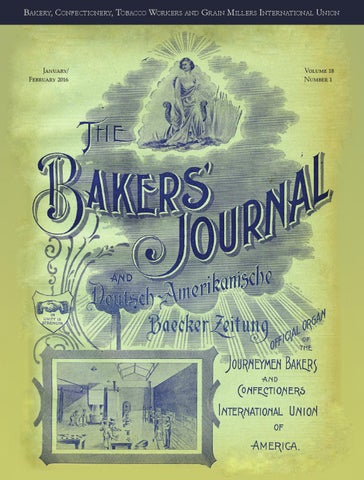
The illustration on the cover of the new JOURNAL is
suggestive of one of the greatest objects for which we stand, and toward whose achievement we have made giant strides when we secured the enactment of the bakery inspection laws in the various States – wholesome and sanitary bakeshops. Our struggle as a Union is carried on to introduce some new principles into the calling of the baker. They may be summed up in two words – humanity of treatment for the employees and all that this word implies, cleanliness of work, tools and surroundings, in the interest of the great masses of the consumers. The people of this age should not, and the more advanced class of them do not, want to eat bread made by working in unclean rooms, with sweat streaming down on the loaf, tempering it with sour thoughts, salting it with disease germs and mibrobes. The public mind is fast improving in its demands. – The Bakers Journal, Brooklyn, N.Y. July 15, 1897
“A baker’s work week usually involved 16 hours a day for five days of the week, as much as 23 hours on Saturdays, and an additional five on Sundays. The bulk of this work took place during night hours in hot subterranean bakeries; many of the bakers suffered from rheumatism because of the regular cooling off they sought for their perspired bodies in the wintry open air. Often the workers slept right in the bakerooms or in proximity to them.”
– A Vision of Unity, History of the Bakery & Confectionery Workers International Union
www.bctgm.org
9
JWJ Conference Highlights Workers’ Struggles, Victories
B
CTGM International Research Specialist Paul Lechtenberg represented the BCTGM at the 2016 Jobs with Justice National Conference in Washington D.C. on February 12-13. Lechtenberg attended the two-day event, taking advantage of the excellent workshops, trainings, and collaborations presented by the national worker rights organization. The BCTGM was among a large number of labor and workers’ rights organizations to attend the event, which mobilized 750 attendees to bundle up and march in the bitter cold in solidarity with low-wage service workers trying to organize in D.C. The JWJ has been a valuable community partner with the BCTGM over the years, including the ongoing campaign to preserve jobs at the Mondelēz Chicago Nabisco bakery. Lechtenberg participated in workshops on Internal Organizing, Organizing Immigrant Workers and Global Bargaining with Multinational Corporations, and panel discussions including Innovation in the Labor Movement, Workers Organizing
and Winning, and Building Our Movement to End Racial Injustice. U.S. Secretary of Labor Tom Perez delivered a keynote speech in which he spoke passionately about the respect and pride that President Obama has for the labor movement and reiterated that the economy must be brought back into balance for working people. Perez told the activists that the economy should be “a rising tide that lifts all boats, not just the yachts.” “It was refreshing to hear a notable figure such as Perez recognize that income inequality is a major problem in the U.S., and that the struggle for collective bargaining at the workplace is vital to re-establishing the middle class,” recalls Lechtenberg. The conference’s numerous workshops were informative and created important dialogue by
“We need a rising tide that lifts all boats, not just the yachts.” – Labor Secretary Tom Perez
10
bringing together labor leaders and activists to compare experiences from many different working class struggles. According to Lechtenberg, seasoned union leaders shared stories about their efforts to organize in the south and within new industries. Experts on International labor rights shared best practices for preventing sweatshop conditions abroad and discussed ways to pressure huge multinational corporations. Many of the workshops and comments by featured speakers were translated into Spanish for a large contingent of immigrant worker rights activists who came from around the country to support the union rights struggle. Lechtenberg notes that the conference helped him make valuable connections with allies and community partners around the country and the world, which could prove to be valuable in future BCTGM campaigns, including the present campaign to save Mondelēz/ Nabisco jobs in South Side Chicago (see page4-5). BCTGM News
Income Inequality Grows as CEO Pay Skyrockets A new report by the Canadian Centre for Policy Alternatives sheds much needed light on the issue of growing executive compensation, in good times and in bad. The report, “Staying Power: CEO Pay in Canada”, focusses on the compensation of Canada’s top 100 chief executive officers between the years 2008-2014. Not surprisingly, what the authors found was that CEO pay continues to increase at a rate far surpassing an average workers’ wage, and was not tied to the actual health or performance of the company they were leading.
Some of the findings include: •
CEO pay in 2014 was 22 percent higher than in 2008.
•
The median pay of a top-100 CEO in 2014 was 32 percent higher, at $7,759,000, than it was in 2008.
•
The lowest paid of the top 100 in 2014 was $4.28 million — an increase of 33 percent from the lowest paid in 2008, at $3.2 million.
January/February 2016
Average earnings for a highly-compensated executives. Canadian worker working full time, This is all the more significant year-round were $48,636 in 2014, because of how common stock while the average minimum wage options are used as a form of produced income of $22,010. executive pay.” Since 1998, the average income According to BCTGM of the top 100 CEOs increased Canadian International Vice by 89 percent while the average President Ron Piercy, it is Canadian income grew by eight important to remember that many percent. Going of these further back CEO’s make The average top 100 in time, since astronomical CEO will have earned the figures 1995, the 50 average worker’s pay by whether or not highest-paid CEOs in 12:18 p.m. on January 4, their company Canada earned performs 2016 — the second paid well. “There 85 times what the average day of the year — and the is no way to Canadian average minimum-wage justify CEO worker made. pay that is 250 worker’s pay by 2:07 p.m. times what In 2014, this ratio had the average — on New Year’s Day. tripled: CEOs worker makes, were making 253 times the earnings especially when many are focused of the average Canadian worker. on short-term gains that normally The report also finds that tend to hurt workers and their as stock options and awards families,” notes Piercy. become a larger piece of the total The report concludes that compensation package, CEO’s despite the recession, the public benefit yet again when the taxman outrage, the criticism of political comes calling. According to the leaders, and the devastating report, “The difference in tax paid analyses of key business thinkers, — half the top marginal rate of the practice of compensating taxation, or 26 percent on average Canadian CEOs has not changed across Canada — amounts to a perceptibly since the global public subsidy paid to these already economic meltdown. www.bctgm.org
11
“The labor movement supports trade. We know that opening up new markets to American products the right way can create jobs and lift up working people. But trade must be done under a fair set of rules that puts people ahead of profits. The TPP fails that test miserably.” — AFL-CIO President Richard Trumka about the Trans-Pacific Partnership Agreement (TPP) in an op-ed in ’The Hill’.
“Simply put, OSHA penalties must be increased to provide a real disincentive for employers accepting injuries and worker deaths as a cost of doing business.” — Dr. David Michaels, Assistant Secretary of Labor for Occupational Safety and Health Administration, speaking in October before the U.S. House Committee on Education and the Workforce’s Subcommittee on Workforce Protections.
“There is a clear sense among the American public that CEOs are taking home much more in compensation than they deserve.” — Stanford professor David Larcker concerning new report on CEO pay by the Stanford Graduate School of Business.
“Most of all, we defeated the idea that Canadians should be satisfied with less, that good enough is good enough and that better just isn’t possible. Well, my friends, this is Canada, and in Canada better is always possible.”
— Justin Trudeau, Prime Minister of Canada, after winning the election in October 2015. 12
“Now, no one thinks that working in the factory is the greatest job in the world. But you know what, you can make a middleclass wage, you have decent health care, decent benefits. You once had a pension. Those jobs, in many cases, are now gone. They’re off to China. Now you are a worker, white worker, black worker, who had a decent job, that manufacturing job is gone. What have you got now? You are working at McDonald’s? That is why there is massive despair all over this country. People have worked their entire lives. They’re making a half, two-thirds what they used to make. Their kids are having a hard time finding any work at all. And that’s why this study, which shows that if you can believe it today, for white working class people between 45 and 54, life expectancy is actually going down. Suicide, alcoholism, drugs, that’s why we need to start paying attention to the needs of working families in this country, and not just a handful of billionaires who have enormous economic and political power.” — Bernie Sanders (S-VT), speaking at Democratic Debate, February 11, 2015. BCTGM News
BCTGM FIGHTS Tax on HEALTH PLANS In 2010, President Obama signed the Patient Protection and Affordable Care Act (ACA) into law, overhauling the American healthcare system, making available
affordable coverage for millions of uninsured and underinsured American families. By and large, organized labor applauded the efforts of the President and Congress for tackling an issue that has plagued U.S. citizens for decades. However, there was one component of the ACA that the labor movement, including the BCTGM, vigorously opposed: an excise tax on employer-provided healthcare plans that cost over a certain threshold. The BCTGM has been working with the AFL-CIO and many of its affiliates to fight implementation of the so-called “Cadillac Tax”. This excise tax, which was to go into effect in 2018, would add a 40% tax on health plans that have an annual cost of $10,200 for individuals and $27,500 for families. This tax would disproportionately hurt a significant number of unionized workers across the country who have negotiated strong health benefits into their collective bargaining agreements. Of great concern to employees across the country is that employers, in an attempt to avoid the tax, would either eliminate employer-provided plans or January/February 2016
shift the costs back onto their employees. According to BCTGM International President David Durkee what the provision does not take into account is that when unions negotiate health care benefits with employers it is part of a larger compensation package where money is split between wages, pension, health care and other forms of compensation or coverage. “The law ignores this reality. Our members are willing to forego larger wage or pension increases because they want comprehensive health benefits for themselves and their families. This tax infringes on the collective bargaining process,” stated Durkee. Opposition to the tax has been broad and has brought together traditional adversaries from business and labor. The labor movement and the Chamber of Commerce both agree that the tax
would increase costs on business and would almost certainly be pushed back onto employees. Labor’s campaign against the tax and the sheer volume of opposition to the tax has paid dividends. In December 2015, Congress passed and the President signed budget legislation which included a delay in the implementation of the excise tax for two years, from 2018 to 2020. President Obama has indicated that the administration would be willing to modify the details of the tax by increasing the cost threshold in order to pass the measure, but opposition to the tax remains strong, and the BCTGM is still vigorously pushing for full repeal of the tax.
In May, 2015 the BCTGM filed formal comments for the record with the federal government in opposition to the tax and the way the Internal Revenue Service (IRS) was calculating the cost thresholds. Excerpts from the comments are below.
The BCTGM anticipates that when the 40% excise tax is implemented, many employers will seek out cheaper and inferior health care coverage for their employees. In addition, it is highly unlikely that employers will negotiate higher wages and/or pension benefits with local unions, to offset the loss or erosion of comprehensive health benefits. Proponents of the excise tax have argued that these benefit-rich plans shield workers from the high cost of care and encourage the overuse of care that, in turn, raises overall U.S. health care costs. The BCTGM flatly rejects this theory as it has no basis in fact or the real world actions of BCTGM members. In fact, because hourly production workers must use vacation or unpaid leave to seek medical attention, there is a disincentive to “overuse” health benefits. In addition, certain health care plans may be more costly and therefore subject to the new excise tax for reasons other than their comprehensive benefits, including plan participants’ health status, being employed in an industry with high injury rates, or due to their gender or advanced age. www.bctgm.org
13
Educated Stewards
Bimbo Bakery Visit
Local 81 (Traverse City, Mich.) shop stewards from the frozen bakery that makes Sara Lee brand frozen goods in Traverse City completed an intensive stewards training in January. The oneday training, led by International Representative Karl Walker, focused on investigating a grievance, member-to-member communication, right-towork-for-less issues and member mobilization. Pictured here are the the proud Local 81 stewards displaying their certificates of completion.
BCTGM Local 351 members working at the Bimbo Bakery in Albuquerque, New Mexico were able to meet U.S. Representative Michelle Lujan Grisham (D-1st District) when she toured the plant in January. The Congresswoman, who was first elected in 2013, has a strong commitment to New Mexico’s working families. Pictured here (from left to right) are Local 351 President/ Business Agent Earl Reed, Congresswoman Lujan Grisham and plant manager Ron Dube.
Applicants to the 2016 Scholarship Program The deadline for applications to the BCTGM 2016 International Scholarship program has passed. All those who submitted an application prior to the January 31 deadline date are reminded to submit the following requirements prior to the March 31 deadline: •
Personal Profile – completed by the applicant.
•
Academic Report – completed by the high school (or college, if a member). The report should reflect the first semester grades for the senior year (or more recent academic performance, if a member).
Essay – Each applicant is required to write and submit an essay (250-500 words) to demonstrate the ability to organize thoughts and express oneself. The essay may be one of the following: •
Essay on “Organized Labor’s Contribution to the Welfare of the People of North America.”
•
Same essay as used in your college application.
•
Same essay as the Union Plus Scholarship application (U.S. applicants only).
•
SAT or ACT Scores (if applicable)
For more information contact the BCTGM International Scholarship Office at (301) 933-8600. 14
BCTGM News
SHAPE UP and $AVE G
et the lowest rates on new memberships at your choice of over 8,000 fitness clubs, including 24 Hour Fitness, Curves, Anytime Fitness, Sport & Health and Bally’s Total Fitness. BCTGM Power/Union Plus has partnered with GlobalFit to provide these healthy living programs for you.
Healthy Living Programs • Health Coaching provides one-on-one guidance from a trained professional to help you lose weight, de-stress, or meet any other health goal. • Online exercise & nutrition programs. • Smoking Cessation classes can help you quit for good with a convenient, guided program that includes free educational materials.
Fitness Clubs • Discounts on initiation fees and lowest price guarantee on monthly fees. • 15% off The Mediterranean Wellness Program — in addition to promotional offers. • Savings on home fitness videos and equipment — including Zumba DVDs and Total Gym. • Check out any club before joining with a free guest pass. • Transfer membership between participating health clubs for a $10 transfer fee. • Freeze your fitness club membership up to 2 months.
Call 1.800.294.1500 to speak with a GlobalFit fitness representative For more information about these benefits available to union members go to:
www.UnionPlus.org/HealthClubs
January/February 2016
www.bctgm.org
15
s M Gew T BCN Printed in the U.S.A.
Celebrating
s r a e 130 Y
In 2016, the BCTGM will have spent 130 years dedicated to providing workers in our industries with a voice and a vote in their workplace. To commemorate this achievement, the Union has released a special 130th Anniversary collectible ring.
Show your pride and solidarity by wearing our official, custommade 130th Anniversary ring!
10K GOLD
Men: $965 Women: $456
ALLURA GOLD
STERLING
Men: $609 Women: $282
Men’s Sizes: Half sizes 8-14
Men: $109 Women: $99
• Women’s Sizes: Half sizes 4-9
BCTGM 130th Anniversary Ring Order Form First Name: Last Name: Mailing Address (Please no P.O. Boxes) Street: City: State: Zip: Email Address: Phone: Metal Type (circle): Gold Payment Type: Check #
Allura
Sterling
Style (circle):
Credit Card #
Men’s
Women’s
Exp.
Size: CVV:
Send order and payment to: Black Forest • P.O. Box 325 • Owatonna, MN 55060 | Phone: 800-670-7918 *No Orders or payments will be taken by the International Union. Please contact BLACK FOREST directly.
Prefer to order online? Go to OrderMyRing.com/BCTGM