Bakery, Confectionery, Tobacco Workers and Grain Millers International Union
March/ April 2016
Volume 18 Number 2
the PRESIDENT’S MESSAGE
Urgent Retiree Action Needed to Protect Pensions An Open Letter to BCTGM Retirees from International President David B. Durkee
I
Brothers and Sisters:
utilizing all available resources to stand up to “The Company will withdraw In the most recent edition of the Nabisco/Mondelēz’s aggressive attacks on our BCTGM News, I addressed in this members and retirees. from participation in the ‘B&C column the many serious challenges this Union and Industry International This is a fight in which every BCTGM Union is facing in our ongoing effort member, active and retired, regardless of Pension Trust Fund’…” to protect the pensions and retirement industry or region, must be fully engaged. No security of current and future retirees. — Proposal from Nabisco/ one in the BCTGM family can afford to sit on The “Great Recession” beginning in Mondelēz in current National the sidelines. This impacts all of us. 2008, caused by massive Wall Street and The centerpiece of our campaign is a Master Bargaining banking industry fraud, wreaked havoc on nationwide consumer boycott of Mexican-made even the most well-run pension funds, such as the B&C Fund. Nabisco products. Twenty-five percent of this company’s sales The B&C Fund, which covers nearly 110,000 retired, active are in the United States. Right now, the company is struggling in and vested BCTGM members, has also had to withstand the Europe and other regions of the world. adverse impact of the failure of the former Interstate Brands/ A successful U.S. boycott of Mexican-made Nabisco Hostess Baking Company to pay more than $900 million in products will show this company that its plan to make products withdrawal liability when it left the Fund. in Mexico and sell them in the United States is misguided and At the same time, Republicans in Congress are working that a better, more successful business model would be to keep day and night to dismantle Social Security; seeking to the production in this country. privatize this critical pillar of retirement security for working BCTGM local unions and members throughout the Union men and women. Their only purpose for pursuing Social are responding to the urgency of this situation and vigorously Security privatization is to enrich and empower their financial promoting the consumer boycott. supporters on Wall Street. Now, I am calling on all of our retirees to step up and join A deep commitment to the retirement security of our the active members on the front lines in this crucial fight. members and their families is a core value of this Union. Here is What You Can Do to Help: For this reason, the International Officers and staff devote • Take the “Check the Label” flier on the back page of this enormous time, energy and resources every day to this issue. magazine and show it to your local grocery store manager. Now we are forced to confront another major threat to the Urge him/her not to stock Mexican-made Nabisco products retirement security of our members, both active and retired. and to call Nabisco and tell the company not to send any Nabisco/Mondelēz, the largest employer of BCTGM members more Mexican-made products to the store; in the biscuit industry, the second largest contributing employer • Call Nabisco/Mondelēz CEO Irene Rosenfeld (847-943in the B&C Pension Fund and one of the Fund’s founding 4000) and tell her to stop shipping American jobs to Mexico employers has announced that it wants to get out of the Fund. and stop the attack on our pensions; Exiting the Fund has been a company priority in the current National Master Contract negotiations. • Urge family and friends to participate in the consumer At the same time, the company also is committed to boycott; eliminating many hundreds of BCTGM jobs and shipping • Visit the website www.fightforamericanjobs.org to learn those jobs to its factories in Mexico where workers receive more about this campaign and share the site with as many poverty-level wages and are exploited in countless other ways. others as possible. We know that if Nabisco/Mondelēz is successful in I firmly believe that BCTGM retirees are an enormously its plans, employees retiring from the company would valuable resource not only in this campaign to stop Nabisco/ immediately suffer a severe cut in their hard-earned benefits. Mondelēz, but in our Union’s ongoing work to ensure retirement And, as a result of the company’s withdrawal from the Plan, security for all BCTGM members. I will be communicating with other B&C Pension Fund pensioners – including those who you in the near future to share ideas we are developing to expand retired from Nabisco – could also face future reductions in our outreach and support from the men and women who helped their pension amounts. build the pension plans of which this Union is so very proud. And while Nabisco/Mondelēz is trying to get out of the Thank you for your solidarity and willingness to “get back B&C Fund, CEO Irene Rosenfeld has set up a $35 million in the game” for what is truly the biggest fight this Union has pension for herself. ever been engaged in. Nabisco/Mondelēz’s frontal assault on our members’ jobs Sincerely and Fraternally, and retirement security cannot and will not stand! For this reason, the BCTGM International Union and David B. Durkee our local unions across the country are fighting back hard and BCTGM International President 2
BCTGM News
AFL-CIO
ENDORSES BCTGM’s
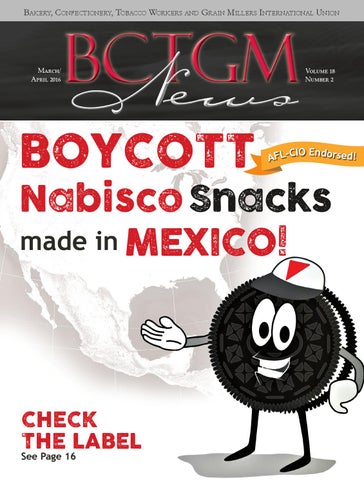
Made-In-Mexico Nabisco BOYCOTT The AFL-CIO has officially endorsed the BCTGM’s nationwide consumer boycott of Nabisco snack products made in Mexico. The
“Check the Label” campaign was launched this spring to stop Nabisco/ Mondelēz from continuing to outsource jobs, by urging American consumers to reject Mexican-made Nabisco products and, instead, buy those that are produced in America in support of middle-class American jobs. The AFL-CIO’s endorsement is a watershed moment in BCTGM’s boycott, as it adds 12.5 million union members in 56 affiliated national and international unions, as well as their families and their local and extended communities across the United States and the globe. Reflecting on the momentum that the AFLCIO endorsement of the boycott brings, BCTGM International President David Durkee said, “The AFLCIO’s support of this campaign sends the strongest
signal yet that American workers and consumers will not stand idly by while Americans lose their jobs. Our brothers and sisters in the labor movement are key allies in this struggle, and we greatly appreciate their support. The Check the Label campaign is an essential component of the movement to stop consumers from buying Nabisco products that are made in Mexico. We want this company to understand that Americans will not support a company that moves work from the U.S. to countries where they exploit low wage workers and then send product back into our communities.” The boycott applies to all Mondelēz International/Nabisco snack food products that are labeled “Made in Mexico,” including Oreos, Newtons, Chips Ahoy, Honey Grahams, Animal Crackers, Ritz Crackers, Premium, Belvita, Lorna Doane, Teddy Grahams, Honey Maid, and Wheat Thins. (Learn how to Check The Label on page 16.)
The BCTGM News Official Publication of the Bakery, Confectionery, Tobacco Workers and Grain Millers International Union 10401 Connecticut Avenue, Kensington, Maryland 20895-3961 • (301) 933-8600 • www.bctgm.org David B. Durkee, Editor • Corrina A. Christensen, Assistant Editor BCTGM General Executive Board • President David B. Durkee • Secretary-Treasurer Steve Bertelli Vice Presidents • Jethro Head • Arthur Montminy • Ron Piercey • Randy Roark • Anthony Shelton BCTGM General Executive Board Members • Joyce Alston • John Bethel • Thomas Bingler • Edward Burpo Butch Henley • Paul LaBuda • Stephane Langlois • Terry Lansing • Earl Lublow • Letitia Malone • Gary Oskoian • Paula Steig • Doyle Townson • Jeff Webb BCTGM News (ISSN 1525-4860) is published bi-monthly by the Bakery, Confectionery, Tobacco Workers and Grain Millers International Union, 10401 Connecticut Avenue, Kensington, MD 20895-3961. Periodicals postage paid at Kensington, MD and at additional mailing offices. Subscription to new members only. Postmaster: Send address changes to BCTGM News, 10401 Connecticut Avenue, Kensington, MD 20895-3961.
March/April 2016
www.bctgm.org
3
From 1886 to 2016:
History of Tobacco Workers
I
In the largest of the five cigarette companies in New York City in 1878, 380
girls and women, along with 75 men and 25 boys, worked a 10-hour day. A few worked the machines, moistening tobacco with cold steam and squeezing it under 16 tons of pressure into a six-inch high block two feet by four feet, machine slicing it into cigarette-length shreds for the cigarette makers. At that point, cigarette making was still a hand process. At long tables, over individual small stone slabs, they worked their tobacco, manipulating it by means of a second piece of paper in order not to touch it, pasting with a flat stick, the best of them making 16,000 cigarettes a week. Training a competent cigarette maker required three weeks, during which
Child laborers at American Tobacco Company in Wilmington, Delaware, 1910, photo by Lewis Hine
the worker earned nothing. The average man earned $16 a week; the women, not above $12; the boys closer to $4.
– Exertpt from Challenge & Change: History of the Tobacco Workers International Union, by Stuart Bruce Kaufman
Emblem of Progress Albert N. Dennis on his 534th weekly broadcast, (4) not made by child labor, and (5) not produced by “Labor News Review” radio program proclaimed: ‘sweatshop’ methods. The same principles apply to “The one emblem union services of all that most truly kinds. represents the fruits of “When you ceaseless toil and effort demand union-made for the betterment of goods and union mankind, from alpha to services, you (1) omega, from the days of assuredly help yourself; serfdom to the present (2) you help your advanced state of wage fellow-men, and (3) you earners, is the union aid in the advancement label – whether a label of civilization to higher on a product, a union standards and greater shop card or a union accomplishments. service button. “These simple truths must be plain to all who toil, “The union label afforts the ONLY their origin a part of the age-long struggle of ALL positive assurance that the goods you wage earners – and certainly their worth should purchase were (1) made by capable be appreciated by all. Truly, the union label is an workers, fairly compensated for their emblem of progress.” work; (2) not made in a foreign nation by exploited labor; (3) not made in a prison; – Cigar Makers Official Journal, November 1944, Vol. 68 4
BCTGM News
Armed with an AFL charter and $179 treasury of the Tobacco Workers Conference Council, the
National Tobacco Workers Union looked almost solely to the strength of the union label to give substance to its claim of being a national union. Its strategy was to print labels and distribute them free of charge to union manufacturers to affix to their products. The National Tobacco Workers Union adopted its union label in July 1895. Union officers would not allow manufacturers to make their own arrangements to print the union label. In fact, when several began to place the label on advertising materials as well as on their tobacco, the union was quick to put an end to the practice. In 1898, Liggett & Myers signed an agreement with the Union but turned down the company’s request for an order of labels to be rushed to its facilities to label current products. The union insisted that if they wanted product labeled, they would have to send for a member of the union to do it. In the formation of new local unions across the country, the union label was the very cornerstone of the organization. It was said to be the chief factor in building the National Union. By the Union’s 3rd convention in May 1897, 27 companies in 16 cities and nine states were using the label and the Union was ready to send its first organizer on the road.
Then AFL President John McBride declines an invitation to attend the founding Convention of the NUTW, sending his wellwishes for the establishment of a successful tobacco workers’ union.
Cartoon from Union Label Trades Dept., The Tobacco Worker, June 1941
“We have learned that throughout the nation there are many conflicting reports in regard to organization in the tobacco industry, and especially in the cigarette field. As in other unions, we of course insist first of all that the labor movement and the public be guided first of all by the T.W.I.U. Blue Label, which signifies that the product is made in a 100 percent union shop, under fair conditions. – The Tobacco Worker, March 1941 March/April 2016
www.bctgm.org
5
WORKING FOR
SAFE JOBS Workers Memorial Day On April 28, the BCTGM and the unions of the AFL-CIO observe Workers Memorial Day to remember
those who have suffered and died on the job and to renew the fight for safe jobs. This year, we will come together to call for work in this country that is safe and healthy and pays fair wages. We will celebrate the victories won by working people and commit to fighting until all workers have safe jobs and the freedom to form unions without the threat of retaliation. The Occupational Safety and Health Act and Mine Safety and Health Act promise workers the right to a safe job. The BCTGM and our allies in labor have fought hard to make that promise a reality—winning protections that have made jobs safer, saved hundreds of thousands of lives and prevented millions of workplace injuries and illnesses. But our work is not done. Many job hazards are unregulated and uncontrolled. Some employers cut corners and violate the law, putting workers in serious danger and costing lives. Workers who report job hazards or job injuries are fired or disciplined. Employers contract out dangerous work to try to avoid 6
•
A p r i l 2 8 , 2 016
responsibility. As a result, each year thousands of workers are killed and millions more injured or diseased because of their jobs. Business groups have launched an all-out assault on working people, seeking to roll back existing protections and rights, and to block new safeguards. We have fought back, joining with worker centers,
local activists and other partners to defend and advance these hard-won gains. The BCTGM has been part of the fight to win a stronger coal dust standard for miners and a new rule to protect workers from deadly silica dust, which soon will be finalized, along with stronger antiretaliation protections for workers who report job injuries.
DECADES OF STRUGGLE by working people and their unions have improved working conditions and made jobs safer. We must push forward and continue our fight to: •
defend safety and health protections and workers’ rights from industry attacks;
•
win new workplace standards for silica, combustible dust and infectious diseases;
•
prohibit employer policies and practices that discourage reporting of workplace injuries;
•
increase attention to the safety and health of Latino and immigrant workers who are at much greater risk of death and injury;
•
pass the Protecting America’s Workers Act to provide OSHA protection for the millions of workers without it, stronger criminal and civil penalties for companies that seriously violate job safety laws, and improved anti-retaliation protections for workers who raise job safety concerns;
•
ensure workers’ right to have a voice on the job, and to freely choose to form a union without employer interference or intimidation; and
•
demand higher wages for workers through mobilizing, organizing, collective bargaining and legislative action.
BCTGM News
WORKPLACE DANGERS Faced by BCTGM Members
Every year, workers in BCTGMrelated industries are killed on the job because of hazardous conditions. It is well-documented
that workers in the food processing and agricultural industries face unprecedented dangers daily in their workplaces. From combustible dust explosions and entrapment in grain elevators, to blunt force trauma and lung disease, workers in the food sector face hazards that few other workers are forced to confront. According to OSHA, employers are legally required to provide a workplace that is free from hazards. And yet every year thousands of workers are killed on the job, while millions more are hurt on the job or exposed to industrial diseases. Many employers simply ignore the law and force workers to work in areas without the needed safety equipment or protection. Other employers speed up lines to such a degree that workers must rush their job (exposing them to injury), or must work in positions than can lead to back, neck and knee injuries or lead to cumulative trauma disorders. Many employers do not provide adequate
March/April 2016
training, leaving workers to fend for themselves and learn on the job. All too often this leads to injury and death. In the agricultural sector, a common hazard is engulfment in a grain elevator. According to OSHA, a worker can be completely submerged in flowing grain within 60 seconds. More than half of all grain engulfment accidents result in death by suffocation. Allowing workers to move grain while a sweep auger is running can cause the worker to become entangled in this dangerous equipment and submerged in the flowing grain. Many BCTGM members in the sugar, grain and baking sectors face combustible dust hazards. An explosion can occur when fine granules, like grain or sugar dust, form a cloud in a confined area and touch an ignition source, such as a spark, flame or overheated pipe. The result can be a catastrophic and deadly explosion. Since 1980, more than 450 accidents involving dust have killed nearly 130 workers and injured more than 800, according to a Center for Public Integrity analysis of data compiled by the federal Occupational Safety and Health Administration and the U.S. Chemical Safety Board.
www.bctgm.org
7
Nabisco Layoffs Exemplify America’s
FAILED TRADE LAWS M
ary Willis is all too familiar with the It took Willis a full year to find another job. feeling of loss that comes when your job In October 2013, she was hired by Mondelēz is outsourced. and joined the ranks of Local 300 as a worker Willis, 50, of at the Southside Chicago Chicago, was laid off Nabisco bakery. “At that Mary Willis in March 23 from the time, I was tired of the front of her Northwestern Southside Chicago constant job loss but I Chicago Nabisco bakery. The had faith that it would all home. She layoff of 277 BCTGM be okay. Because when says she Local 300 members at you have been through it remains the plant is a result three or four times, you optimistic of the decision by are wary and suspicious,” that she will land Mondelēz to shift recalls Willis. on her feet Chicago’s cookie and So at the May 2015 again. Willis, cracker production lines meeting when Mondelēz a proud to a plant in Salinas, approached Local 300 member of Mexico. workers about the Local 300, says, “I love Willis landed her investments needed my union. I job at the Mondelēz/ to the bakery, Willis fully believe Nabisco bakery in 2013 said the lines sounded in my union.” after a year of financial uncomfortably familiar. hardship following “There were a few of us bankruptcy of Hostess that came over from the and the shuttering of the Twinkie bakery Hostess bakery and we had heard it all before. where she worked for 10 years. The company promises to invest in the plant Willis was hired at the Hostess Schiller Park to try to keep it open. You got to at least TRY bakery in 2002 where she worked as a wrapper to be optimistic. We hoped the place wouldn’t and packer and was a proud member of close — that you would one day get to retire. BCTGM Local 1. She truly enjoyed her work at We wanted to have faith,” says Willis. the bakery and was devastated in 2012 when “They quit me. I didn’t quit them,” Willis during the bankruptcy proceedings Hostess recalls with emotion. “And the truth is that shut the plant and eliminated the livelihoods of 300 workers. Dubbed “the Nabisco 600”, Local 300 members who have been laid off In reflecting on that from the Chicago bakery are attending labor events and showing up loss Willis says, “We were outside retail stores in communities urging American consumers to “Check the Label” and boycott Nabisco products made in Mexico. Pictured here is like a family and we all lost a group of workers from Chicago at a Mineworkers rally outside Pittsburgh. everything — except for what our union gave us. The comapany just shut our plant down and that was it. We all thought we would retire from there. And at that point in my life I still needed another 12 to 15 years of work to retire. We didn’t just lose our jobs. We lost a family.” 8
BCTGM News
when one company The offshoring of the Chicago Nabisco bakery jobs has gained the attention of sees another get away presidential candidates, including Hillary Clinton, pictured here meeting with with this — abandoning Intl. Vice Pres. Jethro Head and a group of Local 300 members in the union office outside the Southside Chicago plant. their workers — they think they can leave too,” she adds. Once again Willis finds herself mourning the loss of her work community. “We are like a family and this hurts. With Hostess I lost my family. With Nabisco, I have lost a second family.” Yet Willis says she continues to believe. “God doesn’t close one historic, sprawling Chicago candy production door without opening another one. We still plant that helped earn the city the name of the support one another and lean on one another. “World’s Candy Capital.” Willis worked at the It really takes a community to get through this. candy factory until the 1990s, when workers And I have my union and I love my union. We were laid off when the company moved the will get through this.” jobs to Mexico. Willis is an educated woman. She says she In 2000, Willis went to work at the likes working in a factory, making food that Entenmann’s bakery as a member of BCTGM Americans enjoy. “I choose to do this work. I Local 1. She worked in the utility department, have college degrees in nursing but I happen sanitation department, as a bagel baker and as to prefer my work in the factory and I will tell a machine operator. She left the Entenmann’s you what, it takes an educated worker to run bakery a year before the company moved those machines,” notes Willis. production out of Chicago and closed the plant Her work in manufacturing first began in permanently. During this time, Willis, who had 1985 when she went to work at Brach’s, the a young daughter, took a second job as a seasonal worker at the Nestle’ Since the passage of the North American Free Trade Franklin Park factory. Agreement (NAFTA) in 1994, the U.S. trade deficit with Willis admits that it Mexico and Canada increased from $17 billion to $177.2 is difficult to navigate billion, displacing more than 850,000 U.S. jobs. The majority the emotions of a of the job displacement is the result of a surge in outsourcing constantly downsizing, outsourcing world. of production by U.S. corporations into Mexico. When “It seems that hard other trade and investment deals the U.S. is party to are work doesn’t matter considered, more than five million U.S. manufacturing jobs anymore. This is the have been lost in the last 20 years. The impact on American corporate attitude. working families and the communities in which they live has And it used to be that been devastating. Well-paying middle-class jobs with decent places like Nabisco were benefits have either been eliminated altogether or replaced proud places to work by lower paying jobs with few (if any) benefits. Families but now workers like suffer, communities have smaller tax bases, infrastructure me are tossed to the spending is impacted and consumer spending decreases. curb despite years of dedication,” says Willis. March/April 2016
www.bctgm.org
9
BCTGM Intl. Rep. Brad Schmidt (right) leads the one-day shop stewards training at Local 433 in North Sioux City, S.D. on Feb. 9.
Educated and Engaged S
Local 433 Stewards
tewards play a vital role in their workplaces and in the labor movement, guiding and leading their coworkers in the everyday struggle of policing the union contract and protecting workers’ rights. This position requires patience, persistence, attention to detail, and excellent communication skills. Recognizing that these traits need to be learned, developed and practiced, Local 433 (Sioux City, Iowa) President and GEB Member Paula Steig and International Representative Brad Schmidt recently shared their many years of in-plant experience with a group of newly-elected Local 433 shop stewards. The stewards came from several different plants, including Bimbo Bakeries USA in Bellevue, Neb., Interbake Foods in North Sioux City, S.D., Bimbo
Bakeries USA in South Sioux City, Neb. and J. Skinner Co. in Omaha, Neb. The participation of the stewards from the J. Skinner plant is especially exciting as it a direct result of a successful internal organizing effort led by Steigthe hard work of Steig in a successful internal organizing drive at the facility. The plant has suffered recently from low membership, which leads to deteriorating union strength within the plant. Recognizing this, Steig reached out to the workers and slowly the plant is gaining membership strength. The day-long training included discussions about how to serve as the first line of defense against unscrupulous supervisors and corporate agendas, simulated workplace role playing, and a thorough review of the roles and responsibilities of stewards.
Pictured here are Local 433 stewards (from left to right) Jordan Miller, Alan Boyce, Kyle Trost, Monica Jimenez, Joe Hinds and Herbert Walker. 10
BCTGM News
Celebrating
s r a e 130 Y
2016 marks the 130th anniversary of the founding of the Union. To celebrate our long and proud history of service to union members and the protection of worker rights in the U.S. and Canada, the Union has designed a special 130th Anniversary ring.
! ion W E N Opt h Frenc 10K GOLD
ALLURA GOLD
Men: $965 Women: $456
STERLING
Men: $609 Women: $282
Men’s Sizes: Half sizes 8-14
Men: $109 Women: $99
• Women’s Sizes: Half sizes 4-9
BCTGM 130th Anniversary Ring Order Form First Name:
Last Name:
Mailing Address (Please no P.O. Boxes) Street: City:
State:
Zip:
Email Address: Phone: Metal Type (circle): Gold Style (circle):
Men’s
Allura
Women’s
Payment Type: Check #
Sterling
NEW! Language (circle):
Credit Card #
Size: English Exp.
French CVV:
Send order and payment to: Black Forest • P.O. Box 325 • Owatonna, MN 55060 | Phone: 800-670-7918 *No Orders or payments will be taken by the International Union. Please contact BLACK FOREST directly.
Prefer to order online? Go to OrderMyRing.com/BCTGM March/April 2016
www.bctgm.org
11
BCTGM-Made
Cheerio’s celebrates
BCTGM Local 36G workers have been producing Cheerio’s in Buffalo, N.Y. for decades. And this year the
75 Years
famous General Mill’s brand and the world’s first, oat-based, ready-to-eat cereal, turns 75. Union members at the plant produce 62 million boxes of Cheerio’s per year at the company’s most historic property. The Buffalo General Mills cereal and flour plant is one of the last working grain elevators in Buffalo. It is contained within a 27-acre complex where workers produce the iconic cereal as well as Gold Medal flour. Local 36G Business Agent and GEB member Tom Bingler worked in the flour mill from 1980 to 2002, when he was elected to his current position. According to Bingler, the oldest structure on the General Mills property, which is bordered by the Buffalo River and the City Ship Canal, dates to 1903. Many of the nearly 400 current workers at the plant have parents or grandparents who baked cereal and Union workers outside Buffalo General Mills cereal and flour plant in 1960. The plant is one of the last working grain elevators in Buffalo, contained within a complex that sprawls over 27 acres.
12 12
Local 36G members at the iconic Buffalo plant make 62 million boxes of Cheerio’s per year.
milled flour on the site. Flour-making began at the General Mills property in 1904, under the Washburn Crosby brand, a name still visible on a sky-high chimney stack on the site. According to Bingler, a trek to the top of the grain elevator offers expansive views of downtown Buffalo, north toward Niagara Falls and southwest along Lake Erie. Construction on the current cereal building began in 1939 but a fire destroyed the structure in 1940, one week before it was slated to open. This delayed the start of production of what was initially branded as “CheeriOats” until October 1941. General Mills has modernized the plant and its production process throughout the years, with computers and automation taking on tasks previously done by hand. However, much remains the same and the grain is still brought to the factory by rail – or ship from Duluth, Minn. – and stored in the grain elevator for later use. According to Bingler, you can identify Cheerio’s made by Local 36G members in Buffalo by checking the code on the box; Cheerio’s made in Buffalo begin with the letters “BU.” BCTGM BCTGM News News
FULL SUPPORT
BCTGM Pledges for Lifeway
It has been more than a year and a half since workers at three Chicago-area Lifeway Foods facilities overcame a vicious antiunion campaign and voted overwhelmingly to join the BCTGM.
Since that time, executives for Lifeway, including CEO Julie Smolyansky, have refused to negotiate a first union contract with BCTGM Local 1 (Chicago) and continue to violate federal labor law. In November 2015, the National Labor Relations Board (NLRB) issued a Summary Judgement ordering the company to negotiate with the union. In December 2015, an Administrative Law Judge (ALJ) ruled that the company had illegally fired two workers, had violated federal law for anti-union activity, and had
March/April 2016
unilaterally changed work rules that ultimately harmed many of the company’s female workers. Despite these actions, the spirit of the Lifeway workers has not been diminished. Instead, workers have remained steadfast and committed to their decision to become BCTGM members and are welcoming a renewed effort to expose the hypocrisy of CEO Julie Smolyansky. The Chicago Federation of Labor (CFL) sent a pointed letter to CEO Smolyansky insisting she sit down with the Local and negotiate first contract. Support has also come from Jobs with Justice, BCTGM Local 300, Chicagobased worker organizations, and numerous other unions. Meanwhile, the Local is also making every effort to ensure that CEO Smolyansky hears the message of her workers loud and clear. In February, the Local set up pickets and handed out flyers at a political fundraiser CEO Smolyansky was hosting. In March, officers
www.bctgm.org
Workers
and activists from Local 37 (Los Angeles) hand-billed a Food Expo in Anaheim, Calif. that Smolyansky was attending. In early April, Local 1 activists picketed a conference where Smolyansky was the keynote speaker. According to BCTGM Local 1 President Donald Woods, there is no reason but anti-union animus that is keeping Lifeway workers from realizing their dream of joining the BCTGM. “By ignoring the wishes of her employees, and snubbing her nose at the federal government, CEO Smolyansky is really showing her true colors as an employer,” said Woods. According to BCTGM International President David B. Durkee, the International Union will do everything in its power to bring the company to the table to negotiate in good faith. “The BCTGM is taking this issue very seriously and will utilize any and all means to convince Ms. Smolyansky to stop her vicious anti-union campaign and sit down to negotiate a contract, as the NLRB has demanded,” said Durkee.
13
TPP Could Hurt Canadian Health Care A new report sheds light on the impact the Trans-Pacific Partnership (TPP) trade deal could have on the Canadian healthcare system.
A new series called “What’s the big deal? Understanding the Trans-Pacific Partnership” by the Canadian Centre for Policy Alternatives sheds new light on aspects of the giant trade deal that has not garnered significant media attention. One such area is Canada’s healthcare system. Below are excerpts from the report “Major Complications: TPP and Canadian Healthcare”.
“The TPP will further increase these costs by requiring the federal government to “The overarching extend the term of impacts of the “Without doubt, the TPP’s single patents to account proposed treaty biggest direct impact on the for supposed Canadian health care system would would be to weaken regulatory delays be to increase drug costs as a our public health care in approving drugs result of extending patents. Canada system, undermine for sale. The TPP already has an industry-friendly health regulation, could also have system of intellectual property and obstruct efforts adverse effects on protection for pharmaceutical to renew and expand the criteria that patent holders. This is reflected in Canada uses to public health care the high prices Canadians pay for decide on drug safety in the face of new prescription drugs.” and effectiveness, challenges.” how it approves or does not approve “Canadians already pay too much for prescription drugs and new drugs for the TPP would worsen this situation by extending patents and marketing, postimpeding cost-saving measures. Research clearly shows that market surveillance extending monopoly protection and boosting brand-name and inspection, the drug company profits in hopes of generating higher levels listing of drugs on of research and development (R&D), and more innovative public formularies, medicines, has been a failure. The TPP would burden the Canadian health care system with higher drug costs while and how individual frustrating efforts to find a better balance between needed drugs are priced in innovation and the affordability of medicines.” the future.” “As even its proponents admit, the agreement would have only a marginal impact on actual trade volumes and economic growth. But its 30 chapters and thousands of pages of rules would place many new constraints on government policy in areas not strictly related to trade, including public health.”
14
BCTGM News
Motor Club for Union Members Beats AAA Take the BCTGM Power/Union Plus Motor Club on your next trip and the next time you have a roadside emergency, you’ll be happy you’re a member. The BCTGM Power/ Union Plus Motor Club offers roadside assistance program that’s a better deal than AAA. With the BCTGM Power/Union Plus Motor Club, you can have peace of mind for your entire family for just $69.00 per year or $6.90 a month. And when you sign up for a full year, you can receive $40 in gas reimbursements. BCTGM Power/Union Plus Motor Club provides emergency roadside assistance, locksmith and tow services 24-hours-a-day nationwide through a network of more than 27,000 independent auto service and towing providers. You’ll be covered for any car or truck you’re driving or riding in. And you won’t have any out of pocket costs for any service call under $125.
To enroll call 800-454-8722 or go to unionplusmotorclub.com
Motor Club Features 24-hour Emergency roadside assistance and locksmith services up to $125 per service call. Three auto service calls per year for you and your family. Emergency Towing to your home, a dealership or your mechanic. Battery Boost to jump-start your battery. Flat Tire Change to remove your flat and install your inflated repair. Lockout Service to get you back inside your vehicle. 27,000 independent, dependable auto repair and car towing service providers across the United States to ensure 24-hour emergency roadside assistance. All calls answered in the United States of America. ASE certified mechanics available for second opinions on auto repairs and services.
March/April 2016
www.bctgm.org
15
SU PPO R T A M E R IC AN J O B S !
Printed in the U.S.A.
CHECK THE LABEL!
Nabisco/Mondelēz is slashing good middle-class American jobs and shipping them to Mexico.
Do YOU know if your favorite Nabisco products are MADE IN MEXICO?
Nabisco/Mondelēz has plants in Monterrey and Salinas, Mexico where low-wage workers, in workplaces with lax regulatory standards, are producing Nabisco products. Make sure your family only purchases Nabisco snacks made by your fellow American workers. CHECK THE LABEL on the back of every Nabisco package (near the expiration date and UPC code) before you purchase.
There are TWO ways to tell if your Nabisco snacks are
MADE IN MEXICO:
Check for the words “Made in Mexico”
Check the plant identification code:
DO NOT BUY:
MM = Monterrey, Mexico MS = Salinas, Mexico
DO BUY:
AE = Chicago AH = Portland, Ore. AP = Fairlawn, N.J. AX = Atlanta AZ = Richmond, Va. XL = Naperville, Ill.
www.fightforamericanjobs.org BCTGM International Union @BCTGM_Nabisco
The 600
VIDEOS:
SOCIAL:
DO NOT BUY Nabisco products made in Mexico and tell your grocery manager to stock ONLY AMERICAN-MADE Nabisco/Mondelēz snacks! Check the Label