Bakery, Confectionery, Tobacco Workers and Grain Millers International Union
July/ August 2015
Volume 17 Number 4
the
PRESIDENT’S MESSAGE
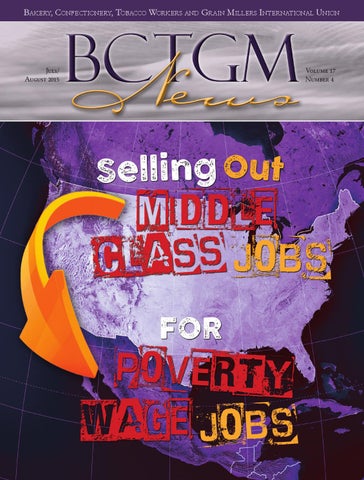
Brothers and Sisters – For this issue of the BCTGM News, I wanted to share with you the full letter that I sent to President Obama concerning the July 29 announcement by Mondelēz International that it intends to move hundreds of union production jobs from the historic
2
BCTGM-represented Chicago Nabisco Bakery to the company’s low-wage facility in Mexico. This contemptible move by this greedy multi-national company epitomizes all that is wrong with corporate America and U.S. trade policy. — David B. Durkee, BCTGM International President
BCTGM News
The BCTGM News Official Publication of the Bakery, Confectionery, Tobacco Workers and Grain Millers International Union 10401 Connecticut Avenue, Kensington, Maryland 20895-3961 • (301) 933-8600 • www.bctgm.org David B. Durkee, Editor • Corrina A. Christensen, Assistant Editor BCTGM General Executive Board • President David B. Durkee • Secretary-Treasurer Steve Bertelli Vice Presidents • Jethro Head • Arthur Montminy • Ron Piercey • James Rivers • Randy Roark BCTGM General Executive Board Members • Joyce Alston • John Bethel • Thomas Bingler • Edward Burpo Butch Henley • Paul LaBuda • Stephane Langlois • Terry Lansing • Earl Lublow • Letitia Malone • Gary Oskoian • Paula Steig • Doyle Townson • Jeff Webb BCTGM News (ISSN 1525-4860) is published bi-monthly by the Bakery, Confectionery, Tobacco Workers and Grain Millers International Union, 10401 Connecticut Avenue, Kensington, MD 20895-3961. Periodicals postage paid at Kensington, MD and at additional mailing offices. Subscription to new members only. Postmaster: Send address changes to BCTGM News, 10401 Connecticut Avenue, Kensington, MD 20895-3961.
July/August 2015
www.bctgm.org
3
Mondelēz Chooses to Send American J
O
n July 29, the BCTGM International was informed by Mondelēz International, Inc. that the company had chosen to spend $130 million in new capital investment at its Salinas, Mexico plant, rather than at the historic Chicago facility, where workers are represented by BCTGM Local 300. As part of this investment, Mondelēz has announced it will install four new lines at its Mexico plant, replacing nine production lines in Chicago. “We are disappointed, angry and frustrated that Mondelēz would abandon its hard working employees in Chicago, who, for more than 60 years, have helped make Nabisco products one of the premier food brands on the market today,” BCTGM International President David Durkee states. More than 1,000 Local 300 members are employed at the plant. The Chicago bakery, which dates to the 1950s, is the company’s largest U.S. bakery. Union members operate all of the bakery’s 16 lines producing such iconic brands as Oreo, Chips
4
Ahoy, Nutter Butter, Honey Maid, belVita, Premium, Ritz and Wheat Thins. According to a statement released by Mondelēz, approximately 600 workers will be directly affected by the decision to close lines at the Chicago bakery. During discussions between the BCTGM and Mondelēz in April, the company essentially told the BCTGM that the workers would have to come up with $46 million in annual savings at the Chicago facility for the company in perpetuity or it would send the $130 million planned investment to its Salinas bakery. Even with the $46 million savings, the company stated that there would still be severe job cuts for workers at the Chicago bakery. In responding to the company’s announcement, BCTGM International Vice President and lifelong Chicago resident, Jethro Head, states, “The announcement by Mondelēz is not a surprise and validates exactly what the BCTGM said when we met with its representatives − that the company had
BCTGM News
Jobs to Low-Wage Workforce in Mexico already decided that it was going to put the new production lines in Mexico. “We knew this because they came to the table with no legitimate, comprehensive proposal for us to review and no detailed production and financial data for us to analyze, all of which is essential for our Union and members to make a responsible and wellinformed assessment and decision,” said Head. BCTGM International Strategic Campaign Coordinator Ron Baker explains, “When we did the basic math on their demands, it was clear that the company knew full well that the magnitude of the financial sacrifice being asked of the workers was not only unacceptable, but would not even be feasible. The demand for $46 million in annual savings would continue in perpetuity and require our members to work for almost nothing.” Baker went on to explain, “The sole purpose of the Mondelēz request to meet with the Union in May was to attempt to reap concessions out of Chicago
workers before they made the announcement. This company wanted the Chicago Bakery workers to pay not only for the full cost of putting new ovens in the Chicago facility, but also for the wages of the entire workforce in Salinas, Mexico.” The company’s contract with BCTGM Local 300 expires on February 28, 2016. The BCTGM represents approximately 4,000 Mondelēz workers in manufacturing facilities, flour mills and distribution centers across North America. Mondelēz International, Inc. is a $35 billion multinational company. Mondelēz International, Inc. CEO Irene Rosenfeld took in more than $21 million in total compensation in 2014, a nearly $6 million increase from the previous year. This included a doubling of her annual cash incentive to $3.6 million and a nearly $4 million increase in her pension plan and other retirement benefits. In the last eight years, Rosenfeld has received approximately $165 million in total compensation.
Mondelēz Uses NAFTA to Flee U.S. Production
T
he vehicle allowing Mondelēz International, and dozens of other companies to move production outside the United States is the North American Free Trade Agreement (NAFTA). The largest free trade agreement in North American history was signed into law in 1993, and at the time, was hailed as a milestone for the U.S. economy. Unfortunately, the reality for North American workers has been the exact opposite. According to the Economic Policy Institute (EPI), the direct effects of NAFTA have been 23 years of stagnant wages, and the upward redistribution of wealth, capital and political power. “By establishing the principle that U.S. corporations could relocate production elsewhere and sell back into the United States, NAFTA undercut the bargaining power of American workers, which had driven the
July/August 2015
expansion of the middle class since the end of World War II,” says an EPI report on the trade agreement. Indeed, according to various reports on the impact of NAFTA on employment, it is indisputable that U.S. workers bore the brunt. Meanwhile, this is not the first time Mondelēz has taken advantage of NAFTA to flee North American unions, labor and environmental laws, and federal and state standards. In the early 2000’s, Nabisco, then owned by Kraft Foods, moved production of Fig Newtons from its facility in Fair Lawn, N.J., to its plant in Monterrey, Mexico. Over the last 20 years, Nabisco has closed plants in Pittsburgh, Niagara Falls, N.Y., Buena Park, Calif., St. Elmo, Ill., Houston, Tex., Toronto, and most recently, Philadelphia — with many of those jobs going to Mexico.
www.bctgm.org
5
BCTGM
International Reps.
complete
TEACHING
SKILLS
PROGRAM
Graduates of the July 26-31 Presentation and Teaching Techniques 1 Bonnie Ladin Union Skills Program course at MITAGS in Baltimore, Md.
International Representatives from four BCTGM Regions completed the Presentation and Teaching Techniques 1 course at the Maritime
Institute of Technology and Graduate Studies (MITAGS) in Baltimore, Md. July 26-31. The class is part of the Bonnie Ladin Union Skills Program, administered by the AFL-CIO. Graduates of the class were BCTGM International Representatives David Woods and Jason Davis from the Southern Region; Roger Miller from the EastCentral Region; Shad Clark from the Western Region; and Sylvain Gagne from the Canadian Region. With an ever-present need for renewed activism and broader involvement among the rank-andfile, membership education is a top priority of the
Intl. Reps. Roger Miller and Shad Clark (left) listen as Jason Davis (right) engages in a training exercise. 6
BCTGM. This course, designed specifically for union staff, leaders and activists who want to engage members to take action—covers a broad range of education skills and training techniques for effective presentations at conferences, workshops, union meetings or other settings. According to BCTGM International Director of Research & Education Matthew Clark, this class stresses the use of participatory techniques to actively engage the union representatives in the learning process. “Practice teaching is a key component of the course with guidance and feedback provided by a skilled labor educator,” says Clark. Most Bonnie Ladin Union Skills courses are held at the Conference Center of the Maritime Institute, a union facility and home of the International Organization of Masters, Mates & Pilots, AFL-CIO.
Intl. Rep. Shad Clark (center) explains mock plant diagram during an organizing workshop. BCTGM News
Kellogg BCTGM Members
RATIFY Master Contract On July 31, More than 1,300 BCTGM members at four U.S. Kellogg cereal plants ratified a new five-year Master Contract to replace the one set to expire on October 3, 2015.
Union members covered under the new agreement work in cereal plants in Lancaster, Pa., Battle Creek, Mich., Omaha, Neb., and Memphis, Tenn. The five-year deal between BCTGM Locals 3G (Battle Creek), 50G (Omaha), 252G (Memphis) and 374G (Lancaster), the BCTGM International and the Kellogg Company includes a five-year moratorium on plant closings, solid wage and pension increases and maintenance of health care benefits. Kellogg approached the Union to conduct the negotiations early in hopes of arriving at an amicable agreement well before the contract expiration. Members of the locals authorized their leadership to engage Kellogg in these early negotiations. BCTGM International Vice President Midwest Region Jethro Head, who chaired the Union negotiating team together with International Secretary-Treasurer Steven Bertelli, was assisted by representatives of each of the local unions. “This was as fine a team effort as I’ve been involved with in any negotiations. These negotiations were not easy and the local union leaders worked diligently to address the issues. They made difficult and important decisions on behalf of their respective members. They should be proud of their accomplishments and the solidarity that they showed during the process,” reflects Head. “The five-year moratorium on plant closings provides our members with a sense of security and hope for the future. Additionally, the moratorium offers the strong likelihood of repatriation of production from non-union facilities in North America to BCTGM-represented factories,” adds Head. Bertelli echoes the importance of this Master Agreement saying, “These employees and their families will continue to enjoy a premier wage and benefit package and can face their future employment
July/August 2015
prospects with renewed confidence in both their active employment and into their retirement years. “Our members have been dedicated to their work for Kellogg and that dedication will continue to be rewarded under this new Agreement as they produce the quality Kellogg cereal brands that are recognized around the world,” notes Bertelli. This new five-year Agreement comes on the heels of a nearly 10-month lockout of Memphis Kellogg workers which ended with an injunction by a Federal Judge. BCTGM International President David Durkee believes that the conclusion of this new Agreement could lead to a “revitalized, constructive and mutually beneficial working partnership between Kellogg, its union workforce and the BCTGM; a relationship that can open the door for new BCTGM jobs at Kellogg and the creation of a dynamic synergy for the company in today’s marketplace,” says Durkee. “The greatest asset any employer has is a dedicated and skilled workforce. Our members, represented by these four BCTGM local unions, are the hard working men and women who daily build these brands from the bottom up. Their exemplary commitment to their work results in the production of Kellogg’s iconic products that are enjoyed in millions of homes,” Durkee adds. “I highly commend the BCTGM leadership team that negotiated this Agreement and the membership of our Ready-to-Eat-Cereal locals and Kellogg for arriving at this quality five-year Agreement,” concludes Durkee.
www.bctgm.org
7
Enjoy a BCTGM UnionLabor Day is the unofficial end of the summer holiday season.
While the day honors the hardworking men and women who make this nation go and grow, the weekend also gives us a chance for one more big backyard barbecue blowout. Here are some BCTGM-made goods to get your barbecue off to a great start.
ICE CREAM TOPPINGS The Masterson Company, Milwaukee, Wisc. (Local 244)
The products listed on these pages are just some of the BCTGM-made products and is not inclusive of every BCTGM local or union-made product. BCTGM members work for hundreds of North America’s best food companies producing thousands of quality goods, too numerous to list. As always, look for the BCTGM Union Label!
SNACKS/CHIPS Frito-Lay, Inc., Rold Gold Pretzels, Canton, Ohio (Local 19) UTZ Pretzels/The Bachman Company, Reading, Pa. (Local 6) Frito-Lay, Topeka, Kan. (Local 218) & Vancouver, Wash. (Local 364) Pirate Booty, Keystone Foods Products, Inc., Easton, Pa. (Local 6) Mike-Sell’s Potato Chip Co., Dayton, Ohio (Local 57) Happy’s Potato Chips/Old Dutch Foods, St. Paul, Minn. (Local 22) Bugles, General Mills, West Chicago, Ill. (Local 316G)
PASTA Ebro Puleva, Fresno, Calif. (Local 85) Dakota Growers Pasta Co., New Hope, Minn. (Local 22) Ronzoni Foods Canada (New World Pasta), Montreal, P.Q. (Local 227)
8
BAKED BEANS Burnham and Morrill (B&M), Portland, Maine (Local 334) BCTGM News
-Made Labor Day BREAD & ROLLS Bimbo Bakeries U.S.A.: Bimbo, SB Thomas, Sara Lee, Nature’s Harvest, Earthgrains, Freihofer, Colonial, Metz, Arnold, Brownberry, Oroweat, Entenmann’s, Ball Park, Marinela, Maier’s, Beefsteak, D’Italiano, J.J. Nissen, Boboli, Mrs. Baird’s, Heiner’s, Tia Rosa (tortillas), Stroehmann.
SWEET GOODS Safeway Bakery: Local 114 (Portland, Ore.), Local 118 (Washington, D.C.), Local 68 (Baltimore, Md.) Hostess Brands, LLC, Ding Dongs, Twinkies, SnoBalls (Only Hostess Brands sweet cake products from Indianapolis (Local 1) and Columbus, Ga. (Local 42) bakeries.)
UNION-MADE BREWS Here is a brief list of beers and ales made by union members of the International Association of Machinists and Aerospace Workers (IAM), the International Brother of Teamsters (IBT), the United Autoworkers (UAW), the United Food and Commercial Workers (UFCW), the International Union of Operating Engineers (IUOE), and IUE-CWA. (For a more extensive list – there are MANY – visit www.unionplus.org/union-made/ beers.)
BEVERAGES Canada Dry, 7-UP, A&W Root Beer, Orange Crush, and RC Cola, Denver, Colo. (Local 26)
July/August 2015
Or if you prefer union-made ROOT beer, chose Barq’s, Blumers or Old Philadelphia. For non-alcoholic beer give Sharp’s a try!
BEER: • • • • • • • •
Budweiser/Bud Light Leinenkugel’s Mad River Michelob Miller Rolling Rock Alexander Keiths Blue Moon
www.bctgm.org
• • • • • • • •
Coors/Coors Light Genesee Cream Ale Iron City Labatt’s Blue Moosehead Pabst Shock Top Red Stripe 9
East-Central Council Holds 2015 Meeting The 2015 meeting of the East-Central States was held June 9-10 in Atlantic City, N.J. and included 45 delegates from 17 locals. President of the Council, Local
53 President Joyce Alston, led the meeting. BCTGM International President David Durkee, International Secretary-Treasurer Steve Bertelli, Director of Organization John Price, International Strategic Campaign Coordinator Ron Baker and Assistant to the President Harry Kaiser addressed the Council. Delegates re-elected Alston to lead the Council for the next year. Other officers who delegates elected include Executive Vice President Paul LaBuda, Local
President Durkee Meets with Tobacco Local Leaders In early July, International President David Durkee attended the annual Tobacco Presidents and Vice Presidents Conference which brings together the leadership of the BCTGM’s U.S. cigarette manufacturing local unions. The Conference provided President Durkee with the opportunity to update the local union officers on the broad range of very positive developments that had taken place in the Union over the past year in the areas of collective bargaining, organizing, legislative and political action and membership education. He also provided the delegates with a comprehensive presentation detailing the underlying causes for the enormous economic challenges facing American workers and middle class families, including the severe income inequality crisis. Delegates from each local reported on the collective bargaining, manufacturing and labor relations situation in their respective factories. Significant time was also spent discussing the major changes that are taking place in the industry. 10
19 President; Treasurer Gary Oskoian, Local 68 Financial Secretary; Secretary Doug Walters, Local 253 President; Vice President Trevor Bidelman, Local 3G President. Also elected to help lead the Council was Henry McKay, Local 6 President; Tom Bingler, Local 36G Business Agent; Orin Holder, Local 70 Financial Secretary; Dan Bristol, Local 81 President/Business Agent; Raymond Aquilino, Local 102 President/ Business Agent; William Andre, Local 116 Financial Secretary/Business Agent; John Jordan Local 334 Business Agent; Fred Boltz, Local 464 Business Agent; and Stan Milewski, Local 719 Financial Secretary. Pictured above are delegates and guests to the 2015 East-Central Council Meeting.
The NLRA Turns Eighty
President Franklin D. Roosevelt signs the National Labor Relations Act on July 5, 1935. Looking on, from left, are U.S. Rep. Theodore A. Peyser, U.S. Labor Secretary Frances Perkins and U.S. Sen. Robert F. Wagner.
“Democracy cannot work unless it is honored in the factory as well as the polling booth; men cannot be truly free in body and in spirit unless their freedom extends into the places where they earn their daily bread.” -Senator Robert F. Wagner BCTGM News
Labor Law REFORM on Agenda in Ontario Much needed labour law reform is slated for Canada’s largest province.
hours at work or possibly their jobs decreased, so too has the number if they support an organizing effort. of employees receiving these According to BCTGM benefits. According to a report The Ontario government has International Director of done by the Ontario government, appointed two Special Advisors to Organization John Price, the fate 32 percent of workers in the lead a review of Ontario’s labour of the middle class depends on private sector enjoyed a defined laws and employment standards. bringing unionization to more benefit pension plan in 1985. By The Changing Workplaces Review will workers. “Right now, workers 2005, that number had dropped to focus on how Ontario’s Labour in Ontario who want to join a 25 percent. Relations Act (1995) could be union commonly suffer employer Card check recognition reformed to “better protect workers intimidation and coercion. Until would allow workplaces that while supporting businesses in our more workers join unions and are sign 50% plus one authorization changing economy.” protected by a collective bargaining cards to automatically be certified When announced early this agreement, the by the Ministry year, the Ontario Federation of middle class of Labour. This “Until more Labour (OFL) called it a “once will continue to would eliminate workers join in a generation opportunity to shrink,” notes the lengthy wait unions and are modernize Ontario’s outdated Price. before a secret protected by a labour laws.” Indeed, the ballot election Ontario has the second lowest statistics show just collective bargaining and significantly level of union density in Canada, what an advantage decreases the ability agreement, the followed only by Alberta. Ontario’s union members of an employer to middle class will overall union density is 27 percent, have over their wage an anti-union however, when considering only non-union cohorts. continue to shrink.” campaign. the private sector, the rate falls to According According 14.4 percent. Since 2000, the union to the Canadian Labour Congress to BCTGM Canadian Region density in the private sector has (CLC), unionized men in Ontario International Vice President Ron declined 8.6 percent; much of that earn nearly $7.00 more per hour Piercey, breaking through that decline has been in manufacturing. than non-union male workers, while barrier of fear is a struggle when The BCTGM’s top priorities unionized women in Ontario earn employers are free to wage bitter for reform of Ontario’s labour l almost $8.00 more per hour than anti-union campaigns. “Card check aws are card check recognition, non-union female workers. recognition would really level the improvements to first contract Unionization not only effects playing field and allow workers to arbitration, and expedited workers’ wages, but also the other make the decision to join a union reinstatement during organizing benefits they receive. Unionized without intimidation or threat of campaigns. workers typically receive a defined reprisals from their employers,” While surveys show that a benefit pension plan, supplemental said Piercey. majority of working Ontarians health insurance, dental and The Special Advisors are would like to join a union, many optical care, that is protected in the holding public meetings to discuss are afraid of retribution by the collective bargaining agreement. potential reforms and will present employer in the form of losing But as the union density has a final recommendation in 2016. July/August 2015
www.bctgm.org
11
BCTGM
Federal Health Care Tax
T
he BCTGM, together with the AFL-CIO, has gone on the offensive to convince Congress and the Obama Administration, that a 40 percent excise tax on so-called “Cadillac” health care plans will have a detrimental effect on union workers who have sacrificed to maintain quality health care coverage for themselves and their families. The tax is part of the Affordable Care Act (ACA) and would force employers to pay a 40 percent tax on health benefits that total more than $10,200 for individual health plans and family plans above $27,500. Several surveys suggest that one-third of employers will be hit by the tax in 2018, and possibly growing to 60 percent by 2022. Taxing health care benefits would represent a major shift in a generations-old tax policy. For more than 50 years, the U.S. government has encouraged companies to offer health insurance by allowing tax deductions in exchange for providing workers with coverage. Implementation of the 40 percent excise tax will lead employers to erode current health care benefits or shift a greater burden of health care costs onto employees to avoid having to pay the tax. According to BCTGM 12
International President David Durkee, those who developed the excise tax do not seem official “Comments” with the to understand the collective Internal Revenue Service (IRS) bargaining process. “What in an attempt to have the food the framers of this law did not processing industry (including seem to comprehend is that our tobacco-related workplaces) and local unions negotiate health grain milling industries exempt care benefits as part of a larger from the tax or to significantly compensation package; money is raise the annual limits for those split between wages, pension and industries. It is our contention health benefits,” notes Durkee. that BCTGM industries should be “Our members pay for these considered “high risk professions.” benefits at the Employers in “high bargaining table. risk professions” will “The ACA should Often, it comes not have to pay the tax not be funded at the expense of or pay it on a much on the backs of more significant smaller scale. working people. wage or pension In the BCTGM’s Our members have comments to the increases. This already paid for is an attack on IRS, Durkee points these benefits and out that the Food their hard-earned benefits.” should not have to Manufacturing The BCTGM classification actually pay twice...” has been lobbying has higher rates of members of Congress to repeal, or injury and illness than other severely limit the excise tax. There industries on the list. For example, are several bills in Congress to workers in food manufacturing are repeal the excise tax. Organized twice as likely to need days away labor, including the BCTGM, from work or job restrictions due supports the “Middle Class Health to injury as workers in the mining Benefits Tax Repeal Act of 2015” industry, which is on the list. (H.R. 2050), sponsored by U.S. “The ACA should not be Representative Joe Courtney (Dfunded on the backs of working Conn.). people. Our members have already While the Union is hopeful paid for these benefits and should that one of these bills will not have to pay twice. We will do pass, work on curtailing the everything we can to make sure tax continues on other fronts. this tax will not be implemented The BCTGM recently filed in 2018,” concludes Durkee. BCTGM News
The Union Veterans Council
T
Amplifies the Voices of America’s Veterans he issues facing U.S. veterans and those facing working families aren’t independent of each other — a lack of good jobs, attacks on health care and fading dreams of a better life impact all of us. The AFL-CIO’s Union Veterans Council (UVC) brings together union leaders and union members who are veterans to speak out on veterans’ issues and influence public policy to improve the quality of life for U.S. veterans and their families. The two primary areas of focus for the UVC are access to good jobs and access to quality health care for veterans through a strong, fully-funded and staffed U.S. Department of Veterans Affairs. The BCTGM is a member of the Council’s Executive Board. According to the U.S. Labor Department, the unemployment rate for Iraq and Afghanistan veterans is about two percent higher than the national average. Approximately 185,000 veterans of those wars are unemployed. Many of these unemployed veterans are National Guard or reserve troops who were called to duty but found that their jobs were no longer there when they returned from duty. Justin Bertelli, the son of BCTGM International Secretary-Treasurer Steve Bertelli, is a U.S. Marine Corps Veteran who served a double tour of duty in Afghanistan and two tours of duty in Iraq. He helped explain some of the frustrations experienced by Veterans. “Access to good jobs after service depends on individual factors like training and education. Many turn to the Veterans Administration for help but it is a very adversarial process filled with major delays and confusion. A Veteran often has to prove he deserves service, instead of a Veterans Administration that assumes its mission is to aid the Veteran. Many become disenchanted with the VA quickly after leaving service,” says Bertelli. July/August 2015
As for access to quality health care, the Veterans Health Administration (VHA) runs 153 veterans hospitals nationwide and hundreds of community clinics and Vet Centers. The VHA has nearly 8 million veterans enrolled in its health care system and provides much higher quality care than the private sector, but according to Bertelli, accessing the system can be a big challenge. “The Veterans Administration overwhelmingly fails in its ability to offer easily accessable, quality health care to all Vets. Only Veterans with a certain level of disability are actually eligible for VA health care benefits, the rest are in the same pool as the average American – dependent on the Affordable Healthcare Act or employer provided benefits. For the Veterans that have a high enough disability to gain VA benefits, they can look forward to wait lists, back logs, and death lists. The current state of VA healthcare is abysmal at best,” adds Bertelli Individual Veterans support organizations like the Union Veterans Council are key to bringing attention to these issues and shaping public policy to help aid the nation’s Veterans. “The majority of Vets capable of being involved in serving veterans organizations are already doing so with groups like the Union Veterans Council, Wounded Warrior Project and many others. Without a third party such as the VA as it was intended to act, to be our voice in a nation where we have become a tiny minority, veterans will continue to die needlessly and continue to be non-entities in the realm of politics,” concludes Bertelli. The mission of the Union Veterans Council is to hold government officials, candidates and elected officials accountable to the needs of military veterans and their families. For more information on how to become involved in the Union Veterans Council visit unionveterans.org.
www.bctgm.org
13
BCTGM Leadership SPOTLIGHT RANDY KOCHERAN,
Financial Secretary Local 57 (Columbus, Ohio)
RANDY COOK, President Local 116 (Syracuse, N.Y.)
“Being a member of the BCTGM gives me great peace of mind knowing that everyone from the International Union level to the local union membership is looking out for the best interests of working-class people.”
“The BCTGM helps provide me with job security, great benefits and a feeling like we are all family. There is nothing like having a voice in the workplace and benefits like health care and pension.”
JOSH CAMDEN,
Financial Secretary/ Business Agent Local 4 (St. Louis, Mo.) “Non-union workers in BCTGM industries should join the Union for protection and benefits at work; to be part of something bigger than they are as an individual and to have fair and equal working conditions.”
JASON THOMAS,
Financial Secretary/ Business Agent Local 65 (Tulsa, Okla.) “If we could organize more workers into the BCTGM it would not only strengthen our membership but unite more workers together for the same purpose: dignity and respect on the job.” 14
RODNEY LIGHTFOOT, SR.,
Vice President Local 68 (Baltimore) “Being a member of the BCTGM has proven to me that there is strength in numbers. I have become more involved politically and have been motivated to get my members to mobilize both inside the shop and within the local union.” BCTGM News
BUDGET
TRUCK RENTAL
Save money and make moving easier than ever with the great trucks and services of a Budget Truck Rental!
Union families save 20% off normal Budget truck & van rental rates for a local or one-way move. Trucks must be reserved online (budgettruck.com/partner/unionplus) or by calling 1-800-561-1157 and referencing discount code 56000127763.
• Discount cannot be applied at the rental counter; it must be applied at the time of the online or over-the-phone reservation.
• Discount cannot be combined with any other discounted rate or promotional offer.
• Discount applies to truck rental only. Taxes, surcharges, refueling, moving supplies and optional items are extra.
• Save 15% on boxes and supplies.
BUDGET TRUCK RENTAL FEATURES: • • • • • • • • •
20% discount everyday Reliable, easy-to-drive trucks Over 2,800 convenient locations nationwide Accepts all major credit cards Provides 24/7 roadside assistance Offers moving kits, boxes and moving supplies Offers car carriers and towing GPS navigation guidance available for rent Optional insurance and protection plans
Start planning your move today! BudgetTruck.com/partner/UnionPlus July/August 2015
www.bctgm.org
15
Printed in the U.S.A.
4
Reasons to Thank LABOR on Labor Day
Labor Day is a welcome, and well-deserved, day off for millions of American workers and their families. But it’s worth remembering that Labor day is more than just a three-day weekend. Labor Day “is a creation of the labor movement and is “dedicated to the social and economic achievements of American workers.” Here are four important accomplishments of the labor movement that benefit all Americans:
1
Unions Helped End Child Labor.
Union organizing and child labor reform were often intertwined in U.S. history, with organizations like the “National Consumers’ League” and the “National Child Labor Committee” working together in the early 20th century to ban child labor. The very first American Federation of Labor (AFL) national convention passed “a resolution calling on states to ban children under 14 from all gainful employment” in 1881, and soon after states across the country adopted similar recommendations, leading to the 1938 Fair Labor Standards Act which regulated child labor on the federal level for the first time.
2
Unions Spearheaded The Fight For The Family And Medical Leave Act.
Labor led the fight for the 1993 law, which “requires state agencies and private employers with more than 50 employees to provide up to 12 weeks of job-protected unpaid leave annually for workers to care for a newborn, newly adopted child, seriously ill family member or for the worker’s own illness.”
3
Unions Gave Us The Weekend.
During the relatively labor-free 1870, the average workweek for most Americans was 61 hours — almost double what most Americans work now. Yet in the late nineteenth century and the twentieth century, labor unions engaged in massive strikes in order to demand shorter workweeks so that Americans could be home with their loved ones instead of constantly toiling for their employers with no leisure time. By 1937, these labor actions created enough political momentum to pass the Fair Labor Standards Act, which helped create a federal framework for a shorter workweek that included room for leisure time.
4
Unions Won Widespread Employer-Based Health Coverage.
The rise of unions in the 1930’s and 1940’s led to the first great expansion of health care for all Americans, as labor unions banded workers together to negotiate for health coverage plans from employers. In 1942, the US set up a National War Labor Board. It had the power to set a cap on all wage increases. But it let employers circumvent the cap by offering ‘fringe benefits’ – notably, health insurance. By 1950, half of all companies with fewer than 250 workers and twothirds of all companies with more than 250 workers offered health insurance of one kind or another.
So, remind your friends and family to thank a union member! Labor Day celebrates and honors the American worker who fought to give them the benefits they enjoy today!
*The above facts were adapted from published materials from: the U.S. Dept. of Labor, Child Labor Education Project, and the AFL-CIO.