Bakery, Confectionery, Tobacco Workers and Grain Millers International Union
July/ August 2013
Volume 15 Number 4
the
PRESIDENT’S MESSAGE
UNION GROWTH
Key to MIDDLE CLASS SUCCESS
P
Greater union density in the Politicians from the President of “U.S. middle class still suffering workforce and robust collective the United States to the mayors of cities bargaining across economic sectors across the country regularly express deep amid economic recovery” – Washington Post, July 19, 2013 ensure rising incomes, greater concern about the difficult and persistent middle-class purchasing power, broad economic and financial challenges economic growth and an improved standard of living for facing middle-class Americans. They are frustrated that American workers, union and non-union alike. the economic recovery so far has failed to generate large There is fierce opposition from corporate and Wall numbers of good jobs with strong wages and benefits. Street powers to any initiative that levels the playing field Unfortunately, beyond a general recognition that and gives workers a fair chance to organize and bargain middle-class families are struggling and that wage collectively for a better life. stagnation is impeding economic progress, there is little if These same powers will also commit unlimited any consensus among our elected officials as to the causes resources to maintain the tax and trade policies that allow of this problem and how to fix it. them to create ever-increasing wealth for themselves by To me, this is baffling because the facts are so clear. The struggles of the middle class and the decline in the exploiting low-wage workers anywhere they can find them. But I believe the middle class has had enough of standard of living of working families are directly linked to this two-tiered society where we work harder and harder the steady decline in union membership during this period. for less and less. Working people are ready to demand What caused the decline in union membership and the that policymakers jettison the failed low-wage strategy resulting hardship for the middle class? and create a new economic order — one that shrinks the As I have detailed in previous columns, corporate yawning gap between the very rich and everyone else; one America and its allies in government have engaged in a that is built upon workplace freedom and justice, high wage decades-long, multi-front assault on workers and unions jobs with good benefits, fair trade, tax fairness, health care that has resulted in a massive transfer of wealth from the for all and retirement security. middle class to the wealthiest one percent and one tenth of I am confident that the labor movement will once one percent in society. The graph on page 10 vividly details again be the catalyst for profound economic and social this staggering disparity, which continues to grow. change that brings with it growing union membership and At the heart of the assault on working families is the a vibrant middle-class. implementation of a low-wage economic strategy built on two primary pillars. The first pillar pits American workers David B. Durkee against low-wage workers in countries around the world. BCTGM International President “Free trade” agreements like NAFTA and CAFTA and tax policies that encourage corporations to move production out of the United States to Mexico and other low-wage countries are responsible for wiping out millions of highwage manufacturing jobs, most of which were union jobs. The second pillar undermines the ability of workers to form unions and bargain collectively. For the past 30 years, corporations have made union busting a top priority, Official Publication of the Bakery, Confectionery, Tobacco employing high-priced consultants to intimidate and harass Workers and Grain Millers International Union workers, taking full advantage of this nation’s weak labor 10401 Connecticut Avenue, Kensington, Maryland 20895-3961 (301) 933-8600 laws. At the same time, their allies in Congress gut funding www.bctgm.org and staffing for the National Labor Relations Board, David B. Durkee, Editor making the union busters’ jobs that much easier. Corrina A. Christensen, Assistant Editor The catastrophic loss of manufacturing jobs and the BCTGM General Executive Board erosion of the ability of American workers to improve their President David B. Durkee • Secretary-Treasurer Steve Bertelli incomes and standard of living through union membership Vice Presidents Jethro Head • Sean Kelly • Arthur Montminy and collective bargaining have had a devastating impact on Robert Oakley • James Rivers • Randy Roark middle-class families and their communities. BCTGM General Executive Board Members If the American middle class is to grow and prosper; Joyce Alston • Thomas Bingler • Edward Burpo • Butch Henley Johnny Jackson • Paul LaBuda • Terry Lansing • Richard Lewis if the next generation of Americans is to do better than Vester Newsome • Ron Piercey • William Shadbolt their parents, then there must be a determined national Paula Steig • Doyle Townson commitment to policies that will create millions of highBCTGM News (ISSN 1525-4860) is published bi-monthly by the Bakery, Confectionery, Tobacco Workers and Grain Millers International Union, 10401 Connecticut Avenue, Kensington, MD 20895-3961. Periwage manufacturing jobs in this country and ensure odicals postage paid at Kensington, MD and at additional mailing offices. Subscription to new members only. Postmaster: Send address changes to BCTGM News, 10401 Connecticut Avenue, Kensington, MD 20895-3961. workers’ freedom to join unions and bargain collectively.
BCTGM News
2
BCTGM News
Senate CONFIRMS NLRB Nominees; Board at FULL STRENGTH
T
he National Labor Relations Board (NLRB) is now fully staffed and able to continue functioning to protect workers’ rights after the U.S. Senate on July 30 confirmed five members. The votes end a months-long blockade on President Obama’s nominees by Senate Republicans who threatened to shut the board down August 27. The five members are current NLRB Chairman Mark Pearce; Nancy Schiffer, a former AFL-CIO associate general counsel; NLRB attorney Kent Hirozawa, currently the chief counsel to Pearce; and attorneys Philip Miscimarra and Harry Johnson, who represent management in labor-management relations. “This development is long overdue but welcome news for all workers seeking to exercise their rights that are guaranteed by law – the right to organize and form a union in their workplace, the right to bargain collectively for fair wages, hours and conditions of employment and the right to a workplace free of abuse, intimidation and harassment,” notes BCTGM International President David B. Durkee. “While the weaknesses of U.S. labor law are clear to those of us involved in organizing, it is the only law we have. Now, with an NLRB controlled by people who are committed to seeing that the law is fully enforced, conditions have improved for workers who want to join a union and be covered by
a collective bargaining agreement,” Durkee adds. In early July, as Senate Majority Leader Harry Reid (D-Nev.) was set to change Senate rules that would have eliminated filibusters against certain executive branch nominees; Republicans ended their obstruction tactics on the NLRB nominees, Secretary of Labor Thomas E. Perez and several others. AFL-CIO President Richard Trumka says the obstructionism by extremist Republicans “delayed the confirmation of a full Board and caused unnecessary anxiety and pain for working families.” “With this vote, our country has qualified public servants on duty to defend America’s workers, businesses and families. We congratulate all of the nominees and look forward to having a functioning NLRB that will fairly and impartially oversee the workplace rights of millions of Americans,” Trumka concludes. The BCTGM’s fight for Panera bakers in Michigan took center stage in labor’s nationwide grassroots effort to demand confirmation of the NLRB nominees (see pages 8-9). The baker’s fight for union representation helped show how a full NLRB is vital for every American worker who cares about their rights in the workplace.
Ohio union activists thank Sen. Sherrod Brown for supporting the confirmation of all five NLRB nominees. July/August 2013
www.bctgm.org
3
AMERICAN
VALUES AMERICA IS A NATION OF VALUES. What unites us as Americans is our belief in shared values and in the country we call home, not where we were born or where our parents were born. We believe hard work should be rewarded with fair pay and that everyone should be able to attain the American Dream.
Hardworking people come to America for the promise of freedom and the opportunity to make a better life—even if it means leaving their loved ones or moving their entire families. And America is all the better for it. But in our current economy, we all have to work together to build an economy that works for everyone. That includes an immigration process that works.
THE BCTGM SUPPORTS COMMONSENSE IMMIGRATION REFORM so everyone prospers. That means
giving the hardworking immigrants who already live and work in our communities a way to become citizens. That means improvement of guest worker programs. And that means real protections for immigrant workers’ rights.
CALL YOUR REPRESENTATIVE at
888-563-8430 to tell him or her to support a road map to citizenship. July/August 2013
www.bctgm.org
5
Franz Family Bakeries: Proudly Union T
he story of United States Bakery and Franz Family Bakeries began in 1897 when Engelbert Franz, at age 15, wrote to his uncle, who owned the United States Bakery in Portland, Oregon. Engelbert asked his uncle to send him passage to travel from Rothsaifen, Austria to Portland, Oregon. In return, Engelbert would work for his uncle and pay him back. His uncle, needing dependable employees, agreed to send for Engelbert. During the eight years Engelbert worked for United States Bakery, he repaid his uncle and also sent for his brother Joseph to join him at the bakery. In 1906 the two brothers branched out and purchased a small bakery named the Ann Arbor Bakery. In less than two years, their bakery became
Clark Sammons (L) and Rosalind Andrews (R)
6
so successful that it allowed the brothers to purchase United States Bakery from their uncle. They kept United States Bakery as their corporate name and the bakery became known as Franz Bakery. In 1912, Franz built a bakery at N.E. 11th and Flanders in Portland, which is still in operation. Over the years, Franz has continued to expand and enhance its facilities by employing dedicated bakers and installing state-of-the art equipment. A number of younger generation Franz family members continue to be active in the family-owned business.
A 107 Year Tradition People living in Portland have been drawn to the corner of NE 11th and Flanders for the last 107 years. The famous bread production line, under the giant spinning loaf of Franz Bread that makes the bakery a local landmark, is operated by BCTGM Local 114 (Portland, Ore.) members who proudly produce the bread, buns, rolls and sweet goods at the renowned location. Passers-by who peer through the Franz facility’s windows still marvel at the hundreds of thousands of loaves of union-made bread and buns making their way down a long, winding wire conveyer track for cooling, slicing and bagging - just as they did after the turn of the last century. For generations, school children have taken the famous bread tour, learned how bread was made and still sing the celebrated jingle, “Franz Bread, the good bread, flavor beyond compare!” BCTGM Local 114 represents workers at Franz bakeries in Portland and Springfield, Ore.; BCTGM Local 9 (Seattle) represents workers at two Franz bakeries in Seattle, as well as the company’s bakery in Spokane, Wash. BCTGM Local 364 (Portland, Ore.) represents workers at the Franz cookie plant in McMinnville, Ore. The combined total output of these facilities is approximately 185 million pounds of bread per year, and millions and millions of pounds of other baked goods. Earlier this year, United States Bakery won the bidding for several Hostess brands located in the Northwest, including Sweetheart, Eddy’s, Standish Farms and Grandma Emilie’s. Under that agreement, United States Bakery purchased the brands, four baking plants, 14 depots and other assets belonging to now-defunct Hostess Brands, Inc. BCTGM Local 466 recently won recognition for workers at the Billings, Mont. bakery and workers at the United States Bakery have subsequently ratified a new collective bargaining agreement.
BCTGM News
M ICHIGAN S UGAR Stewards Gather for Education Conference
Participants of the one-day shop steward health and safety training in Caro, Mich. pose for a photo.
I
n early July, more than 40 stewards from five Michigan Sugar facilities gathered in Caro, Mich. for a one-day education conference. The conference, led by International Director of Organizing John Price and BCTGM Research Specialist Matthew Clark, focused on Shop Steward Training and Occupational Health and Safety. Participants at the training came from Michigan Sugar plants in Bay City (Local 263G), Carrolton (Local 259G), Caro (Local 260G), Croswell (Local 262G), and Sebewaing (Local 261G). The morning session concentrated on issues pertaining to stewards including roles and responsibilities, legal rights, communicating with membership and grievance investigation. The afternoon session focused on health and safety, including sections on the Occupational July/August 2013
Safety and Health Act, hazard identification, role of the health & safety committee, underreporting of injuries and combustible dust. The BCTGM is committed to having an engaged and educated membership. Every year, the BCTGM International trains hundreds of new stewards across
www.bctgm.org
North America. The International also hosts week-long new officer training programs twice a year held in the Washington, D.C. area. “Educating our staff, local union officers and stewards is of the highest priority for the BCTGM,� notes BCTGM International President David Durkee.
7
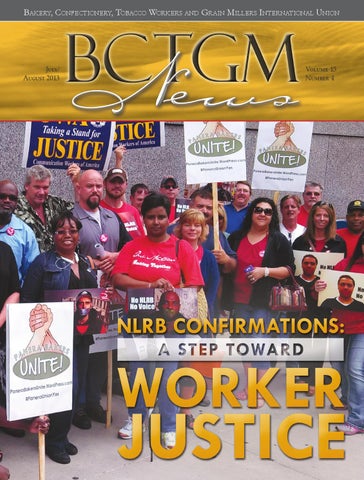
NLRB Confirmations Renew HOPE in
PANERA WORKERS’ FIGHT More than a year since they voted to form a union, Panera workers in Michigan are still waiting. The franchisee that owns the Panera Bread stores in the region has continually refused to recognize the BCTGM as the official representative and to meet to bargain a first contract. The National Labor Relations Board (NLRB) found that Panera
broke the law by refusing to bargain, and ordered the company to bargain with the bakers. But the company appealed that ruling, which put the case on hold because of the delay in confirming President Obama’s recess appointments to the NLRB. And while all five NLRB appointments were confirmed on July 30 (see page 3), the Panera workers are still waiting for justice. The newly confirmed workerfriendly five-person NLRB, offers the bakers renewed hope. However,
the process is still unfairly lengthy and the bakers remain in limbo while their case awaits yet another review. The Panera bakers come from six Panera Bread franchises in Michigan: Kalamazoo, Portage, Battle Creek, Jackson and St. Joseph. The Michigan bakers were the first Panera workers in the U.S. to unionize. The bakers continue to struggle to be part of the middle-class, making less than $25,000 a year.
Nationwide Spotlight On Friday, June 21, BCTGM and Panera workers gathered outside of the Panera Bread Café in Kalamzoo, Mich. to protest the hold up of nominations to the National Labor Relations Board (NLRB). The stalled NLRB resulted in further delays in the fight for justice by Panera Bread workers in Michigan. The BCTGM and the Panera bakers were joined in solidarity by numerous other unions and activists from the Michigan State AFL-CIO, CWA, UAW, AFT, LIUNA, IUPAT UFCW, IBEW and more.
8
BCTGM News
NLRB Day of Action On July 2, BCTGM joined with the CWA, activists and allies to rally outside their senators’ offices and deliver petitions with thousands of signatures, calling on the Senate to approve all five nominations to the National Labor Relations Board. Rallies and actions were held in 26 states. According to the CWA, 3,350 letters were delivered to Senate offices in seven states, and meetings with senators and staff were held in states including Delaware, Illinois, Indiana, Michigan, Missouri, New York, Ohio, West Virginia, Wisconsin and others. In Michigan, BCTGM members and representatives of Locals 70 and 260G joined with Panera bakers and other union activists in an informational picket outside of Senator Carl Levin’s office. The activists presented petitions to the Senator’s office, encouraging the lawmaker to vote to confirm President Obama’s five nominees to the NLRB. In addition to Karla Swift, President of Michigan State AFLCIO, participants included BCTGM International Director of Organizing John Price, Local 70 Business Agent Orin Holder, Local 260G President Randy Joles, Michigan Sugar Interfactory Secretary Todd Holzhei and Panera Bread worker Jared Miller.
Meet Kathleen Von Eitzen “I have always loved baking. It brings back memories of baking with my grandma,” recalls Kathleen Von Eitzen, a Panera baker from Battle Creek, Mich. She started baking seriously as a young mother. Her daughter was diagnosed with ADHD and Von Eitzen vowed to keep her “Ritalin-free” by providing her with a diet free of preservatives, dyes and artificial ingredients. “I baked all her bread products myself and committed to a specialized diet. So I know what quality bakery products are – I’ve made them from scratch all my life,” says Von Eitzen. Today, Von Eitzen works the third shift baking Panera products from night to dawn. She is 55 years old and has worked at the franchise for two years, earning about $21,000 per year. Although her husband has had two heart attacks, company health insurance would take nearly half her earnings, so her family is uninsured and money is so tight that they often forgo needed medications. Due to her husband’s health conditions and financial hardship, Kathleen’s home is in foreclosure. After Kathleen and her coworkers won their union representation election, the company began retaliating against union supporters. “The work attitude has gotten worse. There is constant scrutiny of all bakers who openly support the union. There are intimidation measures. We have evaluation test scores that have plummeted among those of us who are vocal in our support of the union. This does affect my pay raises and my performance bonus, which I wasn’t eligible for this year,” notes Von Eitzen. On July 9 and 10, Von Eitzen shared her experiences before several groups in Washington, D.C. On July 10, she was invited to speak at a open forum, “Will the NLRB Be Able to Protect Workers’ Rights?” at the Center for American Progress. “There are some weeks I have to make the decision whether or not I’m going to pay my light bill or buy food for my husband and me – or buy his prescriptions. I would like to be able to have an NLRB that has decided during this whole 18 months that we were right – that we did everything right to become union. We presented our letter. We went to mandatory meetings. We proceeded with our campaign. They have ordered the company to negotiate with us – yet they continue to refuse to do so,” Von Eitzen told the group.
Keep up with the Panera campaign by visiting bctgm.org/action-center/paneraunionyes July/August 2013
www.bctgm.org
9
Durkee Meets with Director of FDA’s Center for Tobacco Products
B
ecause of the enormous impact a ban or severe restrictions on menthol cigarettes would have on BCTGM members employed in the tobacco industry, BCTGM International President David Durkee on August 1 met with Mitchell Zeller, Director of the FDA’s Center for Tobacco Products (CTP). Also present the meeting were International Representative Randy Fulk and Assistant to the President Harry Kaiser. The CTP was established as a result of legislation passed by Congress in 2009, the Family Smoking Prevention and Tobacco Control Act. Among the Center’s responsibilities are setting performance standards, reviewing premarket applications for new and modified risk tobacco products, requiring new warning labels and establishing and enforcing advertising and promotion restrictions. “We detailed for Mr. Zeller and his staff the tremendous job loss and personal hardship that would result from a ban,” recalls Durkee. “Brother Fulk, because of his many years in the industry as a member of Local 317T, was able to convey on a personal level, what a ban would mean to our members working in the tobacco industry.
“We went to great lengths to emphasize that it is our strong belief, based on an abundance of evidence that a menthol ban would lead to an explosion in illegal cigarette distribution in this country. We were very clear in our assertion that menthol consumers will find the products they desire regardless of restrictions, that the marketplace would not be free of menthol products and that the ban would only serve to put our members out of work,” said Durkee. During the meeting, Durkee presented the CTP with a profile of the BCTGM’s tobacco sector membership, noting that the BCTGM represents workers in every facet of the U.S. tobacco industry. “These are good, middle-class jobs with strong wages and benefits,” Durkee stated. At the conclusion of the meeting, Durkee noted that the BCTGM is very interested in potential CTP actions affecting the jobs of our members working in other segments of the industry beyond cigarette production. The CTP review process for menthol is ongoing. The BCTGM will continue to make its position clear throughout the review process, as we have since the law took effect.
Transfer of Wealth Leaves Middle Class Behind 1947 - 1973
OFF THE CHARTS! 497% income rise $6 million income
1973 - 2004
200%
Wealthiest tenth of a percent earn $1.7 million per year
150%
181%
116%
100%
103%
98.2%
97.1%
84.8% 63.6%
50%
0%
2.8%
Poorest 20%
12.9%
2nd Poorest 20%
23.4%
Middle 20%
38.4%
2nd Richest 20%
Richest 20%
Top 0.1%
Top 0.01%
Source: Economic Policy Institute 10
BCTGM News
Why We Must Say NO to Anti-Union Bills
W
hen was the last time Canada’s senators were praised for their courageous action?
By Ken Georgetti, Canadian Labour Congress President
detailed reports. The legislative strategy behind Bill C-377 mirrors that behind Bill C-525, a Private Member’s Bill introduced by Conservative MP Blaine Calkins, a backbencher from Alberta. This bill would make it easier to decertify unions in the federally-regulated sector and almost impossible for workers to certify a union to represent them in the workplace. Having both of these bills introduced as Private Member’s Bills is a thinly-disguised way for the government to use backbenchers to introduce legislation against groups that don’t see the world in the same way as the government. Private Member’s Bills were meant to be an outlet for MPs to introduce ideas near and dear to their hearts, and not as another avenue for the government to introduce legislation by stealth. Bill C-525 must also be withdrawn. With a shaky world economy, stock market jitters, high unemployment and many jobless Canadians unable to even collect benefits, the Conservative government has more important things to take care of than to use their legislative power to bully, harass, and in the words of the Globe and Mail in a December 2012 print editorial, conduct a “witch hunt” on groups that don’t agree with them.
That’s what happened recently after members of the Senate, including 16 Conservative senators, amended the government-backed Private Member’s Bill C-377, a bill so blatantly unconstitutional and punitive that they forced it back to the House of Commons for reconsideration. When was the last time a Conservative senator described legislation supported by Prime Minister Stephen Harper as “an expression of statutory contempt” towards Canada’s four-million union members? But that’s what Conservative Senator Hugh Segal said in a recent speech that criticized C-377 for its unfair, unnecessary and discriminatory provisions against unions. The bill would demand onerous and expensive disclosure of financial information about individuals and companies, posted publicly on a Canada Revenue Agency (CRA) website. Unions weren’t alone in the criticisms of this bill. Five provincial governments, the Canadian Bar Association, constitutional experts, the life insurance and mutual fund industries and the federal Privacy Commissioner all are on record as opposing the bill for good reason. It singles out unions for discriminatory treatment, invades the privacy of individuals, violates provincial jurisdiction, and is likely unconstitutional. Despite amendments introduced by the Senators, Bill C-377 remains deeply flawed and should be seen for what it really is – an attempt to bully and harass union members and their elected representatives. It should be withdrawn. The bill has nothing to do with financial transparency and good public policy. The government is not forcing other organizations representing employers, doctors, lawyers, Ken Georgetti, pictured here speaking, is president of the 3.3 million member Canadian Labour Congress (CLC) with accountants and all other non-profit groups and charities to produce similar expensive and which the BCTGM is affiliated. July/August 2013
www.bctgm.org
11
Local 19 Bakers Bake S chwebel Baking Company is a large, family owned regional baking company that has plants throughout Ohio, Pennsylvania and West Virginia. In Ohio, BCTGM Local 19 represents bakers at state-of-the-art Schwebel facilities in Hebron, Youngstown and Solon. Workers in the thrift stores at those bakery locations are also Local 19 members. BCTGM made brands include Schwebel’s breads and buns, Country Hearth, Roman Meal, Cinnabon, ‘taliano, Millbrook, and Sun-Maid Raisin. Pictured here are Local 19 members at the Solon, Ohio bakery in various stages of bakery production.
Alan Martter operates the pan setter.
*The photos featured here were taken by Bill Burke of PageOne Photography.
Andrew Bly precisely weighs ingredients.
Jeftimije Markovic, a quality control technician, examines pans of buns before baking.
12
BCTGM News
with PRIDE Arland Slone, a bagger operator, loads trays with fresh buns.
Harold Bower Jr., prepares to unload flour for the bakery.
Vukasin Mrkajic of the shipping department moves trays of bread to the transport trucks for delivery.
Ronnie Linder Jr., a mixer, prepares dough with fresh Greg Speelman is a flour flour, water, yeast and other essential ingredients. receiving technician. The photos featured here were taken by Bill Burke of PageOne Photography. July/August 2013
www.bctgm.org
13
UNION MEMBER Helps Expand FAMILY LEAVE ACT in Oregon
Pictured at the signing of HB 2950 (from right to left) is Oregon citizen Christina Stephenson, Jan DuPont (Willamette Valley Hospice Bereavement Counselor), Dr. Kristine Munholland, L. 114 member Robin Zimmerman, Governor John Kitzhaber (seated), Beth Cooke (Family Forward), Rep. Shemia Fagan, Rep. Alyssa Keny-Guyer, Sen. Brian Boquist, Elizabeth Cushwa (Bureau of Labor and Industries), and Jan Elfers (Ecumenical Ministries).
B
CTGM Local 114 member Robin Zimmerman is a man who despite suffering a tremendous loss – was able to turn his heartache into an important win for Oregon working families. Zimmerman, a union baker at Oroweat in Beaverton, Ore. for the last 33 years, was key to the passage of House Bill 2950, which adds mandatory bereavement leave to Oregon’s Family Leave Act (OFLA). Four years ago, Zimmerman’s wife, Bonnie, died of malignant melanoma. When she was diagnosed in 2004 and as her cancer spread, Zimmerman was forced to use all of his vacation days to help care for her because under Oregon’s Family Leave Act, the use of personal sick leave was not permitted. According to Local 114 (Portland, Ore.) Business Agent Terry Lansing, Zimmerman, “Often had to make the difficult choice of working as usual or take unpaid leave to care for his terminally ill wife when he had a full sick leave bank.” Zimmerman became an advocate for the use of accrued sick leave to cover Family Medical Leave Act (FMLA) /OFLA absences to care for a family member. In 2008, Zimmerman was finally permitted to use sick leave when an earlier family leave act amendment provided the authorization for Oregonians to access sick leave to care for a family member. After Bonnie’s death on May 3, 2008, Zimmerman realized he faced yet another issue: he had funeral services to arrange and grieving children to console, but there was not a grief provision in the Oregon family leave act. 14
“FMLA protects up to the time of death, but there is no protection after the death when family members are most devastated and need time to adjust to the loss,” explains Lansing. Zimmerman began a personal crusade to add a grief provision to Oregon’s family leave law. He received broad support from various groups around the nation while building ties with the state legislators. The language was first introduced in the 2011 legislative session but it failed. It was re-introduced in the next legislative session as House Bill 2950 and Zimmerman testified twice before the measure was passed. It was signed into law on June 13 by Governor John Kitzhaber. This bill makes it mandatory that employers give two weeks unpaid leave to employees to attend a funeral, make arrangements, grieve, and receive counseling when a family member has died. Zimmerman has a personal copy of House Bill 2950, complete with a gold seal and the Governor’s signature. He also has the pen that Governor Kitzhaber used when he signed the bill. “It was such a long process,” notes Zimmerman. “There were times, after so many false starts, that I never believed it would get done. But it did. And it feels good to make such a change and leave a mark.” Zimmerman has become actively involved in the campaign to raise awareness of melanoma. He distributes educational leaflets at the bakery and around town the first Monday of May, which marks the anniversary of Bonnie’s death. He has dubbed the date as “Melanoma Monday” and continues to receive wide community support in his educational efforts. BCTGM News
SUMMER FUN THE BCTGM POWER WAY!
The BCTGM joined several AFL-CIO affiliates to help raise more than $16,000 for DC Labor’s Community Services Agency at the seventh annual Labor Night with the Washington Nationals on July 19. Pictured here taking part in a pre-game on-field ceremony is (left to right, front) AFGE 3615 member Kitty Hagarty, BCTGM Intl. Secy.-Treas. Steve Bertelli, Union Privilege Pres. Leslie Tolf, AFL-CIO Secy.-Treas. Liz Shuler, AFL-CIO Exec. Vice Pres. Arlene Holt Baker, CWA Pres. Larry Cohen, (back, from left) BCTGM Intl. Pres. David Durkee, Maritime Trades Dept. Exec. Secy-Treas. Dan Duncan and Iron Workers Pres. Walter Wise.
Summer is more enjoyable with BCTGM Power entertainment discounts because you can afford it. Union members can use BCTGM POWER/Union Plus Entertainment Discounts – including movie tickets, video and theme park discounts to relax and enjoy the summer.
Theme Park Discounts
Savings up to $19 per ticket at theme parks across the country - including Adventure Island, Busch Gardens, Hershey Park, SeaWorld, Paramount’s Great America, Six Flags and Universal Studios.
Major League Baseball
Sight-seeing savings at theaters, Broadway shows, museums, aquariums, zoos and sporting events like Major League Baseball in major cities.
Movie Theaters
DVD Rentals
Save up to 40% at national chains for those big summer blockbuster movies (most of which are made with union talent and technicians).
Get discount DVD rentals at Blockbuster when you buy movie rental coupons in advance.
Order tickets online at UnionPlus.org/Entertainment or call 1-800-565-3712, Monday through Friday, 9 a.m. to 6 p.m. EST. and reference member ID number: 744387769. Also, learn more about Advantage points and start earning points toward free entertainment.
Start planning your fun today!
Visit: UnionPlus.org/Entertainment July/August 2013
www.bctgm.org
15
S te ward s
Printed in the U.S.A.
ATTENTION: BCTGM The job of a steward is one of the most challenging, most rewarding and most important jobs in our union. That’s because union
stewards are on the front lines of our fight to develop a strong, active union in the workplace. Stewards have an enormous impact on our members’ faith and belief in the union. The steward is the one union person our members see every day when they go to work. In the eyes of most BCTGM members, you are the union. Because this is so, the BCTGM steward, more than any other union leader or activist, has the opportunity to energize and mobilize the source of our union’s strength: the membership.
The International Union has unveiled a new online STEWARDS CORNER to help the thousands of BCTGM union stewards across North America become more effective and educated stewards. Check out the BCTGM website, www.bctgm.org, and look for the STEWARDS CORNER. This special area of the site includes important information on: • The role and responsibilities of stewards.
• Step-by-step guidance through the grievance procedure.
• The legal rights of stewards.
• Manuals, publications and links.
• Work rules and issues and how they affect employees.
• News and safety updates pertaining to stewards.
Visit www.bctgm.org/StewardsCorner TODAY!