Bakery, Confectionery, Tobacco Workers and Grain Millers International Union
January/ February 2009
Volume 11 Number 1
the PRESIDENT’s MESSAGE
A NEW DAY, A NEW WAY FOR AMERICA
W
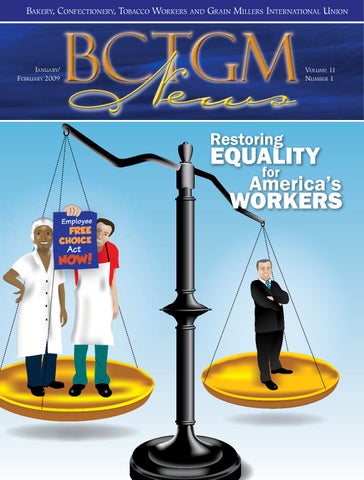
When nearly two million Americans from all walks of life and every corner of the country brave frigid temperatures in the midst of a devastating recession to witness the Inauguration of a new President, there can be no doubt that something extraordinary is taking place in our country. We have not seen such enthusiasm for change and a new direction in half a century. Given the magnitude of the national economic crisis, President Obama and his administration will need the full support of all Americans if he is to lead this nation out of the mess he inherited from his predecessor, restore economic prosperity and heal a wounded nation. The professionalism and decisiveness Obama and his team displayed during the transition period, his obvious grasp of the many of complex issues before him and his willingness to surround himself with bright, talented people offer great promise for a new era of effective presidential leadership. The challenges are daunting to say the very least. The President faces the worst conditions since the Great Depression eighty years ago. Our economy is deteriorating rapidly. We are losing tens of thousands of jobs every week, in every part of the country and every sector of our economy. Communities are staggering as employers shutter their doors. Working families are losing their homes, health care, retirement savings and their hope. In the face of this catastrophic economic situation, President Obama has set out an aggressive agenda for bold change not only in economic policy, but in every aspect of the way government operates. In his first few weeks on the job, President Obama already has shown that he is a different kind of leader; that he has the courage of his convictions and is a man of action who will protect workers and their families and not immoral Wall Street tycoons and corporate greed. When despicable Wall Street executives lavished multimillion dollar bonuses on themselves with taxpayer bailout dollars, the President immediately called them out. He forcefully demanded that they change their “shameful” ways and begin to show some responsibility and respect for working Americans who paid for the bailout. Working people and their representatives have good reason to look forward to dramatic changes in the policies of the Labor Department and other agencies that impact workers on a daily basis. Within days of taking office, President Obama repealed a slew of anti-union measures put into place by George Bush. He did it publicly at the White House with labor leaders by his side and proclaimed, “You cannot have a strong middle class without a strong labor movement.” The BCTGM will be working with the AFL-CIO, the Obama Administration and the Congress on the Employee Free Choice Act and other legislation that will help the economy recover and restore a decent standard of living for all Americans. It is critical that the Obama Administration’s policies be implemented quickly and with the full support of Congress, Democrats and Republicans alike. Unfortunately, to this point
2
the Republicans in Congress haven’t yet accepted the fact that they are no longer in charge and that their failed policies, which created the economic crisis, were soundly rejected with Obama’s landslide victory. They continue to fight against the change the American people demanded and which we desperately need only to champion the old discredited ways of doing business in Washington. Still worse is that many of them share Rush Limbaugh’s sentiment, “I hope (Obama) fails.” At a time when so many Americans are suffering such great hardship, it is beyond belief that some in positions of influence and power would be rooting for the new President to fail. In my mind, nothing could be more unpatriotic. It shows that these people do not care about our country or its citizens but only their own petty self-interests. Nonetheless, we have great confidence that President Obama will not let the defenders of the old-style politics and the practitioners of the politics of hate stand in his way of moving our country forward. As the new President proclaimed in his inaugural address, “On this day, we gather because we have chosen hope over fear, unity of purpose over conflict and discord. On this day, we come to proclaim an end to petty grievances and false promises, the recriminations and worn out dogmas, that for too long have strangled our politics.” With President Obama at the helm, it is a new day and a new way for America. And there is no turning back!
Frank Hurt BCTGM International President
Official Publication of the Bakery, Confectionery, Tobacco Workers and Grain Millers International Union 10401 Connecticut Avenue, Kensington, Maryland 20895-3961 (301) 933-8600 www.bctgm.org Frank Hurt, Editor Corrina A. Christensen, Assistant Editor BCTGM General Executive Board President Frank Hurt • Secretary-Treasurer David B. Durkee Executive Vice President Joseph Thibodeau • Vice Presidents Steve Bertelli • Anthony L. Johnson • Sean Kelly Micheal T. Konesko • Arthur Montminy Robert Oakley • Randy Roark BCTGM General Executive Board Members Joyce Alston • Edward Burpo • Johnny Jackson Paul LaBuda • Richard Lewis • Narcisco Martas Danny Murphy • Vester Newsome Tony Pegram • Ron Piercey • Donna Scarano Brad Schmidt • Doyle Townson BCTGM News (ISSN 1525-4860) is published bi-monthly by the Bakery, Confectionery, Tobacco Workers and Grain Millers International Union, 10401 Connecticut Avenue, Kensington, MD 20895-3961. Periodicals postage paid at Kensington, MD and at additional mailing offices. Subscription to new members only. Postmaster: Send address changes to BCTGM News, 10401 Connecticut Avenue, Kensington, MD 20895-3961.
BCTGM News
CBC Ordered to Rehire Workers, Comply with Order
D
December 3, 2008—After more than six years, justice finally prevailed at Consolidated Biscuit Company (CBC) in McComb, Ohio when workers who were fired for their effort to join the BCTGM returned. On November 14, 2008, the U.S. Sixth Circuit Court of Appeals ordered CBC to comply with the National Labor Relations Board’s (NLRB) Decision in its entirety. This includes the reinstatement of fired CBC management committed union supporters Bill numerous violations of the Lawhorn and Russ National Labor Relations Act. Teegardin. The Court further ordered full back pay for both Lawhorn and Teegardin with all lost wages to be paid, plus compounded interest. The NLRB has informed CBC that its decision will now be enforced. If the company does not comply with the order, CBC will face Contempt Charges, which could cost the company thousands of dollars in fines and possible jail time. The Board’s decision mandates that the 2002 election results be set Fired CBC workers Russ Teegardin (top, aside due to misconduct and orders center) and Bill Lawhorn (top, right) a new election for CBC workers to be were welcomed back to the bakery by co-workers on December 18th. scheduled by the Regional Director. BCTGM International President Frank Hurt reflected on this recent Despite the company’s massive anti-union CBC victory and the need for labor law reform. “This is campaign, the majority of more than 800 workers the very reason why the Employee Free Choice Act decided to exercise their right to form a union and must become law. It is an absolute disgrace what these signed recognition cards. workers went through because they wanted to become In an attempt to stop workers from exercising members of a union. It is outrageous that they were their legal right to sign union recognition cards, CBC forced to wait so long for justice to be served in modern management committed numerous violations of the America.” National Labor Relations Act (NLRA). Questioning employees about their union activities, spying on Long Battle to BCTGM union events, threatening to move or close the plant In 2002, when workers at the Consolidated if the union is voted in and threatening to reduce or Biscuit Company (CBC) plant in McComb, Ohio eliminate wages and/or benefits are among the 40 decided they wanted a say in their working complaints filed against the company after more than conditions, wages and benefits that affect their lives six months of investigation by the NLRB. and families, they called the BCTGM. January/February 2009
www.bctgm.org
3
Solis:
DOL Has ‘Obligation to Restore Trust and Hope’ of Workers
A
At press time, Congress was holding confirmation hearings on the nomination of Hilda Solis as Secretary of Labor. Labor has good reason to believe that as Secretary, Solis will return the U.S. Department of Labor to its primary mission of protecting the lives, wages and rights of working people. Solis, a four-term U.S. House member from California’s 32nd District, was tapped by President Barack Obama to be the Secretary of Labor. As President Obama said repeatedly throughout the campaign, the Bush Administration and outgoing Labor Secretary Elaine Chao spent eight years attacking workers’ rights, strong workplace health and safety rules and unions while they carried the water for Big Business. In summing up the Chao regime, Obama said, “Remember, this is supposed to be the Department of Labor, not the Department of Management.” When her nomination was announced, Solis told reporters,
Hilda Solis
“We can help strengthen one of America’s greatest assets, its labor force….I will work to strengthen our unions and support every American in our nation’s diverse workforce. “We also must enforce federal labor laws and strengthen regulations to protect our nation’s workers, such as wage and hour laws, and rules regarding overtime pay and pay discrimination,” concluded Solis. “After eight years of woeful mismanagement at the Labor Department, Solis will bring energy, experience and dedication to help lead working families
Labor Welcomes New NLRB Chairwoman Liebman The union movement is praising President Obama’s nomination of Wilma Liebman as the next chairwoman of the National Labor Relations Board (NLRB). As an NLRB member over the past eight years, Liebman has challenged the Bush Administration’s war on workers. The Board’s Republican majority made it harder to form unions through majority sign-up, limited the ability of illegally fired workers to recover back pay and allowed employers to discriminate against union supporters in the hiring process. In a statement, Liebman says, “The Board’s work matters, just as it did when the National Labor Relations Act was passed in 1935.” Liebman was first appointed to the NLRB by President Clinton in 1997. Her current term expires in 2011. Before joining the NLRB, Liebman served from 1994 to 1997 at the Federal Mediation and Conciliation Service, first as special assistant to the director and then as deputy director. She began her legal career as an NLRB staff attorney in 1974, then served on the legal staff of two unions: the Bricklayers and the Teamsters. 4
back to prosperity,” said BCTGM International President Frank Hurt. Solis comes to her understanding of unions and working people naturally—she is the daughter of immigrant working class, union member parents. Her dad was a member of the Teamsters and a shop steward, and her mom an assembly line worker at a Southern California Mattel toy factory and member of the United Rubber Workers (since merged into the United Steelworkers). Before her election to Congress in 2000, she served in the California legislature, first in the Assembly and, in 1994, as the first Latina elected to the state Senate. Art Pulaski, executive secretarytreasurer of the California Labor Federation, says Solis focused on labor issues, especially on protecting easily exploited, lowwage workers through enforcement of labor laws during her time in the legislature. The unique experiences she gained in California will now benefit the nation. Her first job in Washington will be to fix the neglect. There many regulations that protect the workforce that the Bush Administration weakened or refused to enforce. In the U.S. House, Solis earned a 97 percent AFL-CIO working family voting record. She co-sponsored the Employee Free Choice Act, raising the minimum wage, protecting the wages of construction workers, strengthening fair and equal pay laws for women, backing tough workplace safety standards, bolstering the rights of federal workers and more issues that should top the Labor Department’s mission statement. BCTGM News
T
The AFL-CIO recently submitted its recommendations for the Obama Administration in a series of reports entitled “Turn Around America.” Among the many suggestions made, the AFL-CIO urges the Obama Administration to repeal executive orders that are “hostile” to project labor agreements, reinstate regulations barring the use of federal contract dollars to fight or promote unionization, and take action to realign the reporting requirements for unions under the Labor-Management Reporting and Disclosure Act. Labor’s Top Priorities Topping the AFL-CIO’s list is dealing with the economy through passing the stimulus bill and sending its dollars to homeowners facing foreclosure and to aid states, auto workers and manufacturers.
“President Franklin Delano Roosevelt said if he went to work in a factory, the first thing he would do is join a union.” “President Franklin Delano Roosevelt said if he went to work in a factory, the first thing he would do is join a union,” the AFL-CIO said. “Forty years later, President Ronald Reagan sent exactly the opposite message when he fired striking air traffic controllers.” That led, the federation said, to employer anti-union “tactics at a level not seen in decades.” “The new administration can make a tremendous difference by publicly sending the message that the administration believes in, and supports, workers’ rights to form and join unions, and the importance of a thriving labor movement to our nation’s economic health and wellbeing,” the AFL-CIO stated. By “speaking positively about unions and workers’ rights to organize,” by promising to “stand January/February 2009
The AFL-CIO’s Recommendations for the Obama Administration with and protect” workers’ rights and “by criticizing employers who interfere” with unionization, Obama’s administration “can set a new tone and put our nation’s labor-relations system back on the right track,” the AFL-CIO concluded. List of Reforms The federation also listed a wide range of administrative measures the Obama Administration could take to help workers. Those measures include: • Suspend bargaining on all new trade and investment pacts, and review all past pacts, as Obama promised during the election campaign. “Any new agreements must assure balance between the interests of companies and those of workers,” the federation said. As part of that review, the AFL-CIO also called for “new administration priorities and benchmarks” for the last three pacts Bush negotiated, with South Korea, Colombia and Panama and said Obama should “lay out a new template for future trade agreements.” The federation strongly backs the TRADE Act, which would restore congressional primacy in setting standards U.S. bargainers in trade deals, and which would order them to write enforceable labor rights into the texts of such pacts. • Have the U.S. take the federation’s extensively documented trade case against China—which
www.bctgm.org
has the largest trade surplus with the U.S.—to the World Trade Organization. The AFL-CIO’s case, which the Bush Administration rejected without review, showed China’s rampant “violation of workers’ rights is an unfair trade practice,” the AFL-CIO said. • Identify and nominate federal judges “who have a demonstrated commitment to equal rights,” including understanding the courts’ role in protecting those rights, including workers’ rights. President Obama has said he wants to name judges who are more attuned to the wider society and to the needs of all citizens. • Appoint pro-worker members and chair of the NLRB and restore the Labor Department, its Wage and Hour Administration, the Occupational Safety and Health Administration and the Mine Safety and Health Administration to their “historic roles” as “advocating for and protecting the interests of workers.” (See page 4.) • Formalize the Clinton-era ban— which Bush’s agency has violated—on wage-and-hour investigators sharing information with Immigration and Customs Enforcement (ICE) officials. It would also require ICE to get highlevel approval before raiding worksites during union organizing drives —a common tactic anti-union employers have used. • “Restore air traffic services as an ‘inherently governmental function.’” Bush’s budget office said such services could be contracted out, again over union protests on safety grounds. More broadly, the AFLCIO wants a three-year moratorium on all federal contracting out and outsourcing, pending a complete “audit and review” of the idea. This story was adapted from “AFL-CIO sends ‘to-do’ ideas to Obama team” written by Mark Gruenberg for Press Associates, Inc., union news service. Used by permission.
5
BCTGM Local Unions Approve
Modification Agreement with IBC
F
Following the approval of the Interstate Bakeries Corp. (IBC) Modification Agreement by all BCTGM Locals involved, the Bankruptcy Judge has approved the proposed IBC reorganization plan. After more than four years in bankruptcy, IBC will soon operate on its own. “It is our sincere hope that with this action, IBC can become a viable, profitable company going forward. I want to commend you for your leadership during this difficult process,” BCTGM International President Frank Hurt stated in a letter to all local unions with IBC contracts. A federal bankruptcy judge approved IBC’s reorganization plan after creditors “overwhelmingly” voted in favor of the plan.
The agreements to provide Interstate with about $600 million in post-bankruptcy financing are still being completed. IBC Executives said they expected all of the financing to be wrapped up so the company could emerge from bankruptcy by March. New York investment firm Ripplewood Holdings will invest $44.2 million in cash and $85.8 million in convertible debt in IBC. It will take a 50 percent equity stake in the reorganized company. The other 50 percent will be held by lenders who will help finance operations once the company emerges from bankruptcy.
Interstate’s 19,000 union workers were promised a future equity stake in the company if it grows. Unsecured creditors, who are owed almost $323 million, receive almost nothing under the plan. A compromise was worked out for Interstate to pay $890,000 of their expenses and put $5 million in cash in a trust for them. They also will be allowed to pursue some claims. The company will cancel all existing stock shares and become a private business. “Twentytwo thousand jobs are being saved, and that is a different story than what you are reading about these days,” Chief Executive Officer Craig Jung told the Kansas City Star.
Obama Signs Fair Pay Act With Lilly Ledbetter looking on, President Barack Obama signed into law the Lilly Ledbetter Fair Pay Act. “In signing this bill today, I intend to send a clear message: That making our economy work means making sure it works for everyone. That there are no second class citizens in our workplaces, and that it’s not just unfair and illegal—but bad for business—to pay someone less because of their gender, age, race, ethnicity, religion or disability,” said Obama during the signing ceremony. After working nearly 20 years at a Goodyear tire plant, Ledbetter discovered she had been paid significantly less than men doing the same job. A federal
6
jury ruled in her favor but Goodyear appealed, and in 2007 the U.S. Supreme Court ruled Ledbetter—and other workers—had no right to sue for a remedy in cases of pay discrimination after more than 180 days after the first paycheck, even if she didn’t discover the pay discrimination until years later. The fair pay bill was the first legislation President Obama has signed since taking office. It was also the target of veto threats from former President Bush after it was passed by the House in 2007. Last year Republican senators blocked a vote on the bill. The new Democratic-majority House and Senate quickly passed the legislation this year.
BCTGM News
Cassone Ordered to
N
Reinstate Workers
early a decade after workers at the J.J. Cassone Bakery in Chester, N.Y. were fired for trying to join the BCTGM, the U.S. Court of Appeals has upheld a 2006 National Labor Relations Board (NLRB) judgment against the company by refusing to review the record. In a decision issued January 23, the U.S. Court of Appeals for the District of Columbia Circuit, found that there was no substance to the company’s claim that the NLRB had violated its due process. The D.C. Court’s decision upheld the NLRB’s 2006 decision against the company which found the company guilty of breaking Federal labor law, including illegally firing several workers for union activity. The 2006 ruling also ordered the company to reinstate the fired workers and reimburse them back pay. BCTGM International President Frank Hurt said he was happy with the Court’s decision, but was stunned that the entire process took 10 years. “The first Unfair Labor Practice charges were filed against the company in 1999, several NLRB trials were held at the beginning of this decade, the final NLRB ruling in favor of the workers was handed down in 2006, and three years later the Appeals Court upholds that decision—and all the while the workers at Cassone’s are without union representation,” said Hurt. “This just illustrates how broken the current system of labor relations is in this country, and why it is imperative Congress pass the Employee Free Choice Act,” continued Hurt. The initial organizing campaign began in 1999, when a January/February 2009
Ten Years After Organizing Drive “Based upon my findings above, I conclude that the unfair labor practices committed by Respondent during the critical period between the filing of the petition on November 2, 1999 and the election held on December 21, l999 constituted objectionable conduct that interfered with the free choice of employees in the election.” —Steven Davis, Administrative Law Judge, February 22, 2006
Such Unfair Labor Practices include: n the suspensions and discharges of key employees most active in
the organizing efforts; n a threat that if the Union won the election, the employees’ hours
of work and other benefits would be reduced; n threats of discharge, unlawful interrogation, and loss of the employees’ pension plan; n announcement of a new benefit of monetary loans for emergencies, demands that its employees cease organizing for the Union; n the creation among its employees of the impression that their union activities were under surveillance by the Company; n informing its employees that their support for the Union would be futile; and n threats of unspecified reprisals. number of workers at the familyowned bakery expressed an interest in joining BCTGM Local 3 (New York, N.Y.). After months of organizing the workers around issues of fair pay, pension benefits, and dignity and justice on the job, the union filed for an election with the NLRB which was scheduled for December 21, 1999. “Local 3 never waivered in our support of these workers, or the justice they so rightly deserve,” noted Local 3 President Narciso Martas. Over the course of the organizing campaign the company consistently violated Federal labor law by retaliating and www.bctgm.org
discriminating against union supporters. After an egregious anti-union campaign, the local lost the election and immediately filed further charges against the company’s conduct. An Administrative Law Judge for the Board ruled against the company in 2005; however, the company objected to the decision and a second Administrative Law Judge ruled against the company. Cassone’s objected to the second decision, but, on Review, the Board itself affirmed the Judge’s decision against the company. The company then took it, unsuccessfully, to the Court of Appeals. 7
The Employee Free Choice Act:
B
Lies & Distortion on the Secret Ballot
Business special interest groups have launched a $120 million campaign to derail reform of the nation’s broken labor law system by lying about the Employee Free Choice Act. Their only line of attack—that the bill somehow takes away so-called “secret ballot” elections for joining a union—is blatantly false. The Employee Free Choice Act not only strengthens the current process for workers forming unions, but also provides for a more fair and democratic method for men and women to join unions. Here are the facts to refute the opposition’s fiction about the Employee Free Choice Act:
Fiction: “Leg al recognition of a union ha tr aditionally be s e s e y lo en achieved th p m e f o s ro t ug h h se ba ig cr r llo et t elections…ju end the st like how a pe rson votes ts n would for a senator or c io a t F la n is g io co n le ng “ U ressman.” e r h fo T r : te n n .” – Ce Fictio lections – Center for U lish ballot e t e nion Facts r c e s not abo to s e o FA d CT: Current un e Act ic o io d n h e el s C ections involv “secret ballots ing e propo ee Free ” bear no rese nder th Employ mation U r e h fo .” s mblance to T t n : o io T ll po n a C lit u t b ic A al e t n F elections. Wor e th secre kers’ free spee hoose er curr ns or “ rights are sque ch h get to c p. Und t i u s electio r w n e k ig y r lc l s he o n d, y w o em it , r s ployers practic n t jo s io a t e r m la va r n is ri e ous forms of io leg tions o economic coer e a un s — elec cion, an cogniz an e r is d la t bo o proces n t r e la e w allows empl v oyers to oes pre e choic indefinitely de e Act d e the law, th c ic n o e h lay recognition u C fl . e s in e r r o e F t y through ee em ns: drawn-out ap emplo Employ ed syst peals. Says U ampaig e w c h a g t fl t in e a h ni iz t versit y of n Wh Oregon politic ulating ith orga rkers; al scientist G ion wo r manip faced w e n or y u n do e n Lafer, lo o h p r “T he presence wn em .W re p of secret bal lose do gally fi utcome c o le o il t n s lo n io r ts t e e t can’t overcome th elec mploy y t h re a e corrupt nat of ent of e illegall ure of ercent s p r e 4 N y h 3 LR lo , it 25 perc B elections.” w nd mp union vails; a ent of e ing the ion pre s 51 perc o n p u p e o h to es if t kers in worksit rce wor e o . c m s r is e orit employ ch” to forming and fav s e a “new approa ib r is p b -u gn si ity or Fiction: Maj nion Facts – Center for U unions. Fiction: NLR on B elections are g and comm “the only way to guaran a longstandin is p -u tee worker prot ns gn io si elat it y ection from ional Labor R coercion and FACT: Major Since the Nat intimidation.” s. n io n ons u ti ca rm ifi e cert way to fo – Coalition for a quarter of th , 35 19 a Democratic in ed er rd w e based Workplace Act was pass r Relations Boa bo La , l na FACT: Worke io at N t. Since 2003 rs are more su issued by the ajorit y suppor m sceptible to of ce h en ug coercion in N id ro on ev unions th LRB elections on non-electi icans formed er than majorit y m A n w io lo sign-up. Wor ill al lf a m kers in NLR ns like AT&T more than ha B elections ajor corporatio m n are twice as ve he E T p. p. -u -u gn likely (46 per majorit y sign ing majorit y si cent vs. 23 percent) join unions us to rs because y ke or da as those in m w to r y thei necessar is ajorit y ct A e ic sign-up cam ho C violating paigns to re Employee Free singly bold in ea port that cr in e m managemen co on ve be t coerced them e NLRB electi employers ha to oppose e law under th th d the union. Fu s an er ts oy gh pl ri rther, less than loped, em employees’ ess was deve one in 20 oc pr workers (4.6 pe al at eg th ill n gal and rcent) who sign process. Whe the massive le in ed a card ge ga with a union y. en y el toda organizer repo did not routin commonplace rted that the ’ rights that is presence of th rs ke nion or U w : ce of la n e organizer m violatio e Workp ade them feel emocracy in th pressured to “D . Minn. L. ig 77 ra C ,” r, w sign the card Becke l Labor La ra de . Fe d an Elections Representation 3) Rev. 495 (199 8
BCTGM News
Know the Facts: Anti-Union Opposition’s rhetoric
The misnamed Employee Free Choice Act does not offer workers a choice.
The Facts
Rhetoric
Employer lawlessness and intimidation denies workers free choice. During organizing drives, 30% of employers illegally fire pro-union workers, 82% hire unionbusting consultants and 91% force employees to attend one-on-one anti-union meetings with their supervisors.1 When workers are faced with these tactics, there is no choice. Further, under current law, the choice to recognize a union rests only with employers. This bill restores free choice by allowing workers to have a union when a majority wants one.
“The American tradition of secret ballot elections should not be tossed aside for a flawed and unfair process.”2
The Employee Free Choice Act does not abolish elections or “secret ballots.” The bill will allow workers, not their employers, to choose the union formation process—either through NLRB elections or majority sign-up. The bill provides workers with a proven method of demonstrating majority support for a union. Since 2003, over half a million workers have formed unions through majority sign-up.3
“Casting a secret-ballot is a democratic principle, one that is an American right, and should not be taken away.”4
The presence of secret ballots can’t overcome the undemocratic nature of the current labor law system, which bears no resemblance to political elections. You cannot have a free and fair election when a party is not allowed to campaign freely and supporters are unable to campaign without fear of retribution.5
The bill “exposes workers to intimidation and coercion by union organizers.”6
Management coercion is the problem, not union coercion. During NLRB elections, 46% of workers complained of pressure from management while only 14% of workers felt pressured during majority sign-up campaigns.7 NLRB elections invite far more exposure to coercion than card check. Workers in NLRB elections are twice as likely (46% vs. 23%) as those using majority signup to report management coercion.8
Unions are outdated and unnecessary in today’s global economy.9
More than half of U.S. workers—60 million—say they would join a union today if they could.10 Workers who belong to unions earn 30% higher wages11 and are 59% more likely to have employer-provided health care.12 Unions provide workers the stability and flexibility to maintain their position and status in the workforce.
Unions are a strain on American businesses.13
Successful U.S. companies thrive with unions. AT&T, Kaiser Permanente, Harley-Davidson and other top companies prove that employers can be industry leaders while still respecting workers’ rights.14
Find out more about the Employee Free Choice Act at: www.bctgm.org/EFCA.html Sources 1
2
3 4
5
6
7
Chirag Mehta and Nik Theodore, “Undermining the Right to Organize: Employer Behavior During Union Representation Campaigns,” Center for Urban Economic Development, University of Illinois at Chicago, Dec. 2005. “Oppose ‘Card Check’ and Protect Secret Ballot Elections for America’s Workers,” Chamber of Commerce Legislative Alert. “Half a Million and Counting,” American Rights at Work, Sept. 2008. “Respect workers’ right to secret vote” Thomas J. Donohue, Miami Herald OpEd Sept. 1, 2008. See Gordon Lafer, “Neither Free Nor Fair: The Subversion of Democracy Under NLRB Elections,” American Rights at Work, July 2007. “Oppose ‘Card Check’ and Protect Secret Ballot Elections for America’s Workers,” Chamber of Commerce Legislative Alert. Adrienne Eaton, Ph.D. of Rutgers University, and Jill Kriesky, Fact Over Fiction: Opposition to Card Check Doesn’t Add Up, Wheeling Jesuit University, March 2006.
January/February 2009
8 9
10 11
12
13
14
Ibid. “It’s in the cards for labor” Steven J. Law, Washington Times OpEd, June 29, 2008. Research by Peter D. Hart Research Associates, Dec. 2006. U.S. Department of Labor, Bureau of Labor Statistics, “Union Members in 2007,” Jan. 25, 2008. U.S. Department of Labor, Bureau of Labor Statistics, “Employee Benefits in Private Industry, March 2007” August 2007. “Unions see fall elections as big opportunity for gains” Robert Cohen, Newhouse News Service July 14, 2008. See “The Labor Day List: Partnerships that Work,” American Rights at Work.
www.bctgm.org
9
International Staff Meetings Held at Headquarters
O
Organizing, 2009 contract negotiations the incoming laborfriendly Obama Administration topped the agenda at staff meetings held at BCTGM International headquarters in January. Regional Vice Presidents and International Representatives from the First, Second, Third and Fifth Regions attended the individual meetings that were led by International President Frank Hurt and assisted by International Secretary-Treasurer/Director of Organization David B. Durkee, and International Executive VicePresident Joseph Thibodeau. The purpose of the meetings is to develop a region-by-region game plan for maximizing organizing opportunities, maintaining high-quality local union service work and implementing an effective grassroots legislative action program in support of the Employee Free Choice Act. Each International Vice President and the International
Representatives reviewed activities in the Region over the past year, including local union mergers, contract settlements, and arbitrations and organizing activities. Additionally, the group discussed upcoming negotiations in the respective Regions. Both Hurt and Durkee stressed the importance of the Employee Free Choice Act for the union’s organizing efforts. “Enactment of the Employee Free Choice Act will lead to enormous
growth in the BCTGM. Greater BCTGM density in our industries means we will have the strength to negotiate stronger contracts and better protect the rights and interests of our members,” explained Hurt. “We will continue to work hard alongside the AFL-CIO, President Obama and Congress to pass additional working familyfriendly laws,” Hurt added. Similar staff meetings will be held for the Sixth and Fourth Regions later this spring.
ATTENTION
APPLICANTS TO THE 2009 BCTGM SCHOLARSHIP PROGRAM The deadline for applications to the BCTGM 2009 International Scholarship program has passed. All those who submitted an application prior to the January 31 deadline date are reminded to submit the following requirements prior to March 31: ➤ Personal Profile — completed by the applicant ➤ Academic Report — completed by the high school (or college, if a member). The report should reflect the first semester grades for the senior year (or more recent academic performance, if a member). ➤ Essay — Each applicant is required to write and submit an essay (250-500 words) to demonstrate your ability to organize thoughts and express yourself. Your essay may be one of the following: • Same essay as the essay requirement from your college application. • Same essay as the Union Plus Scholarship application (U.S. applicants only). • Essay on “Organized Labor’s Contribution to the Welfare of the People of North America.” ➤ SAT or ACT Scores (Members and Canadian applicants need not provide scores; all others must.) For more information contact the BCTGM International Scholarship Office at 301/933-8600.
10
BCTGM News
BCTGM Bargains
D
Bargaining Highlights
in Challenging Environment
espite the turmoil on Wall Street, the collapse of the housing market and a bleak employment outlook, the BCTGM nonetheless continued to bargain excellent contracts for its members in North America. Negotiating with some of the largest food processors in the country, including ConAgra, Kraft, Nestle, Weston Foods and Archer Daniels Midland, local unions were successful in winning respectable wage increases, pension escalations, positive language changes, and most importantly, the maintenance of health benefits. According to BCTGM International President Frank Hurt, the union was able to continue its strong tradition of negotiating some of the best contracts in the food industry because of a dedication to preparedness and mobilization. “Our locals and negotiators understood the environment
they were bargaining in, did the appropriate research and analysis, and mobilized their memberships effectively,” said Hurt. One of the largest contracts negotiated in 2008 was the master agreement with Kraft Foods covering over 3,000 members in seven Nabisco plants. According to Hurt, preparations for the Nabisco contract began the previous year. “It was that meticulous preparation that allowed our negotiators to be successful,” said Hurt. Other negotiations of interest in 2008 include the master contract negotiated with Amalgamated Sugar which covers over 1,000 members in four in plants in Idaho; Local 19 (Cleveland) negotiated new contracts for over 800 Alfred Nickels bakery workers at three plants in Ohio; and Local 42 (Atlanta) negotiated a new contract with Golden State Foods after a successful internal organizing drive at the facility.
Baking Alpha Baking Chicago (Local 1) Lofthouse Bakery/Ralcorp Minneapolis (Local 22) Jon Donaire/Rich Products Santa Fe Springs, (Local 37) S.B. Thomas/Weston bakeries Frederick, MD (Local 68) Milkbone/Del Monte Buffalo (Local 802) Confectionery Tootsie Roll Chicago (Local 1) See’s Candies Sacramento (Local 85) Grain Milling Dakota Growers Pasta Company New Hope, Minn (Local 22) ConAgra Superior, Wisc. (Local 167G) American Crystal Sidney, Mont. (Local 285G) Nestle Purina Oklahoma City (Local 386G)
Robert T. “Bobby” Curtis Robert T. “Bobby” Curtis, former Tobacco Industry Vice President of the International Union, passed away on January 16. He was 71 years old. Curtis began his union career in 1956 at the age of 19 when he went to work at Philip Morris USA in Louisville, Ky. and became a member of Tobacco Workers Local 16. Two years later he was elected shop steward, a position which he held until 1963 when he was elected to serve as secretary treasurer of the local union. He proudly held that office until being appointed as a Tobacco International Representative in 1969, a position he continued to hold after the merger of the Tobacco Workers and the B&C in 1978.
January/February 2009
In 1990, Curtis was elected to the position of Tobacco Industry Vice President at the BC&T Constitutional Convention. He served as a Vice President until his retirement in December 2000. Curtis served as president of the Kentucky State AFL-CIO from 1985 through 1998. He was a union member for 52 years. “Bobby was a devoted union man and a good friend. We will miss him very much,” said BCTGM International President Frank Hurt. He is survived by his wife of 50 years, Donna Mann Curtis, of Eminence, KY; a son, Robert Douglas Curtis, of Charlotte, N.C.; a daughter, Suzanne Curtis Patrick of Bardstown, KY.
www.bctgm.org
11
Labor to Work with New Administration and Congress on
Workplace Safety and Health
O
According to BCTGM result, according to occupational International President Frank safety and health experts, are more Hurt, it will take bold moves dangerous workplaces. by both the White House and However, after years of neglect Congress to fix the problem. under President Bush, organized The “Protecting America’s labor hopes a new Administration Workers Act” amends the will return the Occupational Safety and Health nation’s safety Act to cover more workers, increase and health “We need penalties, strengthen protections, programs to their the President to enhance public accountability intended mission and clarify an employer’s duty to give OSHA and function—to provide safety equipment. protect the safety the resources “We need the President to and health of needed to give OSHA the resources needed workers through effectively enforce to effectively enforce the OSH Act, strong federal to regulate new and dangerous leadership, the OSH Act . . .” chemicals, and to deter companies regulation and —BCTGM Intl. Pres. that knowingly disregard the law. enforcement. Frank Hurt And we need Congress to pass “The agency much needed legislation, like the will reestablish Protecting America’s Workers itself as a leader Act, that would strengthen in safety and enforcement, and expand illnesses directly attributable health as opposed to an agency coverage,” said Hurt. to their workplace. Distraught that is doing the bare minimum to working families are asking how get by,” predicted AFL-CIO Safety this could still be happening 35 Director Peg Seminario. years after the Occupational Safety and Health Act was passed. According to the AFL-CIO, over the last eight years the Bush Administration abandoned its leadership responsibilities 4 Increase Inspectors and Inspections in protecting workers’ safety and health, allowed resources 4 Increase Fines for Violations devoted to job safety to diminish to historic lows, and favored 4 Pass the “Protecting America’s Workers Act” voluntary compliance over 4 Reinstate Musculoskeletal Injuries on OSHA Injury enforcement. In addition, the regulatory Logs process had been effectively 4 Ensure all Injuries are Properly Reported shut down and the Occupational Safety and Health Administration 4 Pass Standards for Diacetyl, Silica and other Harmful (OSHA) had refused to act on Chemicals well-established and emerging safety and health hazards. The On any given day in the United States, an average of 15 workers die on the job. Another 950 will die each day from occupational diseases. In a given year, millions more will suffer injuries and
BCTGM Checklist
12
BCTGM News
CLC Highlights
Worker-Friendly Economic Recovery Plan
T
The Canadian Labour Congress (CLC) has launched a comprehensive campaign to highlight its workerfriendly economic recovery plan for Canada. The campaign, Get Real: It’s the Economy-make it work for us, is designed to stimulate the economy, create and protect jobs, enhance pensions and expand public services. In conjunction with the campaign, the CLC released a report, “Labour’s Plan to Deal with the Economic Crisis.” According to the report, “Our economy needs an economic stimulus, and a new growth model. The federal government should, in partnership with the provinces and cities, launch a major multi-year public investment program which would create jobs
now, promote our environmental goals and help build new industries for the future. It should cover roads, bridges, water and sewers and other basic municipal infrastructure; health and educational facilities; affordable housing; as well as needed investments to reduce carbon emissions, such as in mass transit; passenger rail; public building and residential retrofits to save energy; and investment in new sources of renewable energy such as wind and solar power.”
Other highlights of the Plan include: • Increase Employment Insurance benefits. Workers have paid billions into EI but benefits have been drastically reduced. The EI fund is running a huge surplus and it should be used to improve access to benefits for unemployed workers. • Ensure that laid-off workers have access to training and adjustment programs. • Launch a major public investment program to create good jobs in infrastructure, manufacturing and public services, and link this program to a Made-in-Canada procurement policy. Ensure that government contracts promote a strong public sector, unionization and inclusion of
January/February 2009
women and workers of color in good jobs. • Provide a pension guarantee fund for workers’ pensions. Even the United States has one. Phase in increases to the Canada and Quebec pension plans and immediately raise Old Age Security to protect retirees and reduce reliance on private pensions and RRSPs. • Invest directly in sector renewal strategies designed to save jobs and promote successful restructuring in hardhit industries such as auto and forest products. Pursue strategies to support cultural industries,
www.bctgm.org
energy efficiency, renewable energy and other promising sectors. • Maintain equalization and other transfers to provinces and cities for public infrastructure, public services and social programs. For more information on the campaign, visit the CLC’s website at http://canadianlabour.ca/
13
Local 334 Retirees On December 13, the Retirees of L. 334 (Portland, Maine) gathered at Verrillo’s Convention Center in Portland for their annual Christmas Party. More than 80 retired members from J.J. Nissen Baking Company, IBC and B&M Baked Beans attended the gathering. The Retirees Club began in the late 1960’s and continues to thrive with a strong and healthy membership, according to L. 334 Fin. Secy. Jim Anderschat. Retirees enjoy three meetings a year, featuring guest speakers on issues of importance to seniors such as Social Security, Medicare and health insurance. Former Nissen Cake foreman Bernie Quattrucci has been the President of the Club for 15 years, assisted by his wife, Marie, and Secretary Treasurer, Louise Nickerson. Quattrucci reports that the oldest member of the club is Jane Reardon, a 97-year-old retiree of Nissen’s. The club recently lost Wally Walsh and his name will be inscribed on a plaque honoring all deceased members. Pictured here at the Club’s Christmas party, from left to right, is Bill King, Louise Nickerson, Marie and Bernie Quattrucci.
Spirit of Giving BCTGM L. 57 (Columbus, Ohio) members believe in lending a helping hand to those in need. On December 12-14, the Local participated in the Central Ohio Labor Council One New Toy Program to provide a Christmas dinner and toys for families in need. Pictured here is the group of L. 57 volunteers from left to right (back row) L. 57 Vice Pres. Phil Barney, Paula Palmer, L. 57 Pres. Randy Kocheran, Bill Mozzetti, Linda Newsome, L. 57 Fin. Secy. Vester Newsome, (front row) Labor Council Volunteer, Angela Mozzetti and Jeanette Smith.
The food and toys collected through the One New Toy Program brought happiness to 1,150 Ohio families.
Educated Stewards BCTGM L.802 (Buffalo, N.Y.) held its last educational conference of 2008 in December. The stewards’ training involved grievance handling and basic workplace rules and was well attended, according to L. 802 Bus. Agt. Lawrence Backlas. Pictured here (back row, left to right) is Roger Sessamen, Al Heitmann, Backlas, Jerry Mayer, Keith Krencik, Steve Lange, Chet Jelonek, Danny Pawlak, (front, kneeling) Eugene Levy and Tony Serra.
14
BCTGM News
Flower Service Flowers make the perfect gift for birthdays, holidays, celebrations and tokens of sympathy. The BCTGM Power Flower Service offers a variety of flowers and plants at union-members-only prices. Choose long-stem roses, table centerpieces, spring bouquets, flowers with balloons, baskets and more. Union members can order discounted flowers online or by phone and have them delivered anywhere in the world— satisfaction 100 percent guaranteed!
This BCTGM Power progr am offers: • 20% discount per online or phone order • Unconditional 100% satisfaction guarantee • Additional savings for online orders ($1.00 off service and transmission fee) • Wide selection of expertly designed flower arrangements, blooming plants and wreaths • Same-day flower delivery service (if ordered before noon in recipient’s time zone) • International service (with three-day delivery guarantee; orders for delivery outside the U.S. and Canada taken by phone only.) • Secure site with a password-protected section that can also send gift reminders
The Union Plus Discount Flower Delivery Service Difference: • The Union Plus Flower Delivery Service provider, Teleflora, is committed to a 100% local florist delivered model with no drop shipments for flowers & gifts ordered online or by phone. • Provides hand-delivered flower arrangements, baskets, and gifts through local florists rather than flowers delivered in a box by express mail. • Teleflora’s network of U.S. local florists is significantly larger than the largest competitor. • Labor union members receive a 20% discount on all flowers when they order online or call 1-888-667-7779. • All customer service calls are answered in the United States.
Online: www.unionpriv.flowerclub.com By Phone: 1-888-667-7779 January/February 2009
www.bctgm.org
15
Printed in the U.S.A.