March 2026 Badger Common'Tater

Page 1


INTERVIEW:

DALE JOHNSON

President and Co-owner

Johnson Brothers Inc.

HOW POTATOES FUEL

Cardiovascular Wellness

ROBOTS HELP GROWERS

Overcome Labor Shortages

ANNUAL INDUSTRY SHOW Was One Blockbuster Event!

NEONIC ALTERNATIVES FOR Managing Key Potato Pests

SAME FIELDS, IGHER YIELDS.

Including PureGrade® Liquid Fertilizers in your program will ensure your crop has the nutrients to reach its full potential. PureGrade Liquid Fertilizers include both Low-Salt Starters and Low-Salt Foliars, and are compatible with MicroSolutions EDTA Chelated Micronutrients. Contact Nutrien-Great Lakes, leaders in high leverage crop fertility programs, to learn more about PureGrade Liquid Fertilizers and MicroSolutions Micronutrients.

FEATURES

• Chloride free

• Near neutral pH

• 100% water soluble

• Trouble-free

• Non-corrosive

• Low rates per acre

AVAILABLE PRODUCTS

7-25-5 GoldStart® 9-18-9 GoldStart

5-15-15 GoldStart

6-24-6 GoldStart

Lakes

3-18-18 GoldStart 10-10-10 GoldStart

5-18-10-1 GoldStart Chelated Micronutrients 17-0-4-7

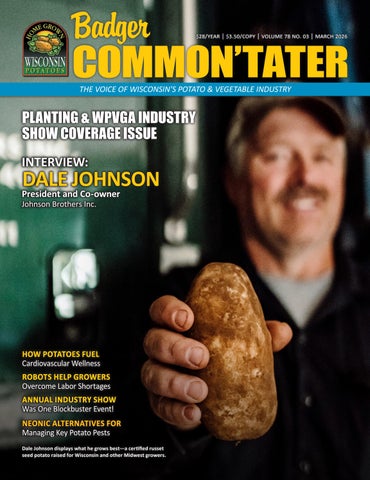
On the Cover: Dale Johnson of Johnson Brothers Inc., Sagola, Michigan, proudly holds up a russet variety grown on the Upper Peninsula certified seed potato farm. The family operation is currently focused on raising russets, including Silverton, Burbank, Norkotah, Caribou, Umatilla and King varieties. Dale and his brother, Rodney, grow about 130 acres of certified seed potatoes on rotation with oats, clover and sometimes sorghum.

BADGER COMMON’TATER INTERVIEW:

Dale (shown) and Rodney Johnson are co-owners of Johnson Brothers Inc., a multi-generational certified seed potato farm in Sagola, Michigan, near Crystal Falls. Established by their grandparents, Elmer and Senia Johnson, the family started raising potatoes in 1931. Currently, there are three generations working on the certified seed potato farm, including Dale and Rodney, Faith and John Kuzak, Jason and David Johnson, and Donavon and Robert Kuzak.

NEW PRODUCTS

Curezin® from VM Agritech delivers essential broad-

Better minerals. Better potatoes.

MEGASOL™ from GLC Minerals. Gypsum with high-solubility for stronger yields and happier spuds.

WPVGA Board of Directors:

PresideNt: WeNdy Dykstra

Vice PresideNt: JosH KNigHt s

Secretary: Bria N Lee

Treasurer: JoHN HopfeNsperger

Directors: Ra Ndy FleisH auer, CH a rlie HusNick, ANdy ScHroeder, Jeff SucHoN & Lucas Wysocki

Wisconsin Potato Industry Board:

PresideNt: Heidi Alsum-Ra Ndall

Vice PresideNt: ANdy Diercks

Secretary: Nicola Carey

Treasurer: Keit H Wolter

Directors: Rod Gumz, Jim Okray, Eric ScHroeder, Joe Seis & Tom Wild

WPVGA Associate Division Board of Directors:

PresideNt: Matt SeleNske

Vice PresideNt: Et H a N OlsoN

Secretary: Melissa Heise

Treasurer: Paul Salm

Directors: Brady Patoka, Scott ScHeer, Morga N Smolarek, Sally Suprise & Bra NdoN Taylor

Wisconsin Seed Potato Improvement

Association Board of Directors:

PresideNt: ANdy ScHroeder

Vice PresideNt: CloVer Spacek

Secretary/Treasurer: Rya N FassbeNder

Directors: MitcH Mattek & Markus SH a fel

Wisconsin Potato Growers

Auxiliary Board of Directors:

PresideNt: Heidi ScHleicHer

Vice PresideNt: Dakota H Smiley

Secretary/Treasurer: Sama Nt H a CypHer

Directors: Jody BagiNski, Misti KiNNisoN, JeNN a SucHoN & EriN Meister

WPVGA Staff:

ExecutiVe Director: Tamas HouliH a N

Ma N agiNg Editor: Joe Kertzma N Director of PromotioNs & CoNsumer

EducatioN: Da N a R ady

FiN a Ncial Officer: KareN RasmusseN E xecutiVe Assista Nt: Julie BrauN

Program Assista Nt: MadisoN Hoffma N -Taylor

Spudmobile EducatioN & OutreacH

AdmiNistrator: Patrick Popejoy

WPVGA Office: (715) 623-7683 • FAX: (715) 623-3176

E-mail: wpvga@wisconsinpotatoes.com

Website: www.wisconsinpotatoes.com

LIKE US ON FACEBOOK: www.facebook.com/WPVGA

MARK YOUR Calendar

Planting Ideas

WhenLynda Bula was notified that she and her husband, Gary, were being inducted into the Wisconsin Potato & Vegetable Growers Association (WPVGA) Hall of Fame, she texted some images to use in the slide presentation at the WPVGA Associate Division Awards Banquet, February 4, 2026, after the Industry Show. Included in the images she sent was the above, with a note, “This is a picture of my grandfather’s potato cutting crew around the 1950’s. Just the cutting crew consisted of 30 people. He farmed both around the Antigo area and in Alabama. During the time that this picture was taken, he planted circa-800 acres of potatoes in the Antigo area and then moved the operation to plant 300 acres in Alabama. When I say, ‘moved the operation,’ I mean he planted both places each year. Grandpa is toward the back wearing a plaid jacket. Bobcats were never heard of back then—you forked all the potatoes out of bins by hand. Modernization has come a long way in 75 years.”

Thank you for sending that nostalgic picture, Lynda. Gary and Lynda Bula of Gary Bula Farms, in Oxford, Wisconsin, have been growing potatoes for a half-century. Today, they raise 4,500 acres of potatoes, sweet corn, green beans, peas, alfalfa, soybeans and field corn. They were inducted into the WPVGA Hall of Fame along with Tom Wild of Wild Seed Farms, Inc., in Antigo, which raises 500 acres of Frito-Lay and Atlantic certified seed potatoes, along with oats and clover. See coverage of the 76th Annual Industry Show, the Industry Awards, and Hall of Fame inductions inside.

I always wondered why a couple Wisconsin potato growers had suggested that I interview either Michigan certified seed potato grower Dale Johnson or his brother, Rodney, of Johnson Brothers Inc., in Sagola, someday. Turns out Dale and Rodney ship about 70 percent of the certified seed potatoes they grow to Wisconsin and work with several WPVGA grower members. “Plus, we have a lot of fun in Wisconsin,” Dale says. “Your Industry Show is tremendous. The guys we deal with in Wisconsin are some of the nicest farmers you run into. My father dealt with their fathers, and I’ve known their sons my whole life.” Enjoy the full Interview with Dale in this issue.

Please email me with your thoughts and questions. If you wish to be notified when our free online magazine is available monthly, here is the subscriber link: http://wisconsinpotatoes.com/blog-news/ subscribe.

N1435 Cty Rd D Antigo, WI (715) 623-2689 farm@sbfi.biz johnt@sbfi.biz

NAME: Dale Johnson

TITLE: President, and co-owner with brother, Rodney

COMPANY: Johnson Brothers Inc.

LOCATION: Sagola, MI

HOMETOWN: Crystal Falls, MI

YEARS IN PRESENT POSITION: Fortythree

PREVIOUS EMPLOYMENT: None

SCHOOLING: Forest Park High School in Crystal Falls

ACTIVITIES/ORGANIZATIONS: County Road Commission Board member for 12 years; involved with Zoning and Planning Board of Sagola Township; and the Johnsons have been deeply involved with Michigan’s Iron Range Farm Bureau dating to when the family first started farming, with Dale and Rodney’s dad having been president, and Rodney being a longtime and current president

AWARDS/HONORS: Dale and Rodney were honored twice as Farmers of the Year in Dickinson and Iron counties of Michigan

FAMILY: Wife, Dee; two daughters, Kristel and Katie; and two granddaughters

HOBBIES: Deer hunting and fishing when there’s time

Interview DALE JOHNSON,

president and co-owner, Johnson Brothers Inc.

Located in Michigan’s Upper Peninsula, Johnson Brothers Inc., in Sagola, grows approximately 300 acres of certified seed potatoes and farms 1,050 acres total of crops on rotation. The operation is currently focused on russet varieties, including Silverton, Burbank and Norkotah potatoes.

Established by Elmer and Senia Johnson as a typical farm of its time, including cattle and crops, the family started raising potatoes around 1931. In 1956, the cattle were sold and the two main operations became potatoes and logging.

Elmer and Senia’s sons, Melvin and Donald, took reigns of the operation, with Melvin focused on potatoes and Donald taking care of logging. After Donald’s passing, the farm narrowed its focus to potato farming. Melvin worked on the farm and inspired future generations until his death in 2019.

Currently, there are three generations working on the certified seed potato farm, including Dale and Rodney Johnson, Faith and John Kuzak, Jason and David Johnson, and

Donavon and Robert Kuzak.

In 2007, Jason, David, and John brought the fourth generation into the business through the formation of Spudland Farms.

Dale, were Elmer and Senia Johnson your grandparents or great-grandparents? They were my grandparents who started the farm right where we’re currently located. My great-grandfather’s farm was just a few miles down the road and included apple orchards, a few potatoes and some animals.

Above: Dale Johnson (left on the Lenco harvester) and his brother, Rodney (right), are co-owners of Johnson Brothers Inc., in Upper Michigan, where they raise around 300 acres of certified seed potatoes, though they’ve passed quite a few of those acres on to the next generation.

My great-grandfather had six sons, and five of them each started a farm. My grandpa Elmer’s was the only one that survived, and if you ask me and my brother, it’s because my grandma was very conservative with the money. But my grandpa was a hard worker.

My dad, Melvin, always said the farm took off in World War II because, at that time, anything you grew was always sold. My grandpa had a dump truck and was hired by the government to haul materials needed for the war effort.

He traveled to the ore docks in Escanaba (part of Michigan’s maritime and mining past where iron ore was loaded onto ships for transport), so he was gone all the time.

He’d come home and split the money he made with my grandma, and then when he finally came home for the summer, my grandma handed him

Left: A couple of years ago, Dale and Rodney Johnson bought a brand-new planter and tractor, going to GPS (global positioning system) for the first time, which makes planting easier, including consistency across fields and nice, straight rows. Rodney’s son, David, is driving the tractor.

a whole wad of money that she saved from what he had given her, and that’s how the farm got started.

Did you grow up on the farm, Dale, and if so, what are your favorite memories from those days? As soon as we were old enough to be up here, my mom and dad had us on the farm, almost every day of the year. Dad always had jobs for us to do. As a kid, you hated it, but now in looking back, I know why he was doing it.

My mom and dad, Melvin and Elaine, both passed away in 2019. They did

everything together. Every time my dad went to town, he’d take Mom with him.

I have a lot of memories from those days. Dad always tried to get us to do more jobs, but the most fun was finally being able to drive the tractor on your own. When I was 12 years old, I’d hook up implements and go to whatever field I could. It was fun to finally be on my own.

When we were about that age, we got a new tractor and all of us fought continued

Right: Caribou certified seed potatoes are windrowed and harvested on Johnson Brothers Inc. farm, in Sagola, Michigan.

over who would be able to drive that John Deere 4630. The tractor is still here working on the farm, and we use it quite a bit. It’s in great shape.

When dad bought the 4630, it changed the farm completely. We finally had some horsepower and were able to buy other implements to help do a better job of growing crops. The crops got better, and the land was taken care of better than before.

What has your own progression been on the farm, Dale? As Rodney and I got older, dad kept assigning more jobs to us. The way I see it with the next generation, as they get older, you try to delegate more to them.

My dad continuously gave us more challenges, and he’d say that each job we tackled better be done as well or better than it was previously. Rodney and I liked those challenges, and our further involvement gave Dad the opportunity to clear more land with bulldozers so we could farm it.

He’d tell us, “See you in the fall. If you need something, call and I’ll go get it for you guys.” That was the best part. As time went on, there were new challenges for us to take on nearly every season.

Most of the potatoes were his.

My dad didn’t want to partner with me and my brother but instead wanted us to have our own potatoes and make our own decisions. That’s how Johnson Brothers formed.

What has the farm’s progression been like since you’ve been involved? My dad farmed about 120 acres of potatoes, so we have more than doubled in size as far as acreage. And if you look at what equipment we have now compared to what Dad had, there’s no comparison.

We built another new storage facility this year. As far as storage, we try to ship the last potatoes by the middle of May each year. We start harvesting

Dale and

parents,

worked on the certified seed potato farm and inspired the future generations up until the time of his passing. “They did everything together,” Dale says about his parents. “Every time my dad went to town, he’d take Mom with him.”

in the middle of September and don’t have refrigeration to store potatoes past mid-May.

We were able to purchase a John Deere self-propelled sprayer, which saves so much money and product in spraying each year.

A couple of years ago, we bought

Dale and Rodney’s grandpa harvests potatoes in 1956, and the year prior, in 1955, the Johnson family is shown picking potatoes by hand.
Above:
Rodney’s
Melvin and Elaine Johnson, pictured here in a neighbor’s wheat field, both passed away in 2019. Melvin

a brand-new planter and tractor, going to GPS (global positioning system) for the first time, which makes planting and everything else so much easier. The technology is great with consistency across fields and nice, straight rows.

Does Johnson Brothers Inc. raise around 300 acres of potatoes on rotation, and with what other crops? We try to raise around 300 acres of certified seed potatoes or a few acres more, on rotation with oats, clover, and sometimes sorghum. About two-thirds of our potato acreage is on a three-year rotation and the other third on a four-year schedule.

A lot has changed since my father passed away. My brother and I have passed quite a few acres on to the next generation. Rodney and I raise about 130 acres of potatoes, and Rodney’s kids grow about another 150 acres, and his two grandkids are planting their own potatoes this year and making their own decisions.

Are you still raising Silverton, Burbank and Norkotah potatoes, and for what market? We also grow Caribou, Umatilla, and King certified seed potato varieties. Johnson Brothers Inc. has always been a certified seed potato grower, with this part of the Upper Peninsula being such a great area to raise seed potatoes.

When we grade our seed, we pick out the oversize and pack those. We have a wash line and we’re able to pack them up for RPE Inc., which buys all of those for the fresh market. RPE has been good to our farm.

Most of the seed goes to growers, with about 70 percent shipped into Wisconsin, 20 percent to Minnesota, and 10 percent staying here in Michigan. Our largest customer is Wysocki Family Farms, and all our Norkotahs go to Jimmy Burns of James Burns & Sons Farms to be grown out for the fresh market.

“The

We’ve been growing for them for a long time, and for quite a few other Wisconsin farms, mostly McCain growers.

As far as brokerages on the seed side, Greg Anderson of North Dakotah and Potato Services in lower Michigan handle potatoes for us, and RPE Inc. is our broker on the fresh side.

I understand there are three generations working on Johnson Brothers Inc. farm, is that correct? Three now, yes, work for Johnson Brothers. Spudland Farms is the

fourth generation and includes my brother Rodney’s three children as well as his son-in-law.

Johnson Brothers itself has six family members working on the farm, and around 3 full-time and 2-4 part-time employees at any given moment.

What are you doing to work sustainably and closely with your neighbors? The big issue, and I know Wisconsin deals with it, is irrigation water. Quantity is a big thing, and quality too. The quality issue is why I’m happy about our new sprayer,

YOU’RE AN OWNER

Left: Burbank certified seed potatoes are shown in storage at Johnson Brothers Inc., in Sagola, Michigan.

Right: A beautiful field of Umatilla seed potatoes is pictured at Johnson Brothers Inc.

which puts out minimal drift and has been good for us.

We try to plant cover crops so that we don’t have any soil erosion, that’s the big thing. We make sure the soil is as good when we harvest as it was when we planted it.

With some of the newer potato varieties, we’ve been able to cut back on fertilizer applications, particularly with Caribou, King and Umatilla. Caribou particularly uses a lot less fertilizer. I think we’re down 30 percent on fertilizer in our Caribou fields.

With such a strong plant and root system, Caribou accumulates a lot of nutrients out of the ground that other varieties can’t take up.

What are the challenges of growing potatoes in the U.P.? Advantages? The advantage up here is that we’re all by ourselves, and isolation is a very good thing on a certified seed potato farm. The disadvantage is frost. You see frost just about every month up here.

We’ve seen a pretty good frost on the 4th of July, so our growing season is short, but there’s a lot of opportunity up here if someone wants to go for it.

The frost is why we plant so late and try to miss the June frost that we get almost every year around the 8th or 10th of the month. In my lifetime, I’ve seen three or four frosts around the

The third and fourth generations of Johnsons who helped usher in Spudland Farms are, in the top row, left to right: Dale’s wife, Dee, his niece (Rodney’s daughter), Faith, and brother, Rodney; and in the bottom row, left to right: Dale, his niece’s husband, John, and Rodney’s sons, Jason and David.

4th of July. We try to start planting on May 15th, and just deal with the June frosts, hoping they won’t be bad.

03-26 Badger Common'Tater (7.25x4.75).v1.pdf 1 2026-02-09 8:53 am

We start looking for frost around August 27th or 28th and keep a sharp eye out for the rest of the season, with a goal of completing harvest by the 10th of October.

How has technology changed the farm, and which technologies? We still do a lot of things the oldfashioned way up here. Irrigationwise, we only have two pivots. The rest are hand-moved irrigators, and we still do a lot of hand picking, and bagging, of potatoes for people.

continued on pg. 14

You can’t imagine how many potatoes we sell out the door. Last year, we sold six semi-loads of potatoes out the door that people use as table stock. People come and get one or two 50-pound bags or 10 or 20 pounds. We sell to all the people in the neighborhood.

One guy stores them, and at night he and his friends have fish, French fries and beer. We also sell to a lot of restaurants and pasty shops in the Upper Peninsula.

Why is it important for you to be involved in the Farm Bureau or other organizations? Because Farm Bureau is the one organization working and fighting for us every day. For us in Michigan, Farm Bureau fights for growers regarding water and labor issues.

We’ve had issues on property taxes where Farm Bureau stepped in, or people telling us we’re draining lakes or the state saying our farms have an adverse effect on trout streams in our area.

We’re the only farm in this area, and you travel quite a long way to find another farm drawing water. Our farm put two monitoring wells in the ground last year to help Farm Bureau and other farms, which are trying to get data across the whole state of Michigan.

We test wells for nitrates a couple times a year, but our test results are great as far as showing low levels of nitrates, and neighbors have the same results. I live here, too, so I’m very happy.

Any new machinery planned for the farm? We’re considering a new bin piler for the storage facility we built so that we have one in there.

Why is Johnson Brothers Inc. a member of the Wisconsin Potato & Vegetable Growers Association, and why is that important? The WPVGA was helpful for us when GAP and other audits started, and my niece was able to go to all the classes down there. Dana Rady (WPVGA director of promotions and consumer education) has been very helpful.

Left: Elmer Johnson, Dale and Rodney’s grandfather, started raising potatoes in Upper Michigan in 1931.
Right: Rodney Johnson poses with his sons, David and Jason, in front of a Lenco potato harvester.
Dale Johnson is in the small tractor, foreground, with his nephew in the second tractor hilling Russet Norkotah potatoes six years ago.

Plus, we have a lot of fun in Wisconsin. Your Industry Show in Wisconsin is tremendous. Oh my gosh, I make sure to leave the checkbook at home when I go.

The guys we deal with in Wisconsin are some of nicest farmers you run into. My father dealt with their fathers, and I’ve known their sons my whole life.

I saw Louis Wysocki at the Industry Show in November of 1983. My dad must have been talking to him, and my brother and I joined the conversation, telling Louis that we planted our first 25 acres of potatoes on new land.

He called us a couple weeks later and bought all the potatoes my brother and I were raising on our 25 acres. That got us up and running. He didn’t have to do that, but it’s just the way he is.

Louis’ grandson, Lucas, brought him up here prior to my dad’s passing in 2019, and he and my dad talked for over an hour.

Of course, when my dad was alive, he gave Rodney’s kids some acres to start farming on, which is now Spudland Farms, so the previous generations have done a lot to support the next generation of potato growers.

Speaking of which, what do you hope for regarding the future of Johnson Brothers Inc. in Upper Michigan? I hope the kids will be as successful as we have been up to this point, that they keep farming and things all go well for them and the next generation after that.

The growers in the Upper Peninsula do a fabulous job, all of them. We get along well together, and as far as the growers who we have left up here, none of us compete against each other. We all have our own market niche and do our own things.

Do you have any advice for the next generation? Don’t spend so much money. I tell them that every day,

Irrigation-wise,

but the only thing I would say, I hope they can keep the farm going up here for future generations and that the land remains in as good a shape or better than it is now.

Anything I’ve missed that you’d like to add, Dale? Well, I’m very grateful to have customers for the produce we grow. Without them, we wouldn’t exist. I call a lot of our guys we deal

with my friends.

They know that they can call me any time, and we don’t have to talk about potatoes. Gary Woyak of Taterland Farms and I have been known to talk on the phone for two hours at a time. I’ve known him since I was 18, and half the time we don’t even talk about potatoes.

N7158 6TH DRIVE P.O. BOX 215 PLAINFIELD, WI 54966

OFFICE: (715) 335-6660

FAX: (715) 335-6661

VENTILATION

• CIPC, CLOVE OIL APPLICATIONS KEEP ON TRACK WITH OUR

INHIBITORS AND DISINFECTANTS

SPROUT INHIBITING • FRUIT GUARD APPLICATIONS • SMART BLOCK APPLICATIONS

Johnson Brothers Inc. only owns two pivots, with hand-moved irrigators providing the rest of the crop coverage. Regardless, the potatoes are looking good under irrigation!

The 76th Annual Industry Show Was a Blockbuster Event!

WPVGA & UW Division of Extension hosted a packed Grower Education Conference & Industry Show

When you’ve been hosting an Industry Show for 76 years and the momentum gained 12 months ago carries over into the current year’s conference, it’s a success before it even starts.

The Wisconsin potato and vegetable growing industry came out in full

force for the combined Grower Education Conference & Industry Show, February 3-5, 2026, at the Holiday Inn & Convention Center, in Stevens Point.

A collaborative effort between the Wisconsin Potato & Vegetable Growers Association (WPVGA)

and University of Wisconsin (UW)Madison Division of Extension, the Grower Education Conference & Industry Show features researcher presentations and an established tradeshow under one roof.

Considered one of the best potato conferences in the nation, the Industry Show is a showcase for the state’s established potato and vegetable production area, and a chance for agribusinesses to present their products and services.

Growers and industry professionals from across the Midwest and country converge on the show floor, meeting with associates, networking, and building new relationships, but also taking in a full slate of University Extension research reports on current

Above & Left: Equipment is strategically parked outside of the Holiday Inn & Convention Center, in Stevens Point, for the 76th Annual Industry Show.

issues affecting farmers everywhere.

In his opening remarks, WPVGA Executive Director Tamas Houlihan recognized not only UW Extension and base-funded researchers, but also invited speakers from Colorado, Idaho and Michigan, as well as representatives from Potatoes USA and the National Potato Council in attendance.

In its third year, the Student Education and Career Development Program is a fantastic chance for university, technical college, and high school students to attend the Grower Education Conference & Industry Show free of charge.

And attend they did! Thirty-nine students from area schools took the opportunity to learn about the agriculture industry, talk to exhibitors, attend presentations, and discuss future career opportunities.

continued on pg. 18

Contact: Jim or John

SNOWDEN • ATLANTIC • LAMOKA

MANISTEE • LADY LIBERTY

MACKINAW • PETOSKEY • BLISS

During the Grower Education Conference & Industry Show, WPVGA Executive Director Tamas Houlihan (right) presented Dr. Irwin Goldman with a plaque recognizing the professor’s new role as the first Wisconsin Potato and Vegetable Grower KWS Chair. The chair position, created by the WPVGA, is named in honor of professors emeriti Keith Kelling, Jeffrey Wyman, and Walt Stevenson (KWS). As part of the Grower Education Conference, Dr. Goldman gave a presentation on “Breeding for Disease Resistance, Shape, Flavor and Nitrate Dynamics in Beet, Carrot and Onion.”

MEET WITH EXHIBITORS

Mike Copas, senior manager of global agronomy for McCain Foods, and several WPVGA Associate Division members met students on Tuesday morning for an introduction to the industry before accompanying them to the tradeshow to meet with exhibitors and learn about a myriad of business and career opportunities. Students were also invited to attend “Agricultural Fundamentals 101” presentations by UW base-funded researchers in such areas as “Potato Irrigation Management,” “Potato Breeding and Genetics,” and “Potato Disease Basics: From Seed to

Storage,” as well as other conference sessions available to them.

The Student Education and Career Development Program is a valuable opportunity to expose developing professionals—the future workforce—to the Wisconsin potato and vegetable industry, and a chance for business leaders to showcase their companies, products, services, and career opportunities.

Agribusiness professionals populating booths on the sold-out show floor meet face-to-face with growers, retailers, brokerages, and other attendees to show off the latest

Left: Industry Show attendees who visited the Family Insurance Center booth were offered homemade potato donuts by, from left to right, Sandy Greening, Billy Lowney, and Eric Greening.

RIght: Dale Nelson (right) of Nelson’s Vegetable Storage Systems took time to visit Scott Scheer at the Vista Financial Strategies, LLC booth during the 76th Annual Industry Show.

in products, machinery, tools, technologies, and services.

Spilling out into the parking lot of the Holiday Inn & Convention Center, the Industry Show provides an ideal venue to exhibit new tractors, trailers, planters, harvesters,

The Dynamic Alliance Roofing, LLC booth was a gathering place for, from left to right, Greg Hartjes of E-Con Electric; Ted Melby from Mid-State Technical College; Thad, Leah and Ruth Brown of Dynamic Alliance Roofing; and Brad Becker, E-Con Electric.
Chad Malek (left) of Specialty Potatoes & Produce discusses seed potato varieties with exhibitor Jake Mecham of Europlant America, LLC.

equipment, controls, crop protection products, software, and more that help potato and vegetable growers become more efficient farmers. It is an ongoing quest for the stewards of the land to adopt and use environmentally friendly practices, fewer inputs and less water

Right: WPVGA Associate Division Board Secretary Melissa Heise (right), of Swiderski Equipment, welcomes students attending the Grower Education Conference & Industry Show as part of the Student Education and Career Development Program. Through the program, which is in its third year, the WPVGA Associate Division invites university, technical college, and high school students to attend the conference and show, free of charge, to meet with exhibitors, attend Agricultural Fundamentals 101 researcher presentations, and learn about the vast number of business and career opportunities in the Wisconsin potato and vegetable industry. continued on pg. 20

Left: Not only was the Food + Farm Exploration Center represented at the Industry Show by its new board president, Les Dobbe (left), but also by mascot “Sunny Sweet Corn,” and board member and WPVGA Executive Director Tamas Houlihan (right).

The 76th Annual Industry Show Was a Blockbuster Event!. . . continued from pg. 19

to achieve high yields and ever higher quality produce.

Industry Show exhibitors include implement dealers and manufacturers; crop protection and irrigation companies; fertilizer plants; ag lenders; insurance agencies; the technology sector; agriculture co-ops and associations; building contractors; seed suppliers; consultants and much more.

GROWER ED CONFERENCE

Attendees capitalize on the opportunity to pre-register for one, two, or all three days of the Grower Education Conference so they can take part in research presentations covering issues directly affecting potato and vegetable farmers and agribusinesses.

In cooperation with the WPVGA Grower Education Planning Committee, Dr. Russell L. Groves puts together a comprehensive, timely, and information-packed lineup of research presentations.

Timely session subjects this year

WPVGA Director of Promotions & Consumer Education Dana

at the United Potato Growers Cooperative of Wisconsin

during the Industry

are, from left to right, WPVGA Associate Division board member Brandon Taylor of EXIT Realty CW, Food + Farm Exploration Center Executive Director Alexandria Behrend, and WPVGA Associate Division board member Morgan Smolarek from McCain Foods.

In her “Bringing Value to Ag” session, Liga Astra Kalnina of VM Agritech introduced attendees to Curezin®, a new broad-spectrum fungicide. The Bringing Value to Ag portion of the Grower Education Conference gives exhibitors the chance to submit a proposal well in advance of the show, and, if it is one of four chosen by the WPVGA Associate Division, give a 12-minute PowerPoint presentation to growers and other industry professionals who are actively looking to learn about new products, services, technologies and advancements in the industry.

20 BC�T March

Visiting
Rady (left)
booth
Show
Top Left and Right: At lunch on Tuesday, February 3, WPVGA Executive Director Tamas Houlihan (gray suit in each image) recognized outgoing WPVGA board members John Bustamante of Wysocki Family Farms (first photo) and J.D. Schroeder, Schroeder Bros. Farms, for their dedicated service on the Board. John is the out-going board president.

included the impact of the AIM Act on potato storage refrigeration; an update on elite potato varieties grown in Central Wisconsin; breeding for early blight resistance in potato; artificial intelligencedriven technologies for sustainable potato production; seed potato testing advancements; neonicotinoid alternatives; quantifying nitrate leaching; and fertility fundamentals.

University Extension specialists discussed soil microbiomes, breeding for resistance to Colorado Potato Beetle, benefits of soil moisture sensors, and economics of nutrient management and nutrient loss.

Potatoes USA Culinary Director Chef R.J. Harvey covered “Delivering Flavor: How Potatoes USA Is Driving Demand Through Culinary

Left: As part of the Grower Education Conference on Wednesday, February 4, Dr. Amanda Gevens, professor and associate department chair, UWMadison Department of Plant Pathology, presented“Distinguishing and Managing Potato Tuber Blemish Pathogens.” She showed slides and asked attendees if they could name the disease that caused certain blemishes, and those in attendance did well.

Right: During the lunch break on Wednesday, February 4, National Potato Council Chief Operating Officer Mike Wenkel gave those gathered an overall perspective on federal and international priorities amid the significant policy changes occurring in Washington, D.C.

Innovation;” and Dr. Amanda Gevens, professor, UW-Madison Department of Plant Pathology, discussed “Distinguishing and Managing Potato Tuber Blemish Pathogens.” continued on pg. 22

The 76th Annual Industry Show gave growers like Steve Worzella (left) of Worzella & Sons Inc. a chance to catch up with exhibitors such as Zach Mykisen (center) from Big Iron Equipment, Inc., and Jay Weidman (right), Ascendance Truck Centers.

Damon Reabe, owner of Reabe Spraying Service, tackled “Aerial Application Technology: Past Present and Future;” and Jed Colquhoun, professor, UW-Madison Department of Plant and Agroecosystem Sciences, gave “A Look into the Future of Potato Weed Management.”

PROCEEDINGS AVAILABLE

Proceedings of the 2026 WPVGA & UW Division of Extension Grower Ed Conference are now online. To access a complete index of the proceedings, as well as .pdf versions of the presentations, research reports and poster abstracts, visit https://wpvga.

conferencespot.org/event-data.

The Wisconsin Seed Potato Improvement Association and WPVGA Associate Division held their annual reception on the show floor, Tuesday evening, including delicious appetizers and refreshments.

The WPVGA Associate Division Banquet, Wednesday evening, is the premier social event in the Wisconsin potato industry, including a social hour with appetizers and refreshments, dinner, Industry and WPVGA Hall of Fame awards, and entertainment.

Left: Dr. Dennis Halterman, U.S. Department of Agriculture’s Agricultural Research Service (USDA ARS), presented “Breeding for Early Blight Resistance in Potato” at the Grower Education Conference.

Right: The Heartland Ag Tech crew, who make up the technology division of Heartland Farms in Hancock, Wisconsin, were out in force and in matching shirts at the Grower Education Conference & Industry Show. They are, from left to right, Terry Cao, Zach Gunderson, Ethan Sanders, Samuel Kier, Andrew Sanders, and Russ Sanders. Russ (far right) works with his two sons.

In addition to the annual Industry Awards and WPVGA Hall of Fame induction, drawings for cash prizes

CONSULTANTS

totaled $2,000, including 10 $100 cash prizes, two $250 cash prizes, and a $500 grand prize winner whose name was drawn after the awards banquet and during the evening’s entertainment—members of the Central Wisconsin Symphony Orchestra.

A nice way to cap off the Grower Education Conference & Industry Show, those who’ve made a significant impact on the Wisconsin potato industry were recognized during the banquet.

Thank you to all sponsors who made the 2026 UW Extension & WPVGA Grower Education Conference & Industry Show possible! Please see the ad thanking sponsors on page 29.

continued on pg. 24

At a brief meeting held immediately following the WPVGA Annual Meeting, February 5, in Stevens Point, the WPVGA Board of Directors elected Wendy Dykstra of Alsum Farms Inc. as its first-ever woman President for 2026. Dykstra succeeds John Bustamante of Wysocki Family Farms, who served as Board President in 2025. Serving on the 2026 WPVGA Board of Directors are, from left to right, John Hopfensperger (Treasurer), Jeff Suchon, Dykstra (President), Randy Fleishauer, Charlie Husnick, Josh Knights (Vice President), Andy Schroeder, and Brian Lee (Secretary). Inset is Lucas Wysocki.

Wendy Dykstra is the First Woman President of The WPVGA Board
WPVGA Past Presidents:

B.H. (Ben) Diercks (1948-49)

Edward Okray (1950)

James D. Swan (1951)

Melvin Luther (1952)

John Okray (1953-54)

Charles Creuziger (1955-59)

Emil Jorgenson (1960)

A.F. Hoeft (1961)

Jack Diercks (1962-65)

Emil Perzinski (1966-68)

Louis Wysocki (1969-71)

Lonnie Krogwold (1972-74)

Robert H. Diercks (1975-76)

Nick Somers (1977-78)

Bob Guenthner (1979-80)

Cy Sorrells (1981)

Richard Pavelski (1982)

Ernest Bushman (1983-85)

Howard “Hod” Chilewski (1986)

John Wolter (1987-88)

Steve Diercks (1989)

Robert Stodola (1990)

Bob Lapacinski (1991)

Francis Wysocki (1992-94)

Jim Okray (1995)

Terry Wex (1996-97)

Robert Stodola (1998)

Al Sowinski (1999)

Mike Wolter (2000)

Jim Wysocki (2001)

Andy Diercks (2002)

Larry Alsum (2003)

Jim Bacon (2004)

Ron Krueger (2005)

Jeff Sommers (2006)

T.J. Kennedy (2007-08)

Kevin Sigourney (2009)

Mike Carter (2010)

Kirk Wille (2011)

Brad Faldet (2012)

Jeremie Pavelski (2013)

Larry Alsum (2014)

Andy Wallendal (2015)

Mark Finnessy (2016)

Eric Schroeder (2017)

Josh Mattek (2018)

Wes Meddaugh (2019)

Rod Gumz (2020)

Bill Guenthner (2021)

Alex Okray (2022)

Randy Fleishauer (2023)

Charlie Mattek (2024)

John Bustamante (2025)

Wendy Dykstra (2026)

The 76th Annual Industry Show Was a Blockbuster Event!. . . continued from pg. 23

WPVGA Honors Outstanding Service with Industry Awards

Agriculture professionals who’ve gone above and beyond recognized at banquet

The icing on the cake of the Grower Education Conference & Industry Show, the WPVGA Associate Division Awards Banquet not only recognizes annual Hall of Fame inductees, but also others for their outstanding service to the Wisconsin potato and vegetable growing industry.

Taking place Wednesday evening, February 4, a deserving group of award recipients was recognized.

The WPVGA Associate Division Business Person of the Year Award was presented to Penney Hammer of Progressive Ag Risk Management Specialists.

As a 25-year WPVGA Associate Division member and crop insurance agent, Hammer has helped growers recover losses from plant diseases and extreme weather and catastrophic events.

She and business partner Ray

Grabanski attend and support the annual Putt-Tato Open golf outing, the largest fundraiser for the Associate Division, and are event sponsors of the annual Industry Show.

Penney has been the secretary/ treasurer of her local chamber of commerce and is involved in nonprofits. It’s a passion of hers to help the underserved of her community.

Brittany Bula was named the WPVGA Volunteer of the Year. Brittany grew up working on her family’s secondgeneration farm, Bula Land Company, LLC, of Plainfield, a grower of potatoes, corn, peas and beans, with a trucking arm primarily focused on the safe transport of Midwest potato crops.

Brittany manages all office operations for the farming and trucking divisions. She has been an active member of the Wisconsin Potato

Penney Hammer

Growers Auxiliary for more than 10 years, serving for six years on the Auxiliary Board, including one year as president.

Brittany has enjoyed volunteer work with the Spudmobile and hosting Harvest Parties for students at the schools where the mobile educational unit visits.

She helped kickstart the “Potatoes in the Classroom” program five years ago and has sold baked potatoes at the annual WPS Farm Shows, in Oshkosh, and Harvest Fairs, in Milwaukee. Brittany is also a member of the WPVGA Promotions Committee.

This year’s WPVGA Young Grower of the Year Award went to Joe Seis, owner and manager of Sterling Farms, LLC, a first-generation potato, vegetable, and grain farm located in Grand Marsh. Sterling Farms raises around 350 acres of russet, yellow, and creamer potatoes, plus canning crops and grain.

Joe performs and directs the main day-to-day operations of the 1,500acre farm, and in 2022, he was invited to be a grower-member of Farmers of the Roche-A-Cri, one of Wisconsin’s producer-led watershed

Brittany Bula
Joe Seis

groups that focuses on cooperation and education between farmers and their non-farming neighbors.

Last year, Joe was elected to the Wisconsin Potato Industry Board, and in 2025, he and his family were

featured on PBS’s “Wisconsin Foodie” to help promote Healthy Grown potatoes.

The WPVGA Researcher of the Year Award was presented to Dr. Yi Wang, who has been actively engaged with

the potato and vegetable growers of Wisconsin for over seven years since she joined UW-Madison as a faculty member and a state extension specialist.

Dr. Yi Wang
John Bustamante and Kirk Wille

The 76th Annual Industry Show Was a Blockbuster Event!. . . continued from pg. 25

She specializes in sustainable vegetable production and precision agriculture. Her research and extension efforts have encouraged the adoption of variable rate irrigation by growers to save as much as a million gallons of water per acre.

More recently, Dr. Wang conducted several years of research on innovative AI-driven technologies such as drones, robots, and machine learning to develop new decision support tools that precisely apply the right amount of fertilizer at the right time, reducing nitrate leaching in vegetable cropping systems.

As the out-going WPVGA board president, John Bustamante of Wysocki Family Farms, in Bancroft, presented the President’s Award to his father-in-law, Kirk Wille, in grateful appreciation for his dedication to the industry and impact on mentoring future generations.

Joe Kertzman, managing editor of the Badger Common’Tater, received the Agri-Communicator Award for excellence in communication and outstanding service to the potato and vegetable industry.

He publishes an outstanding monthly magazine while generating advertising revenue above projections for the WPVGA.

Joe attends and covers all major

industry events and assists with the WPVGA’s export expansion effort by helping Wisconsin host reverse trade missions for Canadian and Mexican buyers and attending trade shows in Mexico and Canada.

Joe also attended the National Potato Council’s Washington Summit, in 2025, lobbying members of Congress. Joe has outstanding communication skills.

Special Industry Appreciation Awards went to Trisha Grezenski and Brian Bushman of Bushman Trucking LLC, in Galloway.

More than a year ago, the WPVGA

lost a valuable member of its team when Spudmobile driver George Neuber sadly passed away. After several months of searching for the ideal candidate to drive the Spudmobile, Brian and Trisha stepped forward as interim drivers.

Brian is a lifelong potato farmer whose 68-year career reflects the grit, pride, and evolution of Wisconsin’s potato industry. He loves farming, shipping, and the trucking side of the business.

Trisha brings a strong background in trucking and a growing passion

continued on pg. 28

2026 INDUSTRY AWARDS RECIPIENTS

Associate Division Business Person of the Year: Penney Hammer

WPVGA Volunteer of the Year: Brittany Bula

WPVGA Young Grower of the Year: Joe Seis

WPVGA Researcher of the Year: Dr. Yi Wang

WPVGA Board President’s Award: Kirk Wille

Agri-Communicator Award: Joe Kertzman

WPVGA Industry Appreciation Awards: Trisha Grezenski and Brian Bushman, Dr. Russell Groves, Jerry Pierce

Recognition of out-going WPVGA Board Members: John Bustamante and J.D. Schroeder

WPVGA Hall of Fame Induction: Gary & Lynda Bula and Tom Wild

Joe Kertzman
Trisha Grezenski and Brian Bushman

for agriculture. Trisha hauled potatoes for 12 years, gaining firsthand experience with the logistics of moving crops from farms to their destinations.

Most recently, Brian and Trisha have been sharing their knowledge, answering questions, and educating the public about potatoes and farming as interim drivers of the Spudmobile mobile education unit.

a Professor and Extension Specialist in the Department of Entomology at the University of Wisconsin (UW)Madison, and a trusted partner and advocate for Wisconsin’s potato and vegetable growers.

His work is grounded in listening to growers, understanding their challenges, and delivering practical, research-based solutions that improve pest management

of Wisconsin agriculture. He develops and expands insect pest management tools within the UW Vegetable Disease and Insect Forecasting Network to help producers proactively manage insect and disease risks across Wisconsin and beyond.

Russ is the driving force behind the annual Grower Education Conference, identifying speakers and topics and finalizing the agenda for what has become the best potato show in the country.

A fourth and final Industry Appreciation Award was presented at Tuesday’s Industry Show luncheon to Jerry Pierce of the Hancock Ag Research Station (HARS), who is retiring this year from his longstanding job as the irrigation lead. HARS Superintendent Troy Fishler and Farm Manager Paul Sytsma presented Jerry with the award

During dinner and after the awards ceremony, members of the Central Wisconsin Symphony Orchestra entertained guests. During the entertainment, cash prizes were awarded to attendees lucky enough to have their names drawn at the banquet.

Dr. Russell Groves
Troy Fishler, Jerry Pierce and Paul Sytsma

theINDUSTRYshow

The 76th Annual Industry Show Was a Blockbuster Event!. . . continued from pg. 28

Tom Wild / Gary & Lynda Bula Enter the WPVGA Hall of Fame

Tom Wild of Wild Seed Farms Inc., Antigo, Wisconsin, and Gary and Lynda Bula, owners of Gary Bula Farms Inc., Oxford, were inducted into the WPVGA Hall of Fame at the industry’s Annual Awards Banquet held February 4, 2026, in Stevens Point.

The WPVGA Hall of Fame honors lifetime achievement in the development of the state’s potato industry. It is the intention of the WPVGA to continue to honor individuals who have made significant contributions to the potato industry in Wisconsin by making annual Hall of Fame inductions.

Tom Wild has been working on his family’s potato farm since graduating from Antigo High School in 1968. Tom’s father, Leonard, founded Wild Seed Farms in partnership with his father-in-law, Lukas Sikora, in 1948. At that time, the farm raised cows, chickens, pigs and about 20 acres of potatoes on Antigo’s north side. The farm has expanded in acreage and technology over the years, with Leonard’s children becoming involved in the potato operation. His son, Robert, has been with the farm since 1982, and Leonard’s oldest son, Tom, and his wife, Caroline, took the helm of Wild Seed Farms in 1995.

In 2012, Tom and Caroline’s oldest son, Dan, and his wife, Connie, became the fourth generation to own and live on the farm. Today, the farm raises 500 acres of certified Frito-Lay and Atlantic seed potatoes along with oats and clover.

VIABLE PROFESSION

Inspired by leaders in the industry who could see that higher production costs and declining potato consumption needed to be addressed, Tom got involved on

committees and boards established to help keep potato production a viable profession.

He believed communication and cooperation between growers within local and state organizations and then on a national level would be the most efficient way to accomplish these goals.

Tom served on the Wisconsin Seed Potato Improvement Association, for which he was chairman of the Seed Promotion Committee. He also served on the WPVGA Inspection Committee. He was elected to the Wisconsin Potato Industry Board in 1992 and has served on it ever since, including 11 years as president.

He served on the WPVGA Promotions Committee for many years and continues to serve on the WPVGA Research Committee. He was honored with the WPVGA Volunteer of the Year Award in 1990.

Nationally, Tom was elected to the U.S. Potato Board (USPB) in 1988 and served two terms through 1994. He was on the USPB Executive Committee for four years and served as USPB chairman in 1992.

Tom had a special interest in promoting seed potatoes internationally and served on the USPB’s Export Committee and Seed Task Force.

Tom says, “I want to thank all my growers and customers for allowing me to work with them over the years. After my wife, Caroline, and family, the next most important thing in my life is the opportunity to be involved in farming.”

Gary and Lynda Bula of Gary Bula Farms, in Oxford, have been growing potatoes for a half-century. Today, they raise 4,500 acres of potatoes,

sweet corn, green beans, peas, alfalfa, soybeans, and field corn.

The vegetables they grow for canning companies, along with silage corn, grain crops and alfalfa, are part of their crop rotation plan. They also grow 2,500 acres of potatoes, corn, soybeans, milo and sunflowers on their farm in Benton, Missouri.

In 1989, Gary and Lynda established the Benton potato farm in southeast Missouri, and later grew potatoes in Dixon, Illinois, for McCain Foods.

Staying diversified is part of their success, saying they see a necessity in diversifying the crops they grow while reducing their impact on the environment.

In Wisconsin, they grow approximately 850 acres of potatoes, with about half being used for frozen products, a quarter for chips, and a quarter as table stock and for the restaurant market.

Gary grew up in Antigo and is a thirdgeneration potato grower. Lynda also

Tom Wild

grew up in Antigo and says the sandy soil in Adams County, in addition to irrigation from the underground aquifer, makes for good potato growing.

Gary and Lynda are community minded and have worked well together for more than 50 years.

FIRST WOMAN TO SERVE

In 1992, Lynda became the first woman to serve on the WPVGA Board of Directors, serving a total of 12 years. She served on the Government Affairs Committee, and as a representative on the Special Work Group on Producer Security.

Gary continues to serve on the WPVGA Chip, SpudPro, and Research committees.

As long-time sponsors and volunteers, Lynda and Gary devote several weeks during the summer organizing and promoting Grand Marsh’s annual Corn ’N Tater Festival. They have been active Adams County Farm Bureau members for decades, with Lynda having served on the Adams County Farm Bureau Policy Development Committee.

She also served on the American Farm Bureau Fruit, Vegetable and Nuts Committee, on the Adams County Women’s Committee, and as a volunteer for Ag in the Classroom. Gary served as president of the Adams County Farm Bureau.

Gary says, “We want to provide our children and grandchildren with the opportunity to care for our farms the way we have, and to have the tools and resources to make better choices.”

“That requires working with growers, researchers and partners,” he adds, “and using new technologies and practices to grow food better and safer with a smaller footprint.”

Congratulations to Tom Wild, and Gary and Lynda Bula on their inductions into the WPVGA Hall of Fame! The recognition and honors are well deserved.

Gary and Lynda Bula

Complete List of WPVGA Hall of Fame Members and Years Inducted

1990

Joseph L. Bushman

Ben H. Diercks

Myron Mommsen

Edward J. Okray

John Okray

W. James Prosser

Lelah Starks

James D. Swan

Barron G. West

Felix Zeloski

1991

Henry M. Darling

Robert H. Diercks

Melvin E. Luther

Albert M. Pavelski

Henry L. Woodward

1992

Lawrence Krogwold

Michael Patrykus

John A. Schoenemann

Clarence Worzella

Louis E. Wysocki

1993

Champ Bean Tanner

Ernest Bushman

Melvin Hugo Rominsky

Lawrence (Larry) Lapcinski

Wayne Brittenham

1994

James Burns, Sr.

Myron D. Groskopp

James Wencel

(J.W.) Mattek

Hal Roberts

1995

A.F. (Bill) Hoeft

Bennett Katz

Eugene Katz

Donn “Hokey” West

1996

Charles M. Creuziger

Alois (Al) Okray

Joseph Jacob Okray

Stanley J. Peloquin

1997

Anton (Tony) Gallenberg

Howard F. Chilewski

1998

Dave Curwen

Francis Gilson

Emil Perzinski

1999

John J. Bushman

James G. Milward

2000

Dean Kincaid

Henry V. Sowinski

2001

(Presented in Feb. 2002)

James J. Mattek

Francis X. Wysocki

2002

(Presented in Feb. 2003)

Robert Hougas

Gerri Okray

2003

(Presented in Jan. 2004}

Larry Binning

Peter Wallendal

2004

(Presented in Feb. 2005)

Jerome Bushman

Harold Sargent

2005

(Presented in Feb. 2006)

Ed Wade

Dennis Zeloski

2006

(Presented in Feb. 2007)

Don Kichefski

2007

(Presented in Feb. 2008)

Walt Stevenson

2008

(Presented in Feb. 2009)

Victor Anthony

Jeffrey Wyman

2009

(Presented in Feb. 2010)

John Landa

Robert Stodola

2010

(Presented in Feb. 2011)

John H. Schroeder

August Winkler

2011

(Presented in Feb. 2012)

Fred and Kathryne Meyer

Howard “Skip” Tenpas

2012

(Presented in Feb. 2013)

Steve Diercks

Mike Finnessy

2013

(Presented in Feb. 2014)

Myron Soik

2014

(Presented in Feb. 2015)

Robert Helbach

2015

(Presented in Feb. 2016)

Charles Cofer

Robert Guenthner

2016

(Presented in Feb. 2017)

Donald Hamerski

Richard Pavelski

2017

(Presented in Feb. 2018)

Nick Somers

2018

(Presented in Feb. 2019)

Dr. Keith Kelling

2019

(Presented in Feb. 2020)

Larry Alsum

Dick Okray

2020

(Presented in Feb. 2021)

Marv Worzella

Norm Worzella

2021

(Presented in Feb. 2022)

Paul Miller

2022

(Presented in Feb. 2023)

Randy Van Haren

2023

(Presented in Feb. 2024)

Ron Krueger

2024

(Presented in Feb. 2025)

Kevin Bula

Dianne Somers

2025

(Presented in Feb. 2026)

Gary and Lynda Bula

Tom Wild

Potatoes Fuel Cardiovascular Wellness

With thoughtful preparation, America’s favorite vegetable protects the heart

Potatoes are one of the most beloved vegetables across cultures in the United States. According to a recent survey, potatoes still play a significant role within family and cultural food traditions, with more than half of Hispanic (54%), Black (52%), White (54%), and Native American (50%) respondents affirming that potatoes are a staple in their family and cultural food traditions.1

It’s no wonder potatoes so often take center plate. With those stats, it’s worth exploring how, with thoughtful preparation, this beloved staple can help protect our hearts.

We love potatoes. Here are a few ways potatoes love us back. Potatoes deliver several nutrients known to support cardiovascular health by sustaining proper heart function and helping keep blood pressure and serum cholesterol levels in check.

One medium skin-on potato provides the following:

Vitamin C: 20 milligrams (mg.), 30% DV (Daily Value) Vitamin C is probably best known for its prominent role in immune function. But did you know that it has also

recently been strongly linked to heart health? It’s thought that vitamin C might help prevent atherosclerosis, hypertension, and stroke2, and may be particularly related to blood pressure.

A 2020 meta-analysis showed serum vitamin C levels to be significantly lower in study participants with hypertension versus those with normal blood pressure.3

Potassium: 620 mg, 15% DV

Potassium is one of the unsung heroes of heart health. It is essential for proper function of the heart, as it is critical for proper muscle contraction, nerve transmission, and fluid balance.

Research shows strong evidence that adequate potassium intake is associated with reduced risk of cardiovascular disease, especially coronary heart disease and stroke.4

The Dietary Guidelines for Americans 2020-2025 identified potassium as a nutrient of public health concern.5

The U.S. Food and Drug Administration has also updated the Nutrition Facts panel to include

potassium content as a required declaration along with other nutrients of public health concern (dietary fiber, vitamin D, calcium, and iron).

Potassium is commonly underconsumed and according to the Centers for Disease Control and Prevention (CDC), heart disease is still the leading cause of death for both men and women, including those in most racial and ethnic groups.6

PROTECT THE HEART

One of the most important ways potassium protects the heart is through moderation of blood pressure. Getting adequate potassium can help buffer the impact of sodium intake, which is typically high in the U.S. populations. Average intake of sodium in the United States is 3,393 mg./day versus the recommended limit of 2,300 mg./day.

Low-sodium diets paired with adequate potassium may be especially helpful in keeping blood pressure in check.7 In fact, insufficient potassium intake (common in the United States) can increase salt sensitivity, causing blood pressure

to rise more than it normally would with sodium intake.8

It may be surprising, but potatoes are one of the best food sources of potassium and certainly the best source among foods commonly eaten in the country.

Just one medium potato delivers 620 mg. of potassium (more than a banana). That’s 18% of the Daily Recommended Intake (DRI) for men and nearly 25% of the daily requirement for women.

Potassium is found primarily in the flesh of the potato (approximately 150 mg. is lost when the skin is removed), so don’t peel before preparing if you want to optimize this cardioprotective nutrient.

In addition to being a good source of potassium, potatoes are naturally free of sodium.

Iron: 1.1 mg., 6% DV Aside from its important role in oxygen transport, iron is essential for proper heart function. The heart is particularly dependent on energy supplied by the mitochondria, which need adequate iron levels to function.9

Though not a significant source of iron, potatoes’ impressive vitamin C content, and very low (to nonexistent) antinutrient levels make their bioavailability shine compared to that of many other plant foods rich in iron.10

Fiber: 2 grams (g.) fiber, 7% DV

Though the exact mechanisms by which dietary fiber promotes heart health are not known, systematic reviews suggest that total dietary fiber intake is associated with a reduced risk of both diabetes11 and cardiovascular disease12

According to the CDC, the risk for cardiovascular disease doubles for those with diabetes. High blood glucose can damage nerves, including those that control the heart, and

“Packed with nutrients, potatoes are a delicious way to support heart health any time of the year.”
– Jenny Heap, MS, RDNRegistered Dietitian Nutritionist

Potatoes Fuel Cardiovascular Wellness. . . continued from pg. 33

blood vessel walls, so reducing the risk of diabetes is an important way to protect the heart.

Research also suggests that adequate intake of both soluble and insoluble fiber can help improve blood pressure and blood lipid profiles.13

It is thought that soluble fiber improves cholesterol levels via

CUSTOMIZED FINANCING

fermentation and production of short-chain fatty acids (SCFAs) in the large intestine, some of which have been shown to decrease cholesterol synthesis in the liver.14

Fiber is the only nutrient significantly reduced when a potato is peeled. Nearly 50% of the fiber is found in the skin, so leave the peel on to

optimize the heart-health benefits.

RESISTANT STARCH

Much of the carbohydrate in potatoes comes in the form of resistant starch (RS), an emerging topic of interest among researchers.

Resistant starch is not broken down during digestion, but like soluble fiber, is fermented in the colon by gut microbes, producing shortchain fatty acids (SCFAs) believed to help regulate insulin sensitivity and glucose metabolism, heart rate, and blood lipid levels.15 16 17

Unique operations need unique solutions.

Note: About 1/3 of the starch in a raw potato is resistant starch (RS), but the proportion varies greatly depending on the preparation method.

The cooking process makes RS more digestible, thus decreasing the proportion of starch available to produce SCFAs. Cooling the potatoes after cooking returns much of the starch to its resistant state.

According to a 2019 study, cooling the potatoes for several days after cooking them maximized the RS content.

Reheated potatoes retained much of the RS and ultimately provided more than the potatoes that were not cooled before eating. The study also indicated that RS was higher in baked vs. boiled potatoes.

HEART OF THE MATTER

Potatoes can be an excellent food to support heart health, but preparation is key. To optimize cardiovascular benefits, use and encourage cooking methods and ingredients that minimize sodium and saturated fat and allow potatoes’ nutrients to shine.

Potato Preparation Tips:

• Leave the skin on to maximize fiber and other nutrients.

• Bake, roast, steam, microwave, or air fry to preserve nutrients and minimize the need for added fats and oils.

• If boiling is needed, boil the whole potato with the skin on to minimize the loss of water-soluble vitamins and minerals. Cutting the potato into smaller pieces increases the surface area and results in greater nutrient losses.18

• Baked potato is naturally full of heart-friendly nutrients. It can be loaded with toppings that detract from or graced with ingredients that add value.

Try these game-changing baked potato hacks:

• A squeeze of lemon (with or without unsalted butter) can be an elevated replacement for table

salt that greatly reduces sodium.

• A drizzle of olive oil in place of butter replaces saturated fat and sodium with healthy monounsaturated fats. For a completely different experience, use a flavored olive oil that complements other toppings.

• Many favorite herbs and spices can be used in place of salt: garlic, green onion, oregano, dill, and more!

• Avocado slices add heart-healthy monounsaturated fats.

• Greek yogurt can replace traditional sour cream for a nutrition boost. The yogurt packs a punch with three times the protein, half the calories, and substantially less saturated fat than traditional sour cream.

1 Meeting Street Insights conducted an online nationwide survey among 1,000 adults (aged 18+) between December 15-18, 2023. Respondents were sourced from Dynata’s online general population consumer panel. Standard demographic quotas were set to mirror Census data for region, gender, age, and race; weights were also applied so that education level aligned with Census figures. The credibility interval for a sample of N=1,000 is +/-3.53%. Potatoes USA commissioned the study.

2 Morelli MB, Gambardella J, Castellanos V, Trimarco V, Santulli G. Vitamin C and Cardiovascular Disease: An Update. Antioxidants (Basel). 2020;9(12):1227. Published 2020 Dec 3. doi:10.3390/antiox9121227

3 Ran L, Zhao W, Tan X, et al. Association between Serum Vitamin C and the Blood Pressure: A Systematic Review and Meta-Analysis of Observational Studies. Cardiovasc. Ther. 2020, 2020, 4940673

4 McLean RM, Wang NX. Potassium. Adv Food Nutr Res. 2021;96:89-121. doi: 10.1016/bs.afnr.2021.02.013. Epub 2021 May 24. PMID: 34112360.

5 U.S. Department of Agriculture and U.S. Department of Health and Human Services. Dietary Guidelines for Americans, 2020-2025. 9th Edition. December 2020. Available at DietaryGuidelines.gov.

6 National Center for Health Statistics. Multiple Cause of Death 2018–2022 on CDC WONDER Database. Accessed May 3, 2024. https://wonder.cdc. gov/mcd.html

7 McLean RM, Wang NX. Potassium. Adv Food Nutr Res. 2021;96:89-121. doi: 10.1016/bs.afnr.2021.02.013. Epub 2021 May 24. PMID: 34112360.

8 Institute of Medicine. Dietary Reference Intakes for Water, Potassium, Sodium, Chloride, and Sulfate. Washington, DC; 2005.

9 Sawicki KT, De Jesus A, Ardehali H. Iron Metabolism in Cardiovascular Disease: Physiology, Mechanisms, and Therapeutic Targets. Circ Res. 2023 Feb 3;132(3):379-396. doi: 10.1161/CIRCRESAHA.122.321667. Epub 2023 Feb. 2. PMID: 36730380; PMCID: PMC9907000.

10 Beals, K.A. Potatoes, Nutrition and Health. Am J Potato Res.

TAKE HEART

Packed with heart-healthy nutrients, potatoes are a delicious way to support heart health any time of year. Give these dietitian-created tips a try! Wisconsin-grown potatoes offer more than just great taste. Local and sustainably sourced, they’re packed with nutrition no matter the variety. Every one of our Wisconsin Healthy Grown® farms is certified by an independent oversight organization.

It ensures our growers pass annual Wisconsin Healthy Grown potato and vegetable whole-farm audits, and that all our packers and shippers maintain the highest sustainability standards.

Look for the Wisconsin Healthy Grown certification seal on your potatoes and explore more at https://eatwisconsinpotatoes.com.

2019;96:102–110. https://doi.org/10.1007/s12230-018-09705-4

11 InterAct C. Dietary fiber and incidence of type 2 diabetes in eight European countries: the EPIC-InterAct study and a meta-analysis of prospective studies. Diabetologia. 2015;58:1394–408.

12 Threapleton DE, Greenwood DC, Evans CE, Cleghorn CL, Nykjaer C, Woodhead C, Cade JE, Gale CP, Burley VJ. Dietary fiber intake and risk of cardiovascular disease: systematic review and meta-analysis. BMJ. 2013;347:f6879.

13 Streppel MT, Arends LR, van 't Veer P, Grobbee DE, Geleijnse JM. Dietary fiber and blood pressure: a meta-analysis of randomized placebocontrolled trials. Arch Intern Med. 2005 Jan 24;165(2):150-6. doi: 10.1001/archinte.165.2.150. PMID: 15668359.

14 Soliman GA. Dietary Fiber, Atherosclerosis, and Cardiovascular Disease. Nutrients. 2019 May 23;11(5):1155. doi: 10.3390/nu11051155. PMID: 31126110; PMCID: PMC6566984.

15 Canfora EE, Jocken JW, Blaak EE. Short-chain fatty acids in control of body weight and insulin sensitivity. Nat Rev Endocrinol. 2015;11(10):577-591. doi:10.1038/nrendo.2015.128

16 Kim MK, Park J, Kim DM. Resistant starch and type 2 diabetes mellitus: Clinical perspective. J Diabetes Investig. 2024;15(4):395-401. doi:10.1111/jdi.14139

17 Maiya M, Adorno A, Toulabi SB, Tucker WJ, Patterson MA. Resistant starch improves cardiometabolic disease outcomes: A narrative review of randomized trials. Nutr Res. 2023 Jun;114:20-40. doi: 10.1016/j. nutres.2023.04.001. Epub 2023 Apr 7. PMID: 37149926.

18 Robertson TM, Alzaabi AZ, Robertson MD, Fielding BA. Starchy Carbohydrates in a Healthy Diet: The Role of the Humble Potato. Nutrients. 2018 Nov 14;10(11):1764. doi: 10.3390/nu10111764. PMID: 30441846; PMCID: PMC6267054.

Auxiliary News

Alice in Dairyland Visits Schools Across the State

Fall 2025 Potatoes in the Classroom program reaches over 200 students

The 78th Alice in Dairyland,

Sarah Hagenow has been busy bringing Wisconsin agriculture to life for students across the state. Through her school visits, Sarah connects children with where their food comes from and makes learning about farming both fun and interactive.

Meanwhile, the Kids Dig Wisconsin Potatoes program has also had an outstanding turnout with over 260 teachers participating. By now, classrooms across the state have received their potatoes and planted them, giving students a hands-on learning experience they won’t forget.

Looking ahead to April and May, both programs will celebrate the growing season with Harvest Parties and additional school visits. Alice will be visiting 3-5 more schools participating in Potatoes in the Classroom, and

an additional 3-5 that are signed up for the Kids Dig Wisconsin Potatoes program.

The Auxiliary is also planning to host five Kids Dig Wisconsin Potatoes field trips to the Food + Farm Exploration Center, in Plover, and two high school Potatoes in the Classroom visits, a significant increase from the three elementary schools we visited last year!

This growth is made possible thanks to the generosity of our donors and members and their support before, during and after the Auxiliary’s 50th

Above and Below: In fall 2025, Potatoes in the Classroom visits, including one to Stevens Point Area Senior High as shown in these images, spanned five days across three Central Wisconsin schools, reaching over 200 enthusiastic students with special appearances by Alice in Dairyland.

and Below:

as part

Anniversary celebration last June.

If the Wisconsin Potato Growers Auxiliary sounds like an organization that might be a great fit for you, we are always looking for new members and volunteers to help make these programs work.

Whether you’re interested in serving on our open board seat, joining a State Fair group and selling loaded

baked potatoes in August, or assisting wherever needed, we welcome your support and enthusiasm! If interested, please contact the Wisconsin Potato & Vegetable Growers Association office at 715-623-7683. We welcome you!

Until next time,

Above: 78th Alice in Dairyland, Sarah Hagenow (standing, center), visits a school in Waupaca as part of the Auxiliary’s Potatoes in the Classroom program.
Above
Alice in Dairyland helps Wisconsin Rapids students prepare potatoes
of the Auxiliary’s Potatoes in the Classroom program.

People

Les Dobbe Named F+FEC Board President

He served as co-chair of the Cultivating Connections Capital Campaign

The Food + Farm Exploration Center of Plover, Wisconsin, has appointed Les Dobbe as its new board president, effective January 21, 2026.

A Central Wisconsin native, Dobbe brings decades of experience across agriculture, logistics, business development, and financial management, along with a strong commitment to community leadership and agricultural education. He is a graduate of the University of Wisconsin-Stevens Point with a degree in economics.

Dobbe began his career with Bushmans’ Inc., in Rosholt, where

BOARD OF DIRECTORS

OFFICERS:

President: Les Dobbe

Vice president: Mike Carter

Secretary: Dick Okray

Treasurer: Paul Palmby

BOARD MEMBERS:

Richard Pavelski

Alicia Pavelski

Sheila Everhart

Dan Hartung

Tamas Houlihan

Phyllis King

Jordan Lamb

Kathleen O’Leary

Michael Smith

he played a key role during a period of significant growth that helped establish the company as a leader in the fresh potato industry.

He later transitioned to the frozen food sector with Service Cold Storage in Stevens Point, where the facility expanded into one of the largest cold storage operations in North America.

Following the acquisition of Service Cold Storage by Lineage Logistics, the world’s largest temperaturecontrolled logistics provider, Dobbe remained with the organization as director of business development.

CULTIVATING CONNECTIONS

Dobbe has been involved with the Farming for the Future Foundation since its early stages and has held several board leadership roles, including treasurer and vice president. He also served as a cochair of the Cultivating Connections Capital Campaign.

“As board president, Les brings a deep understanding of agriculture, strategic leadership, and a passion for advancing agricultural literacy,” says Richard Pavelski, founder and former board president.

“He also brings broad experience in successful startup businesses and financial management,” Pavelski adds, “which will help guide the Food + Farm Exploration Center with a clear, mission-focused vision for the future, ensuring the organization continues to grow and thrive.”

“The Food + Farm Exploration Center has been one of the most exciting projects I’ve been involved with,” Dobbe says. “Increasing agricultural literacy among the general public

is paramount to sustaining our role in eliminating food insecurity in the United States.”

The Food + Farm Exploration Center is guided by a committed group of volunteer leaders who bring a wide range of experience and perspectives to the organization.

About the Food + Farm Exploration Center

The Food + Farm Exploration Center is a nonprofit 501(c)(3) organization dedicated to advancing agricultural literacy and inspiring curiosity about the journey of food from field to fork. Through immersive exhibits, handson learning, and community events, the Center connects people of all ages to the science, technology, and people behind agriculture.

To learn more, visit https:// explorefoodandfarm.org.

Les Dobbe

WHY JOIN UNITED?

• Plan your plantings wisely to generate positive returns

• Use critical market information to help make the best return profitability

Membership includes:

- Weekly local and national communication for growers and marketers that provides market information and helpful input, ideas and suggestions

- Access to complete data packages, including critical and up-to-date supply and demand market information

- Improved grower returns demonstrated to cover the minimal dues many times over

Seed Piece

WSPIA Hosts 66th Annual Seed Meeting

Researchers and growers gather for strategic

season review and planning session

During its 66th Annual Meeting, January 28, at North Star Lanes, in Antigo, the Wisconsin Seed Potato Improvement Association (WSPIA) hosted speakers who presented reports, winter test updates, and production and research results to area seed potato growers and the industry at large.

Charlie Husnick, out-going WSPIA Board president, gave opening remarks and encouraged everyone in the room to ask questions, saying, “As seed growers, we need to all navigate this challenging industry together.”

Certification program reports included Amanda Gevens, professor and extension specialist, University of Wisconsin (UW)-Madison Department of Plant Pathology and administrative director of the Wisconsin Seed Potato Certification Program (WSPCP), who updated attendees about ongoing projects that she and her team are undertaking.

“Within our college, investing in Agriculture Research Stations continues to be a priority,” Dr. Gevens noted.

Top Left: A sizeable crowd tuned in as Brooke Babler (rear), associate director for the Wisconsin Seed Potato Certification Program (WSPCP), gave updates on the growing season, tuber testing and strategies for the year ahead.

Top Right: Out-going Wisconsin Seed Potato Improvement Association (WSPIA) President Charlie Husnick (left) presented Chuck Bolte of AgSource Laboratories with the Leadership Award for his outstanding service throughout the years in working with area certified and foundation class seed potato growers on such things as water flow, phosphorus runoff and monitoring, soil health, and

Gevens also briefly discussed research currently being conducted on nematodes, nutrient and nitrogen use efficiency, microbe interactions and how they work together in soil and plant environments, and other crop trials, as well as product-label, program, and staffing updates.

Cole Lubinski, WSPCP plant disease specialist provided a post-harvest winter test update on the seed potato grow-out in Hawaii. The first year working with Corteva proved fruitful, with minimal soft rot, even dormancy break, improved emergence, outstanding weed control, and one of the best-looking plots Wisconsin has had in years. There was virus expression, and with plants growing so well in Hawaii, it is visibly higher than seen in Wisconsin.

Brooke Babler, WSPCP associate program director, gave winter sample and greenhouse and seed lot testing results, which saw significant positive presence of Potato Virus Y (PVY), with several seed lots down classed to certified status. Hopefully this is the last year of bad news. She also discussed Direct Tuber Testing, ELISA and other methods used in the lab.

Babler said the number of samples submitted by seed growers for direct tuber testing continues to increase, and her program is weighing the

Cole

provided a post-harvest winter test update to growers with results of the seed potato grow-out and testing in Hawaii. The first year working with Corteva proved fruitful, with minimal soft rot, even dormancy break, improved emergence, outstanding weed control, and one of the best-looking plots Wisconsin has had in years.

Middle: Claire Schloemer, Ph.D. student in the Russ Groves Laboratory, UW-Madison Department of Entomology, presented PVY updates from a Neonicotinoid Alternative Project.

RIght: Samantha Conklin, crop scout supervisor for AgSource Laboratories, talked about aphid counts and other notable findings from her team’s work this past season. P O Box 267, Monte Vista, CO 81144

Left:
Lubinski, WSPCP plant disease specialist,

use of direct tuber testing only on challenging varieties, and direct tuber testing and post-harvest testing for samples staying in Wisconsin.

66th Annual Seed Meeting Sponsors

GOLDRUSH SPONSORS

AgCountry Farm Credit Services

CoVantage Credit Union

Insight FS

Nutrien Ag Solutions-Great Lakes Rural Mutual Insurance Co., Antigo

Southside Tire Company

Swiderski Equipment, Inc.

Syngenta Crop Protection

Volm Companies

SILVERTON SPONSORS

AgSource Laboratories

Riesterer & Schnell, Inc.

T.I.P., Inc.

TH Agri-Chemicals, Inc.

SUPERIOR SPONSORS

Big Iron Equipment, Inc.

BMO Bank

Jay-Mar, Inc.

Kretz Truck Brokerage LLC

Nelson’s Vegetable Storage Systems

Northwestern Mutual Wealth Management Co.

Quinlan’s Equipment, Inc.

Vista Financial Strategies, LLC

Warner & Warner, Inc.

Cody Bandoch, farm manager for the Wisconsin Potato Coalition, gave a State Farm report on planting, harvest and storage, as well as tuber testing, handling, and weekly crop protection applications to keep PVY at bay.

Dr. Gevens also delved into “Understanding and Managing Potato Blackleg, Aerial Stem Blight, and Soft Rot” for growers. Blackleg, soft rot and aerial stem rot are similar bacterial pathogens with different disease expressions. Losses can occur pre-emergence, mid-season and at harvest and storage. Management is preventative with no curative rescue.

Gevens discussed causes, field symptoms, and prevention and treatment for the pathogens.

“For planting, use a clean or reduced pathogen seed source, make sure to clean and sanitize seed storage facilities, routinely disinfest seedcutting and suberization equipment, and limit excessive irrigation and nitrogen,” she suggested.

“Copper treatments during the growing season can reduce some spread of bacterial disease,” Gevens added. “Not harvesting with pulp temperatures below 45 degrees Fahrenheit or above 65 degrees is a best practice, as potato tuber conditions never improve during harvest or storage.”

RIght: Following elections held during the 66th Annual Meeting, the 2026 WSPIA Board of Directors is, from left to right, Andy Schroeder (president), Mitch Mattek, Clover Spacek (vice president), Markus Shafel, and Ryan Fassbender (secretary/treasurer).

Kevin Gallenberg, Langlade Agricultural Research Station manager, gave an update on field studies in Antigo, including PVY, white mold, scab variety and drone spraying trials.

He thanked several area seed potato farms for donations to the station, including J.W. Mattek & Sons, Baginski Farms, Bushman & Associates, Kohm & Spychalla, Sunnydale Farms, James Gallenberg and Frito-Lay.

Samantha Conklin, crop scout supervisor for AgSource, discussed aphid counts and other notable findings from her team’s work this past season, as well as pest prevention options such as oils and aphicides.

Claire Schloemer, a Ph.D. student in the Russ Groves Laboratory, UWMadison Department of Entomology, presented PVY updates from a Neonicotinoid Alternative Project.

Left: Newly elected President of the WSPIA Board of Directors Andy Schroeder (left) honored Out-going President Charlie Husnick with a nice plaque in appreciation for his service.

“Seed potato production is challenged by PVY. We saw severe mosaic systems and potato tuber necrotic ringspot disease with unsightly spotting effects on potatoes,” Schloemer noted about the project. “PVY is non-persistently transmitted by aphids, which can feed on diseased plants, hold the disease in their stylets, and move to healthy plants and transmit it.”

“We’re dealing with two different life strategies,” she said, “colonizing aphids, like green peach aphids, and non-colonizing winged aphids that fly around, and they might not necessarily want to be in potato but probe it and transmit the virus. So, we have a two-pronged treatment using insecticides and paraffinic oils.”

Spatial isolation reduces aphid populations. Schloemer suggested growers use varietal selection, early vine killing and scouting to manage PVY levels on the farm, and prevention methods such as the use of clean seed and resistant varieties.

Food + Farm Exploration Center Executive Director Alexandria Behrend gave a lively update on the number of visitors who’ve come through the door of the center since its inception, programming, U-Pick harvest days, cooking and culinary classes, the Greenhouse Grand Opening, and hosting of the National Soil Judging Competition, among other events.

As part of his Annual Report, Wisconsin Potato & Vegetable Growers Association Executive Director Tamas Houlihan updated attendees on the research, promotions, education and legislative activities the association undertook in 2025. He highlighted many successful programs and work being conducted to support growers at all levels.

The WSPIA Board held its annual business meeting, including election of officers and one new board

member, Ryan Fassbender of Seidl Farms Inc., in Deerbrook, and the presentation of a nice plaque to out-going board president, Charlie Husnick, in appreciation for his service.

Andy Schroeder of Schroeder Brothers Farms, Antigo, was elected WSPIA Board of Directors president for 2026, succeeding Husnick. Clover

Spacek, Eagle River Seed Farm, Eagle River, was elected vice president, and Fassbender was elected secretary/ treasurer.

In addition to the three officers, the other two WSPIA board directors are Mitch Mattek of J.W. Mattek & Sons, Deerbrook, and Markus Shafel from Sunnydale Farms, Bryant.

Description: Available in both 30# and 50# in all color s. 2000/bags per roll.

Stock Color: Red

Other colors available: Orange, White, Blue, Purple, Tan, Green, etc...

Ask about our stocking program.

Mesh Rollstock material is less expensive than premade bags. As Labor costs continue to increase, automation is in high demand on all packing lines. With the investment of mesh rollstock baggers, Thorpack strives to meet packing house needs with the best mesh rollstock available. No need for pack off tables and hand packing labor. Move forward into automation and reduce packing cost with this mesh rollstock material. Your cost savings on your material and less labor will generally pay for this machine within a short period of time.

20# Sewing thread available for all mesh rollstock material

Equipment:

Mesh rollstock functions excellent on the following equipment: Upmatic, Ilapack, Gillen Kirch, H-Tech, Saclark, Volmpack, plus more.

Robots in Potato Farming

How technology helps growers overcome labor shortages and boost productivity

Potato farmers aren’t short on know-how; they’re short on help. It takes a lot of manual work to grow high-quality crops, and fewer hands are available each season. Add rising input costs and unpredictable weather, and the math just doesn’t work.

Robots offer a way to close the gap and take the load off. They don’t complain, don’t tire, and they do repetitive jobs like planting and harvesting with consistent precision.

But robots alone aren’t the full answer. The real progress comes from

pairing them with smart tools like digital crop monitoring in agriculture. That’s how farmers know when to plant, where to treat, and how to avoid waste.

Robots and digital crop monitoring are tools in a toolbox, not a silver bullet, but when everything else is stretched thin, they make all the difference.

Robots are helping potato growers tackle some of their most pressing challenges, such as labor shortages, rising input costs, and the need for higher yields.

With automation, many repetitive and labor-heavy tasks like planting, spraying, and harvesting can now be done faster, more accurately, and with less human input.

KEY ADVANTAGES

This shift to robotics brings several key advantages. First, yield gains: it’s estimated that robotic farming could boost potato crop output by as much as 20%, thanks to consistent

Above: Agricultural robots automate repetitive tasks like planting and monitoring, improving consistency.

Left: Automated systems handle potato harvesting and sorting with speed and consistency.

spacing, better crop care, and timely harvesting.

Secondly, robots improve how inputs like water, fertilizer, and chemicals are used. With crop monitoring tools working in real time, robots apply just the right amount, reducing waste by up to 85%. That not only saves money but also supports more sustainable farming.

Robots allow growers to cut back on manual labor by as much as 60%. This reduces hiring pressure and helps farms stay productive during peak seasons. With less time spent on routine tasks, farm staff can focus on managing operations and improving quality.

Robots won’t replace growers, but they’re quickly becoming reliable partners in potato farming.

Potato farming robots are typically categorized according to their primary role in the production cycle. Each type targets a specific stage.

On-ground robots support growers by scanning plant health, soil moisture, and early warning signs of disease or pest pressure.

Thus, growers can deploy taskspecific technologies that optimize results throughout the entire season.

Here are the most common types of potato farming robots:

• Planting robots: These machines place seed potatoes into the soil at just the right depth and spacing.

With help from GPS (Global Positioning System) and sensors, they make sure the field gets planted evenly, something that’s key for even sprouting and growth.

• Weeding robots: These robots can tell the difference between a potato

plant and a weed using cameras and crop monitoring software. They can pull out or zap weeds with lasers without touching the crop, which means fewer chemicals and less damage to the plants.

• Harvesting robots: Potatoes bruise easily, so harvesting requires care. Some robots gently dig and collect potatoes using soft tools, helping protect the quality of the yield. Others use mobile bases and arms to lift tubers more efficiently across big areas.

• Farm monitoring and scouting robots: These robots move through the field or fly over it to check plant health, soil moisture, and signs of trouble. They collect real-time data so farmers can spot issues early and act before problems grow.

By using the right type of robot at the right stage, potato growers can work faster, waste less, and harvest more.

Even with all the progress in agricultural robotics, potato farming still poses unique challenges that robots are not fully prepared to handle.

Potatoes grow underground, require specific soil and weather conditions, and need gentle handling at harvest. These factors make it difficult for robots to work without errors or setbacks.

Here are the main limitations potato farmers face when switching to robotic agriculture:

• High initial cost: Buying selfdriving tractors, planting robots, or automated harvesters is still too expensive for many potato growers, especially small farms.

• Complexity of soil and terrain: Potato fields often have uneven ground, soft soil, or rocks. Some robots get stuck, misjudge planting depth, or damage tubers during harvest.

• Need for skilled operators: Farmers must know how to program, monitor, and repair robotic equipment. This isn’t easy, especially in rural areas with limited training options.

• Unreliable in bad weather: Rain, mud, or frost can interfere with robot movement and sensors, delaying work during critical periods like planting or digging.

• Limited task flexibility: Many robots are designed for one task only, like seeding or agriculture monitoring. Adapting them for multi-step potato farming is still a challenge.

• Rough operation: Robots can be too rough when digging up potatoes, damaging the tubers or leaving some in the ground.

• Internet and power problems: Remote fields may lack internet or stable power for charging, limiting robot uptime.

• Fear of breakdowns: If something fails during harvest, farmers risk losing yield or facing delays they can’t afford.

Despite these issues, the situation is

changing. More training programs, better designs, and local support might drive wider adoption of robotic agriculture.

While field robots play a growing role in planting, spraying, and harvesting potatoes, other technologies are also improving how potatoes are grown, managed, and delivered.

Precision agriculture tools such as satellite crop monitoring, soil sensors, and GPS mapping help farmers collect detailed information about field conditions. These tools often work alongside robotic equipment, feeding them real-time data to guide where and how to act.

Smart irrigation systems, for example, use crop health monitoring data to deliver the right amount of water at the right time, avoiding waste. Some autonomous machines can even adjust their irrigation or fertilizing paths based on live field maps.

In storage and processing, robots are supported by automated sorting and peeling systems, which use machine

Above: Drones and digital monitoring tools help farmers make data-driven decisions in real time.
“Robots

Nutrient Solubilizing Technology Allows Plants to Utilize Unavailable Phosphorus

Lead into P1

Enhanced Phosphate Nutrition

Nutrient Solubilizing Technology Allows Plants to Utilize Unavailable Phosphorus

Nutrient Solubilizing Technology Allows Plants to Utilize Unavailable Phosphorus

Nutrient Solubilizing Technology Allows Plants to Utilize Unavailable Phosphorus

• Insoluble P source (hydroxyapatite) was solubilized only by roots of plants treated with Nutrient Solubilizing Technology (yellow color)

• Insoluble P source (hydroxyapatite) was solubilized only by roots of plants treated with Nutrient Solubilizing Technology (yellow color)

• Insoluble P source (hydroxyapatite) was solubilized only by roots of plants treated with Nutrient Solubilizing Technology (yellow color)

• Insoluble P source (hydroxyapatite) was solubilized only by roots of plants treated with Nutrient Solubilizing Technology (yellow color)

check plus insoluble rock phosphate

check plus insoluble rock phosphate

plus

Enhanced Phosphate

Nutrition

Enhanced Phosphate Nutrition

Enhanced Phosphate Nutrition

PROLOGUE combines a highly available, chelated zinc source with unique Nutrient Solubilizing Technology to increase a crop’s access to phosphate for a higher-performing and more sustainable approach to phosphate nutrition.

PROLOGUE combines a highly available, chelated zinc source with unique Nutrient Solubilizing Technology to increase a crop’s access to phosphate for a higher-performing and more sustainable approach to phosphate nutrition.

PROLOGUE combines a highly available, chelated zinc source with unique Nutrient Solubilizing Technology to increase a crop’s access to phosphate for a higher-performing and more sustainable approach to phosphate nutrition.

PROLOGUE combines a highly available, chelated zinc source with unique Nutrient Solubilizing Technology to increase a crop’s access to phosphate for a higher-performing and more sustainable approach to phosphate nutrition.

Highly Available Chelated Zinc EDTA

Highly Available Chelated Zinc EDTA

Highly Available Chelated Zinc EDTA

Highly Available Chelated Zinc EDTA

Supports the utilization of phosphorus in the plant and aids in the production of early season growth hormones and key proteins that help support quality and yield goals. Chelated Zinc EDTA is the most efficient and easily absorbed form by developing plants.

Supports the utilization of phosphorus in the plant and aids in the production of early season growth hormones and key proteins that help support quality and yield goals. Chelated Zinc EDTA is the most efficient and easily absorbed form by developing plants.

Supports the utilization of phosphorus in the plant and aids in the production of early season growth hormones and key proteins that help support quality and yield goals. Chelated Zinc EDTA is the most efficient and easily absorbed form by developing plants.

Nutrient Solubilizing Technology

Supports the utilization of phosphorus in the plant and aids in the production of early season growth hormones and key proteins that help support quality and yield goals. Chelated Zinc EDTA is the most efficient and easily absorbed form by developing plants.

Nutrient Solubilizing Technology

Nutrient Solubilizing Technology

Nutrient Solubilizing Technology

Combines specific root-colonizing bacteria and microbial metabolites that work together to provide greater availability of applied and soil bank phosphate early in the season so they are available to the developing crop.

Combines specific root-colonizing bacteria and microbial metabolites that work together to provide greater availability of applied and soil bank phosphate early in the season so they are available to the developing crop.

Combines specific root-colonizing bacteria and microbial metabolites that work together to provide greater availability of applied and soil bank phosphate early in the season so they are available to the developing crop.

Combines specific root-colonizing bacteria and microbial metabolites that work together to provide greater availability of applied and soil bank phosphate early in the season so they are available to the developing crop.

Nutrient Solubilizing Technology Relieves

Nutrient Solubilizing Technology Relieves Phosphorus Stress

Nutrient Solubilizing Technology Relieves Phosphorus Stress

Nutrient Solubilizing Technology Relieves Phosphorus Stress

Enriches community of P-solubilizers in soil

Enriches community of P-solubilizers in soil

P-stress relief

Enriches community of P-solubilizers in soil

P-stress relief

Enriches community of P-solubilizers in soil

P-stress relief

P-solubilization in soils

P-stress relief

P-solubilization in soils

P-solubilization in soils

Plant vigor enhancement

P-solubilization in soils

Plant vigor enhancement Zn

Plant vigor enhancement

Plant vigor enhancement

Now News

Fairchild Equipment Expands with New Facility

Relocation supports rapid company growth and enhanced service capabilities

Fairchild Equipment, a premier provider of materials handling and storage solutions, announces the official opening of its new facility located at 5500 North Lovers Lane Road, Milwaukee, Wisconsin.

This strategic relocation consolidates the company’s operations from two previous buildings in Menomonee Falls into a single, significantly larger facility designed to support rapid company growth and enhanced service capabilities.

The move to the Milwaukee location represents a major investment in the company’s future, providing a footprint that is more than triple the size of the two previous facilities combined.

This expansion allows Fairchild Equipment to streamline its operations by housing its comprehensive inventory and service divisions under one roof, ultimately improving efficiency for its teams and their ability to serve customer needs.

The new site features a fully equipped shop for on-site equipment service, a large parts inventory,

and additional stock of equipment available for immediate rent or sale. The facility is also designed with flexibility to accommodate future acquisitions and continued organic growth.

“We simply outgrew our previous footprint in Menomonee Falls,” says Tim Henneman, branch manager at Fairchild Equipment. “Consolidating into this larger, renovated facility allows us to scale our operations significantly and create a better environment for our employees, which is central to our commitment to being an Employer of Choice.”

CUSTOMER SUPPORT

“This move is not just about adding more square footage,” Henneman remarks, “it is about positioning ourselves to provide faster service, better availability, and a higher level of support to our customers.”

To further support its growing customer base and commitment to service excellence, Fairchild Equipment plans to add 10 more equipment service technicians this year.

The new facility features dedicated office space and sets the stage for plans to add a specialized Customer Experience Center within the building. The Customer Experience Center will provide a hands-on environment where clients can test equipment in storage applications that mirror their own facilities.

It will also serve as a resource for businesses looking to visualize storage solution options when building or redesigning their warehouse storage.

“At Fairchild Equipment, we are committed to leading not only within our industry but also in supporting the communities where we live and work,” says Van Clarkson, president of Fairchild Equipment.

“Our new Milwaukee facility is designed to foster meaningful connections, help local businesses thrive and offer valuable resources to our neighbors,” Clarkson concludes. “We believe in empowering our customers through partnership, innovation, and expertise, principles that have defined us since our founding over four decades ago.”

Mental Health Resource Available to Growers

AgriStress Provider Directory helps farmers find counselors trained in ag issues

Farmers and ranchers can now find counselors trained to address stressors impacting agricultural communities. AgriSafe’s AgriStress Provider Directory, https://directory. agrisafe.org, is a digital tool that offers access to counselors who provide ag-informed care for farmers. Agricultural producers face unique stressors, putting them at higher risk for depression and thoughts of suicide. In fact, the agriculture industry has some of the highest worker rates of death by suicide compared to other occupations (Aaron Sussell et al., 2023).

“Every day, America’s farmers and ranchers put their health and safety on the line to provide food, fuel, and fiber for our nation,” says Dr. Tara Haskins, AgriSafe’s Total Farmer Health director. “They deserve to speak with counselors who understand their work, and can meet them where they are, with realistic and attainable solutions.”

Resources for farmers and ranchers are at an all-time low. As of September 2025, over 60% of rural

communities have mental health provider shortages (HRSA Bureau of Health Workforce). To respond to this gap, AgriSafe built the provider directory with support from CoBank and Farm Credit Council.

The directory has counselors that can serve across 49 states, either in-person or via telehealth visits. All counselors listed in the directory have taken AgriSafe’s training for healthcare providers, FarmResponse® (https://www.agrisafe.org/courses/ farm-response/), to understand the unique factors that impact ag producers.

If you or someone you know is having thoughts of suicide, or needs someone to talk to immediately, call or text 988. Do not wait—if you are looking for a counselor who

understands agriculture, check out the AgriStress Provider Directory today at https://directory.agrisafe.org.

For inquiries about the AgriStress Provider Directory, please contact Tara Haskins at thaskins@agrisafe.org.

There’s a Better Way for Wisconsin Potato Growers

For those supplying PepsiCo, Grower Logistics offers an automated SAP connection

For Wisconsin potato growers supplying PepsiCo, the SAP Cloudbased platform website has become an unexpected hurdle. What should be a straightforward logistics process is often complex, time-consuming, and frustrating.

For many growers, managing loads, quality data, and payments through SAP has turned into a daily administrative burden. But it doesn’t have to be that way.

Grower Logistics provides a smarter alternative through a direct businessto-business (B2B) connection with SAP. Instead of manually entering and reconciling data, growers can rely on an automated system designed specifically for agricultural supply

chains (https://www.growerlogistics. com).

With Grower Logistics:

• Load information—including new loads, updates, and cancellations— flows automatically into the system

• Certificate of Analysis (COA) data is captured accurately and transmitted to SAP on time

• Quality results feed directly back into Grower Logistics without manual intervention

• Payment details return from SAP and are automatically applied to each load

The system works quietly in the background, reducing errors and eliminating repetitive data entry. The benefits go beyond convenience. Farmers using Grower Logistics consistently score higher with PepsiCo and SAP plants than those

relying solely on the SAP website. Fewer errors, clearer documentation, and timely data submission translate into stronger performance metrics and faster, more reliable payments.

In a competitive market where accuracy and efficiency matter, those advantages can make a meaningful difference.

Wisconsin potato growers already put in the work to produce a quality crop. They shouldn’t have to spend extra hours managing complex systems that weren’t built with growers in mind.

Automation allows growers to shift their focus back to what they do best—to grow and deliver a dependable product.

BETTER APPROACH

Growers supplying PepsiCo who are struggling with SAP should take a closer look at alternative tools designed for their operation. Evaluating solutions like Grower Logistics can help reduce

administrative stress, improve performance scores, and create a smoother path from harvest to payment.

Sometimes, the biggest gains don’t come from working harder, but from working smarter. Contact

www.sandcountyequipment.com

paul@sandcountyequipment.com

DATCP Announces $1 Million in Grant Awards

Forty-nine farmer-led groups support producer-led conservation solutions

Gov. Tony Evers, together with the Wisconsin Department of Agriculture, Trade and Consumer Protection (DATCP), announces that $1 million will be awarded to 49 farmerled groups to support producerled conservation solutions by encouraging innovation and farmer participation in efforts to improve Wisconsin’s soil health and water quality.

“Wisconsin farmers and producers know firsthand the value of clean water and soil, and are critical partners in our state’s conservation efforts,” Gov. Evers says. “I’m glad to have supported this program to help ensure our farmers, kids, and communities have access to safe, clean drinking water.”

“I have been proud to visit many of these recipients and groups,” Gov. Evers adds. “The work they do every day to support farmers and their local communities is critical, and it remains a priority to ensure they can continue to do this necessary work for years to come.”

Provided by the Producer-Led Watershed Protection Grant (PLWPG) Program, this year’s funding is the eleventh round of grant awards since funding was first made available.

Gov. Evers recognizes that farmers are key partners in protecting and preserving the state’s natural resources and has championed supporting increased funding for the PLWPG program in his previous budgets, including increasing the program’s base funding to $1 million annually in the final 2021-’23 Biennial Budget and securing an additional $500,000 in the 2023-’25 and 2025’27 Biennial Budgets.

CONSERVATION EFFORTS

“For more than 10 years, Wisconsin farmers have been implementing conservation efforts as part of the Producer-led Watershed Protection Grant Program,” says DATCP Secretary Randy Romanski. “Through their efforts with neighbors and partners, farmers lead, innovate, and mentor, inspiring new producer-led groups to follow in their footsteps. It’s great to see the success of this program continue and grow.”

Annual interest in DATCP’s PLWPG program continues to exceed the program budget. This funding cycle matched 2025 for the highest number of requests in the history of the program, with 49 groups applying for a total funding request of almost $1.65 million.

“As one of the first two farmerled watershed groups funded by DATCP, the Horse Creek Farmer Led Watershed program is now in its 11th year of existence. It has been very rewarding watching how producer awareness has grown,” says Timm Johnson, member of the Horse Creek

Farmer-Led Watershed Council, “as well as the evolution of the program’s focus.”

“We are now focusing on soil health, water infiltration, crop health, and improving water quality in Horse Creek,” Johnson adds. “Utilizing conservation practices and cover crops, we have dramatically reduced phosphorus and soil loss in the watershed.”

This year’s grant cycle will support four new groups, indicated below with an asterisk, while helping veteran groups continue to advance their work. A map of recipients can be found on DATCP’s website by visiting: https://content. govdelivery.com/attachments/ WIGOV/2026/01/07/file_attachments /3513379/2026PLWPGMap.pdf.

The 2026 PLWPG recipients and award amounts include:

• Antigo Silt Loam and Water –$3,800

• Apple Willow Farmer-Led Council* – $15,800

Above: Photo courtesy of Matteo Badini on Unsplash

• Bad Axe Watershed Stewards –$26,300

• Biological Farming Friends –$22,000

• Buffalo Trempealeau Farmer Network – $26,800

• Calumet County Ag Stewardship Alliance – $16,500

• Cedar Creek Farmers – $22,000

• Central Wisconsin Farmers’ Collaborative – $20,000

• Chippewa Valley Producer-Led Watershed Council – $18,000

• Coon Creek Community Watershed Council – $22,000

• Dodge County Farmers for Healthy Soil & Healthy Water – $23,500

• Dry Run Farmer-Led Watershed Council – $10,800

• Eau Pleine Partnership for Integrated Conservation – $30,000

• Farmers for Lake Country – $20,000

• Farmers for the Upper Sugar River –$24,000

• Farmers for Tomorrow River Watershed Council – $26,800

• Farmers of Fourteen Mile Creek –$6,800

• Farmers of Mill Creek Watershed Council – $13,200

• Farmers of the Barron County Watersheds – $22,000

• Farmers of the Lemonweir Valley –$20,000

• Farmers of the Roche-A-Cri – $2,800

• Farmers of the Sugar River –$12,000

• Farmers on the Rock – $30,000

• Farmers4Health – $9,000

• Flambeau Valley Watershed Group – $5,000

• Fond du Lac County Watersheds Alliance – $26,800

• Friends of the Little La Crosse Watershed* – $15,400

• Green Lake Farmer Coalition* –$26,800

• Hay River Farmer-Led Watershed Council – $22,000

• Horse Creek Area Farmer-Led Watershed Council – $11,000

• Jefferson County Soil Builders –$22,000

• Kenosha County Regenerative Producers – $24,000 continued on pg. 54

“We’re very eager and excited about the future of this farm.
We know Ruder Ware will help position us for success.”
Jenna Dempze Ag Operations Manager, Gaynor Cranberry

Cranberry farming is often a generational endeavor, and the team at Ruder Ware understands the delicate nature of family businesses. Clients like Jenna and Heidi at Gaynor Cranberry Company trust Ruder Ware to guide them through challenging discussions about succession, the future of the farm, and strategies for better positioning their business.

• Lafayette Ag Stewardship Alliance –$22,000

• Lake Wisconsin Farmer Watershed Council – $30,000

• Milwaukee River Watershed Clean Farm Families – $24,000

• Muddy Bottom Farmers – $11,000

• Peninsula Pride Farms – $26,800

• Producers of Baraboo-Redstone –$22,000

• Red Cedar Conservation Farmers –$26,800

• Rock River Regenerative Graziers –$30,000

• Sauk Soil & Water Improvement Group – $30,000

• Seven Rivers Soil Cooperative –$30,000

• Shawano County Watershed Advisory Council* – $17,500

• Sheboygan River Progressive Farmers – $26,800

• South Kinni Farmer Led Watershed Council – $18,000

• Walworth Alliance Teaching

Environmental Regenerative Systems – $20,000

• Watershed Protection Committee of Racine County – $22,000

• Western Wisconsin Conservation Council – $24,000

• Yahara Pride Farms Inc. – $22,000

About the Producer-Led Watershed Protection Grants

Including the recent round of funding, DATCP has awarded more than $8.2 million to 57 different groups across the state since the program started in 2015.

Grant projects have focused on providing conservation education to farmers, conducting on-farm demonstrations and research, issuing incentive payments for implementing conservation practices, organizing field days, and gathering data on soil health and water quality.

In 2024, groups in the program delivered conservation practices on nearly 1.7 million acres, an increase from 1.5 million acres in 2023. This includes a 34% increase in no-till

practices, a 2% increase in nutrient management, and a 37% increase in cover crop adoption.

In addition, the program provides valuable peer-to-peer learning opportunities for farmers across the state.

Producer-led groups must work with a county land conservation department, University of WisconsinDivision of Extension, a non-profit conservation organization, or the Wisconsin Department of Natural Resources, which serves as the group’s collaborator.

Funds cannot pay for real estate, loans, equipment, or lobbying, and the program places caps on the amount of funding that can be used for staff support to the groups. Each group must start with at least five farmers in the watershed.

Additional details on the impacts of Wisconsin’s producer-led groups are available by visiting https://datcp. wi.gov/Pages/Programs_Services/ ProducerLedProjects.aspx.

Tourism Innovation Awards Nominees Announced

Food + Farm Exploration Center nominated for enhancing the visitor experience

The Wisconsin Agricultural Tourism Association (WATA) is proud to announce that six of its key partners and leaders have been nominated for the prestigious 2026 Governor’s Tourism Awards.

Representing the fastest-growing segment of the state’s $25.8 billion tourism industry, these nominees exemplify the leadership, innovation, and heritage that make Wisconsin a premier agricultural tourism travel destination.

The Governor’s Tourism Awards recognize outstanding contributions to the state’s hospitality and travel

sector. This year’s WATA-affiliated nominees span multiple categories, highlighting the diversity and impact of agricultural tourism from Door County to the driftless region.

2026 WATA-Affiliated Nominees:

• Innovation Award: Food + Farm Exploration Center (Plover) – A first-of-its-kind destination that blends STEM (Science, Technology, Engineering, and Math) education with production agriculture. In its first year, it welcomed over 103,000 visitors and contributed to a 19% tourism growth in the Village of Plover.

• Rising Star Award: Rick Sense (Calumet County) – Recognized for his “visit and stay” initiative, Sense drove a record $77 million economic impact in Calumet County through innovative digital content and strategic destination branding.

• Service Excellence Award: Sheila Everhart (WATA) – Nominated by the City of West Bend for her

servant leadership in coordinating the marketing for the Classic Green Reunion 2025, which generated up to $1.79 million in regional economic activity and attracted visitors from seven countries.

• Legacy Award: Bob and Mary Ann Pearce (Pearce’s Farm Market) –Honored for a 60-year legacy of pioneering agricultural tourism in Walworth County. Their multigenerational operation attracts 75,000 visitors annually and serves as a vital model for rural economic stability.

• Bright IDEA Award: Rainbow Ridge Farms (Onalaska) – Recognized for their “Radical Inclusivity” partnership with the North American Squirrel Association (N.a.s.a.) to provide Action Track Chairs, making rugged farm terrain accessible to all visitors.

• Arts, Culture & Heritage Award: Lautenbach’s Orchard Country (Fish Creek) – A 70-year-old “living museum” of Door County’s farming culture, the orchard gained national fame as the primary filming site for the 2025 holiday movie, “A Cherry Pie Christmas,” injecting over $600,000 into the local community.

“These nominations represent the heartbeat of rural Wisconsin,” says Sheila Everhart, executive director of WATA. “From ensuring accessibility on the farm to driving million-dollar international events, our nominees are proving that agricultural tourism is a powerhouse for economic revitalization and cultural preservation.”

Winners will be announced during the Wisconsin Governor’s Conference on Tourism March 17 in Milwaukee. About the Wisconsin Agricultural

Above: The Wisconsin Agricultural Tourism Association (WATA) has officially nominated the Food + Farm Exploration Center, of Plover, for the 2026 Governor’s Tourism Innovation Award, which recognizes organizations that implement transformative strategies through technology, sustainability, and best practices to enhance the visitor experience.

Tourism Association (WATA): WATA is a non-profit association that provides policy information, marketing and education to working farmers, thereby an organization dedicated to promoting agricultural tourism as a sustainable economic engine for Wisconsin across Wisconsin.

By connecting travelers with authentic farm-to-table experiences, WATA supports the preservation of family farms and the revitalization of rural communities across the state. Learn more at https://WiAgTourism. com.

New Products

Curezin® Available to Wisconsin Growers

Broad-spectrum fungicide from VM Agritech offers disease control & plant nutrition

A new tool is here for growers who refuse to compromise. Curezin® from VM Agritech delivers proven broad-spectrum disease control and essential plant nutrition. It protects crops, yields, profitability, and soil quality.

Built on VM Agritech’s patented Cyncore™ technology, Curezin reduces copper and zinc particles to sub-nanomolar size for complete solubility and superior plant uptake. The result is low-load, high-efficiency disease control and a boost to natural defenses and plant health.

“Growers shouldn’t have to choose between what works and what’s right,” says Chris Wightman, president and chief executive officer of VM Agritech. “Curezin was built to protect yield, protect the soil, and protect the

people we’re growing for.”

In a New York potato trial, adding Curezin to a standard program delivered a 56% yield increase and a whopping $1,824 per-acre return. In North Dakota, Curezin had the lowest pink rot rates after 100 days in storage compared to the standard program.

“We aimed to be soil neutral, to do no harm,” Wightman relates.

“Instead, we saw an 8.1% increase in soil biodiversity, an unheard-of result for a non-biological product, proving performance doesn’t have to come at the cost of soil sustainability or high program costs.”

Curezin works well in any tank. It mixes easily with fertilizers and biostimulants, plus it leaves no residue. As legacy chemistries face mounting resistance and tighter regulations,

JH Biotech Launches KELP STAR™

Soluble bio-stimulant backed by potato performance data

JH Biotech, Inc. announces the launch of KELP STAR™, a soluble seaweed extract bio-stimulant derived from Ascophyllum nodosum. Designed to slot into existing fertility programs, KELP STAR supports plant vigor and crop performance across a range of production systems.

“Growers don’t need another product that sounds good on paper,” says Plant Division Manager Dr. Peter Feng. “KELP STAR is launching with real internal results behind it, especially on potatoes, and it’s built to be easy to use in the field.”

In an internal potato evaluation, KELP STAR was foliar applied at 6 lbs./acre via center pivot, in combination with

standard fertilization practices, with eight applications across the growing season.

Compared to the control, plants treated with KELP STAR showed measured increases in:

• Yield per plant: +58.7%

• Fresh tuber weight: +36.3%

• Leaf area: +38.5%

• Photosynthetic activity: +19.8%

• Plant height: +17.7%

• Leaflets: +20.8%

• Leaf number: +18.9%

KELP STAR is positioned to help support:

• Stronger canopy development

Curezin offers a resistance-smart, future-ready solution that helps growers get more from every pass. Learn more by visiting https://www.vmagritech.com.

• More consistent plant performance through common stress windows

• Improved crop momentum when paired with a sound fertility plan

KELP STAR is available in a soluble flake form for fast dilution and application. It can be used in drip irrigation, foliar spray, and hydroponic systems, and is compatible with many organic, conventional, and microbial fertilizer programs.

Mixing guidance should follow label directions, including any restrictions on calcium-based products.

For more information about KELP STAR and other JH Biotech, Inc. products, visit https://jhbiotech.com or contact our technical advisors at (805) 650-8933.

Eyes on Associates

Hello, everyone. The Grower Education Conference & Industry show is behind us, and now the clock has begun ticking toward spring! I’m always amazed at how fast my schedule fills up with things that need to get done this time of year before the first potato is planted.

The Industry Show was very well attended, including potato growers and ag representatives from other states. I got the chance to run into a few growers who I had not seen in years, and it was nice to reconnect. It was also the first chance I’ve gotten to catch up with some of my customers since they wrapped up harvest.

On Tuesday, February 3, the first day of the show, 39 students attended as part of the Student Education and Career Development Program. Mike Copas, McCain Foods senior manager of global agronomy, and several WPVGA Associate Division members met with the students as part of a roundtable discussion.

Thank you to all the growers and Associate Division members who took the time to visit with the students and highlight career opportunities within the industry. The university, technical college and high school students were invited to lunch in the ballroom and given the chance to attend a few of the educational sessions and explore the trade show.

On Wednesday morning, February 4, the Associate Division held its Annual Meeting, which included a lively discussion on a proposed idea to create an endowment fund to generate income for future

scholarships. More exploration is needed before a decision on whether to go ahead with the endowment is made, but it might turn out to be a great asset.

BOARD ELECTIONS

All incumbents for the WPVGA Associate Division Board were reelected, so the members of the Board remain the same for another year.

The silent auction held during the Industry Show netted $2,250, with all proceeds going toward the Avis M. Wysocki Memorial Scholarship that the Associate Division Board, in conjunction with the Wisconsin Potato Growers Auxiliary, awards in May. Thank you to everyone who placed bids on silent auction items at the Industry Show.

The WPVGA Associate Division Awards Banquet, Wednesday evening, February 4, was a fantastic time. As

far as plated dinners go, my steak was delicious. I think the best part of the night was the acceptance speech by WPVGA Hall of Fame inductee Lynda Bula, who I have known for most of my life. I’ve heard many tales of her potato farming family.

My grandfather worked on the Powell (Lynda’s maiden name) potato farm when my mother was a little girl.

I also want to thank the members of the Central Wisconsin Symphony Orchestra who were our after-dinner entertainment. And appreciation goes out to the staff at the WPVGA, especially Julie Braun and Karen Rasmussen who shoulder much of the load in organizing the Industry Show. They do an incredible job!

Until next month,

Matt Selenske

WPVGA Associate Division President

Paul Salm (right) of BMO Bank discusses career opportunities available in Wisconsin’s potato and vegetable industry with students attending the Industry Show as part of the Student Education and Career Development Program.

Potatoes USA News

Bringing the Harvest to the Headlines

Potatoes USA uses fall potato harvest to spotlight growers and their journeys

The Research Chefs Association (RCA), the leading professional community for food research and development, visited the Potatoes USA Spud Lab, in January, for a culinary immersion that featured presentations on potato nutrition, sustainability, and the functionality of dehydrated potatoes.

This was the first time that RCA has gathered at a commodity board for this type of education. Participants said they were interested in doing more of these events in the future.

The event included 10 research chefs who develop ingredients and recipes for large-volume foodservice and consumer packaged goods companies.

“They’re more focused on the science side of things,” explains Chef R.J. Harvey, director of culinary at Potatoes USA, “such as how to create large-volume food products for restaurant chains and packaged foods. We went into why chefs should utilize dehydrated potatoes in their formulations.”

“For example, for a packaged goods company, you want dehydrated potatoes in your formulation to get even browning, better texture, and to extend the shelf life,” Chef Harvey relates. “Their eyes were opened quite a bit as to how dehydrated potatoes are actually made.”

“They were also impressed with the versatility of potatoes,” he adds, “how they can be used across so many parts of the day, menu items, and applications.”

The event included demonstrations of potato recipes like potato churros with dips, Mexican hot chocolate ganache, potato biscuits with pimento cheese, and fresh gnocchi (made with dehydrated potatoes).

TEACHING KITCHENS

Additionally, in December, the Potatoes USA culinary team attended a three-day Teaching Kitchen Symposium hosted by the Teaching Kitchen Collaborative, a non-profit organization that works to improve lives through transformative culinary and lifestyle education.

The event provided an opportunity to demonstrate how potatoes can be incorporated into culinary medicine and teaching kitchens. Many attendees, including doctors, nurses, and registered dietitians certified as culinary medicine specialists, operate teaching kitchens of their own, extending the

reach of these learnings.

“The sentiment was that this group absolutely loves potatoes and understands that they should be included in this type of curriculum, mainly because they are a ubiquitous, versatile, and nutrient-dense ingredient,” Chef Harvey says.

“Team Potato lit things up! I am a potato person and many of my clients/patients crack up at how much I love potatoes. So, having Potatoes USA at the event and celebrating spuds together was so fun,” says Toni Toledo, an instructor at San Jose State University. “What a great event, and the potatoes fit right here beautifully and deliciously on the plate.”

“It was so good to see Team Potato there,” adds Sabrina Falquier, a culinary medicine educator. “There was great information shared both on the stage and off!”

Badger Beat

Managing Key Pests of Potato with Neonicotinoid Alternatives

Regulators weigh agricultural benefits of neonics against apparent ecological risks

The U.S. Environmental Protection Agency (EPA) is currently conducting Registration Review for all neonicotinoid insecticides on a coordinated schedule. Depending upon the specific active ingredient, this process was initiated as early as 2012 and has yet to be completed.

From the beginning of the process, the EPA’s stated goal was to review the entire class within the same general timeframe to ensure consistency across risk assessments and risk-mitigation decisions.

EPA’s Registration Review program operates on a 15-year review cycle for all pesticides under the 1947 Federal Insecticide, Fungicide and Rodenticide Act (FIFRA).

Based upon their initial date

Above: Dr. Russell L Groves discusses neonicotinoid alternatives and management programs to limit Colorado potato beetles at the 2026 Grower Education Conference, February 5, in Stevens Point, Wisconsin.

of registration, the neonicotinoid insecticides (e.g., thiamethoxam, clothianidin, imidacloprid) entered this cycle at different times, but EPA has accelerated the review of the compounds so that the class could

continued on pg. 60

continued from pg. 59

be evaluated together.

As of March 2026, EPA is nearing the final stages of its Registration Review for the neonicotinoid class. The agency has completed most major risk assessments and has issued Proposed Interim Decisions. Final decisions for imidacloprid are scheduled for this year, with the remaining neonicotinoids expected to follow shortly thereafter as part of the coordinated class-wide review.

Part of the rationale for the coordinated, reregistration review has included some major regulatory and environmental concerns for the Group 4A neonicotinoid insecticides.

INSECT CONTROL TOOL

Outside of these concerns, neonicotinoid insecticides have been among the most widely used insect control tools in modern agriculture, valued for their systemic activity, versatility, and efficacy against a broad range of pests. Yet their reregistration has become one of the most scrutinized regulatory processes in contemporary pesticide policy. This is largely because neonicotinoids sit at the intersection of several contentious issues: pollinator health, aquatic toxicity, environmental persistence, human exposure, and evolving scientific uncertainty.

As regulators revisit their approvals, they must weigh agricultural benefits against ecological risks that have become more apparent over the past decade.

Although portions of the reregistration process have been underway for over a decade, the current review still requires more data than ever before, and several uncertainties persist. These include the long term, low dose ecological effects of these compounds on invertebrate populations and changes in insect biodiversity more broadly.

The combined interactions of these active ingredients with emerging

pests and pathogens, together with reduced nutrition and habitat loss, have been implicated in domestic and wild bee declines worldwide.

Regulators must soon decide whether existing data is sufficient or whether additional studies are required before finalizing decisions. Incidentally, these same criteria are being imposed upon registration of new active ingredients, and this partially explains why the tempo of EPA has slowed appreciably.

In a recent project funded by the U.S. Department of Agriculture (USDA) Specialty Crop Research InitiativeCoordinated Agriculture Program (SCRI-CAP), our long-term goals are designed to “develop and adopt new pest management strategies in the U.S. potato industry that serve as an effective alternative to the neonicotinoids.”

The project is led by Michigan State University, the University of Maine, Cornell University, Washington State University, Iowa State University, and the University of Wisconsin-Madison.

To accomplish this, the project, titled “Enhancing integrated insect pest management strategies for U.S. potato production systems,” has four primary research and outreach

objectives designed to have impact on potato pest management across all U.S. production regions. These objectives include: the development and evaluation of nonneonic pest management strategies in commercial and seed potatoes; the refinement and implementation of pest prediction and decisionaid systems for management; an evaluation of the socioeconomic influences and constraints associated with transitioning to new pest management strategies; and the facilitation and adoption of new pest management approaches among producers.

In Wisconsin specifically, the Vegetable Entomology Program has been working in this direction for several years. And, since the registration of the at-plant systemic insecticide Verimark® (cyantraniliprole) by FMC, in 2014, performed evaluations of at-plant neonicotinoid alternatives at the Hancock Agricultural Research Station in Hancock.

Initially developed by DuPont and later sold to FMC, Verimark is an at-plant, in-furrow or seed-applied systemic insecticide that can be used to manage a wide range of key pests in both ware and seed potato crops (Table 1).

Even in the first year of registration, Verimark performed like other at-plant neonicotinoids, including imidacloprid (AdmirePro®), thiamethoxam (Cruiser®, Platinum®) or clothianidin (Belay®). Not included in this summary, we do observe less control of potato leafhopper (Empoasca fabae) adults and nymphs when we use the at-plant Verimark. For more information, you can also review research results and associated summaries at the Vegetable Entomology web page and specifically under the Research\FieldTrials tabs (https://vegento.russell. wisc.edu/research/field-trials/),

spanning 2014-2024, where similar evaluations have been performed annually.

In addition to applied research trials investigating management of key insect pests impacting potatoes, we have also evaluated the performance of Verimark as a neonicotinoid alternative for the control of potatocolonizing aphid species in seed production.

Here again, annual summaries illustrating these comparisons are also available by visiting the website described above.

New degree-day-based models for the prediction of Colorado potato beetle life stages and Potato Virus Y risk intervals have also been developed as part of the stated objectives of the USDA SCRI project.

Means not follow by the same

To find these updated models, simply navigate to the UWExtension AgWeather page (https:// agweather.cals.wisc.edu/) and select the Vegetable Disease & Insect Forecasting Network (VDIFN) tab to access state-based and regional models.

Contemporary results associated with the entire USDA SCRI project can also be found at the Potato IPM main page (https://potatoipm. msu.edu/).

Take Control with the ICON+ Smart Panel

North Central Irrigation

valleynci.com | valleyirrigation.com

Marketplace

Alice in Dairyland Showcases Wisconsin Potatoes

Hands-on experiences & direct consumer engagement tell the industry story

Connecting consumers to the people, practices, and products behind Wisconsin agriculture is at the heart of the Alice in Dairyland program. During Alice in Dairyland’s partnership with Wisconsin potatoes, and specifically, the WPVGA

Promotions Committee, she has done exactly that.

From the field to the grocery aisle to the digital kitchen, Alice has been actively showcasing Wisconsin potatoes and the growers who produce them, using hands-on

experiences and direct consumer engagement to tell the industry’s story.

As the 78th Alice in Dairyland, Sarah Hagenow’s work began at the source. During harvest season, Hagenow toured Schroeder Bros. Farms of Antigo, gaining a firsthand look at modern potato production in Wisconsin.

The farm visit provided valuable insight into the care, technology,

Above: Alice in Dairyland enjoys a tour of Schroeder Bros. Farms, in Antigo, Wisconsin, during the fall 2025 harvest season. Pictured, left to right, are Eric Schroeder, Alice in Dairyland, and Pete and Andy Schroeder.

Left: Alice in Dairyland attends the WPVGA Industry Show Awards Banquet, February 4, at the Holiday Inn & Convention Center, in Stevens Point. She’s pictured here with Jeremie Pavelski of Heartland Farms and Alexandria Behrend, executive director of the Food + Farm Exploration Center, Plover.

and teamwork that go into bringing potatoes from the field to consumers’ tables, knowledge she has since shared in conversations and promotions.

That connection came full circle during two in-store promotions, where Alice in Dairyland met consumers face-to-face to talk about all things Wisconsin potatoes.

On November 25 at Pick ‘N Save, in Oak Creek, and December 4 at Metro Market, Monona, Hagenow interacted with more than 100 shoppers at each location.

She offered samples of a potato dish, distributed educational handouts and giveaways, and answered questions about potato varieties, nutrition, and how Wisconsin potatoes fit into everyday meals.

These events allowed consumers to engage directly with a trusted

agricultural ambassador while learning practical, relatable information about a staple food grown close to home.

DIGITAL PLATFORMS

Beyond in-person promotions, Hagenow has extended the reach of the Wisconsin Potato & Vegetable Growers Association’s (WPVGA’s) messaging through digital platforms. She has produced YouTube cooking segments on her Alice in Dairyland channel featuring Wisconsin potatoes in approachable, family-friendly recipes.

Videos released in November and December highlight potato versatility and ease of preparation, helping reinforce potatoes as both nutritious and convenient for busy lifestyles. Additional cooking content is planned through May, continuing to build momentum and visibility online.

continued on pg. 64

Alice in Dairyland prepared “Powered by Potatoes Baked Oatmeal” in the “Spud Specialties Kitchen,” which she featured on her YouTube channel and across social media platforms.

Rear Wheel
New North American Dewulf Piler
Enduro Harvester

Hagenow also provided focused campaign messaging during a two-week promotional period in late January and early February. This effort included coordinated media placements and social media amplification, ensuring consistent messaging across platforms and maximizing consumer exposure during a high-impact timeframe.

Looking ahead, several promotional activities are still to come before the end of the contract. Alice in Dairyland will complete a third and final retail or gym visit in either Madison or La Crosse, further expanding outreach beyond traditional grocery settings.

She will also represent Wisconsin potatoes at the Run Madtown Half Marathon in May 2026, connecting with active consumers and reinforcing potatoes as a natural fit for performance-focused nutrition.

Through farm visits, in-store conversations, digital storytelling, and upcoming events, Alice in Dairyland’s collaboration with the WPVGA Promotions Committee continues to highlight the strength of Wisconsin’s potato industry.

By meeting consumers where they are, whether in the field, the store, or online, Alice in Dairyland is helping build trust, awareness, and appreciation for Wisconsin potatoes and the growers behind them.

SUPPORT YOUR FELLOW WPVGA MEMBERS

When you need goods or services, please consider asking our Associate Division Members for quotes or explore what they have to offer. Together, we make a strong organization and appreciate how wonderful we are as a group.

One of Alice in Dairyland’s media visits during her two-week promotional campaign for Wisconsin Potatoes was at WFRV’s Local 5 Live, in Green Bay, where she talked about the power of Wisconsin potatoes with news anchors Millaine Wells (left) and Lisa Malak.

Wisconsin Healthy Grown® Potatoes Sold at Trig’s

Stores

Throughout the last two weeks of January 2026, shoppers at Trig’s grocery stores in northern Wisconsin discovered something grown locally and sustainably in the produce aisle: Wisconsin Healthy Grown® potatoes that were harvested, certified, and sold with pride by two farms committed to quality and stewardship.

The russet and yellow potato varieties on display came from Alsum Farms & Produce, in Friesland, while the reds were courtesy of Gumz Farms of Endeavor.

Both farms participate in the Wisconsin Healthy Grown Program, meaning these spuds were raised under practices that protect soil, water, and wildlife habitats, restore natural ecosystems, and minimize inputs.

Wisconsin Healthy Grown certification is more than a label. It reflects a collaborative effort between growers, conservationists, and researchers to apply sustainable farming techniques and annual

independent third-party audits to ensure environmental stewardship.

For consumers seeking locally grown produce with a transparent sustainability story, Wisconsin Healthy Grown potatoes offer both quality and peace of mind.

Trig’s “Love it Local” philosophy has

resonated with area shoppers, and featuring Wisconsin’s own Healthy Grown potatoes has been a hit with customers looking for fresh, flavorful, and responsibly grown staples.

Above and Below: Wisconsin Healthy Grown® potatoes are displayed at Trig’s in Eagle River as part of an in-store promotion. Photos courtesy of Alsum Farms & Produce

NPC News

New Podcast Advocates for Stable Farm Workforce

Panel discusses efforts to drive ag labor legislative & regulatory reforms

Recorded live at Potato Expo 2026 in Dallas, Texas, “Eye on Potatoes” podcast host Lane Nordlund sits down with some of the nation’s leading agriculture advocates to examine the state of agricultural labor in the United States and discuss the pressing need for a stable and secure workforce.

The panel explores efforts by the Agriculture Workforce Coalition to drive legislative and regulatory reforms. The panel addresses the complex intersection of border security, legal status for the existing workforce, and necessary updates to the H-2A guest worker program.

The group also outlines current regulatory hurdles and how potato growers can engage with lawmakers in Washington, D.C., to amplify the industry’s voice.

Guests:

• Jonathan Sarager, Senior Federal Government Affairs Director, Western Growers

• John Walt Boatright, Director, Government Affairs, American Farm Bureau Federation

• Mike Wenkel, Chief Operating Officer, National Potato Council

Subscribe and set to auto-download on Apple Podcasts, Spotify, or wherever you listen to podcasts. To view the new podcast, visit:

https://podcasts.apple.com/us/ podcast/advocating-for-a-stableand-secure-farm-workforce/ id1491815515?i=1000746230995.

South Korea Market Access Expands to 11 New States

On January 26, the National Potato Council (NPC) welcomed news from the U.S. Department of Agriculture’s Animal and Plant Health Inspection Service (APHIS) regarding expanded U.S. potato market access in South Korea.

Effective January 23, 2026, the agreement allows growers in

Arizona, California, Colorado, Maine, Michigan, Minnesota, Montana, Nebraska, New Mexico, North Dakota, and Wisconsin to export table stock and chipping potatoes to the South Korean market.

“We thank the Administration for this landmark trade achievement.

This announcement marks the culmination of 19 years of persistence by the dedicated team at USDA APHIS Plant Protection and Quarantine, NPC, our state and national partner organizations, our market access advisors at Bryant Christie Inc., and the entire Administration,” says NPC Vice President of Trade Affairs Brett

Jensen, a potato grower from Idaho.

“Although this process began in 2007, our industry and government partners never wavered in their commitment to delivering this result for American growers,” Jensen adds.

Previously, only fresh and chipping potato growers from Idaho, Oregon, and Washington were able to access the Korean market.

Currently, the South Korean market for U.S. fresh potatoes is valued between $12 million and $20 million annually, a figure historically constrained by quotas and limited state eligibility. While total U.S. potato exports to Korea exceed $150 million, the fresh market represents significant untapped potential.

ELIGIBLE FOR EXPORT

This agreement expands the portion of the U.S. potato crop eligible for export to Korea.

By granting access to major chipping

states, including Michigan, North Dakota, and Wisconsin, the U.S. is better positioned to supply the Korean market during its newly established year-long duty-free access for U.S. chipping potatoes, agreed to under the U.S.-Korea Free Trade Agreement (KORUS) 15 years ago and now finally fully implemented in 2026.

A 2024 economic impact study by Michigan State University modeled a conservative 10% increase in exports resulting from this expansion.

This expanded access arrives at a critical moment for the industry.

According to recent data from the American Farm Bureau Federation, U.S. potato growers currently face extreme financial losses due to high input costs and market instability. Opening new export channels helps alleviate some of that economic burden for growers in these vital production areas.

Expanding international markets remains a top priority for NPC.

During the 2026 NPC Washington Summit, February 23-26, NPC leadership, growers, and industry partners emphasized the importance of new trade opportunities to administration and elected officials.

With the U.S. agricultural trade deficit projected to rise, securing new market access is essential to maintaining the industry’s $100 billion contribution to the U.S. economy.

Over 100 Years of Tradition

DISHING IT UP WITH DANA

Potato Bread is Best Right Out of the Oven

It also makes the perfect addition to your corned beef meal for St. Patrick’s Day Column and photos by Dana Rady, Wisconsin Potato & Vegetable Growers Association

I rarely find a potato recipe that can’t be further modified in some way. Granted, I like to experiment in the kitchen and have been known to stray some from recipes as they’re written. But every time I start making a recipe involving potatoes, I think of other ways to make it.

For example, I recently featured “Potato Chip Charcuterie Nachos” on a TV spot and instantly thought of different topping ideas someone could use instead. The nachos could be enjoyed with pizza toppings, barbecue chicken, or even something more exotic like a combination of apple, fig, and goat cheese.

When you hear me say that the possibilities are endless with potatoes, that itself is an understatement.

POTATO BREAD

INGREDIENTS:

1 pkg (1/4 oz) active dry yeast

3 Tbsp sugar

1 tsp baking soda

1/4 cup warm water

1 3/4 cups milk, warmed

1/4 cup unsalted butter, softened

1/2 cup butter, softened

1/2 cup plain mashed potatoes, unseasoned and without added milk or butter

1 tsp salt

5 to 5 1/2 cups all-purpose flour

Please check out the “Potato Chip Charcuterie Nachos” recipe from our website (https:// eatwisconsinpotatoes.com/recipes/ potato-chip-charcuterie-nachos/), with or without modifications, for your next gathering.

But since it’s the month of the Irish, I’m going to share another versatile use for potatoes that you can pair with just about anything.

“Potato Bread” is easy, unique, and the perfect addition to your corned beef meal for St. Patrick’s Day. You can also make it in advance, but my favorite is sampling a slice right out of the oven.

Incidentally, I Googled “What is the most versatile vegetable,” and potatoes came up as the number one answer!

DIRECTIONS

Stir the yeast, sugar and warm water together in a large bowl and allow the mixture to rest and become bubbly for about 5 minutes. Add the milk, butter, mashed potatoes and salt. Mix in enough flour to form a firm dough (you may need slightly less or more

than the 5 cups listed).

Turn the dough out onto a lightly floured surface and knead until smooth and elastic, for about 6-8 minutes.

Form kneaded dough into a ball, and place it into a large, greased bowl. Cover with plastic wrap or a kitchen towel and let rise in a warm place until doubled, about 1 hour.

Gently punch down the dough and then turn it onto a floured surface. Shape into two round loaves and place onto a baking sheet coated with cooking spray. Cover with plastic wrap and allow the dough to rise again until each loaf is nearly double in size (about 25 to 30 minutes).

Cut an “X” or a few decorative slashes into the top of the raised dough if desired.

Bake at 350° Fahrenheit for 40 minutes or until golden brown. Remove from pan and allow the bread to cool before slicing. Enjoy!

Visit https://eatwisconsinpotatoes. com/recipes/potato-bread/.

Friday, June 19, 2026

Bass Lake Country Club W10650 Bass Lake Road

Deerbrook, WI 54424

Deadline for sponsorship commitments to be included in June Badger Common'Tater: May 1, 2026*

DINNER SPONSOR $2,500

• Company name/logo on two banners placed in prominent areas

• Company name/logo on dinner ticket & one beverage cart

• Company name and logo in Badger Common'Tater

• Verbal recognition and name on sign at event

• Registration and dinner for four golfers

LUNCH SPONSOR $2,000

• Company name/logo on one banner and lunch ticket

• Company name/logo on one beverage cart

• Company name/logo in Badger Common'Tater

• Verbal recognition and name on sign at event

• Registration and dinner for four golfers

GOLDRUSH SPONSOR $1,500

• Company name/logo on one banner

• Company name/logo in Badger Common'Tater

• Verbal recognition and name on sign at event

• Registration and dinner for two golfers

CONTACT KAREN RASMUSSEN for more details (715) 623-7683

Make checks payable to WSPIA

*We WILL accept sponsors after this date.

MAIL PAYMENT TO:

WSPIA, P.O. Box 173 Antigo, WI 54409

SILVERTON SPONSOR $1,000

BUSHMAN RIVERSIDE RANCH

• Company name/logo on one banner

• Company name/logo in Badger Common'Tater

• Verbal recognition and name on sign at event

• Registration and dinner for one golfer

SUPERIOR SPONSOR $500

• Company name/logo on one banner

• Company name/logo in Badger Common'Tater

• Verbal recognition and name on sign at event

OCCUPIED HOLE SPONSOR $300

• Company name on hole sign

• Rights to occupy a hole on the course and provide giveaways*

*If alcohol is being served, it must be purchased through the golf course

• Verbal recognition and name on sign at event

BASIC HOLE SPONSOR $200

• Company name on hole sign

• Verbal recognition and name on sign at event

Since 1998, this tournament raised over $241,000, which was donated to Wisconsin potato research.

Turn static files into dynamic content formats.

Create a flipbook