
Loomings 2026

Published by Benedictine College
1020 N Second St
Atchison, Kansas 66002
Materials appearing in Loomings may not be reproduced or reprinted without written consent from Benedictine College and the original artist/ author of each work. Writers, poets, and artists contributing to Loomings retain the full rights to their work and need not obtain permission for reproduction.
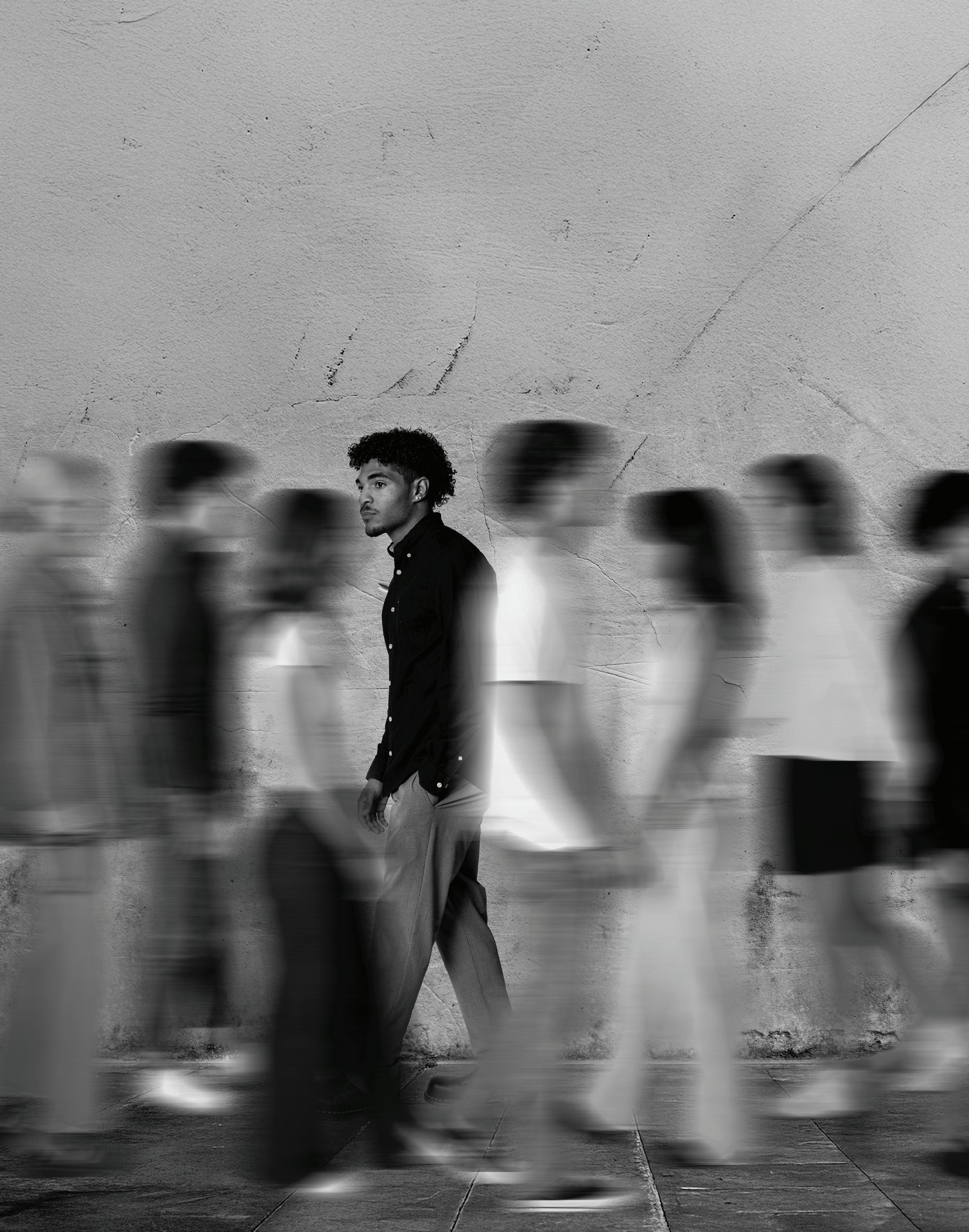
Cover Art Photo: Anya Valladares and Ántonia Smith
Patricia Hattendorf Nerney Poetry Writing Award:
Sister Scholastica Schuster Prose Writing Award:
“The Face of the Box” by Emma Keenan
Thomas Ross Award for a Promising Young Writer
“The Edge of Mercy” by Audrey Kirwan
"Rolled Oats" by Henry Burns
THE EDITORS





Ántonia Smith
Layout Editor
Ántonia Smith is a senior from St. Charles, Minnesota majoring in Graphic Design with a minor in Art. She thoroughly enjoys anything outdoors as well as all things creative.
Anya Valladares
Layout Editor
Anya Valladares is a senior majoring in Graphic Design, with a minor in Marketing and Art. She is from Littleton Colorado. She loves the outdoors, art photography and anything creative.
Eileen Bennett
Art Editor
Eileen Bennett is a junior from Waukesha, Wisconsin majoring in Art. She enjoys playing guitar, baking, and creating art in any medium available, but especially printmaking and pastel drawings.
Gwen Baugh
Poetry Editor
Gwendolyn Baugh is a junior from Excelsior Springs, MO studying English with a minor in Journalism/Mass Communications. Aside from reading and writing, she enjoys planning events with her household, singing, drinking coffee, and enjoying nature within reason.
Mary Nuñez
Prose Editor
Mary is a senior from Southern California studying Marketing and Theology. She believes a life well-lived is one spent in wonder at the beauty around us, and is grateful to have been part of a project that captures that.
Sabrina Vizurraga
General Editor
Sabrina Vizurraga is a senior majoring in English. She is from Centennial, CO. In her free time, she enjoys volunteering in St. Joseph and making matcha lattes.
Michael Stigman
Faculty Advisor
The writer Annie Dillard wrote, “Anything you do not give freely and abundantly becomes lost to you.” With this publication, Michael Stigman has overseen nineteen editions of Loomings. This edition, Sonder, joyfully continues the Benedictine College art community’s long history of sharing creativity freely and abundantly. Enjoy!
A man runs past you on a cold Saturday morning. How blistered are his feet? A woman journals in a coffee shop. What’s her coffee order? A child plays with a toy sailboat in the creek. Where will this adventure take him? If you’ve ever asked yourself these questions, it’s likely you were in a state of sonder.
Although it’s a neologism in English, it means “to probe” in French and “special” in German. The English definition of sonder builds upon both; it’s a meditation and a reveling in the mystery of another person; it’s the realization that each passerby has a life as complex as your own. As artists, sonder is natural— there is always a subject to revel in.
Whether we fictionalize the subject or paint him, we engage in unveiling a world hidden within another person—Melville did so in his epic, Moby Dick. In the first chapter entitled “Loomings,” the narrator says, “Call me Ishmael.” He shares his love for the ocean, its hypnosis on artists, and its hold on the “drizzly November” in his soul.
Dear reader, may this edition of Loomings be a place to revitalize the drizzly November in your own soul and a place to revel in the mystery of the people around you.
Sincerely, Your Looming Editors
Baby Boy Shoes
By: Sabrina Vizurraga
So now she carried the wrapped gift, once his, in one hand as her heels clicked on the pavement. Through the window, the women chatted. She knocked with her free hand on the blue door. The chatter stopped. Her lacquered nails made small dents into the paper wrapping as she waited for a response.
“Come in!” called the women.
She greeted the women who stood up from the cobalt blue couch, giving them each a one-armed hug, and carefully balanced the gift in her hand. They chattered some more while she listened, nodding along. The gift was still in her hand. Her palm was increasingly growing sweaty from holding the gift.
Walking away into the kitchen, she thought of when she had bought it—those little sky-blue booties for her little boy. How precious and tiny his feet had been. Her boy had never worn those blue booties. Instead, the gift remained in the unopened plastic somewhere in the closet’s corner, high on a shelf.
When she got the invitation to the baby shower, her hands trembled, and her fingers struggled to read the blue words. But she knew she had something for it, something she no longer needed—rather—something her son no longer needed. She didn’t need to venture to the store with the babies in their strollers or in their mothers’ arms. She didn’t need to see more socks meant for sixmonth-old babies, the size her son never grew into. She no longer needed to ogle at the precious onesies her son would never wear. All she had to do was go into her closet, get out the stool, and grab the booties. But she had jumped to get the booties, knocking over the other shit she kept in her closet. Angrily, triumphantly, she grabbed the booties and then the wrapping paper.
Now, she was here in this stuffy living room that reminded her of death, watching the women in the family room pretend to be friends. The gift was still in her hands and the paper was beginning to shred itself—she did not know how her hands did this thing to this gift but they did—they continued to shred every piece until it was the size of a lime, then the size of a raspberry, then nothing bigger than the size of a pea. Her fingers continued ripping, lacing themselves inside of the plastic and then inside of the booties, covering and opening the booties, and she wore them angrily, triumphantly on her skinny fingers, the sweat dripping down all the way to her feet.
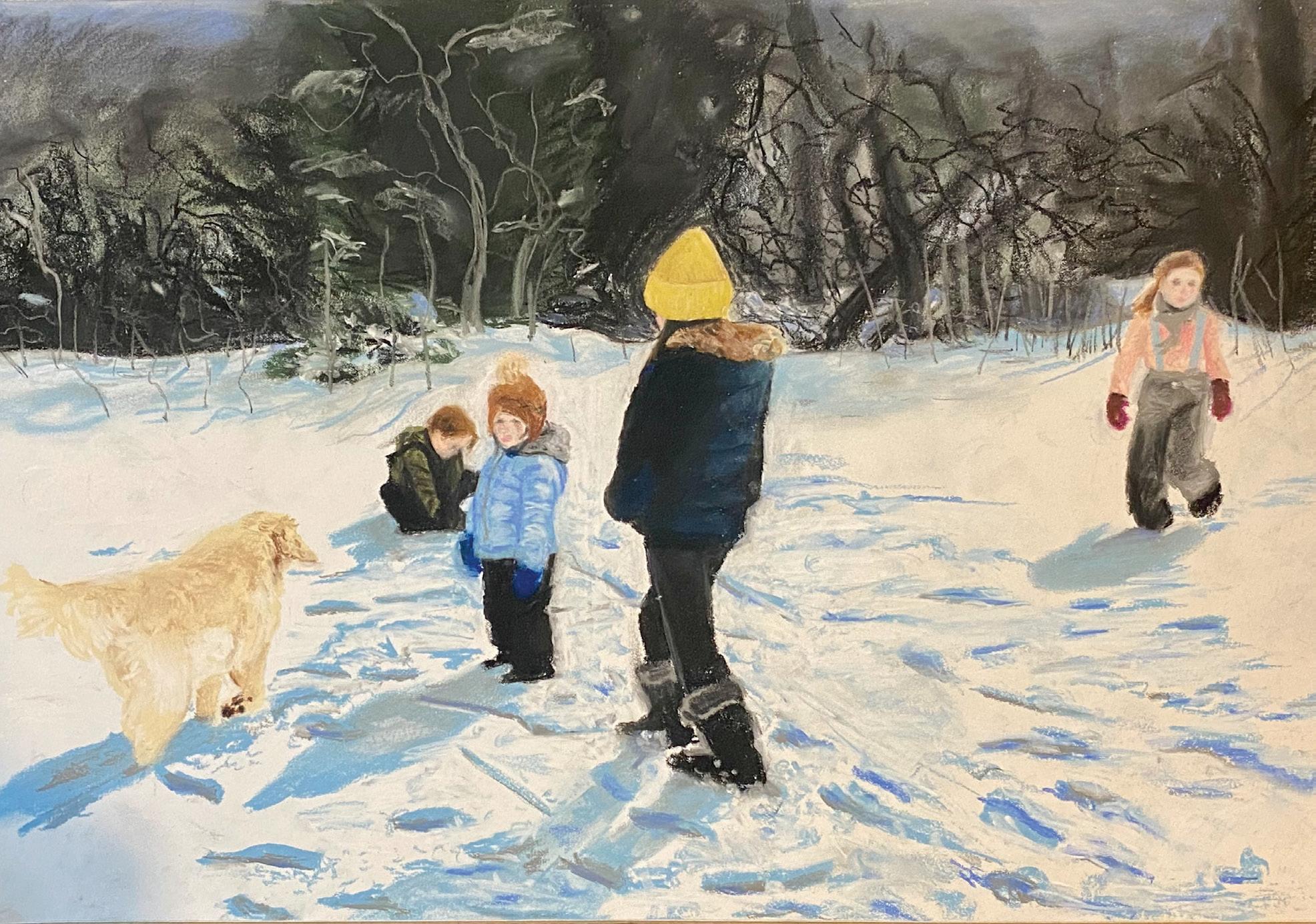
Nix
Eileen Bennett, Pastels on Paper, (12”x18”)
The Edge of Mercy
By: Audrey Kirwan
The clashing of metal reverberated in the turbulent night air. Beyond the dim light of torches and the random flashes of lightning, little could be seen of the ambush unfolding at the top of the bluff.
Brielle crouched in the shadows, poised to join the fray at the word of her uncle. He and her cousin waited just a few yards to the right. It was her family’s third attack on the barbaric intruders who had invaded their home last month. Just thinking of their leering faces and those cold gray eyes made her blood boil. How dare they try to take her family’s land? To destroy their peaceful lives and uproot their village? How dare they taint her noble country with such greed?
Brielle knew that her family would rather die than cower in defeat, and she was itching to help reclaim their rightful heritage. She had finally convinced her father to let her accompany the men on this ambush, asserting that as a skilled and able-bodied 19-year-old, she was duly qualified to contribute to their crusade. No one in her family could match her agility. A smile flickered on her face as she was reminded of her little brother, Alex, who used to march around the house, brandishing his wooden sword and declaring similar claims of independence. Oh, how she missed that simple, happy life.
“Ready.” Her uncle’s low voice cut sharply into her thoughts, and she shifted her weight, muscles tense.
“Brielle and Louis, you go to the left and support us from behind. I’ll go right and cut off those devils before they scamper back down the bluff.” Her uncle turned and faced her seriously. “Stay together and take care of each other. You can’t trust these scoundrels. They’re like snakes, and they’ll bite the moment you look away.”
Brielle glanced towards Louis, observing the hardness in her cousin’s gaze as his mouth twisted in agreement with his father. She could tell that he had no intention of giving the intruders that chance.
With that, her uncle was off like a shot, sword drawn as he disappeared down the side of the hill. Louis nudged her with his shoulder and then charged forward towards the battle. Brielle scrambled after him, adrenaline pounding in her ears and one hand clenching her dagger.
They were about ten paces from the fight when the smell of blood struck her like a hammer. She gasped, eyes wide, and slowed to take in the chaos.
It was horrible. That was her first gut reaction. Already, dozens of lives had been stolen, their bodies scattered and broken on the ground. Most were the intruders, but she was certain that some must be her relatives.
“Brielle!” Louis shouted, lunging back towards her and jolting her from her stupor. “Watch out!”
Brielle twisted, ducking to the side as a blade whistled past her ear. A man with glinting gray eyes had attacked her from behind. Her quick reflexes had saved her life and gave Louis enough time to intervene, clashing blades with her assailant. Louis faced him head-on, the sound of steel ringing so close it rattled her teeth. But, the man was twice his size and wielding a heavy broadsword. Louis wouldn’t stand a chance on his own.
Brielle dove and lashed out with her foot before the intruder could overpower her cousin. The force caused the man to stumble, and Louis knocked his sword aside before striking him down with a firm blow.
There was an eerie stillness as Brielle and Louis straightened and stared at each other, panting. She felt sick.
This was not the glorious vengeance that she had imagined. But why? These people had stolen her home; ruined her life. Wasn’t this the consequence of their actions? Didn’t they deserve to have their lives stripped in the same way?
And yet, now that she was here, carrying out the judgment she had decreed, she knew that this was not the same way. Their lives were just as real as her own. She ran a shaky hand through her hair.
It was then that she caught sight of the boy running near the edge of the cliff. Two figures were fixed in a duel to his left. One stepped backward at just the wrong moment, clipping the boy’s shoulder and throwing him off balance. Lightning flashed across the sky, illuminating the boy’s face and the terror in his characteristic gray eyes. Brielle’s heart clenched. He was so young, hardly a year older than her brother Alex. The boy tumbled sideways, skidding over the edge almost in slow motion. For a moment, it looked like he was floating. Then, he plunged out of sight towards the stormy sea below.
Without hesitating, Brielle took off, sprinting toward the last place she had seen the boy. She ignored the frantic shouts from Louis, knowing in her heart that this was the only possible course of action. How could she stand by when she could save a life? Her boots were steady as she pushed off the ground, reaching the crest of the hill, and she dove.
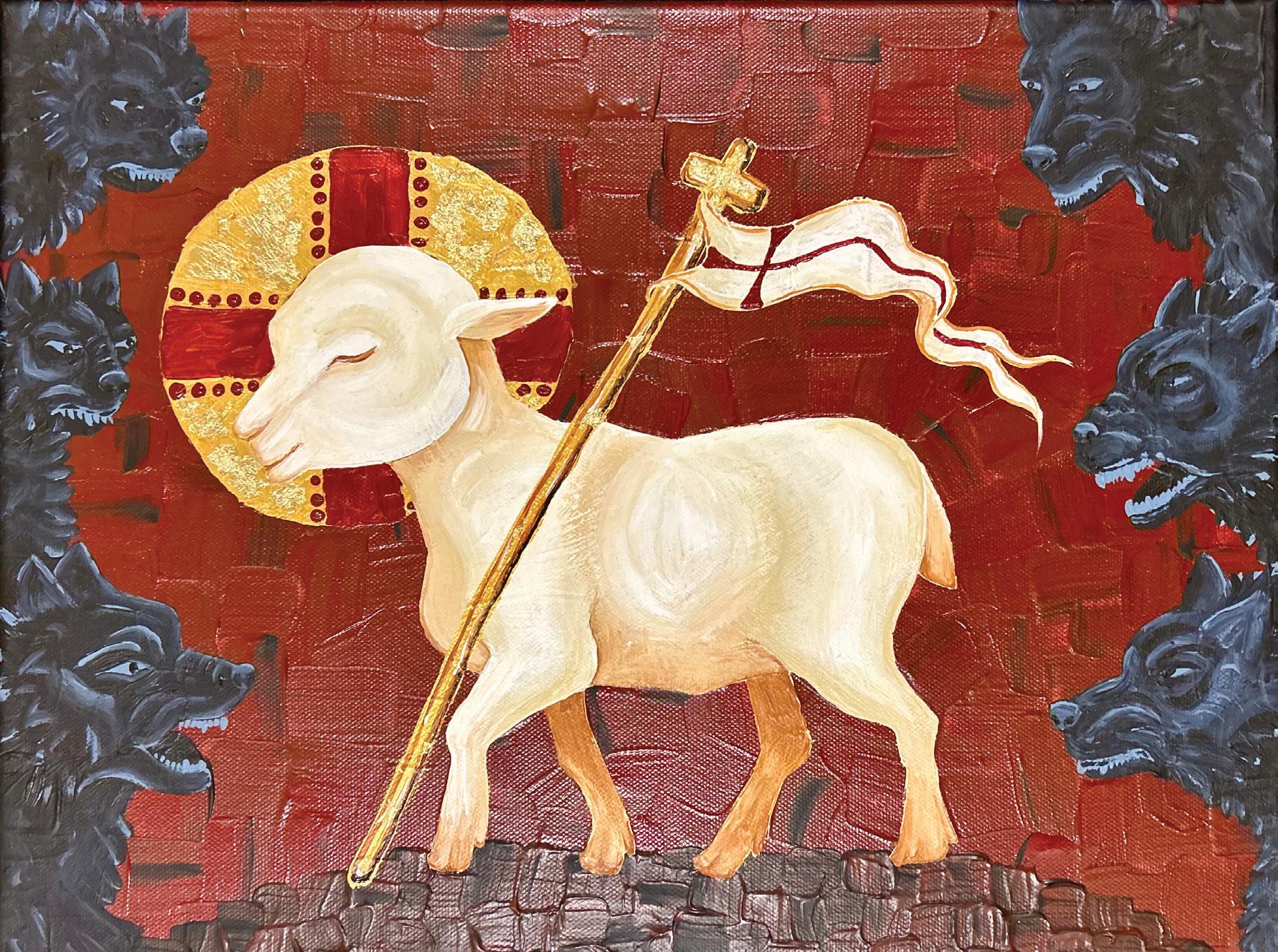
A Lamb Led To Slaughter
Emily Robeson, Acrylic on Canvas, Acrylic on canvas, (12”x16”)
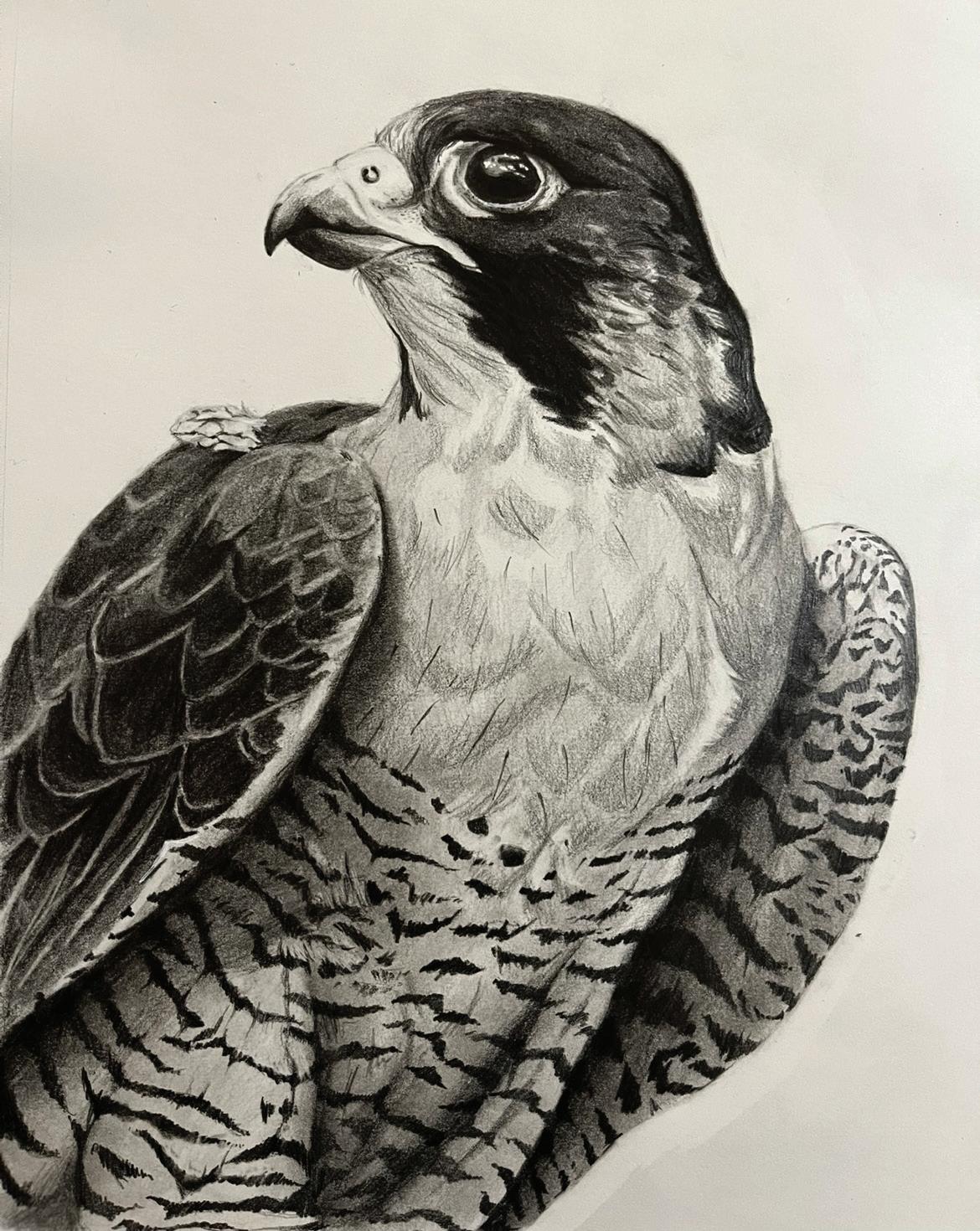
A Favorite
Loomings 10
Naomi Cummings, Pencil and Graphite, (9”x12”)
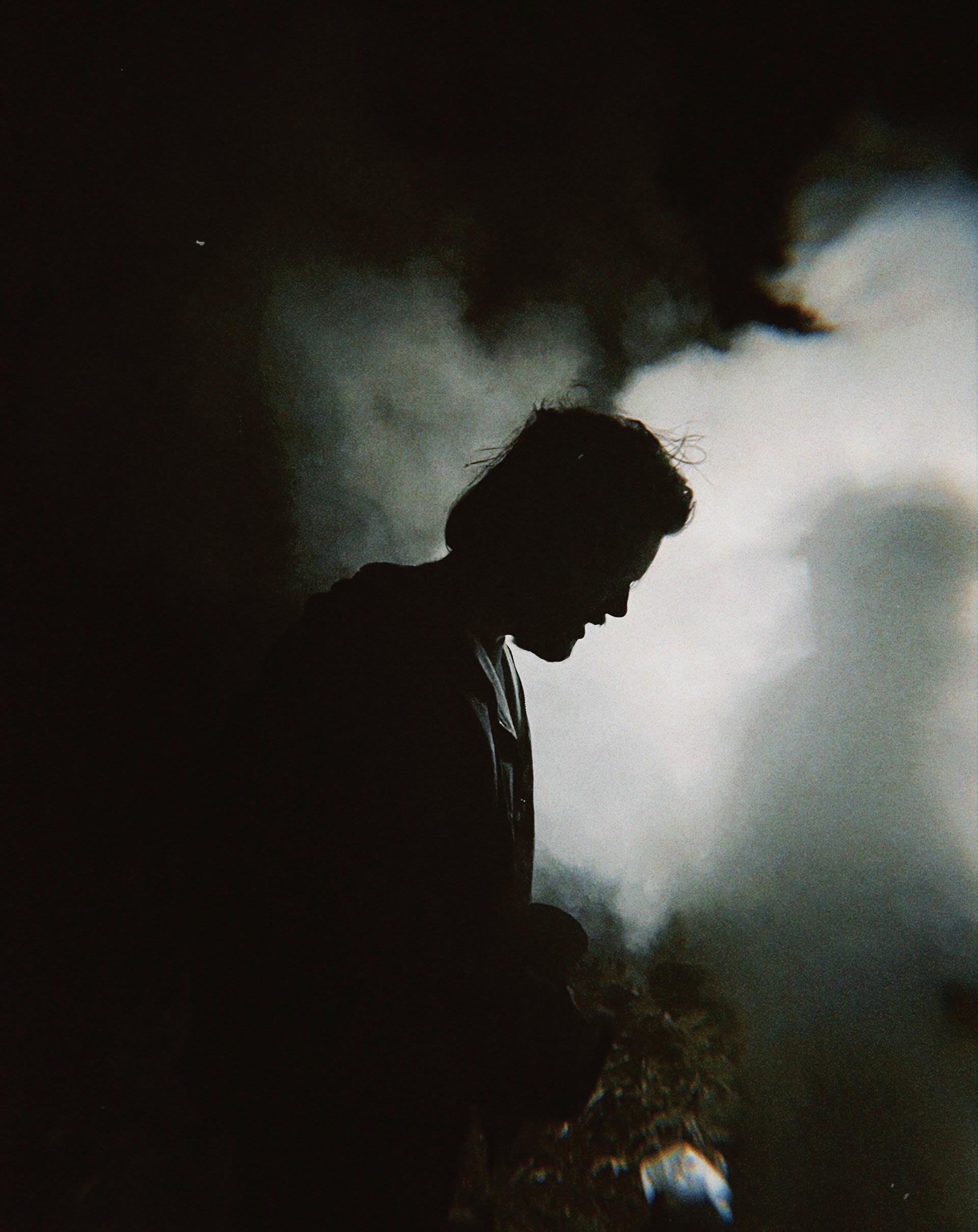
Strangers
Loomings 11
Isaac DuPont, Digital Photography
The Face of a Box
By: Emma Keenan
I sat in the stale, grey cubicle at three in the afternoon when the hum of the white lights gave noise to silence. For hours, I listened to the sound of frantic fingers tapping on keyboards. My job required me to answer the phone when it rang and transfer it to the appropriate person, but on this day, no one called. I spun around in my chair, staring up at the ceiling with squares of glowing white lights. One of my coworkers approached me.
“Look what I found.” He said, placing a large cardboard box on my desk.
“What is it?” I asked.
“Look.”
Inside were old C.D’s from years ago. I picked up a C.D and turned back to Alan. “Okay? So you like music?”
“No, these aren’t mine.” He said. “These belonged to this old lady who worked here for like twenty years before she retired. She had your job.”
“Where’d you find this?”
“In a closet. She left them here.”
“Maybe she just forgot?”
“You never met her. She always had headphones on while she worked, which is kind of funny since she was supposed to be taking calls too, but anyway, when anyone would ask what she was listening to, she would make this face. It scared me. She would put all her CD’s away before anyone could see them and all she would say is ‘I’m working’.”
“She does sound weird.”
“That’s it?”
I moved my chair back to face my desk and smiled. “I’m working,” I said.
Alan walked away. I moved aside the box to work on my computer as the hum of white lights beat on and I typed meaningless jumbles of letters. I did not care for the box resting on the corner of my desk, but I turned every ten seconds to look at it, to see that it had not moved, to ensure that the spirit of a strange, scowling woman, wearing headphones, had not suddenly presented herself as a phantom apparition here to reclaim her forgotten music. I shuddered and went back to Alan.
He was sitting at his desk, playing computer games. He looked up at me and back to his computer. “Hey Alan,” I said.
“I’m working.”
“No you’re not. What was that lady’s name? The one with the box?”
“Why do you care now?”
“I just do.”
He stopped playing his game and looked up. “Her name was Mary. Mariane. Mariane, uh, Hooper, I think.”
“What was she like?”
“Well, she didn’t let you talk long enough with her to really know her. She was quiet and always had that face that looked like she was frowning all the time, you know? She was really into conspiracy theories too, real paranoid about all sorts of things, like how the government is watching us or how the Hollywood stars are a part of the Illuminati, stuff like that.”
“Huh. She sounds weird.”
“She was. I’m glad she’s gone.”
I rolled around in my chair and stared at Mary’s box as the atoms composing the cardboard formed a static, visible face that frowned at me from the corner of my desk. At five o’clock, I picked up my bag and carried the box in my arms. Alan left with me.
“Is she still alive?” I asked him.
“Who? Mary?”
“Yes.”
“I don’t know. I’m sure. She wasn’t that old. Why?” “Just wondering.”
“What are you doing with that box? I found it, you know.”
“Yes, you did.” I said before I went into my car, placing the box on the passenger seat. I waved goodbye through the window.
Driving home, the car beeped from the signal to put on the passenger seatbelt. It detected the box as a person. I parked and walked through the parking garage, listening to the sound of my echoing footsteps and the CD’s rattling in the box. I entered my apartment of grey walls, decorated with one picture frame and a vase of dying flowers. I had ramen and three carrots for dinner, while rewatching It’ s a Wonderful Life in April. When George Bailey stood hovering over the icy bridge, I turned to the box on my kitchen counter. I reimagined the cruel glare of a woman I never met, fearing that to know of her existence was to invite her to haunt my life. I brought her box into my home and as I watched it, I believed its shadow morphed into a physical, human substance that crawled down my counter and slowly approached me along the floor with eerie determination. It mocked my lonely one-room apartment and I was both infuriated and enchanted by the existence of someone I did not know.
I called in sick for work the next day. I laid in bed until eleven in the morning.
The box had not moved. It lingered in the grey area between the present and a hazy manifestation of the past. I opened it and picked up an Elton John CD. I turned it over to look at the songs. I played “I Guess That’s Why They Call it the Blues” on my phone. “Laughin like children, Livin’ like lovers, Rollin’ like thunder” and “thunder” bounced against my grey apartment walls. I was transported seven years backwards into time to my job’s building when Mary still worked there. I was the apparition, a sinister bystander, witnessing her sitting alone at her desk with headphones.
When the song ended, I opened my laptop and searched for a Marriane Hooper. I drove ten minutes away to a little maroon house with statues of tiny angels, like Clarence, along a stepping-stone path, leading to a door with a welcome mat. I held my breath as I knocked and the door opened to a small lady with white hair and rosy cheeks. “Hello!” She said, smiling, as the sound of a radio inside played “Goodbye Yellow Brick Road” under the gentle flicker of yellow lights.
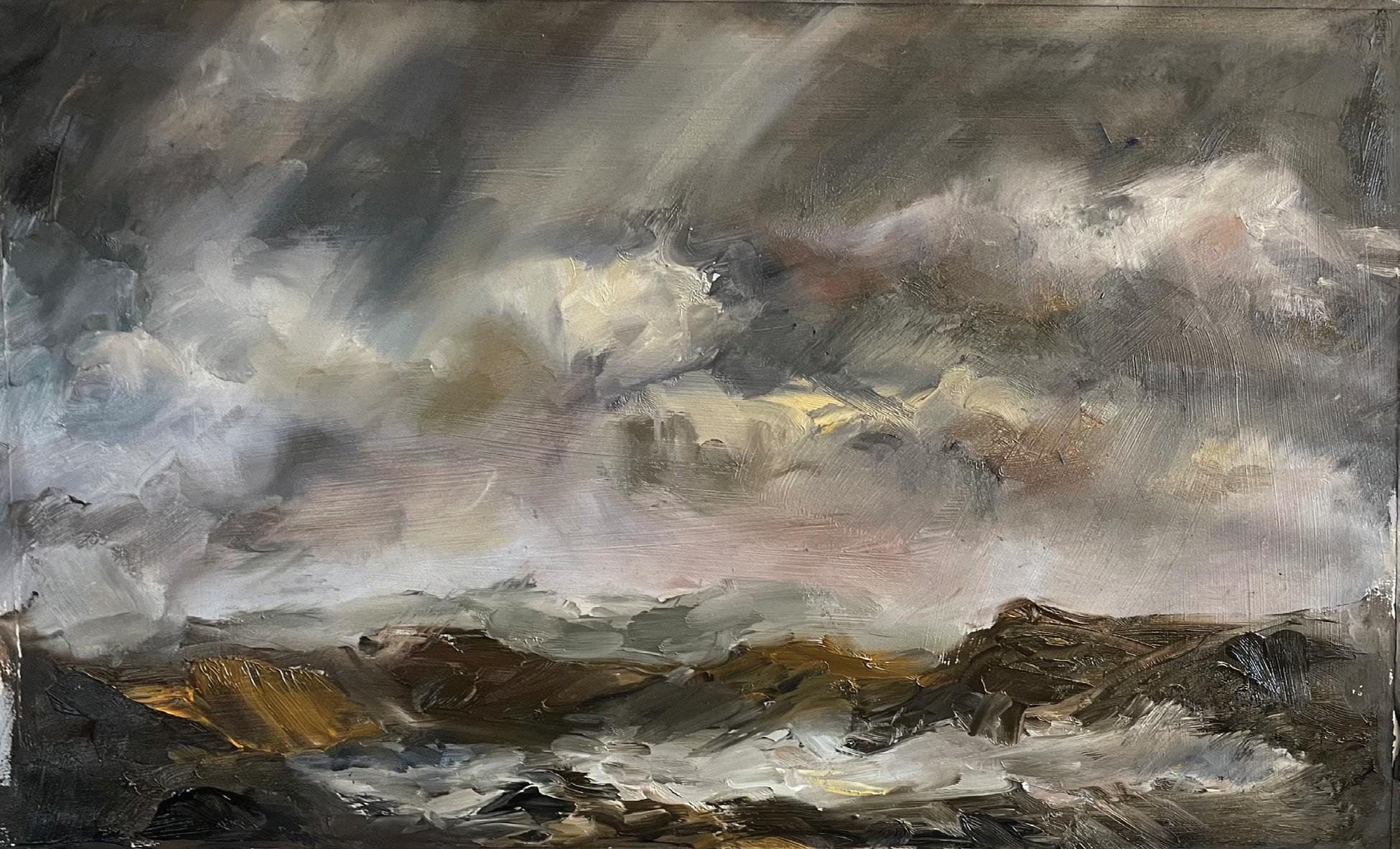
Nora Ley, Oil on Acrylic Gessoed Paper, (9”x12”)
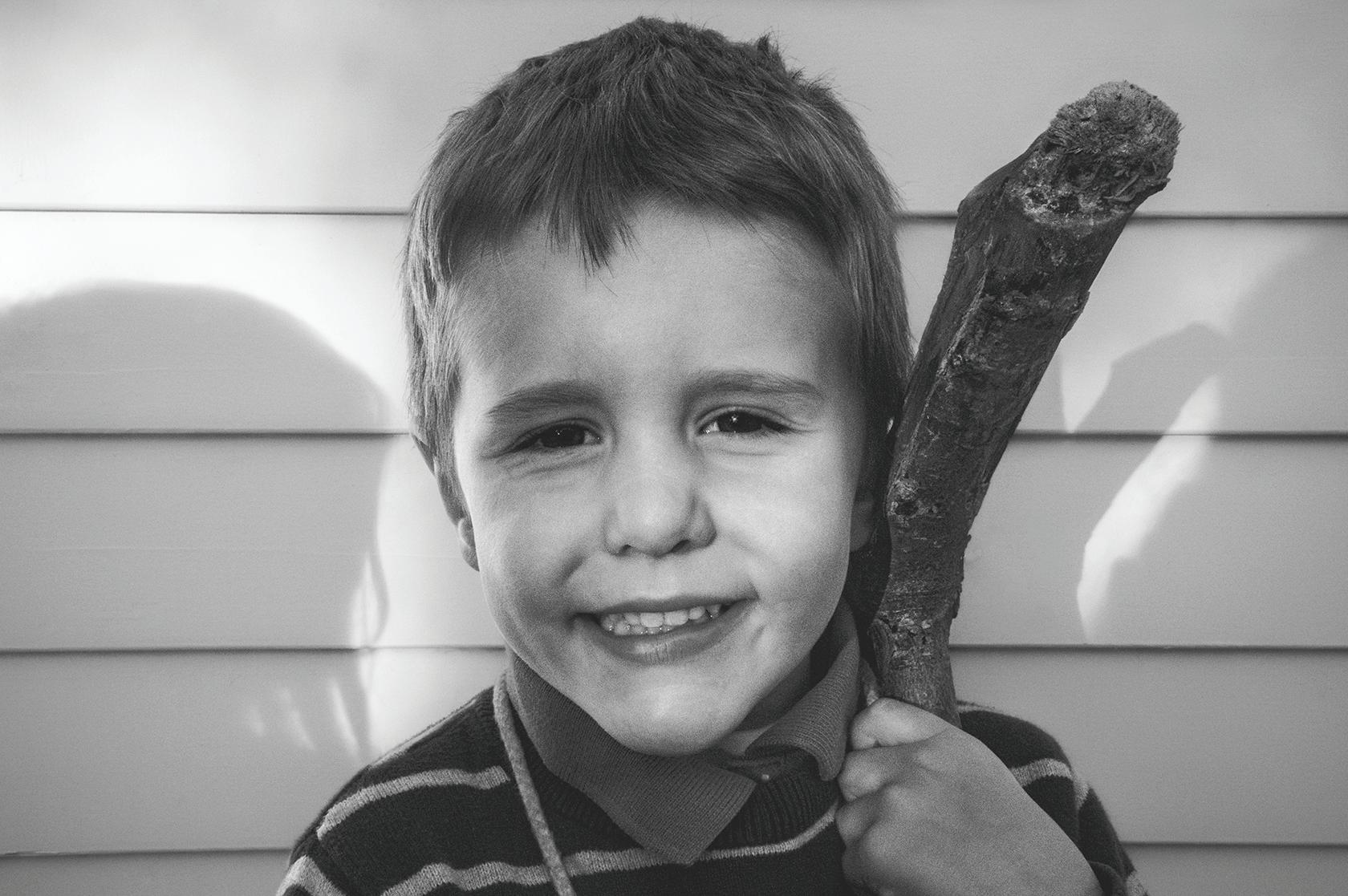
Loomings 14
Peter Thomas
Rosa Rota, Digital Photography
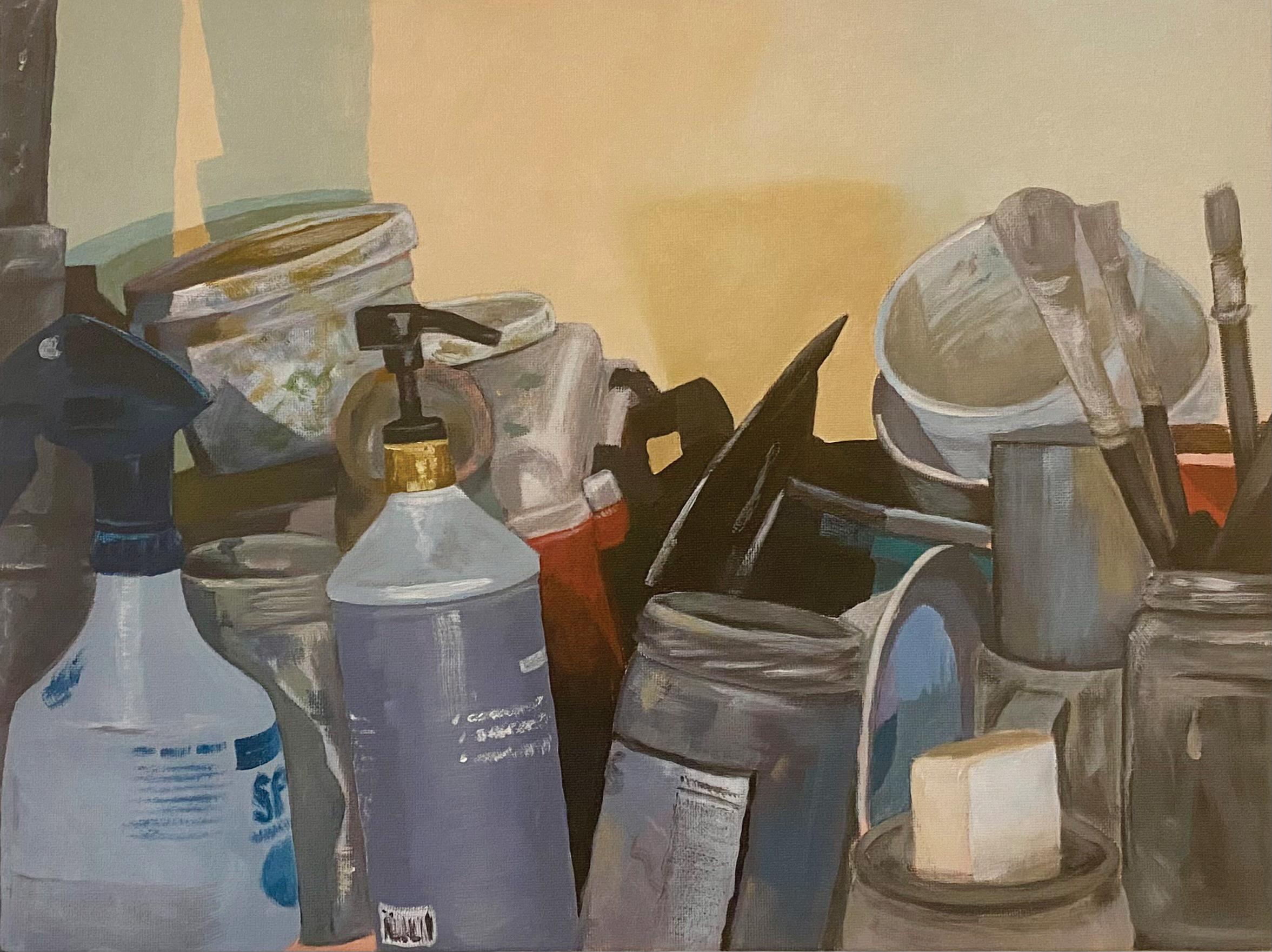
It’s Their Studio Too
Eileen Bennett, Acrylic on Canvas, (12”x16”)
Loomings 16
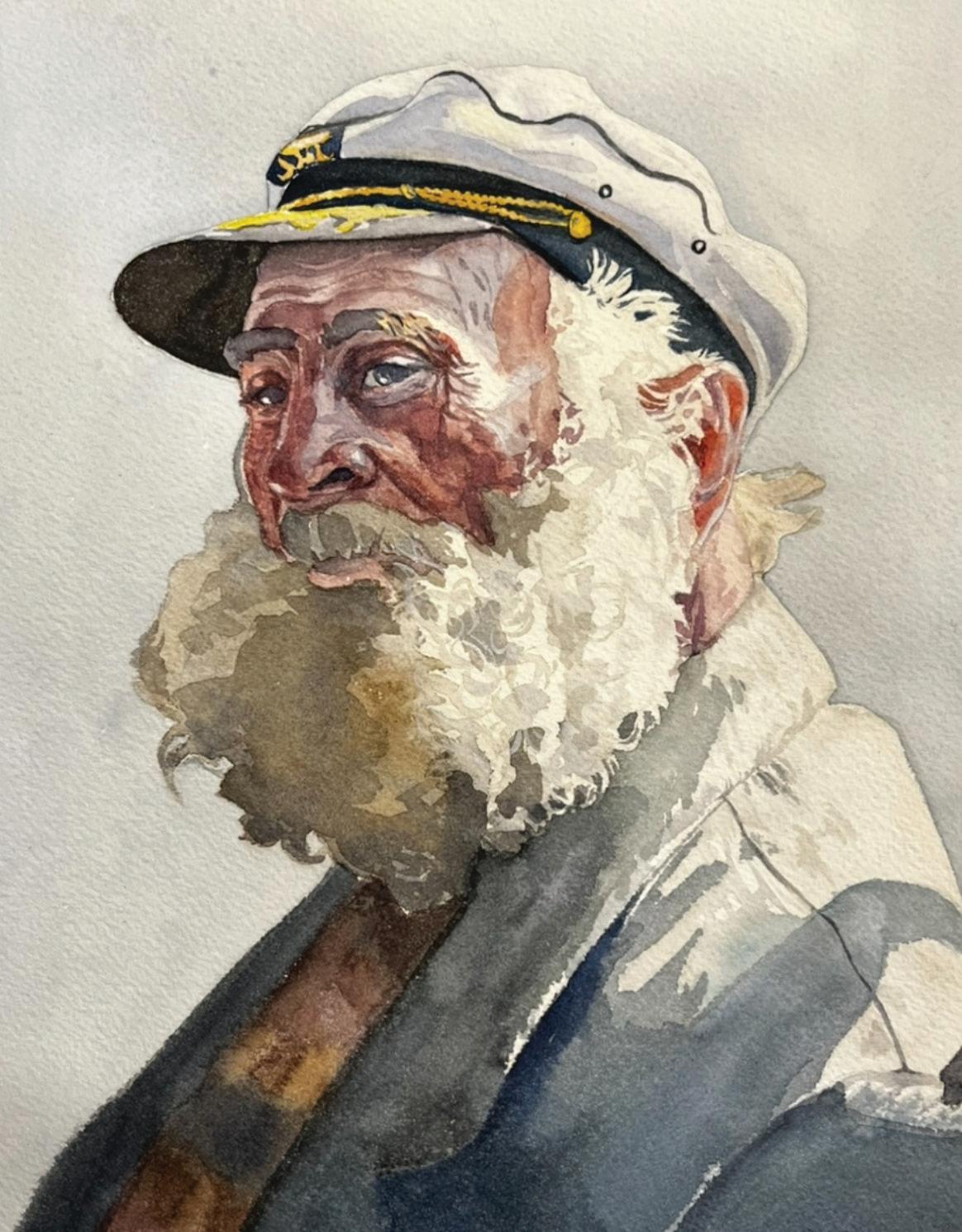
The Sailor
Naomi Cummings, Watercolor, (9”x12”)
The Mopey Man From Moby Dick
By: Annaliese C. Sommer
There was a man called Ishmael
Who if you asked him, are you doing well?
Would say “-ish,”
For he had not yet caught his big fish (The animal he called Fishmael His penultimate wishmael).
Since on this whale he was convinced he had dibs, Ishmael’s arms bore tattoos of the ribs.
Rolled Oats
By: Henry Burns
John Lee Hooker strung strips of innertube across a barn wall for his first guitar.
Sometimes I think about the makeshift moments
Dotted behind me – my father’s mannerisms toward mother – just 12 year olds at the county fair. Do you think that God plotted the stars like cake icing? Anything I’ve loved
Has some scratches. And I discard things easily—except people. People are mixed bags – connect the dots.
Oh! what crazy rains must have blown together
To save a wretch like me –Sunsets and squirrel fights, all the while, inhabiting the Mind of God
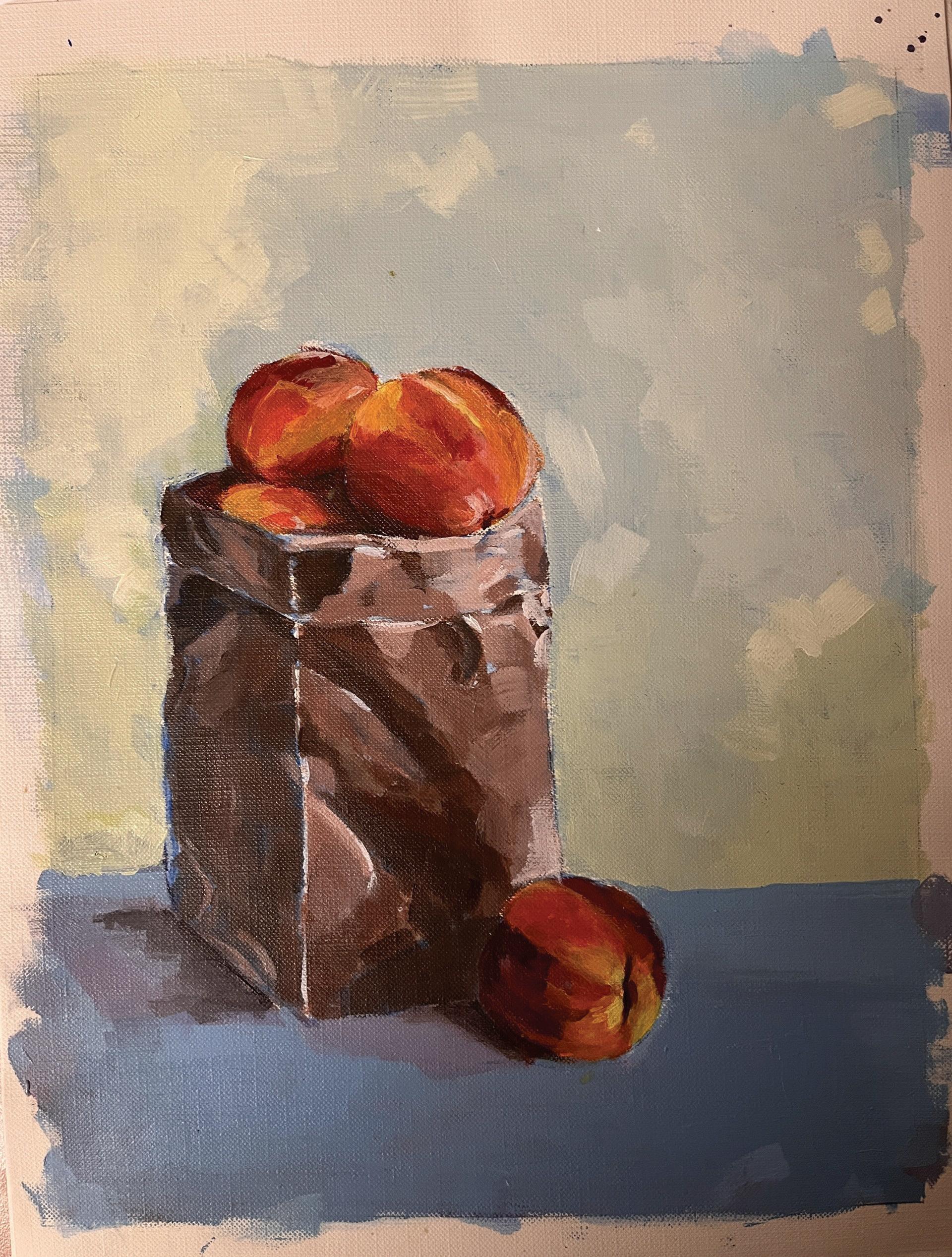
Trip to the Market
Franny Burns, Acrylic, (9”x12”)
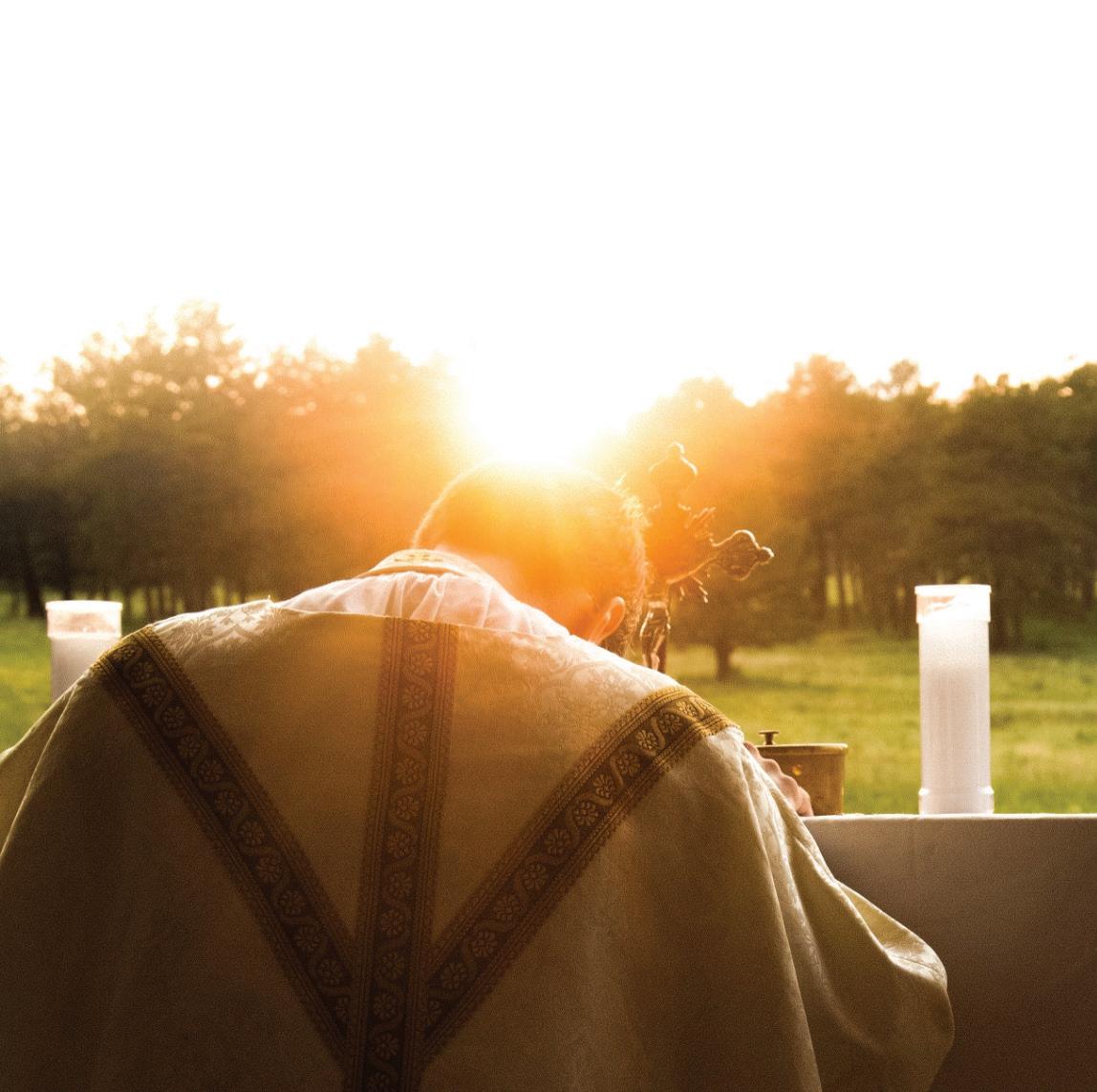
The Ache of Encounter
Loomings 20
Anya Valladares, Digital Photography
Heaven Knows
By: Edward Mulholland
She wasn’t happy with the swaddling clothes; In Nazareth she’d knitted better stuff. But one must travel light when roads are rough. She’d done the best she could, though. Heaven knows.
And Heaven knows the manger was the man’s Last option, when he’d not a moment’s pause, A carpenter reduced to grasp at straws, A patch-job in a week of broken plans.
The stable was a last-ditch effort, too. For them there had been no room at the inn. So, hauling labored limbs and deep chagrin They’d traipsed until a cave had to make do.
And yet, it was these fruits of their frustration That God chose to reveal his Incarnation.
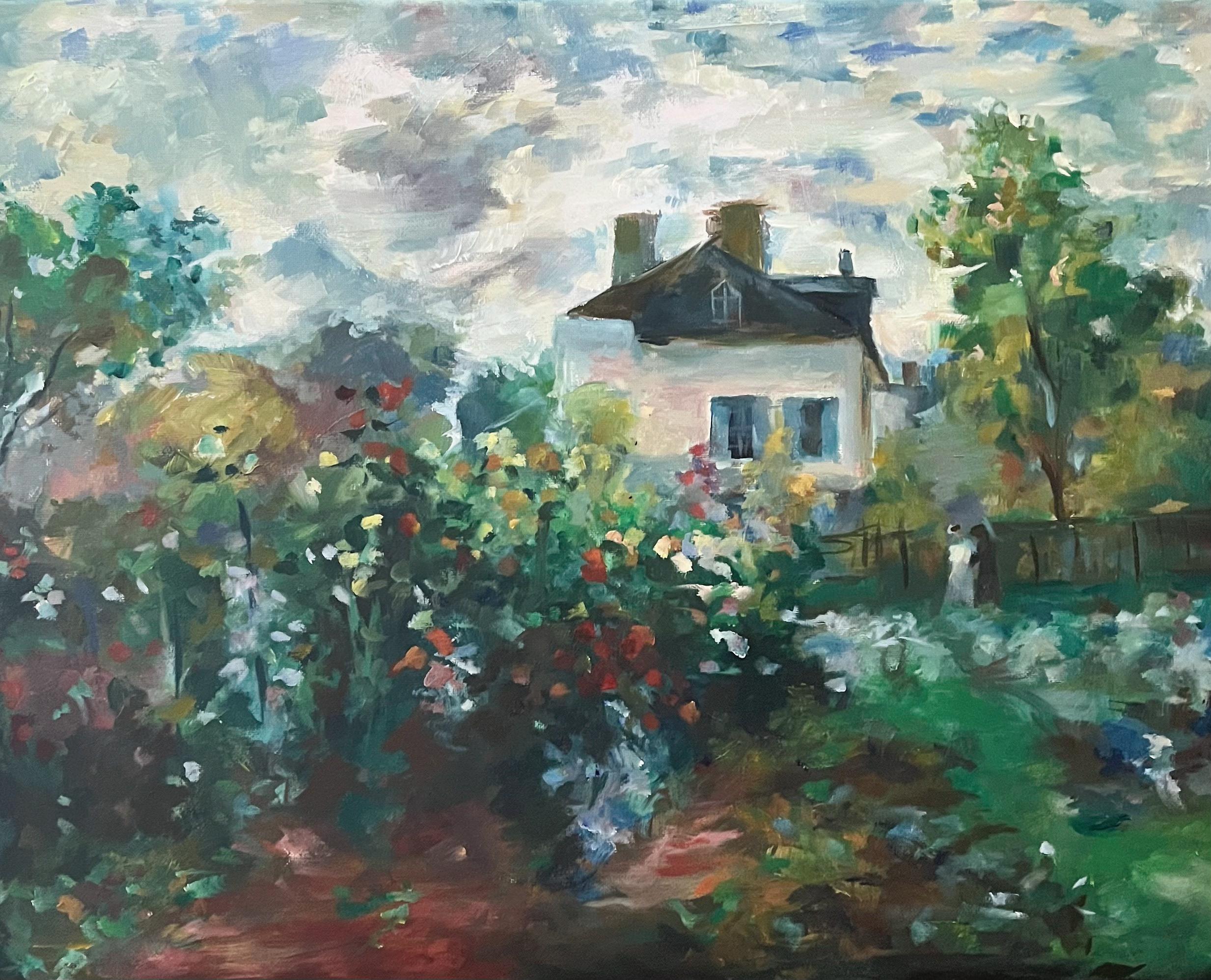
Study of the Artist’s Garden
Loomings 22
Ellen Menke, Oil painting, (16”x20”)
Campbell’s Museum –Worthy Product
By: Annaliese C. Sommer
These soup cans are atrocious.
We hear: The style is precocious!
When an artist claims his fame,
We assume he knows his game.
But these prints are devoid of style!
Off my face they wipe my smile.
What possessed him to detail
A lot of slime in a metal pail!
He made this collection to completely Line up oh so very neatly.
There they stand-side-by-side;
I guess his inner genius died.
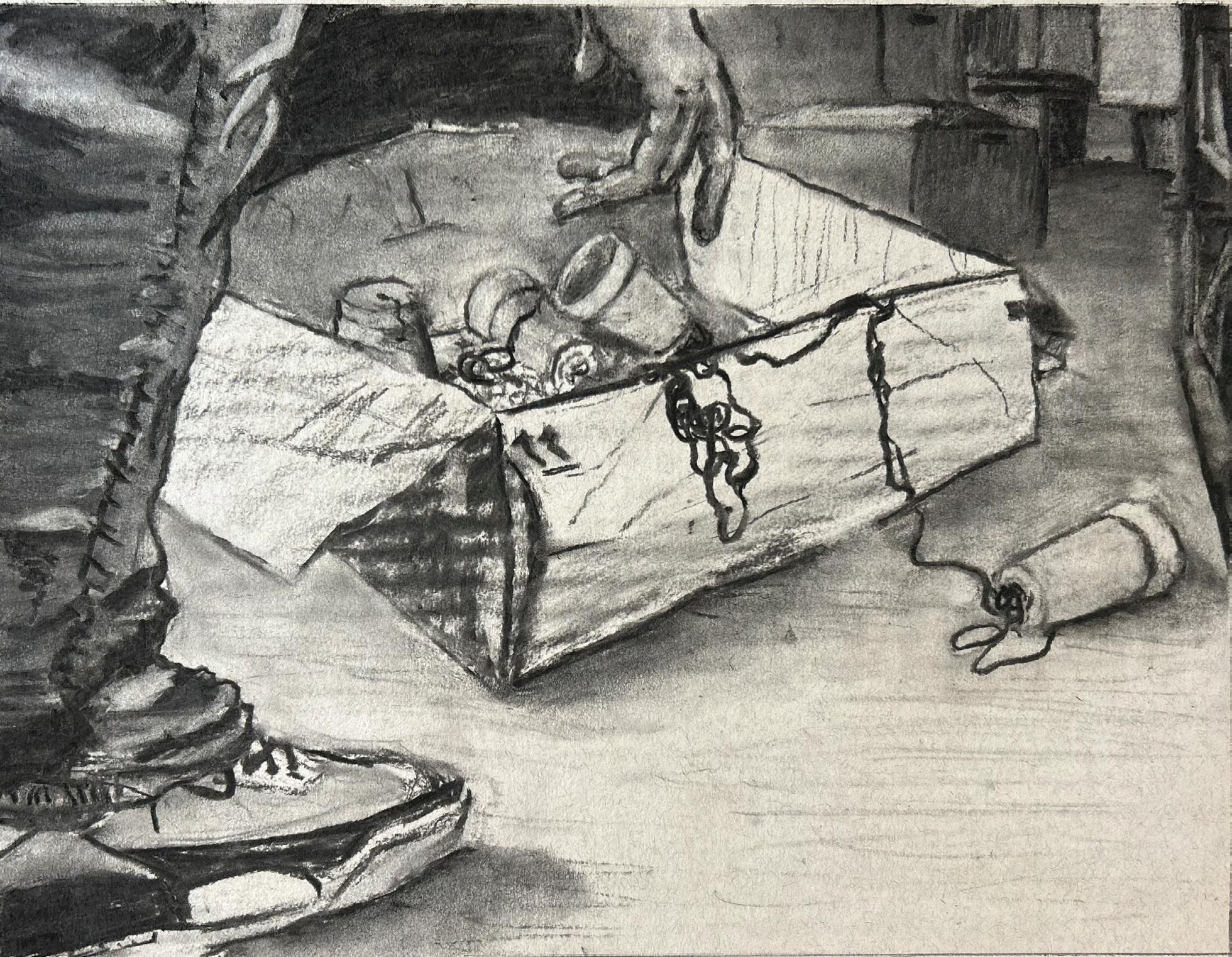
The Retired Phone
Loomings 24
Emmett Pauline, Charcoal, (8.5”x11”)
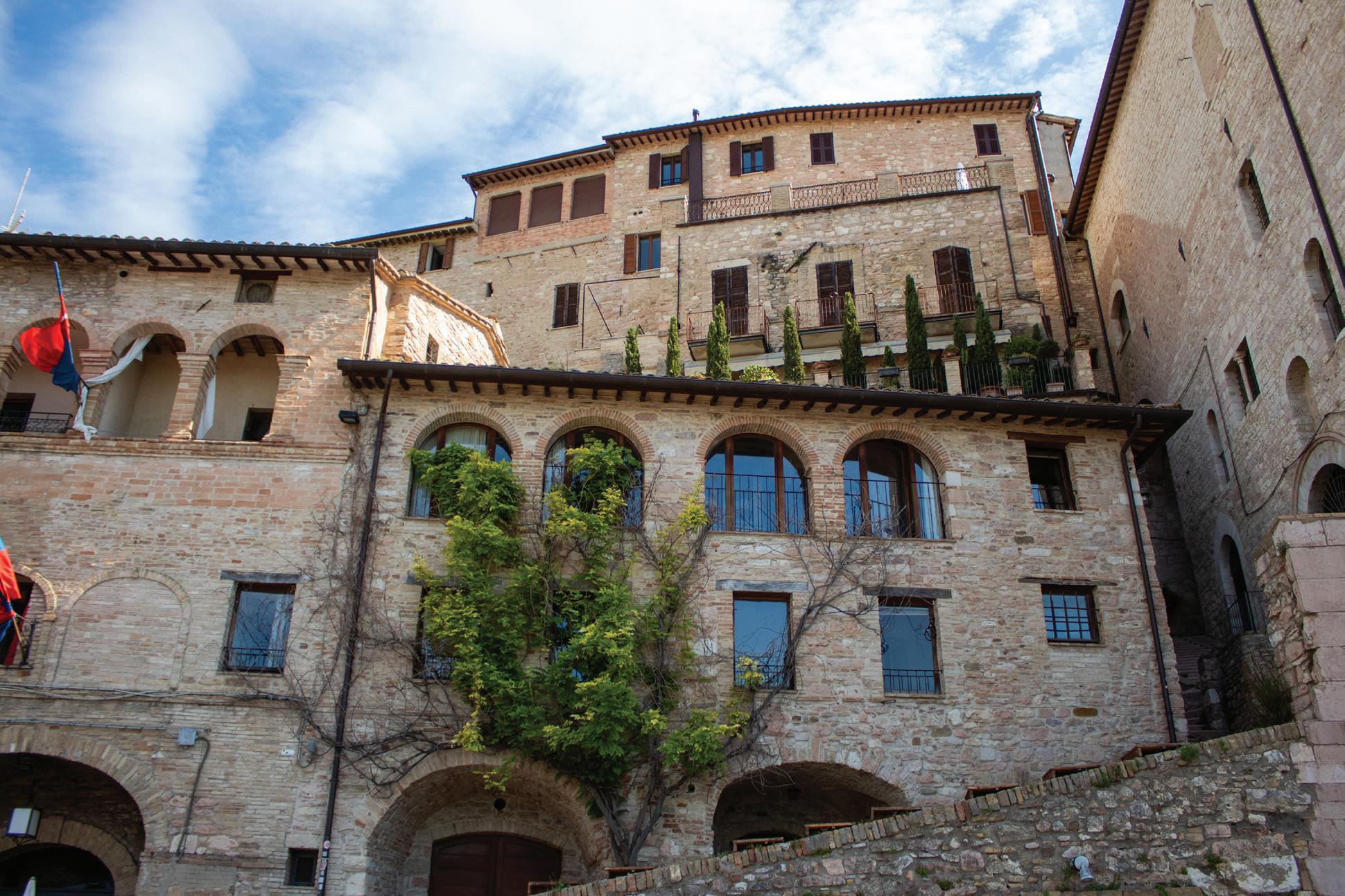
Assisi
Antonia Smith, Digital Photography
for my daughter
By: Natalie Kenney
love it brushed her elbow as she fell off the counter met by giggles and friends wiping kitchen frost from an eye, half closed it came the day the child did the ancient heart that evaporated pools of her cakey skin and told her breath was too slim for uphill walks in windows, spoons and mirror pains the past beats inside her like a second heart: counters, giggles and flour and a small child telling her she was ample for her tiny world living as if they were in love with this little everything called essence her being spilling over with the concept of enough fragments of Him: wisps of love

Loomings 26
Atchison Sunset
Sean Madore, Digital Photography
Loomings 27
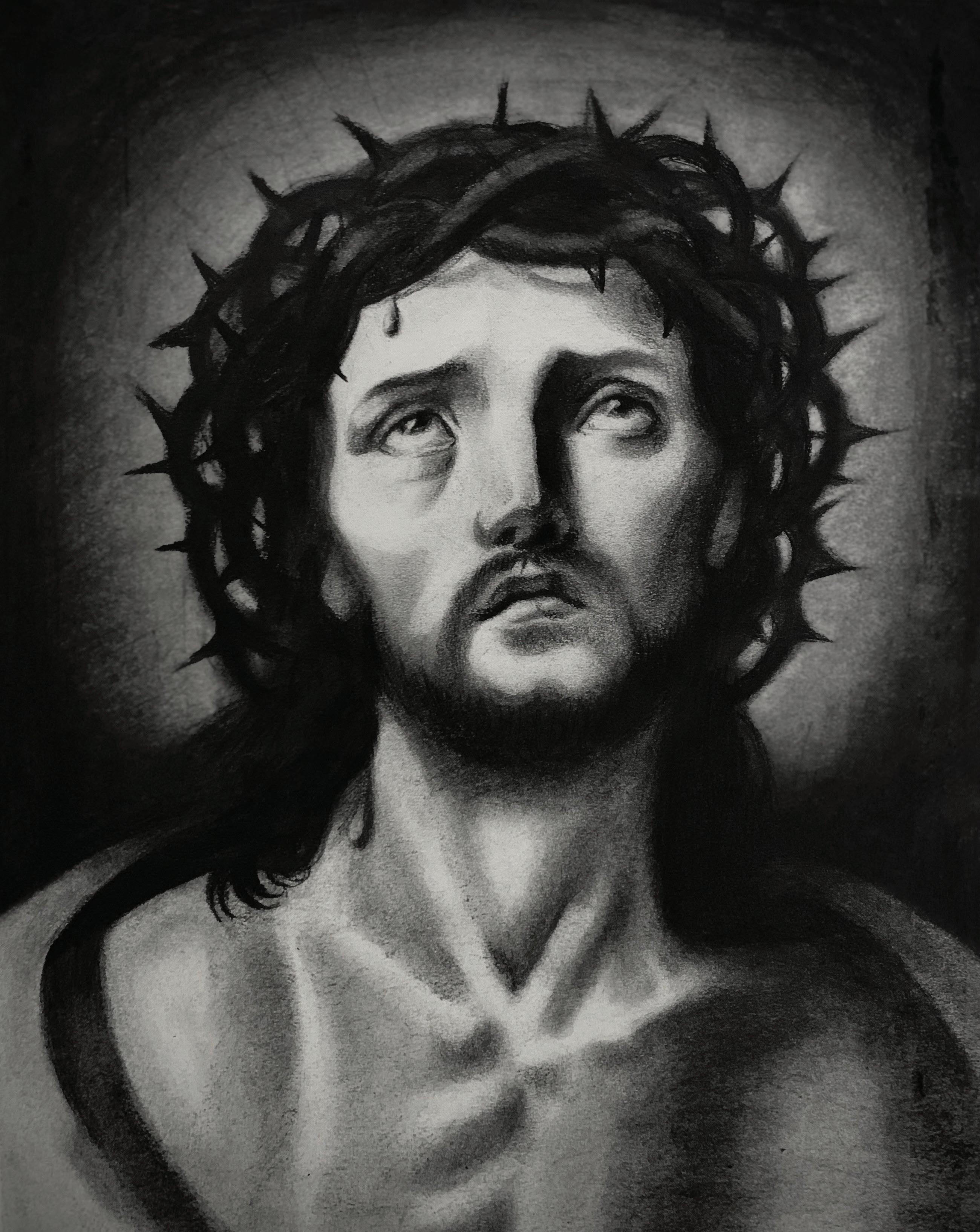
The Passion
Samantha Perales, Charcoal, (18”x24”)
Loomings 28
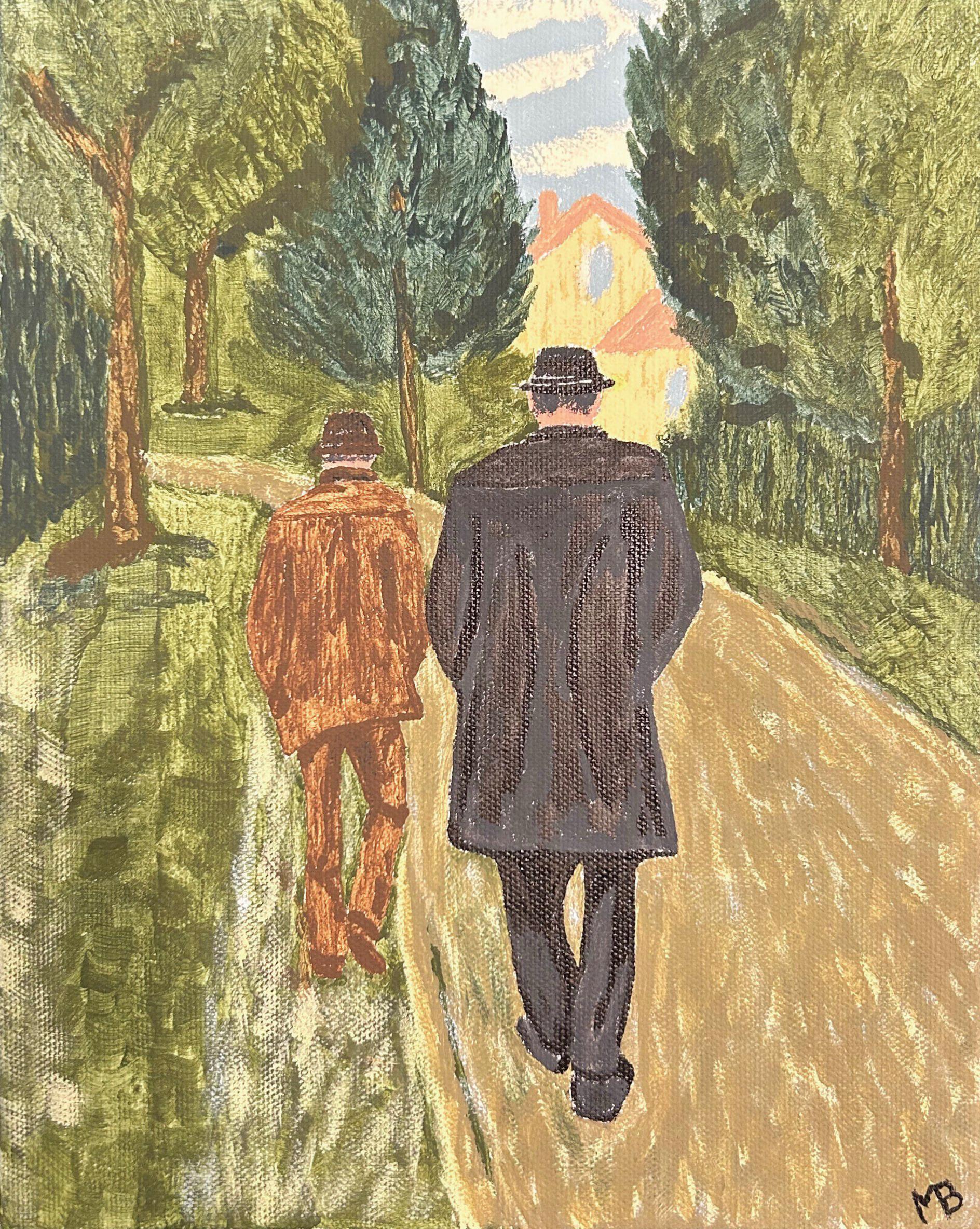
Amicitiae
Mary B Sutherland, Acrylic on Canvas, (8”x10”)

Nature’s Colors
Alexandra Joyce, Watercolor, (16”x20”)
Loomings 30
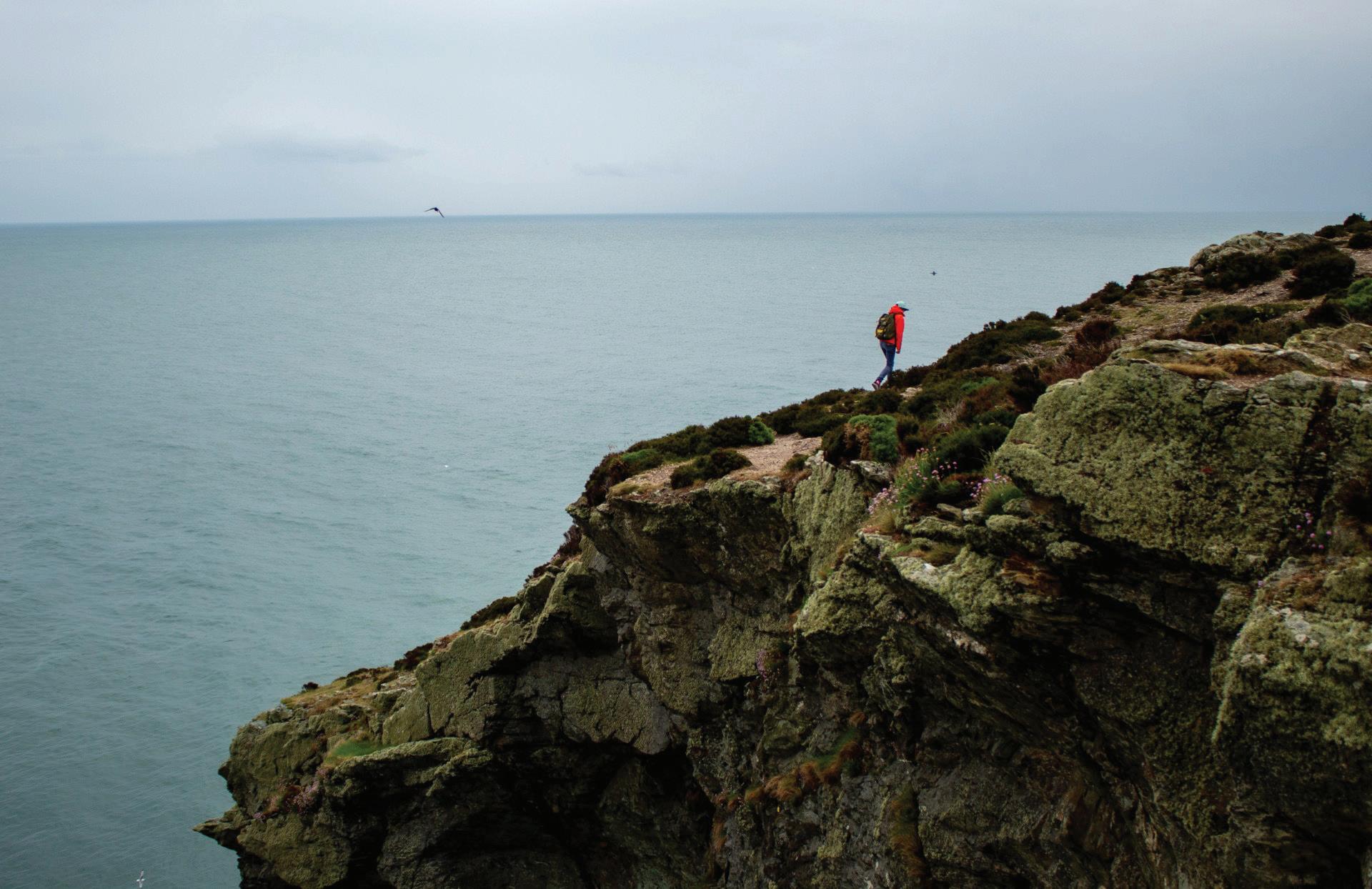
Howth, Ireland
Ántonia Smith, Digital Photography
Ladder-back
By: Nora M. Ley
The ladder-back who tapped
My elm tree, I knew by sound.
With his red hat, his black and white, he was like pitchers and pots; he had
Personality.
Consult a still life; the artists help.
—Or like a fruit, whose Growth is visible in its
Final form. The apple’s swelling outward lean—ah, Bonnard!—
Or a tree whose every writhe is held,
Bark-clothed vessel of decades, Its slow, long
Life present to us in an instant.
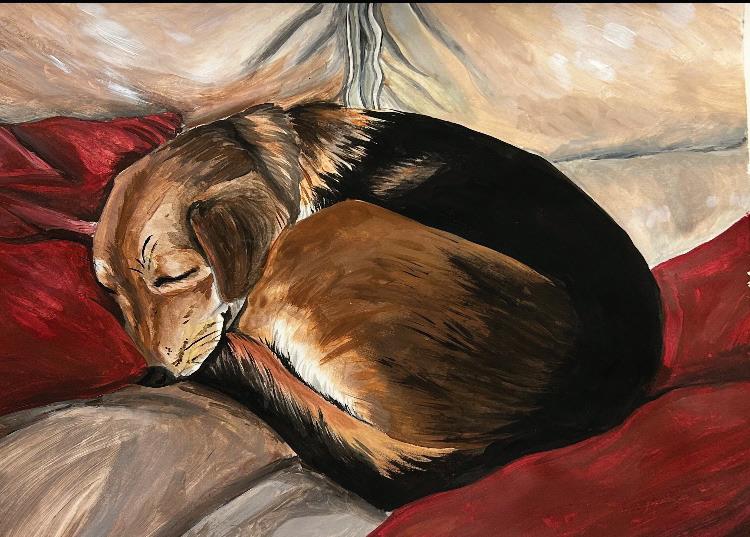
Contentment
Loomings 32
Judith Williams, Acrylic on Paper, (8.5”x11.5”)
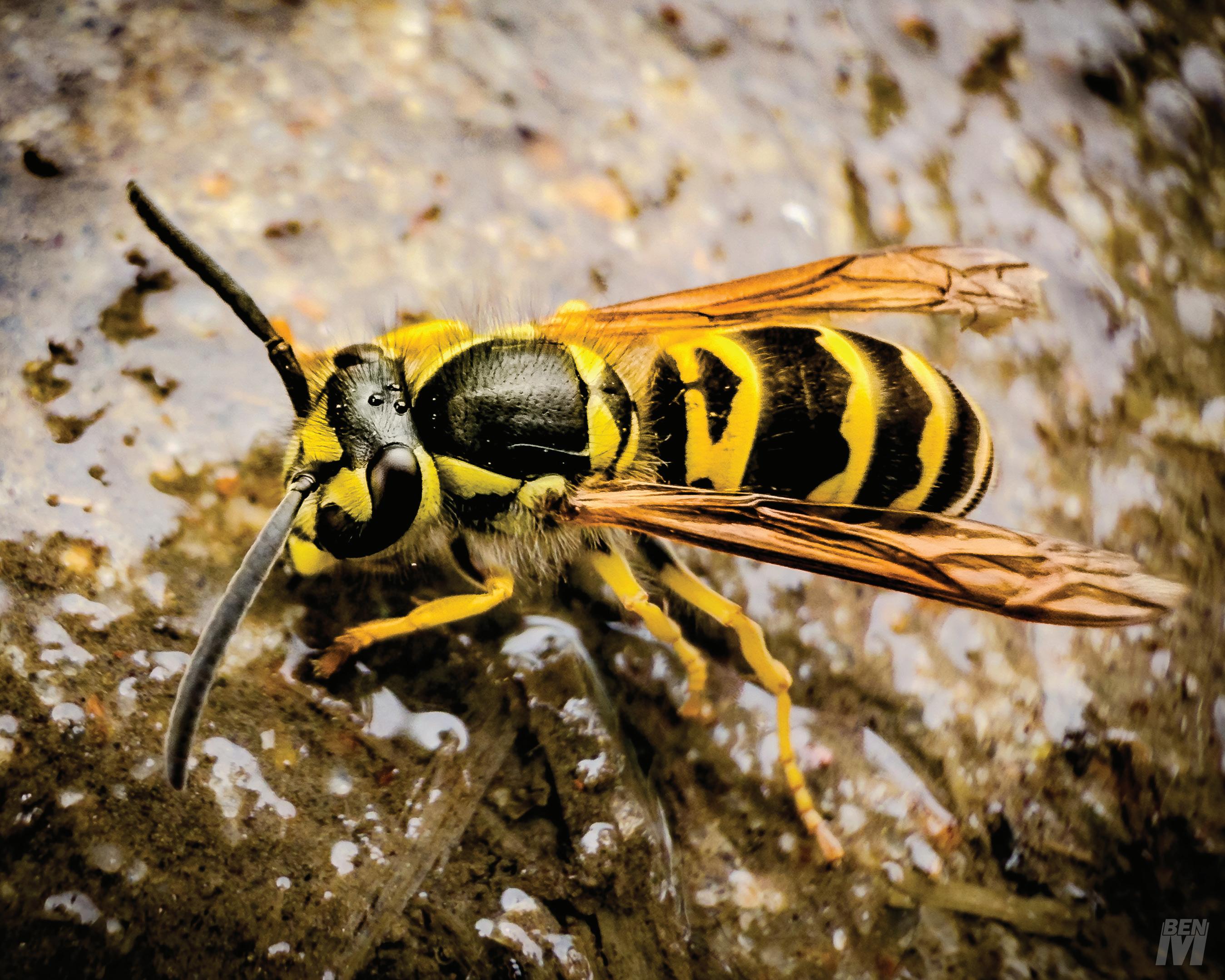
Beeyond What Meets the Eye
Benjamin L Mahoney, Digital Photography
To the Girl with the Pearl Earring
By: Monica Larkin
A Lapis muse lying in Lazuli, sighing in silken apparel-
Her eye pierces through me, beset with a dew, like the wine in a barrel.
And though she is nameless, she’s fervently shameless, and blamelessly seen-
The braid on her head has been swathed in a scarf set in ultramarine.
The dye of a heathen refreshed with secretion of evergreen tears
Anonymous sorrows and dusted tomorrows- too old for her years!
As blue as the gloaming, a sickle moon stole on a seraphic sky
Her stillness has left us alone with the moment of just a goodbye.
Vermeer, did you wonder what slivers of Sonder you’d left us to see
Embalmed in an iris as grey as the fog on a Delftian lea?
You painted a Circe, you fashioned Calypso and left her to stand
For decades to marvel at brushstrokes impressed by the brush of your hand
Yet how can we love her when she is a dream, or a will-o’-the-wisp?
Her only faint murmurs are scarred with a mythic and mystical lisp.
Yet we are the same, though I don’t know her name, she is one of my kin
With the fictional names and historical frames I am ushering in.
We are sisters of Cain, we are children of men, we are daughters of Eve
We have wept the same tears and have bled the same blood, I have cause to believe.
If to care is to love, and to love is to know, and to know is to be
Then although her new room is the dust of the tomb, she is nearest to me.
All the fables we keep in our minds as we sleep, when our hearts are awake
All the faeries that tread the footpaths in my head for their own selfish sake
Once ensnared by the bounds of the sun and the sounds of a day set to rise
Have been captured in pearl, in the ear of this girl, in the grey of her eyes.
And as the world tilts on its axis of stilts and its crutches of time
We mix minutes and hours with sylvian flowers and Graecian rhyme
Although we are worn, and our work is not done, and our lives are not clear
It will do us no harm to be drawn by the charm of the muse of Vermeer
Loomings 35
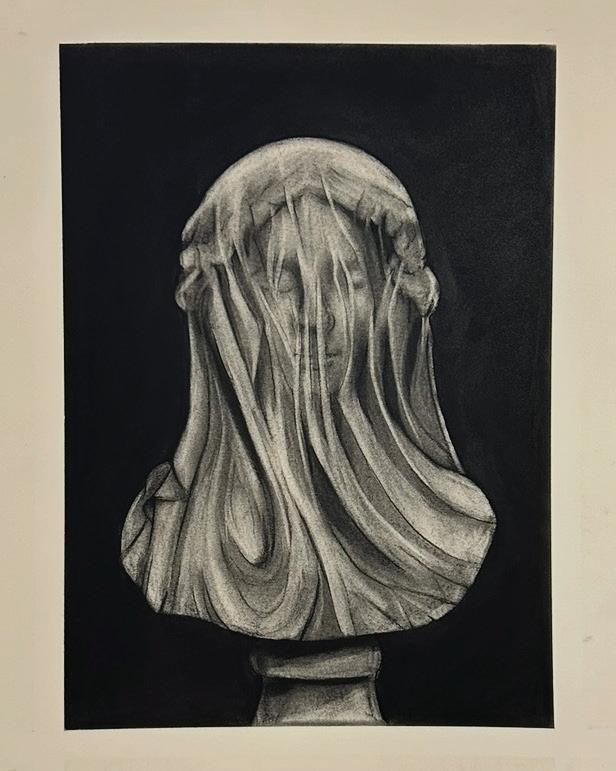
Charcoal of the Veiled Virgin
Alexandra Joyce, Charcoal, (18”x24”)
Loomings 36
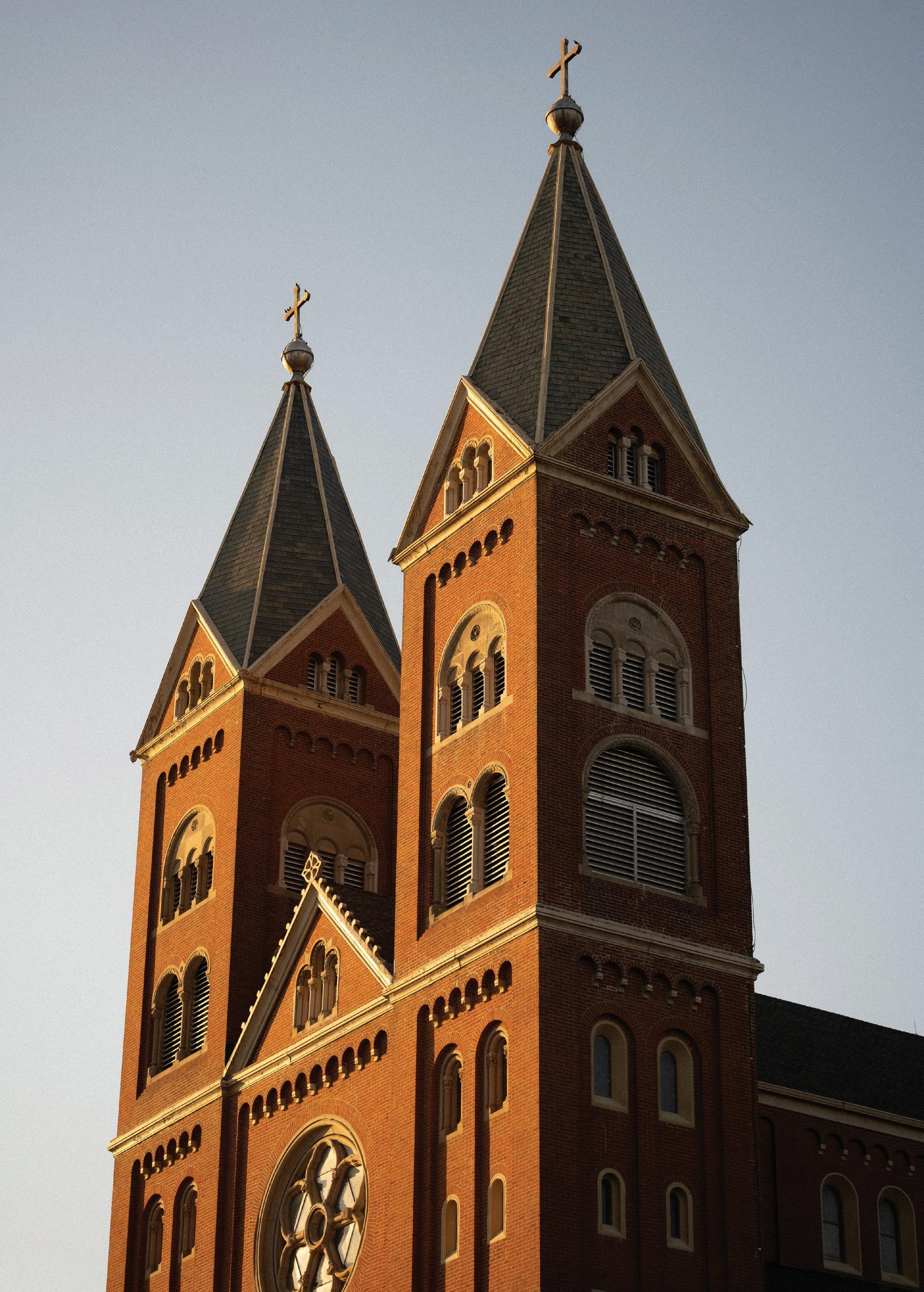
St. Ben’s
Ashley Brockmann, Digital Photography
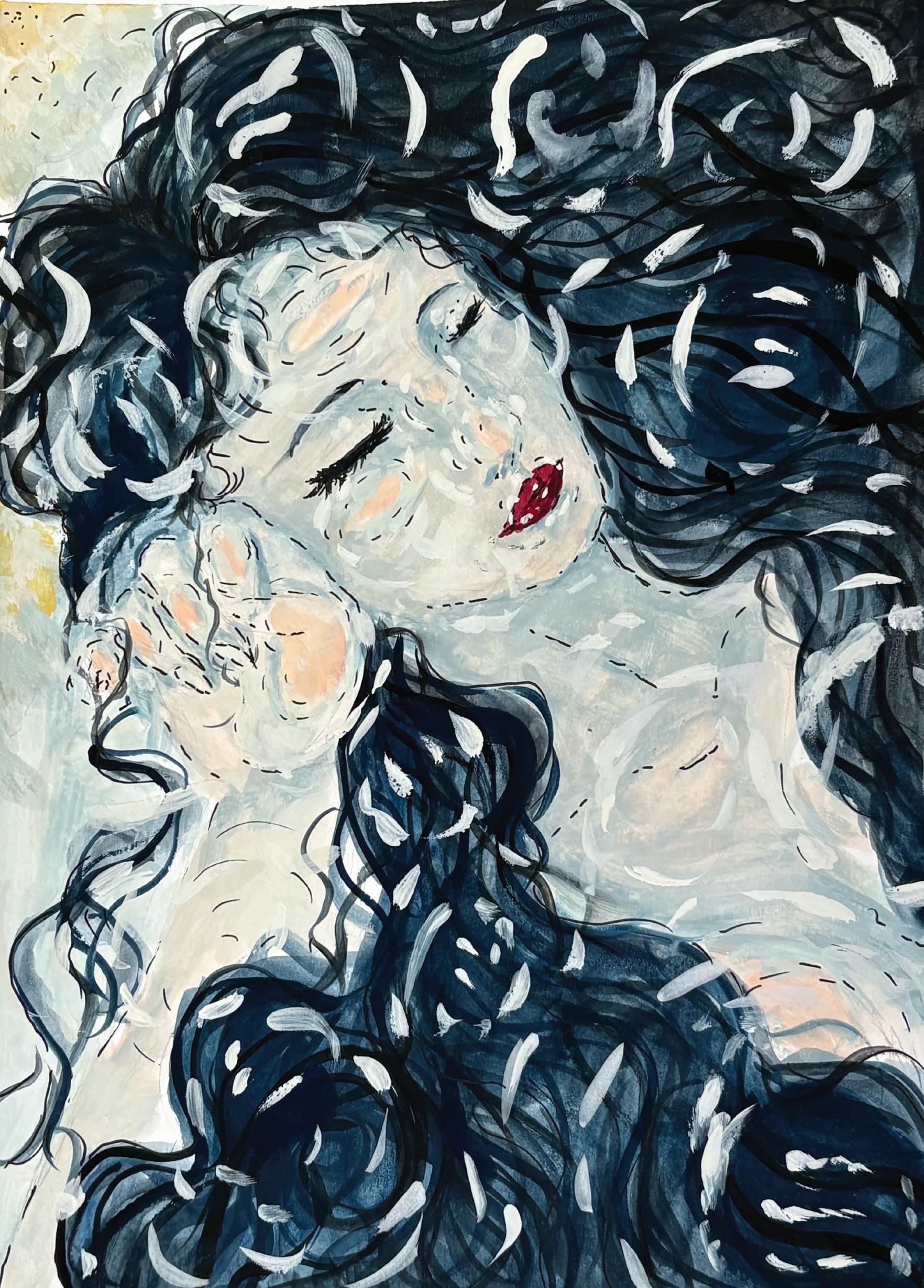
Washing Away
Loomings 37
Charlotte Kennedy, Gouache on Plant-Based Vellum, (9”x12”)
Airports
By: Allison Simpson
Where people share their hearts with strangers at a sports bar
A man who’s traveling to see his dying father
A student finally returning home from grad school
A conversation with a woman about a delayed flight
Teary goodbyes and joy-filled greetings
There’s something special about this place
Humans being humans
Each traveler with a story we’ll never know
Unless we turn and say hello
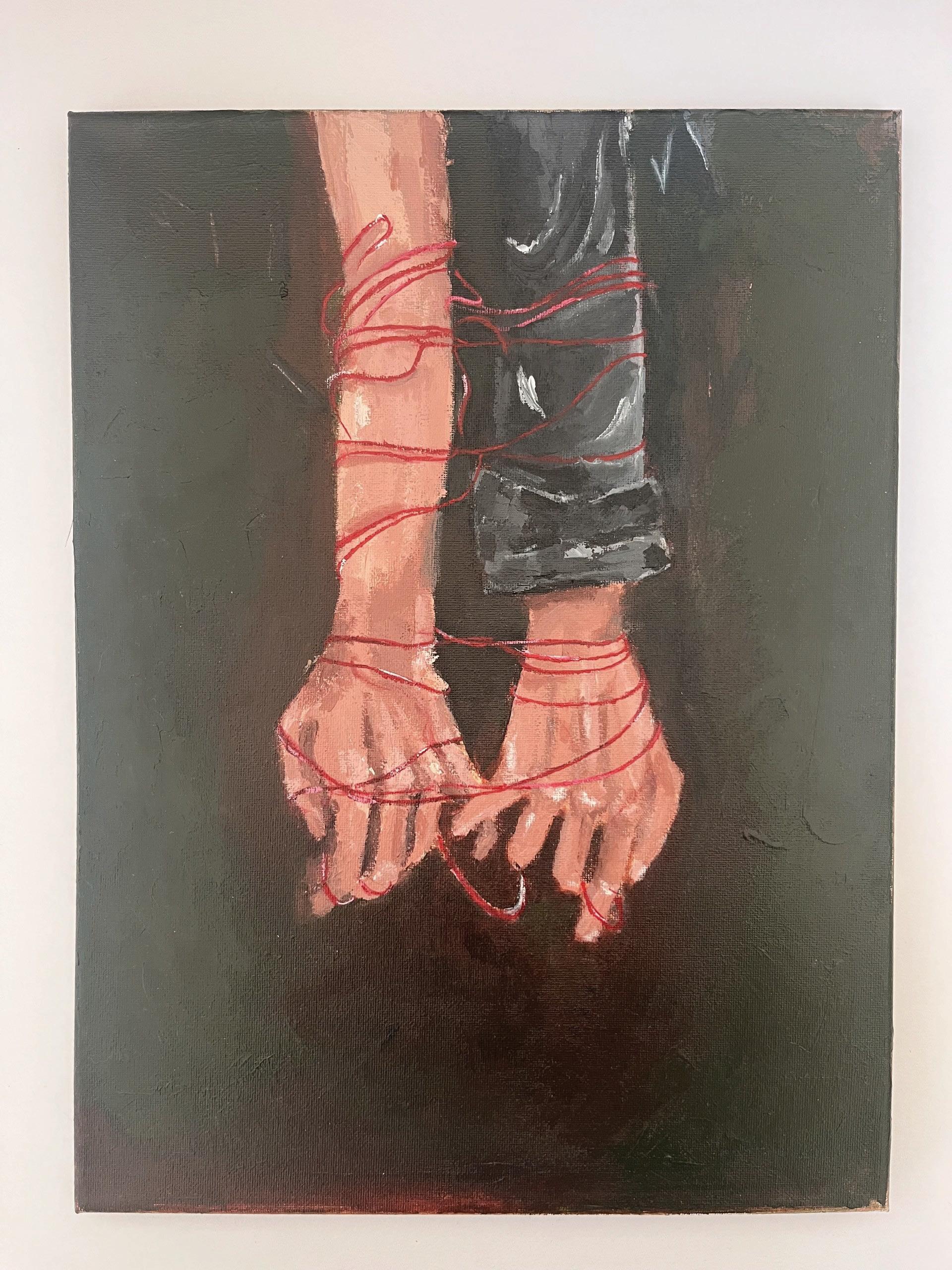
Intertwined
Loomings 39
Franny Burns, Acrylic, (9”x12”)
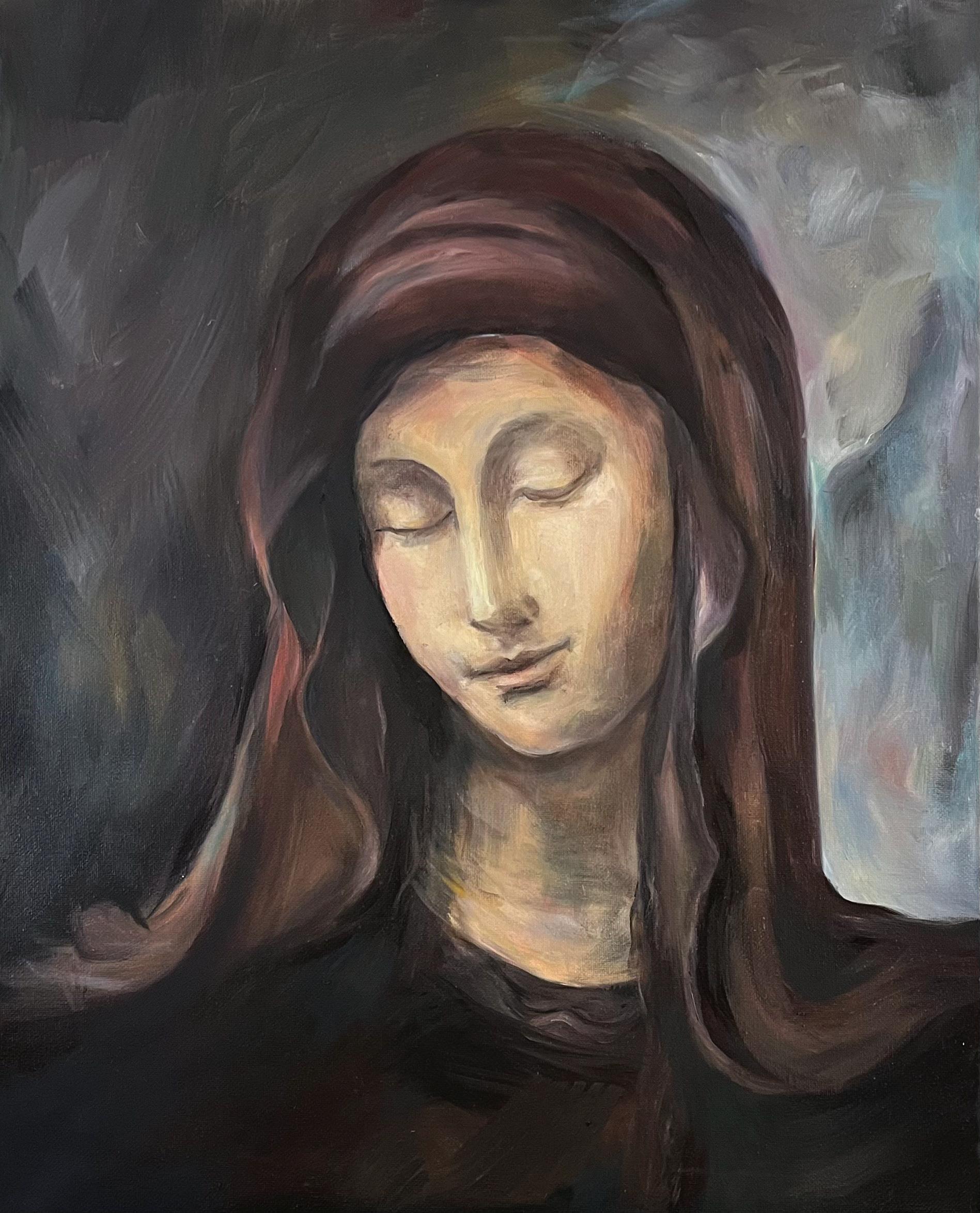
Our Lady
40
Loomings
Ellen Menke, Oil Painting, (16”x20”)
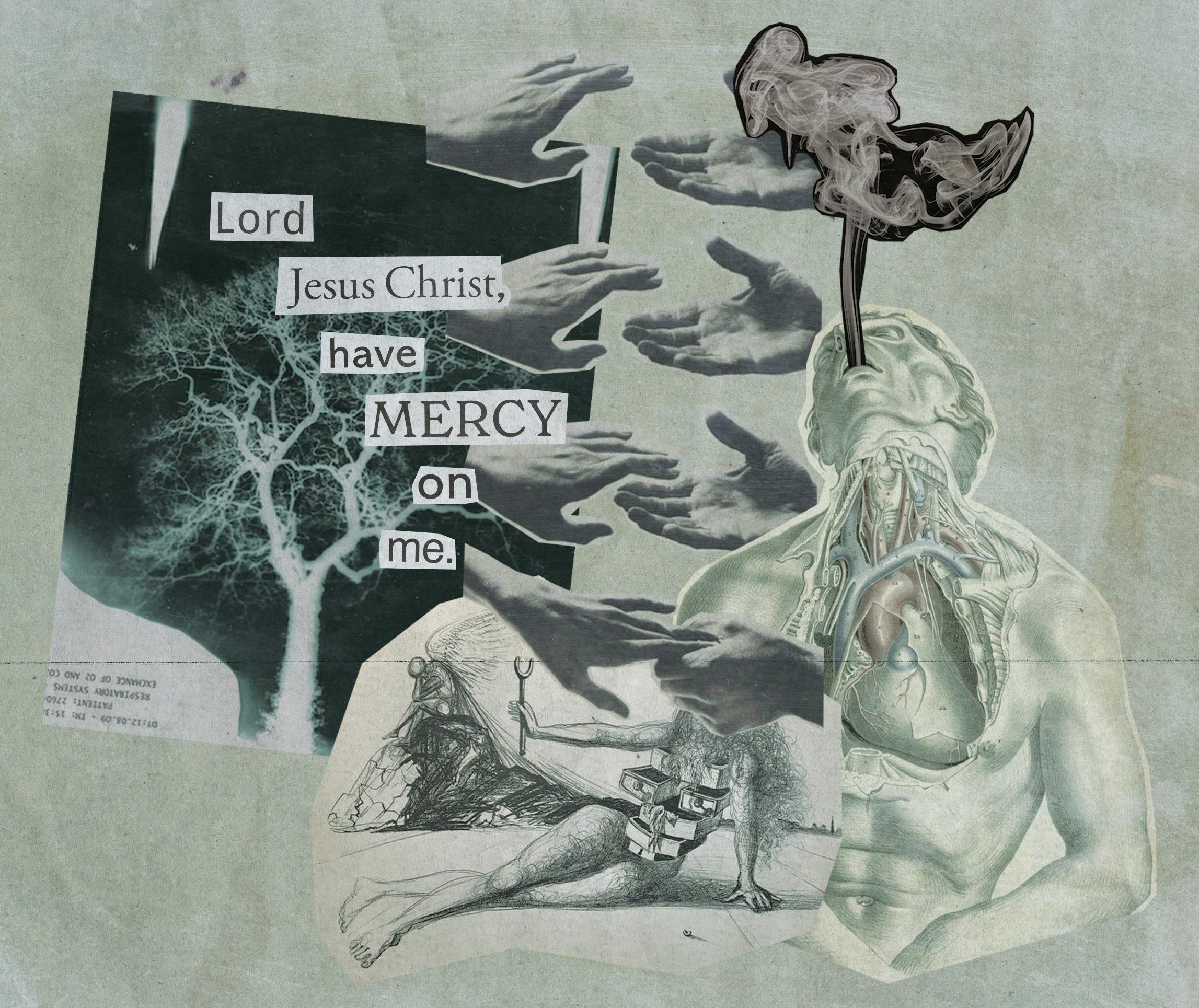
The Jesus Prayer
Blake Habersetzer, Digital Collage, (5”x4.25” )
Loomings 42
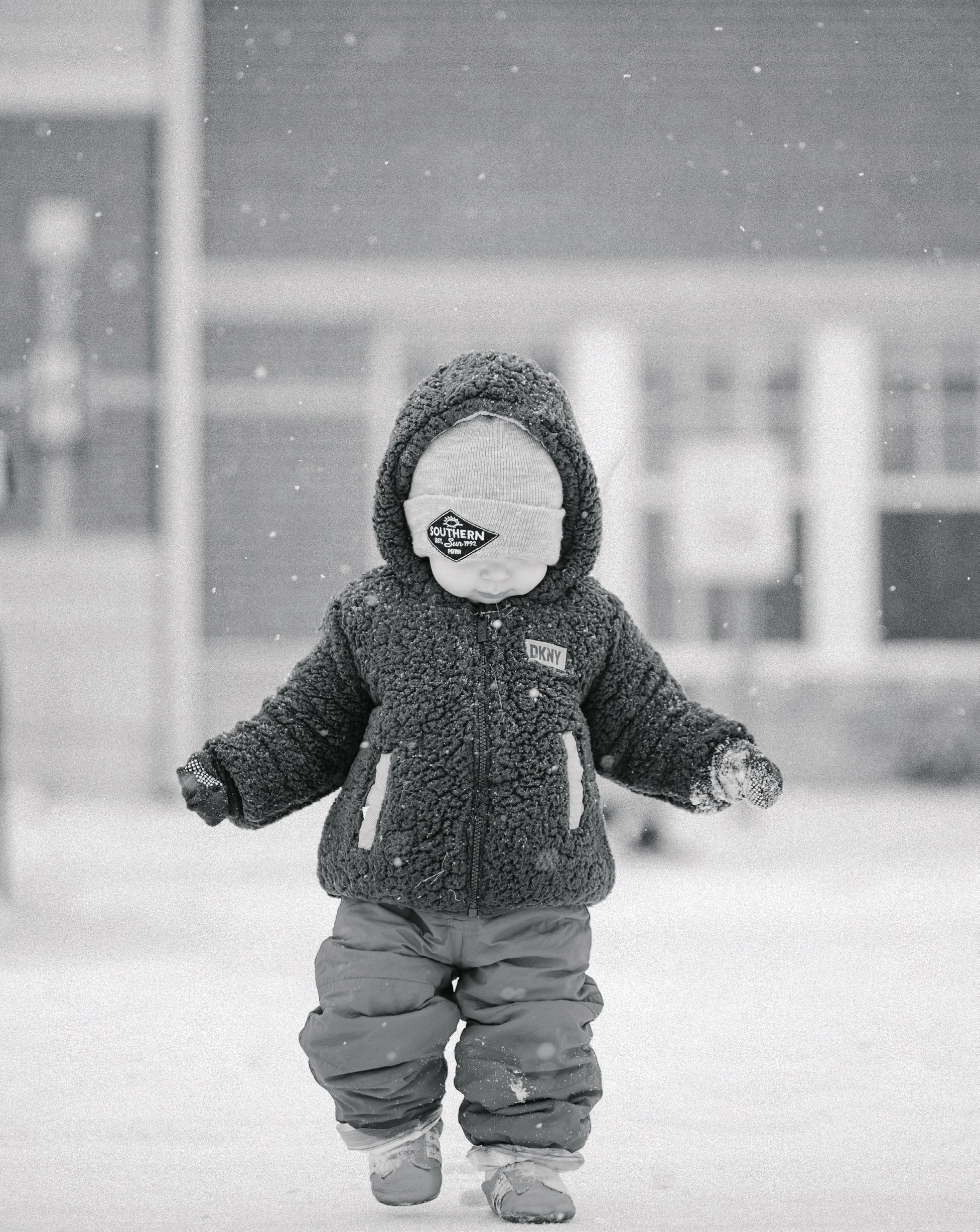
Bundled Wanderer
Luke Morel, Digital Photography
anyone
By: Liana Green
anyone could live there at the end of the street the little white house neat, but alone who knows who lives there? the grass unkempt or maybe a perfect garden stares down the lane no one looking back
but anyone could live there a life of light and dark the hero of an untold story waiting to be seen hoping to be heard but nothing comes no one sees maybe that’s my fault maybe that’s yours
so anyone could live there and maybe that’s you or maybe that’s me but it still sits alone nothing to see to most, anyway. but that doesn’t mean nobody lives there
anyone could live there and maybe it’s alone maybe it’s unseen only because we let it be
The Tiller on the Field
By: Kateri Tawney
An old man stood in a field, plowing. The harsh sun beat on the nape of his neck. Sweat dripped from underneath his battered straw hat, watering the ground. The tool in his hand dug into the furrowed earth again and again.
Scritch. Scritch. Scritch. His heart beat in rhythm with it.
Thump. Thump. Thump. Scritch. Scritch. Scritch. His arched back ached but did not give out. His feet plodded forward, on and on, the path they had trod for many years.
After the plowing would come the seeding. A handful of seeds dropped carefully here, then there, row after row after row. His hands, wrinkled and weathered with age, would take the earth and push it gently over the seeds, like tucking a soft blanket around the body of a sleeping infant.
Then the rains would come. Dark clouds would roll across the endless plains, blot out the sun, and pour forth their bounty on the slumbering earth. Each year people worried, said the and was too dry, the season too hot. But the old man knew better. The rain always came.
And then he would wait, and watch. Watch his children shoot out in tiny green sprigs from the dark soil. Watch them stretch their leaves to the heavens, drink in the sun’s rays. He would till them, root out the weeds that tried to steal their food, and teach them to grow strong and tall.
And when they reached maturity, when the autumn chill signaled the extent of their days, he would reap the harvest they had left for him, a payment for his tender care. The ground would become cold and barren. The broken ends of stalks might remain for a while, but soon they too would be covered by the frost and snow. The old man would be alone for a season.
He would huddle by his fire, anxiously waiting for the day when the ice would melt and the earth reappear, soft and fertile. On that day he would put on his hat, fetch his hoe, and begin plowing he dirt again in the same straight lines as all the years before.
Scritch. Scritch. Scritch. One step after another.
The old man paused to wipe the sweat from his brow. Leaning on the hoe, he looked back at the perfect rows he had already finished. In the distance he could see a row of cars, bouncing along the country road, kicking up dust behind them. That would be the soldiers heading off to war, young men, eager to serve their nation.
They had asked him many times, why didn’t you serve, not in this war, of course, but the last one? His answer was always the same: Someone has to till the field.
His own son was fighting. He’d left before the harvest, before the stalks turned brown and brittle, while the weather was warm. The old man hoped he would return by the next harvest to enjoy the bounty that had grown in his absence. Or maybe it wouldn’t be until next year, or the year after. Regardless, the field
would be ploughed, sown, and tilled. The seasons would progress. The rain would still fall. And the old man would continue to watch the road for the returning car. He took up his hoe again and returned to his work. Scritch. Scritch. Scritch.
His back continued to ache. One day it would give out. One day his hands would drop the hoe, shaking to much to finish the perfect rows. One day the steady beating of his heart —Thump. Thump. Thump–would cease to match the rhythm of the plowing.
A new sound of digging would arise, as his body would be laid to rest in the bosom of the earth. They would cover the dirt back over him gently, just as he had covered the seeds each year. The rain would fall, the grass would sprout above him. They would root out the weeds that covered him, coax flowers to grow strong and tall above him. He would become one with the earth he had tilled so faithfully tilled for many years. He too would join the harvest.
The winter snows would be his blanket in the chilly months. But always spring would follow.
Then, new hands would take up the hoe, put on a fresh straw hat. Strong, sturdy boots would make their way across the field in the same straight rows, back arched, sun beating down. Scritch. Scritch. Scritch.
The hoe would dig into the soil, again and again, like it always had for years and years, matching the rhythm of his heart.
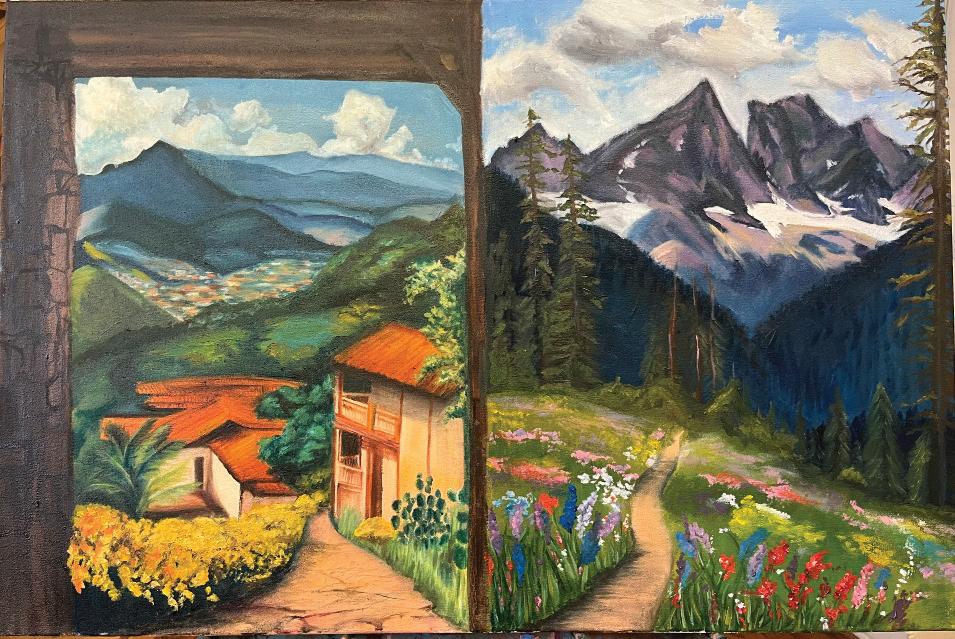
Sown in Two Lands
Anya Valladares, Oil Paint on Canvas, (12”x36”)
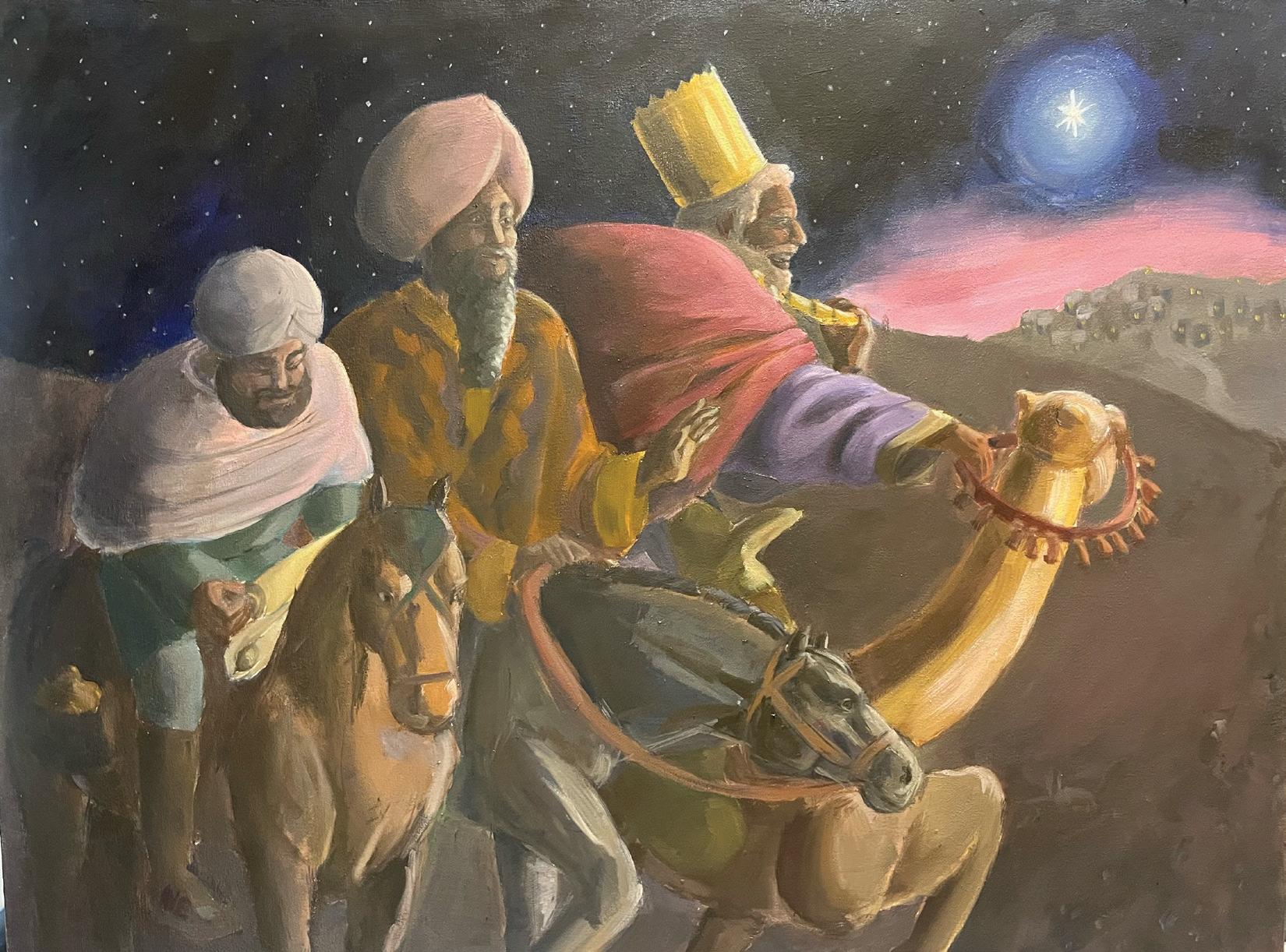
The Three Magi
Ave Wolf, Oil Paint on Canvas, (3’x4’)
Tapestries
By: Catherine Halbmaier
My grandmother did not wear braids on her wedding day.
Well, maybe she did. She might have woken up with one or two plaits in her hair, only to undo them and pin chestnut curls into a sensible bun. I will never know. In the photo on my aunt’s bookshelf, her hair is up, or perhaps already clipped to the length of her chin. Everything is black and white, so I can’t tell. A transparent veil smothers her neck and shoulders. She looks into the camera, and so does my grandpa. They stand next to each other, arms to their sides, as if the ornate church candlesticks in the background would disapprove of affectionate displays.
Before he met Grandma, my grandpa saw his share of adventure. He would tell me about naval tours in Asia and boyhood mishaps in endless loops while we sat by the big window in my parents’ house. I could ask a simple question and somehow be regaled for hours about his fascinating former life. At the ripe age of eight, I was convinced that I was behind. When would my life become interesting? From the trenches of elementary school, it felt like my storytelling days would never come.
He only told me this story once, but my mind soaked it up like a sponge takes in dishwater. Grandpa was third-wheeling that night. His sister and some guy dragged him along. He was probably bored, having just returned from the navy. I imagine couples in suits and fluffy skirts danced to something classy. Maybe there was food, or maybe the tables just served as safe havens for the introverts. That was both of them, Grandpa rolling his eyes at his sister and her guy, and
Grandma, alone. Friends might have dragged her there and left her to flounder. Whoever she came with must have twirled in that crowd, and she watched them. It was Grandpa’s sister who told him to ask that lonely girl for a dance. Then they only danced with each other.
“She was the only girl I ever went with.”
She probably wasn’t wearing braids at that dance. Maybe a singular braid. I will never know.
As a farm girl in Minnesota, she wore them every day.
Grandma never told me stories. What I know of her “before”, I learned in bite-sized remarks, brought about by something that triggered a memory. She would see me in my school uniform, hair braided into two pigtails by her daughterin-law, and gasp that she always wore her hair just like that. On the farm with her sister, they would run and play and perform chores I could hardly conceptualize, every day with those braided pigtails. There was the farm, and then there was boarding school. Her parents sent her away to be formed by the nuns. Formed into what, I’m not sure. At one point, she was nearly folded into their ranks. I think she would have liked that. She probably thinks so, too.
But then my grandpa asked her to dance.
“We only ever went with each other.”
Grandpa told me that part.
She did not wear braids on her wedding day. She has never worn them in my memory. Her hair has always been elegantly cropped since I have known her. It was too much work to keep long hair, she said. Too much work when moving to the Middle of Nowhere, Idaho. Too much work when her work was raising five kids in a tiny town with a schoolteacher for a husband. Too much work when nannying, selling homemade pies, cleaning schools and banks and churches, playing the organ every Sunday with hands worn thin.
When she folds those hands, does she think about the nuns and the boarding school?
She didn’t know that one dance would turn into decades of labor. No one warned her that children would lead to more than her fair share of trips to the hospital. She had stories in her head, I’m sure, too far in her wake to bother telling anybody about. She did not have to dance. But if she hadn’t, none of us would be here.
Her braids would not be here, either.
The nuns would have cut those off before handing her a veil. She did not get her grand spiritual adventure. It isn’t her fault that those hands are worn thin, or that she no longer cares to braid her own hair. But I still braid mine sometimes, and it makes her smile.
Or rather, her daughter-in-law braids it.
My mother, who lived such a different story, used to sit on the couch and weave my hair before I knew how. With her fingernails, painted burgundy for professional flair, she would wrap each dark strand tighter than I thought possible. That was how Mom did everything. Holding herself to the highest standard, moving countries and going back to school and work after having her babies, she only slowed down to give us golden younger years. Before us, before my dad, before coming to the USA, my mom would have worn braids to school, or perhaps to go biking. She did that often. Always disciplined, always pushing her limits in the classroom, the office, and beyond. Far from a farm girl, she went further from home than Grandma ever did.
As I recall the pull of her hands at my scalp, Grandma’s worn, gentle fingers join them in their dance. Hands, then hair, then hands again, three paths winding and weaving. Choices, made in different orders, unchangeable, threads in the inevitable tapestry of lineage.
Loomings 48
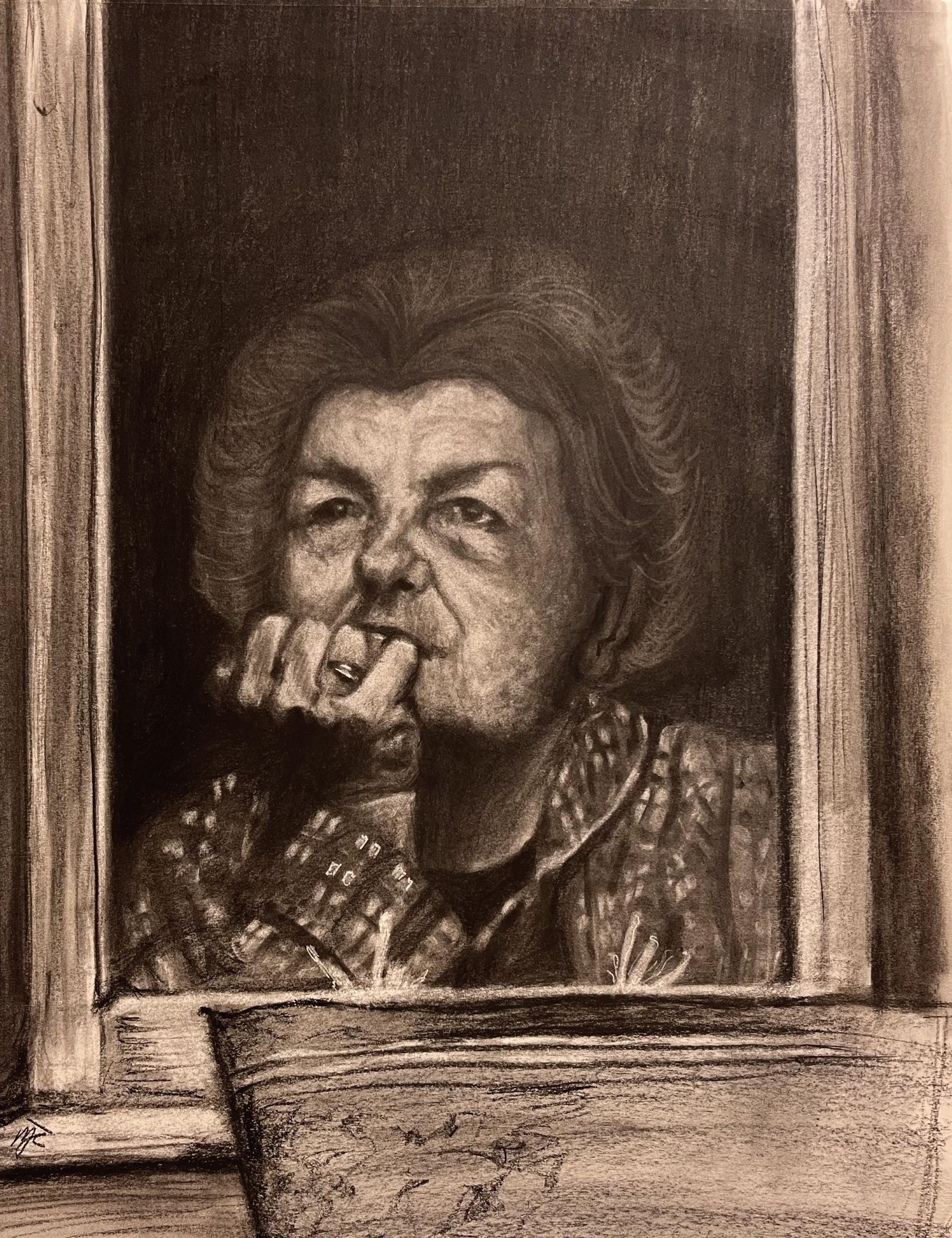
Katherine
Maleah Cummings, Compressed Charcoal, (20”x13”)
Sonnet for the Elderly
By: Gabriella Nyguen
What hair that’s left is only brittle wisps
Their lolling necks, collapsed in hunchbacks, strain
To speak through trembling, chapped, and flaking lisps
If only you would listen to their pain
The luster of their eyes has worn away—
They stare with rheumy whites all seamed with red
To ask for prayers they’ve lost the heart to pray
And whisper of beloved friends long-dead
So many wrinkles crease each spotted face
Like stories written into silken skin:
Nine decades’ passion, and nine decade’s grace
Their warbling words unfold, to wrap me in
The silvered people, not those young and clean
I name most beautiful that I have seen.

Steady Hand
Loomings
Nathanael Jones, Digital Photography
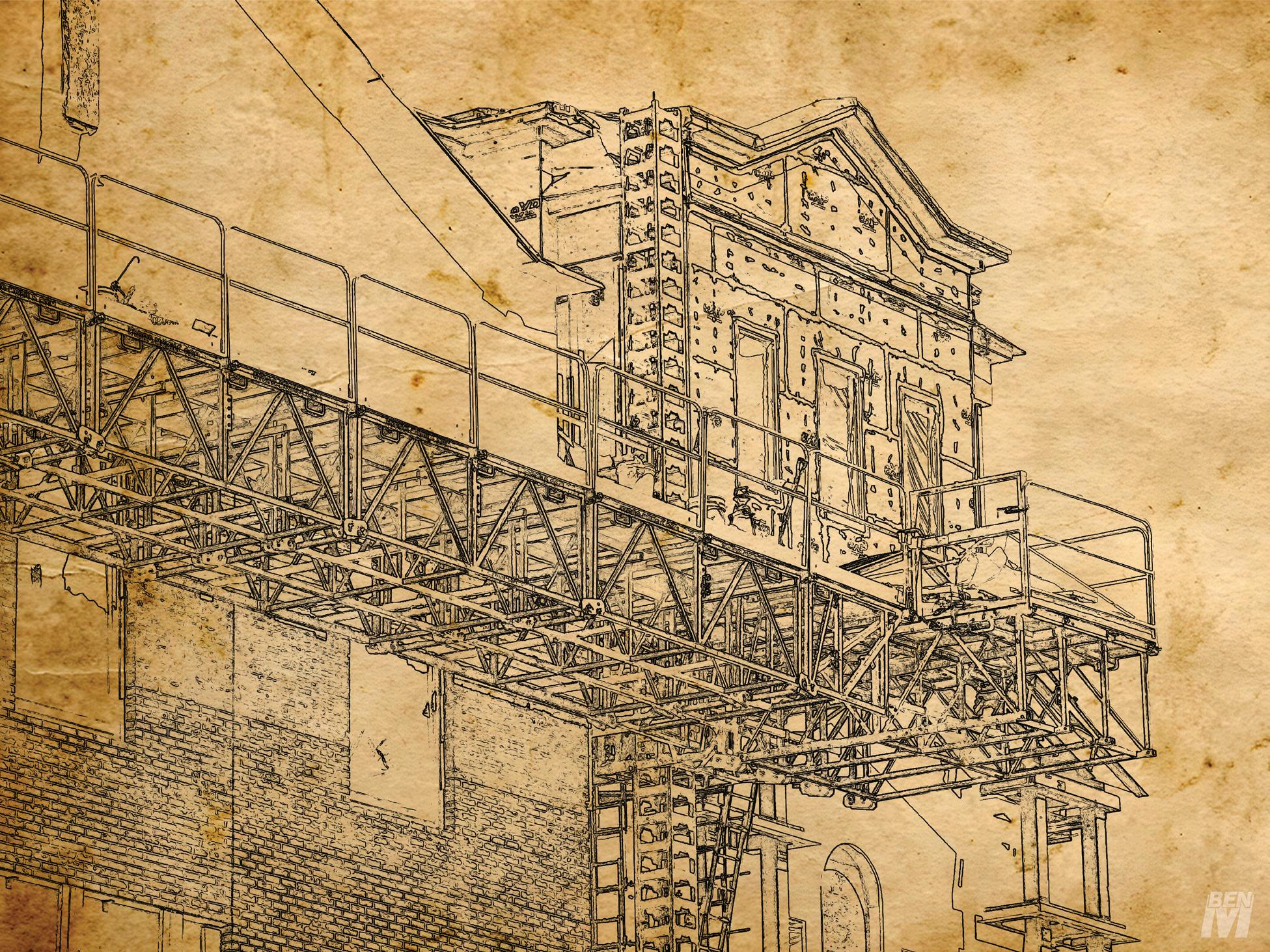
Trust the Process
Benjamin
L Mahoney, Digital Art, (4”x3”)
The editors would like to send their heartfelt thanks to everyone who put time, effort, and thought into this year’s edition of Loomings. The magazine would not have been possible without the help of so many people, especially Dr. Michael Stigman, Jay Wallace, Sue Leo, and Allison Merrick, who tirelessly aid the editorial team year after year. We are so grateful for your talent!
We are also eternally thankful to those who dedicated their time to reviewing submissions and serving our artists. Thank you to Gretchen Burch, Sr. Jennifer Halling, Dr. Francis Petruccelli, and Dr. Filiberto Mares Hernandez, for judging poetry; and to Dr. Jamie Blosser, Danielle Blosser, Sr. Judith Sutera, and Dr. Gail Blaustein for judging
prose. As well, thank you to our anonymous community partners who judged all art submissions. We could not have done it without you.
Thank you for encouraging our local artists and being willing to wonder at their creativity. And to everyone at Benedictine College who has taken the time to submit to Loomings, to read our magazine, or to admire classmates’ artwork, thank you. Thank you for allowing yourself to be captivated by everything from the ordinary to the extraordinary. Thank you for engaging with the idea of “Sonder.”
This is for you.
The
The
Nature’s
Howth,
Contentment
Beeyond
Charcoal
Washing
Intertwined
Sonder:
The profound feeling of realizing that each random passerby is living a life as vivid and complex as your own.
Each life is populated with unique ambitions, friends, routines, worries and inherited craziness, an epic story that continues invisibly around you like an anthill sprawling deep underground, with elaborate passageways to thousands of other lives that you’ll never know existed, in which you might appear only once, as an extra sipping coffee in the background, as a blur of traffic passing on the highway, as a lighted window at dusk.
For this publication cover, we embodied the meaning of the word sonder by illustrating its reality of the lives Benedictine students. This photo depicts the overlapping, yet often invisible traffic of students passing each other throughout their time here at Benedictine. Their lives are sometimes intertwined and vivid, sometimes vague or unnoticed, yet we are always a part of the lives of those around us.