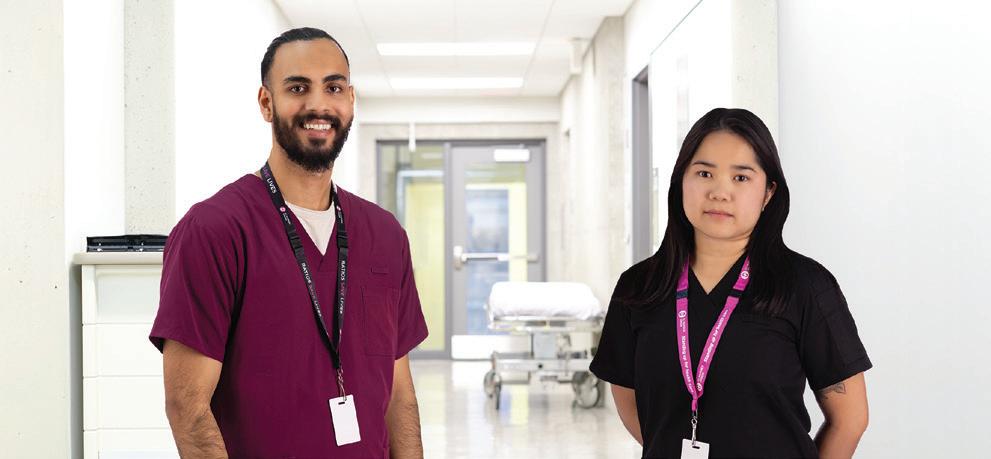
TWO TRUTHS
Cautious optimism emerges as minimum nurse-to-patient ratios roll out across BC


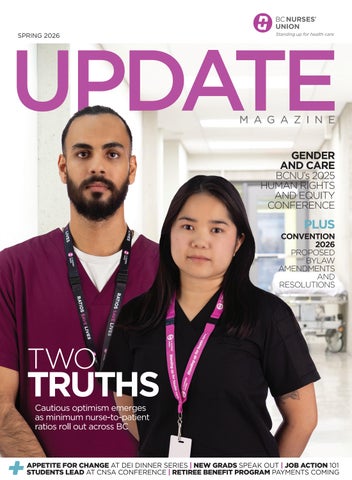
Cautious optimism emerges as minimum nurse-to-patient ratios roll out across BC

Mourn for the dead, fight for the living.
Let’s honour the memory of those who died from workplace injuries by recommitting to illness and injury prevention, worker advocacy, and safer workplaces for all. We all have a responsibility to contribute to a culture of safety through reporting workplace hazards, incidents and injuries.
Quality care depends on a safe and healthy working environment.
Learn more about BCNU’s advocacy for safer workplaces
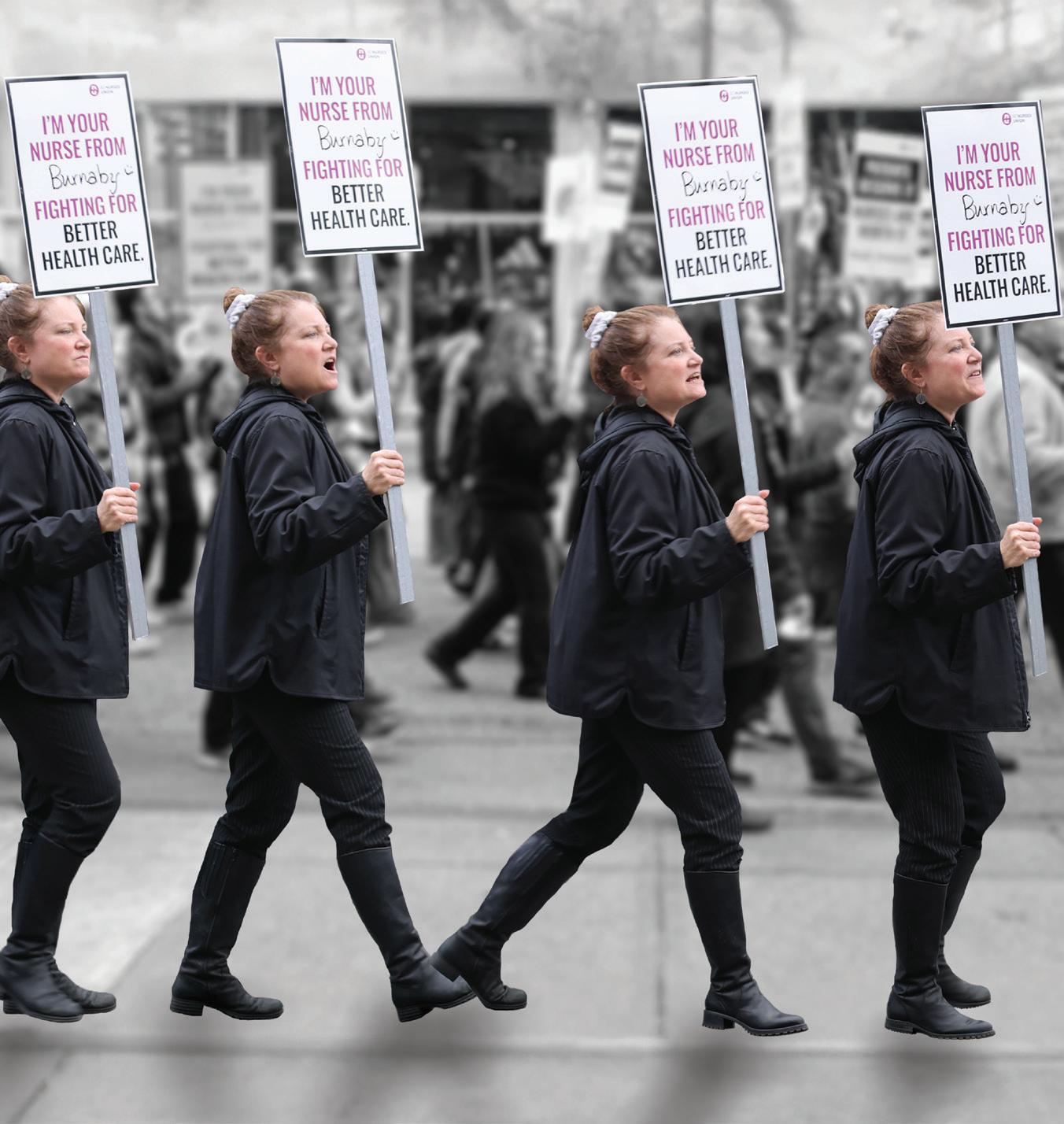


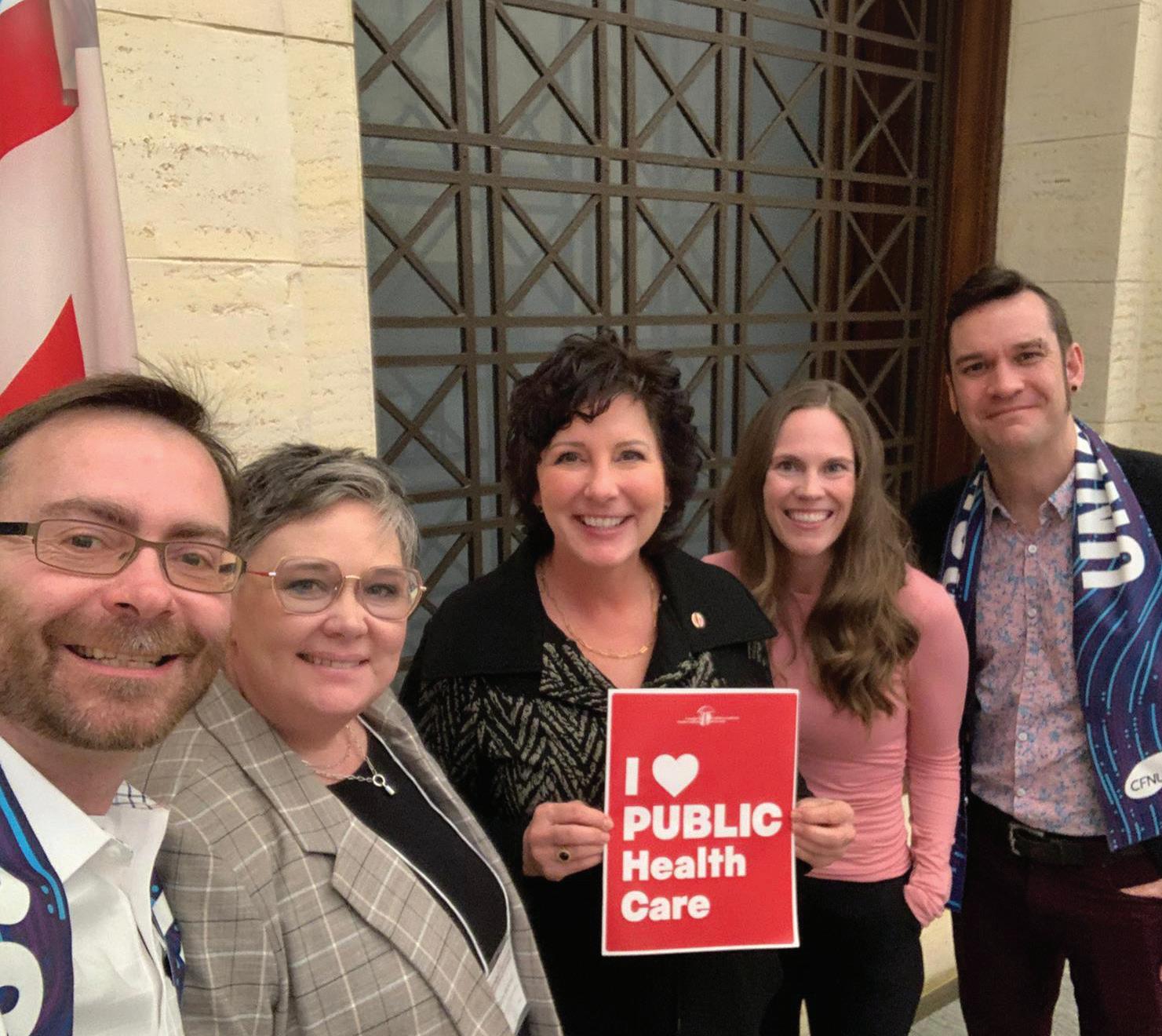
BCNU joins national allies in Ottawa to support public health care.
Learn
BCNU members’ frontline experience drives
Members confront genderbased violence at the 2025 Human Rights & Equity Conference.
BCNU leaders are asking members to be ready for job action.
BCNU conducts elections for its provincial executive committee and regional council members every three years. Successful candidates will take office Sept. 1, 2026.
Nominations open April 6–20*
Online voting takes place May 4–7*
* NBA contract negotiations may impact election dates.
Learn more about the nominations and voting process, including candidate responsibilities and job descriptions.
MISSION STATEMENT
The BC Nurses’ Union protects and advances the health, safety, social and economic wellbeing of our members, our profession and our communities.
BCNU UPDATE MAGAZINE is published by the BC Nurses’ Union, an independent Canadian union governed by a council elected by our 50,000 members. Signed articles do not necessarily represent official BCNU policies.
EDITOR
Eva Prkachin
CONTRIBUTORS
Jaelyn Bartnik, Juliet Chang, Tina Cheung, Laura Comuzzi, Neil Fisher, Joel French, Adriane Gear, Jim Gould, Lexi Huffman, Kent Hurl, Kath Kitts, Shawn Leclair, Lew MacDonald, Linsay Manning, Courtney McGillion, Conley Mosterd, Shannon O’Toole, Caroline Smith, Christa Tran
PHOTOS
Neil Fisher, Blair Gable, Kent Hurl, John Major, Lew MacDonald, Conley Mosterd, Eva Prkachin, Anthony Redpath, Ryan Criztoff Tandiama, John Yanyshyn
CONTACT US
BCNU Communications Department 4060 Regent Street Burnaby, BC, V5C 6P5
PHONE 604-433-2268
TOLL FREE 1-800-663-9991
BCNU WEBSITE www.bcnu.org
EMAIL EDITOR evaprkachin@bcnu.org
MOVING?
Please send change of address to membership@bcnu.org
Publications Mail Agreement 40834030
BCNU respectfully acknowledges its offices are located on the traditional, unceded and ancestral lands of Indigenous communities across the lands now known as British Columbia. Update Magazine is produced at the BCNU head office in Burnaby, which is located on the traditional, ancestral and unceded territories of the xwmə kwəýəm (Musqueam), Skwxwú7mesh (Squamish) and səĺilẃəta (Tsleil Waututh) nations whose historical relationships to the land continue to this day.

AS WE ENTER A PIVOTAL year for nursing in BC, I want to reflect on our accomplishments and the challenges that lie ahead.
Every day, nurses rise to meet the demands of a health-care system under immense pressure – through it all, our strength has come from working together.
Bargaining with the Nurses’ Bargaining Association remains our top priority. These negotiations are unfolding amid economic uncertainty and broad geopolitical pressures on public sector bargaining. While these external pressures create real challenges, our focus has not wavered. We are fighting for safe and sustainable working conditions for nurses and accountability from government and health employers. This includes protecting the benefits that nurses have earned. Our goal is clear: a collective agreement that supports nurses and strengthens public health care.
Alongside bargaining, we continue to push for the full implementation of minimum nurseto-patient ratios. Ratios are not just numbers – they are the foundation of safe staffing, better patient care and a workplace where nurses can practise with professionalism and pride.
Over the past year, I have had the privilege of speaking with nurses at their worksites about their working conditions, their bargaining priorities and how ratios are rolling out. I’ve heard encouraging stories from units where ratios are now in place, and conditions are beginning to improve. Those conversations matter, and they continue to guide our advocacy.
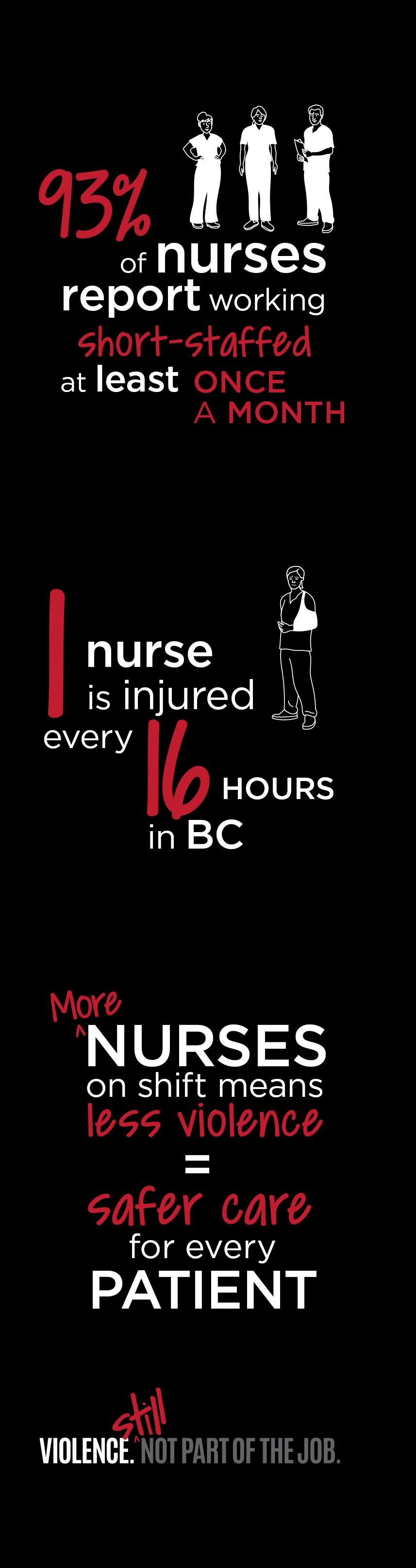
Workplace violence remains a critical issue. That is why we’ve renewed our Violence. Still Not Part of the Job campaign. Nurses should never face threats, intimidation or abuse while doing their jobs – yet far too many do. Through new videos and member stories, we are shining a light on the challenges nurses face – and the courage and dedication that define nursing.
Looking ahead, this spring brings important
opportunities to connect and lead. The BCNU Practice Conference in March will foster learning and professional growth, while our annual Convention will celebrate our solidarity and chart the course for the year ahead. This year’s theme – Together We Rise – is a call to action. It reminds us that the challenges we face, from staffing pressures to workplace violence, are best met when we remain united.
As we look ahead, we must prepare for the possibility of job action. Being ready, informed and united is the foundation of our demand for a collective agreement that ensures our benefits, improves our working conditions and values us for what we bring to the health-care system.
In May, members will take part in BCNU’s general election for senior leadership, an opportunity to shape the union’s direction and ensure that our leadership reflects the voices, needs and priorities of members.
Finally, I want to acknowledge that we are a collective profession, made up of nurses from all walks of life. Nurses come from every corner of the world, and many have family, friends and colleagues who are directly impacted by the distressing and often devastating events unfolding around us. When violence touches our profession – whether it’s unsafe working conditions in health-care settings in BC, the fatal shooting of ICU nurse Alex Pretti in Minnesota or the tragic loss of life in Tumbler Ridge, it affects us deeply. In moments like these, we must support one another so that we can continue to provide safe, compassionate care to the patients and communities who rely on us.
By lifting each other up, sharing our voices and taking action when it matters most, we will continue to build a stronger, safer and more sustainable health-care system. Together, we rise.
In solidarity,


JIM GOULD
YOUR BCNU team has hit the ground running in 2026. Across our union people are stepping up, aligned and working as hard as possible for nurses. But they have an immense task ahead – one that requires total commitment to fighting for members.
At the Nurses’ Bargaining Association (NBA) table, the
employer has taken an aggressive approach to members’ hard-earned health-care benefits. Rather than negotiating, they are attempting to litigate through arbitration. We are responding firmly and strategically, using every tool available to protect what members have earned.
That response depends on the members who participated in our bargaining and benefits surveys. Your engagement strengthens our position and sends a clear message: nurses are paying attention and prepared to act together.
At the same time, the organization behind the bargaining table is mobilizing.
Staff across departments are preparing for all potential bargaining outcomes. Strike readiness planning, logistics coordination, data systems and internal training are well underway to ensure we can
act quickly and effectively if job action becomes necessary. Preparation at this scale takes discipline and coordination, and I am thrilled at the dedication our teams are demonstrating.
You can read more about BCNU’s job action preparations on p. 40.

That readiness matters. In times of uncertainty, institutions either drift or they build. We are building.
Work continues on a redesigned website, an enhanced member portal and a brandnew app to better leverage digital tools. Our holiday ad reached hundreds of thousands of British Columbians and generated overwhelmingly positive feedback. Postcampaign research shows it increased public support for nurses – providing critical leverage in case of job action.
At a time when rights cannot be taken for granted – at home or beyond our borders – BCNU is more engaged than ever with governments, with labour allies and with our own members. We are growing more capable, more connected and more powerful.
I am immensely proud of our team – and of our members. This is your union, and it is an honour to work for you every day. The fight is on, and together, we are rising to meet it. •
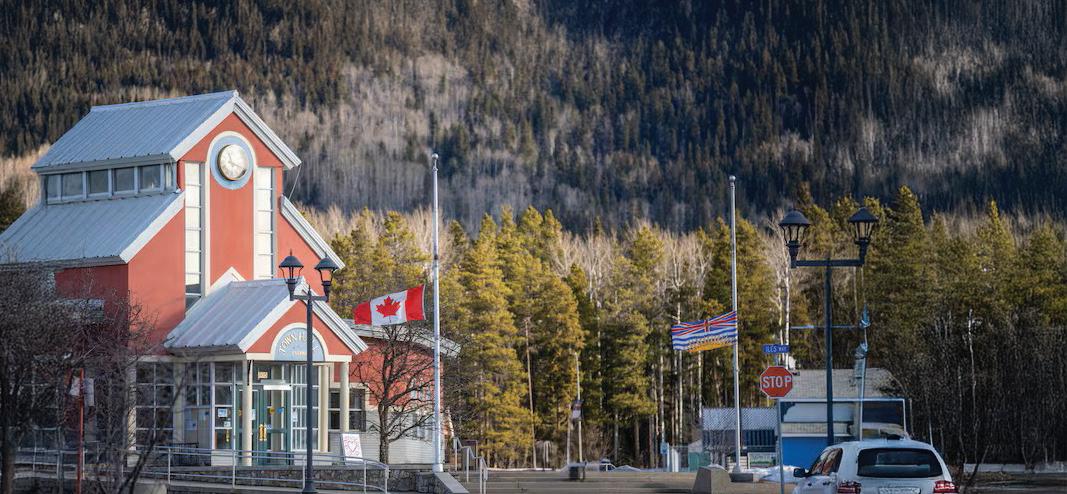
BC’s nurses express our deepest condolences and solidarity to the Tumbler Ridge community. No one should ever experience violence or feel unsafe in their school or workplace. To the first responders and health-care workers responding in the aftermath of this tragedy – we are with you. As a union, we remain committed to fighting every day for stronger, more accessible mental health services and supports in every corner of BC.
LAURA MARTIN (SHE/ her) is the definition of a change-maker. A nurse for 16 years and a full-time steward, she’s guided by the belief that change doesn’t happen from the top down, but from the inside out.
That belief came into focus when nurses at her worksite began raising concerns about being misgendered and feeling unsafe. Although existing Nurses’ Bargaining Association contract language already requires facilities to have gender-inclusive signage in washrooms and changerooms, Martin noticed that implementation was inconsistent.
Rather than waiting for the issue to be addressed elsewhere, she conducted an audit of the hospital herself – finding that more than 40 percent of single-use staff washrooms lacked correct signage.
“It was less about a sticker or sign on a door,” she says. “It was about effort and accountability in building safer spaces.”
Martin escalated the issue to Island Health’s director of diversity, equity and inclusion, as well as the worksite Joint Occupational Health and Safety and Union/Management committees. She also spoke with the occupational health and housekeeping departments to help move the work forward. Instead of just
She’s also looking ahead, advocating for embedding diversity, equity and inclusion language into the employer’s annual nursing competency requirements and worksite inspections. • BCNU ACTIVIST PROFILE
identifying the problem, she offered to help implement the solution – coordinating signage distribution, supporting education efforts and ensuring accountability.
“Our staff should be able to come to work and feel safe and included,” she says.
Now that the washrooms are being updated, Martin is focused on ensuring the employer maintains the changes.

What is one word you would use to describe yourself?
Adaptable.
How did you decide to become a nurse?
I’ve always wanted to help – fixing equipment, inviting people over at Christmas, rescuing animals. Nursing felt like a natural calling. I started volunteering with Island Health before going back to school.
What do you do in your spare time?
Pilates, glamping and learning Spanish. I also volunteer with isolated seniors and unhoused people. Recently, I started sewing small lavender-filled pillows that I call “sanity sacks” for co-workers to help with rest and stress.
What advice would you give to someone just starting out in nursing?
Be patient and kind to yourself. It takes one to two years to feel steady. Find an experienced nurse you trust and talk things through.
What is one thing about you that people would be surprised to learn?
I worked in finance for 16 years before nursing.
What was the last good thing you read?
When the Body Says No: The Cost of Hidden Stress by Gabor Maté. I usually avoid health-care related books, but I couldn’t put this down.
What was the best piece of career advice you’ve received?
If you do nothing, nothing will change.
What do you like most about being a nurse?
The ability to make a difference in a patient’s day, even briefly, during a difficult moment. It’s a privilege.
What do you like least about being a nurse?
Bureaucracy – payroll issues, parking and systems that get in the way of patient care.
Name one change you would like to make to the health-care system. A stronger focus on prevention instead of reaction. Education is key.
BCNU ad builds public awareness during the holiday season
From December through early January, BCNU ran a province-wide holiday advertising campaign highlighting that while many people slow down during the holiday season, nurses continue caring for patients when their community needs them most.
The Holidays Look Different for Nurses emphasized that the holiday season
brings increased demands for nurses, with seasonal illnesses and holiday-related accidents adding pressure to an already strained health-care system.
The campaign included 60- and 30-second television ads airing across BC, along with pre-show advertising in movie theatres. The ad also appeared on billboards and transit shelters, reaching people as
they travelled and gathered throughout the season. On social media, posts reinforced the message by sharing statistics related to seasonal accidents and holiday-related illnesses.
A companion radio tribute, An Ode to Nurses, aired during the same period, thanking nurses for their dedication and commitment over the holidays, often while missing time with family and loved ones.
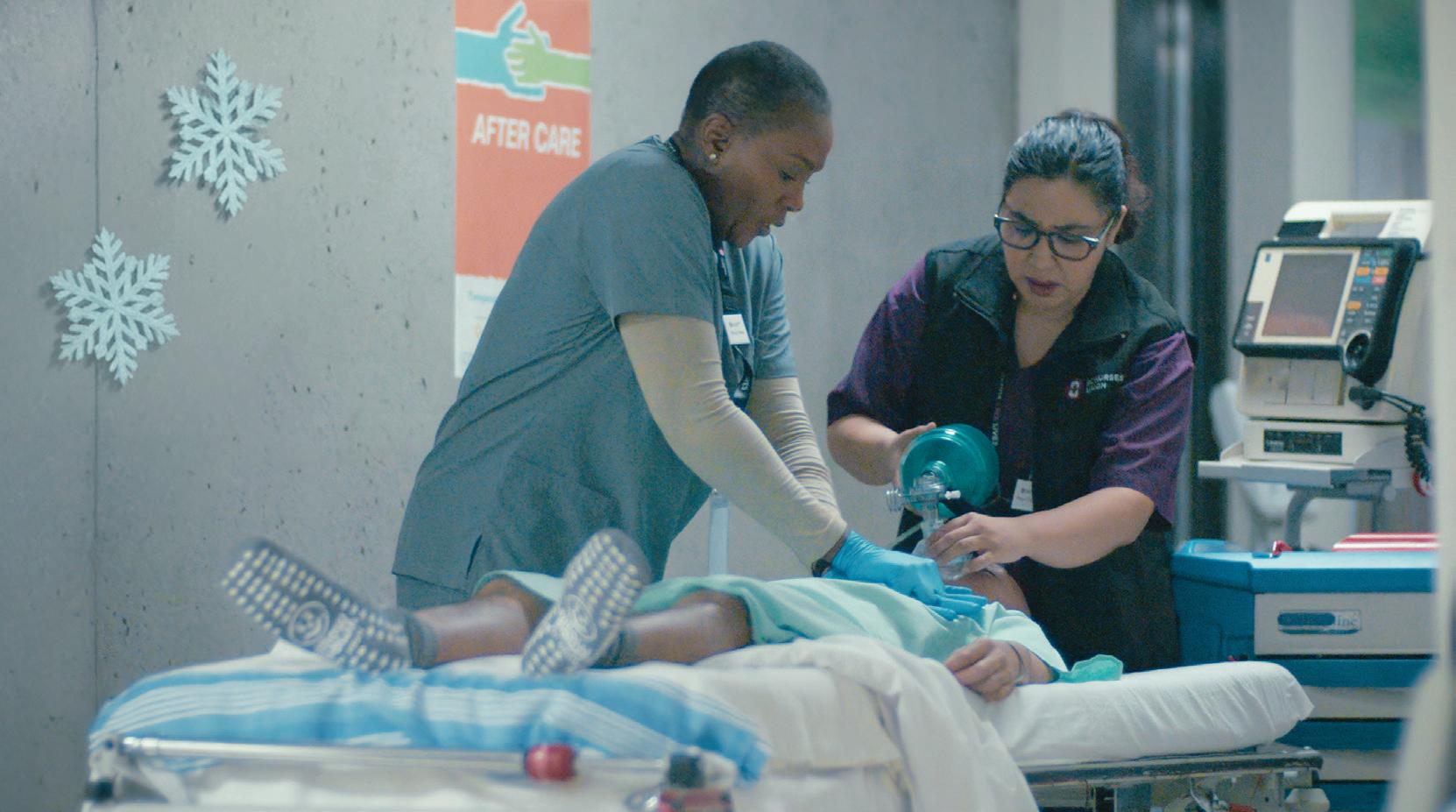
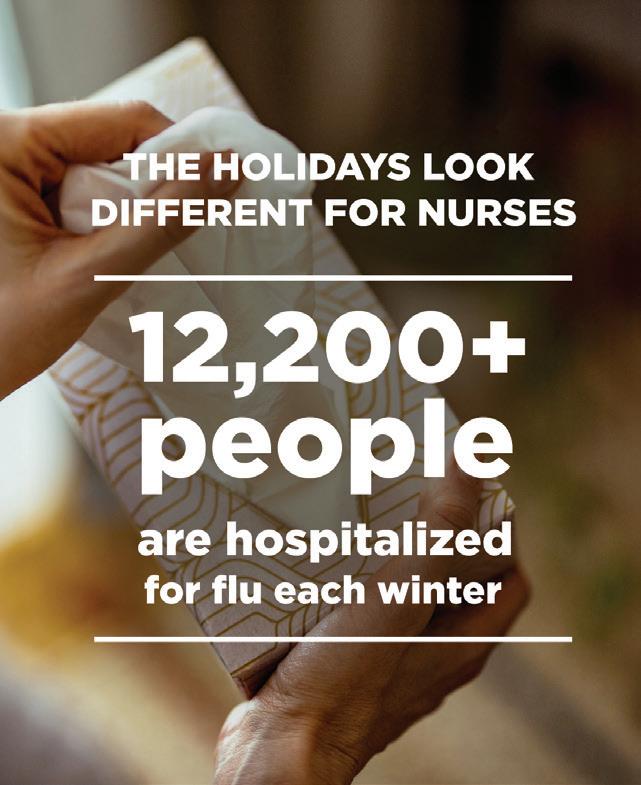
Together, the campaign ads aimed to build public awareness and appreciation for nurses’ work, reinforcing the vital role they play in communities across the province. According to preliminary data from market research company Leger, people who saw the ads were 14 percent more likely to say they respect nurses and 21 percent more likely to say they would support nurses’ job action to fight for better working conditions. •
The ads are available to view at bcnu.org.
In November 2022, the BC government passed the Health Professions and Occupations Act (HPOA), which will replace the Health Professions Act as the legislation governing health professionals and regulatory colleges. The new law will come into effect on April 1, 2026.
The legislation aims to strengthen public protection and safety in the healthcare system. Among its provisions is the creation of an independent disciplinary hearing process that provides support workers and services for health-care professionals navigating the disciplinary system. These changes are accompanied by a new public registry of disciplinary actions and summary protection orders issued against licensees.
The HPOA also seeks to address discrimination and Indigenous-specific racism in the health-care system. One way it does that is by requiring regulatory colleges to offer Indigenous support workers for Indigenous people going through the disciplinary process.
To prepare for the new legislation, the BC College of Nurses and Midwives
(BCCNM) is redrafting its bylaws, which guide and direct nurses’ practice. Some changes are required under the HPOA, while others are being developed by the college within the regulatory authority the Act provides. That work included a public consultation process involving BCNU members, which has now closed for input. •
BCNU continues to learn about the changes the HPOA will bring and the potential impacts on members. As new information becomes available, members can learn more in future issues of Update Magazine and on the BCCNM website.
Find out more about the Health Professions and Occupations Act (HPOA)

THIS YEAR, BCNU recognized International Repetitive Strain Injury (RSI) Awareness Day on Feb. 28. Musculoskeletal injuries continue to be the most common – and preventable – work-related injuries affecting nurses and other health-care workers around the globe. Annually, RSI Awareness Day serves as an important reminder that work should not cause pain, injury or long-term harm, and that prevention and early recognition of RSIs can protect both workers’ health and their careers.
static positions are key contributors to these injuries.
Stay updated on the redrafting of BCCNM’s bylaws
Repetitive strain injuries often develop gradually and become harder to treat the longer symptoms go unrecognized or unreported. Tasks such as patient handling and positioning, mass immunizations, medication preparation, data entry and prolonged computer use place repeated strain on the body, increasing the risk of musculoskeletal injury over time. Awkward postures, repetitive movements, forceful exertion and prolonged
BCNU supported a threeweek, multi-channel awareness campaign throughout February, providing education and practical tools that members could apply immediately at work. The campaign began with a focus on recognizing and identifying early RSI symptoms, such as pain, swelling, numbness, stiffness and weakness. Then, it explored why early reporting is essential to protecting workers. Finally, the campaign concluded with an emphasis on prevention by sharing practical, achievable strategies to reduce the risk of injury in the workplace.
Members were also invited to take part in the lunchhour webinar, Preventing Musculoskeletal Injuries, on Feb. 27.
Through education, advocacy and practical prevention strategies, BCNU will continue to push for safer work environments where injuries are addressed early, hazards are reduced and nurses can work without sacrificing their long-term health. •
CNSA NATIONAL CONFERENCE 2026
BCNU student members are getting an early start on their careers as advocates after attending the Canadian Nursing Students’ Association (CNSA) National Conference in Saskatoon this January.
BCNU sponsored the participants as part of its ongoing commitment to amplifying student voices and responding to the needs of tomorrow’s nurses. The conference brought together nursing students from across Canada for educational sessions and interactive workshops focused on leadership, advocacy and professional development.
This year’s theme, Building
Bridges in the City of Bridges, reflects CNSA’s work to strengthen connections between nursing students, professionals and communities across Canada and the globe.
BCNU’s exhibitor booth was once again a hub of activity, drawing students from across Canada. Participants stopped by to ask practical questions and learn how unionism and advocacy can support them through their careers.
“The conference gives BCNU representatives the opportunity to connect directly with students and hear what matters the most to them,” says BCNU President Adriane Gear. “Students often want to
“We want students to have the information they need to be strong advocates for themselves, their colleagues and their patients when they transition into their nursing careers.”
know about wages, benefits and the employed student nurse program. We want them to have the information they need to be strong advocates for themselves, their colleagues and their patients when they transition into their nursing careers.”
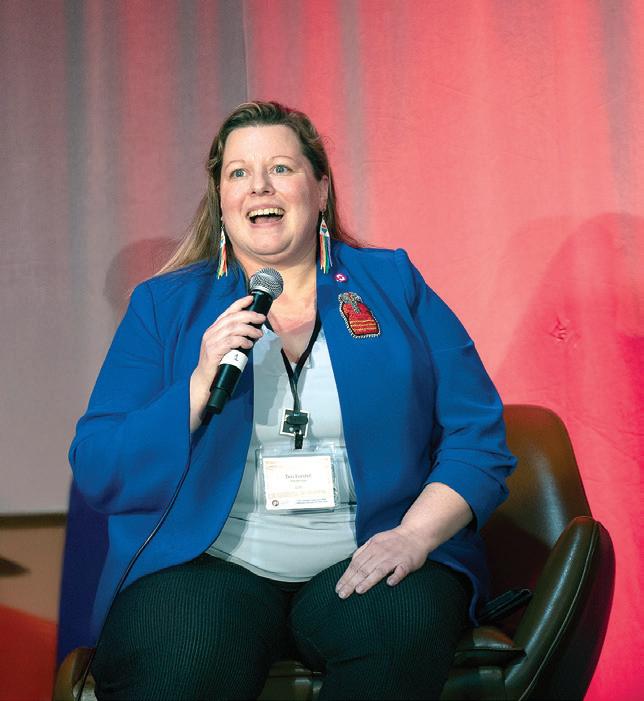
BCNU student nurse liaison and North West regional council member Teri Forster also attended the conference, participating on a panel with other union leaders, including Linda Silas, President of the Canadian Federation of Nurses Unions. The panel, From Student to Unionized Nurse: Knowing your Rights, Power and Professional Worth, explored why students should begin building power and engaging with their union early.
“Recently, the BC government cut a $500 bursary designed to offset the licensing exam fees new graduates pay when entering the profession,” Forster explained. “With strong support from student members, BCNU launched a campaign demanding the bursary be reinstated. If governments can cut an essential support that costs so little, what’s to stop them from taking away more key resources for nursing students?”
Two BCNU student members are taking their leadership skills to the next level with elected roles on the CNSA board.
Alicia Pongracz, a BCNU student member from Selkirk College, was acclaimed for a second term as CNSA Indigenous Caucus Chair. Inspired by her fellow students, nursing leaders, instructors, Indigenous knowledge keepers and Elders and her father, who she describes as a strong advocate, she says it is an honour to continue the work of her predecessors.
“Serving as Indigenous Caucus Chair last year affirmed my commitment to supporting and honouring Indigenous student voices in leadership spaces,” says Pongracz. “By building on established connections, fostering reciprocal relationships and strengthening partnerships, I hope to continue advancing reconciliation and cultural safety in nursing.”
Ryan Criztoff Tandiama, a BCNU student member from the University of Fraser
Valley, was also acclaimed as CNSA’s Director of Communications. He says he is excited to represent his fellow students and looks forward to participating in advocacy and national nursing student initiatives.
“I want to amplify and highlight nursing student voices across Canada,” says Tandiama.
For many of the students BCNU sponsored to attend, the conference helped reinforce the importance of using their voices.
BCIT student Noel Joseph says this year’s conference has strengthened his self-confidence as he prepares to enter the nursing profession.
“Bringing conversations about policies, bylaws, Truth and Reconciliation and the Calls to Action back to my peers, preceptors and fellow nurses has helped me better understand the profession, the role of our union and the support available to me as I transition from student nurse to RN,” he says.
Langara College student Shivani Verma echoes that sentiment, crediting the conference and her union involvement with shaping

her perspective.
“Attending BCNU’s convention last year opened my eyes to the national impact students can have when they are organized and well represented,” she says. That experience inspired her to advocate for access to equitable opportunities for all nursing students. “Student voices matter – especially
those that have been overlooked,” she says.
“As our student membership continues to grow, investing in opportunities like the CNSA conference is meaningful and appreciated,” says Forster. “It’s exciting to watch future nurses get excited about their career and their collective power.” •
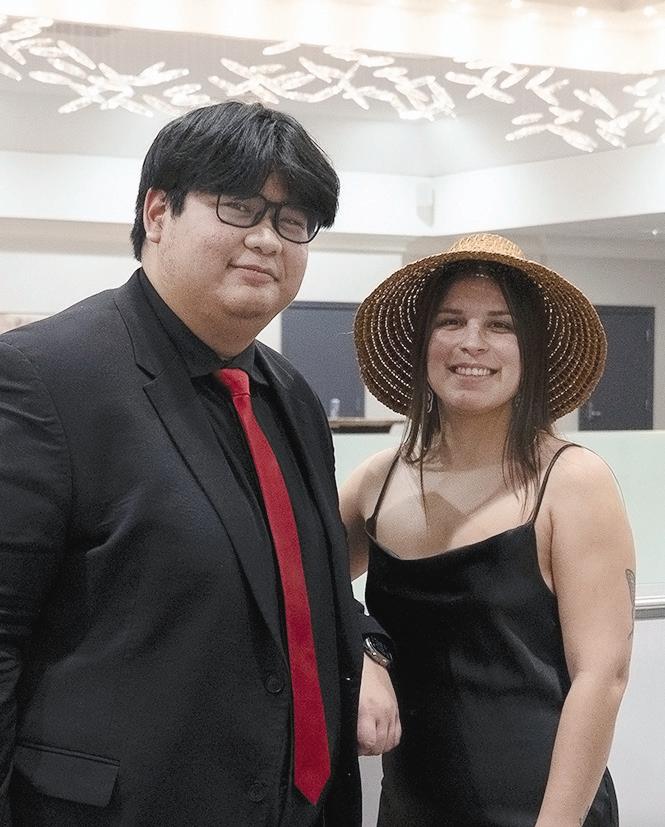
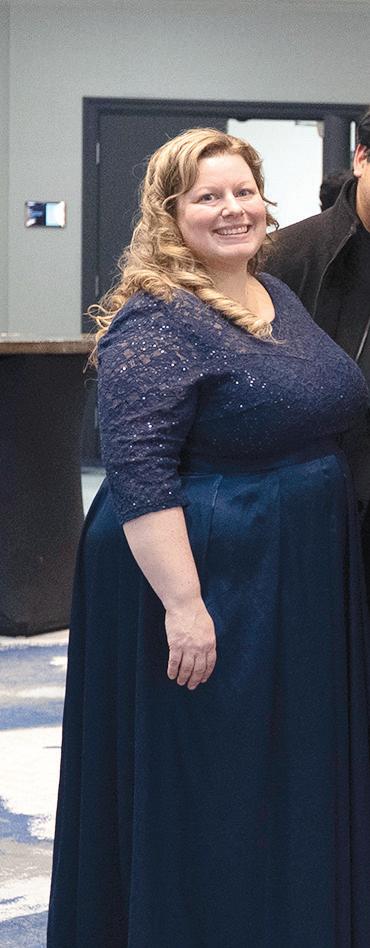
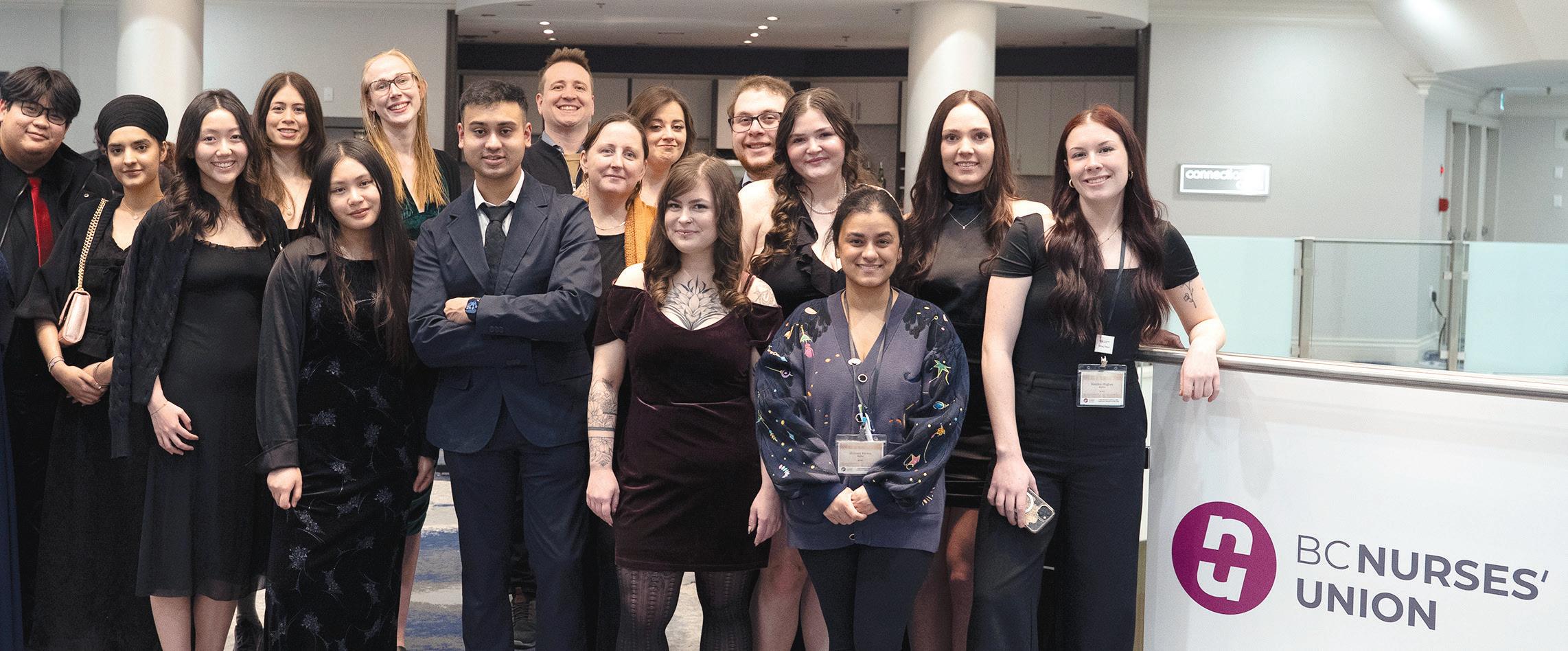
Teri Forster, (left) and sponsored BCNU student members attend the Canadian Nursing Students’ Association 2026 Gala. 2 BCNU student nurse liaison and North West regional council member Teri Forster speaks at the CNSA National Executive Leadership Panel. 3. A group of student nurses, including BCNU sponsored students, gather for a group photo. 4. BCNU student members Ryan Criztoff Tandiama and Alicia Pongracz were acclaimed to the CNSA board of directors.
Find out about future conference and event sponsorships.
AS MINIMUM
nurse-to-patient ratios continue to roll out across BC, BCNU members are shaping the work, not just locally, but nationally.
The Canadian Federation of Nurses Unions (CFNU) recently announced the creation of a National Council on minimum nurse-to-patient ratios. The council will provide guidance and recommendations to governments on implementing ratios, while coordinating advocacy efforts and strengthening momentum across the country. It will bring together government representatives, employers, academics and unions.
“This marks an important step in building a unified national approach to safe staffing,” said BCNU President Adriane Gear. “We are proud to expand our advocacy nationally and share what we’ve learned in BC about this life-saving measure.”
BC will have a strong voice at the national table. President Gear has been appointed to
represent BCNU as a member organization, ensuring the experience of BC’s hard-won implementation informs national discussions. In addition, BC’s Provincial Chief Nursing Officer, Kerry Morrison, has accepted a nomination to co-chair the new council alongside CFNU President Linda Silas.
“This national progress would not have been possible without the efforts of frontline leaders here in BC,” Gear said.
BCNU has been on the forefront of ratio advocacy and implementation from the start. Twelve BCNU regional council members currently sit on Joint Ratios Implementation Committees across BC, turning policy into practice and holding health authorities accountable for implementation.
“Their leadership ensures ratios are not just numbers on paper, but a tool that actually improves care,” said Gear.
From implementation on the ground to leadership at the national level, BCNU continues to lead the way on ratios – demonstrating how collective advocacy can drive meaningful, system-wide change for nurses and patients alike. •
In a busy nursing career, there may be times when members need to take a leave from work. These unpaid leaves create a gap in service that will affect members’ pension. Members do not earn pensionable or contributory service when they are not working or contributing to the plan. However, members who have taken an unpaid leave can purchase service to cover such a gap.
Members covered by the Nurses’ Bargaining Association (NBA) Provincial Collective Agreement who took an unpaid leave of absence during 2025 have until March 31, 2026, to buy back pensionable service.
If they choose to do so before March 31, their employer is obligated to pay its share of contributions to the pension plan for the first 20 days (150 hours) of unpaid leave. After March 31, members will be required to pay the employer’s portion of their pension contribution.
Members of the Municipal Pension Plan have up to five years to purchase service for a leave, such as an unpaid leave of absence.
Members can also purchase time for non-contributory service to cover when they were not contributing to their pension –such as during a probationary employment period or a period of casual employment prior to meeting the full requirements to join the pension plan. This can also include time worked as a casual or part-time employee when they were not a pension plan member, provided the employee did not sign a waiver opting out of the pension.
Members have five years to purchase non-contributory service.
For NBA members considering purchase of service, all pension contributions are based on their current wage rate.

Learn more about your pension, including purchase of service

Hundreds of members, new grads and students share their dissatisfaction after BC government cancels $500 bursary for new graduates
ON SEPT. 30, 2025, the provincial government discontinued a $500 bursary designed to offset the costs nurse graduates pay for their licensing exams when entering the profession.
The bursary was introduced in 2023 as part of the BC government’s Health and Human Resource Strategy, which aimed to help fill health workforce gaps by supporting newly graduated registered nurses, registered psychiatric nurses and licensed practical nurses as they transition into full practice.
“We were very disappointed by this change,” said BCNU President Adriane Gear. “Newly graduated nurses can practise anywhere in Canada
or the world. To achieve minimum nurse-to-patient ratios, we need to offer new grads every incentive to practise in BC.”
“We need to offer new grads every incentive to practise in BC.”
BCNU President Adriane Gear
After BCNU invited members and students to send an electronic letter to their MLA expressing their concern and asking the government to reinstate the bursary, more than 850 answered the call. The letters were also sent directly to Minister of Health Josie Osborne and Anna Kindy,
MLA for North Island and the official opposition’s health critic.
“We are especially inspired by our student members’ enthusiasm to share their concerns,” says BCNU student nurse liaison and North West regional council member, Teri Forster. “It’s important for student members to use their voice and advocate for the supports they need as they begin their nursing careers.”
Kennedy Love is a recent nursing graduate from Thompson Rivers University who now works at Victoria General Hospital. She says that having the $500 bursary was a huge relief. “Having just left university, I had no money at all. The bursary helped me to take my NCLEX exam and start practising.” Love hopes
the government reinstates the bursary to help address the recruitment crisis in the province.
“Making it easier for new grads to practise can help meet minimum nurse-topatient ratios,” she says.
Update Magazine will keep readers informed as BCNU continues to pressure the government to reinstate the bursary. •
“Making it easier for new grads to practise can help meet minimum nurse-topatient ratios.”
Kennedy Love
LPN Learn to Earn program helps BCNU members upgrade their skills –without leaving the workforce
Licensed Practical Nurses (LPNs) at Royal Columbian Hospital (RCH) are one step closer to becoming Registered Nurses (RNs), thanks to an innovative program designed to support career mobility for experienced nurses while filling critical staffing shortages in BC’s health-care system.
The graduates are the first cohort of the LPN Learn to Earn program, a partnership between Kwantlen Polytechnic University (KPU), Fraser Health and BCNU. Launched in 2024, the program provides experienced LPNs with a streamlined pathway to earn their bachelor of science in nursing (BSN) while continuing to work in the public health system.
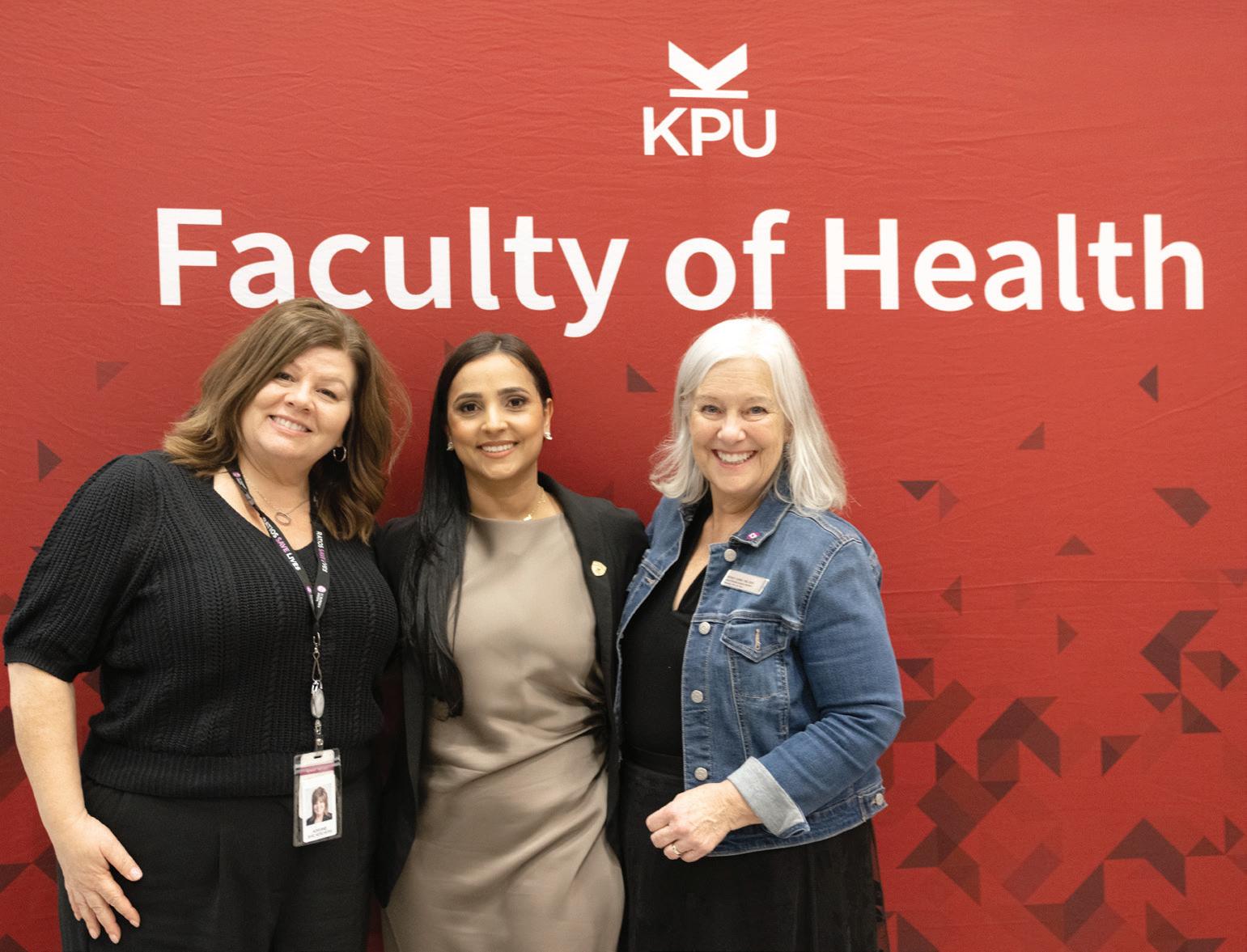
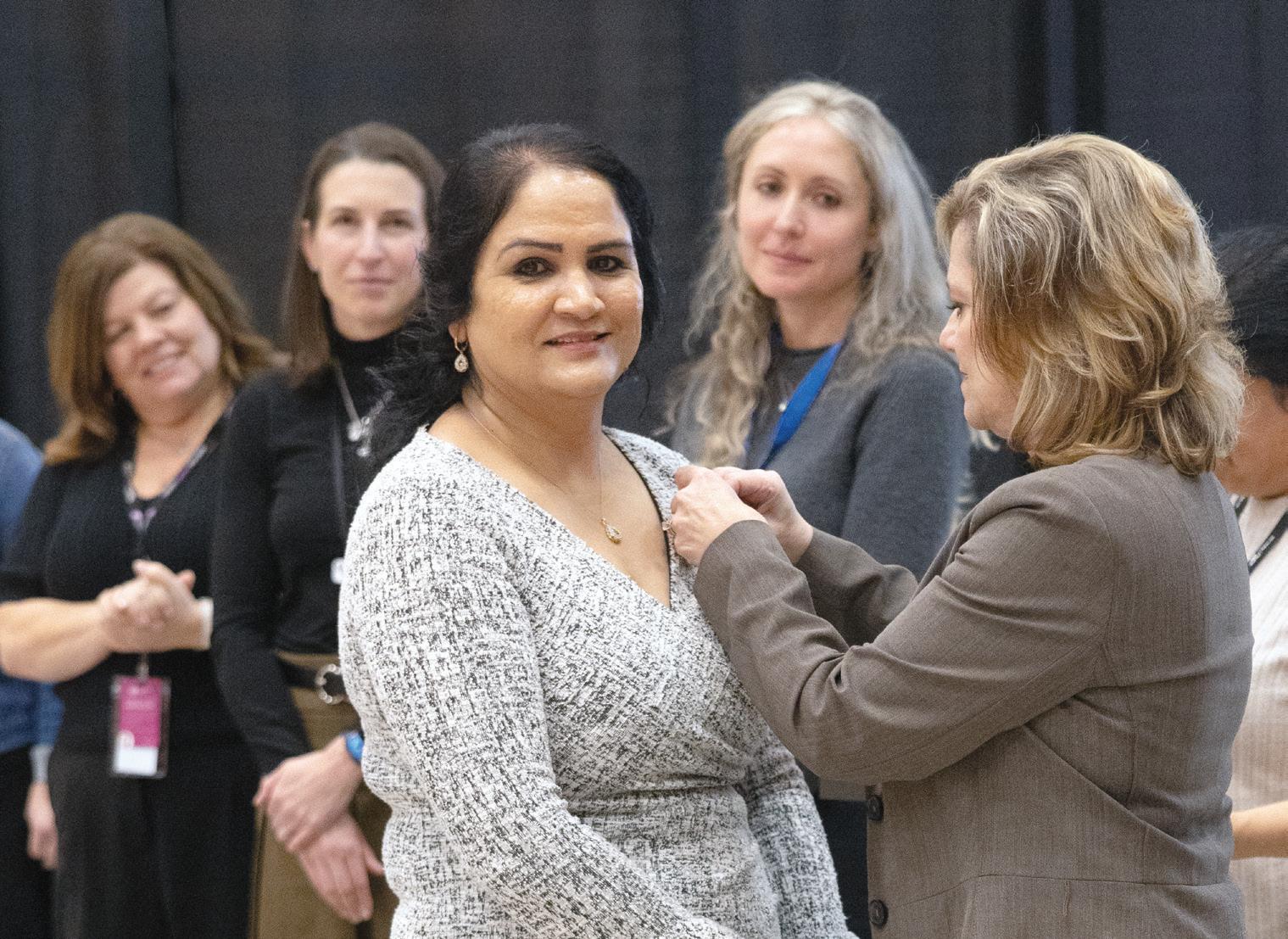
At a traditional BSN pinning ceremony at KPU’s Langley campus on Nov. 27, the cohort was jubilant, celebrating their commencement surrounded by friends, family, instructors – and their union.
“We are incredibly proud of these members and congratulate them on their achievement,” said BCNU President Adriane Gear, who attended the pinning ceremony alongside BCNU Simon Fraser regional council member Wendy Gibbs. “Their hard work and determination in completing this program will advance their careers while helping to bring us closer to minimum nurse-to-patient ratios.”
What sets the LPN Learn to Earn program apart is its integrated employment-and-education model. Program participants keep their jobs at Fraser Health and work parttime while studying full-time at KPU. This allows students to retain not only their income, but also their benefits and seniority under the collective agreement rather than starting over once they graduate. The model promotes internal career growth, addresses persistent RN shortages – particularly in acute care settings – and helps stabilize the workforce.
THE GRADUATE BCNU President Adriane Gear stands with Aman Thoor and BCNU Simon Fraser regional council member Wendy Gibbs.
That focus on retention was central to the program’s design, according to Gibbs, who helped develop and implement the initiative.
“LPN Learn to Earn grew out of professional practice at Fraser Health,” Gibbs says. “It was about finding an agreement that could keep some LPNs working, get them to school and bring more RNs into the system.”
The program also provides financial support through BCNU’s LPN Laddering Fund. The $20 million fund, negotiated with the BC government, supports LPN members pursuing RN or RPN designation by helping offset tuition, books and related costs, reducing the financial strain of returning to school.
“The fund was key to helping these students finish their program” Gibbs notes. “Along with staying jobattached, the financial support eases the pressure of going back to school –especially for established LPNs.
Gibbs adds that upgrading can be especially stressful for people already in the workforce. “Most LPNs going to school like this have families and mortgages,” she notes. “That makes going back to school difficult.”
Alongside funding and job retention, BCNU also provided these members with advocacy and practical support. Gibbs, along with the BCNU labour relations team, helped ensure that participants’ rights under the collective agreement were protected – while also creating flexibility where needed.
“My role was to make sure the collective agreement was followed,” she remarked. “We negotiated a
memorandum of understanding that created a formal agreement with the employer. That kept everything straightforward for the students while they studied and when they completed the program.”
For Aman Thoor – the pinning ceremony marked the fulfillment of a long-held professional goal. Thoor has spent more than a decade working in acute care and had completed prerequisites to begin her BSN studies years earlier. But, like many LPNs, she faced long waitlists and limited program availability.
A working parent, Thoor appreciated the program’s flexibility, which allowed her to balance family responsibilities alongside work and full-time studies.
“I began the program just three months after giving birth to my daughter, which was overwhelming at times,” Thoor remarked. “But I was fortunate to have an instructor who helped me feel supported and capable. This program truly understands the demands of nursing, while offering compassion, flexibility and the kind of teaching that builds confidence and purpose.”
Balancing parenthood, work and full-time studying was demanding, Thoor reflects, but the program’s structure made it feasible in ways traditional nursing pathways often are not.
“This experience really reignited my passion for nursing,” she says.
Thoor also emphasized that the program recognizes the value of
“This experience really reignited my passion for nursing.”
Aman Thoor
prior experience and respects LPNs expertise, rather than treating participants as entry-level students.
“LPNs come with hands-on experience at the bedside,” Thoor notes, “That experience supports patient care, especially in complex areas of practice where more clinical judgment really matters.”
Looking ahead, Thoor is eager to use her advanced skillset to take on more complicated assignments. After all, the opportunity to expand her scope of practice and operate more independently is what motivated Thoor to enter the program in the first place.
“As RNs, we’re prepared to take on more complex decision-making and broader responsibility,” she says.
She believes the program also strengthens workforce stability across BC’s health-care system.
“This program helps keep nurses working,” Thoor explains. “Healthcare employers aren’t losing staff when people choose to study.”
Retaining nurses in the workforce is a critical step in implementing and maintaining minimum nurseto-patient ratios. That’s why BCNU negotiated $68 million in training and licensing funding with the BC
government – an investment that made the LPN Learn to Earn program possible.
“Helping LPNs attain their BSN helps fulfill ratios in the future,” Thoor adds. “It increases the number of nurses at the bedside while retaining experienced staff.”
Gibbs describes the program as a win-win for both employers, students and the public.
“Over time, investing in these nurses saves money and helps stabilize staffing.”
Following the pilot program’s success at RCH, KPU has already
begun expanding the program: cohorts two and three are now underway at five Kwantlen campuses throughout the lower mainland.
The graduates also continue to expand their knowledge after completing the program. “As RNs, you have many opportunities to specialize,” says Thoor. “That’s a huge benefit to a health-care system with increasingly complex and diverse care needs,”
“These members’ hard work and determination will advance their careers while helping implement minimum nurse-topatient ratios.”
BCNU President Adriane Gear
At the same time, many nurses continue to choose LPN roles, providing the essential hands-on care they are trained to deliver. Others see value in expanding their scope of practice as RNs and helping to fill shortages in specialized areas.
“The costs of schooling – both tuition and lost income – slow down a lot of nurses who might otherwise pursue further training,” says Gibbs. “This program helps bridge that gap.”
As many members of the first cohort move towards RN licensure, the program’s early outcomes point to a promising model for strengthening the workforce without temporarily losing experienced clinicians. By recognizing prior experience, supporting nurses financially and keeping them embedded in their workplaces, the LPN Learn to Earn program offers a pathway that benefits nurses, employers and patients alike.
For Thoor, the impact is both professional and personal. “Now we’re stepping into a new role without delay. That makes a difference – not just for us, but for the care our patients receive.” •
HEALTH & SAFETY
BCNU joins national allies in Ottawa to support a strong public health-care system

enshrined universal health care with the Canada Health Act in 1984, there has never been a shortage of threats to public health care from forces that prioritize profits over people. The latest of these threats comes from the provincial government in Alberta in the form of Bill 11, legislation that is poised to open that province’s doors to U.S.-style private health care.
The bill would allow physicians to practise in the public and private systems at the same time, introducing a two-tiered model that could see those who can pay skip health-care wait lines. In addition to violating the Canada
“There is a national crisis in health care, and it demands bold leadership from the federal government.”
BCNU President Adriane Gear
Health Act’s core principles of universality and accessibility, the bill threatens to open Canada’s health sector up to American investors, tilting the scale
towards the for-profit model.
Concern over Bill 11 was among the core issues the Canadian Health Coalition (CHC) raised with politicians of all political stripes in Ottawa at its Parliament Hill lobby day in February.
The CHC brings together healthcare workers, seniors, anti-poverty and women’s groups, trade unions and provincial and territorial health coalitions from across the country. The coalition is sounding the alarm bell about the dangers of the Alberta legislation, which could derail universal health care in the rest of Canada. In total, over 200 people from every province and territory joined the CHC delegation, and they met with
more than 100 elected Members of Parliament and Senators.
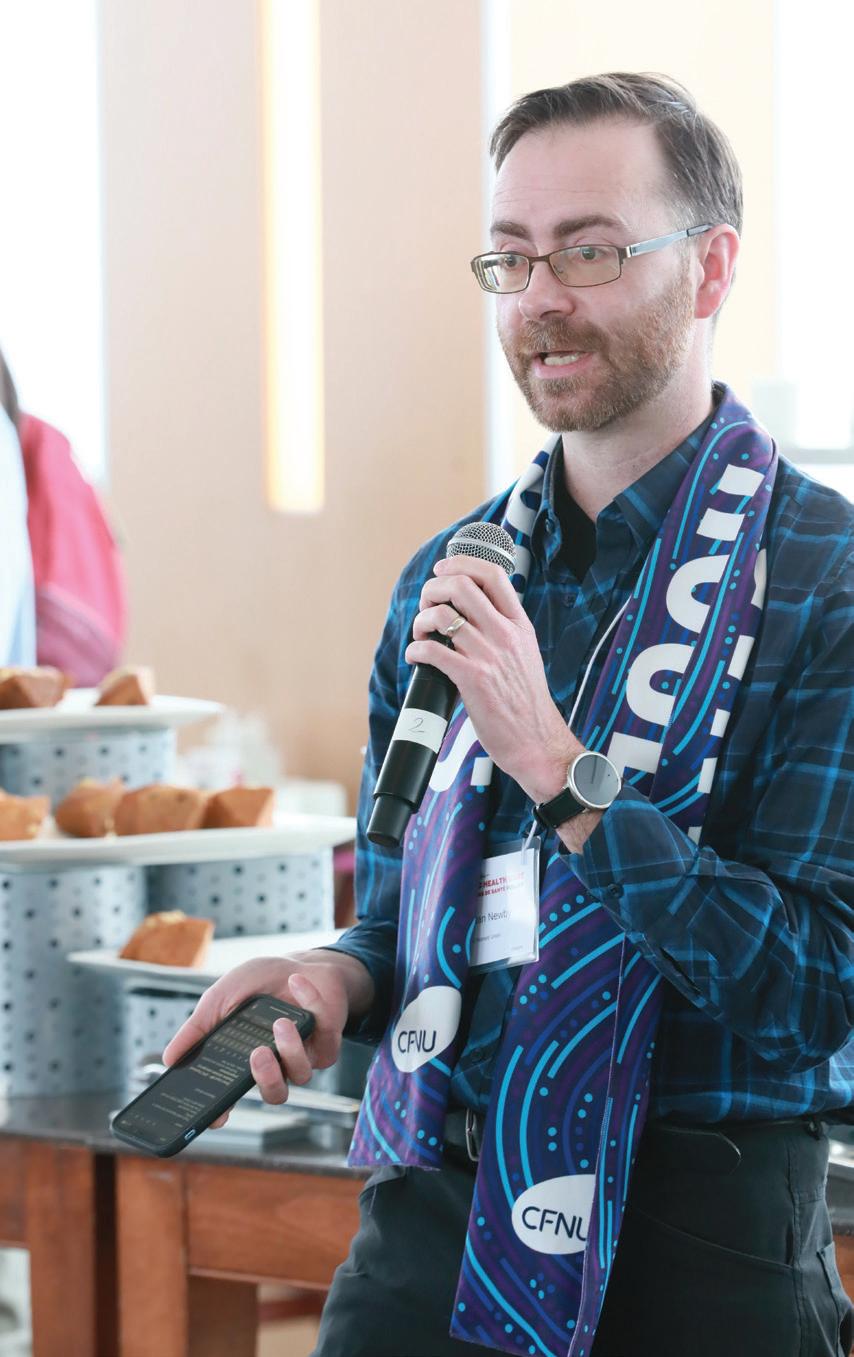
BCNU participates in the CHC through the Canadian Federation of Nurses Unions (CFNU), and BCNU Vice President Tristan Newby serves in elected positions of both bodies, helping to guide their work.
“The momentum for privatization we’re seeing in Alberta should be concerning to everyone across the country who values public health care,” says Newby. “American private insurance companies are out to make massive profits off Canadian health care like they do in the United States, and once they get their foot in the door, it will be next to impossible to get them out. The federal government has a responsibility through the Canada Health Act to defend our health-care system, and we need them to step up in a big way to do that now.”
The Canadian Centre for Policy Alternatives, a progressive think tank that researches public policy, recently published a report on Bill 11 in partnership with Alberta’s Parkland Institute,
“American private health insurance companies are out to make massive profits off Canadian health care.”
BCNU Vice President Tristan Newby
co-written by health-care researchers Andrew Longhurst from BC and Rebecca Graff-McRae from Alberta.
According to the report, “Bill 11 establishes two-tier health care, which is defined as a system that provides faster access to those with the ability to pay privately, and longer public wait times for those who are unable to pay for queue jumping.”
It warns of many dangers in the legislation, including higher overall health-care costs, longer public wait times and the possibility of user fees
being introduced. Worryingly, Bill 11 also opens the door to for-profit hospitals in Canada and a future where American health insurance companies become established in Canada and then entrenched through trade and investment agreements between the two countries. The CHC launched a campaign at www.healthcoalition. ca urging federal Health Minister Marjorie Michel to enforce the Canada Health Act, which guarantees medically necessary care based on need, not ability to pay.
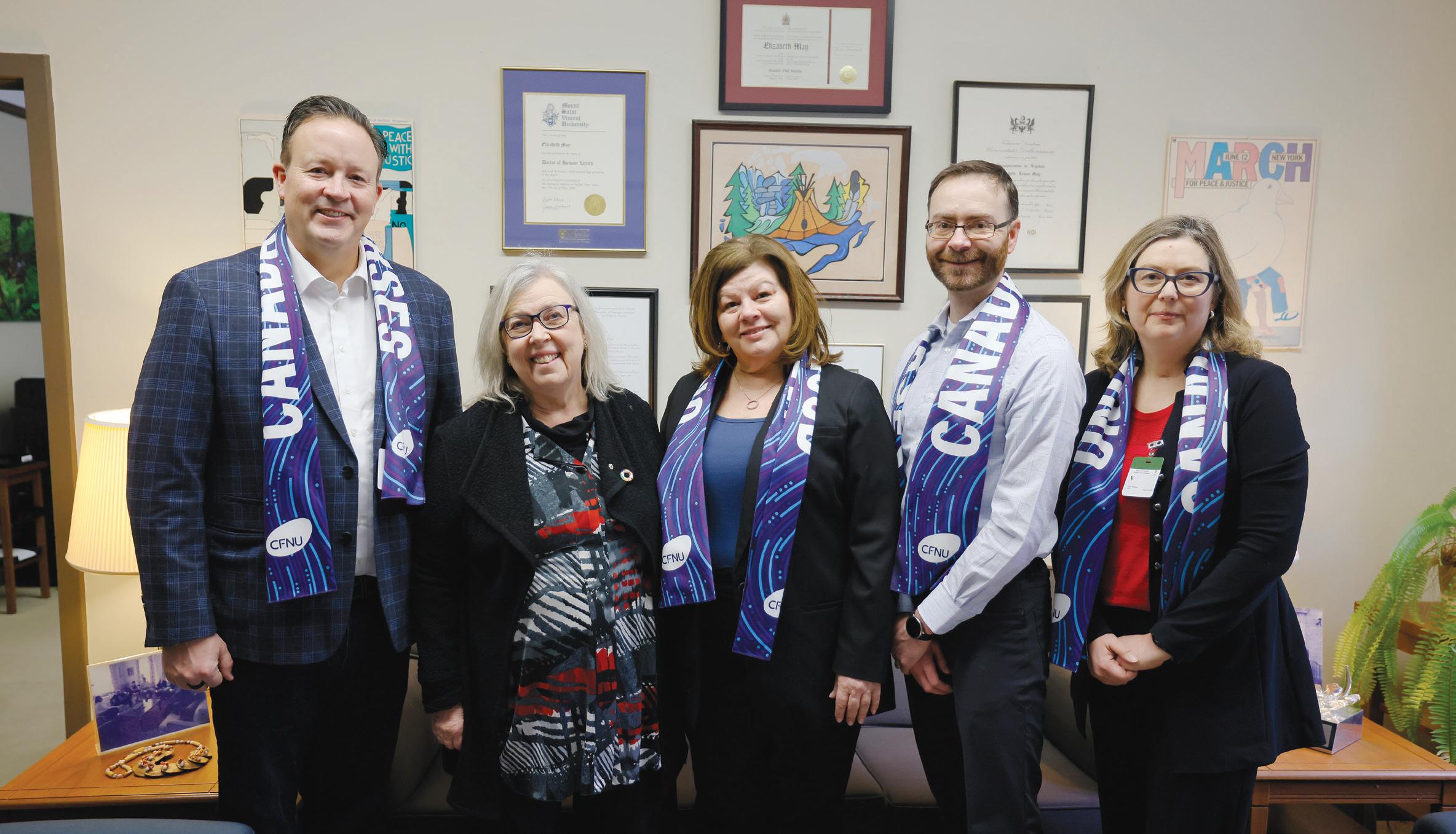
CFNU recently held a national lobby day of its own in Ottawa, raising similar concerns about the federal government protecting public health care from privatization, as well as issues related to violence prevention, the nursing shortage crisis, minimum nurse-to-patient ratios and Indigenous health. While provincial governments play the lead role in providing health care to most of
the population, the problems in these areas are similar across the country, making it critical that all levels of government step up in any way they can.
“Communities across Canada are facing nurse staffing shortages, violence against health-care workers and privatization threats to the public health-care system,” says BCNU president Adriane Gear, who also sits on the CFNU executive board. “That’s why nurses from across the country joined together in Ottawa – to tell Members of Parliament that these are not localized issues. There is a national crisis in health care, and it demands bold leadership from the federal government.”
The union’s participation in coalitions like the CHC and CFNU has been on the rise in recent years. BCNU’s leadership on minimum nurse-to-patient ratios has made the union a valuable resource to other provinces looking for effective ways to improve nurse retention and patient safety. Given the seriousness of the challenges public health care in Canada is facing, BCNU CEO Jim Gould, who also attended the CFNU
“When joining with other healthcare workers, nurses can be the powerful force this country needs to ensure everyone has access to the care they need.”
BCNU Vice President Tristan Newby
lobby day, says that presenting a united front to governments couldn’t come at a more crucial time.
“The federal and provincial governments play such important roles related to nurses’ ability to provide high-quality care to patients,” says Gould. “If public health care isn’t a high priority for both of them, our members’ jobs become even more
difficult. Federal leadership is part of what unifies us as a country around the principle that every person deserves access to health care – it shouldn’t depend on whether or not you can afford to pay.”
Because the principles of universality and accessibility are embedded in the Canada Health Act, the federal government has leverage it can use to prevent provinces from opening up their health-care systems to private insurance markets for medically necessary care. Whether it chooses to do so rests with government leaders, particularly Prime Minister Mark Carney and Health Minister Marjorie Michel.
“The stakes are nothing less than the existence of public health care in Canada,” warns Newby. “When joining with other health-care workers and allies, nurses can be the powerful force this country needs to ensure everyone has access to the care they need when they need it. It is up to the federal government to step up and do the right thing – keep our health-care system focused on people, not profits.” •
BCNU members’ frontline experience drives violence prevention
nurses has not faded into the background. In fact, it has intensified – becoming more frequent, more severe and disturbingly normalized in health-care workplaces stretched thin by chronic understaffing and rising patient acuity.
Across the province, nurses report being hit, threatened, harassed and intimidated. And increasingly, they’re refusing to stay quiet about it.
That refusal is at the heart of BCNU’s Violence. Still Not Part of the Job. campaign. Through a series of short videos shared across BCNU’s social media channels, members from acute care, long-term care and community care speak directly about what violence looks like in their workplaces – and what would actually prevent it.
In the videos, the nurses explain how desperately-needed safety measures
would protect them on the job. They speak about how well-trained, consistently present relational security officers could not just respond to incidents – but prevent them. They describe how safe staffing and nurse-to-patient ratios would allow them to anticipate risk and create calmer, safer environments for patients and staff alike. Others highlight the role of risk assessments, safer workplace infrastructure and design and leadership accountability in preventing situations from spiraling into harm.
BCNU has been sharing these safety measures with decision-makers since October 2025, when the union met with MLAs in Victoria to present ten violence prevention measures – five for government to act on and five for health authorities to implement. The measures focus on strong staffing, safer environments, early intervention and clear leadership responsibility – practical ideas developed directly from
frontline nurses’ expertise.
“These are achievable measures that not only reflect our members’ lived experiences, but also their professional expertise in building safer workplaces,” says BCNU President Adriane Gear. “Violence doesn’t happen in a vacuum. It grows in environments where nurses are stretched too thin and supports aren’t there when they’re needed.”
The videos underscore a reality BCNU members know well: violence in health care is not inevitable. It is shaped by systems – and systems can be changed.
BCNU members spoke out about their experiences with violence in the workplace – and the measures that would keep them safe. Watch the videos on BCNU’s Facebook, Instagram and YouTube page, or scan the QR codes below the photos.
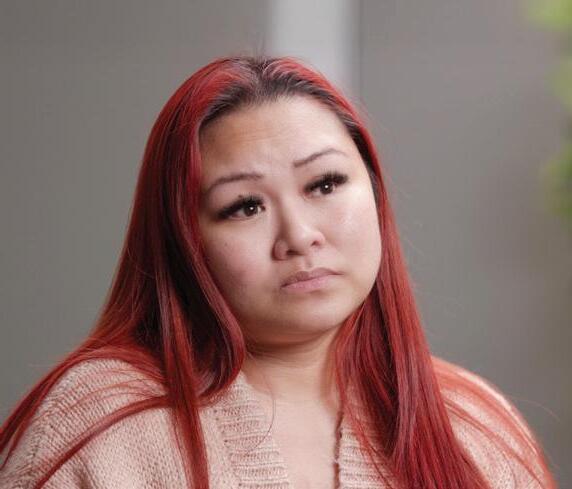
Jennifer : “I tried calling the number, but it was busy. I don’t have time. I have a family. I have four or five other shifts to do.”
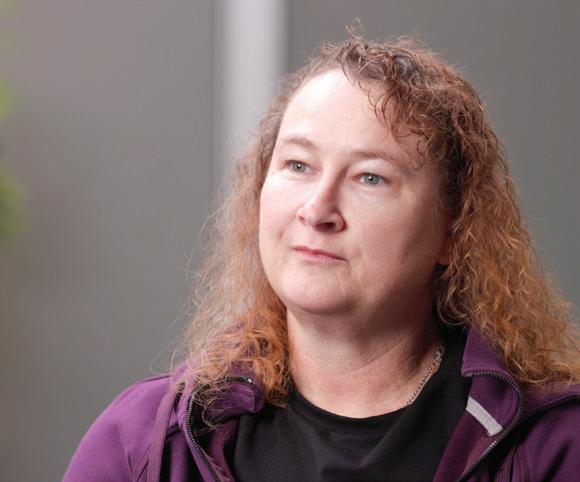
Brigette : “We were promised that all 24-hour emergency departments were going to get security officers. And that promise has not happened.”

Tash : “The patient grabbed her wrist. She called out for help but there was no one there.”
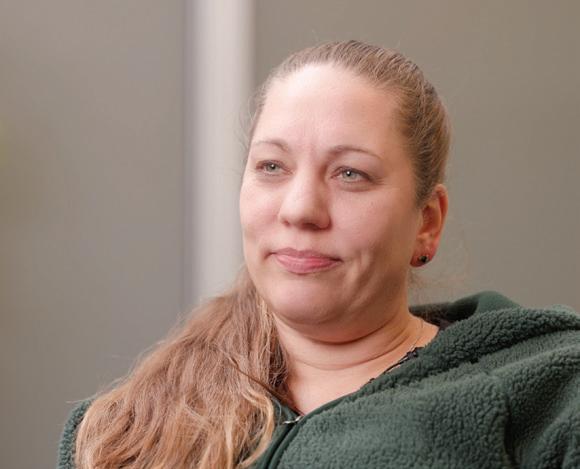
Melissa : “There are a few buttons on the wall, but when they ring, they sound like a call light. So you are just running and yelling for help.”
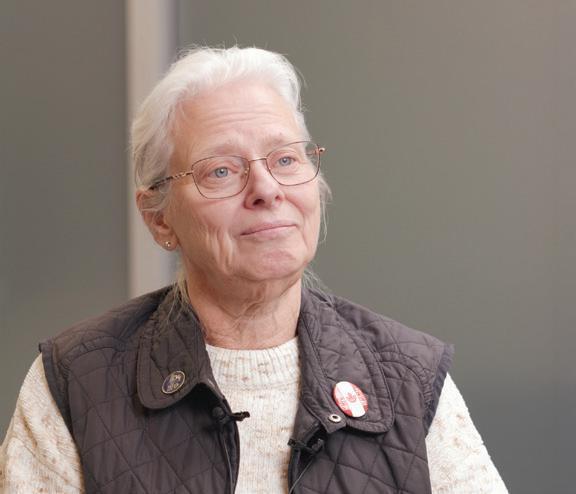
systems don’t reflect the realities of nursing work.
Members describe trying to report incidents mid-shift with no time for or space for privacy. At the end of an exhausting day, members sometimes postpone or forget to report. Night shift nurses miss call-backs while sleeping. Early injuries or exposures are brushed off, only to worsen later with no clear paper trail.
“Reporting is how experiences become evidence,” says Gear. “It’s what allows for investigations, corrective action and employers to be held accountable. Without it, even strong violence prevention policies are difficult to enforce.”
And while we know reporting is effective, safer workplaces require more than individual effort. That’s why BCNU continues to pressure health employers and the government to fully implement the violence prevention measures already on the table – and to foster environments where reporting is supported, accessible, encouraged and acted upon. Because violence is still not part of the job. And neither is silence.
While BCNU continues to call on health authorities to implement the five violence prevention measures, prevention is only part of the equation. Because prevention cannot succeed without systems that capture what is happening on the ground. That is where reporting comes in. BCNU consistently hears from members about violent incidents that are never fully captured in the employer’s reporting systems. Sometimes reports are delayed. Sometimes they are incomplete. Sometimes they never happen at all – not because nurses do not care about safety, but because reporting
At the same time, reporting systems have failed to take advantage of modern technology. Phone-based systems with limited hours and delayed callbacks may not align with shift work, confidentiality needs, or workload pressures. Worse, many nurses still feel pressure to “tough it out” when they’ve experienced a violent incident or have become desensitized after years of not being heard.
“Reporting isn’t complaining,” says Gear. “It’s using your voice to protect yourself, your colleagues and the nurse coming on after your shift. It’s about making sure the system can’t ignore what’s happening.”
In the months ahead, BCNU is emphasizing awareness and action with a new campaign encouraging members to report violent incidents and nearmisses. The campaign reinforces the importance of reporting as a core pillar of violence prevention and a concrete measure to ensure employers do not delay or deflect action.
At the same time, BCNU is engaging members and the public in a province-wide letter writing effort to call on their MLA to implement five key safety measures and pressure health authorities to protect nurses and patients.
The effort marks a new phase of advocacy – one that invites decision makers to play a direct role in demanding safer health-care workplaces. By opening the campaign to patients, families and the broader public, BCNU is amplifying frontline voices and reinforcing that violence in health care is not only a workplace issue, but a concern that affects everyone who relies on the health-care system.
As the campaign evolves, one thing remains constant: nurses are leading the way, using their voices, their expertise and their collective power to demand the safe, respectful working environments they deserve. •
Join BCNU’s letterwriting campaign calling on the BC government to implement five key measures to keep nurses safe.
Members share experiences at BCNU’s IEN Welcome Dinner and Diversity, Equity and Inclusion 101 Dinner series
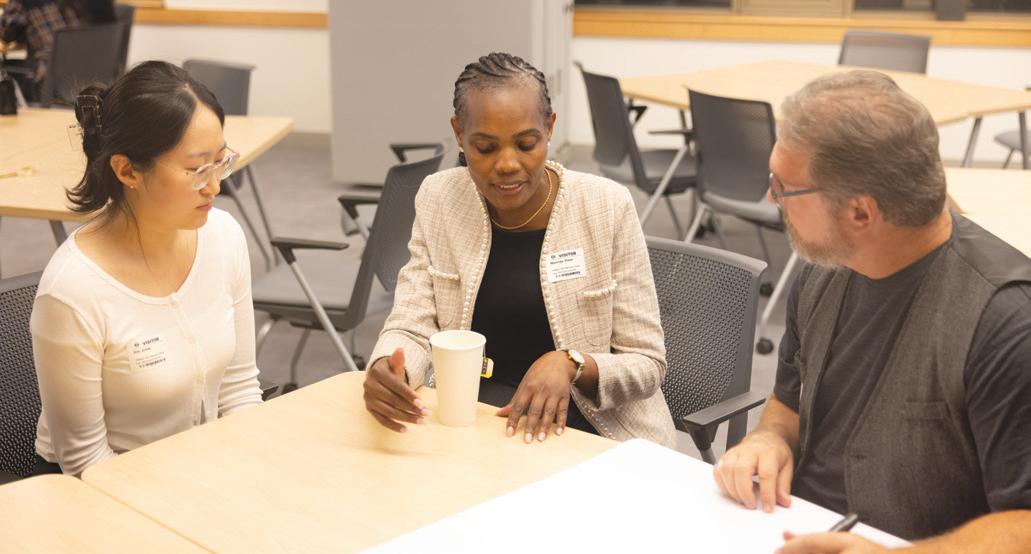
Columbia, nurses are pushing for a more just and inclusive health-care system. In 2024, BCNU’s Diversity, Equity and Inclusion (DEI) 101 dinner series created space for members to hold face to face dialogue about the challenges they encounter in their workplaces and how the union can better support its diverse membership. Rooted in the union’s commitment to advancing human rights, the
dinners brought members together to share their lived experiences, identify systemic barriers and work together to discuss solutions that advance human rights and equity in the workplace, our communities and across the healthcare system.
From internationally educated nurses (IEN) building new lives and careers in BC, to Indigenous nurses calling attention to the enduring impacts of colonialism and racism, to frontline advocates confronting the
EXPERIENCES Internationally educated nurses from

toxic drug crisis, each gathering told a different story. Together, they revealed a shared appetite for change – and the ways union members can foster safer, healthier and more inclusive workplaces.
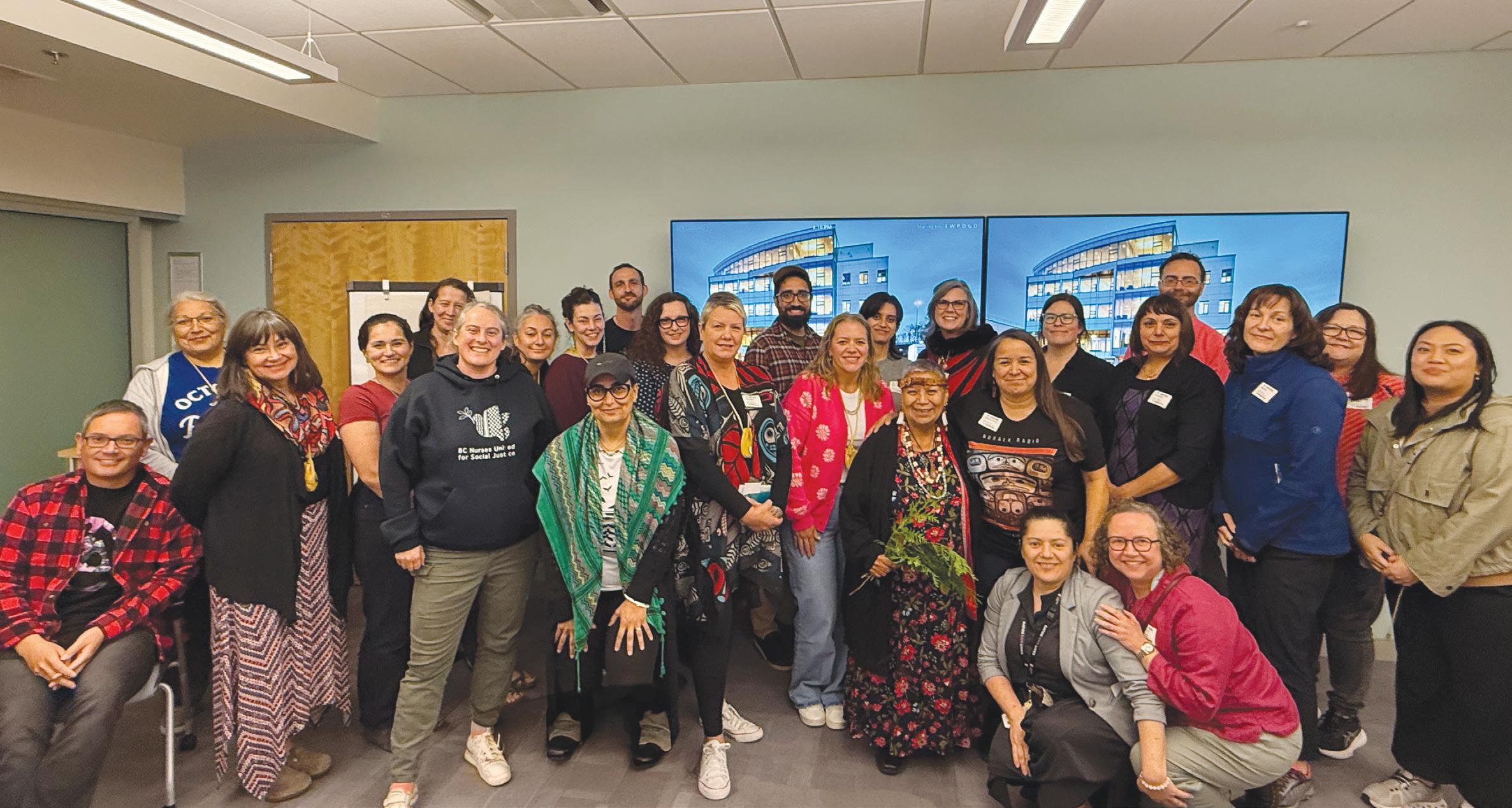
In September, BCNU’s internationally educated nurses committee invited recently licensed IENs to a

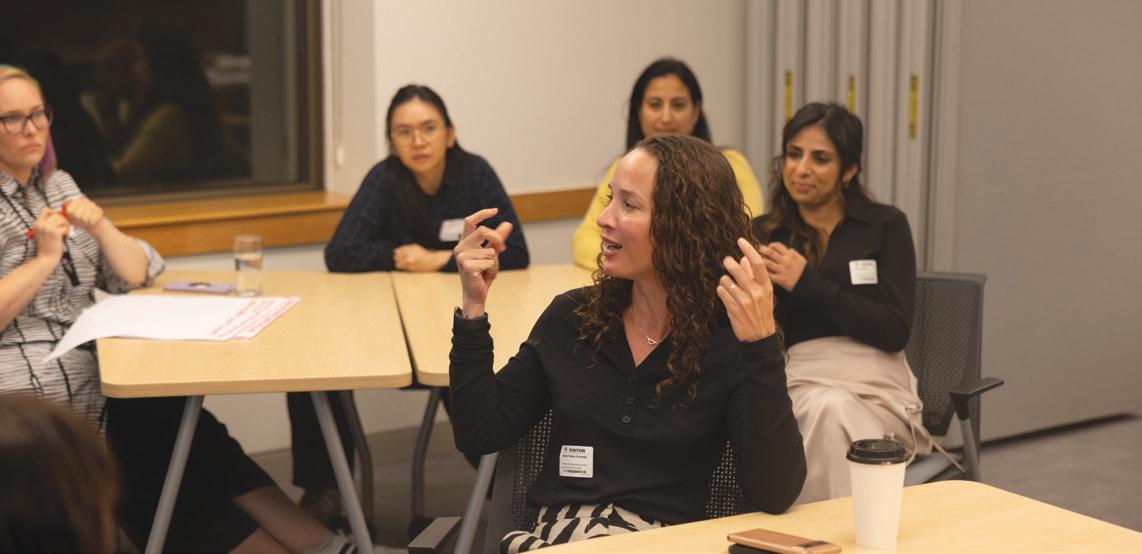
welcome dinner at the union’s office in Burnaby. The event’s goal was twofold: to hear directly from IENs in their first two years of practise in BC, and to better understand how recent provincial initiatives – such as streamlined credential recognition – is playing out on the ground.
Sheron Kaur is a neuroscience nurse at Lions Gate Hospital. She graduated as a registered nurse in Chandigarh, India in 2019 and worked in trauma surgery before moving to BC. She recalls navigating the registration process quickly and receiving her BC nursing licence in three weeks. Other IENs, she says, have not been as lucky.
“Many IENs face really long delays,” she said. “Some end up working odd jobs while enduring a licensing process that’s lengthy and complex.”
“The immigration process is part of settling in Canada, yet its rules can limit our education and ability to specialize.”
Sheron Kaur
These delays reflect a national pattern. Amid a country-wide nursing shortage, nursing unions across Canada have been urging governments to create smoother pathways for IENs to practise. Like Kaur, many IENs arrive with years of clinical experience – skills urgently needed to address
shortages across the health-care system.
The Canadian Federation of Nurses Unions (CFNU) echoed this fact in its February 2025 report, Bolstering Pathways to Practice: Empowering Internationally Educated Nurses in Canada. The report argues that credential recognition is only one part of a successful integration. Its nine recommendations – including paid mentorships, hospital-specific orientations and standardized registration across provinces – aim to support IENs transitioning safely and confidently into the workforce.
Kaur’s story brings those recommendations into focus. Beyond licensing delays, she sees gaps in orientation and training and says that health employers could start by integrating the IEN
introductory skills program into their formal orientations.
“The IEN introductory skills program is optional and only available once you start working,” she explained. “That often conflicts with shift schedules. A more thorough orientation would help address differences in terminology, documentation and equipment.”
Access to specialty training is another barrier, especially for IENs without permanent residency. Temporary residents are often excluded from programs that would help them grow professionally and fill key shortages in high-demand areas like emergency rooms and critical care. “The immigration process is part of settling in Canada,” Kaur said. “Yet its rules can limit our education and ability to specialize.”
BCNU continues to advocate for stronger, fairer pathways to practise for IENs, while also offering direct supports. One example is Communicating: Essential Skills, a three-day, in-person course designed to help members learn to communicate confidently with managers, co-workers, patients and patients’ families. Through small
“We’re spreading the word so more people will feel safe enough to reach out and ask for help.”
Hedy Wolff
group activities, role play and video, participants learn key communication skills and practise them by acting out common workplace scenarios.
Kaur pointed to another opportunity for BCNU to strengthen its support for IENs. “It takes a few months after registration to gain access to the BCNU Member Portal,” she noted. “IENs have many questions, but limited access to resources and support. Having quicker access to the portal early on could help them to find guidance.”
For Kaur, these changes aren’t just about improving the IEN experi-
ence – they’re about ensuring BC fully benefits from the skills IENs bring to the health-care system.
Visit bcnu.org to learn more about how BCNU supports internationally educated nurses.
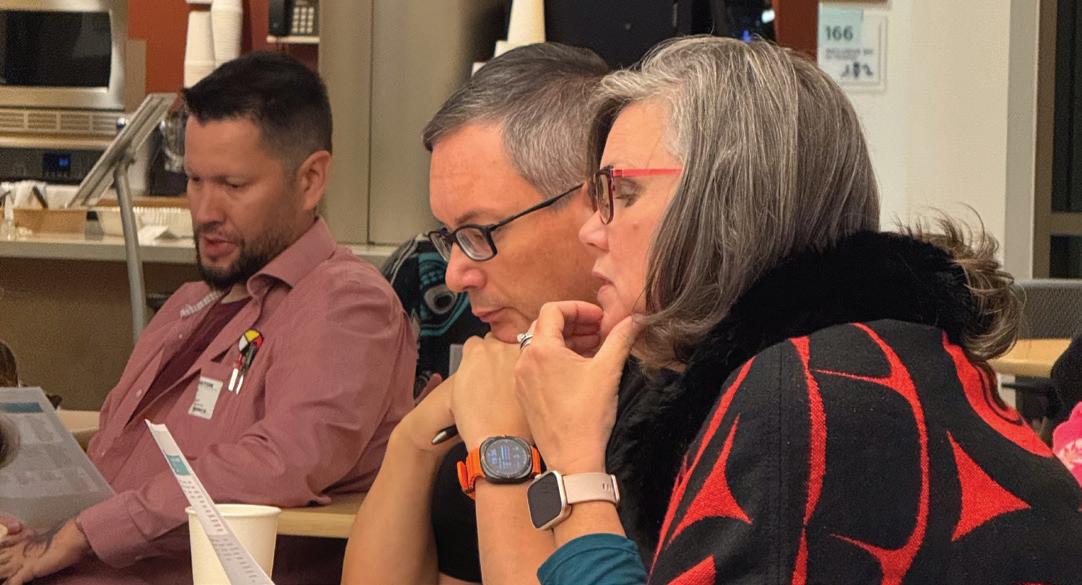
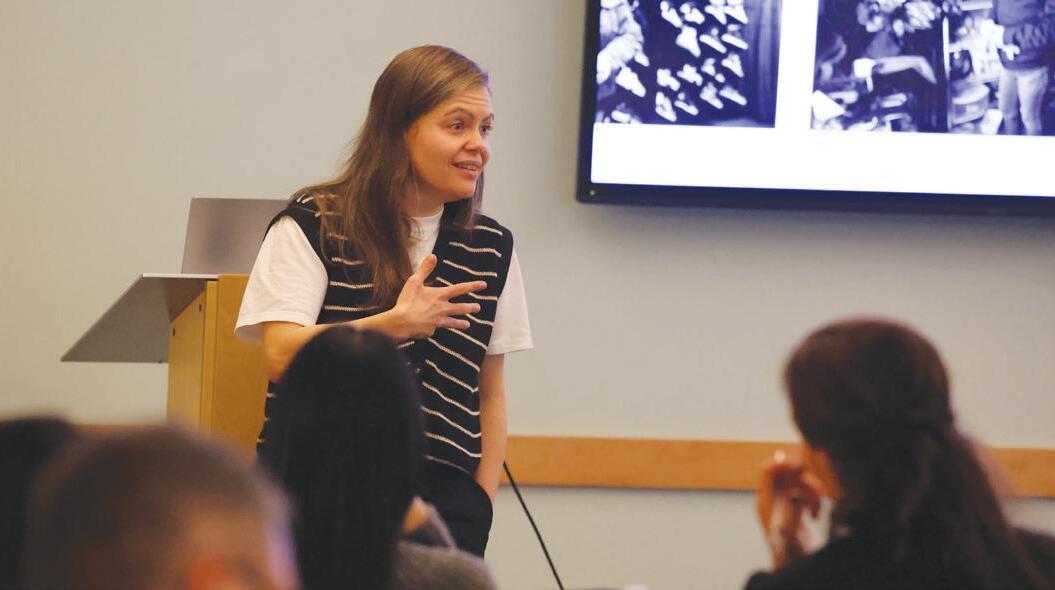
On Oct. 7, BCNU hosted the fourth event in its DEI 101 dinner series in recognition of the Sept. 30 National Day for Truth and Reconciliation. The evening focused on the seven health-related Calls to Action from the Truth and Reconciliation Commission (TRC), which urge governments and institutions to close the gaps in health outcomes between Indigenous and non-Indigenous communities, recognize the value of Indigenous healing practices and increase Indigenous representation in health care.
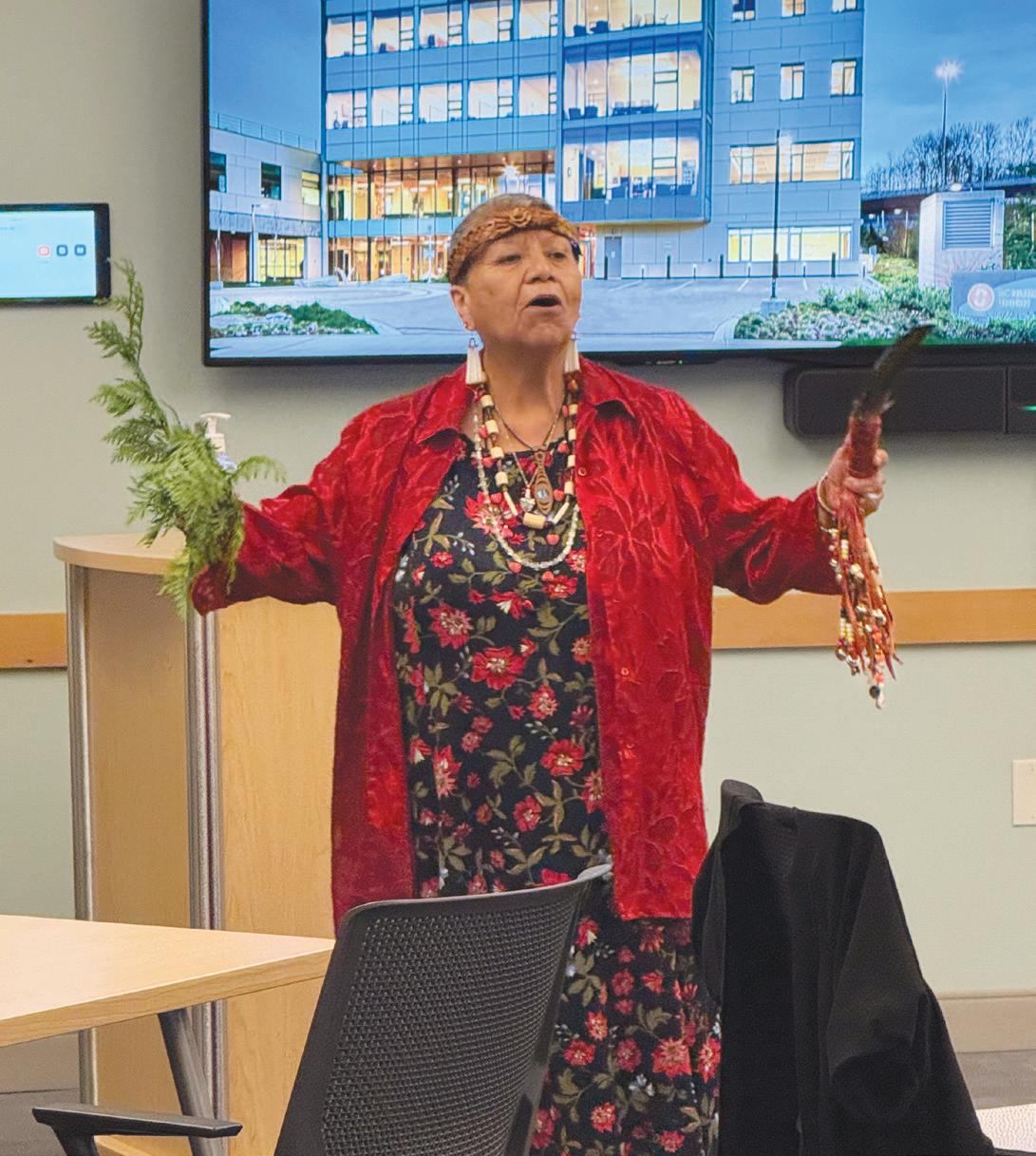
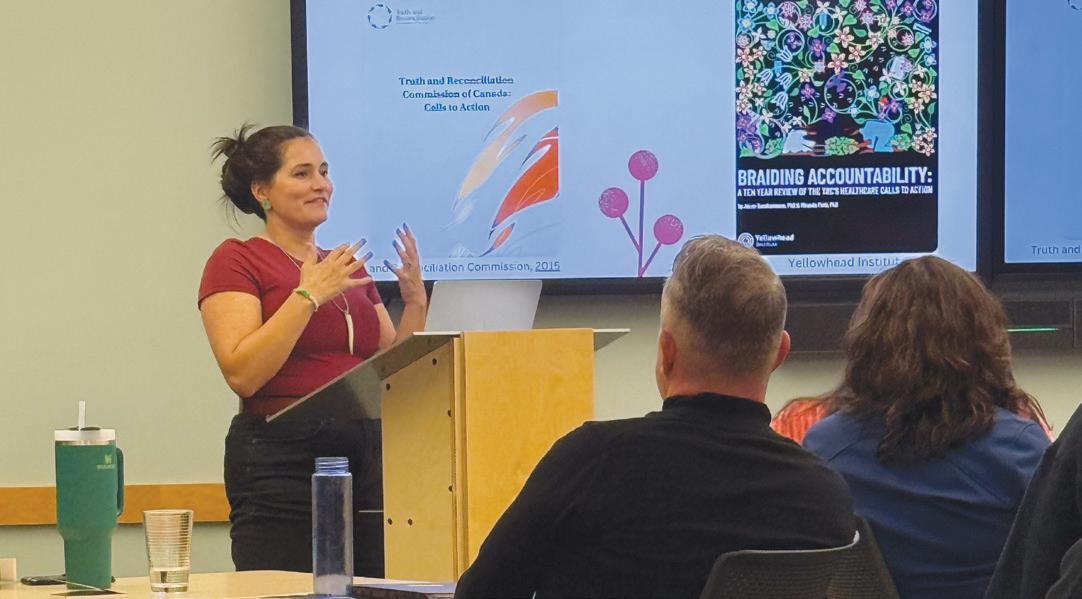
Elder Dr. Roberta Price opened the gathering with a blessing and shared teachings and reflections throughout the event. Guest speaker Jessica Key, a clinical nurse specialist,
Indigenous cultural safety expert and UBC PhD student, presented her work On the Learning Journey: Calls to Action in Practice, a roadmap for embedding cultural safety in health care.
A citizen of the Musgamagw Dzawada’enuxw Nation, Key spoke candidly about the limited progress made since the TRC issued its recommendations more than a decade ago. Her presentation sparked discussion about the systemic barriers that persist in health care, and the roles nurses and unions must play in advancing reconciliation.
Those themes were echoed in a powerful personal reflection from Charlene Copley, an Ojibwe registered nurse from Mississagi River #8 in Blind River,
“Part of harm reduction is helping people believe they are worthy, loved and good people who have a purpose on this planet.”
Charlene Copley
Ontario, who serves as the Pacific Rim region representative of the Indigenous Leadership Circle.
“Something weird happens when

people look down on you for many years, for generations,” Copley told the room. “A person can start to internalize hatred, to feel unworthy. That can lead to abuse of drugs and alcohol, and to violence.”
Reframing her understanding of trauma changed how she sees people struggling in her community. “When I look around, I see people abusing themselves because they’ve been hurt.”
Her reflections underscored the enduring impact of Indigenousspecific racism and discrimination, especially in health care.
Copley calls on nurses to deepen their understanding and compassion for the effects that intergenerational
trauma can have on patients’ health outcomes.
“Part of harm reduction,” Copley added, “is helping people believe they are worthy, loved and good people who have a purpose on this planet.”
BCNU remains committed to advancing the 94 TRC Calls to Action, with focus on addressing inequities in health care, ensuring cultural safety and increasing Indigenous representation in the health-care workforce. This includes advocating for Indigenousspecific language in collective agreements, fostering ongoing dialogue on the legacy of residential schools and collaborating with the Canadian Federation of Nurses Unions on reconciliation-focused initiatives.
Visit bcnu.org for more on BCNU’s efforts in advancing truth and reconciliation with Indigenous Peoples.
A decade after British Columbia declared the opioid crisis a public health emergency, the death toll continues to mount. Over 17,800 lives have been lost to unregulated drugs –each one a reminder of the urgency for action on harm reduction.
On Dec. 10 – International Human Rights Day – BCNU brought members together to discuss the toxic drug crisis through the lens of harm reduction, cultural safety and relational practice, and reflect on the ongoing challenges nurses and other community advocates face in confronting this public health emergency.
Participants listened to award-winning Vancouver-based multi-disciplinary artist, Jackie Dives, whose
work documents the human cost of the toxic drug crisis through auto-ethnography and collaborative storytelling. She spoke candidly about her father’s 2017 death following an accidental drug overdose, and the weaving of her grieving process into her artwork.
“It’s stigma –against drug use, against being poor – that prevents science-based solutions from moving forward.”
Jackie Dives
Dives, whose work has been published in The New York Times, The Wall Street Journal and The Guardian, has documented grassroots efforts to bring the severity of the toxic drug crisis to light while highlighting the failures of drug prohibition. She pointed to the Drug User Liberation Front’s model for preventing overdoses through distributing safer, tested drugs. Despite recommendations from the BC Coroner, Dives noted that the provincial government has been slow to embrace evidence-based approaches.
“This should be a non-partisan issue,” Dives said. “But it’s stigma –against drug use, against being poor – that prevents science-based solutions from moving forward.”
Forum participants also heard from Joe Gallagher, vice president of
Indigenous health and cultural safety at Provincial Health Services Authority and a member of the Tla’amin First Nation. Gallagher was the founding chief executive officer of the First Nations Health Authority, the first and only health authority of its kind in Canada, and spoke about his work supporting BC health regulatory colleges and other institutions as they work to address Indigenous-specific racism and improve cultural safety and humility in health-care settings. This objective, he said, is even more urgent given the impact of the toxic drug crisis on First Nations people and the dehumanizing narratives surrounding drug use.
The presenters all spoke about humanizing the crisis and giving voice to the survivors of prohibition. At the same time, raising the public’s awareness and understanding of harm reduction principles can help spur further action from governments and policy makers.
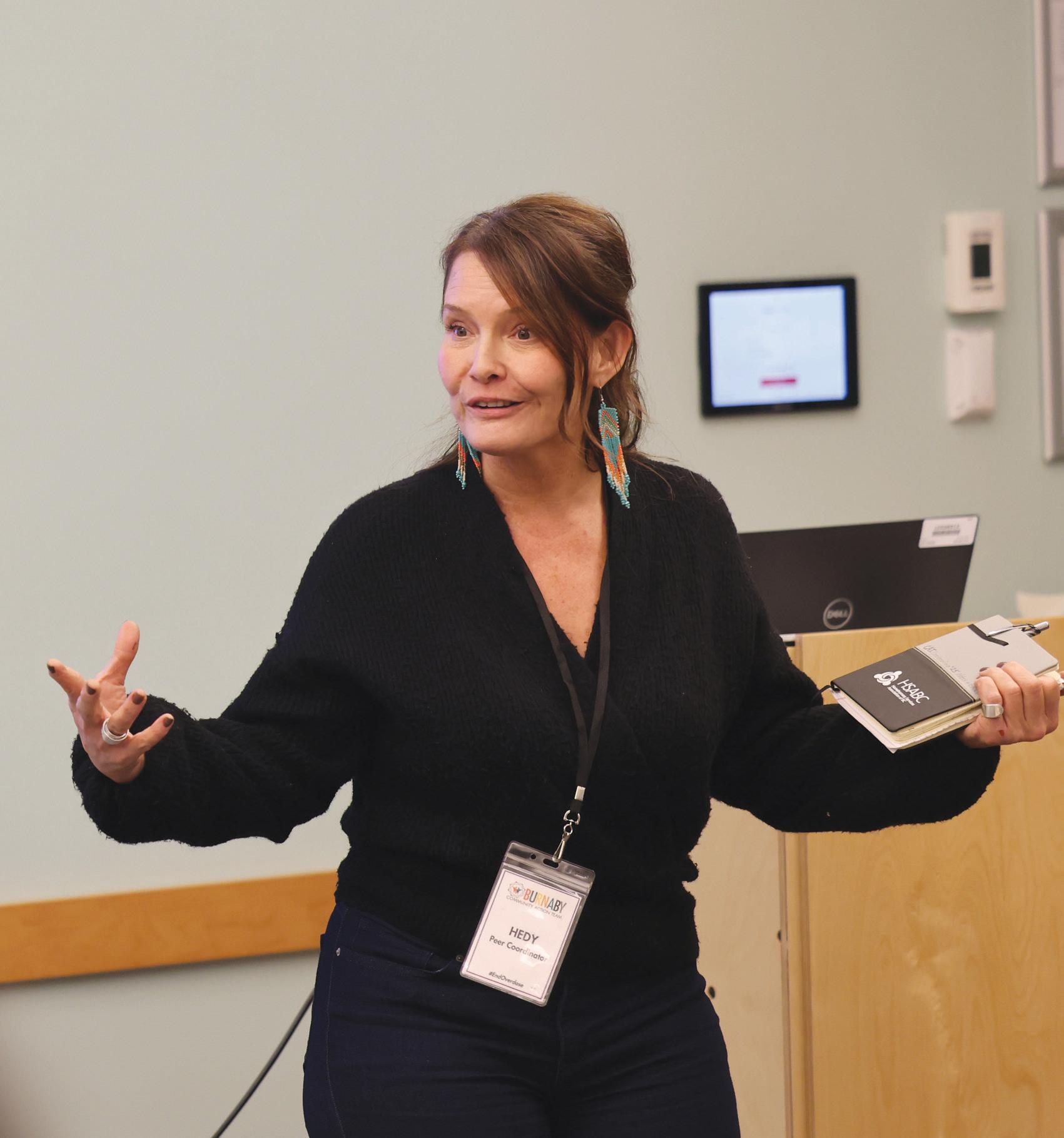
One of those voices is Hedy Wolff. A peer coordinator for the Burnaby Community Action Team, Wolff shared an intimate account of her own journey of substance use and recovery.
“We’re spreading the word about the stigma of substance use disorders so more people will feel safe enough to reach out and ask for help,” she said.
In small-group discussions, participants reflected on the future of harm reduction efforts following the province’s retreat from decriminalization policies launched in 2023. All agreed that nurses’ voices, and their ongoing advocacy, remain critical for preventing further deaths and pushing governments toward compassionate, evidence-based policy that will support people who use drugs. •
At BCNU’s Human Rights and Equity Conference, members confront genderbased violence as a systemic health-care crisis – and a call to collective action
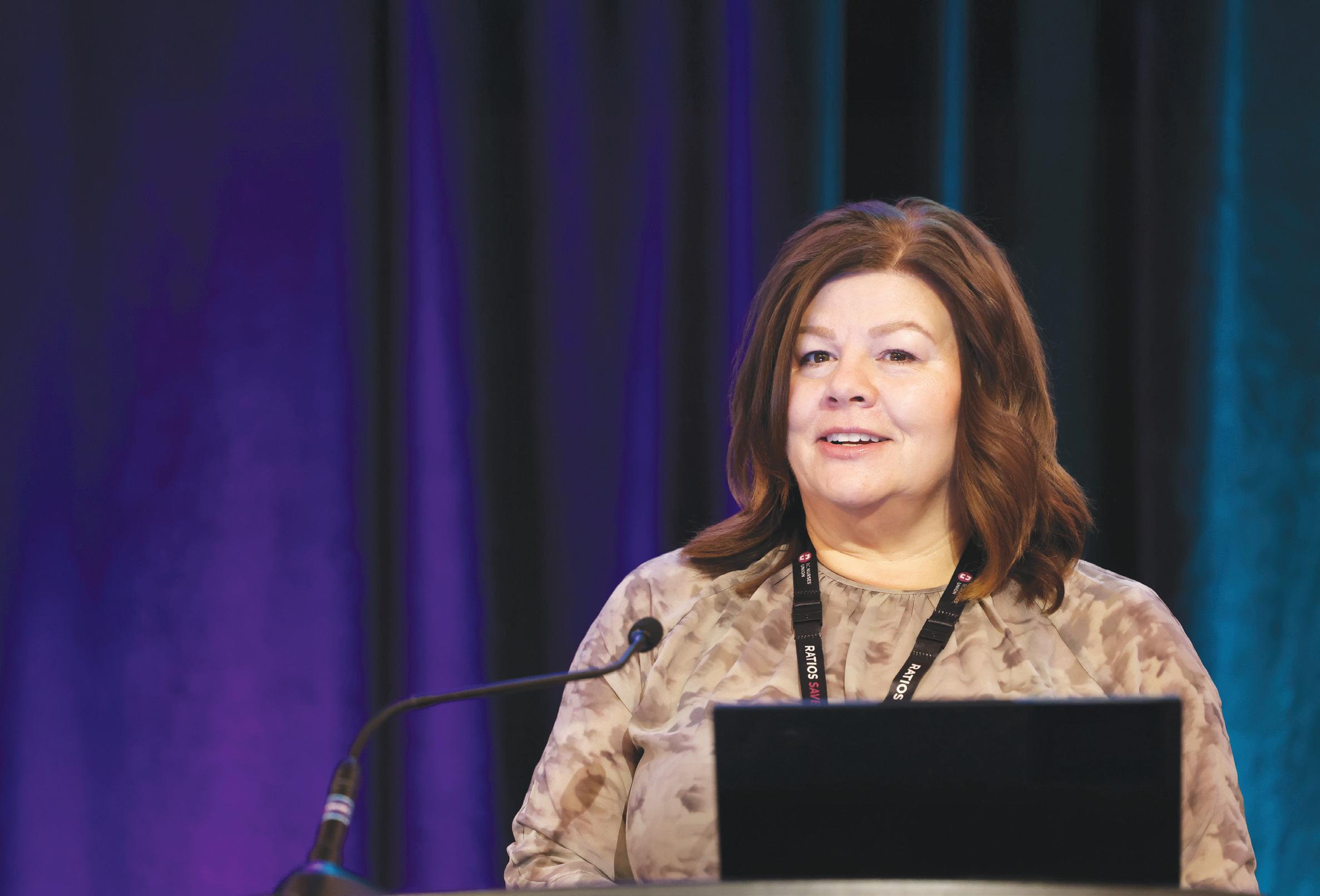
NEARLY 200 BCNU members settled into their seats last Nov. 18 at the Hyatt hotel on the unceded territories of the Musqueam, Squamish and Tsleil-Waututh Nations, for the union’s annual Human Rights and Equity Conference. The atmosphere in the room was expectant – and heavy. The day would ask participants to confront gender-based violence not as a series of tragic, iso -
lated incidents, but as a systemic crisis woven through health care, communities and the structures nurses work within every day.
The conference theme, Gender and Care – Change Through Collective Action, invited members to examine how colonialism, patriarchy, racism, transphobia and economic inequality sustain gender-based violence. The theme highlighted how these structural roots harm women, Two-Spirit, trans,
non-binary and gender-diverse people, especially those in undervalued care roles. The conference aimed to tap the wisdom and energy in the room, challenging participants to reimagine care as a collective, political act that can drive change.
The crisis of Missing and Murdered Indigenous Women, Girls and 2SLGBTQ+ people remains one of the most horrific forms of colonial violence and clearest expressions of the ongoing failure of systems to protect Indigenous lives. While these highly visible instances of violence make headlines, they only begin to tell the story. The true experience of violence shows up in emergency rooms, community clinics, long-term care homes and in the lives of nurses themselves.
Opening the conference, BCNU President Adriane Gear held a moment of silence before reaffirming the union’s commitments to truth and reconciliation. Her opening address highlighted the systems of colonialism, patriarchy, racism
“Systems shape how power and harm are distributed across society. They show us the need for collective action.”
BCNU President Adriane Gear
and transphobia. “These systems shape how power and harm are distributed across society,” said Gear. “They show us the need for collective action to create enduring change, to create space for care in the face of systemic neglect.”
Standing alongside President Gear were BCNU Vice President Tristan Newby and Executive Councillor for occupational health and safety and mental health, Aida Herrera.
“This conference highlights that the provision of care is influenced not only by individuals, but by organizational and societal structures,” said BCNU Vice President Tristan Newby. “As humans, nurses, and a union, we have a responsibility to examine ourselves and the systems in which we work and commit to continuous improvement.”
“Gender-based violence doesn’t stay outside hospital doors,” said Herrera. “Nurses care for its survivors every day, and many experience its impacts themselves. To build safer workplaces, we have to confront the systems that allow this violence to persist.”
Gear welcomed the first conference speaker, Gena Edwards.
GUEST SPEAKER
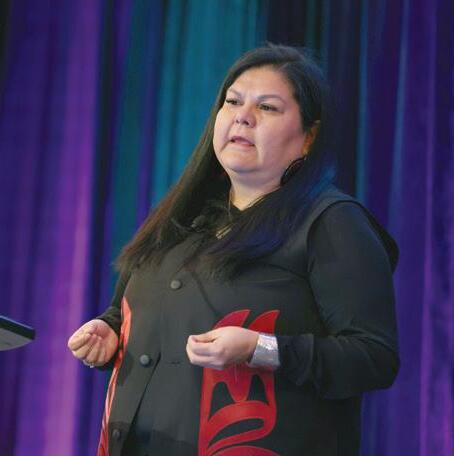
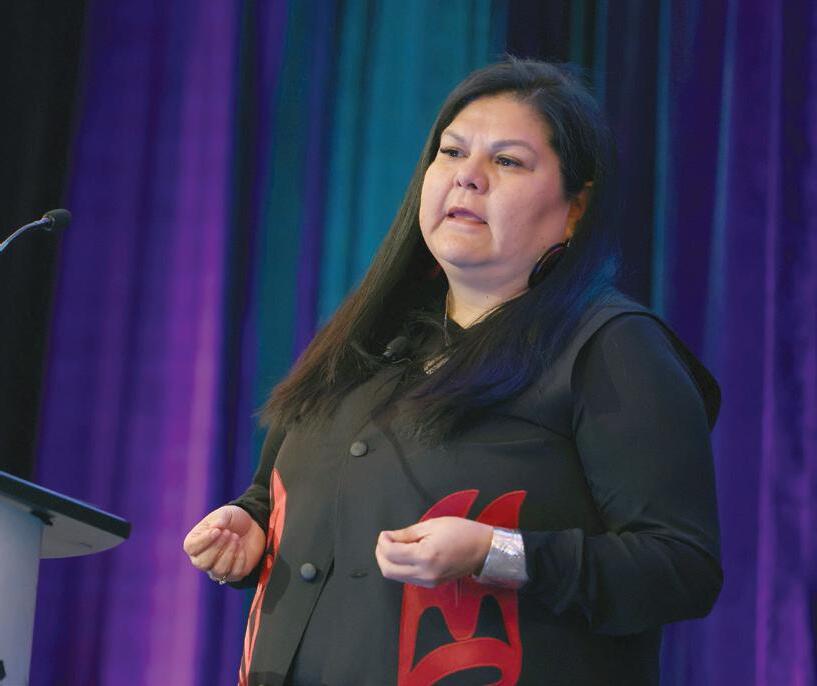
GENA EDWARDS IS A MATRIARCH IN the Eagle wilp with the Nisga’a Nation and is President of the BC Native Women’s Association. Her presentation positioned gender-based violence as a direct consequence of colonization and systemic inequity. She challenged members to use their power as frontline health-care workers to confront the system and improve it for patients.
Edwards began by describing the radical disruption of Indigenous societal structures under colonialism. She pointed out that patriarchy on its own represented a significant departure from Indigenous family and community structures.
“We had our own ways and laws to govern us,” she said. “Most people on Turtle Island came from matriarchal systems. We followed our mother’s bloodline.
“Those matriarchal societies, grounded in collective care and responsibility, were violently dismantled through colonial legislation, residential schools and cultural suppression.”
Far from ending in the 20th century, Edwards argued that colonial violence continues today – even if it’s called something else.
Edwards identified human trafficking as a modern extension of colonial violence. “Indigenous people are four times more likely to be trafficked than any other race in Canada,” she noted. She also pointed to the over-representation of Indigenous children in the foster care system as another form of systemic harm. Indigenous children make up 53.8 percent of youth and children in foster care in Canada, despite representing just 7.7 percent of the population under age 15, according to Statistics Canada.
Addressing the crisis of Missing and Murdered Indigenous Women, Girls
and Two-Spirit people, Edwards did not soften her words. “In 2019 the final report of the National Inquiry into Missing and Murdered Indigenous Women and Girls had 231 calls to justice. Today only two are complete. That’s a failing grade.”
She highlighted systemic inequities that persist across health care, education, justice, employment and child welfare, emphasizing the compounded discrimination faced by Indigenous women – particularly those living with poverty, addiction, or trauma.
“Confront bias within the system,” Edwards urged. “Educate yourself about Indigenous inequalities.”
She called on members to support Indigenous-led solutions, advocate for policy change and recognize the diversity and sovereignty of Indigenous nations. Finally, she performed the Woman’s Warrior Song . Composed by Elder Martina Pierre of the Lil’wat Nation, the song reinforces a message of resilience and calls on women to never stop fighting. •
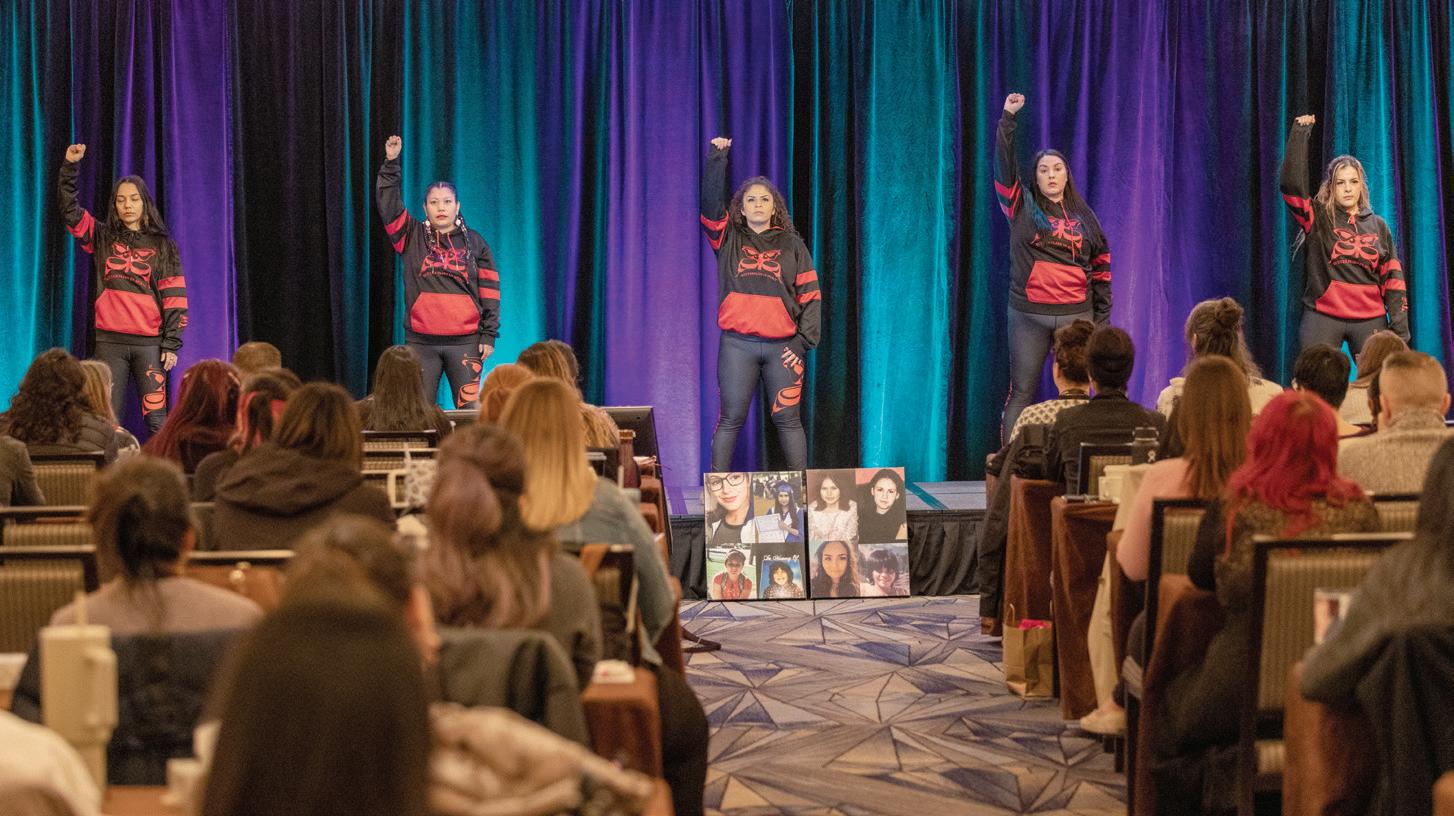
FOLLOWING EDWARDS’ SONG, attendees welcomed Butterflies in Spirit, an Indigenous dance collective honouring Missing and Murdered Indigenous Women, Girls and TwoSpirit (MMIWG2S+) people across Turtle Island, colonially known as North America.
Composed of family members of the missing and murdered, the group uses contemporary and Indigenous dance to share stories, channel grief and call for justice. Their work focuses on acts of remembrance, resistance and healing that center the voices and strength of Indigenous communities.
Founder Lorelei Williams shared the personal history of loss and systemic racism that inspired her work. She began the group to bring attention to her aunt, who went missing in 1977. Repeated attempts by her family to file a missing persons report were
dismissed by police, and it took over 25 years for the police to officially list her as missing.
Williams also lost a cousin to serial killer Robert Pickton and nearly lost another cousin to a different serial killer, Terry Arnold. “She survived,” said Williams, “but lives with survivors’ guilt.”
The group has grown into a national and international collective representing families and survivors across North and South America. Their performance delivered a message of resilience – and an unwavering demand for justice.
On stage, members wore clothing and carried signs bearing images of their missing and murdered loved ones. For their final performance, the dancers donned red dresses –a powerful image first created by Métis artist Jaime Black in 2010 to symbolize MMIWG2S+. •
KNOWLEDGE AND PROTECTION
Islands
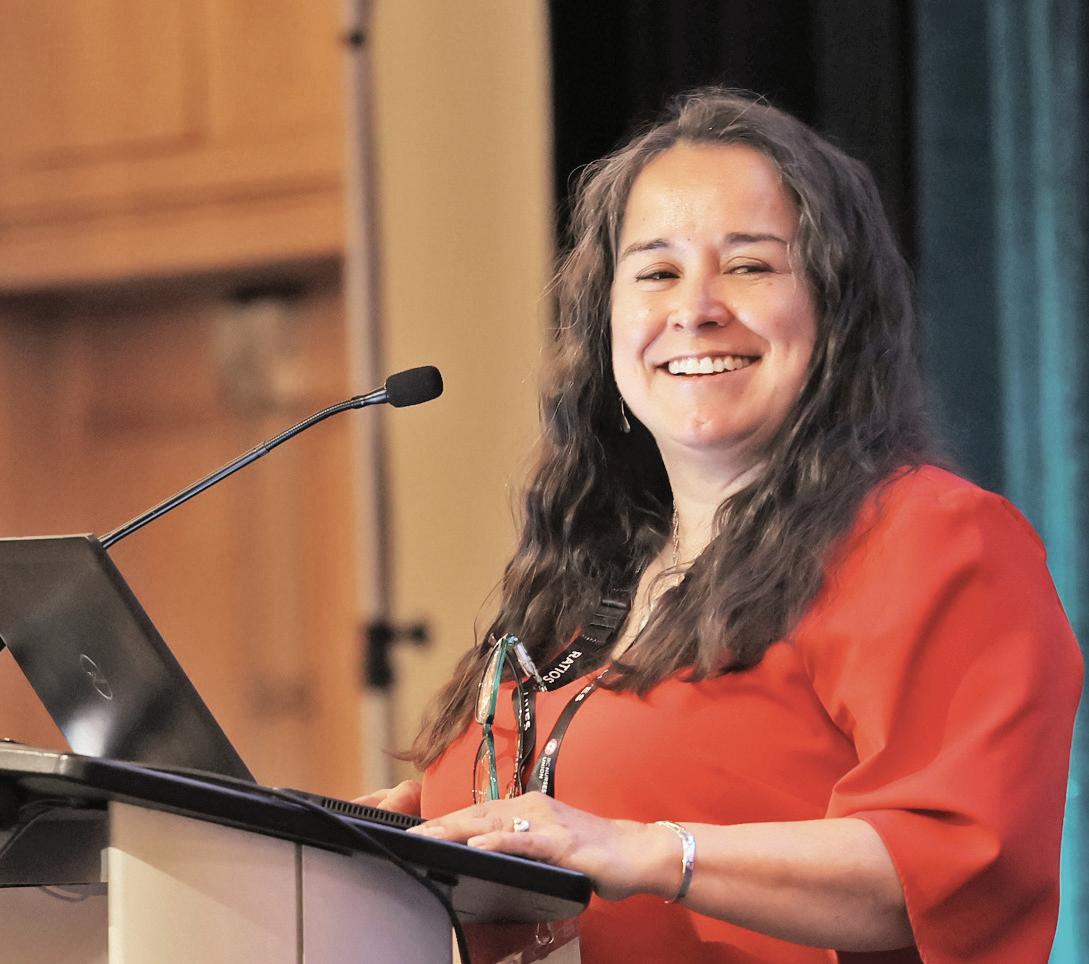
CONNIE WATKINSON, BCNU SOUTH Islands region Indigenous Leadership Circle representative, is an Indigenous liaison nurse. She shared a traditional teaching about the sasquatch – a story meant to remind children that fear, paired with knowledge, can protect them.
Connecting that teaching to present day realities, Watkinson recalled witnessing two young girls being followed. She later realized that she had not intervened to protect the girls, which revealed to her how violence can hide in plain sight.
She urged nurses to recognize the deep trauma Indigenous patients carry, especially families left without closure when loved ones go missing.
“Without bodies there are no ceremonies, no closure. Families walk around with that trauma,” Watkinson said.
She encouraged members to meet Indigenous patients with compassion, cultural humility and an awareness of the intergenerational trauma many families continue to endure. •

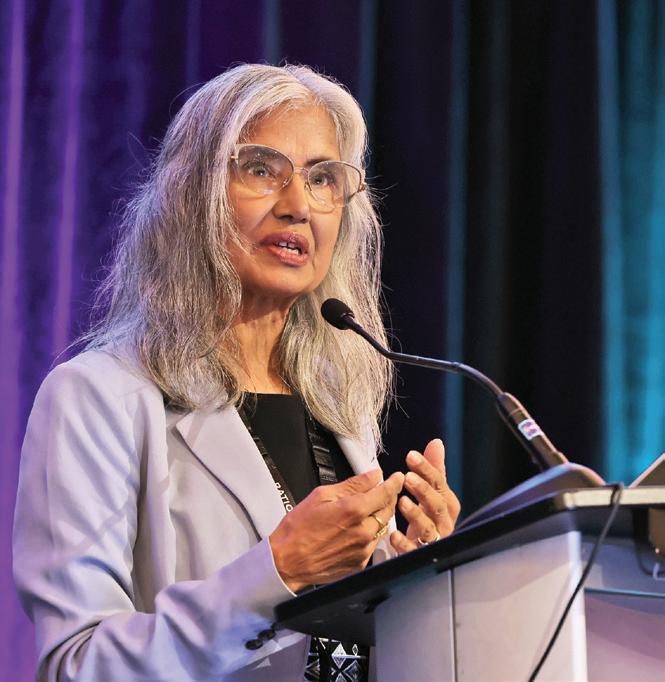
DR. BALBIR GURM, AN AWARD-WINNING nursing leader, educator, social justice advocate and Fellow of the Canadian Academy of Nursing, framed genderbased violence as both a human rights crisis and a pandemic sustained by structural inequality.
Gurm defined gender-based violence broadly, and said that it encompasses physical, emotional, sexual, financial, spiritual and digital harms. She outlined three interconnected layers that work together to perpetuate violence –each also presenting opportunities for intervention:
• Structural violence: patriarchy, colonialism, capitalism and racism create inequality and normalize harm.
• Institutional violence: workplace cultures tolerate harassment, dismiss complaints and reinforce exclusion, including in health care.
• Systemic violence: racism and sexism – embedded in health care, justice, education and social services – produce poor outcomes and revictimize.
Gurm called on unions to lead the fight against gender-based violence,
not only in members’ workplaces, but also in their own governance structures.
“Prioritize representation in decisionmaking roles,” she urged. “That includes union leadership. We need policies that reflect lived experience – and that means having people from different backgrounds at the table.”
Ivan Coyote (they/them), a renowned non-binary trans writer and storyteller, shared deeply personal reflections on living in a world built around a rigid gender binary.
Through humour and candid storytelling, Coyote described how gender is policed in everyday spaces –airports, hospitals and bathrooms – and how barriers in the health-care system exclude trans and non-binary people.
“I am not trapped in the wrong body. I am trapped in a world that makes very little space for bodies like mine.”
Ivan Coyote
“Prioritize representation in decisionmaking roles. That includes union leadership.”
Dr. Balbir Gurm
Frances Beswick, provincial chair of BCNU’s 2SLGBTQ+ Caucus, followed with reflections ahead of the Transgender Day of Remembrance on Nov. 20. She honoured transgender and gender-diverse people lost to violence, highlighting the heightened risk faced by trans women of colour and cautioning that legal protections alone do not guarantee safety.
“With so many seeking to erase transgender people – sometimes in the most brutal ways possible – it’s vitally important that those we lose are remembered in our continued fight for justice,” Beswick said. •
Coyote recounted a traumatic experience during a medical procedure at a crowded clinic. Staff attempted to turn Coyote away, loudly misgendered them and ultimately refused to perform the procedure. Coyote was forced to self-administer the exam.
“The ultrasound technician would not touch me,” they recalled. “She passed me the lubricated wand, instructed me how to put it into myself. After, I asked her for a tissue, and she tossed a Kleenex box onto the exam table and bolted out the door. I barely made it back to my truck before the tears
“Gender-based violence doesn’t stay outside hospital doors. Nurses care for its survivors every day.”
BCNU Executive Councillor Aida Herrera
came. I sobbed in the parking lot for ten minutes.”
Coyote also spoke about being treated as a “learning opportunity” rather than a patient. They suggested that addressing these harms requires more than minor adjustments.
“We need a major renovation,” they said. “To accept that regardless of what some people say, we exist and always have. We’re not going away and sometimes we need health care.”
“I am not trapped in the wrong body,” Coyote declared. “I am trapped in a world that makes very little space for bodies like mine. I live in a world where my trans sisters are routinely murdered. Without consequence or justice. It is the world that needs to change. Not trans people. We are already professionals at changing.” •
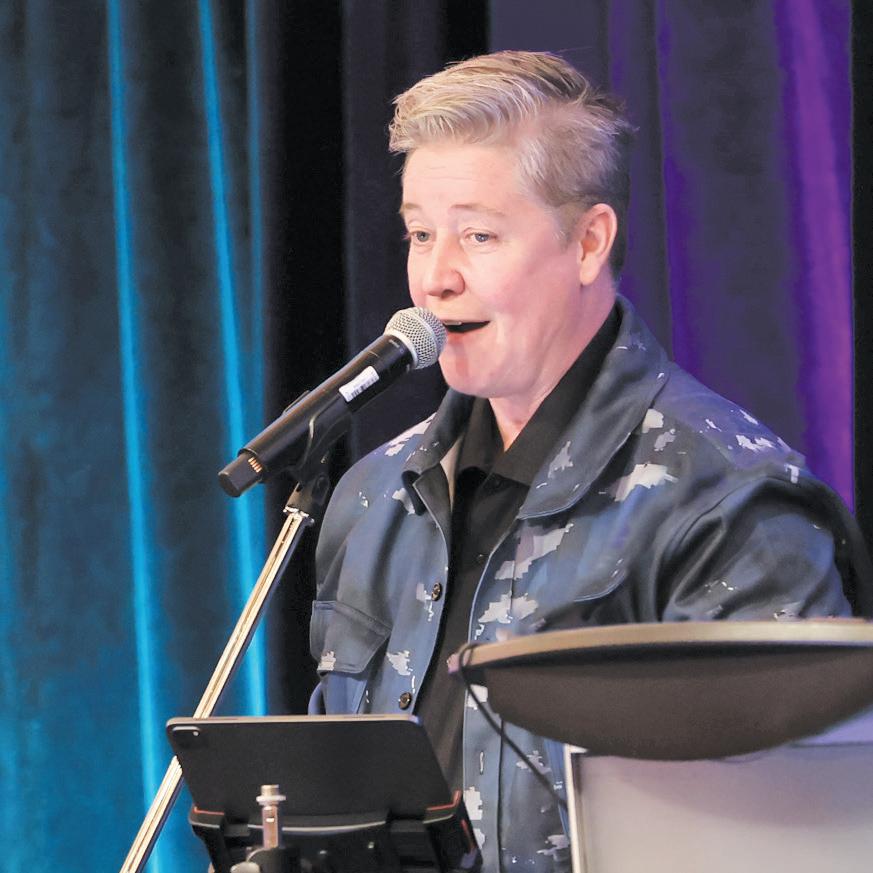
ANGELA MARIE MACDOUGALL IS executive director of Battered Women Support Services (BWSS), a Vancouverbased organization working towards the elimination of violence. They offer counselling, advocacy, legal support, youth engagement and programs encouraging men to take responsibility. MacDougall emphasized the power that nurses have as frontline witnesses to gender-based violence.
“Nurses see everything the system wants to deny, witness everything the system undercounts and hold everything the system drops,” she said. “Genderbased violence is not a private issue. It’s a serious social and public safety crisis.”
Far from improving in recent years, MacDougall noted that recent events like the COVID-19 pandemic led to a rise in intimate partner violence and femicide, even while other crimes decline. She warned that official statistics underestimate the scope of the crisis, as most sexualized violence is never reported to police.
“But nurses witness the real scale through injuries, trauma and chronic health conditions,” she said. “Nurses
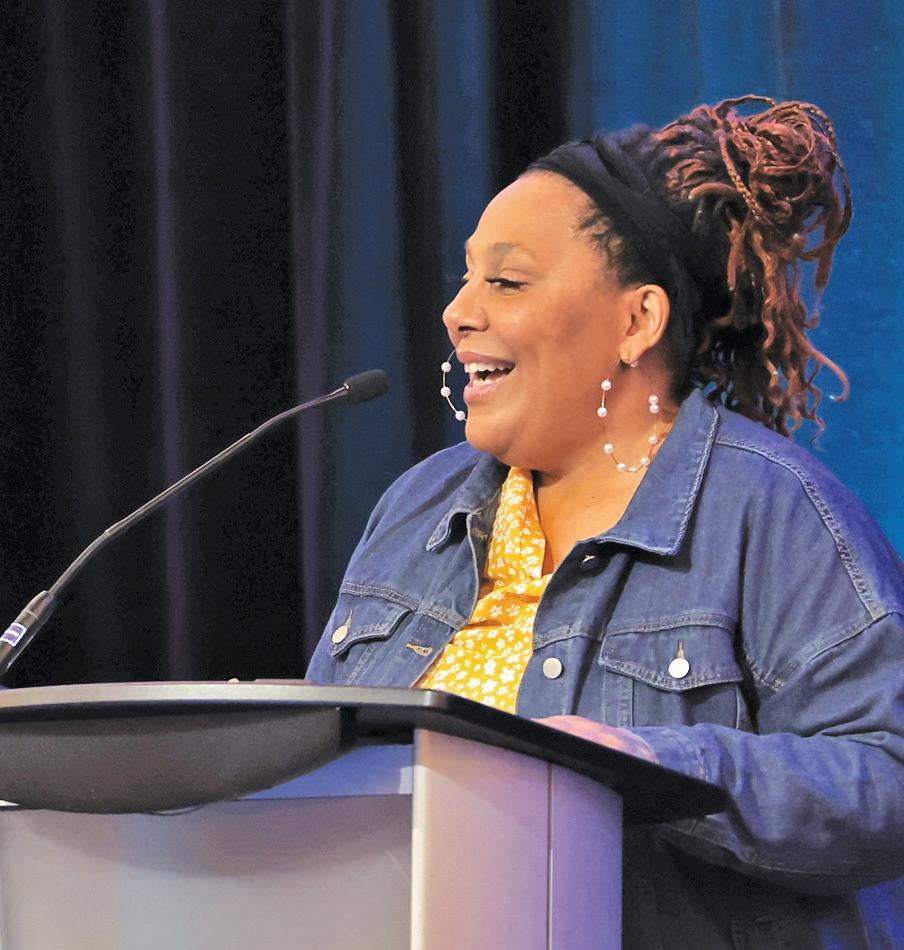
are the relational bridge survivors cross to safety. This is where nursing and community organizations overlap.”
She emphasized that listening, documenting and intervening – all key components of nurses’ training and licensure – can create safety for survivors. Beyond clinical care, she urged members to advocate for stronger public policy, including violence task forces, increased emergency funding, decentralized violence risk assessments and coordinated government responses to violence.
“Nurses see everything the system wants to deny, witness everything the system undercounts and hold everything the system drops.”
Angela Marie MacDougall
“You as nurses have a lot of leverage in what you represent for patients and victims,” MacDougall said. “Gender-based violence is not inevitable. It’s a product of choices, policies and priorities. So is safety.” •
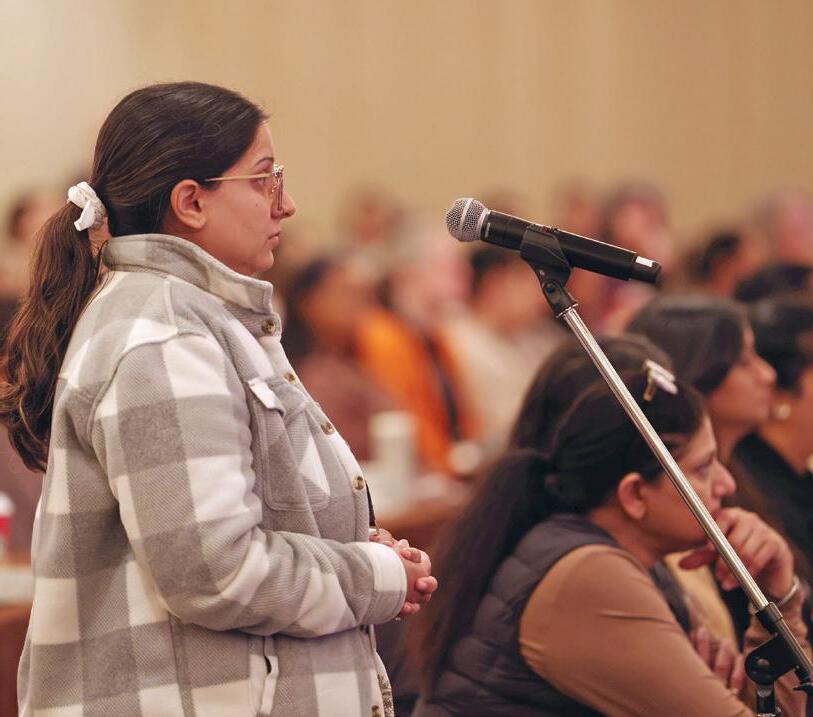
As the conference closed, BCNU human rights and equity officer, Lindsay Manning, invited members to reflect not only on what they had learned, but also on how they might reimagine care and safety within their own practice and communities.
“With nurses, communities and our union at the table,” said Manning, “we can build real, survivor-centred systems that keep people safe.”
Members responded with concrete calls to action and personal reflections on the day’s theme.
Sarra Fedick, a member educator in BCNU’s Thompson North Okanagan region, suggested expanding programs in which nurses partner with police in public safety responses.
Samantha LeDrew, a member in BCNU’s West Kootenay region, called for mandatory cultural safety education. “As an Indigenous nurse, I’m proud I can smudge for my patients – until a colleague says it stinks. That disrespects the ceremony and makes me feel defeated.”

Louise Boxeur, a member based in Williams Lake, spoke to institutional victim-blaming after her daughter was stalked while attending UNBC in Prince George.
“The school suggested my daughter pause her schooling or attend another institution,” she said. “Their focus on relocating the victim rather than addressing the perpetrator infuriates me and shows systemic victim-blaming.”
To close the conference, President Gear invited Dr. Elder Roberta Price to offer a blessing of protection, healing and gratitude, underscoring the power of frontline workers, families and matriarchs acting together as allies.
Reflecting on the day’s emotional impact, BCNU Richmond Vancouver region 2SLGBTQ+ Caucus Representative Jay Chang said the conference was “very heavy, but in a powerful and deeply informative way.”
“It stirred something in me – a feeling that I need to step up and do more. Those most affected need to be at the centre of decisions. Community-led
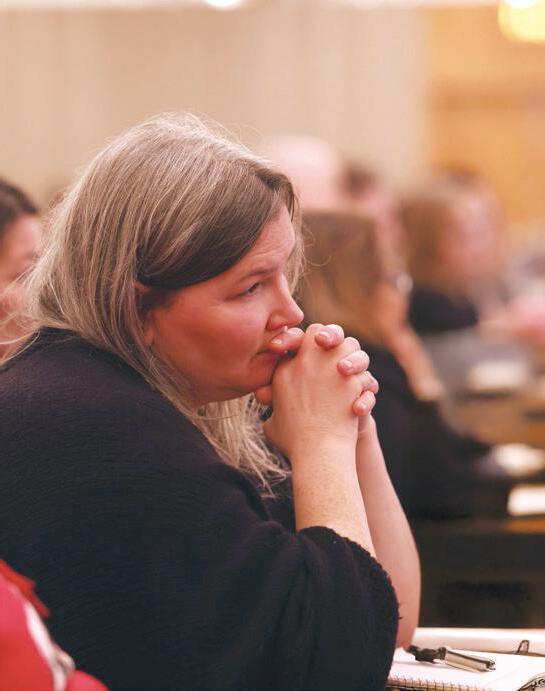
care works. It always has,” he added
“When nurses speak up about unsafe conditions, about discrimination, about violence – that is health and safety work,” said Gear. “Collective action is how we protect each other and our patients. This conference made it clear that silence is not neutral. Our responsibility is to act.”
It was clear that something profound had taken shape at the conference – a collective awakening grounded in the lived realities, expertise and unwavering commitment of BCNU members.
Chang’s words echoed the messages heard in conversations throughout the day. His reflection crystallized a shared recognition that real change begins where care actually happens: in the hands of nurses who know their communities best. What emerged was not just inspiration but perhaps a movement – one that is focused, determined and ready to transform nursing practice and policy by placing members’ collective wisdom and leadership at the forefront of gender and care. •
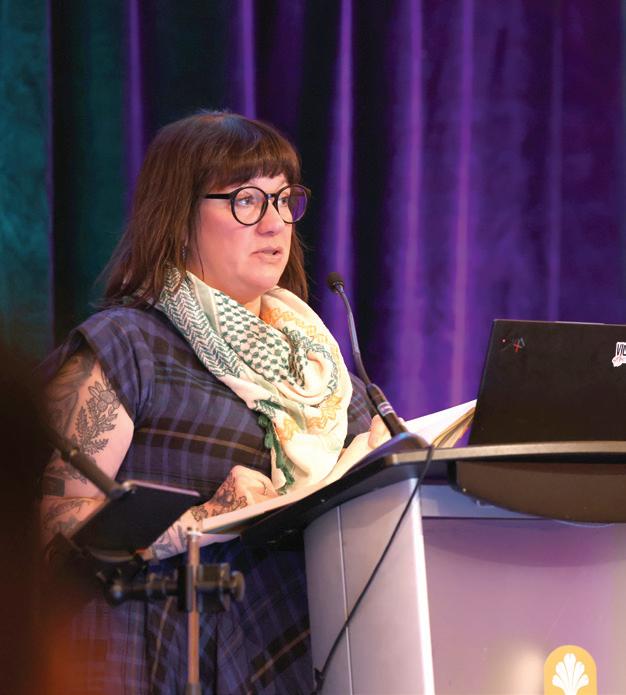
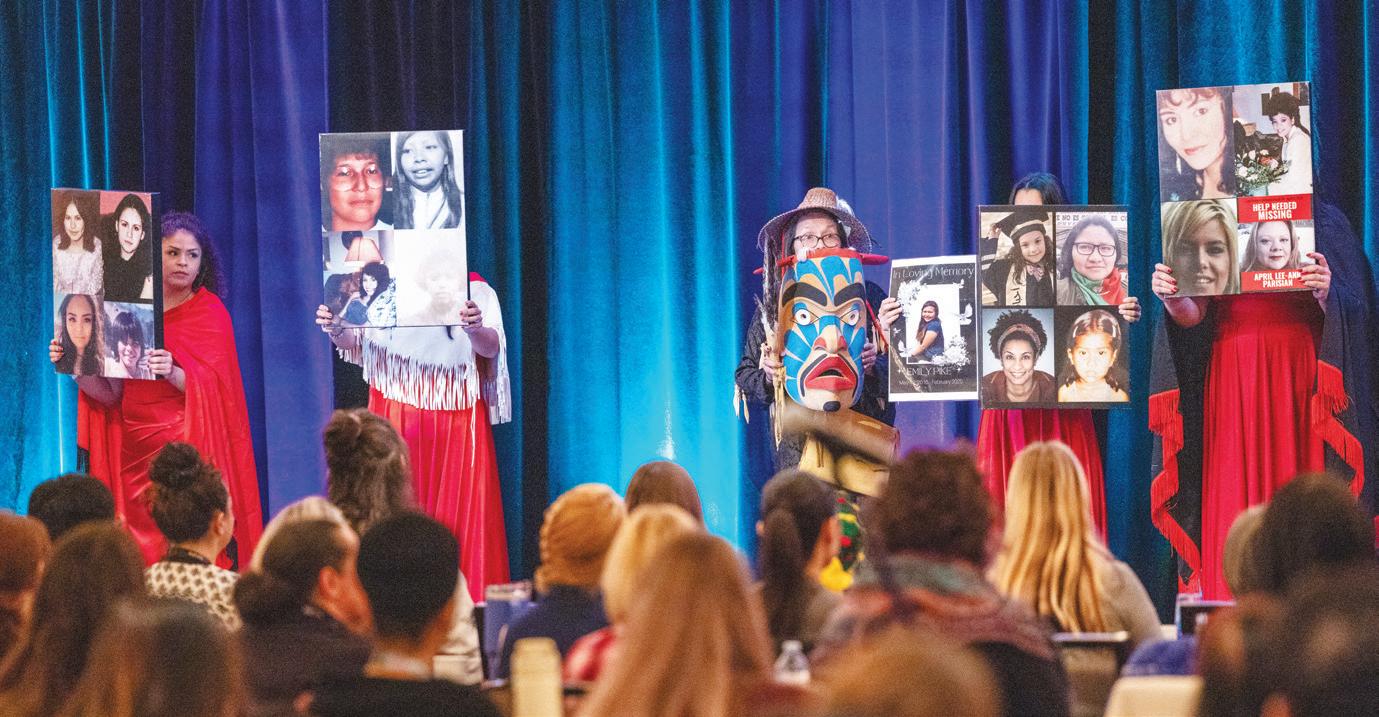
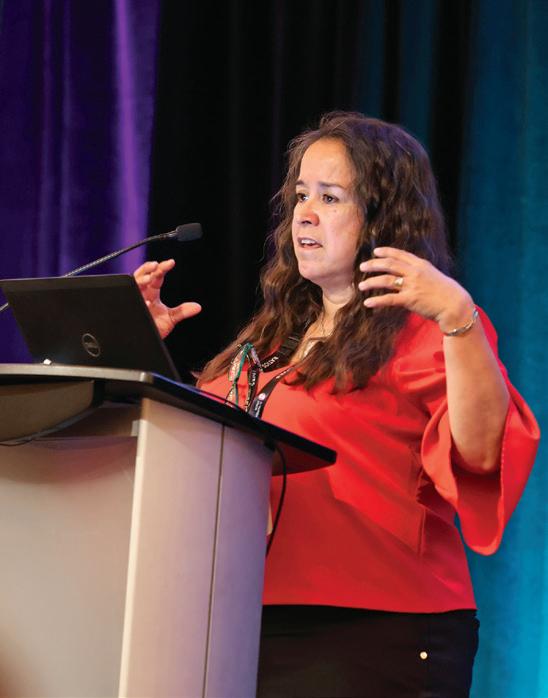
1. BCNU Vice President Tristan Newby addresses participants. 2. A member listens to a presentations. 3. BCNU 2SLGBTQ+ caucus chair Frances Beswick speaks. 4. ILC representative Connie Watkinson addresses the participants. 5. A member speaks at the microphone.
Butterflies in Spirit, an Indigenous dance collective honouring Missing and Murdered Indigenous Women and Girls.

CAUTIOUS OPTIMISM Minimum nurse-to-patient ratios are improving patient care and job satisfaction for BCNU members – but uneven implementation shows there is still work to do.
As minimum nurse-to-patient ratios roll out in hospitals across BC, new hope emerges – even if progress feels slow

or the first time, minimum nurse-to-patient ratios are no longer just a goal on paper in British Columbia. They are beginning to take shape on the floor.
Phase one of ratio implementation is now underway in selected settings across the province, including medical and surgical inpatient units, rehabilitation, palliative care, focused and high-acuity care, intensive care and pediatric services.
In a small but growing number of worksites, nurses are beginning to see early signs of change. These include more manageable assignments, stronger team stability and more time to focus on patient care. For some members, these early shifts have brought a cautious sense of relief.
Nurses have fought hard for ratios, but securing them was only the first step.”
BCNU President Adriane Gear
But the story of ratios in BC is not a simple one.
Implementation of ratios has been uneven. In many Phase One settings, ratios are only partially in place, inconsistently applied, or not yet implemented at all. Staffing shortages, uneven site-level decision-making and the routine redeployment of nurses have made early gains unstable and, in some cases, quickly undone.
For every unit beginning to feel some of the benefits of ratios, there are many more still waiting to experience them. Many nurses see improvements on some days, only to lose them on others.
“Nurses have fought hard to secure minimum nurse-to-patient ratios, but securing them was only the first step,” says BCNU President Adriane Gear. “What members are telling us is that implementation is uneven and fragile. Where ratios are in place, nurses are seeing what’s possible. Where they aren’t, the risks to patients and nurses remain.”
For BCNU members, this tension between early progress and persistent gaps defines the current reality of ratio implementation in British Columbia. These stories come from nurses across the province who are beginning to see signs of positive change in their day-to-day work. They offer a glimpse of what safer staffing can make possible when ratios are in place. While these experiences represent only a fraction of members and are not yet the norm across BC, they point to what is possible as this work continues.
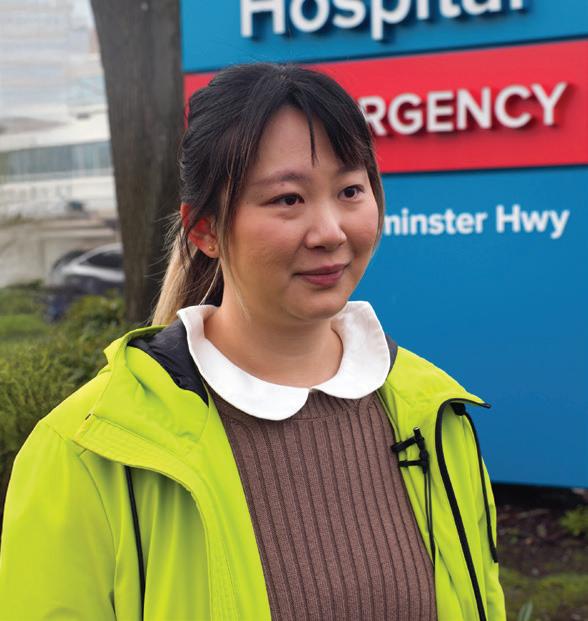
KUNYE
HU Richmond Hospital RN
When ratios are in place on Kunye Hu’s unit, the difference is noticeable.
“With a higher nurse-patient ratio now, I think that it’s really benefited patient care. When you have a lesser assignment, you’re able to really focus on your specific patients,” Hu says. “You’re able to spend more time with assessments. You’re able to spend more time with things like implementations, wound care and you can just spend more time with the patient in general. So, with ratios, you’re able to really build that patient-nurse connection and provide person-centered care.”
For Hu, the impact is felt not only by patients, but by staff as well.
“In addition to benefiting the patients, I think staff are just a lot more relaxed,” she says. “When ratios are implemented, they’re much happier to come to work because they know that they’ll have a fair assignment. They also know that they’re being supported
by other nurses and that they can spend their day focusing just on their assignments and tasks.”
Having ratios in place helps Hu focus on what’s important at work, she says, without having to constantly overexert herself. “There’s not so much short staffing or missing breaks or having to stay for overtime, which used to happen a lot, before ratios were implemented.”
With ratios, you’re able to really build that patient-nurse connection.”
Kunye Hu

Victoria General Hospital RN
Kennedy Love has been working at Victoria General Hospital for eight months. Originally from Edmonton, she came to BC as part of a ratio hiring initiative and says she has already seen how safer assignments can change patient care when they are in place.
“When I’ve got a ratio assignment, which on my unit is four patients, I’ve got way more time to spend with each individual patient,” Love says. “I’m in there with them a lot more. I have much more time to look over their charts and make sure nothing is being missed.”
That additional time, she explains, directly affects patient safety.
“When we’re at ratio, there’s no way for these patients to fall through the cracks,” Love says. “There’s so much more time to look over lab results and make sure there are no errors.”
Love works on an acute unit caring for patients recovering from
When we’re at ratio, there’s no way for patients to fall through the cracks.”
Kennedy Love
surgery. When staffing drops below ratio, she notices the difference immediately.
“Working short is definitely challenging,” she says. “When we’re short, I feel like I spend a lot of my time just running around, and I have less time to be comprehensive in my assessments because I know I’ve got five more to do.”
She describes the responsibility of caring for post-surgical patients in simple terms.
“It’s already a big responsibility to have four lives that you’re in charge of – keeping people alive and well for 12 hours,” Love says. “When you’ve got six instead, or even seven, it can be overwhelming.”
But perhaps the biggest difference for Love is how her patients react when her unit is at ratio “It makes my patients feel better cared for.”
BEFORE RATIO IMPLEMENTATION, BC NURSES REPORTED:
Unsafe workloads and burnout
77% said their workloads were unsafe for patients.
59% reported high levels of burnout linked to staffing shortages.
1 in 5 planned to leave their current workplace within a year due to inadequate staffing.
Missed patient care
63% missed time comforting or talking with patients.
54% missed patient mobilization or ambulation.
Nearly 1/2 missed patient education, counselling or basic care such as oral or skin care.
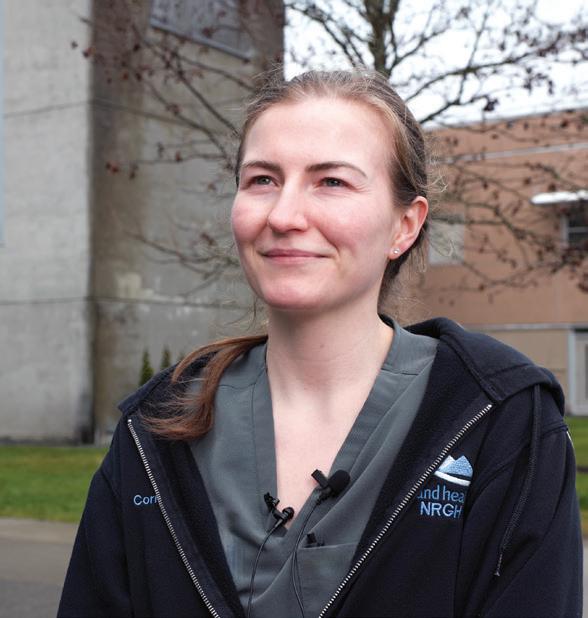
Nanaimo Regional General Hospital
RN
Corinne Loitz says the difference is clear on days when her unit is staffed to ratio.
“It has been much better when we are at ratio,” Loitz says. “We’re much better able to manage our fourpatient load. Just in general, there’s more time available to spend with each patient.”
That time, she explains, shows up in small but meaningful ways.
“It could be little things,” Loitz says. “Having more time means someone gets to brush their teeth that day, or they get to go for a shower. It might not seem like much, but for me, it would be awful if I didn’t get to brush my teeth in the morning.”
When staffing drops below ratio, those intricate moments of care are often the first to disappear.
“When we’re not at ratio, there’s definitely a risk of missing little things because you’re trying to make sure everyone’s taken care of all at the same time,” she says.
Even when ratios are in place, Loitz notes that high patient acuity can still
create pressure – and that pressure is made worse by working short.
“Things can get missed depending on the acuity of patients,” Loitz says. “That gets magnified more when we’re over-capacity.”
For Loitz, the consequences are clear.
“When we’re not at ratio, even basic things – important things – get left behind,” she says. “And that can have pretty bad consequences.”
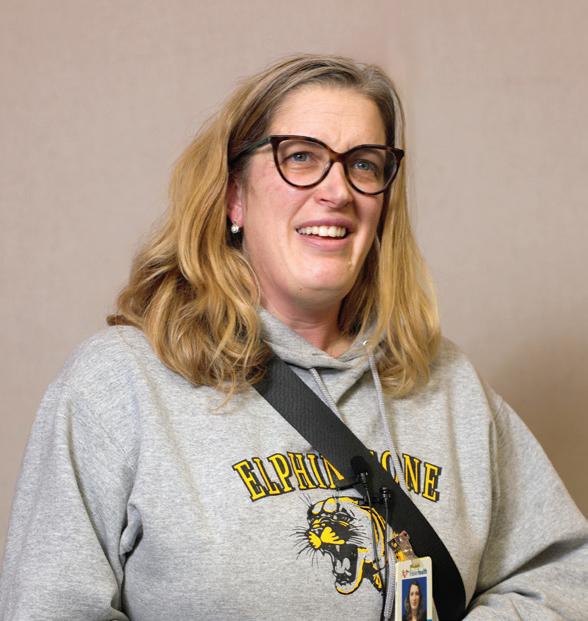
SHANNON WIEKENKAMP Eagle Ridge Hospital RN
For Shannon Wiekenkamp, ratios change not just how much care nurses can provide, but their ability to actually practise nursing at all.
“Ratios make all the difference, because you can actually do your job in the way that you were trained to do it,” Wiekenkamp says. “When you’re at ratio, you should be able to do the tasks and care for your patients in a manner which meets your practice standards and actually acknowledges the patient, as opposed to just doing skills.”
Wiekenkamp works with patients across a wide range of clinical needs, including palliative care. She says having the time to be present with patients matters deeply.
We’re much better able to manage our fourpatient load.”
Corinne Loitz
“We have patients of all different kinds,” she says. “Palliative patients that deserve to be heard and to be cared for and not just be ‘okay’.”
When staffing falls below ratio, the strain is immediate.
“If you’re not at ratio, your day can just be a disaster,” Wiekenkamp says. “If you have six patients you’re in
If you’re not at ratio, your day can just be a disaster. We work a lot of 16-hour shifts on our unit.”
Shannon Wiekenkamp
charge of, you’re constantly trying to help other people instead of just the patient in front of you.”
The impact of working below ratio doesn’t end when the shift does – if the shift even ends on time.
“You go home after an overtime shift,” she says. “How do you have time to care for yourself? How can you care for your family? We work a lot of 16-hour shifts on our unit.”
These stories highlight the promise of ratio implementation in BC, showing what becomes possible when nurses have the staffing they need to do their jobs well. When ratios are in place, nurses describe having the time to provide safer, more attentive care, to support one another and to work in ways that are sustainable.
At the same time, these experi-
ences represent only a fraction of members’ experiences. Many nurses across the province have yet to see ratios implemented consistently, and others experience them intermittently or not at all. Staffing shortages, redeployment pressures and uneven site-level decisions continue to undermine progress in many settings.
Phase One has shown what ratios can begin to deliver, but it has also made clear that implementation alone is not enough. Health employers must consistently apply ratios, properly staff workplaces and protect ratios in practice, not just on paper.
The work to fully implement and protect minimum nurse-to-patient ratios in British Columbia is ongoing. BCNU will continue to push for consistent, effective implementation so that the conditions described in these stories become the standard for nurses and patients across the province, not the exception.
AS PHASE ONE OF IMPLEMENTATION continues, member involvement remains critical. BCNU members are encouraged to stay informed, share their experiences and report how ratios are being applied on their units. This feedback helps identify gaps, track progress and strengthen implementation across worksites. Members who are interested in participating in monitoring efforts or contributing to this work can submit an expression of interest through the BCNU Member Portal.
BCNU is also inviting members working in Phase One units to share their experiences with ratio implementation, whether you are seeing early improvements, ongoing challenges, or a mix of both. These stories will help inform an upcoming ratios campaign and ensure nurses’ real, on-the-ground experiences are reflected. Members who are interested in participating in a short video interview can contact the BCNU communications team at communications@bcnu.org to learn more. •
Ratios make all the difference. You can do your job in the way that you were trained to do it.”
Shannon Wiekenkamp
Hear more member stories:
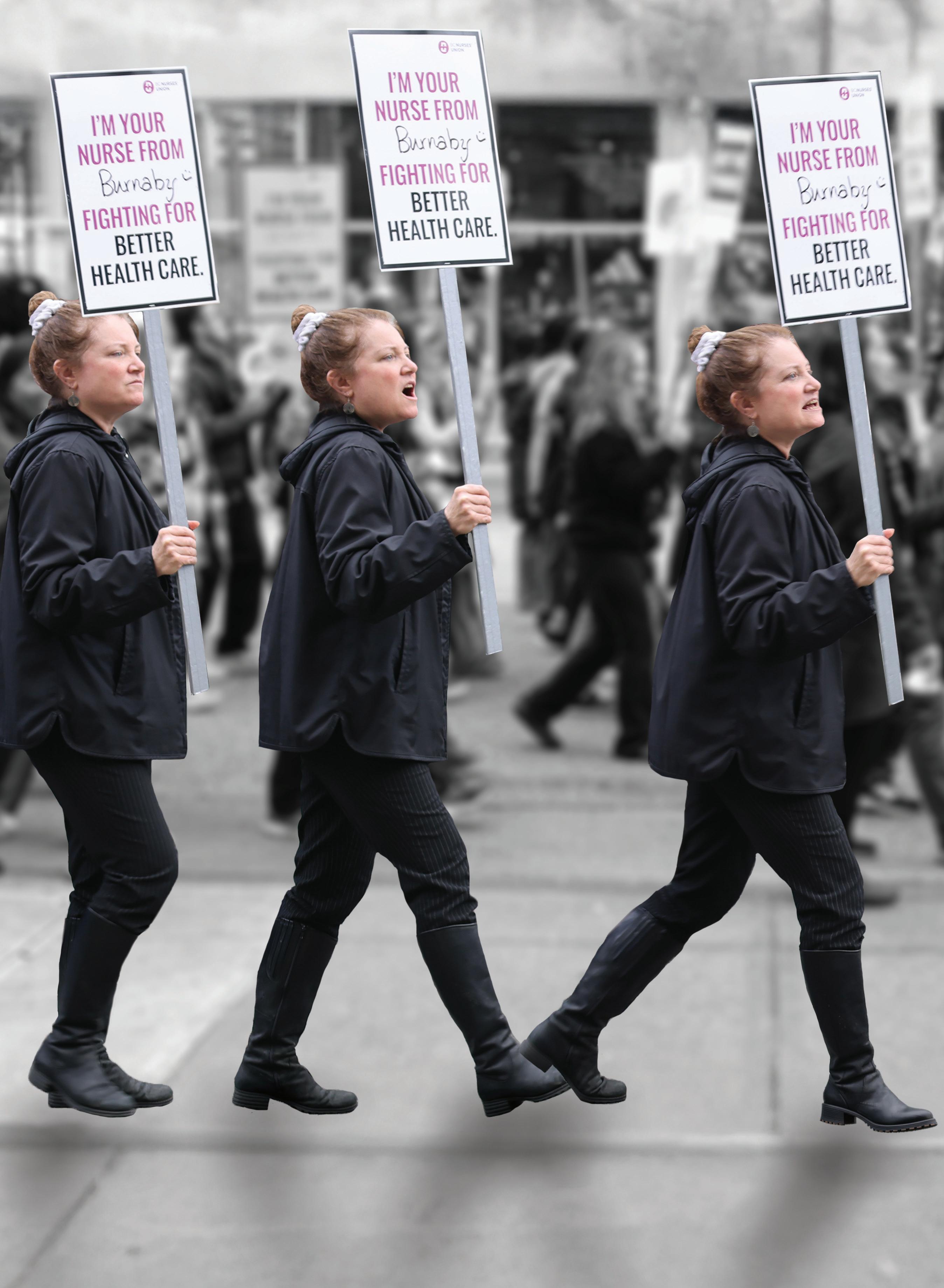
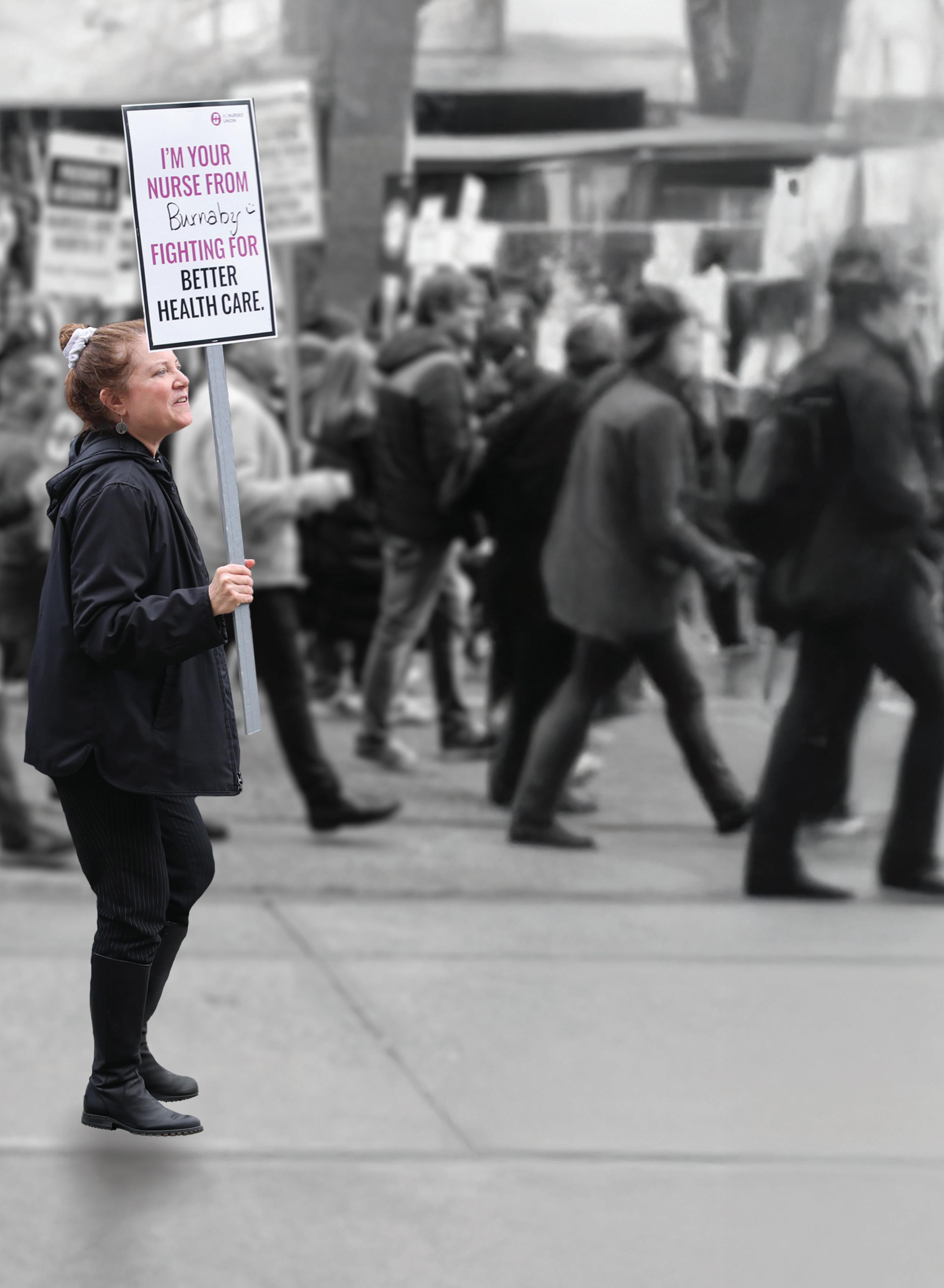
As NBA bargaining continues, BCNU is asking members to get informed, get organized and be ready if job action becomes necessary.
ACROSS BC, NURSES ARE talking about bargaining – in break rooms, at nursing stations and in group chats after long shifts. Many are asking the same questions: What happens if negotiations stall? What would job action actually look like? And what role would I play?
Among members, there is a shared understanding that this round of bargaining matters. Some are channelling their anger into a call to action. Others are carefully considering
what job action could mean for their households. In different ways, nurses are confronting the same reality: what happens at the table will shape their working lives for years to come.
The pressures bearing down on negotiations are significant. With the anchor of the US trade war weighing BC’s economy down, the fight for improved wages – an uphill battle at the best of times –feels even more pitched.
At the same time, entrenched violence in health care continues to compromise members’ health and safety. Despite rising WorkSafeBC claims, the employer has taken an aggressive approach to the benefits members rely on, attempting to strong-arm changes through arbitration rather than negotiation.
While BCNU’s CEO and lead negotiator Jim Gould remains committed to resolving these challenges at the bargaining table, he wants members to know that achieving the goals they have set this round will require their active participation –and that may mean job action.
“We’re ready to use every tool at our disposal to protect NBA members’ rights,” says Gould. “That includes potentially asking members to take job action as a last resort –because we know how much power nurses hold in our health-care system.”
That power has been on display just three times in the union’s 44-year history: a province-wide strike in 1989, a public service strike in 1990 and an overtime ban in 2001. While rare, these historical moments were potent, reshaping the nursing profession. Job action helped secure pay parity for public service nurses and delivered
substantial NBA wage increases –victories won in politically hostile environments. These examples underscore what nurses can achieve when they act collectively to demand transformational change in the health-care system.
Members’ power to re-shape health care came into view more recently after the last round of negotiations concluded, when BCNU and the provincial government came to a separate agreement to implement minimum nurse-to-patient ratios. With ratios now rolling out in units across BC, members are already reporting meaningful improvements in both working conditions and patient safety
Similarly, advocacy from traditionally underrepresented BCNU members helped secure important protections for these nurses in the 2022-2025 NBA provincial collective agreement, including leave provisions for members seeking gender-affirming care and incorporating the Declaration on the Rights of Indigenous Peoples into the language of the contract.
“Whether we take job action or not, this bargaining season is going to be historic,” says Provincial Job Action Committee (PJAC) member Julie Bodden. “It’s going to be in the memory of BCNU for decades to come. This is our moment.”
That’s why, as contract negotiations continue in 2026, BCNU’s leadership has prioritized job action readiness, and why they’re asking all members under the NBA contract to prepare.
“If we reach an impasse, showing the employer that we are prepared and serious about job action can bring them back to the bargaining table,” says BCNU President Adriane Gear. “That’s why we want every NBA member to be ready.” •
To prepare for potential job action, BCNU is asking all members under the NBA contract to:
Ensure your phone number, email and home address is up-to-date on the BCNU Member Portal.
DID YOU KNOW? Never use an employer-owned email for union business. In the event of job action, you may lose access to that address, making it difficult for your union to keep you informed.
Ensure you are subscribed to member eNews. BCNU will send out critical information like strike headquarters locations to your email. Make sure to add bcnunews@bcnu.org to your list of safe senders.
Download the BCNU Connect App for NBA bargaining updates, member bulletins and news releases related to bargaining, education modules, links to surveys and more.
Take the NBA Bargaining, Job Action 101 and Job Action Planning modules on the BCNU Member Portal
Talk to your co-workers about potential job action and ensure they take steps 1-5!
KNOWING THIS WOULD
be a difficult round, the union has been preparing for possible job action since negotiations began in 2025. Since BCNU has not taken significant job action in more than two decades, the task has been an especially challenging one.
Update Magazine sat down with PJAC Chair and BCNU Treasurer Sharon Sponton to discuss how the committee has been preparing for job action – and what members can do to pitch in.
UPDATE Many members hear the words “job action” and immediately think “strike.” Can you explain what job action really means and the different forms it can take?
SPONTON Job action is a tool to support our bargaining committee, to ensure they have the collective power of the membership if they reach an impasse at the table.
A strike vote does not necessarily mean we’ll be out on a picket line. Sometimes, a strong strike mandate is enough to shift the dialogue and get negotiations back on track.
If the bargaining committee does call for job action, it can take many different forms, that could include an overtime ban or a work-to-rule – where members work only their scheduled shift and take their full breaks. Banning non-nursing duties can also be highly effective. Non-nursing tasks like making beds, delivering trays, transcribing orders and answering phones all take up a lot of time and are critical to the normal
functioning of the workplace. If more pressure is needed, job action may escalate to picket lines and a strike. Even then, we escalate strategically. We might take one worksite out one day and another the next. The committee will make decisions in consultation with the bargaining committee and council. The goal is always to maximize pressure on the employer and minimizing impacts on members – while ensuring the public continues to receive care. Much of the committee’s work happens long before members ever hear the words “job action.”
UPDATE How is the PJAC ensuring that members are ready for job action?
SPONTON Preparation has been ongoing. We began ramping up in the summer of 2025 with a full day of training. Since then, we’ve held meetings every two weeks to prepare. We’ve updated, refined and digitized our job action manual, a comprehensive document that will form the blueprint for any job action we might take. The committee has been forecasting potential job action scenarios and troubleshooting issues. That way, we’re ready for anything. That readiness doesn’t erase anxiety. Job action is difficult. But it is also deeply collective. Finally, we’ve produced a number of online modules to educate members about job action and their roles. These are available to all NBA members on the BCNU Member Portal.
UPDATE A lot of members are eager to do their part ahead of any potential job
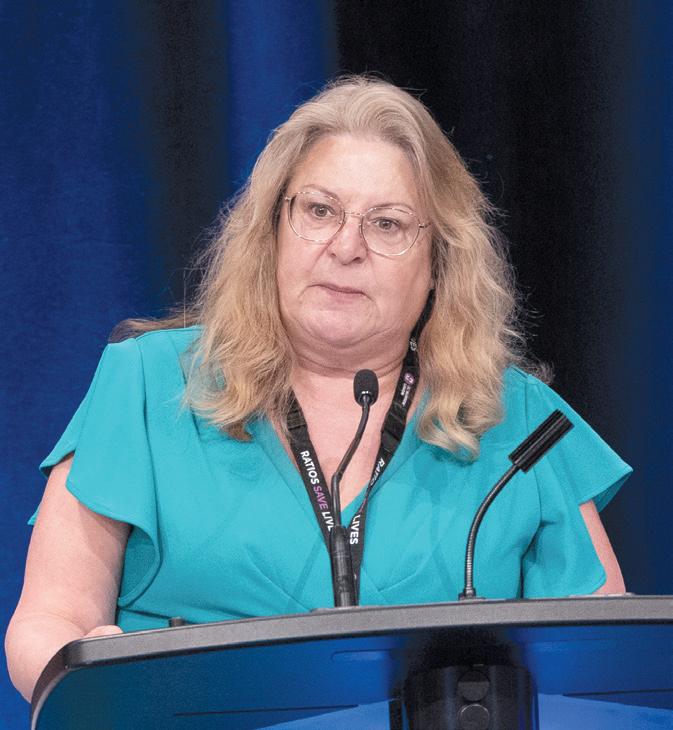
action. How can they show support for their bargaining committee and help apply pressure?
SPONTON Spreading the word and bringing the public on board is crucial. Talk to your MLA. Speak with your family, friends and neighbors. Help them understand what nurses do, what we’re bargaining for and why violence in health care is still not “part of the job.” Start with the people that you know and help them understand that we’re fighting for a contract that respects nurses.
UPDATE What’s the biggest shift you’ve seen in how members talk about job action?
SPONTON Members are ready. Our benefits survey showed that more than 80 percent would strike to protect what they have. They’re frustrated with the lack of progress on violence and with the employer trying to strong-arm changes to their benefits. Many see job action as necessary to secure a fair contract. If we don’t end up taking job action,
that means the bargaining committee was able to accomplish its mission without additional pressure. If we do need to take job action, we’ll need a strong mandate from members who are ready to hold firm. Unity will be key. Readiness is not just logistical – it’s emotional. For many members, the idea of job action can feel uncertain or even intimidating.
UPDATE What would you say to members who feel anxious about job action?
SPONTON It’s important to have a longterm view. Job action isn’t always easy, but it’s short-term pain for long-term gain. Our struggle is not just for nurses now, but for those who come after us. We have to make nursing attractive to the next generation, and we do that through ratios and a fair contract.
UPDATE What motivates you to lead this work?
SPONTON Bargaining and job action affect every single BCNU member. There’s a deep sense of collectivity and solidarity in it. It’s one of those rare moments when we can all come together – that is the heart of unionism. Standing together with your colleagues for something fair can be incredibly motivating and incredibly meaningful.
Whether job action ultimately becomes necessary or not, BCNU leaders say the work happening now – educating members, building connections and strengthening solidarity – is already shaping the outcome. In a round of bargaining that many believe will define the next generation of nursing in BC, that readiness may prove to be one of the union’s greatest strengths. •
Update Magazine asked members of the PJAC: What’s one thing members should do now to prepare for job action?


““Get your information straight from the source. Read your BCNU emails or log in to the Member Portal for official updates and download the app!”
JULIE BODDEN
Have each other’s back. Job action can be morally distressing for a lot of members. It’s important to remember that we’re all in this together.”

““Know where your strike headquarters are and who your local leadership is – not just your regional council but your workplace and regional job action committees.”
GINA NEUMANN
Get the BCNU app – it’s the collective agreement at your fingertips, plus updates and job action modules.”
KETECA
“
“Go do the job action modules on the BCNU Member Portal, update your email address and download the app.”
SABRINA VOGT
Update your contact information today. If we move to a strike vote, we need every member informed, connected and ready.”
BCNU EXECUTIVE COUNCILLOR, PENSIONS AND SENIORS HEALTH MICHELLE SORDAL


“Talk to your co-workers about bargaining and potential job action. Knowing they’ll stand beside you when it matters — that’s what solidarity is built on.”
BCNU EXECUTIVE COUNCILLOR, OCCUPATIONAL HEALTH AND SAFETY AND MENTAL HEALTH AIDA HERRERA
When union members hear “job action,” they tend to think of a strike first. And that’s no surprise – strikes make headlines, and they can cause union members a lot of anxiety.
While a full-scale strike is a possible outcome of tense negotiations, it is always used as a last resort to get members the best deal possible. And there are a lot of ways to ramp up job action before we reach a strike. Each of these actions increases pressure on the employer while minimizing the impact on patients and union members.
Job Action/Strike: Actions that union members take to pressure the employer to offer better terms in bargaining. These can include:
Partial Withdrawal of Services / Work to Rule: Members perform only tasks that are within their job descriptions (e.g., stopping clerical or portering tasks). This may also include overtime bans.
Intermittent Withdrawal of Services / Rotating Job Action: Members withdraw their services for short periods of time. This type of job action is very difficult for the employer to plan and respond to.
Targeted Job Action: Taking out one type of service across several worksites. For example, operating rooms in all hospitals in the lower mainland or all home care nurses in the province.
Escalating Job Action: Job action begins at a single facility and gradually expands to include more worksites, building pressure on the employer.
Complete Withdrawal of Services (Strike): Full withdrawal of services and picketing across the province while maintaining essential services. The PJAC directs decisions to initiate or end strikes.
Employer Lockout: Initiated by the employer, a lockout prevents members from working or receiving pay. Even during a lockout, essential services must be maintained.
Note: essential health-care services continue throughout any type of job action. Attending work as an essential health-care provider during job action is not considered crossing the picket line. Pay close attention to your email for instructions on attending work during job action.
MOTION 1
BYLAWS ARTICLE 12 – DISCIPLINE
CURRENT WORDING
Restorative Justice Framework
Article 12.01
(c) The BCNU is committed to assisting Members to resolve complaints through alternative dispute resolution, where appropriate.
MAIN MOTION IF ADOPTED, WILL READ
(d) It is the intention of this Article to encourage the development of mutual respect between Members. To this end it is important that Members exercise their rights responsibly and with respect for others, and so contribute to the orderly running of the organization. Add new (d)
(d) The BCNU is committed to assisting Members to resolve complaints through a restorative justice framework that emphasizes accountability, mutual dialogue, acknowledgment of harm, repairing harm, healing, and preventing future harm, where appropriate.
The initiation of a restorative justice framework will be conducted in accordance with the Policies and Procedures.
Re-number (d) to (e)
Article 12.01
(c) The BCNU is committed to assisting Members to resolve complaints through alternative dispute resolution, where appropriate.
(d) The BCNU is committed to assisting Members to resolve complaints through a restorative justice framework that emphasizes accountability, mutual dialogue, acknowledgment of harm, repairing harm, healing, and preventing future harm, where appropriate.
The initiation of a restorative justice framework will be conducted in accordance with the Policies and Procedures.
(e) It is the intention of this Article to encourage the development of mutual respect between Members. To this end it is important that Members exercise their rights responsibly and with respect for others, and so contribute to the orderly running of the organization.
Moved by: Teri Forster
Seconded by: Angela Crawford
Costing: $2,000 – $4,000
BYLAWS ARTICLE 8 – CONVENTIONS
CURRENT WORDING
8.05 Convention Delegates:
(a) The Convention delegates will be:
i. All Council Members;
ii. Delegates of the four (4) Human Rights and Equityseeking caucuses who have been elected at their respective provincial caucus Meetings; and
iii. Delegates of the Truth and Reconciliation Committee; and
iv. Regional delegates and alternates, determined as per the table below:
MAIN MOTION IF ADOPTED, WILL READ
8.05 Convention Delegates:
(a) The Convention delegates will be:
Moved by: Matthew Le Gresley
Seconded by: Christina Poirier Costing: $0
BYLAWS ARTICLE 1 – MEMBERSHIP
CURRENT WORDING
1.04 A Member who is employed by any other NBA union, is not entitled to:
(a) Attend Meetings;
(b) Hold an Elected Position; or (c) Fill a temporary or permanent BCNU Staff position.
Moved by: Shalane Wesnoski
Seconded by: Claudette Jut Costing: $0
Strike “and” after “Meetings;”.
i. All Council Members;
ii. Delegates of the four (4) Human Rights and Equityseeking caucuses who have been elected at their respective provincial caucus Meetings;
In (iii) strike “and” after Committee;
Add new (iv) “Stewards with a Diversity, Equity, and Inclusion focus as per the Policies and Procedures; and “
Renumber “iv. to v.”
iii. Delegates of the Truth and Reconciliation Committee;
iv. Stewards with a Diversity, Equity, and Inclusion focus as per the Policies and Procedures; and
v. Regional delegates, determined as per the table below:
MAIN MOTION IF ADOPTED, WILL READ
Add “or in any excluded position with any health employer ” after “union”.
1.04 A Member who is employed by any other NBA union, or in any excluded position with any health employer, is not entitled to:
(a) Attend Meetings;
(b) Hold an Elected Position; or (c) Fill a temporary or permanent BCNU Staff position.
BYLAWS ARTICLE 5 – ELECTIONS
CURRENT WORDING
5.07 All decisions and determinations of the Nominations Committee regarding candidate eligibility or Election Complaints are within the Nomination Committee’s sole discretion, and will be final and binding.
Moved by: Shalane Wesnoski
Seconded by: Claudette Jut
Costing: $0
MAIN MOTION
Replace “Nomination” with “Nominations”
IF ADOPTED, WILL READ
5.07 All decisions and determinations of the Nominations Committee regarding candidate eligibility or Election Complaints are within the Nominations Committee’s sole discretion, and will be final and binding.
BYLAWS ARTICLE 8 – CONVENTIONS
CURRENT WORDING
8.05 Convention Delegates:
(a) The Convention delegates will be:
i. All Council Members;
ii. Delegates of the four (4) Human Rights and Equityseeking caucuses who have been elected at their respective provincial caucus Meetings; and
iii. Regional delegates and alternates, determined as per the table below:
Moved by: Shalane Wesnoski
Seconded by: Claudette Jut
Costing: $0
MAIN MOTION
To add “and Alternates” after “delegates”
IF ADOPTED, WILL READ
8.05 Convention Delegates and Alternates:
(a) The Convention delegates will be:
i. All Council Members;
ii. Delegates of the four (4) Human Rights and Equityseeking caucuses who have been elected at their respective provincial caucus Meetings; and
iii. Regional delegates and alternates, determined as per the table below:
CURRENT WORDING
12.08 Appeals:
(a) Within thirty (30) days of notification of the Hearing Board’s decision, the Respondent or the Complainant may submit an appeal of the decision, in writing, on one or more of the following grounds:
i. The decision or penalty imposed by the Hearing Board was patently unreasonable in all the circumstances;
ii. The Hearing Board failed to observe the principles of natural justice in making its determination; or
iii. New evidence has become available that was not available at the time the Hearing Board made its determination.
(b) An appeal will be heard by an Appeal Board to be established in accordance with the applicable rules and procedures set out in the Policies and Procedures.
(c) All appeals will be conducted in accordance with the Policies and Procedures.
(d) The Appeal Board will have the power and discretion to:
i. Uphold or set aside any decision or penalty, or part of any decision or penalty, imposed by the Hearing Board; and
ii. If the result of the appeal is a decision that the Respondent is guilty of a breach of duty, impose a penalty that it considers appropriate in the circumstances.
(e) The BCNU, individuals holding Elected Positions, other BCNU representatives and Members are not liable for any damages suffered by a Member because of a penalty imposed on that Member by a Hearing Board and later set aside on appeal to an Appeal Board or to any other court or tribunal.
Moved by: Shalane Wesnoski Seconded by: Claudette Jut
MAIN MOTION IF ADOPTED, WILL READ
12.08 Appeals:
Add “Neutral Third Party’s or ” before “Hearing Board’s”
Add “Neutral Third Party or ” before “Hearing Board”
Add “Neutral Third Party or ” before “Hearing Board”
Add “Neutral Third Party or ” before “Hearing Board”
(a) Within thirty (30) days of notification of the Neutral Third Party’s or Hearing Board’s decision, the Respondent or the Complainant may submit an appeal of the decision, in writing, on one or more of the following grounds:
i. The decision or penalty imposed by the Neutral Third Party or Hearing Board was patently unreasonable in all the circumstances;
ii. The Neutral Third Party or Hearing Board failed to observe the principles of natural justice in making its determination; or
iii. New evidence has become available that was not available at the time the Neutral Third Party or Hearing Board made its determination.
(b) An appeal will be heard by an Appeal Board to be established in accordance with the applicable rules and procedures set out in the Policies and Procedures.
(c) All appeals will be conducted in accordance with the Policies and Procedures.
(d) The Appeal Board will have the power and discretion to:
Add “Neutral Third Party or ” before “Hearing Board”
Add “Neutral Third Party or ” before “Hearing Board”
i. Uphold or set aside any decision or penalty, or part of any decision or penalty, imposed by the Neutral Third Party or Hearing Board; and
ii. If the result of the appeal is a decision that the Respondent is guilty of a breach of duty, impose a penalty that it considers appropriate in the circumstances.
(e) The BCNU, individuals holding Elected Positions, other BCNU representatives and Members are not liable for any damages suffered by a Neutral Third Party or Member because of a penalty imposed on that Member by a Hearing Board and later set aside on appeal to an Appeal Board or to any other court or tribunal.
BYLAWS ARTICLE 12 – DISCIPLINE
CURRENT WORDING
12.04 Complaints:
(c) Within fourteen (14) days of receiving a Complaint, the Chief Executive Officer, or designate, will provide the Respondent with the particulars of the Complaint in person or by registered mail to the address shown in the register of Members.
Moved by: Shalane Wesnoski
Seconded by: Claudette Jut
Costing: $0
MAIN MOTION
Replace “in person or” with “by email and”.
Add “, where possible” after “Members”
IF ADOPTED, WILL READ
12.04 Complaints:
(c) Within fourteen (14) days of receiving a Complaint, the Chief Executive Officer, or designate, will provide the Respondent with the particulars of the Complaint by email and registered mail to the address shown in the register of Members, where possible
BYLAWS ARTICLE 12 – DISCIPLINE
CURRENT WORDING
12.05 Complaints Investigation Committee and Complaints Investigation Sub-Committee:
(d) The Complaints Investigation Sub-Committee will investigate the Complaint and, where possible, within ninety (90) days of receiving the Complaint, either:
i. dismiss the Complaint if it is without merit, or
ii. refer the Complaint, or any part of it, to the Discipline Committee.
Moved by: Shalane Wesnoski
Seconded by: Claudette Jut
Costing: $0
Replace “it is without merit” with “there is insufficient basis to warrant referral”
12.05 Complaints Investigation Committee and Complaints Investigation Sub-Committee:
(d) The Complaints Investigation Sub-Committee will investigate the Complaint and, where possible, within ninety (90) days of receiving the Complaint, either:
i. dismiss the Complaint if there is insufficient basis to warrant referral, or
ii. refer the Complaint, or any part of it, to the Discipline Committee.
CURRENT WORDING MAIN MOTION
Article 14
Nil
Add the following new language:
“(s) “Force Majeure” means any event or circumstance beyond the reasonable control of the BCNU or Council, in accordance with the Policies and Procedures.” including but not limited to fire, floods, earthquakes, embargoes, war, acts of war, acts or threats of terrorism, insurrections, riots, strikes, lockouts or other labour disturbances, severe weather events, acts of God, pandemic, disease, medical health emergencies, acts of cybersecurity, technology system failure, curtailment of transportation facilities preventing or delaying attendance by at least thirty-five percent of meeting participants, or any other reason or circumstance beyond the control of the BCNU or Council that prevents or prohibits regular operations, meetings, Conventions, ratifications, or the election of Elected Officers.
To re-number existing clauses (s-hh) to (t-ii).
IF ADOPTED, WILL READ
14.01 Definitions
“(s) “Force Majeure” means any event or circumstance beyond the reasonable control of the BCNU or Council, in accordance with the Policies and Procedures.” including but not limited to fire, floods, earthquakes, embargoes, war, acts of war, acts or threats of terrorism, insurrections, riots, strikes, lockouts or other labour disturbances, severe weather events, acts of God, pandemic, disease, medical health emergencies, acts of cybersecurity, technology system failure, curtailment of transportation facilities preventing or delaying attendance by at least thirty-five percent of meeting participants, or any other reason or circumstance beyond the control of the BCNU or Council that prevents or prohibits regular operations, meetings, Conventions, ratifications, or the election of Elected Officers.
(Subsequent clauses only renumbered – not written here –housekeeping)
Continued on next page
BYLAWS
CURRENT WORDING MAIN MOTION
Article 15
Nil
Add the following new language:
“15.01 Neither the BCNU nor Council will be responsible nor be deemed to have defaulted under or breached the provisions in these Constitution and Bylaws for failure or delay in fulfilling or performing any obligation under these Constitution and Bylaws when such failure or delay is caused by a Force Majeure event.
Add the following new language:
15.02 Notwithstanding the requirements in these Constitution and Bylaws, in the event that a “Force Majeure” event prevents or prohibits regular operations, meetings, Conventions, ratifications, or the election of Elected Officers from being conducted, Council will be empowered to:
(a) suspend, postpone, or cancel regular operations;
(b) Suspend, postpone or cancel any meeting or Convention;
(c) Delay or agree to delay any ratification vote; or
(d) Upon recommendation by the Nominations Committee, extend the end of a term of Elected Officers for a period of up to 90 days to enable the Nominations Committee to plan and conduct the elections pursuant to Article 5. The subsequent term would be shortened the same number of days.
Add the following new language:
“15.03 In the event that a Force Majeure event occurs and Council exercises any of its powers under Article 15.02, upon the cessation of the Force Majeure event Council will make every reasonable effort to return to regular operations.”
IF ADOPTED, WILL READ
15.01 Neither the BCNU nor Council will be responsible nor be deemed to have defaulted under or breached the provisions in these Constitution and Bylaws for failure or delay in fulfilling or performing any obligation under these Constitution and Bylaws when such failure or delay is caused by a Force Majeure event.
15.02 Notwithstanding the requirements in these Constitution and Bylaws, in the event that a “Force Majeure” event prevents or prohibits regular operations, meetings, Conventions, ratifications, or the election of Elected Officers from being conducted, Council will be empowered to:
(a) suspend, postpone, or cancel regular operations;
(b) Suspend, postpone or cancel any meeting or Convention;
(c) Delay or agree to delay any ratification vote; or
(d) Upon recommendation by the Nominations Committee, extend the end of a term of Elected Officers for a period of up to 90 days to enable the Nominations Committee to plan and conduct the elections pursuant to Article 5. The subsequent term would be shortened the same number of days.
“15.03 In the event that a Force Majeure event occurs and Council exercises any of its powers under Article 15.02, upon the cessation of the Force Majeure event Council will make every reasonable effort to return to regular operations.”
Moved by: Shalane
Wesnoski
Seconded by: Claudette Jut
Costing: $0
The Bylaws Committee received a total of four (4) submissions from members by the deadline of January 6, 2026. The Bylaws Committee met January 9, 2026, and reviewed the submissions. The Bylaws Committee received a total of seven (7) submissions from Council, pursuant to Article 6 of BCNU’s Constitution and Bylaws.
During the performance of its duties, the Committee deliberated the motions and proposed recommendations to the movers of the submissions. One (1) proposed bylaw amendment was withdrawn by the mover and one (1) was rescinded by the mover. All changes have been reflected in the following proposed bylaw amendments which have been approved by the Committee to be published for the membership in the Spring 2026 Update Magazine, in the order in which they were submitted.
Included in this report Convention attendees will find supplemental information provided for bylaw submissions. The Committee’s intent is to provide non-persuasive information that may assist Convention delegates in understanding the motion. Supplemental information may include, though not be limited to, definitions, historical information, costing breakdown, additional resources and documents. The Bylaws Committee maintains a neutral stance on motions submitted to the 2026 Convention.
Whereas, in 2025, the United Nations determined that “Israeli authorities have deliberately inflicted conditions of life on the Palestinians in Gaza calculated to destroy, in whole or in part, the Palestinians in Gaza,” constituting an underlying act of genocide;
Whereas, since 2005, Palestinian trade unions and civil society have called on international labour and professional bodies to divest from companies profiting within Palestinian territories illegally occupied by Israel;
Whereas, nurses are guided by compassion, justice, and respect for human dignity, and our professional standards compel us to advocate for those harmed by systemic violence and oppression;
Whereas, in 2025, the UN published a database of companies which are actively profiting from Israel’s illegal occupation of Palestine; and
Therefore be it resolved that BCNU will not invest internal funds in companies identified by the UN Database of Business Enterprises Pursuant to Human Rights Council Resolutions 31/36 and 53/25.
Moved by: Ben Fussell
Seconded by: Reed Adams
Costing: $650 annually
Whereas, the BC Nurses’ Union (BCNU) protects and advances the health, safety, social and economic wellbeing of our members, our professions and our communities;
Whereas, PEC members remain employees of their health employers under the collective agreement;
Whereas, Convention 2023 voted in favour of including Council members in receiving the $2.15 per hour regular premium if applicable and the Add Pay if applicable;
Whereas, members may lose earning entitlements if elected to a PEC position; and
Therefore be it resolved that the PEC positions, excluding the President, be paid the $2.15 per hour regular premium and Add Pay, where applicable; and
Be it further resolved that the premiums will be retroactive to April 1, 2023.
Proviso: The President remuneration is determined by Policy 9.1.1.
Moved by: Candi DeSousa
Seconded by: Melina Kerrivan
Costing: $99,788
Whereas, the burning of fossil fuels is the main contributor to global warming;
Whereas, BC nurses are impacted by the public health impacts of climate change, including surges in respiratory illnesses from wildfire smoke, preventable heat-related deaths and ongoing strains on the provincial health-care system from climate-related disasters;
Whereas, Most BCNU members belong to the BC Municipal Pension Plan (MPP), with the MPP being the plan for the majority of nurses in the union;
Whereas, the MPP, managed by the British Columbia Investment Management Corporation (BCI), holds an estimated $2.6–$3 billion out of $77 billion in fossil fuels with no stated divestment plan;
Whereas, fossil fuel assets pose a risk of “stranded assets,” as global climate policy, technology shifts and market dynamics evolve; and
Whereas, excluding new fossil fuel investments and escalating engagement to divestment can reduce financial risk;
Therefore be it resolved that BCNU sends a letter to the MPP board of trustees to lobby to restrict new investments in companies whose primary business is expanding oil, gas and coal extraction or related fossil fuel infrastructure and adopt a comprehensive plan to responsibly phase out existing fossil fuel holdings; and
Be it further resolved that BCNU publish the lobby letter to the Member Portal.
Moved by: Ankur Patel
Seconded by: Marilyne Tovar
Costing: $3,240
RESOLUTION 4
FTS-(all) Requirements
Whereas, FTS and EDMP reps are dues paying members, employed by a health authority (HA) as agreed in the Nurses’ Bargaining Association (NBA) Provincial Collective Agreement (PCA), but supervised and administered by the BCNU;
Whereas, FTS and EDMP reps are presently subject to revocation of appointment or selection processes under the BCNU Policies and Procedures, which may include a right of appeal;
Whereas, FTS and EDMP reps may wish to have the support of another FTS or EDMP rep during the appeal process; and
Therefore be it resolved that FTS or EDMP reps may request another FTS or EDMP rep to attend any revocation of appointment or selection appeal meeting, where possible.
Proviso: In this resolution, “FTS” applies to all full-time steward positions identified in Appendix W.
Moved by: Paddy Kopieczek
Seconded by: Jeanneth Jacome
Costing: $0
RESOLUTION 5
Anti-Palestinian Racism
Whereas, Palestinians and allies have faced anti-Palestinian racism in the workplace and health care workers across North America, including in British Columbia, have faced anti-Palestinian racism due to their advocacy for Palestinian human rights;
Whereas, “nurses advocate for social justice and fair, equitable and inclusive care and workplaces,” and have an ethical duty “advocating for and implementing strategies that achieve diverse, equitable and inclusive (DEI) workplaces,” per the CNA’s guiding principle 5.17;
Whereas, the CNA’s guiding principle 5.28 is “nurses advocate for the rights of all people to be free from oppression, exclusion, racism and discrimination”;
Whereas, nurses have the ethical responsibility of “fostering a culture that supports workplace diversity and diversity of thought while advocating for the right of nurses to practice in a workplace that is free from oppression, racism, exclusion and discrimination in all its forms,” per the CNA’s guiding principle 5.2; and
Therefore be it resolved that BCNU recognizes anti-Palestinian racism as defined by the Arab Canadian Lawyers Association in 2022.
Moved by: Marilyne Tovar
Seconded by: Caroline Abedrabboh
Costing: $7,200
Whereas, members and elected representatives regularly perform work on behalf of the union, and such work may involve necessary and reasonable expenses; and
Therefore be it resolved that approved expenses must be submitted by, the greater of, December 31 in the year of the expense or 120 days from the date of the expense.
Moved by: Kelly Woywitka
Seconded by: Mike Woywitka
Costing: $22,226
Whereas, FTS and EDMP reps are all employed and paid by a health authority as per Appendix W of the PCA;
Whereas, FTS and EDMP reps are supervised, managed and subject to performance reviews and expectations set by BCNU;
Whereas, FTS and EDMP reps are dues paying BCNU members;
Whereas, at the 2025 Convention, a motion to make EDMP rep positions 3-year terms was defeated and they remain permanent appointments; and
Therefore be it resolved that BCNU remove the 3-year term of office stipulation for all FTS; and
Proviso: If adopted the new language will come into effect with the 2028 appointment.
Proviso: In this resolution, “FTS” applies to all full-time steward positions identified in Appendix W.
Moved by: Paddy Kopieczek
Seconded by: Sherrill Harmer
Costing: Cost savings of $4,237/year (annualized estimate)
Whereas, participating in BCNU investigations into allegations of bullying and harassment by or against members can have an impact upon such members’ psychological well-being;
Whereas, members who have experienced bullying and harassment may also require support and eventual closure, including discussing their personal experiences confidentially with their health-care providers as part of therapeutic treatment; and
Therefore be it resolved that BCNU will advise members participating in BCNU investigations into alleged bullying and harassment of available resources and support both inside and outside BCNU at each stage of the investigation process, where reasonable, in writing; and.
Be it further resolved that where the resolution of any BCNU investigation into a complaint of bullying and harassment involving members is to include a non-disclosure agreement, BCNU will seek to include a provision that permits the members to confidentially discuss their personal experiences with their health-care providers as part of therapeutic treatment.
Moved by: Paddy Kopieczek
Seconded by: Sherrill Harmer
Costing: $0
Increase the Term of Office FTS/SAL
Whereas, FTS “positions are intended to promote understanding between the Union and the Employer through improved communications and relationships.”;
Whereas, the NBA PCA does not set the FTS term of office;
Whereas, BCNU determines the FTS term of office in the Policies and Procedures; and
Therefore be it resolved that BCNU amends the FTS term of office to 5 years.
Moved by: Gurvir Sekhon
Seconded by: Natasha Milne
Costing: Cost savings of $1,694/year (annualized estimate)
Whereas, the eligibility criteria for the NYNN includes an age limit of 35 years and under; Whereas, 40 and under aged members may share the same priorities and concerns as 35 and under aged members; and
Therefore be it resolved that BCNU amend the eligibility criteria for the NYNN to include members who are 40 years of age or under or have 5 years or less nursing experience.
Moved by: Danielle Westwick
Seconded by: Mike Woywitka
Costing: $0
The Resolutions Committee received a total of twenty (20) submissions from members by the deadline January 6, 2026. The Resolutions Committee met virtually January 8, 2026, and reviewed the submissions.
During the performance of its duties, the Committee deliberated the motions and proposed recommendations to the movers of the submissions. The order of resolutions was determined by chronological order of submission.
Six (6) motions were withdrawn by the movers and two (2) were ruled out of order. Council adopted two (2) resolutions prior to Convention. In the remaining ten (10) resolutions where information has been changed, the movers agreed to the proposed changes. The changes have been reflected in the following resolutions which have been recommended by the Committee to be published for membership in the Spring 2026 Update magazine.
Included in this report Convention attendees will find supplemental information provided for resolutions. The Committee’s intent is to provide non-persuasive information that may assist Convention delegates in understanding the motion. Supplemental information may include, though not be limited to, definitions, historical information, costing breakdown, additional resources and documents. The Resolution Committee maintains a neutral stance on motions submitted to the 2026 Convention.
The inclusion of proposed bylaw amendments or resolutions is not intended to reflect the opinions or views of the Bylaws Committee, the Resolutions Committee or the BCNU and its employees, unless otherwise expressly stated.
The respective movers are solely responsible for the content and accuracy of any mover’s rationales provided and for compliance with the Constitution and Bylaws and the Policies and Procedures. The opinions expressed in the mover’s rationales are solely those of the respective movers and do not necessarily reflect the opinions or views of the Bylaws Committee, the Resolutions Committee or the BCNU and its employees.
Changes in circumstances after the time of publication may impact the accuracy of the information published, and the information may change without notice. The Bylaws Committee, the Resolutions Committee or the BCNU and its employees are not in any way liable for the accuracy of any information provided.
MONDAY, April 27 (CHECK-IN DAY)
3:00 p.m. – 7:00 p.m. Convention Badge Pick-up
3:30 p.m. – 3:50 p.m. Delegate WHIP Information Meeting
3:30 p.m. – 3:50 p.m. Scrutineer and Sergeant-at-Arms Meeting
4:00 p.m. – 5:30 p.m. All Delegate Orientation Session
5:30 p.m. – 6:30 p.m. Dinner Break
6:30 p.m. – 8:00 p.m. General Election Event
8:00 p.m. – 9:00 p.m. Meet and Greet
TUESDAY, April 28 (DAY ONE)
7:00 a.m. – 7:45 a.m. Wellness Activity
7:45 a.m. – 8:30 a.m. Convention Check-in
8:30 a.m. – 8:35 a.m. Call to Order
8:35 a.m. – 8:50 a.m. Beginning in a Good Way
8:50 a.m. – 9:05 a.m. Opening Remarks
9:05 a.m. – 9:35 a.m. President’s Report
9:35 a.m. – 10:00 a.m. Vice President’s Report
10:00 a.m. – 10:30 a.m. Health Break
10:30 a.m. – 10:40 a.m. Executive Councillor OH&S and Mental Health Report
10:40 a.m. – 10:50 a.m. Executive Councillor Pensions and Seniors’ Health Report
10:50 a.m. – 11:05 a.m. Treasurer Report
11:05 a.m. – 12:00 p.m. CEO and Executive Director Reports
12:00 p.m. – 1:30 p.m. Lunch Break
1:30 p.m. – 2:45 p.m. Q&A on Reports/Open Forum
2:45 p.m. – 3:15 p.m. Health Break
3:15 p.m. – 4:15 p.m. Open Forum
4:15 p.m – 5:00 p.m. Keynote
5:00 p.m. Adjournment
5:30 p.m. – 7:30 p.m. Resolutions Committee Meeting
6:30 p.m. – 8:30 p.m. General Election Event
WEDNESDAY, April 29 (DAY TWO)
7:00 a.m. – 7:45 a.m. Wellness Activity
7:45 a.m. – 8:30 a.m. Convention Check-in
8:30 a.m. – 8:35 a.m. Call to Order
8:35 a.m. – 10:00 a.m. Bylaws and Resolutions
10:00 a.m. – 10:30 a.m. Health Break
10:30 a.m. – 12:00 p.m. Bylaws and Resolutions
12:00 p.m. – 1:30 p.m. Lunch Break
1:30 p.m. – 1:45 p.m. BCNU Leadership Awards
1:45 p.m. – 3:30 p.m. Bylaws and Resolutions
3:30 p.m. Adjournment
5:30 p.m. – 6:15 p.m. Reception
6:15 p.m. – 10:30 p.m. Banquet
THURSDAY, April 30 (DAY THREE)
8:15 a.m. – 9:00 a.m. Convention Check-in
9:00 a.m. – 9:05 a.m. Call to Order
9:05 a.m. – 10:30 a.m. Bylaws and Resolutions
10:30 a.m. – 11:00 a.m. Health Break
11:00 a.m. – 11:25 a.m. Bylaws and Resolutions
11:25 a.m. – 11:45 a.m. CFNU Update
11:45 a.m. – 12:00 p.m. Get Ready to Rally
12:00 p.m. – 12:45 p.m. Rally
12:45 p.m. – 2:15 p.m. Lunch Break
2:15 p.m. – 4:10 p.m. Bylaws and Resolutions
4:10 p.m. – 4:15 p.m. Rally Summary Video
4:15 p.m. – 4:30 p.m. Closing Remarks
4:30 p.m. Adjournment
The agenda is tentative and may be adjusted prior to convention.
BCNU’s advocacy delivers meaningful support as work continues to secure tax-efficient health benefits for retirees
Retired BCNU members enrolled in the Nurses’ Bargaining Association (NBA) Retiree Benefit Program (RBP) can expect a new round of payments in 2026. The RBP Committee has authorized disbursements of up to $5,500 per eligible member while BCNU continues its efforts with the Canada Revenue Agency (CRA) to secure favourable tax treatment for future
health benefits. This year’s payment for retired members is the second of its kind, following a $500 payment in 2022. It reflects the union’s ongoing work to ensure the RBP remains responsive to and sustainable for members. Since its creation during the 2006 NBA negotiations, the RBP has evolved alongside retired members’ needs, including earlier years when the fund provided MSP premium subsidies before the province eliminated MSP premiums at the end of 2019.
“We know that our members helped to build BC’s public health-care system through decades of hard work,” says Michelle Sordal, BCNU’s Executive Councillor, pensions and seniors health. “Authorizing these payments now allows us to keep supporting retirees while we continue our work with the CRA.”
Lump-sum payments for
Both employers and employees contribute to the plans, and their contributions are invested. The plans’ investment income finances about 70 to 80 percent of the benefits paid to members. Contributions from members and employers make up the remaining 20 to 30 percent. Each generation pays in advance for its own pension benefits, and employers and employees equally share the risks associated with funding the defined benefit portion of the plans.
current eligible RBP members began in February. Each eligible retiree’s payment amount is calculated at $1,000 for every year of program eligibility, retroactive to 2020 and minus the 2022 payment. The 2026 calculation reflects contributions for 2020, 2021, 2023, 2024 and 2025 at $1,000 each, and $500 for 2022, bringing the maximum to $5,500.
Retired NBA members who have not yet enrolled in the RBP, but are eligible, will receive payments in July and October 2026.

“Authorizing these payments now allows us to keep supporting retirees while we continue our work with the CRA.”
members have diverse financial circumstances, and the union is committed to providing options that respect those realities.”
Members who retired on or before December 31, 2025, must enrol and be accepted into the RBP by September 30, 2026, to take part in this payment. Members who retired after January 1, 2026, may still enrol but will qualify only for future benefits.
Eligibility for retired members generally requires retirement from a position covered by the NBA, along with eligibility for a recognized pension plan. The union also reminds members that some retirees – such as those who left from non-
NBA positions, or who did not meet minimum service requirements – may not qualify for RBP.
BCNU advises members that the 2026 payments may impact incometested programs such as the Guaranteed Income Supplement or Old Age Security. The payment cannot be deferred and will be treated as taxable income and reported on a T4A.
“We want every member to have the information they need to make decisions in their retirement that work best for them,” Sordal explains. “Retired
Members are encouraged to keep their banking information updated through the direct deposit form at bcnu. org/RBP. Working members are also asked to pass along news of the 2026 RBP payment so recent retirees do not miss the opportunity to enrol.
The 2026 payment follows significant work undertaken through the RBP Plan Design Review launched in 2023. As part of this process, the union surveyed RBP members, who identified non-taxable health benefits as a top priority for retirement support. This feedback continues to shape BCNU’s advocacy with the CRA regarding whether future
RBP-funded benefits delivered through a health-care spending account could be treated as non-taxable.
“Our focus is on securing benefits that reflect nurses’ contributions and their long-term needs,” says Sordal. “The CRA decision is an important step, and we’re pushing forward with the care and due diligence our members deserve.”
The union has also strengthened program governance. Following a review, the RBP Committee revised its representation structure to ensure Licensed Practical Nurses (LPNs) have a clear voice in program oversight, underscoring BCNU’s commitment to inclusive decision-making.
Funding for LPN inclusion in the RBP began April 1, 2024, following the 2022–2025 NBA agreement. LPNs who retired on or after April 1, 2024, will receive more
“Members deserve retirement benefits that reflect the contributions they’ve made throughout their careers.”
BCNU Executive Councillor, Pensions and Seniors Health Michelle
Sordal
information starting in March 2026 about how to enrol in RBP. Those LPNs who are accepted in the program can anticipate receiving the 2026 payment in July or October. LPN enrolment details are included in eNews and at bcnu.org/RBP. •
Retired members can confirm their RBP enrolment status by emailing RBP@bcnu.org, and all members can find program eligibility details and application forms at bcnu.org/RBP.

BCNU’s periodic e-newsletter for retired members to keep in touch with retirement matters:
> Seniors' health care
> Your pension
> Retiree benefit program
Not yet receiving Retired Member eNews? Join the mailing list! Contact membership@bcnu.org to update your information.
To learn more, visit the Retired Nurses page at BCNU.org

hanif karim DIRECTOR, DIVERSITY, EQUITY AND INCLUSION
Previous Roles
• Human rights and equity and health policy officer
• Education officer
• Steward
hanif karim, who to this day maintains his RN license, says he is deeply committed to nursing as a profession.
“I want the people who work in health care and those who access it to get the equitable and holistic care they are entitled to. It’s what drives me every day.”
Update Magazine sat down with BCNU’s director, diversity, equity and inclusion, hanif karim, to learn more about how his work is building that future for nurses and patients.
“The work feels like a logical extension of the foundational beliefs I hold and our collective capacity to change the world,” says BCNU director, diversity, equity and inclusion, hanif karim.
UPDATE What has your journey with BCNU been like?
KARIM I didn’t always feel connected to my union or understand that it could help build genuinely safe workplaces for all. When I first started as a steward in community nursing, I was mostly concerned about my immediate worksite issues. Then, during a step two meeting, I witnessed a labour relations officer build a relationship with the employer and bridge our perceived divisions. To me, that demonstrated that relational practice is as important as advocacy.
I joined the BCNU education team in 2009, at a time when I was consciously considering my career trajectory. While travelling, I remember meeting folks struggling for basic rights and needs, and asking myself, “What can I do to help people?” That was the impetus for me to become a nurse in the first place. That inspired me to move into the human rights and equity and policy officer position, where I collaborated with members to create the caucuses and networks we know today. In the last couple of years, I started in the newly estab -
lished position of director, diversity, equity and inclusion.
UPDATE What do you enjoy most about working at BCNU?
KARIM At the most basic level, I feel like I have a different job every day. The work feels like a logical extension of the foundational beliefs I hold and our collective capacity to change the world. I am grateful to the mentors I have had along the way. Working with them was a gift. They exposed me to new ideas and sets of cultural and political perspectives –worldviews that I continue to incorporate into my work.
UPDATE What is one achievement for members you are especially proud of?
KARIM My predecessor in human rights and equity work, Frank Gillespie, engaged people and created spaces where they could feel safer to have conversations that were deeply significant to them. Still, early on, one small practice I changed was to invite the caucus chairs to lead meetings instead of a staff person. Learning how to chair, create an agenda and meaningfully include partic-
ipants helps cultivate their leadership in the union and elsewhere.
UPDATE What should members know about the work that you do?
KARIM That any success in diversity, equity and inclusion work – in the workplace or their contract – comes from members’ voices and concerns, the actions they take and the initiatives they propel forward.
UPDATE What is one action all BCNU members should take?
KARIM Make time for each other. The heart of equity and justice is gratitude for each other. The basis of a union is a commitment to solidarity, which grows out of a sense of gratitude for all union members.
UPDATE What is your main hobby outside of work?
KARIM I enjoy going to heavy metal shows, watching Andrei Tarkovsky films, reading László Krasznahorkai novels, listening to the music of Deafheaven and hoping Leeds United wins the Premiership. •
BCNU IS HERE TO SERVE MEMBERS
Here’s how you can get in touch with the right person to help you.
CONTACT YOUR
Stewards for all workplace concerns. Regional Council Members if your steward can’t help, or for all regional matters. Provincial Executive Committee for all provincial, federal or union policy issues.
PROVINCIAL EXECUTIVE COMMITTEE
PRESIDENT
Adriane Gear 778-679-9968 adrianegear@bcnu.org
VICE PRESIDENT
Tristan Newby 604-313-1308 tristannewby@bcnu.org
TREASURER
Sharon Sponton 250-877-2547 sharonsponton@bcnu.org
EXECUTIVE COUNCILLOR
Aida Herrera 604-612-8871 aidaherrera@bcnu.org
EXECUTIVE COUNCILLOR
Michelle Sordal 604-765-3214 michellesordal@bcnu.org
REGIONAL COUNCIL MEMBERS
CENTRAL VANCOUVER
Gerald Dyer 604-786-0594 geralddyer@bcnu.org
Kristina Hernandez
604-329-1343 kristinahernandez@bcnu.org
COASTAL MOUNTAIN
Angela Crawford 778-867-4161 angelacrawford@bcnu.org
EAST KOOTENAY
Carly Vanderhart (Interim) carlyvanderhart@bcnu.org
FRASER VALLEY
Katherine Hamilton 604-317-1457 katherinehamilton@bcnu.org
NORTH EAST
Danette Thomsen 250-960-8621 danettethomsen@bcnu.org
NORTH WEST
Teri Forster 250-615-8077 teriforster@bcnu.org
OKANAGAN SIMILKAMEEN
Candi DeSousa 250-462-9517 candidesousa@bcnu.org
PACIFIC RIM
Deidre Knudson (Interim) 250-816-0865 deidreknudson@bcnu.org
RICHMOND VANCOUVER
Raina Sidhu (Interim) 604-788-2796 rainasidhu@bcnu.org
SHAUGHNESSY HEIGHTS
Claudette Jut 604-786-8422 claudettejut@bcnu.org
SIMON FRASER
Wendy Gibbs 604-240-1242 wendygibbs@bcnu.org
Frank Martens (Interim) 604-308-4848 frankmartens@bcnu.org
SOUTH FRASER VALLEY
Glesy Banton-Victoria 778-892-0978 glesybantonvictoria@bcnu.org
Peggy Holton 306-463-0106 peggyholton@bcnu.org
SOUTH ISLANDS Caitlin Jarvis 250-883-6593 caitlinjarvis@bcnu.org
Leanne Robertson-Weeds 778-222-7997 leannerobertsonweeds@bcnu.org
THOMPSON NORTH OKANAGAN
Leah Takats (Interim) 604-230-7945 leahtakats@bcnu.org
VANCOUVER METRO
Meghan Friesen 604-250-0751 meghanfriesen@bcnu.org
WEST KOOTENAY
Shalane Wesnoski 250-231-5655 shalanewesnoski@bcnu.org
ON THE FAMILY BIRTHING Unit at Surrey Memorial Hospital, Nicole Schnapp helps bring new life into the world. At home, she raises Pacific Assistance Dogs Society (PADS) puppies, guiding them through their early months so someone else can one day move through the world a little more freely. A labour and delivery nurse and longtime volunteer with PADS, Schnapp’s work – paid and unpaid – is shaped by the same commitment: preparing others to thrive, even when it means letting go.
An RN, Schnapp graduated from BCIT in 2013 and has spent most of her career working in labour and delivery. She began volunteering with PADS in 2012, initially as a dog sitter. She wanted a dog, but with shift work and long hours, full ownership didn’t feel realistic. She
found PADS online and has never looked back.
Today, Schnapp is both a volunteer puppy raiser and a puppy program trainer. She supports a cohort of about 20 dogs and volunteer raisers, often while raising two – and right now three – dogs in her own home. PADS assistance dogs live fully integrated lives with their raisers during training: tagging along for work, groceries, restaurants and public transit. The goal for the dogs is confidence, adaptability and trust – skills learned only in real-world settings.
The parallels between Schnapp’s nursing work and her volunteer life are evident. At work, she supports patients through moments of vulnerability, uncertainty and transformation. At home, she raises “baby puppies,” teaching them to regulate, respond and eventually work independently. Both roles demand

patience, keen observation skills and resilience.
The hardest part of puppy raising is also one of the most essential: letting go. Dogs remain with volunteer raisers for approximately 18 months before graduating to more advanced training and eventual placement with a client. Schnapp has raised more than a dozen dogs long-term and fostered many more. Each goodbye carries grief – but it’s a grief anchored in purpose.
“There’s no sugar-coating that part. You live with them for a year and a half, and you get attached,” Schnapp said. “But once you’ve had a taste of the impact these dogs have, the grief pales in comparison to the benefit and freedom they bring to someone else.”

This impact comes into sharp focus when volunteers meet clients whose lives will be shaped by the dogs they helped raise. What once felt abstract becomes deeply personal as clients describe moving through public spaces independently, no longer needing to ask for help, and being engaged with, rather than disregarded by, people. For Schnapp, these moments reaf-
firm exactly why her work matters.
One PADS dog, Compass, holds a special place in Schnapp’s heart. Raised during COVID, Compass arrived at a time when the world had narrowed, and human connection felt fragile. Schnapp and Compass spent every moment together – cuddling, training, walking, and learning each other’s rhythms. Compass wasn’t just attentive; she was discerning. Friendly and social, she formed deep bonds with her people, offering a sense of connection that felt intentional and rare.
“Some dogs just take a bigger chunk of your heart. She was definitely the hardest one to let go.” Schnapp says. “You love them all in different ways, but some dogs stay with you a little more.”
As a nurse, Schnapp sees firsthand how access and supports shape patient outcomes. As a volunteer, she understands how much of that depends on community and advocacy. PADS relies heavily on volunteers and donors to continue its work – a reminder that independence is never built alone.
For Nicole, raising assistance dogs isn’t separate from her nursing identity – it’s an extension of it. In hospitals and homes, she helps build futures rooted in dignity and independence. •



To celebrate National Nursing Week, BCNU is sending five members to the Canadian Association for Health Services and Policy Research 2026 Conference in Ottawa from May 25–28. One conference spot will be designated for an Indigenous member.
Visit BCNU Events Calendar for National Nursing Week activities in your region.