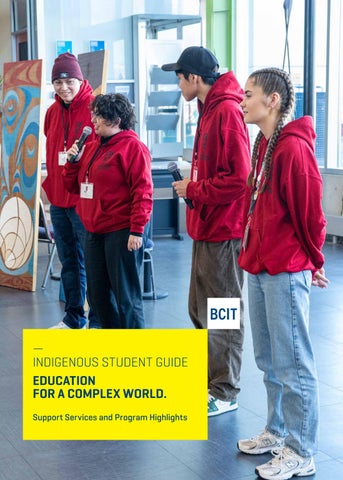
— INDIGENOUS STUDENT GUIDE EDUCATION FOR A COMPLEX WORLD. Support Services and Program Highlights
The British Columbia Institute of Technology acknowledges that our main campus in Burnaby is located on the unceded traditional territories of the Coast Salish Nations of Sḵwwú7mesh (Squamish), səilwətaɁɬ (Tsleil-Waututh), and xwməθkwəəm (Musqueam).
THE SYMBOL OF OUR INDIGENOUS VISION For some Northwest Coast First Nations, a Copper—a traditional copper shield—symbolizes wealth and power. Knowledge is power. A Copper gains value the more it changes hands and is broken and put back together. Life can be challenging, but much like a Copper, our students build strength as they gain knowledge and overcome challenges. That is why we chose the Copper to symbolize the Indigenous Vision. The Indigenous Vision provides a focal point for BCIT’s commitment to the enrolment and success of Indigenous learners. By embracing Truth and Reconciliation and promoting Indigenization throughout the BCIT community, we will honour Indigenous people, knowledge, and culture, while preparing learners for success in a complex world through an education that is complete and relevant.
Learn more at bcit.ca/indigenous-vision
BCIT nursing students gain hands-on experience in one of the simulation labs at the Burnaby Campus.
PROGRAMS WITH DESIGNATED INDIGENOUS SEATING BCIT is committed to the recruitment and retention of Indigenous students. To facilitate this, designated Indigenous admissions processes have been implemented in the programs listed below:
School of Construction and the Environment Master’s Degree Master of Science in Ecological Restoration
School of Health Sciences Diagnostic and Advanced Practice Programs Advanced Certificates Cardiac Sciences Cardiac Rhythm Device Technology option Cardiovascular Perfusion option Cardiovascular Technology option Electrophysiology Technology option
∆ ∆ ∆ ∆
Diplomas Diagnostic Medical Sonography— General and Cardiac Sonography option Diagnostic Medical Sonography— General Sonography option Electroneurophysiology Magnetic Resonance Imaging Medical Radiography Nuclear Medicine
Advanced Diploma Diagnostic Medical Sonography—Cardiac option Degree Bachelor of Science in Radiation Therapy Laboratory and Allied Health Programs Diplomas Biomedical Engineering Technology Food Processing, Safety, and Quality Medical Laboratory Science Occupational Health and Safety Degree Bachelor of Environmental Public Health Nursing Program Degree Bachelor of Science in Nursing
School of Transportation Associate Certificate Bridge Watch Rating
PROGRAMS WITH PREFERRED INDIGENOUS CANDIDACY In select competitive-entry programs, Indigenous applicants are considered preferred candidates at the program deadline. These programs include:
School of Computing and Academic Studies
School of Construction and the Environment
Master’s Degree
Diploma
Master of Science in Applied Computing
Architectural and Building Technology
PRIORITY WAITLIST SEATING FOR INDIGENOUS APPLICANTS In select first-qualified, first-accepted programs, all eligible students may apply until the program is filled. When the program reaches capacity and applicants are wait-listed, Indigenous applicants will be given waitlist priority. These programs include:
School of Computing and Academic Studies Diplomas Computer Information Technology Computer Systems Technology
Degrees Bachelor of Science in Applied Computer Science Programs Database option Games Development option Human Computer Interface option Network Security Administration option Network Security Applications Development option Wireless and Mobile Applications Development option Bachelor of Technology in Forensic Investigation Digital Forensics and Cybersecurity option
∆ ∆ ∆ ∆ ∆ ∆ ∆
MICROCREDENTIALS Microcredentials are short, for-credit, modular programs or courses that offer new skills and knowledge to help students maximize opportunity. Requiring far less time commitment than other programs, microcredentials provide an efficient way for students to advance their careers and build their resumes. Focused, affordable, and flexible, microcredentials can also be combined towards credit for more comprehensive programs.
CHOOSE YOUR PROGRAM To see a full listing of programs offered at BCIT, visit bcit.ca/study
Kobie Smith, the valedictorian of BCIT’s 2024 Broadcast and Online Journalism Diploma program and Hereditary Chief, Hemajalas of the Salmon Clan from Haisla Nation, delivers a speech at Convocation.
Tchadas Leo, BCIT Broadcast and Media grad, works as a TV Host and Journalist at Chek News.
SUPPORT SERVICES FOR INDIGENOUS STUDENTS The Indigenous Initiatives team offers support services that are culturally appropriate to First Nation, Métis, and Inuit students.
The Indigenous Gathering Place
Advisors
Mi Chap Tukw, the BCIT Indigenous Gathering place, is a home away from home for students, families, and staff. Located on the Burnaby Campus, Mi Chap Tukw offers access to amenities including a computer lounge, study area, and fully functional kitchen. Through cultural and educational activities, Mi Chap Tukw creates a sense of belonging for Indigenous students.
Advisors are available to assist students with referrals, academic needs, and financial applications. Advisors can also connect students with Elders on campus.
Elders on Campus Elders are the keepers of Indigenous knowledge and encourage and promote understanding and respect for Indigenous perspectives, culture, and values across BCIT campuses and beyond. Students can schedule appointments with Elders.
Scholarships and financial aid A wide range of scholarships, awards, bursaries, and financial aid is available to Indigenous students to apply for at BCIT.
Indigenous student champions
Cultural workshops Cultural workshops are hosted by the Indigenous Initiatives team and are open to staff, faculty, and students at BCIT. Workshops include basket weaving, drum making, wool weaving, beading, and more. These workshops are often hosted in association with significant days of the year: National Day for Truth and Reconciliation, Indigenous Peoples Day, etc.
Indigenous Garden The Indigenous Garden at Burnaby Campus provides a dedicated area to cultivate a range of Indigenous medicines and plants and is also built to be a peaceful green space for students and staff to enjoy.
Peer Tutor 1:1 referrals
Indigenous student champions help fellow Indigenous students with the first-year transition at BCIT. They offer answers about programs and life at BCIT, providing opportunities to network and meet new people.
Peer tutoring is an essential service at BCIT to help students understand course concepts and develop learning skills in difficult academic subjects. Learning Commons covers cost s if Indigenous Initiatives refers students directly.
Student housing
Indigenous Emergency Assistance Fund (IEAF)
BCIT offers priority housing options for Indigenous students for both short-term stays (under 12 weeks) and long-term stays (over 12 weeks). By self-declaring their Indigenous status on the housing application, students will automatically notify the housing team of their priority status.
Indigenous post-secondary students experiencing financial pressures can apply for the IEAF. Students who access emergency funding do not have to repay it.
Students learn Coast Salish shawl weaving during a workshop at the Indigenous Gathering Place.
CONNECT WITH US BCIT’s Indigenous Initiatives team is here to support you and keep you informed.
Office hours 8:30 am–4:30 pm Monday to Friday (excluding statutory holidays)
General contact information 604.432.8474 gathering_place@bcit.ca
Office location British Columbia Institute of Technology 3700 Willingdon Ave Burnaby, BC V5G 3H2
Campus tours bcit.ca/tours
Join us for a guided in-person tour of our Burnaby Campus. Led by a Student Ambassador, you’ll explore the campus and get an inside scoop on both the academic and social sides of life at BCIT.
Program Advising bcit.ca/advising
Have questions? BCIT program advisors are available by phone, email, drop-in, or virtual appointment.
Building SW01, Room 1521
bcit.ca/indigenous
MCD 5999
Cover photo: Indigenous Student Champions share their experiences and encouragement during a panel at the Indigenous Youth Gathering.