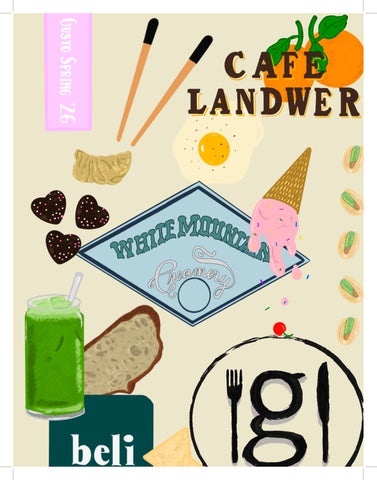
Letter From the Editor When I think back on my time at Boston College, memories surrounding food flood to my mind: dumplings in Cambridge with my dad over parents weekend, shared laughs with my roommates during late-night ice cream runs, café hopping study sessions around the city fueled by coffee and pastries. The memories I hold closest to my heart are often tied to food in some way or another. Maybe I’m just a foodie, but for me, food exists at the intersections of meaning and magic, of love and laughter. It is my hope that this magazine captures the expressive, interesting, and delicious sides of food. For this issue, I decided against picking one particular theme to guide our writing. After all, life is messy. Food is messy. I hope you can enjoy the amazing variety of pieces that our writers have produced. Continue reading to learn about Boston’s changing Chinatown and the rich history of Sicilian identity and cuisine. Our writers explore the Beli algorithm and how this app can help us eat more mindfully, as well as how food-centered Girls Nights can encourage meaningful connection. If you’re hungry, look for our team’s recommendations at Café Landwer or picks for the best matcha shops around Boston. If you’ve always wanted to try baking sourdough bread, you’ll find a recipe to make your own sourdough starter and a simple loaf–it only requires flour, water, and salt. And if you want to learn how Gusto was founded, in addition to hearing about a super cool BC alum working in the food industry, read my interview with Nico Borbolla (without whom, I wouldn’t be writing this and you wouldn’t be reading this). This issue is meant to share the best of what Gusto has to offer. That begins with our fantastic team of writers, graphic designers, photographers, editors, and marketers. Thank you for all of your hard work this semester! A special shoutout to Madeline King, one of our amazing Creative Head and the reason I joined this magazine. Thank you for always meeting with me and helping bring this vision to life. Many thanks to our faculty advisor, Lynne Anderson, as well as Susan Dunn, Bekah Waalkes, Cameron Williams, Mary Crane, and Brandon Fox. To our readers, I hope that you enjoy this issue and learn something new. If I can leave you with any parting words, always salt your tomatoes (try salting your grapefruit too!) and remember that life’s too short to skip dessert. Sincerely, Julia Santos Editor-in-Chief
1
Gusto Team 2026 EDITOR-IN-CHIEF MANAGING EDITOR CREATIVE MANAGERS MEDIA & MARKETING MANAGERS WRITING HEAD
Julia Santos Sydney Luciano Madeline King & Madeline McCormick Kate Johnston & Julia Colone Katie Mangraviti
OPERATIONS HEAD
Eunice Cho
OPERATIONS TEAM
Hannah Phillips, June Kim, Will Ristau
CREATIVE TEAM MEDIA & MARKETING TEAM COPY TEAM WRITING TEAM
2
ISSUE 1
Taylor Palinski, Elizabeth Jennison, Maddie Chin, Chu Yun Noh Amy D’Ambrosio, Addison Evans, Colleen Fogarty Riley Dee, Calleigh Meta Madeline Eig, Cat Feeney, Libby Hegarty, Madeleine Staker, Colette Snyder, Gigi Chu, Melissa Reggio, Lucas Burachio, Vanessa Liao
FRONT AND BACK COVER BY
Sydney Luciano
ADDITIONAL DRAWINGS BY
Maddy Lichwalla
Table of Contents 4
Interview with Nico Borbolla By Julia Santos
12 The Rise of Sourdough By Addison Evans
14 Beli: Automating Taste? By Julia Colone
16 Foreign Culinary Influence and Contemorary Migration By Lucas Burachio
20 Cafe Landwer
By Amy D’Ambrosio, Cat Feeney, Madeline Eig
24 A Changing Chinatown By Colette Snyder
28 The Green Golden Thirst By Vanessa Liao
34 February is for the Girls By Sydney Luciano
38 References
3
Interview with Nico Borbolla
Written by: Julia Santos Creative by: Maddie Chin Pictures by: Nico Borbolla
I sat down to talk with the founder of Gusto Journal, Nico Borbolla. Nico founded the magazine in Fall 2018. Since then, he’s worked for Binging with Babish and Bon Appétit. Now, Nico is a recipe developer and videographer based in New York City. He works as a Video Producer at People, Inc. and has just started as a Creative Strategist and Social Media Manager at Momofuku. You can find his work at @nico.borbolla on Instagram and YouTube and @nicoborbolla on TikTok.
!"#$%&'$(%# What inspired you to start Gusto? The big inspiration for Gusto was from Professor Lynne Anderson’s class, “Food Writing in Paris,” where we read a lot of literary food writers. It was a genre that I really, really enjoyed, that opened me up to ways of thinking about food and food writing that I had never thought about before. And so I was talking to a friend, Kayla Causey, who I was in a theater club with and who had also taken that class two years before. And we joked around, “Well, why don’t we start a literary food magazine?” Then I said, “Let’s actually do it.” We had Kayla, Michaela Santillo, and Emily Stevens (now Emily Ryan), and the four of us set off to do it in whatever way possible. We got some more people to join and then the rest was history.
What was your vision for Gusto at the beginning? I had the most, the most, pretentious vision for Gusto when I started. I wanted to be like France in the 60s: so full of ennui, so nonchalant, but so technically and stylistically sophisticated. The problem is that it’s kind of hard to get people on board with that kind of vision. So we also had the idea of having students write food reviews. The end product is the three sections (Essays, Features, Mucho Gusto) we created to balance those two competing desires, or visions, for the magazine. I think both of these visions are essential for students to want to contribute to the magazine.
4
Do you have a favorite article that you ever wrote for the magazine? I do–I think about it sometimes. It’s the one I wrote about coffee with my grandpa in Asturias. It’s called “Quantum Quinics.” It was in the Fall 2019 magazine. I’m really proud of that one. Sometimes it’s about finding the right line between pretentious and not, and I definitely veered into too pretentious sometimes. But that one I look back on fondly. It was honest.
!"#$%&)*+# How and when did you decide that you wanted to professionally pursue cooking and video production? I always knew in the back of my mind that I wanted to do something around food. When push comes to shove in the employment space, it’s not like food media jobs are being given out like candy. So I was willing to sacrifice for it. But, it worked out that my second job after college was with Binging with Babish, who was one of the biggest food YouTubers eight or nine years ago. He experienced a huge boom during Covid, so two years after that I started working for him. I worked for him as an executive assistant at first. In the second interview, I told him, “I’m so excited about this job. It’s a great honor. But I want to be an Associate Producer, just in case the ship goes under and you have to fire me, I want to have a good title that I can transfer to other industries.” He said, “Okay.” So I was a “producer,” but I was really just doing assistant stuff the entire time, like grabbing coffees, so many, so many grocery runs, and managing lunch orders, literally two years of just that. But as the youngest person on the crew, I was in charge of the TikTok. It was different back then. They said, “Just do something with it. You can do whatever you want with it.” So I had a ton of freedom, a million baked-in followers, and they didn’t care. At first, I didn’t really know what to do. I just made mashups of random iPhone footage we previously shot. And then I had the confidence to start doing recipe videos. He had a basement studio, so I started filming recipes there. I also involved the kitchen producer, Kendall, who’s still a good friend of mine. The two of us
started shooting these videos for each other. I would record her and she would record me. We made a couple of videos like that, and I was really proud of those. I saw myself learning the ropes of Adobe Premiere, editing, the rhythm of short-form media, as well as VO (voice over) writing to an extent. After that, I started getting better and better at shooting. I got more and more used to recipe development. And I got a better hang for script writing. And then he had layoffs. Almost everyone on the team either left or was laid off. But as part of my layoff, he gifted me the first camera he ever recorded his first YouTube videos on. It’s a Sony A7S Mark II, so it’s a little older, but it’s got a beautiful Zeiss 35 millimeter lens on it. That was in August, and I didn’t know what to do with it. I knew how to shoot in the studio because the cameras were set up and they would never leave their tripod. All I had to do was click on a light, click on the cameras, and it was all set up. And they had the most expensive monitors, the most expensive cameras and lenses, every lens to choose from. I went from that setup to a 10-year-old camera with one lens and no lights. So, slowly I had to relearn how to do it. Through that process, I’ve been learning a lot about lighting, pacing, which has informed my script writing, which has informed my recipe development, and it’s all kind of developing together. And that’s where I find myself now. I’ve had a couple of videos that I’m really proud of, a couple of videos that I’m proud of that don’t do well, and a couple of videos that are not my best work. But, you know, consistency is the name of the game.
5
6
Where do you turn to find inspiration for recipe development? Recipe development is like a language that you can start to speak. At least with short-form TikTok recipes, there’s a format where you take X food and then you shift around a couple ingredients, or you replace one with something from a different cuisine, or you just reformat it to make it this, and then you suddenly have a different dish. And so recipe development is 90% stealing, 90% adapting, you’re never really developing a whole new recipe. But to be fair, no one really ever is. To expand on that, is it really possible to have an original recipe? Every recipe is in a way adapted from other things; it’s a collection of ingredients and components from other things that already exist. In a way, recipe development is taking flavors that you really like and then seeing if they fit into another format. One example is that I have this idea to make a potato Rösti from Switzerland, which is like a big round latke, but I want to make it animal style, like from In-N-Out. In-N-Out’s version is not crispy enough, so this one is really crispy. I want to put the spread and the caramelized onions on it. Honestly, I have no idea if it’s going to work or not, but it sounds clicky and it sounds good. And if it sounds clicky and good to me, then it probably will to some other people. So I think it’s worth at least trying on camera.
you. Each person does have a unique voice. I think people should have to justify their food a little bit more. Otherwise it can get a little cookie cutter. But that’s from a guy who just really loves to yap over the food. On the other hand, a lot of it is that I am indebted to a couple of people that would write over their videos narratively. I miss having people talk eloquently over food and expand on it in a way that’s really informative. That’s something that I wish people would try more of. I think everyone in the food industry has a big Anthony Bourdainshaped hole in their heart. Anyone that can try to get to that level of truth about food is looking for something that we all want.
Your videos are very much narrative driven. How have you found your voice within the food world? I think it’s as much knowing what you want to do as what you don’t want to do. If you’re an avid consumer of food media, especially on TikTok, you’re really familiar with the formulas that people use. And they’re formulas because they’re successful. I do think some people don’t focus so much on the narrative aspect because they’re just better cooks. They don’t need to, you know? But for me, writing was always an interest of mine and something I wanted to practice and get better at. And so I really enjoyed doing it. I almost felt as if the videos couldn’t stand on their own, but that they needed something to guide them through, like a justification. But then that justification kind of became something on its own that was worth watching, that people liked. It’s a circular process. You start from a place of your own insecurity maybe, or you are compensating for something else in your video, but then because that’s so authentically you, that becomes your style. At the beginning, I thought, “I don’t feel confident enough in my food to let it speak for itself. I need to yap.” But then the yapping became a reason why people would watch it. At the end of the day, it just makes it more authentically like
It’s very refreshing to see food content that has been so thoughtfully filmed and narrated. How has your voice and style evolved over time? It’s interesting. When I first started filming my own content, I was just using the tools that were available to me at the time, which was this camera. The only light I use is from the one window in my apartment living room. It’s tiny. I can’t even fit another light there if I wanted to. I have to film from the hours of 11 to 3 in the winter because the sun is not there otherwise. And then even then, the temperature of the light changes throughout that time, so I have to color correct it accordingly. But all of these things that you persist through to do something make it your style at the end of it. Whereas back when I was at Babish and I had all the tools available to me and perfect flat lighting and the best cameras and everything, my voice was the only part that made it me, but otherwise it was pretty nondescript.
7
Do you have any food styling tips for beginner chefs? Oh my god, no, I’m the wrong person to ask about this. My food is so fugly. But there are a couple of things that I swear by, no matter what. One, is it needs a garnish: parsley, cilantro, scallions, a pop of green will make any dish, even if it’s just a plate of brown, pop. So that’s part of the reason I want to redo this karaage video I filmed, because I’m going to thinly slice scallions to curl them. I want to put that garnish on top because otherwise it’s just a plate of brown. It tastes delicious and I want to eat it, but this is a visual medium. My other tip is “Less is more sometimes. Smaller is better.” I looked at some of my old videos and I’m just piling on a plate of beans in a big-ass bowl, and it looks so sloppy. But if you use a smaller bowl of it, or a bigger bowl with a smaller portion, and then you can put some garnish, you have more negative space to play with, which gives it more dimensionality. For example, whenever I plate pasta, I do a very small amount and I just kind of pile it into a big bowl. That creates interest, and it looks a little bit more fine dining. So garnish wherever you can, and make sure the plate size does not match the portion size. I think good plates are also important. Use good quality plates and also some with colored rims or some extra little decorations. It’s really hard to make something look good on ugly-ass plates. But then you go to these vintage stores and you get old floral plates, or vintage plates with a little rim on them, or more geometric plates. And those are beautiful. So those are my 3 tips.
8
If you can’t food style well, focus on the part that’s not food styling. I used to try to have a really composed shot of the dish I made, but it was just a big plate of pasta with a huge hunk of burrata. I thought, “This is disgusting.” So then you focus on filming the eating of it or the action moment. That’s something I’m trying to work on right now: trying to figure out a better visual hook for my videos. I used to think that the words were the most important part, but the first five seconds are really a perfect combination of words and motion. Food is so hard to make look good, especially lighting it. You need really soft, cool, bright light that doesn’t change. You basically need a studio, that’ll make it perfect every time. Other than that, you have your window, but even then I’ll take a picture of my window and it looks so good on camera, but it looks so bad on my phone. Yeah, it’s tough. I find it funny that food is one of the most saturated social media niches, because it’s objectively one of the hardest. Outfit TikToks, outfit of the day, that’s way easier. If you just position the camera well and you’ve got good lighting, you’re good. With food, you have to shoot the right moment or the food changes completely. It’s hard. So everyone that does well online, they either position themselves by a big window or they just live in a very nice place with a lot of windows. Or, you know, you just shut down all of your blinds and turn your place into a cave and have a big-ass lamp blasting for five hours. That’s horrible. I don’t want to live like that. You know, I do live here at the end of the day.
Is there a certain person in your life who you has influenced your cooking the most? I’ll say two. One’s my grandma. I’ve talked about her now three times in three different videos, but it’s because her cooking is so chaotic and sometimes so bad. But she also has moments of genius, where she doesn’t even try and it just comes out delicious. She never measures anything, she refuses to follow a recipe, but she always wants to learn more. I think that’s very special, very grandma-like.
And then my girlfriend also introduced me to so much more food. She’s Vietnamese, and so she showed me new Vietnamese food. I’d only really heard of pho and bún chả. But then she showed me so many new foods and spices. It’s funny because Vietnamese food and Mexican food have a lot of similarities. But she opened my eyes to that realization. Food was one of the ways that we courted each other, I guess. She cooked for me, I cooked for her. It was kind of when I started to put more effort into the food, not just that made for her, but that I made for myself too.
9
What is one meal that’s super memorable to you, maybe at a restaurant or with friends?
Do you have a favorite food city that you like to visit? What do you like to eat there?
I have a philosophy these days that if you go out to eat, it should be a feast. And if it’s not going to be a huge feast, with an excess of food with a bunch of friends and you’re getting drunk, cook at home or cook for your friends. It’s not worth it to go out to eat something you could just make at home. In New York, we have a lot of Chinese restaurants where you can bring your own bottles of wine and beer. You just eat and eat and eat until you’re so full that you can’t even walk. So probably Great New York Noodletown or Wu’s Wonton King in New York. I’ve had so much fun with friends at those places. Those are so memorable. Those are some of my fondest memories about food, honestly. And I stand by that take. If the Subway Takes guy came to me, that would be my take: restaurants should make you feel that way. That’s probably an economic signal more than anything. When I first got to the city, all the small plates were really in. It was wine and a couple of small dishes for $200. And I thought, “I can’t be doing this, I’m still hungry.” And the feeling it would leave you with too; if the feeling of signing the check leaves you with a worse feeling than eating the food, I think the restaurant was doing something wrong.
It’ll always be Paris: the place I learned to love food, the place I learned to love writing. I am far from the first person to be inspired by the food in Paris, but it’s the way that every restaurant has a respect for cuisine and they try to make food a whole experience. You go to any random lunch place, and it’s three courses plus coffee, wine, and dessert. And that’s in your lunch break at work. One thing I always try to get in Paris is a baguette with ham and butter, jambon beurre. Every element of that tastes better there. It’s so good.
Pretend you’ve got one day left to live. What do you want your final meal to be? You can include multiple courses, drinks, desserts. I’m going to go off the rails here because I’ve got to let my mind be free for this one. I would definitely have a cheeseburger animal style from In-N-Out. I would have dobladitas, which are basically like enchiladas, but instead of rolled, they’re folded with pulled chicken, homemade salsa verde, feta cheese, sour cream, and cilantro on top. I would have crispy pork belly. I would also have carnitas. I want 3 more foods and then I’ll be happy. I had these vol-au-vents with a lobster curry at Bistrot Ha the other day, I would probably want to have those one more time before I die. I want to have a whole duck roasted, Chinese style peking with the wrappers and the hoisin and the cucumbers. For dessert, I want chocolate mousse, îles flotantes, soufflé, and carrot cake. Carrot cake is my favorite, it’s been my favorite. It’s so good. I would also, if possible, have a Korean barbecue. I would have the whole table and everything. I would want all the banchan, every single banchan. If it’s my last meal, I want to eat a little bit of everything. And I like meals that are a little bit of everything. And then, that’s it... kangaroo tartare! I had that once and it was really good. I want to have it one more time.
10
11
The Rise of Sourdough Written by: Addison Evans
Drawings by: Maddy Lichwalla
Creative by: Taylor Palinski
I
f you are a foodie active on social media, chances are you have seen the recent sourdough takeover. Whether you’re interested in the history of sourdough, the science behind the unique flavor profile, or interested in attempting to bake sourdough, there is a lot to learn about the bread. Many historians believe sourdough originated in Egypt and later integrated itself into common European practice. In the mid-nineteenth century, French bakers brought the concept of sourdough bread to Northern California, around what is now San Francisco, during the gold rush. Today, this bread remains a popular part of San Francisco’s culture, and the city is the modern-day “home” to this type of bread. “Sourdough Sam,” the 49ers mascot, also emphasizes the impact that sourdough has on the community. You might be wondering, what makes sourdough so different from other types of bread? It truly all comes down to the unique acidic flavor profile that sourdough holds; we can actually just turn to science to understand this phenomenon. The dough is a breeding ground for lactic acid bacteria (Lactobacillus) and yeast (Saccharomyces exiguus). The lactic acid bacteria are capable of converting carbohydrates into organic acids, providing sourdough with its deep flavor profile. In addition, the yeast produces
12
carbon dioxide bubbles, which help create the airy texture of the bread. Want a chance to take a go at making your own sourdough? Feel free to use the simple starter and bread recipe on the next page!
Homemade Sourdough Starter Recipe: Ingredients: •
½ cup bread flour (can substitute with all-purpose flour)
•
Room temperature water
Directions: 1. Find any medium-sized jar to create and store the starter. 2. Add ½ cup of flour to the jar. 3. Add water and stir until you get a thicker paste consistency. 4. Instead of utilizing the lid to the jar, place a thin towel or paper towel over the opening and secure it with a rubber band. 5. Stir once daily and add flour or water to maintain consistency, as it may fluctuate. 6. Your starter is “ready” to be used once active/contains many air bubbles (this could take over a week, so stay patient!). 7. After using for a loaf, replenish with water and/or flour as needed to uphold consistency.
Ingredients: • • •
Basic Sourdough Loaf Recipe:
500g or 4 cups bread flour (can substitute with all-purpose flour) 350g or 1 ½ cups of room temperature water 10g or 1 ½ teaspoons of sea salt
Directions: 1. Grab a mixing bowl and combine the ingredients until the dough is no longer shaggy. 2. Cover with plastic wrap and let rest for 30 minutes. 3. Knead the dough on a floured surface and complete a round of stretch and folds. 4. Repeat steps 2-3 three times. 5. Cover the dough and chill for at least 2 hours or overnight. 6. Preheat oven to 400 degrees Fahrenheit. 7. Remove the dough and add one cut down the center. 8. Bake for 20 minutes covered and then remove the lid for 30-40 minutes or until golden. 9. Allow to cool for 1 hour before cutting and serving.
13
Rating of Bar
Beli: Automating Taste? Written by: Julia Colone Creative by: Madeline McCormick I was craving a solid dinner around Boston College and felt like I had exhausted all my options. I scrolled through Google Maps arbitrarily, trying to make an informed choice based on star scores and dollar symbols. This was when I was first introduced to Beli, a restaurant review app unlike any that I’d seen. After all, I love trying new restaurants and, more importantly, I love giving my food somewhat arbitrary ratings based slightly too heavily on the ambiance. I eagerly downloaded the app, excited to bless some familiar favorites with a five star or A-plus rating. Instead, my expectation of assigning an objective score was quickly subverted, as Beli prompts the user to select between two restaurants based on which one they enjoyed more. Being on the hunt for a simple consensus score to help me in my restaurant selection, I initially abandoned the app altogether. I dove back into the unique experience Beli offered, highlighting my favorites and expanding the number of places I’d visited. In 2025 alone, I rated over 180 cafes and restaurants, and with this, my Beli status rose. I was now was ranked (#76371) and wanted to keep eating and ranking. I also unlocked a number of cool perks including a “Rec Score.” Beli will now tell me how much it thinks I will like a restaurant based on my past ratings and what other people have rated it. I decided to put this to the test. Beli highlighted Bar Vlaha in Brookline as a restaurant I’d enjoy, estimating the score I’d assign based on past preferences to be 8.7. I reserved my table right on the app (another perk is preferred reservations) and dreamed about what to order. Upon arriving, I scrolled through photos of the food and even let Beli tell me exactly what to order. After trying homemade sourdough with dips, saganaki, eggplant with homemade feta, and
14
8.8
ng of Bar Vhala:
8.8
more (all of which my phone ate first), it was time to rank. Comparison after comparison popped up and I dove through the rolodex in my brain to remember each meal. And just like that… Bar Vlaha received an 8.8. Beli knew me better than I imagined. I then discovered the final, and perhaps most impactful, offering Beli had. The “friend score” highlights restaurants where my friends had been to, what they ordered, and what rating they gave it. Like any ranking app or review forum, I worried this would begin to influence my taste. Social media often encourages projecting a rosecolored self, the version that has elevated, refined taste. I didn’t want to skew my comparisons to have similar scores to my peers, or boast hard-toget and fancy reservations. In practice, however, exploring the “friend score” has only brought up fun conversations with the people I care about and made the decision on what to try next far easier. Online, we’re all more connected than ever. It only takes two seconds on Twitter to hear someone’s opinion that you didn’t ask for or don’t want. When it has only become easier to judge and discard new and unfamiliar experiences, Beli asked me not to grade but to ask what I felt. Going to a restaurant does the same, not asking “how good was that food?”, but “how am I feeling after this meal?” And, like social media at its best, it’s better with good people around you.
@juliacolone 241 Restaurants Tried Average Rating: 8.7
8.8
Julia’s Rating of Bar Vhala
15
Foreign Culinary Influence and Contemporary Migration Attitudes in Sicily
I. Sicilian Cuisine and the Domestication of Arab, Norman, and Spanish Cultures Sicily, the autonomous island region of Italy, has long been a palimpsest of civilizations—each leaving indelible marks on the island’s social, political, material, and especially culinary profile. This cuisine is a synthesis among Arab, Norman, and Spanish contributions, each introduced through conquest and trade under foreign dominion. Recipes that characterize Sicilian cuisine, such as arancini, cassata, and couscous alla trapanese, are all sources of historical memory. Nevertheless, the same society that exalts these transcontinental dishes of its past often regards contemporary migrants with ambivalence, sometimes framing them as threatening to economic, social, and political stability and order. Thus, there is a paradox between the difference of Sicilian identity historically absorbing and aestheticizing foreign contributions and the living difference, manifested through
16
current migration and refugee politics. This contemporary tension reveals the mechanisms through which culinary tradition can mediate cultural incorporation; while the past is preserved in forms that are consumable and celebratory, there is a simultaneous contradiction wherein difference creates weariness. This essay will explore how Sicilian cuisine functions as an archive of cultural difference, in which culinary, historical influences can be valorized and incorporated, while some contemporary cultures can remain excluded from the collective identity of Sicily. By examining the historical and intercultural identity of Sicily through its Arab, Norman, and Spanish culinary legacies alongside the modern politics of migration in Sicily, this analysis will highlight the temporal and symbolic conditions under which difference becomes palatable in Sicily.
II. An Overview of Sicily’s Intercultural Cuisine The Arab presence in Sicily (827 to 1091 CE) introduced many agricultural and culinary practices that would, over centuries of cultural amalgamation, be irrevocably integrated into Sicilian identity. Arabic-speaking populations under the Aghlabid, and later Fatimid and Kal bid dynasties, primarily from North Africa, brought with them not merely policy, but revolutionary culinary and agricultural practices that resonate to modern day. The introduction of crop rotation and grafting for citrus and pistachio plants revolutionized Sicilian agricultural practices; moreover, the introduction of dried pasta (itriyya), saffron, fruits, rice, and dried fruits, exotic to the time period in medieval Europe, became necessary to Sicilian cuisine (“The Muslim Agricultural Revolution”) (“The Lasting Arab Influence on Sicilian Food”). Dr. Alex Metcalfe, a specialist in medieval Mediterranean history at Lancaster University, notes that, “Indeed, under the revised social structures imposed by ‘infidel’ [Norman] rule, Islam and the Arabic language were far from dead” (29). Even after Norman rule of Sicily, the persistence and integration of Arabic foreign practices was maintained beyond the lifespan of the initial conquest (Metcalfe 29). Arabic culinary contributions were as much social as they were technical in Sicily. Dishes such as couscous in Trapani and the almond-enriched cassata are emblematic not only of historical Arab influence, but also of the capacity for local populations to assimilate, codify, and aestheticize difference. Arabic vocabulary for agricultural and culinary terms remains embedded in Sicilian dialects, functioning as linguistic fossils that anchor cultural memory within everyday life. Although Arabic rule introduced a new cultural identity through conquest, pre-Arabic culture was still preserved, as Christians and Jews were considered protected people (dhimmi), suggesting somewhat of a cosmopolitan orientation to this cultural assimilation (Norwich). Yet, in a curious, if not particularly subtle, inversion of temporality, these foreign elements are celebrated precisely because the original agents of their introduction are no longer socially or politically present—a process by which historical difference becomes neutralized, consumable, and ultimately integral to identity. Therefore, to what extent was this a willingness to assimilate?
Norman conquest in the 11th century did not entirely disrupt this continuum of conquering and cultural assimilation. The Normans, Christian Europeans by faith and polity, adopted techniques, ingredients, and even personnel from the previously dominating Arabic-speaking dynastic emirate; agricultural practices such as the Arabic advanced irrigation systems, and ingredients like citrus, especially, were incorporated into Norman life. Moreover, the Normans introduced meat-heavy dishes or salted cod (baccalà). In addition, the Normans refined the famous cassata with the introduction of marzipan, utilizing the more exotic almonds the Arabs brought to Sicily (Norwich). The culinary legacy of conquest, in this case, was not obliterated but enriched through preservation and adaptation. The Sicilian Muslims remained citizens from the end of the 11th century until the late 12th century, yet, as the Normans were devout Christians, by the mid 13th century, the majority of Muslims who had not left the island or converted were expelled (Davis-Secord). Importantly, this designation would impart finality on the living, embodied presence of Arabic culture in Sicily, even though the traces of Arabic culture continued to fortify Sicilian identity. Spanish rule in the 15th and 16th centuries further augmented Sicily’s layered cuisine, introducing New World crops such as peppers, nutmeg, coriander, tomatoes, and chocolate.These were incorporated into Sicilian vegetable dishes and desserts, as well as an ostentatious perception of food (Capatti and Massimo Montanari). This Spanish rule would be held (at times intermittently) up until 1860 in Sicily, where the island was annexed into the Kingdom of Italy (Chindemi). From Arabic, Norman, and Spanish influences, a persistent pattern is revealed: foreign influence becomes canonized not by its novelty but by its capacity to be aestheticized, historicized, and, ultimately, rendered domesticated within a regional identity that is as much imaginative as material. The presence of these ingredients and techniques surrounding them across a millennium suggest consistent cultural development; Arab, Norman, and Spanish contributions were not only adopted but mediated through social consumption, rituality, and culinary practices.
17
III. Food as Cultural Memory Sicilian culinary practices exemplify how food can be a medium in which cultural difference can be absorbed, stabilized, and re-signified over time. Cuisine, across time and societies, has been used to articulate and stabilize identity. As Italian historian Massimo Montanari writes, food “takes shape as a decisive element of human identity and as one of the most effective means of expressing and communicating that identity” (Montanari 25–28). Food choices, he notes, are governed not only by economic and nutritional criteria but also by symbolic values. What is cultivated, prepared, and consumed thus becomes a language through which core values like belonging arise and are expressed.
Culinary tradition, consequently, is neither natural nor inevitable; it is the product of selection, repetition, and cultural investment. Ingredients introduced through conquest or trade are thus retained because they are both useful and because they are reinterpreted: new meaning is created as these foods become part of a new symbolic order. In the Sicilian case, the persistence of Arab citrus cultivation, Spanish chocolate, or Norman salted cod indicates the gradual reclassification of foreign culture into expressions of something now seen as Sicilian. Interestingly, this expression appears to require temporal distance. Contemporary migrants, unlike Arab agronomists of the 9th century or Spanish administrators of the 16th, remain socially visible as agents rather than as historical memory.
IV. Contemporary Migration and Social Attitudes If Sicily’s culinary history demonstrates the gradual domestication of foreign influence, contemporary migration reveals the unevenness of such incorporation in the present. Today, Italy depends structurally on immigrant labor, even as political discourse frequently frames immigration as a crisis. Since the 1990s, and especially following increased Mediterranean crossing post 2011 due to the Libyan and Tunisian governmental collapses, Sicily has functioned as a central zone for migrants from North Africa and sub-Saharan Africa (Wilkes) (“We Refugees Archive”). Lampedusa, a smaller Italian island south of Sicily, has served as a primary entry point and reception center for migrants crossing the Mediterranean. Maurizio Ambrosini, professor at the University of Milan, describes the dynamic as a “profound contradiction” between economic openness and political rejection in his paper. Italy has become a “reluctant importer” of foreign labor; migration has developed less through planned state policy than through labor market demand, ethnic networks, and social actors responding pragmatically to post-industrial economic needs. Immigrants occupy construction, domestic care, agricultural, and service sectors that Italian, and thus Sicilian workers, have largely abandoned. Indeed, Ambrosini observes that repeated amnesties over the past decades testify to the impossibility of fully excluding immigrant labor from the national economy (Ambrosini).
18
Yet this economic integration has not been matched by symbolic inclusion. Public rhetoric, intensified by populist movements, frequently defines immigration in terms of safety, illegality, and cultural disruption. As Ambrosini notes, Italians increasingly live in multi-ethnic cities— through schools, mixed marriages, entrepreneurship, and everyday labor relations—while simultaneously resisting the cultural acknowledgment of this transformation. The country, he argues, advances “de facto” toward a multi-ethnic future even as political discourse denies it (Ambrosini). This asymmetry is instructive. Unlike the Arab irrigation systems that became invisible infrastructures of Sicilian agriculture or the Spanish tomatoes that now appear natural to Sicilian cuisine, contemporary migrants remain socially legible as foreign bodies. Their presence is juridically categorized, administratively processed, and politically debated. They are incorporated into labor markets, but not yet canonized within regional narratives of identity. The rise of right-wing populism has intensified this framing, especially with Matteo Salvini’s Lega (League) rightwing populist political party. Analyses of Matteo Salvini’s political strategy—including commentary in outlets such as the Yale Review of International Studies—demonstrate how migration has been rhetorically constructed as crisis, invasion, or loss of sovereignty. Salvini, through media, has used disinforming rhetoric through social media to build divisions between native Italians and those considered to
be ‘outsiders,’ a vague group of criminals and migrants” (Board). Similarly, historians Andrea Mammone and Giuseppe Veltri situate contemporary migration debates within broader anxieties about national identity, economic stagnation, and European integration. Migration becomes a symbolic site onto which political instability is projected (Mammone and Veltri). The distinguishing feature of contemporary migrants from Sicily’s historical Arab, Norman, or Spanish influences is not their cultural distance but their political immediacy. Modern migrants arrive within a nation-state policy that codifies belonging through citizenship, legality, and border enforcement. Their presence is constantly debated
and politicized within each electoral cycle and across most media outlets. Unlike the agricultural innovations introduced under Aghlabid rule or the New World crops from Spanish rule, contemporary migrant practices remain socially visible, and that visibility creates politicization. The contrast, therefore, is not between cultural openness and cultural hostility. Rather, it lies in the different conditions under which difference becomes incorporated. Culturally diverse historical influences were gradually normalized across generations; contemporary migration occurs through accelerated media visibility, juridical precarity, and rightwing populist mobilization.
V. Conclusion Sicilian cuisine has revealed that cultural identity is complex—not static, nor indigenous; it is constructed through layers of socialization that are gradually stabilized into tradition and culture. Arabic, Norman, and Spanish exchanges each entered Sicily through asymmetrical power relations (i.e., conquest, governance, trade), yet over time these influences diffused into Sicilian society as local heritage. What was once foreign became foundational. Any political or militaristic conditions of their unwarranted arrival receded, while their material culture endured in citrus groves, marzipan sweets, salted cod, chocolate, saffron, cooking techniques, and crop grafting. Through repetition, ritualization, and symbolic investment, difference was aestheticized, integrated, and domesticated. Contemporary migration challenges this historical narrative. Italy’s economy incorporates migrant labor in agriculture, construction, and domestic work, yet politics frequently resist symbolic inclusion as migration is perceived to reduce social cohesion. As Ambrosini demonstrates, economic necessity coexists with cultural denial. Unlike historical influences that have been absorbed into culinary memory, contemporary migrants remain juridically categorized and politically visible.
Written by: Lucas Burachio Drawings by: Sydney Luciano Creative by: Madeline King
Their difference is sudden and immediate; it has not yet been displaced into heritage. The contrast between these two processes suggests a theoretical insight for food studies: cuisine can reflect intercultural exchange, yet, it can also mediate this exchange through time; culinary tradition neutralizes the disruptive aspects of cultural encounter by transforming them into something continuous. The temporal dimension, the distance between acculturation and complete cultural fusion, allows power relations to soften into flavor, conquest into recipe, and empire into ingredient. Future research might extend this analysis by examining emerging migrant foodways in Sicily itself: North African bakeries, West African markets, or fusion practices developing in port cities such as Palermo and Catania. The question is not whether these cuisines will be accepted, but under what conditions they might eventually be reinterpreted as part of Sicilian identity. Sicily’s past suggests that incorporation is possible. Its present reveals that such incorporation requires time, narrative reframing, and the gradual transformation of living difference into shared cultural memory.
19
Café Landwer: Connection, Community, and Comfort Food!
Written By: Amy D’Ambrosio, Cat Feeney, Madeline Eig Creative by: Chu Yun Noh & Madeline McCormick
A common question frequently heard on Saturday afternoons in our friend group is, “Do we want to get brunch tomorrow?” After an enthusiastic “Yes!” inevitably booms from everyone, we don’t even have to ask each other where we want to go. It will always be Café Landwer. For us authors, Café Landwer in Cleveland Circle has always been there for us. For Cat and Madeline, current freshman year roommates, one of our first ever conversations on Move-In Day was on the topic of Café Landwer. During a walk to a Welcome Week event, Madeline raved about the food at this restaurant in Cleveland Circle. She explained that it was incredible and we needed to go as soon as possible. Café Landwer is more than just a restaurant for us; it’s where friendships have been both made and strengthened throughout our first year here at Boston College. Before football games, with parents, through finals, and even on a cold rainy day, this is our go-to spot. Its delicious food, comforting atmosphere, and proximity to campus are all factors which make this restaurant so great. As frequent customers, we have lots of experience, tips, and tricks for foodies, students, and BC visitors alike that we’d like to share.
For those who don’t know, Café Landwer is a Middle Eastern style restaurant with locations in California, Florida, Nevada, New York, Massachusetts, and Canada. It originated on a picturesque street in the center of Berlin, where Moshe Landwer opened a small and romantic coffee house in 1919. In 1933, with the rise to power of the Nazi regime, Moshe Landwer, along with his family, moved to Tel Aviv. In 1964, due to the rising demand for quality coffee, the Landwer factory moved to its permanent location in the industrial area of Holon, Israel. In 2018, co-founder Nir Caspi moved to the United States with a mission to develop and expand the brand to what it is today. Now, Café Landwer is a sit-down restaurant, not just a coffeehouse. The chain’s Israeli origins are the reason for its delicious food and their foundation of being “rooted in tradition.” The menu features items central to Israeli and Middle Eastern cuisine, like the mezza platter, halloumi sticks, hummus bowl, and chicken shawarma. History is woven into each dish, drink, and unique menu offering. They tie their Middle Eastern roots with their American history in their cuisine. A must-get at the Cleveland Circle location is Rosalach, an oven baked pillowy dough with delicious sweet filling, inspired by their Rosa Parks bar in Tel Aviv that pays homage to the American civil rights movement.
20
Although the Middle Eastern options are customers’ frequent go-tos, Amy’s usual order is the yogurt parfait with a side of two eggs and turkey bacon during breakfast or brunch hours. When Amy comes during lunch or dinner hours, she always starts with the hummus bowl to share with the table. The hummus is tart and silky, and the accompanying pita is fresh out of the oven and perfectly salted. Also, a shared appetizer helps in creating a friendly atmosphere at the table and opening conversation. On the other hand, Madeline loves to try new menu items every time she visits. Despite her commitment to Landwer’s famous tea (a bright, fruity iced tea), Madeline enjoys exploring the menu. She is convinced that Café Landwer has the best falafel pita in Boston, as it is perfectly crispy and in one of the pillowy pockets of pita. When she craves a sweeter breakfast, Madeline recommends the pancakes. The pancakes are one of the many delicious items that arrive on the platter, including a fresh fruit array, maple syrup, whipped cream, and Nutella. What more could you ask for to start your morning? In the fall, she particularly enjoyed the limited-edition pumpkin pancakes. However, if she had to pick one item to recommend, it would be the short rib shakshuka. Shakshuka is a traditional Middle Eastern dish made with poached eggs in a rich, spiced tomato sauce, served with fresh challah. At Café Landwer, the tender short rib adds a delicious savory element, making it comforting and unforgettable. If short rib isn’t for you, she still recommends trying their plain shakshouka since it is just that good. Madeline tried this dish for the first time the day before moving into BC, so it now reminds her of both her childhood and the start of a new chapter. As for Cat, she has a newfound love for the Chicken Shawarma Pita Sandwich since our last visit, just a few days ago. The chicken is incredibly flavorful and the pita is packed, I mean PACKED with chicken, hummus, chopped salad, tahini, and pickles. Another classic dish for Cat would be the Landwer’s Famous Schnitzel. The chicken is incredibly crispy and topped off with a nice squeeze of lemon to make a delicious meal.
21
As a passionate supporter of Nutella in every possible way, Café Landwer is a dream come true with their Nutella Latte, Nutella Rosalach, and Pancakes served with Nutella. In terms of a beverage, Cat also has an obsession with the famous tea, but another favorite would have to be the fruit smoothie. The fruit smoothie is a classic, of course, but it is fully customizable at Café Landwer, so you can try a new combination every time you visit. In Cat’s opinion, every single thing on the menu is absolutely amazing, so you really can’t go wrong.
When we go on weekdays, we allow ourselves a special treat – a super special one, because it’s free! Monday through Friday, enjoy a free latte or coffee with a valid student ID. Just sit down at the bar and ask for the student latte deal. The staff is extremely kind and happy to help. In no time, you will have a steaming hot or perfectly iced latte to accompany your schoolwork. You may be wondering how you’d have time to make it to Café Landwer in between classes, before evening plans, or in a way that is faster than the 30 minute walk from main campus. The solution? The Comm. Ave shuttle, which drops you off at the bus stop right across the street. An insider tip: download the TransLoc app to view BC shuttle bus schedules and track locations of shuttle buses live. When the sun is out, we recommend taking the scenic route and walking the reservoir to Cleveland Circle.
But what do you do to get a table at this coveted restaurant? For high volume times, like weekend brunch, get a reservation in advance (no matter your party size). Amy learned this the hard way: “After driving back from New Jersey from Christmas break the Sunday before classes, I was looking forward to a good meal once we got back to Boston. My dad and I pulled up to Café Landwer and called to see how long it would take for us to get a table. Despite only being a party of two, they told us that they would have space in over two hours!” For large parties, we recommend reservations since the restaurant is decently small and can’t accommodate many people at once.
22
Reservations are especially important during typical BC high traffic times, like Parents Weekend. Whenever our parents are here, we look forward to getting off campus and eating real food – that can be anything from Italian in the North End to Texas Roadhouse. However, due to the obscene number of people coming to campus and wanting good bites to eat, reservations can fill up fast at every restaurant in close proximity to BC. Be sure to book a decent amount ahead of time to secure your table at Café Landwer, to be honest, we’d book it now! Last but not least, Café Landwer has created a sense of community for us. Since it is so close to campus, there’s a high chance you’ll see someone from school you recognize, know, or who is wearing BC merchandise. One time, Madeline saw a table of BC Law students having their meal paid for because an alumni simply “loved their vibe.” The sharable appetizers create great conversation starters and the drink options make you want to talk more about how unique they are. Bonding over food is one of our favorite ways to grow closer to each other and we recommend it for all of you. We love Café Landwer and everything that it gives us. We can always count on great food, a break from schoolwork (if we don’t bring our laptops along), free lattes, and a good time with our favorite people. We hope that you love it as much as we do! Bring your friends, family, or anyone you might know at BC, and if you see the three of us on the Commonwealth Ave. Shuttle, a likely sight on a Saturday or Sunday morning, stop, say hi, and order a Landwer’s Famous Iced Tea in our honor.
23
A CHANGING CHINATOWN Written by: Colette Synder | Creative by: Elizabeth Jennison
24
Miniature silver carts clattered down the narrow carpeted
aisles of the restaurant. The sounds of Mandarin and Cantonese came in and out of focus, blending together. Dumplings peeked out of bamboo baskets stacked in tall towers on top of the carts. I sat in the middle of this chaos at a large circular table covered with plates of food. We were sharing dim sum at Hei la Moon in Boston’s Chinatown. In elementary school, a trip to Boston equaled Sunday morning dim sum. At the time, Chinatown was the only face of Boston I experienced. Many of my most distinct childhood memories are tied to dim sum with my family and visiting the neighborhood for the Lunar New Year. Dim sum is a traditional Chinese dish that originated in the Guangdong region of Southern China. The meal features small dishes that are meant to be shared with accompanying tea. Typically, dim sum is enjoyed in the morning or early afternoon. When arriving at any dim sum restaurant, we always had a few staples we would order. We would get Shumai, ground pork dumplings wrapped in golden dough, with the top left corner open. Our other go-tos were sticky rice with pork, egg yolk, and mushrooms perfectly packaged in a lotus leaf. My sister loved Changfen, which is a rice noodle roll with shrimp or meat in the center. To order dishes, we would be given a paper with each dish listed, with a box to check off if we wanted it. Or we could stop a cart that circled the aisles and ask for the requested dish.
25
requested dish. By the time we accumulated enough plates, we would put them on the spinning glass plate at the center of the table so we could all share. In hindsight, the act of getting dim sum with my family stuck with me not just because it was a good meal, but because the tradition of dim sum is structured to emphasize community. My childhood memories of Chinatown are overlaid with a sepia filter. The shops with scrawling characters that I couldn’t read in vibrant colors felt larger than life. The bakery’s window beckoned me in. The gate at the entrance to the neighborhood welcomed us with its marble pillars and green-tiled roof. The engraving at the center of the gate reads “Tian Xia Wei Gong” and “Li Yi Lian Chi”, which translates to “Everything under the sky is for the people” and “Four Societal Bonds” of propriety, justice, integrity, and honor. I was in a neighborhood where I couldn’t interpret my surroundings because I didn’t know Mandarin, but I felt at home. A trip to Chinatown for dim sum was our ideal activity when visiting Boston because my mom is Taiwanese and Chinese. She grew up in Canada with immigrant parents, moved to Singapore for high school, and then returned to the United States for college. Asian food was her way of sharing her culture with us. Having a kid try new, different foods is much easier than trying to explain her family lineage. Now, I love Asian food because of its connection to my heritage, which I now understand, and my childhood. Boston’s Chinatown was established in the 1870s to offer immigrants a sense of home amidst the anti-
immigrant sentiment and violence in the U.S. Moreover, the Chinese Exclusion Act of 1882 restricted immigration based on nationality and race, barring Chinese laborers from immigrating to the U.S. The already present Chinese population resided in Chinatown, which is located between the South End and Downtown, because of the cheap rent. Finally, in 1943, the act was revoked, and many families came to the U.S. in search of economic opportunities. Still, the neighborhood was mostly inhabited by men from Guangdong Province. The Nationality Act of 1965 further relaxed emigration control on the People’s Republic of China in 1978, allowing immigrants from Taiwan, Hong Kong, and other regions across mainland China to come to the U.S. With the growing community, establishments began to open to serve them. Restaurants opened, usually above lodging or gambling establishments on the upper floors of buildings. This created an environment where authentic food with fresh ingredients was available for those who sought it out. At the time, the white population of Boston avoided Chinatown, viewing it as inferior and undignified. This sentiment gradually shifted as people started to see ways to capitalize on the neighborhood’s Americanizing
26
of Asian cuisine, making it more marketable. This air of marketability still dictates the neighborhood’s present and future. Chinatown used to be filled with local bakeries and restaurants serving authentic food. Each store felt unique, but the contents in the landscape somehow managed to form a cohesive picture. It felt real, not manufactured like the perfectly laid bricks of Newbury Street. There were no trendy shops; rent was cheap, and the area was still inhabited by the Asian population. As soon as the world reopened after COVID-19, I wanted to go to dim sum with my family. However, the once familiar streets of Chinatown felt unfamiliar. The authentic bakery that made pastries from scratch was outcompeted by bakeries that packed their pastries in plastic. Hei la Moon remained, but the quality of the food had diminished. Chinatown no longer served the local population. It served visitors. The pandemic and steep rent increases drove out locals, changing the character of the neighborhood. According to the Red Line Project, after the pandemic, the neighborhood “experienced a sharp decline in foot traffic, resulting in business closures, economic downturn, and social tensions.” Before the pandemic, Chinatown was dominated by Chinese and other East Aasian populations and businesses. During the pandemic, “Health concerns and lockdowns disrupted local businesses, misinformation linking the virus to China fueled anti-Asian racism,” causing tourists to avoid the area (Red Line Project). The decline in business has also led to a decrease in the Asian population of Chinatown as the cost of living rises.
Boston’s Chinatown is the third largest in the country, but the neighborhood is turning into a shell of its former self. Long-standing businesses have been forced to close their doors due to rent increases. For instance, in 2015, Maxim Coffee House had to close due to the “loss of lease after 33 years of business,” as NBC News reported. Luxury developments have started to pop up in the neighborhood, with a median rent of $3,381, the highest median rent in the city. Now, Asians make up less than half of the neighborhood. The Asian population in Boston has the second-highest rate of poverty of 26.6 percent in the city, with 24 percent of families in Chinatown falling below the poverty line (NBC News). This caused many families and businesses to move out of the neighborhood. The divide between those who originally inhabited the area and those gentrifying it is growing. My observation of the neighborhood’s physical changes reflects the underlying, greater issue of high prices driving out the people Chinatown was originally established around. The tradition of getting dim sum within my family created my connection to Chinatown. It has been interesting to witness Chinatown change over the years, finally being able to understand the underlying issues behind the visible shifts. I highly recommend visiting Chinatown for dim sum at a locally owned restaurant. More importantly, I also recommend understanding the culture that creates the food we love.
27
The Green Gold Thirst With a mocking tone: “Is that matcha? Do you put it beside your feminist book and Labubu?”
That was the first comment I received from an American friend when I pulled out a cup of matcha: a drink so ordinary in parts of Asia that it barely raises an eyebrow. Yet in the United States, matcha is no longer just a beverage. It is an aesthetic. A lifestyle. A shorthand for “wellness-coded.” Sometimes even a punchline. How did powdered green tea become a personality trait?
What is Matcha, and Why Does It Cost So Much? Isn’t matcha just green tea? Yes. And no.
Both matcha and green tea come from the same plant: Camellia sinensis. The difference lies in cultivation and processing. True matcha is shade-grown under bamboo mats or netting for three to four weeks before harvest. This shading boosts chlorophyll and L-theanine, an amino acid that contributes to matcha’s distinctive umami depth and its famously “calm” caffeine effect. After harvesting, the leaves are hand-picked, steamed, dried, and stone-ground into a fine powder. It is labor-intensive and increasingly costly. Japan, particularly regions like Uji, remains one of the primary producers, and the industry faces aging farmers and land shortages. In 2026, a high-quality 40-gram tin can cost $30-40, roughly five or six times the price of standard green or black tea.
Societal Impact in the U.S.
I once came across a social media video asking people to define a “performative male.” Guess what most of them answered? “Matcha.” Combined with comments about pairing it with a “Labubu” and a feminist paperback, I began to wonder: how did a centuries-old tea become trendy, viral, and then subtly stigmatized? Matcha was not widely consumed in the United States until the early 2000s. When Starbucks introduced its sweetened matcha latte to the menu, the drink began gaining mainstream popularity. The iced green latte was highly customizable with vanilla syrup, brown sugar syrup, and alternative milks, as well as being visually striking. Its vibrant color and velvety texture were quickly embraced by social media algorithms, transforming matcha from a niche cultural tradition into a viral lifestyle beverage. At the same time, the rise of the “superfood” movement and increased health consciousness following the COVID-19 pandemic further boosted its appeal. Matcha contains both caffeine and L-theanine, an amino acid that works synergistically with caffeine to produce a steadier, calmer form of energy, often described as “calm focus,” with fewer jitters than coffee. Some also argue that the surge in travel to Japan after 2021 contributed to matcha’s growing popularity, as American consumers sought to recreate what felt like an authentic experience back home. Yet as these trends fueled skyrocketing sales, the drink’s historical and ceremonial roots gradually faded behind layers of syrups, sweeteners, and aesthetic toppings. In the process, matcha became more of an image than a ritual. Recently, it has even been dismissed as pretentious: a label that feels unfair to a drink with such rich cultural history. For this food-loving writer, it is disheartening to see something so nuanced reduced to a stereotype. Matcha may be fashionable, but it is also a craft, a tradition, and a flavor worth appreciating beyond the trend cycle.
28
A Brief History: Matcha Crosses the Pacific Matcha did not begin in Brooklyn. Matcha originated in China during the Song dynasty, when powdered tea was whisked into frothy bowls. In the 12th century, this preparation method was brought to Japan by a Buddhist monk. There, the finely ground green tea was refined and elevated into a cultural art form, eventually becoming central to the Japanese tea ceremony, or chanoyu . It is from this deeply ritualized practice that the idea of “ceremonial” matcha ultimately derives, long before the term appeared on Western packaging. When matcha arrived on North American shores, however, I was surprised to see it being divided into “ceremonial grade” and “culinary” or “cooking grade.” In Asia, higher-quality matcha is indeed reserved for drinking, while lower grades are often used in baking or desserts, where delicate flavor notes are less noticeable after exposure to high heat. The classification is more nuanced than a simple two-tier system. In Japan, different blends and harvests are often given poetic names, such as Kinrin or Unkaku, by historic tea producers like Marukyu Koyamaen. More importantly, matcha is traditionally prepared as either koicha (thick tea), which has a rich, almost melted-ice-cream consistency, or usucha (thin tea), which is lighter and frothier. The term “ceremonial grade,” as it is widely used in the West, is largely a marketing label. It is neither legally regulated nor standardized. Any cafe or brand can print the phrase on its packaging and define it as they wish. For that reason, it is often more meaningful to look at the origin, producer, and harvest details of the matcha rather than relying solely on the words “ceremonial grade,” and potentially paying a premium for a label that carries no official certification.
How to Find Good Matcha (and Where)? If you asked me how to find good matcha powder, I would hesitate before answering. There are countless tea sommeliers and professional tasters whose expertise far exceeds mine. Moreover, matcha itself is complex: different cultivars and processing methods produce distinct flavors and textures, and, as mentioned earlier, there is no universal legislation or global standard regulating matcha grading. Still, speaking as someone who has loved matcha since the age of ten (yes, I remember clearly: every birthday cake since then has been some shade of green), I can offer a few practical suggestions.
29
When Buying Matcha Powder My main priority is avoiding products that are simply green tea powder mislabeled as matcha. Here’s what to look for: 1. Check the ingredient list. It should contain only tea leaves or matcha. Avoid products with added sugar or other fillers. 2. Watch out for texture and taste. When properly whisked, good matcha should be smooth and creamy, not dusty or gritty. 3. Be cautious with ultra-cheap supermarket options, unless you are shopping at a Japanese grocery store or in Japan itself. Extremely low prices often signal lower quality. 4. Buy from reputable producers if your budget allows. Established Japanese tea companies such as Nakamura Tokichi or Marukyu Koyamaen are generally reliable sources for high-quality matcha. 5. Check the origin. If purchasing from a U.S. brand, see whether the origin of the tea is clearly labeled. Some matcha is produced in Guizhou, China, which in my experience can be comparable in flavor to Japanese varieties.
Beyond the Aesthetic
Matcha deserves more than to be flattened into a few photos. It carries centuries of agricultural knowledge, ritual refinement, and cultural meaning. Its journey from Song dynasty to American oat-milk lattes is not a story of dilution: it is a story of migration and reinvention.
Yes, it is trendy. Yes, it photographs well. And yes, some people use it as an accessory. But perhaps the real question is not whether matcha is pretentious. It’s whether we are too quick to reduce what we don’t understand into a stereotype. So the next time you see someone holding a luminous green cup beside a stack of feminist theory, resist the urge to smirk. Ask where the tea came from. Ask how it tastes. And if you are the one holding the cup – maybe pause and remember that before it was a latte, it was a ritual. That green gold deserves enjoyment and respect from every corner of the world.
30
When Ordering at a Cafe With matcha cafes appearing everywhere, trying it has never been easier. If you’re new to matcha, or simply want a better tasting experience, here are a few personal (and admittedly unofficial) tips: 1. Ask for half sweetness and light ice. This helps preserve the nutty notes of the matcha and prevents the flavor from being diluted as the ice melts. 2. Experiment with plant-based milks. Oat milk, in particular, pairs beautifully with hot matcha on a cold day. 3. Start with the basics. Instead of choosing the most viral or elaborately decorated drink, try a classic matcha latte first. Many drinks are designed for visual appeal on social media, but if you care about flavor, simplicity often delivers the best experience.
31
Boston’s Best Matcha Lucy and Jane A tiny shop tucked near the port area, Lucy and Jane offers thoughtfully crafted drinks that pair different matcha bases with complementary flavors. The purple ube matcha, “Rain,” was especially impressive. Its thick, lingering umami balanced beautifully with the gentle sweetness of ube. While prices run slightly higher than at other matcha spots, the quality of the matcha and the care in preparation make it well worth it.
Mizu Matcha This newer place on Newbury Street delivers solid drinks, but the real standout is its five levels of matcha ice cream intensity. Our favorite was the level four matcha gelato: rich, earthy, and confidently bitter without overwhelming the palate. Mizu also has one of the most versatile matcha dessert selections in the city, ranging from soft-serve to specialty beverages.
Maruichi Home to the best hot matcha latte I’ve tried in Boston, Maruichi offers both quality and atmosphere. Guests can enjoy their drinks in a cozy seating area or in a tatami room that adds an authentic touch. Beyond matcha, the shop also serves popular Japanese cuisine and sells groceries at fair prices.
Written by: Vanessa Liao | Creative by: Chu Yun Noh & Madeline King 32
33
February is for the Girls Written by: Sydney Luciano Creative by: Taylor Palinski
34
Photos by: Eunice Cho Drawings by: Maddy Lichwalla
In an era full of Girls’ Nights, I think February is the perfect time to really embrace our friendships and time together.
Board nights, fun activities, and other social events can all be tailored to the different events of February. Between the Super Bowl and Valentine’s Day there is plenty of inspiration to find for gatherings to hold around food. This year, my friends and I decided to take full advantage of our kitchens. Although the Super Bowl tends to be a favorite event for guys, my friends and I planned a dip night in which we all brought a homemade dip and fun snacks. I made a batch of fresh guacamole, seasoned with salt and lime, accompanied with some tortilla chips. It was a classic go-to dip and snack combo that I knew would be pleasing to all of the guests. Our dips ranged from savory to sweet including white bean dip, spinach and artichoke dip, street corn dip, and cannoli dip. With eleven girls in attendance, there were plenty of snacks and treats to enjoy. I would say the crowd favorite of the night was definitely the street corn dip as it had the most delicious spices and satisfying texture.
My friends and I gathered together, excited for the big game. As each guest arrived, so did a new dip and plenty of snacks. After filling my plate and sitting down, I fell into easy conversation with my friends while enjoying the delicious variety of food we had. Throughout the entire game, my friends and I went back and forth, alternating between sweet and savory, enjoying every single bite. It was by far our most successful Super Bowl night, made even better by the company we shared together. A night of cheering and conversation was especially fun accompanied by the yummy tastes of the night.
35
The following weekend, we had another even more special
crash and had to go to sleep, happy to have been able to
night to look forward to: Galentine’s Day. As a group of
celebrate my friends and our presence in each other’s lives.
single girls in our 20s, we knew the best way to celebrate
36
the love in our life was to focus on our loving friendships
I believe that Girls’ Nights have been incredibly popular
together. We decided to celebrate what is known as
recently because of how close it brings friends together. In
Galentine’s on Friday, February 13. The spread for the night
a world where women are constantly being brought down
was full of classic Trader Joe’s Valentine’s snacks such as their
and turned against each other, Girls’ Nights have been
XO gummies, chocolate cookie hearts, and their version of
extremely uplifting. Having our friendships be the center of
Takis. We had plenty of other cookies and snacks to share,
these nights allow us to focus on each other and form even
all on theme and matching the beautiful display of pinks
stronger bonds with each other. Gone are all of the negative
and reds around the apartment. Throughout the night, my
thoughts and feelings felt through social media, and all that
friends and I played games and enjoyed our time together,
is left are all of the positive vibes and relationships we share
grateful for each other. Hours later, I inevitably hit a sugar
together.
My friends and I have been having a night dedicated to just the girls about once or twice a week. Our time spent together has been improving all of our relationships and allowing for us to all become closer with each other. Our favorite way to do this is to center our nights around food and meals. For instance, every Thursday we enjoy “Family Dinner” together in which someone in our group cooks a meal and we all spend time together enjoying it. This allows for all of us to have a night together, catching up while eating delicious food. February has been a month full of these dinners and additional special events, truly enveloping the meaning of Girls’ Nights. As Girls’ Nights continue to be successful, I hope they continue to grow in popularity. They allow us girls to support each other while taking a break from life’s responsibilities and enjoying our free time together. With so many fun activities and food ideas, the opportunities for a Girls’ Night are endless. Next time, you are making plans for a meal or food night, think about inviting all of the girls over and have a special night all together!
“
In a world where women are constantly being brought down and turned against each other, Girls’ Nights have been extremely uplifting.
” 37
References For “Foreign Culinary Influence and Contemporary Migration Attitudes in Sicily”:
Ambrosini, Maurizio. “Immigration in Italy: Between Economic Acceptance and Political Rejection.” Journal of International Migration and Integration, Nov. 2011, https://doi.org/10.1007/s12134-011-0231-3. Board, Editorial. “Anti-Immigrant Populism in Italy: An Analysis of Matteo Salvini’s Strategy to Push Italy’s Immigration Policy to the Far Right - the Yale Review of International Studies.” The Yale Review of International Studies, 25 Jan. 2021, yris. yira.org/winter-issue/anti-immigrant-populism-in-italy-an-analysis-of-matteo-salvinis-strategy-to-push-italys-immigration-policy-to-the-far-right/. Capatti, Alberto, and Massimo Montanari. Italian Cuisine : A Cultural History. Columbia University, 2003. Chindemi, Salvatore (1869). Siracusa dal 1826 al 1860 pel professore Salvatore Chindemi. Davis-Secord, Sarah. “Where Three Worlds Met : Sicily in the Early Medieval Mediterranean.” Project Muse (Johns Hopkins University), Johns Hopkins University, 2017, https://doi.org/10.7591/9781501712593. Accessed 11 Nov. 2025. Mammone, Andrea, and Giuseppe A. Veltri. Italy Today : The Sick Man of Europe. Routledge, 2010. Metcalfe, Alexander. Muslims and Christians in Norman Sicily. Routledge, 2014, p. 29. Montanari, Massimo. Food Is Culture. Columbia University Press, 2006, pp. 25–28. Norwich, John Julius. Sicily. Random House, 2015. “The Lasting Arab Influence on Sicilian Food.” Aramcoworld.com, 2 Sept. 2025, www.aramcoworld.com/articles/2025/so25/ sicily-a-fertile-ground-for-arab-culinary-innovation. “The Muslim Agricultural Revolution.” Muslim Heritage, 1 Feb. 2006, muslimheritage.com/the-muslim-agricultural-revolution/. “We Refugees Archive.” We Refugees Archive, en.we-refugees-archive.org/chapters/sicily-as-a-space-of-refuge/. Wilkes, Sybella. “More than 1,500 Drown or Go Missing Trying to Cross the Mediterranean in 2011.” The UN Refugee Agency, 21 Jan. 2012, www.unhcr.org/news/stories/more-1500-drown-or-go-missing-trying-cross-mediterranean-2011. Accessed 16 Feb. 2026.
For “A Changing Chinatown”:
“An Early History of Boston’s Chinatown (U.S. National Park Service).” Www.nps.gov, www.nps.gov/articles/000/boston-chinatown.htm. Asia Society. “What Is Dim Sum? The Beginner’s Guide to South China’s Traditional Brunch Meal.” Asia Society, asiasociety. org/reference/what-dim-sum-beginners-guide-south-chinas-traditional-brunch-meal. Nguyen, Sahra Vang. “Why Boston’s Chinatown Is Losing Its Chinese Population.” NBC News, 15 Nov. 2015, www.nbcnews. com/news/asian-america/bostons-chinatown-sees-declining-asian-population-cost-living-grows-n459971. Reilley, Mike. “How COVID-19 Reshaped Life, Business and Identity in Chinatown.” How COVID-19 Reshaped Life, Business and Identity in Chinatown, 10 Dec. 2025, https://redlineproject.news/2025/12/10/how-covid-19-reshaped-life-businessand-identity-in-chinatown/. Sanchez, Mikayla, et al. “Chinese Restaurants - Global Boston.” Global Boston, Global Boston, 25 May 2023, globalboston. bc.edu/index.php/restaurants/chinese-restaurants/
38
Find us online at: Website: bcgusto.com Facebook: /bcgusto Twitter: @bcgusto Instagram: @bcgusto Email: bcgustomag@gmail.com 39