Class of 2028 composition reflects national trends in higher ed
BY JACK DUNN ASSOCIATE VICE PRESIDENT FOR UNIVERSITY COMMUNICATIONS
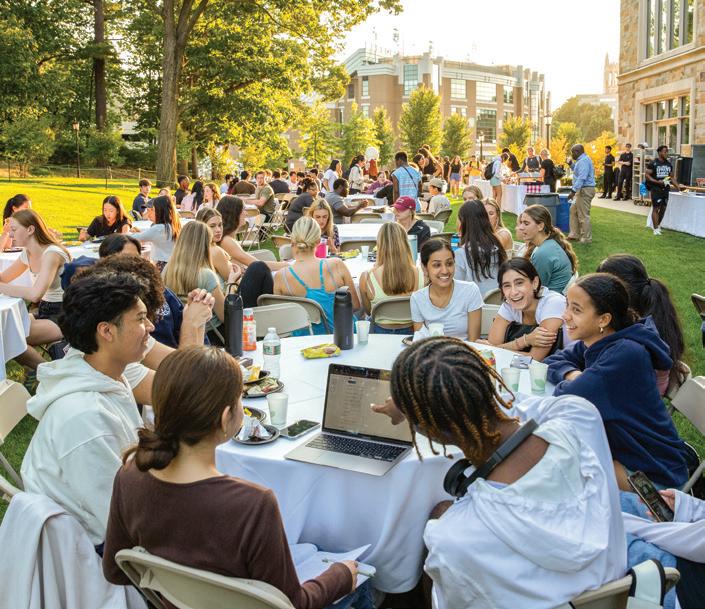
Boston College experienced level enrollment of traditionally underrepresented students in the Class of 2028, with a slight decrease in the number of Black students and a slight increase in the number of Asian American and Hispanic students over last year, according to preliminary data released last week by the Office of Undergraduate Admission.
Specifically, the percentage of Black students in the first-year class fell from 7 percent to 6 percent, while the percentage of Hispanic students rose from 13 to 14.4 percent. Asian American enrollment increased to 16.2 percent from 14.6 percent last year.
The University’s mixed enrollment results were consistent with many highly selective colleges and universities in the wake
Salas-Wright Is First Barry Family Prof. in Social Work
BY SEAN SMITH CHRONICLE EDITOR
Boston College School of Social Work
Professor Christopher Salas-Wright, whose on-the-ground experiences in Central and South America shaped his expertise in Latin American crisis migration and mental health, has been named as the inaugural Barry Family Professor in Social Work.
The Barry Family Professorship was established through a gift from University Trustee Steven M. Barry ’85 and his wife Tammy J. Barry ’85, M.Ed. ’87. The parents of two Boston College graduates, the Barrys are longtime BC benefactors who have supported the Connell School of Nursing, financial aid, athletics, the Wall Street Council Tribute Dinner, and Pops on the Heights, among other University priorities.
of the 2023 United States Supreme Court ruling that ended the consideration of race as a factor in college admissions decisions.
Overall, the Class of 2028 is one of the strongest academically in University history, with 90 percent of students ranked in the top 10 percent of their high school class and average SAT/ACT scores of 1484 and 34, respectively. This year, Boston College admitted just 15.9 percent of its 35,487 applicants and yielded a total of 43 percent—a testament to the University’s popularity among the nation’s best high school students.
BC’s relative stability in maintaining a diverse class was due in part to the Office of Undergraduate Admission’s decades-long efforts to build strong relationships with community-based organizations and urban schools nationwide, and the University’s popularity among QuestBridge Scholars— a pool of high-achieving, low-income high
Healthy Enthusiasm
8 BC Global University to host international forum on plastic pollution. PUBLISHED
Salas-Wright, who is the BCSSW assistant dean for doctoral education, earned
a doctorate from the school in 2012—he also holds a master’s degree from the Clough School of Theology and Ministry—and returned in 2020 as a tenured professor after teaching at the University of Texas-Austin and Boston University.
His research on the experiences of stress and resilience among Latin American crisis migrants, and how such experiences influence mental health, has been key to the development of the crisis-informed theory
Continued on page 4 Continued on page 4
Record 79 Join BC Faculty
New arrivals cite University’s formational mission as a big reason they came to the Heights
BY SEAN SMITH CHRONICLE EDITOR
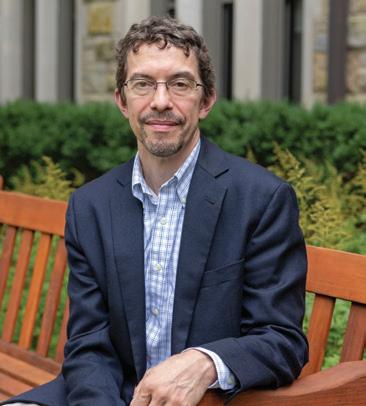
Aaron Stump has more than a few reasons to be enthused about having joined the Boston College faculty this past summer.
He welcomes the opportunity to work at a top-level research university that also has “a strong commitment to humanistic values through its Jesuit heritage,” explained Stump, the John R. and Pamela Egan Chair of Computer Science.
A researcher in programming languages and computational logic, Stump feels BC will be an ideal place to continue his work on software for computer-checked proofs, not only in mathematics and computer science but also theology.
Then there’s the Computer Science Department’s current conversation about what a doctoral program might look like. Stump believes this could help increase the department’s stature and visibility while also attracting strong young scholars “to contribute to our research mission.”
As a Catholic, Stump added, working at a university “that shares my values and faith commitments is a dream come true.”
Stump is one of the 79 new full-time faculty members at Boston College this ac-
ademic year, including 12 with tenure and 35 who are tenure-track—a cohort whose arrival comes only two years after BC had welcomed what was then a record 62 new full-time faculty.
The annual infusion of new faculty typically reflects institutional demographics, University and departmental priorities, new or recent trends in teaching and scholarship, according to BC senior administrators—and sometimes pure happenstance. Ultimately, these hires are a mutual expres-
Continued on page 5
2 Around Campus BC increasing availability of AEDs on campus; Richardson to speak.
3 Theology Offerings Department adds three minors, expanded major.
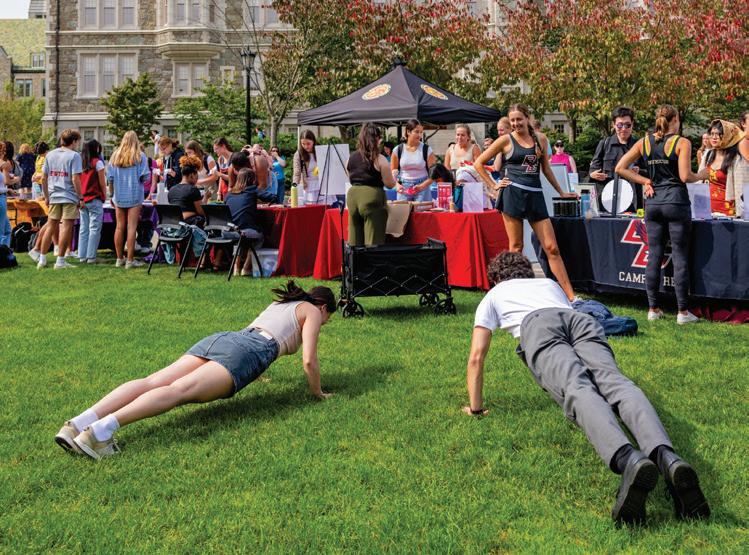
The Center for Student Wellness held its annual “WellFest” on September 18 in the Plaza at O’Neill Library, offering information on campus health and wellness resources—and the opportunity to get in a little exercise.
photo by caitlin cunningham
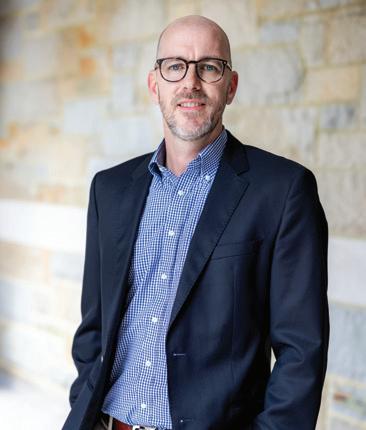
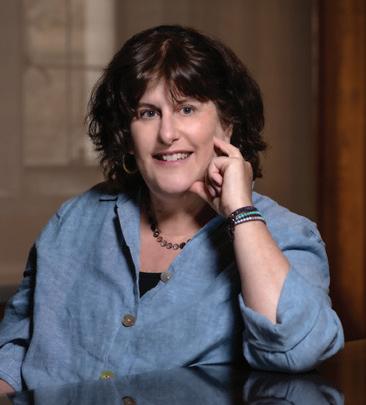
Christopher Salas-Wright
photo by caitlin cunningham
Around Campus
BC Rolling Out More Defibrillators
The Office of Emergency Management is tripling the presence of automatic external defibrillators—known as AEDs—at Boston College through a campus-wide project that began last fall. The rollout of AEDs, which will deploy more than 100 devices to most University-owned properties, is scheduled for completion by the end of the semester.
AEDs are designed to analyze the heart rhythm and deliver an electric shock to victims of ventricular fibrillation to restore rhythm to normal. According to the Centers for Disease Control and Prevention, a study found that administering an AED during a cardiac arrest increases survival rate by 70 percent.
Currently, BC has approximately 50 AEDs on campus, of which about 30 are publicly accessible. The older models, which have already been replaced with the new devices, will be sent back to vendors through a buyback program that will refurbish the technology and sell them on a secondary market to environments that cannot afford the equipment.
Prior to the device launch, BC’s AED program used different models of the portable electronic device. Now, the Office of Emergency Management, with the help of Facilities Management, will replace all AEDs with the new Avive Connect AED.
Snapshot
Starting the Celebration
Director of Emergency Management
John Tommaney described the new devices as “next-generation technology” for AEDs: “A standard AED doesn’t really know its own status or where it is. These new AEDs check in with us every day. Each morning we will get a report on the health and status of every AED on campus—if the batteries need to be charged or replaced, if it’s too hot or too cold, or if it was moved. In the event of an emergency, we actually get an alert from the device. So they’re very intelligent in that respect.”
Unlike the older AED models, the Avive device is universal for children and adults and provides verbal and physical instructions both in English and Spanish through its smartphone-like technology, making them easy and intuitive to handle in the event of an emergency.
During the first-phase rollout of the Avive AEDs, according to Tommaney, almost every major building on campus will have a new device installed along with kits that control severe bleeding—a serious and often deadly effect from industrial or vehicular accidents and other causes. Phase two of the project will include residence halls and other areas.
There have been seven recorded sudden cardiac arrest incidents on campus since 1997. Shortly after the first cardiac
PHOTO BY LEE PELLEGRINI
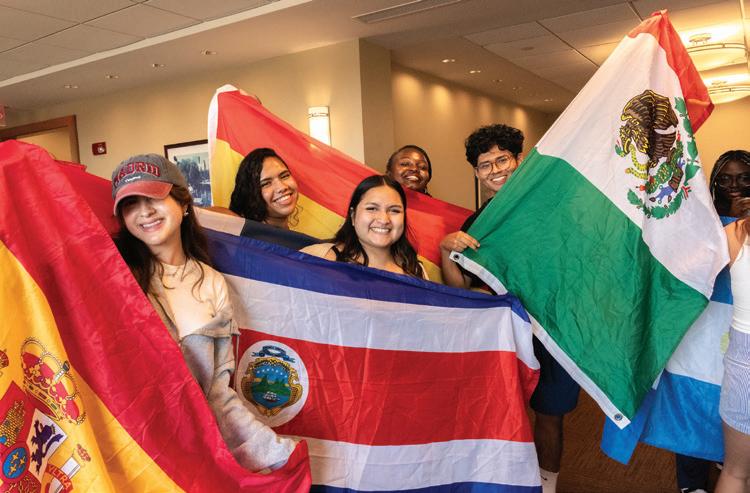
Boston College kicked off Hispanic Heritage Month on September 12 in the Yawkey Center
Room. This annual celebration, recognizing the contributions and influence of Hispanic Americans, features a number of campus events into October. See bit.ly/BC-HispanicHeritage-Month-2024 for more details.
ASSOCIATE VICE PRESIDENT FOR UNIVERSITY COMMUNICATIONS
Jack Dunn
SENIOR DIRECTOR FOR UNIVERSITY COMMUNICATIONS
Patricia Delaney
EDITOR
Sean Smith
CONTRIBUTING STAFF Phil Gloudemans Ed Hayward
Audrey Loyack
Rosanne Pellegrini Kathleen Sullivan
PHOTOGRAPHERS
Caitlin Cunningham Lee Pellegrini
emergency, BC’s Emergency Medical Services program was formed and AEDs were introduced to the University. Through Emergency Management’s partnership with EMS and Campus Recreation, more than a thousand people on campus have been trained to perform emergency CPR in the last two years.
“It’s important to know that anyone can use these devices and there are good Samaritan laws to protect you in the event that you need to use one,” Tommaney said.
“BC Police officers can be at the scene in anywhere from three to five minutes, which is quick. But five minutes could make all the difference of survival in a cardiac event. Somebody intervening right away can really change the outcome of the event.”
To know where the closest AED is to you, go to the Emergency Management home page at bc.edu/emergency. In the event of an emergency, call the BC Police emergency line at ext. 2-4444.
—Audrey Loyack
Heather Cox Richardson to Speak Oct. 1
Professor of History and award-winning author Heather Cox Richardson will share insights into shifting power dynamics, and the importance of historical perspective in addressing today’s political climate and challenges, when she speaks at the Winston Center for Leadership and Ethics Clough Colloquium on October 1 in the Heights Room at Corcoran Commons.
A member of the faculty since 2011, Richardson has become a widely-read writer and commentator on history and politics. Her daily newsletter, Letters from an American, reaches more than a million readers. She is the author of acclaimed books and publications, including her 2023 best-seller, Democracy Awakening: Notes on the State of America, which provides an accessible history that connects the past to current challenges while championing the need for democracy. Richardson recently received the Authors Guild award for literary activism.
“The Winston Center is thrilled to
welcome Professor Richardson as a distinguished historian and insightful commentator on American politics,” said Winston Center Director Monetta Edwards. “As we approach a potentially historic election, with the possibility of electing the first female president of the United States, we are particularly eager to hear Professor Richardson’s reflections on the pivotal role women play in shaping political discourse, leadership, and democracy.”
The Clough Colloquium is a signature speaker series of the Winston Center for Leadership and Ethics, housed in the Carroll School of Management. Held twice a year, the colloquia feature renowned leaders who speak about their personal and professional experiences.
Seating is on a first-come, first-serve basis. Doors open at 3:30 p.m. For more information, see bc.edu/cloughcolloquium.
—Ellen Seaward is a senior digital content writer in the Office of University Communications
The Boston College Chronicle (USPS 009491), the internal newspaper for faculty and staff, is published biweekly from September to May by Boston College, with editorial offices at the Office of University Communications, 3 Lake Street, Brighton, MA 02135 (617)552-3350. Distributed free to faculty and staff offices and other locations on campus.
Periodicals postage paid at Boston, MA and additional mailing offices.
POSTMASTER: send address changes to The Boston College Chronicle, Office of University Communications, 3 Lake Street, Brighton, MA 02135.
A flipbook edition of Chronicle is available via e-mail.
Send requests to chronicle@bc.edu.
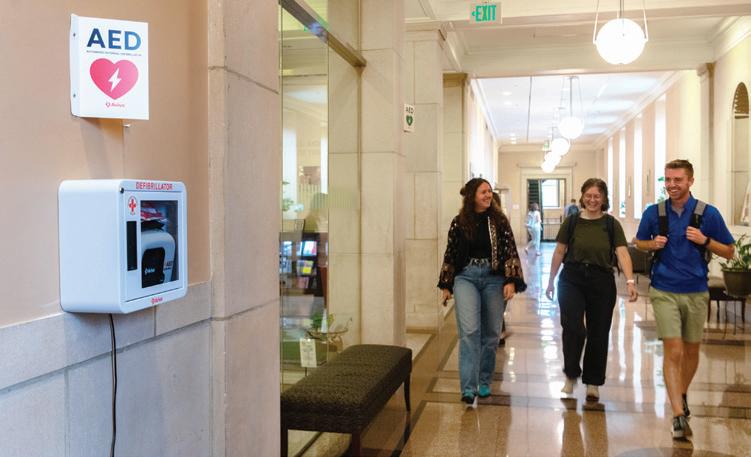
An AED (automatic external defibrillator) station on the first floor of Simboli Hall, Brighton Campus.
photo by lee pellegrini
Murray
Theology Adds Three New Minors, Expanded Major
BY KATHLEEN SULLIVAN STAFF WRITER
Theology Department Chair Andrea Vicini, S.J., the Michael P. Walsh Professor of Bioethics, has announced that the department has launched three new minors and an expanded theology major, so as to deepen students’ exposure to theology and to connect it with other disciplines.
“We want to show how theology can be an interlocutor with other disciplines, responding to the interests of students to combine multiple, diverse fields,” said Fr. Vicini.
The new minors are Catholic Education and Theology, offered in conjunction with the Lynch School of Education and Human Development; Theology and Philosophy, in partnership with the Philosophy Department; and Interreligious Studies.
“The Lynch School and the Clough School of Theology and Ministry both offer masters that align with our new minor in Catholic education and theology,” noted Fr. Vicini. “So our minor gives students an opportunity to explore this area and see if they want to pursue it as a career or through further studies.”
With more than 330 undergraduates enrolled in PULSE and 700 in Perspectives on Western Culture, there is demonstrated interest among BC undergraduates in the study of the intersection of theology and philosophy, said Fr. Vicini.
“The new theology and philosophy minor will allow students to deepen their familiarity with both fields and discover connections. The minor can also be helpful for those students who might want to explore the possibility of our joint M.A. in philosophy and theology.”
The Catholic education and theology minor is being overseen by Charles Cown-
“We want to be in service to our students by empowering them with opportunities and elements that can help them to discern what could be their next steps in terms of their studies, their careers, and their lives.”
—Andrea Vicini, S.J.
photo by lee pellegrini
ie, director of the Urban Catholic Teacher Corps and director of Catholic Teacher Formation. Theology faculty member Rev. Liam Bergin—who is interim director for the Catholic studies minor—serves as co-director. Associate Professor of the Practice in Theology Jason Donnelly directs the theology and philosophy minor, with Timothy Muldoon, associate professor of the practice in philosophy, serving as codirector.
The interreligious studies minor is a natural outgrowth of the diversity represented in the department’s current undergraduate courses and the different religious traditions of the students on campus.
Under the direction of Newton College Alumnae Chair of Western Culture Catherine Cornille, the interreligious studies minor will offer students intentional engagement with more than one religious tradition as part of their training to become global citizens, according to the department. Requirements will include one course that focuses on Christianity in dialogue with another tradition, such as Buddhism, Islam, Hinduism, or Judaism.
The Theology Department will continue to offer its theology minor as well as its popular minors in Faith, Peace, and Justice and Religion and Public Life. According to Fr. Vicini, in 2023-2024, there were 48 theology majors and 44 minors at BC. Thirty-two undergraduates were pursuing a minor in Religion and Public Life, while 43 students were enrolled in the Faith, Peace, and Justice minor.
Fr. Vicini says the Theology Department is also working toward approval of an interdisciplinary minor in theology, science, and technology that could be launched as soon as next fall. He expressed interest in exploring future academic programs connecting theology with environmental studies and the arts.
He noted that several Theology faculty members also teach in related minors outside the department, such as Catholic Studies, Jewish Studies, Asian Studies, as well as the Islamic Civilization and Societies minor and major.
“This dialogue between theology and other disciplines across the University is beneficial for students,” said Fr. Vicini. “We need to work together, across disciplines, to address complex problems that require multiple, layered expertise. By enriching our interdisciplinary outreach and partnering with other fields at the University, we can better accompany our students and they can learn to explore complex realities and issues from different points of view. That is the core of the liberal arts at Boston College.”
In addition to the new minors, the Theology Department is now offering an expanded theology major, with increased credit hours and an optional thesis. It is structured to provide an integrated introduction to the discipline and a broad foundation for further study. With required courses across all theological areas, it exposes students to the entire breadth of the theological discipline.
“This expanded theology major, with more in-depth study, will enrich students’ expertise in theology,” said Fr. Vicini, “and prepare them for master studies in theology or doctoral programs in theology, as well as master studies in the Clough School.
“Our new and expanded programs rise from the expertise of our faculty and respond to the interest of BC students. We want to be in service to our students by empowering them with opportunities and elements that can help them to discern what could be their next steps in terms of their studies, their careers, and their lives.”
For details on the new Theology Department minors and expanded theology major, see bc.edu/theology
BC Is 37th in U.S. News Rankings
Boston College placed 37th in the 2025 survey of national universities released this week by U.S. News & World Report, a twopoint improvement over last year’s ranking.
BC also performed well in several specialty rankings among national universities, including “Commitment to Undergraduate Teaching” (sixth), “Service Learning” (seventh), “First Year Experience” (ninth), “Best Learning Communities” (17th), “Best Study Abroad Program” (18th), “Most Innovative Schools” (19th), and “Best Undergraduate Research and Creative Projects” (36th).
In addition, the University was ranked 52nd in the “Best Value” listing, reflecting its commitment to need-blind admission and meeting the full demonstrated need of all accepted students.
While BC improved in the overall national university ranking, it and other private universities continued to be negatively affected by the 2019 change in U.S. News’ methodology that rewards state universities with a high volume of Pell Grant-eligible students. Prior to the change, BC’s average ranking between 2011 and 2018 was 31st.
Among BC schools and colleges ranked this year, the Connell School of Nursing rose to ninth out of 684 nursing schools
in the “Best Undergraduate Nursing Programs” survey—its highest placement to date.
The Carroll School of Management also improved to 27th out of 527 schools in the “Best Undergraduate Business Programs,” and placed seventh overall in Finance, ninth in Analytics, 10th in both Entrepreneurship and Marketing, and 11th in both Accounting and Management.
Within the Morrissey College of Arts and Sciences, BC was ranked 37th in the “Best Undergraduate Economics” programs, 42nd in “Best Undergraduate Psychology,” and 87th in “Best Undergraduate Computer Science.”
Overall, Princeton University ranked first among national universities this year, followed by Massachusetts Institute of Technology, Harvard, Stanford, and Yale.
Among Massachusetts universities, BC and Tufts University placed third behind MIT and Harvard, and ahead of Boston University (41st), Northeastern (54th), University of Massachusetts-Amherst (58th), and Brandeis (63rd).
The U.S. News rankings of all colleges and universities are available at www.usnews.com.
—Jack Dunn
Boston College Athletics and the Bowman AHANA and Intercultural Center held a barbecue on September 16 in “Baldwin’s Backyard”—the southern end of the Connell Recreation Center. photo by seho lee
The Class of 2028
Continued from page 1
school students who are matched with 52 of the nation’s best colleges and universities. Boston College placed second in the nation among QuestBridge College Partners in the number of National College Match students enrolled.
In addition, Boston College’s increased focus on socioeconomic factors in admission helped it to attract a class composed of 14 percent first-generation students, an increase of 23 percent from last year. Its percentage of Pell-eligible students (individuals with the highest level of financial need) rose by 50 percent to an all-time high of 18.8 percent, reflecting the University’s continued commitment to meeting the full demonstrated need of all accepted students. This year, Boston College will award $177 million in need-based financial aid to undergraduates, with more than 66 percent of BC students receiving financial aid.
“Given our distinctive mission and foundational values as a Jesuit, Catholic university, our commitment to enrolling a diverse class of students is unwavering,” said Provost and Dean of Faculties David Quigley. “All of us working with the Class of 2028 recognize the excellence of this
cohort of students, and our colleagues in Admission and Financial Aid deserve credit for remarkable work in the face of significant headwinds.”
“In response to the 2023 Students for Fair Admissions ruling, our office reviewed applications and made decisions in a raceblind environment while enhancing our focus on race-neutral factors that align with Boston College’s mission,” said Dean of Undergraduate Admission and Finan-
cial Aid Grant Gosselin. “Expanding our commitment to ensuring a wider range of socioeconomic representation among our student body was critical to our work.”
In total, the 2,394 first-year students come from 48 states and 55 countries. Eight percent of the class are international students.
“Boston College was able to achieve broad representation within the Class of 2028 because of the University’s reputa-
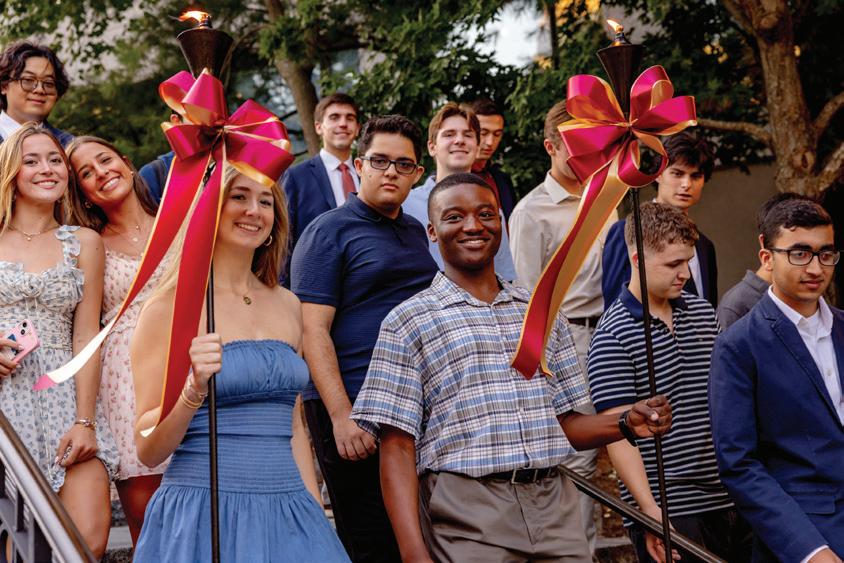
First-year students making the traditional First Flight Procession through campus earlier this month. “Boston College was able to achieve broad representation within the Class of 2028 because of the University’s reputation for academic excellence and its commitment to need-blind admissions and meeting the full demonstrated need of all accepted students,” said Dean of Undergraduate Admission and Financial Aid Grant Gosselin.
tion for academic excellence and its commitment to need-blind admissions and meeting the full demonstrated need of all accepted students,” said Gosselin.
“Enhancing need-based financial aid is a major priority of BC’s $3 billion Soaring Higher campaign, with the goal of raising $1.1 billion to support this crucial initiative. The results of this class demonstrate that the need for continued investment in financial aid has never been greater.”
Expert in Crisis Migration Named to New Endowed Chair
Continued from page 1
of cultural stress, which explores how individuals and families experience stress as a result of cultural changes and challenges when migrating across national borders. This theoretical basis enabled Salas-Wright to develop the crisis migration experiences scale to measure exposure to pre-migration stressors such as material hardship, physical danger, and psychological desperation.
In an age when migration is often a divisive topic, Salas-Wright seeks to keep a lens trained on the humanitarian dimensions of the issue. It’s a research area that aligns with the priorities of a Jesuit, Catholic university, he says, which makes him all the more certain he made the right choice in returning to BC.
“Every time I walk across campus, I feel very fortunate to be at BC,” said Salas-Wright. “Jesuit education is a perfect fit for social work education and research, because it speaks to concern for the individual, especially those in need. BC provides rigorous preparation focused not only on intellectual and professional development but also on the formation of the whole person.
one that I take very seriously.”
“Professor Salas-Wright is a prolific scholar, a scientific mentor to several young faculty and postdoctoral fellows in the school, a respected teacher, and an assistant dean of our doctoral program,” said BCSSW Dean Gautam Yadama. “That’s a grand slam.”
“The opportunity to enter into the lives of people on the margins, and reflect on those experiences in the heart, mind, and faith,” says Salas-Wright, “was transformative in my personal and professional discernment.”
Salas-Wright is leading two National Institutes of Health-funded studies on crisis migration and cultural stress. The Adelante Boricua study focuses on so-called “María migrants”: Puerto Ricans displaced to the United States mainland after Hurricane María in 2017. The only longitudinal study of “María migrants,” Adelante Boricua examines how premigration hurricane trauma and post-migration cultural stress shape the resettlement experiences of climate migrants and influence mental health.
as a Santa Clara University undergraduate. The impact of the country’s devastating civil war was evident, including violencerelated poverty and trauma, he said, and these factors contributed to the migration of many Salvadorans; today, he noted, roughly one in four Salvadorans lives in the United States.
“Those first experiences forced me to grapple with the challenges of poverty, violence, and crises that lead to mass migration,” said Salas-Wright, who later lived in El Salvador for five years and wrote his doctoral dissertation on the role of spirituality and faith in the lives of young people living in high-crime communities in San Salvador. “The opportunity to enter into the lives of people on the margins, and reflect on those experiences in the heart, mind, and faith, was transformative in my personal and professional discernment.”
“While there are aspects unique to the situations in Puerto Rico or Venezuela, these are universal human concerns,” he said. “Down through the centuries, we’ve all heard stories or songs about migration, and one thing is clear: Losing your home, or being forced to leave it, is a deeply troubling and stressful experience. If you have some kind of support system in place— through family or friends, or aid organizations—then you stand a better chance of adjusting to this change and moving forward.
“I’m very grateful to the Barry family for their generosity, and for the opportunity to make a positive impact in the area of crisis migration and mental health, and to teach the next generation of social workers. It’s a great honor to be the Barry Family Professor, and also a great responsibility—
The Venezolanos en Nuevos Entornos study charts the experiences of nearly 2,000 Venezuelan children and adults resettling in Bogotá and Medellín, Colombia, and in Florida. VENE is the sole longitudinal, cross-national study of Venezuelan crisis migrants, providing unique and timely evidence on one of modern history’s most significant population movements.
Salas-Wright traces his original interest in crisis migration and related issues to the first summer he spent in rural El Salvador
Two other career keystones of the past decade for Salas-Wright—the Adelante Boricua study in Puerto Rico and the Venezolanos en Nuevos Entornos project—solidified his belief in the importance of discerning the quality of life among the populations in need he studied, rather than simply record data points. He talked with the Puerto Rican migrants in Florida about how they had fared since Hurricane Maria, how they had been treated in their new place, and the state of their emotional and mental health. He spoke with Venezuelans who had fled to Colombia in the wake of their country’s economic collapse, to find out about the high levels of depression, anxiety, and post-traumatic stress many have experienced.
“Despite adversity, many—in fact, most—migrants settle into their new lives and do quite well,” he said. “Friends, family, and community are important pillars of support as well as a means to maintain relationships with people left back home, which is crucial to migrants’ mental health. This is what we need to understand better about the factors that aid the transition: not just the role of social services and family support, but those of optimism and faith. I believe there are spaces for these kinds of conversations.”
Salas-Wright has authored more than 250 publications, including two books and first-author articles in journals such as the American Journal of Public Health, Addiction, and the American Journal of Preventive Medicine. He was selected for the Deborah K. Padgett Early Career Achievement Award from the Society for Social Work in Research in 2019 and the National Award of Excellence in Research by a Senior Investigator from the National Hispanic Science Network in 2023.
photo by caitlin cunningham
University’s Mission ‘Resonates’ with New Faculty
Continued from page 1
sion of confidence by both parties: For the new faculty member, that BC will be an atmosphere in which to thrive, professionally and personally, and fulfill one’s vocation; for BC, that the new faculty member will grasp, and appreciate, the elements of its Jesuit, Catholic legacy.
“When we had our reaccreditation six years ago,” said Vice Provost for Faculties Billy Soo, “the head of the review committee—Donna Shalala [a cabinet member in the Carter and Clinton administrations]—wrote in her summary that it was evident how well BC faculty understand the University’s mission. This has long been a vital characteristic of Boston College, and one that has only gotten stronger over the years.
“The word has gone out: Our mission is formative education, to help our students become better citizens of the world, and this obviously resonates with the people who want to join our faculty.”
Among the new additions to BC faculty are the first four full-time hires in Messina College, which opened this past summer, plus a fifth who has a joint appointment with the Computer Science Department. The Economics Department is welcoming an unprecedented six new colleagues, while five new tenure-track faculty have joined the BC Law School, and the four-year-old Engineering Department has added three, after having hired four last year.
Each spring, BC’s academic deans assess their respective school’s teaching needs—based on such factors as expected faculty retirements or departures and growth of specific majors—and share these with the Office of the Provost, which takes a holistic view using metrics like student credit hours to help determine how many new faculty a school can recruit. Search committees are formed with current faculty members to identify and interview three finalists for each position.
Of course, not everything goes according to plan, notes Soo. Prospective faculty candidates may turn down offers for various reasons: Perhaps they see more attractive opportunities in the private sector, for example, or they’re simply not fond of the New England climate.
“But this year, we were very successful on new hires, such as in Economics, which is a good surprise,” he explained. “And where a few years ago we saw a significant number of retirements or departures that were probably pandemic-influenced decisions, in this recent cycle the number dropped.
“All you can do is to try and stay ahead of the curve, but we feel very positive about the state of our faculty as we look toward the future.”
A major task for Soo and other academic administrators is to ensure that new faculty understand the nature of a Jesuit, Catholic university: Their orientation in-
“[As a Catholic, working at a university] that shares my values and faith commitments is a dream come true.”
—Aaron Stump
“I have found a strong, supportive community that believes in me and one that provides resources for me to be successful.”
—Anna-Helena Klarare
“[I saw a school committed to] helping junior faculty become the best versions of ourselves, both as scholars and educators.”
—Yan Fang
“Everything feels thoughtfully designed to empower my development as a researcher and teacher.”
—Angela Ma
cludes a talk by representatives from the University Mission and Ministry division on the role of cura personalis in the BC community.
“We want faculty to know one another, and to become familiar with the greater University,” he said. “It’s important for them to see that formation is not just for students, but for themselves, and that their well-being is about more than their work.”
That message seems to resonate among the new arrivals.
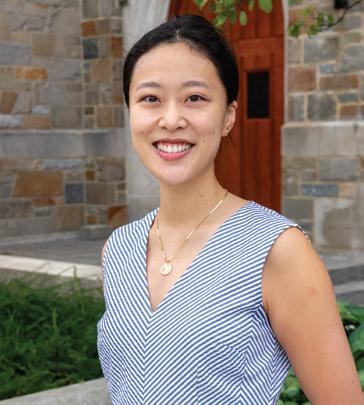
Carroll School of Management Assistant Professor Angela Ma said she was impressed by the strength and creativity of the school’s Seidner Department of Finance, to go with the BC Jesuit, Catholic mission. She describes the environment as welcoming and “can-do.”
“I am already experiencing the abundance of resources and support at BC,” said Ma, whose research interests are in corporate finance and financial intermediation. “Everything feels thoughtfully designed to empower my development as a researcher and teacher. For example, I’m teaching undergraduate corporate finance this semester and drawing from the wealth of experience of other faculty. It’s rewarding to work with the undergraduate students who show up with great questions and to experience real-time resonance between teaching and research.”
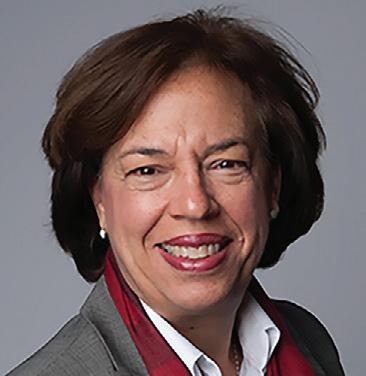
Connell School of Nursing Associate Professor Anna-Helena Klarare was struck by “the University-wide vision of working for the common good and supporting students in reaching their goals” she saw at BC and a “longstanding tradition of excellence in nursing, paired with vision and innovation for the future” at the Connell School. She believes the school is a perfect fit for her work in organizing health care—with nurses at the forefront—to meet needs of people experiencing vulnerabilities, such as health disparities or lifethreatening illness.
“I have found a strong, supportive community that believes in me and one that provides resources for me to be successful,” said Klarare. “I just love the community of thinkers, with the thought-provoking seminars and hallway discussions I’ve had so far.”
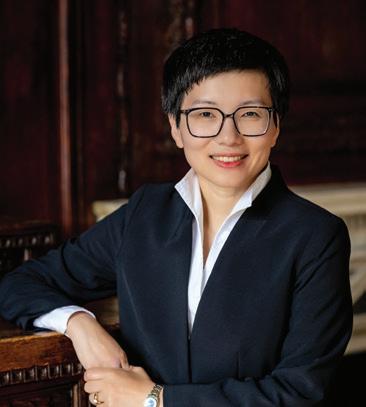
In BC Law, Assistant Professor Yan Fang said she saw a school committed to “helping junior faculty become the best versions of ourselves, both as scholars and educators,” and felt strongly that joining its faculty would be a boon for research on how legal actors and institutions adjust to changes in their informational environments and the impact of those changes on enforcement systems.
“Having BC as my intellectual home will give me rich opportunities to engage with colleagues and students eager to explore the social and moral implications of technological change,” said Fang.
Alumni Talks Highlight Clough School Fall Schedule
BY KATHLEEN SULLIVAN STAFF WRITER
Among a full slate of fall events, next month the Clough School of Theology of Ministry (CSTM) will host a talk by Boston College alumnus Sam Sawyer, S.J, editor in chief of America Media, and present its Alumni Distinguished Service Award to Elise Miranda M.A. ’95, director of diversities at The Association of Theological Schools (ATS).
Fr. Sawyer’s talk, titled “From Polarization to Communion,” will take place on October 10 at 5:30 p.m. in the Heights Room of Corcoran Commons, cosponsored by the Church in the 21st Century Center. In the face of growing polarization in the United States and in the Catholic Church, nationally and globally, Fr. Sawyer will call for a vision to work for something better. He says the mystery of communion—being bound together into the larger life of the Church—provides a starting point.
A Gabelli Presidential Scholars Program member who graduated from BC in 2000, Fr. Sawyer began working at America Media in 2015 and served as a senior editor and director of digital strategy before taking on his current role in 2022. He entered the Jesuits in 2004 and was ordained a priest in 2014. The same year as his ordination, he earned a M.Div. from the Clough School. A resident of New York City, he as-
More Accolades for Graver’s Kantika
Professor of English Elizabeth Graver’s acclaimed 2023 novel Kantika—lauded by The New York Times as an “exquisitely imagined family saga [that] spans cultures and continents”—continues to garner prestigious literary honors.
This month, Kantika was announced by the Massachusetts Center for the Book (MCB) as the winner of the Massachusetts Book Award for Fiction for 2023, while Graver received the Boston Authors Club’s Julia Ward Howe Prize in Fiction.
Graver’s fifth novel, Kantika was inspired by her grandmother, who was born into a Sephardic Jewish family in Istanbul and whose shape-shifting life journey took her to Spain, Cuba, and New York.
“This well-researched novel is a multigenerational tale of a Sephardic family’s dislocations, hardships, and joys,” according to the MCB award announcement.
Among other literary honors, Kantika named by The New York Times as one of the 10 Best Historical Fiction novels and 100 Notable Books of 2023—won the 2023 Edward Lewis Wallant Award, one of the oldest and most prestigious Jewish literary awards in the United States. It also was chosen as a National Jewish Book Award winner, with The Sephardic Culture Mimi S. Frank Award in Memory of Becky Levy.
The MCB program—now in its 24th year—celebrates significant achievements
sists at St. Francis Xavier Church, a Roman Catholic parish in the Jesuit tradition.
On October 24, Miranda will give the annual Daniel J. Harrington, S.J., Lecture on “Bridging Empire and Barrio: The Here and Not Yet of the Kin-dom,” at 5:30 p.m. in the Heights Room. As a Cuban American and practical theologian, she has focused her research interests on the intersection of faith and how socio-culture and socio-political realities impact both human formation and efforts toward peace and justice at local and global levels. Miranda’s lecture will invite attendees to discern their own personal and collective responsibilities to be gente puente (to be the bridge)
in fiction, nonfiction, poetry, translated literature, and young people’s literature by Massachusetts writers, illustrators, and translators. Award winners are chosen by a panel of judges from the writing, academic, publishing, bookselling, and library communities, who come together to select “books that haunt and inspire, books that motivate us to think, feel, and learn,” according to MCB Executive Director Courtney Andree.
MCB is the state affiliate of the Center for the Book in the Library of Congress, charged with developing, supporting, and promoting cultural programming to advance the cause of books, reading, and libraries across Massachusetts.
On October 8, MCB will host a cel-
between empire and barrio that makes manifest the kin-dom of God in the here and now.
Her address is cosponsored by ATS, which provides programs, services, research, and other resources to support the work of administrators and faculty at the more than 270 graduate schools of theology in the U.S. and Canada in its membership.
That evening, Miranda will receive CSTM’s Alumni Distinguished Service Award. Miranda—who holds a master’s degree in pastoral ministry with a concentration in religious education—was named director of accreditation for ATS in 2018,
ebration of the 2024 Massachusetts Book Awards at the State House.
Graver received her Julia Ward Howe Prize award on September 17 at the Waterworks Museum in Chestnut Hill. Awarded for more than two decades and named after the Boston Authors Club’s first president, the prizes—in fiction, nonfiction, poetry, and the young reader categories— recognize exceptional books by Boston-area authors.
“I’m thrilled that Kantika has received
and transitioned to director of diversities in 2023. She previously served on the ATS Committee for the Revision of the Standards from 2012 to 2014, and has served on many evaluation teams and as a member of a peer group examining programs for the ATS Educational Models and Practices project. Prior to joining ATS, she was on the faculty at Barry University, most recently serving as associate professor of practical theology and as director of ministerial formation.
Past president of the Academy of Catholic Hispanic Theologians in the United States, she serves on the Formation and Religious Education Committee for the V Encuentro, a national conference on Hispanic ministry in the U.S. coordinated by the U.S. Conference of Catholic Bishops. She is also a member of the Catholic Theological Society of America and the Association of Practical Theology. Her scholarship includes contributions to the edited volumes Hispanic Ministry in the 21st Century: Urgent Matters and Hispanic Ministry in the 21st Century: Present and Future. She is a coeditor and contributor to Calling for Justice Throughout the World, Catholic Women Theologians on the HIV/AIDS Pandemic. Both lectures are organized by CSTM’s Continuing Education program and are being presented in a hybrid format. To register to attend in person or virtually, go to the Clough School website [bc.edu/cstm] and click on the Continuing Ed link.
the Massachusetts Book Award for Fiction from the wonderful Massachusetts Center for the Book,” Graver wrote on her website (elizabethgraver.com). “I feel so lucky to live in a state with such a rich literary history and current scene and to be, with this award, in the company of dozens of writers I admire, both on this year’s list and from years past.
“I wish my grandmother were alive to clap and sing out in her inimitable way upon learning of this beautiful award.”
—Rosanne Pellegrini
photo by lee pellegrini
Elizabeth Graver
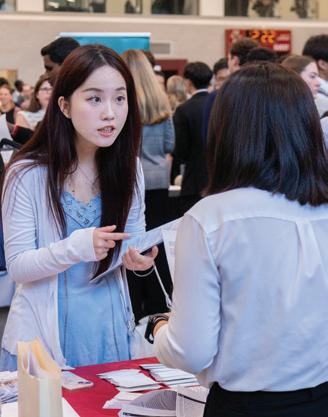
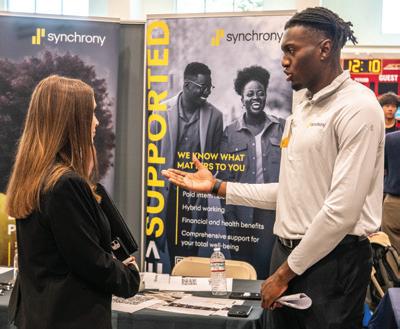
On September 13, the Boston College Career Center hosted a Finance, Consulting, and Business Career Fair in the Connell Recreation Center. The event was open to all class years and majors.
BC Scenes Career Fair
PHOTOS BY LEE PELLEGRINI
Sam Sawyer, S.J. ’00, M.Div.’14, and Elise Miranda M.A.’95
photo of fr sawyer by lee pellegrini
Associate Vice President for Human Resources William Murphy has announced that he is stepping down from his position to become the vice president for human resources at Tufts University, effective October 7.
A 1991 graduate, Murphy returned to Boston College in 2016 from Northeastern University, where he had served as senior director of labor relations; prior to Northeastern, he was Harvard University’s director of labor relations. During his eight years at BC, he helped to manage employment, employee wellness, and the HR Service Center, and led the University’s labor relations and negotiations. He was also an active collaborator with the Office of Institutional Diversity, the Office of Educational Development, and the departments of Compensation and Benefits.
Human Resources Vice President David
Trainor thanked Murphy for his dedicated service to Boston College. “Bill has been a valued leader in Human Resources at Boston College and has made lasting contributions to the division and the University. We wish him the very best as he embarks on this next chapter of his professional career.”
Murphy said that giving back to a place that has meant so much to him and his family was a blessing he will cherish.
“Returning to Boston College as the associate vice president of Human Resources 25 years after graduating here as a student, has been one of the most rewarding chapters of my career,” said Murphy. “It has been a true privilege to contribute to the mission of this extraordinary institution and to work alongside the remarkable Boston College community.”
—University Communications
Pianists to Perform Oct. 5 and 6
Internationally renowned pianists
Thomas Schwan and Liudmila Georgievskaya will present two free campus concerts next week during a two-day residency at the Music Department.
The free performances—“The 21 Nocturnes with Thomas Schwan” and “Elegies and Visions: A Musical Journey with Liudmila Georgievskaya and Thomas Schwan”—will take place on October 5 and October 6, respectively, in Gasson 100 at 7 p.m.
Schwan has performed extensively internationally and won wide acclaim as well as numerous prestigious musical honors. While cultivating a repertoire that spans the history of Western music, he currently specializes in the music of J.S. Bach. As a composer, his music is performed or commissioned by renowned ensembles and soloists. [His website is www.thomasschwan. com]
“Elegies and Visions: A Musical Journey” explores themes of “dreams, childhood, the supernatural, and spirituality” and “promises a poignant and imaginative
Nota Bene
Professor of Music Ralf Yusuf Gawlick traveled to Krakow, Poland, this past summer to participate in events and ceremonies marking the 80th anniversary of the liquidation of the Zigeunerlager, the notorious Romani camp in AuschwitzBirkenau. The commemoration included the Polish premiere in the Krakow Philharmonic of Gawlick’s oratorio “O Lungo Drom” (“The Long Road”), which traces the history of the Sinti and Roma people. In 2015, in memory of all 500,000 Sinti and Roma who perished in Nazi-occupied Europe—including the last 4,300 Sinti and Roma murdered at Zigeunerlager on August 2, 1944—the European Parliament declared that date the European Holocaust Memorial Day for Sinti and Roma. The 2024 anniversary drew prominent representatives of parlia-
Kaveny’s Prophecy Makes a Top 100 Books of the Century List
Darald and Juliet Libby Professor Cathleen Kaveny’s 2016 book Prophecy without Contempt: Religious Discourse in the Public Square has been chosen by the online journal Current as one of the top 100 books of the 21st century Current selected Prophecy without Contempt as 36th among its top 100, along with such books as Gilead (Marilynne Robinson), Frederick Douglass: Prophet of Freedom (David W. Blight), Persepolis (Marjane Satrapi), Harry Potter and the Deathly Hallows (J.K. Rowling), Outside the Gates of Eden: The Dream of America from Hiroshima to Now (Peter Bacon Hales), Born to Run (Bruce Springsteen), Between the World and Me (Ta-Nehisi Coates), Abraham Lincoln: A Life (Michael Burlingame), and Oryx and Crake (Margaret Atwood).
mutate into contempt,” writes Kaveny in the book’s preface. “They—we—must resist this temptation. In an increasingly pluralistic liberal democracy, prophetic condemnation of deep social evils can be justified on occasion, although such rhetoric never comes without ancillary costs.”
Treating one’s political interlocutors as “vile or worthless is to risk undermining their equal status as participants in our political community,” she explains. “It is to treat them as unworthy of citizenship, as people who must be ‘pruned’ from our common political endeavor.”
Kaveny said that, while she didn’t know about Current’s list, “I know—and respect very much—the panel of reviewers.
musical journey and exceptional experience,” organizers note. Georgievskaya and Schwan—who are married and often perform as a duo—will begin with piano four-hands music featuring works by Franz Schubert and Maurice Ravel. Georgievskaya will perform Professor of Music Ralf Gawlick’s “Mysterium Doloris Quintae” for solo piano, weaving together pieces from Bach, Mozart, and traditional children’s songs worldwide.
Georgievskaya—a Global Music Award winner for her solo CD with music by Beethoven and Schumann—is an internationally sought-after pedagogue who has won top prizes in national and international piano competitions, and performed worldwide with broadcasts on radio and television. [Her website is ww.liudmilageorgievskaya.org]
For more information on these concerts, presented by the Boston College Arts Council and Music Department, see the University events calendar [events.bc.edu]. —University Communications
[The full list is at currentpub. com/2024/07/30/currents-100-books-ofthe-21st-century]
Current describes itself as an online journal “of commentary and opinion providing daily reflections on contemporary ideas, culture, and politics.” Although the positions of many Current contributors “are informed by Christian faith,” the description reads, “we are not a Christian publication per se.”
In Prophecy without Contempt, Kaveny— who holds a joint appointment in the Theology Department and Boston College Law School—seeks to reframe the debate about religion in the public square by focusing on a powerful stream of religious discourse in American political speech: the Biblical rhetoric of prophetic indictment, the jeremiad.
“It is all too tempting for practitioners of prophetic rhetoric to let their condemnation
Jobs
The following are among the recent positions posted by the Department of Human Resources. For more information on employment opportunities at Boston College, see www.bc.edu/jobs or scan the QR code at right.
“The list includes a wide range of fiction and non-fiction books, including books dealing with religion,” she said. “I was particularly honored to be included in the company of Charles Taylor’s A Secular Age, and Mark Noll’s America’s God: From Jonathan Edwards to Abraham Lincoln, because I continually teach from and learn from those books.
“In addition, many of the fiction books have taught me more about theological reality than academic treatises. I think of George Saunders’s Lincoln in the Bardo, which is deeply humane and a model of compassion.”
Will her inclusion in the top 100 have any effect on her?
“I think the biggest impact on me will be that it will help me summon up the courage to write my next book, which is on nostalgia,” she said.
—Sean Smith
ments and governments from countries around the world.
“O Lungo Drom”—which includes texts from 13 Roma poets across 10 different Romani languages and dialects— is dedicated to Romani Rose, chairman of the Central Council of German Sinti and Roma, who attended the oratorio’s world premiere in Berlin in 2022 on the 10th anniversary of the inauguration of Germany’s memorial to Roma and Sinti victims of the Holocaust.
Its United States premiere was held last April at Boston College and at the College of the Holy Cross. The renowned recording company Decca Eloquence released the piece to coincide with the American premiere.
Read more about Gawlick’s work at rb.gy/oz7k9c.
Research Assistant, TIMSS and PIRLS Estate Planning Fellow, ILH&PR
Staff Psychologist, Senior Staff Psychologist, Staff Social Worker, or Senior Staff
Social Worker
Assistant Director of Fiscal and Grant Administration
BC Global
Conference Will Address Plastic Pollution Crisis
BY ED HAYWARD STAFF WRITER
Boston College faculty will host scientists and theologians from around the world next month for the conference “Joining Science and Theology to End Plastic Pollution, Protect Health, and Advance Social Justice.”
In addition to addressing a crucial global issue, the conference—which takes place October 4 and 5—represents the latest milestone in the University’s initiatives and investments in scientific research and its use for the public good, as well as the expansion of BC’s historical strengths that have made it one of the world’s top Catholic universities and leading theological centers.
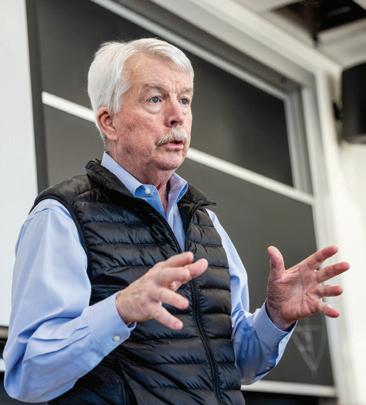
“This conference is based on the recognition that the plastics crisis is more than an environmental challenge,” said one of the conference’s lead organizers, Global Public Health and the Common Good (GPHCG) Program Director Philip Landrigan, M.D. “Like climate change, air pollution, biodiversity loss, and escalating inequality, the plastics crisis is also a social and ethical challenge. It threatens human health and is responsible for widespread environmental injustice.”
Fittingly, campus co-sponsors represent multiple areas of the University: GPHCG, the Theology Department, Institute for the Liberal Arts, Clough School of Theology and Ministry, Connell School of Nursing, BC School of Social Work, and the Schiller Institute for Integrated Science and Society. External co-sponsors of the conference are Australia’s Minderoo Foundation, the Centre Scientifique de Monaco, and MMHBO Fund at Schwab Charitable.
Conference co-organizers include Michael P. Walsh Professor of Bioethics and Theology Chair Andrea Vicini, S.J., BCSSW Professor and GPHCG Associate Director Summer Hawkins, and BCSSW Louise McMahon Ahearn Endowed Professor Karen Bullock.
Speakers from BC include Provost and Dean of Faculties David Quigley, Connell School Dean Katherine E. Gregory, DeLuca Professor in Biology and Vice Provost for Research and Academic Planning Thomas C. Chiles, Clough School Dean Michael C. McCarthy, S.J., BC Law School Dean Odette Lienau, BCSSW Dean Gautam Yadama, and Nobel laureate and Carroll School of Management Seidner University Professor Paul Romer.
Among the visiting speakers are University of Virginia Professor of Religious Studies Willis Jenkins; Beyond Plastics President Judith Enck; Sarah Dunlop, director of the Minderoo Foundation Plastics & Human Health research program; United Nations Environment Program Senior Economics Advisor Pusphpam Kumar; Monterey Bay Aquarium Chief Conservation and Science Officer Margaret Spring; epidemiologist Adetoun Mustapha of Nigeria’s Lead City University; Hervé Raps of the Centre Scientifique de Monaco; and Rev. Mitchell C. Hescox, president emeritus of the Evangelical Environmental Network.
“This conference is the result of a tremendous amount of work that has taken place on campus during the past decade and highlights Boston College’s unique ability to join science and moral theology to address a key issue in global health,” Landrigan said.
The Minderoo Monaco Commission
In response to the worsening plastics crisis, the U.N. Environment Assembly voted in March 2022 to develop a Global Plastics Treaty. An Intergovernmental Negotiating Committee will hold its fifth and final meeting in Korea in November.
The Minderoo Monaco Commission argues that the treaty requires a legally binding global cap on new plastic, restrictions on single-use plastics, and comprehensive regulation of plastic chemicals.
Building on this recognition, the purpose of the BC conference is to bring moral clarity to the conversation on plastic pollution, Landrigan said. In addition to reviewing the current crisis and potential solutions—including their ethical dimensions—the conference will produce a declaration that urges the treaty negotiators to produce a legally binding, just, and equitable treaty prioritizing the protection of human rights and health for all people.
on Plastics and Human Health, anchored at Boston College, found that plastics harm human health at every stage of their life cycle—from extraction of the crude oil, fracked gas, and coal that are plastics’ principal feedstocks, through transport, manufacture, use, recycling, and on to disposal into the environment.
Plastics’ harms fall disproportionately on the poor, people of color, and marginalized communities. Groups at particularly high risk include employees in the fossil fuel and chemical industries, as well as people who live near such facilities and supply chains. More than 400 million tons of plastic are produced annually and the output is projected to double in the next 16 years. Plastic waste can be found in nearly every environment.
Drawing inspiration from Pope Francis, the declaration concludes: “Plastic is not an isolated problem. Like climate change, air pollution, and escalating inequality, the plastics crisis is a social and ethical challenge…We need to embrace a new approach that transforms our way of living in the world, our lifestyles, our relationship with the earth’s resources, and generally how we look at humanity and all life. Such an approach is essential if we wish to leave a habitable planet for our children, our children’s children, and the generations yet to come.”
Conference sessions on Octrober 4 will take place in Gasson Hall; the October 5 program will be conducted in the Corcoran Commons Heights Room. For information about the conference, see https://bit.ly/ Boston-College-Plastics-Conference-2024.
BC to Screen Documentary on Survivors of Irish Mother-Baby Homes
Boston College will host the Bostonarea premiere of the documentary film “Stolen,” which features the stories of survivors of Ireland’s notorious mother-andbaby homes, on October 9 at 4:30 p.m. in Devlin 110. The free, public event also will include a Q&A with the film’s director, Margo Harkin.
Released in 2023, “Stolen” offers insights into a decades-old scandal during which more than 80,000 unmarried mothers were incarcerated in institutions run by nuns. At least 9,000 infants died in these institutions; many who survived were fostered out at a very young age as cheap farm labor in dire circumstances, or else adopted in Ireland or sent to the United States— rendered untraceable and unaware of their birth stories.
Harkin interviews mothers and children who survived the homes, as well as survivors’ children who are searching for their long-lost siblings. She also speaks with journalists, politicians, legal historians, scholars, and other observers, assembling the story “with the skill of a high-court
prosecutor,” according to The Guardian.
After the film’s airing in Ireland last month, the Irish Times called it “powerful and unflinching.” “Stolen” was nominated for the Dublin Film Critics Circle Awards and Irish Film and Television Awards.
The Q&A following the campus screen-
ing of “Stolen” will be moderated by Professor of English James Smith, a member of the BC Irish Studies faculty who has chronicled and spoken about the mistreatment of institutionalized Irish women and children. Appearing with Harkin will be film contributors Sarah-Anne Buckley
The screening of “Stolen” will be followed by a Q&A with director Margo Harkin and other panelists, moderated by Boston College faculty member James Smith.
(University of Galway), Máiréad Enright (University of Birmingham), and Clair Wills (Cambridge University).
The event is co-sponsored by Irish Studies with the Institute for the Liberal Arts, Jesuit Institute, English and History departments, BC Law School, Center for Human Rights and International Justice, Boisi Center for Religion and American Public Life, and Film Studies and Medical Humanities programs.
For more information, email irish.studies@bc.edu.
—Sean Smith
Phil Landrigan: The forthcoming conference “highlights Boston College’s unique ability to join science and moral theology to address a key issue in global health.”