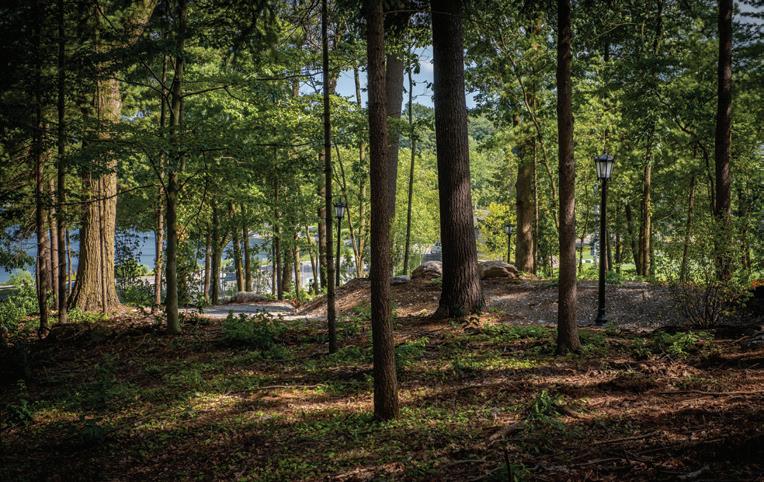
Page 2
Restorative Practices
New initiative seen as helping to strengthen student relationships
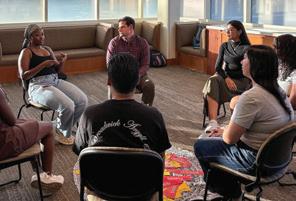
Pages 3 and 6
New faces
Adelmann and Joseph chairs announced
BOSTON COLLEGE OFFICE OF UNIVERSITY COMMUNICATIONS
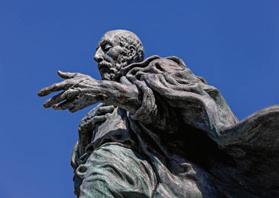
Page 2
Restorative Practices
New initiative seen as helping to strengthen student relationships
Pages 3 and 6
New faces
Adelmann and Joseph chairs announced
BY THE OFFICE OF UNIVERSITY COMMUNICATIONS
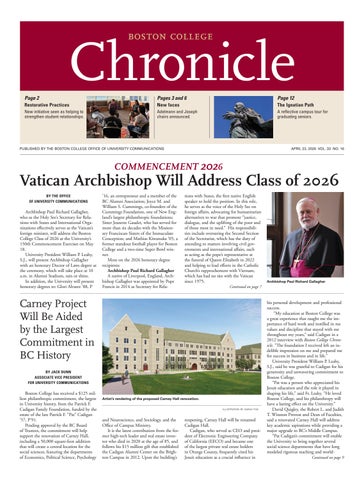
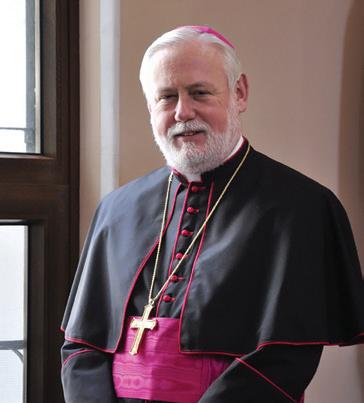
Archbishop Paul Richard Gallagher, who as the Holy See’s Secretary for Relations with States and International Organizations effectively serves as the Vatican’s foreign minister, will address the Boston College Class of 2026 at the University’s 150th Commencement Exercises on May 18.
University President William P. Leahy, S.J., will present Archbishop Gallagher with an honorary Doctor of Laws degree at the ceremony, which will take place at 10 a.m. in Alumni Stadium, rain or shine.
In addition, the University will present honorary degrees to: Glori Alvarez ’88, P
BY JACK DUNN ASSOCIATE VICE PRESIDENT FOR UNIVERSITY COMMUNICATIONS
Boston College has received a $125 million philanthropic commitment, the largest in University history, from the Patrick F. Cadigan Family Foundation, funded by the estate of the late Patrick F. “Pat” Cadigan ’57, P’91.
Pending approval by the BC Board of Trustees, the commitment will help support the renovation of Carney Hall, including a 50,000 square-foot addition that will create a central location for the social sciences, featuring the departments of Economics, Political Science, Psychology
’16, an entrepreneur and a member of the BC Alumni Association; Joyce M. and William S. Cummings, co-founders of the Cummings Foundation, one of New England’s largest philanthropic foundations; Sister Jeanette Gaudet, who has served for more than six decades with the Missionary Franciscan Sisters of the Immaculate Conception; and Mathias Kiwanuka ’05, a former standout football player for Boston College and a two-time Super Bowl winner.
More on the 2026 honorary degree recipients:
Archbishop Paul Richard Gallagher
A native of Liverpool, England, Archbishop Gallagher was appointed by Pope Francis in 2014 as Secretary for Rela-
tions with States, the first native English speaker to hold the position. In this role, he serves as the voice of the Holy See on foreign affairs, advocating for humanitarian alternatives to war that promote “justice, dialogue, and the uplifting of the poor and of those most in need.” His responsibilities include overseeing the Second Section of the Secretariat, which has the duty of attending to matters involving civil governments and international affairs, such as acting as the pope’s representative at the funeral of Queen Elizabeth in 2022 and helping to lead efforts in the Catholic Church’s rapprochement with Vietnam, which has had no ties with the Vatican since 1975.
Continued on page 7
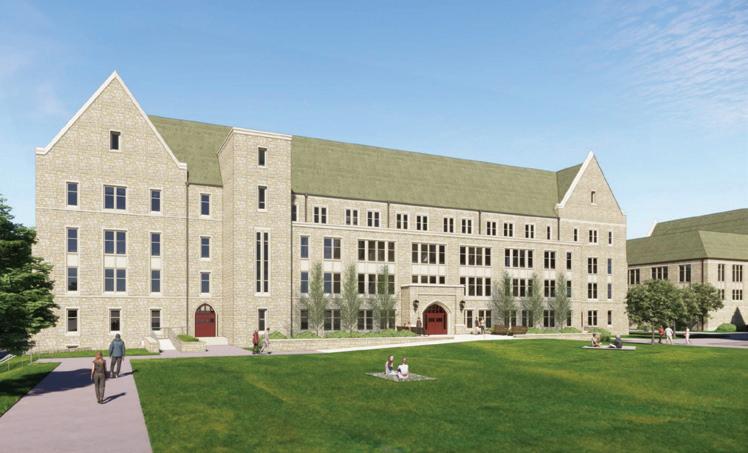
and Neuroscience, and Sociology, and the Office of Campus Ministry.
It is the latest contribution from the former high-tech leader and real estate investor who died in 2020 at the age of 85, and follows his $15 million gift that established the Cadigan Alumni Center on the Brighton Campus in 2012. Upon the building’s
reopening, Carney Hall will be renamed Cadigan Hall.
Cadigan, who served as CEO and president of Electronic Engineering Company of California (EECO) and became one of the largest private real estate holders in Orange County, frequently cited his Jesuit education as a crucial influence in
his personal development and professional success.
“My education at Boston College was a great experience that taught me the importance of hard work and instilled in me values and discipline that stayed with me throughout my years,” said Cadigan in a 2012 interview with Boston College Chronicle. “The foundation I received left an indelible impression on me and prepared me for success in business and in life.”
University President William P. Leahy, S.J., said he was grateful to Cadigan for his generosity and unwavering commitment to Boston College.
“Pat was a person who appreciated his Jesuit education and the role it played in shaping his life,” said Fr. Leahy. “He loved Boston College, and his philanthropy will have a lasting effect on the University.”
David Quigley, the Robert L. and Judith T. Winston Provost and Dean of Faculties, said a renovated Carney Hall will address key academic aspirations while providing a major upgrade to BC’s Middle Campus.
“Pat Cadigan’s commitment will enable the University to bring together several social science departments that have long modeled rigorous teaching and world-
Continued on page 9
From classrooms to residence halls, restorative practices create spaces where students feel heard, respected, and connected
BY ALIX HACKETT SPECIAL TO THE CHRONICLE
No community, or college campus, is immune from conflict, but a grassroots initiative within Boston College’s Office of the Dean of Students centered around restorative practices is helping students strengthen their relationships, reflect on their experiences, and when necessary, repair harm—one circle at a time.
Restorative practices may not be a widely known concept, but a framed placard in the office’s waiting area offers a simple definition: a set of tools used to help navigate disagreements and build community by “focusing on listening, understanding, and problem solving, rather than blame or punishment.” While still relatively new on college campuses, restorative practices have been used in criminal justice settings for decades and can be traced to ancient indigenous and aboriginal peacemaking practices.
One of the most common ways that restorative practices are implemented at Boston College is through community circles, which bring groups of eight to 10 students together for structured conversations around specific issues or themes. These circles are run by trained facilitators who ask a series of questions depending on the topic while ensuring each participant has a chance to respond without interruption. Unlike a typical back-and-forth conversation, the circle format encourages individuals to share their own feelings without the pressure to respond to what others have said.
“It really defies our normal communication where I might feel the need to agree or disagree with you, and I think that’s what makes it so powerful,” said Associate Vice President and Dean of Students Corey
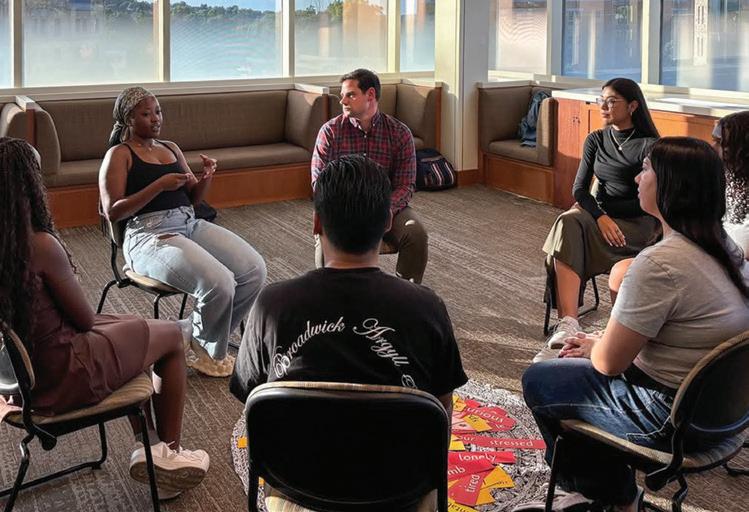
Boston College Student Affairs administrators believe that training resident assistants in the use of community circles and restorative dialogue—a facilitated conversation between two parties—could help them handle disagreements as they arise or prevent them entirely.
Kelly. “You don’t get into debates because you’re coming from a place of just authentically sharing and listening and trying to understand each other.”
Kelly’s office first introduced restorative practices to the BC community in 2020 and hosted a three-day training session for the wider community a few years later. Today, staff in the University Mission and Ministry division facilitate circles during retreats, coaches use them to strengthen Division I sports teams, and faculty have begun integrating them into their classes.
The Office of the Dean of Students regu-
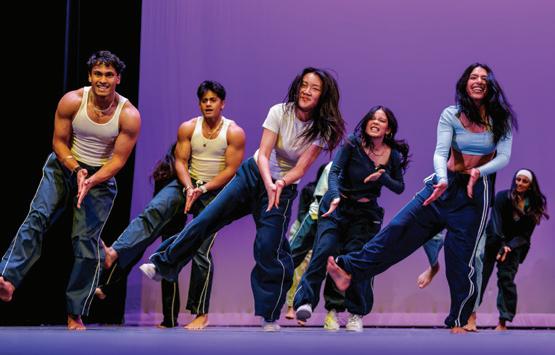
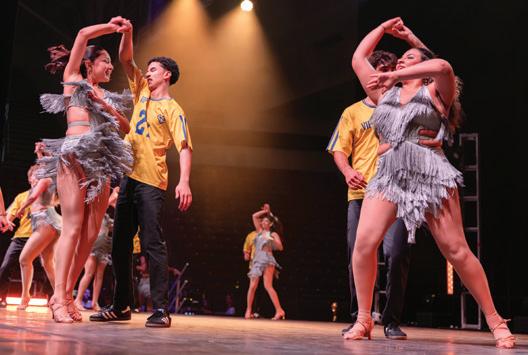
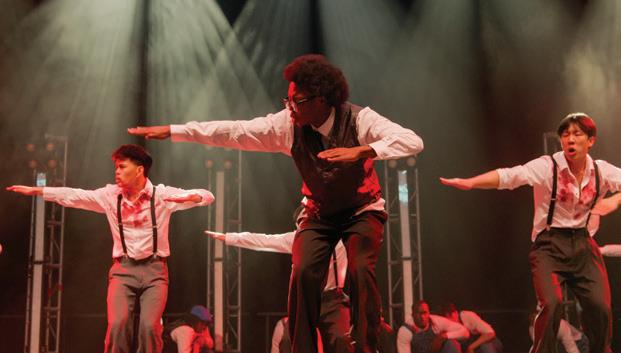
The 28th annual Boston College Arts Festival begins today and runs through Saturday, with an assortment of events showcasing music, dance, theater, studio art, and more, involving some 1,500 BC faculty, students, staff, and alumni artists. Centered on Lower Campus, the festival’s Main Performance Tent is in the Mod Lot behind Robsham Theater Arts Center (RTAC), and an art gallery exhibition will be on display in the theater lobby. Other venues include the RTAC’s Bonn Studio, Gasson 100, Vanderslice Hall Cabaret Room, Burns Library, and Carney Hall’s Gallery 203. The festival schedule and other details are available at bc.edu/artsfestival.
ASSOCIATE VICE PRESIDENT FOR UNIVERSITY COMMUNICATIONS
Jack Dunn
SENIOR DIRECTOR FOR UNIVERSITY COMMUNICATIONS
Patricia Delaney
EDITOR
Sean Smith
CONTRIBUTING STAFF
Phil Gloudemans
Ed Hayward
Audrey Loyack
Rosanne Pellegrini
Kathleen Sullivan
PHOTOGRAPHERS
Caitlin Cunningham
Matthew Healey
larly facilitates circles for students to discuss shared experiences, such as being the first in their families to attend college.
“Those have been really powerful,” said Associate Dean of Student Conduct Melissa Hunt, who wrote her dissertation on restorative practices last year. “I remember a first-generation circle where students shared feeling pressure to make their families proud, and believing they were the only ones to feel that way. Hearing other folks express the same sentiment helps increase their feeling of belonging.”
Last fall, Kelly and Hunt co-taught a Capstone Seminar, “Building Community for the Common Good,” for seniors on restorative practices and the power of circles to foster deep connection and reflection. Instead of traditional lectures or small group discussions, they used circles as their format. Every week, students practiced running circles on different topics related to community, like friendship, grief, and joy, gaining experience as facilitators and participants.
“Initially it was a bit funny, because I don’t think anyone in our class knew each other coming in,” said Kelley Knox ’26, a communication major pursuing a career in elementary education. “But by the third or fourth week it became a space where we
could talk about our lives and how we felt about particular topics and experiences. We were able to talk like friends, and ultimately, we did become friends.”
For their final project, members of the class worked together to plan, promote, and host a community circle for first-year students called “Perfect Advice from Imperfect Seniors.” John Coughlin ’26, an accounting and finance major, invited firstyear members of the Boston College Investment Club to attend. In his final paper, he explored the ways that restorative practices could be used in investment banking, the field he’ll be entering after graduation.
“It was an interesting thought exercise because they seem like two different worlds,” he said, “but I found so many uses for restorative practices and just open talking in the investment banking industry, which is somewhat cutthroat. If I were given the opportunity to lead a team in the future, I would definitely want to implement them.”
Recently, Kelly’s office added a new position focused on expanding the use of restorative practices across campus, particularly in the residence halls, where roommate squabbles and other conflicts often originate. Training resident assistants in the use of community circles and restorative dialogue—a facilitated conversation between two parties—could help them handle disagreements as they arise or prevent them entirely.
Occasionally, Hunt will facilitate a circle in response to a conduct violation, when she feels the responsible party is willing to listen and take accountability. In those cases, the questions are almost always the same: What happened? What were you thinking at the time? What have you thought about since? And what can be done to repair the harm? Restorative practices have not replaced official sanctions, but they have emerged as a powerful complement that encourages everyone involved to examine the root of their feelings and determine how they want to move forward.
“It’s working against the shame and blame that we often are tempted by as a society—wanting to yell, or make someone feel bad,” said Kelly. “Restorative practices invite something totally different: How do we actually see the humanity in all of us, how do we understand people’s perspectives, and how do we actually have a meaningful dialogue?”
Alix Hackett is a senior digital content writer in the Office of University Communications
The Boston College Chronicle (USPS 009491), the internal newspaper for faculty and staff, is published biweekly from September to May by Boston College, with editorial offices at the Office of University Communications, 3 Lake Street, Brighton, MA 02135 (617)552-3350.
Distributed free to faculty and staff offices and other locations on campus.
Periodicals postage paid at Boston, MA and additional mailing offices.
POSTMASTER: send address changes to The Boston College Chronicle, Office of University Communications, 3 Lake Street, Brighton, MA 02135.
A flipbook edition of Chronicle is available via e-mail.
Send requests to chronicle@bc.edu.
BY ED HAYWARD STAFF WRITER
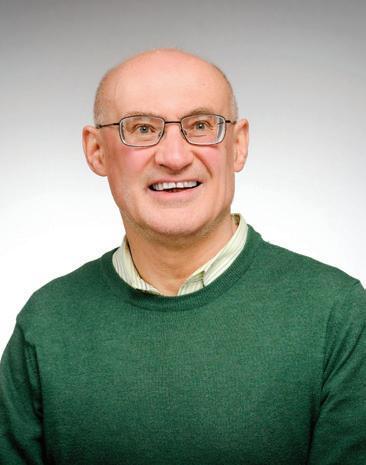
Philosopher Vittorio G. Hösle, the author, editor, and translator of more than 50 books, including 2004’s Morality and Politics, has been appointed to the Frederick J. Adelmann, S.J., Chair and Professor in the Department of Philosophy, starting in the fall semester.
Hösle has spent the past 27 years at the University of Notre Dame, where he is the Paul Kimball Professor of Arts and Letters, his teaching spanning the departments of German, Philosophy, and Political Science. He served as the founding director of the Notre Dame Institute for Advanced Study from 2008-2013.
“I am very interested in seeing a different type of Catholic university—I think it is important to compare things in life,” Hösle said of his decision to join Boston College. “I admire the Jesuits. The order has done so much in the formation of education. So, I was attracted to a Jesuit institution. And Boston is the academic capital of the United States.”
Hösle brings a remarkable range of interests to the Philosophy Department and University, said Albert J. Fitzgibbons Professor of Philosophy Jeffrey Bloechl, the department chair.
“Vittorio is not only a leading interpreter of Hegel and leading scholar of morality and politics but also has serious and weighty books in the theory of knowledge, ecology, philosophy of religion, and literature,” Bloechl said. “He also watches Russian politics very closely, reading the newspapers and press dispatches in the original language, and submitting the data
BY ED HAYWARD STAFF WRITER
to impressive political analysis. We look forward to his regular presence, which is at once intelligent, energetic, and warmly engaging.”
Hösle said he was drawn to a department at BC with a history of continental philosophy, focused on the subjective experiences of life, compared to Notre Dame, which is more rooted in analytic philosophy with its emphasis on logic and conceptual analysis. He said he will work primarily with graduate students.
His scholarly interests include systematic philosophy—examining the areas of metaphysics, ethics, aesthetics and political theory—and the history of philosophy. He lectures in German, Italian, English, Spanish, Russian, Norwegian, and French and reads 10 other languages.
Hösle’s honors include the Fritz-Winter Prize of the Bavarian Academy of Sciences, and among his fellowships was one
“Philosophers must not shy away from the great questions. I try to use all the resources of a rich tradition to give answers to the questions,” says Vittorio Hösle, new Adelmann Chair and Professor of Philosophy.
how the various realms of knowledge I was interested in fit together. Philosophy helps to frame and connect various claims to knowledge.
“Second, I thought that philosophy could give me answers to the great questions that were not based on the assumptions of traditions or scripture,” he said. “In theology, you must presuppose certain things and then go on. Philosophy developed a concept of God based on reason, which then connects all human beings, and not only those who accept certain texts.”
The married father of three said he draws from as broad an expanse of knowledge as possible.
from the Institute for Advanced Study in Princeton, NJ. He was appointed by Pope Francis to the Pontifical Academy of Social Sciences in 2013, and to the Council of the Pontifical Academy of Social Sciences in 2017.
Born in Milan, Italy, Hösle lived most of his childhood in the German state of Bavaria, where his father was a professor of literature. He was exposed to many languages and discussions about books and ideas.
“We had a lot of discussions at home,” he said. “We had a very good library. All this helped to develop my philosophical interests.”
A curiosity with the significant questions of life prompted him to pursue a doctorate in philosophy, which he earned at the age of 21.
“The reason I became interested in philosophy early on was that I thought that philosophy satisfied two important needs I had,” he said. “First was to understand
“As a philosopher, I try various things,” he said. “Philosophers must not shy away from the great questions. I try to use all the resources of a rich tradition to give answers to the questions. I see limits in analytical philosophy, where you narrow down the questions to obtain greater precision—which is laudable and understandable—but it comes at the price of bypassing the questions that traditionally characterize philosophy.”
Though in today’s world few people may have the patience to wrestle with philosophical questions that have persisted across millennia, Hösle believes the discipline may now be more vital than ever.
“Philosophy translated means love of wisdom,” he said. “Wisdom is more than the accumulation of knowledge. It means to have an orientation within the world. Philosophy is not a specific discipline. It weighs the claims of the different disciplines against one another. It is a very strong antidote to approaches that seek to avoid value judgements. We are trying to answer questions about which values are preferable.”
Boston College will launch a minor in Design Studies this fall as part of an initiative to expand offerings and increase collaborations focused on the “design thinking” approach to finding human-centered solutions to complex problems.
The minor, to be offered through the Morrissey College of Arts and Sciences, is among the latest opportunities for students to learn and practice the tenets of design thinking, which is foremost in the guiding principles of the Human-Centered Engineering Program, launched in 2022.
“The new minor grows from the interest and requests from students from across our schools and colleges who want to do more with this subject,” said Associate Vice Provost Sunanda Bhattacharya. “We’ve called the minor ‘Design Studies,’ rather than design thinking, because it is focused on the process. We have finance majors, we have literature students, we have philosophy students, writers, all interested in this subject.”
The 18-credit minor includes three required courses and three electives. The cur-
riculum begins with Innovation Through Design Thinking, a course first developed and offered in 2019 at the request of Winston Provost and Dean of Faculties David Quigley and Vice Provost for Research
Thomas Chiles, Bhattacharya said. More than 700 students have taken the class, signaling that undergraduate interest extends well beyond STEM, with strong engagement from students in the social sciences and humanities, he added.
Interest in the subject has been fueled in part by experiences many students have prior to college, Bhattacharya said: High schools now contain makerspaces and 3D printers, where students can learn to turn ideas into prototypes, or simply get a grasp of the tools that are shaping innovation.
The University’s state-of-the-art science and engineering center at 245 Beacon Street, which opened in 2022, houses the Hatchery, BC’s newest makerspace. Bhattacharya said new design thinking initiatives like the minor will allow students to expand their knowledge in the field well beyond the hands-on experiences of the makerspaces.
A big part of that comes from a synergy that exists between design thinking and its
country. That ethos is here and our efforts in design thinking are based on harnessing the power of design for the common good. That is the overarching goal.”
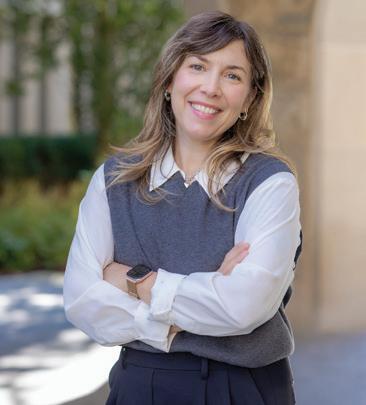
Associate Professor of the Practice of Graphic Design Carissa Henriques, who will direct the minor, said the program can attract a broad sampling of students.
“It is an interdisciplinary minor for everybody, ideally,” said Henriques. “Design Studies can integrate with a student’s current major or minor. It can be the connection point between academic interests and help students bring design-driven creative innovation to the fore.”
Henriques said the minor and its course offerings equip students with skills that help in a competitive job market.
traditional liberal arts curriculum shaped by BC’s Jesuit, Catholic mission, he said.
“BC’s Jesuit, Catholic ethos promotes people doing something to serve the common good,” he said. “It could be a new program to help the homeless. Or it could be a new device to help people in another
“One of the biggest value-added is the problem-solving process,” Henriques said. “Using the design thinking processes means students are considering people’s behaviors and actions and integrating research that is human-centered in the problem-solving process using ethical frameworks and implementation science.
“Those are powerful skills that can be brought into the workplace.”
Nearing retirement, long-time BC theologian reflects on his half a century at the Heights
BY SEAN SMITH CHRONICLE EDITOR
Clough School of Theology and Ministry Professor Thomas Groome’s first brush with education was a decidedly humble affair: attending a small parish school in his native County Kildare, Ireland, that lacked a regular teaching staff and relied on high school students “to keep us quiet,” he recalled.
Not exactly the kind of experience, said Groome, “that prepared me for the academy.”
But that’s where Groome ended up for more than five decades, and the results speak for themselves.
Groome is a world-renowned theologian regarded as a leading authority on Catholic religious education; originator of the approach called Shared Christian Praxis, a pedagogical method that integrates personal life experience with Christian tradition to foster a “lived and living faith”; author, co-author, or editor of numerous books and papers on faith and religion, many of which have been translated into various languages; and he is the lead author of two grade school curricula that have been widely used throughout American Catholic schools and parishes. He has often provided commentary on religious and spiritual matters to media outlets including CBS, NBC, ABC, CNN, Fox News, National Public Radio, BBC, and RTÉ, among many others.
At Boston College, where he has taught for 50 years, Groome served as director of the Institute for Religious Education and Pastoral Ministry (IREPM) and—following its merger with the Weston Jesuit School of Theology to form what is now the Clough School—chaired the Department of Religious Education and Pastoral Ministry for a further six years. He also was director of BC’s Church in the 21st Century initiative. Groome’s academic and professional accolades include the highest honor in the field of religious education, the National Association of Parish Catechetical Directors Emmaus Award for Excellence in Catechesis.
Most of all, he has been a beloved teacher to thousands of BC students and an equally cherished colleague to faculty across disciplines and generations—someone as at home reciting Yeats poetry at a St. Patrick’s Day reception as quoting Biblical verses or
the likes of Karl Rahner, Avery Dulles, and Thomas Aquinas, all in his native brogue and deep, gentle voice.
Groome—who is retiring at the end of the semester—will soon add another mark of distinction to his career, as recipient of the annual Saint Robert Bellarmine, S.J., Award, given at Commencement to honor a distinguished faculty member whose significant contributions have consistently and purposefully advanced the mission of Boston College.
“Tom has been a major figure in religious education, both in the United States
Thomas H. Groome.”
Groome’s career trajectory has coincided with a transformative—and often controversial—era for the Catholic Church, marked by the Second Vatican Council’s array of changes to Church practices and disciplines. In many ways, he reflects this period of metamorphosis, as a former laicized priest who left diocesan priesthood to be married, and who holds progressive views on matters such as the ordination of women and LGBTQ acceptance in Church life.
But Groome is above all adamant in his
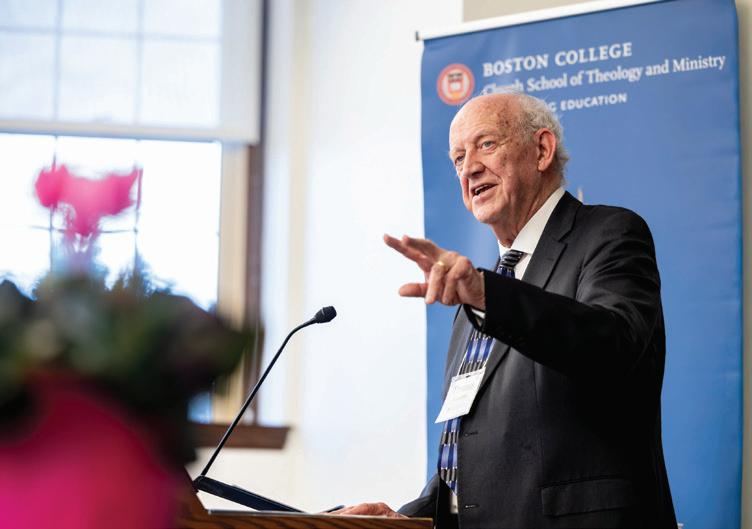
and abroad,” said Clough School Dean Michael McCarthy, S.J. “IREPM—and later DREPM—has had an enormous impact under his leadership. But what I most value about Tom is his dedication to being present. He rarely misses a faculty meeting, a Thursday Mass, or any important school event.
“In a world that has shifted its focus to smartphones and virtual attendance, Tom reminds us that commitment to fleshand-blood presence really is the heart of community. That is part of the culture at the CSTM that students, faculty, and administrators value most. Tom is a model of commitment to that.”
Fr. McCarthy was among the speakers on April 11 at “A Shared Praxis: Renewing Religious Education,” a one-day conference at Simboli Hall inspired by Groome’s scholarly leadership that included a panel discussion, “The Story and Vision of
“What I most value about Tom is his dedication to being present,” says Clough School of Theology and Ministry Dean Michael McCarthy, S.J. “Tom reminds us that commitment to flesh-and-blood presence really is the heart of community.”
love for Catholicism, derived from lived experience as well as years of study at St. Patrick’s College in Ireland, Fordham University, Union Theological Seminary, and Columbia University Teachers College, and his teaching and research in academia.
“I developed a deep conviction that the Catholic faith is a marvelous way to live,” he said. “It has an extraordinarily rich tradition, offers a grace-filled, transcendent horizon and a positive resonance in people’s lives. But the faith was often poorly taught, through rote memorization and repetitiveness. To me, teaching the faith is the key to keeping it strong and relevant in people’s lives: It has to be a participatory, reflective conversation that builds upon the experiences of participants.
“Jesus started out talking to ordinary people living ordinary lives to get them to reflect on and listen to the Gospels. He wanted them to see the truth for themselves, and then invited them to put it to work.”
Groome sees the post-Vatican II era as a time when the religious and secular spheres connected in fascinating and beneficial ways, with IREPM as a prime example.
“I would talk with people from professional and academic circles about serving those in need; a sociologist told me, ‘A lot
of what I see has to do with the spiritual,’” explained Groome, who was appointed IREPM director in 2003, and continued in that position for seven years after it became a department of the Clough School in 2008. “Then, I would speak with someone in pastoral ministry about their observations, and they’d say, ‘A lot of what’s needed has to do with social work.’ That’s what IREPM was, and is, all about: You bring together those seemingly disparate skills and perspectives for the good of humanity.”
BC’s leadership role in charting new territory within the Catholic tradition also was evident, said Groome, in its establishment of the Church in the 21st Century Center in 2002 to explore issues raised by the clergy sexual abuse scandal. Through C21, the University offered symposia, lectures, conferences, published papers, and other resources to assist the Church in moving from crisis to renewal.
“C21 was a good experience, in that through candid introspection and conversation it affirmed the Church’s purpose and mission,” said Groome, who directed C21 for three years. “I am proud of the work we did in its early years, and what C21 continues to do.”
The constant in Groome’s BC career has been a devotion to Catholic/Christian religious education and identity, as exhibited in his acclaimed books such as What Makes Education Catholic: Spiritual Foundations (which earned a Catholic Media Association award), What Makes Us Catholic: Eight Gifts for Life, and the foundational 1980 release Christian Religious Education: Sharing our Story and Vision, which a reviewer described as “one of the most important books—if not the most important—on Christian education published during the last 50 years.”
As Groome recalls, the seed for Christian Religious Education was planted shortly after he was hired at BC by then-College of Arts and Sciences Dean Thomas O’Malley, S.J., who was dubious about Groome’s chances of getting tenure as a scholar of religious education: “He said, ‘You’ll need to publish a landmark book.’” Groome went to work, completed a manuscript and found a publisher; Christian Religious Education wound up selling 50,000 copies and was subsequently reissued as a textbook that remains in use today (“I still get the occasional $100 royalty check,” quipped Groome).
Groome thinks the time is ripe for leaving BC, in part because of health reasons (he is undergoing treatment for prostate cancer), but after a half-century at the Heights he feels his connection to the University is as strong as it’s ever been.
“I love this community. There is such a wide spectrum of fascinating discussions taking place, and equally interesting research and writing. Boston College is so Catholic in the very best way, and its Catholic, Jesuit identity has been embraced by religious and lay alike. Long may it continue.”
In her farewell to BC, Sister Bartunek talks about how she came to pursue an academic career and a religious life
BY ED HAYWARD STAFF WRITER
The day she entered kindergarten, Jean Bartunek, R.S.C.J., decided she wanted to be a teacher. A year later, entering first grade, she decided she wanted to become a Catholic sister.
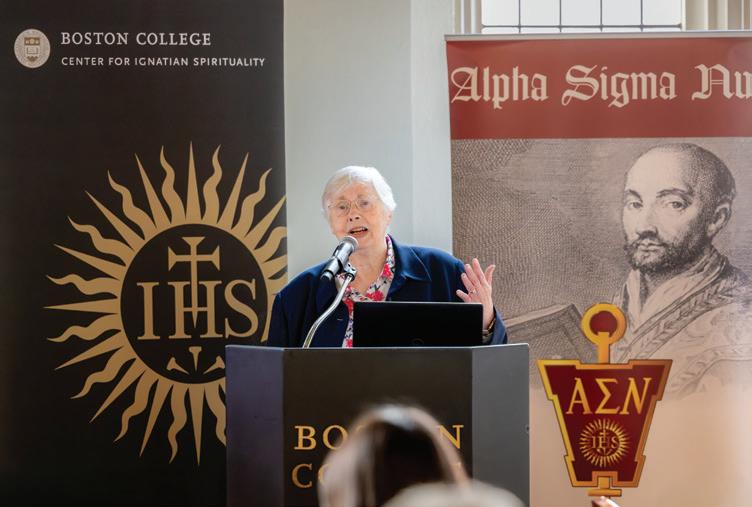
“Isn’t it nice when all your life decisions are made by the time you are in first grade?” Sister Bartunek, the Robert and Evelyn J. Ferris Chair and Professor of Management and Organization in the Carroll School of Management, told a Gasson 100 audience as she delivered a “last lecture” recently to mark her retirement from full-time academic work.
A pioneering academician, Sister Bartunek was one of the first two tenure-track women hired onto the faculty of what was then BC’s School of Management in 1977, along with her Carroll School colleague Judith Gordon.
Sister Bartunek’s career has embraced contrasting actions and ideas, such as scholarship and practice, and being both a committed academic and a vowed religious woman. Her primary scholarly interests center around organizational change and academic-practitioner relationships. She has investigated topics like large-scale organizational change, how knowledge is shared across theory and practice boundaries, and relationships and interactions among change agents and recipients, often from the perspective of dialectical processes.
These dialectical features, she told an audience that included friends, colleagues from the Carroll School and across the University, doctoral students, and fellow members of the Society of the Sacred Heart, first arrived as “a Christmas gift” on December 25, 1976.
Having earned her doctorate in social and organizational psychology from the University of Illinois at Chicago earlier that year, Sister Bartunek was teaching in the University of Illinois Urbana-Champlain management department and consider-
ing whether to make her final vows as a religious. On Christmas morning she was praying with the prologue to the Gospel of John: “In the beginning was the Word, and the Word was with God, and the Word was God…”
“I was thinking, ‘How boring. A super powerful God telling us what to do from some distance away, like some theorists do. Why in the world would I care about it?’ But then, later on, the prologue says, ‘And the Word became flesh and made his dwelling among us.’ I thought: ‘This is theory and practice together. It’s a relationship with God. Wow. I can make my final vows now and I know what I want to do with my career.’
“That’s not bad for a Christmas gift.”
She joined BC the next fall and made her final vows as a religious the following year.
Sister Bartunek said the Christmas “gift” has led her to pay attention to dialectical properties over the course of her BC career, especially those related to organizational change and relationships between scholarship and practice. They have been salient as well when she has served in leadership positions in her professional association, the Academy of Management.
She has recently been exploring how researchers may sometimes serve in supporting roles to practitioners. She used as a prime example the work of Professor Ann
Burgess in the Connell School of Nursing, who taught members of the Behavioral Science Unit of the FBI a great deal about how to conduct social science research in the service of profiling very serious offenders.
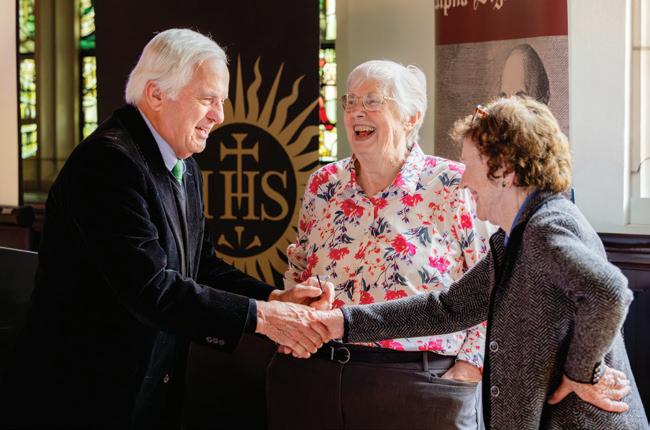
While her lecture explored some of the topics that have defined her work, Sister Bartunek also devoted time to people who helped to shape her life and career. For example, she noted that over time her aspirations of whom she wanted to teach moved from young children to doctoral students, and she showed photos that included all graduates of the Organization Studies doctoral program since its beginning in 1992.
Jean Bartunek, R.S.C.J., giving her “last lecture” as a Carroll School of Management faculty member in Gasson 100. She joined the University in 1977. Below, Sister
Professor Ann
She also thanked Robert and Evelyn Ferris, who have funded her endowed chair: “They made a huge difference in my life and in the lives of many of my students.”
Sister Bartunek noted that the underlying meanings of the Christmas gift continue to unfold in generative ways. She concluded by saying she felt very lucky to have shared the last 49 years with Judith Gordon—who retired last year—and the other members of the Management and Organization department.
“I loved being part of our department and I’ve loved the chance to have been at BC all of these years. Thank you.”
BY KATHLEEN SULLIVAN STAFF WRITER
University of St. Andrews Professor of Philosophical Theology Judith Wolfe has been named as Boston College’s Joseph Chair for Catholic Systematic Theology, announced Morrissey College of Arts and Sciences Dean Gregory Kalscheur, S.J. She will begin her appointment in fall 2027, succeeding Richard Gaillardetz, who held the position from 2011 until his death in 2023.
A Catholic theologian, Wolfe focuses her scholarship and teaching on systematic and philosophical theology. Her main research interest is on eschatology (the “last things”) and on the theological imagination of the world more broadly, with attention to the intersections of theology, philosophy, literature, art, and psychology. Her most recent books are The Theological Imagination and Theologians in Conversations.
She is co-leader of a five-year project titled “Theologies of Catholicity,” as well as “Art as Revelation,” a three-year initiative which has been the subject of a TEDx talk and a mini-documentary. She is also engaged in public theology, most recently about AI and apocalypticism for the Apple Top 100 podcast “Suspicious Minds.”
“As the new Joseph Chair for Catholic Systematic Theology, Judith Wolfe will bring to Boston College an international reputation for outstanding scholarship grounded in theology’s openness to fruitful conversation with a range of disciplines, including philosophy, psychology, and the arts, along with a commitment to education as formation, helping students to grow in freedom, discernment, and the ability to live lives that respond to the needs of the
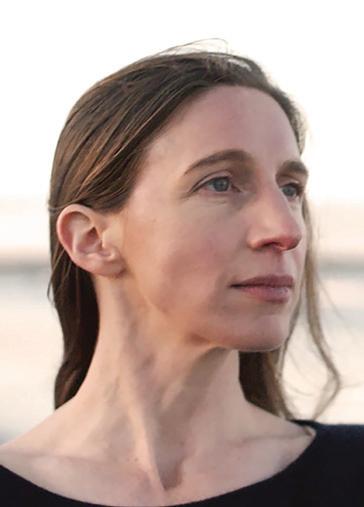
world,” said Fr. Kalscheur.
“Her exploration of the theological imagination promises to make intriguing connections with a central dimension of Ignatian spirituality, and her dedication to being a theologian in service to the Church—with a passion for exploring theology’s role within the academy and in conversation with a wider public—will be very much at home here at Boston College. I look forward to welcoming her to BC.”
“I am deeply honored to be named to the Joseph Chair for Catholic Systematic Theology,” said Wolfe. “The Theology Department at Boston College is one of the most exciting places in the world to do theology, combining intellectual reach, spiritual depth, and a sense of real community. It will be a joy to be part of this community, welcoming students into it
BY PHIL GLOUDEMANS STAFF WRITER
Professor of Psychology and Neuroscience Elizabeth Kensinger, known for her neuroscience research on emotion and memory over the human lifespan, was elected to the American Association for the Advancement of Science (AAAS), a prestigious honorary society that recognizes cross-discipline merit and stewardship that improves society.
Kensinger, one of 449 scientists, engineers, and innovators across 24 disciplines elected to the academy this year, is the co-author of the 2023 book Why We Forget and How to Remember Better: The Science Behind Memory. She also published the book Emotional Memory Across the Adult Lifespan
AAAS praised Kensinger for her “distinguished contributions to the field of cognitive and affective neuroscience, particularly the role of emotion in memory across the lifespan.”
“I’m honored by this recognition,” said Kensinger, who will join the other new
Theology Chair Andrea Vicini, S.J., says of new Joseph Chair for Catholic Systematic Theology Judith Wolfe: “Her commitment to formative education and rigorous scholarship will further strengthen our department and greatly benefit both our undergraduates and graduate students.”
and reaching out to and on behalf of the wider Church.”
A native of Vienna, Wolfe completed undergraduate studies in literature and interdisciplinary honors studies at the Hebrew University of Jerusalem, and graduate studies at the University of Oxford, where she earned a master of philosophy degree in English literature and master and doctor of philosophy degrees in theology.
She has been on the faculty of St. Andrews, located in Fife, Scotland, since 2014 and has held honorary appointments at Blackfriars Hall, Oxford University, Australian Catholic University, and Durham University in the UK. Prior to joining St. Andrews, Wolfe taught at the University of Oxford and Bard College Berlin. She also does ongoing work with the Vatican’s Dicastery for the Doctrine of the Faith.
Wolfe’s forthcoming book, Philosophical Myths of the End, examines varieties of eschatological thought in European philosophy, and political and technological thought.
“Dr. Judith Wolfe is a very accomplished scholar and a very generative and creative thinker with visionary and forward-looking theological interests in Catholic systematic theology, which include theological aesthetics and eschatology, and which engage the philosophy of language and the European continental philosophy, particularly Martin Heidegger,” said Theology Department
Chair Andrea Vicini, S.J., the Michael P. Walsh Professor of Bioethics.
“Her accomplishments over the past 15 years are remarkable,” he continued, “with an impressive research record in publications, lectures, collaborative theological work, and grants. Her commitment to formative education and rigorous scholarship will further strengthen our department and greatly benefit both our undergraduates and graduate students. We look forward to welcoming her.”
Professor of Theology Brian Robinette, who chaired the Joseph Chair for Catholic Systematic Theology search committee, added, “Professor Wolfe’s arrival at Boston College is a major statement in the world of philosophical and systematic theology. One rarely encounters a mind capable of moving so effortlessly and creatively across such a wide range of subjects. Already well known for her work on 20th-century philosophy, eschatology, and theological engagement with the arts, Professor Wolfe is also a tireless networker and a scintillating speaker with a notable public profile. She is ideally suited for the Joseph Chair for Catholic Systematic Theology and will bring both depth of leadership and a renewed sense of intellectual excitement at a time when theology in university settings is in need of innovative ways forward.”
Established in 1986 through an anonymous donor, the Joseph Chair for Catholic Systematic Theology supports a respected research scholar in one of the disciplines of Catholic theology, to serve as an example and guide to doctoral candidates in theology, strengthening the teaching of Catholic theology at Boston College. The donor also created Joseph chairs in Spirituality, Catholic Philosophy, and Theology.
AAAS fellows at a celebratory forum in Washington, D.C., on May 29. “I’m also aware that it reflects a collective effort, because my research program has been shaped by many outstanding students, fellows, and colleagues. It has flourished at Boston College thanks to the University’s emphasis on asking meaningful questions and its commitment to developing scholars, both key ingredients for scientific discovery.”
“This year’s AAAS fellows have demonstrated research excellence, made notable contributions to advance science, and delivered important services to their communities,” said AAAS Chief Executive Officer Sudip Parikh, executive publisher of the Science family of journals. “These fellows and their accomplishments validate the importance of investing in science and technology for the benefit of all.”
Kensinger, who joined BC in 2006 and served as department chair from 2018 to 2024, directs the Cognitive and Affective Neuroscience Laboratory, which uses behavioral testing and neuroimaging techniques to understand how age and emo-
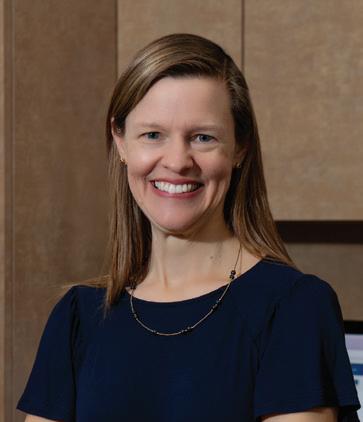
tional content influence how information is stored and remembered.
She also has been involved in the Innocence Project, a national pro bono network linked to the Innocence Program Clinic at the Boston College Law School. In collaboration with BC Law Professor Sharon Beckman, Kensinger has conducted seminars with law school students to educate them about wrongful convictions, false confessions, flawed forensics, and mistaken
identification, and generally about the fallibility of human memory.
Kensinger also serves on the Faculty Steering Committee for the BC Healthy Aging Initiative and collaborates with Lynch School of Education and Human Development faculty on Translational Research on Learning and Memory.
Her previous honors include the Janet Taylor Spence Award from the Association for Psychological Science, the American Psychological Association F.J. McGuigan Early Career Investigator Research Prize on Understanding the Human Mind, the Searle Scholar Award, and the Psychonomic Society Mid-Career Research Award.
“Professor Kensinger’s recognition by AAAS acknowledges the incredible impact of her career’s work to understand how factors like emotion and aging influence the nature of memory at both the cognitive and neural levels,” said Professor John P. Christianson, chair of the Psychology and Neuroscience Department. “In over 20 years of service to BC, she has shaped our faculty, research, and teaching by recruiting world-class scholars, authoring dozens of highly cited articles and award-winning books and introducing a popular neuroscience major. She is a gifted mentor to students and faculty who works tirelessly to realize ‘ever to excel’ in all she does.”
Continued from page 1
Archbishop Gallagher graduated in 1985 from the Pontifical Ecclesiastical Academy in Rome, the training ground for Vatican diplomats. His first three postings took him to Tanzania, Uruguay, and the Philippines. He also has served as representative of the Holy See at the Council of Europe in Strasbourg, Titular Archbishop of Hode, and Apostolic Nuncio in Burundi, Guatemala, and Australia. Last October, Archbishop Gallagher was appointed a Knight Commander of the Most Distinguished Order of St. Michael and St. George by King Charles III, in recognition of his contributions to international diplomacy and interfaith dialogue.
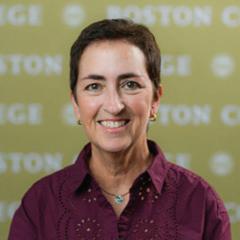
Glori Alvarez
Glori Alvarez ’88 is president of Logotique, a promotional marketing and advertising firm she founded in 1994, headquartered in Guaynabo in her native Puerto Rico. Its product specialties include technology accessories, apparel, executive gifts, bags, and travel items. She joined the Boston College Alumni Association Board of Directors in 2018, served as vice president from 2021-2024 and is now a board associate. A Council for Women of Boston College member since 2019, she spearheaded the creation of a BCAA chapter in Puerto Rico in 2014 and was its inaugural leader for nine years. Alvarez is now senior advisor to the chapter.
Prior to Logotique, Alvarez—who earned a bachelor’s degree in communication from BC—worked in brand management for Elizabeth Arden and The Gillette Company. Among her professional areas of expertise are marketing strategy and communications, social media and digital marketing, advertising, event management, new business and brand development. She and her husband, Jorge Padial, are the parents of Eduardo and Sarah, a 2016 Morrissey College of Arts and Sciences graduate.
At Commencement, she will be presented with an honorary Doctor of Social Science degree.
Joyce M. and William S. Cummings
Joyce M. and William S. “Bill” Cummings are the founders of Cummings Foundation, which has awarded more than $600 million to greater Boston nonprofit organizations, as well as New Horizons not-for-profit assisted and independent living communities in Woburn and Marlborough, Mass. In 2011, the Cummings became the first Massachusetts residents to join “The Giving Pledge,” a national philanthropic organization founded by Bill Gates, Melinda French Gates, and Warren Buffett.
Their philanthropy is deeply rooted in Cummings Properties, the company Bill founded, which has built or restored dozens of large, and sometimes historic, commercial structures, totaling more than 11 million square feet. Based in Woburn,
Cummings Properties currently provides business homes to some 2,000 companies and organizations.
Joyce is a past president of Winchester’s En Ka Society, a women’s service organization, and is a former trustee of Massachusetts Eye and Ear Infirmary. In addition, Joyce was a longtime trustee of Winchester Community Music School and VNA Hospice Care, Inc. of Woburn. Bill served 10 years as a charter trustee of his alma mater Tufts University and is a
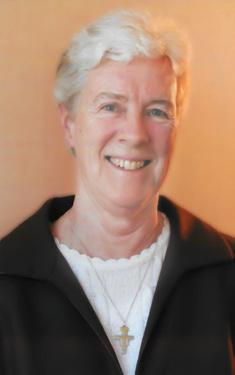
Sister Jeanette Gaudet, M.F.I.C.
With more than six decades devoted to religious life, Jeanette Gaudet is a Missionary Franciscan Sister of the Immaculate Conception, an international religious community guided by the Franciscan values of simplicity, humility, and joyful service to go beyond boundaries to proclaim the Gospel, especially among the poor and marginalized. She has held several leadership positions within her order, including in Rome where she served on
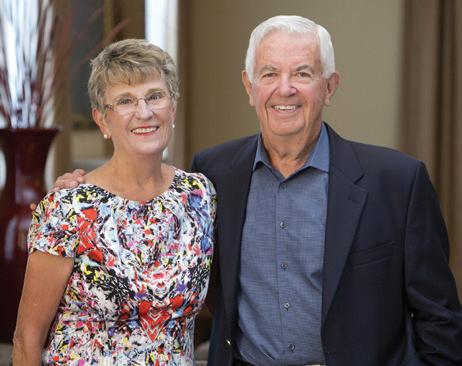
former overseer of Tufts Medical School and director of Winchester Hospital. He was chairman of Tufts’ property-holding corporation, as well as a bank director and elected member and chairman of the Winchester Planning Board. Bill is also the founder and former publisher of three community newspapers: the Woburn Advocate, Stoneham Sun, and Winchester Town Crier
Their joint honors include the 2013 “Solas Award” from the Irish International Immigrant Center, Edward H. Linde Public Service Award from the National Association of Industrial and Office Properties, Justice and Compassion Award from Catholic Charities, and Friend of Israel Award from Lappin Foundation. In 2017, Joyce and Bill were inducted into the Greater Boston Chamber of Commerce Academy of Distinguished Bostonians.
Joyce and Bill Cummings will be awarded, respectively, honorary Doctor of Social Science and Doctor of Business Administration degrees.
her congregation’s leadership council for 17 years and as the general superior for five years. She was also a provincial leader in the United States for four years.
Sister Gaudet served as a missionary in Papua New Guinea for eight years, and her vocation also has brought her to Egypt, Italy, Ireland, and Bolivia. She has taught in schools in Massachusetts and Georgia and conducted work in parish ministry, spiritual formation, and retreats. At a Mass marking her 60th Jubilee, Sister Gaudet traced her interest in religious life to her days as a student at Saint Clare High School in Boston’s
Roslindale neighborhood where she “experienced the joy of the Franciscan Sisters. I felt called to be in a really vital community where everyone was respected, everyone was loved. Everyone was brothers and sisters everywhere.”
Boston College will present Sister Gaudet with an honorary Doctor of Humane Letters degree.
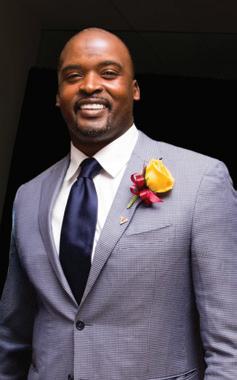
Mathias Kiwanuka
Having excelled on the gridiron for years, Mathias Kiwanuka ’05 is committed to addressing Ugandan health problems and pursuing economic opportunities for his ancestral home. A former Big East Defensive Player of the Year and first-team All-American, he went on to play nine seasons for the New York Giants. He is now vice president of Global Health Initiatives & Programs at Ultimaxx Health, a nutraceutical company specializing in non-narcotic pain relief.
Born in Indianapolis, Kiwanuka is the grandson of Benedicto Kiwanuka, Uganda’s first prime minister, known as the “martyr of justice” for his unwavering commitment to the law, which cost him his life during the Idi Amin regime. Following his grandfather’s legacy, Kiwanuka is a board member for The Water Trust— a nonprofit that empowers rural Ugandan communities to access clean, sustainable water, sanitation, and hygiene services— and Smile Train, which instructs Ugandan physicians on how to provide world-class cleft care in local communities. More recently, he has been involved in efforts for Uganda to become the fifth African nation to join the NFL Africa program, designed to build a pipeline of promising young athletes to the league.
Kiwanuka will receive an honorary Doctor of Humane Letters degree.
For Commencent-related information, see bc.edu/commencement
David J. Barron, whose distinguished academic career led him into public service and to his current position as Chief Judge of the United States First Circuit Court of Appeals, will be Boston College Law School’s 2026 Commencement speaker.
This year’s Commencement will be held on May 22 in the Maloney Lawn Tent on the Boston College Chestnut Hill campus.
Prior to his appointment to the First Circuit bench in 2014, Barron served as acting assistant attorney general for the Office of Legal Counsel for the U.S. Justice Department. Prior to that, he was a professor at Harvard Law School, where he continues to teach part time as the Louis D. Brandeis Visiting Professor of Law.
After graduating from Harvard Law School, Barron clerked for Judge Stephen Reinhardt of the U.S. Court of Appeals
for the Ninth Circuit and for Justice John Paul Stevens of the U.S. Supreme Court.
Barron’s teaching and scholarship interests have included war powers and national security law, constitutional separation of powers, administrative law, federalism, and local government law. In addition to contributing to many academic publications, Barron is co-author of a casebook on local government law and the author of the book Waging War: The Clash Between Presidents and Congress, 1776 to ISIS. He is also a member of the American Academy of Arts and Sciences and the American Law Institute.
For details on the Law School Commencement, see bc.edu/lawcommencement.
—Boston College Law School
BCSSW co-hosts conference for education and human services professionals to talk about ways to assist at-risk families
BY SEAN SMITH CHRONICLE EDITOR
The Boston College School of Social Work and United Way of Massachusetts Bay (UWMB) recently hosted a conference that examined the critical role of housing stability in childhood education and spotlighted an initiative to assist Boston Public Schools (BPS) families at risk of homelessness.
“Housing Stability=Student Success,” which took place on April 10 in the Corcoran Commons Heights Room, brought together representatives from BCSSW, UWMB, BPS, Lynn and Lawrence public schools, and various social services providers of Greater Boston to discuss the adverse effects associated with housing instability on children—among them increased stress and anxiety, and lower attendance, test scores, and graduation rates—and the remedies to such problems.
The all-day event also offered an opportunity for attendees to connect on a more informal level and share their observations and experiences on what works—and what doesn’t—in helping families with schoolage children cope with housing instability.
In his welcome to the conference attendees, BCSSW Dean Gautam Yadama said the event reflected the school’s commitment to community-practice partnerships that seek practical solutions for compelling social and family issues.
“The knowledge we create must matter for improving lives; if it doesn’t matter, we matter less,” he said. “There must be a focus on translating research and knowledge into action.”
UWMB Ansin President and CEO Marty Martinez, who followed Yadama, underscored the conference’s significance at a time when social and financial supports for low-income families are “under attack.” Highlighting practices that address the root causes of housing instability, and the manifold problems it creates, he said, is vital: “We want the information and findings being discussed here to be usable, so we can help transform the lives of families.”
A series of 10-minute small-group breakout sessions in the morning provided a means of introduction to the various participating groups and their representatives. At one gathering, an attendee realized that the person sitting next to her was from a services provider that had been particularly helpful: “Thanks to you and your colleagues for doing a great job,” she said.
Anecdotes also made an impression. Jessi Perez of the Lynn Housing Authority recounted the experience of a homeless family referred to him through Lynn Public Schools. The father, who had a job that involved a two-hour commute both
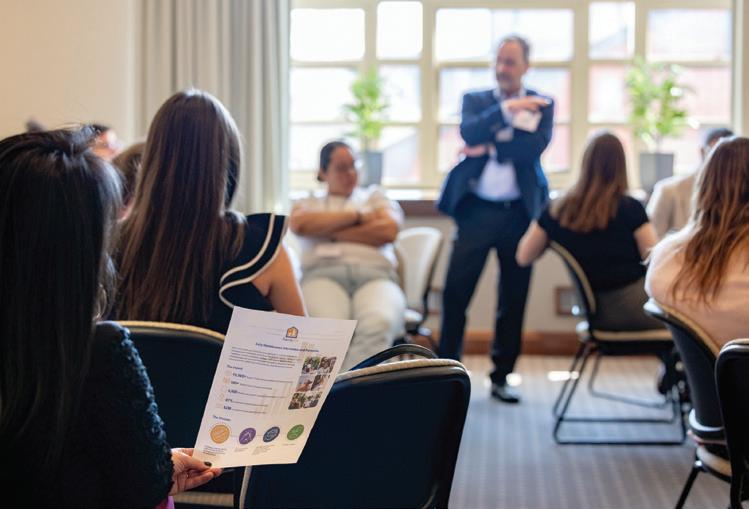
Small-group
ways, slept in his car while his children “couch-surfed” at friends’ homes. Perez said he helped the father create a resume and apply for jobs that were closer to Lynn and paid better. The father landed a job in nearby Beverly that offered $6 more an hour than his old job and was able to find an affordable apartment; he also began taking ESL and computer classes and, Perez added, is seeking work in the construction or plumbing industries.
The conference featured a segment on the Early Homeless Intervention and Prevention (EHIP) program, a BPS collaboration with Greater Boston nonprofit FamilyAid Boston that provides services for BPS families facing homelessness. BCSSW Associate Professor Thomas Byrne, Associate Professor of the Practice Indrani Saran, and Director of Family Housing Hardship Program Jessica McCabe Johnson presented research—conducted through a partnership with UWMB, BPS, and FamilyAid—on EHIP’s progress since its 2019 launch.
Through the program, BPS identifies families at risk of, or experiencing, homelessness and links them to FamilyAid. Depending on a family’s situation, FamilyAid seeks short- and long-term solutions—providing assistance in resolving disputes with a landlord, facilitating access to housing vouchers from the Boston Housing Authority, or finding transportation to work, for example; or helping families to address financial issues contributing to their situation and to find educational, health, and other key resources for their children.
According to the study, in its nearly seven years of existence, EHIP has served almost 3,000 families—including 10,000 children and parents—and more than 1,300 have moved into new permanent housing. Drawing on surveys and interviews with program participants, analyses of BPS administrative data, and surveys of BPS staff, the research indicated improved wellbeing and academic performance and reduced chronic absentee-
ism among children in EHIP families after two years.
Parents reported less severe anxiety and depression, and there were marked decreases in housing-related disruptions affecting adult and child activity. One saw a clear difference in their child’s emotional health after they had found housing (“I feel he’s definitely happier”); another commended the program’s assistance in securing a place for the family (“They paid the realtor’s fee, the security deposit…they followed up weekly. They were very helpful”).
But housing instability remains an everpresent challenge, the BCSSW trio noted: More than 10 percent of BPS students experienced homelessness during the 2024-2025 school year. EHIP families remained vulnerable to high levels of financial precarity and food insecurity while experiencing only modest levels of social support, as indicated by surveys and interviews with parents.
In some cases, success can be fleeting: A parent who was approved for a housing unit 30 days after receiving a voucher had to wait a month for inspection—only to be denied because lead was detected (“I had to start my research all over again”).
BPS liaisons for homeless families reported difficulties in identifying students experiencing housing hardship and recommended systematic screening: “There should
be an assessment completed to learn about the concerns early on and ensure all families are provided with the necessary support,” said one.
Interviewed last week, the BCSSW researchers expressed gratitude for the opportunity to present their findings at the conference. Conference attendees provided a strong endorsement of cross-sector professional relationships in family homelessness prevention research and practice, the trio said, and offered some potential ideas for future analyses and studies.
“We were eager to share the affirming results from our research with the practitioners and policymakers who are doing and supporting the work on a day-to-day basis,” said McCabe Johnson. “The event was also a chance for us to receive and integrate feedback from the community on our ongoing and future research into remaining challenges and opportunities.”
Saran emphasized that while the EHIP study contained encouraging results on housing stability and quality and improvement in parental and child wellbeing, more data are needed regarding improvement in children’s academic outcomes, particularly chronic absenteeism. Moreover, families still face challenges in financial and food security.
“While a larger-scale randomized evaluation would be needed to more rigorously assess the impacts of EHIP, this is one of the first studies to offer evidence on homelessness prevention implemented through a school-housing partnership,” she said. “Overall, our results suggest that initiatives like EHIP could be a promising strategy to improve families’ housing stability, wellbeing, and academic experiences.”
Byrne said the most meaningful reactions to the EHIP presentation were essentially “What’s next?”
“People were highly positive about what our findings meant for the potential positive impact for the EHIP program here locally,” he explained, “and on the other hand, also recognized that there is a need for more programs like EHIP throughout the country as well as more robust economic and social support for families that face housing challenges. These questions speak to the need for broader policy changes to make sure every child and family has a safe, decent, affordable and stable place to live.”
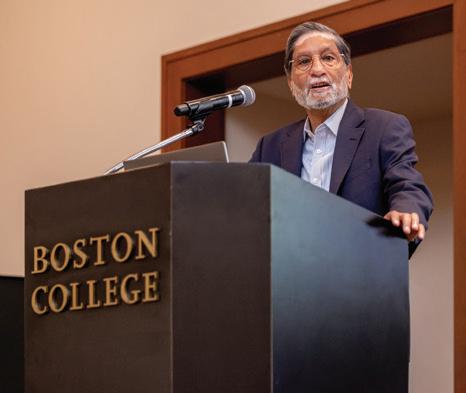
Boston College School of Social Work Dean Gautam Yadama welcomed attendees to the conference, which brought together representatives from BCSSW; United Way of Massachusetts Bay; Boston, Lynn, and Lawrence public schools; and various social services providers of Greater Boston.
Continued from page 1
class scholarship,” said Quigley. “Cadigan Hall will also bring beautiful Collegiate Gothic architecture to the Beacon Street end of Middle Campus. Even more, it will provide a state-of-the-art home for faculty and students in the social sciences, and encourage deeper connections to neighbors in the humanities, management, and the sciences.”
Haub Vice President for University Mission and Ministry Casey Beaumier, S.J., said the expanded facility will enable Campus Ministry to provide a more vibrant presence on BC’s Middle Campus.
“Having Campus Ministry located in a building with key academic units will strengthen the formative educational experience for our students,” said Fr. Beaumier. “Our staff is excited for the possibilities it will afford us.”
A 100,000 square-foot facility located between McElroy Commons and McGuinn Hall, Carney Hall opened in 1962 to provide classroom and office space for the College of Arts and Sciences. Today, it is home to a number of classrooms, centers, initiatives, and administrative offices.
As part of its campus planning, the University announced in 2025 that the BC School of Social Work would be relocated from McGuinn Hall on the Middle Campus to the Newton East Campus (formerly Mount Alvernia High School) on Centre Street in Newton. The relocation will enable the University to temporarily offload offices and staff in Carney Hall to McGuinn Hall and other locations, before beginning renovations to Carney in 2028.
Dennis R. Delahanty, chief executive officer of the Patrick F. Cadigan Family
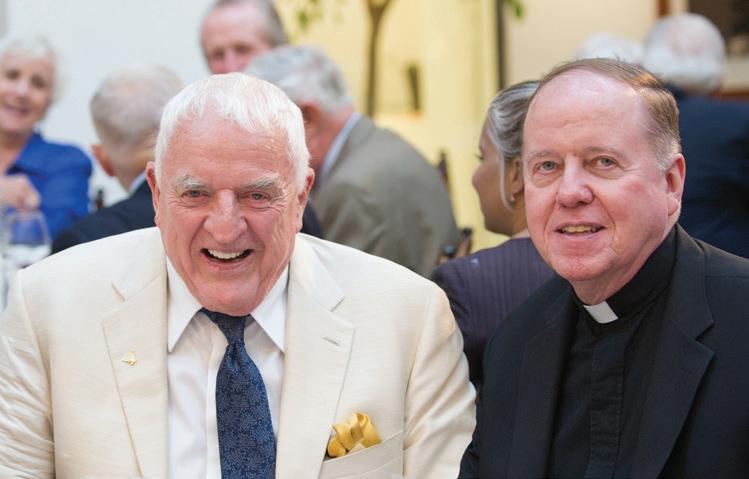
Foundation, said that before Pat passed away, he provided a list of institutions he wished to support through his foundation, including Claremont Graduate University in Claremont, Calif., where he earned a master’s degree and doctorate, and BC High, from which he graduated in 1952. The largest gift, however, was directed towards Boston College, which Delahanty said held a special place in Cadigan’s heart.
“Pat was a good man, an honest man, and a very faithful Catholic,” said Delahanty. “He was proud to be a Jesuit-educated Double Eagle. Boston College was very dear to him.”
The son of Irish immigrants, Cadigan worked nights in his family’s Irish pub,
the Celtic Cafe in Cambridge, while a student at BC to help defray the cost of his tuition. Upon graduating, he worked as a product manager at Sylvania Electronic Systems in Waltham before being recruited to the West Coast to oversee sales and marketing for EECO. He rose rapidly to become its president and CEO, running the company for 20 years and expanding it both nationally and internationally. After retiring from EECO in 1986, he served on the boards of multiple high-tech and electronics firms and as chair and CEO of several public companies, including Gateway Communications Inc., and Linear Instruments Corporation, while investing in real estate in Orange County—a passion
that became his professional focus for the rest of his life.
“My parents were not able to obtain a formal education, so I felt a very personal responsibility to give back to those wonderful schools that educated and shaped me,” said Cadigan in the 2012 Chronicle interview. “Boston College is so well regarded in California and throughout the country, thanks to the outstanding efforts of Fr. Leahy and Fr. Monan before him. It is an honor for me to support BC out of gratitude for what it did for me.”
Maria Cadigan ’91, his youngest daughter, said she was proud to see that her father’s commitment will have such an important impact on their alma mater, allowing the University to renovate and expand a critical academic facility that will benefit the entire BC community.
“Dad felt a strong responsibility to give back to the schools that contributed to the man he became and the success he achieved,” said Cadigan. “He always told me that his time at Boston College truly formed him as a person. His Jesuit teachers, his professors, and the relationships he had with his classmates were powerful influences on him. They instilled in him the values and discipline needed to be successful in every aspect of both business and personal life.
“My father also had a close personal relationship with Fr. Leahy for more than 25 years and he felt very committed to make such an impactful gift during his tenure as president. This contribution will affect so many great minds that will be coming through the doors of Cadigan Hall. It is exactly what my father would have wanted.”
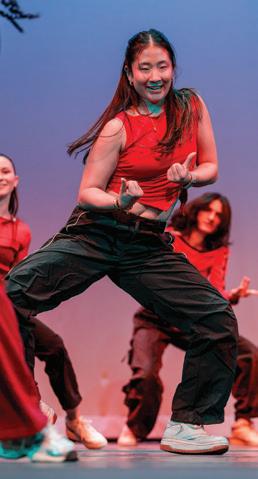

Two faculty members take an interdisciplinary approach to teaching War and Peace
BY SEAN SMITH CHRONICLE EDITOR
Leo Tolstoy’s War and Peace may be regarded as one of the greatest novels in world literature, but not everyone is a fan.
The book checks in at more than 580,000 words, spanning from 1,200 to 1,400 pages depending on the edition, and 365 chapters—one for each day of the year. Some readers complain about having to keep track of its numerous characters, many of whom they consider unlikeable, uninteresting, and—since most are part of elite Russian society—unrelatable; others are annoyed by Tolstoy’s digressions into theories on history and philosophy. Critics say the novel’s reputation as a literary masterpiece can make readers feel compelled to appreciate it, and frustrated when they’re unable to do so.
So, in an era when the college-age generation is reading less, what professor in their right mind would want to include War and Peace in a course?
But Boston College faculty members Nicole Eaton and Thomas Epstein have made Tolstoy’s tome the focus of a paired set of courses being taught this semester through the University Core Curriculum’s Enduring Questions sequence.
Eaton, an associate professor of history, and Epstein—a professor of the practice in the Classical Studies Department—teach War and Peace: History and Literary Truths from their respective disciplines; this semester marks their third such collaboration. The classes are held back-to-back on the same days, with the same students in each. Eaton and Epstein also gather with the students four times during the semester for reflection sessions to integrate the courses’ contents with their lived experiences.
Despite its Napoleonic Wars-era setting, the two faculty members explain, War and Peace raises timeless, fundamental, and relevant questions about human existence: How should I live and what is worth dying for? Is war a necessary evil, or something greater, or different? What role do individuals play in the grand structures of human history? How do we live morally? Do we have free will to shape our destinies?
Beyond such historical, classical, and intellectual elements is another dimension to the paired classes: The very task of reading and assessing War and Peace, say Eaton and Epstein, is valuable in and of itself.
“War and Peace offers the chance to sustain one’s attention for a lengthy text that presumed a very different reading audience in a very different time,” Eaton explained. “Right up front, we talk about the challenge the book presents, that we want them to read the printed version, rather than scrolling it on their phones or computer— and that they should find a quiet place to read.”
“War and Peace simply defies description: Referring to it as a ‘19th-century novel’ is so inadequate,” said Epstein. “It was a groundbreaking poly-stylistic work that went well beyond the standards of 19th-century literature. Therefore, the book is especially useful in exploring how closely related the disciplines of history and literature are, and how they each transform our experiences into stories.”
Epstein and Eaton utilize traditional class lectures and reading assignments, including other texts covering similar moral and philosophical ground (such as Stephen Crane’s Red Badge of Courage), but they don’t want students to passively absorb information. Small-group discussions exploring specific scenes help them form and articulate views on the material, which they share with the larger class. Students are each assigned a character from War and Peace and keep a handwritten diary in the character’s voice—Eaton provides the class with journals—based on his or her experiences as they are related in the book; these are graded for creativity, detail, insight into the character’s mindset, and accurate page numbers and scenes references. Viewings of film or television adaptations of the book also help spark discussion.
Despite the book’s early-19th-century setting, War and Peace touches on numerous subjects that resonate with students, according to Eaton and Epstein, such as societal changes and corresponding shifts in attitudes regarding marriage; the possibility of pacifism in the contemporary world; the limits of human freedom; and which qualities are considered “masculine” and “feminine.”
“Tolstoy wrote War and Peace as a com-
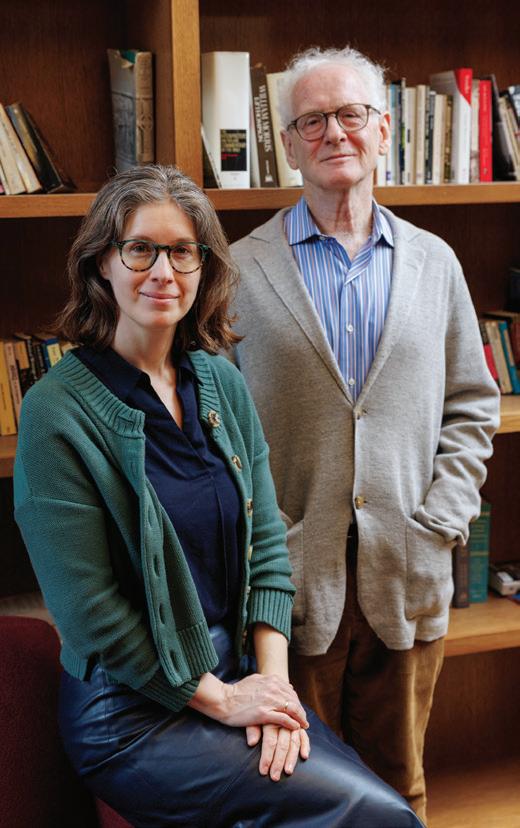
Assoc. Prof. Nicole Eaton (History) and Prof. of the Practice Thomas Epstein (Classical Studies) teach War and Peace: History and Literary Truths as a sequence of courses in the Core Curriculum.
cially when she was carrying around a 10lb. book—but found the class discussions and projects invaluable.
“The project we did on societal expectations helped me see the characters in a different way, especially how many of their decisions are shaped by the roles society expects them to play. Looking at characters like Prince Andrei, Natasha, and Pierre through that lens made the story feel much deeper, because their struggles were not just personal but also connected to the pressures of the society they lived in. It made me realize that many of the novel’s conflicts come from the tension between what the characters truly want and what they feel they are supposed to do.”
“Unlike a novel where a character faces one problem and overcomes it by the end, War and Peace is more like an epic where the reader observes many characters change in countless ways over a long stretch of time,” said biochemistry major John Mack ’29. “For me, this makes it a purer reflection of our own lives, where personal growth is not achieved through overcoming one specific challenge but is instead a journey of prolonged and varied ups and downs. The novelty of the story makes these changes compelling, and that focus entices us to ponder our own lives in return.”
ing-of-age story for many of the characters, as they see their vision of the world being torn apart,” said Eaton. “Our students have certainly been experiencing and witnessing considerable upheaval themselves, so it’s something they can relate to.”
Students formerly or currently in the War and Peace classes had varying degrees of familiarity with the book and its reputation but have relished the experience of reading and analyzing it.
Yizhe Shi ’28, a philosophy and English major, points to the book’s very title as the reason for its enduring place in the imagination.
“It’s ‘War’ and ‘Peace,’” he explained. “To a degree, the two notions exist in relation to each other. We only live to treasure and understand peace if we grasp the dehumanizing horror of any kind of war. Similarly, we have a deeper understanding of the war when we learn what peace entails. Seeing the conflicts going on throughout the world, I think there is some obligation for us as part of a Jesuit institution to initiate some changes. War and Peace deals with the question of what it means to be a human. We see questions being raised in the book during battles that took countless lives; we also see Tolstoy probing such questions with the characters’ journeys and changing ways of living.
“One can say it’s a book about us, too.”
For Samantha Raia ’28, a Management & Leadership and marketing major with an English minor, War and Peace had always been “one of the classic novels that people say they should read, but rarely actually do.” Early on, she wondered if she’d bit off more than she could chew—espe-
Elena Florentinos, a sophomore from Cresskill, NJ, who is a double major in English and accounting for finance and consulting, found much to appreciate about the opportunity to delve into the novel.
“It has interesting commentary on human nature and the philosophy of history, especially the ‘Great Man’ theory,” said Florentinos, referring to Thomas Carlyle’s concept of history being shaped by extraordinary individuals with innate, superior qualities. “I think these ideas are still very relevant today.
“And,” she added, “who doesn’t like the achievement of having read War and Peace”?
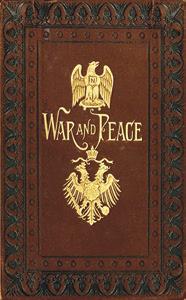
“One can say it’s a book about us, too.”
—Yizhe Shi ’28
BY AUDREY LOYACK STAFF WRITER
Boston College seniors Will Martino and Molly Wysocki have been selected for the 2026-2027 Joseph A. O’Hare, S.J., Postgraduate Media Fellowship by America Media, and starting in August will work for 11 months at the company’s New York City offices to gain experience in Catholic media and other aspects of professional journalism.
America Media, which was founded in 1909, publishes America: The Jesuit Review of Faith and Culture, a leading Catholic journal of opinion in the United States. The O’Hare Fellowship is co-sponsored by Fordham University and named after Joseph A. O’Hare, S.J., editor-in-chief of America from 1975-1984 and president of Fordham from 1984-2003.
O’Hare Fellows create content for multiple platforms, such as web, print, digital, social media, and events, and gain professional experience through mentoring and other opportunities. They meet regularly with America’s editorial staff and editor at large to expand their professional networks and build their journalism skills.
Martino and Wysocki reflected on key experiences at BC that crystallized their interest in storytelling, even though neither began their journey at BC thinking journalism would be the career path for them.
“I joined The Heights [BC’s independent student newspaper] on a whim my freshman year and it totally changed my life. I fell fast in love with reporting, writing, and telling stories that the people around me cared enough to read,” said Martino, a political science major with minors in finance and journalism, who served as the newspaper’s managing editor in 2024 and editor-in-chief in 2025. “I care a lot about doing thorough reporting so that I can tell stories that go beyond the narrative that people—or I—expect.”
For Wysocki, despite her extensive campus involvement as vice president of the Liturgy Arts Group and a committee member of The Church in the 21st Century Center, there wasn’t a single moment of discovery behind her interest in journalism: It was more an innate calling that combines storytelling with the complexity of individuals and communities, she said, noting how a single person’s story reflects a greater, interconnected web of people.
“I’ve always considered myself a storyteller, but the thought of going into media or journalism professionally never crossed my mind until this year,” said Wysocki, an economics and theology major with a minor in applied psychology and human behavior. “I am pursuing this fellowship primarily because of its connections to the world of Catholic theology, which is something I’ve grown to love during my time at BC.
Boston College Associate Director of Undergraduate Admission Peter E. Caruso died on April 7 after a sudden illness. He was 59.
A funeral Mass was celebrated for Mr. Caruso on April 11 at Corpus Christ-St. Bernard Parish in West Newton, Mass.
A resident of Auburndale and a native of Cohasset, Mr. Caruso was a graduate of Stonehill College. After beginning his college admission counseling career at Stonehill College, he joined BC in 1996, relishing the opportunity to represent the University and connect with prospective students, families, and school counselors. He also earned a master’s degree at BC. Mr. Caruso was actively involved in the New England and National Association of College Admission Counselors, and assumed numerous leadership roles over the years, including a term as president.
He served as a coach of boys’ sports teams in Auburndale and at the West Suburban YMCA. A lifelong musician, Mr. Caruso enjoyed the time he spent playing with various bands.
“We are heartbroken at his sudden passing and comforted knowing that he took joy in his family, friends, and colleagues,” his family wrote in a notice announcing his death.
Mr. Caruso is survived by wife, Nancy (Goldsmith), and sons, John and Nick; his sister, Regina Santamaria (and husband Alan) and daughter, Ava; sister-in-law,
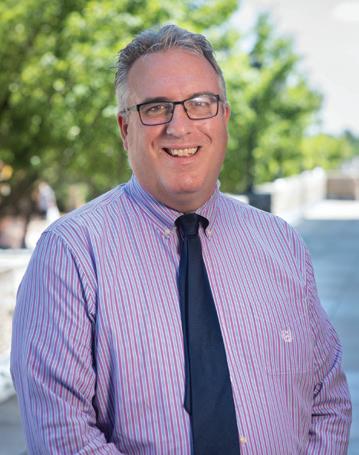
Deborah Caruso and daughter, Cassie; father-in- law Gene; brother-in-law Scott Goldsmith (and wife Hilary), and their daughters Jill and Kate. He was predeceased by his parents, Emilo and Catherine Caruso, brothers Michael and Stephen, and his mother-in-law, Jo-Anne Goldsmith.
In lieu of flowers, donations may be made in Mr. Caruso’s memory to Messina College at BC, a two-year residential program designed to help first-generation students from underserved communities [www.givecampus.com/campaigns/62495/ donations/new].
—University Communications
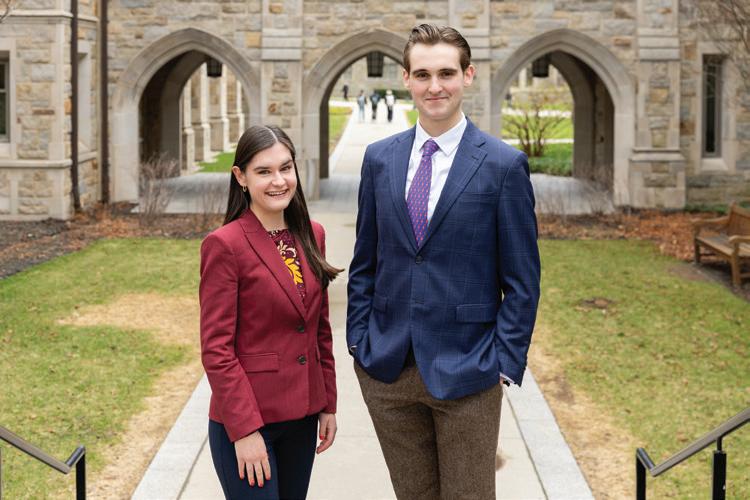
“I am an endlessly curious person, particularly about the people who shape people. We’re all influenced by friends, teachers, mentors, and ordinary folks we pass every day. This interconnectedness reminds me that telling an individual’s story is really telling the story of an unthinkably large amalgamation of people. That’s pretty incredible when you think about it.”
Although the fellows have nearly a year to explore and research various ideas and topics in Catholic media, Martino and Wysocki each have a particular focus that stands out to them. Martino will examine evolving trends and the relationship between Gen Z and the “Catholic revival,” while Wysocki hopes to investigate the ethical, environmental, and social concerns related to artificial intelligence, following Pope Leo’s critical commentary on the technology and centering her own work in the
The following are among the recent positions posted by the Department of Human Resources. For more information on employment opportunities at Boston College, see www.bc.edu/jobs or scan the QR code at right.
Research Systems Administrator Third Cook Waitstaff
Assistant/Associate Director of Stewardship and Donor Engagement
Assistant Director, Corporate & Foundation Communications & Proposal Development
Senior Research Compliance Specialist
Laboratory Safety Specialist
Senior Associate Director, Annual Giving Direct Marketing
Assistant Director, Student Life, Messina College
Administrative Assistant to the Dean, Law School
Gift Processing Specialist
Credit and Collections Specialist
principles of Catholic social teaching. Both fellows are looking forward to joining the America Media community and delving into current topics through a Catholic lens via writing and other forms of communication.
“I’m excited to work with the amazing team at America, and I’m looking forward to exploring different modes of communication, particularly podcasts. I’m coming into the fellowship without any formal journalism background, so that definitely makes me nervous, but I’m hopeful that having two other fellows beside me will help me navigate that barrier,” said Wysocki. Martino quipped that he is “slightly worried” about encountering large cockroaches in his apartment but is eager “to learn from the team of professionals at America Media and, of course, happy that I’ll be living in New York City.”

Senior Research Associate, Whitney Laboratory
Vice President for Student Affairs
Utility Worker/Dishwasher
Manager, Financial Reporting & Cash Services
Assistant Director, PeopleSoft Financial
Management Systems
Network Systems Engineer
Director, Nanofabrication & Cleanroom
Facility
Archivist, Romero Project
Associate Director, Academic Services
Boston College seniors take a special campus tour and reflect on their experiences at the Heights
BY ROSANNE PELLEGRINI STAFF WRITER
On a recent sunny spring Sunday, a group of some 60 Boston College seniors took the opportunity to experience and appreciate their campus home and undergraduate journey through the lens of Ignatian spirituality.
They were participants in “The Ignatian Path Through the Heights: A Campus Camino of Gratitude, Reflection, and Prayer,” offered for the first time by the Office of Campus Ministry on April 12. This campus camino (“path”) of gratitude, reflection, and prayer is modeled after the Camino Ignaciano (The Ignatian Way).
Inspired by the Ignatian tradition and the life of St. Ignatius, organizers said this reflective camino invited seniors to revisit meaningful spaces across campus through guided reflections and prayer inspired by Ignatian spirituality. In preparation for graduation, it provided students a chance to pause, give thanks, and reflect on their undergraduate journey.
“We are pleased that our seniors responded to this offering with such enthusiasm,” said Haub Vice President for Mission and Ministry Casey Beaumier, S.J., who directs Campus Ministry. “Our hope in Campus Ministry is to develop retreats and other experiences that help our seniors leave their undergraduate time at Boston College in a beautiful way. This offering intends to help them reflect upon the gifts they have received during their time at Boston College.”
During the four-hour retreat, the students walked contemplatively and prayerfully through campus. At each of 10 sites—which included academic buildings, chapels, outdoor spaces, and residence halls—there was a reflection or prayer experience associated with a different theme of Ignatian spirituality. A student offered a related personal reflection at each stop,
where participants could make connections between the respective themes and their own campus experiences.
Lynch School of Education and Human Development student Brie Wesner, who is studying applied psychology and Management & Leadership, wanted to participate in this “meaningful opportunity to reflect on the special experiences I’ve had in different places across campus. I thought it was important to enter these final weeks of senior year with a sense of gratitude. I think it’s incredibly valuable that Campus Ministry offers a space like this for seniors to pause, reflect, and appreciate their time at BC.”
The first site on the group’s itinerary was the St. Ignatius statue for an overview of St. Ignatius’ life and Ignatian spirituality. At 245 Beacon Street, the theme was Ignatian imagination and creativity, followed by community and friendship at Conte Forum/Alumni Stadium. The group reflected on finding God in all things at the Pine Tree Preserve and nearby reservoir, where Wesner shared that, upon arrival at BC, she thought of faith as confined to specific places like churches or to formal prayer.
“Over time, especially through moments at the reservoir—whether alone, with friends, or while connecting with family over the phone—I began to recognize God’s presence in ordinary experiences. Everyday moments of conversation, connection, and reflection became just as meaningful as more traditional expressions of faith. The reservoir became a place where I felt grounded, and where I learned to notice and appreciate God’s presence in the small, often overlooked moments of daily life.”
The group went on to contemplate companionship and community on the journey at the Mods/Lower Campus, and a spirituality of everyday life and cura personalis at St. Ignatius Church. St. Mary’s
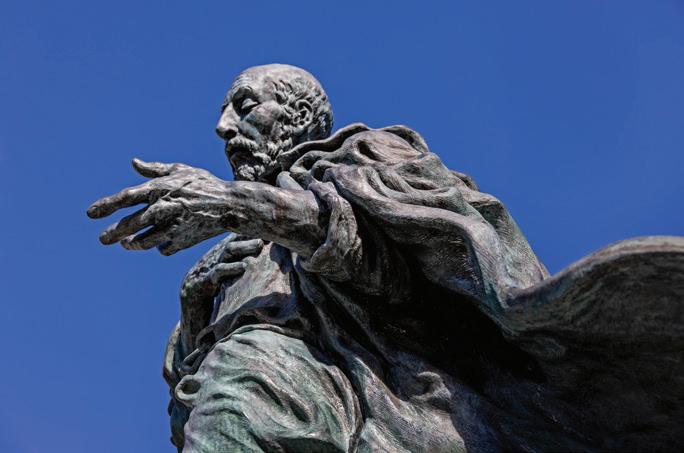
garden provided an opportunity to reflect on the Ignatian examen, while the Bapst Library Lawn and Memorial Labyrinth theme was Ignatian discernment—listening for God’s invitation.
There, Morrissey College of Arts and Sciences history major John O’Keefe spoke about his sophomore year participation in Appa, where service at an immigrationfocused community center in the Bronx inspired him to forgo junior year abroad and remain on campus “to continue engaging with topics that matter. I led Appa and traveled to the United States-Mexico border through Arrupe [International Encounters]. I think that Ignatian discernment is all about noticing what matters to us, listening to what’s happening within us, and taking the time to reflect on what that means for us.”
O’Keefe said he benefited from his peers’ reflections during the retreat: “It was inspiring to hear students speak about who they’ve become during their time here, and I think that’s a testament to all the University community has offered us over the years. I am feeling especially grateful for all I’ve been given at BC and looking forward to paying it forward in all that I do.”
At St. Joseph’s Chapel the group pondered contemplation in action/people with and for others, before the retreat concluded at Gasson Hall with reflection on gathering the graces/looking back with a grateful heart.
At the chapel, Livia Mariani discussed her 4Boston service experiences, and reflec-
tions through her involvement, on community, spirituality, and social justice. It “allowed me to see social justice through a lens of personalism, which emphasizes the dignity and importance of each person and individual relationships. This experience informed how I will continue to live my life and my perspectives on social impact.”
A Morrissey College chemistry major and Hispanic Studies minor, Mariani praised Campus Minister Grace Davis’s leadership of the “amazing” retreat, which she participated in to “get a head start on reflecting and expressing my gratitude for the past four years at BC. I also felt like it would be a great way to be more intentional about how I live and experience the last four weeks of the semester.”
Davis said: “I hope that this on-campus pilgrimage retreat offered seniors intentional time together to both retrace the places on campus that have been significant to them in the past four years and reflect on their BC experience through a lens of Ignatian spirituality. I hope that this time also invites them to consider how they might like to spend the next month before graduation and what it might look like to begin to express gratitude and say goodbye to the significant places and people at BC.”
“The Ignatian Path Through the Heights: A Campus Camino of Gratitude, Reflection, and Prayer” was made possible through a grant from the Office of the Provost and Dean of Faculties, as part of its “Co-Curricular Experiences to Enhance the 4th Year” program.