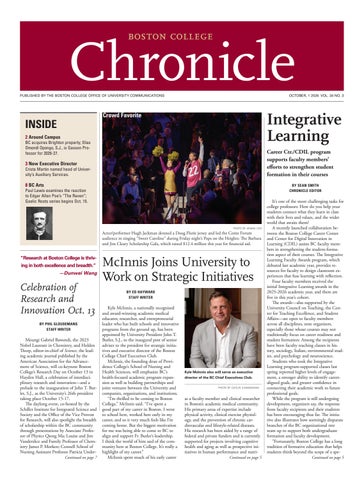
PUBLISHED BY THE BOSTON COLLEGE OFFICE OF UNIVERSITY COMMUNICATIONS
OCTOBER, 1 2026 VOL. 34 NO. 3
Integrative Learning
Crowd Favorite
INSIDE 2x Around Headline Campus
BC acquires Brighton property; Elias xxxxx. Omondi Opongo, S.J., is Gasson Proxfessor Headline for 2026-27. xxx.
Career Ctr./CDIL program supports faculty members’ efforts to strengthen student formation in their courses
3 New Executive Director x Headline Crista Martin named head of Univerxxxxx.Auxiliary Services. sity’s
8 BC Arts
BY SEAN SMITH CHRONICLE EDITOR
Paul Lewis examines the reaction to Edgar Allan Poe’s “The Raven”; Gaelic Roots series begins Oct. 15.
photo by ariana cho
Actor/performer Hugh Jackman donned a Doug Flutie jersey and led the Conte Forum audience in singing “Sweet Caroline” during Friday night’s Pops on the Heights: The Barbara and Jim Cleary Scholarship Gala, which raised $12.4 million this year for financial aid.
“Research at Boston College is thriving in both excellence and breadth.” —Dunwei Wang
Celebration of Research and Innovation Oct. 13 BY PHIL GLOUDEMANS STAFF WRITER
Moungi Gabriel Bawendi, the 2023 Nobel Laureate in Chemistry, and Holden Thorp, editor-in-chief of Science, the leading academic journal published by the American Association for the Advancement of Science, will co-keynote Boston College’s Research Day on October 13 in Hayden Hall, a celebration of interdisciplinary research and innovation—and a prelude to the inauguration of John T. Butler, S.J., as the University’s 26th president taking place October 15-17. The daylong event, co-hosted by the Schiller Institute for Integrated Science and Society and the Office of the Vice Provost for Research, will also spotlight the breadth of scholarship within the BC community through presentations by Associate Professor of Physics Qiong Ma; Louise and Jim Vanderslice and Family Professor of Chemistry James P. Morken; Connell School of Nursing Assistant Professor Patricia Under-
Continued on page 7
McInnis Joins University to Work on Strategic Initiatives BY ED HAYWARD STAFF WRITER
Kyle McInnis, a nationally recognized and award-winning academic medical educator, researcher, and entrepreneurial leader who has built schools and innovative programs from the ground up, has been appointed by University President John T. Butler, S.J., to the inaugural post of senior adviser to the president for strategic initiatives and executive director of the Boston College Chief Executives Club. McInnis, the founding dean of Providence College’s School of Nursing and Health Sciences, will emphasize BC’s health-focused academic program expansion as well as building partnerships and joint ventures between the University and companies, organizations, and institutions. “I’m thrilled to be coming to Boston College,” McInnis said. “I’ve spent a good part of my career in Boston. I went to school here, worked here early in my career, and so it very much feels like I’m coming home. But the biggest motivation for me was being able to come to BC to align and support Fr. Butler’s leadership. I think the world of him and of the community here at Boston College. It’s really a highlight of my career.” McInnis spent much of his early career
Kyle McInnis also will serve as executive director of the BC Chief Executives Club. photo by caitlin cunningham
as a faculty member and clinical researcher in Boston’s academic medical community. His primary areas of expertise include physical activity, clinical exercise physiology, and the prevention of chronic cardiovascular and lifestyle-related diseases. His research has been aided by a range of federal and private funders and is currently supported for projects involving cognitive health and aging as well as prospective initiatives in human performance and nutri-
Continued on page 5
It’s one of the more challenging tasks for college professors: How do you help your students connect what they learn in class with their lives and values, and the wider world that awaits them? A recently launched collaboration between the Boston College Career Center and Center for Digital Innovation in Learning (CDIL) assists BC faculty members in strengthening the student-formation aspect of their courses. The Integrative Learning Faculty Awards program, which debuted last academic year, provides resources for faculty to design classroom experiences that fuse learning with reflection. Four faculty members received the initial Integrative Learning awards in the 2025-2026 academic year, and there are five in this year’s cohort. The awards—also supported by the University Council on Teaching, the Center for Teaching Excellence, and Student Affairs—are open to faculty members across all disciplines, note organizers, especially those whose courses may not traditionally focus on career readiness and student formation: Among the recipients have been faculty teaching classes in history, sociology, Italian, environmental studies, and psychology and neuroscience. Students who took the Integrative Learning program-supported classes last spring reported higher levels of engagement, a stronger ability to identify careeraligned goals, and greater confidence in connecting their academic work to future professional goals. While the program is still undergoing development, organizers say, the response from faculty recipients and their students has been encouraging thus far. The initiative also illustrates how seemingly disparate branches of the BC organizational tree team up to support both undergraduate formation and faculty development. “Fortunately, Boston College has a long tradition of formative education that helps students think beyond the scope of a spe-
Continued on page 5
2
Chronicle
October 1, 2026
Around Campus
2026-27 Gasson Professor is Expert on Conflict Resolution, Reconciliation
An aerial view of 200 Lake Street in Brighton, which formerly housed EF Boston International Language.
University Acquires Brighton Property Boston College has purchased the 17.6acre EF Boston International Language Campus at 200 Lake Street in Brighton from EF International, a world leader in international education that has occupied the site for the past three decades. EF announced earlier this year that it would sell the property following a review of its global operations and long-term needs. EF, which has its North American headquarters in downtown Boston/Cambridge, continues to operate more than 50 language campuses worldwide. Terms of the agreement were not disclosed. University spokesman Jack Dunn
said that BC was pleased to acquire the property, which is directly across from its Brighton Campus and within easy walking distance to the Chestnut Hill Campus. “It is rare when parcels like the EF Boston Campus become available,” said Dunn. “The facilities at 200 Lake Street will help the University to meet its needs through the acquisition of 89,000 square feet of existing educational campus facilities.” Dunn said the University, which closed on the property on September 15, is currently evaluating best uses for the property. Additional information will be disclosed as it becomes available. —University Communications
Elias Omondi Opongo, S.J., a peace practitioner and scholar with a focus on conflict resolution, reconciliation, transitional justice, post-conflict reconstruction, and state-building, is serving as Boston College’s Thomas I. Gasson, S.J., Professor for 2026-2027. Funded by a gift from the Jesuit Community at Boston College, the Gasson Chair is held by a distinguished Jesuit scholar in any discipline and is the oldest endowed professorship at Boston College. Last month, Fr. Opongo assumed the role of rector and vice chancellor (president) of the Catholic University of Eastern Africa, becoming the first Jesuit priest ever to lead CUEA. Previously, Fr. Opongo was director of the Hekima Institute of Peace Studies and International Relations and associate professor at Hekima University College in Nairobi, Kenya. He holds a doctorate in peace and conflict studies from the University of Bradford in the United Kingdom. His most recent book, published earlier this year, is Decolonizing NGO Peacebuilding and Liberal Peace Agenda in Northern Uganda, which argues that the liberal peace agenda—focused on democracy promotion, market reforms, and human rights—often marginalizes local agency and undermines culturally rooted approaches to peacebuilding. He is also co-editor of The Palgrave Handbook of Peace, Conflict and Security Studies in Africa and Elections, Violence, and Transitional Justice in Africa, and has published journal articles on democracy, transitional justice, and peacebuilding. At Boston College, Fr. Opongo will serve as a visiting fellow at the Clough Center for the Study of Constitutional Democracy. Fr. Opongo participated in the 2025 Venice Seminars on Democratic Resilience, cosponsored by the Clough Center, and was a member of the Work-
Elias Omondi Opongo, S.J., is rector and vice chancellor of the Catholic University of Eastern Africa.
ing Group on Democracy, Governance and Education (2023-2025), chaired by Clough Center Director Jonathan Laurence for the Boston College Program on Global Ethics and Social Trust. On November 30, Fr. Opongo will deliver the Gasson Lecture on “Digital Dissent and Democratic Futures: Youth Agency and Physical-Digital Resistance in Kenya” at 5 p.m. in Gasson 100. “For a long time, I have had a close connection with Boston College,” said Fr. Opongo, who served as a visiting scholar at the Jesuit Institute. “I am honored to hold the Gasson Chair this academic year and look forward to learning, exchanging. and creating new networks for current and future collaboration.” —Kathleen Sullivan
Entrepreneurship Summit Oct. 3 photo by matthew healey
Boston College formally kicked off Hispanic Heritage Month with an opening ceremony in Gasson 100 on September 15. For information on Hispanic Heritage Month events on campus, see bit.ly/Boston-College-Hispanic-Heritage-2026.
ASSOCIATE VICE PRESIDENT FOR UNIVERSITY COMMUNICATIONS
Jack Dunn
SENIOR DIRECTOR FOR UNIVERSITY COMMUNICATIONS
Patricia Delaney EDITOR
Sean Smith
CONTRIBUTING STAFF
The Boston College Entrepreneurship Summit takes place this Saturday at Hayden Hall, featuring interactive workshops, panels from top-level executives, and a keynote speaker. Organizers say they hope attendees “leave the conference with a new community of like-minded individuals as well as newfound skills to thrive in the world of entrepreneurship and startups.” The summit is open to students, alumni, and professionals. For more, see the Shea Center website at www.bc.edu/bc-web/ schools/carroll-school/sites/shea-center.html.
Phil Gloudemans Ed Hayward Audrey Loyack Rosanne Pellegrini Kathleen Sullivan
Chronicle
PHOTOGRAPHERS
www.bc.edu/bcnews chronicle@bc.edu
Caitlin Cunningham Matthew Healey
The Boston College Chronicle (USPS 009491), the internal newspaper for faculty and staff, is published biweekly from September to May by Boston College, with editorial offices at the Office of University Communications, 3 Lake Street, Brighton, MA 02135 (617)552-3350. Distributed free to faculty and staff offices and other locations on campus. Periodicals postage paid at Boston, MA and additional mailing offices. POSTMASTER: send address changes to The Boston College Chronicle, Office of University Communications, 3 Lake Street, Brighton, MA 02135. A flipbook edition of Chronicle is available via e-mail. Send requests to chronicle@bc.edu.
3
Chronicle
October 1, 2026
University at No. 31 in Latest U.S. News Rankings
photo by matthew healey
“I’m always thinking first about how to make everyone feel welcome and cared for,” says Executive Director of Auxiliary Services Crista Martin. “How do our operations and services support the very unique ways we come together as a community?”
At Your Service Crista Martin developed a healthy respect for Boston College while working at another area institution. Now she’s the head of the University’s Auxiliary Services. BY ED HAYWARD STAFF WRITER
Crista Martin, who brings nearly three decades of experience in providing essential services to college communities, has been named executive director of Boston College Auxiliary Services, where she will oversee a broad portfolio of operations. Martin, who joined the University this summer, served in a variety of roles within Harvard University Dining Services across approximately 28 years. She succeeds Patricia Bando, who retired last summer after 22 years leading the division. Martin said she has maintained collegial relationships with Bando and other managers at BC, as well as other colleges and universities in the Boston area. “In Boston, we are all friends,” said Martin. “We collaborate, we talk to each other. I had a deep and abiding admiration for BC already, so the chance to bring my particular skill set here was a wonderful opportunity. I am very community driven. My values have to do with making people feel at home and welcome and cared for. Those are the things Auxiliary Services does. These services are the way we welcome our BC community, but also the world as well.” At BC, Auxiliary Services includes Dining Services, Heights Catering, Athletics concessions, Parking and Transportation, the Boston College Bookstore, Eagle Print, events management, and spaces such as the Connors Retreat Center in Dover. “We are here to make your campus life more seamless,” Martin said. “We want to help people move easier through some of their day-to-day tasks.” Martin said the path that led her to food services began in childhood. “I grew up on a family farm. We could walk out
every day and pick fresh produce. So, I was actually born into it.” At Harvard Dining Services, where Martin started her career in 1998, she served as director of strategic initiatives and communication for the past 13 years, with responsibilities that reached into marketing and communications, employee recruitment and engagement, long-range planning, and coordinating with the central administration and campus services. Martin said she maintains a focus on the customer experience. “I’m always thinking first about how to make everyone feel welcome and cared for. How do our operations and services support the very unique ways we come together as a community? Second, I’m constantly innovating within that framework: How to do it better, smarter, yummier, faster. This remarkable team here has been innovating for a long time. That is an example of the energy I get from this work.” Martin said that focus extends beyond the campus community, through programs such as Dining Services’ food donation program. BC Dining works with studentled Every Bite Counts to package excess prepared food, which is then distributed by local food rescue organizations. Additional existing initiatives focused on reducing food waste, composting, reducing plastic waste, and sourcing produce from local and sustainable sources are exciting opportunities to have a broader positive impact, Martin said. “I think a lot about how the services we provide turn around and support our neighbors. How can BC be the best partner, a friend to the city, and a good neighbor to the people who live near us? How can we exemplify the moral standards of this place?”
Boston College placed 31st in the U.S. News & World Report 2027 survey of national universities, a five-point improvement over last year’s ranking. BC shared the placement in a three-way tie with Tufts and New York universities. In addition, the University placed 24th out of 190 private universities in the new Top Private Colleges category, the first time that U.S. News has separately ranked public and private institutions. It also placed 12th nationally in the new “Earnings by Major” metric, reflecting the value of a BC degree. Boston College continued to perform well in several specialty rankings, including “Commitment to Undergraduate Teaching” (sixth), which reflects BC’s national reputation for teaching excellence; “First Year Experience” and “Service Learning” (seventh); “Best Learning Communities” (16th); “Best Senior Capstone Program” (17th); and “Best Study Abroad Program” (19th). In addition, the University was ranked 56th in the “Best Value” listing, reflecting its commitment to meeting the full demonstrated need of all domestic undergraduate students. David Quigley, the Robert L. and Judith T. Winston Provost and Dean of Faculties, said BC’s performance in the rankings reflects the high esteem in which it is held on the national stage. “This year’s national university ranking offers encouraging evidence of the growing recognition of Boston College among our peers in higher education,” said Quigley. “In particular, I’m heartened by our colleagues’ assessment of our faculty’s increasingly excellent work in teaching and research.” While improving in the overall national university ranking for the third straight year, BC continues to be negatively affected
by the 2019 change in U.S. News’ methodology that rewards public universities with a high volume of Pell Grant-eligible students. Prior to the change, BC was ranked 30th or 31st among national universities each year between 2011 and 2018. Among BC undergraduate schools and colleges this year, the Connell School of Nursing was ranked 12th out of 671 nursing schools in the “Best Undergraduate Nursing Programs” survey. The Carroll School of Management improved to 24th among 535 schools in the “Best Undergraduate Business Programs,” and placed seventh overall in Finance, eighth in Analytics, ninth in Marketing, 10th in Management, 11th in Accounting, and 14th in Entrepreneurship. Among Morrissey College of Arts and Sciences academic programs, BC was ranked 37th in the “Best Undergraduate Psychology” survey, 43rd in “Best Undergraduate Economics,” and 88th in “Best Undergraduate Computer Science.” Overall, Massachusetts Institute of Technology ranked first this year in the U.S. News rankings, ousting Princeton, which had occupied the top slot since 2012. Princeton was ranked second, followed by Harvard and Yale. California Institute of Technology and Stanford were tied for fifth. Among Massachusetts schools, the topranked national universities following MIT, Harvard, BC, and Tufts, were Boston University, which moved up in an eight-way tie for 34th; Northeastern; which placed 42nd; and University of Massachusetts-Amherst and Brandeis, which tied at 59th. The U.S. News rankings of all colleges and universities can be accessed at www. usnews.com. —Jack Dunn
photo by matthew healey
Mahdi Muhammad received his bachelor of arts degree at the Boston College Prison Education Program graduation ceremony for the 2026 graduating class at MCI-Shirley on September 21. He was one of five graduates recognized at the event, which was attended by several senior BC administrators. Read the story at https://bit.ly/BC-Prison-EducationProgram-graduation-2026.
4
Chronicle
October 1, 2026
Grant Supports Researchers’ Work on Neonatal Health BY PHIL GLOUDEMANS STAFF WRITER
An interdisciplinary Boston College team was awarded a five-year, $3.2 million grant from the National Institutes of Health to develop the first AI-enabled ultrasound system designed for long-term, point-of-care nutritional monitoring in preterm infants. The tool would fill a critical gap in assessing the accumulation of lean and fat tissue during infants’ neonatal intensive care unit (NICU) stays, when targeted interventions for babies born before 37 completed weeks of pregnancy can have the most significant impact. The project, “Advancing Neonatal Health: AI-enabled Ultrasound for Enhanced Growth and Nutritional Assessment,” will be led by Ferrante Family Assistant Professor of Engineering Bryan Ranger. Co-investigators include Connell School of Nursing Dean Katherine E. Gregory; Associate Professor Jinhee Park, the Deborah Joyce Norberg Faculty Fellow at the Connell School; and Assistant Professor of Computer Science Yuan Yuan. Additionally, clinical collaborators include Brigham and Women’s Hospital— one of the two founding members of Mass General Brigham, the largest health care provider in Massachusetts—and the M Health Fairview Masonic Children’s Hospital at the University of Minnesota. These sites will be led locally by Katherine Bell, M.D., and Sara Ramel, M.D., respectively. According to evidence-based clinical database UpToDate, premature babies need significantly higher amounts of calories, proteins, fats, vitamins, and minerals compared to full-term infants to match the rapid growth they would have experienced in the womb. The earlier the preterm infant is born, the fewer stores of fat, protein, iron, and minerals they have, which are essential for respiratory function, heat regulation, and bone development. Enriching a preterm infant’s nutrition usually addresses the deficit.
“Preterm infants are at high risk for suboptimal growth and neurodevelopmental delays, yet current tools for monitoring nutrition, such as weight, length, and body-mass index (BMI) lack sensitivity to changes in body composition,” Ranger said, noting that BMI is a numerical value calculated from height and weight. “Advanced methods like air displacement plethysmography—a test that measures body volume based on air displacement in
preterm infant’s NICU stay and beyond, rather than at a single time point,” he said. “The results will improve early detection of growth failure, guide individualized nutritional interventions, and ultimately, reduce the burden of adverse health outcomes in this vulnerable population.” Ranger noted that the system will be low-cost, portable, and fully automated, providing a standardized, real-time, noninvasive assessment of lean and fat tissue
Clockwise from top left: Bryan Ranger, Yuan Yuan, Katherine Gregory, and Jinhee Park photos by caitlin cunningham, lee pellegrini, and matthew healey
a sealed chamber—provide accurate measures but are costly, impractical for routine use, and infeasible in critically ill infants. Preliminary data from our group demonstrate that ultrasound imaging, when combined with artificial intelligence, can predict body composition with reasonable accuracy in preterm infants. “The project’s innovation is building on this preliminary work to create a scalable, clinically feasible tool that tracks body composition longitudinally, throughout a
accrual, a rich amalgamation of features not presently available. The project’s primary goals are to validate and standardize ultrasound protocols with real-time feedback mechanisms to ensure high-quality scans; develop and refine AI models that integrate imaging, maternal, and clinical data to predict lean and fat mass with high accuracy; and link early ultrasound-derived nutritional trajectories to neurodevelopmental outcomes to identify at-risk phenotypes and inform targeted
BC Scenes
After the Sun Goes Down
With the academic year well under way, Boston College was full of activity at almost all hours in September. Near right, the Church in the 21st Century Center hosted “God in the Mods,” a candlelight gathering and Mass for students at the Mods, as part of C21’s Espresso Your Faith week. Far right, a couple paused to take in a painting at the McMullen Museum of Art’s “Art After Dark” event—a students-only celebration featuring live performances, food, film, and music to complement the themes and materials on display, including the current McMullen exhibition “Shadows and Light: Symbolist Art in Belgium; Works from the Hearn Family Trust.” photos by seho lee ’27 and tim correira
interventions. To achieve these objectives, the team will enroll 160 preterm infants across two sites, collecting ultrasound scans, gold-standard body composition measures during hospitalization, and maternal and clinical data, with follow-up through 24 months after discharge. Park underscored that weight alone cannot be relied upon as a primary indicator of growth, since it doesn’t reveal what is happening beneath the surface. “The ability to track lean and fat tissue over time could give us a more complete picture of how preterm infants are growing.” She noted that this interdisciplinary work grew from a 2022 Schiller Institute for Integrated Science and Society-funded pilot study that has evolved into this larger, multi-site project. “From my background in neonatal nursing and research, I’ve seen how challenging it can be to know whether a preterm infant is growing well,” Park said. “What is particularly exciting is the potential to bring this kind of information closer to the bedside—to help clinicians understand not just whether preterm infants are growing, but how they are maturing over time, and ultimately, to support more tailored approaches to nutrition and care.” Gregory emphasized that preterm infants are small, but the problems they experience are big—too extensive for one discipline to solve alone. “Approximately half of these newborns experience postnatal growth failure, a major contributor to lengthy hospitalizations and suboptimal health outcomes across the lifespan,” she said. “The use of ultrasound and the analytical approach that this team will utilize to address this problem are paradigm-shifting and could lead to novel nutritional strategies that improve preterm infant growth. “It’s been a joy to see this collaboration flourish across campus with the support of multiple schools, departments, and the Schiller Institute.”
5
Chronicle
October 1, 2026
Faculty Praise Integrative Learning Awards Program Continued from page 1
cific major or discipline,” said Career Center Director Rachel Greenberg, co-founder of the Integrative Learning Faculty Awards program. “It’s more critical than ever for undergraduates to be able to understand and articulate how the skills they are learning in their courses are preparing them for life after college. The more students are able to connect their classroom learning to their lives beyond the classroom, the more engaged they will be in their learning.” “When a potential employer asks students to discuss their meaningful college experiences, they want to hear what they found challenging, what helped them to see new possibilities, gain new understanding about themselves and the world,” said CDIL Director of Digital Learning Innovation & AI John FitzGibbon, who also organizes the program. “Being able to tell those stories is a very important skill—and it’s something they should learn as undergraduates. We know Boston College faculty members are committed to being excellent teachers. This program can help them design courses in such a way that they enable students to bring their whole selves, to think deeply and describe cogently their foundational experiences in college.” Greenberg added, “It’s something faculty members can add to their CV, to show how they’re supporting their own growth. We’re not asking them to do anything radically different—just to be more intentional and explicit in encouraging students to connect their academics to their own lives and sense of purpose in the world.” At the center of integrative learning, noted Greenberg and FitzGibbon, are the famous “three questions” of Ignatian discernment that animate Jesuit education: What brings me joy? What am I good at? Who does the world need me to be? Integrating these questions into the curriculum, they said, prompts students to move from asking “What do I want to do?” to “What am I called to be?”
Associate Professor of Sociology Joshua Seim, one of the previous recipients, decided to fine-tune his Sociology of Health and Illness course, which asks students to think critically about inequality, health, and medicine. Although the class had an end-
Rachel Greenberg: “The more students are able to connect their classroom learning to their lives beyond the classroom, the more engaged they will be in their learning.”
of-semester reflection component, Seim felt he could make integrative thinking a more prominent and regularly occurring feature. “I wanted students to extend course theories beyond the classroom and into their past and anticipated personal experiences. With the Integrative Learning program, I came up with the idea for a sequence of reflection assignments designed to prepare students for an end-of-semester conversation with a relative stranger about their future.” Among the tools Seim utilized was the BC Alumni Association’s EagleExchange mentoring platform, which facilitates dialogue between BC alumni and current students. “I hadn’t imagined using something like EagleExchange in a sociology course, but the idea immediately clicked as a way to support a more ambitious final project.”
The collaboration with CDIL and the Career Center helped Seim think more deliberately “about how reflection could build toward a meaningful culminating experience. “The Career Center is a valuable pedagogical resource for faculty, not just a place to refer students. Their staff helped me think through course design and learning goals, while CDIL helped me envision how these ideas could be implemented online. Rather than offering a cookie-cutter model, the collaboration emphasized customization through conversation, which made the final design much stronger.” Professor of History Conevery Valencius directs the Neponset River Lab, a collaborative team of graduate and undergraduate students who create an interactive historical map of places along the estuary of the Neponset. She used her award to design a new course in which students learn about the connections between the river and American history and create more material for “Mapping the Neponset River’s History,” which is hosted on the Neponset River Watershed Association website. The Integrative Learning program funded appearances by guest speakers and class trips to the Neponset and elsewhere, she said, and enabled her to craft a bigpicture aspect to the class. “Thanks to the insights of Career Center and CDIL, I was able to create a course to support humanities students in thinking not only about the subject matter, but about their trajectory after Boston College,” Valencius explained. “I wanted to construct class experiences that would help people in my class build skills, confidence, vocabulary, and a sense of moral purpose in translating their work with us into their future jobs and careers.” Valencius was heartened by how much her students encouraged and taught one another: One used his experience at Carroll School of Management Career Advising Resources to help others hone resume
language, and seniors assisted first-year students in crafting self-introductions. “Funding from CDIL and the Career Center transformed this class,” she said, “and it has helped me bring more explicit career reflections and skills into my other
Joshua Seim: “The Career Center is a valuable pedagogical resource for faculty, not just a place to refer students.” photos by lee pellegrini
teaching.” Another recipient, Beth McNutt-Clarke, an associate professor of the practice in the Connell School of Nursing, focused on building career readiness and integrative learning into her capstone clinical course for seniors. “It’s the perfect time and opportunity to give students a chance to reflect and derive meaning from their years at Boston College, and also to be more aware of and use the incredible resources available to them through the Career Center,” she said. “I had the students use the Big Interview platform to practice their interviewing skills, which is so important—a number of them said it was very timely and provided valuable feedback to them to ensure their job interviews reflected their strengths.” Information on the Integrative Learning program is available at cdil.bc.edu/programs
McInnis Sees Great Opportunities for Partnerships in Boston Continued from page 1
tion in military personnel. At Providence College, McInnis established the academic programs, faculty, and infrastructure for the new nursing and health sciences school. Over a very short period, the school established deep partnerships and collaborations with dozens of organizations and saw unprecedented enrollment demand. He said he plans to bring that same collaborative focus to BC to support faculty, students, staff, and University leadership. “I think my position will initially require a lot of input from across the University community. There is so much going on here and we have a broad platform to work from. There is a level of academic excellence across the disciplines, grounded in the liberal arts and the Jesuit, Catholic tradition. I want to start from what we do best and help create new ventures from
there that are distinctly BC.” McInnis said the Boston area presents unique opportunities. “We live in the academic medical capital of the world. We have a world-class nursing school and programs in health care administration. We also have worldclass research in the natural sciences. We’d like to utilize what we are currently doing so well to see what niche we can carve out to expand our leadership stronghold and value proposition within the Boston medical community, including leveraging our national brand in athletics and sports medicine.” McInnis cited his experience in launching innovative programs at the Providence College School of Nursing and Health Sciences and establishing a foundation for interdisciplinary education that brings together the health sciences, clinical practice, and the liberal arts within the Catho-
lic tradition. “My work at Providence College has been instrumental in preparing me for a role like this at BC,” said McInnis. “I was charged with leading the development of a new school of nursing and health sciences from the ground up. And that required working with every aspect of the college internally, but also externally with alumni, with boards of trustees, and in the medical community in Rhode Island and throughout New England.” McInnis’s portfolio will also include directing the Boston College Chief Executives Club, one of the nation’s premier business speaking programs. Several times a year, the CEO Club brings leading chief executives to Boston to speak to the leaders of companies based in the Boston area. “The CEO Club is a great opportunity to make connections with really influential people,” said McInnis. “As we explore
new ventures, I think this creates a great opportunity to build partnerships. I’m also excited to let as broad an audience as possible know about the great things happening at Boston College.” Before joining Providence College, McInnis was founding dean of Merrimack College’s School of Health Sciences and provost at Johnson & Wales University, where he helped expand the university’s academic and research portfolio and led several successful health program accreditation initiatives. “I’ve been very fortunate in my many different positions in academia to be very external facing and to be able to develop real meaningful partnerships,” said McInnis. “Given the history of Boston College, I’m excited to serve as a bridge builder, capitalizing on existing and new relationships.”
6
Chronicle
October 1, 2026
BC Historian Relishes Pair of Fellowships BY ROSANNE PELLEGRINI STAFF WRITER
Professor of History Sylvia Sellers-García, an expert on colonial Latin America, received prestigious dual fellowships in recognition of her scholarship in the humanities and social sciences. The awards were announced earlier this year by the American Council of Learned Societies (ACLS) and the Harvard Radcliffe Institute, where she is a Joy Foundation Fellow for the 2026–2027 academic year. Sellers-García is interested in legal history, the history of empire, and the intersections of fiction and history. With these fellowships, she will pursue her book project—titled Flawed Bodies: Making Identity in the Age of Enlightenment—on Enlightenment identity categories. The project is framed around the criminal case of Juana Aguilar, an indigenous intersex person accused of various crimes and arrested multiple times and tried by the secular authorities in El Salvador and Guatemala between 1792 and 1801. “I am so grateful to the Radcliffe Institute and the ACLS for supporting my project, and I am grateful to BC for making it possible for me to accept both and take a year for writing time,” said Sellers-García, who co-directs the University’s renowned Lowell Humanities Series. “I feel so honored to be selected by these organizations. For me, it’s very challenging to write during the academic year; this unrestricted writing time is absolutely essential to me for new writing.” In addition to her scholarly books, Sellers-García has authored both critically acclaimed novels and a series of middle grade and young adult fiction books. “I’m a writer with a foot in history and
“I’m a writer with a foot in history and a foot in fiction,” says Sylvia Sellers-García. “As a historian, I focus on colonial Central America and the Spanish empire, especially in the 18th century. I’m interested in issues of colonialism, gender, and race. As a fiction writer, I’m drawn to the inbetween places of American identity, the unreliability of memory, and questions of truth-telling.” photo by matthew healey
a foot in fiction,” she said. “As a historian, I focus on colonial Central America and the Spanish empire, especially in the 18th century. I’m interested in issues of colonialism, gender, and race. As a fiction writer, I’m drawn to the in-between places of American identity, the unreliability of memory, and questions of truth-telling.” Last year, Penn State University Press published Sellers-García’s introduction to, and English translation, of Aguilar’s case: The Criminal Case of Juana Aguilar: Adjudicating Gender in Colonial Central America. Her current project related to this “fascinating case” as she described it, which had fallen out of view for decades, “is to write a public-facing history book about Aguilar
and the Enlightenment. “While Aguilar’s story is sensational, an equally sensational story about identity unfolds in the background. Medicine, law, and religion all combined to make Aguilar’s identity a ‘problem.’” This was a fairly new problem in the 18th century, Sellers-García explained, and Flawed Bodies tells the story of how these institutions attempted to define Aguilar. “Though identity categories around gender, race, occupation, marital status, and more had existed for centuries, identity categories around gender especially had become more rigid in this period, and the strict gender binary that the judge applied in the conclusion of Aguilar’s case was be-
Panel on Formative Education Oct. 8 Four distinguished scholars will examine formative education and what it means to support students’ intellectual, emotional, ethical, and spiritual development—in the classroom, on campus, and beyond—at a panel discussion, “New Perspectives on Formative Education” on October 8 at 4:30 p.m. at the Yawkey Athletics Center Murray Family Function Room. Organized by the Transformative Education Lab (TLab) at the Lynch School of Education and Human Development, the event will address the critical question of how colleges and universities can foster learning that forms the whole being. Panelists include William Damon, emeritus professor of education at Stanford University; Howard Gardner, the Hobbs Research Professor of Cognition and Education at the Harvard Graduate School of Education; Professor of the Practice Suzanne Shanahan, who is the Leo and Arlene Hawk Executive Director of the Institute for Social Concerns at the University of Notre Dame; and Oon Seng Tan, director of the Centre for Research
in Child Development at Singapore’s National Institute of Education. “As the leader in formative education, it’s appropriate that Boston College should host this panel, discussing challenges and future directions in the project to educate whole people,” said Stanton E.F. Wortham, the Charles F. Donovan, S.J., Dean of the Lynch School, who will moderate the discussion. “We’re thrilled to have such distinguished colleagues from Stanford, Harvard, Notre Dame, and Singapore’s National Institute of Education join us for this important conversation.” A psychologist and a retired senior fellow at Stanford University’s Hoover Institution, Damon is one of the world’s leading scholars of human development across the lifespan and has pioneered the scientific study of how purpose in life develops. Gardner, a recipient of a MacArthur Prize Fellowship, is an American developmental psychologist who is best known for his theory of multiple intelligences, outlined in his 1983 book Frames of Mind. Shanahan leads the Virtues & Voca-
tions Initiative, a national forum seeking to cultivate character, purpose, and meaning in pre-professional and professional education. Tan’s expertise includes teacher education, early childhood education policies, learning sciences, education psychology and problem-based learning. He has authored or edited more than 20 books and over 150 scholarly articles and chapters in the areas of instructor training, cognitive psychology, and problem-based learning. The Transformative Education Lab, founded in September 2025, is a hub for research on holistic, formative human development, and the curation of educational approaches that both support young people’s development as whole persons and prepare them to pursue purposeful lives. Deoksoon Kim, a professor in the Lynch School’s Teaching, Curriculum, and Society Department, is the lab’s director. To attend the panel, register at forms. gle/q1LiJpWva91JccXPA. —Phil Gloudemans
ing enforced in novel ways,” she said. In the end, Aguilar—who underwent 11 physical examinations during incarceration—was determined by the Guatemalan court to be neither male or female and as a result, didn’t belong in society. Rather than banishment, the judge determined that Aguilar should be allowed to live among other people under surveillance, without intimate relationships. “Drawing on archival sources and scholarly works in the history of sexuality, history of religion, history of medicine, legal history, and social history, this project contributes to understandings of how modern society, through the ‘flawed bodies’ of Enlightenment-era institutions, imposed enduring identity categories,” according to the ACLS. “I think this story will be compelling to readers because we, in the present, unwittingly embrace many of the identity categories that were shaped and enforced in the Enlightenment period,” said Sellers-García. “I hope my treatment of this case will reveal to readers where some of the categories that we take for granted really come from.” Sellers-García was one of 63 scholars selected from more than 2,000 applicants by ACLS. “We are proud to award ACLS Fellowships to outstanding scholars across a range of fields,” said President Joy Connolly. “Deep understanding of humanity and human endeavor rests on the work of generations of scholars who need time to do research and develop their arguments. We salute the new fellows’ contributions to knowledge and to society, and we celebrate their expertise and dedication.” The Harvard Radcliffe Institute interdisciplinary cohort of 50 fellows is drawn from contemporary scholars in the humanities, sciences, social sciences, and arts— along with writers, journalists, playwrights, professionals. They will pursue ambitious projects in the unique environment of the Institute within the larger community of Harvard University and convene regularly to share their work in progress with the community and public, according to the institute, one of the world’s leading centers for interdisciplinary exploration.
Nota Bene Laura De Veau, an assistant professor of the practice at the Lynch School of Education and Human Development, was named one of 17 “Pillars of the Profession” by the NASPA/ Student Affairs Administrators in Higher Education Foundation. The award honors professionals who have provided significant service to NASPA, created a lasting impact on the institutions or organizations at which they have worked, and/or have demonstrated sustained, lifetime professional distinction in the field of student affairs and/or higher education.
7
Chronicle
October 1, 2026
Event Will Celebrate BC Research BC in the Media Continued from page 1
wood; and BC School of Social Work Assistant Professor Ed-Dee G. Williams. Winston Provost and Dean of Faculties David Quigley will deliver opening remarks for a showcase of the University’s rich history of working across disciplines to develop new knowledge that produces a real-world impact. “Research at Boston College is thriving in both excellence and breadth,” said Interim Seidner Family Executive Director of the Schiller Institute and Professor of Chemistry Dunwei Wang, the Margaret and Thomas Vanderslice Chair holder. “What excites me most is the growing momentum toward collaboration: Faculty are reaching across traditional boundaries, linking natural sciences with social sciences and the humanities to address the pressing problems of our time. With AI becoming an integral part of the research enterprise, our community is poised to advance knowledge in ways that were unimaginable just a few years ago.” Bawendi, the Lester Wolfe Professor at the Massachusetts Institute of Technology—best known for his advances in the chemical production of high-quality quantum dots—will present the morning’s keynote address. Thorp, whose afternoon speech is titled “Doing Science During Turmoil: Keep Going and Check Care-
Snapshot
fully,” is currently on leave from George Washington University where he is a professor of chemistry and medicine while serving as the editor-in-chief of the Science family of journals. The event will close with a panel discussion on the implications of AI to research and teaching at BC and beyond, featuring BC Law School Professor Natalya Shnitser, the David and Pamela Donohue Faculty Fellow; Peter F. Drucker Chair Sam Ransbotham of the Carroll School of Management; Lynch School of Education and Human Development Augustus Long Professor Marina Bers; and Associate Professor of Psychology Stefano Anzelotti. “The event will bring together the Boston College community to learn more about the innovative research being conducted across different disciplines by faculty, students, and post-docs, and provide opportunities to exchange ideas and forge new collaborations,” said Vice Provost for Research and Academic Planning and Deluca Chair of Biology Thomas Chiles, who will moderate the panel. Research Day is open to the University community and public. For more information, and to register, go to the Schiller Institute website at bc.edu/schiller.
Prof. of the Practice Fr. Philip Larrey (Philosophy) talked with NBC10 how the Catholic Church is seeking a humancentered approach to AI, in a segment that cited the University’s announcement of its new institute focused on ethical leadership in the age of AI. Clough School of Theology and Ministry Prof. Hosffman Ospino (CSTM) published his essay “The Joy of Being Hispanic Catholic” in The Pilot. In a piece for NOW blending memoir, historical insight, and commentary, Prof. Franck Salameh (Eastern, Slavic, and German Studies) reflected on a renewed curiosity about Lebanon’s Jewish past. Prof. Ray Madoff (Law) appeared on the “Armchair Expert”’ podcast with Dax Shepherd, who called her “one of the most interesting guests” he’d ever had. The experience of Carroll School of Management student Talia Kusmirek ’27 was featured in a Wall Street Journal story on internships in the age of AI. Prof. Lisa Alexander (Law) provided comments to WGBH News for a story on how the federal government has changed rules governing grants that have long supported nonprofit fair housing organizations.
Physician-assisted suicide isn’t a virtuous alternative to needing and receiving care, wrote Libby Professor of Theology and Law Cathleen Kaveny in a piece for Commonweal. Research Prof. Peter Gray (Psychology and Neuroscience) spoke with The New York Times on independent play for children. Carroll School Sweeney Chair of Accounting Mary Ellen Carter was interviewed by The Wall Street Journal on the Tesla-SpaceX merger. Boston Globe Magazine ran a profile of Prof. Heather Cox Richardson (History), whose Letters from an American is the most-read politics newsletter on Substack. Drinan Professor Thomas W. Mitchell, founder and director of the Initiative on Land, Housing & Property Rights at Boston College Law School, spoke with The New York Times for a story on how informally bequeathed and jointly inherited real estate can present legal problems. Asst. Prof. Gregg Sparkman (Psychology and Neuroscience) co-authored an essay in TIME magazine on research showing that social change can be mobilized when two groups are united behind a solution: scientists and the public.
photos by caitlin cunningham
Pope Leo and the AI Question
Jobs The following are among the recent positions posted by the Department of Human Resources. For more information on employment opportunities at Boston College, see www.bc.edu/jobs or scan the QR code at right. First or Third Cook, Corcoran Commons Director of Counseling Practicum Experience Teacher Assistant Director of Advocacy Programs Associate Director, Procurement Services Assistant Director, Gift Processing Data Services Librarian The Boisi Center for Religion and American Public Life hosted the panel discussion "Pope Leo on AI: Safeguarding Humanity Amid Technological Transformation” on September 22 in Gasson 100. Moderating the discussion was David Buckley (left), who became director of the Boisi Center this summer. Along with Buckley, the panelists were (above, L-R) Associate Professor Christina McRorie (Clough School of Theology and Ministry), Theology Department Chair Andrea Vicini, S.J., Nelson Professor Brian K. Smith (Lynch School of Education and Human Development), and Drucker Professor Sam Ransbotham (Carroll School of Management).
Assistant Director, Financial Management Systems Staff Nurse Bartender Assistant Director of Recruiting Programs
Academic Support Assistant, Connell School of Nursing Resident Director Associate Director of Intercultural Programming Fiscal & Procurement Specialist Assistant Manager, Corcoran Commons Physical Security Technician Fire Safety Manager
Senior Associate Director, Content Strategy
Senior Auditor
Assistant Director, Undergraduate Learning & Student Success
Associate Director, Admission Technology
Assistant Director of Program and Operations Executive Director, Krantz Institute for Artificial Intelligence, Ethics, and Humanity
Assistant Director, Benefactor Events Associate Director of Media and Technology Associate Director, Admission Technology
8
Chronicle
October 1, 2026
BC Arts
A Look at Poe’s ‘The Raven’— and What a Stir It Caused
Paul Lewis: “On its way to global superstardom, ‘The Raven’ struck chords that have resounded from the antebellum period to our own time.” photo by caitlin cunningham
BY ROSANNE PELLEGRINI STAFF WRITER
Quoth the Raven, “Nevermore.” So goes the most famous line from Edgar Allan Poe’s legendary 1845 narrative poem “The Raven,” about a grieving student mourning the death of his lost love—and his slow descent into madness after a mysterious talking bird visits him on a dreary December night. It was one of more than 5,300 poems published that year in American magazines; most were immediately forgotten. But Poe’s work—known for its hypnotic rhythm, musicality, and stylized language—was a conspicuous exception. An immediate sensation, it remains one of the most iconic poems in literary history. The factors that influenced the attention to “The Raven” from the day of its publication are the focus of Quothing “The Raven”: The First Responses to America’s Most Famous Poem, a new book by English Professor Emeritus Paul Lewis, a prominent Poe scholar and past president of the Poe Studies Association. According to the book’s publisher, Mercer University Press, Lewis addresses such questions as why “The Raven” was widely reprinted, praised, criticized, and mocked during the years between its publication in New York and
Poe’s death on October 7, 1849. In Quothing “The Raven,” Lewis brings together 29 parodies of “The Raven” published during Poe’s lifetime. The book examines why the poem inspired these parodies, which replaced Poe’s “saintly bird of yore” with a menagerie of other animals: an owl, gazelle, turkey, pig, dog, cats, rats, and bedbugs. It also explores how Poe’s reputation—as a literary brawler and harsh book reviewer who struggled with money and alcohol—factored into the reception of “The Raven.” “The poem was instantly controversial because people associated the grieving lover in the poem with Poe himself, which explains why some of the parodies featured impoverished and intoxicated narrators,” according to Lewis. Lewis’ book considers the literary salons where “The Raven” was discussed, the newspapers where it was reviewed, and the parodies that made fun of both the poem and its controversial author. Quothing “The Raven,” Lewis said, “was a delightful American Studies project that began with searching archives for forgotten
parodies,” which he then placed in contemporaneous contexts. Many of “The Raven” parodies, Lewis noted, “shift down from Poe’s gothic intensity and profound mourning to a world where regular people were trying to stay warm, get a good night’s sleep, and avoid being bitten by an animal. While a few responded seriously to Poe’s treatment of mourning and loss, most deployed the formal features of ‘The Raven’ to engage with then-current controversies about such matters as racial difference, tariff policy, debtors’ prisons, public art, alcoholism, prizefighting, and immigration. On its way to global superstardom, ‘The Raven’ struck chords that have resounded from the antebellum period to our own time.” Lewis’ book is praised as “a wonderful romp through the sea of parodies that proliferated in the wake of the publication of ‘The Raven,’” by Sandra Tomc, professor of English Language and Literature at the University of British Columbia, Vancouver, author of Industry and the Creative Mind: The Eccentric Writer in American Literature and Entertainment, 1790–1860.
“He expertly guides readers through the chaotic world of Antebellum magazines and newspapers that Poe himself navigated. Lewis has written an absolutely delightful book full of both humor and wisdom about America’s most famous poem,” she said. Quothing “The Raven” is cited as “a significant contribution to Poe scholarship and a genuine pleasure to read,” by Scott Peeples, author of The Man of the Crowd: Edgar Allan Poe and the City. “Poe said that he wrote his most famous poem ‘for the express purpose of running,’ and Paul Lewis shows us how it ‘ran’ through 1840s pop culture and reshaped Poe’s career and reputation,” he added. “The parodies themselves are fascinating, and the context Lewis provides for them is invaluable. This book is essential to understanding how ‘The Raven’ became America’s favorite poem.” A staunch proponent of Poe’s ties to Boston—where he was born in 1809— Lewis spearheaded a campaign to have the city reclaim Poe. In 2009, he organized a celebration of the Poe bicentennial at Boston College, created a walking tour of Poe’s Boston, and curated “The Raven in the Frog Pond” exhibition at the Boston Public Library. As the Board of Directors chair of the Edgar Allan Poe Foundation of Boston, Inc., he supported efforts to have a square at the intersection of Boylston Street and Charles Street South dedicated to Poe and install a statue of the poet there. Lewis will sign copies of his new book on October 7 from 6-7 p.m. at the Longfellow/ Washington National Historic Site in Cambridge, and on December 5 from 2-3 p.m. at the Boston Public Library. For more information, email paul.lewis@bc.edu.
Gaelic Roots Returns Oct. 15 The Boston College Gaelic Roots music series begins its 23rd year this fall on October 15 with a concert by eminent Irish fiddler James Kelly. Organized by the Irish Studies Program and directed by Sheila Falls Keohane, Gaelic Roots showcases music and dance from Irish, Scottish, and American traditions. After 10 years as a weeklong summer music school and festival, Gaelic Roots became an academic-year concert series in 2004, hosting highly regarded musicians, dancers, and academics. Dublin native Kelly has collaborated with some of the Irish music revival’s leading figures—including his father and brother—and been a member of groundbreaking bands like Planxty and Patrick Street. His solo work also has been highly praised, earning him Irish traditional musician of the year honors from TG4, Ireland’s Irish-language TV station. In addition to adapting tunes from the Irish tradition, Kelly has composed hundreds of his own and has 18 albums to his credit. Boston-based trio Copley Street, which performs on November 12, comprises some of the most acclaimed Americanborn Irish musicians of their generation.
Joey Abarta (uilleann pipes), Nathan Gourley (fiddle) and Owen Marshall (bouzouki, guitar) all have highly impressive resumés on their own and together produce a sound that reflects a whole-hearted dedication to and love for the music, and the tradition from whence it came. With a presentation that is straightforward yet full of ample creativity as well, the trio shows a willingness to experiment with repertoire and arrangements. The “Copley Street” name also has special significance, referring not only to the street in Roxbury where Abarta and Gourley formerly lived but a local record label that issued recordings of many prominent Irish musicians in Boston. A December 3 performance by Grammy award-winning Irish-born singersongwriter Susan McKeown will cap the Gaelic Roots fall season. After studying classical voice as a teenager, McKeown immersed herself in numerous musical traditions and genres, from Celtic to klezmer to African to mariachi, among others, as well as contemporary sounds and styles. Among her notable collaborations and projects have been the multi-genre bands Chanting House (whose members also included notable Irish musicians John Doyle and
Performers for this fall’s Gaelic Roots series include (clockwise from top) Copley Street, Susan McKeown, and James Kelly.
Seamus Egan) and The Klezmatics; “Peter and Wendy,” a musical adaptation of J.M. Barrie’s Peter Pan; and a pair of holidaythemed albums, “Through the Bitter Frost & Snow” and “A Winter Talisman.” All Gaelic Roots events are free and open to the public and take place at 6:30 p.m. in Connolly House (300 Hammond Street). For details, see events.bc.edu/ group/gaelic_roots_series. —Sean Smith