YOUR FREE GUIDE TO BOOKS & AUTHORS kk4
BC
JESS HOUSTY
Kinship, ancestral knowledge & spirituality. P 27
BOOKWORLD VOL. 40 • NO. 3 • AUTUMN 2026
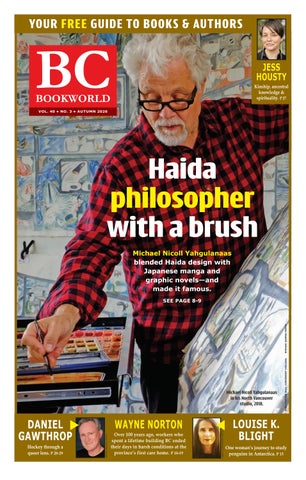
Haida philosopher with a brush Michael Nicoll Yahgulanaas blended Haida design with Japanese manga and graphic novels—and made it famous.
Michael Nicoll Yahgulanaas in his North Vancouver studio, 2018.
Over 100 years ago, workers who spent a lifetime building BC ended their days in harsh conditions at the province’s first care home. P 18-19
pamela gregoriadis photo
Hockey through a queer lens. P 28-29
trevor macneil photo
t
WAYNE NORTON
t
DANIEL GAWTHROP
publication mail agreement #40010086
myriam casper photo
SEE PAGE 8-9
LOUISE K. BLIGHT
One woman’s journey to study penguins in Antarctica. P 15
BOOKS SAVE THE DAY!
New books from BC Creators
1 | BB | $12.95
6 | HC | $21.95
5 | HC | $21.95
978145984083
978145984035
7 | HC | $21.95
978145984338
SLJ
SLJ
7 | HC | $21.95 978145984284
9781459837843 | PB | $16.95
978145984439
5 | HC | $21.95 978145984415
9781459838321 | PB | $16.95
6 | HC | $21.95 978145984421
0 | HC | $29.95 978145984056
8 | HC | $24.95 978145984287
8 | HC | $21.95 978145984104
9781459843257 | PB | $10.95
Available as an accessible ebook
2 BC BOOKWORLD • AUTUMN 2026
t
BC TOP PEOPLE SELLERS Roy Henry Vickers & Lucky Budd
Telling a mother’s story
The Best of Roy Henry Vickers: 80 Selected Works (Harbour $24.95)
Wiley Wei-Chiun Ho The Astronaut Children of Dunbar Street: A Memoir (D&M $24.95)
W
Marion McKinnon Crook
Shelley Adams & Conner Adams Whitewater Cooks: The Food We Love
(Sandhill Book Marketing $38.95)
t C’tasi:a / Geraldine Manson & Nancy Turner
Plant Teachings from My Auntie: Gathering Coast Salish Plants for Medicine, Textiles, Nourishment, and Ceremony (New Society $29.99)
Aaron Chapman & Simon Kendall Real Enough: The Unlikely Story of Doug & the Slugs (Anvil $25)
t M.A.C. Farrant
Seventy-Two Seasons: A Memoir about Noticing (Ronsdale Press $22.95)
Anna Byrne
The Last Caravan: The Power of Community at the End of Life (Dagger/Caitlin $26)
Neil Griffin
Bat Planet: The Mysterious Life of the Creatures of the Night (Orca $24.95)
Elee Kraljii Gardiner
Coming of age in East Van
H
aving published more than 250 books through his company Anvil Press and 103 issues of subTerrain literary magazine since 1988, Brian Kaufman is set to release his own debut collection of fiction, Cascadia Subduction Shift (Guernica $22.95). These coming-of-age tales are set in mid-to late-century Vancouver, mostly East Vancouver locales. The stories are divided into three sections representing childhood, teenage years and early adulthood; most are one-or two-pagers told with unvarnished stark realism and whiffs of mortality throughout. In the first section, Kaufman’s visceral scenes describe the fear and curiosity of young boys, as well as seemingly safer times with parents, such as when Frank, six or seven years old, goes with his dad to a food plant in East Vancouver: “He and his father in the Econoline van—he’d sit centre on the engine cover, where it was warm—no seat belt or even a thought of seat belts back then. His dad working the gears, ‘three on the tree’ … Frank loved the feeling of accessing secured places secreted away on the waterfront, and he realized he had the key, the password, the in, and the ‘in’ was his dad.” The middle section is full of young men exploring drugs, getting into trouble and fights and eking out a living at early career jobs. The final section includes a few female characters and the emergence of a young struggling publisher … named Frank. 9781778490644
A
s the teenage son of Chinese immigrants in
the most meaningful things he did at this job was to
Victoria, Ryan Cho was warned “not to put
collaborate on gender issue sessions. He realized that,
any visible displays of my ‘Asianness’ in my
having grown up in the very white city of Victoria “full
car like a red and gold ornament dangling
of tall, lush trees and British-inspired architecture,” he
from my rearview mirror,” he writes in Brotherhood
had learned to express himself within the boundaries
is a Constant Possibility: Asian Masculinity in a
of “white masculinity” and had internalized its norms
World Made for Whiteness (Thornapple $27.95). His
and ideas. He was, he says, “bamboo among the
parents feared someone would vandalize Cho’s car.
pines.” Cho was able to let go of those
After graduating from university, Cho
thoughts during the gender issue
eventually got a job during the summers
sessions. He explores these insights
with a social justice-oriented youth program on the outskirts of Metchosin, where he worked for ten years. One of
BC
BOOKWORLD
George Bowering
Autumn 2026 Volume 40 • Number 3
The current topselling titles from major BC publishing companies, in no particular order.
hen Michelle Good’s mother implored from her cancer-ridden deathbed, “someone tell my story!” Kitimat-born Good, a Cree writer and lawyer who won the 2020 Governor General’s Literary Award for Fiction for her debut novel Five Little Indians (HarperCollins), did just that. Eliza Sunshine (Random House $27) spans three generations of Cree women, exploring motherhood, identity and generational trauma. In a letter to readers, Good writes that the questions at the heart of Eliza SunMichelle Good shine “call on the conscience of this country”—how did Indigenous women become “disposable” she asks, confronting the violence and injustice that continue to shape too many lives. Good is well suited to this journey among the ghosts of her ancestors. She earned an MFA in Creative Writing from UBC while practising law and running her own firm and has consistently explored the legacy of colonialism. That she does so while emphasizing beauty, strength and resilience is to her 9781039011434 enduring credit.
Bamboo among the pines
sometimes, forest (Talon $19.95)
Barefoot Gringo (UBC Press / On Point $26.95)
beverly cramp photo
Bloomsbury to Barkerville: The Life of Florence Wilson (Heritage House $26.95)
Brian Kaufman has been operating Anvil Press for 36 years. He received the Jim Douglas Publisher of the Year Award in 2013 and a City of Vancouver’s Mayor’s Arts Award for Literary Arts in 2009 and a Lifetime Achievement Award from the Western Magazine Awards in 2014.
Publisher / Editor Beverly Cramp • Design David Lester
Publication Mail Agreement #40010086 Return undeliverable Canadian addresses to: BC BookWorld, P.O. Box 93536, Vancouver, BC V6E 4L7 Produced with the sponsorship of Pacific BookWorld News Society. Publications Mail Registration No. 7800. BC BookWorld ISSN: 1701-5405 Advertising & editorial: BC BookWorld P.O. Box 93536, Vancouver, BC V6E 4L7 Tel: 604-736-4011
t
Ryan Cho
in his book, which is part memoir mixed with commentary and historical context.
97819908698221
Contact: bookworld@telus.net Annual subscription: $25 We gratefully acknowledge the unobtrusive Indigenous Editor: Odette Auger assistance of the Canada Council, a continuous Contributing editors & writers: partner since 1988, and CreativeBC, a provincial partner since 2014. Alexander Varty, John Moore, Heidi Greco, Sonja Pinto, Susan Sanford Blades, Trevor Carolan, Caroline Woodward, Tom Hawthorn
Senior Editor: Sheldon Teitelbaum Proofreader: Shannon Edwards Operations Manager: Brian Nguyen Accounts: Ingela Kasparaitis Consultants: Ken Lapp, Kenneth Li Deliveries: Frank Cui, Acculogix
3 BC BOOKWORLD • AUTUMN 2026
CANADA BOOK FUND The Canada Periodical Fund In-Kind Supporters: Vancouver Public Library University of BC Library
4 BC BOOKWORLD • AUTUMN 2026
PEOPLE
Diane Evans POETICS OF THE
EVERYDAY
F
or years, Diane Evans hid her prowess as a practicing photographer—most knew her professionally through her dual jobs as manager of Presentation House Gallery (now the Polygon Gallery) and instructor at Emily Carr University of Art. Until her early death in 2023 from a rare cancer, she maintained a reputation as a mentor, curator and passionate collector of photobooks. Now a retrospective of Evans’ photos, completed over more than 45 years, shows the extent of her art photography practice: Diane Evans: Photographs 1976–2023 (Polygon Gallery $65). “For Diane, photography wasn’t simply a practice or a medium that she taught,” writes curator and friend Helga Pakasaar in her essay in the book, “but rather a filter through which to come to terms with the world.” The thread that connects Evans’ photos “is more a love for the way the world discloses itself through photographs than consistency in method or approach,” writes curator, Grant Arnold, another contributor. “It is also a desire to enact, articulate, and depict an affective poetics of the everyday … to seek out the often-fleeting encounters with beauty, authenticity, and intimacy that make life bearable in a culture increasingly flattened by the effects of 9780995902633 commodification.”
t
A GARDEN TO NOURISH THE SOUL
9781771514781
lovers dig in T
he region now known as British Columbia holds some of the oldest archaeological sites in the Americas. The archaeological record in BC goes back 15,000 years and contains more than 60,000 sites—with more being added each year. These are some of the findings noted in archaeologist Robert J. Muckle’s guide Once Upon This Land: Archaeology in British Columbia and the Stories it Tells (UBC Press/Purich $29.95). Furthermore, while most early archaeology in BC focused on the stories of First Nations from the last ice age to the coming of European settlers in the late 1700s and Robert J. Muckle early 1800s, more recent archaeological activities—in the 1900s and 2000s—focus on settlers, Indigenous peoples and others including Chinese and Japanese communities. New research locales include shipwrecks, airplane crashes, internment camps and modern garbage sites. Not only an introduction for archaeology lovers as well as casual observers, this book is an important reference guide for all British 9780774881081 Columbians.
t
Throughout the late 1970s, Diane Evans took a series of photos at the Pacific National Exhibition including this one from Super Dogs, c. 1979. Don Steve
T
When hiking gear is stolen
O touchwood editions photo
he colours of fall are an inspiration for foodie Sabrina Currie, a gardening blogger and now the author of a sumptuous cookbook, West Coast Kitchen Garden: Growing, Gathering & Eating Through the Seasons (Touchwood $49) with photography by DL Acken (who can be found part of the year at her farm studio on Salt Spring Island). “As the leaves change colour, tree fruits and tomatoes ripen in earnest and pumpkins try to break weight records,” says Currie who learned young about seasons and cooking what’s fresh while working with her father, a commercial fisherman. In addition to advice for the other three seasons, Currie explores eating local and fresh (hence the focus on seasons) and growing your own garden. Each chapter begins with a gardening guide followed by menus and recipes. Currie, based alongside a highway on Vancouver Island, dug out her own front yard (a lawn) and converted it to “an urban kitchen garden,” she writes. “I envisioned a place that my children could explore, somewhere they could learn about growing food. A garden to nourish my family and my soul.”
Archaeology
t Sabrina Currie harvesting her garden, from West Coast Kitchen Garden. 5 BC BOOKWORLD • AUTUMN 2026
utdoor enthusiast Don Steve, left a lucrative legal career in Sri Lanka to relocate to Canada in 2017. After working in Eastern Canada for eight years, he moved to Vancouver Island and began working in BC’s outdoor industry. Here he finds joy in hiking and canoeing … that is until the day he was the victim of a thief. Steve tells the story in May I Buy My Own Stolen Hiking Gear? (Tellwell Talent $24.49). “This memoir is a journey of two halves,” says Steve. “There is a part of my story I would give anything to forget, and another part I will carry with me forever,” he adds. The other part of Steve’s story is learning to celebrate life again. “The toughest lesson of all was realizing that peace comes when you stop searching for what was or what could be, and simply learn to be.” 9781834540207
Rags to Riches: The Story of the Nelson Brothers Fisheries by W.B. MacDonald with Stuart Nelson (Caitlin $27)
BY ALAN HAIG-BROWN
T
here was a time in British Columbia when a young man could leave a poverty-stricken fishing village in Asia or Europe and find a good life as a fisherman in BC. They arrived in the early twentieth century, worked hard, built lives and settled happily in Steveston, Prince Rupert and other coastal towns. But few, if any, matched the success of the Nelson brothers from the impoverished fishing village of Tromsø, Norway. Ritchie Nelson, who would go on to found Nelson Brothers Fisheries with his brother Norman, was born at Tromsø in 1898. He followed older relatives to BC in 1909. They settled in the little Norwegian immigrant community of Sunbury on the Fraser River’s south shore across from New Westminster. While still a child, Ritchie was able to go out with his brothers to help pull the gillnets that caught sockeye from the huge Fraser River runs. He saved his money and in 1914, Ritchie bought his own 5 HP gillnetter. After a brief stint at a Lutheran college in Everett, Ritchie joined his brother Norman in the fish business. They were aggressive and got bigger boats, explored the whole coast and even fished halibut in Haida Gwaii. In 1919 Ritchie arranged to buy trollcaught salmon on the West Coast of Vancouver Island to pack and sell in Seattle. In 1920 the brothers added a second boat, the American-built seiner Gradac, to their fleet. This allowed them to pack more fish and started a growth curve that would continue for decades. Rags to Riches is an insider look at the remarkable focus and talent that led Ritchie Nelson, with his brother Norman, to form one of BC’s major fishing companies. If the beginning of Ritchie and Norman’s company was somewhat conventional, the growth and management was less so. The brothers proved to be canny businessmen. In the 1930s, the pilchard fishery became the backbone of their company. The little fish were caught by the hundreds of tons and rendered into meal and oil. Ritchie’s innate business sense, enriched by the ups and downs of both fishing and packing, gave him an edge over his more corporate competitors. He understood how to manage hard times, which hit when pilchard disappeared from the BC coast. It didn’t stop the Nelson brothers, though. To invoke a contemporary business term, Ritchie and Norman “pivoted” their focus to seining and gillnetting salmon to provide for their canneries. Perhaps it was their having worked their way up in the industry from a Fraser River gillnet skiff, but the Nelson brothers had particular skills at matching seine skippers and boats. Boats are expensive to maintain and they require a lot of tender care when
fisherman newspaper, 1965, fisherman publishing society collection • ubc open collections
FISHING REVIEW
t
The REMARKABLE
RISE of the Nelson Family fishery How a poor immigrant family built one of BC’s largest fishing operations in the 20th century.
working; therefore, it is better to give a productive skipper some pride of ownership, which became an integral part of the Nelson Brothers’ management style. Ritchie’s gift was giving each fisherman the boat that best suited them. For example, an Indigenous fisherman who favoured his local ancestral waters could do well with a smaller boat; a Croatian immigrant fisherman to whom the whole coast was to be fished hard might do well with a larger, faster boat to attain a higher production. Within those general groups there were multiple individual fishermen and Ritchie and his managers made a point of getting to know each one to ascertain each man’s talents.
In the 1950s, Ritchie brought his son Dick into the company. All the Nelson family boys were given entry level jobs in the industry and then, with time, they would be promoted to a level that Ritchie decided met their abilities. The 1950s, culminating in the spectacular Adams River sockeye returns of 1958, were good times for the BC fishery and good times for the Nelson Brothers. Ritchie was heard to grumble, in private, having sold some equity in the company to BC Packers (BCP) in 1941: “The worst mistake I ever made.” Like so much in the industry, this remained hush-hush and the company continued to operate indepen-
6 BC BOOKWORLD • AUTUMN 2026
Nelson Brothers Port Edward seine boat crewmen Arnold Pearson (behind) and (left to right) John Nelson, Willy Brillon, Dempsey Collinson, Frank Shannon and Melvin Leonard. dently while maintaining its successful growth. The aging St. Mungo cannery in Sunbury was replaced by a modern new plant in Steveston. The company also built extensive operations in Port Edward, which continued and evolved to meet shifting demands. In the early 1960s, herring reduction and oil production provided another steady source of income as did a number of other small fish. The fact is that BC’s fishery seldom, if ever, had two decades in a row without major shifts in catches or permitting of fishermen. The Nelson Brothers were adept at shifting their operations as necessary. Secrecy was also the norm. Fishermen made different deals for vessel purchase-and-lease with the companies. Companies also made secret deals with each other. Throughout the 1960s, rumours persisted among fishermen that BC Packers owned Nelson Brothers, but it wasn’t until the end of the decade that it was proven when a Nelson became senior manager of BCP. The last half of Rags to Riches documents the complex changes in ownership, including the takeover of BCP and Nelson Brothers by the Weston family. The younger generation of Nelsons was managing BCP and they were not happy when Galen Weston took the helm of the parent company, signaling that the end of the Nelson family in BC’s fishery was only a matter of time. Happily, the family had totally devolved their participation in the industry before the sale of BCP by the Westons to the Pattison Group. There was no need for this final chapter in the book as the Nelson family was completely out of ownership by then. 9781773861777
Alan Haig-Brown, from one of BC’s renowned writing families, began his career as a fisherman before becoming an award-winning writer himself. His most recent book is Raincoast Chronicles 25: m̓ am̓ aɫa goes fishing, released by Harbour Publishing in 2025.
AUTUMN READS FROM ARSENAL PULP PRESS shot in vancouver
cutting edge
SAM WIEBE
DANIEL GAWTHROP
An entertaining catalogue of Vancouver’s astonishing contributions to film and television history. “Wiebe engagingly showcases the wide variety of movies and tv shows shot in the city that so rarely plays itself.” —Aaron Chapman
Heated Rivalry for realz: a fascinating and timely examination of ice hockey through a queer lens. “An inspirational and unique perspective on a sport beloved by so many.” —Betty Baxter
Adventures in Hollywood North
Hockey as Queer Culture
978-1-83405-040-9 | $28.95
978-1-83405-048-5 | $26.95
never again, for anyone
tougher than the rest
STACY FRIEDMAN and ELLY STERN
DINA DEL BUCCHIA
A gentle and loving children’s picture book about a Jewish boy’s compassion for others, including Palestinians. “Poignantly told, vividly illustrated, and suffused with the wisdom of ages.” —Gabor Maté
A beguiling story collection with great humour and heart about the ripple effects of wealth disparity on women. “Funny and dark in all the right places.” — Waubgeshig Rice
978-1-83405-052-2 | $22.95
978-1-83405-046-1 | $22.95
arsenalpulp.com
K A N ATA C LASS I CS
A trail-blazin g co llectio n tha t proudl y brin gs to g eth er time le ss bo o ks b y Indi g enous an d n on- Indi g eno us voice s to ref lect th e rich and diver se ran g e of vo ice s o f our co untry .
LEARN MORE
7 BC BOOKWORLD • AUTUMN 2026
MANGA PROFILE
THE POWER OF DRAWING AS A TOOL OF RESISTANCE How artist-activist Michael Nicoll Yahgulanaas created a distinct visual and narrative form that blends Haida design with Japanese manga and graphic novels—and made it famous. The Lost Haida Manga: A Compendium by Michael Nicoll Yahgulanaas (D&M $34.95)
BY ROBIN LAURENCE
t
Illustrations and text from Yagulanaas’ story The Wave (2014) about his existential thoughts concerning diving into ocean waves and what his art means. From The Lost Haida Manga.
8 BC BOOKWORLD • AUTUMN 2026
karolina turek photo
A
t the launch of Michael Nicoll Yahgulanaas’s newest book, it was striking how much time the artist spent with everyone who stood in line to meet him and have their copy signed. In addition to speaking with each person at length and then fully inscribing the half-title page of their book, he presented every individual with a small ink or watercolour drawing. Eventually, he was interrupted by the organizers so that he could address the large audience that had gathered for the event and answer their questions. Once done that public task, however, he returned to personal interactions with his fans. “The work I do is at some point quite solitary,” Yahgulanaas says. “I burrow myself into my studio.” He goes on to explain that because much of the art he creates is spontaneous rather than premeditated, he has to retreat into himself to allow the imagery to flow through him. “When I get a chance to talk to people who have taken time out of their lives to buy a book and express an interest, it’s good for me. It calibrates my relationship with others.”
Michael Nicoll Yahgulanaas The process is exhausting, he admits, but also gratifying. With a foreword by anthropologist Wade Davis, The Lost Haida Manga brings together 15 previously unpublished, black-and-white works Yahgulanaas created between 1981 and 2025. Their subjects range from personal anecdotes to cultural narratives, from a story of time he spent with his grandmother as she gathered medicinal plants in the forest to a rhyming poem about “Rockin’ Raven” fishing, and from an account of Haida management of culturally modified trees to Yahgulanaas’s existential thoughts about diving through ocean waves and making art. As the stories unfold over time, we see the evolution of Haida manga, the graphic style that Yahgulanaas invented and made famous. Davis describes it as “a distinct visual and narrative
Illustration from Yagulanaas’ “A Tale of Two Shamans” (2000) from The Lost Haida Manga. form that blends Haida design principles with the dynamic of Japanese manga and graphic novels.” He then goes on to characterize Yahgulanaas, who also paints and sculpts and is currently developing an interdisciplinary performance and video work, as “an artist-activist, a philosopher with a brush, a mischief maker who has reimagined all the possibilities of the Haida aesthetic ....”
O
Yahgulanaas grew up near Masset on Haida Gwaii, folded into his mother’s family, clan and moiety. From an early age, he drew and painted prolifically; as a young adult, he committed himself to environmental and land rights causes. His art and his activism first came together in the 1970s, when he created the comic book No Tankers, T’anks for the Island Protection Society. Widely distributed, it was part of a successful campaign to block tankers from transporting Alaskan crude oil through the Hecate Strait, the perilously stormy body of water that lies between Haida Gwaii and mainland British Columbia. “The bafflegab advancing the theory
beverly cramp photo
born in prince rupert in 1954, michael
Michael Nicoll Yahgulanaas signing books at his launch for The Lost Haida Manga at Gallery Jones in Vancouver, May 20, 2026. that the economy must trump ecology needed surgery,” he says. Throughout the 1970s and 80s, Yahgulanaas continued to marry his graphic art to his environmental and political activism as a highly effective form of outreach. He discovered, Davis writes, “the power of drawing as a tool
of resistance,” and produced thousands of comic strips, cartoons and visual essays of both protest and advocacy. “Long before Haida manga had a name,” Davis continues, “Yahgulanaas understood something fundamental: if you want to influence people and inspire change, you must first meet them where they are.” At the same time that his graphic art reached out to non-Indigenous audiences, Yahgulanaas was an active member of the Council of the Haida Nation. He is especially proud of his part in the anti-logging blockade on Lyell Island in 1985 and the wide support the Haida generated locally, nationally and internationally, resulting in the creation of the Gwaii Haanas National Park Reserve and Haida Heritage Site. “The degree of public support was such that I decided, at that time, I was going to try to do art that spoke across these cultural-ethnic divides,” he says. Yahgulanaas has fully embraced the idea of “cultural hybridity” in his expanded art practice as well as in his actions. In fact, hybridity was a state of being he was born into. In his thirties, he added his Haida mother’s
9 BC BOOKWORLD • AUTUMN 2026
clan name (Yahgulanaas translates as “those from the middle of the village”) to his Scottish-Canadian father’s surname. His art studies, too, reflected cross-cultural currents: a brief stint at what was then the Vancouver School of Art, where he picked up instruction in cartooning and perspective drawing, and apprenticeships with renowned Haida carvers, Robert Davidson and James Hart, where he learned, he says, “the power of the line, that classic Haida characteristic.” He also studied ink brush painting in Victoria with a Chinese master who spoke no English. “Most of the conversation was not by sound,” Yahgulanaas recounts. “It was by his grabbing hold of my hand and pushing the brush when he wanted to show me this brush has this particular power.” The expressive power and fluidity of working ink and watercolour with an Asian brush have become hallmarks of Yahgulanaas’s style. He also forged links, both personal and historical, to Japan. Japanese university students he was guiding into “the deep forest” noticed his sketching and described it as “manga,” Yahgulanaas says. “I then developed a notion that there was a merger possible between Asian and Haida graphic techniques.” In his foreword, Davis writes that Haida manga emerged organically and stands as a “response to a long history of imposed binaries: traditional versus modern, Indigenous versus non-Indigenous, white versus brown, local versus urban.” Yahgulanaas’s art, which is not bound by such binaries or defined by outdated notions of tradition and authenticity, “insists that cultures are not museum pieces.” “We live in a contemporary petri dish and I think there’s some danger in governing our lives according to standards established in different times for different reasons,” Yahgulanaas says. “I am more interested in the living moment.” Still, he says, it is a moment informed by where he comes from—“a small fishing village off the West Coast of Canada with a really interesting cultural foundation.” A lot of that foundation is evident in The Lost Haida Manga, in tales of shamans and sickness and supernatural creatures. Also evident is the condition of cultural hybridity, especially as expressed in Yahgulanaas’s 2014 tale, “The Wave.” Here, the artist muses on something a Haida elder, Kwii7aans, once said to him: “If I decide to dive into the ocean I must resurface outside the wave.” As he muses on what that koan-like saying meant and how it might apply to his own artmaking, he considers a spooky Japanese story about immersing oneself in a stream; a couple of lines from a Leonard Cohen song; and a Zen-like piece of advice about creatively emptying one’s mind, spoken by the Canadian-American artist Agnes Martin. Ultimately, Yahgulanaas depicts himself diving into his art as if it were a wave and becoming the instrument of his own creativity. Amid sinuous Haida lines and drawings of himself, his friends, his wife and his studio, he writes — exultantly — “I am 9781771624671 a brush.” Robin Laurence is an award-winning writer and critic based in Vancouver.
GRAPHIC NOVEL ROUND-UP
SPONTANEOUS TRAVELLING
Winging It: Travelling Without Reservations by Michael Kluckner (Midtown / Sandhill $19.95)
BY DAVID LESTER
W
ith sketchbook in hand, Michael Kluckner travels on his own terms in Winging It: Travelling Without Reservations. He challenges the reader: “What if you don’t want to commit to six days in a Paris hotel followed by four days in an Airbnb in Lyon, moving on a schedule laid out in advance?” What if you want to “[t]ake your chances on finding a place to sleep? Move along as the spirit moves you?” Thus begins travelling the world with Kluckner and Christine Allen, his partner of 50 years. The romance of travel includes: being double-booked at a casa particulare in Cuba; eating guinea pig (cuy) in Peru; finding last-minute accommodation at a seniors’ retirement home in France; outsmarting a cyclone in New Zealand; and discovering a monkey is trying to drink your beer in Bali as the café owner shrugs, “It is the way of the monkey.” These stories brim with the enjoyment and affection of two seasoned adventurers. The reader joins them in Greece, India, Normandy, Australia, Mexico and onward. In a wild last-minute decision to catch a Rene Magritté exhibit in Bern, Switzerland, Kluckner noted it “gave us the pleasure of the unexpected and the satisfaction that we had turned a journey that was going nowhere into one with excellent memories.” At a station in India, their train arrived slowly but didn’t actually stop. Christine leapt
On the road with Michael Kluckner —and catching up with the latest crop of graphic novels. onto the carriage steps. As the train picked up speed, Kluckner “panicked and ran forward to the other end of the carriage. With one hand grabbing the railing I got a foot on the step and swung myself and my bag inside.” Though not strictly a graphic novel, Winging It combines art and text in a way that defines the very essence of this genre. Kluckner’s evocative sketches allow the reader to share his visceral experiences in a very different way from the often generic quality of holiday snaps. Kluckner observes, “When you stop and draw something, or write about it, it sticks in your mind.”
O
michael kluckner’s graphic novels include
The Bund: A Graphic History of Jewish Labour Resistance (Between The Lines, 2023), written by Sharon Rudahl and Paul Buhle; The Rooming House: The West Coast in the Seventies (Midtown, 2022), which was a BC bestseller; Julia (Midtown, 2018) about the life of novelist Julia Henshaw; 2050: A PostApocalyptic Murder Mystery (Midtown, 2016); and Toshiko (Midtown, 2015), focusing on Japanese Canadians in BC during the Second World War. BC BookWorld spoke with Kluckner about the secrets of spontaneous travel.
t Roadside lunch somewhere in Normandy, 2023. Art by Michael Kluckner. BC BookWorld: The concept of “winging it” in regards to travel, seems a radical idea in a time where so much of travel is pre-packaged, luxury, allinclusive and panders to self-gratification rather than adventure. Are you a radical traveller? Michael Kluckner: We’re not into luxury (even if we could afford it) must-see “bucket list” trips, especially resorts and cruises, and lavish dining has little appeal for us. Why would we want to see well-off people “having fun”—arghhhh? Winging it seems radical to some of our friends, but to us it’s an upscale version of the backpacking days of our youth, where we wandered
t
Tropical Australia near Cairns, 2009. Art by Michael Kluckner.
10 BC BOOKWORLD • AUTUMN 2026
and adventured in a completely unfettered way. BW: Any tips you care to share about travelling and drawing? MK: My travel sketching has evolved considerably over 50 years. I used to carry quite large homemade watercolour sketchbooks and paint a lot of landscapes—urban and countryside. I’m now more interested in drawing people and vignettes—a donkey on the side of a road, say—that will trigger memories. Gradually my kit has shrunk to a small Moleskine sketchbook and a collection of pencils and pens, with the idea of them fitting into a small backpack weighing about six pounds—my only luggage. There is nothing worse for “winging it” than heavy bags. And you can always tell yourself as your clothes get shabby, “These people are never going to see me again.” BW: Do you find drawing when you travel to be more compelling than photography? MK: The act of drawing, of slowing down long enough to get a sketch underway, fixes a place and an experience in my mind. On a typical day I might start several sketches and then add to them from memory in the hotel room that evening, maybe not finishing them until much later. Photos have their place, but often the quick snapshot is so forgettable—“where was that one?”— and when people take so many, their memories blur. A sketch, especially if it becomes a kind of cartoon like many in the book, can tell a story. BW: How do you and your partner Christine decide where you’ll travel? MK: We’re off-season or “shoulder season” travellers, and try to go to coun-
tries when monsoons and heat waves are less likely—an increasingly difficult task with climate change, which is one of the themes of a few chapters in the book, including a cyclone in New Zealand and a hurricane in Cuba which would have thwarted any itinerary. We go to places when they are as “natural” as possible, even if it means the shorter days of their mild winter. And there are elements in our past, such as Christine’s study of Indonesia at university and my fascination with Japanese ink painting, that make places a destination. BW: Travelling can be a real test as to the durability and compatibility of a couple. Was travelling a link you and Christine shared from the beginning? MK: We had travelled alone and with previous partners before we got together. It was finding our compatibility— that we both wanted to wander, that we both liked modest, family-owned hotels and cottages, that we had little desire to eat and drink like gourmets, that we liked trains and buses but could share the driving if we decided on the spur of the moment to rent a car—that made us wing it over so many trips and years. BW: Where are you travelling next? MK: We’re probably going more often now to “the places we’ve saved for our old age” because of similar language and culture. A recent trip was New Zealand. Next stop, southern Spain and Morocco. But ... you never know.
O
and queer in Winnipeg. Diamant is a multidisciplinary artist and librarian who creates comics focused on themes 9781069692610 of identity.
O
The Big Soup: Growing Up Autistic by Matthew Nielsen (Cloudscape)
O
Still from the animated feature film Tangles.
Lost Harbour by Mike Deas and Nancy Deas (Orca)
O
Inbetweens: A Graphic Novel by Faith Erin Hicks (First Second $22.99) Twin sisters Sloane and Ash love drawing, but that doesn’t mean you’ll automatically be good at it. At their summer animation classes, Sloane excels at her art, while Ash struggles with the anxiety of her own expectations. How will this play out? Vancouver-based Faith Erin Hicks is the award-winning and
9781551111179
The Case of David Zimmerman by Lucas Harari and Arthur Harari Translated by David Homel (Arsenal Pulp $47.95) Though not a BC-authored book, it is published by Vancouver-based Arsenal Pulp Press. The Case of David Zimmerman is a compelling mystery that follows thirty-something Parisian photographer, David, who observes a woman at a party only to wake up the next day in the body of that woman. The Unknown, a feature film adaptation of The Case of David Zimmerman, is being released in 2026.
O
9781988242644
Lost Harbour by Mike Deas and Nancy Deas (Orca $16.95) In this seventh book in the The Sueño Bay Adventure series, our heroes, Jenna, Ollie, Kay and Sleeves become intrigued by a book of Sueño Bay mysteries, especially the story about Jenny Mathers, who vanished without a trace years ago. The gang heads up the island in their trusty go-cart to investigate. Mike (artist) and Nancy (writer) Deas live on Saltspring Island, 9781459837843 BC. For ages 6 to 8.
Tangles: A Story about Alzheimer’s, My Mother and Me by Sarah Leavitt (Freehand, 2010) Not a new book, but a film version. Sarah Leavitt’s Tangles was screened at the 2026 Cannes Film Festival where it received a seven-minute standing ovation. The animated film is directed by Vancouver-based Leah Nelson and stars Julia Louis-Dreyfus and Seth Rogen. Leavitt’s remarkable graphic memoir documents a woman’s experience caring for a mother with dementia.
9781834050348
The Black Schooner: Rebellion on the Amistad, A Graphic Novel by David Lester, Marcus Rediker with Paul Buhle (Beacon $24.95) Full disclosure, I’m the editorial designer of BC BookWorld, and this is my most recent book. It tells the story of how enslaved Africans on board the Amistad rebelled and captured the slave ship in 1839, eventually won their freedom and returned to Africa. The Black Schooner is the fourth book created with historians Marcus Rediker and Paul Buhle. Translations of the previous books have been published 9780807016909 in seven languages.
O
Captain America Vol. 1: Our Secret Wars by Chip Zdarsky (text) and Valerio Schiti (art) (Marvel Universe $22.50) On the comics front, Denman Island’s Chip Zdarsky is the first Canadian to write the Captain America monthly comic. The first five issues are now collected in Our Secret Wars. 9781302964030
Dancing with the Sheyd by Rotem Anna Diamant (Inservice Comics) New York Times bestselling writer and artist of over a dozen books. For ages 9781250838742 10 to 14 years.
O
Close On A Full Moon by Amy Longo (Cloudscape $25) The teenage crew working for minimum wage at Big Burger restaurant faces workplace harassment and supernatural horror in this story of friendship and coming of age under capitalism. Amy Longo lives in Pitt Meadows, BC.
O
Close On A Full Moon by Amy Longo (Cloudscape)
9781927742686
Love in the Time of Covid by Jeff Ellis (Jeffrey Ellis $10) I just discovered this gem from 2023 by Jeff Ellis. The year is 2020, the COVID-19 pandemic is underway and, feeling isolated after a recent breakup, Micheal Lee decides to try online dating. In part, this is a book about be-
ing alone during the pandemic and a critique of online dating. Ellis is one of the founders of the Cloudscape Comics Society in Vancouver. Info: www.jeff-ellis.ca
O
The Big Soup: Growing Up Autistic by Matthew Nielsen (Cloudscape $35) Our protagonist faces the challenges of growing up with autism as his parents first get him diagnosed and then find an appropriate, supportive school. A compassionately told memoir of empathy, anger management and respect. Matthew Nielsen is a Welsh-Canadian 9781927742662 comic artist.
O
Dancing with the Sheyd by Rotem Anna Diamant (Inservice Comics $40) Victoria-based Rotem Anna Diamant’s memoir (part folklore, part pop culture parable) of growing up Jewish
11 BC BOOKWORLD • AUTUMN 2026
Inbetweens: A Graphic Novel by Faith Erin Hicks (First Second)
Books created by HUMANS! MUSI C / MEMOIR
S OC IAL H IS TORY
Jan’s Quodlibet
Pioneers & Paupers The Untold Story of the Provincial Old Men’s Home
A Year In Music
Ian Hampton with Barbara Nickel
Wayne Norton
For music lovers, a diary of music and stories told with wit, wisdom and passion, drawn from Ian Hampton’s life as a professional cellist. Ian’s writing is enlivened by his playful drawings, and each entry includes a curated listening recommendation.
Over 100 years ago, when the trappers and miners who built BC could no longer work, they often ended up destitute and homeless. Before pensions, assisted living and universal health care, there was the innovation of the Old Men’s Home.
September 2026 • 978-1-55380-745-2 • 6 x 9 • 300 pp • $25.95 • Trade Paper • Black & white images
October 2026 • 978-1-55380-749-0 • 6 x 9 • 186 pp • $23.95 • Trade Paper • Black & white photographs
HI STO RI CAL FICTION
CON T E M P OR ARY F IC T ION
An Acadian Odyssey
Emily Regained
The Return of Ange Amirault
A Novel
Debra Amirault Camelin
A.C. Bruce
It’s 1766, and after years of brutal, forced exile, Ange Amirault returns to Nova Scotia with his young family. In this historical novel, Acadian lore is woven with eighteenth-century events as the epic, deeply human drama unfolds.
Suffering from chronic pain after a car accident, Emily fights to rebuild her life by blowing the whistle on the health professionals who betrayed her trust. With elements of mystery and a bit of romance, Emily’s story is captured in entertaining and engaging prose.
October 2026 • 978-1-55380-747-6 • 5 x 8 • 270 pp • $23.95 • Trade Paper • Maps & family tree
October 2026 • 978-1-55380-751-3 • 5 x 8 • 350 pp • $24.95 • Trade Paper
Captivating lives Walrus The Remarkable Life of Eco-Warrior David Garrick
Catherine Marie Gilbert
Seventy-Two Seasons
Wilderness Mother
A Memoir about Noticing
A Memoir of 13 Years Off the Grid
M.A.C. Farrant BC Bestseller!
“An excellent chronicling of his extraordinary and exemplary life.” —Captain Paul Watson
• 228 pp • Black & white images • $22.95
• 284 pp • Black & white images • $24.95
Deanna Barnhardt Kawatski BC Bestseller! • 242 pp • Black & white photos • $24.95
Our gripping history A Fight for Justice The Compelling Story of Temporary Foreign Workers & Human Rights
Joe Barrett
• 344 pp • Black & white photos • $26.95
Untold Tales of Old British Columbia
Treaties, Lies & Promises
Daniel Marshall
Tom Brodbeck
National Bestseller! • 336 pp • Black & white images • $24.95
How the Métis and First Nations Shaped Canada
• 204 pp • Black & white images • $24.95
www.ronsdalepress.com 12 BC BOOKWORLD • AUTUMN 2026
les mcdonald private collection photo
LABOUR REVIEW
t The Red Baron of IBEW Local 213: Les McDonald, Union Politics, and the 1966 Wildcat Strike at Lenkurt Electric by Ian McDonald (AU Press $39.99)
BY ROD MICKLEBURGH
M
any remember Les McDonald as a rabble-rouser extraordinaire. He shook the rafters of Local 213 of the International Brotherhood of Electrical Workers (IBEW) with a boisterous activism that drove conservative IBEW leaders around the bend, worried to an extent that seems quaint today about “reds under the bed” of their union. And indeed, McDonald was a Communist, the “Red Baron” of this book’s title, but one who caused consternation for leaders of the BC Communist Party as well with his affinity to rush to the barricades without waiting for their direction. In the 1960s, he was in the forefront of numerous IBEW campaigns and disputes, not all of them sanctioned by the union. Most notably he was part of the 1966 wildcat strike at the historic Lenkurt Electric plant in Burnaby that had a profound impact on the BC labour movement. Some credit a fiery speech McDonald made in the bitter aftermath of the failure of the Lenkurt strike with galvanizing workers to form what became one of BC’s most successful independent Canadian unions. But McDonald’s exploits did not stop with raising ruckuses at union meetings or on the picket line. He also applied his energy to what may have been
Rushing to the barricades with The Red Baron Les McDonald skied, rock climbed, hiked, scaled mountains and led the 1966 wildcat strike at the Lenkurt Electric plant in Burnaby, leading to the formation of BC’s most successful independent union. his first love: outdoor physical activity. He skied, he rock climbed, he hiked, he scaled mountains and eventually he embraced the supreme test of the triathlon. McDonald threw himself into the latter sport, both competitively—a multi-time world champion for his age group—and administratively. As head of Triathlon Canada, he spearheaded the founding of the International Triathlon Union and was elected its first president. Using some of his old trade union skills, he is widely credited with prodding Olympic poobahs into adding triathlon as an Olympic sport for the first time at the Sydney Olympics
in 2000. Under McDonald’s influence, triathlon was one of the first sports to provide equal prize money for men and women competitors. In recognition of all he did for the sport, and for his promotion of women athletes, McDonald received the Order of Canada in 2013. The citation made no mention of his trade unionism. This remarkable individual, who died in 2017 at the age of 84, is now the subject of a full-length book, written by his son, Ian McDonald. The reader gets a sense of what is to come with the book’s evocative cover photo. It shows Les McDonald in full activist mode,
13 BC BOOKWORLD • AUTUMN 2026
Les McDonald (far left) leads Local IBEW 213’s left faction en route to a demonstration of unemployed building trades workers, Vancouver City Hall, 1960. gleefully holding a sign in each hand as he leads a march for the 6-hour day with a huge grin on his face. His happy place. It makes me laugh, in a good way, every time I look at it. But there is more to the book than Ian’s dad. The author does a deep dive into the tortured history of Local 213 and the drive by its international representatives to purge the local of Communists and other opponents of the status quo. Through this one local, Ian McDonald opens a window into an era of BC labour history when McCarthyism and the hunt for “Reds” had shamefully seeped into the province, tainting what was Canada’s most militant labour movement. By then, Communists were nowhere near the force they had been when they led the great industrial organizing drives of the 1930s and 1940s. Yet they still exercised an influence in unions such as the IBEW out of all proportion to their numbers. This was not because union members were itching to follow the red flag of Leninism, but because they recognized Communists as organized, effective trade unionists. The fact they were there, however, was anathema to the higher-ups. In 1955, Local 213’s popular business manager George Gee was ousted from the union for life, accused of “working in behalf of Communist causes”, whatever that meant in a peaceful, democratic country like Canada. Eighteen others received continued on page 14
les mcdonald private collection photo
Les McDonald in his North Vancouver backyard not long after receiving a 30-year suspension from the International Brotherhood of Electrical Workers (IBEW). continued from page 13
suspensions of 10 to 30 years. But ideological turmoil continued to roil Local 213, outlined in such detail by the author that Les McDonald doesn’t show up until page 93. The impassioned electrical worker joined the Communist Party in 1958 and received his journeymen’s ticket in 1963. He wasted little time embroiling himself in the ongoing battle against top-down, business unionism that was trying to keep the lid on people like him. These tensions erupted into all-out war during the ill-fated wildcat strike at Lenkurt Electric. The walkout began when plant workers, most of them women, charged off the job to protest hard-nosed company attitudes. When they delayed their return, Lenkurt fired all 257 employees. The confrontation erupted into mayhem, on the picket line and within the union. There were violent scuffles with police as picketers from all over the Lower Mainland ignored court injunctions and converged on the site to try and keep scabs from going in to work. The international then enraged union members by suspending Local 213 business manager, Art O’Keeffe, and signing an agreement that did not ensure strikers would get their jobs back. O’Keeffe’s replacement was angrily ejected onto the street, followed by a week-long occupation of the union hall led by (who else?) Les McDonald. In the end, there was no course but surrender. McDonald and others were suspended for up to 30 years by the union. Four union leaders, including O’Keeffe and Vancouver Labour Council president Paddy Neale, were sent to jail for defying court injunctions, and 76 plant workers were not rehired. The battle takes up a large chunk of The Red Baron of IBEW Local 213, as befits one of the province’s most
intense labour flare-ups. The details still amaze. Given the extent of the defeat, he bemoans the decisions that turned a planned, one-hour “wobble” into an all-out illegal strike. But most wildcats are emotional from the get-go. Expecting angry workers to always do the right thing is asking a lot when they want to fight, no matter the odds. As it is, the high-profile jailings of Paddy Neale et al. spurred the BC labour movement to launch a full-blown and ultimately successful campaign to end the use of injunctions in labour disputes once and for all. Les McDonald’s call to disgruntled Lenkurt workers to form an all-Canadian union was taken up, leading to the establishment of the Canadian Association of Industrial, Mechanical and Allied Workers (CAIMAW) which grew to more than 6,000 members. That was one of the highlights of McDonald’s trade union career, his son writes. Sadly, however, his dad didn’t join the very union he set in motion. Communist leaders didn’t believe in dual unionism and Les McDonald remained a member of the IBEW to the end. Although The Red Baron of IBEW Local 213 is perhaps overly long and discursive at times, it is good to see attention paid to this forgotten chapter of BC labour history. It is a tale greatly 9781771993470 worth telling. A former labour reporter for the Vancouver Sun and The Province and a senior writer at The Globe and Mail for more than twenty years, Rod Mickleburgh has authored several books including On the Line: A History of the British Columbia Labour Movement (Harbour, 2018), which won the George Ryga Award and, co-authored with Geoff Meggs, The Art of the Impossible: Dave Barrett & the NDP in Power, 1972–1975 (Harbour, 2012) that won the Hubert Evans Non-Fiction Prize.
“The walkout began when plant workers, most of them women, charged off the job to protest hard-nosed company attitudes. When they delayed their return, Lenkurt [the company] fired all 257 employees...” 14 BC BOOKWORLD • AUTUMN 2026
NATURE REVIEW Where the Earth Meets the Sky: A Story of Penguins, People, and Place in Antarctica by Louise K. Blight (Penguin Random House $38.00)
BY TREVOR CAROLAN
D
The adventures of Louise K. Blight in an Antarctic village consisting of dorms, a cafeteria, a lab, a wine cellar and a bowling alley in the driest, windiest, coldest place on earth. With spring temperatures at -20°C, and kitted out in parka, neck warmer and extra layers of clothing over a couple of pairs of long johns, Blight undergoes a mandatory boot camp of extreme weather training. It’s vital as she’ll be sleeping in a mountaineering tent in summertime zero-degree weather and continual daylight beside the Royds’ solitary canvas Quonset hut. Beneath the gaze of Mount Erebus, a snowbound but active volcano, the author’s isolated new home—“a moonscape with penguins”—proves utterly spartan. There’s meltwater for drinking and cooking, and sanitation is an oldfashioned honey bucket. Technology is an emergency radio, with a freestanding propane stove for heat and solar panels to power their computers. With a long, contemplative season ahead, she self-reflects: in Canada she’s left
behind unfinished career objectives, a partner whom she calls a “future ex-husband” and grief at her sister’s death. Yet, “there are few things lonelier than being at the end of the world and awakening to the fact that you are truly alone,” she confesses. It’s the penguins that are the draw. We learn plenty about them. Less than 1% of Antarctica is ice-free, making Ross Island’s rocky summer terrain an ideal breeding environment. Males build nests of loose stones; females produce only two eggs. Their colony area reeks of guano, or penguin poop. Research days are spent carefully observing, weighing and documenting their behaviours, and attaching small transponder tags to the birds. They’ll be tracked for survival rates, migration patterns and reproductive success—data that can be analyzed
over time. David, the station boss, explains the reason: on a swiftly changing planet, there’s no better measurement of change than making comparisons with the Earth’s “last intact marine ecosystem.” Once sea ice clears with warmer days, liquid ocean appears and fishing is easier for the Adélies as they struggle to raise their chicks. Everything is logged. Meanwhile, Blight’s frozen camp meals grow monotonous, relieved only by rare overnight stints “in town”—a chance to meet others, eat fresh, get clean, wash clothes of the stink of penguin guano and purchase goodies—chocolate, a bottle of liquor. For some, she notes, there are secret relationships with “ice wives” or “ice husbands.” Even on the shiftiest edge of the world there’s room for a little hanky-panky. There are lengthy accounts of icy weather surges, landscape details and more of the penguins’ annual saga. Echoes of Lynne Quarmby’s Arctic book Watermelon Snow (McGillQueen’s, 2020) resonate when visitors from the Antarctic Artists and Writers Program turn up, and when Blight discovers patches of unbelievably hardy lichens and moss surviving even here. Then, in an emotive interlude we see her embark totally solo into the icy vastness on cross-country skis. And amid images of Miles Davis’ Kind of Blue album or Yo-Yo Ma’s cello drifting through on headphones into the great void, moments of “peace and tranquility” so profound arise that she intuits, “Antarctica is holding its breath.” There’s merit in this Canuck’s endurance where the earth meets the sky. 9780385702102
Trevor Carolan writes from North Vancouver.
Louise K. Blight and penguins, Cape Royds, at the edge of the Ross Sea, Antarctica
t
espite recent virus outbreaks aboard polar-bound cruise boats, Antarctica is now an on-trend destination for extreme travellers. Yet, as Louise K. Blight intimates in Where the Earth Meets the Sky, a journallike account of a three-month research season there earlier in her career, the strange can be merely normal in this southernmost continent that otherwise exists politically as a model of international cooperation, without borders or passports. Blight begins with reports from 2023 and 2024 of breeding failures among Antarctica’s huge penguin populations that reinforce her concern with global climate change. Although once untouchably remote, its collapsing ice shelves and record-high temperatures are “emblematic of a changing planet,” she says. Her story, she explains, is of Antarctica “on the cusp of change.” In 2003, after previous visits as a cruise ship tour guide, Blight was offered a research sojourn on remote Ross Island. The launch pad for the earliest successful overland voyages to the magnetic South Pole, she describes it as a mesmerizing world of ice and ancient lava rock—landscapes so overpowering that they inspire her to meditate on BC painter E.J. Hughes’ remark that he painted from nature as “a form of worship.” The only continent never to have had Indigenous inhabitants, this “highest, driest, windiest and coldest place on earth,” we’re told makes “human suffering [feel] insignificant.” Blight’s role is to assist her new boss, a taciturn marine ornithologist, in biological studies and the banding of Ross Island’s Adélie penguins. Their two-person post at remote Cape Royds, 35 km by helijet or tracked vehicle from the larger McMurdo research base, is home to an expansive colony of the flightless, marathon-swimming penguins born without fear of humans. McMurdo, with its landing strip and emergency evacuation units, is a US facility housing hundreds of researchers and support staff. Blight describes it as a prefabricated, circa 1980s Arctic village with basic amenities: dorms; a cafeteria; storage space for every sort of winter, field, food and fuel supplies; lab and communications units; a “wine cellar” hut for relaxing; and even a bowling alley. Welcome to downtown Antarctica. Run on military-style discipline, its “isolation, extreme weather, and monochromatic landscape draw an odd mix of adventurers, iconoclasts, and loners,” she records. The next closest station, Scott Base, is a New Zealand facility of 85 souls; life is friendlier and there’s a “rugby field” where the Kiwis always win.
Welcome to downtown Antarctica
15 BC BOOKWORLD • AUTUMN 2026
autumn reading
blood Clot banana bag by biLLeh nicKerSon On Remembrance Day, 2022, the author ended up in the ER with what was eventually diagnosed as blood clots. This diagnosis resulted in a two-week hospital stay that overlooked Vancouver’s Davie Street Village and the nightlife landscapes of his youth. Blood Clot Banana Bag delves into perceptions of luck and fortune, but also grief and survivor’s guilt, and the privilege of universal health care, all through the lens of Nickerson’s trademark humour and exacting details.
www.anvilpress.com info@anvilpress.com
978-1-77214-262-4 | September | poetry
AVAILABLE IN CANADA FROM PGC/RAINCOAST AVAILABLE IN THE U.S. FROM ASTERISM asterismbooks.com
Stanley Park Manor: a ColleCtive HiStory by Kevin SpenSt (with Lyn Guy) Stanley Park Manor: a Collective History brings together dozens of voices and hundreds of lives lived in one of the West End’s most iconic buildings. With previous tenants such as Pierre Berton, Simma Holt, Trish Klein (of the Be Good Tanyas), and congregations of others up to the present, this almost 100-year-old Vancouver building is steeped in stories. 978-1-77214-261-7 | September | non-Fiction/memoir
CoMing next year! Cariboo aSHeS by heather haLey
CaPPer by tereSa mcWhirter
CartHaginian PeaCe & otHer StorieS by evie chriStie
Capper is a modern chronicle of a disabled woman who chooses a life of criminality over poverty. Told in gritty realism, the novel is set in the underbelly of Vancouver’s east side.
The stories in Carthaginian Peace are centred in the domestic and everyday. They follow youngish lovers and domestic partners attempting to find a cure for a cosmic loneliness in an unstable society.
Jason Heroux’s Unfinished Wilderness continues his ever-morphing journey into the far reaches of a gentle surrealism and the deeply human. At times melancholy and darkly slapstick, these poems explore the growing struggle to feel at home in a world where global concepts of shelter and belonging remain scarce.
978-1-77214-255-6 | September | noveL
978-1-77214-212-9 | october | StorieS
978-1-77214-263-1 | october | poetry
CANADIAN HISTORY?
Cariboo ashes explores the tension between rugged geographies and the fragile landscapes within. Moving between intimate lyricism and unflinching observation, Heather Haley examines belonging, resilience, and the stories we inherit and resist. Fearless, sensual, and deeply attentive to the music of language, Cariboo ashes reveals how grace survives fire, estrangement, and the shifting ground beneath our feet.
UnfiniSHed WilderneSS by JaSon heroux
978-1-77214-264-8 | February | poetry
We’ve got you covered. Canadian Quilts and Their Makers
Design, Material, and Place in the Nineteenth Century Lisa L. Binkley Despite social constrictions on women in the nineteenth century, the quilts they made reveal fascinating, nuanced ideas about necessity, colour, design, and even the political environment. Through an exploration of six distinctive styles, this book shows how nineteenthcentury quilts reflected the experiences of the women who made them.
Planting Thistles
Scottish Islander Colonization in Late Victorian Canada Timothy S. Forest At the height of the Victorian age, governments on both sides of the Atlantic targeted Scottish crofters from the Outer Hebrides for resettlement in Western Canada. Within six years, these plans were considered tragic failures. Planting Thistles explores the motivations, misfires, and consequences of this state-sponsored colonization.
available at your local bookstore or online at ubcpress.ca
16 BC BOOKWORLD • AUTUMN 2026
MEMOIR EXCERPT
ADVENTURES IN ETHIOPIA
Tizita: A Memoir of Perseverance and Enchantment by Marian Dodds (FriesenPress $21.49)
Marian Dodds has travelled from the Arctic to Africa, exploring colonialism, feminism and cultural learning. She is an SFU Writer’s Studio graduate.
H
aving spent her career teaching and doing advocacy and international work, Vancouver-based Marian Dodds has written about her life-changing period as a volunteer in Ethiopia in Tizita, an Amharic word that roughly translates as “memory” or “story” and is also an Ethiopian musical genre. Dodds encounters both beauty and challenges aplenty in this male-dominated country yet ultimately finds Ethiopian people warm and kind. Here we excerpt three sections from the book, in no particular order, illustrating Dodds’ exposure to Ethiopia’s coffee ceremonies with her first landlady (Asra) and her maid (Dirib)—who speak no English—along with her British colleague and roommate (Shelagh); an Ethiopian school dean, Ato Biru, with whom Dodds falls out; and lastly, a description of the natural beauty of the country by Lake Tana. 9781038344144
O
O
close to sunset we hop into hailu’s boat
t
we’re just home from saturday market
when Asra bustles in wearing traditional dress rather than her usual caftan, sets up her charcoal burner, and begins a coffee ceremony. Dirib dutifully brings her the tray and cups. Accustomed to such random events, I rustle up cookies. It’s fasting season when Orthodox Christians are forbidden to eat anything from an animal, even a whey product lurking in a packaged cookie, so I read the fine print and assure her they are som (vegan). Offering food to Ethiopians is complicated with all the fasting days: fifty-five before Easter, weeks before Christmas, and every Wednesday and Friday too. Unpacking our market bags, we entertain Asra and Dirib by naming each
what you’ve done,” I tell him. “I can’t do it for you.” Taking the bull by the horns, I add, “I’m hoping you’ll be a role model for the others by following the ground rules we all set up together.” “Ishi, I will try.” He tips his head in a “yes boss” fashion. Is he trying to be charming? Possibly. Or insulting. “Let’s hope he smartens up and stops breaking every one of these,” I say afterward to Shelagh, pointing at the Ground Rules poster. “Hard to imagine him changing his ways.” As seasoned teachers, we’ve dealt with our fair share of chauvinist colleagues and manipulative boys who expect to sail through on their charms.
Marian Dodds (right) with Ethiopian university instructor and gender project team member Ato Kedir at Madda Walabu University, about 430 km southeast of the capital, Addis Ababa. item, showing off our new words. “Sint now (how much)?” Asra asks. Thanks to Henok, we know our numbers. If we’ve paid the local price, Dirib shouts an enthusiastic “Gobez!” and Asra nods approvingly. “Uh-oh, we forgot eggs. Let’s ask Dirib to get some at the neighbour’s shop. What’s egg in Amharic?” “No idea,” Shelagh says. “Must be time for charades.” Flapping her arms, she squats, clucking like a chicken and reaches down to pull out an imaginary egg. Dirib shouts, “Inkulal!” and all four of us collapse into belly laughs. Sitting
back in my chair, sipping Asra’s coffee, I think, How blessed I am to be here. two
days
O
later,
ato
biru
appears
unannounced and pulls up a chair beside my desk for his makeup class, plunking his workbook on top of my papers and nonchalantly flipping through blank pages, holding his pen as if expecting me to dictate the answers. These one-to-one sessions are meant to add flexibility for those who miss class for good reasons. “You’ll need to complete your workbook first, then come back to discuss
for a bird-watching tour. Steering past herds of cattle wallowing in shallows with egrets perched on their backs, he heads across the Lake Tana, cutting the motor to point out an eagle, a kingfisher, and yellow weaverbirds flittering in papyrus grasses. Slowing to a crawl, we watch purple jacanas strut across lily pads and huge crested cranes bobbling along the shoreline, pecking tall grasses. Closer to shore, a tree erupts into a cloud of bright red suncatchers. “Oh look, a baby!” Carol has spotted a hippo family. Large humps of heads with small round ears emerge at eye level. “Will they open their mouths?” I ask, thinking back to a pool of hippos I’d seen in Tanzania a decade ago, remembering massive jaws and teeth. “Better not make them angry,” says Hailu, steering away from danger. Twilight sky swirls with an avian symphony of soaring, swooping birds. Silhouetted against a magenta sunset, sacred ibis, herons, and cormorants alight on trees, flapping and rearranging themselves to roost. From our dining room window back at the Kiriftu, we see a flock of bright white ibis alight on the branches of a large tree, creating an enchanting candlelit Christmas tree effect. “Marian, if I don’t see another thing,” Carol sighs, “I’ll leave happy.”
The Book Shelf est. 2022
Adult Titles—All Genre, Children’s Books, Costumes and Toys
From Series West Coast Stories
Located in the ShopRite at Home Store. Offering Books, Furniture, Appliances, Home Decor and Flower Bar 1700 Broughton Blvd., Port McNeill, BC (250) 956-3568 Mon-Sat 10-5
Purchase from our own website and from bookstores listed @ www.inletpublishing.net & from Amazon. $25 Dynamite $23.
17 BC BOOKWORLD • AUTUMN 2026
HISTORY REVIEW WHEN A SANCTUARY BECOMES A PRISON Workers who spent a lifetime building BC were treated to harsh conditions at the province’s first care home where they were called “inmates.”
A deep and moving exploration of Asian masculinity and identity, and an unflinching examination of the invisible challenges many Asian men face in silence and isolation.
Pioneers & Paupers: The Untold Story of the Provincial Old Men’s Home by Wayne Norton (Ronsdale $23.95)
A must read for anyone, regardless of gender.
BY TOM HAWTHORN
T
he Inland Sentinel newspaper described the new provincial building as “an ornament to the city.” Built in the Queen Anne Revival style with a stone foundation and woodframe construction, a government inspector noted the building’s “very picturesque appearance, with its half-timbered gables, bay and oriel windows, and copper-covered towers.” Verandahs offered views overlooking the confluence of the North and South Thompson Rivers, as well as the downtown of Kamloops, an anglicization of the Shuswap word meaning “where the rivers meet.” It was 1895 and the provincial government had opened what would become known as the Provincial Old Men’s Home. It was to be a place of sanctuary for older men without family or the means to support themselves. On a visit to Kamloops before construction was completed, Governor General Lord Aberdeen congratulated the newly incorporated city for being
CONTINUING STUDIES
THE WRITER’S STUDIO AT SFU
Reach your writing goals with support from mentors in our part-time program.
JOIN US IN JANUARY
sfu.ca/creative-writing
city of vancouver archives, am1376-: cva 137-33, stephen joseph thompson photo
DON’T QUIT YOUR DAY JOB... YET
chosen for the home. “Its object is one with which everyone will sympathize,” the vice-regal representative said, “that of providing a quiet retreat and home for men, who came here as pioneers and without whose qualities of energy this country would never have advanced to the point it has.” The first residents were miners and labourers who found themselves destitute late in life. They were unmarried and without family to assist in their care. They were also white, as racist provincial laws barred Indigenous men or those of Asian heritage from being residents. The same groups were also forbidden from building the Home or from working in it. At first, the home only had three salaried staff: a superintendent, Joseph Ratchford, who was a former hotelkeeper and widower who lived on-site with his two young children; a matron, Alice Pinchbeck, a widow who lived on-site with three sons; and a cook. The cook was to be paid $30 per month. The Home went through nine cooks in its first two years. As well, a fireman was engaged to handle the enormous amount of wood and coal needed to keep the large building heated. After a year, the superintendent and matron married at the Home. The residents, who in the terminology of the times were referred to as “inmates,” paid a heavy cost for this care. The provincial government operated the Home more as a poorhouse
Provincial Old Men’s Home, Kamloops, BC, 1894 18 BC BOOKWORLD • AUTUMN 2026
KMA PHOTOGRAPH COLLECTION NO. 665
t Ten of the first residents at the Provincial Home and three members of the staff in 1897. (Back row, left to right): Donald Donaldson (night fireman), Richard Copeland, John Hunter, William Welsh, Alice Ratchford (matron), Joseph Ratchford (superintendent). (Middle row): Thomas Fish, James McFadden, Robert Brodie, Mr. Holmes, William Johnston. (Bottom row): James Dooley, Mr. Hunter. than as a care home, so the men were forced to surrender their worldly goods and even lost their right to vote. This was their reward after a lifetime of work, either as miners, farmers or labourers, though some professional and other middle-class men would also live at the Home. The Home has all but been forgotten in the province’s history and is but a distant memory even in Kamloops, where the destruction of the Home (in 1974) is already more than a halfcentury in the past. Wayne Norton shines a light on this forgotten history in Pioneers & Paupers, finding a marvelous topic for capturing a slice of the province’s social history, as he makes excellent use of the Home’s expenses and other minutiae captured in historical documents to tell the story of this ignored institution. He has also made solid use of newspaper clippings from the Kamloops newspapers, as well as finding a marvelous quotation in Bruce Hutchison’s magisterial work, The Fraser (Clarke, Irwin, 1950/Oxford Univ. Press, 2009): “The present inmates, from all parts of the interior, represent, in the unnoted record of their obscure lives, the labour of ranch, of forest and mine, that has made British Columbia. In the busy tide of progress few people have time for the wrecks and derelicts, who cannot express the magic of a better time, and have learned, in a proud silence, to take their secrets with them.” It is to Norton’s credit that he finds snippets of their biographies to share with us. In 1956, the Home celebrated the 99th birthday of inmate Alexander McMahon, who 71 years earlier had
“...after discovering notes from the Home’s superintendent seeking a few extra eggs and a turkey dinner instead of mutton for Christmas Dinner in 1916. The response came immediately from Victoria by telegram: ‘Supply mutton.’” been present at Craigellachie for the driving of the last spike completing the Canadian Pacific Railway. Hailed by politicians as the pioneers who built the province, once the men were taken in care the greatest administration concern seemed to be
expenses. Norton embarked on this informative, telling micro-history after discovering notes from the Home’s superintendent seeking a few extra eggs and a turkey dinner instead of mutton for Christmas Dinner in 1916. The response came immediately from
7 OF THE RULES & REGULATIONS AT THE PROVINCIAL OLD MEN’S HOME
1. Inmates shall conduct themselves with due respect to the Superintendent and to one another, and shall not use profane or obscene language. 2. Any inmate returning to the Home in a state of intoxication, or who frequents saloons or places where liquors are sold, or who brings or causes to be brought, without the sanction of the Superintendent, any intoxicating liquors in the Home, shall be liable to expulsion. 3. When an inmate is discharged from the Home for misconduct he will, if unable to support himself, be subject to imprisonment under the Vagrancy Act. 4. The hours for meals and for putting out lights, for rising in the morning and retiring at night, shall be prescribed by the Superintendent with the sanction of the Provincial Secretary, and shall be strictly observed. 5. No inmate of the Home shall leave the premises without the permission of the Superintendent. 6. An inmate of the Home shall, on admission, duly pay, assign, transfer or set over such money or property he may possess to Her Majesty for the use of the Provincial Home. 7. No person admitted to the Provincial Home shall, so long as he is an inmate of the same, be entitled to vote at any Provincial Election.
19 BC BOOKWORLD • AUTUMN 2026
Victoria by telegram: “Supply mutton.” Premier John Oliver visited in 1926, speaking with the inmates and reminiscing about the old days. He then signed the guest book: “Home in satisfactory condition.” He was less interested in the men and their lives than in whether the province was getting its worth. In the depths of the Great Depression, instruction came from Victoria to “exercise not merely strict economy but positive parsimony.” Staff faced pay cuts. Amid these deprivations, funds were found for a commercial dishwasher, a piano and a new radio for the common room. As well, inmates began receiving $3 every Christmas from Charles Woodward of the Woodward’s department store, which became a welcome annual tradition. The grimness of daily life was relieved somewhat on Christmas mornings when the band from the local Lodge of Elks performed a concert, joined one year by inmate Barney Wilson on violin. The Elks made sure each man also received a gift—a cob pipe and a packet of tobacco. In time, the franchise was returned (in 1939) and racial restrictions removed (in 1955). The institution’s purpose as a poorhouse also evolved into becoming more like the care homes we recognize today. Perhaps the most fortunate resident was Thomas Dewar, who had been a cook in the Yukon. Broke, he migrated to Victoria, where he was refused entry to the local old men’s home for not being a longtime resident. He applied and was admitted to the Kamloops home, where he was even hired as a cook for three months. Two years later, he received news both sad and joyous from the old country—a distant relative had died, leaving him the sole heir to an estate valued at 10,000 pounds sterling. The province even paid his way 9781553807490 to Glasgow. Tom Hawthorn’s most recent book, Play Ball!, is an anecdotal history of baseball in Vancouver.
OUTDOORS REVIEW With 600 first ascents, John Clarke is considered one of the world’s most accomplished solo mountaineers.
The man called
John Clarke: Explorer of the Coast Mountains by Lisa Baile, foreword by Wade Davis (Harbour $28.95)
BY MARK FORSYTHE
W
hen you read what John Clarke accomplished in his lifetime, the proverbial comet blazing across a night sky comes to mind. In his 58 years he achieved legendary mountaineer status,
dedicated conservationist. Clarke lived for BC’s Coastal Mountains and spent up to six months each year traversing vast wilderness areas by foot or on skis, crossing icefields or skirting around deadly crevasses to reach the next peak.
john baldwin photo
became an acclaimed wilderness educator and
Mountain Goat
Credited with more than 600 first ascents, many
John Clarke at th
“I had to know what was beyond the next horizon.”
of these were on solo expeditions, which broke a cardinal rule for many in the mountaineering community. (The pilot who dropped him off on glaciers and lakes later remarked, “By agreeing
JOHN CLARKE
to fly him where he wanted to go, I became his accomplice.”) Clarke never felt lonely in the mountains and revelled in “absolute isolation.” During his first major solo expedition into the Misty Icefields,
along instantly,” said Baldwin. “We were totally
loved him and he spent more time playing with
he climbed 12 different peaks. In 1972 he spent
on the same wavelength and wanted to do the
them than visiting with their parents. He wasn’t
eight months in the wilderness, marking 50
same things. It was fantastic.” A young climber
interested in acquiring “trophy climbs” of the
first ascents. He bushwhacked up steep slopes,
and conservationist named Randy Stoltmann
highest peaks; it was about exploring unknown
forded icy creeks, dodged grizzly bears, camped
was another mountaineering companion; Clarke
territory, where he was happiest, “in a kind of
atop glaciers (often waiting out storms) and
watched helplessly as Stoltmann was struck by
a dream state.”
existed on granola, lentils and butter. He built
an avalanche, falling 1,000 feet to his death. (A
Baile stitches Clarke’s story together like a
stone cairns atop these peaks and tucked a
wilderness area north of Squamish is named in
traverse along the peaks and valleys of his life.
hand-scribbled note inside reading: “Greetings
his memory.) This experience became a catalyst
An Irish immigrant, as a child Clarke connected
from the 20th century.” If he missed a peak,
for Clarke to dedicate himself to wilderness pres-
instantly with BC’s mystical mountains and was
he would return—even many years later. The
ervation through public education.
soon exploring. His mountaineering obsession
level of plotting, skill and sheer determination
There are ample photos and maps, along with
also resulted in fractured relationships with
is hard to fathom. Clarke is considered by many
Baile’s eloquent descriptions of wild spaces that
women who knew the mountains were his first
as Canada’s most accomplished mountaineer
most will never experience, such as this one: “...
love. (Until much later in his life when he did
during a career that began in the 1960s and
peaks floating above the clouds like lost conti-
marry and fathered a son.)
continued until his death from a brain tumour
nents; dark, horn-shaped summits rearing out
Baile closes with Clarke’s work as a wilder-
in 2003. Some argue he is the world’s most
of glistening icefalls; a glimpse into the narrow
ness educator (through WildED) and collabora-
accomplished solo mountaineer.
gorge of Headwall Creek where a falling rock
tion with the Squamish First Nation through the
Friend and mountaineer Lisa Baile traces his
takes twelve seconds to hit anything; thousands
Witness Program, which connected urbanites
remarkable story in John Clarke: Explorer of
of feet of polished rock; frigid pools connected
with wilderness areas threatened by logging.
the Coast Mountains (originally published in
by warm granite slabs; snoozing goats; and far below, the sun-struck braid of the Tahumming
The Squamish people named him Xwexwsélkn
2012 and recently reissued by Harbour Publishing). Drawing from his diaries, columns for the
River snaking its way toward the infinite blue
Canadian Alpine Journal and interviews with
of Toba Inlet.” You can almost hear the wind in
friends, a nuanced portrait emerges revealing
the trees. Even with decades of first ascents behind him,
includes another famous BC mountaineer, John
Baile says Clarke was a man of humility with a
Baldwin. Their first 29-day trip together included
rare ability to make everyone he met feel special.
10 days tent-bound by weather—yet they still
He could be laugh-out-loud funny—known to
managed to make 24 first ascents and reached
climb in long johns and a white cotton shirt, he
the conclusion they were kindred spirits. “We got
would pin on a tie while summiting. Children
or “Mountain Goat” to acknowledge his deep commitment to wilderness and a mountain was named in his honour after his passing. 9781998526536
Mark Forsythe worked at CBC Radio for 30 years, 18 as host of BC Almanac. He co-authored four books about BC with Greg Dickson, frequents the outdoors, lives in Fort Langley and is president of the Langley Heritage Society.
20 BC BOOKWORLD • AUTUMN 2026
photo courtesy of annette clarke
how and why he inspired so many people. That
t
Mount Crerar
“All of a sudden I slipped. I thought, Okay, this is it! I’m going to die on this frigging mountain!”
J
ohn Clarke once took an inexperienced friend, Barbara Handford on a climb of Mount Crerar located in the Elaho-Jervis Divide of southwestern BC. He wrote about it for Canadian Alpine Journal. Several decades later, Handford verbally recounted the same climb, recorded in John Clarke: Explorer of the Coast Mountains. It “sounds as if the two of them had been on different trips,” writes author, Lisa Baile. Here we excerpt two segments about this climb: Clarke’s version and Handford’s perception of the same event. The two couldn’t be more different.
O
John Clarke: “Early next morning we headed for the peaks of Crerar by hiking along the crest toward the northwest peak, the lower of the two and our first objective. We were fortunate with the weather up to this point, but clouds were now boiling up from the valley to about 4,000 feet. The blocky northwest ridge of the first peak provided good class 3-4 rock, but its summit revealed that the main peak was gained by dropping south from the crest and skirting the main divide. The peak, a sharp crest at 8,000 feet, gave a great view of the mountains northwest of Squamish and those near Mount Tinniswood. Barbara Handford: “We had to start going up to the rocky part and the ice … I’m not used to exposure and I’m a little bit scared of heights … We had to do some kind of chimney stuff and go around rocks and things [but] John figured we didn’t really need to rope up … Then we came to a really pointy kind of rock, which we had to climb over; and it was two thousand feet down that way and about a thousand feet down that way. I’m like, ‘Oh my goodness!’ John just walked across it in his boots because he had no fear and complete balance. I thought, I’m not walking across that! John said, ‘Just sit on it and inch along.’ When I
john baldwin photo
Toba Inlet—a remote, deep fjord located 100 air miles north of Vancouver.
got over it, John very nicely let me be the first person to stand on the first peak. We built a little cairn and that was all very exciting. Then John said, ‘We don’t have time to go back the way we came, so the best way for us to go is down this snow chute.’ It was August and the snow was rock hard. John said, ‘You have to be really careful. You have to kick steps, and you have to turn around and traverse down this steep chute.’ We had ice axes—I’d used one a couple of times but I’d never had to save myself. So we started down. All of a sudden I slipped. I thought, Okay, this is it! I’m going to die on this frigging mountain! I went screaming down the snow chute. I knew there was a big boulder sticking out of the ice partway down because I’d seen it. My glasses hit the side of the boulder and went flying off into a crevice—not a crevasse, thank god! As I went down, I thought, I guess I’m going to go over the edge! But then I thought this being a chute, there are probably stones at the bottom. By then, I was starting to get the axe in as John kept yelling, “Get your axe in!” I had no strength—I was a skinny thing—but I finally got the axe into the snow and that slowed me down a bit. I’m on my stomach, and all of a sudden I felt the bottom of my boots bank into the rocks. I flipped into the air and did a complete threesixty and landed sitting up. And all I’ve got is this cut on my hand. I held my bleeding hand over my head and I started screaming, ‘God is in the mountains, God is in the mountains!’ And I’m not even religious! I was just so happy to be alive! John was so relieved because he was visualizing rescues and all sorts of crap, but then my body went into complete catatonia. I was terrified. ‘I just can’t move,’ I told him. ‘Well, we’ve got to go,’ he said. ‘We need to get down to the timber.’ Finally I was able to get and up and follow him. I was just in shock.”
t A float plane drops off John Clarke on a log boom at Cumsack Creek, Bute Inlet, BC.
e rappels off Castle Towers Mountain, Garibaldi Park, 1965. 21 BC BOOKWORLD • AUTUMN 2026
HISTORY Q & A
Stanley Park Manor: A Collective History by Kevin Spenst with Lyn Guy (Anvil $26)
BY BEVERLY CRAMP
O
ne of most iconic buildings in Vancouver’s West End is Stanley Park Manor on Haro Street. Built in 1931, the apartment building has been home to such figures as writer Pierre Berton, Liberal politician Simma Holt and musician Trish Klein of the Be Good Tanyas. Taking a deep dive into the remarkable people who have lived in the apartment building he calls home, Kevin Spenst has produced Stanley Park Manor: a Collective History with the help of the former building manager, Lyn Guy. Spenst navigates the lives of generations of tenants as he interviews his neighbours, some of whom include actors, artists, and journalists. BC BookWorld conducted the following interview with him about his book.
O
BC BookWorld: When and how did you come to live in Stanley Park Manor? Kevin Spenst: The short answer is that I was in a pandemic breakup and my ex had once lived in the Manor and she recommended me to the building manager, Lyn Guy, who, in December of 2020, showed me a suite, which I loved on first sight. BW: What was it like at the Manor during your first few years there? KS: During the pandemic it felt like a safe haven—a sentiment that comes up a lot in the interviews I did with different Manor residents, the majority of whom moved in way before Covid. Early Manor resident, Simma Holt, one of the first female reporters in Vancouver to have a crime beat, told Lyn Guy that this was one of the few buildings that would rent to Jewish people in the 1940s. For me, I felt safe to follow an odd impulse or two. After I moved in, I bought wool at a local thrift store at Denman Mall and started wrapping things in wool and hanging other things from webs of wool I strung around my very tiny bedroom (some would call it a large closet). That initial phase of soft sculpture lasted a year and then I took it all down. I still have one videotape wrapped in wool (which also became the title of a small book of poetry). The building was my creative bower, buzzing with all kinds of colours. Looking back through my journals at the time, I see many instances of going
t
Kevin Spenst and Stanley Park Manor. Spenst is the UBC Library Writer-in-Residence for 2026.
These walls can talk Kevin Spenst takes us behind the scenes of the Stanley Park Manor. Built in 1931, it was originally intended as place for single women in Vancouver. Over time it has become a testament to the power of creative living.
out to swim or wander through Stanley Park, both adventures that led to conversations with strangers. Moving into this building helped me move deeper into myself both in terms of solitude and a shared solace in nature with others. BW: Did you already know people in the building when you moved in? KS: I knew the artist, Shannon Pawliw. In fact, well before I’d moved in, I
was over at her top floor corner unit a couple of times with my partner to play cards or Settlers of Catan. Shannon calls her place the “Beyoncé Suite” because it combines one of the regular studios with a former sunroom for the people in the 1930s who paid top dollar to live on the 6th floor (a whopping 65 bucks). Today, this is where Shannon dreams big. In fact, she opened an art gallery in East Vancouver not too many
22 BC BOOKWORLD • AUTUMN 2026
years ago, THIS gallery, which is a hive of community art with two openings a month. I organized a “Jane’s Walk” [community-led walks inspired by the late Jane Jacobs] this year that started at THIS with our city poet laureate, Elee Kraljii Gardiner, opening an afternoon of poetry readings in various locations in the Mount Pleasant neighbourhood. Shannon does so much to support the arts at THIS and she does it with a flair for fun. Many years ago, she curated informal art exhibits inside Stanley Park Manor. I like to think of my home as a creative incubator and I’m sure that’s the case for many others in the Manor. BW: When did you realize the Manor was more than “just” a building—that it was more like a community? KS: After I moved into the Manor, I went through an emotionally turbulent time. One of the first people I met had a dog, who everyone adored. One afternoon as we were both leaving through
bc bookworld aug26.qxp_Layout 1 2026-08-03 6:51 PM Page 1
“I must add that there are many [tenants] who’ve moved in to secure their freedom from unhappy relationships, so the building maintains an emotional balance.”— K EV IN SPE NST the back door exit of the building, we fell into conversation. I explained how I’d moved into the building after a break up. “Me, too,” he said. “This is a halfway house for the broken hearted,” he laughed. I must add that there are many who’ve moved in to secure their freedom from unhappy relationships, so the building maintains an emotional balance. The front entrance of the building is where people stop and chat and in my first few months living here, Lyn’s friendly smile as I came or went meant the world to me. BW: Describe some of the historical writers and interesting people that lived at the Manor before your time. KS: One of the most interesting through lines I found while researching the book was the long lineage of journalists in the building. In the early 1930s, Bob Bouchette took up residence in #601. Through the thirties, he was Vancouver’s most popular journalist. In his book The Great Depression: 1929-1939 (M&S, 1990/Anchor Canada, 2001), Pierre Berton wrote that Bouchette was “an iconoclast, who, when covering heavyweight boxing matches, made it his business to interview the loser while his colleagues were crowding round the champion.” Berton segues from here into Bouchette’s coverage of government relief camps, revealing the horrible conditions under which men worked for 20 cents a day. Bouchette’s articles helped sway public opinion against this “solution” to the poverty brought about by the depression. The next most important journalist resident of the Manor was Pierre Berton. Berton writes about living here in his memoir Starting Out 1920-1947 (M&S, 1987). This was brought to my attention by Greg Dickson, who I interviewed for the book. Greg, who just lives down the hall from me, has been a broadcaster, journalist, CBC producer and author. He was the perfect person to talk to about the many journalists living in our building from Simma Holt to Kiran Singh and others. BW: What is the architectural significance of Stanley Park Manor?
KS: The issuing of a permit for a 122unit apartment building at 1915 Haro was in the Vancouver Daily Province in 1929 and its completion was advertised with a full-page spread in the Vancouver Sun in 1931. Given the fact that the Great Depression hit in late 1929, I think it’s remarkable that the Manor was completed. The Hotel Vancouver stood unfinished through much of the 1930s because of the drastic slowdown of the economy. The Manor is a remarkable exception, perhaps due to the clout of W.A. Lightheart, whose family built many houses and apartments in the city. This was the last Lightheart build. Originally, there were 139 studio apartments (“flats” is the term used in the 1931 Vancouver Sun ad for the building). According to Lightheart’s granddaughter, who Lyn Guy has gotten to know over the years, Stanley Park Manor was built as a place for single women living in the city. In the early 1970s, the vast majority of the units were occupied by women. H.H. Simmonds was the architect and he also designed a series of movie theatres, starting in the 1920s, throughout the Lower Mainland (including one in Cloverdale). Perhaps our building is an expression of cinematic grandeur with a mix of the old (castellated heights) with modern interiors. Each unit feels like a house in miniature: with a small entranceway, a mantel (that originally had electric lights on either side shaped like candles), and French doors (few of which remain) to the dining nook and kitchen. In such small spaces, Simmonds designed so much detail. BW: Anything else you would like to add? KS: I’d like to thank all the people who trusted me with their words. It’s a remarkable honour to be the one who gets to help bring Stanley Park Manor, the building, into book form and this book is a compilation of so many voices and forms. I hope this book stands as a testament to the importance of affordable rent, an ethos of care and the power of creative living. 9781772142617
A Vacation for Victory An Illustrated History of the Women's Land Army in Canada K E L S E Y M . LO N I E
“The Canadian Women’s Land Army brought independence to a generation of young women as it fed a hungry nation at war. In A Vacation for Victory Kelsey Lonie unearths this fascinating history, bringing it vividly to light.” –Elizabeth Renzetti, author of What She Said: Conversations About Equality
mqup.ca
@McGillQueensUP
THE BLACK SCHOONER
Rebellion on the Amistad, A Graphic Novel David Lester & Marcus Rediker “The Black Schooner is an important contribution to both public history and the growing body of graphic narratives that engage with themes of trauma, justice, and collective resistance.” —Gr a phic Medicine • “A necessary and unique, expectation-shattering chronicle.” — Li brary Jour na l, St ar r ed Rev iew • “It’s a history told through art and from the perspective of the many, not the few; the oppressed, not the oppressor.” —Counter P unch • “An evocative, incisive, and powerful piece of graphic history.” — K ir kus Review s • “Vancouver artist David Lester has pushed his black and white graphic talents to a new intensity.” —The BC Review
Postcard of Stanley Park Manor, date unkown.
Beacon Press (distro by Penguin Random House) ISBN: 978-080701690-9 • 6 x 9“ • $24.95 • www.beacon.org
23 BC BOOKWORLD • AUTUMN 2026
MEMOIR REVIEW
Sarah Ellis (right) with Sherry
t
Saying goodbye to Sherry Beloved children’s author Sarah Ellis shares the story of the last year of her wife’s life as she seeks medical assistance with death.
M
y partner’s dog had developed paralysis in its back legs and could only be lifted from the house into the yard. Incontinence set in. Regretfully, she decided it was time. She called the vet, who arrived and administered the injection. All of us stood in a circle, holding the dog as it died.
A few months later, my grandmother finished affixing the Post-Its to the back of her paintings and tables, each with a name in her cursive handwriting. Then she mixed the pills she’d hoarded into the chocolate pudding. There was one more Post-It on the front door, for the cleaner who was scheduled to come the next morning. “Don’t come in,” it read. “Call the police.” Why was the death of an animal, even one as beloved as that dog, handled more compassionately and carefully than my grandmother’s? Why did she have to die alone? But I knew the answer. In 2001, suicide was still
My Year in Fairyland: Grief, MAiD, and a Lifetime of Books by Sarah Ellis (Stonehewer $22.95)
BY CARELLIN BROOKS Warning: The following review deals with aspects of euthanasia. a crime. If any of us had held her as she died, we would have been under investigation by those same police. Twenty-five years later, MAiD has made such heroic measures unnecessary. It is no longer a crime to kill yourself at a time of your own choosing. But when Sarah Ellis’ spouse, Sherry,
decided to take her own life rather than become increasingly debilitated by multiple sclerosis, only a condition where death was foreseeable was eligible for MAiD. To kill herself, Sherry would have to travel to Switzerland, where the procedure has long been legally available, even to those who don’t meet the Canadian criteria. At first, Ellis can’t believe Sherry is serious. After all, Ellis is so adorable and their life together so rich: surely, she’ll reconsider? But Ellis reckons without her partner’s strength of mind, complex moral code and ultimate choice to die with dignity rather than submit to the increasing loss of autonomy inevitable with the disease’s progression. Soon enough, they are trying to sleep in an anonymous Swiss hotel room decorated with origami animals brought from hometown Vancouver, the night before the administration of the drug that will take her spouse from Ellis for good. This memoir, written in heartbreak, chronicles Ellis’ experiences both of the year leading up to her spouse’s death and the aftermath of that decision. Ellis is unflinchingly honest about her own refusal to face the reality of her partner’s condition and her own limitations. She shares her dual thinking: Sherry will die, and she will not. If this sounds like a grim premise
24 BC BOOKWORLD • AUTUMN 2026
for a book, to the contrary. Ellis, one of the foremost writers for children in Canada, is too good of a writer for this memoir to be anything but a surprising delight. Her own personality shines through these pages. As someone who has chosen to look closely and to love all around her, including her lover, whether Ellis is observing children at play, describing a cherished book or trying to wrap her head around Sherry’s decision, it’s a supreme privilege for us readers to peer over her shoulder. There are singular and surprising side effects, it turns out, of your spouse announcing her intention to die within the year. Time slows down. The generic bucket list, with its travel to far-flung places and exotic experiences, turns out to be both impractical and uninteresting. Entirely ordinary moments become those that matter, because only a finite number of them are left. “In real life,” Ellis writes, “when you have the luxury of paying attention, the ordinary and the amazing turn out to be one and the same thing.” These insights, the kind best understood by those in extreme situations, are sprinkled throughout the prose. Light and lovely illustrations by Libbie Bake do not so much anchor Ellis’ words as float alongside them. And did I mention that Ellis is genuinely funny? Her chronicle of the free table
t
she and Sherry set up outside to get rid of the latter’s possessions—the man who takes things each day, and his wife who sneaks back to return them each night—is priceless. And even heartbreak moments are shot through with absurdity, as Ellis describes when they negotiate the steep steps to the Switzerland clinic: “For a fleeting second I got concerned that she would have trouble going back down this flight of stairs. Oh.” In lighter moments, Ellis describes their alternating taste in entertainment. “In our years together Sherry and I went to many movies, alternating her choice (which I characterized as something like an earnest documentary about a women’s health collective in Bolivia) and mine (which she characterized as a moody story of a child in Ireland watching rain slide down a window).” Many aspects of this memoir, in short, are a delight. But I did miss one facet of the story. Memoir, Ellis confides, was never her chosen form. She’s an accomplished writer, but confessional writing is not a natural fit. And so, maybe because of a squeamishness about her own privacy, or perhaps in trying to honour her late spouse, Ellis tells us very little about Sherry and about their life together. We learn sparse details—Ellis’ previous bad breakup and legal settlement, perhaps the reason they are content to live separately, and Sherry’s current life as a landlady after MS has made other career paths impossible. But Sherry has money, Ellis tells us, and
Sarah Ellis, circa 1980s
“In real life, when you have the luxury of paying attention, the ordinary and the amazing turn out to be one and the same thing.” s a r a h e l l i s doesn’t want to use it to pay for home care once her disease progresses. The contradiction is never explained and although the reader senses that this point of tension is important in the relationship and in Sherry’s decision, we learn no more. Eliding these personal and finan-
cial details does protect Sherry’s privacy and, by extension, Ellis’. What it doesn’t do is really allow the reader to know Sherry well enough to walk alongside Ellis in grieving her loss. A reluctance to write in this genre may have been because Ellis didn’t want to step on any toes. “My task and my
ethical responsibility was to see her as clearly as I could and love her,” she writes of her spouse. True. But her task in a book like this, and it’s a tall one, is to convey that seeing so that readers can see it too. Nevertheless, Ellis chronicles her less edifying thoughts with a clarity and honesty I suspect readers in the same situation will find a relief. When she hears of her spouse’s decision for the first time, early in their relationship, Ellis is confident that “life with me would be so delicious that she would never really want to let it go.” Alas, that turns out not to be true. When I was young, I asked my grandmother what she wanted when she became infirm: should I move in with her, would she like to choose a seniors’ residence? “Don’t worry,” Grandma told me. “I’ll take care of it.” Sure, I thought. I dismissed the idea from my mind so fully, in fact, that I only remembered her words after her death. Ellis at least does not dismiss her partner’s wishes, nor does she try to prevent her from carrying them out. She honours Sherry’s purpose, even if she doesn’t understand or agree with it. There’s no better testament to a partnership that endures until death than this one, faithfully chronicled and thoughtfully mourned. 9781069236265 Carellin Brooks is the author of Learned (Book*hug, 2022), One Hundred Days of Rain (Book*hug, 2015), Fresh Hell (Demeter, 2013), Wreck Beach (New Star, 2007), and Every Inch a Woman (UBC Press, 2005).
Beautiful BC Books Based on author Riley Windeler’s childhood, in Tommy’s Race (9781773861968), Tommy and his best friend Willow finally compete at the Dwarf Athletics World Games
Paper Girls Burn (9781773861944) is a candid and darkly comic memoir about the search for love, understanding, and identity through a neurodivergent lens.
Written in Heather Hendrie’s uniquely intimate voice, Where the Eff is My Red Tent (9781773861852) is a collection of essays chronicling a lifelong struggle with PMDD.
25 BC BOOKWORLD • AUTUMN 2026
Ts'iyewh Ts'hilhtus: Strength For All (9781773861937) holds the stories of 37 Carrier and Sekani Elders, each of whom is beautifully photographed.
When the Forest Breathes: Renewal and Resilience in the Natural World by Suzanne Simard (Allen Lane/Penguin $39)
The
BY SONJA PINTO
bill heath photo
O
ur province’s oldgrowth forests hold untold superpowers— and no, not the Marvel Comics kind. In When the Forest Breathes, Suzanne Simard explains the mystifying mechanisms and connections of forests in British Columbia and across the world. Her research with the Mother Tree Project, which Simard first wrote about in Finding The Mother Tree (Penguin, 2023), illuminates how proper forest stewardship informed by Indigenous wisdom has the potential to heal the damage done by extractive forestry practices. Simard’s team of researchers have been studying forests for decades. Their groundbreaking research on mother trees—the oldest, most resilient trees in a forest—challenges conventional clearcut logging practices: “Our data clearly shows that leaving primary and old-growth forests intact, allowing the trees to grow to old age, as nature intended, is the best way to mitigate greenhouse gas emissions from landuse change,” she writes. These mother trees are vital. They share their abundant resources and knowledge with younger trees, strengthening the entire area. The project’s research findings suggest that “trees in forests have powerful abilities of perception and communication, and they co-exist in a finely attuned dance of reciprocity.” From seedlings to rotting carcasses, trees have many roles to play in sustaining an ecosystem. The cyclical pattern of life and death provides the structure that sustains forests, regenerating and evolving over millennia. The forests affect us humans, too: “trees and humans are intimately interdependent, breathing in and out each other’s essence in rhyme,” says Simard. When the Forest Breathes documents key moments of Simard’s research, including experiments done in several British Columbia forests around mother trees and how different logging practices impact the health of a forest. It’s a memoir-style retelling of such expeditions, describing the toil of working through conditions such as intense heat and bug infestations. Simard’s team survives several close calls with wildfires and escapes from wildlife such as bears. This book will satisfy those who are academically inclined. It contains abundant citations and further reading. However, it will do just as well for
Suzanne Simard
t
ENVIRONMENT REVIEW
MARVEL of trees growing to OLD AGE Forest ecologist Suzanne Simard says we can save our forests by learning from First Nations’ historical stewardship. (Hint: It’s not the corporate clearcut logging practices initiated in colonial times.) someone with no interest in the nittygritty of scientific papers and methodology. Readers will be enthralled by descriptions of trips to local sites like Ada’itsx (Fairy Creek) and places as far off as the Amazon rainforest. These trips include anecdotes of Simard’s closest colleagues and students such as her co-researcher, Jean, who “once hauled [Simard] and [her] backpack up a ten-meter cliff on Vancouver Island to escape the incoming tide.” She meets many people throughout her travels who teach her and share knowledge with her. One such person is Dave, a Nlaka’pamux man who shares that connections between trees are part of his people’s creation story. Moreover, his nation has had to fight for the ability to steward their own land. For the ability to log their own forests, they must accept restrictive conditions from the government. Through relationships like these, Simard observes that Western science has had a “roundly disparaged” view of Indigenous ways of knowing. It is for this reason that her research project is titled after the mother tree, a metaphor that nods to ancient Indigenous knowledge. Simard knows that her research findings are supported by centuries
of Indigenous wisdom. According to Dave, “the forests are not being managed for the local ecosystems or the local people,” he says. “They are being managed based on the values of the big corporate owners. These corporate values do not reflect our local values.” Indeed, BC’s forestry industry profits from maximal resource extraction, placing its interests at odds with the health of the ecosystem as a whole. There are disastrous outcomes for clear-cut areas of forest, which struggle to fully recover and lose massive amounts of their carbon storage. Part of Simard’s work is to collaborate with loggers on a way forward. She engages with them at conferences, detailing the often strenuous encounters. Despite attempts at cooperation and collaboration, Simard meets friction from the motivation for profit. “Clearcutting was undisputably the easiest and cheapest method of harvesting trees. It required little knowledge of the forest or understanding the ecosystem,” Simard explains of the logging method. Though she now advocates for sustainable forestry practices, Simard’s ancestors worked in logging. In her earlier years, she too had ambitions to serve colonial forest stewardship
26 BC BOOKWORLD • AUTUMN 2026
practices, but laments that “the goals were wrong.” She has had to unlearn our culture’s flawed ideologies around natural resources: “European settlers did not understand that the existence of abundant forests was deeply influenced by age-old ancestral [Indigenous] stewardship that honoured the natural cycles and connections of the ecosystems.” Early settlers viewed Pacific Northwest forests as “untouched wilderness” and ignored, or were ignorant of, centuries of sophisticated Indigenous stewardship, such as cultural burning and forest gardening. By accepting a holistic view of forests and how they function, Simard gains insight on the interconnectedness of forests. “Not unlike humans, trees are deeply influenced by their families and local neighbourhoods,” she writes. Though the book contains in-depth explanations of the Mother Tree Project’s data and scientific findings, When the Forest Breathes is written to be accessible to a non-specialist. Simard is gifted in translating a wealth of technical knowledge into interesting, easy-todigest anecdotes and explanations for the layperson. The Mother Tree Project data paints a bleak picture about the state of forests if logging practices continue clearcutting. But Simard insists on hope—all is not lost in our ecosystems she says: “Even after the most destructive logging practices, forests 9780735241725 strive to heal.” Sonja Pinto is a writer, photographer, and printmaker. They reside on the unceded territories of the lək̓ʷəŋən peoples (Victoria, BC).
POETRY REVIEW t
How to Nourish a Cannibal by Jess Housty (Nightwood Editions $24.95)
BY ODETTE AUGER
I
n their second poetry collection, How to Nourish a Cannibal, ‘Cúagilákv Jess Housty deepens and widens the lush spiritual and land-based poetics readers first encountered in their debut Crushed Wild Mint (Nightwood, 2024). Where the earlier volume often moved through prayer, medicine and kinship, this collection enters into transformation itself—asking what hunger means, what it means to feed one another and how the body becomes both feast and offering. Drawing on Haíɫzaqv understandings of cannibals and supernatural beings, ‘Cúagilákv writes toward a world where the sacred is neither distant nor metaphorical but living and immediate. The poems hold grief, longing, sensuality and abundance simultaneously. In “Taken,” the cannibal becomes less a figure of terror than a force pulling us toward surrender and belonging. ‘Cúagilákv writes: “When you hear the whistles in the forest / drawing closer, like a lover would, ask yourself: / are they coming to take you away / or to take you home?” The collection repeatedly returns to the body as landscape, inheritance and threshold. ‘Cúagilákv’s particular gift remains their ability to dissolve boundaries between land and self without flattening either. In “Indivisible,” they write, “your body is a creation story / unfolding into a motherland, / into a government, / into futurity.” Nourishment consistently becomes reciprocal rather than consumptive. Berries, geese, nettles, saltwater, rosehips and mint are not decorative
WHEN YOU HEAR THE WHISTLES IN THE FOREST Jess Housty delves into ancestral knowledge and spirituality through the lens of Heiltsuk supernatural beings. natural imagery but part of a living system of responsibility and intimacy. In “You Nourish,” the poet stands “warmly bloodied to the elbows / with the gifts I’ve been given,” while “Twenty-Four Bundles of Mint” transforms grief into acts of preparation and care. Time moves strangely through
these poems. Ancestors surface beside children. Water becomes a portal between worlds. Ravens, robins, wolves and sparrows carry teachings forward through ordinary encounters. ‘Cúagilákv’s poems suggest the supernatural has never left us; rather, modern life has numbed our ability to recognize it.
27 BC BOOKWORLD • AUTUMN 2026
In 2024, ‘Cúagilákv Jess Housty won the Dorothy Livesay Poetry Prize and the Bill Duthie Booksellers’ Choice Award as well as being shortlisted for the Gerald Lampert Memorial Award and the Pat Lowther Memorial Award.
In “The Year We Lost You,” the speaker reflects that, “We thought the Indian Agents / had burned those little fiends / along with our masks and treasures, / that the supernatural / had left this world ….” But the speaker realizes, “we know now / how rich we are, / having spirits we can lose.” There is also a sharpened sensuality in this collection, a tenderness that often edges into ache. Hunger is erotic, devotional and communal all at once. How to Nourish a Cannibal reframes the body not as lacking, but as a source of abundance: “You are not made / in the shape of hunger. / You are a glut of succulence / and succour, / an invitation to generosity.” The striking cover art by Nusí, Ian Reid (Heiltsuk) evokes the circular, open-mouthed imagery running throughout the volume: transformation, consumption, invocation. The poems themselves often move similarly, circling back through repetition and accumulation until image becomes incantation. By the end of the collection, readers begin to understand nourishment itself as ceremony—a way of holding grief, kinship and futurity together. In “What Islands Are Made Of,” ‘Cúagilákv writes that islands are formed partly from “The upward swell / of all that is holy / and all that is common.” That may also describe this collection. These poems refuse separation between body and land, sacred and ordinary, hunger and love. Like the warm loaf tossed across the water in “Leavening,” ‘Cúagilákv offers readers something sustaining, handmade and carried carefully through difficult 9780889715189 weather. Odette Auger, award-winning journalist and storyteller, is Sagamok Anishnawbek through her mother and lives as a guest in toq qaymɩxʷ (Klahoose), ɬəʔamɛn qaymɩxʷ (Tla’amin), ʔop qaymɩxʷ (Homalco) territories.
HOCKEY EXCERPT
IN THE AGE OF HEATED RIVALRY
Growing up a closeted gay
boy in Nanaimo, Daniel Gawthrop watched hockey with his family. Their favourite team was the Montreal Canadiens and Gawthrop became a fan of Guy Lafleur who wore the number 10 jersey for the Habs. Looking back, Gawthrop realizes that apart from Jim Neilson of the New York Rangers, born to a Cree mother, he did not see BIPOC players when he was a kid. “This was the big white world of hockey men I’d witnessed since my earliest days of fandom,” he says in Cutting Edge, his exploration of gender, toxic masculinity and sexuality in defining—and often demeaning—Canada’s national sport. Gawthrop played hockey in his teens, soon learning it was a homophobic world. For a while, he abandoned the game, saying, “there is much to learn about how bad hockey homophobia could get and why gay men like me felt we needed to cancel hockey before hockey cancelled us.” As a journalist, Gawthrop began
Daniel Gawthrop on the Russian Rocket, Pavel Bure, and the role of gender, masculinity and sexuality in hockey through a queer lens. playing hockey again. He co-founded a gay hockey league called The Cutting Edges to make the sport more diverse and safer—and to inculcate queer culture in the game long before the stunning success of the gay hockey romance, Heated Rivalry (Carina, 2019) that has became a popular TV show. Gawthrop also gained attention during the 1994 NHL playoffs when articles he published in a local gay magazine and the Vancouver Sun about the sex appeal of Vancouver Canucks player, Pavel Bure, got mentioned on Hockey Night in Canada by Don Cherry. Here’s is an excerpt from Gawthrop’s book about this period.
Cutting Edge: Hockey as Queer Culture by Daniel Gawthrop (Arsenal Pulp $24.95)
BY DANIEL GAWTHROP
T
o say that the Russian Rocket was the biggest star the Vancouver Canucks have ever had, apart from Quinn Hughes, would be an understatement. Pavel Bure didn’t just score more goals per season than any other player in team history; he also
28 BC BOOKWORLD • AUTUMN 2026
scored more goals per game than any other NHL player in the modern era not named Mike Bossy or Mario Lemieux. His talent was so off the charts that the Canucks would rename their Most Exciting Player Award after him. (This was after his induction into the Hockey Hall of Fame, when he became the only player to have spent most of his career with the Canucks to claim that distinction.) Bure thrilled fans every night with the explosive power of his skating, his electrifying speed, and his deadly shot. He scored on most of his breakaways— of which there were many—and he always found the right moment to bring fans out of their seats. He could skate around Norris Trophy–winning defenders like pylons, make Vezina Trophy–winning goalies look silly with highlight reel dekes, and reduce general managers to tears at the thought he could have been theirs. On top of all this? The twentyyear-old Pavel Bure who arrived in Vancouver in the autumn of 1991 just happened to satisfy every other pre-
trevor macneil photo
Daniel Gawthrop
“My own fascination with Bure began with the Christmas morning-like atmosphere—the excitement of gift unwrapping—of his first media conference with the Canucks. In those days, the internet was still in its infancy, so there were few images of Pavel Bure in circulation.” — d a n i e l g a w t h r o p
Pavel Bure, Vancouver Canucks, in Vancouver, 1997.
creative commons, håkan dahlström photo
a runway model. This was a presence seldom seen in the rough-and-tumble NHL, a league overpopulated with mullet-maned, meat-and-potatoes regular dudes. The blond-haired Bure was an Adonis with lips like rose petals and
t
t
requisite for super stardom in the pop culture stratosphere: he was exotic, mysterious, charismatic, and dropdead gorgeous. It was my privilege, toward the end of his Calder Trophy– winning rookie season, to join what I called the Pavel commentariat. These were local Vancouver writers, not confined to the sports media, who shared their thoughts on the phenomenon that was Pavel Bure and what it all meant. My own fascination with Bure began with the Christmas morning-like atmosphere—the excitement of gift unwrapping—of his first media conference with the Canucks. In those days, the internet was still in its infancy, so there were few images of Pavel Bure in circulation. A subject of the Soviet Union just before its collapse, he was a highly gifted player whose progress international scouts had been tracking for years. But his media presence in the West was limited to a few grainy bits of footage from the World Junior Championships of 1990 and 1991, his features obscured by the cage of his helmet. So when he arrived in Vancouver after a cloak-and-dagger departure from Russia via the US, the mystery surrounding him only added to the anticipation of that media scrum, which was held two days before his first NHL game. Like most Canuck fans, I watched the whole thing on TV during that day’s evening news sports report. When Bure stepped into the room to reveal himself, the strobing effect of all the camera flashes going off had a Hollywood feel to it. Like Tom Cruise arriving on the red carpet for Oscar night. What a stunner, I thought. A perfect 10 … and oh, look, that’s the jersey number they’re giving him. Guy Lafleur’s number. My number … Bure was dazzlingly pretty, his symmetrical Eastern European features worthy of
sparkling green-blue bedroom eyes. His astonishing beauty combined the cherubic androgyny of River Phoenix with the mystique of Rudolf Nureyev or Rudolph Valentino and the insouciance of James Dean. Smoking hot. Apart from being blown away by his looks, Canuck fans like me were left wondering how such features could survive the wear and tear of a lengthy NHL career. As we would soon discover, Bure’s being faster than everyone else would help. It would take the Canucks a long time to realize what they had. Too long, in my view. I did not begin writing about Bure until I saw what was lacking in their promotion of him. Once I did, I found there was plenty to say. In joining the Pavel commentariat, I soon learned that I was the only openly gay
29 BC BOOKWORLD • AUTUMN 2026
writer among its ranks. My interest began innocently enough: a hot young prospect arriving in town to save the Canucks from chronic mediocrity turns out to be much more than anticipated. Were the Canucks taking full advantage? Later I would be accused of stalking Bure with my interest, my “obsession,” even. Apparently there was something tawdry—a breach of good taste—in an “older” man objectifying a defenceless young male athlete. But I was still in my twenties, like Bure, so the age objection was groundless. And this defenceless young male athlete also happened to be a millionaire, soon to be loaded with money, lawyers, agents, and media handlers. He had power and influence, while I had words. He was 9781834050485 fair game.
KIDLIT REVIEW elly stern illustration, from never again, for anyone
Never Again, for Anyone by Stacy Friedman, illustrations by Elly Stern (Arsenal Pulp $22.95) Ages 6 to 10
BY BEVERLY CRAMP
I
n her debut book, selfdescribed “Jewish mama, educator and organizer” Stacy Friedman begins by telling of a kindergarten boy named Lev who is celebrating Shabbat with his mother. They make challah (a braided bread traditionally eaten on the Jewish Sabbath) and light a candle for Lev’s late Bubbie (grandmother) who was a Holocaust child survivor. When Lev asks his mother about why Bubbie looks sad in pictures, his mother carefully measures her words so as not to traumatize her young son. Because of “many people with power who didn’t like Jewish people,” Lev’s mother says, “[Bubbie] had to pretend she wasn’t Jewish … [and] she moved into a stranger’s house without her parents, and she missed them a lot.” While many Holocaust survivors later said, “Never again,” Bubbie instead said, “We can’t ever let anyone be treated like that again.” Bubbie often took her daughter, Lev’s mother, to march and speak out for people who weren’t treated fairly. One of Bubbie’s favourite sayings came from an ancient Jewish sage, Hillel the Elder: “That
A Jewish mama for Free Palestine Stacy Friedman created a book she needed that hadn’t previously existed. which is hateful to you, do not do to your fellow.” Lev has a Palestinian friend, Ameera, and he decides to light a candle for her, too. It inspires Lev’s mother to take Lev to march with people in support of Palestine. Their sign reads, “Never again, for anyone.” The story ends with Lev and his mother, after the march, sharing a meal with Ameera and her mother. In a “letter from the author,” Stacy Friedman says: “I was raised in a Jew-
ish community, but I am not raising my child in the same one I grew up in. I’ve had to find my own way to connect with my Jewish heritage and find a Judaism that makes sense to me, that I can feel proud of … that will help my child have roots so he can grow strong and loving (not strong and brutal).” Like the mother in her story, Friedman has taken her preschooler with her to protests. “We joined Parents for Palestine,” she says. “He played with Gazan children who are growing
strong in a land far from home while they watch their families barely survive (and sometimes not survive at all) on a screen.” Friedman knows of many “beautiful Jewish children’s books about holidays and families,” she says, but she could not find any “that modelled for my child what it means to be a good person at this moment in time when children his age are starving, living in tents, unable to attend school, orphaned, missing limbs, losing their lives.” She adds: “It broke my heart that I could not find a book that conveyed that standing with others in their struggle for justice is part of being Jewish.” Friedman began connecting with more Jewish families who supported the Palestinian cause. “I found that they, too, were eager for a book to offer their own children loving words and ways of being in this frightening world. The book we needed didn’t exist, so I decided to write it.” Vancouver-based Elly Stern provided the gentle, warmly coloured art. Her publisher’s blurb reads that Stern is an “… artist, animator and community organizer who uses visual storytelling to inspire change.” Stern is also a thirdgeneration Holocaust survivor and “anti-Zionist Jew from Israel-Palestine” who is “committed to intertwining art with justice advocacy.” Stern created several protest march signs that line the book’s inner covers, including “Self-Loving Jews for Palestine,” “All Children Need Protection/Ceasefire Now,” “This Jewish Parent says Teach My Kids About Palestine” and “Stand Up Against Anti-Palestinian Racism.” At the back of Friedman’s book is a discussion guide to cultivate under9781834050522 standing and empathy.
A Child’s Seance Weyman Chan Beginning with a brother and sister’s attempt to reach their dead mother through a Ouija board, A Child’s Seance travels from the prairie landscape into the cosmos, finding resilience and connection amid grief and the fleeting chaos of human life. Forthcoming August 25, 2026
notes from recently Chris Turnbull A gorgeous, arresting collection that traces loss and transformation across forests, wetlands, fields, and city streets, asking how we might attend more closely to the interconnected world we inhabit and disrupt. Forthcoming September 10, 2026
Panax: A Relationship Rob Budde Poetry and decolonial thought converge as Rob Budde traces his evolving relationship with Hoolhghulh, known in English as Devil’s Club. Forthcoming August 25, 2026
Sailors Can’t Swim Dominique Scali Translated by Jessica Moore The winner of the 2023 Prix des libraires du Québec, Prix Jacques-Brossard de la sciencef iction et du fantastique, and French Prix Imaginales is now available in English. Forthcoming September 4, 2026 30 BC BOOKWORLD • AUTUMN 2026
MIDDLE READER REVIEW Northern krill (Meganyctiphanes norvegica) is often no bigger than a fingertip. This creature serves as one of the foundations of the entire aquatic food chain.
t
The krilling grounds
How does a creature that can be as small as a paperclip sustain a body as large as that of a blue whale? But that’s exactly what krill do.
their life cycles and habitats, it also makes a number of very serious points about the changes our species is making on the planet, specifically its oceans. These range from the impact supertrawlers make on krill populations with their “ … vacuums that can suck up more than 550 tons (500 metric tons) of krill per day—the daily diet of about 150 humpback whales,” to citing some of the effects of climate change, especially the rising temperatures and acidity of seawater. Ridge also reminds us about the dangers of microplastics, substances now turning up in even our food. While these cautionary signs demand our attention, they are particularly critical to keystone species, a classification in which krill are now recognized for all that they do to support the greater food chain. There’s an old-timey proverb that claims “for want of a nail, the kingdom was lost.” No nails here, but the parallel seems true: if we don’t protect the existence of krill, more than some imaginary kingdom will be lost. This tiny creature serves as one of the foundations of the entire aquatic food chain. These days, Ridge’s slogan has evolved into “Save the Krill” for without them, life on the planet as we know it would be terribly altered. 9781459842878 Tiny giants, indeed.
ey c
h is h
ol m
p ho t
o
Like all the books in the Orca Wild have a deep orange-pink flesh series, nearly every page features a while other salmon species colourful photograph highlighting such as chinook or coho have some aspect of this little spea paler pink flesh, as the latcies’ importance. Many pages ter feed on small fish rather offer explanatory sidebars and, than krill or zooplankton. whether these might be called a Ridge also squeezes in “deep dive” or “krill corner” or a a number of complicated “giant fact,” each contains explanations, but someenlightening information how makes them clear about these tiny critenough to be easily ters. More than one understood. She demention is made of scribes what’s inpoo, but that’s typical volved in the course of a book that clearly of ocean acidificaaims to make learntion and even breaks ing fun. down the process of And though the bioluminescence—the Yolanda Ridge book makes it fun ability that krill have to to learn about krill, glow in the dark. l e sl
R
ossland-based author Yolanda Ridge introduces this book with a recollection of being 12, when she proudly wore a silver necklace that proclaimed “Save the Whales.” She’s moved on and now supports the necessity of saving more than just the whales. She’s done her own “deep dive” and gone to the source of food for so many species of whales: krill. It’s hard to fathom just how a creature that’s sometimes only as big as one’s fingertip or a paperclip could sustain a body as large as that of a blue whale, but that’s exactly what krill do—though, admittedly, they do this in very large numbers: “… up to 40 million per day!” writes Ridge. “If you piled all those krill on the world’s largest dinner plate, they would weigh between 17 and 18 tons (16 metric tons)—the same as 8,800 burger patties.” Making this kind of comparison is one of the things Ridge does so well. She uses examples from everyday life to explain numbers and terminology. One of my only disappointments regarding these illustrations occurs when she compares the size of the biggest krill species to the length of a five-dollar bill. Sadly, the accompanying image is not of the lovely Canadian blue example but of the American five. She takes readers through the entire life cycle of krill, beginning with them as tiny eggs that float near the ocean’s surface. But then down, down, down they go, like tiny submarines to the bottom where more transformations take place. Although Ridge focuses on Antarctic krill, she also takes us around the globe, exploring the many different environments where the various species of krill live—apparently in every single ocean, including our own local waters. Krill, in fact, are one of the reasons our beloved sockeye salmon
t
BY HEIDI GRECO
creative commons / Ø ystein paulsen photo
Krill: Tiny Giants of the Ocean by Yolanda Ridge (Orca $24.95) Ages 9 to 12
FACEBOOK @BCBOOKLOOK • BC BOOKLOOK bcbooklook.com • ABC BOOKWORLD abcbookworld.com
Without realizing she was swimming with krill, reviewer Heidi Greco has enjoyed the wonder of paddling about in bioluminescent waters off Hornby and Salt Spring Islands.
A MEMOIR OF PERSEVERANCE & ENCHANTMENT
Slowly, slowly, the egg will walk. A foreigner’s immersion in Ethiopia.
BC
BOOKWORLD
mariandodds.ca 31 BC BOOKWORLD • AUTUMN 2026
W H O’S
WHO BRITISH COLUMBIA
A IS FOR ASAHI
D IS FOR DYBIKOWSKI
Up to 1941, the Vancouver Asahi baseball team was a source of pride for the Japanese Canadian community during a time of harsh racial discrimination. The players adopted strategies such as bunting and aggressive base stealing to outplay more powerful teams and win championships. In Asahi: JapaneseCanadian Baseball Heroes (Heritage House $22.95) fourth-generation Anglo-Japanese Canadian writer, Carolyn Nakagawa, traces the team’s history from its founding in 1914, its many successes and the team’s last year before the players were dispersed during World War Two to internment camps far away from Vancouver. Illustrations 9781772035926 by Erica Isomura.
What do Doukhobors, the comedian Lenny Bruce (1925–1966), The Tropic of Cancer, The Georgia Straight and the historic, much-loved Fraser Book Bin have in common? They were communities, books, magazines, stores and individuals that the BC Civil Liberties Association and its forerunner, the Vancouver Civil Liberties Union (1938–1958) legally supported when governments trampled on their rights or deemed them morally obscene. These stories and more are covered in James Dybikowski’s Challenge and Persist: The Origins of the British Columbia Civil Liberties Association
9781772142624
(self-published, free). Dybikowski, one of the early founders of the BCCLA, is professor emeritus at UBC and former head of the department of philosophy. Contact: jamesd@mail.ubc.ca
B IS FOR BILLEH
Known for his use of satire and humour, Billeh Nickerson famously blended Canadian hockey culture with queer desire in his poem, “Why I Love Wayne Gretzky—an Erotic Fantasy,” published in his first collection The Asthmatic Glassblower (Arsenal Pulp, 2000). The title of Nickerson’s fifth collection, Blood Clot Banana Bag (Anvil $20), about two weeks he spent in St. Paul’s Hospital in 2022 when he was diagnosed with blood clots, refers to the nickname medical workers give to IV bags (banana bags), which are tinged yellow from electrolytes and hang above patients like banana bunches.
t
Carolyn Nakagawa
E IS FOR ELIZABETH
t Elee Kraljii Gardiner
Plainspoken poet, Elizabeth Bachinsky has released her sixth collection, Real Grownup (Nightwood $19.95) after a 13-year absence from publishElizabeth Bachinsky ing. Motherhood, the Covid pandemic and chairing the creative writing department at Douglas College have kept her busy, although Bachinsky never stopped writing. The new poems, a mixture of formal lyrics, blank verse and prose poetry include reflections on her
C IS FOR CHOUINARD
Michael Chouinard has worked as a warehouse labourer, cab driver, convenience store clerk, newspaper reporter and communications professional—experiences that inform his fiction writing. Inspired by Kurt Vonnegut and a lifelong love of storytelling, Chouinard makes his debut with The Thirty-Three and a Third Revolutions (MEC33 $19.48), a novel set in the 1990s vinyl record business. Following 22-year-old art school graduate Garrett Fagan as he takes a job at a record warehouse on the West Coast, the story explores friendship, precarious work, music culture and disillusionment as Garrett and his co-workers struggle to find stability and meaning 9781069919007 in their lives.
F IS FOR FLYNN
9780889714960
Associate professor at UBC’s Allard School of Law, Alexandra Flynn shows how cities use bylaws “as powerful and often violent legal instruments,” Alexandra Flynn she says, when it comes to dealing with unhoused people in The Bylaw State: Encampment Evictions and the Struggle for Public Space (Fernwood $25), coauthored with Joe Hermer. The authors use case studies from Prince George (Moccasin Flats and Millennium Park) and Vancouver (Crab Park) to demonstrate that bylaws are the primary response of governments to unhoused people living and surviving in public spaces when they have nowhere else to go. They also argue for a more inclusive approach that protects 9781773638027 people not just spaces.
G IS FOR GARDINER
Vancouver’s Poet Laureate, Elee Kraljii Gardiner meditates on the forest as a place of refuge as well as harm in her book of poems, sometimes, forest (Talon $19.95). The title, Gardiner told Margaret Gallagher, host of CBC radio’s North by Northwest, relates to her idea of addressing a beloved, which is “the forest, sometimes or sometimes I’m talking to myself, to a friend, my mom, my daughter, a lover, a memory, the best sense of myself in the future… I’m addressing a wide ecology of selves.”
t
Billeh Nickerson of East Vancouver.
9781069767905
family, especially her daughter, adolescence and references to other poets such as Dylan Thomas. Bachinsky has been nominated for the Bronwen Wallace Award for Poetry, the Pat Lowther Award and a Governor General’s Award. She lives in New Westminster.
9781772017113
32 BC BOOKWORLD • AUTUMN 2026
H IS FOR HALL
K IS FOR KEN
What if the past refused to stay behind? Alyssa Hall returns to her recurring investigator, Joe Parrott, in You Can Never Go Back (FriesenPress $17.99) with a mystery that follows Parrott as he grapples with the aftermath of a case that continues to unsettle both himself and those around him. Based in Langley, Hall uses psychological tension and shifting relationships as her characters confront trauma, change and the possibility that revisiting the past may come at a cost. 9781038357977
Ken Wyder grew up as a member of the Bentall/Wyder family. His mother’s family shaped Vancouver’s skyline through their company, Dominion Construction, with buildings from preWorld War One such as the Sun Building (finished in 1910 and still standing) to Rogers Arena and the Bentall Centre. His father was known for starting the innovative Wyder Electric Co. in 1960. Yet, for all the privilege he was born into, Wyder endured an abusive, destructive childhood as he describes in his memoir Kill Not the Butterfly (Vespera/Tidewater $29.95). The family businesses disintegrated under the pressures of bitter infighting and, after a series of tragedies, Wyder sought to develop a masculine identity free 9781067457600 of toxicity.
L IS FOR LAUREL
t Frances Koncan
I IS FOR INFLUENCER Frances Koncan’s sci-fi play, Space Girl (Talon $18.95) centres on the first person born on the moon. Social media is still being used and Lyra is a successful social media influencer with followers on Earth. Then the day Lyra turns twenty-one, disaster strikes on two fronts: competition shows up when a new, moon-based influencer is born and Earth is in the line of a massive asteroid that might destroy all human life, including Lyra’s followers. Unintentionally, Lyra goes to Earth where she must choose between saving her social media fame or saving humanity. Koncan is an Anishinaabe/Slovenian playwright from Couchiching First Nation and an assistant professor at UBC.
Idris Hall (1906–1996), aka Aloha Wanderwell, was a statuesque explorer and film star raised in North Vancouver, Duncan and Qualicum who has been dubbed the first woman to travel around the world by car, which she did from 1922–25. She faced a firing squad in Russia, drove across Africa and China, briefly lived with Amazon tribes, shook hands with Mussolini and flirted with Hollywood royalty. Her husband, Walter Wanderwell, a World War One spy and the man behind the car trip adventure, was mysteriously murdered on their yacht. Others have written about Aloha and now Victoria-based Laurel Corona has released her take on the adventuress in the creative non-fiction title, Aloha Wanderwell Takes the Wheel 9798897409426 (Sibylline $20).
• Politicsa• Kidlit Food Art • Memoir • Humour Crime a Ferries The Fort George Murders of 1823 by Geoff Mynett (Caitlin $26)
West Coast Kitchen Garden: Growing, Gathering, and Eating Through the Seasons by Sabrina Currie From Where I$49) Stand (Touchwood
by Jody Wilson-Raybould ThePress creator of the popular (UBC $24.95)
food and gardening blog,
Having shaken federal Garden, politics West CoastupKitchen when she went fromhas being a Sabrina Currie published senior cabinet minister in Justin a garden-to-table cookbook of the Liberal same government name for eatTrudeau’s ing local an and in season all to becoming independent year of round: fromIndigenous seeding, Member Parliament, to tending, to harvesting, leader Jody Wilson-Raybould the table. It’s allofabout hasto published a collection her realigning our kitchens with speeches and lectures from the the land around us. The book past ten years. She is forthright in appetizers, main hercovers analysis of Canada’s colonial courses, snacks, desserts, past and her desire for a new era and drinks as well as crafted of recognition and reconciliation. seasonal menus.
9781772017298
J IS FOR JENNIFER
Writing under the nom de plume Eliza Gordon, Jennifer Sommersby has released Wish Upon a Rosie (SGA Books $23.99), a novel that follows a woman rebuilding her life while helping others face loss—and then confronting the secrets she’s been avoiding herself. With more than a dozen titles across genres, Sommersby also works as an editor and mentor to writers through her BC 9781989908082 publishing ventures.
Aloha Wanderwell, Europe, mid 1920s
The Lost Haida Manga: A Compendium by Michael Nicoll Yahgulanaas Every Little Scrap and (D&M $34.95)
t George Mercer
M IS FOR MERCER Retired national park warden George Mercer has released book five in his Dyed in the Green fiction series about Canadian national park wardens and their exploits with poachers, developers and bureaucrats. He has previously covered Canadian locales (Cape Breton Highlands, Wood Buffalo and Jasper national parks) but his new title, The Rhino’s Horn (George Mercer $20), sees Canadian park wardens assist an all-female anti-poaching group in East Africa striving to save threatened wildlife such as the iconic rhinoceros, Cape buffalo, elephants, lions and leopards. The Rhino’s Horn provides insight into the challenges facing 9781775251224 park rangers.
Wonder: A Small-Town Haida artist, Michael Childhood by Carla Funk Nicoll Yahgulanaas created “Haida (Greystone $29.95)
Manga,” a new style of Haida
Poet Carla Funk in a comics that grew uses up traditional Mennonite community in VanderNorth Pacific Indigenous arts hoof. After publishing His five goal: booksto and storytelling. of poetry, thisasis many her first memoir, connect people as a paean to childhood ruraland possible to the and values of Indigenous life sovereignty in British Columbia. Paying Peoples. Itsher energetic, potributes to both church-going litical, mother and philosophical, her truck-driving humourous and plain fun father, she uses richjust language to read. Bookto create the And worldit’s thatBC shaped cover herWorld’s as a person andstory! writer.
Over 200 years ago, what is now BC was home to about 500,000 First Nation Peoples and a tiny band of settlers chasing furs. The settlers depended on First Nations for trade and survival, operating out of various forts. Then two settlers were murdered, Sockeye Silver, almost shattering the fragile Saltchuck Blue trading relationship. by Roy Henry Vickers & Historical sleuth, Geoff Mynett Robert Budd (Harbour $9.95) seeks answers.
With catchy rhymes married to Roy Henry Vickers signature artwork, this children’s board book is the third instalment in a series that started with Hello Humpback! and One Eagle Soaring. The concepts of colours are linked to the changing seasons on the West Coast: red tones of huckleberries in summer, silver and red flashes of spawning salmon in fall, grey rain in winter, and the sprouting of green in spring.
Coastal Connections: A History of British Columbia Ferries and Passenger Ships by Derek Hayes (Harbour $50)
Ferries and passenger vessels have a long history in BC with its thousands of miles of rugged coastline and hundreds of islands. Derek Hayes tells of the historical fleets of Pacific Princesses, Prince ships and the Union Steamships that culminated in the creation of BC Ferries in 1960, which all have richly served The Survival Guideour to coast. Includes hundreds of old and British Columbia new photos.
by Ian Ferguson (Heritage House $19.95)
Having moved to B.C., humorist Ian Ferguson finds the place pretty – but also pretty scary. Here’s his guide on surviving everything from the province’s politics, the locals and the weather, to our food and fashion sense. Some ‘Fergusonian’ wisdom: B.C. is located – “to the left of Alberta”; speaking to B.C.’ers, means “not saying anything beyond, ‘I love trees’ and ‘forgive me’; and, you can “tell an outsider (filled with enthusiasm and interest) from a local (full of resentment and ennui).”
Thought-provoking availableon on Thought provokingbooks books available
Selected by BC BookWorld
Selected by BC BookWorld
33 BC BOOKWORLD • AUTUMN 2026
“An unforgettable book” — BILL RICHARDSON “a delightful, whimsical, warm memoir”
“Anyone who loves language and loves reading, and anyone who has loved and lost and mourned, will cling like a (probably weeping) limpet to the gorgeous rock of this [memoir]. It’s an unforgettable book— its own kind of miracle.”
THE STORY GRAPH
“... exquisitely written, brave, and honest ...” KIT PEARSON
“a book that’s both strange and gorgeous…. the sort of literary work whose pieces…. all work together in perfect harmony”
BILL RICHARDSON
AUTHOR & BROADCASTER
ANNE THERIAULT
QUILL & QUIRE
Fairies, folk tales, ancient lore, and personal loss meet in Ellis’s remarkable multi-layered memoir.
AVAILABLE AT YOUR LOCAL BOOKSTORE & ONLINE AT INDIGO
Stonehewer-Eliis-BCBW-2b-final.indd 1
2026-08-07 2:05 PM
A gift for book lovers that gives 4 times a year. Only $25 to subscribe.
BC
BOOKWORLD
Email: bookworld@telus.net or call 604-736-4011
34 BC BOOKWORLD • AUTUMN 2026
WHO’S WHO N IS FOR NEIL In the titular poem of Neil Surkan’s collection of lyrical poems, Empties (MQUP $19.95), his playful wording is on display: “And who / isn’t my neighbour / now? We alley / bottles / mouthing / ooooo / when gusts prowl, empties / blown / into / a chorus – wind, / song what — difference / if air / grazes / or emits / from our lips?” The author of two other books of poetry, Unbecoming (MQUP, 2021) and On High (MQUP, 2018) as well as four chapbooks, Surkan is the poet laureate of Nanaimo and a professor in the Department of English at Vancouver 9780228027317 Island University.
t Mark Leiren-Young
O IS FOR OCEAN
Atlases show there are five oceans but Mark Leiren-Young argues there is really only one as all Earth’s oceans connect in his new book for middle-grade readers aged 9 to 12, One Ocean: 7 Ways to Save the Seas (Orca $19.95) illustrated by Bithi Sutradhar. More important, the book is about how kids can help protect the ocean because, as Leiren-Young writes, “most of the animals who live in it—from the biggest whales to the tiniest plankton—are in trouble,” caused mostly by climate change and other man-made problems. Leiren-Young shows how children, no matter their age, can help and highlights young people around the world who have made a difference. 9781459842939
P IS FOR PREECE
Written in wet tents and along rugged trails, bronwyn preece’s hiking beyond: poems from the trail (Caitlin $24) gathers reflections from solo backcountry journeys and the realities
BRITISH COLUMBIA S IS FOR SAKLIKAR
t
Ian Hampton’s drawing of Paganini (1782-1840), from Jan’s Quodlibet: A Year in Music (Ronsdale).
of living in a body marked by injury and genetic disorder. A Whistler-based, site-sensitive artist and communityengaged practitioner, preece draws on her interdisciplinary background in applied theatre and performance to create work grounded in place, ecology and lived experience. This second poetry bronwyn preece collection continues her exploration of movement, resilience and connection to land, weaving geology, botany and personal narrative into a poetic practice centred on awareness, responsibility and small acts of repair. 9781773861845
Q IS FOR QUODLIBET
A quodlibet is a musical composition that combines several different melodies in counterpoint, often in a humorous, fun manner. The word has found its way into the title Jan’s Quodlibet: A Year in Music (Ronsdale $24.95) written by former Vancouver Symphony principal cellist Ian Hampton, with
Barbara Nickel. Ever the raconteur, Hampton entertains readers with tales of his life as a musician and vignettes of famous and not-so-famous composers. His charming drawings of characters in music history are presented alongside his playlist of classics and hidden gems from classical, jazz, 9781553807452 folk and pop.
Ten years in the making, Bramah’s Discovery: Book Three (Nightwood $26.95) is the final instalment of Renée Sarojini Saklikar’s fantasy saga in verse, The Heart of Renée Saklikar This Journey Bears All Patterns (THOT J BAP). The year is 2110 and Bramah’s journey to find out about her origins and her parents continues. Along the way, Bramah discovers the price of idealism in the face of ecological and economic calamity. This series is also a meditation on good and evil. Fellow poet and colleague, Stephen Collis calls the three books, “the first epic poem of climate change.” 9780889714946
R IS FOR ROSS-GRAYMAN
In Voices of Resilience: An Anthology of Stories Written by Children of Holocaust Survivors (Amsterdam Publishers $24.95), edited by Deborah Ross-Grayman, the personal stories of 12 second-generation descendants of Holocaust survivors are brought together, many of whom are connected to the Vancouver Holocaust Education Centre (VHEC). The events told are set across Asia, Europe, the Middle East and North America and explore intergenerational memory and trauma. Contributors recount childhoods shaped by war, migration, political upheaval and rediscovered family histories, while also reflecting on resilience, compassion and renewal across generations. Includes a foreword by Robert Krell (psychiatrist and founder of VHEC) and an historical overview by Chris Neil Surkan Friedrichs.
t
9789493418615
t Glenna Turnbull
T IS FOR TURNBULL
In her debut novel, The Art of Getting Lost and Found (Breakwater Books $24.95), Kelowna-based Glenna Turnbull tells of the lives of two women over one week in August, but 130 years apart—1887 and 2017. Both women struggle with difficult lives and violent partners. Turnbull explores the effects of domestic violence on mental health and the “importance of getting out while you still can,” she says. Turnbull is already working on a second novel about a young girl who wants to play hockey and a former NHL player who takes her under his wing. 9781778530814
New Releases Meet our authors at Tillicum Centre,Victoria Oct 24th & Nov 28th 10:00 am to 5:30 pm & Pearkes Rec, Victoria Nov 6 ,7, 8
2026 NON-FICTION CONTEST
Filidh Publishing
Opens April 1 Deadline October 15
Win Cash Prizes $1,500 • $1,000 • $500 and Publication
Professional editing, cover design, and publishing support for independent authors. Visit Our Website: filidhbooks.com Contact Us: info@filidhbooks.com
eventmagazine.ca 35 BC BOOKWORLD • AUTUMN 2026
WHO’S WHO BC 20 pluss varietie
We are now reading Saeed Teebi’s You Will Not Kill Our Imagination —a must-read about a Palestinian generation exposed to trauma.
U IS FOR ULTRA
X IS FOR MAX
In his second book of creative nonfiction, Decadence (Biblioasis $24.95), Richard Kelly Kemick’s 14th chapter titled “Ultra” describes a visit with his ex-girlfriend, Litia, to the doctor for an ultrasound. “It has been eight weeks since she came out to me as gay and we broke up; six weeks since we found out she was pregnant; and four weeks since we decided to keep it—rather, since she decided to keep it,” writes Kemick. It’s a compelling scene told through Kemick’s sensibilities and writing style that was described as having “astonishingly, a tone both earnest and ironic” when he won a National Magazine Award 9781771967136 for his writing.
UBC political science prof Max Cameron is known for his work on the dangers to democracy one of which is polarization. “We are nowhere near as polarized as countries that have lost—or seriously damaged—their democracies,” he writes in Divided We Fall: How we can resist polarizing pressures and strengthen our identity as citizens (James Lorimer $27.95). “But Canadians can ill afford to be complacent.” COVID-19 deepened divisions here, the Freedom Convoy showed how angry some people were and the Conservative Party lurched further to the angry right. Cameron sets out how Canadians can resist toxic discussion, rebuild trust and renew our shared civic culture. 9781459420656
Pre m Af ium for da Qua ble lit Pri y at ces
Y IS FOR YU #5 - 1046 Mason St. Victoria, B.C. V8T 1A3
(just off Cook Street) 1-250-384-0905
• Hand sorted for premium quality • Full selection of exotic teas • B.C. honey and Belgian chocolates • Mail orders welcome
www.yokascoffee.com
“A great read!” —Don Stewart, MacLeod’s Books, Vancouver
t Roy Henry Vickers, artist
V IS FOR VICKERS
On the occasion of his 80th birthday, Pacific Northwest Coast artist Roy Henry Vickers has released an affordably-priced retrospective commemorating eighty of his greatest works. The Best of Roy Henry Vickers (Harbour $24.95) traces his artwork over the fifty-year period,1974 to 2024. Vickers spent his early childhood in the Indigenous village of Kitkatla surrounded by stories and storytellers, setting him on his journey of carving, painting and printmaking. This celebratory book showcases the evolution of Vickers’ vibrantly-coloured landscapes and iconic Northwest Coast imagery. Vickers also provides a short but informative biography in his introduction.
W IS FOR WHITE
Set in the lively 1960s and 1970s of Vancouver’s gritty East End (a.k.a. East Van), full of history, personalities, places, hippies, Yippies, Greenpeace, The Georgia Straight, the PNE, etc. 978-1-55164-834-7 • 5.5 x 8.5” • 300pp • $24.99 Order from University of Toronto Press Distribution:
https://utpdistribution.com/978155164.../the-east-end-rules/
9781998526635
He began carving as a teenager and five decades later, Haida artist Kihl’Yahda Christian White is acknowledged as a master carver. He is known for cedar works such as totem poles and canoes, and also for sculptural works in a special argillite, or “black shale,” found only on Haida Gwaii. These argillite carvings, often with inlays of abalone shell and mastodon ivory, are sought after by White’s patrons around the world. As such, most of these artworks have rarely been seen by the public— until now. Raven Transforms: The Haida Argillite Art of Kihl’Yahda Christian White (Figure 1 $55) is the first-ever monograph of his sculptures, featuring nearly 200 of his artworks in 9781773272771 private collections.
36 BC BOOKWORLD • AUTUMN 2026
Vancouver-based Charmaine Yu has illustrated More Than Books: Why the World Needs Libraries (Orca $29.95) by Margriet Ruurs, a book that celebrates libraries and the many beneficial activities these institutions provide. The back page blurb notes: “While libraries began as places to protect and preserve knowledge, they have grown into community hubs where everyone can access diverse books, pick up a new hobby and fall in love with learning.” More Than Books includes a history of written records (from clay tablets to e-readers), historical libraries such as the fabled Library of Alexandria and describes the work of librarians. For middle-grade readers. 9781459844001
t Charmaine Yu, artist
Z IS FOR ZOKOL Richard Zokol started his rise as a Canadian golf legend when he won the 1981 NCAA Championship. On tour, he initially struggled but discovered that listening to music on his Walkman improved his game tremendously. The first pro golfer to ever try this, he became known as “Disco Dick.” Zokol played in over 450 Tour events, winning twice. Zokol was also twice named Canada’s male professional golfer of the year. He explains how he did it in Zokology: Change Your Perspective Not Your Swing—How I Competed and Won on the PGA Tour by Changing the Way I Thought (ECW $24.95). He currently resides in Kelowna. 9781770418738
BOOKSTORES CANADA’S OLDEST BOOKSTORE - ESTABLISHED 1945 20,000 new and used books to browse Open 11am to 6pm - Seven days a week
Have old books to rehome? Contact us!
1391 COMMERCIAL DRIVE - 604 253 6442 - PEOPLESCOOPBOOKSTORE.COM
Expanding our space for expanding young minds! Our children’s book shop has grown — now with over 4,000 titles, from baby board books to must-read teen novels. There’s something for every young reader to discover — plus puzzles, games, and gifts. Come in and browse — our expanded space is ready for happy little bookworms to explore!
at Beacon & Fourth in Sidney | open 7 days a week 250 656 2345 | tannersbooks.com Only 10 minutes from the Swartz Bay ferry terminal
Open late Thursdays and Fridays! Sat to Wed 9am to 5pm | Thu & Fri 9am to 8pm
Independent Bookstore in Vancouver for over 50 years!
OPENING HOURS: Tanglewood Books, located in a heritage building Mon to Sat: 10am to 6pm at 2306 West Broadway on the corner of Vine Street, Sun: 12pm to 6pm is an Aladdin’s cave of new and used books. We can • get your special orders to you within 4 business days, we have a popular and unusual DVD collection, as Tel: 604-736-8876 well as some rare vinyl thrown into the mix. Tanglewoodbooks.ca
Web & mail orders available to all parts of BC! 3608 West 4th Ave. Vancouver, BC 604-732-7912 banyen.com
37 BC BOOKWORLD • AUTUMN 2026
A LITERARY BULLETIN BOARD FOR INDEPENDENTS QUICKIES is an affordable advertising vehicle for authors & books. For info on how to be included: bookworld@telus.net
My Time with Heroes
One Canadian’s Story of Supplying Humanitarian Aid to Ukraine
by Darrell McKay
A wartime memoir from journal entries with heartrending photos about delivering aid to Ukrainian refugees. 978-1-7383690-0-3 • $20 darrellontheisland@gmail.com Available on Amazon.ca
WARTIME MEMOIR
Voices of Resilience
An Anthology of Stories Written by Children of Holocaust Survivors Rooted in the complex legacy of historical trauma, these deeply personal narratives of loss and memory—of love, creativity, and triumph—resonate universally. 9789493418608 (paperback) Edited by Deborah (Devora) Ross-Grayman Available May 5th on Amazon $24.94
HOLOCAUST DESCENDANTS
Rainforest in Winter
by Norman Kerby
Paintings by Joan Turecki Full colour, beautiful 80 page artistic, poetic, and ecological exploration of northern temperate rainforests in winter. 978-0-98-693135-2 • $39.95 Available at mistyriversbooks.com
COASTAL RAINFOREST
Mending Abortion Trauma With Presence A journal and guidebook into the canyon of silence
by Marsha Donner
Stories and much more to help readers heal on a journey of self-compassion. 978-1-03-830780-4 • $18.99 USD
artfulsolutions.org
SELF-COMPASSION
Buddha’s Closet
Cleaning as a Path to Enlightenment
by Kerri Scott
Spring cleaning for the soul. Embrace abundance and creativity as you curate your seasonal wardrobe. 9781738396108 • $12.95
kerriscott.com
ENLIGHTENMENT
COMMUNITY letters
Happy subscriber I only today realized one could get a physical subscription to BC BookWorld. My local library seems to only ever have one copy, which they cling to fiercely and keep an eye on me when I come in to read it. So, I’ve subscribed. Thank you for everything you do to encourage literacy and spread awareness of our local authors. You are so very much appreciated! Susan Cormier Langley
Frame up
A note of gratitude for all who continue to make BC BookWorld a reality in today’s world. I recently took my Spring 2026 subscription copy with me to Puerto Vallarta to show a circle of writers and artists. They were amazed! Comments ranged from “We need something exactly like this!” to “Imagine how stimulating that would be for our work.” Amen to that. That also reminds me to thank BC BookWorld writers and staff Vickie Jensen for years of support they’ve given over the course of my twelve books and the 50 language and culture books my husband Jay Powell and I have produced in collaboration with Elders in 50+ years of working with First Nation people. We still have framed copies of those BC BookWorld stories in our office. This last issue [Summer 2026] also got me into my local bookstore and library to seek out new, highlighted books. Thank you for all of that! Vickie Jensen Vancouver
Correction
The review of Murder at the Fort, [BC BookWorld, Summer 2026, page 10], misspelled the name of the Dakelh peoples. It should be Dakelh, not Dakehl. We regret the error.—Editor, BC BookWorld Send letters or emails to: BC BookWorld, P.O. Box 93536, Vancouver, B.C. V6E 4L7 bookworld@telus.net Letters may be edited for clarity & length.
ADINDEX
beverly cramp photo
QUICKIES
Hager Books staffer Alanna Burns stands beside a commemorative poster for the late Andrea Davies who owned the bookstore from 1985 to 2022.
Hager Books: a half century on
S
tarted in 1974 by Louise Hager and her business partner, Carol Dale (two former employees of the renowned Duthie Books), Hager Books has long been a literary milestone in Vancouver’s posh Kerrisdale neighbourhood. The late Andrea Davies bought the store in 1985 and ran it until 2022 when another independent family-owned business, Black Bond Books, acquired it. The deal was hailed as an inspired match as both independents emphasize a community-based focus to bookselling. Today, Andrea Davies’ two stepdaughters, Budge and Carrie, still manage the store. They carry a wide selection of fiction, memoir, biography, travel, psychology, history, cookbooks and gardening. They also stock a range of art and decorating books as well as volumes on architecture, cinema and photography. And, not to be left out, Hager Books carries children’s books for all ages. Hager Books selects its titles with their customers in mind—one of the reasons it remains a cornerstone of Kerrisdale’s cultural life.
Michael Clague (left) and his two contributors, Lauryn Clague and Logan Brown at Vancouver’s Brock House Society Seniors Centre. Lauryn led a “mind mapping” exercise for the question: what are our positive and negative experiences, our hopes and fears of this time in our human journey?
Two Gen Zs and a Boomer
R
etiring as director of the Carnegie Community Centre in 2005, Michael Clague has written and self published four books since then. His most recent self-publishing effort is an essay booklet, Lost in the TwentyFirst Century (2026) that he worked on with two contributors: his granddaughter, an artist, Lauryn Clague, and her boyfriend, creative writing student, Logan Brown. “I wrote this essay with no one in mind,” says Michael Clague, adding “rather as a cry to the Universe.” Describing himself as a child of the twentieth century and Lauryn and Logan as children of the twenty-first, Clague was delighted when the Gen Zers agreed to collaborate with him: Lauryn designed the cover art and Logan contributed a poem at the end. “The results frame this story—as they should,” says Clague. “We are entering their world.” To purchase the booklet, contact mclague@telus.net.
To advertise: 604-736-4011 or bookworld@telus.net Mermaid Tales Bookshop...37
Stonehewer Books...34
Anvil Press...16
Douglas & McIntyre...4
New Society Publishers...28
SFU Writers Studio...18
Arsenal Pulp Press...7
EVENT Magazine...35
Orca Book Publishing...2
Talonbooks...30
Banyen Books...37
Filidh Publishing...35
Penguin Random House...7
Tanglewood Books...37
BC Ferries Books...33
Friesens Printers...39
People’s Co-Op Books...37
Tanner’s Books...37
Books On Mayne...37
Galiano Island Books...37
Printorium/Island Blue...39
Thornapple Press...18
Book Shelf, The...17
Harbour Publishing...40
Raven Chapbooks...27
UBC Press...16
Caitlin Press...25
Inlet Publishing...17
Ronsdale Press...12
Whistler Writers Festival...14
Dodds, Marian...31
McGill-Queen’s University Press...23
Steve, Don...31
Yoka’s Coffee...36
38 BC BOOKWORLD • AUTUMN 2026
BOOK PRINTERS
We ARE the Book Printing Experts!
PRINTORIUM BOOKWORKS books@islandblue.com
IslandBluePrint books@islandblue.com
Quick Book ! Printing
OR DER TODAY!
Advertise your services, contest, bookstore, festival, event, special sales, and online deals in BC BookWorld and reach 100,000 readers. bookworld@telus.net • 604-736-4011
BC BOOKWORLD
Be a part of BC Literary Culture 39 BC BOOKWORLD • AUTUMN 2026
40 BC BOOKWORLD • AUTUMN 2026