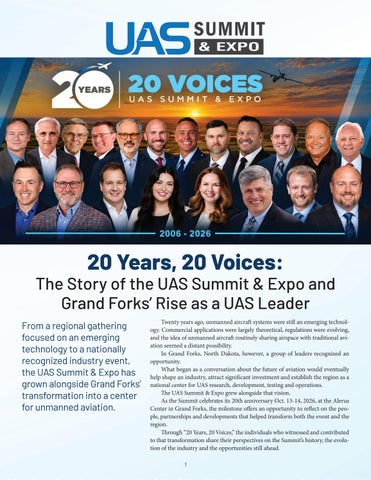
20 Years, 20 Voices:
The Story of the UAS Summit & Expo and Grand Forks’ Rise as a UAS Leader From a regional gathering focused on an emerging technology to a nationally recognized industry event, the UAS Summit & Expo has grown alongside Grand Forks’ transformation into a center for unmanned aviation.
Twenty years ago, unmanned aircraft systems were still an emerging technology. Commercial applications were largely theoretical, regulations were evolving, and the idea of unmanned aircraft routinely sharing airspace with traditional aviation seemed a distant possibility. In Grand Forks, North Dakota, however, a group of leaders recognized an opportunity. What began as a conversation about the future of aviation would eventually help shape an industry, attract significant investment and establish the region as a national center for UAS research, development, testing and operations. The UAS Summit & Expo grew alongside that vision. As the Summit celebrates its 20th anniversary Oct. 13-14, 2026, at the Alerus Center in Grand Forks, the milestone offers an opportunity to reflect on the people, partnerships and developments that helped transform both the event and the region. Through “20 Years, 20 Voices,” the individuals who witnessed and contributed to that transformation share their perspectives on the Summit’s history, the evolution of the industry and the opportunities still ahead. 1
UAS SUMMIT & EXPO 20 YEARS, 20 VOICES General Norton Schwartz, Air Force Chief of Staff, addresses Airmen from Grand Forks Air Force Base, N.D. during a visit to the base May 20 to 21, 2010. PHOTO: GFAFB
2007: Cropcam Drone
Unmanned aviation emerged as a promising direction. Former U.S. Sen. Byron Dorgan was among the leaders advocating for a Global Hawk mission at Grand Forks Air Force Base and expanded UAS research at UND. “I was pleased to play a pivotal role in establishing the new UAS/UAV hub and industry in Grand Forks North Dakota with the Grand Forks Air Base and the University of North Dakota,” Dorgan said. “I was joined by many others in federal and state governments who saw the opportunity to create something new and exciting.” Dorgan also helped establish a Department of Defense Center of Excellence at UND, creating new opportunities for research and partnerships between the university and military. In 2006, he hosted the first UAS Action Summit, bringing together stakeholders interested in the future of unmanned aviation. Delore Zimmerman, president of Praxis Strategy Group and one of the Summit’s original organizers, remembers how undefined the industry was at the time. “The industry and the UAS landscape were both relatively undefined in 2005,” Zimmer‘A new industry is man said. “The defense appliabout to take off in cations, particularly related to the Red River Valley ISR, were easier to understand Research Corridor.’ than the full array of potential
The Early Years: Recognizing an Opportunity
The story of the UAS Summit begins before the event itself. In 2002, U.S. Sen. Byron Dorgan established the Red River Valley Research Corridor, an initiative designed to attract research investment, encourage collaboration and create economic opportunities across eastern North Dakota and northwestern Minnesota. Anchored by the University of North Dakota and North Dakota State University, the Research Corridor brought together academic institutions, government agencies, military leaders and private industry. The 2005 Base Realignment and Closure process created uncertainty surrounding Grand Forks Air Force Base. With the base’s tanker mission scheduled to leave, federal, state and local leaders began working to secure a new mission and identify opportunities that could build on the region’s aviation expertise. 2007: UAS Summit
2
UAS SUMMIT & EXPO 20 YEARS, 20 VOICES
2007: North Dakota Senator Byron Dorgan
2007: Dean of John D. Odegard School of Aerospace Sciences Bruce Smith
2007: U.S. Deputy Assistant Secretary of Defense Dyke Weatherington
commercial applications. Our two biggest assets and selling points relevant to the Grand Forks area were pilot training at UND Aerospace and of course the Air Force Base, which had a strong history of adapting to new missions.” The first Summit carried an ambitious theme: “A New IndusAs unmanned aviation gained attention, Grand Forks began try is About to Take-Off in the Red River Valley Research Corriturning its early vision into operational capabilities and educador.” The gathering brought together military leaders, government tional opportunities. In 2009, UND launched the nation’s first unofficials, researchers, educators and businesses to explore how the dergraduate degree program in UAS operations, helping establish region could become a leader in the emerging industry. a pipeline of professionals trained specifically for the emerging Dr. Mark Askelson, UND associate vice president for research, industry. national security recalls how those early conversations helped esMeanwhile, Grand Forks Air Force Base was preparing for tablish the foundation for what followed. “I was there practically an expanded role in unmanned aviation, with Global Hawk opfrom the very beginning, so to be honest, it sort of didn’t exist,” erations strengthening the region’s military presence. Northrop Askelson said of the early UAS landscape. “It kicked off, as memoGrumman, General Atomics and other aerospace companies bery serves, with a series of meetings driven by Gen Haugen. Those came increasingly involved in the growing ecosystem. resulted in a strategy that helped grow what we have today.” Mike Fridolfs, Grand Sky site director for Northrop GrumThe early Summit reflected that same collaborative approach. man Corp., recalls the importance of the company’s relationship “It, of course, was much smaller and more intimate,” Askelson said. with Grand Forks. “Northrop Grumman and Grand Forks have “But, some of the same elements were there, with federal leaders always had a very tight relationship,” Fridolfs said. “It solidified (senators) supporting heavily, early industry partners contributafter the BRAC when NG realized there was a real opportunity to ing, state and local leaders engaged, and UND engaged.” fly UAS here.” Chris Theisen, executive director of UND’s Research InstiThe Summit was also attracting professionals from outside tute for Autonomous Systems, remembers the university’s early the region. Nicholas Flom, UAS account and portfolio director at role in advancing unmanned aviation. “At that time, the UAS Thales USA, first attended in 2010 industry was just getting started in the Grand Forks region,” while supporting military UAS Theisen said. “Much of the activities were at the University training programs. “The first time of North Dakota through the College of Aerospace Sciences I came to the UAS Summit was in under research programs sponsored by the DOD, and a lot 2010, I was supporting courseware ‘A vision for of the prior UAS knowledge and experience was tied up in development of the MQ-1 for the unmanned aviation military systems.” USAF and our prime contract was Those early investments in research, education and milwas becoming an presenting,” Flom said. “At that itary partnerships would become essential to the region’s industry.’ time, DOD-type operations were growth. being highlighted, everything from
2009-2013: From Emerging Technology to National Recognition
3
UAS SUMMIT & EXPO 20 YEARS, 20 VOICES
2011: Global Hawk
the types of missions being flown using this technology to the lessons learned for early operations. The group was small, but you could tell that the messaging needed to be shared.” Flom remembers an event that was still largely focused on local military operations and research, but was beginning to attract interest from organizations that could support the industry’s expansion. The Summit’s national profile continued growing. In 2011, Michael Toscano, then president and CEO of the Association 2013: Senator John Hoeven at Red River Valley Research Corridor Event for Unmanned Vehicle Systems International, delivered a keynote address, helping reinforce North DaUAS test site locations. The designation was a major milestone, kota’s emerging position in the national UAS conversation. bringing new opportunities for research, flight testing and indusThe following year, the Summit adopted the theme “From try development. Battlefield to Farm Field,” reflecting growing interest in commercial applications, including precision agriculture. Federal policy was also beginning to change. The FAA Modernization and Reform Act of 2012 directed the Federal Aviation Administration to advance the integration of unmanned aircraft into the national airspace system. The Northern Plains UAS Test Site became operational in Zimmerman recalls the significance of that shift. “One of the 2014, establishing a platform for testing unmanned aircraft techmost consequential policy developments was the FAA Modernnologies and developing procedures to safely integrate them into ization and Reform Act of 2012,” Zimmerman said. “Congress dithe national airspace. rected the FAA toward integration of unmanned aircraft into the Trevor Woods, executive director of the Northern Plains National Airspace System.” UAS Test Site, remembers attending the Summit as a UND flight In March 2013, Northrop Grumman committed to becoming instructor during the industry’s earlier years. “I recall the UAS an anchor tenant at the planned Grand Sky development, signalSummit was still ‘early,’ and remember attending under student ing growing private-sector confidence in the region. credentials, leveraging my UND Flight Instructor status withLater that year, the FAA selected North Dakota as one of six in UND,” Woods said. “It was absolutely eye-opening just how
2014-2015: Building the Industry’s Infrastructure
4
UAS SUMMIT & EXPO 20 YEARS, 20 VOICES
2015: UAS Summit & Expo Ballroom
many questions and challenges were in front of UAS that needed to be addressed.” Woods saw an opportunity to become involved in an industry that was still defining itself. “No one could predict what would come of this, but I was excited for any opportunity to be involved,” he said. “I started networking with anyone I could connect with to be involved.” Another milestone followed in 2015 with the establishment of Grand Sky, the nation’s first commercial UAS business and aviation park. Located at Grand Forks Air Force Base, Grand Sky was developed to provide infrastructure and operating space for companies involved in UAS research, testing, training and commercialization. Thomas Swoyer, founder and president of Grand Sky, recalls the challenges of establishing a commercial UAS operating environment when few models existed. “When we started Grand Sky, there wasn’t a playbook for commercial UAS operations,” Swoyer said. “We had to build the infrastructure, build the partnerships and figure it out step by step. What’s exciting is that what started as a vision in Grand Forks has become a real operating ecosystem. The next 20 years will be about taking what we’ve built here and connecting it to the broader future of autonomous flight.” Grand Sky became home to major aerospace companies, including Northrop Grumman and General Atomics, and provided another important connection between military aviation, research and commercial development. For Zimmerman, the establishment of the test site and Grand Sky represented a turning point. “The designation of the Northern Plains UAS Test Site in 2014 and the standup of Grand Sky in 2015 were concrete signals that the UAS sector had potential to greatly impact Grand Forks and North Dakota,” Zimmerman said. These developments demonstrated that Grand Forks was
2014: Lt Col Castellanos and summit attendees at the proposed Grand Sky site
2015: Networking at the UAS Summit & Expo
5
UAS SUMMIT & EXPO 20 YEARS, 20 VOICES
2015: Col. Rodney Lewis, Commander of 319th Air Base Wing at GFAFB
2015: Col. Christopher Larson, 69th Reconnaissance Group commander
In 2015, BBI International began producing the UAS Summit & Expo, bringing its publishing and conference experience to the established regional event. At that time, the Summit attracted approximately 400 attendees and 30 ‘A vision for exhibitors. unmanned aviation Danielle Piekarski, content and program manager for moving beyond discussions of unwas becoming an UAS Magazine, sees a close connection between the pubmanned aviation’s potential and beindustry.’ lication’s mission and the Summit’s role in bringing the ginning to build the infrastructure industry together. “When we started publishing UAS Magnecessary to support a lasting indusazine in 2014, we saw a need for a dedicated platform to try. connect the people developing these technologies with the people trying to understand and implement them,” Piekarski said. “The Summit provides that same connection in person. Over the years, I’ve watched the conversations become more soAs the UAS industry expanded, so did the need for dedicated phisticated as the industry has matured. What makes the Summit coverage of its technologies, companies and commercial oppor- special is that it brings together people from different parts of the tunities. Recognizing that need, BBI International launched UAS ecosystem who might not otherwise be in the same room.” Magazine in the fourth quarter of 2014. The publication was creUnder BBI’s involvement, the Summit expanded its national ated to connect manufacturers, operators, technology developers reach while maintaining its connection to Grand Forks and the and decision-makers across the civil, agricultural, defense and organizations that helped establish the region’s UAS ecosystem. commercial UAS markets. The programming evolved John Nelson, chief operating officer of BBI International and alongside the industry, with UAS Magazine, recalls the activity that prompted BBI’s involve- growing attention to commercial ment. “I started getting involved when BBI International decided operations, airspace integration, to launch UAS Magazine, because we were seeing all of the activity military applications, emerging ‘One industry. One taking place on both national and local stages,” Nelson said. He technologies and the business conversation. A remembers the important work already underway in the region, opportunities associated with ungrowing platform to particularly through the Red River Valley Research Corridor and manned aviation. connect them.’ its early advocates.
A New Chapter: UAS Magazine and BBI International
6
UAS SUMMIT & EXPO 20 YEARS, 20 VOICES
2016-2023: Building an Ecosystem and Advancing Beyond Visual Line of Sight
As the UAS industry matured, Grand Forks continued building the infrastructure, partnerships and workforce necessary to support sustained growth. The region’s development was never the result of a single organization. Instead, it reflected collaboration among government, military, education, economic development and private industry. Keith Lund, president and CEO of the Grand Forks Region Economic Development Corp., believes that collaboration remains one of the region’s greatest strengths. “The UAS Summit is a critically important annual event for Grand Forks,” Lund said. “It celebrates the growth of our ecosystem while giving Grand Forks and North Dakota an important platform to showcase our expanding capabilities, strong business climate, and get-to-yes approach—qualities that help attract industry investment.” For Barry Wilfahrt, president and CEO of The Chamber of Grand Forks and East Grand Forks, the Summit has provided an opportunity to connect the region’s assets with new businesses and industry partners. “The Chamber has been part of the UAS Summit since day one because we recognized early that unmanned aviation could become a transformational opportunity for Grand Forks and North Dakota,” Wilfahrt said. “We saw the combination of UND’s aviation expertise, the missions at Grand Forks Air Force Base,
2020: Mark Askelson at the UAS Summit & Expo virtual event PHOTO: UNIVERSITY OF NORTH DAKOTA
2017: Live demonstrations at the UAS Summit & Expo
7
UAS SUMMIT & EXPO 20 YEARS, 20 VOICES
strong state leadership and an emerging private-sector industry as something very special. The Summit became one of the ways we could bring those pieces together and tell the Grand Forks story nationally.”
Vantis: Taking UAS Operations Beyond the Horizon
One of the most consequential developments in North Dakota’s UAS history came as the state began addressing a challenge that had been central to the industry for years: How could unmanned aircraft safely operate beyond the visual line of sight of their pilots? While unmanned aircraft technology was advancing rapidly, the infrastructure and regulatory approvals needed to support routine beyond-visual-line-of-sight (BVLOS) operations remained significant barriers to widespread commercial adoption. North Dakota responded by investing in a statewide UAS network designed to make those operations safer, more practical and more accessible. In 2019, the state committed an initial $28 million to developing the network. The following year, it introduced Vantis, the nation’s first statewide UAS BVLOS network, administered by the Northern Plains UAS Test Site. Rather than requiring each operator to develop its own airspace surveillance and communications infrastructure, Vantis was designed to provide shared capabilities that could support commercial and public UAS operations. The network combines surveillance technology, communications systems, data infrastructure and a centralized operations center to help support a safe flight beyond a pilot’s direct visual observation. The initiative represented an important shift in North Dakota’s UAS strategy. The state was no longer focused solely on attracting companies, supporting research or providing locations for flight testing; it was investing in infrastructure intended to make more routine unmanned aircraft operations possible. The groundwork for Vantis had been laid through years of collaboration among the Northern Plains UAS Test Site, UND, state leaders, federal regulators and private industry. Nicholas Flom, UAS account and portfolio director at Thales USA, recalls a pivotal conversation during the 2015 UAS Summit involving the FAA, Northern Plains UAS Test Site and General Atomics. “The Summit brings people together, the sessions educate the community, but having key stakeholders show up for side discussions make the biggest impact,” Flom said. That meeting helped establish the foundation for future BVLOS operations in North Dakota, Flom continued, including the use of Air Force radar to support General Atomics’ flight training activities. The relationships and experience developed through those early efforts helped position North Dakota to pursue more ambitious infrastructure projects.
2023: Expo Hall
2019: Expo Hall
2022: Senator Hoeven and Stratolauch
2023: UAS Summit & Expo Main Stage
8
UAS SUMMIT & EXPO 20 YEARS, 20 VOICES
2018: UAS Summit & Expo Ballroom
2016: Delore Zimmerman
2016: North Dakota Senator Byron Dorgan
2019: Ballroom
2018: Expo Hall
9
2024: Palmer Luckey
UAS SUMMIT & EXPO 20 YEARS, 20 VOICES
2021: UAS Summit & Expo Ballroom
In 2021, Thales was selected as the long-term systems integrator for Vantis, supporting the network’s design, operations and maintenance. In June 2022, the Vantis Mission and Network Operations Center officially opened at Grand Sky, connecting two of the state’s most significant UAS investments. Trevor Woods, executive director of the Northern Plains UAS Test Site, has helped guide the development of Vantis, including the work needed to establish its safety and regulatory foundation. In a 2021 announcement about Vantis testing, Woods emphasized the responsibility associ‘North Dakota ated with developing new capabilmoved beyond ities. “Vantis is blazing a new trail testing the in UAS operations, and we take possibilities of that responsibility very seriously,” UAS to building the Woods said. Today, Vantis is one of the cainfrastructure for pabilities that distinguishes North everyday Dakota’s UAS ecosystem. Its deoperations.’ velopment has helped move the conversation beyond individual test flights toward the broader challenge of making UAS operations repeatable, scalable and economically viable. That evolution also reflects the progression of the UAS Summit itself. What began as discussions about whether unmanned aircraft could operate in the national airspace has developed into conversations about building the infrastructure and systems needed to make those operations a routine part of aviation.
2023: Senator Hoeven Award Winner
2022: Exhibitors
10
UAS SUMMIT & EXPO 20 YEARS, 20 VOICES
‘Building the talent and technology shaping the future of UAS.’
2024: UAS Summit & Expo Ballroom
presentation about what exists here. You can show them slides about UND, Grand Sky, the Northern Plains UAS Test Site, Vantis, the Air Force Base and companies like General Atomics,” she said. “But when they actually come here and see how close everything is, meet the people involved and understand how interconnected it all is, the story makes much more sense.”
Developing the Next Generation of UAS Professionals
As infrastructure and technology advanced, the region also continued investing in education, research and workforce development. UND’s UAS programs expanded opportunities for students interested in unmanned aviation, while Northland Community and Technical College contributed specialized training in UAS maintenance and repair. The North Dakota National Guard remained part of the broader unmanned aviation and defense ecosystem, including training and counter-UAS efforts. In 2023, the HIVE opened in downtown Grand Forks, providing a collaborative workspace and technology accelerator focused on supporting UAS-related businesses and innovation. Paul Snyder, director of UAS operations at UND, has watched the opportunities available to graduates expand. “It has been exciting to watch the opportunities for UAS Operations graduates to continue to grow,” Snyder said. “We started from only a handful of companies, many with military connections; to an exponential growth in civilian commercial market not only in North Dakota, but throughout the nation.” For Erin Roesler, director of air systems training at General Atomics Aeronautical Systems, the Summit offers something particularly valuable: the opportunity to see how the different organizations and capabilities work together. “For me, the Summit has always been more than a conference,” Roesler said. “It’s the place where we get to invite people into the ecosystem and say, come see this for yourself.” Roesler believes the region’s story becomes more compelling when visitors experience it firsthand. “You can give someone a
The Summit: A Place Where Connections Become Opportunities
As Grand Forks’ UAS ecosystem expanded, the Summit became more than a venue for discussing new technology. It also became a place where relationships were established, challenges were addressed and new opportunities emerged. Flom recalls a particularly important example from 2015, when representatives from the FAA, the Northern Plains UAS Test Site and General Atomics connected during the Summit. According to Flom, that meeting helped establish the groundwork for future BVLOS operations and the use of Air Force radar to support General Atomics’ flight training activities. For Matt Dunlevy, founder and president of the North Dakota Unmanned Autonomous Systems Council, those connections are central to the event’s value. “What is remarkable in retrospect is how many things that were initially ideas became institutions,” Dunlevy said. “UND developed UAS education and research programs, military UAS missions came to the region, companies arrived, the Northern Plains UAS Test Site was created, and Grand Sky as well.” Dunlevy believes the Summit has played an important role
11
UAS SUMMIT & EXPO 20 YEARS, 20 VOICES
2024: UAS Summit & Expo Registration
2024: Senator Hoeven and Maj. Gen. David Stewart, Director, Counter UAS Office 2025: Award Recipient Erin Roesler
‘Where connections spark collaboration, and ideas become industry-changing opportunities.’
2025: Expo Hall
turn. “The Summit as the networking fusion center to advance the ecosystem here in North Dakota is what attracts me every year,” Berchoff said. “It is about connecting the dots or strengthening the bonds that allow business to thrive and grow. It is about continual learning through the experiences of others and remaining plugged into the rapidly changing operational and technology environment.”
in bringing those developments together. “You put the right people in the same place and they start solving problems together,” he said. That collaborative environment has helped attract companies working on increasingly sophisticated aerospace technologies. Zachary Krevor, CEO and president of Stratolaunch, said the region’s approach to innovation was an important factor in the company’s interest in Grand Forks. “We came to Grand Forks and the UAS Summit because of the strong alignment of the community, local civic leaders, and the North Dakota delegation to autonomous vehicles,” Krevor said. “Few places in the country combine such a forward-leaning regulatory environment, an engaged research community, and a strong public-private partnership model.” For Don Berchoff, CEO of TruWeather Solutions, the event’s ability to connect organizations remains a major reason to re-
2024-2026: A Changing Industry and New Opportunities
Twenty years after the first Summit, unmanned aviation has changed dramatically. What began largely as a discussion about military applications and emerging research has expanded into commercial operations, public safety, agriculture, advanced sensing, artificial intelligence, autonomous systems and counter-UAS technology. The industry is no longer focused solely on whether unmanned aircraft can operate in the national airspace.
12
UAS SUMMIT & EXPO 20 YEARS, 20 VOICES
2025: Expo Ribbon Cutting
2024: UND President Andrew Armacost and students
2025: John Nelson, UAS Magazine 2025: Main Stage
the need for technologies that enable safe operations has also increased. Kraettli Epperson, CEO of Vigilant Aerospace Systems Inc., has watched the Summit evolve alongside those challenges. “The UAS Summit has been a touchstone for the past 11 years of Vigilant Aerospace’s existence, growing in national importance, value and knowledge sharing,” Epperson said. “It has become a critical annual event for Vigilant and for me. We renew important relationships each year, engage in new and ongoing discussions with partners and friends, and learn a tremendous amount in a professional environment that blends business, government policy and technology development in equal proportions.” Military applications have also entered a new phase, with growing emphasis on autonomy, advanced sensing, counter-UAS capabilities and the protection of military installations. Col. Alfred J. Rosales, commander of the 319th Reconnaissance Wing at Grand Forks Air Force Base, sees both opportunities and challenges in that evolution. “The biggest difference I see is the scale of the opportunity and the scale of the challenge,”
Increasingly, the discussion centers on how they can operate safely, efficiently and routinely alongside traditional aviation. For Roesler, that transition represents one of the industry’s greatest accomplishments. “In some ways, normalization is the victory,” she said. “Twenty years ago, I think people imagined success would look like everybody watching us. Instead, some of our greatest success is that these operations can happen and nobody thinks twice about them.” JC Van Liere, CEO of KAZE Drones Inc., has witnessed the technological changes firsthand. “I first got involved in the UAS industry in late 2015, flying the MQ-5B Hunter for Northrop Grumman in Afghanistan,” Van Liere said. “Back then, most of my experience was with larger military drones that required a lot of people, equipment and infrastructure to operate. Those larger platforms still have their place, but we’re seeing smaller, cheaper drones doing things that would have been hard to imagine just ten years ago.” As unmanned aircraft become more accessible and capable, 13
UAS SUMMIT & EXPO 20 YEARS, 20 VOICES
gether industry leaders, researchers, government, military and innovators to showcase the groundbreaking work happening in North Dakota while attracting new companies and investment to the region,” Nelson said. “It demonstrates why North Dakota has become one of the world’s leading environments for UAS research, testing and commercialization—and an increasingly important hub for defense innovation.” The next 20 years will undoubtedly bring challenges and opportunities that are difficult to predict today. Grand Forks and North Dakota, however, enter that future with capabilities that would have been difficult to imagine when the first UAS Action Summit convened in 2006. The region has built a nationally recognized UAS ecosystem that combines UND’s aviation education and research, the military missions at Grand Forks Air Force Base, the Northern Plains UAS Test Site, Grand Sky’s commercial operating environment, Vantis’ beyond-visual-line-of-sight infrastructure and a growing network of aerospace companies and technology innovators. Each represents a different piece of the larger effort to move unmanned aviation from an emerging concept toward routine operations. The 2026 UAS Summit & Expo is expected to draw more than For those who helped establish the original Summit, the an800 attendees, with with all 67 exhibit spaces sold out. The event niversary represents the realization of a vision that began when has grown significantly since BBI International became involved unmanned aviation was still an emerging industry. in 2015, reflecting both the expanding industry and Zimmerman, one of the SumGrand Forks’ continued role in its development. mit’s original organizers, sees the This year’s programming includes military and region’s transformation as a signifigovernment operations, counter-UAS technology, infra‘Twenty years cant accomplishment. “The summit structure, beyond-visual-line-of-sight operations, comand the industry are now internaof innovation, mercialization, autonomy and artificial intelligence. tional and Grand Forks is rightfully collaboration and The Summit also continues creating opportunities recognized globally as an epicenter growth—and the for emerging companies through initiatives such as of innovation and implementation,” next chapter of UAS Pitch Day, connecting entrepreneurs with investors and Zimmerman said. “We don’t just industry leaders. is just taking test UAS here; we have built a place For Piekarski, the next chapter of the industry will flight.’ where the UAS industry can operdepend on advances in technology and the systems ate.” needed to support their use. “I think autonomy and AI For Dorgan, the anniversary will fundamentally change what UAS can do,” Piekarski offers an opportunity to recognize said. “We’re moving beyond remotely piloted aircraft toward sys- the progress made since that first gathering. “Now, 20 years later, tems that can make decisions, adapt to changing conditions and the UAS Summit will celebrate the opportunity that existed two perform increasingly complex missions with less human interven- decades ago and the progress that has been made in the last twenty tion. At the same time, regulation and airspace integration will be years,” he said. just as important as the technology itself.” Twenty years ago, regional leaders came together around a Rosales believes the next generation of UAS professionals will shared belief in the future of unmanned aviation. need to develop expertise that extends beyond aviation. “They Today, that vision has helped transform Grand Forks into a need to understand data, cybersecurity and the limits of auto- nationally recognized center for UAS innovation. mation,” Rosales said. “They should be comfortable asking: What The technology has changed. The industry has grown. The opinformation is this system using? How do we know its output is portunities have expanded. But the importance of bringing people reliable? What happens when navigation or communications are together to move the industry forward remains as relevant as ever. disrupted? When does a person need to intervene?” Twenty years. Thousands of conversations. One evolving inFor Nelson, the Summit’s growth reflects the region’s abili- dustry. And the next chapter is already taking flight. ty to continue attracting investment, building relationships and expanding into new technologies. “The UAS Summit brings to-
Rosales said. “Remotely piloted aircraft have a long history of delivering military capability. Today, the conversation reaches much further into commercial aviation, public safety, agriculture and the security of our installations.” The 319th Reconnaissance Wing’s Point Defense Battle Lab represents one example of how Grand Forks continues contributing to emerging defense capabilities. Rosales said the lab helps airmen evaluate technology and develop tactics to protect military installations against small unmanned aircraft. “At the 319th, we see both sides of that evolution,” he said. “Our reconnaissance experience gives us an appreciation for what unmanned aircraft contribute to the mission. Our Point Defense Battle Lab role puts us directly into the challenge of protecting that mission against small unmanned aircraft.” That work reflects a broader evolution in the UAS industry, where unmanned aircraft are both important operational tools and emerging security challenges.
Celebrating 20 Years and Looking Ahead
14