Customer Service Coordinator Brandon McGarry brandon.mcgarry@bbiinternational.com
EDITORIAL BOARD
Ringneck Energy Walter Wendland Commonwealth Agri-Energy Mick Henderson Western Plains Energy Derek Peine Front Range Energy Dan Sanders Jr.
Customer Service Please call 1-866-746-8385 or email service@bbiinternational.com. Subscriptions Subscriptions to Ethanol Producer Magazine are free of charge with the exception of a shipping and handling United States. To subscribe, visit www.EthanolProducer.com/Subscribe, send an email to subscriptions@bbiinternational.com or call 866746-8385. Back Issues, Reprints and Permissions Select back issues are available for $3.95 each, plus shipping. Article reprints are also available for a fee. For more information, contact us at 866-746-8385 or service@bbiinternational.com.
Advertising Ethanol Producer Magazine provides a specific topic delivered to a highly targeted audience. We are committed to editorial excellence and high-quality print production. To find out more about Ethanol Producer Magazine advertising opportunities, please contact us at 866-746-8385 or service@bbiinternational.com. Letters to the Editor We welcome letters to the editor. Send to: Ethanol Producer Magazine Letters to the Editor, 308 2nd Ave. N., Suite 304, Grand Forks, ND, 58203, or editor@bbiinternational.com. Please include contact information. Letters may be edited for clarity or space.
Upcoming Events
2026 North American SAF Conference & Expo August 25-27, 2026
Greater Tacoma Convention Center | Tacoma, Washington (866) 746-8385 | www.SAFConference.com
Taking place August 25-27, 2026 in Tacoma, Washington, the North American SAF Conference & Expo, produced by SAF Magazine, in collaboration with the Commercial Aviation Alternative Fuels Initiative (CAAFI) will showcase the latest strategies for aviation fuel decarbonization, solutions for key industry challenges, and highlight the current opportunities for airlines, corporations and fuel producers. The North American SAF Conference & Expo is designed to promote the development and adoption of practical solutions to produce SAF and decarbonize the aviation sector. Exhibitors will connect with attendees and showcase the latest technologies and services currently offered within the industry. During two days of live sessions, attendees will learn from industry experts and gain knowledge to become better informed to guide business decisions as the SAF industry continues to expand.
2027 International Biomass Conference & Expo
March 2-4, 2027
Cobb Convention Center | Atlanta, Georgia (866) 746-8385 | www.BiomassConference.com
Now in its 20th year, the International Biomass Conference & Expo is expected to bring together more than 1000 attendees, 180 exhibitors and 100 speakers from more than 25 countries. It is the largest gathering of biomass professionals and academics in the world. The conference provides relevant content and unparalleled networking opportunities in a dynamic businessto-business environment. In addition to abundant networking opportunities, the largest biomass conference in the world is renowned for its outstanding programming—powered by Biomass Magazine–that maintains a strong focus on commercial-scale biomass production, new technology, and near-term research and development. Join us at the International Biomass Conference & Expo as we enter this new and exciting era in biomass energy.
2027 International Fuel Ethanol Workshop & Expo
June 14-16, 2027
CHI Health Center | Omaha, Nebraska (866) 746-8385 | www.FuelEthanolWorkshop.com
Now in its 43rd year, the FEW provides the ethanol industry with cutting-edge content and unparalleled networking opportunities in a dynamic business-to-business environment. As the largest, longest running ethanol conference in the world, the FEW is renowned for its superb programming—powered by Ethanol Producer Magazine —that maintains a strong focus on commercialscale ethanol production, new technology, and near-term research and development. The event draws more than 2,500 people from over 31 countries and from nearly every ethanol plant in the United States and Canada.
Focused On Potential
While this issue of Ethanol Producer Magazine explores fermentation, markets, policy, feedstock use and the industry’s remarkable near-term outlook, the overarching theme is potential. Potential in yeast innovation, in the maritime market, in domestic and export markets, in D3 RIN feedstock blend optimization, in California policy advancements and more.
Our coverage this month puts a fine point on a promising U.S. ethanol environment, the likes of which we haven’t seen in years.
In our lead feature article, we examine the constant innovation coming from yeast and enzyme providers. They never rest. As markets shift in response to carbon intensity incentives or price volatility, these experts seem to easily adapt to producer needs and desires, ensuring their products perfectly achieve ever-evolving goals with no unwanted side effects. Central to this innovation, of course, is yield maximization and robustness. See what the top yeast and enzyme developers say about their newest products, starting on page 16.
Next, we take a deep dive into the maritime market—a prospect for U.S. ethanol that some experts say is bigger than the parallel opportunity of sustainable aviation fuel. More than 100 ships on the water today are designed to run on methanol and could easily use ethanol. Another 300-plus clean-fuel vessels will leave shipyards over the next 18 months. The market has far fewer hurdles than the SAF market and the first movers in the space are already buying their ethanol-fueled ships. Find it on page 24.
Perhaps the clearest picture of the upcoming boom in ethanol is outlined in the article starting on page 32. The experts explain the factors driving a market boasting more favorability than we’ve seen in 20 years, including incentives, global conflict impacting oil supply and demand, E15 and cost benefits, record-high Renewable Volume Obligations, and already record-high exports. Ethanol seems to be on top.
Edeniq and IFF have been hard at work on research to pinpoint the optimal sorghum/corn blend for D3 renewable identification number (RIN) generation. It’s not a simple project, with its many complex factors to consider, but the teams were meticulous in their work and released their results earlier this year. Learn what they found on page 38.
Last, we outline the current ethanol potential in California, with progress on allowing E85 conversion kits—which would boost the blend’s already robust in-state presence—and the details of E15 implementation getting worked through. It’s on page 46.
With domestic and international markets growing, this industry is poised to take off, again. Clearly, it’s a good time to be in ethanol.
-The Editors
As
From
E15 Proves It: Bipartisanship Is Not Dead
May 13 will go down in ethanol industry history books as a watershed day for our nation’s renewable fuel producers, farmers and consumers. On that day, the House of Representatives passed HR 1346, the Nationwide Consumer and Fuel Retailer Choice Act, by a vote of 218-203. The bill, which headed to the Senate upon passage by the House, allows year-round, nationwide sales of E15 and makes targeted reforms to the Renewable Fuel Standard’s small refinery exemption (SRE) program. While the final vote tally itself may at first appear unremarkable and ordinary, a deeper look reveals just how noteworthy and unusual this vote really was.
First, it is exceedingly rare for stand-alone legislation on a narrow policy issue to get time for debate and a vote on the House floor. In recent years, this type of bill has almost always been attached to a larger package of must-pass legislation to ensure it has a chance of advancing out of the House. Indeed, stand-alone legislative proposals typically die a quiet death in the committee of jurisdiction. But, given the urgency of bringing lower-priced fuel to the pump and supporting America’s farmers, HR 1346 took a much different path to the House floor.
Second, neither party’s leadership team took a position on the bill. House Speaker Mike Johnson (RLA) and Majority Leader Steve Scalise (R-LA) didn’t whip Republican votes on the bill; in fact, they both voted “no” on it. The only instruction they gave to Republican members was to “vote your conscience.” Minority Leader Hakeem Jeffries (D-NY) and Minority Whip Katherine Clark (D-MA) both voted “yes,” but also didn’t provide any voting recommendations to House Democrats. It is incredibly unusual for a bill to pass when leaders from both parties take a hands-off approach and stay on the sidelines.
Third, and most remarkable, the vote on HR 1346 was truly bipartisan and showed a broad base of support across the political and geographical spectrum. The final tally showed that 122 Republicans joined with 95 Democrats and the House’s lone Independent to vote “yes” on the bill. This is an incredibly rare feat. In an era of bitter partisan divisiveness and tribalism, the vote on HR 1346 served as a bright beacon of hope that bipartisanship and cooperation are not dead. Even a handful of far-right Freedom Caucus members voted in favor of the bill; and on the far left, more than two dozen members of the Congressional Progressive Caucus voted “yes.”
The vote proved that year-round E15 and SRE reform are not just “Corn Belt” issues. Rather, they are pocketbook issues important to every American household. Yes, representatives from farm states like Illinois, Indiana, Iowa, Minnesota, Nebraska, Ohio and the Dakotas overwhelmingly voted in favor of the bill. But entire House delegations from Alaska, Kentucky, Mississippi, Nevada and West Virginia also voted unanimously in support. The bill also saw plenty of “yes” votes from members representing districts in Florida, Georgia, North Carolina, New York, and even Texas.
How did this happen? It all started with a broad coalition of supportive, active and effective stakeholders. Over the past several years, RFA has helped build a year-round E15 advocacy juggernaut that includes oil refiners, farmers, fuel retailers, veterans, consumer groups and other important voices.
But more generally, HR 1346 is simply good policy. Allowing year-round access to E15 and reining in SREs will lower prices at the pump, deliver cleaner air, support the farm economy and strengthen our nation’s energy security. Who wouldn’t be in favor of that?
Now the ball is in the Senate’s court, and we are urging the upper chamber to follow the House’s lead. Our message is clear: embrace bipartisanship and collaboration, follow the science, ignore the noise and misinformation from opponents, and act swiftly to make year-round E15 a permanent reality. We’re counting on you.
Geoff Cooper President and CEO
Renewable Fuels Association
Is Europe Changing Its Mind On Biofuels (Again)?
The last 10 years of biofuels policy in the European Union have been challenging, not just for an industry looking for some investor confidence, but also for anyone who wants to see more renewable energy in transport.
During that time, the EU ethanol sector has faced several threats of extinction from misguided European Commission proposals aimed at phasing out the use of crop-based biofuels, even though they are the main renewable energy source in EU transport.
But lately there’s been a change of tone from some key EU policymakers, who now talk about the importance of “homegrown” renewable energy sources, including biofuels, as Europe searches for ways to reduce its dependence on imported oil.
Take a look at some recent quotes from top EU officials since the start of the Iran war.
In March, Christophe Hansen, the European Commissioner in charge of agriculture policy, talked about how EU ethanol biorefineries could be better used to boost domestic food and fuel production. “There is a huge potential to do more,” Hansen said. “We have refineries all over Europe and all of them are under their maximum capacity.”
Hansen also shot down the long-running “food vs. fuel” myth that has been used by anti-biofuel lobbyists to impose limits on how much crop-based biofuels can count toward EU renewable energy targets—limits that have left the EU needlessly over-reliant on fossil fuel for transport.
“The ‘tank vs. plate’ dilemma belongs to the past,” Hansen said.
But there was more to come. As EU leaders scrambled to combat the energy crisis created by the Iran conflict, a statement from the Commission’s Directorate for Energy said: “Increasing the uptake of biofuels could help substitute for fossil petroleum products and alleviate pressure on the market.”
Then the European Commission released its AccelerateEU plan aimed at assuring EU energy security and reducing dependence on foreign oil, in which it also calls for increased domestic EU production of sustainable biofuels.
But perhaps the most noteworthy words came from the president of the European Commission, Ursula von der Leyen. In a speech to the European Parliament, von der Leyen said: “We must reduce our overdependency on imported fossil fuels and boost our home-grown, affordable, clean energy supply.”
But von der Leyen has gone even further than that. In a letter to German members of the European Parliament, she specifically mentioned E20, a petrol blend with up to 20% renewable ethanol, as a viable alternative to fossil fuel with lesser amounts of biofuel and suggested the Commission would look at updating the EU’s Fuel Quality Directive to authorize its use.
“The Commission confirms the role that higher biofuel blending can play in decarbonizing existing vehicle fleets,” von der Leyen wrote. “As part of the revision of the policy framework for fuels, the Commission will consider authorizing higher ethanol contents (E20).”
These are welcome signs that the Commission recognizes the strategic importance of EU renewable ethanol biorefineries producing food, feed, fuel and biogenic CO2 to help achieve Europe’s goals for transport decarbonization, energy independence, food security, and industrial and agricultural autonomy.
Let’s hope the words will be followed up with actions to unleash the potential of the EU renewable ethanol industry for replacing fossil fuel, giving European citizens access to cheaper renewable energy sources, boosting food and feed production, and supporting agriculture and industry.
Craig Winneker
Acting Secretary General of ePURE, the European Renewable Ethanol Association
REMOVING SOLIDS FROM WASTEWATER
Yo ur wa stewater stream is unique to yo ur facili ty. Removing suspended, fl oating, an d he av y inorganic solids is a critical step to prot ecting yo ur treatmen t processes. IPEC ’s line of Sidehill Screens pr ov ides an economical solution fo r ef fective solids separation. Our Sidehill Screens operat e without a mo to r or moving pa rt s that we ar an d te ar, pr ov iding a low- main te nance solution.
Re ly on IPEC for separa ti ng solids from liquid.
Sales | Service Needs
800.331.2277
jwce.com/application/general-manufacturing
BUSINESS BRIEFS
PEOPLE, PARTNERSHIPS & PROJECTS
POET Commissioning Thermal Energy Storage Project with Antora
Antora Energy is now commissioning a 5 gigawatt-hour, multi-day thermal energy storage system at POET’s Big Stone City, South Dakota, ethanol plant. The project has advanced from initial construction to delivering energy over the past year and will be fully operational within the next six months. Upon completion, the system will rank among the world’s largest energy storage projects of its type.
The project uses Antora’s technology to improve efficiency and lower costs at POET Bioprocessing-Big Stone. The system will provide POET with competitively priced, around-the-clock energy under a long-term heat offtake agreement, enabling the plant to increase ethanol production and create tens of millions of dollars annually in new market opportunities for South Dakota farmers.
Lummus Technology Selected for Major Ethanol-to-Jet SAF Project in India
Lummus Technology, a global leader in value-driven energy technology solutions, announced GPS Renewables has selected its ethanol-to-jet (ETJ) technology for National Thermal Power Corporation’s (NTPC) project at Pudimadaka, Andhra Pradesh, India. This is the first commercial license of Lummus’ integrated ETJ technology, which offers a proven, reliable solution to produce
sustainable aviation fuel (SAF) while minimizing capital costs, operating costs and carbon emissions. Once complete, the plant will be India’s first capable of producing SAF using ethanol derived from flue gas.
A key part of the SAF production process is Lummus and Braskem’s technology partnership for producing green ethylene, a derivative of ethanol. Since 2010, Braskem
Hawaii Lawmakers Pass Bill to Create Clean Fuel Standard
Hawaii lawmakers have approved legislation to create a clean fuel standard (CFS) that aims to reduce the carbon intensity (CI) of transportation fuels by at least 50% below 2019 levels by 2045. The bill will now be considered by Hawaii Gov. Josh Green. Green’s office previously offered testimony
in support of the bill, and he is expected to sign the legislation into law.
Legislation to create a Hawaii CFS was initially introduced in January. The bill was amended several times as it progressed through the state’s House of Representatives and Senate. A conference committee was
Otter Tail Power, a regional utility serving North Dakota, South Dakota and Minnesota, worked with POET and Antora to develop an innovative electric rate that enables the system to deliver 24/7 thermal energy without increasing costs for other consumers.
has operated an ethanol dehydration unit in Brazil. Using EtE EverGreen technology, the unit provides a proven and reliable foundation for producing ethylene from ethanol. Lummus has integrated this world-scale dehydration process with its light olefins oligomerization and advanced hydro-processing technologies.
formed in April to reconcile differences between legislation approved by the two chambers. An amended version of the bill was approved by the conference committee on May 1, with final approval provided by the full House and Senate on May 6.
Australian Ag Groups Unite Behind National Ethanol
and Biodiesel Mandate
Four of Australia’s most influential agricultural bodies—the National Farmers’ Federation, GrainGrowers, Australian Sugar Manufacturers and Canegrowers—have joined forces to urge the Australian Government to introduce an immediate national mandate for ethanol and biodiesel to bolster fuel security, support regional jobs and unlock new value-adding opportunities for Australian agriculture.
Summit Carbon Solutions Streamlines Iowa Project
Summit Carbon Solutions has announced that it is refining portions of its proposed Iowa project footprint to focus on the strongest and most efficient path forward, helping accelerate progress toward construction and delivery of long-term economic opportunities for agriculture and rural communities.
The filing submitted to the Iowa Utilities Commission removes certain pipeline
Together, the four bodies speak for more than 150,000 Australian farming businesses and numerous manufacturing facilities—spanning grain, oilseed, pulse and cane growers as well as sugar manufacturers— representing a nationally significant crosssection of Australia’s farming and regional manufacturing base, which contributes billions to regional economies.
The agricultural and manufacturing industry bodies warn the current fuel crisis has
exposed the strategic vulnerability created by Australia’s over-reliance on imported fuel, and the failure to fully utilize Australian-made ethanol and biodiesel as practical, domestic fuel security solutions. They emphasize that domestically produced biofuels offer a practical, immediate pathway to reduce reliance on imported fuel while delivering economic benefits across rural and regional Australia.
route segments, simplifying the overall project while maintaining the core infrastructure needed to move forward efficiently and responsibly.
The updated route reduces overall project complexity, with fewer impacted miles and fewer impacted landowners, allowing for a more focused and streamlined regulatory process. Summit will remove the proposed routes in Shelby, Pottawattamie, Montgom-
LanzaTech to Build SAF, Renewable Diesel Plant at Belgium's North Sea Port
LanzaTech Global Inc. has announced plans to build a sustainable aviation fuel (SAF) and renewable diesel plant at a top European port. The facility will be located at North Sea Port in Ghent, Belgium, and is expected to bolster the port's commitment to sustainable industry, innovation and energy transition.
The planned facility will produce 79,000 metric tons of alcohol-based SAF and 9,000 metric tons of renewable diesel annually. At
press time, a notification for the project’s environmental impact assessment was about to be submitted for regulatory consideration, a significant step toward project initiation.
The project represents a significant component of North Sea Port’s Impact 2030 strategic plan, which focuses on targeted sustainable economic growth, energy projects and circular value chains. The arrival of LanzaTech strengthens the port’s position as a pioneer in the transition to alter-
ery, Adams, Page, Fremont, Mitchell and Worth counties, while also reducing pipeline mileage in Crawford, Floyd, Sioux and Dickinson counties. In total, the refinements will remove more than 400 landowners from the project footprint and reduce the overall scope of the project by approximately 200 miles.
native fuels such as hydrogen, biofuels and climate-neutral industry.
Jennifer Holmgren, CEO of LanzaTech, said, “The site’s mature and diverse industrial ecosystem not only reduces development risk but also provides a strong foundation of partnership opportunities to complement and support the project, including [an ethanol plant] located directly across the canal from the site.”
Fast & Furious: Throughput and the Biosolutions for Success
By Novonesis
Since 2020, the ethanol industry has seen a steady resurgence in demand, driven by expanding export markets, increasing decarbonization targets, and a renewed focus on domestic energy independence. As a result, producers are being asked to deliver more: pushing plants, processes and feedstocks further than ever before.
With strong margins across ethanol, distillers corn oil (DCO) and dried distillers grains (DDGs), plants that can operate at higher production rates hold a clear financial advantage. Maximizing output, without sacrificing efficiency, has become a defining factor in plant performance and long-term return on investment.
Increasing Throughput Without Compromising Yield
High-throughput ethanol production focuses on increasing the volume of corn processed to drive greater output of ethanol and coproducts. This can be achieved by increasing corn grind for higher solids and ethanol concentration in fermentation, or increasing the number of fermentations produced per unit of time. In either case, more ethanol gallons, DCO and DDGs are produced, which can significantly add to a plant’s bottom line. Increasing yield will always be important for ethanol producers, and improving a plant’s efficiency by increasing throughput allows producers to double-down and push their facilities to maximize return on investment.
Even in low-margin market conditions, a higher throughput operations model is rarely a negative business decision.
A common misconception is that higher throughput must come at the expense of yield, which can be true if the conversion tools in place can’t manage the demands of today’s
ethanol plant operations. When yeast cannot tolerate the increased stress of high solids, elevated ethanol concentrations, or rising temperatures, plants are forced to pull back and reduce efficiency, especially during warmer months when cooling capacity is constrained.
The result can include lower dry solids, stalled fermentations or even complete batch losses. In these environments, consistency suffers and variability increases, ultimately impacting both yield and throughput.
The Biological Bottleneck
“Biological factors like the industrial yeasts used in fermentation can absolutely be a bottleneck to increasing throughput,” says Kim Bertz, senior marketing manager at Novonesis. “Achieving higher solids, moving from 34.5% to 35.5%, and increasing ethanol titers from 15.5% to 16.5% w/v are key to unlocking throughput. But many conventional yeasts struggle to perform beyond 33.5% solids and 14.5% ethanol.”
Without yeasts capable of operating under these intensified conditions, plants risk leaving value on the table. The ability to maintain fermentation stability under stressors like high heat, high ethanol concentrations and variable process conditions is critical to reducing variability and protecting output.
Powering the Possibilities of Your Plant
“When developing the Innova™ yeast portfolio, we started with our customers’ biggest challenges,” Bertz explains. “We asked what was limiting their fermentations and what it would take to help them push beyond those constraints.”
The result is a platform of “fit-for-purpose” biosolutions designed to perform under the demanding conditions of modern etha-
nol production. With our newest yeast biosolutions like Innova™ Nitro and Innova™ Eclipse, producers can push solids up to 36% w/w and achieve ethanol titers above 16% w/v, while maintaining fermentation performance—even during temperature excursions exceeding 100°F.
This level of robustness gives producers greater operational flexibility, whether that means increasing grind rates, shortening fermentation times or reducing sensitivity to seasonal variability.
Redefining What’s Possible
“Yield is king” has long been a guiding principle in ethanol production. But today’s environment demands more. Producers are looking for ways to maximize both yield and throughput without compromise.
With the right biological foundation, that balance is increasingly achievable. Instead of working around the limitations of fermentation, plants can begin to optimize their entire operation: running faster, pushing harder and capturing more value from existing assets.
As ethanol producers continue to navigate evolving market dynamics, from new carbon intensity targets to increasing demand for low-carbon fuels, the ability to do more with existing assets will define long-term competitiveness. High throughput strategies, enabled by robust and purpose-built biological solutions, offer a path to unlock additional value without major capital investment. In this environment, the question is no longer whether plants can push harder, but how confidently and consistently they can do so.
Take it to
More from every bushel.
the limit
More from every production run.
More from your plant.
The path to increased profitability is simple: process mo re, produce more, earn more. But without the right biology, pushing harder can mean greater risk.
the bio in biofuel
Innova™ yeasts are engineered for today’s production realities, so you can run faster, handle stress, and perform with confidence.
INNOVATION UNDERWAY
Yeast and enzyme developers are rising to ethanol producers’ challenge for higher throughput without lowering batch yields.
By Katie Schroeder
Keeping up with market trends can be a challenge, particularly in an industry where each producer might deploy a different strategy to achieve goals. Nevertheless, ethanol’s yeast and enzyme providers are keeping up, and even getting ahead—monitoring industry expectations and developing solutions once thought impossible. Experts from IFF, CTE Global, Lallemand Biofuels & Distilled Spirits (LBDS), Phibro, Novonesis, and Leaf by Lesaffre share trends they’ve observed, innovations underway and their hopes for ethanol’s future.
Rising to the challenge, vendors are developing products that are aligned with both broad industry trends and specific facility objectives.
IFF: Biological Impact
Marina Chow got her start in the ethanol space back in 2009. Now, serving as the research and development portfolio leader for grain processing with IFF, she reflects on how the ethanol industry has advanced. In the foundational years of the modern ethanol industry, yield was the primary focus. Today, U.S. producers still have many shared ambitions, but their individual needs and objectives are also remarkably unique.
Ethanol plant processes have become increasingly specialized in recent years as producers look for the best path to carbon intensity (CI) score reduction for 45Z Production Tax Credits. Chow explains that varying approaches to CI reduction are being used across the industry—some run fermenters hotter to increase yield, while others target reducing energy use without sacrificing yield.
“Right now, I think it’s the challenge of the biotechnology companies to really be able to cover all the bases,” says Chow. “The industry is becoming very sophisticated and very diversified, and each customer has a slightly different need.”
IFF develops yeast to meet producers’ needs for high yields, rate and robustness, resulting in a yeast able to withstand high temperatures, short fermentation times and increased solids. In the enzyme space, IFF targets liquefaction and saccharification through innovation in protease and alpha amylase products. Chow adds that IFF is also trialing new products.
With the focus on lowering CI, a unique problem has come to light for producers pursuing carbon capture and sequestration, either on-site or via pipeline. The CO2 must meet certain specifications to be handled
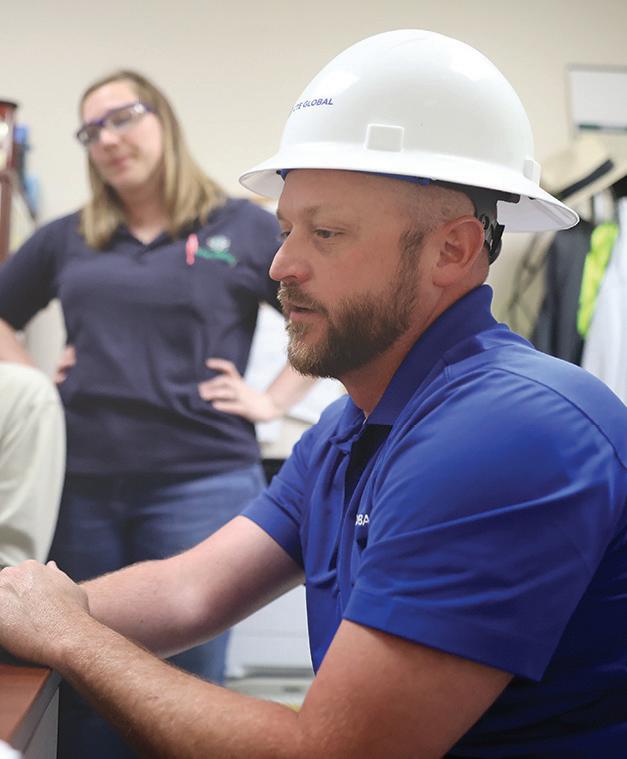
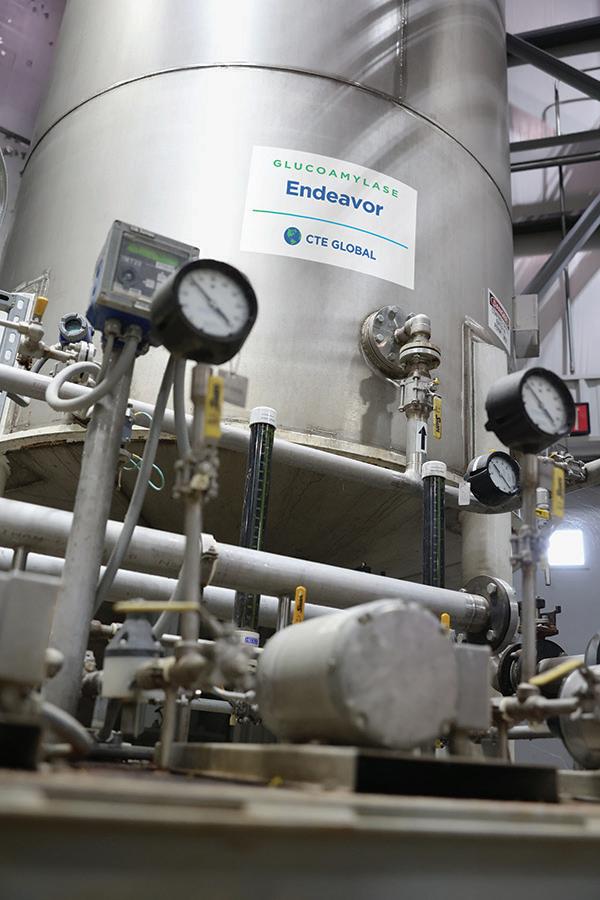
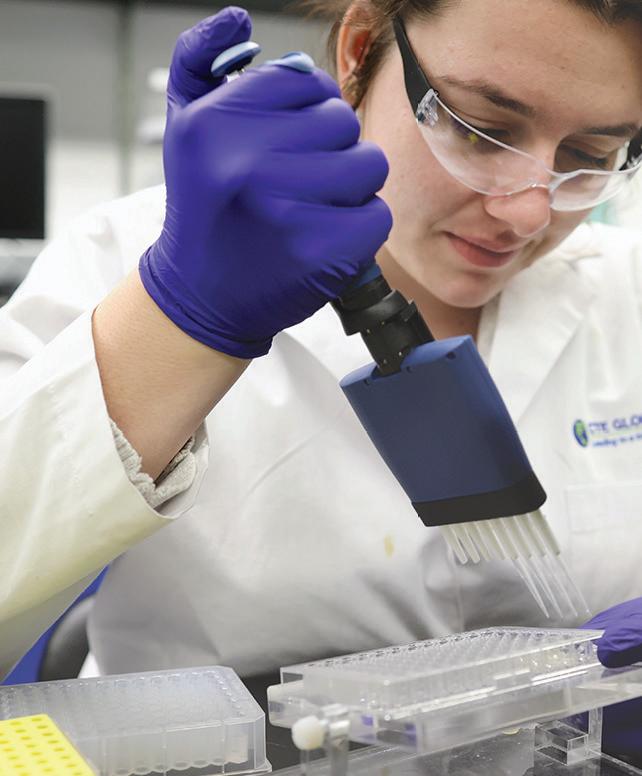
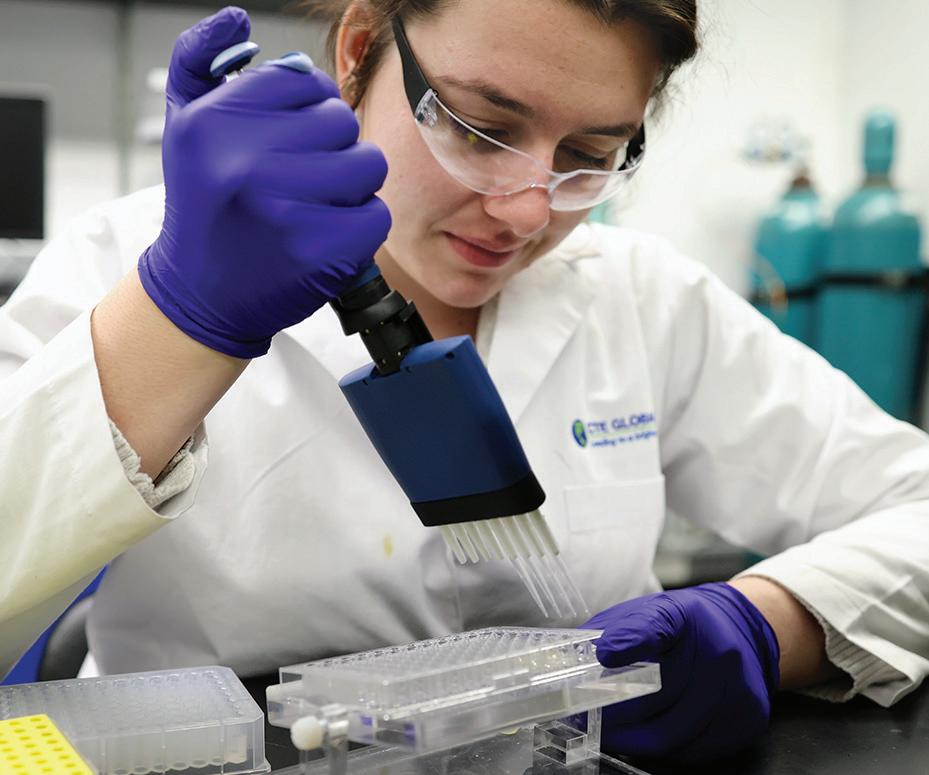
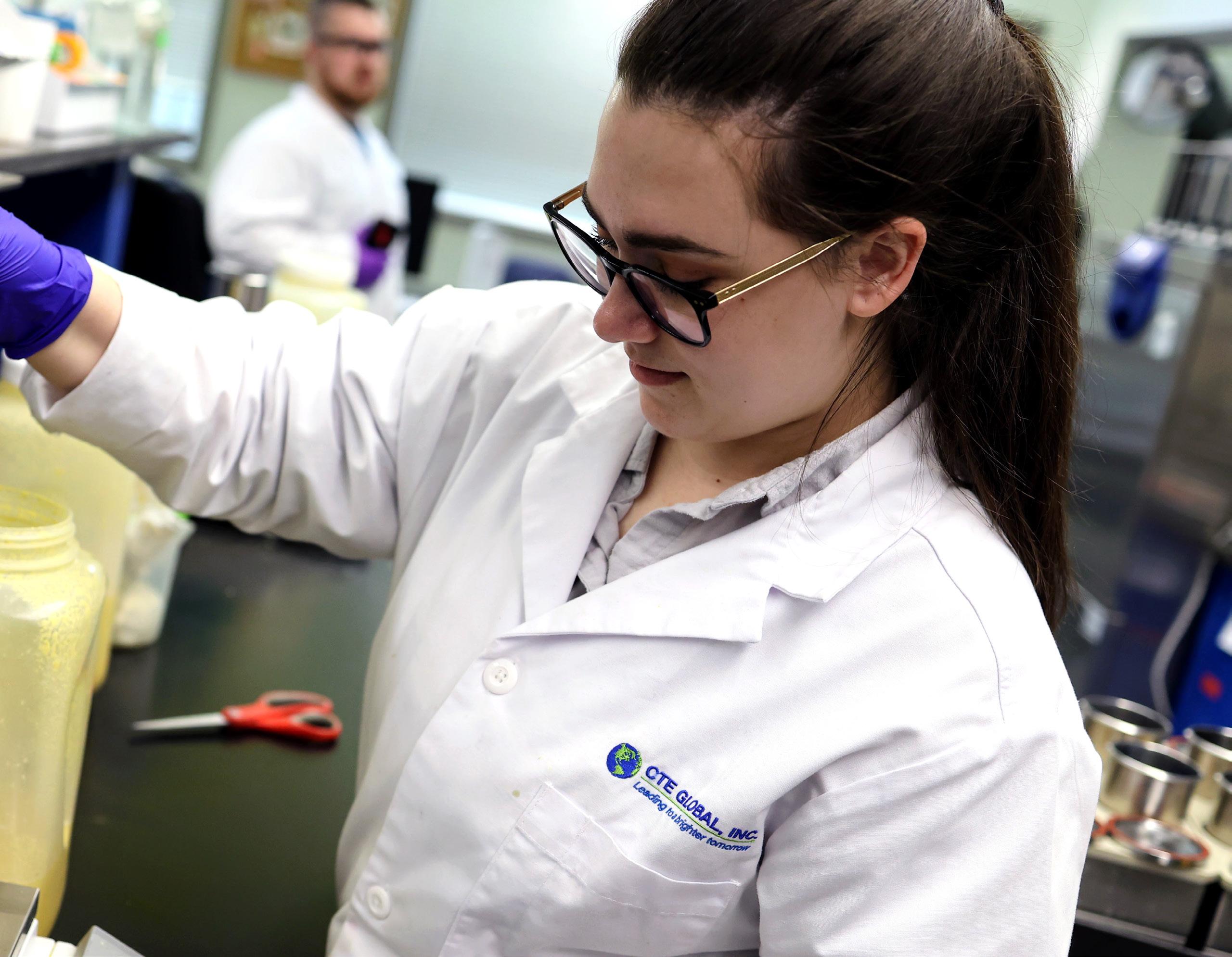
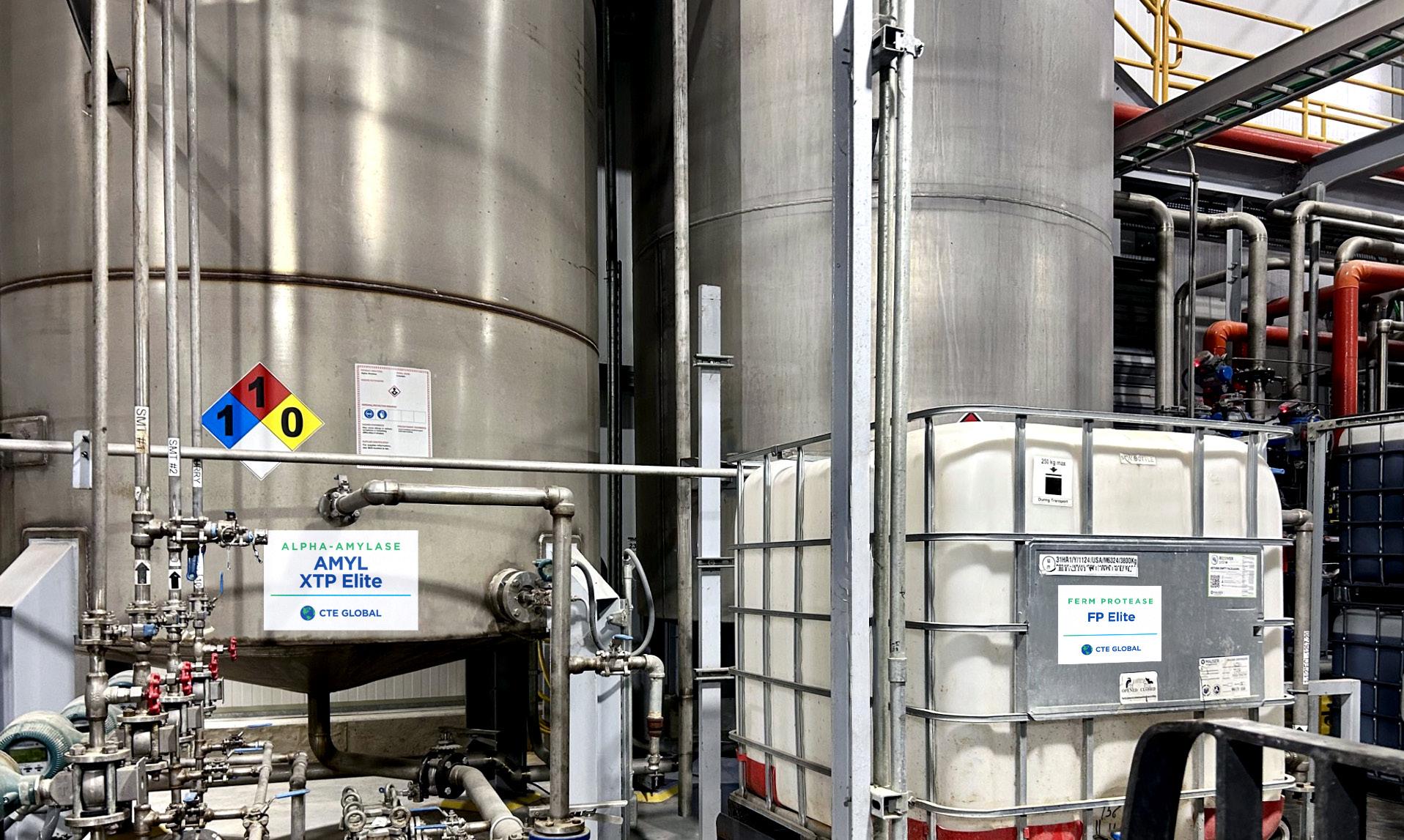
DIVERSE OFFERINGS: CTE Global designs enzyme products for the ethanol industry, targeting higher yields and performance consistency in each of its products.
PHOTO: CTE GLOBAL
by transport equipment. Chow explains that during fermentation, yeast makes volatile metabolic byproducts, which can cause problems for the sequestration equipment. IFF is exploring ways to lower the volume of those byproducts—a complex endeavor.
“It’s not easy, right, because you’re looking at tweaking biology,” she says. “And when you say, ‘Hey, yeast, don’t make this one thing,’ there is a cascade in their biology that then follows. A small tweak—what looks like a small change—could have a huge effect. We’re learning about that and what those impacts could be and just doing our best to try to help the producers while also understanding the impacts of yeast biology.”
Scientific learning remains critical in moving biological innovation forward. IFF is focused on the Rubisco pathway, which it acquired in 2021, and its own Phosphoketolase
(PKL) pathway. Both pathways direct more carbon toward ethanol production and help minimize glycerol creation.
“We’re putting those two pathways through their paces and optimizing them to maximize yield while building understanding on how to make them into ethanol, and how that affects the yeast in terms of the rest of their physiology,” says Chow.
Chow looks forward to the eventual production of ethanol from C5 sugars. Yeast and enzymes already exist that could turn those carbons into ethanol, but changes are needed in process design to make that added percentage of cellulosic ethanol possible.
CTE Global: Targeting Consistency
CTE Global continues to innovate by pushing past previously understood bound-
aries. Focused on efficiency, yield and customer profitability, the company works to provide the highest value possible for its customers via enzyme and yeast products. These days, the ingredients for best value include maximizing distillers corn oil (DCO), increasing ethanol yield and enabling access to low-carbon incentives.
“The D3 RINs and 45Z clean fuel credits are really driving our customers to a higher level of profitability,” says Pedro Peña, vice president of technology and innovation with CTE Global. Every point counts under 45Z, so producers are looking for any and every option to drop their CI scores.
Since corn or milo constitutes a large percentage of an ethanol producer’s CI and production expense, extracting as much value as possible is critical. Conversion is the first principle CTE’s team abides by. “Us-
Fermentation
ing our enzyme innovations and making as much of that sugar—say from the starch or from fiber—and making as much of [it as possible] available for fermentation,” he says.
Recovering the added yields is the second principle guiding CTE’s approach, followed by the third principle—ensuring that both recovery and conversion occur consistently. In an effort to make that sugar more accessible, producer demand for advanced alpha amylase and glucoamylase enzyme products has ticked up, according to Peña.
In situ production of corn kernel fiber (CKF) cellulosic ethanol offers both a CI reduction and access to more lucrative D3 RINs. “The innovations have continued to drive more targeted conversion of the fiber with the goal of, again, converting more of that cellulose, so we can increase the D3 RIN volumes and LCFS volumes,” says Peña. Demand for CTE’s Fiberex, an enzyme product that enables cellulose conversion, has been higher in recent years for this reason.
Breaking up the corn fiber has the added benefit of driving corn oil out of the corn matrix—an increasingly lucrative coproduct for ethanol producers. Cuttingedge cellulases and xylanases disrupt the fiber structures, making more oil available for extraction via backend recovery systems.
CTE targets high oil yield in liquefaction and fermentation with its proteases, which open the protein matrix as well. Beyond product offerings, CTE’s lab uses process optimization analytics to trace DCO throughout the facility, identifying bottlenecks.
In April, the U.S. Environmental Protection Agency finished the Renewable Fuel Standard Set 2, outlining Renewable Volume Obligations for 2026 and 2027 and providing ethanol volume demand certainty moving forward. Having this assurance galvanized CTE customers’ resolve to “push harder” through increasing production rates without compromising on yield, Peña explains. In the past, some compromise was required to push production rates, but the newest advancements in yeast innovation make it possible to run very fast, very
short fermentation times and maintain high yields.
“We’ve seen some pretty favorable legislation when it comes to the RVOs and the potential for E15 legislation, that’s really driving the demand for ethanol,” he says. “We’re very excited to see that, and we’re very excited to continue to support our industry’s growth and success.”
LBDS: Robust Performance
High solids fermentations are one of the recent trends Matt Richards, director of application technology with LBDS, sees in the industry. “Both, I think, to reduce distillation energy inputs and also for process intensification or getting more throughput out of the existing capital that the facilities have.”
Several key challenges face those ethanol producers looking to run higher ethanol titers, some familiar and some new. Fermentation challenges come with seasonal changes; summer heat brings added stress to the fermentation environment. Many ethanol plants have expanded fermentation capacity in the past few years, but not all added cooling capacity needed to keep pace with increased throughput—increasing stress in the fermentation environment, Richards explains.
Fusel alcohols—which have longer carbon chains than ethanol and boil at higher temperatures than ethanol in distillation—also cause challenges for the industry. Richards explains that these longer carbon chain alcohols occur when a yeast reprocesses amino acids for nitrogen, converting the carbon backbones of those amino acids into alcohols and excreting them as fusel alcohols. Typically, these higher boiling point fusel alcohol molecules accumulate midway up the distillation column, but when a plant has a disruption in distillation column temperature or pressure profile, those molecules can drop out of the distillation column and be sent forward in the cook water to slurry for the mashing process. “Longer chain alcohols can be added to the fuel ethanol product when properly drawn from the distillation process, but they can be an additional stressor to yeast in the process,”
he says. “So, it’s another chemical that can disrupt the cell membrane and negatively impact yeast performance in fermentation.”
LBDS is working on a new yeast product as part of its trademarked FermaCore platform but did not yet have a release date set as of press time. Its innovation efforts are concentrated around developing and engineering in a more robust yeast chassis to improve upon the organic acid tolerance enhancements provided by FermaCore Propel. In this pursuit, the LBDS team engineered the yeast to handle stresses such osmotic stress from elevated sugar concentrations, high temperatures and more—all while adding features that drive down production of unwanted byproducts such as glycerol and residual starch. One of the yeast’s features that Richards found especially interesting is the reduction in fusel alcohol production.
“We’re looking to meet producers’ requests for lower nitrogen requirements in fermentation,” he says. “So, some of the new products we’re working on have reduced supplemental nitrogen requirements compared to previous Lallemand yeast products.”
Director of Sales for North America Phillip Shaffer pays attention to what producers want out of their yeast and enzyme
products. “If you ask 10 plants, they’re all probably saying, ‘Well, we want to push solids higher.’ We’ve got to make sure that the yeast are robust enough for the high solids, the high temperatures, the organic acids, and all of that in combination with the ethanol, that’s also a stressor for the yeast inside that fermenter. So, we’ve got to be prepared for that, and I think we are. It’s just about driving yields higher and more robust [yeast] products forward.”
Since LBDS acquired BASF’s trademarked Spartec enzyme product line two years ago, it continues developing new enzyme offerings that will pair well with LBDS’ yeast products in an effort to create the best outcome for customers, Shaffer adds. A new alpha amylase is being tested, with some positive initial results. It will offer some interesting synergies with the existing enzyme portfolio.
LBDS listens to customers but also considers the future beyond adhering to policy demands and accessing tax credits, “because those aren’t always going to be around,” Shaffer explains. Plants are exploring alternative product streams and LBDS is developing yeasts that support those initiatives with industrial partners.
Fluid Quip Mechanical (FQM) delivers full mechanical support for ethanol plants, from field service to preventative maintenance planning.
99% uptime from our reliability team’s operations managers. 24/7 service from Fluid Quip–trained technicians and skilled tradespeople. Always ready to keep you online
Midwest-based warehouse stocked with OEM parts and next-day delivery*. When downtime occurs, we respond quickly.
*In most cases
Your partner in plant uptime.
FERMENTATION ENGINE: IFF is continuously searching for new ways to improve yeast performance, helping producers achieve production goals.
PHOTO: IFF
Fermentation
Novonesis: Building on Momentum
Biology should never be a bottleneck, explains Amanda Moser, senior R&D manager with Novonesis. “If customers want to push rates, we’re going to enable that with our biology,” she says. This belief informs Novonesis’ innovation approach, leading Moser and her team to develop a strong portfolio of yeasts able to handle any operational parameters present in an ethanol facility and create enzymes that break down fiber. “That’s been a big industry trend across the board,” she says. “Customers need the freedom and flexibility of multiple production levers and technologies that help them grow their business through diversification across existing assets and systems.”
An “early mover” in thermostable protease, Novonesis continues innovation related to increasing DCO yields. Thermostable protease breaks down the oleosome membrane made of protein and phospholipids, releasing the oil contained within it, mak-
ing the oil accessible post-distillation. The company’s Fiberex product portfolio grants producers increased DCO yields as well as access to cellulosic ethanol. Product options in the lineup include F1, F2X and F2.5, each built around a complementary blend of cellulases and xylanases that work together to support a plant’s operational strategy and optimize yields, Moser explains. The cellulase allows for more cellulosic ethanol yields from fiber, while the xylanase helps make the fats accessible for extraction.
Moser identifies facility investments as a trend among ethanol producers over the last year, both in the form of added capacity and operational improvement. “For Novonesis, innovation begins with listening to ethanol producers to ensure that our products give our customers an advantage in the production process,” she explains.
Novonesis’ history of innovation in the yeast and enzyme space gives the company a deep well of research to enable customers to shift their production strategies and
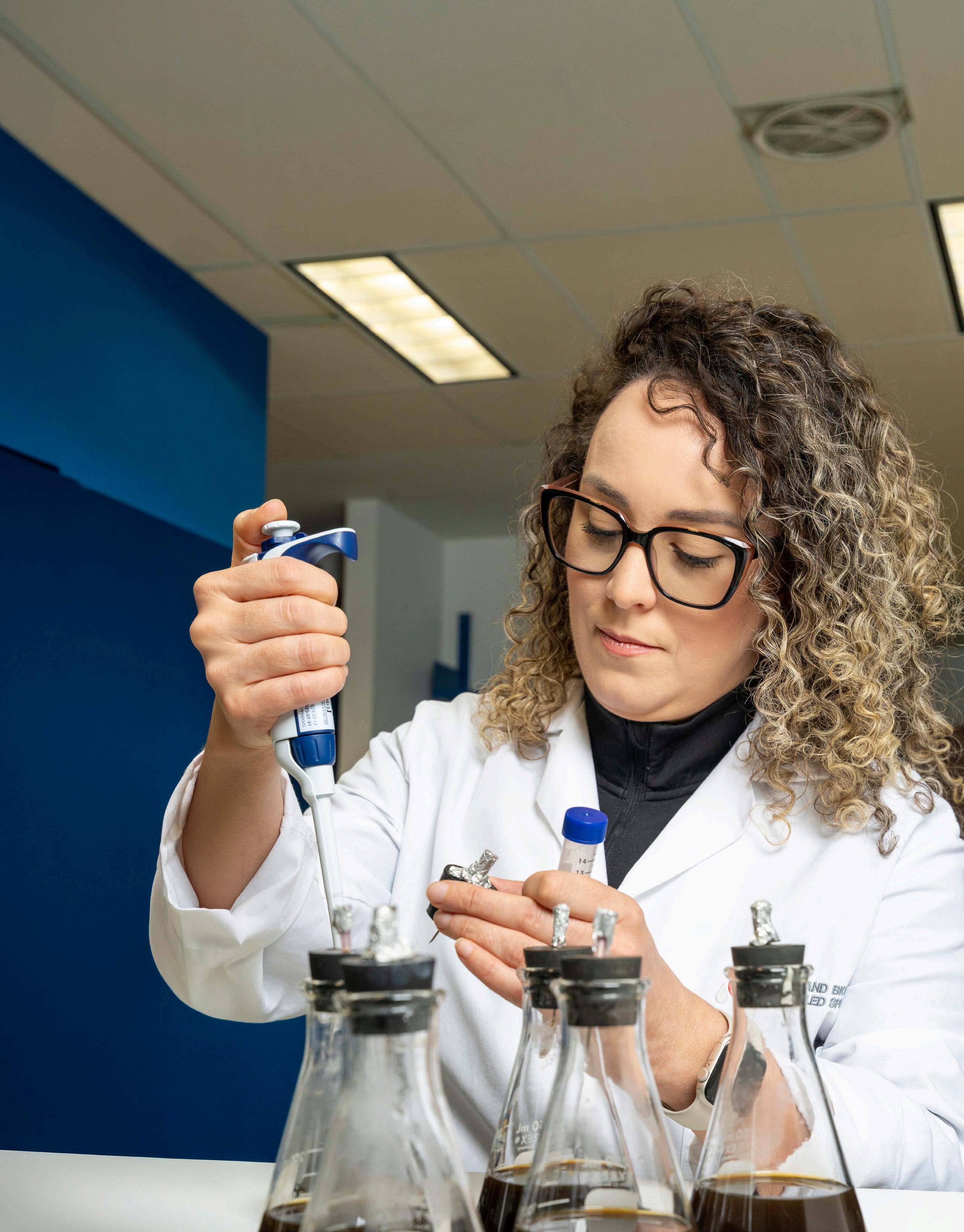
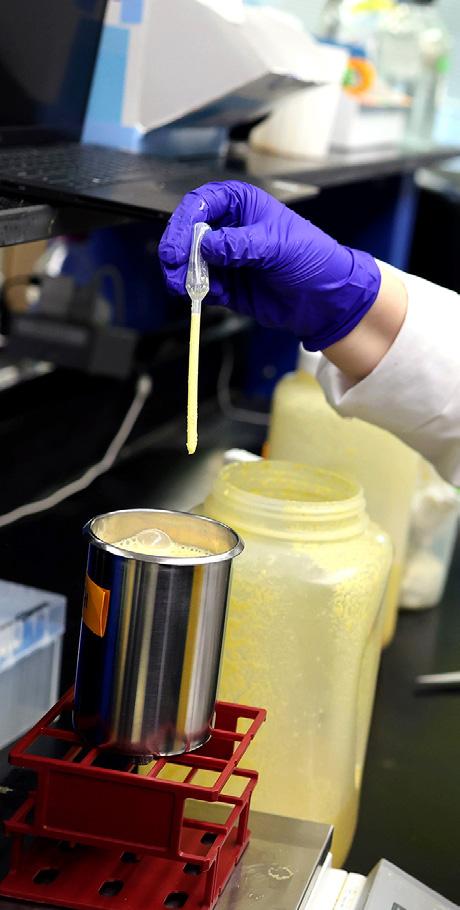
TOUGHER BY DESIGN: LBDS is concentrated on engineering highly robust yeast that stand up better to known stresses. Pictured here is a distillation test being conducted at an LBDS lab.
PHOTO: LBDS
businesses through a dynamic and evolving market. “When we hear from our customers that they are really interested in this next big trend, we can say, ‘Okay, let’s look back at where we’ve been and what could help here? What activity or what technology in yeast could really help us get there?’”
Biology may seem like a bottleneck for the producer that wants to run a fast fermentation at 35%, but then sees a drop in yield per bushel as a result. Novonesis’ innovations prevent producers from needing to choose between yield rates and throughput, Moser explains.
Innova Nitro, Novonesis’ latest yeast advancement, has the ability to reach titers in a short amount of time, reaching 16% ethanol in 52 hours. This is a “big jump forward” in yeast capabilities and attributes, and it’s what the customer needs in today’s ethanol production process, Moser says. Developing biological technology comes out of a mindset of continuous improvement. “We start with our breeding
program, [which] has exceptional robustness, and we can breed for speed,” she says. “We bring that in with our strains and then put in the modifications that we want, keeping in mind what we hear from customers about any production challenges they need to overcome. And we’re always making sure that what we’re doing isn’t affecting that final goal.”
As fermentation products level up, the hurdles between research and the next big breakthrough are high as well. “Not that it wasn’t hard before, because it’s always been hard, but the challenge is always finding just a little bit more,” Moser says. “And I love being challenged to see where we can raise the bar to meet increasing expectations from producers and plants and how we can get even better—that in and of itself, for me, is fun.”
Leaf by Lesaffre: Reduced Variability
With a strong legacy as one of the first
yeast providers for the U.S. ethanol industry, Leaf has made an indelible impact. Mark Lasher, director of the Americas with Leaf, explains that the company aims to regain its place as an industry leader with the products it plans to bring to market later this year.
Producers turning corn and sugarcane into ethanol have the “cheapest sources of sugar on the planet,” Lasher says. It remains to be seen how this resource could be utilized for higher-value chemicals, fuels, plastics and more. Leaf pursues open dialogue with producers about market readiness and technical capabilities. “Some of the biggest challenges are the markets aren’t ready for the technology,” he adds. “Sometimes the technology is ahead of the market, or the market is not ready for a renewable alternative due to cost, changes in operations. But I think that that’s where the discussions with producers today are super valuable.”
The company says it is deliberate in bringing things to market, leveraging data from its extensive organism library and ge-
netic engineering expertise from multiple R&D partners to ensure the products meet their specifications and deliver the desired performance. “Leaf’s focus is on yeasts and other organisms, but we understand the importance of starch and sugar conversion when it comes to enzymes and enzyme inclusions,” Lasher says.
The company’s new line of products aims to improve process control and reduce variability in results. Ethanol producers experience, on average, a 5% variability in yield in each fermentation, Lasher explains. “And the biggest needs we see are reducing that variability,” he says. “It shows up in process variability with temperature or organic acids and then impacts organism variability relating to sugar conversion and enzyme combinations.”
A 172-year-old company, Leaf’s parent company, Lesaffre, has been a leader in bread making, adding other fermentation-related industries to its portfolio, including beverages, human health, agriculture and ethanol. Although bread-making remains Lesaffre’s core business, it supports the advancements in success, speed and capabilities for its industrial yeast for ethanol production.
“Both ethanol and Leaf have a willingness to improve,” Lasher says. “And so, both of us are at the same time seeking what can we do next that drives value for everyone and aren’t bound by the traditional business or ways of thinking.
“Ethanol is the foundation of the bioeconomy and we’re here to grow with ethanol, but if there is a shift to a renewable chemical, we are well-positioned and willing to make that change with those customers.”
Phibro: Tailored Solutions
Ethanol producers strive to maximize yield for each of their products, explains Stephanie Gleason, director of global technology for Phibro Ethanol. Extracting the highest amount of ethanol, fiber and oil utilizes the full value of each kernel. In light of 45Z, maximizing that value now means producers must analyze and account for CI scores alongside tracking production costs and yields.
Producers are asking different questions and approaching decisions with different priorities. Gleason explains that producers want to know how they can optimize their plants to maximize ethanol, fiber and oil yields while also capturing the full value of available low-CI incentives. “There is a shift with carbon intensity now central to decision-making,” she says. “Plants are evaluating technologies they may not have considered in the past.”
Fiber conversion is increasingly central to CI reduction and adding value to the process, Gleason adds. Added in liquefaction, Phibro’s thermostable xylanase product, XylaPlus, has ease of implementation with fewer side effects that sometimes accompany fiber-degrading products.
Jess Vasina, vice president of global technology for Phibro Ethanol, comes from a background in biotechnology innovation. Uncoupled solutions provide optionality for producers as they tailor their process to achieve the best outcome, Vasina explains. “Choice is becoming essential,” he says. “Phibro is focused on leading with flexibility in the yeast and enzyme space, so producers can select the products and support that fit their plant, instead of being locked into rigid programs.”
Producers are looking for the best of both worlds—a yeast that offers both high yield fermentations and consistent results. Phibro’s Kinetx yeast serves producers well with its robustness, but the company continues to innovate, leveraging the product’s robustness alongside increased yield.
Although there are common trends throughout the ethanol industry regarding what producers are looking for, Vasina and Gleason emphasize that each plant is different. As Gleason puts it, “every plant’s a snowflake,” and producers need products that will accommodate a range of operation strategies.
“Plants are different by design, so having options for how producers stitch solutions together matters,” Vasina adds. “The ability to combine yeast and enzyme tools in the right sequence—and adjust as conditions change—is how you fully optimize a system. Producers know their plants best, and that’s why Phibro stands behind offering choice, performance and technical partnership.”
DIVERSE OFFERINGS: CTE Global designs enzyme products for the ethanol industry, targeting higher yields and performance consistency in each of its offerings.
SEA BOUND: Global mining company Vale announced in April that it has commissioned ethanol-powered vessels from Shandong Shipping Corp. for delivery starting in 2029. Industry experts say the maritime market is ripe for ethanol.
PHOTO: STOCK
ON BOARD WITH MARITIME POLICY
Ethanol checks all the boxes for clean alternative fuels in ocean-going vessels.
By Susanne Retka Schill
Strategies for ethanol to fuel ocean-going vessels are gaining steam as industry trade groups work to ensure supportive polices. Treading carefully with a reluctant Trump administration, biofuel groups hope to get the U.S. back on board with a global regulatory push for low-carbon maritime transport.
“I believe this is the single biggest opportunity the ethanol industry has,” says Zoltan Szabo. Based in Hungary, Szabo is secretary general of the Climate Ethanol Alliance—a global partnership representing trade groups and companies from the U.S., Europe, Brazil, Canada and Asia. “The maritime sector needs fuels that are low-cost, available and scalable, [and] that come with low carbon intensity. Ethanol ticks all the boxes, and that’s why we believe that we need to do all we can to make sure that the maritime opportunity becomes a reality.”
Top of the list is getting approval for a global standard supporting the use of alternative fuels. The International Maritime Organization’s Net-Zero Framework was close to being finalized when the U.S. lobbied to delay the
agribusiness solutions
TAKE YOUR AGRIBUSINESS FURTHER
For over 20 years, Beyond has been the innovative and trusted experts in selling, implementing and suppor ting grain processing ERP software solutions.
80+ Ethanol Plants
We provide tailored expertise and innovative technology to plants across North America
Markets
decision. “It took everyone by surprise last October that the U.S. was not supportive, because they had been beforehand,” Szabo says.
The IMO is a United Nations agency with an elected 40-member council. Half of the council is comprised of countries with heavy involvement in international shipping and trade, while those without large maritime transport footprints have broad commercial and geopolitical ties to the sector.
The agency has been striving for international accord on its Net-Zero Framework for years. “The IMO works by consensus,” Szabo says. “And, up until last year, there seemed to be an agreement.”
“I think it’s important that the administration is going to continue to engage, but they’ve made their position clear. For us, it’s emphasizing that it’s important the U.S. remains engaged because of the market potential for American producers and ultimately American farmers.”
10,000+ Transactions
We process more than 10,000 digital transactions per daymore than any competitor
From advanced grain processing to strategic financial tools, we provide comprehensive solutions tailored to your needs Tailored Solutions
The global fuel standard within the framework requires ships to gradually reduce GHG emissions, and it includes a pricing mechanism on emissions to encourage compliance. It was approved by the IMO’s Marine Environment Protection Committee in April 2025. The draft legal text was shared with UN member states aiming for formal adoption in October 2025. After the U.S. and other oil-producing countries lobbied against it, the final vote was deferred until November of this year.
“There’s a lot of reasons why the Trump administration did not like that approach,” says Troy Bredenkamp, senior vice president, government and public affairs at the Renewable Fuels Association. “They saw the net-zero proposal as a global tax, through the fines that were going to be imposed by those not meeting the new, very stringent standard.”
When the approval process for the IMO framework was paused last fall, RFA formed the American Biofuels Maritime Initiative with the American Biogas Council and others to help the administration understand the domestic biofuel sector’s position, Bredenkamp explains. “[They should] stay at the table and come up with some kind of global maritime fuel standard framework that they are able to support,” he says. This spring, Bredenkamp reported, the effort seemed to be moving in the right direction.
“There were some specific elements of the framework that the administration was very concerned about,” concurs Chris Bliley, senior vice president of regulatory affairs at Growth Energy. “They’re not going to support anything that includes a penalizing mechanism. They’re very focused on reliable energy for all approaches. In their view, they don’t think there should be limits on specific fuel types.
Superseding the EU
While the compliance cost of the proposed global standard is a sticking point, Bredenkamp says, “There is a cost to doing nothing, as well, specifically from regional standards.
“If there’s not a single global standard, the concern is [broader global acquiescence to the existing] EU standard, or [the creation of] an Asian standard, because the
Zoltan Szabo Secretary General, Climate Ethanol Alliance
Troy Bredenkamp Senior Vice President of Government and Public Affairs, Renewable Fuels Association
world continues to move towards cleaner fuel standards,” he adds.
“You’re going to have a patchwork. So another point we’re trying to make with the Trump administration is that it would be far better to have a single standard.”
In the absence of a global standard, the EU’s standard would have an outsized influence, Szabo explains. “And in a bad way, because shipping is global. From the U.S. to Tokyo, the EU system wouldn’t be involved, but many routes include a stopover or final destination in Europe. Then, obviously, you would have to respect the EU regulatory framework, which penalizes crop-based biofuels.”
Under the FuelEU Maritime regulations, shippers must purchase allowances for emissions that exceed EU benchmarks, which increase over time as the standards become more stringent. The regulations add significant costs, currently at about 15% more for gray methanol, 20% higher for LNG and more than 30% higher for bunker fuel oil. Crop-based biofuels are assessed the same penalties as petroleumbased bunker/marine fuel. Green methanol and ammonia, bio-LNG from certain feedstocks and biobased diesel from waste oils are assessed little or no penalty. A single, global emissions standard, such as the IMO Net-Zero Framework, would supersede the EU program and any other emerging regional policies, Szabo says.
“Without the support, without the buy-in of the U.S., a global regulatory framework will not be adopted,” Szabo says. “This is not to be seen as a climate deal. This is to be seen as a trade opportunity because the U.S. industry would benefit
a lot. U.S. ethanol is one of the most costcompetitive renewable fuels on the market, if not the most cost-competitive. As such, once there is demand, it will be the first to supply. It will be a major outlet not only for ethanol, but also bio-LNG and biodiesel.”
Szabo doesn’t expect clarity on the issue until the November vote nears. “There is an intense negotiation happening on the floor at the IMO, and also behind the curtains,” Szabo says. As the only biofuels organization with consultative status, though not a vote, the Climate Ethanol Alliance can participate in the discussions and submit proposals. He adds they are willing to speak for not only ethanol, but other biofuels such as biodiesel or bio-LNG.
“Shipping is global and shippers want a single regulation, rules that are applicable all over the place,” Szabo says. “Shippers are investing with dual-fuel ships on the waters already using alcohols, and many more on the order books.”
Vale, a Brazilian mining company, is among the first companies to place orders for ethanol-powered ocean-going vessels. The company announced in April that it has commissioned multiple tri-fueled Guaibamax vessels, with the first to be delivered in 2029 by China shipbuilder Shandong Shipping Corp. The iron ore transports can be powered with ethanol, methanol and/or bunker fuel, with retrofit options for LNG and ammonia. In the news release, Vale reports investments of about $1.4 billion to reduce its Scope 1, 2 and 3 emissions. The company has committed to reducing Scope 3 emissions by 15% by 2035, which relate to the value chain, including the majority of emissions from maritime transport. (Ethanol Producer Magazine covered other engine and shipper developments in a feature in the March issue titled “Ethanol’s Next Big Wave.”)
In its response to the news, the Climate Ethanol Alliance called Vale’s announcement “first-mover validation.” Ethanol has long been discussed as a ma-
per
With the E15 waiver in place, consumers can unlock billions in fuel savings this summer.
Chris Bliley
Senior Vice President of Regulatory Affairs, Growth Energy
rine fuel, but never deployed at this scale, plus the 25-year framework of the purchase agreement “shows this is not a pilot, but a strategic shift.”
Education, Research Ahead
Achieving the maritime opportunity goes beyond getting a global framework that doesn’t penalize crop-based biofuels. “This is pretty new to us as an industry and for government stakeholders and others,” Bliley says. “There’s a lot of education to be done and some research as well.” That work includes understanding the logistics. “We ship ethanol all over the world, but currently we are not used as bunker fuel. So are there things that need to be done?”
On the domestic policy front, legislation has been introduced to include maritime use in the Renewable Fuel Standard.
BCI equipment is built to last, one piece at a time, by a team that still believes quality matters. From custom design, to fabrication, to service & support...
BCI is Elevating Conveying Standards
• Chain Conveyors
• Bucket Elevators
• Parts & Accessories for all makes/models of conveying equipment
Over 200 Years of Combined Experience. Made in the USA.
TYING IN: Capturing only a modest percentage of the nearly 90 billion gallon shipping fuel market would significantly grow global demand for ethanol.
PHOTO: STOCK
“It’s a bill that the RFA has been supportive of conceptually,” Bredenkamp says. But while the current bill would allow biofuels sold for maritime use to generate RINs, Bredenkamp suggests it needs some work. “There are other aspects to the RFS that would have to be considered, like obligated parties.”
How quickly the maritime market for ethanol will grow is uncertain. Ocean-going vessels stay in service for decades, so turnover is slow, although retrofits are being developed. “When you’re talking about a market of 80 to 90 billion gallons annually, it doesn’t take very many ships to add up to a lot of gallons,” Bredenkamp says.
“The marine market is massive, so even if we only get a percentage as the number of ethanol capable ships get built out, you’re talking about a multibillion-gallon opportu-
nity to be sure,” Bliley says. “As you know, 2 billion gallons of exports makes a massive difference. So if you’re talking 4 or 5 billion gallons in the marine market, it would be tremendous.”
“I know how excited everyone was about sustainable aviation fuel a couple of years ago, and there’s reason for excitement there,” Bredenkamp says. “But I think there is more reason to be excited about the maritime opportunity. Ethanol is a drop-in fuel, the infrastructure is already there at a lot of the ports. We perform well from a carbonintensity reduction perspective and, from an affordability perspective, we pair well with bunker fuel.”
The RFA examined maritime fuel prices at major world ports to see how a 50-50 ethanol/bunker blend might compare and, while more costly than conventional petro-
leum-based fuels, the 50-50 blend was less costly than other alternative fuels.
All the conversations over the maritime fuel opportunity are leading to other new opportunities, Bredenkamp adds. “The American Waterways coalition has come to us.” The trade association represents tugboat, towboat and barge operators who are looking for ways to clean up their fuel use. “We’re finding more opportunities that are coming forward. That’s another reason why we’re getting more and more excited.”
See how Ecolab’s range of solutions are making it easier for ethanol producers to fuel the future.
YOUR COMPREHENSIVE LA B FOR QUANTIFYING CELLULOSIC ETHANOL FROM CORN KERNEL FIBER
We employ all available analytical methods for corn kernel fiber conversion pathways
New! ASTM Hemicellulose Method approved by EPA for RFS D3 RINs
NREL cellulose method approved by EPA for RFS D3 RINs
Our Proprietar y Fiber Methods have been approved by CARB for LCFS low CI fuel
All methods suitable for use for any blend of corn and sorghum
Simplified sampling process
You collect, freeze, and ship – we do the rest
STRONG MARKET SIGNALS
Global upheaval, E15 tailwinds, landmark RVOs and other factors push ethanol into the most promising environment the industry has seen in years.
By Lisa Gibson
Record-high Renewable Volume Obligations in the RFS Set 2, lucrative 45Z Production Tax Credits, continuously growing export demand and surging oil and gas prices highlighting the need for E15: The ethanol industry is in the midst of a boom eclipsing any in recent memory.
“I’ve been in this industry a long time and I don’t remember a period where the outlook has been brighter for ethanol production
and demand, maybe with the lone exception of 2007 when we got the RFS 2 passed,” says Geoff Cooper, president and CEO of the Renewable Fuels Association. “You’ve just got this convergence of factors very favorable for growth and expansion in the industry.”
Demand signals are extremely strong, both in exports and domestically, he adds.
“The economic activity is unlike anything we’ve seen in probably 20 years. We are on the precipice of that next big boom of the ethanol industry.”
The Big Boom
RFS Set 2, finalized in March, effectively requires 15.7 billion gallons of conventional renewable fuel in 2026 and 2027.
“We think it is sending a very bullish, very positive signal to the marketplace to ramp up production,” Cooper says. “We’ve not only got a 15-billion-gallon-plus RVO for conventional fuels like ethanol in 2026 and 2027, but we’ve also secured reallocation of 70% of the small refinery exempted volumes from the past three years.
“And that would be the highest-ever requirement,” Cooper says. “Frankly, meeting those volumes is going to require E15.”
Current Reid Vapor Pressure rules restrict E15 from being used in the summer months. While RVP waivers granted each year for the past seven years have allowed E15 year-round in many areas of the country, the fix has been “patchy and uncertain,” says Ron Lamberty, chief marketing officer for the American Coalition for Ethanol.
The U.S. House of Representatives passed year-round E15 legislation on May 13, sending
it to the Senate. The Senate had yet to vote on the legislation as of press time. President Donald Trump has previously said he is ready to sign year-round E15 legislation once it crosses his desk. Nationwide E15 would add 5 billion to 6 billion gallons of new ethanol demand, Cooper says. It wouldn’t happen overnight, but could happen fairly quickly, he adds.
“I would love for people to [appreciate] ethanol for its environmental benefits or its rural economic benefits, or its all-American benefits,” Lamberty says. “But the fuel business is about price.”
“Ethanol is the lowest-cost liquid fuel available on the global marketplace,” Cooper says. “It has been for the past 10 or 12 years and that advantage is only widening in the wake of the Iran situation and the closure of the Strait of Hormuz.”
The RVOs help to put emphasis on the need for year-round E15, but so does the ongoing war in Iran. Climbing oil and gas prices from the war and the subsequent closing of the Strait of Hormuz are pushing interest in measures to lower costs for consumers.
ETHANOL ON TOP: A convergence of policy and global factors is driving ethanol demand, creating unprecedented favorability for the industry.
PHOTO: STOCK
'We’re going to be living with high gas prices for a while, regardless of when the conflict ends, and when traffic starts flowing through the Strait again.'
- Geoff Cooper, Renewable Fuels Association
In May, ethanol was selling for about $1 per gallon less than gasoline blend stock on the global market. That translates to about 30 to 40 cents per gallon at U.S. pumps.
“I think the current situation in the Middle East is really putting an exclamation point on the energy security and economic benefits of ethanol, and we’re seeing that across the globe,” Cooper says. “We’re going to be living
with high gas prices for a while, regardless of when the conflict ends, and when traffic starts flowing through the Strait again.”
As of press time, the Strait of Hormuz was open to only limited traffic and the conflict in Iran, while subsiding in late May, remained ongoing.
Twenty percent of the world’s oil supply goes through the Strait of Hormuz, accord-
ing to Lamberty. “You’ve got the rest of the world trying to supply the markets that oil went to,” he adds.
But even after the conflict settles and the Strait fully reopens, backfilling demand and catching up with the market will take weeks to months. “What we’ve seen historically is that these types of demand and supply shocks have long tails—prices go up very quickly and
Geoff Cooper President and CEO, Renewable Fuels Association
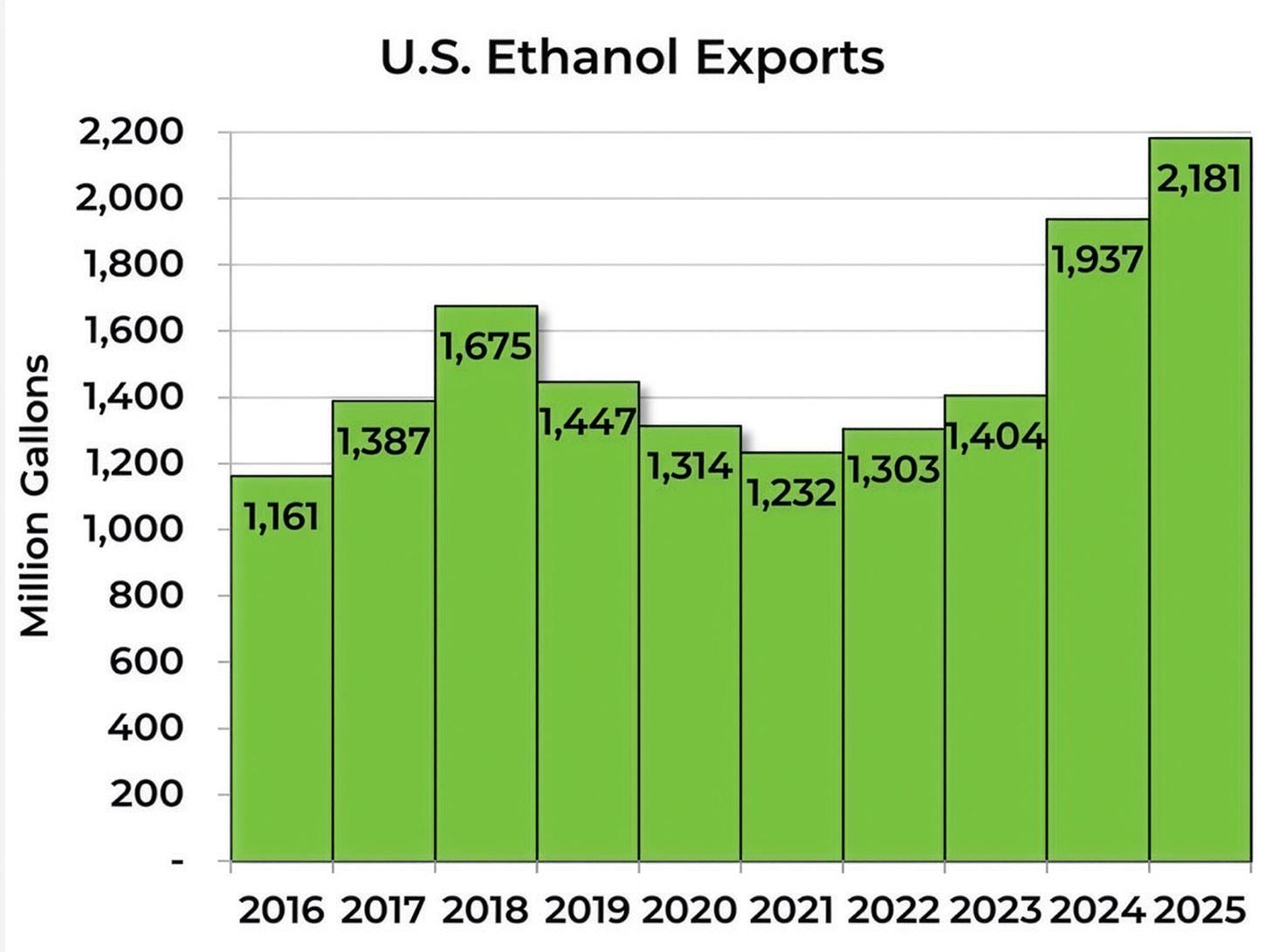
RECORD EXPORTS: The U.S. ethanol industry set annual export records consecutively in 2024 and 2025. Expectations are high for another record in 2026.
SOURCE: RFA
take much longer to come back down to pre-shock levels,” Cooper says. “But we have never seen a supply shock of this magnitude. So, I don’t think even looking at past incidents is necessarily indicative of how this is going to go.”
In response, many countries are committing to increasing their use of ethanol from reliable supply sources, including the U.S..
U.S. exports climbed to record highs in 2024 (1.93 billion gallons) and 2025 (2.2 billion gallons), as countries around the world set aggressive goals, policies and targets for increasing their use of renewable fuels. Cooper
Ron Lamberty Chief Marketing Officer, American Coalition for Ethanol
says the Iran conflict builds on that existing demand.
“We see the situation in the Middle East really catalyzing increased exports and increased use of ethanol globally, and we believe the U.S. industry is well-positioned to benefit from that push.”
Cooper expects the U.S. ethanol industry to export at least 2.5 billion gallons this year, but potentially more, depending on the duration of the turmoil in global oil markets. Already, first-quarter exports set a record of nearly 640 million gallons, 20% above the same period last year.
Meanwhile, producers on the Trailblazer pipeline and others with carbon capture and storage strategies have started collecting 45Z Clean Production Tax Credits. Green Plains, which has three Nebraska ethanol plants on the pipeline, reported it received $55.2 million through 45Z credits in the first quarter of 2026. The credit is yet another positive marker contributing to U.S. ethanol’s boom.
‘Capacity Creep’
The U.S. ethanol industry has over 18 billion gallons in capacity today and has been
running at an annualized rate of around 17 billion gallons in recent months, primarily because of the strength in the export market, Cooper says.
There is room to grow in the existing fleet.
“The other thing we know is happening is virtually every facility is looking into adding capacity, through debottlenecking or modest expansions,” he says. “That capacity creep is moving forward and has really accelerated in the last six months, to the point that we think the industry will have the capacity to produce 19 billion gallons or more as soon as the end of this year, or certainly a year from now.”
Several producers are working on expansions, including: POET BioprocessingShelbyville, from 98 MMgy to 193 MMgy; One Earth Energy, from 150 MMgy to 200 MMgy; The Andersons Clymers, from 140 MMgy to 170 MMgy; and Gevo North Dakota from 67 MMGy to 75 MMgy, as well as a new 75 MMgy plant adjacent to its existing facility.
“We have seen some publicly announced expansion plans but there are a lot of things happening under the radar, undertaking im-
provements, projects and process efficiency initiatives to produce 125 or 130 from 120 (MMgy),” Cooper says. “You start adding all of those up and all of a sudden, we’ve got another billion gallons of capacity in a very short time.
“The incentive is there, the signal is there from the marketplace to continue ramping up production,” Cooper adds. “The market is responding. Every ethanol producer out there is looking at ways to boost their output.
“I think it’s just the very favorable policy environment that we find ourselves in today. Highest ever RVOs, feeling we’ll get E15 done this year, 45Z tax credit, and export market,” he says.
“You add those things together and throw a global event like Iran ontop of it and the signals are screaming to the industry to increase capacity, increase productive capabilities, and that’s what we’re seeing today.”
Author: Lisa Gibson lisa.gibson@sageandstonestrategies.com
Start to finish, keep your processes pumping
The production of ethanol requires the power of pumps from the beginning of the process to the end. Sulzer is your reliable partner for wherever fluids are pumped. We provide the CPE ANSI pump for high efficiency that results in a cost savings in energy consumption. Our CPE is built to exceed environmental regulations, is easy to install and includes trouble-free Sulzer mechanical seals.
Rely on Sulzer for your pumping needs.
Optimal performance: https://go.sulzer.com/CPE
THE PERFECT COMBINATION
A recent study on the optimal blend ratio of corn and sorghum to produce D3 cellulosic RINS offers confirmation and new insight.
By Luke Geiver
The results of a recent study testing the optimum blend ratio of corn and sorghum for the generation of D3 cellulosic renewable identification numbers (RINs) show the best blend to be 60% sorghum/milo to 40% corn. Under normal fermentation conditions, returns begin to diminish outside of that ratio.
The “Corn and Sorghum Cellulosic D3 RIN Study” was released in February, backed by the National Sorghum Producers and the Renewable Fuels Association. IFF collaborated with Edeniq Inc. to source corn and sorghum from operating ethanol plants, running lab-scale fermentations of various blend ratios.
John Duff, founder of Serō Ag Strategies and consultant to the National Sorghum Pro-
ducers, helped conduct the research to build the report. “Sorghum has more raw fiber in it than corn,” he says. “The question is, does that come out in the ethanol to create D3 RINs? This study helps us understand that.”
Methods and Team
Jacyln DeMartini, senior lead scientist at IFF, has led the company’s grain research team and worked at the intersection of research and development and grain processing for 15 years.
“We wanted to show collaboration and partnership on some of the big work being done here,” DeMartini says. “This work was different in how broad and applicable to the industry it was.”
A new and better understanding of feedstock flexibility and feedstock combination opportunities is highly beneficial to the industry,
she says. Until now, this type of information was not well understood, especially not for the generation of cellulosic ethanol RINs.
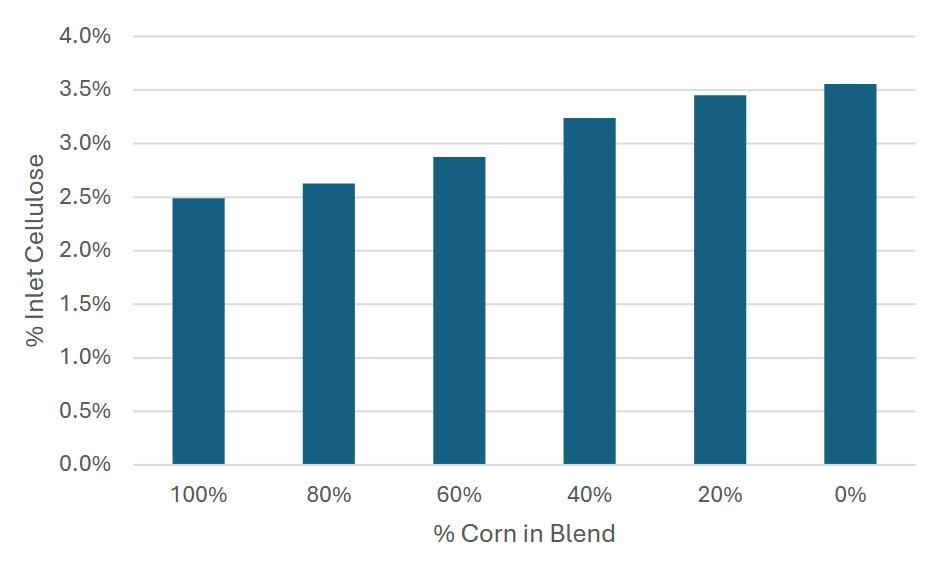
The analysis included recordings of starch converted fractions (how much of the starch within the mix was converted to ethanol), cellulose converted fractions (how much of the cellulose in the mix was made available for conversion) and cellulose ethanol fractions (how much of the available cellulose was converted into ethanol).
According to DeMartini, accounting for every detail was crucial for obtaining accurate results and laying the groundwork for a wider industry understanding. Or maybe, she adds, future plant-by-plant custom analyses.
For its portion of the collaborative study, IFF sourced flour and backset of both feedstocks. Lincolnway Energy provided corn
ORIENTED:
PHOTO: EDENIQ
flour and backset—the remaining stillage after distillation that often gets recycled into the next fermentation round—and Western Plains Energy provided the sorghum equivalent. In addition to its own testing, IFF sent out the flour samples to a third-party participant, Midwest Laboratories.
With all the necessary samples, IFF performed the liquefaction and blending processes that created a final mash. The mash dry solids value was roughly 33%. Other variables like pH, alpha amylase and temperatures were all matched to industry norms. Temps during agitation were 87.8 degrees Celsius for the first 20 minutes, followed by 100 degrees Celsius for an additional 10 minutes; pH levels were set at 5.1.
After lowering temps back to 87.8 degrees, another round of alpha amylase was
added. That mash was then agitated for two hours to mimic normal liquefaction procedures. An ice bath was used to cool down the mash after the two-hour run time. After some additional steps that added urea to create a corn and sorghum liquefact product, IFF moved to a simultaneous saccharification and fermentation step.
Commercially normal doses of yeast, glucoamalyse, protease and cellulose were added to the blends, which were then fermented in flasks for 72 hours at roughly 32.2 degrees Celsius.
IFF produced six different blends to be tested for cellulose ethanol fraction levels. Blend one was 100% corn liquefact; blend two was 80% corn and 20% sorghum; blend three was 60% corn and 40% sorghum; blend four upped the sorghum blend to 60% and lowered
the corn portion to 40%; blend five was made of 80% sorghum and only 20% corn; and the sixth was 100% sorghum.
“Once we confirmed that everything looked good, we froze the samples and shipped them off to Edeniq,” DeMartini says.
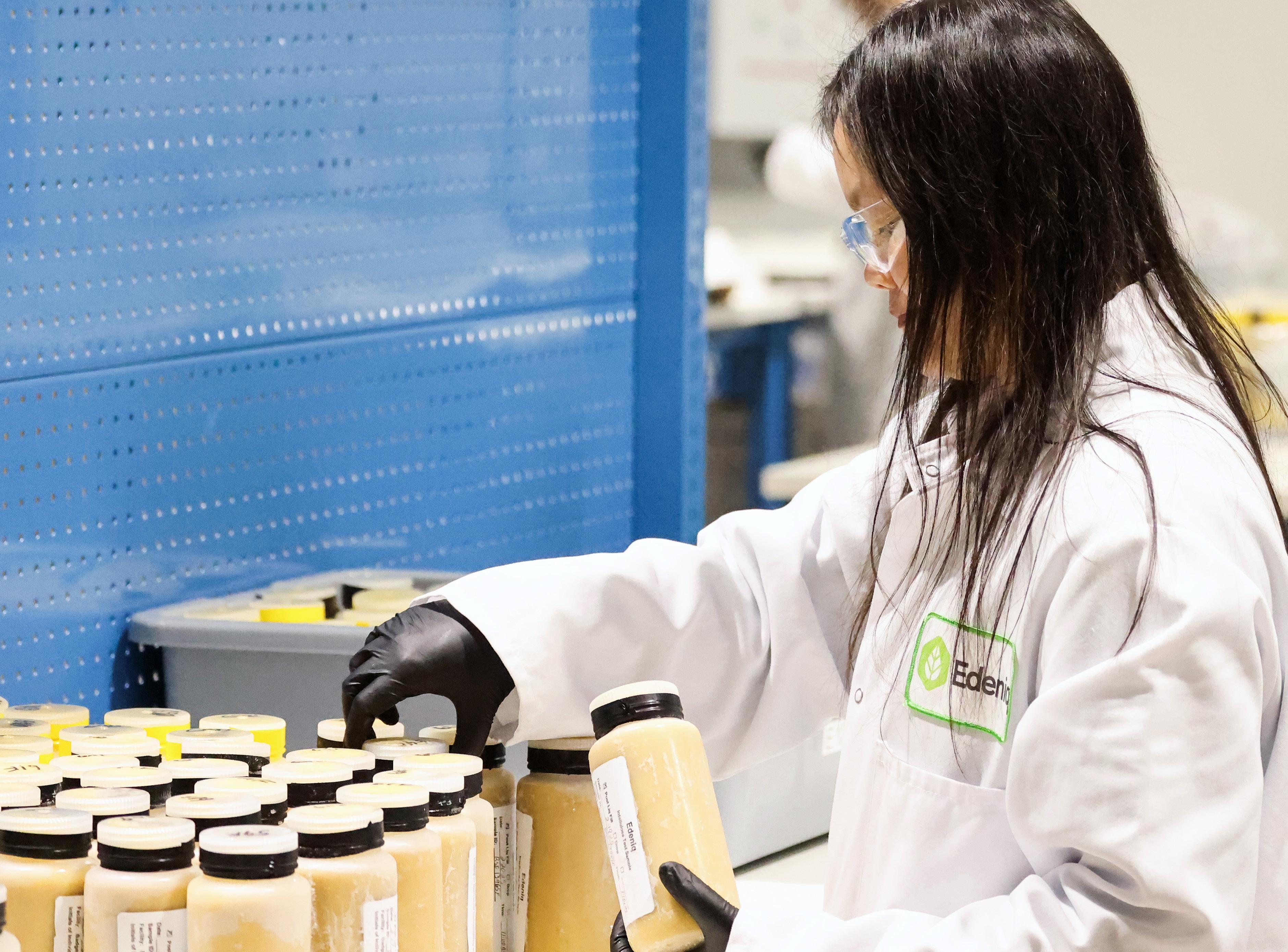
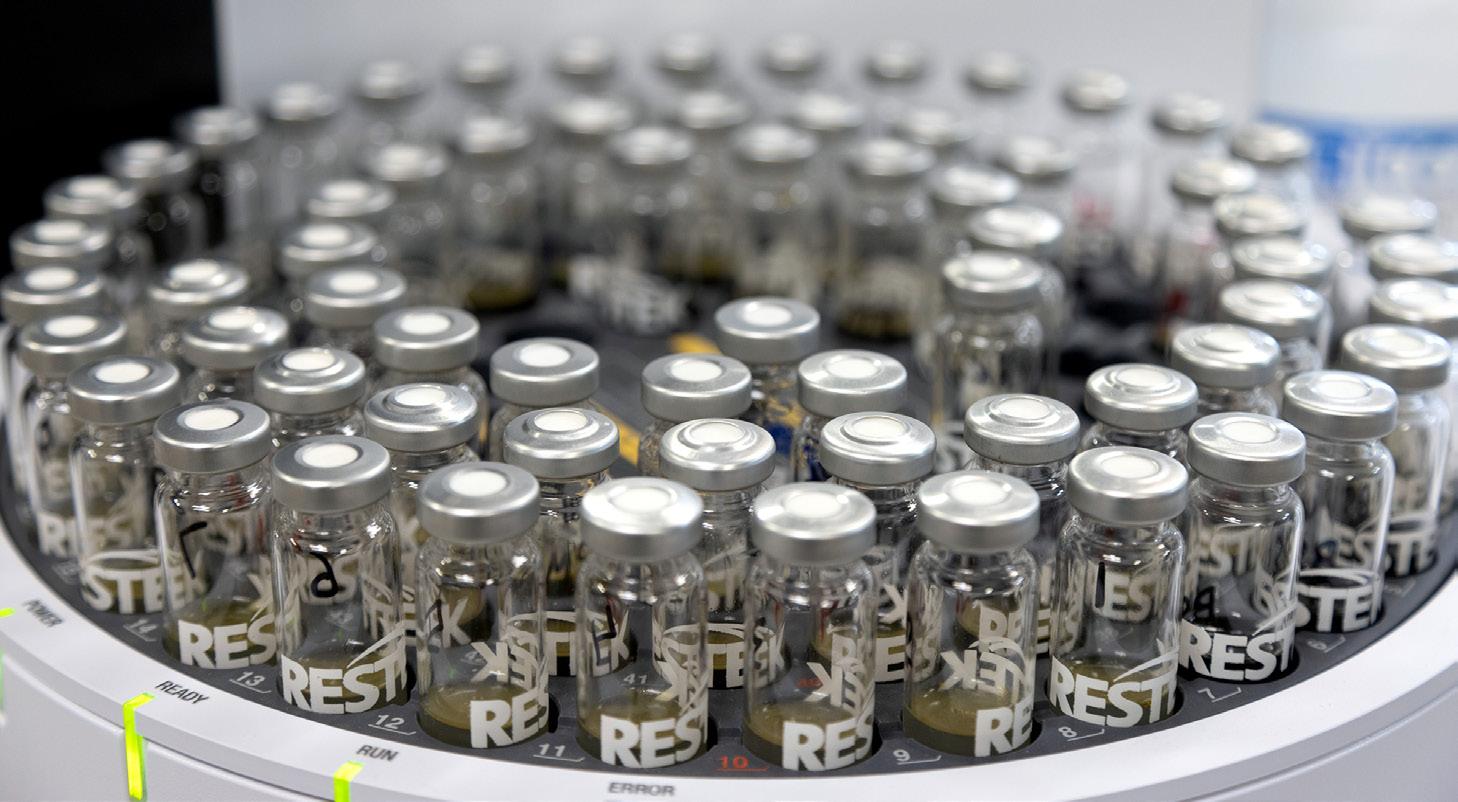
When the samples arrived at Edeniq, they were given two to three days to dry. A longer drying time could have caused unnatural decomposition, according to Johann Venter, chief technology officer at Edeniq. The Edeniq team applied the ASTM Standard E341725, a process that includes inlet and outlet density, inlet and outlet dry weights, inlets and outlets for starch, outlet ethanol and the inlet and outlet cellulose/hemicellulose-derived glucan and galactan (CHDGG).
The CHDGG values calculated using the ASTM process were then applied to Edeniq’s
DETAIL
IFF and Edeniq partnered to evaluate the optimal corn-sorghum feedstock blend for cellulosic ethanol. Edeniq’s attention to preserving and maintaining samples helped ensure accurate results.
Feedstock
proprietary mass balance calculation to determine starch converted fraction, cellulose converted fraction and cellulose ethanol fraction.
Clear Results
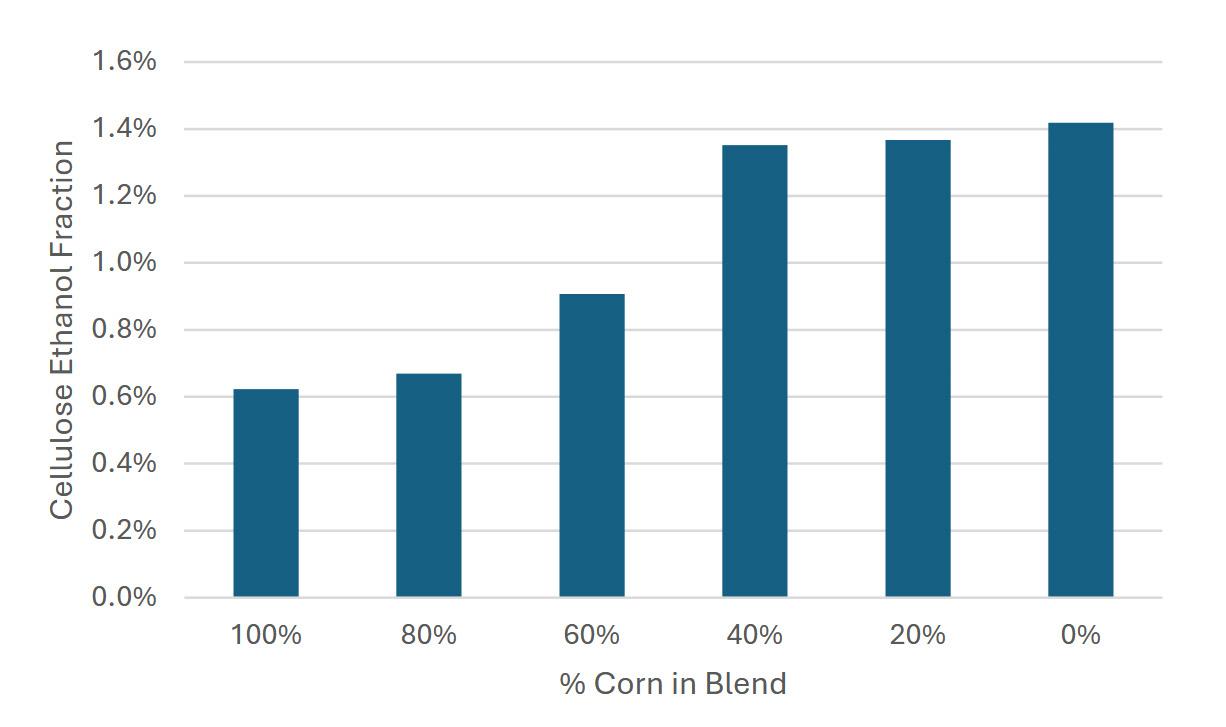
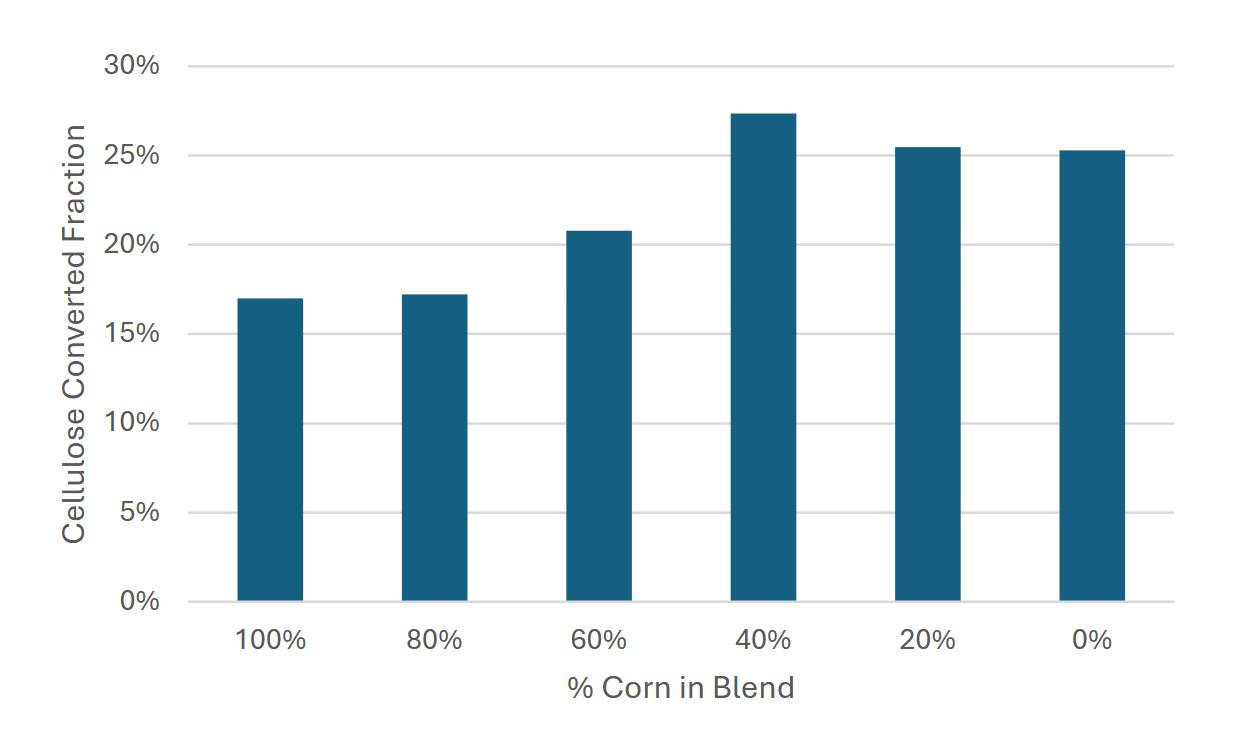
The results were clear on two fronts. The starch converted fraction for each blend was consistently above 97%, the study shows, which is normal for the high efficiency of current enzymes used in the industry. For the cellulose converted fraction, the study results showed the maximum conversion reached was roughly 27.4% (for the fourth blend). The fourth blend was 40% corn and 60% milo. That blend reached 1.35% cellulose ethanol fraction.
According to Venter and DeMartini, sorghum percentages higher than 60% begin to diminish returns. Although increased sorghum volumes will increase the amount of cellulose converted fraction levels (sorghum has more fiber available to convert), the in-
OPTIMAL BLEND: At a blend ratio of 60% sorghum and 40% corn, the cellulose ethanol fraction percentage was at a near-maximum conversion rate of 1.35%.
SOURCE: EDENIQ
Truck & Rail Transfer
Engineered for Speed
Custom Access Solutions
At Carbis, we know that streamlined operations and a healthy bottom line don’t happen by accident...they’re engineered. That ’s why we design and manufacture custom fall prevention solutions tailored to your speci c needs, so your business can run at peak e ciency without compromising the safety of your team.
crease in cellulose ethanol fraction percentages is not worth the added sorghum.
“I thought it was interesting that you did see a trend with increasing sorghum and then it leveled off,” DeMartini says. “I thought we’d see a linear trend all the way up.”
In the future, she hopes to explore why the conversion plateau happens.
“It’s another reason why lab studies are very diligent about detail. It improves our understanding of the situation,” she says. “The smallest details are very critical.”
Brian Thome, CEO of Edeniq, outlines a few key, big-picture takeaways. First, a producer needs to understand that sorghum contains more cellulosic mass that can be converted into cellulosic ethanol. Adding more sorghum may increase cellulose converted fraction, but won’t necessarily increase cellulose ethanol fraction. Second, understanding the corn/sorghum blend ratios allows producers to tailor their ratios.
CONVERSION APEX: With a 40% corn blend, the cellulose converted fraction surpassed 27%.
SOURCE: EDENIQ
Feedstock
THE LIMITS OF MORE: Sorghum has greater cellulosic mass and produces more inlet cellulose (shown here) than corn, but including more than 60% sorghum in a blend of the two feedstocks does not necessarily yield more cellulosic ethanol.
SOURCE: EDENIQ
“It gives plants flexibility to look at their own economic conditions,” Thome says. “They can get higher cellulosic yields when it’s appropriate for them to do that.”
In 2026, D3 RINs are valued above $2 each. Traditional D6 RINs for corn-based ethanol are $.80 to $1.
Venter adds that in some cases, it comes down to the cost of corn and milo. Through April this year, the USDA’s National Weekly Grain Co-Products Report showed that
ethanol plants were paying roughly $4.38 to $4.50 per bushel of corn. July bid projections are roughly the same.
For sorghum bushels, the USDA’s projections show that ethanol plants were paying roughly $3.60 to $3.70 per bushel with some bids in Texas fluctuating between $3.06 and $3.91.
U.S. Energy Information Administration data shows that in 2025, roughly one bushel of corn or sorghum can create just
GCHS CAROUSEL: Edeniq employs gas chromatography head space (GCHS) to accurately determine the percentage of ethanol in beer samples. Pictured is a GCHS carousel. PHOTO: EDENIQ
over three gallons of D6 ethanol. The percentage of cellulosic ethanol created through stover, corn kernel fiber or other means is at a much lower conversion percentage than traditional D6 ethanol production.
Venter also says the results of the broad report should be used as a guideline. Individual plants should conduct their own study if they really want to optimize a corn/sorghum mix to generate more D3 RINs. The ethanol titer for the mixes can also be slightly lower than normal, Venter says.
The lab teams at IFF and Edeniq, along with the sorghum producers, are happy about the results. They believe they prove out what has long been known about sorghum and corn mixes.
But DeMartini seconds Venter’s sentiment about the need for custom analysis. Studies could be performed for each plant using their specific variables like liquefacts, enzymes and others to dial in the best ratio blend for D3s. “With converted fractions and D3 RINs, very small changes can make a big difference,” she says.
Key Takeaways, Impact
While the lab researchers are focused on new studies and finding more answers, Duff and Thome offer a high-level view of the work’s impact on the ethanol industry.
“I think the idea for this work was a really good one,” Thome says, adding that the study shows additional opportunities for different feedstock usage under varying economic conditions. “It really comes down to what’s best for the plants. This report gives them more flexibility.”
Duff believes the work confirms assumptions the industry has held for some time, in addition to providing more certainty about sorghum than ever before. Producers using sorghum already know that the fiber content is higher, so for D3 RIN production there is “more bang for the buck,” Duff explains.
Blending sorghum and corn doesn’t require a big change on the enzyme cocktail side. And, sorghum can be stored next to other corn piles. Duff points to more than 10 plants across Kansas and Texas that have been running sorghum feedstock for more than a decade with no issues. Plants in South Dakota, Nebraska and Missouri also have an opportunity to utilize more sorghum than they already do, he says.
The results of this study have opened a lot of doors and eyes to the possibility of using sorghum mixed with corn to generate higher volumes of D3 RINs, Duff says.
“We’ve had a lot of good questions and conversations with ethanol plants,” he says. “They need to not be wrong.”
In the end, the value of the collaborative work by IFF, Edeniq, ethanol producers and sorghum growers is about opportunity, Duff says.
Author: Luke Geiver writer@bbiinternational.com
Pray
Let’s face it, lab results from the HPLC are subject to significant human error.
People get tired, distracted, bored. Some of the measurements are just hard to do In tests, we’ve found significant variations between di erent operators... and even from the same operator, on the same day, testing the same sample
Human error is NOT something you ever get from the IRmadillo™. Just continuous lab-grade data, 24/7. And automatic warnings, the moment anything starts to go wrong.
It all reminds us of the famous line from the movie, The Terminator: “It can’t be bargained with, it can’t be reasoned with, it doesn’t feel pity or remorse or fear. And it absolutely will not stop… EVER.”
Hasta la vista, failed batches.
CALIFORNIA'S ETHANOL OPPORTUNITY
E85 conversion kits, E15 vapor recovery system certifications and new sustainability requirements are all key to growing ethanol use in the Golden State.
By Luke Geiver
Over the past 10 years, California’s annual E85 volumes sold have increased by more than 600%. In 2015, the total volume purchased in the state was about 15 million gallons. In 2025, consumers bought 110 million gallons (118 million gallons in 2023). Since 2022, Californians have averaged purchasing just under 112 million E85 gallons annually.
The sharp rise of E85 usage can be directly linked to fuel providers like Pearson Fuels. The San Diego-based company announced in late April the opening of its 500th E85 fueling station. In total, the state has roughly 625 E85 pump locations.
“With some retail gasoline above $6 a gallon right now, E85 is providing significant savings to drivers,” says Doug Vind, managing member of Pearson Fuels, following the installation of fueling station 500.
At the time of Pearson’s announcement, E85 was selling for $2.50 per gallon less than gasoline. The lower price has always been a staple for justifying the use of the fuel, and that cost advantage has helped Pearson expand access to ethanol’s highest U.S. blend.
But growing E85 is only part of California’s continued ethanol evolution. In 2026, expanding
ethanol use in the Golden State is also about technology—getting E85 conversion kits approved for use; persistence—navigating the final bureaucratic obstacles to E15 implementation; and adherence— finding creative ways to comply with the California Air Resources Board’s new feedstock sustainability requirements for ethanol coming into the state.
E85 Conversion Kits
According to the California Fuels and Convenience Alliance, California is the only state that doesn’t allow drivers to install kits enabling standard gasoline engines to run on E85. Despite CARB’s acknowledgement that such kits could provide savings to drivers, the state agency has not allowed the technology’s use. Pearson and California Assemblymember Rhodesia Ransom are working to rectify that. In February, Ransom introduced AB 2046, legislation, aimed at giving consumers access to affordable gas by allowing them to legally install federally approved E85 conversion kits. At press time in late May, the bill had advanced through the state assembly and was awaiting action in the senate.
Elizabeth Graham, CFCA CEO, says the legislation would ease one aspect of California’s affordability crisis as rising fuel costs continue to strain families and businesses.
ANNOUNCING AB 2046: Alessanda Magnasco of the California Fuels and Convenience Alliance addresses the media with California Assemblymember Rhodesia Ransom, author of AB 2046, during the bill’s introduction ceremony in February. AB 2046 would allow E85 conversion kits in California.
PHOTO: CALIFORNIA FUELS & CONVENIENCE ALLIANCE
The CFCA has been vocal about the impact of the Iran conflict on fuel supply and high gas prices, in a state that is highly susceptible to international oil price volatility. “California is particularly exposed to global market swings because more than 75% of the crude oil refined in the state is imported,” Graham says.
That exposure to global oil supply fluctuations doesn’t only impact California. California refineries supply nearly 45% of Arizona’s transportation fuels and almost 90% of Nevada’s. A combination of decreased refining capacity in the state along with stricter, more expensive fuel blending requirements in California, highlight the immediate need for a more resilient fuel supply, according to CFCA.
“By becoming more fuel independent, increasing domestic supply and strengthening local infrastructure, California would be less vulnerable to geopolitical conflicts and the price increases they can trigger,” Graham says, adding that E85 conversion kits should be part of the solution.
CALIFORNIA'S E85 RISE: For more than a decade, the use of E85 in California has risen, showing a sharp uptick to levels above 100 million gallons per year starting in 2022.
SOURCE: CALIFORNIA AIR RESOURCES BOARD
The E85 kits work by reading the ethanol content of the fuel in real time and sending adjusted signals to the vehicle’s fuel injectors, according to Pearson. The technology allows the engine to optimize fuel delivery. “One of the most common misconceptions is that higher ethanol blends damage engines,” the company states. “Modern vehicles are already built with materials compatible with ethanol. The limitation isn’t the hardware—it’s that the engine’s software isn’t designed to adjust to higher ethanol content without guidance. That’s exactly what the conversion kit provides.”
E15 Implementation
Despite the October 2025 passage of year-round E15 blending, Californians are still waiting for their chance to fill up with E15 blends, as CARB works through the implementation process. The primary issue is that CARB has not certified the proper vapor recovery equipment for use with E15.
“California is still facing a key barrier when it comes to E15,” Graham says. “Un-
til that certification is addressed, it remains a significant hurdle to introducing E15 into the market. That said, if we’re able to resolve this obstacle, we could see E15 enter the California market relatively quickly.”
According to CARB, most vapor recovery systems need to be certified for use with E15, as the equipment was manufactured for use with E10. CARB also says that before it can provide these certifications, state law requires approvals from four other state agencies: the Department of Industrial Relations (a division of Occupational Safety and Health), the Department of Forestry and Fire Prevention (State Fire Marshall), the California Department of Food and Agriculture (a division of Measurement Standards) and the State Water Resources Control Board.
The rollout of E15 could increase the state’s market potential for overall ethanol gallons consumed by 50%. Like E85, E15 offers a discount to regular unleaded/E10 blends. E15ForCA.com, a site sponsored by the Renewable Fuels Association that tracks the
progress of E15, notes that E15 is roughly 8% cheaper than regular unleaded/E10.
Sustainability Requirements
Producers looking to supply California with ethanol for any blend level will need to understand new feedstock sustainability requirements. Under the revamped Low Carbon Fuel Standard, CARB is now calling on producers to report the point of origin for their feedstocks, along with a number of other LCFS changes adopted this year.
According to CARB, beginning with the 2026 data year submitted in 2027, holders of pathways utilizing biomass must maintain attestations showing when the biomass was planted, contracted and harvested after July 1, 2025. Geographical shapefiles or the coordinates of plot boundaries must be provided to CARB to show the physical location of the biomass used to produce renewable fuel supplied to the LCFS program.
The point-of-origin requirement was debated for several months prior to implementation by CARB. The RFA and Growth Energy both expressed opposition. The phase-in timeline for the full set of requirements for crops like corn, soybean or other feedstocks will culminate in 2031. This year, the main requirement for producers is the supply of geographical shapefiles or coordinates. From 2026 on, producers will need to maintain that information and provide it to CARB as necessary.
In an April webinar, CARB provided clarity on the new point-of-origin requirements. Carmen Meiaula, air pollution specialist for CARB, said the agency is evaluating multiple strategies that would allow producers to show plot boundaries, including satellite imagery.
During the Q&A portion of the webinar, a participant asked if plants outside of California need to record and account for all of the feedstock used at a given biorefinery, or only the amount of feedstock used to produce fuel
supplied to California. For example, if a plant produces 100 million gallons of renewable fuel per year but only supplies 1 million gallons of that fuel to California, does 100% of the feedstock used at the plant need to be accounted for and shown to meet the requirements of the LCFS sustainability metrics?
A CARB representative said only the feedstock used to produce the fuel supplied to California would need to be accounted for with point-of-origin requirements for sustainability. CARB is using a mass balance approach for reporting, so the feedstock used at the plant for California would not have to be stored separately or treated differently. A follow-up question from the same participant centered on corn kernel fiber and its requirements. According to CARB, CKF is not subject to sustainability requirements under new LCFS point-of-origin policy.
Policy of any sort will remain the focal point of CFCA, Graham says, regardless of its link to E85 kits, vapor recovery systems or point-of-origin shapefiles.
“In 2026, one of the most important things to highlight is the continued role ethanol can play in improving fuel affordability and expanding consumer choice in California,” she says. “At a time when fuel prices remain a major concern, ethanol blends like E85 represent a practical, lower-cost, lower carbon-emission solution.
“California continues to face unique regulatory barriers that limit access to these fuels, and addressing those challenges is key to unlocking their full potential.”
Author: Luke Geiver writer@bbiinternational.com
COMMERCIAL BINS
• 165’ Diameter Bins (up to 2.25 Mil. Bu.)
• Up to 21’ Peak Decks & 150K lbs. Rating
•Patented Double End Stud Bol t
•Patented Laminated Splice Plates TM
COMMERCIAL SWEEPS
•Paddle Sweeps
•Capacities up to 12K BPH
•Patented Pivot Point
•Industrial Grade Pushers
COMMERCIAL DRYERS
•Tower Dryers (up to 12K BPH)
• QuadraTouch Pro Controls
• Remote Web Access
• Balanced Moisture Content TM
THE NEXT PHASE OF LOW-CARBON FUEL MARKETS
To capture future opportunities, producers must plan for ever-changing compliance requirements.
By Chelsa Oren
The ethanol industry has always been adaptive, responding to new policies, market signals and technology pathways. Today, producers are capitalizing on near-term opportunities, such as the 45Z Clean Fuel Production Credit, to capture value and improve margins in a favorable policy environment. But beneath that momentum, a more structural shift is underway, one that could redefine competitiveness in low-carbon fuel markets over the next decade. The message
is simple: what earns credits today may earn deficits tomorrow.
A Changing Compliance Curve
Low-carbon fuel programs, particularly in California, are designed to reduce fuel carbon intensity (CI) over time. The compliance curve, the benchmark that decides whether fuels generate credits or deficits, declines each year, increasing stringency. At present, many ethanol pathways remain comfortably below the 2026 compliance
threshold of 24.2% reduction, allowing them to generate credits and support favorable economics. However, recent data indicates that the margin is narrowing. As compliance increases, the stringency aims for a 52.5% reduction by 2035, doubling the reduction planned for 2026.
CI targets for 2028 and beyond may be accelerated by the Automatic Acceleration Mechanism pursuant to section 95484(b).
For example, average CI scores for ethanol in Q3 2025 averaged at 58.59 gCO2e/ MJ, and by 2035, a CI score above 47.09
CONTRIBUTION: The claims and statements made in this article belong exclusively to the author(s) and do not necessarily reflect the views of Ethanol Producer Magazine or its advertisers. All questions pertaining to this article should be directed to the author(s).
gCO2e/MJ for gasoline and 50.23 gCO2e/ MJ for diesel curves will result in earning deficits. This is not a distant or hypothetical shift. It is built into the program’s structure and requires a regulation change to modify. As the benchmark declines, fuels that once generated credits will eventually fall below the line, resulting in deficits rather than revenue.
From Credit Generation to Deficit Risk
This shift will significantly alter mar-
ket dynamics. Currently, ethanol producers base their strategic choices on existing credit values and logistics. Sometimes, they have withdrawn from markets such as California due to transportation expenses and compliance requirements that outweigh credit earnings. But as the compliance curve tightens, demand will increasingly favor the lowest-CI fuels available. Regulated parties—those responsible for meeting carbon targets—will prioritize ethanol with the lowest possible CI scores to avoid deficit exposure.
This shift establishes a new reality: lower CI ethanol gains increased value, while higher CI ethanol becomes less competitive, yet remains somewhat competitive compared to gasoline. As compliance requirements tighten, credit prices are expected to rise. Essentially, the market will favor early preparers and penalize those who delay.
The Limitations of Short-Term Thinking
The current focus on 45Z is understandable. It offers immediate financial
upside and has become a central part of strategic planning for many producers. However, 45Z alone is not a long-term strategy. Facilities that optimize solely for near-term incentives risk missing the broader trajectory of carbon markets. Investments made today can capture current value while also positioning facilities to meet compliance thresholds over the next five to 10 years. The most competitive producers are already defining long-term CI targets and aligning their operations with those goals.
Pathways to Lower Carbon Intensity
Lowering CI is not a single decision; it is a portfolio of operational and strategic improvements. Many producers have already taken initial steps, but further reductions will be necessary to remain competitive. Key areas to assess include energy and utilities optimization. Cutting down natural gas and electricity use or switching to lower-carbon energy sources can lead to significant CI reductions. Renewable energy integration through behind-the-meter solutions like renewable natural gas (RNG) or on-site solar can greatly enhance carbon performance.
Process improvements and efficiency gains, such as converting corn kernel fiber into cellulosic ethanol, can reduce CI while creating additional value streams. Assessing the carbon intensity of inputs, including chemicals and upstream processes, can provide incremental benefits. Although extensively studied, carbon capture and sequestration (CCS) remains a key option where feasible. While these steps may seem incremental individually, collectively they can determine whether a facility remains competitive in a tightening market.
While these strategies are widely understood, the challenge for many producers is not identifying potential improvements but determining where to begin and how to
PHOTO: ECOENGINEERS WITH CARB DATA
PHOTO: ECOENGINEERS WITH CARB DATA
prioritize investments. Each facility operates within unique constraints, including access to feedstocks, energy infrastructure, capital availability and regional market dynamics. As a result, there is no single pathway to achieving lower carbon intensity. Instead, producers must evaluate a combination of options and consider how incremental improvements compound over time.
In many cases, early-stage feasibility assessments can reveal opportunities that are
both technically achievable and economically viable, particularly when aligned with future credit market conditions. Engaging with technology providers, utilities and regulatory experts at an early stage can also help clarify timelines and avoid delays later in the process. Importantly, these conversations often uncover dependencies that may not be immediately visible, such as permitting requirements, infrastructure limitations or verification timelines, all of which can
FIGURE 1: FUTURE COMPLIANCE CI TARGETS
FIGURE 2: AVERAGE FUEL CI SCORES OVER FUTURE COMPLIANCE CI TARGETS
influence when a project ultimately delivers value.
Planning Takes Time
One of the most overlooked challenges in carbon markets is timing. Lowering CI is not an overnight process. It requires feasibility studies, capital investment decisions, technology partnerships, regulatory approvals and operational changes. In some cases, regulatory engagement alone—such as validating new pathways or CI adjustments—can take years. That timeline is precisely why planning must begin now. Producers who wait until the compliance curve becomes restrictive will find themselves reacting under pressure, with fewer options and higher costs.
A Market Signal Producers Can’t Ignore
The development of low-carbon fuel markets is increasingly understood as a policy certainty as regulatory frameworks continue to evolve and tighten over time. The compliance curve will continue to decline, and the standards for what qualifies as “low-carbon” will become more stringent. Additionally, the market will increasingly differentiate between producers based on their CI performance. With change already underway, the focus is shifting toward how prepared producers are to respond to evolving market conditions.
The Next Phase
The ethanol industry has consistently demonstrated its ability to innovate and adapt.
The next phase of that evolution will be defined by how effectively producers manage carbon intensity across both current incentive structures and future compliance requirements. Those who take a long-term view, invest in CI reduction, evaluate new technologies and align with future compliance thresholds will be best
positioned to compete. Because in the next phase of low-carbon fuel markets, the advantage will belong to those who planned ahead.
In practice, this means shifting from a reactive approach to a more structured, forward-looking strategy. Producers that establish clear internal benchmarks for carbon intensity, regularly evaluate progress and re-
visit their assumptions as regulations evolve will be better equipped to navigate uncertainty and capture emerging opportunities in low-carbon fuel markets.
Author: Chelsa Oren, Ethanol and Biodiesel Service Director, EcoEngineers coren@ecoengineers.us
HEALTHIER YEAST. IMPROVED FERMS. HIGHER YIELDS
Revolu onizing yeast fermenta on in the ethanol industry
INTRODUCING STINGERTM GEL SAFE + EFFECTIVE BACTERIA CONTRO L
Environmentally friendly chlorine dioxide technology propelling ethanol produc on towards unmatched efficiency.
With a vision of bacteria control challenges gone for good, S ngerTM Gel offers a proven, safer, highly effec ve, and an bio c-free solu on to control bacteria in yeast fermenta on while addressing the issues of current chlorine dioxide products. That means safe, stable, and high-performing ethanol produc on.
• Gel is easy to spot if leaked or spilled
• Very long drying me, minimizing cleanup and safety concerns
• Superior performance over an bio cs
• Faster fermenta on rate (counts, budding, viability)
• Lower CI Score
RAIL POSITIONED TO SUPPORT THE NEXT PHASE OF ETHANOL GROWTH
New federal incentives and emerging carbon management strategies are expanding the role of freight rail beyond ethanol to support the broader low-carbon fuels supply chain.
By The Greenbrier Companies
Ethanol has long been an anchor commodity for the U.S. freight rail network, connecting production facilities in the Midwest with fuel markets across the country. Today, new federal incentives and emerging technologies are creating additional opportunities for rail to support the next phase of growth in the biofuels sector.
The Inflation Reduction Act introduced the Section 45Z Clean Fuel Production Credit, a policy designed to accelerate the production of low-carbon fuels. As producers adapt operations to qualify for the credit, the broader ecosystem around ethanol production including feedstocks, renewable fuels and carbon management may drive new transportation demand. Freight rail is positioned to support that expansion.
Ethanol’s Role in the Rail Network
Ethanol has become one of the most important renewable energy commodities transported by rail. According to the Association of American Railroads (AAR), railroads account for roughly 60% to 70% of ethanol transportation in the U.S.
The growth of ethanol rail shipments accelerated after methyl tert-butyl ether
CONTRIBUTION: The claims and statements made in this article belong exclusively to the author(s) and do not necessarily reflect the views of Ethanol Producer Magazine or its advertisers. All questions pertaining to this article should be directed to the author(s).
(MTBE) was phased out two decades ago. Ethanol quickly replaced MTBE in fuel blending. Because of ethanol’s alcohol content, it cannot be transported through conventional petroleum pipelines. As a result, railroads became the primary transportation mode capable of moving large volumes.
For ethanol producers evaluating rail transportation, equipment specifications and tank car design play an important role in operational planning. Manufacturers such as The Greenbrier Companies offer tank car guides and technical resources that help producers better understand equipment options and capacities.
These resources also explain commodity applications, supporting the safe and efficient movement of ethanol and other liquid energy products across the rail network.
Tank car design plays a central role in safely transporting ethanol from production facilities to fuel markets.
Ethanol production is concentrated across the Midwest. However, many of the largest consumption markets are lo-
cated along the East Coast, California and Texas. Rail provides the long-distance connectivity needed. Short lines and regional railroads also play an important role. The AAR estimates that 15% to 20% of ethanol rail movements originate on short-line networks.
Rail’s Efficiency Advantage
Freight rail remains one of the most fuel-efficient transportation options available for moving bulk commodities. The Federal Railroad Administration reports that rail-
roads can move one ton of freight nearly 500 miles on a single gallon of fuel. This efficiency advantage has made rail the preferred mode for moving large volumes of energy products such as crude oil, coal and ethanol.
For ethanol producers, rail offers both scale and flexibility. Large unit trains can move product efficiently to major markets, while rail’s national network allows producers to reach multiple blending terminals and storage hubs across the country.
FUEL TRANSPORT: Greenbrier’s 30,600-gallon ethanol tank car transports ethanol to market.
PHOTO: THE GREENBRIER COMPANIES
CONVEYING CARBON: Greenbrier offers a 22,000-gallon CO2 tank car to support ethanol producer’s CO2 transportation for sequestration and utilization needs.
PHOTO: THE GREENBRIER COMPANIES
As the biofuels sector expands, that flexibility will become even more valuable.
The 45Z Clean Fuel Production Credit
The Section 45Z Clean Fuel Production Credit was established to encourage the domestic production of fuels that produce fewer greenhouse gas emissions than conventional petroleum-based fuels. Unlike previous incentives, the credit focuses on carbon intensity.
The credit applies to fuel produced after Dec. 31, 2024 and has been extended through 2029. According to projections from the U.S. Department of Agriculture, roughly 35% of U.S. corn production is expected to be used for ethanol in 2025, highlighting the continued importance of renewable fuels to agricultural markets.
As production is expected to increase, railroads are in position to handle the addi-
'While pipelines are one option for moving captured CO2, rail provides a flexible and deployable solution, particularly in regions where pipeline infrastructure does not yet exist. '
- The Greenbrier Companies
tional capacity needed to transport the fuel safely.
Carbon Capture and New Rail Demand
While ethanol itself remains a critical commodity, the next phase of rail growth tied to ethanol production may come from the broader infrastructure surrounding biofuel facilities.
As producers work to lower their CI scores under the 45Z framework, carbon
capture and sequestration (CCS) is emerging as a key strategy.
Ethanol plants produce high-purity carbon dioxide during fermentation, making them attractive candidates for carbon capture projects. Captured CO2 can then be transported to sequestration hubs where it is permanently stored underground.
While pipelines are one option for moving captured CO2, rail provides a flexible and deployable solution, particularly in regions where pipeline infrastructure does not yet exist.
IMPACTFUL TRANSPORT: Critical for ethanol transport, rail is also becoming a flexible option for producers looking for a way to transport and sequester their CO2. PHOTO: THE GREENBRIER COMPANIES
Some industry initiatives are already exploring rail-based carbon logistics networks capable of connecting ethanol plants to sequestration hubs. In many cases, these solutions are designed to serve ethanol facilities located far from proposed pipeline routes.
For those producers, rail can offer a near-term pathway to carbon management while pipeline infrastructure continues to develop.
Rail Equipment Solutions for a Changing Energy Market
The evolving biofuels landscape is expected to generate transportation demand across multiple commodities beyond ethanol itself.
Renewable diesel (RD), sustainable aviation fuel (SAF) and feedstocks used in biofuel production all require reliable transportation networks capable of moving liquids and bulk materials efficiently.
Rail equipment manufacturers are developing specialized tank car solutions designed to safely transport a range of energy products, including ethanol, renewable fuels and captured carbon dioxide.
The Greenbrier Companies manufactures tank cars designed to transport commodities such as ethanol, renewable fuels and pressurized carbon dioxide, including a 22,000-gallon CO2 tank car developed for carbon capture and sequestration supply chains.
By supporting the transportation of ethanol, renewable fuels and captured carbon, rail equipment manufacturers can help enable the broader infrastructure needed to support low-carbon fuel production.
Rail’s Expanding Role in the Energy Transition
Ethanol will likely remain a foundational commodity for the freight rail industry. However, new policies such as the 45Z Clean Fuel Production Credit are reshaping
the broader ecosystem around ethanol production.
As producers pursue lower carbon intensity fuels, demand for transportation of feedstocks, renewable fuels and captured carbon dioxide is expected to grow. Rail provides an infrastructure capable of supporting both today’s fuel supply chains and the emerging low-carbon fuel economy.
Freight rail’s ability to move large volumes efficiently, reach rural production regions and connect to national fuel markets positions it as a key transportation solution for this evolving energy landscape.