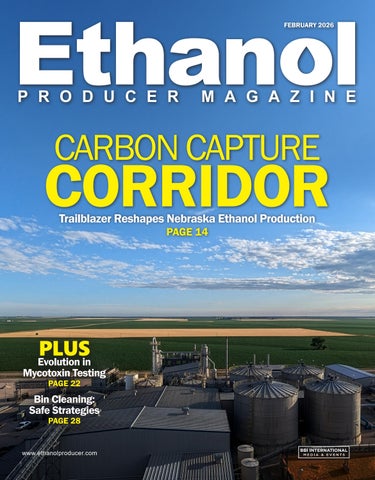
FEBRUARY 2026
CARBON CAPTURE
CORRIDOR Trailblazer Reshapes Nebraska Ethanol Production PAGE 14
PLUS Evolution in
Mycotoxin Testing PAGE 22
Bin Cleaning: Safe Strategies PAGE 28
www.ethanolproducer.com
Turn InSight Into Action TM
Enhance, Optimize, Improve Through Data CTE InSight’s advanced statistical analysis provides timely monitoring systems, predictive modeling and interactive dashboards to analyze data, giving the tools to innovate and optimize. Lean on CTE’s team of experts to develop data-informed strategies that align with your plant goals. Your actionable advantage.
PEOPLE
PROCESS
PERFORMANCE
Innovative Products Are Only the Beginning 1-847-564-5770 • cte-global.com/turn-insight-into-action
Contents
14
22
28
36
44
FEBRUARY 2026 VOLUME 32 ISSUE 2
DEPARTMENTS 5
AD INDEX/EVENTS CALENDAR
6
IN THIS ISSUE Trends, Technicality and Collaboration
FEATURES 14 CARBON
Tallgrass Trailblazers
First CO2 Pipeline Starts Up in Nebraska By Luke Geiver
The Editors
8
VIEW FROM THE HILL Ethanol Unleashed
22
By Geoff Cooper
10
By Linda Schmid
BUSINESS BRIEFS
54
MARKETPLACE
Tracking Toxins
Mycotoxin Testing Picks Up Speed
GLOBAL SCENE USGBC Advances Global Climate Mitigation Practices at COP30
12
FEEDSTOCK By Katie Schroeder
28
MAINTENANCE
A New Level of Clean
Storage Cleanout Techniques Evolve By Luke Geiver
36
EFFICIENCY
Versatility In Vapor
MVR Boosts Efficiency, Reduces CI By Lisa Gibson
44
INDUSTRY
'Shaped By Its Past'
Examining the Parallels Between Brazil and U.S. Ethanol Policy ON THE COVER: Mid America Agri Products/Wheatland, pictured here, was the first ethanol producer to start transporting CO2 for sequestration via the Trailblazer pipeline. PHOTO: MID AMERICA AGRI PRODUCTS/WHEATLAND
Ethanol Producer Magazine: (USPS No. 023-974) February 2026, Vol. 32, Issue 2. Ethanol Producer Magazine is published monthly by BBI International. Principal Office: 308 Second Ave. N., Suite 304, Grand Forks, ND 58203. Periodicals Postage Paid at Grand Forks, North Dakota and additional mailing offices. POSTMASTER: Send address changes to Ethanol Producer Magazine/Subscriptions, 308 Second Ave. N., Suite 304, Grand Forks, North Dakota 58203.
By Susanne Retka Schill
CONTRIBUTION 50
DECARBONIZATION
Carbon Dioxide Use, Sequestration and New Markets Assessing Merchant Demand, Storage and Future Utilization By Sam A. Rushing ETHANOLPRODUCER.COM | 3
W V X &
U H RP
W L O D 4X
G H H S 6 \
Q H Y L 'U
Upcoming Events
Advertiser Index
EDITORIAL President & Editor Tom Bryan tbryan@bbiinternational.com
2026 Carbon Capture & Storage Summit
42
2026 Int'l Fuel Ethanol Workshop & Expo
55
ACE American Coalition For Ethanol
16
Contributions Editor Katie Schroeder katie.schroeder@bbiinternational.com
ArrowUp
19
Beyond
24
Features Editor Lisa Gibson lisa.gibson@sageandstonestrategies.com
Check-All Valve Mfg. Co.
47
CNC Flow Control
4
CoBank
11
D3MAX LLC
48-49
CPM Industrial Solutions
33
CTE Global, Inc.
2
C-TEC AG
30
Ethanol Jobs
35
Fluid Quip Mechanical
51
PUBLISHING & SALES
Foundation Analytical Laboratory
27
CEO Joe Bryan jbryan@bbiinternational.com
GEA North America
39
Growth Energy
25
Chief Operating Officer John Nelson jnelson@bbiinternational.com
IAC
7
ICM, Inc.
38
IFF, Inc.
9
Lallemand Biofuels & Distilled Spirits
43
Mole Master Services Corporation
53
Novonesis
21
Olsson
31
Phibro Ethanol
34
POET LLC
20
RPMG, Inc
41
Trucent
17
Victory Energy Operations, LLC.
56
Senior News Editor Erin Voegele evoegele@bbiinternational.com
DESIGN Vice President of Production & Design Jaci Satterlund jsatterlund@bbiinternational.com Senior Graphic Designer Raquel Boushee rboushee@bbiinternational.com
Senior Account Manager Chip Shereck cshereck@bbiinternational.com Account Manager Bob Brown bbrown@bbiinternational.com Senior Marketing & Advertising Manager Marla DeFoe mdefoe@bbiinternational.com Customer Service Coordinator Brandon McGarry brandon.mcgarry@bbiinternational.com
EDITORIAL BOARD Ringneck Energy Walter Wendland Commonwealth Agri-Energy Mick Henderson Western Plains Energy Derek Peine Front Range Energy Dan Sanders Jr.
2026 International Fuel Ethanol Workshop & Expo
June 2-4, 2026
St. Louis, MO (866) 746-8385 | www.fuelethanolworkshop.com Now in its 42nd year, the FEW provides the ethanol industry with cutting-edge content and unparalleled networking opportunities in a dynamic business-to-business environment. As the largest, longest running ethanol conference in the world, the FEW is renowned for its superb programming—powered by Ethanol Producer Magazine —that maintains a strong focus on commercialscale ethanol production, new technology, and near-term research and development. The event draws more than 2,300 people from over 31 countries and from nearly every ethanol plant in the United States and Canada.
2026 Sustainable Fuels Summit
June 2-4, 2026
St. Louis, MO (866) 746-8385 | www.sustainablefuelssummit.com The Sustainable Fuels Summit: SAF, Renewable Diesel, and Biodiesel is a premier forum designed for producers of biodiesel, renewable diesel, and sustainable aviation fuel (SAF) to learn about cutting-edge process technologies, innovative techniques, and equipment to optimize existing production. Attendees will discover efficiencies that save money while increasing throughput and fuel quality. Produced by Biodiesel Magazine and SAF Magazine, this world-class event features premium content from technology providers, equipment vendors, consultants, engineers, and producers to advance discussions and foster an environment of collaboration and networking. Through engaging presentations, fruitful discussions, and compelling exhibitions, the summit aims to push the biomass-based diesel sector beyond its current limitations. Co-located with the International Fuel Ethanol Workshop & Expo, the Sustainable Fuels Summit conveniently harnesses the full potential of the integrated biofuels industries while providing a laser-like focus on processing methods that deliver tangible advantages to producers. Registration is free of charge for all employees of current biodiesel, renewable diesel, and SAF production facilities, from operators and maintenance personnel to board members and executives.
2026 Carbon Capture & Storage Summit
June 2-4, 2026 Customer Service Please call 1-866-746-8385 or email service@bbiinternational.com. Subscriptions Subscriptions to Ethanol Producer Magazine are free of charge with the exception of a shipping and handling United States. To subscribe, visit www.EthanolProducer.com/Subscribe, send an email to subscriptions@bbiinternational.com or call 866-746-8385. Back Issues, Reprints and Permissions Select back issues are available for $3.95 each, plus shipping. Article reprints are also available for a fee. For more information, contact us at 866-746-8385 or service@bbiinternational.com. Advertising Ethanol Producer Magazine provides a specific topic delivered to a highly targeted audience. We are committed to editorial excellence and high-quality print production. To find out more about Ethanol Producer Magazine advertising opportunities, please contact us at 866-746-8385 or service@bbiinternational.com. Letters to the Editor We welcome letters to the editor. Send to: Ethanol Producer Magazine Letters to the Editor, 308 2nd Ave. N., Suite 304, Grand Forks, ND, 58203, or editor@bbiinternational.com. Please include contact information. Letters may be edited for clarity or space.
Please recycle this magazine and remove inserts or samples before recycling
St. Louis, MO (866) 746-8385 | www.carboncapturestoragesummit.com Capturing and storing carbon dioxide in underground wells has the potential to become the most consequential technological deployment in the history of the broader biofuels industry. Deploying effective carbon capture and storage at biofuels plants will cement ethanol and biodiesel as the lowest carbon liquid fuels commercially available in the marketplace. The Carbon Capture & Storage Summit will offer attendees a comprehensive look at the economics of carbon capture and storage, the infrastructure required to make it possible and the financial and marketplace impacts to participating producers.
COPYRIGHT © 2026 by BBI International TM
ETHANOLPRODUCER.COM | 5
In This Issue
Trends, Technicality and Collaboration Laying out and reviewing the feature articles on these pages, our editors were reminded why we care so much for the ethanol industry. This month, we have newsworthy industry evolution, technical expertise and a people focus: We report on the first operational carbon pipeline in the industry, blazing forward and revolutionizing ethanol production; we put on our scientist hats (or lab coats, if you will) and delve deep into technical details of laboratory testing, process equipment and bin cleaning technologies; and we share a collaborative effort between two ethanol industry historians. First, we deliver a roundup of the plants on the Trailblazer pipeline. An industry segment historically fraught with controversy and opposition, carbon capture and storage via pipeline has been proven a success by Tallgrass. That success is largely attributable to the fact that the pipeline was already in place—save the laterals built to reach producers—and needed only to be reversed in order to bring carbon from Nebraska’s ethanol plants to Wyoming for long-term storage. It’s a win the entire industry can get behind and, as long predicted by Monte Shaw, executive director of the Iowa Renewable Fuels Association, Nebraska now has a “leg up” in ethanol production. The story starts on page 14. In our second feature, starting on page 22, we explore the latest in mycotoxin testing, designed for speed and accuracy. The toxins can infect corn feedstock under certain conditions and wreak havoc on animal feed coproducts, costing money and time. In-house testing techniques and third-party lab services aim to hasten the testing process while increasing accuracy of results. With truck drivers less than thrilled about long wait times for probe stands, speed is an important factor. We also look at silo and bin cleaning, relying on the experts to tell us about new, safer techniques that reduce the requirements of staff to enter storage bins, while providing high-tech analyses of potential issues. The sector has had to evolve for many reasons, not the least of which being that some ethanol producers are installing storage for up to 1 million bushels. Find out more on page 28. Mechanical vapor recompression seems to be piquing the interest of producers in the ethanol industry. Aemetis Inc. in Keyes, California, recently received crucial building permits for its MVR installation, expected to deliver cash flow as well as reductions in the plant’s CI score and natural gas usage. The technology itself might not be new to the industry, but it has potential in new areas beyond evaporation, technology providers say. It starts on page 36. Finally, on page 44 begins a history lesson: a book collaboration by two ethanol experts studying Brazil and U.S. ethanol, separately. A lunch discussion revealed their research paralleled and their plans for books overlapped. Their work focuses on the histories and similarities between Brazilian sugarcane ethanol and U.S. corn ethanol. All this, plus industry voices, Business Briefs and contributions. Enjoy. -The Editors
FOR INDUSTRY NEWS: WWW.ETHANOLPRODUCER.COM OR FOLLOW US:
6 | ETHANOL PRODUCER MAGAZINE | FEBRUARY 2026
TWITTER.COM/ETHANOLMAGAZINE
32:(5,1* 7202552:è6 (1(5*< )8785( 72'$<
Һ
3DWHQW SHQGLQJ
21( 3$571(5 (9(5< 3+$6( 9 ;,' 32' 6!8;2'8 (38 '='8@ 6,!9' 3( @3<8 683/'$;T &'£-='89 -223=!ধ=' #-31!99 93£<ধ329 ('!;<8-2+ 6!;'2;f6'2&-2+ ;'$,23£3+-'9 ;,!; 36ধ1-A' 6'8(381!2$' !2& '29<8' $329-9;'2; 1!;'8-!£ 683$'99-2+W <8 !&=!2$'& ;,'81!£ 683$'99-2+ 9@9;'19 1!?-1-A' 'ă$-'2$@T £3>'8 36'8!ধ32!£ $39;9T !2& #339; 683&<$ধ=-;@T ,'£6-2+ @3< 9;!@ $316'ধধ=' -2 ;3&!@Z9 1!80';W -;, &'$!&'9 3( 96'$-!£-A'& '?6'8-'2$'T <2&'89;!2&9 ;,' <2-7<' $,!££'2+'9 3( #-31!99 683$'99-2+W ' 683=-&' (<££@ $<9;31-A'& 9@9;'19 !2& 9<6638;T +<-&-2+ @3< (831 -2-ধ!£ '2+-2''8-2+ ;,83<+, )2!£ $311-99-32-2+ ;3 !$,-'=' &'6'2&!#£'T 9<9;!-2!#£' 8'9<£;9W
(WKDQRO )XOO 3DJH $G FRS\ LQGG
ɐ30
View From The Hill
Ethanol Unleashed
Geoff Cooper
President and CEO Renewable Fuels Association
Day in and day out, tens of thousands of workers in the ethanol value chain take grain from America’s farm fields and transform it into clean, renewable fuel and other valuable bioproducts. But those dedicated workers aren’t just making and delivering ethanol, distillers grains and corn oil to the world’s consumers—they are solving problems. Big problems. Like air pollution, rising carbon emissions, affordability challenges, energy security concerns and rural economic struggles. These problems—and the need to proactively address them—aren’t going away. And America’s ethanol industry could be doing so much more to confront these societal challenges—if only we had increased access to the marketplace and government policy that truly unleashed ethanol’s full potential. Against that backdrop, this year’s National Ethanol Conference, Feb. 24-26 in Orlando, Florida, is the perfect opportunity to discuss the roadmap for expanding ethanol’s benefits by removing barriers and unleashing innovation. Our theme, “Ethanol Unleashed,” describes the world we aspire to create—a world in which ethanol is allowed to compete on a level playing field and is not held back by artificial regulatory, policy and technical barriers. As 2026 begins, several promising trends are emerging that give us strong confidence in ethanol’s future. In addition to keynote presentations from notable experts and officials, our agenda includes these sessions, to name just a few: • “Unleashing E15: State Momentum, Federal Uncertainty and the Road Ahead:” With California’s AB30 paving the way and Midwest governors forging ahead in the absence of federal action, E15 is gaining ground—but the path to nationwide, year-round access remains complex. This panel will explore how state leadership, regulatory developments and congressional efforts are shaping the future of E15. If federal legislation stalls, what’s next for unleashing E15 across America? • “Taking the Tide: Ethanol on the High Seas:” The massive global marine fuel market offers unprecedented opportunities for U.S. ethanol; experts discuss the policy drivers, economics and technical hurdles associated with using ethanol in the maritime sector. • “45Z: Unlocking Opportunities, Navigating Uncertainty:” Experts outline key considerations for enhancing 45Z values and navigating an uncertain and constantly evolving regulatory landscape. • “Embracing New Technology to Pursue Competitive Advantages:” Advances in carbon dioxide utilization, energy diversification and low-carbon technologies are redefining how we capture value— cutting carbon intensity, improving operational resilience and unlocking new revenue streams in an increasingly carbon-conscious marketplace. As it does every year, this 31st annual National Ethanol Conference will be the must-attend event for industry leaders and those who aspire to lead. We look forward to hosting it and are excited to see you in Orlando.
8 | ETHANOL PRODUCER MAGAZINE | FEBRUARY 2026
H A L F OF TH E CORN OI L I S ST I LL IN YO U R PL A N T Most ethanol producers recover just 50–60% of available corn oil. How does your plant stack up? Ready to find out how to get more? bit.ly/GetMoreCornOil ©2025 International Flavors & Fragrances Inc. (IFF). IFF, the IFF Logo, and all trademarks denoted with ™, or ® are owned by IFF or its affiliates unless otherwise noted.
Global Scene
USGBC Advances Global Climate Mitigation Practices at COP 30
Linda Schmid
U.S. Grains and BioProducts Council, Multilateral Ethanol Policy Manager
The United Nations Framework Convention on Climate Change held the 30th Conference of the Parties (COP30) in Belém, Brazil, in November. The annual conference hosted 194 country representatives to create plans for limiting global warming to 1.5 degrees Celsius (34.7 degrees Fahrenheit). At the conference, national energy plans were delivered, negotiators tackled divisive issues, and industry and civil society stakeholders held energy forums. Bioethanol was showcased for use in on-road, aviation and maritime applications. Major economies submitted 2025 Nationally Determined Contributions (NDCs) to reduce greenhouse gas emissions in the form of national plans across energy and economic sectors. Energy transition plans differ in prioritizing technological innovations, subsidy reform measures and adaptation programs, reflecting each country’s domestic strengths and priorities. In addition to submitting NDCs, parties engaged in a broad scope of negotiations. Negotiators faced off on three divisive issues: the fossil fuel transition, adaptation finance and unilateral mitigation measures. On the conference floor, industry roundtables addressed on-road transport, aviation and maritime fuels. Bioethanol was promoted as a fast track to mobility decarbonization at the meeting. Bioethanol fueled the movement of official delegations in Toyota Hybrids in Belém. Brazil highlighted the social, economic and decarbonization benefits of its ethanol economy to delegates. Leaders in Latin America announced a regional declaration to adopt, develop and promote regulatory frameworks for a competitive sustainable aviation fuel (SAF) market. In maritime, Maersk’s head of energy transition, Morten Bo Christiansen, reported Maersk is ordering new dual-fueled vessels to facilitate its energy transition, while several ports highlighted investment in green shipping corridor infrastructure. Industry roundtables sought resolution to policy, investment and infrastructure bottlenecks that inhibit commercial deployment and uptake of low-carbon aviation and maritime fuels. Industry stakeholders also showcased technological innovations to decarbonize economies and support adaptation. Manufacturers and service providers presented commercial-ready technologies in cooling, production of bio-based materials, organic waste conversion, as well as carbon capture and storage advancements, satellite monitoring and artificial intelligence. At COP30, public officials, industry representatives and civil society stakeholders united around strengthening the architecture for carbon markets, carbon accounting and interoperability of life cycle analysis models. For example, national governments are working to place agreements under Article 6.2 to establish carbon market exchanges known as Internationally Transferred Mitigation Outcomes. Japan, Switzerland and Singapore are first movers in this space. The conference ended with public officials, industry and civil society stakeholders jointly committed to unlocking carbon markets to mobilize finance, technology and trade in mitigation goods and services that will decidedly bend the curve to reduce global greenhouse gas emissions. Upon returning home, industry stakeholders will focus on voluntary and compliance market infrastructure with particular attention to carbon accounting approaches that address the practical accounting needs of commercial entities providing cross border goods and services. There are multiple ongoing carbon accounting initiatives that will be a priority for the industry in 2026. Similarly, solving the challenge of interoperability of life cycle analysis models to ensure non-discrimination and cross-border trade of mitigation solutions remains a priority.
10 | ETHANOL PRODUCER MAGAZINE | FEBRUARY 2026
COOPERATIVE. CONNECTED. COMMITTED. The ethanol industry continues to evolve and remains economically volatile. CoBank’s long-standing mission is to serve U.S. agriculture, including our ongoing support and role as a strategic partner for the ethanol industry.
7+( 48$57(5/< )RFXVHG RQ WKH LQGXVWULHV ĀQDQFHG E\ &R%DQN 2FWREHU
$, ZRQÝW HOLPLQDWH QHHG IRU FROOHJH JUDGV $UWLĀFLDO LQWHOOLJHQFH LV D WRRO WKDW HQKDQFHV SUREOHP VROYLQJ WHDPZRUN DQG FRPPXQLFDWLRQV Ú WKH VNLOOV KLULQJ PDQDJHUV DUH ORRNLQJ IRU LQ QHZ KLUHV
([HFXWLYH 6XPPDU\ 'HVSLWH ULVLQJ IHDUV DUWLĀFLDO LQWHOOLJHQFH LV XQOLNHO\ WR VSDUN D MREV DSRFDO\SVH IRU UHFHQW FROOHJH JUDGXDWHV Ú HVVHQWLDO KLULQJ DWWULEXWHV UHPDLQ SUREOHP VROYLQJ WHDPZRUN DQG FRPPXQLFDWLRQ DQG $, LV D WRRO WR HQKDQFH WKHVH VNLOOV UDWKHU WKDQ UHSODFH MREV 'HVSLWH WKH PDVVLYH VXUJH LQ $, DGRSWLRQ LQ FROOHJH JUDGXDWHVÝ HPSOR\PHQW DQG ZDJH SUHPLXPV KDYH UHPDLQHG VWDEOH 0DFURHFRQRPLF XQFHUWDLQWLHV UHPDLQ LQ WKH IDFH RI WDULIIV GHFOLQLQJ LPPLJUDWLRQ DQG PDVVLYH $, LQYHVWPHQWV EXW WKH )HGHUDO 5HVHUYH LV H[SHFWHG WR FRQWLQXH ORZHULQJ UDWHV ZHOO LQWR Ú D VLOYHU OLQLQJ IRU EHOHDJXHUHG FURS IDUPHUV :KLOH 8 6 IDUPHUV DUH KDUYHVWLQJ UHFRUG ODUJH URZ FURSV SULFHV UHPDLQ LQ WKH GROGUXPV &RUQ H[SRUWV DUH UREXVW EXW GRPHVWLF GHPDQG JURZWK LV PLQLPDO 6R\EHDQ H[SRUWV FRQWLQXH WR VWUXJJOH EXW QHZ GRPHVWLF FUXVK IDFLOLWLHV DUH SURYLGLQJ VRPH VXSSRUW &URS SURGXFWLRQ FRVWV UHPDLQ HOHYDWHG ZLWK H[WUHPHO\ KLJK IHUWLOL]HU SULFHV DQG FURS LQSXW WDULIIV XS IURP WR QHDUO\ 'HOD\HG UHQHZDEOH YROXPH REOLJDWLRQV DQG VPDOO UHĀQHU\ H[HPSWLRQ UHDOORFDWLRQV FORXG WKH ELRIXHOV GHPDQG RXWORRN 6WURQJ GHPDQG IRU PHDW DQG GDLU\ SURGXFWV FRPELQHG ZLWK ORZ IHHG FRVWV FRQWLQXH EROVWHULQJ OLYHVWRFN SURĀWDELOLW\ $OUHDG\ WLJKW EHHI FDWWOH VXSSOLHV DUH QRZ DW ULVN IURP 1 : OG 6 ß% I G L à O K L LĀ WO E W G G L I
A key and dependable lender to the ethanol industry for over 20 years
800-542-8072 • CoBank.com/GoEPM3
7RSLFV LQ WKLV LVVXH (DVLQJ LQWHUHVW UDWHV SURYLGH VRPH KHOS ZLWK URZ FURS FRVWV 5HFRUG IDOO KDUYHVW DUULYHV DPLGVW WUDGH XQFHUWDLQW\ 5LVLQJ SOXJ SULFHV DUH FDXVLQJ DQ[LHW\
Read “The Quarterly” Sign up to receive up-to-date analytical reports about your industry and more. Visit: CoBank.com/GoEPM3
BUSINESS BRIEFS PEOPLE, PARTNERSHIPS & PROJECTS
DOE Renames National Renewable Energy Laboratory as National Laboratory of the Rockies The U.S. Department of Energy has renamed the National Renewable Energy Laboratory as the National Laboratory of the Rockies. The change is effective immediately and will be reflected in all public communications and official correspondence, according to the agency. Information posted to the NLR website currently states the laboratory’s research areas will include advanced manufacturing, basic energy sciences, bioenergy and bioeconomy, buildings,
chemistry and nanoscience, computational science, energy systems analysis, energy security and resilience, energy storage, geothermal, grid modernization, hydrogen and fuel cells, international activities, materials science, solar, transportation and mobility, water and wind. The laboratory also indicated it will continue partnering with state, local and tribal governments and will continue workforce initiatives.
RFA Welcomes New Associate Members CFO Services and Zero Industrial The Renewable Fuels Association has announced the addition of two companies, CFO Services and Zero Industrial, as new associate members. Their specialization in incentives and credits, and industrial low-carbon electrification, respectively, will give ethanol producers access to cutting-edge financial tools and clean energy technologies that support ongoing decarbonization and operational efficiency efforts. “We’re excited to welcome CFO Services and Zero Industrial to RFA,” said RFA President and CEO Geoff Cooper. “CFO Ser-
vices strengthens our members’ ability to capitalize on the financial programs that enable clean energy investments, while Zero Industrial offers practical electrification solutions that help producers operate more efficiently and sustainably. Their addition to our membership reflects the broad range of knowledge and collaboration driving today’s renewable fuels industry.”
Allied Biofuels, Praj Industries Sign MOU for Ethanol Plant in Uzbekistan to Produce SAF Feedstock Allied Biofuels FE LLC and Praj Industries Ltd. have signed a memorandum of understanding (MOU) to develop Central Asia’s largest ethanol production facility in the Khorezm region of Uzbekistan. Praj’s technology will generate 890 metric tons per day (or 293,700 metric tons per year) of 95% ethanol and capture biogenic CO2 from its “1G” process. The Allied Biofuels project will utilize ethanol to produce 160,400 metric tons per year of sustainable aviation fuel (SAF) 12 | ETHANOL PRODUCER MAGAZINE | FEBRUARY 2026
and 5,040 metric tons per year of green diesel, while fermentation CO2 from the process will combine with synthesis gas from gasification and green hydrogen to produce 257,000 metric tons of electro-sustainable aviation fuel (e-SAF) annually. The project represents the crucial first step in establishing Central Asia’s first integrated refinery producing SAF, e-SAF and green diesel.
New Novonesis Yeast Technology Helps Ethanol Producers Achieve 16% Ethanol w/v in Short Fermentations Novonesis has introduced its latest industrial yeast advancement to the Innova platform of biosolutions for the biofuels industry. Innova Nitro follows the recent success of Innova Eclipse and Eclipse-L launches. Built with Innova yeast strain technology, Nitro is engineered for maximum throughput and efficiency in ethanol plants seeking high ethanol titers in short fermentations—less than 52 hours— and creating opportunities to achieve ethanol concentrations of
16%. This level of ethanol concentration in such short times has not been possible until now. The company says Nitro also provides robustness to the toughest fermentation challenges. “With Innova Nitro, biology is no longer the bottleneck,” the company stated. “Plants can break through previous production barriers with peace of mind for their production and without sacrificing yield.”
Argus Launches First UK SAF Certificate Prices Global energy and commodity price reporting agency Argus has launched the world’s first assessed price for U.K. sustainable aviation fuel (SAF) certificates, expanding its coverage of the northwest European SAF market. The new prices will help market participants optimize their compliance with the U.K. SAF mandate by enabling them to compare the cost of purchasing SAF certificates, blending physical bioSAF—produced from hydrotreated esters and fatty acids (HEFA) feedstock—and paying buy-out costs in case of non-compliance.
The new assessment will track the price of certificates acceptable for meeting the U.K. SAF Mandate and based on manufacture using a relevant HEFA feedstock. These tradeable certificates are generated by supplying eligible SAF in the U.K. and are then redeemed by obligated parties to comply with the mandate’s rules. The mandate allows companies which exceed their own quota to sell their excess certificates to others needing to comply.
Rex: One Earth Energy Expansion Remains on Track for 2026 Completion Rex American Resources Corp. recently confirmed that the capacity expansion project at its One Earth Energy plant in Gibson City, Illinois, is on schedule to be complete in 2026. A final decision on a Class VI CO2 injection well is also expected next year. Rex Executive Chairman Stuart Rose explained that the expansion at One Earth Energy will boost capacity to 200 MMgy, enhancing production output and operational efficiency. Safar Rizvi, president and CEO of Rex, discussed the CCS project Rex is developing adjacent to the One Earth Energy facility. He noted
the U.S. EPA is currently expected to issue a decision on the project’s Class VI injection well permit application in June 2026. Rose and Rizvi also indicated Rex is planning to generate 45Z tax credits. “We are actively engaged with groups to assess our operations and assign a carbon intensity score to our production operations, which we expect to be below the threshold to begin earning credits,” Rose said.
ETHANOLPRODUCER.COM | 13
Carbon
TALLGRASS
TRAILBLAZERS For now, Tallgrass’ Trailblazer pipeline carrying captured CO2 from ethanol plants in Nebraska to a sequestration site in Wyoming has rewritten the ethanol state rankings, at least in CI terms. Multiple industry stakeholders and association leaders have gone on record to say that, as far as U.S. ethanol production and opportunity go, Nebraska is second to none. With 11 (and counting) confirmed plants either sending CO2 through the pipeline or in various stages of work to do so, producers in the Cornhusker State are play-
ing a major role in the latest chapter of the American ethanol success story, says Ben Rhodes, executive director of the Nebraska Ethanol Board. “There has never been a better time than now to be a Nebraska ethanol producer,” Rhodes says. Don’t be fooled by any perceived bias Rhodes may have for the state he works for. Shortly after the Tallgrass pipeline was officially placed into operation in fall 2025, Iowa Renewable Fuels Association Executive Director Monte Shaw offered his take. “For the first time since 2000, Iowa is no longer the best place to produce corn ethanol,” Shaw said. “The plants on the Tallgrass pipeline now have a leg up in many ways.”
14 | ETHANOL PRODUCER MAGAZINE | FEBRUARY 2026
Plants on the Pipeline
Although it might be hard to determine which ethanol plant agreed in some fashion to participate in the Trailblazer pipeline first, there is no doubt that the first to ship real CO2 was Mid America Agri Products/ Wheatland. The western Nebraska plant is the closest to Wyoming where the CO2 will be sequestered. On Oct. 3, 2025, the plant in Madrid, Nebraska, about an hour southwest of North Platte, became the first customer to ship, according to Steven Davidson, Tallgrass’ vice president of government affairs. The original Trailblazer line flowed in the
Eleven Nebraska ethanol producers are in various stages of connection to a CO2 capture pipeline that has reshaped the American ethanol industry. By Luke Geiver
opposite direction than it does now and has transitioned from moving natural gas to compressed CO2. For the MAAPW team, the Trailblazer announcement was the culmination of plant founder Robert “Bob” Lundeen’s last great project before his passing. Tina Lundeen Smith, executive vice president of business development at MAAPW, says her father Bob believed ethanol’s future depended on bold investment. “Thanks to the vision of Nebraskans like Bob Lundeen, the state is now positioned at the forefront of the biofuel industry,” said Alison Nelson, segment president of CO2 business development and origina-
TRAILBLAZER MAPPED: The Tallgrass Trailblazer pipeline is now operating across Nebraska, creating a low-CI ethanol production corridor through the state. PHOTO: TALLGRASS
ETHANOLPRODUCER.COM | 15
Carbon tion for Tallgrass at the time of the MAAPW announcement. “We are incredibly proud to work alongside MAAPW and others across Nebraska to make large-scale carbon capture a reality and demonstrate how rural economies can thrive while setting the standard for global energy innovation.” MAAPW’s announcement was released on a Friday. By Tuesday the following week, Green Plains Inc. announced that it was successful in its startup of carbon capture and storage equipment at its 50 MMgy York, Nebraska, ethanol plant. The company’s 116 MMgy plant in Central City and 121 MMgy plant in Wood River, both in Nebraska, followed closely behind. Carbon capture and sequestration via pipeline at York has long been part of Green Plains’ carbon strategy, says Chris Osowski, CEO. The three Green Plains Nebraska plants will contribute CO2 from 287 MMgy of ethanol production. POET will connect its Fairmont, Nebraska, bioprocessing facility to Trailblazer,
as well. The world’s largest producer of biofuels announced an agreement with Tallgrass in February 2025. At press time, no official announcement that POET was operating on Trailblazer has been made yet, but the company said in its initial February statement that once the Trailblazer was up and running in 2025, POET would have connectivity in the “near-term.” ADM has also begun capturing and shipping CO2 on Trailblazer. With its Columbus, Nebraska, ethanol complex, ADM says it has the world’s largest ethanol carbon capture facility in the world. The 100 MMgy wet mill was connected to the Trailblazer by lateral lines using only voluntary easements by landowners, according to ADM. Like Green Plains, ADM’s team said the CCS project linked to the Trailblazer is a key part of its decarbonization strategy. “This is an exciting project for the industry and for the future of CCS technology,” says Chris Cuddy, president, North America at ADM.
˃˨˧ ˔ ˙˔ ˙˙˔˖˘ ˖˘ ˕˘˛˜ˡ˗ ˧˛˘ ˘˧˛˔ˡˢ˟ ˜ˡ˗˨˦˧˥ˬʡ ˬ
ˀʴ˅ʶʻ ʤʪʠʤʫʟ ʥʣʥʩ
ʻ˜˟˧ˢˡ ˊ˔˦˛˜ˡ˚˧ˢˡ ʷʶ ʶ˔ˣ˜˧ˢ˟ ʻ˜˟˟ ʨʥʨ ˁ˘˪ ʽ˘˥˦˘ˬ ʴ˩˘ ˁˊ ˘˧˛˔ˡˢ˟ʡˢ˥˚ʢ˘˩˘ˡ˧˦ʢ˙˟ˬʠ˜ˡ
16 | ETHANOL PRODUCER MAGAZINE | FEBRUARY 2026
ˇʻʸ ʴʶʸ ʷʶ ʹʿˌʠʼˁ ʙ ʺ˂ˉʸ˅ˁˀʸˁˇ ʴʹʹʴʼ˅ˆ ˆˈˀˀʼˇ
ˆ˃˅ʼˁʺ ʼˁˇ˂ ʴʶˇʼ˂ˁ
KAAPA Ethanol Holdings, an ethanol producer now owning and operating multiple plants in areas of close proximity to Trailblazer, also sees the pipeline as an important strategy for its future. Although the company had not yet announced its official operational status on the pipeline at press time, it is committed and has already invested in connecting its ethanol plants in Aurora and Ravenna. In Lexington and Hastings, Nebraska, Chief Ethanol has connected two plants— fermentation CO2 from a combined 125 MMgy of ethanol production—to the Trailblazer pipeline. In October 2025, the company replaced its old scrubber with a new, larger CO2 scrubber to clean up the CO2 that leaves the fermenters prior to capture. The new unit has dramatically decreased the plant’s water use, according to Brent Jessop, manager at Chief Ethanol. On the border of Nebraska and Iowa, the team at 140 MMgy Southwest Iowa Renewable Energy is working to connect
to Trailblazer by mid-2026. Retired former CEO Mike Jerke has been active in his support of Trailblazer, writing letters to the Iowa Governor to effect legislation that would benefit the pipeline.
Commitment to Community
Advocates like Rhodes cite a unique aspect of the Trailblazer pipeline that was crucial to its ultimate success. Through the Trailblazer Community Benefits Agreement, ethanol producers will support direct funding to landowners who have agreed to site the pipeline on their properties in addition to the communities hosting infrastructure. The agreement also created rigorous landowner rights through the entire lifecycle of the pipeline. Tallgrass formed the benefits agreement with the input and help of several organizations, including: Renewable Fuels Nebraska, Nebraska State Volunteer Firefighters Association, Nebraska Farm Bureau, Nebraska
CO2 PIPELINE VISION: MAAPW celebrated its CCS startup in October. From left: Mike Kluthe, plant manager; Sandra Lundeen, co-founder; Prestin Read, CEO. PHOTO: MAAPW
ETHANOLPRODUCER.COM | 17
Carbon Corn Growers Association, Nebraska Cattlemen, Nebraska Farmers Union, Nebraska Soybean Association, Nebraska Sorghum Producers Association, Nebraska State Dairy Association, Nebraska Pork Producers Association and We Support AG. Bold Alliance, an organization formed to build “unlikely alliances to protect the land and water,” was also a big partner helping to form the agreement. Monetary funding through the agreement also includes $500,000 commitments to nonprofits in the counties associated with the project. Another $400,000 commitment goes to first responders throughout the development of the pipeline, in addition to ongoing funding for essential equipment once the project is operational. If the pipeline is decommissioned, the easements will be returned to landowners who may elect to have the pipeline abandoned in place or removed from their property. “Tallgrass is the first pipeline company we have encountered that has been willing to engage proactively, acknowledge the need for the landowner benefits that Bold fights to achieve, and genuinely commit itself to addressing those benefits by written agreement,” says Jane Kleeb, founder of Bold Alliance.
Close But Not Connected
Several more ethanol plants throughout Nebraska are close to the Trailblazer line but have not invested or committed to it. Some of those plants already have plans for alternative CO2 capture options. Bridgeport Ethanol in far southwest Nebraska is working with Carbon America on a sequestration well and underground pipeline project. Through their agreement, Carbon America will finance, build, own and operate the CCS system utilizing CO2 produced from Bridgeport. Valero Renewable Fuels - Albion, is on the Northern proximity of the Trailblazer line but the company has already committed to the proposed Summit Carbon Solutions option that would capture CO2 from several states before terminating in North Dakota.
CUTTING EDGE: ADM held a ribbon cutting ceremony with Nebraska Gov. Jim Pillen (third from left) for its carbon capture and storage system at its Columbus, Nebraska, wet mill. PHOTO: ADM
Trailblazers: Committed Connections Connection and operational status as of December 2025
Mid America Agri Products/Wheatland: Connected and shipping CO2 Green Plains Inc. - York: Connected and shipping CO2 Chief Ethanol - Lexington: Connected and shipping CO2 Chief Ethanol - Hastings: Connected and shipping CO2 Archer Daniels Midland Co. - Columbus Wet Mill: Connected and shipping CO2 Green Plains Inc. - Central City: Connection and commissioning in progress Green Plains Inc. - Wood River: Connection and commissioning in progress POET Bioprocessing - Fairmont: Connection and commissioning in progress KAAPA Ethanol - Aurora: Connection and commissioning in progress KAAPA Ethanol - Ravenna: Connection and commissioning in progress Southwest Iowa Renewable Energy: Connection and commissioning in progress
18 | ETHANOL PRODUCER MAGAZINE | FEBRUARY 2026
Nebraska Corn Processing LLC in Cambridge, Nebraska, near the Kansas border, has no public plans for CO2 capture to date. Trenton Agri Products LLC, another southwestern Nebraska ethanol plant, has previously explored CO2 capture and sequestration options due to its location within a potential geologic formation capable of storing CO2.
Significance of Success
To Tom Buis, CEO of the American Carbon Alliance, Trailblazer is a major step forward in proving what’s possible with CCS. It’s potential lies in more than its link to sustainable aviation fuel, he says. “The most important point is this: Carbon capture isn’t some someday idea,” he says. “It’s happening right now. States that are embracing this technology are building new markets for ethanol, creating jobs, spurring rural economies and supporting farmers.”
States that are “slow-walking,” as Buis says, or blocking progress, run the risk of falling behind. Rhodes and his team at NEB worked with Tallgrass to enable Trailblazer’s success, through educating audiences around the state about its benefits. The excitement surrounding the reality of the pipeline has prompted high hopes for 2026. It could be another banner year for the state, Rhodes says, as the team continues to work on forward-thinking research projects and developing new opportunities. Buis says there is much to learn from the work of Rhodes and the success of the Trailblazer in Nebraska. Carbon capture succeeds when stakeholders stay focused, protect local economies and keep rural industries competitive, he says. “Another lesson is that carbon capture is the future and long-term play,” he says. “The industry has to be proactive, whether its upgrading technology, building partner-
ships with farmers or preparing to meet standards.” The Trailblazer ultimately succeeded, Buis says, because state leaders stepped up and saw the value early. Then, they worked to give energy producers and rural communities a fair, predictable permitting process. They focused on science, safety and what the project meant for Nebraska farmers, ethanol plants and long-term economic growth. “We are at a tipping point and if America fails to lead, countries like Brazil, China and others will gladly step in to meet the demand for low-carbon fuels,” Buis says. “That means jobs, innovation and revenue leaving the Midwest (and the U.S.) and never coming back.” Author: Luke Geiver writer@bbiinternational.com
ˁʸˊ ʼˁʷˈˆˇ˅ˌ ʵ˅ʸʴʾˇʻ˅˂ˈʺʻʔ
ʴ˥˥ˢ˪ˈˣ ˅˘˟˘˔˦˜ˡ˚ ʺ˔ˠ˘ ʶ˛˔ˡ˚˜ˡ˚ ˆ˧˜ˡ˚˘˥ϱ ʺ˘˟
ʴʷʷ˅ʸˆˆʼˁʺ ʶ˂ˀˀ˂ˁ ˆʴʹʸˇˌ ʶ˂ˁʶʸ˅ˁˆ ˢ˙ ʶʻʿ˂˅ʼˁʸ ʷʼ˂ˋʼʷʸ ˇʸʶʻˁ˂ʿ˂ʺˌ ˆ˧˜ˡ˚˘˥ϱ ʺ˘˟ ˙˘˔˧˨˥˘˦ ˠ˔˫˜ˠ˨ˠʠ˦˧˥˘ˡ˚˧˛ʟ ˣ˔˧˘ˡ˧ʠˣ˘ˡ˗˜ˡ˚ ˧˘˖˛ˡˢ˟ˢ˚ˬ ˪˜˧˛ ˔ ˦˟ˢ˪ʠ˗˥ˬ˜ˡ˚ ˙ˢ˥ˠ˨˟˔ ˧˛˔˧ ˧ˬˣ˜˖˔˟˟ˬ ˥˘ˠ˔˜ˡ˦ ˪˘˧ ˙ˢ˥ ˢ˩˘˥ ˔ ˪˘˘˞ʡ ʼ˧˦ ˗˜˦˧˜ˡ˖˧˜˩˘ ˔ˣˣ˘˔˥˔ˡ˖˘ ˠ˔˞˘˦ ˔ˡˬ ˟˘˔˞˦ ˘˔˦ˬ ˧ˢ ˜˗˘ˡ˧˜˙ˬʡ ʶ˛˟ˢ˥˜ˡ˘ ˗˜ˢ˫˜˗˘ ˜ˡ ˦˜˧˨ ˔˖˧˜˩˔˧˜ˢˡ ˧˘˖˛ˡˢ˟ˢ˚ˬ ˗˘˟˜˩˘˥˦ ˕˘˦˧ ˔˩˔˜˟˔˕˟˘ ˕˔˖˧˘˥˜˔ ˖ˢˡ˧˥ˢ˟ ˪˜˧˛ˢ˨˧ ˔ ˚˘ˡ˘˥˔˧ˢ˥ ʴˡ˧˜˕˜ˢ˧˜˖ ʹ˥˘˘ʟ ʺ˅ʴˆʟ ˢ˥˚˔ˡ˜˖ʟ ˔ˡ˗ ˛˔˟˔˟ ˃˘˔˖˘ ˢ˙ ˠ˜ˡ˗ ˆ˧ʡ ʿˢ˨˜˦ʟ ˀ˂
ʦʤʧʡʬʤʨʡʬʧʥʦ
˔˥˥ˢ˪˨ˣ˚˟ˢ˕˔˟ʡ˖ˢˠ
ETHANOLPRODUCER.COM | 19
Feedstock
TRACKING
TOXINS
Testing strips and third-party labs enable ethanol producers to identify and measure mycotoxins with speed and accuracy. By Katie Schroeder
As biorefineries, ethanol facilities provide not only fuel, but also distillers grains (wet or dry, with or without solubles) as ingredients for animal feed. Quality
control in these products is critical to maintaining animal health and nutrition. Mycotoxins are one of the potentially damaging contaminants ethanol producers must manage. Caused by mold or fungal growth on corn plants, mycotoxins can contaminate the corn coming into an ethanol facility, making DDGS sales more difficult and resulting in profit loss. Mycotoxins thrive in environments of extremes, such as unusually cold, 22 | ETHANOL PRODUCER MAGAZINE | FEBRUARY 2026
wet summers or drought conditions. Josh Rodgers, lab manager at Commonwealth Agri Energy in Hopkinsville, Kentucky, explains that insects or hail damage can also lead to mycotoxin growth, damaging the plant’s exterior and allowing mold to get inside the corn. The point in the corn’s growth cycle in which the damage occurs also impacts whether mycotoxins will be present. “When we produce the byproducts, the DDG, the wet feed, it actually concentrates that mycotoxin up to three times higher versus what it is in the corn,” Rodgers says. Commonwealth sources all its grain from the nearby Hopkinsville Grain Elevator, which tests each truck for mycotoxin levels, eliminating the need for the ethanol
plant to test trucks. Occasionally, in years when mycotoxin levels trend high, Commonwealth will double-check corn before it goes into the mill. The plant’s feedstock comes from a 50- to 75-mile radius. The experience Rodgers has accumulated over his 14 years in the ethanol industry helps him estimate whether mycotoxins will be high, and which ones are likely to be prevalent based on the summer’s weather patterns. “If we’ve had a drought, a lot of pests, [and] it’s been really hot and humid, that is normally when you’re going to see the aflatoxin,” he says. During cold, wet summers, vomitoxin typically becomes more prevalent. The summer of 2025 had a mixture of weather—cold and wet in June,
EASE AND SPEED: The TotalTox Comb from EnviroLogix combines four test strips, allowing operators to test for multiple mycotoxins at once (aflatoxin, DON, fumonisin, and zearalenone are pictured here). PHOTO: ENVIROLOGIX
and hot and humid in July and August. This year’s corn has low levels of mycotoxins in Kentucky. Rodgers guesses that the presence of both extremes lowered the amount of mycotoxins found overall. The major mycotoxins that Commonwealth tests for on a daily basis are aflatoxin and deoxynivalenol (DON), also known as vomitoxin. A third mycotoxin, fumonisin, is tested for less frequently, since its occurrence is rare in Kentucky, according to Rodgers. The corn flour is tested after the milling step. In order to meet safety standards for the feed, aflatoxin presence must be under 20 parts per billion, while fumonisin and vomitoxin levels need to be under 5 parts per million.
For example, if aflatoxin levels are above 5 parts per billion, the lab will test the DDGS a few days later, after that batch has made its way through the process. Should the test results show a number above the appropriate threshold, Commonwealth would segregate that batch, evaluating specific market options and specialized mitigation techniques for managing off-spec coproduct.
Strip Testing
Commonwealth’s lab uses EnviroLogix testing strips to assess samples and record results. According to Rodgers, these tests meet the three criteria he and his team prioritize when selecting a testing partner: ac-
curate results, a user-friendly procedure and reasonable cost. John Bielecki, regional product manager with EnviroLogix, explains that the lateral flow device (LFD) test strip, named TotalTox, is only one of the products the company has to offer. It also provides laboratory testing, a reference sample program and a data service. “This suite of products and services enables customers to have a comprehensive mycotoxin risk management solution that enables them to efficiently manage risk while complying with their food safety plans that they have in place.” For corn, EnviroLogix mycotoxin tests have a water-based extraction rather ETHANOLPRODUCER.COM | 23
April 21-23, 2026 JW Marriott Mall of America, Minneapolis, MN • Network with like-minded agribusiness professionals • Hands-on training with industry leaders • Located at the famous Mall of America
www.beyond.biz/bic • sales@beyond.biz
agribusiness solutions
THOROUGH EXAMINATION: Foundation Analytical Laboratory can test for a variety of mycotoxins, including aflatoxins, DON, fumonisins ochratoxin A, T-2, HT-2, and zearalenone. PHOTO: FOUNDATION ANALYTICAL LABORATORY
than solvents such as ethanol or methanol. “The TotalTox mycotoxin tests have a common run protocol which greatly simplifies and speeds up the corn testing process,” Bielecki says. “The process from sample extraction to results takes just under seven minutes. Older generation tests for multiple mycotoxins took about 15 to 20 minutes from sample extraction to results.” This simplification of the testing process and increasing the speed of results was inspired by the company’s close communication with ethanol producers, according to Bielecki. The LFD strips can test for six different mycotoxins, four of which are commonly tested for at ethanol facilities: aflatoxin, DON, fumonisin and zearalenone. The other two, ochratoxin and T-2/HT-2, are less common. First, a lab staff member or operator at the plant grinds the corn sample with a coffee grinder, reducing the grain to the size needed. Then, the sample is mixed with water and a buffer packet in a cup. The sample is filtered, combined with the buffer in
a test vial, and the TotalTox Mycotoxin test strip is added. When the test is complete, the strip is removed from the vial and inserted into EnviroLogix’s QuickScan reader system. QuickScan gathers the data from the strip and compares the results with a quantitative curve to determine the amount of the mycotoxin present. “This simplicity of the test method reduces operator errors and makes it easier to go from one toxin to testing for multiple toxins without adding any time or protocol complexity,” Bielecki says. When the strip is placed in the vial and mycotoxins are present, the mycotoxin particles flow up an absorbent pad, bonding with the antibodies it contains. “The extract will then continue to flow up the strip to the test and control lines,” he says. “If the mycotoxin is bonded with the antibody, it does not get immobilized by the test line, and it flows over to the control line where it gets captured.” When there are fewer mycotoxins present, the test line will be darker. The reader
Feedstock an increased focus on data collection and management. “The competitive nature of these different testing suppliers pushes incremental innovation with LFD test strip technology as well,” he says.
Third-Party Testing
scans to determine the test line’s intensity, which is compared to a quantitative curve. These quantitative curves are a compilation of data specific to the matrix (type of grain or grain product) and analyte (the mycotoxin being tested for). QuickScan delivers the results in either parts per million (ppm) or parts per billion (ppb). Speed helps producers make the right decision about each truck coming into their facilities, deciding whether to accept the corn, redirect it or turn it away. EnviroLogix heard ethanol producers’ feedback on tests and applied it when developing new products. Bielecki points to the TotalTox DON Lightning Protocol as an example, a test that can yield results in under two minutes, 33% faster than the standard TotalTox DON protocol. Reducing waiting time is crucial, as it allows trucks to finish at the probe stand more quickly, resulting in higher grain receiving productivity. Bielecki explains that data visibility and storage has been a key development in the mycotoxin space in recent years, as well as
Commonwealth also relies on thirdparty labs for added testing and to check the accuracy of the plant lab’s instruments. One such lab provider, Foundation Analytical Labs, provides timely test results for ethanol producers’ coproducts. Brittany Erickson, quality manager with Foundation Analytical, has observed the advancements in the lab’s testing techniques over the years. In the past, the team used enzyme-linked immunosorbent assay (ELISA) tests and test strips. However, the test strips came with limitations, giving results that were too broad and did not provide the specific numbers they wanted or the required reliability. Now, the lab uses an advanced ultra-high performance liquid chromatography instrument with a double mass spectrometer (UPLCMSMS), enabling precise and repeatable results. The lab tests samples throughout the ethanol production process measuring protein, ash, fiber and moisture found in coproducts, examining process parameter metrics such as yeast and available nitrogen, and testing for mycotoxins. The mycotoxins the lab tests for include aflatoxins (with measurements of the total amount as well as the B1, B2, G1 and G2 varieties), DON, fumonisins (the total amount and B1, B2 and B3 varieties), ochratoxin A, T-2, HT-2, and zearalenone. Running the UPLC-MSMS instrument and preparing the samples for testing takes several hours. However, due to the logistical work and speed at which the lab staff works, Erickson says that if an ethanol producer has a critical sample and gets it to them in the morning, the lab guarantees results by end of day. The process begins with extracting the toxins in methanol or water, then it
UNLOCK E15 IN CALIFORNIA
California is now one step closer toward a cleaner, more affordable energy future. Learn more about what we are doing to unlock E15 in California at GrowthEnergy.org/CAE15
Feedstock
ASSESSING FEEDSTOCK: Commonwealth Agri Energy sources corn from its associated nearby elevator, which tests incoming trucks for mycotoxins. PHOTO: COMMONWEALTH AGRI ENERGY
runs through an immunoaffinity column, which helps capture toxins and remove elements that could interfere with the instrument’s work. “And then we’re able to collect the toxins off of that column, and we inject it on our piece of equipment,” Erickson says. “It’s liquid chromatography at the beginning, so that is going to take the sample and separate it out into the different toxins.” Following the liquid chromatography, the first mass spectrometer detects the toxin’s mass by ionizing the sample and breaking it down into daughter ions. Then, it goes through the second mass spectrometer. The double spectrometers increase the reliability of the measurement. Erickson explains how the process works, using the example of testing for fumonisin. “You have more assurance, because you could have other compounds that come off at the exact same time as fumonisin that
have the same initial mass as fumonisin,” she says. “But then once it breaks apart, it isn’t going to break apart the same [way] that fumonisin molecule is. So, it’s just highly specified to give you assurance that … the molecule you’re looking at is your fumonisin or your DON or your aflatoxin.” Foundation Analytical receives a steady flow of samples throughout the year, but a flood of samples comes through its doors during harvest time. “Definitely in the harvest [we] pick up because people want to know what they have and it’s generally pretty stable … if you have high mycotoxin, you generally have that for the year, that harvest cycle,” she says. The Integralim system proves its usefulness during these busy seasons, enabling producers to alert the lab when a critical rush sample is coming, giving staff an opportunity to prepare. Erickson explains that the ethanol producers can input the tracking information for the
26 | ETHANOL PRODUCER MAGAZINE | FEBRUARY 2026
sample package, the requested testing and the submitter’s information. Applying technical expertise and technological advancements, ethanol producers are finding ways to maximize profits without losing time. “We’re seeing technology and data being leveraged more in the mycotoxin testing space, which enables grain handlers and processors, such as ethanol plants, to take cost-saving actions and make actionable insights by using it,” Bielecki says. Author: Katie Schroeder katie.schroeder@bbiinternational.com
Maintenance
FROM THE TOP: The most advanced bin cleaning service providers rely on non-invasive technology controlled from the top of a bin rather than inside the vessel. PHOTO: CHIEF ETHANOL
28 | ETHANOL PRODUCER MAGAZINE | FEBRUARY 2026
A NEW LEVEL OF
CLEAN
Bin and silo cleaning services go beyond traditional methods, forging new paths in safety and technology. By Luke Geiver
ETHANOLPRODUCER.COM | 29
Maintenance When it comes to ethanol storage silos or bins, every cleaning project is different. Service providers have learned to expect and prepare for certain issues, including material formations inside the bin known as funneling, doming, caking or the likeliest of all: ratholing. Funneling happens when a product is not flowing out correctly, a scenario that creates blockages or stagnant zones near the auger or outflow. Doming happens when arches of grain form over the discharge area creating external flow issues or stoppages. Caking, a gateway issue to funneling or doming, happens when material or organic matter builds up on the sides of a storage vessel. Ratholing is the most common issue seen by Dan Bruenderman, project engineer and manager for Mole Master Services Corp., in his work for ethanol clients, and happens when excess material builds up on the wall and along the sides, ultimately leading to a narrow passageway above the feed auger or belt.
Any of these issues can pop up for a number of reasons, according to IA Bulk Materials, silo cleanout specialists that serve the ethanol industry along with the grain, cement and pulp or paper sectors. Moisture in the delivered commodity or introduced from a leaky roof, as well as improper drying processes or cross contamination are likely culprits. To deal with tough blockages or hardened build-up, plant maintenance teams have options, including on-hand equipment like pressure washers or vacuums for the smallest jobs, or rented purpose-built cleaning systems. But in many cases, specialized teams are the go-to option. Safety protocols, cleanout time constraints and the sheer size of modern bins have created the ever-evolving need for new and better strategies. Traditional, man-inthe-vessel jobs performed in-house do still happen, but cleanouts have become more advanced with the advantages of specialized services with tech-infused processes that are safer than ever before.
0LOOZULJKW 0HFKDQLFDO 6HUYLFHV
([SDQVLRQV
(PHUJHQF\ %UHDNGRZQV
6KXWGRZQV
&UDQH 6HUYLFHV
0DWHULDO +DQGOLQJ
6WHHO )DEULFDWLRQ ,QVWDOODWLRQ
&7(&$* &20
30 | ETHANOL PRODUCER MAGAZINE | FEBRUARY 2026
Mastering the Approach
St. Louis-based Mole Master has been providing silo and bin cleanout services for more than 40 years. The company has built a specialized portfolio of cleanout equipment and strategies specifically offered for those two times a year an ethanol client shuts down for maintenance. In addition to a suite of equipment, Bruenderman has built an experienced team with the sole purpose of operating safely, efficiently and effectively while on-site, he says. Oftentimes, Mole Master will work with a client months in advance of a shutdown to formulate a custom plan and a trained crew for the specific requirements of the job. “We want to get the facility back up and running,” Bruenderman says. “With us, you’re getting cutting-edge technology and an experienced team.” At the forefront of Mole Master’s ethanol service equipment line is the proprietary and trademarked Big Mole System, what Bruenderman calls the bread-and-butter of Mole Master. Big Mole can move a lot of
3URXG 0HPEHU RI
material at once, running on high-pressure air. It also eliminates engulfment hazards. In addition to the Big Mole, Mole Master relies on the Arch Master Portable Auger System to establish a flow channel, the Junior 360 Whip Machine to get hardened grain through the flow channel, and the Safety Shot to break up hard chunks. According to Breunderman, all of the equipment is operated remotely from the silo roof, and no human entry is required. “It’s not an easy or a safe place to work,” Bruenderman says. “I think all the plants out there need to know there is a safer, better, faster way. If you are still doing things the old fashioned way, look at the new technologies.” In addition, no water or other liquids are used during the process, which eliminates the risk of water damage to material or the facility. The team also uses dry ice blasting and industrial vacuums, neither of which require water. During a scheduled service visit, Mole Master works around the clock with multi-
MASSIVE STORAGE: Grain manufacturers like Sukup are now providing storage options that exceed 1 million bushels, contributing to the need for ever-evolving cleanout techniques. PHOTO: SUKUP MANUFACTURING
ROVVRQ FRP
0RVW VHH HWKDQRO EHLQJ SURGXFHG :H VHH D KHDOWKLHU SODQHW
ENGINEERING POSSIBILITIES. ETHANOLPRODUCER.COM | 31
ple shifts and teams. Ratholing is the most common material issue, as the plants run 24/7 for six months straight. The non-stop run time creates fines and broken material that start at the bottom and work up the sidewalls. The services and techniques provided by Mole Master aren’t limited to high-volume storage bins or silos. The company also uses CO2 blasting, drills or the Big Mole to clean rail cars, DDG silos or surge bins. Bruenderman says Mole Master has seen a trend in use of surge bins to directly fill hammer mills. Many ethanol plants rely on surge bins as temporary options to help with material flow for continuous operations. They help balance processes and eliminate the possibility of downtime if two different processes are running on different timelines. A high-pressure system that can work fast like the Big Mole is almost always used on such jobs, Bruenderman says. Shutdowns generally last about two to four days, so service providers are working around the clock and, in some cases, might not be able to finish the work in the allotted time. “With our approach to everything, we can get in, get set up and get it all done within the timeframe,” Bruenderman says. REASONS FOR SERVICE: Grain silos require service due to moisture issues with grain, improper handling and cross contamination. PHOTO: MOLE MASTER
TIMING IMPACTS SERVICE: Excess moisture in delivered feedstock can increase the likelihood of issues inside a bin or silo, such as funneling, doming, caking and ratholing. PHOTO: AZTALAN BIO
32 | ETHANOL PRODUCER MAGAZINE | FEBRUARY 2026
When to Service
Apart from the planned scenarios connected to a broader shutdown maintenance routine set by each individual plant, there are a number of factors to consider with cleaning services, according to Airmatic, an industrial distributor and installation, maintenance and repair provider of bulk material handling, maintenance and safety supplies. Airmatic serves several industries, including battery makers, breweries and biofuel producers in the eastern U.S. First, silo or bin cleaning services are needed when there is change out in the vessel, according to Airmac. When live capacity is diminished in a vessel or it needs frequent filling or the time to fill has decreased, a service call should be made. Material discharged in lumps, chunks or off-center also warrant service. If the outlet area regularly plugs, the same can be said. And any of the standard flow issues related to caking, bridging or ratholing that can be seen by viewing the internal area of the bin or silo should earn a service call, according to Airmatic.
Reducing Grain Fires
IA Bulk Materials says grain degradation is one
Maintenance of the leading causes of silo fires, as the material is not meant to be stored long-term. Over time, the grain kernels break down. Regular cleaning and full-service strategies can help eliminate the possibility. Look for hot spots, black sludge, mold on or around the commodity, clumping or caking, insect infestation, foul odors, condensation, dust accumulation or a discolored product as possible indicators that conditions might be right for the making of a grain fire.
Repair, Restore, Rebuild
York, Nebraska-based CTECAG provides silo cleaning using a bin whip system that is non-invasive. But the company also goes beyond cleaning, providing silo assessments, shotcrete repairs and liners, concrete crack and spall repairs, hopper repair and installation and soil stabilization and foam injection. In addition to all things silos and bins, the team provides millwright and mechanical services for installing, repairing or aligning industrial machinery and equipment. Formed in 1995, CTECAG is now serving customers in North America and beyond. In 2017, the company introduced a new silo corner cleaning whip to the industry. In 2018, it released its deep foam injection system to stabilize soils and lift concrete foundations.
ter intrusions, cracks or other serviceable areas. Many concrete silos in the U.S. are old, Miller says. With age comes cracking, settling and lamenting. The internal rebar also breaks away, causing serious structural issues. Lidar can detect such issues. Although the technology is new to them and many in the silo and bin cleaning space, Mole Master already has a dedicated staff member to deploy it across the country and has used it on a several projects already.
Services heavily reliant on human intervention inside a bin or silo are still used, but companies like Mole Master and others show the trend in bin cleaning is moving toward technology that is more efficient and safer than ever. “This is truly a step into the future,” Miller says. Author: Luke Geiver writer@bbiinternational.com
6XSHULRU $QLPDO )HHG 6ROXWLRQV :HȇYH EHHQ LQ WKH DQLPDO IHHG LQGXVWU\ IRU JHQHUDWLRQV :H IRFXV RQ EXLOGLQJ HTXLSPHQW WKDW MXVW UXQV :LWK VXVWDLQDEOH LQQRYDWLYH DQG DXWRPDWHG VROXWLRQV IRU QHZ HTXLSPHQW DQG DIWHUPDUNHW &30 LV WKH ZRUOGȇV OHDGLQJ SURYLGHU WR WKH DQLPDO IHHG LQGXVWU\
Into the Future
Nat Miller, project manager at Mole Master, says the company has seen all possible issues with silos. The team recently began using Lidar, a GPS technology based on laser scanning and detection that accurately maps the inside and outside of a silo. The high-tech process allows plant teams to gain an inventory of what is inside a bin and the condition of both the structure and the material, Miller says. The Lidar takes a scan, gets adjusted for the desired level of accuracy and then gathers millions of data points that are then fed into a software program. The program provides a 3D drawing and a visual walkthrough of the vessel itself, identifying wa-
3HOOHW 0LOO 6HULHV
3HOOHWLQJ *ULQGLQJ &UXVKLQJ )ODNLQJ :HLJKLQJ &RQGLWLRQLQJ &RROLQJ &UXPEOLQJ &RQWUROOLQJ 3DUWV 6HUYLFH
ETHANOLPRODUCER.COM | 33
Minimize Downtime.
Maximize Performance.
Offering complete plant coverage, the Phibro Total Cleaning program can: Reduce CIP Frequency and Cost
Eliminate Infection Sources
Optimize Fermentation Performance
Ask your Phibro Account Manager about PhibroTCP. © 2025 Phibro Animal Health Corporation. Phibro, Phibro logo design and PhibroTCP are trademarks owned by or licensed to Phibro Animal Health Corporation or its affiliates.
Improve Energy Efficiency
JOBS.ETHANOLPRODUCER.COM
POST UNLIMITED JOBS
POST
UNLIMITED
30-DAY ONLINE LISTINGS
FOR 1 YEAR
WITH A JOBS PACKAGE
THE LEADING JOB SITE FOR THE ETHANOL INDUSTRY. Ethanol Producer Magazine’s Ethanol Jobs site is the leading website for ethanol jobs in the industry . Ethanol Jobs is the place companies go to connect thousands of professionals with jobs in the renewable fuels industry. If you are looking for a job or looking to hire new employees, Ethanol Jobs is where you need to be.
Jobs.EthanolProducer.com
Efficiency
VERSATILITY IN
VAPOR Prompted by low-CI tax credits and high natural gas prices, ethanol producers are exploring mechanical vapor recompression. By Lisa Gibson
OVERHEAD MVR: U.S. ethanol producers have shown strong interest in MVR, but installations have been slow to materialize. Pictured is the uppermost portion of the mechanical vapor recompression system at a Maguin ethanol plant in Hungry. PHOTO: ENERGY INTEGRATION INC.
36 | ETHANOL PRODUCER MAGAZINE | FEBRUARY 2026
ETHANOLPRODUCER.COM | 37
Efficiency
Shelby Baker, sales engineer with Fluid Quip Technologies, says her favorite characteristic of mechanical vapor recompression (MVR) is its surprising versatility. “There’s a lot more potential
'Historically, they’ve been used in wet mills, and other industries are very comfortable with them.'
to use MVRs than where you initially think of—at the evaporators. Our work with Gevo in designing NetZero 1 utilizes MVRs - Bill Schafer, in multiple areas of the plant to achieve an CEO of Energy Integration Inc. ultra-low energy and low-CI footprint for this next-generation ethanol plant.” MVR, which recompresses and reheats “We are seeing more questions come existing gases in lieu of burning natural gas, into a valuable heat source and reduce cooling tower loading in addition to boiler up, but there is still hesitancy to implement is suitable to increase efficiency in any vaMVRs, as they are expensive and there por stream being condensed and moving steam.” Interest in MVR among ethanol pro- aren’t many ethanol plants that have them,” to a liquid phase, she adds. “If you’re using a cooling tower to condense a stream, that ducers is trending high. Baker says FQT has Baker says. “Historically, they’ve been used would be a spot where we could integrate recently fielded inquiries from and created in wet mills, and other industries are very comfortable with them.” an MVR ai172122621117_ICM4602 to turn the low-value vapor steam concepts for upwards of 40 projects. FOT Oil Recovery Ad_EPM_7.5x4.625 with .25 bleed .pdf 4 7/17/2024 9:23:32 AM
C
M
Y
CM
MY
CY
CMY
K
38 | ETHANOL PRODUCER MAGAZINE | FEBRUARY 2026
Bill Schafer, CEO of Energy Integration Inc., agrees and points out that ADM and Cargill have installed MVR systems, and dairies have used them for decades. “MVR is not some revolutionary new technology,” Schafer says. “It’s how it’s used. They use it mostly in the evaporation process or other single processes.” In the ethanol industry, MVR can shave points off a plant’s CI score, bring significant savings in energy costs, and increase revenue, Schafer says.
How It Saves
Schafer refers to EII’s MVR technology as “The Doublr.” It doubles the steam generation, the cooling tower capacities and the profits. The moniker stems from the system’s results: 50% reduction in steam generation and cooling requirements; and a 6-point CI reduction matching historical
INTEGRATED INTERFACE: The Human Machine Interface for MVR at a Maguin plant shows the system includes eight blowers. PHOTO: ENERGY INTEGRATION INC.
ģǸβʧ˰ʧώɤڒŀʧ˓ڒžɤɆ̇Υɤͅηڒ Ωʧ͵ʔڒ _ ڒƋ̇˓΄͵ʧ̇˷ͣ Ljʔɤ˷ ڒη̇΄̻̇ͅͅ ڒɆɤͣͣ ڒɒɤ˰Ǹ˷ɒͣ ڒʔʧʊʔͣ ڒɤ̻ǸͅǸ͵ʧ̇˷ ڒɤʅʅʧɆʧɤ˷Ɇηռڒ ͅɤ˓ʧǸȿʧ˓ʧ͵η ڒǸ˷ɒ ڒʅ˓ɤβʧȿʧ˓ʧ͵ηռ _ ڒիͣ ڒΩʧɒɤͅ ڒǸ˷ʊɤ̇ ڒʅ ڒɆɤ˷͵ͅʧʅ΄ʊɤͣڒ Ǹ˷ͣΩɤͣͅ͵ ڒʔɤ ڒɆǸ˓˓ս ڒAη ڒʔǸΥʧ˷ʊ ڒǸ˓˓͵̻̇ ڒʧ̇˷ͣ ڒǸΥǸʧ˓Ǹȿ˓ɤ ڒǸ˷ɒڒ ̻ʧɆˋʧ˷ʊ͵ڒʔɤͅڒʧʊʔ͵͵ڒɤɆʔ˷̇˓̇ʊηڒʅ̇ͅ͵ڒʔɤ̇˃ڒȿռ˓̻ڒǸ˷͵ͣڒɆǸ˷ڒʧ˷ɆͅɤǸͣɤڒ ͣɤ̻ǸͅǸ͵ʧ̇˷ڒɆǸ̻ǸɆʧ͵ηڒȿηڒԓԏ՟ԕԏٝڒʧ˷͵ڒʔɤͣڒǸ˰ɤڒʅ̇̇͵̻ͅʧ˷͵սڒ գڒŶǸ͵ɤ˷͵ɤɒڒǸɒ˃΄ͣ͵Ǹȿ˓ɤڒ _ ڒΥǸͅʧ̻̇˷ɒְڒǸ˷ɒڒʅʧ˷ɤ͵΄˷ɤְͅڒ ͣηͣ͵ɤ˰ڒǸɒ˃΄ͣ͵ͣ͵ڒʔɤͣڒɤ̻ǸͅǸ͵ʧ̇˷ڒώ̇˷ɤڒʧ˷ͣʧɒɤ͵ڒʔɤڒȿ̇Ω˓ գ˷_ڒɤͅʊηՒɤʅʅʧɆʧɤ˷͵ڒɒɤͣʧʊ˷րڒƋ˰Ǹ˓˓˓̇ͣڒʧɒͣڒɒʧͣɆʔǸͅʊɤڒ ɒʧǸ˰ɤ͵ɤͅڒǸ˷ɒڒɤ˷ɤͅʊη˃ڒɤ͵ͣ̇˓ڒΩɤͅڒɤ˷ɤͅʊηڒɒɤ˰Ǹ˷ɒ գڒDžɤͅηڒʔʧʊʔڒʊՒʅ̇ͅɆɤڒɆǸ̻͵΄ͅɤͣ͵ڒʔɤ˰ͣڒǸ˓˓ɤͣ͵̇ڒʧ˓ڒɒ̻̇ͅ˓ɤ͵ͣڒǸ˷ɒڒ ͅɤɒ΄ɆɤͣڒɆʔɤ˰ʧɆǸ˓ͣ΄ڒɤ գ¡ڒʧʊʔͣڒɤ̻ǸͅǸ͵ʧ̇˷ڒɤʅʅʧɆʧɤ˷Ɇηڒʅ̇ͅڒɒͅʧɤͅڒɆǸˋɤڒՅ֝ԔԏٝڒTƋՆ գ ڒʧɤ˓ɒͅڒɤ̻ǸʧͅڒǸ˷ɒڒȿǸ˓Ǹ˷Ɇʧ˷ʊ͵̻̇ڒʧ̇˷ͣڒǸΥǸʧ˓Ǹȿ˓ɤ գڒIǸ̻Ǹȿ˓ɤ̇ڒʅڒʔǸ˷ɒ˓ʧ˷ʊڒʅ˓̇Ωͣڒʅ̇ͅ˰ڒԕڒ̇͵ڒԕԏԏ ڒŶģڒΩʧ͵ʔڒͅ΄̇ڒ ʅ΄˓˓˓ڒʧ˷ɤ̇ڒʅڒI ڒǸ˷ɒڒžƋ_˰ڒǸɆʔʧ˷ɤͣ
_ ڒLjɤͣ͵ʅǸ˓ʧǸڒƋɤ̻ǸͅǸ͵̇ͅڒɤɆ̇ʅ̇ͅɆɤڒTɤɆǸ˷͵ɤͅڒƋɤͅʧɤͣ Յԑ՟ڒǸ˷ɒڒԓՒ̻ʔǸͣɤ̇˰ڒɒɤ˓ͣڒǸΥǸʧ˓Ǹȿ˓ɤԽ
ƙ̇˓ڒɤǸͅ˷̇ͅ˰ڒɤͣڒɆǸ˷͵ڒʔɤڒŽžڒɆ̇ɒɤր _ ڒLjɤͣ͵ʅǸ˓ʧǸڒƋɤ̻ǸͅǸ͵̇ͅڒžƋ_ڒԑԑԏ
ETHANOLPRODUCER.COM | 39
FQT INSTALL: Fluid Quip Technologies has installed a few MVR systems in the U.S., but fielded inquiries from 40 or so producers. PHOTO: FLUID QUIP TECHNOLOGIES
ethanol plant profits of 12 cents per gallon under 45Z, Schafer explains. Certainly, quantified results vary by plant based on size, energy source, location, etc., but in general, Schafer says an MVR system reduces the amount of energy used to make a gallon of ethanol at a dry mill by over 60% for wet distillers grains and over 40% for dried distillers grains. The energy used in distillation, drying and evaporation is reduced by 80% to 90%, Schafer says. In December, Aemetis Inc. received its Authority to Construct air permits for an MVR at its 65 MMgy ethanol plant in Keyes, California. Eric McAfee, Aemetis CEO, says the system will reduce the plant’s CI by 13 to 15 points, reduce natural gas consumption by 80%, generate about $32 million in annual cash flow and increase the value of 45Z tax credits. Aemetis is working with Praj on installation of the technology, licensed from EII. The cost is roughly $35 million, McAfee
says, backed by a $6 million grant from the California Energy Commission and up to $4.7 million from Pacific Gas & Electric, as well as $10.5 million in 48C Qualifying Advanced Energy Project tax credits. ROI, McAfee says, is just one year, largely because of California’s high natural gas prices. Project development started long before the 2022 announcement of the 45Z tax credit, initially with increased Low Carbon Fuel Standard credits in mind, he explains. In August of 2020, the credit was $218. Today, the credit sits at $50. “In July 2025, CARB adopted a 20-year extension of the LCFS with significant increases in the amount of credits, which is expected to increase the price of each credit,” McAfee adds. The system is expected to be up and running in the second quarter of 2026, intertwined with the plant’s existing systems. Schafer says, “It’s a beautiful application.”
40 | ETHANOL PRODUCER MAGAZINE | FEBRUARY 2026
“The changes are heavily integrated into the post-fermentation production processes,” McAfee says, adding that, after fermentation and alcohol production, “almost every component from that point on gets touched by this system. “It’s a very positive trend,” he says of MVR interest industry-wide. “Almost every ethanol producer should run the model to look at converting from a petroleum natural gas energy source to using low-CI electricity.”
How It Works
“We’ve been able to use MVRs to reduce energy consumption, primarily natural gas, by taking low-value vapor streams and compressing them to become a highervalue heat source to offset steam,” Baker says. “We can take a process vapor steam, boost the pressure and use it to drive distillation, evaporation, or put heat anywhere in the process.
Efficiency “Anyone can install an MVR, but the real value comes from integration and system-wide optimization,” she explains. Project complexity depends on where in the plant the system is installed, but training plant staff to operate with MVR in place is straightforward, similar to any new process implementation. Experience is critical, Baker adds, noting that many FQT engineers have hands-on experience in designing, installing and operating MVRs. Depending on project scale, an MVR can be one unit or a series of compressors to achieve final pressure and temperature. Schafer points out that it’s important to recognize the existing process design of the plant and work with that when integrating MVR. “From day one, we’ve said we don’t want to preclude the plant from running exactly as it runs today,” he says. “We want a system that can be switched in or switched out.” EII’s MVR technology uses just 15% to 20% of the natural gas energy saved. “By integrating heat flows, besides giving the redundancy and reliability, we are able to branch to multiple processes using a single train of blowers.” An MVR system installed for Pannonia Bio at its biorefinery in Hungry compresses 190 proof alcohol vapors from the rectifier into a train of blowers, raising the pressure and temperature to a level that replaces the steam driving the plant’s side stripper, evaporation and dehydration processes.
“Some plants have great geology or access to a pipeline,” Schafer says. “Some plants have access to lower-cost feedstocks, or advantageous product transportation options. Some plants are diversifying their products into higher-value markets. “We provide an option for everyone because we deliver absolute energy efficiency. It’s an absolute reduction in the amount of energy required to make your ethanol, which means you’re less vulnerable to vola-
tility in the energy markets, either natural gas or electricity.” Baker says, “Everybody’s interested, in ethanol. The biggest hurdle is getting comfortable with something that will be moving at much higher speed than any other equipment in the plant.” Author: Lisa Gibson lisa.gibson@sageandstonestrategies.com
How It Evolves
EII is still improving on its MVR technology, having recently received a patent for a design change that eliminates variable frequency drives using synchronous motors and integral guide vanes to reduce capital, maintenance costs and utility demand. Schafer says MVR is of high interest in the ethanol industry, an energy-saving complement to other CI score reductions. But unlike some CI strategies, MVR is universally applicable.
ETHANOLPRODUCER.COM | 41
JOIN Your Customers
Save $200 on Registration - Early Bird Rates End April 22
ST. LOUIS
America’s Center June 2-4, 2026 CarbonCaptureStorageSummit.com 866-746-8385 | service@bbiinternational.com
#FEW26 @BiodieselMag
Produced By
WHERE PRODUCERS MEET
Co-located Events All included for one price
A new day is dawning for ethanol production. Our industry-leading lineup of yeasts, yeast nutrition, & enzymes are pushing the limits of fermentation and reaching levels of performance never achieved before. Paired with our renowned educational programs and expert services, we’re setting a course for even greater yields and performance. With LBDS,
THE FUTURE OF FERMENTATION IS BRIGHT AND THE POSSIBILITIES ARE ENDLESS.
©2025 Lallemand Biofuels & Distilled Spirits
LBDS.COM
Industry
‘SHAPED BY ITS PAST’
Multiple themes emerge as historians compare the historic development of ethanol production and policy in Brazil and the U.S. By Susanne Retka Schill
Ethanol’s trajectories in Brazil and the U.S. have often been parallel and, even with many differences, often directly connected. Understanding that
history offers important perspectives for current affairs, according to two ethanol historians. It wasn’t surprising at all, for example, that Brazil organized the Belem 4X Pledge on Sustainable Fuels announced the Friday before Brazil COP30 opened in Belem on Nov. 10. Brazil’s President Lula da Silva was an enthusiastic ethanol supporter when he was president during the boom years of the 2000s that occurred in both countries. The Belem 4X Pledge calls for quadrupling production of sustainable fuels—such as biofuels, hydrogen and synthetic fuels—by 2035. President Lula garnered cosponsorship with Italy and Japan, with initial endorsements from 16 countries including Canada, India, Mexico and the Netherlands, among others. The pledge calls for strengthening international collaboration to scale up sustainable fuels in an environmentally and socially responsible manner. “That’s potentially a pretty big deal,” says Tom Rogers, history professor at Emory University in Atlanta. “The COP is notorious for being a platform for trying out big splashy ideas that maybe achieve momentum.” Brazil recently passed three major energy
transition bills, one of which creates a carbon market to pay for decarbonization. “That’s built on a bill they passed just a few years before that gives specifically ethanol and other biofuel producers tradable securities in exchange for reducing carbon,” he says. “Brazil’s been [on] a real tear with planning the energy transition.” “This fits in with this pattern we’ve seen in the past,” says Jeff Manuel, history professor at Southern Illinois University-Edwardsville. “The U.S. seems to be stepping back from policy commitments to non-fossil fuels, while Brazil seems to be much more committed, full speed ahead.” Studying the interplay of the two ethanol powerhouses over more than a century, the two historians describe multiple occasions where the development lead flips from one to the other in their book “Ethanol—A Hemispheric History for the Future of Biofuels,” recently published by University of Oklahoma Press. The book covers the fuel debates in the first decades of the automobile, the fuel crises in the depression and wars, the 1970s energy crisis and the interplay of agriculture, agribusiness, environmental concerns and policy efforts ever since. A mutual friend introduced the two historians, who discovered over lunch that Rogers’ study of Brazil’s sugarcane ethanol and Manuel’s of U.S. corn ethanol history shared multiple themes,
COMPLEMENTARY CURIOSITIES: Two historians interested in the histories of Brazil’s and the U.S.’s ethanol industries teamed up to write a book that explores the parallels between the two markets. PHOTO: UNIVERSITY OF OKLAHOMA PRESS
ETHANOLPRODUCER.COM | 45
and though different in many ways, were inextricably linked. Instead of writing two books, they wrote one. Policies in one country, they demonstrate, shaped those in the other. Brazil patterned its midcentury development on the U.S. model. U.S. policymakers in turn took note when Brazil responded to the 1970s oil shocks by distributing ethanol nationwide, replacing half its gasoline consumpJeffrey Manuel tion. Then, in the 2000s, the U.S. and Brazil presidents worked together to dramatically expand ethanol production. “A central argument of our book is that the complex history of fuels and automobility on two continents make any simplistic judgments untenable,” they write in the book’s introduction. “Ethanol has provoked difficult policy decisions over time: biofuels versus oil, food versus fuel, farmers versus drivers, imported energy versus domestic sources. We believe that a clear-eyed understanding of today’s debates is necessary to make intelligent decisions about energy and agriculture in the years ahead.” Understanding the historical development of these issues can help with devising new solutions, the historians suggest. Take the food versus fuel argument that bubbles up periodically. “The Brazilian approach was interesting,” Rogers says. The issue became acute in the late 1970s, early 1980s when politicians in Sao Paulo, the state in the heart of Brazil’s ethanol industry, “acknowledged they were straining to maintain food supply,” he explains. “They mandated agro ecological zoning, chopping up the state into micro regions where sugarcane was not going to be grown. It wasn’t stringent, but rather mostly carrots to encourage farmers to obey these zoning practices.” In talking with scientists and people from Sao Paulo’s ag department for the book, the authors learned how they faced multiple challenges. “One of the lessons is if you take a careful policy approach, if you empower state-level political agencies with the responsibility of addressing things like food trade-offs and pollution, then you can get some pretty good results,” Rogers says. Part of the formula for ethanol is marrying a surplus commodity—corn in the U.S. and sugarcane in Brazil—with the political will to craft supportive policies and economic support that allows companies to break through to producing at scale, and a market that’s going to adopt the fuel. In the early 1970s, Rogers says, “sugarcane producers saw this opportunity with spiking oil prices to seize the moment and find an exit out of their own price rise while also serving the national interest.” The program developed quickly and served as a model for a similar movement in the U.S., with proponents traveling to Brazil to see what they were doing. “We find a lot of parallel histories where the Brazilians move first and Americans are watching and then trying to copy elements 46 | ETHANOL PRODUCER MAGAZINE | FEBRUARY 2026
of it,” Manuel says. “But there are really important differences.” He explains that Brazil, in the 1970s, was a military dictatorship with a state-owned oil company, Petrobras. “So when they embrace[d] alcohol fuels, [it was] a matter of … going to the state-owned company and saying, ‘You’re going to do this now.’ In the U.S., everything has to go through bills and horse-trading in Congress.” Thomas Rogers In the U.S., the oil crisis on top of a deepening farm crisis in the 1970s spawned a small-scale, farm-based alcohol still movement. Then oil prices dropped radically in the 1980s, and the small-scale producers struggled, causing a swing toward agribusiness consolidation. “I think that pendulum swinging back and forth is one of the big dynamics we also see in the past half century or so of ethanol's history,” Manuel says. “The swing between the dream of using alcoholic fuels to get away from the petroleum system—which has been associated with monopoly in the U.S. all the way back to John D. Rockefeller—so farmers can control their own destiny and their own fuels and get free from that system. But then the pendulum swings over to the reality that you need to centralize. These are very, very low-margin industries and in many cases, it’s only at massive scale that you can make a real go of it. Then you see consolidation and they get big and corporate and then it swings back the other way. I think that pendulum has defined the industry in the really big picture for several decades now.”
Can the Past Be Replicated?
Beyond the Belem 4X Pledge, Brazil is hoping to replicate the past in another initiative to extend its influence in the global south, starting with the African countries of Mozambique and Angola, Rogers says. “Lula presided over the big 2000s boom,” Rogers says. “He wants to get small-scale ethanol production begun in a distributed production process with Brazil backing it up.” Replicating past success may not be easy. The resource endowments of a particular place are important, Manuel says. “Brazil and the U.S. are big, continent-sized countries that don’t have great public transportation systems like some European countries. So the answer for a particular place is going to be very different depending on the sort of history that’s evolved around energy, transportation and farming systems. When we look at what India or Vietnam are going to do, the historical evolution of those systems is going to carry a lot of weight in determining the sort of choices that get made.” “The boom era of the 2000s was pretty exceptional in a lot of ways,” Manuel continues. “A lot of things had to come together to make that happen with oil prices, policy support, foreign policy concerns. I think we need to be careful to think that by passing
Industry 45Z (the Clean Fuel Production certainly have some role in a Tax Credit incentivizing lower future energy system that relies carbon fuels) we’ll get back to far less—or not at all—on fossil where we were in 2007. Maybe fuels. Perhaps instead of servthat’s the case, but you know the ing as a perennial alternative to history shows it’s more complex. gasoline, it will serve as a bridge There are long periods where to electric vehicles. Beyond that ethanol was present but in a realm, there will still be hardpretty steady backseat role.” to-electrify sectors like aviation Ethanol’s long history may and shipping, which appear to offer a better guide to its future be likely markets for ethanol in than the fuel’s recent past, the authe middle of the 21st century. - Thomas Rogers thors suggest in the conclusion Yet another new market for to their book. They cite continethanol may appear in the form ued concerns on both contiof using it as a feedstock for nents about issues around the environmental impact of monocrop plastics currently made from petroleum. But no matter what new agriculture and emerging electrification. “[T]he quickening pace markets or uses emerge, ethanol’s future will inevitably be shaped of electric vehicle adoption has raised fundamental questions that by its past.” have not been considered since the dawn of the automobile age. It is no longer clear that any liquid fuel will be needed to power Author: Susanne Retka Schill cars and trucks after the next several decades. But the long-term writer@bbiinternational.com historical view we have argued for suggests that the transition between internal combustion engines and electric vehicles could be protracted and complex. Ethanol is an old fuel. It once supplanted whale oil in lamps, and it survived the switch from illumination fuel to powering automobiles. For more than a century, it served as a ready alternative to gasoline. This persistence could continue. “What might change is the fossil fuel–biofuel counterpoint that has defined so much of ethanol’s history. Biofuels will almost
'I think we need to be careful to think that by passing 45Z (the Clean Fuel Production Tax Credit incentivizing lower carbon fuels) we’ll get back to where we were in 2007.'
More than a Check valve
,W¶V D &KHFN $OO
6,/(17 23(5$7,21
83675($0 75,0 83675($0 75,0
2XU FKHFN YDOYHV FORVH TXLFNO\ DQG 7KH XSVWUHDP WULP LV SURWHFWHG 2XU FKHFN YDOYHV FORVH TXLFNO\ DQG IURP FRUURVLYH PHGLD PL[LQJ VPRRWKO\ WR DYRLG ZDWHU KDPPHU WKHUHE\ H[WHQGLQJ YDOYH VHUYLFH OLIH WKHUHE\ H[WHQ QRLVH DQG YLEUDWLRQ
635,1* /2$'('
0XOWLSOH VSULQJ VHWWLQJV DV ZHOO DV VHDW DQG ERG\ PDWHULDOV DYDLODEOH WR PHHW \RXU DSSOLFDWLRQ QHHGV \RXU DSSOLFDWLRQ QHHGV
$QG PRVW OHDG WLPHV DUH OHVV WKDQ RQH ZHHN 7KDWಬV ZKDW PDNHV RXU FKHFN YDOYHV &KHFN $OO
Order at: ww.checkall.com O 3URXGO\ PDQXIDFWXUHG LQ WKH 86$
Call us at 515-224-2301 or email us at sales@checkall.com
ETHANOLPRODUCER.COM | 47
' 0$; '(/,9(56 352'8&( /2: &$5%21 &(//8/26,& (7+$12/ )25 6$) 3URYHQ 7HFKQRORJ\ 0D[LPL]H 5,16 &DSLWDOL]H RQ 6$) 'HPDQG /($51 025( &RQWDFW 0DUN <DQFH\ 7RGD\ 3KRQH
' 0$; SURGXFHV HWKDQRO ZLWK D ORZ FDUERQ LQWHQVLW\ VFRUH %\ XWLOL]LQJ WKH WD[ FUHGLW IRU 6XVWDLQDEOH $YLDWLRQ )XHO 6$) ZLWKLQ WKH ,QIODWLRQ 5HGXFWLRQ $FW \RXU IDFLOLW\ FDQ VWDUW WDNLQJ DGYDQWDJH RI WKLV QHZ FUHGLW QRZ E\ LQVWDOOLQJ ' 0$; WHFKQRORJ\ $V RI $XJXVW WKH QHZ WD[ FUHGLW TXDOLILHV XS WR SHU JDOORQ GHSHQGLQJ RQ WKH JUHHQKRXVH JDV *+* UHGXFWLRQV RI WKH IXHO SURGXFHG &RQWDFW XV WRGD\ WR GLVFXVV KRZ \RX FDQ LQVWDOO WKLV SURYHQ WHFKQRORJ\
0$;,0,=(
352),76 ' 5,16 &251 *5,1' (7+$12/ <,(/' &251 2,/ 5(&29(5< &251 ),%(5 72 (7+$12/
/ ( $ 5 1 0 2 5 ( $7 ' 0 $ ; / / & F R P &217$&7 86 $7 RU P\DQFH\#G PD[OOF FRP 48 | ETHANOL PRODUCER MAGAZINE | FEBRUARY 2026
,QFUHDVH FRUQ RLO UHFRYHU\ E\ ó OE EXVKHO
+LJKHU <LHOGV )URP &RUQ )LEHU $W /RZHU &RVWV
5HSRUW ([DFW &HOOXORVLF 2XWSXW WR 0D[LPL]H 5,16
,QFUHDVH ''*6 3URWHLQ WR PRUH WKDQ
',67,//(56 0$; ' 0 $ ; / / & F R P | 49 ETHANOLPRODUCER.COM
FRUIT PRESERVATION: Food processors use CO2 to freeze fruit and other high-value foods. This method helps improve the water retention of the frozen food, improving its value and appearance. PHOTO: STOCK
CARBON DIOXIDE USE, SEQUESTRATION AND NEW MARKETS Exploring CO2 sequestration, merchant market applications and the utilization opportunities available to ethanol producers. By Sam A. Rushing
The global merchant CO2 industry is estimated to be around 22 million metric tons in size, stated in consumption terms, and the U.S. accounts for about 40% of this volume. The food and beverage industry makes up 70% of the market in developed countries,
where it is primarily used as a refrigerant. The remaining percentage is used in a wide range of industrial applications, and a growing number of green applications. The global atmospheric CO2 content in 2024 averaged 424 parts per million (ppm), up from 402 ppm a decade earlier. Accumulation accelerated from 2023
to 2024. Some of this could be caused by natural factors, such as volcanic eruptions, however much of the CO2 increase is logically attributed to industrial emissions.
Decarbonization by Sequestration
Sequestering CO2 deep underground
CONTRIBUTION: The claims and statements made in this article belong exclusively to the author(s) and do not necessarily reflect the views of Ethanol Producer Magazine or its advertisers. All questions pertaining to this article should be directed to the author(s).
50 | ETHANOL PRODUCER MAGAZINE | FEBRUARY 2026
Decarbonization 3/$17 837,0( ,6 ,03257$17 72 (9(5<21( metric ton. However, this process is an outlier, given its place in the CO2 sourcing industry, and the process is virtually unaffordable in most markets. Another form of geological sequestration, essentially a recycling of CO2, is enhanced oil recovery (EOR). In this process, CO2 is used to essentially sweep oil from the small cracks and crevices in the well. It’s an ongoing process, generally running for many years—even decades in some cases—and more CO2 is added as the process continues. The recycled CO2 used in EOR is ultimately sequestered.
CO2 Values
is one solution to help tame the CO2 beast. The Summit Carbon Solutions pipeline has been slated to receive CO2 from up to 57 ethanol plants in a five-state Midwest region. However, due to permit denials and a shifting regulatory landscape, the project’s estimated completion date has been pushed back to 2027. A smaller venture, the Tallgrass Trailblazer pipeline, is now transporting CO2 on a repurposed pipeline from ethanol plants in Nebraska to a sequestration site in Wyoming (see story on page 14). The pipelines are looking to take advantage of the 45Q tax credits available to industrial or power generation facilities that sequester their CO2 in secure geological storage. Currently, the credits are worth $85 per metric ton. This value would also apply to other sequestration destinations such as advanced fuels, chemicals and building materials. One such destination would be methanol production. The value for sequestering from direct air capture (DAC), stands at $180 per
The tax credit value would typically remain at $85 per metric ton, assuming the project adheres to specific requirements surrounding prevailing wage and apprenticeship requirements. In merchant markets, CO2 currently has an average selling price of around $100 per short ton; and regional U.S. markets vary widely, from under $100 per ton to over $300 per ton for delivered product. Costs of production, depending on the asset’s scale and age of installation, can run from $30 to $80 per ton; and distribution costs can run in the low $30 per ton range, on average. Given the above ranges, it is easy to see how significant profit margins can be achieved within the merchant market under the right conditions.
CO2 Markets and Developments
Regarding CO2 consumption in the U.S., knowing 70% of this market demand is food and beverage, of which 70% is food related, this leaves about 20% of the markets dedicated to beverage carbonation. The merchant applications for food processing include dry ice pressing and utilization, though the product is mainly used in the food industry
Our team of experts have over 20 years of ethanol plant maintenance expertise. We offer full service and parts for all Fluid Quip equipment to ensure peak performance.
3$576 • OEM Parts Warehouse • $2 million+ inventory on-hand
6(59,&( • Factory Trained & Certified Techs • MZSA™ Screens • Paddle Screens • Grind Mills • Centrifuges • Gap Adjusters
FluidQuipMechanical.com | 920-350-5823
©2023. All rights reserved. Fluid Quip Technologies, LLC. All trademarks are properties of their respective companies.
SEQUESTRATION STRATEGY: Some ethanol producers are looking to carbon capture and sequestration or enhanced oil recovery as methods to reduce CO2 emissions and drive down their fuel’s carbon intensity. PHOTO: STOCK
for temperature containment and reduction of heat generated in grinding and blending various food products, primarily all forms of meat, seafood and poultry. The other uses for CO2 in this sector are cryogenic freezing of a wide range of food products from more expensive fruits and vegetables, such as berries, to all types of meat-related products, whether this is individually quick frozen, or frozen as a convenient meal. Cryogenic freezing has several benefits compared to slower freezing methods, including a faster production line, which increases efficiency and capacity, and the inherent value in improving the “bloom” of meat products—meaning better appearance and greater water/moisture retention. This improvement in appearance and moisture retention is partially because the ice crystals produced through this method penetrate the cell wall less, leading to less leakage within the matrix of the food products, thus selling more weight with the moisture retention. When using CO2 snow or dry ice in either a heat generating process or for shipping purposes, there is the ongoing sublimation of dry ice to CO2 gas, which creates more of an anaerobic envi52 | ETHANOL PRODUCER MAGAZINE | FEBRUARY 2026
ronment, reducing bacteria content. There are numerous benefits compared to other methods of freezing, such as plate, mechanical, glycol or even nitrogen. CO2 can also be used to stun cattle and poultry, making it more humane to further process into edible products. Purging oxygen from packaged food products with CO2, sometimes mixed with another gas, improves the appearance and freshness of many food products. The industrial sector applies CO2 in a variety of ways, ranging from metallurgical uses—such as using liquid CO2 as a stirring agent for molten metals in steel mills—to cooling sand cores in foundries or serving as a shield gas in welding operations, among other uses. Before hydraulic fracturing of natural gas wells became the standard, the CO2 industry had a very large market for CO2 fracturing, where the value of this commodity provides an activated frac, bringing up the natural gas more readily than water. CO2 usage also provides a slightly alkaline pH in the formation, reducing the swelling of clays. It can also be used to recover natural gas from
Decarbonization
coal seams, known as coal bed methane projects, which is a way of sequestering CO2 via the replacement of methane molecules with CO2. Over the last few years, many cannabis producing operations have expanded vastly in Canada and certain regions of the U.S. To manufacture some CBD products, a supercritical CO2, under high pressure, can be used to extract the oils rather than other forms of extraction, which use hydrocarbons such as propane or hexane. As a natural agent, CO2 is more desirable than hydrocarbons for many CBD consumers and manufacturers. Supercritical CO2 has a number of interesting and valuable uses. One such application today is its use as an agent for driving turbines in the production of power. More than ever, there is opportunity to reduce the use of process water in the fast-growing data center industry, in the U.S. and internationally. There are data centers that have installed green cooling systems with natural refrigerants, including CO2. One such data center in Canada reports significant annual electrical operating savings—not to mention the value in potentially replacing the refrigerants used in various hydrofluorocarbon systems as regulations change. Some other intriguing and emerging technologies include using CO2 and hydrogen to yield a carbon neutral synthetic fuel, applying CO2 in electrochemical or thermochemical synthesis, and creating polymers and plastics without hydrocarbons. The uses for CO2 in traditional and green technologies are ever-growing, and it is important to understand the product’s market potential, values and uses. It’s also crucial to compare the tax credit value for sequestration projects—knowing the principal will have to pay for the liquefaction plant going to the pipelines, should this approach be chosen. Analyzing profit, costs and requirements helps ethanol producers find the right use for their CO2. Author: Sam A. Rushing President, Advanced Cryogenics Ltd. 305-852-2597 rushing@terranova.net www.CO2consultant.us
RAISING THE BAR IN GRAIN SILO CLEANOUT
Experience More than 35 years of tackling the most difficult silo cleanout projects in 30+ countries worldwide.
Safety Professional service technicians are MSHA and OSHA-certified and adhere to a rigorous continuing education program.
Capability We conquer the most difficult cleanout projects in the world with our proprietary silo cleaning technology.
10/22 02254
ETHANOLPRODUCER.COM | 53
EPM Marketplace
The Specialist in Biofuels Plant Appraisals
0HPEUDQH 6WRFNLQJ 'LVWULEXWRU /DUJHVW 6HOHFWLRQ 5HDG\ WR 6KLS
• Valuation for financing • Establishing an asking price • Partial interest valuation
6WDUWLQJ DW ʹ Ǥ ȋͺͲͲȌ ͺͷʹǦͳͳͷͲ
Over 50 Years of Experience Call us for a free, no-obligation consultation today.
701-235-5541 | 701-793-2360 www.natwickappraisal.com natwick@midconetwork.com
21/,1(
Get Your Message Out Now Quickly Reach 40,000+ Industry Contacts Easily Track Your Performance
FUEL ETHANOL ',5(&725< 6($5&+ (7+$12/
,1'8675< &203$1,(6
y/^d/E' WZK h Z^ DW>KzD Ed
POST UNLIMITED JOBS
KE^h>d/E'
Yh/WD Ed
Digital Press Package
&hdhZ WZK h Z^
> E/E'
Interested? Contact us at 866-746-8385
h d/KE
GLUHFWRU\ HWKDQROSURGXFHU FRP
By Ethanol Producer Magazine
Post unlimited 30-day online listings for 1 year
jobs.ethanolproducer.com
Live + OnDemand
WEBINAR SERIES
www.EthanolProducer.com/pages/webinar
GAIN MAXIMUM EXPOSURE & CONTACT INFO Sponsor Featured On:
Website All emails Advertisements Webinar page on EthanolProducer.com OnDemand material Attendee Information
54 | ETHANOL PRODUCER MAGAZINE | FEBRUARY 2026
Contact us today d for f more information service@bbiinternational.com or 866-746-8385.
Your Customers Become an Exhibitor
42nd ANNUAL
Create Face-to-Face Meetings by Becoming an Exhibitor
ST. LOUIS
America’s Center June 2-4, 2026 WHERE PRODUCERS MEET
FuelEthanolWorkshop.com
866-746-8385 | service@bbiinternational.com
#FEW26 @ethanolmagazine Produced By
Attendees of the Fuel Ethanol Workshop & Expo seek solutions to the everyday challenges they face. When you purchase a booth, you're not just buying real estate in the expo hall, you're becoming part of the most comprehensive and vibrant event available in this dynamic industry.
Co-located Events All included for one price
6
2
9,&725< (1(5*< 23(5$7, 21 6 //&
6LQJOH 6RXUFH 6ROXWLRQV IRU 'HPDQGLQJ &RPEXVWLRQ $SSOLFDWLRQV
3UR)OH[ 6HULHV X :DWHUWXEH %RLOHUV X +7+: *HQHUDWRU V
3UR/LQH 6HULHV X )LUHWXEH %RLOHUV X +RW :DWHU +HDWHUV
3UR3OXV 6HULHV X &RPELQHG &\FOH X &+3 8WLOLW\ +56*
3UR0D[ 6HULHV
X 72V 7KHUPDO 2[LGL]HUV X 'U\HUV 3URFHVV $SSOLFDWLRQV
9,6,21 3UR6HULHV %XUQHUV RIIHU DQ H[WHQVLYH OLQH RI LQWHJUDWHG DSSOLFDWLRQ VSHFLILF FRPEXVWLRQ VROXWLRQV WKDW DUH LGHDO IRU QHZ DQG UHWURILW DSSOLFDWLRQV X:DWHUWXEH %RLOHUV X+7+: *HQHUDWRUV X)LUHWXEH %RLOHUV X+RW :DWHU +HDWHUV X+56*V X72V X'U\HUV X3URFHVV $SSOLFDWLRQV 7RWDO LQWHJUDWLRQ DQG DGYDQFHG HQJLQHHULQJ SURYLGHV RYHUDOO V\VWHP FRPSDWLELOLW\ HQKDQFHG SHUIRUPDQFH DQG VLQJOH VRXUFH UHVSRQVLELOLW\ 0(0%(5
/HDUQ PRUH YLFWRU\HQHUJ\ FRP EXUQHUV
0(0%(5
$ , 1$ %
6
67
/(
X 6WHDP 7HDP 86$
68
BBI International 308 2nd Ave. N., Suite 304 Grand Forks, ND 58203
/8 7,21