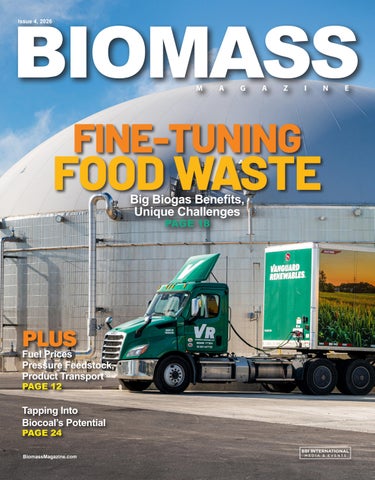
Issue 4, 2026
FINE-TUNING
FOOD WASTE Big Biogas Benefits, Unique Challenges PAGE 18
PLUS Fuel Prices
Pressure Feedstock, Product Transport PAGE 12
Tapping Into Biocoal’s Potential PAGE 24
BiomassMagazine.com
7XUQ %LRPDVV ΖQWR &OHDQ 5HQHZDEOH (QHUJ\ :H DUH WKH ZRUOGȇV DXWKRULW\ LQ ELRPDVV SURFHVVLQJ ZLWK QHDUO\ PDFKLQHV LQVWDOOHG JOREDOO\ 2XU FRPSOHWH HTXLSPHQW DXWRPDWLRQ DQG DIWHUPDUNHW VROXWLRQV KDQGOH DQ\ PDWHULDO IRU SHOOHWLQJ EULTXHWWLQJ JULQGLQJ DQG FRROLQJ *HW FRPSOHWH ELRPDVV VROXWLRQV SOXV SDUWV DQG VHUYLFLQJ ȃ DOO IURP D VLQJOH VRXUFH
3(//(7Ζ1* %5Ζ48(77Ζ1* &22/Ζ1* *5Ζ1'Ζ1* 3$576 6(59Ζ&Ζ1*
{
,$& ,6 32:(5,1* 7+( )8785( 2) %,20$66 352&(66,1* )DFLOLWLHV SURGXFLQJ KLJK WHPSHUDWXUH SDUWLFXODWH DQG V\QJDV HPLVVLRQV WKURXJK S\URO\VLV PXVW RSHUDWH ZLWKLQ DQ HYROYLQJ HPLVVLRQV FRQWURO HQYLURQPHQW ZKHWKHU XSJUDGLQJ DQ H[LVWLQJ IDFLOLW\ RU GHYHORSLQJ D QHZ RQH ,$& GHVLJQV EXLOGV DQG FRPPLVVLRQV WXUQNH\ ELRPDVV WKHUPDO SURFHVVLQJ IDFLOLWLHV HQJLQHHUHG WR PHHW WKHVH GHPDQGLQJ UHTXLUHPHQWV ZKLOH PD[LPL]LQJ XSWLPH HIĆFLHQF\ DQG ORQJ WHUP UHOLDELOLW\ $V DQ 2(0 PDQXIDFWXUHU RI EDJKRXVHV GU\HUV FDOFLQHUV DQG FRQYH\LQJ V\VWHPV ,$& SURYLGHV ERWK VWDQGDORQH HTXLSPHQW DQG IXOO\ LQWHJUDWHG WKHUPDO SURFHVVLQJ V\VWHPV JLYLQJ FXVWRPHUV RQH SDUWQHU IRU WKH HTXLSPHQW HQJLQHHULQJ DQG H[HFXWLRQ UHTXLUHG WR EULQJ FRPSOH[ ELRPDVV SURMHFWV RQOLQH )XOO (3& SURMHFW GHOLYHU\ IURP HQJLQHHULQJ WKURXJK FRPPLVVLRQLQJ
6FDODEOH LQGLUHFW FDOFLQDWLRQ WHFKQRORJ\ IRU KLJK FDSDFLW\ SURGXFWLRQ
%LRPDVV IHHGVWRFN KDQGOLQJ VWRUDJH DQG FRQYH\LQJ V\VWHPV LQFOXGLQJ ZRRG\DUGV
+LJK WHPSHUDWXUH GXVW FROOHFWLRQ DQG V\QJDV ELRJDV FOHDQXS V\VWHPV
7KHUPDO SURFHVVLQJ V\VWHPV GU\LQJ WRUUHIDFWLRQ FDOFLQDWLRQ DQG S\URO\VLV
%RLOHU LQWHJUDWLRQ KHDW UHFRYHU\ DQG FRJHQHUDWLRQ V\VWHPV
,QWHJUDWHG ELRFKDU DQG ELRFDUERQ SURGXFWLRQ V\VWHPV
&RPPLVVLRQLQJ WUDLQLQJ DQG ORQJ WHUP V\VWHP VXSSRUW
9LVLW LDF LQWO FRP ELRPDVVPDJ RU FDOO
,$& $GHOSKL 0HWFDOI $YH 6WH 2YHUODQG 3DUN .6
ISSUE 4 | VOLUME 19
12
18
COLUMN
FEATURES
06 EDITOR’S NOTE
12 TRANSPORTATION The High Cost of Hauling
Tougher Pieces of the Puzzle By Anna Simet
DEPARTMENTS 08 COLUMN Building the Energy System Behind Britain’s Next Industrial Era By Will Gardiner
09 COLUMN Why the Next Biochar Markets Will Be Built Around Specifications By Tristan Springer and John Bogil
10 BIOMASS NEWS
By Biomass Magazine
38 MARKETPLACE
| ADVERTISER INDEX 28 39 23 2 15 14 3 16 7 29 26 20 40 17 27 21 22
2027 Int’l Biomass Conference & Expo Biomass Magazine Industry Directory BRUKS Siwertell CPM Industrial Solutions Detroit Stoker Company Hermann Sewerin GmbH IAC KEITH Manufacturing Company KESCO, Inc. MARS Mineral Mid-South Engineering Company MoistTech Olsson Roeslein & Associates, Inc SUMA America, Inc. Uzelac Industries West Salem Machinery Co.
Biomass Magazine: (USPS No. 5336, ISSN 21690405) Issue 4, 2026. Biomass Magazine is published quarterly by BBI International. Principal Office: 308 Second Avenue North, Suite 304, Grand Forks, ND 58203. Phone: (701) 746-8385. Periodicals postage paid at Grand Forks, N.D., and additional mailing offices. POSTMASTER: Send address changes to Biomass Magazine/Subscriptions, 308 Second Avenue North, Suite 304, Grand Forks, N.D., 58203.
4 BIOMASS MAGAZINE | ISSUE 4, 2026
Surging diesel prices are squeezing biomass and pellet producers, putting new pressure on feedstock sourcing, transportation and already-narrow operating margins. By Katie Schroeder
18 RNG Beyond the Digester
Scaling food waste RNG requires more than proven digestion technology—it takes reliable feedstock, preprocessing infrastructure, long-term contracts and durable markets. By Keith Loria
24 BIOCOAL Building the Biocoal Market
Technology providers and producers are working to scale biocoal as a drop-in replacement for fossil steam coal, opening a potentially massive market for thermally treated biomass. By Emma Auch
CONTRIBUTIONS 30 MAINTENANCE When “Good Enough” Becomes a Liability By Victoria Bracco
32 BIOGAS How Hyper-Efficient Motors Can Transform US Biogas Economics By Robert Boyce
34 FINANCE Finding Hidden Capital in Biomass Facility Real Estate
By Aria Pournazarian, Brody Hess, Thiago Delia and Adam Rose
36 FEEDSTOCK A Second Life for Railroad Ties: Evaluating Recovered Wood as Biomass Fuel By Greg Kutschke
INDUSTRY EVENTS |
2027 Int’l Biomass Conference & Expo MARCH 2-4, 2027
Cobb Convention Center, Atlanta, Georgia Now celebrating its 20th year, the International Biomass Conference & Expo has served as the premier meeting place for the global biomass industry. The 20th annual event is expected to welcome more than 1,000 attendees, 175 exhibitors and 75 speakers from more than 25 countries, offering unmatched opportunities to learn from industry experts, discover emerging technologies and connect with decision-makers from across the biomass sector. Produced by Biomass Magazine, the conference delivers comprehensive programming focused on commercial-scale biomass and bioenergy, including pellets and densified biomass, biocarbon, biogas, liquid biofuels, heat and power. Whether you’re developing projects, supplying technology, producing biomass or exploring new markets, the event provides the knowledge and connections needed to move your business forward.
EDITORIAL
DIRECTOR OF CONTENT & SENIOR EDITOR Anna Simet asimet@bbiinternational.com SENIOR NEWS EDITOR Erin Krueger ekrueger@bbiinternational.com ASSOCIATE EDITOR Katie Schroeder katie.schroeder@bbiinternational.com
ART
(866) 746-8385 | BiomassConference.com
VICE PRESIDENT OF PRODUCTION & DESIGN Jaci Satterlund jsatterlund@bbiinternational.com
2027 North American Biocarbon Conference
SENIOR GRAPHIC DESIGNER Raquel Boushee rboushee@bbiinternational.com
MARCH 2-4, 2027
Cobb Convention Center, Atlanta, Georgia The North American Biocarbon Conference, co-located with the International Biomass Conference & Expo, brings together the full value chain of carbon-negative and carbon-smart technologies in one powerful, integrated event. By aligning biocarbon producers, biomass power generators, biochar innovators, carbon-removal buyers, project developers, and equipment providers with the broader biomass, biogas, CHP, pellet, and renewable-power industries, this co-located experience creates unmatched cross-sector engagement. Attendees gain access to expanded networking opportunities, dual-track educational programming, a unified expo hall, and a broader pool of commercial partners—all designed to accelerate the deployment of biocarbon solutions, scale climate-positive markets, and strengthen the emerging carbon-removal economy across North America.
(866) 746-8385 | BiocarbonConference.com
2027 International Fuel Ethanol Workshop & Expo JUNE 14-16, 2027
PUBLISHING & SALES CEO Joe Bryan jbryan@bbiinternational.com PRESIDENT Tom Bryan tbryan@bbiinternational.com CHIEF OPERATING OFFICER John Nelson jnelson@bbiinternational.com SENIOR ACCOUNT MANAGER Chip Shereck cshereck@bbiinternational.com SENIOR ACCOUNT MANAGER Bob Brown bbrown@bbiinternational.com SENIOR MARKETING & ADVERTISING MANAGER Marla DeFoe mdefoe@bbiinternational.com CUSTOMER SERVICE COORDINATOR Brandon McGarry brandon.mcgarry@bbiinternational.com
CHI Health Center, Omaha, Nebraska Now in its 43rd year, the International Fuel Ethanol Workshop & Expo remains the premier event for the global ethanol industry. The conference is expected to welcome more than 2,300 attendees from over 31 countries, including representatives from nearly every ethanol production facility in the United States and Canada. Produced by Ethanol Producer Magazine, the FEW delivers practical, operations-focused programming spanning production, policy, markets, technology, coproducts and emerging opportunities. Attendees gain firsthand insight from industry leaders, discover the latest innovations on the trade show floor and build valuable connections with the people shaping the future of ethanol.
(866) 746-8385 | FuelEthanolWorkshop.com
Please check our website for upcoming webinars
Please recycle this magazine and remove inserts or samples before recycling TM
COPYRIGHT © 2025 by BBI International
biomassmagazine.com/events/webinars
Subscriptions Biomass Magazine is free of charge to everyone with the exception of a shipping and handling charge for anyone outside the United States. To subscribe, visit www.BiomassMagazine.com or send a mailing address and payment (checks made out to BBI International) to Biomass Magazine Subscriptions, 308 Second Ave. N., Suite 304, Grand Forks, ND 58203. Back Issues & Reprints Select back issues are available for $3.95 each, plus shipping. Article reprints are also available for a fee. For more information, contact us at 701-746-8385 or service@bbiinternational.com. Advertising Biomass Magazine provides a specific topic delivered to a highly targeted audience. We are committed to editorial excellence and high-quality print production. To find out more about Biomass Magazine advertising opportunities, please contact us at 701-746-8385 or service@bbiinternational.com. Letters to the Editor We welcome letters to the editor. Send to Biomass Magazine Letters to the Editor, 308 2nd Ave. N., Suite 304, Grand Forks, ND 58203 or email to asimet@bbiinternational.com. Please include your name, address and phone number. Letters may be edited for clarity and/or space.
BIOMASSMAGAZINE.COM 5
| EDITOR’S NOTE
Tougher Pieces of the Puzzle
ANNA SIMET
DIRECTOR OF CONTENT & SENIOR EDITOR
asimet@bbiinternational.com
Most of the time, there are multiple obstacles standing between a good idea and a viable project. I think that’s evident in this issue, even though our three feature stories tackle very different corners of the biomass industry. The technology might work, the feedstock may be there, and the market may even be solid, but there are plenty of other pieces that have to fall into place. Some of those pieces might be more complex than it appears on the surface. In many cases, it has nothing to do the project itself, but rather, external factors that impact a project or operation’s bottom—i.e., the cost of fuel to transport feedstock or product. Our transportation feature provides a great example of this. Diesel prices surged this year, and for industries that move large volumes of relatively low-value material, the impact adds up quickly. For biomass power producers, pellet manufacturers, loggers and others in the forest products supply chain, transportation has always been a significant part of the equation. At today’s fuel prices, it’s an even bigger one. While some have strategized to mitigate the brunt of the impacts—such as industry veteran American Wood Fibers, as our page-12 feature, “The High Cost of Hauling,” demonstrates—the challenge remains for the foreseeable future. To give you a real example of the effects, according to CEO Stephen Faehner, for every dollar that diesel prices increase, it costs AWF a staggering $100,000 more every month. Food waste RNG presents a different version of these hurdles. There’s certainly no shortage of food waste, and anaerobic digestion (AD) is proven technology. But getting that material from where it’s generated to where it can be processed—and dealing with everything that comes along with it—is another matter. As Keith Loria explores in “Beyond the Digester” (page 18), successful projects require much more than a digester. Feedstock agreements and consistency, depackaging, transportation, interconnection and dependable end markets all have to work together. While food waste AD projects seem like a no-brainer, they are much more complicated than what meets the eye. Then there’s biocoal, a market with enormous potential. Thermally treated biomass can serve as a replacement for fossil coal in existing power and industrial applications, opening the door to a market far larger than the traditional biomass sector. But here again, scaling will depend on matching the right feedstocks and technologies with the right end users—and doing it economically. Read more about this sector in “Building the Biocoal Market” on page 24. If there’s a common denominator among these stories, it’s that producing a biomass-based fuel or energy product is only part of the equation. Getting the right material on-site it so the numbers work can be just as important. That’s certainly not a new challenge for this industry, but right now, it may be one of the most important.
6 BIOMASS MAGAZINE | ISSUE 4, 2026
CHOOSE KESCO
FROM CONCEPT TO REALITY EXPERIENCE MATTERS
SERVICES PROVIDED
" Þ« «½«æüΑ[æê « Þ T½ ÄÄ«Ä£ΑϞΑTÚ˶ æΑ õ ½Ë×à ÄæΑ TÚË ÞÞΑ ê «æÞ ͌ Α[ ÄÄ«Ä£ΑϞΑAË ½«Ä£ ÚËÄ Α+à £ Úü b¨ Úà ½Α[ ÄÄ«Ä£Α [üÞæ ÃΑ; üËêæΑϞΑ Þ«£Ä TÚË ÞÞΑ Ä£«Ä Ú«Ä£ TÚ˶ æΑA Ä £ à Äæ ËÄÞæÚê æ«ËÄΑA Ä £ à ÄæΑ W"VΑ õ ½Ë×à ÄæΑϞΑ õ ½ê æ«ËÄ bêÚÄα9 üΑTÚ˶ æÞ
CALL US TODAY
803-802-1718
Þ ½ Þϝº Þ ËÞ˽êæ«ËÄÞΠ ËÃΑΑΑΑΑΑΑΑΑΑΑΑΑº Þ ËÞ˽êæ«ËÄÞΠ ËÃ
Building the Energy System Behind Britain’s Next Industrial Era BY WILL GARDINER
I’ve always thought of energy as the silent partner behind economic growth and technological progress—rarely visible when it’s working; unmistakable the moment it isn’t. When London opened the world’s first electric underground railway in 1890, it showed the scale a new technology can achieve when matched with the right energy infrastructure. I see the same test facing today’s emerging technologies, from AI-enabled healthcare and electric transport to advanced manufacturing and digital public services. It is going to be very difficult to scale them unless the electricity system has enough power, keeps prices sensible and can flex generation by the minute rather than the season.
Where the Strain is Showing
The U.K. government projects that electricity demand could double by 2050. AI and data centers alone are expected to account for up to 16% of Britain’s electricity demand within a decade, and that’s before we include everything else electrifying around them. The system is already proving it can evolve. Wind was Britain’s largest electricity source for four consecutive quarters, with the first quarter of 2026 the most productive on record, while fossil fuel generation fell by 16% year over year, according to Drax’s Electric Insights report. Growth on that scale changes the job in front of us: The more we lean on wind and solar, the more critical flexible generation and storage become. Russia’s invasion of Ukraine and renewed tensions in the Middle East have exposed the risks of overreliance on single fuel sources or geographies. The core lesson remains that resilience comes from a mix of energy sources, and that includes both intermittent renewables and baseload power such as biomass generation.
Solving the Energy Trilemma
Much of what’s needed already exists. The right combination of technologies can deliver a more affordable, secure and sustainable system. Affordability: Wind and solar are already among the cheapest sources of electricity available, but affordability is about more than the cost of generation. A balanced system uses flexible generation and storage to manage weather and supply swings while reducing exposure to price volatility. Security: Renewables made up around half of Britain’s electricity last year. But an important part of security is whether the system can deliver it reliably. Maintaining that reliability as the renewable share grows will require dispatchable sources that can generate power exactly when it’s needed, including sustainable biomass. Sustainability: When sustainably sourced, biomass supports healthy forest management and helps limit new atmospheric carbon, while complementing other renewable technologies rather than competing with them. 8 BIOMASS MAGAZINE | ISSUE 4, 2026
Real challenges remain: political and investment uncertainty, local opposition to new infrastructure and intensifying global competition for capital all slow progress. So do practical constraints—some data center projects are facing grid connection delays of up to 15 years.
Bills Reflect the Entire System
For most people, energy only becomes visible when the bill arrives, reflecting the entire system—from the generation we’ve built to the networks we’ve established. Prices are signals. When demand outpaces supply or supply is constrained, costs and volatility rise. Three forces will shape where prices go from here: Policy: Market and planning reform and faster grid connections will decide how quickly Britain can turn investment into infrastructure. Demand: Accelerating electrification and data center growth will decide how much expansion is needed. Exposure: Our continued reliance on the global gas market and other single sources of energy will decide how much of that cost moves with events far outside our control.
Building the System Behind the Bill
At Drax, we’re investing in a diverse portfolio across the country to support the U.K.’s energy needs. That includes our £548 million ($742.5 million) acquisition of Bluefield Solar’s wind and solar portfolio, alongside our continued investment in biomass and battery storage. Biomass plays a distinct role in that mix as a renewable, dispatchable source of generation capable of running when intermittent renewables cannot. Drax Power Station also provides vital system services beyond generation, including inertia and electricity system restoration, helping to maintain stability and support the restoration of electricity supplies following a major disruption. Renewable energy, data centers, advanced manufacturing and grid investment can become engines of regional growth and job creation, not competitors for the same limited capacity. If we truly want to tackle affordability, we need to invest ahead of demand to build the flexibility Britain needs into the system before today’s constraints become tomorrow’s bottlenecks. I think about London’s first electric railways often and how we now hop on and off the Tube without thinking about the energy systems working quietly in the background. The technologies defining our next era are no different; they depend on the electricity system behind them that is often forgotten. But we can’t forget to invest in the silent partner for innovation. Author: Will Gardiner CEO, Drax
Why the Next Biochar Markets Will Be Built Around Specifications BY TRISTAN SPRINGER AND JOHN BOGIL
Biochar is moving into more markets. What was once discussed mainly as a soil amendment or carbon removal tool is now being explored in construction materials, agriculture, water treatment, industrial processes and other applications. This change creates a new problem for the industry: There is no single material called “biochar” that works equally well across all of these markets. Biochar made from wood at one temperature can look very different from biochar made from agricultural residues under different conditions. Feedstock, temperature, residence time, ash content, particle size, moisture and post-processing can all change the finished material. Those differences affect where and how the biochar can actually be used. As the industry grows, we need to spend less time asking how to sell raw biochar and more time asking what specifications each market needs.
Biochar Is Not a Commodity
Commodity markets work when buyers can reasonably expect one unit of a material to behave like another. Biochar is not there yet. Two biochars can both contain a high percentage of stable carbon while having very different pH, ash content, density, particle size, pore structure and surface chemistry. Those differences may not matter much in one application, but might determine whether the product works at all in another. This is not necessarily a weakness. Steel, plastics, chemicals, and many other industrial materials also come in a wide range of grades. The difference is that those industries have spent decades defining which material properties matter for each application. A buyer looking for steel does not simply order “steel.” The buyer starts with the application and works backward toward a grade and specification. Biochar must develop in the same direction.
Poultry Litter: A Useful Example
We ran into this problem while looking at biochar for poultry litter. At first glance, the application makes sense. Biochar is porous and can help manage moisture and nutrients. Poultry growers also have a significant problem with ammonia produced from manure in the litter, but ammonia control is heavily affected by pH. As litter becomes more alkaline, conditions favor the release of ammonia gas. Many raw biochars are also alkaline, which means a material that performs well at moisture management can still be poorly matched to ammonia control. Research has produced mixed results for raw biochar in poultry litter. Some studies have reported lower ammonia emissions, while others have found that biochar kept litter relatively dry but resulted in higher ammonia levels. The takeaway is not that biochar works or does not work; it’s that the properties of the biochar make all the difference.
Our response at Valorize was to work backward from the application. Instead of treating raw biochar as the finished product, we modified its chemistry and developed AeroChar, a pH-modified biochar for poultry litter and ammonia control. The poultry application is relatively narrow, but the lesson applies across the industry. A useful carbon material is not defined only by how it was produced, but also by what the customer needs it to do.
Post-Processing Can Become Part of Biochar Production
This changes how we should think about the boundary of a biochar operation. Today, much of the focus is understandably on pyrolysis. Producers optimize feedstock preparation, temperatures, residence times, energy recovery, emissions, throughput and carbon yield. Those decisions are critical. But pyrolysis does not necessarily need to be the final manufacturing step. Biochar can be screened, milled, blended, pelletized, activated, coated, acidified, loaded with nutrients or otherwise modified depending on the market. In some cases, the biggest increase in commercial value may happen after the carbon leaves the reactor. We already see versions of this model emerging. Pelletization is being used to change handling and application characteristics. Activation and other treatments can alter surface properties. Blending allows carbon materials to become components in larger formulations rather than standalone products. The result is a shift from biochar production toward biochar manufacturing.
Product-Market
The biochar industry has done an amazing job proving that biomass can be converted into stable carbon at commercial scale. The next challenge is figuring out where all of that carbon should go, which requires more than a list of possible applications—it requires understanding the specifications behind each one. The question for producers is increasingly not, “Who will buy our biochar?” but rather, “What material does this market need and can we make it?” That change in thinking will significantly expand the market for biomass-derived carbon. The future of biochar may not be one enormous commodity market. It may be dozens of large markets, each built around a different version of the material. For an industry with unusually flexible feedstocks and production methods, that may be exactly the opportunity. . Author: Tristan Springer and John Bogil Cofounders, Valorize Systems
BIOMASSMAGAZINE.COM 9
BIOMASS NEWS | imported or not modeled oils as feedstock for transesterification of mixed oils pathway and HEFA of mixed oils pathway; the renaming of distillers corn oil (DCO) to distillers corn oil/distillers sorghum oil (DCO/DSO) to clarify that this feedstock may be either or a blend of both; and, for certain pathways, the addition of user inputs for facilities that operate integrated natural gas and combined-heat-and-power systems for on-site electricity production, and guidance for how such facilities may enter the quantity of purchased environmental attribute credits.
July US Wood Pellet Exports Top 1.08 Million Metric Tons
The U.S. exported more than 1.08 million metric tons of wood pellets in July, up 15% when compared to June and up 11% when compared to July 2025, according to data released by the USDA Foreign Agricultural Service in early September. The U.S. exported wood pellets to more than 20 countries in July. The U.K. was the top destination for U.S. wood pellet exports at approximately 704,625 metric tons, followed by Japan at approximately 169,769 metric tons and the French West Indies at 50,565.8 metric tons. The value of U.S. wood pellet exports reached $212.26 million in July, up 17% when compared to both the previous month and July of last year. Total U.S. wood pellet exports for the first seven months of 2026 reached 6.52 million metric tons at a value of $1.25 billion, compared to 5.82 million metric tons exported during the same period of 2025 at a value of $1.11 billion.
Updated DOE 45ZCF-GREET Model Includes RNG, Regenerative Ag Updates
The U.S. Department of Energy
10 BIOMASS MAGAZINE | ISSUE 4, 2026
on Sept. 8 released an updated 45ZCFGREET model, used to calculate fuel emissions rates for the 45Z Clean Fuel Production Credit. The latest version includes revisions related to renewable natural gas (RNG) production and regenerative agriculture, along with other minor changes. The update adds several RNG pathways, including RNG produced via anaerobic digestion and upgrading from food scraps, corn stover, grain stillage, mixed high-moisture organic wastes, dairy manure and swine manure. The updated model also incorporates the 45ZCF feedstock carbon intensity calculator (FD-CIC) to be used for calculating carbon intensity adjustments for feedstocks that are produced using certain regenerative agricultural practices. In addition, for certain pathways that include the option for feedstocks that are produced with regenerative agricultural practices, units for user inputs for feedstock amount have been revised for consistency with 45ZCF FD-CIC. Other changes include the updating of categories for imported used cooking oil as a feedstock in 2025 to align with the most recent clarifications regarding 45Z eligibility; the adding of a user input for other
Montana Renewables Announces Expansion to 200 Million Gallons of SAF
Calumet Inc. on Sept. 1 announced a revised expansion plan for its Montana Renewables LLC facility that aims to increase sustainable aviation fuel (SAF) production capacity to approximately 200 million gallons per year by the end of 2028. The company expects the expansion to require $137 million in remaining capital spending, down from the $1.2 billion project contemplated under a loan guarantee agreement with the U.S. Department of Energy signed in January 2025. Calumet and the DOE have amended that agreement to reduce remaining federal funding from up to $658 million to a final $34 million draw. Montana Renewables plans to fund the balance of the expansion with retained earnings. The revised structure eliminates the need for third-party equity. The expansion will repurpose equipment from the adjacent Calumet Montana Refining facility, including a hydrotreater, hydrogen plant and naphtha splitter. The equipment will be leased to Montana Renewables and integrated into its existing operations. Rather than completing the expansion as a single large construction project, Calumet plans to undertake six smaller
BIOMASS NEWS |
projects. Montana Renewables is currently producing SAF at an annualized rate of approximately 60 million gallons and expects to exceed an 80 million-gallon annualized rate by the end of 2026. Production is expected to surpass an annualized rate of 120 million gallons by spring 2027 and reach approximately 200 million gallons annually by the end of 2028. Total product sales are expected to reach 17,000 barrels per day. The expansion is also expected to allow Montana Renewables to recover approximately 20 million gallons per year of renewable propane and butane that is currently burned as fuel gas. The project is expected to improve renewable naphtha yields and reduce unit operating costs. A turnaround to complete the equipment tie-in is scheduled for the fourth quarter of 2026. Calumet Montana Refining will remain in operation and continue producing retail asphalt.
US Forest Service Funds Bioenergy, Biochar Projects
The U.S. Forest Service on Aug. 5 awarded $105.5 million to 177 wood products and energy projects across the nation. Funded projects include those focused on biochar, bioenergy and wood pellet production. The funding includes $31 million for 113 Wood Innovations Grant projects, $17 million for 23 Community Wood Grant projects and $57 million for 41 Wood Products Infrastructure Assistance projects. The selected projects span 44 states and the District of Columbia. Some examples of Wood Innovations Grant recipients include: LanzaTech Inc., which was awarded $300,000 to support the design of a biorefinery in Bellemont, Arizona, that would produce wood-based ethanol and create a new market for more than 500,000 tons of low-value biomass; West Biofuels LLC, which received $500,000 to establish a wood energy system and biochar facility in California that is expected to ex-
pand wood markets by 30,000 tons annually while reducing wildfire risk on national forests; and Highland Pellets LLC, which received $500,000 to establish wood energy and methanol production systems in Arkansas to increase the use of low-value wood. Examples of Community Wood Grant recipients include: Robison Carbon LLC, which was awarded $1 million to install two continuous pyrolysis reactors in Louisiana that will convert Southern yellow pine veneer chip residuals from regional sawmills into biochar; Pallet and Lumber Supply LLC, which received $595,000 to install a combined-heat-and-power system integrated with a continuous pyrolysis reactor in Arizona to utilize mill residuals and support production of new products; and Renew Biomaterials LLC, which was awarded $1 million to install a rotary pyrolysis unit in southwestern Washington that will utilize low-value mill residuals and support the regional timber economy. Examples of Wood Products Infrastructure Assistance Grant recipients include: Co-Gen Co. LLC, which was awarded $2 million to support the reopening and upgrade of a biomass CHP system co-located with an Oregon sawmill that will use forest-generated biomass and residuals as fuel while creating an additional market for restoration byproducts from federal and tribal lands; Forest Energy Corp., which received $1 million to upgrade an Arizona wood pellet facility to increase its use of small-diameter and low-value timber from the Four Forest Restoration Initiative landscape; and Sierra Pacific Industries Inc., which was awarded $2 million to upgrade a biomass boiler at an existing California sawmill, increasing its use of federal timber, including low-value and small-diameter material.
nounced the release of the 2025 United States Biochar Market Report. It’s the most comprehensive, self-reported industry snapshot available to date, according to the ABI. The report shows a rapid increase in biochar use across agriculture, water filtration, carbon sequestration and other markets. Created as a follow-up to the 2023 Global Biochar Market Report, this new edition focuses specifically on benchmarking the United States industry as it grows. Among other highlights in the report, the estimated economic value of the U.S. biochar industry increased from $53.6 million in 2023 to around $157 million in 2025, driven by rapid commercialization and capacity expansion. This reported expansion is reflected in multiple state- and city-run biochar projects across the country, including the City of Minneapolis and Hamilton County’s Great Parks and Cincinnati Parks. Agriculture remains the largest market for biochar. Water filtration, environmental remediation, carbon sequestration and industrial applications continue to to emerge as growth sectors. The report also identified key obstacles to more rapid growth and surfaced areas of progress so far. Organizations like ABI will continue addressing the obstacles by increasing awareness of biochar, building robust and durable market demand, and developing industry standards. The 2025 U.S. Biochar Market Report is available for free at biochar.org.
US Biochar Industry’s Economic Value Tripled Since 2023
The American Biochar Institute anBIOMASSMAGAZINE.COM 11
| TRANSPORTATION
THE HIGH COST OF
HAULING
Surging diesel prices are squeezing biomass and pellet producers, putting new pressure on feedstock sourcing, transportation and already-narrow operating margins. BY KATIE SCHROEDER
F
ueled by supply chain interruptions due to war in the Middle East, diesel prices have reached historic highs in 2026, driving up operating costs across many industries and hiking prices for consumer goods. With narrow margins and significant volumes of feedstock to transport, biomass-to-energy facilities and wood pellet producers face a challenging financial equation. In August 2026, average U.S. diesel prices stood at $5.37 per gallon, according to AAA’s fuel price tracker. Supply chain disruptions due to conflict in the Middle East jumped significantly in 2026. U.S. Energy Information Association data has tracked this trend as diesel prices climbed from an 12 BIOMASS MAGAZINE | ISSUE 4, 2026
average of $3.52 per gallon in January to $4.91 in March. Since then, prices spiked to $5.60 on average in May, rising to a crushing $6.31 national average by mid-September— an all-time record in the United States.
The Cost of Transport
Approximately two gallons of diesel are needed to produce one ton of hardwood pulp, explains Dana Doran, executive director at Professional Logging Contractors of the Northeast, a nonprofit representing timber harvesting and hauling contractors in the Northeast. One ton of biomass requires about two gallons of fuel, meaning that $5 per gallon diesel prices lead to a total of $10 per ton of biomass. “If
you’re being paid $50 a ton, basically 20% of that … [is] just for production; that does not include trucking—just diesel alone,” he says. He estimates this cost spikes to about 30% when including the cost of trucking. Doran notes that fuel prices also surged in 2021 and 2022, but the forest products industry—both pulp and paper and lumber mills—was doing good business and willing to pay logging companies a price escalator for every 50 cents above $4 per gallon of diesel. This time around, however, that is not the case, and he has seen logging companies shoulder the cost. Fuel prices in California jumped from about $5 per gallon to over $7 per gallon when the Iran war began in February ex-
IMAGE: STOCK
plains Chris Quijano, director of operations with Kyuden Energy Partners. As a third-party operation and maintenance company, Kyuden Energy Partners, formerly known as IHI Power Services, manages and operates power facilities from Hawaii to New York. One such facility is the Rio Bravo Rocklin biomass power plant located near Sacramento, California. Feedstock transportation costs account for about 50% of biomass power facilities’ operating budget, explains Scott Pederson, fuel manager at Rio Bravo Rocklin. Several key factors helped dampen the blow of surging diesel prices, including the significant amount of local supply and plant downtime for maintenance. Pedersen explains that the
facility was offline between April and July to overhaul a turbine—a critical piece of plant infrastructure—avoiding operation when diesel prices were at their highest. (However, since interviews for this story were conducted, prices have crept even higher.) Most companies sign annual contracts for biomass supply to mitigate market volatility coming from shifting diesel prices, explains Pedersen. Many of the Rocklin facility’s suppliers are local, which helps minimize the impact of higher fuel costs. In the past, the plant has helped shoulder the burden of high diesel prices on a situational basis. For example, rather than adding a diesel surcharge framework into contracts, Pederson may increase payments slightly in high-price
environments for six months if a supplier expresses concern about diesel prices. “It just makes it easier … for us as well as for them, and they’re not having to constantly be watching diesel prices fluctuate,” he says. High prices in recent months spurred a few of those conversations, Pedersen explains. Rio Bravo Rocklin was approached by some of the facility’s long-distance suppliers, some of whom asked to renegotiate their supply prices in light of the sudden change in fuel prices. Suppliers are not making much—if any—money off of transporting the biomass. Now, acquisition prices primarily cover fuel costs, giving suppliers little margin. BIOMASSMAGAZINE.COM 13
| TRANSPORTATION
Supply and Demand
©śľʲƉſŷǤʲ ıƉžİşſľķʲ ƳƽĔƽşƉſĔƬǤʲ ĔſķʲžƉİşŷľʲ žľĔƳǃƬşſŔʲ ƳǤƳƽľž jǃŷƽşƽľıʲ˻ʲ şƉ ƉſƽƬƉŷ
0QUJNJ[F ZPVS QMBOU 4BWFT UJNF BOE NPOFZ UIBOLT UP DPOUJOVPVT BVUPNBUFE NFBTVSFNFOU &YUSFNFMZ VTFS GSJFOEMZ æFYJCMF BOE QSFGBCSJDBUFE TZTUFN r QMVH BOE QMBZ *NQSPWFT HBT RVBMJUZ BOE QSPUFDUT QPXFS HFOFSBUPST
XXX TFXFSJO DPN 14 BIOMASS MAGAZINE | ISSUE 4, 2026
Rio Bravo Rocklin uses 200,000 tons of biomass each year to fuel energy production. California has abundant supply to meet this demand, to the point that Pederson has needed to turn away potential suppliers. Diseased forests, wildfire cleanup and forest thinning all contribute to the large supply pool for biomass power plants in the state. Brooks Mendell, president of Forisk Consulting, tracks data on various biomass types, including combined-heat-and-power, wood pellets, liquid fuel and biomass energy. The impact of increased fuel prices is uneven across these products, varying by region and by industry, explains Mendell. The southern U.S. also has significant feedstock volumes available, mitigating the cost for biomass facilities and making the biomass harder to dispose of for sawmills. The significant amount of pulpwood and sawmill-derived residual fiber available locally gives energy facilities many fuel options. “On the flip side, people who are trying to sell this material are having a hard time moving it, and they’re willing to send it farther than they would have in the past,” Mendell says. The supply dynamic in California is quite similar; Rio Bravo Rocklin has needed to turn away suppliers who want to ship feedstock over 100 miles. In the past, California was home to 50 biomass power plant facilities, but that number has dropped to about 20. Many of the facilities shut down due to contract expiration with power companies. “They were all like 30-year contracts that ended around 2015 to 2020 [roughly],” Pedersen says. “Those all expired, and they didn’t renew them because it costs more to make biomass power than it does solar.” Quijano adds that even though the cost difference between the two power sources is higher per megawatt, the cost increase is quite small “in the grand scheme of things,” amounting to only a few pennies for consumers. In the Northeast, standalone biomass energy facilities and softwood pellets both provide strong demand for the region’s
wood residue. Biomass energy facilities gather feedstock from an approximately 60-mile radius because of the cost of shipping, chipping and handling. In the past, the biomass power plants could go beyond that radius because they could pay for it. The acquisition radius shrinks as biomass energy producers are impacted by trucking prices and struggle to find the money to pay a competitive rate in light of low natural gas prices. Also, some biomass power facilities in the region run as peaking facilities, so their fuel demand is intermittent. In contrast, pellet producers in the region are in a more favorable position. As pulp and paper mills close, softwood demand dissipates and competition dwindles, enabling pellet producers to collect feedstocks from a tighter 60-mile radius, according to Doran. Pellet producers also use round wood, which could come from a farther distance due to a higher density and lower handling costs. Mendell also outlines the competitive edge that pellet facilities have gained as pulp and paper mills close. “When a pulp mill closes, it helps the bioenergy sector because the pulp mills are the top of the food chain when it comes to using residuals or chips,” Mendell says. “When we’ve had pulp mill closures, it frees stuff up for the energy guys, so it actually helps them.” Mendell believes higher diesel prices are only part of the equation when it comes to locating a pellet facility, as producers always site facilities as close to the feedstock source as possible. “The fuel price does affect your distance if you’re selling something that needs to be shipped,” he says. “So, if you are a pellet facility and you need to get something to the port and you don’t have access to a rail line, fuel prices really matter.” Doran explains that, in the Northeast, biomass facilities simply are not being built, but he could see overall transportation economics impacting the location of any future facilities.
Operational Obstacles
The difficult situation for pellet plants
American Wood Fibers staff hold bags of wood pellets used for animal bedding. With narrow margins on many of its products, the company is sensitive to changes in transportation costs. IMAGE: AMERICAN WOOD FIBERS
is that they have an outbound product that they’re selling and need to ship that product via truck, according to Mendell. Every entity in the supply chain is “taking a haircut” explains Stephen Faehner, CEO and president of American Wood Fibers. “Folks are passing along the cost, we generally have those factored into our relationships and our contracts with those folks,” he says. “But like with most businesses in today’s world, we get sort of squeezed in the middle between our suppliers and our customers.” With 10 locations across the United States, AWF produces animal bedding made from wood shavings, grilling pellets, wood fuel pellets, small pet bedding, potting soils, bulk wood shavings and wood flour for industrial applications. “We have a fairly diversified and fairly integrated business that is somewhat different than most people that do the pellets for fuel,” he says. “But it’s not getting any easier.” He estimates that an increase of one dollar in diesel prices add up to $100,000 in extra expenditures each month. The company pulls in about 50,000 truckloads each year, and the low value of each pound makes the company sensitive to inbound freight price fluctuations. “My truckloads, on a good day with a tailwind, is worth $5,000,” Faehner says. “I’m not shipping TVs. I’m not shipping microchips; we’re selling stuff that goes pennies per pound.” Many pellet producers and biomass energy producers operate more like a waste management service, he explains. For example, a lot of the trucks used to ship biomass to AWF facilities are operated by the company’s employees through its shipping subsidiary, BIOMASSMAGAZINE.COM 15
| TRANSPORTATION
AWF Express, but some of the work is contracted out. “It’s not quite 50-50, but we do a fair amount, and we have a good number of contractors,” Faehner says. “We provide the trailers 100% of the time.” On top of fuel price increases, the company feels the impact of national truck driver shortages in real time. Faehner explains that past regulation changes, which forced truck drivers to drive fewer hours each day, caused companies to put more trucks on the road—often with less experienced drivers—to move the same amount of freight. AWF also feels the pinch from rising energy prices, Faehner explains. As an industrial process, making biomass-based products requires significant amounts of electricity. Much of the low hanging fruit for energy efficiency—using LEDs for lighting, variable frequency drives or load balancing—has already been implemented at AWF facilities. Although Faehner has explored alternative energy sources, such as solar panels, the return on investment time frame for
This graphic from the U.S. Energy Information Administration demonstrates the spike in diesel prices across the U.S. beginning after the Iran war broke out in February 2026. SOURCE: U.S. EIA
KEEP FUEL MOVING Independent loading and discharge allows continuous flow.
16 BIOMASS MAGAZINE | ISSUE 4, 2026
renewable energy projects ends up being a prohibitive 15 to 20 years. “There’s not really a return, because I’ll have to replace it in 15 [years],” he says. The story around difficult financial realities is not limited to fuel and energy prices and truck driver shortages; overall staff shortages are also a problem. AWF has handled this challenge by implementing automation wherever possible, “all the bad jobs are getting automated out.” The difficulty of automation, however, is the need for more skilled labor. Now, fewer jobs are entry level and more training is needed to operate the machine, requiring skills like coding and PLC programming. Pricing for many of AWF’s products has not kept pace with rising production costs, compounding cost challenges. Faehner notes that fuel pellets are the exception, increasing slightly in recent years.
Must-Have Markets
Looking ahead, Faehner is concerned
about finding the right type of wood residues needed to produce his products. With construction options like luxury vinyl tile and PVC windows, both of which are cheaper and require less maintenance for cash-strapped consumers, he worries that large-scale manufacturing with wood may be in trouble. However, one emerging opportunity in the forest products space stands out as a potential bright spot. The mass timber movement, an effort that pursues utilization of wood in large-scale projects instead of steel or concrete, has been gaining momentum. According to the Wood Products Council website, mass timber utilizes large, engineered wood panels combined with engineered wood columns and beams. Faehner’s family has a legacy steeped in the forest industry, spanning over 100 years and beginning in 1919. “The last thing I want to see is forest not staying forest,” he says.
A strong market for forest products entices landowners to keep their trees and tend them well, rather than cutting the trees down or protecting forests to the point that they become unhealthy. “Having opportunities to convert it into other useful products is just a huge part of the equation of a sustainable world and a balanced ecosystem, and one that keeps climate change at a minimum,” Faehner adds. Ultimately, high diesel prices are magnifying an existing challenge for biomass and pellet producers: moving large volumes of relatively low-value material economically. As transportation costs rise, feedstock availability, haul distance and proximity to end markets become increasingly important to keeping operations competitive. Author: Katie Schroeder Associate Editor, Biomass Magazine
TURNKEY RNG SYSTEMS TURNKEY RNG SOLUTIONS FROM CONCEPT TO PIPELINE. MANURE | FOOD WASTE | INDUSTRIAL
SCAN HERE TO LEARN MORE BIOMASSMAGAZINE.COM 17
| RNG
BEYOND THE
DIGESTER
Scaling food waste-based RNG requires more than proven digestion technology—it takes reliable feedstock, preprocessing infrastructure, long-term contracts and durable markets. BY KEITH LORIA
F
ood waste appears to have nearly everything a renewable natural gas (RNG) project needs: enormous volumes, strong gas-production potential and a compelling case for keeping organics out of landfills. Yet, while dairy manure and landfill gas have supported a rapidly expanding RNG market, food waste deployment has moved more slowly. The gap is not a referendum on anaerobic digestion. Developers and operators say the technology works. The larger obstacle is assembling a dependable system around it, one capable of sourcing diverse wastes, separating organics from packaging, moving material economically, securing long-term contracts and generating enough predictable revenue to finance infrastructure expected to operate for decades. “The technology has proven itself,” says Michael O’Laughlin, CEO of Vanguard Re18 BIOMASS MAGAZINE | ISSUE 4, 2026
newables, a Weston, Massachusetts-based developer, owner and operator of farm-based anaerobic digestion facilities that convert food, beverage and agricultural waste into RNG and nutrient-rich agricultural products. “What’s slowed development has been the economics around it.” Construction and equipment costs have risen while policy support has matured unevenly. Volatility in voluntary environmental markets adds uncertainty. Demand for landfill diversion, circularity and low-carbon fuels continues to strengthen, leaving the industry with a paradox: The resource is abundant, but the commercial system connecting it to energy markets remains incomplete.
An Abundant, Uneven Resource
The scale of the opportunity is difficult to miss. The U.S. EPA estimates that 66.2 million tons of wasted food were generated in
the retail, food service and residential sectors in 2019. Nearly 60% went to landfills, while less than 1% was managed through anaerobic digestion. Food and beverage manufacturing generated another 40 million tons, although that material followed a different pattern: The EPA estimates 42.6% was managed through anaerobic digestion. American Biogas Council data shows that 138 stand-alone food waste biogas systems are operating nationally. Patrick Serfass, the council’s executive director, notes those facilities are only part of the market because farms and water resource recovery facilities also co-digest food waste. “We as a society in the United States do not have the same approach to recycling food waste that we do with glass, metal, paper and plastic,” Serfass says. “I don’t think most people see food waste that way.” Availability on a national spreadsheet, however, does not equal bankable feedstock
Grocery store food waste is delivered to a digester. IMAGE: AMERICAN BIOGAS COUNCIL
at a particular site. The resource is dispersed among homes, restaurants, supermarkets, distributors and manufacturers, and its accessibility varies sharply by region. Robust curbside organics programs can consolidate residential material, while weak collection systems and exemptions from diversion requirements can leave a proposed facility without sufficient nearby volume. Suzanne Hunt, vice president of policy at Generate Upcycle, a New York-based developer, owner and operator of organic waste recycling facilities that convert food and agricultural waste into RNG, renewable electricity and nutrient-rich fertilizers, says industrial and commercial streams add volume but also complexity. Food manufacturers may generate process water, off-spec products, production residues and packaged goods, each requiring different handling. “You could be getting offspec baby food in glass jars, expired beer in
aluminum cans or pallet loads of cookies in cardboard boxes,” Hunt says. “You have to have the machinery to handle all those different types of packaging.” That variability separates theoretical potential from material that can be processed economically. A facility must control transportation costs, accept changing streams and find outlets capable of beneficially using the nutrients remaining after digestion.
Manure’s Built-In Advantage
Dairy manure projects begin with an advantage that food waste facilities must spend years achieving—a large, consistent feedstock concentrated at one location. A developer building a dairy digester knows where the material originates, how it will be collected and, with reasonable confidence, how much will be available. Starting a project co-located at a dairy, you have 100% of your feedstock,” says
Dan Meccariello, vice president of operations at Generate Upcycle. “The commercial risk associated with [sourcing] the feedstock to make the gas, that box is checked.” Permitting is generally more streamlined as well. Manure-only systems typically remain within familiar agricultural regulations. Commercial food waste can bring solid waste rules, multiple agencies and differing local requirements into the same project. It also demands more equipment because bulk liquids, source-separated organics, dry foods and beverages cannot be managed identically. Policy incentives have widened the difference. Serfass says manure-based RNG and landfill gas can qualify for D3 cellulosic biofuel credits under the federal Renewable Fuel Standard, while food waste-derived RNG generally receives D5 advanced biofuel credits, which are typically less valuable. California’s Low Carbon Fuel Standard also tends BIOMASSMAGAZINE.COM 19
| RNG
to award manure RNG more credits because capturing methane that otherwise would escape from manure storage produces an exceptionally low carbon-intensity score. “When you develop a policy that hinges on reducing carbon emissions and one feedstock reduces more emissions, it is going to perform better in that program,” Serfass says. “That is exactly what has happened with manure.” Food waste still brings an important advantage to co-digestion: it generally produces more biogas than manure, while manure provides a stable biological base. The combination can lift gas yields and create more consistent digester biology. “Food and beverage waste typically produces significantly more biogas than manure alone,” O’Laughlin says. “Manure provides a stable biological foundation for the digestion process.”
Waste Is Not a Commodity
Financing requires certainty, but food waste contracts often follow the short-term practices of the hauling industry rather than the longer commitments common in energy infrastructure. A generator accustomed to month-to-month or quarterly waste service may resist a five-year feedstock agreement, even when a lender views that commitment as essential. Food waste drives revenue twice. A project may receive tipping fees for accepting it,
20 BIOMASS MAGAZINE | ISSUE 4, 2026
A liquid tanker delivers feedstock to Vanguard Renewables’ anaerobic digestion facility in Eden, Wisconsin, where food and beverage waste is converted into renewable natural gas. IMAGE: VANGUARD RENEWABLES
then sell the gas and environmental attributes produced from it. A break in supply therefore affects both sides of the ledger. “The reliability of food waste coming to the biogas system is responsible for 100% of the revenue,” Serfass says. “If you’re asking for a loan and you’re not going to pay it back in five years, the bank wants to see that you have a feedstock agreement for five years.”
The problem extends beyond contract length. Manufacturers want a turnkey outlet for every residual product they generate, but those materials change with seasons and production schedules. A processor may run several products on one line, while a co-packer handles goods from multiple brands in different formats.
The Cost Before Digestion
Vanguard Renewables’ Eden, Wisconsin, operations team manages the day-to-day challenges of receiving and processing diverse food and beverage waste streams. IMAGE: VANGUARD RENEWABLES
Meccariello recalls arranging to receive sports drinks and preparing for 20-ounce bottles filled with liquid. The first truck instead carried powdered flavor packets intended to be mixed with water. “It was something we were not prepared for and didn’t fully understand,” he says. “It highlights the variety of materials that can come from a manufacturer.”
Successful developers therefore sell reliability as much as disposal capacity. O’Laughlin says customers view unsalable food as a liability and do not want diversion programs interfering with their core businesses. “Collection has to be dependable, simple and virtually invisible to daily operations,” he says. “If a program creates operational headaches, it won’t be sustainable.”
Consequential work occurs before organics reach a digester. Packaged goods must be opened, separated and converted into a consistent slurry without allowing contaminants to compromise equipment, biology or digestate quality. Depackaging lets facilities receive products that would otherwise be difficult to recycle, but these systems raise capital and operating costs. Each stream must be evaluated for packaging, density, recovery potential and the value of separated materials. Meccariello notes that project teams can overlook dunnage—the pallets, crates, intermediate bulk containers and other reusable shipping materials customers expect to receive back. Those items must be handled, cleaned, stored and returned. Low-density products present another trap because they consume transportation and processing capacity while yielding relatively little organic material. “If you’re not paying attention to what the actual harvestable organics are compared to the ratio of the packaging and the cost associated with that packaging, you can get yourself upside down,” he says. “You don’t have a lot of organic recovery capability with very lightweight materials.” Vanguard has responded by expanding both digestion and preprocessing capacity. During the past year, it brought three RNG
BIOMASS
WOOD FIBER • CELLULOSE • AGRICULTURAL
BIOSOLIDS
MUNICIPAL SLUDGE • INDUSTRIAL SLUDGE • DAF SOLIDS • DIGESTATE • POULTRY MANURE
THE RIGHT CHOICE IN DRYING FOR OVER 30 YEARS. www.uzelacind.com
RENDERING
Uzelac Industries is a leading manufacturer of Rotary Drying Systems, with systems opera ng interna onally. Our systems convert many different products into marketable byproducts in many different industries.
FERTILIZER
Consulta ons are FREE.
CATTLE & HOG BLOOD MEAL • BONE AND FEATHER MEAL • EGG SHELLS AMMONIUM SULFATE • POTASH
Please contact our Main Office in Pewaukee, WI (414) 529-0240 BIOMASSMAGAZINE.COM 21
+LJK 3HUIRUPDQFH 6L]H 5HGXFWLRQ 6ROXWLRQV +LJK (IILFLHQF\ 8QPDWFKHG 'XUDELOLW\ 9HUVDWLOH $SSOLFDWLRQV /RZ 0DLQWHQDQFH
+DPPHU PLOOV + LOO 6KUHGGHUV 6FUHHQV &RQYH\RUV )URP VLQJOH PDFKLQHV WR IXOO SURFHVV OLQHV UHO\ RQ :HVW 6DOHPɒV \HDUV RI H[SHULHQFH IRU D VROXWLRQ EXLOW DURXQG \RXU ELRHQHUJ\ JRDOV
6FDQ WR YLVLW RXU ZHEVLWH
ZHVWVDOHP FRP 22 BIOMASS MAGAZINE | ISSUE 4, 2026
| RNG
facilities online in Wisconsin and Virginia through a joint venture with TotalEnergies. The facilities have nearly 870,000 MMBtu of combined annual production capacity, with their RNG supplying AstraZeneca’s U.S. research and manufacturing operations. Vanguard also acquired E-Z Recycling in Minnesota and Complete Beverage Destruction in Florida, adding depackaging, processing and certified destruction capacity. The investments reflect an emerging lesson: Food waste RNG cannot scale through digesters alone. It needs a network that can collect, depackage and route materials before digestion and manage nutrients afterward.
Making the Revenue Stack Work
No individual revenue stream usually carries a project. Tipping fees, RNG sales, federal and state credits, government incentives and voluntary purchases each recognize a different portion of the value created through landfill diversion, methane avoidance, renewable energy and nutrient recycling. “No single market mechanism drives investment on its own,” O’Laughlin says. “Success comes from multiple value streams working together.” That structure provides diversification but exposes projects to moving markets. Energy prices and credit values fluctuate, while feedstock volumes can shift after a recall, refrigeration failure or manufacturing change. Hunt says operators need redundancy, but policy stability remains crucial for multidecade infrastructure. State organics recycling laws have helped signal demand, though Serfass says roughly a dozen statewide programs generally lack meaningful enforcement. Large companies may comply to meet environmental commitments or prepare for tighter future regulation, while others can continue landfilling when it remains the cheaper option. “It is super common for a solar developer or wind developer to go out and get a 20-year contract for their power,” Hunt says. “That is not nearly as easy to access for an RNG contract.” Ontario offers one possible model. Generate Upcycle notes that strong organics
separation requirements, landfill constraints and updated assumptions about methane released by landfilled food have accelerated digestion investment there. The lesson is not that one mandate solves every problem, but that coordinated collection rules, emissions accounting and durable markets reduce enough risk for capital to move.
The Path to Scale
Growth is beginning to cluster where agriculture, food manufacturing, organics policy and energy demand overlap. O’Laughlin points to the Midwest as particularly promising. Vanguard recently broke ground on a facility at Wagner Dairy in Litchfield, Minnesota, designed to process more than 300 tons of food and beverage waste per day and produce about 270,000 MMBtu of RNG annually. The gas will enter CenterPoint Energy’s distribution system. The company continues to evaluate a pipeline of nearly 10 projects. Its recent facilities and acquisitions show that investors still see opportunity, but also that the next phase will require more than replicating a digester design. Developers must integrate logistics, depackaging, farm partnerships, gas interconnection and dependable end markets into one platform. The industry’s unrealized potential is not evidence that food waste RNG does not work. It shows how many pieces must align before a project becomes financeable. Enforced diversion policies, recognition of avoided landfill methane, longer offtake agreements and preprocessing investment could close that gap. “Demand for landfill diversion, low-carbon fuels and domestic energy production continues to grow,” O’Laughlin adds. “As markets mature and scale, food waste-derived RNG is well positioned to play an increasingly important role.” Author: Keith Loria Contributing Writer, Biomass Magazine
| BIOCOAL
BUILDING THE
BIOCOAL MARKET
Technology providers and producers are working to scale biocoal as a drop-in replacement for fossil steam coal, opening a potentially massive market for thermally treated biomass. BY EMMA AUCH
F
or an industry looking to dramatically expand the market for biomass-based fuels, fossil steam coal presents an enormous target. Thermally treated biomass products, often referred to broadly as biocoal, are being developed to replicate many of coal’s handling, storage and combustion characteristics while providing a renewable alternative for power generation and industrial applications. Unlike conventional wood pellets, these products are intended to replace coal with relatively few modifications to existing infrastructure. That potential was the focus of a recent World Bioenergy Association webinar featuring representatives of the International Biomass Torrefaction and Carbonisation Council, Andritz, Arbaflame and Yilkins. Speakers discussed biocoal technologies, commercial progress and remaining challenges. Christian Rakos, president of the WBA and moderator of the webinar, emphasized the importance of collaboration within the bioenergy industry. He said advanced biomass technologies could help reduce dependence on fossil fuels while providing opportunities for industry professionals to share information about current project development. Following Rakos, Michael Wild, president of the International Biomass Torrefaction and Carbonisation Council, outlined the fundamentals and potential applications of thermally treated biomass.
Recreating Coal—Only Faster
The IBTC focuses on advancing industrial-scale applications for thermally treated biomass and brings together producers, technology suppliers, traders and consumers across the biomass sector. Wild noted that biomass carbonization is not new; methods of charcoal production have existed for thousands of years. “Coal is, 24 BIOMASS MAGAZINE | ISSUE 4, 2026
in reality, made out of biomass,” Wild said, explaining how natural geological processes transformed plant material into coal over millions of years. Modern biomass technologies aim to replicate aspects of those transformations in minutes through controlled heat and pressure. Torrefaction removes moisture and volatile compounds from biomass, producing a material with improved energy characteristics. The processes can convert a range of feedstocks into more stable, renewable fuels. “The main goal in using a drop-in substitute for steam coal is so that power plants can digest biocoal as well as digesting normal coal,” he said. “It is the ideal material for all kinds of gasification processes.” Torrefied biomass can allow industries to transition away from fossil coal while continuing to use much of their existing equipment, an important consideration for sectors in which switching to other energy sources would require significant infrastructure changes. Production generally involves drying biomass, applying thermal treatment and densifying the resulting material. During torrefaction, volatile components are released as gases that can be captured and reused as process heat. Using those byproducts can improve process efficiency, sustainability and economics. Wild said global demand for alternatives to steam coal is creating significant growth opportunities. Although coal substitution in power plants remains a major application, he pointed to growing interest from sectors including steel and synthetic fuels. He estimated the industry could expand rapidly over the next decade as more companies pursue decarbonization strategies, but said successful projects require careful consideration of feedstock quality, technol-
ogy and customer requirements. “Circular biocarbon and biocoal is absolutely the easiest and cheapest way to substitute fossil coal,” he said.
Different Technologies, Different Markets
Maximilian Lehr, technology manager at Andritz, discussed the engineering behind advanced solid biofuels and how the Austriabased company is positioning its technologies to meet growing global demand for renewable alternatives to coal. Lehr identified projected demand for renewable solid fuels as one of the bioenergy sector’s biggest challenges. Research suggests global demand could reach nearly 1 billion metric tons annually by 2030, or about 10% of current global demand, he said. To help meet that need, Andritz has invested in two primary technologies: steam explosion and torrefaction. Although both processes convert biomass into higher-value fuels, they operate differently and can serve different end markets. Lehr described torrefaction as a dry thermochemical process in which biomass is heated in an oxygen-free atmosphere to about 250 to 330 degrees Celsius. The heat causes hemicellulose and some lignin to decompose and release torrefaction gas, or torrgas, leaving a dark, brittle material with fuel characteristics including higher calorific value and fixed carbon content.
Steam explosion, by contrast, is a wet thermochemical and mechanical process that treats biomass with high-pressure steam followed by a rapid pressure release. Lehr said lignocellulosic biomass is heated with steam under pressure to about 215 degrees Celsius, partially converting hemicellulose into degradation products such as acetic acid and furfural while softening and partially melting the lignin. The sudden pressure drop ruptures the biomass fibers, creating a fine material that can be pelletized with little or no additional binder. Rather than favoring one technology, Lehr said the best option depends on the customer’s application. “If you’re looking for a direct replacement fuel for coal-fired heat and power plants, steam explosion may be the better option,” he said. “For industries requiring higher fixed carbon content, such as a steel production, torrefied material may provide greater advantages.” Andritz is also working to expand the range of biomass feedstocks that can be processed. Although woody biomass remains common, Lehr pointed to growing interest in agricultural residues, including straw and empty fruit bunches from palm oil production. These materials often contain higher levels of ash, silica and minerals, making them difficult to process with conventional pellet technologies. Andritz has developed a biomass leaching process to remove unwanted minerals before thermal treatment. The process can reduce BIOMASSMAGAZINE.COM 25
| BIOCOAL
corrosion, equipment wear and ash-related combustion problems while producing cleaner-bur ning fuel that meets industrial specifications. Christian Rakos Lehr empha- President, World Bioenergy Association sized that biomass conversion should be viewed as an integrated production system rather than a single technology, and that Andritz supplies all equipment for biomass preparation and drying, thermal treatment, pelletizing and automation, allowing customers to develop complete processing lines.
From Technology to Tonnage
Eirik Haugen, CEO of Norwegian company Arbaflame, discussed the com-
26 BIOMASS MAGAZINE | ISSUE 4, 2026
mercialization of steam explosion technology and the company’s experience producing biocoal at industrial scale. Arbaflame operates one of the world’s first comEirik Haugen CEO, Arbaflame mercial-scale steam explosion facilities in Norway, demonstrating that advanced biomass fuels can be produced consistently for industrial customers. The facility converts sawdust into ArbaCore, a product marketed under the company’s Arbaflame biocoal platform. The process uses high-pressure steam to alter the physical structure of the biomass before it is pelletized into a dense, durable fuel. According to Haugen, the company has produced approximately 250,000 tons of biocoal since
commercial operations began, and now ships roughly one bulk vessel per month. Arbaflame is not seeking to compete directly with conventional Michael Wild wood pellets, he President, International said. Its goal is Biomass Torrefaction and Carbonisation Council to replace fossil steam coal in applications requiring similar handling characteristics and combustion performance. “Our product ArbaCore was designed specifically as a drop-in substitute for coal,” Haugen said. Because biocoal shares many physical properties with coal, power plants and industrial users can require relatively few equipment modifications compared with a conversion to untreated biomass. Qualifying a new industrial fuel, however, can be a lengthy process. Utilities and manufacturers typically conduct laboratory testing, pilot projects and combustion trials before approving longterm fuel purchases, and Haugen estimated that commercial qualification can take one to three years. Rather than relying on spot-market sales, Arbaflame works directly with customers during testing to optimize performance and implementation. Sustainability is another priority for Arbaflame. The company sources certified biomass and participates in international certification programs to document greenhouse gas emissions and supply chain traceability. As governments strengthen climate policies and industries seek practical decarbonization options, Haugen said commercially proven biocoal technologies are positioned for significant growth. “We see an attractive market with a lot of potential customers,” he said. “The main trigger for making an investment decision is to have full confidence in the feedstock supply base, so we are actively maturing that base.”
Expanding the Feedstock Pool
Spaan, business development manager at Yilkins, discussed how torrefaction could support the transition away Maximilian Lehr from fossil coal Technology Manager, Andritz across multiple industries. The Netherlands-based technology company focuses on torrefaction and biomass drying solutions designed to produce consistent, high-quality biocoal as a fossil fuel replacement. Although Yilkins was established in 2015, Spaan said its team has decades of combined experience in biomass conversion technologies. “We are focused on our core technology, and that is torrefaction,” Spaan said. A core component of Yilkins’ work is increasing biomass processing flexibility by expanding the range of usable feedstocks. That flexibility is becoming increasingly important as demand for sustainable biomass grows. Spaan said many types of feedstocks can be processed, torrefied and densified, although differences in chemical properties
and processing requirements must be considered. Yilkins’ torrefaction process uses a two-stage approach. In the first stage, biomass is dried to below Joris Spaan a p p r o x i m a t e - Business Development Manager, Wilkins ly 10% moisture and heated to 250 to 320 degrees Celsius. A second residence stage allows the release of volatile compounds while retaining as much carbon as possible in the finished product. By independently controlling temperature and residence time, operators can produce torrefied biomass with high carbon retention and uniform quality. Volatile gases generated during the process are combusted and recycled to provide heat for drying and torrefaction. “By applying these different process conditions in a good way, you can make a very good homogeneous product,” Spaan said. Spaan said successful deployment of torrefied biomass depends on cooperation across the supply chain, from biomass suppliers and technology providers to end users. He said the future of biocoal will depend
on tailoring solutions to specific industries rather than assuming one technology will fit every application.
Scaling a Global Market
Speakers identified scale, feedstock availability, efficiency and sustainability as key considerations for further biocoal deployment. They also repeatedly distinguished biocoal from conventional wood pellets, describing it primarily as a replacement for fossil steam coal rather than a competitor in the existing pellet market. That distinction is significant because the global coal market is far larger than the existing renewable biomass market. The discussion also highlighted concerns about rising global biomass demand. As governments and companies pursue lower-carbon operations, speakers said biocoal could provide a cost-effective option for replacing fossil coal in some applications. Their broader message was that expanding the market will require scalable, commercially available solutions, with thermally treated biomass positioned to play a role in that transition. Author: Emma Auch Data & Content Coordinator, BBI International
:( 62/9( 029(
/ /HDGLQJ 0L[LQJ 7HFKQRORJ\ LQ %LRJDV
JRVXPD FRP
7UDQVIRUPLQJ &DUERQ IRU 7RPRUURZâV ,QQRYDWLRQV
&λ } a[λ}B ? &ě÷ÿěããľλØÿĢÙü¾ľλ¾ěßλØÿĢę¾łłλľãłÿßŏ¾ēłλÿěŊĢλ łŊ¾ěß¾ľßÿűãßλĻãēēãŊłλũĢŏľλÙŏłŊĢęãľłλŢ¾ēŏãό §ĢŏľλßĢţěłŊľã¾ęλÿłλũĢŏľλÙŏłŊĢęãľϮłλŏĻłŊľã¾ęό &XVWRPHUV QHHG SHOOHWV WKH\ FDQ KDQGOH WUDQVSRUW DQG XVH ZLWK FRQðGHQFH )RU QHDUO\ \HDUV 0DUV 0LQHUDO KDV KHOSHG SURGXFHUV FUHDWH PDUNHW UHDG\ SHOOHWV ZLWK ðHOG SURYHQ 3LQ 0L[HUV DQG 'LVF 3HOOHWL]HUV
&ě÷ÿěããľãßλöĢľλÙĢěłÿłŊãěÙũ
8QLIRUP SHOOHW VL]H
%LRFKDU 3LQ 0L[HU 3
+LJK SHOOHW VWUHQJWK &RQVLVWHQW TXDOLW\ %HWWHU KDQGOLQJ /HVV GXVW
'LVF 3HOOHWL]HU
¡ Ŋ Ŋ ÿŊü ¡ãλłŊ¾ľŊλţÿŊüλũĢŏľλę¾Ŋãľÿ¾ēό Ŋ ÿ ē §ĢŏλãěßλţÿŊüλ¾λüÿ÷üϝŢ¾ēŏãλĻãēēãŊό
Sã¾ľěλ¡ü¾ŊϮłλzĢłłÿØēã 6FDQ WR VHH ZKDW \RXU PDWHULDO FRXOG EHFRPH -YLL MLLKZ[VJR JVUZ\S[ ^P[O V\Y WYVJLZZ [LHT
:ãŊλBěλ ĢŏÙü
ãľŢÿÙãł
QDWH PRUJXV#PDUVPLQHUDO FRP PDUVPLQHUDO FRP ELRFKDUSHOOHWL]LQJ FRP
/DE 3LORW 7HVWLQJ 3URFHVV 'HYHORSPHQW (TXLSPHQW 5HQWDO )LHOG 6HUYLFHV
3URFHVV 'HYHORSPHQW 6ROXWLRQV 6LQFH
manufacturers manage aging equipment, changing supply chains, limited engineering resources and growing pressure to avoid unplanned downtime. A component can continue to perform today while becoming progressively more difficult, expensive or risky to support tomorrow. The question is not whether everything old should be replaced. The question is whether the risks associated with keeping it have been evaluated.
Working Does Not Mean Risk-Free
IMAGE: PLATTCO
When “Good Enough” Becomes a Liability For OEMs and cement manufacturers, the decision to keep a functioning component in service can be more complicated than simply asking whether it still works. BY VICTORIA BRACCO
I
n industrial manufacturing, few decisions are more difficult than deciding whether to replace equipment that is still working. The logic for keeping it is straightforward. If a component is performing its intended function, replacing it introduces cost, engineering work, installation requirements and the possibility of dis30 BIOMASS MAGAZINE | ISSUE 4, 2026
rupting an otherwise stable operation. For OEMs and plant operators working under tight budgets and demanding production schedules, “If it isn’t broken, don’t fix it” can be a reasonable operating philosophy. But “working” and “future-ready” are not necessarily the same thing. That distinction is becoming increasingly important as
A component’s current performance is only one part of its lifecycle picture. Obsolescence can emerge gradually. A manufacturer may discontinue a model, parts or materials may become harder to source, and documentation may no longer be readily available. None of those issues necessarily create an immediate operational problem. They can, however, turn a routine maintenance event into an emergency sourcing exercise. When a component is evaluated before failure, an OEM or plant can compare options, review specifications, assess compatibility, secure parts and schedule installation around production requirements. When the same decision is made after a failure, the priorities often change. Availability can become more important than optimization, and the cheapest immediate solution can appear more attractive than the best longterm solution. That is where a component that was once considered “good enough” can become a liability and put reputations at risk.
The Engineering Resource Equation
There is another factor that can be overlooked: engineering capacity. OEM engineering teams are often focused on new product development, customer requirements, regulatory changes, production improvements and other higher-priority initiatives. Spending significant time researching a decades-old component may not make sense—until that component becomes a problem.
MAINTENANCE |
A proactive lifecycle review does not necessarily require redesigning an entire system. It can simply mean documenting what is installed, identifying potential vulnerabilities, understanding available alternatives and determining what would happen if the component became unavailable. That information has value even if the ultimate decision is to leave the existing equipment in place.
The Real Cost of Downtime
The cost of a replacement component is usually easy to identify. The cost of not having that component available when it fails is much harder. For a cement operation, an equipment failure can affect production, maintenance labor, inventory, environmental compliance and customer commitments. Depending on where a component sits in the process, a relatively small failure can create a much larger operational consequence. That is why lifecycle decisions should consider more than purchase price. A useful evaluation can include several questions: What is the expected remaining service life? Are replacement parts still readily available? How long would emergency replacement take? What would an unplanned shutdown cost? Can replacement or modernization be completed during a scheduled outage? The answers may lead to replacement. They may also support keeping the existing component in service.
When Run-to-Failure Makes Sense
Run-to-failure is not inherently a bad strategy. For noncritical components that are inexpensive, readily available and easy to replace, allowing equipment to operate until failure can be an efficient use of maintenance resources. The strategy becomes more questionable when a component is difficult to source, requires significant downtime to replace, affects environmental or safety requirements, or sits in a critical part of the production process. In those situations, the objective should not necessarily
be to replace the component immediately. It should be to understand the consequences of failure before failure occurs. That distinction is important. A lifecycle assessment can reveal that the best decision is to keep the equipment in operation but maintain a spare. Another application may justify refurbishing the existing component rather than purchasing new equipment. In another case, modernization may make sense because newer technology addresses a known maintenance or supply-chain risk. The point is not to create a universal replacement schedule; it is to create options.
Experience Can Change the Calculation
Industrial history provides useful reminders of why lifecycle planning matters. For instance, Plattco has documented a cement application in which H-Series double-flap airlock valves installed in the late 1980s or early 1990s remained in operation for more than 30 years with minimal maintenance. When the plant eventually decided to replace them, it selected a lower-cost, fabricated alternative. Eighteen months later, the replacement valves had deteriorated significantly, creating leakage issues and an urgent need for new valves. The original equipment had ultimately demonstrated a longer service life than the replacement that was intended to succeed it. The lesson is not that every original component will outperform every replacement, but that purchase price alone does not determine lifecycle value. There are also examples of equipment continuing to operate for decades when supported with appropriate maintenance and replacement parts. Plattco, for example, documents original valves installed in the mid-1970s that remain in operation, as well as cement applications where valves installed more than 20 years ago continue to operate. For OEMs and plant operators, these examples point toward a broader principle: Longevity should be evaluated as part of the engineer-
ing decision, not simply celebrated after the fact.
Knowing the Options Before They Are Needed
The most effective lifecycle strategy may be less about replacing aging equipment and more about reducing uncertainty. OEMs can identify critical components, assess their condition, review supplier availability and determine what alternatives exist. They can establish whether a component can be repaired, refurbished, upgraded or replaced. They can also identify which components justify spare inventory and which can reasonably be managed through run-to-failure. This approach allows engineering and maintenance teams to make decisions based on risk rather than urgency, and it also preserves something that becomes increasingly valuable as equipment ages: choice. A functioning component does not automatically need to be replaced. In many cases, continuing to operate proven equipment may be the most responsible decision. But that decision is stronger when it is informed by an understanding of what could happen if the component becomes unavailable, fails unexpectedly or can no longer be supported. The goal is not to eliminate every risk—that’s impossible. The goal is to know which risks are acceptable, which ones require a contingency and which ones could become expensive if ignored. For OEMs, that may ultimately be the difference between maintaining an asset and managing its lifecycle. The answer isn’t always to replace it. The answer is to know your options before you need them. Author: Victoria Bracco info@plattco.com
BIOMASSMAGAZINE.COM 31
How Hyper-Efficient Motors Can Transform US Biogas Economics Electricity is the defining operational cost of a biogas facility, yet electric motors rarely receive the same scrutiny as the compressors, digesters and upgrading systems they power.
T
he United States biogas industry is expanding at pace. According to the American Biogas Council, 70 new facilities came online in 2025, representing over $2 billion in new domestic infrastructure. National biogas capture capacity has grown to 780.7 billion cubic feet per year across nearly 2,600 sites. Agriculture led new construction, food waste investment more than doubled yearon-year, and renewable natural gas (RNG) production rose 24%. That growth is translating directly into more motor-driven equipment in the field, compressors, pumps and blowers, and more electricity consumed running them. Across a typical 20-year service life, electricity accounts for approximately 97% of a motor’s total cost of ownership. Purchase price is around 2%, and maintenance 1%.
BY ROBERT BOYCE For a sector processing organic waste into pipeline-quality renewable natural gas around the clock, that number should frame every equipment conversation on the site. It also points clearly toward where the most meaningful efficiency gains are available.
More Motors Than You Might Expect
A biogas-to-RNG facility is more motor-intensive than it first appears. The compression duties are well understood: raw biogas must be compressed for upgrading through membrane separation, pressure swing adsorption or amine scrubbing, then recompressed to meet pipeline injection pressure specifications. Less immediately obvious is the pump count. Agricultural biogas operations, the fastest-growing segment of the U.S. market, handle significant volumes of manure
slurry and digestate on a continuous basis. Feedstock must be conveyed from collection points to digesters; digestate must be transferred to storage or returned to land. On sites processing waste from large, concentrated animal feeding operations, the number of pump motors can run into the dozens. Add gas collection blowers, conditioning equipment, and ancillary loads, and a mid-scale facility can carry 40 to 60 motor-driven systems of varying power ratings, each drawing electricity around the clock.
The Efficiency Class Framework
The International Electrotechnical Commission efficiency classification system provides the framework for comparing motor performance. The IEC 60034-301:2025 standard defines efficiency classes from IE1 (Standard Efficiency) through
CONTRIBUTION: The claims and statements made in this article belong exclusively to the author(s) and do not necessarily reflect the views of Biomass Magazine or its advertisers. All questions pertaining to this article should be directed to the author(s).
32 BIOMASS MAGAZINE | ISSUE 4, 2026
BIOGAS | IE5 (Ultra-Premium Efficiency), with each step representing approximately 20% lower losses than the class below—losses being the heat, vibration and electromagnetic energy that is consumed but not converted into useful work. IE6, designated Hyper-Efficiency, is an anticipated efficiency class that ABB and a number of industry bodies define as achieving a further 20% reduction in losses compared to IE5. On already highly optimized machinery, that is a significant engineering achievement, and its downstream effects on operating cost are considerable. IE6 motors are currently available in power ratings from 110 to 450 kilowatts (kW) (150 to 600 HP), a range that covers the majority of compressor and pump applications found on biogas sites.
How Synchronous Reluctance Technology Delivers IE6 Performance
IE6 efficiency levels are achieved through synchronous reluctance (SynRM) rotor technology, which differs fundamentally from the induction motor designs that have dominated industrial applications for over a century. In a conventional induction motor, rotor current is induced electromagnetically from the stator field. That induced current generates the torque that drives the load, but it also generates heat through resistive losses in the rotor conductors. Additionally, the rotor operates with a small speed deficit relative to the stator’s rotating magnetic field, known as slip, which introduces a further efficiency penalty. A SynRM rotor carries no conductors and no permanent magnets. It is a laminated steel structure, precisely engineered with alternating flux barriers and guides. Torque is produced through magnetic reluctance: the rotor aligns itself with the rotating stator field by following the path of least magnetic resistance, exploiting the difference in reluctance between the rotor’s two principal magnetic axes. With no rotor current flowing, rotor resistive losses are eliminated entirely. IE6 SynRM motors run up to 30 degrees Celsius cooler in the rotor and 15
degrees cooler at the bearings than equivalent induction motors at equivalent load. A 15-degree reduction in operating temperature can more than double L10 bearing life under typical load conditions. Since bearing failures are responsible for approximately 70% of unplanned motor outages across industrial applications, the reliability case for SynRM in continuous-duty biogas applications is as strong as the efficiency case. SynRM motors carry an additional advantage worth noting in the current supply-chain environment: they contain no permanent magnets or rare earth materials, eliminating exposure to the price volatility and supply chain risk that has made rare earth dependency a concern for long-term industrial asset planning.
Variable Frequency Drives: Matching Supply to Demand
SynRM motors require a variable frequency drive (VFD) to operate. The drive controls the stator’s electrical frequency and voltage to regulate rotor speed. In biogas compressor and pump applications, that makes it a valuable tool for reducing electricity consumption. Agricultural biogas operations run continuously, but they do not run at constant load. Feedstock delivery varies with farming schedules and seasonal cycles. Digester gas production fluctuates with temperature and organic loading. Pipeline injection may be subject to downstream constraints. A motor running at fixed speed on a direct-online connection draws close to its full-rated power, regardless of actual process demand. With a VFD, motor speed is adjusted continuously to match process requirements, and in centrifugal applications, the power savings follow the affinity laws: power consumption varies with the cube of speed. Dropping a pump motor to 80% of rated speed reduces power draw to roughly 51% of full load. At 70% speed, power falls to approximately 34%. The drive eliminates energy wasted overcoming throttling or bypass control; the SynRM motor converts its input power to shaft work with extremely low losses. ABB’s drive solutions for compressor
applications support output frequencies to 1,600 hertz for high-speed centrifugal and screw compressor designs and incorporate Direct Torque Control for stable, responsive performance without the need for encoder feedback—simplifying installation in the often-remote environments typical of agricultural biogas sites.
Crunching the Numbers
On a 110-kW application running at 75% average load, specifying an IE6 SynRM and VFD package instead of a typical IE3 induction motor yields estimated energy savings exceeding $100,000 over 20 years, with a payback period of around eight months. CO2 avoidance over the same period exceeds 157,540 kilograms. Applied across the many motor-driven loads of a mid-scale agricultural biogas facility, those per-unit savings compound into a material improvement in the facility’s longterm cost position.
The Right Specification, Made Once
One practical note for engineers evaluating this technology: IEC-frame motors are quite common on biogas equipment in the U.S. market, despite NEMA’s historical dominance in domestic industrial applications. The transition to IE6 SynRM specification therefore requires no changes to mounting arrangements, coupling designs or electrical infrastructure. It is a higher-performing alternative within the same physical and electrical envelope. The U.S. biogas industry is still in the infrastructure-building phase. Engineers are making equipment specifications today that will determine operating costs for the next two decades and beyond. Getting motor selection right at the point of initial design, rather than revisiting it when electricity bills prove unsustainable, is the more straightforward and considerably less expensive path. When 97 cents of every dollar of lifetime motor cost is electricity, efficiency is the specification that matters most. Author: Robert Boyce U.S. Division Manager, ABB IEC LV Motors
BIOMASSMAGAZINE.COM 33
Finding Hidden Capital in Biomass Facility Real Estate Plant owners and operators can use real estate to unlock capital, lower occupancy costs and support long-term growth.
F
BY ARIA POURNAZARIAN, BRODY HESS, THIAGO DELIA AND ADAM ROSE
or biomass producers and other industrial operators, the real estate beneath a plant is usually viewed first and foremost as an operating asset. It houses equipment, supports production and provides access to labor, raw materials, transportation infrastructure and end markets. What it is not always viewed as is a potential source of capital. That distinction can matter. Biomass facilities are often highly specialized, capital-intensive properties that would be difficult for another user to occupy without significant investment. Yet those same characteristics can make the facility extremely important to the company operating within it. For a plant owner looking to fund an expansion, reduce debt, complete an acquisition or simply improve liquidity, the value tied up in the real estate may provide an additional financing option without requiring the company to relocate or interrupt production. A recent transaction involving a sponsor-backed industrial lumber end products and biomass company illustrates how that can work.
The company did not need to own the facility in order to continue operating there, and the private equity sponsor had invested in the operating business rather than the real estate. But the purchase option ultimately created an opportunity to restructure the property in a way that benefited the company, its sponsor and the original owners. The company exercised its contractual right to purchase the property and then completed a sale-leaseback with a third-party real estate investor. In simple terms, a sale-leaseback involves a company selling the real estate it occupies and simultaneously signing a long-term lease to remain in the property. The business continues operating as before, but capital that had been tied up in the real estate becomes available for other purposes. For biomass operators, that distinction is important: Selling the real estate does not necessarily mean giving up the plant. When structured properly, the operating company can retain long-term control of a mission-critical facility while redirecting real estate capital toward the business itself.
A Specialized Facility With an Overlooked Opportunity
Why a Biomass Operator Might Consider It
The business operated from a highly specialized facility of approximately 360,000 square feet on roughly 40 acres in a rural Mid-Atlantic market. The property supported lumber, biomass, building materials and related industrial operations. Following a recapitalization of the operating company, the founders retained meaningful equity in the business while the company continued operating from the same facility. As part of the transaction, the operating company also held an option to purchase the underlying real estate. At first glance, that purchase option had little practical importance.
There are several circumstances in which a plant owner may want to evaluate this type of strategy. A company may have capital tied up in owned real estate while simultaneously needing money for new processing equipment, storage capacity, feedstock infrastructure, efficiency improvements or additional facilities. Another operator may be focused on reducing leverage following an acquisition or refinancing. A family-owned business may want to create liquidity for shareholders without selling the operating company. In other situations, the opportunity can arise from the company’s
CONTRIBUTION: The claims and statements made in this article belong exclusively to the author(s) and do not necessarily reflect the views of Biomass Magazine or its advertisers. All questions pertaining to this article should be directed to the author(s).
34 BIOMASS MAGAZINE | ISSUE 4, 2026
FINANCE | lease or ownership structure rather than from outright real estate ownership. Purchase options, rights of first refusal and other contractual rights can sometimes have meaningful value even if management has no desire to become a long-term real estate owner. The central question is therefore not simply, “Should we own or lease our plant?” A better question may be: “Is the capital tied to this property being used in the most productive way for the business?” For many biomass companies, returns generated by investing in additional production capacity, equipment, acquisitions or debt reduction may be more attractive than the return from leaving capital invested in real estate.
That approach can be particularly relevant for biomass plants. A specialized facility may be difficult for another company to reuse. But if the existing operator has invested heavily in equipment, infrastructure, permits, supply relationships and logistics surrounding the site, moving may also be extremely difficult for the operator. That makes the facility mission critical. From an investor’s perspective, the company’s commitment to the location can help offset some of the risks associated with specialized improvements or a rural location. In other words, the underlying business can sometimes matter as much as the real estate.
Turning Real Estate Into Working Capital
A sale-leaseback or similar structure will not be appropriate for every biomass company. Plant owners should evaluate the long-term cost of leasing, required operating flexibility, tax considerations, existing debt and the company’s expected use of the capital. But certain situations should prompt a closer look. A company preparing for a major equipment investment or capacity expansion may want to understand how much equity is sitting in its real estate. An owner considering an acquisition may find that property capital can reduce the amount of outside equity or debt required. A business approaching a recapitalization or ownership transition may want to separate the value of the operating company from the value of its facilities. And companies that already lease their facilities should review the agreements governing those properties. Purchase options and similar rights can sometimes create opportunities that are easy to overlook. The goal is not necessarily to sell real estate. The goal is to understand what options the real estate provides and determine whether those options can strengthen the operating business.
In this transaction, the tenant purchase option became the starting point for a larger capital solution. The facility presented some challenges from a traditional real estate perspective. It was located in a tertiary market, contained specialized manufacturing improvements and had limited alternative uses. Those characteristics can make conventional real estate investors cautious. The operating business, however, told a different story. It had strong margins, durable cash flow, diversified end-market exposure and a long operating history. Just as importantly, the facility was critical to the business. That allowed investors to evaluate the property not merely as a building in a rural market, but as the operating home of an established industrial company that intended to remain there for the long term. The transaction was ultimately structured around the exercise of the purchase option followed by a sale-leaseback to an institutional real estate investor. The result generated approximately $14.5 million in total proceeds. For the sponsor-backed operating company, approximately $4.5 million of working capital was created through the difference between the contractual purchase price and the value achieved through the sale-leaseback process. At the same time, the new lease was negotiated on more favorable terms, reducing annual rent expense by approximately 30%, or roughly $500,000 in the first year. Those savings are particularly meaningful for an operating company because lower occupancy expense improves cash flow available to the business. For plant owners, this illustrates an important point: A real estate transaction does not have to be only about raising money. In the right situation, it can also improve the ongoing economics of occupying the facility.
Why Specialized Biomass Real Estate Can Still Attract Capital
Owners of biomass and other specialized industrial facilities sometimes assume their properties will not attract institutional capital because they are located outside major metropolitan areas or were designed for a very specific use. Those factors certainly matter, but they do not necessarily eliminate the opportunity. Investors in sale leasebacks increasingly look beyond the physical property itself. They also evaluate the financial strength of the company occupying it, the durability of its cash flow, the importance of the facility to its operations and the length and structure of the lease.
When Does It Make Sense to Explore the Real Estate?
Looking Beyond the Plant Walls
In the lower middle market, real estate frequently becomes secondary to the operating company during an acquisition, recapitalization or ownership transition. That is understandable. Management teams are focused on production, customers, employees, margins and growth. But for biomass businesses, where plants can represent substantial investments in land, buildings and specialized infrastructure, the real estate deserves periodic strategic review. Capital locked in a facility may potentially be redirected toward equipment, working capital, acquisitions, debt reduction, shareholder liquidity or other priorities while the company continues operating from the same location. In the case described here, an overlooked purchase option ultimately helped generate approximately $14.5 million in proceeds, create approximately $4.5 million of working capital and reduce annual rent expense by roughly $500,000. The broader lesson for biomass producers is straightforward: The property supporting the operation is more than a place to manufacture product. Under the right circumstances, it can also serve as a strategic source of capital. Authors: Aria Pournazarian, Brody Hess Thiago Delia, Adam Rose Matthews Real Estate Investment Services Inc.
BIOMASSMAGAZINE.COM 35
Railroad ties are shown before and after processing for use as biomass fuel. IMAGE: TIENERGY
A Second Life for Railroad Ties:
Evaluating Recovered Wood as Biomass Fuel For qualified biomass facilities, properly processed railroad ties can provide a reliable supplemental fuel stream with useful heating value, established regulatory pathways and the potential to diversify supply.
B
BY GREG KUTSCHKE
iomass energy producers continually look for fuel sources that can strengthen supply, support reliable operations and make productive use of materials that still have energy value. Retired railroad ties offer one such opportunity. After decades of service, the wood can retain meaningful heating value and, when properly sourced and processed, can become a useful supplemental fuel for qualified facilities. The opportunity is supported by an established federal framework for certain treated railroad ties. It also benefits from processing practices that can create a more consistent, combustion-ready product through metal removal, sizing and source control. For facilities
equipped and permitted to use the material, recovered ties can diversify the fuel mix while extending the productive life of an existing wood resource. A successful program begins by aligning the material, processor and combustion unit. The same disciplines biomass producers already use to evaluate other fuels—specifications, testing, handling and delivered cost—provide a practical roadmap for considering recovered railroad-tie material.
An Established Regulatory Pathway
Under its Non-Hazardous Secondary Materials regulations in 40
CONTRIBUTION: The claims and statements made in this article belong exclusively to the author(s) and do not necessarily reflect the views of Biomass Magazine or its advertisers. All questions pertaining to this article should be directed to the author(s).
36 BIOMASS MAGAZINE | ISSUE 4, 2026
FEEDSTOCK |
CFR Part 241, the U.S. Environmental Protection Agency categorically identifies certain treated railroad ties as non-waste fuels when they are processed and combusted under specified conditions. The regulations distinguish qualifying secondary materials used as fuel from materials regulated as solid waste, helping facilities determine the Clean Air Act requirements that apply to their combustion units. EPA’s categorical non-waste fuel listings address several railroad-tie treatment types. For creosote-treated ties, required processing includes, at a minimum, metal removal and shredding or grinding. The material must also be used in specified combustion units designed to burn the applicable traditional fuels. Separate provisions address creosote-borate, mixed-treatment, copper naphthenate and copper naphthenate-borate ties. This framework gives producers a defined place to begin. Because the applicable pathway can depend on treatment type, boiler design, construction date and annual heat input, facilities should confirm how their unit, permit and proposed fuel blend align with federal, state and local requirements. Early coordination with permitting teams can make that evaluation more efficient and establish clear operating parameters.
Processing Creates a Usable Fuel
Processing is what transforms retired ties into a fuel product suited for evaluation by biomass facilities. Railroad hardware such as spikes, plates and anchors can be removed before the material enters plant receiving and feed systems. Effective metal removal protects processing and combustion equipment and helps produce a cleaner, more consistent stream. Controlled sizing supports dependable handling. By establishing particle-size ranges and limiting oversized pieces, long splinters and excessive fines, processors can tailor the material to the needs of receiving pits, screens, conveyors and metering systems. A shared specification between the processor and end user creates clear expectations and a repeatable basis for accepting loads. Source control and traceability add another level of confidence. Documentation of tie origin, treatment category and processing methods helps plant operators and permitting teams understand what they are receiving. Together, metal removal, sizing and source documentation turn recovery into a managed fuel-supply process rather than a simple disposal alternative.
Use Fuel Data to Build Confidence
Recovered wood can retain useful energy value after its original service life. Material-specific data helps producers translate that potential into a fuel specification. Heating value, moisture, ash, bulk density and particle-size distribution provide insight into delivered energy, combustion performance, transportation and handling. Chemical analysis can identify constituents relevant to a facility’s equipment, emissions controls and permit requirements.
Biomass producers should ask prospective suppliers for representative laboratory analyses of the material they intend to provide. Testing can give plant operators a stronger basis for evaluating a proposed fuel stream within the context of the facility’s equipment, permit requirements and intended blend rate. A practical fuel specification can establish expected ranges for heating value, moisture, ash and particle size, along with any chemical constituents relevant to the plant. Sampling frequency, laboratory methods and procedures for addressing an out-of-specification load can be agreed upon in advance. This gives operators reliable information for purchasing, blending and day-to-day fuel management.
Integrate the Fuel with Existing Operations
Stoker, fluidized-bed and hybrid suspension-grate boilers handle fuel differently, which allows each producer to evaluate recovered tie material within its own operating envelope. Receiving, reclaim, conveying and feeding systems are part of that review, along with the combustion unit itself. Matching the specification to the facility helps identify an appropriate particle size and starting blend rate. A controlled fuel trial, conducted within permit requirements, is an effective way to move from laboratory data to operating experience. Establishing a baseline allows the facility to compare boiler load, feed consistency, emissions, ash behavior and maintenance indicators at a defined blend rate. Operators can then adjust the blend using familiar performance data and determine where the material delivers the greatest value.
Evaluate Delivered Value
Rail maintenance and replacement programs generate retired ties on an ongoing basis, creating a recoverable wood stream across many regions. A supplier’s access to material, processing capacity, storage practices and transportation network all contribute to supply continuity and delivered cost. The most useful comparison goes beyond price per ton or per load. Producers can compare usable tons and delivered energy after accounting for moisture, transportation and the percentage of material that meets specification. Consistent processing and dependable logistics can be as important to long-term value as the initial price. For qualified facilities, processed railroad ties can be a valuable addition to the biomass fuel mix. When equipment, permits, specifications and supply relationships align, the material can broaden the fuel portfolio, recover meaningful energy from an established wood resource and give retired ties a productive second life. Author: Greg Kutschke Executive Vice President, TIEROC and TiEnergy
BIOMASSMAGAZINE.COM 37
Biomass Magazine Marketplace
Statement of Ownership, Management, and Circulation (Requester Publications Only) 1. Publication Title
2. Publication Number
3. Filing Date
_
5 3 3 6 9/15/2026
Biomass Magazine 4. Issue Frequency
5. Number of Issues Published Annually
Quarterly
4
6. Annual Subscription Price (if any)
Requested
7. Complete Mailing Address of Known Office of Publication (Not printer) (Street, city, county, state, and ZIP+4 ®)
308 2nd Avenue North, Suite 304 Grand Forks, ND 58203
Contact Person
Marla DeFoe Telephone (Include area code)
701-738-4960 8. Complete Mailing Address of Headquarters or General Business Office of Publisher (Not printer)
308 2nd Avenue North, Suite 304 Grand Forks, ND 58203 9. Full Names and Complete Mailing Addresses of Publisher, Editor, and Managing Editor (Do not leave blank) Publisher (Name and complete mailing address)
Joe Bryan 308 2nd Ave. N., Suite 304 Grand Forks, ND 58203
Editor (Name and complete mailing address)
Tom Bryan 308 2nd Ave. N., Suite 304 Grand Forks, ND 58203
Managing Editor (Name and complete mailing address)
Anna Simet 308 2nd Ave. N., Suite 304 Grand Forks, ND 58203
10. Owner (Do not leave blank. If the publication is owned by a corporation, give the name and address of the corporation immediately followed by the names and addresses of all stockholders owning or holding 1 percent or more of the total amount of stock. If not owned by a corporation, give the names and addresses of the individual owners. If owned by a partnership or other unincorporated firm, give its name and address as well as those of each individual owner. If the publication is published by a nonprofit organization, give its name and address.) Complete Mailing Address Full Name
Joe Bryan, CEO
308 2nd Avenue North, Suite 304 Grand Forks, ND 58203
Tom Bryan, President & Editor-in-Chief
308 2nd Avenue North, Suite 304 Grand Forks, ND 58203
11. Known Bondholders, Mortgagees, and Other Security Holders Owning or Holding 1 Percent or More of Total Amount of Bonds, Mortgages, or Other Securities. If none, check box. None Full Name
Complete Mailing Address
12. Tax Status (For completion by nonprofit organizations authorized to mail at nonprofit rates) (Check one) The purpose, function, and nonprofit status of this organization and the exempt status for federal income tax purposes: Has Not Changed During Preceding 12 Months Has Changed During Preceding 12 Months (Publisher must submit explanation of change with this statement.) PS Form 3526-R, July 2014 [Page 1 of 4 (See instructions page 4)] PSN: 7530-09-000-8855
PRIVACY NOTICE: See our privacy policy on www.usps.com.
13. Publication Title
14. Issue Date for Circulation Data Below
Biomass Magazine
Issue 3 2026
15. Extent and Nature of Circulation
Average No. Copies No. Copies of Single Each Issue During Issue Published Preceding 12 Months Nearest to Filing Date
Industry Trade Publication a. Total Number of Copies (Net press run) Outside County Paid/Requested Mail Subscriptions stated on PS Form 3541. (Include direct written request from recipient, telemarketing, and Internet (1) requests from recipient, paid subscriptions including nominal rate subscriptions, employer requests, advertiser’s proof copies, and exchange copies.) b. Legitimate Paid and/or In-County Paid/Requested Mail Subscriptions stated on PS Form 3541. Requested (Include direct written request from recipient, telemarketing, and Internet Distribution (2) requests from recipient, paid subscriptions including nominal rate subscriptions, (By mail employer requests, advertiser’s proof copies, and exchange copies.) and outside Sales Through Dealers and Carriers, Street Vendors, Counter the mail) (3) Sales, and Other Paid or Requested Distribution Outside USPS® (4)
Requested Copies Distributed by Other Mail Classes Through the USPS (e.g., First-Class Mail®)
c. Total Paid and/or Requested Circulation (Sum of 15b (1), (2), (3), and (4))
(1)
d. Nonrequested (2) Distribution (By mail and outside the mail) (3)
4,281
4,818
1803
1960
7
7
21
24
1831
Outside County Nonrequested Copies Stated on PS Form 3541 (include sample copies, requests over 3 years old, requests induced by a premium, bulk sales and requests including association requests, names obtained from business directories, lists, and other sources)
1991
1575
1802
In-County Nonrequested Copies Stated on PS Form 3541 (include sample copies, requests over 3 years old, requests induced by a premium, bulk sales and requests including association requests, names obtained from business directories, lists, and other sources) Nonrequested Copies Distributed Through the USPS by Other Classes of Mail (e.g., First-Class Mail, nonrequestor copies mailed in excess of 10% limit mailed at Standard Mail ® or Package Services rates) Nonrequested Copies Distributed Outside the Mail (Include pickup stands, trade shows, showrooms, and other sources)
775
925
e.
Total Nonrequested Distribution [Sum of 15d (1), (2), (3) and (4)]
2350
2727
f.
Total Distribution (Sum of 15c and e)
4181
4718
g.
Copies not Distributed (See Instructions to Publishers #4, (page #3))
100
100
h.
Total (Sum of 15f and g)
4281
4818
i.
Percent Paid and/or Requested Circulation (15c divided by 15f times 100)
43.7%
42.2%
(4)
* If you are claiming electronic copies, go to line 16 on page 3. If you are not claiming electronic copies, skip to line 17 on page 3.
PS Form 3526-R, July 2014 (Page 2 of 4)
Statement of Ownership, Management, and Circulation (Requester Publications Only)
16. Electronic Copy Circulation
a. Requested and Paid Electronic Copies
Heat Transfer Solutions Since 1972
Biomass Magazine Podcast Series
Xchanger is a leading manufacturer of custom heat exchangers and blower aftercoolers, with over 25,000 units installed worldwide. We can optimize any of our 10 standard product models to control temperature and humidity in almost any application. By making simple changes to our standard models, our Mechanical Engineers are able to provide custom designs at a fraction of the cost.
Biomass Magazine’s podcast series offers insightful discussions on the latest advancements and trends in the biomass industry. Each episode features industry experts sharing updates on renewable natural gas, biomass power, pellets, biogas, sustainable aviation fuels, and innovative biomass technologies. The podcast series provides valuable information for professionals and enthusiasts alike.
Xchanger 952-933-2559 xchanger.com David Wangensteen david.wangensteen@xchanger.com
Average No. Copies Each Issue During Previous 12 Months
No. Copies of Single Issue Published Nearest to Filing Date
1569
1537
b. Total Requested and Paid Print Copies (Line 15c) + Requested/Paid Electronic Copies (Line 16a)
3400
3528
c. Total Requested Copy Distribution (Line 15f) + Requested/Paid Electronic Copies (Line 16a)
5750
6255
d. Percent Paid and/or Requested Circulation (Both Print & Electronic Copies) (16b divided by 16c Í 100)
59.1%
56.4%
I certify that 50% of all my distributed copies (electronic and print) are legitimate requests or paid copies. 17. Publication of Statement of Ownership for a Requester Publication is required and will be printed in the Issue 4, 2026 issue of this publication. 18. Signature and Title of Editor, Publisher, Business Manager, or Owner
Date
Sr. Marketing & Advertising Manager
9/15/2026
I certify that all information furnished on this form is true and complete. I understand that anyone who furnishes false or misleading information on this form or who omits material or information requested on the form may be subject to criminal sanctions (including fines and imprisonment) and/or civil sanctions (including civil penalties).
866-746-8385 service@bbiinternational.com BiomassMagazine.com/Podcast
PS Form 3526-R, July 2014 (Page 3 of 4)
38 BIOMASS MAGAZINE | ISSUE 4, 2026
PRIVACY NOTICE: See our privacy policy on www.usps.com.
BIOMASS INDUSTRY DIRECTORY BiomassMagazine.com
Sign Up Today!
GET LISTED
Information Technology Enzymes En nzym mes Services Electrical Chemicals Ch emic cals & Additives
Consulting
Get Your Free Print + Online Listing
BIOMASS INDUSTRY DIRECTORY
Mills Hammer
Separators
Deadline:December 9th
Listings Not Automatically Renewed Please Create a New Listing GO TO: BiomassMagazine.com
Cleaning Interested in Advertising? Contact us at 866-746-8385 or service@bbiinternational.com ONLINE | PRINT | DIGITAL | WEBINARS | EVENTS | MAPS | DIRECTORY | PODCASTS
BBI International 308 2nd Ave. N., Suite 304 Grand Forks, ND 58203
ROVVRQ FRP
0RVW VHH DQ HQJLQHHU :H VHH DQ H[SHUW LQ UHQHZDEOH IXHOV
ENGINEERING POSSIBILITIES.