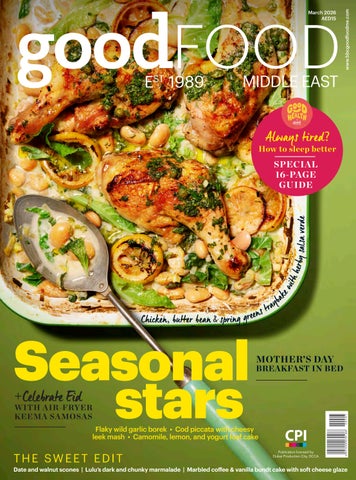
Good Food Middle East - March 2026

Page 1


Seasonal stars

Flaky wild garlic borek • Cod piccata with cheesy leek mash • Camomile, lemon, and yogurt loaf cake

Welcome!

March is a month of gentle transitions, with longer evenings and calendars filling with gatherings that centre around food and togetherness. In this issue, we celebrate the dishes and traditions that bring comfort and a welcome sense of occasion to the table.

Our three ways with Worcestershire sauce will remind you just how transformative a dash of this savoury staple can be, from elevating a Steak Diane to adding depth to Rarebit cauliflower cheese (p28). For those marking Ramadan, or simply looking to expand their culinary repertoire, we’re thrilled to share a Chapli kebab recipe from Sabrina Ghayour (p32), ideal for Iftar yet equally suited to a relaxed weekend cook-up. Our marmalade guide proves that it’s not just for bears. We cover the essentials — from choosing citrus to the cold-saucer test — alongside a special recipe (p38).

Turn the page to discover our fresh new look and a collection of global flavours. Explore West African dishes rich in warmth and spice (p42), a hearty Kabsa from Saudi Arabia (p46), and a sweet-and-sour Vietnamese beef salad, alongside Prawn and chive dumplings (p70) that bring brightness to early spring meals. With Eid on the horizon, we’ve included two air-fryer specials (p92) for effortless entertaining, while Holi is marked with a spread of Indian street snacks (p96).

Beyond the kitchen, this issue looks after you, too. If sleep has been elusive, our 16-page special explores practical, nourishing ways to rest and reset. For those planning travels in the months ahead, we’ve gathered inspiration, from days on the slopes to easy, all-inclusive family stays across Europe, perfect for Eid and summer getaways alike.

Editor
Tandoori-style lamb chops
Chicken glass noodle soup
Seafood en papillote with cheat’s aioli
Camomile, lemon & yogurt loaf cake

EDITORIAL

EDITOR: Nicola Monteath nicola.monteath@cpimediagroup.com

ASSISTANT EDITOR: Blanche D’mello blanche.dmello@cpimediagroup.com

ADVERTISING

GROUP SALES DIRECTOR: Liz Smyth liz.smyth@cpimediagroup.com

SALES DIRECTOR: Gill Fairclough gill.fairclough@cpimediagroup.com

SALES & MARKETING MANAGER: Yash Gehlot yash.gehlot@cpimediagroup.com

CONSULTANT: Ivan Grbic ivan.grbic@cpimediagroup.com info@cpimediagroup.com

MARKETING marketing@cpimediagroup.com

DESIGN

Froilan A. Cosgafa IV FOR OTHER ENQUIRIES, PLEASE VISIT: www.bbcgoodfoodme.com

FOUNDER CPI MEDIA GROUP Dominic De Sousa (1959-2015)

PRINTED BY Wellpack Printing Press LLC

PUBLISHED BY

Head Office: Office 1307, DSC Tower, Dubai Studio City, Dubai, United Arab Emirates, PO Box 13700 Tel: +971 4 568 2993

Email: info@cpimediagroup.com

A publication licensed by Dubai Production City, DCCA

© Copyright 2025 CPI Media Group FZ LLC. All rights reserved.

While the publishers have made every effort to ensure the accuracy of all information in this magazine, they will not be held responsible for any errors therein. www.cpimediagroup.com

Good Food, UK

GROUP MANAGING DIRECTOR, FOOD: Jessica Norell Neeson GROUP EDITOR-IN-CHIEF: Christine Hayes COMMERCIAL DIRECTOR: Simon Carrington GROUP MAGAZINES EDITOR: Keith Kendrick

Immediate Media Co Ltd CEO: Sean Cornwell

CFO/COO: Dan Constanda

DIRECTOR, SUPPLY CHAIN & LICENSING: Alfie Lewis

DIRECTOR INTERNATIONAL, LICENSING & TOP GEAR MAGAZINE, UK: Tim Hudson

HEAD OF LICENSING: Tom Shaw

HEAD OF PARTNERS, BRAND MANAGEMENT & ETHICAL COMPLIANCE: Molly Hope-Seton HEAD OF SYNDICATION: Richard Bentley

4 YOUR SAY

Find out if you won the Star Letter prize

5 LOCAL ICON

Know about Chef Gabriela Chamorro’s favourites

8 FLAVOURS OF THE MONTH

Restaurants to try across the region

12 TRIED AND TASTED

Fine dining venues to dine at this month

17 THIS JUST IN

This month’s top launches and trends

20 COOK SMART TONIGHT

Budget meals using storecupboard staples

26 MONDAY MASH-UP

Onion bhaji gets a crispy chicken tenders twist 28 3 WAYS WITH WORCESTERSHIRE SAUCE

Staying home? Add flavour with this classic British favourite

32 SABRINA GHAYOUR’S STREET FOOD AT HOME

The British-Iranian chef shares her rise to fame and favourite speedy chapli kabab

WEEKEND

75

64 IN THE KNOW

36 NEXT LEVEL

Perfect fluffy pancakes with our expert tips

38 MARMALADE IS NOT JUST FOR BEARS

Make Paddington’s favourite sandwich with a thick-cut, easy-to-make version

42 THE WEST AFRICAN KITCHEN

Chef Aji Akokomi of Michelin-starred Akoko shares the ingredients behind his signature dishes

46 BOOKS FOR COOKS

Fiona Forman explores Saudi Arabia’s national dish and new cookbooks worth checking out

Our recipe descriptions

Suitable for vegetarians. You can freeze it.

Not suitable for freezing.

Easy Simple recipes even beginners can make.

A little effort These require a bit more skill and confidence – such as making pastry. More of a challenge Recipes aimed at experienced cooks.

Low fat 12g or less per portion.

Low cal 500 calories or less per main.

50 BREAKFAST IN BED FOR MUM

Celebrate Mother’s Day

53 SPRING TREATS

Easy bakes to brighten your day

64 REVOLUTIONISE YOUR ROAST

Choose from three centrepieces to share

70 ONE-PAN VIETNAM

Easy, authentic Vietnamese dishes to prepare at home

75 AT ITS BEST

Make the most of spring produce

86 SUNDAYS ARE FOR COMFORT

Low-effort recipes for cosy meals

92 A MODERN EID TABLE

Easy, fusion-inspired Ramadan dishes from Chef Zaynah Din

96 CELEBRATE HOLI

Traditional treats for the Festival of Colours

HEALTH

103 EVERYTHING YOU NEED TO KNOW ABOUT SLEEP

Struggling with sleep? Experts share their insights

GOURMET LIFESTYLE

122 HIT THE SLOPES

Winter trails and Alpine flavours in Flaine

124 3 ALL-INCLUSIVE EUROPEAN GETAWAYS

Luxury all-inclusives for families and foodies

COMPETITIONS

127 GIFT VOUCHERS, MEALS AND PLENTY MORE

Superhealthy Low in saturated fat, 5g or less per portion; low in salt, 1.5g or less; and at least one of the following: provides onethird or more of your daily requirement of fibre, iron, calcium, folic acid and/or vitamin C, or counts at least one portion of your recommended 5-a-day fruit and veg.

Good for you Low in saturated fat, low in salt.

Heart healthy Low in saturated fat, with 5g or less, and low in salt, with 1.5g or less, and high in omega-3 fatty acids.

1 of 5-a-day The number of portions of fruit and/or veg contained in a serving.

Vit C Iron Omega-3 Calcium Folate Fibre

Indicating recipes that are good sources of useful nutrients.

GLUTEN FREE Indicates a recipe is free from gluten. Some recipes contain pork. They are clearly marked and are for non-Muslims only. Look for this symbol:

P Contains pork.

We love hearing from you!

I enjoyed reading the January review about Al Baleed Salalah By Anantara. I love how the article captures the contrast arriving from Dubai’s bustle into Salalah’s cool breeze, quiet roads, lagoon views, and Indigo mountains. It feels like discovering a hidden sanctuary. The Frankincense farm-to-table-to-spa journey stood out to me most as it’s not just a stay, it’s an immersive story where nature, flavour, and wellness come together in the most authentic way. Can’t wait to visit this awesome hotel.

Zeljko Potkonjak

What I enjoyed most about this month’s issue was the amazing mix of celebrations and recipes all in one place. I loved how it featured Valentine’s Day, Lunar New Year, and Ramadan together - it felt like a festival of flavours and ideas. After all the expensive celebrations over the past few months, this magazine really came in handy. I tried the Steak Frites last Valentine’s Days it was good, though not perfect (I think I overcooked it!). Still, it was a budgetfriendly way to make the day feel special. I just bought the steak from the supermarket and did my best. Now, I’m looking forward to trying the wonton soup before winter ends. Honestly, there are so many recipe options in this issue, it’s definitely worth reading.

The Steak Frites for two feature was my favourite! It provided the perfect inspiration for a cosy Valentine’sthemed dinner at home without the fuss. I also found the review of The Beach House at Anantara incredibly helpful; your restaurant reviews are my go-to guide for navigating Dubai’s vibrant dining scene. It’s the ultimate handbook for foodies in the region.

A COOKING CLASS FOR TWO AT FELICITÀ, WORTH

Experience a cooking class for two at Felicità in Address Sky View, Downtown Dubai. Happening on Sundays from 4:30pm to 7pm, you and a guest can join a hands-on Italian cooking experience, learn traditional recipes, and enjoy two hours of free-flowing drinks and bites, all with stunning views of the Burj Khalifa.

To send in your Star Letter and win this prize, visit the Competitions page on bbcgoodfoodme.com

Morning routine

I am not a morning person! Between the two of us, my husband is the early riser (if you consider getting up at 9am early) who walks our dogs in the morning. When they come back, they all jump into bed with me - even though they shouldn’t! That’s usually how my day begins: with lots of cuddles and some chaos to convince me it’s time to get up. My mornings are usually about easing into the day. I really cherish those quiet, loving moments at home before the energy and fast pace rhythm of the kitchen begins.

Home-cooked meal

Gallo Pinto with sweet fried plantains and feta cheese. It’s a very simple dish, yet one of the most traditional ways to enjoy food. It instantly reminds me of family, warmth, and where I come from.

Maru Udon for something warm and comforting, Bait Maryam when I crave bold Middle Eastern flavours, and Pitfire Pizza when I want something relaxed and easy after a long day.

Favourite restaurants

LOCAL ICON fridge staples 3

Chef Gabriela Chamorro first built a loyal following through her intimate supper club days, where guests gathered around her table to experience soulful Central American cooking in its most personal form. That spirit of connection lives on at Girl & the Goose - Restaurante Centroamericano, the restaurant she founded and now leads as Executive Chef.

Bad Bunny, Calle 13, and Keinemusik are my top choices. My music taste shifts between high-energy Latin rhythms and more atmospheric electronic sounds.

Kefir yogurt, eggs, and blueberries.

Currently listening to…

I enjoy listening to Nourish by Spinneys and The Chef JKP Podcast, both of which are great for staying connected to the local food scene and industry conversations. I also like Restaurants Unstoppable for its international perspective and the authentic, firsthand experiences shared by restaurant owners around the world.

Drink Order

You’re hosting a dinner party with three celebrities, who would you invite and what would you serve?

My dream guest list would be Anthony Bourdain for his incredible curiosity and storytelling; Frida Kahlo for her deep connection to culture and identity; and José Andrés for his passion for community and humanitarian work. I’d serve our Green Coconut Pipian Ceviche, followed by our Omani Reef Cod with Pinol Sauce and Sweet Corn Espumas, and end the meal with our Horchata Tres Leches. Meant to be shared, each dish is warm, vibrant and full of personality.

CURRENTLY READING

Pedroisms, written by a friend and mentor who shares his personal life lessons from more than 30 years in hospitality. Filled with short, thoughtful reflections and small “a-ha” moments, the book is incredibly relatable as many of the challenges he writes about are the ones I’m facing myself now while building the restaurant. I’m also reading World Travel: An Irreverent Guide by Anthony Bourdain, which was gifted to me by a dear friend in the community. I love how the book captures his spirit of curiosity and reminds you that food is really about people, culture, and human connection.

21 Grams, CQ French Brasserie, BOCA, Trèsind Studio, and Mythos. Each one of them has a strong identity and a real sense of authenticity, whether it’s through storytelling, community, or staying true to their culinary roots.

TWO CONCEPTS, ONE VISION

From the Persian elegance of Ziba to the award-winning energy of Sold Out, Takara Hospitality Group is shaping two distinct dining destinations in Riyadh

Riyadh’s dining scene continues to evolve, and Takara Hospitality Group is at the forefront of that momentum. With the arrival of Ziba in the capital and the rapid expansion of Sold Out, the group is shaping two distinct experiences – one rooted in Persian heritage and refinement, the other driven by distinct burger culture.

Ziba, meaning “beautiful” in Persian, first opened in Al Khobar in October 2023, quickly earning recognition for its elevated interpretation of Persian cuisine and immersive approach to dining. Now in Riyadh’s Al Sulimaniyah district, the restaurant presents a polished expression of Persian culture and craftsmanship. The new branch has already seen strong success, with a second Riyadh location on the way – reflecting the brand’s growing demand.

The menu showcases authentic Persian flavours, with highlights including the Mezzah Platter, delicate dolmeh and an array of rich khorshet stews. Gourmet platters and Ziba Grills arrive tender and aromatic, complemented by jewel-toned zereshk rice. A selection of handcrafted mocktails under Ziba Noosh adds depth to the offering. The kitchen continues to introduce new creations that honour tradition while presenting refined interpretations of classic dishes. Desserts conclude the experience with Zafran milk cake and Narenj brûlée cheesecake.

The interiors reflect Persian artistry, unfolding like a living museum where curated patterns, Heriz carpets and motifs such as The Kiss of the Gazelle reference centuries of craftsmanship. Textures and design elements – from lighting to furnishings – are carefully composed to complement the cuisine. Hospitality remains central, with every detail shaped around the guest, encouraging diners to relax and immerse themselves in the setting.

Sold Out has entered Riyadh with equal momentum. After building a strong following across the Eastern Province, the brand debuted in the capital and, within two months, opened a second branch in Malqa. Its reception is reflected in a 4.9-star Google rating, supported by consistent praise for quality and overall experience. The brand was also named Best Casual Dining Restaurant at the Good Food Middle East Awards 2025.

The Al Sulaimaniyah branch introduced Riyadh to Sold Out’s signature energy: a playful burger concept built around premium ingredients and handcrafted flavours. On opening night, retro interiors lit up the outdoor seating area as music carried through the space, queues formed and metal trays of Angus beef and chicken burgers moved from kitchen to table.

Favourites, such as the Sold Out Burger, quickly drew recognition, while indulgent sides completed the menu. Playful details – from the “WE ARE ABOUT TO HAVE THE LAST PIECE” packaging to a custom photo booth – reinforce the brand’s personality. Seasonal releases such as the Mr. Smoky Burger, Corn Queen and SO Caesar Salad demonstrate a balance of innovation and consistency, with the recent winter menu strengthening loyalty among returning guests.

Together, Ziba and Sold Out highlight Takara Hospitality Group’s expanding presence in the country – one celebrating heritage and refined dining, the other redefining modern burger culture through energy, quality and hospitality.

Flavours month of the

What’s hot and happening around town this month

NAYZAK CAFÉ AND RESTAURANT

At the Natural History Museum Abu Dhabi this Ramadan, visitors are invited to traverse 13.8 billion years of history before breaking their fast in a setting that reflects the origins of the universe and the evolution of life on Earth. After a stroll through immersive galleries, take a seat within the restaurant complete with contemporary interiors, for a dining experience that stems inspiration from heritage and discovery. Beneath architecture inspired by the story of our planet, the Ramadan set menu opens with a choice of red lentil or lamb and freekeh soup, followed by seasonal salads. For mains, tuck into slow-braised lamb shoulder with saffron rice, sea bass served with glazed root vegetables, and vegetarian dishes such as roasted cauliflower steak or grilled eggplant millefeuille. Desserts draw on classic Ramadan flavours, from warm date pudding with toffee sauce to pistachio and rosewater milk pudding finished with saffron syrup.

6-9pm. AED175 per person. Contact +97150 661 4381.

Nayzak Café and Restaurant

Gather loved ones for an Iftar that brings together Japanese technique and Middle Eastern warmth, in an open-air setting with views of the Burj Khalifa. The four-course menu commences with traditional dates, followed by a comforting choice of umami-rich miso or corn soup, before a second course of sashimi and shrimp tempura rolls arrives at the table. The main course features house signatures, including lamb rack kimchi CLAP style and the restaurant’s renowned black cod with a smooth miso glaze. To conclude, a Dubai-inspired pistachio kataifi chocolate dessert layers crisp pastry threads with dark chocolate mousse and toasted pistachio for a richly textured finale.

Sunset to 8:30pm (last seating at 7:30pm). AED275 per person. Visit claprestaurant.com/dubai.

Set within the striking surrounds of Expo City Dubai with views of the illuminated Al Wasl Dome, the spirit of Ramadan is marked with a convivial Iftar at Gup & Shup (a beloved Indian term meaning chit-chat) that reflects the warmth and generosity of Indian hospitality. The latest concept by Michelin-starred chef Rohit Ghai, one of the most influential figures in modern Indian cuisine, features a curated set menu that begins with dates, laban and comforting lentil soup, followed by a generous spread of flavour-forward starters, aromatic curries, freshly baked naan and fragrant rice, designed for sharing. The experience concludes with traditional Indian desserts such as Kesar Payasam or Kulfi Falooda.

Until 20 March. AED189 per person. Contact +97150 874 9077.

î GUP & SHUP, EXPO CITY DUBAI
î CLAP DUBAI

EL&N London, the global café and lifestyle brand, is expanding in the UAE with two new Abu Dhabi locations: an EL&N Deli & Bakery at Reem Mall and a full café and lifestyle destination at Marina Mall. The Reem Mall deli offers freshly baked pastries, artisanal breads, specialty coffees, and delistyle dishes in a light, contemporary space, while the Marina Mall café delivers the full EL&N experience with signature desserts, all-day menu items, coffee, and the brand’s signature stylish interiors.

Visit elnlondon.com.

Saddle Café, known for its modern take on Emirati hospitality, has expanded into Dubai’s residential neighbourhoods. The new venue caters to everyday visits, from morning coffee and school-day stops to casual lunches and dinners. Its all-day menu features signature dishes like eggs benedict, truffle mushroom omelette, crème brûlée French toast, Katsu chicken bowl, and pastas, alongside specialty coffee options such as Affogato, Spanish Latte, and Matcha.

Visit saddledubai.com.

î SADDLE AT THE GROVE, AL BARSHA
î EL&N

Embrace Ramadan at the Noor Ramadan Pavilion, where flowing drapes, elegant chandeliers, and traditional lanterns create a warm, inviting ambience ideal for families, groups, and corporate gatherings. Begin with dates and traditional Saudi coffee at the table, followed by an expansive buffet of local and international specialities, including cold mezze, fresh salads, hot appetizers, live cooking stations, and rotating Ramadan favourites, with VIP seating available for a more exclusive experience. The curated dessert selection features Arabic sweets, signature creations, and live stations, while Mansard’s regular dining options remain available daily. SAR450 per person and SAR600 VIP. Contact 011 829 0900.

î MANSARD RIYADH, A RADISSON COLLECTION HOTEL

TASTED&TRIED

Our top dining experiences this month

GIRL & THE GOOSE

From cabin crew to chef-restaurateur, Gabriella Chamorro first launched Girl & the Goose as a supper club in 2019 from her home in Dubai, before the pandemic reshaped her path and propelled her fully into the kitchen. The goose — her personal symbol of migration, resilience and renewal — mirrors her journey from Nicaragua to the Middle East.

Tucked into the first floor of the Anantara Downtown, the family-style dining room here features terracotta warmth, spilling onto an open-air terrace with courtyard views that evoke the intimacy of a private residence. It’s a clever bit of architectural sleight-of-hand that preserves the supper club soul. The menu acts as a vibrant map of Chamorro’s heritage, where Central American staples are elevated with a fine-dining touch that feels essential rather than decorative.

MENU HIGHLIGHTS

We started with the Elotes loco, a wild corn salad that plates up the joy of street food, bringing together the smokiness of the grilled corn with a bouquet of cilantro, shiso, and mint. Pecans and

chayote add a welcome crunch. Equally impressive is Gigi’s guacamole. A holdover from her supperclub days, this isn’t your standard table-side mash. Served chunky mashed with jalapenos, alongside caramelised onions and a surprising tangy ponzu cream, it pairs perfectly with the crisp plantain chips.

If you’re keen on fish, we highly recommend at least one serving of the Chalupas. The Tuna tartare crispy tostada is truly an explosion of flavours. Starring Spanish tuna akami, the tender fish is marinated in ponzu, punctuated by the sharp bite of pickled red onions and the airy crunch of crispy leeks. Meanwhile, the Lubina aguachile ticks all the boxes for an incredible ceviche. Fresh sea bass sits in a delicate, spicy cucumber marinade enhanced with dried black olives and orange zest for texture. The highlight here is a refreshing jalapeño sorbet that provides a slow-burn chill, though diners should note the dish contains alcohol for that extra botanical lift.

For mains, the Coffee & orange duck confit is exceptionally tender, falling away at the suggestion of a fork, paired with a velvety squash purée and a reduction that

balances the bitterness of coffee with citrus. Crunchy cacao nibs and earthy chanterelle mushrooms add layers of texture. If you’re after something more decadent, the table and chef’s favourite from this course is the Lobster bisque yuca gnocchi. Sink your teeth into handcrafted pillows of creamy yuca root bathed in a moreish bisque, topped with black truffle and raw, cured lobster tartare. Burnt sage and butter lend a nutty, aromatic touch.

The finale is as much a game as it is a course. Dessert is introduced through a playful set of Lotería cards, a nod to the nostalgic Central American game Chalupa. We played and went down the traditional route with the Sweet Yoltamal, a traditional young corn masa dough wrapped in a fragrant husk and steamed to a delicate, cake-like consistency. Paired with a whipped ricotta cheese sauce and berry compote, it’s a rustic dish brought into this era with a scoop of homemade tarragon ice cream and white chocolate. It is a fitting end to a meal that feels less like an invitation into Chamorro’s home.

Make a reservation at girlandthegoose.com.

TEZUKURI

In the shadow of Dubai Opera, a new Japanese dining concept has emerged with a focus on craftsmanship. Tezukuri, a collaboration between Neha Mishra of Kinoya and Panchali Mahendra of Atelier House Hospitality, is a specialised temaki destination that strips away spectacle in favour of dishes that let the ingredients speak for themselves.

The space is minimalist, defined by wood and low lighting that creates depth, directing attention to the 18-seat counter. Hidden within the walls is a Martini room and listening bar — a no-phone zone with the heady aroma of leather and wood, designed as a sanctuary with a dedicated food and beverage menu. Perfect for an intimate gathering, it’s a space where I’d love to while away the hours with a good book or journal.

MENU HIGHLIGHTS

In a kitchen led by the Osaka-born chef Tatsuya, rice is treated as a foundational element rather than a mere vehicle. The kitchen uses Nanatsuboshi, a premium variety from Hokkaido prized for its sweetness, glossy appearence and stickiness. Tinged red from akazu — a rare aged red vinegar produced through slow fermentation — the rice is introduced in a tasting at the start of the meal.

Our lunch commences with an umamirich miso soup made with barley miso, dashi and tuna flakes. A textured daikon salad follows, paired with white fungus and a sweet plum dressing. The highly anticipated temaki are assembled before diners’ eyes. Crustacean lovers can indulge in the akaebi, a sweet Argentine red prawn, offering natural sweetness against crisp toasted nori. The toro is another gorgeous bite with generous slices of fatty bluefin tuna belly tucked neatly into seaweed.

The attention carries through to cooked and seared dishes. A5 wagyu is seared counterside over Japanese charcoal, a technique that enhances the marbling without sacrificing the beef’s buttery character. It’s noticeable from the first bite of the nigiri topped with meltingly delicate meat. The smoky Madai (sea bream) is another standout, handled with minimal intervention. For a more substantial bite,

the Tebasaki karaage comes in highly recommended. The sticky glazed boneless chicken wings are crisp, adorned with a generous mound of finely grated Parmesan. Batter-fried chicken skewers are another juicy bite, topped with pickled radish for tang that cuts through the richness. There’s only one way to end this meal, with assorted Daifuku: matchainfused rice cakes with strawberry and chestnut fillings.

The beverage menu is quite impressive too, with Japanese specialties and a creative selection of distinctive ingredients. The Okinawa mocktail is a refreshing blend of Lyre’s Italian spritz and genmaicha soda, with a light fizz and subtle herbal notes. Meanwhile, the Kobe concoction offers a bold twist on the classic Old Fashioned, featuring kumquat coffee bitters for layered complexity.

Contact +9714 579 4888.

BRASSERIE 2.0, LE ROYAL MERIDIEN BEACH RESORT & SPA, DUBAI

At this Dubai stalwart, brunch brings forth gastronomy with theatrics. The newly launched Voyage Brunch transforms a Saturday afternoon into an immersive, globe-trotting tableau set within the sun-drenched grounds of Le Royal Meridien Beach Resort & Spa. The experience unfolds under the narrative of Claire, a roving traveller whose journey is rendered through live dance, acrobatic interludes and hits by DJ Adam J. The effect is equal parts entertainment and culinary tour, with dancers sweeping past tables, costumed characters guiding guests across continents, and the tempo gradually rising from languid indulgence to celebratory procession.

MENU HIGHLIGHTS

The culinary journey begins at the salad station and formidable Seafood & Raw

Bar — an altar to the ocean featuring freshly shucked oysters from multiple regions, Alaskan king crab, lobster tails and an abundance of cold crustacean. This ocean-centric focus extends to an Asian Corner where a massive bamboo dim sum basket opens to reveal my favourites, Har gow (Crystal shrimp dumplings) and siu mai, sat alongside other classic dishes such as fried rice, noodles and stir-frys. Sushi chefs turn out maki, nigiri and sashimi with quiet efficiency. The caviar and roe counter, unsurprisingly, rewards repeat visits. At the table, a curated beverage menu features potent creations inspired by global cities. Take your pick from the extensive grape selection, bubbles or fruit-led concoctions to accompany the meal.

Elsewhere, the Mexican station offers familiar comforts from nachos and tacos with guacamole and salsa to quesadillas, while the Italian counter produces freshly baked pizzas and fresh pasta made to order. Tucked into a corner of the terrace are live grill stations serving everything from beef Wellington to kebabs, lamb chops, rib-eye and T-bone steaks cooked to your preferred temperature. Nearby, grilled lobster and shrimp are charred on the grill, best eaten with lemon butter and chili-garlic sauce. End with a visit to the lavish dessert spread of tiramisu, cheesecakes, tarts and

trifles, or feast on a composed cheese selection for a savoury finale. As the afternoon progresses, a theatrical live shots presentation signals the transition to sunset vibes, with a complimentary espresso-led concoction for those drifting toward the afterparty by the shore.

Every Saturday, 1:30-4:30pm. From AED395 to AED795 per person. Contact +9714316 5555.

THE FORE

At Jumeirah Marsa Al Arab, Saturday brunch at The Fore resists the excess typically associated with hotel buffets. Instead, four open kitchens share the spotlight. Experience the Japanese precision of Umi Kei, the Pan-Asian verve of Madame Li, the Mediterranean flavours of Mirabelle, and the spice-driven repertoire of The Bombay Club by Chef Manav Tuli. Under the direction of

Executive Chef Roberto Rispoli, the experience unfolds with notable cohesion. Each kitchen distinct, yet calibrated, feel part of a single narrative.

MENU HIGHLIGHTS

The first impression belongs to Umi Kei, positioned at the entrance. A miso soup station offers a nourishing beginning, alongside skewers of chicken, fish and beef yakitori. Nearby, the sushi counter presents sashimi, familiar rolls and maki, including charred salmon and vegetarian bites, that venture just far enough beyond convention. At the dedicated Temaki station, hand rolls are assembled to order with fillings such as crab and crisp vegetables.

Madame Li’s section leans into comfort with aromatic Thai curries, beef with vegetables, springy noodles and fried rice mercifully free of excess oil. A few steps away, self-serve buffet windows reveal lacquered Peking duck and bamboo baskets of dim sum — prawn, chicken and translucent vegetable parcels. Between stations, a leg of jamón draws attention, accompanied by salads studded with cheese, sun-dried tomatoes, artichokes and an assortment of pickles.

Leave room for the tandoori prime rib at The Bombay Club that is well-seasoned with its fragrant crust yielding to a blush interior. It pairs perfectly with biryani, butter chicken and naan pulled from a live

tandoor. On the return to your table, mezze and crisp fatayer appear at the Arabic station, while a Wellington with roast and trimmings offers a nod to British comfort. Away from the counters, tableside service intervenes - we loved the freshly shucked oysters and caviar blinis that arrived between visits to the buffet. Toward the end, a roaming vendor dispenses scoops of Greek yoghurt ice cream in miniature cones, a cooling interlude that appeals equally to adults and children.

A marshmallow tree and candy bar lend whimsy at the dessert display, while a pastry wheel features chocolate viennoiserie and delectable macarons from the renowned Pierre Hermé Paris boutique. The remarkable cheese selection stuns with over 20 varieties curated by the renowned affineurs Les Frères Marchand.

On the terrace, sunlight glints off the water and sea air tempers the richness of the meal; indoors, the atmosphere remains polished and tranquil. In either setting, The Fore’s brunch succeeds through a well-curated spread that complements the innovative signature concoctions.

Every Saturday, 1-4pm. AED500 for the soft package, AED750 for the premium grape package (including bubbly). AED250 for children aged four and above. Contact +9714 540 8888.

ThisA curated look at this month’s most talked-about launches and standout trends

Dubai’s Coffee Moment

Cypher Urban Roastery has earned a spot at No. 90 in the World’s 100 Best Coffee Shops in Madrid, a recognition of its careful bean sourcing, precise roasting, and attentive service. Founded in Dubai, co-founder and Q Grader Mohamad Merhi leads a craft-driven approach that goes beyond the café, from green-bean importing to training the next generation of coffee talent through Cypher Academy. The ranking cements Cypher’s place among the world’s specialty coffee leaders and showcases Dubai’s rise as a destination for serious coffee culture.

Visit bycypher.com

EID GIFTING

Special treats for loved ones

Featuring 20 handcrafted chocolates, the Hoof Assorted chocolate box features hazelnut praline bon bon, dates & pistachio crunch, dates & almond gianduja, and tahini milk chocolate bites. This limited-edition box is designed for gifting and sharing. AED220 at Hoof branches.

Indulge in handcraftedAqaya’sMendiants in flavours such as white chocolate with roasted pistachio and dried cranberry, milk chocolate with roasted hazelnut and crunchy feuilletine, and dark chocolate with roasted walnut and dried figs. Available in four box sizes, starting from AED45 for nine pieces to AED255 for 54 pieces. Available at City Walk and Dubai Creek Harbour branches.

Knafeh lovers will be thrilled as the cult-favourite bar “Can’t Get Knafeh Of It” from FIX Dessert Chocolatier gets a dreamy white chocolate makeover. Fans of classic treats can also welcome back “Mahalabi Or Not To Be,” where creamy mahalabia meets crunchy rice puffs and almond brittle, and Rahash Hour, a sesame halawa delight with pistachio brittle, both wrapped in silky chocolate. Additionally, the iconic Minis Box now boasts a limited-edition Ramadan design, available in boxes of 10 or 20 - perfect for sharing, gifting, or solo indulgence. Available exclusively on Careem.

The UAE’s National Food Loss and Waste Initiative, ne’ma, has announced a major expansion of its Valuing Our Roots campaign for Ramadan 2026, marking the largest rollout of its food rescue programme to date. Operating across Abu Dhabi, Dubai, Al Ain, Sharjah and Ras Al Khaimah, the initiative aims to recover more than 300,000 tonnes of surplus food — a 50% increase on last year — for redistribution to over 10,000 low-income families through its Family Iftar Boxes. Backed by government entities, major food suppliers and thousands of volunteers, the campaign reflects a broader national push to curb waste, strengthen food security and promote community solidarity during the holy month.

cook smart

Use storecupboard heroes in these creative budget meals recipes ANNA GLOVER photographs GEORGIA GOLD

STORECUPBOARD STARS

• Harissa

• White miso

• Sundried tomato purée

• Crispy chilli oil

Crispy pork & broccoli noodles

SERVES 2 PREP 15 mins

COOK 20 mins EASY

1 tbsp sunflower or vegetable oil

100g pork mince

10g ginger

2 garlic cloves

4 spring onions

1 small broccoli

2 nests of fine egg noodles

2 tsp sesame oil

1 tbsp oyster sauce

2 tbsp dark soy sauce

1 tsp honey

¼ tsp ground white pepper crispy chilli oil, to serve

1 Heat the oil in a wok or large frying pan over a medium heat and fry the pork mince for about 10 mins, stirring occasionally until golden and crisp. Meanwhile, grate the ginger and garlic, slice the spring onions and cut the broccoli into florets, chopping the stem into small pieces. Remove the pork from the pan using a slotted spoon, leaving the fat behind. Set aside.

2 Bring a pan of water to the boil and cook the broccoli for 1 min. Lift out using a slotted spoon and set aside. Add the noodles to the water, remove from the heat and leave to soak for 6-7 mins.

3 When the noodles have had half the soaking time, reheat the wok over a medium heat and fry the ginger and garlic for 1 min until fragrant. Add the spring onions and cook for a further minute. Add the broccoli and, using tongs or a slotted spoon, transfer the noodles directly from the water into the wok, bringing a little of the starchy cooking water with them to help form the sauce.

4 Add the sesame oil, oyster sauce, dark soy sauce, honey and pepper, stirring well to coat the noodles evenly. Serve in bowls and finish with a spoonful of crispy chilli oil. GOOD

1 of 5-a-day

get the most from our meals

We’ll point out any swaps

If you can use things like yogurt instead of crème fraîche, chives instead of spring onions or butter beans instead of cannellini beans, we’ll let you know, so you’re not buying extra ingredients. This also helps prevent food waste.

Optional extras are your choice

If you have them, great, but if you don’t, don’t worry! We’re talking the final garnishes of nuts, seeds or lime wedges – don’t put them in your shopping basket just for one recipe.

All meals will serve at least two ...and any dishes with larger servings will be designed to be freezable in portions, so you can batch-cook them.

Dishes will be quick to make

We know time is of the essence in the week, but you still want inventive and delicious dinners. Our promise is that dinner will be on the table within an hour – and often in less time.

We’ll use storecupboard staples

All the recipes in this series will aim to include items that are already in your storecupboard. This means that if you cook from this series regularly, you’ll get to explore new ways to use up the rest of the ingredient, rather than having it linger in the back of your fridge until you make the same meal again.

Gadgets will be go-tos

We love a gadget here at Good Food, especially if it means avoiding turning the oven on midweek. So, we’ll give you options for the air fryer and other gadgets where we can, but try to avoid anything that requires extra washing-up, like food processors, stand mixers or excessive pans, where possible.

All the prep is in the method ...so you can cook the recipe in real time.

Cod piccata with cheesy leek mash

SERVES 2 PREP 20 mins

COOK 20 mins EASY

3 medium floury potatoes

1 medium leek

2 tsp olive oil

1 shallot or small onion

4 tbsp plain flour

2 cod fillet pieces

25g butter

100ml chicken or vegetable stock

1/2 lemon

2 tbsp capers

4-6 tbsp milk

100g mature cheddar

1 Wash and chop the potatoes (no need to peel) and cook in boiling

salted water for 10 mins until tender.

2 Wash the leek, then finely slice. Heat the oil in a frying pan over a

medium heat and fry the leeks with a pinch of salt until softened, about 6-8 mins. Transfer to a plate.

3 Finely chop the shallot, put the flour on a plate and season. Pat the fish dry, then dip in the flour. Melt the butter in the frying pan and, once foaming, cook the fish for 1-2 mins on each side until golden and just cooked. Transfer to a plate. Fry the shallot in the pan until soft.

4 Pour in the stock, squeeze in the lemon juice and add the capers. Season. Simmer until slightly thickened and glossy.

5 Drain and mash the potatoes, then stir in the leeks, milk and cheese. Serve with the fish, spoon over the sauce and finish with black pepper.

Harissa honey-glazed chicken traybake with squash & spelt

SERVES 2 PREP 10 mins

COOK 40 mins EASY

2 chicken thighs (or 4 small)

4 tsp olive oil

2 tbsp harissa, plus 1 tsp

2 tbsp honey

1 tbsp red, white or sherry vinegar

1 tsp thyme leaves

160g frozen squash cubes (see tip)

160g long-stemmed broccoli

250g pouch of cooked spelt or other grains

3 tbsp yogurt

handful of soft herbs, such as mint, dill or coriander (optional)

1 Heat the oven to 220C/200C fan/ gas 7. Season the chicken thighs with salt and put on a shallow baking tray. Rub half the oil into the skins. Cook for 20 mins.

2 Meanwhile, whisk the rest of the oil, 2 tbsp harissa, the honey, vinegar, thyme and seasoning in a bowl. Tip the squash and broccoli onto the tray. Pour over the harissa sauce and mix well. Roast for a further 15 mins until the chicken is cooked and the veg is tender.

3 Tip the spelt onto the tray. Stir. Pour over 2 tbsp water to steam the grains and return to the oven for 5 mins until warmed through. Swirl 1 tsp harissa through the yogurt. Roughly chop the herbs, if you have some.

4 Spoon the yogurt over the traybake and scatter over the herbs to serve, if using.

You can use raw butternut squash or pumpkin when in season – add to the tray with the chicken, as it needs a little more time to cook.

Miso leek & potato soup with sesame cheese dunkers

SERVES 4 PREP 15 mins

COOK 30 mins EASY V ❄ soup only

2 medium leeks

2 medium potatoes

1 tbsp olive oil

1 garlic clove

1 tsp thyme leaves, plus extra to serve

600ml vegetable or chicken stock

2 tbsp white miso

2 tbsp crème fraîche or double cream

For the dunkers

100g emmental, gruyère, comté or other nutty hard cheese (vegetarian, if needed)

4 slices white sourdough 4 tsp white miso 2 tbsp sesame seeds

1 Wash the leeks, then trim and finely slice. Chop the potatoes into small cubes (no need to peel)

2 Heat the oil in a saucepan over a medium heat and fry the leeks with a large pinch of salt for 5 mins until softened. Stir in the potatoes, grate or crush in the garlic, add the thyme and fry for 2 mins more until fragrant. Pour in the stock and bring to a simmer. Cook for 20 mins until the potatoes are tender. For the dunkers, grate the cheese into a bowl.

3 Stir the miso into the soup and blitz using a hand blender. Season and keep warm over a low heat.

4 Heat the grill to high. Toast the sourdough for 2 mins on one side, then flip and spread the miso over in a thin layer. Sprinkle over the cheese and seeds, and grill for 2-3 mins until the cheese is golden and bubbling. Cut into strips. Serve the soup topped with the crème fraîche, a few thyme leaves and black pepper, with the dunkers on the side.

This soup freezes well –make a double batch and keep some for when you need a warming meal in minutes.

Spiced baked feta with bean ragu & walnuts

SERVES 2 PREP 5 mins

COOK 20 mins EASY V

400g can of chopped or cherry tomatoes

1 garlic clove

1 tsp dried oregano, plus a pinch

400g butter beans

2 tbsp sundried tomato purée

2 tsp harissa

200g block of feta

2 tsp olive oil

25g walnuts

2 tsp honey

crusty bread or pasta, to serve

1 Heat the oven to 200C/180C fan/ gas 6. Put the chopped tomatoes in a small baking dish. Grate in the garlic, then add 1 tsp oregano, the drained butter beans, tomato purée and harissa, if using. Season well. Nestle in the feta, drizzle over the oil, add a pinch more oregano and bake for 20 mins until golden and bubbling. Or, cook in the air fryer at 180C for 20 mins

2 Crumble over the walnuts and top with a drizzle with the honey. Serve with pasta or crusty bread.

tip

Warm the crusty bread for a few minutes in the oven if it’s on, or use the second drawer of your air fryer, if you have one.

monday mash-up

Fast food

Curry house starter meets chicken shop staple in this weeknight winner recipe BARNEY DESMAZERY photograph GEORGIA GOLD

Onion bhaji chicken tenders

Crisp and spicy, these are a treat, and so versatile – you can use them to fill naan wraps, bao or burger buns, or include in a curry-themed spread of small plates.

SERVES 4 PREP 10 mins plus marinating COOK 20 mins EASY

3 skinless chicken breasts, cut into finger-sized strips

2 medium onions, finely sliced

1 tsp cumin seeds

1 tsp ground coriander

1 tsp garam masala

1/2 tsp ground turmeric

1/2 tsp chilli powder

100g plain flour

50g cornflour

1 tsp baking powder

1 green chilli, deseeded and chopped (optional) handful of fresh curry leaves (optional) sunflower or vegetable oil, for frying or drizzling naans, salads and sauce (see tips), to serve (optional)

1 Put the chicken strips and onions in a large bowl with all the spices and a good pinch of salt, then toss to evenly coat the chicken. Leave for 20 mins or longer, if you can, for the flavour to develop. Will keep covered and chilled for 24 hrs.

2 Scatter the flour, cornflour and baking powder over the spiced chicken and onions, and stir in 4 tbsp water to make a thick, sticky batter that clings to the meat. Add the green chilli, curry leaves (if using) and a pinch more salt.

3 Heat a 2-3cm depth of oil in a large frying pan or wok until a drop of batter sizzles straightaway. Working in batches, use two spoons to scoop up and lower the battered chicken and onion pieces carefully into the oil. Fry for 4-5 mins, turning until deep golden, crisp and cooked through. Drain on kitchen paper and keep warm while you fry the rest. Serve how you like – we like to wrap them in warm naans with salad and yogurt sauce (see tips).

tips

• Crunchy slaw Finely shred 1/2 small white cabbage, grate 1 carrot and thinly slice 1/2 red onion, then tip it all into a bowl with a handful of coriander leaves Squeeze over the juice of 1/2 lemon, add a pinch of salt, and toss well to combine.

• Yogurt sauce Combine 150g Greek yogurt, 1 tbsp mango chutney and 1/2 tsp ground cumin in a small bowl, then season to taste.

Worcestershire sauce 3 ways with

When going out isn’t an option, add a dash of excitement to a night in using this classic British condiment recipes ANNA GLOVER photographs MIKE ENGLISH

Steak diane

While steak is a big purchase, the smart part of this recipe is that it makes lots of mushroom sauce, which you can use the next day on jacket potatoes or tossed through pasta for a thrifty, speedy meal. You can also serve it on toast for brunch.

SERVES 2 with leftover sauce

PREP 15 mins plus resting COOK 25 mins EASY

2 steak fillets (rib-eye or sirloin)

1 tbsp olive oil

2 tbsp salted butter, softened

1 rosemary sprig

1 garlic clove, bashed

1 long shallot, finely chopped

200g chestnut mushrooms, sliced

2 vine tomatoes, chopped

125ml non-alcoholic red wine

100ml chicken stock

1 tbsp French or Dijon mustard

150ml double cream

1-2 tbsp Worcestershire sauce dash of Tabasco

rocket and potato wedges, to serve

1 Let the steak fillets come to room temperature for 30 mins, then pat dry using kitchen paper.

2 Heat a heavy-based frying pan or skillet over a high heat. Season the steaks on both sides, then rub with the oil. Sear for 1-2 mins, or until brown. Flip and add 1 tbsp butter, the rosemary and garlic. Spoon the melted butter over the steaks, frying for 3-6 mins more, or until cooked to your liking, then remove to a plate to rest.

3 Add the remaining 1 tbsp butter to the pan, reduce the heat to medium and fry the shallot for 5 mins until softened, scraping any browned bits from the bottom of

the pan. Add the mushrooms and cook for 10 mins until golden and any water released has evaporated. Stir in the tomatoes, season lightly, then pour in the non-alcoholic wine. Bubble until reduced by half, then add the stock and mustard. Bring to a simmer. Stir in the cream, Worcestershire sauce and Tabasco. Season to taste, or add more mustard or Worcestershire sauce, if you like. Once cool, will keep

chilled for up to three days. Reheat until piping hot.

4 Pour any resting juices from the steaks into the sauce. Carve the steaks, if you like, and serve with rocket and potato wedges and some of the sauce spooned over. Finish with black pepper. Reserve the leftovers for another meal.

Ultimate bloody mary

Flavoured zero spirit concoctions are very trendy at the moment. Try our version of this classic cocktail.

SERVES 2 PREP 10 mins plus overnight infusing EASY

100ml non-alcoholic vodka

1 small red chilli, sliced

1 tsp light brown soft sugar

1 lemon, juiced and cut into wedges (you’ll need 1 tbsp juice plus 1 strip of lemon peel and 1 wedge) ice

400ml tomato juice

2 tsp Worcestershire sauce

1/2 -1 tsp Tabasco

1 tsp celery salt

1/2 tsp ground white pepper

1 tsp sea salt flakes

1 tsp sherry vinegar

1 celery stick cherry tomatoes, cornichons and olives on skewers to garnish (optional)

1 Put the non-alcoholic vodka, chilli, sugar and lemon peel in a clean jam jar or covered container, and shake until the sugar dissolves. Leave to infuse for 6 hrs or overnight.

2 Put a handful of ice in a jug and pour over the infused spirit. Add the lemon juice, tomato juice, Worcestershire sauce, Tabasco and a pinch each of the celery salt, white pepper and sea salt. Mix well. Add the vinegar to taste, then add more salt, pepper and Worcestershire sauce or Tabasco sauce, if you like.

3 Rub the lemon wedges around the rims of two tall glasses. Combine the remaining salts and white pepper on a plate, then dip the rim of each glass in to coat.

4 Strain in the bloody mary over more ice and serve with a celery stick each. You can also add cherry tomatoes, olives and cornichons on skewers, if you have them

cook smart

Rarebit cauliflower cheese

While you can make this as a side dish, using a few simple ingredients to up the umami flavour means that budget-friendly cauliflower can also be the star of the show. Serve with crusty bread to mop up the sauce.

SERVES 4-6 as a side PREP 10 mins plus resting COOK 45 mins EASY

1 large cauliflower

50g salted butter

50g plain flour

200ml brown ale

250ml whole milk

3 bay leaves

200g mature cheddar, grated 1-11/2 tbsp English mustard

2 tbsp Worcestershire sauce

1 Separate the leaves from the cauliflower, halving any larger ones through the stem. Break the cauliflower into florets and cut the stalk into 2cm pieces. Tip the stem pieces into a tiered steamer or metal colander set over a pan of boiling water. Add the florets, then the leaves. Cover with a lid and steam for 8-10 mins, or until the stalk and florets can just be pierced with a knife. Leave to dry.

2 Heat the oven to 200C/180C fan/ gas 6. Melt the butter in a pan over a medium-low heat until foaming. Sprinkle in the flour and mix to make a paste. Cook for 1-2 mins, or until it starts to smell nutty. Add the ale, a splash at a time, stirring continuously until all the beer has been incorporated and a smooth

paste forms. Add the milk and bay leaves, and cook until the sauce just coats the back of a spoon.

3 Stir the cheese, mustard and Worcestershire sauce into the sauce, then season with a little salt and plenty of black pepper. Remove the bay leaves.

4 Tip all the cauliflower into a baking dish and pour over the cheese sauce. Mix briefly to coat – the leaves will crisp up if you leave a few exposed, which creates nice texture. Bake for 30-35 mins, or until golden and bubbling. Leave to rest for 5 mins before serving.

Lifestyle Eatery & Terrace

Coastal Lebanese Flavours & Panoramic Views

Framed by the dazzling panoramas of Palm Jumeirah, La Sirène invites you to indulge in an ode to the sea through the rich culinary heritage of coastal Beirut. The experience is defined by our lounge and spectacular 90-metre terrace, offering one of Dubai’s most iconic alfresco settings with unobstructed views from Ain Dubai to the Burj Al Arab.

Amongst various attractive offers, indulge in our curated set menu at La Sirene.

Starting from AED 99 for two courses, inclusive of soft beverages.

Monday to Friday, 12 pm to 4 pm.

Sabrina Ghayour’s street food at home

British-Iranian chef and food writer

Sabrina Ghayour is a self-taught cook and multi-award-winning, five-time best-selling author who made her name hosting the Sabrina’s Kitchen supper club in London and across the UK.

Sabrina specialises in Persian and modern Middle Eastern cuisine, for food that’s bold, flavoursome and accessible, winning her legions of devoted fans. @sabrinaghayour

The acclaimed British-Iranian chef on how an online joke led to her success, and her favourite quick dinner recipe photograph KRIS KIRKHAM

Iused to get so much flak from the Persian and Middle Eastern community when I started out. They would say, “That’s not how we cook rice.” And I’d reply, “I know, but I’m trying to teach other people how to make something that tastes as close to it as possible that’s much easier.” Because if I teach them the Persian way to make certain things, they’re never going to do it.

My favourite recipe from my new book, Persiana Easy, is chapli kebab. It’s a spicy, delicious lamb patty, and essentially the smash burger street food of Pakistan and Afghanistan. It’s quick to make, you can slap a bit of yogurt on and eat it with bread – I love food like that.

I grew up in a house where nobody cooked, which is very unusual for Persian or Middle Eastern people. In Iran, if you’re both working, it’s common to have a house cook, so my mum and grandma didn’t do much cooking, but we always had Persian food. Five, six nights a week, we were at other people’s houses. We are very social people. Eating, talking, playing cards, drinking tea – it’s part of our heritage.

In the 80s, I was watching Ken Hom and Madhur Jaffrey on TV, and I fell in love with their cooking – I was transfixed. There was a Chinese supermarket on my way to school, it had ginger and things like that – you couldn’t get ginger in the supermarket back then – so I just started cooking. My mum encouraged me, and I took over the cooking in the house when I was about 10, because I loved it.

Then, in my late teens and early 20s, I started teaching myself Persian food. I knew the flavours, I just didn’t know how •

The supper clubs really took off – I had to set up a dedicated phone line, people were calling from Australia, America, desperate to come for dinner

 to get there. I bought cookbooks from America, but the recipes were so complicated. Then, one day I lost my job, and I made a joke online that I would do a supper club for £2.50 (about AED12) a head. It went viral, and I was inundated with bookings, so I did it for charity and we raised about £4,000 (about AED19,900).

After that, the supper clubs really took off. I had to set up a dedicated phone line – people were calling from Australia, America, desperate to come to dinner. Over time, a lot of well-known faces came, including a lovely lady who brought her commissioning editor along and offered me a book deal. I thought nothing would come of it, but in the morning, the offer was there in my email. I wanted the recipes to be accessible, so that’s the book I wrote – Persiana – and people embraced it.

Chapli kabab

These spicy patties are beyond delicious and deeply satisfying when smashed into bread. Because they’re popular in both Afghanistan and Pakistan, I don’t dare suggest where they originate – my only job is to share good food with you.

MAKES 8 (serves 2-4) PREP 10 mins

COOK 10 mins EASY

500g lamb mince (20% fat)

3 spring onions, thinly sliced from root to tip

1 small onion, finely chopped

2 large garlic cloves, finely chopped

4cm piece of ginger, peeled and grated, or 1 heaped tsp ginger purée

1 tsp chilli flakes

1 tsp ground coriander

1 tsp ground cumin

1 small bunch (about 30g) coriander, finely chopped, plus extra leaves to serve

1 large tomato, deseeded, finely chopped and liquid drained

1 tbsp cornflour

1 egg

To serve flatbreads thinly sliced red onion thick Greek yogurt

1 Put all the ingredients in a large bowl along with a generous amount of salt and pepper. Using your hands, work the ingredients together really well for a few minutes until you have a smooth, evenly combined paste.

2 Divide the meat mixture into eight equal portions and roll into balls, then flatten into thin patties (I do this between two sheets of baking parchment).

3 Heat a large frying pan over a high heat and, once hot, fry the patties for 2-3 mins on each side until nicely browned and cooked through.

4 Serve with warmed flatbreads, coriander leaves, sliced red onion and some yogurt.

Recipe extracted from Persiana Easy by Sabrina Ghayour (Mitchell Beazley). Photographs by Kris Kirkham.

NEXT LEVEL

fluffy pancakes

Our skills & shows editor Barney Desmazery longest-standing member of the Good Food team, shares the secrets he’s gathered over 26 years of developing recipes and talking to countless chefs and cooks photographs CHELSEA BLOXSOME

Tips for top pancakes

SEASON WITH BACON

Our pancakes are topped with whipped bacon butter that you can make ahead of time, which brings a rich, salty edge.

BROWN THE BUTTER

Additional melted butter in the pancake batter adds flavour without making them too stodgy. But, we’ve also taken this idea a step further by browning the butter first for a nutty note.

DIY BUTTERMILK

Buttermilk brings acidity to the mix, giving the pancakes an authentic American-style flavour. But, if you can’t get hold of it easily, mix 400ml whole milk with 2 tbsp lemon juice or white wine vinegar, then leave to stand for 10 mins.

BE GENTLE

For the lightest result, be careful not to overmix the batter – if you do, you’ll stretch the gluten in the flour, which will make the finished pancakes tougher. Don’t worry about a few lumps

or streaks in the batter – these will cook out as you’re frying the pancakes.

STAND AND DELIVER

Letting the batter stand before adding the whipped egg whites gives the raising agent (in this case, baking powder) time to activate, so your pancakes will have a smoother texture.

WHISK THE WHITES

This is optional – you can just crack in the whole eggs – but whisking the whites separately then folding them in ensures super-light and fluffy pancakes.

SIZE IT UP

Making saucer-sized pancakes guarantee everyone gets a pancake that’s properly drenched in butter and syrup. But, feel free to make a size that suits your needs.

HEAT THE SYRUP

Pancakes lose heat quickly, so serve on warm plates and drizzle with hot syrup to warm them up and melt the butter.

American-style pancakes

Despite being a simple dish, there are so many recipes out there, all claiming to be the best. Often, these are American so require swaps for British ingredients, which can affect the result. We’ve gone full US-style here, but have considered the parts that are usually taken for granted. Whisked egg whites make these extra-light, and since eggs are already in the batter, it doesn’t require much extra effort (but you can skip this, if you want). We’ve also thought about how pancakes are served: the classic tall stack often disguises a dry, butter-free middle layer, so we’ve made fewer, larger pancakes to get the butter-topancake ratio just right. But whether saucer-sized, bigger, or smaller, these are the lightest, fluffiest pancakes we’ve made yet.

MAKES 6 saucer-sized or 12-18 small pancakes PREP 20 mins plus cooling and resting COOK 40 mins MORE EFFORT V

50g unsalted butter, plus extra for frying

300g plain flour

2 tsp baking powder

1 tbsp caster sugar

2 eggs, separated 400ml buttermilk

1 tsp vanilla extract

sunflower oil or butter, for frying maple syrup, to serve For the whipped bacon butter (optional)

8 rashers smoked streaky bacon

100g unsalted butter, softened

1 tbsp maple syrup

If making the bacon butter, heat the oven to 200C/180C fan/gas 6 and line a baking tray with baking parchment. Arrange the bacon on the tray in a single layer, then cover with another sheet of parchment and a second tray (this ensures the bacon stays flat). Bake for 25-30 mins until very crisp, then leave to cool. Crumble finely. Beat the butter with the maple syrup,

then fold in the bacon. Scrape onto a sheet of parchment, roll up into a log, twist the ends to seal, and chill until needed. Will keep chilled for three days or frozen for two months.

2 For the pancakes, melt the butter in a small pan over a medium heat until foaming, golden and smelling nutty. Remove from the heat and cool slightly. Tip the flour, baking powder, sugar and a large pinch of salt into a bowl, and stir to combine. Whisk the egg yolks, buttermilk and vanilla together in a jug, then slowly whisk in the cooled brown butter. Pour the wet mixture into the dry, and whisk briefly until just combined. Don’t worry about small lumps – they’ll disappear as the pancakes puff up. Let the batter rest for 15 mins.

3 Tip the egg whites into a clean bowl and whisk until just holding their shape using an electric whisk. Fold the whipped egg whites into the batter – it’s fine if a few streaks remain. Once the egg whites have been added, you should cook the pancakes as soon as possible. (If you prefer not to whip the egg whites separately, add the whole eggs in the wet mixture in step 2.)

4 Heat a large non-stick pan over a medium heat, and brush over a little oil or butter. Ladle in enough of the batter to create one or two saucer-sized pancakes, or a smaller amount to make small pancakes (you’ll need to do this in batches). Cook for 2-3 mins until the pancakes are puffed up, small bubbles appear on the surface and the edges look set. Flip and cook for 1-2 mins more until golden and fluffy. Transfer a baking tray and keep warm in a low oven while you repeat with the rest of the batter.

5 Warm the maple syrup in a small pan until just steaming, or in the microwave in short bursts (don’t boil). Serve the pancakes topped with thin slices of the bacon butter, if using, and maple syrup.

MARMALADE

is not just FOR BEARS

Buy the last of the season’s Seville oranges for Paddington’s favourite sandwich filler. Lulu Grimes takes the faff out of making it at home and shares her dark, thick-cut version

the basic method

In a nutshell, you boil Seville oranges (or other citrus) with sugar and water, but how you cut your oranges and what you add (and when) varies. I’ve tried several methods, including pressure-cooking, but the below is the most efficient and foolproof way. Use up to 1kg fruit and stop halfway through to no ill effect (I often start one day and finish the next).

1 Cut the oranges in half, simmer in water for 30 mins, lift them out and drain any liquid into the pan.

2 Scoop the flesh and pips back into the water, bring to the boil, simmer again for 30 mins, then strain.

3 Meanwhile, slice the tender orange peel.

4 Finally, add the sliced peel and sugar to the clear liquid, then boil to setting point.

LINE UP YOUR JARS

You can buy jars or reuse them; I try to remember to save them up towards the end of the year, ready for Seville orange season. Clean them thoroughly and sterilize. One year, I used an old mango chutney jar, which definitely added an extra layer of flavour I wasn’t expecting.

I like dark, thick-cut marmalade with a slightly bitter edge. Marmalade can be anything from pale, translucent jelly with hair-like slivers of peel, to dark, chunky and ‘black’, with brown sugar or treacle. There are peel-free ones, those made with limes, lemons and other citrus, and flavoured varieties. You may like them all, or have a firm preference. Neither my parents nor in-laws like mine – it’s too dark and chunky. This is good, because I don’t have to gift jars, and, at the rate we eat it, we don’t have any spare!

no special kit needed

The business of making marmalade (or jam) needn’t be difficult, and you don’t need any special equipment other than a large saucepan. I don’t own a jam pan (I did, but I lent it to someone and can’t remember who – slightly annoying as it’s also handy for mulled beverages, but then, so is my slow cooker). Your pan just needs to be big enough to boil your marmalade without it going over the edge and leaving you with quite the mess to clear up.

why stick to Seville?

Seville oranges (citrus x aurantium) – aka bigarade or bitter oranges – have the right flavour for marmalade because their bitterness adds to the flavour, as do the aromatic oils in the rind. They are also high in pectin, which sets the marmalade.

OTHER BITS & BOBS

A thermometer helps gauge how things are coming along – you could invest in one, but you’ll still need to do the ‘wrinkle’ test with a cold saucer, which is more reliable. I’ve had batches that have reached the right temperature but have failed to set, and haven’t trusted temperature alone since. I use a Thermapen to see if I’m in the right ballpark temperature-wise; a jam one is also useful. For the last step, use a colander and fine sieve to strain the marmalade. If you skip this, bear in mind you’ll have cloudy marmalade. A wide jar funnel isn’t essential, but it helps. Don’t use a narrow one, because the peel will clog it up.

The business of making marmalade needn’t be difficult, and you don’t need any special equipment other than a large saucepan

SLICING THE PEEL

I halve the oranges through the stem and not the circumference, as if for squeezing, because I find this makes them easier to scoop out when they’re cooked. This is the tedious, or mindful, part of the recipe, depending on how you’re feeling at the time. Once they’re cool enough and you’ve scooped out the flesh, cut each half into two and slice the peel to the thickness you want. For more even-sized peel, cut across the length, or for differing sizes, cut across the width. Crosswise is easier.

Lulu’s dark & chunky marmalade

MAKES 4kg (10-12 jars)

PREP 20 mins plus at least 1 hr cooling COOK 1 hr 30 mins EASY V

1kg Seville oranges

1 lemon

1.5kg granulated sugar (or preserving sugar, if you like)

500g dark or light muscovado sugar (depending on how dark you want your marmalade to be) small knob of butter (optional)

1 Cut the oranges in half through the stem and put in a large pan. Take the peel off the lemon using a vegetable peeler and add this, then quarter the lemon, cut out the flesh and pips, add these to the pan and discard the pith (if your lemon is very thin-skinned, skip this step). Add 2 litres water to the fruit and bring the pan to the boil. Reduce the heat to a simmer, cover with a lid (leaving a crack for the steam to escape) and cook for 30 mins.

2 Scoop the oranges out into a colander, collecting any juices in a bowl. Scoop out and discard the lemon peel. Leave everything to cool for 1 hr, or overnight.

3 Scoop the flesh and pips out of the orange halves and into the liquid in the pan. Pour in any juices from the bowl and bring to a simmer. Cook for 30 mins. Meanwhile, cut the orange peel into slivers, as fine or chunky as you like. The peel should still be firm enough to slice easily with a sharp knife.

4 Once the liquid, flesh and pips

have cooked for 30 mins, drain into a large bowl through a fine sieve, wipe the pan out and pour the liquid back in. Put a couple of saucers or small plates in the freezer to chill. Add the sugars to the liquid, then warm over a low heat, stirring until dissolved. Add the sliced peel, then turn up the heat and boil rapidly until the setting point is reached – this should take between 6-15 mins, but sometimes it takes a lot longer. If you have a thermometer, the temperature should reach 105C (or 104.5C, if you’re being precise). Check it at 6 mins, then keep checking if needed. To test for setting point, turn off the heat, take a cold saucer out of the freezer and spoon on a little blob of the marmalade. Leave for a moment, then push the marmalade using your finger. If the surface wrinkles, it’s ready; if not, boil for a few more minutes and test again using the other cold saucer. Turn off the heat and leave for 15 mins, then add the butter, if using (it helps disperse any foam).

5 While the marmalade cools slightly, wash all the jars in hot, soapy water and dry upsidedown. You can run them through a dishwasher’s hot wash if you have a load you need to put on. If you’re using Kilner jars or similar, wash the rubber seals as well. Put all the hot jars next to each other, put the lid on and swirl it around to coat the inside of the jar, then tip

into the next and so on until all the jars have a coating. Spoon or pour the marmalade into the jars, using the funnel if you have one and filling each one up to the top of the neck (I use a 1/4 cup measure or small heatproof jug). Screw on the lids and don’t forget to label them. The marmalade will keep until the following year, if you haven’t eaten all of it by then!

Showcase your offerings with an exclusive pre-roll commercial that plays before expert videos. The video content will be interrelated with the brand, and clients can sponsor culinary skill videos, kids’ recipes, meal inspiration, baking clips, and plenty more. For more information, email info@cpimediagroup.com

WEST AFRICAN

the West African flavour in layers

KITCHEN

Chef Aji Akokomi from Michelin-starred Akoko reveals the key ingredients that shape his cooking

When we talk about West African food, we’re really talking about a region that, before borders, was one huge area with shared techniques and traditions. So even though I’m Nigerian, what we do at my restaurants has strong influences from Ghana and Senegal, too. Flavour always begins with bases: rich stocks and pepper stews. We cook beef bones, chicken and sometimes fish until they release their juices, then add onions, dried spices and sometimes fermented ingredients like dried crayfish, oyster sauce or fish sauce for umami. The second base is the pepper mix – caramelised onions cooked down with tomato paste and red bell peppers until thick, dark and rich. These two foundations – the broth and the stew base – form the backbone of almost everything, from soups and stews to jollof rice. I modernise them at Akoko by refining flavours and using herbs like lemongrass and coriander, but the soul remains the same.

DISH DECODER

SUYA (pictured above)

Thin meat slices rubbed with spicy peanut-based yaji (spice) mix, grilled over open fire and served with onions and tomatoes.

MOI MOI Steamed black-eyed bean pudding blended with onions, peppers and crayfish: soft and savoury – sometimes baked with egg.

ABUNU ABUNU Ghanaian stew of cocoyam leaves cooked with stock, crab or fish – rich, green and smooth.

EGUSI Melon seed stew cooked with fish stock until thick and nutty – we serve it with monkfish or hake.

GROUNDNUT (PEANUT)

The joy of jollof

Jollof rice is the dish that unites West Africa. Its origins are in Senegal but it’s just as loved in Ghana and Nigeria. It’s the dish for every celebration. It starts with a stew base of onions, tomatoes, red bell peppers, curry powder, thyme and scotch bonnet. Rice is cooked directly in that sauce with stock, so it steams in its own flavour and develops that smoky note we all love. At Akoko, I keep it traditional but serve it under a smoked lid with Lake District beef and braised ox tongue.

STEW Peanuts blended and simmered in red pepper sauce with beef – creamy, spicy and comforting.

LAMURJI Tamarind drink soaked overnight with citrus and spices – sweet, tangy and sometimes turned into sorbet.

PEPPER SOUP Broth cooked with oxtail or fish, lemongrass, uda and scotch bonnet – hot, aromatic and restorative.

SCOTCH BONNET CHILLI

FRIED PLANTAIN

(DODO) Ripe plantains fried until golden – at Akoko we confit them first for sweetness, then crisp them to finish.

Scotch bonnet isn’t just about heat – it’s about flavour. It’s fruity, slightly tangy and full of aroma. I never just perfume my stews with it, I blitz it right in with the peppers so it becomes part of the sauce. We also use the dried version, which gives a different kind of warmth.

Soup or stew?

In West African cooking, a soup is always brothbased, built around meat or fish and cooked down with spices and herbs until the stock becomes rich and flavourful. Think of pepper soup – it’s light, aromatic and full of spice. A stew, on the other hand, starts with the pepper base – onions, tomato paste and red bell peppers cooked down with spices until thickened. You then add stock or water to loosen it. So soup is thinner, more like a broth, while stew is thicker, deeper and heavier with the paste that gives West African cooking its body.

what’s the one...

…West African dish everyone should cook at least once?

Jollof rice. Everyone’s heard of it and cooking it right is pure joy.

…mistake beginners make?

Not cooking things long enough. The stews need time –cook them until the oil separates and the flavour deepens.

…ingredient that completely changes a dish?

Dried crayfish. Like fish sauce in powder form, it gives a dish real umami depth.

…smell that instantly takes you home?

The smell of jollof – tomato paste, curry, thyme and scotch bonnet frying together.

…bit of kit West African cooks rely on most?

a pressure cooker. It’s essential for beans and for building stock quickly.

…shortcut when you’re cooking at home?

A dash of oyster or fish sauce for instant umami. …piece of advice for first-timers?

Lots of West African dishes are prep-heavy and for the best flavour can often start couple of days ahead.

Aji Akokomi founded Michelin-starred Akoko, then the more casual Akara, both redefining West African dining in London. akoko.co.uk | akaralondon.co.uk @akokorestaurant | @akokomi | @akara.london

BOOKS for COOKS

Our reviewer Fiona Forman tries the national dish of Saudi Arabia from The Red Sea Cookbook by Madeeha Qureshi and casts her eye over other new titles recipe photograph PATRICIA NIVEN

I know little about Saudi Arabian cuisine, so couldn’t wait to delve into Madeeha Qureshi’s book. She grew up with an ever-changing food landscape – from the Gulf War, when food was rationed, to an influx of American food post-war, then modernisation. After arriving in the UK from Saudi in 2007, she kept memories of her homeland alive by cooking for friends, and later featured on MasterChef 2021 when she made it to the final five. With The Red Sea Cookbook, she hopes to inspire more people to try Saudi food. As she puts it, “I want you to give these recipes a go and say, ‘What was that? Why haven’t I had this before?’”

In the book, you’ll find small plates and street food – whipped feta dip, tandoori chicken tenders – mains like spiced lamb and creamy Saudi risotto, seafood, breads and fruity, fragrant bakes.

The national dish of Saudi Arabia was an obvious place to start (opposite). It’s what Madeeha calls the “crowning glory of the mains”. Don’t be put off by the ingredient list – if you have a well-stocked spice rack, the only thing you might not have is dried black limes, which you’ll find in Waitrose or online (or, as Madeeha says, “give it a go anyway – it’ll still be delicious”). It’s easy enough for midweek, but worthy of the weekend, serving up to six with impressive looks and layers of flavour and texture (fluffy, aromatic rice that confirms I’ve been cooking rice incorrectly my whole life), juicy raisins, chillies, herbs, nuts and salad, topped with crispy, golden spiced chicken.

Madeeha grew up in Saudi Arabia with an ever-changing food landscape – from the Gulf War, when food was rationed, to an influx of American food

Recipe extracted from The Red Sea Cookbook by Madeeha Qureshi (Nourish). Photographs by Patricia Niven.

Good Food recommends Saudi kabsa

Saudi kabsa

SERVES 4-6 PREP 30 mins plus soaking and resting

COOK 1 hr 10 mins EASY

500g basmati rice

40g ghee or vegetable oil

1 large onion, finely chopped

2 cinnamon sticks

6 cardamom pods

3 black cloves

2 whole black loomi (dried limes)

3 bay leaves

3-4 garlic cloves, finely chopped

½ tbsp grated ginger

1 medium chicken, cut in half lengthways or quartered

1 tbsp double-concentrate tomato purée

400g can chopped tomatoes

1 chicken stock cube (Madeeha uses Maggi)

1 orange, zested

For the aromatic kabsa spice mix

6 saffron strands

1 tsp each black pepper, red chilli powder, ground coriander, ground nutmeg, ground cinnamon and ground cardamom

½ tsp each ground cumin and ground turmeric

½ tsp powdered loomi (dried black lemon)

To garnish

2 tbsp ghee or vegetable oil

70g blanched and halved almonds

150g carrots, coarsely grated using a box grater

50g jumbo raisins, soaked in hot water for 10 mins and drained (if you can’t find them, use normal raisins)

50g sultanas, soaked in hot water for 10 mins, then drained

2 hard-boiled eggs, peeled and halved

whole red and green chillies

lemon wedges

coriander or parsley leaves

handful of crispy fried onions (shop-bought or homemade)

yogurt

1 Start by washing the rice at least twice to remove extra starch, then soak in a bowl of water for 30-45 mins.

2 Meanwhile, put the ghee or oil in a heavy-based pot that is large enough to eventually accommodate everything. Set over a medium-high heat and add the

In Good Taste: What Shapes What We Eat and Drink – And Why It Matters by Mallika Basu (Nine Bean Rows Books)

In this fascinating book, writer and sustainability champion Mallika Basu looks at the history of our global food system and talks about the big issues – from factory farming to the rise of UPFs – and offers advice on how we can all make a positive difference. A must-read for anyone interested in food and its impact on the planet.

onion, whole spices and the bay leaves. Fry for 3-5 mins until the onion becomes translucent. Add the garlic and ginger, and fry for another minute until fragrant.

3 Add the chicken pieces, skin-side down, and sear for 4-5 mins on each side until golden. Remove from the pot and set aside on a plate. Add the tomato purée, chopped tomatoes, stock cube and orange zest to the pan. Season with salt. Fry for 2-3 mins until well combined, then add all the aromatic kabsa spices, and mix well. Add 1 litre boiling water to the pan to deglaze and make a stock.

4 Return the chicken to the pan, cover and simmer for 20 mins over a medium-low heat until the chicken is completely cooked and the stock has slightly reduced.

5 Heat the grill to 180C and line a baking tray with foil. Once the chicken is cooked, remove it from the stock and put it on the lined tray. Brush the chicken pieces with any oil that has risen to the surface of the stock, then grill for 10-15 mins until golden brown.

6 Meanwhile, strain the stock by passing it through a sieve set over a bowl, squeezing all of the liquid out in the sieve. Pour the stock back into the pan, bring to the boil over a medium-high heat, then add the soaked and drained rice. Top up with more water if needed to cover the rice – the water level should be about 1cm above the rice for it to be cooked to perfection.

7 Keep the heat at medium-high. Once the rice starts to absorb the stock and small craters start to appear, put a sheet of baking parchment on top, then the lid so the parchment works as a sealant (cartouche). Turn the heat up to high for 1 min, then turn down to low and cook for 15 mins, moving the pan around every 5 mins for equal distribution of heat. Turn off the heat and let stand for 10 mins, undisturbed.

8 Meanwhile, prepare the garnishes. Heat the ghee or vegetable oil in a frying pan and fry the almonds until golden, then remove to a plate lined with kitchen paper. Add the carrots, raisins and sultanas, and fry for 2-4 mins until the raisins are puffed up. Remove from the pan. Set aside with the almonds.

9 Remove the lid from the rice and fluff up the rice. Spoon onto a large platter or dish and put the chicken pieces on top. Garnish with the egg halves, chillies and lemon wedges, then sprinkle over the herbs, almonds, raisins, carrots and fried onions, and top with yogurt.

GOOD TO KNOW 1 of 5-a-day

PER SERVING (6) 668 kcals • fat 26g • saturates 9g • carbs 67g • sugars 5g

Bake Your Sweet Time by Tat Effby (Murdoch Books) Baker and cartoonist Tat Effby adapts classic flavours into quick, medium and long recipes, so you can choose what to make based on how much time you have. Take sticky toffee pudding: if you’ve got 15 mins, make sticky toffee cookies. If you have a bit more, turn it into a tart. If you’ve got a few hours, try the monkey bread – date & vanilla buns rolled in cinnamon sugar and covered in toffee sauce.

Canned peaches cake Chicken, butter bean Spicy soup with pasta

WEEKEND

Mouthwatering dishes to dig into with your family and friends

Roast Nduja & seafood en papillote Hassleback maple squash

Breakfast in bed for Mum

Serve up a treat this Mother’s Day (21 March)

recipe HELENA BUSIAKIEWICZ photographs CHELSEA BLOXSOME

Smashed sausage, cheese & chilli English breakfast muffins

Think of these breakfast muffins as the grown-up (and much tastier) cousin of the ones you might get from the Golden Arches. Feel free to adjust the amount of chilli flakes – I like it spicy, so I add a full teaspoon. The recipe serves four so you can treat others as well as Mum (and yourself) to this Sunday morning pick-me-up.

SERVES 4 PREP 10 mins COOK 35 mins EASY

80g red leicester

30g pickled long green chillies, finely sliced

1 garlic clove, finely grated

350g sausagemeat

½-1 tsp chilli flakes (optional)

4 English muffins

60g mayonnaise (we used Japanese mayo)

1 tsp Tabasco

2 tbsp vegetable oil

4 eggs

20g coriander, roughly chopped

40g pink pickled onions (optional), to serve

1 Coarsely grate the red leicester using a box grater. Add to a bowl along with the pickled chillies, garlic, sausagemeat and chilli flakes, if using. Season and mix well with your hands to combine.

2 Split the sausage mix into four round patties, around 2cm thick – this is best done with slightly damp hands to avoid getting sticky Meanwhile, put a large, non-stick pan on a medium-low heat.

3 Once the pan is hot, place the patties into the pan. Use a fish slice or spatula to firmly press them down, they should spread out slightly. Cook for 5-6 mins, then flip over and cook for an additional 2-3 mins, or until cooked through. You can stick a metal skewer through a patty and briefly touch your wrist with it to check that it is piping hot. Remove to a serving plate once cooked.

4 Meanwhile, halve the muffins and toast them until golden. Mix the mayonnaise with the Tabasco in a small bowl and set aside.

5 Pour the oil into a frying pan over a medium heat. Once hot, fry the eggs until cooked to your liking. Layer up the muffin with the sausage patty, egg, the chopped coriander and the pickled onions, if using. Spread a layer of Tabasco mayo onto the toasted side of the muffin, then sandwich together to serve.

SPRING treats

Enjoy brighter days with feel-good bakes, whether it’s our showstopping marbled bundt or simple scones and traybakes that you can freeze for later recipes CASSIE BEST & HELENA BUSIAKIEWICZ photographs CHELSEA BLOXSOME

Marbled coffee & vanilla bundt cake with soft cheese glaze

Bundt tins can be notoriously tricky to bake in – if the non-stick coating has seen better days, you may lose half your cake! The advice we’re sharing here will ensure you get the best result. Cassie Best

SERVES 12 PREP 20 mins plus cooling and setting

COOK 45-50 mins EASY V ❄

3 tbsp instant coffee granules

200ml vegetable oil, plus extra for the tin

350g plain flour, plus 1 tbsp 120g full-fat soft cheese

4 medium eggs

2 tsp vanilla extract

250g golden caster sugar

3 tsp baking powder

4 tbsp milk

For the soft cheese glaze

1 tbsp full-fat soft cheese

150g icing sugar

1 tsp vanilla extract

1 Combine the coffee granules and 4 tbsp boiling water, then leave to cool. Heat the oven to180C/ 160C fan/gas 3. Oil a 26cm bundt tin (measure across the top) and dust with 1 tbsp flour, making sure all the grooves are well coated. Tip out the excess.

2 Put the soft cheese in a large bowl and add the eggs, one at a time, whisking well between each addition. Add the vanilla and oil, and whisk until smooth. In a separate bowl, combine the flour, sugar, baking powder and 1/4 tsp salt.

3 Pour the wet ingredients into the dry, and whisk until smooth. Divide the batter evenly between two bowls (each should contain about 550g batter). Stir the cooled coffee into one bowl and the milk into the other, mixing until smooth.

4 Dollop alternate spoonfuls of the vanilla and coffee batters into the tin. Once all the batter has been used, gently swirl a skewer through the mixture a few times to create a marbled effect.

5 Bake on the middle shelf of the oven for 45-50 mins until risen, golden and a skewer inserted into the centre comes out clean. If it doesn’t, return to the oven for 5 mins, then check again. Leave to cool in the tin for 10 mins, then turn out onto a wire rack to cool slightly.

6 To make the glaze, whisk the ingredients together until smooth, then whisk in 50ml water to make a loose icing. Drizzle this over the cake and leave to set. Will keep chilled in an airtight container in the fridge for up to four days. To freeze, wrap slices (or the whole cake) well and freeze for up to three months. Defrost at room temperature before serving.

DON’T HAVE A BUNDT TIN?

Bake in a deep 20cm round tin for 1 hr 5 mins or 1 hr 10 mins (until a skewer inserted comes out clean) at 180C/160C fan/ gas 3.

HOW TO USE A BUNDT TIN

Bundt tins can produce beautifully sculpted cakes – but only if they’re treated properly. Follow these tips to ensure a clean release every time.

● Choose the right design – the more intricate the pattern, the higher the risk of sticking. If you’re buying a new tin, opt for a simple design with smooth, rounded edges – it’ll be more forgiving.

● Always hand-wash your tin in hot, soapy water. Dishwasher detergents can be harsh, damaging the non-stick coating and finish of cast aluminium. For tins with detailed designs, check for baked-on crumbs in the crevices; a soft toothbrush works well for gentle cleaning.

● Never use steel wool, abrasive sponges or metal utensils on your tin, as these will scratch the surface.

● Use a neutral-flavoured oil or melted butter and a pastry brush to coat every nook and curve – don’t rush this step!

● A light dusting of flour (or cocoa powder for chocolate cakes) creates an additional non-stick barrier. Tap out any excess to avoid a floury residue.

● Let the cake cool in the tin for just 10-15 mins after baking. If it cools completely, it’s more likely to stick. Put a wire rack over the tin, invert confidently and give it a gentle shake if needed.

● If things go wrong, try loosening the edges using your fingers or a silicone spatula. If all else fails, remember: broken bundt cake can make an excellent trifle!

Date & walnut scones

Most scones are best eaten on the day they’re baked, but these are actually good for up to two days (if stored in an airtight container) which is thanks to the dates mixed into the dough. They add moisture, keeping the scones tender; then they can be warmed again in a low oven for 5 mins or microwaved for 20 seconds. We’ve served them with a tahini honey butter, and we recommend you don’t skip this – it takes the scones to another level! Cassie Best

MAKES 8 PREP 20 mins plus cooling COOK 12-15 mins EASY V ❄

80g dates

275ml milk, plus extra for brushing

1 tsp vanilla extract

450g self-raising flour, plus extra for dusting

1/2 tsp ground cinnamon

125g cold butter

50g walnuts

50g light brown soft sugar

1 tbsp icing sugar

1 Pit and roughly chop the dates, then put in a saucepan over a medium heat along with the milk, and heat until steaming (not boiling). Remove from the heat and mash the dates into the milk using a fork – don’t worry if there are a few lumps. Stir in the vanilla and leave to cool completely.

2 Tip the flour into a large bowl and mix in the cinnamon plus a pinch of salt. Chop the butter into small cubes, and roughly chop the walnuts. Add the butter to the flour mixture and rub in using your fingertips until the mixture resembles coarse crumbs. Stir in the brown sugar and most of the walnuts using a cutlery knife.

3 Pour the cooled date mixture into the dry ingredients, and use the

cutlery knife to bring everything together into a soft, scrappy dough. Tip onto a lightly floured surface and knead briefly until there are no floury patches. Try not to overmix – the less you handle scone dough, the lighter the scones will be. Pat into a roughly 3cm deep disc.

4 Heat the oven to 200C/180C fan/ gas 4 and line a baking tray with baking parchment. Cut the dough into eight triangles, then transfer to the tray. Brush the tops lightly using milk, then scatter over the remaining chopped walnuts.

5 Bake on the middle shelf of the oven for 12-15 mins until risen and golden. Transfer to a wire rack and leave to cool for at least 5 mins, then dust with the icing sugar.

6 Serve the warm scones slathered with our tahini honey butter. Once cool, will keep in an airtight container for up to two days, or frozen for up to three months. Defrost at room temperature and warm gently in a low oven or the microwave before serving.

Tahini honey butter

Mash 150g softened salted butter, 3 tbsp tahini and 2 tbsp honey together until smooth. Will keep chilled for up to a week or frozen for up to three months.

MOTHER’S DAY TREAT

For the full afternoon tea experience, serve the scones with pear conserve, clotted cream and a pot of tea – the perfect treat for Mum.

Camomile, lemon & yogurt loaf cake

Elevate a classic lemon drizzle cake with floral notes of camomile. If you buy good-quality teabags – the kind with real flower buds inside – you can open them and use those flowers to decorate the cake. Cassie Best

SERVES 8-10 PREP 15 mins plus steeping, cooling, soaking and setting COOK 50 mins EASY V ❄ uniced

3 camomile teabags

100ml vegetable oil, plus extra for the tin

100g natural yogurt

2 medium eggs

275g self-raising flour

1 tsp baking powder

200g golden caster sugar

2 lemons, zested, 1/2 juiced

85g icing sugar edible camomile flowers or pesticide-free daisies, to decorate

1 Put 2 teabags in a heatproof mug and pour over 150ml boiling water. Leave to infuse for 20 mins, or until completely cool. Pour the cooled tea into a jug, squeezing out the teabags and discarding, then whisk in the oil, yogurt and eggs.

2 Heat the oven to 180C/160C fan/ gas 3. Lightly oil a 900g loaf tin and line with baking parchment. Tip the flour, baking powder and caster sugar into a large bowl, and mix well. Add the wet ingredients, a pinch of salt and half the lemon

zest, and whisk until you have a smooth batter. Pour into the tin and level the surface.

3 Bake on the middle shelf of the oven for 45-50 mins until risen, golden and a skewer inserted into the centre comes out clean. Cool in the tin for 15 mins, then transfer to a wire rack to cool completely.

4 Put the last teabag in a heatproof mug, pour over 50ml boiling water and infuse for 5 mins. Squeeze out and discard the teabag. Stir in the lemon juice. Spoon half over the cake and leave to soak for 5 mins. Once cool, wrap and freeze slices (or the whole cake) for up to three months. Defrost at room temp, then drizzle over the icing before serving.

5 Stir the icing sugar into the rest of the camomile lemon tea to make a thick, pourable icing. Drizzle over the cake. Scatter over the rest of the lemon zest and the edible flowers, if using. Leave to set for 30 mins. Will keep in an airtight container for up to three days

FLOWER & SUGAR

If you enjoy floralscented bakes, head to the Good Food website for these recipes:

• Sugared flower shortbreads (made with edible pansies and rosewater)

• English rose cake (made with rosewater and edible rose petals)

• Lemon & lavender fondant fancies (made with dried lavender)

Chocolate peanut butter flapjacks

These are a lunchbox treat that pair well with a strong cup of tea. To balance the sweet flavours, we’ve used salted butter, but you could use unsalted if you prefer. Or, if you want to dial up the salt even further, you could sprinkle over a tiny pinch of sea salt flakes at the end. It’s all about tailoring it to your personal preference! Helena Busiakiewicz

MAKES 16 squares or 8 bars

PREP 10 mins plus cooling and optional setting COOK 25 mins

EASY V

150g salted butter, plus extra for the tin

125g crunchy dark roast peanut butter

150g light brown soft sugar

4 tbsp golden syrup

2 tbsp cocoa powder

350g porridge oats

50g dark chocolate (optional)

20g salted peanuts (optional)

1 Heat the oven to 200C/180C fan/ gas 6. Butter a 20cm square tin and line with baking parchment, leaving some overhanging the rim (this will help you remove the flapjacks after baking). Chop the 150g butter into cubes, then put in a large saucepan along with the peanut butter, brown sugar and golden syrup. Melt over low heat, stirring gently using a spatula until smooth and combined.

2 Sift over the cocoa powder, stirring to combine. When the

mixture is a uniform colour and smooth, pour in the oats. Mix until fully combined, then spoon into the tin, spreading it out to the edges. Bake for 20-25 mins until bubbling and darkened at the edges. Leave to cool completely in the tin.

3 Once completely cool, lift the flapjacks out of the tin and cut into 8 bars or 16 squares. If you like, decorate the flapjacks; chop the dark chocolate into small chunks, then melt in a heatproof bowl in short bursts in the microwave or over a pan of simmering water (don’t let the bowl touch the water). Dunk one end of each bar or square into the melted chocolate, using a small spatula to help coat it. Finely chop the nuts, then sprinkle over the chocolatecoated flapjacks. Leave to set on a wire rack with a tray underneath to catch any dripping chocolate. Will keep in an airtight container for up to a week.

MORE IS MORE

If you fancy an even more luxurious treat, coat the entire top of the flapjacks in melted chocolate, then swirl with melted smooth peanut butter for a marbled effect.

SWITCH IT UP

This would work with most nut butters, like almond or hazelnut. Or, try using a flavoured peanut butter, like a date or cinnamon & maple one – they’d both be delicious.

Canned peaches cake

This is a great ‘cut-and-come-again’ cake, as the oil keeps the sponge tender. Serve with plenty of hot custard for a twist on peaches and cream. Helena Busiakiewicz

SERVES 8 PREP 15 mins plus cooling COOK 1 hr EASY V

200ml vegetable oil, plus extra for the tin

420g can peaches in fruit juice, drained and juice reserved (about 270g drained weight)

150g caster sugar, plus 2 tbsp

2 tsp vanilla extract

1 lemon, zested and juiced

100g Greek yogurt

2 eggs

250g self-raising flour

1 Heat the oven to 180C/160C fan/ gas 4. Oil a deep 20cm cake tin. Put half the peaches in the bowl of a mini food processor or blender, and blitz until smooth. Set aside. Reserve the remaining peaches for decorating the top.

2 Put the oil, 150g caster sugar, vanilla, lemon zest, yogurt, eggs and puréed peaches in a large bowl, and whisk until smooth. Sift over the flour and a pinch of salt, and fold to combine. Pour the

GET CREATIVE

Experiment with your decoration by cutting the peaches in different ways, or arranging them into a fun pattern. Just remember that the smaller you chop them, the more likely they will sink into the batter.

mixture into the tin and arrange the reserved peaches on top.

3 Bake for 1 hr until the cake is golden, risen and a skewer inserted into the centre comes out clean. Leave to cool in the tin for 20 mins, then remove to a wire rack and leave to cool completely. Will keep in an airtight container for up to a week.

4 While the cake bakes, pour the reserved peach juice, the 2 tbsp caster sugar and lemon juice into a small saucepan set over a medium heat and cook, stirring often until the syrup has reduced by half, about 5 mins. Pour into a bowl and cool slightly before brushing over the still-warm cake. As the cake cools, continue brushing over layers of the peach syrup until it has all been used. When the cake has cooled fully, slice into thick wedges and serve with custard, cream or ice cream, if you like.

HOW TO STORE

Once cooled, the cake will keep in an airtight container for up to a week.

MAKE INTO MUFFINS

Divide the mixture between 12 muffin cases, filling threequarters of the way full. Bake for 15-18 mins until golden, risen and a skewer inserted into the middle comes out clean.

Revolutionise your roast

Try a different take on Sunday lunch with three sharing centrepieces to choose from recipe HELENA

BUSIAKIEWICZ photographs TOM REGESTER

Pork loin roast with caramelised onion & garlic potatoes

Save on washing-up with this one-pot roast. Similar in flavour to the French potato dish pommes boulangère, the meat, potatoes and gravy all cook in one pan.

SERVES 6-8 PREP 15 mins COOK 1 hr 30 mins EASY

3 onions

1½ tbsp vegetable oil

1.5kg pork loin crackling joint

1 tbsp sea salt

800g Maris Piper potatoes

4 small thyme sprigs, stalks removed

2 garlic cloves, grated

2 rosemary sprigs, stalks removed and finely chopped

½ tbsp Dijon mustard

500ml good-quality chicken stock

30g gruyère

steamed green veg, to serve

1 Heat the oven to 260C/240C fan/gas 10. Finely slice the onions using a mandoline then put in a large, deep pan or roasting tray – we used a 30cm round casserole dish. Drizzle 1 tbsp oil over the onions and season with a little salt, tossing to coat.

2 Thoroughly dry the pork with kitchen paper. If your pork is not scored, score the skin and fat using a sharp knife in a diamond pattern, being careful not to cut down to the meat. Sprinkle with the sea salt and use your hands to get it into all the cuts. Put the pork on top of the onions and roast for 20 mins until beginning to bubble and blister. Don’t worry if it’s not perfect crackling yet as it will crisp up later.

3 Meanwhile slice the potatoes using a mandoline and put in a medium bowl. Drizzle with the remaining oil, then scatter over the thyme, garlic and rosemary, and season well.

4 Once the pork has had 20 mins, turn the oven down to 180C/160C fan/gas 4. Remove the pan from the oven and briefly remove the pork to a plate, then brush with the mustard, avoiding the skin. Stir the onions, then add the potatoes, stirring well to coat. Pour in the chicken stock, then place the pork on top. Return to the oven for another 40 mins.

5 After 40 mins, turn the oven to the grill setting and set the temperature to high or 240C. Grate the gruyère over the potatoes, then put the whole pan under the grill. Grill for 8-10 mins, or until the pork skin is blistered and bubbling and looks like crackling and the potatoes are golden. The internal temperature of the pork should read 60C on a meat thermometer.

6 Slice the pork, then serve with the potatoes and plenty of the sauce from the pan, alongside some steamed green veg. PER

Hasselback maple & cumin

Nduja, fennel & seafood en papillote with cheat’s aioli

When you’re in the mood for something lighter, this is a lovely alternative to a traditional roasting joint. Serve with some steamed potatoes or crusty bread for scooping up all the sauce.

SERVES 4 PREP 25 mins COOK 1 hr EASY

1 fennel bulb

2 tbsp olive oil

3 garlic cloves

1 tbsp red wine vinegar

100ml non-alcoholic white wine (we used pinot grigio)

2 tbsp nduja

100g Nocellara olives

400g can cannellini beans

250g frozen monkfish chunks, defrosted

300g frozen seafood mix, defrosted, ours had a mixture of mussels, scallops, prawns and squid

100g mayonnaise

¼ tsp ground turmeric

1 lemon, halved

10g chopped flat-leaf parsley

steamed new potatoes or warm crusty bread, to serve

1 Measure out a 60cm wide sheet of baking parchment. Slice the fennel bulb in half, then slice each half through the centre (like chopping an onion) – this will help to create thinner, smaller slices. Thinly slice each piece.

2 Meanwhile, put a large, wide casserole dish on a medium heat, then pour in the olive oil. Once the oil is shimmering, scatter in the fennel with a pinch of salt. Cook for 10-12 mins, stirring often, until softened. Heat the oven to 200C/180C fan/gas 6.

3 Grate in 2 garlic cloves and cook for 1 min, then pour in the red wine vinegar and non-alcoholic wine, allowing the alcohol to evaporate until you have roughly 1 tbsp liquid left in the pan. Spoon in the nduja and melt to combine, then pour the mix into a large bowl, scraping it well with a spatula. Wipe out the pan with kitchen paper. Set aside.

4 Remove the olive stones, if you need to, by pushing on the flat side of your knife on top of the olive, then peel the flesh away. Drain the cannellini beans. Stir the beans, olives, fish and seafood mix into the fennel.

5 Scrunch up the sheet of baking parchment slightly then lay in the pan so it has two long sides that can fold together. Spoon the fish and bean mix into the centre of the bag, then fold and pleat the edges to seal. Bake for 20 mins until the prawns are pink, the seafood is cooked and the sauce is bubbling.

6 For the aioli, put the mayonnaise in a small bowl, then grate in the remaining garlic clove, scatter in the turmeric and season. Stir to combine.

7 Open the bag of seafood and squeeze over the juice of half a lemon. Slice the remaining half into wedges to serve. Scatter over the parsley and serve with new potatoes or crusty bread and spoonfuls of the aioli.

Hasselback maple & cumin squash with chickpeas & pickled chillies

VEGETARIAN MAIN

We’ve taken the Swedish technique of hasselbacking potatoes and used a butternut squash instead, allowing all the spices to get into those nooks and crannies. The curry underneath is rich and spicy, and can be soaked up with a side of fluffy rice.

SERVES 2-4 PREP 15 mins COOK 50 mins EASY V

1 butternut squash

2 tbsp vegetable oil

1 tbsp maple syrup

1 tsp nigella seeds

3 tsp cumin seeds

570g jar chickpeas

1 tbsp madras curry paste

400g can coconut milk

1 tsp tamarind purée

1 tbsp dried fenugreek leaves (optional)

2 mild red chillies

1 tbsp white wine vinegar

1 tsp light brown soft sugar

10g coriander

1 lime

1 Prepare the butternut squash by trimming the top and bottom off, then peel using a vegetable peeler. Once peeled, slice in half down the middle, then scoop out the seeds from the flesh and discard

2 To hasselback the butternut squash, put one half flat side down on a chopping board, then lay two wooden spoons along either side and use a sharp knife to slice through the squash, keeping each cut a few millimetres apart, using the spoons to stop you going all the way through to the board Repeat with the other half.

3 Heat the oven to 200C/180C fan/gas 6. Put the squash halves on a plate. In a small bowl, mix the oil with the maple syrup, nigella seeds, cumin seeds and a generous pinch of salt. Pour this over each half, rubbing the seeds into the little slits.

4 Tip the chickpeas into a medium bowl, along with the liquid from the jar, then add the curry paste, coconut milk, tamarind and fenugreek, if using. Season with salt and mix to combine, then pour into a deep traybake tin. Put the butternut squash on top, cut side up, and drizzle with any spiced oil left on the plate.

5 Bake for 45 mins until the squash is tender and the chickpeas are bubbling. In the last 20 mins, thinly slice the red chillies and put in a small bowl. Pour over the white wine vinegar and sprinkle over the sugar, then roughly chop the coriander and stir in. Zest the lime into the bowl then squeeze over the juice. Season

6 When the butternut squash is cooked through, spoon over the lime and chilli dressing and serve straight from the baking tray at the table.

Vietnam One-pan

COOK THIS WEEKEND

Forget endless ingredients and tricky methods – Thuy Diem Pham proves how easy it is to make authentic Vietnamese food at home photographs LAURA EDWARDS

Thuy Diem Pham

is a British-Vietnamese chef, best-selling author and London restaurateur who’s widely regarded as a leading authority on Vietnamese cuisine in the UK. Thuy and her husband Dave established a popular supper club at their home before opening the award-winning Islington restaurant The Little Viet Kitchen in 2015.

@chef_thuy_pham

make it veggie

Swap the chicken for tofu, adjusting the seasoning with salt or soy sauce instead of fish sauce, and use veg stock and stock cubes.

Chicken glass noodle soup (Mie'n gà)

A lighter, more delicate broth than the betterknown pho’ gà, yet just as flavourful. It’s subtle and refined, allowing the natural clarity to shine. This dish celebrates simplicity: silky noodles, tender chicken and a clean, comforting broth. Swap the chicken for pork, salmon or tiger prawns.

SERVES 4 PREP 5 mins plus marinating COOK 35 mins EASY

2 corn-fed, boneless, skin-on chicken breasts

about 2 tbsp vegetable oil

100g ginger, peeled and crushed

2 onions, halved

2 litres chicken stock

4 tbsp fish sauce

30g rock sugar

2 chicken stock cubes, crumbled

To serve

200g mung bean glass noodles, cooked following pack instructions

40g beansprouts

20g coriander, stalks and leaves chopped

4 tsp crispy fried shallots

1 lime, quartered

2 red chillies, sliced

4 spring onions, finely chopped

1 Rub 2 tsp salt onto the skin of the chicken. Heat the oil in a large pot over a medium heat and cook the chicken skin-side down for 8-10 mins until golden and crisp. Flip and cook for a further 12-15 mins, or until fully cooked (internal temperature of 74C). Remove and cool, then slice against the grain into 2cm-thick pieces.

2 Add a little more oil to the pot, if needed. Turn up the heat to high and sear the ginger and onions for 4-5 mins to lightly char. Pour in the stock and bring to the boil. Add the fish sauce, sugar, 1 tsp salt and stock cubes. Skim off any impurities. Reduce to a simmer while you make the bowls.

3 Divide the noodles between bowls. Add the beansprouts, followed by the sliced chicken. Ladle over the hot broth. Garnish with the coriander, a pinch of black pepper and the crispy shallots. Serve with lime wedges and sliced chillies on the side, and sprinkle over the spring onion.

GOOD TO KNOW vit c 1 of 5-a-day PER SERVING 523 kcals • fat 14g • saturates 3g • carbs 63g • sugars 14g • fibre 5g • protein 33g • salt 11.07g

Sweet & sour beef salad

(Goi

bò so ' t chua ngo . t)

Goi bò s t chua ngot is a vibrant, refreshing Vietnamese beef salad that draws influence from Thai cuisine. It’s made with tender slices of beef, crunchy vegetables and fresh herbs, all tossed in a tangy dressing that adds a lovely zing. In Vietnam, salads like this are a staple at family meals, offering a light, zesty contrast to richer dishes. Not only is this salad delicious, it’s also incredibly versatile, perfect for a quick lunch, starter or light dinner. It’s an excellent introduction to the five key flavours that capture the essence of Vietnamese cuisine while using ingredients readily available in the West.

serving suggestion

Simple, fresh sides are the perfect complement to this zesty salad, balancing its bold flavours. As noted, dishes like this are often enjoyed as part of everyday family meals in Vietnam, providing a lighter counterpoint to richer mains. It’s typically paired with steamed jasmine rice, which is a neutral base that lets the salad’s complex flavours shine. It’s perfect as part of a shared meal, but also works as a standalone salad if you’re keeping it light.

SERVES 4 PREP 25 mins plus marinating COOK 5 mins EASY

400-500g rib-eye beef steak

100ml all-purpose marinade (see below)

1 green (unripe) mango, peeled and stoned

1 cucumber

1 green apple, cored

1 red onion

100g mangetout

100g mixed colour cherry tomatoes

5g coriander, leaves picked

5g mint, leaves picked

5g Thai basil, leaves picked

1 tbsp vegetable oil

For the dressing

200ml shop-bought tamarind sauce

1 orange, juiced

2 tbsp sriracha sauce

2 lemongrass stalks, finely chopped

To garnish

2 tbsp unsalted roasted peanuts, crushed prawn crackers

1 Put the steak in a bowl, coat in the marinade and leave to marinate for up to 3 hrs in the fridge if you have time (remove from the fridge 30 mins before cooking to bring to room temperature).

2 Slice the mango and cucumber into thin matchsticks, then thinly slice the apple, red onion and mangetout. Halve the cherry tomatoes. Tip everything into a large bowl with the herbs, add the dressing ingredients and toss to evenly coat. Set aside.

3 Heat the oil in a large frying pan over a high heat and sear the steak for about 1½ mins on each side for rare, or longer if you like. Remove from the pan and rest for 5 mins before slicing into strips and adding to the salad.

4 Transfer the salad to a large serving platter or divide between individual plates. Garnish with crushed peanuts and serve with prawn crackers on the side for scooping up every bite.

All-purpose marinade

The ultimate marinade for infusing depth, richness and balanced flavour into a dish. It works beautifully with beef, chicken, pork or even tofu.

MAKES 1.6 litres PREP 5 mins NO COOK EASY

Combine 500ml oyster sauce, 500ml light soy sauce, 200g coarsely ground black pepper, 300ml sesame oil, 100g garlic powder and 100g chilli power in a large bowl until smooth. Pour into an airtight container. Will keep chilled for up to three weeks.

Prawn & chive diamond dumplings

(bánh hoành thánh tôm)

I love making these with friends and family, as it turns meal prep into a social experience that’s both fun and productive, sparking plenty of conversation. These versatile dumplings work as a main course or appetiser, or can be added to soups or noodles. You can easily switch up the filling or even make them vegetarian. They also freeze beautifully – perfect for rainy days when you need a quick, comforting meal.

SERVES 6 (makes 34-40) PREP 30 mins

COOK 15 mins EASY ❄

4 eggs, separated about 40 wonton wrappers

For the filling

100g chicken mince

400g raw king prawns, peeled and deveined

25g chives, finely chopped

1 tbsp fish sauce

1 tbsp light soy sauce

1 tbsp sesame oil

1 chicken stock cube, crumbled

1 tbsp garlic powder

To finish and serve

200ml nu’ó’c châ ’ m (shop-bought, or see recipe, right)

6 tsp ginger & chive oil (see recipe, right)

6 tsp chilli & lemongrass oil (see recipe, right)

20g crispy fried shallots

1 Pulse all the filling ingredients in a food processor along with 2 tsp black pepper and the egg yolks until well combined, keeping the prawns slightly chunky.

2 Put a wonton wrapper in your palm with a corner pointing towards you (like a diamond). Spoon a heaped teaspoon of the filling to the centre. Lightly brush the edges with some egg white. Fold the bottom corner up to meet the top, forming a triangle. Press around the filling to seal tightly, pushing out any air. With the long edge of the triangle facing you, bring the two side corners together so they slightly overlap. Dab one corner with egg white, pinch the two ends together and press to seal, forming a diamond (or boat) shape. Repeat with remaining wrappers and filling.

3 Lower into a pan of boiling water and cook for 7-8 mins, or steam for 10-12 mins until cooked through.

4 To serve, spoon over nu’ó’c châ’m, drizzle over ginger & chive oil and chilli & lemongrass oil, then finish with a generous sprinkle of crispy fried shallots. GOOD

Nu’ó’c châ ’ m sauce

MAKES 1.3 litres PREP 15 mins

NO COOK EASY

Put 900g sugar and 600ml warm water in a large bowl. Stir to dissolve. Mix in 300ml fish sauce and 300ml lime juice. Cool, then stir in 180g finely chopped red chillies and 120g finely chopped garlic Will keep chilled in an airtight container for a week.

Ginger & chive oil

MAKES 500ml PREP 15 mins

COOK 5 mins EASY V Heat 400ml veg oil in a pan over a medium-high heat until it reaches 150C. To check if it’s ready, dip in a wooden chopstick – if it bubbles around the chopstick, it’s ready. Remove from the heat, then stir in 200g finely diced ginger, 100g chopped chives, 1 tsp salt and 2 tbsp light soy sauce. Cool before pouring into an airtight container. Will keep chilled for up to three months

Chilli & lemongrass oil

MAKES 1 litre PREP 15 mins

COOK 15 mins EASY

Heat 2 tbsp veg oil in a pan over a medium-high heat and fry 100g finely chopped lemongrass and 50g shallots for 3-4 mins until browned. Add 50g finely chopped garlic and cook for 1 min. Mix in 100g chilli flakes, 50g chilli powder, 200g cane sugar, 200ml light soy sauce and 100ml fish sauce. Pour in 500ml sesame oil and cook over a medium heat for 5 mins so the flavours can meld. Cool. Will keep chilled in an airtight container for up to three months

make it veggie

Swap the chicken and prawns out for the same weight of tofu.

Recipes are extracted from One Pan Vietnam by Thuy Diem Pham (Quadrille) and not retested by us. Photographs © Laura Edwards.

Food editor Ailsa Burt revels in the coming of spring with its abundance of produce, including cauliflower, wild garlic and asparagus photographs TOM REGESTER

Wild garlic

Known for its wide green leaves with white flowered stems and its gentle chive-like onion smell, wild garlic has become very popular in recent years.

TO FREEZE

Wrap well after preparation and covering with butter and the toppings, then freeze for up to three months. To bake from frozen, heat the oven to 190C/170C fan/ gas 5 and bake for 45-50 mins until piping hot.

Wild garlic borek

SERVES 4 PREP 20 mins COOK 40 mins EASY V ❄ unbaked

200g wild garlic, about 2 large handfuls

4 spring onions

½ tbsp olive oil

200g feta

100g grated mozzarella

100g butter

270g filo pastry (7 sheets)

½ tsp pink peppercorns (optional)

1 tsp black sesame seeds

1 tsp white sesame seeds

½ tsp dried oregano

1 Wash the wild garlic well and shake dry. Tip into a food processor and pulse a few times until roughly chopped. Finely slice the spring onions. Heat the oil in a large frying pan over a medium heat and stir in the wild garlic and spring onions. Cook for 2 mins until just wilted, then transfer to a bowl. Leave to cool slightly.

2 Heat the oven to 200C/180C fan/gas 6. Crumble the feta into the bowl of wild garlic and stir in the grated mozzarella, then season with black pepper. Melt the butter in the microwave in short 20-second blasts, then butter the base and sides of a 23cm springform cake tin. On a clean worktop, lay a sheet of filo pastry with the longest side closest to you. Brush with the butter all over and spoon over a quarter of the wild garlic and cheese filling in a long line around 5cm from the bottom of the pastry. Flip up the bottom and roll upwards so it resembles a long cigar, then hold one end and twirl it around into a spiral and arrange in the centre of the cake tin.

3 Lay a sheet of filo on the counter, brush with butter and top with another sheet of filo (the first cigar only uses one sheet), then fill and roll as before. Repeat the process to use up the sheets and give you two more cigars, then arrange each in the cake tin, around the central spiral, so it looks like a snail shell.

4 Brush generously with the remaining melted butter. Crush the pink peppercorns, if using, with the end of a rolling pin and sprinkle over the borek, along with the sesame seeds, oregano and some flaky sea salt. Bake for 35-40 mins until crispy and golden. Remove and leave to sit for 10 mins before removing from the cake tin to a serving plate. Cut into wedges to serve. Will keep chilled for up to three days. Reheat in an air fryer on low to warm through and crisp up. Can also be served cold.

Spring greens

Spring greens are the first cabbages of the year. They have fresh, loose heads without the hard heart of other cabbages, and a sweet flavour. The stalks are a little tougher on the outer leaves, so you can remove them and finely chop them – they’re still perfectly edible. Cook quickly by stirring finely chopped ribbons into hearty soups or stews in the final few minutes of cooking.

TIPS & TR ICKS

• Jarred beans are worth seeking out as they often have a better flavour and texture than canned. However, if you don’t have jarred, you can use two 400g cans.

• You can use bone-in, skin-on chicken thighs too.

Chicken, butter bean & spring greens traybake with herby salsa verde

SERVES 4 PREP 25 mins COOK 1 hr EASY ❄

4 chicken legs (see tips)

1 lemon, thinly sliced

3 tbsp olive oil

400g spring greens

2 leeks

4 garlic cloves

250ml chicken stock

700g jar butter beans (see tips)

2 tbsp crème fraîche

For the salsa verde

30g parsley

10g chives

5g dill

1 large garlic clove

2 tbsp capers

2 tbsp red wine vinegar

100ml extra virgin olive oil

To serve parmesan shavings and crusty bread

1 Heat the oven to 220C/200C fan/gas 7. Lay the chicken and lemon slices in a large, shallow roasting tin, around 30x40cm, drizzle over 1 tbsp of the olive oil and season. Rub in well using your hands and turn the chicken skin-side up. Roast for 20-25 mins until golden.

2 Meanwhile, remove the stalks from the spring greens, finely slice, then shred the leaves. Halve the leeks lengthways and thinly slice. Heat the remaining olive oil in a frying pan over a medium heat and once hot, stir in the leeks and spring greens stalks with a pinch of salt. Cook for 5-7 mins until softened. Finely chop the garlic, then stir into the leeks and cook for 1-2 mins until fragrant. Pour in the chicken stock and beans along with their liquid, and bring to a simmer, seasoning well. Remove the tin from the oven and pour in the bean mixture around the chicken. Return to the oven and cook for a further 20 mins.

3 To make the salsa verde, finely chop the herbs, crush the garlic and roughly chop the capers. Add to a bowl and pour in the vinegar and oil, then season. Blitz in a food processer for a smoother texture, if you prefer.

4 Remove the tin from the oven, stir in the shredded greens and return to the oven for 10-15 mins. Remove the chicken to a plate, stir in the crème fraiche and season. Serve the beans with the chicken on top and the salsa verde drizzled over. Scatter over the parmesan and serve with crusty bread. Leftovers will keep chilled for two days. Reheat gently in the oven until piping hot, adding a little water if needed.

Asparagus

A beloved delicacy, asparagus is tricky to grow and can be pricey, but it’s cheaper in season. There are many different varieties including purple and white, but in the UAE and GCC, green is the most widely available. It has high levels of vitamins A, C, potassium, iron and calcium. For thinner spears, the ends are fine to eat, just peel a little, and trim thicker spears with a knife. Asparagus is best eaten fresh, however you can stand it upright in a glass of water and it’ll keep in the fridge for several days.

SUSTAINABILITY

Any leftover croutons are great crumbled over soup.

Asparagus & pecorino panzanella

SERVES 4 PREP 20 mins plus cooling COOK 30 mins EASY V

300g stale sourdough bread

2 tbsp olive oil

100g pecorino or vegetarian alternative, plus extra shavings to serve

4 eggs, at room temperature

1 large bunch of asparagus (around 200g)

10g dill

15g parsley

200g radishes

1 small apple

80g rocket

For the dressing

½ lemon

1 banana shallot

1 tbsp red wine vinegar

½ tbsp Dijon mustard pinch of sugar

75ml extra virgin olive oil

1 Heat the oven to 200C/180C fan/gas 6. Tear the sourdough into chunks and toss in a bowl with the olive oil and some seasoning. Grate over the pecorino and toss again to coat. Tip onto a baking tray lined with baking parchment and sprinkle over any pecorino left in the bowl. Cook for 10-15 mins until golden. Remove and set aside. Will keep for two days in an airtight container.

2 Meanwhile, for the dressing, juice the lemon into a jar. Finely slice the shallot into rings. Add the other ingredients, screw on the lid and shake to combine. Season to taste, then add the shallots and set aside. Will keep sealed and chilled for up to two days.

3 Bring a large pan of water to the boil and carefully lower the eggs into the water. Cook for 7 mins so the yolks are jammy. Meanwhile, put a colander on top of the pan, making sure the water level is below the colander. Trim the asparagus, removing the woody ends, and put in the colander. Cover and cook for 3-5 mins, depending on how thick they are. Run the colander of asparagus under cold water and set aside, then drain the eggs and put in a bowl of cold water. Once the eggs are cool enough to handle, peel and dry.

4 Dry the asparagus, cut each stalk into three and put in a bowl. Roughly chop the herbs, finely slice the radishes and apple, then toss with the asparagus, rocket and croutons. Drizzle over the dressing and toss again to combine. Tip onto a platter, cut the eggs in half and arrange over the top. Scatter over pecorino shavings and grind over some black pepper. Serve straightaway.

Cauliflower

The stalks and leaves are edible and delicious – just discard any tatty outer leaves, then crisp up the rest in the oven. Cauliflower can become watery and tasteless if overboiled while roasting it creates the best flavour. Pair with punchy flavours like vinegar and capers or warming spices like turmeric and cumin. There are a few different varieties of cauliflower – the vivid colour of purple cauliflower is gorgeous in salads, or try crunchy romanesco which is actually a cauliflower and broccoli hybrid with a nutty flavour.

Cauliflower roasted in anchovy butter with orzo

SERVES 4-6 PREP 20 mins COOK 55 mins EASY

1 large cauliflower, around 1.2kg

3 tbsp olive oil

8 anchovies

75g butter

2 banana shallots

3 garlic cloves

300g orzo

1 lemon

small handful of parsley

25g flaked almonds

200g frozen peas

1 Heat the oven to 220C/200C fan/gas 7. Remove any of the large leaves from the cauliflower and set aside. Cut the cauliflower into 4-6 wedges, depending on how big it is, cutting through the root to hold it all together. Brush both sides with some of the oil and season well, then arrange on a tray. Roast for 15-20 mins until just starting to colour.

2 Meanwhile, roughly chop the anchovies. Tip the butter into a saucepan and melt over a medium heat, swirling the pan. The butter will foam first, then the milk solids will separate and turn nutty brown, it will smell very fragrant. Remove from the heat and stir in the anchovies.

3 Remove the cauliflower from the oven and drizzle over half the anchovy butter. Flip the wedges and drizzle over the remaining butter, making sure each wedge is well covered. Return to the oven for a further 15-20 mins until tender and browned.

4 Finely chop the shallots and crush the garlic. Heat the remaining olive oil in a large frying pan over a medium heat. Stir in the shallots with a pinch of salt and cook for 5-7 mins until softened. Add the garlic and cook for another 1-2 mins until fragrant, then mix the orzo in along with 600ml boiling water. Increase the heat to high and cook, stirring frequently, for 7-9 mins, topping up with extra boiling water if needed, until the orzo is almost tender and the orzo is looking unctuous like a risotto.

5 Meanwhile, zest the lemon and cut into wedges. Finely chop the parsley. Toast the almonds in a small, dry frying pan for 3-5 mins until golden. Add the frozen peas and lemon zest to the orzo and continue to cook for a further 2-3 mins. Season to taste.

6 Divide the orzo between the plates and top with the cauliflower wedges. Drizzle over any roasting juices from the cauliflower and scatter over the parsley and almonds to serve. Add the lemon wedges on the side for squeezing over.

Spinach

This popular green, leafy veg is packed with nutrients. The flavour is distinctive (you either love it or hate it) and it particularly complements dairy products and eggs. The younger leaves are bright green, deepening to a more intense colour when older. The milder, young leaves can be eaten raw in a salad, while the older ones are usually cooked (spinach has one of the shortest cooking times of all vegetables). It reduces very dramatically during cooking; a 450g bag will be just enough for two people. Store it in the fridge and wash well before using to remove any grit.

Spinach & egg pizzas

SERVES 2-4 PREP 25 mins plus at least 2 hrs 30 mins rising COOK 20 mins

MORE EFFORT V

250g plain flour, plus extra for the baking tray

½ x 7g sachet fast-action yeast

1 tsp fine sea salt

1 tbsp extra virgin olive oil, plus extra for proving, rolling and drizzling polenta or semolina, for dusting

For the topping

250g spinach

1 small garlic clove

25g parmesan or vegetarian alternative

2 tbsp crème fraîche

2 medium eggs

1 Combine the flour, yeast and 150ml warm water in a bowl. Mix together well, then sprinkle over the salt and oil, scrunching it in with your hands, until the oil is amalgamated and you can’t feel any grains of salt, around 3-4 mins. It will be a very soft dough. Transfer to a clean, lightly oiled bowl. Cover. Set aside in a warm place for 2 hrs until doubled in size.

2 Meanwhile, to make the topping, heat a large, dry frying pan over a high heat. Wash the spinach well and cook in a hot frying pan for 1-2 mins until just wilted, then drain in a sieve set over a bowl. Leave until cool enough to handle, then squeeze as much water out as possible. Roughly chop the spinach, then add to a bowl. Crush the garlic and finely grate the parmesan into the bowl of spinach along with the crème fraîche and season. Set aside in the fridge.

3 Lightly oil a clean worktop and your hands and carefully tip the dough out. Cut in half and knock back (punch or press down) for 30 seconds. Lightly dust a baking tray with a little flour and polenta or semolina. Add the dough, cover and leave to rise for 30 mins-1 hr.

4 Heat the oven as high as it will go (ours is 250C fan) and put two large baking trays in to heat up. Oil a clean worktop and stretch the dough into a round that will just fit onto a tray. Transfer to a sheet of baking parchment and spoon over half the spinach mix, almost to the edges. Make an indent in the middle for the egg to go in later. Slide the parchment onto one of the trays and cook for 5-8 mins until the base is cooked through and turning golden. Repeat with the next piece of dough.

5 Remove both sheets from the oven, crack the eggs into the indents and return to the oven for 2-4 mins until the white is set, the yolk is runny and the dough is golden. Finish with a drizzle of olive oil and some pepper.

Sundays are

for comfort

COOK THIS WEEKEND

Cosy up with low-effort, adaptable recipes from Alison Roman photographs CHRIS BERNABEO

Alison Roman is an American food writer and former senior food editor. She has worked in professional kitchens including Momofuku Milk Bar in New York and Quince in San Francisco, and has written four cookbooks. @alisoneroman

Spicy pork soup with pasta & parmesan

SERVES 4 PREP 10 mins COOK 40 mins EASY

1 tbsp olive oil, plus extra for drizzling 450g pork or turkey mince

4 garlic cloves, thinly sliced

1 tbsp fennel seeds

1/2 tsp chilli flakes, plus extra to serve

1.4 litres chicken or vegetable stock

175-225g dried pasta (a short, tube-y noodle or something fun, like radiatori)

1 bunch cime di rapa or kale, thick stems removed, chopped parmesan or pecorino, for grating or shaving

1 lemon, halved, for squeezing over (optional)

1 Heat the olive oil in a large pot over a medium-high heat. Add the pork and season. Cook, resisting the urge to break it up too much at first. As it browns, break it up into small pieces; some of the pork will get very small (these bits will get very brown and crispy) and some will stay larger, in sausage-like clumps (these will be tender and juicier). Once the pork is about 80 per cent browned to your liking, about 8-10 mins, add the garlic. Continue cooking until the pork is well browned throughout and the garlic is softened and starting to brown around the edges, about another 4-5 mins.

2 Add the fennel seeds and chilli flakes. Give them a stir to toast in the pork fat, cooking for a minute or two. Add the stock, season with salt and pepper and bring to a simmer.

3 Meanwhile, cook the pasta in a medium pot of salted water until just before al dente. (It’ll continue to cook in the soup, but it’s good to give it a head-start )

4 Once the soup has simmered for a few minutes, add the cime di rapa and the pasta, stirring to wilt the cime di rapa. Simmer until tender and the flavours have mingled appropriately, another 5-8 mins or so. Season with salt, pepper and more chilli flakes, if you like. Will keep chilled for up to three days.

5 To serve, ladle into bowls and top with a drizzle of olive oil, lots of cheese and a squeeze of lemon, if using

This is my best interpretation of ‘fava’, the classic Greek dip you’re able to get at any taverna across the country. The best part about this dip is that you don’t need a food processor or blender: the lentils cook in just enough water to fully break them down. Season aggressively, and – if making this ahead – know it’ll firm up as it sits. (Thin it out with lemon juice, olive oil, or water.)

I like this with bread.

Lentil dip with toasted garlic & crispy herbs

SERVES 4-6 PREP 5 mins COOK 30 mins EASY V

250g yellow lentils

2 tbsp fresh lemon juice, plus extra to serve

4 tbsp olive oil

4 garlic cloves, 2 finely grated, 2 thinly sliced 8-10 sage leaves, or 1 tbsp thyme or oregano leaves freshly ground black pepper or chilli flakes

1 Bring 650ml water to the boil in a small pot. Add the lentils and season with salt. Reduce the heat to medium-low and simmer until the lentils are completely tender and cooked through, then pass into total mush. As they cook and break down and the water evaporates, stir continuously to encourage them to further break down into a coarse paste (not watery or soupy). This whole process should take 20-25 mins.

2 Once the lentils are the perfect mush/dip texture, remove from the heat. Add the lemon juice, 2 tbsp of the olive oil and the grated garlic. Season with salt, plus more lemon juice, if you want. Let cool while you make the topping.

3 Heat the remaining 2 tbsp olive oil in a small skillet or pot over a medium-high heat. Add the sliced garlic and herbs. Cook, swirling occasionally, until the garlic has toasted, crisped and browned, and the herbs are crispy, about 2-3 mins. Remove from the heat and season with salt and the pepper of your choosing.

4 To serve, transfer the dip to a bowl, spooning the toasted garlic-herb mixture over. Will keep chilled for up to five days

Chilli means many different things depending on where you are. This version calls for tomatoes (Texas chilli purists may as well stop reading now), is well spiced but will not necessarily light your mouth on fire, uses hunks of meat that slowly braise and calls for beans cooked from dried to soak up all that beefy, spiced, tomatoey liquid. It takes a long time to cook, simmering at least three hours. Is it worth it? I really think it is

Chilli

SERVES 10 PREP 20 mins

COOK 3 hrs 30 mins EASY ❄

1.35-1.82kg chuck roast, sirloin or brisket, cut into 4cm pieces

2 tbsp neutral-tasting oil, or olive oil

2 onions, finely chopped

8-10 garlic cloves, finely chopped

175g tomato purée

2 tbsp cumin seeds or 1 tbsp ground cumin

2 tsp smoked or sweet paprika

11/2 tsp hot paprika (or smoked or sweet)

11/2 tsp chilli flakes, or to taste

2 x 330ml cans light beer or lager, or 750ml water

2 x 400g cans crushed tomatoes

450g dried beans (white, black or pinto beans, or use a mix)

To serve

sliced spring onions, fresh or pickled red onion, shredded cheddar, full-fat soured cream, chopped coriander, thinly sliced fresh or pickled jalapeños, crumbled tortilla chips, lime wedges

1 Season the beef with salt and pepper. Heat the oil in a large heavy-bottomed pot over a medium-high heat. Add the beef in one layer (don’t worry too much about crowding) and cook until browned on all sides, about 15-18 mins. Transfer the beef to a large plate or bowl, leaving the fat behind; set aside.

2 Add the onions and garlic to the pot, season with salt and pepper, and cook, stirring occasionally until softened, about 3-5 mins. Add the tomato purée and cook until it caramelises a bit on the bottom of the pot, about 2-3 mins. Add the cumin, smoked paprika, hot paprika and chilli flakes, and cook, stirring continuously for a minute or so to toast.

3 Add the lager and use a wooden spoon to scrape up the caramelised bits on the bottom of the pot. Add the tomatoes, beans, 1.4 litres water and the beef, plus any juices. Season and bring to a strong simmer.

4 Reduce the heat to medium-low – you want a gentle simmer – and cover the pot about 90 per cent of the way. (Use a baking tray if you don’t have a lid.) Cook, checking and stirring occasionally, until the pot has thickened and the beef and beans are completely tender and nearly falling apart, about 3-31/2 hrs.

Recipes adapted from Something

From Nothing by Alison Roman (Quadrille) and not retested. Photographs by Chris Bernabeo.

5 Remove from the heat and, using a wooden spoon, encourage the hunks of beef to break down into smaller bits by gently pressing them against the side of the pot. Stir so the meat is evenly distributed and season once more with salt, pepper and maybe chilli flakes.

6 To serve, set out all the toppings you want. Do not top anyone’s bowl for them, but encourage them to go wild. There are always more toppings where those came from, you say.

Celebratory dishes to mark Eid al-Fitr (19-20 March) are reworked for the air fryer to save time and energy recipes ZAYNAH DIN photograph GEORGIA GOLD

A table modern

Zaynah Din is a British-Pakistani chef who has built a huge following on social media with easy recipes packing big flavours, often with a fusion twist. Her viral Ramadan series and best-selling cookbook Desified showcase her uniue style of cooking and here, she shares her take on classic dishes for breaking the fast – made in the air fryer. @zaynahsbakes

Eid al-Fitr – the Festival of Breaking

the Fast – is a celebration that marks the end of Ramadan, the month when Muslims fast from dawn until sunset. Ramadan is one of the five pillars of Islam, and Eid alFitr celebrates the conclusion of this demanding period

of fasting, prayer, self-reflection and charity. Families and friends come together to share food and drink, and exchange gifts.

Tandoori-style lamb chops

SERVES 4 PREP 5 mins plus at least 1 hr marinating COOK 10 mins EASY

1 lemon

3 tbsp yogurt

1 tbsp tomato purée

1 tbsp olive oil

1 heaped tbsp garlic & ginger purée

1 tsp Kashmiri chilli powder

1 tsp paprika

1 tsp garam masala

1 tsp smoked paprika

¼ tsp ground turmeric

1kg lamb chops naan and chutney, to serve

1 Juice the lemon into a large bowl, then tip in the yogurt, tomato purée, oil, garlic & ginger purée and spices. Season with 1 tsp fine sea salt and some black pepper, then add the lamb chops and mix with your hands to coat. Chill for at least 1 hr, or for best results, overnight – the yogurt will help tenderise the lamb, so the longer, the better.

2 When ready to cook, heat the air fryer to 200C. Gently shake the excess marinade off the lamb chops, then transfer to the air fryer basket and cook for 8-10 mins, turning halfway through, until charred and crispy at the edges and pink in the middle. Serve hot with warm naan and chutney.

tips

• You can freeze the samosas at the end of step 3 on a lined baking tray until solid, then transfer to a freezer bag to keep frozen for up to three months. You can air-fry from frozen, adding a few minutes to the cooking time.

• If you don’t fancy making the dough for these, you can use 12 frozen spring roll sheets.

Air fryer keema samosas

MAKES 10-12 PREP 40 mins

COOK 35 mins EASY

250g plain flour

½ tsp ajwain seeds

1 tbsp vegetable oil

For the filling

1 small Maris Piper potato (about 150g)

1 red onion

1 ½ tbsp vegetable oil

500g lamb or beef mince

1 tsp hot or mild chilli powder

1 tsp garam masala

½ tsp cumin seeds

75g frozen peas

1 tbsp plain flour

1 Mix the flour and ajwain seeds with ¼ tsp fine sea salt in a bowl Pour in the oil, then slowly add 150ml water until you have a soft dough. Cover and set aside (see tips)

2 Cut the potato into ½cm cubes and finely chop the red onion. Heat 1 tbsp oil in a large non-stick pan over a medium heat and fry the onion for 5 mins until golden. Add the meat and cook until browned all over, about 8-10 mins. Mix in the potatoes and reduce the heat to low. Cover and cook for 10 mins until the potatoes are tender, then stir in the spices and peas, and season. Cook for 2-3 mins more

3 Combine 1 tbsp flour and 1 tbsp water in a small bowl to create an edible glue. Roll the dough out until it’s as thin as possible (without tearing) and cut into roughly 6 x 24cm rectangles Fold one of the bottom corners up to meet the edge, then repeat with the other bottom corner to make a cone shape. Fill the cone with a heaped tablespoon of the meat filling, then fold over twice more to enclose it.

Seal tight using the glue. (See tips.)

4 Heat the air fryer to 180C. Brush the samosas with the remaining ½ tbsp oil and cook for 10-12 mins, flipping halfway, until evenly golden brown.

Alu tamatar masala

Cook a spread of Chetna Makan’s traditional snacks to mark the Festival of Colours (4 March)

Celebrate Holi

Chetna Makan is a food writer and cookbook author who also runs the popular YouTube channel Food with Chetna @chetnamakan
Masala dosa

Alu tamatar masala

This is potatoes cooked in tomato masala, which might sound quite plain, but don’t underestimate this dish – the potatoes soak up all the beautiful spices and flavours.

SERVES 4 PREP 15 mins

COOK 25 mins EASY V

6 medium potatoes (about 1kg), roughly chopped

2 tbsp sunflower oil

1 tsp black mustard seeds

6-8 curry leaves

1 green chilli, thinly sliced

2 garlic cloves, finely chopped

2.5cm piece of ginger, peeled and finely chopped

5 medium tomatoes, finely chopped

1 tsp garam masala

1/2 tsp chilli powder

1/2 tsp ground turmeric handful of coriander leaves

1 Bring a large pan of water to the boil over a medium-high heat and cook the potatoes for 10-15 mins until just tender (a cutlery knife should just be able to cut through). Drain and set aside.

2 Heat the oil in a large frying pan over a low heat and add the mustard seeds. When they begin to pop, add the curry leaves, chilli, garlic and ginger, and cook for 1 min until the aromas start to release. Stir in the tomatoes, then cover and cook for 10 mins until soft and mushy.

3 Add the garam masala, chilli powder, turmeric and 1 tsp salt. Mix well and cook for another minute before adding the cooked potatoes. Pour in 200ml water, cover and simmer for 10 mins until the potatoes are completely tender. Mash a few of the potatoes with a potato masher, keeping the rest whole. Sprinkle over the coriander leaves to serve.

Masala dosa

The batter will keep in the fridge for up to five days if you want to get ahead on prep.

MAKES 20 PREP 20 mins plus overnight soaking and 24 hrs fermenting COOK 45 mins MORE EFFORT V

300g white rice

100g split urad dal 10g fenugreek seeds neutral-tasting oil (such as sunflower), for drizzling

1 Tip the rice into a large bowl and cover with 500ml water. Combine the urad dal and fenugreek seeds in a second bowl, then pour over 400ml water. Cover both bowls and leave to soak overnight.

2 The next morning, pour the soaked rice and its water into a food processor. Blitz for 1 min until a thick paste forms – you can add a little extra water, if needed. The rice mixture may be thinner in texture and more glue-like. Tip into a bowl and repeat with the urad dal mixture. Pour this into the rice mixture and combine. Cover and leave in a warm part of the kitchen to ferment for 24 hrs. You will find that the batter rises a little, smells sour and has bubbles on top. At that point, transfer it to the fridge until you are ready to cook.

3 Check the batter is the right consistency – it should be easy to spread, like crêpe batter (add a little more water, if needed). Heat a few drops of the oil in a large, non-stick frying pan over a medium heat and carefully wipe the oil around the pan using kitchen paper. Pour a ladleful of batter into the pan and use the bottom of the ladle to spread it over the base, making a large, thin dosa. Drizzle 1 tsp oil around the edge of the dosa and turn up the heat. Cook until it turns golden and releases from the pan. Fold the dosa in half and remove from the pan. Repeat with the remaining batter.

Masala chana chaat

SERVES 4 PREP 15 mins

COOK 25 mins EASY V

4 tbsp sunflower oil

3 potatoes, cut into 3cm cubes and boiled

400g can chickpeas, drained and rinsed

1 small red onion, finely chopped handful of pomegranate seeds (about 35g)

For the spice mix

1 tsp chilli powder

1 tsp ground cumin

1 tsp chaat masala

1/4 tsp caster sugar

For the coriander chutney

30g coriander, roughly chopped

10g mint leaves, roughly chopped

1/4 tsp caster sugar

2 green chillies (deseeded if you prefer less heat), roughly chopped

1 lemon, juiced

For the yogurt

150g natural yogurt

1/4 tsp ground cumin

1/4 tsp chilli powder

1 To make the spice mix, mix all the spices with 1/2 tsp salt in a small bowl and set aside. Heat the oil in a pan over a high heat and cook the potatoes for 6-8 mins, stirring regularly, then mix in the chickpeas and spice mix. Reduce the heat to medium and cook for a further 5 mins until the chickpeas and potatoes are golden and slightly crispy. Transfer to a serving plate.

2 To make the chutney, tip all the ingredients into a blender with 1/4 tsp salt and blend until smooth, adding 1 tbsp water, if needed. In a bowl, mix the yogurt and spices with 1/2 tsp salt and 50ml water.

3 Drizzle the yogurt over the potato and chickpea mixture, then dot over the chutney. Sprinkle the red onions and pomegranate seeds over the top to serve.

Chilli pakora

These might sound hot, yet they aren’t because mild chillies (padron peppers) are used to make them. You can use any type of chillies you like.

MAKES 20 PREP 15 mins

COOK 40 mins MORE EFFORT V

2 medium floury potatoes

20 padron peppers

1/4 tsp chaat masala

1/4 tsp garam masala

1/4 tsp ground cumin tamarind chutney, to serve

For the batter

120g gram (chickpea) flour

1/4 tsp ground turmeric sunflower oil, for deep-frying

1 Cut the potatoes into bite-sized pieces and tip into a pan of cold, salted water. Bring to the boil and cook for 10-15 mins until tender. Drain well and leave to steam-dry for 5 mins before mashing well.

2 Cut a slit into the middles of the peppers vertically, and carefully scrape out the seeds using a teaspoon. Tip the mashed potatoes into a bowl with all the spices and 1/4 tsp fine sea salt. Carefully stuff this into the chillies.

3 In another bowl, combine the flour and turmeric with 1/4 tsp fine sea salt and 140ml water, and mix well. The batter needs to be just thick enough to coat the chillies, so add another 10ml water if needed.

4 Fill a deep saucepan by no more than a third with sunflower oil and heat over a medium heat until it reaches 170C. Dip the stuffed chillies in the batter to coat. Carefully lower into the hot oil and fry in batches of three to five, depending on how large your pan is, for 4-5 mins, turning them around halfway through. Remove with a slotted spoon. Serve hot with the tamarind chutney for dipping.

Every

Indian festival is as much about the food as anything else, and Holi is no different. Growing up, we would celebrate Holi with our neighbours and every family made their favourite snacks for the gathering. Among other things, pakora always seem to shine through Chetna

All winners will be chosen by public vote, ensuring every award reflects genuine appreciation from our community. Submit your nominations today and help us honour those who make family life better! Mother, Baby & Child Awards 2026 returns!

The Mother, Baby & Child Awards in association with Baby & Kids Expo is back to honour the best products, brands, services and retailers within this core market and recognise the achievements of industry luminaries making a profound impact on the journey of parenthood!

The Mother, Baby & Child Awards are entirely consumer-voted, giving you the power to celebrate the people, brands, and services that truly make a difference to families. If you know someone or a business that supports mothers, children, or families in an exceptional way, nominate them now.

Everything you need to know about

Are you tired all the time? Do you long for better quality sleep and to wake up feeling energised? You’re in good company. In our recent Good Food Nation Survey, we asked you about your energy levels – and you’re struggling. Only a third of you say you sleep well. We listened, and we’re here to help. In this new special from Good Health by Good Food, we take a deep dive into how sleep impacts our health, and reveal the science-backed ways we can improve our rest. This is the first in our new series of in-depth investigations into the lifestyle topics that you say affect you most. In future issues, we’ll be looking at how you can improve your brain health, manage weight loss for long-lasting results and how to ensure you’re eating enough protein. As ever, our advice, recipes and guides are written and checked by our top team of experts, and we include the latest science so you can live your best, healthiest life. Check us out on social media, too, at: @GoodHealthbyGoodFood Until next month, Emma hartfiEld, hEalth Editor

• Are you tired all the time? (p68) • Eat right to sleep tight (p70)

• What’s wrecking your rest? (p78) • Can supplements help? (p80)

Meet

our

experts Are you all the time?

ISSIE KEELING, DEPUTY HEALTH EDITOR

Issie looks after all health content for Good Food.

KERRY TORRENS, REGISTERED NUTRITIONIST

Kerry has a postgraduate diploma in personalised nutrition.

MELISSA KUMAN, SOCIAL MEDIA CREATOR

Melissa is a nutritionist posting for Good Health by Good Food.

if there’s one health topic we all think about, it’s sleep. Is eight hours a night really the gold standard? Can you ‘bank’ sleep at weekends? Why do some people seem to thrive on less, while others are useless without a full night’s rest? With so much advice swirling around, it’s no wonder many of us are left confused and sometimes anxious about whether we’re getting it right. Here’s what the science actually says about how much sleep we need, why it matters, and how to tell if you’re getting enough.

Why the ‘7-9 hours a night’ guideline isn’t the whole story

You’ve likely heard that adults should aim for seven to nine hours of sleep each night. This range is a solid starting point, but it’s not a one-size-fits-all prescription. Sleep needs are shaped by factors such as age, genetics, life stage and gender, as well as environmental and behavioural factors. Most healthy adults do best with somewhere between seven and eight-anda-half hours, but some genuinely need a little more or less.

There is no magic number: the best sleep is the amount that leaves you refreshed and ready for the day ahead. It’s also important to know that sleep

requirements change across our lives. Children aged three to five need the most, requiring 10-13 hours regularly (per night and daytime naps). Children aged six to 13 years benefit from nine to 12 hours a night, while adolescents aged 14-17 years need eight to 10 hours – though their natural body clocks often make early mornings a struggle. For young adults aged 18-25 years, seven to nine hours is ideal, and this guideline continues into midlife and older age, though sleep quality may decline and sleep may become more fragmented as we get older.

What happens if you regularly get too little sleep?

Most of us have felt the effects of a late night, such as grogginess, irritability and brain fog the next day. But, regularly skimping on sleep can have much bigger consequences.

Adults who consistently get less than seven hours a night are more likely to experience weight gain and have a higher risk of type-2 diabetes, heart disease, stroke and depression. Lack of sleep can also disrupt your immune system, making you more prone to infections, and can even affect your cholesterol, blood pressure and blood sugar levels. For children and teenagers, insufficient sleep

did you know? Growth hormonE, or somatotropin – which is important throuGhout our life – typically peaks shortly after falling aslEep. this hormonE helps thE body undErtake tasks likE memory consolidation, fat-burninG and GrowinG and rEpairing musclE and bone. reGularly GoinG to bEd latE blunts this hormonE, and could explain why you’rE not seEing rEsults from your exercisE reGime, or why your memory fails you.

The best measure of good sleep is not your tracker stats, but how rested and alert you feel in the morning

can impact attention, behaviour, learning and emotional wellbeing. In both adults and younger people, chronic sleep loss can disrupt hormones that control appetite, making it harder to maintain a healthy weight.

Can you get too much of a good thing?

While much of the focus is on getting enough sleep, consistently sleeping for longer than nine hours can also be a sign that something isn’t quite right. Oversleeping – also called hypersomnia – is linked with higher BMI and increased risk of cardiovascular disease, and can be associated with mental health challenges. It’s not just about the hours in bed – both too little and too much sleep can signal underlying health issues.

Forget the perfect number –here’s what to watch instead

If you’re obsessively tracking your sleep with a fitness device, you’re not alone. But, while gadgets can be useful, they don’t always tell the whole story. What matters most is how you feel day-to-day. Are you waking up feeling refreshed? Do you have enough energy to get through daily activities? Can you concentrate and remember things clearly? When it comes to sleep, quality is as important as quantity. Good sleep involves cycling through all the stages of sleep, including deep and REM sleep, which help with memory, repair and emotional balance. If you’re tossing and

There’s no magic number – the best sleep is the amount that leaves you refreshed and ready for the day ahead

turning, waking frequently or feeling unrefreshed despite spending enough hours in bed, it’s worth looking at your sleep habits or speaking to your GP if problems persist.

sleEp rEality checks

• Catching up at weekends doesn’t fully fix chronic sleep loss – regular shortfalls can’t be erased by a lie-in

• ‘Enough’ but poor-quality sleep won’t suffice – you can spend eight hours in bed and still wake unrefreshed

• Sleep needs are personal – some people naturally need more or less than the average

• Oversleeping can signal health issues

– regularly sleeping more than nine hours may be a sign to check in with your GP

• Bedtime consistency matters

– changing sleep times drastically between weekdays and weekends can disrupt your body clock

If you’re worried about ongoing sleep problems or if poor sleep is affecting your mood, memory or general health, don’t hesitate to speak with your GP or look up sleep resources.

Remember, sleep is a foundation for good health, and not another thing to feel guilty about. Focus on creating a restful routine, listen to your body and aim for the amount of sleep that helps you feel and perform at your best.

Eat riGht slEEp tiGht

The nutrition–sleep connection

What you eat and drink throughout the day can play a meaningful role in supporting your natural sleep rhythms. Food isn’t a magic cure, but it can help create the right conditions for a more restorative night, especially when paired with other healthy habits

Which nutrients and foods best support sleep?

Certain nutrients have been shown to help the body wind down and prepare for sleep. Magnesium – found in foods like dark green leafy vegetables (including spinach), as well as nuts, seeds and wholegrains – is known for its calming properties. It helps relax muscles and quieten the nervous system, both of which are important when you’re trying to drift off.

A lack of magnesium has been linked to restless nights and difficulty staying asleep, so including magnesium-rich foods in your meals can be a simple yet effective strategy.

Tryptophan is another nutrient to look out for – this essential amino acid is a building block for the brain chemicals serotonin and melatonin, both involved in sleep regulation. Foods containing tryptophan include yogurt, cheese, eggs, bananas and peanuts. Pairing tryptophan-rich foods with carbohydrates such as oats or wholemeal bread can help your body absorb and use this nutrient more effectively.

Omega-3 fats – found in oily varieties of fish like sardines and mackerel, as well as nuts and seeds – also help improve the sleep cycle. Studies report that a higher intake of these fats results in longer sleep and fewer disturbances during the night.

Fibre also plays a role, helping keep blood sugar levels steady and avoiding the spikes and crashes that can make you feel wired or restless during the night. Meals that combine wholegrain carbs, healthy fats and a source of protein are a good foundation.

Does when I eat and drink influence my sleep?

When you eat is almost as important as what you eat. Regular meals throughout the day help keep energy levels balanced, making it less likely you’ll feel overly hungry or crave sugary snacks late at night. Extreme eating patterns or skipping meals can disrupt your body’s natural rhythms, making it harder to wind down in the evening.

Caffeine is a well-known culprit for sleep disruption. It’s best to avoid coffee, tea, energy drinks and caffeinated soft drinks after midday, as caffeine can linger in your system for several hours. Similarly, alcohol may seem to help you fall asleep, but it tends to disrupt the deeper stages of sleep, leaving you feeling less refreshed the next day.

Eating a large meal close to bedtime can also make sleep harder, as digestion increases body temperature and may cause discomfort. Aim to finish your evening meal at least two to four hours before going to bed.

3 simplE, sleEp-supportivE meal ideas for busy EvEninGs

Even on the busiest nights, you can prepare for better rest with these recipes:

Teriyaki tofu with broccoli: this vegan dish combines protein and magnesium from tofu with fibre from broccoli. It’s easy to prep and makes for a soothing, balanced meal 1 2 3

Puy lentils with seared salmon: salmon is a rich source of omega-3 fats, which help regulate the sleep hormone melatonin

Curried spinach, eggs & chickpeas: with tryptophan, carbs and fibre, this quick and easy dinner will help you wind down naturally

Start the day

Oats and a little protein are the perfect combination for slow-release energy. These breakfasts will help reduce sugary snacking, which could disrupt your sleep later on

Overnight oats with banana & seeds

This make-ahead breakfast is packed with fibre, slow-release carbohydrates and a touch of healthy fat from seeds and nut butter. It will keep you full and help avoid the mid-morning energy dip, setting a steady tone for the day.

SERVES 2 PREP 5 mins NO COOK EASY V

2 bananas, peeled

100g porridge oats

1/4 tsp ground cinnamon, plus a pinch to serve

1 tbsp maple syrup

300ml milk of your choice, plus a splash

2 tbsp peanut or almond butter, plus extra to serve

2 tbsp flaked or chopped almonds

2-4 tbsp natural yogurt, to serve (optional)

1 Mash 1 banana in a bowl until smooth. Stir in the oats, cinnamon, maple syrup, milk and nut butter. Mix well, cover and chill overnight.

2 The next morning, stir the porridge, adding more milk if needed. Divide between bowls. Slice the remaining banana and scatter over the porridge, add a little extra nut butter and sprinkle over the almonds. Top with yogurt and more cinnamon, if you like.

GOOD TO KNOW

Blueberry baked oats

Warm, gently sweet and full of fibre, these baked oats make an easy breakfast or snack. Blueberries add antioxidants and natural sweetness, while oats provide slow-release energy for a settled start or finish to your day.

SERVES 6 PREP 5 mins COOK 35 mins EASY V

500ml almond milk, plus extra to serve

200g jumbo porridge oats

2 tbsp almond butter

1 tsp baking powder

1 egg, beaten

1 small, ripe banana, mashed 1/2 tsp almond extract, or 1 tsp vanilla extract (optional)

450g fresh or frozen blueberries, plus extra to serve

30g whole, skin-on almonds, roughly chopped fat-free yogurt and honey, to serve (optional)

1 Heat the oven to 200C/180C fan/ gas 6. Mix all of the ingredients together in a large bowl.

2 Tip into a 2-litre ovenproof dish, then bake for 30-35 mins until piping hot in the middle. Serve warm with a little extra milk or yogurt, honey and more blueberries, if you like.

GOOD

Peanut

butter & date oat pots

These oat pots are naturally sweetened with dates and cinnamon, providing fibre and slow-release energy. Peanut butter adds a little protein and healthy fat, too, making these pots a satisfying snack or breakfast.

SERVES 6 PREP 10 mins NO COOK EASY V

180g porridge oats

75g crunchy 100% peanut butter

40g stoned medjool dates, chopped

2 tsp vanilla extract

600g natural bio yogurt

ground cinnamon, for dusting

1 Tip the oats into a large heatproof bowl and pour over 600ml boiling

water. Add the peanut butter, dates and vanilla, and stir well. Cool, then stir through 240g of the yogurt.

Dilute with a little water if too thick

2 Spoon into six glasses, then top with the remaining yogurt and dust with cinnamon. Cover each glass and chill until ready to eat. Will keep chilled for up to five days.

4 dishes for a better night’s sleep

While no single meal can guarantee perfect rest, choosing foods rich in fibre, magnesium, protein and complex carbohydrates can help support your body’s natural rhythms. These nutrients play a role in helping you feel fuller for longer, keeping blood sugar steady, and promoting feelings of calm and relaxation

Teriyaki tofu with broccoli

This light, plant-based dinner is rich in protein and magnesium from tofu, plus fibre from broccoli.

SERVES 4 PREP 10 mins

COOK 15 mins EASY V

1 tbsp olive oil

400g firm tofu, cut into bite-sized cubes

1 large broccoli, cut into florets, stalk peeled and thinly sliced

1 bunch of spring onions, separated into white and green parts and thinly sliced 8-10 tbsp teriyaki sauce (vegan, if needed)

cooked rice or noodles, to serve

1 Heat the oil in a pan over a medium heat and fry the tofu for about 8 mins until crisp and golden. Remove from the pan and set aside.

2 Add the broccoli florets and white parts of the spring onions to the pan, and cook for about 4 mins until tender but not completely cooked through. Stir in the teriyaki sauce and season well.

3 Return the cooked tofu back to the pan along with the broccoli stalk, and stir well to coat. Cook for 1-2 mins more for the flavours to combine.

Sprinkle over the green parts of the spring onions, then serve with cooked rice or noodles.

Curried spinach, eggs & chickpeas

A comforting dish that’s packed with magnesium from spinach and fibre from chickpeas.

SERVES 2 PREP 15 mins

COOK 35 mins EASY V

1 tbsp rapeseed oil

1 onion, thinly sliced

1 garlic clove, crushed

3cm piece of ginger, peeled and grated

1 tsp ground turmeric

1 tsp ground coriander

1 tsp garam masala

1 tbsp ground cumin

450g tomatoes, chopped, or a 400g can chopped tomatoes

400g can chickpeas, drained

1 tsp sugar

200g spinach

2 eggs

3 tbsp natural yogurt

1 red chilli, finely sliced 1/2 small bunch of coriander, torn

1 Heat the oil in a large frying pan or flameproof casserole dish over a medium heat and fry the onion for 10 mins until golden and sticky. Add the garlic, ginger, turmeric, ground coriander, garam masala, cumin and tomatoes, and fry for 2 mins.

2 Add the chickpeas, 100ml water and the sugar to the pan, and bring to a simmer. Stir in the spinach, cover and cook for 20–25 mins. Season to taste.

3 Cook the eggs in a pan of boiling water for 7 mins, then rinse under cold running water. Peel and halve.

4 Swirl the yogurt into the curry, then top with the eggs, chilli and coriander. Season and serve.

Red lentil chilli with guacamole & rice

This wholesome dish is packed with fibre-rich lentils and beans, delivering steady energy without making you feel overly full – ideal for a relaxed dinner.

SERVES 4 PREP 15 mins COOK 55 mins EASY V

1 tbsp rapeseed oil

2 peppers (any colour), finely chopped

3 garlic cloves, finely grated

2 tbsp smoked paprika

1 tbsp ground coriander

2 tsp cumin seeds

500ml passata

500ml vegetable stock, made with 2 tsp vegetable bouillon powder

150g red lentils

1 tsp thyme leaves

400g can black beans

200g easy cook brown rice

For the guacamole

2 avocados, mashed or cut into cubes

1 lime, juiced

1 small red onion, finely chopped

1 red chilli, deseeded and finely chopped

2 vine tomatoes, chopped 10g coriander, chopped

1 Heat the oil in a large pan over a medium heat and fry the peppers for 5 mins, stirring frequently. Add the garlic and spices, stir briefly, then tip in the passata and stock. Stir in the lentils and thyme, then cover and simmer for 15-20 mins until pulpy. Tip in the beans, along with the liquid from the can, then re-cover and simmer for another 10-15 mins.

2 Cook the rice following pack instructions. Combine the guacamole ingredients and serve the rice and chilli topped with the

guacamole. If cooking for two people instead of four, make up half the guacamole and save the ingredients for the other half to make a fresh batch on another day. The chilli will keep chilled for up to four days. Reheat the chilli in a pan

over a low heat with a splash of water until piping hot. Reheat the rice in the microwave.

Puy lentils with seared salmon

This dish brings together proteinrich salmon and fibre-packed lentils for a balanced, filling dinner. The combination of healthy fats and slow-release carbs makes it a great option for an evening meal.

SERVES 2 PREP 15 mins

COOK 40 mins EASY

160g dried puy lentils or lentilles vertes

2 bay leaves

2 tbsp rapeseed oil, plus extra for the salmon

2 onions (350g), finely chopped

180g celery, thinly sliced

320g carrots, finely diced

2 tbsp thyme leaves

1 tbsp wholegrain mustard, plus 1 tsp

2 tbsp raw apple cider vinegar

10g flat-leaf parsley, chopped

1 tsp wholegrain mustard

2 skin-on salmon or trout fillets (260g)

drizzle of balsamic vinegar, to serve

1 Put the lentils in a pan of water with the bay leaves, and bring to the boil. Cook for 10 mins, then reduce the heat to medium-low and cook for 20 mins more until the lentils are tender.

2 Meanwhile, heat the oil in a large non-stick pan over a high heat and fry the onions, stirring frequently until softened. Add the celery, carrots and thyme. Cover with a lid, reduce the heat and cook for 10 mins more, stirring occasionally until the veg is tender.

3 Drain the lentils, then add to the vegetables along with 1 tbsp of the

mustard and the cider vinegar. You can measure half the lentils to set aside and use for lunch later in the week (search for our puy lentil salad with beetroot & walnuts recipe on goodfood.com). Toss the parsley through the lentil and veg mix.

4 Meanwhile, spread 1 tsp mustard over the top of the salmon. Wipe a non-stick pan with a drop of oil and cook the salmon, skin-side down, for about 6 mins. Flip over and cook for 4 mins more until cooked through. Serve with the lentils and a drizzle of balsamic vinegar.

wrEckinG What’s your rest?

It’s not just what happens in bed...

Many of us struggle to drift off or wake up groggy. But before blaming your mattress (or the moon), it’s worth looking at your routine: many of the habits that sabotage sleep start long before your head hits the pillow. From what you sip at midday to the way you wind down at night, everyday choices can quietly undermine your rest. The good news is, even small tweaks to your routine can make a world of difference.

Self-audit: what’s sabotaging your sleep?

I have caffeine after midday

I drink alcohol most evenings

I eat large or sugary snacks close to bedtime

I use my phone or tablet in bed

My bedtime and wake time vary widely between weekdays and weekends

I often feel stressed or anxious at night

My bedroom is not fully dark, quiet or cool

I rarely get outside in natural daylight

I don’t move much during the day

I take long naps or nap late in the afternoon

If you ticked two or more, focus on these areas for your next sleep upgrade. Small changes can lead to big improvements. Start with one, and see how it affects your sleep quality.

The usual suspects

1 Caffeine creep

That afternoon coffee or energy drink might be the culprit behind your restless nights. Caffeine lingers in the body for hours, so drinking it after midday can disrupt your ability to fall and stay asleep. Try switching to decaf or herbal teas after lunch instead.

2 Nightcap pitfalls

A glass of alcohol late at night may feel relaxing, but alcohol can actually disrupt sleep cycles, making your sleep lighter and more broken. It can also trigger snoring and leave you dehydrated in the morning. Have a few alcohol-free nights each week. Wind down with a soothing herbal tea or warm bath instead.

3 Heavy meals and ultra-processed snacks

Eating a large, rich meal or snacking on sugary, processed foods late at night can spike your energy, make it harder to settle down and increase the risk of indigestion. Finish your evening meal at least two to four hours before bed, but, if you’re peckish, choose a light snack with some protein and wholegrain carbohydrates, such as oatcakes or a banana.

4 Blue light and doomscrolling

Scrolling through your phone or tablet in bed exposes you to blue light, which suppresses melatonin, the hormone that signals sleep. The act of scrolling itself keeps your brain alert, delaying the natural wind-down process. Try putting devices away at least

30 minutes before bed, and read a book, listen to calming music or try gentle stretching instead.

5 Irregular schedules

Sleeping in at weekends or varying your bedtime confuses your body’s internal clock, making it harder to fall asleep and wake up feeling refreshed. Try sticking to a consistent sleep and wake time, even on weekends – your body will thank you with steadier energy and easier mornings.

6 Stress and worry

A racing mind is a classic sleep thief. Worry and overthinking can keep you tossing and turning, especially if the only time you pause is when you get into bed. Try building a wind-down routine into your evening instead: meditation, journalling or even a warm shower can help your mind switch off before lights out.

7 Environmental factors

A bedroom that’s too bright, noisy or warm can interrupt sleep cycles. Try installing blackout curtains, keeping the room cool and minimising noise where possible. You could even consider using earplugs or a white noise machine, if needed.

Your sleep story starts long before nighttime. Daylight exposure, especially in the morning, helps set your body clock and boosts your chances of a restful night. Regular movement supports deeper sleep, while too many long naps or sedentary days can leave you wide awake at bedtime. If you do nap, keep it short (20-30 minutes) and early in the afternoon.

Can supplEmEnts help?

Why are so many people turning to pills and powders for sleep?

The struggle for a good night’s sleep is a familiar one for many: in England alone, over five million prescriptions for sleep medications were issued between 2022 and 2023. While traditional sleeping tablets may offer short-term relief, concerns about side effects and potential dependency have led many to seek gentler, over-the-counter alternatives. The result is an ever-growing array of supplements – capsules, powders, teas and gummies – with promises of better, more restful sleep.

What the evidence says

While many supplements contain ingredients traditionally linked to relaxation and sleep, the scientific evidence varies. Magnesium plays a role in muscle relaxation, stress reduction and melatonin production, with some studies suggesting it can

improve sleep quality. Herbal ingredients, such as valerian, hops, passion flower and lemon balm, have mild sedative effects and may help some people fall asleep more easily, though results can be inconsistent. Amino acids like L-theanine and tryptophan are also included for their calming properties. However, high-quality clinical trials are limited, and not everyone will experience significant benefits. Importantly, no supplement can replace the foundational habits that underpin healthy sleep.

Safety first

Supplements are not risk-free, and not recommended for children, pregnant or breastfeeding women. If you’re taking medication, have a medical condition or are under medical supervision, always consult your doctor before starting any new supplement. Melatonin should not be combined with herbal sleep aids unless advised by a healthcare professional.

sleEp trackErs everything you need to know

What sleep trackers actually measure

Sleep trackers typically monitor your rest by detecting changes in movement, heart rate and, in some cases, skin temperature or sound. Most commonly, they are worn on the wrist or finger, though non-wearable options such as mattress mats are also available.

Using built-in sensors, these devices estimate when you fall asleep, how long you stay asleep and how much time you spend in different sleep stages (such as light, deep and REM sleep). The results are then presented in an app, often as a sleep score or series of colourful charts. Some trackers offer additional features, including snoring detection, sleep apnoea alerts or contextual tagging for things like caffeine or alcohol intake.

However, it’s important to remember that these results are estimates, based on algorithms interpreting physical signals. While trackers can give a reasonable sense of sleep duration and general patterns, they don’t provide a medical-grade record of your sleep cycles.

The benefits – when tracking helps

For many, sleep trackers offer a helpful window into habits that might otherwise go unnoticed. By highlighting trends such as consistently late bedtimes or frequent wake-ups, these devices can encourage healthier routines. Some trackers even

3 of the best

BEST FOR FITNESS FANS

Garmin Venu 3

This is the tracker for people who want sleep data in the context of serious training. It combines sleep scores, a sleep coach and ‘body battery’ energy tracking with excellent fitness features.

offer personalised advice, such as suggesting more regular sleep schedules or recommending relaxation techniques before bed.

Tracking can also be motivating, helping users prioritise rest in the same way they might focus on nutrition or exercise. For those who enjoy data, seeing improvements in sleep scores or energy levels can reinforce positive changes and build better sleep hygiene.

The limitations – when tracking can make things worse

Despite their popularity, sleep trackers are not without drawbacks. The algorithms behind them are not infallible; factors such as how tightly the device fits, environmental noise or simply turning over in bed can skew the results. This means the data should be seen as indicative rather than definitive.

There’s also an emotional side to consider. For some, the pursuit of perfect sleep data can become a source of anxiety – a phenomenon known as orthosomnia. Worrying about achieving the ‘right’ numbers may actually make falling asleep harder, creating a cycle of stress and disappointment. If you wake feeling tired despite a good sleep score or find yourself fretting over your nightly stats, it may be time to take a step back.

BEST AFFORDABLE

OPTION Fitbit Versa 4

A solid, budget-friendly smartwatch that offers clear sleep tracking, long battery life and plenty of health features – though some advanced insights require a subscription.

BEST OVERALL

Oura Ring 4

This ring delivers detailed nightly reports, long battery life and thoughtful insights into sleep quality, readiness and recovery. It’s great for spotting long-term sleep trends, though less strong for fitness tracking.

3 things doctors do to sleep better

Dr

ChintalPatel

DrAlex George

Our new podcast hosts Dr Alex George and Dr Chintal Patel share advice and the good bedtime practice that ensures they always sleep well

Number one is the environment. For me, it has to be a dark room and not too hot, not too cold. I find that really helps me get off to sleep.

I avoid caffeinated drinks after about midday – I try to have them earlier in the day.

I don’t drink any alcohol any more. That has definitely been a big thing that improves my sleep.

I try to avoid having caffeine in the afternoon. I’m a big coffee lover, so I’ve swapped for decaf. I also have decaf tea only. People often don’t realise how much tea is like coffee in that regard: if you have an English breakfast tea in the

Dr Chintal and Dr Alex will be hosting the Good Health by Good Food podcast, coming soon. Listen wherever you access your podcasts or watch on YouTube. For healthy recipes from Dr Chintal, download the Good Food app or visit goodfood.com. 1 2 3 1 2 3

I also try to avoid going on my phone before bed. I was never really a scroller, but I would check those last-minute emails, which can end up becoming such a long amount of time. You check an email, then there’s an action from that – plus, you’re having the blue light, releasing stress hormones and not unwinding.

evening, it’s got caffeine in it, so just be aware of that. It can keep you up. Just having decaf has helped me.

The other thing I’ve learned the hard way is that doing long runs in the evening is not great for sleep – you find yourself wired at 2am. So, I do my running in the morning now and go to the gym before 6pm, ideally.

Dr Chintal Patel is a GP with a special interest in lifestyle medicine who is passionate about evidence-based preventative health that’s practical for everyday life. Dr Alex George is a former A&E doctor and now a health content creator with a speciality in mental fitness.

lifestyle Gourmet

HIT THE SLOPES

With guaranteed snow and a range of trails to conquer, Flaine is the ultimate destination for skiers, winter sports enthusiasts and lovers of Alpine cuisine
words JORDAN EDMONDS-MOORE

Tucked away high in the French Alps at an altitude of 1,600 metres lies Flaine, a skiers’ paradise and one of five interconnected resorts collectively known as ‘Le Grand Massif’.

Discovered in the 1960s by Marcel Breuer, Flaine is a snow-sure haven that offers breathtaking views over the Mont Blanc massif and easy access to a range of snow-related activities, with its car-free approach.

Often referred to as the ‘big snowy bowl’ (it has one of the best snow records in the Alps) Flaine has 24 ski lifts that offer access to 64 trails suited to skiers of all abilities, from downhill forest runs and beginners’ zones to fun zones and dedicated free-ride sectors.

For those seeking an alternative activity, a guided snowshoeing sunset walk offers, quite literally, a more off-the-beaten-path adventure. The

destination? A hand-built igloo, where you can enjoy an apéritif or Savoyard dinner of fondue, cured meat, cheese and homemade desserts, accompanied by local wine and traditional génépi liqueur. For those less confident in their skiing abilities but wanting a similar shot of adrenaline, there’s also quad-biking on a 700-metre ice track.

Juxtaposed against the vast peaks is the small town centre’s brutalist architecture, a visual identity created with sustainability, quality and utility in mind. Listed as a 20th-century architectural heritage site, Breuer designed the diamond point-facaded buildings to showcase the interplay between shadow and light, and the reflections change throughout the day.

Flaine is also an open-air museum, with Pablo Picasso’s ‘Head of a Woman’, Victor Vasarely’s ‘Three Hexagons’ and Jean Dubuffet’s ‘The Copse of 7 Trees’ (among others) within walking distance of the town centre.

EAT

Eating out in Flaine is an absolute highlight, with many of the town’s gorgeous chalet-style restaurants dotted around the town centre and on the actual slopes themselves, boasting all the signature Alpine cuisine you’d expect, plus panoramic views of the snow-capped mountains.

Aside from the aforementioned fondue (a delicious blend of comté, beaufort and abondance cheeses), much of the typical Alpine dishes are given a refreshing twist. Located on the upper level (known as Flaine Forêt), Sabaudia offers its unique take on a tartiflette, a dish from Savoy that usually consists of potatoes, reblochon cheese, lardons and onions. Dubbed the ‘mortiflette’, the lardons are replaced with Morteau sausage, a traditional smoked sausage from the FrancheComté region, resulting in an equally indulgent version of the classic.

And, while Flaine is largely skewed towards meat-eaters, Sabaudia also offers vegetarians a chance to experience another take on an Alpine favourite. Croziflette, a dish made of small, square pasta served with cheese and bacon, is instead made with porcini mushrooms – a perfect comfort meal after a day on the slopes.

A highlight is Le Michet, an authentic 100-year-old sheepfold. Its camembert rotî is the most perfect boîte chaude (‘hot box’): a whole camembert baked in a round wooden container until molten and gooey, served with potatoes, charcuterie and peppers for dipping.

STAY

Pierre et Vacances Premium Residence

Les Terrasses d’Helios offers five-star self-catered accommodation, with two-,

“Flaine has 24 ski lifts that offer access to 64 trails”

three- and four-bedroom apartments available. These are modern and spacious, with a fully equipped kitchen, comfortable living room and balcony or terrace for views of Le Grand Massif.

The complex is ski-in, ski-out, meaning guests can almost instantly reach the slopes and make the most of each day.

After a long day skiing, relax in the wellness centre, which features a pool, sauna, hammam and outdoor hot tub. For extra pampering, the Deep Nature spa offers treatments ranging from massages and facials to exfoliation. It also includes treatments for children aged four to 12 years old.

The complex is also committed to sustainability: there’s a Sunday switchover (rather than Saturday) and soaps and shampoos used are produced by local suppliers, then recycled after guests check out.

HOW TO BOOK

Book a seven-night stay the Pierre et Vacances Premium

Residence Les Terrasses d’Helios from AED4,400 (based on four people sharing a onebedroom apartment). pierreetvacances.com

European getaways

All-inclusives have had a luxurious makeover – think bubbly on tap, Michelinstarred food and top kids’ clubs words SARAH

BARRELL & GOOD FOOD TEAM

Forget beige buffets and limited drinks menus, today’s all-inclusive resort is aimed at an ever-younger, travelsavvy crowd who demand boutique design and the comfort of knowing that all those craft concoctions have been factored into the headline price. Premium beverages and chef-led tasting menus are deemed a must-have for any self-respecting allinclusive resort, while some partner with local restaurants to allow the culinarily curious to explore beyond the hotel compound.

Andalusia, Spain

The first foray for the Ikos brand outside Greece has raised the bar for Spanish all-inclusives, offering menus by Michelin-starred chefs, premium drinks and activities like paddle-boarding, yoga and golf. There’s massage for ‘deluxe’ guests in the spa, where you’ll find a lovely hammam, Anne Semonin treatments and an adults-only pool. There are five other pools, around which this low-rise white-washed hotel is clustered in 21 acres of gardens along the beach. Kids’ clubs include tailored offerings for all ages, from four months to 17 years. The food available spreads across nine restaurants, with menus drawing from cuisines across the Med and Asia, accompanied by a 300-strong wine list. Then there’s the ‘dine out’ programme where dining at a selection of restaurants in Marbella and Estepona comes at no extra charge. Just an hour from Malaga airport, and a short bike ride along the promenade to Estepona, this is a well-located resort should you decide to step beyond its luxurious confines. Borrow one of the electric Teslas (complimentary for a day) to explore nearby Marbella or the hill town of Rhonda. Rooms and rates Cool contemporary décor, whites and neutrals characterise rooms, which have complementary mini bars and Nespresso machines.

There are family rooms and suites sleeping four to six and some doubles are interconnecting. From AED1,700 per night based on two people sharing a double room. Book via booking.com, British Airways, Tui or Ikos Resorts

Val d’Isère, France

The French resort brand Club Med elevated its all-inclusive offering to include the Exclusive Collection, opened in 2023 in the Dominican Republic, Mauritius, Cefalù in Italy, the Seychelles and Val d’Isère in France. Here, all-inclusive thrills include bubbly at 6pm, breakfast in your room, poolside service and private pool suites in some destinations.

Along with offering an exceptional ski experience in winter, the Val d’Isère resort is a surprisingly good bet for a summer break. Free from Europe’s coastal humidity and peak season crowds, this Alpine escape has a sizeable spa with an outdoor whirlpool, indoor pool plus pristine lakes to swim in, along with biking and hiking trails to enjoy the meadows and peaks of the surrounding Vanoise National Park. Children from four to 17 years old have

Explore picturesque Andalusia
This Alpine escape has a sizeable spa with an outdoor whirlpool plus pristine lakes to swim in

Ibiza

complimentary club access where activities include mountain biking, treetop ziplines and camping under the stars.

Food is French and effortlessly high quality. Dine at the resort’s two restaurants and two bars, focused on local ingredients from the Savoie region and nearby Italy, with a wide selection of grape drinks available. Or step out to learn about local cheese-making at nearby Ferme de l’Adroit.

Rooms and rates Replete with wood and warm colours, rooms have balconies with mountain views, slippers and robes. Family rooms and suites sleep three to five people. A week’s stay in summer starts from AED14,000 for a deluxe room with balcony sleeping two; under-fours stay free. Book through Club Med

One for adults only, this is the place where grown-up denizens of Ibiza’s party scene come to kick back and be waited on hand and foot. Set right in San Antonio, the TRS resort launched in 2022 has upped the game for the island’s all-inclusives. Signature Level, the top tier all-inclusive category, allows guests the option to dine out in select Ibizan agroturismos – hip beach clubs and sushi bars island-wide – along with giving them access to events at such institutions as Ushua Ïa Ibiza Beach Hotel and H Ï Ibiza. It also gives this category of guest their own sun lounger and hammock spot in resort VIP areas, free spa access, a complimentary mini bar restock every three days and premium beverages, plus early check-in and late check-out.

On site, restaurants range from El Gaucho serving Latino-

Iberian grills, the Ibizan-style Helios with a classic beach club-style menu of salads and small plates, to the elegant all-day dining spot Capricho, with its sun-dappled terrace and show kitchens serving globallyinspired dishes. Certain drinks are permanently free-flowing throughout. DJs play discreet sets around the infinity pools, while the eighth-floor rooftop pool and cocktail bar is for enjoying sundowners and more laid-back live music.

Rooms and rates There are 378 rooms (53 of which are dedicated to Signature guests) from standard to deluxe, plus swim-up suites. Décor is all blonde wood and whites with splashes of colour from contemporary Spanish artists. Espresso machines and full-sized toiletries are included. Double rooms from AED1,550. Book at booking.com, Tui, British Airways or TRS Ibiza Hotel

From far left: chic alpine resort Val d’Isère; enjoy a Mediterranean breakfast buffet at TRS Ibiza
Above left: Fine dining at Ikos Andalusia. Above: Ibiza’s picturesque Cala d’Hort beach

Culinary Workshops & Coffee Mornings

Want to introduce your culinary offerings, restaurant, chef or FMCG/CPG brand to our targeted foodie audience? Let Good Food Middle East source the perfect venue, manage the guest list and take care of everything you need to showcase your concept to our loyal community via a fun, foodie event.

For more information, email info@cpimediagroup.com

Fabulous prizes, from dining vouchers to gourmet goodies, up for grabs

WIN A DINING VOUCHER AT NOVECENTO, DUBAI SILICON OASIS, WORTH AED500

Indulge in the finest Italian flavours with the La Cucina Italiana experience. From handcrafted antipasti to succulent mains and decadent desserts, the menu is a celebration of authentic Italian tradition, passion, and freshness.

WIN A GIFT VOUCHER FROM GLOW BY CITRON, WORTH AED500

One lucky winner will receive a gift voucher to shop the latest Glow Drop from @glowbycitron, featuring limited-edition colours. Redeem it on insulated tumblers, thermal water bottles, and coffee mugs, and refresh your everyday hydration essentials.

WIN A ONE-NIGHT STAYCATION AT MAMA SHELTER, WORTH AED500

Enjoy a one-night stay for two guests, including breakfast. During your visit, receive 20 percent off à la carte dining across all three F&B venues, ideal for exploring a range of flavours and experiences. Unwind with 15 percent off spa treatments, designed to help you relax and recharge. The perfect escape for a memorable getaway.

WIN A SAMBAZON AÇAÍ BUNDLE, WORTH AED500

Discover one of the Amazon rainforest’s most sought-after superfruits, açaí. This giveaway from SAMBAZON, a pioneer in organic and fair trade açaí, offers a chance to win an AED500 bundle featuring frozen scoopable açaí, ready-to-eat bowls, superfruit packs, and more. Every purchase supports sustainable sourcing and fair practices that help protect the Amazon and its communities.

To be in with a chance of winning these prizes, visit our competitions page on bbcgoodfoodme.com, or simply scan this QR code with your mobile to directly to the website.

*Terms & conditions apply. Employees of CPI Media Group and entrants below 21 years old are not eligible to enter. Winners will be selected on random basis from correct entries.

on In stagram

For daily inspiration, behind-the-scenes snaps and gooey videos, join the goodfood Instagram community today

Turn static files into dynamic content formats.

Create a flipbook