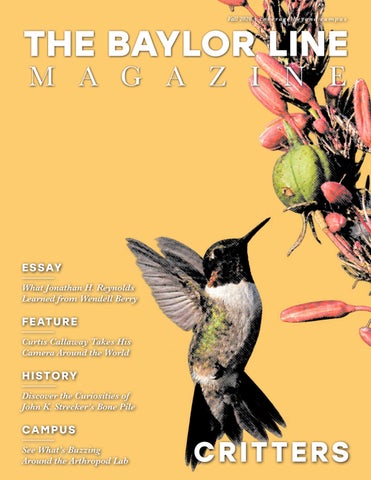
Fall 2026 | c o v e r a g e b e y o n d c a m p u s
M A G A Z I N E
ES SAY What Jonathan H. Reynolds Learned from Wendell Berry
FEATURE Curtis Callaway Takes His Camera Around the World
HI S TORY Discover the Curiosities of John K. Strecker’s Bone Pile
CAM P US See What’s Buzzing Around the Arthropod Lab 1
CRI T TE RS The Baylor Line
Staff FAITH ARNOLD (‘23) DIGITAL EDITOR
REBECCA CHAPMAN (‘15, MA ‘23)
contents
Fall 2026 | Vol. 90 No. 2
opening
03 EDITOR’S NOTE Why devote an entire issue to critters? For Editor-in-chief Kourtney Nering, the answer goes back to a neuroscience class, a riding center, and an unlikely bird assignment. Along the way, she finds that the critters in our own backyard have plenty to teach us.
STAFF WRITER
BROOKE MCCOWN REVENUE DEVELOPMENT MANAGER
KATIE MITCHELL STAFF WRITER
MAKAYLA MOWE (‘24)
features
4
FROM THE SOIL TO THE STARS Author Jonathan Reynolds reflects on advice he received from the agrarian poet Wendell Berry on being a steward of the land.
EXECUTIVE ASSISTANT TO THE CEO
KOURTNEY NERING (‘22) EDITOR-IN-CHIEF
10 BIRDS OF A FEATHER A new generation of birders takes flight as the Central Texas Audubon Society looks to Baylor students to get involved.
JONATHON PLATT (‘16, MA ‘19) CHIEF EXECUTIVE OFFICER
PAIGE SULLIVAN (‘15) EDITORIAL ASSISTANT
ANNIE WILDE (‘14) LAYOUT DESIGNER
14 HORSE POWER Dr. Beth Lanning has spent her career studying how horses help people heal — and helped build one out of metal and motors to find out why.
18 A BUG HUNTER’S BONE PILE Mammoth tusks, Babylonian tablets, and thousands of jarred creatures: the story of John K. Strecker’s “bone pile” and the curators who have kept it for more than a century.
Fellows
26 CRITTERS FROM AROUND THE WORLD From deep blue sees to high blue skies, Curtis Callaway’s lens has seen it all.
RENEE OLATERU (‘28)
JULIANA VASQUEZ (‘28)
38 THE WORLD’S DEADLIEST ANIMAL, UNDER THE MICROSCOPE
Baylor’s Arthropod Sensory Biology and Neuroethology Lab is studying how mosquitoes track down their hosts, and how that knowledge could help stop the diseases they carry.
2026
1
The Baylor Line
BOARD OF DIRECTORS OFFICERS
DIRECTORS
PRESIDENT
KAYE ROBINSON CALLAWAY (JD ‘09)
SHARON MCDONALD BARNES (‘78)
GEORGE COWDEN III (‘76, JD ‘79) PRESIDENT-ELECT
LINDSEY DAVIS STOVER (‘99)
42
THE BIRDS AT BAYLOR AND BEYOND More than 600 bird species make Texas their home. Maybe it’s time to lace up your boots, grab those binoculars, and check out what’s flapping on the Baylor campus.
LAURA HILTON HALLMON (‘96, JD ‘99) KAREN WALDEN JONES (‘86)
TREASURER
ROBERT MORALES (‘93) SECRETARY
MCKENZIE OVIATT MCENTYRE (‘20, JD ‘24) CHAIR, EDITORIAL BOARD
ROBERT F. DARDEN (‘76)
48
JACKIE BAUGH MOORE (‘86) TONY PEDERSON (‘73) STACY MAYS SHARP (‘76) MALEESA JOHNSON SMITH (‘16)
THE WACO CONNECTION This 2001 Classic article chronicles how Baylor contributed to early space exploration.
MADELINE SNEED (‘16)
BEHIND THE COVER Baylor alumnus Matthew W. York captured a photo of this ruby-throated hummingbird (Archilochus colubris) in Elm Mott, a small town just north of Baylor’s campus. York, an avid birder featured in The Birds at Baylor and Beyond, has one piece of advice for those looking to experience the joys of birding: “I know it sounds silly, but enjoy the birds.”
A SPECIAL DEDICATION This issue is dedicated to Sherry Boyd Castello (1936-2026), editor of The Baylor Line from 1968 to 1990, who covered her university with courage, fairness, and devotion. She died July 22, 2026, and The Line remains, in every sense, hers. The Baylor Line Magazine is published by The Baylor Line Foundation (formerly Baylor Alumni Association). Mailing address: PO Box 2089, Waco, Texas 76703. Copyright © 2026 by The Baylor Line Foundation. All rights reserved. Printed in Texas, USA. This publication and its trademarks are the property of The Baylor Line Foundation and may not be reproduced in whole or in part in any form without the express written permission from the Publisher. Website: baylorline.com. The Publisher reserves the right to change publication schedule without notice. The Baylor Line is a registered 501(c)3 nonprofit and independent of Baylor University. 2
The Baylor Line
EDITOR’S NOTE
Friends: This issue feels like the culmination of my career. It was a labor of love, and one of the most fun projects we’ve ever pulled together, from CEO Jonathon Platt’s first mention of “something on critters” to the book in your hands. To explain why, I have to go back to my senior year at Baylor, when my Behavioral Neuroscience course plucked me out of the classroom to apply what I’d learned in the real world. My group created marketing materials for Reach Therapeutic Riding Center in McGregor (yes, for a neuroscience class, I spent weeks editing a feature-length video; the writing was on the wall, people), and my fascination with equine-assisted services was born. I hope you catch the same bug reading staff writer Katie Mitchell’s Horse Power. Later, as a young reporter, I was pitched what felt like a silly assignment: What’s up with bird migration in Waco? As someone who was mildly afraid of birds, I bit off more than I could chew. I still remember my hour-long phone interview with Anna Dunbar (whom you’ll meet in Birds of a Feather). She told me to download Cornell Lab’s Merlin Bird ID app, and now I’d consider myself a novice birder. It’s just what happens when you meet the birding community. So naturally, I sent our wonderful writer Roger Munford to investigate on Baylor’s campus. He found it may start slow, but once you tap into the birders, they all come flocking (pun intended). I’m happy to report that his article, The Birds at Baylor and Beyond, helped spark Baylor students’ interest in chartering a campus Audubon society. There’s so much more inside. John Kern Strecker’s legacy has been on my story list for years, and staff writer Rebecca Chapman’s piece is funnier and more unexpected than anything I could have written. Curtis Callaway needs no introduction, but the adventures behind his photographs keep me coming back. And let’s face it: Everybody hates mosquitoes, but for the wrong reason, writes student writer Juliana Vasquez. It may seem frivolous to cover critters — there’s so much else going on at the junction of religion, university culture, and higher education that surely deserves this moment’s attention. But caring for creating is part of that conversation, which is why we being with Jonathan Hal Reynolds’ reflection on what it means to be a good steward of the land we call home. I hope it helps you see all of God’s creatures a little differently. Yes, even the mosquitoes.
All my best, K ourtney N ering ( ‘22 ) Editor-in-chief, The Baylor Line
2026
3
ESSAY
By Jonathan Hal Reynolds (‘05) From the author: On August 31, 2026, three days after I submitted the following article to The Baylor Line, Wendell Berry died. The news reached me that evening as something I had anticipated and yet was unprepared to receive. For a moment, it seemed as though some great light had gone out of the world, that there was less hope in it without him. Then I realized that Wendell was still in the world. His words remain. His questions remain. The direction he offered remains. Earlier that evening, before I heard the news, I had been wrestling with a significant decision in my own life, and I found myself returning again to Wendell’s philosophy and to the letters he had written to me. I imagine it will not be the last time. A man does not cease to be a guide simply because he has gone home. My heart and prayers go out to the entire Berry family, and most especially to Tanya, his beloved wife and companion of 70 years, who knew better than anyone else what it means to be faithful to a person and a place.
4
The Baylor Line
B
y noon, I had stopped counting how many times the plow had tried to pull itself free from my hands. It was early March, and a soft rain had settled over the fields outside Waco. A team of draft horses moved steadily through the wet ground while I followed behind, both hands wrapped around the handles of a walking plow. The earth corrected my expectations almost immediately. Every buried root traveled up through the steel and into my arms. If I leaned too heavily to one side, the blade wandered. Too lightly, and it climbed toward the surface. The horses seemed to understand the work far better than I did, moving with the patience of animals long accustomed to human incompetence. It took most of a day to plow a single acre — four of us taking turns, stopping often to stand in the field and breathe the smell of turned earth. It felt like brushing against a world almost entirely forgotten. Somewhere behind the horses, I thought of the agrarian writer Wendell Berry. For the previous year, Berry and I had been exchanging letters about faith, land, community, and the question that seemed to gather all the others into itself: how ought a person live responsibly in the modern world? The correspondence had begun to change me. My daughters were preparing to raise chickens and help establish an apiary. We
talked about orchards and animals, about growing more of what we ate. And I had developed the improbable desire to learn to plow with horses, partly because Berry had written so compellingly about the intimacy between good work and the place upon which that work is done. What stayed with me after that March day was not nostalgia for some vanished agricultural past, but something quieter — the idea, encountered again and again in Berry’s letters, that care requires proximity. The acre demanded something of me precisely because I could not deal with it abstractly. Progress came at 3 mph, and the measure of success was not how quickly I could escape the limits of place but how well I could work within them. And for the first time, I began to wonder whether the great moral question of our technological age might not be how far human beings can go, but whether we can learn to care for what is already within our reach. — I had first written to Berry as a reader from the comfortable distance at which ideas remain ideas. His books had been troubling that distance for some time, arguing that the way we treat the natural world cannot be separated from the way we treat one another.
“I come into the peace of wild things who do not tax their lives with forethought of grief. I come into the presence of still water. And I feel above me the day-blind stars waiting with their light. For a time I rest in the grace of the world, and am free.” — Wendell Berry
2026
5
A culture willing to exhaust its soil or regard animals merely as units of production should not be surprised when those same habits of exploitation appear in its treatment of human beings. It is difficult to think seriously about stewardship without eventually encountering inheritance. And it’s difficult to think seriously about inheritance without asking what, exactly, we believe we have truly received. Property? Memory? A right? A debt? Environmental concern is easier when the guilty parties remain conveniently far away — corporations, governments, industries, previous generations. Stewardship becomes more demanding when the pronoun shifts from they to I. What have I neglected? What has been placed within my care? Slowly I was becoming less interested in environmentalism as a set of positions and more interested in the moral discipline that makes sustained care possible. The most fitting word for it, I began to think, was fidelity. — The word can sound almost antique now. It belongs to vows and covenants, to promises made in a vocabulary more comfortable with permanence than ours tends to be. But the longer I read Berry, the more I began to see fidelity as something larger — not merely the keeping of a promise to another person, but a way of inhabiting the world. Berry has spent most of his adult life testing that proposition. He returned to his native Kentucky, settled on a farm in Henry County, and made one small region the imaginative geography of a lifetime’s work. The habits required to care well for a marriage and a farm, he suggests, share something essential: patience, restraint, memory, forgiveness, attention, and the willingness to keep returning after novelty has worn away. Land must be courted long enough to become known. Care becomes particular. This ewe. This hive. This field. Responsibility acquires names. That particularity matters because nature is an abstraction, and abstractions are remarkably easy to love. I can profess concern for the 6
environment without knowing the name of a single native grass growing beyond my fence. I can lament the destruction of distant ecosystems while treating the small patch of earth entrusted to me as merely decorative. Berry’s challenge is to bring love down to scale. For a person of faith, this carries additional weight. A steward does not create the thing he tends. He receives it. To receive something as gift is to recognize a giver, and therefore an obligation beyond appetite. What are we willing to remain faithful to long enough for our care to matter? You cannot nurture what you have already decided is disposable. — I had thought much about the argument for leaving Earth long before I had fully considered the moral importance of staying. For many years, my family and I lived on a ranch outside of McGregor, Texas, not far from the SpaceX rocket-development facility. Most days followed the ordinary rhythms of rural life with horses and cattle in the pastures, long walks through fields and groves, endless stars at night, and a quiet rarely granted in the modern world. Then, without warning, a rocket engine would ignite. The windows rattled. The ground trembled. The horses raised their heads from the grass. Long before I began corresponding with Berry, I had been drawn to that vision myself in my own science-fiction writing and also in writing a graduate thesis on humanity’s The Baylor Line
potential obligation to expand human consciousness beyond Earth. The argument is not frivolous. Earth is vulnerable, and there is something moving in the thought of carrying the flame of conscious life beyond the world on which it first appeared. Even now, Berry’s letters have not taught me to stop looking at the stars. They have changed the questions I ask when I look at them. The question Berry’s work presses upon the dream of Mars and further space colonization is not whether exploration is wrong. The harder question is what kind of creatures we will be when we arrive. We do not leave our character behind when we leave a place. If our habits on Earth are habits of extraction and abandonment, distance will not purify them. A rocket can carry human beings to another world, but it cannot make us worthy inhabitants of one. The danger lies in acquiring the technological power to leave before acquiring the moral discipline to tend the world already within our hands. The stars may indeed be part of our future. But the first test of that future is still beneath our feet. — The trouble with thinking at the scale of planets is that it can make an acre seem very small. Yet one of the deepest lessons I have taken from my correspondence with Berry is a growing suspicion of any vision of responsibility so 2026
vast that it excuses us from attending to the life immediately within our care. Nurture happens at the smaller scale. It happens when an animal needs feeding whether or not we feel like feeding it. It happens when a fruit tree is planted with the knowledge that years may pass before anyone eats from it. Most of these acts will never be noticed beyond the small circle of lives that depend upon them. Perhaps that is part of their virtue. I want my children to inherit not the illusion of a purer past, but a habit of attention — to know that eggs come from particular hens, that soil is not dirt but a living inheritance, that a tree planted now may offer shade to someone whose name we do not yet know. Faith has given me a language for this that environmentalism alone never quite did. To call ourselves stewards is to confess that the world is not ours. We receive it before we possess it. A commodity can be exhausted and replaced. But a gift carries memory, establishes relationship, and asks to be handed on. Eventually, the direction of nurture must reverse. The child becomes the parent. The recipient becomes a steward. Then the question is no longer only What has nurtured me? but becomes What will I nurture in return? — By the end of that March day, one acre of turned Texas soil lay behind us. One acre — almost nothing, measured against the ambitions of our age. Less than an hour away, engineers were building engines to cross distances that require numbers too large to picture. I had spent most of a day walking back and forth across a single field. Yet the acre no longer felt small to me. Walking behind the horses had restored a scale that modern life makes easy to lose. At the speed of a plow, an acre becomes a world of its own. And progress is measured not in miles but in furrows. You do not conquer such a place. If you are attentive, you begin to know it. When I first wrote to Berry, I wanted to know how a person might live responsibly in a world whose problems seem to have escaped the 7
“It may be that when we no longer know what to do we have come to our real work, and that when we no longer know which way to go we have come to our real journey. The mind that is not baffled is not employed. The impeded stream is the one that sings.”
scale of individual action. Our correspondence never made those problems smaller. But it slowly changed the scale at which I imagined an answer might begin. Not somewhere. Here. Not someday. Now. I still look at the stars with wonder, and perhaps one day our descendants will walk beneath a Martian sky. If they do, I hope they carry the disciplines of the gardener and the
8
farmer, the parent and the neighbor. I hope they understand that possessing the power to reach a place is not the same as possessing the wisdom to belong there. Most of all, I hope they have learned fidelity. The world is being tended or neglected every day in places too small to make the news — in fields and backyards, in marriages and neighborhoods, in what we take and what we return. Nurture begins there. So does stewardship.
“THE VETERAN IN A NEW FIELD” BY WINSLOW HOMER, COURTESY OF THE METROPOLITAN MUSEUM OF ART
— Wendell Berry
The Baylor Line
It’s
Baylor
News
For All,
Y’all ! baylorline.com
2026
9
VOICES
BIRDS OF A FEATHER By Juliana Vasquez (‘28), Fellow
A new generation of birders takes flight as the Central Texas Audubon Society’s enthusiasm infects Baylor students.
10
The Baylor Line
PHOTOS COURTESY OF ANNA DUNBAR
F
2026
or much of the year, the skies above Central Texas are busier than they appear. Birds migrating between North and South America pass through the region along the Central Flyway, making Waco and the surrounding communities a stopping point for hundreds of species. For those who know where to look, a walk through Central Texas can reveal a flash of color in the trees, a call from somewhere overhead, or a species that may only pass through for a few days. For decades, the Central Texas Audubon Society has helped people notice them. “Birds tend to tunnel right through the center of Texas on their migrations, both north and south,” said Clint Trimble, president of the Central Texas Audubon Society. “Roughly 1,000 bird species can be seen in North America, and we get about 600 of them. Over half of all the bird species that you could experience in North America pass through Texas. Now if that’s not cool, I don’t know what is.” Each migration brings millions of birds through the heart of Texas, and the Central Texas Audubon Society takes the opportunity to share the exciting news with the Waco community while advocating for the migratory birds’ safety on their journey. Anna Dunbar, a longtime board member and administrator of the Central Texas society, explained that a group of local ornithologists and birdwatchers hosted the first Waco Christmas Bird Count in 1957, later becoming an official nonprofit entity in 1979. The group was unofficially organized by local birders and civic scientists in 1969, operating as an informal regional group in its first decade. The Christmas Bird Count is one of various advocacy and education efforts led by the Central Texas society and the National Audubon Society broadly to emphasize the importance of birds to the Waco community and beyond. The annual census, which began nationally in 1900, tracks birds’ population sizes and migratory patterns over time and helps inform conservation decisions. In 2025, 36 people took part in Waco’s count, Dunbar said. “It’s called civic science, and it’s used by the government to make decisions across the nation, so national parks and other areas can be affected,” Trimble said.
Central Texas Audubon Society members prepare to search for local wildlife with binoculars in hand during a bird walk in May 2026 at Lake Waco Golf Club. Over decades, those tallies also show how birds’ territorial ranges are shifting, sometimes right in Waco. “The first time the Christmas Bird Count saw white-winged doves was in 1992, and that’s because the white-winged doves were pushing their territory further north,” Dunbar said. “But in 2025, there were almost 150 white-winged doves counted over Christmas break.” Aside from its efforts in the field, the Central Texas society also partners with local sites and organizations to provide information and birding opportunities to the public. The group meets once a month at the Mayborn Museum Complex to engage in bird-centric conversations led by experts and enthusiasts. “We have everything that goes from people showing off their photos that they took on a cool trip, all the way to a class I teach called ornitherapy, which is the idea of conceptualizing nature through the lens of birdwatching as a way to deal with cortisol levels and affect our brains in positive ways,” Trimble said. That connection to nature is also what brings 11
Students keep their binoculars trained on the landscape as they search for birds during a July 2025 summer camp.
12
walk through a bit of nature and maybe have an audiobook,” Trimble said. For many members, their birding adventure begins with a single bird that makes them stop and look twice. Trimble, who regularly travels for birding expeditions, encountered his spark bird (the bird that first gets someone hooked on birding) on a research trip he took with Baylor professors to Costa Rica. He was the only person on the trip who wasn’t a birdwatcher and for two weeks cautiously watched as his fellow travelers got more and more excited over the birds. “Then we stopped at a place called Trogon Lodge and saw a quetzal,” Trimble said. “It has these long green tail feathers and looks like the most ornate pigeon you’ve ever seen. And literally, my thought was, ‘I’m going to spend a lot of money on this hobby,’ and that was it.” Since that initial trip, Trimble has visited the Arctic, Central America, South America, and traveled through the Amazon observing birds as a part of ecotourism. Now Trimble hopes to help create those moments of discovery for others while protecting the birds and habitats that make them possible. The Central Texas Audubon Society aims to give back to the Waco community by safeguarding bird habitats and protecting the species that use Waco as a rest stop along their migratory routes. It protects those that nest in Waco, too, including the endangered goldencheeked warbler, the only bird species with breeding habitat exclusively in Texas. One way the community can contribute to these efforts is by participating in the Lights Out, Texas! initiative, which asks residents and businesses to turn off non-essential artificial lights at night during spring and fall migration seasons. According to the National Audubon Society, reducing excess lighting along migration corridors also reduces disorientation and accidental bird strikes — one of the top humanrelated causes of death for birds. The Central Texas chapter’s advocacy efforts have expanded onto Baylor’s campus, where sophomore Chandler Clark and senior Connor Bennett are working to charter a campus Audubon chapter. “As human society continues to develop, we’re going to build more structures, and these structures kill birds,” Clark said.
PHOTOS COURTESY OF ANNA DUNBAR
Audubon Society members together beyond the meeting space, with regular opportunities to explore Central Texas and its birdlife as a community. “We do bird walks about once a month, with the exception of summer months,” Dunbar said. “And we’re trying to do more events that can include everyone of all abilities as well.” Bird walks look different for everyone, ranging from casual to extravagant, beginner to committed. Last year, the Central Texas Audubon took a group on a birding trip to Costa Rica, and recently hosted a bird walk at the Lake Waco Golf Club. The group has also begun hosting Big Sits, where members stay in one spot for a few hours and count every bird species they see or hear. “We are trying to have some spaces that are for the visually or hearing impaired, where you can, for instance, have a handrail where you
The Baylor Line
PHOTOS COURTESY OF ANNA DUNBAR
A yellow-crowned night heron sits in the shade.
2026
Seeing the impact the University has on the local Waco community, the pair was inspired to charter a campus group. They also attempt to unite students who share their love of birding. “Baylor has a lot of influence over Waco itself and surrounding areas, so I think being able to tackle a lot of the issues inside of the campus is really good for being able to maintain this environmental consciousness,” Clark said. “They are the future, and if you enter your young adulthood knowing about birds and being enthusiastic about birds, chances are that it’ll carry throughout your life,” Dunbar said. “These
students seem very enthusiastic, and they really want to do it, and we’re very hopeful that it can happen.” As new generations of birders begin to take an interest in the natural world around them, Trimble hopes that enthusiasm will extend beyond the Central Texas Audubon Society and into the broader Waco community. “I think that the city of Waco has a lot of spaces that are still natural and can stay natural because they’ll never be useful in any other way,” Trimble said. “I would love for us, as an organization, to give people access to those spaces through the lens of birdwatching and just nature as a whole.” 13
CAMPUS
HORSE POWER Dr. Beth Lanning has spent her career studying how horses help people heal — and helped build one out of metal and motors to find out why.
By Katie Mitchell, Staff Writer 14
The Baylor Line
PHOTOS COURTESY OF SHANNON SMITH, REACH THERAPEUTIC RIDING CENTER
D
2026
r. Beth Lanning grew up around horses and planned to spend her life caring for them as a veterinarian. Decades later, the Baylor public health professor is still working with horses — including one made of metal and motors. Baylor has become a leading research hub for equine-assisted services — a field focused on utilizing horses for human benefit, commonly for therapeutic benefit. People have touted the healing power of horseback riding since ancient Greece, where Hippocrates is often credited with praising riding’s “healing rhythm.” But today, modern interventions, such as Baylor’s MiraColt, which mimics the movement of a horse, no longer require the animal’s physical presence. Lanning, now associate chair of Baylor’s Department of Public Health, studies humananimal interventions (especially those with horses) for children with autism, veterans with PTSD, and individuals recovering from trauma. In 2014, Lanning’s own research published in the Journal of Autism and Developmental Disorders looked at children with autism who were enrolled in a nine-week equine-assisted activities program. Parents reported significant improvements in their children’s physical, emotional, and social functioning after six weeks, with greater gains than among children enrolled in a non-equine program. Anecdotally, while working with autistic children, Lanning said she found that the coinciding qualities between the children and the horse helped build a connection between them. For instance, the high anxiety, reactivity, and hypersensitivity to sensory cues within both parties may create a mutual experience of trust and understanding of the other. For a child with autism, a connection with a horse can act as a powerful conduit because this big animal is very similar to them, Lanning said. For veterans, Lanning said, working with horses can upend what they learned in the military, learning leadership built on trust rather than orders. A 2023 review in the International Journal of Environmental Research and Public
Health proposed that handling a horse may help build veterans’ sense of control, autonomy, and assertiveness. In combat, veterans are taught the need for order and protection, creating a complicated transition back into society. Lanning said they try to figure out their purpose, as well as their place in civilization. “They’re a very high social order,” she said of members of the military. “But then, when they don’t have that as a protection, it’s not as emotionally safe for them or physically safe.” She emphasized that having a connection with a horse that is built on the foundation of trust instead of demand can put them in a leadership A participant receives assistance while feeding a horse during a session at REACH Therapeutic Riding Center in McGregor.
15
role that is comfortable. A hallmark of Baylor’s research on veterans, post-traumatic stress disorder, and equineassisted services came to fruition in 2017. A study authored by Lanning and partially funded by the Horses and Humans Research Foundation found that veterans who engaged in an eightweek horseback riding program reported they felt less anxious and depressed and had an overall greater quality of life versus those who did not participate. There are many proposed theories as to why equine-assisted services help trauma survivors. Horses, highly attuned to humans’ body language and emotional state, respond to this and act as a mirror for participants to recognize and regulate their own emotional state. “A horse is a prey animal so they are going to react to everyday life differently,” Lanning said. “They are very in tune to your emotions that you’re not showing. They read body language very well.” According to Lanning, building a relationship with an animal may serve as practice for rebuilding trust with other people, and takes away the judgement that some feel after trauma. At times when people have gone through lifechanging situations and protection feels stripped, to gain control of an animal this large could offer some mental strength. Lanning said that with this practice, individuals start to take a little bit more control and feel empowered to readapt to everyday life. “To be able to have some kind of relationship with that size of an animal is empowering for a lot of people,” Lanning said. Though studies are mounting, researchers still can’t say exactly why horses help. In a 2025 proof-of-concept study, Lanning and Dr. Cory Smith used portable brain imaging technology on veterans as they groomed and led horses, a very early step toward understanding what happens in the brain during horse-human interactions. For some patients, though, the benefit may come from something simpler: the way a horse moves. In hippotherapy, licensed physical, occupational, and speech therapists use the horse’s gait as a tool for treatment. The movement of the horse’s walk engages 16
PHOTOS COURTESY OF SHANNON SMITH, REACH THERAPEUTIC RIDING CENTER
A participant rides a horse during a session at REACH Therapeutic Riding Center.
The Baylor Line
PHOTOS COURTESY OF SHANNON SMITH, REACH THERAPEUTIC RIDING CENTER
2026
A participant helps groom a horse at REACH Therapeutic Riding Center. the rider’s balance, posture, and coordination in a three-dimensional pattern similar to human walking. It’s an effective tool for treating people with autism, providing unique sensory, motor, and neurological input. With this idea, Lanning and Dr. Brian Garner, associate professor of mechanical engineering, designed and invented a device — the MiraColt — that replicates the motion of horseback riding. The device reproduces a horse’s motion in real time, working the same muscles as would be used on a living animal. “You’re up higher, your center of gravity is higher,” Lanning said. “All of that really helps in improving the mobility and also the brain connection back to the muscles.” She said the movement of the horse improves
the balance and movement of the person. In 2009, Garner’s students built the first prototype of a machine that would replicate a horse’s movement. After four generations of refinement and a patent, that machine became the MiraColt. The Texas Higher Education Coordinating Board in 2020 granted an interdisciplinary team of scientists and engineers, including Lanning and Garner, some $600,000 to study the device’s effectiveness. The study found that: • Regular sessions on the MiraColt led to measurable physical improvements (like smoother walking patterns and better walking speed), • The device showed no statistical difference in engagement versus riding a live horse, • The device successfully challenges the brain and muscles to stay upright, • And the unique rhythmic sensory input from riding the device helped lower reactivity, resulting in children feeling calmer and more in control following sessions. Although the evidence is promising, the research behind equine-assisted services is nowhere near finished. The phenomenon of hippotherapy has reached an international audience as studies are taking place all over the world. Currently, Lanning said she plans to travel to Prague and get information on international equine services. She said she’s also interested in learning more about the use of equineassisted services for people with dementia and Alzheimer’s disease. For now, the connection between humans and horses remains a powerful reminder that sometimes, healing can come from an unexpected place. 17
HISTORY
A Bug Hunter’s Bone Pile The Legacy of John K. Strecker
By Rebecca Chapman (‘15, MA ‘23), Staff Writer
Mammoth tusks, Babylonian tablets, and thousands of jarred creatures: the story of the Strecker “bone pile” and the curators who have kept it for more than a century.
18
The Baylor Line
I
t was a sunny afternoon in the canyons of Bluffton, Texas. A local rancher spotted an odd-looking fellow camped near the riverbed, napping in a cot, a necktie draped over his dusty clothing. The rancher approached the sleeping man, Baylor faculty member John K. Strecker, and asked with some reservation: “Are you the bug-hunter?” Unamused to hear the scope of Strecker’s research, the rancher then pestered Strecker for a drop of precious whiskey, hoping for a fiery sip from a traveler’s silver flask. Strecker extended an arm, offering up a glass jar of the liquor, which was preserving an 8-inch centipede meant for display at the Baylor University Museum. Today that same centipede almost certainly lies in storage with the Mayborn Museum, which still stewards the tens of thousands of biological specimens and historical artifacts that Waco’s very own Indiana Jones brought to Baylor — the “bone pile” of internationally-renowned adventurer, John Kern Strecker.
PHOTOS BY REBECCA CHAPMAN
Baylor’s First Museum — A Cabinet Of Curiosity
2026
Today’s Mayborn Museum Complex, an institution whose doors opened in 2004, was first conceived in spirit in 1857. Baylor’s trustees had requested a cabinet to keep minerals and shells in for use as educational materials, and in Independence, this was the seedbed of the University’s museum efforts. By 1893, Baylor had acquired enough material and space to open the Baylor University Museum. At its start, university alumni, students, and Christian missionaries would gift the museum
The Strecker’s Cabinets of Curiosities exhibit at the Mayborn Museum displays many artifacts from the Strecker Museum’s collections. with treasures from their travels. Orlando Clarke Charlton was made the first curator, followed by Baylor royalty James Carroll. Strecker replaced Carroll in October 1903, and it was under Strecker’s direction that the museum became something completely unique for a Texas college.
John Kern Strecker — Baylor’s Very Own Indiana Jones
Strecker was arguably a cornerstone of Baylor history from his tenure of 30 years, serving as both museum curator and university librarian. The majority of contents comprising Baylor’s original museum system were acquired through Strecker, either via expedition or donation. He travelled all over Texas and around the United States to find animals, insects, shells, and eggs for Baylor’s collection of biological specimens. Strecker remarked in his own writings that growing up, people found his passion unorthodox. “They not only shook their heads sadly, but pointed to their foreheads in a suggestive fashion,” he wrote in a zoology manuscript, published posthumously by the Baylor Bulletin. “While conditions have improved, as a result of the teaching of nature study and zoology in high schools and colleges, in many parts of the country it is still impossible for one to chase the festive red-winged butterfly or swift-footed lizard, or crawl his belly through the shadows 19
Top: The Mayborn’s Strecker exhibit is patterned after early natural history museums, displaying many specimens — like these horseshoe crabs — without modern labels. Bottom: The exhibit features a humpback whale skull collected in 1905 in Brazil. of some stream in quest of fresh-water mussels, without some moron suspect him of being what old-timers call a ‘nateral.’” Strecker was described by his peers as a man who would sleep peacefully with a bag of live rattlesnakes tucked under his bed. He was bold and unblushing when searching the wild for specimens, and his quirky, jovial nature added to the air of intrigue around him. Strecker’s obituary notes his great sympathy for animals and interest in their world. Though he killed them for scientific research, Strecker was politically protective of animals. He once penned an essay for the 1928 edition of the Texas Humane Review, repeatedly condemning people who destroyed animals and their habitats, damaging food chains and ecosystems. One Baylor alumnus wrote in a 1925 Baylor Monthly letter that Strecker had more friends than anyone on campus. He was a renowned scientist whose acquisitions were recognized by scientific societies and publications far beyond Waco, yet he was also a compassionate friend to every student with whom he interacted. “To be loved by one’s neighbors, to be respected by one’s professional associates and honored by one’s colleagues is indeed a worthy estate — one to be coveted by all,” wrote the alumnus J.W. Harrell. “Such is the heritage of John Kern Strecker.”
The Bone Pile — What’s Buried In Baylor’s Basement?
Though Strecker was once called “the bug hunter” on his adventures, as relayed in one of his personal writings, the sheer volume and breadth of treasures he acquired for Baylor eclipse any entomologist’s most aspiring beetle collection. Just a few noteworthy items acquired by the Baylor University Museum are as follows, according to Baylor publications and Strecker’s own accounts: A meteorite, a mammoth tusk, Inuit clothing and totem pole from Alaska, a humpback whale skull, a puma, a brown bear, a grey wolf, and a mountain sheep. The museum had skeletons and skulls of all kinds of animals, including a jaguar and seal skull. There were thousands of reptiles, bugs, frogs, fossils, eggs, birds, and fish. In Strecker’s tenure the museum had 3,000 mineral specimens, as well as a collection of 5,400 shells. 20
The Baylor Line
A 1910 article from The Lariat notes the museum housed “ethnological” items like “race skulls,” the head of an Egyptian mummy brought to Baylor from Israel by B.H. Carroll, and a baby Native American mummy from West Texas. The severed hand of a Native American chieftain could also be found on display at one time. The museum held Aztec and Native American artifacts from more than a dozen tribes. Baylor owned several war relics from North American conflicts and personal effects of Gen. Sam Houston. Strecker noted in a 1927 Baylor Monthly letter that he retained a photocopy of a letter from George Washington to a member of the Baylor Family (George Baylor, Judge R.E.B. Baylor’s uncle), along with other treasures belonging to famous Baylor figures. In 1920, Strecker was gifted 16 Babylonian tablets from an Egyptologist. Strecker died while active in his career at Baylor, passing in early 1933. A few years following his death, then-University President Pat Neff renamed the university museum the Strecker 2026
The face of John K. Strecker greets museumgoers as they enter his Cabinets of Curiosities exhibit. Museum, a name it kept until the birth of the Mayborn Museum Complex. Baylor’s museum system has continued to acquire more and more specimens and artifacts across time. By the time the Strecker Museum closed in 2003, there had been over 250,000 items cataloged, according to former staff. Seemingly countless articles and letters addressing the Baylor University Museum and the Strecker Museum note that in each of the pre-Mayborn locations the museum has made home, space for the aptly nicknamed “bone pile” has been limited. Chasing the Bone Pile: A Centennial History of the Strecker Museum, a book by Baylor alumna Karen Gerhardt detailing the history of Baylor’s museum system up to 1995, chronicles difficulties directors had in organizing and cataloging the mounds of jarred creatures and containers of bones. The museum was housed all across campus, 21
Dr. Trey Crumpton holds a freeze-dried turtle specimen from the museum’s non-display archive squeezed into the upper floors of Pat Neff Hall or the basement of the Sid Richardson Building. But, those men and women who cared for Strecker’s legacy always found a way to make everything fit.
History Never Changes — Museums Do
David Lintz, a longtime staffer with the Strecker Museum and for many years its assistant director, was the last man of an era — the last of the men who slept under the stars in dusty canyons to hunt and jar lizards and frogs. He also was the first to step into a new era that was exciting in its own way — an era of mammoth bone discovery, 22
computer integration, and repatriation of things sacred. Lintz, a 1969 Baylor graduate, was part of the team that dug up the first layers of Waco’s famous mammoth site in the early 1980s. He also helped facilitate the acquisition and assemblage of the Gov. Bill and Vara Daniel Historic Village. He worked on the Strecker’s first computer and cataloging system, and he was part of the team that conceived the design for the Mayborn Museum. Though retired, he is still active in Waco’s professional museum community. “Well, where else do you find your history?” Lintz said of museums. “If you don’t preserve it in a facility that can preserve it, where else is it going to be? Sold, flea market, trash, ruined in an attic or a basement. Things of historical significance need to go to a facility that can take care of them.” As Lintz had seen the acquisition of more and more new material, he also managed processes of removing material. Lintz was in charge of repatriation of several remains when the Native American Graves Protection and Repatriation Act went into effect in the early 1990s. Some human remains were repatriated, including the body of the aforementioned baby. No items were ever thrown away due to lack of space or interest, Lintz said. Most things no longer owned by Baylor’s museum now have been returned to original owners or shared with other museums. “Museums do this all the time,” Lintz said. The Baylor Line
“They transfer stuff to a museum that is more amenable to that or has that type of collection.” The Strecker Museum closed its doors in 2003, making way for the Mayborn Museum, which would display many of Strecker’s most eyecatching items, while archiving the mammothsized expanse of the full collection in a variety of places. Though he frequents the Mayborn, Lintz said he hasn’t been back in the basement of Sid Richardson in 23 years — the one historical relic he doesn’t choose to re-experience. “I just couldn’t bring myself to go and see what they had done to it because I was gone when they moved everything out and I’d built everything down there,” he said. “I’d built almost all those cases … I didn’t want to see any of that anymore. When I walked out of it, that was it.”
Strecker’s Grandbaby: The Mayborn Museum
Today, the Strecker “bone pile” is in the hands of faculty and staff like Dr. Trey Crumpton, who has been a passionate member of the Mayborn team since the groundbreaking of the museum in 2003, when Crumpton was still a Baylor student. “Our current mission is the cultural and natural history of Central Texas within about a
2026
200-mile radius of Waco,” Crumpton said. “But before the Mayborn was the university museum. It was everything from all over the world.” Crumpton and his colleagues receive donations regularly, whether anthropological artifacts, animal remains, or Baylor memorabilia. The Mayborn engages in passive collecting of animal specimens, where dead animals may be donated to it, but the museum staff no longer hunt and kill animals for the collection. Some people have made the museum aware of their intention to donate special historical items when they or a loved one eventually pass away. “People want to know that the things they have that are important to them are important to somebody else,” Crumpton said. “… A lot of times it is important to us, and they may not realize how important it is to the museum until they ask.” The museum stores specimens and artifacts both inside the Mayborn campus and at off-site storage locations. All mammoth bones from the Waco Mammoth National Monument are stored inside the Mayborn Museum’s upper floors, Crumpton noted. Thousands of items belonging to Strecker and the museum live off display in an archive.
23
The Mayborn archives still contain human remains from Baylor’s earliest museum collections, which are not on display. “The first thing is that it’s disrespectful to those people,” Crumpton said. “Second is that we follow the federal law on human remains.” Today, the Mayborn is negotiating with relevant tribes in an attempt to ensure the remains are returned to the correct people and locations. Crumpton said the museum leadership has worked with the Wichita and Comanche Nations to build the Mayborn’s newest permanent gallery, Cultural Crossroads, with the intention to display Native American items in a way that better tells the story of their heritage.
Why Keep That Whiskey-Scented Centipede? Information about natural sciences and human history is widely and instantaneously available through the tap of a phone screen in 2026, as are images and videos. While museums remain popular tourist attractions, they are now an optional educational experience — though no
less vital, according to Strecker’s successors. For Crumpton, the ethos of the “bone pile” is something not quantified. “There’s a certain experience that you can only get — it’s called numinous, when you have a numinous experience,” Crumpton said. “And it’s a spiritual, almost a religious wonder that you feel when you’re in the presence of a real thing.” Hundreds of books and research papers likely exist on centipedes like the one Strecker brought home in a whiskey jar over 100 years ago. One might question whether creating space for a dead centipede in a jar is justifiable, or even rational. To much of the world, a dead bug in a jar, or an old rocking chair that belonged to a late politician, or a photocopy of a handwritten letter, may be garbage fodder. But to the few romantics inhabiting the profession of museums — men like Strecker, Lintz, and Crumpton — there is beauty and purpose. “If such objects are ‘junk,’ then all of the stories of history are just so many idle words that should be blotted out and be no more remembered by men,” Strecker wrote of his museum.
We give a special thanks to Baylor University, Mayborn Museum for photo assistance.
Dr. Trey Crumpton presents specimens, including these swans, that live in the museum’s archive rather than on display. 24
The Baylor Line
Top: Over the last 135 years, the Mayborn’s mammal collection has grown to more than 1,400 specimens, including this rat. Bottom: This toad is one of 22,600 specimens in the Mayborn’s amphibian collection.
2026
25
FEATURE
critters from around the world A Photo Story by Curtis W. Callaway
From deep blue sees to high blue skies, Curtis Callaway’s lens has seen it all. ALL IMAGES COURTESY OF AND COPYRIGHT OF CURTIS W. CALLAWAY
26
The Baylor Line
Tanzania — A storm cloud brews across the Serengeti. The original goal was to capture the trees against the clouds, the sky, and rain, when — all of a sudden — into the frame runs an ostrich. Great wildlife photography is a serious mix of skill and patience . . . with a dash of luck.
2026
27
Hawaii A diver swims next to a Hawaiian monk seal. A bucket list photo for sure. A critically endangered and protected species, there are only about 1,700 left in the world. There were two of these seals hanging out together off a small island near Kauai. Both were inquisitive creatures, coming right up to the camera.
28
The Baylor Line
France Two white horses of the Camargue face off. Against a clear, blue sky, these stallions were doing a lot of staring each other down, pushing each other around, nosing each other, and butting heads. Will they duke it out?
2026
29
Morocco A Barbary macaque nibbles on seeds. An endangered species, these critters are no strangers to human interaction. On an excursion up near the Atlas Mountains, a group of these monkeys were raiding the flowers for their seeds. It didn’t take long at all for him to pose for the shot.
30
The Baylor Line
Tanzania Three giraffes pose, each looking in a different direction. At Little Chem Chem, in the private Chem Chem Conservancy, giraffes are the stars of the show — especially Omo, a rare leucistic white giraffe. The contrast of these three in a line while looking in different directions almost makes it feel like they’re wrapping around each other. 2026
31
Far West Texas A horny toad quizzically looks over his shoulder while exploring a ranch outside of Marfa. Gnarly, crazy cool creatures, they can eject blood from their eyes as a defense against predators.
32
The Baylor Line
Ecuador The national bird of Peru, the Andean cockof-the-rock. In dense forest, up in the cloud jungle, these birds are extremely difficult to find and photograph. They move around early, early in the morning for a mating ritual, as the first light of the day peaks through you hear their calls growing louder and louder.
2026
33
Tanzania On the Serengeti, a huge herd of wildebeest is joined by a single zebra. The blur of the herd behind him and the stripes on his legs contrast the crisp focus of the zebra’s body.
34
The Baylor Line
Interstate 35 A porcupine poses. Heading back from a dog sledding trip in Minnesota, this guy was hanging out in a tree on the side of the interstate. A quick glimpse of him caused an 8-mile detour for this shot of him gnawing on some aspen bark. The detours are always worth it. 2026
35
Bosque County, Texas A rough green snake pokes his head up next to a bluebonnet. Laying level with him on the ground, this was for work on a book of North American snakes. He was a curious little fella.
36
The Baylor Line
Ecuador A violet-tailed sylph perches, displaying its long tail and bright colors. This hummingbird lives at 14,000–15,000 feet above sea level, making it the highest altitude hummingbird. They’re elusive, skittish, quick, and very difficult to catch for a photograph. Suddenly, he just appeared on this branch.
2026
37
CAMPUS
The World’s
DEADLIEST ANIMAL
under the microscope By Juliana Vasquez (‘28), Fellow
Dr. Jason Pitts and Baylor’s Arthropod Sensory Biology and Neuroethology Lab are studying how mosquitoes track down their hosts, and how that knowledge could help stop the diseases they carry.
E
ven as a doctoral student, Baylor associate biology professor Dr. Jason Pitts wrote off the danger of mosquitoes — just as most people do. Although for over a decade the Centers for Disease Control and Prevention has promoted the pest as the world’s deadliest animal due to its ability to transmit diseases, it’s more commonly associated with its short-lived, itchy bite than its extraordinarily high fatality count. It wasn’t until he joined the Zwiebel Lab at Vanderbilt University — a lab dedicated to the
38
molecular genetics and neurobiology of smell in mosquitoes — as a lab manager that Pitts was introduced to mosquito biology, vector-borne diseases, and the danger behind nature’s most annoying pest. “I just became completely fascinated by mosquitoes and vector-borne disease as a human problem,” Pitts said. “I really just became entrenched in that area of research and decided that it was going to be my career direction.” Pitts’ passion for studying the insect began with an interest in the transmission of malaria, The Baylor Line
RIGHT: PHOTO COURTESY OF DHIVYA RAJAMANICKAM
LEFT: PHOTO COURTESY OF THE NATIONAL INSTITUTE OF ALLERGY AND INFECTIOUS DISEASES, VIA UNSPLASH
2026
a life-threatening disease spread by mosquitoes that kills some 610,000 people primarily in Sub-Saharan Africa each year. The disease disproportionately affects certain populations based on geography and socioeconomic status: according to the World Health Organization, nearly one-third of the world’s deaths due to malaria occur in Nigeria, while the CDC reports the United States averages just seven malaria deaths per year. “The impact of malaria on human flourishing across the globe was so profound — and still is — that I really felt called to study that and to try to understand as much about the mosquito as I could,” Pitts said. After receiving his Ph.D. and serving as a faculty member at Vanderbilt, Pitts searched for an opportunity to branch out on his own. After interviewing and touring with his family, Pitts fell in love with the Baylor community, the opportunity the school offered as a university vying for R1 status, and the idea of asking unexplored questions in vector biology. “That was one of the unique aspects of the research that I was proposing to bring here — that it was something that could be used to promote human flourishing, that studied a global health problem, and the idea we were using the tools of microbiology to study how mosquitoes and other insects sense chemical cues,” Pitts said. At Baylor, Pitts created the Arthropod Sensory Biology & Neuroethology Laboratory, with his team of undergraduate, graduate, postbaccalaureate, and post-doctoral researchers following the yellow fever mosquito (Aedes aegypti) and investigating how mosquitoes use the chemical information in the world around them to survive and reproduce. Toward the beginning of Pitts’ career, much less was known about how a mosquito’s chemical receptors worked, and Pitts attributes his timing in the field to simply being at the right place at the right time. For example, mosquitoes find food, mates, and hosts largely by using smell, specialized proteins called chemoreceptors on their antennae, and other sensory organs. By asking about and identifying the genes that code for those receptors and comparing which ones are active in males versus females, Pitts and his colleagues began to understand how each sex detects the chemical signals around it, and why they respond
This trap at Cameron Park Zoo is set up to appear and smell like a human, allowing it to attract all blood-feeding mosquito species. differently. “Once we discovered the genes that allowed mosquitoes, both sexes, to find resources, we became really interested in the question of blood feeding,” Pitts said. “That’s been the focus of the kinds of research that we did at Vanderbilt and now here at Baylor as well.” Through topics ranging from the study of mosquitoes’ anatomical structures to how environmental chemical cues are transmitted into the brain, Pitts’ lab at Baylor has asked countless questions about the yellow fever mosquito. The lab hopes to understand the spread of arboviruses, such as dengue, Zika, West Nile, and yellow fever. “There are still, of course, a huge number of questions that remain unresolved, but we’ve made strides, and that’s what we’ll continue to do with the ultimate goal of not only learning as much as we can about these mosquito vectors of disease, but somehow using that information to block the transmission of human pathogens,” Pitts said. Dhivya Rajamanickam, a doctoral student in Pitts’ lab, conducted seasonal studies between 2023 and 2025, visiting Waco’s Cameron Park Zoo every day from May to November to collect data. By using different types of traps to identify mosquito species and determine which animals they fed on, the study aimed to understand how mosquitoes interact with zoo animals, local wildlife, zoo employees, and visitors, connecting these hosts through disease-transmission cycles.
39
40
This trap at Cameron Park Zoo utilizes fabricated human skin scent lures to capture mosquitoes. to do morphological identification,” Rajamanickam said. “If you can’t identify them, you have to do a DNA extraction, and this is all only for the blood-fed mosquito.” Each specimen carries another piece of information that can help researchers understand where mosquitoes are feeding and how they interact with the animals around them. The process is repetitive and difficult, and the field work doesn’t stop for the weather, but Rajamanickam is grateful to have the opportunity to go out into the field and conduct her research. “It’s a huge process,’ Rajamanikam said. “It’s time consuming, but I’m so happy that my work is balanced between field work and molecular work because going outside and seeing the real-world implications of your research is very important.” For Rajamanickam, the work offers a chance to see the questions she studies in the laboratory play out in the field. For undergraduate researcher Manav Kapadia that same connection has become one of the most rewarding parts of the experience.
LEFT: PHOTO COURTESY OF THE NATIONAL INSTITUTE OF ALLERGY AND INFECTIOUS DISEASES, VIA UNSPLASH RIGHT: PHOTO COURTESY OF DHIVYA RAJAMANICKAM
“When you look at the history of the United States, the first West Nile outbreak of 1999 was identified at the Bronx Zoo, New York,” Rajamanickam said. “That happened in the wild birds and then it was transmitted to all the captive birds inside the zoo, and then it spilled over to the community.” With a variety of readily available blood meals and still-water habitats to function as breeding grounds, zoos provide the perfect habitat for mosquitoes to thrive in. If mosquitoes are provided captive, ready-to-eat hosts, they tend to stay within the safety of the habitat rather than branch out to find different hosts to feed on. “Mosquitoes make their habitats there and breed inside the zoo very easily, and they can immediately emerge and feed on animals around the zoo,” Rajamanickam said. In fact, some mosquitoes within the zoo have a preference for which hosts they feed on. Rajamanickam found multiple examples of mosquitoes who fed on specific hosts or went out of their way to feed on hosts, even though they were difficult to access within the zoo. “They are so fond of particular host species, so hundreds of them will specifically go and feed on them, and there are specific reasons behind this based on their habitat preferences and also their behavioral activities,” Rajamanickam said. For Rajamanickam, the zoo is only one half of the research. The mosquitoes she collects there eventually make their way back to Baylor, where the work shifts from observing mosquitoes in their natural environment to examining them under a microscope and, when necessary, analyzing their DNA. “It is really messy, and you have to take them individually and then see under the microscope
The Baylor Line
“It definitely takes a little bit of learning, and a little bit of time to get used to working in a lab,” said Kapadia, who learned about the lab after taking Pitts’ biology classes. “It’s a completely different environment from school, but it’s been really rewarding.” Pitts attributes the lab’s success to great students and lab personnel like Rajamanickam and Kapadia, who are motivated about what they do and put the lab’s guiding questions into action. Although the turnover rate is high in academic labs, institutional knowledge and growth are key values of the lab. The lab’s mission continuously draws back to Pitts’ passion to benefit the greater good, with the hopes that the research the lab conducts potentially improves human flourishing overall. “I wish people understood how great the imact of mosquito-borne illness around the world is,” Pitts said. “Mosquito-borne illness has an outsized impact on the lives of the people around the world.” Both Kapadia and Rajamanickam echoed Pitt’s sentiment, as the pair both have family living in countries where mosquito borne illnesses continue to impact everyday life.
PHOTO COURTESY OF MANAV KAPADIA
Manav Kapadia poses next to a research poster displaying findings from studying mosquitos at Cameron Park Zoo.
Rajamanickam, who is from Sri Lanka, originally began studying mosquitos in a collaborative public health and entomology research project. In Sri Lanka, mosquito-borne illness continues to be a leading problem, with thousands contracting illnesses from mosquitoes this year alone. Kapadia, who has family in India and Africa echoed a similar sentiment, stating that his personal investment in the research is another aspect of what attracted him to it. “In each of those places, vector-borne diseases like malaria and dengue virus are a really big problem,” Kapadia said. “I’ve had family members that have had some of these illnesses, and mosquitoes kill probably the most people out of any animal in the world, so I think controlling them is very important.” For the researchers in the Pitts lab, that concern extends beyond understanding mosquitoes for the sake of understanding them. Their work is rooted in the hope that learning more about how mosquitoes behave can help researchers stay ahead of the diseases they carry. “I think we have a responsibility to work toward the betterment of the lives of other people,” Rajamanickam said. “And if we’re not out in front of this and learning more about the mosquito vectors, then we’ll be behind when they do come.”
2026
41
More than 600 bird species make Texas their home. Maybe it’s time to lace up your boots, grab those binoculars, and check out what’s flapping on the Baylor University campus.
42
PHOTO COURTESY OF RICH KOSTECKE
CAMPUS
The Baylor Line
C
entral Texas is a gold mine for birders, and the Waco area is no exception to that. With a diversity of ecosystems that attract many species, it is a prime location on the Central Flyway. Of the four avian superhighways in the United States, the Central Flyway runs through Texas, as well as Colorado, Kansas, Montana, and Wyoming, and is by far the most popular route for the millions of birds that migrate each year. neotropic cormorant, the American white pelican, and the barn swallow. “Another favorite is the black-bellied whistling duck, which will fly low in the sky in the evening right up until it roosts for the night,” said Kyle Melton, a wildlife biologist at the Texas Parks and Wildlife Department. “They have a unique flying call, a whistle, and I’ve seen them land on Baylor’s campus. We also have a lot of hawks that come through. And Franklin’s Gulls. You may not see them landing, but you can hear them honking and chattering overhead.”
The Making of a Good Habitat
“You can roughly categorize the birds we get in Central Texas into four groups,” said Charlotte Reemtz, an ecologist and science project director with The Nature Conservancy’s Texas chapter, where she has studied ecosystems across Texas since 2005. “We have woodland forest birds that like big trees, lots of structure. We have shrubland birds, like the black-capped vireo, that want shorter plants. Then we have grassland birds that want open spaces. And finally, there are the waterbirds.”
The ideal habitat for a bird is one with a plentiful source of food nearby, shelter against bad weather and for protection, and a place to build nests for those species that are in the area during breeding season. “The large trees and live oaks on Baylor’s campus, plus the Brazos River, establish a very welcoming habitat, especially during migrations,” said Matt York, an avid birder and Baylor alumnus with more than 500 birds on his Life List (that is, a personal record of every bird species positively identified in his lifetime). “If you look at satellite imagery, it’s like a little green ribbon, which is perfect for spring warblers.”
The Birds at Baylor
A Carolina Chickadee at Granger Lake.
PHOTOS COURTESY OF RICH KOSTECKE
An eastern screech owl.
2026
The Baylor campus sits within an urban environment, but its location along the Brazos River is a sanctuary for many bird species. “We have a good habitat here right next to the river and, on the older part of campus, some really old trees that are home to screech owls,” said Dr. Joe C. Yelderman, Jr., professor and chair of the Department of Geosciences. He’s been on the Baylor faculty for 43 years and has been watching birds his whole life. “I sometimes stumble because I’m always looking up,” Yelderman said. Some of the birds most often seen around campus include the blackpoll warbler, the
43
A golden-cheeked warbler at Belton Lake. Baylor campus, they enjoy the Ashe juniper woodlands of Meridian State Park. Only an hour’s drive from Waco, the park is worth the drive for its wide variety of birds. “We also have big reservoirs that provide a habitat for a variety of ducks, loons, and seasonal eagles,” said Rich Kostecke, director of science and stewardship at the Hill Country Conservancy and vice president of the Travis Audubon. “Central Texas eagles have made a comeback, and we have a lot of nesting eagles now. We also have whooping cranes. They’re still listed as endangered — their numbers are recouping, but they still have a way to go until they’re fully recovered.”
Whooping Cranes Over Texas Dr. Karine Gil began researching whooping cranes in Texas in 2002 while pursuing her Ph.D. in the Department of Wildlife and Fisheries at Texas A&M University. She’s now a lecturer and professional concert pianist, joining the Baylor faculty in 2019. “I have more than 40 years
44
PHOTOS COURTESY OF RICH KOSTECKE
One of the more famous avian residents in nearby Bosque County is the golden-cheeked warbler, the only bird that nests exclusively in Texas. Although rarely seen on the
The Baylor Line
of 70 different species of birds since we started the project in 2023,” Mullins said. “And more than 500 folks on campus have contributed.” A year after Mullins began her project, the biology department’s Dr. Robert Doyle encouraged his students to contribute to the Baylor Biodiversity Project as part of the upperlevel ecology course he taught. As Mullins stresses: “It’s really there for anyone to use — the perfect citizen science project that’s fun for Baylor students.”
Playing Favorites Whooping cranes at Fort Hood. of experience working with birds,” Gil said. “Whooping cranes live around 32 years, so when you see a flock, it’s probably great grandparents, grandparents, parents, and children. An entire family — that’s so beautiful.” Whooping cranes have been on the planet for 54 million years. Research from 1938 showed that only 14 remained. Today, there are between 400 and 600 thanks to the work of scientists and conservationists. “Migratory birds don’t know about the boundaries of a country and use the entire planet for their benefit,” Gil said. “Next semester, I’ll be teaching ecology classes and hope to inspire more bird watchers, encourage Audubon membership, and raise awareness about diversity at Baylor and in the Waco area.”
“Most recently, I saw a double-striped thick-knee, a bird primarily found in Central and South America, and that was one that I was able to register with the American Birding Association,” alumnus York said. “I also drove down to Galveston for a yellow-headed caracara, which is quite rare north of southern Mexico. And, perhaps most noteworthy, was the sighting of A red-shouldered hawk.
PHOTOS COURTESY OF RICH KOSTECKE
The Baylor Biodiversity Project
2026
For students, faculty, and campus passersby, there’s the Baylor Biodiversity Project. “A big topic for the second semester of freshman biology is biodiversity, so I was looking for a way to get the students more engaged in biodiversity in their own backyard,” said Melissa Mullins, an environmental education and outreach coordinator for the Center for Reservoir and Aquatic Systems Research. “As I was already using the iNaturalist app, I decided to create the project there. Every week, the students have to make a number of observations.” Although students are encouraged to document all animal species living on and passing through campus, there have been many bird sightings. “I’m proud to say we’ve had 1,700 observations 45
46
The Baylor Line
PHOTOS COURTESY OF RICH KOSTECKE
“Migratory birds don’t know about the boundaries of a country and use the entire planet for their benefit...” of a mile, I saw 15 Mississippi kites overhead. I don’t know what that means, but I’ll cherish it.” You can increase the odds of seeing a wider variety of birds in your backyard with some feeding and planting strategies. “Don’t underestimate the power of putting out clean water for the birds, either to just drink or bathe in,” Kostecke said. “And with backyards, it’s nice to have native plants and maybe a little messiness, with shrub-covered areas of thickets, where birds can escape into at all levels from the ground all the way up to the trees.”
The Joys of Birding
Left: A northern cardinal at Lake Georgetown. Top: A wood duck Bottom: A scissor-tailed flycatcher
PHOTOS COURTESY OF RICH KOSTECKE
a Siberian stonechat, an Old World flycatcher species.” For wildlife biologist Melton, his favorite bird sightings are memorable. “On my birthday a couple of years ago, I saw about 50 Mississippi kites fly through, the first time I ever saw one,” Melton said. “And then, just last week, I got some bad news of the passing of a cousin of mine, and within the next quarter
Whether you want to see the northern mockingbird — the state bird of Texas since 1927 — or the super-rare cattle tyrant, York has some simple advice for you: “I know it sounds silly, but enjoy the birds.” Kostecke agrees. “Don’t be intimidated,” Kostecke said. “It’s a wide spectrum, from those who watch the birds in their backyards to folks who are really hardcore twitchers. It’s a process, and the more you do it, the better you get. Birding is about having fun and enjoying yourself.” “A bird doesn’t have to be rare or unusual to be really, really beautiful and interesting,” Reemtz said. “They’re like a little piece of the sky that just sat on your feeder or in that tree on campus. Birds are our neighbors, and we should all get to know them better.”
2026
47
CLASSIC
Waco Connection The
How Baylor contributed to early space exploration By Todd Copeland
For now over 75 years, The Baylor Line has been publishing vivid storytelling from across the Baylor Family. I don’t think our archives full of deep, inspirational features should live solely on shelves, so we are bringing them back to life in BL Classics. This Classic comes from a 2001 sidebar, which chronicles the brave chimponauts of Baylor and the faculty and administrators who brought their research to campus.
F
ew people around Baylor are aware that, almost forty years ago, a training facility for space flight was located in Baylor’s backyard. The place was a nondescript cinder-block structure behind the old Behrens building, now the site of a new parking garage. The trainees, however, weren’t your ordinary, aspiring astronauts. They were chimpanzees, or chimponauts. John Glenn had piloted America’s first Earth-orbiting flight just a month before Baylor’s psychology department began work, in March 1962, on an eighteen-month, $40,000 contract with the U.S. Air Force in which three
48
chimpanzees were to be trained to perform tasks for possible space flight. A chimp named Enos had preceded Glenn into orbit in the fall of 1961, providing NASA-Air Force scientists with data regarding the effects that weightlessness, launch and reentry gravitational forces, and the inherent physiological dangers of space flight would have on one’s ability to perform complex tasks in flight. Even after the relative safety of astronauts had been established by Glenn’s pioneering flight, chimps such as the ones at Baylor were still being trained for possible future missions. “I can remember their names perfectly after all The Baylor Line
these years — Clayton, Cindy, and Gail,” says Dr. Roger Kirk, who was one of the Baylor professors involved in the project. Now a distinguished professor of psychology and statistics at Baylor, Kirk notes that the primate laboratory was also eventually home to several Java monkeys, gibbons, and baboons. How did Baylor get involved in the chimptraining business? The answer lies in the relationship between Dr. William D. Thompson, then a psychology professor at Baylor and the principal investigator in the Air Force contract, and someone well-known in Baylor circles—Dr. Herbert H. Reynolds. Now president emeritus, the former Baylor president and chancellor earned his master’s degree and doctorate in psychology from Baylor in 1958 and 1961, respectively. The chair of his doctoral committee was Thompson, and it was Reynolds who later negotiated the contract between Baylor and the Air Force. In June 1961 Reynolds—who had studied and taught at Baylor as an Air Force officer—was assigned to the Aeromedical Research Laboratory at Holloman Air Force Base near Alamogordo, New Mexico, as chief of the Training and Research Branch of the Comparative Psychology Division. In January of that year, the Hollomantrained chimp Ham had preceded Alan Shepard in suborbital flight. Then, in late November, the NASA-Air Force team sent chimponaut Enos into orbit. Like his predecessor, Enos had been trained under a NASA contract with the Air Force in the New Mexico laboratories—this time with Reynolds as part of the team. That same fall, Reynolds traveled back to Waco on a mission—to create a safety net for the Holloman project. “The Baylor facility would be a back-up program in case an injury or a disease outbreak disabled our chimponauts at Holloman. I guess you could call it a mini chimponaut colony,” Reynolds says with a laugh. “I felt Dr. Thompson and the psychology department faculty would do a good job. He was an exceptionally well-qualified psychophysiologist.” “All of the equipment and the animals were flown in from Holloman,” Kirk remembers. After the facility was finished in 1962, the Baylor group quickly put the chimps to work, training them to respond to simulated flight panels. “It was a breakthrough for Baylor and, specifically, the psychology department,” Kirk says. “It put us on 2026
Dr. William D. Thompson and aspiring chimponaut Cindy prepare for a training session at the Baylor primate laboratory in 1963. the map.” A second Holloman-sponsored Air Force contract followed in May 1963—an eighteenmonth, $98,724 project studying the differences in autonomic nervous system reactivity between Java monkeys, chimpanzees, and men. Thompson again served as the principal investigator at Baylor, and Reynolds remained the Air Force’s liaison. The primate lab was expanded, and more faculty members and graduate assistants became involved. Thompson, Kirk, and Dr. John Flynn, who recently retired from Baylor, eventually used the research as the basis for several articles, reports, and professional presentations. In addition. Dr. Marvin Grunzke, PhD ‘66, Reynolds, and Dr. Frederick H. Rohles co-authored an article published in the Journal of Comparative Physiological Psychology based on both of the Holloman-trained chimpanzees’ Mercury program flights. 49
Before retiring from the Air Force in 1968 at age thirty-eight, Reynolds had been selected for promotion to lieutenant colonel at age thirty-five and had risen to become deputy commander and director of research of the entire Aeromedical Research Laboratory in 1964 and 1965, respectively. During his years at Holloman, he oversaw several other NASAcontracted experiments. Prior to Ed White’s space walk in 1964, Reynolds’s group conducted experiments on chimpanzees to determine what would happen if an astronaut, due to an accident, experienced rapid decompression to a near-vacuum state during extravehicular activity. Once the experimental program and apparatus had been set up and the initial experiments had been conducted, Baylor doctoral student Alfred Koestler ‘60, PhD ‘71, carried out a new body of experiments for his dissertation under Reynolds’s direction. The two eventually co-authored an article on the decompression experiments, published in the Journal of Applied Psychology. Reynolds’s last research project concerned the toxicity of the coolant ethylene glycol for the Apollo spacecraft. During the project, he called upon his friend and colleague Dr. John Belew, a chemistry professor at Baylor, who carried out independent research at Baylor to allow cross-validation of the Holloman results. Reynolds says their research gave NASA the hard data it needed to determine how to safely use ethylene glycol which, if allowed into the human body, produces crystals in the tubules of the kidneys, resulting in potentially fatal acidosis. Noting that “we had a lot of different laboratories out there in the desert of New Mexico,” Reynolds says that “to have the opportunity to be involved in that kind of research for most of the 1960s was very exciting.” No doubt Reynolds’s colleagues at Baylor were equally excited, working in the heart of Texas, to be contributing to the space program in those heady days of the early 1960s. As for Clayton, Cindy, and Gail—well, they never actually made it into space. But they could work those flight panels like true chimponauts. 50
The Baylor Line
2026
51
RIGHT: PHOTO COURTESY OF NASA, PUBLIC DOMAIN, VIA WIKIMEDIA COMMONS LEFT: PHOTOS COURTESY OF ANNA DUNBAR
“I come into the peace of wild things who do not tax their lives with forethought of grief. ... For a time I rest in the grace of the world, and am free.” — Wendell Berry (1934-2026)
PHOTO COURTESY OF CURTIS W. CALLAWAY
52
The Baylor Line