



Rick Gerharter
Rick Gerharter
by John Ferrannini
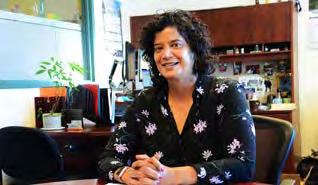
San Francisco Mayor Daniel Lurie will soon have the opportunity to put his stamp on the city’s department that addresses unhoused people. A bisexual woman who has been the executive director of the San Francisco Department of Homelessness and Supportive Housing will be retiring in June.
Shireen McSpadden announced to staff March 17 her impending retirement and will leave June 30.
Her retirement marks the latest departure of LGBTQ appointed department heads since Lurie became mayor last year. Currently, three gay men remain in charge of departments: Paul Henderson at the Department of Police Accountability, Mawuli Tugbenyoh at the Human Rights Commission, and Jorge Rivas at the Office of Civic Engagement and Immigrant Affairs. Carol Isen, who is LGBTQ, runs the Department of Human Resources. Honey Mahagony, a trans person, runs the Office of Transgender Initiatives that now falls under HRC.
McSpadden declined a request to be interviewed but provided a statement.
“It has been an incredible honor to serve as executive director of the Department of Homelessness and Supportive Housing for the past five years, and I am deeply proud of what we have accomplished together,” McSpadden stated.
“Addressing homelessness in San Francisco requires partnership, persistence, and a shared commitment to meeting people with compassion and dignity,” she added. “Throughout my time at HSH, I have been continually inspired by the dedication, expertise, and heart that so many of you bring to this work. I have learned a great deal from our partnerships over the years and remain deeply grateful for the collaboration, candor, and trust that have made progress possible.”
The most recent point-in-time count of San Francisco’s unhoused population has not yet been released; numbers did rise between 2022-2024, according to city statistics, from 7,754 to 8,328.
McSpadden stated that she’s proud of a number of her accomplishments since she was appointed to the position by then-mayor London Breed in 2021.
At the time of her appointment, she had been executive director of the Department of Disability and Aging Services.
“Together, we have achieved a great deal,” she stated, including expanding shelter and other resources, creating “more tailored pathways” for people seeking “recovery-focused environments,” strengthening connections between people and housing or other critical support services, deepening partnerships with providers and city departments, expanding prevention efforts, and “bringing a stronger focus on equity, lived experience, and dignity to the design of programs and services across the system.”
by John Ferrannini
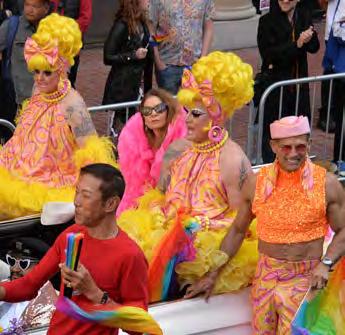
Hoping for a rebound year, San Francisco Pride has stopped the loss of more corporate sponsors who left in 2025 and is seeking new ways to increase its revenue stream, its executive director told the Bay Area Reporter in a March 17 phone interview. Last year’s withdrawal by several companies resulted in a nearly $200,000 shortfall for the organization, officials said.
Suzanne Ford, a transgender woman who has led the San Francisco LGBT Pride Celebration Committee since 2022, had told the B.A.R. at this time last year that after President Donald Trump’s return to the White House, corporate partners such as Anheuser-Busch had pulled out of sponsoring the annual celebration that commemorates the 1969 Stonewall riots. Patrons of the Stonewall Inn in New York City had fought back against police discrimination, and the riots are widely viewed as the birth of the modern LGBTQ rights movement.
After taking office last January, Trump and his administration promptly began attacks on diversity, equity, and inclusion programs. The president issued executive orders ending such programs in the federal government, which his administration has aggressively enforced. This, in turn, led many companies in the private sector to end sponsorship agreements with Pride organizations across the
country, as well as to cut back on giving to other LGBTQ-related programs. Some universities have also stopped DEI programs, while many hospitals have paused gender-affirming care for those under 19 due to pressure from the Trump White House.
Last year, SF Pride fell short by $180,000 of its $2.3 million budget goal – a difference it has to make up this year, Ford said.
“It’s still very fragile … but I am encouraged,” she said. One reason for that hopefulness, she explained, is that SF Pride is already at almost 50% of its corporate sponsorship goal for 2026.
“We’re in the process of signing contracts,” Ford said, adding that Alaska Airlines and bank BMO have already agreed to continue their support, and Gilead Sciences Inc. and Kaiser Permanente also are expected to sign agreements for this year soon. None of the four sponsors returned requests for comment for this report March 17.
“No one from last year has said ‘No,’ yet,” Ford said. “However, we still need to find some new sponsorships. Will we be able to find four to five new sponsors? I’m cautiously optimistic.”
Asked if any of the departed sponsors had indicated plans to return, Ford said they had not. She has not heard from Meta, which owns Facebook, Instagram, and WhatsApp. Target also notably pulled its support.
Unlike Pride festivals in Oakland and San Jose, which charge an admission to their post-parade festivities, San Francisco’s Pride celebration is free to attend, though donations are welcome. SF Pride is intending to have the festival remain free and accessible this year, Ford said. (The parade is free to view along Market Street.)
See page 6 >>
by John Ferrannini
As San Francisco leaders implement Proposition E, which established a task force to recommend changes to advisory bodies and commissions, members of the Board of Supervisors warned they are unlikely to approve all of the panel’s recommendations as outlined in a report. While the supervisors held a hearing on the plan March 17, no action was taken.
Gay Board of Supervisors President Rafael Mandelman, who represents District 8, said that the body is listening to complaints about recommendations made by the Commission Streamlining Task Force’s proposed changes to the city’s oversight bodies.
“This board is very likely to depart from the task force recommendations in a number of areas,” Mandelman said at the outset of a hearing on the matter. Hours later, after commenter after commenter expressed dismay about both particular recommendations and the task force in general, he noted, “I don’t think we’re going to touch many of the live wires folks have expressed the greatest concern about.”
Mandelman does expect, however, the supervisors to put a charter amendment on the ballot in November to incorporate at least some of the task force’s recommendations.
San Francisco voters passed Prop E in November 2024 in order to study ways in which to streamline the city’s system of over 150 unelected commissions, boards, and other oversight bodies. It passed narrowly whereas an alternative measure, Prop D, which would have reduced the number of advisory bodies to 65 and given the mayor broad powers, failed by 13 points.
In the time since, the task force had one year to survey city departments, hold 27 public hearings, collect feedback, and produce its report.
At the hearing, Rachel Alonso, a project director with the city administrator’s office,
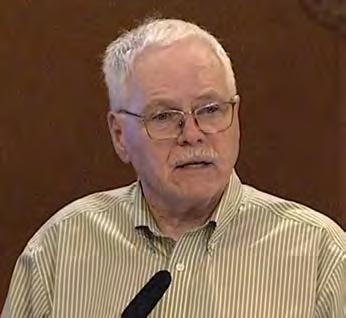
Ed Harrington, chair of the Commission Streamlining Task Force, spoke to the Board of Supervisors during a March 17 hearing.
and task force chair Ed Harrington, a gay man and the former longtime city controller, discussed the report.
Alonso said she also doesn’t expect all of the recommendations to move forward.
“It is now up to you,” she said to the supervisors. “Today is the handoff.”
Alonso said that there are currently 152 boards and commissions, of which 116 are active and 36 inactive.
“Many of them have existed for decades without meaningful evaluation, and may be duplicative, or have outlived their useful purpose,” she said. “Best practices have been applied inconsistently.”
For example, there is still a City Hall Preservation Advisory Committee, meant to preserve City Hall’s historic architectural features during a renovation following the 1989 Loma Prieta earthquake.
The report recommends it be eliminated, stating that, “More than three decades later, the committee has largely outlived its useful purpose. It now has minimal activity, limited
public engagement, and overlapping responsibilities with other bodies, such as the Planning Commission, Historic Preservation Commission, and Arts Commission.”
Alonso said that the task force, when making its recommendations, had to balance the needs to create clear lines of accountability, making city government easier to understand, using city resources responsibly, and evaluating and coordinating public trust. A single list of all the commissions and boards didn’t exist before the task force, she said.
All told, the task force suggested eliminating 26 inactive commissions, combining two, keeping 86 as is, and removing 24 from the city’s administrative code. It also suggested moving a number of commissions from the city charter to the city code; for example, the Commission on the Status of Women and the Human Rights Commission, and removing oversight authority from others, such as the Police Commission.
Those bodies that were established under the city charter have specific responsibilities, such as hiring and firing department heads, approving budgets, and setting policy, the report states. Those that are under the administrative code are mostly advisory, though some have specific decision-making authority, such as the rent board, the report states.
Many of the task force’s recommendations, including any changes to the city charter, would ultimately need to be ratified by voters.
Harrington acknowledged that the recommendations to move commissions out of the city charter have generated the most concern, particularly the women’s panel and HRC.
District 10 Supervisor Shamann Walton thanked the task force for its work, but was unsparing in his criticism that the body lacked diversity, quipping that he’d seen more diversity at a rally for President Donald Trump.
“This task force is as diverse as a stack of $1 bills,” he said. “It wasn’t diverse at all. … Could
by Matthew S. Bajko
ASan Francisco supervisors committee is supportive of renaming a portion of Oak Street not far from City Hall in honor of retired New Conservatory Theatre Center founder Ed Decker. The proposal is expected to be finalized in the coming weeks ahead of a planned retirement celebration in June for the influential LGBTQ theater executive.
Decker, a gay man, founded New Conservatory 45 years ago and served as its artistic director over that timespan until January 1, when he retired and took on the title of founder and artistic director emeritus. He helped build up the theater company to a globally celebrated home for LGBTQ productions and had a role in launching the careers of numerous queer and transgender playwrights.
To commemorate his tenure and legacy, New Conservatory’s Executive Director Barbara Hodgen approached gay District 8 Supervisor Rafael Mandelman, president of the board, with the idea of honoring Decker with a commemorative street naming. She had been inspired by the commemorative street signage for MTT Way at the corner of Grove Street and Van Ness Avenue, next to Davies Symphony Hall.
Unveiled in December 2023, that street name honors gay former San Francisco Symphony music director Michael Tilson Thomas. Hodgen wanted to see a similar tribute to Decker for the street running next to the New
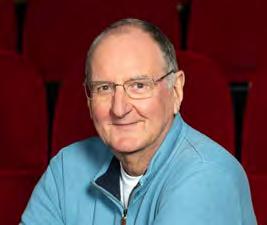
Conservatory’s home at 25 Van Ness Avenue.
As the Bay Area Reporter was first to report last month, the block of Oak Street between Van Ness Avenue and Franklin Street would be christened “Ed Decker Way” if approved by the San Francisco Board of Supervisors this spring. As it would be a commemorative street name, it would not impact the mailing address for any property on that portion of the roadway.
“The outpouring of joy when the news hit the Bay Area Reporter was noticeable,” said Hodgen, who joked that the theater located since 1984 in an underground level of the building “is the most glamorous basement in all of San Francisco.”
As for why Decker deserves such a civic honor as the street naming, Hodgen said, “Ed’s work helped shape the cultural landscape of San Francisco.” And “through the ephemeral medium
of theater,” she added, he left an indelible mark on “the city’s social fabric.”
Mandelman introduced the street naming resolution in early February, leading to the supervisors’ land use committee voting 3-0 at its March 16 meeting to recommend the full board approve it. It is expected to do so when it meets next week.
Addressing the committee members Monday, Mandelman said of Decker that he had distinguished himself during his career “as a trailblazer in the world of LGBTQ+ theater and the world of progressive theater education.”
He added that Decker, a playwright himself, had built up New Conservatory to be “one of the city’s most prized cultural institutions.”
Noting San Francisco “is filled with everyday heroes,” District 11 Supervisor Chyanne Chen said of renaming streets in their honor that, “I love to see them receive the recognition they deserve.”
Filling in for committee chair District 7 Supervisor Myrna Melgar, who was absent, Chen made the motion to send the Decker street name proposal on to the full board with a positive recommendation.
Chen, who is vice chair of the land use and transportation committee, also asked to be added as a co-sponsor of the resolution. Gay District 6 Supervisor Matt Dorsey, also a co-sponsor, temporarily joined the committee Monday to vote along with Chen and District 5 Supervisor Bilal Mahmood in support of the resolution.
As it is a resolution and not an ordinance, the street naming proposal will need to be voted on just once by the 11 supervisors before being sent to Mayor Daniel Lurie to finalize. Hodgen told the committee members Monday that she hopes it can be wrapped up in time for New Conservatory’s 45th birthday celebration it is holding May 19.
A second party marking Decker’s retirement is to be held June 2. In a Facebook post last month reacting to the B.A.R.’s article about the commemorative street naming proposal, as he was traveling overseas at the time, Decker had noted, “Such lovely news to receive to begin my retirement.”
As the resolution in support of Ed Decker Way notes, “the New Conservatory Theatre Center, located at the intersection between Van Ness and Oak Street, has produced more than 50 world premieres by established and emerging queer playwrights, employed thousands of Bay Area theatre professionals and teaching artists, and launched the careers of nationally recognized theatre artists.” It requests that the San Francisco Municipal Transportation Agency fabricate the commemorative street sign and hang it under the existing Oak Street sign where the roadway intersects with Van Ness Avenue.
Should Ed Decker Way be approved as expected, it is set to become the fourth street named in honor of an LGBTQ leader that connects with Van Ness Avenue in that part of the city. Near City Hall is Dr. Tom Waddell Place
named for the gay Olympic athlete and founder of the Gay Games.
Further up the street just before Geary Boulevard is Alice B. Toklas Place honoring the lesbian author born nearby. Across the city are streets bearing the names of queer and trans luminaries.
Bisexual artist Frida Kahlo and Beat writer Jack Kerouac have streets named for them near the main campus of City College of San Francisco and in the North Beach neighborhood, respectively, while the 100 block of Turk Street is named after transgender drag performer Vicki Marlane.
That portion of Taylor Street in the Tenderloin neighborhood is also named Gene Compton’s Cafeteria Way for the business where a transgenderled uprising against police brutality occurred in 1966 at the intersection with Turk Street. It is a focal point for the historic Transgender District.
In the city’s LGBTQ Castro district the block of 16th Street in front of the Eureka Valley/Harvey Milk Memorial Branch Library is called José Sarria Court, named after the first gay man and drag queen to seek public office in the city. The nearby alley between Dolores and Landers streets is ceremonially called Sister Vish-Knew Way in honor of Sisters of Perpetual Indulgence cofounder Kenneth Bunch, ordained by the philanthropic drag group as the Sister’s Grand Mother Vicious Power Hungry Bitch. t
compiled by Cynthia Laird
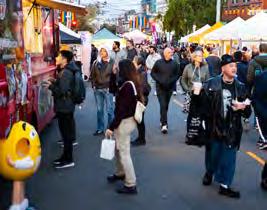
The popular Castro Night Market is back for its second season. The LGBTQ neighborhood night mar-
ket’s first iteration of 2026 takes place Friday, March 20, from 5 to 9 p.m. on 18th Street between Hartford and Collingwood streets.
“Transforming two blocks of 18th
Street into a vibrant pedestrian plaza, the market will run every third Friday of the month from March to September,” a news release stated. (As the Bay Area Reporter previously noted, there

may be plans to incorporate Halloween into an October event, though the spooky holiday falls on a Saturday this year. Last year’s night market was combined with Halloween and viewed as a success by community leaders.)
Civic Joy Fund and CG Events produce the Castro Night Market.
“These events are a love letter to the Castro,” stated Luke Spray, executive director of the Civic Joy Fund.
“Though they only started a few years ago, they already feel like a tradition, as the night market always reflects the spirit and sparkle of the neighborhood.”
The night market is expected to feature drag shows, local markets, food, and live music, Spray added.
The release noted that this season there will be a rotating show case of 30-plus independent artists, makers, and vintage collectors; two dedicated stages; street eats and drinks, including neighborhood favorites; and new interactive installa tions.
Castro business leaders stated they are looking forward to the event.
September 18. For more information, go to castronightmarket.com.
Peninsula Pride Center marks trans visibility day

“The return of Castro Night Market in 2026 is huge for our local merchants and for the soul of our neighborhood,” stated Nate Bourg, a gay man who is president of the Castro Merchants Association. “It brings the streets to life, introduces new customers to queerowned and independent businesses, and celebrates the bold, joyful energy that makes our community so iconic.”
Chris Carrington, a gay man who co-founded CG Events, is also involved in the night market.
“Activating our streets in this way is about more than just a single night of fun; it’s about creating a consistent heartbeat for the Castro,” Carrington stated. “By transforming 18th Street into a pedestrian-centered space, we’re driving foot traffic to our brick-andmortar merchants and providing a platform for local creators.”
The Castro Night Market is open to the public. Admission is free. Future events are scheduled for April 17, May 15, June 19, July 17, August 21, and
The San Mateo County Pride Center is holding its third annual Trans Week of Visibility with several events. While the center is still looking for a permanent home, as the B.A.R. has noted, events will be held online and at other locations, an email announcement stated.
Transgender Day of Visibility is formally observed March 31. Center officials noted they are planning a week of events to celebrate the strength, beauty, and visibility of trans, nonbinary, and gender-diverse people.
There will be a mixer for families of trans kids Monday, March 23, from 6 to 7:30 p.m. at Outlet, 1779 Woodside Road, #200, in Redwood City. Attendees can learn about their children’s legal rights, resources, and advocacy options. There will be a panel presentation featuring parents and community members. Parents, caregivers, and children are welcome.
The center’s legal name and gender change workshop will be held online Wednesday, March 25, from 6 to 7:30 p.m. Participants will be guided through the process step-by-step of updating identity documents and be provided assistance in filling out court paperwork.
by Matthew S. Bajko
One benefit that will come from an affordable housing project aimed at LGBTQ seniors to be built in San Francisco’s Castro district is funding for a number of public transportation improvements across the city. The transit-oriented projects include safety upgrades for people on bikes and speeding up rapid bus routes.
Mercy Housing California and nonprofit LGBTQ service provider Openhouse are overseeing the construction of a 185-unit apartment complex at 1939 Market Street set to open in early 2029. As the Bay Area Reporter noted in a story last week, efforts are underway to put a plan in place to see that the majority of the below-market-rate studios and one-bedrooms go to queer and transgender older adults who meet the eligibility requirements to apply for the units.
Due to nondiscrimination policies, any senior regardless of their sexual orientation or gender identity who qualifies will be able to enter the lotteries or application processes to be held to select the tenants for the units. Some will be set aside for those unhoused or at-risk for homelessness, while a batch of units are to go to veterans and another to seniors living with HIV.
The selection processes are similar to those used to choose the tenants who moved into the first such units meant for LGBTQ elders built nearby at 55 and 95 La guna Street. Openhouse and Mercy previously worked together on transforming a portion of an old college cam pus into several build ings with apartments plus offices and a community space for the service provider.
and benefit disadvantaged communities through increased accessibility to affordable housing, employment centers and key destinations via lowcarbon transportation.”
At its meeting Tuesday, the Board of Supervisors unanimously approved acceptance of the growth council grant. According to the board’s resolution, the Mayor’s Office of Housing and Community Development will be responsible for expending the funds for the various transportation, streetscape and pedestrian improvements and will have until December 10, 2080 to do so.
Eight million is designated toward a right of way improvement project in South of Market along 11th Street between Market and Bryant streets. As detailed in the resolution, the San Francisco Department of Public Works is to oversee the construction of “approximately 2,000 feet of safe and accessible walkway improvements, new ADA curb ramps, traffic signals, street lights, bulb-outs, 0.95 lane miles of parking protected Class IV context sensitive bike lanes, landscaping and other streetscape improvements.”
Another $1,350,000 will be used to make “sensitive bikeway improvements” along Eighth Street between Stevenson and Mission streets and 13th Street between 11th and Bernice streets in SOMA, and in the Polk Gulch neighborhood along Polk Street between McAllister and Pine streets. The San Francisco Municipal Transportation Agency will oversee that work along 1.29 miles of street segments, per the resolution.

The $2,363,000 designated for rapid bus transit improvements is to benefit nine stations and bring enhanced traffic signals and safety enhancements along six routes in the city. They are the 5 Fulton, 5R Fulton Rapid, 14 Mission, 14R Mission Rapid, 22 Fillmore, and 49 Van Ness-Mission.

along with Sauter and District 7 Supervisor Myrna Melgar were absent.)
The transit projects to be funded by the state grant for the 1939 Market Street housing development were largely overshadowed at the committee hearing last week due to concerns gay Board President Rafael Mandelman expressed about who will live there. Mandelman, who represents District 8 where it will be built and had worked with the Breed administration to purchase the property, warned not having LGBTQ seniors comprise the bulk of its residents would be a “failure outcome” on the part of Mercy and Openhouse.
Morey Riordan, a transgender man who took over as executive director of Openhouse last October, had responded that he wants to hire at least two people to work on the leasing issues around the new building and recruit upward of 20 community members to serve as volunteers who can assist LGBTQ seniors in applying for the units. To do so, he aims to raise $250,000 in order to roll out the efforts during Pride Month in June 2027.
“I am not going to sugarcoat it. It is going to be hard work,” stressed Riordan at the hearing. “It is an 18-month plan. We need 18 months if we are going to achieve the goal we want.”
In a follow-up statement to the B.A.R., Openhouse officials said close to two-thirds of residents housed at the 55 and 95 Laguna developments identify as LGBTQ+ based on their “best estimates” to date. They hope to replicate that selection success rate in the new building.
“If there is any organization that can reach this community, it is Openhouse,” noted Riordan. “We serve around 4,000 LGBTQ+ older adults every year, and we have a waiting list with hundreds of people for our current buildings. We know it will be an uphill battle to get folks activated, but we have done it before and we are already gearing up to do it again.” t
In December, the California Strategic Growth Council awarded a $47.6 million grant to the new project to be constructed on a triangular lot at the intersection of Market Street and Duboce Avenue. The former Breed mayoral administration bought the property in 2020 for $12 million from the Sheet Metal Workers Local 104 specifically for the purpose of building affordable housing affirming of LGBTQ seniors.
The bulk of the growth council grant, $35 million, is designated toward constructing the multi-story building of housing above ground floor commercial space. The total cost to build it is pegged at $116 million, and Mercy must still secure roughly $100 million before ground can be broken.
As the B.A.R. reported late last year, Mercy plans to apply in the spring for 4% low-income housing tax credits administered by the California Tax Credit Allocation Committee (CTCAC) and the California Debt Limit Allocation Committee (CDLAC). The state committees will announce their decisions August 18. If awarded the tax credits, Mercy will be required to break ground within 180 days, which happens to coincide with Valentine’s Day on February 14, 2027. Should that occur, construction is expected to wrap up in February 2029, with the marketing and leasing for the units to start in July 2028 so the selected residents are ready to move in that winter.
Transportation improvements
As for the remaining $12,579,100 in grant funds, the money will pay for a number of public transportation improvements across the city but located fairly close to the 1939 Market Street site. In addition to affordable housing projects, the growth council’s grant program also aims to “achieve greenhouse gas reductions
SFMTA plans to install transit signal priority software and hardware at 45 intersections along Fillmore Street, between O’Farrell and Haight; McAllister Street, between Broderick Street and Charles Brenham Place; Mission Street between 11th and 25th streets; Church Street, between 14th and 16th streets; and 16th Street, between Dolores and Guerrero avenues.
Upgrades to the stop lighting at four locations along the 5/5R, 22, and 14/14R/49 routes aim to “improve safety and rider comfort using polemounted solar lights,” per the resolution. New or upgraded Transit Signal Priority hardware and software is also to be installed by the SFMTA along all signals for three lane miles along McAllister Street, for over three lane miles along Fillmore, Church, and 16th streets, and for over three lane miles along Mission Street.
The upgrades “will improve travel speed and increase reliability leading to increased ridership along all routes,” according to the resolution approved by the supervisors.
The remaining funds, $866,100, are to go toward workforce training, transit passes, and improved internet access.
“Even though it is just a few blocks out of my district, as a gay man who is aware of the fact we have an aging senior population, especially people living with HIV who often have unique challenges as they are aging, I really appreciate this kind of project. We need more of them,” said gay District 6 Supervisor Matt Dorsey, who represents SOMA, during the March 11 hearing the supervisors’ budget and finance committee held about the state grant for the project.
Dorsey, who asked to be added as a co-sponsor to the resolution, had voted in favor of seeing the full board approve it along with committee chair District 1 Supervisor Connie Chan and District 3 Supervisor Danny Sauter. The full board approved it 8-0 without comment at its March 17 meeting. (Queer District 9 Supervisor Jackie Fielder
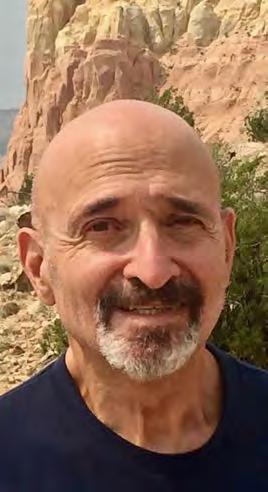
Dr. Larry Price has entered home hospice following a long and courageous battle with Parkinson’s disease.
For more than 30 years, Larry served our community as a devoted physician whose compassion, courage, and tireless dedication shaped the lives of countless patients and medical students. During the most difficult years of the AIDS epidemic, he routinely worked 12 to 14 hour days caring for patients suffering horrendous illness while facing profound uncertainty, loss and societal rejection. He brought not only deep medical expertise, but also hope, steadiness, and humanity when they were needed most.
As Larry enters the final chapter of his life, it would mean a great deal to him to hear from those whose lives he touched. If you were once his patient, colleague, student, or friend, a brief note would be a profound gift. You might share how you are doing now, reflect on what his care meant to you, express your gratitude, or recall a fond memory from your time together.
Mail may be sent to:
Dr. Larry Price
2360 Mendocino Avenue, #2A-314 Santa Rosa, CA 95403
Your words will serve as a powerful reminder of the legacy he leaves behind and the many lives he has touched.
Volume 56, Number XX
Volume 56, Number 12
March 19-25, 2026
Month XX-XX, 2026 www.ebar.com
PUBLISHER
Michael M. Yamashita
Thomas E. Horn, Publisher Emeritus (2013)
Publisher (2003 – 2013)
Bob Ross, Founder (1971 – 2003)
NEWS EDITOR
Cynthia Laird
ARTS & NIGHTLIFE EDITOR
Jim Provenzano
ASSISTANT EDITORS
Matthew S. Bajko • John Ferrannini
CONTRIBUTING WRITERS
Kyle Amato • Race Bannon • Robert Brokl
Christopher J. Beale • Robert Brokl
Christopher J. Beale • Brian Bromberger
Brian Bromberger • Philip Campbell
Heather Cassell • Eliot Faine
Philip Campbell • Myron Caringal
Michael Flanagan • Jim Gladstone
Heather Cassell • Meg Collins • Chelsea Davis
Natasha Dennerstein • Eliot Faine
Liz Highleyman • Brandon Judell • Lisa Keen
Philip Mayard • Laura Moreno
Michael Flanagan • Jim Gladstone
David-Elijah Nahmod • Mark William Norby
Liz Highleyman • Brandon Judell
JL Odom • Paul Parish • Tim Pfaff
Michele Karlsberg • Lisa Keen
Jim Piechota • Adam Sandel
Matthew Kennedy • Philip Mayard
Jim McDermott • Laura Moreno
Jason Serinus • Gregg Shapiro
David-Elijah Nahmod • Mark William
Gwendolyn Smith • Charlie Wagner
Ed Walsh • Cornelius Washington • Sura Wood
Norby JL Odom • Tim Pfaff • Jim Piechota
Joshua Polanski • Adam Sandel
Gregg Shapiro • Gwendolyn Smith
ART DIRECTION
Charlie Wagner • Ed Walsh
Cornelius Washington • Evelyn C. White
Max Leger
PRODUCTION/DESIGN
Ernesto Sopprani
ART DIRECTION
Max Leger
PHOTOGRAPHERS
Jane Philomen Cleland
PRODUCTION/DESIGN
Rick Gerharter • Gooch
Ernesto Sopprani
Jose A. Guzman-Colon
PHOTOGRAPHERS
Rudy K. Lawidjaja • Georg Lester
Jane Philomen Cleland
Rich Stadtmiller • Christopher Robledo
Rick Gerharter • Gooch
Fred Rowe • Shot in the City
Jose A. Guzman-Colon
Steven Underhill • Bill Wilson
Rudy K. Lawidjaja • Georg Lester
ILLUSTRATORS & CARTOONISTS
Rich Stadtmiller • Christopher Robledo
Christine Smith
Fred Rowe • Shot in the City
Steven Underhill • Bill Wilson
ILLUSTRATORS & CARTOONISTS
VICE PRESIDENT OF ADVERTISING
Christine Smith
Scott Wazlowski – 415.829.8937
VICE PRESIDENT OF ADVERTISING Scott Wazlowski
NATIONAL ADVERTISING REPRESENTATIVE
Rivendell Media – 212.242.6863
LEGAL COUNSEL
Paul H. Melbostad, Esq.
LEGAL COUNSEL
Paul H. Melbostad, Esq.


Bay area reporter
44 Gough Street, Suite 302 San Francisco, CA 94103
415.861.5019 • www.ebar.com
Bay area reporter
A division of BAR Media, Inc. © 2026
President: Michael M. Yamashita
44 Gough Street, Suite 302 San Francisco, CA 94103
Director: Scott Wazlowski
415.861.5019 • www.ebar.com
News Editor • news@ebar.com
A division of BAR Media, Inc. © 2026
Arts Editor • arts@ebar.com
President: Michael M. Yamashita
Out & About listings • jim@ebar.com
Director: Scott Wazlowski
Advertising • scott@ebar.com
Letters • letters@ebar.com
News Editor • news@ebar.com
Arts Editor • arts@ebar.com
Out & About listings • jim@ebar.com
Advertising • scott@ebar.com
Letters • letters@ebar.com
Published weekly. Bay Area Reporter reserves the right to edit or reject any advertisement which the publisher believes is in poor taste or which advertises illegal items which might result in legal action against Bay Area Reporter. Ads will not be rejected solely on the basis of politics, philosophy, religion, race, age, or sexual orientation.
Advertising rates available upon request. Our list of subscribers and advertisers is confidential and is not sold. The sexual orientation of advertisers, photographers, and writers published herein is neither inferred nor implied. We are not responsible for unsolicited manuscripts or artwork.
W hen the going gets tough for President Donald Trump, he creates a distraction. As the Epstein files were being released in early January, revealing that Trump is mentioned, a lot, he suddenly ordered the military to capture the leader of Venezuela. As more files were released by the Department of Justice, Trump three weeks ago went to war in Iran. Now, the war, being conducted with Israel, isn’t going so well – gas prices in the U.S. are spiking because of the global disruption on oil markets caused by dangerous conditions in the Strait of Hormuz – the president is at it again.
This time, he’s insisting that the U.S. Senate pass the now-renamed Safeguard American Voter Eligibility, or SAVE, America Act. This bill passed the House of Representatives in February as the SAVE Act. The SAVE America Act, as written, is a blatant attempt to restrict voting rights, and requires people to provide proof of citizenship when they register to vote. As the 19th reported, “That has raised alarms with voting rights groups, who say it would be burdensome to voters – especially married women and others who have changed their legal names because of marriage, assimilation, or to better align with their gender identity.”
lot. But insisting that anti-trans provisions are included is Trump’s way of creating chaos and raising the trans issue ahead of the midterm elections. Never mind that most voters care more about how high gas prices are right now, in addition to grocery costs and everything else. Trump is losing the affordability argument – and he knows it. What better way to counter it than by pitting Democrats against each other over gender-affirming care and trans kids playing sports.
But the president fails to recognize that the political dynamic has changed since his 2024 campaign worked to vilify trans people.

But that’s not enough for Trump. The 19th reported that he now wants the bill revised to include unrelated anti-trans measures about trans women’s participation in sports and gender-affirming care for trans youth, though he has not given additional details about how that would combine with the voting legislation.
This is a trap because the Senate bill would need to clear 60 votes to advance, something that cannot happen without Democratic support. Under Trump’s demands, adding the antitrans measures would put Democrats in a bind – vote for the bill and be criticized from the left for being anti-trans, or vote against the bill and be labeled by the right as being pro-trans.
Obviously, Senate Democrats should vote against the SAVE America Act, in whatever form it is ultimately presented. After all, people already need to be U.S. citizens to be able to cast a bal-
“There are currently no provisions in the SAVE America Act dealing with gender-affirming care or transgender athletes, despite Trump’s new priorities list,” the 19th’s Marissa Martinez and Orion Rummler report. “House Republicans have tried to pass anti-trans laws this session, but barely any have made it out of Congress – most have gotten stripped in the Senate. Most recently, all but one anti-LGBTQ+ provision was removed from the 2026 National Defense Authorization Act. The remaining one stopped trans women enrolled at U.S. service academies from participating in athletic programs designated for women.
“Caius Willingham, a senior policy analyst at Advocates for Trans Equality who frequently works on the Hill, said that there is just not enough support in the Senate to adopt these anti-trans measures,” the outlet reported. “That makes Trump’s fixation on this bill all the more perplexing,” he said.
Willingham said that including the anti-trans riders in the bill would actually “turn off more senators that it would inspire them.”
Indeed, Senate Majority Leader John Thune (R-South Dakota) doesn’t see Republicans successfully getting rid of the filibuster, which would mean bills could pass on a simple majority vote. And he’s said the House should pass any new version with Trump’s additions before the Senate takes it up.
But Trump now insists that he won’t sign any legislation until the SAVE America Act reaches
his desk. That will prolong the partial government shutdown that has hit the Department of Homeland Security. The shutdown has affected many airports, where Transportation Security Administration personnel, part of DHS, have been working without getting paid for weeks. In a March 8 post on Truth Social, Trump wrote, “It supersedes everything else. MUST GO TO THE FRONT OF THE LINE. I, as President, will not sign other Bills until this is passed, AND NOT THE WATERED DOWN VERSION - GO FOR THE GOLD: MUST SHOW VOTER I.D. & PROOF OF CITIZENSHIP: NO MAIL-IN BALLOTS EXCEPT FOR MILITARY - ILLNESS, DISABILITY, TRAVEL: NO MEN IN WOMEN’S SPORTS: NO TRANSGENDER MUTILIZATION FOR CHILDREN! DO NOT FAIL!!! President DONALD J. TRUMP” Senate Minority Leader Chuck Schumer (DNew York), stated that Democrats will not support the SAVE America Act. “If Trump is saying he won’t sign any bills until the SAVE Act is passed, then so be it: there will be total gridlock in the Senate,” Schumer posted on X, responding to Trump. “Senate Democrats will not help pass the SAVE Act under any circumstances.”
Senator Alex Padilla (D-California), said Tuesday, “The SAVE America Act isn’t a voter ID bill, it’s a voter suppression bill. Trump and Republicans want to get their hands on sensitive voter information, conduct mass voter purges potentially kicking off eligible voters, and make it as hard as possible for those Americans to re-register to vote. As long as this anti-voter bill is on the floor, Senate Democrats will fight it in full force and push back against this Administration’s lies.”
Congressional Democrats know that the SAVE America Act is really about disenfranchising voters, particularly people of color, and that would be disastrous for them in the coming midterm elections, as well as the 2028 presidential race. How they feel about trans issues is more nuanced, unfortunately, with too many unwilling to defend trans people no matter the political risk for doing so. But as long as the party stays united against the SAVE America Act, its passage is less certain. And that’s a good thing. t
by Gwendolyn Ann Smith
Look, I know you don’t need me to tell you to be upset, as everything in this world right now is surely pushing us all to our personal breaking points.
Yet, in the midst of a calamitous war in the Middle East that that is likely to demolish a tattered economy, against the background of attacks on our health and well-being in more ways that I can count, and all to appease a ruler who is credibly accused of sexual assault against minors, there are still things so dramatically awful that they can turn both my head and my stomach.
No, I’m not talking about Senate Bill 244 out of Kansas, which invalidated driver’s licenses of every transgender person in the state while simultaneously disallowing transgender people from using the bathroom aligned with their gender identity, though this, too, is bad enough. I should note, however, that the first court challenge against SB 244 failed, as the law was allowed to go into effect immediately.
Nor am I thinking of Idaho’s House Bill 822, which will require children to be monitored by teachers and counselors to make sure they are confirming to gender stereotypes, lest they be fined. This isn’t about hormones or surgery, of course, but just a haircut, or attire that isn’t feminine or masculine enough for their assigned sex at birth. The bill now heads to the state Senate.
Likewise, this isn’t about Congress’ HR 7661, a federal book ban that would label anything involving “gender dysphoria or transgenderism” as “sexually oriented material.” Yes, presumably, even including this very column.

No, while each of the above is bad, there is still always a hope that a judicial review of these laws will indeed find that they overreach. Similar things have been struck down before, after all.
What happens, however, when the court doesn’t strike down some heinous laws?
A ruling out of the 4th U.S. Circuit Court of Appeals, determined by three Republican judges, two of whom were appointed by President Donald Trump – upheld a ban on using Medicaid funding to cover trans-specific medical needs in West Virginia. This overturned a 2024 ruling, also from the 4th Circuit.

Each of these alone are horrific, and – in my opinion – vastly overstep what the government should be doing. We should be allowed to blaze our own trails, even if they include gender identity and expression. Each of the above instead imposes strict anti-transgender rules that not only may criminalize aspects of trans lives, but non-transgender ones as well.
These policies are not what I expect the government to concern itself with, especially when there are far, far larger issues afoot.
There is a key quote from the decision, from Judge Julius Ness Richardson, that I want to draw attention to.
Wrote Richardson, “It is not irrational for a legislature to encourage citizens to appreciate their sex and not become disdainful of their sex by refusing to fund experimental procedures that may have the opposite effect.”
Irrationality does not enter into it. It is not the job of a legislature to determine the best care for a transgender person. That is up to the person themselves, potentially aided by a care professional. The government should not enter into this, no more than it should interfere with any of the medical needs any of us may face.
I am not naive. I know that governments do interfere plenty. All one needs to do is look at the 2022
Dobbs v. Jackson Women’s Health Organization decision by the U.S. Supreme Court that overturned Roe v. Wade, allowing for abortion bans. Indeed, I see very little light between the 4th Circuit judge’s language around this notion of “appreciating our sex” than I do around the idea of abortion bans allowing women to “appreciate motherhood,” or even “corrective,” predatory rape of lesbian women to allow them to “appreciate penetrative sex.” This is awful, ugly, and deeply troubling.
I should also note that trans care has long since stopped being “experimental.” This is care that has a century of use – but I digress.
Now, we can surely quibble about who should foot the bill for transgender care. I’m sure plenty will argue that this shouldn’t be funded by Medicaid. Not everyone is an expert on transgender care, and therefore might not see the need.
Yet, I also know that the government should not be determining what is the right course of action when it comes to medicine and, further, it should not be in the business of allowing certain care for non-transgender people and another for those of us who are trans. Consider, for example, a hysterectomy that may be covered for the former, but refused for the latter.
Much of what I alluded to before is this: just how far should a legislature be allowed to coerce us to “appreciate our sex?” Should a legislature be allowed to force people to wear dresses or suits? Should we get government-mandated haircuts? Are all of these things that sound patently silly just waiting around the horizon for transgender people?
It’s this that has me on edge. I don’t see the 4th Circuit ruling as being the end of things, but just another step. We have seen a long erosion of transgender rights over the last decade, with several states becoming increasingly dangerous for transgender people to exist within, and the country as a whole just one bad law away from doing irreparable harm against transgender people.
The thing is, I appreciate my sex plenty – it’s the anti-trans folks who don’t appreciate my existence that’s the real problem. t
Gwen Smith wants the government out of her pants. You’ll find her at www. gwensmith.com.
by Matthew S. Bajko
U
nlike previous election cycles when there were multiple chances to see the number of LGBTQ Bay Area state legislators expand, the 2026 ballot will feature only two races in the nine-county region with high-profile bisexual candidates in the running. Just one is for an open seat, providing the lone contest where a new member to the Legislative LGBTQ Caucus could be elected come November.
That race does provide a chance to see the first out leader residing in the North Bay be elected to the state Legislature. With Assemblymember Damon Connolly (D-San Rafael) running for state Senate this year, his Assembly District 12 seat straddling Marin and Sonoma counties is up for grabs.
Two bisexual Democratic Marin County elected officials are seeking to succeed him. Corte Madera Town Councilmember Eli Beckman and Tiburon Town Councilmember Holli P. Thier both entered the race.
They received a dual endorsement from Equality California, the statewide LGBTQ civil rights organization. The national LGBTQ+ Victory Fund has yet to endorse in the race, while the California Legislative LGBTQ Caucus sole endorsed Beckman in December.
Being from small towns, Beckman and Thier bring to the race shallow pools of supporters who’ve previously cast ballots for them and face the challenge of now presenting themselves to voters across the two counties. They are vying for the two spots on the November 3 general election ballot.
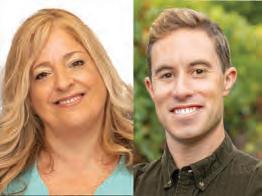
North Bay Assembly candidates
day, March 11. (It had been extended since the incumbent opted not to run again.)
“While this isn’t the right moment for a run, my commitment to our community and to public service remains as strong as ever. I look forward to continuing to work alongside all of you to make our communities stronger,” Mojadedi wrote in a Facebook post.
Although queer political consultant Shay Franco-Clausen had sought the East Bay Stonewall Democratic Club’s endorsement – the LGBTQ political group ended up not endorsing in the race when its membership voted last month – she also didn’t file to seek the seat per the Alameda County Registrar of Voters’ website.
In 2022, she had eyed an East Bay Assembly seat but ended up not entering that race.
neur and trained economist Brandon Riker netted 8% after voters were told of his bona fides. (Fellow gay Palm Springs resident Ferguson Porter, a comic book seller, wasn’t included in the polling.)
Campa-Najjar’s campaign blasted von Wilpert due to the poll also telling those surveyed that he had “lost three campaigns from four different addresses under two different names,” per the polling memo, leading to 65% of the respondents to express doubts about him. As first reported by Semafor, Campa-Najjar’s camp called such language “racist attack lines” based on false facts over his hyphenated last name peddled by “disgraced former Republican Congressman Duncan Hunter,” noted campaign manager Andi McNew, during the 2018 midterm election.
“It’s deeply disappointing to see a fellow Democrat recycling the kind of divisive rhetoric that we’ve sadly come to expect from the far right, including (Hunter) and politicians like Trump who weaponize someone’s name or background for political gain,” stated McNew.
Another Democrat in the race, Vista City Councilmember Corinna Contreras, stated, “These racist attacks are disgraceful, but sadly they’re consistent with Councilmember von Wilpert’s pattern of failed leadership.”

Serving the San Francisco Bay Area LGBTQ+ Community Since 1999.
• Probate • Wills/Trusts
• Trust Admin • Estate Planning FLAT FEE!
Flood Building, 870 Market St, Suite 420 By Appointment only! 415-421-1893
www.ShelleySFeinberg.com • trust@shelleysfeinberg.com
Shelley_S_Feinberg_2x2_032025.indd 1 3/13/25 7:45 PM
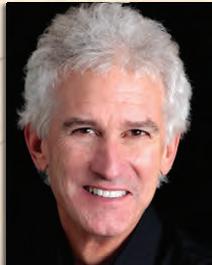

Only the top two vote-getters regardless of party affiliation will advance out of the June 2 primary.
Democrats Marin County Supervisor Eric Lucan, Rohnert Park City Councilmember Jackie Elward, and organic farmer Steve Schwartz are also in the race, and the state party failed to endorse one of the candidates at its convention last month in San Francisco. Republican Eryn Cervantes, who failed to survive the 2024 primary, is running again.
With less than three months to go before voters will head to the polls at the start of Pride Month, Beckman and Thier both told the Bay Area Reporter in recent days that they feel good about their prospects of making it to the fall ballot.
“For me, I could not be prouder of the amount of support we are getting and the race that we are running,” said Thier, a former San Francisco resident who decades ago served on the board of the progressive Harvey Milk LGBTQ Democratic Club.
Pointing to the support he has been receiving, Beckman said, “This is what a winning campaign looks like. I think my message and stance on the issues local families and seniors are experiencing the most is powering this campaign to victory.”
Of the 14 Democratic LGBTQ+ legislators who comprise the legislative caucus, the sole member in the Bay Area up for reelection this year is bisexual Assemblymember Alex Lee (D-San Jose). He is expected to easily win another term to his Assembly District 24 seat in the South Bay.
In the East Bay, gay Chabot-Las Positas Community College District Board of Trustees member Harris Mojadedi opted against running for the 10th Senate District seat being vacated by state Senator Aisha Wahab (D-Hayward) since she is running for an open congressional seat. Mojadedi, a Muslim Afghan American, announced his decision on the filing deadline last Wednes-
Across California, there are at least 20 LGBTQ candidates seeking either a state Assembly or Senate seat this year. The bulk of the contests are in Los Angeles County, while half represent incumbents running for reelection.
With several of the races drawing multiple LGBTQ candidates, there are at least seven contests that the B.A.R. is aware of this cycle that could produce a newly elected member of the affinity group for out legislators in Sacramento, potentially netting it a historic high of 21 members. Gay Assemblymember Carl DeMaio (R-San Diego) is seeking a second term but doesn’t caucus with his out Democratic colleagues.
The LGBTQ caucus could see gay state Senator Scott Wiener (D-San Francisco) depart if he wins his race for a U.S. House seat this year. His doing so would result in a special election for his Senate seat next year, thus an LGBTQ candidate could vie to succeed him in Sacramento.
SoCal House race heats up
With conservative Congressmember Darrell Issa (R-Vista) opting to retire rather than seek reelection this year in a redrawn district that favors Democrats, the race to succeed him is heating up ahead of the June primary. Like the legislative contests, only the top two vote-getters regardless of party affiliation will advance to November.
As the online Political Notes column reported Monday, Republican San Diego County Supervisor Jim Desmond jumped into the race with Issa’s endorsement and is seen as likely to survive the primary. A recent poll showed him potentially nabbing 40% of the June vote.
Conducted by the campaign of bisexual San Diego City Councilmember Marni von Wilpert, it had her edging past Ammar CampaNajjar, who lost to Issa in 2020, once the 500 likely 2026 primary voters were read “positive profiles” of the candidates, per the memo about the results. With a margin of error of +/4.4%, von Wilpert was at 20% and Campa-Najjar at 18% and thus basically in a dead heat for second place in the primary, while gay entrepre-
Asked for comment by the B.A.R. about the denunciations from Campa-Najjar and Contreras, von Wilpert campaign manager Jacob Ostacher defended the poll.
“This isn’t about Ammar CampaNajjar’s family history, it’s about his long record of shifting his policies and his district to suit his political ambitions,” stated Ostacher. “In past campaigns, he told a white nationalist group he ‘ran for Congress to work with Donald Trump,’ was against Trump’s impeachment, and opposed abortion rights. Voters can spot someone who will say or do anything to get elected – and they’re not buying it.”
Last month, von Wilpert and LGBTQ advocates had blasted CampaNajjar’s campaign for using “thinly veiled anti-LGBTQ dog whistle” language in its own memo claiming that out candidates from Palm Springs lost their races in the last two election cycles for being unable “to reach voters beyond Palm Springs.” It contended von Wilpert “is a candidate in the same vein, who will fail to win over Latinos and veterans, who are the true swing voters in this district.”
One of those calling out CampaNajjar was gay Congressmember Mark Takano (D-Riverside), who was outed by his GOP opponent, Congressmember Ken Calvert (RCorona), when he came up short in his first bid for a House seat in 1994.


“When I ran for Congress, I heard the same anti-LGBTQ attacks – and I proved them wrong,” noted Takano of his successful 2012 campaign. “Our party wins when we build real coalitions rooted in respect and shared values, not when we echo the kind of divisive rhetoric that voters have grown tired of hearing. Democrats won’t defeat Republicans by sounding like them.”
As for von Wilpert’s reaction to the criticisms of her campaign’s polling language, she stated to the B.A.R. that, “I am an out and proud member of the LGBTQ community. When we’re seeing unprecedented attacks against our communities by Donald Trump and Republicans, I was disappointed to see this insinuation. I’ve spent my life going toe to toe with Republicans, winning tough races, taking on powerful interests and standing up for LGBTQ equality and civil rights — from Mississippi to San Diego. Ultimately, voters want someone they can trust. And unlike my opponent, voters in this district know where I stand.” t


McSpadden thanked Lurie “for his leadership and for the partnership of his administration in advancing this work.”
For his part, in a statement to the B.A.R., Lurie thanked McSpadden for dedicating “her career to serving San Francisco with compassion.” She’s been a city employee for nearly 23 years, he stated.
“Over the past year, she has been a critical partner on our Breaking the Cycle plan to address San Francisco’s homelessness and behavioral health challenges, helping us get more people off the street, connected to support, and on the path to stable housing,” Lurie stated. “I am grateful for her leadership and want to thank her for her years of service to our city.”
Breaking the Cycle, unveiled last year, is Lurie’s executive directive to address issues of chronic homelessness and behavioral health challenges in the city. According to the mayor’s office, it “outlines a roadmap with immediate ac-
A gender-affirming workshop will be held Thursday, March 26, from 5 to 7 p.m. at Allcove San Mateo, 2600 El Camino Real, Suite 300 in San Mateo.
Free gender-affirming supplies will be available, such as binders, trans tape, packers, and breast forms. Style and contouring tips will be provided, along with hair and grooming consultations and vocal coaching tips. A gender-affirming closet will be available for people to browse for free clothing, makeup, and accessories, the announcement stated.
A sunset hike at Mori Point, 775 Bradford Way in Pacifica, will take place Friday, March 27, from 5:45 to 8:15 p.m. People can enjoy a beautiful sunset with the Pride Center’s partners at the Golden Gate National Parks Conservancy. To register, go to https://tinyurl. com/4zy32kp8.
“Glitter and Glam,” an introduction to drag, takes place Saturday, March 28,
One change, as a cost-saving measure, is that the annual Pride Day Party that has been held inside City Hall will move across Civic Center Plaza to the Asian Art Museum, 200 Larkin Street, Ford said. An SF Pride spokesperson stated that the savings are expected to be several thousand dollars – and that after this year’s Pride, they can share exact dollar amounts.
tions and longer-term reforms that will tackle the enduring homelessness and behavioral health crisis – enabling more effective coordination across departments, policymaking rooted in evidence and reliable data, and accountability for government and nonprofit partners to deliver results.”
McSpadden stated that “HSH will continue to play a critical role in implementing the city’s Breaking the Cycle initiative, and I have every confidence in the mayor and his administration’s ability to support the department and our partners through this transition and in the work ahead.”
Bill Ambrunn, a gay man who chaired the 2014 task force that wrote a groundbreaking report on LGBTQ aging issues and had founded the LGBT Better Aging Project for California, worked with McSpadden during her time at DAS. He said in a phone interview she is a “wonderful person.” (Ambrunn, 63 and now retired, said the project folded in 2021.)
“It’s just a huge loss for the city,” Ambrunn said. “Shireen has been a remarkable support in the city administration
from 2:30 to 5:30 p.m. at the Peninsula Jewish Community Center, 800 Foster City Boulevard in Foster City. People will get a beginner’s lesson in drag makeup and put on a show. A limited amount of drag materials will be provided, and people are invited to bring their own. Those who don’t want to participate can still come and cheer on the newbies.
A pronouns 101 workshop will be held Sunday, March 29, from 10:30 a.m. to 12:30 p.m. at the Belmont Public Library, 1110 Alameda de las Pulgas in Belmont. Through interactive videos, participant engagement, and pronoun use practice, people will learn about the history of pronouns and the importance of using them correctly, the announcement stated.
Finally, on Transgender Day of Visibility, March 31, there will be a celebration at Cañada College’s Cultural Center, 4200 Farm Hill, in Redwood City, Building 17, room 107. People are invited to show up as their authentic selves to enjoy a DJ and music along with refreshments.
Alcohol sales dipped Ford was disappointed that alcohol revenue at the festival declined in 2025. In 2019, she said, corporate sponsorships and alcohol sales kept the organization afloat.
“It was a great year,” said Ford, who was board treasurer at the time.
“We were able to put some money in reserves.”
After 2019, of course, came the COVID pandemic that resulted in SF Pride being held virtually in 2020 and 2021. SF Pride returned to the in-person parade and celebration in 2022.
for LGBTQ people, and in particular, LGBTQ older adults.”
Asked if he’d followed McSpadden’s work at HSH, Ambrunn replied, “From more of a distance.”
“I just was very impressed when she was asked to take on that assignment because it’s a huge department and so important to the public,” he said, “very front and center to the public’s idea of how the city is doing. For her to voluntarily take on that position, it was a huge loss for the department of aging services, but you get the feeling with Shireen she can almost do anything she sets her mind to. She’s one of those people with an extraordinary capacity to get things done.”
Gay District 6 Supervisor Matt Dorsey told the B.A.R. he respected McSpadden.
“Even when we’ve occasionally disagreed, I have enormous respect and affection for Shireen McSpadden,” stated Dorsey, who represents the South of Market neighborhood and is HIV-positive. “I know the headlines will focus on her homelessness work over the last five
The events are free to attend. There are a limited number of transportation vouchers for those in need, which can be indicated when people RSVP. To register for any of the events, go to https:// tinyurl.com/mr3vhvxb.
Trans visibility in East Bay
Community members in the East Bay city of Lafayette will gather for a Transgender Day of Visibility event Sunday, March 22, at 2 p.m. at Lafayette Park Plaza, 3530 Plaza Way.
According to organizers, the afternoon will feature speakers, music, games, and opportunities for community connection.
Pride Action Lamorinda is organizing the event.
“At a time when trans people are being targeted by government policies across the country, it matters that communities show up with support, compassion, and a clear message that trans people belong,” stated organizer Sarah Vickers-Webb with Pride Action Lam-
“Young people are not drinking at the same rate as in the 2010s,” Ford said, and therefore SF Pride will try to introduce more mocktail options this year. Asked if lowering alcohol prices would help, Ford said, “I think we compared ours to other festivals last year, and I don’t think so. We had very fair prices.”
Ford said that another positive development is she has brought on two people on a contract basis to help with development – Gayle Roberts, who has been a development officer for PRC, Openhouse, and Larkin Street Youth Services, is helping SF Pride with securing foundation dollars; and Nguyen Pham, a gay man and past president of the SF Pride Board of Directors, is helping with the sponsorships.
Roberts, who is trans, pansexual, and polyamorous, stated, “I’m helping them build a major donor program that brings more of our own community into Pride’s financial future. That means a new community advisory board, a dozen community leaders who are personally committed to SF Pride and actively connecting us to major donors and foundations.
“I’m also managing our grants pipeline and working directly on individual donor cultivation with Suzanne,” Roberts added. “Our goal is
years, but she has also been a truly transformational leader on aging and disability services in San Francisco. I would congratulate her on a well-earned retirement, but I intend to interrupt it early and often to solicit her advice on many policy matters – especially in terms of how we can be better serving LGBTQ older adults and those with HIV.”
Gay Board of Supervisors President Rafael Mandelman, who represents District 8, stated, “Shireen McSpadden’s leadership of the Department of Homelessness and Supportive Housing over the past five years has left a lasting impact on how San Francisco responds to homelessness. Director McSpadden stepped into her role in the height of the pandemic and led the expansion of our shelter program, enhanced the coordinated entry system, and improved cross-departmental response to deliver a compassionate response to our street crisis. I thank her for her service and wish her all the best in her retirement.”
Queer District 9 Supervisor Jackie Fielder didn’t immediately return a request for comment.
orinda. “Visibility is not a safe option for some trans people right now, so allyship is extremely important.”
The event is family-friendly and open to all.
‘No Kings’ rallies planned
Another day of large “No Kings” rallies is planned for people to make their voices heard against President Donald Trump and his administration, including Immigration and Customs Enforcement. Rallies in cities across the country will be held Saturday, March 28. The day comes just before Palm Sunday and the aforementioned Transgender Day of Visibility.
The Human Rights Campaign, a national LGBTQ rights organization, is just one of many groups promoting the rallies.
“It’s critical that we, the people, come together – LGBTQ+, disabled, Latino, Black, Asian, Indigenous, Pacific Islander, and all other intersecting communities – to show this hateful administration
tinct privilege of helping to lead our sponsor program, ensuring that our corporate supporters center and protect our community on SF Pride’s continued, decades-long fight for LGBTQ+ justice.”
Ford said that finding other funding sources is key.
“We know we have to diversify our revenue,” Ford said, adding that while SF Pride got some money from city budget add-backs in 2022, 2023, and 2024, it didn’t in 2025 and is not expected to this year, though the city’s Grants For The Arts finished the second year of a two-year grant cycle in February that provides 10% of SF Pride’s revenue stream.
According to SF Pride’s most recent IRS Form 990, for the fiscal year ending in September 2024, the organization had $4.3 million in revenue.
Ford encouraged individuals to make a donation on SF Pride’s website.
Individual donors have not accounted for more than 10% of SF Pride’s revenue, Ford stated, but “If I got it up to 15%, it’d be a big, big win.”


Last week, as the B.A.R. reported, SF Pride announced that Imani Rupert-Gordon, a queer Black woman who is president of the San Francisco-based National Center for LGBTQ Rights, will be one of this year’s community grand marshals.
Ford also wanted to promote that tickets will soon be available online for some of the events the organization is planning for this year’s Pride season. On Wednesday, June 10, there will be a kickoff at the Castro Theatre, 429 Castro Street. While the exact time is still being determined, the event will honor the 2026 grand marshals, and feature the Heritage of
Andrea Aiello, a lesbian who is the executive director of the Castro Community Benefit District, stated she has no comment about McSpadden’s departure.
Another initiative that happened during McSpadden’s tenure was the March 2025 reorganization of nine previously siloed organizations across seven departments – police, fire, sheriff, public works, public health, HSH, and emergency management – so that neighborhoods will have unified street outreach teams.
“While stepping away from my role is bittersweet, I do so with great confidence in the department and in the extraordinary network of partners who help make this work possible. I am a proud San Franciscan and look forward to finding new ways to stay engaged in and serve this community. I hope our paths continue to cross, and I look forward to seeing many of you around the city,” McSpadden stated. “Thank you for your partnership, your leadership, and your continued commitment to San Francisco’s unhoused residents.” t
that their actions will be met with collective resistance and action,” HRC officials stated in an email announcement.
In San Francisco, the rally is planned for 11:30 a.m. to 3 p.m. at Embarcadero Plaza on Steuart Street.
In the East Bay, Oakland will have a rally from noon to 2:30 p.m. at Frank Ogawa Plaza at Broadway and 14th streets. Alameda’s rally will take place outside City Hall, 2263 Santa Clara Avenue, from 1 to 2 p.m. Berkeley will have three events, including one on the highly visible pedestrian bridge that spans Highway 80 from 1 to 2:30 p.m. The others are in West Berkeley, from 11 a.m. to noon at 2000 San Pablo Avenue, and a rally that starts at the UC Berkeley campus at 1:15 p.m. will march to MLK Park.
In the South Bay, the rally takes place from noon to 2 p.m. at St. James Park in San Jose.
For more information, including locations of numerous other rallies around the Bay Area, go to nokings.org. t
Pride Awards as well as yet to be announced entertainment.
David Perry, a gay man who’s a spokesperson for Another Planet Entertainment, which manages the theater, stated, “Another Planet couldn’t be prouder to host the kickoff for SF Pride at the Castro Theatre. We salute the leadership of Suzanne Ford and everyone at Pride who are standing strong and courageous during a challenging time.”
SF Pride is also planning its second annual fashion show at Glide Memorial Church, 330 Ellis Street, for Tuesday, June 23.
Glide minister Marvin K. White, a gay man, stated, “Glide Memorial Church and the GMC Pride Team, are collaborating with SF Pride and partners for a fashion show that will be held in the sanctuary. We’re excited to have a queer legendary event in a legendary queer space such as Glide Memorial Church.”
The Commonwealth Club, 110 The Embarcadero, will be hosting SF Pride’s fourth annual human rights summit on Thursday, June 25. Officials there did not return a request for comment.
The parade will be kicking off at Steuart and Market streets Sunday, June 28, at 10:30 a.m., and will end near Civic Center.
As the B.A.R. previously reported, this year’s theme is “Resistance in Action,” building on last year’s “Queer Joy is Resistance.”
For more information on SF Pride, go to sfpride.org t


by Jim Gladstone
There’s a whole lot of Frankenstein lurching around lately.
This past weekend, Guillermo del Toro’s take on Mary Shelley’s monster won three Oscars; Maggie Gyllenhaal’s “The Bride” was released in theaters nationwide; and San Francisco’s own New Conservatory Theatre Center opened a provocative stage production of “Gods & Monsters,” a delusion-shrouded biographical take on James Whale –the director of Universal Pictures’ “Frankenstein” (1931) and “The Bride of Frankenstein” (1935)– which runs through April 5.
It’s the latter that truly meets our moment, doing far more than exhuming old intellectual property. Playwright Tom Mullen’s adaptation of Bill Condon’s screenplay (1998) and its source material, the novel “Father of Frankenstein” (1995) by Christopher Bram, finds new dimensions of contemporary meaning in the melancholy horror of Mary Shelley’s alienated outsider.
Going deeper
While Bram’s novel and Condon’s film –which won the 1998 Academy Award for best adapted screenplay– tease out echoes between Victor Frankenstein’s monster and James Whale’s experience as a gay man in old Hollywood, Mullen explores further resonances by folding racial identity racial into his richly layered retake.
In all three fictional takes on Whale’s story, we meet the director in exile from filmmaking. His Pacific Palisades mansion has become a hermitage in the wake of a sex scandal that has effectively led to his banishment from the industry. And a series of strokes has left him in the state of dementia that will eventually lead to his death at age 67. The trio of tellings all find Whale (Donald Currie) befriending Clayton Boone, a hunky landscaper who tends to his grounds (Shades of “Maurice”). In the novel and movie, Boone

is
‘Gods
Boone is Black.
And, as played at NCTC with a keen tactical recessiveness by Jason M. Blackwell, he gives the story a new degree of complexity.
“This is not about race-blind casting,” said Mullen in a recent interview with the Bay Area Reporter, “I wanted to move race front and center in the piece; to address it directly in the dialogue.”
Unlike gay viewers of the film version, audience members at NCTC will not be able to read the story as fundamentally a queer tragedy. Throughout Whale and Boone’s burgeoning friendship, their relative social status comes into question.
A reanimating inspiration
Mullen had long contemplated writing a stage adaptation of “Gods & Monsters” (He considers Bram’s novel one of the greatest works of late 20th-century gay literature) but wasn’t sure he had anything to add to the story, until he picked up a long unread James Whale biography from his bookshelf one day and took it to the beach.
“Frankenstein and the other horror films that
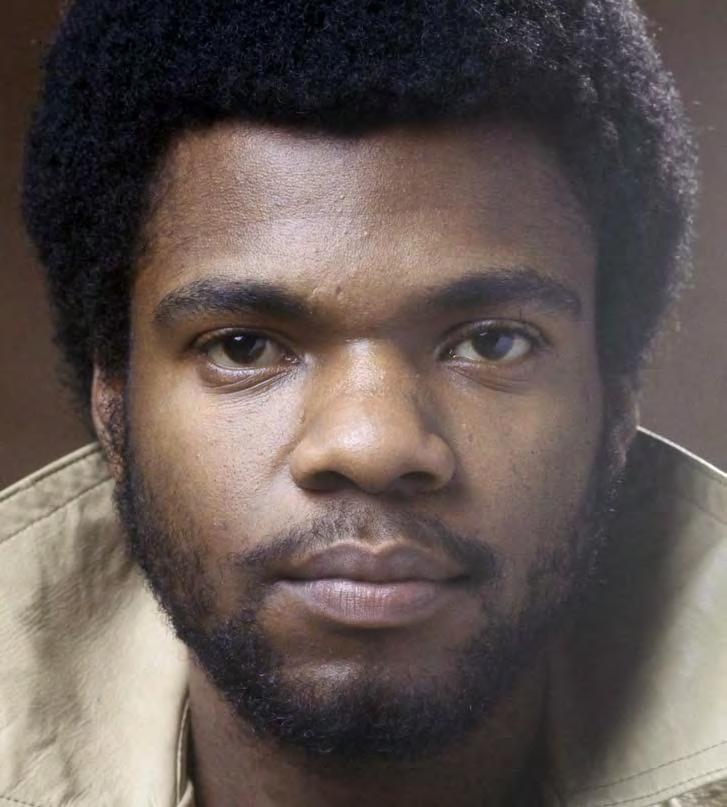
Billy Preston documentary shares the life of the closeted musical genius
by Brian Bromberger
At age 3, he was a child musical prodigy playing piano –without any lessons– and singing in church, eventually becoming a tour de force keyboardist, successful singer/songwriter, whose work spanned R&B, rock, soul, funk, and gospel.
In the opening scene of the biographical documentary, “Billy Preston: That’s the Way
God Planned It,” (Abramorama) that occurs in August 1971 at a concert benefit for the people of Bangladesh, Preston (1946-2006) shone brightest among the greatest musical stars of his era also performing in that show: George Harrison, Ringo Starr, Eric Clapton, and Bob Dylan. He sang and danced his gospel rocker, “That’s the Way God Planned It,” a showstopper resembling a tent revival meeting that electrified the audience. Preston was at the height of his career, yet by
Whale is most famous for today came toward the end of his movie career,” said Mullen, “He wasn’t particularly proud of them.”
As the play makes clear, Whale felt deeply attached to early work that reflected his own experiences in the trenches of WWI. But Mullen zeroed in on the director’s 1936 film of “Show Boat,” the classic American musical by Oscar Hammerstein and Jerome Kern.
“The Black characters were really pushed into the background in the 1951 version. In Whale’s film, they’re at the center of the story.”
“When I read about the making of ‘Show Boat’ in that biography, it hit me like lightning,” said Mullen. “There were so many outsider stories that I could explore in a play.”
More new nuance
The NCTC production of “Gods & Monsters,” smartly directed by M. Graham Smith as a timeeliding palimpsest of present tense, memory, and delusion, follows the play’s 2024 debut in Chicago, which involved close collaboration between Mullen and his close friend Paul Oakley Stovall, who directed the premiere.
Stovall, perhaps best known to Bay Area the-
the end of the 1970s both his personal and professional lives would be in decline. This overdue, stupendous documentary charts the cataclysmic life of a musical icon and “beautiful human being who deserved more than he got.” It’s an almost unbearably sad story of a conflicted and secretive genius destroyed by drugs over the pain and conflict of being gay.
At age 10, Preston played the organ (the complicated Hammond B3) backing up gospel legend Mahalia Jackson. At age 11, he sang with Nat King Cole. At age 16, he joined Little Richard’s band as an organist touring with him, then meeting and playing with The Beatles in Hamburg, Germany. The next year, he released his first album, “16 Yr. Old Soul,” with Sam Cooke. In 1965 he appeared on the television rock and roll program “Shindig!” In 1967 he joined Ray Charles’ band. All these accomplishments happened before he turned 21.
In 1969 he joined the Beatles’ “Get Back” sessions at Apple Studios, playing organ and electric piano. He played on the “Let It Be” and “Abbey Road” records, and accompanied them on their final public rooftop concert, becoming the closest anyone came to being the fifth Beatle.
He created several chart-topping singles including the No. 2 funky instrumental hit “Outa-Space,” “Will It Go Round in Circles,” “Nothing from Nothing,” and “Space Race.” He toured with the Rolling Stones, playing keyboards at concerts and on five of their albums. No one else could say they collaborated with both the Beatles and the Rolling Stones. He also appeared on albums for Barbara Streisand, Elton John, and Sly Stone. In 1974 he wrote one of his biggest hits, “You Are So Beautiful” for Joe Cocker, not for any lover, but for his mother.
He was the first musical guest to appear on the premiere episode of “Saturday Night Live,” in 1975. In 1978 he signed with Motown Records. Unable to adjust to disco, the 1980s was a downhill period as he became addicted to cocaine and alcohol. Desperate, he felt humiliated having to visit Black radio stations to drum up interest as he attempted to cross over back to where he had started.
His self-destructive addictions led to him losing everything, owing millions in taxes. He was
atergoers for playing George Washington in the first national tour of “Hamilton,” engaged his cast in a deep examination of the characters’ psychology and the play’s overlapping historical eras.
Smith similarly challenged the San Francisco cast, finding even further nuances in the story in regard to the character of Whale’s live-in maid, Maria, played with humor-guarded tenderness by Francine Torres.
Sharing her character’s Mexican heritage, Torres brings sharp insight to Maria’s outward temperament and language, which varies from stereotypical Spanglish to almost unaccented English from scene to scene.
“Whale, Boone, Maria; all of these characters have to wear masks in different situations,” said Smith in an interview with the Bay Area Reporter. “They’ve all made compromises and they’re all doing different kinds of codeswitching. The play feels incredibly relevant right now.”
Indeed, as a certain mad doctor once exclaimed, “It’s alive!”t
‘Gods & Monsters,’ through April 5. $36.50$55.50. New Conservatory Theatre Center, 25 Van Ness Ave. www.nctcsf.org
arrested for drunk driving, for a $1 million insurance fraud scheme after setting his LA home on fire, and for sexually assaulting a 16-year-old boy. In 1997, he was sentenced to three years in prison for cocaine possession, having violated his probation.
After he was released from prison, he played on albums of Johnny Cash, Neil Diamond, and the Red Hot Chili Peppers, with a few TV appearances. He continued to suffer from kidney failure and in 2002 received a kidney transplant. He toured with Eric Clapton, also in recovery, who attempted to help him remain sober.
Yet he still used cocaine and was warned by the Mayo Clinic if he didn’t get clean, he’d be dead. He entered rehab in Malibu and calling his last manager, said, “Well I hope you’re happy. I told them I was gay.”
Tragically, four days later, he suffered respiratory failure going into a coma, which lasted for more than six months before his death at 59 in June 2006. As one of his close friends remarked, “How did we let this boy get away from us?”
Gay director Paris Barclay deserves credit for earning the trust of Preston’s closest friends who still adore him and mourn his loss 20 years after his death. Initially they were closed-mouth about the darker elements of his life, believing it wasn’t their story to tell. But eventually they opened up. With all his talent, Preston should’ve been a more popular artist, though he seems to have been more comfortable behind the scenes. Barclay has shed light on an elusive, hidden, and mysterious figure as well as the causes behind his tragic descent. But Barclay reveals in this enlightening but also emotionally devastating and unflinching documentary, how despite all his pain and self-condemnation, Preston was a great musician, and this is how he should be remembered.t
Read the full review on www.ebar.com.
‘Billy Preston: That’s the Way God Planned It’ screens March 21 & 22 at the 4 Star Theater, 2200 Clement St. billyprestonfilm.com www.4-star-movies.com




by David-Elijah Nahmod
Mark Foehringer has spent his life immersed in dance. A director, dance educator, choreographer and mentor, he is now celebrating the 30th anniversary of his company Mark Foehringer Dance Project|SF, though he has actually been practicing the art of dance for an impressive 47 years.
To commemorate his company’s 30th year, Foehringer is mounting a return engagement of his production of the classic children’s tale “Alice in Wonderland,” which can be seen on March 28 and 29 at the Cowell Theater at Fort Mason.
From a very early age Foehringer was drawn to dance. Growing up in a creative household, it felt natural to him to make up dances in the stories and plays he created.
“Any music or soundscape motivated me to make up sequences of movement as early as five years,” Foehringer said in an interview with the Bay Area Reporter. “I was drawn to the structure of it. Once I started ballet training, it made a dance career a reality. The discipline and commitment to it helped me focus and find a path to choreography. It allowed me to dream.”
Finding home
Foehringer said that being a member of the LGBT community informs his work, though, he added, he doesn’t make work about the queer community or issues that the community struggles with.
“I’m a queer man and I make work through that lens,” he said. “My work explores finding connections, facing challenges, feeling lost and finding your way back home. Blame ‘The Wizard of Oz’ for that. So, in that sense, then yes, being queer informs my perspective and how I see the world.”
When he founded Mark Foehringer Dance Project|SF he was told that he would not succeed because funding had started to dry up and that there were so many smaller companies that didn’t make it past four or five years. He saw this as a challenge. Over the years there have been a lot of ups and downs, money, then no money, bookings, then no bookings. But the company survived, and he is very happy to have reached the 30-year milestone.
“I’m grateful, excited and indebted to so many generous collaborators and community members for their support,” he said.
Choreographer celebrates 30th anniversary with ‘Alice in Wonderland’

scene from Mark Foehringer’s ‘Alice
the main protagonist’s journey, featured characters, maybe the weird ones,” he said. “My Alice is not afraid of a challenge and is confident she can help come up with a solution to any situation. I wanted her to have agency. With the world going through so much misunderstanding and division I restaged it hoping to give my audience a moment of relief from the chaos out there. My ‘Alice in Wonderland’ doesn’t fix those things but it brings joy. It feels like the right time to be together in a theater hearing our orchestra and taking in my zany adaptation.”
Music and mischief
This production will be performed to the music of the legendary classical composer Camille Saint Saens, with an eleven-piece orchestra playing live, conducted by Keisuke Nakagoshi. The production has been branded “Mark Foehringer’s Alice in Wonderland.”
“This production is a fifty-minute, high-energy colorful dance theater work,” said Foehringer. “Often considered a scary story that portrays
grotesque characters, this one was designed for kids. I chose mischievous or whimsical instead.”
Foehringer has also done a short version of the holiday classic “The Nutcracker.”
“‘Nutcracker Sweets’ is a fifty-minute adaptation of the Hoffman tale, ‘The Nutcracker and the Mouse King,’” he said. “I don’t follow the ballet synopsis as most do. I have done a retelling of the story with the focus on the role of Drosselmeyer, the toymaker, who suddenly faces the challenge of breaking the curse placed on his nephew by the mouse king. He needs to figure out a way to break the curse. It is a pairing of sorts with ‘Alice in Wonderland’ this season. Two shows created specifically for a young audience. ‘Mark Foehringer’s Nutcracker Sweets’ returns this December.
Foehringer hopes that people will bring their children to see his production of “Alice in Wonderland.”
“I hope they experience the joy of this dance and this music,” he said. “I hope they get to see it with a child and experience the show through their eyes. If they don’t come with a kid, I hope they leave the theater uplifted. I was one of those kids who saw their first production with moving set pieces, dance and music. I hope there are kids like me in the audience who will go running home and perform their version of the show for friends and family. Maybe ballet, opera and new dance theater pieces as well.”t
Read the full article on www.ebar.com.
Foehringer last mounted “Alice in Wonderland” in 2019. A planned 2020 production was cancelled due to the COVID-19 pandemic.
“I’ve always been interested in the characters that support the story and
Choreographer Mark Foehringer
Mark Foehringer’s ‘Alice in Wonderland,’ $23.50-$65.50, March 28 & 29, 11am & 2pm, Cowell Theater at Fort Mason, 2 Marina Blvd. www.mfdpsf.org www.fortmason.org



‘Cutaways’
by David-Elijah Nahmod Director/writer
Mark Schwab’s
“Cutaways” is a dark film. It’s the story of Evan (Silas Kade), an independent filmmaker who was once the darling of the Sundance Film Festival. Thanks to a false accusation from an extra on his film who was denied a speaking part, Evan has fallen victim to cancel culture and is now reduced to shooting gay porn. And it’s quite a motley crew that Evan is working with. First, there’s Andy (Fernando), a burnt-out former Disney star who’s having a love affair with drugs. Ryan (Diogo Hausen), a mainstream movie star wannabe, works at the city morgue. Ryan is not too bright. Then there’s Sammy, the sleazy producer (cult film actor James Duval) and Trace, Sammy’s new boy toy (Jason Caceres), who also longs for cinematic fame.
“A lot of people want to be in movies,” Trace says. “The difference is I will be in movies.”
Queer indie movie shows the dark side of filmmaking

Fernando and Silas Kade in ‘Cutaways’
Though whether Trace wants to be in mainstream films or porn films is left up in the air. The entire film is set in the warehouse where Evan is shooting his porn opus, with these five characters making up the entire cast. Like numerous films before it,
“Cutaways” illustrates what a sleazy town Hollywood can be. It’s a town where people are often discarded like trash, as Evan and Andy have been. It’s a town where people mask their pain by “self-medicating.”
by Jim Piechota
Here comes the third installment of our Spring books roundup, where you’ll discover terrific queer fiction choices.
“Work To Do” by Jules Wernersbach
$19.95 (University of Iowa Press)
This remarkable debut from Brooklyn bookstore founder and author Wernersbach tells the tale of the inner workings of the Austin, Texas Guadalupe Street Co-op. All the underpaid employees have secrets burning inside them, including their plan to unionize.
Store manager Roz is much more interested in the sparkling diamond engagement ring on her meteorologist ex-wife’s finger as she gives a disastrous weather warning on television. Power losses, panic, and interpersonal hijinks follow, much of it non-weather related, as Wernersbach cranks up the melodrama to insane but awesomely entertaining levels. uipress.uiowa.edu
“Star Shipped” by Cat Sebastian
$18.99 (HarperCollins)
Known for writing historical romance novels, Cat Sebastian charts new territory with this queer contemporary romp set against a television program backdrop. The story stars two TV actors on the hit sci-fi series “Out There” who have shared space on the set for seven years now.
Bickering and generally sick of each other, Simon Devereaux and Charlie Blake stick together for the sake of the show, but snarky, snippy, OCD-addled Simon decides to take his career up a notch and quit the show in search of loftier prospects, but not before a road trip with Charlie changes everything.
The duo’s gossipy fanbase has hint-

ed at a possible off-screen romance between them, but Simon and Charlie aren’t anywhere near that point until they share time away from the set and get to know each other intimately both in and out of bed. It’s a slow burn as far as the romance goes, but character-wise, there is plenty to chew on for fans of queer romance novels, historical or contemporary, and Sebastian knows her stuff. This romance is a definite breakaway hit and a beach read to savor. harpercollins.com
“Ramin Abbas Has Major Questions” by Ahmad Saber
$21.99 (Atheneum/Dlouhy)
Saber’s Toronto-based teenage drama concerns gay Muslim student Ramin Abbas, who looks forward to attending NYU, which is far away from his parents’ traditional expectations of him and a place where he alone can dictate where his life and identity take him.
For now, however, his school PE credit requirements remain unmet and the only way to achieve them is to join the soccer team late in its season. The team is on its way toward a championship win. But the group is intimidating, especially a boy named Fahad, whom Ramin has a secret crush on.
Saber is smart to have Ramin narrate his own story with humor and intense emotion as he explores the
by Jim Provenzano
Heads up, gay erotica collectors.
The Bob Mizer Museum and Photographic Archives, formerly named the Bob Mizer Foundation, will publish “Timeless: The New Men of Physique Pictorial,” a book of sexy and nude photos of men by dozens of photographers in a contemporary tribute to Mizer’s “Physique Pictorial” magazines of yesteryear.
The museum, which houses the expansive archives of Mizer’s body of work, has been hosting exhibits for the few years since it started in 2016. It also continues to put out the new quarterly issues of “Physique Pictorial” that feature historic Bob Mizer photos, and new photographers whose work is inspired by him.
<< Cutaways
From page 10
As the story progresses, poor Evan is trying to insert some artistic sensibility into his porn film but has to contend with Andy’s snorting of various substances and Ryan’s delusional fantasies. Ryan needs to be finished by 4pm so he can meet with a producer who’s going to cast him in the next “Spiderman” movie. Yeah, right.
The dialogue is filled with namedropping, such as director Peter Bogdanovich and queer cult auteur Gregg Araki, whom Duval has worked with a number of times, and who, in this story, may be getting ready to throw Evan a lifeline. Araki’s name comes up repeatedly throughout the film. Evan doesn’t seem to believe that Araki is interested in him, but he could be wrong.

complex nuances of being both Muslin and gay. Sports culture, adolescent identity challenges, queer love, and religious faith commingle in this beautifully resonant tale of coming to terms with one’s own authenticity. simonandschuster.com
“HipHop Studies and Queer Black Feminism” by Elaine Richardson, Gwendolyn Pough, and Treva Lindsey (editors), $29.95 (Univ. of California Press)
All three editors (scholars and award-winning professors) in this dramatic, academically written essay collection have a great stake in the feminist movement. All strive to impart the importance of its history and present condition to readers concerned about Black gendering and racialized sexualities within Hip Hop culture and its unique style of music.
Contributors like Moya Bailey provide insightful commentary on the “homolatent masculinity” of the culture, while the entertainment dynamic and persona of Missy Elliott takes center stage in a piece on Black queer feminists.
The Hip Hop world’s creators and practitioners are in the spotlight for other essays probing how these figures tackle the challenges of gender
“Timeless” includes more than 40 contributors in a 200-page hardcover full-color book that sells for $79 pre-
Like Araki, Schwab is a queer indie filmmaker worth watching. The Bay Area Reporter reviewed his last film “Exteriors” around a year ago. In his current film, as well as his earlier one, he displays an ability to pull strong performances out of his actors.
Of course, it helps that he has a repertory company of sorts, as Fernando, Hausen and Kade were all in “Exteriors.” They and the director are now old friends. They know what makes each other tick, and they work beautifully together.
Kade is superb as the brokendown, frustrated Evan, who’s trying to maintain his dignity as he works with Andy and Ryan, two losers. Though a somewhat tragic figure in this story, Kade, as Evan, gets a few laughs as he screams in exasperation at his two stars. Fernando also gives a good performance as the drug-addled Andy, who’s clearly losing it as the shoot pro-
bias and sexual discrimination within their own music genre and its culture.
Relevant and intensive, this is a book for gender-rights activists and those who are marginalized not only by society in general but by the very company they keep. ucpress.edu
“Café Lafitte in Exile: Queer New Orleans and the Story of America’s Oldest Gay Bar” by Frank Perez, Jeffrey Palmquist
$32.95 (LSU Press)
Throughout its storied history, Bourbon Street’s Café Lafitte in Exile, which opened in 1933, is more than worthy of a colorful, vibrant book like the one Perez and Palmquist offer that sings its praises and regales its importance to LGBTQ communities across the country.
Rich in detail, historical facts and side commentary, the authors admit that while the staff has majorly changed since they’d initially written the text, the bar remains and continues to dazzle New Orleans locals and tourists alike.
Chapters include a look at queer life in New Orleans before bar culture came into focus; the history of Café Lafitte’s location (and the bar’s relocation in 1953); and the everevolving role of the bar in the context of queer acceptance. A precious meditation on place and identity,

“Kids, Wait Till You Hear
This!” by Liza Minnelli
$36 (Grand Central)
The daughter of film director Vincente Minnelli and megastar entertainer Judy Garland, Liza tells all in a dazzling memoir (dictated to her friend and musical collaborator Michael Feinstein) that begins with her birth in Hollywood in 1946 just above Sunset Boulevard and chronicles her childhood playing with other “children of household names” like Bogart, Bacall, Turner, Astaire, Crosby, Gershwin, and others.
Liza’s love life, including the rundown on her 1964 engagement and subsequent marriage to pansexual Australian singer Peter Allen and details on her torrid affairs with celebrities like Pete Sellers and Martin Scorsese are just the beginning.
An addiction to OxyContin, assorted marriages and divorces, and performances that made her a household name in entertainment circles are all contained in the pages of this immersive and deliciously dishy self-portrait from a true storyteller and veteran master entertainer. hachettebookgroup.comt
sale $89 regular, and ships in April. With only 1000 copies made, collectors should act fast, as several hundred have already been sold.
“These images, in stunning full color, showcase the diversity of vision each artist possesses as each presents his own representation of that same traditional masculinity Bob Mizer first sought to present so many decades ago,” read a museum press statement.
“Those classic portrayals are interspersed with visual elements and settings that also reflect the forward movement of male physique culture into the future.”
Exhibits of vintage male physique and erotica prints are on display at the museum, 920 Larkin St. www.bobmizer.orgt
gresses. Hausen gets a lot of laughs as the dimwitted Andy. Duval and Caceres drip sleaze as two lowlifes who will do whatever they need in order to get what they want. Both actors have had long careers in queer indie cinema, with Duval also having done mainstream films like the sci-fi blockbuster “Independence Day” (1996). These are good actors who play their roles to perfection.
“Cutaways” continues Schwab’s streak as an indie filmmaker following in the footsteps of Araki. He’s a talent whose films are worthy of theatrical releases. By all means check out “Cutaways,” and if you haven’t, go back and watch “Exteriors.”t
“Cutaways” (Mostly Verse/ Diamond in the Rough Films) is now streaming at Amazon Prime, and on Tubi TV April 2. www.ditrfilms.com



3-4

by Natasha Dennerstein
In Linda Rosewood’s lengthy debut novel, “A Circle Outside,” set in a women’s commune in Santa Cruz in the 1980s, not a lot happens, really, as most of the action is set within the community and the various machinations and politics within.
There are eight lesbian women, all of whom identify as witches. At the start they are being evicted and move to another rural property owned by a mysterious wealthy woman named Robin. There is some suspense around the moving process; will they or won’t they? And one of the women, Wren, is wildly attracted to Robin.
There are stakes set up: will the commune be successful, will they be able to keep men off the land, will Wren and Robin get together, will the
dreaded tractor stay or go? Some of the women see the tractor as being a phallic/patriarchal symbol. Much of the language and ideology is quaintly dated, but intentionally so, forming a sort of time capsule of 1980s feminist thought.
Thankfully, author Linda Rosewood, has her tongue firmly in her cheek and is able to make humor of the milieu as well as understanding it deeply and respecting it profoundly.
It is this light humor that really makes this novel succeed.
Witchcraft is practiced throughout.
They have group rituals, harvest festivals, celebrations, and incantations.
It’s in the area of society and group dynamics, though, that the novel really excels. We see the women having meetings wherein they process their feelings and practice a democratic
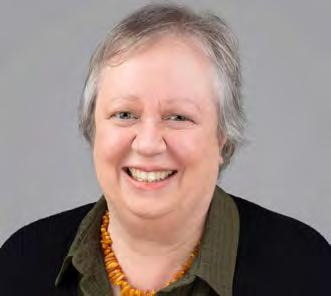
Author Linda Rosewood
group dynamic. They unpack the concepts of leadership and control. They discuss polyamory and the workshopping of sexual jealousy, seeing monogamy/coupledom as a form of pa-

triarchal control which they attempt to unlearn.
It may have been more exciting if there were more suspense and more at stake, but Linda Rosewood prefers to
by Tim Pfaff
Areader dismayed at the sameness of coming-out novels has yet to encounter Madeleine Dunnigan’s “Jean” (Norton). Her debut novel swaps an arrestingly literary tale for the clichés of the genre.
The title character and the book’s principle consciousness, Jean, a troubled 17-year-old Jew, is packed off to Compton Manor, a gentile boys’ school (the students call it “The House of Nutters”), far from his usual London stomping grounds and Jean’s best shot at passing, belatedly, his O-level exams. Oh, and Jean is handsome and blond, neither of which is enough to save him from the disdain of his fellows and his own desires.
As one might expect, there’s sex of sorts at the all-boys school, but most
of it is tentative and essentially uninformed. There is a toilet out back where things happen, but Jean knows that if he goes in, he may never come out. There’s a frankness about sex

whenever it happens, but it is saved from the sensational by the author’s knack for describing the clumsiness of boy-to-boy sex with its inept passions.
More vivid are scenes involving animals. Pigs are big. Jean hoses the shit off some penned porkers until they squeal in terror. The detailed depiction of the slaughter of a pig for a major celebration hints at violence even to the dead animal.
“Jean stands before the headless, flayed animal that not so long ago would have been standing, chewing cud.” There’s also a frog you won’t forget anytime soon.
Then there are the obligatory drugs, but this being 1976, they’re mostly speed to improve studies and what feels like an endless succession of joints passed among the boys. Dunigan treats them matter-of-factly.
No spoilers about the way Jean’s and Tom’s sexual adventures play out. There are escapes and then there are escapes.
concentrate on the internal lives of her characters and on the politics of the group living situation. “A Circle Outside” is an entertaining as well as educational read, easy to read and delightful. It concerns a more innocent time of the 1980s and in many ways is a sort of time capsule of that period in women’s social history. Remarkably, many of the issues dissected in the novel are extremely relevant today, particularly the discussions around monogamy and polyamory. Sisters were doing it for themselves!t
Read the full review on www.ebar.com.
Linda Rosewood’s ‘A Circle Outside,’ $14, paperback, Eye Books www.eye-books.com www.lindarosewood.com
This novel will not be to all tastes, mostly because of the sophistication of Dunnigan’s style, which is long on sentence fragments, has an aversion to quotation marks, and boasts a penchant for a species of continuity that ricochets between past and present, sometimes within the same sentence or paragraph. The writing can be as aggravating as it is strong but will appeal to readers who have abandoned the need for linear narrative, say nothing of woozy romanticism, and welcome a twist on that staple of gay fiction, the coming-out story.t
Read the full review on www.ebar.com.
‘Jean,’ by Madeleine Dunnigan, W.W. Norton and Company, 216 pages, $29.99, www.wwnorton.com

On April 2, 2026, the Bay Area Reporter, America’s longest continuously-published and highest circulation LGBTQ newspaper will celebrate our 55th Anniversary. Our anniversary issue will include highlights of our fifty-five year history of coverage of LGBTQ rights from the early-1970’s to the present time.
It will also announce the results of our 15th read ers’ poll, BESTIES: The LGBTQ Best of the Bay These are the best people, places, businesses, nonprofits, events, and things to do in the Bay Area, as voted by our readers.


Advertising space reservations for this special edition are now being accepted. Call 415-829-8937 t