The first medical report of what would become known as AIDS was published in the Centers for Disease Control and Prevention’s 45 years ago this week, on June 5, 1981. The first antiretroviral drug, AZT, was approved in 1987, but it took nearly a decade longer to develop effective combination therapy that kept the virus in check, and another 16 years until the approval of daily pills to prevent HIV.
The evolution of HIV prevention and treatment is among the most remarkable stories in medical history. From handfuls of pills taken multiple times a day to injections administered just twice a year, antiretroviral therapy has come a long way. But while HIV treatment and PrEP for prevention have steadily improved, an HIV vaccine and a functional cure remain elusive.
“Without question, current treatment and PrEP options work great. They are effective and safe, and they are getting better and better every year,” Dr. Steven Deeks of UCSF and Zuckerberg San Francisco General Hospital and Trauma Center told the Bay Area Reporter. “But they require an individual to remain engaged in the healthcare system for life and to adhere to lifelong therapy. This is just not feasible for many. To end the epidemic, we will need a one-and-done approach for treatment or prevention. In other words, we will likely need a scalable cure or a vaccine, preferably both.”
HIV treatment
Modern HIV treatment is highly effective, generally well tolerated, and most people can take a single-tablet regimen that combines two or three drugs in one daily pill. The newest, Merck’s Idvynso (doravirine/islatravir), was approved in April. Researchers are now testing islatravir in combina-
Wiener headed to fall US House race
by Matthew S. Bajko and John Ferrannini
Looking to make LGBTQ political history this fall is gay state Senator Scott Wiener (D-San Francisco), who is aiming to become the first out congressmember to represent America’s gayest city. As expected, he took first place in his primary contest Tuesday to succeed retiring Congressmember Nancy Pelosi (D-San Francisco.)
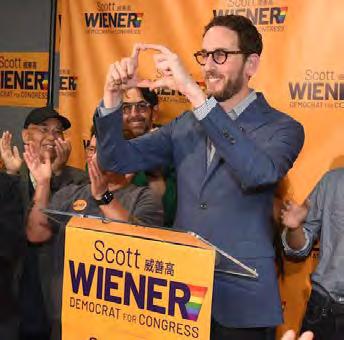
A jubilant Wiener celebrated his commanding showing with scores of supporters at his campaign headquarters June 2 as the election results came in. He thanked those who volunteered and endorsed his potentially pink glass ceiling shattering candidacy to date.
“So, tonight, the people of San Francisco sent a very clear message. This message has been received. San Franciscans are ready for bold, forward looking leadership. For real results, not just words. And a new generation of leaders, a new generation, ready to take on the hardest issues facing our country,” said Wiener.
The first woman to be speaker of the U.S. House, Pelosi opted to retire rather than seek reelection this year. Wiener had long planned to seek San Francisco’s 11th House District seat when Pelosi stepped down.
But he announced his bid last fall months before Pelosi made her retirement official due to the momentum that was building behind the campaign of centimillionaire Saikat Chakrabarti, a straight ally
Congressional
who for six months served as chief of staff to Congressperson Alexandria Ocasio-Cortez (D-New York). He had launched his bid for the House seat in early 2025.
Since then Chakrabarti has pumped nearly $9 million of his own wealth into his congressional bid. The former tech executive appears to have come up short, however, against a tidal wave of last minute support for District 1 Supervisor Connie Chan from local labor unions and Pelosi’s decision to endorse her last month.
According to the unofficial election results, Chan is in second place with nearly 29% and Chakrabarti trails in third with 15%. Meanwhile, Wiener had a comfortable lead for first place with 41% of the vote.
Under the state’s open primary system only one of the progressives could face off against Wiener in the November 3 election. The top two vote-getters regardless of party affiliation advance out of the primary.
Chan told supporters at a celebration at the El Rio LGBTQ bar in the Mission neighborhood late June 2 that, “We fight to win.”
“We will win on November 3. Let’s go,” she said. Chan spokesperson Julie Edwards stated to the B.A.R. after the results made it clear Chan was a lock for the November race that hers was a victory on behalf of the working class.
“San Franciscans came together and are sending a strong message: we need to send a working people’s champion to Washington, D.C.,” Edwards stated. “We were outspent but we were never outworked and this result is a testament to the work of our team, our labor allies and our volunteers. There are still a lot of ballots to be counted but we feel great about where things stand.”
Chakrabarti spoke to supporters at another Mission bar, The Chapel. He wouldn’t characterize his speech as either a winning or losing speech.
See page 10 >>
Out candidate Kellman loses lieutenant governor primary
by Matthew S. Bajko
Gay lieutenant governor candidate Janelle Kellman couldn’t overcome her lack of name recognition or support from her Democratic Party of her bid for the statewide office. She fell short in Tuesday’s primary, ensuring that California will be without LGBTQ representation among its elected executive branch come 2027.
As for the close contest to be the Golden State’s next governor, three of the contenders were in the mix for the two spots on the November 3 ballot headed into Tuesday. It appears Democratic former state attorney general Xavier Becerra, who served in the Biden administration, will face off against Republican Steve Hilton in November to succeed termed-out Democratic Governor Gavin Newsom. Wealthy progressive Democrat Tom Steyer was in third place.
Kellman had always been seen as the underdog in her race; it was why she launched her campaign back in 2023. The former Sausalito city councilmember was vying to be the first LGBTQ woman to hold statewide office in the Golden State and only the second out person to be elected to one.
The first, gay Democratic Insurance Commissioner Ricardo Lara, is termed out of office in January. In her bid to succeed termed-out Democratic Lieutenant Governor Eleni Kounalakis, Kellman
landed near the bottom of 16 candidates with 3.5% of the vote, according to the unofficial returns Wednesday morning.
In first place with nearly 20% of the vote is Republican Gloria Romero, a former Democratic state senator who switched parties in 2024. Democratic
termed-out state Treasurer Fiona Ma, a former San Francisco supervisor, was close behind in second with 19% and fellow Democrat Josh Fryday, California’s chief service officer in Newsom’s administration, took third place with 13.5% of the vote. In fourth place with 11% is Michael Tubbs, a former Newsom poverty adviser and Stockton mayor.
As for the gubernatorial contest, Hilton took an early lead for first place on Tuesday night and was at 27.8% of the vote Wednesday morning, while Becerra is close behind in second place with 25.4%. He told his supporters that “the people of the great state of California, in the greatest nation on earth, have spoken. Loudly and proudly” at his election night party in Los Angeles.
“And while I take nothing for granted – there are lots of ballots left to count – it appears we are on track to advance to November. One step closer to the son of those hardworking immigrants Maria and Manuel Becerra becoming the next Governor of the great state of California,” said Becerra, who had surged to the head of the gubernatorial pack in recent weeks.
Steyer was at 19.6% Wednesday. He told his supporters at his results watch party in San Francisco that he was not ready to concede and would wait for more ballots to be counted.
Kim wins school board race
Frameline's origin story
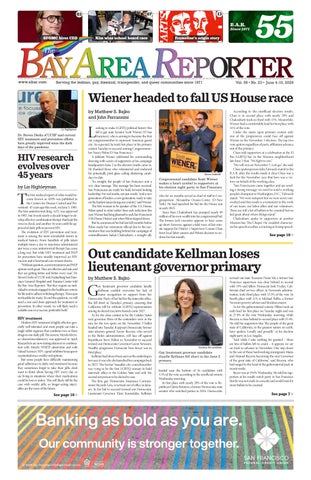
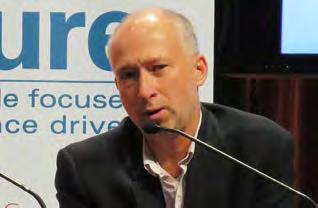
Dr. Steven Deeks of UCSF said current HIV treatment and prevention efforts have greatly improved since the dark days of the pandemic.
Liz Highleyman
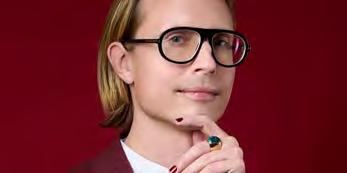
Gay lieutenant governor candidate Janelle Kellman fell short in the June 2 primary.
Courtesy the candidate
candidate Scott Wiener makes a heart symbol to supporters at his election night party in San Francisco.
Steven Underhill
SF conflict resolution nonprofit marks 50 years
compiled by Cynthia Laird
ASan Francisco nonprofit that helps people resolve disputes is marking its 50th anniversary. Community Boards will hold its annual Peacemaker Awards gala Friday, June 12, from 6:30 to 9:30 p.m. at the Verdi Club, 2424 Mariposa Street. The theme is “50 Years: People-Powered Conflict Revolution.”
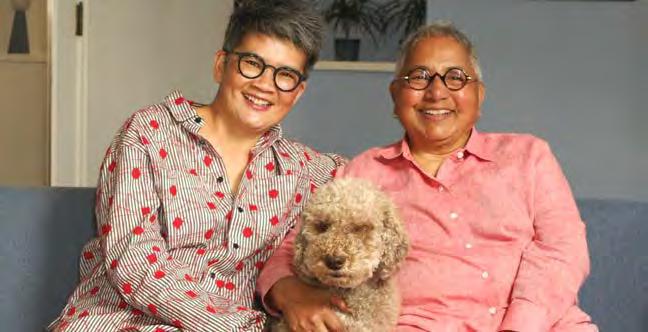
Darlene Weide, a lesbian and the agency’s longtime executive director, said the help it provides to residents is needed now more than ever. In addition to volunteers providing its mediation services, Community Boards also trains people in conflict resolution skills.
In a phone interview, Weide told the Bay Area Reporter that Community Boards was started by the late Raymond Shonholtz in 1976 as an alternative to the judicial system. Mediations cannot be used as evidence in legal matters, she noted, and an advantage of that is people can speak freely.
“The heart and soul of the organization is its neighborhood mediation system,” Weide said, with common issues including things like sound or noise concerns.
The upcoming gala will be emceed by drag king Alex U. Inn and will be “festive,” Weide said.
This year’s Peacemaker award recipients include Max Trujillo, a former San Francisco Youth Commission member who is being recognized for founding San Francisco’s first District 9 Youth Council; and Gloria Cuevas Torres, who is being honored for her work as a peer counselor at Dr. Martin Luther King Jr. Academic Middle School, helping students resolve conflicts through listening and restorative practices.
Sharon Rose will be recognized for more than 30 years of leadership in restorative justice and alternatives to incarceration, including work with Neighborhood Courts and the San Francisco Pretrial Diversion Project.
Finally, Community Boards’ Leadership Award will go to CLECHA, a nonprofit supporting Latino entrepreneurs through financial education, business development, reentry programming, and youth entrepreneurship initiatives focused on empowerment and stability, a news release stated.
Weide, who has been executive director for over 20 years, spearheaded curriculum to combat LGBTQ discrimination in the San Francisco Unified School District and trained adjudicators on how to address workplace bullying at the San Francisco District Attorney’s office, the release noted.
Over the last 50 years, Community Boards has helped more than 50,000 San Franciscans resolve disputes. It has trained over 20,000 individuals in conflict resolution skills and built a volunteer network of more than 400 trained mediators, the release stated.
Weide said that the next training for prospective mediators is coming up in October. It’s a 40-hour training offered over two weekends.
Community Boards’ services are offered on a sliding scale for its neighbor-
Our friend and comrade, Matthew Lamar Florence, has rejoined the stars. Matthew’s gift for weaving strong, interconnected communities enriched others wherever he went. He died on Monday, May 11, at 9:30 a.m. after a brief hospital stay. In the hours after his passing, he was surrounded by friends.
Born January 9, 1967, Matthew was raised in Spring City, Tennes-
hood program. No one is turned away for lack of funds.
Tickets for the gala are $100, or $85 for Community Boards members. For tickets and more information, visit communityboards.org.
Looking at an ‘unbuilding’ of Compton’s site
The San Francisco Public Library will have an opening reception for “The Unbuilding Archive: Liberated Futures for the Site of Compton’s Cafeteria Riot,” Thursday, June 4, from 6 to 7:30 p.m. in the James C. Hormel LGBTQIA Center on the third floor of the main branch, 100 Larkin Street. The event is free.
The exhibit is co-curat ed by Chandra Laborde and Ach Kab of the TurkxTaylor Initiative. That initiative has convened the Compton’s x Coalition, which is cur rently working on getting city landmark status for the exterior of the old Compton’s site at 101121 Taylor Street.
takes place Sunday, October 4, in San Francisco’s LGBTQ neighborhood.
Board members made the announcement June 1, the first day of Pride Month.
Founded by the late Harvey Milk in 1974, the Castro Street Fair began as a celebration of gay-owned businesses and the vitality of the Castro neighborhood, a news release stated. More than five decades later, the fair continues that legacy by bringing together LGBTQIA+ people, neighbors, families, artists, performers, merchants, community organizations, and allies for a joyful celebration of queer life and community connection, the release noted.
In 1977, three years after the fair started, Milk made history as the first gay person elected to office in California when he won a seat on the San Francisco Board of Supervisors. A year later, in 1978, Milk and thenmayor George Moscone were assassinated inside City Hall by disgruntled ex-supervisor Dan White.
This year’s theme honors the Castro as a place where generations of LGBTQIA+ people have found community, safety, visibility, and joy, and affirms that the neighborhood remains a beacon of freedom and diversity today, organizers noted.
The site is presently a reentry facility operated by GEO Reentry Services, a subsidiary of GEO Group Inc.
This August marks the 60th anniversary of the Compton’s riots, the Tenderloin uprising led by trans women, drag queens, and others three years before the Stonewall riots in New York City that are widely considered the birth of the modern LGBTQ rights movement. The exact date has been lost to history.
The TurkxTaylor Initiative and the broader Compton’s x Coalition have emerged to liberate the Compton’s site and imagine an alternative future that honors its legacy of resistance, press materials noted. “We approach the building as a microcosm where interconnected structures of oppression –colonialism, capitalism, white supremacy, patriarchy and ableism – can be dismantled at a local scale to uncover possibilities for collective liberation,” Laborde and Kab stated.
For more information about the exhibit, visit https://tinyurl. com/2bjmns7h.
Castro Street Fair announces theme
The Castro Street Fair has announced its theme for the 52nd annual event will be “Where We Belong.” The street fair
Matthew attended Harvard College, earning his bachelor’s degree in social anthropology in 1989. He was a community leader and nonprofit executive with an emphasis on LGBTQ+ communities; HIV/ AIDS awareness; and diversity, equity, and inclusion strategy. His work at organizations included Men of Color Against AIDS, or MOCAA, in Boston; TechSoup; Black Coalition on AIDS; and AIDS Housing Corporation. He also worked for the Black Teacher Project and taught at Kaplan, Intrax, and St. Giles International. Matthew volunteered on boards including Comfort & Joy, Ground-
“‘Where We Belong’ is both a celebration and a promise,” stated Redge Roberts, Castro Street Fair board president. “The Castro has long been a place where people come together, find community and live more openly and joyfully. This year’s fair invites everyone to gather in that spirit with pride, courage, connection, and the belief that every member of our community deserves to belong.”
Located at Castro and Market streets and throughout the surrounding neighborhood, the Castro Street Fair features local artisans, community organizations, food vendors, queer and ally entertainers, live performances, and dancing in the streets. The annual fair is a neighborhoodcentered celebration that welcomes both longtime San Franciscans and visitors to experience the creativity, history, and spirit of the Castro.
The Castro Street Fair is a nonprofit 501(c)(3) organization, with proceeds benefiting charitable causes important to the Castro community. Since 1998, the fair has distributed more than $1.6 million to local nonprofit beneficiaries, the release stated. The fair also supports the Castro Merchants Association in the purchase and maintenance of the giant rainbow flag flying in Harvey Milk Plaza.
Admission to the street fair, which takes place from 11 a.m. to 6 p.m., is open to all, with a suggested donation of $10 to $20 to support community beneficiaries.
For more information, visit castrostreetfair.org. t
swell Retreat Center, Horizons Foundation, SF Arts Commission, Performing Arts Workshop, B/GLAM, Boston AIDS Consortium, HIV/ AIDS Services Planning Counsel, Citizens Against Homophobia, and Interfaith AIDS Ministry. Matthew was creative, erudite, intentional, inclusive, gleeful, and kind. He is survived by his siblings and their families, as well as countless friends and loved ones. He is deeply missed.
A GoFundMe has been started to help family and friends lay Matthew to rest and celebrate his life. To donate, go to https://tinyurl. com/2zrj65ac.
Community Boards Executive Director Darlene Weide
Courtesy the subject
Matthew Lamar Florence January 9, 1967 – May 11, 2026
see, the sixth child of Thomas and Shermine Florence of Cedine Bible Mission.
SF Gay Men’s Chorus hires 1st nonbinary CEO Community News>>
by Brian Guan
The San Francisco Gay Men’s Chorus has found its next chief executive officer. The pioneering LGBTQ choral organization has appointed Lane Sugata, a queer and nonbinary executive with an arts and philanthropy background, to succeed Christopher Verdugo in the role starting Monday, August 24.
Sugata, 46, will serve as the chorus’s second CEO and the first nonbinary person in the position.
Their starting two-year appointment, announced by the chorus Tuesday, follows a monthslong search for the organization’s next executive leader after Verdugo, a gay man, stated his intention to depart from the job last September. In collaboration with Arts Consulting Group, the chorus recruited across North America to discover Verdugo’s successor, according to a news release.
Hired as the chorus’s executive director in 2016 and promoted to CEO in 2022, Verdugo saw the organization through a multimillion-dollar budget increase and the opening of its permanent Chan National Queer Arts Center in 2023, as the Bay Area Reporter previously noted.
Board Chair Tom Paulino, a gay man, characterized Verdugo’s tenure in a phone interview as a “beautiful partnership.”
“His time at the chorus has been transformative,” Paulino reflected.
As the chorus’ CEO designate, Sugata presently serves as a senior program officer for the Ford Foundation in New York City, a major philanthropic organization dedicated to social justice. In their role, Sugata has overseen global grants totaling over $270 million, acting as a leader for the foundation’s arts portfolio and LGBTQ initiatives in particular. Before working at the Ford Foundation, Sugata was executive director of performing arts organization Dance/NYC. They hold both a master’s degree in performance studies from UC Berkeley and an MBA
from Columbia Business School, with additional experience as a ballet dancer.
Originally from New York, Sugata met their husband John-Paul Sugata at Marshall’s Beach during the COVID pandemic in San Francisco, they said. The couple were married in the city in 2024.
Now, following their most recent work funding artists and cultural institutions, Sugata described in a phone interview their excitement for “the opportunity to build from inside an institution.”
Sugata’s philanthropic background has informed their vision for their upcoming tenure as the chorus’s CEO. “My work at Ford has given me a national lens,” they said.
Sugata expressed their belief that institutional strength lies in interconnection.
“What excites me about the chorus and the Chan Center,” they explained, “is the opportunity to connect San Francisco’s extraordinary queer cultural leadership to a broader national conversation.”
In their national and global work, Sugata has witnessed how “artists, cultural groups, and social justice organizations are responding to many of the same challenges: political polarization, economic uncertainty, audience shifts, and increasing pressure on public institutions,” they recounted.
Over the course of President Donald Trump’s second term, a multitude of arts organizations – including those with a focus on LGBTQ identity – have experienced threats to their funding. Several arts nonprofits throughout the Bay Area received notification last May that their grants had been rescinded in line with Trump’s new priorities for the National Endowment for the Arts, the B.A.R. previously reported.
Under the Trump administration, the NEA briefly implemented a policy against federally funding the “promot[ion] of gender ideology.” A federal court in Rhode Island ruled that the policy was unconstitutional last September, as reported by the New York Times.
Changes to funding security have directly impacted the chorus. Claiming that the NEA effectively adjusted its criteria for supporting LGBTQ organizations in 2025, Paulino described how the chorus has been “operating under the understanding since last year – that ended up coming to fruition this year –that we would not be receiving any more NEA grants for the foreseeable future.”
The chorus has an annual budget of approximately $5.1 million. Sugata’s salary will be $230,000, Paulino remarked.
Coupled with financial challenges faced at the state and local level to support arts organizations, a primary concern in selecting the CEO was “financial stability and ensuring the organization’s fiscal health going forward,” Paulino said.
Building queer infrastructure Sugata similarly described financial turmoil experienced not just by the chorus but by LGBTQ institutions at large. “Space is expensive. Funding is tightening. Many organizations are carrying similar challenges in isolation,” they explained.
Yet, in the midst of this hardship, Sugata sees the Chan Center as an ideal site for collective resilience. “I believe we have an opportunity to build a national model for queer cultural infrastructure, one that demonstrates how collaboration can help artists and communities thrive together,” Sugata said.
The SFGMC has long held a prominent role within the broader LGBTQ movement. Holding its first public performance following gay city supervisor Harvey Milk’s assassination in 1978, it is now recognized as having animated the LGBTQ choral movement in the United States and beyond.
Now, as the chorus approaches its 50th anniversary, Sugata will have the opportunity to lead the organization toward its semicentennial celebration. It is also set to return to the newly remodeled Castro Theatre for its traditional Christmas Eve concerts this December after spending the last several years performing them at the Louise M. Davies Symphony Hall across from City Hall.
In a phone interview, Jacob Stensberg, a gay man and the chorus’s artistic director, described being in “a lot
of conversation” with Sugata about the anniversary season.
In his own conception of the milestone, Stensberg explained wanting to capture the “legend” of the chorus’s last 50 years. “Both the glorious, shining times of light and the challenging times, particularly the way the HIV/AIDS epidemic wiped out a generation of San Francisco,” he said.
Yet Stensberg is also excited to explore the future of the chorus. “Legacy to me is the next 50 years,” he added.
Perhaps Sugata’s appointment is itself a reflection of an organization still actively defining its future. In 2021, the chorus changed its bylaws, removing the requirement that members identify as male and allowing anyone able to sing within the tenor or bass range to qualify.
The change was the result of advocacy from the chorus’ trans and nonbinary members, Paulino said, and has since resulted in “folks from all over the gender spectrum coming and auditioning and joining the chorus.”
“We
- Meggy Gotuaco and Dipti Ghosh, Legacy Circle Members “A
- Bill Lowell and Richard Davis-Lowell, Legacy Circle Members
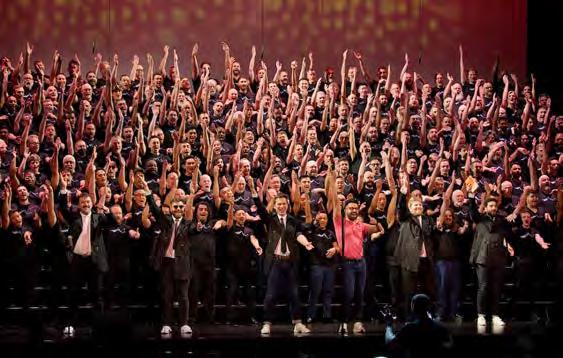
The San Francisco Gay Men’s Chorus shown during its “Totally 80s” performance earlier this year.
Stefan Cohen
Lane Sugata was named the next CEO of the San Francisco Gay Men’s Chorus.
Simon Luethi
SF designates 2nd historic site related to AIDS
by Matthew S. Bajko
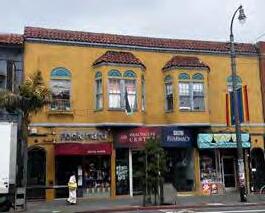
Today, passersby of the building at 514-520 Castro Street will find the AIDS Healthcare Foundation’s pharmacy it operates on weekdays and its healthcare center next door open twice a week. The Los-Angeles-based nonprofit is bookended by gay sex shops Rock Hard and Phantom.
Not visible is the historic role the twobedroom flat above the commercial spaces played in the fight against AIDS back in the early days of the deadly epidemic that killed thousands of San Francisco’s gay residents in the 1980s. It was where gay health advocates including Cleve Jones and Dr. Marcus Conant in 1982 opened the first offices for the agency they founded to respond to the then little understood disease.
“The resulting Kaposi’s Sarcoma Research and Education Foundation (later renamed the San Francisco AIDS Foundation) initially operated from folding tables covered with flyers and leaflets at the corner of 18th and Castro streets. Within a few months, it opened the first agency specifically addressing the new disease at 520 Castro Street, where Jones recalled that, even though initially unlisted, their phone immediately rang off the hook with calls for help and information,” noted the “Citywide Historic Context Statement for LGBTQ History in San Francisco” that city officials officially published in 2016.
A year later, in October, the organization “received national attention when a Florida hospital flew a critically ill AIDS patient to San Francisco and had him dumped at the organization’s front door,” noted the context statement.
Now, 44 years after KS/AIDS Foundation volunteers answered their first telephone calls from terrified men worried they would be killed by the mysterious ailment, the 1906-constructed building they went to for their shifts manning the phoneline has been designated a city landmark. It is the second site in the city’s LGBTQ Castro district, and entirety of San Francisco, to be recognized for the role it played in the fight against AIDS. (The first was the former home at 2362 Market Street of the AIDS Memorial Quilt, which Jones co-created in 1987 as a way to memorialize those who died due to the disease.)
“The office was stationed in a tiny back room with a single telephone referral and information hotline staffed by volunteers,” noted the ordinance F deeming the address worthy of local recognition for its historical significance. It added that, “While the organization did not remain at the subject property long, the building is significant for having housed one of first agencies in the United States specifically addressing AIDS.”
Noting this year marks the 45th anniversary of the first report of AIDS, SFAF CEO Tyler TerMeer, Ph.D., a Black gay, HIV-positive man, told the Bay Area Reporter, “we are reminded of the importance of commemorating HIV and AIDS history. We are glad to see San Francisco AIDS Foundation’s first office space commemorated by the city, in recognition of the important ways that SFAF has responded to the needs of the community over nearly 45 years.”
While SFAF continues “to fight for the needs of our communities still affected by the epidemic to this day,” stated TerMeer, the landmark adds to the ways the agency and others are honoring the “history of resilience, activism, and loss” wrought by the AIDS epidemic.
“These historic places are more than markers of the past – they are touchstones that connect us to one of the most significant public health responses in modern history,” he noted. “They remind us of the courage of those who organized, cared for one another, demanded action, and built systems of support in the face of fear, stigma, and government inaction.”
Speaking to the B.A.R. last fall, Jones recalled of that first location for the KS/AIDS Foundation how “the phone company sent a technician to wire us up with a telephone line and, as they were leaving and going down the stairs, the phone began to ring. It was such an eerie sort of moment, and of course, it never stopped ringing.”
When AIDS was discovered, the foundation rebranded its name and became a nonprofit in 1984. Since then it’s been housed in various locations and currently is headquartered at 940 How-
ard Street in the South of Market neighborhood, while it operates the Strut health clinic at 470 Castro Street.
As the B.A.R. first reported in October, its initial home a block away was one of six LGBTQ historic sites that gay District 8 Supervisor Rafael Mandelman, who is board president, included among a host of properties in neighborhoods he represents to be deemed local landmarks. In late April, San Francisco Mayor Daniel Lurie signed off on the ordinances for 14 of the designations that won approval from the Board of Supervisors earlier this year.
Historic properties
Several other LGBTQ historic properties across the city are currently underway, as both Mandelman and District 3 Supervisor Danny Sauter, who represents North Beach, requested the additional sites located in their respective supervisorial districts be recognized for their historical significance. And more are likely to be nominated in the coming months and years.
Last week, Mandelman and Lurie announced a push to see the city vastly increase the number of buildings deemed to be local landmarks. They are targeting by 2030 a doubling of the more than 335 current designated sites via new resources to survey the city’s historic properties and legislation to streamline the landmarking process.
They are also asking that all city landmarks be listed on the California Register of Historic Resources.
Doing so would greatly boost the number of LGBTQ sites, in particular, on the statewide list since few are on it.
While it does include the San Francisco
birthplace of the late lesbian activist Alice B. Toklas at 822 O’Farrell Street (between Larkin and Polk streets), the former residence of the late gay supervisor Harvey Milk and location of his Castro Camera store at 573-575 Castro Street is not despite becoming a city landmark on July 2, 2000.
“Whether it’s the Painted Ladies or Harvey Milk’s camera store in the Castro, San Francisco’s historic landmarks tell the story of our city,” said Lurie during a May 28 news conference held at one of the newly landmarked properties, St. Matthew’s Church, at 3281 16th Street. “San Francisco doesn’t have to choose between growth and preservation, and as our city evolves, we are protecting what makes San Francisco special and gives our neighborhoods their character.”
Mandelman noted at the news conference that, “San Francisco’s historic built environment is one of its valuable cultural and economic assets. It draws visitors, anchors neighborhood economies, and provides the sense of place that defines San Francisco and sets it apart. It also carries the remarkable stories of the city and the communities that built it.”
As for the two-story mixed-use building at 514-520 Castro Street, its ground floor storefronts have been “fairly altered” over the years, city planning staff noted in preparing its landmark designation. But it still maintains such architecturally significant Mediterranean Revival features “as red Spanish clay tile roofs, ornamental molding, and a decorative beltcourse,” noted the departmental report.t
Just as SF was getting to zero, HIV money started drying up
by John Ferrannini
F
orty-five years after the first an-
nounced cases of what later became known as AIDS, those on the frontlines of the epidemic are sounding the alarm that just as they were making unprecedented progress, they are now losing the resources they need.
The heads of two major health care providers to San Francisco’s communities with or at risk of contracting HIV told the Bay Area Reporter in recent weeks that a combination of federal and local budget cuts, as well as a decline in philanthropic giving, may threaten core services.
“We’ve come so far in the epidemic. We have made such signifi-
cant strides,” Tyler TerMeer, Ph.D., a Black gay, HIV-positive man who is CEO of the San Francisco AIDS Foundation, told the Bay Area Reporter in a phone interview. “I do believe San Francisco can be the first large American city to get to the end of the epidemic, but it requires us keeping a steady investment in all the initiatives. … If we don’t do that, we will end up in a scenario where we take steps backward.”
SFAF runs its Magnet sexual health clinic at Strut, its health center at 470 Castro Street. It also provides needle exchange and other programs.
“We’ve been seeing the convergence of multiple threats all at one time. I am worried about our ability to maintain in the short term the
same level of HIV, STI services at the same scale,” said TerMeer, referring to sexually transmitted infections. “We offer a free service to the community six days a week, and we’ve been proud to do that as a free, lowbarrier service to the community, and I think we hope to maintain the same number of hours, the same days a week, but with the cut we received, this hit to our services … if that were to truly hit, we’d have to evaluate whether that would impact our ability to stay open the same number of hours.”
The hit TerMeer is referring to is a cumulative $1.2 million in cuts from city grants over a period of two years to his agency. SFAF’s most recent IRS 990 form, from June 2025, showed an
annual budget of $44 million.
A 2025 independent auditors report shows that the total in contributions and grants from individuals was $784,000 – a significant decrease from almost $1.1 million in 2024.
However, SFAF did see an increase in corporation and foundation funding.
However, SFAF did see an increase in reported corporation and foundation funding. According to SFAF spokesperson Emily Land, that reported increase was because they received a two-year grant beginning in 2025.
“The revenue is recognized in the year that it is received (2025), but it is for 2025 and 2026,” she stated. “So although it looks like there was a large increase in corporation & foundation
grants in 2025, there wasn’t a big increase – it just looks that way due to accounting practices.”
TerMeer said SFAF is trying to diversify its income stream, one reason behind the new full-service pharmacy it opened in the Castro earlier this year.
The agency also laid off 34 staff members last summer, as the B.A.R. reported at the time.
Lance Toma, a gay man who is CEO of the San Francisco Community Health Center, said, “Philanthropic organizations have either shifted or reprioritized.” The health center has offices at the LGBT community center and trans-focused programs in the Tenderloin.
The former site of what is now the San Francisco AIDS Foundation was located on the second floor at 514-520 Castro Street
Matthew S. Bajko
Volume 56, Number 23
Volume 56, Number XX
June 4-10, 2026
Month XX-XX, 2026 www.ebar.com
PUBLISHER
Michael M. Yamashita
Thomas E. Horn, Publisher Emeritus (2013)
Publisher (2003 – 2013)
Bob Ross, Founder (1971 – 2003)
NEWS EDITOR
Cynthia Laird
ARTS & NIGHTLIFE EDITOR
Jim Provenzano
ASSISTANT EDITORS
Matthew S. Bajko • John Ferrannini
CONTRIBUTING WRITERS
Danger signs as AIDS turns 45
The world as we knew it started to change on January 20, 2025, as President Donald Trump roared back into the White House and immediately began to upend federal agencies and policies. Aside from the effort to erase transgender Americans, the worst has been Trump and his administration’s attempts to dismantle the country’s public health infrastructure, which has resulted in fears that HIV/AIDS transmissions could see a rebound after years of steady decline. San Francisco, in particular, saw 146 new HIV transmissions in 2024, the latest figures available from the health department. The all-time low was 140 cases in 2023. Whereas cities like San Francisco and New York were once epicenters of the epidemic, that has shifted to the South in recent decades. Despite effective prevention tools like PrEP, many people who would benefit from it aren’t on the regimen, due to costs, stigma, conservative policies, and other issues.
The Circle of Friends at the National AIDS Memorial Grove in San Francisco’s Golden Gate Park remembers those
have died of HIV/AIDS.
Christopher J. Beale • Robert Brokl
Kyle Amato • Race Bannon • Robert Brokl
Brian Bromberger • Philip Campbell
Christopher J. Beale • Brian Bromberger
Heather Cassell • Eliot Faine
Philip Campbell • Myron Caringal
Meg Collins • Chelsea Davis
Michael Flanagan • Jim Gladstone
Natasha Dennerstein • Eliot Faine
Liz Highleyman • Brandon Judell • Lisa Keen
Philip Mayard • Laura Moreno
George Faville • Michael Flanagan
Jim Gladstone • Brian Guan • Liz Highleyman
David-Elijah Nahmod • Mark William Norby
JL Odom • Paul Parish • Tim Pfaff
Brandon Judell • Michele Karlsberg • Lisa Keen
Jim Piechota • Adam Sandel
Matthew Kennedy • Philip Mayard
Jim McDermott • Laura Moreno
Jason Serinus • Gregg Shapiro
But the true danger signs are coming from the federal government. We’ve previously noted Health and Human Services Secretary Robert F. Kennedy Jr.’s promotion of AIDS denialism over the years. He has leaned into that as HHS has terminated programs aimed at preventing and eliminating HIV at home and abroad, as gay Congressmember Robert Garcia (D-Long Beach) and Congressmember Raja Krishnamoorthi (D-Illinois) wrote in a letter to Kennedy last July.
disinformation you have spread previously about HIV and AIDS, including your repeated claim that HIV does not cause AIDS.”
that HIV/AIDS does not discriminate; anyone can become infected. The myriad nonprofits that now serve the HIV/AIDS community largely depend on public funds, and thanks to this administration, that money is drying up, along with cuts to other health programs. That means private donors need to continue or increase their giving, but the problem is too many companies and foundations have been afraid to stand up to the Trump administration and its repeal of diversity, equity, and inclusion policies and their donations are decreasing. Rather than do the right thing and give generously so that people at risk or living with HIV/AIDS can continue receiving free or low-cost services from nonprofits, these donors are too often tightening their purse strings, which is exactly the wrong approach. If the federal government is decreasing its resources, then the private sector must step up. This is especially true in other countries, where the U.S. has decimated its foreign aid programs. We’re seeing that in real time with the Ebola outbreak in Africa, but the gutting of federal aid has also deeply affected HIV/AIDS services.
David-Elijah Nahmod • Mark William Norby
Gwendolyn Smith • Charlie Wagner
JL Odom • Lois Pearlman • Tim Pfaff
Ed Walsh • Cornelius Washington • Sura Wood
Jim Piechota • Joshua Polanski • Adam Sandel
Gregg Shapiro • Gwendolyn Smith
ART DIRECTION
Charlie Wagner • Ed Walsh
Max Leger
Cornelius Washington • Evelyn C. White
PRODUCTION/DESIGN
Ernesto Sopprani
ART DIRECTION
Max Leger
PHOTOGRAPHERS
Jane Philomen Cleland
PRODUCTION/DESIGN
Rick Gerharter • Gooch
Ernesto Sopprani
Jose A. Guzman-Colon
PHOTOGRAPHERS
Rudy K. Lawidjaja • Georg Lester
Jane Philomen Cleland
Rich Stadtmiller • Christopher Robledo
Rick Gerharter • Gooch
Fred Rowe • Shot in the City
Jose A. Guzman-Colon
Steven Underhill • Bill Wilson
Rudy K. Lawidjaja • Georg Lester
ILLUSTRATORS & CARTOONISTS
Rich Stadtmiller • Christopher Robledo
Christine Smith
Fred Rowe • Shot in the City
Steven Underhill • Bill Wilson
ILLUSTRATORS & CARTOONISTS
VICE PRESIDENT OF ADVERTISING
Christine Smith
Scott Wazlowski – 415.829.8937
VICE PRESIDENT OF ADVERTISING
Scott Wazlowski – 415.829.8937
NATIONAL ADVERTISING REPRESENTATIVE
Rivendell Media – 212.242.6863
LEGAL COUNSEL
Paul H. Melbostad, Esq.
NATIONAL ADVERTISING REPRESENTATIVE
Rivendell Media – 212.242.6863
LEGAL COUNSEL
Paul H. Melbostad, Esq.
Bay area reporter
Bay area reporter
“It is shameful that HHS Secretary RFK Jr. and the Trump administration are working to dismantle our HIV research, care, and prevention programs aimed at eradicating the disease across the world,” stated Garcia, the ranking member of the House Oversight Committee. “This decision is absolutely reckless and puts millions of lives at risk.
Oversight Democrats refuse to let Secretary Kennedy’s reliance on conspiracy theories and misinformation threaten the health and safety of our public health. We will fight back against every attack.”
“The Trump administration’s actions threaten to upend decades of progress and scientific advancements that have taken HIV from a death sentence to a preventable and manageable disease,” Garcia and Krishnamoorthi wrote in their letter. “Under your leadership, the Department of Health and Human Services (HHS) has made extensive cuts to HIV-related programs and slashed funds to bolster HIV research, prevention, and treatment in the United States. We are concerned that your motivations for disrupting HIV funding and delaying preventative services and research are grounded not in sound science, but in misinformation and
It’s unfortunate that Kennedy hasn’t addressed the letter’s criticisms of his leadership. In fact, the opposite seems to be happening. As the HIV + Hepatitis Policy Institute noted in April, the Trump administration’s proposed Fiscal Year 2027 budget cuts over $1.5 billion from HIV prevention, substance use, housing, and other programs. The budget did leave in place funding for domestic HIV care, treatment, and PrEP programs.
As with last year’s proposal, the budget would consolidate all domestic HIV treatment and prevention programs into the Administration for a Healthy America (AHA) at dramatically reduced funding levels, noted Carl Schmid, a gay man who is executive director of the policy institute. Current HIV prevention funding totals over $1 billion; the proposed budget would reduce that to only $220 million, the institute noted. Without federal support, most local HIV prevention programs will be unable to conduct the necessary surveillance, testing, and linkage to care and PrEP in their communities.
And that’s frightening because prevention saves lives – and money – over the long run.
It was 45 years ago this week that the Centers for Disease Control and Prevention issued its first medical report about what would become known as AIDS. That, of course, was followed by years of pain and federal government inaction as tens of thousands of people, mostly gay men, died. Today, we know
In the U.S., access to health insurance, a hallmark of the Affordable Care Act, is also shrinking with the increased costs due to Congress allowing ACA subsidies to expire at the end of last year. Federal support for state-run Medicaid programs has been slashed, as health policy experts at Johns Hopkins University noted in 2025.
All of this is connected, of course. Access to health insurance, stable housing, and counseling for substance use, if needed, improves outcomes for people living with HIV/AIDS or at risk for HIV. It’s harder to take a daily pill if you’re unhoused. That’s why recent injectable PrEP, with shots every two months or twice a year, depending on the medication, has promise to prevent HIV if cost barriers are lowered or removed so that more people can get it. Science has come a long way since 1981, and research likely will continue to lead to new innovations regarding HIV prevention and treatment. But the issue of stigma has a long way to go. Whether it be conservatives, religious leaders, or others, they need to evolve their stance so that people living with HIV/AIDS aren’t afraid or ashamed to seek services. Whether it be by meeting with HIV-positive people or learning more about services provided, policymakers need to understand how important continuing funding is for AIDS service organizations. In the U.S., AIDS is no longer the death sentence it once was, and as we mark this grim milestone, it’s incumbent upon the Trump administration to increase resources for HIV/AIDS programs so that we can move toward eradicating this disease. t
Transforming queer advocacy into economic visibility
by Shaun Haines
Tor a sustainable local movement if the human foundation behind it is structurally compromised. True community empowerment requires a dual-engine architecture: a mechanism that handles external media scaling and local market visibility alongside an unyielding commitment to personal, whole-person wellness.
ing profound stress, physical exhaustion, and the emotional toll of public service, this adultonly studio introduces a framework focused on Presence (grounded execution), Personalization (tailored lifestyle strategy), and Progress (measurable physical and mental rejuvenation). By pairing corporate image consulting and public relations alignment with hands-on stressreduction and motivational masterclasses, we actively protect the literal human engine driving our local culture and commerce.
44 Gough Street, Suite 302 San Francisco, CA 94103
44 Gough Street, Suite 302 San Francisco, CA 94103
rue resilience is not a corporate buzzword; it is a hard-won baseline for survival. For our LGBTQ+ community in the Bay Area, our spaces, our businesses, and our cultural institutions have always been forged through the necessity of making something out of nothing. Today, as queer entrepreneurs, nonprofit directors, and local creative leaders navigate a volatile economic landscape marked by shifting real estate, systemic underfunding, and acute burnout, we are realizing a critical truth: our community’s long-term sustainability requires us to own both our stories and our wellness.
This realization drove me to build a professional production and wellness sanctuary based out of Suisun City, designed specifically to serve the diverse business owners and individuals anchoring our broader Bay Area ecosystem. To help resource-constrained enterprises fight against punishing digital algorithms, I built SHH SMS LLC.
Published weekly. Bay Area Reporter reserves the right to edit or reject any advertisement which the publisher believes is in poor taste or which advertises illegal items which might result in legal action against Bay Area Reporter. Ads will not be rejected solely on the basis of politics, philosophy, religion, race, age, or sexual orientation.
Published weekly. Bay Area Reporter reserves the right to edit or reject any advertisement which the publisher believes is in poor taste or which advertises illegal items which might result in legal action against Bay Area Reporter. Ads will not be rejected solely on the basis of politics, philosophy, religion, race, age, or sexual orientation.
Advertising rates available upon request.
Advertising rates available upon request.
Our list of subscribers and advertisers is confidential and is not sold. The sexual orientation of advertisers, photographers, and writers published herein is neither inferred nor implied. We are not responsible for unsolicited manuscripts or artwork.
Our list of subscribers and advertisers is confidential and is not sold. The sexual orientation of advertisers, photographers, and writers published herein is neither inferred nor implied. We are not responsible for unsolicited manuscripts or artwork.
My perspective on this was shaped on the asphalt of San Francisco’s advocacy corridors, not inside an isolated corporate suite. Serving our city through mayoral and supervisor appointments taught me how fragile our ecosystems can be. Whether fighting for transparency and open government on the Sunshine Ordinance Task Force, championing civil rights and equity on the Human Rights Commission LGBTQ Advisory Committee, building community infrastructure on the Our City Our Home Oversight Committee, or fostering critical communication on the San Francisco Police Chief’s LGBT Advisory Forum, I learned firsthand what it means to stand on the front lines of systemic adversity. I also learned the profound personal exhaustion that hits leaders when the cameras turn off.
This digital media and broadcast engine serves as a vehicle to elevate authentic, valuesdriven storytelling over hyper-funded corporate marketing. Even in its pre-launch phase, our media framework captured 97,000-plus deep YouTube views and 49,000-plus annual TikTok impressions, tracking toward over 620,000 unified regional impressions through upcoming multiplatform networks like The Success Studio. We are proving that community-anchored narratives naturally outpace generic advertising.
Adversity is not an anchor meant to keep us trapped in our past; it is the raw material from which we construct robust, self-sustaining ecosystems for those following in our footsteps. When we intentionally back our local queer and minority-owned enterprises with high-impact media visibility and simultaneous executive mental-health care, we create an insulated, resilient neighborhood economy. Our communities thrive when our local business leaders are both seen by the public and deeply supported in their personal wellbeing. By aligning our marketing visibility with real inner clarity, we don’t just survive the socio-economic shifts of the Bay Area – we pioneer them. t
Through these trials, I came to realize that we cannot build an impactful outward brand
Yet, public visibility is an empty victory if the business owner or community leader behind the scenes is operating on empty. The quiet crisis of executive burnout is a direct threat to our community’s economic autonomy. To address this, I founded St. Sovereign LLC, an executive leadership and wellness practice. Born from my own journey of navigat-
Shaun Haines, a Two-Spirit queer person, is a Bay Area civic leader, CEO of SHH SMS LLC, and founder of St. Sovereign LLC. Formally recognized by former San Francisco mayor London Breed and the Board of Supervisors in 2018 for his public service, he has served on the Sunshine Ordinance Task Force and the Human Rights Commission LGBTQ Advisory Committee. He specializes in combining high-impact media production with executive wellness frameworks to empower local businesses.
Shaun Haines
Courtesy the subject
who
Rick Gerharter
Gay SF school board president Kim fends off challengers
by Matthew S. Bajko
Gay San Francisco school board
president Phil Kim easily defeated his two opponents to secure first place in his June 2 race to serve out the remainder of his current term through the end of the year. He will now need to run for a full four-year term on the November ballot.
“I’m really proud to have led the board as board president right now at a moment where I think, you know, our families and our city deserves honesty and transparency and clarity. So, I think that’s what we’ve been able to do, and as we’ve been slowly working towards stabilizing the district, I think voters have appreciated that,” Kim told the Bay Area Reporter on election night.
Former mayor London Breed had tapped Kim in August 2024 to fill the vacancy created when then-president of the school board Lainie Motamedi resigned because of personal and health issues. Last year, he was elected president of the board that oversees the San Francisco Unified School District.
Since then Kim and his board colleagues hired Superintendent Maria Su Ph.D., whom Breed initially appointed to the job, on a permanent basis and dealt with a short teachers’ strike this year that extended the school year into June. They have also had to confront deficits of hundreds of millions in the district’s $1.2 billion budget and return to possibly closing schools as its 49,000 student body declines.
His special election landed on the June 2 primary ballot, in which he came in first place with 64% of the vote, based on the unofficial returns. In second place was Virginia Cheung with 24.25%, and Brandee Marckmann came in third with 11.58%.
board President Phil Kim receives some election night puppy love from his Dalmatian, Noe, as he awaited results to come in at eatery Parasol.
Wednesday morning the San Francisco Department of Elections said it had 122,400 remaining ballots to tally. A new count for the school board race will be posted by 4 p.m. Thursday, June 4.
In the North Bay gay Sonoma County Superintendent of Schools Amie Carter, Ph.D., easily won a second term since she ran unopposed. Elected in 2022 to her North Bay countywide post, Carter had been one of two out female county superintendents in the Bay Area.
wear line STRONGSUIT and has been a Richmond resident since 2010. They bought a home in the city’s May Valley neighborhood with their husband, Kelly Nabours, a programmer at Viz Media, due to transferring to Cal State East Bay, where they earned degrees in philosophy and political science in 2012.
Gay electeds
cakewalk primaries
When Kim joined the education oversight body, he resigned as executive director for school strategy and coherence in the SFUSD superintendent’s office. He is currently deputy director of the city’s Human Rights Commission.
He and his fiancé Andrew Tremblay, who plan to wed in September 2027, live in the city’s LGBTQ Castro neighborhood. On election night, Kim gathered with a small circle of friends and supporters at the eatery Parasol on the corner of Market and Noe streets not far from his home.
“I think we certainly see a really clear path to ensuring that November is a successful race for us.” Kim told the B.A.R. on if Tuesday’s results mean an easy campaign for him come the fall race. “I’m just deeply appreciative. It’s been a really fun and challenging and rewarding journey.”
“This might take some time, but we’re feeling good,” he said. “We’re going to wait until every ballot is counted. We’re going to give democracy time to work.”
Progressive former congressmember Katie Porter netted almost 5%, while the more moderate San Jose Mayor Matt Mahan was at 4.1% based on the unofficial returns.
In thanking her supporters Wednesday morning, Porter stated, “Now, our attention must be on November, when we will elect a Democrat as our next governor and Democrats up and down the ticket. This election is our chance to put a check on (Republican President) Donald Trump’s abuses of power and the path to flipping the House runs directly through California.”
Attorney General Rob Bonta, Secretary of State Shirley Weber, Ph.D., and Controller Malia Cohen, all Democrats, easily took first place in
But after being diagnosed with cancer, Nancy Magee retired as San Mateo County’s schools superintendent earlier this year. She died April 26 three days shy of her 67th birthday.
Pursell loses Richmond council race
Having fallen short four years ago, Jamin Pursell again sought the District 4 seat on the City Council in Richmond, California this year. The queer and nonbinary small business owner in the East Bay city had told the B.A.R. he was hopeful of forcing the incumbent into a runoff race on the fall ballot.
For that to happen, Councilmember Soheila Bana needed to fall short of 50% of the vote in their race on Tuesday’s primary ballot. Instead, she secured a second term with 67% of the vote, according to the unofficial returns Wednesday.
Pursell was in second with 25%, while Keycha Gallon, executive director of the gun violence prevention group Keys to the Future, was in third with 8%.
Born in Alaska and raised in Los Angeles, Pursell co-owns the unisex swim-
their respective reelection bids. Bonta netted 52.5% of the primary vote; Weber has 54.2% in her race; and Cohen leads with 53.1%.
Former San Francisco supervisor Jane Kim is in first place with nearly 24% of the vote in the primary race to succeed Lara. Currently in second place is state Senator Ben Allen (D-Santa Monica) with 19.2%. while Republican Stacy A. Korsgaden is in third place with 17.5%.
“Last night, California made clear they want an insurance commissioner who will take on the corporations who have abandoned California and driven up the cost of living,” Kim stated Wednesday morning since it was clear she would be on the fall ballot.
“I’m deeply grateful to have come out on top in a field of eleven candidates, and to have won counties from Imperial and Los Angeles to Siskiyou and San Francisco. This is a clear mandate for a commissioner who will fight for working people. On to November.”
In the race to succeed Ma as state treasurer, Kounalakis is in first place with 34.3%. She is likely to run against
Due to no one challenging him, gay District 2 Richmond City Councilmember Cesar Zepeda didn’t need to wage a reelection bid on the primary ballot and will serve another four years in his seat through 2030. He became the first member of his governing body to run unopposed since Richmond moved to having district elections.
Also unopposed in their reelection bids on the primary ballot were gay Contra Costa County Supervisor Ken Carlson and gay San Jose District 3 City Councilmember Anthony Tordillos Carlson secured another four-year term serving as the lone LGBTQ member of his East Bay board of supervisors.
Tordillos also won a full four-year term representing much of downtown San Jose and its Qmunity LGBTQ district on his council. He became the lone out member of it last summer after winning a special election to serve out the remainder of a term through the end of this year.
It was vacated in 2024 by disgraced gay former councilmember Omar Torres due to his arrest for allegedly molesting a cousin years prior. He pleaded no contest to child sex crimes and was sentenced to 18 years in prison, plus must register as a sex offender for the rest of his life. t
Republican Jennifer Hawks in the fall, as she is in second 27%. State Senator Anna Caballero (D-Merced) was in third place with 15% of the unofficial returns Wednesday morning.
And in the nonpartisan contest for the open Superintendent of Public Instruction office, the current firstplace finisher is Chino Valley Unified school board president Sonja Shaw, who clashed with outgoing Superintendent Tony Thurmond in 2023 over the rights of transgender students. She was at almost 25% of the vote, while Democratic San Diego Unified school board member Richard Barrera is in second place with nearly 19%.
Assemblymember Al Muratsuchi (D-Torrance) had almost 8% of the unofficial primary vote Wednesday, while former legislators Josh Newman of Fullerton netted 7.3% and Anthony Rendon of Los Angeles garnered 8.2%.
As for the race to represent District 2 on the state’s Board of Equalization, incumbent Sally J. Lieber easily took first place with 52.5% of the vote. The Democrat represents San Francisco on the state’s tax board.t
San Francisco school
Matthew S. Bajko
<< Kellman
Primary pares number of LGBTQ CA leg candidates
by Matthew S. Bajko
The two bisexual politicos who ran for an open North Bay state Assembly seat fell short in Tuesday’s primary, according to the unofficial returns. They were among a number of nonincumbent LGBTQ candidates for state legislative seats running across California this year.
Several are now headed to the fall ballot and could make state LGBTQ political history if they win their respective races. The November 3 general election could see the first out state legislator from the Fresno area be sent to Sacramento, while the ranks of Southern Californian out legislators could grow.
All of the current Democratic members of the Legislative LGBTQ Caucus up for reelection this year are moving on, having taken first place in their respective primary contests. The only one from the Bay Area this year is bisexual Assemblymember Alex Lee (D-San Jose), who took first place with nearly 62% as of Wednesday morning in his race for the Assembly District 24 seat that spans Alameda and Santa Clara counties.
The lone competitive legislative primary in the Bay Area with out contenders was the contest for the Assembly District 12 seat straddling Marin and Sonoma counties. It is open due to Assemblymember Damon Connolly (D-San Rafael) running for a state Senate seat this year.
Two out Democrats, Corte Madera Town Councilmember Eli Beckman and Tiburon Town Councilmember Holli P. Thier, had sought to succeed him to become the first out legislator from a North Bay county. But the Marin County elected officials fell short, with Beckman currently tied for fifth place with 7.7% of the vote and Thier in fourth place with nearly 14%, based on the unofficial returns.
Attention in the final days of the primary campaign had focused on the
“We’ve moved out of portfolios for most private foundations at a time when we need it the most,” he said.
SFCHC is staring down cuts in the hundreds of thousands of dollars from the Trump administration, the implementation of HR 1, and local cuts from the health department that’ve already come to pass.
SFCHC’s annual impact report for 2025 said the agency had a $24.4 million budget, of which 73% came from contracts and awards; 9% from gifts, contributions and fundraising; and 19% from patient care services.
Asked if core services are threatened, Toma replied, “Oh yes, for sure.”
“Unless there is some repair or fix, organizations like mine will have to make some very hard choices,” he said.
Longtime gay activist Cleve Jones, who is living with AIDS and cofounded the AIDS Memorial Quilt, put it even more bluntly. Jones, a cofounder of SFAF, is currently behind a project, Seven Days in June, that is using the 45th anniversary milestone to call attention to the attacks on healthcare access by President Donald Trump’s administration, as the B.A.R. reported last week.
“At the precise moment the medical science brought us to the brink of a reality-based hope for zero new transmissions, on the brink of some kind of victory, we now find ourselves on the precipice of a whole new wave of HIV transmission, illness, and death,” Jones told the B.A.R. “The virus never went away, and now I fear it’s going to come roaring back.”
Getting to zero
In 2019, during Trump’s first term, he announced in his State of the Union address an initiative to reduce infections by 90% by 2030, the Ending the HIV Epidemic initiative.
flood of money various special interests spent to attack Rohnert Park City Councilmember Jackie Elward and support Marin County Supervisor Eric Lucan in the race. Elward is in third place with 20.7%, while Lucan is in second place with 23.8%; Republican Eryn Cervantes was at 26% of the unofficial returns Wednesday.
One of the groups funneling more than $1 million toward bolstering Lucan’s candidacy was Grow California, funded by cryptocurrency billionaires Chris Larsen and Tim Draper. It also spent more than $1 million in opposition of gay West Hollywood City Councilman John Erickson’s bid for the open Senate District 24 seat in Los Angeles County.
The seat is open because Senator Ben Allen (D-Santa Monica) is termed out and ran in the primary to succeed termed out gay Democratic Insurance Commissioner Ricardo Lara. Erickson is currently in third place with 16.4% of the unofficial returns. Another Democrat in that race, lesbian Doheny/Sunset Plaza Neighborhood Association cofounder Ellen Evans, has nearly 3% of the unofficial returns.
Under California’s open primary system, the top two vote-getters regardless of party affiliation will make it out of Tuesday’s contests to face off against each other in the November 3 election.
Gay Fresno City Councilmember Annalisa Perea is seeking to become the first LGBTQ member of the Legislature from her section of the Central Valley. The sister of Democratic former assemblymember Henry T. Perea, she is vying to succeed termed out Assemblymember Joaquin Arambula (D-Fresno) in the 31st Assembly District. She came in first place with 43.7% as of Wednesday, while fellow Democrat Sandra Celedon, president/CEO of Fresno Building Healthy Communities, is in third at nearly 18%. Republican retired engineering consultant Jim Polsgrove is in second place with 38.4%.
Another Central Valley Democratic Assembly candidate, Matthew Adams, is aiming to be the first asexual to serve in Sacramento. He was one of six candidates who ran in the primary for the Assembly District 9 race against the incumbent, Assemblymember Heath Flora (R-Ripon). Adams is in second
Similar efforts on the state and local levels were credited with consistent drops in new cases, particularly as more people at risk got access to PrEP. San Francisco’s Getting to Zero effort was launched in 2014. PrEP, or pre-exposure prophylaxis, was a game-changer in HIV prevention. It refers to the use of antiviral drugs to prevent people exposed to HIV from becoming infected. The pill Truvada was first approved for PrEP use in 2012 by the FDA; since then, the agency has also approved the pill Descovy for some groups, as well as injectable options Apretude and Yeztugo. Jones, 71, said that for those with access to PrEP, hearing about the mass death that characterized his generation’s experience of the epidemic “is like hearing my grandmother talk about the Zeppelins over London in World War I. It’s that long that has passed, and a generation of LGBTQ folks have no memory whatsoever of what happened to us.”
In San Francisco, new infections continued to decline – 157 diagnoses in 2022 became a record-low 140 in 2023. In 2024, the city saw a slight
place with 24.6%, while Flora placed first with 30%. GOPer Jim Shoemaker, who was endorsed by several local Republican Party groups in the district spanning northern San Joaquin Valley, is in third place with 23.8%.
In Southern California, Riverside City Councilmember Clarissa Cervantes (D), who is queer and bisexual, is mounting a rematch against Assemblymember Leticia Castillo (R-Corona), whom she narrowly lost to in 2024 for the 58th Assembly District seat. The younger sister of lesbian state Senator Sabrina Cervantes (D-Riverside), had been first on election night but dropped to second Wednesday morning with 49.8% of the unofficial returns, while Castillo had taken first place with 50.2%. Gay software engineer and computer consultant Jason Byors (D) was seeking to oust from office Assemblymember Greg Wallis (R-Bermuda Dunes). His Assembly District 47 seat includes LGBTQ retirement and tourist mecca Palm Springs; bisexual former Palm Springs city councilmember Christy Holstege came close to defeating Wallis in the last two election cycles. But Byors is currently in third place with nearly 21%, while Wallis has first place with 49.5%, and Democrat Leila Namvar was in second place with 29.5%.
Running for the Assembly District 66 seat covering parts of Los Angeles County was gay West Basin Municipal Water District board member Scott Houston (D). It’s open due to Assemblymember Al Muratsuchi (D-Torrance) being term-limited and running for state superintendent of public instruction this year. But Houston was in last place Wednesday with 5.2% of the unofficial primary vote.
Vying for the open state Senate District 26 seat in Los Angeles County was government affairs official Juan Camacho, a gay married immigrant residing in Los Angeles’ Echo Park neighborhood. Among the
Last year, SFAF held its last AIDS/ LifeCycle, ending a 31-year fundraising event put on in partnership with the Los Angeles LGBT Center, due to declining participation and increased production costs for the seven-day, 545-mile trek.
Last weekend, SFAF held a new, much smaller bicycle fundraiser called Cycle to Zero that went 85 miles, from Sausalito to Guerneville.
Nonetheless, TerMeer said fundraising has improved.
“We’ve seen tremendous response from the community getting involved in fundraising events, we’ve got a great turnout [to Cycle to Zero], so I definitely think folks are back and involved and interested,” he said. The Cycle to Zero ride had 700 participants and 450 support staff.
other Democrats in the crowded race to succeed termed out Senator María Elena Durazo (D-Los Angeles) were transgender drag queen Maebe A. Girl, listed on the ballot by her given name of Maebe Pudlo, and former assemblymember Wendy Carrillo of Los Angeles.
While Carrillo was in third Tuesday night with nearly 14% of the vote, Camacho and Pudlo both appear to have fallen short. Camacho had almost 8% of the vote and Pudlo 11.3%, which means the Legislature will continue to forgo having a transgender member.
All 10 of the out legislators up for reelection this year took first place in their respective primary races and are expected to easily secure another term come November. In addition to Lee, bisexual Assemblymember Sade Elhawary (D-South Los Angeles) is seeking a second two-year term representing Assembly District 57.
Also running this year are gay Assemblymembers Rick Chavez Zbur (D-Hollywood) of District 51, Mark González (D-Los Angeles) of District 54, Corey A. Jackson, Ph.D., (D-Perris) of District 60, José Luis Solache (DLynwood) of District 62, and Chris Ward (D-San Diego) of District 78. Lesbian Senator Caroline Menjivar (DSan Fernando Valley) and gay Senator Steve Padilla (D-San Diego) are both seeking second four-year terms in the Legislature’s upper chamber this year.
They are among the current 14 Democrats in the Legislative LGBTQ Caucus, a record in terms of its membership. Also seeking reelection this year is gay Assemblymember Carl DeMaio (R-San Diego) of District 75.
DeMaio isn’t part of the affinity group for out legislators. Two years ago, he became the first out gay GOPer elected to the California Legislature and appears set to be the lone LGBTQ member of his party’s caucus come 2027. t
tainty doesn’t make his job any easier.
“We’re fighting an uphill battle,” he said. “We’re fighting to hold on to government funding at all levels.”
The national and local situations are intertwined – just as San Francisco stares down a structural budget deficit year upon year, congressionally-authorized cuts as part of Trump’s HR 1 (One Big Beautiful Bill Act) is creating funding gaps for local hospitals and providers because the law reduces federal Medicaid spending, which means more care is being provided without compensation to medical institutions, which in turn creates more budgetary pressure on local governments.
uptick to 146 new cases, the most recent figures available, according to the San Francisco Department of Public Health.
Decline in giving
But a confluence of factors has impacted the work of getting to zero since then. One was a decline in philanthropic giving around the time of Trump’s 2024 reelection. Both TerMeer and Toma did not give specific figures, but did say they’ve seen a drop off in donations since about that time.
“I think certainly there was donor fatigue after decades of HIV work, particularly among people who mistakenly believe HIV was over, or that we were so close to the end they could switch to the next crisis,” TerMeer said.
One case study is the Levi Strauss Foundation, which in 2023 ended four decades of HIV/AIDS being a priority in its grantmaking. The foundation invested over $80 million in HIV/AIDS grants over the years, according to a report it published at the time.
Toma, on the other hand, said things haven’t improved for SFCHC – charitable giving “has consistently declined, especially around private foundation support, so that’s been a big loss for us.”
Budget cuts
Another factor complicating things are budget cuts. When Trump returned to office in 2025, his administration abruptly cut funding to nine HIV/AIDS and LGBTQ organizations – including SFAF and SFCHC – based on alleged noncompliance with the president’s executive orders around gender identity and diversity, equity, and inclusion.
They, along with several other nonprofits, sued and won a preliminary injunction last year, allowing them to keep the funds as the case makes its way through the federal appellate courts.
However, earlier this year, the administration announced $600 million in new cuts to HIV and other STI programs, once again impacting the two nonprofits.
TerMeer said the funding uncer-
On June 1, San Francisco Mayor Daniel Lurie announced his $16.9 billion proposed San Francisco city budget that is using $34 million to keep people enrolled in Medi-Cal and CalFresh even as HR 1 increases eligibility requirements for those programs. The new work requirements in HR 1 may result in 45,000 San Franciscans losing health care over the next two years – requirements that aren’t waived for those living with HIV/AIDS.
Asked about how they anticipate HR 1 will impact their agencies, TerMeer and Toma said they know it’s not going to be good.
“I think there’s still a lot of questions about how it may or may not directly impact SFAF,” TerMeer said. “It certainly impacts the broader sector, and therefore the people we serve, and so our policy team is closely monitoring what the importance will be to the broader health care infrastructure and social safety net.”
Toma said that his agency disproportionately serves Medi-Cal recipients and also noted that HR 1 drastically limits the ability of noncitizens to access Medicaid dollars for their care.
10 >>
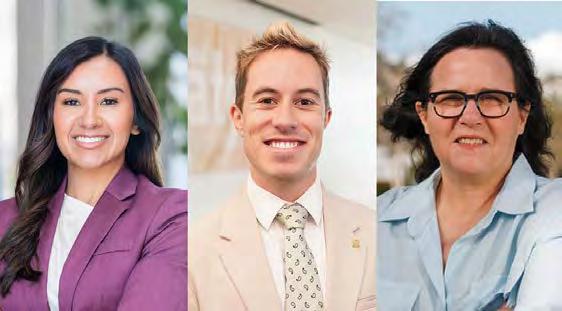
Annalisa Perea of Fresno, left, Eli Beckman of Corte Madera, and Ellen Evans of Los Angeles were among the LGBTQ candidates who sought California legislative seats in Tuesday’s primary.
Courtesy the candidates
San Francisco Community Health Center CEO Lance Toma, left, and San Francisco AIDS Foundation CEO Tyler TerMeer, Ph.D., worry about funding cuts for HIV/AIDS programs.
Rick Gerharter
Lurie unveils $16.9 billion SF budget proposal
by John Ferrannini
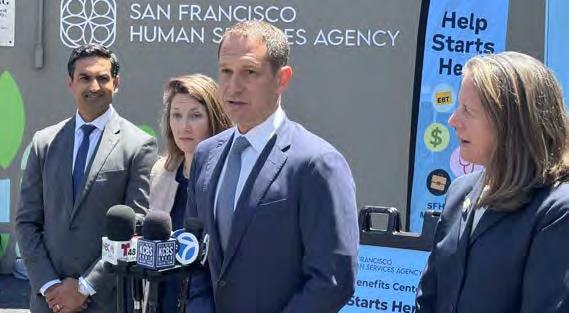
San Francisco Mayor Daniel Lurie
unveiled his long-awaited $16.9 billion two-year balanced budget proposal June 1. The spending plan, which needs approval from the Board of Supervisors, closes a $642 million deficit while keeping the number of additional layoffs from city jobs to nine.
The proposed budget came after Lurie’s office announced late last week that cuts to some LGBTQ-serving institutions were able to be averted to the tune of $2 million.
More than 100 city layoffs were announced in April.
It’s been widely anticipated this budget year would be a gloomy one, as the city faces a structural budget shortfall.
If Lurie’s budget were to be approved by the supervisors (which has an August 1 deadline), the city will reduce spending by $300 million so its expenses better match its revenues. Nevertheless, the structural deficit is expected to balloon to $1 billion by 2029.
The board, led by budget chair District 1 Supervisor Connie Chan, will begin holding meetings on Lurie’s proposal. Chan did not respond to a request for comment Monday.
Unions and nonprofit organizations have been outspoken in opposing the Lurie administration’s cuts to social services. The mayor told reporters after he announced his proposed budget Monday that he understood those concerns.
“Every single day I’m out on the street there are people telling me about how these cuts impact them, and I hear them, and I know these have real impacts on people, not just city workers,” Lurie said. “I hope what you’re hearing today is we are focused on working families. We are focused on young people that need the help of the city, where we’re going to take care of them to the best of our abilities – but we have a budget, we have to live within that budget.”
Lurie said that he tried to balance the needs of the city’s most vulnerable populations with the fiscal blows the city is taking due to federal cuts that are part of HR 1, President Donald Trump’s 2025 One Big Beautiful Bill Act, which is having massive impacts on health and food security programs.
“Just as our city was getting back on track, the federal government passed HR 1, making it harder for people across this country to access the critical healthcare and food assistance they depend on,” Lurie said in livestreamed remarks before the press gathering. “When people lose healthcare coverage, they turn to our public hospitals. And when the federal government cuts funding, those costs fall to the city of San Francisco – unless we help people keep the benefits they need.”
Earlier this year, the city’s health commission OK’d $17 million in cuts – including grants to LGBTQ and HIV/AIDS nonprofit organizations –after that money had been removed from the Department of Public Health’s budget last year.
The total amount DPH is getting this year is actually more than last year, and so the Bay Area Reporter asked the mayor if additional cuts to DPH grants are on the way. Staci Slaughter, Lurie’s outgoing chief of staff, responded that there aren’t any more grant cuts that haven’t been announced coming down the pike.
“Last year, we had assumed an additional $17 million in cuts in year two of the budget. This year we don’t have any assumptions like that on the grant side, so the cuts that are out there from the CBO [community-based organizations] perspectives are already identified,” she said.
While there are only nine more staff layoffs in this budget, there are over 400 vacant positions across city government that are going to be eliminated. Those are opposed by International Federation of Professional and Technical Engineers Local No. 21, which represents city workers. Labor has also pledged to fight the 127 layoffs announced earlier this year.
Service Employees International Union Local No. 1021 Vice President Kristin Hardy was “pleased and relieved” that there weren’t additional layoffs. She added that if San Francisco is, as Lurie says, a city recovering and on the rise, “we need our city workers to keep up that progress” and that “we want to ensure that nonprofits providing critical public services have the funding they need to retain the frontline workers who do that hard work every day.”
Hardy also asked voters to vote for San Francisco Proposition D, which would raise the taxes the city collects from some large businesses when their highest-paid executive earns over a hundred times the median compensation. Lurie opposes the measure.
At the press availability, Lurie said if Prop D did pass, the city wouldn’t see revenue for 18 months.
“We have to be fiscally disciplined now,” he said.
The budget states that the city is providing $6.5 million in Fiscal Year 202627, and $6.9 million in Fiscal Year 202728, for the Free City College program for San Francisco residents who qualify for in-state tuition at California’s com-
munity colleges so they can attend City College of San Francisco.
According to a mayoral spokesperson, while everyone will have access to the Free City College program, another program that was giving cash grants on top of the tuition will no longer be funded.
Some cuts averted
According to a mayoral spokesperson, the effects of certain city departments’ budget proposals on some LGBTQ-serving institutions were initially more severe than what was eventually announced June 1. That’s because the vast majority of cuts housed under the Mayor’s Office of Housing and Community Development, and the bulk of the planned cuts for MOHCD itself, were ultimately averted.
This, the spokesperson said, is because the city wants to send a statement of support to the LGBTQ community amid the more difficult national environment with a Republican-controlled Congress and presidency.
Lurie stated as much to the B.A.R. last week.
“In this budget, we’re standing up for San Francisco’s communities and our values,” he stated. “As the federal government targets trans and LGBTQ+ communities, we’re stepping up with investments to protect the organizations that San Franciscans rely on. Our trans and LGBTQ+ communities have shaped who we are as a city, and we will have their backs – in this budget and every day.”
The mayor reiterated that during his livestream announcement, made from a benefits center in the Mission district.
The organizations that will maintain current funding levels are LYRIC Center for LGBTQQ+ Youth, the San Francisco Community Health Center, the Asian Women’s Shelter, El/La Para TransLatinas, Miss Major Alexander L. Lee Transgender GenderVariant & Intersex Justice Project the Black Trans Cultural Center, the San Francisco LGBT Community Center, and the Transgender Advocates for Justice & Accountability Coalition, or TAJA.
Lance Toma, a gay man who leads the community health center, told the B.A.R. during a phone interview May 29 that, “It looks like the funding from MOHCD may have been restored. We still have other cuts in the DPH [Department of Public Health] budget.”
Asked to clarify, Toma said that he was referring to cuts in the center’s budget for capacity building and training programs out of last year’s budget that the department signed off on earlier this year.
Further, $300,000 will be added in the budget at the Human Services Agency to hire eligibility workers who will help trans and nonbinary people navigate the job market, according to the mayoral spokesperson.
San Francisco Mayor Daniel Lurie, flanked by health and human services adviser Kunal Modi, left, outgoing chief of staff Staci Slaughter, and budget director Sophia Kittler, right, spoke to reporters after he unveiled his proposed budget June 1.
John Ferrannini See page 10 >>
Today, the longest-acting complete regimen is Cabenuva, ViiV Healthcare’s injectable cabotegravir and rilpivirine combination, which is administered once monthly or every other month. An injectable formulation of lenacapavir (branded as Sunlenca) is given just twice a year, but it currently has no equally durable partners to build a complete treatment regimen.
That’s likely to change in the coming years. At this year’s Conference on Retroviruses and Opportunistic Infections, researchers reported promising early data on experimental antiretrovirals from ViiV (VH184 and VH499) and Gilead (GS-3242) that could potentially be given every six months. Both companies are also working on broadly neutralizing antibodies, which target hidden parts of the virus, as partners for long-acting injectable antiretrovirals.
HIV prevention
Turning to prevention, the daily PrEP pills Truvada (tenofovir disoproxil fumarate/emtricitabine) and Descovy (tenofovir alafenamide/ emtricitabine) reduce the risk of HIV acquisition by around 99% if used consistently. Yet only about a third of the estimated 1.2 million people who could benefit from PrEP are using it, according to the CDC. Clinicians and advocates hope longer-acting options can help close the gap.
CEO
page 3
“The diversity of gender and sexual orientation is just the surface of diversity within the chorus: diversity of age, diversity of immigration status, of HIV status, and the rest,” Paulino explained.
Likewise, he expressed excitement for Sugata’s appointment as a nonbinary executive of the chorus. “Having Lane
<< SF budget
From page 9
The city’s deficit threatened two grants the Castro Community Benefit District receives annually, its executive director Andrea Aiello told
From page 1
“We have built a force in this city, and we are going to change this city,” he said. “We are going to change this country. We’re not going anywhere.”
Chakrabarti, dogged by accusations he tried to buy himself a House seat in a city he barely lived in or understood politically, conceded Wednesday morning.
“I want to congratulate Sen. Scott Wiener and Supervisor Connie Chan on their victories and thank everyone who participated in this election,” he stated. “While this wasn’t the outcome we hoped for, I’m incredibly proud of what we built together. Thousands of volunteers and supporters came together around a vision for changing our part to stop the corrupting influence of corporations buying our elections.”
Wednesday morning the San Francisco Department of Elections said it
HIV money From page 8
“That’s a huge concern because starting in July, those folks could lose medical coverage,” Toma said, adding “up to one-quarter of our patients could lose coverage.”
City budgetary pressures have already affected both agencies. In March, the city’s Department of Public Health approved $17 million in cuts to community-based organizations based on last year’s budget. SFAF and SFCHC were among the CBOs that took hits. SFAF’s cuts totaled $700,000 and impacted its health access points and clinical assistant program; SFCHC lost $139,000 that
Dr. Susan Buchbinder, director of Bridge HIV at the San Francisco Department of Public Health, assessed progress over the years.
“We’ve made tremendous strides in both HIV prevention and treatment over the last few decades,” Buchbinder stated. “Now, a person who may be exposed to HIV can prevent infection with a single shot every two months, a double shot every six months, or daily pills or pills just around the time of sex.
“There are new products in development – shots maybe as infrequently as once a year and a monthly pill, both of which could be further major breakthroughs in HIV prevention. However, we still need HIV prevention and treatment research, to make regimens easier to take, to address individual’s needs for products, to study how to scale up prevention and treatment, and hopefully to get us to an effective HIV vaccine and HIV cure,” she added.
Last year’s big news was the approval of injectable lenacapavir (branded as Yeztugo) for twice-yearly PrEP. In two large studies, lenacapavir PrEP dramatically reduced HIV acquisition among young cisgender women in Africa and gay and bisexual men and genderdiverse people in the United States and six other countries. Early studies suggest that the interval could potentially be extended to once yearly. But lenacapavir’s high price and lack of clarity about insurance coverage have slowed its rollout in the United States, and federal funding cuts have limited its distribution in low-income countries.
and who they are as a person be such a prominent role in our leadership is critical,” Paulino said.
While “honored” to serve as the chorus’s first nonbinary CEO, Sugata described in an email statement ultimately viewing “that milestone less as a personal achievement than as a reflection of the organization’s evolution.”
Sugata referenced the chorus’ movement over time toward broader inclu-
the B.A.R. last month. The first is a $100,000 grant to maintain Jane Warner Plaza in the Castro for 40 hours a week. The second $415,000 grant funds four visible full-time community ambassadors who are trained in deescalation and outreach. These
had 122,400 remaining ballots to tally.
A new count for the U.S. House race will be posted by 4 p.m. Thursday, June 4. Coming in fifth with almost 5% of the vote is former Republican-turnedDemocrat Marie Hurabiell. The former Trump appointee’s last-minute, longshot campaign earned her the scorn of local officials, including San Francisco Mayor Daniel Lurie, for her attacks on Wiener that were characterized as homophobic by opponents.
Hurabiell thanked supporters as returns began to come in at her campaign party.
“We built something real here,” she said. “We spotlighted a bunch of critical issues along the way: common sense moderate values like public safety, affordability, and sex-based spaces and rights.”
Also making the primary ballot was gay Castro resident Keith Freedman.
The local small business owner ran in the 2024 San Francisco mayoral race. He received less than 1% of the primary vote.
was part of transgender health capacity building assistance. SFAF estimated that the total in proposed cuts to HIV-related programs, services, and capacity building amounted to $1.32 million.
Though there are more cuts to health programs being considered, TerMeer wasn’t aware of any coming up based on Lurie’s budget proposal.
City leaders “have been fairly upfront and transparent with us at SFAF because of the scale we’re being hit,” he said.
Lurie’s outgoing chief of staff Staci Slaughter seemed to confirm that at a June 1 news conference, saying, “Last year, we had assumed an additional $17 million in cuts in year two of the budget. This year we don’t have any assumptions like that on the grant side, so the cuts that
A twice-yearly shot may seem vaccine-like, but lenacapavir is an antiretroviral drug that stops HIV replication, not a vaccine that trains the immune system to fight the virus. Like Deeks, many experts think that only a vaccine – in particular, one that offers durable protection – can end the epidemic.
Despite decades of effort and billions of dollars, HIV vaccine research has yielded a string of disappointments. One after another, traditional vaccine approaches have failed to provide protection in clinical trials. The last large trial, PrEPVacc, was halted in 2023 after data showed that there was little or no chance that the tested vaccines would demonstrate efficacy.
But scientists have not given up, turning to more sophisticated strategies. Some studies have tested broadly neutralizing antibodies for prevention, but again, results have been disappointing. Currently, the most promising avenue is germline targeting, which uses a series of primer and booster vaccines to train the immune system to produce its own broadly neutralizing antibodies. If this approach requires multiple vaccines given over time, however, it might be no more practical than long-acting PrEP.
“A vaccine generally mimics the body’s natural immune reaction to a virus, which usually results in it being cleared,” former National Institute of Allergy and Infectious Diseases director Dr. Anthony Fauci once explained. “But with HIV, it doesn’t. So a vaccine has to elicit an immune response that’s better than nature, and that’s hard to do.”
sivity in regards to both identity and leadership.
“What excites me most is that the Bay Area is home to extraordinary trans, nonbinary, and queer artists, organizers, and cultural leaders,” Sugata stated. “I see the chorus and the Chan Center as part of a broader ecosystem working to affirm the dignity, creativity, and humanity of those communities. In that sense, being the first nonbinary CEO is less
grants will not be cut, the mayoral spokesperson said.
Aiello, a lesbian, told the B.A.R., “I am thrilled to learn this and thrilled to learn of the additional critical LGBTQ-related funding put back in the budget.”
“Thank you to Mayor Lurie for lis-
Around the state
Gay incumbent Congressmembers Mark Takano (D-Riverside) and Robert Garcia (D-Long Beach) easily took first place in their respective primary races as they seek reelection this fall. Takano has nearly 57% of the vote, and Garcia is at 54.5%.
As for the closely watched contest to succeed retiring Congressmember Darrell Issa (R-Vista), the two Democratic frontrunners bisexual San Diego City Councilmember Marni von Wilpert and Navy Reserve officer Ammar Campa-Najjar are currently in second place and third place, respectively. Campa-Najjar, who previously lost to Issa, has nearly 10% of the vote, while von Wilpert is at 20%.
In first place is Republican San Diego County Supervisor Jim Desmond with 41%. It appears he will be running against von Wilpert come November. “The voters of this district want to
are out there from the CBO perspectives are already identified.”
The city’s health department declined requests for an interview for this report.
The B.A.R. asked if the department could discuss the effects of HR 1 on the city’s health infrastructure as it relates to HIV, and if it could shed light on the decision making process surrounding the $17 million in CBO cuts.
In an emailed statement, the department stated, “Facing a two-year citywide deficit of $643 million – including more than $300 million in federal and state Medi-Cal/Medicaid cuts – SFDPH and the Mayor’s Office worked together to shield core services from the full effect of those reductions. The department will re-
Cure research
The ultimate goal is a cure for HIV, but here too, research has proceeded slowly with many setbacks. While antiretrovirals can suppress viral replication indefinitely, HIV inserts its genetic blueprints into the DNA of human cells and establishes a long-lasting viral reservoir that is unreachable by antiretrovirals and usually invisible to the immune system, making a true cure nearly impossible. Even with treatment, HIV causes persistent immune activation and chronic inflammation that can lead to a host of health problems and accelerated aging.
Only 11 people are known to have been cured after stem cell transplants for cancer treatment, most recently a Toronto man whose case was presented at the Canadian Association of HIV Research Conference in April. The procedure is too risky for people without life-threatening cancer, but each new case offers clues that could help scientists develop a more accessible functional cure, or longterm remission without antiretrovirals. Many cure approaches have been studied, such as locking HIV in an inactive state so it can never replicate, flushing the virus out of resting cells so it becomes susceptible to antiretrovirals, and boosting the immune system to better recognize and attack the virus.
Deeks presented findings from a small study of CAR-T therapy for HIV at the American Society of Cell and Gene Therapy annual meeting last month. Best known as a treatment for cancer, CAR-T involves removing a
about me than it is about the future we’re building together.”
It’s a sentiment present in Sugata’s understanding of the SFGMC’s continued importance.
“In moments like this, organizations like the chorus matter not only artistically, but civically, and that’s part of why music matters,” Sugata reflected at the conclusion of their interview. “It gives people a way to find each other, imagine a different
tening to the needs of the Castro, and to President Mandelman and his staff for constantly keeping the Castro front and center in budget negotiations,” she added, referring to gay District 8 Supervisor Rafael Mandelman, who leads the board. “We’re filled with gratitude to
take back Congress, they want to afford to live and provide for their families, and they want to take back our country from Donald Trump. I’m energized by these super strong early results and ready to continue the fight to take back Congress,” stated von Wilpert after her campaign said she had taken a “commanding lead” Tuesday night.
Two gay men also sought the seat. Entrepreneur and trained economist Brandon Riker is at 7% of the vote, while comic book seller Ferguson Porter has less than 1%. Fellow Democrat Corinna Contrera, a queer member of the Vista City Council, is at 4.6% of the vote.
In another Southern California race, gay Democratic Los Angeles U.S. House candidate Todd Lombardo was one of seven people challenging Congressmember Sydney Kamlager-Dove (D-Los Angeles) for her 37th House District seat. She easily took first place
ceive General Fund support to offset the unprecedented federal cuts and identified $340 million in savings through additional revenue and operational efficiencies that minimize the impacts to staff and patient programs. This includes the City of San Francisco continuing to backfill reductions in federal HIV services funding by approximately $25 million per year.”
Lurie, like previous mayors, has promised to work to backfill federal cuts related to HIV/AIDS.
The department also stated, “SFDPH has and will continue to invest significantly in services that aim to reduce HIV transmission in communities across San Francisco, so we
sample of a patient’s T cells, inserting artificial receptors and reinfusing the “living drug” back into the body.
Of the nine participants who received T cells reprogrammed to target HIV, one has maintained an undetectable or very low viral load for nearly two years after stopping antiretroviral treatment, a second has been in remission for almost a year, and a third showed transient, or temporary, viral control for about three months. All three participants started antiretrovirals soon after infection, adding to the evidence that very early treatment improves the prospects for a functional cure.
Many experts think that achieving a functional cure will require a combination approach. Current strategies are complex and expensive, however, so they are unlikely to be accessible to the millions of people living with HIV worldwide, largely in resource-limited countries. On the other hand, this is just the population that stands to benefit most from a one-and-done cure because they have limited or sporadic access to lifelong antiretroviral treatment, especially given cuts to international aid. While an HIV vaccine and a functional cure remain on the distant horizon, people living with HIV can look forward to better prevention and treatment options in the near and mediumterm future, many researchers believe. But experts warn that continued progress requires steady funding of medical research, which is jeopardized under the Trump administration. t
future, and remember they’re not alone.”
The San Francisco Gay Men’s Chorus will present “Dolly! A Pride Show” featuring 225 singers, dancers, and musicians in performances on Saturday, June 6, at 5 p.m. at the Green Music Center on the campus of Sonoma State University, Rohnert Park, and Saturday, June 13, at 1 p.m. and 7:30 p.m. at the Curran Theatre in San Francisco. For tickets and more information, visit sfgmc.org. t
the 600-plus people who sent emails to Mayor Lurie on the CBD’s behalf. Your support means the world to us!”
The five other organizations didn’t return comment by Monday afternoon. Mandelman didn’t return a request for comment for this report. t
with nearly 55%, and appears set to sail to victory in the fall against Republican Baltazar Fedalizo, who is at nearly 14% of the vote. As for Lombardo, he’s in sixth place with 3.3% of the vote. Meanwhile, in the East Bay race for the state’s 14th House District seat, gay San Leandro City Councilmember Victor Aguilar Jr. fell short in the race to succeed disgraced former congressmember Eric Swalwell, who resigned this spring amid a sexual misconduct scandal and ended his bid to be California’s next governor. As expected, state Senator Aisha Wahab (D-Hayward) took first place with 35% of the vote, according to the unofficial returns. In second is former Dublin mayor Melissa Hernandez, now president of the board that oversees regional transit agency BART, with 16.2%. while Republican Wendy Huang is just 125 votes behind her for third place. t
can continue the progress made over the past decade.”
“Every decision in SFDPH’s proposed budget was made with one goal: preserving the public health system San Franciscans depend on and ensuring patients continue to receive the care they need, where they need it,” the department added.
Now it’s up to the Board of Supervisors to consider Lurie’s budget proposal – and likely make revisions – with an August 1 deadline.
Gay Board of Supervisors President Rafael Mandelman, who as District 8 supervisor represents the LGBTQ Castro neighborhood, didn’t return multiple requests for an interview. t
<< Chorus
Wiener
by Brian Bromberger
It all began with a notice.
“This festival was coordinated by reaching out to gay filmmakers in the Bay Area through word of mouth, notices on bulletin boards and in laundromats, short articles in local magazines, etc. Therefore, our viewpoints and perspectives are diverse. One thing brings us together—our love of making films and our desire to reach out to the community at large. We hope you enjoy our program.”
The festival in reference later became the Frameline International LGBTQ Film Festival, but had a very modest beginning, having been organized in 1976 and happened in 1977. Its founding members were Berne Boyle, Greg Gonzales, Marc Huestis, Ric Mears, Daniel Nicoletta, Wayne Smolen, and David Waggoner. Only Huestis, Nicoletta, and Mears are still alive. The Bay Area Reporter spoke with all three men.
Indirectly, Frameline owes its roots to Harvey Milk. Huestis wrote in his autobiography, “Impresario of Castro Street: An Intimate Showbiz Memoir,” “In 1977 I was a prolific film-maker. I needed to buy and develop vast amounts of Super 8 film. The only place to go was a half-block away from my apartment at Castro Camera, owned by Harvey Milk and his lover Scott Smith. Manning the front desk was an adorable young waif named Danny Nicoletta. He looked about 13 years old [he was actually 23].
“Danny was a photographer and filmmaker, and parenthetically, one of my fans (he had shot my Bay Area stage debut in ‘Paris Sites’). Danny and I had much in common: both East Coast kids with show gal moms. We were born three days apart, both 1954 Christmas babies – Capricorn
The birth of the Frameline Film Festival
sisters! The connection was instant.”
Nicoletta added, “I was in a good position to put artists and filmmakers together socially as the camera store was a lovely hub of ’60s-style networking.”
Other Super 8 gay filmmakers would drop off films for processing and join in discussions on filmmaking.
by David-Elijah Nahmod
Imagine being thirty or so years old and watching all your friends die while wondering when your own time was going to come. For many gay men who came of age in the 1970s and ’80s, this was their reality.
The AIDS pandemic decimated the San Francisco gay community. Thousands and thousands of young gay men died horrible deaths, some
only days after falling ill. In 2011, filmmaker David Weissman, who himself lived through the epidemic, released the feature-length documentary
“We Were Here,” a touching look back at how the epidemic affected the local gay community. The film will screen, with Weissman in attendance, on June 10 at the main branch of the San Francisco Public Library in the Koret Auditorium. The screening commemorates the 15th anniversary of the film’s release.
“We Were Here” features interviews with four
Huestis recalled, “We called it The Gay Film Festival of Super 8 Films. We formed a loose collective and met in my Castro Street flat. I’d like to claim that I co-founded the festival out of some altruistic, utopian vision of a burgeoning new gay culture. But really I just wanted my ego stroked and get my damn movies shown. And there was safety and power in numbers.”
survivors and a nurse who took care of the sick. There’s Daniel, an artist who lost two lovers and most of his friends, but who managed to survive his own HIV diagnosis. Daniel’s interviews are powerfully moving as he catches his breath, recalling the pain he felt, and still feels, after living through so much loss.
There’s Guy, the beloved flower man of Noe Street, who sometimes gave his flowers away for free to people who were arranging memorials and could not afford to pay. Guy’s eyes well up with tears as he speaks of sitting by his flower stand watching sick people go by, many of whom would “disappear” a few days later.
There’s Eileen, the nurse who provided care to so many of the sick and dying. Community activist Ed Wolf also recalls his experiences.
The film recalls Bobbi Campbell (1952-1984), one of the first AIDS activists. In 1981 Campbell placed photos of his Kaposi’s Sarcoma lesions in the window of Star Pharmacy on Castro Street. But Campbell wasn’t the only one. In the late 1980s, ACT-UP, the AIDS Coalition to Unleash Power, let their rage boil onto the streets after years of government inaction regarding the crisis. Many gay men who were dying took part in these actions, knowing full well that they would never live to see the results of their efforts, yet they persevere, hoping to save the lives of those who came after them.
One group who got a well-deserved homage in the film is the lesbian community. As the pandemic raged, thousands of women stepped up to the plate and did whatever they could to help care for the sick.
The Bay Area Reporter made a few cameos in the film. During one moving sequence, Weissman shows viewers a collage of hundreds of pho-
Loosely curated
Huestis was instrumental in setting up the festival itself. “Besides having several films in the program, my life was dedicated to organizing the festival, writing press releases on a battered manual typewriter and copying them on a dilapidated Xerox machine. Silvana Nova designed the fire engine red poster and Neighborhood Arts donated the printing. Soon I covered every telephone or streetlight pole with our agitprop art advertising the festival.”
Huestis mentioned that the festival was loosely curated.
“Show up to a meeting and your film was most likely in,” he said, “with one glaring exception. Rob Epstein’s submission, which featured his lover John Wright naked in a bathtub, intercut with shots of his cat cleaning herself. The group decided his short was “not gay enough” and rejected it. Of course, Rob later won two Oscars for his groundbreaking documentaries: 1984’s ‘The Times of Harvey Milk’ and 1989’s ‘Common Threads.’”
The festival was held at 32 Page Street on February 9, 1977. The upstairs flat was the Ed Mock Dance studio where he gave dance lessons and held public performances. Nicoletta remembered, “The building was co-owned by Hank Wilson, who was likely lending or renting that space to community endeavors that needed a wide-open room like that. Hank Wilson was a great community builder and the space was often referred to as a gay community center. I doubt if we paid rent that night. I imagine it was pro-bono in the spirit of what we were up to. There was also no door charge and I believe there was no hat passed either then.”
Humble debut
Nicoletta lent his Super 8 projector.
“We had two projectors, and one on a little table in the center of the room,” he said. “I can’t remember, but we must have had a cassette tape recorder connected to a PA system because many of us had separate soundtracks on cassette. Each filmmaker managed their own pairing, so my guess is the cassette tape recorder was also right there on or near that little table. Frameline currently owns that projector, though it is non-functional.”
Nicoletta also submitted a film for that first festival.
“It was about 30 minutes and was comprised of five short vignettes that were semi-autobiographical in nature and included a same-sex kiss
page 14 >>
tos of people who died. These photos were from a special issue of the B.A.R., and underscored the magnitude of the devastation that the community was enduring. Also shown in the now legendary “No Obits” headline from the B.A.R., published a few years later when newly released drug cocktails had begun extending people’s lives. These days, thanks to those cocktails, AIDS is, for the most part, a manageable, chronic disease. But for gay men who lived through and survived the 1980s and ’90s, AIDS was a horror they will never forget.
In an interview with the B.A.R., Weissman spoke of his experiences in making this important documentary.
David-Elijah Nahmod: What inspired you to make this film?
David Weissman: The idea came up in a conversation with a much younger boyfriend at the time who had heard me tell many stories about the epidemic and said somebody needs to make a documentary, because my generation knows that we’re supposed to be wearing condoms but we don’t really know much about the history. And my immediate reaction was there’s no way in the world I’m going to make a documentary about AIDS, and then that changed in about a minute. I realized that this was something that was important to do and that I was the person to do it.
What made you feel it was important to do? I realized that it was important to capture that history. Also, the way the epidemic played out starting in the late ’90s is that it started becoming less and less central in our lives as the death rates started
page 19 >>
The poster for the first SF Gay Film Festival in 1977
From shadows on a bedsheet to an international event
picture
A group of friends bring a friend with AIDS to watch a sunset; photo used in the film ‘We Were Here’
A love letter to the cult phenomenon
by David-Elijah Nahmod
It’s hard to believe that “The Rocky Horror Picture Show” has been playing for 50 years in cinemas with no end in sight. And the play that inspired the film, which opened in London in 1973, is currently one of the hottest tickets on Broadway.
“Rocky Horror” is indeed a phenomenon that has inspired millions of people to let their hair down, explore their sexual and gender identities, and just have a rocking good time.
“Strange Journey: The Story of Rocky Horror” is a lovely new documentary that explores the complete story of this most unusual of occurrences. As the doc opens, “Rocky” creator Richard O’Brien is visiting his New Zealand hometown, where he visits a statue that has been erected in his honor and meets the woman who now lives in his childhood home.
“We call it the ‘Rocky Horror’ house,” she says, as she and O’Brien shake hands.
The film then flashes back to late 1960s London. Filmmaker Linus O’Brien, Richard’s son, has his father recall his early days in London’s musical theater scene. After failing to get a role in “Jesus Christ Superstar,” the elder O’Brien takes his love for horror and science fiction films and creates a very gay homage to those films, a musical which became “The Rocky Horror Show.”
The play opens in a small, sixtyseat theater for a three-week run and quickly sells out. It moves to a larger theater where it continues to be a smash. It then moves to Los Angeles,
From page 13
between me and my then boyfriend Esme. At that point in the ’70s, like many peers I was all fired up with the notion that coming out was a courageous political act.”
Huestis remembered, “We couldn’t afford to rent a screen, so we hung a funky white bedsheet. I even ironed it! Two hundred people arrived for a space that could only accommodate 100. The overflow was turned away (except for Harvey Milk, whom we ushered in). Tobacco smoking was absolutely forbidden, but the sweet smell of pot perfumed the air. We ran the films, coping with the numerous film splices that broke and the audiocassette soundtracks going out of sync. The audience didn’t care; they were
where movie stars come out to see it. Can a film version be far behind?
Well, how ‘bout that?
The majority of “Strange Journey” focuses on “The Rocky Horror Picture Show,” as the film came to be called, and includes a lengthy segment on the film’s production. Besides creator O’Brien, interviewees include director Jim Sharman, and actors Tim Curry (Frank N Furter), Patricia Quinn (Magenta), Nell Campbell (Columbia), Susan Sarandon (Janet), Barry Bostwick (Brad), and Peter Hinwood (Rocky). There are also extensive interviews with drag artist Trixie Mattel and actor Jack Black, who discuss how seeing the film inspired and affected them. “Rocky” cast members, among
there to see images of the lesbian and gay community, something rarely addressed by the Hollywood machine.”
Miracles and poodles
Louis Biedak, better known by his drag stage name Lulu, attended that first festival. Marc Huestis directed his drag show, “Strange Fruit,” which had been playing at 32 Page Street. Lulu says he hung up the (cum-stained) bed sheet which acted as the movie screen.
“People were sitting on the floor –there were no chairs– smoking cigarettes and joints,” said Biedak. “It was all exciting, as we knew this gathering was the first of its kind. It raised the consciousness of our community and we all wanted to support the filmmakers.”
other things, sing the praises of the late Meat Loaf (Eddie) who nearly stole the show in his one-scene appearance.
It’s hard to believe today, but when “The Rocky Horror Picture Show” first opened in 1975, it was a bomb. But then an executive at 20th Century Fox came up with the idea of playing it weekends at midnight, and the cult was born. It didn’t take long for people to start talking back to the screen and dressing up as their favorite characters. Then came the shadow casts, fans who would act out the entire show in front of the screen as the film unspooled. These midnight screenings, which spread around the world, attracted straights, LGBT people, liberals and others, all caught up in the magic of this unusual phenomenon.
“Five days a week I’m a nurse,” says
one young woman. “Two nights a week I’m a star.”
“Strange Journey” also pays homage to the late Sal Piro, former president of the Rocky Horror Picture Show Fan Club and the author of two books about the film. Piro was openly and unapologetically gay, and he didn’t care who knew it or what they thought of it. He was who he was, and let many “Rocky Horror” fans know that it was okay to embrace who they were. Piro, who lived and breathed “Rocky Horror,” is as responsible for the spreading of the cult as is Richard O’Brien himself.
The documentary also addresses Richard O’Brien’s gender identity. He says that he is 70% male and 30% female, another signpost to the fans that it’s okay to be who you are. This is an
especially important message right now, given the attacks that the trans community is dealing with.
“Strange Journey: The Story of Rocky Horror” is a terrific tribute by a loving son to his father’s work, a film that will continue to live on long after we’re all gone. It’s a work that’s as timely today as it was fifty years ago.t
‘Strange Journey: The Story of Rocky Horror’ is streaming at Apple, Amazon and Fandango June 2; a Blu Ray release is TBA. www.rockyhorrordoc.com
‘The Rocky Horror Picture Show’ continues to have monthly screenings (next: June 27) at the Balboa Theater, 3630 Balboa St. www.balboamovies.com
In addition to Huestis’s “Miracle on Sunset Boulevard,” “The Poodle Poo-Poo Miracle Mask,” “Cliché in the Afternoon,” and Nicoletta’s abovementioned film, also screened was Ric Mears’ “Laundromat,” “a typical American housewife comes clean at the laundromat.”
There were four short films by Wayne Smolen, including “Garbage Can Man,” “that shows what can happen spontaneously with an open field, two people, a camera, and a free afternoon.”
Bernie Boyle contributed “Untitled,” “self-consciously gay and crude in more ways than one.” Ken Wards’ “A Bicentennial Film” is described as “two conflicting views of our late (great?) two hundredth birthday by a novice filmmaker.”
Activist Cleve Jones contributed his “A Woman One Day” (no description). And T.K. Perkins’s “Dedicated to Those Days,” inspired one morning while on his way to work. He was enrolled in film school at San Francisco State University.
Animated response
Ric Mears, who had moved to San Francisco in 1975, began studying film and animation at SFSU. He saw Huestis’s posters for a Gay Film Festival of Super 8 Films. He showed some of his films at the festival.
“One of my films was synchronized with music, “Continuum 2,” my second short film that included about one minute of animation that took almost six months to make,” said Mears. “It looks absolutely primitive today, but
Above: David Waggoner working at Castro Camera, winter 1977
Below: Marc Huestis directs Lulu in a scene from his film, ‘Unity,’ December 4, 1977
audiences always applauded back then because of the emotional impact when sound and image dance together.”
Mears recalled that the movies screened varied quite a bit.
“Most were fairly short, under 10 minutes long, so if you didn’t like one, you didn’t have to wait too long for another. A few were film class homework projects; others were just for fun. Some had quite memorable imagery, such as Marc Huestis’s film with Silvana up on a cliff clad in reams of sheer fabric blowing in the wind. A beautiful scene of Danny Nicoletta and his boyfriend each leaning out facing bay windows to romantic music.
“Wayne Smolen’s first-person view of him hanging from a parasail with the Beatles’ ‘Help’ playing. Or Bernie Boyle’s outrageously funny ‘A to Z (almost) a gay alphabet,’ illustrated flashcard with A is for assless chaps, B is for… you get it. I’ll never forget getting to M is for masturbation with a Mickey Mouse hand puppet! The films were not all G-rated, not rated at all.”
Film as existential tool
Asked what commonalities they saw between the festival’s humble beginning and what it has grown into << Frameline’s origin
See page 15 >>
Right: Patricia Quinn, Tim Curry and Nell Campbell in ‘The Rocky Horror Picture Show’ Left: Richard O’Brien in ‘Strange Journey: The Story of Rocky Horror’
Both Photos: Daniel Nicoletta
Q-Music: Women up front and on the road
by Gregg Shapiro
Ranging from pop to punk, folk to rock, women-led bands have new albums and are on tour, including The Beths, Carolina Chocolate Drops, Ladytron and Case Oats.
Since the late 2010s, New Zealand quartet The Beths, led by Elizabeth Stokes, have been releasing increasingly poppy and accessible albums, exemplified by its latest, “Straight Line Was A Lie” (Anti-). Stokes’ distinctive Kiwi accent gives the songs a charming quality. This is true when she’s performing bristling 21st-century power-pop/ punk numbers such as “No Joy,” “Take,” and the title cut. It also applies to the funky “Best Laid Plans” (deserving of an extended remix), and sweeter tunes including “Metal,” “Mosquitoes,” and “Roundabout.” www.thebeths.com
Hailing from (relatively) nearby Australia, Folk Bitch Trio lives up to the folk of its name on its harmonyinfused debut album “Now Would Be a
Good Time” (Jagjaguwar). This Aussie threesome – Gracie Sinclair, Heidi Peverelle, and Jeanae Pilkington – is certain to remind some listeners of Boygenius (Julien Baker, Phoebe Bridgers, and Lucy Dacus) and Case/Lang/Veirs (Neko Case, k.d. lang, and Laura Veirs).
However, on original and memorable songs such as “Hotel TV,” “Cathode Ray,” “The Actor,” and “That’s All She Wrote,” as well as a cover of Ted Lucas’ “I’ll Find A Way (To Carry It All),” these three talented women firmly establish their own unique identity. www.folkbitchtrio.com
Originally released in 2010, the Grammy Award-winning album “Genuine Negro Jig” (Nonesuch) by Carolina Chocolate Drops has been reissued as an expanded double-LP anniversary edition featuring a multitude of bonus tracks. A trio specializing in old-time music, Carolina Chocolate Drops featured vocalist and multiinstrumentalist Rhiannon Giddens before she went solo in the mid-2010s.
One of the things that stands out about this recording is the way that while CCD remains steeped in a traditional musical style, they have no trouble addressing contemporary material, epitomized by the brilliant cover of Blu Cantrell’s “Hit ‘Em Up Style,” featuring Giddens on lead vocals. Giddens reading of “Why Don’t You Do Right?,” made famous by Peggy Lee, is also outstanding. www.rhiannongiddens.com/ carolina-chocolate-drops
fifty years later, Mears wrote that it’s all about visibility, then and now.
Nicoletta replied, “The commonalities are that the community curates itself into a teaching moment for posterity and for the larger social fabric. We barely understood that in ’77, but it wasn’t entirely lost on us that we were accomplishing that or something like that. Don’t forget this is the time when Anita Bryant launched her national assault against gays in the ballot box in Florida, which in turn politicized us in reaction to her boldness, conversely increasing ours. Which is not to bypass the trenchwork of our elders before that, but there was a kind of rude awakening in that moment in ’77 and a necessary vigorous response to it.”
Huestis also reflected on the changes since 1977.
“It’s really been quite moving to see the evolution of the festival,” he said, “from our humble beginnings of a group that came together in Harvey Milk’s camera store and showing our little Super 8 films on a white bed-
It’s shocking to realize that it’s been 25 years since British synthpop band Ladytron, led by Helen Marnie and Mira Aroyo, released its debut album. During that time, Ladytron released another eight studio albums, including its newest, the double LP set “Paradises” (Nettwerk).
At its best when keeping listeners on their feet and dancing with abandon, Ladytron offers plenty of opportunities to do just that on tantalizing tunes such as “I See Red,” “Secret Dreams of Thieves,” “Metaphysica,” “Kingdom Undersea,” “A Death in London,” and “I Believe in You.” www.ladytron.com
Pressed on exquisite ice blue vinyl, “Lost on You” (Hopeless), the seventh album by Scranton, PA’s very own Tigers Jaw features vocals by Brianna Collins, who also plays keyboards. Tigers Jaw’s sonic profile has morphed over time, but you can still
sheet, to shining artistic light to the dark days of AIDS, to fostering the new queer cinema, to star-studded gaylas and mainstreaming of LGBTQ cinema (yet still not losing our edge). And as founders and survivors we were there.
“Today there is a huge swath of all
types of films spanning the globe in many genres. Sometimes I feel like the programming has as much to do about identity as the quality of the work, but that’s the world we live in. I do feel like we were the seeds that grew into a huge tree. And that’s the common thread that makes me happy.”t
hear traces of its emo roots on “Head Like a Sinking Stone,” “Primary Colors,” and “Breezer” (with Collins singing lead on both). There are also elements of power pop on “Anxious Blade,” and unexpected beauty on “Roses + Thorns,” both of which are Collins-led. www.tigersjaw.com
In a sort of full-circle moment, it’s fitting that Spencer Tweedy, of alt-country band Case Oats, is the son of Jeff Tweedy. After all, the elder Tweedy began his music career in alt-country bands such as Uncle Tupelo and Wilco (in its early years). The main difference with Case Oats is that the lead vocalist, Casey Walker, is a woman, which gives the songs on the band’s debut album, “Last Missouri Exit” (Merge), an entirely different energy. This comes through on “Seventeen,” “Bitter Root Lake,” “In A Bungalow,” “Nora,” and “Bluff.” www.caseoats.com t
Frameline50 runs June 17-27 at eight venues. www.frameline.org
Read the full article on www.ebar.com
Above: Gay Film Festival 1978 flyer
Below: Co-founders of The SF Gay and Lesbian Film Festival, and recipients of The Frameline Award, June 2001 (Left to Right) Daniel Nicoletta, Marc Huestis and Rick Mears
‘The Testaments’
by Laura Moreno
“The Testaments” is Hulu’s sequel to the well-known series “The Handmaid’s Tale,” based on the 1985 book. Set 15 years later, it tells the story of how a heavily indoctrinated teenage girl begins to learn to think for herself. This series is a dystopian thriller about the horrors of living in a tyrannical theocracy.
In the suffocating world of Gilead, where every thought is policed and every possible future predetermined, “The Testaments” narrows its focus considerably from the broad, violent struggle of its predecessor. The new series takes place within the intimate, treacherous terrain of an elite prep school.
Based on Margaret Atwood’s powerful 2019 novel also called “The Testaments,” and adapted for television by Showrunner Bruce Miller and a team of writers, the series features impeccable performances. It is a tense, nuanced exploration of how oppression and privilege in a corrupt system often go hand in hand.
In the final episode, just released on May 27, 2026, the dour prison guard approaches a cell with Aunt Lydia and lo and behold, the guard is author Mar-
‘Kink
by Stephen LeBlanc
garet Atwood, nearly 87 years old, making a cameo appearance! Cast members have since described Ms. Atwood as “scary” in character, which doesn’t quite come across on film, but “sweet” off-camera. Margaret Atwood herself quipped that her role was “scowly.”
Life-altering solidarity
The plot revolves around Agnes MacKenzie (played by Chase Infiniti),
a student at Aunt Lydia’s academy. She is known by her deep purple uniform as holding the status of a “Plum,” one of Gilead’s chosen.
Although her life may appear comfortable, a far cry from the suffering of the Handmaids, it is a gilded cage. As daughter of a top commander, she wants for nothing, and has been schooled to become a commander’s wife. But the series masterfully cap-
Is My Superpower’
The Bay Area kink community has been telling its own stories for a long time: in zines, in leather bars, in the pages of this newspaper. This past month, a collective of some of San Francisco’s most accomplished and recognized kink activists and educators launched a new YouTube video project as part of a fundraising campaign to create a series of longer-form documentary shorts – illuminating the Bay Area’s kink community and the leading role it has played in advancing understanding of kink lives and lifestyles around the world.
The YouTube channel (youtube. com/@KinkIsMySuperpower) posts new videos every Tuesday and Thursday. It includes interviews filmed at the Folsom Street Fair and other kink events around the Bay Area, in-depth conversations with academics and cultural figures who have shaped how the world thinks about kink – among them Gayle Rubin, Carol Queen, Peter Tupper, and Mufasa Ali – and a filmed roundtable at The Armory in San Francisco with Race Bannon,
Cleo DuBois, Audrey Joseph, and others.
Team member Race Bannon is a name readers of the Bay Area Reporter will recognize. He wrote the paper’s leather column for seven years and has been an organizer, educator, and HIV prevention advocate in the leather and kink communities since 1973. These are not outside observers documenting a community. They are the community, doing it themselves.
There are also crowd-sourced video reflections from community members around the world on what kink means in their lives. The channel has an active commentary component, and all members of the community are encouraged to watch and participate. As of this writing, there are 82 videos featuring dozens of community members.
“The YouTube channel is where the community gathers every week – and it’s also how we’re building the donor base to make the documentary films happen,” said co-executive producer Beatrice Stonebanks. “They’re connected, but they’re not the same thing. One is the conversation; the other is the cinematic work that conversation
& Discussions
tures the dread of adolescence intertwined with the grotesque anxieties of living in Gilead, awaiting eligibility for the chattel marriage market.
It’s through Agnes’ eyes that the audience experiences the horror of her situation and the flicker of her defiance against it. Her deeply personal struggle is linked to the larger narrative of Gilead’s inevitable downfall.
Ultra-conservative societies are built on hypocrisy, a fear to be human, and therefore are necessarily on borrowed time. Gilead is a mafia state with a thin veneer of religiosity, like the mafioso who takes pride in his Catholicism and family values while undermining actual families through his criminality.
The dynamic shifts with the arrival of Daisy (Lucy Halliday), a Pearl Girl from Canada, a foreign missionary for Gilead, who will be mentored by Agnes. Daisy’s forthrightness and painful past become catalysts for Agnes’s eventual awakening. As the two teens grow closer, their bond challenges the rigid strictures of their world.
The series brings the novel’s queer subtext to the fore, exploring the fierce, life-altering solidarity that forms between them.
What makes “The Testaments” compelling is its realistic portrayal of complicity and the slow, painful process of unlearning indoctrination. Nonetheless, Agnes and her friends are not saints. The show does not shy away from this, even as fans root for their liberation.
It is a story about finding solidarity against the subtle, internalized prejudices of their own upbringing.
The tension builds not through action, but through whispered conversations, meaningful glances, and the constant, suffocating pressure of a society that demands their complete submission.
“The Testaments” is a powerful television adaptation of a literary masterpiece, but it is not an easy watch. Nor does it offer the catharsis of its popular prequel. But it does dig deep beneath the surface into the psychology of a world built to erase individuality, and the shared glances and hesitant confessions, radical acts out of which a new self is mapped out by those who dare to forge their own truth. It is in this internal revolution that “The Testaments” finds its haunting, unforgettable hope.t
www.hulu.com
is funding.”
The YouTube launch is the latest chapter in a years-long effort by Divine Deviance LLC, the San Francisco collective that promotes awareness of kink issues. The collective published “Kink Is: An Anthology of Surprisingly Relatable True Stories About Sex, Power, and Joy” in late 2024 through Unbound Edition Press. In its first full year, the book appeared on bestseller lists four times and was acquired by academic and public libraries as a resource for understanding kink social and health issues.
The larger ambition is the documentary film series: standalone cinematic works, each running 20 to 30 minutes, following one or two subjects at a time in a close, observational style. Directing them is Jörg Fockele, a two-time Emmy winner whose credits include reality series “Queer Eye” and “Wife Swap.” Casting and crew for the first three films are already in place; nine additional episodes are in preliminary casting.
“We didn’t want to wait for the films to be funded before showing up for this community,” said Fockele. “The
Participants in the ‘Kink is my Superpower’ project include Race Bannon, Beatrice Stonebanks and Graylin Thornton.
channel keeps us present, builds the audience, and helps us raise what we need to make something lasting.”
Early advertising partners on the channel include Mr. S Leather and TASHRA (The Alternative Sexualities Health Research Alliance). Donations to support production are tax-deductible. The project is fiscally sponsored by The Center for Independent Docu-
mentary, a 501(c)(3) nonprofit.t www.kinkismysuperpower.com www.documentaries.org/films/ divine-deviance www.youtube.com/ @KinkIsMySuperpower www.unboundedition.com/product/kink-is-divine-deviancecollective-anthology/
B.A.R. Talks 9: Drag through Bay Area history
by Jim Provenzano
We continue our 55th anniversary celebrations by reprising some of our 2021 online discussion panels. The ninth edition of the Bay Area Reporter’s monthly online chats, ‘Drag through Bay Area History,’ took place January 13, 2021. Drag of all kinds, from José Sarria to the newest ‘Drag Race’ contestants, The Sisters of Perpetual Indulgence, and the Imperial Court, as well as countless nightlife performers, have been covered through the B.A.R.’s fifty-five years in publication.
B.A.R. Arts & Nightlife Editor Jim Provenzano welcomed a half dozen notable drag stars, including the late Heklina, Trannyshack and Mother host for years, costar of “The Golden Girls Live,” and former co-owner of Oasis; Fudgie Frottage, creator and host of the annual SF Drag King Contest; Khmera Rouge, 50th Empress of the Imperial Court; Mercedez Munro, Absolute Empress LII; Per Sia, performer, art curator and teacher; and Sister Tilda Nextime of the Sisters of Perpetual Indulgence. Enjoy the chat! Watch more of our B.A.R. Talks on our YouTube channel.t
Local project plans documentary series based on the hit book
Lucy Halliday and Chase Infiniti in ‘The Testaments’ Season 1 Hulu
Pride books roundup part 2: Non-Fiction
by Jim Piechota
Here comes the second of our annual Pride books roundup series where we present a wondrously queer selection of reading material.
“My Bad: A Personal History of the Queer Nineties and Beyond” by Hugh Ryan
$30 (Bold Type Books)
Gays of a certain age will certainly find something to wax nostalgic over in queer historian Hugh Ryan’s new book chronicling a unique decade that became formative not only in his life, but in the lives of many others: the epic 1990s. Ryan was in college then and writes about the ways his generation cloaked certain aspects of themselves to fit in better with straight society and to avoid the kind of social humiliation he’d endured growing up. While he was brave enough to come out to his mother, she cruelly lamented that Ryan had chosen a life of loneliness for himself.
Ryan paints a bittersweet portrait of these years, accepting that as the queer community embraced new technology and further demanded acceptance and social equality from the world, it also sacrificed the subcultures of underground safe spaces, dancefloors, secret meeting rooms, and hushed societies which made it distinctively untouchable and uniquely queer. This is a fantastic nostalgic glimpse at a bygone era that continues
to inspire the present and the future. www.hachettebookgroup.com
“Trans Cinema: Making Communities, Identities, and Worlds” by Laura Horak
$26.95 (University of California)
Laura Horak, a film studies professor at Carleton University, presents this expansive, inclusive deep dive into the creative minds of transgender artistic film producers from the 1990s well into the 2020s. Her study first highlights the negative ways trans characters have been portrayed in the media in past decades, evoking hilarity and a mocking sense of pity within audiences, and an outright dismissal of trans humanity.
This important book raises awareness and visibility of trans cinema through the films produced and celebrated on its behalf whether on the big screen, the small screen, or across the reels on TikTok. www.ucpress.edu
“The Lesbian Bar Chronicles: The Living History and Hopeful Future of America’s Dyke Dives and Sapphic Spaces” by Rachel Karp, $29.95 (Beacon Press)
As co-creator and host of the popular podcast “Cruising,” Rachel Karp embarked on a grassroots tour of America searching out the country’s remaining lesbian bars in this enlightening and fascinating cultural update. She writes that nearly four decades ago, there were over 200 lesbian bars across the US, and now there are just a few handfuls.
Together with her wife, Jen, and podcast co-host Sarah Gabrielli, the women set out to survey what’s left of these bars, what they are like now, and what the future of bar culture for queer women really is. The book is an easy, illuminating, and thoughtprovoking reading experience packed with histories, interviews with bar owners, patrons, and regular staff, as well as anecdotes and stories spread out over 24 briskly written chapters.
Karp writes about several notable locations and figures in lesbian bar culture including Chicana Nancy Valverde who, in the 1950s, was apprehended by Los Angeles law enforcement for her refusal to wear gender-appropriate attire.
There are many more places and histories included in this work of lesbian bar culture and as the numbers of establishments like these continues to dwindle, their significance never fades. Pick up this wonderfully immersive travelogue of lesbian saloon culture. www.beacon.org
“Rainbow Wisdom:
18 LGBTQ+ Life Lessons for Everyone” by Mischa Oak
$21 (Page Two Books)
Readers finding it difficult this month to uncover their individual “pride” in this year’s Pride season, or who find the doorway toward connecting to the LGBTQ community a bit more narrow than previous years, need only pick up this new book from educator Mischa Oak to be reinvigorated and to discover a renewed sense of hope and queer vitality.
Captured in its inspirational pages are lessons learned by the author himself through a life lived across great periods of challenge, struggle, and triumph alike. The book celebrates queerness as a “positive contribution” to a world in desperate need of compassion, diversity appreciation and overall happiness.
This vibrant, proactive work is applicable to anyone wishing to make themselves a better individual, but the queer slant and the inclusion of LGBTQ history, cultural touchstones, and an affable narrative voice make it a beautiful and effortlessly joyful keepsake. www.mischaoak.com
“Femmephilia: Love Letters to Trans Mermaids, Queer
Mothers, and Marilyn Monroe” by Sophie Lewis
$22.95 (Haymarket)
In this curious, academicallyminded essay collection, scholar and teacher Sophie Lewis culls together what she calls “a love letter to feminism” comprised of perspectives celebrating everything from a scrutiny of Marilyn Monroe’s intellect, to octopus sex, to the abrasive anti-feminine nuances of femme phobia.
Included is her creatively queer deconstruction of “The Little Mermaid,” which offers a brilliant critique of how the modern versions of the tale have sanitized its inherent brutality and offensive interpretation of “Western mermaid mythology.”
This kind of cultural criticism requires a very feminist-centric, open mind to fully appreciate and connect with what the author’s unique perspectives can offer. Overall, Sophie Lewis demonstrates here that she’s an opinionated feminist writer with a lot to share, and her collection is a refreshing inhale and exhale for those who choose to appreciate and applaud the feminist state of mind through a variety of alternative and often wildly interpreted pop cultural analyses. www.haymarketbooks.org
“Say Nephew: On Boyhood, Unclehood, and Queer Mentorship” by Steven Pfau
$28 (Catapult)
Author Steven Pfau has crafted an intensely personal appreciation for his uncle Bruce throughout a book that shares memories, formative moments, and deeply felt emotions throughout. A Vietnam veteran who came out as a teenager while growing up in Memphis, uncle Bruce soon branched out to New York City to live an authentically queer life.
Pfau writes that Bruce became the kind of mentor with whom one could confess anything and not be judged or chastised about it. The author’s confessionals to Bruce about his own burgeoning homosexual feelings were met with compassion and support and only drew them closer as relatives but also as best friends across the years.
This is a supremely moving, fond tribute to an uncle who shaped a nephew’s life in the most affirmative and loving ways possible. Don’t miss this one. www.books.catapult.cot
Read the full reviews on www.ebar.com
Gorgeous gigolo from Beverly Hills, travel to SF. George Hamilton look alike 6 ft 178 lbs sexy, smoky sexuality, male nympho for the generous discerning, discriminating man.
Your hotel apt or mansion. Casanova (415) 818-3126.
$6000 per session. Erotic unforgettable rendezvous great conversationalist. Easy on the eyes.
Emanuel Xavier
by Michele Karlsberg
Few writers embody resilience and artistic evolution quite like Emanuel Xavier. I have known him since his early days working at A Different Light Bookstore and onstage at the Nuyorican Poets Cafe in New York City. Watching him become a nationally recognized voice, Xavier has built a body of work that is compassionate, unflinching, and deeply human.
Xavier is the author of one novel and eight collections of poetry, each rooted in identity, survival, and truthtelling. His latest collection, “Still, We Are Sacred,” reached #1 New Release in LGBTQ+ Poetry, Hispanic American Poetry, and Gay Studies, underscoring both his relevance and resonance. As he has said, “I would like to be remembered as someone who told the truth and did not turn away from what was difficult,” a line that defines both his work and his legacy.
When asked how New York City’s ballroom culture and the Nuyorican arts movement shaped his understanding of voice, performance, and survival,
threat, showing up fully is an act of survival. Ballroom culture taught him that performance is not artifice but declaration—a way of saying “I’m still here,” with style, humor, softness, and attitude serving as both armor and celebration.
Michele Karlsberg: “Still, We Are Sacred” moves between elegy and affirmation. What does it mean for you to bless survival while also honoring grief?
and pretending otherwise would feel dishonest.
Blessing survival doesn’t mean ignoring the loss. It means saying, I made it, and heres who I m carrying with me.” Every joy is shaped by absence. Every celebration has names behind it. The book lets both exist at once without forcing closure.
“Still, We Are Sacred” honors the dead while refusing to treat survival as luck or silence. Grief keeps us con nected. Survival keeps us responsible. Holding both is how I stay honest, and how I keep the people we lost from
Your work has been described as both confrontational and deeply intimate. How do you balance provocation with care in your poems?
Early on, yeah, my work was angry and confrontational. Spoken word, especially the world I came up in, encourages that. You re taught to hit hard, to grab the room, to speak from the wound because no one was listening otherwise. And honestly, I needed that. I had a lot to be angry about. So what?
As I’ve grown, the work has shifted, but I don’t see anger as a flaw in the early poems. It was a tool. It got me heard. What’s changed is that I’m less interested in confrontation for its own sake and more interested in intention. I still push when I need to, but now it comes with care and clarity.
has holding space for other writers influenced your own creative practice?
Holding space for other writers has made me a better listener. When you read someone elses work with care, especially queer and Latinx writers still finding their voice, you re reminded how fragile and hard-won that voice can be. That awareness always follows me back to my own writing.
I do wish I could be more supportive sometimes. Writing is a solitary act, and we often work in silos, so there are real limits to how much any one person can do. I’ve learned to be honest about that while still showing up where I can.
<< We Were Here
From page 13
to go down, but there was never a moment of reconciliation acknowledging what we had been through because it was not a victory day.
It occurred to me that that whole history of what we went through during those two decades, specifically in San Francisco, had never been addressed with the benefit of the passage of time. It seemed that for the people who lived through that it would be cathartic and healing to have that experience validated. And for people who knew nothing about it, it would be a window into something extraordinary.
What kind of a reaction did you get to the film?
Well, it’s still 100% on Rotten Tomatoes. The movie elicits enormously tense reactions. The audience has varied from people who have lived in San Francisco during that entire period to people who were born in the 2000s. It’s shown in high school classes that I’ve spoken to. It always elicits a lot of emotion, you know, different things depending on the vantage point of the viewer.
What do you hope younger viewers who weren’t there will take from the film?
I think I would have answered that question differently at different points
Provocation and intimacy can live together. You can be sharp and still be loving. You can call something out and still protect the people you re writing for. If my work feels confrontational at times, it’s because honesty can be uncomfortable, especially when it comes from queer and brown bodies that were never expected to speak so freely.
As an editor and advocate for queer and Latinx voices, how
over the last 15 years. But I think, considering the political moment we’re in now, the deepest message and the most profound message of the movie is the value of the community coming
together for mutual support, for activism, for mutual care.
What was most gratifying to you about making the film and
I came up at a time when being openly gay in the spoken word world, which grew out of hip hop, still meant facing a lot of discrimination. Watching the culture change and seeing writers like me openly celebrated now brings genuine joy. If theres any envy in that, its less about resentment and more about recognizing how far we’ve come, and how much it cost to get here.t
Read the full interview on www.ebar.com.
www.emanuelxavier.org
seeing it completed and released?
One of the most gratifying aspects of the responses to the film over the years is how many reviewers and viewers have said that the film was contrary to their fears, inspiring and even uplifting, which of course was my hope in making it. I would also say the experience of working with editor Bill Weber on the film was a beautiful collaboration.t
‘We Were Here’ 15th anniversary screening with David Weissman and guests in attendance. June 10, 5pm, San Francisco Public Library Main Branch, Koret Auditorium, 100 Larkin St., free. www.sfpl.org www.wewereherefilm.com
Xavier Zihao Huang
Guy Clark, Ed Wolf, Bill Weber, Daniel Goldstein, David Weissman, Eileen Glutzer and Paul Boneberg at a Castro Theatre screening of ‘We Were Here’