
by John Ferrannini
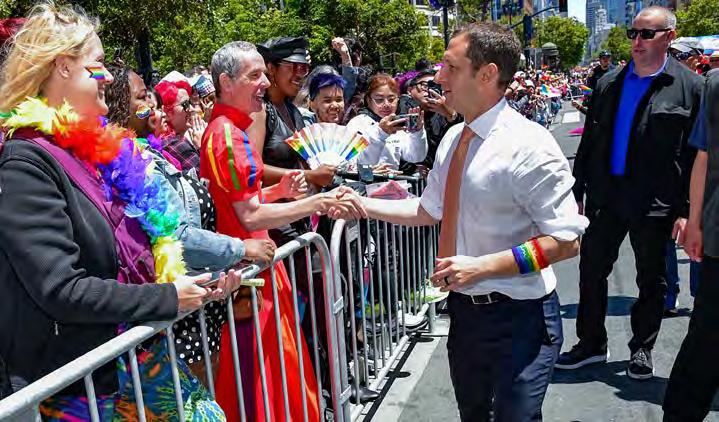
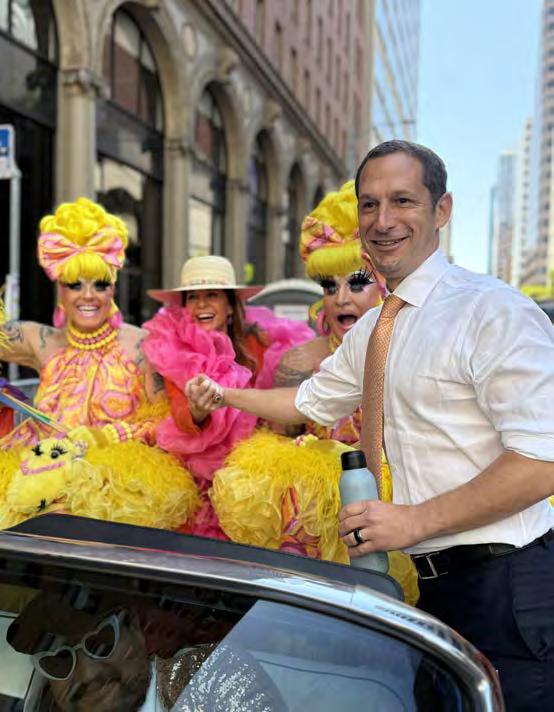
San Francisco Mayor Daniel Lurie has a message for queer people visiting for Pride festivities this weekend.
“I hope people come from all over the world, because there’s no better place to celebrate Pride and see what San Francisco is all about than this weekend,” Lurie, who was elected two years ago, told the Bay Area Reporter during a recent interview at his City Hall office. “A great weekend, it’s one of the best weekends we have on the calendar all year.”
A million people annually descend upon the City by the Bay for Pride, according to the San Francisco Lesbian, Gay, Bisexual, Transgender Pride Celebration Committee. The Pride Parade is Sunday, June 28. Lurie, who took office last year after he defeated incumbent mayor London Breed, has become one of the nation’s most popular mayors – with 73% approval according to a recent San Francisco Chronicle poll.
And between the Super Bowl earlier this year and the ongoing World Cup matches, Pride gives him another opportunity to showcase a San Francisco that’s come a long way from just a few years ago, when commentators decried (or celebrated) a “failed city” full of disorder and rapidly losing its tax base.
In the B.A.R.’s last sit-down with Lurie at the end of 2025, he touted record-low crime levels, a recovering downtown, and a rebounding tourism industry.
He continued on those themes, telling the B.A.R. this month that, “For the first time in years, San Franciscans believe we’re moving in the right direction.”
“San Franciscans are feeling the difference in their everyday lives,” he continued. “Crime is at record lows, unsheltered homelessness is the lowest it’s been in 15 years, and we’re welcoming record numbers of visitors to our city this year. People are proud to live here again, and it’s time to put our foot on the accelerator.”
by John Ferrannini
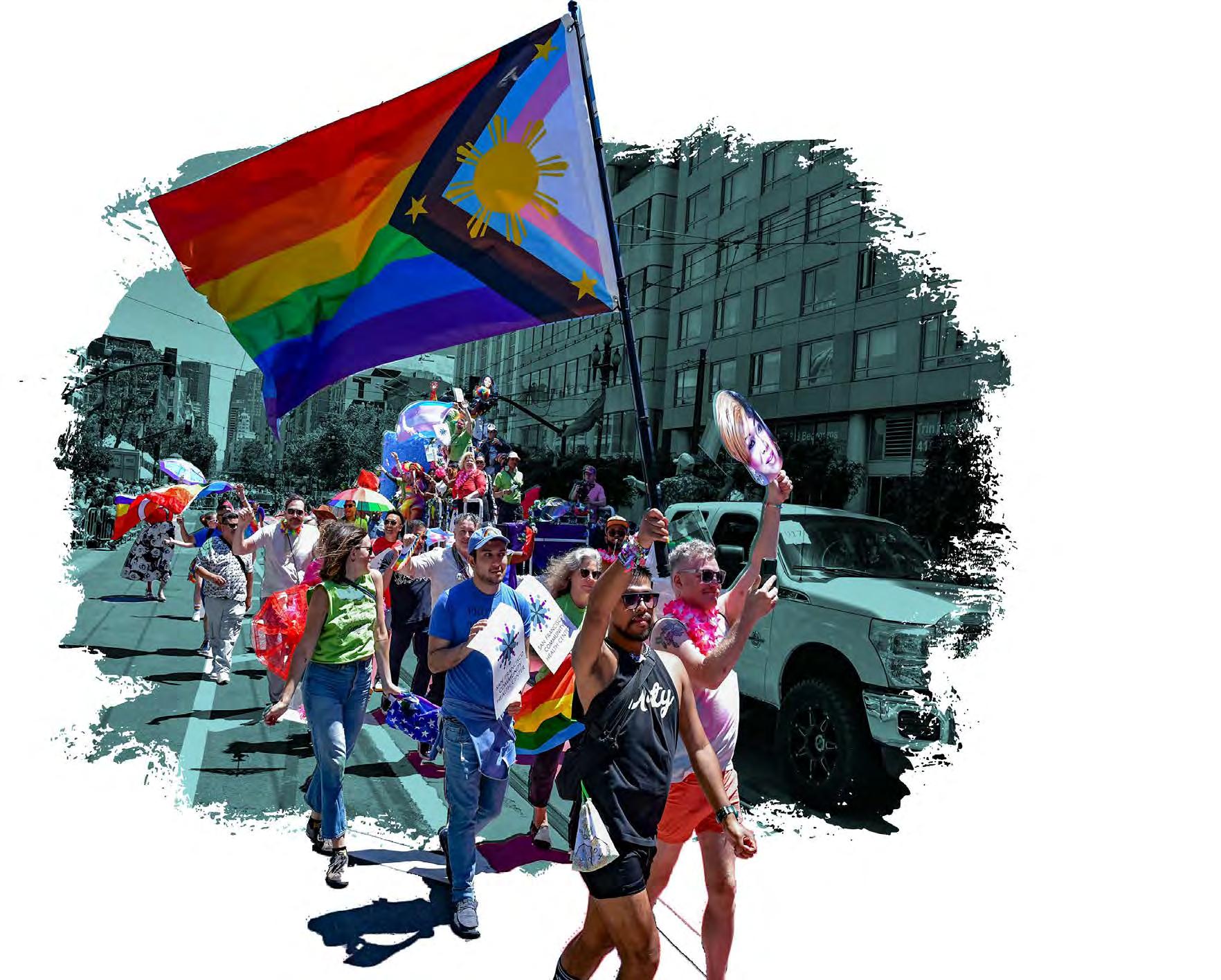
This year’s gigantic 56th annual San Francisco Pride Parade will kick off from Market and Beale streets Sunday, June 28. It marks the 57th anniversary of the Stonewall riots in New York City that began the modern day worldwide movement for LGBTQ rights.
“I hope people can see concrete ways that they are represented in their community and that they can come and resist in action,” said Suzanne Ford, a trans woman who is the executive director of the San Francisco LGBT Pride Celebration Committee, which puts on the annual event. “We all know part of resistance is finding joy and unity with each other.”
Ford was echoing this year’s theme, “Resistance in Action.”
Pride is the City by the Bay’s largest annual parade, sometimes lasting five hours or longer. There are six community grand marshals this year. Among them, and exemplifying the theme, is Imani Rupert-Gordon, the president of the National Center for LGBTQ Rights. NCLR has been on the forefront of at least six lawsuits against President Donald Trump and his administration since Trump returned to office last year.
See page 28 >>
LGBTQs concerned about budget
But not everyone in the LGBTQ community is happy with Lurie. The Pride flag raising his office hosted at City Hall June 5 saw protesters eager to have their say about the mayor’s proposed budget, which, beset with a decline in tax revenue, increased demand for law enforcement services, and cuts to local healthcare by President Donald Trump’s HR 1, or One Big Beautiful Bill Act, includes reductions to the city’s social safety net.
The effect on San Francisco’s federal funding is estimated to be $300 million over two years. The San Francisco Board of Supervisors continues to hold hearings on Lurie’s budget ahead of their summer deadline to approve it.
Lurie’s proposed spending plan totaling $16.9 billion would close a $642 million deficit and includes a 6% across the board reduction to health access points that would take effect in 2027 resulting in a cut of $750,036. The health centers provide services to specific communities, including ones focused on gay and bi men and trans individuals.
That comes on top of $17 million in cuts to community-based nonprofit contractors with the city from earlier this year and the proposed closure of two youth health clinics.
Despite the changes to the health access points, Lurie’s proposed spending plan would cut from other agencies to bolster the Department of Public Health’s budget, which in the proposal is $3.5 billion
for Fiscal Year 2026-2027, a $123 million increase from 2025-2026. In 2027-2028, that number goes up to $3.7 billion.
At a celebration earlier this month of the 90th anniversary of Castro Street mainstay Cliff’s Variety, Lurie was heckled by Ande Stone, who works at the San Francisco AIDS Foundation. During the interaction, caught on video, Lurie asked Stone, “Can I talk to you after?” to which Stone responded, “No!”
The B.A.R. asked Lurie what he would’ve said to Stone if he’d had the chance to have that discussion.
“I’ll talk to anybody,” Lurie said. “I’m walking the streets of the Castro quite often. I get approached by people all the time who want to talk. That was around HIV funding. And what I would say is, I think [the B.A.R.] covered it really well with Dan Tsai. We are investing in HIV. If you are backfilling Ryan White funding, as I committed to doing on the campaign, we have stepped up that funding. It actually goes up a little bit next year.”
As Tsai noted to the B.A.R., under DPH’s plan, total spending on HIV services will be the same in Fiscal Year 2026-2027 as it was in 2025-2026, at $84.1 million. The amount the city is backfilling from its general fund to offset the impact of federal cuts to the Ryan White program will increase from $28.7 million to $29 million. In Fiscal Year 2027-2028, that backfill will be $30 million, and the city’s total HIV budget $84.4 million.
Lurie reiterated to the B.A.R. that his administration “believe(s) strongly in taking care of our LGBTQ+ community, being a leader on HIV and making sure we get to zero, and so that remains an important priority for me. And listen, I understand. It’s budget season. There are attacks on this community across this country. But my administration stands as an incredibly strong ally.
by John Ferrannini
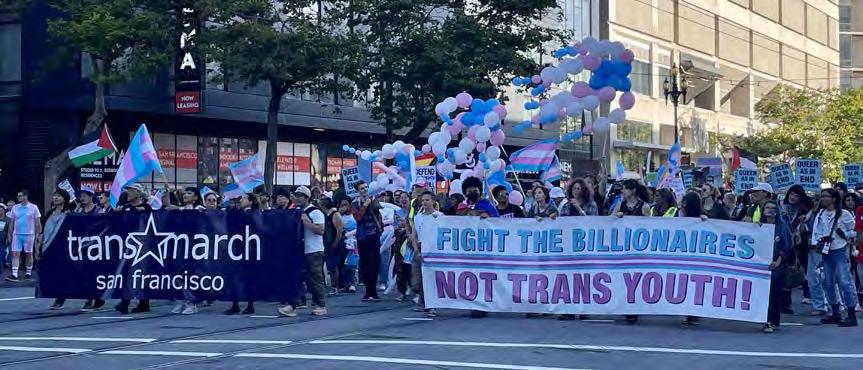
Outside of the main San Francisco Pride Parade June 28, queer marchers have two long-standing options and one newcomer for their weekend of protest and festivity. These are the Trans March, the Dyke March, and the first-ever Trans Ally March.
Trans March
The annual Trans March will kick off from Mission Dolores Park at 6 p.m. Friday, June 26, and make its way to the intersection of Turk and Taylor streets, the former site of Gene Compton’s Cafeteria. It was there where drag queens and trans people revolted against police oppression on an August 1966 night lost to history –three years before the Stonewall riots in New York City began the modern LGBTQ civil rights movement.
Niko Storment, a queer trans man who is the production manager of the Trans March, told the Bay Area Reporter that the event is more essential now than ever before.
“I think this year there is a hypervisibility of trans people in the media, and it’s not in a positive light,” Storment said in a phone interview with the B.A.R. “I want us to really concentrate as a Trans March on being people power. Real trans liberation is not going to come through politicians. It’s going to come through us banding together for our common goals, and organizing together to achieve them, so I hope this Trans March we as a community come together and organize and open those community lines and networks and become resilient in the face of the threats to trans people.”
The day will begin at 11:30 a.m. with the Señora Felicia Flames Intergenerational Brunch at the Women’s
who died in 2021.
“People can just walk up, and if they’re at capacity, they’ll let people in as needed, but it typically holds 200-300 people,” Storment explained.
Then, from 3 to 6 p.m., there will be a resource fair and stage at Mission Dolores Park, leading up to the march itself, Storment said. Attendance and participation is free, but Storment said any donations are welcome. People can donate to the Trans March via its website, transmarch. org/contribute.
Mx. Kiki Krunch, a trans woman and drag performer, is hosting the stage.
“The Trans March celebration is momentous this year, as it coincides with the 60th anniversary of the Compton’s Cafeteria Riot,” Krunch stated. “We call it a march and not a parade because we understand the importance of mobilizing and bringing our voices to the streets – advocating in front of local and state leaders to stand and fight with us during these challenging political and social times caused by attacks on the federal level.”
Krunch reflected on the march’s theme this year.
“Our theme, ‘One Struggle, One Fight,’ reflects our historical and ongoing efforts to raise awareness that we are not truly free until all of us are free,” she stated. “When we say protect the trans community, protect the dolls, we are referring to providing essential human services such as healthcare, housing, and employment. We acknowledge the intersectionality of identities and communities coming together to continue fighting against systemic oppression.”
After the march, there will be some speeches at Turk and Taylor. The site of the former cafeteria, at 111 Taylor
District 5 Supervisor Bilal Mahmood earlier this year introduced an ordinance that is making its way through the process.
“We’re excited and happy to be ending at that space, on the 60th anniversary [year],” Storment said. There’ll also be a live performance by an organization called BODYSTORM, Storment noted.
B Dean, a queer transboy, is the artistic director of BODYSTORM.
Dean told the B.A.R., “Trans folks are world builders. We imagine new ways of seeing and defy imposed expectations that demand uprightness in an upside-down world. Our bodies are experts at transition, at change, because the trans body is a force of nature, and nature is hella queer.”
From 9 p.m. to 2 a.m. there’ll be an afterparty at the LGBTQ El Rio bar and nightclub at 3158 Mission Street.
Trans Ally March
As the B.A.R. first reported, a new march will be kicking off at the Embarcadero 10 a.m. Saturday, June 27, and making its way to the Civic Cen-
joint project between San Francisco Pride and Indivisible SF, the group behind the No Kings events protesting President Donald Trump.
Suzanne Ford, SF Pride’s executive director and a trans woman, told the B.A.R. in a Zoom interview that she is looking forward to it, and framed it as being in keeping with SF Pride’s wider theme of “Resistance in Action.” (See related story.)
“I’m really excited that we’re doing something politically,” Ford said. “Not a parade, no corporations, strictly a political message supporting trans people. I’m really excited about that.”
Anna Krasner, a straight ally who is the co-lead of Indivisible SF’s direct action group, told the B.A.R. the event is for allies to show their solidarity with the trans community.
the Pride festival itself, in an unprecedented show of unity.
“The only emphasis I would like to make, if at all possible, is this emphasis on solidarity,” MORE! said in a phone interview with the B.A.R., “not just for transgender people but for the LGBTQ community generally at this moment. It is a really, really important issue that is shockingly downplayed in the broader population of San Francisco, and it’s something Indivisible SF is hoping to change.”
Krasner said that permits would be secured by the time of the event, but they had not been as of a June 10 interview with the B.A.R.
The new Trans Ally March is a
When the event reaches the Civic Center Plaza, attendees will be let into the Pride celebration, where there will be a stage hosted by drag artists Juanita MORE! and Alex U. Inn featuring speakers and performances. MORE! and Inn founded the People’s March in 2020 to bring Pride back to its roots in protest – now their People’s March stage will be the centerpiece of
“I don’t think much has changed” since the B.A.R.’s first story last month, Krasner said. “We’re still in the process of logistics-level organizing, getting permits, and all that jazz. It’s still a march aimed toward allies and to uplift this idea that non-trans people should be standing up much more aggressively for transgender people.”
Participation in the Trans Ally March is free.

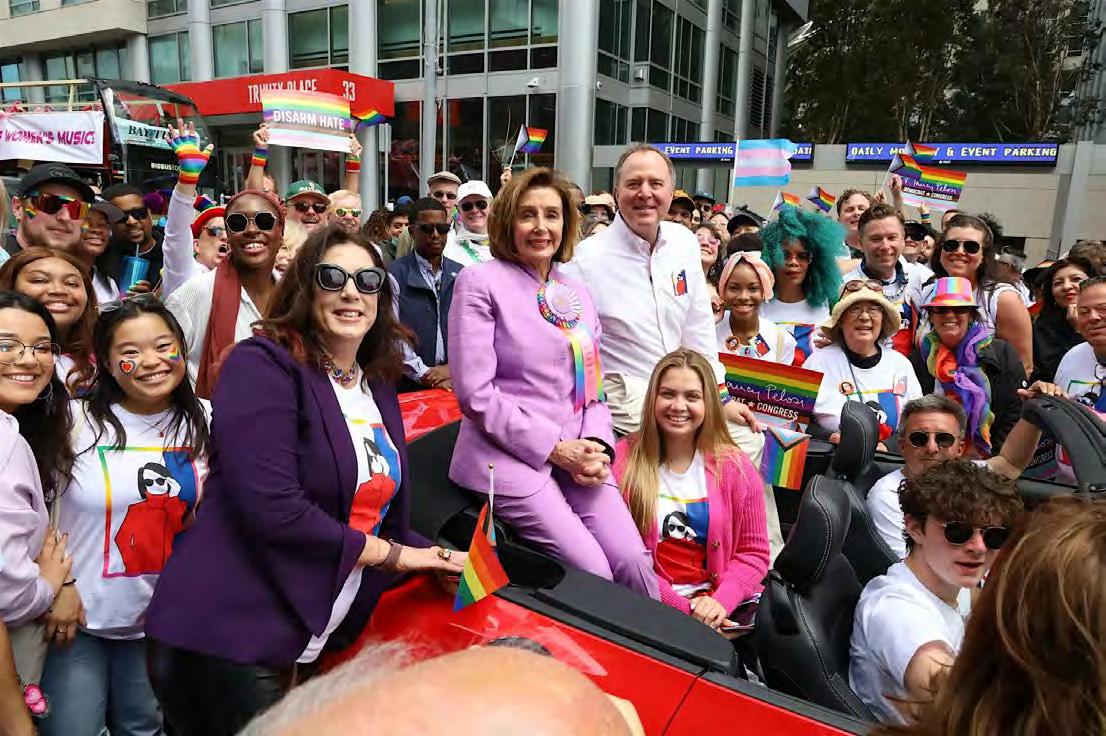
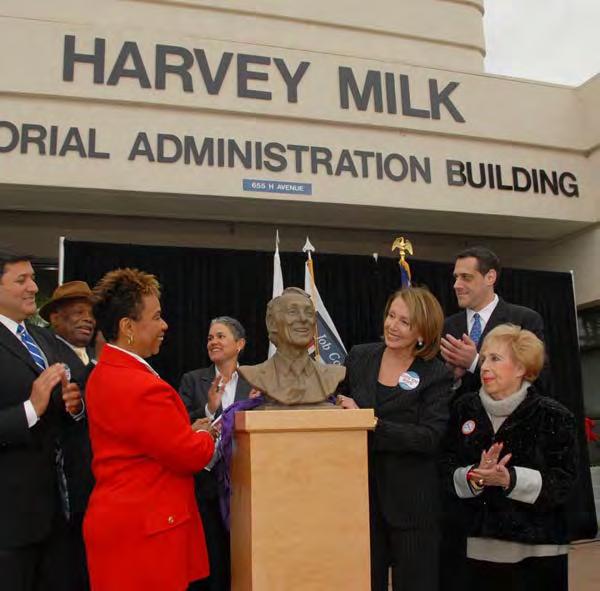
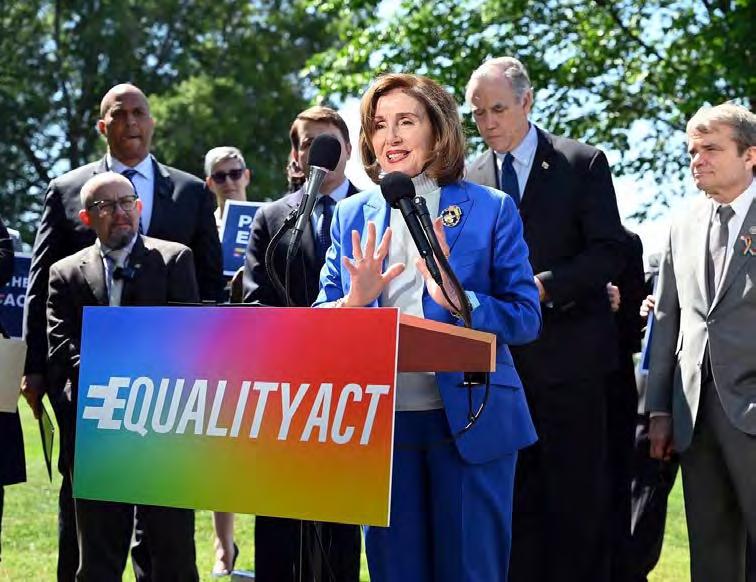
“Pride Month is a celebration of love, LGBTQ+ freedom, and the courage to live. It is also a time to honor those who challenged injustice, expanded opportunity, and helped move our nation closer to its highest ideals.”
by John Ferrannini
The Castro Street cafe at the center of a lease controversy that ended just before the reopening of the eponymous theater moved last weekend. The relocation was per the terms of its final agreement with its former landlords.
As the Bay Area Reporter extensively reported, the Castro Coffee Co. and the Castro Nail Salon, which previously flanked the Castro Theatre at 427 Castro Street and 431 Castro Street, respectively, were asked to move when their lease with the theater-owning Nasser family expired.
New theater-operator Another Planet Entertainment had expressed it wanted the storefront spaces.
The coffee company and nail salon are owned by brothers Ken and Riyad Khoury, respectively. They are straight allies in their 70s who are immigrants from Palestine. They had been in the storefronts that were part of the theater for decades.
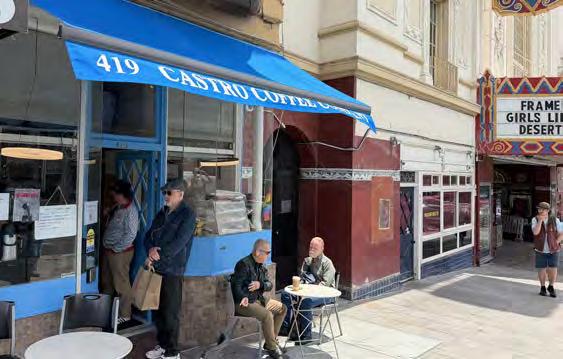
Initially, APE had disavowed involvement in the non-renewal of the brothers’ leases, saying it was between the Nassers and the Khourys. Eventually, gay Board of Supervisors President Rafael Mandelman, who as District 8 supervisor represents the Castro, and San Francisco Mayor Daniel Lurie got involved in the negotiations between all the parties. The Khourys’ relatives owned the adjacent building, including 421 Castro Street, where the coffee company relocated. Ken Khoury told the B.A.R. June
18 he is glad “I never left the neighborhood.” The switchover to the smaller space happened Saturday, June 13, he said.
“I’m happy to still have an open door on Castro Street serving the community,” he said.
The new space has an even smaller area for customers than the old storefront had, which quickly became
crowded if there were more than two people in it at a time. Longtime customers will also notice some price increases, with pounds of the regular roasts for coffee beans now costing a dollar more at $13.50.
Dan Drummer, a gay man who was sipping coffee at the businesses’ outdoor tables Thursday, told the B.A.R., “I’m glad they were able to stay and establish a location still on the 400 block of Castro Street where they’ve been for 40-plus years.”
Also patronizing the new site was Patrick Augustine, a gay man who said, “The service is great. I’m glad they found a place to move.”
Lurie told the B.A.R. Wednesday he plans to stop by as well.
“I gotta go get a cup of coffee there,” he said. “I have not seen the new space. I really appreciated their commitment to the community. I really wanted to see them stay in the community. … They’ve been a real important part of the Castro.”
Asked about the details of the negotiations, Lurie said, “Mandelman and I did a lot of work. I don’t know if we need to go into all the details on it,
but we really wanted to see the community come out with the win.”
Mandelman told the B.A.R., “I’m just really glad Ken was able to stay on the block, and I’m hoping the neighborhood continues to give him all the love and support to stay there for many, many years to come.”
Riyad Khoury told the B.A.R. that the nail salon is in the process of moving. It’s still in its longtime spot, and will be moving to 4359 18th Street. Riyad Khoury told the B.A.R. that an accessory dwelling unit already at the site had to be retroactively OK’d by the city for the move to proceed, but that now that has happened, so his business should be moving in the next six weeks.
APE spokesperson David Perry stated, “We’re looking forward to Castro Coffee continuing to serve the neighborhood and wish them years of continued success along with all our local small businesses. We’re especially grateful to Mayor Lurie and Supervisor Mandelman for their efforts.”
The Nassers didn’t return a request for comment. t
by Brian Guan
LGBTQ-inclusive spaces at San Francisco Unified School District are receiving new funding for the coming academic year. The funds come as the school district is under increasing pressure from conservatives in Congress.
The straight donor coordinated the donation with Spark SF Public Schools, SFUSD’s official philanthropic public foundation, as a show of allyship. They choose to remain anonymous so as to not pull focus from the
An anonymous donor has pledged $35,000 in funds to continue and possibly expand dozens of LGBTQinclusive Rainbow Clubs at SFUSD elementary schools next year, inspired by another unnamed donor’s $1.6 million donation to district teachers in April.
clubs, they told the Bay Area Reporter in an email statement.
In the statement, the donor referenced Philz Coffee’s now-reversed decision to take down store Pride flags and the three San Francisco Giants pitchers who wrote Bible verses on their Pride Night hats.
“It feels more important than ever for all of us who love this city and its residents to visibly show public support
to the LGBTQ community,” they explained. “Our city is literally more colorful, more human, and more wonderful because it contains such multitudes.”
The Rainbow Clubs – communityfocused groups that explicitly acknowledge LGBTQ identity – were founded in 2022 following the increased reported number of SFUSD elementary schoolers coming out as LGBTQ post the COVID school closures, according to a news release. Implemented in 12 elementary schools within the clubs’ first year, they promote allyship and empathy for all, welcoming both LGBTQ and straight students.
With a $24,000 grant from Spark SF in 2024, the program had expanded to 32 elementary schools by the 20242025 school year.
Now, the new donation gives the Rainbow Clubs a “bit of a budget,” providing funding for possible initiatives such as club Pride events, Spark SF President Ginny Fang, a straight ally, said in a phone interview. Additionally, the grant will support honorariums for the teachers, social workers, and counselors who lead the clubs as Pride Liaisons, while also allowing for the possible expansion of the program to other schools.
Fang reflected on the importance of funding the Rainbow Clubs, describing Spark SF’s commitment to serving the “whole child,” acknowledging the importance of student wellness support for vulnerable experiences like coming out.
“In this current moment, I think it’s so much about who we are as a city,” Fang said, “and we have to stand for the values that San Francisco has built itself on.”
The donor’s support for the clubs coincides with a period of conservative pressure on SFUSD’s approach to LGBTQ identity.
Congressional testimony
SFUSD Superintendent Maria Su. Ph.D. announced in May that the Republican-led House Committee on Education and the Workforce had requested the school district to appear at a congressional hearing. Called alongside leaders from other public school districts across the U.S., Su testified on June 10, facing critical inquiries on subjects including drag queens, the district’s former ethnic studies curriculum, and its preferred pronouns policy. The hearing was titled “Breaking
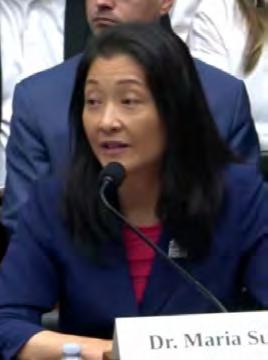
San Francisco School District
Superintendent Maria Su, Ph.D., testified at a congressional hearing June 10.
Trust: Attacks on Parental Rights, Inappropriate Content, and Legal Abuses in America’s Schools.” At one point, Congressmember Robert Onder (R-Missouri) asked Su, “Should biologic men be allowed in locker rooms and shower rooms with biologic girls and women?”
“It is to the best of my knowledge we follow state and federal law,” Su responded.
Cheryl Greene, a lesbian and the vice president of school and youth programming at the national Human Rights Campaign, an LGBTQ advocacy group, expressed concern regarding the hearing, describing it as “ridiculous.”
“Acknowledging that LGBTQ students exist is a reality; it’s not an ideology,” Greene said in a Zoom interview with the B.A.R. “When students see themselves reflected in their school community, they’re more likely to feel connected, engaged, and supported. The goal is not to make everybody the same. It’s to make sure that everybody belongs.”
“We need to ensure people know that LGBTQ people exist,” Greene later said. “This is who we are, and it should be a part of what we talk about every day.”
When asked about the importance of LGBTQ-supportive programs on the elementary school level, Kena Hazelwood, SFUSD’s LGBTQ student services coordinator, referenced gender development research. “We know that kids begin to have a sense of gender from a very, very young age,” Hazelwood said.





































by George Faville
Those wandering in for a drink on a recent evening at The Clift Royal Sonesta Hotel would have found – and learned – a lot more than they came for. The room was full for the night’s lecture on how San Francisco became the world’s gay capital.
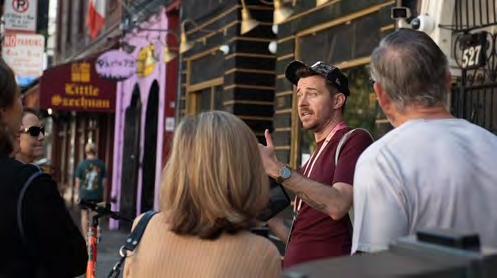
For the eighth installment of the hotel’s “Making History Fun Again” speaker series, Shawn Sprockett, a gay man and senior adjunct professor at California College of the Arts, delivered a talk June 18 on the unsung heroes and history of San Francisco’s queer world. Sprockett is also the founder of Unspeakable Vice, a volunteer history project that hosts walking tours through the city’s historic “gayborhoods.”
The event, held in the hotel’s Redwood Room, was preceded by a cocktail hour. During the talk, the audience had heard several centuries worth of queer history at Sprockett’s impassioned, breakneck pace.
“It’s kind of like drinking from a fire hose,” Sprockett said over a martini after the lecture.
“I loved his enthusiasm, and he was able to fit a lot of information in basically 45 minutes,” said Glenne McElhinney, a lesbian historian specializing in California LGBTQ histories of the 1950s, 1960s, and 1970s, in a phone interview following the event.
Sprocket said in a phone call prior to the event that he began Unspeakable Vice following his move in 2018 from San Francisco’s Castro to the city’s North Beach neighborhood. Initially worried about moving away from the LGBTQ center of San Francisco, talking to his new neighbors and bartenders and reading Nan Boyd’s “Wide Open Town” revealed North Beach to be the city’s original gay mecca. What began as a passion for the history turned, with prodding from friends, into a walking tour through North Beach’s long lost gay nightlife.
“José Sarria’s story on the North Beach tour is absolutely the reason I do this,” Sprockett said. Sarria (1922-2013) was a Latino San Francisco native, World War II veteran, opera singing drag queen, political activist, and the founder of San Francisco’s Imperial Court, becoming Empress I, the Widow Norton. He is one of the central figures in Sprockett’s presentation. Sarria was the first gay person to seek elective office in the U.S. when he unsuccessfully ran for a seat on the San Francisco Board of Supervisors in 1961. Sarria held court at the old Black Cat Cafe in North Beach.
Sprockett said that he hadn’t planned on doing the walking tours for as long as he has.
“I was going to hand it off to the historical society and they said, ‘Can you do the first few tours and we’ll find a volunteer to replace you.’” said Sprockett, referring to the San Francisco Historical Society. “Here I am five or six years later still doing it myself.”
Through the walking tour Sprockett met people who added their own accounts of the history to his story and directed him to more resources, archives, and books.
“It just kept getting bigger and bigger from there,” he said.
Now, Sprockett is the guide for a monthly 11 a.m. North Beach tour covering the 1700s to 1960s and a Tenderloin/Polk tour covering the 1940s to 1980s, usually held on a Saturday at 2 p.m. He has also finalized a tour for the Castro and is working to begin its run as well.
Sprockett is partnered with the San Francisco Historical Society for the North Beach walking tour, for which tickets are $20; the Tenderloin Museum for the Tenderloin/Polk tour (check the website for ticket information). Some of his previous lectures are available online through the San Francisco Historical Society, and the Museum of San Francisco.
Molly Blaisdell, a straight ally who is the public relations consultant for the Clift Royal Sonesta Hotel and Redwood Room, and the creator of its “Making History Fun Again” speaker series, said Sprockett came highly recommended by the San Francisco Historical Society.
Having begun in November 2025, the speaker series has covered the 1906 Earthquake and Fire, San Francisco’s hotels, and the San Francisco food scene.
Blaisdell’s late mother, Marilyn Blaisdell, was a historian respected for her photo collection, and Molly Blaisdell credits her for her passion for history.
“When I started this project for the Clift Hotel, it was reconnecting with a lot of my mom’s old friends, people who admired her. Many of them have used her photos in their presentations,” Blaisdell said in an interview after the event.
“It’s so beautiful to see her legacy live on.”
Typically, the events bring in 90-120 people, although it can vary a lot. May’s panel of speakers on San Francisco’s hotels had an audience of 200, while Sprockett’s was around 75. Blaisdell said the crowd this time skewed older as well.
“It’s the younger people in our audiences that seem to get the most out of

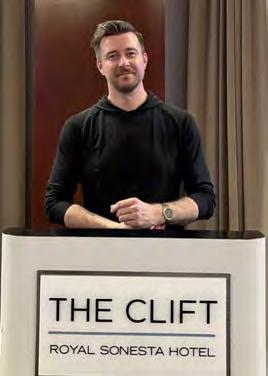
Shawn Sprockett gave a talk on San Francisco’s LGBTQ history at the Clift Royal Sonesta Hotel June 18.
this,” Blaisdell said, but Pride season in San Francisco has a way of drawing young eyes away from in-depth historical research.
The early bars of San Francisco were taverns, which popped up in droves throughout the city to serve the many gold rush hopefuls working North Beach’s docks with little else to do in the nascent city than drink, Sprocket explained. With an overwhelmingly male population who knew mainly partner dancing, nights saw men dancing with men, signaling whether they would “lead” or “follow” from across the room with a handkerchief tucked in either their right or left back pocket.
Prohibition forced the scene underground, into smaller bars and speakeasies that now could cater to certain community niches – like classical music, specific cocktails, and homosexuality.
One such bar, the Black Cat Cafe, became a gathering spot for the artists and writers boarding in the nearby Montgomery housing block. In 1953 it would win its case against the revocation of its liquor license on the basis of it serving known homosexuals, one of the first landmark victories for gay rights.
Some 50,000 servicemembers were given a “blue” or “other than honorable” discharge from the military during and after World War II, a practice targeting African Americans, women, and homosexuals to cut costs and save time, a history of the National Park Service noted.
Sarria and Harvey Milk both received “blue” discharges after their service in WWII and the Korean war, respectively.
Unable to find employment and denied veterans’ benefits, many chose to stay in San Francisco instead of returning home. They found support in each other and already established groups, like the early lesbian and gay rights advocacy and social organizations the Daughters of Bilitis and the Mattachine Society.
Beneath McCarthyism and the Lavender Scare, a North Beach group – on unfounded fears of grooming – reportedly lobbied the city in an effort to shut down many of the area’s gay bars, initiating a migration to Tenderloin and Polk Street where queer nightlife shifted from a focus on entertainment to local bars and sex work. Called “The Valley of the Queens” by Sprockett, 1950 to 1990 saw as many as 150 gay and trans bars in the Tenderloin and Polk areas. Aunt Charlie’s Lounge are the only two to remain. Perhaps overdue, in June 1964 Life magazine ran a feature on homosexuality in San Francisco crowning it as “America’s Gay Capital”.
Some in the audience had lived through what Sprockett presented on.
During a Q&A, one woman asked how many police officers raided the former Castro gay bar Elephant Walk after the White Night riots – her friends had said eight or 50. Two-dozen, according to Sprockett. That seemed right to what the woman had seen, having watched them enter the bar from across the street.
“History is such a fragile thing. Every generation relies on the previous one to pass it down. In our case, because we lost so many people to AIDS, we are experiencing a huge fragmentation in that transition of history,” Sprockett said after the event. “We are really all in the same boat of piecing together a history that has denied us. … This is a personal project, I freely admit I’m an amateur figuring this out myself.”
McElhinney said these kinds of ac-
counts of history are proof of existence for the many who have been out and proud and are no longer living. Cary Norsworthy, who identifies as lesbian and organized the San Francisco AIDS Foundation’s food drive from 19841989, said in an interview after the event that she was happy to see “someone carrying the torch.”
The speaker series is part of an effort to bring activity to the hotel’s spaces, said Dania Duke, the general manager at the Clift Royal Sonesta Hotel. She said that attendees are a mix of regulars and new faces drawn to the month’s topic. The overall reaction, she said, is that people are blown away that it is available for free.
Both Norsworthy and McElhinney said they would be interested in coming back for another speaker, especially the next one on July 16 featuring rock journalist Ben-Fong Torres. McElhinney said that she will be booking one of Sprockett’s walking tours.
The project seems to keep growing for Sprockett, who has considered a book but prefers the personal, conversational feeling of the walking tours. “I’m just glad I got to Castro,” he said, when asked about plans to continue the history into the 2000s, although he did mention research into Valencia Street, the South of Market neighborhood, the Fillmore district, and the Haight-Ashbury.
Younger people, McElhinney said, should take advantage of historical tours.
“I’d highly encourage young people to look into doing guided tours, I think there’s such a sense of pride and a difference when they learn about this history,” she said. “Every little bit helps. Getting this young man’s historical work out into the world is a very good thing.” t
by Brian Guan
The Tenderloin became more colorful this Pride Month, housing a new monument to trans history and joy. The Transgender District, the world’s first and only legally-recognized transgender district, revealed its first outside mural in the neighborhood June 15.
Spanning six archways under an elongated trans flag painted on the facade of 64 Golden Gate Avenue, the permanent mural realizes a “visual narrative of trans and queer identity, cultural legacy and community resilience” in a neighborhood essential to the history of trans liberation, according to a news release. While they form a cohesive product, each archway presents its own visually distinct exploration of trans and queer experience. Imagery ranging from California poppy flowers to a pink-and-blue Martian depicts subjects like trans prosperity and self-acceptance.
Finishing work was still being applied on the artwork upon its opening. The mural was fully completed on Monday, June 22, with an additional virtual unveiling in the works.
Breonna McCree, the Transgender District’s co-executive director and a woman of trans experience, described the significance of the mural in a Google Meet interview. “Trans and nonbinary people, our existence has always been a protest to the status quo,” McCree said. “And having this live on a garage as placemaking is a testament to our resilience, and our visibility and our strength.”
McCree explained how the project arose after the owner, Orhan Kaplankiran of parking company HPM of America, reached out to the district to offer the garage as a venue for the murals. “He didn’t think the city was doing enough to support trans and nonbinary people,” recounted McCree.
From there, the district began conceptualizing the archways, working to “create some historical significance for each,” said McCree. She referenced the depiction of the Compton’s Cafeteria riot on one mural, a 1966 altercation between cops and often-harassed trans people and drag queens at the Tenderloin’s old Gene Compton’s Cafeteria. The event occurred three years before the
Stonewall uprising in New York City, as the Bay Area Reporter previously noted, and this August will mark the 60th anniversary, though the exact date has been lost to history.
Kaplankiran’s Golden Gate Avenue garage is a few blocks away from the building that had once housed Gene Compton’s Cafeteria, the first site related to trans history to be federally recognized on the National Register of Historic Places. Kaplankiran, a straight ally, told the B.A.R. that he was “proud to collaborate with the Transgender District on the mural,” describing his company’s dedication of the facade as “a show of respect and support.”
Memorializing the underrepresented aspects of LGBTQ history is important to McCree.
“San Francisco has had a rich history of Black and Brown trans and queer people always starting the movement. We’ve seen that with the Compton’s Cafeteria riot, we’ve seen that in Stonewall,” she said. “It’s always the most marginalized community putting their necks
We take pride in delivering care that celebrates the full spectrum of who you are.
by JL Odom
Four years ago, gay Mission resident Walter Parenteau set out on an ambitious goal: to walk every street in San Francisco. On Saturday, June 27, he will complete his endeavor, having traversed every street, alley, and named staircase in the city, as well as those on neighboring Treasure Island and Yerba Buena Island.
His final leg of the project will begin at Sue Bierman Park at Washington and Drumm streets. The walk, which he’s invited people who have been a part of his yearslong journey to attend, will follow Washington Street.
For Parenteau, who has lived in San Francisco for 22 years, finishing the project during Pride weekend is intentional. Along the way, he said, the endeavor deepened his appreciation for the city’s neighborhoods and hidden corners.
“It was a real joy to learn every nook and cranny,” he said.
His interest in long treks dates back to his undergraduate years in Vermont, when a friend gave him a copy of Peter Jenkins’ book, “A Walk Across America.”
Only 19 at the time, Parenteau, who turns 45 in July, didn’t make plans to set out on a cross-country journey, but his fascination with long-distance travel lingered.
In March 2012, that fascination became reality when he joined about 60 people walking from Oakland to Sacramento as part of what was called the “99-Mile March for Education and Social Justice,” a multi-day Occupy movement-related protest focused on issues including tuition hikes, student debt, and budget cuts.
The actual roughly 80-mile walk culminated in a rally attended by thousands of people at the California State Capitol.
To prepare for the footed voyage to Sacramento, Parenteau, who was living in the Haight and going to San Francisco State University at the time, walked to and from school, averaging about five miles. For a while, he stuck with 19th Avenue for his walks but then began taking other routes, like 21st Avenue and expanding from there, to break the monotony.
“I don’t know the exact day I started but 3.5 years is about right, which stretched over four calendar years,” he stated in a follow-up email. “I started very early in 2023.”
“As I was doing it, I thought, ‘Man, I should be logging this, because I’ve walked a lot of these streets’ – and I kept thinking this as the years went on and I walked more and more of the city,” he said.
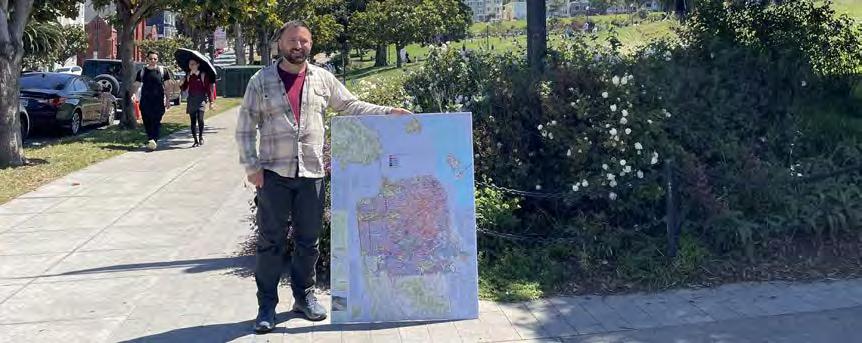
Shortly after the COVID-19 pandemic began in 2020, he decided it was time to purchase a folding city travel map of San Francisco, on which he later began marking his treks.
“The second I started doing that, the fire lit under my feet,” he said.
He’s used different colored markers to distinguish his walks per year on the map, which he keeps on a wall in his home. For each of his outings, to avoid having to fold and unfold the map and possibly damage it, he relied on a photo of it on his smartphone.
“I would just look at that, and I would look at Google Maps and kind of compare as I walked along,” he explained.
Throughout the duration of the project, he never switched over to a digital platform, app, or device to record his walks, even when his boyfriend gave him an Apple watch. Other than photos of his marked up city map he posted in the summers of 2025 and 2024 on Threads, Parenteau didn’t routinely share updates about his endeavor publicly, though he did keep friends informed of his progress.
During the first year, he walked every
day, venturing onto street after street on his commute between his workplace, St. Anthony’s Foundation in the Tenderloin where he is a chef, and his home in the Mission.
“You’ll see that all of 2022 is the whole center of the city [with streets marked with a red marker on the map], and I very quickly saturated everything near my normal commute,” he said.
From there, he branched out, quite literally, planning purposeful trips to sections of the city, which slowed down the frequency of the walks, as they were now calendar-scheduled and required farther commutes. He averaged two to five walks along with thousands of steps each week in subsequent years of the project, strategically working his way through the city’s neighborhoods, with many of the walks happening after 4:30 p.m., post-workday.
“I remember thinking, ‘Oh, when it’s wintertime, I won’t want to go walking
because it’ll be dark at 5 p.m.,’ but what I found was just how much I loved walking at nighttime,” he said.
Parenteau said there was a certain intimacy to his evening walks, during which he was able to take in the stainedglass windows of Victorian homes, families spending time together, and even the occasional decorated interior of a residence during the holiday season.
“When you’re walking through a dark street and you turn a corner, and then there’s this incredibly bright, festive home in the middle of December darkness, it really uplifts your spirits a lot,” he said.
The experiences culminated with a venture home for the nightly ritual of marking on his map where he had walked.
“It was always a really fun conclusion at the end of each day,” he said.
Some walks were relatively short; others totaled 20-plus miles. The latter, he said, were unanticipated sources of a “runner’s high.” He recalled attaining that endorphins-fueled feeling when trekking up and around Twin Peaks and in steep-street-filled Dolores Heights, where he encountered several loud owls perched in a tree.
“That was really an incredible thing to bump into in the middle of my euphoria,” he said.
On the longer treks, he’d wear a backpack. Other items he’d commonly bring included a flannel, a vest, a bottle of water and, depending on the time of day and the area in the city, sunscreen and a straw sun hat. At times, he’d go headphones-free to take in the neighborhood sounds surrounding him; other times, he’d listen to a spiritual-themed
by Lois Pearlman
One afternoon a visitor walked into Guerneville’s gay-owned bookstore, Books & Letters. Michael Rex, the store’s proprietor, lifted a slim paperback volume off a display table, handed it to the visitor and said, “You need to read this book.”
“But, Michael,” the visitor protested, “I can’t afford this book right now.”
“No,” he continued, “I am loaning it to you. You really need to read it.”
“OK,” the visitor agreed. “I’ll be careful with it.”
“Don’t worry. If you spill something on it, I’ll put it on the used book shelf,” he replied.
Rex, 56, was right. The book was Omar Akkad’s “One Day, Everyone Will Have Always Been Against This,” an examination of why people ignore the atrocities going on in the world.
Rex’s desire to match up the reader with just the right book is one of the reasons why Books & Letters will be celebrating its fifth anniversary in January, after so many other shops have quickly come and gone in the space, located at 14045 Armstrong Woods Road, Suite B, in the Sonoma County town that’s popular with the LGBTQ community.
It also demonstrates that while Books & Letters is a kind of mecca for LGBTQ tourists and locals, it is also a store for everyone who likes to read
– albeit with an unapologetic leftist orientation.
And there are books for every taste – LGBTQ fiction and nonfiction, of course, memoir, science fiction, natural history, cookbooks, novels of general interest, poetry, mysteries, politics, and a Spanish-language section. There’s also the category of solarpunk, a speculative fiction subgenre centered on ecological sustainability that has gained mainstream traction. Toward the front of the store there is a children’s section, with a kid-size table and chairs and books carefully displayed so that young readers can peruse them easily.
But it’s not so much the variety that sets Books & Letters apart. It’s the way Rex personally chooses every book he buys. He calls it “hyper-curated.”
“A lot of it’s my taste,” he said. “I have a few main focuses – LGBTQ+, small presses, and translations from other languages because they provide a different perspective.
“It is important for me to have books by and about queer people,” he continued. “Books about queer people in all areas of life, like ‘The Queer Face of War,’ ‘Baby Making for Everybody,’ books about queer architects, queer animals. Many people didn’t live in a time when you could find all this queer literature. They eat it up.”
And it’s not just the books. There are the gifts and collectable items, mostly created by local artists and craftspeople – everything from gay-themed art and Pride apparel to hand-made dolls stitched by Norma McFaddan, a woman who lives up the hill from the bookstore.
“I make these Day of the Dead dolls because I really like Day of the Dead. I used to make them for the Oakland Museum. Now you can only buy them at the bookstore,” said McFaddan, a straight ally.
During the COVID pandemic, McFaddan made hundreds of masks, including Day of the Dead masks, that she gave away for free, she said.
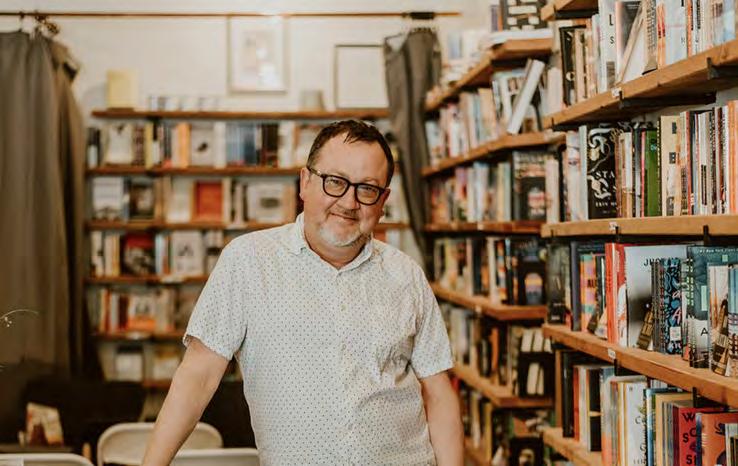
There are also events at Books & Letters. Rex said he hosts around three of them each month – evenings with authors, an artists’ meetup where local artists can network, an annual Hanukkah concert performed by two local lesbian musicians in Yiddish and assorted other languages, and a book club.
Recently, Rex said, the book club members read the memoir “Frighten the Horses,” and they had a chance to talk with the author, Oliver Radclyffe, over Zoom.
“It’s the first time some people in the book club talked with a trans person,” Rex said, referring to Radclyffe.
Rex has some special LGBTQ+ events planned this summer. On Sunday, July 12, there will be a champagne fundraiser for Guerneville’s September 19 Pride celebration. It will feature gay comedian, actor, and Emmy Awardwinning comedy writer Bruce Vilanch, reading from his 2025 memoir, “It Seemed Like a Bad Idea at the Time,” and otherwise entertaining the audience. Tickets are available on Eventbrite.
For Lazy Bear week July 27-August 3 there will be a bear-themed poetry reading called Poetry and Poppers. For the aforementioned Pride day Rex will host a reading by a yet-to-be-announced
queer author. With the exception of the Vilanch appearance, for which there is a suggested $25 donation, bookstore events are free of charge.
Rex is offering a 15% discount for Lazy Bear Week ticket holders and will also do so for this year’s Women’s Weekend, August 14-16.
The discounts, the events, the individually curated books, the local arts and crafts, and the store windows plastered with flyers advertising local happenings, all make the little shop a kind of community gathering place, for locals and tourists alike, Rex observed. People pop in just to chat with Rex, ask him to stock their newly released book, or to schedule an event they have in mind.
Lyric Croxford, 28, who identifies as nonbinary, asexual, and bi-romantic, is a frequent customer. While working behind the counter at the Coffee Bazaar, which shares the building with the bookstore, Lyric said, “The bookstore is great for getting good recommendations. I love all the queer representation I can find, of all kinds of queer folks. I love it. I feel very welcome there.”
For more information, visit booksletters.com.t
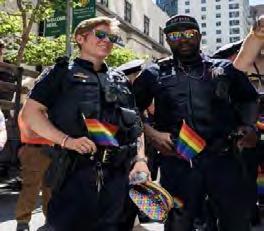
SFPOA & SFPD PRIDE ALLIANCE proudly stands in solidarity with our LGBTQ community.
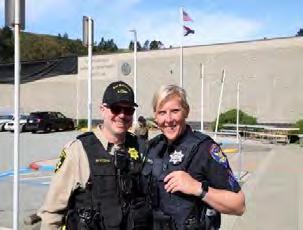
Supporting a safe 2026 Pride and love for the Bay Area Reporter’s PRIDE edition.
Proudly stands in solidarity with our LGTBQ community!
Supporting a safe 2025 Pride and love for the annual Bay Area Reporter ’s Pride edition
With one rep, one order, and one monthly invoice, partner with the most trusted, local independent media outlets in San Francisco and the Bay Area –ten individual media brands – and easily reach the region’s unique neighborhoods and diverse ethnic communities, to increase sales in a highly sought after metropolitan market.





by Matthew S. Bajko
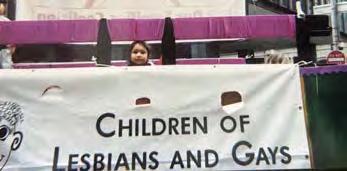
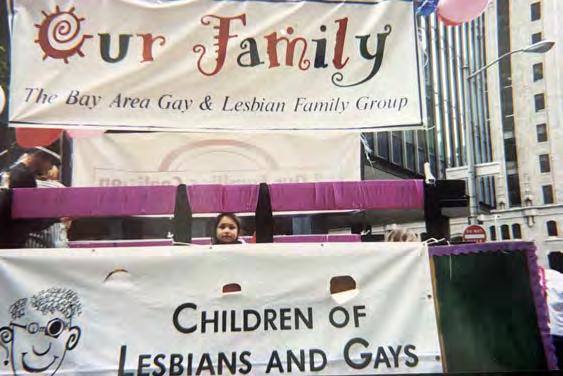
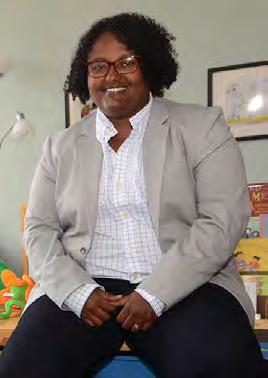
WhenSierra Sparks was a preschooler in the late 1990s, she marched in San Francisco’s Pride Parade with her two moms as part of the Our Families Coalition contingent. Her parents were early members of the San Francisco-based nonprofit that provides services to LGBTQ families and advocates on their behalf.
Included in a scrapbook of her childhood that her moms made for her is a photo showing Sierra Sparks peering over the agency’s banner in the parade. The family isn’t sure of the exact year it was taken but believes Sierra Sparks was either 3 or 4 years old at the time.
“I think when I was a little kid was the last time I walked with Our Family,” Sierra Sparks, 32, told the Bay Area Reporter when asked if she had more recently joined the nonprofit’s Pride contingent.
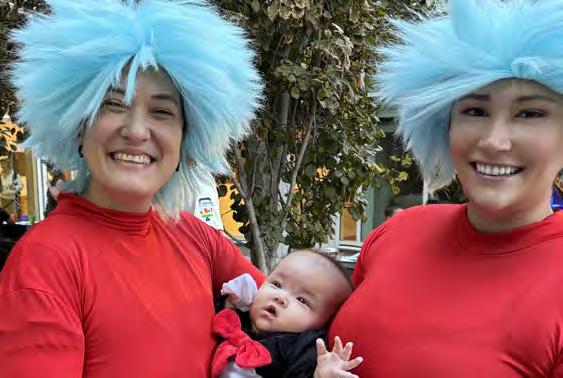
She and her wife, Sparks, who goes by one name, are looking forward to one day marching in the annual event with their 1-year-old daughter, Reyna,
as part of the Our Family contingent. Sierra Sparks is a member of its board of directors, having joined it two years ago, and prior to the birth of their child, the couple had marched in the parade with the National Center for LGBTQ Rights contingent, as Sparks serves on its board.
“I am really excited for that moment. There is this queer legacy she is born into,” Sierra Sparks said of having the chance to photograph her own child marching in the parade with Our Family Coalition.
This Sunday, though, the trio plans to cheer on the nonprofit’s parade contingent at a private viewing party the couple is hosting at a venue that overlooks the route. Sparks made the winning bid for the auction item at another local LGBTQ nonprofit’s annual gala fundraiser held earlier this year.
They’ve invited friends who also have newborns and will welcome having easy access to a place to change a diaper, noted Sierra Sparks, to join them.
“We are doing ‘Baby Pride’ is what we are calling it,” said Sierra Sparks,
whose own moms also received an invite to attend.
Debbie Loya and Tammi Lewis are 67-year-old retirees living in the East Bay. According to Loya, when their daughter, Sierra, was just 3 weeks old back in the spring of 1994, she and Lewis drove to a private residence in Pacifica, California, on the San Mateo County coast for the first gathering of what was initially called the Gay and Lesbian Parents Group until later being changed to Our Family Coalition. It was hosted by a lesbian couple planning to become moms via overseas adoption.
“I wanted to make friends with other lesbian moms and I wanted to join a community for Sierra with kids her age with two moms. I’m a planner – best to start early,” recalled Loya in a written response to the B.A.R.’s questions about the founding of the nonprofit. “The first Halloween Party we attended in 1994 was held in SF and no one lived as far out as Tammi and I did, but it was very important for me that Sierra had social time with families that looked like hers. So well worth the travel.”
This October 10 Our Family Coalition will officially celebrate its Pearl Anniversary. It has dubbed it “30 Years of Pride in Action: Legacy of Love” and already is selling tickets to the gala online at ourfamily.org/30th-anniversary-gala.
Started as underground group
“What is Our Family Coalition? It is a bunch of people who said, ‘Hey, our desire to want to have children of our own and to raise families with kids isn’t wrong.’ When OFC started, it was underground. People were whispering these needs and desires,” noted Mimi Demissew, a queer mom who has led the nonprofit as its executive director since September 2020. “At that time when women were coming out, they were losing access to their children. And now we find ourselves back in a time where we are now having to defend who gets to be called a parent, who gets to be called a family. We don’t take that right for granted.”
Wanting to have a child and build a family, said Demissew, “is a selfless act” that is reflected in the legacy part of the anniversary theme.
“Our work is about love,” she said during a phone interview with the B.A.R., explaining that the action half of the theme derives from “advocating for our rights and making sure our families are equally protected and equally recognized.”
Our Family Coalition primarily focuses its attention on families with children up to the age of 13. Over the years it’s worked with Bay Area school districts in training teachers and classroom staff on how to teach LGBTQ curriculums as required by state law. It also has stepped in to assist LGBTQ parents, whether single or in relationships, who didn’t see school staff respecting their households in how they interacted with them or their children.
At the state level, the nonprofit has worked with lawmakers on legislation to strengthen the rights for LGBTQ families in California. In particular, it has co-sponsored bills focused on allowing people to take leave from their jobs to care for their chosen family members, such as a roommate or friend, in addition to their biological relatives, spouses, and children.
This year it is working with the author of those bills, state Senator María Elena Durazo (D-Los Angeles), to help pass her Senate Bill 1149 that would allow workers to take bereavement leave for chosen and extended family members. It is currently being heard in the Assembly.
“There are still so many gaps in our laws, even in California, that don’t recognize LGBTQ families,” said Demissew. “It is why OFC still matters.”
It’s the sole such agency focused on LGBTQ families in California, noted Demissew. It is one of just three in the U.S. that she is aware of doing such work.
“This is why I say Our Family Coalition is so unique. We are a niche amongst the niche because we focus on the LGBTQ family,” she said.
Full circle moment
With various jurisdictions dubbing June “Traditional Nuclear Family Month” to counter it being celebrated as Pride Month by the LGBTQ community – a divided Fresno County Board of Supervisors voted 3-2 to do so this year – it came as no surprise that Loya told the B.A.R. she still sees a need for Our Family Coalition all these years later even though she and her wife are no longer active members of it.
“There are still issues that moms and dads (and their kids) need support around, and Our Family can provide that in a way that other organizations can’t. Diverse families can best get that support from other parents who are dealing with the same issues or who have already been through the issues,” wrote Loya in her emailed reply. “No one should underestimate the power of connection. Right now we are just proud moms of a board member and very busy grandmas. But if we’re not needed to provide childcare the night of the gala, I’d really like to start our support by attending the Our Family gala on the 10th.”
They are “thrilled!” noted Loya, with seeing their daughter now so engaged with a nonprofit that meant so much to them as new moms.
“Full circle life moment there. Not something I would have imagined since at age 3 she wanted to be a dentist when she grew up. Not that dentists aren’t on boards of nonprofits … just not something I even thought about,” Loya told the B.A.R.
Demissew also expressed delight at seeing involvement in the nonprofit be passed through three generations of one family. It speaks to the evolvement of the LGBTQ community and maturation of Our Family Coalition itself, she said, with its early members now grandparents watching their children become parents and deal with the issues that come with raising a child.
“It really speaks to the trajectory of our families in this movement,” said Demissew. “I just think it is a full circle moment to know her parents were OFC family members and now she is a board member and now her kid gets to be a part of the Our Family community. It is really beautiful to see.”
In 1999, Sierra Sparks and her moms relocated to San Antonio, Texas, where they were closer to Lewis’ family members in Houston. They stayed in touch with several of the LGBTQ families they had met via Our Family Coalition and soon got connected with other lesbian families in the Lone Star State.
After graduating in 2018 from Yale University with a master’s in religion with a concentration on women’s and sexuality studies, Sierra Sparks moved back to the Bay Area into the East Bay house her maternal great-grandparents had first bought and in which her moms now live. An older woman she met at the
lesbian bar Henrietta Hudson’s in New York City had provided her a job connection in San Francisco, though Sierra Sparks now works at a different organization, Open Door Legal, focused on development for it.
“I kind of always have been following Our Family to some degree,” said Sierra Sparks, who recalled going to the San Francisco Pride celebration the year she moved back with her one mom, Lewis, and their being photographed sitting in front of the agency’s family area holding a poster for it.
“I think it’s still on their fridge. I was just excited to see it was still in existence, thriving, and had a space at Pride. It was amazing to see,” said Sierra Sparks during an interview this spring at a cafe in the Castro.
She later agreed to speak on a panel with other donor conceived people that Our Family Coalition put together. Connected to the man that her moms used as a donor, Sierra Sparks is also very close with several of her half-siblings who are also part of LGBTQ families that she met in her late teens.
“I do call them aunts and uncles to my kiddo,” said Sierra Sparks, recalling that her participation as a panelist brought back to her “this feeling I had as a kid that this is my community. I felt that again as an adult on this panel. I felt really seen by these folks.”
When she was 6, and living in Texas, Sierra Sparks first realized how invisible her family was. She was denied participating with a camping group for fathers and daughters because it wouldn’t allow her to join it with one of her moms.
“They said no because I had to have a dad,” recalled Sparks. “I remember being upset. It was a glass-shattering moment of knowing you are different.”
She and her family weren’t publicly out other than to close friends and family members when she was growing up. She did get to go camping on trips organized via the lesbian family group they became a part of in Texas and recalled holiday get-togethers where one of the lesbian moms would dress up as Santa.
by Matthew S. Bajko
Wanting to create a celluloid tribute to Teresita, one of their transgender mothers they had befriended in San Francisco in the late 1980s, Tina Valentin Aguirre pieced together footage of the ranchera singer performing and being interviewed for a short documentary. The 15-minute video screened in 1997 as part of a Latin American-focused program at Frameline, the city’s international LGBTQ film festival.
The screener they had submitted was the only version Aguirre had made. For reasons now unknown, Frameline either never returned it to them or they forgot to pick it up.
“Because it was not digitized, and with it not being in a digital format, I didn’t have a backup,” said Aguirre, a genderqueer Latine person who is director of the Castro LGBTQ Cultural District. “I lost it for decades.”
It was in 2002 that Aguirre first feared their homage to their friend was lost for good. After Teresita, who went by one name, died that year, Aguirre couldn’t find the short doc they had made in their archives.
Over the last decade Aguirre has been digitizing the old footage they took on Hi8 or 8 mm video formats, allowing them to piece together from memory parts of the film about Teresita. Then, out of the blue, a friend emailed Aguirre to say that they believed a copy of the original existed.
Scrolling through the titles in the Frameline Film Festival Collection at the San Francisco Public Library’s Hormel LGBTQIA Center, they noticed a listing for “Wanted Alive: Teresita, La Campesina” directed by Aguirre. After being notified by their friend, Aguirre contacted library staff about viewing it and acquiring a copy.
Last year in May Aguirre was told that they could come to the main li-
brary in the Civic Center to screen it, but because of its age and being in a VHS format, they were cautioned it might be the last time the Hormel’s holding of their short would be viewable. Aguirre was also given the option to wait and request that the library digitize the version it had so a copy of it could be made and given to them.
“I chose to wait,” Aguirre told the Bay Area Reporter in early June, just weeks after receiving their digitized copy of the short May 28.
Seeing the original version again was “amazing,” they said. It was also “extremely moving,” Aguirre added, to rewatch the footage of Teresita since “I loved her to death.”
The library’s Frameline collection is just one way it is connecting patrons to LGBTQ films. It also allows anyone with a library card to create an account on the video-streaming platform Kanopy and watch without ads the myriad LGBTQ films in its collection.
They range from more mainstream fare, such as last year’s “The Wedding Banquet” remake of a beloved 1993 gay romantic comedy and the classic 1996 lesbian thriller “Bound” starring Jennifer Tilly and Gina Gershon, to international titles like the 2021 Chinese love story “Lan Yu” and the 2024 Brazilian film “Baby.”
Kanopy collection
Kanopy also has its own collection of films that played at Frameline over the years that can be found by searching under the name of the film festival marking its 50th anniversary this month. San Francisco library users are given 30 free “tickets” per month to use on Kanopy.
The streaming platform requires a certain number of tickets to screen a film, which can range from one ticket for older movies or short films, to four tickets in the case of newer titles like “The Wedding Banquet.” Once selected, the movie is usually available to be screened over the next 72 hours as many times as a Kanopy user wants to view it.
“We got Kanopy because it is more of an arthouse streaming service. It has a lot more documentaries and international films,” said Shellie Cocking, the San Francisco Public Library’s chief of collections and technical services. “It is nice to have access to any international films we can get streaming. Nowadays it is hard to get them in physical form as well. The DVD format is dying. We still get Blu-Ray, but a lot of the time things are not coming out on disc.”
Library users can also access movies via the streaming platform Hoopla, where titles selected are available for three days. But it does not have a separate listing for LGBTQ films like Kanopy does and not as many foreignlanguage titles in its offerings.
“Not everybody can afford to have the streaming services at home. We want to make sure people can access this stuff for free,” said Cocking.
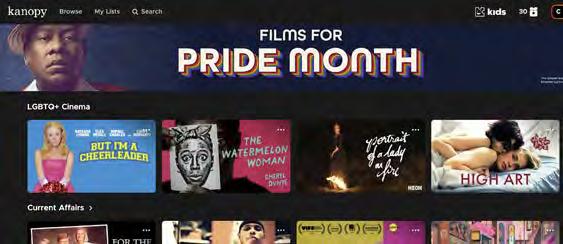
Last year during June, the LGBTQ collection was the #30 most played collection among the hundreds and hundreds of collections on Kanopy among cardholders with the city’s library.
“It does spike in June. That collection saw a 157% increase in plays when comparing May 2025 to June 2025,” noted Aaron Spears, a film programmer with OverDrive who formerly worked as a children’s librarian in the Cleveland, Ohio, metro area.
Spears, a straight ally still based in Ohio and a proud dad of a lesbian teenager, told the B.A.R. that Kanopy now has almost 500 titles in its Pride collection. New films are added at least twice monthly throughout the year, not just during Pride Month in June.
“The Pride collection, we do that year-round,” said Spears.
As for how many tickets are assigned to a film, Spears explained newer films that are higher profile cost more for Kanopy to acquire. Thus, they will require a greater number of tickets to check out and stream.
films up there and so many classic movies,” said Mitra.
More than just books
The growth of various streaming platforms has led to more people utilizing Kanopy via their library membership, said Mitra, particularly post the COVID pandemic when accessing such content had to be done at home. It can still be challenging to educate library users that they have access to more than just books at the library, she noted.
Mitra likened it to being an employee at McDonald’s and asking customers if they “want fries with that” when they order to ensure they aren’t missing out on an offering other than a burger.
“I think, sometimes, we are still, as a library, always up against the old 20th century identity or idea of a library. We are still having to say, yes, we have amazing book collections,” said Mitra, adding, that “nothing against books ... but there is so much more we offer. I think sometimes it gets lost in the mix.”
Main library houses Frameline film archive

In 2017, the San Francisco Public Library first signed a contract with Kanopy a year after it had launched its services to public library systems. Begun in 2008 with a focus on providing academic institutions with educational materials on film, the streaming platform was acquired by OverDrive in 2021.
The library has been working to promote Kanopy among its users of late, highlighting its wealth of LGBTQ films and documentaries in a recent email to cardholders timed to June being Pride Month. Between July 1 and April 30 there had been 450,000 checkouts of films on Kanopy by San Francisco library cardholders.
For the fiscal year ending June 30, 2025, there had been 480,000 checkouts, Cocking told the B.A.R., with the number per month spiking during the colder winter months and dropping in the warmer summertime. It costs the library $1 for every ticket redeemed on Kanopy, with the cost for last month being a little less than $58,000.
“My guess is we will go over the circulation compared to last year,” Cocking predicted when the checkout totals on Kanopy for the 2025-2026 fiscal year are tallied at the end of the month.
The library is in the process of renewing its contract with Kanopy, as its current one expires in September. Cocking, a straight ally, and her family use the platform, which she praised for the diversity of its offerings.
“It is just really well curated,” she noted. “You can go a little more deeper. Look at the Pride listings; there is not only general cinema but topics like current affairs, history, and short films.”
Promoting Pride
During June Kanopy has been promoting LGBTQ films for Pride Month with a special banner on its main page when San Francisco library users log onto it from a computer via the link.
There are more than 39,000 titles on Kanopy across all sorts of genres and interests. It is ramping up its efforts to promote the service via social media channels and the library systems that contract with it. Pride Month is one example of how it uses annual observations and celebrations, such as the just passed Father’s Day and Juneteenth holidays, to highlight the various movies it now has, said Spears.
“The library is already paying for and offering this service so use it,” said Spears. “The same reason for why you can go into a library and peruse all of the books and even audio books, the library is offering these digital services. So jump in and start exploring; see what catches your eye.”
For those unable to attend this year’s Frameline movie screenings, Spears suggested they curate their own festival at home via Kanopy’s Frameline collection. It has a number of films that played in previous festivals. He and his daughter recently watched “The Incredibly True Adventure of Two Girls in Love,” which had its Bay Area premiere and was the opening night film at Frameline in 1995.
“Going through Pride Month there is so much dread and awful stuff in the world these days, why not be focusing more on queer joy by watching stuff at home,” said Spears. “Let’s have some joy in our lives. It is bad enough out there, so let’s have some joy in our house where we can. That is more like a vibe watch rec for the month.”
Aguirre is among the San Francisco Public Library users who have been taking advantage of Kanopy.
“Oh my gosh, Kanopy houses great movies,” they said. “It has many queer films I just love.”
Queer San Francisco native Cristina Mitra, the Hormel Center’s program manager, checks out Kanopy at least once a month to see what new titles have been added. A fan also of the educational courses it has that run from 12 hours to 42 hours, and require five tickets to watch, Mitra told the B.A.R. the platform is a great way to experience classic cinema, whether it be LGBTQ titles or more mainstream fare, at no cost.
“I try to tell literally everyone I talk to about it. I think especially for the LGBTQ community, we have this free resource that has so many Frameline
Unfortunately, due to copyright issues, the more than 5,000 films in the library’s Frameline collection can’t be streamed online. They must be watched at the main library at 100 Larkin Street via its San Francisco History Center on the sixth floor where viewing rooms are set up.
The library in 2007 first acquired a trove of film screeners from Frameline and continued to do so through 2016. It stopped after that year’s festival because the entry process for filmmakers to submit their works went digital, explained Mitra.
“Some of these didn’t actually make it into the festival, but Frameline kept the physical copies,” noted Mitra. “But many of them did make it into the festival.”
It is what makes the collection housed by the library unique. Various titles never were screened outside of the film festival circuit unlike the LGBTQ movies available via Kanopy and other streaming platforms that did get picked up by a distribution company.
“If you are an independent filmmaker, you work the festival circuit and hope you get distribution. But so little films actually get distribution,” said Mitra, who noted that the titles in the library’s Frameline collection run the gamut from being “rare or perhaps never seen or festival favorites, or they are something people saw at the festival and haven’t seen it since.”
Those most accessing the films in the collection are researchers and academics, said Mitra. Sometimes it is filmmakers reaching out, such as in the case of Aguirre. Last fall, the library revamped the search capability online for finding films in the Frameline collection at its special webpage for it found at https://tinyurl.com/ts3kwhc.
“You can now put any word in there to search for, from the name of the director or anybody on the film team. Or you can search under Italy if you want see all the films from or about Italy, or you can search under cat for all the films that have a cat in it,” said Mitra.
by John Ferrannini
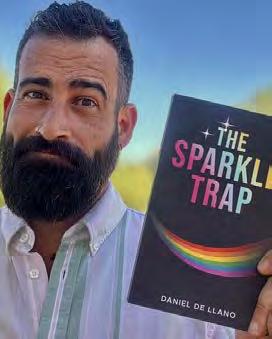
Agay Spanish author recently won an award for his book on healing from narcissistic abuse in same-sex relationships. The former San Francisco resident and wellness coach wants people to learn from his experiences.
Daniel de Llano, 38, the author of “The Sparkle Trap: Recognizing, Escaping, and Healing from Narcissistic Abuse in LGBTQ+ Relationships,” credits his five years living in San Francisco with helping him to heal from a relationship when he resided in Spain that he said “destroyed my life, different times, in different ways.”
“San Francisco was more the transformation, where I think the ingredients came into place. I think leaving my country helped me a lot to kind of get distance,” de Llano said in a recent Google Meet interview. “Actually, I wrote [‘The Sparkle Trap’] in English, and then [translated it] in Spanish, because it was like giving back what I received from San Francisco, what I received from the U.S. I’m really grateful and I wanted to give this book to my community, to the U.S., and to California.”
“The Sparkle Trap” was recognized by the 2026 IndieReader Discovery Awards last month with the first place award in overall nonfiction – beating over 1,000 submissions.
“The quality of this year’s submissions make it clear why we believe so deeply in this community,” IndieReader co-owner
For Hazelwood, a genderqueer and bisexual person, the Rainbow Clubs are a space for affirmation and normalization. “We’re simply leading the kids in an age and developmentally appropriate way with what they are already experiencing on their own,” Hazelwood told the B.A.R. in a
Jared Drake stated. “Independent publishing has never been more vital, and these winners represent exactly the kind of bold, original work that deserves a wider stage.”
De Llano, who is once again residing in his home country, studied performing arts at the Royal Higher College of Performing Arts in Madrid, one of the world’s most prestigious theater schools.
A hypnotherapist and wellness coach accredited by Rapid Transformational Therapy, the International Association of Counselors and Therapists in the United States, and the Accredited Counselors, Coaches, Psychotherapists and Hypnotherapists in the United Kingdom, de Llano founded the Association for Research, Prevention and Recovery
phone interview. Hazelwood described being a “product of SFUSD schools myself” and thus knowing “the importance of having [gay-straight alliances], having curricula that reflects your own lived experiences.”
“I want us to continue to have spaces where our students can see themselves and dream bigger and better,” Hazelwood said.
from Relational Abuse.
It was before he came to the U.S. that he ended up in what he characterized as a narcissistic abusive relationship.
“I didn’t understand why I kept coming back,” he said. “And it was like my mind cheating on me.”
Asked what makes a relationship narcissistic, versus normal tensions that take place between psychologically healthy individuals, he said, “Normal friction has a solution. You can fix things with communication.”
“When you are in an abusive relationship, there is no possible change. Normally, you are always the guilty one in everything that happens,” de Llano said. “The person will keep promising and promising and promising and having temporary changes, but then, they will come back to painful dynamics, and it’s the willingness of hurting. A narcissist has the capacity of hurting you on purpose. And that’s something that over time, you get to see that they are doing weird things that they know will hurt, and they still do it.”
De Llano said that once he realized he was in an abusive relationship, “it was very hard for me to find queer resources around this topic.” After the relationship ended, he moved to San Francisco, where he lived for three years, from 2022 to 2025.
“I decided to create a resource for my community,” he said. “I didn’t want to write a testimony about how my life got destroyed, but I wanted to do something
Su reflected Hazelwood’s sentiment. In a statement to the B.A.R., Su affirmed the importance of Rainbow Clubs as “safe spaces” in district schools, noting, “At SFUSD, we welcome students as they are.”
“When young people are supported for who they are, they are more likely to show up for school and engage in the classroom,” Su stated. “This program reflects both our values and our commitment to student success.”
At Marshall Elementary School’s Rainbow Club, this support can look as simple as having regular student introductions. Elaine Ellis, the school’s social worker and the facilitator of its Rainbow Club, described weekly meetings beginning “usually with a check-in circle where kids introduce their name and their pronouns.”
“Even though most of them have heard them,” Ellis, a straight ally, explained in a phone interview, “we reiterate that sometimes kids are choosing to use different pronouns at different times.”
Other efforts have included presentations in classes affected by homophobia and group visits to LGBTQ institutions, such as the San Francisco Gay Men’s Chorus and the Castro LGBTQ neighborhood.
The school’s Rainbow Club is primarily for fourth and fifth grade students, a decision made in regard to both scheduling and maturity. “Sometimes those kids want to talk about stuff that’s a little more mature,” Ellis said.
Still, “it’s not like we would say no if a [younger] kid was really inter-
Lurie From page 1
We want to be there in every possible way. And I would just say, you know, we’re living in really difficult budget times, and we’re continuing to invest in the LGBT community, HIV prevention, and getting to zero.”
The city has long had a Getting to Zero program to decrease new HIV transmissions, lower deaths, and reduce stigma.
According to the most recent annual report, new HIV diagnoses rose slightly in 2024 to 146 cases after hitting an alltime low of 140 cases in 2023.
Reached for comment, Stone declined and deferred to the Harvey Milk LGBTQ Democratic Club’s HIV+ caucus. Jonathon Salinas, a gay man who
with it that could benefit the community.”
Queer relationships sometimes face different challenges than heterosexual ones. De Llano gave two examples – one being that because the LGBTQ community is relatively small, queer people are more likely to have to share space with their abusive partner or ex-partner.
“San Francisco, it’s a queer city, but if you go to other parts of the U.S., there are many cities that have maybe one bar, one queer bar, two queer bars,” he said. “So how do you go zero-contact with a narcissist if the community is so small, if the places we can go are so limited? Also, something that happens a lot in these types of relationships are smear campaigns. It’s a small community.”
Non-monogamy also presents challenges.
“It’s very frequent to see open relationships” in the gay community, de Llano said. “An open relationship with a narcissist can become a battlefield, as they tend to test boundaries. Trespassing boundaries is something that they normally do.”
“The Sparkle Trap” presents information in a number of different ways.
“I presented my story, but it’s a combination of different survivors’ stories and my own, and I add neuroscience information, I add exercises, I add QR codes that include a free online course where we dig deeper into certain things, so it’s a full guide and a companion for people trapped in a relationship needing some
ested and wanted to be a part of it,” Ellis said.
The B.A.R. attempted to reach parents and students for this story but was unsuccessful.
The one challenge the club occasionally faces, Ellis says, is parental discomfort, with one parent in the 2025-2026 school year who didn’t want their child to go on a field trip.
She described how the school’s Rainbow Club does not ask permission from parents for kids to be present during the day, which she says can be a “barrier to access” when required after school.
help to get out,” he said. De Llano’s editor was Gillian Rodgerson, a lesbian.
“When he told me about the premise of his book, ‘The Sparkle Trap,’ I could certainly see how something like that could bring a really important message to guys who were trying to find healthy dating relationships,” Rodgerson stated. “Daniel’s book is particularly aimed at gay men, and some of the issues he discusses are specific to that community, but a lot of the strategies for coping with, and ultimately leaving, a narcissist, would resonate with anyone.”
Rodgerson continued that she appreciated de Llano’s presentation style.
“My favorite thing about the book was his narrative voice,” she stated. “He’s warm and supportive but doesn’t sugarcoat the real harm narcissists can inflict on their partners. He’s been there and he knows how it feels, but he’s managed to move on and he wants to show how others can too.
“And, as well as being a good, thoughtful therapist, he’s also very funny. Narcissists have always prowled around the dating scene, but we can now put a name to their behavior. And, once you can name and identify something, you can see it and fight it,” Rodgerson added.
“The Sparkle Trap” is available wherever books are sold. The paperback version on Amazon is $17.99. t
is in the caucus, responded to Lurie’s remarks.
“Talk is cheap. We could have conversation after conversation with no action and nothing will ever get done,” Salinas said. “Funding services is what we want to see, and what the people want to see.”
Tsai told the B.A.R. that the department is working with organizations seeing cuts on how they can bill MediCal rather than relying on the city’s general fund to cover their expenses. Salinas said that the budget should continue providing funding to community-based organizations until their ability to bill Medi-Cal comes fully online.
“Why is there no possibility to have the funding, and say this is the last year you’re going to have it, so there are no layoffs or ongoing gaps?” he asked.
For the anonymous donor, LGBTQ representation is a regular part of San Francisco city life. They described having kids who were raised “just above the Castro.” “They think the rainbow flags are as much a part of their city as eating dim sum or grabbing Mission Burritos,” the donor stated. “They have friends who have two moms and friends who have two dads, and quite a number of their friends identify as trans. For them, this is all normal – as it should be.”
Yet even in a city where LGBTQ presence is undeniable, for some, the Rainbow Clubs have become a crucial space for safety. Ellis described how she found an old form she had filled out with a small quote from a student. “A kid said that this is the only place I can talk about my feelings,” Ellis said. “I think that that was important.”
For details on donating to Spark SF Public Schools, visit sparksfpublicschools.org/ways-to-give. t
Religion, Ellis explained, sometimes acts as a complicating factor, although people are “generally tolerant and supportive, even if maybe it’s a little bit uncomfortable to talk about in their family or in their church.” Ellis described her openness to talking to parents. “We want to accept that every family talks about things differently, and we’re not trying to change that at school,” she said. Hazelwood described a similar approach to mitigating parental worries through transparency. “Our first step is always to reach out and to say, hey, we are happy to walk you through, ‘What are the activities that are happening?’ We’re happy to show what it is that we’re talking about,’” Hazelwood explained.
“When it comes to being physically present somewhere, walking the Castro, that’s a great photo-op, but the community needs the services. We are happy to support any administration policies that would allow continuing coverage for services without gaps and would love to work with the mayor to ensure that happens.”
‘We want you to feel safe’
The B.A.R. also asked Lurie about his philosophy when it comes to appointments, pointing out that the LGBTQ heads of public health, the Department of Homelessness and Supportive Housing, and the Port have been replaced by straight allies during Lurie’s tenure.
See page 31 >>
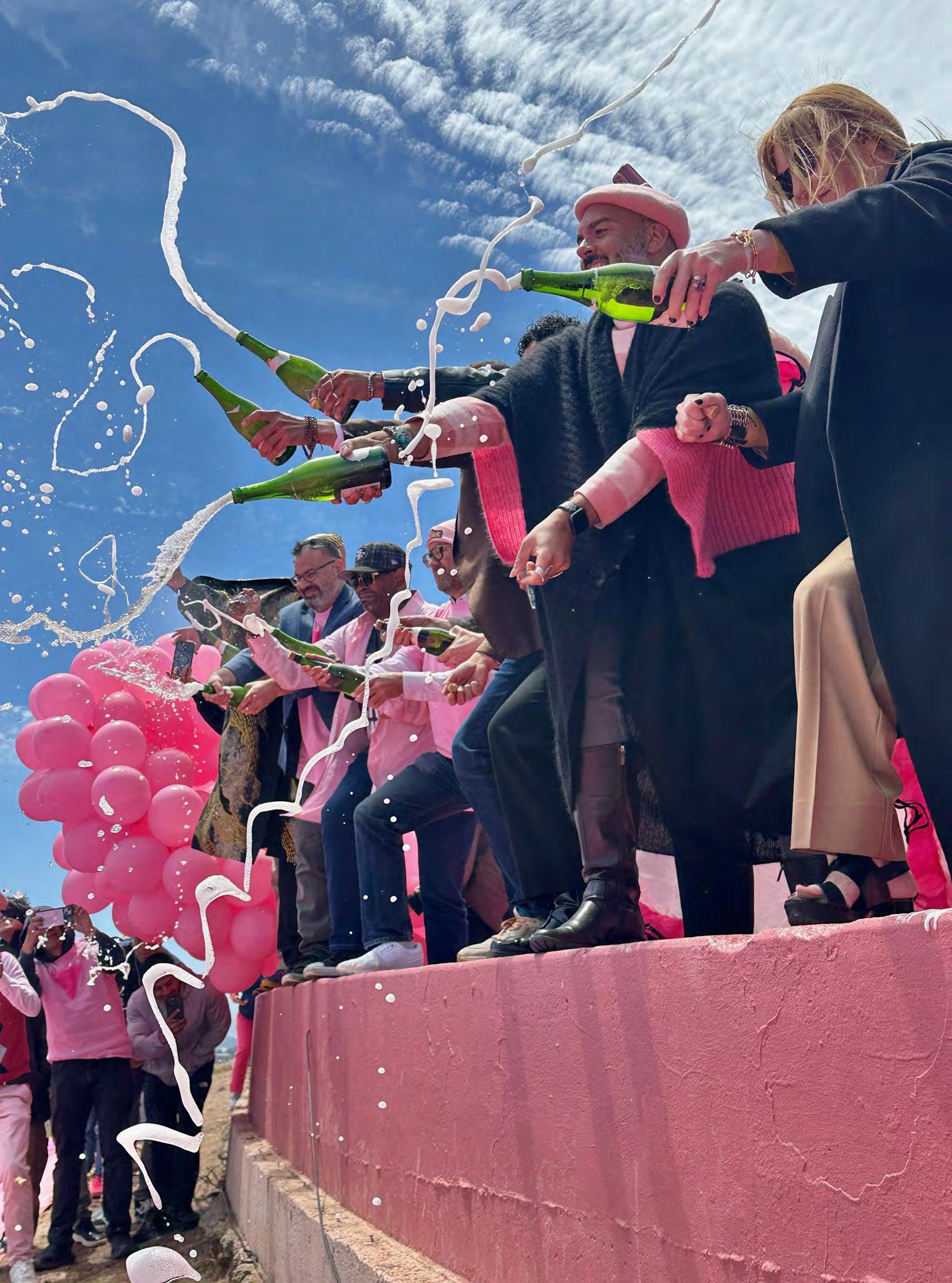
was once a badge of shame forced on queer people by a fascist regime.
Today, it stands atop Twin Peaks as a powerful symbol of remembrance — and warning.
Across America, anti-LGBTQ+ rhetoric and legislation are rising. Books are banned. Trans rights are under attack. History is being rewritten.
Thirteen years after the death of Bob Ross, the Bay Area Reporter's publisher and founder, the foundation that bears his name, established in 1995, continues to support a diverse range of local arts, HIV-related, LGBT, and other nonprofit organizations. During this time, these organizations need our support, and yours, more than ever.
If you are able, please consider supporting these vital institutions.
Chanticleer
GLBT Historical Society
Horizons Foundation
The Bob Ross Foundation is proud to support the lighting of the Pink Triangle and the work of San Francisco Pride — and dozens of other LGBTQ+ organizations defending our truth, our culture, and our lives.
KDFC Classical Music
Larkin Street Youth
Meals on Wheels
New Conservatory Theatre Center
Openhouse
Pets Are Wonderful Support (PAWS)
San Francisco Ballet
San Francisco Dance Film Festival
San Francisco Giants Community Fund
San Francisco Pride (Pink Triangle)
Shanti
Tenderloin Tessie Holiday Dinner Theatre
Rhinoceros
Volume 56, Number 26
June 25-July 1, 2026
Volume 56, Number XX Month XX-XX, 2026 www.ebar.com
PUBLISHER
Michael M. Yamashita
Thomas E. Horn, Publisher Emeritus (2013)
Publisher (2003 – 2013)
Bob Ross, Founder (1971 – 2003)
NEWS EDITOR
Cynthia Laird
ARTS & NIGHTLIFE EDITOR
Jim Provenzano
ASSISTANT EDITORS
Matthew S. Bajko • John Ferrannini
CONTRIBUTING WRITERS
Governor Gavin Newsom is soon
expected to sign California’s $356 billion budget that the Legislature has already approved. His deadline is June 30, the last day of Pride Month. We urge him to do so, as there are several budget items that will help the LGBTQ community. Equality California, the statewide LGBTQ rights organization, and the Sacramento LGBT Community Center also called on Newsom to sign the budget.
“At a time when LGBTQ+ communities across the country are facing continued attacks on our rights, our health, our safety, and our dignity, California has an opportunity to show what real leadership looks like,” David Heitstuman, CEO of the Sacramento center, wrote in a letter to supporters.
violence know that there are resources available. In San Francisco right now, District Attorney Brooke Jenkins has filed hate crime charges in three separate cases related to alleged anti-LGBTQ actions. (The defendants have all pleaded not guilty.) People can visit cavshate.org for more information.
BTQ community. It’s important because, as we’ve all seen, the Trump administration continues to pressure medical facilities that provide gender-affirming care to pause or end such care.
Kyle Amato • Race Bannon • Robert Brokl
Christopher J. Beale • Robert Brokl
Christopher J. Beale • Brian Bromberger
Brian Bromberger • Philip Campbell
Heather Cassell • Eliot Faine
Philip Campbell • Myron Caringal
Michael Flanagan • Jim Gladstone
Meg Collins • Chelsea Davis
Natasha Dennerstein • Eliot Faine
Liz Highleyman • Brandon Judell • Lisa Keen
George Faville • Michael Flanagan
Philip Mayard • Laura Moreno
In its note to supporters, EQCA pointed out that the budget includes $30 million for the LGBTQ+ Community Center Fund, which recognizes the essential role such spaces play in the queer community across the state. For many, these centers are a lifeline and provide safe spaces for queers to find community and get information on myriad services.
Another important item in the budget is $5 million to fund specialized crisis hotline services for LGBTQ+ youth. This is also known as the “Press 3” option. As we have reported, the Trump administration canceled the specially trained LGBTQ crisis counselors that youth under the age of 25 could request when calling the national 988 Suicide and Crisis Lifeline. As of last July, the “Press 3 option” that youth could utilize in order to be connected to a counselor equipped to handle questions about sexual orientation and gender identity matters had been disconnected.
Since then, training on queer and transgender issues for counselors with the state’s 988 suicide support line has started. The state funding would enable the program to continue operating.
We realize that this is a difficult budget year for the state, not to mention local governments like San Francisco; however, these state budget items that lawmakers included are critical for the LGBTQ community. Newsom, who is termed out of office in January and is widely expected to run for president in 2028, cannot retreat when it comes to LGBTQ issues. He has already upset many in the community with his anti-trans sports comments to the late Charlie Kirk in 2025. At that time, we noted that Newsom should have reached out to trans community leaders and parents of trans youth so that he could become more enlightened on the issue. (There are few out trans athletes competing at the collegiate level, and none from the U.S. were in the 2024 Summer Olympics or this year’s Winter Olympics, so the issue is really just a red herring for the transphobes.)
David-Elijah Nahmod • Mark William Norby
Jim Gladstone • Brian Guan • Liz Highleyman
JL Odom • Paul Parish • Tim Pfaff
Brandon Judell • Michele Karlsberg • Lisa Keen
Jim Piechota • Adam Sandel
Matthew Kennedy • Philip Mayard
Jim McDermott • Laura Moreno
Jason Serinus • Gregg Shapiro
Gwendolyn Smith • Charlie Wagner
David-Elijah Nahmod • Mark William Norby
JL Odom • Lois Pearlman • Tim Pfaff
Ed Walsh • Cornelius Washington • Sura Wood
Jim Piechota • Joshua Polanski • Adam Sandel
Gregg Shapiro • Gwendolyn Smith
ART DIRECTION
Charlie Wagner • Ed Walsh
EQCA, the Sacramento center, and the California LGBTQ Health and Human Services Network highlighted a $26 million budget item to create an in-state network for transition-related care and to stabilize existing providers.
The Sacramento center noted a five-year expenditure plan using nearly $1 billion in AIDS Drug Assistance Program Rebate Fund resources, which would support efforts to end the epidemics of HIV/ AIDS and other sexually transmitted infections while strengthening prevention, treatment, and care services, Heitstuman stated.
Nonetheless, if Newsom is serious about seeking the Democratic presidential nomination, he will need to do more than just be known as the former San Francisco mayor who jump-started the marriage equality movement back in 2004. Today, many Democrats want someone who will fight back against what Trump and Republicans in Congress are doing, not mimic conservatives.
Cornelius Washington • Evelyn C. White
Max Leger
PRODUCTION/DESIGN
Ernesto Sopprani
ART DIRECTION
Max Leger
PHOTOGRAPHERS
Jane Philomen Cleland
PRODUCTION/DESIGN
Rick Gerharter • Gooch
Ernesto Sopprani
Jose A. Guzman-Colon
PHOTOGRAPHERS
Rudy K. Lawidjaja • Georg Lester
Jane Philomen Cleland
Rich Stadtmiller • Christopher Robledo
Rick Gerharter • Gooch
Fred Rowe • Shot in the City
Steven Underhill • Bill Wilson
Jose A. Guzman-Colon
Rudy K. Lawidjaja • Georg Lester
ILLUSTRATORS & CARTOONISTS
Rich Stadtmiller • Christopher Robledo
Christine Smith
Fred Rowe • Shot in the City
Steven Underhill • Bill Wilson
ILLUSTRATORS & CARTOONISTS
Christine Smith
VICE PRESIDENT OF ADVERTISING
Scott Wazlowski – 415.829.8937
VICE PRESIDENT OF ADVERTISING
NATIONAL ADVERTISING REPRESENTATIVE
Scott Wazlowski – 415.829.8937
Rivendell Media – 212.242.6863
LEGAL COUNSEL
Paul H. Melbostad, Esq.
NATIONAL ADVERTISING REPRESENTATIVE
Rivendell Media – 212.242.6863
LEGAL COUNSEL
Paul H. Melbostad, Esq.

Bay area reporter
“If fully funded, these proposals would help protect access to gender-affirming care and reproductive healthcare as federal attacks continue to escalate and providers face growing uncertainty,” the LGBTQ network noted, also referencing a budget item of $30 million for the uncompensated care fund.
There’s also $30 million to continue funding Stop the Hate programs. The Bay Area Reporter has participated in these programs by publishing related articles and public service announcements. It’s critically important that potential victims of hate
Another $900 million in the budget would support homelessness and housing programs statewide, including services for LGBTQ+ youth and young adults. As we have reported over the years, queer youth and young adults experience disproportionately high rates of homelessness, especially those aging out of the state’s foster care system.
All of these budget proposals that the Legislature has approved would reinforce California’s status as a state that cares for its residents, in this case, the LG-
Signing the state budget that includes the LGBTQ-related items will demonstrate Newsom’s commitment to the community at a time when we need allies to have our backs. California is recognized as a trans refuge state, thanks to bills Newsom has previously signed into law. That means the Golden State welcomes trans kids and their families who have to leave less-hospitable states.
But that status is meaningless if there aren’t resources for those individuals once they arrive. This year’s LGBTQ budgetary allocations, particularly for gender-affirming care items and the crisis line, will reinforce California’s reputation as being welcoming to all. t
by Dennis Mabasa
I
am an environmental educator and, for more than 20 years, I’ve had the privilege of watching what happens when people discover that they belong.
Through my work, I’ve seen young people climb mountains they never thought they could climb and discover confidence they didn’t know they possessed. I’ve met former participants who tell me environmental education programs changed the trajectory of their lives. Some say the joy they found in those programs gave them a reason to keep going during some of their darkest moments.
Environmental education is often thought of as learning about plants, animals, ecosystems, and climate. It is all those things. But at its best, it’s also about creating opportunities for people to understand their unique place in the world.
For me, the power of belonging became deeply personal in June 2015.
I had recently started a new job at an organization in the Southern United States and was preparing for a weeklong camping trip with a group of young people when a supervisor pulled me aside and said, “Dennis, we love you, but when we meet the parents, tone it down. Remember, this is the South.”
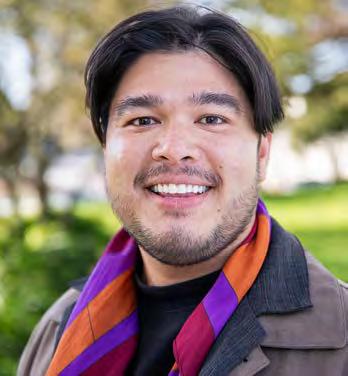
it’s their first experience sleeping under the stars, carrying a backpack through wilderness, or connecting with peers who share similar lived experiences.
Our monthly Belonging in Nature programs invite queer and trans community members and allies of all ages to connect with the land through stewardship, art, and wellness. Participants might restore habitat, learn about native plants, practice meditation, hear from Indigenous and Two-Spirit artists, or share a meal outdoors. These gatherings support care for the land and for one another.
Participants consistently tell us these programs offer space to show up as themselves. They find community, mentorship, healing, and connection. Some pursue careers in conservation and environmental stewardship, while others build a lasting sense of belonging in nature.
That’s what Pride means to me.
It’s not only a celebration of identity. It’s a commitment to creating conditions where people can thrive. It’s recognizing that belonging is not something we ask individuals to earn. It’s something we build together.
Bay area reporter
44 Gough Street, Suite 302 San Francisco, CA 94103
415.861.5019 • www.ebar.com
44 Gough Street, Suite 302 San Francisco, CA 94103
A division of BAR Media, Inc. © 2026
415.861.5019 • www.ebar.com
President: Michael M. Yamashita
Director: Scott Wazlowski
A division of BAR Media, Inc. © 2026
President: Michael M. Yamashita
News Editor • news@ebar.com
Director: Scott Wazlowski
Arts Editor • arts@ebar.com
News Editor • news@ebar.com
Out & About listings • jim@ebar.com
Arts Editor • arts@ebar.com
Advertising • scott@ebar.com
Out & About listings • jim@ebar.com
Letters • letters@ebar.com
Advertising • scott@ebar.com
Letters • letters@ebar.com
Published weekly. Bay Area Reporter reserves the right to edit or reject any advertisement which the publisher believes is in poor taste or which advertises illegal items which might result in legal action against Bay Area Reporter. Ads will not be rejected solely on the basis of politics, philosophy, religion, race, age, or sexual orientation.
Advertising rates available upon request.
Published weekly. Bay Area Reporter reserves the right to edit or reject any advertisement which the publisher believes is in poor taste or which advertises illegal items which might result in legal action against Bay Area Reporter. Ads will not be rejected solely on the basis of politics, philosophy, religion, race, age, or sexual orientation. Advertising rates available upon request.
Our list of subscribers and advertisers is confidential and is not sold. The sexual orientation of advertisers, photographers, and writers published herein is neither inferred nor implied. We are not responsible for unsolicited manuscripts or artwork.
Our list of subscribers and advertisers is confidential and is not sold. The sexual orientation of advertisers, photographers, and writers published herein is neither inferred nor implied. We are not responsible for unsolicited manuscripts or artwork.
They didn’t explain what they meant. They didn’t have to.
Part of me wanted to quit.
Instead, I stayed.
On the first day of the trip, while driving a van full of teenagers to our first campsite, I heard screaming from the back. I immediately pulled over, thinking something terrible had happened.
Instead, I found a group of young people hugging, crying, and cheering. They had heard the U.S. Supreme Court ruling in Obergefell v. Hodges, legalizing same-sex marriage nationwide.
The young people in that van were celebrating the possibility that they, their friends, and their family members could be fully recognized and loved.
Before that moment, I was so afraid they wouldn’t accept me after that supervisor made that comment.
In that moment, I learned something important. Belonging isn’t determined by titles, authority, or power. It’s created by people. It’s built through culture, community, and small actions that communicate, “You are welcome here exactly as you are.”
That trip changed me. It helped me realize this lonely queer kid could devote a life to creating spaces where other people would never have to question whether they belonged.
Today, I have the privilege of serving as vice president of community and youth at the Golden Gate National Parks Conservancy. One of the core goals of our work is ensuring these public lands are welcoming and accessible to everyone, particularly communities that have historically been excluded from outdoor spaces and environmental movements. That commitment feels especially important right now.
Across the country, we’re seeing efforts to erase or minimize the stories of LGBTQIA+ people, particularly transgender people and queer and trans people of color. Pride has always been intersectional, shaped by people whose lives reflect the intersections of race, gender, class, sexuality, and culture.
When those experiences aren’t centered, we miss the chance to better understand one another and strengthen community.
Through programs like the Queer Belonging Backpacking Adventure (QBBA) and our Belonging in Nature: Queer and Trans Community Days, we create opportunities for queer and trans people and allies to experience parks as leaders, stewards, educators, and artists.
QBBA is a paid summer leadership program for high school-aged youth that centers queer, trans, and gender-diverse young people and allies, particularly Black, Indigenous, and youth of color. Participants build outdoor skills through activities like rock climbing, camping, backpacking, hiking, and kayaking, while exploring identity and community. For many,
This Pride Month, I invite you – especially LGBTQIA+ communities and allies – to join us. Attend a community program. Volunteer alongside us. Encourage a young person to apply for QBBA next year. Spend time in your parks. And if this work resonates with you, consider supporting it so that more people can experience the healing, connection, and belonging that nature makes possible.
I often think about that young educator sitting in a van in 2015, wondering whether there was space for someone like me in this field. What I learned from those young people that day is something I still carry with me: belonging is something we make together – in vans, on trails, in campsites, in the small and radical acts of seeing each other fully.
That work didn’t begin in that moment, and it doesn’t end here. t
Dennis Mabasa, they/them, is a queer leader in environmental education. They are the vice president of Community and Youth Programs at the Golden Gate National Parks Conservancy. Mabasa has led community and youth initiatives at organizations including Friends of the Los Angeles River and the California Academy of Sciences. In their current role, they work to break down barriers to park access through welcoming community and youth engagement programs in the Golden Gate National Recreation Area, the most-visited national park unit in the United States.
by Matthew S. Bajko
As a freshman member of the San Francisco Board of Supervisors, Joel Engardio showed up to its meeting that coincided with Halloween in 2023 adorned in a T-shirt sporting the character Joy from Pixar’s “Inside Out” movies. Joyfulness had been a major theme of his throughout his first year representing the fourth supervisorial district covering neighborhoods adjacent to the city’s Pacific Ocean shoreline.
“The hard work we are doing to fix problems is not sustainable if you don’t have hope. It is important to recognize joy where it exists,” Engardio, who is gay, had told the Bay Area Reporter during an interview to talk about those initial 12 months he served at City Hall.
In November 2022 Engardio had made local political history by becoming the first LGBTQ resident of a western neighborhood in the city to be elected supervisor. The moderate former journalist also was the rare challenger to oust from office a sitting supervisor and did so on his fourth bid for a seat on the board.
The previous three tries the Lakeshore neighborhood resident, where he shares a home with his husband, Lionel Hsu, had vied for the District 7 seat on the board. But in 2021 he was redistricted into District 4 centered around the Outer Sunset and ran against progressive former supervisor Gordon Mar the following year.
His victory over Mar resulted in the board, for the first time, having three gay men serving on it at once. Last year, on September 16, Engardio notched another historic first by becoming the only San Francisco supervisor to be recalled from office.
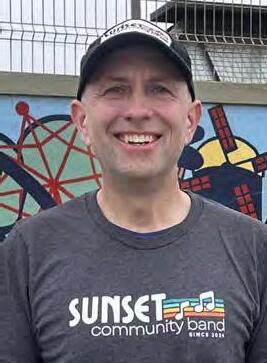
Matthew S. Bajko
Former San Francisco supervisor Joel Engardio remains a fan of Sunset Dunes park and the Sunset Community Band that he helped launch.
live forever,” noted Engardio. “So the question is, how do we want to best use the time that we have? I believe in approaching life with curiosity and kindness. It’s not healthy to carry bitterness and anger.”
He told the B.A.R. that, “There are too many people in San Francisco who become the Simpsons meme of the old man yelling at clouds. They have permanent scowls. They are angry about everything, say no to everything, and spend their time trolling on Nextdoor. That makes me sad and I feel bad for those folks because it must not be a very happy life.”
tive interaction between him and his mom. He had brought her a copy of the New York Times with its coverage of his losing his supervisor seat.
“It was, like, a banner headline on the front of the national page, and with a giant photo of me, like, a smiling photo, standing on Sunset Dunes,” said Engardio. “And even though the article was about me being recalled, my mom read it, and she said, ‘Oh, this is really something. This is really something.’ She said, ‘You actually come out pretty good in this article, right?’”
To a national audience, said Engardio, “it’s quite ridiculous what happened, right? But I’m so glad my mom got to see her son in the New York Times, being on the right side of history, and she was proud, even though I was recalled, she was proud, like, from her hospice bed.”
He was also able to share with her video of his final speech during the board’s September 30 meeting last year. (It can be seen here beginning at the 2:35 mark.)
“She said, ‘You go, go you, you say it. You say it!’ Like, she was so proud that I was speaking my truth and really liking my last speech just to let it all out and say what’s really important,” said Engardio.
His political undoing came from his putting on the November 2024 ballot the successful citywide measure that closed a portion of the Great Highway to vehicular traffic. The roadway that runs along Ocean Beach had long been a favored commuter corridor for many of his constituents, and their anger at seeing the stretch between Sloat Boulevard and Lincoln Way become the city park Sunset Dunes paved the way for the recall of Engardio.
Keeping perspective
Earlier this month the B.A.R. caught up with Engardio, 53, at the park to talk about what life has been like post being recalled and his future political plans. As when he was in office, Engardio throughout the nearly 40-minute conversation enthused joyfulness when discussing his time in office and the months since his last day as a supervisor on October 18.
“I try to keep perspective because, like, I’ve been through a lot in life, you know, and I’ve experienced a lot of loss, like profound loss, you know, like my dad abandoned my family, and then I had a boyfriend who died of cancer when I was only 29,” noted Engardio. “Like, just, like, things that really, like, those are hard things to go through, right? And so when it comes to politics, you know, I’ve been through much worse, right? So I try to keep perspective. And I try to also think about, like, the time I was there, all the positive things we accomplished.”
In a follow-up texted reply, Engardio explained one reason for his not being bitter about his brief tenure as a supervisor is because even if he wasn’t recalled, his ability to serve in the seat would be “finite.” Following the passage of a local ballot measure in this month’s primary, supervisors in San Francisco can only serve a total of eight years – two fouryear terms. Previously, after serving back-to-back terms, they could wait four years and then run again to serve on the board. (The new rule also applies to the city’s mayors.)
“You can’t be in the seat forever, just as our time on earth is finite. We won’t
Even when he and his husband were subjected to “vicious” comments, Engardio said he would wish for the person to find “love and be loved. What gives me the most hope are the people who roll up their sleeves when there’s a challenge and always have a smile on their face. They are trying to make things better and they’re working for a greater cause than themselves. They’re thinking about what young people and the next generation need. And they’re trying to leave the city better than they arrived. That’s the person I want to be and who I want to spend time with. Plus, it’s more fun to be around them.”
Fate also intervened to prevent Engardio from having time to stew over his being recalled. Seven years ago he had moved his mom, Mary Kaye Engardio, from Michigan to Vacaville, California, about an hour northeast of San Francisco to help care for her. A few weeks after the recall vote, she was diagnosed with terminal pancreatic cancer and died in mid-October at the age of 76.
“So that was the most, you know, important and devastating thing that happened last year,” he said. “I mean, politics is not life and death when it comes to your personal life, and it doesn’t define you as a human being.”
Because his mom was a Jehovah’s Witness, she didn’t attend his wedding to Hsu. Nonetheless, Engardio remained close with her, and both he and Hsu were with her during her final days.
“We were with her when she died, and the night before she died, she told my husband that she loves him, and that she’s so glad that he’s in my life, and that I’m in his life,” recalled Engardio, adding it “was just a really poignant moment to go from not coming to my wedding to saying how much she loved my husband and was glad he was in my life. So these are the things that are most important in life versus recalls and elections and all the shenanigans and crazy stuff that happens in San Francisco politics.”
In social media posts about his mother’s passing, Engardio noted, “She left us too soon, but I know her final years were filled with love and joy.”
Speaking with the B.A.R. Engardio recalled how his recall brought one posi-
During the 14-minute speech Engardio listed off the accomplishments he was able to achieve while in office and some of his more difficult votes he cast, such as the one to put the creation of Sunset Dunes before voters. The point he tried to make that day, explained Engardio, is his name and those of most of his board colleagues are unlikely to be remembered in 50 years, but their actions taken as supervisors are likely to be impacting life in the city for decades to come.
“People even forget presidents, so supervisors will long be forgotten,” said Engardio. “So I feel good knowing that whether I’m remembered or not, this park is going to be here and will stand the test of time. And while I’m still alive, like, I will be out here sitting on a park bench with my husband, enjoying the sunset, right? So that will be the joyful part of my days.”
Revived newsletter
This spring Engardio returned to his roots as a reporter and revived the newsletter he had started even before being elected supervisor in which he highlighted positive goings-on and the contributions of residents of his supervisorial district after fielding repeated requests from his former constituents to do so. He has about 35,000 subscribers for it and posts new ones via Substack.
“I’ve invited a lot of guest writers to join the newsletter. So you’ll see writers from each generation, from Z, X, millennial, the boomer, even the silent generation,” said Engardio, who wants the newsletter “to uplift and amplify voices of and to showcase people who are using creativity, innovation, and kindness to create our best San Francisco.”
He also has been hosting monthly “Politics 101” seminars about San Francisco’s government at the gayowned Manny’s cafe and event space in the Mission district to standingroom-only crowds. (Owner Emanuel “Manny” Yekutiel is among the four out candidates running this year for the open District 8 seat on the Board of Supervisors centered around the city’s LGBTQ Castro district.)
The next one will be July 22, and those interested in attending at no cost can RSVP at https://engardio. com/101. Engardio also presents it for free to private groups like school classes or tech companies that reach out to him.
“I try to make it as entertaining as possible. I guarantee folks it’ll be as entertaining as their favorite Netflix show,” he said.
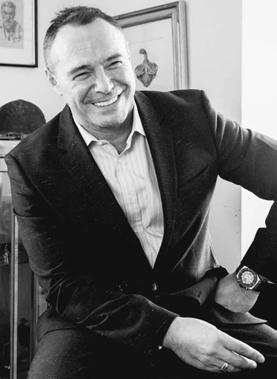
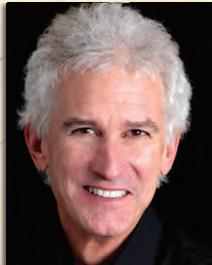
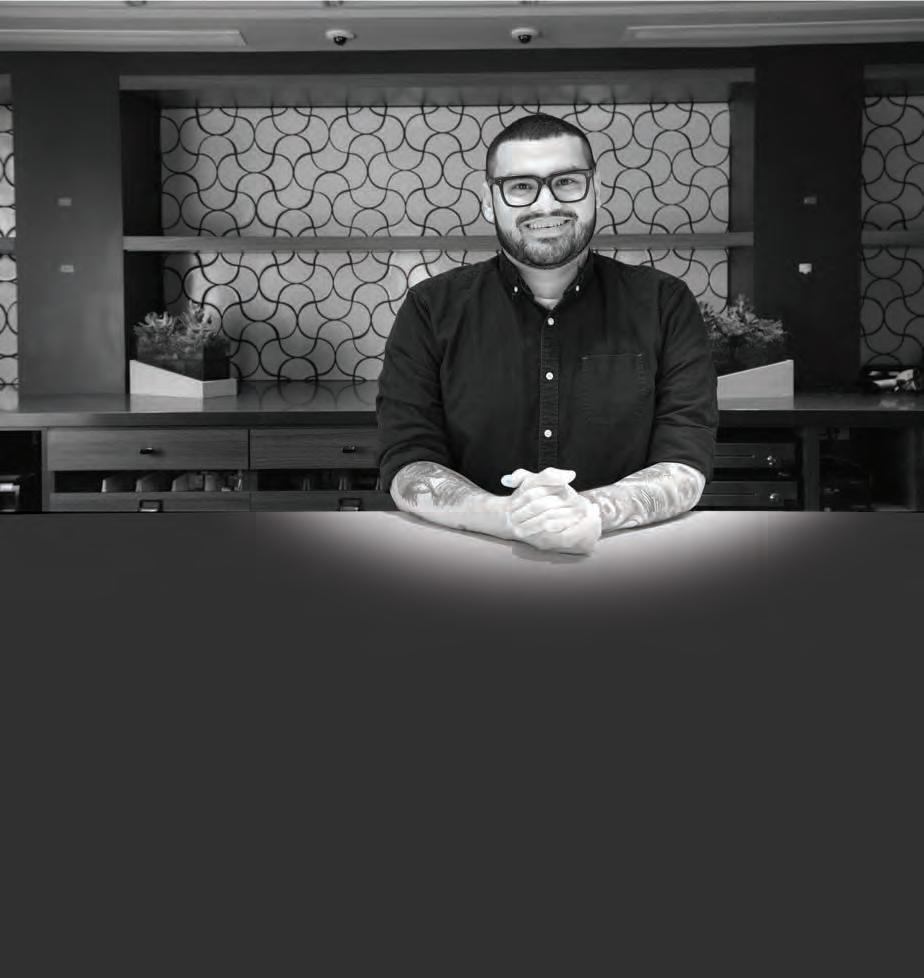
by Gwendolyn Ann Smith
Pride season is a haze of rainbows and frivolity, of massive street parades, parties, and festivals. Yet, if this is true, why has so much of my time been spent this month bolstering my friends among their fears and such?
It’s because we are seeing an unprecedented rise in anti-trans laws, both across the country and outside of it. Consider, for example, Idaho’s House Bill 752, which takes effect as Pride Month winds down on July 1. It is a simple law, with the intent of crimi nalizing transgender people’s restroom use.
The law, which is currently partially blocked thanks to U.S. District Court Judge Amanda K. Brailsford, would mandate that even a first offense – using a restroom consistent with your gender identity – would be treated as a misdemeanor and put you in jail for a year. Further offenses could lead up to a lifetime imprisonment. Brailsford’s June 16 order has blocked enforcement of the law, for now.
I would be remiss not to note that, while temporarily blocked, it’s still not even sure how such a ban would work in actuality. This lack of clarity on how to enforce this ban, of course, did not stop its passage into law.
This is but one of a reported 60 anti-transgender bills that have become law this year, according to Trans Legislation Tracker. They are a litany of every awful idea conservatives have tried to push over the last decade, including other restroom bans, sports restrictions, bans of books and flags, identity updates, laws stripping trans youth from privacy, and rules to prohibit using correct pronouns and names.
One other category has also really taken center stage, with civil liability laws designed to prevent caregivers from aiding transgender patients. This, as well as the Trump administration’s own push to criminalize transgender care, has led to many hospitals and doctors halting care for transgender youth entirely.
legally adults, so this isn’t even a trans youth specific ban.
Speaking of civil liability, the Federal Trade Commission and four states have also taken aim at the World Professional Association for Transgender Health, claiming that WPATH is participating in unfair and deceptive acts and practices. This case could, given the ruling, end insurance coverage for trans care nationwide. Not that there is much of that to begin with.
Meanwhile, trans people are facing increased hatred from any number of anti-trans bigots, emboldened by a culture that has largely turned against supporting transgender people. It very much feels like open season.
have left are increasingly afraid to be there for us.
I will tell you what I have told my friends.
What is going on is what is going on. We should not sugarcoat that, or paper over our worries with simple platitudes.
We have won many battles in the last two years. We may still win many more. Nothing, however, is assured. I wish I could tell you that “it gets better.” I can’t.
If our government starts kicking in our doors with agents in jackboots and shipping transgender people off to camps – along with everyone else they’ve already been rounding up, I suppose – then they will. This isn’t an action movie, and it is unlikely there is a transgender John Wick out there to vanquish the bad guys.
We still have a choice though: we can keep fighting, or we can give in.
The latter helps no one – least of all ourselves. That just does the bigots’ job for them, and I certainly am not willing to do that.
We can – should – continue to stand up, support each other, and make our presence known. We can do all we can to keep ourselves safe in this hostile place, and do what we can to help others survive. It is up to us.
For some, that’s also about helping to get people to safer havens, and out of hostile states. Heck, that can even mean emigrating out of the U.S. – or even doing what you can to live stealth, quietly supporting others while remaining under the radar.
For others, that means continuing to educate, continuing to tell our stories, and continuing to do the good work we are known for. It is vital that we keep changing this world, even as we fight against the tide.
Understand, too, that it’s not all just survival. Survival requires joy. There have to be times for happiness, for camaraderie, and for Pride. We will need each other.
Again, this is all for the “crime” of having to engage in a biological process that humans undergo half a dozen times every day.
Even in New York City, as Mayor Zohran Mamdani praised the opening of a new city-run trans clinic, that clinic barred anyone under 19 from accessing care due to federal pressure. I have to note that 18-year-olds are
That is what I am hearing from so many today. We’re feeling isolated, unprotected, and under siege. It’s not a great feeling. It makes it hard to celebrate Pride, knowing that we exist in a world where even what few allies we
The fact that you are still reading my words can tell you what side I fall on. I’m still here, still raising my voice.
I am feeling the effects of all that is going on, too, but until they drag me away, I will be here. I’m just too old, and too ornery, to stop.
compiled by Cynthia Laird
The Aesop Queer Library is coming to San Francisco for the first time Friday, June 26, through Sunday, June 28, at the body care company’s store at 2450 Fillmore Street. The company’s annual literary initiative celebrates LGBTQI2S voices through complimen tary books by queer authors and the transformation of its stores into welcoming library spaces, a news release noted.

Aesop is partnering with the American Civil Liberties Foundation for the project. This is the sixth edition of the queer library, which is being held at the Melbourne-based company’s locations across the U.S.
“The ACLU Foundation is grateful and proud to be collaborating with Aesop and its queer library for the fourth year,” stated Chase Strangio, a trans man who is co-director of the ACLU’s LGBT and HIV project.
Each visitor will be invited to select a complimentary book to take home, while stocks last, with no purchase required, according to the release. Some stores will see their shelves cleared of products, like the San Francisco event, while others will feature reading rooms.
Aesop has partnered with Penguin Random House, with titles sourced from a diverse range of queer authors, according to the release.
A select number of audiobook titles will be available online.
The release stated that this year, the Aesop Queer Library explores writing that centers on the queer body, highlighting literature’s ability to challenge assumptions, foster connection, amplify underrepresented perspectives, and bring greater visibility to stories too often overlooked.
The Fillmore store is open from 11 a.m. to 7 p.m.
SF Frontrunners Pride Run
The San Francisco Frontrunners annual Pride Run takes place Saturday, January 27, in Golden Gate Park. People should meet at Middle Drive West at Metson Road in the park. Check-in begins at 8 a.m., followed by remarks, the national anthem, and a group stretch, the group’s website stated. The 5k and 10k runs start at 9. Results will be posted an hour later, the website noted.
Registration is $55 until June 24. After that, limited day-of registration is available for $70, as capacity allows. To register, visit sffr.org/priderun.
Milkshake benefits EQCA
The Melt, a sandwich chain, is helping out statewide LGBTQ rights group Equality California during Pride Month. Through June 30, $1 from each sale of its Harvey Milkshake at all California locations will go to EQCA, the company stated. The vanilla milkshake is topped with rainbow sprinkles.
The Melt has locations around the Bay Area. As the Bay Area Reporter’s Business Briefing column noted in May, it is expected to soon open a location inside Harvey Milk Terminal 1 at San Francisco International Airport.
BART increases service for SF Pride
Regional transit operator BART has announced it will have increased
<< SF library From page 14
The library is systematically working through the collection with the Bay Area Video Coalition to digitize it so the individual movies aren’t lost due to deterioration or at risk of being irreparably ruined after being screened, as was the concern with the condition of Aguirre’s short doc.
“The majority of this collection is tape-based media like VHS. It is in danger of deterioration,” said Mitra. On average, at least five requests come in monthly from someone wanting to view one of the titles in the Frameline collection. It may not sound like a lot, but Mitra told the B.A.R. it is “pretty significant” for such a unique trove of historical films.
service Sunday, June 28, as tens of thousands of people are expected to attend the 56th annual San Francisco Pride Parade and celebration, a news release stated.
BART encourages people throughout the Bay Area to “ride with Pride” to get to and from San Francisco safely and expediently. The Embarcadero, Montgomery, Powell, and Civic Center stations are all along the parade route.
On Sunday, BART will open at 8 a.m., its regular time, and will run five-line service with trains roughly every five minutes through downtown San Francisco, the release stated. Additional event trains will be dispatched as ridership warrants, the agency noted. After 9 p.m., BART will run three-line train service.
In the morning, from 9:30 to 11 a.m., event trains will bolster service between Millbrae and downtown
“I think the significance, honestly, cannot be underscored enough because we are talking about films that maybe never even got seen by the public. We are talking about a lot of media and creative work really generated from the 1990s to 2000s,” said Mitra. “Basically, a lot of this stuff doesn’t exist anywhere else unless the filmmakers have their own copies.”
Anyone interested in viewing something in the library’s Frameline collection should note the film’s title when making an appointment to watch it either by calling the San Francisco History Center at (415) 5574567 or emailing sfhistory@sfpl.org.
“I think this can also be a treasure for filmmakers who don’t have access to their titles,” said Mitra. “I encourage anyone to look here and see if maybe
Pride season is a haze of rainbows and frivolity, and it is just as vital that we enjoy these moments as we can. We need to fill our hearts in order to give ourselves the energy to keep on going in this cold world.t
Gwen Smith has never been good at giving up. You’ll find her at www.gwensmith.com.
San Francisco, as well as between Pleasant Hill and downtown San Francisco, the release stated. The SF Pride Parade begins at 10:30 a.m. at the foot of Market Street and ends at Eighth Street near BART’s Civic Center Station.
Later in the day, event trains will start at 2 p.m. and continue into the evening, the agency noted. Riders should expect large crowds at Embarcadero Station before the parade starts and large crowds all day at Civic Center Station, as well as heavy ridership to and from all downtown San Francisco stations and 16th Mission Street Station, the agency stated.
The city’s LGBTQ Castro neighborhood is a short walk up 16th Street from the BART station in the Mission district. Riders headed to the festivities downtown are encouraged to use Montgomery and Powell stations instead of the Embarcadero and Civic Center stations.
At stations where BART has parking lots, parking is free on weekends, except at its Milpitas and Berryessa/ North San Jose stations, which are owned by VTA, and VTA’s parking rates still apply. Parking lots are expected to fill quickly.
BART staff, their families, and friends will march in the SF Pride Parade with the BARTmobile.
For more information, download the BART official app or visit bart.gov for ticket prices and trip planning.t
we have it. If you submitted it to Frameline during those years, the likelihood is we will have it.”
As for Aguirre, now that they have their short documentary again, they want to make a longer film about Teresita with the extra footage they have accumulated in their digitized archives. They also want to include interviews with those who knew Teresita in order to contextualize her life story and provide personal reflections about her.
“My plan is to do just that over the next two years and make a different movie. The first one was like a prayer or spell I made because I wanted to keep her alive,” said Aguirre, adding that with their friend now passed, their new motivation is “to keep her memory alive.”t
by Johnny Conterez
Sea-breeze winds its cool way through the city’s streets, gliding by trees and wafting the perfume of jasmine and jacaranda flowers through the air. Summer is here in San Francisco, and Pride preparations are underway. But a few Bay Area botanists have noticed a queer connection between plants and the LGBTQ community.
Natural, same-sex partnering has been documented in about 1,500 species across the animal kingdom, according to the Yale School of the Environment, but in the plant kingdom thousands of species are naturally non-heterosexual. In fact, about 90% of flowering plants are hermaphroditic, containing both male and female sexual organs in their bodies at once. “Nature itself is inherently, quite queer,” said Matthew Gaston.
Gaston, 30, is a botanist committed to the public understanding of plants. He is the former educational programs director of the Zilker Botanical Garden in Austin, Texas. Brawny and mustachioed, Gaston, a gay man, has created a social media following of 211,000 on Instagram. He explained why he decided to go to the apps and move to California.
“I was in charge of all field trips for kindergarteners, as well as special programming on the weekends, like a prehistoric garden that [was] all dinosaur themed from the Cretaceous period,” said Gaston. But as he wanted a wider audience, he thought, “I’m teaching so many folks and kids. This is really wonderful, but I feel like I can make a bigger impact doing this independently.”
So, now living in San Francisco, he uses social media platforms to get his message out. Who is this audience primarily?
“Plant gays” is a recent term on the internet used to broadly refer to a vast community of queer folks and their
interest in gardening, floristry, botany, and even forestry, and points to a wider field called Queer ecology, a new inter disciplinary framework that describes a modern understanding of nature through a non-heteronormative lens. But why are so many LGBTQ people today being drawn to plants, flowers, and forests? Well, it’s not exactly new. Connotations between flowering plants and queerness, like lavender, lesbians, green carnations and Oscar Wilde, are actually very old. But there is a deeper level to horticulture and today’s cha otic climate and the interests of people who are not straight. Social anxiety and mental health concerns are particularly high among queer folks who deal with “minority stress,” a term that describes the burden of constantly maneuver ing through rejection, stigma and dis crimination, according to the National Library of Medicine in a 2024 report.
Since 2024, over 2,200 anti-trans bills have been considered at the state and national level and more than 200 have been made law, according to Cornell University Library. Additionally, since 2004, 10,046 books with LGBTQ characters, themes, or same-sex love have been banned in the United States, according to the nonprofit organization PEN America. This existential dread is not abstract, it is a feeling rooted in a real-world experience. Over the phone, Gaston spoke about his insecurities in the past, like difficulty with social anxiety and how he used his love for the Earth to navigate through that ordeal.
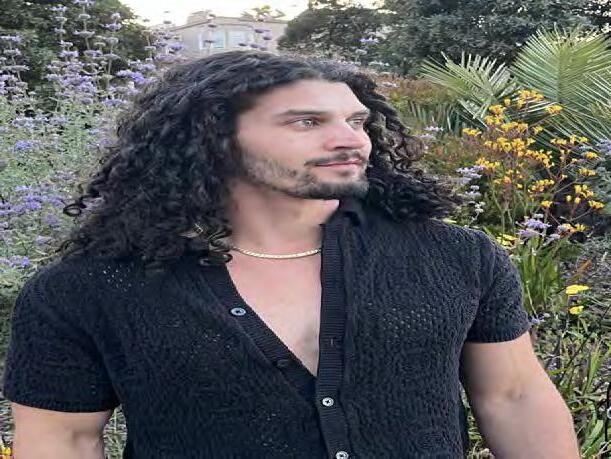
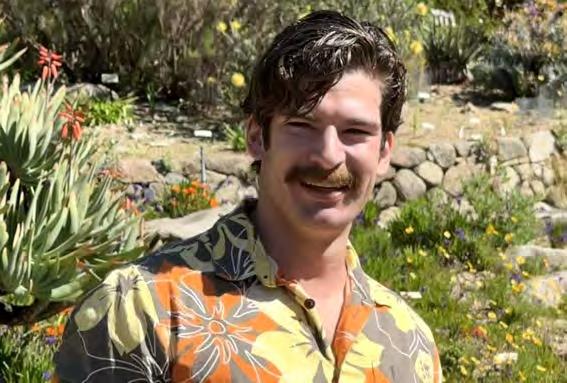
“I think there’s just something really wonderful about plants and the idea of tending and caring for something. I think queer folks often realize you have to go through a great hardship to see how important things are and I think most people who are LGBTQ will feel that at some point, unless they grew up in a very progressive city with extremely accepting communities around
them,” said Gaston. “I’m, at my core, very progressive and, as a kid, the connection to plants and nature was a way to kind of escape large crowds which were overwhelming. Now that’s my job, talking to people about the world and nature. And so I think the ability to feel this kind of great challenge, this darkness allows for great lights to come out, and sometimes that light is caregiving of communities and nature.”
Across the bay another botany influencer Saumitra Kelkar, 28, an Oakland-based educator, echoes and expands this view of climates and nature. Kelkar, who is gay, is a former biology high school teacher with 25,300 followers on Instagram and a large LGBTQ audience.
“I found that out largely because of how many dudes are hitting on me by DMs,” said Kelkar, in a phone interview. He has helped build grassroots campaigns for community-based actions to protect the environment with local governments in Alameda County.
“Everything is connected, but I think there are two distinct topics,” he said. “One is that our government at every level from federal to city government is run by people who, despite their different views on the hot-button political issues, all kind of share the same ideological norms about what land is and what the purpose of land is and what the rights of a landowner are, and I think that is dangerous.”
Kelkar explained that ideological norms like heteronormativity have had a negative effect on how people relate to the natural world. That conflict lies at the heart of today’s LGBTQ community and the planet at large with the looming effects of climate change in full swing. Competing interests between profit and sustainability fuel disputes among minority communities and governments.
In Oakland just last month a protracted and public fight against a property owner who destroyed 38 mature trees (including native live oaks, broadleaf maples, buckeyes, and plum) on their Oakland hills home resulted in a $915,000 fine. But some feel the fine doesn’t go far enough and will simply become the cost of doing business in order to shirk environmental oversight.
Kelkar said he was present during Oakland City Council meetings regarding the tree incident and lent his platform as an influencer to the local community’s cause.
“Life does not follow a cis-hetero model. This is a topic that I really enjoy teaching to students because I think it’s so fascinating because our society and its pressures have basically obscured a
lot of the basic facts of how life works,” he said. “The natural diversity of all of existence is inherent. In terms of the natural world, pretty much every single species that exists, if you pay attention to it enough, you will find individuals that don’t conform to the gender/sex binary. I would argue that gender isn’t really relevant for plants, for example, because they don’t really have subjective social experiences the way humans do, but sex is relevant for plants because sex is a compatibility system for reproductive cells.”
That conflict that Kelkar describes with heteronormativity between queer ecology and its facets like Indigenous technology was reported by NPR’s Science Friday in an interview in May with Cherokee author Daniel H. Wilson, a straight ally.
“So a common theme that was expressed by settlers whenever they came to North America, the first colonists, they looked out at these beautiful forests, and they compared them to the Garden of Eden,” said Wilson in the interview. “They were perfect. They were amazing. And it was clear that they were wasted on these primitive people who were actually living there. And so I think there’s a saying that’s appropriate here. Arthur C. Clarke, ‘Any sufficiently advanced technology is indistinguishable from magic.’ And I think that was the case for those settlers.
“They looked out at those forests and they saw magic, but what they were looking at was Indigenous technology,” Wilson continued. “The land had been manicured meticulously for hundreds or thousands of years using farming and agroforestry techniques, and I think that the key difference is that all of that stuff is not designed to scale up and out to feed an exponentially growing population. It was technology designed to create a sustainable balance. And so I think from a Western perspective, that just looks really inefficient, and that looks really primitive. And the reason is because they’re grading it on a different scale. How many millions of people will that feed? Well, it won’t. It’s not designed to. It’s designed to keep a certain number of people in balance to promote the long-term survival of that human population. And so I think that’s what defines indigenous technology.”
Promoting renewable energy
Back in San Francisco, Miguel Velez sat on stone steps downtown outside an Equinox gym on a sunny
day for a Zoom call with the Bay Area Reporter. Also known as “Renewable Energy Jesus,” Velez, who is gay, was crowned the winner of this year’s Hunky Jesus contest at the drag philanthropic group Sisters of Perpetual Indulgence’s Easter in the Park party in April. He chatted between clients and breaks to discuss how his idea and platform ties in with queer ecology.
Originally from Colorado, Velez, 28, said, “I’ve always been fascinated by renewable energy, even as a kid, I toyed around with solar panels and I’ve always had a solar power generator handy for camping and everything, so I’ve been using solar for quite a while. Before I moved out here, I was camping every single weekend, literally every single weekend, I was camping. I love nature.”
When asked about the dilemma faced by renewable energy and the climate crises, Velez said, “It definitely doesn’t look or feel the same kind of climate as it did when I was a kid. And I think that’s pretty concerning. I’ve grown up in the generation of seeing the ecosystem that I’ve lived in deteriorate. Like I said, I’m from Colorado, and there’s certain parks that have started shutting down that you can’t even go to for certain times of the year.”
In the face of these challenges, Velez is using his newfound popularity to spotlight ecological issues plaguing the queer community in the Bay Area.
“I am working on a project currently. I don’t want to ruin the surprise or anything. But now I am working on an art project that I feel hasn’t been talked about quite enough. So I can say that I think it is going to be really good,” Velez said.
In addition to the upcoming art project, Renewable Energy Jesus will be making several appearances throughout the Pride season, including several musical performances. Besides being a Hunky Jesus winner, Velez is an accomplished and classically trained musician and works as a personal trainer in San Francisco. He will be performing at the Cole Valley Farmers’ Market July 26-27.
He worked with the San Francisco AIDS Foundation and its new Cycle to Zero bicycle fundraiser that was held in May.
As a result of his Easter win, Velez also took a moment to describe how working with the Sisters of Perpetual Indulgence was. The Sisters, who marked their 45th anniversary in 2025, have been the organizers of the Hunky Jesus contest for decades. Velez said, “I did have some conversations with a few of the Sisters afterwards. They’ve been very, very supportive.”
One of those sisters in particular, Sister Roma, said in a phone interview in regard to Velez and his theme, “I’m glad to see this kind of Hunky Jesus come forward because, in the past, it was a lot more just like, let’s have fun, let’s like ‘show up.’ And this one felt like it actually had a meaning and it really grabbed the attention of people.”t
Patriotic holidays remind us of core American ideals: independence, opportunity, community, and dignity. At 1440 By The Bay senior living, these values guide daily life. Residents enjoy choices in dining, activities, and personal expression while finding connection through learning, creativity, and shared experiences.
As the nation celebrates 250 years of independence, we honor the freedoms that continue to inspire our senior living community.
Here, life feels welcoming, dignified, and full of possibility. A place where the spirit of the nation lives on, one meaningful day at a time.

Choice & Independence
Flexible support, multiple dining options, and resident‑led clubs give everyone the freedom to stay independent and live the way they prefer.

Expression & Opportunity
From watercolor painting and creative writing to cooking demos, gardening groups, Tai Chi, and lifelong learning classes, residents can explore interests old and new.

Community & Belonging
Friendships naturally grow through shared moments, seasonal BBQs, picnics, workshops, outings to local parades, holiday celebrations, and gatherings that honor traditions and values.

Convenience & Comfort
With housekeeping, transportation, maintenance, and on‑site amenities handled, residents can focus on what brings them joy, not errands.
by Cynthia Laird
Arecent survey of LGBTQ people by a UCSF neurologist sought to increase awareness of stroke. Now, Dr. Nicole Rosendale and her team are ready to disseminate information so that the wider community can become aware of stroke risk factors and symptoms.
The most important thing is if people think they are having a stroke, they should immediately seek medical attention, Rosendale explained.
“Call 911, don’t delay,” Rosendale said in a recent Zoom call with the Bay Area Reporter.
Rosendale, who is cisgender and identifies as pansexual, queer, and femme, said that she co-crafted the survey, which was conducted this spring, with members of the Brain Health Advocacy for Visibility and Equity, or BRAVE, Community Advisory Board. The 10-question survey, conducted anonymously online, had questions ranging from “What is a stroke?” to “Which of the following can you do to prevent stroke?” (Answers: A sudden loss of blood supply to the brain; and regular exercise, respectively.) Rosendale said she was pleased with both the response rate and respondents’ knowledge.
A total of 88 people completed the survey and “most people scored pretty well, an 8.5 average,” Rosendale said,
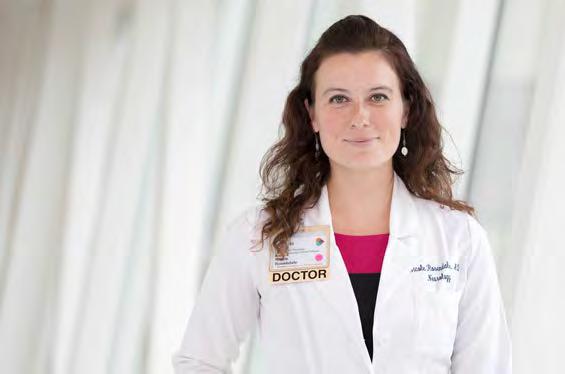
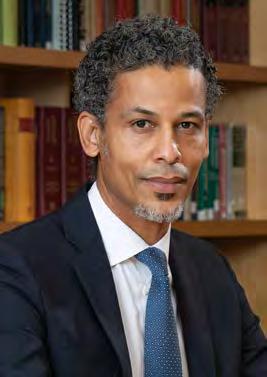
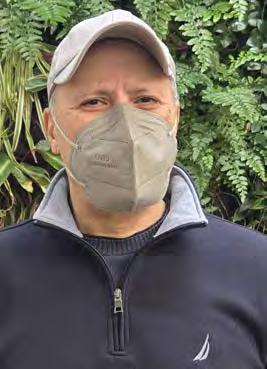
adding that most respondents were able to indicate what a stroke is and some of the risk factors.
Gay men made up 40% of the respondents under the LGBTQ umbrella, followed by queer, 25%; bisexuals, 17%; nonbinary, 15%; lesbians, 11%; trans women, 9%; and trans men, 1%. Other identities included asexual, 7%; pansexual, 3%; and another identity, 8%. Some respondents preferred not to answer, according to the survey.
Most respondents, 32%, were between the ages of 66-75, the survey results showed, though people of all ages
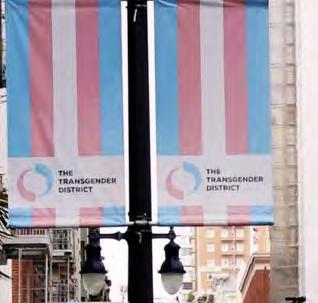
completed the survey.
Rosendale and others who spoke to the B.A.R. for this story pointed out that while age is a risk factor, stroke can happen to people at younger ages. One of the survey questions was, “Stroke only happens in people over the age of 50.” The answer is no.
Rosendale, 43, said that several factors prompted her to develop the survey.
“This work was really generated out of some of my clinical experience as well as some of my prior research,” she said.
“I am an inpatient neurologist, meaning that I take care of people who are admitted to the hospital setting, and I work mostly at San Francisco General Hospital. And so I care for a lot of people who have experienced a stroke and are recovering after [a] stroke.
“Fewer of the respondents knew that there were treatments available for stroke, that the timeline is very short for being able to administer those treatments, and then why that was important – that stroke is kind of an emergency situation,” she said.
Symptoms, risk factors
Stroke is an injury to the brain related to the blood vessel (vascular) system. There are two main types: ischemic, meaning a lack of blood flow to the brain due to a clot in a blood vessel; and hemorrhagic, meaning bleeding into the brain. Ischemic strokes are more common in the U.S., Rosendale said.
research in America than any entity except the National Institutes of Health.”
Leslie-Mazwi, a straight ally who declined to give his age, said that the AHA’s main message on stroke is that it’s a preventable, treatable problem. Taking care of one’s blood vessels is key, he noted, and goes beyond stroke.
“If you have healthy blood vessels, you prevent more than just stroke. You prevent dementia, heart attacks, renal failure, vision loss, and peripheral vascular disease,” he said. “Blood vessels are a single organ that feeds all parts of the body.”
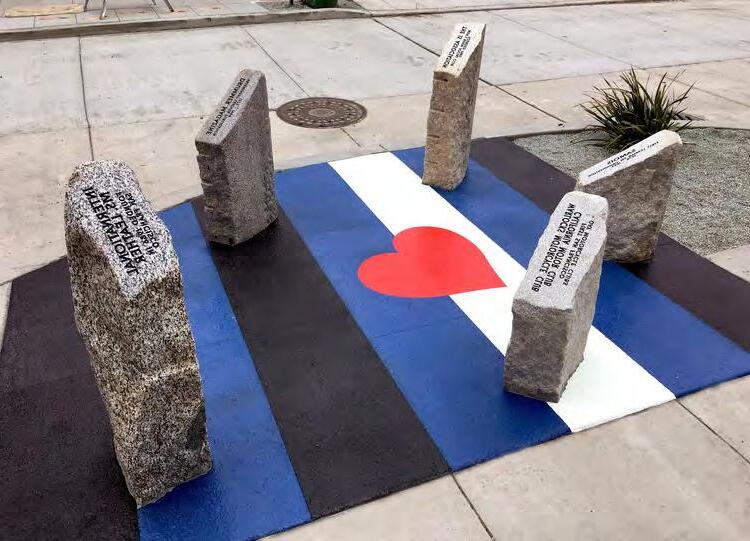
“Clinically I have seen that there is, even after people experience a stroke, that they don’t always know what that means, what the symptoms were, right, and I just recognized that there were a lot of gaps in terms of public knowledge,” Rosendale said.

Join our inclusive, bilingual workshop and understand your rights as a tenant!
Whether you’re new to the area or have been here for years, this workshop is designed to help you navigate the complexities of tenant law.
Bilingual Presentation: The presentation and materials will be provided in both English and Spanish.
“That, combined with my dedication and interest, and my prior research and work in LGBTQ health, specifically in neurology – it’s something that I’ve been very passionate about throughout my entire career,” she continued. “And so that led me to the question of, well, if the general public doesn’t know about stroke, or has these gaps in stroke knowledge, what about our community, the LGBTQ community?”

Scott Aiu is a gay man who is a member of the BRAVE Community Advisory Board. Aiu, 69, is a client of Openhouse’s programs – the agency provides services to LGBTQ seniors. The nonprofit also has affordable senior housing but Aiu, who lives in San Francisco, is not a resident. The advisory board members and Rosendale meet in a conference room at Openhouse’s Bob Ross LGBT Senior Center at 65 Laguna Street. (Ross, who died in 2003, was the founding publisher of the B.A.R.)
According to the American Heart Association, which also runs the American Stroke Association, a subsidiary, there are several stroke symptoms: sudden loss of balance or coordination; sudden loss of vision or double vision; sudden drooping of one side of the face; sudden weakness or numbness in one arm; and sudden loss of speech or slurred speech.
The AHA uses the acronym BEFAST for these: balance, vision, face, arm, and speech, with the “T” for time to call 911.
The reason it’s so important to quickly seek medical attention is because brain cells start to die within minutes.
Rosendale said that stroke can be misunderstood, as compared to a heart attack.
“I think it is,” she said. “Part of the reason that makes it very tricky is the brain is very complex. So, depending on where the stroke affects, what part of the brain the stroke affects, the symptoms can be different. It’s hard enough for a heart attack, where it’s a single organ, similar to the brain, but there’s a clearly defined symptom that’s most common, or [a] constellation of symptoms that’s most common.
He reiterated things people should do, like having their blood pressure checked regularly and starting medication if readings are high. Exercise, sleep, a sensible diet, managing high cholesterol and blood sugar, and avoiding smoking are key.
Leslie-Mazwi praised Rosendale’s survey.
“Surveys are essential,” he said, explaining they create a baseline sampling of knowledge and inform how the healthcare profession can intervene to improve health.
Leslie-Mazwi pointed out that gender identity or sexual orientation are not intrinsic risk factors.
“Risk factors for stroke in LGBTQ communities come from social aspects – like access to primary care, or smoking, for example,” he said.
He did note that gender-affirming care, particularly endocrine therapy, can have vascular implications.
“Gender-affirming care must be aligned with cardiovascular care,” Leslie-Mazwi said, highlighting that patients should be informed, and advocate for themselves when seeing their healthcare provider.
Spreading the word
“For the brain it’s really, really different and so that makes it more complicated,” she said. “Even with that, I think there’s been a big effort from the American Heart Association, which is also the American Stroke Association, to really try to emphasize what are the most common symptoms.”
On-site Support: Limited, one-on-one tenant counseling will be available after the presentation.
“We started the CAB in July 2025,” said Aiu during a recent interview at the center. “Dr. Rosendale said it would be a one-year program, but she received additional funding to extend the program to November.”
Naomi Cruz is the community programs supervisor at Openhouse, primarily working with the agency’s health and wellness programming. Cruz, who is nonbinary and queer, told the B.A.R. that helping the BRAVE Community Advisory Board has been a meaningful way to help empower LGBTQ people. In addition to folks from Openhouse, the advisory board also has members from the Curry Senior Center, they said.
The extra time will enable the advisory board to get its message out through an educational campaign, he noted.
Legal Resources: Schedule appointments for legal service intakes.




Aiu has a more personal reason for wanting to get involved in the advisory board. In 2015, he suffered a mini stroke, he said.
“I did not know I was having a stroke,” he recalled. “I was in a meeting and someone looked at my face, felt my forearm, and said I should seek medical attention.”
Aiu went to the Dr. Tom Waddell Health Center, where medical staff found his blood pressure to be twice as high. He then went to the emergency room of a local hospital.
“I just want to let people know, so they will be aware of symptoms and react right away,” said Aiu, who has not had a recurrence.
Rosendale said that one thing that stood out from the survey was that most people don’t know that having a stroke is treatable.
That led to the aforementioned BEFAST list of stroke symptoms and call to act fast.
There are several risk factors for stroke, according to the AHA, including high blood pressure, diabetes, smoking (including cannabis and vaping), atrial fibrillation (heart rhythm difference), high cholesterol, and HIV.
Dr. Thabele Leslie-Mazwi, a professor and chair of the Department of Neurology at the University of Washington in Seattle, is on the AHA Western States Board and serves in national and international roles for the AHA. In a phone interview, he talked about the importance of the association’s work regarding stroke.
The American Heart Association has more than 35 million volunteers, donors and supporters, including many physicians in many specialties. Leslie-Mazwi said the AHA “is an extremely impressive organization.”
“The AHA is a prime driver of trusted scientific voices,” he said. “It’s funded more
“It’s been an amazing project to follow,” they said in a Zoom interview, adding that they believe it’s been a healing experience for the advisory board members “to know that they’re doing something to help touch upon the discrimination that our community has felt and help empower folks to have the knowledge they need to best seek medical attention when they need it.”
“For our community, for folks I’ve talked with, they’ve really valued this information,” Cruz added. “There’s some key things we’ve discovered. A lot of folks know what a stroke is, or broadly what a stroke is, and can name some of the symptoms of one. But when it comes to how urgently you have to get to the hospital in order to receive medical treatment, that is something that folks are like, ‘I did not know that it was that serious, that it has to be this urgent and this specific.’”
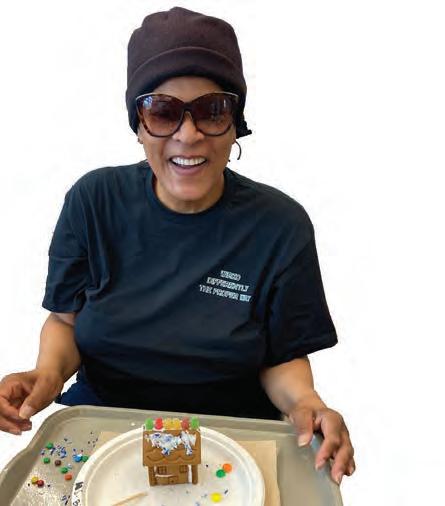
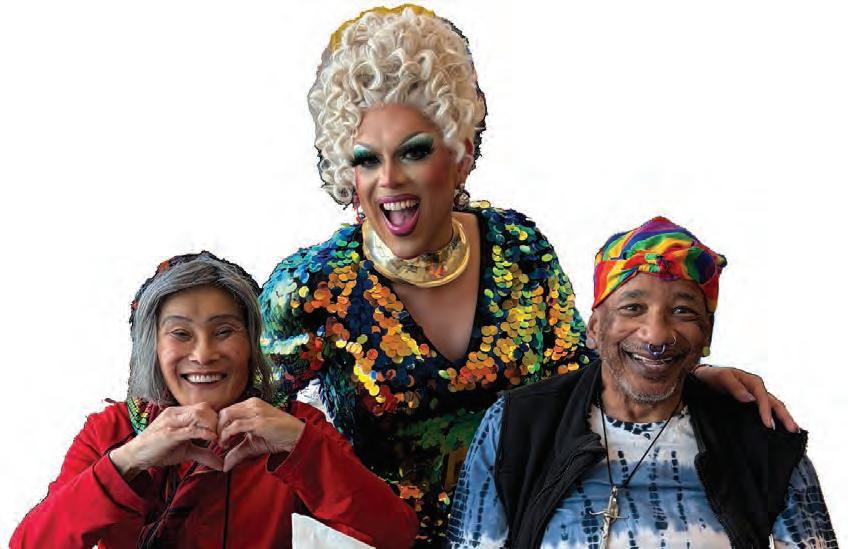
On Lok serves our diverse communities in San Francisco through programs designed to support health and wellbeing.
On Lok PACE is an integrated, full-service health plan that helps seniors stay healthy and independent as their needs change. PACE covers all Medicare and Medi-Cal services, including medical, home care, meals, transportation and more.
Club 75 is the first day health center created with and for the LGBTQ+ community, offering social activities, assistance with personal care, meals, and transportation. Club 75 is also an alternative care setting for seniors enrolled in On Lok PACE.
On Lok 30th Street Senior Center is the largest multipurpose senior center in San Francisco, connecting older adults to exercise and wellness classes, meals, social activities, and case management. Programs are partially funded by the City of San Francisco Department of Disability and Aging Services.
On Lok also provides On Lok Enhanced Care Management and On Lok Medically Tailored Meals to help San Francisco Health Plan members improve their health and maintain their independence.
hood features, like a remarkable community garden in the southwest corner of the city.
podcast or an episode of “Wait Wait... Don’t Tell Me!,” NPR’s weekly comedy and news quiz program, such as when walking along the numbered avenues in the city.
Nearly all of the walks were solitary, with friends occasionally accompanying him along the way.
“I had no shortage of interest, but it always felt like a solo project, almost like a meditation – so mostly I went alone,” he explained.
Physical, mental health benefits
Aside from the physical benefits of routine walking, the project has been essential to his mental health, he said, alleviating panic attacks and the winter blues.
“ I feel like I haven’t been depressed for years,” he said.
And there’s been a lot to appreciate throughout the project, including the neighborhoods themselves and the unique sights he’s observed in each one, like people outside together grilling food in Bayview and Hunters Point.
He made some discoveries along the way, such as 10 parks he’d never seen, as well as special neighbor-
page 16
“I really believe representation is incredibly important. I talked about that on the campaign, and I think what we have appointed and people inside my mayor’s office, I really do believe, represent the very best of our city, and we can’t represent the very best of our city without LGBTQ+ representation,” Lurie said. “And I really think that we have strong representation with some of the people that I have appointed.”
Among those Lurie has appointed is Mawuli Tugbenyoh, a gay man
He also realized just how much of the city is what he described as resident streets, where at night he’d bask in their quietness and have occasional run-ins with coyotes. At other times, he’d be walking through a section of the city at just the right moment, getting to see a community gathering taking place, like a celebration of Chinese New Year in Chinatown.
“I would keep bumping into these neighborhood festivals and events that I had never gone to, despite living in the city for 20 years,” he said. “I feel like that was so regular that it just spoke to the richness of the city’s culture.”
In 2018, over a span of 40 days, ultrarunner Rickey Gates ran every street in San Francisco.
Per Parenteau’s online research, including personal blogs, people who cover every street by walking usually complete their goal in upward of seven to nine years. He reasoned he could find a middle ground there, predicting three or four years, and he was right on the mark.
His project also differentiated from others in that he decided to al-
who’s now the permanent head of the San Francisco Human Rights Commission and the new Agency for Human Rights (having stepped into the role as an interim under Breed), and Matthew Goudeau, a gay man who’s the city’s first executive director of Arts and Culture.
Goudeau told the B.A.R., “I’m honored to be appointed by Mayor Lurie, that goes without saying. His support for the LGBTQ community is genuine and it’s deeply rooted. It really is a reflection of his values; he has carried it with him for a long time and his family has a long history of supporting LGBTQ rights and
ways walk or rely on public transportation to get to and from a location.
“I really felt that the use of vehicles went against the spirit of the project, at least for me,” he said.
That doesn’t mean the temptation wasn’t there at times to request a Waymo or other ridesharing service, such as when finishing up a walk in a neighborhood miles away from his home at 10 p.m. But he stuck to his ethos, even if it meant waiting around a bit for a delayed train or bus.
When he had completed about a third of the project, Parenteau assessed it was time to figure out what his very last street would be. He settled on Washington for a couple of reasons.
“One is I like the idea of inviting people along and then ending for a picnic in a park, so I knew I wanted a street that had a nice city park on it,” he explained.
He decided to open the final walk to friends, given how many had asked to join over the years and followed his journey on private social media.
He also liked the tie-in between the street being named after George Washington, the first president of the United States, and the street being his last walk. This year also
the community, and that’s probably why he feels so comfortable expressing his support publicly.”
Asked about that history, Goudeau brought up Levi Strauss’ advocacy over the decades.
“That is the family he was brought up in and the values he was raised with,” Goudeau said.
Tugbenyoh stated, “You can’t be what you can’t see. Representation matters, and perspective matters. I am proud of my more than 16 years of service to San Francisco, and I believe that my experience, as both a public servant and a Black gay husband and father, has given me per-
marks the 250th anniversary of American independence.
“I like that historical rhyming there,” he said.
Marta Lindsey, communications director at Walk San Francisco (walksf.org), expressed that she was glad to hear about Parenteau’s project and upcoming final walk plans.
“What a beautiful, amazing, and inspiring thing for Walter to do. I love when and where he will end this incredible feat for his feet! On behalf of Walk San Francisco’s staff and members, I salute Walter!” wrote Lindsey in an email to the B.A.R. Walk SF, a nonprofit organization based in the Mission, focuses on making San Francisco a pedestrianfriendly city with safe, welcoming, and walkable streets for everyone. Lindsey, a straight ally, shared with the B.A.R. that the Walk SF team planned to send Parenteau “a token of appreciation for what he’s done.”
Parenteau’s boyfriend, Jose Guajardo, an accounting supervisor at Fuerza Immigration Lawyers LLP in Oakland, said he is proud of Parenteau’s yearslong feat and what it reveals about his character.
“When people hear that Walter walked every street in San Francisco, they’re naturally impressed by the scale of it. I am too. But what
spective that strengthens my leadership.”
One Pride weekend activity Lurie won’t be participating in is the Trans March. Last year, the mayor was heckled out of the march.
“Right now, I don’t want to be a distraction,” he said. “I want the trans community to have that event and so that’s my plan right now and I will say when I was there last year, I remember talking to a father who was really grateful to be in a city where his child could be who they wanted to be, and he expressed that to me, and I felt great pride in that. So, I want it to be a great weekend,
moves me most is how much this accomplishment reflects the Walter I know: curious, patient, observant, generous, and quietly determined,” he wrote in an email to the B.A.R. Guajardo, a 43-year-old gay man, met Parenteau toward the end of the walking project.
“I didn’t see every mile of it,” he wrote. “But I have seen what the project brought out in him: joy, wonder, connection, and a deep love for the city and its people. He has a rare way of moving through the world with attention and care, noticing details others might pass by and finding meaning in ordinary places.
“This project may be complete, but the spirit behind it is very much alive in him. I’m so proud of Walter – not only for walking every street in San Francisco, but for doing it in a way that feels so true to who he is. I feel lucky to know him, to love him, and to celebrate this remarkable milestone by his side,” he continued.
Concluding the project during Pride weekend adds another layer of meaning, Parenteau noted. After spending so much time exploring every corner of San Francisco on foot, the final walk serves as both a personal achievement and a celebration of the city and the LGBTQ community to which he belongs. t
a great event, and I wouldn’t want to be a distraction.”
Aside from that, Lurie is expected to be in the Pride Parade and attend other related events.
Asked what his message would be to the city’s LGBTQ community this weekend, Lurie said, “You are integral to the fabric of our city. You are what makes San Francisco the greatest city in the world, and we take great pride in the community. We want you to not only know that you are heard, we want you to feel safe. We want you to know that you have a strong ally here in the mayor’s office, and in my administration.” t






















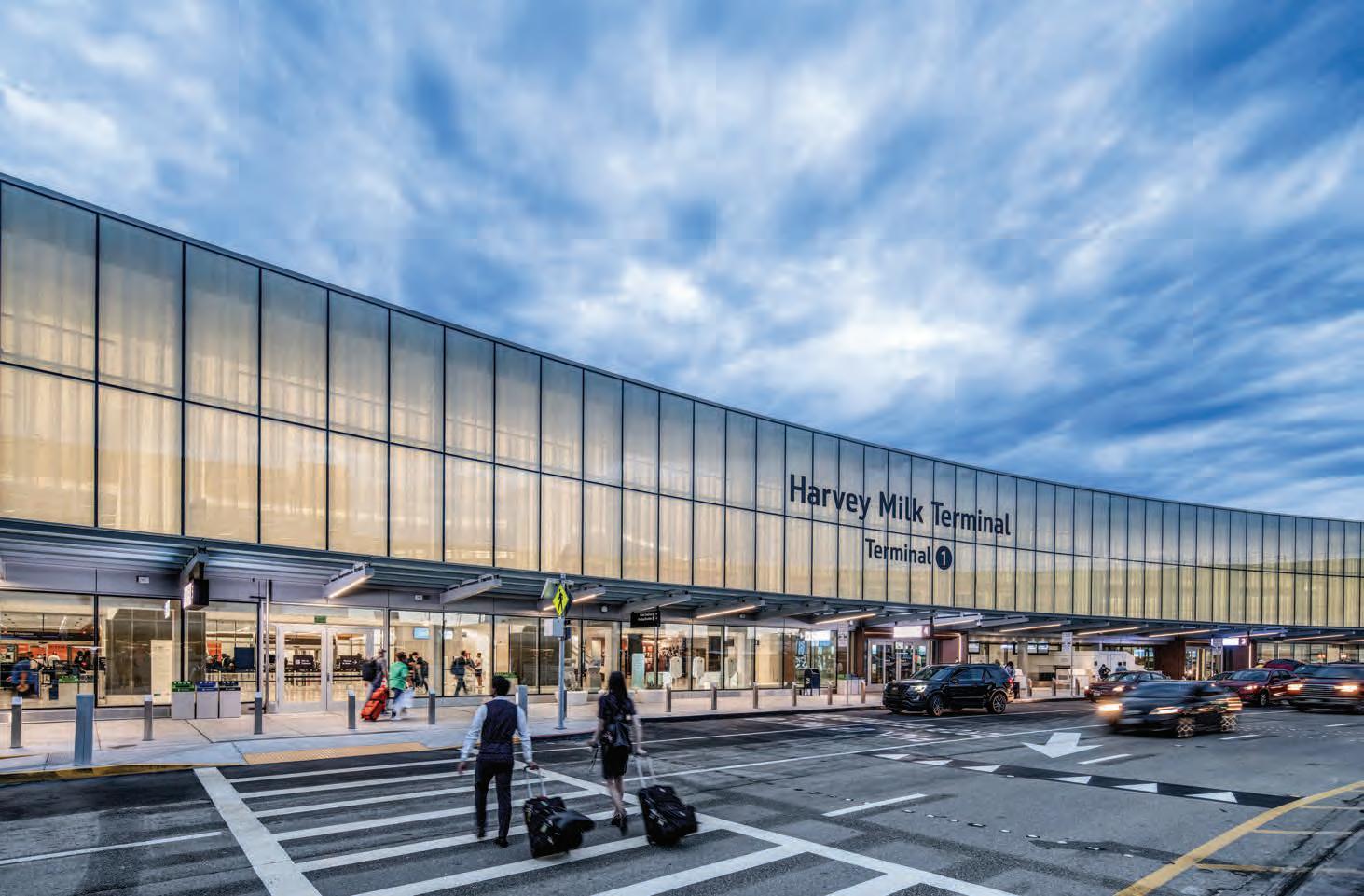
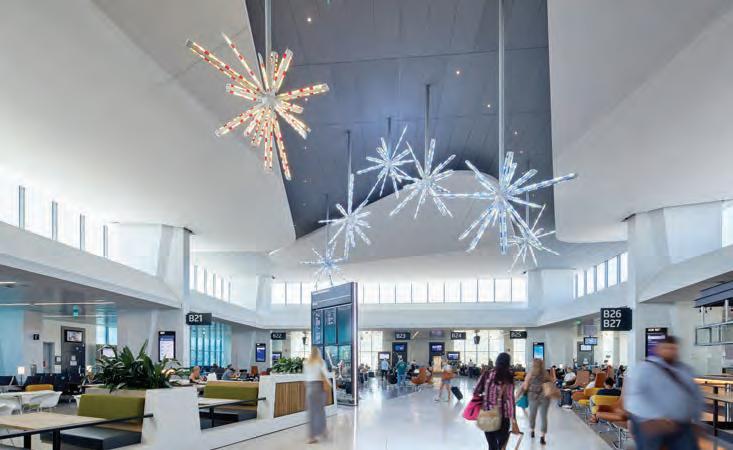
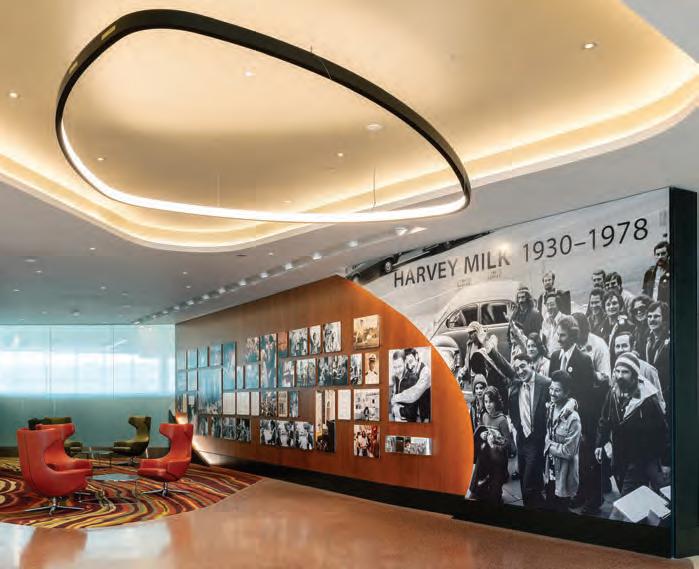

by Jim Provenzano
Get ready for some more low sparks of high-heeled shoes as Oasis, the glittering beacon of queer performance in San Francisco’s South of Market, returns with a full facelift.
After undergoing a six-month renovation, the nightclub is preparing to re-open its doors on July 17 with a spectacular re-opening celebration, “The Grand Reveal.” This event marks the beginning of a bold new era for one of San Francisco’s most iconic nightlife and performance destinations.
After announcing in early January that a surprise emergency donation would keep the club alive after closing for a few months for renovations, that date has now been announced. The substantial donation of several million dollars came from the Stevens Family. Oasis Arts, the nonprofit started in 2022, will operate the nightclub and has finalized the purchase of the building for $3.5 million.
“It is an absolute privilege and delight to welcome our artists, patrons, and community back home to Oasis,” said Founder and Artistic Director D’Arcy Drollinger. “They are the reason Oasis became this glittering, joy-soaked piece of San Francisco magic. As this city keeps reinventing itself, Oasis stands as proof that a thriving, creative LGBTQ+ arts scene isn’t just nice to have, it’s essential to this city’s soul.”
Added Drollinger, “As we reopen, Oasis Arts is stepping fully into its role as an arts nonprofit and performing arts venue, here to serve and support the long-term sustainability and future growth of our queer creative ecosystem. To that end, I’m excited to be joined by Greg Sottolano as our new Executive Director, while I continue to focus on our artistic and creative programming.”
Milestones and drag rejuvinatation
Oasis Arts’s new Executive Director Greg Sottolano said, “Through this transformation, the heart and spirit of Oasis remain exactly what artists and audiences have always loved - joyful, innovative, sexy, and unapologetically San Francisco. Our re-opening is a reminder that the San Francisco Bay Area has always been, and will al-
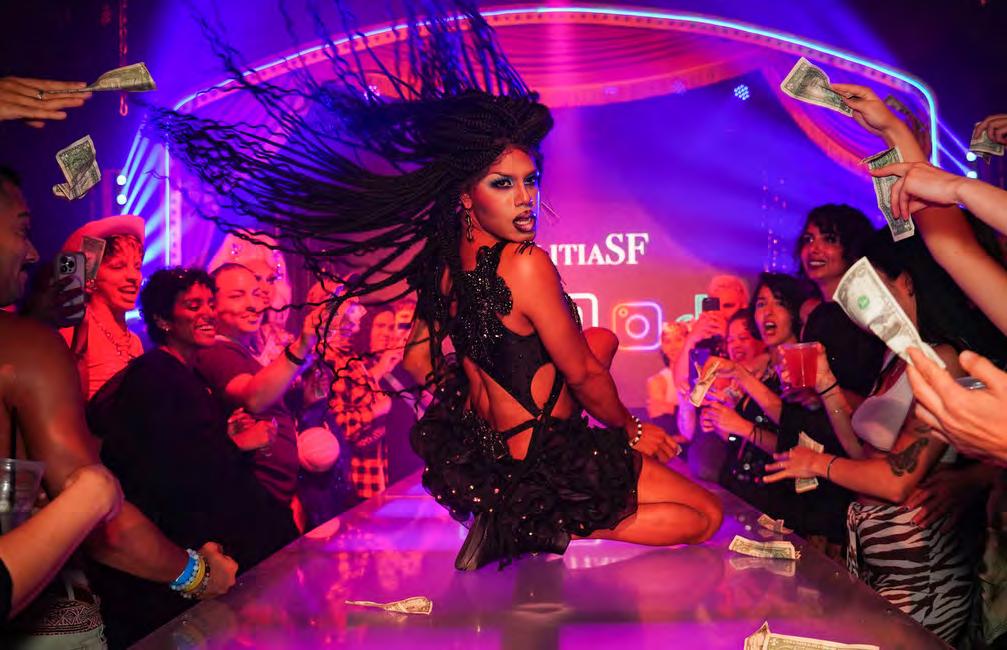
ways be, an essential home, and source of inspiration, for the queer community. Oasis Arts is immeasurably thankful to the Stevens Family, and all of our donors, for the opportunity to continue to build this legacy.”
With such an auspicious opening, even Mayor Daniel Lurie offered a comment.
“The reopening of Oasis is a celebration of the spirit that makes San Francisco special,” he said. “Drag is an essential part of our city’s culture, and I’m proud to congratulate D’Arcy, San Francisco’s first Drag Laureate, on this incredible milestone. Places like Oasis create spaces where people can find joy, build community, and express themselves freely. San Francisco will keep supporting the artists, performers, and cultural institutions that make our city a welcoming place for everyone.”
New historic step
Considered a queer sanctuary for any patrons, Oasis, located at 298 11th Street, has won multiple awards and hosted hundreds of events in the past 11 years. But this is not the first time the venue has suffered a financial crisis. In the past few years, the venue hosted two marathon telethons online. The first raised more than $250,000, but only covered Oasis’ debt. That wasn’t enough to fully fund the nightclub’s needs, including paying performers, staff and rent. The announcement in July 2025 stated that the nightclub would have to close.
This is after Oasis merged with the nonprofit
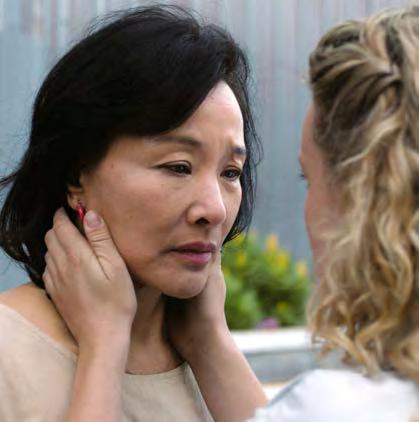
by Brian Bromberger
The last days of the international film festival’s 50th anniversary selections are filled with stunning documentaries, serious dramas, campy melodramas and romcoms, even a twinge of suspense.
Oasis Arts as a means of survival, but also to continue the creative process of bringing new shows to audiences at other venues as well.
In December 2025, Drollinger offered statistics that showed Oasis Arts’ contributions.
“Our nonprofit has really become more of an integral part of what Oasis is,” he said. “We’re really able to point to all of our different programs that we do. Our impact report looks pretty strong. Like last year we did 352 events, we sold over 48,000 tickets. We gave artists almost $800,000. We do good for the community, and I think they really saw that.”
Before the venue became Oasis in the early 1980s, including with a removable dance floor that had a swimming pool beneath it, the space was the Polly Ann restaurant, and became a gay
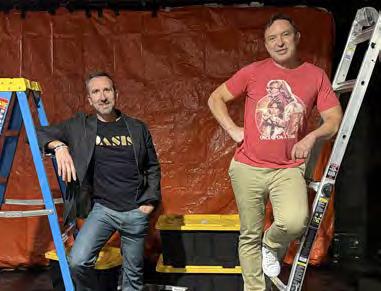
“Montreal, My Beautiful” (June 25, Vogue Theatre)
A love letter to Montreal (exquisitely filmed here) this is also another film about the difficulties of coming out in middle age.
Chinese immigrant Feng Xia (Joan Chen), at 53, is undergoing menopause but is looking at her life and isn’t happy. She and her civil engineer husband


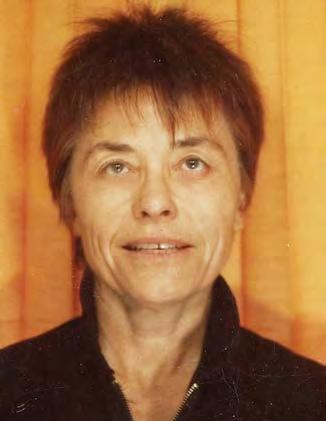
Jun, moved to Montreal for a better life. They own a convenience store, but because he lacks a Canadian education, he can’t find a job in his field. Their children speak fluent French, but her university daughter is tired of translating into Mandarin for her mother, so Feng takes a French class.
Feng meets 30-year-old free-spirited Camille (Charlotte Albin), though she’s troubled, has nev-
space in 1968. A pair of leather bars named The Covered Wagon and the Leatherneck followed. Then it became The Plunge, replete with a pool, in 1979-1980, before becoming the first Oasis. That name lasted through the 1990s, with many live music acts performing there, until its change to dance clubs Caliente and V/sf, which closed in 2009.
Since its grand opening on New Year’s Eve in 2014, the new Oasis has hosted hundreds of drag, cabaret, live theater, and queer-themed shows. The iconic venue has been home to some of San Francisco’s most popular events, from drag nights Mother (hosted by the late Heklina, originally a co-owner of Oasis with Drollinger), Princess and Reparations, the Drag King Contest, live parody shows like “Star Trek Live” “Nine to Five,” and several annual productions of “The Rocky Horror Show.”
Celebrity appearances have included Cher, The B-52s’ Cindy Wilson, Doja Cat, Lil Nas X, and dozens of “RuPaul’s Drag Race” performers. During the pandemic, Oasis performers, faced with the temporary closure of the nightclub, took to the streets with Meals on Heels, a drag queen food delivery service.
Specific scheduling for returning shows and events will be forthcoming. Sign up for Oasis’ newsletter for the latest updates.t www.sfoasis.com
er actually been in love (though has lots of sex) and has a rocky relationship with her divorcing parents. What happens if Jun discovers the affair and will they return to China, since both are conservative and feel out of place in liberal Montreal?
The film’s crown jewel is the elegant Chen, who deserves award recognition as a woman trying to balance fear and desire in an incandescent, vulnerable performance.
“Test” (June 25, Roxie Theater)
An earnest, grim meditation on the sport of amateur bodybuilding finds Eddie (Brock Yurich) at a crossroads, who desperately wants to win the championship and earn his Pro card. He’s coached by his suffocating devout mother Joanne (Tammy Blanchard, amazing) who is manipulative, but under her tutelage he’s not winning contests.
He finds a new coach (real-life fitness coach Mike Edwards) to whom he’s sexually attracted. Eddie also reunites with an old girlfriend, a dance instructor, back for the summer, who’s teaching him some body moves to improve his competition skills.
He indulges in late-night online sex work as a camboy, which he keeps hidden in their rural conservative Ohio town, to help ends meet.
by Gregg Shapiro
Here’s a little quiz. Where were you in 1997? What kind of music were you listening to? Do you remember the first time you heard “SemiCharmed Life,” the first single from the self-titled debut album by San Francisco band Third Eye Blind?
Did you “doo-doo-doo,” along with the hot, straight lead singer Stephan Jenkins? If so, you’ll definitely want to catch longtime ally Jenkins performing an acoustic number, perhaps the queer-inspired song “Jumper,” at San Francisco Pride on June 28 at Civic Center. Stephan kindly made time for an interview in advance of Pride.
Stephan, I’d like to begin by asking some background questions, such as who are two of your favorite musical acts that you listened to when you were growing up, and in what ways, if any, would you say they influenced the music you make?
Stephan Jenkins: I’ve given up trying to do that. Maybe some people work that way about having their all-time favorite two. I don’t have a favorite book or writer or most influential. I’ve listened to so much music so intently at different times in my life and I still do. There are moments where I was shocked by hearing them. That’s what rock music did to me. I was intrigued by the Beethoven and Bach that my father would play. Or my mother would drive me up to the city from Palo Alto to go sit up in the cheap seats and listen to Puccini.
So, classical music played an influence.
I think so, in some way. I never listened to pop music until I first heard the Jackson 5. I heard “I Want You Back,” and I was like, “What it that?” I was just shocked. And then, I was
probably in the 4th grade, and there was some girl who I thought was cute, and when I walked by her house there was something terrifying and scary playing in her brother’s room that was behind a curtain. It was Led Zeppelin. It was “Kashmir.” I remembered it was haunting and compelling. I’m a freshman in high school in in Palo Alto and I don’t fit in with the sort of suburban rock scene. Then, on KCSU college radio, I hear this voice. I can’t understand what it is, but it was so sharp and pointing to me. The song was “Roxanne…”
…The Police!
Yeah! (Drummer) Stewart Copeland’s rhythms! Then seeing Prince in his underpants on (the album cover for) “Dirty Mind.” I was a child. It was appalling. Then going off and hearing punk for the for the first time. The SoCal punk scene kind of mushing together. Then the post-post punk scene: Joy Division. When I first heard that blend of songwriting, I thought it was so incredible and it stuck with me.
So, the answer is no. I can’t give you any two songs or singers. I could just keep moving on through time. Like the first heard time I heard A Tribe Called Quest. And my desire for the Bob Dylan that I grew up with but putting it into a deeper rhythmic sensibility because I was a drummer. I’ve always been a drummer by trade.
For those not in the know, please tell the readers how the band’s name, Third Eye Blind, came to be. Is there one person who takes credit for that, or was it a group decision?
No, I named it. I thought it would look good on a T-shirt. It was like third eye, and then blind! I love Camper Van Beethoven. They were kind of a wordy smartass-named band.
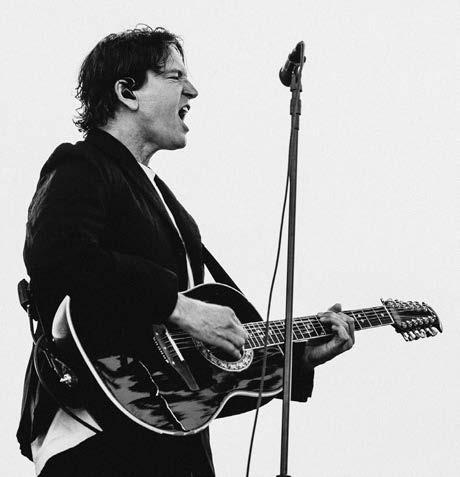
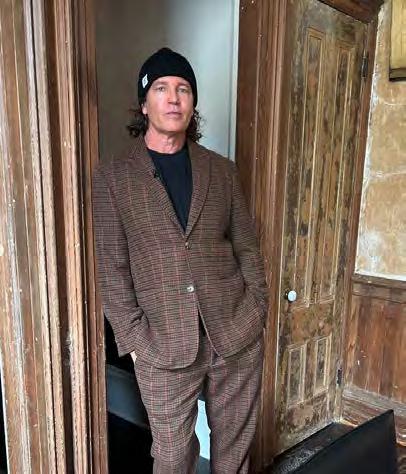
It’s a great play on words.
I was also thinking about how in the ’90s there was, to me, this kind of phony spiritualism. The people who were into it always seemed so ultimately self-absorbed and selfish and in the guise of “aren’t I blending with you, but I’m actually just preoccupying myself. I’m just a consumer.”
So, it’s like poking phony spiritualism in the eye. Music, to me, was always the thing that could bring alive a sense of magic and dreams. It’s like music in a blind time. But we can just go back, Gregg, to the t-shirt.
Okay, it looks good on a t-shirt, for sure. You spent your formative years in the San Francisco Bay Area… …I’m still forming.
That’s good to know. You’ve been quoted as saying you were in-
fluenced by the queer community around you. When you lived there, did you attend any Pride parades or festivals in San Francisco?
Yes, but I think all of San Francisco is influenced by queer culture. We have this odd idea that our cultures are segmented off from each other, but we are the most forward-thinking city in the world. And I don’t think there are even 900,000 of us here. It’s a tiny town.
To take a group of these service men, these robust people who were in service to the United States and say, “You don’t belong,” and now they’re stuffed over here in a corner. To think that that’s not going to affect everyone in some way, is like saying music’s not effected by hip-hop. You’re not paying attention to you yourself, is my sense. That’s one aspect of it. I think that without queer culture in San Francisco, there would be no survival research labs, and the DJ scene
would not be happening as it was. In the larger sense, queer culture makes room for a wider sense of expression and contingency. It’s not my experience, but it is part of my culture is how I would put it.
You will be performing an acoustic version of the Third Eye Blind song “Jumper” at the San Francisco Pride parade. How did this invitation come about? Did you reach out to them, or did they reach out to you?
They asked the band to play, but they didn’t have any money. Just to get Third Eye Blind, it’s like a circus to get us all there. It’s really expensive. So, I said to my manager, “We can’t do it, but I’ll just go play for free.” I’m glad to do it, and that’s how it came together.t
www.thirdeyeblind.com www.sfpride.org










by Jim Gladstone
Horror is having a moment on stage. Earlier this year, a theater spin-off of the “Paranormal Activity” movie series shattered San Francisco box office records. It skulked onward toward Broadway, where it arrives next month, joining “Stranger Things: The First Shadow” and the musicalization of ’90s vampire flick “The Lost Boys.”
Here in San Francisco, at Theater Rhinoceros, another fearsome tale lurks in the wings: Playwright MarkEugene Garcia’s scary, sexy “Goat Blood,” a co-production of the Rhino and JT Presents, begins performances on June 25.
But unlike the brand name fright franchises that have jumped from screens to stages (arguably jumping the shark en route), “Goat Blood” is an original, written specifically for the theater.
Particularly well-suited to the close confines of the Rhino, it’s intimate, shivery, and not at all dependent on big-budget effects.
“A lot of my inspiration came from old radio programs and “Twilight Zone” episodes,” said queer playwright Garcia in a recent interview with the Bay Area Reporter. “I wanted to focus on what works best on stage rather
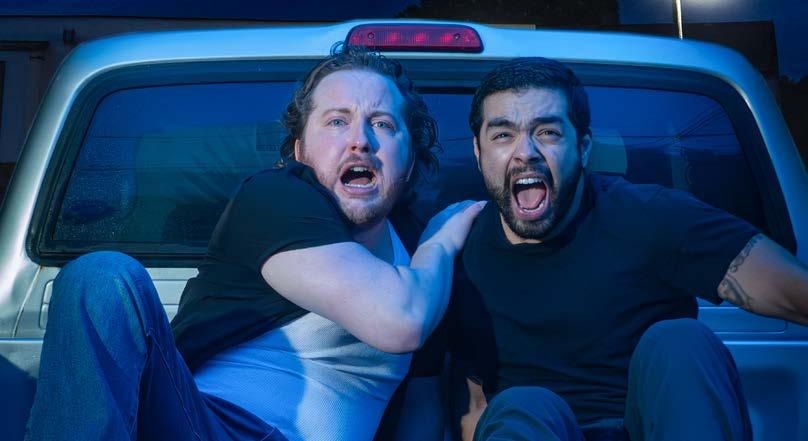
than in a movie. It’s a lot about what you can’t see. What’s scary is what’s unknown.”
“Goat Blood” seeps into you.
Horror and hormones
“I want the audience to experience the same suspense as the two main characters,” said the California-raised, New York-based Garcia.
Those characters are co-workers Pablo (Eric Esquivel-Gutierrez) and Owen (Casey Spiegel), both in their
thirties but immature. They spend much of the play getting under each other’s skin as they shoot the shit in the bed of a pickup truck.
They’re waiting for two women they met in a bar earlier, but becoming ever more flirtatious with each other. When Pablo reminisces about his troubled past, some of his more disturbing anecdotes are staged as flashbacks, including harrowing near-encounters with El Chupacabra, the bloodsucking livestock-stalking beast of Latine lore.
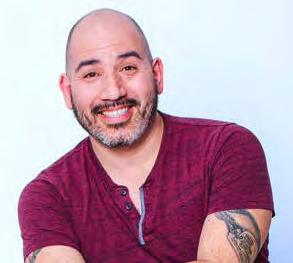
Is this unseen creature fantasy or reality? Is there a monster to fear, or are the men’s fears themselves the monstrosity, holding them back and destroying their dreams?
“A man seals himself off to survive,” suggests a slippery third character. “All becomes defense. If fear, or any emotion, surfaces, crush it. True manhood is unwavering. Vulnerability is for cowards.”
Garcia toys with the tropes of machismo as well as those of the horror genre.
Scary smart
Garcia confesses that, as a kid growing up in suburban San Gabriel, he steered away from even a mention of the word “horror.”
“Forget about it,” he said. “I was terrified. I was afraid to watch ‘The Rocky Horror Picture Show’ and ‘Little Shop of Horrors.’”
By his teen years, though, Garcia was emboldened and developed a particular fancy for films featuring cryptozoology.
“I love monster movies, like the original ‘Anaconda.’ And it’s a running joke among my friends that my favorite movie is ‘Congo.’’” (Ironically, that 1995 shaggy ape tale featured Tim Curry, the original Frank N. Furter).
The legend of the Chupacabra provided an ideal bridge between Garcia’s past work and “Goat Blood.”
Garcia’s earlier plays focused more realistically on Latine and queer culture in the U.S., addressing topics including immigration, racism, and intergenerational conflict. “Goat Blood” doesn’t shy away from such themes, even as it cloaks them in genre trappings. It’s Garcia’s “Get Out.”
‘Can do!’ spirit
While “Goat Blood” is intended to jolt audiences with the stuff of nightmares, Garcia recounts his own life these days as something of a dream come true.
His partner of more than two decades is fellow theatermaker Rodrigo Ernesto Bolanos, who directed the premiere of “Goat Blood” in 2024.
“I like to joke that he’s in the business of making my fantasies come true,” said Garcia. “When I said I wanted to move from California to New York to pursue my career in the theater, he’s the one who made the plans and booked that first trip. I’ll come up with a crazy idea and he’ll say, ‘Ok, this is how to make it happen.’
“In one of my plays, I wrote a stage direction that pretty much said, ‘So she pulls a blanket out of her bag, and the blanket becomes a mountain; they climb the mountain and then throw someone off the top.’ And he’s like ‘Great! Here’s how we can do that!’ We have a very unique connection.”
When Garcia’s not writing or acting (the playwright is also a performer), he’s deepening his connection to the New York theater scene through his job managing The Drama Book Shop, a venerable New York institution that, as of 2020 is owned by LinManuel Miranda, director Thomas Kail, and a handful of other Broadway notables.
“I’m surrounded by inspiration on the shelves every day,” said Garcia, who co-hosts the shop’s weekly podcast The Drama Book Show. “And every customer who walks in the door is someone I share a passion with.”t
‘Goat Blood,’ $17.50-$25, June 25July 19, Theatre Rhinoceros, 4229 18th St. therhino.org markeugenegarcia.com broadwaypodcastnetwork.com
by Brian Bromberger
It seems fitting that pioneering gay iconic English pop artist David Hockney died during Pride month on June 11 at 88. It’s not too much of an exaggeration to say that some of the progress LGBTQ people have made in the last half century can be attributed partially to his work.
One of his earliest paintings, created when he was only 23, “We Two Boys Together Clinging,” inspired by a Walt Whitman poem, depicting a male couple embracing and perhaps kissing, was created in 1961 when he was a second-year student at the Royal College of Art. This work was Hockney’s public coming out as an artist, despite homosexuality then being illegal in England. Following his father’s advice to him, “Never worry what the neighbors think,” he was out to his family in his teens, extraordinary for those repressive times and workingclass background.
Hockney’s art was radical for the time, challenging the homophobia in art itself, not so much politically nor even explicitly, but revealing gay lives as normalized, even domesticated. He showed gay relationships as playful, even joyous with a style that was luminous and accessible, but with just the same calm dignity as straight ones, leading regular lives but perhaps more beautifully and stylishly.
Bigger splashes
His career catapulted after he moved to Los Angeles in 1964. He wanted to come to the U.S., seeking freedom to live more openly as a gay man. For him, LA represented all the energy of America combined with a Mediterranean climate, a gay paradise.
It was during this period he painted his renowned glowing sun-drenched swimming pool pictures under blue skies, complete with palm trees, flawless manicured green lawns, and rolling hills. One of his renowned works was 1966’s “Peter Getting Out of Nick’s Pool,” with a nude man climbing out of a swimming pool with the viewer’s eyes focused on his bare ass cheeks.
His most famous pool painting and perhaps the most iconic of all his paintings is 1967’s “A Bigger Splash,” which captures the moment after a person has jumped off a diving board into a cyan blue swimming pool. While not gay, the way the scene is set up evinces a gay sensibility, since it’s a queer take by evoking a sensual subtlety, one not constrained by expectations and never afraid to be contrarian.
In living color
Yet it was his 1972 painting, “Portrait of an Artist (Pool with Two Figures),” showing a clothed man standing at the edge of the pool staring down as another man in white trunks is swimming underwater, that sold at Christie’s auction in 2018 for $90 million, becoming the most expensive artwork by a living artist sold at that time.
He also loved to paint gay couples, such as Christopher Isherwood and Don Bachardy. Hockney is survived by his partner (and sometimes model) Jean-Pierre Goncalves de Lima.
Hockney once remarked, “I prefer living in color.” It can be said that Hockney was the foremost artist of vibrant colors since Van Gogh. And these vivid colors extended to his clothes. Hockney could wear light mint-green sport coats, his signature oversize (almost owlish) eyeglass frames, mismatched colored socks, pastel shirts, ostentatious accessories, and bleached blond hair (“Blonds have more fun”).
Freedom of expression
Since he wasn’t hiding his sexuality, he felt he could wear whatever he wanted, a freedom to express his own style which often subverted traditional apparel. Since he lived in
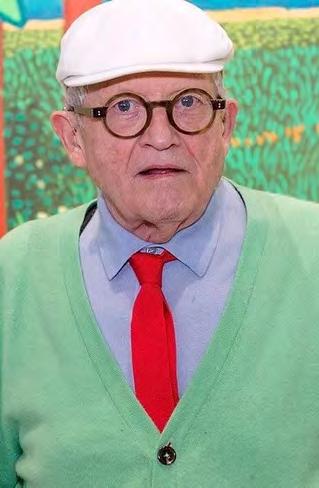
Hollywood on and off for 40 years, he knew everyone in fashion, film, literature, dance, and art. He was a champion of LGBTQ rights, usually in a camouflaged way. Yet there was one time when he publicly dissented. In 1988, as he
An appreciation of the revolutionary painter

was preparing an exhibition of his work at the Tate Gallery in London, he threatened to cancel the show to protest Section 28 anti-gay legislation being debated in Parliament. When the proposed law was defeated, the exhibition proceeded.
In his later years, he painted large almost mural-like canvases of his native Yorkshire landscapes (i.e. “Woldgate Woods”) in his bid to remind viewers how we’ve lost our connection with nature. He also used the latest computer technologies such as an iPad.
As a gay man he loved theater and was a celebrated designer of sets and costumes for operas (i.e. Stravinsky’s “The Rake’s Progress” and Wagner’s “Tristan and Isolde”) and ballets. In 2017 he was awarded the San Francisco Opera Medal, the company’s highest honor, for his revival and restoration of Puccini’s “Turandot,” declaring his productions as “bold expressions of archetypal emotions with rhythms in color and creating portals we enter with thrilling excitement.”
The modus operandi of Hockney’s gay work and interests was if he created it, then it would become true in real life, which decades later it did. He painted the world the way he wanted it to be and his vision was so stunning yet authentic, viewers couldn’t help but ask, “Why not?” With his exhibitions (the final and largest one, at the Louis Vuitton Foundation in Paris last year), he was the 20th century’s greatest gay artist, with the possible exception of Andy Warhol.
His art reveled in the sense of possibility for greater freedom and through his own rigorous work ethic, painting to the very end of his long life, he defied the status quo and helped us envision a more tolerant welcoming world.t
www.hockney.com

The film shines a light on the dark unglamorous side of bodybuilding, including steroids, drug abuse, and violence, but also ambition and what it takes to succeed. This angle seems to take precedence over the queer dilemma, though Yurich, who also wrote the screenplay, is trying to show us how both struggles were intertwined for Eddie.
“Maddie’s Secret” (June 25, Castro Theatre)
This strange yet earnest satire will probably divide viewers, but writer/ director John Early has walked a tightrope in delivering a campy melodrama (reminiscent of Douglas Sirk) on a serious topic with tons of laughs along the way.
Early dons a wig and dress to play Maddie, who is catapulted from dishwasher at a food network content collective called Gourmaybe, after her adoring burly husband Jake (Eric Rahill) who thinks she’s perfect, films her making a vegetarian recipe, then posts it online, it goes viral, and Maddie overnight becomes a chef/influencer, an audience favorite.
The pressure is too much. Her life spins out of control as she struggles with bulimia. The film never devolves into mockery, despite its silliness, and the irony of someone with a food disorder working as a chef/influencer. Ultimately, it’s touching as Maddie begins to recover. Early successfully navigates a tonal tightrope between absurdity and authentic deep emotion, that in one less talented could have been a disaster.
“Barbara Forever” (June 25, Castro Theatre)
“It’s my own life I put on screen. My life has been lived in film.”
These words epitomize the career of Barbara Hammer (1939-2019), the lesbian experimental filmmaker. Hammer remarks that she was born when she became a lesbian, but
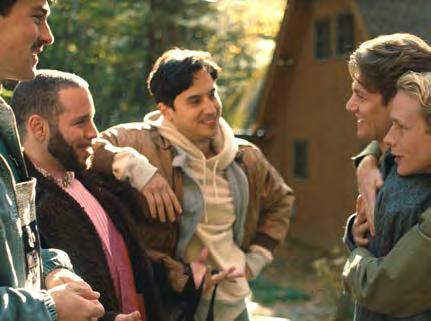
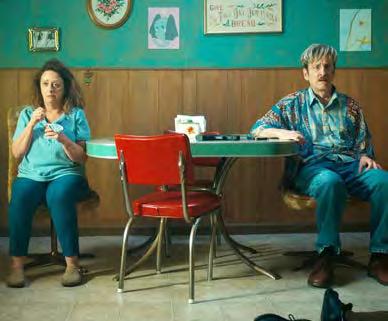
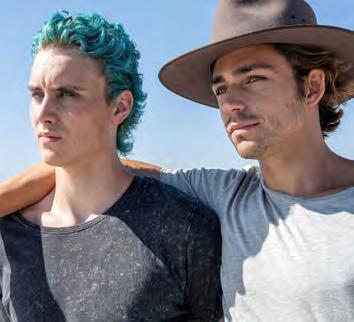
she loved on TV.
didn’t hear the word lesbian until she was 30. Once she discovered what it meant, she had sex with a woman (she was married to a man), embraced that identity, but was angry that she had never seen lesbian sexuality on screen. She was determined to put it there herself.
Her “Dyketasking” is the first lesbian lovemaking film to be made by a lesbian. She comments she had many love affairs and each one inspired a new film. Her blurring the lines between her work and her personal life, with the camera always there, put a strain on her relationships.
This documentary on her life is no cradle to grave story, nor are there any talking heads, but it adopts an experimental approach that reflects Hammer’s work. Hammer was bold, unconventional, immersive, uninhibited, and fearless, even appearing naked on film towards the end of her life, viewing her age and mortality (she fought uterine cancer for decades) through her art. “Barbara Forever” is not only a tribute, but an argument that Hammer’s work is essential, a groundbreaker for the queer filmmakers that followed her, that she’s still relevant and deserves an honored place in the cinema canon.
“Before I Do”
(June 26, Castro Theatre)
Making its world premiere at Fra-
meline, this queer romcom drama could be seen as a gay millennial “Big Chill” featuring a wedding rather than a funeral or “Love! Valor! Compassion!” without AIDS.
A group of gay men in their mid-30s, who met at university, gather at one of their friends’ lakeside cottage (with gorgeous autumn foliage, shot on location in the Berkshires region of Massachusetts) as they throw John Michael (Cole Doman) a bachelor pre-wedding party, minus the other groom, David.
Anything can happen and does during this weekend. It’s a total queer cast helmed by a gay director with wonderful ensemble acting. It’s a playful, mischievous, horny romp as these gay men start to settle down and decide what they want from their friends and lovers; winner from start to finish.
“Hunky Jesus” (June 26, Castro Theatre)
It’s Dolores Park on Easter Sunday with a cheering crowd of thousands, which can only mean contests for Foxy Mary and Hunky Jesus as well as drag performances, music, and pole dances, created by the Sisters of Perpetual Indulgence, an order of queer and trans activist nuns.
This raucous, joy-filled documentary intercuts the 2023 celebration with the history and impact of the Sisters, that incorporates archival footage, animation, and penetrating inter-
views with new and founding Sisters.
The documentary is insightful when it observes how queerness and Christianity can not only coexist, but in dialogue inform each other, especially because serving the marginalized in one’s community is key to both groups (i.e. donating wigs to cancer patients). The Sisters’ nonjudgmental embrace of all people, whoever they are, should also have resonance with progressive Christians.
Several Sisters spoke about growing up gay in traditional religious backgrounds, but didn’t find any space for them to be their true selves and if they expressed it, exile and denunciation could result. Director Jennifer M. Kroot has fashioned a playful and uplifting film that will have you cheering and screaming for joy by the time it ends. It might even change the way you view Jesus.
“Loves Company” (June 27, Castro Theatre)
A gay low-budget riff on Stephen King’s “Misery,” only the kidnapped ‘star’ is the crazy one, this lunatic comedy tells the sad tale of Blake de Troy (Jack Plotnick), a faded, has-been gay flamboyant gameshow personality (a satire on Paul Lynde) on the long canceled “Open That Box” (a takeoff on “Hollywood Squares”) who, after his assistant/ spouse Jimmy (Bryan Batts, “Madmen”) dies, he scatters his ashes in Florida.
A drugged-up limo driver leads to a car accident and Blake is rescued by his devoted, perhaps only fan and outcast Antoinette Funk (Rachel Dratch, in a career resurgence as younger generations are rediscovering her Debbie Downer “SNL” skits).
Trying to nurse him back to health, she realizes what a needy mess he really is, a nasty drunk in withdrawal, and not the bubbly, fun personality
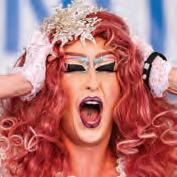
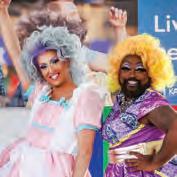
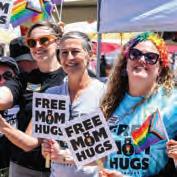
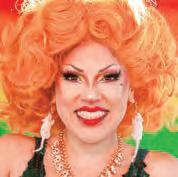
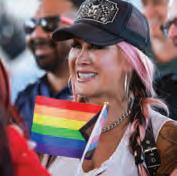
After Blake steals from her, Antoinette wants to be rid of him (shades of the famous O. Henry short story “The Ransom of Red Chief”), but he asks her to make a video turning his accident into a kidnapping to remind the world he still exists and can hopefully stage a comeback in Hollywood. It’s pure escapist fun with lots of laughs, thanks to Dratch and Plotnick, who are both sensational.
“Invisible Boys” (June 27, Roxie Theater)
This limited ten-episode drama series ran on Australian TV last year, adapted from a YA novel by Holden Sheppard. It’s set in the remote coastal town of Geraldton, Western Australia during the 2017 contentious, divisive same-sex marriage plebiscite.
We meet four gay teens. Each of the boys gets an episode from their pointof-view profiling their struggles and stories. The beauty of the harsh landscape contrasts with the oppressive cultural atmosphere. All four actors are outstanding, revealing characters who have depth, inconsistencies, and complexity.
Unfortunately, the series was not renewed for a second season, in spite of Sheppard having written a sequel novel, but season 1 is written so it’s self-contained, no real cliffhangers. There is trauma here, but what makes this series shine is the joy of tight-knit friendship the boys develop with each other, showing the healing power of chosen family as a way to combat the rather hopeless situations in which they find themselves.t
Read the full article, with more reviews, on www.ebar.com.
www.frameline.org

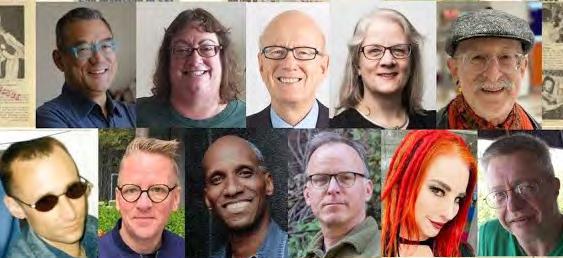
We continue our 55th anniversary celebrations by reprising some of our online discussion panels. The twelfth edition of the Bay Area Reporter’s monthly online chats about the newspaper’s history took place in April 2022.
Several current and former editors and writers participated, including Publisher Michael Yamashita, Publisher Emeritus Tom Horn News Editor Cynthia Laird, Arts & Nightlife Editor Jim Provenzano (also moderator), arts writer Cornelius Washington, arts writer Mark Norby, AIDS/Science writer Liz Highleyman, former production designer Adriana Roberts, former arts editor and porn columnist John F. Karr, former arts editor Chris Culwell, and dance writer Paul Parish
Since 1971, the B.A.R.’s reputation as an essential forum for local news about the LGBTQ community has expanded. Reviews and features in theater, film, music, dance and visual arts have grown from a small community focus to national interest. Our reviews have been quoted by book publishers, film promoters and theater companies for decades. The chat included a slideshow of articles and ads through the B.A.R.’s five decades.
Enjoy the chat. Watch more of our B.A.R. Talks on our YouTube channel, www.youtube.com/@BayAreaReporterSF.t










by Michael Flanagan
At a slight 53 pages, “The Castro: The Story of San Francisco’s Best-Known LGBTQ+ Neighborhood” punches far above its weight. The book, written and edited by public historian and book dealer Gerard Koskovich and San Francisco State University associate professor of sociology Jen Reck, reveals much that even amateur historians may not know.
Instead of beginning with the first bars like the Missouri Mule (2358 Market), which opened in 1963, or the communes of the neighborhood in the late ’60s, this book takes us back a decade to the ’50s.
In the 1950s, Eureka Valley (as it was then known) had some wellknown residents including the Black Cat’s own Jose Sarria, who lived there as a child in the 1920s, and later in the ‘50s the founders of the Daughters of

6
Your hotel apt or mansion.
Casanova (415) 818-3126.
$6000 per session.
Erotic unforgettable rendezvous great conversationalist. Easy on the eyes.
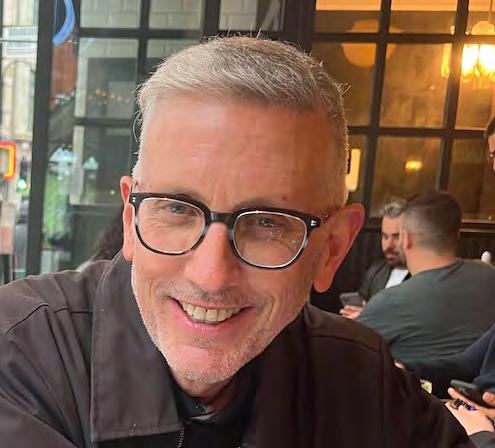
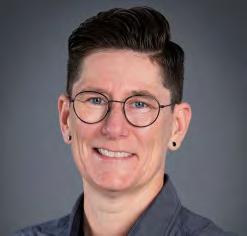
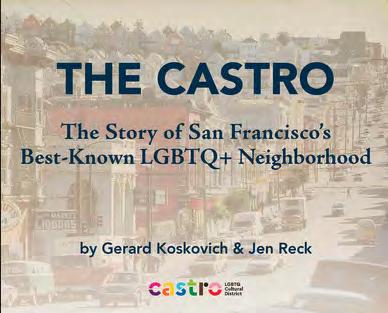
Bilitis Del Martin and Phyllis Lyon.
But the first gay merchant in the neighborhood was Maurice “Mike” Gerry, who opened Maurice’s Salon of Beauty at 587 Castro in 1957. Mike Gerry was also known as Michelle, “San Francisco’s foremost male actress.” There are some truly wonderful photos in the book of a New Year’s Eve party at Gerry’s home at 1449 Clayton in 1956 featuring both Gerry and Sarria.
Among those moving to the neighborhood in the ’60s was the photographer Henri Leleu, who moved to 230 States in 1963, and the late Bay Area Reporter photographer Ron Williams, who moved to 360 Sanchez in 1967. Some of Leleu’s photos are featured in the book.
With the influx of gays and lesbians to the neighborhood, the bars followed.
“The Castro” has pictures of four. As well as the Missouri Mule, there were the Libra, the Mint, and the Mistake. Entertainment was part of what made these bars successful. The Missouri Mule had Vivian Garcia, a lounge pianist known as “Vivacious Vivian.”
The nascent neighborhood had an explosion of gay and gay friendly businesses in the ’60s, including
the Valet, a men’s wear shop at 449 Castro that opened in 1964. Other business, including gift and card shops, pet shops and stereo stores followed. Of particular note are Chez Danny (456 Castro), a restaurant that opened in 1965, City Athletic Club (2500 Market), a gym that opened in 1966, and Castro Baths, a bathhouse at 582 Castro that opened in 1968.
Groovy times
The ’70s brought even further change to the neighborhood. “The Castro” quotes a 1971 article from The Advocate:
“This summer Castro Street has gone lavender with a vengeance. San Francisco has found a new Polk Street, and on some Saturday evenings, Castro Street seems to be a reenactment of Mardi Gras.”
Contributing to the changes in the neighborhood were communal houses like the Hula Palace (590 Castro) and Hunga Dunga (3841 18th Street). The changes were also reflected in the availability of nightlife spots. The book notes:
“The GLBT Historical Society Sites Database tracks 22 new bar spaces
opening by 1979–nearly four times the number that had opened in the 1960s. Most remained in operation throughout the decade, although several changed owners and names, sometimes more than once.”
Entertainment followed in these new bar spaces. The book has a set of truly wonderful photos of Sylvester performing as Billie Holiday at the Elephant Walk in 1975.
Along with the nightlife spots, the book documents the increasing number of cultural institutions, including art galleries, coffee houses and bookstores (including the Jehu Gallery at 2323 Market Street and Paperback Traffic at 558 Castro Street).
“The Castro” also documents the political activism of the neighborhood and includes the campaigns of Harvey Milk and the related founding of the Castro Street Fair.
The book does not shy away from the effects of AIDS on the neighborhood in the ’80s. But along with the horror and sadness of that decade, it documents the bridging of gender divides and the contributions that lesbian caregivers and activists made in that era.
Particularly noteworthy is the fact that the book does not shy away from contentious issues in the neighborhood like the Castro Sweep Police riot, the problems that gentrification caused and problems faced by BIPOC community members at places like Badlands. The book brings these issues up to the current day by including the Dyke March, the Transgender Day of Remembrance and recent conflicts over the future of the Castro Theatre.
Further good news regarding this book is that it is the first step toward a full-length book on the neighborhood. Reck and Koskovich ask for community members with experience in Eureka Valley and the Castro to contact them. They can be reached via email at jenreck@sfsu.edu and gkoskovich@gmail.com.t
“The Castro: The Story of San Francisco’s Best-Known LGBTQ+ Neighborhood” is available only at the GLBT Historical Society Museum and at Fabulosa Books, and via mail order from Fabulosa. www.fabulosabooks.com www.glbthistory.org
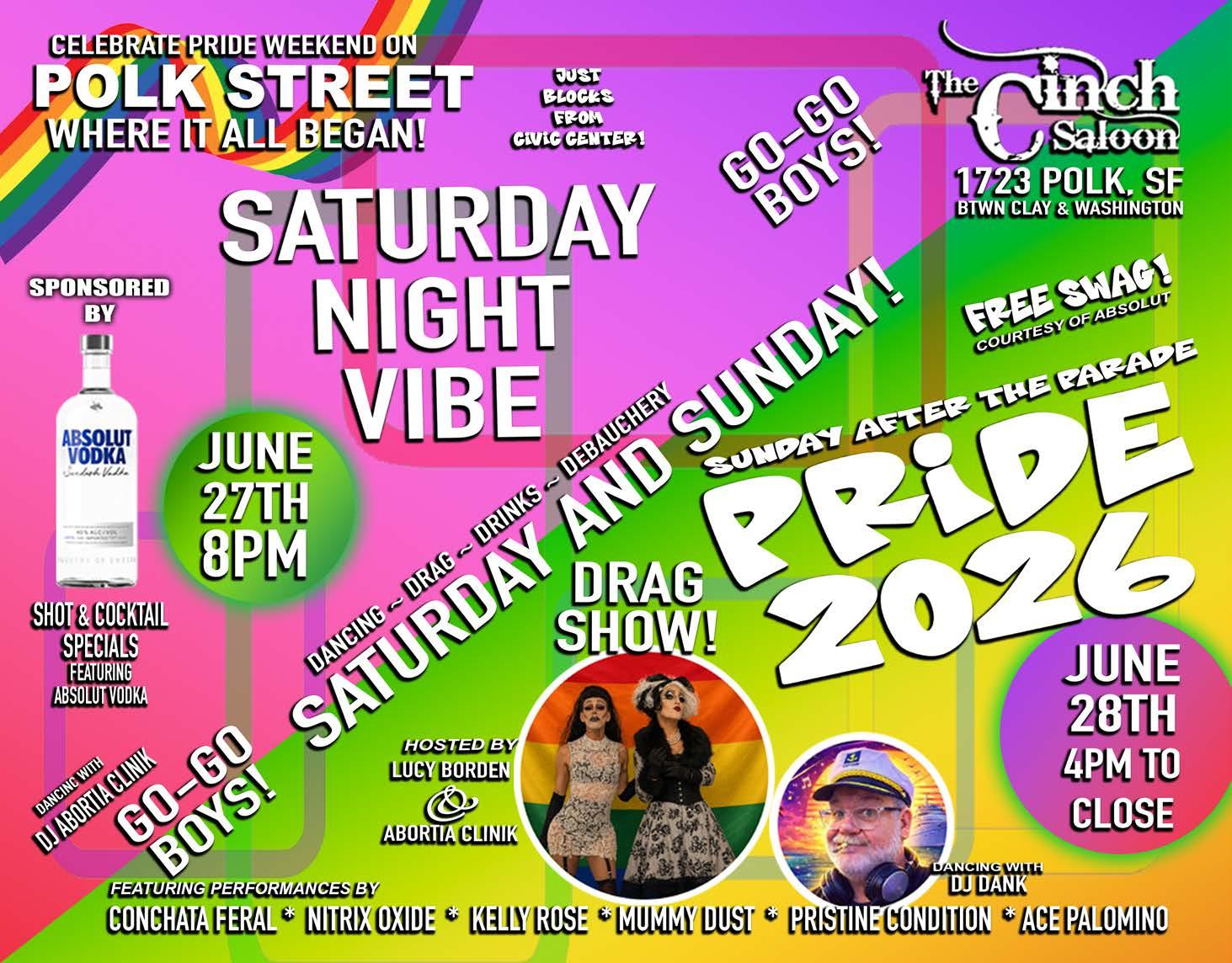
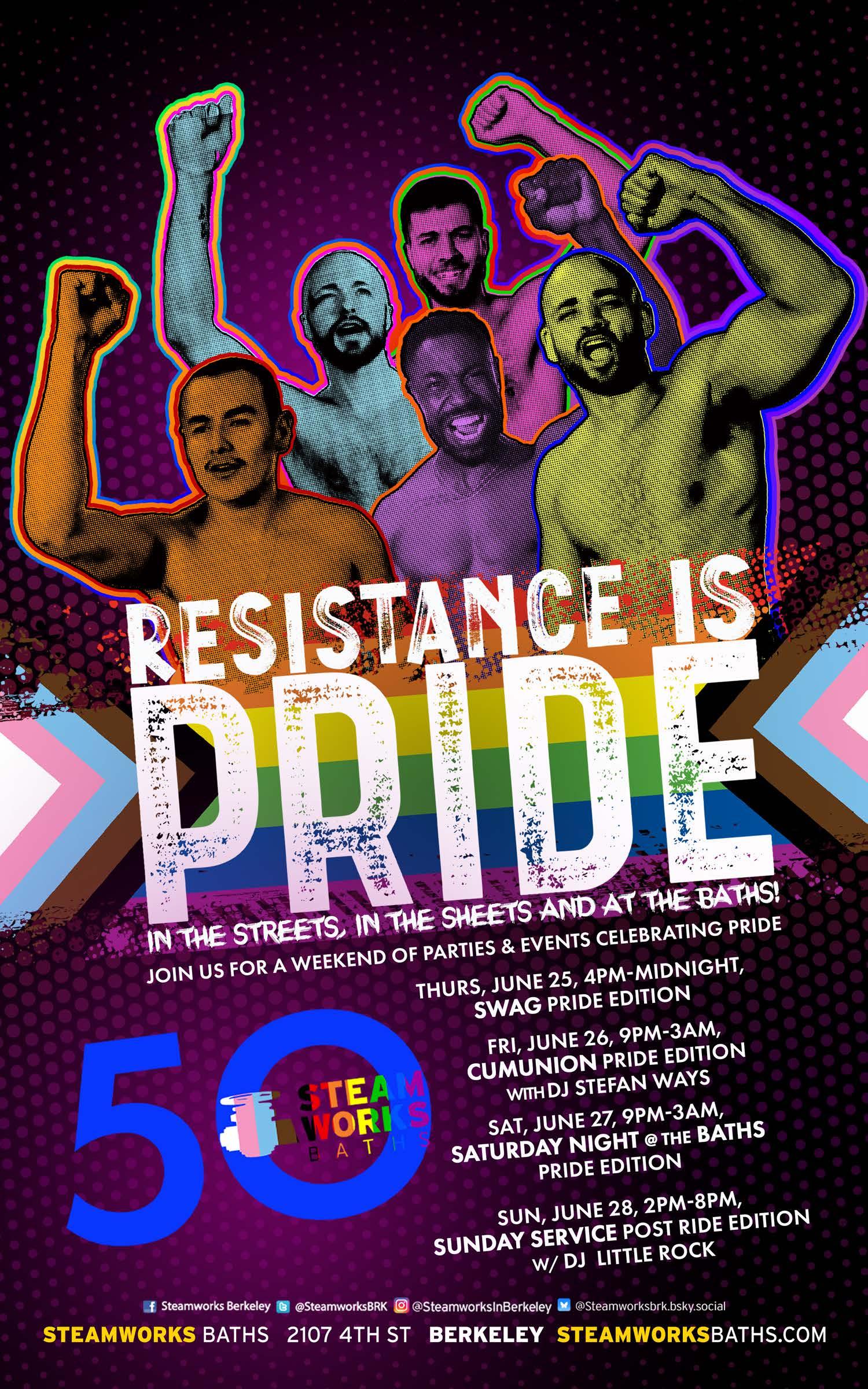



by Jim Piechota
Page after page, here are some new rainbow-hued selections for your reading pleasure in our fifth and final installment of the Pride 2026 books roundup. A royal biography of Jose Sarria, a history book going back centuries, plus a gay romance set in a dragon-filled fantasy land should charm any eager readers.
“The LGBTQ Almanac: 500 Years of Queer Culture in American History” by Deborah G. Felder, $39.95 (Visible Ink Press)
There’s no better time than Pride season to give yourself a history lesson. This one comes courtesy of Deborah Felder, a women’s history authority, who presents a kaleidoscopic array of notable and influential figures in LGBTQ history and profiles them with a keen eye and a genuine sense of curiosity and wonder.
Prior to the immense amount of research needed to compile her book, Felder admits that “there was so much about LGBTQ that I did not know…I wanted to know the stories.” She went to work, amassing these histories and impeccably sketching out profiles using the facts and details available to her.
At well over 600 pages, this historical guidebook is vast in scope, dizzyingly detailed, and narratively illuminating throughout its many biographies (and photographic imagery) of impactive queer folk from all walks of life and from all corners of the queer universe.
Among them are politicians, actors, scientists, authors, chefs, attorneys, and many more. This is a must-have melting pot for queer academics, historians, or anyone who wants a brushup course on LGBTQ history, and an obvious labor of love for Felder. www.visibleinkpress.com
“Queer and How We Got Here: A (Personal) History” by Hazel Newlevant
$25.99 (Little Brown Ink)
Cartoonist Hazel Newlevant has crafted this graphic interpretation of how queer history became shaped by the community’s unified resistance to decades of oppression, homophobia, injustice, and social and political intolerance.
gay San Francisco Sarria barely recognized, and a 1961 deep dive into politics, which was a risky endeavor back then to purposefully become an openly gay candidate for public office.
This pictorial vividly and regally introduces The Queen of San Francisco to those unfamiliar with Sarria’s remarkable legacy as a drag impresario, a queer defender. It also refamiliarizes our community with a true queen who dazzled California with his unapologetic activism, fearless spirit, drag empress fierceness, and audacious sense of pride. www.abramsbooks.com
“Bromantasy” by Maire Roche, $20 (Putnam)
Silliness and great adventuresome fun abound in a clever fantasy romance from queer author Maire Roche. This medieval fairy tale (in every sense of the theme) follows “roommates” and BFFs Juniper O’Reilly, who adores fermented honey mead, wrestling, and skin care, and ruggedly handsome outdoorsman, Mo Elmthorn.
Opposites attract as the two bros have been best pals for years, but there was a time when the lines of brotherhood and friendship became blurred and romance began to bud, but Mo opted out of love in favor of a solitary adventure years ago.
Though Juniper never quite got over Mo’s betrayal and departure, the two reunited and resumed their friendly frolicking. A mishap involving lots of drinking at the local tavern and a fight with a band of mercenaries wind both men in jail with the option of either public execution or be assigned by official decree to “DeDragon Your Homeland.”
The hunt brings Juniper and Mo face to face with a parade of odd mystical characters whose situations force them both to face their fears, their suppressed anger and animosities, and their enduring secret love for each other.
By the time the gigantic, snarling evil “dragon” is revealed, readers won’t care about how much the story’s heroes have been misled, only that they end up in each other’s arms. www.penguinrandomhouse.com


The author recalls, even at a young age, coming out as queer to others and this experience proved formative to the ways she looked at the world at large in both positive and negative ways.
Newlevant draws her own image and dialogue directly onto the book’s artful pages and escorts readers through her own memories, which directly intersect with LGBTQ histories and the influential moments that most made an impact on how the world perceived and valued queer communities.
Ideal for a young adult audience, this educative book doubles as both a colorfully depicted queer history lesson as well as an opportunity for readers of any age to rediscover where the concept of Pride emanated from, how it’s evolved across decades, and how to best respect and honor it today. www.lbink.com
“What Kind of Queen?: A Royal Biography of Drag Queen and Activist Jose Sarria” by Kyle Casey Chu, Andrew W. Shaffer; Illustrated by Cindy Lozito
$19.99 (Abrams)
An iconic Columbian American drag queen is gorgeously profiled in Chu and Shaffer’s “royal biography” of activist Jose Sarria.
Born in 1922 to an amazingly supportive family, Sarria was encouraged to live his life as he desired, but his mother cautioned him that naysayers were ever-present and always on the lookout to terrorize social outliers. Sarria’s life history is vibrantly on
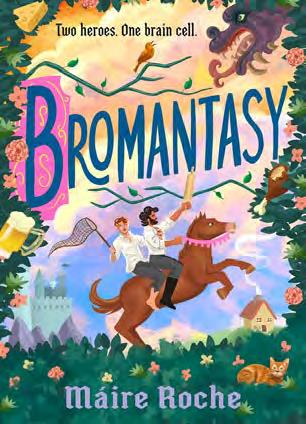
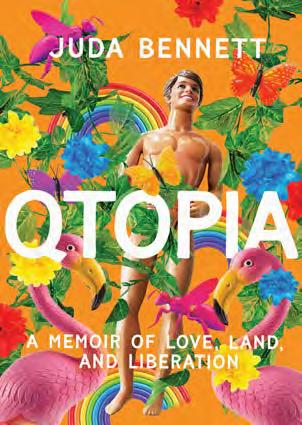
display in this all-age appropriate, lavishly produced biography with rich colorful illustrations and artwork by Cindy Lozito. From his Army enlistment in World War II, the narrative moves onward into a violently anti-
“Qtopia: A Memoir of Love, Land, and Liberation” by Juda Bennett, $18.95
(Univ. of Wisconsin Press)
In this beautifully written, earnest coming-of-age memoir from queer author Bennett, a professor emeritus of English at the College of New Jersey, he describes his enlightening journey from high school graduation into a series of communes in the 1970s and ’80s to varying degrees of happiness.
Emerging from a tightly knit and tightly wound family of five siblings, all who’d enlisted in the military, Bennett admitted during a trip from his sister’s boot camp graduation in 1971 that “I was next.” Bennett defied expectations, resisted the military lifestyle, and left what others touted as “the comforts of suburbia” as a teenager with his sights set on finding a commune to live in.
Rural Virginia was his first stop at the North Mountain Community homestead where free-spirited living was the goal, but the hippie castaway camaraderie he felt there didn’t sustain him for the long haul. In 1973, he started to come out to people while experimenting sexually with other commune friends. But the mountain retreat never felt like home.
When he discovered the queer commune known as Lavender Hill in central New York state, he knew it was the place for him. Bennett’s uplifting story reminds us about the exhilaration of true liberation and that the desire to live an unencumbered queer life ultimately lies in no one else’s hands but one’s own.

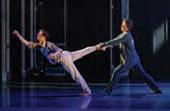
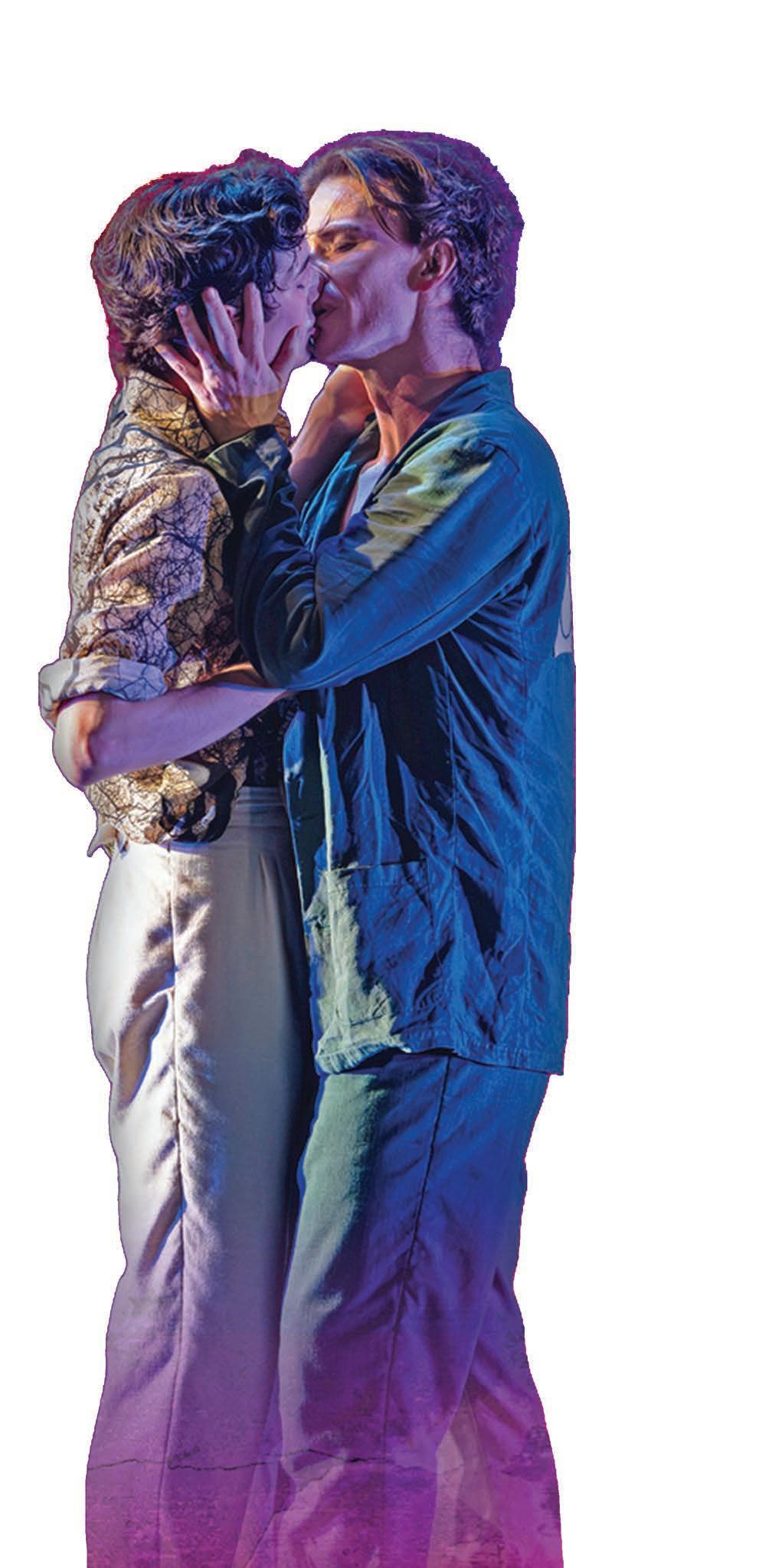
The Australian Ballet in Oscar (Sep 25–27), weaving Oscar Wilde’s life and work into a ballet of romance and forbidden love.
The mischievous singing elves of the San Francisco Gay Men’s Chorus (Dec 19) in their cherished annual Holiday Spectacular!
The world-renowned allmale drag ballet troupe Les Ballets Trockadero de Monte Carlo (Feb 27–28), bringing their iconic style and sass.
Yannick Nézet-Séguin conducting the Vienna Philharmonic (Mar 2–4) in three ravishing, Mahlerfocused programs.
Cheyenne Jackson (Mar 6) in a musical memoir about a “super-tall, super-queer kid from northern Idaho.”
The one and only Audra McDonald (Mar 20) singing classics from Broadway and the Great American Songbook.