Activists’ move to landmark the entirety of the culturally historic site of the former Gene Compton’s Cafeteria was postponed by a San Francisco Board of Supervisors committee Monday. The decision, announced by District 5 Supervisor Bilal Mahmood, who’s sponsoring the local landmark ordinance, comes ahead of August’s 60-year anniversary of one of the earliest transgender riots in the U.S.
The San Francisco Land Use and Transportation Committee continued a hearing on the landmarking request, which now includes the interior and exterior of the building. Local activists want the landmark ordinance to include the interior of the building at 101-121 Taylor Street, the site where the Compton’s Cafeteria Riots took place in 1966. The building is currently used as a prison reentry facility owned by GEO Reentry, a subsidiary of Florida-based company GEO Group.
It was at the all-night diner one August night that a drag queen reportedly threw a cup of hot coffee in the face of a police officer who tried to arrest her without a warrant. The ensuing riot occurred three years before the more famous Stonewall riots in New York City, long considered the birth of the modern LGBTQ rights movement.
With the supervisors’ impending August recess, Mahmood’s office is unsure when the agenda item will be heard again. Mahmood, a straight ally, represents the Tenderloin District where the building is located at the corner of Turk and Taylor streets. Mahmood had previously introduced an ordinance for a local landmark for only the exterior of the building. More recently, he has proposed landmarking the interior as well, based on requests from the Compton’s x Coalition, a group of activists, historians, and scholars.
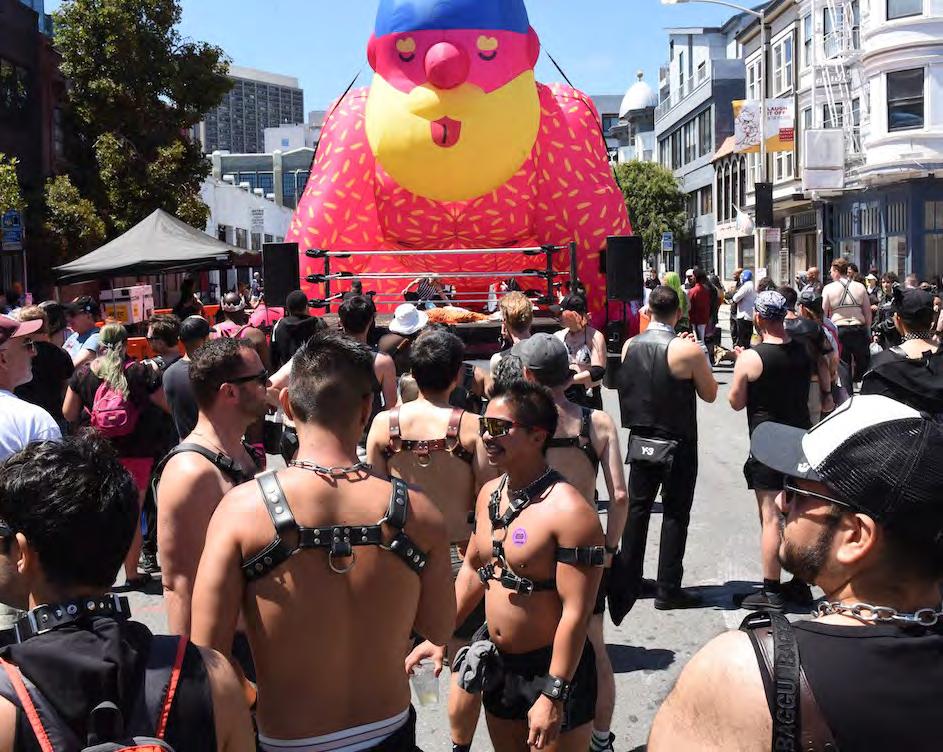
Summer fun at Up Your Alley
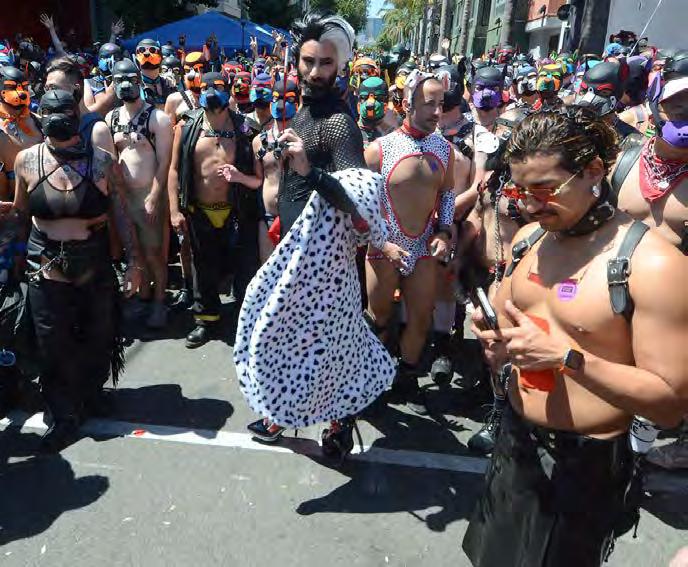
The San Francisco K-9 Unit gathered on Dore Alley during Folsom Street’s annual Up Your Alley street fair Sunday, July 26. The leather and kink event brought thousands out to the city’s South
of Market neighborhood for a day of partying and entertainment. The smaller Up Your Alley is a warmup for the huge Folsom Street Fair, which will take place Sunday, September 27. Rick Gerharter
SF DA urged to drop charges in Pride cases
by JL Odom
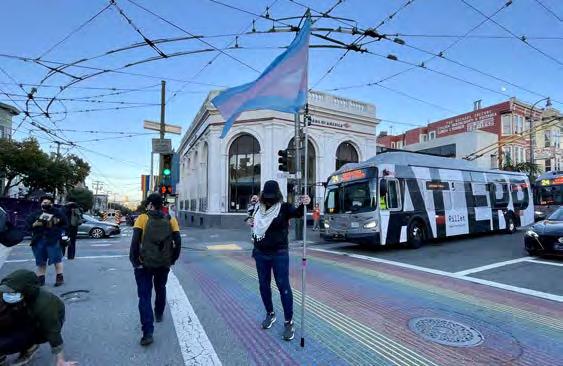
Speakers, chants, and signs at a Friday evening rally in San Francisco’s Castro neighborhood delivered a unified message: drop the charges stemming from Pride weekend arrests. Dozens gathered July 24 at Harvey Milk Plaza for the “Cops Out Everywhere, Drop the Charges” rally, calling on prosecutors to dismiss criminal cases tied to two Pride weekend events: the June 26 San Francisco Trans March and the June 27 Stud Alley block party.
See page 8 >>
Nonprofit SF library archive preserves LGBTQ children’s books
by Matthew S. Bajko
When Randall Tarpey-Schwed and his husband, Mark, became fathers in 2001, the couple wanted books to read to their twin daughters that celebrated the LGBTQ community and families like their own. As their children grew up, so, too, grew their collection of such titles geared toward young readers.
At the same time, Tarpey-Schwed’s interest grew into learning more about the backstory to each of the books. Who authored them and when? Why did they focus on telling stories about queer and transgender people?
“With the children’s books, I was mostly interested in having some books to read to our kids. But then I got quite interested about what was the nature of these books,” said Tarpey-Schwed, 63, an executive with a financial management firm.
He had “very carefully catalogued them,” he told the Bay Area Reporter, before storing them away since his daughters are now in their mid-20s.
“They sat in boxes for six or seven years,” said Tarpey-Schwed, who didn’t want his daughters’ names to be published.
With no grandchildren imminent, TarpeySchwed decided it was time to find a new home for the 210 LGBTQ children’s books the Mill Valley family had amassed over the years. In 2024, while serv-
an early LGBTQ-themed children’s book.
ing as master of the press for the Roxburghe Club of San Francisco, a private society for bibliophiles, printers, and book collectors, Tarpey-Schwed had invited Mechanics’ Institute Library Manager Myles Cooper to give a talk about the nonprofit institution known for its historic membership library, cultural
events, and chess classes and tournaments. Cooper in turn invited Tarpey-Schwed to visit the Institute’s special collections and archive at its building at 57 Post Street in San Francisco’s Financial District.
See page 8 >>
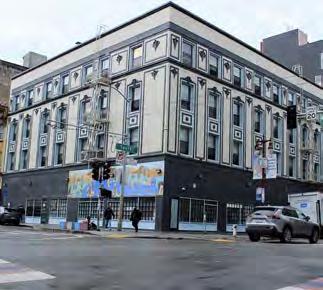
A proposal to landmark the whole of the former Gene Compton’s Cafeteria site was continued by a Board of Supervisors committee.
Eliot Faine
SJ Rasmussen, far left, Jim Martinez, and fellow rally attendees walked down Castro Street following speeches at Harvey Milk Plaza.
JL Odom
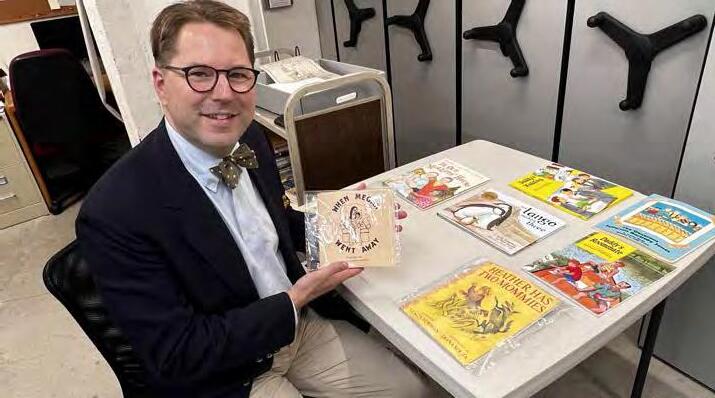
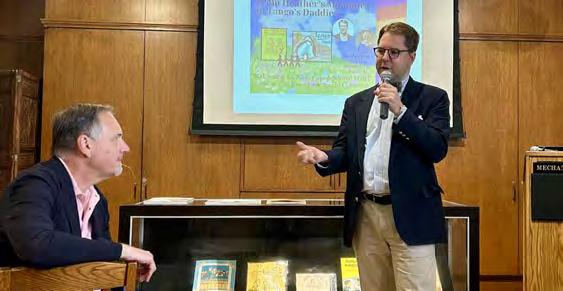
Mechanics’ Institute Library Manager Myles Cooper held a copy of “When Megan Went Away,”
Matthew S. Bajko
Hormel landmark approved
<< LGBTQ Aging
Supes OK lease terms for LGBTQ senior housing project
by Matthew S. Bajko
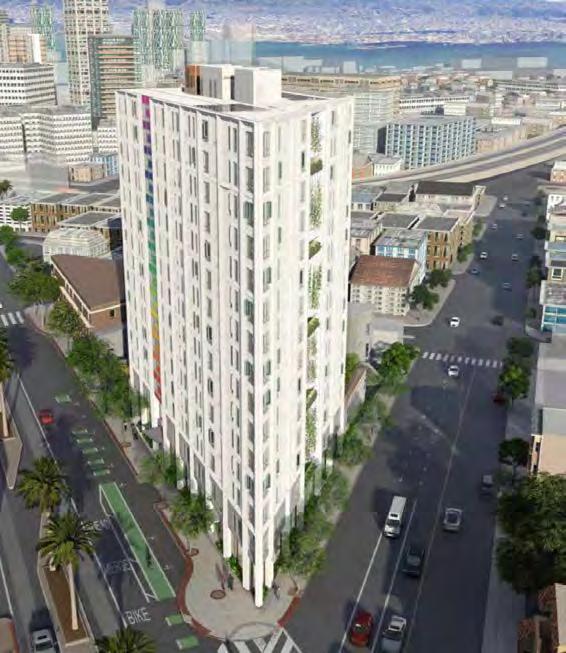
As a 15-story tower of affordable housing aimed at LGBTQ seniors nears closer to breaking ground in San Francisco’s Castro district, city officials are set to finalize the lease agreement with the nonprofit housing developer behind the project. Doing so will allow for demolition of an existing former union hall on the upper Market Street site to proceed.
Mercy Housing California and nonprofit LGBTQ service provider Openhouse are jointly working on the 185-unit apartment complex at 1939 Market Street on the corner with Duboce Avenue. It will be their third such housing site they have partnered on in that section of the Castro.
At its July 21 meeting, the San Francisco Board of Supervisors voted unanimously without comment to accept the proposed lease terms between Mercy and the city’s director of property and director of the Mayor’s Office of Housing and Community Development. The ground lease is to be for a term of 75 years, with one 24-year option to extend, and an annual base rent of $15,000.
It comes with the stipulation that the building’s rent levels be affordable to households up to 80% of area median income. There will be two additional units set aside for the on-site property managers.
“The developer will require future funding approval from the Board of Supervisors in order to construct the project, and the early approval of the ground lease pursuant to this resolution will allow the developer to begin early demolition of the existing twostory office building, thereby reducing the construction timeline and associated construction financing costs,”
cution of the lease could see the razing of the existing structure on the triangular lot begin “in the third quarter of 2026.” The lease also has a stipulation that it “automatically terminates” if the final financing needed to construct the project “does not close by February 23, 2027.”
Representatives for Mercy Housing did not respond to the Bay Area Reporter’s request for comment last week.
Presenting the lease agreement during the July 15 meeting of the supervisors’ budget and finance committee, Mercy senior project manager
Matt Grace noted the new housing is meant to be “an LGBTQ+ senior community” and will deliver a 1,600 square foot space to provide services to both residents and nonresidents of the building.
lotteries or application processes to be held to select the tenants for the units.
Forty units will be set aside for those unhoused or at-risk for homelessness, while a batch of units are to go to veterans and another to seniors living with HIV. The selection processes are similar to those used to choose the tenants who moved into the first such units meant for LGBTQ elders built nearby at 55 and 95 Laguna Street. Openhouse and Mercy previously worked together on transforming a portion of an old college campus into several buildings with apartments plus offices and a community space for the service provider.
Last December, the California Strategic Growth Council awarded a $47.6 million grant to the new housing project.
Former mayor Lon don Breed’s admin istration bought the property in 2020 for $12 million from the Sheet Metal Workers Local 104 specifically for the purpose of building affordable housing affirming of LGBTQ seniors and later selected Mercy Housing and Openhouse to deliver it.
The bulk of the growth council grant, $35 million, is designated toward the construction costs. The remaining roughly $12.5 million of the grant funds will pay for a number of public transportation improvements across the city but located fairly close to the 1939 Market Street site, as the B.A.R. noted in March.
The total development cost for the senior housing is pegged at $177,036,217, and Mercy must still secure roughly $100 million before ground can be broken. It should know by August 18 if its application submitted in the spring for 4% low-income housing tax credits administered by the California Tax Credit Allocation Committee (CTCAC) and the California Debt Limit Allocation Committee (CDLAC) was approved, which would then prompt city officials to ask the supervisors later this year to sign off on a $52.36 million gap financing loan for the project.
According to the applicants list for the state tax credits, Mercy made a bond request of $45,702,865 and an annual federal credit request of $8,601,845. A preliminary list of recommended awards to Qualified Residential Rental Projects has yet to be posted ahead of next month’s allocation meeting.
Open to all attendees – focused on housing discrimination for San Francisco tenants
4pm - 6pm Thursday, September 17, 2026
Join our inclusive, bilingual workshop and understand your rights as a tenant!
Whether you’re new to the area or have been here for years, this workshop is designed to help you navigate the complexities of tenant law.
What to Expect:
Bilingual Presentation: The presentation and materials will be provided in both English and Spanish.
With a target opening date in early 2029, the aim is to see that the majority of the below-market-rate studios and one-bedrooms go to queer and transgender older adults who meet the eligibility requirements to apply for the units. Due to nondiscrimination policies, any senior regardless of their sexual orientation or gender identity who qualifies will be able to enter the
Gay District 8 Supervisor and Board President Rafael Mandelman, who represents the Castro and has been a main backer of the senior housing project at City Hall, told the B.A.R. that “it’s very exciting” to see the long-gestating development reach this point.
“This project has been a priority for me since London Breed agreed to purchase the property many years ago. The stars finally appear to be aligning, and I am hopeful we will soon have nearly 200 more units of LGBTQfriendly affordable senior housing in the gayborhood,” said Mandelman.
If awarded the tax credits, Mercy will be required to break ground within 180 days, which happens to coincide with Valentine’s Day on February 14, 2027. Should that occur, construction is expected to wrap up in February 2029, with the marketing and leasing for the units to start in July 2028 so the selected residents are ready to move in that winter. t
Sausalito city manager released from jail
by Cynthia Laird
E
laine Forbes, the Sausalito city manager who was arrested after she was discovered on a boat that wasn’t hers, has been released from jail and is undergoing a psychiatric evaluation. Forbes, a lesbian who was previously director of the Port of San Francisco, did not enter a plea during a July 22 appearance in Marin County Superior Court.
Forbes, 53, was arrested July 18 on a felony burglary charge in the North Bay city after she was found on someone else’s yacht. The arrest came just two days after Forbes was approved for a leave of absence from her new job. She had started as Sausalito’s city manager July 1.
– and this is the first step in getting that help.”
Iida stated that the DA’s office had no additional comments.
A San Francisco resident, Forbes was hired May 5 by the Sausalito City Council to be its new city manager. She started in the job at the beginning of the month, with a salary of $275,000.
Sausalito Mayor Steven Woodside stated the City Council met in closed session July 21 to discuss “matters related” to Forbes.
On-site Support: Limited, one-on-one tenant counseling will be available after the presentation.
Legal Resources: Schedule appointments for legal service intakes.
In the Latino/Hispanic community room
But on July 21, Marin County Deputy District Attorney Geoff Iida told the Bay Area Reporter that Forbes would be charged with misdemeanors and not with the felony charge. Specifically, Forbes was charged with prowling, petty theft of personal property, and two charges of unauthorized lodging.
Sam Singer, a family spokesperson, stated last week that Forbes was experiencing a mental health crisis. Singer also shed light on why she may have been inside someone else’s houseboat.
“Forbes owns a houseboat in the vicinity of the boats she boarded in Sausalito,” he stated. “She was obviously not of sound mind and believed that she was on a vessel she owned. I am sure she regrets and apologizes for any and all behavior she exhibited during her personal mental health crisis.”
At the July 22 hearing, Judge Cindee Mayfield ordered that Forbes be released on her own recognizance and as a condition of that voluntarily submit to a psychiatric evaluation at Marin General Hospital. Forbes’ next court date is August 11, her attorney, Randall Knox, told the B.A.R. in a brief phone call July 23.
Knox said he does not know if Forbes will enter a plea at her next appearance.
“I’m glad she’s aware she needs help and is getting help,” he said.
Stated Singer, “The court sent Elaine Forbes for a mandatory psychiatric evaluation at Marin General Hospital. Elaine and her family are pleased with the court’s decision and direction. Ms. Forbes has experienced a mental crisis and needs help
“Since it is a personnel matter, there is not a lot we can share publicly right now,” he stated. “But I can tell you no decisions were made regarding her employment. She remains on a leave of absence, and I want to assure everyone we are gathering and evaluating all of the facts.”
It’s not clear whether Forbes sought the leave of absence.
Marin County Sheriff’s deputies made the arrest after being called to the Sausalito Yacht Harbor due to a noise complaint, according to media reports, and upon their arrival, found Forbes manipulating the controls of a yacht that didn’t belong to her, along with empty containers of alcohol.
Forbes was the director of finance for the San Francisco Planning Department from 2006-2010, and the chief financial officer of the port from 2010-2016. Former mayor London Breed appointed Forbes executive director of the port in 2016, according to her LinkedIn, which hasn’t been updated since she left the role of executive director of the port last year. t
A rendering shows the proposed affordable senior housing project that Mercy Housing and Openhouse are partnering on.
Courtesy Openhouse
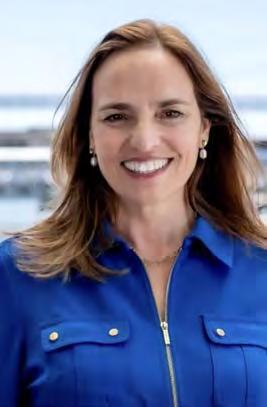
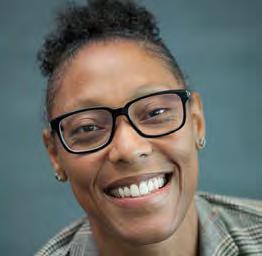
Sausalito City Manager Elaine Forbes
Courtesy Port of San Francisco
LGBTQ History>>
San Francisco supervisors vote to landmark Hormel mansion
by Matthew S. Bajko
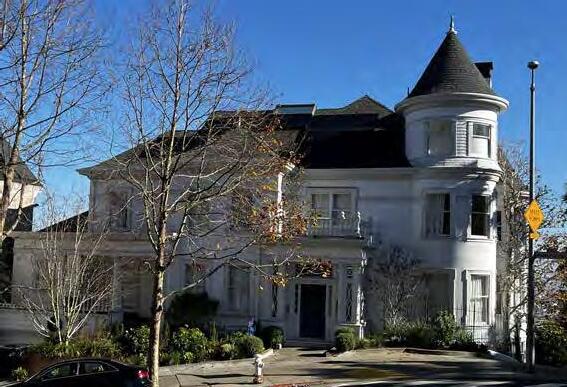
The San Francisco Board of Supervisors has given its preliminary approval for landmarking a 127-year-old Queen Anne Victorian once the residence of the late gay U.S. Ambassador James C. Hormel. It is set to become the seventh site in the city to be recognized this year for its connection to LGBTQ history, with several other such properties moving through the process.
At their July 28 meeting, the supervisors voted 10-0 with District 10 Supervisor Shamann Walton absent to adopt the local landmark for 181 Buena Vista Avenue East on the corner of Duboce Avenue. Because it is an ordinance, which requires two votes by the supervisors, and the board will be on its summer recess during August, the final vote on landmarking the Hormel mansion should take place when the supervisors meet September 1.
It will then be up to Mayor Daniel Lurie to finalize landmarking the property built in 1899 by architect Nathanial Blaisdell across the street from Buena Vista Park. It initially had been the home of George de Urioste, who served as consul of the Argentine Republic from November 1901 through at least 1913, and the stately mansion survived the 1906 earthquake and subsequent fire.
The de Urioste family sold the home in 1986 to Hormel, who lived there for 26 years, according to the Citywide Historic Context Statement for LGBTQ History in San Francisco.
At the time, the six-bedroom, five-bathroom mansion sported a pink paint job.
In 2012, tech executive Robert Mee and his wife purchased it from Hormel for $7.2 million and repainted the fourstory, nearly 9,300 square foot singlefamily residence in a white coat. They supported landmarking the property, which a city planning report had noted was eligible for inclusion on the California Register of Historic Resources when the couple sought city approvals to renovate the property and add a roughly 325-square-foot addition in 2013.
City historic preservationist staff had made the determination partly due to Hormel and de Urioste residing at the property while contributing to local and national history. In Hormel’s case, the heir to the Hormel meatpacking fortune became a prominent philanthropist who helped launch such LGBTQ organizations as the Human Rights Campaign and the James C. Hormel LGBTQIA Center housed at the San Francisco Public Library’s main branch.
He made international headlines in 1997 when then-President Bill Clinton nominated Hormel to be the country’s ambassador to Luxembourg, and thus, the first out LGBTQ person to serve in such a role. It sparked immediate opposition from Senate Republicans and conservative Christians, prompting Clinton to use his recess appointment powers to install Hormel into the diplomatic position in 1999.
Hormel would serve as ambassador to the small European country until 2001. He died of natural causes at the age of 88 in the summer of 2021, as the Bay Area Reporter reported at the time.
Gay District 8 Supervisor Rafael Mandelman, the current board presi-
dent, had instigated adding the property to the list of city landmarks. It was one of 22 properties the supervisors voted on Tuesday to landmark, all but one solely brought forward by Mandelman.
The bulk of the sites are single-family residences in various neighborhoods that Mandelman represents. Several are church buildings, one of which was turned into luxury housing, and a few are former firehouses repurposed into private homes.
Mandelman noted to the B.A.R. that “181 Buena Vista is a Queen Anne Victorian built in 1890 that has survived more than a century of San Francisco’s history, including the 1906 earthquake. It’s also where James Hormel lived for 26 years while he helped build the modern LGBTQ+ rights movement, from founding the Human Rights Campaign to becoming the first openly gay U.S. ambassador. It’s a building eminently deserving of landmark status and a legacy well worth recognizing and celebrating.”
Several supervisors this year have brought forward sites in their districts they want to see become local landmarks to help protect them from being demolished and replaced with
infill housing developments. It comes after the mayor and the board upzoned neighborhoods across the city to make it easier for developers to build multi-unit housing projects.
Now the supervisors are racing to preserve those sites they consider worthy of receiving landmark status. Doing so affords the structures some protection, such as a requirement that their facades be preserved. Any development proposed for the sites also requires closer scrutiny by the city’s planning department and oversight bodies.
The Hormel mansion was the only one directly related to LGBTQ history taken up by the board Tuesday. In the spring, the supervisors and Lurie landmarked six properties in Mandelman’s District 8 due to their LGBTQ historical significance.
They included the initial home of LGBTQ synagogue Sha’ar Zahav at 220 Danvers Street and the one-time residence at 4200 20th Street of the late gay B.A.R. founding publisher Bob Ross, who died in 2003 at age 69. Also given landmark status was the San Francisco AIDS Foundation’s inaugural site at 51420 Castro Street and the building at 582 Castro Street that once housed the Castro Rock Steam Baths from 1971 until 1977. So, too, were the locations of pioneering but now defunct lesbian-owned businesses Maud’s bar at 929-41 Cole Street and the Full Moon Coffeehouse at 4416 18th Street.
Other sites
When the Hormel mansion is officially added to the list of city landmarks, it will bring to 18 the number of sites recognized for their connections to LGBTQ history. An additional four could be added to the list this fall.
District 3 Supervisor Danny Sauter in the spring instigated the process to do so for a number of sites, including three in the city’s Italian neighborhood of North Beach and one atop Nob Hill with ties to the LGBTQ community. The Masonic temple turned concert venue at 11111171 California Street, for instance, has an endomosaic interior window
designed by gay artists and life partners Emile Norman and Brooks Clement.
The building at 500-508 Broadway for decades had housed Finocchio’s, the legendary female impersonators cabaret that opened in the 1930s and closed in 1999. The building at 473 Broadway had once housed Mona’s Candle Light, the fourth club opened in the late 1940s by lesbian bar owner Mona Sargent, who died in 2001.
Since 1948, Vesuvio Cafe has called 253 Columbus Avenue home, with queer and transgender people long among its clientele. Early on it became a haunt of the Bohemians and Beat writers who moved into North Beach in the 1950s, such as Jack Kerouac. The pedestrian alley it sits on and shares with the world-famous City Lights Bookstore is named after the bisexual writer.
The city’s Historic Preservation Commission has yet to hold a hearing on Sauter’s request to landmark the quartet of LGBTQ historic sites and other properties across his district, such as the distinctive Transamerica Pyramid. It has until September 1 to do so, after which time the supervisors will vote on officially landmarking the properties.
Sauter had also requested that 678 Green Street known as the Fugazi Building be landmarked. For 45 years, it was the home of the mixed-gender drag musical revue “Beach Blanket Babylon” created by the late Steve Silver, who died in 1995 at the age of 51 due to AIDS. The show, shuttered in 2019, became famous for its over-the-top costumes, constant updates with current pop culture and political references, and fabulous hats, one of which was an animated model of the San Francisco skyline that included the Transamerica Pyramid.
The supervisors had voted to move the landmark for the Fugazi Building forward along with the others Sauter had selected. But at its July 21 meeting, the board granted an extension for doing so, giving the Historic Preservation Commission until November 30 to review the landmark request for the site before the supervisors vote on approving it. t
Oakland councilmember reports assault
by Cynthia Laird
Queer
at-large Oakland City
Councilmember Rowena Brown is recovering from injuries she sustained after being allegedly assaulted by an acquaintance, according to media reports.
The attack occurred on the evening of Saturday, July 18, Brown’s office said
in a statement July 23. “Councilmember Rowena Brown was the victim of an assault and robbery in Oakland by an acquaintance she had been supporting through a difficult time,” her office stated, according to KRON4TV.
After receiving medical care for her injuries, Brown “remains focused on her recovery and on continuing to
serve the Oakland community,” the statement continued.
The Bay Area Reporter reached out to Brown’s office but has not heard back.
The station reported that the Oakland Police Department stated that it responded to a West Oakland location just before 12:45 a.m. on Sunday to investigate the assault. On July 21, the
suspect was found by OPD Ceasefire officers outside the city and taken into custody, the station reported.
Oaklandside reported that police identified the suspect as Ahshatae Millhouse, 38. Brown had appointed Millhouse as a member of Oakland’s Cannabis Advisory Commission, earlier this year. Oaklandside reported
See page 8 >>
Valor
The home of the late Ambassador James C. Hormel was approved as a city landmark by the San Francisco Board of Supervisors.
Matthew S. Bajko
Oakland City Councilmember Rowena Brown
Courtesy the subject
Volume 56, Number 31
Volume 56, Number XX
July 30-August 5, 2026
Month XX-XX, 2026 www.ebar.com
PUBLISHER
Michael M. Yamashita
Thomas E. Horn, Publisher Emeritus (2013)
Publisher (2003 – 2013)
Bob Ross, Founder (1971 – 2003)
NEWS EDITOR
Cynthia Laird
ARTS & NIGHTLIFE EDITOR
Jim Provenzano
ASSISTANT EDITORS
Matthew S. Bajko • John Ferrannini
CONTRIBUTING WRITERS
Yet another think tank has issued advice on how Democrats should “handle” the transgender issue. First, the group Third Way came out with its report last fall that identified certain words Democrats should avoid using.
Next up was the Democratic National Committee’s botched “autopsy” report on the 2024 presidential election, in which an unnamed author justified the party’s non-response to the Trump campaign’s blizzard of anti-trans ads.
they love. Our military is stronger when all who are qualified and dedicated can serve.
“An inclusive future is a brighter future – and an attainable one. Leaders must stay the course, protecting all of our civil rights and holding tight to a vision where we all can thrive,” the document concluded. This language is straight out of the 2008 way-back machine, although at that time, politicians employed it to indicate that they supported same-sex marriage. The current dangerous climate demands a much more robust response.
Christopher J. Beale • Robert Brokl
Kyle Amato • Race Bannon • Robert Brokl
Now we have a plan by the Center for American Progress, “Ending the Backlash on LGBTQ+ Issues,” that was co-authored by Caleb Smith, a trans person, yet doesn’t mention the key issue confronting trans people today: how the vitriol coming from President Donald Trump and his administration has weaponized the language involving trans issues, especially regarding the term “biological sex.” Incidentally, biological sex is not the same as gender, as Vyvyan Evans, Ph.D., pointed out in a 2023 article in Psychology Today.
We’d argue that the CAP plan is just another in a long line of Democratic and Democratic-leaning organizations attempting to have it both ways while solving nothing. The backlash against the trans community isn’t going to end until political leaders take a stand and call out the prejudice for what it is – bigotry – and refuse to submit to this blatant bullying. No amount of “no matter who you love” is going to change that.
Brian Bromberger • Philip Campbell
Christopher J. Beale • Brian Bromberger
Heather Cassell • Eliot Faine
Philip Campbell • Myron Caringal
Michael Flanagan • Jim Gladstone
Meg Collins • Chelsea Davis
Natasha Dennerstein • Eliot Faine
Liz Highleyman • Brandon Judell • Lisa Keen
Biological sex, Evans argued, is not binary but runs along a spectrum. Gender is not necessarily determined by biological sex, Evans noted.
A report with a plan
Philip Mayard • Laura Moreno
George Faville • Michael Flanagan
David-Elijah Nahmod • Mark William Norby
Jim Gladstone • Brian Guan • Liz Highleyman
JL Odom • Paul Parish • Tim Pfaff
Brandon Judell • Michele Karlsberg • Lisa Keen
Jim Piechota • Adam Sandel
Matthew Kennedy • Philip Mayard
Jim McDermott • Laura Moreno
Jason Serinus • Gregg Shapiro
David-Elijah Nahmod • Mark William Norby
Gwendolyn Smith • Charlie Wagner
JL Odom • Lois Pearlman • Tim Pfaff
Ed Walsh • Cornelius Washington • Sura Wood
Jim Piechota • Joshua Polanski • Adam Sandel
Gregg Shapiro • Gwendolyn Smith
ART DIRECTION
Charlie Wagner • Ed Walsh
Trump turbo-charged the anti-trans environment in which we find ourselves with his January 20, 2025, executive order “Defending Women From Gender Ideology Extremism and Restoring Biological Truth to the Federal Government.” “‘Sex’ shall refer to an individual’s immutable biological classification as either male or female.
Max Leger
Cornelius Washington • Evelyn C. White
PRODUCTION/DESIGN
Ernesto Sopprani
ART DIRECTION
Max Leger
PHOTOGRAPHERS
Jane Philomen Cleland
PRODUCTION/DESIGN
Rick Gerharter • Gooch
Ernesto Sopprani
Jose A. Guzman-Colon
PHOTOGRAPHERS
Rudy K. Lawidjaja • Georg Lester
Jane Philomen Cleland
Rich Stadtmiller • Christopher Robledo
Rick Gerharter • Gooch
Fred Rowe • Shot in the City
Jose A. Guzman-Colon
Steven Underhill • Bill Wilson
Rudy K. Lawidjaja • Georg Lester
ILLUSTRATORS & CARTOONISTS
Rich Stadtmiller • Christopher Robledo
Christine Smith
Fred Rowe • Shot in the City
Steven Underhill • Bill Wilson
ILLUSTRATORS & CARTOONISTS
Christine Smith
VICE PRESIDENT OF ADVERTISING
Scott Wazlowski – 415.829.8937
VICE PRESIDENT OF ADVERTISING
Scott Wazlowski – 415.829.8937
NATIONAL ADVERTISING REPRESENTATIVE
Rivendell Media – 212.242.6863
LEGAL COUNSEL
Paul H. Melbostad, Esq.
NATIONAL ADVERTISING REPRESENTATIVE
Rivendell Media – 212.242.6863
LEGAL COUNSEL
Paul H. Melbostad, Esq.
Bay area reporter
‘Sex’ is not a synonym for and does not include the concept of ‘gender identity,’” the order states, and goes on from there.
Fundamentally, what the administration has done, along with red states and even the U.S. Supreme Court, is create categories that claim biological sex is scientific, although it is not, in order to form the basis for misinformation and discrimination. The CAP plan ignores this shift in the argument against trans people. It does not address how the right uses the term “biological man” when talking about trans women, for exam-
ple, as conservatives attempt to dehumanize trans women. This language is now constantly used by transphobes to belittle and bully, such as the routine online deadnaming of Congressmember Sarah McBride (DDelaware), the first openly trans member of the U.S. House of Representatives. No matter your politics, this is wrong. The problem with the CAP document, also co-authored by senior fellow Winnie Stachelberg, who previously served in the Biden administration and at the Human Rights Campaign, is that it doesn’t say that trans women are women. Instead, it says that people just shouldn’t discriminate. (Yes, trans women are women, as we’ve long believed.)
The CAP plan aims for pity: one shouldn’t discriminate against these poor trans people. “Families are healthier when they have access to stable housing and affordable health care,” it stated. “Workers are safer when they are protected from discrimination regardless of who they are or who
Contrast the milquetoast CAP plan with the thorough report from Seattle-based Gender Justice League that also came out this month. The 56-page white paper, “Expelled from Home: Persecution of Transgender Americans, Internal Displacement, and the Road Map for a Resettlement Response,” reveals that Washington state has become a point of destination for many trans people fleeing hostile states, known as internal displacement because they’re not crossing an international border. In particular, Seattle has a lower cost of living and no state income tax, making it more attractive than New York City or San Francisco, even as those cities, too, are seeing an influx of trans people. As a guide for political leaders, the report makes policy recommendations, including funding trusted responders, and expanding immigrant and refugee services to address displacement. San Francisco leaders should look into both of those ideas as more trans people relocate to the city.
More LGBTQ economists are needed
Headline
by Michael E. Martell and Leanne Roncolato
Things won’t get better on their own and the current headwinds are strong. LGBTQ+ economists and economists committed to doing research empowering LGBTQ+ individuals are under attack. For many decades barriers to working on LGBTQ+ economics were implicit. It has been difficult to emulate the natural sciences with scarce data on queer individuals, and grant administrators have been reluctant to fund our research. Just as these implicit barriers were lowering, the Trump administration and its allies in power are trying to silence queer research. They are defunding our few grants and erasing us from federal data. These efforts are gathering steam. New explicit barriers are emerging every day. For example, Texas Tech recently announced a ban on researching LGBTQ+ topics throughout its ranks. The time to respond is now.
44 Gough Street, Suite 302 San Francisco, CA 94103
Bay area reporter
415.861.5019 • www.ebar.com
44 Gough Street, Suite 302 San Francisco, CA 94103
Published weekly. Bay Area Reporter reserves the right to edit or reject any advertisement which the publisher believes is in poor taste or which advertises illegal items which might result in legal action against Bay Area Reporter. Ads will not be rejected solely on the basis of politics, philosophy, religion, race, age, or sexual orientation.
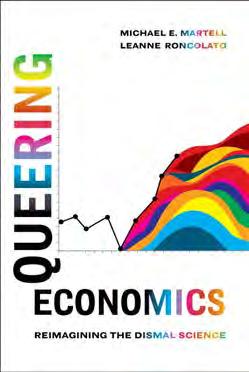
The world is turbulent. The uncertain impacts of conflict in the Middle East, artificial intelligence’s disruption of labor markets, rising inequality, and climate change are frightening. Historically, economists at powerful institutions – like the World Bank, the International Monetary Fund, and Central Banks – have influenced how we navigate turbulent times. We trust these powerful economists to act in our best interest. But should we be trusting economists? We, two economists, are skeptical. Economic graduate schools should be recruiting and training the best and the brightest to navigate our storms. But they aren’t. Instead, they are training a new generation of impressive analytical thinkers who spend too little time studying how actual people experience real economies and too much time thinking abstractly, applying the tools of the natural sciences to questions they weren’t designed to answer. Economics has run askew and often gets it wrong. We need to question, challenge and transform economics. We believe that the solution requires more LGBTQ+ economists present and in positions of power. In “Queering Economics: Reimagining the Dismal Science,” we explain how and why.
Published weekly. Bay Area Reporter reserves the right to edit or reject any advertisement which the publisher believes is in poor taste or which advertises illegal items which might result in legal action against Bay Area Reporter. Ads will not be rejected solely on the basis of politics, philosophy, religion, race, age, or sexual orientation.
Advertising rates available upon request.
Advertising rates available upon request.
Our list of subscribers and advertisers is confidential and is not sold. The sexual orientation of advertisers, photographers, and writers published herein is neither inferred nor implied. We are not responsible for unsolicited manuscripts or artwork.
Our list of subscribers and advertisers is confidential and is not sold. The sexual orientation of advertisers, photographers, and writers published herein is neither inferred nor implied. We are not responsible for unsolicited manuscripts or artwork.
Too few economists question the status quo. We agree far too much, because we are far too similar. Economics is the least diverse (in terms of socioeconomic status, gender, sexuality, and race) of all the social sciences, and the most influential. We are not the first to see this problem. For nearly half a century, feminist economics has shown us how the under-representation of women in the field contributes to its masculine bias. Stratification economics has similarly shown us how the under representation of racialized minorities has contributed to the field’s racial bias. Things have gotten better – with no small thanks to those who have dedicated their careers to promoting diversity, inclusion, equity, and excellence within the field – but there is much left to do. Alice Wu in her 2018 paper showed us that rampant misogyny persists today. Florian Ederer and his colleagues showed us that racism, xenophobia, and homophobia are its bedfellows. All economists are culpable for our part in perpetuating this culture. And we are all responsible for
making things better. In “Queering Economics,” we bring to light contributions of LGBTQ+ economic trailblazers to show how queering economics will make it better for all of us. We need a better economics now, and queer economists can help us navigate our current storms. We spoke with 31 LGTBQ+ economists at varying stages of their careers. These conversations revealed barriers to representation and power in economics. Economics elevates voices of those who cultivate power through emulating natural sciences and discourages dissent and diversity; it marginalizes queer voices. It has created a homogenous and hierarchical discipline where power is concentrated in the hands of a few. For example, nearly half of the editors at the four most influential publishing outlets in economics – those who decide what survives peer review and counts as knowledge – graduated from only two schools (the Massachusetts Institute of Technology and Harvard.) They share economic philosophies. They were, largely, trained by the same people to think and practice economics in the same way. And when too many of us share the same philosophy, we are less able to see our commonly held flaws and more likely to conform to prevailing philosophies. We focus too much on conforming and too little on challenging.
These attacks may delay the project of queering economics, but they will not derail it. The communities of economists committed to building a more inclusive, diverse, and useful discipline have already formed and are strong. Progress will not continue, however, without intention and hard work. In our book, we offer both stories of hope and a roadmap for how to move forward despite adversity. We provide concrete ways in which all of us, economists or not, can contribute to a better, more diverse economics. As we diversify who are economists, we can crowd out convention and create space for new ways of thinking and creative solutions to the problems we face. This economics won’t look much like the discipline we know. It may look less like physics and math, and more messy. But some of the affirming research we need will be inherently messy. The world we live in is messy. We can make sense of the messiness together, with all of us. And when the economics discipline includes everyone, our economies can promote prosperity for everyone. t
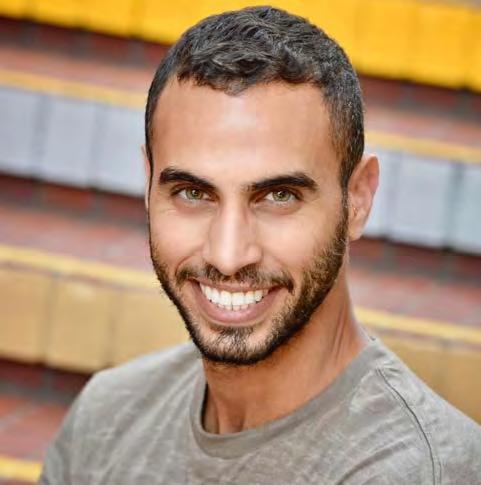
“Queering Economics: Reimagining the Dismal Science” co-author Michael E. Martell, a cis gay man, is an associate professor of economics at Bard College. Co-author Leanne Roncolatoan, a cis androsexual woman, is an associate professor of economics at Franklin and Marshall College.
A new book examines the need for more LGBTQ economists.
Courtesy UC Press
Gender Justice League’s new white paper lays out steps municipalities can take as more transgender people flee hostile states.
Courtesy GJL
Gay data engineer Chen joins San Francisco planning body
by Matthew S. Bajko
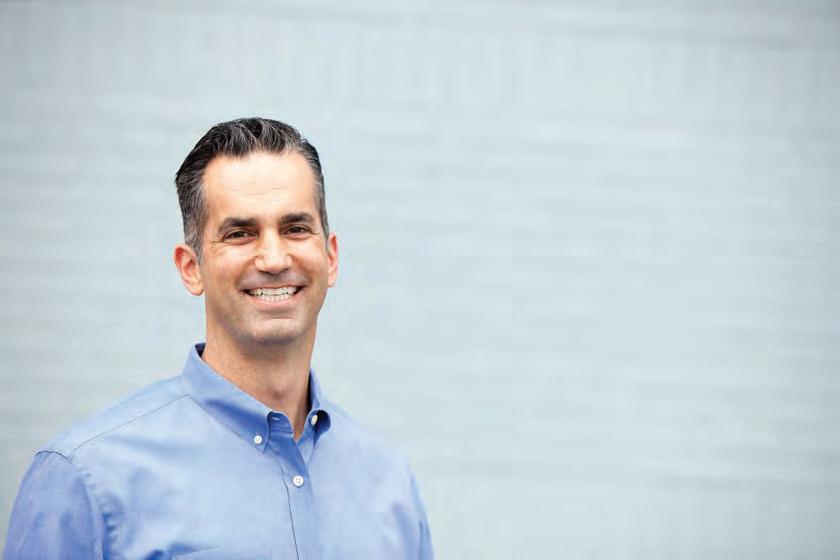
Gay data engineer Mike Chen will maintain LGBTQ representation on the San Francisco Planning Commission now that he has been confirmed to a term running through the summer of 2030. He was one of three appointees to the high-profile oversight body approved to serve on it by the Board of Supervisors at its July 28 meeting.
Mayor Daniel Lurie selected Chen to succeed Derek Braun, a gay strategic economist appointed to the planning commission in September 2022. Since 2024, Chen had been serving on the San Francisco Municipal Transportation Board of Directors, appointed to that transit policy setting body by former mayor London Breed
The supervisors voted 10-0 with District 10 Supervisor Shamann Walton absent to approve Chen’s nomination as a planning commissioner. The agenda posted for Thursday’s planning commission meeting had listed Braun among the commissioners, but Chen told the Bay Area Reporter he expects to be sworn into his Seat 7 in order to take part in it. Otherwise, his first meeting wouldn’t take place until the panel returns from its August recess.
Addressing the supervisors’ rules committee Monday, Chen noted that over his 12 years living in the city, he has seen how the dual housing affordability and housing supply crises have been “killing dreams and hopes for people, whether you are a native or a newcomer, whether you are young or old …. whether you don’t have kids or you have them.” He hopes to be able to address both as a planning commissioner.
proaches problems is unique.”
The committee members had earlier unanimously voted 3-0 to recommend that Joel Koppel and Elizabeth Macdonald become planning commissioners. Mandelman, as president of the board, had nominated the two to serve on the body, as three of its seven members are selected by the supervisors.
Lurie in announcing his selection of So and Chen for the oversight roles.
At their meeting Tuesday, the supervisors also voted 10-0 to approve their nominations. Their terms will end on July 1, 2030.
Koppel, who oversees governmental affairs for the San Francisco Electrical Contractors Association, had served on the planning commission between August 2016 and July 2024. He twice served as its president.
“I think the housing crisis is something that really weighs on all of us,” noted Chen, 36, who now lives with his boyfriend along the Divisadero corridor not far from Japantown. “It’s the reason why we can’t, it’s really hard to have late night entertainment and dining …. It’s the reason why it’s really hard to have, like, a vibrant art scene in the city because it’s hard to be an artist.”
On a 2-0 vote, the rules committee had recommended Chen be seated on the planning commission. District 2 Supervisor Stephen Sherrill and gay District 8 Supervisor Rafael Mandelman supported Chen’s appointment, while committee chair District 10 Supervisor Shamann Walton left the meeting and did not vote.
“I think he is a very level-headed, thoughtful person,” said Sherrill. “I think that plus his kindness doesn’t go recognized. I think the way he ap-
<< Editorial From page 4
Danni Askini, a trans person who is executive director of Gender Justice League, noted in the document, “The displacement is real, large, and hardest on the poor.”
“Between November 2024 and June 2025, roughly nine percent of transgender Americans, an estimated 401,000 people, moved to a different state,” the report’s executive summary stated. “They did not move for jobs, family, school, or the charming Seattle weather. They moved because state legislatures have enacted more than 290 antitransgender laws since 2021, a record 109 of them in
Macdonald is a retired UC Berkeley professor of city and regional planning whose late husband, Allan Jacobs, served from 1967 to 1974 as the city’s “powerful and colorful planning director” the San Francisco Chronicle noted in its obituary for him last year. The couple collaborated on “The Boulevard Book: History, Evolution, Design of Multiway Boulevards” released in 2002.
Chen’s term will expire June 30, 2030. He will serve alongside planning commissioner Lydia So, whom Chen had succeeded on the SFMTA board. Lurie this month renominated So for another term on the planning commission that also ends at the culmination of Pride Month in 2030.
The supervisors on a unanimous 11-0 vote at their July 21 meeting had approved So’s reappointment.
“I am confident that they will serve our community well,” stated
2025 alone; because the Supreme Court upheld bans on their healthcare in United States v. Skrmetti and their exclusion from school athletics in West Virginia v. B.P.J. and Little v. Hecox; because federal executive orders stripped them of accurate passports, military careers, and federally funded healthcare; and because eight states in a single year redefined ‘sex’ across their legal codes to erase transgender people from law entirely.”
Notably the report finds that the U.S. constitutional backstop is gone – not surprising given recent high court rulings – and that the next wave of anti-trans bills have already been drafted.
When the B.A.R. checked the website for the SFMTA’s board earlier this week, Chen was already removed from it. He had been the lone LGBTQ community leader serving on it, and Lurie will now nominate someone to serve out Chen’s term through March 1, 2029.
Chen remains on the committee that oversees the San Francisco Democratic Party and holds the position of director of internal operations. He was elected to it in the winter of 2024.
In his remarks to the rules committee, Chen had noted that his “years of advocacy at the planning commission and other bodies for a vibrant, affordable city, for housing shelters, for low-income housing, for market-rate housing, for all these reasons, I’m very honored to be nominated by Mayor Lurie for the Planning Commission, and I ask for your support.” t
Web Extra: For more queer political news, be sure to check http://www.ebar.com Monday mornings for Political Notes, the notebook’s online companion. This week’s column reported on the latest support bisexual U.S. House candidate Marni von Wilpert has received in her Southern California race.
Keep abreast of the latest LGBTQ political news by following the Political Notebook on Threads @ https://www.threads. net/@matthewbajko and on Bluesky @ https://bsky.app/profile/politicalnotes.bsky.social.
Got a tip on LGBTQ politics? Call Matthew S. Bajko at (415) 829-8836 or email m.bajko@ebar. com.
Jesus didn’t discriminate so neither do we.
Come and see Dignity/SF, which affirms and supports LGBTQ+ folks.
Catholic liturgy Sundays at 5pm, 1329 7th Avenue (Immediately off the N Judah line)
dignity | san francisco
Come for the service and stay for the fellowship. dignitysf@gmail.com for more details Instagram @dignitysanfrancisco † Facebook @DignitySF
The Bay Area Reporter can help members of the LGBTQ community in the San Francisco Bay Area reach more than 120,000 local residents each week with their display of Obituary* and In Memoriam messages.
The Bay Area Reporter can help members of the community reach more than 120,000 LGBT area residents each with their display of Obituary* & In Memoriam
So, on the one hand, we have Democratic strategists crossing their fingers and hoping for the best as we approach the midterm elections and the 2028 presidential race; on the other, we have a bold plan aimed at Seattle from which other cities can learn and adapt to assist the growing number of trans people who find they have to move elsewhere in the U.S. for their safety.
RATES: $21.20 per column inch (black & white) $27.75 per column inch (full color)
DEADLINES: Friday 12 noon for space reservations Monday 12 noon for copy & images
RATES: $21.20 per column inch (black $29.15 per column inch (full color)
It’s clear that what the trans community needs now more aligns with the Gender Justice League’s report. It will also benefit from less handwringing from centrist Democratic organizations. t
TO PLACE: Call 415 829 8937 or email us at advertising@ebar.com
DEADLINES: Friday 12noon for space reservations Monday 12noon for copy & images
*Non-display Obituaries of 200-words or less are FREE to place. Please email obituary@ebar.com for more information.
TO PLACE: Call 415-829-8937 or email advertising@ebar.com
Non-display Obituaries of 200-words or less are FREE
Mike Chen was approved by the San Francisco Board of Supervisors to a seat on the planning commission.
Screengrab via SFGovTV
Pelosi delivers Open Hand’s 30 millionth meal
by George Faville
C
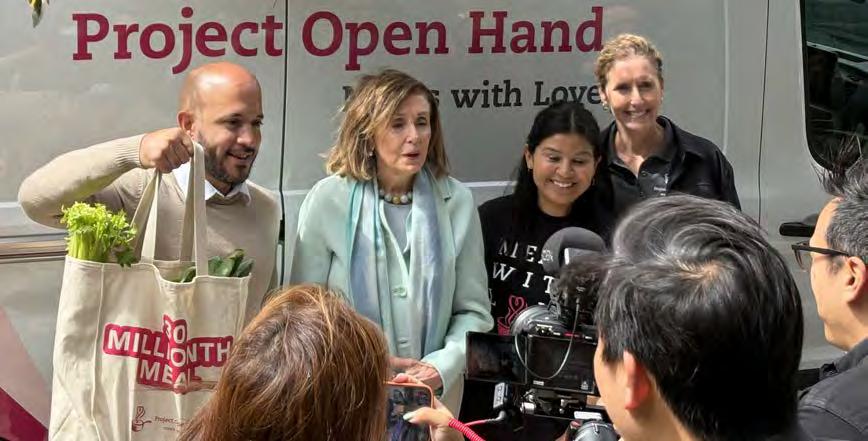
ongressmember Nancy Pelosi (D-San Francisco) delivered the 30 millionth meal for Project Open Hand Monday morning, celebrating the agency that began as muchneeded help for people living with AIDS. Nicholas Galarza, the meal recipient, met her outside of his apartment in Noe Valley for the delivery and a short conversation, after which Pelosi spoke with members of Project Open Hand about the importance of the organization.
Founded by the late Ruth Brinker in 1985, Project Open Hand began as a hot meal delivery service for those living with HIV/AIDS. The program has since grown to support a broader range of illnesses and also provides groceries. Pelosi is a longstanding supporter of the agency as part of her efforts in Congress to combat HIV/AIDS and provide support for those living with the disease.
“The pride [Brinker] took, and the gentleness in which she did, not showing off but giving out … it was really something that I always remember,” said Pelosi during brief remarks to the media. “Can you imagine what an honor it is for me to be invited to deliver the 30 millionth meal?”
Pelosi will be leaving Congress in early January, as she decided not to seek reelection. She has endorsed District 1 Supervisor Connie Chan to succeed her. Chan, a Democrat, will face off against gay state Senator Scott Wiener (D-San Francisco) November 3.
Brinker began delivering meals to
seven of her neighbors living with AIDS after watching a friend die from the illness. At the time, many diagnosed with the disease died from malnutrition. Brinker delivered meals to those too weak to feed themselves and with no friends or family to care for them, first alone, and then with the support of volunteers and community donations.
In 2023, Pelosi, then House speaker, secured $1.4 million in federal funding for Project Open Hand, as part of a larger $30 million fund designated to supporting San Francisco neighborhood-serving organizations.
“Speaker Emerita Nancy Pelosi has been a wonderful supporter of
Project Open Hand and the HIV/ AIDS community, so we knew that she was an important part of our celebration,” Ana Ayala, the agency’s vice president of programs and a straight ally, said in an interview after the event. “We wanted it to be a community event and highlight our clients and all the great work everyone does to keep our services going.”
Project Open Hand delivers more than 2,500 meals daily. Galarza, a gay man who has been living with HIV for 12 years and has received meals from Project Open Hand for the past five, said he found out a month prior that he would be the 30 millionth delivery.
“That was such a shock when I
found out that Nancy Pelosi was going to be handing me the meal,” he said. He added that during their conversation, he thanked Pelosi for her effort in repealing “Don’t Ask, Don’t Tell,” as he had been discharged from service for his sexuality. DADT, which barred out gays and lesbians from serving in the military, was repealed in 2010 by then-President Barack Obama after the House and U.S. Senate passed legislation to end the homophobic policy.
Galarza said Project Open Hand has given him access to healthy, immune-boosting meals and eliminated his worries about finding his next meal.
Due to federal funding cuts, Ayala
said the organization had to reduce services, including the elimination of its congregate meals program.
“We are committed to making sure that we are here for the community in spite of changes,” she said. “We know that nutrition is health care, and that this is a critical need, especially as food costs rise and people struggle with cuts to Medi-Cal and other services.”
She added that the services provide a touch point for the community.
“Food is not just food. It’s also community and love,” Katie Jackson, Project Open Hand’s chief nutritional officer and a straight ally, said in an interview. “This program has been here for 40 years and delivered 30 million meals. That’s a testament to the dedication of POH in the community, and the volunteers and the staff that serve the community.”
The meal delivery was witnessed by members of the press, a group of Project Open Hand staff and volunteers, and several neighbors on an overlooking balcony. Pelosi, Galarza, Ayala, and Jackson posed for photos on the apartment’s steps, on the sidewalk, and in front of Project Open Hand’s new, 100% electric delivery van.
All were buffeted by the particularly blustery and foggy San Francisco morning.
Pelosi spoke about her admiration and respect for Brinker, who passed away in 2011 at the age of 89.
“She started [Project Open Hand] simply and then it just all grew because it was so good and so right,” said Pelosi. “Ruth Brinker was so San Francisco.” t
Marin LGBTQ Center seeks award nominations
compiled by Cynthia Laird The Marin LGBTQ Center is now accepting nominations for its second
annual Courage Awards. The community center was established in the North Bay county last year, following the closure of the former Spahr Center.
According to a flyer, the Marin center honors individuals and organizations whose courage, leadership, and compassion uplift LGBTQ+ people in Marin County. Community members are invited to submit nominations for three awards.
The awards are: the Transgender Courage Award, which honors a transgender, nonbinary, or genderdiverse individual who demonstrates courage through authenticity, advocacy, leadership, or resilience; the Youth Courage Award, given to an LGBTQ+ young person who exemplifies courage, leadership, and integrity; and the Community Partner Courage Award, given in recognition of an organization, business, or individual who has demonstrated exceptional courage and commitment in supporting LGBTQ+ people in Marin County.
The deadline for nominations is Monday, August 10. To submit a nomination, visit http://bit.ly/4bgfUAR.
The awards will be presented at the center’s second annual awards luncheon Saturday, October 24.
The Marin LGBTQ Center continues to be run by volunteers, according to its website.
It currently holds a QNest art and skill-building program twice a month for LGBTQIA+ youth ages 13-25. On the first Thursdays of the month, the program is held in San Rafael; on the third Thursdays it is held in Larkspur. From 6 to 7 p.m., the program is for those aged 13-17; from 7 to 8 p.m., those aged 18-25 can attend. For more information, or to sign up, email qnest@marinlgbtqcenter.org.
center, board president of the
Big garage sale in Bernal
The Bernal Heights Neighborhood Center will hold its Hillwide Garage Sale Saturday, August 8, from 9 a.m. to 2 p.m. throughout the San Francisco neighborhood.
A news release stated that the beloved Bernal Heights tradition brings neighbors together for a day of treasure hunting, decluttering, and community connection. Shoppers can explore garage sales throughout the neighborhood featuring clothing, books, toys, furniture, household goods, collectibles, vintage finds, and more, the release noted.
Residents are encouraged to register their garage sale to be included on the official event map, making it easy for visitors to discover participating homes.
“When I think about Hillwide, I don’t think about garage sales – I think about community,” stated Gina Dacus, CEO of the Bernal Heights Neighborhood Center. “I think about neighbors welcoming strangers onto their porches, families walking the hill together, conversations that start over an old record or a vintage lamp, and the simple joy of being outside with one another.” Admission is free. For more information, including seller registration and a map of participating residents, visit hillwide.com. t
Bill Otton,
new Marin LGBTQ+ Center, spoke to supporters at the center’s May 16, 2025 kick-off event. The Reverend Jane Spahr, who founded the former Spahr Center, is at far left.
John Ferrannini
Nicholas Galarza, left, was the recipient of Project Open Hand’s 30 millionth meal, which was delivered by Congressmember Nancy Pelosi July 27. Ana Ayala and Katie Jackson of Project Open Hand attended the event.
George Faville
Non-alcoholic LGBTQ ‘third space’
by Brian Guan
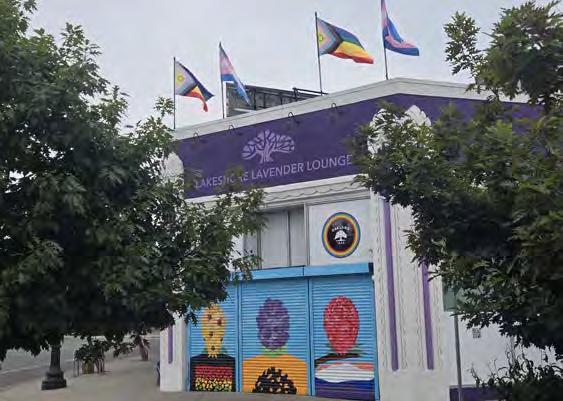
Oakland residents can expect a new LGBTQ-friendly alternative to bars later this year. The Oakland LGBTQ Community Center aims to open its Lakeshore Lavender Lounge late this fall across from its central building on Lakeshore Avenue.
An alcohol-free space functioning as a cafe, lending library, and programming venue, the lounge will serve as an intergenerational “third space” for members of the LGBTQ community, a term used to describe gathering spaces beyond work and home. The building at 3199 Lakeshore Avenue that will house the lounge already sports its name and a mural created by Derrick Bell on its facade, as seen in a recent post to the center’s Instagram account.
Events hosted in the space will include “book readings, wellness activities, spoken word evenings, drag performances, guest speakers, live music, DJ sets, and substance-free dance parties,” according to the project’s donation page.
The center plans to regularly welcome visitors to the lounge from 9 a.m. to 5 p.m. Monday through Thursday.
The lounge marks an attempt by the center to expand what gathering spaces for LGBTQ people in Oakland may look like. In an interview with the Bay Area Reporter, Joe Hawkins, a gay Black man and the center’s CEO, described how the LGBTQ community in Oakland has, for the most part, been used to “going to bars for our social outlets.”
LGBTQ bars and clubs in Oakland include the White Horse, the longestrunning in the U.S.; Fluid 510; the Town Bar and Lounge; and Que Rico.
While Hawkins said he didn’t believe this practice of socializing in nightlife venues was wrong, he recalled realizing it was time for the LGBTQ community to “evolve” to a place where it could gather without exposure to substances like alcohol. The new lounge comes amid a trend of less alcoholic imbibing by younger
generations and people of all ages increasingly looking for activity-driven gatherings.
“We have this amazing opportunity to bring so many people together in a space like Lavender Lounge,” Hawkins said, describing the possibilities for community across age and identity as “just amazing.”
Brandon Harami, a gay man and the organization’s Oakland Pride director of operations, affirmed the importance of the lounge as a new establishment of the Lakeshore LGBTQ Cultural District, founded in 2023 as an LGBTQ neighborhood recognized by the City of Oakland. The cultural district is anchored by the community center, which took over Oakland Pride this year, coming up Sunday, August 16.
In a statement to the B.A.R., Harami described how the cultural district was created “recognizing that while we love and celebrate our LGBTQ+ nightlife, we also need to ensure our elders, families, and youth have a place where they can gather and share in community.”
“Strong communities need third spaces,” Harami remarked, “and I’m thrilled that our district will now have
one that is welcoming, accessible, and doesn’t revolve around alcohol.”
Hawkins co-founded the Oakland LGBTQ Community Center with Jeff Myers, a gay Black man, in 2017, as the B.A.R. previously reported. He told the B.A.R. at the time that the organization’s founding was spurred by the 2016 election of Donald Trump as president.
“So many of us were anxious about what is next and where do we go from here,” Hawkins noted.
Since then, the organization has become a staple of the Bay Area’s LGBTQ community, featuring a transgender wellness center, a clinic providing sexual health services, a food pantry, various youth and senior programs, and more.
The center’s current budget is around $7.5 million, according to Hawkins. The rent for the lounge will be $8,000 per month starting September 1, with a lease for five years. To build the lounge, the organization is working toward raising its goal of $100,000, seeking both donations and grants for the project.
“We feel confident that we will get there,” said Hawkins.
The center has faced – and over-
Castro Tarts to reopen in a few weeks, co-owner says
by John Ferrannini
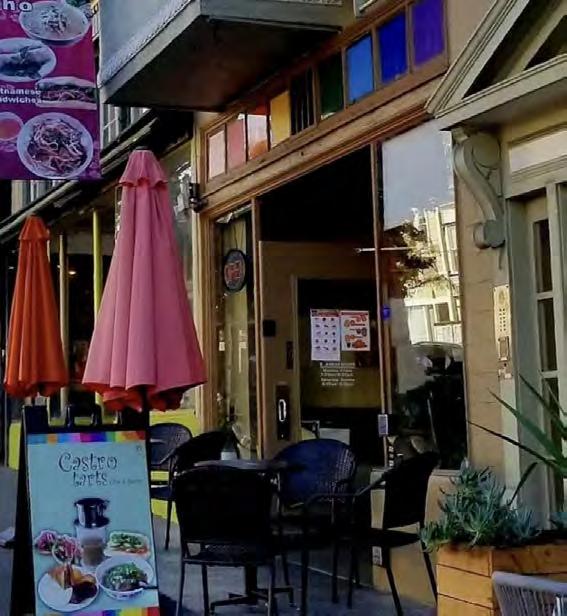
C astro Tarts, known for serving breakfast and Vietnamese fare on the 500 block of Castro Street, is anticipated to reopen in three weeks, its co-owner told the Bay Area Reporter.
Co-owner Judy, a straight ally who declined to provide her last name, said in a July 28 phone interview that the business closed due to a pipe leak three weeks ago. Indeed, it announced via Instagram July 3 that, “Due to unforeseen circumstances beyond our control, our cafe is temporarily closed for a few weeks. We apologize for any inconvenience.”
Judy said that she and her husband and co-owner Raymond “are using this time to make a remodel” of the space.
Asked how much that or the repairs will cost, Judy said, “I don’t know because insurance pays for it.”
Asked about the employees being put out of work, Judy said that Castro Tarts’ employees are all her family and will be OK.
Castro Tarts first opened at 564 Castro Street in 2002. On its website, Judy and Raymond wrote they “are so lucky and proud to have not only started our business here, but to have also found this community.”
“We started off wanting to pursue a family-owned business and to share what we love with the people around
come – financial challenges under Trump’s second administration. The center experienced a cut to a $622,000 federal grant in 2025, indicative of larger threats to federal funding impacting the LGBTQ community, as the B.A.R. previously noted.
Yet the organization ultimately prevailed financially. After losing the grant, the center was able to raise a million dollars, according to Hawkins, a feat he attributed to the support of the community.
“I think it’s been true for us since the beginning that the community here in Oakland and throughout the Bay Area has wanted the Oakland LGBTQ Center to survive,” Hawkins said.
The lounge is not the only project the center will be celebrating later this year. On Wednesday, August 12, at noon, in front of the center’s main campus at 3207 Lakeshore Avenue, the organization will hold the dedication ceremony of the nearby Moore Hope Plaza. The event will honor the memories of Peggy Moore and Hope Wood, a well-known married couple who were killed in a San Diego County car crash in 2024.
Queer at-large Oakland City Councilmember Rowena Brown, who helped champion the dedication,
described Moore and Wood as having “devoted their lives to expanding opportunity, advancing equality, and building community.”
“This plaza will stand as a lasting tribute to their leadership, love, and legacy,” Brown stated to the B.A.R. “At a time when LGBTQ+ history is too often overlooked or erased, Oakland is proudly affirming that these stories matter, these leaders matter, and their impact will continue to inspire generations to come.”
(Brown was recently the victim of an alleged assault by an acquaintance and was injured. A suspect was taken into custody.)
It’s a commitment to history representative of the Lakeshore Lavender Lounge’s naming. Hawkins recounted how the color lavender invokes the Lavender Scare, the period in which LGBTQ people were fired or pressured to resign from the federal government in conjunction with McCarthyism.
Yet Hawkins described how the LGBTQ community took on the color “as a part of our history ... just like people use queer today.” In this way, he sees the lounge as “a way for us to embrace our history.”
“It’s a way to start a conversation,” he said. t
us: our culture and love for food,” they wrote in 2020. “With those things in mind, we started Castro Tarts, and fell in love with this community. Over the past 18 years, we’ve
gotten to know residents, served our homemade food, and have gotten to add to the diversity within this community.” t
Castro Tarts has temporarily closed due to a pipe leak, a co-owner said.
Courtesy Castro Tarts
The Lakeshore Lavender Lounge, across the street from the Oakland LGBTQ Community Center, is expected to open in late fall.
Cynthia Laird
San Francisco District Attorney Brooke Jenkins filed criminal charges against four people following the Trans March, as previously reported by the Bay Area Reporter.
At the Stud Alley party, 18 people –referred to by supporters as the “Stud Alley 18” – were arrested. On July 22, the San Francisco District Attorney’s office charged them with unlawful assembly, refusing to disperse during a riot, and resisting, obstructing, or delaying a peace officer.
Queer Palestinian artist and community organizer Mama Ganuush told rally attendees the arrests and prosecutions represented an attack on the queer and trans community, describing the charges as “extremely unprecedented.”
“We are here to demand that the district attorney drops all the charges against all the queer participants and trans participants that were in the Trans March and Stud Alley [party],” they said.
They also called for an end to police presence at future Pride and LGBTQ community events.
Critical of prosecutions
Jess McPeake, a deputy public defender with the San Francisco Public Defender’s office and a member of the Stud Alley 18 defense team, similarly criticized the prosecutions.
“The charges are unheard of. We have not seen that in San Francisco – unlawful assembly and failure to disperse,” McPeake said, adding that the public defender’s office stands with the trans community and supports dismissing the cases.
McPeake also denounced the San Francisco Police Department’s response to both Pride weekend events, saying officers used aggressive arrest tactics, riot gear, and drones, and argued Jenkins elevated the Trans March case by filing eight felony vandalism charges despite investigators finding that “almost all of the washable paint was gone.”
“We know that we are going to win and prevail in this fight,” McPeake said,
<< Councilmember
From page 3
that she runs a music therapy and mental health nonprofit and at least two local businesses. Social media posts indicate Millhouse and Brown have known each other for several
Compton’s
From page 1
At the outset of the July 27 hearing, Mahmood announced that the item would be continued to the call of the chair. He said that there was additional work to do with the city attorney’s office. District 7 Supervisor Myrna Melgar, chair of the committee, said that public comment would still be taken on the item but there were no speakers. The committee, which includes Vice Chair District 11 Supervisor Chyanne Chen, voted 3-0 to continue the matter.
“The Compton’s x Coalition submitted an evidence report identifying the interior character-defining features that need to be landmarked to prevent further modifications,” Chandra Laborde, a queer doctoral candidate at UC Berkeley and Coalition member wrote to the Bay Area Reporter. “We continue to urge the Board of Supervisors to support the protection of trans history.”
<< Children’s books
From page 1
“I started talking to him about my collections. He found the children’s book collection to be quite interesting,” recalled Tarpey-Schwed during a recent phone interview.
Coincidentally, the 172-year-old Institute had just adopted an updat-
noting that more than 70 letters supporting those charged were submitted to the court within 24 hours.
According to Jenkins, the photos of police making arrests during the event near the very site of the 1966 Compton’s Cafeteria Riot – an early watershed in the fight for transgender rights, at the intersection of Turk and Taylor streets –was precipitated by “troubling behavior.”
Two vandalism suspects defaced several security cameras, as well as Mission Dolores Basilica, a Roman Catholic Church on the march route, Jenkins said earlier this month. The defacement was done through paint shot through water guns, according to the DA. Jenkins added that among the graffiti left behind was “Queer as in kill the cops.”
Among the rally attendees was a San Francisco resident who requested anonymity for privacy reasons and said they were present at both Pride weekend events.
“I just think that there’s a lot of targeting going on, and it’s way out of scope,”
they told the B.A.R.
Recalling the Trans March, they said, “We didn’t know what was going on –we thought something catastrophic had happened. And then we found out that it was for vandalism.”
The following night at the Stud Alley party, they said friends were injured during the police response.
years, and Millhouse campaigned for the councilmember in 2024, the outlet reported.
On July 22, the Alameda County District Attorney’s office charged Millhouse with three felonies, including first-degree residential robbery, assault with force likely to produce great
The property manager of 101-121 Taylor Street previously agreed to expand the current boundaries of the landmark to include the entire fourstory building, as long as the designation excluded the interior. Years ago the city landmarked a portion of the structure’s exterior where the eatery had been located, and last January federal officials listed the site on the National Register of Historic Places.
A representative from Mahmood’s office told the B.A.R. that the supervisor had requested a tour of the inside of the building but was denied by the property managers.
Instead of a tour, GEO Group contracted with Environmental Science Associates to evaluate the interior for historic significance. ESA Is a San Francisco-based environmental consulting firm.
Johanna Khan, a senior architectural historian with ESA, came to the same conclusion the city’s planning department did in April, that much of the interior architecture of the
ed strategic plan through 2028 that prioritized diversifying its holdings, which heavily skew to books about chess, the Civil War, and the history of San Francisco and California. Among the document’s tactics for doing so is a call to “build new partnerships, identify needed resources, and develop infrastructure to support diversity.”
want or need cops at Pride.”
Rasmussen participated in the Trans March and credited its organizers with defusing the incident that took place in the Transgender District in the Tenderloin.
“I do feel very grateful for the folks who organized the march,” he said. “They were able to de-escalate and keep it so that a lot of us didn’t know that that happened until after.”
At the rally, Rasmussen held a handmade sign that read “Trans Lives Are Sacred” on the frontside and “We Protect Us” on the backside.
“I think that’s a big thing,” he said about the latter statement. “It’s good to come here and see community and remember that we protect us.”
Rasmussen supported all charges being dropped, noting in particular what had transpired at the Trans March.
“I have people close to me that were there with me that were trampled by the police and got hurt,” they said, adding, “We were not doing anything unpeaceful.”
The attendee said they fully supported dropping all of the charges and hoped the rally would bring greater public awareness while countering misinformation.
They, along with several others at the rally, distributed flyers reading “Abolish Cops Everywhere – Drop the Charges.”
The flyer condemned SFPD’s response to the Trans March and Stud Alley party, stating that “Israeli-trained SFPD [Georgia International Law Enforcement Exchange (GILEE)] terrorized trans people by violently escalating and arresting trans people two consecutive nights in a row.” It also criticized the San Francisco Pride organization for not publicly responding to the incidents.
SF Pride did not return a message seeking comment.
SJ Rasmussen, a 24-year-old caregiver from Oakland who identifies as trans, said his reason for attending the rally was straightforward.
“Just knowing that my trans siblings are being attacked – that’s what it comes down to,” he said. “I’m here to stand in solidarity with the people who were arrested and to express [that] we don’t
bodily injury, and false imprisonment by violence, jail records indicated. As of Friday, Millhouse remained in custody. Millhouse is next due in court July 30.
Oakland Mayor Barbara Lee posted on Instagram that her thoughts are with Brown.
site is not recognizable as the space that was Gene Compton’s Cafeteria in 1966, according to the ESA report that was reviewed by the B.A.R.
Additionally, the planning code designates that interior spaces must have been publicly accessible at the time of historical significance, or publicly accessible currently. As a private facility, no part of the interior is currently publicly available.
“All spaces that were publicly accessible during the proposed revised period of significance (i.e., the former commercial spaces and the former hotel lobby on the ground floor) are currently devoid of any features dating to the 1960s and 1970s,” Khan wrote in a May memo.
The request to amend the landmark ordinance to cover the whole of the building on Taylor Street has been brought to the city by the Compton’s x Coalition.
Shayne Watson, a lesbian and architectural historian who’s a member of Compton’s x Coalition, re -
Acquiring the Tarpey-Schwed’s collection thus would help achieve that goal, noted Cooper, a gay man who is also the Institute’s archivist. Ahead of Thanksgiving last year six banker boxes with the family’s books arrived at the Institute, which then worked with Sweden-based Librar Labs to develop an online, searchable home for the collection.
police, including the 1989 “Stop AIDS Now or Else” demonstration on the Golden Gate Bridge, during which 24 people were arrested.
Gold also referenced the October 6, 1989 ACT UP demonstration that escalated into the Castro Sweep, when police declared an unlawful assembly, cleared portions of the neighborhood, arrested 53 people, and sparked years of litigation and police oversight reforms.
“When they mobilize the cops like they did to Stud Alley and the Trans March, they’re not individual cops making that decision. It’s political,” Gold said.
“People were literally brutalized over vandalism. That’s just not a rational or proportional response,” he said.
At the July 8 Police Commission meeting, San Francisco Police Chief Derrick Lew addressed what occurred during the Trans March. He said that it was purely coincidental the arrests were made at Turk and Taylor streets, as that’s where a police drone tracked two suspects caught spray painting buildings, vehicles, and cameras earlier.
During his appearance at the meeting, Lew showed a map detailing 36 alleged acts of vandalism associated with the event. Twenty of those were to security cameras, he said.
“In terms of evidence recovered there were paint-filled water pistols, plastic paint bottles, gloves. In total, the incident lasted approximately an hour and eight minutes from the time of the march till when the arrests were effected,” Lew said.
Leaders of the Trans March delivered a letter to Mayor Daniel Lurie on July 13, alleging police used disproportionate force against marchers during the June event, as previously reported by the B.A.R.
Longtime LGBTQ activist Deeg Gold placed the recent arrests in the context of past confrontations between San Francisco’s queer community and
“I have been in touch with Councilmember Rowena Brown and she is well and recovering from her injuries as she continues to serve the residents of Oakland,” Lee wrote July 23. “I want to thank her friends, family, and OPD for their support during this period and ask that her privacy be respected at this time.”
butted Khan’s evaluations in a June letter to the supervisors’ land use committee, according to a review of the letter by the B.A.R.
Watson argued that ESA had appraised the significance of the site based on architectural, rather than cultural, criteria.
“For properties significant under Criterion A, integrity is evaluated primarily in relation to a property’s ability to convey historically significant events, patterns of activity, and associations rather than the survival of every element of historic architectural fabric,” Watson wrote.
Watson also noted that while ESA prepared a memorandum on the interior of the site, no photos or floor plans were provided to show the architectural changes.
The B.A.R. reached out to Monica Hook, GEO Group’s vice president of communications, and Maria Richard, facility director for the Taylor Street building, for comment regarding why Mahmood had been
“They are in beautiful condition,” said Cooper, pointing out in particular a copy of “When Megan Went Away,” a 1979 picture book by Jane Severance and illustrated by Tea Schook.
It was published by Lollipop Power, a feminist children’s-book collective and press in Chapel Hill, North Carolina. Cooper noted it is
They emphasized the importance of LGBTQ San Francisco supervisors being there for the queer community in response to incidents like those that occurred during Pride weekend.
“Our community has got to stand up for our people, and that’s why we’re here today,” they said.
“Mary,” a 78-year-old who identifies as queer and a dyke, was also among the crowd. Members of the radical direct-action Gay Shame collective, several of whom were at the rally, often use the pseudonym “Mary” when speaking with the media and public.
Like Ganuush and Gold, Mary criticized what she described as the lack of response from city leaders following the Pride weekend incidents.
“It’s a travesty that [SF] Pride itself hasn’t made a statement calling out what happened,” she said.
Mary said the rally continued a long tradition of people responding publicly to police actions.
“Back then, when the police attacked the queer and trans community, people came out,” she said.
While uncertain what immediate impact the rally would have, Mary said showing up still mattered.
“I do demonstrations because it’s the only thing I know to do,” she said. “I don’t know what’s going to happen, but it moves the momentum a little bit.” t
Brown was elected to the City Council in November 2024 and assumed office in January 2025. She succeeds lesbian former longtime at-large councilmember Rebecca Kaplan, who is now doing policy research for the city on illegal dumping. t
denied entry to the interior of the building. Neither responded in time for publication.
With Transgender History Month beginning Saturday, August 1, the Compton’s site will be featured by local organizations. The date of the riots have been lost to history, though one scholar pinpointed later in August as a likely date in a B.A.R. article last year.
On Saturday, August 22, the TurkxTaylor Initiative – a collective of event producers with the same goals as Compton’s x Coalition –will host an anniversary party of the Compton’s Cafeteria Riot at the intersection of Turk and Taylor streets from 5 to 9 p.m.
On Thursday, August 27, the San Francisco Public Library will host a screening of “Screaming Queens,” the 2005 documentary recounting the cafeteria riot, and a panel discussion with co-director Susan Stryker, Ph.D., a transgender woman and historian. t
one of the first books for children to focus on the dissolution of a lesbian relationship.
“These types of books are in danger of being lost. We are very glad we can safeguard them,” said Cooper, 43, first hired by the Institute 11 years ago as a library assistant.
See page 9 >>
A “Drop the Charges” rally attendee held a trans Pride flag at the crosswalk at Castro and 18th streets during the July 24 rally.
JL Odom
Global AIDS conference kicks off in Rio
by Liz Highleyman
The 26th International AIDS Conference opened July 27 in Rio de Janeiro, Brazil, with global leaders taking stock of a new reality spurred by the precipitous decline in funding for the HIV response worldwide.
The biennial conference, convened by the International AIDS Society, brings together thousands of policymakers, clinicians, scientists, advocates, and people living with HIV.
The Trump administration’s cuts, in particular, have driven the unprecedented drop in funding from donor governments, putting decades of progress at risk, according to newly released reports.
International AIDS Society President and conference Co-Chair Dr. Beatriz Grinsztejn, left, spoke at the opening news briefing alongside UNAIDS Executive Director Winnie Byanyima and Global Action for Trans Equality Executive Director Erika Castellanos.
“Never has donor funding fallen so far, so fast, and those most vulnerable are already paying the price,” IAS President and conference Co-Chair Dr. Bea-
<< Children’s books
From page 8
It held an event last month timed to Pride Month to officially welcome the Tarpey-Schwed LGBT Families Children’s Book Collection, at which Cooper and Tarpey-Schwed both spoke. The associated dedicated webpage for it at https://tinyurl.com/4h9n2pfb also went live that Tuesday, June 9.
“It is rare and valuable, not in terms of monetary value but for research,” said Cooper while giving the B.A.R. a look at the collection and a tour of the Institute’s archives this month.
Rare titles
Among the rarer titles is the oldest in the collection, “I’ll Get There. It Better Be Worth the Trip,” written by John Donovan and published in 1969. According to Tarpey-Schwed’s catalogue, “It is one of the first young adult novels to positively portray (for the most part) a gay coming of age relationship.”
There are also well known titles like “And Tango Makes Three,” the story of a gay penguin couple that raises a chick published in 2005, and a first edition of “Heather Has Two Mommies” released in 1989 about a little girl being raised by a lesbian couple. Both titles are among the LGBTQ children’s books most often targeted and banned from public libraries and school classrooms by conservative parents.
“It is a hot topic, libraries trying to ban children’s LGBT books. It is kind of crazy to me,” said Cooper, who formerly worked as an afterschool teacher at the Harvey Milk Civil Rights Academy, a public elementary school in the city’s LGBTQ Castro district named after the late civil rights leader and first gay elected member on the San Francisco Board of Supervisors.
The Tarpey-Schwed collection is believed to be the first of its kind on the West Coast, and one of two in the U.S., dedicated solely to LGBTQ children’s books. The first to be established is believed to be the Professor Elizabeth Rowell’s Reserve Collection of LGBTQFriendly Children’s Picture Books at The James P. Adams Library on the campus of Rhode Island College.
triz Grinsztejn said at the opening news briefing. “Donor countries are choosing to walk away, while many high-burden
Rowell for decades had taught graduate and undergraduate early childhood education and literacy courses at the college in Providence and co-chaired its Dialogue on Diversity and Diversity Week Committees. The website for her collection at https://tinyurl.com/56hk8urc describes Rowell as an LGBTQ+ community ally who received “several faculty research grants to study LGBTQ+ friendly picture books for children and also young children and the transgender experience.”
Associate Professor Kieran Ayton, a librarian who now oversees the college library’s children’s book collections, told the B.A.R. during a video interview that it began purchasing LGBTQ titles in 1999 in collaboration with Rowell, who in 2014 donated money to keep the collection growing. (The campus library subsequently lost touch with Rowell, and the B.A.R. was unable to find any up-to-date information about her.)
“It is now close to 250 titles,” said Ayton. “The collection itself is really unique and includes titles from the late 1970s into the 2000s.”
Due to how valuable some of the books are, and concerns about them being damaged, those that are part of the archived collection do not circulate amongst the library’s users. Ayton said he isn’t sure how well-known the Rowell reserve collection is with scholars or the general public.
“It is kind of a static collection at this point,” he said. “We are not adding to it. Anything I buy goes into the main children’s book collection.”
In an emailed reply, the college library’s digital archivist and special collections librarian Veronica Denison told the B.A.R. that she and her colleagues have “been adding LGBTQ children’s book titles to other collections. I’ve incorporated titles into our Rhode Island Rare Book Collection, which focuses on books by Rhode Island authors, set in Rhode Island, or about Rhode Islanders, and Kieran has added LGBTQ children’s books to the main children’s collections as well.”
Intends to grow collection
Cooper told the B.A.R. that the Mechanics’ Institute does intend to grow its LGBTQ children’s book archival collection with newer titles and does have duplicate copies for some of its holdings that circulate among its library members. The initial donation of books from Tarpey-Schwed is to be maintained as an archival collection separate from the library’s circulating holdings, he noted.
“It is open to the public for research by journalists, academics, researchers and others. We want to make them accessible,” said Cooper, noting anyone interested in a book in the archival collection can request access to it.
countries remain shackled by debt they cannot escape.”
The decline in funding comes as an end to the global HIV epidemic is in sight thanks to highly effective antiretroviral drugs for treatment and prevention, including lenacapavir (Yeztugo), the new twice-yearly injectable PrEP option. But these tools can only make a difference if they are accessible to those who need them most, advocates noted.
“This is one of the greatest public health achievements of our lifetime. But let’s be clear, progress is not the same as victory,” said UNAIDS Executive Director Winnie Byanyima. “Scientific breakthroughs alone will not end AIDS. ... Science has done its job. Now politics must do its job.”
A past president of the Book Club of California based in downtown San Francisco, the state’s oldest bibliophilic organization founded in 1912, Tarpey-Schwed said he “accidently” fell into book collecting after discovering the works of celebrated food writer M.F.K. Fisher, who died in 1992 at age 83 in Sonoma County. He sought out her books and wrote a definitive bibliography of her work.
He turned his collector’s eye toward his family’s LGBTQ children’s books, creating a detailed 54-page catalogue for the titles. It includes synopses of their plots and search terms that can be used for most of the books, such as “divorce,” “lesbian mothers,” “gay fathers” and “gender diversity.”
“Not all the books are necessarily great books. But in their entirety, this is a collection solely dedicated to this genre. There is a history behind why these books were written and how they evolved over time,” noted TarpeySchwed, who has been with his husband 36 years. “You can’t get a sense of what that history is by reading a single title here and there. You have to read the older ones and see how they evolved.”
For example, “Daddy’s Roommate” written by Michael Willhoite and published by Alyson Books in 1990 clearly depicts an older dad with a younger boyfriend but eschews such direct terminology about their romantic partnership. In the 1981 book “Families” written by Meredith Tax and illustrated by Marylin Hafner, a lesbian family with a little girl is included, though the women are referred to as her mother and godmother.
Then there is “Molly’s Family,” a 2004 picture book written by Nancy Garden and illustrated by Sharon Wooding, that doesn’t wink-wink about the title character having two moms, referred to as Mommy and Mama Lu. The story is premised on a classmate of Molly’s telling her she can’t have both a mommy and a mama.
“The books reflect changes in politics and culture, and how gay people view themselves and are viewed by other people,” said Tarpey-Schwed,
Vulnerable populations bear the brunt of the HIV epidemic, including gay and bisexual men, transgender people, sex workers, people who use drugs, and people in prison. Criminalization of these groups has increased for the first time since UNAIDS has been tracking these trends. In 2026, 168 countries criminalized sex work, 152 criminalized possession of small amounts of drugs, 66 criminalized same-sex sexual relations, and 14 criminalized transgender people, according to the agency.
“You cannot end AIDS while criminalizing people living with, and most at risk of, HIV,” Byanyima said. t
A longer version is online at ebar. com.
citing as one example the evolving terminology used for the characters over time by the authors. “Look at how the parental figures in these books were labeled; that changed over time. A lot of the early books we read used phrases like daddy and his roommate.”
One “wonderful” book, said TarpeySchwed, is “Donovan’s Big Day” written by Lesléa Newman and illustrated by Mike Dutton. The 2011 picture book focuses on a boy excited to be the ring bearer at his mom’s wedding.
“As the books evolved, you didn’t have to use euphemisms to describe the nature of the relationship,” said Tarpey-Schwed, whose daughters called him Poppa and his husband Daddy. “We read all kinds of books to our kids, and we have all sorts of favorite family books. But we wanted to have some books that showed families like ours.”
He was “thrilled,” said TarpeySchwed, when Mechanics’ Institute agreed to accept the family’s book collection and vowed to preserve it for perpetuity. Unlike with a public library, he isn’t concerned that it will come under pressure to deaccession the LGBTQ titles by conservative voices.
“It is a smaller, private library, which I think, in theory, should be less subject to what happens at large public institutions,” said Tarpey-Schwed, who grew up in Idaho and has called California home since 1989. “You never know what people are going to do, even libraries. Will it give it attention at all or deaccession it at some point?”
“I think it has found a good home,” he added.
Founded in 1854, more than two decades prior to the city opening its first public library, Mechanics’ Institute costs $150 a year for an individual membership. It has more than 3,000 members who can freely access its Beaux Arts library set to be remodeled, chess offerings, and discounted tickets to special events and programs it hosts throughout the year.
To learn more about the Institute, visit its website at milibrary.org. t
least two court days before the matter is scheduled to be heard and must appear at the hearing to show cause why the petition should not be granted. If no written objection is timely filed, the court may grant the petition without a hearing. Notice of Hearing: AUGUST 18, 2026, 9:00am, Dept. 103N, Rm. 103N, Superior Court of California, 400 McAllister St., San Francisco, CA 94102. JULY 09, 16, 23, 30, 2026
FICTITIOUS BUSINESS NAME STATEMENT FILE 2026-0409766 Fictitious
The registrant(s) commenced to transact business under the above listed fictitious business name or names on N/A. The statement was filed with the City and County of San Francisco, CA on 06/29/2026. JULY 09, 16, 23, 30, 2026
FICTITIOUS BUSINESS NAME STATEMENT FILE 2026-0409789 Fictitious Business Name(s)/Trade Name (DBA): SILVER CAFE, 4300 MISSION ST, SAN FRANCISCO, CA 94112. This business is conducted by an individual. Registrant/Owner(s):
Liz Highleyman
Randall Tarpey-Schwed, left, who donated his family’s collection of LGBTQ-themed children’s books, listened to Mechanics’ Institute Library Manager Myles Cooper.
Courtesy Mechanics’ Institute
by Brian Bromberger
It’s official, according to creator-writer Alice Oseman, that the new Netflix movie “Heartstop
characteristic of the past three years has again been recaptured, as has the delightfully sappy animated graphic hand-drawn doodles of fluttering hearts, stars, and fireworks to remind viewers of Nick and
course
The movie opens with the once-ostracized Charlie who is now popular, thriving, and confident as an upperclassman. He’s elected head
LGBTQ students, such that he can help a vulnerable incoming freshman Alfie, who is bullied by his classmates. Nick wonders who he is if he’s not taking The Los Angeles Blade covers Los Angeles and California news, politics, opinion, arts and entertainment and features national and international coverage from the Blade’s award-winning reporting team. Be part of this exciting publication serving LGBT Los Angeles from the team behind the Washington Blade, the nation’s first LGBT newspaper. From the freeway to the Beltway we’ve got you covered.
Refresher
Kit Connor and Joe Locke in ‘Heartstopper Forever’
‘American Apollo’
by Stephen LeBlanc
Opening August 8 as part of West
Edge Opera’s 2026 Summer Season, “American Apollo” uses scant strokes of available history to paint a rich canvas of one of the great relationships in American art, one that crossed deep lines of class, race, and queerness.
In 1916, when he was 60 and living in Boston, world-recognized portrait painter John Singer Sargent met Thomas Eugene McKeller, a 26-yearold Black man who had left the Jim Crow South and was working at the posh Hotel Vendome. Sargent invited McKeller to become his model. Under the patronage of the formidable art patron Isabella Stewart Gardner, for the last nine years of Sargent’s life, McKeller was his primary model, muse, and possibly lover.
When “American Apollo,” composed by Damien Geter with a libretto by Lila Palmer, had its world premiere in July 2024, it sold out immediately and added a fourth performance due to demand. Opera Today reported that at the final curtain, the audience “rose as one in the dark” into “a tearyeyed roar of approval that grew into a prolonged, emotional ovation.”
West Edge Opera, which has distinguished itself since 2014 in providing high-quality operatic productions, is presenting the West Coast premiere and second-ever staging of “American Apollo.” Based on the talent of the two principal singers, on display at a preview event at The Academy in July, it
is expected this second staging will generate the same excitement and accolades as the first.
Painter’s muse McKeller modeled repeatedly for Sargent, including for a number of
classical murals at the Boston Museum of Fine Arts. But his face was never depicted in public works, instead replaced by white faces of classical figures or of the prominent Bostonians who commissioned portraits from Sargent.
The centrality of McKeller to Sargent’s work was largely forgotten until curator Nathaniel Silver discovered a portfolio of drawings of McKeller at the Gardner Museum in 2017. The discovery led to a landmark 2020 exhibition “Boston’s Apollo,” which included a monumental nude portrait of McKeller, worked on over three years, that hung in Sargent’s private studio until his death in 1925.
Kedrick Armstrong, Music Director of the Oakland Symphony, conducts the opera.
“As a Black queer conductor,” Armstrong told the Bay Area Reporter, “telling this love story between McKeller and Sargent, grounded in sexuality, race, and identity, feels both beautiful to look at in the past and very present to tensions many feel today. To see yourself on stage, to see parts of yourself and your own history played out in front of you, is a very moving experience.”
Armstrong praised composer Damien Geter and librettist Lila Palmer for “building a love story that honors that struggle while also honoring the beauty of two people connecting across socioeconomic, racial, and class lines, finding each other in a society that recognized neither of them fully.”
Tobias Picker’s ‘Lili Elbe’
by Tim Pfaff
Lili Elbe, the “Danish girl” who died tragically in 1931 from complications of an early, if not the first, gender-reassignment surgery, has had a number of reincarnations across the media. The latest is Bright Shiny Object’s release of the audio from the world premiere of gay composer Tobias Picker’s opera, “Lili Elbe,” and its 2023 premiere at Switzerland’s Theatre St. Gallenin. The premiere won the Opera Magazine’s award for best world-premiere production later that year.
The audio-only recording, in great sound, is ideal for a certain kind of
opera-goer: one who wants to arrive as prepared as possible without the prejudicial visual influence of a previous production. Words and music only, please. The complicating factor is that of late the video of the same production
Singing out
Tenor John Bellemer brings more than three decades of operatic experience to the role of John Singer Sargent. Many will recognize the painter from his most famous work, “Madame X,” which scandalized Paris when exhibited in 1884 and now hangs in the Metropolitan Museum of Art in New York.
While Sargent is not widely identified as a gay artist, his portraits are energized by gay sensibility. Contemporary gossips attested to his orientation: a wealthy patron wrote in preserved letters that in Venice, “Sargent was only interested in the gondoliers.”
Jacques-Emile Blanche, French painter and peer of Sargent, reportedly said, “He was a frenzied bugger.”
Markel Reed, a native of North Carolina, uses his rich baritone and life experiences to portray Thomas Eugene McKeller. McKeller was born in 1890 in Wilmington, North Carolina, a city whose Black residents endured a
violent white supremacist massacre in 1898. McKeller moved to Boston as a teenager.
Reed discussed the opera with the B.A.R. in July.
“For McKeller, I think the first question is, why aren’t you painting me like me? Later it becomes the love story, but first it is: I am a Black man, because that is the thing that walks before me. In our telling, I believe his mother plants that in him, that sense of pride, that sense of ownership of his body. Not only was he a Black man moving through the world, he may have been a Black queer man as well, whether that meant being gay or simply having a sexuality that was not entirely straight. How do you move through the world carrying both of those at once?”
“American Apollo” imagines the deepening intimacy between artist and model, a crisis of trust when Sargent flees Boston without explanation, McKeller’s growing fury at seeing his Blackness erased from every finished mural, and reconciliation engineered by Isabella Stewart Gardner, played by soprano Marnie Breckenridge.
“American Apollo” plays three performances at the Oakland Scottish Rite Center, 1547 Lakeside Drive, August 8, 2pm; August 13, 8pm; and August 16, 2pm. $10 to $182.
Season tickets are also available and include two other productions, Benjamin Britten’s “Turn of the Screw” and George Frideric Handel’s “Rinaldo.”t
www.westedgeopera.org
Historic trans life gets an operatic tribute
has surfaced on YouTube, with helpful (I’d say necessary) subtitles. More on that to follow.
Also, the opera will have its American premiere at Santa Fe Opera August 1-27, with a slate of ancillary events in the previous weeks. It’s a coproduction with Seattle Opera, dates for which have yet to be announced.
The story has also been the subject of several non-fiction books and a novel by David Ebershoff, but most people will come to this opera having first seen the film “The Danish Girl.”
Any time a new opera gets a second performance is news, usually good news. Bright Shiny Thing’s new audio recording is a major step along that path. It gives audiences the rare opportunity to attend a new opera based on a trans subject fully prepared.
their appearances in the opera, but it ends with Lili’s gratitude for the flowers Gerda has sent daily.
In the words of the official synopsis, “From their two distant cities, their voices rise together in a last duet –declaring their love for each other that only grows and never looks back.” (That’s not the libretto’s only moment of philosophizing.)
The opera’s two-hour running time demands compression of the story (as did the film, of course), but it occasionally feels too rushed. The text itself is staccato, all short lines and strong accents, well-suited for the composer’s music and the cast’s savvy way with the text. Whatever you think of the vocal writing –grateful or not? – it allows the cast to deliver the words clearly and with meaning.
The historical Lili
Gerda Gottlieb, a book illustrator and painter of fashion designs, asked her husband, landscape painter Einar Wegener, to sit in for Anna Larssen, a famous actress who had cancelled her latest sitting. In female costume, Wegener discovered a truth she had held since childhood, that despite being a biological male she was a woman.
The actress proposed the name Lili. Over the course of the couple’s marriage, the husband Wegner became the trans woman Lili Ilse Elevenes, a legal name change sanctioned by the King of Denmark, who also, more helpfully than not, annuls the marriage.
A series of medical consultations, which dismissably asserted that Einar was a homosexual, and therefore a pervert, were offset by medical evaluation and supportive contact with famous sexologist Magnus Hirschfeld.
The search for understanding and even acceptance led to a promising medical intervention, first by Erwin Gorbandt, a surgeon in Dresden, and subsequently by Kurt Warnekros at Dresden’s Municipal Women’s Clinic. (It was there that Lili, asked about her last name, improvised Elbe, because the River Elbe ran by the clinic.)
In three grueling surgeries they did survive, their testicles were removed,
an ovary planted in their abdominal musculature, and their penis and scrotum completely excised. Long enamored of the idea of having children of their own, Lili underwent a fourth surgery, for uterus transplant and possibly vaginoplasty. Lili died on September 13, 1931, of complications from that surgery.
The new opera
Aryeh Lev Stollman’s libretto for the opera goes from Lili’s inner revelation of her feminine core while posing for Gerda, through Lili’s death foreshadowed. The real-life spouses went on to relationships with others, who make
It’s a good fit for Picker’s score, which canters along with spiky, chugging rhythms. The Bernstein-ish overture propels the music and reappears in different guises throughout the opera.
The uniformly strong Swiss cast is led by trans baritone Lucia Lucas, around whom all else moves, and who takes the role in the Santa Fe production. A riveting performer, Lucas sings from that thing we call the soul, and their every musical gesture is honest. Such as there was a disappointment for me, it was in their singing only in the baritonal range. It seems a perfect opportunity for a “male” singer to work up the falsetto ladder to a more “female” sound, but that’s not the role Picker composed.
The remainder of the cast is fine, the Gerda of Sylvia D’Eramo a standout, and, in a number of smaller roles (including the actress Anna), the mezzo-soprano Mack Wolz, whose portrayal of female characters also seems grounded in reality. The chorus is rousing, and the orchestra of the Swiss house is tautly conducted by Modestas Pitrénas.t
‘Lili Elbe’ by Tobias Picker, Theatre St. Gallen, two CDs and streaming, $19.99, Bright Shiny Things. www.brightshiny.ninja
Composer Tobias Picker
Lili Elbe in 1929
Markel Reed as Thomas Eugene McKeller in ‘American Apollo’
Left: Conductor Kedrick Armstrong Right: John Bellemer plays painter John Singer Sargent
t Theater, Music & Fair Play >>
Olivia Bratko brings her “Trey”
by Jim Gladstone
Once upon a time, a frog made like an ouroboros, tongue-kissing its amphibian nether regions and becoming a princeling. This is the radical fairy tale embodied with zany energy, non-linear structure, and fierce intelligence in “Trey, or, Kyle Kyle Kyle Kyle Kyle Kyle Kyle III,” the latest comic cabaret by sui generis San Francisco performance artist Olivia Bratko (who you may recognize from Cockettes Nouveau), playing Thursdays to Saturdays through August 28 at Theatre Rhinoceros.
This tight but epic hour of barbed cultural commentary, genre-spanning musical numbers, and gender-spanning celebration of Bratko’s brooking-no-fools (and digging oneself) identity is a show that must be seen by any self-respecting arts fan in San Francisco right now.
“I’m not serious,” Bratko announces from the stage, in what amounts to the show’s manifesto, “I’m not joking. I’m doing a secret third thing.”
While Bratko was raised in an evangelical San Jose household, it may be easier to understand the 33-year-old
transwoman as a lovechild of Andy Kaufman and Sandra Bernhard, parented by Marina Abramovic and the Pet Shop Boys; which is to say, not easy at all, but so worthwhile if you’ve got the right sort of open mind.
Hair whipping, lanky and leotarded, “Trey” is the sort of club kid you want to be a member of. (Flagrant language diddling intended, as suits the subject).
Bratko’s titular entity is not so much a single coherent character as a glitchy, pixelated corporeal vessel bombarded by –and bombarding their audience with– the sexist, heteronormative social and commercial detritus that make it challenging for contemporary queer people to evolve into themselves.
The cornucopic spill of Bratko’s musing encompasses Celine Dion, climate change, Shakira, Pandora, and “The Devil Wears Prada.” There’s a topsy-turvy audience participation segment that she calls “reverse crowd work.”
It’s a swirl of consciousness punctuated with abrupt, deadpan moments of Steven Wright-worthy one-liners: “Why is the ocean so full after it rains?”
“Everyone’s body is different. Not
cabaret to Theatre Rhino
mine. Mine is the same.”
Bratko breaks language into shards that sparkle as they cut. Then she goes beyond language’s limits, with inchoate noisemaking, horrified gapes, ribbon twirling, and a headstand.
By the time “Trey” draws to its conclusion with Bratko delivering spot-on Kermit vocals over a banjo-prominent instrumental track of “Rainbow Connection,” you’ll laugh, you’ll groan, and while you probably won’t cry, a tear in your eye and a lump in your throat are pretty much inevitable.
There’s no sentimental pandering here, but in her spellbinding indirection, Bratko manages to infuse her wicked, non-sequitur scenography with cumulative emotional impact. “Trey” jolie.
Olivia Bratko is “Trey, or Kyle Kyle Kyle Kyle Kyle Kyle Kyle III,” through August 28. $20-$108.55. Theatre Rhinoceros, 4229 18th St. www.oliviabratko.net
New Works Festival opens August 7
Mariska Hartigay transplants her Broadway debut to Palo Alto and the writers of the Tony-winning “Come From Away” present their new musical in progress, “Vienna” as part of this year’s 23rd edition of TheatreWorks Silicon Valley’s New Works Festival.
At the festival’s core is a series of staged readings showcasing promising in-development plays and mu-
Q-Music: a colorful, gay grey area
by Gregg Shapiro
At present, we’re in the grey area between Pride Month (June) and LGBTQ History Month in October. While it’s nice that we get two months of the year to celebrate our community, you might be wondering what would make good music to listen to during this period. Here are some suggestions, including Melissa Etheridge, Catie Curtis, Sad Daddy, Cécile McLorin Salvant and Sweet Petunia.
Those of us who worship at the altar of lesbian singer/songwriter Melissa Carper know that in addition to her incredible solo career, she also performs as a member of “Arkansas roots outfit” Sad Daddy. Carper takes the lead on the OCD anthem “Did We Turn Off the Stove?”, “Don’t You Take My Dollar Bill,” “Down in A Hole,” shares the lead with Rebecca Patek on “Frazzie,” and illuminates “Bootlegger” with her vocal harmonies. With the winter holidays less than six months away, keep Carper’s 2025 holiday album “A Very Carper Christmas” in mind, too. It’ll sound just as good in 2026. www.saddaddyband.com
Released 30 years ago, “Truth From Lies,” the major-label breakthrough
album by lesbian singer/songwriter Catie Curtis, contained the uplifting queer love song “Radical,” which, as it turns out was pretty radical for 1996. Curtis’ wonderful new album “C’mon Butterfly,” on which she is holding her dog Soji on the cover, features a new rendition of “Radical,” as well as a new interpretation of “Troubled Mind” (also from “Truth From Lies”).
Backed by a solid band, and featuring a string section, Curtis sound fantastic throughout, with songs such as “Sparkle Like Stars,” “Our Two Dogs,” “Running With Wild Horses,” “The Things That I Can’t Say,” and the title track deserving to be mentioned. Additionally, Curtis is joined by a knockout team of harmony vocalists, including Maia Sharp, Mary Chapin Carpenter, Rose Polenzani, and Kristen Hall. www.catiecurtis.com
Based on the song selection on triple Grammy Award-winning jazz vocalist Cécile McLorin Salvant’s new album “With Every Breath I Take” (Nonesuch), available as a 45 RPM double LP, it’s safe to say she’s an ally. Show tune queens will recognize the title number as being from the Tony Award-winning 1989 musical “City of Angels,” in addition to Stephen Sondheim’s “Send In the Clowns” (from “A Little Night Music”).
The album also includes a stunning rendition of “Les Parapluies De Cherbourg” (which some may recall as “I Will Wait For You”), co-written by bisexual filmmaker Jacques Demy,” Noël Coward’s “I’ll See You Again,” and closes with Sondheim’s “Being Alive” and “all the very gay places” in Billy Strayhorn’s “Lush Life.” Cécile
sicals, many of which go on to major productions in the Bay Area and nationwide. (Last year’s terrific TheatreWorks world premiere of “Back to the Five and Dime, Jimmy Dean,” was first presented as a work-in-progress).
Audiences have the opportunity to speak directly to playwrights and offer feedback on their endeavors.
Hartigay, of “Law and Order SVU” fame, will open the festival with three benefit performances of “Every Brilliant Thing,” the feel-good audience participation-heavy solo show that she recently performed on Broadway (replacing Daniel Radcliffe).
In addition to “Vienna,” this year’s five showcased new works include a Mexican folk musical, and an intriguing hybrid of Edgar Allen Poe and hip-hop.
Ticket prices for the benefit begin at $450, but tickets to new work readings are only $25 each, or $95 to see five different shows over the course of one week.t
New Works Festival, August 7-17. $25-$600. Lucie Stern Theatre, 500 Castro St., Palo Alto. www.theatreworks.org
McLorin Salvant performs on Sept. 22 at Siesta Valley Bowl in Orinda. www.cecilemclorinsalvant.com
Where would LGBTQ music be without the legendary Grammy and Oscar-winning singer/songwriter Melissa Etheridge? A musical presence for almost 40 years, Etheridge’s immediately recognizable vocals sound better than ever on her new album “Rise” (Sun), co-produced by Etheridge and Shooter Jennings (son of Waylon Jennings and Jessi Colter).
Featuring a guest appearance by Chris Stapleton on “The Other Side of Blue,” the album continues in the country rock vein in which she’s been working on some of her recent albums. Standout tracks include the
title cut, “Davina,” “More Love,” “Tomboy,” “Call You,” and “Bein’ Alive.” www.melissaetheridge.com
Remaining on the country course, we arrive at “Foggy Mountain Mental Breakdown” (Righteous Babe), the outstanding debut album by Bostonbased queer duo Sweet Petunia The twanging twosome, consisting of Mairead Guy (who uses they/them pronouns) and Maddy Simpson, combine their voices for fabulous front-porch harmonies that are pleasing to the ear and the soul. There’s not a misstep among the dozen songs, including “In David’s Living Room,” “Good Part,” “Hal,” “Heels,” “Guise,” and the emotional country punk wail of “Puke.” sweetpetuniaband.comt
Photos by Steven Underhill
Olivia Bratko
Post-Pride non-fiction reading list
by Gregg Shapiro
Pride has come and gone, and summer and fall remain in the coming months. There’s still plenty of time to catch up on your reading.
David Sedaris, currently “in the hard part of getting old—the part where everything irritates you,” continues to find ways to make readers laugh out loud in his marvelous new essay collection “The Land and Its People” (Little, Brown, 2026). Sedaris’ 28 tales of family, friends, travel, politics, rams, Duolingo, and his marriage to longtime paramour, handsome Hugh never ceases to delight us at a time when we really crave it.
Ryan O’Connell is no David Sedaris, but he has a distinctive way with words in his new book “Inspiration
Touching couple
Porn: Essays” (St. Martin’s Press, 2026). Touching on a broad range of subjects including substance abuse and recovery, representation as a disabled gay man, and his complicated relationship with his family. O’Connell’s refreshing and particular voice makes for an uninhibited read.
Prolific gay writer Brad Gooch who began as a poet and novelist, has focused more on non-fiction in recent years, including biography (“Radiant: The Life and Line of Keith Haring”) and memoir (“Smash Cut”). Continuing in the memoir vein, Gooch’s latest is “Good Morning Moon: A Snapshot of an American Family” (Harper, 2026), follows the writer into middle age, marriage (to Paul), and fatherhood (through surrogacy), as well as an examination of his own childhood.
Both characters are growing up, preparing to celebrate their two-year anniversary as a couple. As they look at photos of themselves from season one, Charlie comments, “We look like babies.” Nick agrees. They both slowly realize their lives will never be the same again as the semester ends. What’s delightful is how the film retains the sweet wholesomeness, even in the sexual scenes (which unlike “Heated Rivalry” are not graphic, almost coy, as you don’t even see their naked butts) that has defined the whole series.
In what could have been gimmicky, but instead is touching, as Charlie contemplates if he and Nick have a future together. At his barista coffee
A lot of living went into “Kids, Wait Till You Hear This!: My Memoir” (Grand Central, 2026) by Liza Minnelli as told to Michael Feinstein with Josh Getlin and Heidi Evans. Even if you think you’re one of those expert
shop job, he observes the quiet intimacy and mutual support of an older male couple (Sir Derek Jacobi and his real-life husband, Richard Clifford) together for 50 years. It reiterates the series’ theme that you always have to fight for who you are. The way forward is suggested by Charlie’s sister Tori (Jenny Walser), who observes her asexual relationship with a man, “Maybe our together isn’t the same as your together, or the normal sort of together, but it’s ours, and we’re happy with it.”
The absolute foundation to the charm and success of the series has been the simpatico electric chemistry between Conner and Locke, which is never condescending, but honest and hopeful, as they grapple for happiness.
In the podcast following the film, we learn both actors served as executive producers, so they would have
more say in the development of their characters, which works well as they figure out their own particular lives, but also how they fit together.
Sincere performances
While acting-wise last year it was Locke’s moment to shine, this year it’s Conner’s turn and he delivers a powerful vulnerable sincere performance. From start to finish, the series has balanced earnestness with sentimentality without overstretching the comingof-age clichés endemic to this genre.
What made the series unique was its evocation of queer joy; yes, a fantasy for most high school students, yet potentially realizable as a couple and their circle of close sexually nonconventional friends. Spotlighting queer teen’s mental health in the form of Nick’s inability to express his feelings, and Charlie’s issues with disordered eating and self-harm, have been treated with sensitivity and compassion, so we empathize with their struggles.
What is mildly disappointing in this film is that the reduced length gives the presentation a rushed tone without much depth to wrap up various plots. Obviously, the core line is Nick and Charlie’s relationship, but it comes at a cost, as their supportive friends’ stories that have been nurtured in the last three seasons are given almost footnote treatment, even pushed aside in some cases, which is a shame as it’s obvious the cast has become its own family.
It would’ve served the franchise far better if there had been a full eightepisode fourth season to conclude the supporting cast’s fates. For example, although Darcy comes out as nonbinary, her lesbian romance with Tara is virtually ignored and all we are told is that they plan to travel the world after graduating. Asexual Isaac has no narrative and fades into the background. Straight Tao and trans Elle’s relationship here is presented as on and off again with viewers having no idea what is driving them apart.
However, in fairness, Elle (Yasmin Finney) is given the best scene of the film with a powerful monologue, a truly heartstopper moment. Trying to convince Charlie to attend a Pride march to be visible and vocal, standing together as one united community, she exclaims, “I need you to come and march with me because I’m fucking scared. The world hates me right now.
Liza Minnelli queens, your head will be spinning with revelations by the time you reach the last page. Oh, and there are 32 pages of photos to boot!
In recent years, there has been a plethora of books written about queer bars, including Krista Burton’s “Moby Dyke: An Obsessive Quest to Track Down the Last Remaining Lesbian Bars in America” and “Last Call South Florida: A History of 1,001 LGBTQ-Friendly Taverns, Haunts & Hangouts” by Fred Fejes and Rick Karlin. “The Lesbian Bar Chronicles: The Living History and Hopeful Future of America’s Dyke Dives and Sapphic Spaces” (Beacon Press, 2026) by Rachel Karp is the latest.
At the time of this writing, the oneyear anniversary of the passing of groundbreaking gay writer Edmund White was observed. White’s 2001
book “The Flâneur: A Stroll through the Paradoxes of Paris” (Bloomsbury, 2026) has been reissued with a new foreword by gay writer Alexander Chee. The book focuses on two of White’s great loves: Paris and travel. A pair of fascinating music memoirs round out this post-pride nonfiction reading list. The first is “Shaping Sounds: Stevie Wonder, Devo, The Synth Revolution and My Life Behind the Music” (Jawbone Press, 2026) by gay, Grammy Award-winner Robert Margouleff with Jim Reilly, features a foreword by Devo’s Mark Mothersbaugh. The second, described as “an intimate insider’s account of New York’s most radical cultural revolution,” is “No Wave: A Memoir of No Wave and the Women Who Shaped the Scene” (Beacon, 2026) by lesbian singer/songwriter Adele Bertei t
The government is taking away my rights and everything we fought for. I just want to be myself. To be free. To be happy.”
Of course, the same sentiments apply here in the U.S., where we need to respect and honor love in all its different forms.
Towards the end of “Heartstopper Forever,” Nick declares, “I love knowing that we have tomorrow,” which is more meaningful as they learn how to survive change. In the chaotic world in which we now live, it’s almost healing to see a positive romantic portrayal of a queer couple connecting, handled with gentleness and honesty.
For older LGBTQ folk, this heartwarming series acts almost like a healing balm, in that they could imagine
vicariously what their lives might have been had they experienced the queer acceptance and ability to have an open same-sex relationship in high school, like Nick and Charlie.
Many fans on whom the show had a huge personal impact will wish the series could continue. But graduation seems like the right time to give them the heartfelt send-off they deserve. We wish all the characters we’ve come to love the same joy they gave to us in the last three years. Can first love be forever? “Heartstopper” made us believe that it can.t
Note: A behind-the-scenes documentary, ‘Heartstopper: Ending on a Hi’ premiered on Netflix July 24. www.netflix.com
Heartstopper
Joe Locke and Kit Connor with other cast members in ‘Heartstopper Forever’
Samuel Dore/Netflix
The main cast of ‘Heartstopper Forever’
Samuel Dore/Netflix
Words: Anthony Bidulka
by Michele Karlsberg
A
nthony Bidulka has long been celebrated for crafting mysteries that balance compelling crime plots with warmth, wit, and emotional depth. Best known for his groundbreaking Russell Quant series, the Saskatchewan author has built a loyal readership by creating stories that are as much about the people behind the mysteries as they are about solving the crimes. After a 15-year absence, Bidulka has reunited readers with his beloved detective in Quant, a novel that explores family, legacy, resilience, and the changing face of rural communities.
The return of Russell Quant is more than the revival of a familiar character; it is also a reflection of the author’s own journey. Bidulka speaks candidly about reconnecting with a protagonist who has grown older alongside him, drawing from his own experiences while allowing Russell to chart his own path. The result is a novel that blends heartfelt introspection with the page-turning suspense that has become Bidulka’s signature.
In this conversation, Bidulka discusses the personal inspirations behind Quant, the joy of revisiting an iconic character, weaving connections across his fictional universe, and the leap of faith that transformed him from accountant to awardwinning author. Throughout the interview, his passion for storytelling shines through, revealing why readers continue to come for the mystery, and stay for the heart and humor.
<< I Want Your Sex
From page 11
he said. “They want to put sex, sexuality, queerness, all of it, back in the darkness.”
And yet, Araki is still optimistic for queer media.
“When I first made ‘The Living End’ and my earlier movies in the early ’90s, it was shocking to see two guys kissing. The fact that we’ve gone from a time when it was shocking to see any kind of queer representation to ‘Heated Rivalry’ becoming this huge mainstream thing is amazing.”
Radical optimism
Leaning into his ethos of radical optimism amid dark times, Araki elucidated his stark shift from the nihilism of his earlier work to “I Want Your Sex.”
“It’s certainly more optimistic than ‘The Doom Generation,’ when I was feeling much angrier and much more nihilistic. I wanted to make something and put something out into the world that was an expression of queer joy, because I feel like, as an audience member, I really need that right now. The world, particularly America, is so fucked up and so dark and so fucking terrible right now. I can’t watch anything that’s too dark or too dystopian.”
That expression of hope and empathy radiates through the characters of Erika and Elliot, who are based on the current and younger iterations of Araki’s personal evolution.
“Erika is definitely kind of a mouthpiece for me,” he said. “She has that reaction to the article about Gen Z not having sex, and that’s literally my reaction. Like, what are you talking about? Why would you not be having sex? Why are you afraid of making mistakes when you’re young? Being young is the time to make mistakes. That’s what being young is all about.”
But Araki understands Elliot’s fledgling state as he confided, “I really patterned him after myself when I was a young artist; confused, coming to terms with queerness and going to a gay bar for the first time when I was 19 or 20 years old. I was in that tender, confusing period of: Who am I? What am
Michele Karlsberg: After fifteen years away from Russell Quant, what was the moment when you realized it was finally time to bring him back?
Pretty much since the day I announced the final book in the series (“Dos Equis,” 2012), readers have been contacting me about a follow-up book. At first, I worried it meant readers would not accept anything else I published, instead of realizing it was nothing more than a wonderful compliment to the world of Russell Quant. When I was wrapping up the Merry Bell trilogy, my mind naturally turned to: what’s next? That’s when it struck me; it had been almost 15 years since I last wrote about Russell, when he was a young man starting out his career as a fledgling PI. Today he would be in his mid-fifties. His good friend
Anthony would be in his seventies. I wondered about his mom, his dogs Barbra and Brutus? Where were they now? I didn’t know. I hadn’t thought about it. The characters would have changed. Their lives had changed. My interest was piqued. Maybe there was more story to tell.
In “Quant,” Russell returns to Howell, Saskatchewan and confronts both family history and community secrets. How important was it for you to root this story in rural Saskatchewan rather than an urban setting?
One of the pieces of advice I give to new writers is to ask themselves one question: Why do I write? My answer is this: I write to tell stories about underrepresented people and underrepresented places in a way that is both
I? I want to be an artist, but I don’t know what kind of artist to be. A lot of that was very much drawn from me, so I really relate to his character as well…so I believe in both sides of the argument.”
Screen scene
Shifting the conversation to Araki’s history with San Francisco, a place where many of his earliest, most devoted fans originated, he fondly recounted the recent Frameline festival showing of “I Want Your Sex.”
“The Frameline screening was the best screening we’ve had of the movie yet. It was my favorite screening. The audience was fucking crazy. They were screaming. It was like a riot. The screening at The Castro Theater was so personally meaningful to me. My first two movies screened at fucking Frameline at The Castro when I was a baby.”
The conversation abruptly took on a melancholy tone as he said, “What concerns me, not just in San Francisco but in L.A., New York and all these places, is the fucking shitty economy we live in, which is for billionaires only.
I think about it a lot. What do regular artists today do? If you’re a struggling
accessible and, hopefully, entertaining. The underrepresented place I typically focus on in my work is Saskatchewan, and often the rural environment. It’s where I grew up, it’s what I know, and in terms of contemporary crime fiction, it certainly counts as being underrepresented. Even readers from other parts of Canada often know little about life in Saskatchewan. In truth, writing about Saskatchewan is part of my secret sauce. So few people do it. And in a competitive industry like ours (and, I believe, in life in general), standing out and being different is a good thing.
Russell Quant was one of the first openly gay Canadian private investigators in mainstream mystery fiction. Looking back, how do you think the literary landscape has changed since “Amuse Bouche” was first published in 2003?
In 2003 there were so few of us writing LGBTQ2S+ characters as lead protagonists in crime series in Canada. My joke at the time – and still, I must admit (a version of it is on the cover of “Quant”) – was that Russell Quant was the first and only wine-swilling, wise-cracking, worldtravelling, ex-cop, ex-farm boy, gay, Canadian prairie private eye being written about by anyone anywhere! No one could prove me wrong. Today we have much greater representation of queer lead characters in all genres of fiction. We have an expanding collection of wonderful new and young writers doing great things out there. It’s a joy to see.
There is of course more work to be done. There are still stories about underrepresented people and places to tell. It was when I revisited my ‘Why do I write?’ that I conceived and wrote the Merry Bell trilogy, featuring a female trans PI living in, you guessed it, Saskatchewan.
American readers are increasingly discovering your work. What aspects of Saskatchewan life and Canadian culture do you think resonate most strongly with U.S. audiences?
One of the hallmarks of the Russell Quant books is that in each one he travels somewhere beyond Saskatchewan, places like New York City, the French Riviera, and Africa. I did this to place Saskatchewan on an even playing field with other exotic foreign locations we more typically find in novels. It wasn’t done to illustrate that one is more or less attractive than the other, but rather to highlight that perhaps we are all more alike than we expect.
I have always loved the Mauricio Macri quote: “There is more that unites us than divides us.” The concept of ubuntu in the fifth Russell Quant book, “Sundowner Ubuntu” (2007) says much the same thing. I believe US audiences resonate with the world of Russell Quant because they can easily see themselves in it. It’s what we all want, to see ourselves reflected in the world (literature) around us. Representation matters. Representation is powerful. Its importance is universal.t
www.anthonybidulka.com
young artist who doesn’t have a fucking trust fund, and they talk about that in the movie, too. How do you survive when rents, expenses and the cost of living are so high? There are no social services.”
He recalled, “I grew up in the time of punk rock and new wave. It was all happening, and the attitude was, you could be an artist. You could do anything. You could DIY, make this crazy art and express yourself. I’m aging and dating myself now because it was so long ago.”
Social shifts
Despite their uniquely difficult social conditions, Araki holds great reverence for the youth.
He explained, “As a filmmaker and an artist, I’m interested in the drama and confusion of being young and not yet fully formed. That’s something that’s been in almost all of my movies. The characters are all searching for love or meaning, or whatever it is they’re looking for.”
He hopes that through his new film, he can speak intergenerationally to young audiences from a place of wisdom.
“Dating is fucking hard. As somebody who’s done it, I’ve been in a lot of relationships, a lot of bad relationships and finally, a good one. But at the same time, I’ve made a lot of mistakes. I’ve been on a lot of bad dates. I’ve had my share of one-night stands, encounters and fuck buddies. I’ve done everything. I come from a place of experience, and I think those experiences are important.”
Araki passionately concludes his sex-positive love letter to queer youth and Gen Z as a whole.
“I hope people talk about it, pick a side, argue about it and think about it, because it is life, and it’s passing you by.
As someone who’s old, life goes by so fucking fast.”
He implored viewers, “If you’re okay with being 50 years old and never fucking falling in love or having a relationship, then okay; accept that that’s who you’re going to be. But if you feel like you might not want to miss out, maybe take a chance now.”t
‘I Want Your Sex’ debuts July 31 at Alamo Drafthouse Cinema New Mission, San Francisco, Landmark Opera Plaza Cinema, San Francisco, and AMC Mercado 20, Santa Clara. magpictures.com/iwantyoursex
Author Anthony Bidulka
Left: Director Gregg Araki on the set of ‘I Want Your Sex’
Above: Olivia Wilde and Cooper Hoffman in ‘I Want Your Sex’
Both photos: Magnolia Pictures
A WORLD APART
Check in for the energy, stay for the indulgence. Sonoma’s premier all-in-one destination brings together elevated dining, luxurious stays, rejuvenating spa escapes, jaw-dropping entertainment, and an expanded gaming floor featuring 1,700 more ways to win than ever before. Whether you’re here for a weekend getaway, a night out, or the thrill of your next big moment, Graton Resort & Casino delivers an experience that goes far beyond the expected.