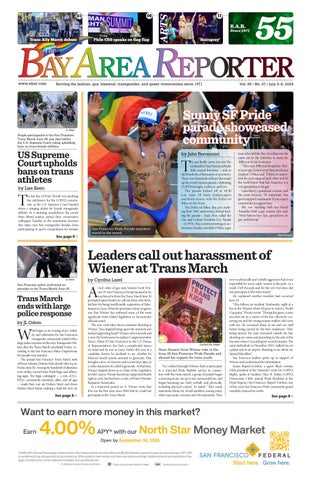
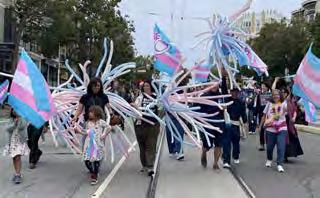
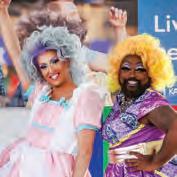
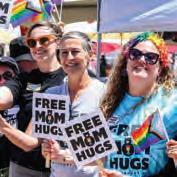
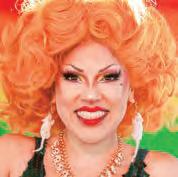
People participated in the San Francisco Trans March June 26, just days before the U.S. Supreme Court ruling upholding bans on trans female athletes.
US Supreme Court upholds bans on trans athletes
by Lisa Keen
The last day of Pride Month was anything but celebratory for the LGBTQ community, as the U.S. Supreme Court handed down a stinging defeat for female transgender athletes. In a stunning smackdown, the court’s three liberal justices joined their conservative colleagues Tuesday in the unanimous decision that states may ban transgender females from participating in sports competitions for females
See page 8 >>
San Francisco police confronted an attendee at the Trans March June 26.
Trans March ends with large police response
by JL Odom
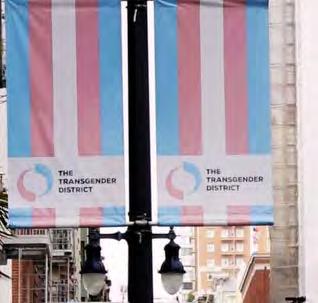
What began as an evening of joy, visibility, and celebration for San Francisco’s transgender community ended with a large police response in the city’s Transgender District after the Trans March concluded Friday. According to the San Francisco Police Department, five people were arrested.
The annual San Francisco Trans March took off from Mission Dolores Park shortly after 6 p.m. Friday, June 26. Among the hundreds of attendees were smiles, myriad trans Pride flags, and affirming signs. The large contingent — a mix of LGBTQ+ community members, allies, and all ages — made their way up Dolores Street and down Market Street before making a final left turn on
See page 8 >>
Sunny SF Pride parade showcased community Sunny SF Pride parade showcased community
by John Ferrannini
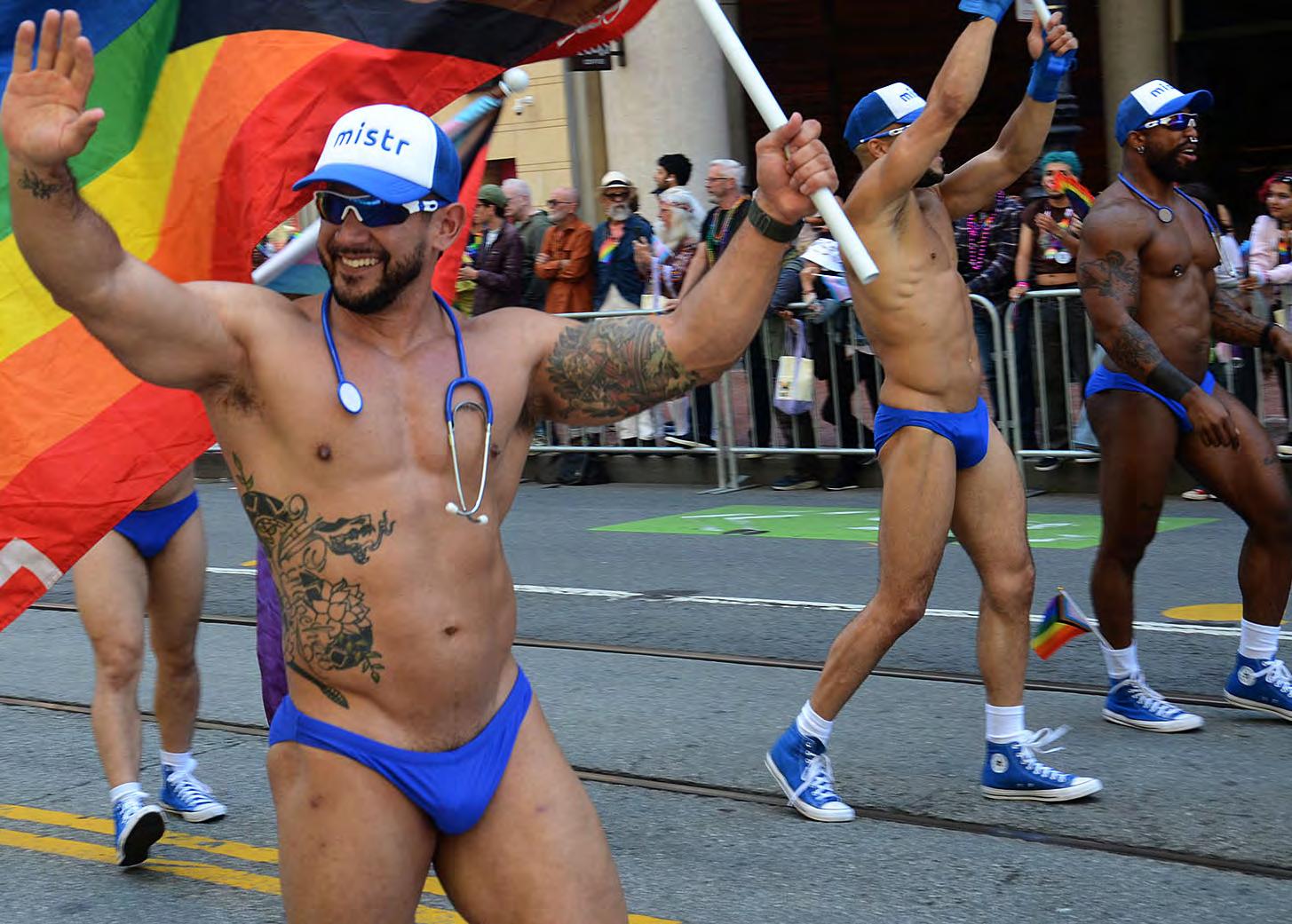
The sun finally came out over the weekend for San Francisco Pride’s 56th annual festivities – and so did hundreds of thousands of spectators. There were hundreds of floats that made up the world-famous parade, celebrating LGBTQ strength, resilience, and love.
The parade kicked off at 10:30 a.m. June 28 from Embarcadero and Beale streets, with the Dykes on Bikes at the front.
The Dykes on Bikes, this year marking their 50th anniversary, started leading the parade – back then called the Gay and Lesbian Freedom Day Parade – in 1976. Also commemorating an anniversary Sunday was John O’Shea, a gay
man who told the Bay Area Reporter he came out to the festivities to mark his 30th year in San Francisco.
“This is my 30th year living here. Thirty years ago, I came to my first parade as a resident,” O’Shea said. “I think it’s important for us to support each other and let the world know that San Francisco is a very good place to be gay.”
Lana Berry, a pansexual woman, said she came because, “It’s important. You got to support community if you expect community to support you.”
She was standing with her friend Tsaundor Huff, a gay woman who said, “We’re here to have fun, spread love, be gay, and turn up.”
Leaders call out harassment of Wiener at Trans March
by Cynthia Laird
Aviral video of gay state Senator Scott Wiener (D-San Francisco) being harassed as he was forced to leave the Trans March June 26 prompted queer leaders to call out those who heckled him for being insufficiently supportive of Palestinians in Gaza. What the protesters chose to ignore was that Wiener has authored some of the most significant trans-related legislation in Sacramento, officials noted.
The now viral video shows someone shouting at Wiener, “You stopped being queer the moment you started supporting Israel.” Wiener, who is Jewish and is now the frontrunner to replace Congressmember Nancy Pelosi (D-San Francisco) in the U.S. House of Representatives, has had a complicated stance on Israel and its war in Gaza. Earlier this year at a candidate forum, he declined to say whether he believed Israel’s actions amount to genocide. That brought a slew of criticism and several days later, in a video statement, he called it genocide. At that time, Wiener stepped down as co-chair of the Legislative Jewish Caucus. Wiener has always supported Israel’s right to exist, but has been a critic of Prime Minister Benjamin Netanyahu.
In a statement posted on X, Wiener wrote that this was the first time since 2004 that he could not participate in the Trans March.
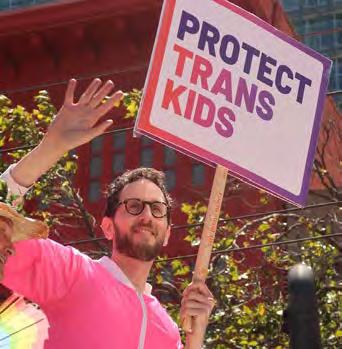
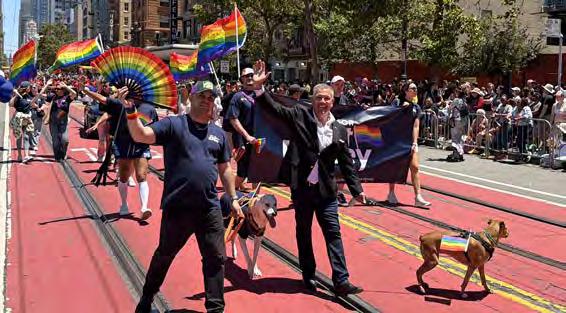
State Senator Scott Wiener rode in the June 28 San Francisco Pride Parade and showed his support for trans youth.
“As I walked through Dolores Park to participate in a trans-led Pride Shabbat service in connection with the trans march, a group of people began screaming at me, ran up to me, surrounded me, and began harassing me, both verbally and physically, including physical contact,” he stated. “They made statements about my ‘Israeli handlers,’ among many other inaccurate, extreme, and vile statements. They
were so physically and verbally aggressive that it was impossible for me to safely remain in the park. As a result, I left the park and, for the very first time, did not participate in the trans march.”
He explained another incident had occurred June 24.
“This follows an incident Wednesday night at a bar in the Mission where I’d gone to watch a World Cup game,” Wiener wrote. “During the game, a man accosted me in a corner of the bar, effectively cornering me and the young women staffers who were with me. He screamed abuse at me and our staff before being ejected by the bar’s employees. After being ejected, the man remained outside the bar, shouting my name and pounding on the side of the bar near where I was sitting for several minutes. The same individual, in December 2023, stalked me on a plane and in an airport, shouting at me about my ‘tainted bloodline.’”
San Francisco leaders spoke up in support of Wiener and condemned the intimidation.
Imani Rupert-Gordon, a queer Black woman who’s president of the National Center for LGBTQ Rights, spoke at Sunday’s Alice B. Toklas LGBTQ Democratic Club’s annual Pride Breakfast at the Hyatt Regency San Francisco. Rupert-Gordon, one of this year’s San Francisco Pride community grand marshals, minced no words.
page 8 >>
JL Odom
JL Odom
San Francisco Pride Parade marchers waved to the crowd.
Rick Gerharter
Joy, resilience take center stage at SF Dyke March <<
by JL Odom
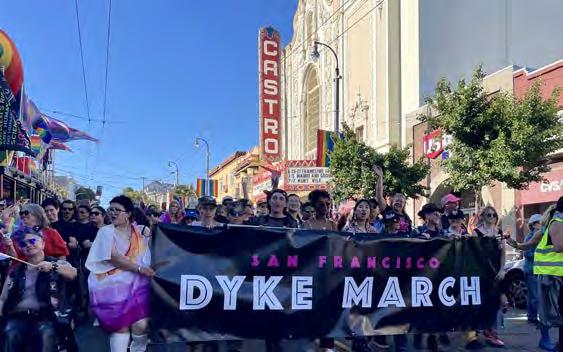
Cheers erupted as the unmistakable roar of the San Francisco Women’s Motorcycle Contingent’s engines echoed through the Mission, signaling what thousands had been waiting for –the annual San Francisco Dyke March.
Held Saturday, June 27, during San Francisco Pride weekend, the beloved tradition once again filled city streets with celebration, community, and unapologetic queer joy as marchers made their way from the Mission to the Castro and back again.
Following a 3 p.m. rally on Dolores Street, the approximately 2.2-mile march stepped off at 5 p.m., traveling along 18th, Valencia, Market, and Castro streets.
As the San Francisco Women’s Motorcycle Contingent rolled down 18th Street ahead of the procession, Day Darmet was among the large crowd cheering them on. The veteran Dyke March attendee, who identifies as gay, said she wouldn’t miss it for the world.
“I’m here to celebrate, to feel confident about being in a city where we can be free to be ourselves, no matter what, and bring the community together,” she said.
Darmet, 71, moved to San Francisco in 1994, which was also the first year she went to the Dyke March. She’s attended every time since it’s been held and said it’s important to continue to show up and demonstrate resilience amid adversity. (The official Dyke March was not held in 2024, though plenty of people showed up anyway for a grassroots celebration. Under new leadership, the official march resumed in 2025.)
“We’ve been drawn out and broken through, and now here we are, and if we don’t keep fighting, we’ll lose our position,” she said.
With Darmet was Eliana Telles, 77, who said she was there to celebrate and be proud of her queer identity among the many other LGBTQ individuals at the march.
“There is happiness in being together — no matter your economics, no matter where you come from,” she said.
Originally from Brazil, Telles, who identifies as queer, moved to San Francisco in 1980 and has lived here ever since, describing her home of nearly 40 years as offering freedom and resources.
“People told me, ‘Go to San Francisco. It’s a gay city. You’re a lesbian. You have people who would help you there,’” she said.
She said she initially reached out to the Women’s Building in the Mission for guidance and support, and she prospered from there, also becoming integrated into the LGBTQ community.
“It’s a great city, and this is my favorite weekend. I’ve done all of the Prides, all of the marches,” she said.
Marchers on Saturday carried orange, white, and pink-striped lesbian pride flags, wore lavender or Pride-themed Golden State Valkyries shirts and caps, and held signs such as “Mean, hairy dyke and proud – butch is beautiful.”
San Francisco resident Tye Waller, who described herself as a woman who loves women, said everything about the Dyke March – from the weather to the people – keeps drawing her back. With a pending move to the East Coast, this year’s march felt especially meaningful after months of becoming more involved in the community and the causes she supports.
“It’s probably the most active I’ve ever been,” said Waller, who declined to share her age.
Waller said she’s spent time in cities including Boston, New Orleans, and Connecticut, but while each has its own Pride celebrations, none compare to San Francisco’s Pride weekend or the Dyke March.
Walking with the crowd on Valencia Street, Waller said the march was a powerful reminder of just how many LGBTQ people call the city home.
“It’s good to be seen,” she said.
Dyke March project director M Rocket, a dyke, previously told the B.A.R. that it was financially prohibitive to reserve
Mission Dolores Park this year because doing so would have required organizers to cover park maintenance, trash collection, and restroom costs for the entire day. Instead, the pre-march rally was held on the closed stretch of Dolores Street. Nonetheless, the park was still packed with queer women, lesbians, and others before the march. Rocket said it cost about $60,000 to stage the march and organizers sought about 100 volunteers to help make this year’s event possible.
Yet little about Saturday’s event felt diminished. With Curve magazine founder and lesbian Frances “Franco” Stevens at the helm, chants of “Hot Dyke!” echoing from the lead truck, and the traditional left turn onto Castro Street – hailed over a megaphone as “the belly of gayness” – the celebration carried an infectious energy.
For Fay Meisels, the BART ride from Oakland for their first San Francisco Dyke March was well worth it.
“I’m glad to be able to see happy, beautiful, queer people come together in these dark times and all of these different ways of being queer represented,” Meisels said.
The 27-year-old, who identifies as a gender-fluid lesbian, walked hand-inhand with their girlfriend, Tanvi Dutta Gupta. Their sleeveless shirt featured a pink triangle with the words, “Queer joy is powerful.”
“This country has so many places where it’s hard to be out and to be yourself, so being with so many people here today celebrating love and supporting each other makes me full of so much joy,” they said. t
Becerra draws laughs at Alice club Pride breakfast
by Cynthia Laird
Xavier Becerra, California’s likely next governor, drew laughs at the Alice B. Toklas LGBTQ Democratic Club’s annual Pride Breakfast June 28 when he said he, too, wanted an impersonator like one being sought for San Francisco Mayor Daniel Lurie.
The normally low-key Becerra, who won a top spot in the June 2 primary and will take on Republican Steve Hilton November 3, was referring to remarks Lurie made earlier in the program, when he referenced flyers in the Castro seeking a doppelganger to star in a gay porn film.
“I thought, ‘I’d made it,’” Lurie quipped when recounting the flyer, which was posted in May.
“Can I find my impersonator?” asked Becerra after he took the stage at the Hyatt Regency San Francisco.
Jokes aside, Becerra is favored to win the gubernatorial race due to California being a heavily Democratic state. Hilton, who has been endorsed by President Donald Trump, exudes the same rightwing talking points as the president,
though he has struggled in recent TV appearances when asked about alleged voter fraud during the primary and has admitted he hasn’t seen any evidence of that. Trump, of course, is using the baseless allegations of voter fraud to push the Safeguard American Voter Eligibility Act,
or SAVE Act. U.S. Senator Alex Padilla (D-California), who also spoke at the breakfast, was critical of the legislation.
“It’s not just a voter ID bill; it’s a voter suppression bill,” Padilla said, adding Republicans and Trump administration officials want to “get personal private information on every voter in America.”
“It’s an attack on trans rights,” he added. “Read the bill.”
The bill would require proof of citizenship when registering to vote, such as a passport or driver’s license paired with a birth certificate, documentation that many lack, according to Human Rights Watch.
“The bill would disproportionately affect women and trans people, particularly those from marginalized groups,” the organization stated on its website.
The SAVE Act has been rejected by the Senate, Padilla noted, where it lacks the 60 votes needed for passage. Trump is now refusing to sign a bipartisan bill Congress passed to address the country’s housing affordability crisis by banning large investors from buying single-family homes until he is sent the SAVE Act.
See page 7 >>
The San Francisco Dyke March rolled through the Castro Saturday, June 27.
JL Odom
California Democratic gubernatorial candidate Xavier Becerra spoke at the Alice B. Toklas LGBTQ Democratic Club’s Pride Breakfast in San Francisco June 28.
Courtesy the Becerra campaign
New march emphasizes solidarity with trans people
by JL Odom
Anew event joined the San Francisco Pride weekend lineup this year – one centered on solidarity with the transgender community.
The first-ever Trans Ally March and Rally got underway Saturday, June 27, with participants walking from the Embarcadero to Civic Center beginning at 10:30 a.m. Organizers estimated about 1,000 people, including volunteers and safety monitors, took part.
It was the second of the weekend’s major outdoor Pride events, following Friday’s San Francisco Trans March and preceding the Saturday afternoon Dyke March and the SF Pride Parade and Celebration on Sunday.
The event was organized by Indivisible SF, an independent, volunteer-led group, in partnership with the People’s March & Rally, the San Francisco Dyke March, the SF Trans March, SF Dykes on Bikes, and San Francisco Pride. Indivisible SF is best known for organizing the No Kings marches against President Donald Trump. This year, as the Bay Area Reporter noted, the People’s March, which started in 2020 during the COVID pandemic, was folded into the Trans Ally March.
“The trans community is an integral part of San Francisco, and they are our friends, our neighbors, our coworkers, our children. We marched today to demonstrate that the trans community has cisgender and straight allies in this city and we have their back,” said Connie Jeung-Mills, an activist and graphic designer for Indivisible SF.
According to its website Indivisible SF “defends democracy and resists the Trump regime and MAGA” and is “progressively pro-trans.” The group, made up of LGBTQ people and straight allies, opposes what it describes as the systematic erasure of transgender people by the Trump administration and state and local governments.
Indivisible SF’s platform calls on San Francisco Mayor Daniel Lurie to fully fund the Transgender District, transgender youth and housing programs, nonprofits serving the transgender community, and the city’s Office of Transgender Initiatives. It also advocates protecting transgender youth and adults from bans on genderaffirming care, sports participation and bathroom access, as well as ensuring access to accurate identity documents.
Jeung-Mills, a queer San Francisco resident in her 70s, also co-hosts the “Trump Regime Takedown” protest on Saturdays from noon to 2 p.m. at Van Ness and O’Farrell streets.
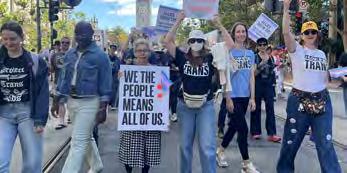
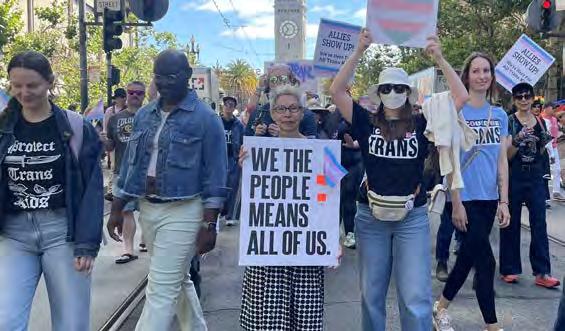
During the walk to Civic Center, she held a sign that read, “We the people means all of us,” with a small trans pride flag taped to it.
“It’s essential that we stand united against the Trump administration’s bigoted and genocidal policies that are seriously harming the trans community. We need to protect the fundamental rights of everyone in this country because ‘we the people’ means all of us. This is what democracy looks like and we need to actively protect it,” she said.
Other Trans Ally March attendees carried signs with slogans such as “Demand due process” and “Genderaffirming care for all.” Another featured “Love all thy neighbors” on its front; the back of it read, “It was never about the water fountains either.” The sign’s creator, who requested anonymity, said it was a response to the recent San Francisco Giants incident involving three pitchers inscribing Bible verses on their rainbow-colored Pride game hats at the team’s June 12 Pride Night, as previously reported by the B.A.R.
Several children also took part in the march, walking with their parents and carrying signs such as “Trans rights are human rights” and “Kind kids change the world.”
Amber Richardson, who was holding a sign that read “Proud Ally, Fierce Protector,” commuted from the East Bay for the event. She shared that, with a 25-year-old daughter who is transgender, it was important for her to be there and show her support.
“We live in Berkeley, and she always got a lot of support from her school and our community. I know that’s not the
case for most kids who are trans. It’s not the environment that most kids grow up in,” Richardson said.
“I feel really fortunate to live in the Bay Area. It’s really kind of why we stayed. It’s a hard place to live with a young family – it’s very expensive – but we made it work for her, and I’m really glad we did, because she’s a pretty self-assured, confident woman at this point. I’m just really proud of her. She’s really fought for herself this whole time,” she continued.
Richardson, 50, noted that the visibility and support of the transgender community’s allies matters.
“It’s really important to show up for these kinds of events, especially in this political climate where trans rights are under attack. As allies, encouraging other people to stand up for human rights is essentially what we’re doing right now,” she said.
Also among the march’s participants was Paul Morrow, a gay man who lives in San Francisco, who wore a blue hat festooned with AIDS Walk San Francisco badges and pins, a pink polo with a blue collar and festive beads around his neck. He was also sporting one of the “Support Trans Rights” buttons that Alfred Twu, a nonbinary person who’s a commissioner of the Berkeley Rent Board, was handing out to attendees.
“It’s more important than ever, given this administration, that we support our community, especially the trans community, so I’m here in support of them,” Morrow said.
Morrow, who recently turned 68, has been HIV-positive for nearly 40 years. A long-term survivor and San Francisco resident since 1989, the recently retired nurse said he’s focused on enjoying life and living authentically.
“I wanted to be here to promote change in our governmental system and show that we’re all humans – we’re all trying to be our authentic selves,” he said. His husband of many years, Tonii Morrow, also attended the Trans Ally March.
Tonii Morrow, a queer, Black, white, and Cherokee dancer who has performed in Paris and elsewhere around the world, said he wants the same opportunities he’s had to be available to other LGBTQ people.
“I’m here to support all these beautiful people, from the young people to the old people, to say that we all deserve to be treated with respect,” he said.
Morrow, who will soon turn 70, has called San Francisco home for decades, like his husband Paul. There’s no other place like it, he said, when it comes to supporting diverse LGBTQ people like himself.
“This city has the whole world, every ethnic group, that’s mixed up and mixed together, and I love that,” he said. “This place has given me my freedom, and at this age I have way more freedom [here] than if I were in Ohio, where I’m from, or other places.”
During the march, he and Paul held hands as they walked along Market Street.
About a dozen motorcycles ridden by members of Dykes on Bikes guided the contingent up front along the route, helping neon yellow vest-wearing volunteers safely usher marchers through streets and intersections.
At the front of the procession, Sister Roma and fellow members of the drag nun philanthropic group Sisters of Perpetual Indulgence, drag artist and activist Juanita MORE! and others walked ahead of “The People’s March” banner. At the rear, members of Refuse Fascism carried a yellow banner reading, “Trump must go now!”
Alex U. Inn, an artivist, co-founder with MORE! of the People’s March in San Francisco and the Bay Area Reporter’s 2026 readers’ poll winner for Best Drag King, led chants through a megaphone between bursts of dance music from the lead truck.
As the march turned onto Turk Street
Connie Jeung-Mills of Indivisible SF held a “We the People” sign during the first-ever Trans March and Rally that took place June 27 in San Francisco.
JL Odom
Volume 56, Number XX
Volume 56, Number 27
July 2-8, 2026
Month XX-XX, 2026 www.ebar.com
PUBLISHER
Michael M. Yamashita
Thomas E. Horn, Publisher Emeritus (2013)
Publisher (2003 – 2013)
Bob Ross, Founder (1971 – 2003)
NEWS EDITOR
Cynthia Laird
ARTS & NIGHTLIFE EDITOR
Jim Provenzano
ASSISTANT EDITORS
Matthew S. Bajko • John Ferrannini
CONTRIBUTING WRITERS
The awful ruling Tuesday by the U.S. Supreme Court certainly was a buzzkill to end Pride Month and put a damper on our celebratory plans for the 250th birthday of America that will be commemorated July 4. The justices ruled unanimously to uphold state bans on trans women and girls playing on female sports teams. The two cases were from West Virginia and Idaho. Yes, we even lost the three liberal justices, though Elena Kagan, Sonia Sotomayor, and Ketanji Brown Jackson dissented in part from the majority opinion. We knew back when oral arguments were held in January that the trans community would lose this case.
But the decision shows how cruel the justices are. Kids should be able to play sports on teams that correspond with their gender identity. That’s what AB Hernandez did during her high school career. She was in town last week and spoke at San Francisco Pride’s Human Rights Summit. She has endured much transphobia for the chance to participate in track and field, a sport she excels at.
from participating on female sports teams. California, thankfully, is not one of them, but the pressure has been on the Golden State for years, as transphobic parents and policymakers attempt to exert control. It would not surprise us to see more states adopt such bans.
may otherwise have no relevant competitive advantage,” he stated. “Like other health or medical considerations in sports, reasonable policies for transgender student athletes rely on individual assessments rather than blanket bans. Every child deserves the chance to play sports with their friends and learn the lessons sports teach, including determination, resilience, and teamwork. Our kids deserve to have the people who know our children best, local school districts and communities, make these decisions on a case-by-case basis.
“To the transgender kids watching today: please don’t lose heart. This is a setback, not the final word. You deserve to play, to belong, and to dream as big as any other child – and we will keep working until the law fully recognizes that. We see you, and we’re with you,” stated Minter.
Kyle Amato • Race Bannon • Robert Brokl
Christopher J. Beale • Robert Brokl
Christopher J. Beale • Brian Bromberger
Brian Bromberger • Philip Campbell
Heather Cassell • Eliot Faine
Philip Campbell • Myron Caringal
Meg Collins • Chelsea Davis
Michael Flanagan • Jim Gladstone
Natasha Dennerstein • Eliot Faine
Liz Highleyman • Brandon Judell • Lisa Keen
George Faville • Michael Flanagan
Philip Mayard • Laura Moreno
Jim Gladstone • Brian Guan • Liz Highleyman
David-Elijah Nahmod • Mark William Norby
JL Odom • Paul Parish • Tim Pfaff
Brandon Judell • Michele Karlsberg • Lisa Keen
Jim Piechota • Adam Sandel
Matthew Kennedy • Philip Mayard
Jim McDermott • Laura Moreno
Jason Serinus • Gregg Shapiro
The decision further exemplifies the country’s long-standing discrimination against Black people. That, of course, was baked into America’s founding document, the Constitution, where it was decided enslaved people would count as three-fifths of a human. David Johns, Ph.D., CEO and executive director of the National Black Justice Coalition, pointed out that Black trans youth will suffer.
Shannon Minter, a trans man who is the longtime legal director for the National Center for LGBTQ Rights, did point out that the court’s decision was a narrow one. In other words, it could have been worse.
Equality California, the statewide LGBTQ organization, stated the “court did not give states or schools a blank check to discriminate against transgender people in every aspect of their lives. Even with this ruling, schools and states like California can continue to adopt inclusive policies that ensure every student is treated with dignity and respect.”
Gwendolyn Smith • Charlie Wagner
David-Elijah Nahmod • Mark William Norby
JL Odom • Lois Pearlman • Tim Pfaff
Ed Walsh • Cornelius Washington • Sura Wood
Jim Piechota • Joshua Polanski • Adam Sandel
Gregg Shapiro • Gwendolyn Smith
ART DIRECTION
Charlie Wagner • Ed Walsh
Max Leger
Cornelius Washington • Evelyn C. White
PRODUCTION/DESIGN
Ernesto Sopprani
ART DIRECTION
Max Leger
PHOTOGRAPHERS
Jane Philomen Cleland
PRODUCTION/DESIGN
Rick Gerharter • Gooch
Ernesto Sopprani
Jose A. Guzman-Colon
PHOTOGRAPHERS
Rudy K. Lawidjaja • Georg Lester
Jane Philomen Cleland
Rich Stadtmiller • Christopher Robledo
Rick Gerharter • Gooch
Fred Rowe • Shot in the City
Jose A. Guzman-Colon
Steven Underhill • Bill Wilson
Rudy K. Lawidjaja • Georg Lester
ILLUSTRATORS & CARTOONISTS
Rich Stadtmiller • Christopher Robledo
Christine Smith
Fred Rowe • Shot in the City
Steven Underhill • Bill Wilson
ILLUSTRATORS & CARTOONISTS
Christine Smith
VICE PRESIDENT OF ADVERTISING
Scott Wazlowski – 415.829.8937
VICE PRESIDENT OF ADVERTISING
NATIONAL ADVERTISING REPRESENTATIVE
Scott Wazlowski – 415.829.8937
Rivendell Media – 212.242.6863
LEGAL COUNSEL
Paul H. Melbostad, Esq.
NATIONAL ADVERTISING REPRESENTATIVE
Rivendell Media – 212.242.6863
LEGAL COUNSEL
Paul H. Melbostad, Esq.
Bay area reporter
“Black transgender youth will once again bear the greatest burden of this decision,” Johns stated. “Already navigating the intersecting harms of racism, sexism, transmisia [transphobia], and economic inequality, they are now being told by the highest court in the land that they may be excluded simply because of who they are. That message is as unnecessary as it is cruel.”
“Let’s be clear: this has never really been about sports,” Johns added. “It has always been about whether our transgender siblings, brothers, sisters, and babies deserve the same dignity, opportunities, and freedoms as everyone else. Our young people have been transformed into a national political obsession – not because they threaten girls’ and women’s sports, but because they make convenient targets for politicians seeking to divide and distract us from their own failures.”
There are 27 states that ban trans women and girls
“This is a disappointing decision, but also a narrow one that leaves the door open for the many states and schools that have adopted reasonable policies that protect both fairness and inclusion with respect to transgender students,” Minter stated. “Today’s limited decision means that states and schools across the country still have the power to make reasonable rules to ensure fairness without banning all transgender girls.”
What was frustrating about the case involving West Virginia is that the plaintiff, Becky PepperJackson, 15, had started on puberty blockers when she was in the third grade, and never did go through the changes in puberty that males do. This has long been an accepted course of treatment, and sports governing organizations usually accepted that. Not anymore. Last year, the U.S. Olympic and Paralympic Committee effectively barred trans athletes from competition in women’s sports. So does the NCAA at the college level. Now, one has to be female assigned at birth to participate.
Minter stated that kids deserve the chance to play sports.
“Many transgender girls, given age or medical treatments, may only go through female puberty or
At the same time, the court did not disturb existing federal protections against sex discrimination outside the context of school athletics, EQCA added, including those recognized under Bostock v. Clayton County, the court’s 2020 decision that Title VII of the Civil Rights Act of 1964 protects employees against discrimination based on sexual orientation and gender identity.
The broader LGBTQ community needs to stand with trans leaders and community members, especially families, to help amplify their voices – and listen to their stories. But the reality is that it’s unlikely things will change with President Donald Trump in the White House and Congress controlled by Republicans. That’s why it’s critical that the community focus on the upcoming midterm elections so that Democrats regain control of at least one chamber of Congress. And those Democrats need to support the trans community, which is going to be a tough ask in some states, but these politicians need to do the right thing and support equality.
The decision on trans athletes is a big blow. It’s important, however, that we continue fighting for equal rights. As our country’s history has shown, however, that can take a long time. t
Thank you, Dennis Herrera!
by Matt Dorsey
Withlast week’s announcement that former city attorney and current San Francisco Public Utilities Commission General Manager Dennis Herrera will retire at the end of the year, published recaps of his remarkable public service career spanning three decades hit all of the expected highlights: the first Latino elected city attorney in San Francisco history, lawsuits that successfully beat back the excesses of the first Trump administration and protected more than a billion dollars in federal funding, and unprecedented progress in San Francisco’s century-old municipalization bid to wrest control of our electric power system from the serially incompetent PG&E.
San Francisco Public Utilities Commission General Manager Dennis
is retiring at
end of the year.
Herrera’s well-known litigation battle for LGBTQ+ marriage equality merited mentions, too, of course.
ever to sue another government to strike down marriage laws that discriminated against same-sex couples. What followed was anything but a straight line to victory. Although Herrera’s affirmative legal challenge would go on to prevail at the California Supreme Court in 2008’s landmark case, In re Marriage Cases, the victory was shortlived. Months later, a majority of California voters stripped same-sex marriage rights away with the heartbreaking passage of Proposition 8.
But Herrera’s fight continued – this time as a challenge to Prop 8 in federal court.
However unlikely the successful fight for marriage equality may have seemed in 2004, none of us who’ve known Herrera were surprised by how passionately he made the LGBTQ+ community’s cause his own. After all, his allyship didn’t begin with the 2004 marriage cases.
Bay area reporter
44 Gough Street, Suite 302 San Francisco, CA 94103
Published weekly. Bay Area Reporter reserves the right to edit or reject any advertisement which the publisher believes is in poor taste or which advertises illegal items which might result in legal action against Bay Area Reporter. Ads will not be rejected solely on the basis of politics, philosophy, religion, race, age, or sexual orientation.
But for those unfamiliar with the decade-long roller coaster that was the history-making legal fight against marriage discrimination in California, it scarcely did justice to how singular Herrera has been as an ally to the LGBTQ+ community.
I can speak with some authority to that record, as a gay man who spent 14 years working for Herrera in the city attorney’s office. Together with former chief deputy city attorneys Terry Stewart and Ron Flynn – two fellow LGBTQ+ community members who served with me on Herrera’s executive staff – we had front-row seats to history in securing marriage rights none of us thought we’d see in our lifetimes.
Together with the American Foundation for Equal Rights – represented by legal powerhouses the late Ted Olson and David Boies – Herrera’s office represented a broader societal interest in marriage equality that had never before been argued in American jurisprudence, and that proved persuasive in successfully “putting discrimination on trial.” In August 2010, U.S. District Court Judge Vaughn Walker found Prop 8 unconstitutional under both the Due Process and Equal Protection Clauses of the 14th Amendment, for impermissibly denying rights to a disfavored class with no rational basis.
(Walker, who has retired from the bench, publicly came out as gay after the trial.)
Still, the appeals dragged on.
As a San Francisco police commissioner as early as the 1990s, Herrera helped to pioneer the first San Francisco Police Department policies to treat transgender and gender-nonconforming people with dignity and respect – years before such protections existed almost anywhere in the country, and at a time when transgender San Franciscans too often faced hostility from the very institutions sworn to protect them. He understood, early, that equality under the law means little if it isn’t also equality in practice. Neither was Herrera’s allyship limited to cases or policies. It was also about people. Throughout his career, Herrera elevated LGBTQ+ community members into positions of real responsibility and trust –Stewart, Flynn, and me among them – and they included, too, now-state Senator Scott Wiener (D-San Francisco) and former supervisor David Campos, among many others.
Published weekly. Bay Area Reporter reserves the right to edit or reject any advertisement which the publisher believes is in poor taste or which advertises illegal items which might result in legal action against Bay Area Reporter. Ads will not be rejected solely on the basis of politics, philosophy, religion, race, age, or sexual orientation.
Advertising rates available upon request.
Advertising rates available upon request.
Our list of subscribers and advertisers is confidential and is not sold. The sexual orientation of advertisers, photographers, and writers published herein is neither inferred nor implied. We are not responsible for unsolicited manuscripts or artwork.
Our list of subscribers and advertisers is confidential and is not sold. The sexual orientation of advertisers, photographers, and writers published herein is neither inferred nor implied. We are not responsible for unsolicited manuscripts or artwork.
The fight began in February 2004, when thenmayor Gavin Newsom directed the county clerk to start issuing marriage licenses to same-sex couples. Nearly 4,000 couples obtained them before the California Supreme Court halted the practice, and defending Newsom’s decision – and the marriages behind it – fell to Herrera.
No one would have objected had Herrera limited his office’s role solely to legal defense, of course. But what Herrera did was bolder and ultimately more consequential: he went on offense, too, suing the state of California to strike down its discriminatory marriage laws. Herrera’s 2004 lawsuit made history – establishing San Francisco as the first government
That it was ultimately a jurisdictional question that doomed Prop 8 underscored the principled role San Francisco played under Herrera’s leadership. The courageous city that in 2004 stood alone as the only government ever to fight for LGBTQ+ marriage equality was, by 2013, standing shoulder-to-shoulder with then-attorney general Kamala Harris and thenPresident Barack Obama’s Justice Department in refusing to defend a law that unconstitutionally discriminated against same-sex couples. In the end, with no government to defend Prop 8, the U.S. District Court’s ruling was affirmed.
Herrera’s U.S. Supreme Court victory along with AFER in 2013 struck Prop 8 down, restored marriage equality in California, and set the stage for the high court’s landmark 2015 decision in Obergefell v. Hodges, which secured LGBTQ+ marriage equality as the law of the land nationwide.
Herrera never did it as a gesture or token, but because he recognized civic dedication and talent, and believed our judgment was worth betting on. Herrera demanded excellence from those on his team, and he usually got it. But he was also deliberate in making room for those of us too often underrepresented in the halls of power. And it’s no accident that an out gay man – Flynn, who served as Herrera’s chief deputy city attorney – stands as the San Francisco’s Public Utilities Commission’s second-in-command as deputy general manager. (Stewart was appointed to the California Court of Appeal in 2014 by former governor Jerry Brown, where she is now presiding justice of Division Two.)
San Francisco can be justifiably proud of our civic creed as a beacon for LGBTQ+ rights, and our community has done a lot to earn it. But we’ve had the help and championship of countless straight allies, too, and few have been more consequential than Herrera. So, on the occasion of your retirement, thank you, Dennis! Ours is a better city for all your contributions to it. t
Matt Dorsey, a gay man, represents the South of Market neighborhood on the San Francisco Board of Supervisors.
Herrera
the
From Facebook
The U.S. Supreme Court ruled against trans female athletes this week.
Fred Schilling, Collection of the Supreme Court of the United States
CA budget includes funds for LGBTQ services
by Matthew S. Bajko
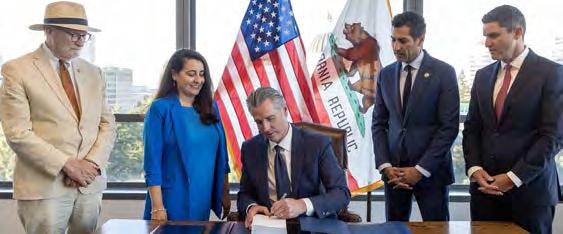
LGBTQ advocates notched a host of fiscal successes totaling more than $2 billion in the 2026-27 state budget and associated trailer bills that California Governor Gavin Newsom signed into law Monday. It marks the final budget for the outgoing Democratic leader, widely expected to seek to be his party’s presidential nominee in 2028, and the first time a state has established a statewide fund to support LGBTQ community centers.
Also among this year’s budget priorities for LGBTQ advocates were $26 million for a Gender-Affirming Care Fund to be used to ensure transgender, nonbinary, and gender-expansive people have access to the medically necessary care they need, and $30 million for the Uncompensated Care Fund, which is to be used to cover gender-affirming care alongside abortion and reproductive health services. The Legislature had included both in the budget they sent Newsom to sign.
“At a time when transgender youth and their families are facing unprecedented challenges across the country, California has chosen to stand as a beacon of hope, safety, and dignity,” stated California LGBTQ+ Health and Human Services Network Director Dannie Ceseña, who is Two-Spirit and Native. “We are deeply grateful to Governor Newsom and our state leaders for not just speaking about equality, but funding it. By protecting access to genderaffirming care and robustly supporting the Transgender Health Care Fund, California is actively saving lives and setting a powerful national standard.”
State Senator John Laird, left, and Senate President pro Tempore Monique Limón looked on as Governor Gavin Newsom signed the state budget with Assembly Speaker Robert Rivas, second from right, and Assembly Budget Chair Jesse Gabriel.
mittee. Earlier in the month, after the Senate had approved several budget trailer bills that included the funding asks from LGBTQ advocates, Laird noted that they reflected “the same balanced approach that has guided budget negotiations this year. They provide additional revenues that help balance the budget over the next two years, reduce the structural deficit, maintain strong reserves, and avoid deeper cuts to services that Californians rely on every day.”
Acknowledging there was likely to be “debate about individual provisions, the alternative would have been more significant reductions to health care, education, housing, child care, public safety, and other essential programs,” added Laird. “This package represents another important step toward a final budget that protects Californians while strengthening the state’s longterm fiscal position.”
“At a moment when LGBTQ+ communities across the country are under relentless attack and states are dismantling protections for our community, California has chosen a different path— one rooted in dignity, compassion, and action,” stated Hollendoner. “This is one of the most significant LGBTQ+ policy victories in our state’s history. These investments will save lives, expand access to healthcare and housing, and strengthen the institutions our communities rely on to survive and thrive.”
LGBTQ advocates in recent weeks had mounted an intense lobbying campaign to see legislators in Sacramento and the governor include the funding in the final $351.7 billion balanced state budget. State leaders also boosted California’s reserves to almost $29 billion in case of future fiscal shocks to the state’s finances.
In a video message his office posted about his signing the budget that begins on July 1, Newsom noted, “For decades, we’ve been told that government has to choose between balancing the books and investing in people. California proved that’s a false choice. This budget reflects years of disciplined decisions that built historic reserves, paid down debt, strengthened our economy, and made transformational investments in education, healthcare, housing, infrastructure, and opportunity. We’re leaving California stronger than we found it – and leaving the next generation a state that’s fiscally sound, economically dominant, and ready for whatever comes next.”
Helping oversee this year’s budget negotiations was gay state Senator John Laird (D-Santa Cruz) as chair of the Senate Budget and Fiscal Review Com-
and entered the Tenderloin’s Transgender District, Sylvester’s “You Make Me Feel (Mighty Real)” blasted from the truck’s speakers. The song paid tribute to the Black genderfluid San Francisco singer, known as the “Queen of Disco,” who died in 1988 at age 41 from HIV/ AIDS-related complications.
When the group neared the intersection of Turk and Taylor streets, where the historic Compton’s Cafeteria Riot took place in August 1966, Inn asked everyone to pause in their steps to reflect on the lasting impact of the uprising.
“Without our [trans and queer] ancestors, we would not have the strength to fight these fascist, racist regimes and
The money for gender-affirming care was a main focus of the inaugural TGI Youth Advocacy Day at the state Capitol. It took place June 23, a week prior to Newsom’s June 30 deadline to sign the budget bills. Equality California, the statewide LGBTQ advocacy organization, had also marshalled its members to contact the governor and legislators and urge them to back the Gender-Affirming Care Fund and other budgetary asks made by the community this year.
“At a time when the federal government continues attacking transgender people and undermining access to medically necessary health care, California is making a historic investment to ensure that our community can continue to access the care they need,” stated gay EQCA Executive Director Tony Hoang
One of the fiscal priorities advocates secured is roughly $9 million for LGBTQ+ community centers and other LGBTQ+ serving organizations.
Another $995,000 is to be directed to those LGBTQ service providers “in less resourced regions” of the state, according to the budget bill. Gay Los Angeles LGBT Center CEO Joe Hollendoner called the $10 million funding allocation “truly historic,” as it’s believed to be the nation’s first statewide LGBTQ+ Community Center Fund.
the ones that are targeting our most sensitive in our community: our trans youth and our trans siblings,” they said.
“Whenever you cross these lights, think about how you got here. Think about the strength that we have to do this,” they continued.
The Trans March the previous night had ended with a large police response stemming from individuals’ alleged vandalizing of property with spray paint. Ultimately, five people were arrested, and the otherwise peaceful evening was disrupted, with San Francisco Police Department officers clashing with march attendees, as reported by the B.A.R. Inn expressed their frustration with the individuals who incited the incident.
“It makes me sad, because the Trans March committee does a
LGBTQ advocates also secured $50 million to strengthen victim services through a Victims of Crime Act (VOCA) backfill. They were also successful in seeing $900 million be directed toward the state’s Homeless Housing, Assistance and Prevention (HHAP) Program.
Another priority was having state leaders designate nearly $1 billion over five years through the ADAP Rebate Fund expenditure plan to strengthen HIV prevention, treatment, care, and efforts to end the epidemics of HIV and other sexually transmitted infections. Lobbyist Ryan Souza, speaking Monday on behalf of the San Francisco AIDS Foundation, APLA Health based in Los Angeles, and the End the Epidemics Coalition at the Senate budget committee’s final hearing on the budget, thanked Newsom, the Legislative LGBTQ Caucus, and the Legislature for backing the ADAP spending plan. Their “leadership, vision and collaboration allowed the ADAP Rebate Fund to be used in a truly generational investment in the effort to end the epidemic of HIV,” said Souza.
The budget also includes $15 million for the Chancellor’s Office of the California Community Colleges to distribute to community college districts so they can “provide additional funds to support LGBTQ+ students.”
The State Department of Education was also awarded $77,000 to continue its having a half-time position tasked with updating existing, and developing new, resources, strategies, and in-service teacher training to support LGBTQ and questioning students. The state agency also received $150,000 and a full-time position in its School Health and Safety Office “to support LGBTQ+ initiatives and best practices,” according to the budget bill. t
making sure that everyone is having a good time. What happened last night … they didn’t represent our community … that was not us, but it penetrated the good and the joy that we do, and destroyed our day. So to those people who did that, stop it, because it comes down on us. Today we had to take extra caution in case it happened here, and that’s not fair because that puts fear in people. We want to have a joyful day,” they said. t
Correction
In the June 25 article, “Influencers share Pride messages for queer naturalists,” influencer Saumitra Kelkar is a straight ally and Miguel Velez identifies as queer. The online version has been corrected.
Courtesy Governor’s Office
Law Office of Shelley S. Feinberg
Flood
870 Market St, Suite 420 By Appointment only! 415-421-1893
Philz Coffee CEO talks about flag flap at summit
by Brian Guan
The
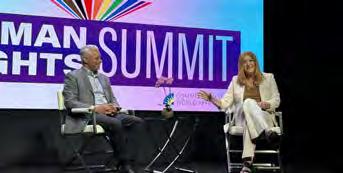
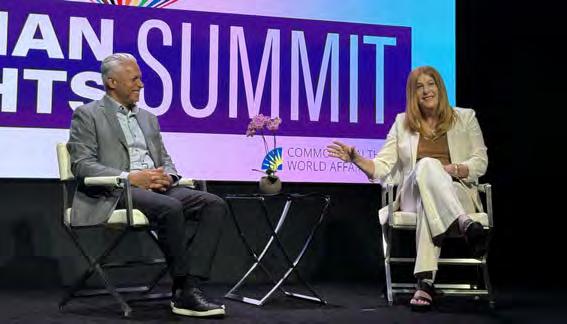
CEO of Philz Coffee addressed his now-reversed decision to ban Pride flags from stores at San Francisco Pride’s recent fourth annual Human Rights Summit. He was in conversation with Suzanne Ford, a transgender woman who’s executive director of SF Pride and played a key role in convincing Philz to rescind its decision.
Philz Coffee CEO Mahesh Sadarangani faced an immense wave of public backlash in April after Philz announced its plans to remove Pride flags from its stores, including one in the Castro. The news sparked an upset among the LGBTQ community. Ford herself had organized a rally protesting Philz at the coffee chain’s Castro location. Nine days later, Philz announced its reversal of the decision.
Sadarangani described Ford as an instrumental figure in the turnaround, as the Bay Area Reporter previously noted.
At the summit, Sadarangani convened with Ford to discuss the events of the prior dispute on behalf of Philz, which is now a sponsor of SF Pride. The San Francisco Standard reported the company gave SF Pride $30,000.
On the initial decision to remove the Pride flags, Sadarangani explained that the Oakland-based Philz sought a “more consistent looking feel” as it began expanding. He described discussions around consistency as having started “several months before.”
Wide range of speakers
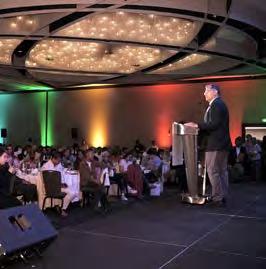
The June 25 summit was held at the Commonwealth Club World Affairs offices along the Embarcadero. It covered a wide range of issues pertinent to LGBTQ people in the Bay Area and beyond – from corporate support to trans athletes.
After an opening statement by Nguyen Pham, a gay man who was previously the SF Pride’s board president and this year served as director of sponsorship, the summit’s main proceedings kicked off with a speech by Mayor Daniel Lurie.
Tom Steyer, a Democrat who was running for California governor at the time, released a social media video backing AB Hernandez. Republican candidate Steve Hilton, who advanced to the November general election and will face Democrat Xavier Becerra, was critical of her participation.
“The media doesn’t see a person; they just see a story,” AB Hernandez said.
“They kind of chose the wrong kid to mess with,” Nereyna Hernandez said of her own defense of her daughter. “Because I’m there for all children, just not my child.”
From the audience’s perspective, Madeleine Quine, 17, especially enjoyed the presence of “younger people on the stage.”
“One of the many things involved in a more consistent looking feel is what we have on our walls, our flags,” Sadarangani said. He claimed that Philz had planned to standardize the representation of the Pride flag in all its stores on what he described as a “community wall.”
4pm - 6pm Thursday, September 17, 2026 UNDERSTAND
Join our inclusive, bilingual workshop and understand your rights as a tenant!
Whether you’re new to the area or have been here for years, this workshop is designed to help you navigate the complexities of tenant law.
What to Expect:
Bilingual Presentation: The presentation and materials will be provided in both English and Spanish.
Recounting her initial reaction to the news, Ford described her assumption that Philz had wanted to move politically to the right to “broaden [its] customer base,” soon calling for a protest after a reporter asked her about how she would respond.
After Ford’s protest in the Castro, Sadarangani met with Ford and Jupiter Peraza, a trans woman, to discuss the decision. While steadfast in her condemnation of Philz’s decision, Ford described experiencing remorse for her initial assumptions about Sadarangani’s
“They didn’t sit around with diabolical evil corporate planners and decide they were going to participate in our demise as trans people,” she said.
Acknowledging institutions such as the National AIDS Memorial Grove and the Castro’s GLBT Historical Society, Lurie affirmed the importance of LGBTQ identity for San Francisco.
“The LGBTQ+ community has helped define San Francisco for generations and continues to shape the values our city proudly stands on,” Lurie said.
“Together, we send a powerful message. San Francisco is a place where you can love who you want to love, be who you want to be, and live openly.”
There was a discussion on employee resource groups, otherwise known as affinity groups; a plenary recognizing the SF Pride’s 2026 grand marshals, including gay outgoing Horizons Foundation President Roger Doughty and Ms. Bob Davis, a trans woman who founded the Louise Lawrence Transgender Archive in Vallejo; and a panel discussing legal battles regarding LGBTQ issues moderated by Imani Rupert-Gordon, a queer Black woman who is president of the National Center for LGBTQ Rights and also served as a Pride grand marshal.
Trans athletes
“There were a lot of people here who were more representative of my generation, which was really good to see. It made me feel very welcome,” Quine said. The notion of resistance has been baked into the summit since its inception. In an interview with the B.A.R., Michelle Meow, a queer lesbian who organized the event, described the summit coming into fruition after she was approached by Ford four years ago about the “anti-LGBTQ bills” being proposed nationwide. “Some of these bills were actually being passed,” she recounted.
Even back then, Meow recounted not expecting the “hard, dark place” of the current moment. “I never thought that we would be in this place, but at the same time, what it has taught me – and I think for so many people who do come and attend the Human Rights Summit – is that democracy is worth fighting for. Freedom of speech is worth fighting for,” she said.
Sadarangani described the reversal as a result of internal discussions and his work with Ford. He thanked the audience for their “patience” as he made the decision to reverse course: “Some leaders, they can make a decision in 24 hours, they can make a decision in an hour. It took me a week.” He described the period as “probably the toughest week in my career.”
Meow described the LGBTQIA+ community as “one of the first that they come and try to rip those freedoms apart” for. “We always have to be the first at the front line to fight back,” she mused.
Intergenerational conversation
On-site Support: Limited, one-on-one tenant counseling will be available after the presentation.
Legal Resources: Schedule appointments for legal service intakes.
“The reason I have a house over my head, the reason I drive my car, the reason I have food on my table is because of my 1700 team members who work each and every day,” Sadarangani said. “And I know that for a fact, that I’ve broken their trust, and that hurt, when I disappointed them.”
The audience response was not unilaterally positive. While one audience member thanked Sadarangani for acknowledging his staff during a question and answer session, another criticized the CEO for the weeklong timeline of the reversal.
“You should have asked immediately beforehand you made the decision to find out what you’re doing. It just seems like a power grab,” the audience member said.
In response, Sadarangani noted that “flags never represented what we truly did at Philz.”
“It’s our actions, how we hire, what we give back,” he said, stating that Philz “never meant any harm.”
One discussion that garnered an enthusiastic audience response was a panel on trans student inclusion in sports, featuring former high school trans athlete AB Hernandez and her mother, Nereyna Hernandez. (Five days later the U.S. Supreme Court ruled states can ban trans girls and women from participating on student athletic teams at schools and colleges that receive federal funding.)
AB Hernandez, newly graduated, has been a subject of widespread media coverage and conservative scrutiny over her participation in athletic events, sparking multiple headlines in Fox News. Upon AB Hernandez’s slated participation in California’s track and field championships in 2025, President Donald Trump wrote a Truth Social post threatening to hold back “large scale Federal Funding.” “I am ordering local authorities, if necessary, to not allow the transitioned person to compete in the State Finals,” Trump wrote.
A few days later, the California Interscholastic Federation announced a “pilot entry process” offering more opportunities for cisgender female athletes to compete in the championships. At the summit, AB Hernandez spoke on her experience being scrutinized for her athletic participation. This year, she won the girls high jump and triple jump, at the late May state finals, as the Los Angeles Times reported.
Nearing the summit’s end, audiences witnessed an intergenerational conversation between Oliver Tinoco, a 25-year-old queer and nonbinary community advocate, and Dolores Huerta, the iconic 96-year-old activist and straight ally who co-founded the National Farm Workers Association with the late Cesar Chavez. (This spring, Huerta came forward for the first time with her account of sexual violence at Chavez’s hands.)
Moderated by Dulce Garcia, a queer Chicana board member of NCLR, Tinoco and Huerta discussed subjects ranging from activism to intersectionality. Huerta described herself as “like a broken record” in saying, “Organize, organize, organize.”
Regarding the current generation, Huerta offered a few words of advice. “We’re going to have to really learn how to fight really hard, and we have to also have faith that we’re going to be able to overcome what’s happening right now,” she said, noting that “too many people have died to get where we’re at.”
“We should think of this week as a recommitment, okay?” Huerta later said in her keynote remark. “Because we still have a long way to go.” t
Philz Coffee CEO Mahesh Sadarangani, left, spoke with SF Pride Executive Director Suzanne Ford at the SF Pride Human Rights Summit.
Brian Guan
Pride 2026 >>
Despite flashpoints of political controversy over the weekend (See story, page 1.) – has there ever been a Pride season without them? – the festive atmosphere stretched all the way from the kickoff of the parade to its terminus near the celebration at the Civic Center Plaza, where main stage emcees Sister Roma of the drag philanthropic group Sisters of Perpetual Indulgence and Honey Mahogany, a Black queer trans person who’s director of the city’s Office of Transgender Initiatives, eventually made way for performances by pop duo Aly & AJ and Oakland-born rapper Kamaiyah, among others.
Candidates weigh in
Among the parade marchers were the two gay members of the San Francisco Board of Supervisors, board President Rafael Mandelman, who represents the Castro, and District 6 Supervisor Matt Dorsey, who represents the South of Market area. Queer District 9 Supervisor Jackie Fielder, a queer woman who represents the Mission, has been absent for medical leave, and is slated to return to work this week.
Dorsey was walking with his husband, Gerson Costa, and their dogs, Brando and Georgia.
“It was a great turnout and a great time,” Dorsey stated. “This was the first year my husband and I brought both our dogs to the parade with us, and they seemed to be a big hit with the crowd. We all had a lot of fun.”
Mandelman highlighted the nearperfect weather, as well as the year’s SF Pride theme of “Resistance in Action.”
“Pride is always amazing and this one did not disappoint,” Mandelman
(The “21st Century Road to Housing Act” was sent to Trump Monday, who can either veto it or allow it to become law without his signature in 10 days.)
During his remarks, Becerra urged the LGBTQ community to meet a new wave of attacks on civil rights with the same courage that has defined the Alice club for decades. And he recalled his own experience as a congressmember fighting against the Defense of Marriage Act in the 1990s.
“Thirty years ago, with Nancy Pelosi, we were in the fight in the House of Representatives in 1996 against the Defense of Marriage Act,” Becerra said. “We stood up –all 67 of 435. That’s who stood up to defend our right to love, our right to live, our right to be who we wanted to be. Times have changed, but not
told the B.A.R. “The weather certainly helped, and the Bay Area’s queer community showed up to celebrate and protest in fabulous style.”
Mandelman was walking in the parade with Emanuel “Manny” Yekutiel, the candidate he has endorsed in the race to replace him as District 8 supervisor, representing the Castro and surrounding neighborhoods. Yekutiel told the B.A.R. that, “Pride in San Francisco is a beacon. People come here from all over the world to remember that they deserve to be loved. I’m so proud of our city for being that beacon and it was a real honor to march this year and to be a part of the joy that is pride.”
Gary McCoy, also running for District 8 supervisor, marched in the contingent of Congressmember Nancy Pelosi (D-San Francisco), for whom he now works for her Save Our Healthcare campaign and previously served as her district director. It will be Pelosi’s, a former House speaker, last parade as San Francisco’s representative in the House, a position she’s held since 1987. Both were
that much. We still have to stand up.”
In addition to Congress, where he represented a district in Southern California, Becerra served as California’s attorney general from 2017 to 2021 when he was named by thenPresident Joe Biden to be Health and Human Services secretary.
Invoking the club’s namesake, Becerra credited Toklas with refusing “to make herself small at a time when our country was demanding exactly that,” a moment he said is repeating itself today.
“If there’s anyone who thinks that ‘Make America Great Again’ is a slogan, you’ve got it wrong. It’s a warning,” Becerra said. “It’s time for all of us to put on Alice’s uniform and stand up the way she did.”
Becerra referenced the 1966 Compton’s Cafeteria Riots, sparked by queer and trans people fed up with police harassment at the diner in San Francisco’s Tenderloin neigh-
at the Alice B. Toklas LGBTQ Democratic Club’s annual Pride Breakfast at the Hyatt Regency San Francisco prior to the parade.
“Pride is always the best and busiest weekend of the year, and this was no exception,” McCoy said. “It was particularly meaningful to introduce Speaker Pelosi at the Alice Pride breakfast, and march alongside her and labor in the parade. I’m grateful for her decades of leadership for the LGBTQ community, and her personal mentorship.”
At the breakfast, Pelosi noted her time as a member of Congress is nearing its end.
“This is my last time as an elected official, but not my last time,” she told the audience. She attended the breakfast with District 1 Supervisor Connie Chan, a straight ally whom she has endorsed in the race to succeed her, and her daughter, Christine, who plans to seek the state Senate seat held by gay Senator Scott Wiener (D-San Francisco), whose term is up in 2028 and is also running this year to replace the elder Pelosi.
borhood. This year marks the 60th anniversary of the uprising, which took place three years before the Stonewall riots in New York City that are often credited with the birth of the modern LGBTQ rights movement.
“As tough as times have been, we have made some great progress. Thank you for resisting those attacks – whether it was attacks on our LGBTQ+ community, attacks on our immigrant families, attacks on our rights to reproductive health, or the attacks on our voting rights, which are growing more and more intense,” Becerra said. “It’s time to suit up.”
Attendee Jamal Anderson, a gay man and Alice board member who’s a policy director and an attorney at the San Francisco Department of Police Accountability, said that he was impressed with the morning’s speakers.
“It’s a lot of work to put this to-
Chan spokeswoman Julie Edwards stated, “Connie was proud to stand with our LGBTQ community at events this weekend, including today’s march, the Alice B. Toklas breakfast, opening the API [Asian American Pacific Islander] stage and Trans March. Coming just days after hard fought budget wins, this year’s celebration felt particularly powerful.”
Chan, the outgoing chair of the board’s budget committee, was instrumental in adding back hundreds of thousands of dollars for LGBTQ and HIV/AIDS services.
Edwards also touted Nancy Pelosi’s support, adding, “Connie joined Speaker Emerita Pelosi at a number of events as the community honored her years of advocacy and hard work.
Speaker Emerita Pelosi has shown the way in how to be a true ally in the fight for equal rights and funding for critical priorities. With Trump in the White House, we know there is much work to do and Connie is committed to continuing to stand and fight for our LGBTQ community.”
Wiener, the focus of national attention over the weekend due to his being verbally harassed at the Trans March on Friday, told the B.A.R. that, “Every year, Pride reminds me why I got into public service in the first place. Our community is under constant attack from this administration. Marching in support of our community with friends and supporters is a declaration that we will never stop fighting – for trans kids, for their families, and for every member of our LGBTQ community. That fight fuels me each day in my work in the Capitol, and it’s exactly why I’m running for Congress.”
At the Alice breakfast, Wiener paid tribute to Nancy Pelosi and noted the
gether,” he said of the breakfast. “The speakers were fantastic. All struck the right tone in talking about Pride, but also the opportunity to remind ourselves of the work we have to do. We’re going to choose joy and be joyful and fight back.”
Shorter recognized with posthumous award
Several past co-chairs of the Alice club joined current leaders Rabbi Martin Rawlings-Fein, a trans and bi man, and Jane Natoli, a trans woman, in honoring the late lesbian political strategist Andrea Shorter with the “Show Up No Matter What” Award. Shorter, 60, died in March.
Former co-chair Susan Belina Christian, a lesbian, talked about Shorter’s contributions.
“Andrea founded the Bayard Rustin LGBTQ Coalition in part because the mainstream didn’t represent people of color,” Christian said.
importance of having out elected leaders alongside straight allies.
“Thank you allies, but we need our own seat at the table,” Wiener said.
Michael Trung Nguyen, also running for District 8 supervisor, made an appearance at the Trans Ally Rally at the Embarcadero Plaza the previous day. He was also at the Trans March on Friday. On Sunday he marched with the GLBTQ+ Asian Pacific Alliance.
“As a former Miss GAPA and past chair, marching with GAPA this Pride felt like coming home — and coming together,” stated Nguyen, whose drag persona is Juicy Liu. “This year’s theme, ‘Resistance in Action,’ couldn’t be more fitting: our communities are under attack, and the answer is to show up louder, organize harder, and build the kind of power that lasts. I’m proud to carry GAPA’s endorsement into this race and to fight alongside this community every step of the way.”
The fourth candidate, Darshini Patel, a bisexual and queer woman, didn’t return the B.A.R.’s request for comment.
San Francisco Pride Executive Director Suzanne Ford, a transgender woman, told the B.A.R. that there were approximately 220 contingents in this year’s parade.
“All of our numbers were up for Sunday at the Civic Center were up from last year,” she said.
At the Alice breakfast, Ford, who introduced community grand marshal Imani Rupert-Gordon, a queer Black woman who is president of the National Center for LGBTQ Rights, said it was a powerful day.
“I am excited to celebrate today, living our lives openly,” said Ford. “This organization has never backed down.” t
Cynthia Laird contributed reporting.
Rustin, a gay Black man who died in 1987, was a top confidant to the late Reverend Dr. Martin Luther King Jr.
“Andrea was the joyful embodiment of joyful intersectionality, Black woman, lesbian, queer,” Christian said. “And too often in our LGBTQ+ spaces the intersectionality is missing.”
Another former co-chair, Esther Lee, a lesbian, recalled Shorter.
“When I first met Andrea, I experienced her laugh,” said Lee.
Shorter’s brother, Larry, and partner, Lubov Smith, accepted the award.
Larry Shorter said he moved to the Bay Area in the 1980s.
“Her work was so meaningful to our whole family,” he said.
Smith said that Shorter died suddenly,
“Hold on to each other,” Smith said. “She loved Pride – Pride was her high calling.” t
Gerson Costa, left, walked with his husband, District 6 Supervisor Matt Dorsey, and their pups, Brando and Georgia.
John Ferrannini
<< Becerra
From page 2
at schools that receive federal funding.
While there were dissents from the court’s most liberal justices –Sonia Sotomayor, Elena Kagan, and Ketanji Brown Jackson – all nine agreed in the judgment.
The result was widely predicted following the oral arguments in January, but no one speculated it would be a 9-0 decision.
The ruling emerged out of appeals from two states – Idaho and West Virginia – but will clear the way for enforcement of existing bans in 25 other states. Nearly all secondary schools, colleges, and universities receive federal funding for various purposes.
Justice Brett Kavanaugh, who wrote the decision consolidating two appeals, said one could not “plausibly” interpret Title IX, a federal law that bans discrimination based on sex in educational programs, to be anything other than “biological sex.”
“The ordinary meaning of the term ‘sex’ at the time of enactment in the early 1970s was biological sex and not gender identity, particularly in the sports context,” wrote Kavanaugh, the father of two teenage female athletes he has coached. Title IX, he noted, does not say “schools must allow certain biological males to participate in women’s and girls’ sports. Nor do the statute or regulations say that schools must make an exception for those biological males who identify as female and have taken puberty blockers or hormones.”
Legal activists with the American Civil Liberties Union and Lambda Legal Defense and Education Fund said they are very disappointed in the decision but believe it is a narrow one, leaving much to be decided when the questions are in contexts other than sports. The ACLU’s Joshua Block said the organizations would continue to “push back against attempts to erase trans people from public life.”
Sasha Buchert, a transgender woman who is senior attorney and director of the Nonbinary and Transgender Rights Project at Lambda Legal, said she was “profoundly disappointed” that the court did not address the fact that the teenage plaintiff in the West Virginia case had taken puberty blockers at a young age and did not pose a safety threat to other female players. Block and Buchert noted that while the decision leaves state bans against trans female athletes in place, it does not require other states to adopt such bans.
“Hate has no place in our community,” she said, “and Scott, you were treated horribly.”
Gay San Francisco Board of Supervisors President Rafael Mandelman publicly thanked Rupert-Gordon for her comments. Mandelman, who is Jewish, said that while he generally “struggles” to condemn people because “it doesn’t reach the people you’re condemning,” he nevertheless supported Wiener and called out the intimidation against Wiener.
“Thank you, Imani Rupert-Gordon, for denouncing what happened to Scott Wiener on Friday night,” Mandelman said at the Pride breakfast. “It happens to Scott every day. It happens to gay Jewish electeds far too often. It is about Jew hatred.
“It is wrong,” he added.
San Francisco Mayor Daniel Lurie criticized the remarks in a social media post Saturday.
“As mayor, I can never accept hate directed at a member of our community,” Lurie stated. “The language directed at Sen. Wiener yesterday was targeted, hateful, and antisemitic. In San Francisco, we
Jennifer Levi of GLADLaw said, “This ruling is not the end of the story.”
“Many states have developed thoughtful, evidence-based policies that treat students as individual athletes – and those remain in place,” stated Levi in a news release. “When a law bars every transgender girl regardless of age, hormones, or physiology, it isn’t about competitive fairness. It’s about keeping transgender kids out. We can protect women’s sports without doing that. Most of the country already does.”
In reaching the opinion, the court had to deal with its 2020 decision in Bostock v. Clayton County. That decision, written by Justice Neil Gorsuch for a 6-3 majority, said a federal law (Title VII) barring discrimination on the basis of “sex” in employment also prohibits discrimination based on “sexual orientation” and “gender status.” Kavanaugh stated simply that employment and sports are “vastly different.”
The court ruled that the state bans on trans women and girls in female sports do not violate the Constitution’s guarantee of equal protection, because, Kavanaugh wrote, the government has an important interest in ensuring the “safety and competitive fairness” of women’s sports. The decision also said that it does not matter whether some trans females take puberty blockers early in life.
Sotomayor and her two liberal colleagues filed opinions concurring in significant part on the judgment but dissenting in part. Sotomayor said she agreed that the Title IX claim fails, but that the majority is wrong on its equal protection analysis because “unresolved factual questions prevent the Court from assessing the merits of a teen athlete who took puberty blockers at a young age.” At this time, wrote Sotomayor, the Court should allow the District Court to address those factual questions.
“Yet in an opinion unencumbered by fact or law,” wrote Sotomayor, “the majority today cuts off that process prematurely, deciding instead that [teen’s] case must end now.”
“This litigation implicates deeply sensitive, contentious, and evolving issues, wrote Sotomayor. “These circumstances demand exercising judicial restraint, not rushing to answer conclusively difficult questions without sufficient evidentiary development. ... Because the majority, however, inflicts a hardship on those it disfavors without giving them the fair and full opportunity the Constitution
welcome disagreement and respectful dialogue around issues many of us feel passionately about – but we cannot allow harassment and threats of violence.”
Trans community member StormMiguel Florez was critical of Wiener’s shift on Gaza.
“His very recent shift to finally admitting there is a genocide in Gaza holds no water without accountability for the harm he has caused regarding censorship around Palestine… I’m disgusted that Scott Wiener is using this moment to center himself and fundraise for his political campaign.”
Among Wiener’s successful legislation has been his 2023 bill establishing California as a refuge for trans families. Last year, Governor Gavin Newsom signed Wiener’s bill that strengthens that law. It rejects any out-of-state court judgments removing trans kids from their parents’ custody because they allowed them to receive gender-affirming health care.
During his own remarks at the Alice breakfast, Wiener did not mention the Trans March incident or the one at the Mission bar. Instead, he praised Pelosi, a former House speaker, even as she has endorsed his opponent, District 1 Supervisor Connie Chan, a straight ally, in the
requires to litigate their contentions, I respectfully dissent.”
Jackson, in an additional dissent, said the holding in Bostock – that on the basis of sex includes discrimination based on sexual orientation and gender identity – “plainly applies to Title IX.”
“Title IX makes room for individuals to live in the gender they choose; it cares not just about sex assigned at birth but also about individuals’ ability to match (or not) their gender presentation to their gender identity,” wrote Jackson. “Because West Virginia’s law forces [the teen] to live – in this case, to play – as a boy though she is a girl, it might well run afoul of Title IX. …”
Chief Justice John Roberts and Justices Clarence Thomas, Samuel Alito, Neil Gorsuch, and Amy Coney Barrett joined Kavanaugh’s opinion in full. Not surprisingly, Gorsuch wrote a concurring opinion to explain why his opinion in Bostock – that “on the basis of sex” includes discrimination based on sexual orientation and gender identity – now comports with a decision that says it does not.
“The Court understands the term ‘sex’ in Title IX to mean biological sex, just as we understood that term in Title VII in Bostock, wrote Gorsuch. “…The difference between this case and Bostock is that we face here a question that wasn’t present there. In Bostock, again, no one doubted that firing someone because of his biological sex qualified as ‘discrimination’ under Title VII. Here, though, we face the question whether it qualifies as discrimination under Title IX for a federal funding recipient to sponsor sports teams restricted to biological women or girls alone. And for the reasons just laid out above and explored in depth by the Court, it does not. Title IX anticipates and approves single-sex living accommodations and sports teams in school settings; it does not treat them as unlawful discrimination.”
Thomas was more blunt and dismissive of the trans female athletes.
“A man does not have a legal right to compete against women just because he believes that he is a woman,” wrote Thomas. “… Because ‘gender dysphoria’ is a mutable mental state that is the object of psychiatric treatment, it does not resemble the immutable characteristics on the basis of which our precedents have applied heightened scrutiny – race, sex, or national origin.” Instead, added Thomas, “gender dysphoria resembles
congressional race. Pelosi has long championed HIV/AIDS programs, and in fact made the epidemic the topic of her first speech on the floor of the House in 1987, saying she was in Congress “to fight AIDS.”
“So madam speaker, thank you for doing something that was not popular at the time,” said Wiener.
Wiener also criticized the Trump administration for its efforts to erase trans people.
“Their work has destroyed research,” he said, referring to the administration’s cutting funds from universities. “They work to terrorize immigrants, and trans people simply don’t exist.”
Liking the current administration to an authoritarian regime, Wiener said it’s time for Democrats and others frustrated by the federal government to take action and vote in the November midterm elections.
“Authoritarianism ends when everyone comes together and says ‘no,’” Wiener said. “That’s what Alice is.”
Chan stated that she stood against hate.
“As an elected leader, and a candidate running for office, I have experienced the rough and tumble of San Francisco politics including folks who disagree with us publicly and sometime vehemently,” she
other characteristics on the basis of which legislatures may classify with a merely rational basis.”
“Men and boys with gender dysphoria are not women or girls, even if they believe that they are,” wrote Thomas. “Sex is an immutable ‘biological’ characteristic; it is binary; and ‘man’ and ‘woman’ ‘boy’ and ‘girl,’ are the terms that correspond to adults and children of each sex.”
The conservative American Principles Project hailed the ruling.
“The Supreme Court has handed down a landmark victory for fairness and sanity by restoring sex-based categories that protect female athletes,” stated APP President Terry Schilling. “Girls deserve their own playing fields and private spaces, free from biological men who seek to invade them.”
Cases consolidated
The Supreme Court consolidated the two cases because, while each involves a transgender female athlete, one fact in their cases differed. Becky Pepper-Jackson, 15, who challenged the West Virginia law, started taking puberty blocking medications in the third grade and never went through the bodily changes that males go through during puberty. Thus, her attorneys argued, she does not have any biological advantage over cisgender female athletes. Lindsay Hecox, 24, who challenged the law in Idaho, began experiencing gender dysphoria in elementary school but did not begin to take drugs to suppress testosterone until her first year in college. The state of Idaho passed a blanket ban against trans-female athletes in school just as Hecox was preparing to try out for her school’s soccer and track and field teams.
Both athletes argued that the bans violate the 14th Amendment to the U.S. Constitution’s guarantee of equal protection under the law and Title IX of the federal Education Amendments Act. Under the 14th Amendment, a state must justify treating two people differently under the law. Under Title IX, “No person in the United States shall, on the basis of sex, be excluded from participation in, be denied the benefits of, or be subjected to discrimination under any education program or activity receiving Federal financial assistance. ...” Nearly all secondary schools and about 90% of colleges and universities receive federal funding for various purposes.
Both the 4th and 9th U.S. Circuit
said in a statement. “And I accept and understand this responsibility.
“And as someone who has been a target of hate and threats of violence, I stand firm against threats of violence and hate speech. There is no place for hate and violence in our city,” Chan added.
Gay longtime activist Cleve Jones, who has endorsed Chan, said that politicos are not welcome at the Trans March.
“Memo to all the breathless commentators on a politician being harassed at the SF Trans March: Politicians are not welcome at the Trans March and never have been,” Jones wrote on Facebook. “If they show up they are booed. Like it or not, agree with it or not, that is the fact of the matter. Mayors, Supervisors and other elected officials, including the one in question, have all been booed and harassed at previous marches. So one might well ask why, knowing that, they would choose to attend? Maybe because that was precisely what they wanted? Maybe that was exactly the video they wanted? Color me cynical but I think they got what they wanted. Happy Pride.”
Courts of Appeals ruled against the state bans, and both West Virginia (in West Virginia v. BPJ) and Idaho (in Little v. Hecox) appealed to the Supreme Court.
During oral argument in January, several justices said they considered the record unclear or underdeveloped. They did not think Congress had clearly defined the word “sex” in 1972 when it passed Title IX.
In 2020, the U.S. Supreme Court held, in Bostock v. Clayton County, that “on the basis of sex” in Title VII (barring discrimination based on sex in the workplace), includes prohibition of discrimination based on gender identity and sexual orientation.
In February 2025, President Donald Trump signed an executive order saying federal funds would be rescinded from any federally funded educational program that “results in the endangerment, humiliation, and silencing of women and girls” in sports “and deprives them of privacy.” And the Department of Justice under Trump argued in favor of the state bans on trans females playing in female sports.
Hecox had formally notified the Supreme Court last September that she had voluntarily withdrawn her original lawsuit against the state of Idaho’s law banning transgender females from female athletic competitions. But the court heard the case anyway.
The West Virginia and Idaho appeals were two of the last four decisions released in the Supreme Court’s 2025-26 session. They were also two of three transgender-related appeals this session. In Chiles v. Colorado, an 8-1 majority of the Supreme Court ruled that Colorado could not ban therapists from recommending their clients under 18 undergo conversion therapy to change one’s sexual orientation or gender identity. The court said the Colorado law regulated speech based on viewpoint, violating the therapist’s First Amendment right to freedom of speech.
The court did decline to take up three appeals involving attempts by parents to insist schools report to parents any information they have about a student’s exploration of sexual orientation or gender identity. However, in a similar case, Mirabelli v. Bonta, the court issued an emergency order in March vacating a lower court stay for the parent plaintiffs. It revived an injunction while the case proceeds. t
year, and told the B.A.R. he would not attend this year. Instead, he posted a video to his Instagram account showing him standing at the top of the city park where the march begins alongside Jahnell Butler, associate director of trans services at San Francisco Community Health Center, to welcome attendees.
In 2016, as the B.A.R. reported, gay then-state senator Mark Leno (D-San Francisco) was booed off the stage. Wiener, then a San Francisco supervisor, and then-mayor Ed Lee reportedly left the stage after being loudly criticized.
Taylor Street in the Transgender District.
The incident following the march unfolded around 7:30 p.m. near the site of the 1966 Compton’s Cafeteria Riot, widely regarded as one of the nation’s earliest documented acts of organized transgender and queer resistance against police harassment. This year marks the
uprising’s 60th anniversary.
The former cafeteria building at 111 Taylor Street now houses a transitional housing facility operated by GEO Group.
Earlier this year, District 5 Supervisor Bilal Mahmood introduced legislation to designate the building’s exterior as a city landmark, a proposal that is moving through the approval process, as the B.A.R. previously reported. After the march concluded, dance
music blared from speakers on the lead truck, parked on Taylor Street, with many march participants remaining in the area to continue their celebration. The party atmosphere was soon overtaken by yelling, a group of people tightly forming on the street, and the presence of SFPD officers.
Witnesses to what had prompted the incident told the B.A.R. that someone had sprayed graffiti on public property
This isn’t the first time politicos have been heckled out of the Trans March. Lurie was shouted out of the march last
and the police rushed in to respond; from there, a clash between dozens of people and officers ensued. Several individuals were escorted in handcuffs or carried to SFPD vehicles onsite.
The incident lasted about 30 minutes, concluding with the majority of the dozens of police officers leaving the scene, though some remained on and around Taylor Street. While the turn of events post-march
As for Wiener, with multiple news outlets picking up the story over the weekend, his campaign sent out fundraiser emails linking to articles. A campaign spokesperson told the San Francisco Standard that Wiener saw the highest number of donors in a single day since the campaign launched last fall. Wiener told the outlet he has seen a flood of support via emails and text messages. The campaign official did not share the number of donations or amount raised, the Standard reported. Wiener rode in Sunday’s San Francisco Pride Parade, holding a sign that read, “Protect trans kids.” t
was unexpected, Trans March production organizer Niko Storment emphasized the march itself, and the hours spent beforehand in Dolores Park with stage performances, speakers and a resource fair, were otherwise jubilant and peaceful. “[Friday] was a day of trans joy and support for trans freedom and people power. We mobilized over 200 volunteers, brought together over 35 resource orga-
by David-Elijah Nahmod
From July 10 until September 12, the classic musical “Hairspray” will perform at San Francisco Playhouse, the city’s acclaimed theater company. The musical has become an American classic, having begun in 1988 as a John Waters film starring the late, great drag icon Divine and plus-sized Ricki Lake in her film debut.
Set in 1962, the film follows the story of Tracy Turnblad (Lake), a Baltimore teen in 1962 who became a star on The Corny Collins Show, a locally produced “American Bandstand”-styled show. Besides a soundtrack filled with fun early ’60s music, “Hairspray” dealt with some serious topics, such as racism and body positivity.
In 2002, “Hairspray” was adapted into a Broadway musical starring gay actor Harvey Fierstein as Edna Turnblad, Tracy’s mom, with a score by Marc Shaiman, lyrics by Scott Wittman, and a book by Mark O’Donnell and Thomas Meehan. The show was a huge hit, running for more than 2000 performances, and was adapted in 2007 as a hit film starring John Travolta in full drag as
musical to perform at
is thrilled to be playing this role in a show that celebrates body positivity.
Chisolm has said that they are delighted to be playing Edna in the city where queer love and liberation began. In an interview with the Bay Area
eryday presentation, so in that regard I can relate to her because I am comfortable with all the feminine aspects of myself,” they said. “I have been an honorary mother to many younger actors in shows in the past, and many of them still reach out to me for
“The show entertains you with one of the greatest scores in musical theatre and enough energy to power the entire Bay Area,” they said. “But people come back because we can all see ourselves in the characters and the changes they make, or
Mission
The Los Angeles Blade covers Los Angeles and California news, politics, opinion, arts and entertainment and features national and international coverage from the Blade’s award-winning reporting team. Be part of this exciting publication serving LGBT Los Angeles from the team behind the Washington Blade, the nation’s first LGBT newspaper. From the freeway to the Beltway we’ve got you covered.
Ella Ruth Francis (center) with cast members of SF Playhouse’s production of ‘Hairspray’
Siblings confront the past in ‘Arab Spring’ t << Theater & Music
by Jim Gladstone
A struggle between estranged adult siblings reunited in the aftermath of their father’s death is the central storyline of Denmo Ibrahim’s play, “Arab Spring,” now in a world premiere, co-produced by SFBATCO and Golden Thread Productions, at the Potrero Stage.
Unfortunately, a stylistic struggle –kitchen-sink drama directness vs oblique poetic allusiveness– puts a distance between the play and the audience akin to the one between older brother Yusef and younger, lesbian sister Dina.
A disturbing inheritance
Revisiting their Houston childhood home to plan their father’s funeral and relitigate the family’s past, Yusuf, played with bewildered tenderness by Salim Razawi, protects his self-image as the dutiful first-born son.
He runs the family’s small store alongside the siblings’ long-divorced mother and still lives nearby, with his own wife and two children. During their father’s recent, rapid decline
due to cancer, he’s attended to the patriarch after many years of noncommunication.
On the other hand, Dina, played with magnetic charisma by Arti Ishak, has long kept her distance. As a child she always felt subordinated to Yusuf as a result of their not-particularlyreligious parents’ ingrained Muslim social prejudices.
Now a successful New York businesswoman, her sexuality, while known to her parents, has never been accepted. She’s disconnected. He’s lost in place.
There are several lovely nuggets of recognition and reconciliation between the siblings over the course of the play’s two days. As they sift through their hoarder father’s catastrophic domain (Mikikio Uesugi’s set design is exquisitely cluttered), the piles of papers, spoiled take-out meals, 1980s televisions and tape recorders trigger reminiscence: Yusef’s Jewish prom date, accepted without comment by their parents; the Easter egg-making session in which a spiteful Dina scalded her brother with boiling water.
Veins of sweetness crack the duo’s hardened shells. Deep-seated affection emerges from beneath their friction.
Missing links
But between these scenes, mysteries emerge only to dangle, unsatis-
factorily unresolved.
The audience is never provided an explanation of why the siblings’ parents divorced, or how their father descended into cluttered hermitage.
Meanwhile, hokey haunted house moments –TVs flicker on and off, revealing old home movies, pictures
fall from their hooks, a chair collapses– feel blunt and clumsy, disconnected from dialogue and narrative rather than effectively echoing or underscoring them.
There’s also the snippet of their father’s old audio-journal that the siblings play on cassette, in which he pointedly refers to a “Yusuf King.”
The name causes Dina to startle, shudder, rewind and play it again. It feels like she’s come upon a secret key, but we’re given no further information about what it unlocks.
The play’s alternation of emotionally accessible domestic drama and obscurant puzzle pieces undermines its ability to carry the audience forward. It moves in fits and starts, with little momentum.
One is left hoping that, as “Arab Spring” moves toward future productions, playwright Ibrahim and director Nailah Harper-Malvaux will refine their approach to the story at its heart, embracing an old-fashioned genre more than embellishing it. The particular cultural quandaries of these firstgeneration Arab-American characters already make it feel fresh.t
‘Arab Spring,’ through July 12. $20$100. Potrero Stage, 1695 18th St. www.goldenthread.org
Q-Music: post-Pride playlist
by Gregg Shapiro
The sheer amount of new music being released on the regular is mind-boggling, and that’s just from major labels. Therefore, it’s easy to see how independently released albums get overlooked. What follows are recommended indie releases for your Pride playlist and beyond, including albums by Sam Bettens, Leslie Vincent, Johnny Manchild and the Poor Bastards and more.
Sam Bettens, whom some may recall from the mid-1990s band K’s Choice (and the hit single “Not an Addict”), came out as trans and began transitioning in the late 2010s. “Coming Home” (Integral), a collection of contemporary country/Americana songs, is Sam’s first studio album since that time and significant life change.
Cod,” “Rainy Days,” and “The Girls In My School,” without ever once losing focus. lesliedellavincent.com
Even if this isn’t your genre of choice, the 13 tracks, all written or co-written by Bettens, are as accessible as they are noteworthy. While it’s not a new phenomenon for there to be queer artists in Americana, a trans performer will likely be something else for a certain demographic of this style of music. Nevertheless, those who appreciate good songwriting and performance should have no trouble embracing Bettens.
Even though he (and his family) traded Johnson City, Tennessee, for Palm Desert, California, his boots remain firmly planted in country music, from the hat on his head in the album cover photo through the last song. Standouts include “Hurt” (co-written with queer singer/songwriter Kristen Hall), “Bounce Back,” “Table for Four,” “5000 Miles,” “Superman,” “Your Kid,” and the stellar title tune. sambettens.com
If you think it would be a challenge to be a trans musician in country music, imagine what it’s like being a queer jazz vocalist, singing original songs, no less. On her third album, “Little Black Book,” Leslie Vincent doesn’t shy away from her queerness.
With an alto reminiscent of Norah Jones, the Minneapolis-based Vincent strikes a balance between lighter material – “Hannah Always Cries at IKEA,” “Swinging Tattooed Queen,” “Analog Love Affair,” and “Do What Humans Do” (a duet with Jeremy Messersmith) – more traditional jazz vocal numbers including “You & I (Go Together Like),” “Love On Cape
“Side Effects” by Johnny Manchild and the Poor Bastards, led by newly out bi singer/songwriter Johnny Manchild, makes accessible music about a serious subject matter: struggles with mental health. Manchild, backed by the latest incarnation of the Poor Bastards, wastes no time in letting listeners know where songs such as “Stacks!” (“You’ll never know just what I had to get/through just to be here today”) and “Windfall” (“Fuck, is it easier for everyone; Greeting the sun and having to be productive”) are headed. If you’re willing to strap in for the ride, and it’s not an easy one, the rewards are plentiful in “Conversations,” “All I Can Do,” “Give Me A Reason,” “Remember Me,” and “Medicine Dance.” manchild.band
Do you remember how exciting it was the first time you heard an early song by kd lang and the Reclines, either from 1984’s “A Truly Western Experience” or 1986’s “Angel With a Lariat”? Don’t be shocked if you have a similar reaction when listening to “Take Me to the Moon” by Bonnie and the Mere Mortals
Described as “southern gothic from the Paris of Appalachia,” Led by Bonnie Ramone, whose vocal skills will likely remind some of lang, the band incorporates synths into its countrified tunes, the best of which are “Wildfires,” “Kindred Spirits,” “When She Whispers,” “Evaline,” the amazing “Bechdel Test,” and respectful covers of Mazzy Star’s “Fade Into You” and The Cranberries’ “Dreams.” bonnieandthemeremortals.com
Nashville folk duo Haunted Like Human, consisting of lead vocalist/ lyricist Dale Chapman (who uses they/them pronouns) and multi-instrumentalist/singer/songwriter Cody Clark, returns with its fourth studio full-length, “American Mythology.” As gorgeous as its predecessor, “Tall Tales & Fables,” the new album features singularly enthralling songs, including the amazing “Family Name,” as well as “Bargain With the Moon,” “Milliner’s Daughter,” “High Wire,” Married in Savannah,” “Meet Me in Memphis,” and “Plastic Jesus.” hauntedlikehuman.comt
Salim Razawi and Arti Ishak in ‘Arab Spring’ Jared Randolph
Jess Curtis’ experiments with Gravity
by Lou Fancher
The human body and its endless capacity was the choreographic playground for the late Jess Curtis. His 40-year career as a contemporary dancer and innovative performance artist based in San Francisco and Berlin was tragically and abruptly cut short by his unexpected death due to a heart attack at age 62 in 2024.
Known for bold, experimental investigations of the body that in 1997 included improvising with a circling, driverless car and spinning shirtless on large slab of ice (“Ice/Car/Cage”), his body of work was raw and confrontational one moment, nuanced and tender the next. The primary aspiration for Curtis, the dancers in his Gravity company, and the audience, was to feel, smell, sense, and perceive movement.
From pain to pleasure to sensations for which adequate descriptive words barley exist, his work could always be felt. Sight and hearing were certainly included on the sensory menu, but were often held as secondary, which made his work with people in differently-abled communities particularly profound.
The intentional accessibility of his projects created safe spaces for queer artists, welcomed intergeneration audiences, and highlighted artist from marginalized communities in the Bay Area. Curtis’ “Intercontinental Collaborations” and other vibrant cultural exchange activities established longlasting, worldwide collaborations and training programs.
New exhibit
This summer, an exhibition presented by Gravity and the Fort Mason Center for Arts & Culture, “Please. Stay. Touch. Jess Curtis Experiments with Gravity,” offers a major retrospective of his life and work. Curated by Seth Eisen and Lisa Ruth Elliott, the exhibit itself is a grand experiment embodying his legacy through audio, video, and documents, ephemera, and presentations using tactile walking surfaces, Braille, ocular-deprivation, and other haptic tools. An Activation Stage hosts special events such as contact improvisation jams and workshops led by Activation Programmers Maria Silk, Abby Crain, and jose e. abad, and other haptic opportunities. The exhibition is open through August 16.
In a phone interview, Eisen recalls arriving in the Bay Area and his earliest interactions with Curtis.
“In my experience as a young artist coming to San Francisco in 1994, I did my first queer performance at a community space,” he said. “Shortly after that, my brother got terminally ill and the community, Jess included, held me through that experience. It was quite profound to understand what community was. The archive brought me back to that. It was a reckoning with my own process.
“Losing my brother in 1995 set me on a path to realizing people who are so valuable easily disappear. It might sound trite–all through the ’80s and ’90s we were losing queer people left
and right– but Jesse and others helped me understand my grief and learning to elevate the stories of people who were important. Curating this work was coming full circle.”
Sharing a legacy
Sharing the wisdom, legacy, and work of Curtis could have resulted in a written biography, but Eisen knew instinctively a tactile representation was a more true expression. Honored to be asked to archive Curtis’ collected materials, he immersed himself for two years in the slow, thoughtful curatorial process. With a wealth of information available, the greatest challenge was deciding which materials to include.
“The selection process went through many different phases,” said Eisen. “From the beginning, his work with his company and his dedication to accessible work with other-abled dancers was central. Originally, I thought there’d be a total blackout (sensory room) like in his last piece, “Into the Dark,” where the audience was led in by performers into complex darkness and all they can bring is their sense of touch. Those ideas developed to dedicated space where we feel the vibration of his recorded voice speaking to us. We get into using tools he used to make his performances not ocular-centric.”
Proprioceptive environments are the exhibit’s architectural frame, which Eisen said emphasizes the drama of being present. He believes it will cause people to ask themselves, “What am I experiencing and how am I participating in it?”
Even so, words such as “grammaturgy,” a term Curtis developed combining dramaturgy and grammar to name something happening in the body as it occurs, also have a place in the exhibit. The dancers in videos and live performances during the exhibit announcing, “We are doing this,” or “I am doing this,” invite audiences into the performer’s inner and outer experience in real time.
Queer space
Another essential aspect of the gallery spaces, presentations, and workshops is queer placemaking and bringing greater awareness to queer sensibility and history.
“Queerness isn’t just someone’s sexual preference or place on the gender spectrum,” said Eisen. “Queer encompasses being outsiders; people who are in alternative communities that are less mainstream and have alternate ways of living, making work, and being in the body.”
The activations, Eisen suggested, organically expand on narrow definitions of queerness by introducing topics such as eco-sexuality, past and new radical experiments with the body, and historic works that come from and have lived in the queer world.
About the programmers leading the three primary workshops, Eisen says each had special connection to Curtis. Silk appears in an archival video Curtis made of artists he was mentoring and performs live during the exhibit.
“She’s just so incredible and charming in the performance she gives,” said Eisen. “She’s also a scholar and brings that knowledge of contemporary practice to it while always pushing the edge of what is queer, what is camp, and how to awaken people to queerness.”
Crain is a seasoned dancer who has worked with companies both in New York and the Bay Area. More of a peer than a student of Curtis, her visceral practices provide a unique perspective as a contemporary of his work. Important to both artists were the deep con-
cepts and heightened intellectualism aimed at fostering or forcing expansion of contemporary dance boundaries and the body’s possibilities.
Eisen has worked with abad and says they are experimental, but grounded. In every aspect approachable, abad in works he creates at the intersection of art and social justice activism, also draws upon the influence of raw, experimental, somatic community of artists in Europe.
“They and Maria are the nextgeneration who got to train at Ponderosa,” said Eisen. “Jess didn’t found it, but helped to start spaces like Ponderosa. It got its energy from what Jess brought there, and Jose is bringing it back here.” (Ponderosa Dance is an international dance meeting space in the countryside outside of Berlin.)
The loud, bold body culture of Curtis’ works definitely stretched the parameters of human anatomy. Eisen called Gravity a form of schooling, a research project anchored in applied, scientific discovery. The body practices Curtis investigated went beyond choreographic and became about trust, permission, curiosity, and induced kinesthetic empathy.
Watching a person pierce themselves, like what happens in his early piece, “Sex and Gravity,” either engages people, or turns them off. Either way, Curtis drew people in, invited sensory and emotional response, and refused to be viewed only as a performer of courageous, sometimes deliberately outrageous acts. If there is a legacy, it is one that includes seeking to know and learn from the body and carving out spaces to discover limitless, new types of knowledge and wisdom.t
‘Please. Stay. Touch. Jess Curtis Experiments with Gravity,’ free, through August 16, Fort Mason Center for Arts & Culture, 2 Marina Blvd. fortmason.org
Jess Curtis/Gravity
Co-curator Seth Eisen
Left: Jess Curtis (right) with Claire Cunningham in ‘The Way You Look (at Me) Tonight’
Right: Jess Curtis in ‘The Dance That Documents Itself’
Robbie Sweeny
<< Books & Discussions
The poet’s eye
by Jim Provenzano
Originally published in July 2007, this article is being republished in honor of the life of Duane Michals, 1932-2026
Prolific photographer Duane Michals’ book, “The Adventures of Constantin Cavafy” (Twin Palms Publishers, $60), visualizes excerpts from the work of the Greek gay poet, with actor Joel Grey playing the role of Cavafy, and a series of gorgeous young men in and out of clothes serving as his muses. As with many of his books and photo essays, Michals gives himself a cameo role as well.
Michals, [then] 75, has frequently explored the journey of life and death, as well as age and the beauty of youth. His work often exemplifies a mirthful, curious, and tragic portrait of intergenerational desire, and mythical transformation in contemporary settings. In “Cavafy,” these themes come to a deceptively simple perfection, as Michals, like the poet, comes to the twilight of his artistic life. Yet he and his work retain a sense of joy and wonder, perhaps because he learned the art-form without restrictions.
“I never went to photography school,” said Michals in a phone conversation from his Manhattan home. “If I had, I would have learned the big rules.”
Those broken rules include what Michals has become famous for: telling stories with handwritten text below the images, using images in sequence to tell stories, and in some cases, creating dreamlike montages.
Nearly all Michals’ prints come with text that furthers the story in each image or series of prints.
“I’m very verbal,” said Michals. “I needed to express more than what the camera was saying. I set up stories, a narrative. I had to figure out a way of doing that, which led to going from
Duane Michals visualized Cavafy poems
one photo to another.”
Much of Michals’ work explores the ephemeral moments of gay romance, with the gaze of the lens contemplating simple moments like a man lighting another’s cigarette, or a naked man toweling off.
Whole vocabulary
“I like to explore the world where things are queer,” he said. And not just in a sexual way, although some of his work’s male nudity evokes a stirring eroticism. There is a strange beauty to Michals’ work, as if dreams had been captured on film.
Yet he employs the most basic photographic techniques. “It’s extremely simple, but I use the whole vocabulary, in terms of double exposures, of what the camera does. I include my dreams, anxieties, and desires, none of which are visible.
“My version of reality includes what you can’t see,” he said. “I never trusted the facts. I’m more interested in what something feels like rather than what it looks like.”
With more than 20 published
B.A.R.
Talks 13:
Sharon McNight and Mark Abramson
by Jim Provenzano
We conclude our 55th anniversary celebrations of reprising our online discussion panels. The last of the Bay Area Reporter’s monthly online chats about the newspaper’s history took place in December 2021, and served as a catch-up with Sharon McNight, who was unable to join an earlier scheduled talk.
Take a trip down memory lane with many other gay bars of yore. Arts & Nightlife Editor Jim Provenzano welcomed author and former bartender Mark Abramson and veteran performer Sharon McKnight for the second part of an online chat about the historic connection between the Bay Area Reporter and its 50 years of writing about and being distributed in the many long-gone and still-thriving Bay Area LGBT bars.
Minnesota-raised farm boy and prolific author Mark Abramson has lived in San Francisco long enough to consider himself a native of the City by the Bay. He worked as a bartender and event coordinator for decades in various gay bars from the Russian River to Haight Street, Castro Street, and South of Market.
Multi award-winning performer Sharon McNight has played from Moose Hall to Carnegie Hall, from San Francisco to Berlin. She began her career entertaining in the cabarets and gay bars of San Francisco in the late 1970s. In the mid-’80s she received a San Francisco Critics Circle award for her performance in “Nunsense” and was one of two straight women chosen as Grand Marshal of the 1986 S.F. Gay Day Parade for her dedication and fundraising efforts during the AIDS crisis. Enjoy the chat. Watch more of our B.A.R. Talks on our YouTube channel, www.youtube.com/@BayAreaReporterSF.t
books, and dozens of exhibits shown around the world, Michals shows no sign of slowing down. As “Cavafy” was completed, he’s begun work on two more books with different themes.
Bringing famous actors into his work is nothing new. Joel Grey was part of a whimsical detective series that included Richard Gere and Cindy Crawford. His other celebrity portraits of Liza Minnelli, Burt Reynolds, and Joe D’Allessandro capture a warm intimacy.
Michals said that he picks models through people he knows or meets. Some of the male nudes betray a casual comfort, wearing only a hat or a pair of feathered wings.
“My models are people like me,” he said. For a book about Walt Whitman, whose work Michals calls “profoundly profound,” his muse was a straight friend who later asked him to be the Best Man at his wedding.
Self-taught style
Born in McKeesport, Pennsylvania, Michals studied at the University of Denver and the Parsons School of Design. His first exhibit in New York was a series of portraits he took on a 1958 trip to Moscow, which Michals cites as the pivotal moment when he knew he wanted to be a photographer. In the 1960s, his work was disdained by critics. At his first exhibit, “half the people walked out,” he said. Yet he continued to develop his personal self-taught style while doing commercial work for fashion magazines. Even after achieving acclaim for his artistic work, he shot rock bands like The Police.
<< Hairspray From page 11
believe it. Well guess what? I’ve played Juliet three times. Similarly, people assume that just because a body is bigger it’s not athletic, which means that musicals especially tend to exclude plussize actors based on assumptions.”
Francis is delighted to be playing “Hairspray” in the very theater where she saw “Camelot” in high school. Bill English, the director of “Hairspray,” also directed “Camelot,” and Ken Brill, who plays her father in “Hairspray,” was also in that production. She has always known that she would be an actor.
“I was introduced to theatre at a young age, and since then there was never any other option to me,” she said. “It was just the thing I knew I was going to do. I love stories and the act of telling them. It’s how we build and maintain community.”
She loves telling Tracy’s story and says that she sees the character as a “ray of sunshine.”
“She knows exactly who she is and what she wants, which is something that is so aspirational,” she said. “I feel like 16-year-old Ella could have learned a thing or two from Tracy. I think often she is played as all energy with no depth, but what we are really exploring through this production is how to ground everything. John Waters created a larger-than-life world
homage in his new book, Michals still retains a sense of wonder about life and art. “My work gets more intimate as I get older.”
Sometimes the subject of desire depicted in his work changes from men to women. “Homosexuality is just like heterosexuality, except it’s different,” said Michals, who has been openly gay for decades. “Those instincts are exactly innate, except the genders.”
Symbolic and political
His topics have ranged from the erotic and dreamlike to quantum physics and a return trip to Pittsburgh, where he took plaintive photos of his family and former home that bear an antique style. One of his next books will include his personal writings, mostly typeset, and not in his handwritten style.
“I love handwriting,” said Michals.
“I like to buy books that have original letters. I love the intimacy of the hand. It’s like listening to someone speaking.” Michals even owns books with copies of Cavafy’s poem drafts. “You can see the scrawl and mistakes.”
Like the poet to whom he pays
Above: ‘Fallen Angel,’ the first in a sequence by Duane Michals
Below: ‘Salvation’ (cropped) by Duane
that was incredibly rooted in the realworld conflicts. Tracy may be a big personality, but she understands how to treat others with kindness and love from the beginning.”
Francis feels that “Hairspray” has such a wide audience appeal because, while the show has a lot of laughs and great music, the laughs lead you to the heart of the story where there is a serious message about civil rights and equality.
“With the rise of GLP-1s and ‘skinny talk,’ having a story about loving your
Some of Michals’ previous work is also political, with a focus on homophobia, particularly from religion. In one of his more recognizable images, “Salvation,” a priest holds a crucifix like a gun against a young man’s head. Published in The New York Times in a 1980s series asking artists to show or write in 10 words what they thought about conditions in America, “it was very upsetting for a lot of people,” said the photographer.
“My point was, no American has the right to impose his morality on another American. They published it. Then my mom called and said, ‘The priest talked about you in his sermon.’ [New York archdiocese] Cardinal O’Connor wrote [the Times] a nasty letter.” As a result, a later submission of his work was censored by the newspaper.
Michals is no longer surprised by such controversy. “People don’t usually react to photographs like that,” he said. “As long as photographers are polite, they pass. If you’re dealing with political issues, it’s more shocking. People never believe drawings, even trompe l’oeil. People believe a photograph. When it contradicts them, it’s shocking.”
For Michals, the dreamlike elements of his work represent a form of truth. A self-proclaimed atheist and empiricist, Michals said, “The only true knowledge is direct experience. I photograph what I know. Dreams are more intimate, much more authentic.”
And despite his atheism, he does consider his photography a form of spiritual quest. “There are certain ideas I come back to, like the journey of the spirit after death. Traditional photographers would shoot a tombstone or a funeral home. I’m trying to visualize what happens when you die.”
His lively curiosity remains spirited as ever. “Old age should be a reward, not a punishment. I must recommend getting older.”t
body feels even more needed,” she said. “Also in 1962, anyone who wasn’t a straight white man was fighting to gain rights. Now in 2026, anyone who isn’t a straight white man is fighting to keep them. It’s a sad reminder that the country doesn’t always learn from its mistakes.”t
‘Hairspray,’ $52-$135, July 10-September 12, San Francisco Playhouse, Sunday, 2pm, Tues, Wed Thur, 7pm, Fri and Sat 8pm,
450 Post St. www.sfplayhouse.org
Left: Photographer Duane Michals Right: Joel Grey (left) and a model in Duane Michals’ ‘The Adventures of Constantin Cavafy’
Michals
Left: Trevor March and Ella Ruth Francis in SF Playhouse’s production of ‘Hairspray’ Right: Jonathan Chisolm plays Edna in SF Playhouse’s production of ‘Hairspray’
Jessica Palopoli
by Michele Karlsberg
My column is simple this month. I wrote to a group of published writers whom I admire: Christopher Bram, Jen Cheng, Julie Enszer, David Groff, Reginald Harris, Mercedes Lewis, MariNaomi, Gar McVey-Russell, Kimm Topping, Carla Trujillo, and Jerry Wheeler, and asked them to suggest a book for my column.
All are published authors themselves, avid readers moving through the world from a range of gender identities and experiences. So I thought, ‘Let’s have some summer fun.’ I invited each writer to choose a title by an author of a different gender identity or someone who is nonbinary, specifically a book they had read within the last year.
What came back was exactly the kind of summer reading conversation I had hoped for.
Christopher Bram (He/Him), author of “Gods and Monsters,” recommends Natsuo Kirino’s (She/Her) “Out”:
Recommended to me by Roz Parr, it’s a feminist noir about four women who work in a boxed lunch factory in Tokyo. When one of them kills her abusive husband, they band together to dispose of the body. And that’s just the beginning. The after-effects of the crime expand and ripple through a world of families, children, money, loan sharks, Chinese and Brazilian immigrants, club owners and detectives. The prose is quick and clear, the inner lives of the characters complex and real. I’ve never read anything like it!
Jen Cheng (They/Them), author of “Braided Spaces,” recommends José Enrique Medina’s (He/Him) “Haunt Me”:
In José Enrique Medina’s Rattle Prize Chapbook, “Haunt Me,” readers are teased and unsettled as they encounter the ghosts of Medina’s family. Each poem is like a short film, moving the reader into altered states and leaving indelible impressions about survival, memory, and longing. In the poem, “Broken Seashells,” the narrator challenges us to become philosophers of life, to muse on ‘retreat’ through the hard fortress of a shell, before landing us on ‘the world’s softest pillow.’
Julie Enszer (She/Her), author of “The Lamed-Vovniks,” recommends Hugh Ryan’s (He/Him) “My Bad”: I recently read and loved Hugh Ryan’s “My Bad,” his new memoir about coming out as queer in the 1990s. I loved the easy nostalgia and Ryan’s thoughtful work to complicate that nostalgia, but it is the ending that is the most lovely, as he writes about his current queer family constellation. This is a delicious book by one of the important writers and historians of our time.
other differently
David Groff (He/Him), author of “Live in Suspense,” recommends Elaine Sexton’s (She/Her) “The Post Office: An Opera in Poems”: Elaine Sexton, author of the recent “Site Specific: New and Selected Poems,” is not just a master on the page but a maestra of the stage. Her libretto, “The Post Office: an Opera in Poems” is published by Grid Books in time for the opera’s staging at the Brooklyn Academy of Music.
Written in collaboration with composer Laura Kaminsky, the libretto features the ghost of Benjamin Franklin, our first Postmaster General, presiding over a contemporary smalltown post office. Sexton brings into this intimate arena a generous sensibility and language so vivid it sings.
Reginald Harris (He/Him), author of “Autogeography,” recommends Ally Ang’s (They/Them) “Let the Moon Wobble”: In their poem “Year of the Pig,” Ally Ang writes, “I am only as dangerous as the world demands me to be. Inside my closed mouth, my canines sharpen.”
Employing and playing with both poetic (“Late Summer Ghazal”) and nonpoetic forms (“Heartbreak Mad Libs”), the Gaysian poet and editor’s incisive work travels across topics ranging from family, love, and sex, to issues of self-worth and being mixed race. This impressive first collection is delightful: smart and joyously queer: “I’m so fruity, I may as well / be a smoothie.”
Mercedes Lewis (She/Her), author of “Glimpses of a Fractured Soul,” recommends Benjamin Medrano’s (He/Him) “The Avatar’s Flame”: I recommend “The Avatar’s Flame” by Benjamin Medrano, the first book in a five-book series. I recommend it not because it is my favorite, but be-
When I first started interviewing LGBTQ+ youth for “Generation Queer,” I was moved by their creativity, inclusivity, and vision for a better future. I picked up Nico Lang’s “American Teenager” because I was searching for reporting that centered trans youth in their own words with humanity, care, and nuance. Lang’s book, along with platforms like Queer News Daily, TransLash, and Making Gay History, shows why community-led storytelling matters: it tells the truth while embracing us in their fullness.
Carla Trujillo (She/Her), author of “Faith and Fat Chances,” recommends David Ciminello’s (He/Him) “The Queen of Steeplechase Park”: A delicious romp tells of the life of Belladonna Marie Donato –burlesque queen and culinary wizard– who escapes from her oppressive home in a quest to find her baby after it’s stolen from her as a teenager by conniving nuns and her embittered papa. Ciminello’s writing is propellant and vivacious as Bella herself.
cause it is a great place to start, and you wouldn’t want to miss any of the story!
My bailiwick is the romance genre. Many scoff, but romance is the most popular genre. I needed magic, and dragons, and honor, and a world that makes for great escapism. Medrano’s series fits that bill perfectly.
MariNaomi (They/Them), author of “I Thought You Loved Me,” recommends Lindy West’s (She/Her) “Adult Braces”:
I recently listened to the audiobook version of Lindy West’s “Adult Braces,” which felt like I was on a road trip with a funny friend going through a hard time. I must admit I first heard about this book with the insinuation that there was a bit of controversy attached to it. I thought, ‘Again?’ But the real reason I bought the book is that I loved her first memoir and was excited to hear she’d written another one, controversial or no.
Gar McVey-Russell (He/Him), author of “Sin Against the Race,” recommends Lori Ostlund’s (She/Her) “Are You Happy?”:
Lori is a friend and local writer. When she sent word about her book launch at Mrs. Dalloway’s Books in Berkeley, I made a note to attend. Short stories bite back, which make them a powerful genre, and Lori’s latest collection is a masterclass of storytelling and character development. A collage of characters populates her stories, handling their situations with endurance and sometimes dark humor. One that stayed with me is “The Stalker.” I found Lori’s book a gripping read.
Kimm Topping (They/Them) recommends Nico Lang’s (He/Him) “American Teenager: How Trans Kids Are Surviving Hate and Finding Joy in a Turbulent Era”:
have been some bumpy moments, at the end of the day, if you are surrounded by the people you love and they want you to succeed, that’s all that matters and it will be enough to get you through the tough times.”
Last season Prokop played with the Bakersfield Condors and had a really good season, so he’s hopeful they will renew his contract for the upcoming year. The LGBTQ movement has a new hero in Luke Prokop, and this winning and honest film will have you cheering, as he has a liberating impact on himself and hockey.t
Read the full interview on www.ebar.com.
‘The Hockey Player’ streams on OUTtv.com, Amazon Prime and Apple TV. instagram.com/ lukeprokop_
Jerry Wheeler (He/Him), author of “Mercedes General,” recommends Joyce Chng’s (She/Her) “Sailing the Golden Chersonese”: