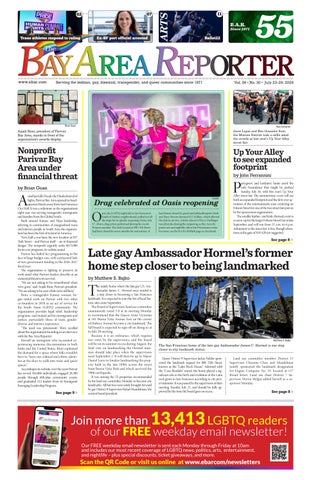
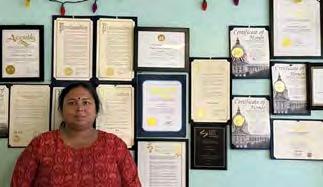
Anjali Rimi, president of Parivar Bay Area, stands in front of the organization’s awards display.
Gerharter
by Brian Guan
Parents of trans kids and youth themselves are speaking out after the U.S. Supreme Court’s recent decision upholding state bans in Idaho and West Virginia against transgender female athletes playing on women’s and girls’ sports teams. The ruling, which came on the last day of Pride Month, determined that such bans do not constitute a violation of Title IX, which dictates that federally-funded schools cannot discriminate on the basis of sex.
While allowing for state bans, the June 30 decision does not require states to ban trans athletes from participating in women’s and girls’ sports.
California has long enshrined the rights of trans students to participate in sports under Assembly Bill 1266, which requires public schools to allow students to participate in sex-segregated activities under the gender with which they identify. It was introduced by gay former assemblymember Tom Ammiano (D-San Francisco) and signed by then-governor Jerry Brown. The law took effect in 2013.
Yet in the wake of the Supreme Court’s decision, families of trans athletes across the Bay Area are worried about the state of trans inclusion in sports in California and beyond.
In a phone interview with the Bay Area Reporter, Calder Storm, a trans man and the parent of a trans athlete, described his reaction as, “in a word, horrified.” Storm is involved with Rainbow Families Action, a community of parents of trans and genderexpansive youth.
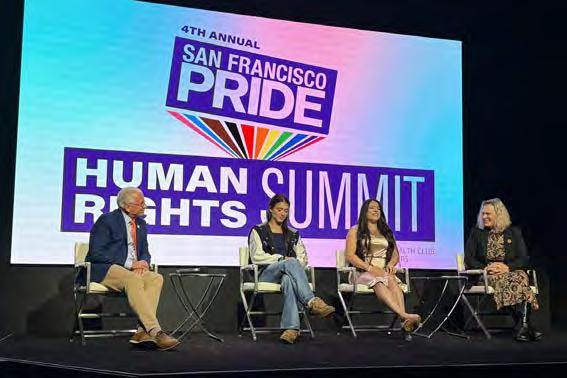
athlete at San Francisco Pride’s Human Rights Summit last month.
This year, she won the girls high jump and triple jump at the late May state finals.
She spoke about being scrutinized for her athletic participation.
“The media doesn’t see a person; they just see a story,” Hernandez said.
For Storm, a notable issue with the Supreme Court’s ruling was the court’s adoption of language used by conservatives. Storm referred to the court’s use of the term “biological male” in discussing trans women and girls, which he affirms is not a “real scientific or medical term.”
theories of inherent athletic advantages for transgender women.”
For one Bay Area mother of a high school transgender athlete, who requested to remain anonymous for her child’s safety and declined to state her sexuality, the Supreme Court decision was disheartening but not surprising, she told the B.A.R. in a call.
“I can’t say disappointed, because that would imply that I was expecting something different,” said the parent on her reaction to the ruling, “and I can’t honestly say I was.”
“These are trans children,” Storm said. “They’re just trying to participate in the same experiences offered to their cis peers. And having running public discord, and now a SCOTUS ruling, it’s causing active harm to these children.”
Whether you’re new to the area or have been here for years, this workshop is designed to help you navigate the complexities of
What to Expect:
Bilingual Presentation: The presentation and materials will be provided in both English and Spanish.
The issue of trans inclusion in student sports has become a prominent point of focus within conservative politics. President Donald Trump signed Executive Order 14201 in February 2025, titled “Keeping Men Out of Women’s Sports,” attempting to utilize Title IX to ban trans athletes at federally funded schools from playing in sports.
Some conservative attention has fallen on trans competitors in California, where trans athletes in public schools are allowed to compete.
As AB Hernandez, a trans teen and then-high school track athlete, approached her competition in California’s 2025 track and field championships, Trump threatened to withhold “large scale Federal Funding” in a post on Truth Social, as the B.A.R. previously noted.
Hernandez, who graduated this year, described her experience as a trans
Storm stated that gender-affirming care, such as hormone replacement therapy, changes a trans person’s dominant sex hormone, physical secondary sex characteristics, and more.
“The media makes it sound as if the Incredible Hulk is trying to play on a girl’s … rec soccer team,” he said.
“They’re trying to make it as if someone who is actually a man is trying to invade a woman’s space.”
Storm described his daughter, an athlete, as “frail” and “built like a bird,” noting a lack of inherent guarantee that trans women automatically will be successful at sports.
“Trans people are not a monolith,” Storm said, “and trans children are not a monolith.”
There is still a lack of scientific consensus from researchers on if trans women may hold advantages in competitive sports, which the New York Times attributed in January to diversity in sports categories and athletes’ experiences with transitioning.
A meta-analysis published in the British Journal of Sports Medicine in February found that current evidence across multiple studies, while varied and “mostly low certainty,” failed to “support
The parent said that “the situation in California is complicated.” She expressed gratitude for legislation protective of trans athletes while also describing federal attacks on the state in regard to its protections.
Particularly troubling for the mother was the pilot entry process set forth by the California Interscholastic Federation in 2025 before Hernandez’s competition that year, as conservative backlash regarding the championships increased. The process allowed more cisgender female athletes to compete in the championships, given the participation of transgender athletes.
“The CIF values all of our studentathletes and we will continue to uphold our mission of providing students with the opportunity to belong, connect, and compete while complying with California law and Education Code,” stated the CIF upon the process’s release in 2025. The organization described the process as achieving “the participation opportunities we seek to afford our studentathletes.”
CIF again instated the process during the 2026 track and field season, as KQED reported in May.
On-site Support: Limited, one-on-one tenant counseling will be available after the presentation. Legal Resources: Schedule appointments for
Trans teen AB Hernandez, second from left, participated in a panel on trans sports inclusion at the SF Pride Human Rights Summit.
Volume 56, Number 30
Volume 56, Number XX
July 23-29, 2026
Month XX-XX, 2026 www.ebar.com
PUBLISHER
Michael M. Yamashita
Thomas E. Horn, Publisher Emeritus (2013)
Publisher (2003 – 2013)
Bob Ross, Founder (1971 – 2003)
NEWS EDITOR
Cynthia Laird
ARTS & NIGHTLIFE EDITOR
Jim Provenzano
ASSISTANT EDITORS
Matthew S. Bajko • John Ferrannini
CONTRIBUTING WRITERS
Trump’s push undermines democracy
President Donald Trump, the sore loser after being defeated in the 2020 election, is trying to scare Americans into staying home for the midterm elections this November 3. With his constant lies that the 2020 election was “rigged” – while he was president at the time, no less – Trump’s baseless claims aim to undermine democracy, and, make no mistake, they will increase in frequency as the midterms approach. Trump wants Congress to pass the Safeguard American Voter Eligibility, or SAVE America Act, which is nothing more than a voter suppression bill, as U.S. Senator Alex Padilla (D-California) said during his remarks at the Alice B. Toklas LGBTQ Democratic Club’s Pride Breakfast in San Francisco last month. The bill would require voters to present in-person proof of citizenship, like a birth certificate or U.S. passport.
“He cited selectively declassified documents to make sensational claims about vulnerabilities of the election system, although nothing he revealed proved any outcomes were actually changed.
“The exercise underscored how much Mr. Trump in his second term has come to be obsessed with relitigating the 2020 election and finding ways to cast doubt on the 2026 election,” Baker continued. “In the 18 months since he returned to office, he has installed election deniers in key positions, sought to change the rules to make it harder to cast ballots, seized voting records in a bid to prove his conspiracy theories, and purged officials who investigated his efforts to overturn his election defeat six years ago.”
“This decision protects the fundamental principle that people should not lose their right to vote because of mail delays outside their control,” stated a coalition that brought the case, which includes the American Civil Liberties Union. “The Court recognized what states, Congress, and voters have understood for generations: federal law does not require states to discard timely-cast ballots simply because they arrive after Election Day.”
California has a similar law.
Kyle Amato • Race Bannon • Robert Brokl
Christopher J. Beale • Robert Brokl
Christopher J. Beale • Brian Bromberger
Brian Bromberger • Philip Campbell
Heather Cassell • Eliot Faine
Philip Campbell • Myron Caringal
Meg Collins • Chelsea Davis
Michael Flanagan • Jim Gladstone
Natasha Dennerstein • Eliot Faine
Liz Highleyman • Brandon Judell • Lisa Keen
Philip Mayard • Laura Moreno
George Faville • Michael Flanagan
Jim Gladstone • Brian Guan • Liz Highleyman
David-Elijah Nahmod • Mark William Norby
JL Odom • Paul Parish • Tim Pfaff
Brandon Judell • Michele Karlsberg • Lisa Keen
Jim Piechota • Adam Sandel
Matthew Kennedy • Philip Mayard
Jim McDermott • Laura Moreno
Jason Serinus • Gregg Shapiro
David-Elijah Nahmod • Mark William Norby
Gwendolyn Smith • Charlie Wagner
JL Odom • Lois Pearlman • Tim Pfaff
Ed Walsh • Cornelius Washington • Sura Wood
Jim Piechota • Joshua Polanski • Adam Sandel
Gregg Shapiro • Gwendolyn Smith
ART DIRECTION
Charlie Wagner • Ed Walsh
Max Leger
Cornelius Washington • Evelyn C. White
PRODUCTION/DESIGN
Ernesto Sopprani
ART DIRECTION
Max Leger
PHOTOGRAPHERS
Jane Philomen Cleland
PRODUCTION/DESIGN
Rick Gerharter • Gooch
Ernesto Sopprani
Jose A. Guzman-Colon
PHOTOGRAPHERS
Rudy K. Lawidjaja • Georg Lester
Jane Philomen Cleland
Rich Stadtmiller • Christopher Robledo
Rick Gerharter • Gooch
Fred Rowe • Shot in the City
Steven Underhill • Bill Wilson
Jose A. Guzman-Colon
Rudy K. Lawidjaja • Georg Lester
ILLUSTRATORS & CARTOONISTS
Rich Stadtmiller • Christopher Robledo
Christine Smith
Fred Rowe • Shot in the City
Steven Underhill • Bill Wilson
ILLUSTRATORS & CARTOONISTS
VICE PRESIDENT OF ADVERTISING
Christine Smith
Scott Wazlowski – 415.829.8937
VICE PRESIDENT OF ADVERTISING
NATIONAL ADVERTISING REPRESENTATIVE
Scott Wazlowski – 415.829.8937
Rivendell Media – 212.242.6863
LEGAL COUNSEL
Paul H. Melbostad, Esq.
NATIONAL ADVERTISING REPRESENTATIVE
Rivendell Media – 212.242.6863
LEGAL COUNSEL
Paul H. Melbostad, Esq.
Bay area reporter
Because of this, as Padilla pointed out, the SAVE Act is an attack on trans rights. That’s because the bill could block trans people from voting if their legal names and gender markers differ from their birth certificate or passport. Last year, the U.S. Supreme Court rendered a decision that new passports issued by the State Department will show a person’s sex assigned at birth, rather than their gender identity, as Lambda Legal Defense and Education Fund noted. There will not be a choice of an “X” gender marker. This applies to new passport applications, renewals, and replacements for lost or damaged passports. This may cause delays with pending passport applications, Lambda Legal pointed out. These new restrictive policies are now in place at the State Department.
Just one example of this is evident in Trump’s appointees. When grilled by congressional Democrats during hearings, none could say that Joe Biden won the 2020 presidential election. If it weren’t so serious, it’d be comical to see these powerful people squirm and make word salads instead of answering the question with a simple “Yes, Biden won.” Last week, Jay Clayton, Trump’s nominee to be director of national intelligence, was asked by Senator Jon Ossoff (DGeorgia), “Who won the 2020 election?” Responded Clayton, “I’m not going to do this with you.” While Clayton eventually said that Biden was certified the winner of the 2020 election, he would not say that Biden won the election.
Following Trump’s speech, California Secretary of State Shirley Weber, Ph.D., (D) issued a statement rebuking the president. “Despite President Trump’s repeated and thoroughly debunked claims, the 2020 election was free, fair, and secure. Courts across the country, including judges he appointed, rejected allegations of widespread election fraud,” Weber stated.
The SAVE Act does not currently have the votes in Congress to pass, which is infuriating Trump. So last week, he delivered an address from the White House to once again pontificate on his obsession with the 2020 election. In so doing, he’s sowing the seeds to justify that if the Republicans lose control of the U.S. House and/or Senate in November, the midterms will be “rigged” too.
“Mr. Trump’s prime-time speech from the East Room of the White House was an astonishing spectacle featuring a president intent on persuading the country that its elections cannot be trusted, at least not the ones where he or his allies fall short,” observed the New York Times’ Peter Baker.
Trump has long sought to disparage voting by mail, even though he votes that way. Indeed, mail-in voting has increased in recent years because it’s an easy way for voters to participate. Trump should be singing the praises of mail-in voting, as many older voters use it. But he has consistently cast doubt on the practice, which may be good news for Democrats if MAGA Republicans shun it and stay home this year. That’s the disconnect here: mail-in ballots are good enough for Trump, but he doesn’t want others to vote that way. We’re speculating it’s because those ballots take a little longer to count, and to Trump, if ballots aren’t counted on election night, they’re fraudulent. Trump has a narrow – and wrong – worldview of many things, but his views on voting may be the most dangerous to democracy. The U.S. Supreme Court disagreed with Trump, ruling 5-4 on June 29 in a case out of Mississippi that permits voters’ ballots that are cast on time to be counted after Election Day according to state law.
Department of Homeland Security Secretary Markwayne Mullin sent letters to four secretaries of state, including Weber, after Trump said in his speech that DHS had identified 250,000 non-citizens illegally registered to vote in four states. In the letter, Mullin claims that there may be as many as 190,832 non-citizens registered to vote in the Golden State. Weber stated that once her office receives the letter, staff will review DHS’ methodology. “However, the information provided during the president’s remarks, and on the White House website, do not inspire any level of confidence in the methodology used or the conclusions reached,” Weber noted.
We understand her skepticism. It’s hard to believe anything coming out of the Trump administration because the president and his appointees just make things up to fit whatever Trump believes. As Weber noted, “If the president is truly committed to election integrity, he must stop undermining confidence in our democracy, making it harder for eligible Americans to vote, and attempting to seize authority that the Constitution clearly reserves for the states.”
It’s crucial that LGBTQ voters not be persuaded by Trump’s nonsense. Whether here in California or in other states, it’s critical that we exercise our right to vote this November. Don’t fall for Republican shenanigans, whether from Trump or any of his lackeys. Elections in this country are secure and can be trusted. Free elections provide the bedrock for a democracy, and any effort to undermine them puts the U.S. on a dangerous path. t
California bill restricting social media access would harm LGBTQ+ youth
by Shae Gardner
For many LGBTQ+ youth, online spaces are where community begins. They are often where a young person first encounters language for what they are feeling, sees someone like themselves living a full life, finds affirming information that may be unavailable at home or at school, and connects with peers who make them feel less alone.
Beyond LGBTQ+ youth, the internet ban could be very detrimental to children and teens who face discrimination, suffer from learning disabilities, live in geographically-isolated communities, or want to be part of an interest-based community such as sports, music, or science. Youth will be deprived of valuable opportunities to explore, discover, and educate themselves.
44 Gough Street, Suite 302 San Francisco, CA 94103
Bay area reporter
415.861.5019 • www.ebar.com
44 Gough Street, Suite 302 San Francisco, CA 94103
Published weekly. Bay Area Reporter reserves the right to edit or reject any advertisement which the publisher believes is in poor taste or which advertises illegal items which might result in legal action against Bay Area Reporter. Ads will not be rejected solely on the basis of politics, philosophy, religion, race, age, or sexual orientation.
This makes California’s proposed Assembly Bill 1709 so troubling. The bill prohibits social media platforms with “addictive features” from allowing children under 16 to create or maintain accounts. According to Assemblymember Josh Lowenthal (D-Long Beach), the bill’s author, addictive features are defined as psychologically exploitative interfaces that are intended to maximize engagement and encourage compulsive use. These design features include, but are not limited to, notifications, addictive feeds, endless scrolls, autoplay, and any feature that learns from user information or behavior to prolong engagement.
In trying to respond to real concerns about youth online safety, however, the bill takes a broad and deeply restrictive approach that would do measurable harm to the very young people policymakers should be trying to protect.
Some LGBTQ advocates are concerned that Assembly Bill 1709, which would prohibit social media companies with “addictive features” from allowing children under 16 to create or manage accounts, would harm young LGBTQ people.
an under-16 social media ban through the legislative process without grappling seriously with its real-life consequences.
AB 1709 is the wrong approach and does not provide a flexible solution to address risks that may result from social media and online channels. It simply bans everything, including the good. Rather than falling victim to the most restrictive and destructive policy, the state should develop a program that will target risk areas, require social media companies to provide a proven digital literacy and safety program for parents to manage social media access, and adopt requirements that will work within a changing technology environment instead of attempting to change the terms of access.
Published weekly. Bay Area Reporter reserves the right to edit or reject any advertisement which the publisher believes is in poor taste or which advertises illegal items which might result in legal action against Bay Area Reporter. Ads will not be rejected solely on the basis of politics, philosophy, religion, race, age, or sexual orientation.
Advertising rates available upon request.
Advertising rates available upon request.
Our list of subscribers and advertisers is confidential and is not sold. The sexual orientation of advertisers, photographers, and writers published herein is neither inferred nor implied. We are not responsible for unsolicited manuscripts or artwork.
Our list of subscribers and advertisers is confidential and is not sold. The sexual orientation of advertisers, photographers, and writers published herein is neither inferred nor implied. We are not responsible for unsolicited manuscripts or artwork.
Any serious conversation about youth online safety must begin with honesty about the risks. Online platforms can and do expose young people to harassment, misinformation, doxxing, predatory behavior, and serious content moderation failures. LGBTQ+ youth experience those harms at disproportionate rates. Transgender youth, LGBTQ+ youth of color, and youth in non-affirming homes often carry the highest burden.
However, acknowledging those harms is not the same thing as accepting exclusion as the solution. There is too much at stake for policymakers to rush
A ban will fundamentally change interactions that LGBTQ+ youth have with family, friends, and acquaintances, as well as people that are part of an online community. These online communities provide access to peer support, affirming role models, and critical mental health resources that may be entirely unavailable in their physical surroundings. Banning internet and social media access doesn’t just limit screen time; it strips these young people of the connections and information that can be life-saving. LGBTQ+ children and teens in California will be denied the ability to have positive experiences, life-changing interactions, and tremendous learning opportunities about their identity.
The ban is a blunt and ineffective instrument meant to prohibit. California’s LGBTQ+ youth need protections that will allow them to navigate technology in a positive and productive manner, not bans that impose consequences and deficiencies on our future generation. t
Shae Gardner (she/her) is the director of policy and research at LGBT Tech, a national nonprofit working at the intersection of LGBTQ+ rights and technology.
A lesbian, she is a longtime advocate for her community’s right to digital safety, privacy, and equitable access, with over a decade of experience in industry research and policy, and works to elevate the needs of LGBTQ+ youth and adults alike in national and state-level conversations on tech regulation and digital infrastructure.
Pexels
Headline
Out Bay Area city councilmembers launch reelection bids
by Matthew S. Bajko
Ahead of the upcoming August 7 filing deadline for candidates interested in running for local city council seats and other elected positions, several out Bay Area city councilmembers have already launched their bids for reelection. Some are hopeful they will be unopposed this year and are watching to see if anyone decides to challenge them next month.
Sunnyvale City Councilmember Richard Mehlinger, who is queer and bisexual, kicked off his reelection bid July 19 at his city’s Murphy Park. He is running for a second four-year term in his District 5 council seat and reported having raised more than $23,200 so far this year, which includes $3,900 he loaned to his campaign.
The longtime advocate for bicycle and pedestrian safety made news last summer after he was injured by a car driver who hit him while biking home. As the software engineer had told the Bay Area Reporter at the time, he broke his left thumb and right wrist in the accident and had to have casts on both his hands for several months as he healed.
As of Tuesday, no one had filed to run against him for his seat. It is one of three odd-numbered council districts on the ballot this fall in the South Bay city. (The other out member of the governing body, queer District 2 City Councilmember Alysa Cisneros, is not up for reelection until 2028.)
“I am very proud of the achievements I have accomplished in my first time and definitely am looking forward to November,” Mehlinger, currently serving as vice mayor, told the B.A.R. this week, adding when asked if he expects to face an opponent, “I really have no idea.”
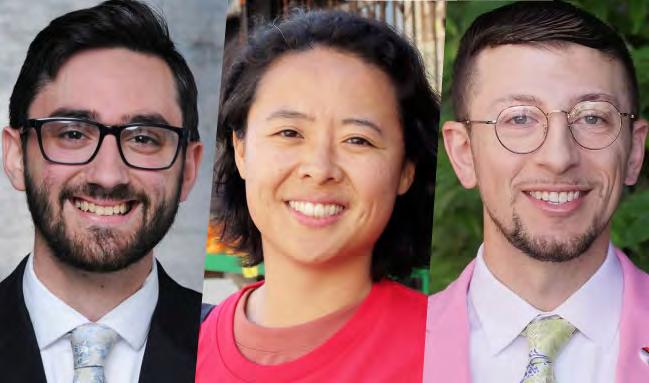
James Aguilar, left, Charlene Wang, and Chris Sturken are seeking reelection to their city council seats in San Leandro, Oakland, and Redwood City, respectively.
gay District 2 City Councilmember James Aguilar is looking at officially launching his campaign to keep his seat next month. The former school board member was appointed earlier this year to fill the vacancy created when Bryan Azevedo resigned after pleading guilty to wire fraud and lying to the FBI as part of its wide-ranging corruption probe of elected officials across Alameda County.
Aguilar, who took his oath of office April 6, will be running to serve out the remainder of his term through 2028. Last summer, due to being hired as San Lorenzo High School’s activities director and a leadership teacher at the school, Aguilar had resigned from the San Leandro Unified School District Board of Education.
a full four-year term this year. She had won a special election in 2025 to serve out the remainder of the term vacated by Nikki Fortunato Bas due to her election the November prior to the Alameda County Board of Supervisors.
He said his campaign kickoff event “went very well” and that he wanted to hold it now since “we are really entering the heart of campaign season now.”
Other council candidates had already held their kickoffs earlier in the year, noted Mehlinger, who will still be on the November 3 ballot even if he faces no opposition for his seat.
“I am really looking forward to the campaign. I hope to earn another four years on the city council and earn the confidence of the voters,” said Mehlinger.
On the Peninsula gay Redwood City District 2 City Councilmember Chris Sturken recently jumped fully clothed into a pool due to having met his goal of netting $10,000 for his campaign coffers. In a July 13 post to his Instagram account, Sturken noted he “took the leap!” and thanked “everyone who believed in me and supported me.”
As the Political Notebook column had reported in April, Sturken launched his reelection bid for a second term early in hopes of being uncontested this year. He announced a host of local officials who had early endorsed his candidacy, including Mehlinger, and planned to ramp up his communication with his constituents on why he deserves another four years helping to lead the San Mateo County city.
As of Tuesday, Sturken was listed as the sole person to have filed to seek his council seat. He is currently the lone LGBTQ community leader on his governing body.
“I always say that I am a ‘conduit for the community’ to be heard and for them to make change for the better,” he wrote in his recent Instagram post. “I realized in the past week that what I represent to people is hope. It’s hope for the future of Redwood City and for the world. While I am not the source of hope, my job is to create hope for the community and to bring people’s hopes to a reality.”
In the East Bay city of San Leandro,
Speaking to the B.A.R. this week, Aguilar said his focus of late has been on teaching at a summer camp and laying to rest his father, who died unexpectedly June 20. He is starting to rollout endorsements for his council candidacy and looking at hosting a kickoff event in mid-August.
To date, Aguilar is the only person to file to seek the truncated term. He told the B.A.R. he doubts anyone else will do so but is waiting to see what happens when the filing window closes.
“I am not expecting anybody. As a matter of fact, one of the former council members who applied for this seat, Ed Hernandez, endorsed me. I am happy to have his support,” said Aguilar, who will appear on the ballot even if unopposed for his seat. “I have grown to really love this job.”
He may be the lone out member of his council come December, as gay District 3 City Councilmember Victor Aguilar Jr., no relation, will be cycling off the governing body later this year after first being elected to it in 2018. He fell short in the June 2 primary race for an open U.S. House seat and days later endorsed Joseph Trujillo to succeed him on the city council.
“Joseph is the right person to continue the legacy of progressive leadership in our community. His vision to get San Leandro back on track by investing in roads, infrastructure, local jobs, and economic growth is exactly the kind of forward-thinking leadership our city needs,” wrote Aguilar Jr. in a June 17 post on Facebook.
Two out women on the Oakland City Council are seeking reelection this fall. Queer Oakland City Councilmember Janani Ramachandran who has a toddler with partner Osagie Edebiri, is running for a second term having won election to her District 4 seat four years ago. (As the Political Notebook recently noted, she and James Aguilar are among the few Bay Area candidates to have been endorsed so far this year by the LGBTQ+ Victory Fund.)
Lesbian District 2 City Councilmember Charlene Wang is seeking
Ramachandran and Wang serve alongside queer at-large City Councilmember Rowena Brown, whose term runs through 2028. According to the city’s election webpage, two people have submitted papers to challenge Wang for her seat centered around Oakland’s Lake Merritt.
One person has filed to run against Ramachandran, who last year had kicked up her fundraising efforts to retain her seat covering several Oakland hills neighborhoods. She has yet to report on her 2026 campaign finances.
Wang held several fundraising events for her reelection bid last month ahead of the June 30 reporting deadline for the first half of the year but has yet to disclose what she has raised so far. The first pre-election financial reports for local candidates are due September 24.
“When I first ran for City Council, I heard the same thing over and over from neighbors: People are tired of excuses,” noted Wang in an emailed invite to her Pride Month events. “They want safer streets. Cleaner sidewalks. Faster emergency response. A city government that actually follows through. That’s why I ran and it’s why I’m running for reelection.”
Down ballot Marguerite Young, a lesbian who serves on the East Bay Municipal Utility District board, will be seeking another term in her Ward 3 seat. She filed her paperwork to run for reelection last week, and so far retired EBMUD engineer Donald Gray also has pulled papers to seek the seat covering Orinda, El Sobrante, Moraga, Piedmont and portions of Oakland, Pinole and Richmond.
“The promises I made when first elected hold true today. Protect our Water Source, Lead on Climate, Water for everyone, and Replace our aging infrastructure. We’ve made so much progress on all of these, and there’s still more to do,” noted Young in a Facebook post about kicking off her 2026 campaign.
Are you looking for a spiritual experience as unique as you?
Come and see Dignity/SF, which affirms and supports LGBTQ+ folks. Catholic liturgy Sundays at 5pm, 1329 7th Avenue (Immediately off the N Judah line)
dignity | san francisco
Come for the service and stay for the fellowship. dignitysf@gmail.com for more details Instagram @dignitysanfrancisco † Facebook @DignitySF
Also pulling papers to seek reelection is bisexual EBMUD board member Andy Katz. His Ward 4 seat covers El Cerrito, Kensington, Albany, Berkeley, Emeryville, and a portion of Oakland. According to Alameda County’s registrar, he is the only person to have done so as of Tuesday.
Katz and Young serve alongside gay EBMUD Ward 5 board member Jim Oddie, whose term is not up until 2028. t
DEADLINES: Friday 12 noon for space reservations Monday 12 noon for copy & images
TO PLACE: Call 415 829 8937 or email us at advertising@ebar.com
Obituaries of 200-words or less are FREE to place. Please email obituary@ebar.com for more information.
Courtesy the candidates
Creep
by Gwendolyn Ann Smith
Anti-trans bigots like to imagine themselves as a literal white knight, fighting for the purity and innocence of women and girls. Every argument against transgender rights seems to stem from this one thing.
The recent U.S. Supreme Court decisions in Little v. Hecox and West Virginia v. BPJ that stripped both Title IX rights and the equal protection clause from transgender athletes? This comes out of the idea that trans women are somehow pretending to be men to steal wins from women. The facts don’t bear this out.
Now that this victory is notched on each bigot’s bedpost, they have of course moved on, not only continuing to fight against trans rights, but attacking women’s sports overall. The ink wasn’t even dry on the decisions before Heritage Foundation Senior Fellow Scott Yenor, Ph.D., decid ed to argue that Title IX needs to be rewritten. Not to “protect” against trans gender people, but to halt equality between men’s and women’s sports programs in universities that receive federal funding.
the partly natural, partly cultural differences between the sexes can sustain vibrant women’s sports, protect and perhaps expand male opportunities, and contribute to a healthier, more humane social order.”
So, apparently, the real victims here are men.
Like with sports, issues around transgender people – specifically transgender women – in bathrooms were always predicated on a falsehood, and designed not only to create restrictions on transgender people existing in society, but also to pave the way for restrictions on everyone.
We were sold this notion of “safety” for women and girls, to prevent them from being assaulted, conveniently forgetting that we already have laws that prohibit sexual assault by anyone of any gender.
To Yenor, equality under Title IX “requires opportunity rooted in human nature that will reveal genuine differences between the sexes. Recovering an approach that accommodates
As a slight aside, there’s an interesting linguistic quirk that anti-trans bigots use when arguing about transgender people, whether it is in sports, or in bathrooms, or, seemingly anywhere.
They’ll say it is about “men in women’s sports” or “men in women’s bathrooms,” but they’ll keep the meaning of this unclear.
Sometimes, they are talking about non-transgender men dressing up as women to be able to creep on women and girls – but they are also
saying that they view transgender women as men, and we’re the actual predators in that scenario. Like a twisted quantum superimposition, the definitions shift depending on the audience.
This belief that they are “protecting women and girls” applies even to transgender men.
The argument so often presented is that they are trying to protect vulnerable young women (sic) from being lured into a “transgender lifestyle” and making irreversible changes to their bodies. As if, of course, people are seduced into this and cannot make their own decisions in life.
They want you to believe this is about “protecting women,” but really women are, at best, an afterthought to them. Otherwise, the focus would
be on, oh, untested rape kits, pedophiles in high office, sexual assault and domestic violence protections, or, you know, other actual things that harm women and girls.
Meanwhile, trans women are treated as boogeymen, while the real creeps get away with it. Everyone is looking the wrong way. As I already noted above, they are indeed making strong inroads. The loss of Title IX protections for transgender people will neither stop with sports, nor will it end with Title IX.
It’s very likely, as I see it, that transgender people may well lose any legal rights for housing, employment, and so on. I do not think that is 100% assured, but I do feel like the dominoes are teetering.
You see, equality is not a spectrum. It is all or nothing. The moment you start choosing where the line is between who is equal and who isn’t, it all quickly falls apart.
If we should not be allowed to participate in sports with others of our gender – and mind you, this isn’t just about high-level competitive sports, but casual physical education sports in elementary school, with young transgender girls who haven’t even started puberty – then this can be extended to other areas of school life. This is where a restroom ban can easily start, beginning with grade schools, then quickly being legislated into adulthood.
Maybe, then, lawmakers decide that certain medications only be-
long to one gender or another, or some medical services are barred, or that trans women should not be in “traditionally” women’s employment fields, or vice versa.
In a just world, the erosion of transgender rights should be enough to demand change. Sadly, if we were in a just world, we would not be in this fight in the first place. Transgender people want to live their lives as equal citizens.
So, let’s consider this: much like the Heritage Foundation trying to weaken Title IX for women, maybe these Supreme Court rulings start to pull back women’s rights. If transgender women are somehow “naturally” too much stronger than their non-transgender counterparts – because the law sees them as men – then women should not be equal to any men.
Or let’s say that someone argues for racial segregation in sports next, arguing that some races are inherently stronger than others. It would surely not be the first time such an abhorrent argument has been used.
You can see how this sort of argument can just continue to creep forward: you thought this was just about transgender sports stars, but it is so much more.
This creep – and these creeps –needs to be stopped. t
Gwen Smith will not reference that Radiohead song. You can find her at www.gwensmith.com.
Newsom appoints Goodall to state workforce board
compiled by Cynthia Laird
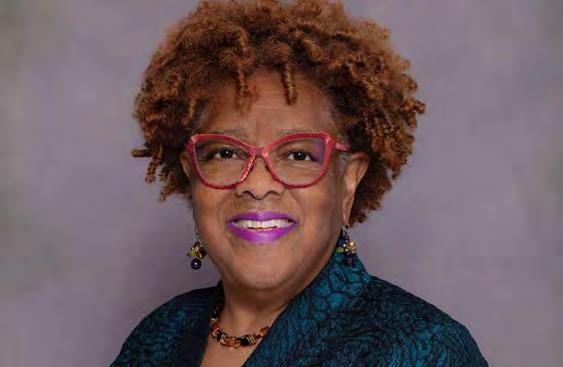
California Governor Gavin Newsom has appointed Brendalynn Goodall, a Black Oakland lesbian, to the California Workforce Development Board. Newsom made the announcement July 14, along with other appointments to state panels.
Goodall was the summer jobs program coordinator in then Oakland mayor Jean Quan’s office from 20122014, according to the governor’s announcement. She also served as the division manager for Aging and Adult Services for Oakland’s Health Services Department from 2002-2011. According to the workforce de-
velopment board’s website, it works with employers, local workforce development boards, education partners, community organizations, labor unions, and workers statewide to increase quality job opportunities for all Californians.
Goodall was appointed by Newsom in 2020 to serve on the California Commission on Aging, where she’s currently on the executive committee, according to its website. As it happens, that was one of the reasons for her new appointment.
“I’m honored to share that, as a California Commission on Aging commissioner, I have been appointed to the California Workforce Development Board as a result of the California Commission on Aging’s sponsored legislation, Assembly Bill 2207, which ensures representation of older adults on state advisory bodies,” Goodall wrote in an email response.
The bill was passed in 2024 and signed into law by Newsom. It adds older adult representation to several state advisory bodies, including the workforce development board.
Goodall stated that she hopes to impart her experience on the panel.
“I am grateful for the opportunity to serve and look forward to bringing my experience and per spective to workforce development discussions, helping ensure that the needs, contributions, and potential of older adults are reflected in California’s workforce policies and initiatives,” she stated. “I’m ready to serve and to advocate for inclu sive workforce opportunities that recognize the value of older adults at every stage of life.”
Horizons opens RFPs for nonprofit grants
Horizons Foundation has announced that the request for proposal process is now open for its flagship Community Issues funding program. The grants are awarded to LGBTQ nonprofits and programs in the nine-county San Francisco Bay Area region.
Goodall earned a master’s degree in social work from San Francisco State University, and a bachelor’s degree in psychology from California State University, East Bay.
The workforce development board appointment does not require state Senate confirmation, and the compensation is $100 per diem, according to Newsom’s announcement.
According to an email announcement, Horizons expects to award substantially more funding through Community Issues this year.
“We are committing additional resources to respond to two critical and interconnected realities that persist: the sharp decreases in funding from federal, state, county, and city sources, and the growing strain on LGBTQ organizations and programs caused by the current presidential administration and escalating anti-LGBTQ sentiment nationwide,” stated Francisco O. Buchting, Ph.D., vice president of grantmaking, programs, and communications at Horizons.
Key changes this year include lifting the $1 million annual budget cap eligibility. The grant program will accept applications from LGBTQ-pri-
mary agencies of any organizational budget size. Horizons will continue to accept applications from LGBTQfocused programs that have annual budgets of $1 million or less from non-LGBTQ-primary organizations, it stated. The applicant must demonstrate that it serves a specific area in the nine-county Bay Area region where LGBTQ-primary organizations do not provide sufficient, comparable services or reach a specific LGBTQ population, the announcement noted.
Additionally, Community Issues has expanded its priorities beyond the current focus on specific populations and organization types, the announcement noted. The shift enables the funding to support a more ecosystem-wide strategy that encompasses a broader and more integrated range of LGBTQ organizations across four interconnected areas: arts, health and wellness, community building, and advocacy.
Also new this year is the addition of a letter of interest to the application process. This is the first step and is now open, with letters due by Wednesday, August 5, at noon. Selected organizations will then be invited to submit a full application, according to the announcement.
For more information, visit horizonsfoundation.org. t
Brendalynn Goodall was appointed to the California Workforce Development Board.
From Facebook
Christine Smith
Chen and Melgar were joined by District 5 Supervisor Bilal Mahmood in advancing the landmarks forward with positive recommendations. Prior to the land use committee meeting, the San Francisco Historic Preservation Commission in the spring had voted in support of landmarking the nearly twodozen properties.
Several supervisors this year have brought forward sites in their districts they want to see become local landmarks to help protect them from being demolished and replaced with infill housing developments. It comes after the mayor and the board upzoned neighborhoods across the city to make it easier for developers to build multi-unit housing projects.
Afforded some protection
Now the supervisors are racing to preserve those sites they consider worthy of receiving landmark status. Doing so affords the structures some protection, such as a requirement that their facades be preserved. Any development proposed for the sites also requires closer scrutiny by the city’s planning department and oversight bodies.
The Hormel mansion was the only one directly related to LGBTQ history
The mother described the CIF’s policy as “different rules for some girls and other girls.” She added, “It falls on these kids and their families to push back on that.”
In the wake of the Supreme Court ruling, the mother said she expects to see “a lot of anti-trans pressure on school boards, particularly to try to put forward resolutions that are harmful to trans kids.”
And while most conversation revolves around trans female athletes in competi-
“Elaine Forbes has devoted much of her life to public service and is widely respected by the many people who have worked with her over the years,” he stated.
Forbes was the director of finance for the San Francisco Planning Department from 2006-2010, and the chief financial officer of the port from 2010-2016. Former mayor London Breed appointed
page 1
Folsom Street Executive Director Angel Adeyoha, who is queer and nonbinary, said in a phone interview that the reason for the expanded footprint was to make the fair safer. The entrance gate will now be on Eighth Street instead of Ninth Street, as in the past.
Regularly centering on Dore Alley, the fair boundary is between Howard Street on the north, Harrison Street on the south, Eighth Street on the west and 11th Street on the east.
“Part of the push to expand was there was some concern from the [San Francisco] Fire Department about our density, and part of the reason the density works the way it does is everybody gravitates toward the entertainment and the music,” Adeyoha said.
To thin things out further, Adeyoha said this year there will be two stages of music and entertainment on opposite ends of Ninth Street.
“We’re adding stages to highlight different parts of our community,” Adeyoha said, noting that there will be a wrestling and drag stage on Ninth Street between Howard and Folsom streets hosted by Oasis, the recently-reopened LGBTQ nightclub at 298 11th Street, and another stage on Ninth between Folsom and Harrison streets, hosted by
taken up at land use Monday. As the Bay Area Reporter had noted earlier this year when Mandelman initiated the landmark request for it, Hormel purchased the home in 1986 and lived there for 26 years, according to the Citywide Historic Context Statement for LGBTQ History in San Francisco.
The heir to the Hormel meatpacking fortune, Hormel became a prominent philanthropist who helped launch such LGBTQ organizations as the Human Rights Campaign and the James C. Hormel LGBTQIA Center housed at the San Francisco Public Library’s main branch. He made international headlines in 1997 when then-President Bill Clinton nominated Hormel to be the country’s ambassador to Luxembourg, and thus, the first out LGBTQ person to serve in such a role.
It sparked immediate opposition from Senate Republicans and conservative Christians, prompting Clinton to use his recess appointment powers to install Hormel into the diplomatic position in 1999. Hormel would serve as ambassador to the small European country until 2001. He died of natural causes at the age of 88 in the summer of 2021, as the B.A.R. reported at the time.
When Hormel lived in the sixbedroom, five-bathroom mansion, it sported a pink paint job. He sold it in 2012 for $7.2 million to tech executive Robert Mee and his wife, who repainted
tive environments, for her child, a trans male athlete who similarly asked not to be named, controversy around trans athletes detrimentally affects trans men, too.
“I feel like trans female athletes are characterized as taking advantage of women’s sports and being either predators,” he said in a call. On the other hand, he described how “trans men are just talked about as women in sports, with little acknowledgement given to their gender identities.”
For him, both are “negative depictions.”
Another parent of a high school trans athlete, a straight ally who also requested anonymity, described CIF’s overall rules
Forbes executive director of the port in 2016, according to her LinkedIn, which hasn’t been updated since she left the role of executive director of the port last year.
During her port leadership, she helped bring to fruition a new seawall to create ecologically-friendly surfaces as the port adapts to climate changerelated sea-level rise.
A San Francisco resident, Forbes was hired May 5 by the Sausalito City Council to be its new city manager. She started in the job at the beginning of the month,
the four-story, nearly 9,300 square foot single-family residence in a white coat.
When the couple sought city approvals to renovate the property and add a roughly 325 square foot addition in 2013, a city planning report noted it was deemed to be a historical resource eligible for inclusion on the California Register of Historic Resources partly due to Hormel’s having resided at the property and for its original owners.
“The residential dwelling was constructed in circa 1898 by George de Urioste. The family lived in 181 Buena Vista Avenue for 85 years. During this time, the family made significant contributions to local history as a pioneering San Francisco family, actively involved in local politics, business, the development of the Park Hill Tract and philanthropic endeavors,” noted the report.
It also detailed Hormel’s achievements during his lifetime and while he owned the property.
“Hormel was an important figure in the gay rights movement in San Francisco in the late 20th century and his association with the property is exceptionally significant such that the period of significance for the property should extend to 2012, when he sold the property,” noted the report. “Both the de Urioste Family and James C. Hormel made significant contributions at the local, regional, and national levels while
regarding student athletic participation as “very supportive of trans inclusion.”
“Schools that are adhering to CIF rules, which are the majority of schools in our state, continue to be inclusive,” she said.
She affirmed this sentiment earlier in her call with the B.A.R., stating, “The law in California protects our kids.”
However, she noted that, “we have seen a start to an erosion and a targeting – an illegal and discriminatory targeting – of trans athletes,” describing the doxxing and harassment of trans female athletes in California. “We need to see the highest level of government here
with a salary of $275,000.
The city of Sausalito issued its own statement.
“Sausalito City Manager Elaine Forbes has been arrested in Sausalito while on a leave of absence,” it stated.
“This is a difficult development for our city staff and our community. Because this is now an active and ongoing investigation by the Marin County Sheriff’s Office, the city will not comment on the specific allegations.”
The statement noted that the leave of absence started just days earlier.
ganizations, they will come together on one stage as one family.”
Longtime owner of 1015, Sandler died aged 73 in May.
Rounding out the Folsom stage on 10th Street between Howard and Folsom streets will be drag artist Juanita MORE! spinning a set from 5 to 6 p.m.
“I’m excited to play some music alongside a great lineup of DJs on the Folsom Stage at the Up Your Alley fair,” MORE! stated to the Bay Area Reporter.
residing at 181 Buena Vista Avenue East. As such, the subject property is eligible under Criterion 2 from the time of construction of the property in 1899 when Hormel sold the property in 2012.”
Other sites
Nearby the Hormel property, at 737 Buena Vista Avenue West, Mandelman is also seeking local landmark status for another mansion owned by a prominent San Franciscan. The Richard Spreckels Mansion is named after the sugar magnate who had it built in 1897 in the style of Classical Revival architecture.
Mandelman is seeking to landmark a number of private residences. They include the Duboce Triangle Greek Revival Home at 2173 15th Street; the Tietz-Beneke House at 657 Chenery Street; the Poole-Bell House at 192 Laidley Street; the Hinkel House at 740 Castro Street; and the John J. Clark House at 210 Douglass Street.
Other private residences to be landmarked are the Alexander Adams Home at 1450 Masonic Avenue; the Elliott M. Wilson Home at 1335 Guerrero Street; the Charles Katz Home at 1200 Dolores Street; the Shaughnessy House at 394 Fair Oaks Street; the Guerrero Street Double Stick Eastlake House at 14151417 Guerrero Street; the Early Haight Ashbury Farmhouse at 11 Piedmont Street; the Henry Street Rowhouses at
in California. We need to see the attorney general, we need to see [Governor] Gavin Newson, stepping up to protect our kids and uphold the law.”
Newsom commented “it’s an issue of fairness” last year on his podcast with the late conservative activist Charlie Kirk when the two discussed trans athletes. His statements were sharply criticized by LGBTQ leaders.
The parent characterized the Supreme Court decision as normalizing the othering of individuals, whether trans or cisgender, at the highest level of government. When her son “sees any kid anywhere in our country that
“Previously, on Thursday, July 16, the Sausalito City Council met in closed session to approve a leave of absence for Forbes,” it stated. “The work of the City of Sausalito continues without interruption under the leadership of Acting City Manager Brandon Phipps and our dedicated municipal staff. It is anticipated the City Council will discuss next steps at its upcoming City Council meeting.” It’s not clear from the statement whether Forbes had requested the leave or whether that decision came from other city officials.
However, this isn’t the first time outdoor consumption of alcohol has been allowed at the fair. Adeyoha said a hybrid California Department of Alcoholic Beverage Control permit had allowed it in the past, and that, “I kind of think the success of that helped the supervisors take up the entertainment zone idea. … It’s kind of a proof-of-concept.”
191-197 Henry Street; the Born Home at 99 Divisadero Street; the Fernando Nelson Home at 701 Castro Street; and the Lange House at 199 Carl Street.
Several properties turned into private homes are on the list. They include the Phoenix Brewery Building at 552 Noe Street; Firehouse No. 44 at 3816 22nd Street; and the Second Church of Christ Scientist at 651-655 Dolores Street now known as the Light House luxury townhome across from Mission Dolores Park. Also on the list are religious institutions Holy Innocents Church at 455 Fair Oaks Street and Mission Congregational Church at 3689 19th Street.
On April 30, six properties related to LGBTQ history in Mandelman’s District 8 became local landmarks, including the initial home of LGBTQ synagogue Sha’ar Zahav at 220 Danvers Street. Another is the one-time residence at 4200 20th Street of the late gay B.A.R. founding publisher Bob Ross, who died in 2003 at age 69.
The San Francisco AIDS Foundation’s inaugural site at 514-20 Castro Street and the building at 582 Castro Street that once housed the Castro Rock Steam Baths from 1971 until 1977 are now landmarked. So are the locations of pioneering but now defunct lesbianowned businesses Maud’s bar at 929-41 Cole Street and the Full Moon Coffeehouse at 4416 18th Street. t
is trans being excluded,” she said, “it still cuts him, whether it impacts him personally or not.”
Similarly, the high school trans athlete acknowledged that the decision will personally affect “a very small amount of people.”
“But for those people, it will have a massive, massive effect,” he said. “As anyone who’s done competitive sports knows, you’re spending, like, 12 hours a week practicing your sport, competing, thinking about it even.”
For trans athletes, he described no longer being able to participate in their sports as “a life-changing thing.” t
The San Francisco Chronicle reported that the day after the leave was approved, a former co-worker filed a missing person’s report with the Marin County Sheriff’s Office. Forbes was married to Angela Calvillo, clerk to the San Francisco Board of Supervisors. The B.A.R. viewed court records that state the couple quietly divorced in October 2024. Some media outlets have reported that the couple’s divorce is not final. Calvillo has not returned a request for comment. t
Gay District 6 Supervisor Matt Dorsey represents the South of Market neighborhood where the fair will take place.
1015 Folsom, the events venue at the eponymous address, and REAL BAD, a fundraising House music dance party.
Will Vitagliano is a gay man who is the president of the board of directors of the Grass Roots Gay Rights Foundation, which produces REAL BAD.
“This year, we’re excited to curate a DJ stage with our longtime partners at 1015 Folsom and Folsom Street,” he stated.
“The collaboration began with conversations with the 1015 Folsom team and its owner, Ira Sandler, before his passing in late May. Together, we shared a vision of showcasing the incredible talent within our vibrant communities during a weekend that celebrates freedom, selfexpression, and connection. While each DJ represents one of our respective or-
“It is always a great celebration of our leather and kink communities, and yet it somehow feels a bit more intimate than the Folsom Street Fair – though it is still huge! Dore Alley still holds a special place in my heart, as it was the place where the young teenage gay kid in me found a good time.”
Adeyoha said the end result is, “There’ll be more places for people to dance, listen to music, and be entertained, and hopefully that’ll reduce the density in one area so we’ll be spread out a little more, and give people different options.”
Asked about crowd size, Adeyoha said by the peak hour of 3 o’clock, the crowd is typically around 20,000 attendees.
Adeyoha also discussed how this is the first of the Folsom Street organization’s events to utilize the entertainment zone. Activation of the zone for special events allows alcohol to be sold by businesses within it for consumption outdoors.
Adeyoha said that nobody can leave the footprint of the fair with alcohol, but can carry around a drink outside if they have a wristband and purchased it at a participating business establishment.
“I’m excited to see how it all works together and I welcome anything that gives a little more positivity to nightlife and entertainment in our city,” Adeyoha said.
Robert Goldfarb, a gay man who’s the executive director of the Leather & LGBTQ Cultural District, told the B.A.R. in a phone interview that the district will be having its well-received gear swap at the fair. The district’s booth will be between Dore and Ninth streets.
“It has been wildly popular,” he said. “We’ve had a lot of people donating at each of these events where we have items available on sale.”
It isn’t a literal “swap” of items. Rather, people donate items, which the district sells. Proceeds from the gear swap benefit the leather district. For guidelines, visit sfleatherdistrict.org/gear-swap-info.
“Up Your Alley is a beloved only-inSan-Francisco tradition for the fetish and kink communities,” he stated. “I know the SOMA community and local businesses look forward to it every year. Donations are voluntary, but given city budget challenges, I hope everyone will be extra generous this year to support Folsom Street Events. Together with the Leather & LGBTQ Cultural District, they do amazing work to activate our neighborhood and celebrate our community. Have fun, be safe, and stay kinky!”
Dorsey advised attendees to wear sunscreen.
“I understand it’s going to be a warm and sunny weekend, so I’d encourage attendees to wear sunscreen – and as much or as little as they’re otherwise comfortable with,” he continued.
Asked about the weather forecast, Adeyoha said that though things in the city have often been cloudy and gloomy lately, as is customary in late July, the situation is supposed to improve by Sunday.
“I check every morning obsessively, but last I looked – and you’re not going to believe this – 69 [degrees] and mostly sunny,” Adeyoha said. “It’s like they knew we were coming.” t
<< Up Your Alley
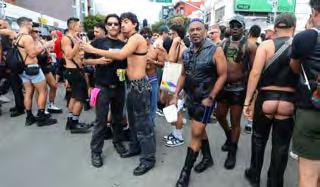
The Leather & LGBTQ Cultural District’s popular gear swap, as seen last year, will return to Sunday’s Up Your Alley street fair.
Rick Gerharter
by Brian Guan
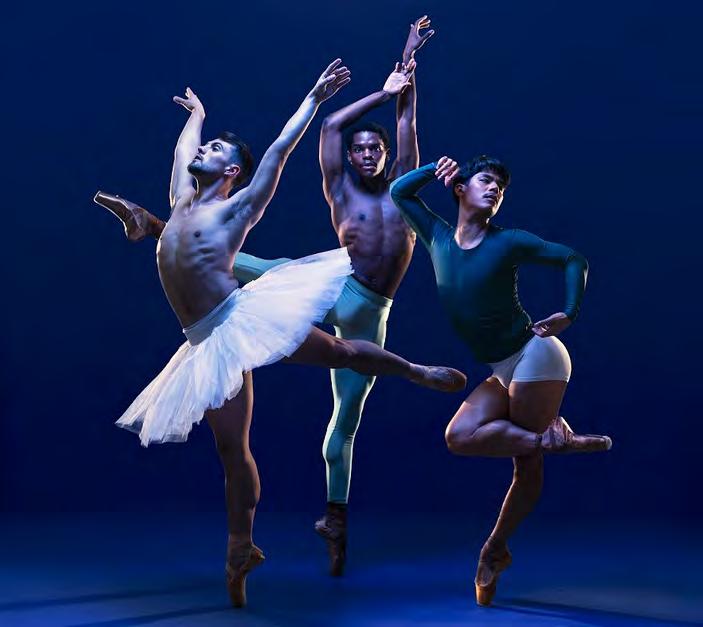
Ballet fans in the Bay Area have another program to enjoy this July, one which marries tradition and transformation. Ballet22, an Oakland-based nonprofit dance organization, will present its 2026 summer season on July 25 and 26 at Fort Mason Center’s Cowell Theater in San Francisco.
A company composed of male, transgender, non-binary, and queer dancers performing en pointe, a technique traditionally reserved for women, Ballet22 brings both contemporary and classical pieces to the San Francisco stage, challenging expectations around gender in ballet. The company’s program in July will feature three acts: a suite condensing the comic ballet “Coppélia,” a staging of the 2021 piece “La Follia,” and the world premiere of “The Fifth Point,” a new work.
In an interview with the Bay Area Reporter, Executive Director Theresa Knudson, a straight ally, described the company’s mission as “making space for folks who are told they’re not allowed to dance en pointe or generally don’t have a space to dance en pointe.”
It’s an endeavor doubled with the company’s dedication to “creating new works or new ballets for LGBTQIA+ representation on the ballet stage,” Knudson said.
Knudson founded Ballet22 in 2020 during the pandemic with her then-roommate Roberto Vega Ortiz as she reevaluated her relationship with ballet.
“Everything had come to a halt,” Knudson said, characterizing the pandemic as a moment of collective reflection for the ballet community. “I felt strongly that I wanted to see change in the field,” she noted.
Ballet22
Oasis
Seeking an expansion of the “narrow definition of who was allowed to be a ballet dancer,” Knudson recounted how she and Ortiz began teaching en pointe technique over Zoom to male, non-binary, and trans dancers. The lessons soon resulted in the founding of Ballet22, whose first show was recorded and disseminated digitally.
Beyond seeing the lessons as a fun exercise,
by Jim Provenzano
Knudson recounted being moved, recognizing that “this was truly a need in the dance world that wasn’t being met.”
Moving beyond expectations
From Knudson’s view, while everyone loves watching ballet, people may not enjoy the traditional gender values the form’s narratives often up-
almost was going to be closed for good, until last year, when Sky Stevens, a frequent patron and fan of the club, told his parents, philanthropists Mark and Mary Stevens, about the imminent closure.
A well-known venture capitalist and a partner at Menlo Park-based S-Cubed Capital, Mark Stevens’ last-minute $3.5 million dollar donation led to preventing the club from permanently closing, allowing the staff and designers to make renovations and improve the venue itself. Oasis Arts, the nonprofit that runs the nightclub at 298 11th Street, now owns it outright. The organization has also hired Madeline Howard as its first director of development and expanded its board to 11 members.
“For me, Oasis is the first step in making the world full of more color and more love,” Sky Stevens said at the ribbon-cutting ceremony. His mother Mary Stevens spoke briefly, including noting that she had visited the older Oasis back in the 1980s when there was a swimming pool beneath the dance floor.
“Now we get to grow, and I’m curious and excited to see what we’re going to grow into,” said Drollinger.
Camp glamour
Once the eager crowd was allowed inside, people checked out the new décor, including a neon sign designating the front room as “D’arcy’s Champagne Room,” a reference to Drollinger’s popular stage and film character, Lady Champagne.
The VIP cul-de-sac now has a mirrored ceiling, and other décor on the walls and at the bars made for a festive fresh look, designed by Evan Favela, who performs in drag as Evian.
Diego Gomez’s lengthy mural on the rooftop added festive color and personality to the event space.
Earlier, Oasis Arts had commissioned seven artists to create murals in the bathrooms. The collective works by Serge Gay Jr., Maya Fuji, Blake Cedric, Jae, Stevie Hues, Patrick Stevenson and Favela, dubbed “Club Toilet,” even has its own Instagram account.
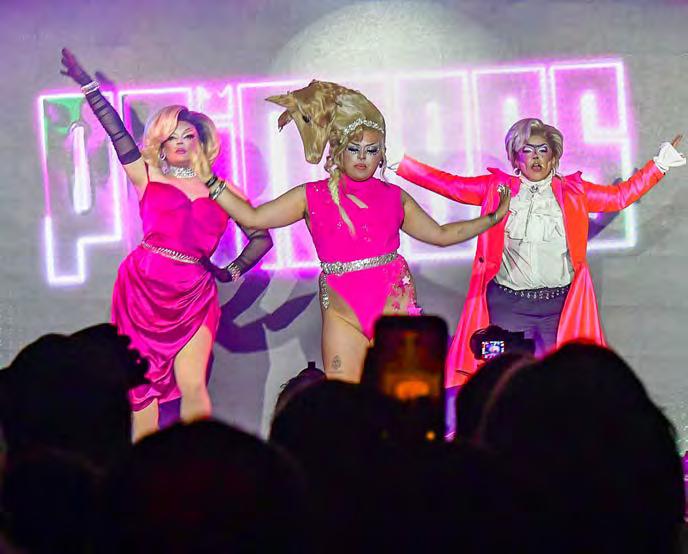
Onstage, celebratory cheers were encouraged by cohosts Drollinger and Michael Phyllis, the creator of numerous hilarious drag parodies and shows.
Three sets of entertainment lineups kept the audience thrilled and tossing dollar bills that between acts were scooped up and swept into
hold. She explained how many ballets surround “a really fragile female lead that’s being supported by a strong, sometimes emotionless man.”
“That is just not how I think our generation likes to operate or present ourselves,” Knudson explained. “We would like to expand the strength
See page 15 >>
buckets.
Performances kicked off with Tila Pia, who emerged from a golden egg à la “Game of Thrones” and became a winged, scaled beautiful creature who, after discarding her wings, offered a few somersaults and deathdrops.
Alotta Boutée of Moist, the Hex women’s ensemble, and other acts offered some saucy moves. With a mostly new cast, SF Baloney performed a hilarious take on the Hanky Code with a live singer crooning a parody, “Colors of the Kink,” set to the Stephen Schwartz “Pocahontas” song.
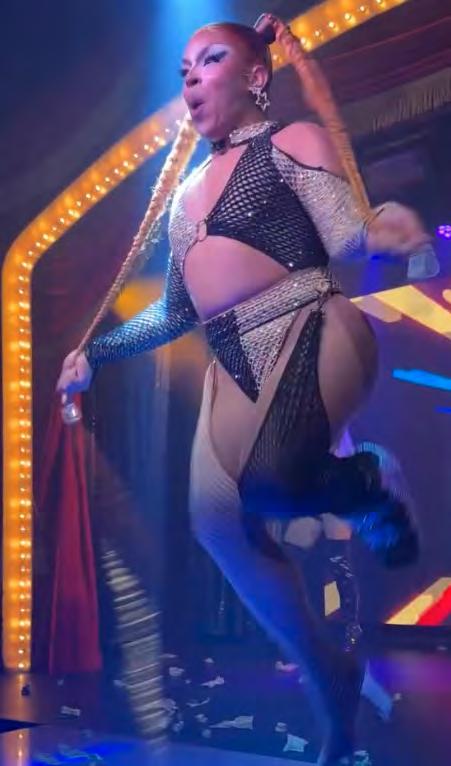
But a true standout was Jax, who entered on a scooter with one foot in a bedazzled cast, and then proceeded to single-footedly jump rope with her wig braids.
The next shows are Princess, and an array of local and visiting talents (Matthew Martin, Jackie Beat) will be hitting the stage in the next successive weeks. Welcome back, Oasis!t
See more Oasis photos on page 15. www.sfoasis.com
Jax jump-ropes her braid wig on the Oasis stage at the festive reopening
Ballet22 dancers Jake Speakman, Daniel R. Durrett, and Victor Maguad
Oakland company challenges dance gender roles in its 2026 summer season
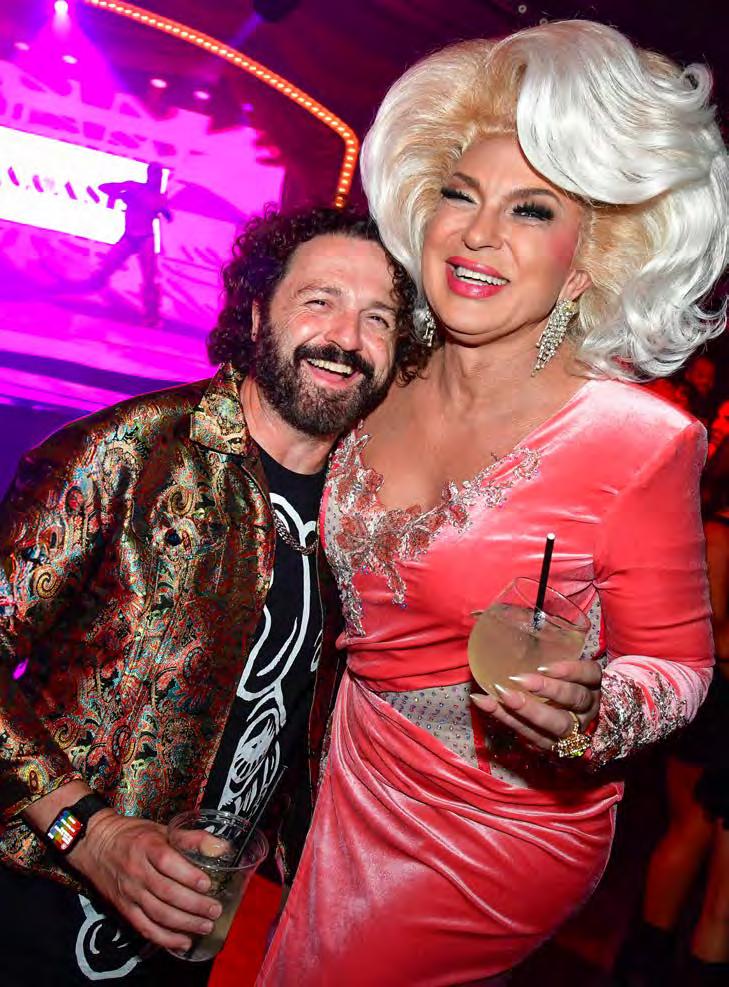
DJ Mark O’Brien with Oasis Artistic Director D’Arcy Drollinger at the July 17 reopening of Oasis
Festive return of the treasured nightclub showcases performers & splashy decor
reopens
Gooch
“American Rough” is a gorgeous thing t << Music & Comedy
by Gregg Shapiro
Released during Pride Month 2026, “American Rough” (Bloodshot) by queer singer/songwriter Andrew Sa isn’t just one of the best LGBTQ albums released this year; it’s also one of the best country albums.
Possessing one of the most distinctive voices you’re likely to hear, Sa sings as if he were born to be crooning country tunes. Sa, who wrote or co-wrote nine of his debut album’s 10 tracks, infuses his performance with a nostalgic quality while unequivocably addressing contemporary romantic queer themes. It’s an unforgettable combination and one that should appeal to a broad range of listeners.
Gregg Shapiro: When you got to Chicago in 2009, did you immediately connect with the music scene?
Andrew Sa: When I first moved here. I was toying with the idea of jumping into a sing/songwriter sort of career. But I was still very much interested in doing theater. I did a theater show at that time with a theater company that’s now defunct called Sideshow Theater Company. I did a modern retelling of “Medea.” I didn’t hook up with the music community until I started taking songwriting classes at the Old Town School of Folk Music.
Your new album, “American Rough,” was released at the end of Pride month on Bloodshot Records, a label that was founded in
Chicago and was at the forefront of the alternative country scene in the 1990s. Bloodshot’s roster included notable LGBTQ artists such as Neko Case, J.B. Brooks, and Laura Jane Grace. Did that play a part in your signing to Bloodshot?
That’s a good question. I had loved so many of the records that had come out on Bloodshot before I even knew of the label. This was probably before I was paying attention to what label people were on. Then, of course, there’s Lydia Loveless, who’s on the label as well as being a lovely singer/ songwriter. I would say no; Bloodshot was something my friend Kelly Hogan recommended.
“American Rough” was co-produced by queer singer/songwriter
H.C. McEntire, who also co-wrote a few of the songs on the album with you, and can be heard playing on it. How did your creative relationship come about?
Before we knew each other, we were interviewed separately for the same article in No Depression Magazine. It was about the intersection of queerness, cosmic country music, and astrology [laughs]. I saw her name, and I thought “McEntire. I wonder if she’s related to me Reba.” Turns out she’s not. I dove into her catalog of music and fell in love with her songwriting, her poetic lyrics, and her stunningly beautiful, authentic country voice. The rest is history. My manager and I reached out to her to see if she’d be interested in producing my record. She had never produced another person’s music. She jumped
in head-first. I feel like a better writer having had that experience with her.
In addition to McEntire, drummer Spencer Tweedy, son of Wilco’s Jeff Tweedy and the lovely Sue Miller of the legendary Chicago music venue Lounge Ax, is a member of the band. What can you tell the readers about working with Spencer?
Oh, my goodness, what a consummate professional. When he was tracking for my record, he flew with me to North Carolina, where H.C. had already tapped a bass player and her amazing guitar player Luke Norton. Spencer rounded out the mix as the drummer.
I remember talking to him on the flight down there. He hadn’t even turned 30 yet, and he said he’d already played on over 30 albums. That should give you an indication that the guy knows what he’s doing.
I love the way Chicago is a presence on “American Rough.” You sing about “Sweeping Halsted like a broom” in “You Turned Me On,” and in “Fightin’ to be Fightin’,” the CTA’s Red Line gets a mention. What role does place play in your music?
A lot of “American Rough” is about my sexual awakening, especially on a song like “You Turned Me On.” I do attribute that awakening to my experiences to being in the gay communities here in Chicago. This album is my experiences in Chicago to the nth degree.
BATS Improv celebrates 40 years
by Jim Gladstone
One of San Francisco’s oldest theater companies is celebrating its 40th anniversary this year. But its members have no idea what shows they’ll be performing.
Since 1986, BATS Improv has celebrated and elaborated on the structured yet seat-of-the-pants improvisation techniques created for Theatre Sports, a free-flowing improvisational comedy format developed in the 1970s by pioneering British-Canadian director and educator Keith Johnstone. (BATS stands for Bay Area Theatre Sports).
Every Saturday night, a group of BATS’ two-dozen primary performers take the stage at the company’s Bayfront Theater at Fort Mason and create on-the-fly performances based on audience suggestions.
Some shows hew to the original Theatre Sports format: Performers are divided into two teams which compete in a variety of brief prompted pieces.
Others find the performers all collaborating to build a series of shorts or a single full-length play from scratch, guided by attendee input and a loose, overarching theme. Upcoming themes include telenovelas, Silicon Valley start-ups, and Broadway musicals, complete with songs composed on the spot.
Releasing inner stories
William Hall, one of BATS’ founders, who still performs with the group, arrived on the San Francisco theater scene in the early 1980s, having studied acting at Boston University.
He looked back on the era in a recent interview with the Bay Area Reporter.
Queerness permeates the album from start to finish. Are these songs directed to someone special in your life or someone you’d like to have in your life? Every song that you just mentioned in that string of songs is quite specifically about my fiancée, Jacob Strayer. We’ve been together for 12 years, and just recently got engaged.
In April, the New York Times published a piece about “The 30 Greatest Living American Songwriters,” and included a trio of country songwriters, two of whom – Brandy Clark and Shane McAnally – are openly queer. At this time when our community is under constant threat, do you think the presence of LGBTQ musicians in the country genre has the power to change hearts and minds?
Oh, yeah. Absolutely. I think that it’s very possible. Everyone approaches it differently, and my approach is through tenderness. I hope to build a bridge, if I can, for people who don’t understand the queer lifestyle or my particular queer lifestyle through the music. I really hope I can offer them an in to see themselves within it and maybe recognize that we’re not so different.t
Read the full interview on www.ebar.com.
www.andrewsamusic.com
Four decades of laughter on the fly
“I arrived here believing that the job of an actor was to bring truth to the lines of the playwright. The playwrights are poets, so you don’t ever change anything, you just search for a way to make that truth resonate with the audience. That’s what I was doing when I first came to San Francisco. Then I got married and divorced, very quickly. Seven months. I was feeling so depressed and I didn’t know how to get back in the game.”
Hall continued, “I hooked up with a bunch of guys who were doing Commedia d’elle Arte, which is basically masked slapstick and fart humor, at the Northern California Renaissance Fair. And it ended up being a great time for me.”
Their group was the influential Fratelli Bologna, which, along with the Pickle Family Circus and Penn and Teller’s Asparagus Valley Cultural Society, helped cement the Bay Area’s reputation as a hotbed of unconventional comedic performance.
Hall’s commitment to his formal acting training loosened even further when his friend, Seattle-based director Rebecca Stockley, an early advocate of Theatre Sports in the U.S. (and, in short order, a San Francisco resident and co-founder of BATS), visited to lead an improv workshop for the Fratellis and other local performers.
“There was just something magical about this sort of improvisation,” Hall recalled.
“Everything I had learned about narrative went out the window. The protagonist, the narrative arc, the inciting event. I just realized that there are stories inside of all of us that can come out if we get out of the way and let them emerge. Forty years of performing and teaching it later, I can still feel that magic.”
Skills beyond the stage
Teaching has become one of BATS’ cornerstones over the past four decades, as the organization has evolved from an ad hoc creative outlet into a thriving non-profit.
Six levels of multi-week courses along with one-time workshops are regularly taught at the Bayfront Theater. The company also offers participa-
tory team-building and communication training programs for corporate and institutional clients which have included Apple and Anthropic.
What Hall refers to as “the improvisational mindset,” combining confidence with a collaborative spirit, has value beyond the stage. Students have enrolled in BATS classes to improve their workplace communications, community-building skills, and social confidence
Sage Simms was a newly out trans woman when the pandemic hit.
“I was very much a scaredy-cat, homebody-type person. But I was bingeing a lot of ‘Whose Line Is It Anyway?’” she told the Bay Area Reporter.
“I was going through my whole queer journey and the idea of showing myself in front of a bunch of strangers was terrifying. I was so protective of myself, my voice, my body. But I was curious. And I found BATS. They were offering classes
online, so I knew I could always just turn the camera off if I needed to.”
Sage continued, “I took their foundational six-session class online and I was immediately hooked. I knew in my soul it was for me. I did a second class online. And then, after the pandemic, I was like, okay, I’m going to go in-person. I became obsessed. I loved listening to the coaches give notes. I paid really close attention. I wanted to be a coach, too. To help people feel more comfortable with themselves. To not worry about failing. To be kind to themselves and their ideas.”
When an office job came available at BATS, Simms, who had previously worked delivering packages for Amazon, applied and was hired.
“One of the perks was free classes. And I literally did hundreds and hundreds of hours of improv training over the next few months,” said Simms. “For the last couple of years, I’ve also been teaching. And I’m a completely different person now, the opposite of a scaredy cat. There’s a fluidity in improv that connects to what genderfluid and gender non-conforming people dream of having in their life. There’s a freedom to it. And it’s so nice that there’s humor to it as well.
“When you’re doing improv in the BATS style, you’re never thinking about giving a performance. You’re being incredibly present. It’s almost the opposite of escapism.”
Simms will oversee a single-session improv jam on Sunday, July 26. Newcomers are welcome.t
www.improv.org
Andrew Sa and his album ‘American Rough’
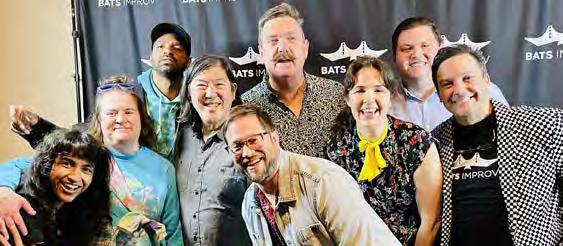
A recent cast of BATS’ Theatre Sports All-Stars
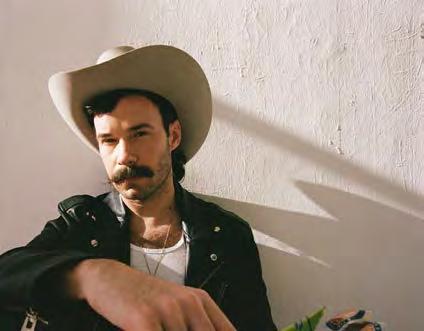
BATS cofounder William Hall
t Cabaret & Film>>
Matthew Martin is back in business
by David-Elijah Nahmod
Matthew Martin is thrilled to be returning to the stage at Oasis. The drag veteran, who has gained fame in the Bay Area and beyond for his interpretations of legendary ladies such as Bette Davis, Joan Crawford, Katharine Hepburn and many others, referred to the reopening of the club on July 17 as a family reunion and a homecoming.
“Excited to see everyone onstage and in the audience again,” Martin told the Bay Area Reporter. “People have missed the Oasis experience since closing end of last year so much. I’m grateful to those that made a return possible and for D’Arcy Drollinger’s tireless work throughout.”
Oasis had closed after a drop in patronage made running the venue financially unviable. But a multimillion-dollar gift from Bay Area philanthropists Mark and Mary Stevens enabled owner Drollinger to purchase the club and remodel it, thereby saving it. Martin said that he never really believed that the club would close.
“Oasis is essential to the fabric of this city from the day the doors opened over ten years ago,” he said. “We thought the club was in peril during the pandemic and D’Arcy innovatively transformed it into a film studio where performances, including “The Golden Girls,” could be filmed and streamed when the world shut down.
Talk about making lemonade out of lemons!”
To Martin, Oasis is more than a club, it’s a sanctuary.
“Oasis has been a safe haven for a whole panoply of performers to be seen and celebrated,” he said. “The club has won several awards over the years, deservedly, for its productions and programming. Oasis Arts has made it possible for people to support performers who have otherwise been marginalized here and elsewhere. I’m a proud native San Franciscan. An establishment where all are welcome is what my hometown means to me and should be.”
Greatest hits
Martin is calling his new show
“Back in Business,” and he’ll perform it at Oasis on July 31 and August 1. The show’s title is an homage to the club’s rebirth. In the show, Martin will perform what he calls “the usual suspects” from his repertoire. Davis, Hepburn, Judy Garland, and Susan Hayward from “Valley of the Dolls” for an opening number. He’ll sing live with piano accompaniment from Tom Shaw. Performing with him will be special guest star Maureen McVerry.
“I’m mixing classic material with new material,” Martin said. “I have to
‘Jewel’s Catch One’
by Joshua Polanski
The 2016 documentary of a Black gay dance bar in Los Angeles by the same name, “Jewel’s Catch One” is a hagiographic portrait of Jewel Thais-Williams, the bar’s founder and owner. A poor Black lesbian woman, the world had four targets for intolerance ready to bludgeon against ThaisWilliams, a woman who deserved more from the world than most. She died last year and the film’s re-release on major streaming channels comes shortly after the first anniversary of her passing.
Catch One was the nation’s oldest Black-owned disco. Their motto was to turn away nobody, a motto that the queer and especially queer Black community in Los Angeles found meaningful in an era of inhospitality. The documentary surveys the history of the establishment from its founding in 1973 to when Thais-Williams sold it in 2015, fluctuating in both primary audience and success with the passing years.
Police harassed Catch One, city ordinances targeted gay activities, and an arsonist tried to burn everything down. Firefighters openly told ThaisWilliams they wished the arsonist succeed. Director C. Fitz never lets the darkness of these barriers to equality and safety –even when birthing into belligerence– tonally overshadow the vibrancy or hopefulness of the community the bar nurtured.
The community emerges with vitality through the sheer quantity of interviewees. Innumerable voices share
Documentary
what Catch One meant to them and how meeting Jewel Thais-Williams was a milestone in their lives. The diversity of faces – young and old, women and men, gay and straight, poor and famous– willing to be interviewed for a documentary about a nightclub in LA really illustrates how the strength of the community’s ties became the source for their resilience during challenges like the arson attack or the AIDS crisis. Even on mute, the interviews would still give shape to a tapestry of deep camaraderie and powerful social bonds.
Snapshots of memory
The sheer abundance of archival footage and photographs approaches incredulity. From black and white news images to warmly colored snapshots of memory, the entire history of this nightclub appears to have been captured on celluloid. Archival footage of Madonna, a club frequent for a brief period, is less surprising given her fame, but there is something earnest about its presentation as if we are simply watching a family’s home video and that family just happens to be a nightclub social scene that includes one of the world’s most famous singers.
The most powerful moment comes in the way archival photos record a tall man with AIDS shrinking over the course of the sickness. To have a face to put to the story, let alone photos from that time, elevates the yarn that Thais-Williams shares of this random patron slowly dying.
Amusingly, Fitz seems to care more about Madonna, Thelma Houston, and Sharon Stone than the politicians with whom Thais-Williams brushed
be careful about getting too esoteric about songs or text, or, as D’Arcy always reminds me, ‘give ‘em the hits.’ If Peggy Lee didn’t sing ‘Is That All There Is’ or if Judy didn’t do ‘Get Happy’ or ‘The Man That Got Away,’ someone would feel shortchanged. Katharine Hepburn will be extending her delicious dialogue from ‘The Lion in Winter’ and Bette has a few surprise tricks up her sleeve as well.”
The singer, dancer and actor feels a special kinship with these ladies. They are, he pointed out, the goddesses of his childhood.
“Ever since I could remember or
shoulders. The lone exception to this is Representative Maxine Waters, whose heavy presence provides a seal of significance to the documentary.
Politics of dancing
Photos of the founder with Hillary Clinton and Democratic presidents play almost like B-roll footage and without any relevant commentary, a comically fitting touch for a gay documentary to care more about LGBTQ icon Madonna than Joe Biden. The politicians aren’t woven into the story, which is really about the bar and the people that occasioned it; the governmental power brokers have mere cameos.
“Jewel’s Catch One” is an extremely hagiographic pursuit genuine about its mission to convince viewers that the bar’s founder might actually be a saint. The last thirty minutes become much more about Jewel ThaisWilliams herself than the Catch One. Even the interview subjects reflect this change as they attest to the quality of her character and determination in great detail.
She is even quirky the way most saints were too, becoming an acupuncturist later in life and joining Alcoholics Anonymous. The Traditional Chinese medicine section distracts like a non-sequitur from the bigger story of this club’s reflection of the changing Black and gay culture in LA. Other big ideas, including the club’s influence on broader culture, the space it provided to intersectional activism, or its status as a beacon to cutting-edge Black and house music, get abandoned for additional ThaisWilliams tributes.
Multiple interviewees draw allu-
put words and thoughts together, they have been of great inspiration and companionship,” he said. “It has been a lifelong love affair celebrating them and their careers and sharing them with audiences as well as introducing them to new fans. I want what I do onstage to be as entertaining to audiences who know everything about these divas as to audiences who know nothing about them simultaneously. I feel like I am a Hollywood historian enlightening new generations to the true greats of the silver screen and stage. They are timeless talents and that is the exact reasons their legends endure.’’
Martin has paid homage to so many of the great ladies of the screen it may seem that he has done them all. But there are still a few he hasn’t done, such as Lucille Ball.
“I have always wanted to portray a latter-day Lucy to show the woman behind the ‘I Love Lucy’ image,” he said. “She was a pioneer, the head of a major studio and a savvy business woman, and offscreen a much more serious person than her onscreen image. There are many more I would like to play, lesserknown greats, Grayson Hall, Maria Ouspenskaya, Constance Ford, Mercedes McCambridge, to name a few.”t
Matthew Martin, ‘Back in Business,’ July 31 & Aug. 1, 7pm, $47.08-$67.58, Oasis, 298 11th St. www.sfoasis.com
sions from the Catch One to Studio 54, calling it the West Coast’s answer to the famous New York City nightlife establishment. Similarly, the documentary “Jewel’s Catch One” is California’s answer to “Paris Is Burning.”
They both provide rich snapshots of very specific queer and largely Black local cultures in 20th-century America that became more important than their business operations.
But the inevitable comparison to “Paris Is Burning” doesn’t serve “Jewel’s Catch One” well. The former convinces you that the patrons of the New York ballroom scene changed history together and catalyzed broader cultural trends; the latter eventually loses its community in the heroification of its founder.
She could very well have been a real-life superhero, but that doesn’t change the fact that “Jewel’s Catch One” eventually loses the community that made the club special in the first place to focus on its founder.t
jewelscatchonedocumentary.com
Left: Matthew Martin in a recent Martuni’s show Right: Matthew Martin as Bette Davis
Randall Whitehead
Left: A costume ball in the 1980s at the Catch One Right: The dance floor at the Catch One
Jewel Thais-Williams in the 1980s
A WORLD APART
Check in for the energy, stay for the indulgence. Sonoma’s premier all-in-one destination brings together elevated dining, luxurious stays, rejuvenating spa escapes, jaw-dropping entertainment, and an expanded gaming floor featuring 1,700 more ways to win than ever before. Whether you’re here for a weekend getaway, a night out, or the thrill of your next big moment, Graton Resort & Casino delivers an experience that goes far beyond the expected.