Aletter sent to San Francisco Mayor Daniel Lurie and other officials by a former employee claims that the independence of the city’s Office of Transgender Initiatives is under threat. The letter comes as the office is slated to soon vacate its space in the San Francisco LGBT Community Center and relocate in a city building.
The Bay Area Reporter was already looking into other reports that 2024 changes to the office’s structure – when it moved from under the auspices of the City Administrator’s Office to the Human Rights Commission – had compromised its integrity when, on January 21, a letter from Asri Wulandari, a nonbinary trans woman who was the communications director for the office, was sent to news organizations and community leaders, including the B.A.R. (The B.A.R. reached out to Wulandari January 21 for an interview and to confirm her authorship, but has not heard back as of press time Thursday.)
“As stated in official City materials, the office exists to advocate for and uplift the voices and needs of transgender, gender-nonconforming, intersex, and Two-Spirit (TGNCI2S) San Franciscans by acting as a bridge between communities and local government in the pursuit of equity,” the letter states. “When this office is weakened (financially, structurally, or operationally) it is not merely an internal adjustment. It is a policy decision with direct consequences for community access, safety, and care.”
Wulandari’s letter goes on to state that while staff were assured before the transition to the Human Rights Commission that “the office would not lose autonomy, staffing capacity, physical space, or budget … the office has since experienced a steady erosion of capacity that closely tracks with budgetary decision-making.”
Among these are “the planned loss of a dedicated physical office space in the SF LGBT Center due to the cancellation of the rental lease, reduced operational and discretionary funding once the office was moved from ADM [city administrator] to HRC [human rights commission]. No fiscal autonomy. Elimination of key positions, including an office manager role,” the letter stated. “Ongoing delays in refilling the
LGBTQ issues not discussed at CA governor forum in SF
by John Ferrannini
LGBTQ issues were not discussed at a forum among several Democratic candidates running to be California’s next governor. Instead, affordability was top of mind for the seven candidates who appeared at the forum held by the Urban League of Greater San Francisco Bay Area at USCF Mission Bay January 26.
Incumbent Governor Gavin Newsom (D) can’t run again for the position due to term limits and is nearing the end of his second term. He is widely expected to seek the presidency in 2028.
According to January 20-21 Public Policy Polling, the two leading gubernatorial candidates thus far are Republicans – Riverside County Sheriff Chad Bianco and Steve Hilton. The top two vote-getters in the June 2 primary, regardless of party affiliation, advance to the November 3 election. The number of Democratic candidates and the inability of any of them to break through, so far, has resulted in the possibility of two GOPers on the fall ballot in deep blue California.
A Hilton spokesperson stated he could not make it because he was at the Los Angeles Office of the State Controller launching CAL DOGE, which will identify ways to reduce the size of state agencies. CAL DOGE is named for an effort by Elon Musk that facilitates mass layoffs and canceled govern-
and other issues at a
Urban League
Greater San Francisco Bay Area forum.
ment funding appropriated by the U.S. Congress at the federal level.
Bianco didn’t return a request for comment as of press time.
The highest polling of the Democrats in the race are former congressmember Katie Porter (D-Irvine) and Congressmember Eric Swalwell (D-Dublin). Swalwell did not appear at the forum, and his office
didn’t return a request for comment as of press time. Bianco, Hilton, and Swalwell were all invited but unable to attend, according to the Urban League. The forum was moderated by KNTV-TV reporters Marcus Washington and Velena Jones, who asked the candidates about their top priorities.
SF exhibit focuses on LGBTQ psychiatry history
by Matthew S. Bajko
Beginning in the 1930s Louise Lawrence began clipping out news articles about transsexuals, cross dressing, and other aspects about the lives of gender-nonconforming people for a scrapbook she was creating. The San Francisco resident also compiled a second scrapbook about her own transition as a self-identified maleto-female cross-dressing activist in the 1940s.
A third scrapbook she put together contained the ephemera Lawrence collected about female impersonation and drag shows. Lawrence, who died in 1976 in her mid-60s, had also befriended the acclaimed sex researcher Alfred C. Kinsey, Ph.D., a professor of zoology based at Indiana University, and corresponded with him throughout the 1940s and 1950s.
In one letter dated September 21, 1950, she detailed receiving a visit from a friend in Los Angeles who showed her his own collection of clippings and photos documenting female impersonators and transvestism.
“He had well over one hundred photos of fellows in drag. Some were professional impersonators but the bulk of them were what I would call transvestites,” wrote Lawrence. “I certainly wish that you could see them for it is truly a marvelous collection and one that I would give anything to own.”
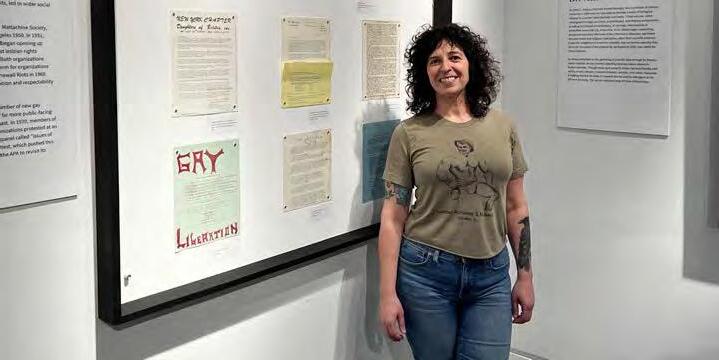
Kinsey Institute curator Rebecca Fasman stood in front of displays for the new exhibit “Desire on the Couch” in the Desai | Matta Gallery at the California Institute of Integral Studies.
One letter dated July 11, 1951 from Kinsey, five years prior to his death at the age of 62, thanks Lawrence for “all the good help” she provided him when he came to San Francisco to visit.
“As I bring together all of the material that you have contributed it begins to make a marvelous assemblage of data,” he wrote.
Their correspondence and digitized copies of Lawrence’s scrapbooks are now on view in San Francisco at the new exhibition “Desire on the Couch” that opened Wednesday in the Desai | Matta Gallery at the California Institute of Integral Studies (CIIS). It is a joint exhibition between
See page 2 >>
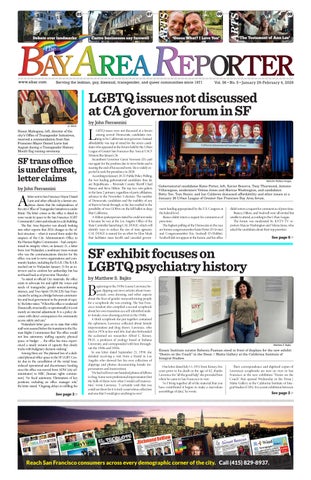
Honey Mahogany, left, director of the city’s Office of Transgender Initiatives, received a commendation from San Francisco Mayor Daniel Lurie last August during a Transgender History Month flag raising ceremony.
Matthew S. Bajko
Gubernatorial candidates Katie Porter, left, Xavier Becerra, Tony Thurmond, Antonio Villaraigosa, moderators Velena Jones and Marcus Washington, and candidates Betty Yee, Tom Steyer, and Ian Calderon discussed affordability
January 26
of
Malcolm Wallace Images
the school and the Kinsey Institute based at IU’s Bloomington, Indiana campus.
Some of the letters between Lawrence and Kinsey can be perused in one of the six glass vitrines for the exhibit mounted to the walls of the gallery space in the lobby of CIIS’ building at 1453 Mission Street near 11th Street. A monitor provides attendees a way to flip through Lawrence’s scrapbooks.
They are “a cool archive within our collection of transgender life in the 1940s, especially in California as well as across the U.S. and the world,” said Rebecca Fasman, who co-curated the exhibit with CIIS Chair of Research Psychology Christopher Walling, Ph.D.
Fasman, who is queer and lives in Washington, D.C., has been the curator for the Kinsey Institute for close to a decade. She provided the Bay Area Reporter a sneak peek of the exhibit Monday as she was working on its final installation.
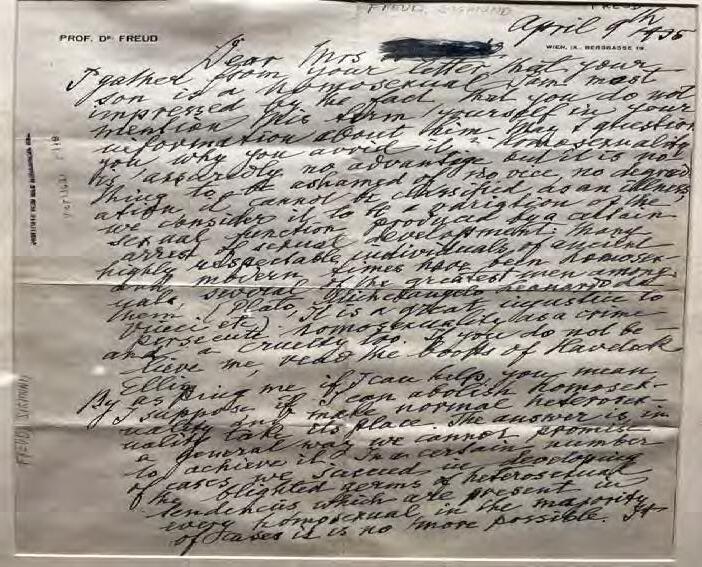
One item in the exhibit she is particularly excited for people to see is an April 9, 1935, letter Sigmund Freud sent to an American mom of a gay son who had written to him for advice. Writing in English the Austrian neurologist credited with founding psychoanalysis told her that homosexuality was “nothing to be ashamed of” and should not be classified as “an illness.”
He notes “many highly respected individuals” such as Plato, Michelangelo, and Leonardo da Vinci were gay. Freud added, “It is a great injustice to persecute homosexuality as a crime and a cruelty too.”
Freud “was an outlier” in such thinking during his time, noted Fasman, pointing to how homosexuality was included in psychiatry’s diagnostic manual, Diagnostic and Statistical Manual of Mental Disorders, known as the DSM for short. It wouldn’t be until 1973 that it was removed from what is basically the bible of the field.
Despite Freud’s stance, that was a difficult fight waged by LGBTQ ad-
vocates and members of the field in conjunction with their straight allies, said Fasman.
“He very clearly made his opinion known, and he helped create the field,” she said. “It was something he knew to be true and sexual researchers like Kinsey knew to be true.”
‘Exhibition about change’
Through its rarely-seen letters, photographs, and archival materials the exhibition “aims to reveal how ideas about sexuality and desire have long been argued over, resisted, and reimagined,” according to the curators. As the introductory sentence for it declares, “This is an exhibition about change.”
It marks the first time since Fasman joined Kinsey in 2015, initially hired
as its manager for traveling exhibitions, that it has mounted an exhibit in San Francisco. It came about due to Walling being selected for one of the institute’s fellowships and bringing up using Kinsey’s archive of more than 600,000 materials to examine the fight over delisting homosexuality in the DSM. Fasman suggested using that topic as a jumping off point to examine how “knowledge production involves multiple voices and perspectives” from inside and outside academia and scientific fields.
As he was traveling out of the country ahead of the exhibit opening, Walling told the B.A.R. in an emailed reply that it is debuting amid public debate about sexual orientation and gender identity in the country’s political, scientific, and cultural circles that mirrors those reflected in the more than 70 items he and Fasman selected to put on display.
“This exhibit is opening at a moment when conversations about desire, sexuality, gender, and the body are once again being constrained politically, culturally, and sometimes even clinically. ‘Desire on the Couch’ reminds us that psychoanalysis and sexology were born out of a radical willingness to look directly at what society often prefers to repress or moralize,” wrote Walling. “At a time
<< From the Cover
when sexual knowledge is increasingly polarized, simplified, or weaponized, this exhibit offers historical depth and nuance. It shows that rigorous, compassionate inquiry into desire has long been central to understanding psychic life, trauma, creativity, and freedom.”
And opening it at this time, added Walling, “is a way of reclaiming complexity and curiosity in a cultural climate that often resists both.”
He also pointed to Freud’s letter as one of his favorite items on display, not simply due to its historical import but because of its contemporaneous feeling.
“As a psychoanalyst myself, I read that letter and can almost imagine Freud writing it to my own mother back in Kentucky in the 1990s – despite the fact that it was written at the very beginning of the 20th century. His tone is humane, non-pathologizing, and deeply respectful; he speaks to a parent’s fear with clarity and compassion rather than judgment,” wrote Walling, himself a gay man.
“That letter reminds us that within psychoanalysis, there has always been a strand of thought that recognized sexual difference not as an illness to be cured, but as a variation of human love and desire. Seeing it here collapses time in a powerful way and makes the history feel personal, lived, and still urgently relevant.”
The exhibit is “text heavy” because of its focus on letters and other correspondence, acknowledged Fasman. They did purposefully look to include more visual material to help break up the exhibit, such as a selection of homoerotic black-and-white drawings created by Andrey Avinoff, a gay man who was the director of the Carnegie Museum of Natural History for two decades in the first half of the 1900s.
A renowned expert on Asiatic butterflies, he struck up a correspondence with Kinsey and was working with him on a book of erotic art they were unable to finish before Avinoff’s death in 1949. Also featured in the exhibit are four black-and-white male nude photos taken by George Platt Lynes along with correspondence between him and Kinsey.
A gay man who was Vogue magazine’s first staff photographer and also struck up a friendship with Kinsey, Platt Lynes donated roughly 2,300 negatives to the Institute for Sex Research now known as the Kinsey Institute. In a May 15, 1950, note of thanks Kinsey remarked the material from Platt Lynes was “excellent” and “the best nude photography that we have in our collection.”
Also on display are items related to pioneering LGBTQ rights groups such as the Gay Liberation Front and
the Daughters of Bilitis founded by the late San Francisco couple Phyllis Lyon and Del Martin. Walling hopes the exhibit will inspire a sense of personal curiosity in attendees and illustrate for them the wide-reaching impact cultural forces can have on their lives.
“I hope visitors leave with a deeper appreciation that desire is not something to be reduced to pathology, identitarian labels, or moral judgments. Desire is relational, embodied, historically shaped, and deeply human,” wrote Walling. “I want people to understand that psychoanalysis and sexology – at their best – are not about fixing or normalizing people, but about expanding our capacity to tolerate complexity, difference, and ambiguity. If visitors walk away feeling more curious about their own inner lives, more compassionate toward others, and more aware of how cultural forces shape what we are allowed to want or say, then the exhibit has done its work.”
Fasman told the B.A.R. she hopes it is illustrative of how connected Kinsey was with others throughout his life, from colleagues in his fields of study to community activists and artists, all of whom helped to shape his thinking about human desire, sexuality, and other topics he researched and wrote about. It speaks to the importance of hearing from multiple perspectives in the pursuit of societal change, she said.
“There are multiple voices and methods required to make substantive change in society. There is not just one way,” said Fasman.
The exhibit’s opening is timed with the American Psychoanalytic Association’s annual meeting in San Francisco running through Friday. Tickets on those days cost $27.24, with Fasman and Walling providing guided tours periodically throughout the day, on a first come, first served basis, and can be purchased online at https://tinyurl.com/2k5s5exz.t
Starting on February 6 tickets will cost $21.99 for self-guided viewing and can be bought online at https://tinyurl.com/3x284e7e.
It closes on March 14, and two days prior, Walling will be in conversation with Kinsey Institute Executive Director Justin Garcia, Ph.D., about the exhibit and Garcia’s book “The Intimate Animal.”
Tickets for in-person or online access cost $11.49 to $32.49 and can be purchased online at https://tinyurl.com/buf7e49c.
Sigmund Freud sent a letter in 1935 to an American mom who had written to the neurologist about her gay son.
Matthew S. Bajko
Gay artist, educator Ronald Chase dies
by Cynthia Laird
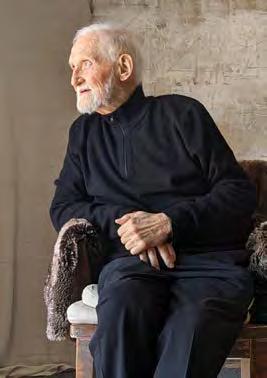
Ronald Chase, a gay man who was an artist and educator, died December 20 at his home in San Francisco. Mr. Chase is known for his pioneering projection work for operas, as well as founding the San Francisco Art and Film Program for students.
Mr. Chase was 90, and his health had been declining in recent years, said Isaiah Dufort, who had known him for decades and is the executive director of the San Francisco Art and Film program. Mr. Chase passed away at his home, an art studio in the Developing Environments building in San Francisco, Dufort said.
“I was a student in the program when it started,” Dufort, a gay man, said in a phone interview with the Bay Area Reporter. He explained that Mr. Chase had volunteered at schools and in arts programs and began asking students what they did in their free time.
“It seemed that they didn’t have contact with arts in San Francisco, like galleries and museums, so he started an afterschool program,” Dufort said.
Mr. Chase began taking students on trips to local galleries and museums, and the art and film program started in 1993. Mr. Chase later used his contacts with the San Francisco Opera and San Francisco Symphony to obtain unsold tickets to performances which were
communications position. A pending leadership demotion of the OTI director that will reduce authority and compensation (as indicated in the June 26, 2025 presentation given by Director [Mawuli] Tugbenyoh to the Human Rights Commission). OTI’s Gender Inclusion e-module for City employees being removed from required training.”
used by youth in the program, said Dufort. That later expanded into film screenings.
“In about three years there was a full slate of almost weekly programs,” said Dufort.
The art and film project became its own nonprofit around 1997, said Dufort. Students generally range in age from 13-19, he said. The program had served about 800-900 youth annually prior to the COVID pandemic. Dufort said that today, it serves about 550 youth a year.
The program has a budget of about $180,000. In addition to private donors, it receives some funding from San Francisco Grants for the Arts, and used to get funds from the National Endowment for the Arts, though Dufort said, “That’s changed” due to the Trump administration.
Dufort said that Mr. Chase “was really dedicated” to his artwork. “He woke up every day painting, doing film, or writing. Over a 70-year career he produced a whole lot of art.”
“He deeply believed in beauty; it was vital that everyone have something that was beautiful to them,” he added.
LGBTQ film
Mr. Chase is also known for his 1972 film, “Parade,” about the first San Francisco Pride Parade. The documentary “gives us insight into
Honey Mahogany, a Black queer trans person who is director of the Office of Transgender Initiatives, had a meeting with Lurie the evening of January 22, after the initial publication of this report.
“I am meeting with the mayor today to discuss my concerns and the concerns of the community,” Mahogany said January 22.
Later, she provided a brief comment on the meeting.
“The mayor and I had a good conver-
San Francisco’s first official gay pride parade,” noted B.A.R. contributor Brian Bromberger in a 2024 article.
Max Sokoloff, one of Mr. Chase’s former students and a former film workshop mentor, wrote in an email message that he will miss him.
“I will never meet anyone with the same faith in art as Ronald,” Sokoloff stated. “His enthusiasm could exhilarate and frustrate in equal measure. But his persistence and devotion as a teacher left everyone in his orbit deeper, their lives reoriented by having known him.”
sation tonight,” Mahogany stated. “I had an opportunity to talk to him about the many things we need to work on, and he let me know how important he feels it is that our trans community here in San Francisco is supported.”
Asked to comment on Wulandari’s letter before his meeting with Mahogany, the mayor’s office issued a statement attributed to Lurie. The mayor’s office did not provide subsequent comment after the meeting with Mahogany.
Opera projections
These days, many opera productions use film and slide projections. But in the late 1960s it wasn’t common. According to an obituary in Lighting & Sound America, Mr. Chase pioneered the practice.
In 1968, Mr. Chase was asked by Richard Pearlman, head of the Washington Opera, to design a production of Benjamin Britten’s “The Turn of the Screw,” the obituary stated.
Mr. Chase agreed, on the condition that he would be allowed to incorporate film and slide projections.
According to Mr. Chase’s website, “A year earlier, Gordon Compton and Emelio Ardelino had used film for the Joffrey Ballet’s ‘Astarte’ and were creating a media production with Frank Corsaro for ‘The Makropolos Affair’ at New York City Opera. These three productions marked the beginning of a development that would bring film and slide projections into the mainstream of opera and theatre in the U.S. When [Mr.] Chase and Corsaro began work on ‘Koanga’ the next year (at Washington Opera), it began a 30-year collaboration in developing the use of film and projection on stage.”
Dufort said he was Mr. Chase’s assistant on his last opera that was done in 2003 for the now-defunct New York City Opera.
“San Francisco is a place where people are allowed to be who they are and live the lives they choose without fear of persecution,” the mayor stated. “Our trans community has helped shape this city, and it is an essential part of what makes San Francisco so special. As mayor, I’m committed to ensuring San Francisco remains a place where trans people feel safe, seen, and valued – and where they have the opportunity to build full, stable lives. That means a city where trans people can earn a living
The obituary in Lighting & Sound America also noted that Mr. Chase continued exhibiting his artwork through 2018 at San Francisco’s Triangle Gallery, among others. He was in several group exhibitions, and his work is part of the permanent collections of the Metropolitan Museum of Art in New York; the San Francisco Museum of Modern Art; the International Museum of Photography; George Eastman House, in Rochester, New York; the Princeton Art Museum; and the Boston Museum of Fine Arts.
Early life
Mr. Chase was born on December 29, 1934. He was a native of Seminole, Oklahoma, the obituary stated. Mr. Chase studied dance, design, and direction at Bard College in New York. “Next, he studied painting in Spain and Italy before moving to Quebec, exhibiting his work in Montreal and New York in 1962 and 1963. He subsequently moved to San Francisco,” the obituary stated.
Dufort said that a memorial had been held for Mr. Chase at his studio on January 5 for Twelfth Night, a Christian holiday. He said a second memorial is likely at the end of this year.
“He was a one-of-a kind person,” Dufort said. “We will do our very best to continue his vision.” t
with dignity, open and grow businesses, raise their families safely, and know, without question, that they belong here.”
With a two-year city deficit of $936 million to fill, and not much help, if any, expected from the federal government, Lurie is asking for $400 million in spending cuts from city departments, and told reporters last month he will deliver a “responsible budget that prioritizes core services.”
In a world that still questions who you are and where you belong. After all that, getting high quality health insurance shouldn’t be one more fight.
Covered California connects the LGBTQ+ community with friendly enrollment support that includes free, confidential help. They’ll walk you through your options, check if your doctors and medications are covered, and help you find a plan that includes you nd access to affirming care, mental health support, and the benefits that matter most to you. Because real care doesn’t come with conditions. Just compassion.
Open Enrollment is here.
<< Trans office From page 1
Ronald Chase
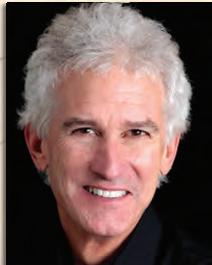
Isaiah Dufort
Volume 56, Number XX
Month XX-XX, 2026 www.ebar.com
Volume 56, Number 5 January 29February 4, 2026 www.ebar.com
PUBLISHER
Michael M. Yamashita
PUBLISHER
Thomas E. Horn, Publisher Emeritus (2013)
Michael M. Yamashita
Publisher (2003 – 2013)
Thomas E. Horn, Publisher Emeritus (2013)
Bob Ross, Founder (1971 – 2003)
Publisher (2003 – 2013)
Bob Ross, Founder (1971 – 2003)
NEWS EDITOR
Cynthia Laird
NEWS EDITOR
Cynthia Laird
ARTS & NIGHTLIFE EDITOR
Jim Provenzano
ARTS & NIGHTLIFE EDITOR
Jim Provenzano
ASSISTANT EDITORS
Matthew S. Bajko • John Ferrannini
ASSISTANT EDITORS
Matthew S. Bajko • John Ferrannini
CONTRIBUTING WRITERS
Christopher J. Beale • Robert Brokl
CONTRIBUTING WRITERS
Brian Bromberger • Philip Campbell
Kyle Amato • Race Bannon • Robert Brokl
Heather Cassell • Eliot Faine
Christopher J. Beale • Brian Bromberger
Michael Flanagan • Jim Gladstone
Philip Campbell • Myron Caringal
Liz Highleyman • Brandon Judell • Lisa Keen
Heather Cassell • Meg Collins • Chelsea Davis
Philip Mayard • Laura Moreno
Natasha Dennerstein • Eliot Faine
David-Elijah Nahmod • Mark William Norby
Michael Flanagan • Jim Gladstone
JL Odom • Paul Parish • Tim Pfaff
Liz Highleyman • Brandon Judell
Jim Piechota • Adam Sandel
Michele Karlsberg • Lisa Keen
Jason Serinus • Gregg Shapiro
Matthew Kennedy • Philip Mayard
Gwendolyn Smith • Charlie Wagner
Jim McDermott • Laura Moreno
Ed Walsh • Cornelius Washington • Sura Wood
David-Elijah Nahmod • Mark William
Norby JL Odom • Tim Pfaff • Jim Piechota
Joshua Polanski • Adam Sandel
ART DIRECTION
Gregg Shapiro • Gwendolyn Smith
Max Leger
Charlie Wagner • Ed Walsh
Cornelius Washington • Evelyn C. White
PRODUCTION/DESIGN
Ernesto Sopprani
ART DIRECTION
PHOTOGRAPHERS
Max Leger
Jane Philomen Cleland
Rick Gerharter • Gooch
PRODUCTION/DESIGN
Jose A. Guzman-Colon
Ernesto Sopprani
Rudy K. Lawidjaja • Georg Lester
Rich Stadtmiller • Christopher Robledo
PHOTOGRAPHERS
Fred Rowe • Shot in the City
Jane Philomen Cleland
Steven Underhill • Bill Wilson
Rick Gerharter • Gooch
Jose A. Guzman-Colon
ILLUSTRATORS & CARTOONISTS
Rudy K. Lawidjaja • Georg Lester
Christine Smith
Rich Stadtmiller • Christopher Robledo
Fred Rowe • Shot in the City
Steven Underhill • Bill Wilson
VICE PRESIDENT OF ADVERTISING
ILLUSTRATORS & CARTOONISTS
Scott Wazlowski – 415.829.8937
Christine Smith
VICE PRESIDENT OF ADVERTISING
NATIONAL ADVERTISING REPRESENTATIVE
Scott Wazlowski – 415.829.8937
Rivendell Media – 212.242.6863
LEGAL COUNSEL
NATIONAL ADVERTISING REPRESENTATIVE
Paul H. Melbostad, Esq.
Rivendell Media – 212.242.6863
LEGAL COUNSEL
Paul H. Melbostad, Esq.
Bay area reporter
Bay area reporter
44 Gough Street, Suite 302 San Francisco, CA 94103
415.861.5019 • www.ebar.com
44 Gough Street, Suite 302 San Francisco, CA 94103
Published weekly. Bay Area Reporter reserves the right to edit or reject any advertisement which the publisher believes is in poor taste or which advertises illegal items which might result in legal action against Bay Area Reporter. Ads will not be rejected solely on the basis of politics, philosophy, religion, race, age, or sexual orientation.
Advertising rates available upon request.
Published weekly. Bay Area Reporter reserves the right to edit or reject any advertisement which the publisher believes is in poor taste or which advertises illegal items which might result in legal action against Bay Area Reporter. Ads will not be rejected solely on the basis of politics, philosophy, religion, race, age, or sexual orientation. Advertising rates available upon request.
Our list of subscribers and advertisers is confidential and is not sold. The sexual orientation of advertisers, photographers, and writers published herein is neither inferred nor implied. We are not responsible for unsolicited manuscripts or artwork.
Our list of subscribers and advertisers is confidential and is not sold. The sexual orientation of advertisers, photographers, and writers published herein is neither inferred nor implied. We are not responsible for unsolicited manuscripts or artwork.
Headline
SF trans office is essential
Ten years ago, San Francisco took a huge step toward recognizing the unique needs of the transgender community when the late then-mayor Ed Lee created the post of senior adviser for transgender initiatives in his office. A year later, in 2017, the San Francisco Office of Transgender Initiatives was formally established – the only municipal office of its kind in the U.S. Since then, it has served as a bridge between the transgender communities and city government, and previously provided trainings to city workers on gender inclusion.
The efforts of the office now appear threatened, a possible victim of the city’s daunting $936 million budget deficit. According to a letter from former trans office staffer Asri Wulandari sent last week to Mayor Daniel Lurie, city officials, and community leaders, budget cuts would diminish the office, which is now under the city’s Human Rights Commission. (Until 2024, it had been under the purview of the City Administrator’s office.) OTI, as the office is also known, has had concrete and measurable impact “precisely because the office has historically been resourced to do its work,” Wulandari wrote.
With the mayor’s office and Board of Supervisors gearing up to balance the budget, we strongly call for OTI to be funded at least at its current level. We understand the pressures all city departments are facing, but with President Donald Trump and his administration calling for the erasure of trans people, now is not the time for San Francisco to cut back on this important office. Many trans people are in fear to simply live their lives, with health care access being curtailed (especially for trans youth). Some companies, eager to curry favor with Trump, have rolled back diversity, equity, and inclusion policies, precisely at a time when trans and gender-nonconforming people need to find or keep their jobs. MAGA fanatics constantly go after trans people on social media, where their transphobic rhetoric is amplified, thanks to some social media companies getting rid of content moderators – and parroted in real life by others. Some trans people and their families have already left the U.S.; others regularly contemplate taking such a drastic step, because the U.S.
is sliding toward authoritarianism. The daily news has become overwhelming. In San Francisco, OTI has helped alleviate some of that. On the public-facing side, as Wulandari’s letter noted, the office “works directly with transgender residents and trans-serving organizations, many of whom have experienced government not as a source of protection, but as a site of harm, exclusion, or neglect. OTI has helped community members navigate city systems, participate in public processes, advocate for budget priorities, and engage with elected leadership.”
On the government side, OTI has helped implement the city’s gender inclusion policy, the City College chosen name system, citywide sexual orientation and gender identity (SOGI) data collection, the Emerge SF Transgender Immigrant Fellowship, and the city’s commitment to ending trans homelessness by 2027, Wulandari stated in the letter. Additionally, there are newer programs for which OTI is critical. In June 2024, the Board of Supervisors adopted a resolution declaring San Francisco a transgender sanctuary city, which also includes gender-nonconforming, nonbinary, and Two-Spirit people, as we reported at the time. Coming just months before the presidential election that would see Trump return to the White House, the policy statement is important, particularly in light of how anti-trans Trump has been.
But even before the presidential election, states across the country were passing anti-trans bills. Honey Mahogany, who is trans and became director of OTI that May, noted at the board meeting during public comment that the trans community is “seeing unprecedented and targeted attacks” against it not only in the U.S. but in numerous countries around the world.
We reached out to Lurie last week after we received Wulandari’s letter. He and Mahogany met January 22, though we don’t know what, if any, policy changes will come out of it. The mayor stated, “San Francisco is a place where people are allowed to be who they are and live the lives they choose without fear of persecution. Our trans community has helped shape this city, and it is an essential part
of what makes San Francisco so special. As mayor, I’m committed to ensuring San Francisco remains a place where trans people feel safe, seen, and valued – and where they have the opportunity to build full, stable lives. That means a city where trans people can earn a living with dignity, open and grow businesses, raise their families safely, and know, without question, that they belong here.”
We strongly encourage Lurie to honor that commitment and find the funds for OTI in the upcoming budget. According to Wulandari’s letter, OTI has seen reduced operational capacity and discretionary funding since it was moved to HRC, and has seen the elimination of some key positions, including an office manager role. There have been ongoing delays in filling the communications position, which, to us, is crucial since that is often a public-facing person. The e-module training on gender for city workers was reduced by the Department of Human Resources, according to an HRC official.
“These changes are not isolated administrative adjustments,” Wulandari wrote. “They are cumulative outcomes of financial decisions that materially weaken the office’s ability to serve its purpose.”
We should note that OTI is expected to vacate its offices in the San Francisco LGBT Community Center soon and relocate to the city building at 25 Van Ness Avenue, where HRC is housed. While that is troubling, we do understand the desire to keep city offices together, and if it results in cost savings then those funds should be given back to OTI’s budget to mitigate some of the possible reductions outlined above. In other words, if OTI has to leave the center, the city should allocate the money saved from the lease to OTI so that it can hire for those vacant positions, for example. We know many people would prefer to see OTI remain at the center; we would rather see the personnel funding beefed up.
Overall, OTI is a vital component of city government. Its capacity will “determine whether the city responds to this national crisis by strengthening its support systems – or by quietly retreating from them,” as Wulandari’s letter noted. Now is the time for Lurie, gay Board of Supervisors President Rafael Mandelman, the other out members, gay District 6 Supervisor Matt Dorsey and queer District 9 Supervisor Jackie Fielder, as well as allied supervisors, to include OTI funding in the budget at a level that allows the office to fully do its job. t
Don’t close the door on community power
by AjaiNicole Duncan and Sophia Andary
San Francisco has long defined itself by its commitment to participatory democracy, civilian oversight, and the principle that communities most affected by policy should have a voice in shaping it. Proposition E, approved by voters in November 2024, was presented as an effort to streamline city commissions, not as a sweeping expansion of mayoral authority. Yet in practice, it risks undermining those core principles under the banner of government “efficiency.”
This distinction matters. Voters rejected Proposition D, the City Commissions and Mayoral Authority Amendment, which would have explicitly expanded the mayor’s power over commissions. Prop E was not meant to resurrect what voters had already rejected.
Voters were told this was about administrative efficiency, not about shifting power. The measure passed with the understanding that streamlining would not come at the expense of civilian oversight, community voice, or democratic checks and balances.
Prop E established the Commission Streamlining Task Force, charged with reviewing the city’s appointive boards and commissions and making recommendations to improve coordination and reduce redundancy. The task force will submit its recommendations to the City Attorney’s Office, which will draft legislation to provide to the Board of Supervisors by March 1.
Moscone appointed Milk to the Board of Permit Appeals, giving him a formal platform to challenge discriminatory practices and represent communities. That appointment reflected a core San Francisco value: commissions are often where excluded voices first gain access to power. (Tragically, both Milk and Moscone were assassinated in City Hall in 1978 a year after Milk’s election as a supervisor.)
LGBTQ+ residents have long relied on commissions and advisory bodies to protect civil rights, shape public policy, and provide civilian oversight. These include:
The Human Rights Commission, which addresses discrimination based on sexual orientation, gender identity, gender expression, and HIV status, and its LGBTQ+ Advisory Committee that advises city leadership on policies affecting LGBTQ+ residents, including housing stability, healthcare access, and public safety.
Department of Public Health advisory bodies, which guide policies on HIV prevention, mental health services, and gender-affirming care.
San Francisco’s commissions exist for a reason. They were created to decentralize power, embed lived experience into governance, and ensure transparency in decision-making, especially in areas where communities have historically been harmed by unchecked authority. Accountability has been their primary purpose.
When commissions are weakened, consolidated, or eliminated without strong community involvement, authority does not disappear; it concentrates.
This tradition is deeply rooted in San Francisco’s LGBTQ+ history. Harvey Milk himself entered city government not first as an elected official, but as a commissioner. In 1977, then-mayor George
The Police Commission, a critical venue for civilian oversight, where LGBTQ+ residents, particularly transgender and gender-nonconforming people, have raised concerns about profiling, harassment, and use of force.
For LGBTQ+ communities, commissions are not abstract bureaucratic bodies. They are often the first line of defense when rights are violated, services are denied, or policy decisions overlook lived experiences.
The Human Rights Commission and Commission on the Status of Women are clear examples. Each has their role in enforcing the city’s anti-discrimination laws, addressing bias based on sexual orientations, HIV status, gender identity, gender inequities, protecting reproductive health access, and shaping policies that disproportionately affect LGBTQ+ people, women, and caregivers. Their work has consistently highlighted how discrimination intersects with race, gender identity, sexual orientation, immigration status, and economic inequality.
For our community, if authority is taken away or weakened – their status would be stripped of the authority and visibility needed to effectively advocate across departments and influence budgetary pri-
orities. Women, transgender women, or nonbinary people who may be denied access to shelters, health care, or other protections may lose one of the few bodies that can push for policy changes.
Across the country, administrative “reforms” are increasingly used to weaken civilian oversight and centralize executive power, often without public scrutiny. These changes rarely announce themselves as rollbacks of democracy, but their impact is the same.
Prop E was never intended to grant unilateral authority to the mayor or to dismantle commissions that serve as checks on power. Any recommendations that move in that direction betray both the spirit of the measure and the will of the voters.
Democracy is not efficient by design. It is participatory, deliberative, and accountable, and those qualities are strengths, not flaws.
San Franciscans still have tools to protect community governance:
Attend the Board of Supervisors meetings and make public comments opposing any recommendations that weaken civilian oversight or community representation.
Submit written public comments urging the board to distinguish clearly between legitimate streamlining and power consolidation.
San Francisco’s commissions were built through decades of civic struggle. The Commission Streamlining Task Force, the mayor, and the Board of Supervisors should not be used to undo that legacy through the back door.
Streamlining should mean making democracy work better, not making it easier to bypass. t
AjaiNicole Duncan is a queer lesbian and is co-president of the Harvey Milk LGBTQ Democratic Club. Sophia Andary, who identifies as queer, is a commissioner on the Commission on the Status of Women. (Title for identification purposes only.)
There will be an educational event Wednesday, March 11, at 6 p.m. at the Women’s Building, 3543 18th Street, to learn more about the implementation of Prop E and how the public can respond to protect commissions that keep the city safe. To RSVP, go to https:// tinyurl.com/2p9pyf5e
San Francisco Mayor Daniel Lurie
Rick Gerharter
Debate arises over SF LGBTQ historic sites
by Matthew S. Bajko
As the San Francisco Board of Supervisors takes up initiating the process to landmark another batch of historic buildings in the city, including the one-time home of the late gay Ambassador James C. Hormel, there is growing pushback about seeing several of the selected properties receive such recognition. Those voices could grow over the coming months as city leaders take up the matter.
Local Catholic officials have objected to seeing two of their parishes be deemed city landmarks, one being the LGBTQ-friendly Most Holy Redeemer Roman Catholic Church’s buildings at 100-117 Diamond Street in the heart of the city’s Castro district. The other is St. Paul’s Church at 1660 Church Street in Noe Valley, which was the exterior used for the film “Sister Act” starring Whoopi Goldberg
As the Bay Area Reporter was first to report last week, the Archdiocese of San Francisco Real Property Support Corporation contends state law prevents the city from landmarking noncommercial property owned by religious institutions. In light of its opposition and the City Attorney’s Office wanting time to look into the matter, the Historic Preservation Commission postponed its review of the proposed landmarks to its February 4 meeting.
It did unanimously vote 7-0 to take up a community request to expand the landmark designation for the site of the Compton’s Cafeteria Riots in the Tenderloin to include the entire building. Currently, just the exterior walls of 101 Taylor Street where the allnight diner was located and the public right-of-way at the intersection of Turk and Taylor streets are covered by the local landmark approved in 2022.
other is the San Francisco AIDS Foundation’s inaugural site at 514-20 Castro Street, with a third being the building at 582 Castro Street that once housed the Castro Rock Steam Baths from 1971 until 1977.
Also on the list is the former site of LGBTQ synagogue Sha’ar Zahav (19831998) at 220 Danvers Street.
The other two sites are where pioneering but now defunct lesbian-owned businesses had operated. At 929-41 Cole Street in Cole Valley was home to Maud’s bar from 1966 until 1989, while the Castro building at 4416 18th Street had housed Full Moon Coffeehouse during the mid-1970s.
The site was where historic demonstrations took place in 1966 between queer and trans people and the police, though the exact date has been lost to time. Last January, 101 Taylor Street became the first property granted federal landmark status specifically for its connection to the transgender movement in the U.S.
The expanded local landmark would align with the property’s listing on the National Register of Historic Places. It is being pushed by the Compton’s x Coalition, which would also like to regain control of the property from its current owner, Geo Group, the operator of a prison reentry facility in the building.
“Expanding the landmark is a meaningful way for the city to acknowledge that history, accurately and publicly,” Andrea Horne, a historian and Black trans woman, told the commissioners, as the B.A.R. reported last week.
David H. Blackwell, an attorney for GEO Group with the firm Allen Matkins Leck Gamble Mallory & Natsis LLP, expressed the company’s support for the expanded landmark in a January 20 letter to the commissioners. He noted it would bring it in alignment with the federal listing and noted it would have “no authority for requiring operational changes or restoration” on the GEO Group.
“As such, the proposed amendment’s focus on the exterior of the building as the character-defining subject for preservation is appropriate,” wrote Blackwell.
The Historic Preservation Commission will now hold another hearing to vote on recommending that the city’s supervisors and Mayor Daniel Lurie approve updating the local landmark for the Compton’s site. It also last week voted in support of seeing more than a dozen sites become local landmarks, with six of those connected to LGBTQ history.
One is 4200 20th Street at Castro Street, the one-time residence of the late Bay Area Reporter founding publisher Bob Ross, who died in 2003 at age 69. An-
The sextet were part of the properties that gay District 8 Supervisor Rafael Mandelman, who is board president, last fall began the process to have become city landmarks. They included several other religious buildings, former firehouses and residential structures across his district, from Cole Valley to the Mission, that he wants to protect from one day being demolished and replaced with in-fill housing developments.
Motivated by the recently adopted Family Zoning Plan backed by Lurie and approved by Mandelman and a majority of supervisors, Mandelman has been conferring with planning staff on what sites within his District 8 could be recognized for their historical significance. Granting them landmark status provides some protection to their facades and requires greater scrutiny of any redevelopment plans for the sites.
The agenda for the supervisors’ January 27 meeting included having the board vote to initiate the local landmarking process for another 28 properties across Mandelman’s district, including Hormel’s mansion at 181 Buena Vista Avenue East on the corner of Duboce Avenue. Also on the list is the Floyd Spreckels Mansion at 737 Buena Vista Avenue West, the onetime home of sugar magnate Richard Spreckels.
The list covers a host of private residences, including the Fernando Nelson House at 701 Castro Avenue; the Power House at 1526 Masonic Avenue; the Duboce Triangle Greek Revival Home at 2173 15th Street; the Tietz-Beneke House at 657 Chenery Street; the PooleBell House at 192 Laidley Street; the Hinkel House at 740 Castro Street; the John J. Clark House at 210 Douglass Street; the Kirby House at 560 Noe Street; and the P.F. Ferguson House at 2 Vicksburg Street.
Other homes eyed to become landmarks are the Alexander Adams Home at 1450 Masonic Avenue; the Elliott M.
Wilson Home at 1335 Guerrero Street; the Lange House at 199 Carl Street; the Charles Katz Home at 1200 Dolores Street; the Shaughnessy House at 394 Fair Oaks Street; the Guerrero Street Double Stick Eastlake House at 14151417 Guerrero Street; the Buena Vista Farmhouse at 11 Piedmont Street; the Henry Street Rowhouses at 191-197 Henry Street; and the Born Home at 99 Divisadero Street.
Several properties turned into private homes are on the list. They include the Phoenix Brewery Building at 552 Noe Street; Firehouse No. 44 at 3816 22nd Street; and the Second Christian Science Church at 651-655 Dolores Street now known as the Light House luxury townhome across from Mission Dolores Park. Mandelman also wants to landmark the Mission Dolores Academy school building at 3371 16th Street. Also on the list are religious institutions St. Agnes Church at 601 Belvedere Street; Noe Valley Ministry at 1021 Sanchez Street; Holy Innocents Church at 455 Fair Oaks Street; and Golden Gate Lutheran Church at 3689 19th Street.
Mandelman had wanted to bypass having the supervisor’s land use committee first weigh in on initiating the landmark process and brought the matter directly to the full board Tuesday.
Doing so necessitated a unanimous vote by the supervisors in support. Yet, District 10 Supervisor Shamann Walton called for them to first be heard at land use, which should now occur in the coming weeks. He and his office did not immediately respond to a request for comment.
Mandelman told the B.A.R. he did not know what Walton’s reason for doing so was and expressed disappointment in not having the supervisors simply vote to begin the landmarking process. Once the board votes to do so then the Historic Preservation Commission has 90 days of receiving them to weigh in. The matter then goes back to the supervisors for final approval before Lurie must sign off on landmarking the sites.
“It slows down a process that is already quite long, so it is disappointing,” Mandelman said.
As St. Agnes Church, referred to on the board agenda by its original name of St. Aidan’s Church, is a Catholic parish, the archdiocese is expected to object to it being landmarked. Nonetheless, Mandelman told the B.A.R. he saw no reason to not bring forward his request to recognize its historical significance.
“I don’t think for this part of the process there is a reason not to. It is just initiating the landmark process,” he explained. t Jesus didn’t discriminate so neither do we.
Come and see Dignity/SF, which affirms and supports LGBTQ+ folks. Catholic liturgy Sundays at 5pm, 1329 7th Avenue (Immediately off the N Judah line)
dignity | san francisco
Come for the service and stay for the fellowship. dignitysf@gmail.com
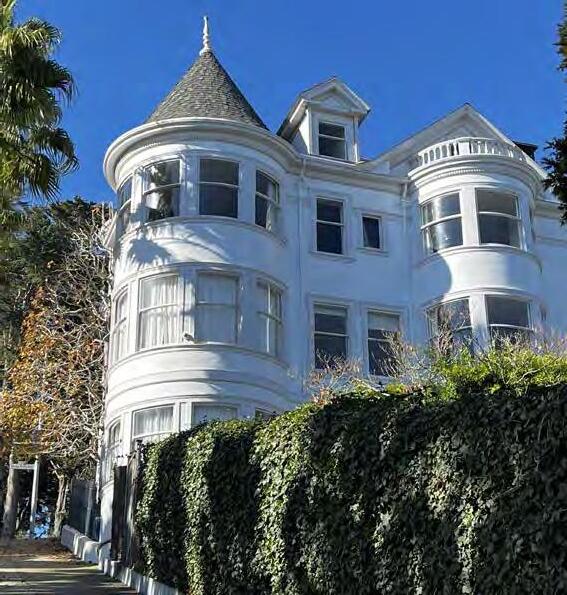
The home of late gay U.S. Ambassador James C. Hormel is proposed as a city landmark.
Matthew S. Bajko
Lurie said at that time that he’s not going to “get into what may or may not happen” in the 2026 budgeting process, “but we’ve given instructions to all the department heads that we have to see a minimum in $400 million in savings, and so we’re going to work with them. They have till February to come back to us; We’re meeting with them weekly.”
Wulandari’s letter stated that with the Trump administration’s attacks on trans rights, now is not the time for the city government to be downsizing its commitment to equal rights for trans and gender-nonconforming communities.
“I share these observations not to assign individual blame, but to urge city leadership to reckon honestly with the consequences of decisions affecting OTI,” Wulandari wrote. “Decisions that dwindle OTI’s capacity ultimately determine whether the City responds to this national crisis by strengthening its support systems – or by quietly retreating from them. Choosing to further reduce investment in OTI at this moment would amount to a decision to provide less protection, less care, and fewer resources to transgender people seeking refuge and stability in San Francisco. The Office of Transgender Initiatives has demonstrated measurable impact when it is properly resourced. Continued cuts – whether direct or indirect – threaten to undo years of progress and weaken a nationally significant model for transgender equity.”
Trans office changes
Since mid-2024, the office has been led by Mahogany, who was appointed by then-mayor London Breed. Mahogany’s appointment coincided with the office’s move to the Human Rights Commission.
Earlier, Mahogany did confirm to the B.A.R. that the office’s lease at the LGBT center is up at the end of February, and that it would be moving to 25 Van Ness Avenue, along with the Department on the Status of Women, which was also moved under the auspices of the Human Rights Commission. The new configuration is known as the Agency on Human Rights.
Representatives of other LGBTQ organizations Wulandari copied on the email – including LYRIC, Parivar Bay
Porter, setting the tone for the next hour and 15 minutes, was emphatic that her main focus “is going to be bringing down costs.”
“Affordability is not just a talking point for me,” Porter said. “I’m a single parent of three teenagers – I’m the one having conversations with my kids about whether or not they will be able to afford to live here.”
Since New York City Mayor Zohran Mamdani made the costs of housing, health care, child care, and groceries the key to his election victory last year, Democrats nationwide have parroted similar talking points. San Francisco Mayor Daniel Lurie made it the theme of his State of the City address earlier this month.
Affordability was also highlighted in the Urban League’s 2026 State of the Black Bay Area survey, the results of which were announced to coincide with the forum. The survey found that 59% of Black Bay Area residents reported “difficulty dealing with the rising cost of living, including paying weekly or monthly bills, maintaining stable housing, and having enough food to eat, among other challenges.”
Candidate Tony Thurmond, who is the elected state superintendent of public instruction, promised that as governor he’d build 2 million units of affordable housing, and support “down payment assistance programs for those who want the opportunity to buy a home.”
Thurmond also pledged a tax
Area, and the LGBT Asylum Project –did not immediately return requests for comment.
HRC ED responds
Last week, the B.A.R. contacted the Human Rights Commission to ask about what changes to the office’s structure had occurred, and to speak with Tugbenyoh, a gay man who is its executive director. Tugbenyoh was appointed, first as the interim HRC leader by Breed and eventually as the permanent head of the agency by Lurie, after Cheryl Davis, the former head of the HRC, resigned in disgrace after it was revealed she signed off on $1.5 million in contracts with nonprofit Collective Impact, run by a man with whom she shared a home address and a car.
Davis was required to disclose this and allegedly didn’t. Further, a San Francisco Chronicle investigation also revealed alleged financial mismanagement at the city agency, reporting that people were overpaid tens of thousands of dollars, that expenses were approved without documentation, and that one nonprofit director received a reimbursement for a $10,000 Martha’s Vineyard rental.
The B.A.R. reached out again January 22 following Wulandari’s letter, but did not hear back until after the initial online version of this report was published.
Tugbenyoh stated January 23 that the commission is doing everything it can to stand up for trans people.
“The Human Rights Commission is proud to stand with, and fight for, trans communities,” Tugbenyoh stated. “The trans community has seen unprecedented attacks over the last year and our colleagues in the Office of Transgen-
credit in his first hundred days.
“Imagine a couple hundred bucks, or money in your pocket, to help you pay for gas, cost of groceries, and housing,” he said.
Billionaire environmentalist Tom Steyer promised he’d “bring in $10$20 million a year for California education and health” by “fighting the special interests who are gaming this system and ripping us off.”
The candidates broadly agreed that lowering the cost of housing would make the largest impact toward making California more affordable.
“It’s not inevitable that California has unaffordable housing,” Porter said. “That is a policy choice.”
Steyer suggested building 1 million houses in his four-year term and enacting statewide rent control. He said with new technologies, “We can cut the per square foot cost of building housing in half,” and suggested supportive interim housing for “people who show up on the street.”
Former Assembly speaker Ian Calderon (D-Whittier) said that the billions in state funding that’s been spent on homelessness services clearly isn’t working well enough to keep large numbers of unhoused people off the streets.
“A lot of people in this state are one rent increase away from living in their car or being pushed out of their home,” he said. “We got to build more homes and reduce regulations … but we have to provide real economic opportunity so your money can work for you.”
der Initiatives do tremendous work in bridge-building and connecting city resources to members of community that need them most. We are doing everything we can within the constraints of a difficult citywide fiscal landscape to provide the most impactful resources, including the staff and visibility our trans community members need and deserve.”
Asked if he agreed with Wulandari’s letter’s characterization of the trans office being diminished, Tugbenyoh said in a phone interview with the B.A.R. January 23, “We know the trans community has been under attack in this country. ... All I can say is that it is a very difficult budget for the past two years, and this year more than last, and we’re doing everything we can to ensure the limited resources we have are used in the most important ways.”
A high-ranking official in the Human Rights Commission said that not much changed when the trans initiatives office was moved to the commission, that the move to 25 Van Ness Avenue was cleared with Mahogany well in advance, and that a staff person did resign but that was unrelated to the move to HRC. The official said that hiring has been paused because of Lurie’s hiring freeze and not because of the move of the trans office to HRC, and that OTI’s Gender Inclusion e-module for city employees being removed was a decision by the Department of Human Resources.
Three longer trainings, including the gender diversity training, were consolidated into one, according to a spokesperson with the human resources department. The new training continues to cover the same concepts, and the consolidation occurred to improve completion rates, the spokesperson continued.
Carol Isen, an out woman who is the human resources director, stated via a spokesperson to the B.A.R. January 27 that, “Gender inclusion is a core priority for the city. DHR’s new streamlined, mandatory course continues to include instruction that affirms gender diversity and supports respectful, inclusive workplace practices.”
The HRC official did not know about the allegation in Wulandari’s letter about “Elimination of key positions, including an office manager role” or the “impending leadership demotion of the OTI director that will reduce authority and compensation.”
Speaking with the B.A.R. last year, Tugbenyoh said he has enjoyed working more closely with the trans initiatives office.
“It’s been incredible and I’ve really enjoyed working more closely with Director Honey Mahogany,” Tugbenyoh said at that time, referring to the Office of Transgender Initiatives. “They do incredibly hard work, which is, given the times we’re living in, very important work and critical work, so it has been a pleasure working with them.”
This week, a spokesperson for the Human Rights Commission responded to the B.A.R.’s requests with a statement.
“In June 2024, the Office of Transgender Initiatives was transferred from the Office of the City Administrator to the Human Rights Commission. This followed the appointment by Mayor London Breed of Honey Mahogany, in May 2024, to Director of OTI. The Human Rights Commission and the Office of Transgender Initiatives are aligned in mission and in support of freedom from discrimination for all persons living and working in San Francisco.
“HRC looks forward to bringing OTI staff to our main office location soon, continuing the work of this vital team in service of San Francisco’s transgender communities,” the statement added. “We are proud to continue to support and serve all our diverse LGBTQI+ communities, through OTI programming and other initiatives. Also, we were very pleased to launch the Commission’s LGBTQI+ Advisory Committee earlier this month; all are welcome to apply and help us steward this work.”
After this statement, the B.A.R. asked again via email and voicemail message to speak with Tugbenyoh. The B.A.R. followed up with a Public Records Act request of the Human Rights Commission, the mayor’s office, and Mahogany, requesting electronic communications regarding the office’s reorganization, and any changes in the structuring or powers of that office, for the entirety of 2024.
Mandelman raises concerns
Asked by the B.A.R. before receiving Wulandari’s letter if he had heard concerns from community members about the diminution of the transgender office, gay District 8 Supervisor Rafael Mandelman said during a January 21 phone interview that he had not.
“I definitely heard more concern about the Department on the Status of Women. There is a very active group
nected the problem of crime to a lack of education and economic resources in communities. Thurmond, a former member of the Richmond City Council and former assemblymember, recalled, “When I came to the City Council in Richmond, I found a bullet proof vest at my seat. I thought, ‘What did I sign up for?’”
Trump-proofing CA
Candidates also discussed the importance of standing up to Trump. Becerra touted his record in suing the first Trump administration when he was state AG.
of folks concerned about that,” said Mandelman, president of the Board of Supervisors, referring to a proposal that that oversight body of a city agency be demoted to a purely advisory role. “I think all this reorganization is, you know, rightly going to raise concerns. The Lurie administration is going to have to address those concerns and ensure people we are not abandoning our commitment to women and marginalized communities or historically-marginalized communities.”
As the B.A.R. reported January 8, queer San Francisco Commission on the Status of Women member Sophia Andary is worried that the upcoming charter reforms will lead to the diminishment of organizations meant to stand up for women and minority groups, in favor of business interests.
“There appeared to be significantly more corporate interest and support from individuals aligned with wealth, rather than from community rooted organizations doing on the ground work with marginalized communities,” Andary, who was speaking for herself and not as a city commissioner, stated to the B.A.R. “Marginalized communities would be negatively impacted with certain charter reforms, and I personally think it’s important to have as many diverse voices at the table.”
Mandelman didn’t return a follow-up request to comment after the paper received Wulandari’s letter.
The B.A.R. asked Lurie about the city’s commitment to the LGBTQ community generally, and specifically to the Office of Transgender Initiatives, after his January 15 State of the City address.
“We’re going to continue doing as much as we humanly can, but like every single important topic, we have less money to continue to do this work,” Lurie said to a press gaggle of reporters after his address. “Honey Mahogany is doing excellent work. She and I are in constant communication about how do we make sure we protect our LGBTQ+ community, our trans community. This is a safe haven for people and it always will be. We’re always going to stand up for our values no matter what dollars we’re talking about; our values will be front and center in our administration.” t
Matthew S. Bajko contributed reporting.
brought up her immigrant parents who ran a laundry and drycleaning business on Taraval Street on San Francisco’s westside.
“Everyone up on this stage is vying to be the fighter-in-chief for the state of California,” she continued.
The candidates were also asked about diversity, equity, and inclusion. The Urban League’s survey had found that 46% of Black Bay Area residents reported “being impacted by the rollback of diversity, equity and inclusion programs.”
Former Los Angeles mayor Antonio Villaraigosa agreed that, “We’ve got to make it easier to build housing.”
“Housing is the biggest driver for affordability,” said Villaraigosa, a past state Assembly speaker. “Rent and the cost of housing.”
Xavier Becerra, former national health and human services secretary in the Biden administration and California attorney general during President Donald Trump’s first term of office, promised he’d freeze utility and property insurance rates “because I believe we are entitled to see behind the curtain.”
“I can’t just change their rates, but I can freeze them and work with the Legislature to understand what’s going on,” Becerra said.
Thurmond and Betty Yee, the state’s former elected controller, con-
“The entire tenure of my governorship will be about the hardest working and lowest paid,” Becerra said. “If you want someone who knows how to fight Donald Trump, go to someone who did – I sued him about 120 times, but we beat him back.”
Villaraigosa said he’s a fighter, too.
“We need a fighter; someone who’s been fighting his whole life to take on this man, take on these ICE raids,” Villaraigosa said.
Referring to Immigration and Customs Enforcement agents, he added, “People covered from head to toe, like the Ku Klux Klan, coming in with weapons and flash bang grenades. We need to build a nonviolent movement, and a governor can support that.”
The killing of a second American citizen by federal immigration agents in Minneapolis over the weekend cast a pall over the forum.
Yee said, “I know our hearts are heavy as we gather here today,” and
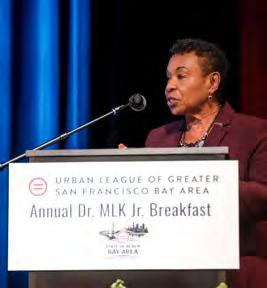
In response to a question about DEI efforts posed by Oakland Mayor Barbara Lee, the only person other than the two moderators who got to ask a question, Steyer promised he’d create a DEI office at the cabinet level. Lee recently endorsed Thurmond’s candidacy.
“The most diverse group makes the best decisions,” Steyer explained.
“Everybody knows that.”
Calderon said in response to the DEI question that he’d support a “forensic audit of every tax credit, every agency, so we know where the money is going.” Historically marginalized communities have been led on by politicians in the past, he said.
“How many times have you been given promises you’re getting funding for your business, your community, and it never happens, because the state doesn’t follow through on its commitments,” Calderon said. “It makes the promise, the pretty press release or social media post, and goes away. That isn’t going to be me.” t
<< Governor forum
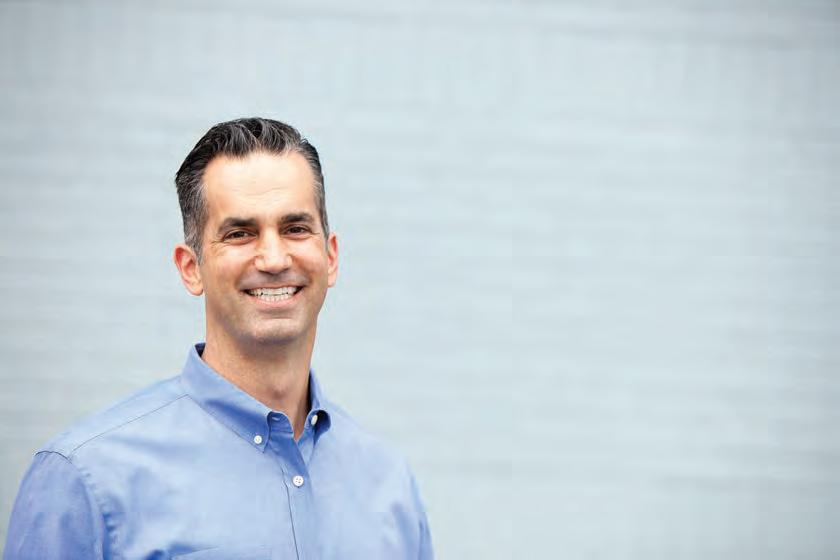
Mawuli Tugbenyoh is the executive director of the San Francisco Human Rights Commission.
From SFHRC
Oakland Mayor Barbara Lee asked the last question at the forum for gubernatorial candidates.
Malcolm Wallace Images
by Gregg Shapiro
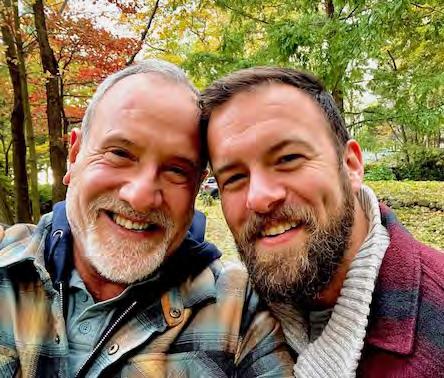
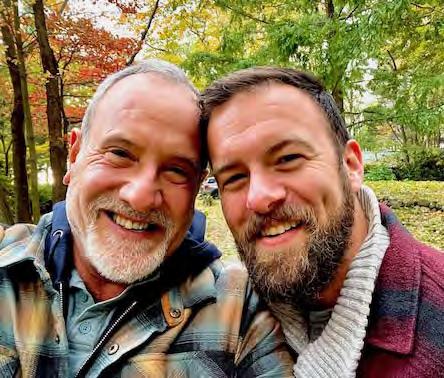
Gay singer/songwriter Mike Maimone has a soul-crushing story to tell. What better way to do it than in song? Maimone and the late, legendary, gay public relations whiz Howard Bragman, who was renowned for his crisis management skills, met in 2022. The pair began a whirlwind, long-distance relationship, marrying in early 2023, shortly before Bragman died of acute myeloid leukemia.
Maimone’s two most recent albums, 2023’s “Mookie’s Big Gay Mixtape,” and his latest, 2025’s “Guess What? I Love You” (8Eat8), address the relationship with a broad range of emotions. Listeners can expect to be taken on a roller-coaster ride of feelings, concluding on an unexpectedly uplifting note with “Waiting in The Light,” which closes the new album.
Gregg Shapiro: Mike, the dedication on your 2023 album, “Mookie’s Big Gay Mixtape” reads “In loving memory of my husband, Howard Benjamin Bragman.” It was released the year Howard passed. Your new album, “Guess What? I Love You,” arriving a couple of years later, is also dedicated to Howard, whom you call “my forever guy.” Were any of the songs on the new album originally intended for its predecessor, or were they all written specifically for the current project?
Mike Maimone: The songs on “Guess What? I Love You” were all written specifically for the album. The only exceptions are “Forever Again,” which I wrote for Howard when we first got engaged, “Big Kiss,” which I started writing after Howard and I returned from a road trip through
the Southwest, and “Paranoid in Paradise,” which I wrote after a misguided attempt to get high with him. Those three ended up on Side A of the record, chronicling our love story from first meeting through our wedding.
There’s a certain blush to the songs written for and about Howard, on both albums, that made me wonder if he was your first serious relationship.
I’m glad to hear you say that, because no, this was not my first serious relationship. In fact, “Forever Again” was written because I’d been previously engaged, and Howard had been divorced, and I wanted to ease any trepidation about putting our hearts on the line again. I was in that prior relationship for seven years, before that I was with a man for six years, and had a yearlong relationship before that. Because Howard and I met later in life, we had the experience to recognize what an incredible thing we had from the moment we met. It made us giddy. We were genuinely grateful for each other. I’m glad that shines through the songs.
by Brian Bromberger
With the Oscar nominations announced last week, it was disappointing that Amanda Seyfried wasn’t nominated as Best Actress for what is likely her best performance as the 18th-century visionary spiritual leader Ann Lee, who founded the devotional sect the Shakers in the historical drama film “The Testament of Ann Lee” (Searchlight Pictures).
The film has received mixed reviews including this one. Yet despite its flaws, Seyfried is incandescently marvelous and is the main reason why this film works as well as it does, even if it ultimately lets down her character while trying to capture the ecstasy and agony of her quest to build a religious utopia.
Poor beginnings
The first chapter depicts Ann Lee growing up poor and illiterate (no formal education) in Manchester, England in the 1730s. Her parents were physically abusive and she seems to have been disgusted seeing her parents have sex. As a teenager working as a nurse, she became part of the movement known as the “Shaking Quakers,” led by a female preacher whose adherents shook vigorously during prayer in a kind of ecstatic dancing they believed purged sin from one’s mind and body in a ritual form of confession. She married a lusty locksmith and they had four children all of whom died within their first year, which traumatized her enormously.
The second chapter focuses on her stint in jail as a public nuisance for her heretical be-
Even though this is a very personal album, was it your intention for “Guess What? I Love You” to be helpful to others grieving the loss of a life partner?
That was one of the intentions. First was to document the love for my own memory. I needed to capture it through music, or I’d start to secondguess if it happened at all. The next was to honor Howard’s legacy and make sure he’d always be remembered. Channeling my grief into the music helped me begin my healing journey, and as I started sharing it with people close to me, the third intention emerged. Although it’s very specific lyrically, it seems to speak to the universal as well.
In addition to this album, you have also written a memoir about your experience. What can you tell the readers about the book?
There is a distinctive shift in tone from the “Mixtape” to “Guess What?,” although the new album does open with more upbeat numbers, including “On My Way,” “Big Kiss,” and “Meet Me.” Was it important to you that you ease the listener in for what was to come later?
Similar to “Mixtape,” I added interlude tracks to guide the narrative, including some voicemails. The new record flows chronologically, so it starts with songs about those first exciting trips to see each other, falling in love, and deciding to spend the rest of our lives together. On the vinyl, “Forever Again” closes Side A, about our love story. Side B begins with “Beautiful Mess,” about being by Howard’s side through his diagnosis and, ultimately, holding him as he passed away. It took me about two years to write and record, and eventually I realized that the album needed to be about beginning to heal, as well, so there is a trio of hopeful songs to close the album.
liefs, where she fasts as part of a hunger strike, perhaps suffers a mental breakdown, and has visions.
Sexual intercourse is prohibited as it is the cause of all evil, even amongst married couples, thus making celibacy mandatory (so new members must be recruited). She proclaims God is male and female, advocating for gender equality. As Mother Ann, she proclaims she is the second coming of Jesus Christ.
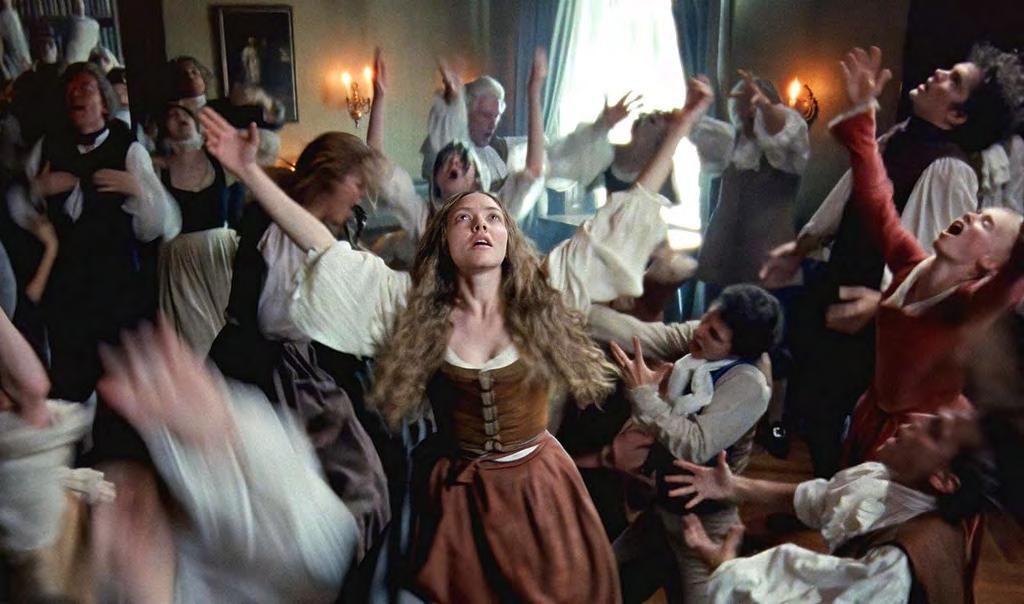
The group’s worship consists chiefly of almost orgiastic chanting, rhythmic breathing, cathartic percussive dancing, releasing their sins in trembling exuberant exultation in an embodied spirituality characterized by complete abandon in their devotional acts.
Released, she forms a small band of followers, most particularly her brother William (Lewis Pullman, terrific), who is gay and leaves his lover Jacob to become Lee’s chief proselytizer.
Moving and movement
The third chapter centers on Lee’s vision where she’s told to emigrate with her band to New York. They settle on several acres of land near Schenectady to build their mission. They work hard practicing a utilitarian ethos (“a place for everything and everything in its place”) and strive for simplicity and craftsmanship with everyone sharing equally their wealth, leading to their now iconic minimalist wood furniture.
The Shakers were anti-slavery and pacifists during the Revolutionary War, resulting in attacks by a violent town mob (who see her as a treasonous witch), with Lee and her brother severely injured, both dying of their wounds in 1784.
And oh yes; the film is a musical, adapting
The book is my story about love, loss, grief, and healing. It started as a way for me to memorialize Howard’s contributions to the world through the lens of our love story. But it ended up describing the ways Howard changed my life upon entering it, and again upon leaving it one year later. Howard was an enormous personality, and there were a lot of funny moments.
There are a lot of sexy stories, too. And some interesting insights due to our culture clash, as he was a Hollywood publicist and celebrity in his own right, while I was a scrappy independent musician living in Nashville. It, of course, gets very heavy. In the writing and editing process, I’ve had to pause many times to allow myself to break down. But I didn’t want to leave the reader, or myself, in sadness. In the two years it took to write, a lot of things changed in my life. I grew as a person. And my beliefs evolved. So, it closes with some perspective on hope and healing. I got a fantastic literary agent and a publisher, and we’re looking at February 2026 for release. I’ve pushed the album back so we can put out both at the same time.t
Read the full interview, with music videos, on www.ebar.com.
www.mikemaimone.com
Shaker hymns (reworked into contemporary melodies so we can experience them anew) in song-and-dance numbers, complete with feet stomping athleticism, grunts and wails, writhing and whirling, outstretched arms, percussive thrusts, almost simulating orgasm.
The problem is when the singing and dancing stops, the film doesn’t adopt a point-of-view as to who Ann Lee really was: insane, a prophet, an early feminist seeking equality, reclaiming agency for women when they had virtually no say over their own bodies and renouncing sex as a tool to subjugate them, a victim of PTSD, or sexually averse.
Yet Seyfried manages to convey Lee’s otherworldliness as if she’s really channeling ecstatic messages from God. It’s a visceral, uninhibited performance, raw yet glowing, tender and vulnerable, but obsessive in her commitment such that Seyfried fearlessly becomes Lee.
It’s a morality epic about a woman who refuses to be broken by grief and tragedy, relying on religious fervor and the power of faith. Spellbinding during the musical numbers, mesmerizing as we watch Seyfried immerse herself totally in Lee, we marvel at the film’s entrancing audaciousness, even if its incongruities, lack of insight, and emotional chilliness prevent it from becoming the masterpiece it might’ve been. t
Amanda Seyfried (center) in ‘The Testament of Ann Lee’
strange but intrepid musical about a spiritual utopian zealot
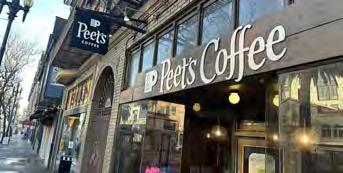
The late Howard Bragman and Mike Maimone
Maimone’s odes to the loss of a loved one
Yesterday once more
by Gregg Shapiro
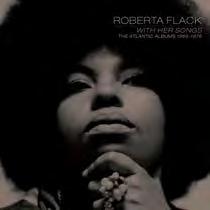
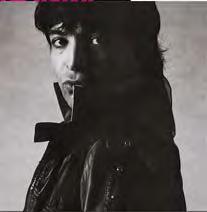
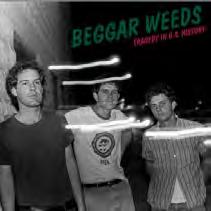
Reissues seem to be more popular than ever. Box sets or single albums, they are audio reminders that the music we listen to today wouldn’t exist without the artists that paved the way. Since you should be boycotting Spotify anyway, check out these reissues from Roberta Flack, whom you know, also Alan Vega and Beggar Weeds, whom you probably don’t but should.
The passing of Grammy Awardwinner Roberta Flack at 88 in 2025 was an immeasurable loss. The eightdisc box set “With Her Songs: The Atlantic Albums 1969-1978” (Atlantic/ Rhino) celebrates the first decade of her music career. Flack, who spent her formative years in the DC area, was a teacher before becoming a performing artist, most notably at the legendary gay restaurant and bar, Mr. Henry’s on Capitol Hill. She released her debut album, “First Take” in 1969, and followed it in 1970 with the aptly titled “Chapter Two” and 1971’s “Quiet Fire.”
This is where Flack’s vocation took
one of the most fascinating trajectories in contemporary music history. Her cover of Ewan MacColl’s “The First Time Ever I Saw Your Face,” from 1969’s “First Take,” was featured in the 1971 Clint Eastwood movie “Play Misty For Me,” propelling the three-year-old album into platinum territory and earning Flack a Grammy Award in 1972. That MacColl cover is a perfect example of Flack’s knack for interpretation, as in the case of another of her Grammy-winning tunes, a 1973 cover of Charles Fox, Norman Gimbel, and Lori Lieberman’s “Killing Me Softly with His Song” (from her “Killing Me Softly” album). Flack also made her mark on songs by queer singer/songwriter Janis Ian (“Jesse”), Carole King
t << Music, Museums, & Film
Classic album reissues by Roberta Flack, Alan Vega and Beggar Weeds
(“Will You Still Love Me Tomorrow”), Paul Simon (“Bridge Over Troubled Water”), Leonard Cohen (“Suzanne”), and many others. Her remarkable friendship with fellow Howard University classmate Donny Hathaway yielded a pair of collaboration albums, the first of which, “Roberta Flack & Donny Hathaway” from 1972 (included in the box set), produced another massive hit single, “Where Is The Love.” Additionally, the albums “Feel Like Makin’ Love” (1975), “Blue Lights In the Basement” (1977), and her eponymous 1978 release, all generated hit singles: “Feel Like Makin’ Love,” “The Closer I Get to You,” and “If Ever I See You Again,” respectively. “With Her Song” is an es-
sential musical history lesson. store. rhino.com / robertaflack.com
Where would the current state of electronic music be without the No Wave pioneers Suicide? The duo, comprised of Martin Rev and the late Alan Vega, set the stage for so much of what we listen to now. Of course, what set Suicide apart was Vega’s distinctive vocal style. Imagine a 1950s rockabilly heartthrob fronting an electronic act, and there you have it.
For his 1980 debut solo album, an eponymous record reissued by Sacred Bones in an expanded deluxe edition featuring early demos of the disc’s eight songs, Vega, with “encouragement” from The Cars’ Ric Ocasek (who would produce Vega’s third solo effort), focused on a retro rock style.
The best of the material includes the surf punk of “Fireball” and “Bye Bye Bayou,” the hip-swaying “Jukebox Babe,” and “Speedway,” which incorporates a persistent synth beat. Vega worked in a similar vein on the reissued 1981 follow-up “Collision Drive” (Sacred Bones), even going
so far as to cover Gene Vincent’s “Be Bop A Lula,” and revisiting Suicide’s “Ghost Rider” in this vintage rock setting. sacredbonesrecords.com
Beggar Weeds, a Jacksonville, Florida trio that could count queer R.E.M. front-man Michael Stipe among its supporters, is given its due on the 13-track compilation “Tragedy in U.S. History” (Strolling Bones). During the band’s brief lifespan, it recorded a five-song EP, along with even more unreleased music.
Fortunately, Beggar Weeds’ drummer Alan Cowart, now drumming with the re-formed Chickasaw Mudd Puppies, brought his former band to the attention of Strolling Bones Records’ George Fontaine Sr. Now we have the chance to appreciate Beggar Weeds, many for the first time. In addition to the five EP songs (including the catchy “Graduating”), the unreleased tracks, co-produced by Stipe (who also provided “cursing”), feature standout “Elizabeth,” “Seer,” and “Ship.” Two bonus tracks, including the rapidfire punk of “El Camino,” close out the album. strollingbonesrecords.comt
Archival treasures
by Jim Provenzano
Take a step back in time in historic film and videos clips at a special screening of archival footage at the GLBT Historical Society Museum on February 5.
“In Their Own Words: Trans People of Color Speak from the Video Archives” will highlight Black, Latinx, Asian, and Pacific Islander trans and gender-nonconforming people sharing, in their own words, stories of their lives, identities, and activism. The program includes excerpts from “Screaming Queens: The Riot at Compton’s Cafeteria” (plus extended interviews), highlights from Sylvester’s fabulous 40th birthday celebration, and candid clips of everyday trans and gender-nonconforming life in the Bay Area. Presented in celebration of the
current exhibition, “I Live the Life I Love Because I
the Life I Live,” the evening will also include remarks
Queer short films
by Jim Provenzano
from curator Ms. Bob Davis, joined by StormMiguel Florez, community members, activists, and artists featured in the exhibition, which runs through February 15.
Co-presented with the Louise Lawrence Transgender Archive, “I Live the Life I Love Because I Love the Life I Live” celebrates Black, Latinx, Asian, and Pacific Islander trans and gender-nonconforming people who lived boldly and authentically despite racism, homophobia, transphobia, and class prejudice. Featuring portraits, candid photographs, activist materials, and self-portraits, the exhibition highlights both performance and everyday expressions of identity.t
Screening February 5, 6pm-8pm, $10-free for members. 4127 18th St. www.glbthistory.org
Take the ferry, if you like, over to Tiburon for “Our Heroes Bleed Glitter,” a one-night mini-festival of short queer films by diverse young filmmakers. Ten films screen at Cinelounge on February 7.
Curated by Daniel Talbott, Felix Mack and Andrew Klaus-Vineyard, the collection of award-winning queer films range from young romantics in Mexico to sassy drag queens in nightclubs.
“Queercore filmmaking is a cultural and social movement that began in the mid-1980s as an offshoot of the punk subculture,” said co-curator Talbot. “It’s distinguished by its discontent with society in general, and specifically society’s disapproval of the LGBTQ+ community. Queercore filmmaking expresses itself in a doit-yourself manner and aesthetic. We make our films whether we have two dollars, a condom, and a few pieces of gum, or whether we have actual financial backing or government subsidy and a full crew.
“This collection of ten award-winning short queer films from all over the globe personifies queercore filmmaking,” said Talbott. “Some were made for literally zero dollars, without a crew and proper sound. Some again where supported and held by film funds. All of them are a prism of queerness and singularity. We’re be-
A scene from Rafael Ruiz
from Jenni
A
yond excited to team up with the incredible film folks at Cinelounge and to share these films in the Bay Area. We really hope audiences will come and see them in a cinema, the way they were made to be seen, and to celebrate indie filmmaking with us.”
‘Our Heroes Bleed Glitter,’ February 7, 6pm, Cinelounge, 40 Main St., Tiburon. www.cineloungefilm.com
Harvey honored A powerful elegy from acclaimed queer filmmaker Jenni Olson, “575 Castro St.” reveals the play of light and shadow upon the walls of the Castro Camera Store set for Gus Van Sant’s Academy Award-winning film “Milk” as we hear excerpts from the audiocassette that Harvey Milk recorded to be played, “in the event of my death by assassination.”
The film, which can be viewed free online, features Milk’s now legend-
Luis
ary line, “Ya gotta give ’em hope,” and his eloquent, timely, and timeless denouncement of right-wing antiLGBTQ hate (calling out Anita Bryant and California State Senator John Briggs). The tape was made in November 1977 (after Milk’s election to the San Francisco Board of Supervisors, which made him one of the first openly gay elected officials in the United States). Milk and San Francisco Mayor George Moscone were assassinated by SF Supervisor Dan White one year later, in November 1978.
Commissioned by Focus Features to be showcased online in conjunction with the theatrical release of Gus Van Sant’s Academy Award-winning feature film “Milk,” 575 Castro St. premiered at the 2009 Sundance Film Festival and 2009 Berlinale, and has played at festivals and museums across the globe.t
www.575castrostreet.blogspot.com
Love
Photo from the GLBT Historical Society’s current exhibition, ‘I Live the Life I Love Because I Love the Life I Live’
Left:
Espejo and
Pacheco’s ‘Verano’
Right:
scene
Olson’s ‘575 Castro St.’
t Books, Film & Art >>
Love, lust, and the internet
by Adam Sandel
Writer and performer Mike Albo
has chronicled his misadventures as a gay man ever since he wrote copious diaries about his growing lust for boys in middle school. In his wildly entertaining audiobook, “Hologram Boyfriends: Sex, Love, and Overconnection,” he takes us from his coming of age in the 1980s to his New York City club kid days in the ’90s, to his search for romantic connection using every form of meetup technology that’s been invented since.
He’s performed comedy shows across the US, Canada, the UK, and Europe, and penned the acclaimed novels “Hornito,” “The Underminer: The Best Friend Who Casually Destroys Your Life” (with Virginia Heffernan), and “Another Dimension of Us.”
“Hologram Boyfriends” combines spoken word chapters with recordings of his live readings. Throughout, Albo’s writing is filled with sharp social satire, vivid sensory details, and laughout-loud self- deprecating humor.
In a recent phone interview with the Bay Area Reporter, the 50-something Albo shared his insights as a technologically over-connected gay New Yorker.
Adam Sandel: Having tried all of them, which form of technol-
ogy have you found to be the best way to meet guys?
Mike Albo: Instagram. Direct messages offer the best version of our slutty society. I’ve given and gotten slutty messages on Instagram, and I’ve gone on dates through Instagram DMs.
Any others?
There is a site called Raya, a very exclusive way to meet people. Ben Affleck was on it. It’s by invite only. I’ve had a couple people recommend me for it, but I can’t get on it to save my life. I guess they looked at my profile and said, “Nah.”
What are some of the benefits of meeting people through technology?
Technologies have helped people
get through their shyness. There’s something good about it and something bad about it. It’s changed the language. It’s gone from, “Do you want to hang out at my place?” to, “I’m a top, I’m a bottom, I’m versatile.”
So how do you meet guys now? I’m into in-person meeting now. I meet people at parties or readings. I’m always going to some reading. I don’t go out to bars as much anymore because I can’t stay out past 11:00. I realized that the amount of time I wasted sitting at bar holding a Rolling Rock beer was about the same amount of time I spend scrolling – only now I can do it on the toilet.
What are the worst parts of meeting guys through technology?
Teen taunts in ‘The Plague’
by Gregg Shapiro
Adirectorial and writing debut ev-
ery bit as potent as Eva Victor’s “Sorry, Baby,” writer/director Charlie Polinger’s “The Plague” (IFC), is also just as hard to shake, which makes it required viewing.
Adolescent Ben (Everett Blunck, who was recently seen in the queer film “Griffin in Summer”) is the new kid in town. Relocating from Boston after his mother had an affair and his parents divorced, Ben is enrolled in the second session of water polo camp, on a college campus, in summer 2003. The coach, Wags (Joel Edgerton, on
the comeback trail with this movie and “Train Dreams”), has his work cut out for him with this rambunctious group of 12 and 13-year-old boys. Because most of the adolescents are “vets” from the first session, Wags tries to make socially anxious Ben feel welcome. It doesn’t take long to discover who the ringleader is. Jake (Kayo Martin), on whom Regina George of “Mean Girls” had nothing, is cruelty personified. For the first half of “The Plague,” his target is nerdy and socially awkward Eli (Kenny Rasmussen). Eli, who suffers from what looks to be plaque psoriasis, never takes his shirt off in the pool. When he’s not being ignored, he’s
treated like a pariah in the cafeteria.
Led by Jake, the other boys jump up from their seats at the table whenever Eli approaches with his tray. Jake has labeled Eli’s physical difference The Plague, and created a mythology around it.
For a while, Ben succeeds in fitting in with the others. As naïve as he is desperate to connect with the others, Ben takes what Jake says as gospel, and follows his, and the other boys’ leads.
When Ben accidentally bumps into Eli, in an especially chaotic scene when the boys sneak out of the dorm and do some damage in a nearby desolate neighborhood, he rushes over to a burst pipe and begins to scrub his skin. This is done to the delight of Jake and the others.
After Ben makes the mistake of helping Eli apply medicinal ointment to a hard-to-reach area, something witnessed by Jake, his world collapses in unimaginable ways. Suddenly, he is also said to have The Plague. He is shunned in the pool, the showers, and the cafeteria. He is alternately ridiculed and ignored. Making matters worse, he begins to show signs of an outbreak similar to Eli’s.
“The Plague,” which pulses with tension, raises the question, when is a
‘This Burning World’
by Jim Provenzano
In what could most assuredly be called the largest art installation in the downtown district, the Institute of Contemporary Art San Francisco announced the completion of the installation of Jeffrey Gibson’s 433-footlong vinyl mural, “This Burning World.” Adapted from stills of his 2022 video installation of the same title, the mural includes a dazzling array of imagery. The mural’s installation was completed on January 22 and will be on view through summer.
Gibson is an interdisciplinary artist, curator, and convener celebrated for his work in painting, installation, video, and performance. For more than two decades, he has examined how language, pattern, and music construct meaning, synthesizing Indigenous and Western traditions through
vibrant color, complex patterning, and layered sound. A member of the Mississippi Band of Choctaw Indians and of Cherokee descent, Gibson represented the U.S. at the 2024 Venice Biennale with his acclaimed exhibition, “the space in which to place me,” which made its U.S. debut at The Broad in Los Angeles in May 2025.
“Indigenous kinship philosophies provided the conceptual and philosophical framework for my 2022 presentation at ICA SF, from which this installation finds its foundation,” said Gibson, who identifies as queer. “These perspectives acknowledge
Mike Albo searches for love (and sex) in his audiobook, ‘Hologram Boyfriends’
What they’re calling “AI slopification.” There are all these photos of men which are probably AI-doctored. That’s a depressing development. Everyone on Grindr is a sex worker now, or an OnlyFans person trying to solicit. The internet has become a red-light district, with people on the sites trying to get money from you.
How would you meet men if there was no technology?
I guess I’d go back to the bars. But I’m older now and I can’t drink as much as I used to. Older men I know say that before technology, Manhattan was the internet, with so much flirting and cruising going on. If the internet went away tomorrow, everyone would be out in the streets. When we had blackouts in New York, people were all out in the street, getting into each other’s pants. Their desire spurred them to action.
After all the searching, have you found your love?
I absolutely long for a stable longterm relationship. I’ve been having dreams lately about really close relationships with dogs. Chat GPT tells me that’s me longing for a relationship. In the meantime, I’m dating. My level of desire and horniness has become moderate enough that I can actually get work done. It’s not in control of me as much as it used to be.
I’d love to have a garden and a partner walking around the garden with me. After ‘Hologram Boyfriends,’ I don’t need to write about looking for love in New York again. This city isn’t conducive to long-term relationships.
How has the response to ‘Hologram Boyfriends’ been?
Critically it’s been amazing. The challenge is trying to get people to listen to it. People say they don’t listen to audiobooks, they listen to podcasts. So, I tell them it’s a podcast. A few gay men have said, “I’ve been wanting someone to say all of this.”
What’s next for you?
I have a TED talk coming up; isn’t that fancy? It’s sort of a parody of a TED talk, which is the only way I could do it.
Any plans to come to San Francisco?
San Francisco is such a sexy, beautiful city. I’d love to come to San Francisco and perform at Oasis one day. I used to go to Trannyshack, and I’m a fan of a lot of the San Francisco people.t
‘Hologram Boyfriends: Sex, Love, and Overconnection’ by Mike Albo, Macmillan Audio. $26. www.us.macmillan.com www.mikealbo.net
Charlie Polinger’s 21st-century ‘Lord of the Flies’
horror movie not a horror movie? The visuals, including many of the underwater shots, are breathtaking. There is also an effective use of original music in the score by Johan Lenox. By the stunning conclusion, you
may find yourself gasping for air after a dive into the deep end, with the revelation that the plague may well be teenage boys. Rating: A-t www.ifccenter.com
the elements of our natural environments as our equal ancestors, living relatives, and as extensions of our own minds and bodies. When we damage or treat the land without regard for its own sustainable well-being, we are in turn hurting and damaging ourselves and disregarding our own well-being, safety, and health.”
When you’re downtown, check it out along Mission Street between 4th and 5th streets.t
Hailed as “her generation’s most imaginative and thrilling jazz interpreter” (Spin), vocalist and composer Cécile McLorin Salvant has redefined jazz. Come hear Salvant sing selections from her new release Oh Snap alongside an eclectic, thrilling mix of standards from her repertoire.
Feb 5
ZELLERBACH HALL, BERKELEY
Martha Graham Dance Company
GRAHAM100: A Celebration of the Company’s 100th Anniversary
After more than a decade, the legendary Martha Graham Dance Company returns to Berkeley to celebrate their 100th anniversary, featuring iconic works like Appalachian Spring and Night Journey, plus new dances by Jamar Roberts and Hope Boykin.
Feb 14–15 VALENTINE’S WEEKEND
ZELLERBACH HALL, BERKELEY
Yaa Samar! Dance Theatre Gathering
Choreographer Samar Haddad King’s Gathering explores themes of love, loss, trauma, and dislocation. Part staged work, part interactive experience, the production features an international cohort of artists telling a fictional story of a village under siege, and one woman’s struggle to reconcile her fragmented memories.
Feb 27–Mar 1
ZELLERBACH PLAYHOUSE, BERKELEY
The English Concert
Handel’s Hercules
Harry Bicket, conductor
A true season highlight! Britain’s extraordinary early-music ensemble visits with a concert performance of Handel’s musical drama Hercules, a showcase for the expressive mezzo-soprano Ann Hallenberg, who sings the demanding role of the hero’s wife Dejanira.
Mar 8
ZELLERBACH HALL, BERKELEY
Joyce DiDonato, mezzo-soprano Time for Three, string trio Emily – No Prisoner Be
Superstar mezzosoprano Joyce DiDonato joins with Pulitzer Prize-winning composer Kevin Puts and Grammy-winning chamber ensemble Time for Three in a series of intimate songs based on the deeply touching poetry of Emily Dickinson.
Feb 7
ZELLERBACH HALL, BERKELEY
A.I.M by Kyle Abraham
Visionary choreographer Kyle Abraham’s daring company arrives in Berkeley with kinetic, intimate works danced to live music composed by Max Roach, Nina Simone, and Shelley Washington.
Feb 21–22
ZELLERBACH HALL, BERKELEY
Geneva Lewis, violin Evren Ozel, piano
Praised for her lustrous tone and deft, dancing energy in a wide range of repertoire, the New Zealand-born, US-raised violinist plays Schoenberg, Bach, and Schubert in her Cal Performances debut recital, joined by acclaimed pianist Evren Ozel.
Mar 1
HERTZ HALL, BERKELEY
Opera Parallèle
La Belle et la Bête
Opera Parallèle presents an astonishingly original production of the classic Beauty and the Beast tale that blurs the distinctions between cinema and live opera, merging Jean Cocteau’s surrealist 1946 film with Philip Glass’ mesmerizing 1994 score.
Mar 13–14
ZELLERBACH HALL, BERKELEY
Bruce Liu, piano
Praised for his “effortless virtuosity” (Classics Today), Liu makes his Cal Performances debut with a program featuring Beethoven’s beloved Moonlight and Waldstein sonatas, Chopin’s luminous Nocturnes, Op. 27, and a set of works inspired by Spanish themes.
Feb 10
ZELLERBACH HALL, BERKELEY
Chris Thile, mandolin and vocals
A dazzling virtuoso and musical shapeshifter, the four-time Grammy winner performs selections from his new Bach album in addition to selections from Laysongs, his eclectic solo recording from 2024. Prepare for anything from bluegrass to Bach!
Feb 27
ZELLERBACH HALL, BERKELEY
Julia Keefe Indigenous Big Band
The dazzling big band celebrates and extends the contributions of Indigenous and Native musicians, composers, and bandleaders throughout the rich history of jazz, in a performance representing a wide range of tribal affiliations across North and South America.
Mar 6
ZELLERBACH PLAYHOUSE, BERKELEY
Alvin Ailey American Dance Theater
Under the exciting new leadership of Artistic Director Alicia Graf Mack, the legendary Alvin Ailey American Dance Theater returns to Berkeley with four dynamic programs uniting iconic masterpieces like Revelations, works by Ailey dancers past and present, and bold new creations from the next generation of choreographers, including Maija García, Fredrick Earl Mosley, and Matthew Neenan.