The Los Angeles Blade covers Los Angeles and California news, politics, opinion, arts and entertainment and features national and international coverage from the Blade’s award-winning reporting team. Be part of this exciting publication serving LGBT Los Angeles from the team behind the Washington Blade, the nation’s first LGBT newspaper. From the freeway to the Beltway we’ve got you covered.
Marilyn Pittman dies
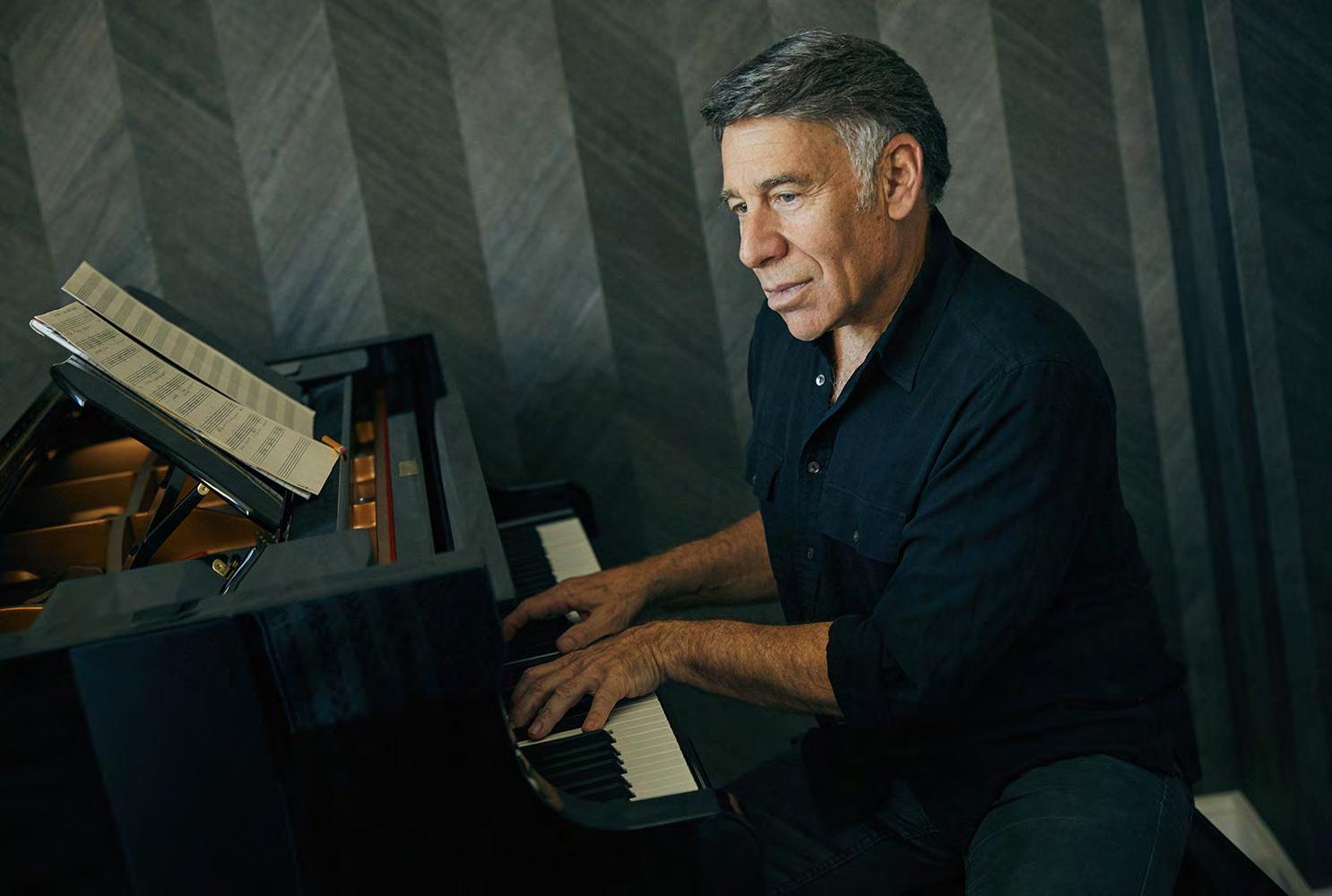
Stephen Schwartz
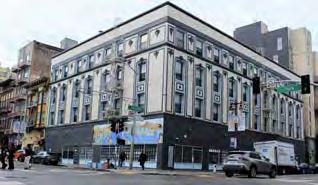
111 Taylor Street, the site of Compton’s Cafeteria Riots in 1966, sits at the corner of Turk and Taylor streets in San Francisco, as seen on April 1.
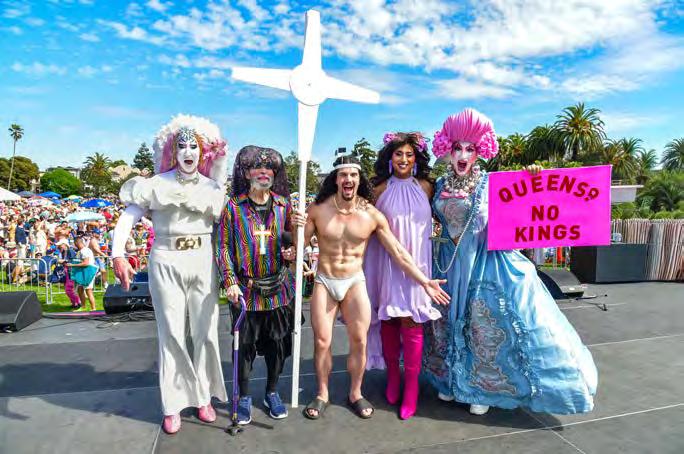
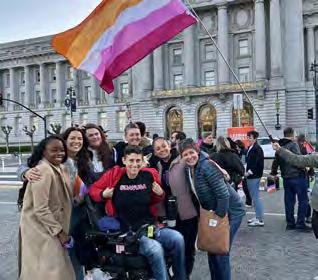
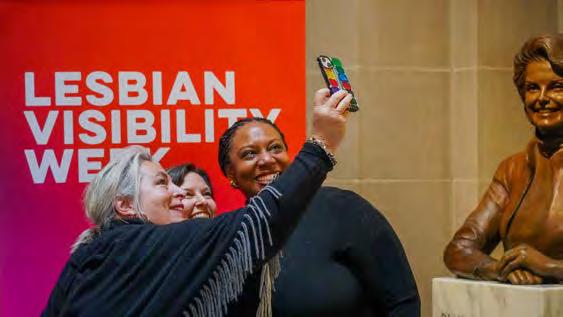
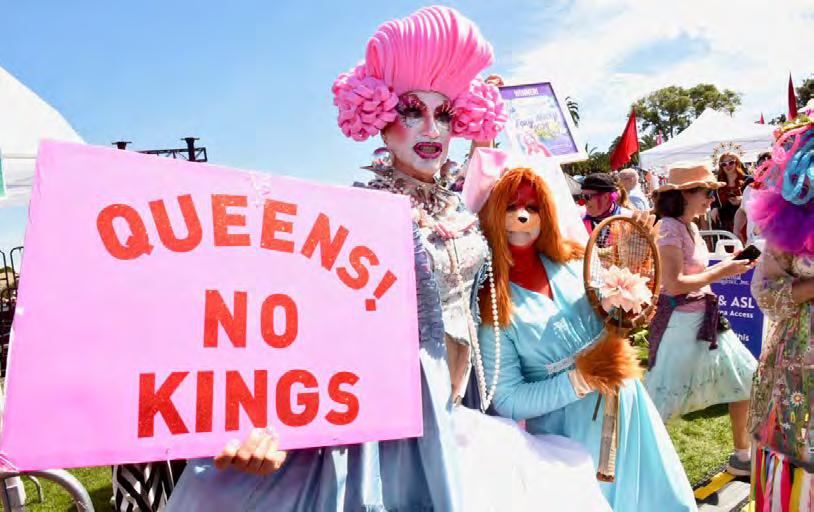
Frances “Franco” Stevens, center, was joined by friends before the San Francisco City Hall illumination for 2025’s Lesbian Visibility Week.
Courtesy Curve Foundation
Helpers needed to clean Castro history plaques
compiled by Cynthia Laird
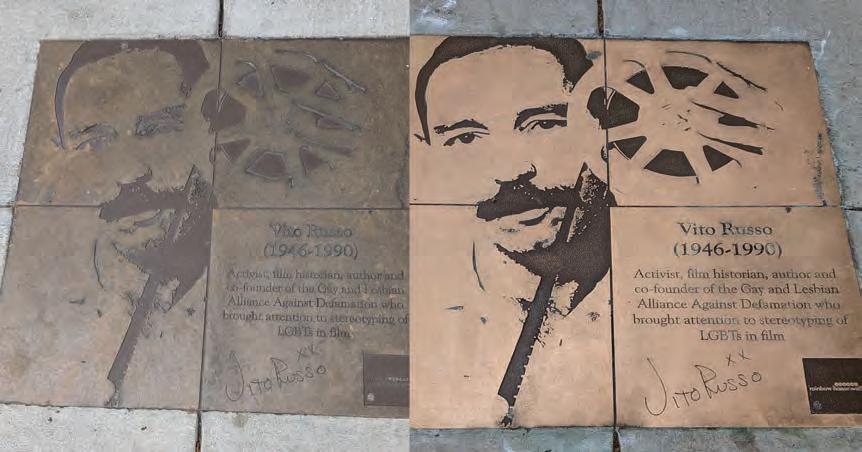
The Rainbow Honor Walk, which installs sidewalk plaques of deceased LGBTQ luminaries, is looking for volunteers for its annual spring-cleaning project. The plaques, located throughout the LGBTQ Castro neighborhood, need to be refreshed, leaders of the nonprofit stated in a recent newsletter.
Spring cleaning day takes place Saturday, April 25, from 11 a.m. to 3 p.m. The goal is to have the bronze plaques cleaned and polished ahead of Pride Month in June.
Additionally, the honor walk noted that throughout the summer, a separate initiative will see some plaques restored. A nonslip coating will be applied to all plaques to comply with updated sidewalk safety codes, according to the newsletter.
The Rainbow Honor Walk’s first class of inductees was in 2014. Since then, two other classes have been named, and many plaques now dot the Castro neighborhood.
Brian McConnell, a gay man who founded the old Guerrilla Queer Bar, a free-wheeling bar crawl that took place in the early 2000s, has recently joined the Rainbow Honor Walk board. Previously, he had stepped in as an adviser.
McConnell encouraged interested people to volunteer for the spring cleaning, which the honor walk hopes to make an annual event.
“It’s a really great way to deliver history,” McConnell said of the plaques during an online interview with the Bay Area Reporter. “The Rainbow Honor Walk is an integral part of the Castro neighborhood, and we want to make the plaques shine.”
Other new board members are Paul T. Winfield, Ph.D., a program manager and world explorer who has lived in 12 countries on six continents, and Kathy Amendola, a lesbian who owns the Cruisin’ the Castro walking tours company and
who previously served on the board.
In a phone interview, Amendola said that she had been a founding board member of the honor walk years ago. She came back in February, she said, in order to help the organization.
“It’s so important and it keeps queer history alive,” she said. “I bring sales and marketing and travel and tourism knowledge to the organization.”
Amendola added that the group’s goal is to get “plaques down as fast as we can,” but that takes money. The board has fundraising activities planned, she said.
The Rainbow Honor Walk last year installed two new plaques. One honored Roger Casement, a gay Irishman who was hanged for treason in 1916.
The other was for Bob Ross, a gay man who was the founding publisher of the Bay Area Reporter.
Over the next year, eight more memorial plaques are expected to be installed, according to the newslet-
ter. McConnell said that four have been fabricated and will be installed first. They are for honorees Gilbert Baker, co-creator of the rainbow flag, whose plaque will be located close to Market and Castro streets within the sightline of the giant rainbow flag he designed that flies in Harvey Milk Plaza; Marsha P. Johnson, a trans activist, whose plaque will be along 18th Street; Phyllis Lyon, a lesbian pioneer, whose plaque will be located near the one for her wife, Del Martin, on 19th Street near Collingwood Street; and Mario Mieli, a gay Italian activist, whose plaque will be on 18th Street near Poesia Restaurant.
The other four plaques that are hoped to be in stalled will be for Bernice Bing, a queer Chinese American artist; Billie Holiday, a bisexual jazz singer; Charley Parkhurst, the only known stagecoach driver in California history identified as female at birth; and Edie Windsor, a lesbian whose lawsuit against the government helped pave the way for marriage equality in the U.S.
Rainbow Honor Walk, and to donate, go to rainbowhonorwalk.org.
McConnell noted that the map on the site is outdated and that it should be updated by the day of the cleanup project.
Queer women to host D8 supe forum San Francisco’s District 8, which includes the Castro LGBTQ neighborhood, will have a new supervisor in early January, and a group of queer women is hosting a forum for the three gay male candidates looking to succeed the incumbent, gay Supervisor Rafael Mandelman. The election is November 3.
The forum will take place Thursday, April 16, from 7 to 8 p.m. at Rikki’s, the queerowned women’s sports bar located at 2223 Market Street in the Castro.
blocks outside the boundaries of the District 8 supervisorial district.
Organizers stated that the forum is designed to make space for queer women, trans, and nonbinary people. Moderated my lesbian event producer Michelle Meow, the forum will be an opportunity to connect with the candidates, hear about their plans for small businesses, community events, housing, policies on education, and transportation. The program will include time for questions and answers.
The event is free, but space is limited. To RSVP, go to https://tinyurl. com/bdsfp6ue.
New season of live music at Civic Center
San Francisco Mayor Daniel Lurie has announced a new season of live music and food trucks in the Civic Center area. The Civic Center Soundtrack concert series will kick off its third annual season at Fulton Plaza Tuesday, April 14. The plaza is located between the Asian Art Museum and the main branch of the San Francisco Public Library.
Concerts will take place Tuesdays and Thursdays from noon to 3 p.m. through October, a news release from the mayor’s office stated. The concerts will bring new performances and, for the first time, a rotating lineup of food trucks, creating a vibrant and welcoming lunchtime hub in the heart of the city, the mayor’s office noted.
“I’m thrilled to welcome Civic Center Soundtrack back for a third season – transforming Fulton Plaza into an exciting destination for live music, local artists, and great food,” Lurie stated.
For the upcoming spring-cleaning day, McConnell stated in an email that volunteers will meet in front of SoulCycle at Castro and Market streets. The honor walk will provide cleaning supplies, polish, etc. Volunteers are encouraged to bring foot stools and kneepads, if needed. People can sign up at www. rainbowhonorwalk.org/volunteer/.
For more information on the
An email announcement noted that the trio of candidates are expected to attend. They are Gary McCoy, a former aide to Congressmember Nancy Pelosi (D-San Francisco) who is currently campaign manager of Pelosi’s Save Our Health Care Campaign; Michael Trung Nguyen, an elected member of the San Francisco Democratic County Central Committee who is also drag artist Juicy Liu; and Emanuel “Manny” Yekutiel, a D8 resident and a former member of the San Francisco Municipal Transportation Agency board, who owns Manny’s Cafe and event space on Valencia Street a few
Funded and produced by Illuminate, the Civic Center Soundtrack is a partnership between the arts nonprofit, the San Francisco Public Library, the San Francisco Recreation and Parks Department, and the Civic Center Community Benefit District, the release noted.
“This transformation of the Civic Center area, including Fulton Plaza, demonstrates the power of active public spaces,” stated Sarah Madland, interim general manager of Rec and Park. “Music, culture, recreation, and this year’s addition of rotating food trucks make Fulton Plaza a true hotspot.”
Each event will feature three performers spanning a wide range of genres, highlighting local talent alongside notable singer-songwriters. t
Courtesy Brian McConnell/Rainbow Honor Walk
Bourg easily reelected Castro Merchants president Community News>>
by John Ferrannini
Merchants Association Presi-
Castro
dent Nate Bourg was reelected to a second term in his position, alongside the organization’s current board members and two new ones, at its monthly membership meeting April 2.
Also discussed were upcoming events, the neighborhood rate of storefront vacancies, and a reported commercial burglary.
Board elections
“I’m really proud to continue leading the Castro Merchants Association at such a pivotal moment for the neighborhood, and humbled that my fellow merchants have placed their trust in me for another year,” stated Bourg, a gay man. “Our board and I will continue focusing on bringing fresh energy into the district, supporting merchants in real, tangible ways, and ensuring the Castro remains not just culturally significant, but economically strong and built for the future.”
There were 11 people elected to board positions and all were chosen “nearly unanimously,” Bourg said. He clarified that not every person got every single vote but he did not want to publicize the cases in which that happened. Votes were anonymous.
“It’s very gratifying, sometimes thankless,” Bourg said of being president, asking for his colleagues’ support for a second term, “but at the end of the day, it’s never a negative taste in my mouth because it’s gratifying that we’re helping people, people who deserve to be uplifted, not just business owners, but the whole community.”
Bourg is co-founder of The Academy SF, a private social club where the merchants’ meetings are held each month except for July or January.
Jenn Meyer, a straight ally who is proprietor of Local Take, 4122 18th Street, will continue as vice president, and Desmond Morgan, a gay man who is co-owner of Eureka Sky, 3989 17th Street, will continue as secretary. Morgan was not at the meeting. Robyn Lounsbury of Bean Counter, 2358 Market Street, Floor No. 2, will be treasurer.
Rounding out the board are incumbents Terry Asten Bennett of Cliff’s Variety at 479 Castro Street, a straight ally and past president; Steve Martel, owner of PO Plus at 584 Castro Street; Robert Emmons, a gay man who is owner of Welcome Castro at 525 Castro Street; David F. Khalili of Rouse Relational Wellness at 4124 18th Street; and Leon Shannon, owner of Skin on Market at 2299 Market Street.
There are two new board members – Praveena Selvaduray of Castro Direct Primary Care at 2191 Market Street, and Mark Bowen, a bi man who is general manager of Midnight Sun at 4067 18th Street.
Bowen said he’d worked in the neighborhood for a decade and would appreciate the chance to give back to the community. Selvaduray was elected in absentia.
The board had previously been capped at nine members, but new bylaws passed at the April 2 meeting now allow 11. Bourg said the change is necessary because of the merchants’ group’s growth over the years. Of other bylaw changes, there’s “nothing that will dramatically impact the workings of the organization,” he said.
Bourg thanked everyone who put their foot forward to volunteer.
“All of the existing board has enthusiastically decided to run again,” he said. “They care a lot about the neighborhood. It’s a time commitment and it does require energy, showing up and taking part in things, so we’re grateful for those who’ve volunteered. Everyone’s a volunteer. Everyone’s running their own small business, and working really hard, and probably not getting rich – far from it, I’m sure.”
Upcoming events
Chris Carrington, a gay man who co-founded CG Events, which produces the Castro Night Market, said that the first iteration of the event for the year, on March 20, drew a huge crowd.
“A few thousand people came out to take advantage of the warm weather,” he said. “We’re trying to include the neighborhood as much as possible and the businesses as much as possible.”
Patrick Batt, a gay man who is proprietor of Auto Erotica at 4077A 18th Street, asked if there was a way to “put some sort of signage up that would indicate the sidewalk at least is accessible,” as the street closure from noon until after
the event, which started at 5 p.m., caused some pedestrians to assume the block’s businesses were closed, and turn back. Carrington said he would do so.
The next iteration of the night market, Friday, April 17, from 5 to 10 p.m., will be “musicals” themed.
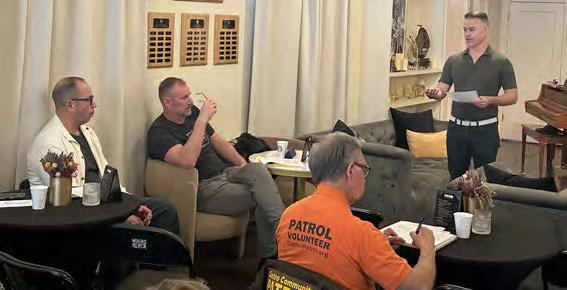
Greg Carey, chair of Castro Community on Patrol, said that there will be another self-defense workshop on Saturday, May 16, at the Eureka Valley Recreation Center, 100 Collingwood Street. Further details are available on Eventbrite.
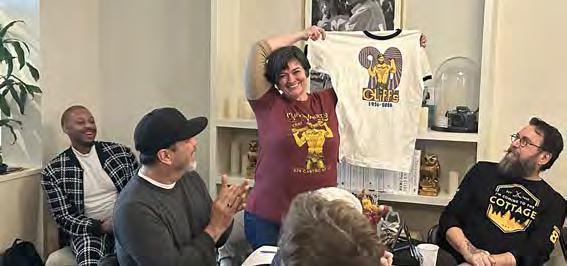
Asten Bennett teased the celebration of the 90th anniversary of Cliff’s, Saturday, June 6, from noon to 5 p.m.
At about 4, Sister Roma of the drag nun philanthropic group Sisters of Perpetual Indulgence will host a look-a-like competition for the hunk depicted on the iconic Cliff’s T-shirt. The event will be a fundraiser for the Harvey Milk Civil Rights Academy, the public elementary school in the Castro. Asten Bennett also thanked Emmons for designing a new Cliff’s T-shirt for the event.
Bourg said that Suzanne Ford, a trans woman who is executive director of San Francisco Pride, is planning on announcing a June 10 Pride kick-off at the Castro Theatre, as the Bay Area Reporter previously reported.
Ford was not present at the meeting as initially announced, and Mary Conde of Another Planet Entertainment said the date has not been finalized, but to stay tuned.
Looking to next year, the board voted to support a request for a street closure on 18th Street (the night market footprint) for October 2, 2027 – the day before the Castro Street Fair, for festivities associated with the Gay Softball World Series, which will be hosted in San Francisco and the Bay Area next year. John Alexander, a gay man who is closing ceremonies chair for the 2027 Gay Softball World Series and a member of the board of directors of the San Francisco Gay Softball League, beseeched the mer-
chants to support the closure from 6 to 10 p.m. that night.
“Five thousand-plus athletes are preparing to come, plus their entourage,” Alexander pitched. “They’ll be in your businesses. … We don’t want to have to go create a $200,000 event at the Bill Graham [Civic Auditorium]. That’s not where we want to be, if we can bring them to the neighborhood.”
Batt, who was one of two abstentions, expressed displeasure at the prospect of two days of street closures on 18th Street, given that the Castro Street Fair is the following day. Alexander said it would allow the league and the fair to share resources.
Storefront numbers
The B.A.R. had asked Bourg earlier this year about the Castro’s storefront vacancy rate, but he did not have up-to-date numbers. The B.A.R. reported two years ago that the vacancy rate within the Castro Community Benefit District was 15%. Since then, lesbian CBD chief Andrea Aiello handed over the task of crunching those numbers to Bourg, who completed the task in time for the April 2 meeting.
Bourg counted 468 total storefronts, of which there were 68 vacancies, a rate of 14.5%, “which if you ask is considered medium, not so great, not so bad, but in-between,” he said.
Broken down by block, the 400 block of Castro Street has a 5% vacancy rate, encompassing two storefronts closed, and the 500 block has a 17% vacancy rate, encompassing seven storefronts closed.
“We’ve been working on this data for a while, and I’ve whittled it down to where I feel pretty confident with who is listed on there,” he said, adding they want but don’t have the answer to the question of the average cost per square foot of retail space in the neighborhood, because landlords often aren’t forthcoming with that information.
Burglary reported
Dave Burke, a straight ally who is a civilian San Francisco Police Department liaison for District 8, said the first commercial burglary in quite a while to hit the Castro happened in the early morning hours of March 25 at the Nail Me Salon at 18th and Hartford streets. San Francisco Police Department Officer Paulina Henderson stated to the B.A.R. that “at approximately 8:09 a.m., San Francisco Police officers were patrolling the 4000 block of 18th Street when they responded to a burglary of a business.”
“Officers arrived on scene and observed a damaged door to a business,” she continued.
“Officers conducted a walk-through of the building for additional subjects to no avail. There were no items reported stolen at this time.”
Reached for comment, Nail Me Salon’s Micki Vo said this put the business back about $1,000 and that this is the fourth time this has happened. Vo said the business will apply for a grant to try to offset the cost.
“It happened around 5 a.m.,” Vo said in a phone interview. “We got called by the cops at like 8 a.m. saying someone broke the window and went through our register. We do not have cash in the register. We usually keep it empty, and in front of the window. The only thing they got out was our Bluetooth speaker. They did go to the back to see if there was a safe. We have everything on camera. … Their face was in a hood. It all happened within two minutes.”
No arrests have been made at this time. Anyone with information is asked to contact the SFPD at 415-575-444 or text a tip to TIP411 and begin the message with SFPD. t
Full disclosure: The Bay Area Reporter is a member of the merchants’ group but does not vote on any items, including the leadership votes.
Castro Merchants Association President Nate Bourg, right, was easily reelected to a second term at the group’s April 2 meeting.
John Ferrannini Cliff’s Variety co-owner Terry Asten Bennett held up a new T-shirt that celebrates the store’s 90th anniversary.
John Ferrannini
Volume 56, Number XX
Volume 56, Number 15
April 9-15, 2026
Month XX-XX, 2026 www.ebar.com
PUBLISHER
Michael M. Yamashita
Thomas E. Horn, Publisher Emeritus (2013)
Publisher (2003 – 2013)
Bob Ross, Founder (1971 – 2003)
NEWS EDITOR
Cynthia Laird
ARTS & NIGHTLIFE EDITOR
Jim Provenzano
ASSISTANT EDITORS
Matthew S. Bajko • John Ferrannini
CONTRIBUTING WRITERS
Kyle Amato • Race Bannon • Robert Brokl
Christopher J. Beale • Robert Brokl
Brian Bromberger • Philip Campbell
Christopher J. Beale • Brian Bromberger
Heather Cassell • Eliot Faine
Philip Campbell • Myron Caringal
Michael Flanagan • Jim Gladstone
Heather Cassell • Meg Collins • Chelsea Davis
Natasha Dennerstein • Eliot Faine
Liz Highleyman • Brandon Judell • Lisa Keen
Michael Flanagan • Jim Gladstone
Philip Mayard • Laura Moreno
Liz Highleyman • Brandon Judell
David-Elijah Nahmod • Mark William Norby
JL Odom • Paul Parish • Tim Pfaff
Michele Karlsberg • Lisa Keen
Jim Piechota • Adam Sandel
Matthew Kennedy • Philip Mayard
Jim McDermott • Laura Moreno
Jason Serinus • Gregg Shapiro
Gwendolyn Smith • Charlie Wagner
David-Elijah Nahmod • Mark William
Norby JL Odom • Tim Pfaff • Jim Piechota
Ed Walsh • Cornelius Washington • Sura Wood
Joshua Polanski • Adam Sandel
Gregg Shapiro • Gwendolyn Smith
ART DIRECTION
Charlie Wagner • Ed Walsh
Cornelius Washington • Evelyn C. White
Max Leger
PRODUCTION/DESIGN
Ernesto Sopprani
ART DIRECTION
Max Leger
PHOTOGRAPHERS
Jane Philomen Cleland
PRODUCTION/DESIGN
Rick Gerharter • Gooch
Ernesto Sopprani
Jose A. Guzman-Colon
PHOTOGRAPHERS
Rudy K. Lawidjaja • Georg Lester
Jane Philomen Cleland
Rich Stadtmiller • Christopher Robledo
Rick Gerharter • Gooch
Fred Rowe • Shot in the City
Jose A. Guzman-Colon
Steven Underhill • Bill Wilson
Rudy K. Lawidjaja • Georg Lester
ILLUSTRATORS & CARTOONISTS
Rich Stadtmiller • Christopher Robledo
Christine Smith
Fred Rowe • Shot in the City
Steven Underhill • Bill Wilson
ILLUSTRATORS & CARTOONISTS
VICE PRESIDENT OF ADVERTISING
Christine Smith
Scott Wazlowski – 415.829.8937
VICE PRESIDENT OF ADVERTISING
Scott Wazlowski – 415.829.8937
NATIONAL ADVERTISING REPRESENTATIVE
Rivendell Media – 212.242.6863
LEGAL COUNSEL
Paul H. Melbostad, Esq.
NATIONAL ADVERTISING REPRESENTATIVE
Rivendell Media – 212.242.6863
LEGAL COUNSEL
Paul H. Melbostad, Esq.
Bay area reporter
44 Gough Street, Suite 302 San Francisco, CA 94103
Bay area reporter
415.861.5019 • www.ebar.com
44 Gough Street, Suite 302 San Francisco, CA 94103
News Editor • news@ebar.com Arts Editor • arts@ebar.com
Out & About listings • jim@ebar.com
Advertising • scott@ebar.com
Letters • letters@ebar.com
Out & About listings • jim@ebar.com Advertising • scott@ebar.com
Letters • letters@ebar.com
Published weekly. Bay Area Reporter reserves the right to edit or reject any advertisement which the publisher believes is in poor taste or which advertises illegal items which might result in legal action against Bay Area Reporter. Ads will not be rejected solely on the basis of politics, philosophy, religion, race, age, or sexual orientation.
Advertising rates available upon request. Our list of subscribers and advertisers is confidential and is not sold. The sexual orientation of advertisers, photographers, and writers published herein is neither inferred nor implied. We are not responsible for unsolicited manuscripts or artwork.
Headline
Historic Title IX agreements rescinded
In April 2024, then-President Joe Biden’s Department of Education issued its final rule governing obligations to guarantee all students, including survivors of sexual harassment, LGBTQ students, and pregnant and parenting students, have full and equal access to educational opportunities regardless of sex. Title IX is the federal civil rights law that was enacted as part of the Education Amendments in 1972. It prohibits sex-based discrimination in any school or education program that receives federal funding. Key to the new rule was the Biden administration’s view that sex discrimination includes discrimination based on gender identity as well as sexual orientation.
While the rule notably did not cover athletics, as many trans leaders had hoped, it was nonetheless praised by community leaders because LGBTQ students, especially those who were trans or nonbinary, were under attack by conservative politicians. In fact, they still are, but the times have changed.
On Monday, President Donald Trump’s education department rescinded the agreement and five others, including some negotiated by the Obama administration. This is unsurprising, as Trump and his administration have made targeting trans students a dubious hallmark since his return to the White House. Now, school districts across the country are free to discriminate, and we suspect that many will. Even California is not immune. Last month, the U.S. Supreme Court granted an emergency appeal and blocked a state policy that prevented school districts from telling parents if their children identify as transgender without getting the student’s consent.
The federal Department of Education’s Office of Civil Rights stated that rescinding the prior agreements frees “schools from their illegal and burdensome enforcement of Title IX of the Education Amendments of 1972.” The timing of this is likely due, at least in part, to the Supreme Court’s recent action. It’s important to note that the Biden rule wasn’t illegal or burdensome. The Trump administration says things like that to bolster its own weak grasp on legality. The rule went through extensive vetting, and was controversial even among LGBTQ leaders, who wanted it to include school sports. Yet, Biden issued
it because it was the right thing to do.
The education department put its own spin on the matter.
“Today, the Trump administration is removing the unnecessary and unlawful burdens that prior administrations imposed on schools in its relentless pursuit of a radical transgender agenda,” stated Kimberly Richey, assistant secretary of civil rights in the education department. “While previous administrations launched Title IX investigations based on ‘misgendering,’ the Trump administration is investigating allegations of girls and women being injured by men on their sports team or feeling violated by men in their intimate spaces.
“Today is yet another demonstration of the Trump administration’s commitment to uphold the law, protect our students, and restore common sense. No longer will the federal government force educational institutions to violate the law or punish them for upholding it,” added Richey.
in schools. But for a trans kid who has unsupportive family members, school may be a safer haven, which is unfortunate, but true.
At the same time, the Biden-era agreements worked to put the best interests of students at the forefront of policy changes. Schools that receive federal funding should be free of discrimination and harassment. But that’s not how the Trump administration sees it. For the president and his allies, it’s all about erasing trans girls and women, even if that means blatant discrimination, bullying, and harassment. Heck, Trump is the bully in chief, from international affairs to trans kids at home. Trump most certainly does not put anyone’s best interest ahead of his own, and that’s the major problem with him – and has been for his entire professional life.
We vehemently disagree. Far from violating the law, the policies put in place by the Biden administration helped trans students. No student should be outed without their consent. Sometimes, school is the only safe place for trans students, and that’s saying something, given how pervasive bullying is
Step by step, policy by policy, the Trump administration is engaging in bullying at the highest level, and ending the agreements is unprecedented, observers noted. From deliberate misgendering, as we see in Richey’s comments, to disrespect, the administration has placed a huge target on the back of trans people without even the most basic understanding of what it means to be a transgender person. There are no surgeries being performed at schools, as Trump said during his 2024 campaign. There is no attempt to “make” people identify as transgender. Young people often explore their sexual orientation and/or gender identity; that’s part of life. For the Trump administration to impose these rigid gender binaries is wrong. As the New York Times reported, the Trump administration has opened at least 40 civil rights investigations into education institutions that provide protections for trans people. This is the opposite of what the office should be looking into, that is, education institutions that discriminate against LGBTQ people.
Rescinding these agreements will harm trans kids and their families and increase bullying and harassment, while educators will be prevented from providing support. It’s a lose-lose proposition that won’t benefit anyone. t
Equality needs better restroom design, not louder culture wars
by Setareh Farajollahzadeh, Ming Hu, and Vahid Roshanaei
What would fair restroom access actually look like if we designed for it?
Public debates about restrooms have become increasingly loud, often centered on identity, safety, and who belongs where. Those concerns are real and deeply felt. But focusing only on them risks missing a more practical and solvable question: how can we design shared spaces so they work better for everyone who depends on them?
Our research points to a clear answer. The most effective solution is neither the status quo of strictly separated men’s and women’s facilities nor a fully gender-neutral system. It is something in between: a hybrid design that retains gender-designated restrooms while converting some fixtures into unisex use.
This approach does more than split the difference. It reduces long wait times for women, creates safer and more welcoming options for transgender, nonbinary, and gender-nonconforming people, and improves outcomes across the system. In many cases, it outperforms both traditional layouts and fully unisex designs. A moderate redesign can do more good than an all-or-nothing approach.
That finding challenges how restroom access is often framed. Too often, the conversation becomes a kind of cultural standoff. Meanwhile, the design of the system itself - how space is allocated, how congestion is managed, and how users actually experience these environments - receives far less attention.
This is fundamentally a systems problem. And like many systems problems, it can be analyzed and improved using the tools of operations research and analytics.
inequity matters. But it is not the whole story.
For many transgender, nonbinary, and gendernonconforming people, restroom access is shaped by something less visible but equally important: whether entering a space will feel safe, dignified, or risky. Any meaningful definition of fairness has to account for those experiences alongside efficiency.
When those factors are included, a key insight emerges. While it may seem intuitive that making every restroom unisex would be the fairest solution, full flexibility does not always produce the best outcomes. When privacy, identity, and safety matter, as they do in real life, a fully pooled system can fall short on both efficiency and equity.
Our study, “Potty Parity,” applies methods such as queueing theory, utility modeling, and fairness metrics to evaluate how different restroom designs perform under real-world conditions. These tools are commonly used to improve hospitals, transportation networks, and supply chains – settings where access, congestion, and resource allocation are critical. Restrooms may seem like a smaller domain, but the underlying challenges are remarkably similar.
Traditional approaches to “potty parity” have focused on wait times, especially the well-documented reality that women often wait longer than men. That
Hybrid designs, by contrast, allow systems to balance competing needs. They expand access without eliminating choice. They reduce disparities in wait times while recognizing that different users experience public spaces differently. And importantly, they do so in ways that can be measured, tested, and improved.
This is where analytics matters most.
Rather than relying on assumptions or slogans, we can evaluate design choices based on evidence: comparing alternatives, anticipating tradeoffs, and identifying solutions that improve both system performance and human experience.
Operations research, the field behind these methods, is often associated with optimizing efficiency in domains like airlines, health care, and infrastructure. But its core concerns - allocation, access, congestion, and fairness – are deeply relevant to social systems as well. Restroom design is one example of a broader principle: the way we structure shared resources reflects what we value and who we prioritize.
INFORMS, the leading professional association for operations research and analytics, has increasingly emphasized work that is both technically rigorous and socially consequential. This research reflects that direction by showing how analytical tools can help move public conversations beyond abstract debates and toward practical, evidence-based solutions.
The implications extend beyond restrooms. Many public spaces were designed around outdated assumptions about gender and the “typical” user. Buildings last for decades, but the people who use them, and the expectations they bring, change. Retrofitting these systems is not just symbolic. It shapes whether people can comfortably participate in workplaces, public events and everyday life.
For LGBTQ+ communities, that distinction is especially important. Inclusion is not just about language or signage. It is about whether systems recognize that users are different, sometimes vulnerable in different ways and deserving of dignity.
Operations research cannot resolve every social conflict. But it can help us see where existing systems fall short and where better design can make a tangible difference. In this case, the evidence suggests something both practical and hopeful: we do not need to choose between efficiency and equity.
With thoughtful design, and with the analytical tools to guide it, we can build systems that deliver both and shift the conversation from conflict toward solutions. t
Setareh Farajollahzadeh is an assistant professor at McGill University, Ming Hu is the University of Toronto Distinguished Professor of Business Operations and Analytics and a professor at the University of Toronto’s Rotman School of Management, and Vahid Roshanaei is an assistant professor, teaching stream of operations management and statistics at the Rotman School of Management. Farajollahzadeh and Hu are coauthors of the Management Science paper “Potty Parity,” https://pubsonline.informs. org/doi/10.1287/ited.2023.0051ca which uses operations research and analytics to study fairness, access, and restroom design. All three are co-authors of the case article and case study published in INFORMS Transactions on Education. They are straight allies committed to evidence-based inclusion.
Co-authors Setareh Farajollahzadeh, Ming Hu, and Vahid Roshanaei
Courtesy INFORMS
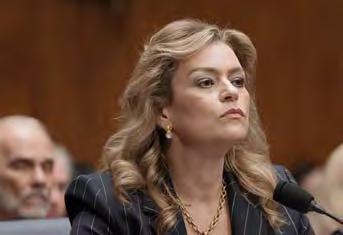
Kimberly Richey testified before the U.S. Senate Committee on Health, Education, Labor and Pensions last year.
Senate Committee on Health, Education, Labor, and Pensions
SF Supervisor Melgar moves to ban smoking in bar patios
by Matthew S. Bajko
San Francisco would join a host of California cities and counties that have banned smoking in bar patios should an ordinance being introduced by District 7 Supervisor Myrna Melgar be adopted by city leaders this spring. It is the last of the Bay Area’s three major cities to do so.
Over a decade ago San Jose imposed a requirement that outdoor patios of all bars in the South Bay city be smokefree. Oakland followed suit last year.
As the Bay Area Reporter had reported in 2023, the group LGBTQ Minus Tobacco was behind the effort to see the East Bay city be added to the list of more than 50 Bay Area cities and counties that have enacted laws for 100% smokefree outdoor dining and bar patios. It is compiled by the American Nonsmokers’ Rights Foundation and includes the counties of Contra Costa and Sonoma.
The anti-tobacco initiative also was pushing to see San Francisco leaders follow suit. But it wasn’t until this year that Melgar sponsored the ordinance to do so. Chair of the Board of Supervisor’s Land Use and Transportation Committee, Melgar told the B.A.R. ahead of introducing the patio smoking ban at Tuesday’s full board meeting that she did so because it was a campaign promise she had made when she ran for reelection in 2024.
“We tend to be individualistic about health. It is about my choices that I control,” said Melgar. “But these things are about everybody else, especially with smoking. Secondhand smoke impacts the people around you, your children, and the workers serving you. This is a really important workers’ rights issue.”
yet to pass it. We need to still work at it,”
Melgar acknowledged Tuesday, though she added she is “proud” of her record of passing everything she has introduced at the board over the past five years. “I am hoping we can come to a path, you know, that protects the public’s health but also doesn’t have a huge economic downside for the businesses, which is what I have heard from folks.”
Gay District 6 Supervisor Matt Dorsey, who represents the South of Market and Mission Bay neighborhoods where a number of venues have outdoor patios patrons can smoke in, told the B.A.R. he is undecided on if he will support Melgar’s ordinance. He said he wants to first talk to business owners in his district about it before making a decision.
“not keep from doing the right thing.”
Brian Davis, a gay man who is a volunteer co-chair of the San Francisco Tobacco Free Coalition, is supportive of Melgar’s ordinance. Until retiring last June, he had been the project director of LGBTQ Minus Tobacco and advocated for local leaders to update their smoking ban ordinances to cover more areas of businesses.
Enacting Melgar’s ordinance would simplify the rules for business owners to follow and make it easier for health department workers to enforce it, said Davis. As one example he gave, the city currently says people can’t smoke in a patio space if it has a ceiling but doesn’t define what is a ceiling, so there is some question if a cloth canopy is covered or only solid wood structures.
“It removes these exemptions so the only place people could smoke would be at the curb on the sidewalk. Anywhere at a business with customers and workers would be smokefree spaces,” said Davis.
At a time when the rights of, and supportive services for, LGBTQ individuals, especially transgender people, are under attack by the Trump administration, having spaces for people to find community is more important than ever, said Davis. But for those with health concerns triggered by secondhand smoke, they can’t congregate at bars where smoking is allowed.
According to a copy of the draft ordinance Melgar’s office provided to the B.A.R., it would amend the city’s Health Code to prohibit smoking in outdoor patios of bars and taverns. It would also eliminate exceptions that have allowed people to smoke indoors at “bars with no employees, bars with historically compliant semi-enclosed smoking rooms, and hotel rooms, to conform to provisions of California law.” Another aim is to clean up other parts of the city’s codes dealing with smoking restrictions to bring them into compliance with state laws that have been passed over the years.
Melgar is asking that her ordinance be taken up by the land use committee, the earliest meeting of which when it could be heard is Monday, May 11. The city’s small business commission may ask to also hold a hearing on it, while Melgar will need five of her board colleagues to vote for it twice for it to pass and be sent to Mayor Daniel Lurie.
“I don’t know if I will have the votes
“My mom died of lung cancer. I worked against Juul, so I am not opposed to some of what the people behind this are proposing,” said Dorsey, who served as the spokesperson of the 2019 campaign that defeated a local ballot measure backed by the vaping company aimed at overturning a city ordinance restricting the sale of e-cigarettes to youth and banning the sale of vape products until they were approved for use by the U.S. Food and Drug Administration.
But Dorsey said he has concerns about a patio smoking ban merely moving the problem with secondhand smoke to the sidewalks in front of businesses where people would still be able to smoke. It could filter up to the windows of apartments built atop the locations or in nearby buildings, he noted.
“If people go to the sidewalk to smoke then we are trading one problem for another. I want to engage in conversations with local businesses and see. I am sympathetic to the arguments for both sides,” said Dorsey.
Melgar pointed out people smoking on the sidewalks in front of residential buildings is already happening and shouldn’t be a reason for the board to
“It makes it hard for us to be in smoking spaces,” said Davis, who has Mycobacterium avium complex or MAC for short. “It is a chronic lung disease, and I need to be careful around smoking spaces. It does aggravate my lungs and makes it harder to breathe.”
Others within the LGBTQ community have already voiced opposition to the patio smoking ban proposal. A poster to a Facebook group for leathermen who smoke a pipe or cigars warned last month that doing so with friends at the patios of SOMA gay bars “is being threatened by some function within San Francisco City Government. It is ridiculous, but smoking in any open space will become illegal.”
LGBTQ Minus Tobacco continues to promote cities adopt a smokefree bar patio policy. Those already enacted cover all bars with such areas in the municipality, not just those at LGBTQ establishments.
It also has an online petition for people to fill out and send to the San Francisco supervisors and mayor. It can be found at https://www.lgbtqminustobacco.org/petition-san-francisco
“LGBTQ+ bars and clubs should be safe and protected community gathering places, but many have outdoor patios or partially enclosed indoor spaces where smoking is allowed, exposing patrons and workers to harmful secondhand smoke,” states the petition. t
office April 6 to San Leandro City Councilmember James Aguilar, left, was Jennifer Brouhard, his fifth grade teacher and current president of the Oakland Unified School District Board of Directors. The gay educator was appointed by the council to fill the
Courtesy James Aguilar
Supervisor Myrna Melgar has introduced an ordinance that would prohibit smoking in outdoor bar patio areas.
Courtesy the subject
Oakland couple hosts queer communal feasts
by Matthew S. Bajko
he theme for the Deluxe
TQueer dinners held in March was “Femme Fatales,” with dishes inspired by female screen stars and historical political figures. The main course of roast beef with pickled bell peppers, demi-glace, and pomme puree was modeled around Hollywood siren Barbara Stanwyck.
“If you Google Barbara Stanwyck and food, you get a steak recipe that is not one of my favorites, so here is a good one,” chef and co-organizer Sean Ang informed the 16 people gathered around an elongated dining table set up in the living room of their apartment a block from the West Oakland BART station.
A recipe for “Spanish Style Steak” signed by Stanwyck and posted on Reddit purportedly was first cooked for her by her husband, Robert Taylor. The dish features broiled steaks covered in a sauce made by simmering together tomato, bacon, sweet and hot peppers, onion, garlic, herbs, and spices.
“I like it because Bob cooks it while I sit and enjoy idleness,” Stanwyck is quoted as saying by the recipe writer.
Other courses served up by Ang were drawn from O-Ren Ishii, Lucy Liu’s assassin character in the “Kill Bill” films (an appetizer of vegetarian fried gyozas); Italian noblewoman Lucrezia Borgia, who was the illegitimate daughter of Pope Alexander VI (a primo course of pasta blankets over slow roasted fennel and spicy breadcrumbs); and the ruthless Chinese empress Wu Zetian (a desert of osmanthus panna cotta with orange syrup and strawberry granita).
The theme, noted Ang, celebrated “being a bitch in a good way!”
Ang, 30, who is nonbinary, and their fiancé, David Cox, 35, who is pansexual and bisexual, launched the monthly dinner gatherings in the fall of 2021 when they were living in San Francisco’s Bayview neighborhood. It was a way for them to bring friends and strangers together to share a meal prepared by Ang, who had taken up cooking as a hobby.
“People loved it,” recalled Cox, who works in the tech industry.
“That November, we hosted another one that was a Friendsgiving sort of vibe and hosted 24 people.”
Attending many of the monthly dinners has been queer San Francisco resident Zach Chatham, 29,
who befriended Ang six years ago.
“It’s a great way to both meet queer people of all types from around the bay and eat high quality, really good tasting food,” said Chatham, adding that he could go out to eat anywhere by himself in the city for a nice meal but likes being able to mingle with the other guests at a Deluxe Queer dinner.
Hayward residents Nicol Hammond, 43, and Stephanie Leveene 55, are also regular attendees. It reminds the couple of the private supper clubs they would frequent when living in New York City but skewed more toward a queer guest list.
“The food is really good, first of all,” said Leveene. “And being a married couple living in the suburbs, we don’t do a lot of socializing with queer people.”
For Hammond, she finds it easier to socialize at the dinners.
“I am kind of shy and don’t like to go out. But when I come here, I love it and am around fun people,” she said.
The spark for the dinners came out of a Pride brunch that Ang “was forced to make,” according to their bio on the culinary business’ website at deluxequeer.com. An ice figure skater who teaches those new to the sport, Ang was encouraged by Cox to see if they could turn their love for the kitchen into an entrepreneurial pursuit.
Building community
By having a monthly schedule, Deluxe Queer is more than just a pop-up event, noted Ang, and can serve as a way to build community among the attendees. They especially like seeing queer and trans people from different generations break bread together and share their life experiences with each other.
“We have a lot of regulars, and it is a safe space for people to be queer,” said Ang, who has fielded queries from older people if they would be welcomed at the dinners. “They can certainly come, and I am glad we can provide a space for them to find community.”
At the Sunday night meal last month the Bay Area Reporter was invited to attend, helping with host duties, plating and serving the courses, and tending to the needs of the dinner guests was clothing designer Anthony Rogers, 34, who is transgender and dating Ang. (Cox and Ang are in a polyamorous relationship.) She also oversees Deluxe Queer’s social media presence.
collaborators “strive to cultivate an environment where queer people always have a seat at the table.” Having randomly chosen Deluxe Queer to use as their TikTok handle, Ang felt the name worked for their commercial pursuit.
Bisexual San Francisco resident Echo Hansen, 27, works as a paralegal and for nearly three years has helped staff the Deluxe Queer dinners. It brings together her passion for food and interacting with people in a “third space” separate from her professional settings and nighttime venues she frequents.
It was Rogers that had roped Ang into serving up the brunch five years ago for a gathering she hosted at her San Francisco apartment to introduce people to her line of dresses under the And Our Label brand.
As Rogers notes on her website at andourlabel.com, she “creates occasion wear for queer people who deserve to feel like the ultimate version of themselves.”
A similar ethos infuses the Deluxe Queer dinners, as Ang and their
“In the queer community, you often only see people out and about in a club or bar. If you want to meet people and have longer conversations, you can do that there,” said Hansen, who has become close with some of the dinner regulars. “At the end of every meal, people are encouraged to stick around if they want to keep their conversations flowing or play games after dinner.”
In December, Ang usually takes the month off for the formal dinners due to the busy holiday season and requests to cater events. They can provide appetizers for a cocktail gathering with upward of 200 people or cook dinner for 20 people that someone wants to host at their own home.
For the other 11 months, the weekend dates on which they schedule the Deluxe Queer dinners will float around and include some Friday nights. Each month’s dinners are centered around a theme, several of which Ang has revived over the years. The meals inspired by the Japanese animation company Studio Ghibli have been “wildly popular,” they noted.
What seasonal ingredients are available also impacts the menus, which also reflect Ang’s Southeast Asian family background. Their parents are from Singapore.
Tickets for the dinners cost $60 per person, with reservations made via the Deluxe Queer website and the address sent by email closer to the date. The theme for the April dinner, being held just on Sunday, April 26, is “Queers Inherit the Earth.” Coming right after Earth Day on April 22, it will feature a four-course vegetarian focused tasting menu.
“Don’t be shy,” Ang answered when asked what their pitch is to those less extroverted diners on why they should consider attending an upcoming Deluxe Queer dinner. “We strive to be a welcoming experience. Don’t be afraid to come, or to come to a person’s house whom you do not know. You will have a good time.”
Anyone interested in booking Ang to cater a private or corporate event should email them at deluxequeer@gmail.com. t
Deluxe Queer co-founders Sean Ang, left, and David Cox stand in their kitchen during the March event.
Matthew S. Bajko
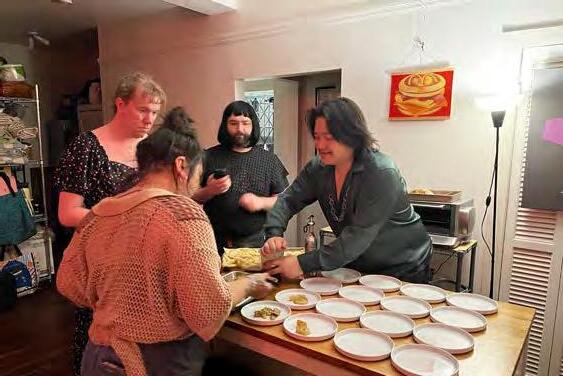
Anthony Rogers, left, and Echo Hansen, foreground, help Sean Ang plate the second course of pasta blankets over slow roasted fennel with citrus relish and spicy breadcrumbs, while David Cox prepares to take images for social media posts.
Matthew S. Bajko
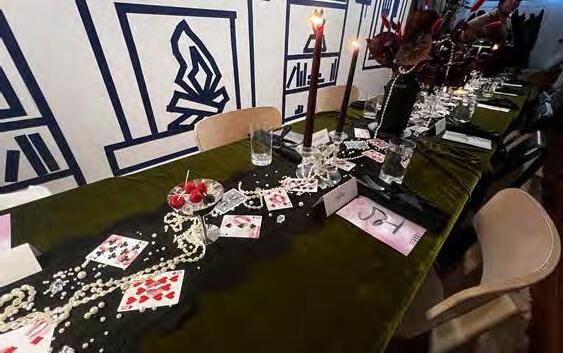
The table setting for Deluxe Queer’s femme fatales-themed March dinners featured playing cards and jewelry.
Matthew S. Bajko
Lesbian comic, performer Marilyn Pittman dies
by Cynthia Laird
Marilyn Pittman, a lesbian who was one of the first out comics, died March 28, her longtime partner posted on social media. Ms. Pittman was also involved with public radio, where she was a voice coach and producer.
Ms. Pittman died at the Heritage Royale care facility in Millbrae while in hospice, her partner Deb McDonald stated. She was 73.
“Although her ability to speak was extremely limited, she retained her comic chops; her last audible words were a perfectly timed ‘ar, ar, ar’ dropped during a lull in the conversation that cracked up the small audience gathered in her room,” McDonald stated.
In a phone interview with the Bay Area Reporter, McDonald, who now lives in Brooklyn, New York, said that Ms. Pittman “was a brassy broad.”
“She was the opposite of introvert,” McDonald said. “She was also very kind.”
McDonald provided biographical information that noted Ms. Pittman cut her stand-up teeth during the AIDS crisis in San Francisco, headlining clubs, nationwide Pride events, and performing at the 1993 March on Washington. She starred in the first gay stand-up comedy video, “All Out Comedy,” and was featured in books “A Funny Time to be Gay,” and “Revolutionary Laughter.” Ms. Pittman continued to do live storytelling events throughout the 2000s.
Ms. Pittman was full of energy, McDonald recalled.
“She didn’t like sitting around,” McDonald said. “She was adventuresome, she dragged me on so many vacations.”
McDonald first met Ms. Pittman in the 1980s in New Mexico. McDonald had been part of a lesbian theater group in Taos, and the group had come to Albuquerque.
“All lesbians in New Mexico knew each other,” McDonald quipped. She added that she found herself in a hotel room in Albuquerque and Ms. Pittman was there.
“There was a plastic tray with a piece of gum on it and she improvised a fiveminute bit,” McDonald recalled.
Their lives didn’t intersect for several
years, but they both moved to San Francisco within a week of each other and bumped into each other, McDonald said.
“She was ready to do her first standup comedy set and she just blew me away,” McDonald said.
In the late 1990s, McDonald and Ms. Pittman became a couple, buying a home together in Bernal Heights.
Ms. Pittman performed at the old Josie’s Cabaret and Juice Joint, where several other out comedians took the stage over the years.
Gay former assemblymember and San Francisco supervisor Tom Ammiano was also a stand-up comic – and still known for his zingy one-liners. In a Facebook message, he recalled that Ms. Pittman performed at Josie’s when he did.
“Yes, we, and Scott Capurro and Karen Ripley traveled to LA to perform at a very straight comedy club, and Bohdan Zachary produced a video for us,” Ammiano wrote. “Bigger than life, Marilyn was fun-loving and always supportive.”
More recently, Ammiano stated that he would run into Ms. Pittman at the lesbian-owned Wild Side West bar in Bernal Heights, “where she would hold court and we’d laugh our asses off.”
Radio work
McDonald said that Ms. Pittman’s work as a voice coach overlapped with her comedy gigs. Ms. Pittman’s website noted that she began her radio career in rock radio, then pop, then news. She was even a TV news anchor for a year, her website stated.
“She went to a conference in San Francisco on voice work and that really lit her up,” McDonald said. “She developed a coaching practice and business for radio, becoming known as the voice training whisperer.”
Ms. Pittman’s radio work spanned more than 40 years, both on and off the air.
Ms. Pittman served as senior coproducer for “Out in the Bay,” https:// www.outinthebay.org/ a San Francisco radio show about LGBTQ life that aired on KALW. (The B.A.R. did crosspromotion and contributed to the program for a few years.) Host and Execu-
tive Producer Eric Jansen wrote on Facebook that Ms. Pittman was especially proud of “easing Lesley Gore ‘out’ on-air.” Gore, a lesbian known for her classic hits “It’s My Party and I’ll Cry if I Want To,” and “You Don’t Own Me,” taped a show with Ms. Pittman for “Out in the Bay” in 2007. Gore died in 2015.
In an email, Jansen remembered his colleague.
Marilyn Pittman was a stand-up comic and voice coach for those in public radio.
“Marilyn and I worked together on ‘Out in the Bay’ for over a decade, from late 2004 through 2015,” he wrote in an email. “She was intense, and brought so much to the show. Marilyn was passionate about queer rights – though she resisted the word ‘queer’ – and a talented broadcaster. She knew how to get people to open up on the air and talk about their lives.
“Also an outrageous comic,” Jansen added. “I treasure the times she and I and her partner Deb would get together and Marilyn would just crack us up. We had huge laughs.”
“Out in the Bay” won NLGJA: The Association of LGBTQ Journalists’ 2012 Excellence in Journalism Award, and had notable interviews with filmmaker
Obituaries >>
Memorial set for Andrea Shorter
A celebration of life for Andrea Shorter, a Black lesbian and longtime San Francisco political strategist and activist in the LGBTQ community, has been announced. Ms. Shorter died March 19 at the age of 60. The memorial will be held Sunday, April 26, from 2 to 5 p.m. in the Green Room at the San Francisco War Memorial Building, 401 Van Ness Avenue. Future memorials are planned for
John Waters and the late Gilbert Baker, co-creator of the rainbow flag.
Ms. Pittman’s influence in radio can still be heard today, as she had a robust career coaching broadcasters at NPR and community radio stations, her bio noted.
Her “Coaching Talent with Confidence” event was one of the top five sessions at the September 2020 Public Radio Program Directors Association’s (now Public Media Content Collective) Let’s Go Live! Conference. After the announcement of her death, hundreds of her coaching clients reached out to speak of the profound influence Ms. Pittman had on their careers and lives.
Many had become close friends, McDonald noted.
Her talent at the mic led to much work in narration. Ms. Pittman was the voice in Debra Chasnoff’s Oscar-winning documentary “Deadly Deceptions: General Electric, Nuclear Weapons, and Our Environment,” and James Yager’s documentaries “Water from the Wilderness: Hetch Hetchy to San Francisco Bay” and “The People’s Palace: San Francisco City Hall 100 Years.”
McDonald also noted an unthink-
Murrieta, in Riverside County, where
Ms. Shorter moved with her family when she was in high school, and Indianapolis, where she was born, family members stated.
Ms. Shorter was long involved in San Francisco politics. She was a former trustee on the City College of San Francisco board. She also served on the San Francisco Commission on the Status of Women for many years, including as its president.
Ms. Shorter is survived by her partner, Lubov Smith; her mother, Karen; her brothers, Lawrence and Aaron; her nephews, Kahlil and Lukas; many beloved family members in Indianapolis, and her closest inner circle of friends
able event that occurred in 1997, when Ms. Pittman’s father murdered her mother and then died by suicide.
“Marilyn turned that tragic experience into a solo show, ‘It’s All the Rage,’ saying that gallows humor helped her stay sane and make sense of what happened to her family,” McDonald stated in the bio. “Directed by David Ford, the show ran for three months in San Francisco in 2012, and received the Best One-Woman Show Award from United Solo in New York City.”
Ms. Pittman was born June 30, 1952 in Belleville, Illinois.
McDonald said that Ms. Pittman loved to have fun.
“She didn’t like to sit around and mope,” McDonald said.
The COVID pandemic did affect Ms. Pittman, as it “really killed her spirit,” added McDonald.
In addition to McDonald, Ms. Pittman is survived by her brother Alan Pittman and his partner Justine Lauderback, of Iowa. She was preceded in death by her parents, Marylou and Merle Pittman, as well as her sister Karen, of Durango, Colorado.
McDonald thanked Heritage Royale, Suncrest, and the many friends who supported the couple through hospice. A memorial is being planned, likely in a few months, said McDonald. t
known among themselves as “The Council.” She was preceded in death by her father, Leon Shorter.
The family invites donations in Ms. Shorter’s memory to three organizations she believed in deeply: the Young Women’s Freedom Center, https://givebutter.com/honoring-andrea-shorter LYRIC Center for LGBTQQ+ Youth, https://giving.gofundme.com/campaign/784499/donate and the National Center for LGBTQ Rights https://www. justgiving.com/campaign/andreashorter. Funds have been established in her name.
To read the Bay Area Reporter’s obituary, go to https://tinyurl.com/ mw4he2xf.
Courtesy Deb McDonald
Rick Gerharter
Chandra Laborde, a queer doctoral candidate in architectural history at UC Berkeley and administrative volunteer with Compton’s x Coalition, presented a PowerPoint of copies of floorplans and photographs during public comment to show commissioners that “no major structural or architectural permanent changes made to the interior of 101-121 Taylor from when Compton’s closed in 1971.”
Laborde presented decades of building permits and said they visited the Department of Building Inspection, whereupon comparing the original and current floorplans concluded that, other than regular maintenance, no major permanent changes had been made to the structure or architecture.
David Blackwell, an attorney with Allen Matkins Leck Gamble Mallory & Natsis LLP and representative of the site’s property owners, argued against Watson and Laborde’s claims during public comment.
“This ownership has supported
Landmark 307. They supported the inclusion on the national registration [...] We’re fine with the entire building being recognized as a landmark and we have total respect for what happened in 1966. What we don’t agree to, however, is this intrusion now to get inside of the building itself to say that the interior is somehow part of this designation. It’s simply not,” Blackwell said.
“There still has to be essential physical characteristics that tie the event to this space. ... There is no way that can be done here anymore. … There is no vestige of a cafeteria here; it’s just nonsense to say that there is,” he continued.
Commissioner Hans Baldauf, who ultimately voted to approve the resolution excluding the interior, later commented, “I would hope that we’re creating an environment where people actually cherish their property for its historic associations. And that would motivate people to do things in the community interest.”
Ultimately, the commission moved unanimously to exclude the interior for now because it
Lesbian Visibility Week is April 20-26 in the U.S. and across the globe. Local events include speed dating, women’s sports trivia, a taco-eating contest, and more.
The Curve Foundation is the official North American host of Lesbian Visibility week. Once a print magazine that catered to lesbians, the foundation was established several years ago and retains the digital history of the publication, as well as quarterly online issues.
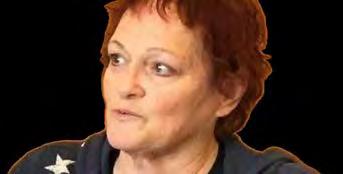
Frances “Franco” Stevens, a lesbian who founded Curve magazine, originally launched in 1991 as Deneuve, now runs the foundation. An Oakland resident who said San Francisco has always been Curve’s home base, she recently spoke with the Bay Area Reporter via Zoom about the importance of Lesbian Visibility Week. The week was started in 2020 by Linda Riley, publisher of DIVA magazine in the United Kingdom.
“The idea is to have a global recognition of the week,” said Stevens. “In 2023, we started with three activations. It snowballed and there are over 100 this year.”
Stevens said that while it’s intentionally called Lesbian Visibility Week, it is inclusive of bi women, trans and queer women, and nonbinary people. She noted while some may exclude those women and people from lesbian-themed events, that’s not the case with Lesbian Visibility Week.
“That’s not us,” she said. “We want to reclaim the word ‘lesbian.’”
In addition to the many events listed on the lesbianvisibilityweek.org website, https://www.lesbianvisibility.org/ people are free to submit their own. In this way, smaller communities and neighborhoods can also participate, Stevens noted.
“From a clinical standpoint, I want to be very clear – conversion therapy is not a legitimate therapeutic practice,” Innerarity said. “It has no basis in evidence-based practice. In my 12-plus years as a clinician, I have never seen credible clinical data supporting that sexual orientation or gender identity could be safely or successfully changed through therapeutic means.”
Craig Pulsipher, Equality California’s legislative director, attended the hearing and said the statewide LGBTQ rights organization supports Wiener’s legislation. EQCA has made SB 934 one of its legislative priorities this year.
remains private property. The commissioners would have to be invited by the property owners to tour the building.
The coalition hired local lawyer Thomas Lippe in early March for counsel on land use throughout the landmarking case. Lippe spoke to the commissioners as a project sponsor and on behalf of the coalition during the hearing.
“Obviously, my client prefers to have what they asked for, which is to designate interior features. ... If the commission is not going to do what my client has asked them to do, which is to identify the features that Shayne Watson in her March 17 letter listed ..., then your proposal, Ms. Cox, is certainly preferable to not having that language in the resolution,” Lippe said after consulting with members of the coalition.
The coalition prepared an informational packet for the first landmarking hearing earlier this year, which included historical context of the site’s queer significance beyond the cafeteria riots. According to the coalition, a group of
This year’s week embraces the theme “Health and Wellbeing” through activities including gatherings and more. Organizers invite groups, businesses, and community members across North America to host or attend events throughout the week.
Stevens said that Lesbian Visibility Week received a $20,000 grant from Horizons Foundation’s community issues program to fund a project coordinator.
The coordinator is Dana Piccoli, a lesbian whose day job is managing director of News Is Out, a collaborative of LGBTQ publications that includes the B.A.R. She is based in Vancouver, Washington and stated in an email that she’s happy to help out.
“As a young lesbian, Curve magazine was a lifeline,” Piccoli stated.
“Then when I started my professional career, Curve magazine gave me one of my first ever gigs in LGBTQ+ journalism. The Curve Foundation has been doing amazing work to uplift lesbian, queer women, and nonbinary journalists, photographers, artists, and so many others. They have also taken on the responsibility for Lesbian Visibility Week in the U.S.”
Opposing the legislation was Jonathon Skinner, a 23-year-old gay man who is an ex-transgender activist who detransitioned. Skinner said after having taken puberty blockers and hormones as a teenager, he now cannot reach orgasm and that if the legislation passed, “more people will end up like me – the walking but wounded.”
Several legislators questioned Wiener as to the testimony of Skinner and others who opposed the legislation, which is limited to lengthening the statute of limitations for matters already proscribed. Wiener clarified it does not add any further causes of action for civil suits to the law.
State Senator Angelique Ashby (D-Sacramento) said, “My understanding is we have already legis -
LGBTQ+ youth that were part of Vanguard, an early LGBTQ rights group, protested mistreatment by Compton’s Cafeteria staff and security at the dining hall a month before the riots. The upper floors of Compton’s were called the Hyland Hotel and housed trans women.
The process of city landmarking the Taylor Street site comes ahead of the 60-year anniversary in August of the Compton’s Cafeteria riots, reportedly sparked by a drag queen tossing a cup of hot coffee in the face of the police officer who tried to arrest her without a warrant. The exact date has been lost to time, despite the efforts of historians and others to determine it.
There are several more steps before the landmark designation becomes official. Ultimately, it will be up to the city’s Board of Supervisors and mayor to grant local landmark status to the site.
In 2022, the San Francisco Board of Supervisors declared the intersection of Turk and Taylor streets and the lower portions of the exterior building walls of 101-121 Taylor Street as the city’s 307th landmark.
Local events Activities planned for San Francisco are mostly free, Stevens said. However, space is limited and people are encouraged to RSVP online. There are also free online events for queer women on sports, health, film, and terminology.
A women’s sports trivia night will be held Wednesday, April 22, at 7 p.m. at Rikki’s, the queer-owned women’s sports bar at 2223 Market Street. It’s free to play and $1 from every pint of Rikki’s house beer will be donated to Lesbian Visibility Week. No tickets needed.
Speed dating takes place at the San Francisco LGBT Community Center, 1800 Market Street, Thursday, April 23 at 7 p.m. It’s billed as a fun, low-pressure way to meet new single LGBTQ+ women. To RSVP, go to https://tinyurl.com/bdej8p78.
Piccoli noted that she got involved now that the week has grown so much this year.
“I’ve been assisting the Curve Foundation help expand the reach of Lesbian Visibility Week in North America. This year LVW will celebrate over 100 events across the U.S. and Canada, from flag raisings to film festivals to panels focused on queer women in sports and lesbian health and wellness.”
Piccoli was the recipient of the Curve Foundation’s inaugural Excellence in Lesbian Journalism Award in 2023.
“I think Lesbian Visibility Week serves several important purposes,” she stated. “With lesbians being one of the smallest demographics in the LGBTQ+ community, we are often overlooked for our contributions. We received a fraction of funding for our causes; we still get by on mostly grassroots support. Yet, as a new generation of people embrace being lesbians and part of the lesbian community, LVW helps spread the message that lesbians matter. LVW is also very much about inclusion and reestablishing the narrative of positivity and joy behind the word ‘lesbian.’”
lated in this space.” Speaking to Wiener, she added, “You and your office work really hard on your bills and take on tough topics. My legislative background thinks the community are a bit disconnected with what the bill actually does, so my hope is in your time you will work with folks so people understand the implications of this actual language you have in front of us.”
Wiener replied, “We always work with a lot of people. It’s hard to work with people who say a whole group of people don’t exist,” referring to people who deny transgender people have an innate identity.
Niello took issue with Wiener’s characterization of the bill’s opponents as believing trans people don’t exist. He delineated between two ar-
Because the bulk of the structure was not covered by the 2022 landmark decision, local historians and preservation planners are concerned this leaves the site vulnerable to being torn down. Local landmark status would expand the protections of the site and trigger closer scrutiny by city planning officials of any redevelopment plans for it.
On January 27, 2025, 101 Taylor Street became the first property granted federal landmark status specifically for its connection to the transgender movement in the U.S. Despite the building’s recognition on both the California and National registers, those classifications don’t offer protection like a city landmark would.
A city designated landmark affords safeguards under Article 10 of the San Francisco Planning Code, which declares the protection and perpetuity of culturally significant sites.
The item is next expected to go to the supervisors’ land use committee before heading to the full board. Upon approval, the legislation goes to the mayor to sign. t
Frameline, producers of the San Francisco LGBTQ film festival, and the Curve Foundation will have a screening of “Dykes, Camera, Action” at the Roxie Theater, 3117 16th Street, Sunday, April 26, at 3:10 p.m. General admission tickets are $16.62, seniors with ID are $12.62. To purchase tickets, go to https:// tinyurl.com/4azj7ky7.
A Sapphic Pub Crawl of the Castro is slated for Thursday, April 23, from 5 to 10 p.m. Tickets and details are coming soon at lesbianvisibilityweek.org.
Yerba Buena Center for the Arts, 701 Mission Street, will hold a “Lesbian Power” reception and panel discussion Friday, April 24. There will be a docent tour at 5:30 p.m., followed by the reception and panel at 6:30. Stevens noted there will be an exclusive live viewing of the winning images from the 2026 Curve photo contest. To RSVP, go to https://tinyurl. com/2s3bp34x.
A lesbian taco-eating contest takes place at the aforementioned Rikki’s Saturday, April 25, at 6 p.m. It’s a follow-up to the popular lesbian pieeating contest held there last year. Tickets are coming soon at https:// tinyurl.com/56pb6jf7.
There will be a fundraiser for the San Francisco Dyke March Saturday, April 26, from 6 to 9 p.m. at The Academy, 2166 Market Street. It will feature Tammy Hall, Vicki Randle, and Leberta Lorál. For more information, visit https://tinyurl.com/3kr9jxkf.
guments going on – “a philosophic one about the treatment of gender dysphoria, particularly among minors,” and the other argument about the statute of limitations per se on conversion therapy.
On numerous occasions, Niello positively cited the United Kingdom’s Cass Review, a National Health Service report evaluating treatment of trans and gender-nonconforming youth, which was criticized by trans rights activists. He asked what the statute of limitations is for gender-affirming care cases, such as Skinner’s.
Wiener said that the Cass Review was also disputed in many quarters, and that the statute of limitations for alleged malpractice in genderaffirming care is three years.
Finally, the grand finale will be the lighting of San Francisco City Hall in the colors of the lesbian flag. That takes place Sunday, April 26, at 7 p.m. No tickets are needed, and everyone is welcome. City Hall is located at 1 Dr. Carleton B. Goodlett Place. There will be special guest speakers, recognition of local heroes, and a raffle of swag from the WNBA’s Golden State Valkyries. For more information, go to https://tinyurl.com/574tj4e7.
Stevens encouraged lesbians, queer and trans women, and nonbinary people to attend events.
“Come, this is for you,” she said. Stevens also alluded to the current state of affairs in the U.S., where President Donald Trump and his administration have actively sought to erase trans people through policies and executive orders. Just this week, the U.S. Department of Education rescinded a Biden-era rule around Title IX, which were the governing obligations to guarantee all students, including survivors of sexual harassment, LGBTQ students, and pregnant and parenting students, to have full and equal access to educational opportunities regardless of sex.
Lesbian Visibility Week, Stevens said, seeks to bring people together.
“It’s where you are centered and not an afterthought,” she said. “Coming together not only stops erasure, but we come together in a time when we’re actively under attack.”
For more information on Lesbian Visibility Week, go to lesbianvisibilityweek.org. t
Unlike gender-affirming care, however, “Conversion therapy is not accepted by any medical standard and it does harm that may not surface until many, many years later, and so we can see these things are very different and are not the same,” Wiener said.
Valladares said, “I do think we can all agree we want the particular individuals who may be harmed in any kind of treatment” to have the ability to seek justice. She voted no, and after the item had been heard but before the end of the day’s business, Niello entered a no vote. Senators who step out to attend other hearings have the option of returning to cast votes on other matters before the end of the day. t
<< Lesbian visibility
Bay Area artist Tricia Rissmann, left, posed for a selfie with Curve Foundation Co-Founder Jen Rainin, and Imani Rupert-Gordon, president of the National Center for LGBTQ Rights, inside San Francisco City Hall for the Mayor’s flag raising during 2025’s Lesbian Visibility Week.
Courtesy Curve Foundation
by Jim Provenzano
His musicals have been performed on Broadway for decades, and a few continue to be performed around the world. Stephen Schwartz, the award-winning composer and lyricist of the hit musicals “Godspell,” “Pippin,” “Wicked” and several Disney animated films, will perform in a special concert of his songs and stories at the Chan National Queer Arts Center on April 17 and 18, with Broadway actors Taylor Iman Jones, Michael McCorry Rose and members of the San Francisco Gay Men’s Chorus.
In a phone interview with the Bay Area Reporter from his home in Los Angeles, Schwartz discussed his expansive creative experience, and why he’s returning to San Francisco for this intimate concert. One aspect of his work that’s woven into many of his songs is a sense of hope.
“Well, it’s not conscious,” said Schwartz, 78. “I haven’t really been asked about it before in these terms. I’m not sitting there thinking, ‘Oh, I need to write something hopeful now.’ But we live in a pretty tough world that seems to be getting tougher all the time. One doesn’t want to be mindlessly hopeful, but if we don’t have the hope that we can improve things for ourselves and our loved ones, and even possibly beyond that, then life is pretty grim. You have to have hope even sometimes in the face of contradictory evidence.”
With so many of his own songs to choose from, how has he decided on the program?
“The idea of this program is a thank you and a valedictory for Christopher Verdugo, whom I’ve known for many, many years,” said Schwartz. “Originally, Chris was with the Los Angeles Gay Men’s Chorus, and then has been in San Francisco for a long time [Verdugo will leave the Chorus in June]. Chris and I have become very good
friends over the years. I’ve done a lot of things with the SFGMC, mostly under Chris’s oversight.”
Day by day
Schwartz has enjoyed a long career of successes. “Godspell,” Schwartz’s early hit musical, included a surprising collection of talent in its 1972 Toronto production.
“A recent documentary [“You Had to Be There”] about the Toronto cast has been making its way through various film festivals, because it was so remarkable that so many major comedy stars came out of that particular cast,” Schwartz recalled, as he is interviewed in the film. “Victor Garber is more known as a musical theater and movie star, but all those people; Eugene Levy, Martin Short, Andrew Martin, Gilda Radner. It was very funny, I will tell you that; probably our funniest production.”
Berkeley’s The Back Room celebrates 10 years
by David-Elijah Nahmod
In April 2016, East Bay musician Sam Rudin opened The Back Room, a small, intimate club in Berkeley that offers, according to Rudin, “a living room intimacy that allowed lesserknown musicians to make their mark, and better known players to get up close and personal with their fans.”
A rousing success since its inception, The Back Room seats no more than 100 people, yet the venue is loaded with atmosphere. It features brick walls, vaulted wood ceilings and thrift store couches, and is located right by Berkeley’s Arts District.
Rudin has quite a celebration planned for the club’s tenth anniversary. Running from April 1626, the ongoing party will offer a variety of musical styles and genres. Represented will be Latin, Celtic, Folk and Bluegrass, along with several varieties of Jazz and Blues.
The Back Room was inspired by the original
Freight and Salvage in Berkeley, a beloved musical venue that’s now a 490-seat concert hall, but which began as an 87-seat club. In an interview with the Bay Area Reporter, Rudin spoke of how The Back Room came to be.
“In 2011 I played that one date at the current Freight,” Rudin said. “Anna’s Jazz Island was already closed. There were literally no places in the Bay Area that could provide the atmosphere of the old Freight, and precious few anywhere else, so I decided it was up to me. It took me three years of looking, and then two more years of building in. My creative urges, which had previously been entirely musical, now encompassed architecture, interior design, and even furniture design.”
Rudin added that expanding The Back Room’s seat count is not in the cards.
“It can’t be done,” he said. “When we get to one hundred people, we are using all of our square footage except for the aisles. And moving is not an option. This place is too perfect, and I am too old to spend years creating a new one.”
Unlike other venues, The Back Room has a
Stephen Schwartz
Asked to explain the technicalities of arranging a song for choral performance, Schwartz explained, “For men’s chorus, you’re still usually doing four parts, but instead of SATB (soprano, alto, tenor, bass), you’re doing TTBD, upper tenor, lower tenor, essentially baritone and bass. Most of the choral arrangements of my songs that are being performed are not ones that I did myself. The pieces that were commissioned, like ‘Testimony,’ that is obviously my choral writing. I don’t remember whether the chorus is doing a combination of ones that others have done or that they did themselves. I think they tend to do their own arrangements themselves mostly.”
About his choice of guest performers, Schwartz said he’s excited to be working with Taylor Iman Jones, a Bay Area native who’s performed on Broadway in “Six,” “Head Over Heels”
BYOB policy, which Rudin noted came out of necessity.
“Well, I had no choice, really,” he said. “A liquor license would have cost me six figures, plus would take up space and require a bartender, plus would create age restrictions for the audience. Plus, my neighbors were opposed. This way is much easier. And people like it.”
Band on the fun
Among the bands that will be performing for the tenth anniversary is Bululú, an eight-piece Latin band which features several LGBT members. Bululú comprises of Lali Mejia (band leader, percussion, vocals), Karla Lozada (lead vocals), Ayla Davila (music director, bassist), Grace Guerrero (lead vocals), Rithie Dineen (piano), Omar Ledezma jr (percussion, vocals), Jose Roberto Hernandez (guitar, lead vocals) and Steve Senft (bass). Bululu will perform on April 17 at 8pm.
“Bululú is a Venezuelan word used to describe a lively commotion,” Mejia, a gay woman, told the B.A.R. “A crowd, a buzz, or that electric feeling when people come together and something exciting is happening. It’s the kind of word you’d use after a great night out. ‘That party was a fullon bululú.’”
Mejia said that being a member of the LGBT community definitely informs her musical tastes and song selections.
“As one of the primary composers, I draw directly from my personal experiences as an LGBT artist, which naturally shapes the themes and stories in our music,” she said. “Our music director and bassist, Ayla Davila, also a member of the LGBT community, is an essential collaborator in creating work that feels intentional and meaningful for our community. Bululú is a diverse group, and members who don’t identify as LGBT bring valuable perspectives that are fully embraced.”
The band has dubbed their concert at The Back Room “A Night of Bubbles and Boleros.” Mejia explained the meaning behind the performance’s name.
“It’s our way of celebrating both the music and the moment,” she said. “Boleros are some of the most beloved songs in the Latin American tradition, romantic, expressive, and centered on love in all its forms. The bubbles are part of the celebration, marking The Back Room’s tenth anniversary, so yes, there may be a little sparkle in the air to match the music, wink wink. And really, the pairing just feels right, boleros, bubbles, Bululú.
and “Groundhog Day,” and in the national tours of “Hamilton” and “American Idiot.”
“We wanted to have someone who was a San Francisco local, and Taylor obviously has an impressive list of credits, but I haven’t worked with her before,” said Schwartz. “She was someone that Chris knew, so I’m looking forward to it, because I admire her from afar.”
A Sentimental Man
Michael McCorry Rose played Fiyero in a few versions of “Wicked” onstage, as well as performing a different role in the film adaptations.
“We sing a lot together, and he’s sung with the chorus before,” said Schwartz. And he’s a friend of Chris’s as well. We’re going to do some stuff that we’ve frequently performed elsewhere.”
“For this performance, we’ll be sharing a curated selection of classic and contemporary boleros, along with original arrangements that bring a fresh perspective to the genre,” Mejia continued. “We’re honored to be part of this special series and excited to celebrate live music in such a unique and intimate space.”
Mejia hopes that the audience will leave the concert feeling like they’ve had a meaningful experience and a great time. She said that the evening will begin gently, then move through to songs about love, resistance, peace, solitude, hope, nature and friendship.
“As part of that experience, we provide English translations of our Spanish language repertoire via downloadable PDF for those who want to connect more deeply to the lyrics,” Mejia said. “But at The Back Room, language isn’t a barrier. What happens in that space transcends words. It’s about connection, presence, and the shared beauty of the art form, with the audience as an essential part of it.”t
‘Bululú: A Night of Bubbles and Boleros,’ $25-$30, April 17, 8pm, The Back Room, 1984 Bonita Avenue, Berkeley. www.backroommusic.com www.bululusf.com
Tony & Oscar-winning composer performs at the Chan Center with SF Gay Men’s Chorus members & special guests
Members of Bululú / Left to Right standing: Ayla Davila, Ruthie Dineen, Pedro Pastrana, Dayron Calderon, Grace Guerrero Left to Right seated: Lali Mejia, Karla Lozada, Omar Ledezma Jr
Queer-led band Bululú set to appear
Kike Arnal
The Back Room’s founder Sam Rudin
Irene Young
Basketball drama ‘Flex’ scores
by Jim Gladstone
The members of the Lady Train, Plainnole, Arkansas’ high school girls’ basketball squad, struggle to keep up their team spirit in “Flex,” the seriocomic sports drama now running the floor at the San Francisco Playhouse.
While sharing the court doesn’t always come naturally to the characters in Candrice Jones’ genial, topical play, it’s the go-to move for this production’s all-star acting ensemble.
Under the direction of Margo Hall, who slam-dunked last year’s SF Playhouse production of ‘Fat Ham,’ the six-member cast of ‘Flex’ delivers a truly collaborative win, without a ball (or spotlight) hog among them.
Mighty assists are provided by Bill English’s two-court set, which makes particularly clever use of SF Playhouse’s beloved stage turntable, and action-packed blocking executed with the support of basketball consultant Emmanuel Blackwell.
Team dynamics
“Flex” opens with a show of team unity. We see the players practicing on a red dirt court outside the home of team captain Starra Jones (Santeon Brown). All five appear to be pregnant, but, in fact, four have stuffed their jerseys with belly padding as a last-ditch effort to support April Jenkins (Camille Colacco), whose actual pregnancy makes her ineligible to compete in the upcoming playoffs, according to team rules established by Coach Francine Pace (Halili Knox).
The pregnancy plot is soon jostling for control with another storyline: The rivalry between Starra and newcomer Sidney Brown (Paige Mayes), a California transplant who arrived this season and suddenly commanded the attention of college scouts who had previously focused on her teammate. Brown plays Starra with looselimbed physicality and short-fused sensitivity. Her basketball version of an end zone victory dance is irresist-
ibly charismatic. It’s easy to understand how she’s established herself as the team’s leader.
Sidney has recently assumed the role of worldly big city sister to the rest of the squad while flashing knifesharp smiles at Starra, who instigated their competitiveness. Still, her choice to date Starra’s twin brother makes her more than an innocent victim. Substitute hightop Chucks for ‘Mean Girl’ Manohlos and you’ll have a sense of the tension between these two.
Elaborate playbook
Fortunately, girl-on-girl disrespect is merely one dimension of a play with far more complexity. Another player, Cherise (Emma Gardner) is a devout Youth Minister and struggles to maintain a positive view of her pregnant teammate, let alone herself, given her sexual experimentation with the fifth team member, self-confident levelheaded lesbian Donna Cunningham (Courtney Gabrielle Williams, making the most of playwright’s least developed role).
The teammates all accompany April on a road trip across state lines for an abortion that’s illegal in Arkansas. And Coach Pace has a late-revealed backstory that illuminates her decisions regarding the team. (Knox convincingly assumes the strong bearing and firm-but-supportive vocal manner of her character).
That’s a lot of plot, enough to hold the attention of infrequent theatergoers more accustomed to the interwoven dramas of reality television. It’s a chance to treat your sports fan friends and couch potato pals to a night at the theater.
But there’s so much going on that even Jones, a tight and tidy writer, lets some threads dangle a bit: Starra seems to live with her grandmother (“G-Mama”) but regularly engages in dialogue with her unseen, unheard mother.
In a play with an abundance of characters and narratives to keep track of, this invisible extra feels like both too much and too little. One member of my theatergoing party argued, based on mere snippets of dialogue,
that Starra’s mother was killed during military service; another was certain we were to assume her alive and present, a squawk-less ‘Peanuts’ parent. And “Flex” feels like it’s making a too-fast break as the play rushes toward its conclusion. There’s some unearned rule-bending and forgiveness left behind in its final press to team triumph.
Still, the show is fast-paced and enormously entertaining, and the ensemble cast has a near-perfect passing game. Despite a few penalty-worthy moves, “Flex” is a net success.t
‘Flex’ through May 2. $52-$145. SF Playhouse, 450 Post St. www.sfplayhouse.org
Drama in the octagon
by Jim Gladstone
Ngozi Anyanwu returns to the Bay Area with a powerful one-two combination. Last represented by her experimental “The Last of the Love Letters” at Z Space a year ago, the theatrical polymath is back as both playwright and lead actor in Berkeley Repertory Theatre’s thrilling production of “The Monsters,” a bruising family drama set in the world of mixed martial arts.
The two-hander, which last week was nominated for a Lortel Award as the year’s Best Off-Broadway play for a recent New York production that Anyanwu directed, explores the relationship between two half-siblings with an abusive father in common.
We meet stoic, softhearted Big (Sullivan Jones) and scrappy, animated Lil (Anyawu) and in the present. He’s a belt-winning champion in a secondtier MMA league, eking out enough prize-money to support a hermit-like existence of self-discipline and selfdenial in a shabby Philadelphia apartment in walking distance of the gym where he trains.
She’s the decade-younger sister for whom he once babysat and still serves as a positive model of masculine care and protection, despite having disappeared without a trace years earlier.
At loose ends after the death of her mother, and having recognized Big during a televised match, Lil has made her way to Philly in desperate hope of a reunion. She waits tables at an Applebee’s and lives with an unreliable group of housemates in a dangerous part of town.
When she first shows up at one of Big’s matches, he doesn’t recognize her. But soon enough, the pair are living together, working through their past traumas, and charting their forward courses.
Battling family demons
A warm familiarity supersedes the duo’s inevitable frictions. A similar sense draws the audience into their story: Unlike “The Last of the Love Letters,” this is not a play of intellectual abstraction or meta-narratives. It’s rock-solid storytelling with clearly etched characters.
Like the skilled fighters at its center, “The Monsters” stays firmly grounded.
Director Tamilla Woodard and the actors crisply delineate between foreground action and flashbacks to the siblings’ younger years without timeshifting flourishes to cue the audience.
Anyanwu’s masterful grip on Lil’s psyche gives us a character who’s looser, almost goofy, in youth and grows warier, clenched against disappointment, over time. But the younger Lil never disappears into the older version; the performance and the writing have a completely believable translucency, allowing us to see both the loss and growth that come with experience.
For most of Jones’ performance, empathy and injury quietly crack Big’s life-hardened shell through tiny fleeting smiles, momentary laugh lines around his eyes, and the occasional waver in his steady sonorous vocal tone. When he ultimately releases a fusillade of emotion, it feels earned and authentic.
So, too, does the reflexive sibling humor that leavens the entire show and renders it significantly less dark than its title might suggest. Sister and brother both know just how to aim and land a critical jab. Usually they pull their punches, trying to keep things light. On occasion each punches too hard, and we can see the unintended hurt.
A light touch also works to Anyanwu’s advantage in the play’s deft handling of sociocultural issues that are too often turned into ham-fisted messages and morals on stage.
Alcohol and other substance abuse is not in the realm of a singular ‘villain’
here. Booze is a baton passed between family members over time, used to fuel bad behavior, but also as a salve and an escape valve.
Homosexuality is surprisingly noted, then almost instantly dismissed as a non-issue in a scene that’s slyly progressive.
And while Lil and Big are Black, and the dialogue sings with rich vernacular, race is not centered as a driving dramatic force.
First rate stagecraft adds impact to the script. Nina Ball’s scenic design is centered on an octagon that serves as both an MMA battle cage and a liminal space for memories of the siblings’ conflicted past.
The lighting by Reza Behjat and sound design by Bailey Trierweiler and Uptownworks perform elegant fourth-wall-breaking magic to transform the theater into a sports arena whenever a match is fought.
And choreographer Adesola Osakulumi, aided by mixed martial arts consultant Sijara Eubanks, brings remarkable tension to the bouts, which are portrayed using only a single actor.
Nurtured through Berkeley Rep’s Ground Floor program for new play development, ‘The Monsters’ should be a source of great pride for both that program and playwright Anyawu.
The play’s a knockout, the Rep its champion.t
‘The Monsters,’ through May 3. $25-$135. Berkeley Repertory’s Peet’s Theatre, 2025 Addison St., Berkeley. www.berkeleyrep.org
The cast of San Francisco Playhouse’s ‘Flex’
Jessica Palopoli
Ngozi Anyanwu and Sullivan Jones in ‘The Monsters’
Kevin Berne
ODC Theater’s spring season jumps into action
by Lou Fancher
ODC
Theater’s four weekends of experimental performances that launch its 2026 Spring Season makes a person yearn for five, six, seven, or more show dockets on the calendar.
Setting the bar at a high level with a world premiere by Fauxnique (artist Monique Jenkinson) April 17-19, the mainstage series continues with a world premiere by FACT/SF, April 24-26, the Bay Area debut of New York-based artist Mariana Valencia, May 1-3.
Jenkinson’s body of work encompasses dance, drag, essay, and unwavering investigations of the outer fringes of queer history and contemporary culture. As Fauxnique, her faux queen persona, she makes claim to being “the first cis-woman to win a major drag queen pageant.”
Among other noteworthy achievements, there is her 2022 memoir, “Faux Queen: a Life in Drag,” a revelatory collection of essays that tell not only her story but that of San Francisco during a transformative time in drag history.
Jenkinson has appeared at Yerba Buena Center for the Arts, ODC Theater, The Stud, CounterPulse, the de Young Museum, and at multiple venues in around the world. Honors include residencies at Headlands Center for the Arts, Tanzhaus Zürich, Atlantic Center for the Arts, the de Young Museum; and support from San Francisco Arts Commission, Foundation for Contemporary Arts, CHIME, Center for Cultural Innovation and the Kenneth Rainin and Zellerbach Family foundations.
Gutsy vulnerability
In an email interview, Jenkinson, who is married to musician Marc Kate, provides the nuts-and-bolts outline and speaks of the upcoming premiere of “How Do I Look?” The roughly
60-minute performance provides an episodic work in which lighting plays an integral role. Shifts and emphasis she says are used for “destabilizing the way I look onstage and the way the audience looks, or sees.” The ambiguity as to whether or not her description means either how the audience appears to her or the way in which they view Jenkinson—or both—is arguably intentional.
The same mindset has her saying, “The set is the costumes, the costumes are the props. A few of the costumes work multiple ways.”
There is no sense that she is being facetious or duplicitous. Instead, it is a factual accounting of a show that bears vestiges of her dance training, nightclubbing, cabaret, and drag and includes a sound design composed of recorded classical music, one pop song, pop song fragments sung live, and monologue/dialogue.
Jenkinson, described in a press release as a performer with “gutsy vulnerability” who “digs past glossy platitudes and flattering exaggerations into the hot mess of perception, subjectivity, identity and taste,” speaks with quiet candor about the new work.
“One impetus for this work was a friend in the dance field who, upon hearing me express frustration, confusion and impostor syndrome while in the throes of a professionally and personally tough time, observed, ‘Wow, you really see yourself differently from how others see you.’ It was a deep, sweet, thing for her to say, but also kind of a tough-love moment. I needed it. It got me thinking about the gap between how we see ourselves and how the world sees us.”
A second theme arose when Jenkinsons was reflecting on a tribute she wrote about her friend Heklina, the decades-long drag nightlife host and former Oasis owner who died in 2023.
“I wrote that Heklina had ‘unflinching self-knowledge.’ I kind of envied that warrior-like quality, I don’t think I possess it. I am extremely sensitive and ‘flinching.’ It got me thinking about whether self-knowledge is a virtue or simply a quality, like having blue eyes.”
The limits and possibilities of “know thyself” are foundational to her investigations. Aided in large part by having written her memoir, Jenkinson appears to be more confident as a performer.
by Jim Provenzano
As we celebrate the Bay Area Reporter’s 55th anniversary, let’s take a step back five years to our series of online panel discussions about the newspaper’s legacy. We kick it off with my extended chat with photographer Rick Gerharter. His prolific photojournalism has documented our community for decades.
“I’ve always been visually-oriented,” said Gerharter as he discussed and shared many of his favorite shots throughout his career path. He said it was an extensive visit to South America in the 1980s that inspired him to document his travels on film. 1980s and ’90s AIDS activism protests became a stark visual that he documented for the Bay Area Reporter in his early years as a professional photographer.
Based in San Francisco, Gerharter has been photographing for over thirty years. His experience is broad and deep, with special emphasis on photojournalism and travel. He is a people photographer, being able to work well with a wide variety of people, capturing the uniqueness of each. He was also the guest-curator of the GLBT Historical Society’s 2020 online exhibit, “Stories of Our Movement: Bay Area Reporter at 50.”
Watch this and a dozen more panel discussions on our YouTube channel, https://www.youtube.com/@BayAreaReporterSFt
“I’m a writer now, and a pretty good one. I’ve always written as part of my artistic practice, but there is a particular kind of thinking/processing that comes with and from the act of writing, especially from the deeply involved project of writing a book. Yes, it was agonizing at times, but I’m so grateful for having written my book. Having something in the world that can exist outside of my body and presence is thrilling. Reading is a uniquely intimate way of relating.”
Asked if there is one question that has no answer” in the show, Jenkinson replies with two; delivering along with them two gem-like conclusions. “Can I fully know myself? Can we fully know each other? Being perceived is a fact. Being understood is a luxury.”
More dance events
It is likely audience returning one week later will still be pondering issues related to “knowing” when FACT/SF Founder Charlie Slender-White presents “The Waves.”
The world premiere is inspired by Virginia Woolf’s masterful modernist poetic novel of the same name.
Slender-White, who is gay, has said about the work that it explores “that liminal space between subjectivities.” The dividing lines between people, the line where land masses meet oceans, and, one might anticipate, the “lines” between performers or between a cast and the audience, are inevitable testing grounds.
‘The Waves’ includes performers Keanu Forrest Brady, Erin Coyne, Jon Kim and LizAnne Roman Roberts, with lighting design by Del Medoff and scenic design by Maryam Rostami and Slender-White.
One group of performers is making a political statement just by their absence. Toronto-based company Anandam has dropped out of the lineup due to concerns about the U.S. government’s immigration policies.
The first three days in May have queer New York-based Mariana Valencia making her Bay Area debut with “Jacklean (Jacklean).” Elements of standup comedy, conversations with friends, improvisation, and dance brings the Bessie Award-winning artist to the ODC stage with musician Jazmin Romero.
In addition to the performances, the 2026 Spring Season will include a series of Coffee Hours with the season’s artists on Sundays at 11 a.m.; a Conversation with FACT/SF Founder Charlie Slender-White about the inspiration behind his new project on Friday, February 27 at 5 p.m.; a post-show Cumbia Dance Party with Mariana Valencia in collaboration with The Makeout Room on Saturday, May 2; and a series of Hot Spot Classes at ODC School led by the season’s artists.t
ODC Theater presents the 2026 Spring Season, 3153 17th St. Free-$100, April 17-May 10, www.odc.dance www.www.fauxnique.net www.factsf.org www.marianavalencia.work
Arts Editor Jim Provenzano and Rick Gerharter in our 2020 online talk
Far Left: Monique Jenkinson Left: Mariana Valencia
Above: FACT/SF’s Charlie Slender-White in ‘The Waves’ Maria Baranova, courtesy of the Museum of Modern Art, New York Robbie Sweeny
Joe Dombrowski is ‘Dad on Arrival’
by Adam Sandel
Recently named one of Variety’s Top 10 Comics to Watch, Detroit native Joe Dombrowski first caught the world’s attention in 2017 with a viral April Fools’ Day spelling test prank that led to multiple appearances on “The Ellen DeGeneres Show.”
Today, he tours internationally with material that highlights his marriage, being a new dad, his accidentally hilarious parents, and unforgettable years as an elementary school teacher. He’s been featured on “The Late Show with Stephen Colbert,” the Just for Laughs Festival in Montreal, the New York Comedy Festival, and the Netflix Is a Joke Fest.
He’s also the co-host of the hit live comedy game show “My Straight Friends,” running monthly at The Comedy Store in Los Angeles and the Emerald City Comedy Club in Seattle. Off stage, he co-hosts the podcast “Social Studies” with Netflix star and fellow teacher, Gaspare Randazzo. According to his website, Dombrowski currently resides in Seattle, Washington where he hopes to run for Mayor sometime. And by Mayor he means PTA president.
His new comedy special “Dad on Arrival,” which chronicles his adventures as an expectant gay dad, premieres on
YouTube on April 14. In a recent phone interview with The Bay Area Reporter, the comic shared stories about Ellen, Colbert, and a prosthetic leg.
Adam Sandel: Congratulations on being one of Variety’s 10 Comedians to Watch! What was that like?
Joe Dombrowski: It was a huge goal of mine for a very long time in my career. It’s a mark of distinction, like, “Yes bitch, I’m doing it!”
I enjoyed your performance on “The Late Show with Stephen Colbert.” Tell me about the experience of doing that gig.
That was another huge one. A big goal of mine was to do a late night set. It’s a very long process. Your team vouches for you, then you submit a tape to their casting team. For years, I was denied on lots of late night shows, then Colbert said yes. Then it was about finding the right date and practicing my set. I sent them my tape, and they gave me notes on tightening it up, and performing on network TV. It was right after the announcement that “The Late Show” was canceled. I was on the first episode of the final season, so it truly was the perfect storm.
Your “Dad on Arrival” special drops on April 14 on YouTube. How old is your son now?
He’s four months old and he’s gigantic; 20 pounds. Anytime we meet another four-month-old, he’s double their size.
Your touring schedule is booked until December. How do you balance being a baby daddy with your touring and Podcast gigs?
Luckily both of my baby’s grandmas are retired and they love being grandmas. Whenever I tour, they come help my husband with the baby. It’s been super helpful, but I’m also grateful for the wealth of humor that it provides. The jokes write themselves.
Does most of your material come from your life?
I’m an autobiographical comedian and I always will be. “Dad on Arrival” was taped before the baby was born, about anticipating being a dad. We did IVF and surrogacy. It’s a very complex process and I go into depth about it. What I’m doing on stage now is about what’s happened since. I don’t know if we’ve seen a gay dad standup act before. It’s fun to write through that lens.
How long have you been performing standup professionally?
I started in Detroit around 2017, moonlighting, and I started to pick up steam. It was a time when a lot of people were breaking digitally. I put up videos from my elementary school classroom, including an April Fools’ prank that I did with my class. It got 2 million views overnight and it blew my career out of the water.
And that led you to appearing on “The Ellen DeGeneres Show.”
Once I went on “Ellen” in 2017, I really blew up. I get asked all the time if she
was mean or rude. Her production staff told me not to talk about standup, but offstage, she said, “I can see that you’re a standup. You’re really funny. You should do something with it.” I’ve idolized her act since I was a kid, so I left that show with a fire lit under my ass. I thought, “If this person thinks I can do it, I can do it.”
Tell me about your transition from being an elementary school teacher to a standup comic.
At first I was scared to give up my day job, so I stayed teaching, which is an excellent job when you’re a comedian because you have so many breaks. One day my principal saw my act, came into my classroom, shut the door, and said, “You’ve got a gift.”
What was your next big turning point?
Louis Faranda at Caroline’s on Broadway booked me as a headliner then vouched for me with clubs around the country. That was a pivotal moment in my career. Once I was able to make my teaching salary with just standup, I became a full-time comic.
Any memorable nightmare experiences with audience members?
I was doing a meet and greet and I heard a tiff happening in the line. While waiting to meet me, a woman cut in front of another woman, who detached her prosthetic leg and started beating her with it. Then she asked me to sign her leg.
What did you write?
I was so dazed and confused, I just signed my name.
Any plans down the road to perform in San Francisco?
Absolutely. I did the Palace of Fine Arts, and I’ve also done Cobbs and the Punchline. The last time I was there, someone might have flashed me their dick. I thought, “Well this is San Francisco!” So tell the boys to watch out for me.t
Joe Dombrowski’s ‘Dad on Arrival’ on YouTube, April 14 www.thejoedombrowski.com
Ahab Among the Stars
by Laura Moreno
“Hell’s
Heart” is Alexis Hall’s first sapphic science fiction novel set in outer-space. This 464-page retelling of the literary classic “Moby-Dick” by American queer author Herman Melville was just released by Tor Books.
“Civilization has collapsed into a fragile web of corporations, collectives and churches, each struggling to control what little remains.”
Earth is ruined and pockets of humanity survive in precarious places across the solar system. They sustain themselves by hunting colossal Leviathans in Jupiter’s atmosphere not for oil, but to harvest a hallucinogenic substance from their cerebrospinal fluid.
The captain of the vessel, known only as A, is an Ahab-like obsessive figure driven by personal trauma and his determination to hunt a specific particularly dangerous Leviathan known as the Möbius Beast that threatens to destroy their entire mission.
Melville’s whale Moby-Dick was based on a real whale in the Pacific, an albino called Mocha Dick, that Melville had read about. It sank or destroyed 20 ships and had dozens of harpoons embedded in it when it was finally killed.
Hall’s narrator, known only as “I” (perhaps a trans woman) signs on to a whaling vessel for a perilous hunt. She has joined only to escape debt and financial desperation. She is literally owned by ruthless medical creditors.
The crew includes Q, a striking, otherworldly beauty whose skin shines with holographic light and is a Latinspeaking hi-tech harpooner and Old Earth survivor. She becomes an emotional anchor for “I” as the voyage becomes more and more obsessive. Their bond is the heart of the story in an environment that is otherwise
increasingly alienated and agitated as conditions deteriorate.
As the ship plunges deeper into Jupiter’s storms, reality is overtaken by dread, strange visions, and psychological chaos that stirs up inner demons.
The title “Hell’s Heart” comes from chapter 132 of “Moby-Dick,” The Symphony, in which Captain Ahab declares in a maniacal rage: “From Hell’s heart I stab at thee; for hate’s sake I spit my last breath at thee.”
The British writer known as Alexis Hall made a name writing artful romance novels and urban fantasy. His/ their/her (Hall is not particular about pronouns) spicy novel, “Boyfriend Material,” was named one of the best books of the year. They are a three-time Lambda Literary Award nominee.
Textured prose, love in the Berkshires & gay marriage
To be sure, Melville’s “Moby-Dick” (1851) and Hall’s “Hell’s Heart” are both highly symbolic, profound explorations of our unknowable universe. But naturally they are written in radically different styles and are con-
structed very differently.
Melville’s 19th-century style is dense, layered and described as baroque, like luxurious brocade fabric. Hall’s 21st century style, in contrast, is visceral, sharp and unsettling contemporary prose. That said, I’ve noticed some American readers tend to find writing by Brits, including this book, a bit old-fashioned, even labeling it pretentious on that basis.
“Hell’s Heart” isn’t for everyone, the author admits. Readers who find Melville’s digressions too long with too many details will find a similar if much reduced tendency here.
More importantly, the book’s explicit sexual content, gore, and unhinged energy fill many more chapters than readers seeking lighter fare may expect. Be advised, this book would be rated NC-17 if it were a film.
But “Hell’s Heart” manages to be lyrical and philosophical while being bawdy and profane, just as the superhuman sci-fi technology is juxtaposed against raw emotion, obsessions and human frailties. It’s a fascinating mix of horror, violence, psychological turmoil, queer desire, and engaging satire (mostly of capitalism and religion) that has been described as “Gideon the Ninth” meets “Murderbot.”
It’s clear Alexis Hall is a master storyteller whose expansive world-building provides an immersive reading experience, making the future world of “Hell’s Heart” completely believable. It is, in short, a literary triumph.t
Read the full review on www.ebar.com.
‘Hell’s Heart’ by Alexis Hall, Tor Publishing, $21 hardcover, $15 Kindle, $22 audiobook, 464 pages. www.torpublishinggroup.com www.quicunquevult.com
Joe Dombrowski
Todd Rosenberg
Schwartz and Rose have been partners for many years. Schwartz, who was previously married to Carole Piasecki, and has two children with her, said it’s meaningful for Rose to participate in this particular concert.
“I think the binary identifications can get complicated,” Schwartz said, “but it’s well known that Mike and I are long-term partners going on 17 years. I tend not to talk a lot about my personal life. Some of that really just has to do with wanting people to take my work on its own merits and not based on the extent to which they identify or don’t with me personally. I tend to be taciturn, if you will, about all things, politics and religion and sexuality. That being said, none of this is secret.”
Magic to do
Conversation inevitably shifted to the mega-hit musical “Wicked.” Schwartz was asked about the variety of different productions around the world that he may have seen.
“Not just in different languages, but particularly recently, there have been several, what we call non-replicated versions, meaning that they’re not replications of the Broadway show,” he said. “When the show first started playing overseas, they were always replicated versions and they were done by the original creative team.
But I’ve recently seen several different
versions, which is always a lot of fun, recently in Madrid, in Austria and in Sao Paulo. Those are just the most recent.”
Another iconic moment from “Wicked” is the inimitable ‘war cry’ at the end of the Act I, “Defying Gravity,” and how performers like Ana Gasteyer have discussed making it their own.
“It’s so funny how that happened,” said Schwartz. “I often say that I’ve written lyrics for five decades or so, and my most famous lyric is, ‘Ay aye aye oh!’ But yeah, it’s so much fun to hear what the different Elphabas do with it. When we were doing the movie, Cynthia Erivo said, ‘Everybody’s going to be talking about what I do for the war cry, and everyone’s going to be judging me, so I really have to work this out.’ It’s become one of those cultural things that was completely unexpected, but is fun. And I think it’s fun for the Elphabas too.”
Schwartz mentioned the impact that the chorus has had for him and why he’s returning for the new concert.
“It’s an organization that has been very, very meaningful to me over many years and as I said, my friendship with Chris, but the whole organization,” said Schwartz. “I’ve done a lot of stuff with them and it goes without saying how important the creation of the SFGMC was and continues to be. They’re a very important organization and I’m really glad to be able to come out and not just work with them, but say a thank you to Chris.”t
Read the full interview on www.ebar.com.
‘The Songs + Stories of Stephen Schwartz,’ $70-$195, April 17 & 18, 7:30pm, Chan National Queer Arts Center, 170 Valencia St. www.sfgmc.org
The Sisters’ Easter in the Park
Photos by Steven Underhill
The Sisters of Perpetual Indulgence once again conjured up a holy hilarious 47th Easter Sunday celebration on April 5 with the annual Hunky Jesus, Foxy Mary and Easter Bonnet contests, along with other talent and amusements. Thousands sat on the hillside of Dolores Park under sunny skies to enjoy the festivities.
The winners included Renewable Energy Jesus (Miguel Love, beating Fitness SF Jesus, two Mister Rogers Jesi and Fuck Ice Jesus. abSanta Maria de Exorcism, a Marie Antoinette lookalike, was the winning Foxy Mary. Aaron Dence’s Church of the Golden Cock and a giant magenta-clad Bruce Beaudette, aka Magenta Easter, won in a bonnet contest tie. Sainthood honors were bestowed upon writer Rebecca Solnit, local activist and Navy veteran Jim Martinez and others. For more nightlife and arts events, check out Going Out each week, only on ebar.com. For more Steven Underhill photo albums, visit facebook.com/lgbtsf.nightlife and stevenunderhill.com
Left: Taylor Iman Jones Right: Michael McCorry Rose
Local voters meet the 2026 candidates for California’s 11th Congressional District — questioned by the journalists who cover our communities.
Congressional Candidate Forum
Wednesday, April 15 • 7pm • FREE!
United Irish Cultural Center, 2700 45th Avenue, San Francisco
The San Francisco Independent Media Coalition is proud to present its first Congressional Candidate Forum, moderated by Ben Trefny, KALW Executive Producer, where local voters can learn more about the 2026 candidates for California’s 11th Congressional District.
This event is meant to center questions that matter to San Franciscans — asked by the reporters who cover your neighborhoods, your communities, and your daily lives.
The SFIMC is an alliance of San Francisco-based independent media outlets that directly serve the city’s diverse communities and neighborhoods. Together, our member publications reach hundreds of thousands of San Francisco residents in multiple languages.
Submit a question: Email your question for candidates to hello@sfindependentmedia.org and our coalition journalists may ask it at the forum.
Share with your neighbors: This forum is free and open to all San Francisco residents. Spread the word in your community.
Saikat Chakrabarti Former Chief of Staff to Rep. Alexandria Ocasio-Cortez
Connie Chan SF Board of Supervisors, District 1
Scott Wiener California State Senator, District 11