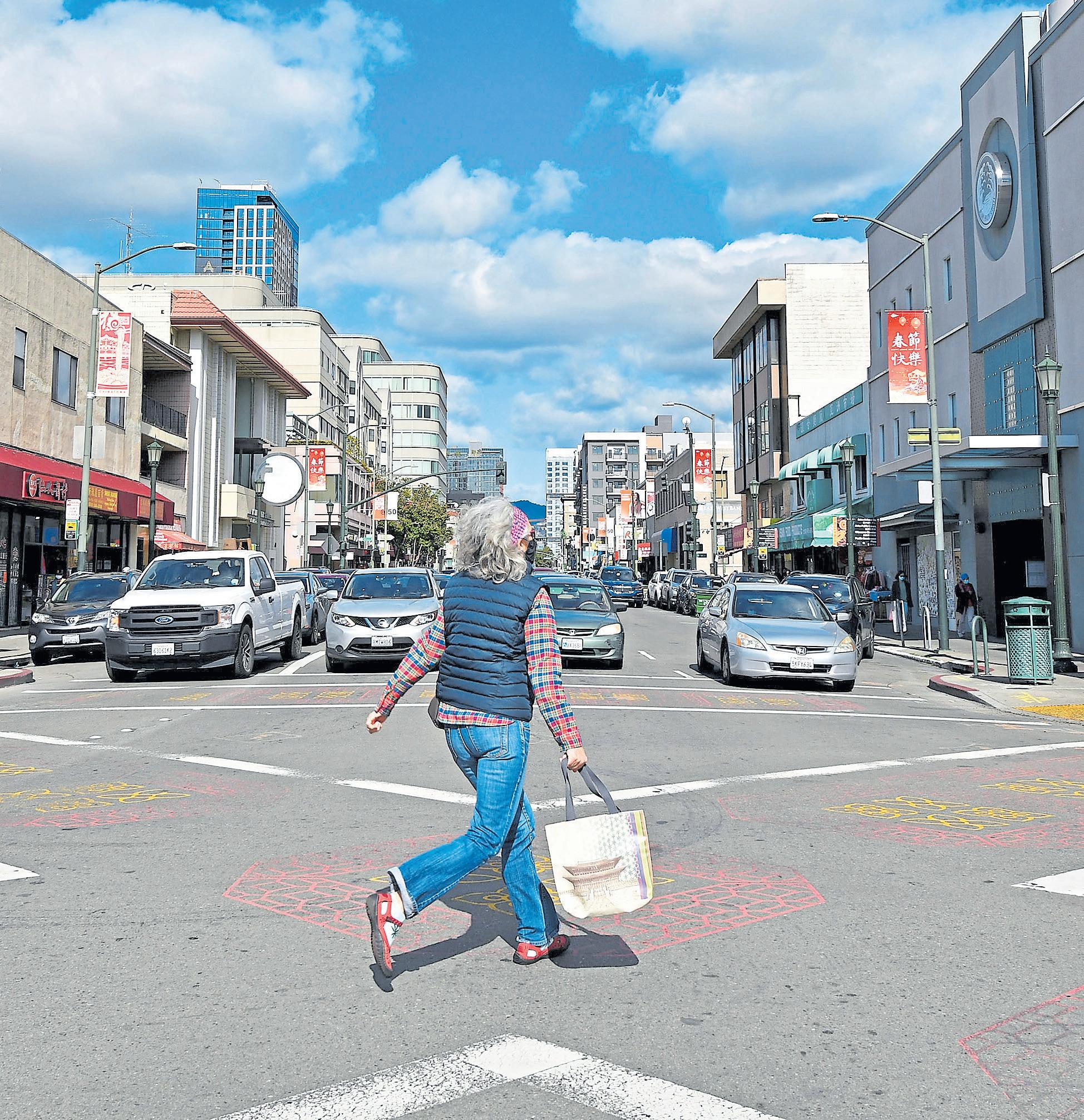
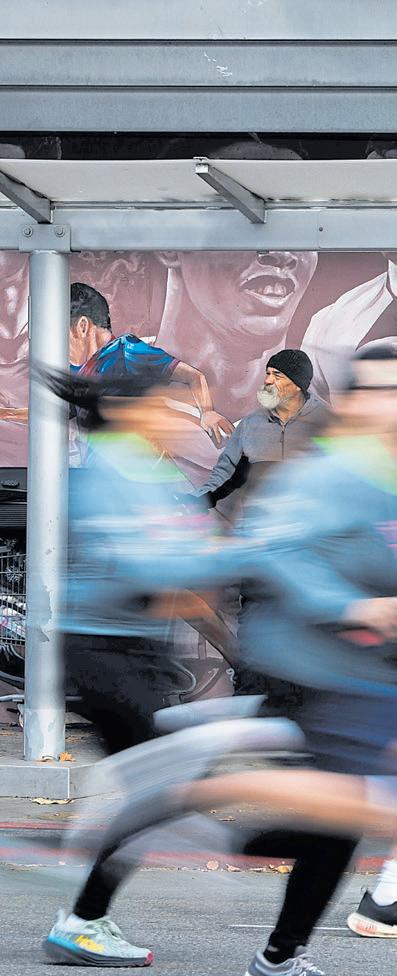
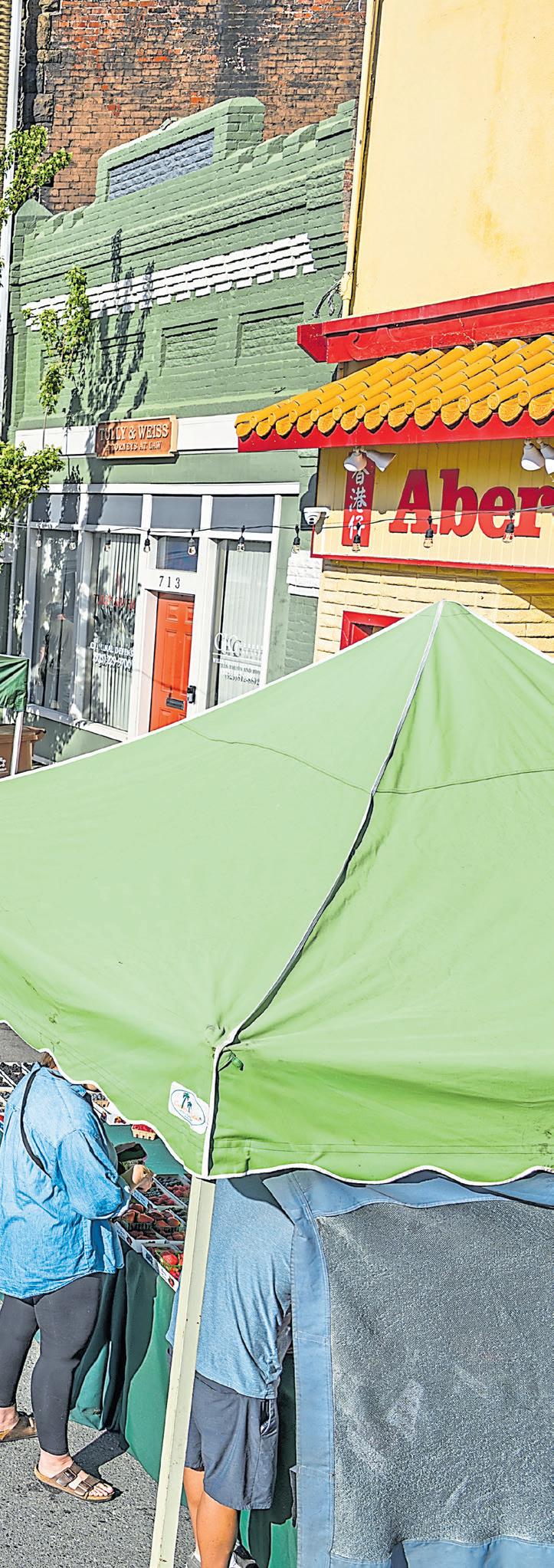
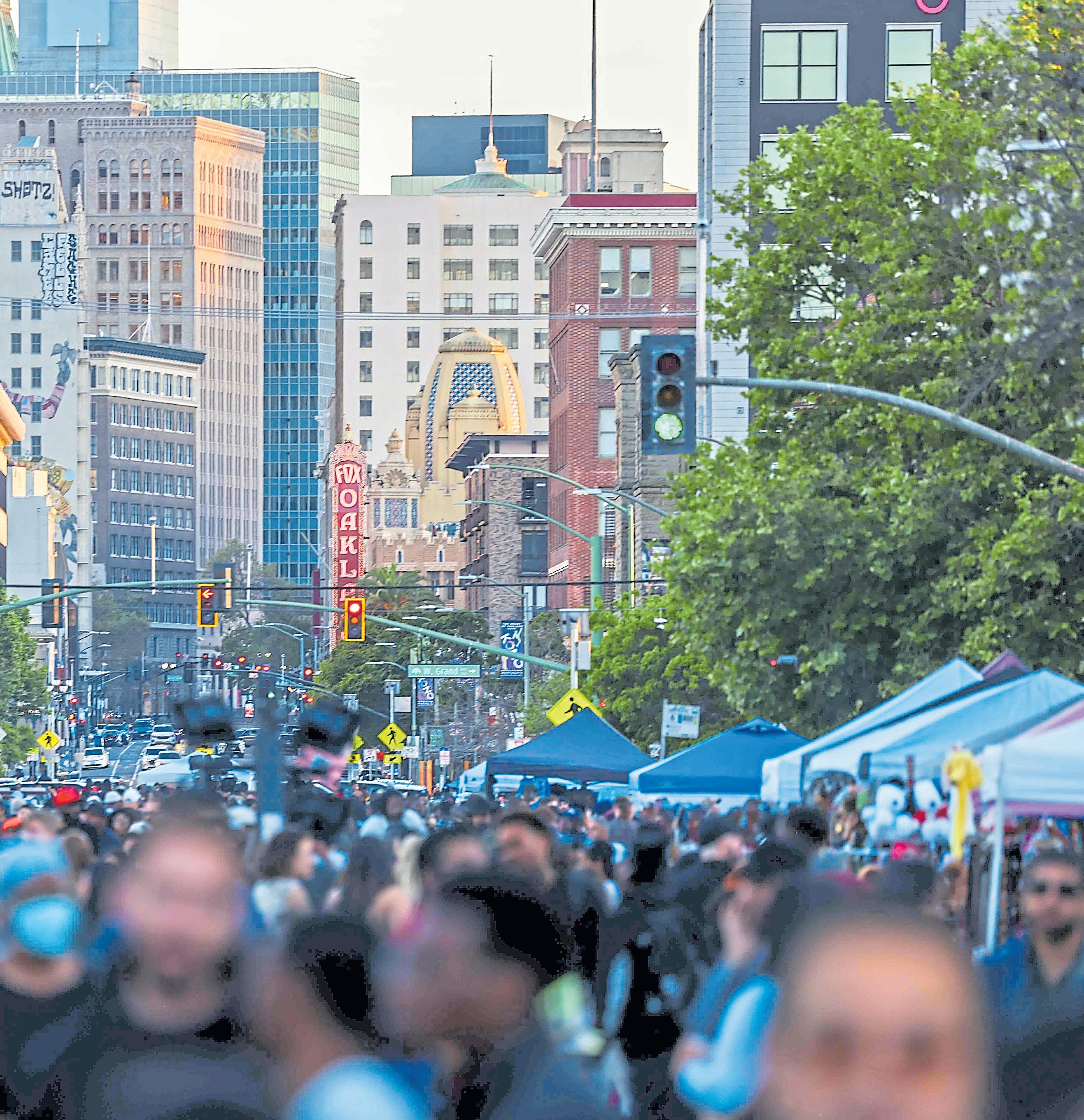
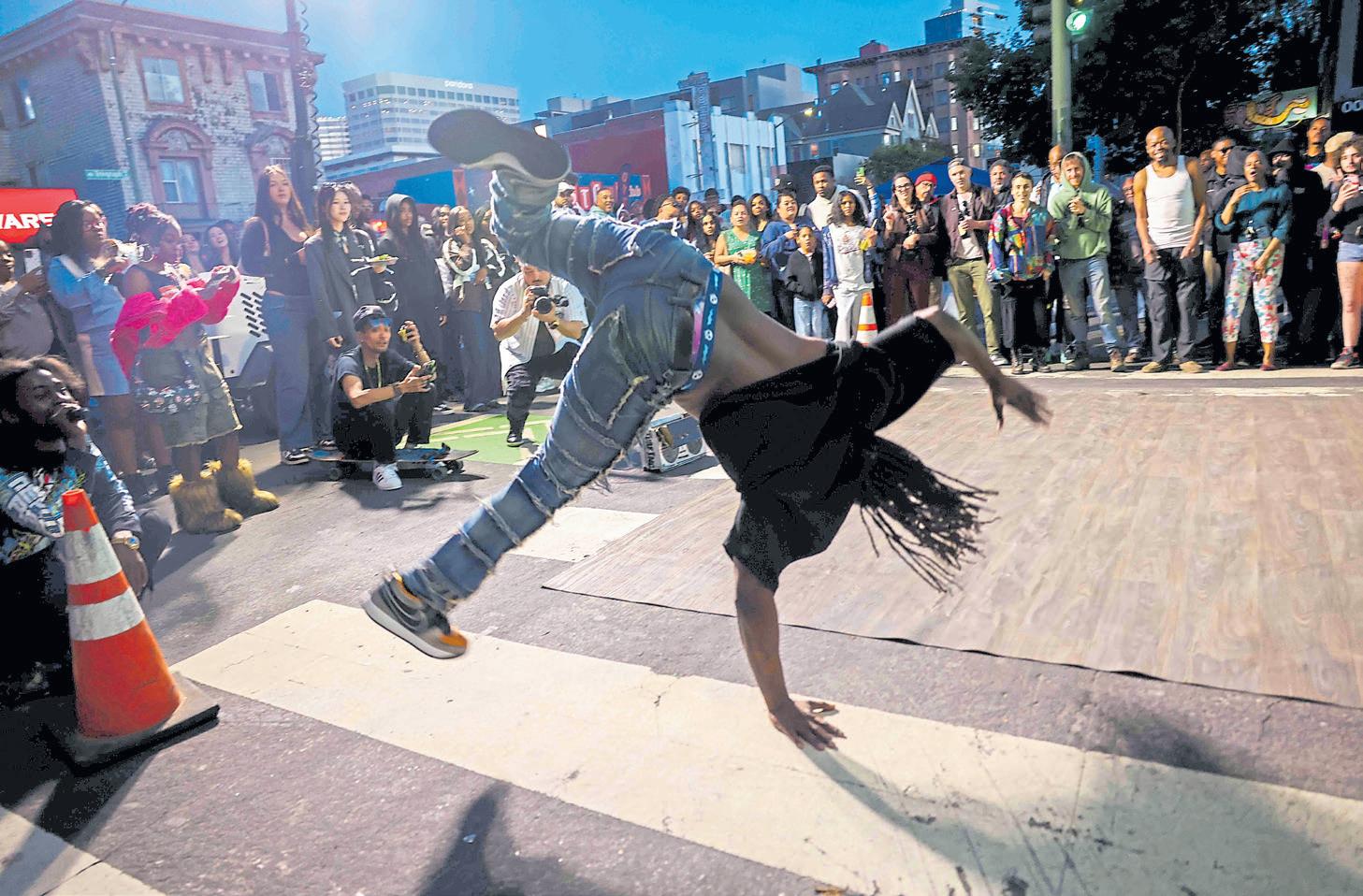
A pedestrian runs in a crosswalk in Chinatown in Oakland. JOSE CARLOS FAJARDO/STAFF ARCHIVES
elcome to Main Street! In this magazine, we’re touring the downtowns that pull our Bay Area communities together. From the northern tip of Contra Costa County to the urban streets of San Jose, many are experiencing a cultural resurgence after the pandemic. We explore the unique appeal of our town and city centers as we step out in classic destinations like Los Gatos and Walnut Creek as well as emerging hotspots like Danville and Livermore. From the tactile thrill of a small walking downtown to the rush of a big-city block party, it’s all about the vibe. So come along with us to the must-visit avenues and hidden gems of the Bay Area and learn why these downtowns are worth discovering.
STORY BY MARTHA ROSS
How the rebirth of Main streets in the Bay Area began in the suburbs
Since the pandemic, there’s been lots of handwringing over the slow comeback of urban downtowns. But what often goes untold is the story of the many downtowns in the suburbs and other small towns of the Bay Area — where more than two-thirds of the 7.6 million people in the region currently live — that are thriving again.
One of those lively suburbs with lots of people out and about is my hometown of Walnut Creek, which first became an exciting place for me when I was 12 and my parents gave me permission to “go downtown” with my friends.
On Saturday afternoons, we’d walk from our neighborhood to Walnut Creek’s Main Street and Broadway Plaza. We’d wander along the sidewalks, ride the escalators at Bullock’s (now Nordstrom), try on clothes that were too old for us, go to a movie and eat what we wanted. It was exciting, like in that boppy Petula Clark song where downtown is a place with bright lights and neon signs — “the noise and the hurry.”
Even though Walnut Creek was still considered a bedroom community, its downtown had some edge. On Friday and Saturday nights, out-of-towners turned Main Street into a Northern California destination for “American Graffiti”-style
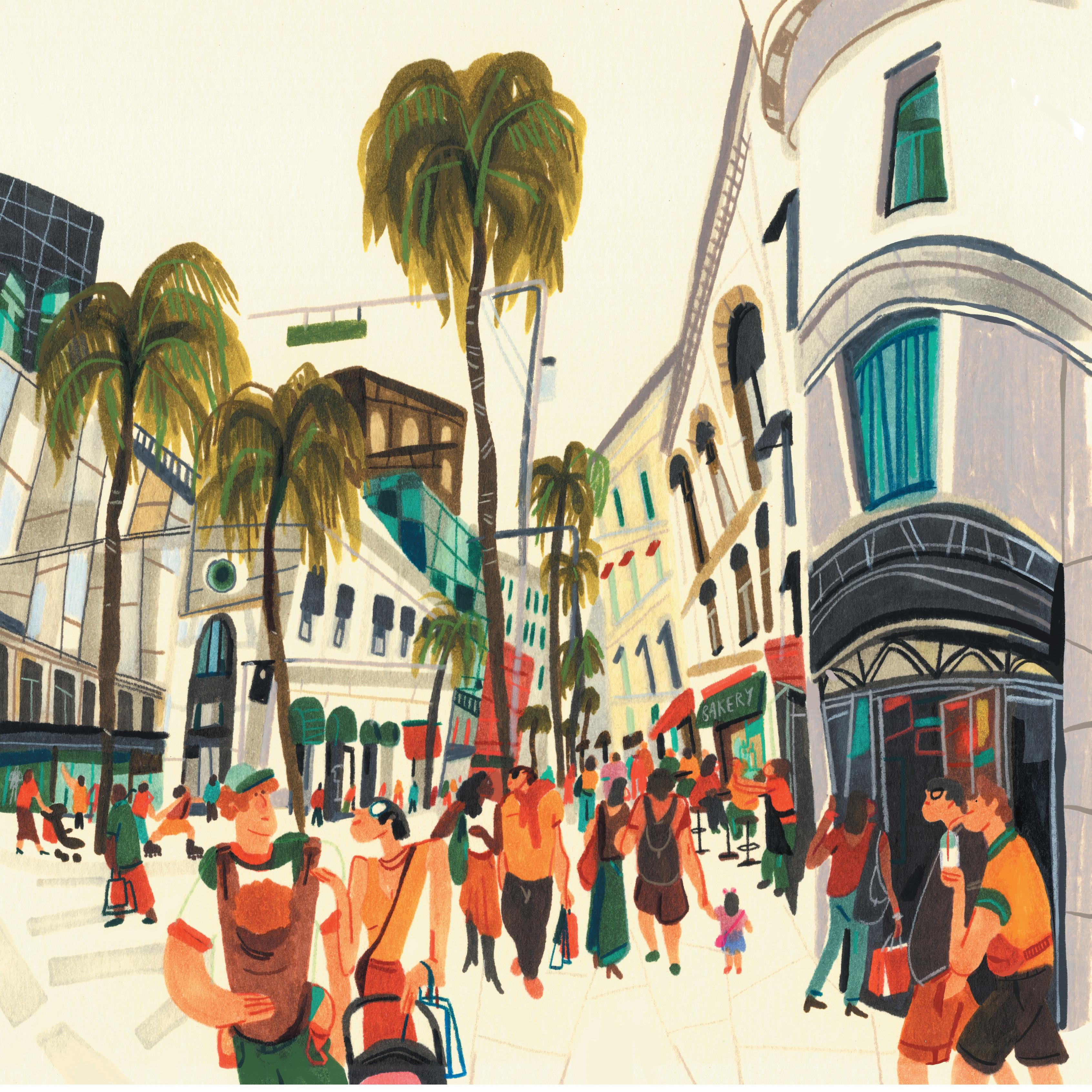
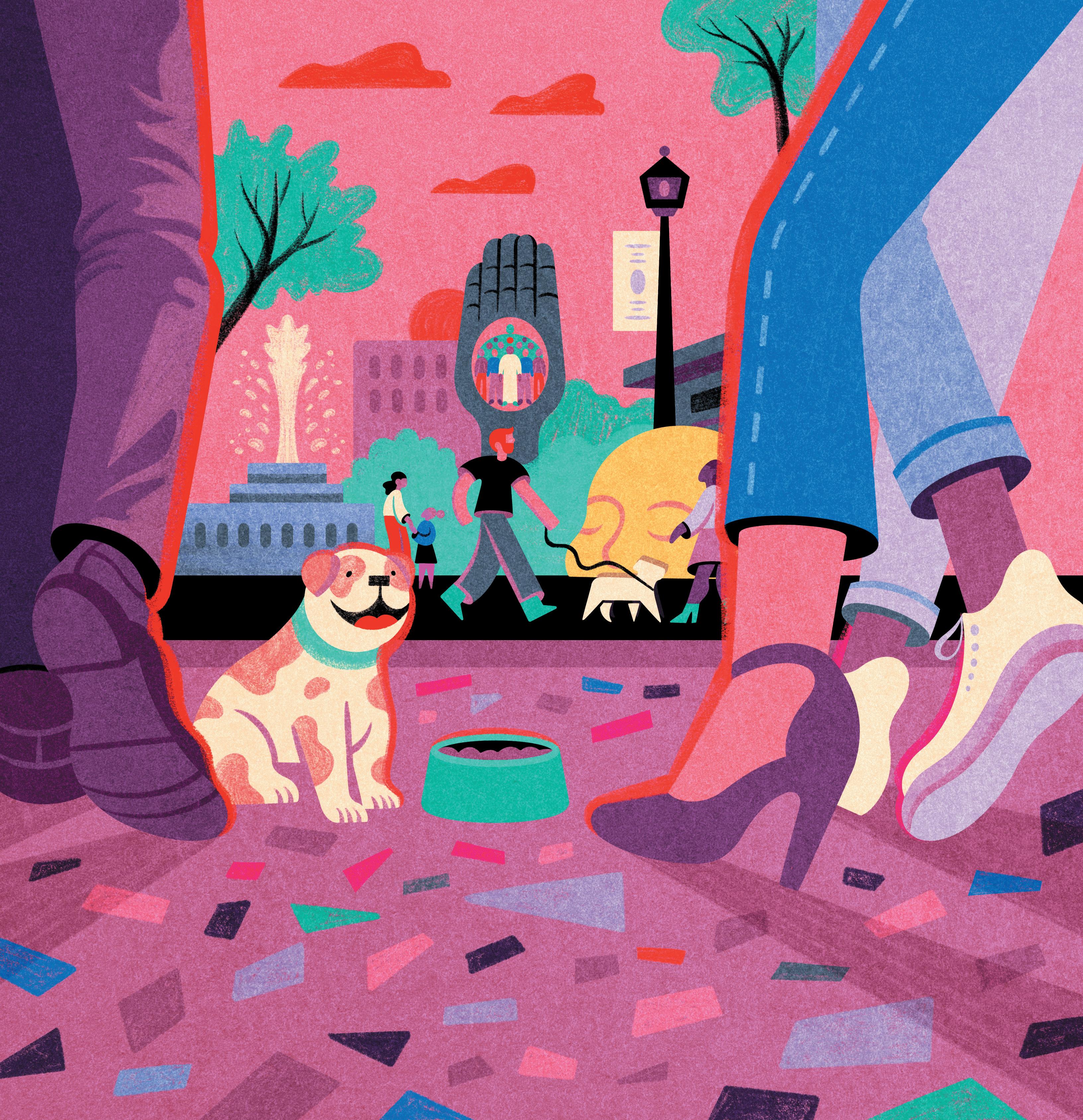
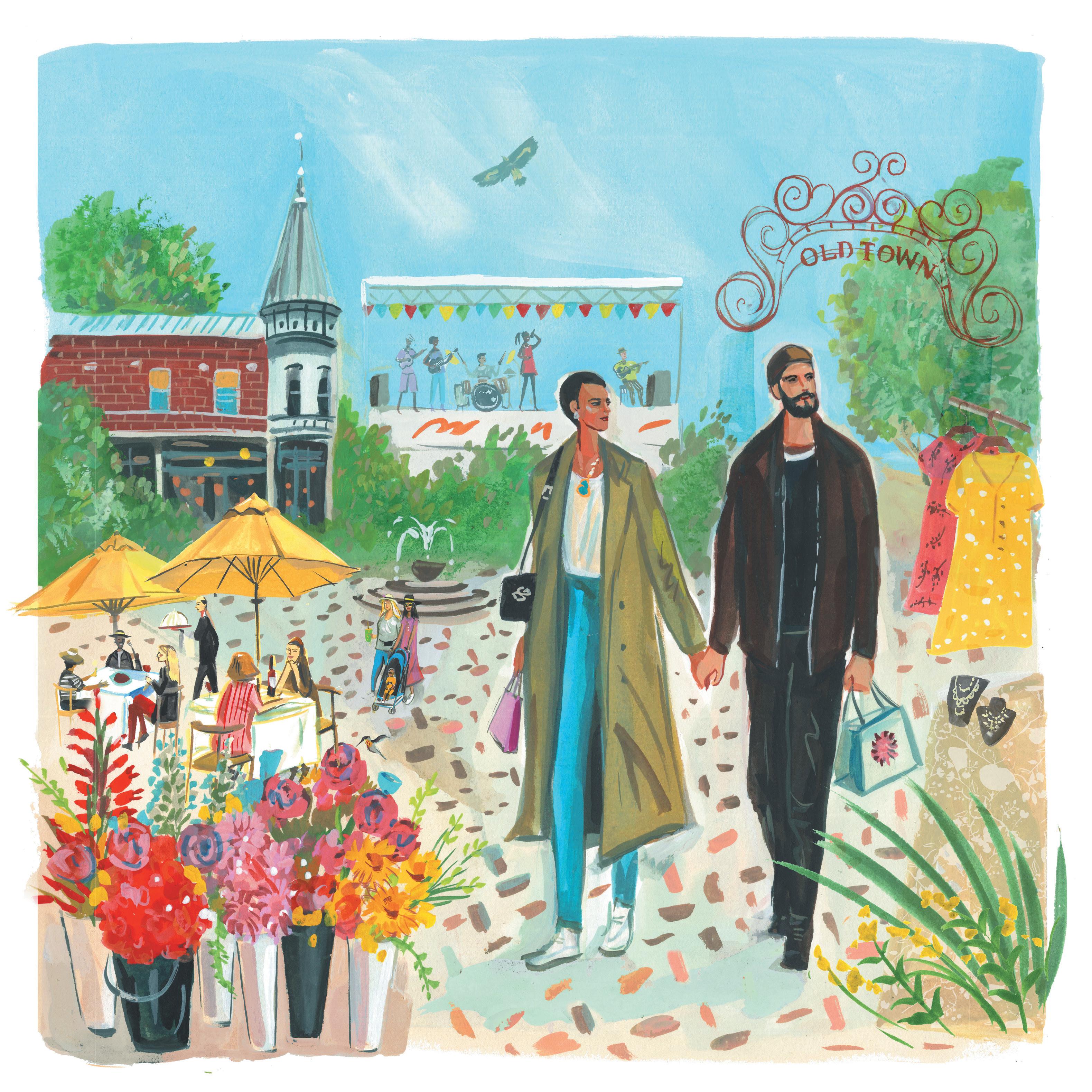
ILLUSTRATION BY CHANELLE NIBBELINK
cruising. A few years later, my high school friends and I attended midnight showings of “The Rocky Horror Picture Show.” The parade of gender-fluid Frank-N-Furter clones on Main Street suggested that the suburbs could easily accommodate the revolutionary ideas of the counterculture unfolding in bigger cities.
Between college and 2001, I got to visit some of the most exciting cities on the planet — Chicago, New York, London, Paris, Istanbul, Moscow, Singapore and Hong Kong, and I lived in Bangkok and San Francisco. When I moved back to Walnut Creek for the usual family reasons, I was delighted to find that its downtown was far more interesting than I remembered. Among other things, it had become a top retail destination.
As a reporter covering East Bay cities and lifestyles in the early 2000s, I often heard about neighboring towns wanting some of what Walnut Creek had in terms of foot traffic, community vitality and, of course, sales tax revenues.
I’ve since discovered that a number of Bay Area suburbs do have what Walnut Creek has, especially since the pandemic. Thriving downtowns abound across the region in places like Mountain View, Los Gatos, Morgan Hill, Fremont, San Leandro and the Tri-Valley. Even communities that have struggled, like Hayward or Martinez, have begun to gain a foothold with their downtowns emphasizing
their unique histories, businesses or locations.
Clark’s 62-year-old pop single still speaks to a universal truth: People like to go downtown, which is why many of these communities began working long before COVID to create core areas where locals and visitors can shop, eat, be entertained and socialize. According to By Area Economic Institute and Squareup data, the region’s suburbs have gained in popularity since the pandemic, as people
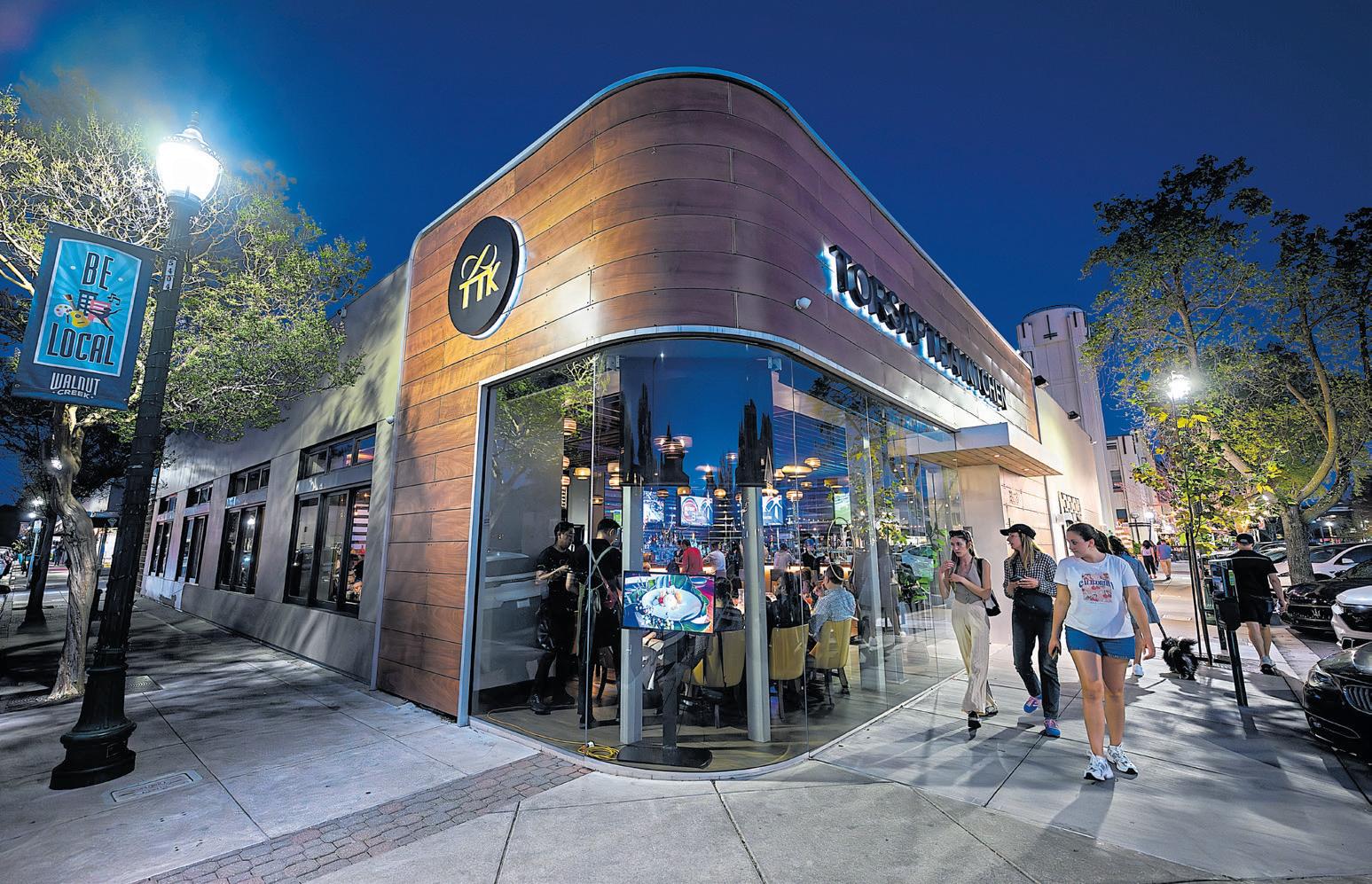
Walnut Creek began with the opening of a hotel, store and saloon in the 1850s. Today, it thrives as a commercial, dining and nightlife destination
JOSE CARLOS FAJARDO/STAFF
shifted to remote or hybrid work or sought a relatively lower cost of living.
The Bay Area’s suburban population of some 5 million also has become increasingly diverse, educated and affluent. People of color make up nearly 40 percent of residents in Walnut Creek, a notable rise from when I was a child. In the Silicon Valley and the Tri-Valley — the Bay Area’s fastest growing region — more than half of residents are Asian, Latino, Black or mixed-race, and
a growing share of suburbanites are immigrants.
FALLING IN LOVE WITH THE LOCAL SCENE
The resulting mix is a population that wants some of the benefits of cosmopolitan, urban living, but want it close to home, where they don’t have to deal with traffic, parking issues or the safety concerns they associate with going to “the city.”
“I think people fell in love
with their hometowns a bit during COVID because it was really hard to go anywhere,” said Brandon Cardwell, the economic development manager for Livermore, which also has a thriving downtown. “I heard from people who were working remotely that they now had a favorite restaurant, not in the city where they used to work, but in their own downtown. One of the silver linings of the pandemic is that people have a chance to really get to know and fall in love with
the communities they live in.”
Today’s successful downtowns rely on a mix of ingredients, said Steven Falk, the former city manager of Lafayette, who’s served as an interim city executive in Oakland and Richmond and who lectures at UC Berkeley’s Goldman School of Public Policy. They need retail, restaurants and services as well as parks and plazas for festivals; outdoor concerts and weekly farmers markets; historic or “culturally meaningful” architec-
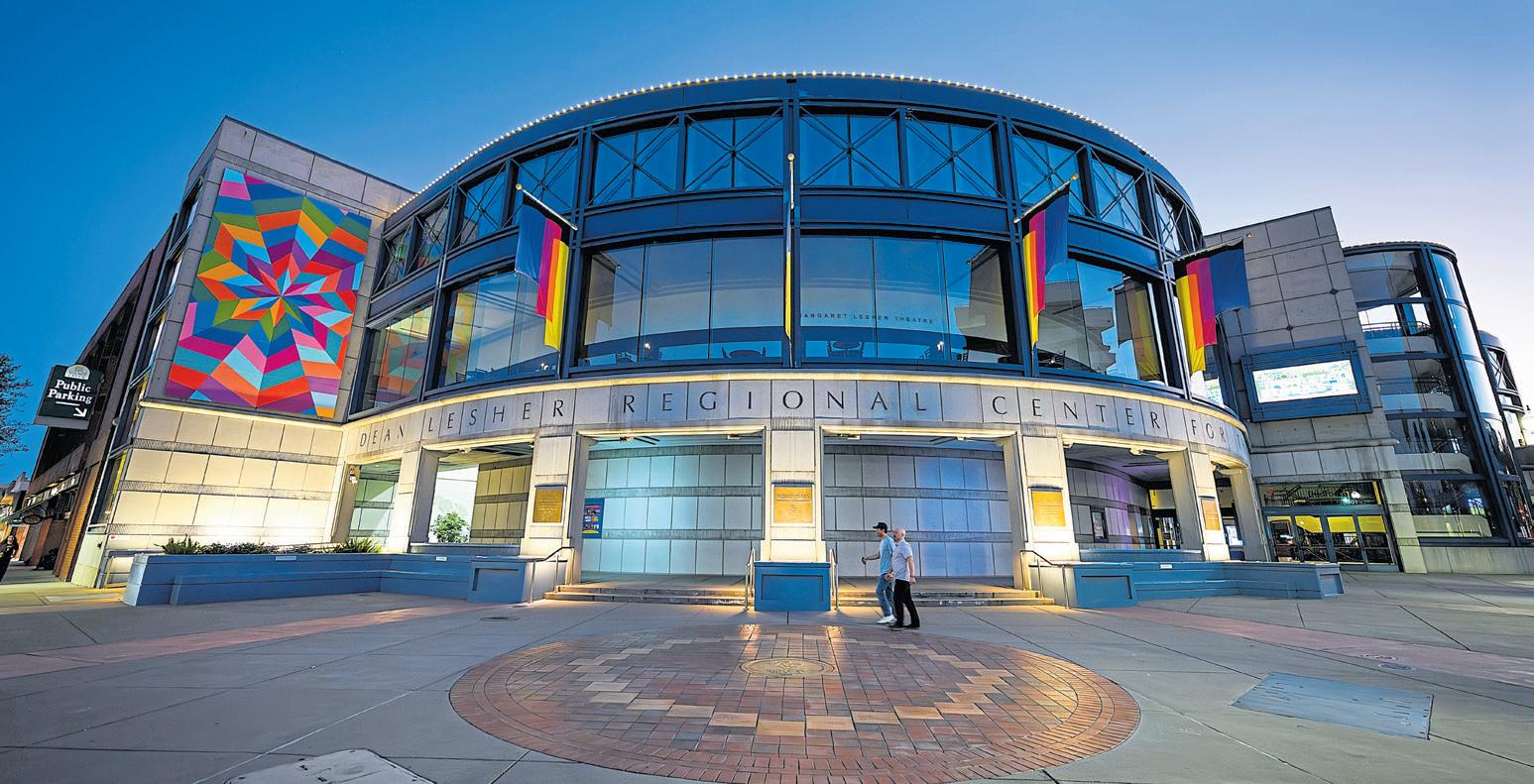
Spaces for arts and culture, such as the Lesher Center for the Arts, are important new inclusions for city planners, Walnut Creek’s economic development manager Mike Nimon said.
JOSE CARLOS FAJARDO/STAFF
and government, while people migrated to outlying areas, desiring land for increasingly bigger homes with yards, according to Mitchell Schwarzer, an author and retired professor of architectural and urban history at the California College of the Arts.
“The greatest transformation to the American downtown in recent decades has been the reintroduction of housing,” Schwarzer said. In what he called a global trend, singles, couples, young families and empty nesters are moving into new apartments, townhouses and loft developments. Some of these projects are mixed use, lining formerly vacant streets with ground-floor stores and restaurants and bringing an urban look to suburban skylines.
Old-timers and NIMBYs may complain that these projects destroy the “small-town” feel of their communities, but Walnut Creek Mayor Kevin Wilk said cities are limited in their ability to say no to new downtown complexes. Dozens of state laws enacted in recent years mandate that cities do their part to address California’s housing crisis by creating new homes at all income levels.
He and Falk both believe density is good for downtowns, because it brings more foot traffic, shoppers, shops and variety.
“It’s a virtuous circle,” Falk said.
ture; and libraries, civic buildings and venues for arts and culture. It’s necessary to have a robust job market nearby, Falk said, and residents who have money to spend.
Their success dovetails with a larger trend: Over the past decade or so, people have begun moving back into downtowns. This reverses a particularly American trend going back to the late 19th century, which had downtowns become strongholds of commerce, manufacturing
WALNUT CREEK: MAKING A MODEL DOWNTOWN
There are a number of factors that made Walnut Creek a model for other midsized suburbs, and they didn’t happen overnight.
“It’s a fantastic downtown,” Falk said. “None of that happened by accident. It’s the result of decades of good planning and oversight.”
Even before any human intervention, Walnut Creek had
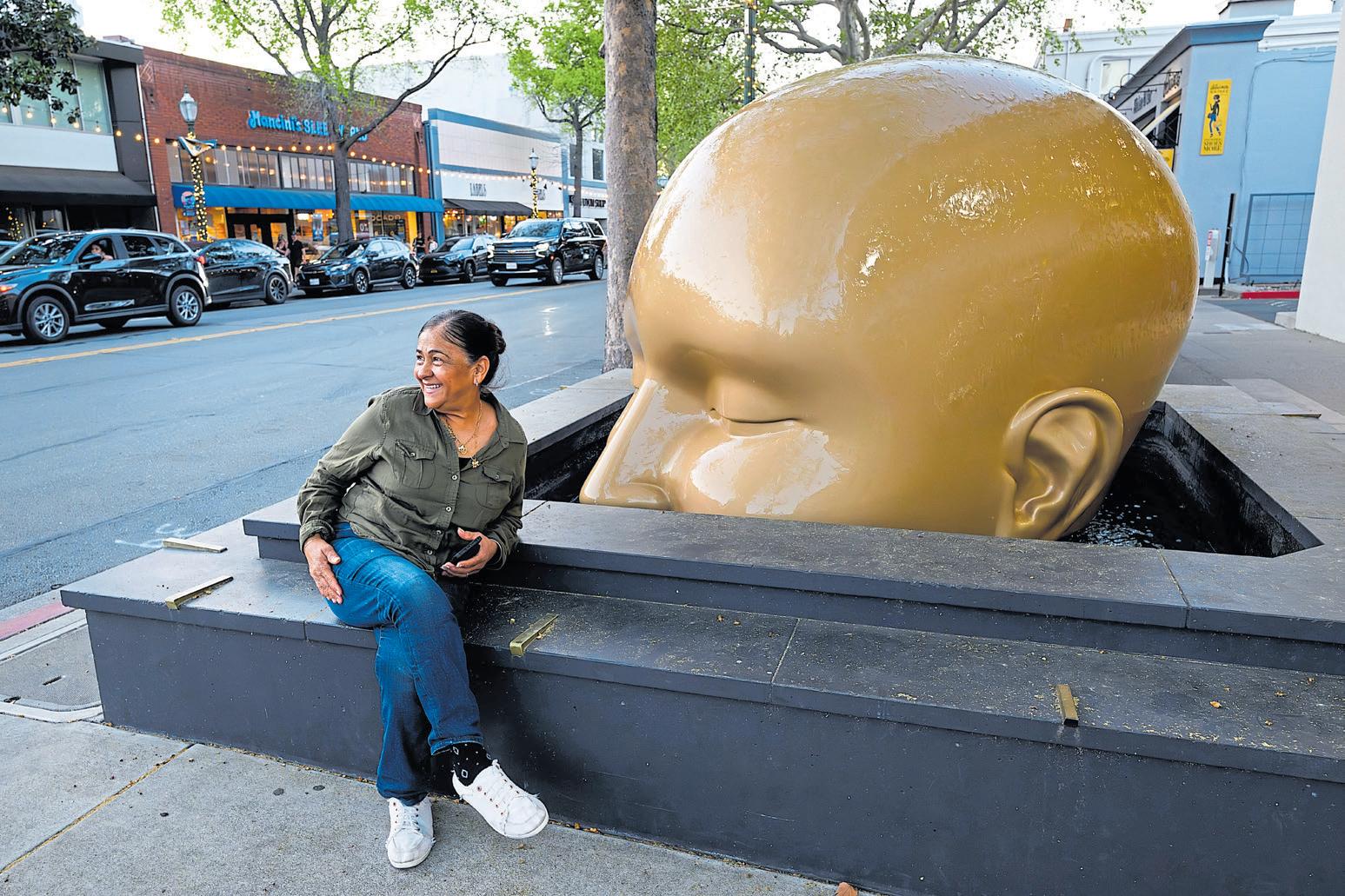
Walnut Creek’s sculpture “Fountain Head,” by artist Seyed Alavi, is a popular spot for photos.
“the gift of geography,” according to Brad Rovanpera, the city’s former public information officer who wrote its official history. Walnut Creek developed at the crossroads of two 19th-century routes, one running between Oakland and east Contra Costa County and the other between Martinez, a shipping town on the Carquinez Strait, and San Jose.
Walnut Creek’s future as a commercial, dining and nightlife destination began near those crossroads with the opening of a hotel, store and saloon in the 1850s. Today, the crossroads is the intersection of Mt. Diablo Boulevard and Main Street, one
of the city’s prime retail areas, with Broadway Plaza and the Apple store on one corner and Tiffany and Pottery Barn on the others. This intersection also lies about a half-mile away from another crossroads: the I-680 and Highway 24 interchange.
When Harvard-educated lawyer Dean Lesher surveyed the then-2,200-person city from an airplane in 1947, he decided to make it the home of his future media empire. When buying the local paper, which he would later rename the Contra Costa Times, he correctly predicted that the East Bay was on the verge of a major expansion and
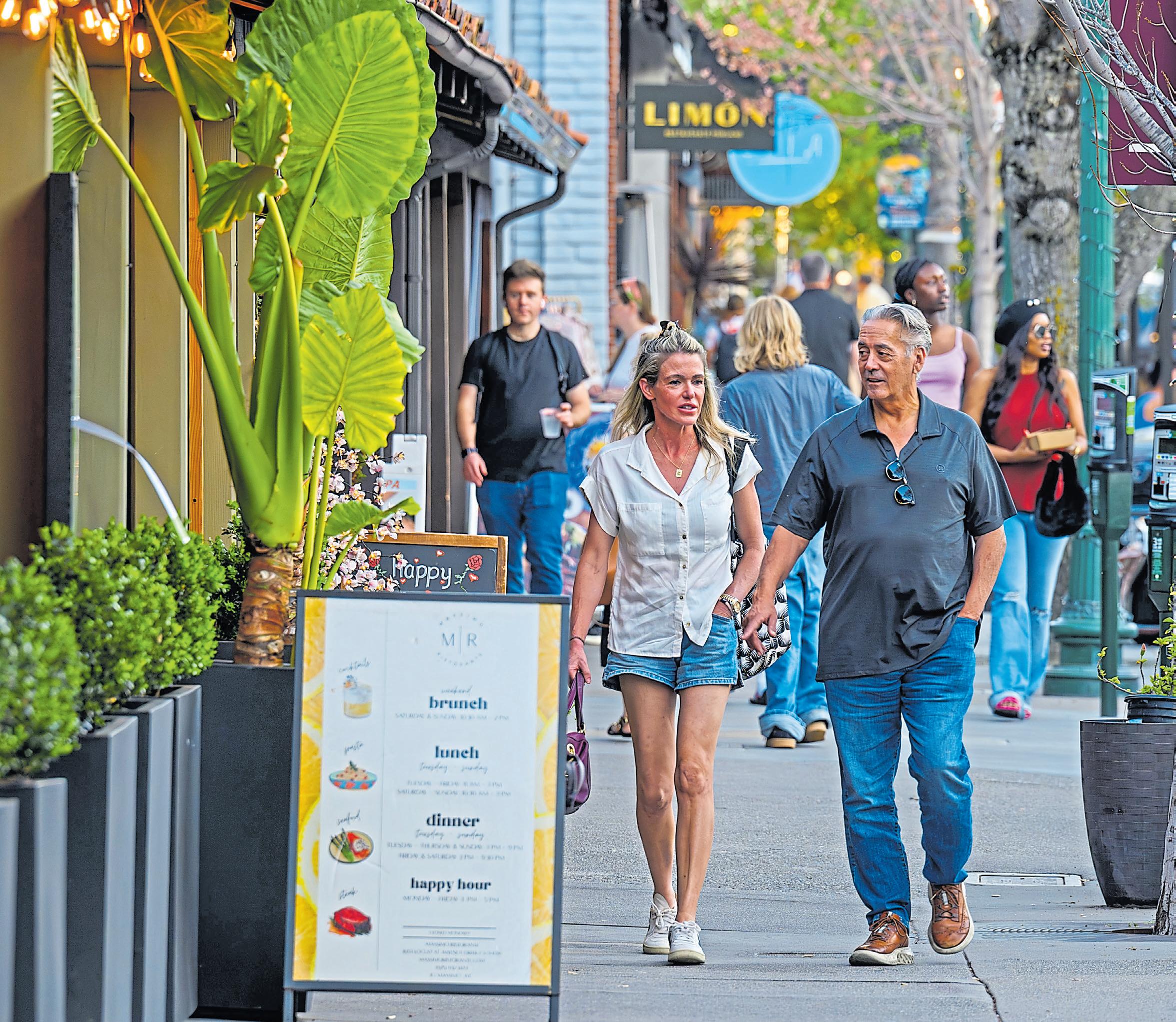
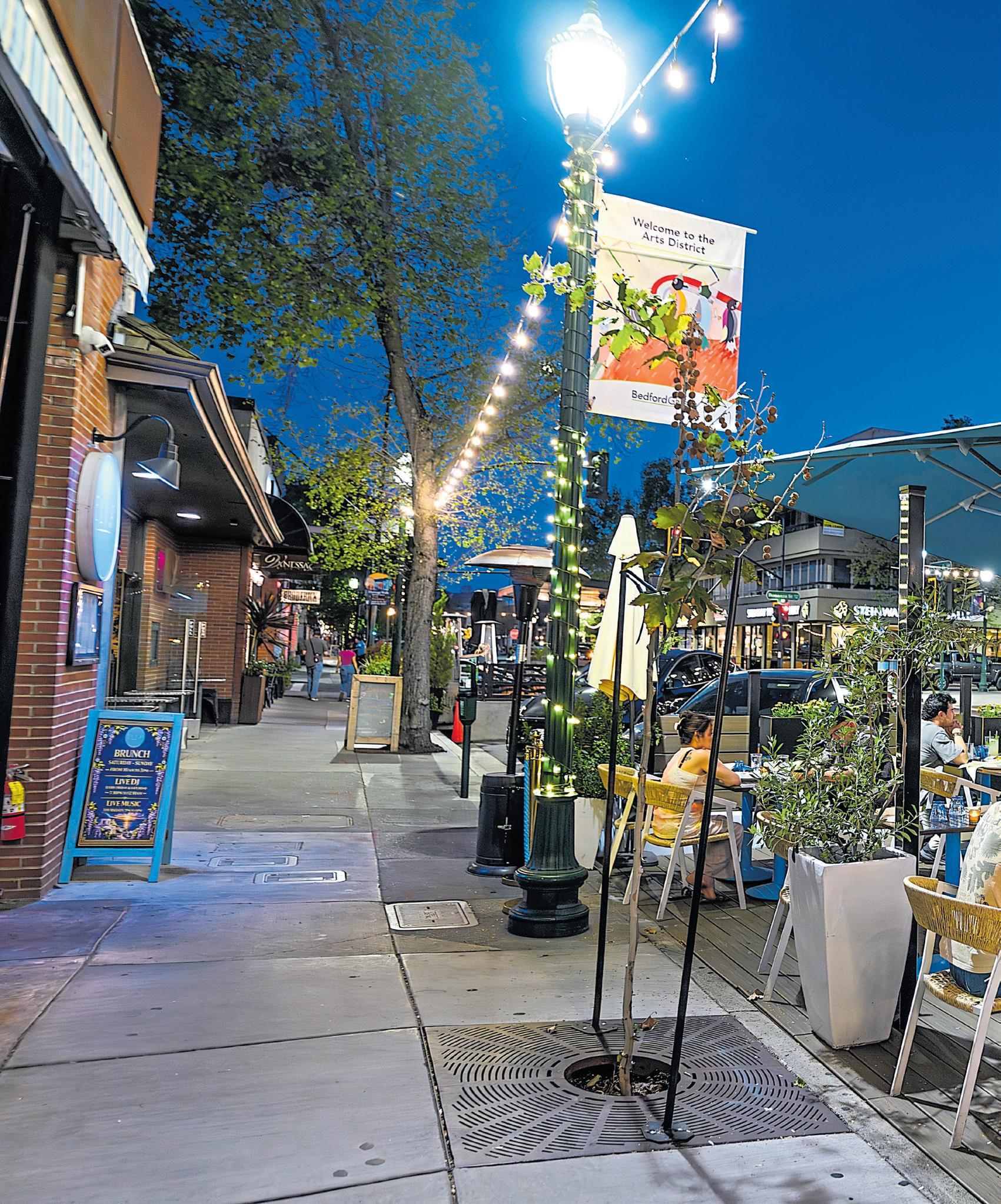
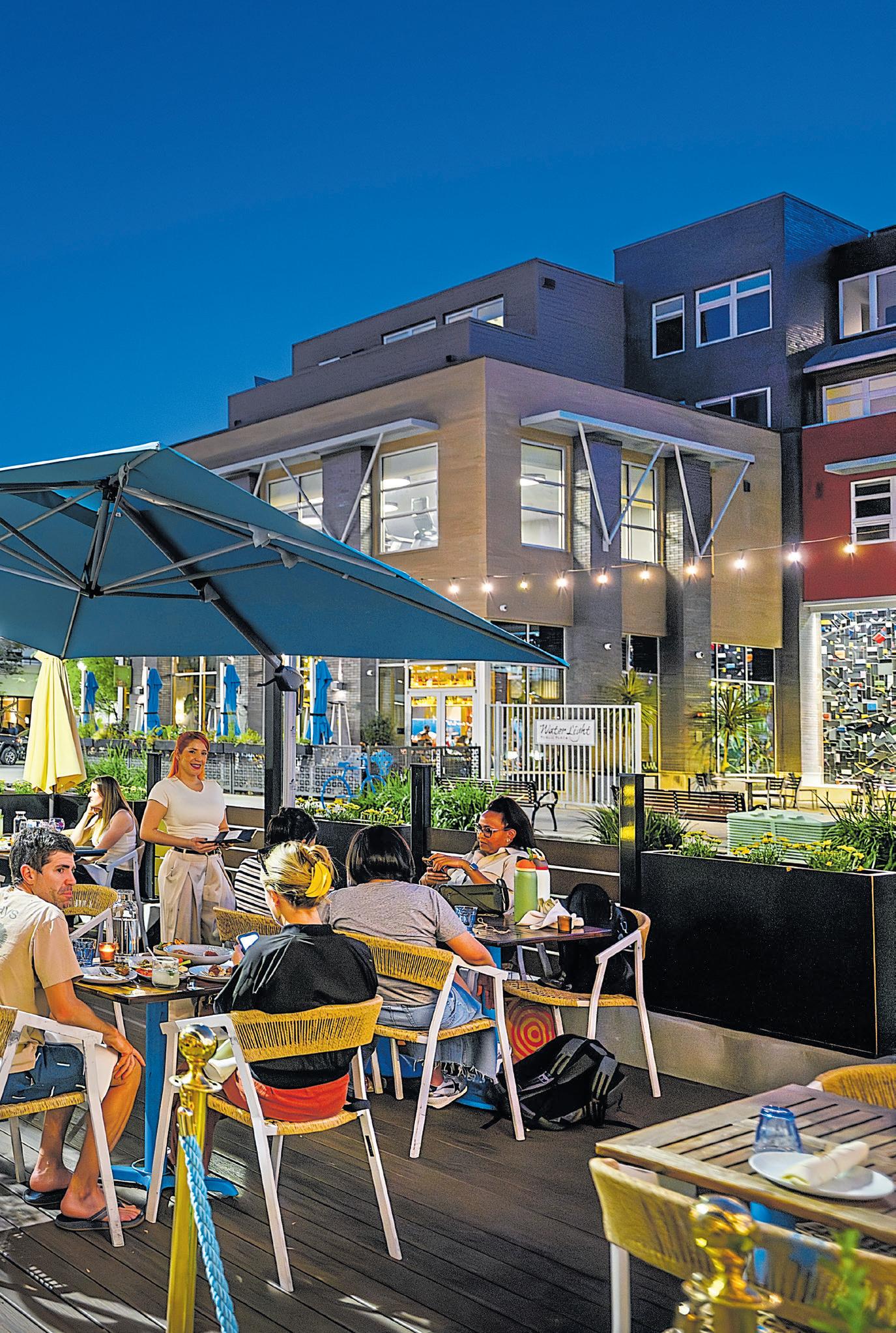
People enjoy a spring evening in downtown Walnut Creek, with lush green trees, flower displays and patios featuring dinner al fresco.
JOSE CARLOS FAJARDO/STAFF
wrote a column that could serve as a manifesto for any American downtown: “The people are flocking here. … They will shop here if the shops offer what they want. They will look for entertainment here if it is available.”
Early in its post-war development, Walnut Creek leaders made a key decision that seems especially prescient, given the recent decline of indoor shopping malls due to the growth of online shopping and the resurgence of downtowns. They
approved the construction of an open-air mall near those crossroads, designed to resemble a traditional Main Street rather than a galleria. Opening in 1951, the Broadway Shopping Center, as it was then called, also offered space for several anchor department stores, along with a Woolworth variety store.
“In one broad stroke, the opening of the center changed the financial fortunes of the sleepy downtown that would one day be recognized as one of
the top shopping districts in the nation,” Rovanpera wrote in his book, “Walnut Creek: An Illustrated History.” Walnut Creek’s downtown also attracted other kinds of businesses, including financial firms and auto dealerships. Kaiser Permanente notably chose the downtown to build its first state-of-the-art “dream hospital” in Northern California in 1953, as the fledgling nonprofit began to grow its healthcare empire.
In the 1960s, Walnut Creek
Of course, that’s not the case anymore, as Walnut Creek’s downtown continued to thrive, while Sunvalley’s recent struggles have been well-documented. Meanwhile, after Walnut Creek got its BART station near downtown in 1973, it experienced another growth spurt, with thousands pouring in to live and work in new subdivisions and office parks in the city and surrounding communities.
lost a couple of its department stores to Concord’s Sunvalley mall, one of the gleaming new, fully enclosed shopping centers that were seen as the future of retail for auto-dependent suburbanites. Built along I-680, Sunvalley became another Saturday afternoon destination for me and my friends. Wilk admits that he sometimes preferred going to Sunvalley after he got his driver’s license, because Walnut Creek’s downtown seemed so “nondescript.”
By 1976, Walnut Creek was enough of a destination that President Gerald Ford stopped by to experience it. Like other suburbs, Walnut Creek also experienced growing pains over traffic, congestion and concerns about overdevelopment. But it continued to harbor big-city ambitions, notably in aspiring to become a regional cultural center. It approved the construction of a performing arts center at the north end of town, which was later named for Lesher, an ardent arts supporter. Opening in 1990, it soon provided the momentum for new redevelopment projects and for upscale shops and restaurants finding their way into vintage buildings along Main and Locust streets.
After Walnut Creek got a BART station near downtown in 1973, the city experienced another growth spurt, with thousands pouring in to live and work in new subdivisions and office parks in the city and surrounding communities.
Of course, Walnut Creek was not the only city to put the arts at the heart of community development — Mountain View, for instance, opened its downtown Center for the Performing Arts the following year. But it has provided an example of how this can be a successful strategy for any town aspiring to what planners called “livability.” Economic data from nonprofits like Americans for the Arts and the Knight Foundation show that investing in theaters, museums or public art displays boosts spending, creates jobs and turns downtowns into destinations.
This arts and culture piece fits into a new mantra for city planners — that downtowns need to be more “experience-oriented,” and retail needs to be “experiential,” as Walnut Creek’s economic development manager Mike Nimon said.
People can easily go online and buy what they need, he said, so downtowns also need to be places where people can eat before or after they shop, meet up with friends or just hang out in a pleasant outdoor space.
My 12-year-old self would approve.
From music festivals to night markets to street fairs, downtown San Jose’s outdoor events are drawing crowds
In the wake of the COVID-19 pandemic, San Jose needed a comeback.
It was slow at first, as the downtown calendar gradually filled up with new music festivals, night markets, street fairs and other events. Last year, though, it finally hit a tipping point as the city’s nightlife scene exploded and downtown drew more than 34 million visitors — an increase of 9 percent over 2024, according to data from location analytics firm Placer.ai.
Ironically, this new success owed a debt to the pandemic itself, which had inspired San Jose officials to spend money creating more outdoor experiences for residents and visitors. The Urban Vibrancy Institute’s Every Thursday initiative recruited bands to play at different brewpubs and restaurants in 2022 and then expanded that into a series of block parties with live music and food trucks in different downtown districts.
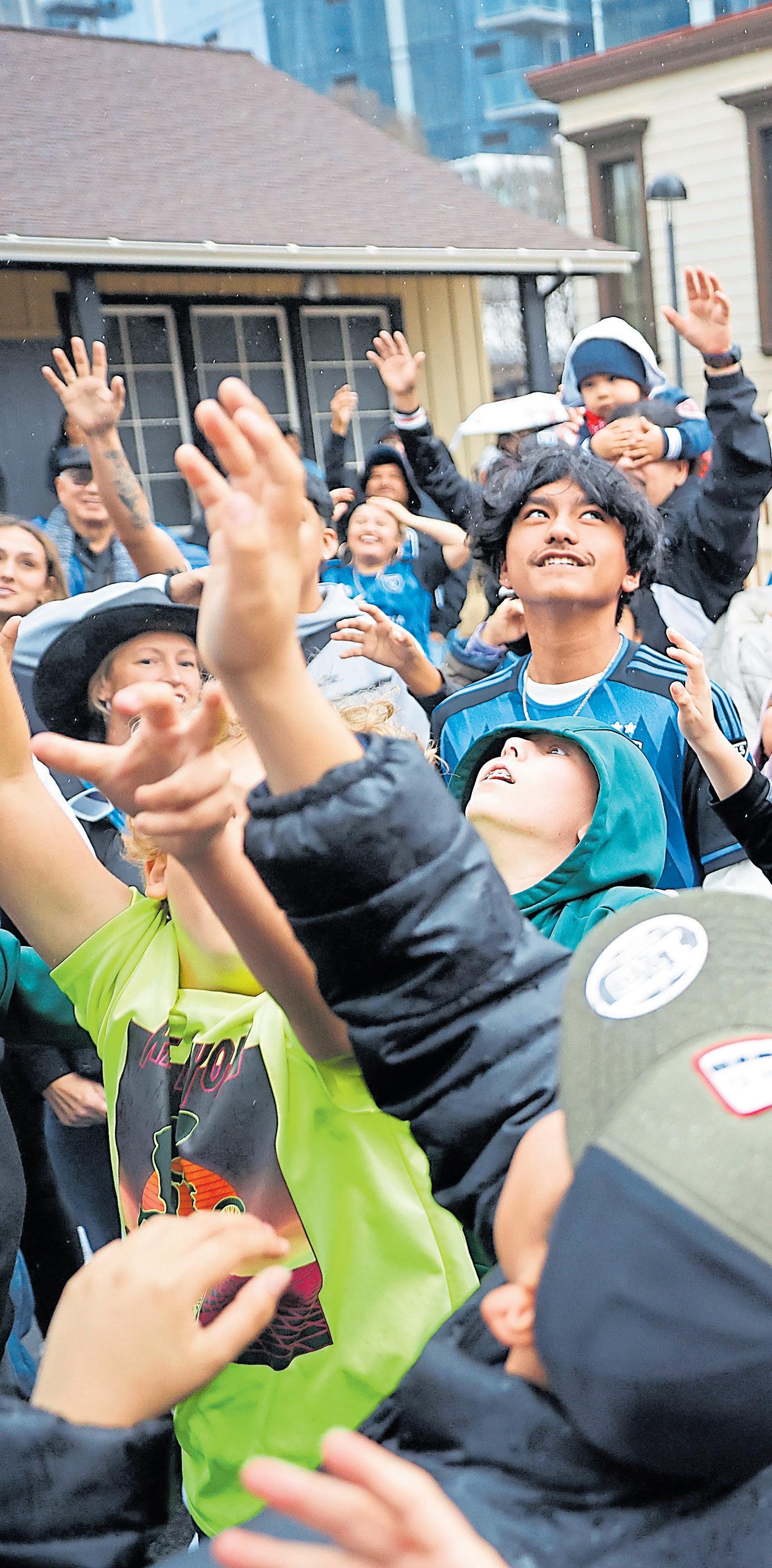
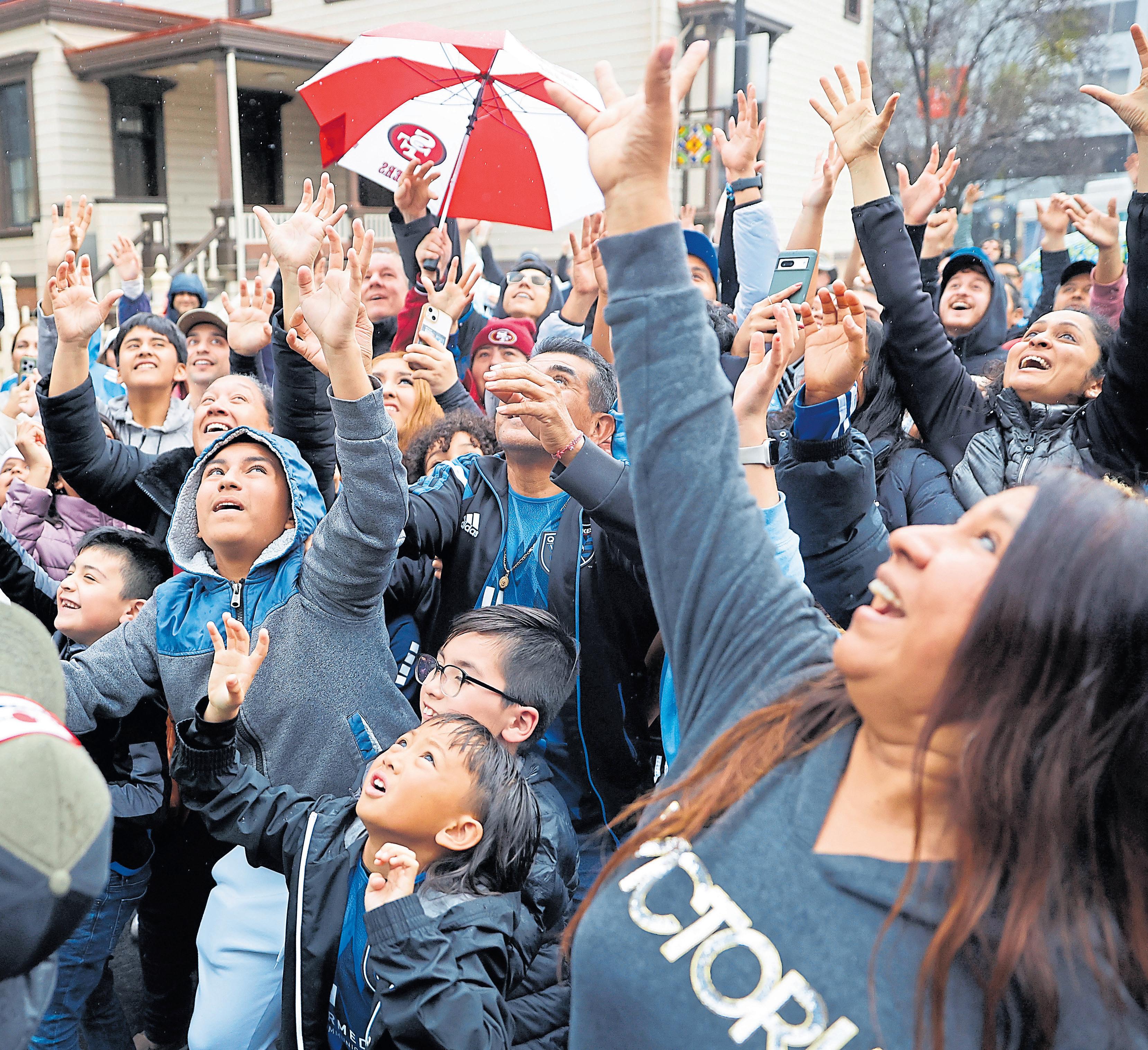
Fans reach for a jersey at the San Jose Earthquakes’ 50th anniversary block party at San Pedro Square Market in downtown San Jose.
STORY BY SAL PIZARRO
SHAE HAMMOND/STAFF
They started with a splash in 2023 with an eclectic crowd of a few hundred grabbing a bite or a drink at Scratch Kitchen and Goodtime Bar in Fountain Alley in the Historic District or on the Paseo de San Antonio next to the Hammer Theatre. The following year, the block parties looked to be following a similar pattern. Then, the social media sensation San Jose Foos got involved, hyping the July event at San Pedro Square.
Somewhere between 10,000 and 20,000 people jammed onto the street, listening to music by the Good Time Collective. On Santa Clara Street, crowds waited in groups on the corners like there was a Sharks playoff game going on. The parties never reached that kind of attendance again, but the point had been made: People will show up downtown if you throw a good party.
The San Jose City Council also voted to create pedestrian malls on portions of San Pedro Street and Post Street. In both cases, the asphalt was covered with colorful street murals, and the closed streets became natural gathering spots for pop-up events.
“Our downtown has at times struggled to be a consistent regional destination,” Mayor Matt Mahan said at a forum on the Future of Downtown in March. But that’s changing, he said. “People are
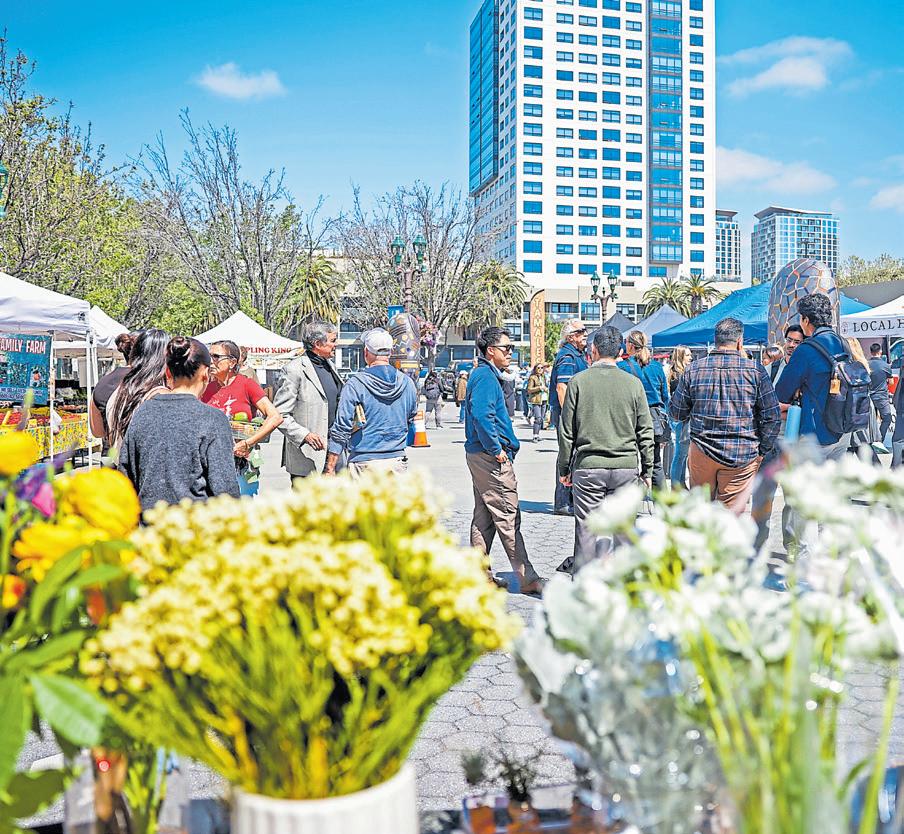
Above: After a two-year absence, a farmers market returned to downtown San Jose outside the Hammer Theatre in 2025.
coming because there’s something unique there.”
This isn’t the first time that a focus on outdoor culture spotlighting some of downtown’s best assets — great weather and numerous parks and plazas — has worked for San Jose. Christmas in the Park, Music in the Park and San Jose Jazz’s SummerFest have been popular for decades. There are no fewer than six major running events that go through downtown; the summer City Dance series outside the San Jose Museum of Art gets more popular every year, and the routes for Viva CalleSJ — which closes six miles of streets to vehicle traffic and opens them for bikes, skateboards and walkers — almost always go through downtown.
This year, the multiple events connected to national and global sports events like the Super Bowl and the World Cup have supplanted block parties.
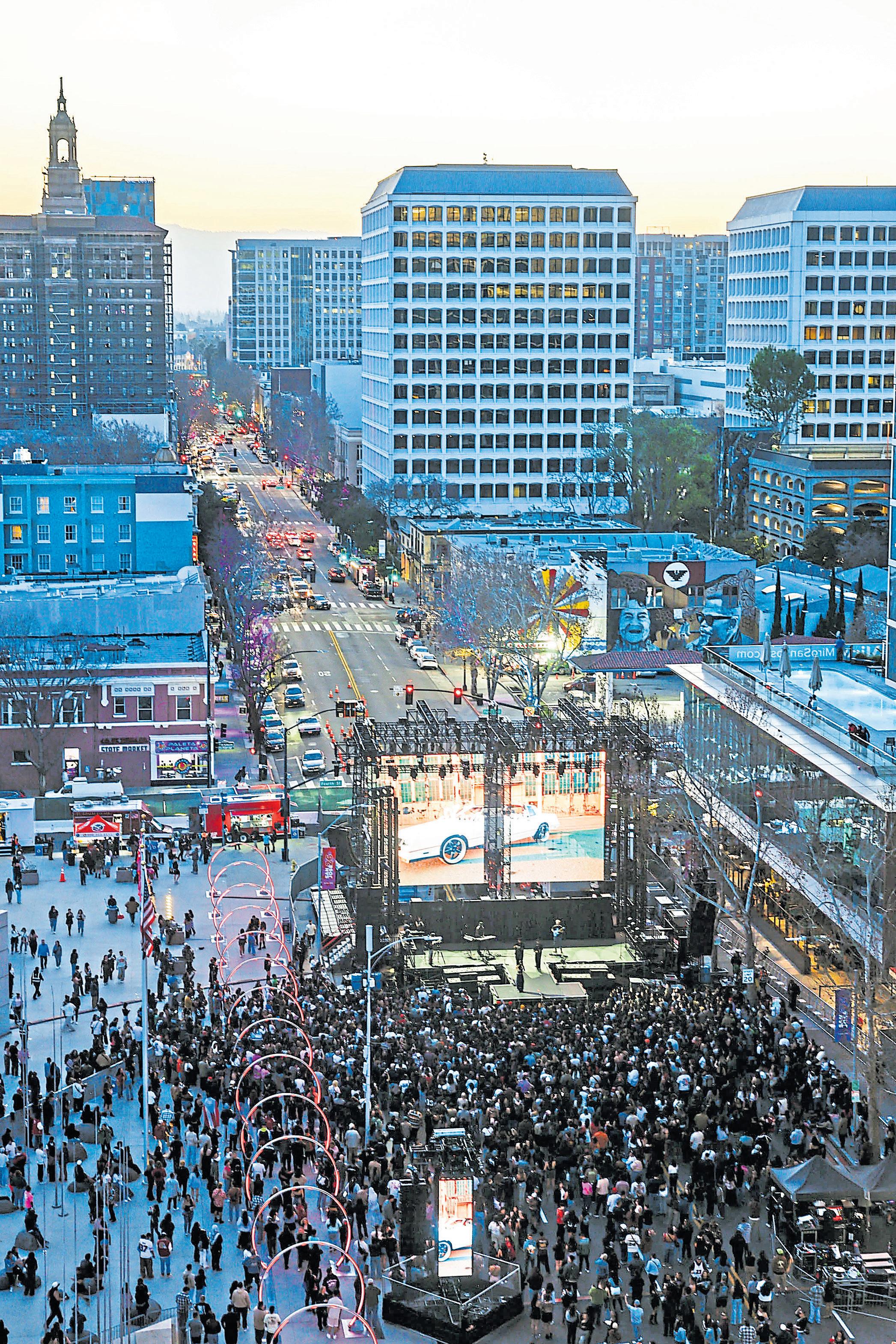
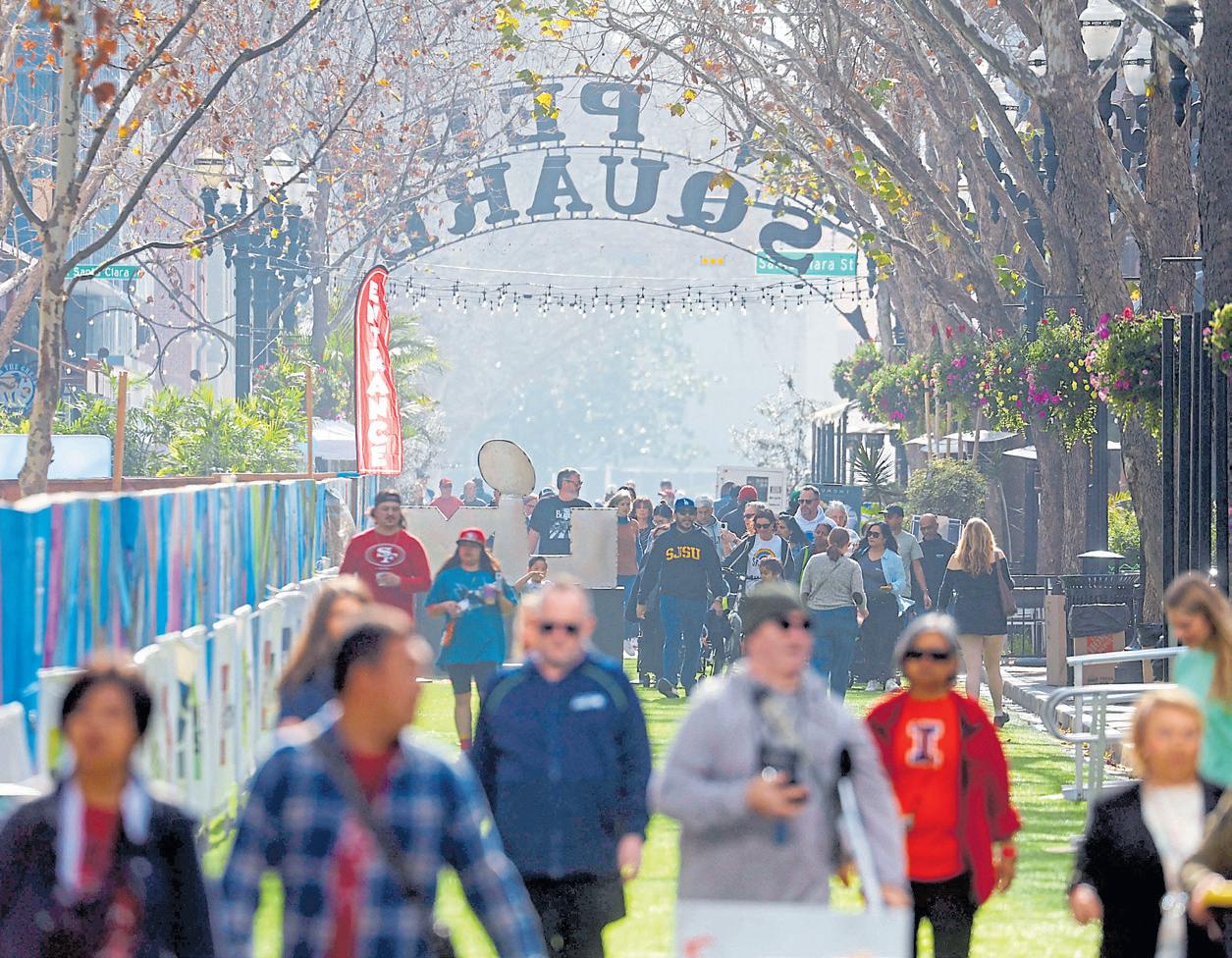
On the Friday between rounds of the NCAA Men’s Basketball tournament in March, DJ Diesel — aka NBA legend Shaquille O’Neal — spun tunes for a crowd of about 5,000 people in front of San Pedro Square Market. A few weeks earlier, during Super Bowl weekend, crowds three or four times that size massed on the street in front of City Hall for a pair of music-driven block parties featuring Kehlani and DJ Dom Dolla. The pattern will be repeated this summer when
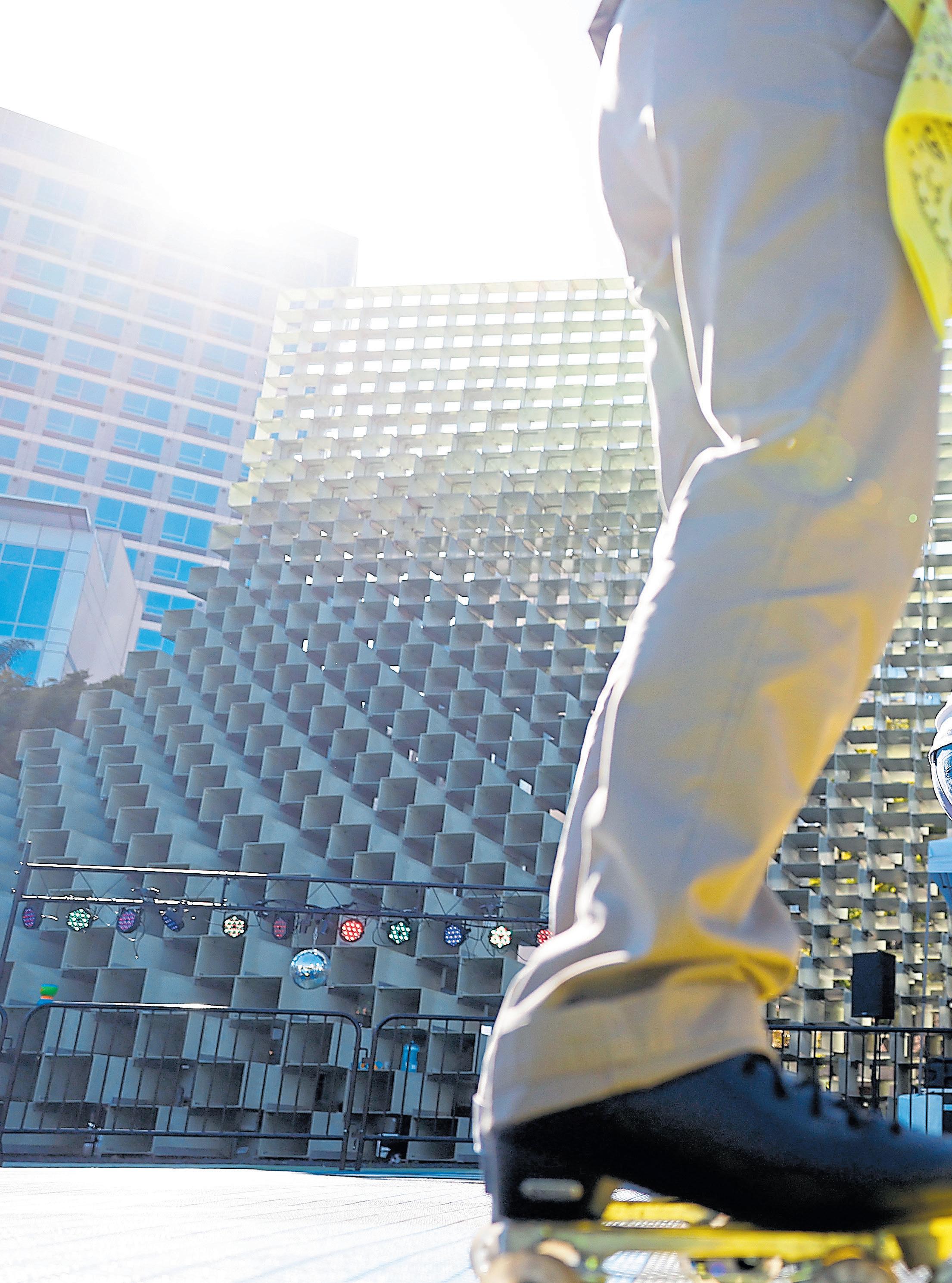
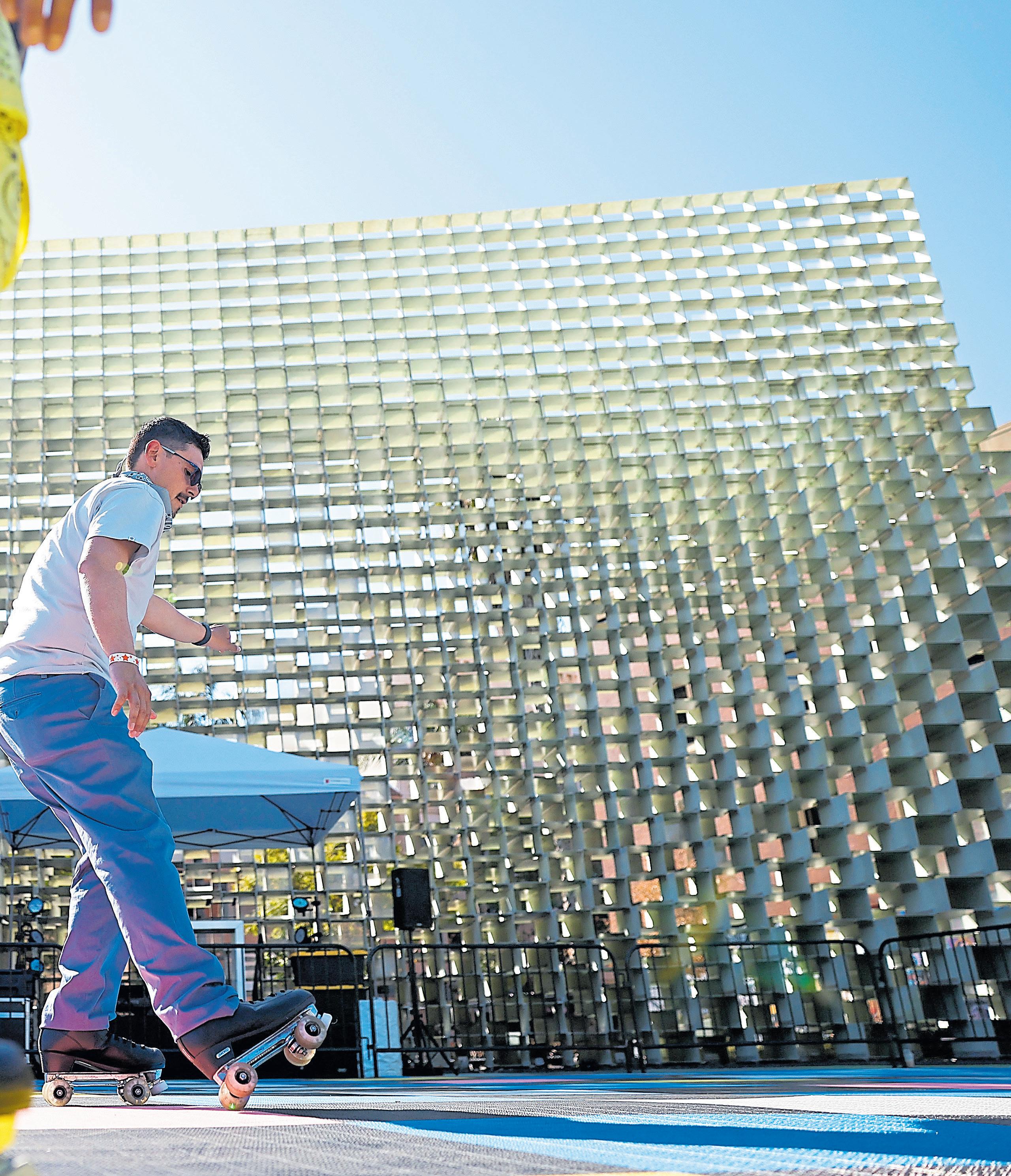
Brian Guzman skates in front of the “Unzipped Wall,” an art installation by Danish architect Bjarke Ingels, at Unzipped Gardens Roller Rink & Beer Garden in downtown San Jose. NHAT V. MEYER/STAFF
“ The more successful events are the neighborhood events. You create a sense of place, and that’s what brings people, as opposed to the headliner or a fireworks show.”
Local event producer Fil
Maresca
six FIFA World Cup games are played at Levi’s Stadium.
“Super Bowl and World Cup are pretty unique experiences,” Mahan said. “But let’s not underestimate the power of creating a reputation and a playbook for being a place that does sports events, conferences, conventions, live music and have that be a repeat driver of the experience economy.”
Local event producer Fil Maresca agrees that the key to the comeback has been creating a consistently enjoyable experience for people, especially those who live in and around downtown.
“The more successful events are the neighborhood events,” Maresca said. “You create a sense of place, and that’s what brings people, as opposed to the headliner or a fireworks show.”
Left: People gather on East Santa Clara Street for the Kehlani concert as part of the Big Game Block Party.
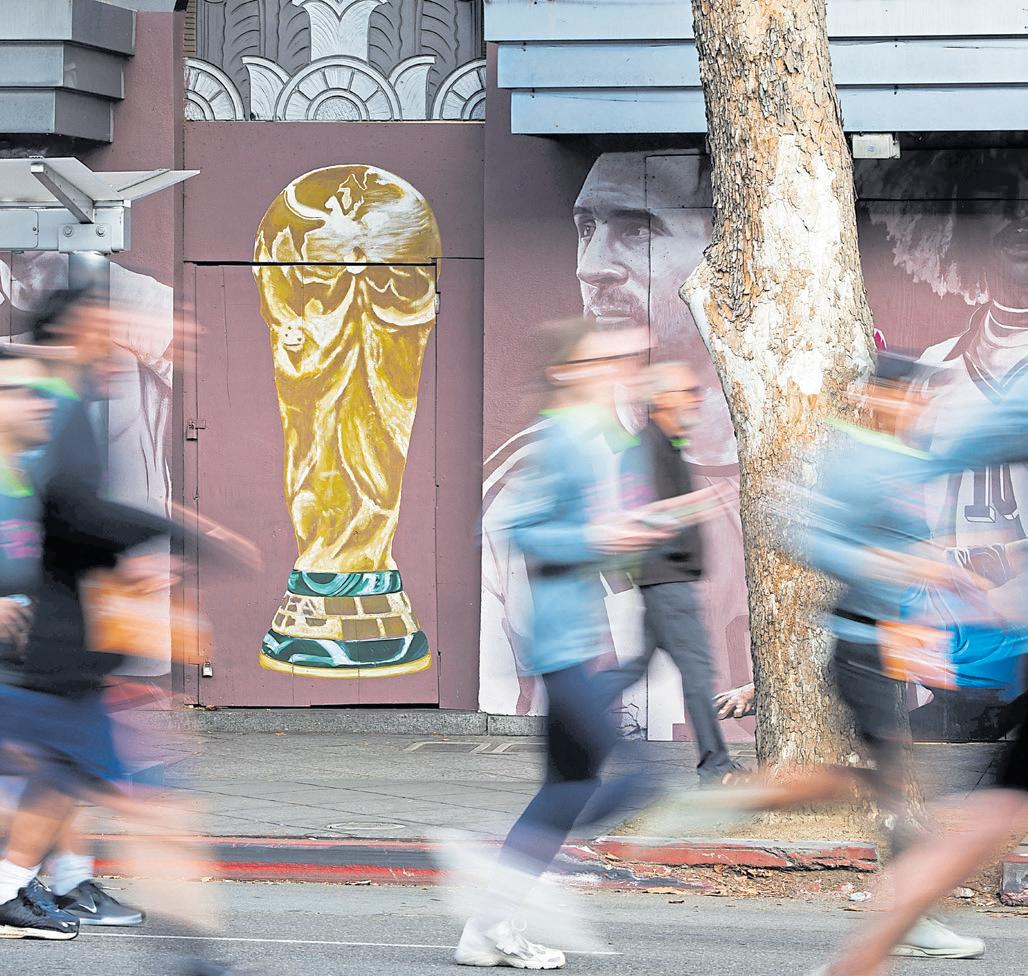
Right: Silicon Valley Turkey Trot runners pass a mural depicting the FIFA World Cup trophy in downtown San Jose. Six FIFA World Cup matches will be played at Levi’s Stadium this year.
SHAE HAMMOND, DAI SUGANO/STAFF
That sense of place can be found at South First Fridays, which has been inviting people to explore downtown’s art galleries and other creative spaces every month for more than two decades, as well as the weekly night markets in Japantown and Parque de los Pobladores and cultural events like the Little Italy Festival.
Maia Harris, vice president of strategic operations for San Francisco-based developer Jay Paul, said people who haven’t spent much time in downtown San Jose often have a perception of the area being beset by crime and homelessness. “But when you bring those people downtown, you change that perception,” she said at the Future of Downtown forum.
With visitors and residents noticing the resurgent nightlife, the San Jose Downtown Association and the city have started a “stitching districts” initiative to connect different downtown areas with lighting and wayfinding signage.
The goal is to create a seamless downtown where people can start in Little Italy or San Pedro Square and party their way to the SoFA district without missing a beat. And it’s starting to work.
“People say, ‘I can walk across the street on Thursday nights, and there’s a band playing in the park across the street from my house.’ That is a great thing,” Maresca said. “When you say to somebody, ‘I’m going to a night market,’ nobody says, ‘Who’s playing?’ They say, ‘Which one?’”
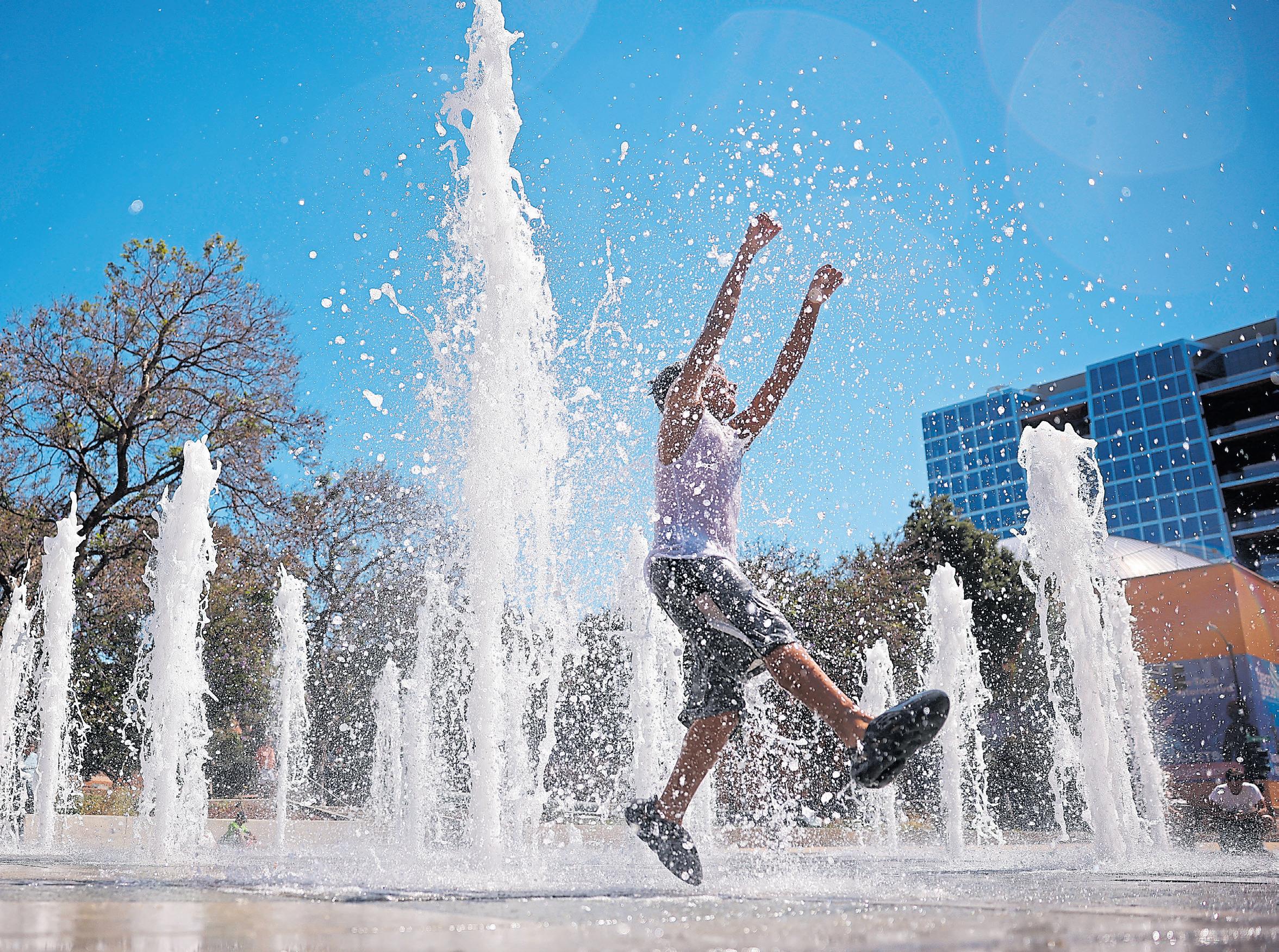
A young boy named Mario runs through the water fountains at Plaza de Cesar Chavez.
Left: People walk toward the State of the City Address at San Pedro Square Market.
NHAT V. MEYER, SHAE HAMMOND/STAFF
Top:
Home grown
How farmers markets became a fixture of Bay Area downtowns
BY JOHN METCALFE
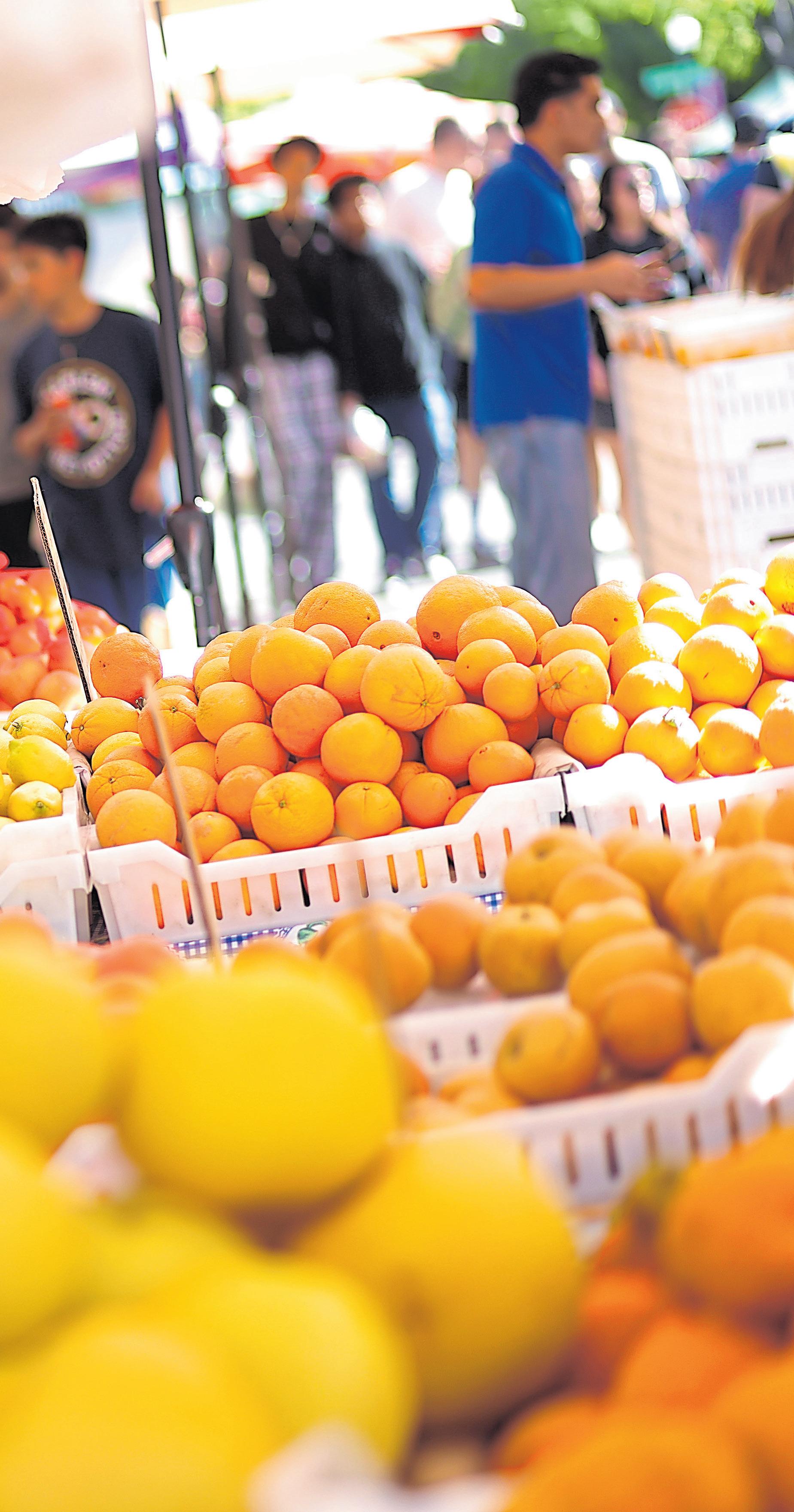
It’s Sunday morning at the farmers market in downtown Campbell, and John Shimek is selling citrus to a crowd of customers — tight, juicy oranges, plump grapefruit and O.J. in condensation-beaded bottles.
A woman shoves a wad of cash into his hands. “My husband comes here for the mezze dip from the hummus guy,” she tells him. “I come here for you. I’m addicted to you!” He drops a few extra oranges into her shopping bag.
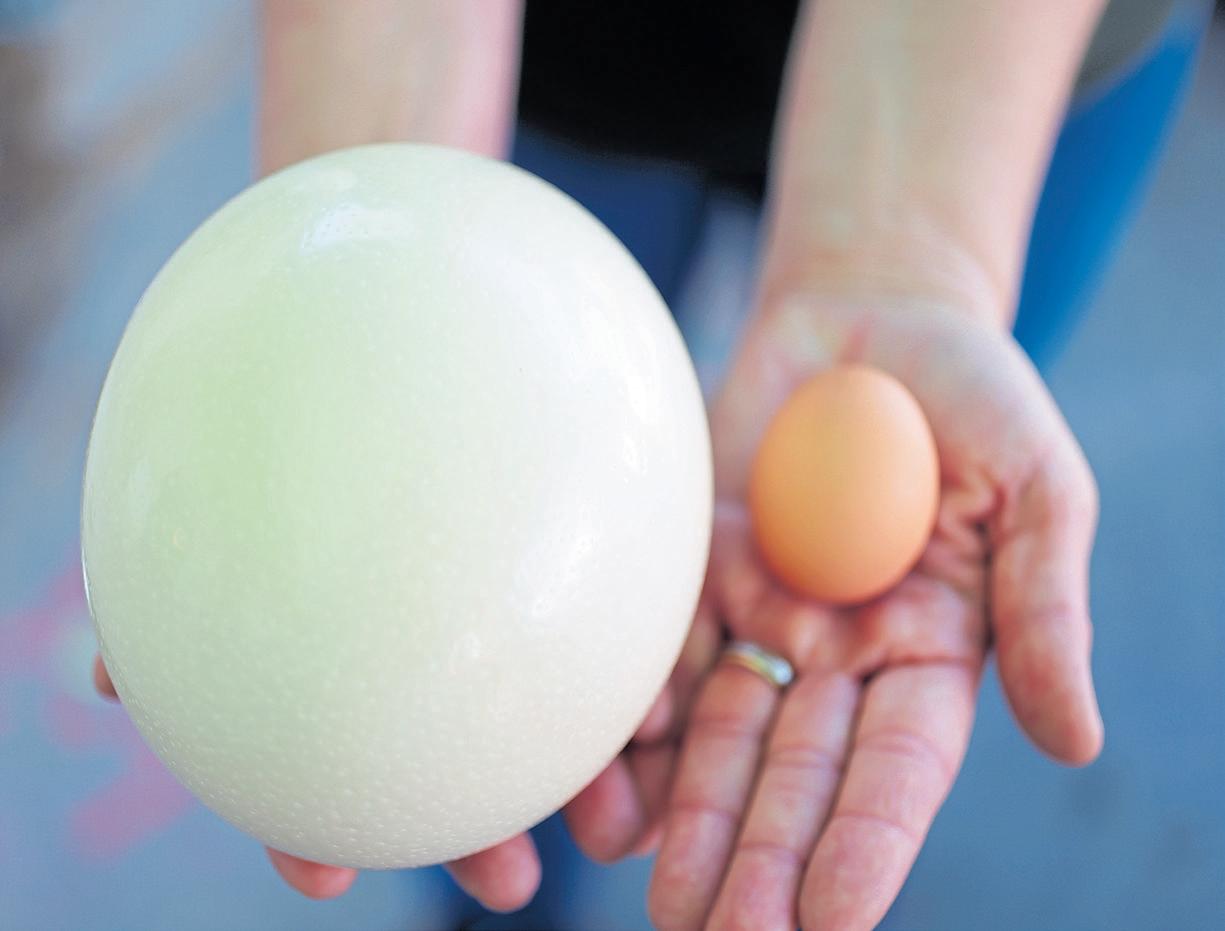
“Always a joy to see you,” he replies. Similar transactions are occurring over the market’s multiple blocks. Shoppers explore pyramids of pomelos, beets with dirt still clinging to them, raw milk and soft cheeses, a bakery with sausage rolls “made locally by legit Britishers.” A grower with “special ugly” Lion’s Mane mushrooms tells a buyer to “marinate and cook it like meat. It turns into a steak, it’s phenomenal.” People gather around a $75 ostrich egg the size of a volleyball, asking if it’s real. “Oh yes,” the seller replies, “and it’s going to feed up to 12 people.”
Is there any experience more quintessentially
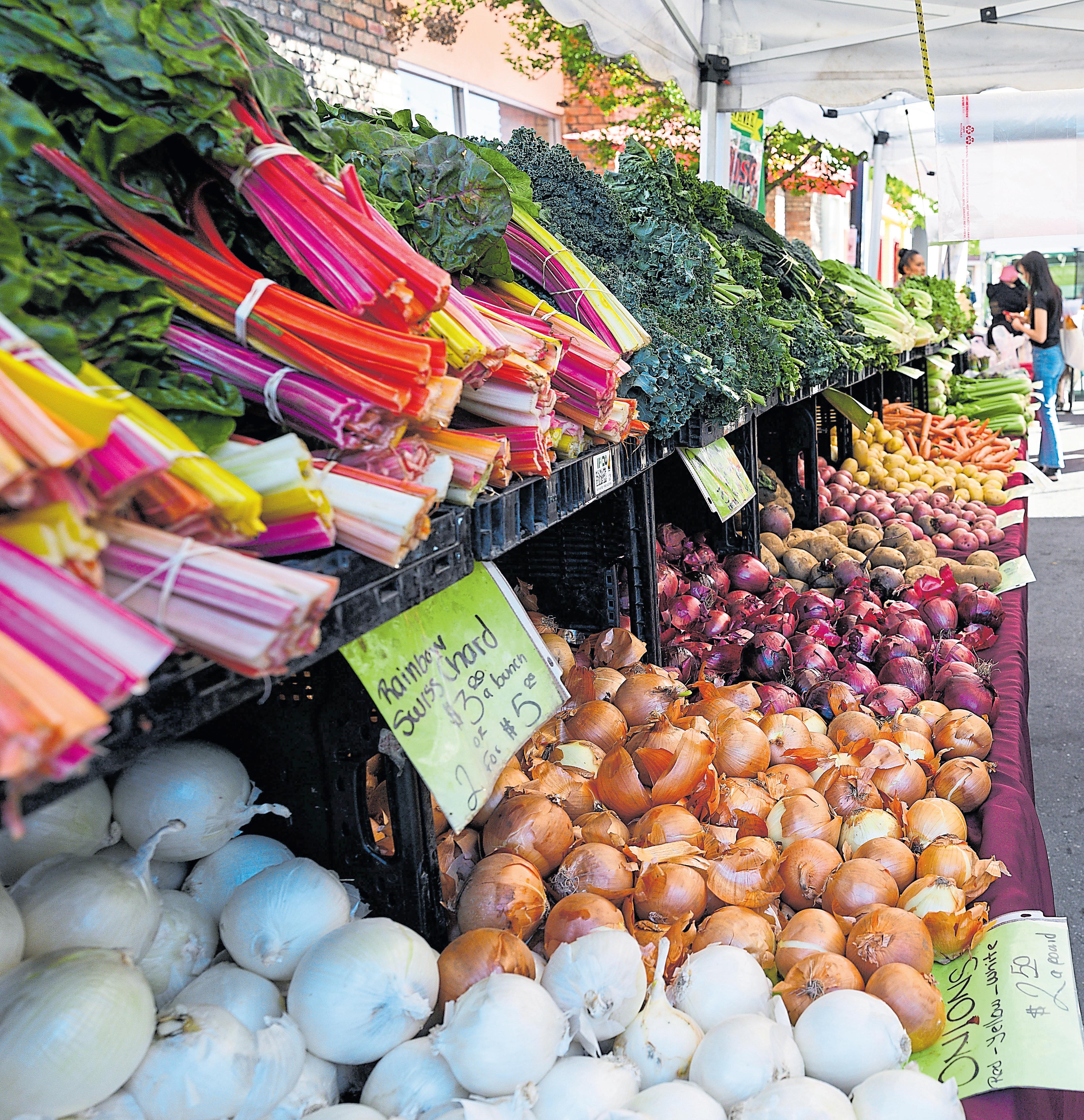
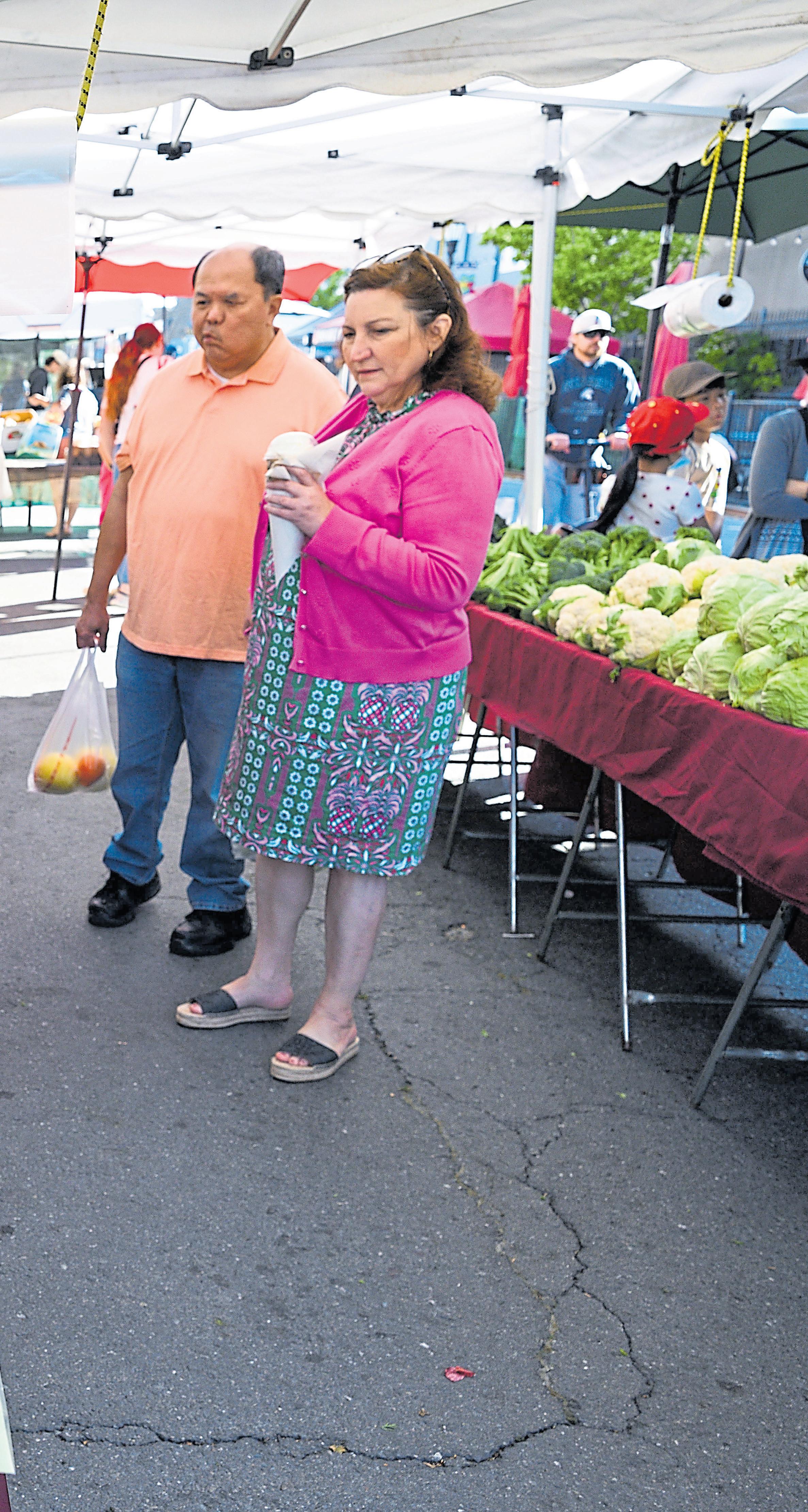
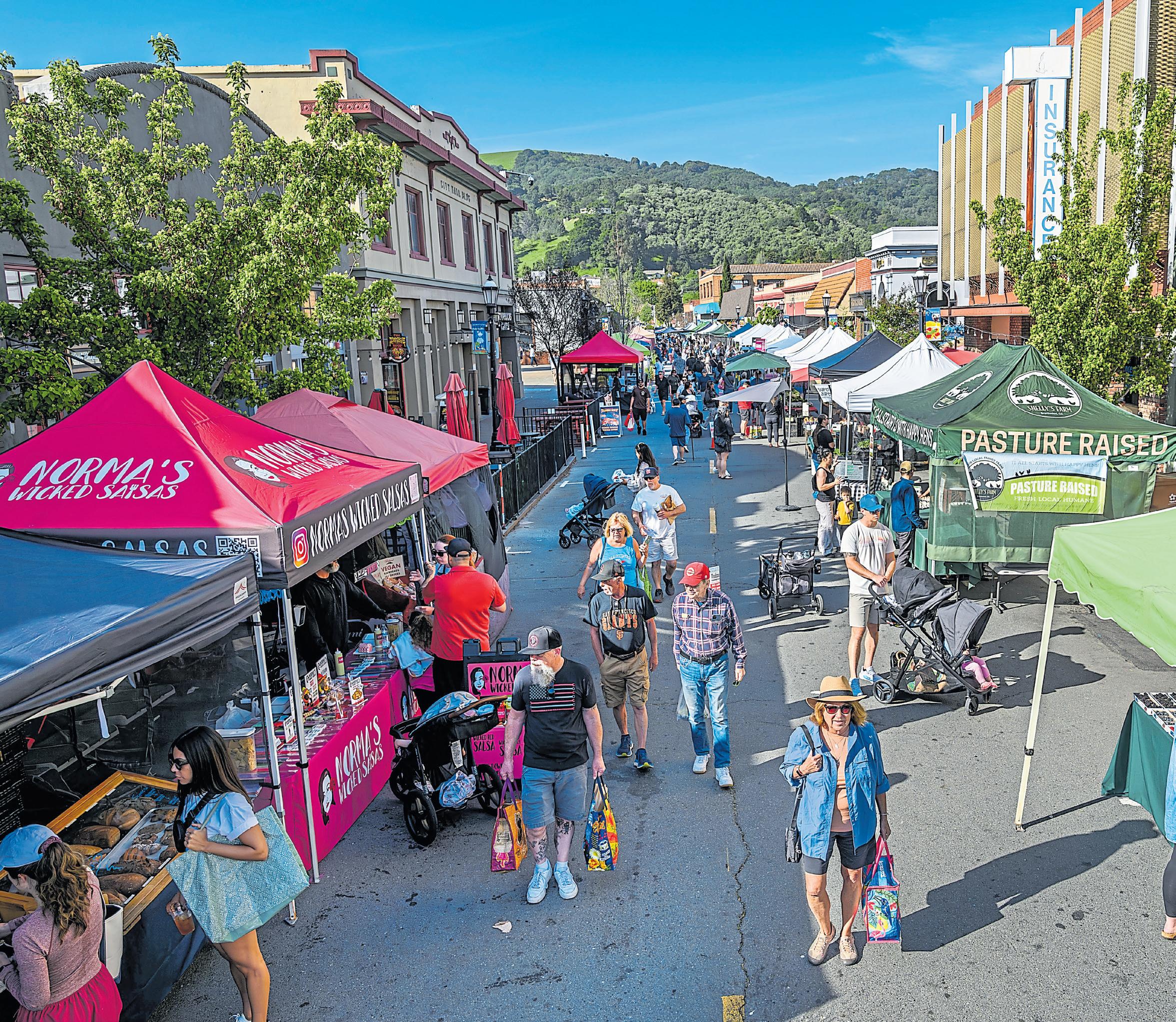
Visitors stop to look at vegetables at the Martinez Farmers Market on Main Street.
JOSE CARLOS FAJARDO/STAFF
Californian than the farmers market? Part larder-stocking, part therapy, it’s a routine beloved by millions who head out, recyclable bags in hand, to suss out what’s fresh through the changing seasons.
“People love to know where their food comes from. And if you’re talking directly to the farmer who grew it, who else better?” says Ron Pardini, founder and executive director of Urban Village Farmers’ Markets, which has operated markets in the Bay Area since the 1990s. “In addition, people love to bump into their neighbors — it’s the social aspects that are wonderful at farmers markets.”
Over the years, cities learned that these markets could also be a valuable tool for revitalizing downtown areas that otherwise might not see a lot of traffic. Martinez started one in 2011 for that very reason, and since then, it has become the city’s backbone, says Sarah Baird, executive director for Downtown Martinez & Co.
“The need came from wanting to promote downtown and get more business into our stores and also get people used to coming to Martinez and knowing it’s a great weekend spot,” she says. “We all love our weekend getaways here in the Bay, and we wanted to be one of those places, despite being a little less developed than some of the other coastal towns.”
Martinez’s market takes place Sundays and is managed by the Pacific Coast Farmers’ Market Association — one of a couple
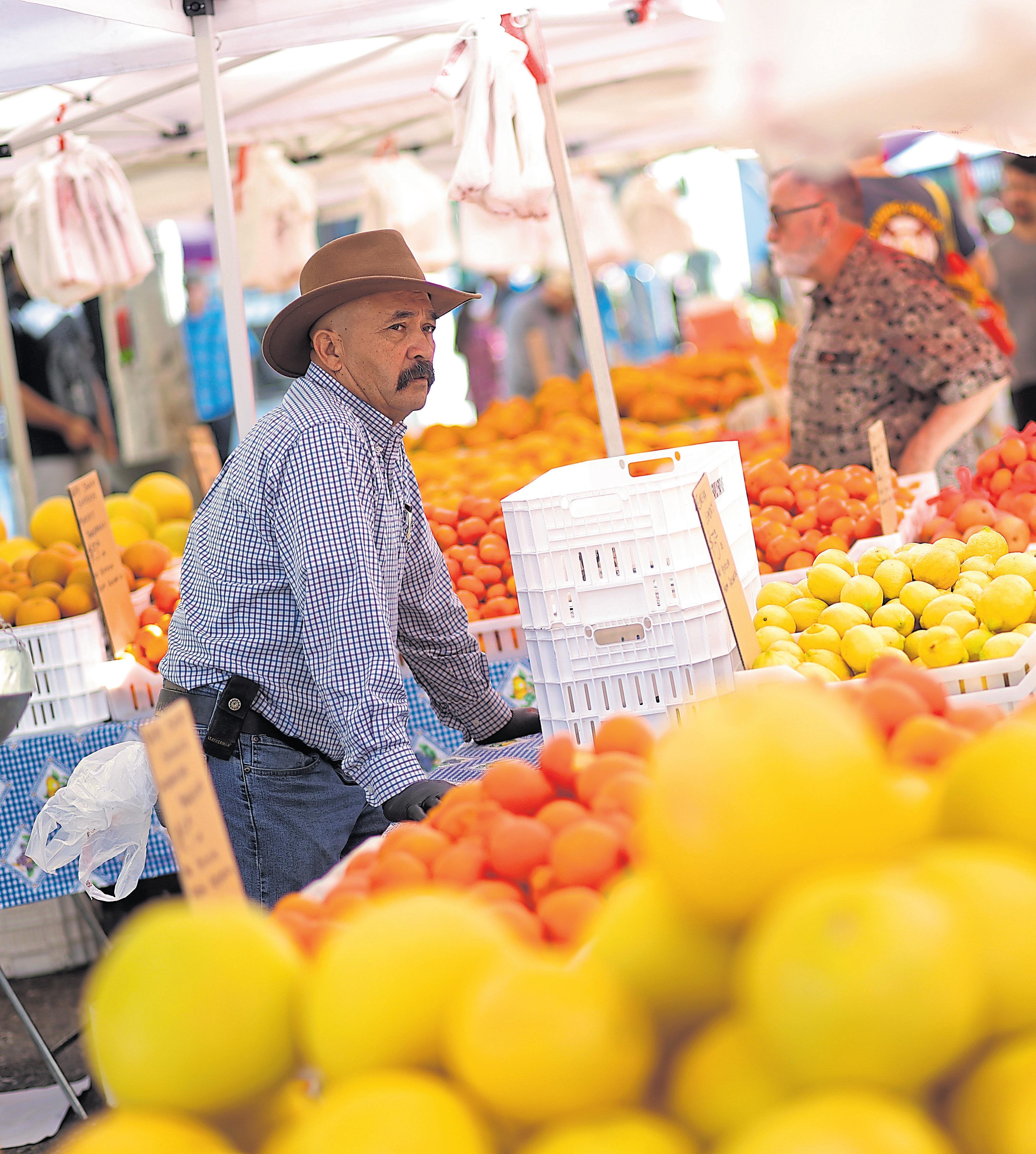
A fruit stand worker watches as customers shop during the weekly Campbell Farmers Market.
ARIC CRABB/STAFF
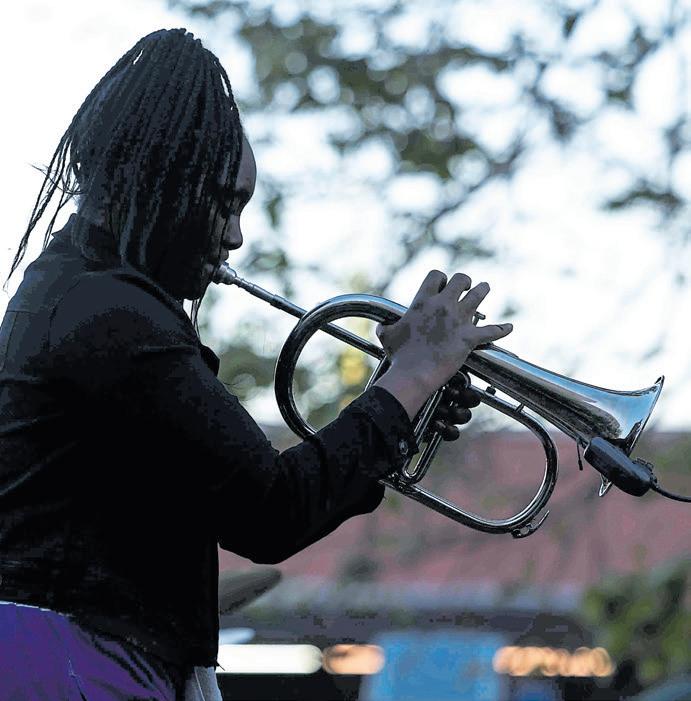
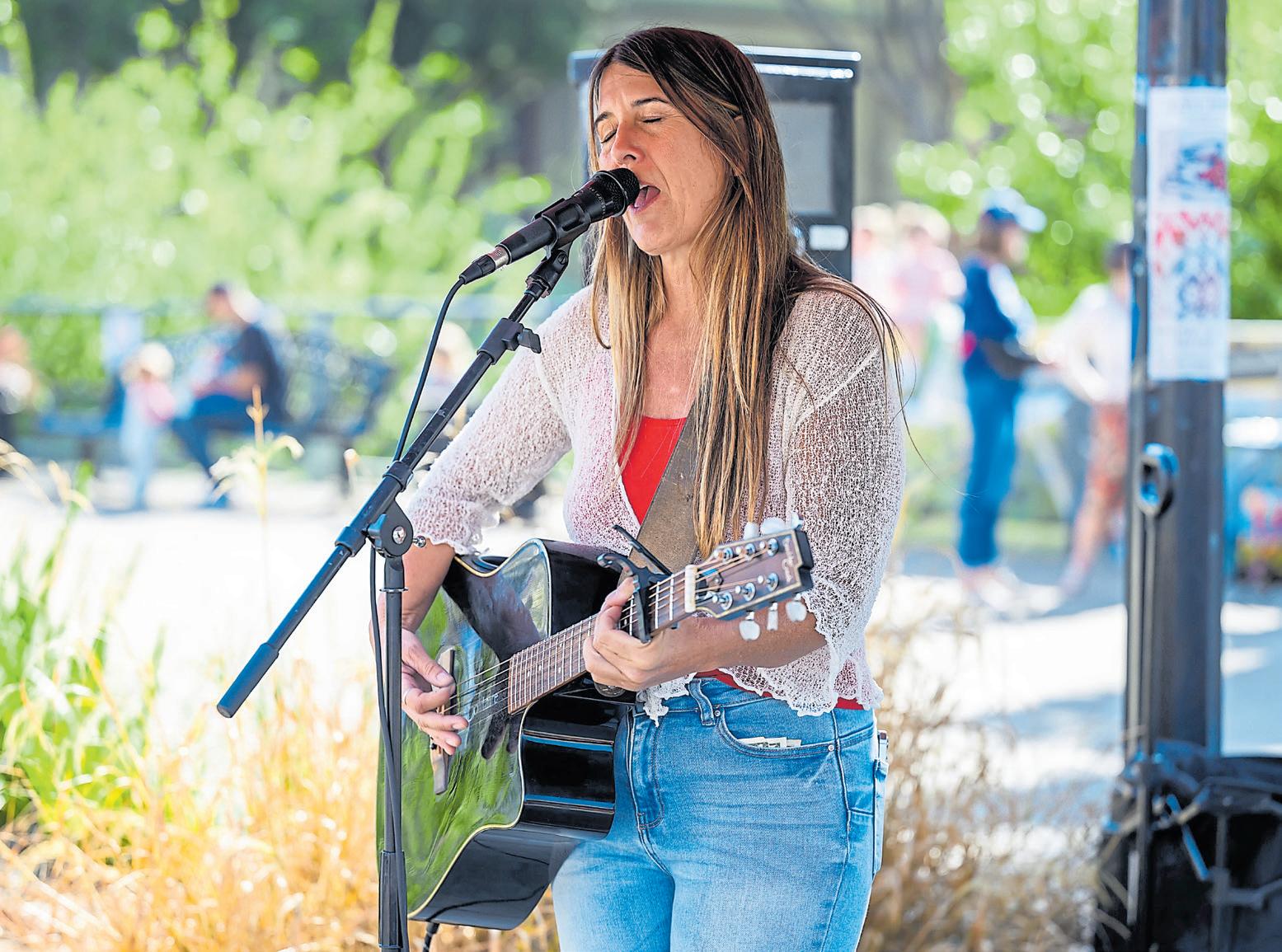
Musician Aprylle Dawn performs at the Martinez Farmers Market.
JOSE CARLOS FAJARDO/STAFF
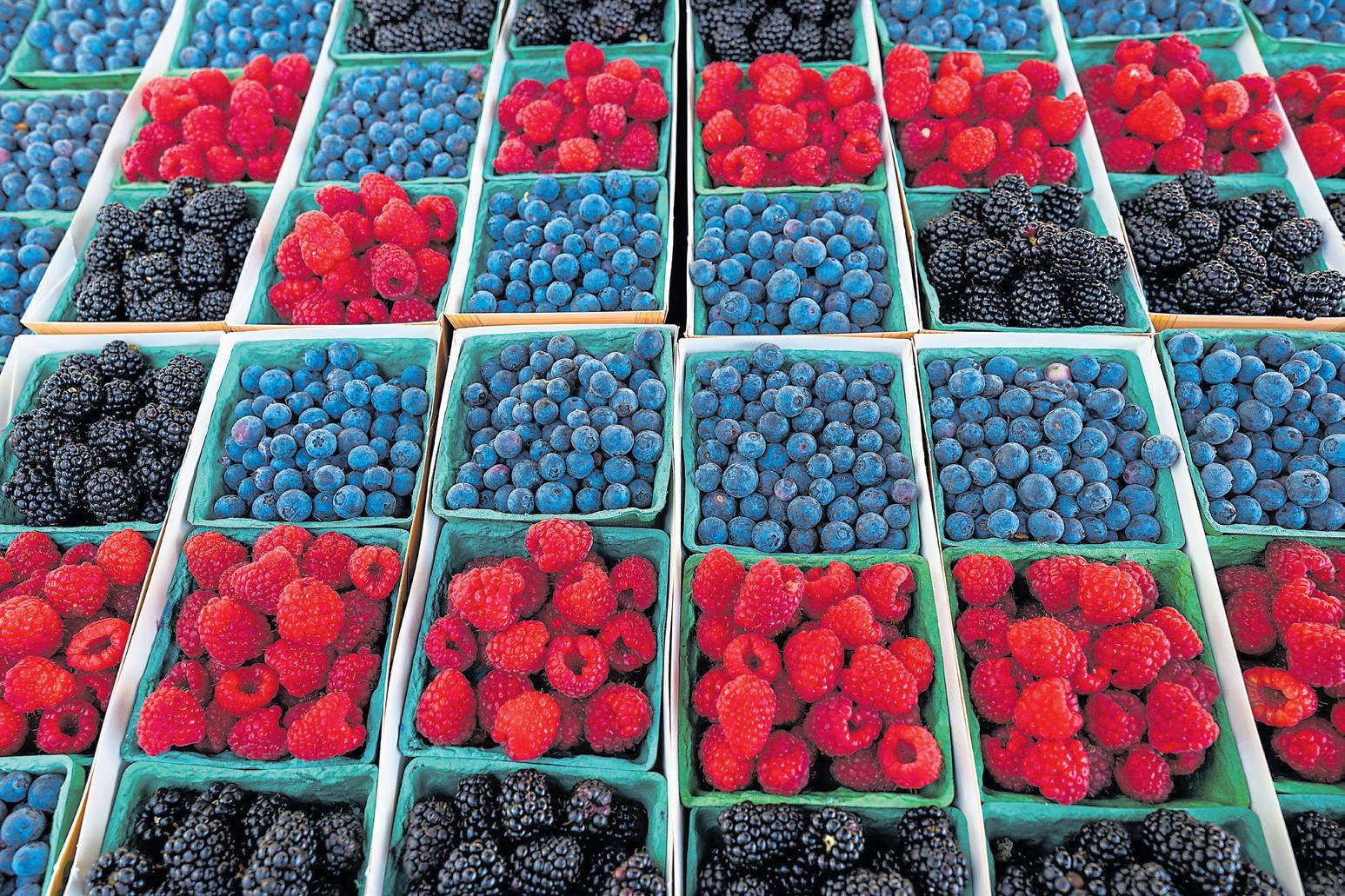
Colorful fruits in abundance are available at the Martinez Farmers Market on Main Street.
JOSE CARLOS FAJARDO/STAFF
umbrella organizations that run markets across the Bay. It spans several blocks of vendors and pop-up eateries selling living microgreens, artisan granola, filled-to-order doughnuts and gelatinous Irish sea moss (“92 essential minerals,” 16 ounces for $55).
This particular market lures in people from all across the region, numbering as many as 3,500 on summer days. There’s a multiplier effect to this foot traffic, too. A study from the Cornell Cooperative Extension in New York found that for every dollar a vendor earns at a farmers market, consumers spend an additional 58 cents at nearby brick-and-mortar shops.
“When it started, a lot of the (downtown) businesses weren’t even open on Sundays,” Baird says. “Now it’s one of their busiest and best days.”
The first farmers market in California was right here in the Bay Area — when canneries were backed up during World War II and growers in the North Bay had nowhere to send their fruit. In 1943, civic-minded citizens claimed a plot in San Francisco and invited farmers to sell their produce there.
But the proliferation of the modern farmers market came on the heels of the back-to-theEarth movement, which gave voice to a growing distrust of industrial farming that relied on herbicides and pesticides and viewed the smaller markets as a healthy alternative. Walnut Creek launched its first farmers market in 1983, Richmond in 1984, downtown San Jose in 1993. The success of local markets in the Bay Area became so talked-about that Los Angeles sent its own city officials up here to learn how to copy it.
Berkeley started several dif-
ferent farmers markets, which have been as political as most other aspects of the city. They banned produce treated with the pesticide methyl bromide in 1996 and genetically modified produce in 2002. Berkeley finally broke its “dead animal barrier” in 2012, allowing in a fish merchant who had salmon and local crab.
With roughly 8,700 of them in the United States — around 760
in California alone — the market for farmers markets may now be hitting its limit.
“We are not interested in operating any more (markets),” says Pardini of Urban Village Farmers’ Markets. “Basically, it’s getting a little bit saturated. We just make the ones that we currently run better.”
Enter into the picture companies like Foragers Market from the Tri-Valley, which is in
the business of relaunching or streamlining existing farmers markets. Run by Harvindar Singh and Justin Johal, the organization has rebooted markets in San Ramon, Fremont and Livermore, with the latter city giving them an official “certificate of appreciation.”
They also helped develop the farmers market and night markets in West Oakland which, in a pretty amazing
Visitors shop at the Martinez Farmers Market on Main Street.
JOSE CARLOS FAJARDO/STAFF
development, saw some of its nomadic vendors transition into brick-and-mortar homes in the neighborhood’s newest foodand-events hall, Prescott Market. It’s not uncommon for vendors to use markets as a launchpad for physical shops; for instance, a little business that started in Oakland called Blue Bottle Coffee sold to a private-equity firm this year for a reported $400 million.
The simpler market gatherings that existed 20 years ago — vehicles for selling “mostly vegetables and fruit,” according to Johal — simply won’t do for today’s audiences. People expect a more comprehensive, even exciting experience, with things like live music, poetry readings and even circus acts.
“We’ve always been at the forefront of expanding categories and things at the market. We were
one of the first to allow the sale of CBD items, one of the first to allow cottage-food operators, like people who were baking in their homes,” Pardini says.
There are no circus acts at the Campbell Farmers Market, founded in 1998, but it’s bustling every Sunday nonetheless. There are more than 100 vendors at this market, all of them makers of their own products — no reselling allowed. There’s the
Apricot King from Hollister, the Guacamole Queen from Concord. Ana’s Corn & Potatoes offers just that, corn cobs and baked potatoes. At one recent Campbell market, a butcher holding up a beef coulotte tells a customer it’s a “big boy, my favorite cut right now.” A jeweler receives a compliment on his delicate handiwork and responds, “I’m a bezel maniac.”
Brian Parks from Campbell came here to pick up some focaccia and flowers. “For me, I like the people-watching,” he says. “A lot of the food products down at the beginning are good — the baked potatoes, the pizza. Usually, my wife is here with me, but she’s sick at home, so I had to get some cookies for her.”
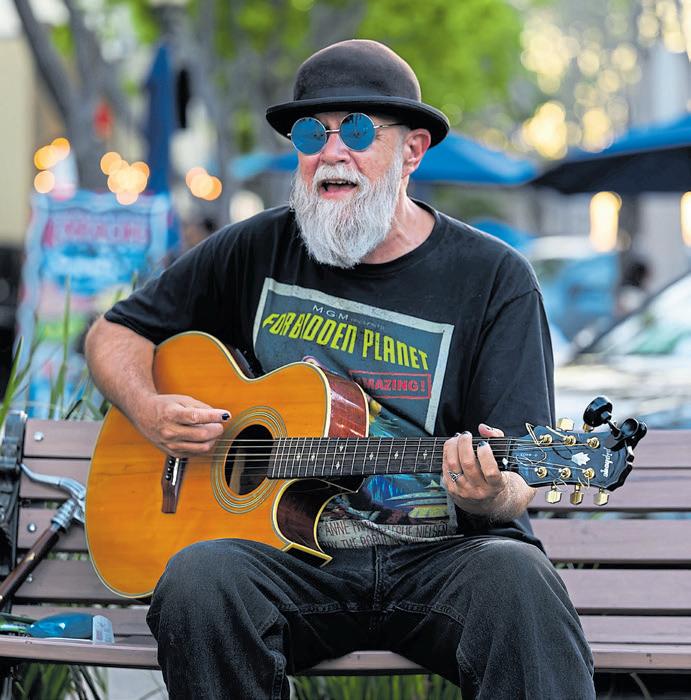
Maintaining grace among the throng, like a butterfly in a swarm of honeybees, is Khalilah Ramirez, aka “Khalilah Peace Dancer.” She’s one of the artists who likes to spread their creativity at the market — there’s also a crazy-haired guy walking and strumming an acoustic guitar and a Santa cosplayer twisting balloon animals. With her shiny uniform and interpretive gesturing, the Campbell native has gathered a small crowd.
“I’m doing a Dance of Peace,” says Ramirez, “Because that vibration of peace — with all of us locked in, all of us practicing — can really help us get a lot more ease while we go through all the chaos in this world.”
She could try to do it on a stage somewhere, in front of a formal audience, but she likes this better.
“This crowd is open,” she says. “They’re open enough to clap a hand, break into a dance, you know? They’re open enough to really enjoy it and know how special they are for participating. Yeah, I love it here.”
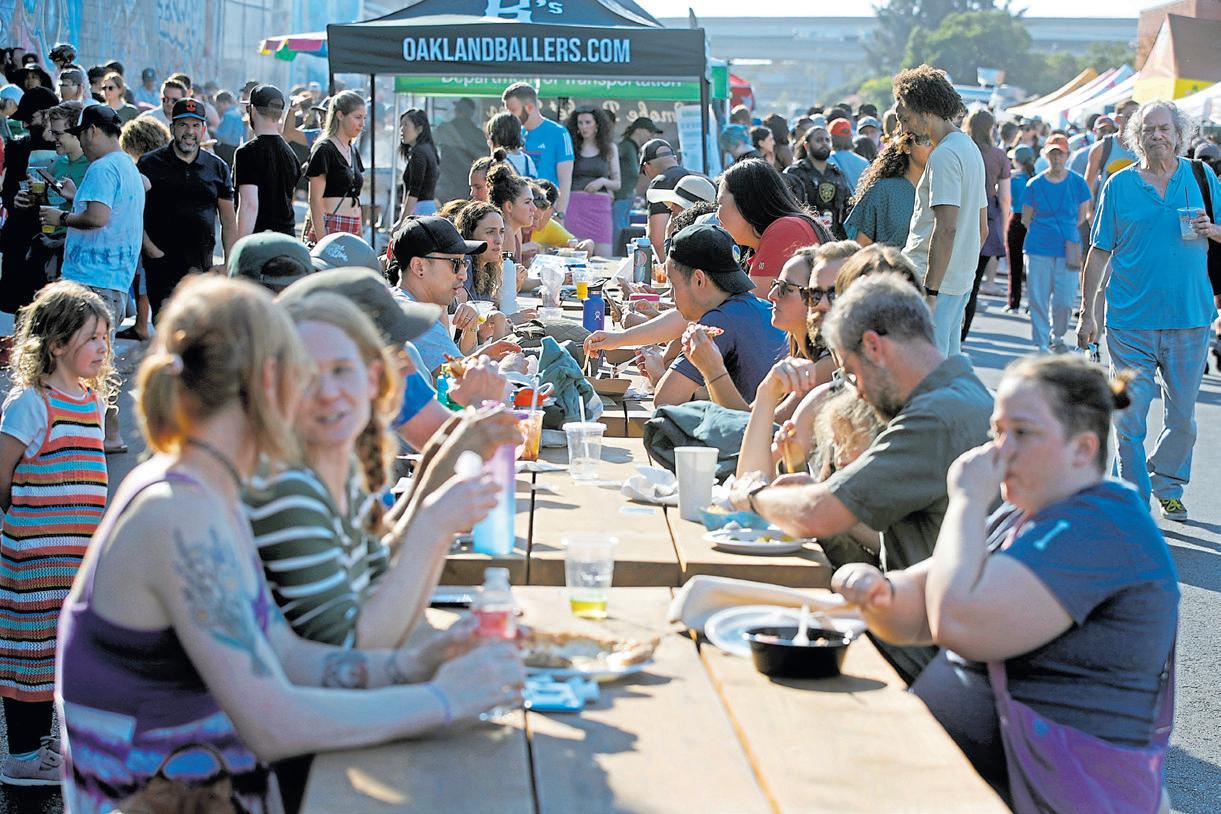
Top left: People check out food trucks and tents along 18th Street near Raimondi Park during the Prescott Night Market in Oakland.
JANE TYSKA/ STAFF ARCHIVES
Bottom left: California Ostrich Valley Ranch owner Nataliya Toderica holds a large ostrich egg next to a chicken egg during the weekly Campbell Farmers Market.
ARIC CRABB/STAFF
STORY BY CAELYN PENDER
ILLUSTRATION BY JENNY KROIK
CAT WALK
A tour of downtown Los Gatos, where a vintage feel gets some unexpected twists
To step back in time to a vintage American downtown, one need not go far from the whir of high-tech Silicon Valley.
Nestled into the Santa Cruz Mountains just 20 minutes from downtown San Jose, Los Gatos offers colorful shopfronts, historic buildings and antique charm.
“It’s quaint,” said Ferrah Mckeown, a 49-year-old Los Gatos resident walking her dog downtown while waiting for her son’s football game to start at the high school. She compared the town to Stars Hollow from “Gilmore Girls” or Mayberry from “The Andy Griffith Show.” “You always tend to run into somebody that you know.”
On Sunday mornings, the streets are bustling. Shoppers carry flowers wrapped in newspaper or
fresh vegetables from the farmers market. Cyclists lean their bikes against the trees lining the street as they pop into cafes. Runners veer off of Main Street to pick up the Los Gatos Creek Trail.
As night falls, a new wave of downtowners takes over: couples and families, groups of friends meeting for dinner at the town’s numerous restaurants, drivers showing off their classic cars.
But its location on the edge of Silicon Valley guarantees that it’s not some throwback American small town, either. Phil and Melanie Branon, both 72, have lived in Los Gatos since 1984, and they laud the town’s diversity and vibrancy.
“You can walk down the street any given day and hear a number of languages, which always just really surprises me,” Melanie Branon said. “I grew up near New York City, and I’m used to that in a big city, but we get that here, and I think that’s really impressive.”
Unlike some cities in the Bay Area, Los Gatos’ downtown has “maintained a great sense of community,” said Phil Branon.
Los Gatos, which has retained much of its old-town charm, was incorporated in 1887, but the roots of its downtown area were sown even earlier: John W. Lyndon purchased 100 acres in 1868 and began to develop the area with the construction of a bank, a gas company and a cannery. Many of the original buildings built on Main Street burned down in a fire in 1901, and others were damaged in the 1906 earthquake.
Still, many of the buildings on Main Street and Santa Cruz Avenue have a long history; an aerial photo taken in the 1960s and showcased in the New Museum Los Gatos shows many familiar facades, though a spot that now features upscale shopping was instead occupied by a lumber yard.
“As far as I can remember, it’s always been the same little downtown,” said Maria Gonzalez, 52, who has lived in Los Gatos for most of her life. “It’s gotten a lot more crowded, but it’s still the same nice place.”
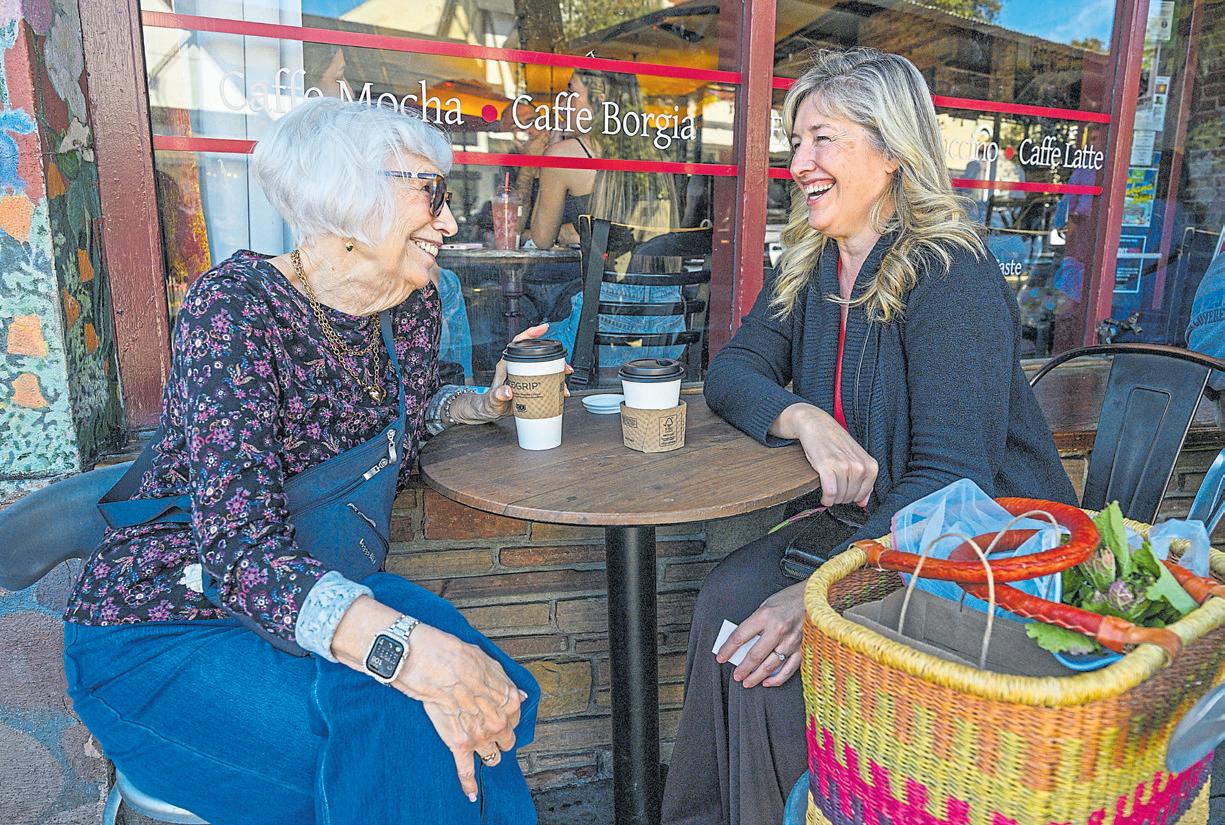
Betty Young, 84, and her daughter Marge Poytress, 55, visited Los Gatos on a sunny March weekend from their homes in Redding, drinking lattes outside Los Gatos Coffee Roasting Company, where Poytress bought a bag of Terry’s Blend coffee beans to bring back to her husband, who grew up in the town.
“I just love this place,” said Young.
Young grew up in Santa Clara in the 1940s and ‘50s and can recall when the valley was filled primarily with fruit orchards. Los Gatos looks the same, she said, but unlike today, it used to be surrounded with orchards.
“This was Old Town, just like this,” she said of the surrounding streets. But beyond that? “Orchards everywhere.”
To start the Los Gatos
adventure like a local, begin with a hike, walk or ride on the Los Gatos Creek Trail, with the trailhead located in the heart of downtown. On weekends, the trail is bustling. For David Wooden, a 45-year-old resident of Los Gatos, it’s a Monday ritual — he’s there walking four-and-ahalf miles, followed by a Tuscan sandwich at Mr. Pickle’s Sandwich Shop.
As she prepared to embark on
a weekday walk, Gonzalez said that the trail is a unique part of the town’s landscape.
“It’s right off of downtown, and then you can have lunch afterwards, so it’s really nice,” Gonzales added. “It’s a beautiful view when you get to the top, and then, if you go through the middle of the mountains, they have these big rocks. It’s just beautiful.”
The town’s culinary options,
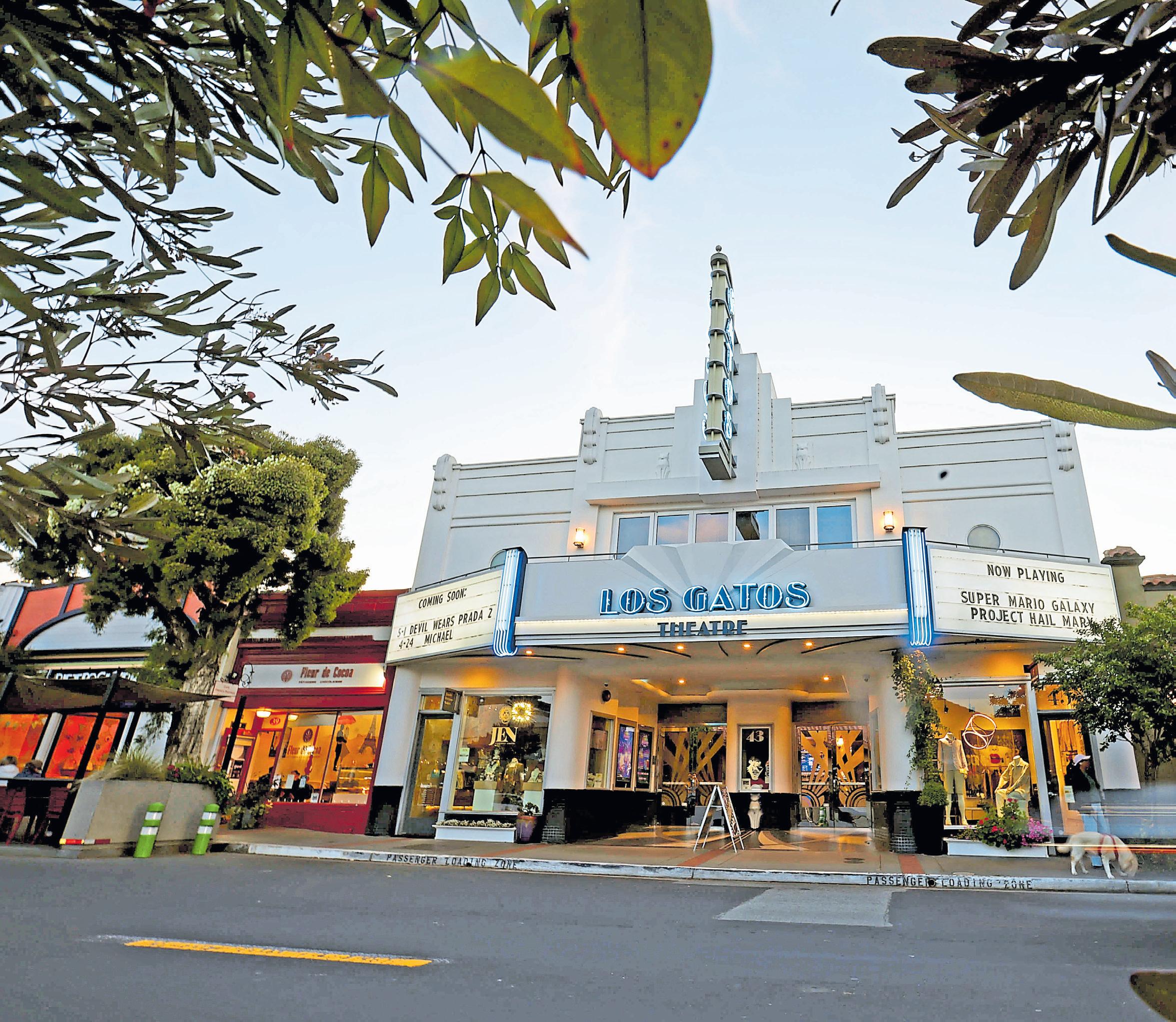
Cars speed past the CineLux Los Gatos Theatre in Los Gatos. The 110-year-old theatre opened in 1915 as the Strand.
SHAE HAMMOND/ STAFF
spreading across downtown, offer the visitor variety, whether it’s grabbing a quick lunch after a hike or looking for a sit-down date night.
“The mom-and-pops here in Los Gatos really go out of their way,” said Glenda Crespo, 53, who was staying in Los Gatos with a friend. “They take the time to talk to you, and you know them, and they know you.”
Though small, the town
boasts restaurants serving a wide range of cuisines. The options are “expansive,” said Phil Branon.
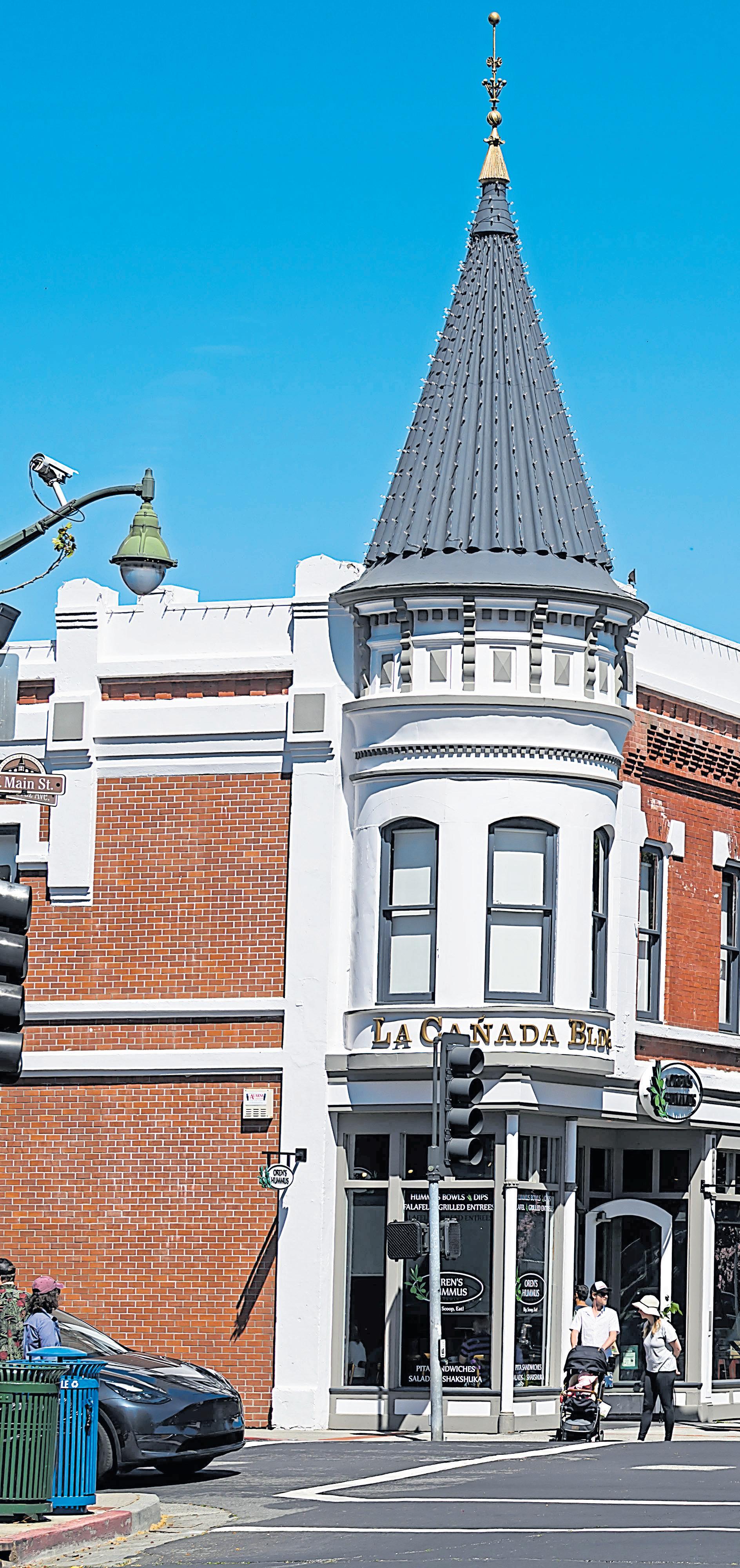
“You find all kinds of cuisine around here. There is Oren’s Hummus, there is Thai food, there is Indian food, … Mexican food,” said Rose Sokhanvari, a 63-year-old resident of Los Gatos. “Name it, you’ll find it.”
University Avenue takes the adventurer to Old Town, home
to a Spanish-style shopping center with high-end destinations for homeware and clothing: Anthropologie, Sephora, Warby Parker. Main Street, home to attractions such as Los Gatos Coffee Roasting Company, Zona Rosa, Parkside Los Gatos and more is a “restaurant haven,” Melanie Branon said.
“We have our favorites, and it feels very neighborhood-y,” she said. “You’ll know some of the waiters or waitresses or bartenders, and that’s kind of special.”
The Los Gatos Coffee Roasting Company is usually packed,despite recent damage from a car crashing into its front. On a Sunday morning, the line stretches all the way to the door, as waiting patrons eye a display case filled with baked goods, shiny with glaze. In the evenings, live music plays.
“It’s always a nice go-to, and you can get your cup of coffee and run into somebody you know,” Mckeown said.
The shoe store Athletic Performance has been a staple of Main Street for 36 years — hikers and runners are known to lace up their new shoes and go directly to the trail. Tyler Harmatz, 33, whose dad co-founded the store before he was born, is now a co-owner of the store and said an active lifestyle is a core part of Los Gatos’ culture.
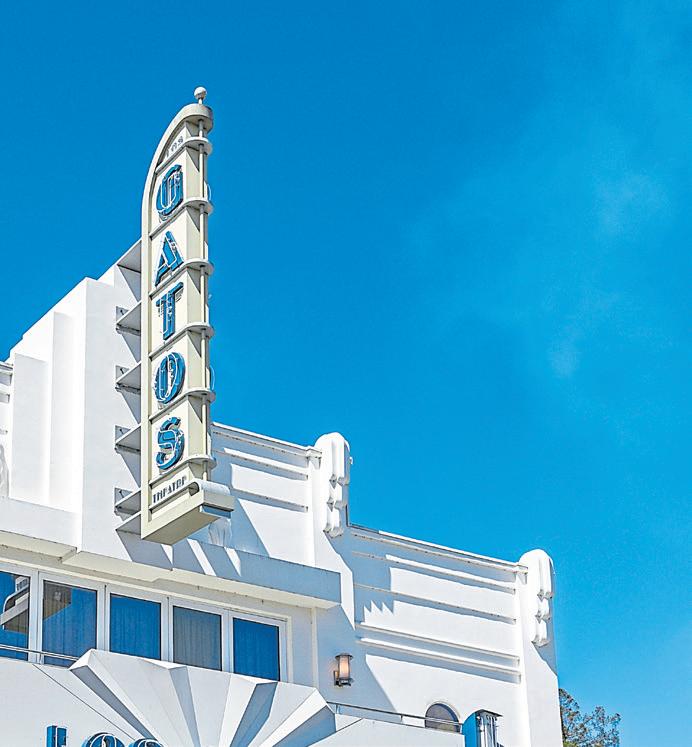
Santa Cruz Avenue is perhaps the center of it all, with clothing shops, restaurant patios and an art deco-style movie theater. Featuring walls lined with portraits of movie stars from the golden age of Hollywood, the theater boasts two screens and a balcony overlooking downtown.
A Barnes and Noble recently opened on the street, bringing a bookstore back to the town, in a
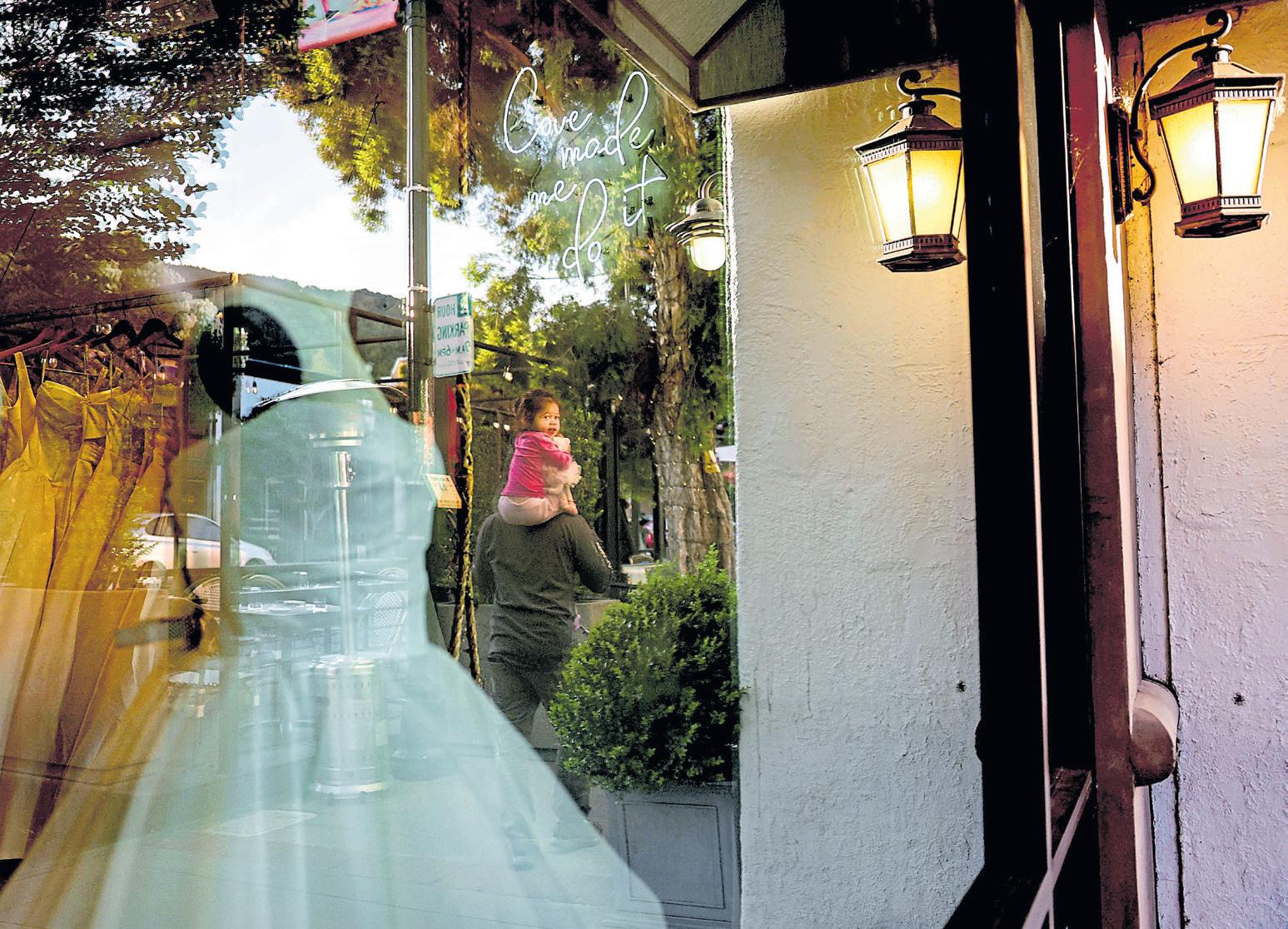
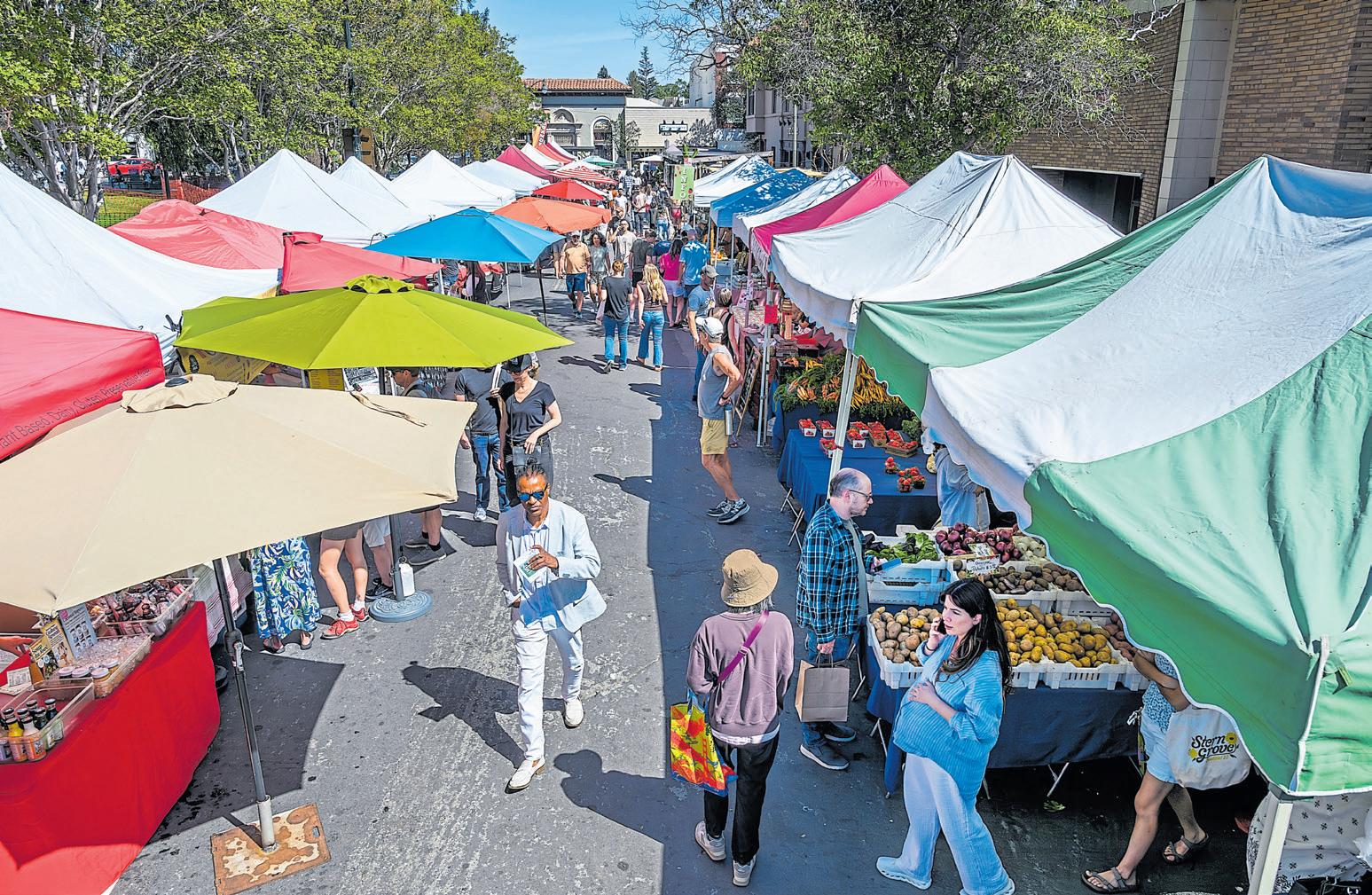
People walk past Bride and Bustle in downtown Los Gatos, above, while shoppers make their way through the farmers market, below.
SHAE HAMMOND, JOSE CARLOS FAJARDO/STAFF
“rebirth,” Melanie Branon said. Even at 7 p.m., people fill the store, browsing for their next read.
Britt Tapella, a resident of San Jose in her 40s, works at Bunches, a small flower shop filled to the brim with cut flowers. The shop, which has been there for 34 years, gets many regular customers, plus the weekend tourists visiting and orders from out of state.
Working in a small town comes with its charm compared to the bustling big city next door, Tapella said.
“You have everything at your fingertips — eateries, coffee shops, shops,” Tapella said. “You literally have all of it in just a very close walking distance.”
Andalé, a Mexican restaurant, has two locations across the street from each other on the main drag. Mercedes Ampie, a resident of Los Gatos, has worked for the restaurant’s various locations for 13 years and said people in town are very kind and that the summers are bustling with customers. The best dishes at Andalé are the salmon, the carnitas and the al pastor, she said.
“We try to make the food
fresh,” she said.
The town is known for its dog-friendly ethos, with pooches allowed to join their owners in many stores and on restaurant patios — though it’s all a bit at odds with the town’s name, which translates to “the cats.”
Sokhanvari stopped for lunch on Andalé’s patio with her dog on a Monday afternoon. She goes to the restaurant regularly and enjoys their salads, especially the grilled salmon salad, and their burritos.
“We can just walk down here, and there is a little bit of everything you could possibly want — there are restaurants and bars and coffee shops, a movie theater, galleries, great beer places,” she said. “It’s just very friendly.”
While Los Gatos’ downtown is tucked only a few miles from the bustling tech hub of San Jose, it feels “far removed,” said Mckeown — “a nice escape from reality.”
“You have this beautiful backdrop as well,” Mckeown said. “I remember someone saying to me once that it reminded them of Tuscany.”
“You don’t need to leave Los Gatos,” she added. “What more could you ask for, really?”
Above: Betty Young and her daughter Marge Poytress, both of Redding, have coffee at the Los Gatos Coffee Roasting Company.
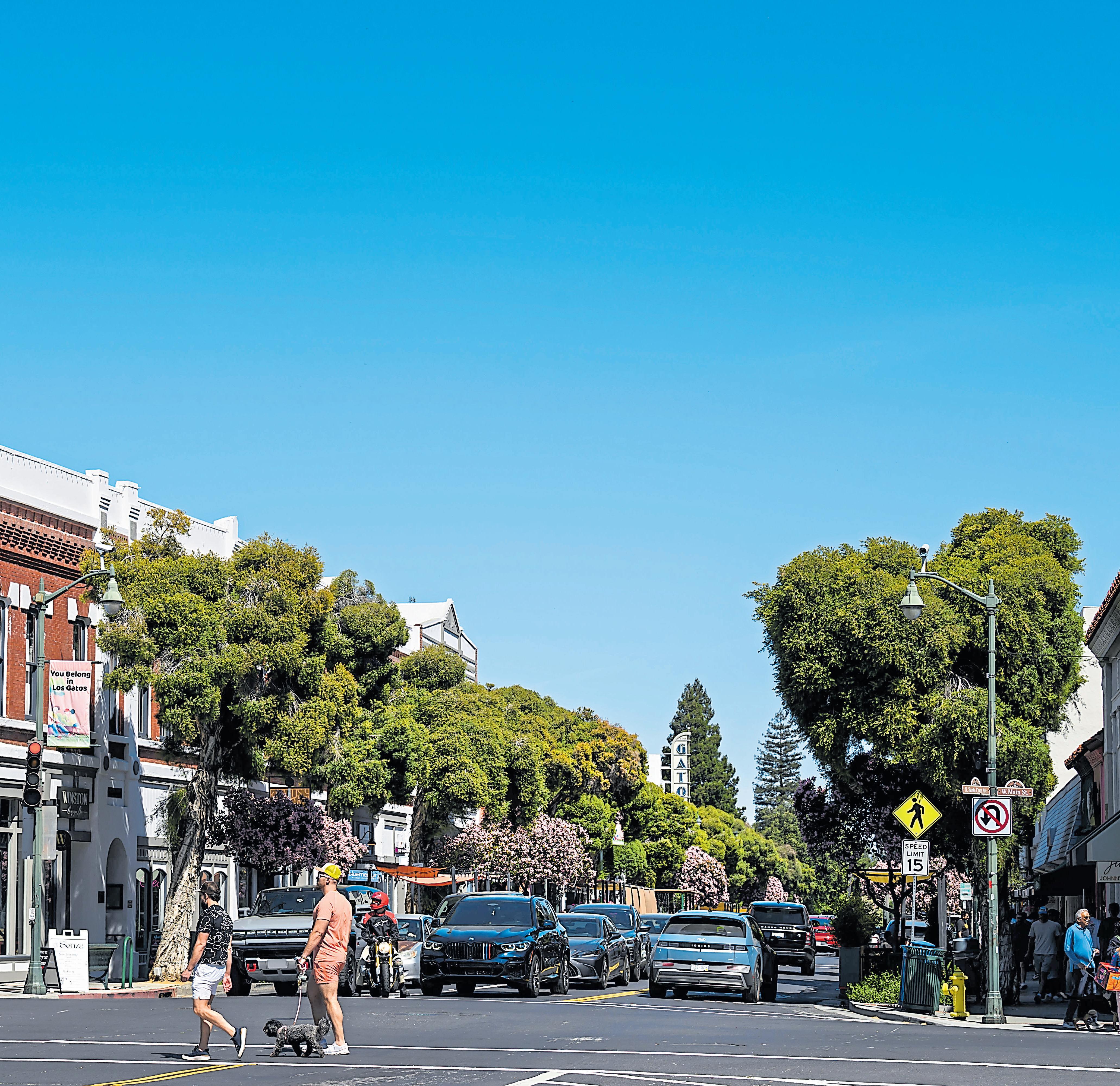
Right: Pedestrians walk along West Main Street in Los Gatos.
JOSE CARLOS FAJARDO/STAFF
“ The mom-and-pops here in Los Gatos really go out of their way. They take the time to talk to you, and you know them, and they know you.”
Glenda Crespo, 53, a visitor to Los Gatos
Despite what you’ve heard, downtowns aren’t dying — they’re evolving
BY LUIS MELECIO-ZAMBRANO
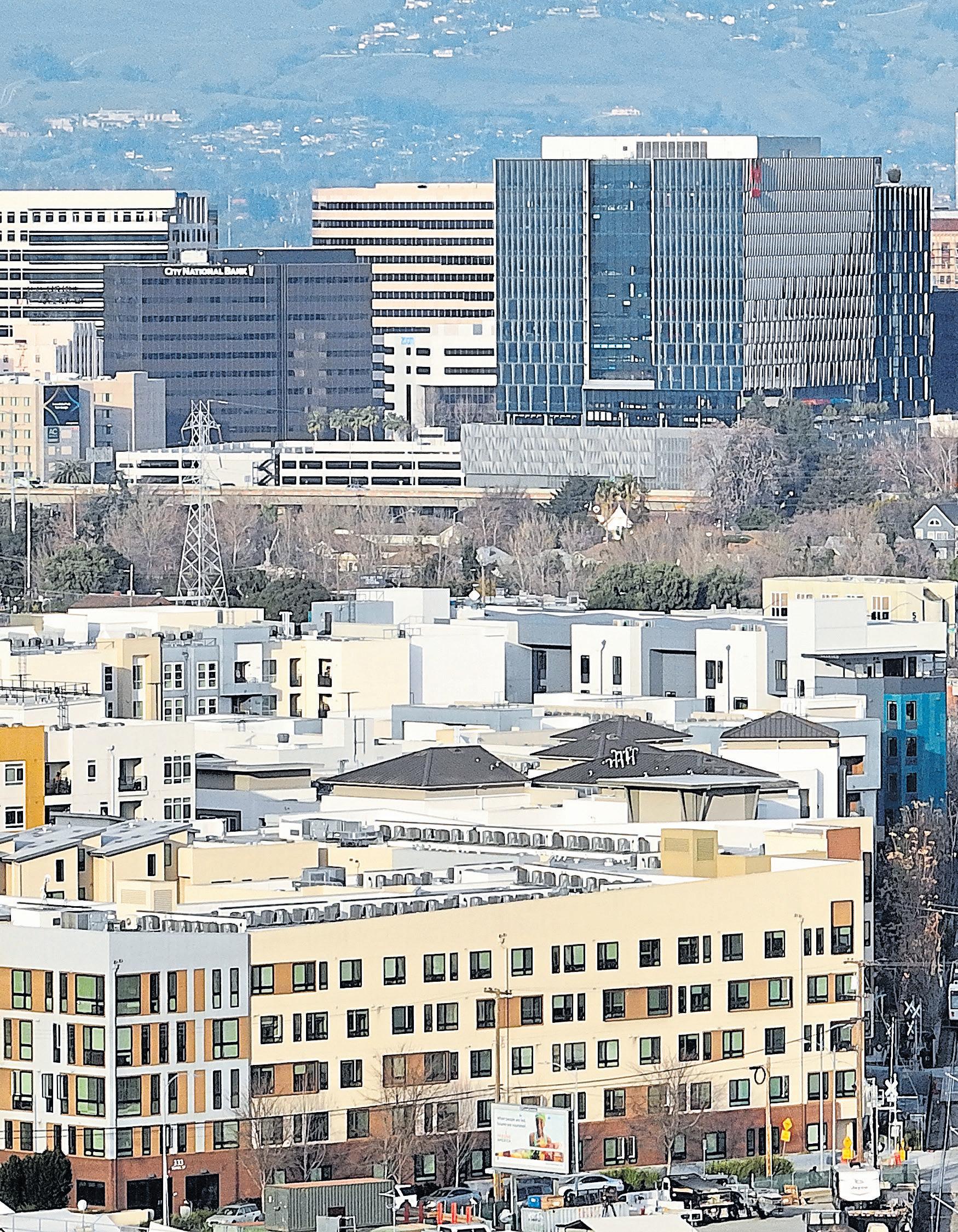
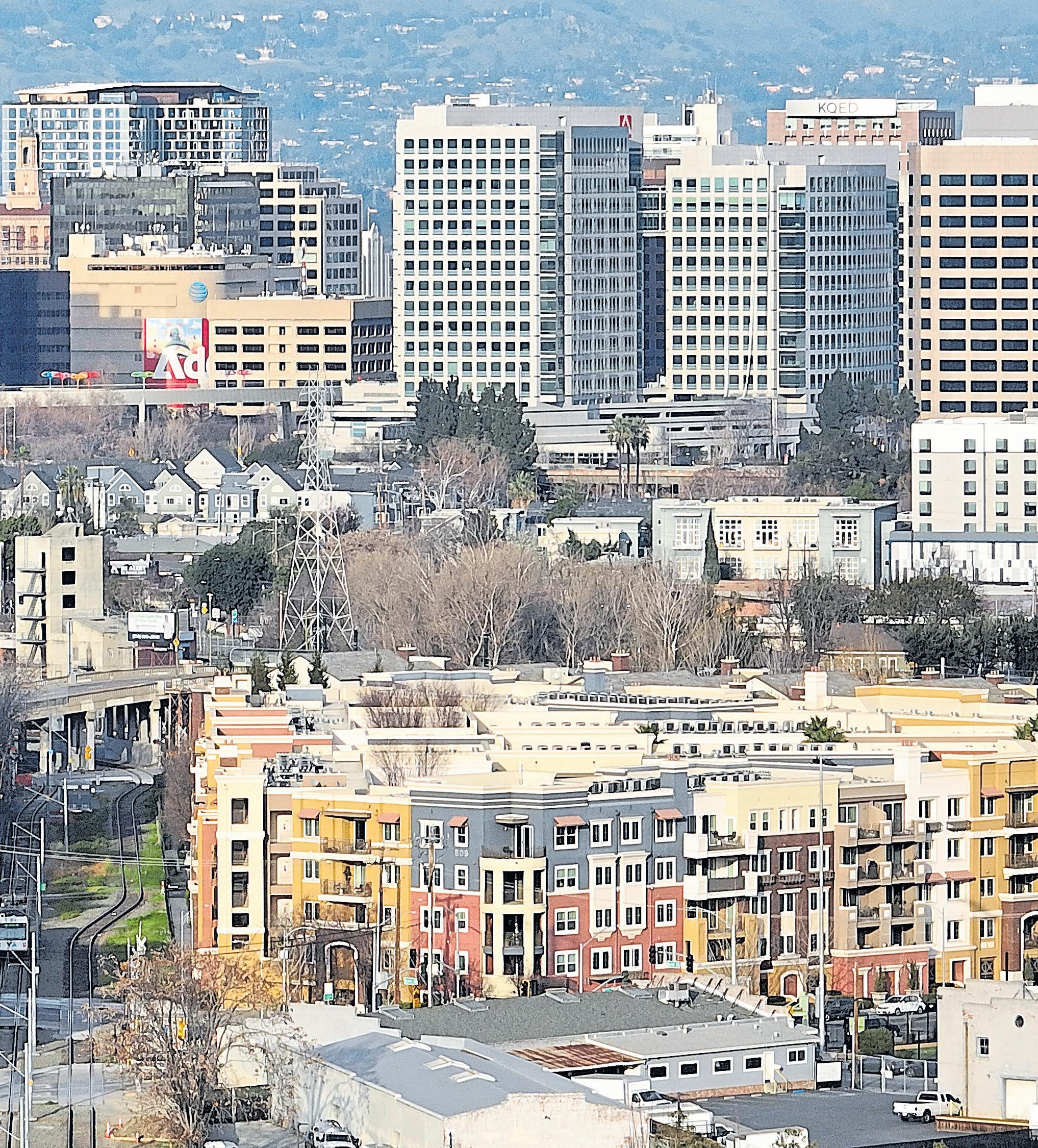
For years, headlines have warned of downtown “doom loops” and “death spirals,” focusing on the office vacancies that have piled up since the pandemic. Take a walk through downtown San Jose, for instance, and you’ll see many once-bustling buildings quiet and mostly empty.
But while they’ve been slow to recover, the streets below them are humming with resurgent energy. Lowriders blast música regional out of LED-lit speakers and trail fluttering Mexican flags. Twenty-something tech workers stumble in and out of barcades, and fans clad in Sharks jerseys stride arm-in-arm through the balmy evening air. Where pre-2020 San Jose might have seen packed lunch spots and ho-hum nightlife, that cycle has now flipped.
For American downtowns, this kind of change is nothing new. For more than a century, they
A drone view near Race Street and Parkmoor Avenue looks eastward toward downtown San Jose.
have evolved with technological advancements and shifting public policy. The COVID-19 pandemic and the rise of remote work presents the latest challenge, but for many experts on urban design, it’s not so much a crisis as an opportunity to redefine the future of downtown in the Bay Area and beyond.
“It’s a very dynamic time, and it’s been dynamic for the last couple hundred years,” says Mitchell Schwarzer, a historian of urbanism and professor emeritus at California College of the Arts in San Francisco. There hasn’t ever been a “long, stable period” for downtowns, he says.
MADE IN THE USA
The very idea of “downtown” is almost uniquely American.
City centers across Europe and Asia were anchored for centuries by ancient seats of royalty and religion and delineated by walls. But modern U.S. cities were especially malleable to the new technologies that came with the Industrial Revolution, which shaped the myth of the “classic” downtown.
The first was transportation. By the turn of the 20th century, new modes of transportation like the cable car, the street car and the trolley allowed people to live further away from their work and at the same time created an incentive for businesses to locate at the downtown stations where the lines merged, says Schwarzer.
Meanwhile, the skyscraper
allowed downtowns to grow denser and denser, fitting a growing number of workers into tighter spaces.
Together, taller buildings and faster transit transformed places that were once a mix of residential, business, religion and society to almost exclusively hubs of commerce and government. Glass and steel edifices sprang up in cities around the country and brought with them the heyday of downtowns. They were the sites of movie palaces that sat thousands, massive hotels and ballrooms and department stores that dominated retail. In some cities, half or more of the population would go downtown every day.
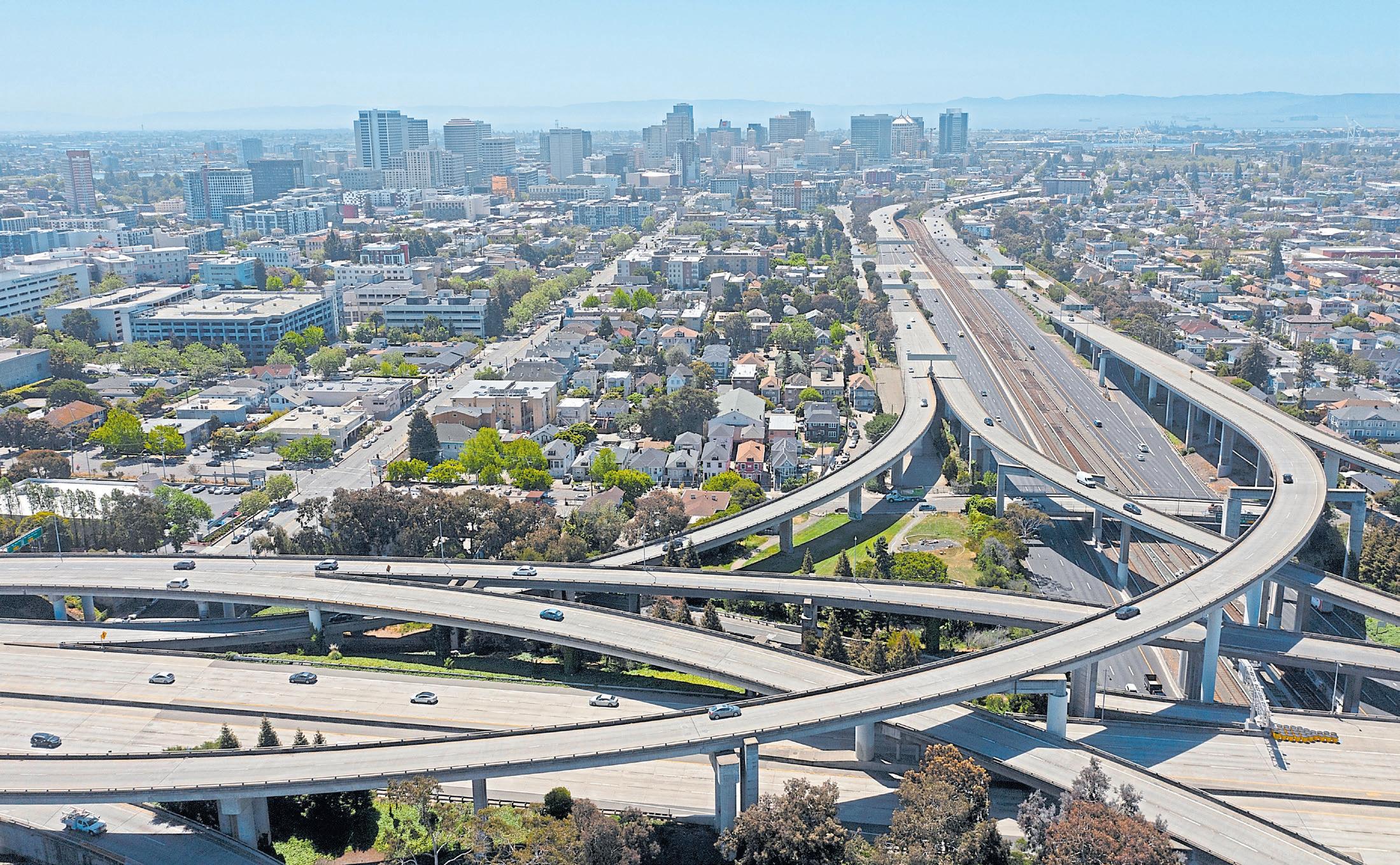
Only a few decades after downtowns rose into prominence, they faced their first great threat: the highway.
In the decades after the second World War, the federal government began pouring billions into building an interstate highway system that stretched across the nation’s breadth. While the project connected the nation, it changed the face of cities, razing vulnerable neighborhoods to make way for roads and — most importantly for downtowns — creating arteries that allowed people to flow beyond the heart of the city to new commercial hubs throughout the region.
With the rise of shopping malls, the department stores that were the mainstays of downtowns began to flag, move or eventually close. Most of cities’ growth began taking place not in downtowns, but in suburbs and exurbs, says Joel Kotkin, a fellow at Chapman University who studies urban development.
In 2020, another disruption came along, this time on a global scale.
The COVID-19 pandemic brought with it wide-scale quarantine orders that left many shuttered in their homes: away from a deadly virus — and away from offices, retail and restau-
rants. Pandemic restrictions took a heavy toll on downtowns.
Over months of quarantine, city-dwellers and others grew accustomed to online shopping, ordering food in and working from home, creating a “tremendous accelerant” for technologies that had been slowly growing for years, says Schwarzer, the urban historian.
These latest challenges have brought with them headlines that warn of “urban doom loops” that could spell the end of downtown. Though all experts interviewed by this news organization agreed that the old downtown of white-collar offices is gone, they also believe something new can rise in its wake.
“It’s a big opportunity,” says Randy Howder, an architect and strategist at the San Francisco-based Design and Architecture firm Gensler. “With any disruption, there’s always an opportunity for change.”
THE DOWNTOWN OF THE FUTURE
So what does that change look like?
First, fewer offices and more people.
“Hybrid and remote work are here to stay,” says Tracy Hadden Loh, a fellow at the Brookings Institution who has conducted extensive research on downtowns. “What the pandemic did was make extremely obvious something that was always inevitable: The nature of office work itself is changing, and so offices have to adapt.”
That means that some offices could have to downsize, others could be converted to apartments and others replaced by buildings that more readily serve the needs of a changing downtown.
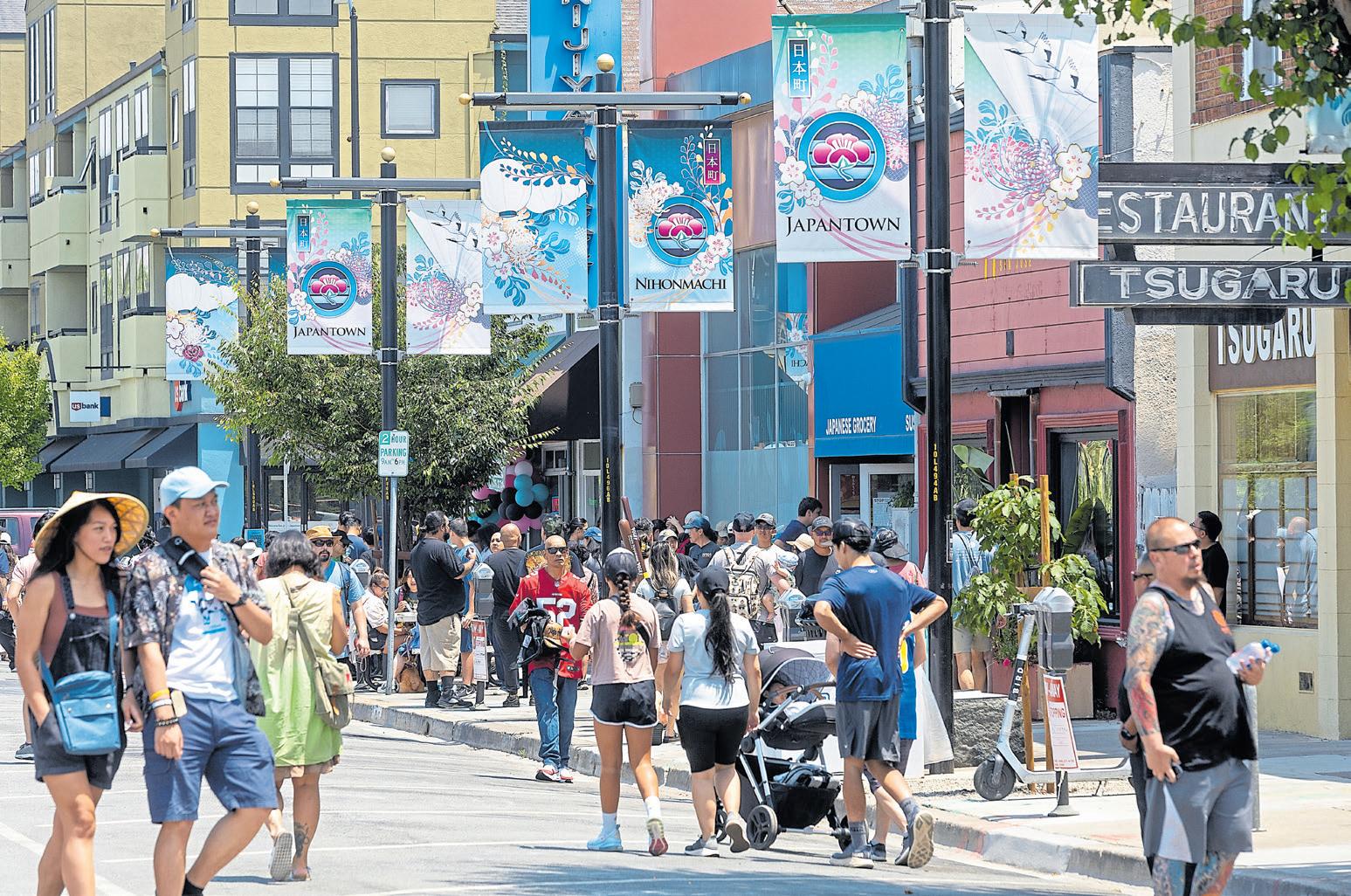
“I think they’re going to become like mega-neighborhoods,” says Schwarzer, the urban historian, of Bay Area downtowns, pointing to San Jose’s Japantown as an example
of what a future blend of shops and housing might look like. “It won’t be what it was.”
Bringing more people downtown could kickstart what Howder calls a “virtuous cycle of good things”: As more people live in a neighborhood, they support the shops and restaurants where they live and help make that place more attractive for others to come visit the places
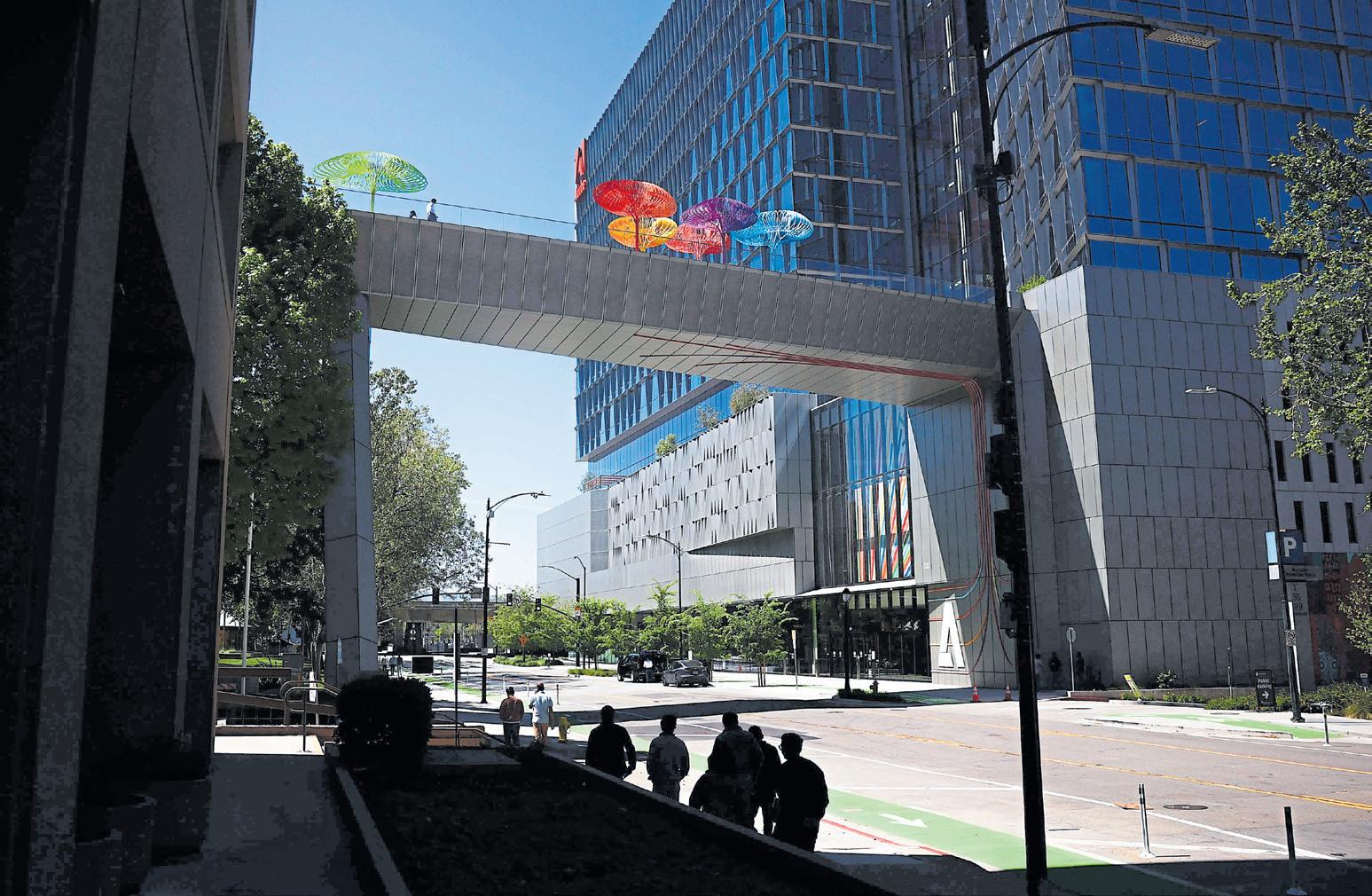
People walk towards Adobe headquarters during the lunch hour in San Jose.
they frequent.
A thriving community, in turn, attracts more people to then want to work there. Here, Howder points to the Jackson Square neighborhood in San Francisco, which has become one of the hottest office markets in the Bay Area, in part because of its proximity to a neighborhood with successful shops and restaurants.
“The crazy thing is that this all
Crowds flock to the first day of the Obon Festival in San Jose’s Japantown.
KARL MONDON/STAFF ARCHIVES
SHAE HAMMOND/ STAFF
The Interstate 980
War II,
loops back around on itself,” says Loh. “The more attractive downtowns are a place to live and play, that will also make them more attractive as places to work.”
That work would go beyond white-collar jobs. Experts suggest that downtown could become more of a destination for recreation, with arts, entertainment, bars, restaurants and shops helping anchor it as a mainstay for weekends, evenings and tourism. Hospitals and schools could help fill in as well.
Loh imagines education could play a key role, creating “knowledge worker factories” that could act as a pipeline for upward social mobility, a conduit for developing the workforce that would be employed downtown and a place for workers to adapt and retrain in a changing market.
Howder places emphasis on the physical space, arguing for more parks, transit and narrower, safer streets that favor pedestrians. Together, future downtowns could create a more
human experience with street vendors, nooks and little parks where you could steal away and read a book, and architecture that is less stark and more approachable. “You don’t have speeding cars or giant parking lots or faceless facades of giant buildings,” he says.
Kotkin thinks downtowns are likely to be just one hub in a network of city spaces that allow people to gather. While
in the Bay Area and elsewhere.
Despite the challenges they face, downtowns have advantages that can help them move to a better future.
“There’s a little bit of magic that happens,” when people gather together to work, says Loh, who notes that places that concentrate their economies into hubs become more productive. “It’s bigger than something that we would just measure in dollars or productivity: There’s a creative effect, there’s a democracy-building effect, there’s a connection effect.”
Already, Oakland and San Jose have begun creating spaces and moments where their downtowns can thrive. Downtown Oakland has done a particularly good job of drawing more residential development downtown, and Lake Merritt has become a draw in its own right.
San Jose has San Pedro Square, The Sharks and San Jose State and companies like Adobe that call it home, all of which draws life to downtown and could plant the seeds for future growth.
“We have, I think, a lot to celebrate,” says Howder.
Imagine a walk through downtown San Jose 20 years from now.
he agrees that bringing people downtown will inject more life into city centers, that also requires making downtown more attractive for those who want to live there, he says — ensuring public safety, addressing homelessness in city centers and providing strong public schools. And even though “what would really make downtowns successful is transit,” he notes that public transit is struggling
Step out of your apartment, take the elevator down past your neighbors, who are getting ready for work. Open the door to streets lined with trees and flecked with benches, where the bell of the light rail dings its warning as cyclists zip by on narrow roads. Join the intermittent flow of foot traffic that passes by the apartments, the satellite campuses, the cafes, restaurants, the hospitals and the corner grocers. Key in to your new office building — smaller, but big enough for the regulars who come in — and settle at your desk to drink in the view from your window: downtown. Different, yes.
But as alive as ever.
Above:
flyover from Interstate 580, bottom, is seen from this drone view in Oakland. After World
the government poured billions into building an interstate highway system that would span the nation.
JANE TYSKA/ STAFF ARCHIVES
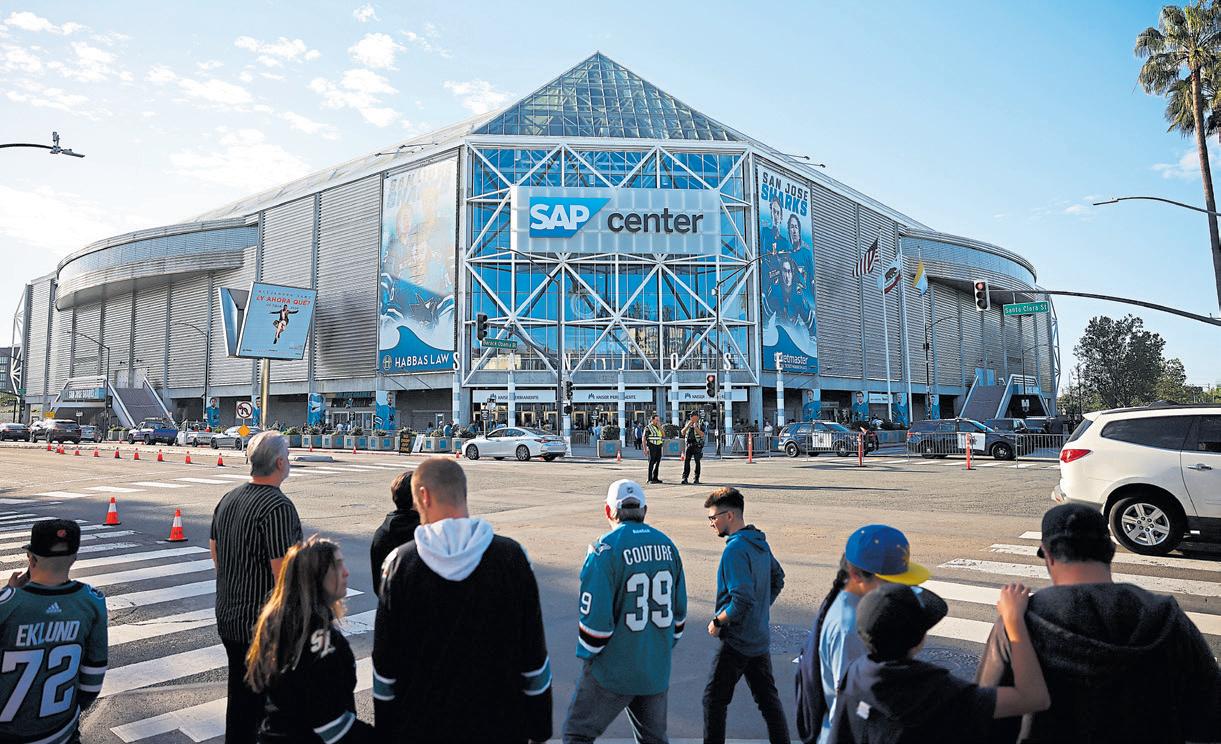
Right: Fans gather to watch a Sharks game at the SAP Center in downtown San Jose.
NHAT V. MEYER/ STAFF ARCHIVES
Tiny, quirky Port Costa is steeped in a charm all its own
A hidden gem
BY KATIE LAUER
There are only two roads that lead into Port Costa, which makes this port town along the northern edge of Contra Costa County feel particularly isolated and remote.
But in fact, it’s well within daytripping range for most of the Bay Area, especially the East Bay — and well worth visiting. One can take Interstate 80, with views of the Straits of Carquinez, or Highway 4, which connects to the same trail Juan Bautista de Anza’s expedition navigated through the coastal canyons 250 years ago.
The latter peaks in verdant bluffs before descending more than 600 feet to narrow county roads built around the turn of the 20th century. At the bot-
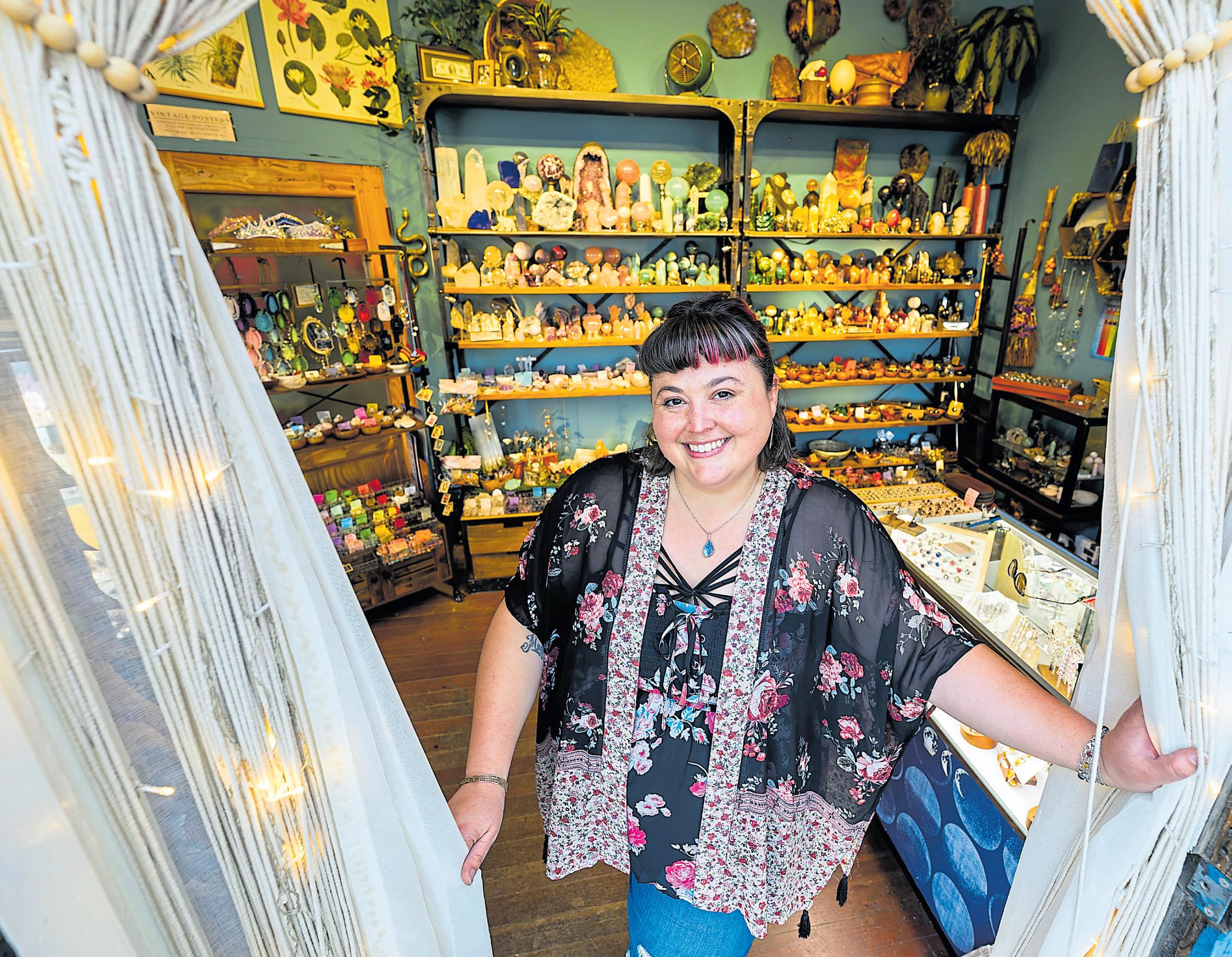
tom of the hills, Sarah Louise Humann takes in the view from the doorframe of the Crystal Garden, the shop she opened in Port Costa three years ago at the very end of Canyon Lake Drive — about as far away from the water as the town’s main street is long.
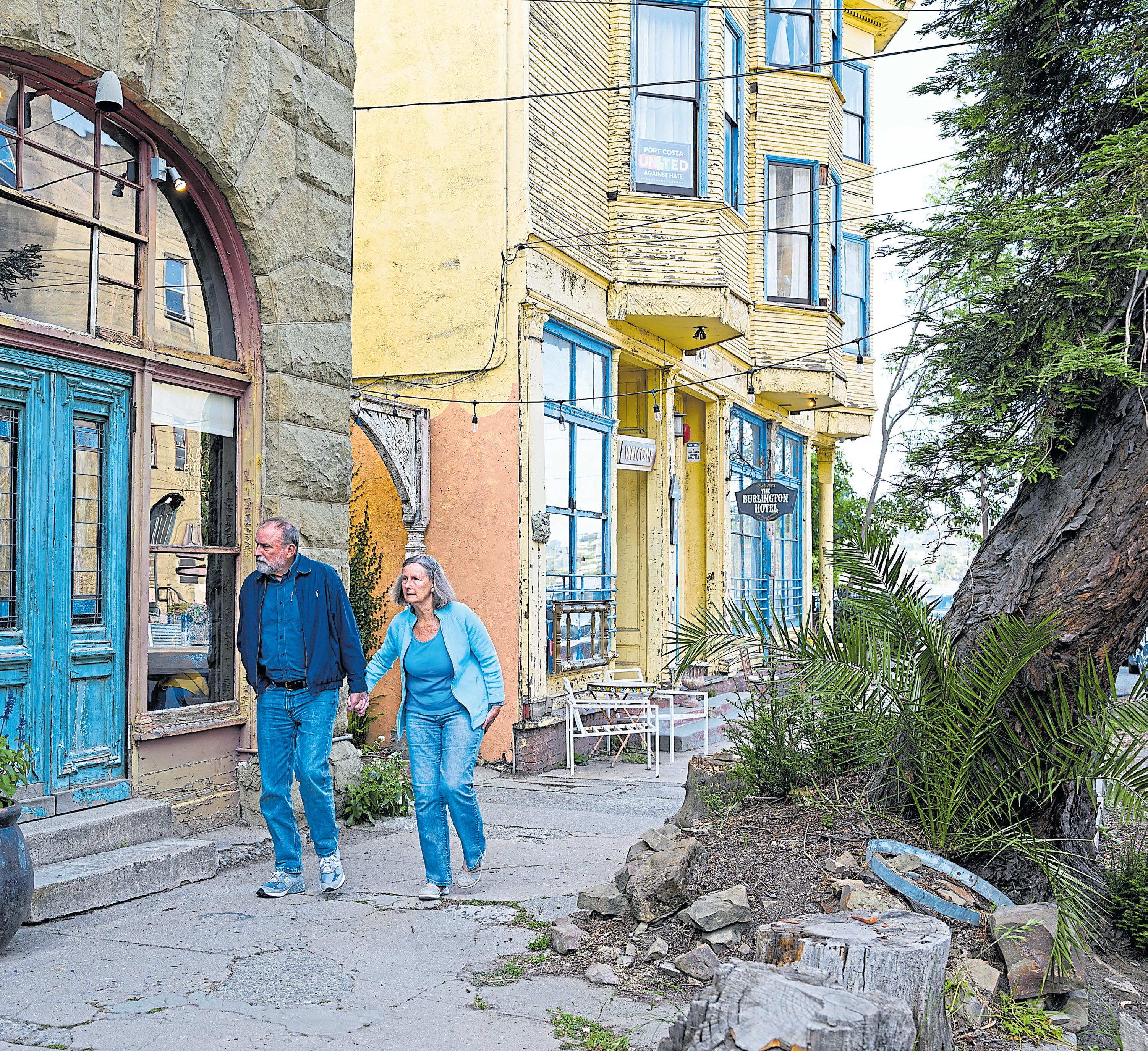
Her space is a cross between the Garden of Eden and “Alice Through the Looking Glass,” where tarot cards, handcrafted jewelry and other little gems line the walls inside the restored Burlington Hotel that nearly 120 years ago accommodated travelers in tailor-made wool suits, fox furs and haute couture skirts.
The 42-year-old Humann is one of the lucky locals working in historic and architecturally stunning buildings POR T A C O STA
Pedestrians walk along Canyon Lake Drive in Port Costa.
JOSE CARLOS FAJARDO/STAFF
that are all that’s left standing of the commercial hub that arose here in the late 1800s.
Decades before it was accessible by road, Port Costa’s main street served the needs of hundreds of gigantic steam ships — the largest of their kind in the world — that carried freight and passengers from California’s fertile valleys and industrial waterways across the Carquinez’s crisscrossing currents and to the oceans beyond.
And there is something magical, Humann says, that keeps drawing people to Port Costa.
“It does have that magnetic ability to pull people in,” she says.
When one arrives here, they’ll find no light-up signs or flowing banners welcoming tourists.
More often than not, the sidewalks and storefronts are quiet, with the syncopated choruses of birds the only sounds filling tree-lined streets.
Just past the Crystal Garden, the community’s lone parking
Top: Crystal Garden owner Sarah Louise Humann stands in her shop in Port Costa.
JOSE CARLOS FAJARDO/STAFF
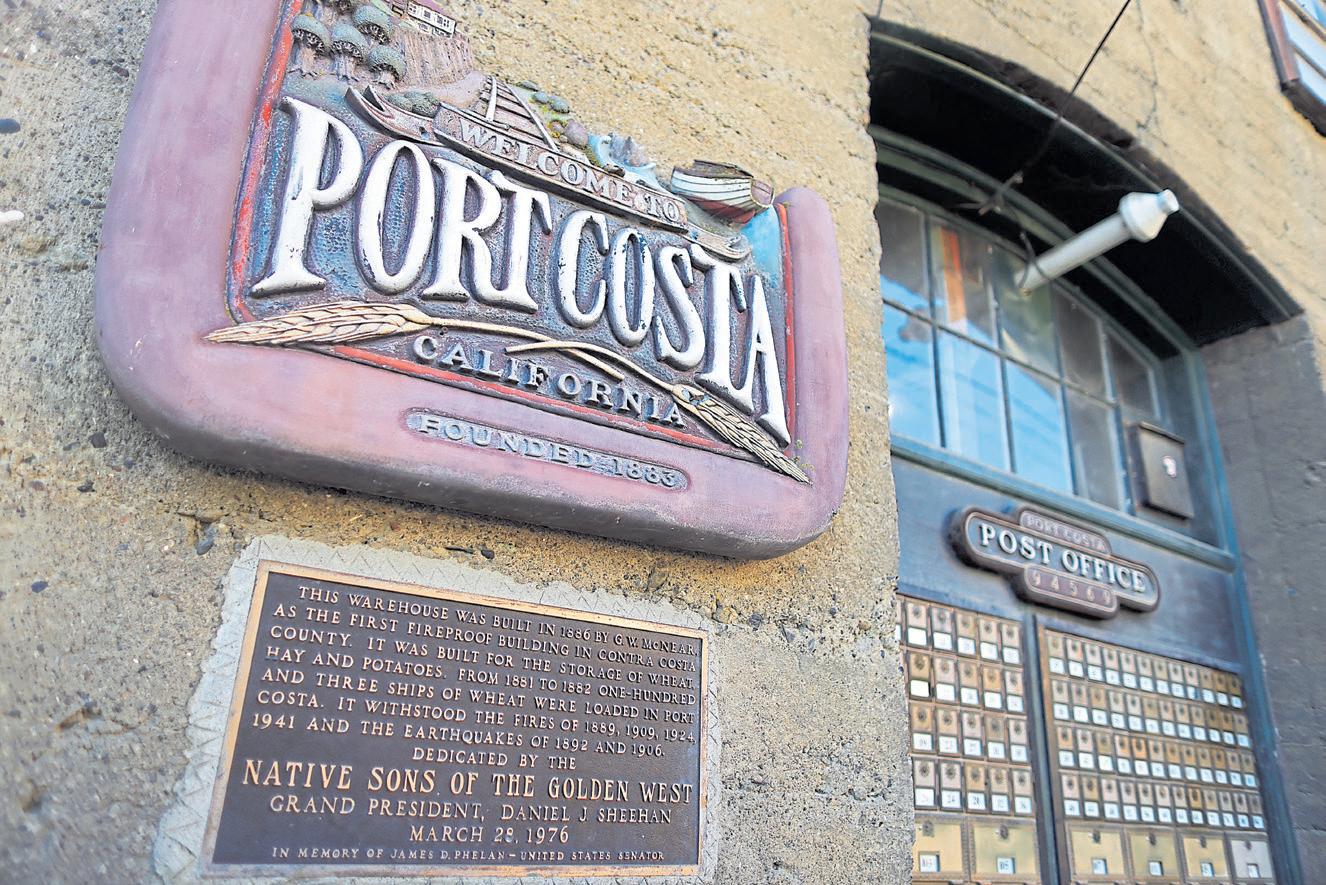
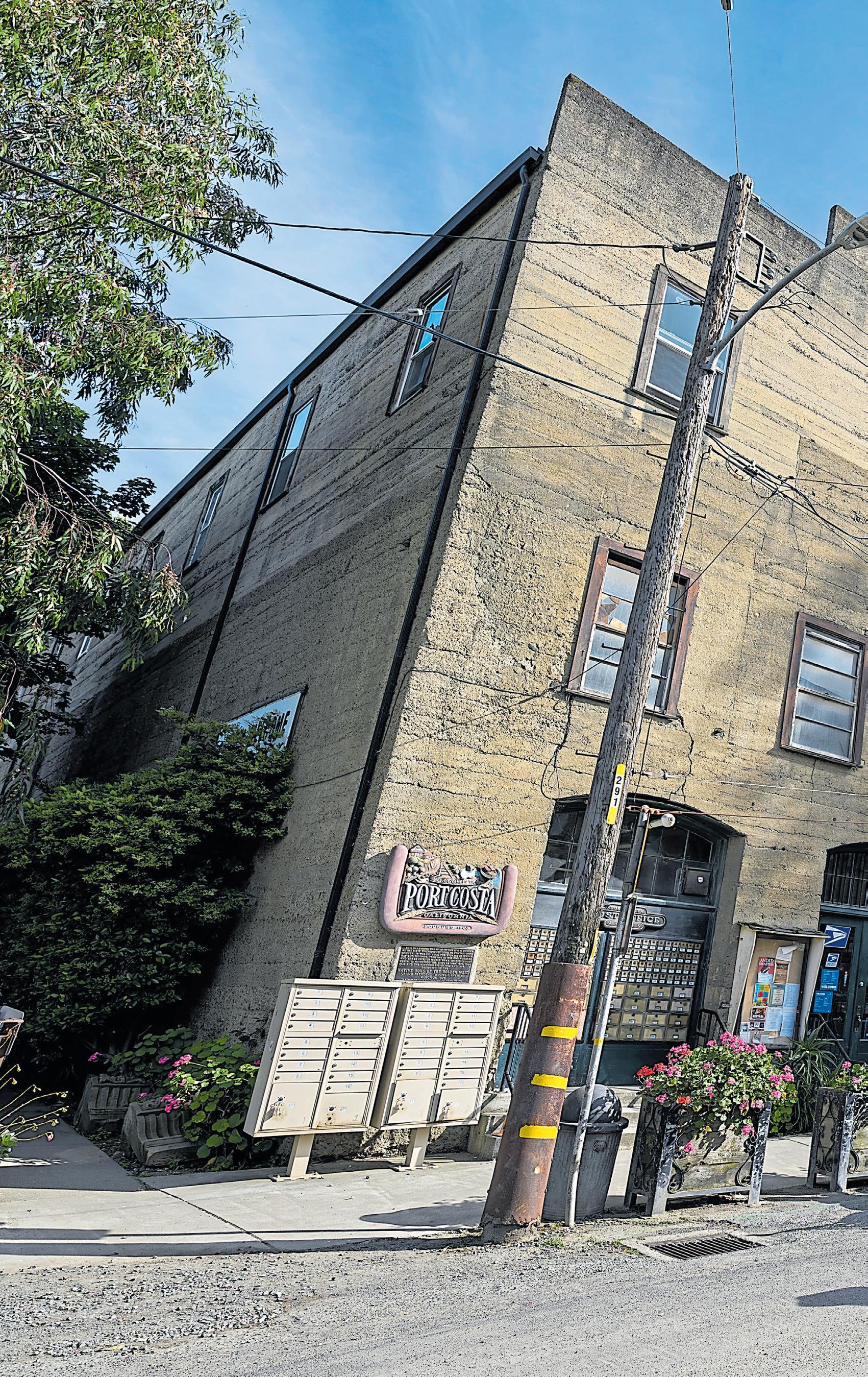
Right: Vintage post office boxes are lined up on the exterior of the Port Costa Warehouse.
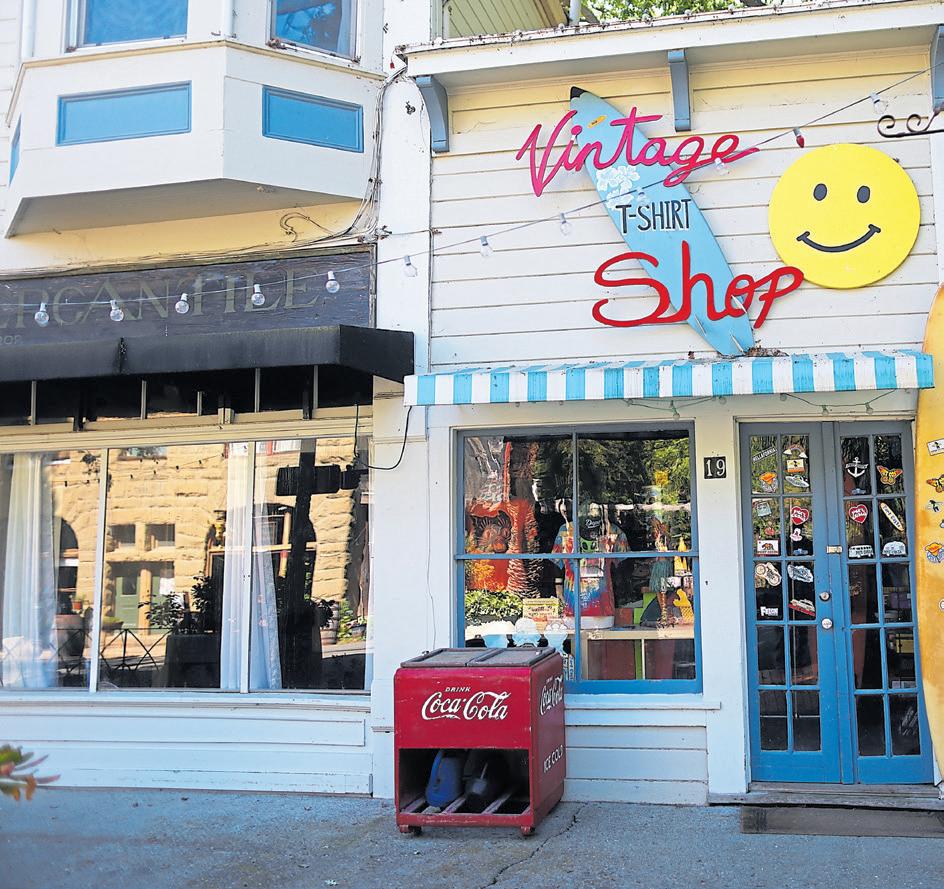
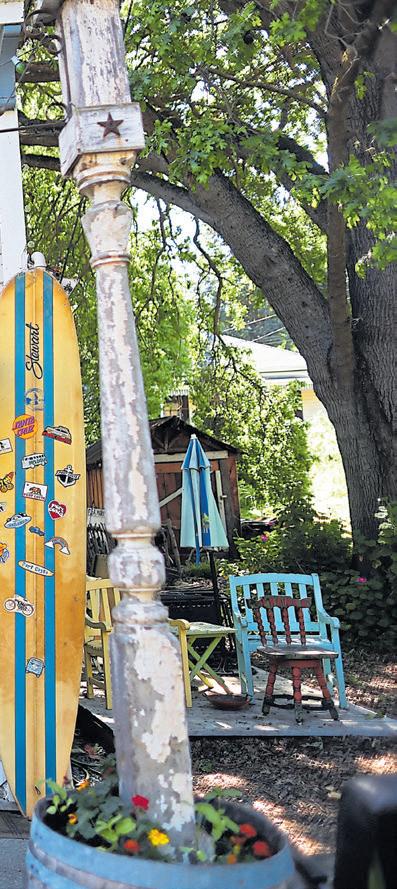
Far Right: When arriving in Port Costa, you won’t find light-up signs or flowing banners welcoming tourists, but on the quiet sidewalks and streets you’ll find shops like The Vintage T-shirt Shop.
ARIC CRABB/STAFF
lot is just a short walk away from a shoreline dotted with sailboats, fishing poles and oil tankers like the “American Endurance.” Bones of the long-abandoned rail lines that put Port Costa on the map in 1879 remain, as does one active set of tracks that run along the water’s edge; passengers on the Amtrak trains that whoosh by the town a few times each day may blink and miss it.
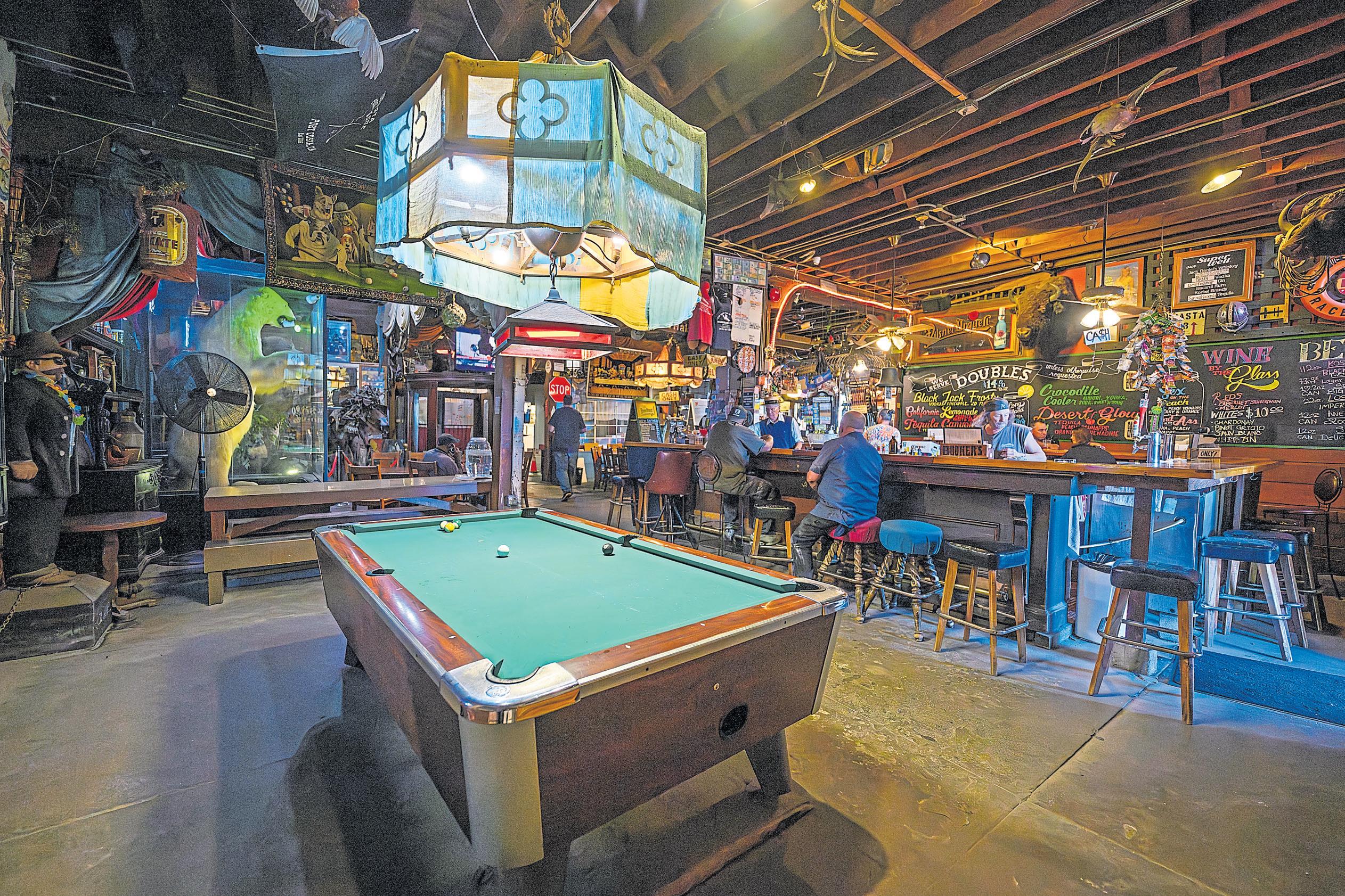
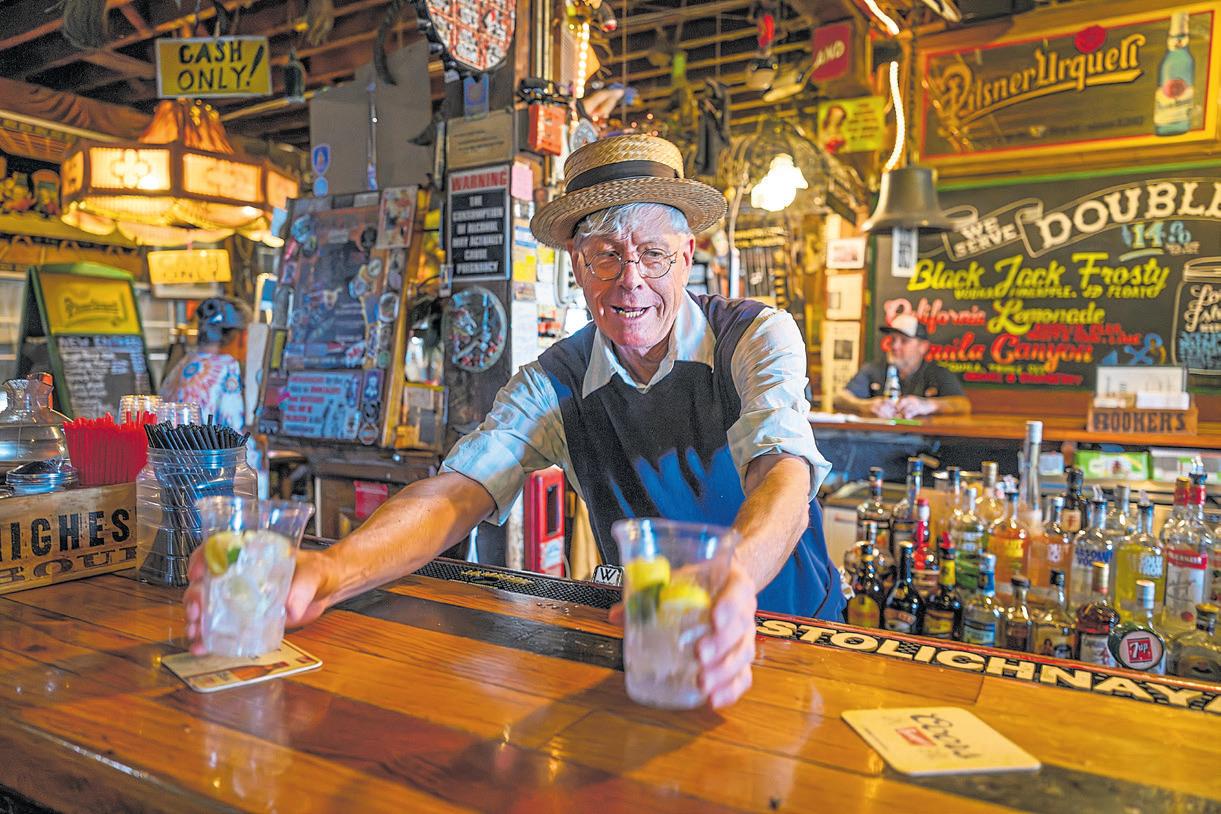
The valley’s natural quiet fades into weekends when leather-clad bikers rev their engines down Canyon Lake Drive and friends cackle over decks of cards on the patio behind the Warehouse Cafe. Pool balls crack while patrons flash cash at Scoty Hopkins, who’s tended bar for nearly a decade inside the mammoth structure, which in 1886 was the first fireproof building constructed in Contra
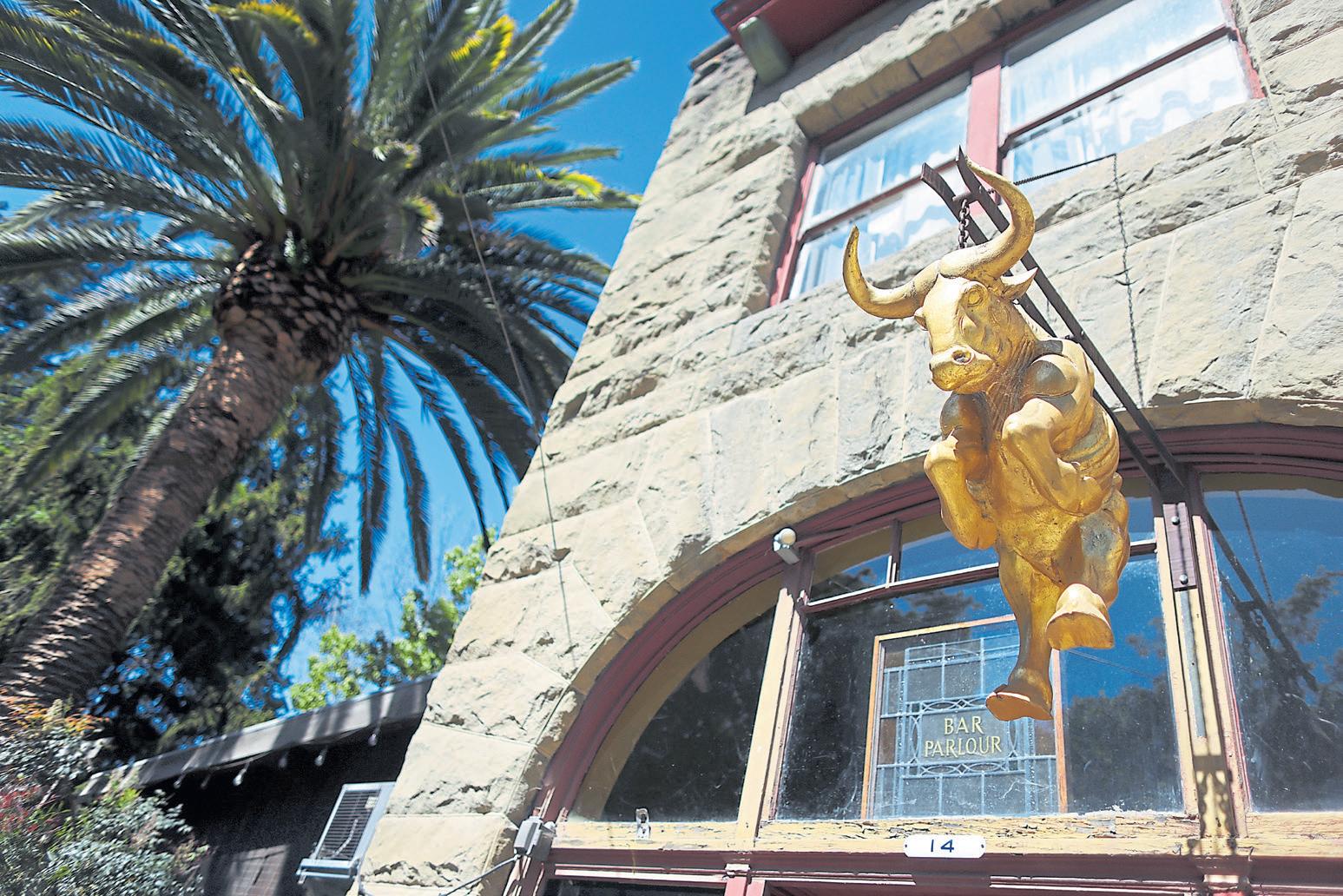
A pool table is the tamest piece of decor at Warehouse Cafe in Port Costa, above, while a golden bull adorns the exterior of the Bull Valley Roadhouse in Port Costa.
JOSE CARLOS FAJARDO, ARIC CRABB/STAFF
Costa County. The warehouse for wheat, hay and potatoes withstood four disastrous fires and two earthquakes long before it became known as a destination for brews with a view.
Over the years, Hopkins says, the restaurant has shed its “Wild West biker bar” reputation for a more laid-back atmosphere.
“This bar sort of functions more like a community center,” he says, pointing to a mismatched collection of patio furniture. “People hang out here.”
Across the street and kitty-corner from the warehouse, JJ Levine has operated his antique store Compulsive Peddler for the past decade. The 56-yearold concedes he has a knack for “discovering beautiful things”
but is quick to credit luck for his success as a tenant in Port Costa, five minutes from the quiet home he owns in Crockett.
Singing along to playlists of pop divas while hand-stickering the newest additions to his collection of vintage ceramics, figurines, signed artwork and high-end fashion, Levine says he’s often asked if the town is actually real or a movie set.
In reality, it’s the opposite of a movie set, he says — almost hyper-real.
“Life here is very transparent. It’s a freaking anomaly,” Levine said. ”I feel very fortunate to be around it, and I feel valued, like I belong.”
Levine has also noticed the effect this place has on people.
Scoty Hopkins works behind the bar at Warehouse Cafe.
JOSE CARLOS FAJARDO/STAFF
“Everyone thinks this is a ghost town or haunted because it’s old and looks the same as 150 years ago,” Levine said. “There’s no ghosts, but there is this feeling — a sort of serotonin or elixir — here that puts people in a good mood.”
People are close here, and those bonds have thrived since Port Costa Brick Works established its own company town in the early 1900s.
While the old brick plant churned out hundreds of millions of the building blocks of California growth for nearly a century, the company also built bunkhouses, worker housing and other amenities on the property it owned and donated the land underneath the church and school.
“There were families who, while working at Brick Works, their kids were born there, grew up there, went to school there,” says Aidan Behrendt, a volunteer for the Port Costa Conservation Society’s museum who has digitally archived stories of the town’s history. “It was such a tight-knit community because they all literally lived together.”
While it might not be quite so insular these days, Humann says the town’s remote feel is still part of its power.
“It’s just far enough away for people to emotionally fully let go,” she says. “There’s something magical about just simply three miles of windy road that can untangle somebody from existence.”
DAYTRIPPING in SUGAR TOWN
A Contra Costa County community with an unusual history is making a comeback
STORY BY JOHN METCALFE
PHOTOS BY JOSE CARLOS FAJARDO
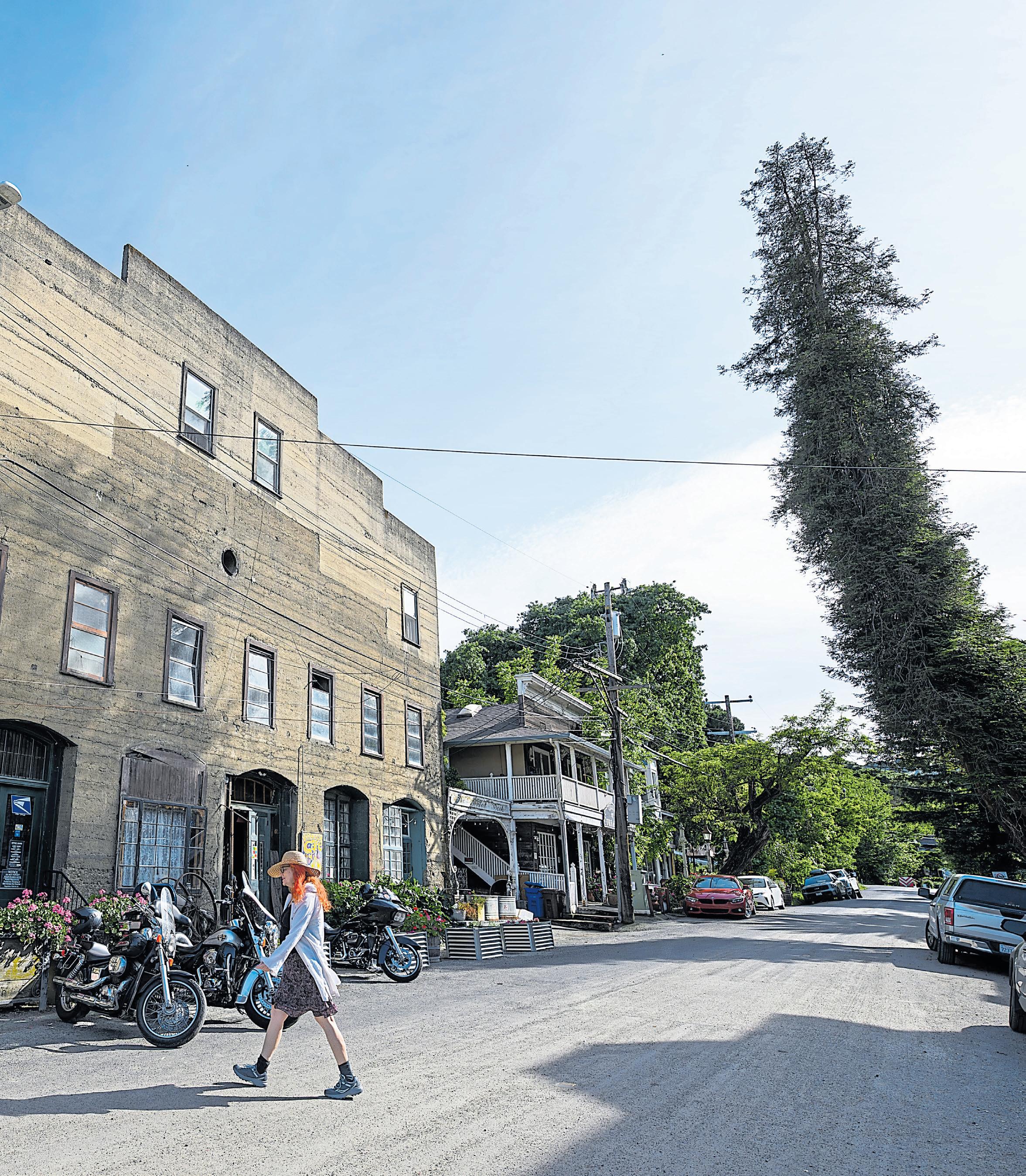
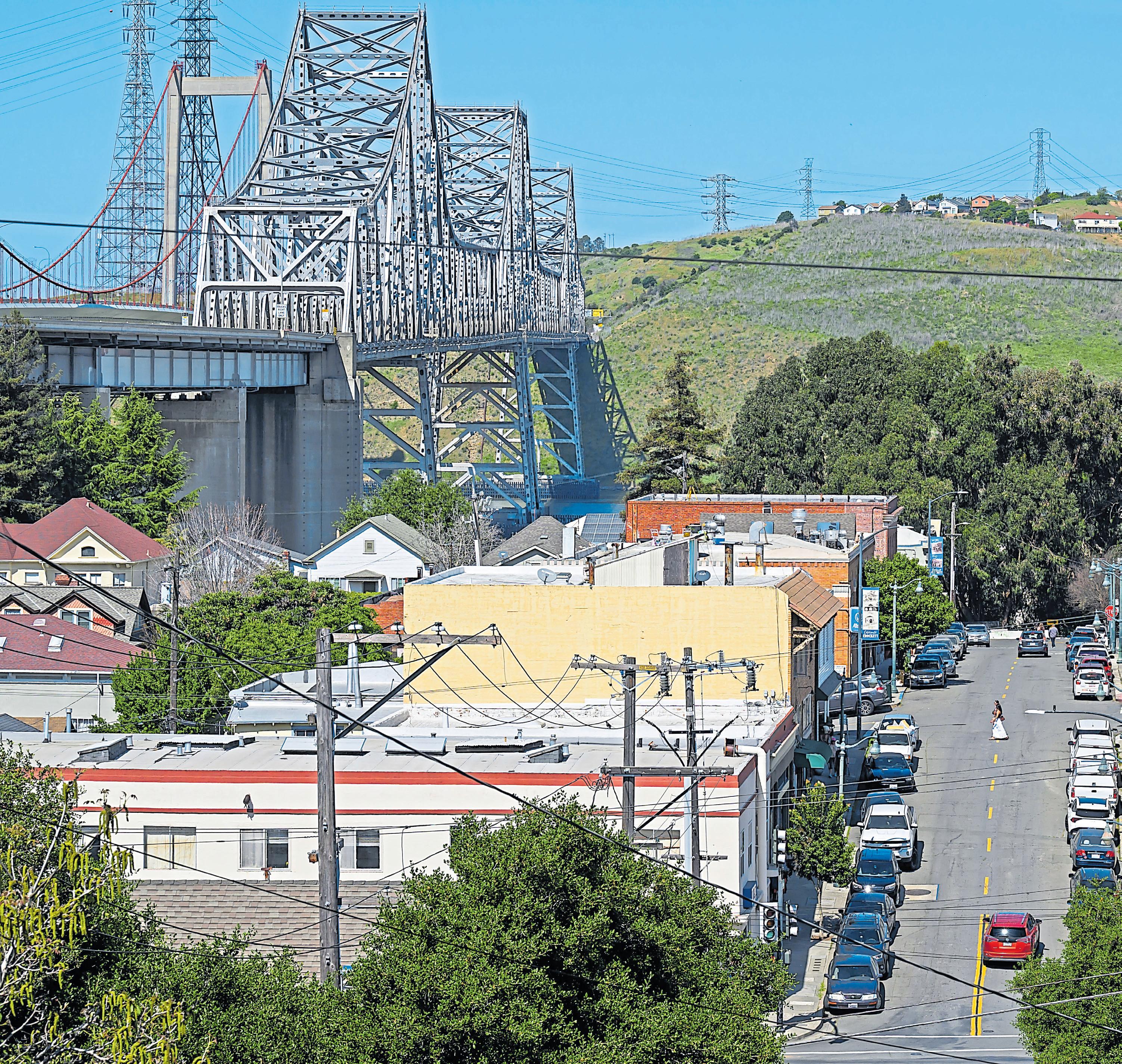
Every downtown in the Bay Area has its origin story, and one of the strangest is that of Crockett, an unincorporated town hiding under a bridge that also happened to be part of a late experiment in Utopian society.
Crockett’s main employer through the 20th century was the California and Hawaiian Sugar Company, whose local refinery gave the community its nickname “Sugar Town” and also the persistent rumors of underground “sugar caverns.” Company president George Rolph wanted to keep the workforce stable and productive, so he invested in affordable housing, education, the arts and even a hothouse-gardening program with free vegetables for all.
“I surmise that Rolph said, ‘If I have to live in this backwater, I’m going to make it what I want it to be.’” says Barbara Denton, author of the 2024 book “Sweet Success: How Industry, Immigrants and Working Women Shaped a Town.” “This led to what I call Crockett’s Golden Age, which was from the 1920s to the mid-’70s.”
Downtown Crockett had two cinemas, two meat markets, a bakery and shops for produce, furniture and shoes. It was
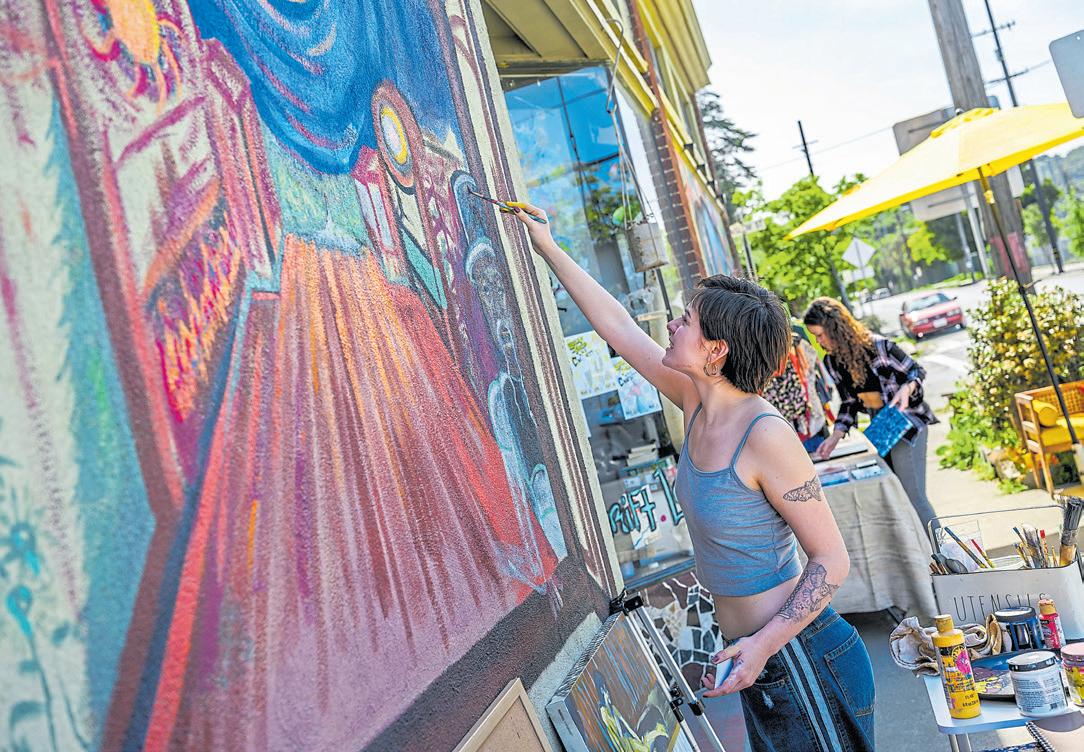
Artist Leila Latimer touches up a mural, above, at a store called Messuhya. Crockett, left, with its historic, cheap-to-rent buildings and an advantageous location between Sonoma and San Francisco is experiencing a revival.
a walkable community, in the true sense of the word, and swelled to a population of 5,500.
“The kids in Crockett had the most robust recreational programming to take advantage of — everything from puppet theater and athletics to art classes and music,” says Denton, 78, who grew up there. “Every Christmas, there was a beautiful pageant with professional choreographers and musicians from San Francisco, and every child in Crockett got a gift.”
The good times, however, were not to last. The sugar company saw its revenues
The Monarch Store in downtown Crockett specializes in customized coveralls, the full-body denims popular with factory workers and the French. “What I’m finding is that coveralls kind of are fan favorites. Most people just kind of like coveralls,” explains store owner Davin Che.
drop and invested less and less in the community. In the 1950s, the state of California decided to build a second bridge over the Carquinez Strait that cut right through this populated area. The Italian immigrant-heavy community didn’t have the resources to fight the development, and 150 homes were destroyed.
“It lost a huge portion of its population,” says Denton. “There were 9.5 million cubic feet of dirt moved for the freeway that connected to the bridge. Slowly, the downtown started to decay, and businesses closed up. That was a very, very sad time.”
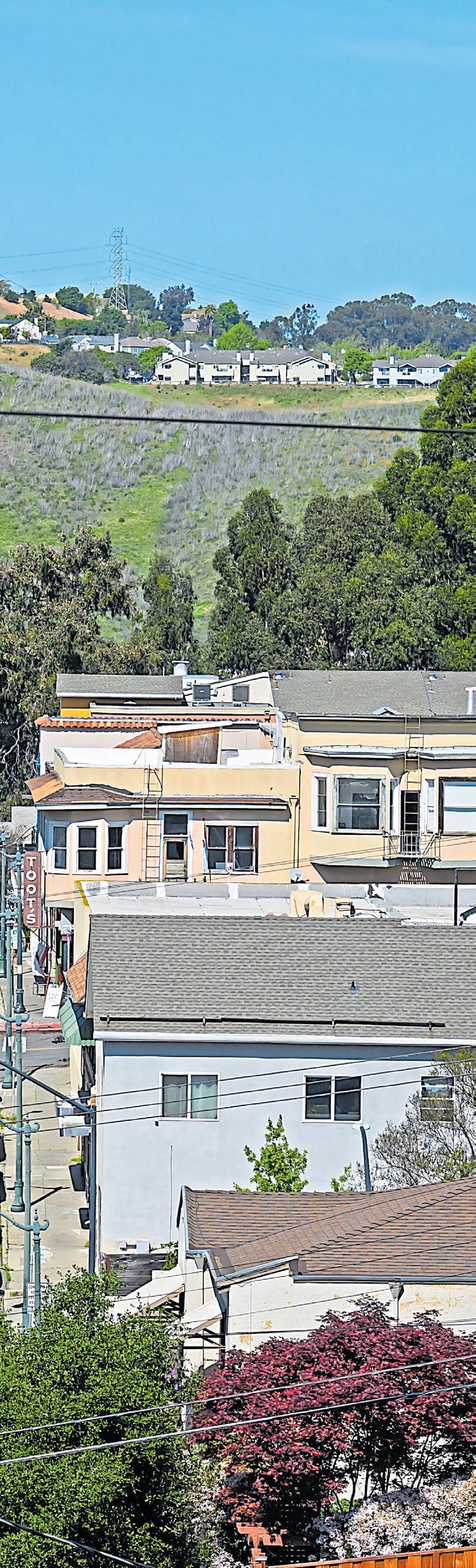
But as it happens, historic, cheap-to-rent buildings and an advantageous location between Sonoma and San Francisco has given Crockett something of a revival. Today, it’s home to a tight-knit populace of artists, workers and rugged individualists, who come together for community Italian dinners and daffodil planting.
There are “Walk It and Shop It in Crockett” events every third Saturday that feature local makers, as well as annual events like the Sugartown Festival in July, the Downtown Crockett Wine Stroll in August and an Oktoberfest with beer and axe chucking.
People in Crockett seem to take pride in what they call their “S.T.U.B.” — Small Town Under the Bridge.”
One of the first things visitors might do in Crockett is grab a drink. There are a few options, including Club Tac — a darkened watering hole plastered with certificates from E Clampus Vitus, a men’s-only organization devoted to the history of the Western Gold Rush — and Toot’s Tavern, a 1901-era haunt for cocktails and live music that’s reportedly the oldest continuously operating bar in Contra Costa County.
The Golden Age of Crockett saw dozens of such bars crammed into town. “That was because these guys would work
their shift, and (then) there was no place for them to go,” says Denton. “So they would go to the bars and drink, and then go lie in the fields to sleep, get up and do their shift again.”
Bootlegging during Prohibition led to the legend that Crockett sits atop an intricate network of underground tunnels. Some people swear they’ve seen smuggling exit holes down by the water. Other folks talk about the existence of massive, underground troves of sugar, a relic of the town’s history.
“Walking up Pomona Street, someone even went to the point of putting a little sign on a manhole that says, ‘Entrance to the Sugar Caverns,’” says Denton.
“I have also been told about tunnels and how there’s old cars
down in these tunnels, kind of like a time capsule. I doubt that is true, but it’s kind of fun to think about,” says Erin Mullen, a volunteer at the Crockett Museum.
If all these tunnels were real, hard-up developers certainly would have turned them into new real estate by now.
“There’s no room to build new houses, so we’re sort of stuck with where we are. We’re surrounded by the East Bay Regional Park District and ranch lands and the water, so there’s really nowhere to grow,” says Mullen. “That part is a little limiting in terms of some of the businesses — like, we don’t have a grocery store. We have a little mini-mart, which generally has everything you need.”
Crowds line up to order food while attending the 17th annual Sugartown Festival held in Crockett in 2025.
Crockett’s a great place for relics. The historical museum itself is one, located inside an old railroad station where trains still roar by on a regular basis. The volunteer staff know them by sight, yelling “That’s Amtrak!” over the racket. Among the interesting treasures in the museum is a 468-pound stuffed sturgeon, the largest ever caught in San Pablo Bay; fishers used to haul these living fossils out of the water to teach youngsters to harvest caviar.
There’s also California’s last mechanical telephone switchboard, removed from Crockett in 1968. “Up until then, we had operators and three-digit phone numbers,” recalls Denton. “When I was away at college, I couldn’t dial my parents. I’d
have to dial zero, get the operator and say, ‘Okay, Crockett 297, please.’ She’d say, ‘Yeah, what’s the rest of it?’ And I’d have to explain the whole thing. Crockett and Santa Catalina Island in Southern California were the last two places in the state to have operator-assisted calls.”
Antique stores dot the streets, among them The Cat Vintage. The store has slowly accumulated thousands of feline-related knickknacks and artworks, to the point where it will soon open a “Vintage Cat Museum.” This future roadside attraction, according to the shop’s website, will serve as a “love letter to the quirky, forgotten and a-meow-zing world of secondhand kitties.”
On a recent afternoon, arranged like Bela Lugosi in a coffin on the counter, was a duck puppet from the 1986 movie “Howard the Duck.” Wikipedia describes the George Lucas-produced comedy as being “among the worst films ever made.” A
Ellen Mullen, a Crockett Museum volunteer, enjoys all the storied rumors about the tunnels under the city.
sign on the puppet, which looks like it has rabies or some sort of wasting disease, reads: “No touching. Howard bites... is very delicate and old.”
A staffer swears it is the real thing and was built by a local craftsman. “A lot of people who worked with Lucas were stationed out of here and worked (at Skywalker Ranch) in Marin,” she says.
Folks who visit Crockett have some good choices for dining. There’s The Dead Fish, a winningly kitschy surf-and-turf restaurant with prime views of the water, and casual favorite Crockett Cocina. Lucia’s Craft Sandwich is a bustling place for the breakfast-and-lunch crowd and consistently ranks on Bay Area restaurant lists for its inventive sandos — the mortadella with artichokes and ricotta is a delight. This winter, its owner opened Duke’s Dining Hall next door, serving bistrostyle comfort food like roasted bone marrow, moules-frites and
pan-seared filet mignon with mashed potatoes.
The Monarch Store debuted downtown last year and specializes in customized coveralls, the full-body denims popular with factory workers and the French. “What I’m finding is that coveralls kind of are fan favorites. Most people just kind of like coveralls,” explains owner Davin Che.
Che moved from Brooklyn to Crockett several years ago, partly for its creative vibe. “The arts scene here reminds me of an Oregon or a Vermont with the idea that everyone, everywhere can do anything. Like, everyone can build a house or do a project, and everyone knows how to play instruments.”
The current state of the housing market has attracted more artists and Bohemian types to Crockett. “On the residential side, it’s having its own little boom, partly because of the pandemic,” says Che. “Other Bay Area people came and bought these additional homes, because it was such a cute little perfect town to live in during the pandemic. Now that the world has opened up again, they don’t need to live here, so they open it up for rent.”
And the rent is pretty sweet. “Crockett is still very much based on what’s reasonable. It’s not necessarily a market rate. Let’s say you’re not paying the 1982 rate, right? You’re kind of paying the 2012 rate.”
Denton, the author, says she’s also noticed change washing over her hometown. “New people are moving here, so there’s new energy. It’s kind of a convergence right now of forces that are putting Crockett on the map, which is kind of fun.”
But, she jokes, “we don’t want it to be too much on the map.”
STREET CULTURE
Post-pandemic parklets pour life into Palo Alto’s downtown
BY KATE BRADSHAW
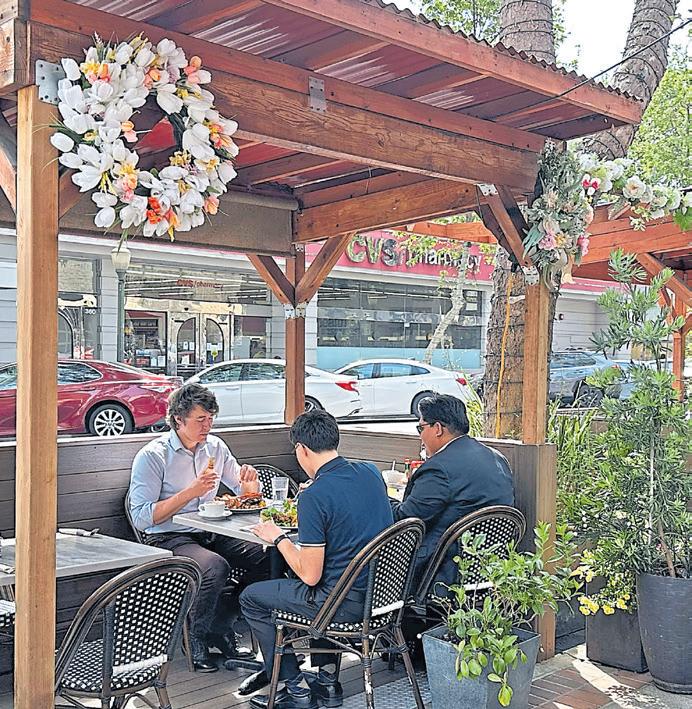
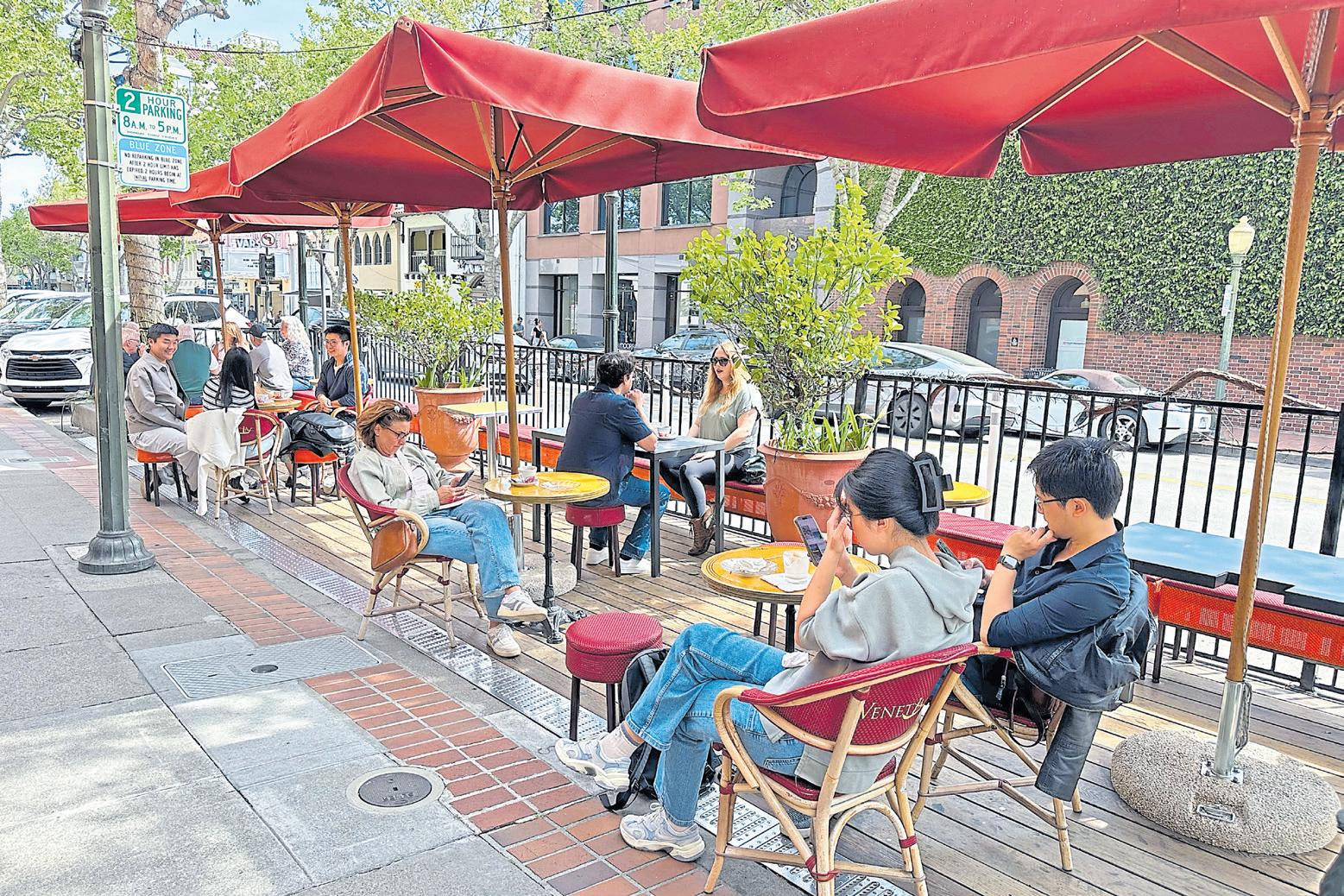
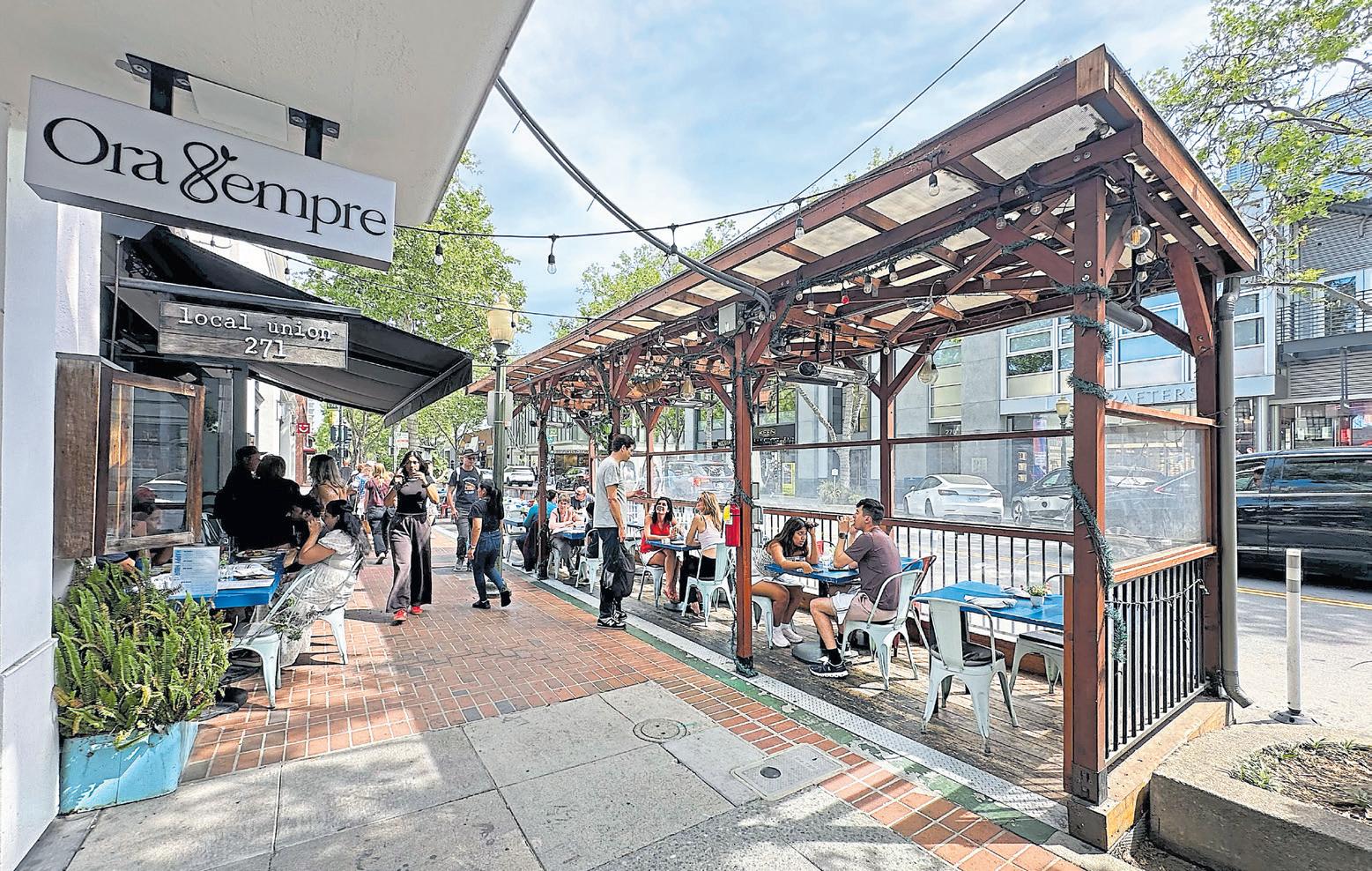
On a stroll down University Avenue in Palo Alto on a spring Saturday evening, one can see parklets that were once parking spaces packed with well-heeled diners elegantly swirling wine glasses or digging into their meals inspired by culinary traditions from around the world.
Families line up down the block to order ice cream at Salt & Straw, while students chatter over their laptops at Coupa Cafe. The marquee at the Stanford Theater announces the night’s classic films, all for $7 a ticket.
Less than two miles away, a similarly bustling scene plays out on California Avenue, often considered Palo Alto’s second downtown. A stretch of road between El Camino Real and
Customers enjoy lunch in a parklet at Crepevine on University Avenue in Palo Alto.
JOSE CARLOS FAJARDO/STAFF
PA L O A LTO
Birch Street is fully closed off to cars, and diners at restaurants like Terun, La Bodeguita del Medio, Joanie’s and Zareen’s fill the street, while indoors, patrons work their way through the tasting menu at Protege or sip craft cocktails at newcomer bar Underdog.
It’s the kind of downtown city planners dream of, but it hasn’t been smooth sailing getting here. In fact, every step has been fiercely contested — particularly the parklets, which many Bay Area cities quickly abandoned after they were born out of necessity in a pandemic era of social distancing and outdoor dining. But Palo Alto let many businesses keep their parklets, and the fierce public debate
over the past half-decade may have helped the city land on a setup that works for most residents, restaurants and retailers — and feels practically idyllic to visitors.
“It’s been a real policy struggle,” says Palo Alto Vice Mayor Greer Stone, a longtime champion of the city’s parklet programs. “Through community engagement with residents, customers and businesses, I think we’ve found a nice middle ground that is going to activate Palo Alto in ways we haven’t seen in the past.”
The saga starts back in 2020, when the COVID19 lockdowns appeared to spell disaster for many local businesses — especially restaurants, since
eating indoors around other people increased the risk of contracting the virus. Outdoor dining was substantially less risky, and dining tables were soon moved into the streets.
To help local businesses during a public health crisis, the city even closed down portions of University Avenue and California Avenue for the summer of 2020.
The University Avenue closure was short-lived, as it created challenges for commuters and, according to Stone, emergency responders. The street reopened to cars in October 2021.
In the interim, though, some of the restaurants in Palo Alto’s downtown had invested heavily in
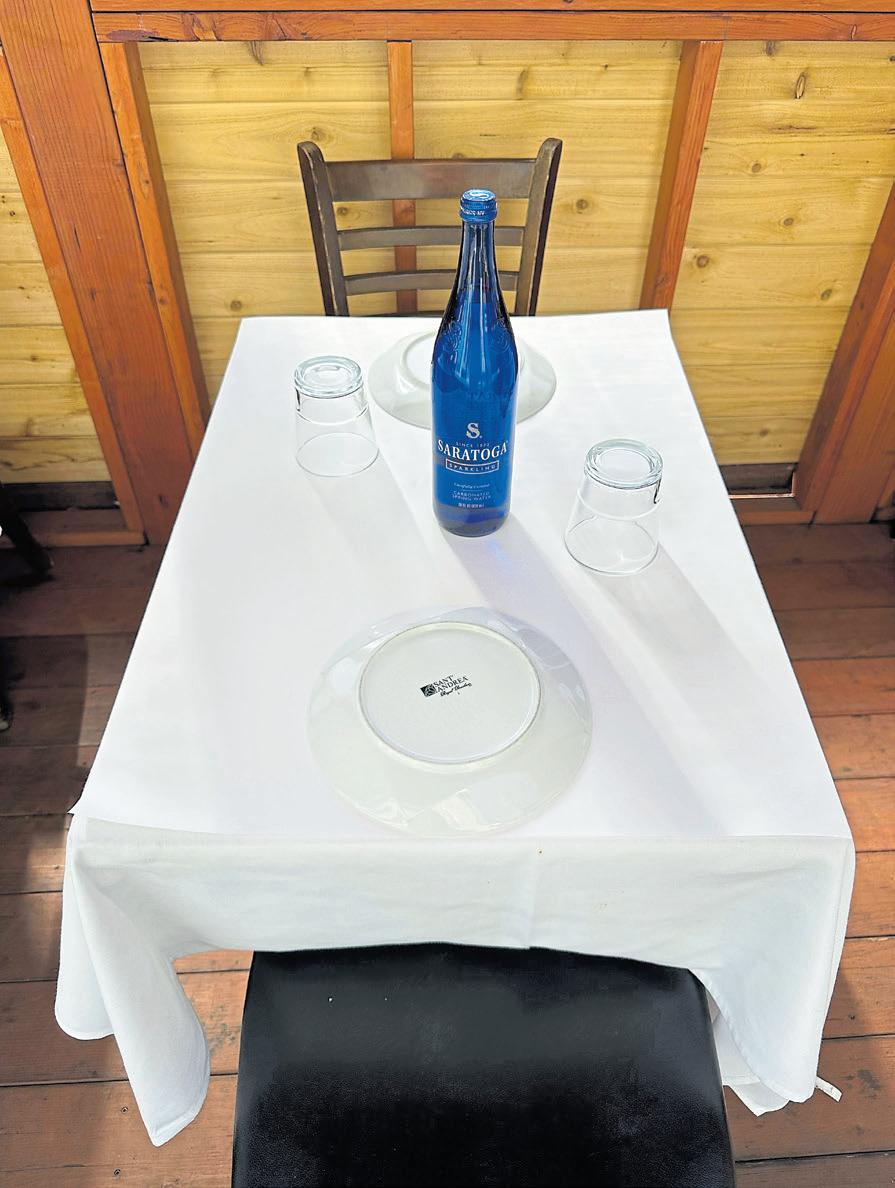
Above: A table in a parklet at Rangoon Ruby Burmese Cuisine awaits customers in Palo Alto.
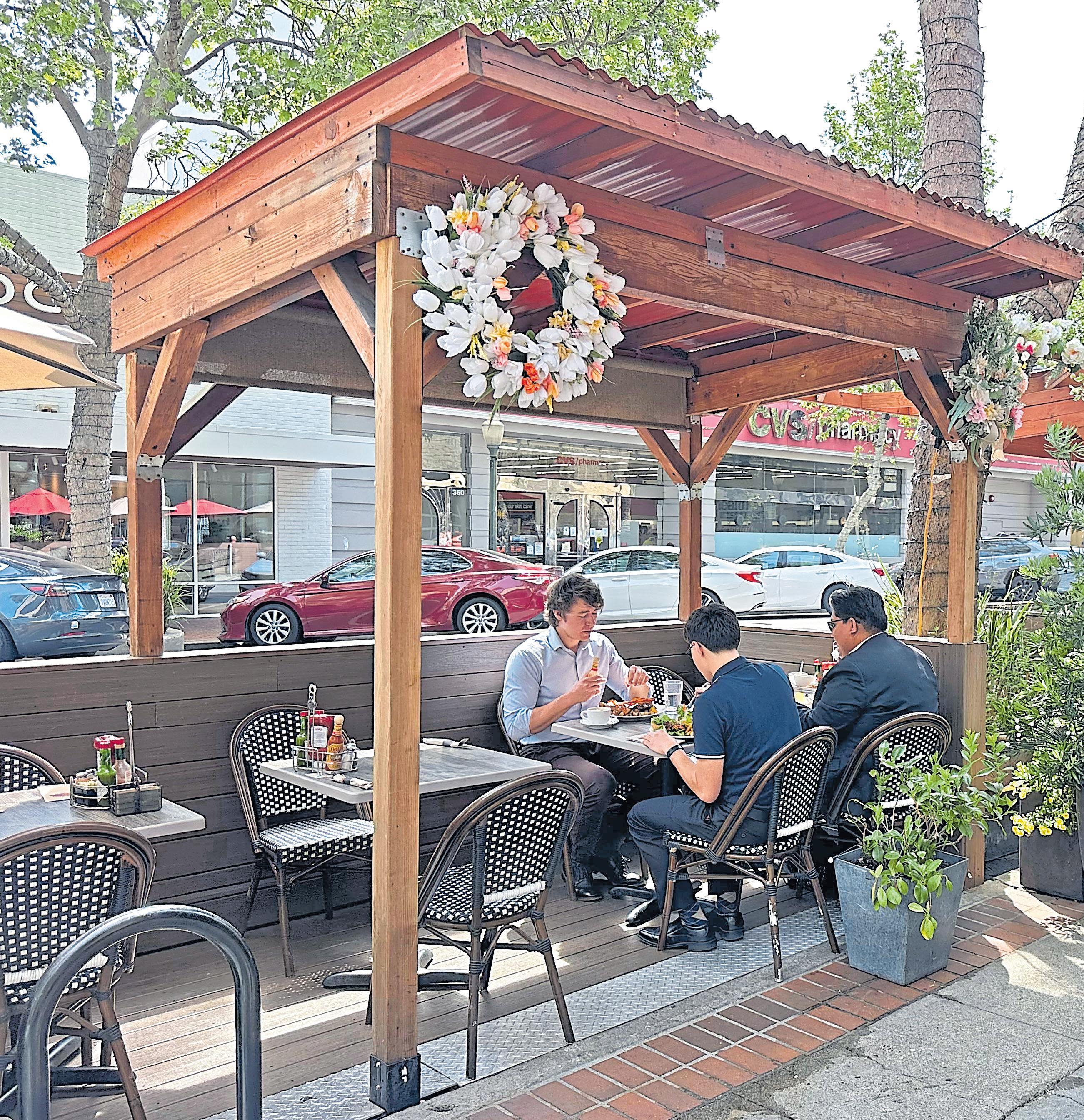
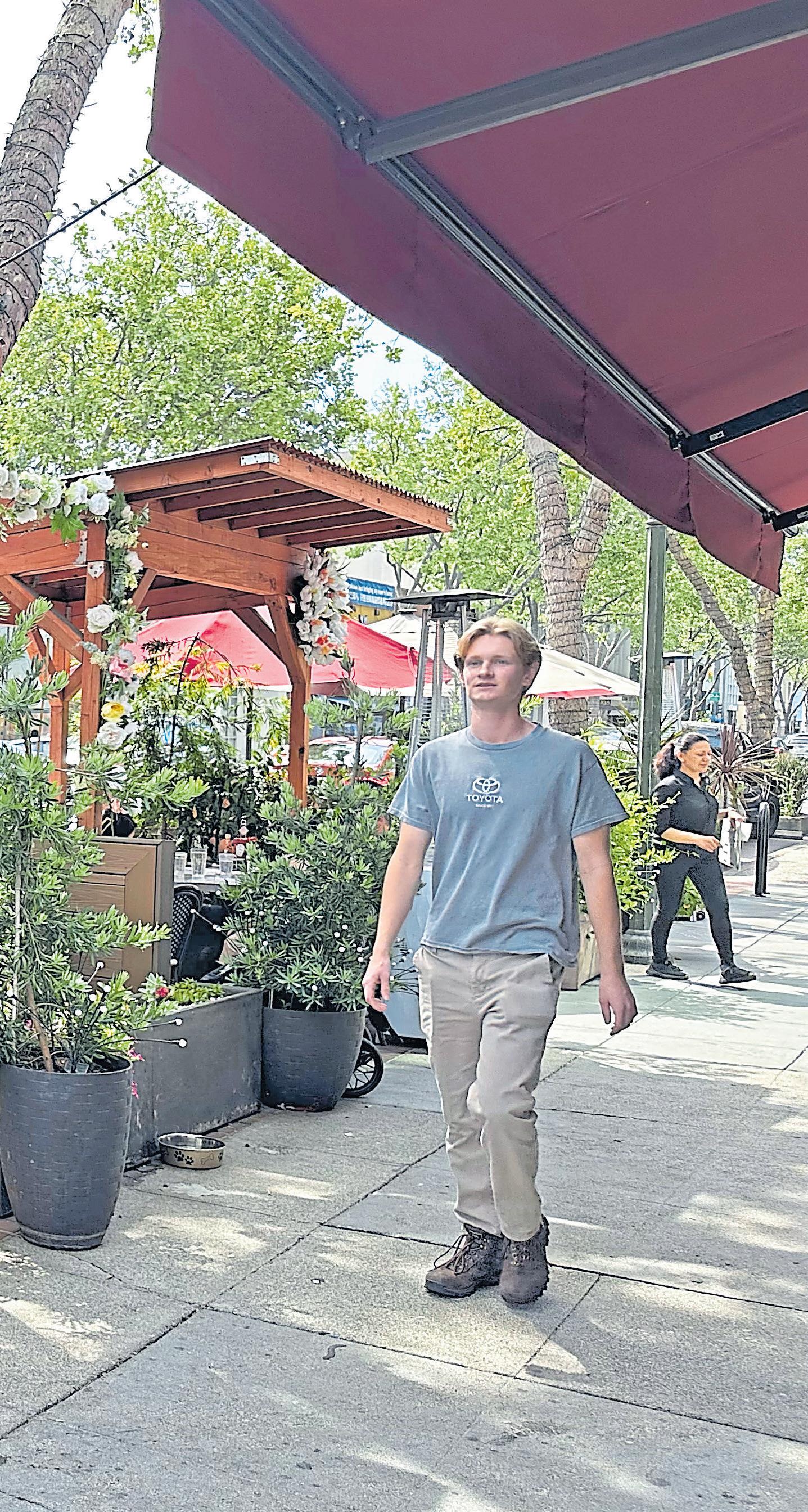
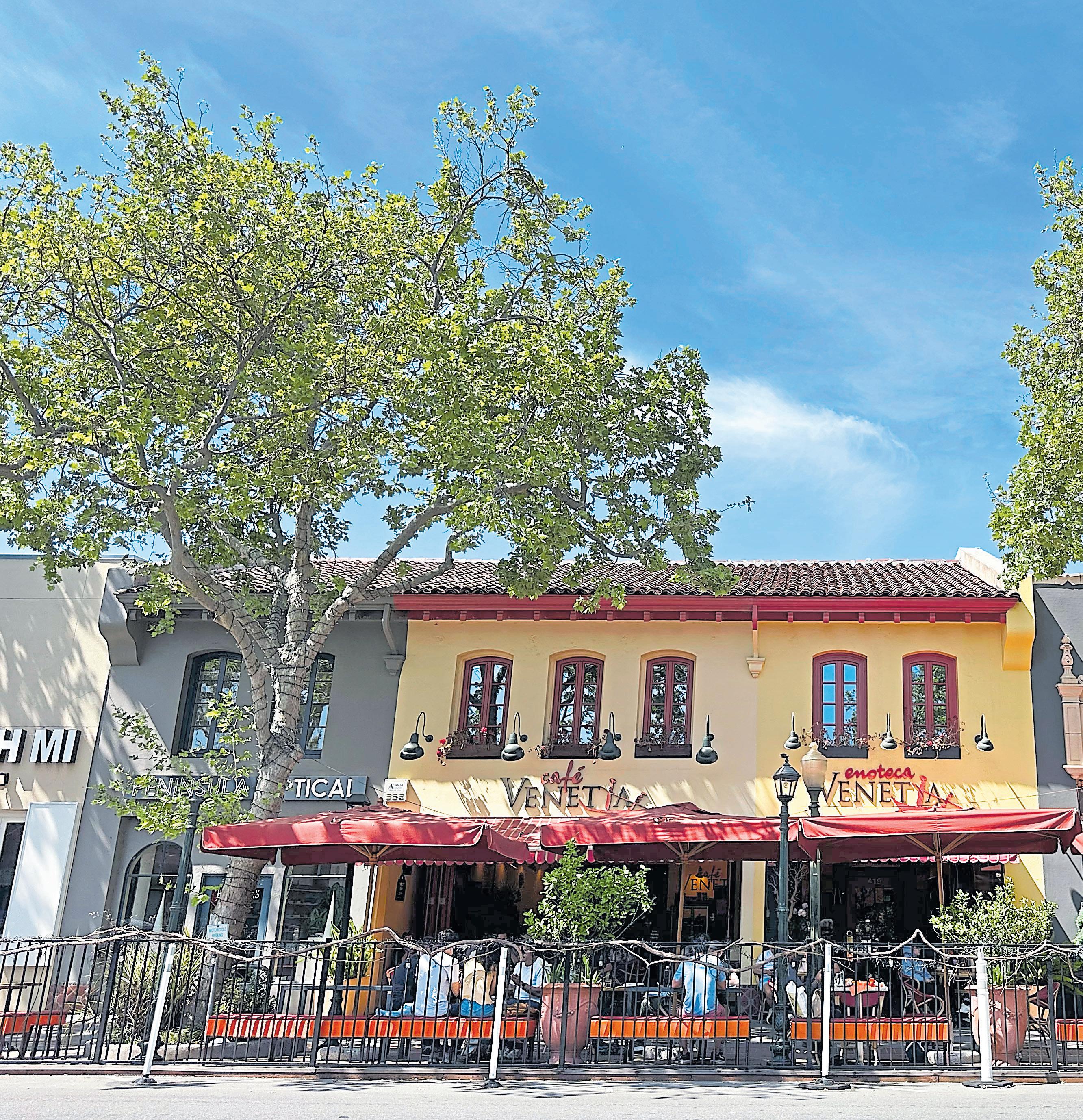
Right: After the COVID-19 pandemic, parklets like this one at Cafe Venetia on University Avenue in Palo Alto allowed businesses to utilize more space and provide unique alfresco dining.
JOSE CARLOS FAJARDO/STAFF
creating their own parklets. Official rules for downtown parklets were approved in September 2023 as the council tried to bring cohesion to the new dining spaces.
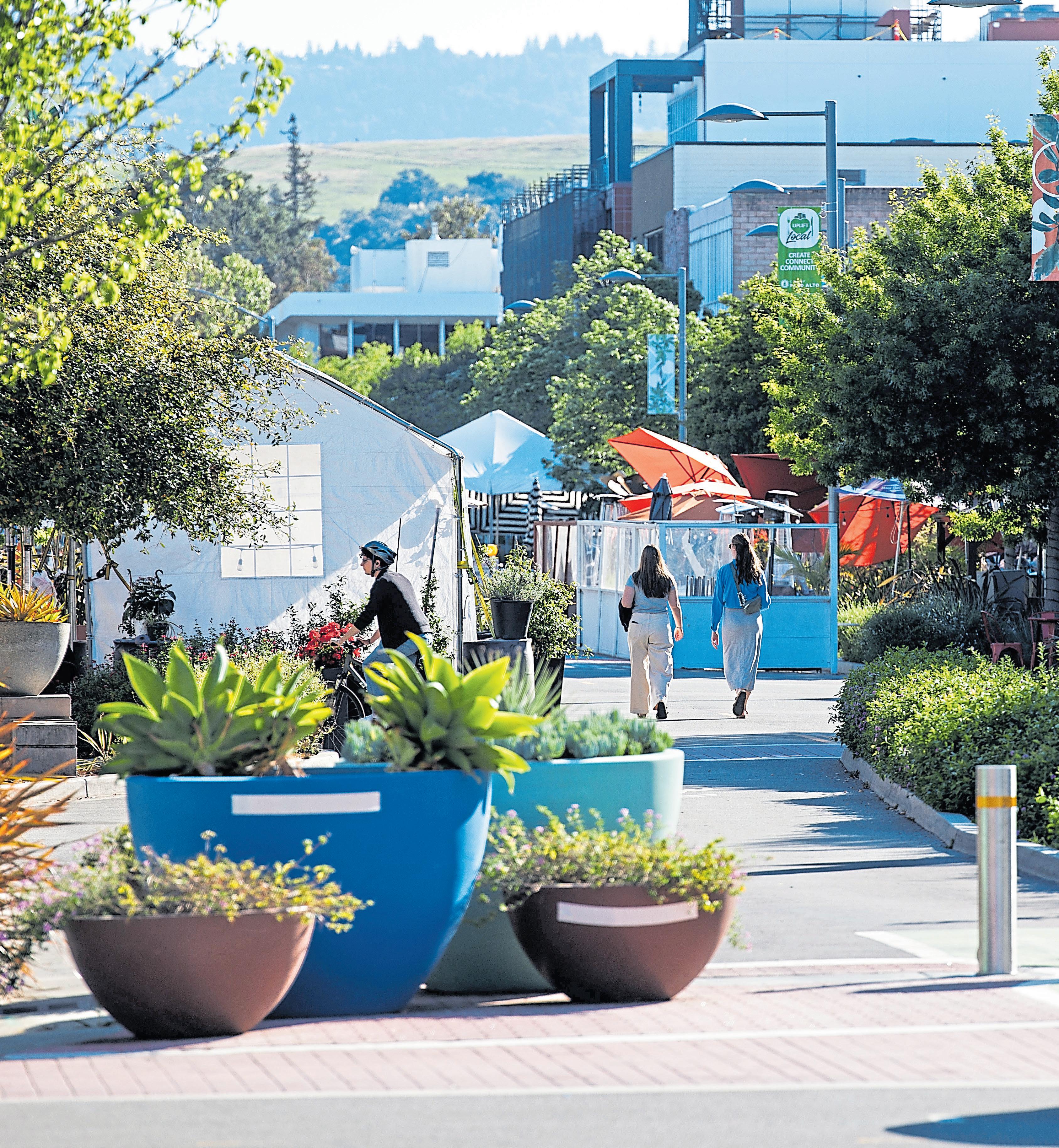
By contrast, California Avenue remained closed to cars. After several short-term extensions to the car-free program, the council agreed to permanently close it to cars last March and enhanced the strip with additional infrastructure like planters, bollards, colored pavement and bike lane markings.
“I think we’ve learned some of those hard lessons over the last few years,” Stone said.
To be fair, not everyone in Palo Alto is happy with how things have shaken out. Some retailers and
Customers enjoy sitting outside under the shade of parklets at Cafe Venetia, top, and Local Union 271, above, in Palo Alto.
JOSE CARLOS FAJARDO/STAFF
landlords have been particularly vocal opponents of the parklet program. For instance, there is ongoing litigation between downtown property owner Elizabeth Wong and the city over the downtown parklet operated by Coupa Cafe on Ramona Street, where a half-block has been similarly closed to cars. Wong is seeking more than $600,000 in damages and a nullification of the parklet, according to Palo Alto Online, alleging that the parklet resulted in her being unable to finalize a lease.
Additionally, the past few years have not been easy for many brick-and-mortar shops, as business has pivoted toward online shopping and rapid-delivery services, and some shopkeepers oppose the incursion of the parklets into their storefronts and street parking.
However, overall, it seems that what the city has been doing is working to lower vacancy rates in the zones where parklets and street closures have taken root. On University Avenue, the city’s retail vacancy rate was down to 13.4 percent in 2025 from the decade-high rate of 17.4 percent at the start of 2024, while on California Avenue, the retail vacancy rate was down to 5.4 percent in 2025 from 10 percent a year ago, according to Palo Alto spokesperson Meghan Horrigan-Taylor. Additional upcoming openings include high-end bakeries Arsicault and Croissanté on California Avenue and Auntea, La Corneta and Zhangling Malatang on University Avenue, according to Horrigan-Taylor.
Pavel Sirotin, owner at the Georgian restaurant Bevri, is a fan of Palo Alto’s parklet program. His restaurant shares a parklet with neighboring restaurant Khazana. He says the items from his kitchen — which include orange Georgian wines
and magnificently cheesy and eggy khachapuri adjaruli bread boats — take on an additional aesthetic quality when they’re lit with the natural sunshine in Palo Alto.
“We live in California, where the weather is almost always perfect,” he says.
Today, there are plans in the works to make these downtown areas even more appealing to visitors and locals alike. The city is looking to take a page out of the New Orleans playbook, à la Bourbon Street, to allow open alcohol beverage containers within the closedto-cars areas on California Avenue and Ramona Street for special events. If the proposal is approved by the City Council, it could be in effect as early as this summer, according to Stone.
Business owners, for their part, are continuing to invest in their parklet spaces. For instance, at Zola and BarZola on Bryant Street on a recent Friday, workers were installing state-of-the-art overhead heaters at the restaurants’ parklet. The installation was being led by
On bike, above, or on foot, left, people visit a section of California Avenue in Palo Alto closed to motor vehicles.
DAI SUGANO/STAFF
Daniel Goodman, who explained that the heaters, by San Francisco-based robotic heating company Focal, are designed to be energy-efficient by focusing on heating people rather than spaces and are controllable by app for restaurant visitors.
The installation is intended to “make it so that people can eat outside year-round,” says Goodman.
And while Palo Alto’s 3rdThursday concert series on California Avenue was halted this past October, additional programs could be on the way.
“The city is working on additional opportunities to activate California Avenue with various entertainment options,” Stone says.
The streetscape may also see additional changes. The city is now working on a plan to create pre-approved parklet designs on California Avenue, improve bike amenities and implement other changes that would make the outdoor dining areas feel more permanent.
“It’s going to be an exciting future for Palo Alto,” says Stone.
Town Out on the
How First Fridays became a cultural cornerstone of downtown Oakland
BY KATE BRADSHAW AND SHOMIK MUKHERJEE
Those who insist Oakland should forever be called a “town” rather than a city need look no further than its First Fridays events for validation, because that’s the feel this monthly event creates.
As the sun descended into golden hour during April’s First Friday, residents embraced as they reconnected, posing for selfies in the middle of the street. Young couples and large families shuffled through, eyeing the food trucks, merch stands and makeshift art galleries that crop up once a month on Telegraph Avenue. The theme of this month’s pop-up festival was “Oakland Blooms,” and the event lived up to its name — not just in offering a festive springtime atmosphere, but also by showcasing the efflorescence of community itself.
“Oakland is a town where everyone’s familiar with each other, even if they haven’t met,” said Desmond Ford, who operates the Oakland’s Own clothing store on Piedmont Avenue and has run a booth
A crowd of attendees mingles at the Oakland First Fridays event along Telegraph Avenue April 3.
RAY CHAVEZ/STAFF
at First Fridays for a decade.
Ford’s father, Leo, sat in a chair nearby, watching his son guide passersby through a selection of snazzy T-shirts with Oakland branding — including a spin on the popular Bass Pro Shop tee with “Lake Merritt” in the logo.
“First Friday has had different issues keeping its own brand going, dealing with the COVID shutdown,” said Leo, a clothing designer himself who raised Desmond in Oakland after moving from Texas. “But it’s persevered through that.”
The free monthly events began in 2006 as a simple art
gallery walk down several blocks of Telegraph Avenue and has gradually become a touchstone of Oakland culture.
Originally called Oakland Art Murmur, the monthly fest soon began to draw large crowds. That drew vendors, and eventually, the event started spilling out into the street, causing traffic jams and hindering public transportation, according to Oakland First Fridays’ festival director Venessa McGhee.
Then, in February 2013, during a First Fridays event, a late-night confrontation turned deadly when a shooting left 17-year-old Kiante Campbell
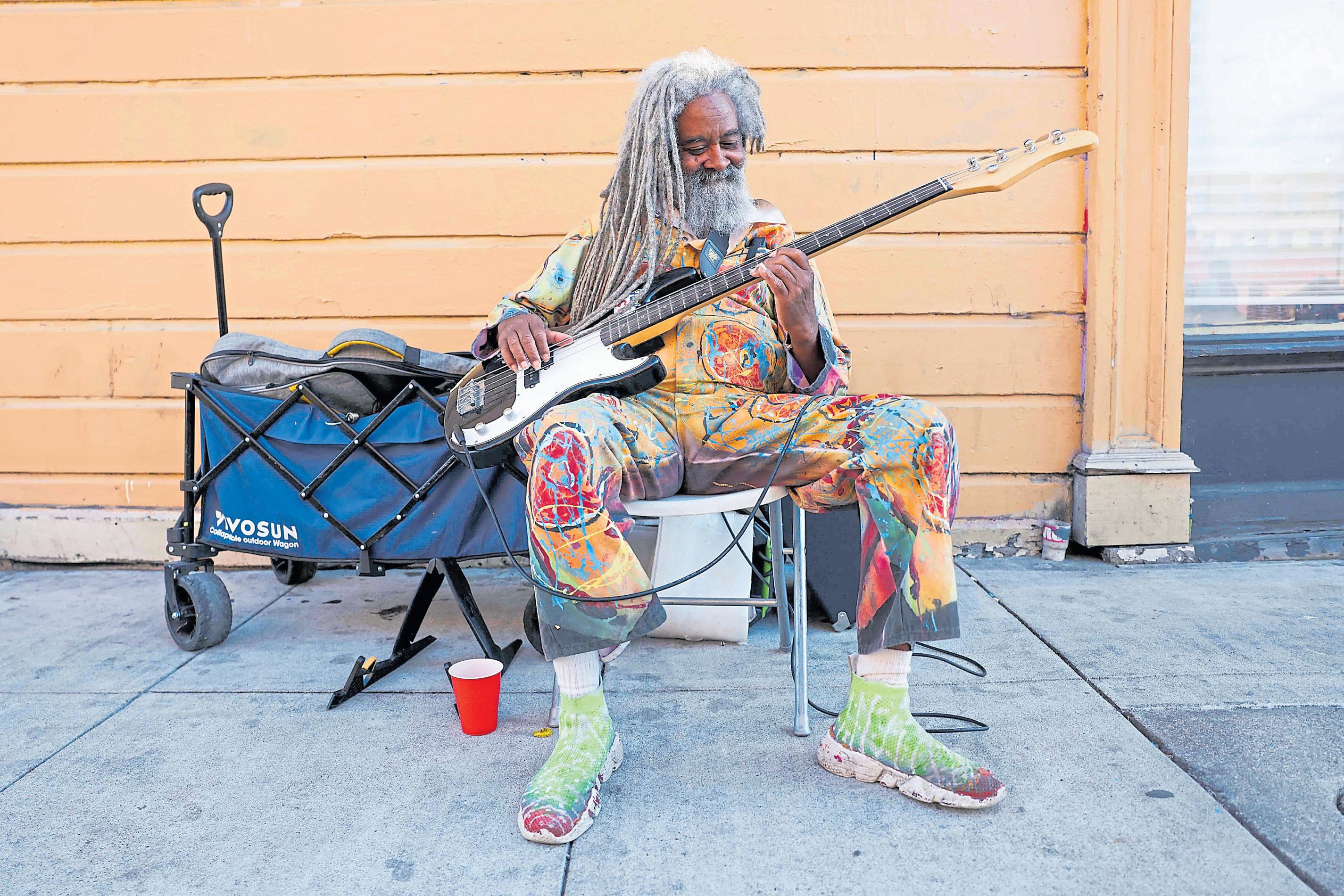
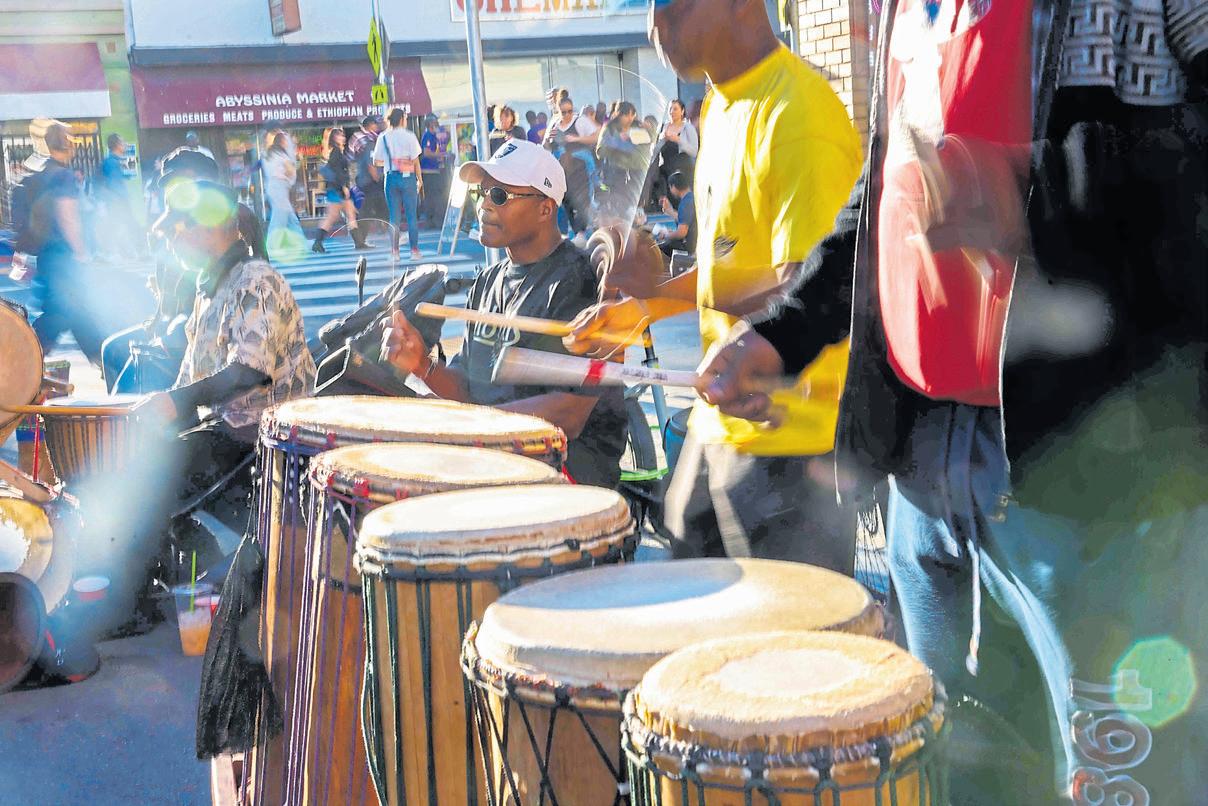
Fullani plays his guitar, above, and a group of drummers, left, performs during the Oakland First Fridays event April 3.
RAY CHAVEZ/STAFF
dead and three others injured. The homicide triggered a reckoning within the city.
“The city said, ‘Either we have to get a handle on this, or this has to go away,’” McGhee says.
At that point, the KONO district — short for Koreatown Northgate Oakland — took over the event. As a Community Benefit District — a nonprofit funded by property owners through additions to their property tax bills — it had already been providing funding for things like portapotties, says McGhee, but it became the official organizer of First Fridays in 2013. Guiding the event was a council of community members made up of vendors and creatives who helped to develop a structure for the event, and today a number of the former council participants are still involved as vendors and artists, she says.
But as the district ushered in nearly 500 new housing units, some critics argued Art Murmur’s original grassroots spirit had been lost amid the area’s rising cost of living and the city’s stricter rules around vendor permits.
Robin Balliger, a cultural anthropologist at Stanford, argued in a 2021 study that the festival effectively became a sanitized “rebranding strategy” for the local government following a forceful police response to Occupy Oakland protests in 2011.
Today, Oakland Art Murmur continues to host art walk events on the first Friday of each month, but operates separately from the Oakland First Fridays street festival. The art walk features galleries such as ARTogether, Oakland Photo Workshop, Mighty Mighty
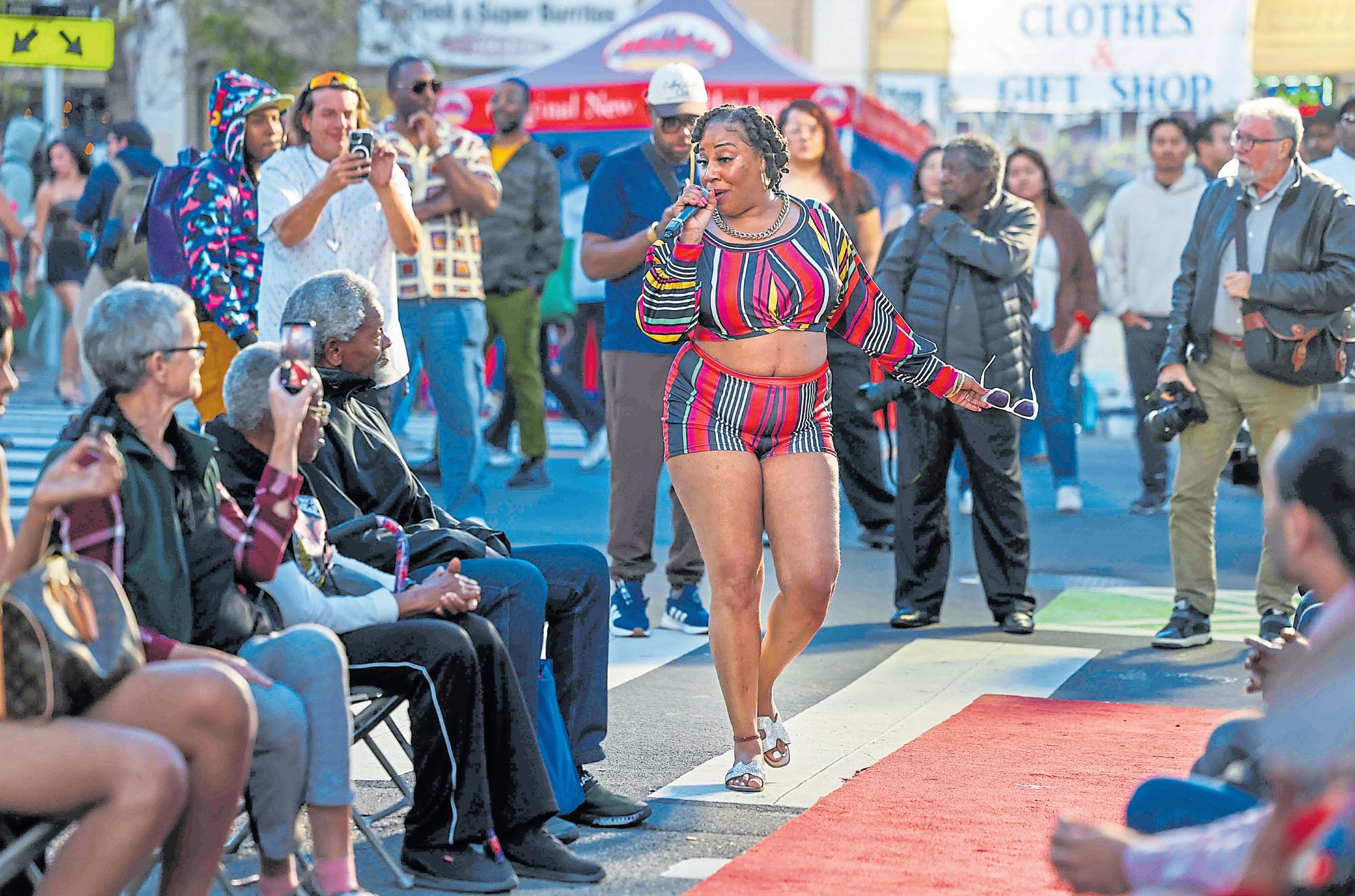
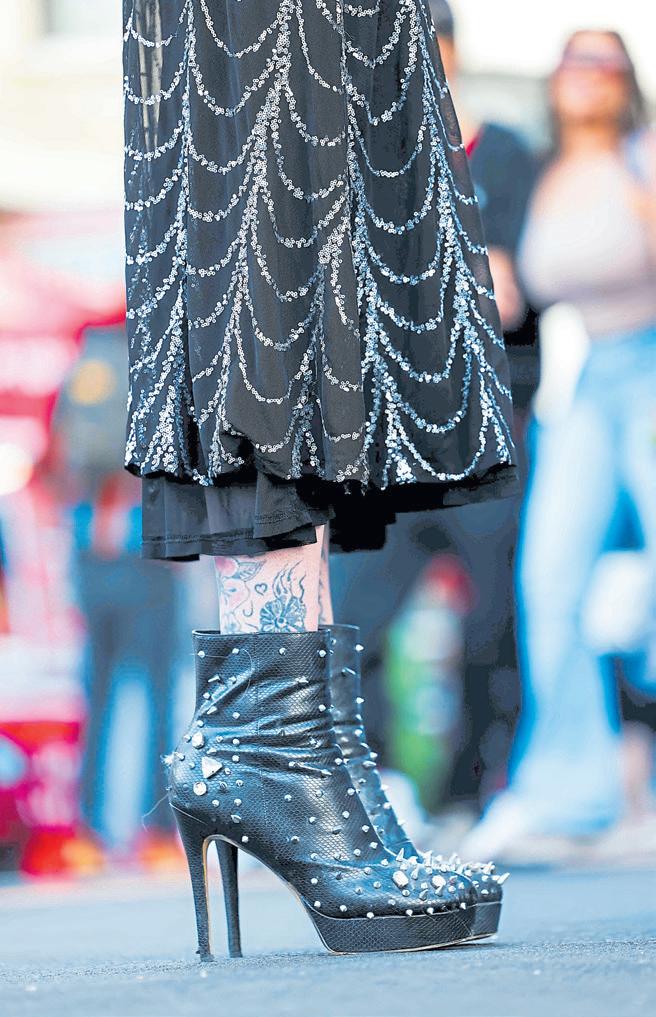
A crowd is entertained by a singer, top, prior to a fashion show during the Oakland First Fridays event along Telegraph Avenue. An attendee gets a clearer view of the show, bottom left, thanks to studded and spiked high heels.
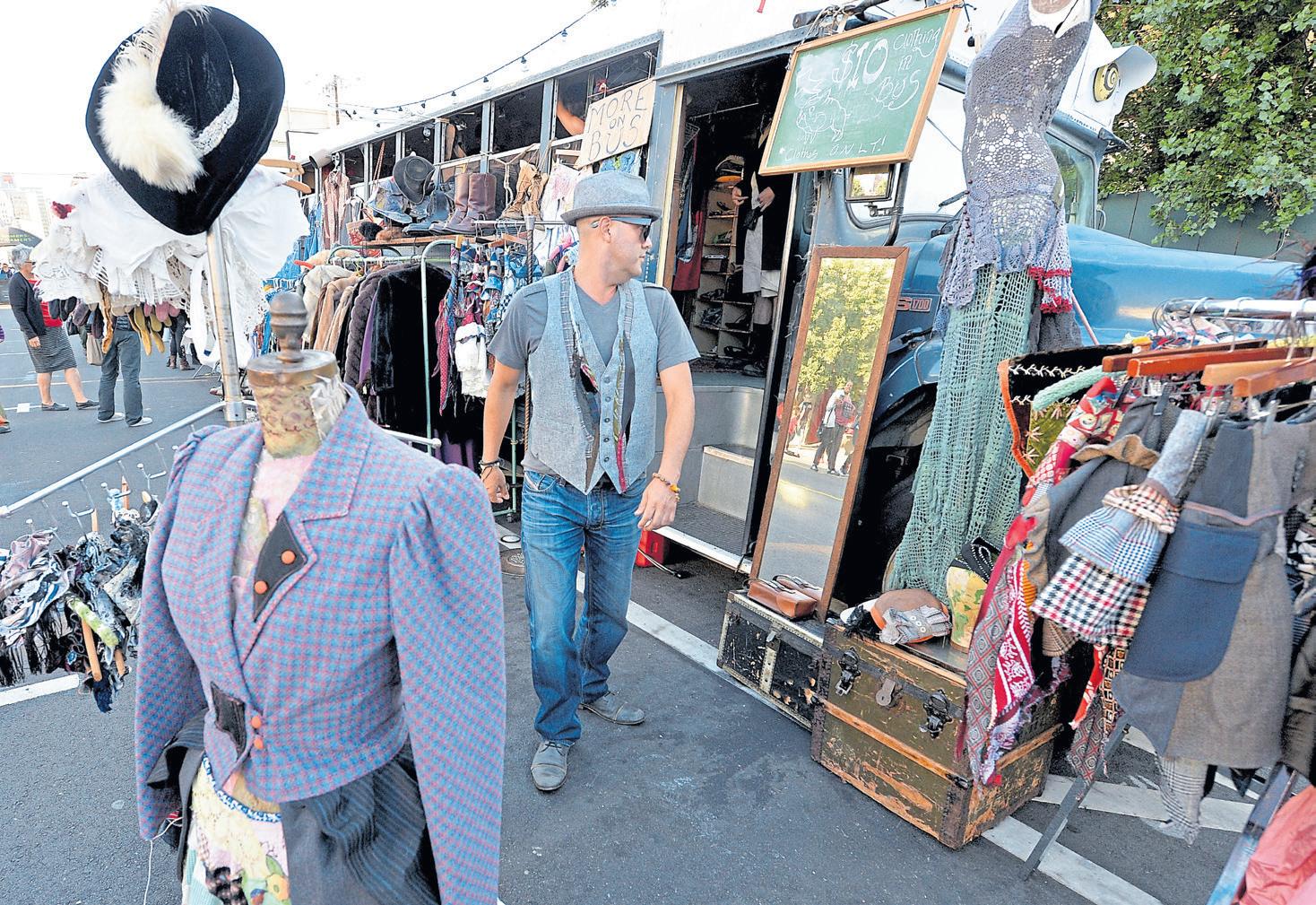
Bottom right: Christian Luna tries on a vest at The Window Lady vintage clothing bus during a First Friday in 2016.
RAY CHAVEZ/STAFF; DOUG DURAN/STAFF ARCHIVES
Studios, FM Oakland, Manna Gallery and more.
Meanwhile, McGhee is working to bring back more art to the festival, she says. For the last three years, for instance, some of the booths at First Fridays events have been reserved as free artist spaces, sponsored by Airbnb.
Today, the festival draws thousands to the city’s Uptown, packing the bars and eateries that line Telegraph Avenue and mixing a blend of streetbarbecue aromas and hyphy hip-hop into the evening air.
McGhee started out with First Fridays 11 years ago as day-ofevent staff, then helped to curate the event’s pop-up bar before becoming a full-time staffer in 2019. She has been the director for about two years and says the festival is finding its way again after plenty of turmoil.
“Over the years, with different leaderships and things like that, we’ve kind of pivoted and lost our path a little bit. But I like to believe that we are coming back
to what our true purpose is,” McGhee says. “Being a person who’s from Oakland also makes a difference, because the heart that we have for our city is just a little bit different. If you know, you know.”
One key mission of the festival is to support small businesses by creating pop-up spaces for vendors, many of whom don’t have brick-and-mortar locations. A number of the vendors that First Fridays features are new to running their own businesses, McGhee says. Oakland First Fridays supports these vendors as they secure business licenses and liability insurance and keeps those documents on hand during the events.
“I constantly tell people, ‘Don’t let wanting to be perfect stop you from getting out there. The best way for you to perfect your craft is to get out there and do it. It’s going to be a learning curve. There’s going to be things that are going to happen along the way. They’re going to teach you how to be better. And that’s
a good thing,’” McGhee says. Each month, around 65 to 75 vendor businesses participate — down from around 100 due to the addition of bike lanes through the streets of the market, a loss that has adversely affected the festival’s budget, she notes.
“Being able to be a part of the process of someone growing their business is really like watching your kid grow up,” she says. “A lot of these people have invested lots of money into start-
Players concentrate on their next chess moves outside a beauty shop during the First Fridays in Oakland, April 3.
RAY CHAVEZ/STAFF
ing their businesses, and so we want to see them be successful.”
One success story is Oakland’s Own, a local apparel brand that started at Oakland First Fridays and went on to host other popups, then secure a brick-andmortar location in Oakland’s Fruitvale district before relocating to Piedmont Avenue. The brand continues to pop up each month at First Fridays, McGhee says.
Another longtime vendor is James “Old School” Copes, the
Shayla Bell, of Stockton, performs during the Oakland’s First Fridays along Telegraph Avenue April 3.
RAY CHAVEZ/STAFF
man credited with coining the term “Oaktown” at his T-shirt shop back in the 1980s. He recalled how quickly the festival became the “hottest thing” in the Bay Area, drawing international attention for its promotion of Black culture.
“What made it unique was the spontaneity,” Copes, 75, who has missed some recent First Friday events due to health concerns, said in an interview.
“People making art on the spot, rapping, juggling, everything
you could think of — there’s a different vibe every time you walk 20 feet down.”
The pandemic, vendors note, dealt a rough blow to First Friday’s existence. The event — and its attendees — have rallied in the past couple of years, though often without the main stage concerts of the past and with fewer streetside attractions than before.
Still, business is brisk at First Fridays now, as the crowds have returned post-pandemic.
“People from all walks of life come here,” said Jabari Hopkins, who said his Oakland Native clothing spot has not missed a First Friday in eight years. “Diversity is the culture of Oakland. You can come out here and experience what Oakland is all about.”
Despite Oakland First Fridays’ successes, however, figuring out how to keep it funded is an ongoing battle, McGhee says. “Our budget is never rightside-up. It’s always upside-down. And that’s just because the cost of things is constantly rising, and we really don’t want to pass that cost on to our vendors.”
Over the past few years, she says, the City of Oakland has helped with police and fire fees, but that funding could be in jeopardy due to citywide budget challenges.
“Reaching sustainability is an absolute must in order to keep this event alive, and that’s
“Being able to be a part of the process of someone growing their business is really like watching your kid grow up. . . . We want to see them be successful.”
Venessa McGhee, First Fridays’ festival director
something that we are working really hard to get to,” she says.
“Being in operation for 20-plus years is a huge milestone, and we don’t take that lightly, but we also know that if we want to be here another 20 years, some things have to change.”
Oakland First Fridays are held the first Friday of each month along Telegraph Avenue from West Grand to 27th Street in Oakland, generally running from 5-9:30 p.m. Go to oaklandfirstfridays.org for more information or to get involved.
TURFinc dancers perform during the First Fridays in Oakland April 3. RAY CHAVEZ/STAFF
Amid rapidly changing times, Danville’s work to preserve its past is paying off
While Danville’s downtown boasts new bars, restaurants and other modern attractions, the remnants of an era when horse-drawn covered wagons and Southwest Pacific Railroad cars lumbered through the San Ramon Valley aren’t hard to spot.
In fact, all it takes is a tour in one of the European luxury cars that can often be seen in the streets — or to really get the feel, maybe a gallop along the Iron Horse Trail, which runs through downtown and into surrounding cities — to see how the past has been lovingly preserved in Danville, even as an incoming generation of young
RAY CHAVEZ/STAFF
STORY BY KYLE MARTIN
PHOTOS BY RAY CHAVEZ
A group with bicycles waits to cross the street in front of the Museum of the San Ramon Valley in Danville.
“People are now coming to Danville to be seen. It’s a quaint little town that’s not so little anymore.”
Denise Dolan
suburbanites has brought the city a new dash of 21st-century cool.
“We’ve integrated the past and the present. That’s what makes Danville unique,” says town Councilwoman Renee Morgan. “Our downtown reflects a commitment to architecture, and we’ve maintained our landmarks.”
The town, now home to more than 43,000 residents, was founded in 1858 at the end of the California Gold Rush, starting with a blacksmith, a hotel, a wheelwright and a general store on 400 acres. It spread out over an area where mastodons once roamed and where the indigenous Tactan people once hunted and gathered on Bay Miwok land before American colonization and industry took over.
The downtown evolved into a community so famously quaint and charming that the late Mike Doyle, the much-loved former mayor who passed away in 2025, decided to spend the rest of his life in Danville after a single chance stop at Elliott’s in 1954. The bar is Danville’s oldest business, dating back to 1907. Doyle loved the town so much he bought an acre of land there a year later and moved his family there from Pleasanton. He would go on to serve on the town council for 25 years — six terms as councilman and another five as mayor — and called Danville his “Camelot.”
With its long, classic wooden bar top and a steadfast cash-only policy, Elliott’s is still the most popular bar in town. The couple who now own it,
Bar owner Manny Bobele, center, looks on as patrons enjoy their drinks at Elliott’s Bar, the oldest bar in Danville.
Old agricultural tools and artifacts are on display at the Museum of the San Ramon Valley in Danville.
Patrons dine al fresco in downtown Danville.
Manny and Stephanie Bobele, have the utmost respect for its history and the regulars who have been patronizing it for decades.
“Everyone in town wanted this bar,” Manny says. “I love this place.”
After having been regulars at Elliott’s themselves for more than 25 years, the Bobeles bought it two years ago and swore to maintain its integrity: no blended drinks, no nightclub-type DJ nights and no fancy gimmicks.
“If you grew up in Danville, this is where your parents took you to get your first beer,” Manny says. “This is the best thing I’ve ever done.”
Indeed, at any given time, three generations of Danville families can still be found drinking at the bar at the same time. However, Stephanie, who has lived in Danville her whole life, says she has noticed a younger crowd taking over the night scene lately.
“It’s gotten crowded,” she says. “But it’s good for business.”
Volunteers Denise Dolan, left, and Stephanie Brown-Myers show a portion of an exhibit at the Museum of San Ramon Valley in Danville.
Elsewhere, a good example of the town’s attention to historical detail is the museum, which is housed inside the original Danville Depot — a train station that formerly served the Southern Pacific rail line — in the middle of downtown on Railroad Avenue. It still has the same wooden structure, floorboards and many of the original glass windows from when the depot was built in 1891.
Inside, museum greeters Stephanie Brown-Myers and Denise Dolan have seen how Danville’s downtown has evolved through generations, having lived in the town since the 1950s, when there were just about 2,000 residents. Now that the local population is more than 20 times bigger, they have noticed some subtle differences.
“People are now coming to Danville to be seen,” Dolan says. “It’s a quaint little town that’s not so little anymore.”
Dolan recalls how the pair attended San Ramon Valley High
Pedestrians stroll through downtown Danville, left, while a waitress takes the order of patrons dining al fresco, below.
School together, before the town had any stoplights and when Brown-Myers still rode her quarterhorse, Chubby, to the store to get milk. At that time, freight trains still came into town twice a day, at 10 a.m. and 2 p.m.
“It was more peaceful back then. There weren’t as many people ... it was just orchards and farms,” Dolan says.
Brown-Myers remembered when sprawling walnut orchards covered the surrounding landscape and Railroad Avenue was the town’s main thoroughfare — before car traffic started to fill downtown’s Hartz Avenue and Front Street.
As tech companies and urban housing developments started creeping into the area, including the nearby Tri-Valley cities of Dublin, Pleasanton and Livermore, Danville’s officials worked to preserve its historic buildings and landmarks to keep its past alive. But as the times changed, many of Danville’s residents have stuck around.
“I like the way they’ve saved all the old buildings in downtown,” Dolan says. “Everyone you meet that’s moved here, they say they wouldn’t rather live anywhere else.”
Brown-Myers agrees.
“People will come back and say, ‘oh, it’s changed,’” she says. “In my opinion, it’s changed for the good.”
MURPHY STREET
An innovative approach rejuvenates
Sunnyvale’s downtown
Saturday morning on Sunnyvale’s historic Murphy Avenue starts early and doesn’t stop.
Crimson tomatoes, perfectly ripe strawberries and freshly baked pastries call out to the city’s early risers, who peruse the weekly farmers market with a steaming cup of coffee in hand before heading to a yoga class at YogaSix or brunch at Keke’s Breakfast Cafe, where the regulars swear the food is worth the sometimes-very-long wait.
Those who prefer a slower start to their weekend can be spotted catching a midday cup of coffee or bubble tea from one of the many cafes ensconced in the downtown district or grabbing a bite at one of several al fresco dining spots on the pedestrian-only avenue, which was permanently closed to vehicles in February of 2023.
But downtown Sunnyvale really comes alive once the sun begins to set, with a vast array of bars, nightclubs and latenight dining peppered throughout the city’s streets.
On Murphy Avenue, regulars crowd the charming Irish pub Fibbar MaGees for pints and traditional Irish food or grab a strong cocktail and a game of pool next door at Paul & Harvey — a dive-bar fixture in the area since 1937.
STORY BY MOLLY GIBBS
PHOTOS BY DAI SUGANO
Visitors stroll under string lights along historic Murphy Avenue in downtown Sunnyvale.
Also hopping are Fuego, a sports bar that transforms into a nightclub in the evening with live music, and Pure, which often gets a line stretching from one end of Murphy Avenue to the other for its lineup of famous DJs and performers.
Once the bars serve their last drink and the shows end, the latenight crowd stumbles out, limbs heavy and heels often in hand, to the smell of steaming onions, peppers and grilled meat at taco stands and hot-dog carts before wandering back to the many new apartment buildings towering over the downtown streets.
This explosion of life in what just 10 years ago was a fairly quiet community nestled amid big tech and aerospace companies is largely because of Cityline Sunnyvale, a dynamic mixed-use development project in downtown Sunnyvale that has transformed the downtown streets with modern apartments, offices, restaurants and retail.
“For years and years, it was just a parking lot,” said Heather Howard, who has worked for Fibbar MaGees since it opened in 1994, of
Gumba’s Italian Restaurant pizza chef Antonio Cruz works in the kitchen as customers have dinner along historic Murphy Avenue in downtown Sunnyvale.
Sunnyvale’s downtown. She now works as the controller for Fibbar’s and its sister bar, Molly MaGees in Mountain View. “It kind of felt like a neglected area … it wasn’t really a vibrant place you go visit.”
In the late 1980s and ’90s, the downtown area was primarily a mall called Sunnyvale Town Center, explained Josh Rupert, the director of development at Hunter Properties who led the Cityline project. Over the course of nearly two decades, several developers attempted to revamp the downtown area into a dynamic mixed-use center — the mall was torn down in 2007 and some offices and residential units were constructed. But the project was largely in a state of disarray, he said, when Cityline acquired it in 2016, nearly a decade after progress on the development had halted.
“It was very complicated, frankly, at that time to sort of restart the project some eight years later,” Rupert said. “It required a lot of diligence on our side.”
Cityline constructed nearly 200 residential units, more than 100,000
square feet of retail space and about $25 million in site improvements within the first few years of the multistage project, Rupert said. Then came more residential units, the AMC movie theater and the Whole Foods grocery store — right when the pandemic shut down all business in 2020.
But within a couple of years, construction was finished on additional office and retail space as well as nearly 500 apartment units in the Martin, a luxury apartment complex that opened in 2024. Shake Shack, the popular fast food joint, opened up underneath the Martin earlier this month, with
“You’re seeing a transition from an older downtown into a newer downtown. And just knowing that it’s all combined together is really unique in comparison to quite a few other downtowns.” Sunnyvale resident Kristina Kawczynski
lines stretching down the street, Rupert said.
“The opportunity to redevelop a downtown in any location is unique,” Rupert said. “We wanted a mixed-use environment that was dynamic at all hours of the day. We wanted to have offices that support retail, and we wanted to have retail that supports the residential.”
While other downtown areas in the Bay Area have experienced a slow recovery from the pandemic, downtown Sunnyvale seems to have fasttracked its growth.
Other recent additions include the Palo Alto Pakistani-Indian restaurant Zareen’s, while Databricks is expected to move into the downtown offices in late 2026, joining CrowdStrike and Nokia.
Kristina Kawczynski, 39, has been a Sunnyvale resident her whole life and has lived at the Martin apartment complex since it opened in August 2024. She said Cityline has transformed the city and offered something she’s never experienced — the chance to live in the heart of a bustling downtown area with nearly everything within reach.
“It’s ever-changing, and I love that about downtown,” she said. “There’s always something going on.”
Kawczynski said downtown Sunnyvale is unique primarily because of its layout — instead of just a singular, long main street, the downtown area is more of a square of neighboring streets.
“When you go from Murphy Avenue and you’re having to go to a movie at AMC, you’re passing
Top: Evelyn Lin, of San Jose, front, and her husband, Nicholas Yin, play pool at Lucky Shot Billiards. Above: Karina Nolan, of Mountain View, seen through a window, enjoys an evening with family at Fibbar Magees Irish pub.
by the brand new office buildings, the Martin, the Redwood Square,” she said. “You’re seeing a transition from an older downtown into a newer downtown. And just knowing that it’s all combined together is really unique in comparison to quite a few other downtowns.”
She said downtown Sunnyvale’s strong sense of community between residents, business owners and the city’s leadership is another part of its appeal.
“It’s definitely kind of a camaraderie down here,” she said. “Walking around downtown, I see a lot of very familiar faces. Some of the coffee shops and businesses that I frequent not only recognize me, but (also) some of the people that I’ve brought with to dinner. A lot of businesses also tend to look out for each other.”
Widely considered the birthplace of the commercial video game industry, Sunnyvale is still a hub for innovation and technology, with the headquarters for Lockheed Martin, Apple, Google, Meta and LinkedIn located throughout the city. Many of those companies’ employees call downtown Sunnyvale home.
Heather Gerloch, founder of the marketing firm MDR Consulting with Cityline, said nearly half of the city’s population comes from overseas, with many foreign workers dealing with culture shock and the challenges of connecting with others while
Top: Banners and neon signs decorate historic Murphy Avenue in downtown Sunnyvale.
Right: Street performer Anthony Bunales sings to patrons visiting businesses along Murphy Avenue.
working long hours.
Cityline’s goal, Gerloch said, was to create an opportunity for residents to connect, discover new businesses and feel at home.
“My goal is really to create community,” Gerloch said. “We want to create a destination where people want to be.”
Gerloch said that in 2025, Cityline hosted 41 events downtown, including 13 festivals, with more than 150,000 attendees. They included everything from car and craft shows to art and fitness classes to singles events, music series and vintage markets.
Ethan Zhu, 37, leads data science and analytics for DoorDash and moved to Sunnyvale in 2023. A Bay Area resident since 2007, he said Sunnyvale has a unique downtown compared to other cities in the South Bay.
“It’s very convenient, and it has all these shops, supermarkets and movie theaters within walking distance,” Zhu said.
He said he loves attending the events in downtown Sunnyvale, which offer him a chance to try new food, explore downtown businesses and meet people.
“You just bump into people,” Zhu said. “I actually reconnected with some people while we were waiting in the same line at one of the food stalls.”
While she’s happy to see Sunnyvale thrive, Howard said she also knows that many of Fibbar MaGee’s longtime regulars have been priced out of the downtown area, as housing costs continue to rise. Walkability is an essential part of Sunnyvale’s vibrancy, she said, but very few of those regulars live within walking distance of the downtown area now.
However, she remains hopeful that downtown Sunnyvale will continue to thrive for years to come.
“I have hopes that the entire area will stay successful, but I think we’re still going to see some turnover,” she said. “At its best, there’s no place I’d rather be.”
A menu displays the daily specials at Fibbar Magees Irish pub, above, while a bartender pours a glass of Guinness, left.
Top: An art installation at the corner of McKinley and Taaffe avenues bring color to the Cityline district of Sunnyvale.
HUMDRUM FROM TO HOTSPOT
How Livermore built a lively downtown
BY MARTHA ROSS
PHOTOS BY JOSE CARLOS FAJARDO
On a late Friday afternoon in March, Julia Huckins has brought her 4-year-old son Malcolm into downtown Livermore to treat him to some Meadow Lark Dairy soft-serve ice cream, meet up with other moms and let their kids run around in a nearby park.
For the lifelong Livermore resident, downtown has become that kind of destination — a place to find good food and fun things to do during the day or after dark. It’s a very different downtown than when the 29-year-old Huckins was growing up here — back then, First Street was lined with empty storefronts, and the main place to hang out was Wienerschnitzel.
“Livermore has everything now,” Huckins said. “You’ve got the beautiful vineyards; you’ve got the scenery and then, of course, the downtown. It’s hard to find a place
A family enjoys the water fountain in downtown Livermore.
JOSE CARLOS FAJARDO/STAFF
with a good downtown that’s busy and has enough to do. But it’s not so, you know, big city. It’s still a hidden gem.”
But judging from all the people crowding into downtown on that unseasonably warm March afternoon, Livermore isn’t so hidden anymore. There were scores of people, including teens from nearby Livermore High, sitting outside the recently opened Meadowlark Dairy, trying to finish their ice cream before it melted. Nearby, a little girl splashed in the fountain beneath the landmark flagpole overlooking South Livermore Avenue. Along First Street, fashionable young couples and wealthy empty nesters strolled by sidewalk pergolas. Some popped into upscale boutiques, while others enjoyed al fresco dinners or TGIF libations in chic breweries, wine bars and cocktail lounges, all housed within stylishly refurbished vintage buildings.
In the whimsically elegant Fat Pigeon bar, two friends celebrated a belated birthday with a craft-cocktail version of high tea, surrounded by “Wizard of Oz”-inspired decor. Renee Dale of Galt said Livermore has become one of the busier and most fun downtowns she’s visited lately, while Leesa Piper Teves of Dublin gushed about the choice of restaurants and her delight in meeting Oscar-winning actor Billy Bob Thornton in 2023, when he and his rock band The Boxmasters performed at the Bankhead Theater.
Livermore’s evolution into a happening place began more than 20 years ago, when city planners and the community began to focus on investing in
downtown, supporting local businesses and trying some interesting urban-design strategies to improve the look and feel of the city.
Like the denizens of many midsized Bay Area suburbs, Livermore residents wanted to have a lively, attractive and walkable downtown. They also wanted it to reflect their community’s unique history and culture. The town of 85,000 is surrounded by a historic wine country and home to the 108-year-old Liver-
Plants and bold colors frame the decor at The Fat Pigeon in Livermore, while “The Wizard of Oz” plays on a screen above the bar.
more Rodeo and two national laboratories, Lawrence Livermore and Sandia, which opened in the 1950s. Over the century, the population has included farmers, ranchers, cowboys, young families and Ph.D.s and nuclear scientists.
“You know, we sort of dreamed that maybe it would be a destination, but we thought we’re mostly doing this for Livermore residents — businesses and folks that are here,” said Brandon Caldwell, a Liver-
more native who serves as the city’s innovation and economic development director. “But we were successful (enough) with the design and place-making that we have become a broader destination for people in the Bay Area.”
Livermore’s new downtown still has a “small-town” feel, but with big-city amenities that appeal to its increasingly educated, affluent and international population, said longtime resident Greg Acton. There’s plenty
of arts and culture, anchored by its regional performing arts venue, the Bankhead Theater, and the two movie theaters at either end of downtown.
There’s also a plethora of restaurants of increasing quality and Michelin-level aspirations, which Eduardo Posada, the chef and owner of the popular Posada Restaurant, says has inspired him to raise his game. Livermore’s nightlife has also taken off, with bars hosting live rock, jazz and blues music,
karaoke and comedy nights. There’s also line-dancing and mechanical bull-riding at the new Stampede Bar and Grill. These places exist alongside unique mom-and-pop businesses that have been around for decades: Fantasy Books and Games comic book store, the beloved Donut Wheel bakery and Baughman’s Western Outfitters, the city’s go-to place to buy cowboy hats, boots and other apparel since 1881. Further down First Street is the Vine Cinema — a landmark movie theater which first opened in 1956 and has survived the pandemic and the rise of streaming through cineaste-centric special events and “the love of the community,” said longtime owner Kenny Way.
To revitalize Livermore’s downtown, the city first had to overcome a serious quirk of its geography. The city was established in the late 1860s in a fer-
tile valley alongside the Western Pacific Railroad tracks, which was all well and good because that allowed it to become a small commercial hub and shipping and processing center for local farmers, ranchers and winemakers.
But by the end of the 20th century, State Route 84 was running through downtown, with the sole purpose of conveying commuters back and forth between the Livermore Valley and Fremont and San Jose. First Street was essentially a fourlane highway, which meant that downtown had become a place to pass through, rather than a destination.
For city planners and residents, the first order of business in the early 2000s was to shift the highway traffic to the west and transform First Street into a pedestrian-friendly, two-lane street with wide enough sidewalks to accommodate outdoor dining and landscaped spaces where people could gather.
The city also began to approve a number of major projects to make the downtown more inviting, such as new plazas and a parking garage. It also said yes to rehabbing historic buildings and a plan to expand Blacksmith Square to include new retail and restaurants overlooking Stockman Park, according to assistant city manager Paul Spence.
Livermore also has encouraged people to move back into downtown by approving new townhouse and multifamily developments such as the Legacy Apartments, which recently welcomed a Slice House pizza restaurant to its retail-focused ground floor. More people living downtown means more people
Top: Patrons enjoy the atmosphere inside the First Street Alehouse.
Above: A drink called the “Ruby Slipper” is served at The Fat Pigeon.
out and about, coming home from work or going out to eat and shop nearby.
The downtown makeover picked up momentum with the construction of the Livermore Valley Center, a retail-office-restaurant project that is anchored by the Livermore Cinema and Bankhead Theater. The venues opened in 2006 and 2007, respectively, and have proven that it pays for cities to put arts and culture at the heart of community development.
The Bankhead hosts more than 220 events a year, including local performing arts groups and headline music and comedy stars such as LeAnn Rimes, Ruthie Foster, Marc Maron and Jason Alexander. The large plaza out front has become the site for regular food, wine, family and cultural events, such as a ComicCon and a “Palate: Art of Cuisine” culinary competition in June as well as ArtWalk, the Taste of Africa and Pride Fest in October.
“There’s a ton of Ph.D.s that live in Livermore, and they really like their art,” said Chris Carter, the executive director of Livermore Valley Arts, the nonprofit that manages the Bankhead Theater and the Bothwell Arts Center.
Above: Richard Streeter plays the guitar from a bench on First Street in Livermore.
JOSE CARLOS FAJARDO/STAFF
Opposite: Visitors dine out in downtown Livermore.
RAY CHAVEZ / STAFF
Carter said the Bankhead attracts up to 90,000 people a year, whose spending at local restaurants and other businesses supports jobs and contributes about $2 million a year to the local economy. Since the Bankhead and Livermore Cinema opened, a number of popular restaurants — including Zachary’s Pizza, Sauced BBQ and Spirits and Locanda Wine Bar have transformed a once-desolate block into a buzzing culinary destination.
Tom Lawrie, who has opened Sons of Liberty Alehouse and the Honeycomb Lounge, remembers passing through Livermore 25 years ago — and it was not a good experience. “I had never been to Livermore, and I had a flat tire,” said Lawrie. “I drove around on a Sunday afternoon, trying to find someplace, but everything was closed.”
Fast forward to a few years ago, after he and his wife Teresa opened their first Sons of Liberty in downtown San Leandro in 2016. Some San Leandro police officers who commute from Livermore gave him some good advice, telling them they could “kill it” if they opened a second location on First Street.
“It’s gone well,” Lawrie said. “Livermore loves what we’ve done so far. They love supporting local businesses, for sure.”
Whether you’re looking for the best day trips or new places to discover in your own city, these free newsletters offer plenty of inspiration.
Take a peek below, then sign up at mercurynews.com/newsletters or eastbaytimes.com/newsletters . Your Bay Area guide to what to do this weekend — hikes, shows, festivals and more — arrives every Thursday morning. apps.mercurynews.com/newsletters/weekender
THE WEEKENDER
EAT+DRINK
Buzzy new restaurant openings, taproom updates and delicious recipe inspiration fill this free weekday newsletter. apps.mercurynews.com/newsletters/eat-drink
TRAVEL+PLAY
Find inspiration for West Coast road trips, weekend getaways and close-to-home fun here every Monday morning. apps.mercurynews.com/newsletters/travel-play