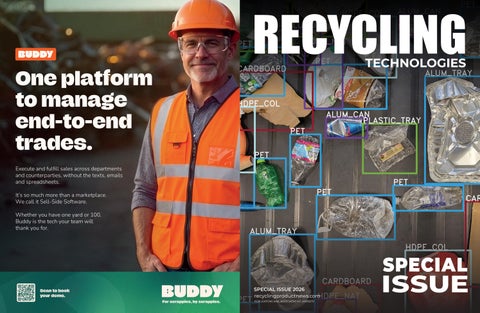
One platform to manage end-to-end trades. Execute and fulfill sales across departments and counterparties, without the texts, emails and spreadsheets. It’s so much more than a marketplace. We call it Sell-Side Software. Whether you have one yard or 100, Buddy is the tech your team will thank you for.
SPECIAL
Scan to book your demo.
SPECIAL ISSUE 2026 recyclingproductnews.com PUBLICATIONS MAIL AGREEMENT NO. 40069270
ISSUE
pipes caps/closures plastic trash bins CNC waste corrugate plastic profiles purge/lumps cardboard/cores injection molding pulper waste automotive scrap IBC barrels agricultural film ...and much more.
10
AI IDENTIFIES, AIR SORTS Recycling Technologies 2026 | Volume 2, Number 1
14 28
WHAT THE SORTER SEES
AUTONOMY STARTS WITH INTEGRATION
44
DASHCAMS GIVE RECYCLING FLEETS A CLEARER PICTURE OF RISK
FEATURES
DEPARTMENTS & SECTIONS
10
AI identifies, air sorts
8
From the Editor
14
What the sorter sees
10
Sorting & Separation
20
From plant intelligence to automation
32
Trading
28
Autonomy starts with integration
36
Automation
32
Hedging without the guesswork
38
Digital Marketplaces
40
Monitoring Systems
36
Automated bale dewiring cuts shredder blade maintenance in half
44
Insurance
38
Q&A: Jeffrey Zwirsky on giving scrapyards more exposure to buyers
46
Advertiser Index
40
Seeing heat before flames
44
Dashcams give recycling fleets a clearer picture of risk
BEFORE
AFTER
RECYCLING TECHNOLOGIES 2026 | VOLUME 2 • NUMBER 1 EDITOR & DIRECTOR OF DIGITAL STRATEGY Slone Fox sfox@baumpub.com 604-291-9900 ext. 335
ADVERTISING PRODUCTION MANAGER Tina Anderson production@baumpub.com 604-291-9900 ext. 222
EDITOR IN CHIEF Kaitlyn Till ktill@baumpub.com 604-291-9900 ext. 330
DESIGN & PRODUCTION Morena Zanotto morena@baumpub.com 604-291-9900 ext. 325
SENIOR WRITER Meghan Barton mbarton@baumpub.com 604-291-9900 ext. 305
PRESIDENT/PUBLISHER Ken Singer ksinger@baumpub.com 604-291-9900 ext. 226
ASSOCIATE EDITOR Stephanie Bontorin sbontorin@baumpub.com 604-291-9900
VICE PRESIDENT/CONTROLLER Melvin Date Chong mdatechong@baumpub.com
VICE PRESIDENT OF SALES/ ASSOCIATE PUBLISHER Sam Esmaili sam@baumpub.com 604-291-9900 ext. 110
FROM THE COVER Green Machine’s Green Eye Ai recognizes objects and automates sorting decisions using the same visual cues a human sorter would. Read more on page 14.
FOUNDER Engelbert J. Baum
Published by: Baum Publications Ltd. 124 - 2323 Boundary Road Vancouver, BC, Canada V5M 4V8 Tel: 604-291-9900 Toll-free: 1-888-286-3630 Fax: 604-291-1906 www.baumpub.com www.recyclingproductnews.com @RecyclingPN FOR ALL CIRCULATION INQUIRIES Toll-free: 1-866-764-0227 email: rpn@mysubscription.ca Subscription: To subscribe, renew your subscription, or change your address or other information, go to: https://www.recyclingproductnews.com/ mysubscription/subscribe
CONNECT WITH US
@RecyclingPN
Recycling Product News is published six times yearly: January/February, March/April, May/June, July/August, September/October, November/ December. Advertising closes at the beginning of the issue month. One year subscription rates for others: Canada $33.50 + 1.68 GST = $35.18; U.S.A. $40; other countries $63.50. Single copies $6.00 + 0.30 GST = $6.30; outside Canada $7.00. All prices are in Canadian funds. Recycling Product News accepts no responsibility or liability for reported claims made by manufacturers and/or distributors for products or services; the views and opinions expressed are those of the authors and not necessarily those of Baum Publications Ltd. We acknowledge the financial support of the Government of Canada. Copyright 2026 Baum Publications Ltd. No portion of this publication may be reproduced without permission of the publishers. Printed on paper made of FSC®-certified and other controlled material. ISSN 1715-7013. PUBLICATIONS MAIL AGREEMENT NO. 40069270.
WE’D LIKE TO HEAR FROM YOU Do you have a story, equipment, or technology innovation, commentary, or news that our readers in the recycling industry should know about? Drop us a line any time.
Return undeliverable Canadian addresses to: Circulation Dept., PO Box 430 Stn Main, Alliston, ON L9R 1V6 email: rpn@mysubscription.ca / 705-502-0024
Retrofit for Results. Modernize your MRF with engineered retrofit solutions that increase throughput, reduce operating costs, and unlock new commodity recovery opportunities.
Increase Throughput
FiberMax™
Reduce OPEX
PlasticMax™
Improve Efficiency
FilmMax™
Extend System Life
Auger Screens
Future-Ready
Al Sorting
Contact: Editor Slone Fox at sfox@baumpub.com or 604-291-9900 ext. 335
OCC
Fiber
Plastics
PP
Film
Last Chance Recovery
FROM THE EDITOR
FROM THE EDITOR
Unmatched solutions for a range of industry sectors.
THE CONVERSATION CONTINUES
Converters/Box Plants
Horizontal Auto-Tie Balers, Horizontal Auto-Eject Balers
Distribution Centers
Horizontal Auto-Tie Balers, Horizontal Auto-Eject Balers
Ferrous/Nonferrous/Auto Recyclers
Triple Compression Balers, Baler/Loggers, Shears, Shredders, Two-Ram Balers
MRFs
Two-Ram Balers, Horizontal Auto-Tie Balers, Horizontal Auto-Eject Balers
Paper Recyclers/Document Destruction
Horizontal Auto-Tie Balers, Horizontal Auto-Eject Balers, Two-Ram Balers
T
here’s no shortage of pressure on recyclers these days: material streams are getting more complex, buyers keep asking for cleaner bales, regulations keep raising the bar on reporting, and finding skilled people to run the floor hasn’t gotten any easier. Technology has become the most realistic answer to all four at once, which is why we devoted last year’s inaugural Recycling Technologies special issue to it. Today, the conversation looks very different, and so does our second technology issue. A year ago, automation and artificial intelligence were things recyclers were watching with interest. Some were running pilots, others were waiting to see what the early adopters learned, and many were still weighing the cost versus the payoff. Now these tools are running on the floor every day, sorting material, monitoring equipment, and flagging safety risks around the clock. That shift has changed what the industry is asking for. Facilities that once wanted to know what a robot or a vision system could do now want to know how those systems fit together and how the data they produce can guide decisions across the whole operation. This issue looks at what comes next, now that these tools have become central to how facilities and yards operate. Automation, for example, has moved well past the sorting line. In fire detection, thermal imaging and smart suppression systems can catch a potential fire incident in seconds. In maintenance, sensors can flag a failing component before it shuts production down. And in the office, software now handles the logging, tracking, and trading that used to take hours out of the day. Each of these is valuable on its own, but the real gains show up when they share information and start working as one system. One thing worth repeating from last year’s issue of Recycling Technologies is that technology isn’t about replacing people. At a time when so many facilities are struggling to find and keep skilled workers, automation takes on the repetitive, haz-
9
Plastic Recycling
Two-Ram Balers, Horizontal Auto-Tie Balers, Horizontal Auto-Eject Balers
At a time when so many facilities are struggling to find and keep skilled workers, automation takes on the repetitive, hazardous, and high-volume work so people can focus on what machines can’t do.
Printers
Horizontal Auto-Tie Balers, Horizontal Auto-Eject Balers
Specialty Markets
Rubber Balers, Drum Crushers, Foam Balers
Textile Recyclers
Horizontal Auto-Tie Balers, Horizontal Auto-Eject Balers, Two-Ram Balers
Waste Transfer Stations Two-Ram Balers, TransPak
ardous, and high-volume work so people can focus on what machines can’t do. Judgment, problem-solving, and experience still decide how well a facility runs, even with the best equipment in place. In the pages ahead, you’ll find the equipment and technologies shaping how recycling facilities operate today, along with a look at where they’re headed next. Some of it may validate what you’re already doing, but some of it may change how you think about your next investment. As always, thanks for reading!
recyclingproductnews.com | RECYCLING TECHNOLOGIES 2026
SLONE FOX Editor sfox@baumpub.com recyclingproductnews.com
Application Expertise · Legendary Performance · Superior Owner Experience
BEYOND THE EXPECTED.
Discover more at: HarrisAmericanCo.com
SORTING & SEPARATION
AI IDENTIFIES, AIR SORTS CAL-WASTE’S UPGRADES SHOW HOW OPERATORS CAN ADD AUTOMATION WITHOUT REBUILDING FROM SCRATCH BY ASHLEY DAVIS
E
xisting material recovery facilities (MRFs) are modernizing and increasingly turning to automation, and new MRFs are being designed around it from the start. In both cases, the first targets are the manual positions at each end of the process: pre-sort and quality control (QC).
AUTOMATING PRE-SORT
Pre-sort is the most demanding and least predictable manual work in the plant. Sorters face the full inbound stream, including bulky items, film, hoses, and unsafe objects like sharps. CP Group developed the CP Auger Screen to eliminate the traditional pre-sort. Its cantilevered steel augers fractionate material before manual sorting and release film and hoses off the end instead of wrapping. As a primary screen, it diverts 60 percent or more of inbound material away from manual sorting while reducing the number of human sorters at the front end of the plant. It also improves efficiency in downstream sorting units, whether it’s a mechanical screen, an AI unit, or an NIR machine. Auger screens are a cornerstone of plant sorting performance. Sized, more uniform fractions reach downstream units at a lower burden depth, with fewer overlapping objects. The QC automation that follows depends on that presentation.
AUTOMATING QC WITH VIVID AIR AND RECYCLEYE
On the container line, QC sorters clean up after the primary separation equipment. They pull contamination out of the PET, HDPE, and aluminum streams before baling, and on the lastchance line, they recover any missed containers. NIR sorting decisions depend on polymer. Many QC decisions depend on an object’s form instead, and at many plants they have stayed manual. These are the sorting decisions AI vision is built to make. But vision has to be paired with a way to remove what it finds. A robotic arm picks one object per cycle. Cycle rate and suction-cup seal cap its recovery, and material that arrives in surges can get missed. Air ejection doesn’t have the one-objectper-cycle limit and allows higher throughput. A valve bank
11
One of four Vivid Air units on Cal-Waste’s container line. Recycleye AI vision identifies targets, and MSS air ejection removes them at high belt speeds.
spans the belt and can eject several items side by side at once at high belt speeds. Conventional NIR sorters have long used air, but NIR identifies polymers, not objects. It cannot separate a PET bottle from a PET thermoform, or non-ferrous items that shouldn’t be with the UBC. MSS and Recycleye introduced Vivid Air in 2023 as the first system to pair a standalone AI vision sensor with an air-ejection unit built for QC positions. Where an application suits a robotic picker, such as tight retrofits, Recycleye pairs vision with an arm instead. Recycleye AI classifies objects by shape, colour, and texture — which lets it separate UBCs from non-UBC aluminum, thermoforms from bottles, and food-grade from non-food-grade packaging — while MSS air ejection removes the targets at high belt speeds. In April 2026, CP Group announced its acquisition of a majority stake in Recycleye. MSS and Recycleye have completed more than 30 installations together in the U.S. and Europe. Recycleye, founded in London in 2019, maintains its leadership and engineering team. Its U.K. team also extends technical support coverage across time zones.
recyclingproductnews.com | RECYCLING TECHNOLOGIES 2026
Cal-Waste’s container line is now fully automated.
RECYCLING TECHNOLOGIES 2026 | recyclingproductnews.com
12
SORTING & SEPARATION
Cal-Waste Recovery Systems’ MRF in Galt, California.
THE CAL-WASTE RETROFITS
Cal-Waste’s MRF in Galt, California, has been at the forefront of implementing modern technology. CP Group rebuilt the majority of the system in 2019 and has supplied two major automation upgrades since. The most recent upgrade fully automated the container line with Vivid Air, which pairs Recycleye’s AI vision with MSS air ejection. The 2019 rebuild increased system capacity from 11 to approximately 30 tph. The equipment included a Primary Auger Screen, Glass Break Screens, a CPScreen, and an Anti-Wrap Screen, along with multiple MSS FiberMax and PlasticMax NIR optical sorters. In 2022, three MSS FiberMax optical sorters were added to automate fibre QC, improving brown and white fibre separation and recovering smaller fibre. The container line came next, driven by workforce needs and regulatory requirements. In 2025, Cal-Waste installed four Vivid Air units to fully automate the container line: HDPE natural/ colour separation, PET QC, aluminum QC, and last-chance container recovery. The last-chance unit sits at the end of the line and recovers any remaining containers. Eight manual sort positions were removed from the container line, and two of those employees moved into maintenance and technical roles. Container recovery is now fully automated. “If you’re looking to increase recovery and optimize the existing headcount you have, I think it’s the way to go,” says Casey Vaccarezza, Director of Operations at Cal-Waste. Sort targets on an AI unit are set in software, and the model can be retrained on new object classes. Cal-Waste can change what each unit targets as commodity values, accepted materials, and regulations shift. The facility expects that flexibility to matter as California’s EPR requirements and end-market expectations become clearer. Galt’s sequence ran from rebuild to optical fibre QC to AI on containers. Each step built on the existing system. For operators weighing retrofit automation against a new build, it shows they can stage technology enhancements.
13
If you’re looking to increase recovery and optimize the existing headcount you have, I think it’s the way to go. Casey Vaccarezza Director of Operations, Cal-Waste
DATA FROM THE PLANT FLOOR
The AI system also generates useful data. The camera counts and provides an average weight for each object it classifies, so every unit keeps a running composition record of the stream at its point in the plant. Operators can also use that record to fix issues upstream. That data becomes more relevant as EPR programs place greater emphasis on documented material flows. That record is one of several data sources in the plant. NIR sorters record what material is made of as they sort it. AI vision records what each object is. Plant controls log equipment status, from conveyors and screens to motor loads. Joint development between CP Group, MSS and Recycleye now centres on bringing those sources together, so operators can see how the whole system is performing rather than one machine at a time. ASHLEY DAVIS is Director of Marketing and Communications at CP Group, a San Diego–based designer, manufacturer, and integrator of MRF systems. CP Group’s companies include MSS and Recycleye.
recyclingproductnews.com | RECYCLING TECHNOLOGIES 2026
One platform to manage end-to-end trades. Execute and fulfill sales across departments and counterparties, without the texts, emails and spreadsheets. It’s so much more than a marketplace. We call it Sell-Side Software. Whether you have one yard or 100, Buddy is the tech your team will thank you for.
Scan to book your demo.
SORTING & SEPARATION
WHAT THE SORTER SEES GREEN MACHINE EXPANDS ITS GREEN EYE OPTICAL SORTING PLATFORM WITH AI-POWERED VISUAL RECOGNITION BY MEGHAN BARTON, SENIOR WRITER
A
person standing beside a conveyor in a recycling operation doesn’t need to know the chemical composition of an item to recognize it as a bottle. Shape, size, colour, and other visual characteristics provide enough information to make the distinction. Green Machine is applying that principle to optical sorting with Green Eye Ai, a camera-based vision system designed to recognize objects moving across the belt. For a recycler, the ability to identify an object can matter just as much as identifying its material composition. A PET bottle and PET thermoform may share the same polymer, for example, but a recycler’s end market may require those products to be separated. By recognizing those visual differences, Green Eye Ai can automate sorting decisions based on the same visual cues an experienced human sorter would use. “It sees the material in the same manner that a human mind would when it’s analyzing the material before it on the belt,” says John Green, President of Green Machine. “Anything that you can teach a human to see, the AI system can see better and faster.”
WHAT THE SORTER NEEDS TO KNOW
Green Machine initially developed its object-recognition AI for robotic sorting before applying the technology to optical sorting. The company’s Green Eye HYP hyperspectral system also uses AI, but it works with a different source of information to make sorting decisions. “Both of Green Machine’s hyperspectral and AI sorters process information using AI because relying solely on NIR or hyperspectral methods has several drawbacks. AI can overcome many of these limitations and provide more effective sorting across a wide range of recyclable materials,” says Peter Mendre, Chief Technology Officer at Green Machine. What separates the two, then, isn’t AI itself. It is the information the AI is being asked to interpret. Green Eye HYP uses hyperspectral data to identify a material by its spectral signature. Green Eye Ai uses visual information to recognize an object by characteristics such as its shape, size, and colour. In effect, Green Eye HYP asks, “What is this object made of?” and Green Eye Ai asks, “What is this object?”
15
recyclingproductnews.com | RECYCLING TECHNOLOGIES 2026
Object recognition is particularly effective for whole items, such as containers, where shape, size, and colour provide distinct visual cues.
RECYCLING TECHNOLOGIES 2026 | recyclingproductnews.com
16
SORTING & SEPARATION Object recognition is particularly effective for whole, recognizable items such as containers with unique visual characteristics. It can also be used to identify unwanted items within a fibre stream. At one facility, the amount of paper in the material stream was reduced to the point that it made more sense to identify and eject contaminants than to positively sort the paper itself. AI was trained to recognize foreign objects including forks, syringes, coat hangers, bottle caps, toothpicks, and Popsicle sticks. There are limits. If an object has been shredded to the point that its original form is no longer recognizable, it loses the visual cues Green Eye Ai needs to identify it. When the sorting decision instead depends on the material’s chemical signature, hyperspectral technology with AI assistance may be required.
WHY GREEN EYE AI DOESN’T NEED TO LEARN CONTINUOUSLY
Green Eye Ai does not continuously retrain itself on everything passing beneath its camera. Instead, Green Machine pretrains the system before deployment and provides customers with a library of recognized objects. Green says the decision not to use a continuously learning
Anything that you can teach a human to see, the AI system can see better and faster. John Green President, Green Machine
colour that had not been included in the original training. “It took about an hour and a half to retrain the AI, and then we did a remote update on the customer’s machine,” Mendre says. Once trained, that recognition can be added to the library and deployed to other systems where the same object appears. “We don’t have to spend days or weeks retraining for something new,” he says. “We can just add it to our existing library.”
AN AI RETROFIT IN A DAY AND A HALF
For recyclers already operating a Green Eye HYP optical sorter, moving into AI-based object recognition does not require replacing the entire machine. Green Machine can reuse much of the existing processing system and air bars while changing the vision system components. “If it’s an existing Green Machine customer that has a Green Eye, we can integrate the AI technology and either remove or lay dormant the hyperspectral technology on that optical sorter,” Green says. Retaining the hyperspectral technology allows the customer to toggle between technologies. The transition is reasonably short from an operating standpoint because the AI arrives pre-trained. “It’s an instantaneous, robust system that can be changed if needed,” Green says. “We turn it on, it’s all there.” Green Machine remains involved for several days after startup to identify anomalies and confirm that the system is meeting the facility’s requirements. For operators, Mendre says the interaction is largely limited to starting and stopping the system and adjusting parameters such as recognition thresholds. “If you can run a PC, you can run one of our AI systems,” he says. The case for converting a HYP sorter depends on the job it is being asked to perform. Green points to cardboard sorting as one application where he would choose AI object recognition, citing improved collection, cleaner picks, faster sorting, and the ability to recognize material even as material conditions vary. “If I had a fibre sorter and wanted [to sort] cardboard, I’d upgrade it to AI,” Green says. “When the material comes in wet, it doesn’t care. When the material comes in with paint on it . . . it doesn’t care. It’ll still pick it.”
After identifying an object, Green Eye Ai tracks it across the belt and triggers air jets to send it to the correct destination.
FROM RECOGNITION TO SEPARATION model is deliberate. Green Machine found through its own experimentation that continually adding data could overtrain the model, reducing the certainty with which it recognized previously learned objects. Mendre says keeping the operating model static gives Green Machine more control over what is added to the training set and when. This delivers predictability to Green Machine’s customers. “We give a static program that it starts to run with, and then we can improve on it from there based on the customer’s direct needs. Then we can improve the software again based on overall industry requirements as things change,” Green says. Because the system arrives pre-trained, a new installation does not need to learn the local material stream before it can begin sorting. Mendre says Green Machine’s current dataset contains millions of images. When an object that isn’t part of the existing training set appears, adding it can be relatively quick. Mendre points to a recent customer that encountered three container types outside the training set. The customer sent Green Machine 30 samples of each. They included HDPE containers without caps and a
17
Recognizing the right object is only part of optical sorting. The machine still needs to track that object across the belt and physically send it to the correct destination. Mendre says both Green Eye Ai and HYP track identified material and trigger air jets for separation, but object recognition gives the AI system a more defined outline of the target. “The AI does a better job at recognizing the actual shape of the object, and it’ll actually draw a better impact zone,” Mendre says. That allows the system to consider the true shape of the object when targeting. Green Machine’s individually actuated air jets are positioned on quarter-inch centres, which Green says also enables the system to target small-format material. That precision becomes particularly important with Green Eye’s dual-sort capability. A single machine can simultaneously send two selected commodities along different trajectories while a third, untargeted fraction follows another path. “The same machine can separate two different types of material using a single air bar with two rows of ejector jets, rather than two separate air bars, to avoid cross-firings,” Mendre says. For example, he says a Green Eye sorter could separate office
recyclingproductnews.com | RECYCLING TECHNOLOGIES 2026
WHAT AI COULD RECOGNIZE NEXT
paper and cardboard simultaneously, directing each to a different location while undesired material follows a third path.
SEEING THE STREAM AS DATA
The same vision system used to identify objects for separation can also record what is travelling across the belt. Green Eye Ai can track quantities in real time, allowing a recycler to see, for example, the number of PET bottles identified during an eight-hour shift and break that information down hour by hour or minute by minute. Historical information, downtime events, alarms, and quantities can also be stored and exported to other databases and business systems. That data extends beyond the objects the system actively sorts. “We collect data on what we sort and what we see, and we see everything that comes across the belt,” Mendre says. That can reveal discrepancies between what a facility expects to be processing and what actually appears on the conveyor, while showing how material composition changes across shifts or loads.
Green Machine is also applying its camera-based technology to another longstanding optical-sorting challenge: black plastics. Green says the company has developed systems capable of identifying and sorting black plastics by polymer at production speeds, addressing a material stream that has traditionally presented a challenge for optical sorting. Beyond recovering new material, increasingly specific object recognition could also make the information collected by the system more granular. Green sees potential for AI to identify packaging by manufacturer, creating the possibility of counting materials from individual brands as extended producer responsibility programs evolve. Green believes the industry isn’t at the point of requiring such specific sorting and says the market has not yet demanded it. But it points to a broader evolution in optical sorting: from identifying what a material is made of, to recognizing what the object is and, eventually, identifying who made it. RPN
RECYCLING TECHNOLOGIES 2026 | recyclingproductnews.com
18
ADVERTISING FEATURE
ENGINEERING A FASTER, SMARTER CATALYTIC CONVERTER PROCESSING EXPERIENCE
Inherently, by focusing on processing their material more efficiently, we can then reduce production steps, thereby better protecting the integrity of a client’s lot and helping deliver results sooner.
PMR’s investments in integrated machinery, connected production systems, and data-driven operations are designed to give recyclers faster turnaround times, stronger lot control, and greater insight into their material
Logan Money Project Manager – Engineering and Continuous Improvement, PMR
By Logan Money and Philippe Landry, PMR
T
o meet catalytic converter recycling industry demands, processing lines must be reliable and efficient. At PMR, our approach focuses on four priorities: faster processing, dependable sampling, clear lot traceability, and useful information that supports better business decisions. These priorities guide both our processing equipment and digital infrastructure. Our goal is to create a faster, more connected experience from arrival through processing, laboratory analysis, and settlement. This includes working toward an average five-business-day processing turnaround while maintaining the controls, cleaning procedures, and sampling standards required for dependable results.
COMBINING CRITICAL PROCESSING STEPS
Traditional catalytic converter processing can involve several separate stages, with converters sorted and decanned before ceramic material is transferred for size reduction, ho-
Industry 4.0 allows us to connect what is happening on the production floor with the information recyclers receive. The goal is greater traceability, faster decisions, and more useful insight into every lot. Philippe Landry Project Manager – Engineering, Continuous Improvement & Logistics, PMR
mogenization, and sampling. Each transfer adds handling time and another point where material must be documented and controlled. PMR’s processing equipment combines sorting, size reduction, decanning, extraction, and ceramic separation on the same line. Decanning and homogenization are integrated in one continuous process. For recyclers, fewer transfers can mean faster processing while reducing opportunities for material loss or cross-contamination. It also gives our production team greater visibility over each supplier lot, helping protect lot separation and traceability.
BETTER CERAMIC PREPARATION SUPPORTS RELIABLE SAMPLING
Proper ceramic preparation is essential to obtaining a representative sample. Precious metals are not always distributed evenly throughout catalytic converter ceramic, so the material must be sufficiently reduced in size and thoroughly homogenized before sampling. PMR’s equipment is designed to break down ceramic more effectively than a conventional hammermill process, creating a more uniform material. This gives recyclers greater confidence that the sample represents the entire processed lot. Laboratories can only analyze the sample provided to them. Reliable results therefore begin before the material reaches the lab, with controlled processing, effective ceramic breakdown, and proper homogenization.
INCREASING THROUGHPUT AND REDUCING WAITING TIME Over the last two years, PMR’s engineering team has completed significant design work to create a
more robust drivetrain for its processing lines, increasing production throughput by approximately 30 percent per line. These improvements are part of PMR’s effort to move toward an average five-business-day turnaround. Achieving that objective requires processing lines, changeovers, scheduling, quality controls, sampling, and laboratory operations to work together. The goal is to eliminate avoidable delays without sacrificing accuracy or lot protection.
IMPROVING RELIABILITY AND OPERATING EFFICIENCY
Unexpected machine downtime can delay assay results, settlement, and a recycler’s ability to reinvest in additional material. PMR’s maintenance and engineering teams therefore evaluate machine wear, consumable costs, and maintenance requirements, looking for ways to simplify consumable designs and make parts easier to inspect and replace. Hardfacing high-abrasion and high-impact areas has also helped extend the life of certain consumables. Although recyclers may not see these mechanical improvements directly, they benefit from fewer disruptions, more consistent throughput, and more predictable processing timelines.
CONNECTING THE PRODUCTION FLOOR THROUGH INDUSTRY 4.0
contribute to a more complete digital record of each supplier lot. At PMR, this includes Industrial Internet of Things technologies integrated through programmable logic controllers, Rice Lake scale-monitoring systems, and our warehouse management system. Together, these technologies connect weight information, production activity, and lot movement in a centralized production database.
oratory procedures remain central while unnecessary movement, waiting and complexity are reduced.
CREATING MORE VALUE FROM LOT-LEVEL DATA
PMR uses production dashboards to plan work and optimize the sequence in which supplier lots are processed, with a focus on reducing changeover downtime. Changeovers are necessary to preserve lot separation and prevent cross-contamination, but scheduling affects how efficiently they are completed. Better planning helps teams coordinate incoming material, equipment availability, and cleaning requirements while reducing unnecessary waiting.
As more production systems become connected, PMR can collect increasingly detailed information about individual supplier lots. Over time, this data can provide value beyond a single assay or settlement result. Lot-level information can help identify trends in converter purchases, material composition, and recovery performance. It may also help recyclers compare purchasing sources, material categories, and historical results. The long-term objective is to help recyclers understand not only what their material was worth, but what contributed to the result and how similar lots performed over time. That information can support better decisions around purchasing, inventory management, and supplier negotiations.
APPLYING A LEAN MANUFACTURING MENTALITY
MEASURING TECHNOLOGY BY THE RECYCLER’S EXPERIENCE
USING DATA TO IMPROVE PRODUCTION PLANNING
PMR’s technology development is also supported by lean manufacturing: reducing waste, improving workflow, and ensuring each stage adds value without sacrificing accuracy. Lot separation, equipment cleaning, weight validation, sampling, and lab-
Mechanical engineering is one part of PMR’s technology strategy. The other is integrating Industry 4.0 systems across the processing operation. Industry 4.0 connects physical machinery with software, sensors, and production data so systems can
Catalytic Converter Recycling
Technology should ultimately be measured by the experience it creates for the recycler. Can material move through the facility faster? Can each lot be tracked more clearly? Can ceramic be prepared more consistently for repre-
sentative sampling? Can downtime be reduced? Can recyclers receive more useful information about the material they purchase? These questions guide PMR’s investment in machinery, automation, and Industry 4.0. By combining integrated processing lines, stronger drivetrains, connected production systems, dashboard-based planning, and lean manufacturing, PMR is building a faster, more transparent, and more reliable processing experience. The technology may operate behind the scenes, but its purpose is clear: to help recyclers receive dependable results sooner, gain greater confidence in their material, and make better-informed business decisions. Logan Money is Project Manager – Engineering and Continuous Improvement at PMR. His work focuses on the technical design, performance, and continued development of PMR’s catalytic converter processing machinery. Philippe Landry is Project Manager – Engineering, Continuous Improvement & Logistics at PMR. His work focuses on connected production systems, data visibility, lean manufacturing, logistics, and the continued digitalization of PMR’s processing operations.
4640 Boulevard de la Grande-Allée
1-855-901-5050
Boisbriand, Quebec
www.pmrcc.com
Canada J7H 1S7
SORTING & SEPARATION
FROM PLANT INTELLIGENCE TO AUTOMATION STADLERCONNECT TURNS PLANT DATA INTO ACTIONABLE INSIGHTS FOR MAINTENANCE, PERFORMANCE, AND OPTIMIZATION BY MEGHAN BARTON, SENIOR WRITER
A
MRF can generate enormous amounts of data without necessarily telling an operator what to do with it. A change in motor load could signal a developing equipment problem. Repeated short conveyor stoppages can add up to hours of lost production. Changes in the incoming material stream can affect both throughput and sorting performance. The challenge is making sense of those signals and responding early enough to make a difference. STADLERconnect is designed to turn that plant data into actionable information. The cloud-based platform collects machine and material data from across the MRF to generate operational insights and recommended actions. “Our plants get larger and larger and then also more complex to operate,” says Dr. Nils Kroell, Head of Digital Solutions at STADLER. “We want to take some stress off the operators and support them with a better overview of the plant.” Cloud connectivity extends that visibility beyond the plant itself — it also brings together information that has often existed in separate systems.
MACHINE HEALTH IS ONLY HALF THE PICTURE
Machine data provides information about how equipment is operating, including machine status, motor loads, temperatures, conveyor behaviour, and downtime. Material data provides another view of plant performance, tracking the composition, quantity, and quality of material as it moves through the sorting process. Looking at either independently leaves part of the story untold. A machine’s performance can affect throughput or the quality of the sorted material, while changes in the incoming material can alter how equipment behaves. Bringing the two data streams together gives operators more context for
21
recyclingproductnews.com | RECYCLING TECHNOLOGIES 2026
STADLERconnect brings machine and material data together to support maintenance, monitor performance, and enable more automated operation.
RECYCLING TECHNOLOGIES 2026 | recyclingproductnews.com
22
SORTING & SEPARATION downtime events per year. He estimates that a major downtime event can cost approximately $23,000 USD to $113,000 USD, with potential annual savings from avoiding those events reaching approximately $512,000 USD for a large facility.
TWENTY SECONDS AT A TIME
Not every production loss comes from a major failure or hours-long stoppage. Some disappear into the normal rhythm of a shift. STADLER’s Downtime Tracker automatically records stoppages and analyzes their causes. The system uses information from the plant control system to identify the equipment and error associated with each stoppage, while operators can add operational causes such as material or staffing issues. At one plant, the system traced a series of brief interruptions to a faulty sensor. The stoppages lasted only about 20 seconds each, but occurred roughly 30 times per shift. Individually, they were easy to overlook, but over time those seconds added up to dozens of hours of lost production.
CATCHING TROUBLE AS IT BUILDS
STADLERconnect organizes its digital tools across three areas: Digital Maintenance, Adaptive Plant Control, and Material Intelligence.
understanding not only what is happening in the plant, but what may be causing it. STADLERconnect is structured around three areas: Digital Maintenance, Material Intelligence, and Adaptive Plant Control. Together they help operators understand what happened, why it happened, and what to do next. The first of those areas, Digital Maintenance, encompasses four modules: Predictive Maintenance, the Support Portal, Downtime Tracker, and Blockage Detection.
FINDING A FAILURE BEFORE IT HAPPENS Predictive Maintenance focuses on identifying developing equipment problems before they result in unplanned downtime. STADLERconnect’s Predictive Maintenance combines existing plant signals, such as motor load and energy consumption, with vibration and temperature sensors installed on critical components, including bearings, motors, and shafts. Data from the plant is collected and standardized locally through an edge device, a small industrial computer that connects the plant to the cloud platform. From there, algorithms monitor the data for anomalies and compare patterns with historical information collected from other machines. Kroell says vibration is currently one of the strongest indicators. “We can detect very small increases in the vibrations,” he says. “Typically, we see things before the operators even notice.” In one trial, STADLER detected an early indication of degradation and, under controlled conditions, continued monitoring the equipment as the issue developed. The machine remained
23
Other sources of downtime can be identified before the stoppage occurs. STADLERconnect’s Blockage Detection uses existing machine data to recognize when material begins accumulating on a conveyor. Dr. Xiaozheng Chen, Head of Digital Solutions at STADLER,
We want to take some stress off the operators and support them with a better overview of the plant. Dr. Nils Kroell Head of Digital Solutions, STADLER
says the system can often detect a developing blockage within the first minute, giving operators an opportunity to intervene before it becomes more difficult and time-consuming to clear. The system assigns each detection a confidence score from zero to 100 percent. A low score may indicate a developing blockage that could still clear itself, while a rising score signals a greater likelihood that operator intervention will be required. “We have one customer that reported to us that they could save half an hour per shift through our Blockage Detection,” Chen says.
operational for another six months, providing valuable insight into how the condition progressed from the first detectable signs through to eventual failure. That kind of advance warning can change how maintenance is planned. Rather than reacting when a component fails and production stops, the maintenance team can order parts and arrange service support. “What we try to do with Predictive Maintenance is basically move equipment replacement from an unplanned downtime to a planned maintenance,” Kroell says. Predictive Maintenance complements scheduled maintenance. STADLERconnect’s Maintenance Task Manager tracks routine work based on calendar intervals and operating hours, while predictive monitoring identifies developing conditions that may require attention between those intervals.
CONNECTING THE ALERT TO SUPPORT
Detected anomalies can also be reviewed by the STADLER team before a recommended action is sent to the operator. “So we take some load off the maintenance lead,” Kroell says. That support extends into STADLER’s After Sales network. The Support Portal provides a central record of service requests, including the status of current tickets and service history associated with individual machines. With customer permission, STADLER’s After Sales team can also access relevant machine or plant data to support troubleshooting and respond proactively to developing issues. The potential cost savings of catching problems before they result in unplanned downtime is substantial. Across plants monitored by STADLER, Kroell says a facility without predictive maintenance typically experiences about three to four major
recyclingproductnews.com | RECYCLING TECHNOLOGIES 2026
RECYCLING TECHNOLOGIES 2026 | recyclingproductnews.com
24
SORTING & SEPARATION Across a year, she says, those savings can add up to hundreds of hours of additional operating time. Earlier intervention can also reduce unnecessary stress on conveyors and sorting equipment, limiting the potential for blockages to contribute to equipment wear as well as downtime.
FROM AN ALERT TO AN ACTION
Identifying a problem does not necessarily mean STADLERconnect acts on it automatically. Predictive Maintenance can flag a developing problem and recommend an action, but the maintenance team determines how to respond. Blockage Detection can identify where intervention may be required, but an operator acts on the alert. Material Intelligence provides information about what is moving through the plant. Volume flow sensors measure material flow while STADLER’s AI Material Compass analyzes characteristics such as material type, colour, and shape depending on the sorting target. Chen says that analysis can move beyond broad material categories, distinguishing, for example, between different paper products, such as cardboard and office paper. When Material Intelligence is combined with machine performance data, Adaptive Plant Control can use live material data to automatically adjust parts of the sorting process. With the Adaptive Material Split Control, a movable conveyor distributes material between two sorting lines. If one line begins receiving too much material, the system can automatically adjust the conveyor position to create a more even distribu-
tion and reduce the material overlap that can compromise sorting performance. The connection between material and machine data becomes particularly important as conditions change. The operating point that produces the highest throughput is not necessarily the one that produces the best overall result. Kroell says pushing more material through the plant can also contribute to more blockages, greater downtime, or reduced sorting performance. By monitoring those relationships, STADLERconnect can begin adapting equipment to the material actually moving through the plant rather than relying solely on fixed operating parameters. That capability moves the sorting process closer to what STADLER describes as a self-optimizing plant. The operator remains in control and can override the automation or establish a target, while Adaptive Plant Control makes the ongoing adjustments needed to maintain it.
BUILDING ON EXISTING DATA
Retrofitting a MRF with STADLERconnect does not mean rebuilding its digital infrastructure from the ground up. The starting point is the data the plant already produces — and identifying what is missing. “Basically every module can be retrofitted,” Chen says. STADLER recently did so at a 15-year-old sorting plant. While an older facility may not generate all of the signals available from a new plant, STADLER can add the sensors or other hardware needed to close those gaps without reducing
Break the Grinding Curve. The RAS Dual Stage Hammer Mill is engineered to do more in a single pass. With integrated dual-stage grinding, it delivers up to 20:1 volume reduction, eliminating secondary processing steps while producing a consistent end product for demanding applications.
Dual Stage. Single Pass. Smarter Grinding.
the functionality of the modules. STADLERconnect can also integrate information from equipment supplied by other OEMs. This is significant in MRFs where screens, optical sorters, conveyors, and other equipment may come from several manufacturers, each with its own monitoring system. Bringing those data sources together allows STADLERconnect to look beyond the performance of an individual machine and examine how equipment and processes interact across the plant. A change at one point in the sorting process can affect equipment behaviour, material flow, and performance elsewhere in the facility. For operators with multiple facilities, the cloud platform extends visibility beyond a single plant, providing a standardized way to access and compare information across sites.
For operators with multiple facilities, the cloud platform extends visibility beyond a single plant, providing a standardized way to access and compare information across sites.
THE NEXT LEVEL OF AUTONOMY
STADLERconnect already collects information about machine health, downtime, material composition, and plant performance, and Adaptive Plant Control can automatically adjust several key processes. Kroell says the goal is to build on that plant-wide intelligence to give operators clearer direction and automate more of the decisions that follow. Extending that automation across more of the plant is the next part of that progression. STADLER is developing what Kroell calls “autonomous sorting plants,” which understand the material entering the facility and automatically adjust the sorting process in response.
For now, the progression is happening in smaller, practical steps: identifying a bearing problem weeks before it becomes a failure, recognizing a developing blockage within minutes, or discovering that seemingly insignificant 20-second interruptions are quietly consuming hours of production. The data was not necessarily the missing piece. In many cases, sorting facilities have been generating it for years. What is changing is the ability to understand that data in context and use it to determine what should happen next. RPN
Recycled Material Business Insurance from Cowan Insurance Group
Expert advice and tailored options
Comprehensive coverage for your business
A trusted partner for your evolving needs
Talk to a Cowan expert who understands your business recyclers@cowangroup.ca | 519-573-8284 or Toll-free: 1-866-912-6926 | cowangroup.ca/recyclers
800.447.4634 | www.hammermills.com
25
recyclingproductnews.com | RECYCLING TECHNOLOGIES 2026
We care about what you care about.®
Proudly Canadian. Proudly independent. Family-owned since 1927.
RECYCLING TECHNOLOGIES 2026 | recyclingproductnews.com
26
ADVERTISING FEATURE
WHY THE FUTURE OF MRFS BELONGS TO SYSTEMS DESIGNED AND MANUFACTURED AS ONE Machinex’s turnkey approach is built around how equipment, technology, and data work together across the entire process
H
istorically, material recovery facilities have been pieced together one machine at a time, sometimes as drastically as a screen from one supplier, an optical sorter from another, and a robotic unit added down the line to catch what the rest missed. This is often considered integration, but there’s a distinct difference between machines that were designed to work together and machines that have merely been connected. Sourcing everything from one supplier doesn’t necessarily solve this. Even a full product line is often built by separate divisions, frequently in different countries, each focused on its own machine. Each machine may excel on its own, yet no single team is responsible for how they perform together. Whether the equipment comes from three suppliers or three divisions of one, the operator ends up with a line that was integrated rather than designed. Machinex designs for the whole line. The screens, optical sorters, controls, and MIND™ AI come from a single engineering team in one location, and every design decision begins with one question: how will it all perform together? Even a machine that performs exactly as promised can create problems if it isn’t designed around everything happening before and after it. What reaches an optical sorter depends on how well the upstream equipment has prepared the materials, and its performance then affects every downstream process. Recognizing this is what separates a facility where
good machines have been connected from one where they are designed together. That distinction is central to Machinex’s turnkey approach: designing and manufacturing a MRF as one interconnected system to improve throughput, purity, recovery, uptime, cybersecurity, and long-term performance.
FIELD-VALIDATED, DATA-DRIVEN DESIGN
Good MRF design starts with knowing exactly what materials are coming through the door and setting realistic expectations for throughput, recovery, purity, material loss, and availability. Machinex has built an extensive onsite performance testing program around that principle, so a customer’s material characterization can be measured against performance from real operating facilities. That work has also been mapped against the requirements of Extended Producer Responsibility frameworks emerging across North America, in coordination with the Producer Responsibility Organizations that oversee them, so that the data is ready before compliance obligations come into play.
ONE AI PLATFORM ACROSS THE ENTIRE MRF
The same whole-facility approach carries over to MIND™, Machinex’s AI platform. A MRF can accumu-
late a surprising number of separate technologies over its lifetime. New optical sorters are installed, robots are added, monitoring tools come online, and software platforms are connected to existing equipment. Each may do its job well, but the operator can still end up managing several independent systems that collect and interpret their own data. While they may be connected, they were never designed together. MIND™ is designed together with Machinex’s equipment, sorting technology, and controls, allowing information to move across the process instead of remaining within individual pieces of equipment. For an operator, the practical advantage is having one consolidated place to understand what’s happening across the facility. Performance at one stage can be viewed in the context of what is happening upstream and downstream, giving operators a clearer picture of why the line is behaving the way it is and where adjustments may need to be made.
CYBERSECURITY BUILT INTO THE SYSTEM
That level of connectivity brings another consideration with it: cybersecurity. Modern MRFs increasingly rely on connected controls, remote monitoring, software platforms, and data systems to keep equipment running and give operators visibility into performance. A facility that can be compromised, disrupted, or
locked out of its own controls has little use for a strong recovery rate. Every new integration with a remote monitoring tool or data platform is a new point of entry, and each connection has to be secured and maintained over the life of the facility. That can become more complicated when equipment and software come from several sources. A cybersecurity issue may involve the controls on one machine, a third-party monitoring platform, and another vendor’s software, requiring the operator to coordinate across multiple systems and suppliers to identify and address the problem. Machinex’s single-source approach reduces those hand-offs. With the equipment, controls, and software designed together by the same team, cybersecurity can be built into the architecture from the start and updated as the facility evolves. When one team owns the full stack, it can respond to emerging threats with a clear view of how every layer connects. That makes it easier to identify vulnerabilities, implement safeguards, and troubleshoot issues without relying on multiple vendors to coordinate a fix across separate systems.
WHY TURNKEY MATTERS AFTER COMMISSIONING
The value of a turnkey partner extends beyond the initial design and build of a MRF. There’s continuity between the team that designed the facility, the technology running it, and the people supporting it. When material streams change or new technology needs to be added, operators aren’t starting from scratch with a collection of separate systems and suppliers. A MRF is a long-term investment, and the demands placed on it won’t stay the same over its operating life. For Machinex, turnkey design is ultimately about giving operators a system that can evolve with those demands and a partner that understands how every piece fits because it built every piece. Machines can always be connected, but the best MRFs are designed together.
SORTING & SEPARATION “What NRT optical units do that’s different is they recognize the material after it leaves the belt,” Miller says. “We process that reading at very high speed within milliseconds, and then we make an ejection while it’s in flight.” By moving the detection point off the conveyor, the system reduces the opportunity for the material’s position to change between the moment it is identified and the moment the air nozzle fires. Detecting material in flight also addresses another challenge: keeping the optical sorter calibrated. Dust, changing lighting conditions, and other factors can affect optical detection when the conveyor belt forms the background against which material is being analyzed. Miller says conventional systems therefore require periodic calibration. With NRT’s approach, he says the system automatically calibrates as it detects objects in flight. “Since In-flight Sorting uses a different background than the competition, our design can auto-calibrate, and so our equipment stays calibrated,” Miller says.
Our vision is to have fully autonomous processes, sort of ‘lights-out sorting,’ where the system operates independent of activity on the ground. Steve Miller CEO, BHS
GIVING THE SORTER MORE INFORMATION
AUTONOMY STARTS WITH INTEGRATION BHS INTEGRATES MATERIAL IDENTIFICATION, SORTING, AI, AND CONTROLS TO ADVANCE AUTONOMOUS RECYCLING BY MEGHAN BARTON, SENIOR WRITER
A
highly automated manufacturing operation can run around the clock, spreading the cost of its equipment across more production hours and greater output. Recycling facilities have traditionally operated differently, with people still playing an important role in monitoring material, adjusting the process, and making sorting decisions. BHS CEO Steve Miller sees a future where all recycling operations move to that level of full autonomy. “Our vision is to have fully autonomous processes, sort of ‘lights-out sorting,’ where the system operates independent of activity on the ground, deliveries of material, that kind of thing,” Miller says. Getting there requires more than automating individual sorting tasks. Equipment has to accurately identify and separate material, but the information generated in that process also has to extend beyond a single pick or ejection. Greater autonomy depends on technologies across the sorting process sharing that information so the system can respond to what is moving through it. BHS is working toward that goal by bringing together technologies developed across its portfolio, including optical sorting, artificial intelligence, robotics, and controls and automation.
29
BHS’s Autonomous Sorting Loop cycles material through a common line, using sensor data to guide sorting based on recovery and purity priorities.
IMPROVING ACCURACY BETWEEN DETECTION AND EJECTION
Long before AI became part of the recycling industry’s technology conversation, optical sorting was already automating a fundamental task: identifying a target material and removing it from the stream. A successful sort, however, depends on more than correctly identifying that material. In a conventional optical sorter, there is a physical distance between where an object is detected and where it is ejected. The system has to track that object as it travels between the two points and trigger the right air nozzle at precisely the right time. That creates an opportunity for error. An object can shift laterally on the conveyor or travel slightly faster or slower than expected before it reaches the ejection point. Even if the sorter identified the material correctly, the air jet can miss its target or eject other material along with it. National Recovery Technologies (NRT), BHS’s optical sorting technology brand, developed its patented In-Flight Sorting technology to reduce the potential for tracking error between detection and ejection.
recyclingproductnews.com | RECYCLING TECHNOLOGIES 2026
As the mechanics of detecting, tracking, and ejecting material have evolved, so has the information available to make the sorting decision. NRT’s SpydIR-HS uses hyperspectral imaging (HSI) to create a more detailed picture of a material’s response to near-infrared light, providing more information to distinguish one material from another. “Hyperspectral allows us to see material across a wide range of spectral imaging, whereas multispectral will look at bands,” says Miller. “So HSI allows us to get a much clearer view of material as it’s flowing through the system.” Hyperspectral information is only one way to identify a material. BHS has also built Max-AI around visual recognition. A camera captures the material, and a neural network processes the image to classify objects based on visual characteristics, such as size, shape, colour, and texture. “We’re able to see material in the way a person does, and based on the characteristics of what is seen, we can determine with a very high confidence level what it is,” Miller says. For BHS, AI is not intended to replace other sensing technologies. Miller describes the technologies as additive, with AI providing another source of information that can be combined with near-infrared, colour, induction, and other sensing technologies depending on the sorting objective. “I would say that these are . . . not competitive,” he says. According to Miller, approximately half of the optical sorting units BHS currently sells have AI embedded. Combining sensing technologies can provide additional information on which to base a sorting decision. A system might identify a particular polymer, for example, while additional characteristics allow the sort to be narrowed by colour or another attribute.
BHS’s Max-AI technology combines AI-powered visual identification with robotic sorting to identify and remove targeted materials from a conveyor.
MORE SPECIFIC SORTS FOR HIGHERQUALITY COMMODITIES
Better sorting decisions can translate into a higher-quality commodity leaving the plant. The more precisely a system can distinguish between materials, the more effectively it can target what belongs in a recovered fraction — and what does not. “Our customers are commonly looking for that additional information, and that’s because the industry is requiring increasing levels of purity and performance from the recycling world,” Miller says.
BHS develops the controls and automation that connect its sorting technologies across a recycling system.
RECYCLING TECHNOLOGIES 2026 | recyclingproductnews.com
30
SORTING & SEPARATION Those requirements make sorting accuracy important beyond the recovery process itself. For the downstream processor receiving that commodity, its quality directly affects the next stage of production. “You can’t just generate something that sort of looks like the thing and send it off to the customer and expect that they’re going to be happy,” Miller says. “Their business is affected by the quality of the product that you’re providing.” BHS’s range of sensing technologies gives it different sources of information to draw on depending on the material and sorting objective. In addition to AI, near-infrared, and colour, Miller points to X-ray and induction technologies as part of that portfolio.
FROM INTEGRATED MACHINES TO AN INTEGRATED PROCESS
The next step is connecting those technologies so information can move beyond an individual machine and contribute to decisions across the sorting process. Miller sees BHS’s ownership of multiple technologies as an important part of achieving that connectivity. While a recycling system can incorporate equipment and technologies from multiple suppliers, he says developing several of those technologies within BHS allows the company to connect them more closely. “It’s important that we own these technologies such that everything’s under one roof,” Miller says. “The technologies truly are integrated. They’re talking to each other, and we’re supporting the entirety of the plant through one group.”
BHS’s Autonomous Sorting Loop takes that integration to the process level. Instead of relying on a dedicated sorting line for each commodity, material is cycled through a common automated sorting line that can sequentially target different commodities based on defined recovery and purity priorities. Sensors gather information about the material stream while BHS’s Total Intelligence Platform uses that data to guide sorting decisions as material moves through the loop. “The system gets information from the various sensors around the system and makes sorting decisions that maximize the return to the customer without human intervention,” Miller says. “And so it operates on its own.” The loop operates as an autonomous subsystem within the MRF rather than making the entire facility autonomous. BHS says operators can establish commodity-specific recovery priorities and purity thresholds, while the system determines how material is sorted through the loop to meet those targets. BHS has deployed one Autonomous Sorting Loop and is installing a second. Miller sees systems like these as a step toward a longer-term goal: extending autonomous decision-making beyond individual processes to more of the recycling operation.
THE VALUE OF LONGER OPERATING HOURS
The potential value of greater autonomy extends beyond the sorting process. Reducing the amount of human intervention required to operate a recycling system could also change how
BHS designs and assembles its sorting and automation technologies at its Technology & Automation manufacturing facility in Nashville, Tennessee.
facilities use their equipment. “When you think about the recycling world, the way it varies from a typical production environment is just the number of hours that they operate,” Miller says. “Most robust manufacturing operations run 24/7. They invest in capital, and then they spread that cost over more hours, units, so forth.” Increasing the number of hours a recycling system can operate reliably with less human intervention could allow recyclers to process more material through the same installed equipment and spread their capital investment across greater
tonnage. Miller does not see any single technology getting the industry there. “We think AI is part of that story, but the overall technology . . . whether it’s AI, near infrared, the software that we develop in the controls automation, all of that comes into play,” Miller says. For BHS, bringing those technologies together is a step toward “lights-out sorting” and the potential for recyclers to get more operating hours from the equipment they’ve already invested in. RPN
ARE YOUR PROFITS IN THE CAN? Let’s get together!
The Throw Makes The Difference™ IMI’s Eddy Currents featuring high-grade rare earth magnets are the latest in magnetic design technology! Custom design options available » Vibratory Feeders » Rotational speeds up to 3600 RPM » Total System Design » Skid Mounted Unit Available
Industrial Magnetics Inc. » imi@magnetics.com » 231.582.0821
31
recyclingproductnews.com | RECYCLING TECHNOLOGIES 2026
magnetics.com RECYCLING TECHNOLOGIES 2026 | recyclingproductnews.com
32
TRADING WHO IS HEDGING?
HEDGING WITHOUT THE GUESSWORK PILLAR IS MAKING COMMODITY-PRICE RISK EASIER FOR RECYCLERS TO MANAGE BY MEGHAN BARTON, SENIOR WRITER Copper’s price volatility can create financial risk for recyclers holding material between purchase and sale.
A
recycler buying metal today may hold, process, ship, and eventually sell that material weeks or months later. During that period, the market price can move significantly. The margin that looked profitable when the material entered the yard can shrink or disappear altogether before the transaction is complete. Hedging, in the form of derivatives — in this case futures contracts — is designed to protect against that risk. This form of risk management allows recyclers and buyers to lock in the price of a trade in advance of the physical transaction, protecting both parties against commodity price volatility. “The physical transaction takes place whenever they want it to,” says Harsha Ramesh, CEO of Pillar, a risk management platform for commodity and currency markets. “Recyclers continue business as usual. This is almost a form of insuring themselves from negative
33
margins on their trades.” Hedging doesn’t change how a recycler buys or sells physical material. “You can essentially [have] your physical operation run the same way it always has,” adds Daniel Freedland, COO of Pillar. “Meanwhile, the risk that you would normally take if copper price goes up or down 10 percent has been transferred off to somebody else in the financial market.” The party taking the other side of that transaction could be an investor, a bank, a manufacturer, or any other participant in the financial market.
PROTECTING THE MARGIN ON A TRADE Consider a simplified aluminum transaction. A recycler purchases material for 65 percent of the current London Metal Exchange (LME) price and expects to sell it two months later for 75 percent of the LME price. Using simplified figures to
recyclingproductnews.com | RECYCLING TECHNOLOGIES 2026
make the math clear, Freedland puts the current LME aluminum price at $4,000. At 65 percent, the recycler pays $2,600. On paper, buying at 65 percent and selling at 75 percent appears to create a healthy spread. But the two percentages are being applied to the market price at different times. If aluminum falls to $3,000 by the time the material is sold, 75 percent of that price is only $2,250. Despite selling at a higher percentage of LME than they paid, the recycler has lost $350 on the metal. “When you’re not hedged, that’s a very real risk,” Freedland says. The reverse is also true. If the market price rises, the recycler may gain on the value of the physical material while losing on the corresponding financial hedge. The objective is not to profit from either direction of the market, but to reduce the effect of those price movements on the margin established
through the physical trade. This gets to a common misconception about hedging: because it involves futures markets, hedging can look like another form of betting on commodity prices. Ramesh argues that the objective is precisely the opposite. “If you’re dealing in that unhedged example and just holding the material, hoping that the market rises or stays the same, that’s the express definition of gambling, is it not?” he says. Hedging attempts to remove that gamble. The goal is not to make additional money by correctly predicting where copper or aluminum will go. It is to protect the economics of the underlying physical business. According to Ramesh, companies hedge “to control what they can control and make sure that they are making money from their consistent business model as opposed to getting lucky with where copper prices are heading.”
Not every recycler currently manages commodity exposure this way. Ramesh says hedging has traditionally been more common among larger organizations and trading companies, while many recyclers have relied on the margins within their physical business to absorb price movement. He says that equation is becoming more difficult as trading margins tighten while commodity markets remain volatile. “In the past, let’s say people were making a healthy 10, 15 percent margin and the volatility on average of the material was 5 percent,” Ramesh says, using hypothetical figures. “A lot of people were like, ‘I don’t need to hedge. It seems complicated. In the end, this will net out with me making money.’” The trend, he says, has moved in the opposite direction, leaving less room within the physical margins to absorb larger market swings as competition tightens margins and geopolitical and economic uncertainty drives volatility. Against that backdrop, Pillar has seen growing interest from metal trading companies as well as recycling yards with brokerage operations. Ramesh says Pillar sees more interest in hedging copper and aluminum than ferrous scrap, which tends to be less volatile and more commonly traded through fixed-price purchases and sales. That history has also contributed to the perception that, as Freedland puts it, “Hedging is just for the big guys.” “If you’ve got any copper in your yard, any aluminum in your yard, then you have something that you can hedge,” he says. That does not necessarily mean every recycler has the same need to hedge. A company that consistently buys and sells on a fixed-price basis may be a less obvious candidate. Formula pricing tied to an exchange such as the LME or COMEX (a U.S.-based metals futures exchange) creates a clearer exposure because the eventual purchase or sale price moves with the market. The length of time between buying and selling material also affects the potential exposure to price movements. Freedland says, “If you’re holding material for more like a month, two months, maybe between when you’re fixing your price and actually able to sell it, then you become a really, really great candidate for it.” Commodity type matters, too. Copper, aluminum, nickel, lead, and steel vary in volatility, so the risk associated with
If you’ve got any copper in your yard, any aluminum in your yard, then you have something that you can hedge. Daniel Freedland COO, Pillar
holding each material differs. How much of that exposure a company chooses to hedge also depends on its business model, margins, pricing power, and risk tolerance. Ramesh says businesses operating on particularly thin margins may have less capacity to absorb commodity price swings.
HEDGING CAN BE DIFFICULT EVEN WHEN THE CONCEPT IS SIMPLE
If the objective is simply to offset commodity price risk, why isn’t hedging routine for every recycler carrying that risk? Complexity is one reason. A recycler may be managing numerous purchases and sales at different weights, prices, dates, and pricing formulas. The challenge is that the hedge has to keep pace with changes on the physical side of the business, from final weights and shipment timing to purchases and sales. Traditional tools can be surprisingly basic. “If you asked who our biggest competitors are on the how-you-should-hedge side, it’s a whiteboard, a piece of paper, or an Excel spreadsheet,” Freedland says. “At the end of the day, as scary as hedging can seem, as . . . esoteric as it feels, it’s math.” The math becomes harder to manage when a metal trader is making 30 or 40 transactions a day, with material simultaneously on its way in, sitting in inventory, and shipping out to customers. Freedland says experienced hedgers have shared stories with Pillar about what he calls the spreadsheet from hell: dozens of tabs attempting to reconcile physical transactions with their corre-
RECYCLING TECHNOLOGIES 2026 | recyclingproductnews.com
34
TRADING
Pillar’s platform helps users track commodity-price risk, determine appropriate hedges, and execute them.
sponding hedges. That gap between a relatively straightforward risk-management concept and the complexity of executing it is where Pillar sees its opportunity.
BRINGING THE PHYSICAL AND FINANCIAL SIDES TOGETHER
Pillar combines risk-management software with the ability to execute hedges through the same platform. Ramesh says the company was created around two barriers its founders saw within commodity businesses: companies that lacked internal hedging expertise and companies that lacked access to the financial markets needed to execute those hedges. The platform is designed to understand the user’s physical transactions, identify the resulting commodity-price exposure, recommend an appropriate hedge, and allow the user to execute it. During onboarding, Pillar first looks at the company’s role in the metals supply chain and how it buys and sells material, then configures the platform around those transactions. Pillar then recommends the hedge to place, which the user can execute directly through the platform. The physical transaction and the hedge remain separate. If a company sells one ton of copper, for example, Pillar needs
35
to understand the quantity being sold, how it is priced, and when that price will be fixed. It can then determine a financial position to offset the commodity-price exposure. The challenge is keeping track of both sides. The physical trade and the financial hedge are separate transactions, with no contractual link between the two. That relationship has traditionally been tracked internally through an enterprise resource planning (ERP) system, spreadsheet, whiteboard, or another system. Pillar is intended to track that relationship within the user’s risk-management records.
YOU DON’T HAVE TO BECOME A HEDGING EXPERT
Reducing the expertise required from the recycler is another part of Pillar’s value proposition. Users who want to understand futures, derivatives, and the mechanics behind their hedges can work with the company’s team to learn them. Those who simply want to manage their commodity exposure do not have to become traders themselves. “If they say, ‘Look, I don’t need to become an expert in derivatives, I’ll let you guys take care of that,’” Freedland says, the user can provide information
recyclingproductnews.com | RECYCLING TECHNOLOGIES 2026
about the physical trade — including by uploading a purchase order — and have the platform interpret it. “As long as you can confirm the understanding is right, you can then just say, here’s the hedge I want to do,” he says. “And it can be as easy as that.” Pillar can also connect with larger and industry-specific ERP systems and work with spreadsheets and documents such as bills of lading and contracts to build its view of a company’s physical exposure.
IS HEDGING RIGHT FOR YOUR OPERATION?
For recyclers wondering whether their operation is a good candidate for hedging, Freedland suggests looking at the commodities they handle and how those materials are priced. Consider how much business is fixed-price versus formula-based and, critically, how much time passes between establishing a purchase price and ultimately establishing the sale price. The longer that window — and the more volatile the commodity — the more opportunity there is for the market to change the economics of the transaction. Hedging shifts the focus back to the physical business: earning a margin on buying and selling material rather than relying on which way the commodity market moves. RPN
TECHNOLOGY CONTINUED
BHS (Bulk Handling Systems) has opened the Nashville-based CTEC (Customer Testing and Education Center); offering material stream testing and evaluation in real time with BHS equipment and systems. Testing at CTEC gives customers vital information about the characterization and value of materials being processed at every stage. This type of testing will benefit operators who may be struggling to improve the percentage value of their waste stream purity. By sending a sample to test with the BHS team, operators can receive key insights into what system changes would be required to improve purity rates. Customers can choose to submit test samples and have BHS provide results, or participate in real-time testing via virtual or in-person sessions.
Understanding the costs of required system updates and the timeframe for a return on investment is crucial to businesses where investing in new equipment retrofits could mean critical downtime and lost productivity and revenue. The CTEC system provides clear, tested validation on what purity levels can be achieved. An industry-first facility, CTEC utilizes Max-AI® Flex robots, followed by the industry-leading SpydIR®-HS optical sorter; the loop showcases a fully automated QC where customers can choose either the proven Max-AI® AQC-2 robotic QC featuring the iEOT, or Max-AI® AIR direct eject QC machine—all controlled via the Total Intelligence Platform. See the loop in Action To learn more, or schedule a visit: www.bulkhandlingsystems.com/CTEC
AUTOMATION
AUTOMATED BALE DEWIRING CUTS SHREDDER BLADE MAINTENANCE IN HALF BLUE MOUNTAIN PLASTICS TURNS TO CROSS WRAP TO PROTECT ITS SHREDDER AND REDUCE DOWNTIME BY SLONE FOX, EDITOR
I
n Ontario, bales of used beverage bottles arrive at Blue Mountain Plastics by the truckload, compressed into dense blocks and bound with steel wire. The facility runs a closedloop recycling operation: plastic bottles go in, and 100 percent recycled PET for new bottles comes out. Blue Mountain Plastics processes millions of pounds of material a year. At that scale, small inefficiencies add up fast. Manually dewiring bales was slowing things down, so the company turned to automation.
THE COST OF MANUAL WIRE REMOVAL
Before automation, operators fed PET bales directly into the shredder with a clamp truck. Wires that reached the shredder caused problems. They made the infeed unpredictable, wore down the shredder blades, and required manual intervention. Cutting the wires by hand was also slow and dangerous. Each wire had to be cut individually, and a compressed bale can expand suddenly once the tension is released. Workers had to pull the loose wires from the bale by hand, gather them, and carry them to a container. Staffing made the problem harder. Labour was becoming increasingly scarce, while manual wire cutting created safety risks and slowed the process.
AUTOMATING THE FIRST STEP
Blue Mountain Plastics turned to Finnish technology company Cross Wrap, which develops automated systems
37
Blue Mountain Plastics turned to automation to eliminate baling wire from the process.
for removing wire from bales. The company supplied two fully automatic Bale Dewiring machines, along with feeding conveyors, adapted for the heavier, denser North American bale format. The machines remove the wires in a single automated pass before the material reaches the shredder. Cross Wrap’s horizontal system works from both sides of the bale, with grippers securing the wires on one side while cutters on the other slice through them. The system then coils the removed wire into compact bundles. The cutters can be configured for different materials and bale types, helping ensure consistent performance.
WHAT CHANGED ON THE LINE
The results at Blue Mountain Plastics were measurable. Shredder-blade maintenance hours dropped by roughly 50 percent, cutting both the time and the money spent keeping the shredder running. The infeed also became more predictable — without wires snagging and tangling, the facility could process heavy-duty bales more consistently. Automating the process meant workers no longer had to manually cut and pull wire from the bales, eliminating a potentially hazardous job while reducing the facility’s reliance on labour for a task that was becoming increasingly difficult to staff.
TURNING AN INCONVENIENCE INTO A COMMODITY
There is value in what the system pulls off the bales, too. Instead of leaving loose strands of steel wire to deal with, the
recyclingproductnews.com | RECYCLING TECHNOLOGIES 2026
system coils them into compact bundles that take up less space and are easier to store and transport. The recovered steel can then be recycled, turning what had been a disposal headache into another recyclable material stream. A typical bale holds about two to four kilograms of wire, roughly 30 metres. Recovery depends on how many bales a facility processes, but every bale carries multiple wires. For a busy facility, that adds up to a substantial stream of scrap metal. Facilities that want a cleaner product can go a step further. Coiled wire can be run through a coil shredder and a magnetic separator to produce a more compact, cleaner metal fraction for recycling.
FINDING THE RIGHT PLACE TO AUTOMATE
Blue Mountain Plastics’ experience points to a broader role for automation in recycling facilities. Technology does not have to overhaul an entire operation to make a difference. Targeting a repetitive, labour-intensive, or problematic step can remove a bottleneck and improve everything that follows. As recyclers look to get more from their existing equipment while dealing with labour constraints and pressure to limit downtime, those targeted applications of technology become increasingly valuable. Sometimes improving an entire process starts with fixing one problem in the right place. RPN
Cross Wrap’s system coils removed wire into compact bundles.
RECYCLING TECHNOLOGIES 2026 | recyclingproductnews.com
38
DIGITAL MARKETPLACES
Q&A
Jeffrey Zwirsky on giving scrapyards more exposure to buyers BY SLONE FOX, EDITOR Even if your scrapyard already has dependable buyers, others may have never seen your material and would gladly bid on it. However, reaching them takes work: you have to gather the photos, weights, grades, and sale terms buyers need before they’ll make an offer. I caught up with Jeffrey Zwirsky, Founder and President of SMASH, a B2B auction platform built for scrap metal and catalytic converter trading, to discuss how it gives sellers more exposure to buyers, why catalytic converters are so tricky to price and document, and how technology can support industry relationships.
Slone Fox
How did you get into scrap?
Jeffrey Zwirsky
By luck, really. At 18, I cleaned grocery stores in the evenings for my uncle’s business and worked through a temp agency during the day. The agency found someone who needed a driver, so I drove him to a customer in small-town Saskatchewan. He bought catalytic converters. I kept in touch and started driving him across the Prairies once a month, then across Western Canada. Eventually he taught me how to buy and sell scrap. I began cleaning out garages and auto shops, taking their steel and buying things like aluminum rims, wheel weights, and converters. I bought a few more trucks, then reached a point where I needed to expand or do something different. That’s when I met Dan and Josh Chisick. They gave me the opportunity to run the converter business at Industrial Metals, and I was fortunate to grow alongside the company.
SF
JZ
39
What experiences or frustrations during your time as a buyer led to the creation of SMASH? I built SMASH to give sellers more exposure. A seller may have good buyers already, but there
recyclingproductnews.com | RECYCLING TECHNOLOGIES 2026
are other buyers who have never heard of that yard or seen its material. Giving those buyers a chance to make an offer can help the seller see what their material is really worth. Buyers need good information to make informed offers. I kept seeing how much time it took to get photos, weights, grades, and sale terms organized and out to buyers. SMASH helps a seller put that information together and share it in a clean, consistent way.
SF
Can you walk me through what the average transaction looks like for a yard?
JZ
It depends on how involved the seller wants to be. An auto recycler might have a bin of aluminum rims. They can palletize and weigh them, then give each pallet a unique package ID in SMASH. Once they have enough material, they can create a sale with the SMASH AI or through the sales tab, set their terms, and invite bids. When an offer is accepted and the sale is finalized, SMASH sends confirmations and generates the sale paperwork, including the invoice, packing list, and bill of lading. We can help arrange freight if needed. The buyer checks the material in when it arrives, either through its own process or with SMASH’s receiving tools. Payment goes directly from buyer to seller under the agreed sale terms.
Catalytic converters contain precious metals, so their value is harder to predict than most scrap.
SF
Why are converters so difficult to value and trade?
JZ
Every converter model is made up of different materials, but to most people they look like rusty pieces of metal. They can be bought by the piece or sold through an assay, but there is no simple way to know the final value you will get. You can’t simply weigh a load and check a market screen. Treatment charges, metal lease rates, and hedging make assay terms hard to follow, and all affect the result. Over the years, I built my own systems to estimate what was there before a load left Industrial Metals. Many sellers don’t have that information, which makes a result difficult to question when they disagree with a processor or refiner.
SF
JZ
How does SMASH benefit Canadian yards, and what role do U.S. buyers play? In my experience, yards in different regions work very differently. Some remote recyclers are extremely organized; others have never had a system that gives them a clear view of their inventory. I do not want to force every yard into the same process. SMASH can com-
plement what they already do, or help them build more visibility from the ground up. Some yards still track inventory on paper or spreadsheets, so it can be hard to see exactly what they have. SMASH helps them organize packages, see who created each one and when, and ask the AI about their inventory. It can also put Canadian sellers in front of buyers and export markets they might not have reached on their own. More qualified buyers means more offers and better price discovery. A Canadian yard should have the chance to see whether a U.S. buyer values a particular grade or load differently, then decide whether the offer works after freight and the other sale terms are considered.
SF
In your opinion, what will scrap buying look like in 10 years?
JZ
I expect more consolidation and more automation, especially as AI becomes part of everyday yard work. Every time you handle material, you have a chance to add value by sorting, identifying, recording, or preparing it better. I think yards will become much more efficient and may run software tailored to their own operations. I hope SMASH can be part of that growth. RPN
RECYCLING TECHNOLOGIES 2026 | recyclingproductnews.com
40
MONITORING SYSTEMS
SEEING HEAT BEFORE FLAMES THERMAL CAMERAS GIVE RECYCLING FACILITIES EARLIER INSIGHT INTO ABNORMAL HEAT AND MORE TIME TO ACT BY HEIDI SCHMIDT
T
emperature monitoring can help recycling facilities identify abnormal heat while there is still time to investigate. Thermal cameras help identify anomalies and alert personnel before smoke or visible flame trigger other fire management systems.
WHY HEAT REQUIRES ITS OWN MONITORING LAYER
Operators cannot completely control what enters a recycling facility. Batteries, electronics, aerosol containers, and other items capable of introducing heat or ignition may be concealed within otherwise routine loads. Conditions inside the plant add complexity. Equipment generates heat during normal operation, but abnormal temperatures may signal a larger problem. Dust, moisture, outdoor exposure, and constantly moving material can make these conditions harder to observe. Smoke detection, flame detection, and suppression systems remain essential, but each responds to a different indication or stage of an event. Thermal monitoring contributes a distinct data point by asking a focused question: is something getting hotter than it should?
THERMAL IMAGES BECOME ACTIONABLE ALERTS
Thermal cameras detect infrared radiation and translate temperature differences into an image operators can interpret. For recycling applications, however, simply displaying a thermal image is only part of the value. The more significant technology development is the ability to analyze that thermal information continuously. Modern thermal monitoring systems can be configured around temperature parameters established for a particular application. When a monitored area exceeds those parameters, the system generates an alert automatically. This changes the camera from something an operator has to actively watch into a sensor that continuously evaluates conditions.
41
Opticom Tech’s thermal camera output.
For example, a camera positioned over a material handling area might be configured to identify a temperature anomaly within the incoming material stream. Another might monitor a conveyor transfer point, storage area, or piece of processing equipment. If temperatures move outside established parameters, personnel are notified through an on-screen warning, audible or visual alarm, email, or text message, depending on the system configuration. Thermal video monitoring converts temperature information into an actionable warning that gives personnel time to investigate.
AI ENHANCES THERMAL MONITORING
AI is increasingly influencing industrial video monitoring, and thermal applications are no exception. AI-assisted analysis helps monitoring systems evaluate the thermal data captured by cameras and identify conditions that
recyclingproductnews.com | RECYCLING TECHNOLOGIES 2026
meet predefined criteria. Rather than relying on an employee to notice a small hot spot somewhere within a large camera view, software continuously analyzes the area. Opticom Tech’s MIB-5141T thermal camera, for example, combines AI-assisted thermal analysis with customizable temperature parameters to monitor conditions around the clock and automatically alert to unexpected conditions. This type of automation is particularly useful in recycling operations to provide continuous oversight while employees concentrate on operating the facility.
COMBINING THERMAL DATA WITH VISIBLE VIDEO
In an industry handling increasingly complex material streams, even a small amount of additional response time can be valuable.
Temperature data tells operators that something is hot. Visible video helps them determine what that something is. For that reason, dual-sensor cameras that combine thermal and conventional video are particularly useful for industrial monitoring. RECYCLING TECHNOLOGIES 2026 | recyclingproductnews.com
42
MONITORING SYSTEMS When thermal monitoring indicates an elevated temperature at a particular location, the corresponding visible image provides additional context so personnel can determine next steps as quickly as possible. Some thermal monitoring systems require separate thermal and visible-light cameras. Dual-sensor cameras combine infrared and visible-light views to prevent camera duplication.
WHERE THERMAL MONITORING ADDS VALUE
Camera placement should follow material movement and the facility’s documented risk assessment. Useful monitoring points may include: • Inbound or tipping areas, where unknown materials first enter the plant. • Conveyors and transfer points, where batteries may be crushed or exposed. • Shredders and size-reduction equipment. • Balers and compacting equipment. • Storage bunkers and stockpiles. • Charging or parking areas for mobile equipment. • Motors, bearings, and electrical equipment, where unexpected heat is a warning. The strategic approach is to identify locations where abnormal heat is most likely to develop, where an event could spread quickly, or where personnel may have limited visibility.
Camera selection and placement should also account for the environment. Recycling plants expose electronics to dust, moisture, vibration, and changing temperatures, so cameras need to be chosen accordingly. Look for an IP67 rating and operating temperatures that meet your needs.
INTEGRATION GOES BEYOND DETECTION
One of the most important considerations when evaluating thermal monitoring technology is what happens after an abnormal temperature is detected. An alert that appears only on a monitor in an unattended office has limited value. Facilities should think through how alerts will reach the people responsible for responding and how the technology will fit into existing procedures. Depending on the system, alerts may be routed to operators via a variety of communication methods. Hardwired input/ output also allows thermal cameras to communicate with other facility systems. Facilities should consider these integration requirements early rather than treating the thermal camera as an isolated piece of equipment.
MONITORING IS JUST ONE LAYER OF FIRE MANAGEMENT
No technology should be viewed as a standalone solution to fire risk. Thermal monitoring works as part of a larger fire
management strategy that might include material handling procedures, employee training, equipment maintenance, smoke and flame detection, suppression systems, and emergency response planning. Thermal technology: • Continuously monitors high-risk areas of a facility. • Automatically alerts to temperature anomalies. • Notifies personnel who can investigate and react. In an industry handling increasingly complex material streams, even a small amount of additional response time can be valuable.
INTELLIGENT MONITORING WITH THERMAL CAMERAS
The evolution of thermal technology illustrates a larger shift taking place in industrial video. Cameras that were once primarily used for security or post-incident review are increasingly becoming active sources of operational intelligence. With thermal imaging, AI-assisted analysis, and automated Opticom Tech’s MIB-5141T thermal camera combines AI-assisted alerts, video systems can continuously evaluate conditions and thermal with Opening customizable temperature parameters. the analysis Highest in the Industry bring potential concerns to operators’ attention. Only Overbuilt offers Thermal monitoring won’t eliminate the inherent fire risks at 10’ and the Patented High Speed Oil Bypass System associated with processing unpredictable materialminimizing streams, costs and maximizing production. but it provides earlier insight into one of the most important HEIDI SCHMIDT is the Global Sales Manager at Opticom warning signs available: abnormal heat. As recycling facilities evaluate new technologies for safer and Tech. As a sales leader at Opticom Tech, she helps customers implement robust video monitoring solutions for more resilient operations, thermal cameras are helping operaunique and harsh industrial environments. tors recognize changing conditions soon enough to act.
OverBuilt High Speed Car Crushers
OverBuilt
The world leader in
Model 20 Baler logger
Gypsum Recycling
With more than 8+ million tonnes recycled in North America and Europe.
We have recycling plants in Vancouver, Calgary, Toronto, and Montreal.
OverBuilt
HigH Speed Car CruSHer
Our Baler with logger a 20’ chargeofbox reach Whether you need a high-speed car crusher thehas largest opening any and in the26.5’ industry or on a the crane with a 5000 lb lift at 25’, the highest in the industry. baler logger with a 5,000 pound crane and over 26 feet of reach, OverBuilt has you covered.
New West Gypsum Recycling Inc. Office Canada T +1 604 534 9925
800-548-6469 NWGYPSUM.COM
605-352-6469
www.OverBuilt.com sales@overbuilt.com
overbuilt.com | sales@overbuilt.com | 800-548-6469 | 605-352-6469
43
recyclingproductnews.com | RECYCLING TECHNOLOGIES 2026
RECYCLING TECHNOLOGIES 2026 | recyclingproductnews.com
44
INSURANCE shouldn’t necessarily be a barrier. “Having the footage and not constantly reviewing it is better than not having it at all,” he says.
FIVE CONSIDERATIONS WHEN IMPLEMENTING DASHCAMS
DASHCAMS GIVE RECYCLING FLEETS A CLEARER PICTURE OF RISK FROM COLLISION EVIDENCE TO DRIVER COACHING, DASHCAMS HELP RECYCLING FLEETS PROTECT DRIVERS AND IMPROVE SAFETY BEFORE AND AFTER AN INCIDENT BY MEGHAN BARTON, SENIOR WRITER
A
tractor-trailer was travelling along a rural road in Northern Ontario when an oncoming vehicle crossed the centre line. The truck driver braked and moved toward the shoulder, but could not avoid the collision. It was fatal. In the aftermath, there was little question about what had happened. The truck’s dashcam had captured the incident, while integrated data provided additional information about the truck’s speed and the driver’s response. For Ryan Burns, Practice Leader at Cowan Insurance Group, the incident underscores the value of having an objective record when a serious collision occurs. “It demonstrates to the fleet manager that the driver was acting responsibly and exercising due diligence,” Burns says. “For the insurance company, it can help show that the driver was not at fault.” Dashcam footage can similarly help resolve less severe but more common incidents. Burns says he regularly sees footage involving roll-off trucks and passenger vehicles attempting to merge into areas where the truck driver may have limited visibility. Without video, determining responsibility can depend on physical evidence, witness accounts, and sometimes conflicting recollections. With it, investigators and insurers can see the event as it unfolded. “Once the police officer is able to watch these types of videos, they’re really quickly able to determine who is at fault,” Burns says. “It expedites the process significantly.” That can mean faster claims resolution, protection against false allegations or staged collisions, and evidence a company can use to respond to public speculation surrounding a serious incident. It can also provide something less tangible: reassurance for the driver. In the Northern Ontario collision, Burns says, the footage gave the company objective evidence to show its driver that he had reacted appropriately as the collision unfolded.
45
For recyclers considering a dashcam program, Burns recommends focusing on these fundamentals: Prioritize forward-facing cameras: Start with forward-facing coverage, which can capture the circumstances surrounding most on-road incidents. Driver-facing cameras can provide additional information, but they have also generated more resistance from drivers over privacy concerns. Make footage easy to retrieve: When an incident occurs, the company needs to be able to locate and access the relevant recording quickly. Consider cloud or off-site storage: Storing footage somewhere other than solely on the company’s own server provides another layer of protection and accessibility. Establish a retention period: Burns recommends retaining footage for approximately six months. Assign responsibility: If footage and telematics are going to support proactive fleet management, determine who will monitor the system and use the information for coaching and performance reviews. Dashcams aren’t currently a requirement for obtaining fleet insurance, but Burns says underwriters are paying attention to whether companies use them as part of their broader approach
Once the police officer is able to watch these types of videos, they’re really quickly able to determine who is at fault. It expedites the process significantly. Ryan Burns Practice Leader, Cowan Insurance Group to fleet management. “When an underwriter is looking at a fleet, this is always one of their first questions: do they have dashcam footage in there? And is the fleet manager responsible for reviewing this information?” Burns says. Fleets using dashcams and telematics can receive more favourable rates because those systems demonstrate stronger risk-management practices. Ultimately, a dashcam does more than record what happens on the road. In the aftermath of a collision, that footage can protect a driver, a company, and its reputation by providing a clear record of what happened. Used proactively, it can also help a fleet identify risky driving behaviours and address them before the next incident occurs. RPN
“You’re showing this individual that [they] did everything [they] were supposed to,” he says. “I think it helps these drivers put themselves back into the driver’s seat.”
REDUCING THE IMPACT OF A CLAIM
When dashcam footage provides clear evidence of what happened, it can streamline the investigation and deliver benefits throughout the claims process: Faster claims resolution: Clear evidence can help move a claim through the investigation and settlement process more efficiently. Reduced legal expenses: Resolving liability questions around an incident sooner can reduce the need for prolonged legal involvement. Lower administrative costs: A more efficient investigation can reduce the time and resources required to manage a claim. Less operational disruption: Faster resolution can help a fleet move past an incident and return its focus to day-to-day operations. For fleet managers, Burns says reducing the time and resources consumed by a claim can create significant value.
PUT THE CAMERA TO WORK BEFORE A COLLISION
STOP IGNITION RISKS BEFORE THEY STOP YOU. Sparks and hot particles turn any recycling line into a fire risk. Protect your shredders, conveyors, balers, filters and waste piles before ignition becomes downtime. 9 220,000+ process lines monitored 9 50,000+ protected customers 9 50+ years of experience
Dashcams can be just as valuable before an incident occurs. Many commercial systems integrate with telematics that can identify behaviours such as harsh braking, excessive speeding, rapid acceleration, and distracted driving. Burns says fleets can use that information alongside camera footage for driver coaching and performance evaluations, as well as incorporate it into safety meetings and new-employee training. For smaller recyclers without a dedicated fleet manager, however, a lack of resources to continuously review footage
recyclingproductnews.com | RECYCLING TECHNOLOGIES 2026
RECYCLING TECHNOLOGIES 2026 | recyclingproductnews.com
46
www.recyclingproductnews.com
ONLINE HIGHLIGHTS
ADVERTISER INDEX Buddy........................................................... 13 Bulk Handling Systems (BHS).... 35 Construction & Demolition Recycling Association (CDRA).... 23 Cowan Insurance Group................. 25 CP Group......................................................7 ELV Select Inc........................................ 47 Fagus-GreCon US................................45 Gensco Equipment Co. Ltd........... 31 Harris American Company..............9 Industrial Magnetics, Inc................30
PROCESSING & SEPARATION EQUIPMENT SOLUTIONS ELV Select Equipment provides advanced recycling and processing solutions, from vehicle drainage and dismantling to shearing, pre-shredding, as well as separation and screening systems. ELV Select delivers expert support and proven processes that boost efficiency, throughput, and workflow across facilities.
Machinex Industries Inc......... 26–27 New West Gypsum Recycling Inc. ........................................42 OVB Holdings LLC..............................43
EPR UPDATE
ALBERTA TRANSITIONS TO EXTENDED PRODUCER RESPONSIBILITY FOR SINGLE-USE PACKAGING AND PAPER PRODUCTS
PMR........................................................ 18–19 Schutte Hammermill........................24 VAN DYK Recycling Solutions.....48 Weima America, Inc. ......................2–3
AUTO RECYCLING
WA ST E HANDLING
M E TA L PROCESSING
M AT E R I A L S E PA R AT I O N
CONNECT WITH US
@RecyclingPN
ACQUISITION
RESPARK ACQUIRES SCRAPRIGHT, ADDS OVER 500 SCRAPYARDS TO SOFTWARE PLATFORM
47
recyclingproductnews.com | RECYCLING TECHNOLOGIES 2026
E L V S E L E C T . C O M | + 1 8 6 6 - 7 3 3 - 2 3 5 8 | S A L E S @ E LV S E L E C T . C O M
The Bollegraaf Two-Ram is Here.
The industry’s #1 high-volume baler just got a two-ram upgrade. FULLY AUTOMATED BALING OF ANY COMMODITY DUAL PRE-PRESS TECHNOLOGY NO SHEARING LOW ENERGY COSTS PARTS INTERCHANGEABLE WITH SINGLE RAM MODELS
vdrs.com | info@vdrs.com | 203-967-1100
®
SCAN TO WATCH