Recycling Product News July/August 2026, Volume 34, Number 4
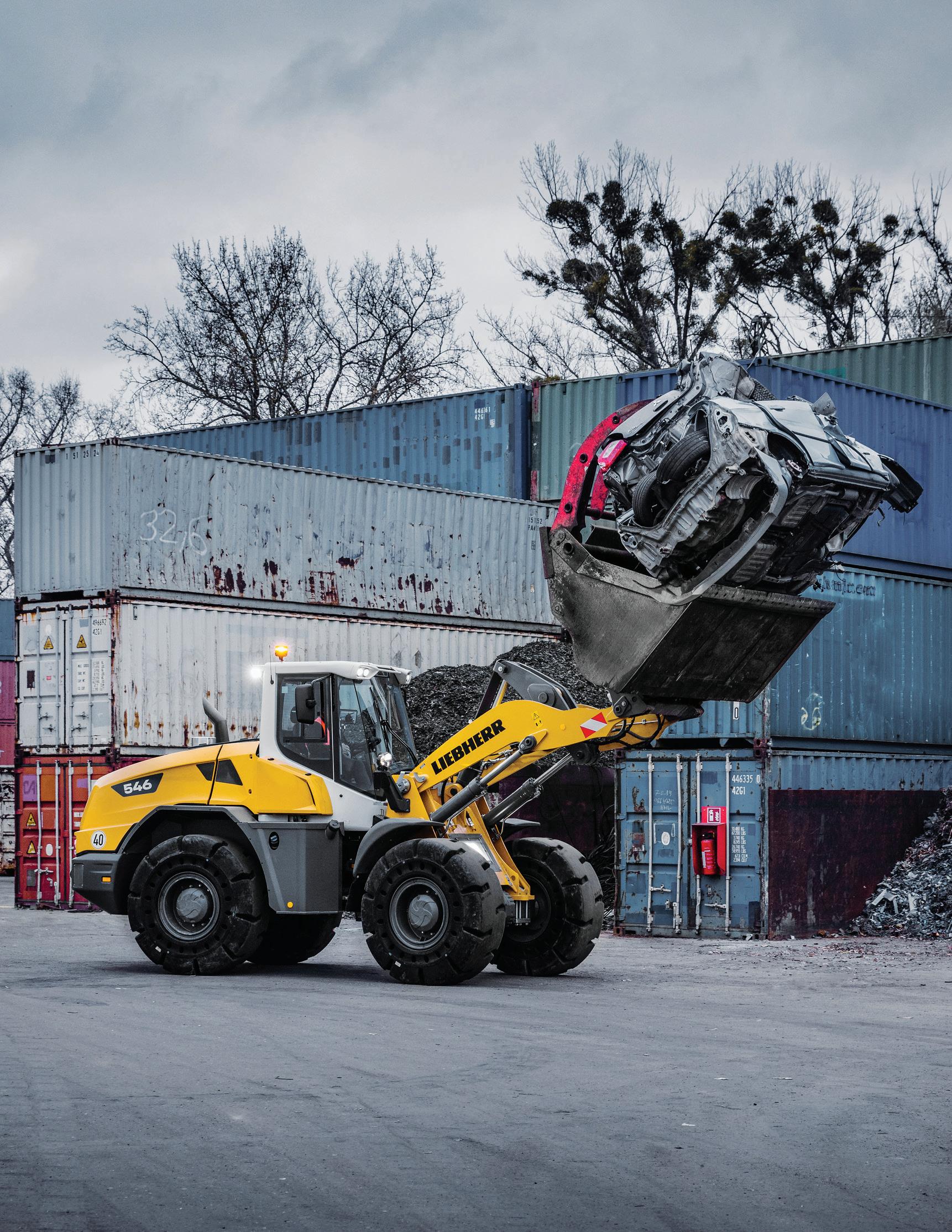
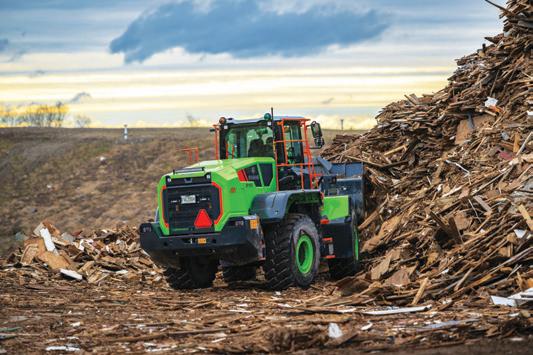
Medium-size, top class: the L 526, L 538 and L 546 wheel loaders score top marks across all performance parameters. With the new, optimised Z-bar linkage, Liebherr has opened up unlimited application possibilities allied to even better productivity. Generation 8 is bigger, tougher and more powerful than its predecessors – but with consistently low fuel consumption. www.liebherr.ca
Wheel loaders L 526, L 538 and L 546
FROM THE COVER
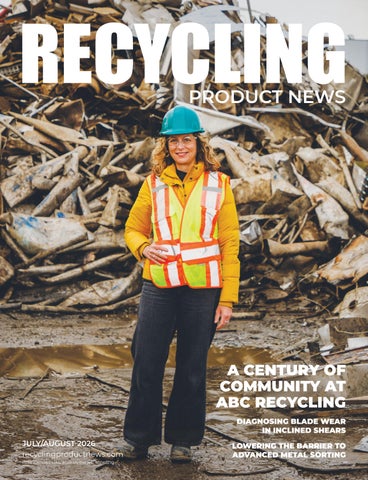
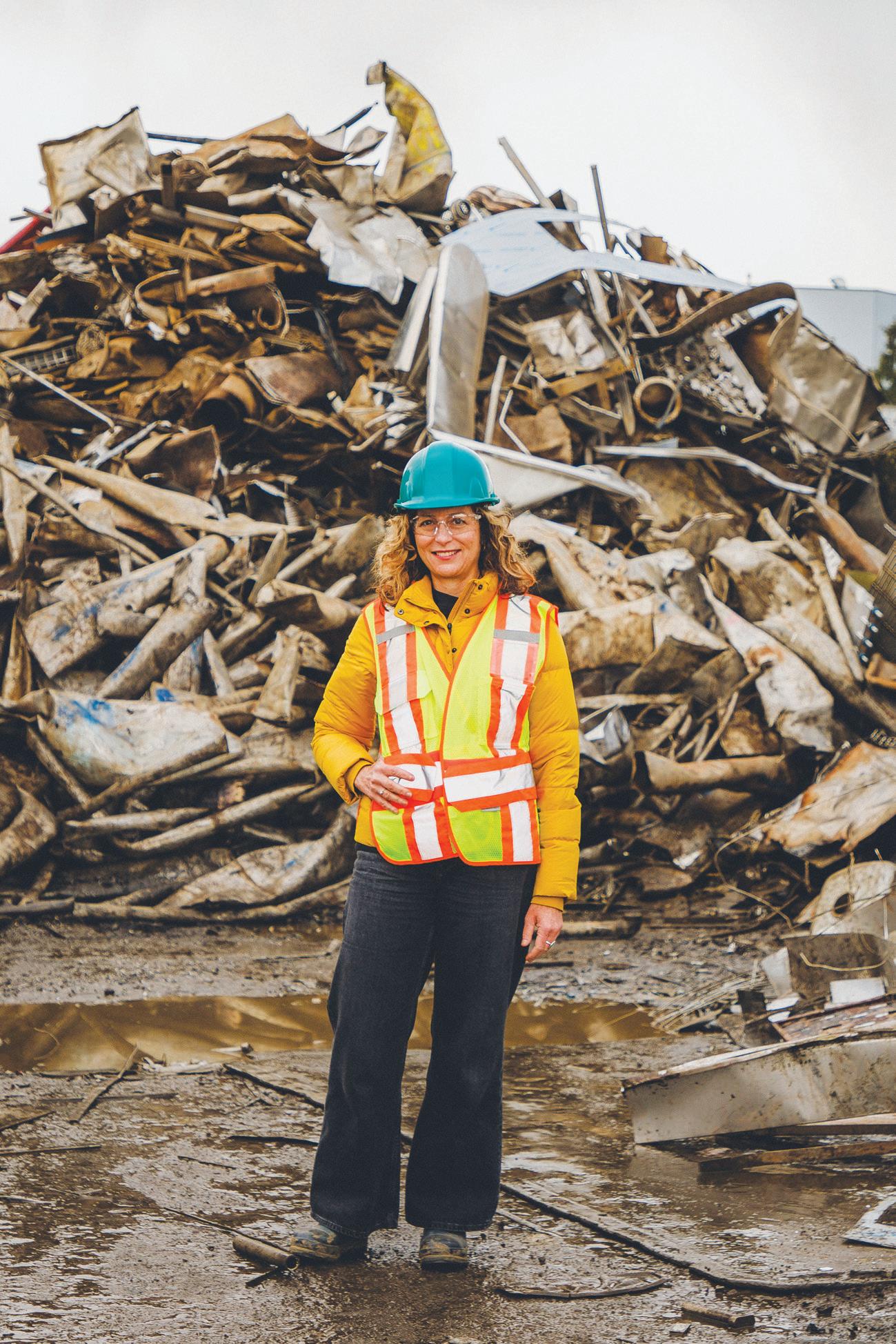
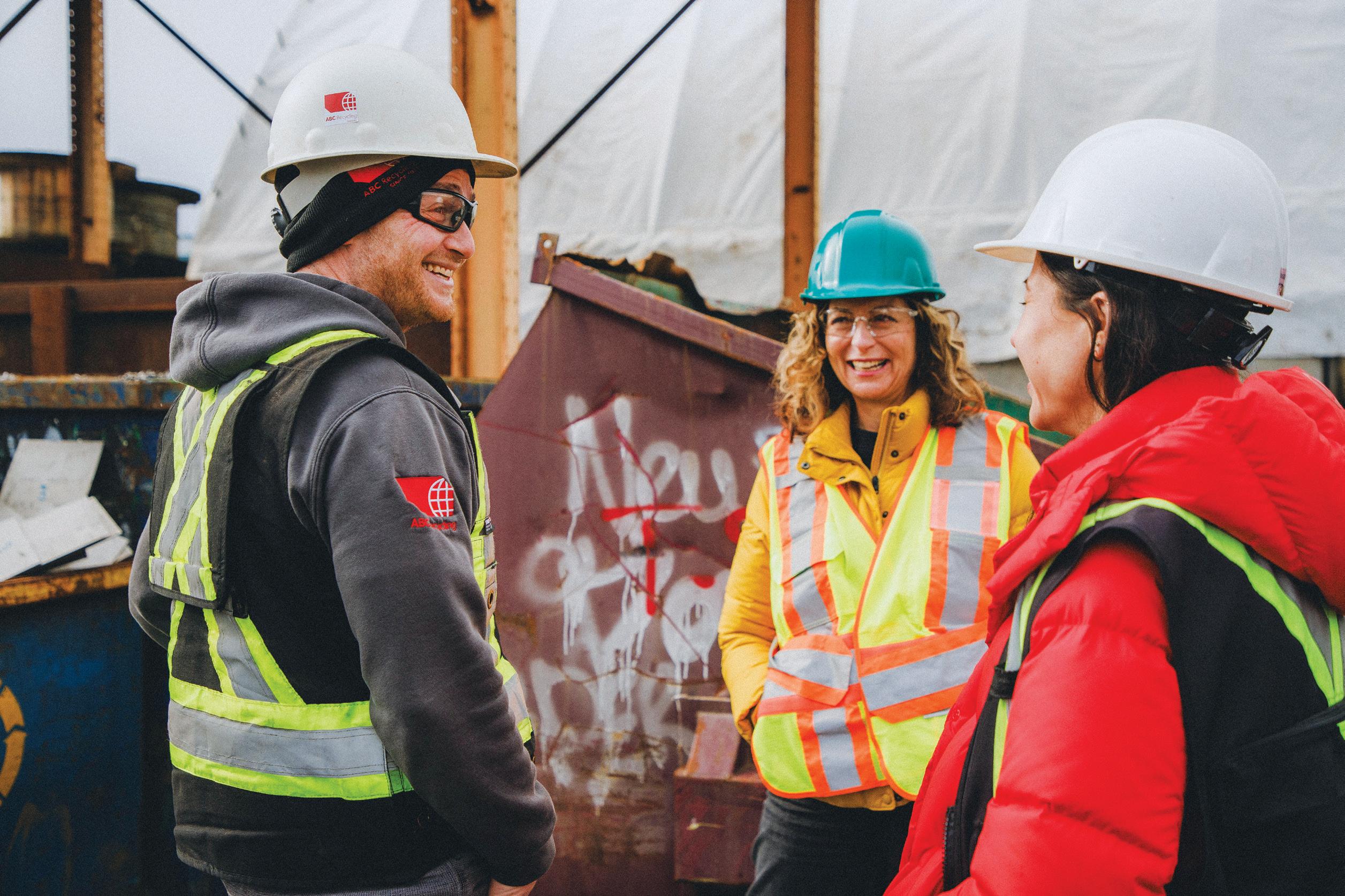
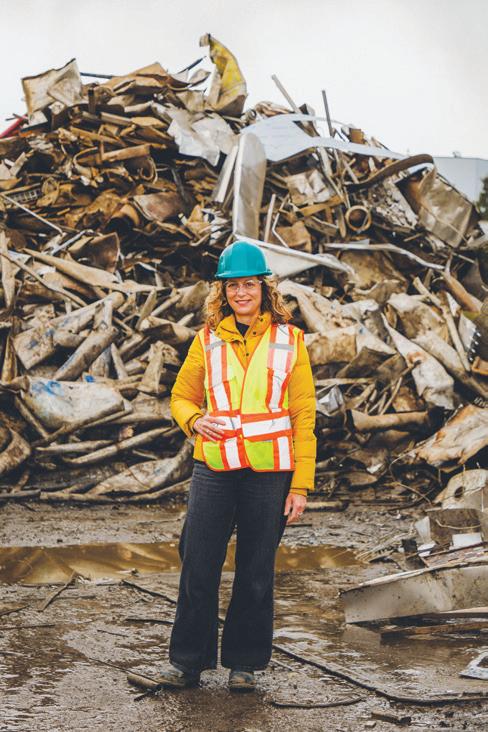
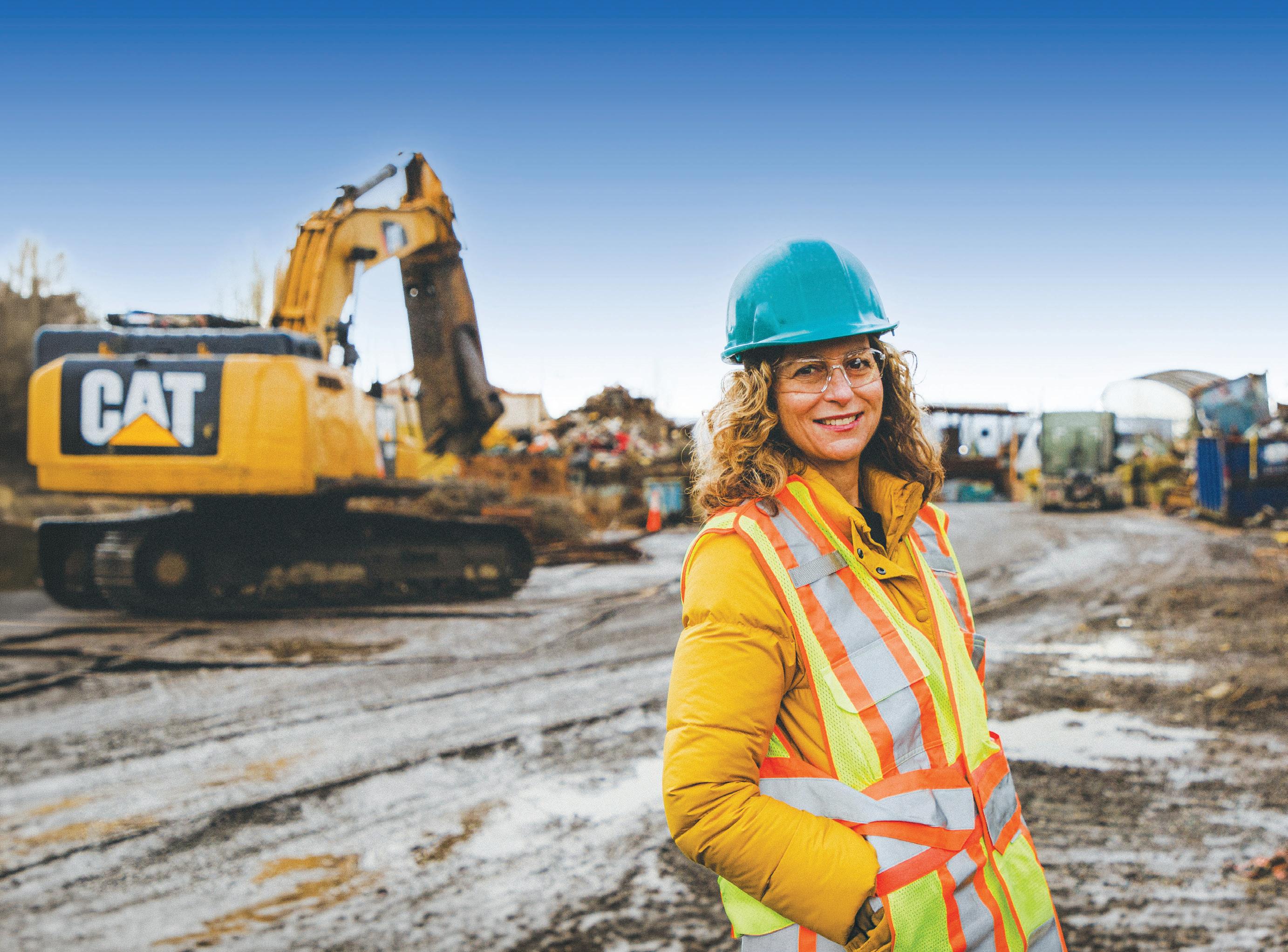
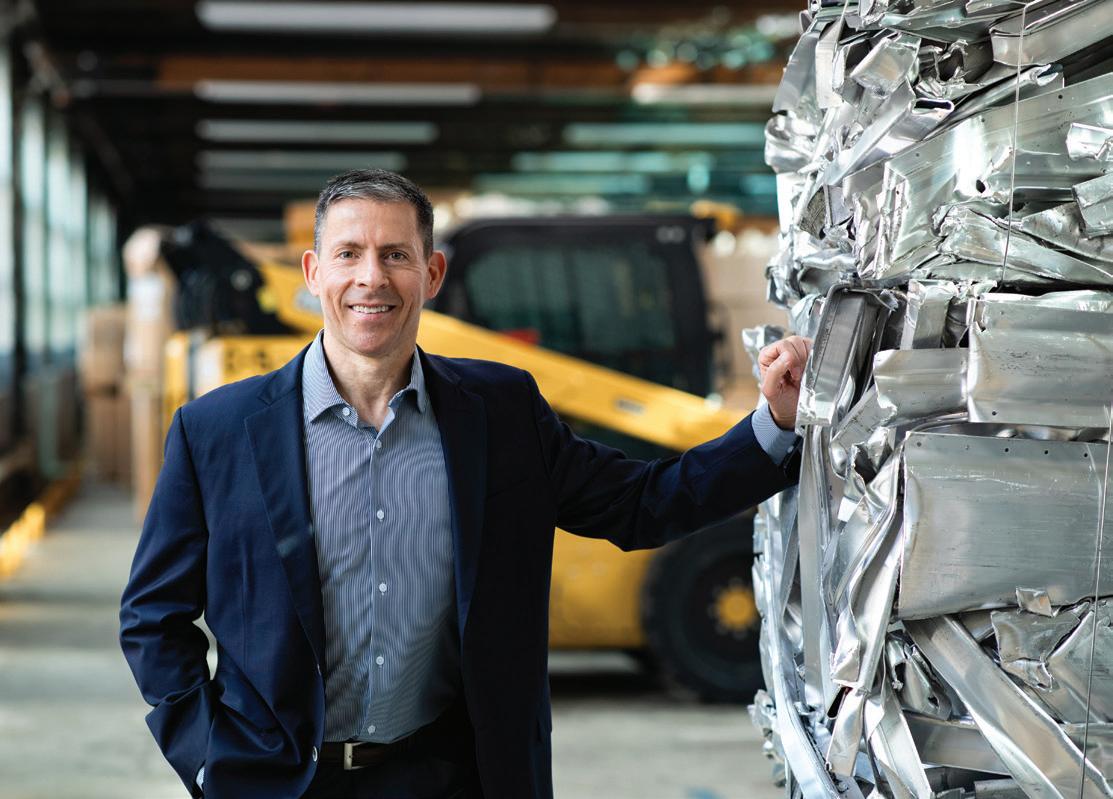
Karen Alko is the director of community relations at ABC Recycling, Western Canada’s largest privately owned metal recycling company. Read more on page 18.
EDITOR & DIRECTOR OF DIGITAL STRATEGY
Slone Fox sfox@baumpub.com 604-291-9900 ext. 335
EDITOR IN CHIEF Kaitlyn Till ktill@baumpub.com 604-291-9900 ext. 330
Subscription: To subscribe, renew your subscription, or change your address or other information, go to: https://www.recyclingproductnews.com/ mysubscription/subscribe
Recycling Product News is published six times yearly: January/February, March/April, May/June, July/August, September/October, November/ December. Advertising closes at the beginning of the issue month.
Do you have a story, equipment, or technology innovation, commentary, or news that our readers in the recycling industry should know about? Drop us a line any time.
Contact: Editor Slone Fox at sfox@baumpub.com or 604-291-9900 ext. 335
One year subscription rates for others: Canada $33.50 + 1.68
= $35.18; U.S.A. $40; other countries $63.50. Single copies $6.00 + 0.30 GST = $6.30; outside Canada $7.00. All prices are in Canadian funds.
Recycling Product News accepts no responsibility or liability for reported claims made by manufacturers and/or distributors for products or services; the views and opinions expressed are those of the authors and not necessarily those of Baum Publications Ltd.
We acknowledge the financial support of the Government of Canada.
Copyright 2026 Baum Publications Ltd. No portion of this publication may be reproduced without permission of the publishers.
Printed on paper made of FSC®-certified and other controlled material. ISSN 1715-7013. PUBLICATIONS MAIL AGREEMENT NO. 40069270.
Return undeliverable Canadian addresses to: Circulation Dept., PO Box 430 Stn Main, Alliston, ON L9R 1V6 email: rpn@mysubscription.ca / 705-502-0024
Photo by Jessica Nicklen Smart.
FROM THE EDITOR
RECRUITMENT VS. RETENTION OF YOUNG PROFESSIONALS
Every office has its version of a morale booster. Sometimes it’s a pizza party. Sometimes it’s branded merch, a summer barbecue, or free coffee. These things certainly don’t hurt — and I would never complain about free pizza — but they also aren’t what convinces someone to build a career with a company.
People stay in a job because they feel like they’re growing, they know their work matters, and because they can picture themselves being there five or ten years from now. That topic came into focus during the recent Canadian Association of Recycling Industries Convention, where I moderated a panel centred on the next generation of recycling professionals. The conversation went beyond flashy recruitment campaigns and explored a much more important question: once you’ve hired talented young people, what gives them a reason to stay?
One of the biggest critiques of young professionals is the ways in which communication has changed. Younger professionals still value relationships, handshakes, and personal connection, but they approach things differently than previous generations did. Emails, text messages, and video meetings have become normal parts of business, but that doesn’t mean personal relationships matter less. If anything, it means leaders need to be more intentional about creating opportunities for genuine connection rather than assuming they’ll happen naturally.
That might mean bringing younger employees to industry conferences, or involving them in association committees or next-generation leadership programs. It might mean introducing them to people throughout the industry and helping them build networks that will serve them throughout their careers.
Workers are much more likely to invest in a company when they believe the company is equally invested in them. That investment doesn’t always require expensive training programs, and can be as simple as regular conversations about goals, strengths, interests, and future opportunities.
For decades, effective management often meant directing work closely and ensuring every decision went through multiple layers of approval. Today’s professionals increasingly value autonomy.
Young professionals don’t need to be convinced that the work matters. The goal is to make sure they experience that purpose first-hand inside the workplace.
They want guidance, support, and accountability, but they also want the freedom to apply their own judgment and solve problems independently. Trust is a powerful, but often overlooked, retention tool.
In the end, it’s about building companies people are proud to join, contribute to, and spend their careers helping grow. Young professionals don’t need to be convinced that the work matters. The goal is to make sure they experience that purpose first-hand inside the workplace.
NEWS ROOM
CP GROUP INSTALLS 25-TPH PROCESSING LINE IN FRESNO MRF
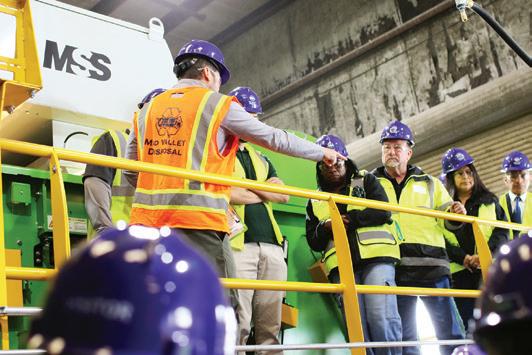
Mid-Valley Recycling (MVR) has reopened its Fresno Commercial material recovery facility following more than $12 million in upgrades. It features a brand-new 25-tph commercial processing line engineered, manufactured, installed, and operated by CP Group.
In 2025, the MVR facility processed more than 130,000 tons of material. The upgraded infrastructure positions the facility to handle more volume while improving purity and recovery rates across both residential and commercial streams.
The grand re-opening marks the latest chapter in a nearly three-decade relationship between Mid-Valley Disposal and CP Group. When MVR first engaged CP Group to replace its original 2001-era system in 2017, the result was a new 35-tph single-stream facility that significantly expanded the MRF’s capacity and recovery performance.
The new 2026 commercial line completes the facility’s transformation, replacing the aging commercial sort line with a purpose-built 25-tph system designed from the ground up for the material composition and operational demands of commercial collection routes in the San Joaquin Valley.
Early material separation is handled by a CP Drum Feeder, an OCC Auger Screen, and a CP Glass Breaker Screen, while CP Group’s proprietary CPScreen disc screen platform and a Drum Magnet handle ferrous metal extraction and mid-line size classification.
Optical sorting is handled by two units from CP Group’s MSS optics division: the CIRRUS FiberMax NIR sorter targets mixed paper and fibre fractions, and the CIRRUS PlasticMax NIR sorter identifies and separates PET, HDPE, and mixed plastics by resin type using near-infrared spectroscopy across the full belt width.
RIO TINTO’S $1.5B SMELTER TO ADD 160,000 TONNES OF ALUMINUM ANNUALLY
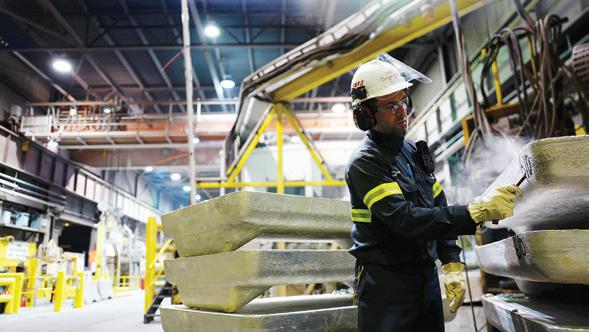
Rio Tinto has expanded its low-carbon aluminum smelting technology by commissioning a $1.5 billion AP60 smelter expansion at Le Complexe Arvida in Quebec.
The project, which began in March, is expected to be completed by the end of 2026, with all 96 new pots operating. The new smelter will increase the plant’s production capacity by approximately 160,000 tonnes of primary aluminum annually. In total, the plant will produce 220,000 metric tonnes with AP60 technology.
Quebec has been a hub for aluminum recycling and production for the past century. With the AP60, Rio Tinto has strengthened that position by deploying advanced smelting technologies at a commercial scale. The milestone brings the first primary aluminum project online in the West in more than a decade.
The AP60 expansion, together with the planned aluminum recycling centre at Arvida, will outweigh the loss of production associated with the closure of the older Arvida potrooms, which is expected to be completed in June.
When combined with the hydropower used at Rio Tinto’s operations in Canada, it generates one-sixth of the greenhouse gas emissions per tonne of aluminum compared with the industry average and half the emissions of the technology currently used at the adjacent older Arvida smelter. It is expected to reduce fine particulate matter by up to 90 percent.
The expansion will support approximately 100 permanent jobs locally and help consolidate positions across the supply chain. During its peak construction period, more than 1,500 jobs were created, and the project generated more than $1 billion in economic benefits for the province of Quebec through spending with contractors and suppliers.
NEW WM FACILITY SUPPORTS ONTARIO’S STANDARDIZED HOUSEHOLD RECYCLING SYSTEM
WM is celebrating the opening of its new recycling facility in Cambridge, Ontario. The facility marks a major milestone in the company’s investment in modern recycling infrastructure across the province, including roughly $300 million in investments across two new facilities in Ontario.
First announced in 2024 as part of a dual-facility development in Cambridge and the Greater Napanee region, the site is now operational and designed to support Ontario’s transition to a more standardized Blue Box recycling system, in collaboration with Circular Materials.
Under this extended producer responsibility framework, producers fund the system, while qualified service providers deliver collection and processing. This investment aligns with Ontario’s broader policy direction, including the province’s Strategy for a Waste-Free Ontario and Made-in-Ontario Environment Plan.
Ontario’s transition to a full extended producer responsibility (EPR) framework for Blue Box recycling is part of the province’s expanded unified materials list. New recyclable materials in Ontario include coffee cups, deodorant and toothpaste tubes, black plastic containers, frozen juice containers, ice cream tubs, and more.
Together, the two purpose-built facilities enable consistent processing at scale and help ensure recyclable materials are managed effectively as programs and material streams continue to evolve. Combined, they are expected to process roughly 30 percent of Ontario’s Blue Box materials, strengthening the province’s recycling network.
In addition to its processing capabilities, the Cambridge facility includes a dedicated education centre which facilitates guided tours and hands-on learning experiences for students, community groups, elected officials, and industry partners.
BILL TO IMPROVE RECYCLING ACCESS IN RURAL AND UNDERSERVED AREAS
Congresswoman Mariannette Miller-Meeks’ bipartisan legislation, the Recycling Infrastructure and Accessibility Act, passed through the House Energy and Commerce Environment Subcommittee. This first step advances the bill toward full House consideration and eventual
passage into law.
The legislation seeks to establish an Environmental Protection Agency (EPA) pilot program to improve recycling accessibility in rural and underserved communities where residents often lack access to recycling infrastructure.
Under the bill, the EPA would award grants to eligible entities — including states, local governments, tribes, and public-private partnerships — to improve access to recycling systems in underserved areas. Eligible projects include adding more transfer stations, expanding curbside recycling collection where appropriate, and leveraging partnerships to reduce transportation and collection costs.
WM DEVELOPS CANADIAN WORKFORCE WITH DEDICATED TRAINING CENTRE
WM has opened its first bilingual, Canada-based Training Centre, a dedicated national hub designed to support the safety, development, and long-term success of Canadian drivers and technicians. Located within WM’s Hauling Facility in Brampton, Ontario, the Canada Training Centre reflects the company’s continued investment in its people and operations across the country.
PILOT PROGRAM RECYCLES VINYL RECORDS WITHOUT COMPROMISING SOUND QUALITY
Warner Music Group and GZ Media have completed a new pilot program to demonstrate how unsold records can be reprocessed and incorporated into new vinyl pressings without compromising sound quality, underscoring vinyl as a circular resource.
Approximately 10,000 unsold records were shredded, and new records were pressed using different recycled content ratios
ranging from 10 to 100 percent.
Through rigorous blind listening evaluations, industry experts assessed the pressing without knowing which material blends they were hearing. The results showed that recovered material can be successfully incorporated into new, commercial-grade pressings while maintaining the sound quality and production standards expected across today’s physical releases.
FIVE HAND-PAINTED MACK LR REFUSE VEHICLES SUPPORT ART PROGRAM
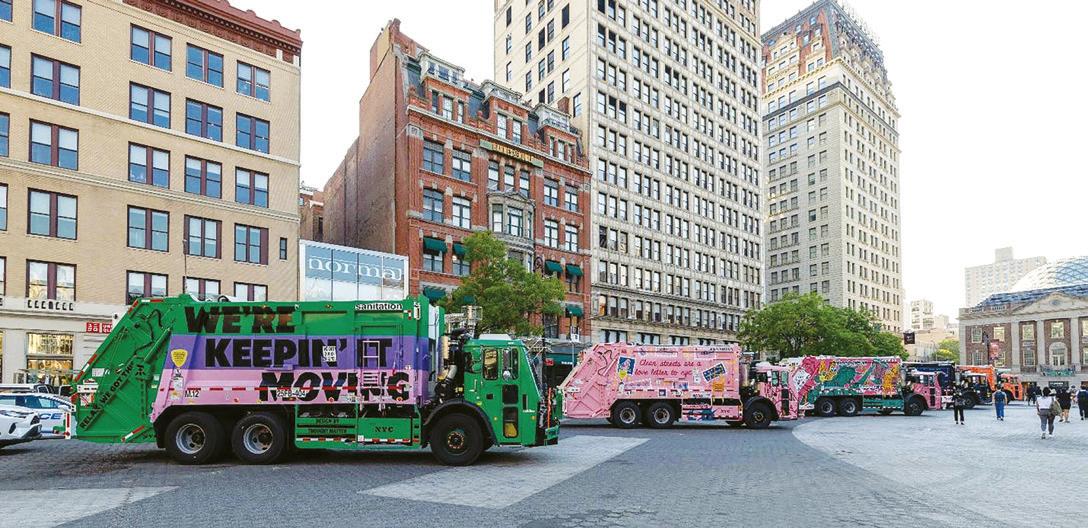
The New York City Department of Sanitation and its nonprofit partner, the Sanitation Foundation, recently debuted five new hand-painted Mack LR Class 8 refuse vehicles as part of New York City’s Trucks of Art program. The program challenges artists to transform DSNY refuse vehicles to spotlight cleanliness, sustainability, and the 10,000
men and women who keep the city clean and safe. The paintings were judged on uniqueness, complexity, and flexibility in colour palette. Trucks of Art also challenged artists to implement zero-waste practices by using cans of unwanted paint. Each of the winning artists received a stipend for their finished work.
REWORLD LAUNCHES THERMAL DESTRUCTION SERVICE FOR PFAS
Reworld’s ReAssure PFAS Destruction service offers full-scale destruction capacity for PFAS-containing materials across municipal, commercial, and industrial waste streams.
ReAssure provides recyclers with access to approximately 17 million tons of processing capacity through Thermome-
chanical Treatment Facilities (TTFs) available in all major U.S. markets, delivering the scale necessary to address PFAS-containing waste.
Reworld TTFs process waste at temperatures above 1,100 degrees Celsius, widely cited as effective for PFAS destruction. Testing has demonstrated 99 percent destruction and removal of PFAS at a processing capacity 17 times greater than hazardous waste incineration.
Storing PFAS-containing materials in landfills increases levels of groundwater contamination, and wastewater treatment plants are not designed to manage these compounds. Permanent solutions are needed to remove PFAS from circulation when materials reach end-of-life.
1 SPOTLIGHT
INTRODUCTIONS & UPDATES
CONCRETE BUCKET
1
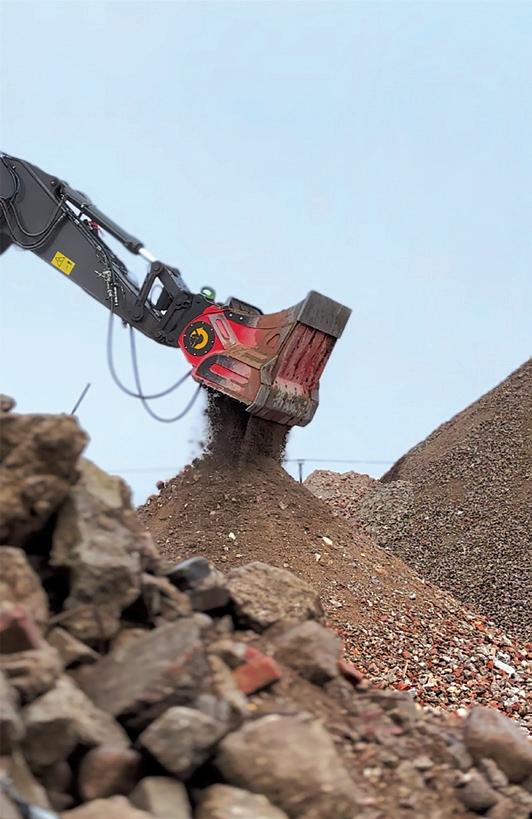
ALLU’s all-new Concrete Screening and Crushing Bucket is an excavator-mounted attachment for on-site processing of demolition material, including concrete, asphalt, and scrap metal. Designed for machines in the 25- to 45-ton class, ALLU’s customizable crushing solution is ideal for sites where it would be inefficient or impossible to bring in a separate mobile crusher. The result is a bucket that can process material right where it’s generated. The bucket can also be used for pre-crushing to increase a mobile crusher’s capacity.
LIEBHERR ELECTRIC MATERIAL HANDLER
2
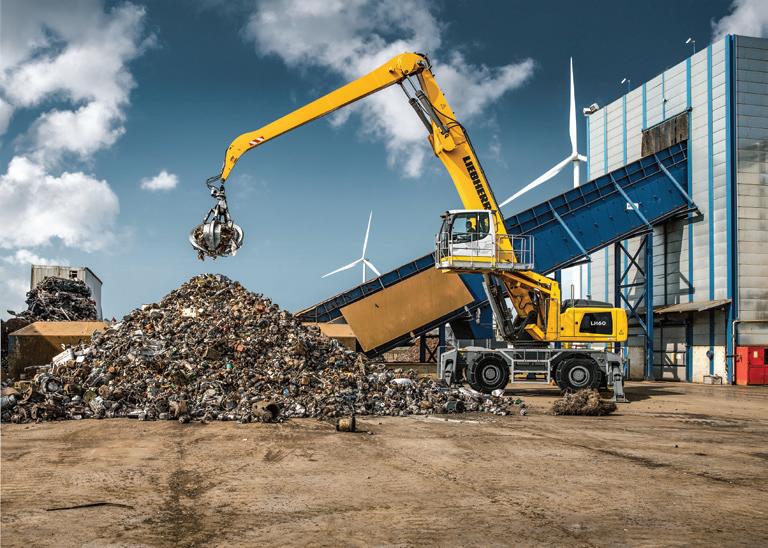
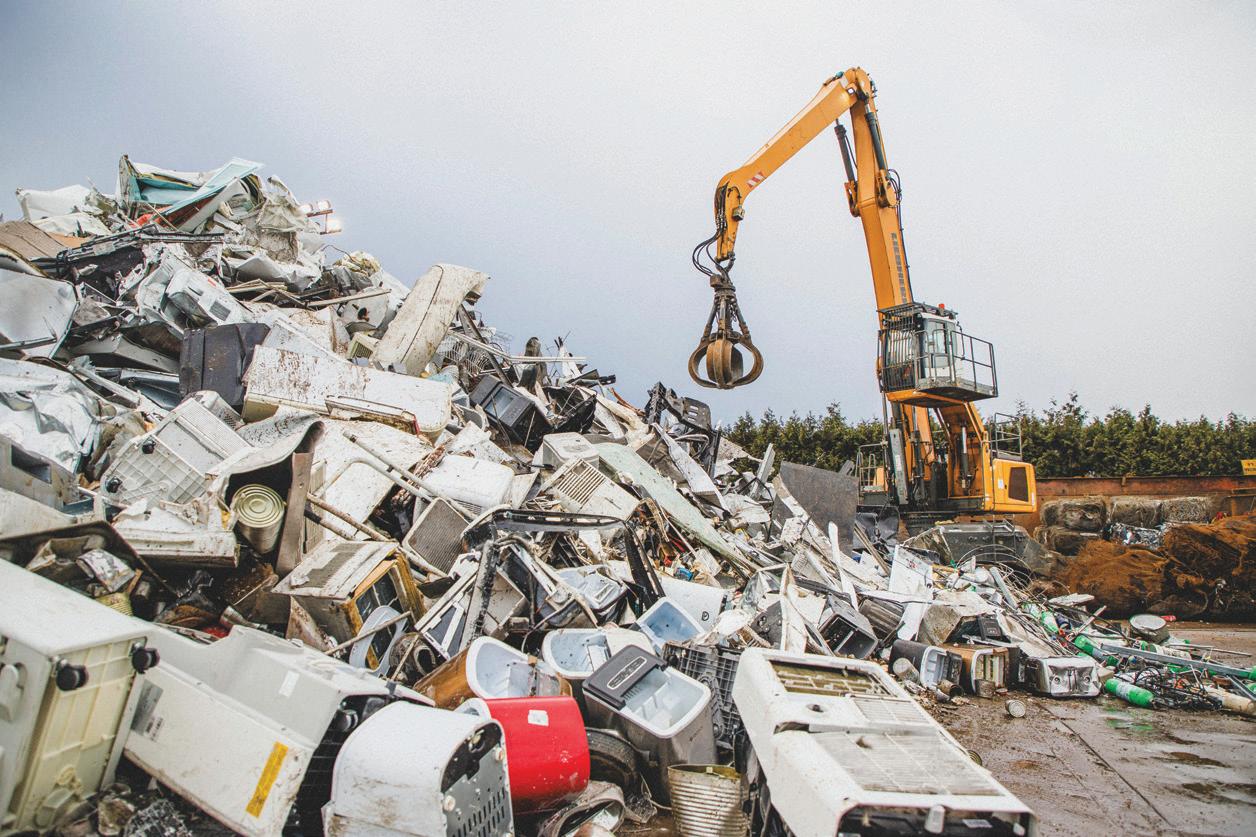
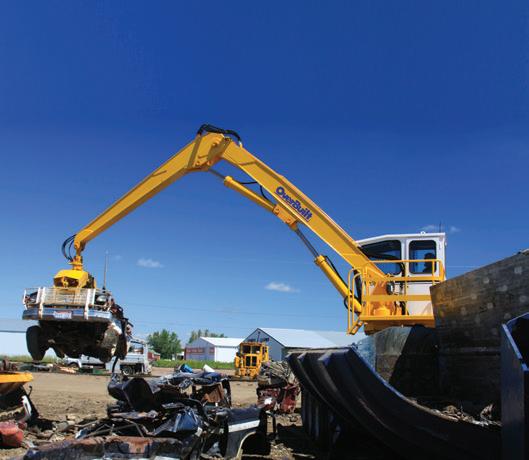
The LH 60 M Electric material handler is equipped with Liebherr’s patented energy recovery system, which boosts system performance to 180 kW while increasing fuel savings. The machine’s attachments can be tailored to a wide variety of needs, including scrap handling and moving bulky materials. The reach extends to 65 feet, and the multi-tine 2.2-cubic-yard grapple allows the operator to scoop, grab, and clamp. The electric drivetrain allows the machine to work from a variety of power sources, creating greater flexibility.
TEREX VIBRATION ANALYSIS SYSTEM
3
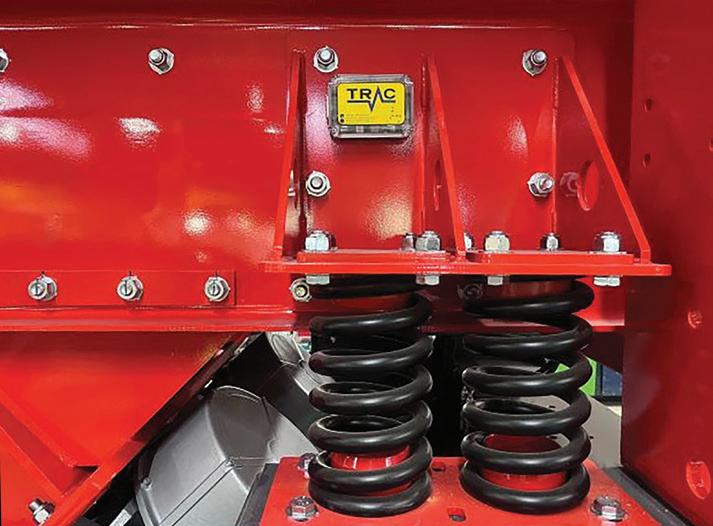
Terex’s TRAC vibration analysis system provides clearer insight into the performance, condition, and long-term integrity of screening equipment. The portable, multi-sensor system uses synchronized measurements taken from multiple points on the screen box for fast, repeatable insight into screen motion, balance, resonance, and bearing condition, which helps the operator identify potential issues before they worsen and affect performance, uptime, or structural integrity. TRAC also supports commissioning verification, troubleshooting, and ongoing condition assessment, which allows the operator to make more informed maintenance decisions throughout the machine’s life.
KLEEMANN MOBILE SCALPER
4
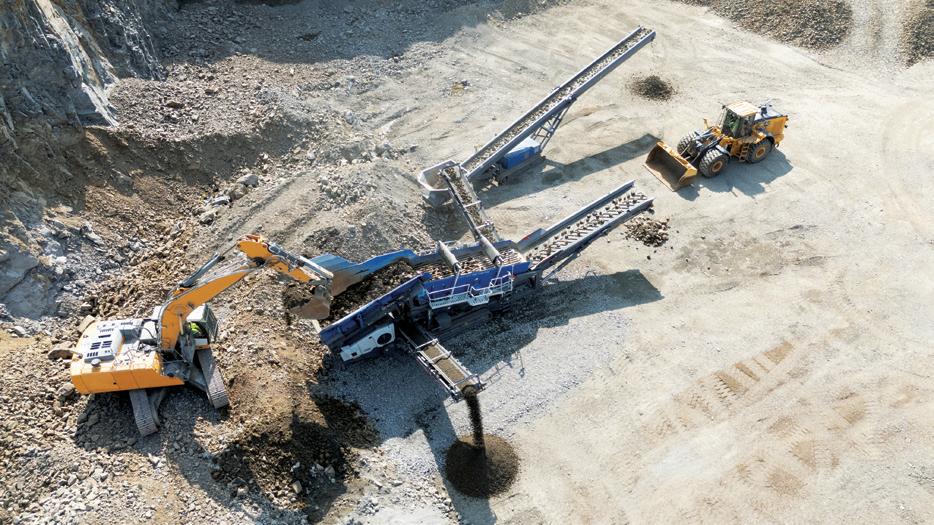
When outfitted with optional Dual Power drive, the Kleemann MOBISCREEN MSS 1102 PRO mobile scalper can be connected to an external power supply for fully electric operation. Infinitely variable speed adjustment of conveyor belts and easy conversion from two to three final grain sizes provide further operational flexibility. The screen decks can be fitted with a combination of screening media to fit a wide range of applications. With its large feed hopper and screening surface of 120 square feet, the mobile scalper delivers feed rates of up to 750 tph (827 U.S. tph).
ABC RECYCLING BUILDS ON
BY MEGHAN BARTON, SENIOR WRITER
STORY
PHOTOS BY JESSICA NICKLEN SMART
BUILDS COMMUNITY CENTURY-OLD FOUNDATION
Karen Alko believes strong businesses and strong communities grow together, a philosophy that shapes ABC Recycling’s approach to giving back.
For more than a century, ABC Recycling has grown alongside the communities it serves. Founded in 1912, the fourth-generation family business is Western Canada’s largest privately owned metal recycling and processing company.
Headquartered in Burnaby, B.C., the company’s 11 locations stretch from Vancouver Island through the Pacific Northwest and into northern Alberta and down to the U.S., with a presence built on competitive pricing, logistics capability, and longstanding customer relationships. Yet behind the piles of ferrous and non-ferrous metal is an even deeper story, one rooted in family legacy and an intentional effort to connect that history to the communities ABC serves today.
A FOURTH-GENERATION PERSPECTIVE
For Karen Alko, director of community relations, the work is personal. ABC Recycling was founded by her great-grandfather and grandfather, who began collecting scrap with a horse and buggy as Jewish immigrants looking for a way to make a living at a time when employment opportunities in Vancouver were limited.
recycling. It was about stepping in to help guide and steward a multi-generational family business with deep community ties.
That realization shaped her role within the company, pushing her to think more deliberately about how ABC could give back and how its values could be reflected in everyday actions.
“I did start to take a deeper look at the values and how we could be more intentional about the work that we’re doing and ensure that we remain a values-based family business,” she says.
Part of that shift came through governance work. About two decades ago, ABC joined a national family-enterprise organization and began working with a family advisor to formalize elements like governance, a code of conduct, and the ethos the ownership group wanted to uphold.
ABC’s centennial in 2012 offered a moment for reflection. Reaching 100 years in business prompted the family to step back and look more closely at the company’s origins and the principles that had carried it forward.
“When we had our hundredth anniversary, [we were] thinking, ‘Wow, this is huge.’ We’ve been around for a hundred years,” Alko says. “So we started to look at our story, our origin story, and the importance of that. So it’s all kind of connected.”
BEYOND THE CHEQUE
Today, ABC grounds its community efforts in a clearly articulated mission.
We have a social purpose, and it is to preserve the world’s resources and strengthen the lives of our people and communities.
Karen Alko Director of Community Relations, ABC Recycling
Over time, the business grew from peddling and salvage into a full-service metal recycling and brokerage operation. More than a century later, the company remains family owned. Across four generations, the family has carried forward a belief that success should translate into tangible support through community outreach, partnerships with Indigenous communities, local environmental cleanups, food security initiatives, and hands-on employee volunteering.
“It’s always been a value,” Alko says. “My great-grandparents and grandparents always believed in the importance of giving back. And that is a core value that’s been passed down through the generations.”
LEGACY WITH INTENTION
Alko didn’t grow up assuming she would join the family company. Her mother only entered the business later in her own career — in the 1980s, during a challenging economic period — and Alko’s early interests were more rooted in the arts. She completed a liberal arts degree followed by graduate studies in business administration, initially considering work in the arts nonprofit sector before eventually turning her attention back to the family business.
Over time, Alko realized the opportunity wasn’t just about scrap
“We have a social purpose, and it is to preserve the world’s resources and strengthen the lives of our people and communities,” Alko says. “That social purpose is kind of like our North Star.”
For Alko, it’s less about more conventional forms of philanthropy and more about using the company’s strengths to make a lasting impact.
“It goes beyond the cheque writing,” she says, “[It is] really looking at how we can leverage our strengths and what we do best and have a real impact on our people and communities.”
ABC’s outreach combines shared company-wide goals with local discretion, allowing each yard to respond to the needs of its own community. That local flexibility drives how each scrapyard selects charities and volunteer activities.
“We do have guidelines,” Alko says, “but we also like to give a little bit of autonomy to [each] location because they know their community best.”
One of the tools ABC uses to guide that work is an internal structure that helps align volunteer and donation efforts across different regions: quarterly themes. For example, the first quarter of 2026 focuses on food security, encouraging locations to select a food-related charity or choose volunteer activities aligned with that need.
INDIGENOUS ENGAGEMENT AS A CORE FOCUS
One of the most notable areas of ABC Recycling’s community strategy in recent years has been Indigenous engagement. Alko says the focus grew out of relationships the company had already been building with Indigenous communities, as well as broader calls for corporate accountability following the findings of the Truth and Reconciliation Commission of Canada. In particular, Call to Action 92 asks corporate Canada to adopt the principles of the United Nations Declaration on the Rights of Indigenous Peoples. ABC’s evolving approach, she says, aligns with those expectations.
ABC Recycling’s community philosophy is built around leveraging what the company does best: recovering materials, sharing expertise, and supporting the communities it operates in.
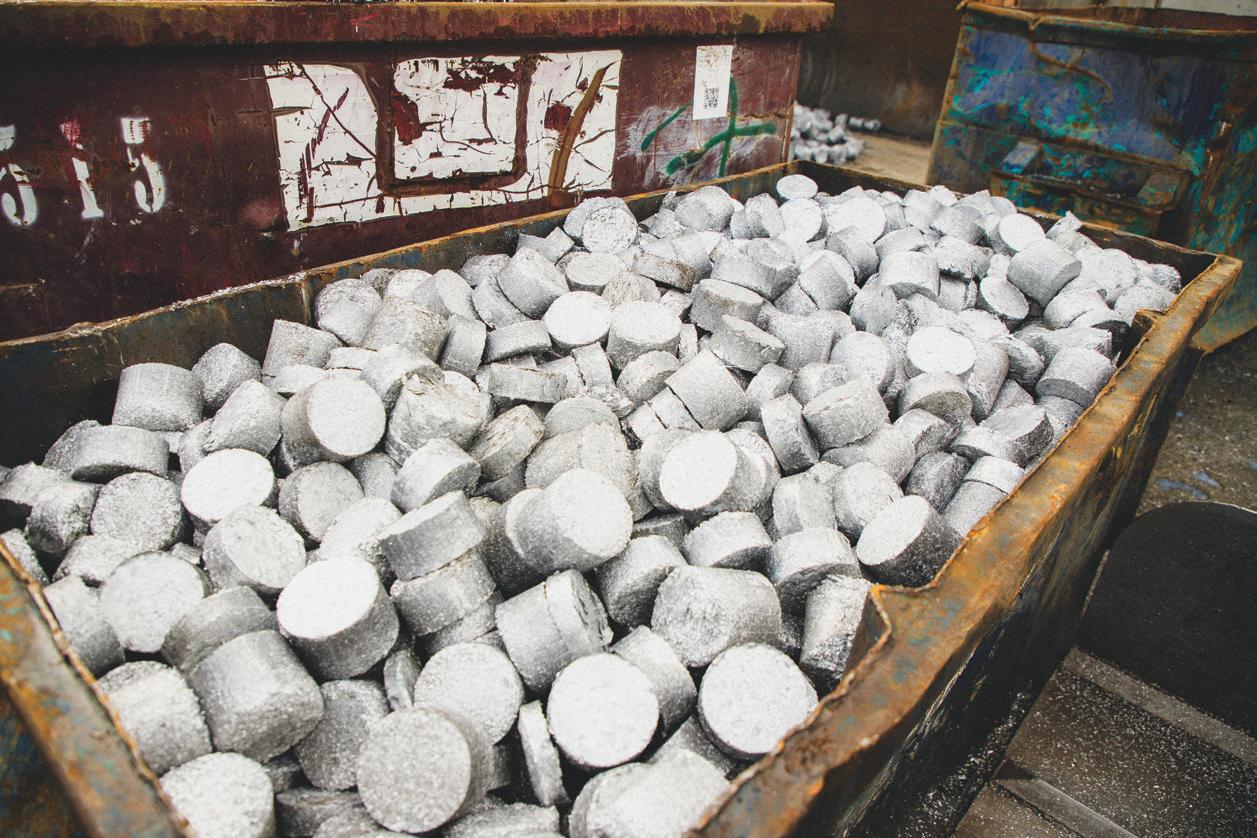
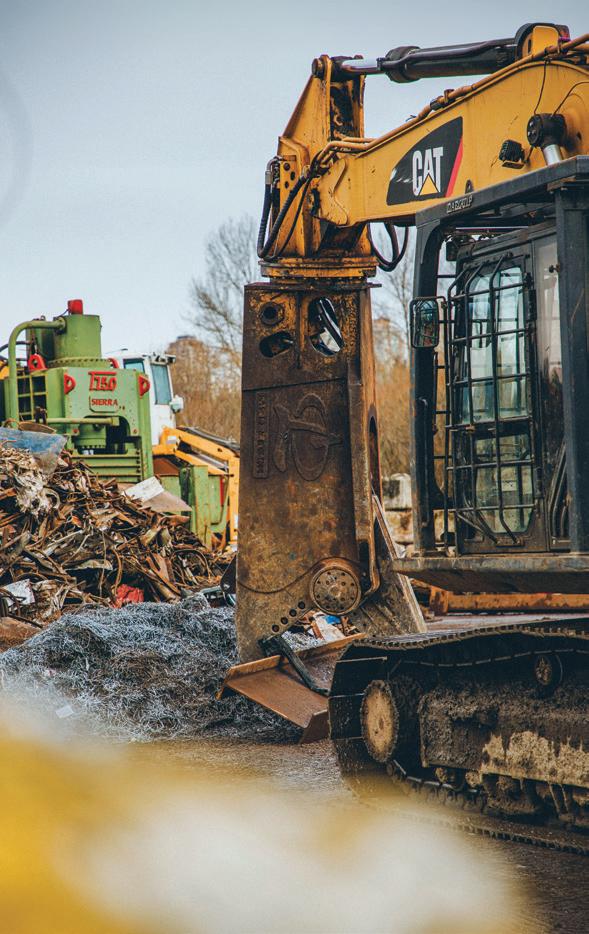
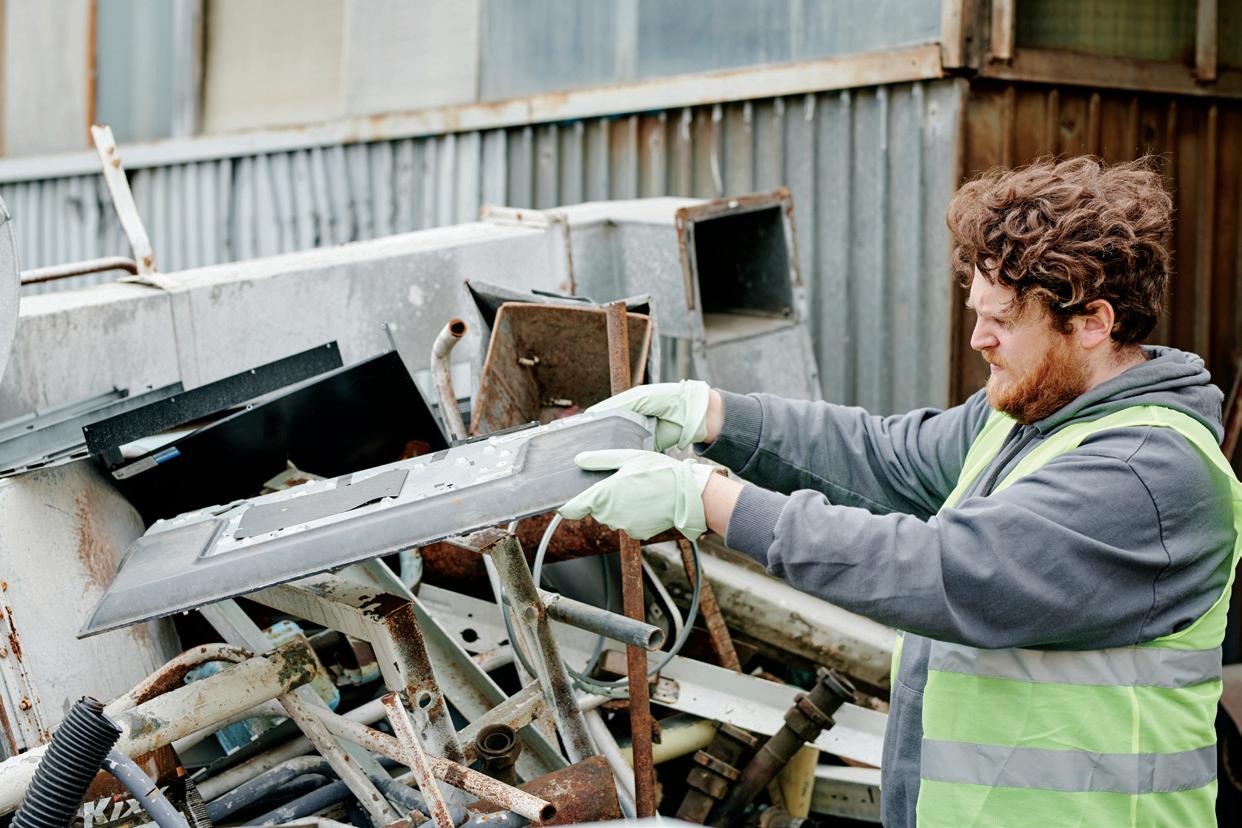
ABC Recycling processes ferrous and non-ferrous metals at its facilities, preparing materials for reuse in manufacturing and industrial applications.
ABC formalized its commitment to reconciliation through an Indigenous Peoples Commitment Policy in 2019, and the company is participating in the Partnership Accreditation in Indigenous Relations (PAIR) program through the Canadian Council for Indigenous Business.
For Alko, the emphasis isn’t just on programs, it’s on how the company shows up, learns, and avoids the pitfalls of helping without listening.
Training plays a role in that foundation. ABC requires Indigenous cultural awareness training for employees as part of building internal understanding before expecting external relationships to succeed. What the ABC team has learned, says Alko, “Is the importance of consultation and not just walking onto First Nations land and saying, this is what we can do for you, but working with communities and finding out what they need, how we can work together so that it’s like a win-win situation.”
Through hands-on training and facility tours, ABC also shares technical knowledge that Indigenous communities can apply to their own cleanup and recycling efforts. Teaching communities practical skills, such as safe removal of refrigerants from appliances and draining of fluids from end-of-life vehicles, better-equips them to manage materials locally and on their own terms.
DONATE AT THE GATE TURNS SCRAP VALUE INTO LOCAL FUNDING
Another of ABC’s more distinctive initiatives is “Donate at the Gate,” a program run at each yard that invites customers to donate the value of their scrap to local charities.
For ABC, Donate at the Gate offers something more relational than traditional corporate giving. It turns everyday drop-offs into a shared local effort between customers and the yard team.
“Sometimes [customers] come in with material and they don’t necessarily want to get paid for it,” Alko says. ABC Recycling takes the value of that drop and donates it to the local charity designated to receive proceeds that month.
The numbers help illustrate scale. In 2025, ABC’s Donate at the Gate program raised over $72,000 company-wide. ABC is very intentional about where that help lands: small organizations, local causes, and the kinds of community groups that often struggle for visibility.
DOLLARS IN ACTION
ABC’s Kelowna yard raised more than $12,000 last year and presented a cheque to the Okanagan Forest Task Force, an organization that tackles illegal dumping in backcountry areas. To underpin their support, ABC volunteers joined the task force team on cleanup missions by providing equipment and recycling recovered metal.
The Burnaby scrapyard team selected an organization called Dan’s Legacy, which supports programming for local youth. Alko says the yard raised about $3,000 for the organization, an impactful amount for smaller community groups.
ABC also partners with local hospital foundations in communities where its yards have long-standing ties. In Burnaby, where the company has operated its head office and primary facility since the 1970s, many employees rely on the Burnaby Hospital, making the support a natural extension of the company’s presence in the neighbourhood.
On Vancouver Island, ABC has taken a similarly hands-on approach with Campbell River Hospital, partnering on an annual scrap metal challenge that encourages local businesses to donate the value of their scrap to the foundation. The proceeds are
directed to the hospital, turning everyday recycling activity into a practical fundraising tool for local health care.
OUT OF THE OFFICE AND INTO THE COMMUNITY
ABC has formalized employee volunteering through a policy that provides 16 paid volunteer hours per year, per employee. While the goal is to remove barriers, Alko is candid about the fact that participation is still a work in progress.
“It [can be] an ongoing challenge . . . to get people engaged,” she says.“Not every employee takes advantage of it. Some employees are much more engaged than others.”
To foster engagement and connection, Alko leads a social purpose working group that brings together an ambassador from each location for monthly check-ins. The group shares volunteer ideas, discusses themes, and helps build momentum across the organization. `
Tracking participation is another practical hurdle. Still, the company is beginning to quantify impact. ABC Recycling recorded 1,558 volunteer hours collectively last year. Alko says this measure helps show progress and creates a feedback loop that informs the next year’s goals.
WHY COMMUNITY MATTERS IN A COMPETITIVE INDUSTRY
Community engagement in recycling is often discussed in terms of brand reputation, public perception, and social license. Alko acknowledges those realities, but frames it as something deeper: a way to stand out in a crowded market while building a workplace people feel proud of.
“There’s a lot of competition out there. There’s a lot of noise,” she says. “If the choice [was] to do business with a company
In 2025, ABC Recycling’s Donate at the Gate program directed more than $72,000 to local charities and community organizations across its operating regions.
that did nothing in the community or a company that’s super engaged . . . [to me] it’s kind of a no-brainer.”
She also points to workforce feedback as a signal that the effort is landing internally.
“We survey our employees, and year after year, the feedback comes back consistently that they appreciate working for a values-based business. They appreciate the impact we have in the communities. That says a lot.”
In practice, ABC Recycling’s community outreach has become a differentiator in a competitive market and a foundation for employee engagement, linking community relationships directly to long-term business resilience.
WHAT’S NEXT FOR ABC RECYCLING?
ABC has expanded through acquisitions in recent years, growing its presence across Western Canada and into the United States. However, Alko says the company is intentionally pausing major geographic growth for now to focus on strengthening internal systems and its people, particularly after a challenging 2024 market year for the industry.
ABC Recycling is exploring training and development to continue building workforce capability and investing in its people. Outside of operations, Alko’s community engagement priorities are concrete: increasing volunteer utilization, growing Donate at the Gate, and completing Phase 3 of the PAIR Indigenous relations program.
“I would love to get to a place where it’s not just me . . . running the community relations in our organization,” she adds, pointing to the potential for a larger team as the program matures. “We could do much more.”
And then there’s the next generation. There are currently nine potential next-gen ABC members, ranging from age 5 to 25. Although the intention is for them all to be owners in the future,
My great-grandparents and grandparents always believed in the importance of giving back. And that is a core value that’s been passed down through the generations.
Karen Alko
none are in the business yet. Some have completed summer work or internships, and the family is increasingly focused on engagement and stewardship with those coming up.
“It’s about exposing them to the different opportunities,” Alko says of the career pathways available. “There’s finance, there’s logistics, there’s technology . . . there are so many different things.”
For Alko, that range of opportunity mirrors her own path: joining a scrap and recycling company not because she was expected to, but because she saw how a legacy business can evolve, stay relevant, and still remain grounded in community.
In the recycling industry, it’s easy to talk about sustainability in terms of diverted tonnes and closed-loop systems. ABC Recycling’s story suggests a parallel kind of circularity built around people: customers who donate scrap value, employees who volunteer time, and communities that see a recycler not as a fenced yard at the edge of town, but as a valued neighbour. RPN
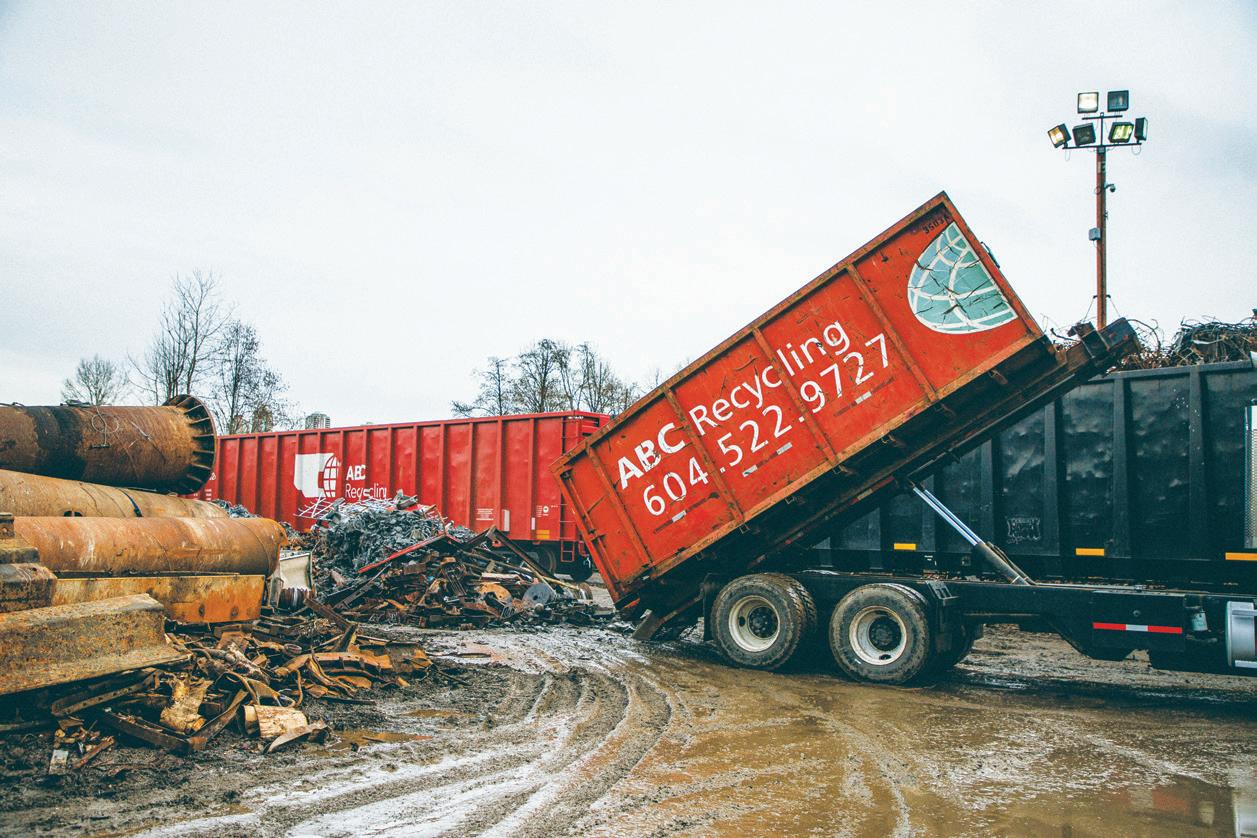
Headquartered in Burnaby, B.C., ABC Recycling has grown into a cross-border network of 11 locations serving customers throughout Western Canada and the Pacific Northwest.
ELDAN SUPER CHOPPER
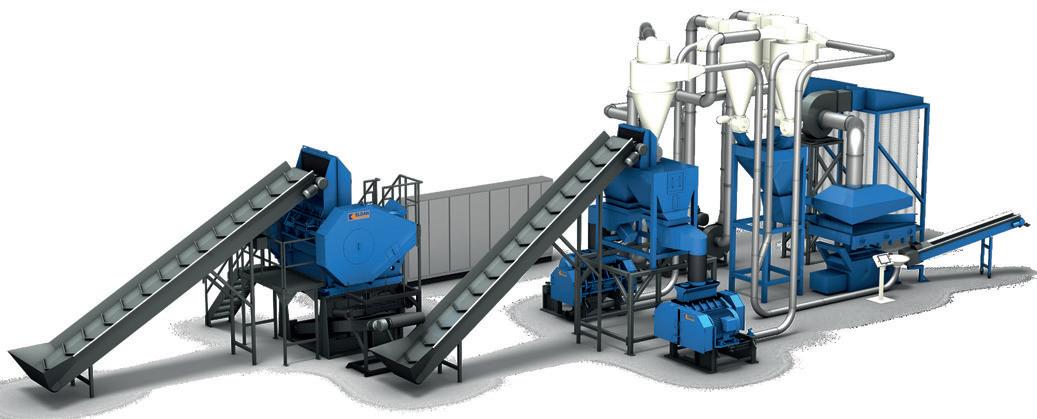
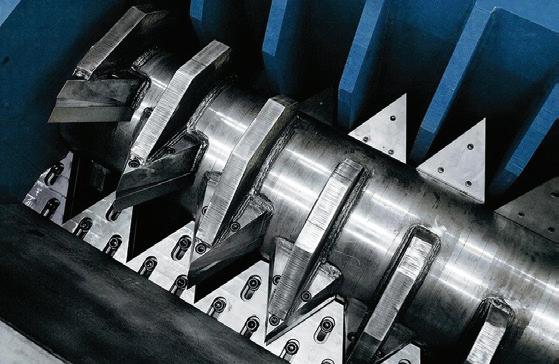
In modern recycling operations, efficiency and material recovery are critical factors for achieving profitability and sustainability. Primary processing of ferrous materials, such as steel scrap, mixed metals, automotive components, and industrial waste, requires equipment capable of handling tough material while maintaining consistent performance. The ELDAN Super Chopper is a heavy-duty primary shredder that delivers reliable size reduction while helping recyclers maximize throughput and improve downstream separation processes.
PERFORMANCE
The ELDAN Super Chopper is engineered around a low-speed, high-torque operating principle. This combination is especially beneficial when processing tough, dense ferrous materials because it enables the machine to deliver high cutting force while reducing unnecessary wear and energy losses. Rather than relying on extremely high rotational speed, the machine focuses on controlled power delivery, creating an efficient shredding process that improves overall plant performance.
DRIVE SYSTEM
A notable feature of the Super Chopper is its intelligent drive system. The machine can be equipped with either a planetary gear and frequency converter system or a hydraulic motor and power unit. Both options provide smooth operation and include automatic reverse functionality for overload protection. This feature minimizes knife damage and reduces the risk of production interruptions caused by difficult or oversized material entering the system.
DURABILITY
The machine’s adjustable knife clearance system allows operators to optimize the cutting process according to the material being processed. Whether handling mixed ferrous scrap or preparing material for downstream separation stages, this flexibility helps maintain a high-quality output while maximizing efficiency. Longterm durability is also a major consideration — the knives can be reground multiple times using a flat-bed grinder, extending component life and reducing replacement costs. Combined with a rotor engineered for minimal wear, this contributes to lower maintenance requirements and improved total cost of ownership over the machine’s life.
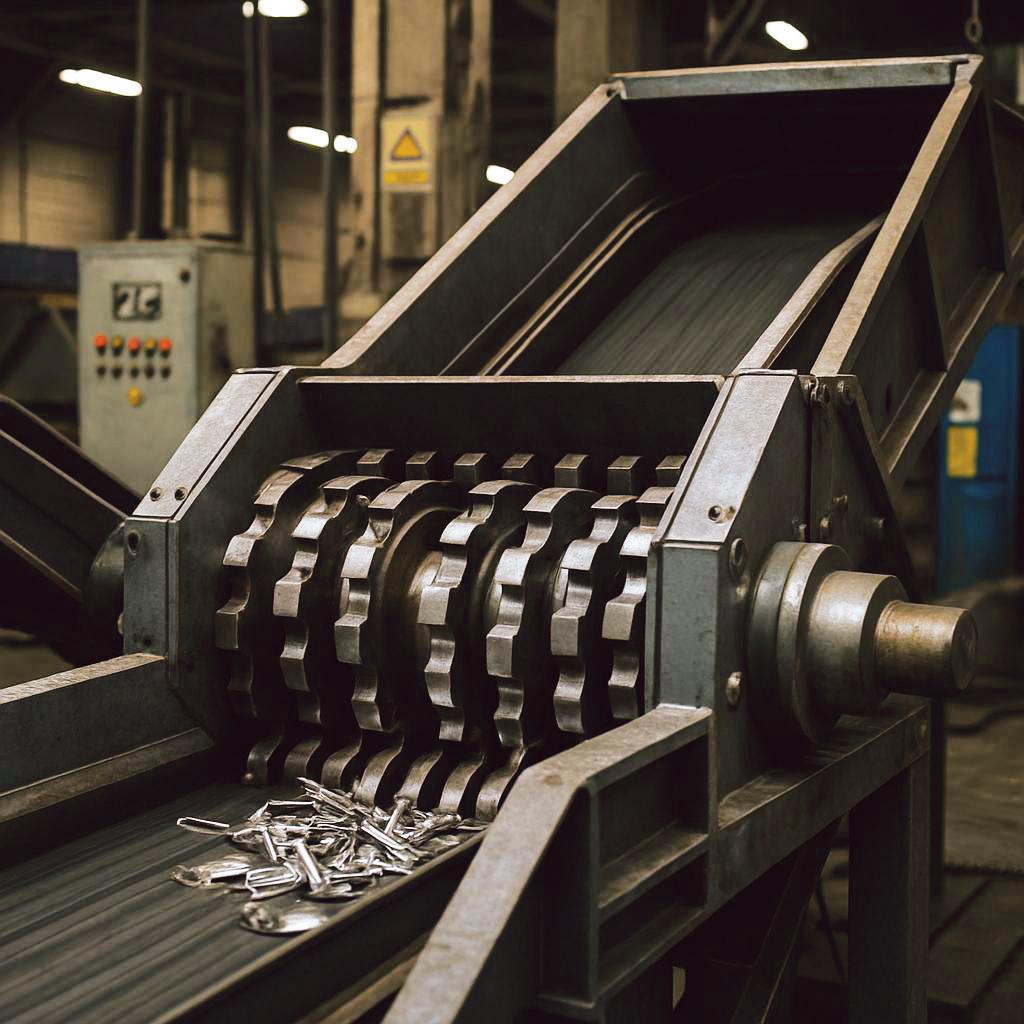
The ELDAN Super Chopper shredder.
LOWERING THE BARRIER TO ADVANCED METAL SORTING
HOW AI MAKES HIGHER-VALUE METAL RECOVERY MORE ACCESSIBLE
BY MEGHAN BARTON, SENIOR WRITER
Producing premium metal commodities has traditionally come at a premium cost. Consumers demand cleaner, more precisely sorted commodities, while recyclers face rising labour costs and tighter margins. Premium products can unlock higher prices, but achieving those specifications has traditionally required either labour-intensive hand sorting or costly sensor-based technologies.
Artificial intelligence is beginning to change that equation.
Rather than introducing entirely new ways to separate metals, AI-enhanced optical sorting is making many existing sorting applications more economical, allowing recyclers to recover more value from material streams without the investment traditionally associated with advanced sensor technologies.
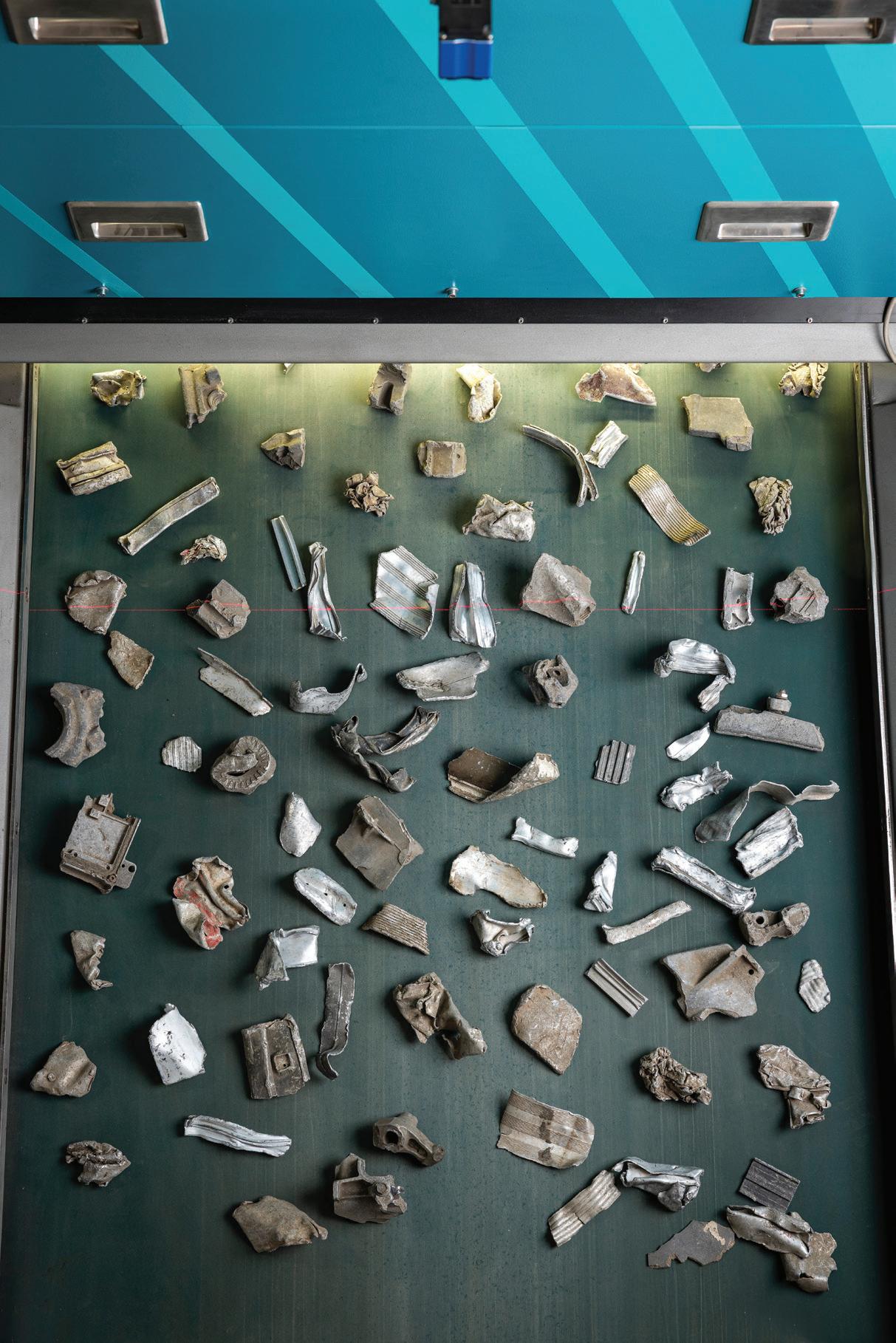
One example of that shift is Binder+Co’s CLARITY AI sorting system, which combines conventional optical sorting hardware with machine learning to recognize materials in ways that traditional colour-based optical sorting may miss.
“We’re not presenting new ways to sort materials,” says Ferdinand Schoen, senior sales manager for Binder+Co USA. “It’s that AI can do a lot of the sorting that’s being done today, but do it better or cheaper than conventional sorting technologies.”
A DIFFERENT WAY OF SEEING THINGS
Traditional optical sorters identify materials primarily by colour. While effective for many applications, those systems can struggle when materials no longer appear exactly as expected.
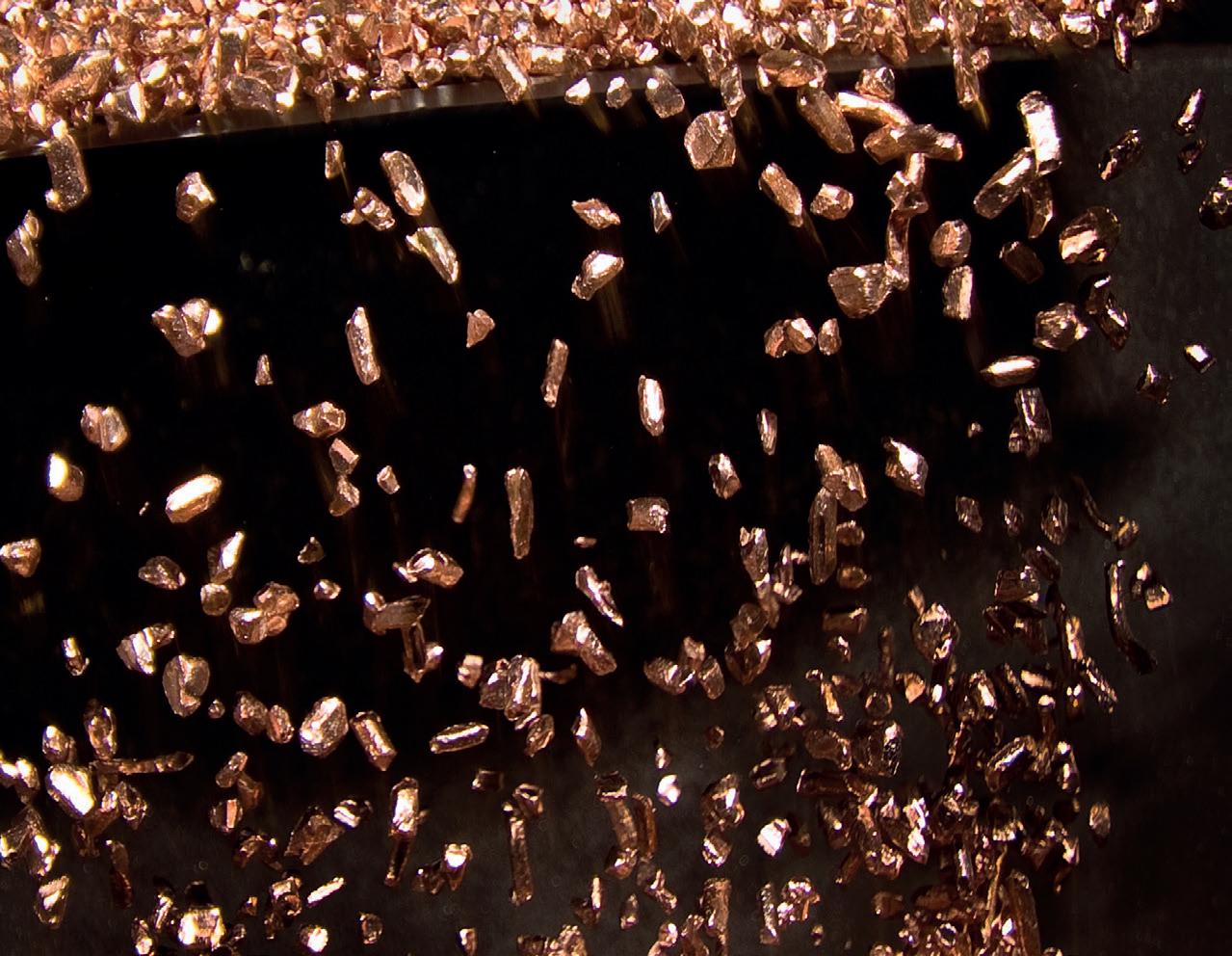
A weathered piece of copper, for example, may appear brown, grey, oxidized, or coated rather than bright copper red. Human operators can still recognize it immediately, but conventional optical sorters often cannot. AI changes that by evaluating a much broader range of visual information.
“The AI sorter works with just an optical camera system that employs a neural network architecture to process and analyze complete image information in real time. It’s basically an enhancement to a conventional optical sorter, enabling maximum performance through intelligent visual data interpretation,” says Schoen.
I think the real advantage of AI is that you can implement a very versatile system that can handle a number of applications that are a much lower investment cost compared to previously existing technologies.
Ferdinand Schoen Senior Sales Manager,
Binder+Co USA
Instead of focusing mainly on colour, the system analyzes characteristics such as shape, edges, surface texture, and other visual cues to build a more comprehensive understanding of each object passing beneath the camera.
TRAINING THE SYSTEM
Teaching the system follows a process similar to training a person. Representative pieces of a specific material are presented to the system, allowing the AI to develop its own recognition model based on their shared visual characteristics.
“You have to present the machine with . . . at least a thousand pieces,” says Schoen. “The more the better.” While that may sound like a lengthy process, pre-sorted material can pass through the AI sorter in just a few minutes, after which the software processes the information on Binder+Co’s server and creates a new or updated sorting program within a few hours.
Binder+Co currently favours site-specific training rather than relying entirely on centralized databases. According to Schoen, creating the training dataset using material from the customer’s own operation consistently produces the most reliable results because every recycling stream has its own characteristics. While material libraries exist, programs are tailored to individual applications and retrained when operators determine conditions have changed significantly.
I think [AI] will really be a door opener for many recyclers to do more with sorting.
Ferdinand Schoen
MAKING ADVANCED SORTING MORE ACCESSIBLE
The most significant impact of AI is not only improved sorting accuracy but improved accessibility.
Advanced technologies such as X-ray Transmission (XRT) and X-ray Fluorescence (XRF) have enabled increasingly sophisticated metal separation for years. However, their cost has limited adoption primarily to larger recycling operations.
AI optical sorting offers an alternative for many applications. Schoen says that, for certain sorting tasks at comparable throughput, AI systems can often perform the same sorting tasks while requiring roughly one-third to one-half of the initial investment of comparable XRT or XRF systems. Since the systems rely on optical cameras rather than X-ray technology, he says that operating costs can decrease by eliminating X-ray components, reducing spare parts costs, and avoiding the additional requirements associated with X-ray safety standards. AI sorting can also run faster than conventional XRT/XRF sorting, further reducing operating costs. On a 2.1-metre-wide sorter, for example, Zorba can be run at over 20 tph.
This gives larger recyclers the capacity to do more with fewer machines and gives smaller companies the flexibility of quickly running different products and different programs. Instead of dedicating individual machines to one specific application, recyclers can switch between customized sorting programs as production requirements change. Used as a batch process, a single AI sorter can move between different sorting applications throughout the day, allowing facilities to recover a wider range of higher-value materials with one machine. That lower cost changes the economics for many recyclers.
“I think the real advantage of AI is that you can implement a very versatile system that can handle a number of applications that are a much lower investment cost compared to previously existing technologies,” says Schoen.
For many mid-sized recyclers, that may represent the first practical opportunity to move beyond producing standard non-ferrous products and begin upgrading material into higher-value products.
“I think it will really be a door opener for many recyclers to do more with sorting,” says Schoen. “It gives them a lot more opportunities.”
RECOVERING MORE VALUE FROM EVERY STREAM
That flexibility extends across a wide range of metal recycling applications.
Within mixed, non-ferrous material streams such as
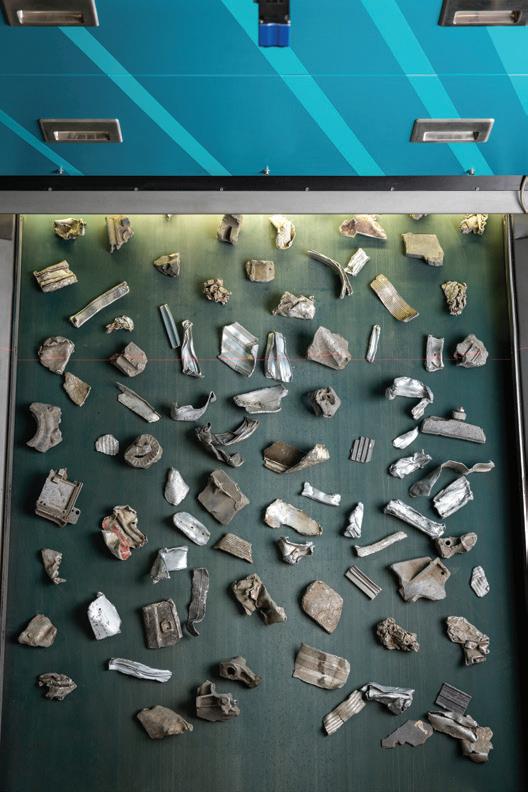
Using a camera and AI-based image analysis, Binder+Co’s Clarity system can identify materials based on a wider range of visual characteristics than colour alone.
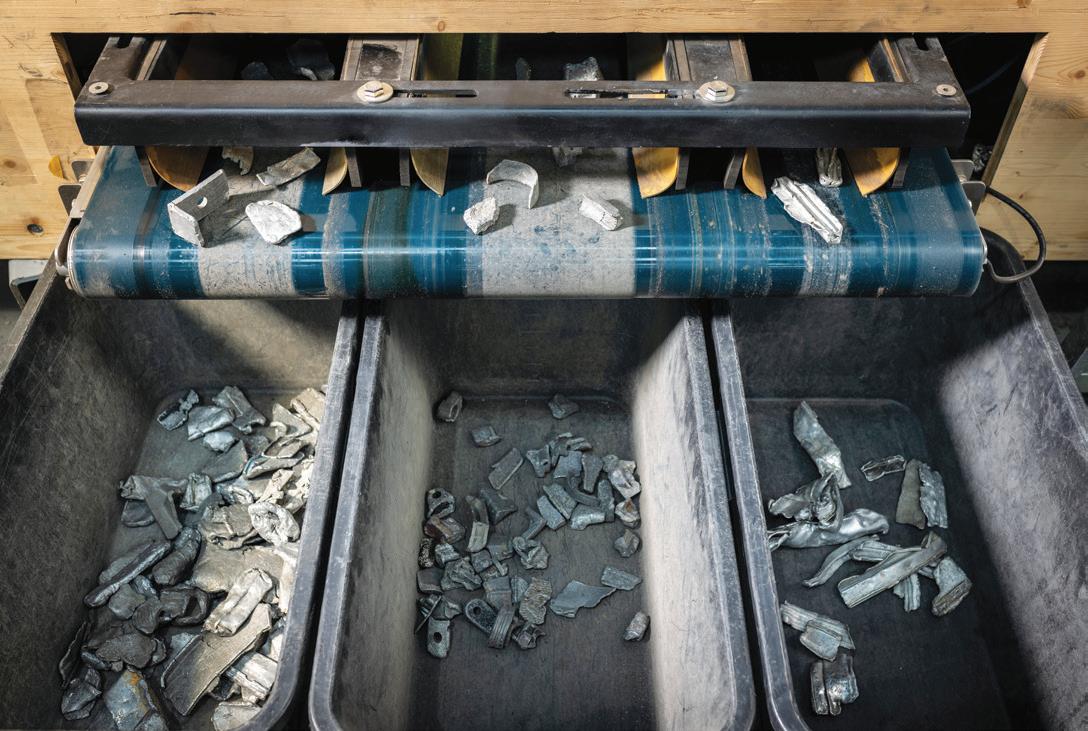
AI sorting can transform mixed non-ferrous streams into cleaner, higher-value commodities by separating materials such as copper, brass, zinc, and aluminum.
Zorba, Twitch, and Zurik, AI can separate copper, brass, zinc, cast and wrought aluminum, radiators, and extrusion products into cleaner commodity streams. Many of these separations were already possible using other technologies, but AI makes them economically attractive for a broader segment of the market.
The technology is also finding applications in shredder residue and automobile shredder residue (ASR), where recyclers continue searching for additional value after primary recovery processes have been completed. Insulated copper wire is one of the primary targets, but AI can also automate many manual picking tasks that remain common in those streams.
Electronic scrap presents another area where AI offers significant advantages. Unlike more uniform material streams, e-scrap contains an exceptionally diverse mix of products, components, plastics, metals, and assemblies. According to Schoen, that complexity plays to AI’s strengths.
Circuit boards, electric motors, copper, aluminum, and other visually identifiable components can all be targeted through customized sorting programs, reducing reliance on manual sorting and, for some applications, more expensive sensor-based technologies.
ROI MEASURED IN MONTHS
Ultimately, the business case depends on the application. Recovering a few percent of copper from a high-volume Zorba stream generates a very different return than recovering insulated copper wire from ASR. Even so, Schoen says customers frequently calculate payback periods measured in months rather than years.
He shares one example of a customer who previously sold Zorba containing residual copper and brass, but now removes those materials before sale. The recovered metals are marketed separately, while the remaining aluminum fraction is upgraded
AI can do a lot of the sorting that’s being done today, but do it better or cheaper than conventional sorting technologies.
Ferdinand Schoen
and sold as Twitch. The result is not simply cleaner material but multiple premium products from the same feedstock.
Labour savings can further strengthen the business case. Automating manual picking tasks not only reduces operating costs but also helps recyclers address the ongoing challenge of finding workers for repetitive sorting roles.
Beyond the immediate operational cost savings, Schoen says the greatest opportunity lies in separating valuable metals into cleaner commodity streams, so recyclers can produce higher-value products and capture more of the material’s value themselves.
THE NEXT STAGE OF METAL RECYCLING
The next stage of metal recycling may not be recovering more metal, but recovering more value — more intelligently.
For Binder+Co, AI is emerging as a complementary technology for existing sorting systems and as an affordable way to make advanced sorting accessible to more operations. For many recyclers, the biggest breakthrough may not be what AI can identify, but what it makes economically possible. RPN
PLANNING DOWNTIME TO REDUCE DOWNTIME
WHY THE MOST RELIABLE SHREDDING OPERATIONS TAKE EQUIPMENT OFFLINE BEFORE IT FAILS
BY MEGHAN BARTON, SENIOR WRITER
In shredder operations, downtime is expensive. Every hour a shredder is offline can mean lost production, backed-up material, labour inefficiencies, and increased fire risk from growing scrap piles.
But according to operators at some of North America’s largest shredding facilities, the cost of avoiding planned downtime is often far greater.
During a session at the ReMA 2026 Convention & Exposition, Randy Brace, president of Riverside Engineering, spoke with operators about the difference between reactive and preventive maintenance (PM) cultures in shredder operations.
Many larger shredding operations are relying on structured PM schedules, predictive monitoring, detailed maintenance planning, and disciplined shutdown routines to keep equipment running reliably and avoid costly interruptions.
For operators, the shift begins with recognizing that keeping a shredder running is not the same thing as keeping an operation productive.
THE DISCIPLINE TO STOP RUNNING
Many facilities continue to prioritize production over scheduled maintenance, operating with a reactive maintenance mindset: run the shredder as long as possible and repair failures when they happen.
Kevin Gershowitz, president of Gershow Recycling, says one of the biggest challenges in recycling is creating a culture where preventive maintenance is valued as much as production.
“I think one important factor, from a management point of view, is to have the discipline to value PM over running. So many times you see ownership or executive managers who think we got to run, we got to run, we got to run,” says Gershowitz.
That pressure can create a domino effect. Small maintenance issues are deferred, inspections are rushed, and crews focus on temporary fixes to keep production moving. Eventually, those
smaller problems can escalate into major failures requiring far longer shutdowns.
To avoid that cycle, Gershow Recycling schedules a dedicated PM shutdown every Wednesday, using an 8- to 10-hour maintenance window to complete repairs and inspections. Larger maintenance projects are scheduled for weekends.
Instead of treating downtime as lost production, operators need to view it as an investment in reliability. Strategically planned downtime often enables greater long-term uptime.
PREVENTIVE MAINTENANCE AS AN OPERATIONAL SYSTEM
Effective PM programs should rely on communication systems, documentation, inspections, and planning routines to keep facilities operational.
At Gershow Recycling, operators log downtime incidents directly into the shredder operating software and also maintain
handwritten day sheets that crews review daily.
Tony Cuevas, manager of SA Recycling’s Terminal Island shredder operation, describes a similar approach. Supervisors generate turnover reports at the end of each shift, documenting tons per hour, downtime events, and maintenance concerns. The reports are shared across departments, allowing operators, electricians, supervisors, and maintenance personnel to identify emerging issues before the next shift begins.
According to Cuevas, this communication between operators, electricians, supervisors, and maintenance crews is critical to an effective PM program at their facility. Consistent inspection routines create accountability across shifts and help ensure maintenance concerns are documented, repairs are verified, and equipment is ready to return to service.
Documentation alone, though, is not enough. Facilities also need a process for reviewing maintenance observations, prioritizing repairs, and incorporating those issues into future maintenance work. Brian Sackett of Riverside Engineering
notes that identifying problems during daily operations is only the first step. The real value comes from turning those observations into planned maintenance work.
PLANNING DOWNTIME TO REDUCE DOWNTIME
Minimizing downtime starts long before equipment is taken offline. For larger maintenance projects and shutdowns, preparation often begins weeks or even months in advance. Labour, spare parts, crane schedules, contractor availability, and production schedules all need to be coordinated before the first bolt is removed.
The goal is not simply to complete repairs quickly. It is to eliminate as many unknowns as possible before the shutdown begins.
At SA Recycling, major projects are planned using detailed charts that assign responsibilities, establish timelines, and identify critical tasks. Parts are inspected, test-fitted when
Structured preventive maintenance and disciplined shutdown routines are critical to keeping equipment running reliably and avoiding costly breakdowns.
necessary, and staged in advance.
“If you’re on the clock and you’re over here trying to sand and fit bearings, and if you need to send them to the machine shop, you just lost a day,” says Cuevas.
Preparation also includes inspecting and cleaning equipment before a shutdown begins. Sackett says that maintenance projects can expand when crews discover additional damage after equipment has already been disassembled. Thorough inspections conducted during the planning stage can help identify worn components, damaged structures, or additional repair requirements, reducing the risk of costly schedule extensions.
Gershow Recycling recently replaced an entry conveyor system in less than a week by fabricating rebar assemblies in advance instead of during the shutdown itself.
Motor replacement is another example. SA Recycling completed a 9,000-hp motor replacement in a single day using a fully prepared spare motor. Gershow Recycling maintains the spare equipment, lifting resources, and contractor relationships needed to swap motors overnight rather than losing days to an unplanned failure.
In many cases, the difference between a one-day repair and a week-long outage comes down to what happens before the shutdown begins. The more planning, inspection, and preparation completed in advance, the less time crews spend troubleshooting once the equipment is offline.
The talent can’t work without the tool.
Kevin Gershowitz President, Gershow Recycling
THE IMPORTANCE OF SPARE PARTS
Even the best maintenance plan can fall apart if a critical component isn’t available when it is needed.
“If anything’s going to take more than 24 hours to get, it should be on your shelf,” Gershowitz says.
Spare parts inventories are often treated as a cost until a major failure occurs. Once a shredder is offline waiting for a bearing, hydraulic component, or motor part, the cost of carrying inventory becomes much easier to justify.
“Business interruption always drove planning for projects and [we’re] always looking at a way to shorten that business interruption,” Sackett says. He notes that operators often focus on the cost of resources such as larger cranes or specialized equip-
Learning to prioritize planned maintenance over non-stop production can be a challenge for operators.
ment when planning maintenance projects, but those expenses should be weighed against the cost of extended downtime.
The most proactive operations apply the same discipline to inventory management. Rather than ordering parts when something fails, they keep critical components and tooling on hand so repairs can begin immediately when they are needed.
“The talent can’t work without the tool,” says Gershowitz.
Maintaining spare parts inventories also requires ongoing attention. Components that sit in storage for extended periods still need to be protected, inspected, and maintained to ensure they are ready for service when needed.
EXPERIENCE STILL MATTERS
Preventive maintenance programs may be built on schedules, inspections, and tracking systems, but many maintenance decisions still rely on experience. Recognizing an unusual vibration, a change in sound, or the early signs of a developing mechanical issue often comes from time spent around the equipment rather than from a report or dashboard alone.
Experience also plays a role in knowing when not to intervene. Temporary fixes intended to keep material moving can sometimes create larger failures later, a phenomenon Gershowitz referred to as “friendly assassins” — operators trying to help the operation while unintentionally increasing risk.
Experience is difficult to teach in a classroom. It comes from exposure to real-world failures and the opportunity to learn alongside experienced personnel.
“There’s only so much mentoring you can do,” Cuevas explains. “It’s not until something breaks and you actually physically [fix] it, [that’s] when you’re really going to learn.”
Management plays an important role in shaping that culture. Even the most experienced operators can struggle to prioritize preventive maintenance when production pressures consistently outweigh repair schedules and inspection routines.
DOWNTIME AS A COMPETITIVE ADVANTAGE
Unplanned downtime affects far more than production alone. It can increase fire risk, create environmental concerns, strain labour resources, and disrupt downstream processing across an entire facility.
The irony is that many of the industry’s longest shutdowns begin with an attempt to avoid a much shorter one.
Specific maintenance practices may vary from facility to facility, but an important underlying philosophy emerges: address small problems while they are still small, plan repairs before they become emergencies, and create systems that remove uncertainty from the maintenance process.
The result is not simply fewer breakdowns. It is greater operational consistency, lower risk, and a stronger ability to meet production targets. For larger shredder operations, reliability is no longer measured by how long equipment can run before it breaks. Reliability is measured by the discipline to shut it down before it does.
Car Crushers boast
THE TEST THAT CAN BE ACED WITHOUT STUDYING
MATERIAL STREAM TESTING PUTS VALUABLE DATA IN THE HANDS OF OPERATORS IDENTIFYING REAL OPPORTUNITIES TO INCREASE COMMODITY RECOVERY, BOOST REVENUE, AND MAXIMIZE SYSTEM PERFORMANCE.
In today’s fluctuating commodity markets, it is more important than ever to maximize yield productivity at sorting facilities. Validating capital expenditures is often a major obstacle for small and mid-sized facilities.
Material stream testing provides vital information about the characterization and value of materials being processed. Testing material samples allows operators to receive key insights into what system changes may be required to create long lasting improvements. Understanding the costs of required system updates and the timeframe for a return on investment is crucial to businesses where investing in new equipment retrofits could mean critical downtime and lost productivity or revenue.
BHS (Bulk Handling Systems) opened Nashville-based CTEC (Customer Testing and Education Center) to offer customers material stream testing and evaluation in real time with BHS equipment and systems. Clear, tested validation on what purity and recovery levels can be achieved is a significant benefit of on-site test sessions. A typical test session utilizes familiar BHS products, including NRT optical sorters, Max-
AI® detection & sorting technology, and Bulk Handling Systems screens and conveyors. Controlled and monitored via the Total Intelligence Platform (TIP), a fully integrated, smart management system which delivers centralized, system-wide performance and material-composition data at the fingertips of operators. Testing at CTEC provides important insights on the impact of upgrading a facility and what gains can be found when paired with the right technology.
HOW TESTING ON THE LOOP WORKS
Customers can choose from conventional linear sorting or autonomous circular sorting methodologies. Autonomous sorting methodology removes and stores target commodities returning non-target materials back to the front of the system; each pass focuses on increasing material recovery, leveraging different technology located around the system. The loop is fully integrated with multiple Max-AI® VIS units for unparalleled material categorization. A customer can choose either fully automated quality control (QC) option: the proven Max-AI® AQC-2 robotic quality control featuring the iEOT (Intelligent End of Arm Tool), or Max-AI® AIR direct eject QC.
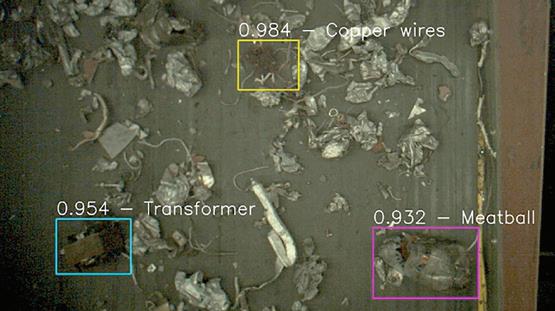
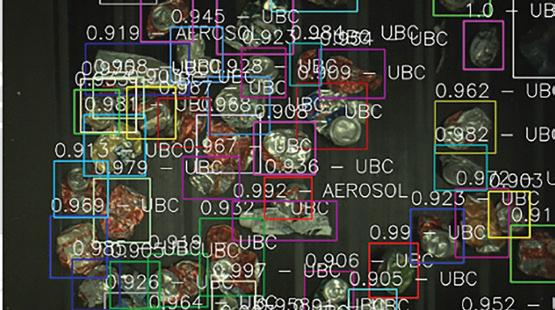
Max-AI® VIS identifies aluminium cans as the commodity and contaminants to be ejected (right); locating copper wires, transformers, and “meatballs” in a WEEE stream (left).
THE TECHNOLOGY
Material is evaluated with Max-AI® VIS which rapidly analyzes waste stream composition before Max-AI® Flex robots sort out contaminants and hazardous materials big and small.
This presort is followed by the industry-leading NRT SpydIR®HS optical sorter, integrated with Max-AI® VIS. Using the latest in data fusion, this sorter combines hyperspectral imaging with AI to solve complex sorts while providing real time material composition. The SpydIR®-HS has a nearly 10time increase in detection resolution and twice the precision in air ejection compared to other optical sorters in the industry. Showcasing the InFlight Sorting® technology NRT is known for; material is detected and ejected off the belt in less than 10ms, 15 times faster than the blink of an eye. Easy access enclosure with optimized airflow geometry reliably and consistently keeps the material stream in the right place.
Max-AI® AIR, the latest in the Max-AI® lineup, uses proven air ejection technology with AI to separate contaminants from the material stream. Like all BHS products Max-AI® AIR is not limited to recycling streams like paper, plastics and mixed materials. Max-AI® AIR also sorts organics, metals, and printed circuit boards (PCBs) streams. A versatile solution for sorting all material types and sizes.
Max-AI® AQC-2 with iEOT utilizes patented BHS technology to successfully remove contaminants. Software and hardware seamlessly optimize picking performance, and an automated cleanout tool improves recovery and reduces downtime and maintenance. With hundreds of Max-AI® AQC units installed around the world, this QC is chosen for its ability to exceed manual QC in pick rates, accuracy, and uptime.
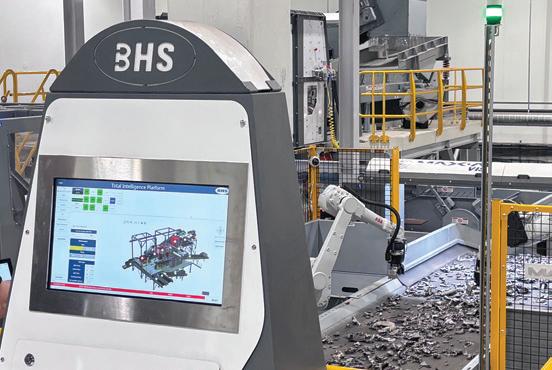
Data is fed into the Total Intelligence Platform (TIP). As an intuitive interface with a 3D system visualization, TIP displays a snapshot of equipment, expanded views into machine centers, and isolated machine modes for flexible timeframe and system monitoring. TIP integrates with NRT optical units, Max-AI® detection and sorting technology; providing bunker and baler monitoring, and product inventory visibility. Gone are the days of walking the system to gather information or adjust production settings. The power of real-time data and diagnostics can be accessed instantly, creating a new level of adaptation and profitability.
THE PASSING GRADE
The solutions to be found at CTEC-Nashville address purity rates and efficiency problems for operators of all sizes. Customers will leave a testing session at CTEC with actionable data and insights for real opportunities to increase recovery, purity, boost revenue, and maximize system performance at their own facility. When the answers are data-validated, can you afford not to test in Nashville?
To learn more, or schedule a visit: www.bulkhandlingsystems.com/CTEC
TIP provides valuable system-wide insight to help operators see where to improve performance and profitability.
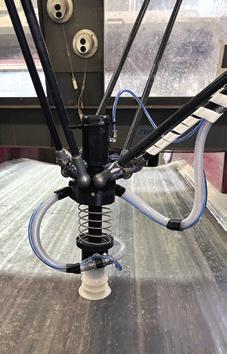
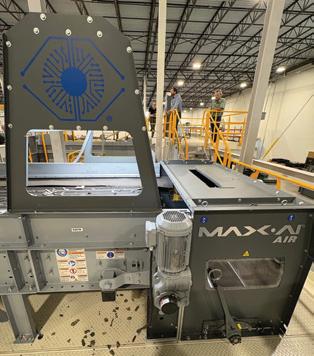
Left: The Intelligent End of Arm Tool, a BHS patented technology. Right: The Max-AIR direct eject QC on the CTEC loop.
WHERE ELECTRIFICATION PAYS OFF IN RECYCLING OPERATIONS
LOWER OPERATING COSTS ARE DRIVING ELECTRIFICATION AT GROUPE BELLEMARE
BY MEGHAN BARTON, SENIOR WRITER
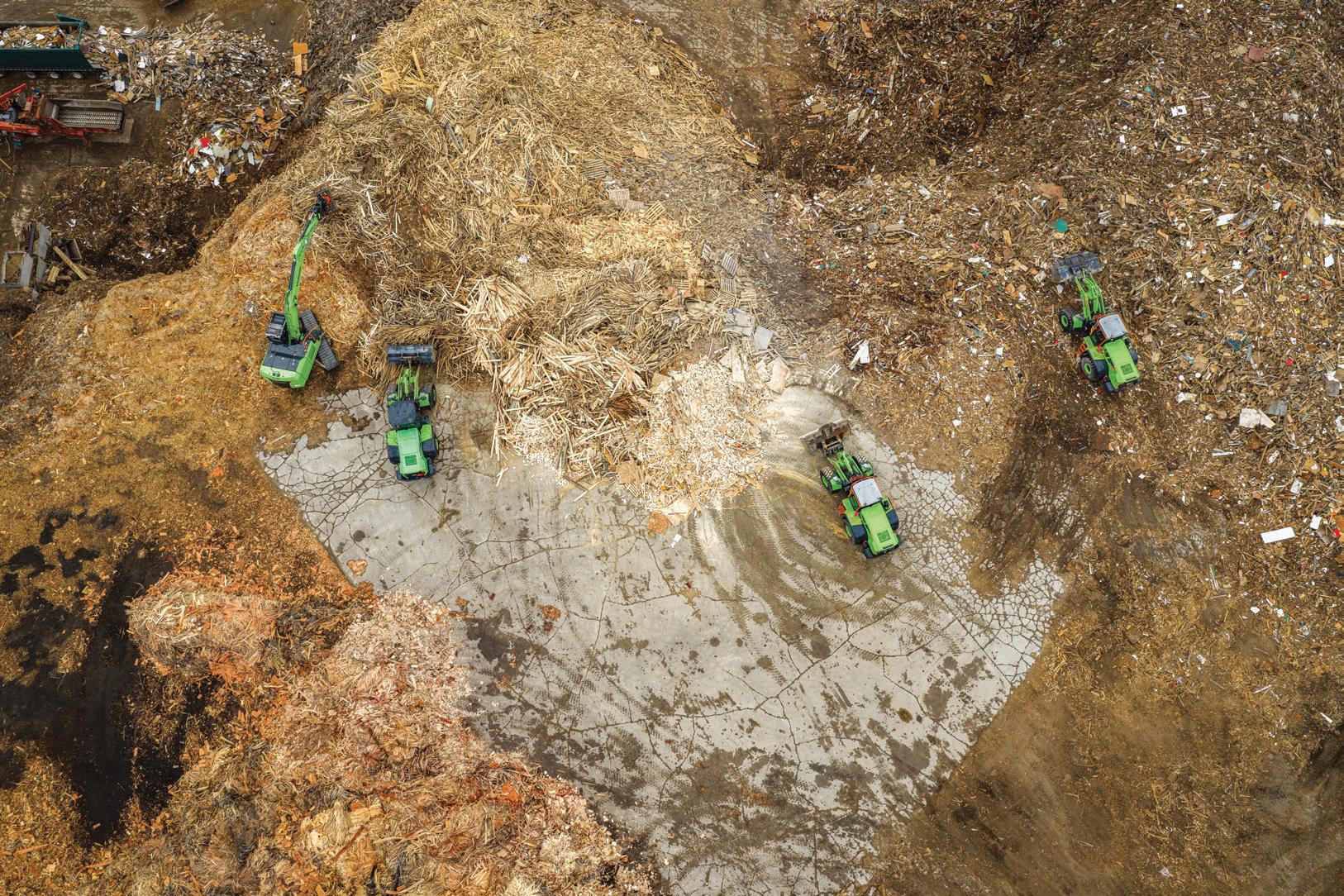
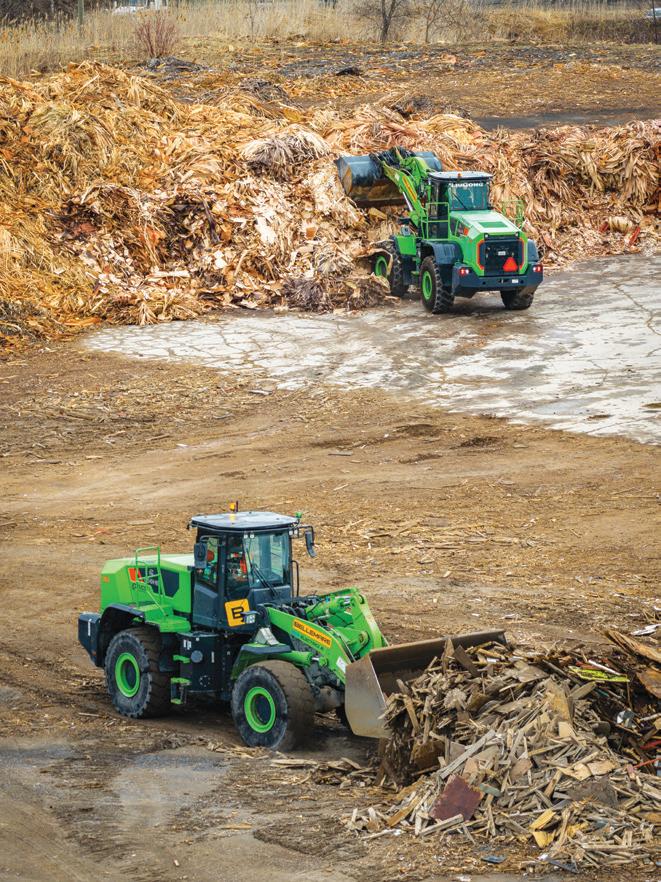
At Groupe Bellemare’s Plan 1 facility in Trois-Rivières, Quebec, five mid-size electric machines are hard at work. This is not a pilot project or a test run — Groupe Bellemare has successfully integrated one of North America’s first fleets of mid-size electric construction equipment into its daily operations.
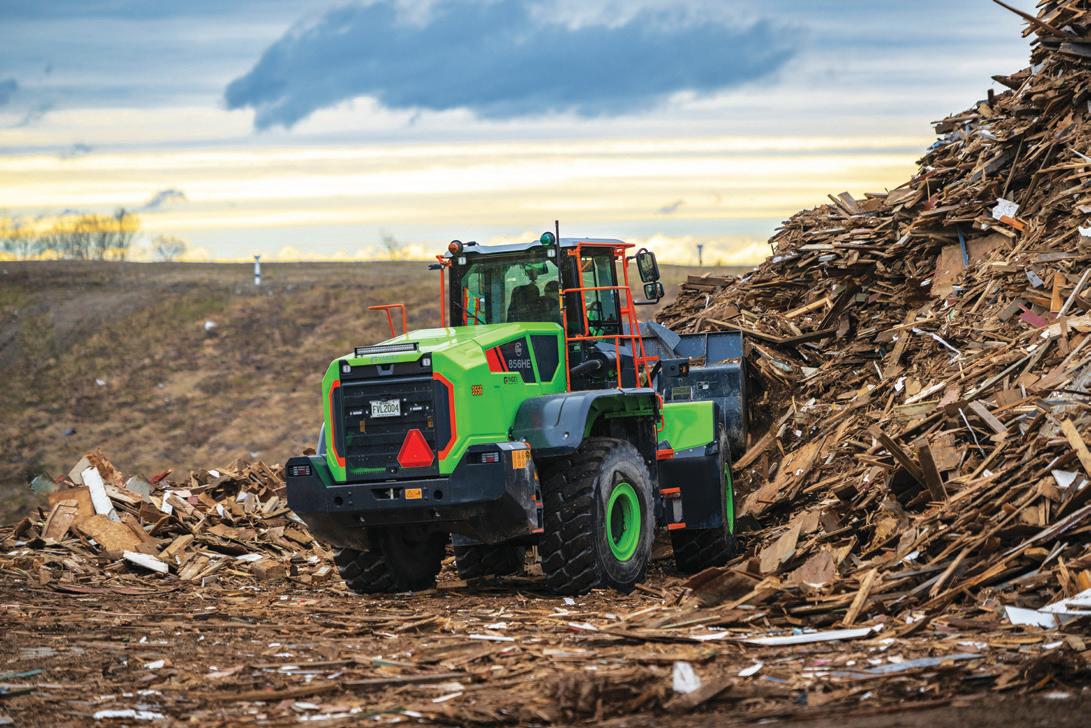
Its equipment lineup includes four 46,297-pound LiuGong 856HE MAX electric wheel loaders and a recently added 58,422-pound 924FE electric excavator — among the first machines of their kind sold in North America.
For the family-owned company, founded in 1959, the transition spans its abrasives and minerals division and its C&D recycling operations. In these divisions, short travel distances, controlled work cycles, and indoor material handling define the work.
According to Jason Lagacé, operations manager with Groupe Bellemare, the electric loaders have matched or exceeded the output of comparable diesel machines while delivering responsive hydraulics, strong travel speed, and a quieter operating environment for crews working long shifts.
In Bellemare’s abrasives and minerals and C&D recycling division, fulfilling orders and moving material efficiently and consistently over multiple shifts is critical. The company has proven that productivity doesn’t slow when switching from diesel to electric. Instead, in the right application, and with support and collaboration from the right dealer and OEM partners, electrification delivers tremendous operational cost savings.
ELECTRIC EVOLUTION
Bellemare’s introduction to electric loaders came unexpectedly. A company sales representative saw one operating during a business trip to India, recorded a video, and sent it back to the team. That sparked the internal discussion about whether
electric machines were available in Quebec and whether they could handle Bellemare’s workload at Plan 1.
At the time of Bellemare’s evaluation, electric equipment options were limited. Lagacé says the company was looking for a machine that could meet its production requirements while remaining financially viable, but few manufacturers offered electric loaders that aligned with those needs.
That evaluation process ultimately led Bellemare to LiuGong’s electric platform.
“We really wanted the best available,” he says. “We looked around . . . and we found out that there weren’t any other companies building something that even compared to LiuGong in terms of performance and reliability.”
Bellemare worked with Groupe Gymdex, LiuGong’s Quebec dealer, to review specifications, assess site suitability, and determine whether the loaders could realistically replace its diesel units. The evaluation process included multiple visits to the dealer, where supervisors and operators tested the equipment first-hand. The company also reviewed available government incentives, including provincial and federal subsidies tied to replacing diesel equipment with electric machines.
Because they had to replace a diesel machine with an electric one to qualify for subsidies, the loader was not a supplemental unit. Reliability quickly became one of the most critical considerations.
For Bellemare, measurable operational cost savings has made the company more confident about its fleet electrification strategy.
Jean-Nicolas Gonzalez, sales representative with Groupe Gymdex, says the evaluation centred on understanding how the equipment would perform in Bellemare’s specific environment.
Hands-on testing and early support from the dealer helped build confidence in the machines and confirmed they could be integrated into Bellemare’s production workflow.
ASSESSING SITE SUITABILITY
The centralized layout and predictable material flow at Plan 1 were well-suited to evaluating electric equipment, particularly as an environment where machines operate within a defined area and access to power is readily available.
In both the abrasives and minerals and the recycling divisions, the work is relatively light duty. In the recycling division, applications primarily involve handling recycled glass, wood, and construction debris, with limited exposure to higher-load work that would place greater demand on battery systems.
The loaders work primarily feeding crushers, screens, and other processing equipment. The operating area is compact, and the machines spend most of their time within a defined indoor space rather than travelling long distances between stockpiles and production equipment.
That indoor environment also mattered. As Bellemare’s operations grew, the prospect of running multiple diesel machines
The cost savings are miraculous.
Jason Lagacé Operations Manager, Groupe Bellemare
inside the building became more difficult to ignore from both a workplace and operational standpoint. Electrification offered a way to reduce those exhaust concerns.
INFRASTRUCTURE SUPPORT
Charging was another early concern. Bellemare runs two eight-hour shifts, and the company needs its machines to operate through a full day without disrupting workflow to charge. The company had upgraded its electrical service years earlier in anticipation of future business growth. While not originally intended for electric equipment, that investment has provided sufficient capacity to support charging infrastructure. As a result, Bellemare was able to install multiple chargers across its
The team at Bellemare turned to LiuGong for machines that can meet its production requirements while remaining financially viable.
operations without major last-minute electrical upgrades.
To support future fleet expansion and Bellemare’s growing mix of mobile electric assets, including loaders, trucks, and other vehicles, the company plans to install a centralized charging hub with nine stations. When it becomes fully operational in September 2026, the hub will allow equipment to return to a single location for charging, but smaller chargers will still remain in place for equipment with fixed operating patterns. For example, the electric excavator, which will be used to feed a mulcher, is expected to be charged in place to minimize unnecessary movement.
PERFORMANCE MEASURED WITH REAL NUMBERS
While Bellemare’s broader environmental goals played a role in the initial decision, Lagacé says that success has been determined by measurable operating data.
“The cost savings are miraculous,” he says. Based on the company’s internal tracking over the first 5,000 hours of operation, the electric loaders consume roughly 30 kWh per hour during operation. At an average electricity cost of $0.12 per kWh, that translates to significantly lower energy costs compared to a diesel machine consuming approximately 12 litres of fuel per hour.
Maintenance costs have remained similar to diesel machines, at roughly $8 per hour including tires, but Lagacé notes that diesel machines typically see those costs increase significantly after 5,000 hours due to engine wear and aftertreatment-related issues.
Bellemare also benefitted from provincial and federal financial support when purchasing the equipment and chargers, including Quebec’s ÉcoPerformance program and Canada’s Clean
Technology Investment Tax Credit (ITC). In addition, the compa ny has accumulated more than 300 carbon credits over the past year, adding another layer to the overall return on investment.
WHERE ELECTRIFICATION FITS NEXT
Bellemare’s experience with the LiuGong equipment — and its measurable operational cost savings — has made the compa ny more confident about continuing to electrify other parts of its fleet where the technology fits.
Within the abrasives and minerals and environmental oper ations, which include C&D recycling, sand pits, and quarries, Lagacé says Bellemare is working toward the goal of having about 80 percent of relevant machinery electrified over the next few years.
Electric equipment tends to be most effective in operations where work is centralized and access to power is reliable. Those are the same characteristics that define many recycling facilities, making them strong candidates for electrification.
At the same time, recycling operations are driven by produc tion targets and customer commitments, leaving little room for unexpected downtime. For Bellemare, that reality shapes how it approaches fleet electrification.
Even within the divisions where Bellemare sees the most promise, the company expects to retain some diesel equipment as backup.
That pragmatic approach may be the clearest lesson from Bellemare’s experience so far. The company is not treating electrification as an all-or-nothing proposition. It is evaluating where the equipment performs well, where it improves eco nomics, and where it can be deployed with confidence. Belle mare’s machines operating in Trois-Rivières prove that electric equipment delivers. RPN
Bellemare’s equipment lineup includes four LiuGong 856HE MAX electric wheel loaders and a 924FE electric excavator.
AGENDA IS LIVE
A&A RECYCLING BOOSTS TIMBER PROCESSING WITH ECOTEC SHREDDER
THE TBG 530T WORKS ALONGSIDE AN EXISTING GRINDER TO ADD UP TO 60 TONNES AN HOUR
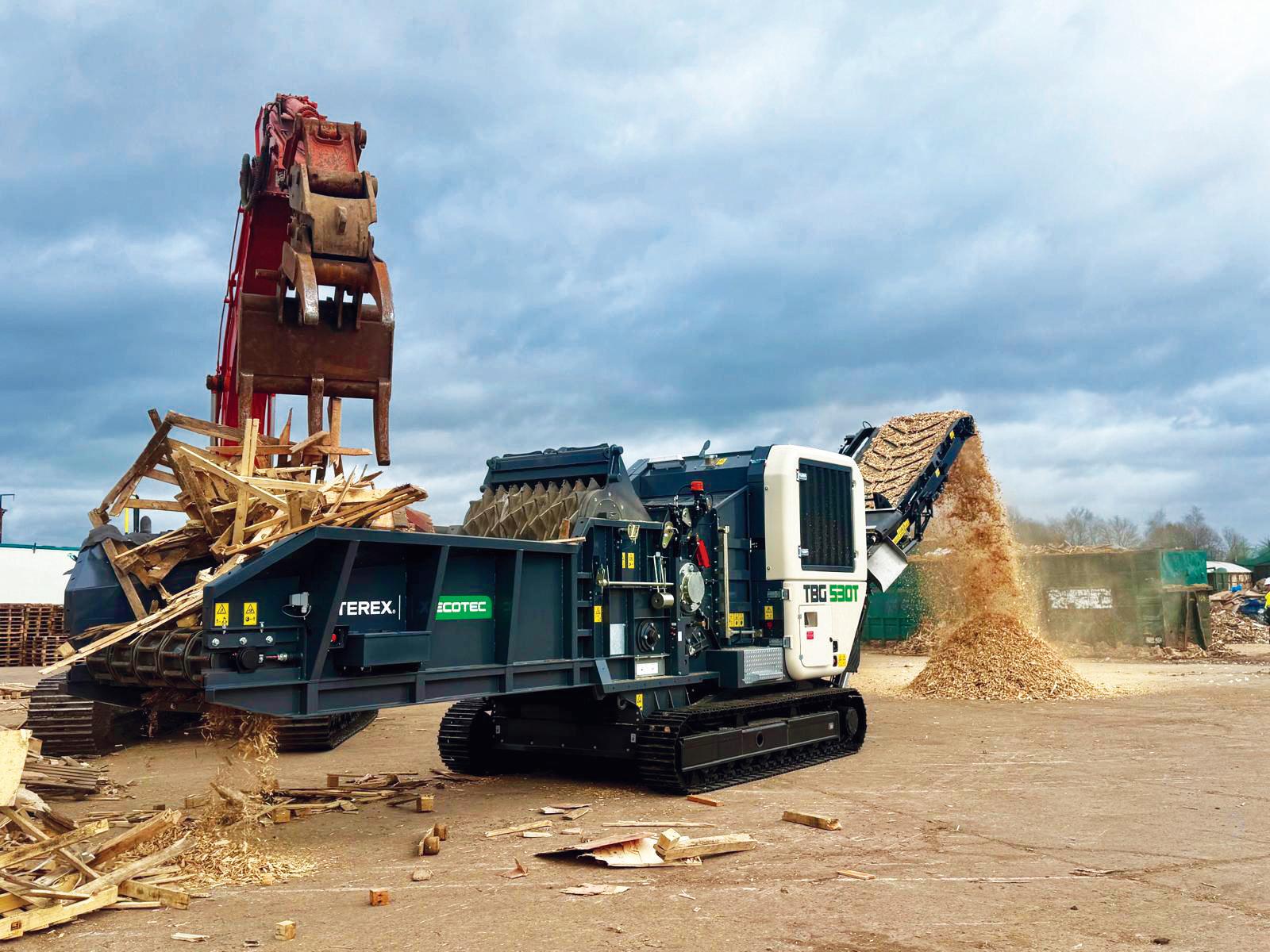
A&A Recycling Services, a U.K.-based specialist in waste wood recycling, processes more than 240,000 tonnes of waste wood annually across its operations, supplying material to the panel board and biomass energy sectors. Recently, it increased processing capacity at its Meriden Quarry operation in Coventry by adding an Ecotec TBG 530T highspeed shredder, distributed by Blue Machinery.
The site operates from a fully concreted yard, with large windrows of material prepared for processing, and handles mixed A- and C-grade waste timber, including lightly contaminated material with no pre-pick carried out.
RISING DEMAND FOR TIMBER PROCESSING
With throughput requirements continuing to increase, A&A Recycling required an additional machine to work alongside an existing CBI 6400 horizontal grinder, enabling an additional 40–60 tonnes per hour to be processed while reducing reliance on the primary shredder.
Following an assessment of the application and site conditions, Blue Machinery proposed the Ecotec TBG 530T fitted with 80-millimetre (3.15-inch) top and bottom screens as a solution that could meet both output and material demands while keeping running costs low.
“The brief was to introduce a machine that could integrate smoothly into an established process and deliver consistent output at a competitive cost per tonne,” says Davie Sutherland, technical sales manager at Blue Machinery. “The TBG 530T has proven well-matched to the material at Meriden Quarry, delivering high throughput with low fuel consumption and supporting a strong return on investment.”
ENGINEERED FOR MIXED TIMBER STREAMS
Powered by a 493-hp (368-kW) Scania DC13 engine, the track-mounted TBG 530T is designed for medium-scale producers requiring consistent end-product quality. Its open-fronted feeder supports efficient loading, while an electronically controlled feed system — comprising heavy-duty drag chains and an aggressive feed wheel with lift and downward assist — provides a steady flow of material through the machine.
At its core is a swinging hammer rotor measuring 1,100 millimetres (43.3 inches) in diameter and 1,490 millimetres (58.7 inches) in width, operating at 1,000 rpm with 30 up-swinging hammers. A choice of hammer designs and interchangeable screens allows the configuration to be tailored to different product requirements. A screen kickback system provides additional protection from unshreddable material entering the chamber, helping to minimize damage and downtime.
TURNING WOOD WASTE INTO PRODUCTS
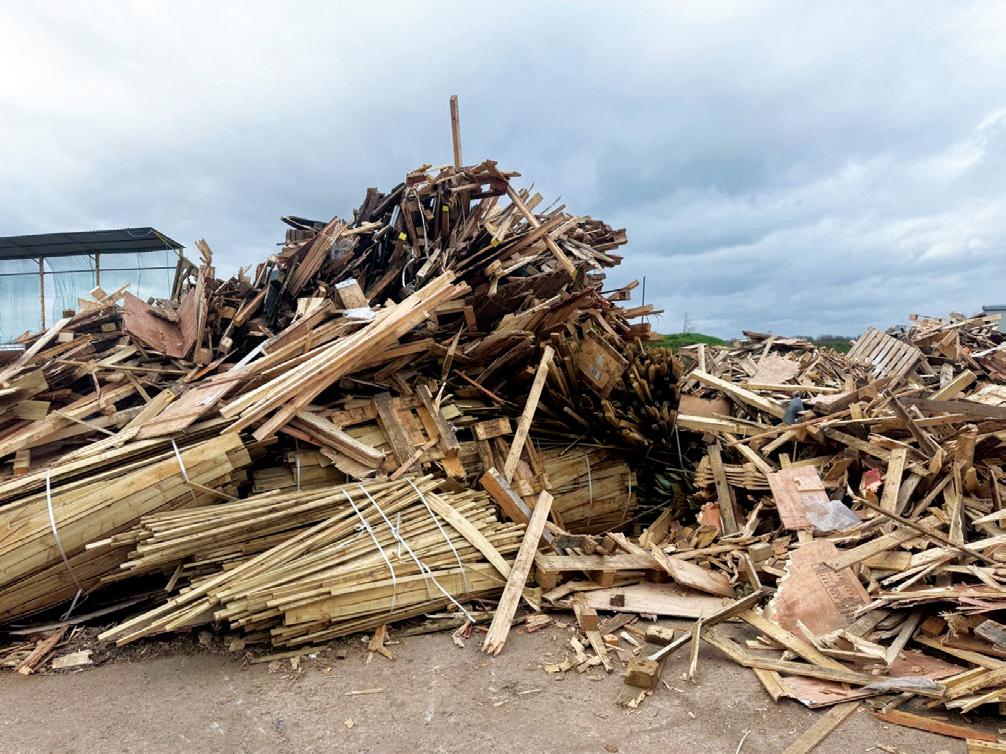
Material processed by the TBG 530T at the Meriden Quarry site is separated into three fractions to maximize recovery and value. Fine material up to 10 millimetres is directed to agricultural applications, material between 10 and 60 millimetres is supplied to chipboard production, and material above 60 millimetres is used in biomass energy plants.
The combination of high throughput and efficient fuel
consumption has enabled A&A Recycling to reduce cost per tonne, improving overall operational efficiency while maintaining consistent output quality. The machine’s modular discharge conveyor offers a discharge height of up to 4.6 metres (15.1 feet) and can be lowered for inspection and maintenance. Optional overband magnet technology is available for the removal of ferrous contamination.
“The TBG 530T has been engineered for consistent performance in demanding waste wood applications, with a strong emphasis on efficiency, service access and uptime,” says Conor Hegarty, business line director for Ecotec. “For operators processing mixed timber streams, these factors are critical in controlling operating costs and delivering long-term value.”
KEEPING TIMBER MOVING THROUGH THE YARD
Ease of maintenance was also a key consideration, with the TBG 530T providing simplified access to all major service points. Electric and hydraulic screen raise-and-lower functions, along with interlocked chamber access, support efficient inspection and maintenance.
“For us, sustainability and efficiency go hand in hand,” says Paul Hayward, operations manager at A&A Recycling Services. “The TBG 530T supports our ability to recover and process waste wood efficiently, helping to divert material from landfill and direct it into productive end uses such as panel board manufacture and biomass energy. Reliable equipment that supports these outcomes is central to how we operate.”
A&A Recycling’s new Ecotec TBG 530T shredder works alongside an existing horizontal grinder at the Coventry site.
Waste wood is separated into different fractions depending on end use, from agriculture to biomass energy.
A GUIDE TO DIAGNOSING BLADE WEAR IN INCLINED SHEARS
WHAT A WORN BLADE IS TRYING TO TELL YOU ABOUT YOUR MACHINE
BY SLONE FOX, EDITOR
For recycling operations running inclined shears, blade wear is more than a maintenance checkbox. It can also be a diagnostic tool.
The way a blade wears can tell you almost everything about how the machine is set up and how much life the blade has left. Reading those patterns correctly, tracing them back to their root cause, and acting on what they show is what separates proactive blade management from constantly reacting to downtime.
STEP 1: IDENTIFY THE WEAR PATTERN
The first step is looking closely at the edge itself, rather than judging blade condition by how long it’s been in service. Wear pattern, not wear amount, can be a more useful indicator.
Rolled or rounded edges where the cutting line has bulged usually indicate that the material is tearing rather than cutting cleanly. This can point to clearance that’s set too wide, since the gap allows the material to be pulled before it separates, rolling the edge over.
Chipping or fractured edges — especially near the point of first contact rather than spread along the blade — usually point to clearance that’s too tight. When the gap is undersized, the blades can experience “double shear” where the edges grind against the material and each other, which can show up as chips or fracture lines. This pattern can also appear when the shear
encounters unexpectedly hard material in the feed, even if clearance itself is correct.
Uneven wear along the blade’s length can mean the gap isn’t consistent across the full edge, even if the average clearance measured at one point looks fine. This kind of pattern often develops gradually and can go unnoticed until it’s severe enough to start affecting cut quality.
Localized damage at a single point, rather than distributed wear along the edge, usually traces back to the blade seat rather than to clearance: a loose mounting bolt, a worn or damaged seat surface, or a hard object entering the shear at a consistent feed position. This pattern can be a signal to look at the hardware holding the blade in place rather than the blade itself.
Mushrooming or edge deformation means the blade steel is bending or spreading under load. This usually happens when clearance is too tight, the blade hardness doesn’t match the material being cut, or the shear is running scrap heavier than its rated capacity.
Even, gradual dulling across the full edge, with no chipping, rolling, or localized damage, is a sign of healthy wear. It’s the pattern a properly set-up shear produces when it’s running well-matched scrap under normal conditions, and it’s the easiest pattern to manage since it develops predictably.
STEP 2: TRACE THE PATTERN TO ITS CAUSE
Once a pattern is identified, the next step is confirming what produced it. Each pattern points toward a specific check.
Clearance: measure with a feeler gauge at several points along the length of the blade and compare the readings against the manufacturer’s specification for the thickness and type of material being processed.
Alignment and consistency: where clearance measurements vary from one end of the blade to the other, shims placed between the blade and its holder can close or open the gap incrementally. After any shim adjustment, the mounting bolts should be torqued and clearance rechecked, since tightening hardware can shift the setting slightly.
Blade seat and clamping hardware: where damage is concentrated at one point rather than spread across the edge, the seat surface and mounting bolts should be inspected for wear, looseness, or damage that lets the blade move slightly during the cut.
Feed material: where chipping or mushrooming appears despite clearance checking out correctly, it’s worth reviewing whether the scrap stream includes material outside the shear’s rated hardness or thickness range.
STEP 3: DECIDE WHAT THE WEAR MEANS FOR BLADE LIFE
Once the cause has been identified and corrected, the wear pattern also informs what to do with the blade currently in the machine.
Regrinding usually makes sense when the wear is even and stays on the surface with no cracks reaching down into the blade body. There should also be enough material left within the manufacturer’s grinding allowance to keep the blade rigid and hold proper clearance.
Replacement is generally the better call when there’s chipping or cracking that a regrind won’t fully clean up. Grinding away the visible damage won’t fix what’s underneath, and the crack can still cause failure under load.
Mushrooming is another dealbreaker: once the steel itself has deformed, grinding can’t undo that. Repeated regrinds can also leave the two blades mismatched in clearance or angle, at which point it’s better to replace.
By treating wear patterns as a diagnostic tool rather than simply a sign of blade age, operators can improve inclined shear performance, reduce maintenance costs, and get the most value from every blade. RPN
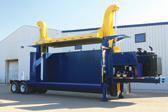
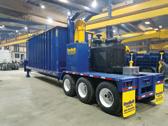
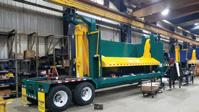
Inclined shears cut metal scrap into uniform, manageable sections ready for sorting, baling, or melting.
EVENTS CALENDAR
CONNECT WITH THE INDUSTRY
CARI NEXT GEN: ONTARIO BRAMPTON, ON | AUGUST 12
Created for recycling professionals aged 40 and under, CARI’s Next Gen events are hosted by up-and-coming leaders across Canada. The Ontario event will be hosted at Triple M Metal, where attendees will receive an exclusive tour of its yards, followed by a lunch featuring insightful conversations and networking opportunities.
cari-acir.org/next-gen-ontario-2026
WASTE & RECYCLING EXPO FORT LAUDERDALE, FL | AUGUST 12–13
WR Expo offers a comprehensive hub for networking with recycling professionals and discovering new technologies across waste management, processing, and disposal. The two-day event will feature a packed exhibit hall with the latest products and equipment, along with educational opportunities focusing on major challenges and opportunities in the industry.
wrexpo.com
COMING SOON
SCRAP EXPO
CARI NEXT GEN: BRITISH COLUMBIA VANCOUVER, BC | SEPTEMBER 2
CARI’s Next Gen: British Columbia event will host an afternoon of professionalism-centred workshops. Leadership will walk attendees through conferences, associations, and committees that move the industry forward, as well as awards and grants that recognize hard work in the industry. The event will wrap up with headshots, pinball, and networking opportunities.
cari-acir.org/next-gen-british-columbia-2026
LOUISVILLE, KY | SEPTEMBER 8–10
SCRAPEXPO.NET
ORGANICS RECYCLING CONFERENCE
CALGARY, AB | SEPTEMBER 22–24
COMPOST.ORG
2026 RECYCLING MARKET
SEPTEMBER 1 6 - 1 8 · CHICAGO
THE DEALS START HERE.
Big Players. Big Insights. Big Opportunities.
Join brokers, traders, processors, and consumers from across the recycled materials industry at the ReMA 2026 Roundtables , September 16–18 in Chicago.
This highly anticipated event brings together the leaders shaping global and domestic recycled materials markets for two-and-a-half days of market intelligence, strategic networking, and business development opportunities.
Whether your focus is copper, ferrous, aluminum, nickel, stainless, or other recycled materials, the Roundtables deliver the insights and connections you need to stay competitive in the year ahead.
Early-Bird Rates Available! Scan the QR code to register today. Act Now! Register by June 30 and save 18%.