Heavy Equipment Guide March 2026, Volume 41, Number 3

Page 1


SECTORS

40

50

52 Cat’s D11 is

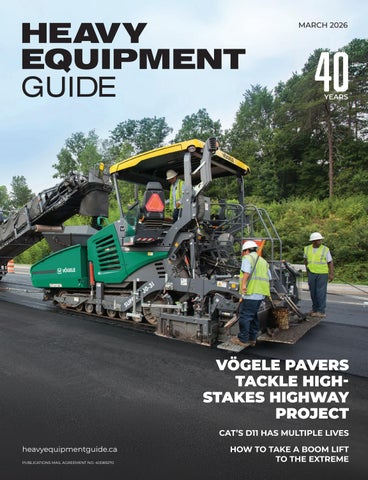
COVER PHOTO: VÖGELE’S SUPER 2000-3I PAVERS ARE READY TO TACKLE HIGHDEMAND PROJECTS.

In this issue, learn why a GTA contractor selected the Super 2000-3i for the high-stakes rehabilitation of Highway 403 near Mississauga, Ontario.

Turn to page 32.

CONNECT WITH US @HeavyEquipGuide

WE’D LIKE TO HEAR FROM YOU

Do you have a job site story, innovation, or industry concern that our readers should know about? We’d like to hear from you.

EDITOR IN CHIEF Kaitlyn Till ktill@baumpub.com 604-291-9900 ext. 330

DIRECTOR OF DIGITAL STRATEGY

Slone Fox sfox@baumpub.com 604-291-9900 ext. 335

SENIOR WRITER Meghan Barton mbarton@baumpub.com 604-291-9900 ext. 305

ASSOCIATE EDITOR Stephanie Bontorin sbontorin@baumpub.com 604-291-9900

VICE PRESIDENT OF SALES/ ASSOCIATE PUBLISHER Sam Esmaili sam@baumpub.com 604-291-9900 ext. 110

ADVERTISING

Contact: Editor in Chief Kaitlyn Till at ktill@baumpub.com or 604-291-9900 ext. 330 MARCH 2026 | VOLUME 41 • NUMBER 3

PRODUCTION MANAGER

Tina Anderson tanderson@baumpub.com 604-291-9900 ext. 222

DESIGN & PRODUCTION

Morena Zanotto morena@baumpub.com 604-291-9900 ext. 325

PRESIDENT/PUBLISHER Ken Singer ksinger@baumpub.com 604-291-9900 ext. 226

VICE PRESIDENT/CONTROLLER

Melvin Date Chong mdatechong@baumpub.com

FOUNDER

Engelbert J. Baum

Published by: Baum Publications Ltd.

124 - 2323 Boundary Road Vancouver, BC, Canada V5M 4V8

Tel: 604-291-9900

Toll-free: 1-888-286-3630 Fax: 604-291-1906 www.baumpub.com www.heavyequipmentguide.ca @HeavyEquipGuide

FOR ALL CIRCULATION INQUIRIES

Toll-free: 1-866-764-0227 email: heg@mysubscription.ca

Subscription: To subscribe, renew your subscription, or change your address or other information, go to: http://mysubscription.ca/heg/

Heavy Equipment Guide serves the Canadian engineered construction industry including: roadbuilding and maintenance; highways, bridges, tunnels; grading and excavating; earthmoving; crushing; trucking and hauling; underground utilities; trenching; concrete paving; asphalt paving; demolition; aggregates production; fleet maintenance; and asset security and management. The magazine is distributed to key industry personnel involved in these sectors.

Subscription Price: In Canada, CDN $91.00; Outside Canada, US$149. Heavy Equipment Guide is published eight times a year in January/ February, March, April, May/June, July/August, September, October, and November/December.

Heavy Equipment Guide accepts no responsibility or liability for reported claims made by manufacturers and/or distributors for products or services; the views and opinions expressed are those of the authors and not necessarily those of Baum Publications Ltd.

Copyright 2026, Baum Publications Ltd. No portion of this publication may be reproduced without permission of the publishers.

We acknowledge the financial support of the Government of Canada.

Printed on paper made of FSC®-certified and other controlled material. ISSN 1715-7013.

PUBLICATIONS MAIL AGREEMENT NO. 40069270

Return undeliverable Canadian addresses to: Circulation Dept., 8799 Highway 89, Alliston, ON L9R 1V1 email: heg@mysubscription.ca / Toll-free: 1-866-764-0227

Sized right for tight spaces. Steel-built for heavy-duty work. With groundbreaking power in a nimble package, Takeuchi Compact Excavators are proof positive that it’s not the size of the machine in the work, it’s the size of the work in the machine. THE MARK OF TOUGHNESS

FROM THE EDITOR

CAREFUL EQUIPMENT MANAGEMENT IS A STRATEGY FOR SUCCESS

Tight margins are always a topic of concern in this industry, and it’s worth re-evaluating the strategies that you can use to maximize the utilization and longevity of your fleet. In this issue, we explore several different approaches to equipment management that can reduce your expenses and increase your productivity.

Heavy Equipment Guide contributor Mack Plovie recently visited Finning’s Regina dealership, which carries out complex Cat D11 dozer rebuilds. The company was celebrating a significant milestone of its D11 rebuild program and is proud of its incredible success and expertise in rebuilding this model. As you’ll see in Mack’s incredible photographs of the stripped down D11, the process is thorough and impressive.

Equipment rebuilds can extend the working life of a machine many times. For multi-million-dollar assets that take a beating, like the D11, rebuilds provide incredible savings over decades of extended life. But equipment rebuilds aren’t just for behemoth machines like the D11. Finning and other dealerships across the country can carry out full rebuilds, partial rebuilds, and remanufacture components for other types of construction equipment — all of these approaches can significantly reduce capital expenditures for your business.

Choosing the right machine to begin with is also vital. Focused more on the compact sector, our friends at Cooper Equipment Rentals explore some common equipment selection errors that can lead to overspending, in addition to safety and efficiency problems. Whether you’re renting, buying, or a mix of the two, the advice applies. Fitting the correct equipment to the job site and scope of work is an essential strategy for keeping costs in check.

Finally, Heavy Equipment Guide’s senior writer, Meghan Barton, sat down with the experts at Trimble to explore Trimble’s subscription services. This approach to technology adoption is aimed toward small-to-medium-sized contractors for whom the high upfront cost is a barrier to realizing the benefits of modern

For multi-million-dollar assets that take a beating, like the D11, rebuilds provide incredible savings over decades of extended life.

construction technology. For first-time technology users, this practical approach offers financial predictability and access to the latest updates.

Reducing unplanned downtime by keeping equipment in good order, maximizing the utilization of your assets, and selecting suitable technology tools for those assets can all help optimize your efficiency while keeping costs in check — and are all strategies that never go out of style.

ktill@baumpub.com

heavyequipmentguide.ca

NEWS ROOM

JOHN DEERE TO OPEN $70 MILLION EXCAVATOR MANUFACTURING FACILITY IN NORTH CAROLINA

John Deere has announced plans to open two new U.S.based facilities: a new distribution centre near Hebron, Indiana, and an excavator factory in Kernersville, North Carolina. Both are slated to open in 2027.

“Our investment in these new facilities underscores John Deere’s dedication to strengthening the backbone of American industry and supporting local economies,” said John May, chairman and chief executive officer of John Deere.

The new $70M factory in Kernersville, North Carolina, will bolster John Deere’s manufacturing capabilities, leveraging advanced technologies to produce excavators for the construction market.

“We are excited to bring this new facility to our Kernersville campus and to be part of the region’s thriving manufacturing community,” said Ryan Campbell, president Worldwide Construction and Forestry and Power Systems. “Our focus will be on delivering excellence, creating jobs, and advancing the legacy of John Deere manufacturing.”

John Deere recently broke ground on a new distribution centre near Hebron, Indiana, strategically located to enhance supply chain capabilities. This facility will be designed to streamline operations and ensure timely delivery of equipment and parts.

“This new facility is an investment in customer expectations around world class product support through parts availability for our U.S.-based ag, construction, forestry, mining, and turf customers,” said Denver Caldwell, vice president, Aftermarket and Customer Support. “Indiana’s strong workforce and central location make it an ideal choice for expansion.”

CANADIAN CONCRETE EXPO 2026 SETS NEW ATTENDANCE RECORD

THE 8TH ANNUAL CANADIAN CONCRETE EXPO WELCOMED 7,893 INDUSTRY PROFESSIONALS

The Canadian Concrete Expo (CCE) 2026 delivered record-setting growth across every major area of the event, welcoming 7,983 industry professionals to The International Centre in Toronto from February 11 to 12, a 20 percent increase over last year. The show organizers say that Canada’s largest trade show dedicated to concrete construction also reached a new milestone with a record 396 exhibitors, expanded show floor, and exceptional engagement in both live demonstrations and educational programming.

CCE 2026 was supported by over 90 sponsors, partners, and industry associations, reflecting strong industry confidence in the event and its continued growth. Attendees travelled from across Canada and many countries around the world, with significant participation from Quebec and Eastern Canada, underscoring CCE’s continued rise as a national and international meeting place for the concrete and construction industries.

“CCE 2026 exceeded all expectations, from the energy on the show floor to the strength of attendance in the conference sessions and live demos,” said Stuart Galloway, president of Canadian Concrete Expo. “The growth we saw this year is a clear signal that the industry is prioritizing in-person connection, hands-on product evaluation, and practical education to keep pace with evolving construction demands.”

RECORD GROWTH ACROSS THE ENTIRE SHOW

CCE 2026 established new benchmarks for expansion and participation, including records in:

• Total attendance: 7,983 visitors.

• Exhibitors: 396 participating companies.

• Trade show growth: new highs in overall footprint and show-floor activity.

• Featured areas: continued momentum in the Forming, Shoring and Scaffolding Pavilion and Equipment and Product Demo Area.

• Education: 35 conference sessions, with record participation and a 39 percent increase in conference session attendance.

DEMONSTRATIONS DRAW STRONG CROWDS

One of the standout successes of CCE 2026 was the expanded Equipment & Product Demo area, which was consistently busy throughout both days of the show. The enhanced demo experience gave attendees an immersive, hands-on opportunity to test tools and equipment on-site, compare solutions side-by-side, and engage directly with manufacturers on real job site applications.

A SPOTLIGHT ON EDUCATION AND PROFESSIONAL DEVELOPMENT

With 35 conference sessions delivered over the two-day event, CCE 2026 placed a major spotlight on professional development. Conference session attendance increased by 39 percent, reinforcing the value of CCE as a destination not only for equipment, products, and suppliers, but also for practical learning, best practices, and forward-looking insights across the concrete and construction sectors.

LOOKING AHEAD TO CCE 2027

Planning is already underway and CCE 2027 is expected to grow once again, building on the momentum and the strong demand from exhibitors, attendees, and industry partners.

CCE 2027 will take place February 10 to 11, 2027, at The International Centre in Toronto.

ACQUISITIONS

SMS EQUIPMENT ACQUIRES FINNISH EQUIPMENT DEALER

Canadian dealer SMS Equipment will expand in Europe with the acquisition of Suomen Rakennuskone Oy, a Finnish distributor of construction and mining machinery. The purchase grows SMS Equipment’s global footprint, which also includes operations in Alaska and Mongolia.

Established in 1992, Suomen Rakennuskone Oy provides heavy equipment sales, maintenance, parts, training, and technical support to contractors across Finland with headquarters in Pirkkala. It is the nation’s exclusive dealer of Komatsu mining and construction equipment. In addition to supporting Finland’s construction industry, Suomen Rakennuskone Oy serves the country’s growing mining sector, which is anchored by nickel and gold production, and supported by significant reserves of cobalt and lithium.

“The acquisition of Suomen Rakennuskone Oy represents an important milestone in our international growth,” said Robin Heard, SMS Equipment president and CEO. “Through the expansion, we’re able to extend our depth of expertise developed in global mining and construction segments and work with Suomen Rakennuskone Oy to further develop these industries in Finland. Together, we will evolve our global capabilities and strengthen the value we deliver to all our customers.”

SMS Equipment brings decades of mining experience to the Finnish market.

“SMS Equipment’s expertise and best practices have been honed in some of the world’s most demanding mining environments,” said Jared Collins, managing director of Suomen Rakennuskone Oy. “With this acquisition, we’re combining the global experience with Suomen Rakennuskone Oy’s deep local knowledge and longstanding customer relationships.”

JLG ACQUIRES TECHNOLOGY COMPANY CANVAS

JLG Industries, Inc. has acquired the core technology developed by Canvas, a San Francisco–based construction robotics technology company known for creating robotic solutions for interior construction applications.

The relationship between the companies began six years ago

when Canvas selected a JLG platform to develop its robot, and, since then, the technology has advanced to automate repetitive tasks and enable consistent, high-quality results, according to the company.

Through the acquisition, Canvas technology will advance robotic end-effector capabilities and autonomy, enabling pairing with JLG access equipment to support a range of interior construction applications. These solutions are designed to assist skilled workers by handling repetitive, physically demanding tasks, and allowing crews to focus on higher-value work.

WACKER NEUSON WILL NOT BE ACQUIRED BY BOBCAT

Wacker Neuson will not be acquired by Doosan Bobcat. In December 2025, Wacker Neuson addressed reporting of talks concerning a possible public takeover by Doosan Bobcat. On January 22, 2026, Wacker Neuson issued the following statement:

Wacker Neuson SE announces that discussions between the company and Doosan Bobcat Inc. regarding a potential acquisition of a majority stake in Wacker Neuson SE, as well as a possible public takeover offer for Wacker Neuson SE, will not be continued. The Wacker Neuson Group remains focused on executing its Strategy 2030 pursuing sustainable growth.

JOHN DEERE COMPLETES ACQUISITION OF TENNA

Deere & Company has completed its acquisition of Tenna, a construction technology company based in New Hope, Pennsylvania. John Deere announced the intent to acquire Tenna on December 22, 2025, and the agreement was concluded on February 18, 2026.

Tenna says it will continue to operate as an independent business marketed directly to construction customers under the Tenna trade name and will focus on scaling and growing the business through its mixed-fleet customer-focused business model.

www.heavyequipmentguide.ca

TOPCON ENTERS INTO AGREEMENT TO COLLABORATE ON INTEGRATED TECH WITH FIXPOSITION

Topcon Positioning Systems and Fixposition have entered an agreement to collaborate on integrated technology for future product offerings.

“Topcon provides high-precision GNSS (global navigation satellite system) positioning technologies for geomatics, construction, and agriculture applications worldwide. Working with companies such as Fixposition — specialists in Visual RTK (real-time kinematic) and visual-aided positioning — helps create added value for our customers,” said Ron Oberlander, head of the Topcon Geomatics Platform.

“Customers are increasingly working in environments where satellite connection can be challenging, such as dense urban environments, and need consistent, reliable positioning to maintain productivity,” Oberlander added. “Fixposition offers technology that augments satellite positioning, beneficial for users even while working inside structures and in indoor–outdoor transitions, without disrupting workflows by combining RTK GNSS with artificial intelligence to ensure position accuracy. We see this AI-enabled technology as an innovative integration with our next-generation GNSS solutions.”

KOMATSU TESTS HYDROGENPOWERED HYDRAULIC EXCAVATOR

Obayashi Corporation, Iwatani Corporation, and Komatsu Ltd. successfully conducted Japan’s first on-site proof-of-concept (PoC) test using a medium-sized hydraulic excavator equipped with a hydrogen fuel cell system (FC excavator). The test was carried out at the Joshin-Etsu Expressway (Rockfall Countermeasure) Kitanomaki (No.2) Construction Project.

Since 2023, Komatsu has been conducting PoC tests of its FC excavator. Compared to battery-powered models, hydrogen-powered systems offer higher energy density and output, making them a promising power source option for achieving carbon neutrality at job sites that use medium-sized hydraulic excavators.

This test involved using the FC excavator for relocating surplus soil and refuelling of the on-board hydrogen tanks on-site. The aim was to assess the practical feasibility of the FC excavator on an actual construction site and to identify potential areas for improvement in hydrogen supply and refuelling methods.

Komatsu says that the FC excavator demonstrated work performance equivalent to conventional diesel-powered models. The test also confirmed additional benefits, including

More than Features. Built as Essentials.

Compact in size but big on capability, the Kubota SVL65-2S delivers impressive performance. Its new Auto Shift function down-shifts while turning for maximum traction and better productivity, while the Advanced Multi-Function system lets you operate the loader, bucket cylinders, and auxiliary functions seamlessly at the same time. Powered by a durable Kubota engine and equipped with outstanding vertical lift, the SVL65-2S is built to help you accomplish more in less time.

reduced operator fatigue, reduced engine-induced vibration, as well as improved situational awareness due to lower noise levels. There were also several challenges to commercialization that were realized during the testing phase, including the need for an increased on-board hydrogen supply and faster hydrogen refuelling.

DEVELON OPENS NEW TRAINING CENTRE IN ARIZONA

DEVELON recently opened a new construction equipment training, testing, and education facility called the HD Construction Equipment (HDCE) Real Operation Center (ROC) in Tucson, Arizona. The new facility replaces the previous testing and training centre. It’s located adjacent to the Tucson

STEELWRIST EXPANDS NORTH AMERICAN OPERATIONS

Steelwrist has expanded the operations at its North American headquarters in Newington, Connecticut. The investment further strengthens the company’s long-term commitment to the North American market and positions Connecticut as a strategic hub for advanced manufacturing and assembly to serve the construction industry.

The expanded facility enhances Steelwrist’s machining, local assembly, and product testing capabilities, enabling the company to deliver products that are assembled and tested in the United States. This development marks an important milestone in Steelwrist’s North American growth and reinforces its ability to serve contractors with shorter lead times, increased flexibility and high product availability.

Compactors

Pedestal

SPOTLIGHT

INTRODUCTIONS & UPDATES

Caterpillar MOTOR GRADER

Caterpillar has added a joystick steering option to the next-generation 140 motor grader, allowing buyers to select either joystick (JOY) or traditional lever and steering wheel (LVR) controls at the time of purchase. The configurable platform eliminates the need for separate JOY and LVR models. The three-axis joystick layout integrates transmission and directional control in the left joystick, with drawbar, circle, moldboard, throttle, and differential lock functions in the right. Follow steer enables the front wheels to respond directly to joystick input. The 140 also features a new 9-forward-speed transmission with finish gear for smoother final grading passes. The next-generation cab design improves visibility, while available grade control, smart cameras, and safety systems support accuracy and job site awareness.

Astec JAW CRUSHER

Astec Industries has launched the A50 jaw crusher, the first model in its new A-series line for primary crushing applications. The A50 features a keyed and bolted frame that eliminates high-stress welded joints, solid side plates for added strength, and a cast swing jaw with an angled wear plate to reduce material bridging. Longer liners with an improved nip angle increase material grip and crushing efficiency, and patented interchangeable toggle assemblies simplify adjustments and maintenance. High-inertia flywheels support higher capacity and reduced horsepower requirements. Engineered isolation mounts isolate crushing forces and reduce stress on chassis frames and mounting structures. Additional A-series jaw crushers are expected to follow.

ProAll CONCRETE MIXER

ProAll’s new L20R lightweight volumetric concrete mixer is designed for small- to mid-sized producers and contractors. With a gross vehicle weight rating under 25,950 pounds, the L20R may be operated without a commercial driver’s licence and can be transported using a standard pickup truck. The unit meets Volumetric Mixer Manufacturers Bureau standards and features intuitive mix controls, compatibility with skid-steer loaders for aggregate loading, and bag-fill capability for producers without silos. Multiple chassis configurations are available. Standard equipment includes a 100-gallon water tank, aggregate and cement bin vibrators, a manual mesh tarp, swivel chute, and aluminum chute.

Atlas

Copco

PORTABLE AIR COMPRESSOR

Atlas Copco has expanded its DrillAir lineup with the X-Air+ 800-20 portable air compressor designed to deliver higher flow at 20 bar for applications such as foundation drilling and abrasive blasting. The unit provides up to 800 cfm with 11 percent greater fuel efficiency than its predecessor. Powered by a 6.7-litre Cummins engine, the compressor integrates AirXpert technology to automatically adjust operating parameters in response to real-time demand. A Dynamic Flow Boost function increases output during peak drilling phases, and the Xc2004 controller offers enhanced monitoring and connectivity. The compact canopy design simplifies transport and job site deployment without compromising performance.

JLG Industries MICRO SCISSOR

To mark 50 years since debuting its first scissor lift, JLG Industries has expanded its lift lineup with the micro-sized ES2632M. This electric micro scissor delivers a 25-foot 6-inch indoor platform height, 600-pound capacity, and a 32-inch machine width for work in confined spaces. QuikFold rails allow the unit to pass through standard doorways, and a zero-turning-radius design delivers manoeuvrability on congested job sites. The lift includes a standard leak-containment system and on-board technologies, including Progressive Elevated Drive, Variable Tilt, and ClearSky Smart Fleet. An optional integrated mid-rail deck increases platform height by 19.5 inches for applications requiring additional vertical reach.

THE STATE OF ELECTRIFICATION

ELECTRIFICATION

HOW ELECTRIFICATION IS DEVELOPING IN THE ROADBUILDING, CRANES & AGGREGATES SECTORS

Electrification is expanding the range of power options available in construction equipment. Instead of replacing diesel machines outright, electric machines are favoured in applications where operating conditions support alternative powertrains. For the question of where electric solutions deliver measurable value, the answer varies by sector, shaped by duty cycle, infrastructure, ROI, and application.

Electrification gained its earliest traction in applications where benefits were immediate and measurable. Strict emissions targets and regulatory pressure in parts of Europe helped accelerate innovation and moved electric equipment from development into active job site deployment. Lift equipment has demonstrated the practicality of battery-electric systems in controlled settings, particularly indoors. In underground mining, electric fleets reduce ventilation requirements and improve underground conditions. Electrification of compact earthmoving and demolition equipment has proven practical in municipalities, indoor environments, and rental fleets.

Today, electrification development is progressing in more demanding segments, such as roadbuilding, cranes, and aggregates processing, where power demands are higher, runtimes longer, and workflows more varied. In these sectors, the approach is less uniform. Here we examine how that development is playing out and why each sector is arriving at electrification on its own terms.

ROADBUILDING

Electrification in roadbuilding is advancing most clearly in compact tandem rollers. Their defined operating patterns, moderate energy demands, and frequent use in urban and municipal environments make them suited to electrification.

Battery-electric compact rollers are now operating full shifts on street repairs, bike paths, parking lots, and residential projects. Machines such as the Volvo DD25 Electric and Hamm’s HD 10e and HD 12e demonstrate the viability of electric compaction equipment. With battery capacities designed to support a typical working day and recharge times measured in hours rather than extended downtime, these machines integrate into existing workflows

with minimal adjustment.

Beyond emissions reduction, electric rollers offer secondary operational advantages. Reduced vibration, lower noise levels, and fewer service points contribute to improved operator comfort and lower maintenance demands. For rental fleets and municipal contractors in particular, the simplified service profile of electric compact rollers can reduce downtime and operating costs across the life of the machine.

Advances in battery capacity and energy management have expanded electrification development into larger tandem rollers, such as Hamm’s HX 70e, which has been tested on job sites in Europe, and paving, though paver development has progressed more slowly due to higher energy demands.

Unlike compact rollers, asphalt pavers run at higher, more consistent power levels, especially during continuous laydown on larger projects. Because of that, electric pavers are developing more gradually and are limited in their commercial use. Some electric pavers are now demonstrating full-shift capability supported by high-capacity lithium-ion battery systems

Hamm’s HD 12e tandem roller.
Volvo’s DD25 Electric tandem roller.

and rapid-charging options.

Electric pavers, such as the LeeBoy 8520C Electric, the Vögele SUPER 13005e and MINI 500e/502e, the Ammann eABG 4820, and the Dynapac SD1800W e, illustrate how electrification is scaling in mini, compact, and mid-class pavers to benefit compact urban paving, municipal work, and mid-size commercial projects.

The LeeBoy 8520C Electric, with pave widths from 2.44 metres to 4.57 metres, integrates GM’s battery and drive system with the company’s Legend HD screed and high-flow hydraulics, positioning it as an electric paver built for commercial applications.

Vögele’s SUPER 1300-5e features a 126 kWh liquid-cooled lithium-ion battery operating at 400 V and supports pave widths from 1.8 to 4.2 metres. The MINI 500e and 502e models offer 15 kWh or 22 kWh battery options designed for smaller-scale work such as pathways, sidewalks, utility restoration, and confined urban paving projects with full-day runtime expectations.

Ammann’s eABG 4820, which was billed as the largest electric paver at its introduction in early 2025, delivers pav-

ing widths up to 6.5 metres and recorded daily outputs of up to 1,200 tonnes, supported by a battery system designed for full-shift operation.

Dynapac’s SD1800W e is powered by a 98 kWh lithium-ion battery paired with a 55 kW electric motor (200 kW peak output), with reported recharge times from 5 to 80 percent in approximately 40 minutes. With minimum paving widths down to 0.7 metres using reducing shoes (and up to 4.7 metres), the SD1800W e can handle narrow urban applications such as pathways and utility restoration work.

Battery capacity and charging strategy remain critical considerations. Reduced noise and emissions could make compact and mid-sized electric pavers particularly effective in urban environments and enclosed spaces, for night work, and where emissions regulations influence bid requirements. Electrification development for the roadbuilding sector is shaped less by technological possibility and more by operational fit. In roadbuilding, that fit emerges most clearly where urban density, environmental standards, and bid requirements intersect.

Instead of replacing diesel machines outright, electric machines are favoured in applications where operating conditions support alternative powertrains.
LeeBoy’s 8520C Electric paver.
Ammann’s eABG 4820 paver.

CRANES

Electrification of mobile cranes is advancing through hybrid and plug-in systems that reduce emissions while preserving lifting performance and runtime flexibility. This approach reflects the operational realities of mobile cranes. All-terrain and rough-terrain units operate with highly variable duty cycles and often travel significant distances between work sites where grid access can be inconsistent. Large, heavy-lift jobs require steady, high-power output. These conditions can challenge fully battery-dependent systems in larger crane classes. As a result, many OEMs are integrating electric-drive capability into conventional powertrains.

between jobs.

Fully battery-electric cranes are emerging in more defined applications. Tadano’s eGR-1000XLL-1 is a fully battery-electric rough-terrain crane designed for urban and emission-sensitive environments. With up to seven hours of lifting capability or a combined lifting and travel cycle supported by its onboard battery pack, it demonstrates that full battery-electric operation is commercially viable in select crane classes.

on-board battery systems, many manufacturers are advancing electrification through grid-connected and diesel-electric-drive architectures.

Liebherr’s LTM 1150-5.4E and LTC 1050-3.1E combine conventional engines with electric-drive systems that enable emission-reduced crane operation when connected to job site power. In electric mode, lifting can be performed with reduced noise and zero on-site exhaust emissions. When grid power is unavailable, the machines retain the flexibility of an internal combustion engine.

Manitowoc’s Grove GMK5150L-1e and GMK5150XLe similarly reflect the plug-in hybrid strategy gaining traction in all-terrain cranes. These models connect to external power for lifting operations, reducing fuel consumption and emissions on site while maintaining diesel-powered mobility for travel

Mobile cranes frequently operate on temporary sites where grid infrastructure varies widely. Plug-in capability becomes a practical bridge solution. When reliable job site power is available, cranes can operate in electric mode. When it is not, diesel engines can ensure uninterrupted operation. As battery density improves and charging infrastructure expands, fully electric crane platforms may gain broader use. For now, hybrid and plug-in systems represent the dominant strategy, enabling emission reductions without compromising performance or versatility.

AGGREGATES PROCESSING

Electrification in aggregates and materials processing follows a distinct, sector-specific logic. Crushing and screening plants operate under sustained, high-load conditions that demand continuous power over extended periods. Rather than relying primarily on

In quarry and recycling environments, crushers and screens often remain in place for weeks or months at a time. When grid access is available, connecting directly to external power can reduce fuel consumption, lower operating costs, and eliminate on-site exhaust emissions without requiring large battery packs. Where grid infrastructure is limited, diesel-electric systems provide a hybrid solution by using diesel-fuelled generators to power electric drives more efficiently than traditional hydraulic systems.

Terex Finlay offers electrified versions of its established mobile crushing and screening platforms, allowing operators to switch between grid power and generator supply without fundamentally altering machine architecture. Electric variants of the J-1175 jaw crusher, I-120RS impact crusher, and C-1540 cone crusher reflect this strategy. These machines can connect directly to grid power or operate from an external generator, allowing operations to reduce diesel reliance while maintaining production throughput.

Terex Finlay extends this approach to screening with the 883+ Electric Scalper, which powers its feeder, screenbox, and conveyors through an electric-drive system, but, like the company’s other elec-

Tadano’s eGR-1000XLL-1 rough-terrain crane.

Terex Finlay’s 883+ Electric Scalper.

FOCUS: ELECTRIFICATION

trified machines, maintains an on-board engine for transportation. This allows screening operations to run on external power while maintaining flexibility for movement around job sites.

Keestrack’s E-drive and ZERO-drive platforms represent a progressive electrification strategy. E-drive models use electric motors powered either by a grid connection or by an on-board or dropoff diesel generator, allowing operators to transition between electric and diesel operation depending on site conditions. ZERO-drive configurations eliminate on-board combustion engines entirely. The R5e impact crusher, for example, is available in diesel-hydraulic, hybrid plug-in, and ZERO-drive configurations, offering operations flexibility within a single machine platform.

Kleemann emphasizes flexible drive architectures for its crushing and screening solutions, including the new MOBISCREEN MSS 1102 PRO mobile coarse screening plant. With a diesel-hydraulic H-Drive in its standard model, an optional electro-hydraulic Dual Power configuration allows the diesel engine to be disengaged so the plant can run entirely on an external electric power supply when grid power is available. This architecture improves efficiency and reduces fuel consumption and emissions when compared to traditional diesel-hydraulic models.

SBM Mineral Processing’s REMAX and JAWMAX series, including models such as the REMAX 400, REMAX 600, and JAWMAX 450, are also available in diesel-electric configurations that allow operation through an on-board generator or through direct grid connection. These architectures reinforce the trend toward externalized power sources rather than fully battery-dependent equipment.

While roadbuilding increasingly explores battery-powered machines and cranes adopt hybrid systems to balance mobility with emissions reduction, aggregates and materials processing demonstrate a third path. Electrification, in this case, is not focused on on-board batteries. It is about supplementing diesel-powered systems with electric drives and shifting the energy source away from diesel wherever practical.

As in other sectors, the outcome is not uniform. The viability of electrification depends on site conditions, infrastructure access, and production requirements. In aggregates, the strategy is clear: plug in when possible, supplement when necessary, and prioritize continuous output above all else. HEG

Keestrack’s R5e impact crusher.
SBM Mineral Processing’s REMAX 600 impact crusher.
Kleemann’s MOBISCREEN MSS 1102 PRO mobile coarse screening plant.

TECH MADE ACCESSIBLE

PROGRAM

SIMPLIFIES TECH ADOPTION FOR SMALL-TO-MEDIUM OPERATIONS

For operators and small-to-medium-sized contractors, technology is only valuable if it’s accessible, consistent, and reliable. Trimble’s subscription model was developed to remove upfront cost barriers, simplify ownership, and standardize the technology that operators rely on every day. Instead of purchasing hardware and software outright, contractors now have the option to access the same tools through predictable, flexible subscription packages designed to evolve as their business and job requirements change.

Trimble’s approach to subscriptions is built on a simple premise: meet customers where they are. The model is designed for operators who want consistent workflows across their equipment, and for growing contractors who want modern technology without the pressure of major capital investment.

“The goal of subscriptions is to be able to provide our technology in ways that our customers need,” explains Alex Heinlein, field system subscription manager with Trimble. “We want to be able to . . . provide our solutions in a way that works for them.”

HOW SUBSCRIPTIONS WORK

Trimble currently offers two main paths: Works (software only) and Works Plus (hardware and software together). Works Plus functions as a hardware-as-a-service bundle that includes hardware, software, protection plans, and ongoing upgrades in one monthly payment. Works provides the same software experience, primarily Earthworks and Siteworks, on a subscription basis without the hardware component.

The structure is intentionally flexible. Works Plus plans run in 18- to 72-month terms, while software-only subscriptions operate in 12-month increments with the option to pay annually or monthly. Customers can choose from pre-built bundles or mix and match the licensing, features, and machine types they need.

One of the key distinctions between Trimble’s model and other leasing programs is ownership. “The equipment is the customer’s on day one,” says Heinlein. In hardware-inclusive subscriptions, the cost of ownership is spread across the term of the subscription, giving contractors a path to adopt technology without large upfront spending.

Trimble’s subscription model ensures operators always have access to the newest software features.

IS A SUBSCRIPTION RIGHT FOR YOUR BUSINESS?

For many small contractors or first-time technology users, this is a practical way to get started. Trimble sees strong adoption in this segment of users.

“Forty percent of our sales are to new-to-technology customers,” says Toni Piwonka, associate vice president of strategic transformation with Trimble. A shorter contract allows these customers to test the technology, prove ROI, and scale at their own pace.

For medium-sized contractors, many of whom are exploring new project types or expanding into larger or more complex work, subscriptions offer a future-proofing mechanism. “They’re familiar with what’s now and they want to invest in the future so they can continue to grow,” says Heinlein. “Subscriptions and the value that we build into [them] make it easier for them to do that.” Contractors can upgrade hardware or add licensing as needed, keeping fleets aligned with evolving project demands.

For larger contractors, subscriptions offer financial predictability and the ability to align technology costs directly with projects. “Our large contractors . . . understand the difference between capital expenditures and operating expenses,” says Heinlein. “Subscriptions allow them to OpEx a technology cost to a specific job site or a project.” This creates a clearer picture of technology spending across multiple jobs and enables contractors to route costs where they are used. Subscriptions also eliminate the heavy cash outlay

Dealers assist customers in evaluating needs, selecting tiers, onboarding new technology, and understanding how subscription packages align with field workflows and business goals.

required to outfit an entire fleet at once, giving large organizations a way to deploy new technology across machines without tying up capital.

SUBSCRIPTIONS KEEP YOU UP TO DATE

Trimble’s subscription model ensures operators always have access to the newest software features. Updates are dispatched automatically. Heinlein describes it as a “set it and forget it” experience: as long as you are current on your payments, you’re always on the latest version.

Hardware upgrades are handled through Trimble’s dealer network and included in premium subscription tiers. When new devices launch, customers are notified through their dealer, who handles the installation and any required training.

For many small contractors or firsttime technology users, subscriptions are a practical way to get started.

DO SUBSCRIPTION MODELS MEAN BETTER SERVICE?

By expanding access across more customer types, the subscription model also fosters deeper engagement and accelerates innovation within Trimble’s ecosystem.

“When done well, subscription is genuinely good for customers,” says Piwonka. “If you look at companies that do subscriptions well, they naturally get better at being closer to the customer and delivering what the customer really needs. Because the customer has an opportunity to not renew . . . The onus is on us to really deliver high value.”

This feedback loop requires Trimble to deliver real, measurable benefits, including greater uptime, smoother updates, simpler workflows, and improved project results. Because renewals are not guaranteed, Trimble and its dealers maintain more regular contact with customers compared to traditional hardware sales cycles, which ultimately strengthens long-term relationships and support.

THE CRITICAL ROLE OF THE DEALER NETWORK

Trimble’s dealer network is central to the success of the subscription model. Dealers assist customers in evaluating needs,

selecting tiers, onboarding new technology, and understanding how subscription packages align with field workflows and business goals.

This network has played a major role in expanding subscriptions. Early adopters validated the model, and their internal success stories encouraged other dealers to follow, leading to strong growth across the U.S. and Canada.

Subscriptions are also critical to the new Trimble Technology Outlet (TTO) model operated through its dealer network. SMS Equipment became the first TTO worldwide, giving Canadian contractors another direct point of access to Trimble technology. With SMS Equipment, and now other recently launched TTOs, contractors have additional opportunities to learn about, test, and acquire Trimble technology, including subscription bundles.

WHAT’S NEXT?

Trimble plans to continue expanding subscription offerings, adding new bundles, and growing globally. Piwonka says the program has a strong footing in the U.S. and Canada, and Trimble’s next step is broader global expansion. Planned developments include more product types, improved upgrade pathways, and bundle enhancements guided by customer feedback. HEG

Trimble currently offers two main paths: Works (software only) and Works Plus (hardware and software together).

LIEBHERR UPDATES FOR GENERATION 8 CRAWLER EXCAVATORS

Liebherr introduced its generation 8 excavators starting in 2019 and is now updating the features available for these machines, including a suite of technologies. Ranging from the R 922 to R 945 G8, this generation of excavators has been proven in diverse applications worldwide and continues to evolve to give operators even greater performance, energy efficiency, and ease of use.

ENERGY MANAGEMENT MODE REDUCES FUEL CONSUMPTION

With LPE mode (Liebherr Power Efficiency), Liebherr is taking an important step toward energy management for its crawler excavators. This patented system, now integrated as standard on R 922 to R 945 G8 models, continuously optimizes the hydraulics and the diesel engine and reduces fuel consumption by up to 10 percent. Easy to activate and able to store the operator’s preferred settings, LPE Mode also offers a temporary performance boost for key movements, ensuring fast, precise, and efficient work.

DEF CAN BE FILLED FROM THE GROUND

The operator no longer has to climb onto or off of the upper carriage with Liebherr’s new diesel exhaust fluid filling pump. It can be filled directly from the ground and eliminates the risk of overflowing, contamination, and corrosion.

2D GUIDANCE, 3D-READY

The Leica 2D machine control system is now available as standard. Fully integrated into the main display, it provides clear, colour-coded visuals for levelling and earthmoving tasks. The system delivers ±2 cm precision and offers flexible configuration.

The 2D guidance system is also 3D-ready for passive 3D or semi-automated 3D functions for even greater ac-

curacy. The result is higher productivity, enhanced safety, and exceptional ease of use through a streamlined, operator friendly interface.

BUCKET FILLING IS AUTOMATED

The bucket filling assistant (BFA) option automates bucket filling to optimize excavation cycles. A simple joystick command triggers the automated process that guarantees fast, precise, and consistent bucket filling. Available as a full factory installed feature or via software update, the BFA system includes an anti-stall function that prevents bucket blockage.

INTEGRATED ON-BOARD WEIGHING

The weighing device is integrated directly into the main display for the generation 8 crawler excavator. This system measures with a precision of ± 2 percent in real time during the entire loading cycle. With automated data recording

via Liebherr Connect (depending on the licence) users benefit from optimum tracking and complete traceability. It is available from the factory or via a software update and guarantees optimum HGV loading, reduces the risk of overloading, and avoids potential fines.

MAXIMUM VISIBILITY

The Skyview 360° assistance system uses four heated, high-resolution wide-angle cameras to deliver a complete all-around view, ensuring even blind spots remain visible in cold weather. Operators can select from six individual views or opt for a computer generated 360-degree bird’s eye view displayed on an adjustable additional screen. Available from the factory site or as a retrofit solution, Skyview 360° guarantees early obstacle detection, even in tight working environments. Compatible with all Liebherr G8 excavators, the system includes cameras, a computer unit, displays, and accessories that are designed for straightforward installation and seamless replacement of existing systems.

DEF can now be filled from the ground.

FROM TRIAL TO TRUST

VÖGELE PAVERS PROVE

THEIR WORTH ON HIGHSPECIFICATION GTA PROJECTS

The busiest section of Highway 403 near Mississauga, Ontario, carries more than 200,000 vehicles per day. When Fermar Paving Limited was awarded the high-profile paving contract to rehabilitate the highway, they knew that stakes were high and there was no room for error.

GTA CONTRACTOR SEEKS FLEXIBILITY AND VERSATILITY FROM ITS EQUIPMENT SOLUTIONS

Fermar started as a small paving contractor 62 years ago and has since grown into a full-service general contractor capable of delivering complex jobs in the Greater Toronto Area (GTA). And, as a family business, Fermar’s vision is to be the safest and best-managed construction service company in the GTA, providing innovative solutions that adapt to customers’ changing needs. They run a mixed fleet of paving equipment, which they use to their advantage.

“Having a mixed fleet gives us flexibility and versatility. Different machines can perform under different applications. Having multiple brands allows us to match the right paver to the right job,” says Mike Cabral, asphalt operations manager at Fermar.

Fermar decided to invest in new pavers for the 403 and other major highway and municipal projects in the GTA. The contractor’s deliberations over which machines to purchase went beyond specs and price tags. The right pavers for these specialized jobs need to handle increasingly complex, high-specification work while supporting the skilled crews who operate them every day.

That led to Fermar’s demo of Vögele’s Super 2000 highway-class pavers. “We tried them because of the strong reputation they have in the industry for precision innovation and quality of finish,” says Cabral.

Vögele’s Super 2000 pavers are proving their worth on GTA highway projects.

PAVER TRIAL DELIVERED CONSISTENT RESULTS ON A TIGHT SCHEDULE

The company trialled the Super 2000 pavers on a large municipal contract for the region of Halton, Ontario, in 2025. The job, which spanned four years, was a full rehabilitation project that included crossfall specifications and a total of 60,000 tons of hot mix. All of the surface work was done with the Vögele pavers over the final two months of the project.

The Fermar team was impressed with the results. “[The Vögele pavers] deliver a high-quality mat. As a contractor working with municipalities and the [Ontario] Ministry of Transportation, performance and consistency are important to us. We wanted to test a paver that helped us deliver tight tolerances; deliver a smooth, consistent mat; and keep productivity high on projects with tight schedules,” says Cabral.

Our purchase of the Vögele pavers was part of our company’s commitment to providing our employees with the right tools to do a good job.
Kevin Martin President and Chief Executive Officer, Fermar

“A big part of our decision to go with Vögele pavers is that [the] large project on Highway 403 near Mississauga [requires] a million square metres of milling and 170,000 tons of hot-mix asphalt that will run through the pavers,” explains Kevin Martin, Fermar president and chief executive officer. The project has a stringent smoothness specification, which spans 8 kilometres of mainline paving both west and east — 16 kilometres in total — with four lanes, including high-occupancy vehicle lanes and interchanges.

Cabral adds, “The pavers have been proven to be reliable, consistent, and well-suited for the large-scale mainline projects and tight specification projects

that we’ve performed so far with them. They provide crews confidence on long, continuous highway paving and mainline projects.”

VÖGELE’S VARIETY OF EQUIPMENT OPTIONS MEET MULTITUDE OF PROJECT NEEDS

Vögele pavers are divided into five product classes: the mini, compact, universal, highway, and special class. They cover a range of pave widths from 25 centimetres to 18 metres (10 inches to 59 feet) and deliver a variety of equipment options and screeds to meet the needs of a multitude of construction projects.

Fermar has run some smaller Vögele pavers over the years, but the purchase of the two Super 2000s in October 2025

was their first foray into Vögele’s highway class. The Super 2000 has a nominal output of 186 kilowatts, basic width of 3 metres (10 feet), paving width of 8.6 metres (28 feet 3 inches), and a maximum laydown rate of 1,400 tons per hour, featuring high compaction technology and plenty of power.

“The highway-class application is where Vögele really performs,” says Richard Perzan, vice-president of sales — construction and forestry central at Brandt, Fermar’s dealer partner for Vögele pavers. “We’ve seen a lot of companies in Ontario and other parts of North America winning paving awards for smoothness and rideability after they’ve paved with a Vögele.” He says the screed makes a big difference, delivering “good initial compaction and also consistency.”

Another strength of Vögele, according

to Perzan, is the way the pavers are laid out in terms of weighting. “They’re very sturdy and well weighted, which helps that stability and allows the asphalt to be laid in a very consistent manner. That’s where Vögele gets a lot of their rideability successes.”

Cabral agrees. “We appreciate the control and street performance with the weight of them. It helps us achieve things like compaction a lot easier. The overall stability of Vögele pavers is really good. Consistent material flow, smooth grade control, and intuitive operator controls help the crews produce a high-quality mat with less of the crew being involved. These features provide better ride quality, improved consistency over longer hauls, and increased efficiency.”

Durability is also important. Fermar has day and night crews, so equipment is

running 24 hours a day over the course of the three-year Highway 403 project. They have found the Vögele pavers to run well in a variety of conditions.

A TRUSTED SOLUTION FOR HIGH-STAKES PROJECTS

On Highway 403, where stakes remain as high as ever, Fermar’s Vögele pavers are now proving the trust they earned during their trial run. What began as a demo on the Halton project has evolved into full confidence on one of the region’s most demanding highway rehabilitation contracts. The stringent smoothness specifications, tight tolerances, and aroundthe-clock paving schedules that initially made Fermar consider their equipment choices are now exactly why they’re glad

they made the investment. For Fermar, the journey from trial to trust wasn’t just about finding pavers that could handle high-specification GTA projects — it was about finding partners in precision that would support their crews and their reputation for years to come.

“We’re proud of our people, and we appreciate what they bring to the table every day,” says Martin. “Our purchase of the Vögele pavers was part of our company’s commitment to providing our employees with the right tools to do a good job.”

On the 403, where there’s no room for error, that trust is being validated with every metre of smooth, consistent asphalt laid.

SABRINA CATALDO is a technical writer at Brandt Tractor.

Fermar’s equipment is running 24 hours a day over the course of the three-year Highway 403 project.
The Vögele pavers’ consistent material flow, smooth grade control, and intuitive operator controls help the crews produce a high-quality mat.

TANDEM ASPHALT ROLLERS

EQUIPMENT INSIGHT & TRENDS

Meeting tight tolerances on a timeline is vital for paving operations, and carrying out compaction work safely and efficiently is made easier with the latest technologies that automate tandem roller functions. Tandem roller tech tools keep operators and project managers focused on producing a high-quality mat that meets regulatory requirements while doing that work as efficiently as possible. They lower the costs that come from equipment wear-and-tear, unnecessary fuel use, and financial penalties for a job out of spec. These three technology tools keep operators focused on ensuring the work is done correctly while requiring fewer inputs — a sure way to produce the highest-quality road surfaces.

SAKAI GUARDMAN WITH ECHELON MODE PREVENTS POTENTIAL COLLISIONS

SAKAI America’s Guardman, now with Echelon Mode, utilizes either millimetre-wave radar or 3D LiDAR, depending on the model, to detect potential collisions with personnel or equipment, warn the operator progressively, and automatically brake the roller to prevent accidents if needed.

SAKAI says that the Echelon Mode

feature was developed based on operator feedback after the initial release of Guardman. The update specifically addresses the need for tandem rollers working together in echelon rolling formation, typically used on highway-class paving projects. With Echelon Mode, operators get all the safety benefits of Guardman without the concern of false alarms triggered by another roller in intentional close proximity. The system intelligently monitors distance to the lead roller, ensuring that both the operator warning and braking is only initiated when an

imminent collision risk is detected. Echelon Mode optimizes tandem rolling, enabling closer, more efficient echelon formation to maximize productivity while retaining all of the safety benefits of Guardman by providing reliable collision prevention without generating false alarms. The proximity indicator provides operators with real-time feedback on the distance between rollers, allowing for proactive adjustments and preventing unwanted braking, and Echelon Mode can be easily toggled on and off via the Guardman display screen.

SAKAI Guardman with Echelon Mode promotes safety and efficiency in Echelon rolling patterns.

HAMM SMART COMPACT PRO PROVIDES REAL-TIME QUALITY ASSESSMENT

Hamm Smart Compact for asphalt rollers uses smart sensors to collect precision data on compaction quality and asphalt conditions, such as temperature, rigidity, and cooling behaviour, to automate control of the compaction energy and compaction modes in both drums, separately, depending on the selected layer type. Integrated local weather data can take into account both external temperature trends and the cooling behaviour of asphalt when automatically adjusting the compaction.

Hamm has taken Smart Compact a step further with the Smart Compact Pro version and incorporated a Realtime Density Scan into the system. The Realtime Density Scan provides a real-time quality assessment of the work, giving the operator the ability to monitor the quality of the work in real time, even during static compaction.

This real-time quality assessment gives contractors and project owners the confidence that the job is being completed to spec and streamlines regulatory compliance while reducing the risk of financial penalties. It can offer substantial financial savings, both to the contractor and to the taxpaying public, and assures a longer service life of the paved road.

Smart Compact makes compaction more efficient, safer, and easier for less experienced operators. The system also automatically operates in ECO mode, where appropriate near the end of the process, reducing emissions and saving fuel.

DYNAPAC’S SEISMIC ASPHALT AUTOMATES COMPACTION FREQUENCY

Dynapac’s SEISMIC ASPHALT technology for asphalt compaction is an intelligent system that improves compaction performance compared to conventional compaction carried out at a fixed frequency. The automated system detects the optimum compaction frequency and continuously adjusts it in real time. This automation offers increased efficiency and lowers cost of ownership of the roller by reducing fuel consumption and

wear-and-tear on the roller.

The operator does not need to set the drum to high or low amplitude or manually adjust the frequency. Since the drums and the material act as one dynamic system, Dynapac says that several benefits can be found from the system’s natural resonance frequency. SEISMIC ASPHALT compacts at the natural frequency of the mat, avoiding

double-jumping of the drum, and constantly monitors the variations of the asphalt layer, automatically adjusting to changing temperature conditions. This automation of adjustments allows the operator to focus on meeting the compaction requirements using Dynapac’s compaction monitoring tools such as Dynapac Compaction Meter and Dyn@lyzer.

Hamm’s Smart Compact PRO ensures the job has been done right on the spot.
Dynapac’s SEISMIC ASPHALT automates the frequency of the drums.

The Polymer Paver features GOMACO’s G+ control system for grade and steering.

GOMACO POLYMER PAVER FOR ULTRA-THIN OVERLAYS & FOUR-TRACK PLACER/ SPREADER SLIPFORM PAVER

GOMACO Corporation is introducing the Polymer Paver for ultra-thin overlay applications alongside the new four-track GP348 placer/spreader slipform paver, which joins the company’s two-track models.

HIGHLIGHTS OF GOMACO’S NEW POLYMER PAVER

The Polymer Paver can pave overlays on bridge decks and flat slabs in widths from 6 to 30 feet (1.8 to 9.1 m). The all-welded steel frame sections feature bolted connections, allowing easy width changes. The welded polymer paving pan sections are available in widths to match the frame sections. Vibration is provided by sectional rotary eccentrics supported by ball bearings. The vibration is coordinated to

start and stop with the machine movement. A dual-drive 9-inch (229 mm) variable speed auger spreads the material ahead of the paving pan.

The Polymer Paver is powered by a 74-hp (52 kW) diesel engine, which does not require diesel exhaust fluid. Four tracks allow for easy operation and loading/unloading. A four-bogie option allows for paving up against a barrier wall.

The Polymer Paver features GOMACO’s G+ control system for grade and steering. A 10-inch (254 mm) full-colour display provides the operator with control over all paving machine functions. The control system is multi-lingual and can toggle between metric and imperial settings. The tethered control display is magnetically mounted and can be positioned where the operator prefers for optimal operator visibility.

GOMACO INTRODUCES ITS FIRST FOUR-TRACK PLACER/SPREADER SLIPFORM PAVER

With the new GP348, GOMACO is building on the success of the GP360 and GP460, the industry’s first combination concrete slipform pavers and placer/spreaders on two tracks. The GP348 is a four-track machine that adds extra mobility. As a placer/spreader with a 48-inch (1,219 mm) belt, the GP348 will place at widths up to 36 feet (11 m) wide. As a concrete slipform paver, the GP348 will pave widths up to 30 feet (9.1 m) wide.

It's built on the framework of the GOMACO four-track GP3 slipform paver with the ability to convert the prime mover into a concrete placer/spreader. The prime mover is equipped with vibrator circuits for paving and auger drive circuits for placing. Controlling the new technology is made possible with the GOMACO G+ digital control system. G+ seamlessly handles the controls conversion needed for each application while also bringing on board machine-to-machine (M2M) communication, sonic sensors, 3D machine guidance, and more. Rotary-sensored slew drives on its leg pivots work seamlessly with the G+ control system.

Operators can automate transitions from transport to paving mode, dramatically reducing set-up time and improving efficiency. Its four-track design enhances stability and onsite manoeuvrability, while its compact transport footprint allows it the capability to be hauled on a single semi-tractor

GOMACO’s Polymer Paver can pave up against a barrier wall when equipped with the fourbogie option.

trailer (either as a placer or paver), minimizing downtime between pours.

The GOMACO GP348 is powered by a Caterpillar C7.1 turbocharged diesel engine. The high-volume, 48-inch (1,219 mm) conveyor belt can be mounted on either the left or right side, depending on job site conditions and the location of the haul road. It has a discharge speed of up to 491.5 feet per minute (150 mpm) for fast and efficient concrete placement. A controllable material deflector directs the flow of concrete at the discharge end of the conveyor for placement accuracy. A dual-drive auger system moves the material to the centre or outer areas and across the strike-off.

The GP348 is available with an optional sonic sensor system to monitor the concrete depth as it is placed. Information from the sonic sensors is utilized by the G+ control system on the paver using M2M communication to provide an optimum and consistent head of concrete in front of the paver.

The GP348 is built on the framework of the GOMACO four-track GP3 slipform paver with the ability to convert the prime mover into a concrete placer/spreader.

THE HIDDEN COST OF EQUIPMENT RENTALS

HOW VISIBILITY, UTILIZATION, AND EQUIPMENT FIT MATTER MORE THAN THE RATE

It’s 8 AM on a Monday morning. A scissor lift arrives on site but the crew isn’t ready yet, so it sits there — engine off and rental charges accumulating. No one thinks to off-rent the machine. By the end of the job, the cost has doubled without any added value.

The same contractor rents a compact track loader when a lower-cost four-wheel skid-steer loader would do the job, paying for performance they don’t need.

We see these decisions all the time. On their own, they seem minor, but over time and across multiple job sites, an underutilized machine can drain profits. Without visibility into equipment usage, it can take months to realize you’re paying for something not being used.

When rental decisions come down to the lowest price, contractors miss the opportunity to look beyond the rate at service reliability, technical expertise, flexible terms, and fleet availability. These factors often have a greater impact on total project cost than the daily rate alone. What’s needed is better insight into compact equipment utilization, alongside transparent rates and availability, which can help contractors make smarter job site decisions and eliminate unnecessary costs.

RENTAL VALUE BEYOND THE MACHINE

Before booking a rental, contractors should evaluate more than just rental rates and equipment availability. Ground conditions, lift height requirements, attachment needs, space constraints, job duration, and site access all influence equipment selection. When these factors are fully considered, the risk of renting the wrong machine is reduced.

Rentals provide the flexibility to scale equipment up or down rather than forcing a “make it work” solution. Asking the right questions up front means properly aligning equipment with the application, improving productivity, optimizing rental periods, and avoiding unnecessary costs. Proper equipment selection

is also a safety decision. Using undersized or inappropriate equipment increases job site risk, compliance exposure, and potential liability.

Service reliability is a major part of the rental equation. For contractors working across multiple provinces, a rental partner with a consistent service network across Canada can ensure fast response times, parts availability, and equipment standards that don’t change based on location.

While a lower-priced rental may seem appealing, poorly maintained equipment or inadequate service can lead to multiple days of downtime or even equipment replacement, quickly erasing any initial savings. Access to well-maintained, low-age, fuel-efficient equipment can result in fewer breakdowns, and same-day repair or replacement can minimize job site disruptions.

For some contractors, purchasing equipment may seem like the right approach, but ownership ties up capital and adds additional costs for storage, insurance, and maintenance. These expenses can quickly outweigh the benefits of ownership, especially when utilization is inconsistent. With the ever increasing cost of parts and equipment, owning equipment can easily become an economic burden and an unwanted headache. Rental acts like a built-in buffer, helping contractors avoid risk while staying fully operational.

GET BETTER VISIBILITY INTO YOUR EQUIPMENT RENTALS WITH DATA

Equipment is constantly on the move. Machines rotate between crews and hop sites as priorities shift. Without the right data, it’s easy to miss key insights: machines sitting idle between jobs, lifts still on-rent after work at height is complete, or using the wrong-sized equipment when a smaller option could perform just as well.

With better visibility, waste can be identified early before unnecessary rental days pile up.

Utilization data allows contractors to right-size their fleets and align equipment to actual job site needs. Armed with this information, machines can be easily located using GPS tracking and idle equipment can be moved, redeployed, or returned with a click of a button. Rentals then shift from a reactive expense to a strategic tool, supporting better planning, tighter schedules, and stronger margins.

Real-time equipment insights are quickly becoming a competitive advantage. The right equipment platform helps identify, interpret, and apply the data that matters most. With data around past equipment usage, costs can be forecasted more accurately for smarter future bids. And by establishing utilization benchmarks and tracking idle days, rental transforms from a transactional expense into a managed operational KPI.

TAP INTO RENTAL EXPERTISE

Rental rates directly affect project margins. Achieving maximum productivity without driving up rental costs or extending timelines is critical.

Renting the wrong-sized machine can result in thousands in lost profitability — losses that are often avoidable. For example, a small compact roller may cost $100 per day but take eight days to finish the job, while a larger model costs $400 per day and completes the work in one day. Completing work faster reduces the total cost more effectively than choosing the lowest daily rate. With real-time access to asset-specific rate calendars, it’s easier to track daily, weekly, and monthly equipment spend, helping prevent surprise charges and mid-project cost increases.

With greater insights into equipment, contractors can analyze spend by equipment type to better understand where dollars are going. They may spend $70,000 annually on excavator rentals,

but after examining the data, it shows the machines are too large, driving up rental costs, burning more fuel, and preventing equipment from being fully utilized. With this knowledge, contractors can downsize or negotiate better rental rates.

RENTAL RATES ALONE DON’T TELL THE FULL STORY

While upfront price often gets the most attention, factors like fuel efficiency, utilization, and downtime have a direct impact on project margins. A lower rate means little if equipment failure delays schedules, drives up costs, or forces last-minute replacements.

Overspending on compact rental equipment often starts with a few simple oversights. Experienced rental providers help contractors avoid these pitfalls by right-sizing machines, recommending specialty equipment, and helping plan for demand. Better visibility into utilization and availability combined with competitive rates and expert guidance allows for smarter planning, accurate forecasting, and prevents unnecessary equipment costs.

Working with a rental provider who understands regional demands around transportation efficiency, seasonal planning, capital strategy, safety alignment, and real-time utilization data allows contractors to plan more confidently, even as pricing fluctuates. In today’s environment of rising expenses and tight budgets, building long-term partnerships helps to manage equipment costs and shifts rental from a reactive choice to a proactive business strategy.

Access to well-maintained, low-age, fuel-efficient equipment can result in fewer breakdowns, and same-day repair or replacement can minimize job site disruptions.

KUBOTA COMPACT EQUIPMENT DESIGNED FOR VERSATILITY

Kubota Canada has made three additions to its compact construction equipment portfolio: the new Kubota tiltrotator, the SVL65-2s compact track loader, and the SVL110-3 compact track loader.

KUBOTA’S TILTROTATOR MAKES EXCAVATORS MORE VERSATILE

The new Kubota tiltrotator is engineered to handle a wide range of attachments, making it a true multi-tool. Whether grading large surfaces, digging at challenging angles, sweeping debris, or handling materials, the tiltrotator provides seamless control and precision with 360-degree rotation and a 50-degree tilt angle.

Compatible with buckets, grading beams, pallet forks, grapples, brooms, asphalt cutters, and more, it allows operators to switch between tasks effortlessly. The compact, cylinderless design reduces wear and tear while delivering consistent torque and clamping force.

THE SVL65-2S CTL HAS A SMALL FOOTPRINT

With its lighter operating weight and smaller footprint, the SVL65-2s is designed to have the versatility to tackle jobs of all sizes. The machine features a 7-inch LCD monitor with touch and jog dial controls for quick operation selection, seamless Bluetooth compatibility, and auto downshift technology to maximize traction when turning.

Operators will be comfortable and confident in the cab with the high back air ride heated seat, standard rear-view camera, and an available Kubota shockless ride option. LED work lights with delayed auto turn-off keep the operator safe while leaving the job site, and vertical lift arms reaching 118.5-inch hinge pin height expand the machine’s reach and capability. Track response settings can be customized with mild, normal, and quick modes.

High-flow hydraulic options delivering 27 gpm with a 14-pin connector give contractors the flow needed for operating demanding attachments.

THE SVL110-3 CTL DELIVERS VERSATILE HYDRAULIC PERFORMANCE

Kubota says that the SVL110-3 combines increased performance with operator-focused features. The machine delivers high-flow auxiliary capabilities up to 45 gpm with a 14-pin connector. It is programmable with 20 preset flow modes, while the auxiliary performance system intelligently manages power for maximum productivity. This is Kubota’s first compact track loader to feature creep mode, which allows for precise speed adjustment from crawl to full low-range speed.

The sound level in the sealed cab is 79 dBa. Operators will appreciate the 7-inch LCD monitor with touch and jog dial controls and the high back air ride heated seat. A rear-view camera is standard along with seamless Bluetooth radio integration and an auto-idle function. Maintenance is simplified with an easy-access radiator swing-out design and a tilting cab.

Kubota has introduced its first tiltrotator.

Don’t Just Digitize.

Optimize.

Unlocking Digital Value for Canadian Specialty Contractors.

Protect the Margin: Cut costly rework and safety incidents.

2026 ROI Report

Reclaim Your Time: Recover 2 to 6 hours per person, every week.

Scale Without Hiring: Increase project capacity by 20%–30%.

BUILT FOR HEIGHT

HOW TO TAKE A BOOM LIFT’S PRODUCTIVITY TO THE EXTREME

Urbanization has become a significant driver for many equipment design and technology trends in the access industry. With less open space, buildings are becoming taller, and the distance between them is narrower. As buildings go up vertically instead of out horizontally, the demand for higher-working, farther-reaching equipment is on the rise.

EQUIPMENT OPTIONS

Historically, cranes were considered the only equipment capable of accessing job sites higher than 100 feet in the air. But, cranes are only designed to lift materials, not people. With buildings and other structures (think bridges, cellular towers, electrical transmission substations, shipyards, stadiums, steel mills, and oil and gas refineries) getting taller, the need to get workers to height has changed what type of equipment can be used to get work done.

Aerial work platforms are the solution when the work requires lifting people in the air. But when the work requires lifting people to extreme heights (defined as greater than 100 feet), only a few types of aerial devices can go that high, including truck-mounted aerials, mast climbers, suspended work platforms, and self-propelled boom lifts.

Let’s take a brief look at each of these options.

Truck-mounted aerial work platforms can rival a crane’s lifting height, today going up to more than 300 feet in platform height, and they have the advantage of being designed to travel on roads so they can get to and from different job sites. The disadvantage is that they need to be driven by a professional driver, and they are rented with the driver/operator, further adding cost to the project. Their on-highway chassis design can make these trucks more diffi-

A machine’s chassis design is the secret to its stability, and making boom lifts stable at height may require a wider wheelbase, extra counterweight, or outriggers.

cult to manoeuvre once on site, especially across unimproved terrain.

Mast climbers are also designed to get workers up to extreme heights, but once installed this type of equipment cannot be moved until the work is done. That really limits its flexibility to be used in different locations across the job site. Another limitation is that a mast climber should be positioned on the ground, and many buildings have lower levels with a larger footprint than the tower. Mast climbers also do not have up-and-over reach capability.

Suspended work platforms are positioned at height by hoists or rigging systems that are either a permanent part of the building, on tracks that travel around the perimeter of the building, or can be temporarily installed. Like mast climbers, this type of equipment cannot quickly or conveniently be used at different locations within the job site. Still, it is most effective when servicing simple vertical surfaces.

Self-propelled boom lifts, like the other equipment options mentioned, are purpose-built for this work. Their

advantage is that they are designed to be driven while elevated; in fact, many models offer drive-at-full-lift-height capability so workers can keep going when overhead work requires them to move or reposition. These machines’ compact footprint also allows them to be used in smaller, space-restricted areas.

As equipment design and technologies have advanced, along with innovations in safety features, many boom lift models can achieve great heights. The largest boom lifts on the market today provide the reach needed to put workers up to 19 to 20 stories high, translating to the ability for workers to get projects done 180 to 200 feet above ground level.

These advancements have led to increased demand for taller boom lifts. With that demand comes the need to explain what these machines can do and how they can do it. For example, a few factors need to be considered when making the equipment selection for work at extreme heights: the machine’s chassis design and transportability, as well as its envelope control.

TO GO UP, LOOK DOWN

Boom lifts’ ability to achieve extreme heights is owed to what happens at ground level. A machine’s chassis design is the secret to its stability, and making boom lifts stable at height may require a wider wheelbase, extra counterweight, or outriggers.

All of these design elements impact the machine’s transportability. The higher a boom lift goes, the bigger and heavier the machine’s undercarriage becomes. As a machine’s weight and dimensions go up, it is less efficient to transport, and overweight and/or oversized load permits may be required for highway transportation.

This means that the size and weight of the machine’s base are very important. To ensure stability at height and ease of transportation, boom lift manufacturers have to find the right balance between chassis size and weight in their machine design.

JLG Ultra Series boom lifts (models that reach 12-plus stories — 120 feet and higher), for example, are equipped with extendable axles. Hydraulic cylinder-de-

With buildings and other structures, such as bridges, cellular towers, electrical transmission substations, shipyards, stadiums, steel mills, and oil and gas refineries, getting taller, the need to get workers to height has changed what type of equipment can be used to get work done.

ployed axles allow JLG boom lifts to grow from their transport width of 8 feet 2 inches to 16 feet 6 inches wide for exceptional rigidity and stability. These axles can extend or retract in less than one minute for ease of transportation and set-up. JLG’s Ultra Series models utilize an electronic steering system, as there are no traditional tie rods on modern extendable axle machines, to keep the machine’s steer wheels in the proper position.

Extreme height machines with extendable axles have one significant compromise — they lack oscillating axles and the ability of the wheels to follow ground imperfections is negatively affected. Keep in mind that this will reduce the machine’s traction management. Although the machine will weigh less, it may not work as efficiently in certain ground conditions. Or, it may not be able to work at all if the ground hasn’t been suitably prepared before the machine arrives on site. Before bringing one of these bigger boom lifts on site, it is important to confirm that the ground conditions can support the machine’s weight during travel, as well as set-up and operation.

Today, new technologies like Building Information Modelling (BIM) are used to pre-plan projects that use these larger machines and can help planners understand how the ground conditions could impact the machine’s operation. Because BIM provides architects, design engineers, and contractors with the most up-to-date specifications, models look and act as the real equipment would on the job. This provides a better understanding of how a larger boom lift can be used on a job site during planning and the early stages of a construction project. BIM can help to visualize the machine’s placement and position to complete the necessary work, as well as how its length and width will impact its ability to manoeuvre in specific environments.

GOING UP IS ALL ABOUT CONTROL

Self-propelled boom lifts become heavier when height increases and have a more extensive working base. But those are not the only contributors to the stability of a machine working at extreme heights. Another critical element is the envelope control system, which allows for maximum operating reach and height within given constraints of stability and structural design of the machine. Each machine has its own

• Figure out what materials and tools need to be lifted to the work area.

• Know how many workers are needed at height.

• Understand how the machine will be transported.

• Plan the machine’s movements on the job site.

• Calculate the optimal boom positions needed to reach the overhead work.

• Evaluate the ground conditions.

To ensure stability at height and ease of transportation, boom lift manufacturers have to find the right balance between chassis size and weight in their machine design.

envelope profile and size, and the shape of the working envelope is a critical differentiator when comparing various machine models.

Electronic control systems limit working envelopes on large, modern boom lift models. These systems use information from sensors, usually a combination of boom length and angle sensors and load sensing devices, that continuously measure the boom position and control the position within the machine’s predetermined work envelope. For example, these sensors can restrict the length of the boom based on its angle, and vice versa.

Another advantage of envelope control is that the same sensors and control systems can also provide the operator with very smooth machine operation. Advanced boom control systems also lead to better diagnostic capabilities because

the information from the sensors can be used to evaluate a machine’s state, either using locally deployed tools or remotely via telematics systems. With envelope control, a boom lift gains the advantage of multiple platform capacities on the same machine, giving users selectable envelopes based on the desired platform capacity ratings.

WORK AT GREATER HEIGHTS WITH THE RIGHT MACHINE

As with any equipment selection, choosing a boom lift for working at greater heights isn’t all about the machine’s unique design elements and technology components. It’s also important to consider what else will be needed to complete the work.

Factors to consider include knowing

what materials and tools need to be lifted to the work area and the number of workers required at height. Job planning and operator training are critical components of successful projects, no matter how high the equipment goes. When preparing for work at extreme heights, it’s important to consider how the machine will be transported, plan its movements on the job site, know the optimal boom positions needed to reach the overhead work and evaluate the ground conditions.

This information will help determine the machine with the right rated operating capacity, maximum platform height, and working reach to get the job done at any height.

As equipment design and technologies have advanced, along with innovations in safety features, many boom lift models can achieve great heights.

Stock up and save on oil and filters to make sure your equipment is ready to

More Uptime

Avoid downtime during peak season by stocking up on oil, filters, and fluids at great prices.

Better Performance

John Deere parts ensure top performance and wear protection for the ultimate peace of mind.

Highest Quality

GET COMFORTABLE WITH HANDLING LITHIUM-ION BATTERIES

TIPS FOR SAFE STORAGE, TRANSPORTATION, AND RECYCLING

Lithium-ion batteries are an increasingly common power source in modern MEWPs, delivering strong performance with lower noise, reduced emissions, and improved total cost of ownership. As adoption grows, fleet owners and operators are asking practical questions about how to store, ship, and recycle these batteries — and for good reason. Proper handling protects people, equipment, and long-term asset value.

SAFE STORAGE PRACTICES FOR LITHIUM-ION BATTERIES

With proper storage, lithium-ion batteries have a lifespan significantly longer than their FLA or AGM counterparts. Lithium-ion batteries should always be stored according to the battery manufacturer’s guidance, but several best practices apply:

• Lithium-ion batteries should be kept clean, dry, and free of corrosion or debris.

• They should be stored upright, unless otherwise specified.

• Dedicated storage areas should be sheltered from sunlight

and maintained below 95°F/35°C as prolonged heat or direct sunlight exposure can shorten battery life.

• Lithium-ion batteries should be stored separately from other hazardous materials.

For machines in storage, operating mode matters. Genie recommends placing lithium-ion-powered equipment in SLEEP mode for short-term storage, and OFF/SHIP mode when stored for more than 24 hours. To make this simple, Genie machines have easy-to-use mechanical control switches located by the battery or within the controls. For machines stored beyond six months, lithium-ion batteries should be maintained between 50 and 80 percent state of charge, with checks at least every six months to preserve battery health.

KNOW YOUR TRANSPORTATION REQUIREMENTS

Lithium-ion MEWPs can be transported without major modifications to how machines are shipped today. However, it’s

Proper handling of lithium-ion batteries protects people, equipment, and long-term asset value.

important to be aware of and understand regulations specific to the transport of lithium-ion batteries. Information about these regulations is readily available from sources like the USDOT Pipeline and Hazardous Materials Safety Administration (PHM-

HOW TO RESPOND TO BATTERY DAMAGE

Although uncommon, lithium-ion battery damage can occur from impact if the protective steel box the battery is stored in becomes compromised and the battery inside that box is itself damaged. If a lithium-ion battery shows signs of damage, it should be isolated immediately and not handled further. Genie advises contacting the manufacturer for guidance and keeping the battery away from personnel and equipment until proper

HOW TO PREPARE FOR BATTERY END-

Lithium-ion batteries require dedicated lithium recyclers, who typically require basic information such as battery dimensions and weight, Material Safety Data Sheets, and part or supplier identification — all details that should be readily available from manufacturers. Genie, for example, provides this information at time of purchase and stores the information so that it is readily available when needed.

There are numerous recycling facilities in countries around the world, a few of which Genie has identified in its

Guide. Fleet managers can also consult with the U.S. Environmental Protection Agency or Call2Recycle Canada for guidance on lithium-ion battery recycling.

Lithium-ion battery technology offers clear benefits, and by understanding how to store, ship, and recycle lithium-ion batteries properly, equipment owners can protect their investments, reduce risk, and ensure long-term fleet performance.

Step into a global audience of 7,600+ mining professionals representing 40+ countries and every part of the value chain.

Make your brand impossible to miss across the technical program, networking events, and the CIM CONNECT Expo. This is where the industry discovers new partners. Sponsor CIM CONNECT 2026 Be

Genie’s S-85 XC FE hybrid boom lift is powered by 48-volt lithium-ion batteries.

BUILT AND REBUILT TO LAST

HOW FINNING REBUILDS CAT D11 DOZERS IN REGINA

Launched in 1986, the Cat D11 large track type tractor (LTTT) forever changed the market for big dozers. Initially introduced as the D11N and weighing over 200,000 pounds with a 770-hp engine, Caterpillar has since cycled through several product improvements and iterations including the N, R, T, and now next-generation series.

Built in Peoria, Illinois, the D11 still stands as mining’s most popular dozer, and well over 40,000 Caterpillar LTTTs, which include the D9, D10, and D11, have been built to date. You can find the D11 in coal, gold, oil, aggregate, iron ore, copper, and many more mines around the world.

The next-gen D11 dozers are powered by a Cat C32 diesel engine producing 850 hp with the tractor itself measuring 10.4 metres long, 3.6 metres wide, and 4.5 metres high, with a total weight of 248,500 pounds when configured with a 45-cubic-yard U blade. With open pit mines growing in size as demand for critical metals heats up, it’s no wonder the D11 is the dozer of choice for many mining operations to match their fleets of ultra-class haul trucks and loading tools.

It’s also not uncommon to see older generation tractors still in service alongside newer models, a testament to Caterpillar’s “Built to be rebuilt” philosophy and successful Cat dealer-led rebuild programs around the world.

A LEGACY OF CATERPILLAR SERVICE IN SASKATCHEWAN

Finning was founded in 1933 by Earl B. Finning in Vancouver, B.C., with a simple motto: “We service what we sell.” Today, Finning is the largest Caterpillar dealer in the world with 15,000+ employees globally and branches throughout Western Canada, Argentina, U.K. & Ireland, Bolivia, and Chile.

The origins of Finning’s Regina dealership, which today services and rebuilds the Cat D11, date back to 1928, when a downtown Regina Caterpillar dealership was founded by Albert Olson. The Kramer family purchased the business from Olson on June 1, 1944, and operated under the name Kramer Tractor Ltd, relocating to Regina’s warehouse district. In 1977, Kramer Tractor relocated again to an 11 service bay facility with additional yard space in the north end of Regina, and in 2015 Finning acquired Kramer Tractor, bringing all of its facilities, people, and expertise under the Finning name. The Regina branch has since expanded to over 30 service bays, which include welding and machine shops, an engine and transmission dyno test bench, a hydraulic cylinder shop, a paint bay, and more.

HOW THE D11 LARGE TRACK TYPE TRACTOR GETS REBUILT

Finning’s Regina branch has long specialized in the D11, and recently completed its 100th D11 rebuild. That machine also happened to be the 40,000th LTTT built by Caterpillar in Peoria. This milestone also represents roughly 230,000 person hours Finning has dedicated to rebuilding the Cat D11 in this facility.

Cat equipment is built to be rebuilt, and Finning’s branch network operates as a coordinated system where specialized facilities, like the Regina facility, handle complex rebuilds while other branches focus on response and repair work and rebuilds on other equipment types. For customers, this means access to the right expertise for every job no matter where they are located.

The dozers arrive at the facility — visibly tired as evidenced by the undercarriage, worn down paint, and general condition of the machines — and that’s when the rebuild process begins.

Depending on the customer’s maintenance program and operational objectives, a dozer is selected for rebuild in the 12,000 to 16,000 frame-hour range, which is denoted by the service meter reading. “Frame hours” refers to the total hours on the frame. While components are rebuilt and become “0 hour,” or new, after that rebuild, the frame carries the total hours accrued by the machine, no matter how many times it is rebuilt. A piece of equipment is commonly referred to as having “lives.” This simply refers to how many rebuilds the machine has gone through: a first life stretches from new to the first rebuild, with the second life being between the first rebuild and second rebuild, and so on.

To start the rebuild, Finning fully washes the tractor, then rolls it into one of the service bays for an incoming Technical Analysis Level 1 (TA1) inspection to identify any previously un-noted incoming damages or deficiencies. From there, Finning goes to work completely disassembling the tractor following Caterpillar’s Service Information System (SIS) guidelines to strip the tractor of all components down to a bare frame, dispersing the components through their shop for reconditioning.

Once the dozer is stripped of all major components, the bare frame is left for inspection. Depending on customer requirements, Finning either performs Non-Destructive Testing (NDT) or a thorough visual inspection to identify frame cracks for repair. Cracks or defects are then gouged out and welded to complete the repair, with special care taken to follow pre-heating and cooling treatments to ensure the repaired metal cures properly on the cast iron frame. Items like frame wiring harnesses are also inspected and replaced.

For rebuilds on large equipment like the D11 LTTT, Finning rebuilds 99 percent of components in-house and salvages most structural parts. But what determines when a component requires a rebuild? Caterpillar refers to components using a percentage factor relative to its design life. The component is designed to achieve 100 percent life and can often exceed that with stricter maintenance and operating programs.

Excluding a component failure, which immediately qualifies it for repair, measuring a component’s life comes from both the service meter reading as well as the changeout history records attached to each machine. Generally, when a D11 comes into Finning’s shop nearly every component is rebuilt.

Finning rebuilds most D11 components in-house, including front and rear idlers.
Once the dozer is stripped of all major components, the bare frame is left for inspection.

A dozer is selected for rebuild in the 12,000 to 16,000 frame-hour range, which is denoted by the service meter reading.

The Regina Cat dealership had a long history before it was purchased by Finning in 2015. It is pictured here as Kramer Tractor, located in Regina’s warehouse district.

While there are many components on a D11 track type tractor, key components rebuilt in-house by Finning include engine and drivetrain, hydraulic cylinders, operator cabs, and undercarriage.

Hydraulic cylinders, like the hoist and tilt cylinders for the blade and the ripper cylinders, are rebuilt in Finning’s cylinder bays. This includes full reseal of cylinders, honing out cylinder barrels, rebushing the ears, and inspecting the cylinder rod chrome for damage. Associated hydraulic hoses can also be built in-house or replaced with new.

There are very few components that Finning doesn’t rebuild in-house. An exception is cylinder rod re-chroming and hydraulic pumps, which are completed by outside vendors.

With respect to the diesel engine, the C32 is stripped down to the bare block where key measurements are taken on cylinder heads, crank and cam bores, and each cylinder bore to determine if repair or boring and honing is required. For instance, if the cylinder deck height is out of tolerance and too low, spray welding builds up the cylinder head deck and a machine called the “Rottler,” accurate to 1/10th of 1,000 of an inch, machines the cylinder deck back to OEM specifications. Once machining on the block is complete, cylinder liner kits are replaced alongside bearings, wiring harness, and more to fully reassemble the engine.

Before the engine can go back into the dozer, a bench test on a dynamometer is completed. The dynamometer uses fluid friction to simulate load on the engine. The force required to overcome this fluid friction is then measured to read engine horsepower, torque, and overall performance which is documented and compared to OEM specifications. Other driveline components, such as transmissions and torque converters, also

undergo bench testing after the rebuild to ensure they meet OEM specifications before reassembly on the tractor.

One of the most important components on track type tractors is the undercarriage. With exception of the track group, comprised of rails and track pads, which is replaced with a brand-new track group, Finning rebuilds undercarriages in-house. The track frame as well as major and minor bogies are inspected for cracks and defects and are repaired as necessary.

Rolling stock, such as bottom or top carrier rollers, are replaced with new, while large items like front and rear idlers are rebuilt. The idler is first placed on a lathe to bring the worn, uneven surfaces true, then placed on an idler rebuild machine which uses two flux-cored arc welders to build up new metal on the surfaces where the undercarriage rails ride and wear. The process involves special pre-heating and cooling where the idler is placed in an insulated box to control the rate of cooling to properly cure the metal.

At any given time, Finning can have multiple D11s in the shop for rebuild, all at different stages. But, with all these components being rebuilt in-house, how does Finning have all the parts ready for comprehensive rebuilds?

Finning’s warehouse team builds parts lists for each rebuild using a 30–180 parts stocking outlook and strategy. To organize parts for each rebuild, a colour coding system is used to separate parts for each dozer, which is further broken down into segments to group parts in individual boxes. Each D11 rebuild has 177 segments which translates into a lot of parts and boxes, hence why robust parts stocking and organization is key to ensure parts are readily available no matter what phase or segment each D11 rebuild is in on the shop floor.

The engine is stripped down to the bare block where key measurements are taken to determine if repair or boring and honing is required. Once the required work is done, a bench test on a dynamometer is completed.

REASSEMBLING THE D11 FOR ITS NEXT LIFE

Reassembling the dozer is not much different from disassembling the dozer — everything is done in reverse order. As components are reconditioned, they are returned to the dozer for re-installation. And, as components like the engine, cab, hard nose, track frames, and track group are reattached to the machine, it begins to look like a D11 again.

While individual components such as engine, transmission, and cylinders are bench tested to ensure they meet OEM specifications, all components working together in a system must be tested as well. Finning completes full operational testing of all the dozer’s systems in their yard through basic operation of the machine.

Once testing is complete, the dozer is rolled into Finning’s paint bay for final painting and decal application. Matching the original trade dress, the machine is sanded, masked, and painted, then original OEM decals are applied. The paint process for an entire D11 consumes less than 10 gallons of paint and takes only two days to complete. Knowing each customer has unique needs, Finning also completes finishing touches such as installing unit number decals, catwalk packages, specific lighting packages, dump horns, electronic illuminated unit number boards, ladders, auto greasers, and more depending on the customer.

WHAT A REBUILD ACCOMPLISHES

The decision to rebuild large equipment requires heavy consideration of the inherent quality of an OEM’s machine, meaning it must support first, second, third, and further life rebuilds. If the frame quality isn’t there or support from the OEM is lacking, rebuilding may not be an option.

Rebuilds on large equipment, like the D11 LTTT, accomplish three main things. A rebuild extends the life of a machine by giving the customer a like-new machine able to work another 12,000 to 16,000 hours without buying new, it reduces future operating costs by providing 0-hour components with warranty, and it improves the reliability of the machine on site.

So why rebuild a machine when you can buy new? With

demand for the D11 growing, lead times on new tractors can be quite long, while a rebuild takes 10 to 12 weeks or 2,400 person hours to complete, making the option to rebuild very attractive.

New equipment purchases also require large capital expenditures. A rebuild is a like-new machine with the same physical availability on site as new, but at half the cost of a new machine. With a proven track record of rebuilding over 100 Cat D11s, Finning’s rebuild program has extended dozers to their seventh life mark with over 100,000 hours on the frame — a testament to not only Finning’s rebuild program, but also Caterpillar’s “Built to be rebuilt” philosophy.

PLOVIE is the president and chief dirt enthusiast of Earthmovers Media Group.

MACK
As components are reconditioned, they are returned to the dozer for re-installation.
Finning’s Regina team carried out its 100th D11 rebuild on the 40,000th large track type tractor that Caterpillar produced in Peoria.
Photos by Mack Plovie

MEET

THE ALL-NEW

HYDRAULIC BREAKER FAMILY FROM BLUE DIAMOND ATTACHMENTS

Designed for construction, demolition and quarry applications, including underwater jobs, our comprehensive breaker line includes 12 models. Blue Diamond Breakers are compatible with excavators, mini-skid, skid steer and compact track loaders.

Every one of our breakers features:

• Solid mono-block design; only 2 moving parts.

• Anti-blank firing to protect internal components.

• A unique poly case shell for vibration dampening.

• Interchangeable machine mounting brackets.

THERE’S SIMPLY NOTHING LIKE IT IN THE INDUSTRY.

Choose Blue Diamond –where all we do is elevate everything you do.

YOUR ESSENTIAL SPRING HYDRAULIC MAINTENANCE CHECKLIST

Is your heavy equipment ready to meet the demands of the peak season? As temperatures rise, the transition from winter’s cold to spring’s warmth introduces a unique set of challenges for hydraulic systems.

Cold weather thickens hydraulic fluid, while warmer temperatures can decrease its viscosity and stress cooling systems. The reality is that a significant portion of costly in-season breakdowns are not random events — they are the direct result of inadequate preparation.

THE SPRING HYDRAULIC MAINTENANCE CHECKLIST

Follow these steps methodically to ensure your hydraulic systems are prepared for the demanding season ahead.

1. CONDUCT A THOROUGH VISUAL INSPECTION

Your eyes are one of the most powerful diagnostic tools you have. A detailed visual inspection can uncover issues before they escalate into catastrophic failures.

Hoses and lines: Look for any signs of wear, such as cracking, abrasions, kinks, or bulging. Pay close attention to areas where hoses might rub against other components. A simple reinforcement, like a corrugated plastic pipe sleeve, can prevent costly future damage.

Fittings and connections: Check every connection for leaks. A clean machine makes this much easier. Even minor leaks can lead to significant fluid loss over time and indicate a failing seal or loose fitting.

Fluid levels: Inspect hydraulic fluid levels and check for any signs of contamination. Milky or foamy fluid suggests water contamination, while a burnt smell can indicate overheating.

2. CLEAN EQUIPMENT AND COMPONENTS

A clean machine is easier to inspect and maintain. Dirt, grease, and debris can mask serious problems like hairline cracks or leaks.

Gentle cleaning: Avoid using high-pressure washers near sensitive electronic components, seals, or wiring harnesses. The force can push contaminants into the system and damage delicate parts.

Protect after cleaning: Once the equipment is clean, apply a rust inhibitor to high-wear areas to protect against corrosion.

3.

CHECK AND REPLENISH FLUIDS

The transition to warmer weather may require a change in fluid type.

Fluid viscosity: Winter-grade fluids are designed for cold temperatures. As the weather warms, you may need to switch to a fluid with a higher viscosity (e.g., ISO VG 46 or 68) to ensure optimal performance and prevent breakdown under heat. Always flush the system completely when switching fluid types to avoid contamination.

Moisture control: Condensation can introduce water into the system, leading to corrosion and fluid degradation. Check reservoir tank bottoms for water and drain if necessary. Ensure desiccant breathers are clean and functional.

Log the date of

4. TEST SYSTEM PRESSURE AND PERFORMANCE

Verifying that your system operates at the correct pressures is crucial for both performance and safety.

Pressure testing: Conduct a pressure test to ensure hoses and components can withstand normal operational pressures.

Gauge accuracy: Verify that all system pressure gauges are calibrated and functioning correctly. Inaccurate gauges can lead to improper diagnoses and adjustments.

Tighten connections: Re-torque all hose fittings and connections to the manufacturer’s specifications to prevent leaks and ensure secure operation.

5. LUBRICATE AND PROTECT MOVING PARTS

Proper lubrication is essential for reducing friction, preventing wear, and protecting components from corrosion.

Key lubrication points: Focus on bearings, pivot points, and chains.

Follow guidelines: Adhere to the manufacturer’s recommended lubrication schedule based on hours of use.

6. MAINTAIN ACCURATE RECORDS

Diligent record-keeping is a cornerstone of an effective maintenance program. It moves your team from guessing to knowing.

What to track: Log the date of each service, parts replaced, fluids added, and the results of all inspections.

The benefit: A detailed maintenance history is invaluable for troubleshooting future issues, scheduling preventive replacements, and providing essential documentation for war-

Spring maintenance should be viewed as an investment, not an expense.

ranty claims. It helps identify recurring problems and informs smarter repair decisions over time.

ADOPT A PROACTIVE MAINTENANCE MINDSET

Spring maintenance should be viewed as an investment, not an expense. The cost of proactive maintenance — typically a few hundred dollars per machine for fluids, filters, and labour— pales in comparison to the cost of in-season failure. A single hydraulic pump replacement can cost upwards of $5,000, not including the thousands lost in project delays and downtime. Navigating the complexities of hydraulic maintenance requires expertise. Whether you need guidance on selecting the right fluids, sourcing high-quality replacement parts, or designing custom solutions for unique challenges, having a trusted partner is essential.

DANNY WYRICK is the dealer/distributor manager – east for Bailey International.

each service, parts replaced, fluids added, and the results of all inspections.

PERKINS DIAGNOSTICS APP PREVENTS UNPLANNED DOWNTIME

Engine manufacturer Perkins has entered into a Works With Trackunit program to deliver enhanced fault code diagnostics and actionable engine insights to customers via the Perkins app available in the Trackunit Marketplace. OEMs, machine owners, and rental companies will now have the option to consent to the addition of advanced condition monitoring via the Perkins app.

By combining Perkins’ advanced diagnostics with data that the customer consents to share with Perkins, the

app can deliver recommendations for resolving issues leading to downtime before the issue is noticed in the field. That means faster troubleshooting, fewer delays, and higher first-time fix rates. It also frees up time for field teams to focus on proactive tasks, reducing reactive responses and supporting better workforce planning.

Advanced diagnostics enable service teams to pinpoint faults quickly and re-

TITAN STEEL-BELTED SKID-STEER TIRES

Titan International Inc.’s new Carlstar-branded Ultra Guard Steel tire line is the company’s first steel-belted skid-steer tire. Titan says that the Ultra Guard Steel line addresses a growing need for a high-performance, steel-belted option for tough environments such as construction sites and areas with high-puncture hazards. The Ultra Guard Steel is ideal for operators pushing the limits of their machines in high-intensity and demanding environments while offering a more forgiving ride, helping improve machine performance and operator comfort.

Key benefits include:

• Heavy-duty steel-belt construction with a more than 150 percent increase in puncture resistance compared to a traditional bias tire.

• An ultra durable, larger lug design that enhances load distribution by boosting overall endurance.

• A flexible sidewall that improves rideability through better shock absorption.

duce costly unplanned downtime. It also leads to more efficient service calls, with condition monitoring providing a single document that outlines key fault details, including likely required parts and areas to inspect.

Additionally, maintenance planning is optimized by leveraging existing engine data and insights to ensure a seamless flow of actionable data for proactive decision-making.

• Increased tread-to-surface contact and deeper tread depth, which allows for superior grip, traction, and strength in tough conditions.

• A built-in robust rim guard that provides added rim protection, preventing damage and reducing repair costs.

Advanced condition monitoring is now available via the Perkins app.
Titan’s new Ultra Guard Steel tire for skid-steer loaders.

CATERPILLAR EXCAVATOR TRACK INSTALLATION DOESN’T REQUIRE ADDITIONAL TOOLS

The new Cat Track Clamp Master Link assembly is designed to improve track installation efficiency in the field. It replaces both slip-style and press-fit joints and needs no hydraulic tooling and presses, allowing operators to safely remove and install tracks without any additional equipment.

“Improperly managed undercarriages cause downtime and cost money,” says Tim Nenne, senior market professional for Caterpillar. “The Track Clamp Master Link is available for any standard hydraulic excavator with a 7.5-inch pitch size class, making in-field track installation both simple and safe.

“We all know how time-consuming both slip-style and press-fit joints can be to replace,” he continues, “but after all that effort, they’re not infallible either.”

Nenne says that Caterpillar focused on durability when developing the new link, alongside convenience, speed, and safety. Caterpillar says that extensive press-out testing has shown that the Track Clamp Master Link offers 25 percent higher pin retention compared to the press-fit master and up to a 50 percent improvement in joint life compared to the slip-fit master.

Nenne adds that tool-less solutions are often seen as a temporary quick-fix, but with the Track Clamp that’s not the case.

The Track Clamp Master Link is widely used across a variety of hydraulic excavators and covers all types of undercarriages, including General Duty, Heavy Duty, and Heavy Duty XL.

The Cat Track Clamp Master Link does not require hydraulic tooling or presses.

HYDROGEN POWER

SAFETY

Real-time haul road hazard detection builds on Kal Tire’s autonomous tire scanning technology

Hydrogen-powered job site completes successful test with Liebherr wheel loader

JOB STORY

Rokbak ADTs move half a million tons of sand and gravel annually at Alberta-based aggregate pit

A LONG WAY TOGETHER

AIROMAX AM 543

With outstanding traction and stability, AIROMAX AM 543 is the ideal BKT’s tire for construction applications with cranes. As crane tires are subject to particular stress and extreme usage conditions, AIROMAX AM 543 has been designed for providing excellent heat resistance. Besides, it is suitable for all operations requiring a high level of handling.

Joe Dias

Eastern Zone Manager

Directeur Régional, Est du Canada

BKT Tires (Canada) Inc.

Cell: 514-792-9220

Web: www.bkt-tires.com

The Worldwide Leader in Concrete Paving Technology

GOMACO offers the full range of concrete slipform pavers, curb and gutter machines, trimmers, placer/spreaders, texture/cure machines and bridge/canal finishing equipment. GOMACO equipment features our exclusive and proprietary G+® control system, created in-house by our software engineers from the wants and needs of contractors paving in the field. At the heart of GOMACO equipment is our passion for concrete and our commitment to our customers. We look forward to visiting with you about your upcoming paving projects and your concrete paving equipment needs. Our worldwide distributor network and our corporate team always stand ready to serve and assist you.

Turn static files into dynamic content formats.

Create a flipbook