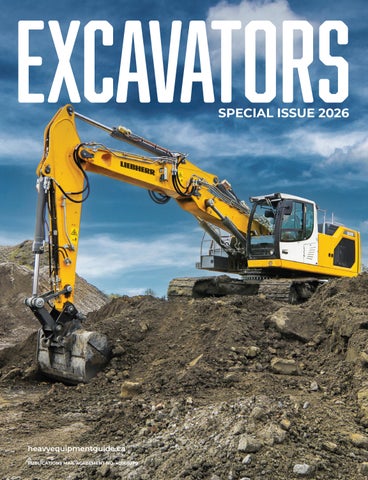
Excavators SPECIAL ISSUE 2026
heavyequipmentguide.ca PUBLICATIONS MAIL AGREEMENT NO. 40069270
BUILT LIKE NO OTHER KOBELCO EXCAVATORS Mini • Short Radius • Conventional • High & Wide • Long Reach • Scrap & Recycling • Building Demolition Purpose-built machines engineered for superior performance, greater productivity, improved efficiency, and uncompromising safety.
ESCO
®
Level up with ESCO Vertasys tooth system ®
™
The Vertasys™ tooth system was extensively tested in-house and with customers in real-world conditions to deliver incomparable performance with enhanced safety. ESCO® Vertasys™ construction tooth system
• Innovative locking mechanism with stronger points and adapters • Easy-to-use with improved ergonomic installation and removal • Reduction in SKUs with an integrated lock and multi-use adapters • Advanced point profiles cast in superior ESCO® alloys • Industry-leading support and technical assistance
www.esco.weir
Copyright (C) 2026 ESCO Group LLC. All Rights reserved.
Everything new The generation 8 The strengths of the new generation of crawler excavators include: increased engine power, higher digging forces, large bucket capacities, at the same time, reduced fuel consumption and simplified maintenance work. www.liebherr.ca
Crawler excavators
Liebherr-Canada Ltd. • 1015 Sutton Drive • Burlington • ON • Canada • L7L 5Z8 • Phone +1 905 319 9222 • Email: Info.lca@liebherr.com • Instagram: @LiebherrCanadaLtd • www.liebherr.ca
14
FEATURE STORY NORTH AMERICA’S FIRST LIUGONG 995F GOES TO WORK IN NOVA SCOTIA
46 28
THE EVOLUTION OF EXCAVATOR MACHINE CONTROL
96
INCREDIBLE EXCAVATORS
2026 SPEC GUIDE
Excavators SPECIAL ISSUE 2026
Excavators 2026 | Volume 2, Number 1
FEATURES
DEPARTMENTS & SECTIONS
14
North America’s first LiuGong 995F goes to work in Nova Scotia
12
From the Editor
28
The evolution of excavator machine control
14
Feature Story
38
Electro-hydraulic controls are the new standard for heavy excavators
28
Technology
46
Incredible Excavators
46
Incredible custom excavator configurations
60
The Operator’s Office
60
Excavator cabs: explore the operator’s office
72
Attachments
80
Strategies to help you right-size your excavator
86
Safety
86
Bucket-integrated GPR reveals what lies beneath the job site
96
Spec Guide
130
Advertiser Index
92
Safety starts with smart design
96
2026 spec guide
EXCAVATORS 2026 | VOLUME 2 • NUMBER 1 EDITOR IN CHIEF
ADVERTISING PRODUCTION MANAGER
Kaitlyn Till ktill@baumpub.com 604-291-9900 ext. 330 DIRECTOR OF DIGITAL STRATEGY
Slone Fox sfox@baumpub.com 604-291-9900 ext. 335
Tina Anderson tanderson@baumpub.com 604-291-9900 ext. 222 DESIGN & PRODUCTION
Morena Zanotto morena@baumpub.com 604-291-9900 ext. 325
SENIOR WRITER
PRESIDENT/PUBLISHER
ASSOCIATE EDITOR
VICE PRESIDENT/CONTROLLER
Meghan Barton mbarton@baumpub.com 604-291-9900 ext. 305 Stephanie Bontorin sbontorin@baumpub.com 604-291-9900 VICE PRESIDENT OF SALES/ ASSOCIATE PUBLISHER
Ken Singer ksinger@baumpub.com 604-291-9900 ext. 226
Melvin Date Chong mdatechong@baumpub.com FOUNDER
Engelbert J. Baum
Sam Esmaili sam@baumpub.com 604-291-9900 ext. 110
Published by: Baum Publications Ltd.
COVER PHOTO: LIEBHERR’S R 928 G8 EXCAVATOR.
124 - 2323 Boundary Road Vancouver, BC, Canada V5M 4V8 Tel: 604-291-9900 Toll-free: 1-888-286-3630 Fax: 604-291-1906 www.baumpub.com www.heavyequipmentguide.ca @HeavyEquipGuide FOR ALL CIRCULATION INQUIRIES Toll-free: 1-866-764-0227 email: heg@mysubscription.ca Subscription: To subscribe, renew your subscription, or change your address or other information, go to: http://mysubscription.ca/heg/
CONNECT WITH US @HeavyEquipGuide
Heavy Equipment Guide serves the Canadian engineered construction industry including: roadbuilding and maintenance; highways, bridges, tunnels; grading and excavating; earthmoving; crushing; trucking and hauling; underground utilities; trenching; concrete paving; asphalt paving; demolition; aggregates production; fleet maintenance; and asset security and management. The magazine is distributed to key industry personnel involved in these sectors. Subscription Price: In Canada, CDN $91.00; Outside Canada, US$149. Heavy Equipment Guide is published eight times a year in January/ February, March, April, May/June, July/August, September, October, and November/December. Heavy Equipment Guide accepts no responsibility or liability for reported claims made by manufacturers and/or distributors for products or services; the views and opinions expressed are those of the authors and not necessarily those of Baum Publications Ltd. Copyright 2026, Baum Publications Ltd. No portion of this publication may be reproduced without permission of the publishers. We acknowledge the financial support of the Government of Canada.
WE’D LIKE TO HEAR FROM YOU Do you have a job site story, innovation, or industry concern that our readers should know about? We’d like to hear from you. Contact: Editor in Chief Kaitlyn Till at ktill@baumpub.com or 604-291-9900 ext. 330
10
heavyequipmentguide.ca | EXCAVATORS 2026
Printed on paper made of FSC®-certified and other controlled material. ISSN 1715-7013. PUBLICATIONS MAIL AGREEMENT NO. 40069270 Return undeliverable Canadian addresses to: Circulation Dept., PO Box 430 Stn Main, Alliston, ON L9R 1V6 email: heg@mysubscription.ca / 705-502-0024
ON BRANDT
Bank on Brandt for the deals you need on the machines you want—finance, lease, or rent. More Convenient
Unrivaled Support
Ultimate Flexibility
Time is money—why not save both?
With dozens of locations from coast to
Brandt works for YOU and will get creative
Brandt Finance will meet you on your
coast, Brandt can get to you fast, wherever
to deliver the affordability and flexibility
terms and turf (literally).
the road takes you.
your business needs.
Learn more at
brandt.ca/Bank-on-Brandt
FROM THE EDITOR
FROM THE EDITOR DIG INTO THE WORLD OF EXCAVATORS
F
or a second time we dig deep into the world of excavators — the construction industry’s most popular machine. Excavators account for roughly half of worldwide construction equipment sales, according to a new report from Off-Highway Research, and demand continues to grow. That growth comes as excavators are evolving, and in this issue we examine how technology is changing excavators and how they’re operated. OEMs transitioning their excavator lines from pilot to electro-hydraulic (EH) controls is an accelerating trend that is driven by easier incorporation of advanced technologies into electrical control architecture compared to mechanical pilot set-ups. We cover this topic in two articles. In the first, we take a closer look at the evolution of excavator machine control and how two decades of innovation in 2D, 3D, and automatics have transformed today’s job sites. The second feature looks more closely at EH controls and how they differ from pilot controls, what that means for operators and fleet owners, and how electrical control architecture changes how excavators can be maintained and upgraded over their multi-year lifespans. Changing equipment to suit the needs of the job site is the focus of Heavy Equipment Guide contributor Mack Plovie’s feature on custom excavator configurations. Plovie has travelled the world to see how contractors and modification specialists solve job site problems with customized excavators that work in a variety of unusual environments. The focus on excavator power, technology, and capability sometimes leaves finer details behind, but a well-designed, ergonomic operating environment is vital to operator productivity and safety. Step into the operator’s office with our excavator
12
heavyequipmentguide.ca | EXCAVATORS 2026
Excavators account for roughly half of worldwide construction equipment sales.
cabs gallery for an up-close look at what makes a great operating environment. Finally, our spec guide updated for 2026 covers nearly 400 excavators on the market in North America, from mini excavators to production-class machines. Thank you for reading Heavy Equipment Guide’s second Excavators special issue — we hope you enjoy this continuing comprehensive coverage of the industry’s most versatile, and most popular, machine.
Kaitlyn Till Editor In Chief ktill@baumpub.com heavyequipmentguide.ca
A generational leap in performance. Meet the -9 Series crawler excavator, our most advanced machine ever. Five models offer completely redesigned cabs and leading-edge technology to keep operators safer and jobs more productive.
See the difference for yourself.
©2026 HD Construction Equipment Develon North America. All rights reserved. DEVELON is a brand of HD Construction Equipment.
FEATURE STORY
Nova Scotia–based Ocean Contractors took delivery of North America’s first LiuGong 995F excavator.
North America’s first LiuGong 995F goes to work in Nova Scotia OCEAN CONTRACTORS TOOK A CHANCE ON AN UNFAMILIAR EXCAVATOR FOR A PRODUCTIONCRITICAL ROLE BY MEGHAN BARTON, SENIOR WRITER
WHEN OCEAN CONTRACTORS NEEDED to replace a production excavator at their Dartmouth, Nova Scotia, quarry, the timing was less than ideal. Their 90-tonne-class excavator had already been running over 16,000 hours when an engine oil sample indicated an imminent problem, accelerating the need to find a replacement in a size class that is not typically available off the lot.
FEATURE STORY As it happened, representatives from Atlantic Equipment were sitting across the desk from Steve Wellwood, vice president of Ocean Contractors, when he received the news. “I said, ‘Do you have a 95-tonne excavator?’ James said, ‘Yes, we do.’ And I said, ‘Could you give me one?’ And he said, ‘Yeah, I certainly can,’” Wellwood recalls. The excavator Atlantic Equipment owner James Bond had in mind was the LiuGong 995F. Ocean Contractors had never owned a LiuGong excavator, and the 995F had no established operating history in North America. Today, that machine is the first LiuGong 995F sold and operating in North America, and it occupies a critical position in the company’s quarry operation, loading blasted rock for delivery to the primary crusher.
When you’re putting that kind of machine into an operation that hinges on it being running and successful, you want to make sure that you’ve done your homework. James Bond Owner, Atlantic Equipment
HIGH-PRODUCTION QUARRY DEPENDS ON A BIG EXCAVATOR
Ocean Contractors has worked at the quarry site in Nova Scotia since 1974 and purchased the operation roughly two and a half years ago. The acquisition gave the roadbuilding and construction contractor ownership of a quarry it had operated from for decades, supplying aggregates for its own operations as well as outside customers. About 30 percent of the material produced at the quarry is consumed internally by Ocean Contractors’ operations, including its ready-mix concrete and asphalt production. The remaining 70 percent is sold to other customers.
16
The quarry processes approximately 8,000 tons of material per day, and the 995F works at the front end of that production process. Following blasting, the excavator loads rock into Cat 772 haul trucks for transport to the primary crusher. Previously, Ocean Contractors relied on a combination of its outgoing 90-tonne-class excavator and a production-class wheel loader to keep that process moving. Replacing the high-hour machine meant filling a key position in an operation where maintaining production depends on keeping material moving to the crusher.
OCEAN CONTRACTORS COMPARES NEW EXCAVATOR OPTIONS
Ocean Contractors’ relationship with LiuGong equipment had started on a much smaller scale. Atlantic Equipment had previously supplied them with a LiuGong 6612E roller and a CLG 2040H heavy-duty industrial pneumatic tire forklift, giving Ocean Contractors some experience with both the OEM and the dealer behind it. Introducing an unfamiliar 95-tonne excavator into a production-critical role was a considerably bigger investment. After that first conversation with Bond, Wellwood began comparing the 995F with alternatives from several established manufacturers, looking at fundamentals including operating weight, horsepower, and hydraulic pressure. “There’s nothing that jumps out really,” he says. “I was looking at four different machines, all different manufacturers, all in the same weight class, and they’re all very similar. The specs are all very similar.” The 995F lined up with what Ocean Contractors needed from the size class, while major components, including a Perkins engine and hydraulic components from Kawasaki and Bosch Rexroth, provided some familiarity behind a less familiar trade dress. Affordability was another consideration, and Atlantic Equipment’s offer to take the high-hour excavator on trade simplified the replacement by giving Ocean Contractors a way to move the old machine at what Wellwood considered a fair value. The business case for the 995F extended beyond the machine’s specifications and the terms of the deal. With Ocean Contractors considering an unfamiliar
heavyequipmentguide.ca | EXCAVATORS 2026
excavator for a critical production application, the dealer behind it was another important part of the equation.
LOCAL SERVICE SUPPORT BACKS EXCAVATOR PURCHASE
Wellwood had known Bond for years before Atlantic Equipment became a LiuGong dealer, and that existing relationship gave Ocean Contractors a level of confidence that would have been difficult to establish through specifications alone. Atlantic Equipment is also located only minutes from the quarry, putting service support close by. Bennett Gaskin, territory sales manager, says the dealer considered its ability to support the 995F from the outset. “You can always sell machines, but if you can’t service [them], you’ll never sell another one,” he says. With the 995F headed for a production-critical role, Atlantic Equipment’s commitment had to extend well beyond the initial sale. “Are we going to be able to service this? Are we going to be able to look after this machine to make sure it gets through its life cycle and it works the whole way and doesn’t have any downtime?” Gaskin says. Answering those questions required preparation before North America’s first 995F ever reached the quarry. Bond knew the contractor’s operation and the consequences if a machine in this role went down. “When you’re putting that kind of machine into an operation that hinges on it being running and successful, you want to make sure that you’ve done your homework,” Bond says. Atlantic Equipment leaned on LiuGong North America for additional technical support. LiuGong personnel assisted with assembly and training when the machine arrived in January 2025, and Atlantic Equipment’s Red Seal technicians received additional training specific to the 995F. The dealer worked with Ocean Contractors to determine which critical spare parts would be kept available. The contractor stocks routine maintenance items, such as filters, fluids, oils, and GET, while Atlantic Equipment expanded its local parts inventory and increased parts storage in Katy, Texas, specifically to support the 995F and minimize downtime. Atlantic Equipment remains Ocean Contractors’ primary point of contact.
Atlantic Equipment has supported Ocean Contractors through purchasing, delivery, and service of the LiuGong 995F.
The dealer performs the machine’s maintenance and has handled any service requirements that have arisen under warranty.
PROVING THE DECISION IN PRODUCTION
The real test, however, has taken place at the rock face. After roughly 3,000 operating hours, Wellwood estimates that the 995F had accumulated only about one day of downtime. This increased uptime has allowed Ocean Contractors to consolidate much of the truck loading work that was previously handled by the older excavator and wheel loader, freeing up the wheel loader for other work. “It filled that gap 90 percent of the time,” he says. “It saved us quite a bit.” Curtis Isenor, Ocean Contractors’ rockface excavator operator, appreciates to the 995F’s digging performance and responsiveness, describing the machine as having “lots of stick power” with fast bucket and swing functions.
Assembly of the LiuGong 995F.
Photos by Logan MacIsaac. Find him on Instagram: @loganmacisaacmedia. EXCAVATORS 2026 | heavyequipmentguide.ca
17
FEATURE STORY
After roughly 3,000 operating hours, the 995F had accumulated only about one day of downtime.
The 995F’s performance also addresses one of the questions that came with choosing a less familiar machine: whether the contractor would give up anything in production. “Quite frankly, it really hasn’t missed a beat,” says Bond. For Wellwood, the result has reinforced the decision to look beyond the brands already established in his fleet. Ocean Contractors is not committed to one equipment manufacturer. Instead, the machine has to suit the application and be backed by a dealer capable of sup-
18
porting it throughout its working life. “To me, it’s a partnership,” he says. “If they can service us, and LiuGong makes decent equipment, and they’ve got the parts . . . we’ll continue to do business with them.” That support network is expanding. At the end of August 2026, LiuGong announced the establishment of a LiuGong Canada subsidiary, which Gaskin says will provide Atlantic Equipment and other Canadian dealers with greater access to parts inventory and will increase machine availability across the country.
heavyequipmentguide.ca | EXCAVATORS 2026
A REFERENCE POINT FOR THE CANADIAN MARKET
Putting the first 995F into service required that Atlantic Equipment and LiuGong prepare technicians, establish parts inventory, and bring in factory expertise to support the machine in a new market. It also established something neither had before: a North American operating record for the 995F. That experience now gives other Canadian contractors considering an excavator in this class something beyond specifications or examples from other
LIUGONG NORTH AMERICA
995F
T
he 95-tonne-class LiuGong 995F excavator combines substantial digging forces with electronically controlled hydraulics, reinforced structures, and features intended to improve fuel efficiency, serviceability, and operator comfort for high-production quarry, mining, and earthmoving applications. The 995F is powered by an 18.1-litre Perkins diesel engine that delivers 608 hp, and operators can select Economy, Standard, or Power modes, which adjust engine speed, hydraulic flow, and system pressure for different workloads. Automatic idle and shutdown functions also help reduce unnecessary fuel consumption. For excavation in hard or compacted material, the 995F combines a 5.6-cubic-metre rock bucket with a digging force of 471 kN, increasing to 496 kN with power boost. Responsive hydraulic controls help operators maintain consistent digging and truck-loading cycles, and a boom-floating function reduces hydraulic demand during certain operations, including breaking and grading. The 995F’s reinforced boom and arm structures are designed to withstand the demands of heavy-duty excavation. Forged supports and reinforced plates strengthen high-stress areas of the boom, with additional plates and ribs reinforcing the arm. Full-length track guides and a heavy-duty undercarriage provide support when working on uneven quarry surfaces. The heavy-duty rock bucket incorporates wear-resistant steel and reinforced ground-engaging components to withstand the abrasive conditions of quarry excavation.
markets to evaluate. They can now point to one with thousands of hours in a high-production Nova Scotia quarry. Being first was never Ocean Contractors’ objective. The company needed to replace a high-hour excavator with a machine capable of meeting an established production volume. The 995F happened to be available, its specifications fit the application, and the economics made sense. What made the unfamiliar choice viable was the support behind it. HEG
Inside the cab, LiuGong emphasizes operator comfort and visibility. The pressurized cab with Level II falling-object protection includes a heated air-suspension seat, climate control, and a touchscreen display for monitoring and adjusting machine functions. A rear-view camera provides additional visibility. To simplify routine maintenance, wide-opening engine covers, a surrounding catwalk, anti-slip steps, and centralized lubrication points improve access for inspections and servicing. Hydraulic fluid has a service interval of up to 5,000 hours, with hydraulic filter replacement scheduled at 1,000 hours. The cooling system uses a variable-speed reversible fan to help clear accumulated dust and debris from the cooling cores.
EXCAVATORS 2026 | heavyequipmentguide.ca
19
When only the hardest & toughest will do
The bucket is Hardox® In My Body certified, made from Hardox® 500 Tuf by the Swedish bucket producer Fronteq.
Hardox® is a registered trademark. Hardox® wear plate is only available from SSAB.
Hardox® wear plate is the #1 wear steel, with a combination of hardness and toughness that stands up to the most extreme challenges. With hardness that stays high from the surface to the core, it delivers exceptional service life. The toughness keeps equipment in good shape even when exposed to heavy impact loads.
Explore more
Certified equipment manufacturers and wear parts providers Excavator buckets certified to endure Designed and manufactured to meet demanding standards for durability and high productivity. Looking for certified equipment – look for Hardox® In My Body.
Wear parts built to outlast Engineered to take the hits, keep going and deliver wear life you can count on. Repairing your equipment or looking for parts – look for Hardox® Wearparts.
Level up your equipment
Find your parts
EXCAVATORS
KOMATSU
PC365LC-11
K
omatsu’s unique hybrid PC365LC-11 Multifunction Plus excavator features an innovative electric swing system with “boom-up” power assist. The dedicated electric swing motor improves swing speeds and operational efficiency, reducing cycle times in multi-function applications up to 15 percent compared to similar conventional Komatsu machines. The ultracapacitor stores an additional 70 electric horsepower for acceleration when the engine is in ultra-low idle, giving operators instant power to the work equipment on demand. Komatsu says that fuel consumption is reduced by up to 20 percent, compared to its comparable conventional excavators, when ultra-low idle is used, and no external charging is needed. All electrical energy is generated during normal operation and is stored in the ultracapacitor. As hydraulic power isn’t needed for swing operations, this power is fully available for the boom, arm, and bucket cylinders. This optimization reduces digging cycle times and work equipment lag. The hybrid power system makes the machine significantly quieter in and out of the cab. Operators will further appreciate a new premium heated air-suspension seat, new proportional ergonomic joysticks, and the standard KomVision bird’s-eye-view camera system. Komatsu’s Smart Construction 3D Machine Guidance kit can be factory-installed, giving operators in the field and managers in the office access to 3D design and topography data. Machines configured with an additional hydraulic piping line come with a standard tool control system, which allows operators to configure and store flow rates and target pressures for multiple attachments. Optional hydraulic quick coupler piping can be factory-installed.
All Orange, All In: How Anthony Légaré Built a KubotaOnly Empire in Mont-Tremblant
Some people build businesses; others build identities. For Anthony Légaré, those two things have always been the same, and for the past decade, Kubota has been building right alongside him. Drive past his yard on Route 117 in Mont-Tremblant and you’ll understand immediately. Rows of orange equipment, clean and polished, lined up with the kind of precision that says something about the person behind it all. “People actually think I’m a Kubota dealer because of how much orange equipment we have,” he says with a grin. But he’s something much more interesting than that: a 30-year-old entrepreneur running three businesses out of the Laurentians, and a Kubota customer whose loyalty runs so deep it started before he had anything to show for it.
WHEN A SETBACK BECOMES THE BUSINESS PLAN Around 2020, Anthony was building his house and had rented an excavator to handle the groundwork. When he needed just one extra day to finish the job, the rental centre said no, so he picked up the phone and called his Kubota rep in Mirabel. He bought a KX040, finished the job and then found himself with a machine sitting in his yard and nowhere to put it. So, he rented it out. When the calls kept coming, he eventually bought the rental centre that had turned him away, sold off all their old equipment, and replaced everything with Kubota. “There are other brands that are less expensive,” he acknowledges. “But I didn’t want to mess with that. It’s about the service behind the equipment, and honestly, it just works.”
The numbers tell their own story. Two and a half years ago, Location Légaré had three excavators available for rent. Today, there are 14. The snow THE BRAND THAT BELIEVED IN HIM FIRST removal division has grown from 15 clients to 1,200 Anthony was 18 when he launched his first business, in four years. a lawn care company built on ambition and not much else. He knew what equipment he wanted, and he went to a dealer in Sainte-Agathe to get it. They A PARTNERSHIP BUILT ON TRUST turned him away. What started as a chance encounter with Samuel at the Mirabel dealership has become one of Anthony’s His local Kubota dealer in Mirabel came to his house most important business relationships. and sold him a tractor at the kitchen table. “Kubota trusted me when I had nothing. They believed in “It’s not just about buying machinery,” he says. me before I even believed in myself.” “There’s trust behind it. There’s service behind it. It’s a partnership. Kubota wants my business to He started with a Kubota ZD1011 and didn’t look back. succeed as much as I do.” Lawn care grew into snow removal, and the fleet expanded one orange machine at a time. When Anthony looks at the vision board in his office, he sees nothing but orange. Not because it’s the only colour he knows, but because it’s the one that’s always shown up when it mattered.
REAL PEOPLE REAL WORK REAL
The World’s #1 Selling Compact Excavator For 20 Years.*
From Ultra Compact to Mid Size, Kubota’s Excavator Lineup backs up two decades of proven performance with reliable digging power, wide-ranging lift and reach, and simple, comfortable operation. Add in a full range of buckets and attachments, and you’ve got the productivity to handle any job site, big or small. *According to 2023 data from Off-Highway Research including all Kubota Group brand sales.
EXCAVATORS
LIEBHERR
R 952 G8
V
ersatility defines the 50-tonne-class R 952 G8, which Liebherr has designed with reinforced structures made from high-strength steels and steel castings to ensure durability in diverse conditions and under continuous use, including in heavy earthmoving and quarry applications. Three undercarriage options are available along with a variety of boom, stick, and backhoe bucket configurations. Liebherr’s Positive Control hydraulic control system gives operators fast, smooth, and coordinated movements. Assistance systems include Liebherr Power Efficiency, which helps to reduce fuel consumption by up to 10 percent; Bucket Fill Assist, which automates the process of filling the bucket; and the Modetronic function, which adjusts the machine parameters to the application to ensure optimum performance. A Leica 2D grade control system is integrated into the R 952 G8 as standard, a 3D control solution is available, and semi-automated functions can be added. A built-in dynamic weighing system is included with 500 hours of use. The layout of Liebherr’s latest-generation emCAB operator’s cab with its INTUSI human-machine interface is optimized to ensure operators can easily see and reach the controls quickly, helping reduce fatigue. Ultra-precise electronic joysticks ensure smooth work movements.
TECHNOLOGY
THE EVOLUTION OF
EXCAVATOR
machine control HOW TWO DECADES OF INNOVATION IN 2D, 3D & AUTOMATICS HAVE TRANSFORMED TODAY’S JOB SITES BY KAITLYN TILL, EDITOR IN CHIEF
Machine control systems provide reliable accuracy, upskill operators, and save time on job sites.
TECHNOLOGY
M
achine control has been quietly transforming the construction industry for a couple of decades, but 2D, 3D, and automatics for excavators have only achieved large-scale buy-in in recent years. At CONEXPO-CON/AGG 2026, every excavator OEM was discussing machine control, and the prevailing message was that contractors now expect technology solutions to be available and easy to integrate into their operations. This is a seismic transition for an industry that is slow to change. So how did we get here? I explore that question with Volvo Construction Equipment’s Matthew McLean, a machine control specialist who has served as an educator both within Volvo and to operators. McLean has been a part of the construction industry’s technology transformation, both in his current role and as a motor grader specialist in the early 2000s. This breadth of experience, from early aftermarket indicate solutions to today’s advanced automatics, makes him the ideal candidate to help break down the evolution of machine control for excavators. Let’s look at the technology’s development, how contractors came to trust it, and its impact on the construction industry.
It has only been the last two years that the customers have really come on board and said, ‘Yeah, this makes sense. Let’s start using it.’ Matthew McLean Product Manager Assist Systems, Volvo Construction Equipment
THE FOUNDATION OF EXCAVATOR MACHINE CONTROL
While machine control for excavators has only become widely used over the past decade or so, the foundation of modern elevation control technology dates back over 60 years to the invention of the 360-degree rotating laser. Throughout the 1970s and 80s, these rotating lasers paired with sonic sensors could provide elevation control for motor graders and pavers. In the 1990s, advances in total stations and GNSS accelerated the development of 2D and 3D final pass precision grading solutions for dozers and motor graders, and today’s “big three,” Trimble, Topcon, and Leica, all offered aftermarket machine control solutions. Precision grade technology is much harder to apply to an excavator, McLean explains. The complexity of joints involved in positioning the bucket, including movements of the boom joint, boom cylinder, arm joint, arm cylinder, and bucket cylinder, all have to be accounted for. This complexity limited machine control options for excavators until the 2010s.
30
heavyequipmentguide.ca | EXCAVATORS 2026
GRADE INDICATE SOLUTIONS FOR EXCAVATORS
There are two basic types of indicate solutions for excavators, and the first systems were all aftermarket add-ons, says McLean. One method was to pair a laser sensor mounted on the arm of the excavator with a rotating laser and a grade stake. The excavator-mounted sensor would catch the laser as it rotated, then, depending on where the laser caught the joint, the system would indicate whether the operator was too high or low in relation to their programmed depth requirement. “The nice thing about lasers,” says McLean, “is they had a very loud speaker on them. If you were high above grade, the laser would beep every couple of seconds. As you got closer, the beeping would speed up until it was a solid tone at grade. Some manufacturers did the opposite — a lot of tone when you’re far away and quieter when you get close.” This method wasn’t the most efficient. After digging, the operator, or a labourer, would have to walk around the site with a laser sensor on a two-metre stick to check whether the excavation was on grade. Each area that wasn’t on grade had to be marked with spray paint: one mark for under-dug areas and another for over-dug areas. The operator would then get back to work, either backfilling or digging down as needed, until a consistent grade was achieved. Rework is what machine control is designed to avoid, and contractors are only paid for digging, not for walking around with a grade stake or fixing work that isn’t on target, says McLean. The second method, 2D visual guidance via tablet in the cab, is more efficient and the basis for today’s 2D systems. It tells the operator where to dig on a flat plane, relying on sensors that measure the angles of the boom, arm, and bucket to the edge of the tooth. Before digging, the operator sets the bucket down to create an elevation benchmark of zero and inputs the depth they want to dig. As they dig, the tablet displays the depth of the bucket relative to the benchmark. This real-time visualization of the bucket depth includes both measurements and colour coding. As the operator progresses, the colour changes to indicate whether they need to dig deeper, are on grade, or have gone too far. The colour scale will vary, depending on the system provider, says McLean, but the principle is generally the same. Initially, both of these guidance methods were only available as third-party additions, but by the mid 2010s, a few OEMs, including Volvo, were introducing proprietary machine control solutions. Volvo introduced its 2D visual guidance system, Dig Assist, at CONEXPO-CON/AGG 2017 along with In-Field Design software and Co-Pilot, the Volvo-developed, Android-based tablet that serves as the in-cab command centre for software on Volvo machines. Dig Assist 2D relies on robust IMU (internal measurement unit) sensors on the boom and stick and GNSS antennas on the back of the excavator to detect machine rotation. It does not require a base station. With Dig Assist, the operator can produce compound slopes. It also simplifies trenching, explains McLean. When the operator wants to dig a trench, they can touch two points with the bucket, and the system extrapolates a straight line on the Volvo Co-Pilot screen. The operator just needs to follow the line to dig their straight trench. The screen will let them know if they start digging to the left or right of that straight line.
When the operator wants to dig a trench, they can touch two points with the bucket, and the system extrapolates a straight line on the Volvo Co-Pilot screen.
Volvo later introduced a simpler version of Dig Assist without the GNSS antennas, Dig Assist Start, which comes standard on new Volvo excavators and can be used to produce simple flat surfaces or slopes. Adding a base station or GNSS receiver allows the operator to use Volvo’s In-Field Design to draw complex shapes and slope profiles in the cab on the Volvo Co-Pilot tablet. With this set-up, the excavator can move around the job site, the system knows where the excavator is relative to the design, and the operator can dig to plan. Select third-party 3D solutions for more complex profiles, such as roadwork that requires curbs, gutters, and utilities, were compatible with Volvo Co-Pilot by 2020, says McLean. With 3D, an engineer draws the plan in the office, producing a CAD file that can be loaded onto the tablet. Initially, USB sticks were used to load plans onto equipment. Today, plans can be transmitted via the cloud to connected machines. By the mid-2010s, indicate systems for excavators were fairly established, says McLean, but while they can guide operators toward accuracy, indicate doesn’t stop them from making mistakes — that requires automatics.
FROM INDICATE TO AUTOMATICS
With an indicate system installed, the operator can still overdig. Once automatics are added, the operator makes far fewer movements to dig to plan, and the automatics will prevent over-digging and the need for rework. Without automatics, digging a flat plane requires that the operator balance the arm-in function against boom up/down functions and the correct bucket angle. An automatics system eliminates the need for delicate control to hit grade, explains McLean. Once the operator gets within a few centimetres of grade, the automatics kick in, and the operator just pulls back on the arm joystick — the computer will do the rest. On the excavator, four IMUs — on the bucket’s dog bone link, the arm, the boom, and the frame — tie into the machine’s computer via controller area network (CAN) bus vehicle communication protocol. An algorithm calculates the position of the edge of the bucket’s reference tooth based on the angles of the dog bone, the stick, the boom, and the frame. That information, when tied into the controls, allows the computer to automatically stop boom down movement when the reference tooth gets to grade.
EXCAVATORS 2026 | heavyequipmentguide.ca
31
TECHNOLOGY
Active Control is Volvo’s proprietary automatics solution that builds on Dig Assist, and its introduction hinged on Volvo’s switch from pilot controls to electro-hydraulic controls on select E-Series excavators in 2019.
Early automatics just controlled the boom cylinder, says McLean, but the operator could still control the bucket and breach the intended grade. It wasn’t perfect, but the system would prevent significant over-digging. As the technology improved, the computer could control the bucket cylinder as well. Applying automatics to tiltrotators and tilt buckets was more complicated. At first, autos would only work for the tilt function when digging straight and pulling at grade to produce a flat plane, says McLean. Today, automatics are fully compatible with tiltrotators and can be used for compound angles and curves. Active Control is Volvo’s proprietary automatics solution that builds on Dig Assist, and its introduction hinged on Volvo’s switch from pilot controls to electro-hydraulic (EH) controls on select E-Series excavators in 2019. For excavators with mechanical pilot controls, installing automatics is much more complicated. The six hoses that run into each joystick need to be reconfigured with a valve and solenoids to translate electrical signals from the computer into mechanical action on the machine. This integration is a time-consuming, complicated process. “People who had been using those aftermarket systems were glad to try Active Control because typically electro-hydraulic systems were a lot smoother and faster,” says McLean. “If they had previously been using one of those aftermarket systems that intercepted all the hoses, they were game.” By the late 2010s, multiple aftermarket automatics solutions were available, and Komatsu, Caterpillar, and Volvo had all rolled out their own automatics. Komatsu’s in-house machine control platform with automatics, Intelligent Machine Control (IMC), was a notable forerunner in 2014. Caterpillar introduced Cat Grade with ASSIST in 2015, and Volvo launched Active Control in 2019.
32
heavyequipmentguide.ca | EXCAVATORS 2026
Today, OEM partnerships with varying combinations of the big three solutions providers, and some smaller players, ensure that 2D and 3D machine control with automatics can be installed on most excavators, either in the factory or as an aftermarket upgrade, and some OEMs offer 2D as standard on new machines. A growing number of OEMs, including Volvo, are fully switching from pilot to EH controls across their new excavator lines to simplify technology integration.
THE EARLY ADOPTERS
Construction is a conservative industry that is notoriously slow to embrace the latest technologies, especially when a premium price tag comes attached, so it’s not surprising that it has taken awhile for machine control to catch on. As with any technology, the first to jump in were the true believers, says McLean, and there were growing pains, both on the end-user side and on the OEM sales side, as everyone tried to understand the significance and the value proposition of machine control. McLean recalls first teaching colleagues how to use Dig Assist to dig to a line, which requires that the operator touch two points with the bucket to project the trench’s path on Volvo Co-Pilot. An operator touched the bucket to a point in front of the machine, then swung the excavator around to touch another point behind him. When he looked at the line on the screen, it was slanted. “That actually threw me,” says McLean. “In my first training, it’s like, ‘What’s going on? I thought this was going to be a perfectly straight line.’ Then I recognized the fact that on an excavator, the boom is not perfectly centred.” Facing one direction, the boom was on one side of the machine, but rotating to face the other direction meant that
the boom was on the other side, so of course it would produce a line diagonal to the intended direction. Volvo worked with customers to address some of these early complications. Calibration was also more complex on first-generation products, but, McLean says, by 2018 Volvo had made adjustments to the calibration process at the factory, so dealers weren’t having to make those adjustments with the customer. It was vital that the system become self-calibrating so the operator could trust the information they were receiving as soon as the bucket touched the ground. Contractors also needed demonstrations to convince them that machine control was accurate. McLean would position a hardware store laser on the frame, line up the bucket’s reference tooth with the laser, and benchmark the position at zero. Then he would move the bucket out in five stages: close, short, medium, medium-long, and all the way out. The tooth touched the laser beam, whether the bucket was all the way in or all the way out, maintaining accuracy within two centimetres, and usually under one centimetre. The price tag was another barrier. Early machine control systems cost about $50,000, just for the positioning technology. If the machine costs $250,000, that’s a 20 percent premium just to know where you’re digging, says McLean. The return on that investment would have to be clear before contractors would commit to the purchase. It first made the most sense for big projects, and McLean cites excavation for factory construction as an example. Large bonuses for on-time completion — and penalties for being late — are at stake on these job sites. The precision technology could ensure that the
If the customer wants something, there’s no reason why they can’t have it put on the machine within 24 hours, even if it includes hardware, because the hardware kits aren’t that hard to install anymore. Matthew McLean work was done correctly, and faster, clearly justifying the high financial outlay compared to small-scale work without such bonuses up for grabs. The value proposition for smaller-scale work, such as digging basements, has since evolved, and machine control now makes sense for those applications, too. Eliminating the time that it takes to lay out stringline and stakes by drawing touchpoints on a screen using In-Field Design delivers significant savings over time, says McLean, adding “Even companies with just one to two machines can make their machine control investment back in months.”
CRUSHING DUO MB Crusher demolition pulverizer and crusher bucket. Demolish. Crush. Recycle. Scan for the full range of attachments MBCRUSHER.COM
EXCAVATORS 2026 | heavyequipmentguide.ca
33
TECHNOLOGY
There remains a misconception that machine control is hard to install and learn. That may have been the case with legacy systems, but it doesn’t bear out in the field today.
SUCCESS BREEDS MORE SUCCESS
Today, over half of Volvo excavators have some form of machine control installed, says McLean, compared to 2018 when total sales were under 50 machines. “I don’t think people were ready for it,” he says. “It has only been the last two years that the customers have really come on board and said, ‘Yeah, this makes sense. Let’s start using it.’” There remains a misconception that machine control is hard to install and learn. That may have been the case with legacy systems, but it doesn’t bear out in the field today, and growth has become organic. “The early adopters tried it, and then realized ‘I’m saving 30 percent, 40 percent, 50 percent time on my jobs — and I’m completing my jobs quicker,’” says McLean. When people talk about success, it breeds more success, and contractors have realized that if they want to stay competitive, they have to get in the game. Integration of machine control architecture at the factory helps. Wires are now pre-run, and some sensors are included on the machine. According to McLean, upgrading a Volvo machine after purchase is now as simple as adding a receiver to the battery box to take the excavator from 2D to 3D, buying an antenna kit, and purchasing the software license. Excavator owners can also call a dealer and ask that other features, such as a weighing system, be remotely activated without taking the equipment off the job site. “If the customer wants something, there’s no reason why they can’t have it put on the machine within 24 hours, even if it includes hardware, because the hardware kits aren’t that hard to install anymore,” says McLean, comparing the process to buying a new laptop. The hardware and software are ready to go. Once you want to use Word, you add a Microsoft licence. McLean continues to demonstrate machine control at
34
heavyequipmentguide.ca | EXCAVATORS 2026
industry events, including CONEXPO-CON/AGG, and finds that contractors are quick to recognize the solutions that best suit their line of work. For a smaller business, that could be the efficiency of In-Field Design for digging pools and basements. For larger contractors, 3D with automatics that can help compensate for a dwindling skilled labour pool.
THE BIG PICTURE
On any individual job site, machine control can provide reliable accuracy, upskill an operator, and save time. McLean offers an additional perspective on why machine control is so revolutionary. Consider the size of the construction industry and the amount of money that is spent. Now consider what a productivity improvement of 5, 10, or even 30 percent represents. That’s an enormous amount of money — it justifies the cost of the technology and accounts for its growth. “Early in my career, starting in the 1990s, my initial work was transitioning people from the old lever controls over to pilot hydraulics on different kinds of machines. I was getting them to use the hydraulics and experience the benefits of smoother operating, faster operating, and more precision,” says McLean. “Now we’ve converted from pilot over to electro-hydraulic. And, by virtue of that, you can tie in all these technologies that tell you where to dig, help you dig, and tell you how much you’ve lifted and how much you’ve loaded. It’s just improving the speed at which work can be done.” As the labour market becomes more constricted, machine control won’t be optional, remote operation solutions will expand, and development of full autonomy will continue. “The more work that can be done with less effort, and the least number of people, is where the industry is headed,” McLean concludes. “I’m eager to see what’s going to happen.” HEG
STRETCH THE LIMITS OF TECHNOLOGY Set site boundaries with IMC 3.0’s 3D Boundary Control. The all-new Komatsu PC220LCi-12 excavator keeps production moving without second-guessing your surroundings. With fully integrated 3D Boundary Control, Komatu’s IMC 3.0 technology ties boundary limits to the job site, helping prevent contact with obstacles without the need for constant boundary resets. That means fewer stoppages, greater operator confidence, and the ability to stay productive across even the most complex job sites.
THE ALL-NEW EXCAVATOR LINE
EXCAVATORS
CATERPILLAR
305 CR
C
at now offers its ease-of-use (EOU) E-Fence and Indicate features for software-enabled attachment versions of the 5-tonne 305 CR excavator. This compact radius machine joins Cat’s 6- to 10-tonne-class mini excavator models in offering this technology. Cab and premium canopy models are EOUready from the factory, or the 305 CR can be ordered with the EOU features already installed. E-Fence automatically constrains machine motion to boundaries pre-set by the operator, giving them confidence when working under overhead structures, above underground infrastructure, or close to obstacles, such as live traffic and walkways. Indicate, the entry-level grade system now available for the 305 CR, gives the operator visual and audible indications of the bucket position relative to target grade to ensure they hit the correct grade and avoid rework from over-digging. Target depth and slope is selected from the in-cab guidance system, and the monitor provides real-time feedback. A Laser Catcher option for Indicate is also available. Working with a laser transmitter, Laser Catcher is suited to large job sites that require the excavator to regularly reposition.
TECHNOLOGY
A NEW REALM OF
PRECISION
DEVELON’s new -9 Series excavators are outfitted with EH controls.
ELECTRO-HYDRAULIC CONTROLS ARE THE NEW STANDARD FOR HEAVY EXCAVATORS BY RYAN JOHNSON
TECHNOLOGY
EH control systems act as a powerful equalizer by smoothing out sudden excavator joystick movements and offering automated assistance.
F
or decades, the unmistakable hum and physical resistance of hydraulic oil circulation directly beneath an excavator operator’s hands was the defining hallmark of machine performance. Today, that physical connection is rapidly fading. The heavy construction equipment industry is undergoing a quiet but profound transformation. OEMs are replacing traditional mechanical pilot control systems in excavators in favour of full electric-over-hydraulic, or electro-hydraulic (EH), controls for enhanced performance and versatility. There’s more to the transition than operator preferences or engineering simplification. It represents an entirely new way of managing machine dynamics, protecting thin profit margins and mitigating labour shortages on today’s construction job sites. The latest generations of crawler excavators entering the market are launching with EH controls as the standard set-up. “At the end of the day, both pilot controls and EH controls direct the excavator’s hydraulics,” says Brian Kim, excavator product manager at DEVELON. “But with an EH system, you trade old-school mechanical simplicity for an entirely new realm of customizability, precision, and seamless technology integration.”
PILOT VS. EH CONTROLS
To better understand the scale of this industry trend, it helps to break down how these two excavator control designs handle everyday tasks like trenching and lifting material. Kim explains that traditional pilot controls rely entirely on physical fluid dynamics to execute an operator’s commands. Inside a standard pilot-controlled excavator control, a dedicated, low-pressure pilot pump continuously forces hydraulic oil up into the cab and directly through the joystick housings.
40 heavyequipmentguide.ca | EXCAVATORS 2026
“When an excavator operator moves a lever to swing the machine’s house or lift the boom, they are physically shifting a mechanical spool to route that low-pressure oil back down to the main control valve,” he says. While mechanical pilot controls have traditionally been highly dependable, the configuration requires a complex web of hydraulic hoses routed directly inside the operator’s cabin, adding physical complexity and potential leak points to the machine’s layout. The modern EH controls in many new excavators entirely eliminate the low-pressure pilot pump and the network of oil lines running into the operator’s cabin. Kim explains that mechanical joysticks are replaced with digital transducers that turn physical motion into data. Several key differences between mechanical pilot controls and EH controls are as follows: • Pilot systems use low-pressure hydraulic oil as their primary signal medium. EH platforms rely entirely on digital electrical currents. • Mechanical set-ups require physical oil lines routed directly under the joysticks, whereas EH controls utilize a clean electronic wiring harness. • A centralized controller sends precise electrical current to electro-hydraulic valves instead of fluid pressure that must physically shift valve spools to a digital framework. “EH controls replace those hydraulic pilot signals with electronic inputs,” says Kim. “Instead of using oil to physically actuate the main control valve, the joystick sends an instantaneous electrical signal to a centralized controller. That controller then commands the electro-hydraulic valves to perform the desired function.”
The modern EH controls in many new excavators entirely eliminate the lowpressure pilot pump and the network of oil lines running into the operator’s cabin.
EH CONTROLS UNLOCK NEXT-GEN CAPABILITIES AND SMART TECHNOLOGIES
A primary driver behind the industry-wide migration to EH controls is the effortless integration of advanced, software-driven job site technologies. Excavators built with EH controls already use software to communicate with the main hydraulic pumps and valves. “Software developers can integrate intelligent features natively without turning a single wrench or physically tweaking hardware components,” says Kim. This digital foundation for EH controls has unlocked a suite of advanced capabilities that are fast becoming standard project requirements: Semi-automated grade control: EH controls allow factory 2D and aftermarket 3D excavator guidance systems to step in and actively control hydraulic flow parameters. When finishing a slope or digging a precise trench, the software automatically adjusts the excavator’s boom and bucket positioning to keep the edge perfectly on grade, regardless of operator adjustments. Virtual fencing: Safety parameters can be mapped directly into the excavator’s software. Operators can set strict digital ceilings, floors, or swing walls to prevent the excavator from physically encroaching on overhead power lines, active traffic lanes, or buried utilities. Intelligent lift assist and payload weighing: By monitoring electronic pressure sensors and geometry, modern control systems calculate live lifting capacities based on real-time chassis tilt, alerting operators before a load creates a tipping risk. It also tracks bucket payload weight on an in-cab screen to prevent overloading dump trucks.
With an EH system, you trade old-school mechanical simplicity for an entirely new realm of customizability, precision, and seamless technology integration. Brian Kim Excavator Product Manager, DEVELON
EH CONTROLS ELIMINATE JOYSTICK RELIABILITY WOES
For some contractors, this clean electronic set-up alleviates a long-standing headache: the unreliability of aftermarket components. Matt Quinnell, owner of Advanced Wall Structures, a Minnesota-based contractor specializing in intricate commercial boulder retaining walls, has run complex tiltrotator attachments on his crawler excavators since 2018. He recalls the constant maintenance required by legacy mechanical set-ups. “I previously used aftermarket joysticks and had a separate hydraulic stack set-up to run the auxiliary functions,” he says. EXCAVATORS 2026 | heavyequipmentguide.ca
41
TECHNOLOGY
From a long-term fleet management perspective, the industry’s widespread adoption of EH controls fundamentally alters how machines are maintained and upgraded over their multi-year lifespans.
“I had issues with my aftermarket joysticks where the microswitches would go bad after a certain number of hours, so I got pretty good at soldering in new microswitches. Now, it’s all just the factory equipment. If I do have an issue, it’s a lot easier to diagnose because I can just go into the computer and see the fault code.”
A POWERFUL EQUALIZER FOR BRIDGING THE SKILL GAP
The ongoing shortage of highly skilled heavy equipment operators is a constant challenge for construction business owners and project managers. EH control systems act as a powerful equalizer by smoothing out sudden excavator joystick movements and offering automated assistance. This levels out the performance curve between a novice and a seasoned worker. “The technologies that come with EH controls can help bridge that skill gap,” says Kim. “It minimizes the need for tedious manual adjustments — reducing cycle times and allowing a relatively new operator to nearly match the daily productivity of a highly seasoned veteran.” Quinnell has experienced this labour dynamic first-hand within his own business and has used advanced attachments and built-in machine guidance to combat workforce constraints. “That’s a big reason why we made those investments in technology,” he says. “We do jobs now with just one person in a machine where before it required two labourers on the ground. You can take someone who is less experienced, put them in the excavator with machine guidance, and they can still do the same job as someone who is far more experienced.”
42
heavyequipmentguide.ca | EXCAVATORS 2026
EH INFRASTRUCTURE FUTUREPROOFS FLEETS FOR AN AUTOMATED TOMORROW
From a long-term fleet management perspective, the industry’s widespread adoption of EH controls fundamentally alters how machines are maintained and upgraded over their multiyear lifespans. In a traditional mechanical fleet, adjusting how an excavator handles or adding a new feature requires physical intervention: turning wrenches, swapping out internal valve springs, or installing complex hydraulic blocks. The EH infrastructure allows manufacturers to optimize excavator performance parameters and roll out entire new operating features seamlessly via software updates, completely bypassing the need for physical hardware changes. “Many leading manufacturers are now utilizing over-the-air wireless updates to push these optimizations directly into the excavators in the field, minimizing service calls and reducing unscheduled shop downtime,” says Kim. Most importantly, the shift to electro-hydraulic provides the mandatory framework for the next major frontier in earthmoving: autonomous operations. “While widespread job site autonomy is still an evolving trend, the industry’s swift migration to EH controls ensures that the machines rolling off assembly lines today are fully prepared for the digital demands of tomorrow,” says Kim. RYAN JOHNSON, APR, is a public relations and content strategy manager at Two Rivers Marketing in Des Moines, Iowa.
Sized right for tight spaces. Steel-built for heavy-duty work.
MINI EXCAVATORS (<6 TONS)
With groundbreaking power in a nimble package, Takeuchi Compact Excavators are proof positive that it’s not the size of the machine in the work, it’s the size of the work in the machine.
U KE C
DA
HI
T HROUGH
DECEMBER 31, 2026
TA
S C A N T O SEE HOW T O
SCAN FOR DETAILS
STANDARD EXCAVATORS (10-15 TONS)
» FULL LINEUP AT TAKEUCHI-US.COM
THE MARK OF TOUGHNESS
SAVE BIG
MIDI EXCAVATORS (6-10 TONS)
YS
EXCAVATORS
LINK-BELT EXCAVATORS
245 X4S
D
elivering 160 hp in a compact footprint, Link-Belt’s 245 X4S is built for urban infrastructure projects, roadwork, utility installation, and demolition. Optional advanced technology features include Digital Level, Height and Depth Alarms, and Link-Belt’s integrated Payload system. It comes from the factory Precision Grade– ready to reduce the time and labour required to install IMU sensors and Machine Guidance kits, allowing contractors to add automated control systems with minimal downtime. Link-Belt’s electronically controlled hydraulic pump system, paired with Spool Stroke Control, delivers smooth, responsive operation with improved controllability. The new Customizable Hydraulic Flow Balance allows operators to fine-tune flow distribution to their specific preferences and reduces arm drift when manoeuvring heavy attachments during a swing. The 245 X4S is powered by the Isuzu AR4HK1X Tier 4 Final engine, and four selectable operating modes, including Lifting, Eco, Power, and Speed Priority, allow operators to match machine performance to their work. Inside the cab, the 10-inch anti-glare LCD monitor can be customized to display critical information, and integration with Link-Belt’s WAVES camera system (Wide Angle Visual Enhancement System) provides 230 degrees of visibility around the machine.
INCREDIBLE EXCAVATORS
incredible
excavators
CUSTOM EXCAVATOR CONFIGURATIONS IN THE DIRT, ON THE RAILS, ON THE WATER & IN THE WOODS ARTICLE & PHOTOS BY MACK PLOVIE
E
xcavators might be the ultimate base machine to modify — there is certainly no limit to the creativity that can be infused into customizing an excavator. While OEMs do offer custom configurations and options, contractors and modification specialists around the world are the best at tailoring machines to unique local applications. I’ve been fortunate to travel in Canada and to other countries to see some incredible customized excavators that work in the dirt, on the rails, on the water, and in the woods. Most designs start with a phone call from a contractor, a challenge that presents itself on a project, or an initiative to better serve a contractor and improve their bottom line with a tailored equipment solution. What fascinates me most about custom excavators is that they are the ultimate reflection of the builder — how they see a problem and the solution to that problem — translating their thoughts into steel, welds, and hydraulics. While some customizations may be repeated by other operations, each of these machines is unique in the way it was built to address the specific problem it was tasked with. Because, as we all know, no two job sites are exactly the same.
46
heavyequipmentguide.ca | EXCAVATORS 2026
CAT 395 EXCAVATORS WITH MUSKEG BUCKETS H
ow do you move a lot of material in a hurry? A bigger bucket usually does the trick. KPCL Dirt Movers’ (Kelly Panteluk Construction) two Cat 395s are a fine example of why bigger buckets can really make a difference on large earthmoving projects. KPCL was tasked with excavating 1.6 million cubic yards of fly ash at a coal-fired power generating station in southern Saskatchewan. Fly ash is the byproduct of burning lignite coal to generate electricity; it is captured and turned to a slurry for long-term storage in ash lagoons. The reality is, OEMs tend to be conservative when outfitting their excavators with standard buckets, but
In the dirt
contractors often encounter materials and conditions where a much larger bucket would be a better pass match for the haulage fleet and would increase production. For this project, KPCL outfitted the two mass excavation configuration Cat 395s with 10-cubic-yard muskeg buckets built by Weldco-Beales Manufacturing out of Edmonton, Alberta. Muskeg buckets were designed for northern Alberta’s muskeg (boggy peat), yet have found their way into other applications due to their wide applicability for earthmoving. A muskeg bucket is deeper than it is wide, allowing for higher capacity. A
spade nose lip increases ease of penetration. The larger bucket proved to be an ideal pass match for loading KPCL’s fleet of Cat 745 ADTs. When you think of configuring a mass excavation machine, 3D machine control might not come to mind, but both excavators are fitted with Trimble 3D. The technology is used to track excavated quantities; take point shots in the pit bottom, which surveyors can’t access due to water; and ensure the underlying clay liner is not excavated through. Once the project is complete, the machines will find their way onto KPCL’s other large earthworks projects in Saskatchewan.
EXCAVATORS 2026 | heavyequipmentguide.ca
47
INCREDIBLE EXCAVATORS
VOLVO EC300EL WITH ROCK DRILL
W
hile excavators are usually associated with digging, T & A Rock Works outfitted a Volvo EC300EL excavator with a Junttan Excadrill 51A rock drill for specialized drill and blast projects. Sourced from Finland, the Junttan Excadrill 51A is a unique attachment that turns a conventional excavator into a machine capable of drilling blast patterns in steep and challenging terrain found in urban quarries and residential development projects. This Volvo EC300EL began its life as a conventional excavator before its conversion at Junttan’s facility in Lacombe, Alberta, where the rock drill and an X-125 dust collector system were installed. The drill can reach depths of 29 metres with a 64- to 127-millimetre-diameter bit. The set-up requires 340 to 475 litres per minute of hydraulic flow to operate the drill, compressor, and dust collector system. This drill package also includes Junttan’s AutoDrill function and anti-jamming technology to improve drilling performance. In the cab, an indicator on the monitor shows the orientation of the drill mast, and the operator can drill vertical or angled holes to match the drilling plans. Compared to a dedicated rock drill, T & A Rock Works’ excavator-mounted drill can reach more holes without repositioning, is safer to operate on steep slopes, and requires less site preparation work for access to drilling locations. When I visited the machine it was completing drilling work on a private residential driveway project on the steep rocky slopes above Okanagan Lake in southern B.C. The machine successfully drilled blast patterns for cuts over 12 metres deep.
INCREDIBLE EXCAVATORS
CAT 349E TELESTICK
I
n order to build up high, you have to dig deep, really deep. BelPacific Excavating & Shoring has been digging deep in Vancouver, B.C., since 1994 and has completed excavation and shoring work on some of downtown Vancouver’s most identifiable skyscrapers. Deep excavation work in this area is incredibly complex: adjacent active roadways, vertical excavation walls, inclement weather, groundwater, developer project schedules, and underground infrastructure all have to be contended with. So how do you excavate material from 100-plus feet deep in a bustling downtown core where space is limited? That’s where BelPacific’s custom-built Cat 349E Telestick excavator came in for the excavation of 1515 Alberni Street. To reach the necessary depth for this project, the conventional stick and bucket on BelPacific’s Cat 349E were replaced with a Cosben SRL TA-3550 three-stage telescoping stick and a 1.7-cubic-yard clamshell bucket. To accommodate the telestick, BelPacific worked with Van-Ed Equipment to modify the Cat 349E with an additional 4,500 pounds of counterweight, OEM hydraulic lock valves for the boom and telestick attachment, and a secondary auxiliary hydraulic tank for added capacity to operate the telestick. An internal hydraulic ram extended the telestick in three stages down into the hole where the clamshell bucket could scoop loosely piled dirt. In the cab, a 7-inch Brigade monitor provided a live feed of the bucket from a camera mounted on the telestick. The modified Cat machine removed material from more than 120 feet deep and loaded trucks and pups at street level to make way for the 42-storey 1515 Alberni Street residential tower. In the excavation pit, Cat 349 and 352 excavators were used to dig material and pile it in a central location for the telestick to pull to the surface. The modified Cat 349E averaged 215 cubic yards of dirt removal per day, and the excavation was completed in 15 months. In total, more than 60,000 cubic yards of dirt were removed to make way for eight levels of parkade, the elevator core, and other key building footings.
On the Rails CAT 325 HI-RAIL O
ne of the more surprising applications for excavators is on the railway, where they are extremely useful for maintenance of way work. Given how remote railways often are, and that road infrastructure often doesn’t parallel railroad infrastructure, getting machines to the specific area where track maintenance is required can be a challenge. That is, unless you put the excavator physically on the railway tracks. That’s exactly what Saskatoon, Saskatchewan– based contractor Acadia Group of Companies did with their Cat 325 Hi-Rail excavator. The factory-standard Cat 325 was converted by Vancer, a company that engineers and builds maintenance of way equipment for the railroad industry. The Cat 325 Hi-Rail is made rail-worthy by a pair of flanged wheel sets that lower down onto the tracks and raise up the excavator. A separate pedal in the cab controls the travel direction, forward or reverse, allowing the machine to travel up to 25 mph on the tracks. While you wouldn’t expect an
excavator to be seen shuttling train cars about, this machine can do that thanks to a built-in vehicle-mounted air compressor for release and controlling of train brakes and a knuckle for connecting to cars. The Cat 325 Hi-Rail is outfitted with a Rototilt R6 tiltrotator used for ditch work, grading ballast, and other excavation duties. Attachments include a Ballast Tools Equipment (BTE) undercutter bar for cutting out ballast beneath wooden ties, a tinbin dry hydro-vac system, a cold air blower for clearing switches in winter, and an AMI Attachments Graptor Bucket with integrated thumb. A benefit of the Vancer-modified machine is that every attachment needed for railway maintenance is installed on Vancer’s in-cab computer system, which makes it easy to switch between and use attachments. With its complete array of attachments, Acadia’s Cat 325 Hi-Rail excavator can be seen travelling across central Canada’s railway network doing maintenance of way work all year round. EXCAVATORS 2026 | heavyequipmentguide.ca
51
INCREDIBLE EXCAVATORS
CAT 323 & 330 AMPHIBIOUS EXCAVATORS
C
an excavators float? With the right modifications, they sure can. When it comes to modifying excavators, the Dutch are experts, and Van Tunen’s reputation is known around the world. When Van Tunen got the call for excavators capable of working in open water and shallow marsh, they started designing their first amphibious excavators. Van Tunen acquired Cat 323 and 330 excavators, removed the OEM undercarriages, and replaced them with custom-built pontoons and tracks. While conventional excavators rely on track pads for flotation on soft ground, amphibious excavators rely on airspace in pontoons for flotation on the water. Cleats allow the machine to travel, and the pontoons also have spuds mounted to the outside. These allow the excavators to anchor in place as required. Van Tunen also outfitted these machines with a long-reach front, enabling them to reach 14.5 metres. But why build machines capable of floating? Amphibious machines don’t require barges to work off of, nor do they require road infrastructure. They can transition from dry land to water easily and reach areas that other machines cannot. The two Van Tunen amphibious excavators were tasked with building artificial islands to provide habitat for birds and additional filtration of water draining from Europe. To do this, both machines were outfitted with Trimble 3D machine control and wrist buckets. Van Tunen also added 600-litre fuel tanks in the counterweights to increase the time between fuelling. There are few machines that can match the amphibious capabilities of these two.
ON THE WATER
INCREDIBLE EXCAVATORS
CAT 6015 TRIPLE BOOM S
ince building their first triple-boom excavator on a Cat 375 in 1996, Van Tunen has been perfecting the recipe for success and today builds some of the world’s largest triple-boom excavators. A recent project is a Cat 6015 Triple Boom build for an underwater tunnel project in Antwerp, Belgium. From the factory, the Cat 6015 is a 150-ton
54
machine designed for mining and heavy civil construction projects. Van Tunen purchased the 6015 and removed the OEM boom, stick, and bucket, replacing them with a threepiece boom arrangement. They added four boom cylinders in place of the two OEM cylinders and outfitted the machine with two stick cylinders in place of the original one. Other
heavyequipmentguide.ca | EXCAVATORS 2026
modifications included additional counterweight and wider and longer track frames. But why a triple boom? Compared to a long-reach excavator with a typical longer boom and stick, the three-piece boom allows for greater breakout force and higher lifting capacity at reach, and it can conduct precise work very close to or far from the machine.
After the modifications, the completed machine weighs 250 tons, reaches 35 metres horizontally and over 20 metres deep, and can lift 14 tons at full reach horizontally. The machine was also outfitted with Teledyne PDS marine construction machine control software that allows the operator to see the bucket position underwater relative to
KOBELCO SK850 HIGH BED
I
the engineered design in real time. During my visit, the machine was chained down to a barge working on the underwater tunnel project. After concrete tunnel elements were placed on the sea floor, Van Tunen’s triple-boom excavator went to work covering the tunnel elements with native material and rip rap to protect the submerged tunnel.
f there is one thing the UAE does, it’s build ambitious projects, such as the world’s tallest building. But what happens when you run out of land to build on? You build artificial islands. To do that, you need a lot of heavy equipment. Headquartered in Sharjah, UAE, is Al Marwan Machinery, one of the largest equipment rental companies in the region. Its fleet of over 3,500 machines includes long-reach and amphibious excavators made for marine construction projects. One machine, however, stands above them all — literally. This high bed excavator is a modified conventional KOBELCO SK850 that has been purpose-built for working in the water to help build artificial islands, jetties, ports, beaches, and other infrastructure. Al Marwan’s fabrication team custom-built this machine in their Sharjah yard. The house was separated from the undercarriage, and Al Mar-
wan installed a 5.5-metre-tall riser to raise the machine up, allowing it to sit above the water when working in depths up to 3.5 metres. The undercarriage was modified to provide a stable base and added flotation in soft underfoot conditions, measuring 7 metres wide and fitted with 1-metre-wide track pads. Unlike a conventional excavator, where the operator climbs into the cab from ground level, this machine requires the operator climb a vertical ladder to access the cab. The machine is fitted with a custom 22-metre long-reach front and is equipped with a 1.8-cubic-metre bucket. When in operation, the modified SK850 wades into the water similar to how you would at the beach when going for a swim, with the cab remaining above water level. In total, five high-bed excavators are being built and allocated by Al Marwan for a private marine construction project.
EXCAVATORS 2026 | heavyequipmentguide.ca
55
INCREDIBLE EXCAVATORS
In the Woods
CAT 330 TILTER W
hat do you do when an OEM doesn’t offer the machine you need? You build it, and that’s exactly what Grand Forks, B.C.–based ANM Construction did. The company serves the forestry industry throughout B.C.’s southern interior, building roads, supporting logging efforts, and helping reclaim the land post-logging. This work takes them into the steep terrain of B.C.’s backcountry. Tasked with cleaning up slash (logging debris), ANM Construction needed a machine that could not only handle the steep slopes, but also climb them without winch assist. For slope work at grades of up to 65 percent, they settled on combining a high-and-wide Timberking TK732 feller buncher undercarriage with a next-gen Cat 330 excavator. The Timberking undercarriage features beefy final drives from a D7 Cat dozer and a thick 1-inch-steel-plate build. This robust undercarriage allows the machine to self-level at roughly 45 percent tilt, front and back and side
to side, when working on steep terrain. The levelling is controlled by a button on the joystick in the cab. The Cat 330 cab was replaced with a Waycon Manufacturing forestry cab that offers better visibility for this type of work. Penticton, B.C.–based Waycon also built a custom reinforced bucket with two teeth mounted on the heel to help sort timber debris and uproot stumps. The bucket is paired with a Waycon pro link thumb, which can maintain contact with the bucket lip through its entire range of motion, improving the machine’s ability to grab tree debris at full reach. ANM Construction calls this unique machine the 330 Tilter. When I visited, it was cleaning up leftover slash from logging near Christina Lake; this slash is piled and burned to reduce forest fuel load and return nutrients to the forest floor after burning is complete. MACK PLOVIE is the president and chief dirt enthusiast of Earthmovers Media.
Hydraulic Quick Coupler
ENGINEERED IN SWEDEN BUILT TO PERFORM
Tiltrotator
Turn your excavator into a multi-tool with engcon’s tiltrotator system. Dig from any angle, work in tight spaces, and tackle complex jobs without constant repositioning. Hydraulic Quick Coupler
Our sandwich solution offers the flexibility you could only imagine. Combine whatever you need to get the job done. You can even detach the tiltrotator if needed. Let’s dig big in Canada. Detachable gripper
Tools
Read more at engcon.com
EXCAVATORS
HD CONSTRUCTION EQUIPMENT HYUNDAI NORTH AMERICA
HX210L
T
he HX210L long-track excavator is part of Hyundai’s next-generation HX excavator lineup, which was introduced in early 2026. It has a rated operating weight of 54,900 pounds and maximum dig depth of 21 feet 9 inches. A standard 10,800-pound counterweight enhances stability and lifting capacity, and the HX210L’s reinforced upper structure, upgraded swing bearing, increased swing torque, and larger-capacity buckets boost productivity. The excavator is powered by a new 186-hp Hyundai DX05 engine. Hyundai notes that the HX210L’s pilot-controlled hydraulic system delivers a traditional feel and performance and makes this machine a budget-friendly choice for rental houses and larger fleets. Hyundai has upgraded the cab, which includes a wider heated/cooled seat and improved climate control. Optional comfort packages are available. Optional safety technologies are also available. A white noise alert uses a wideband frequency to warn people of machine activity on the job site. Hyundai says that the safety system’s sound quickly dissipates compared to other buzzers, reducing noise complaints. Smart Around View Monitoring automatically detects people passing or working around the machine during operation.
THE OPERATOR’S OFFICE
EXCAVATOR John Deere’s New Generation P-Tier excavator cab. 60 heavyequipmentguide.ca | EXCAVATORS 2026
CABS
WELCOME TO THE OPERATOR’S OFFICE
W
hen an operator goes to work, the cab is their office. Thoughtful cab design that accounts for the operator’s longterm physical comfort and safety is paramount in an industry that is struggling to attract talent. Here is a close look at today’s excavator cabs, including seats, safety features, visibility, monitors, and controls — plus a few creature comforts.
EXCAVATORS 2026 | heavyequipmentguide.ca
61
THE OPERATOR’S OFFICE
Operator Comfort ADJUSTABLE SEATS MOVE WITH THE OPERATOR
The standard Liebherr Comfort seat, shown right, features air suspension, automatic weight adjustment, seat heating, and independently adjustable armrests and joysticks. Oscillating arm consoles move with the seat to provide ergonomic operation throughout the workday. Below, controls to adjust the Liebherr Comfort seat. Bottom left, the adjustable right armrest on Liebherr’s R 938 G8 excavator. Bottom right, the fully adjustable suspension operator seat with integrated armrests, side joysticks, dual digital monitors, and foot controls in DEVELON’s DX400LC-9 excavator cab.
62
heavyequipmentguide.ca | EXCAVATORS 2026
AIR-RIDE SMOOTHS OUT THE BUMPS
Adjustable air ride seats, as shown right in the Cat 395 FS and Liebherr R 938 G8, absorb shocks and vibration on the job site, ensuring operators are comfortable and supported throughout long workdays.
ERGONOMIC COMFORT FOR LONG DAYS ON THE JOB SITE
Excavator cabs are designed to give operators the legroom and layout they need to comfortably work all day. Left, the complete cab layout of DEVELON’s DX260LC-9. Below left, Komatsu’s PC220LCi-12 cab gives operators 30 percent more legroom compared to the previous model. Below centre and right, Cat’s spacious 336 and 395 operator stations feature ergonomic layouts.
CUSTOMIZABLE TO EACH OPERATOR
Cabs of the New Generation John Deere excavators, shown right, give operators 27 inches of legroom and provide ten points of seat adjustment and tool-free armrest and joystick modifications.
EXCAVATORS 2026 | heavyequipmentguide.ca
63
THE OPERATOR’S OFFICE
Monitors & Controls MONITORS ARE THE EXCAVATOR’S COMMAND CENTRE
The G5 Plus 12.8-inch display in New Generation John Deere excavators, shown right, is an intuitive touchscreen for monitoring machine health, managing attachments, and viewing camera feeds. Below, Komatsu’s PC220LCi-12 features a dedicated 10-inch Intelligent Machine Control (IMC) touchscreen monitor with an advanced payload meter system. Bottom left, the stacked dual-screen digital display system shows camera feeds and machine metrics in the DEVELON DX230LC-9. Bottom right, high-resolution monitors provide access to machine information and camera views in the Cat 330.
64
heavyequipmentguide.ca | EXCAVATORS 2026
FOOT CONTROLS
Shown right, large foot pedals provide smooth, precise control for confident manoeuvring of Cat’s 340 excavator. Below, foot controls and hand levers in DEVELON’s DX400LC-9 excavator cab.
JOYSTICKS
The control console inside a DEVELON -9 Series excavator cab, shown above, includes an ergonomic joystick, push-button engine start/stop, rotary dial controller, and integrated switch panel. Right, precision joystick controls in the Cat 326. Below, Liebherr excavator controls. Bottom, John Deere excavator controls.
RIGHT-SIDE CONTROLS
The ergonomic right-hand console, shown above in the Cat 336, places machine controls, touchscreen access, and a jog dial within easy reach. Right, right-side button controls in Liebherr’s R 938 G8 excavator cab.
THE OPERATOR’S OFFICE
Visibility & Safety CLEAR SIGHTLINES TO THE WORKING AREA
Large glass areas and strategically positioned cameras help expand the operator’s view of the machine surroundings, improving overall job site awareness, as seen in Komatsu’s PC220LCi-12, shown right and below. The PC220LCi-12 includes Komatsu’s Komvision 360 camera + Human Object Detection system. Bottom left, the expansive view from the seat in the Cat 330 GC cab helps operators work with confidence and precision. Bottom right, the view through the front windshield toward the excavator boom and bucket inside the DEVELON -9 Series cab.
66
heavyequipmentguide.ca | EXCAVATORS 2026
VERTICAL VISIBILITY
Overhead skylights enhance upward visibility, bring natural light into the cab, and provide an additional emergency exit. Left, the skylight in Cat’s 340. Below, the skylight in DEVELON’s -9 Series. Bottom, the skylight in Liebherr’s R 938 G8.
GUARDING PROVIDES PROTECTION
Optional front Operator Protective Guards (OPG), seen below on the Cat 395 FS, provide added protection in demanding applications while maintaining clear visibility to the work area. Right, the optional FGPS front guard on Liebherr’s R 938 G8.
SAFE ENTRY & EXIT
Falls getting into and out of the cab are one of the biggest risks for operators. Bright handrails are easy to see and grab for safe threepoint-contact, as shown on a John Deere excavator, right. Far right, the entry step on the Cat 320 GC provides stable footing.
THE OPERATOR’S OFFICE
The Finer Details STORAGE & CUP HOLDERS
Shown right, Liebherr’s R 938 G8 features ample storage, including a cup holder, which is easily accessible to the right of the seat, and a storage box at the rear of the cab. Below, operators can keep their Cat cab clutter-free with convenient storage solutions, including behind the seat in the 320 GC.
TEMPERATURE CONTROL & SUN PROTECTION
HVAC systems, like in the DEVELON -9 Series cab shown left, keep operators comfortable throughout long work days all year round, and sun shades reduce glare in the cab. Above, a front windshield sun shade in Liebherr’s R 938 G8 excavator cab.
68
heavyequipmentguide.ca | EXCAVATORS 2026
BUILT IN NORTH AMERICA. READY FOR ANYTHING.
The Wacker Neuson ET40 delivers a brand new 4-ton excavator experience, built right close to home in the USA. From strong digging performance to smooth, responsive hydraulics designed for precise control and efficient cycle times, these new models will take a bite out of your workload. Visit us online or see your local Wacker Neuson dealer today, for a closer look at our full equipment line-up. wackerneuson.com
EXCAVATORS
HITACHI CONSTRUCTION MACHINERY AMERICAS (LANDCROS)
ZX890LC-7H
H
itachi’s 95-ton ZX890LC-7H excavator is designed to provide the digging power, operator comfort, and lower fuel consumption needed for mass earthmoving and quarry operations. The rugged undercarriage with integrated X-frame and enhanced track protection ensures the ZX890LC-7H is ready for tough job sites, says Hitachi. The excavator’s 510-hp Isuzu 6WG1 engine features built-in auto idle and auto shutdown control to reduce fuel consumption. Hitachi further lowers total cost of ownership with next-generation hydraulics that ease coupling, boost fuel efficiency, and maximize the number of compatible attachments. Tilt Control, Attachment/Arm Tuning Control, and hydraulic quick couplers help operators efficiently use heavy attachments; they can also change flow settings and save up to 16 attachment presets to streamline switching tasks. All major functions, including the 270-degree camera system, ECO Mode, and more, can be managed from the integrated 8-inch LCD monitor. Hitachi will rebrand as LANDCROS in April 2027.
ATTACHMENTS
EXCAVATOR ATTACHMENTS HEAVY-DUTY DYNASET HYDRAULIC RECYCLING VACUUM BUCKET FOR DEMOLITION MATERIAL SORTING
D
ynaset’s new HRVB-HD hydraulic recycling vacuum bucket is suitable for a wide range of applications, including waste sorting on demolition and construction sites. The HRVB-HD has a heavy-duty reinforced structure and is made of more durable materials to withstand demanding demolition site conditions compared to Dynaset’s standard HRVB vacuum bucket. With one attachment, operators can move material, compact waste inside containers, and vacuum lightweight materials, such as plastics, wood, insulation wool, and lightweight aggregates. The HRVB-HD reduces manual cleanup work, improves worksite safety by keeping people away from hazardous cleanup tasks, speeds up sorting and cleanup on demolition and construction
72
heavyequipmentguide.ca | EXCAVATORS 2026
sites, and reduces dependence on vacuum trucks. The HRVB-HD converts the machine’s existing hydraulic system directly into vacuum and air blow. The unit produces negative air pressure of -8 kPa and an air flow of 3.4 cubic metres per second, delivering strong performance for light material collection and site cleaning. Installation is straightforward: the bucket is connected to the machine’s pressure and return lines, as well as the hatch control lines. An additional suction hose can be connected to the rear of the unit for manual vacuuming. A new HRVB Sound Suppressor is available for both bucket models. The Sound Suppressor reduces noise levels during attachment use to improve operator comfort and make the bucket more suitable for noise-sensitive areas.
DARDA DEMOLITION ATTACHMENTS FOR MINI EXCAVATORS
D
arda North America has introduced a series of demolition attachments for compact carriers, including mini excavators. Bolt cutters These new bolt cutters are a compact, hydraulic cold-cutting option with no sparks and no open flames. They safely cut through high-strength rebar up to 1.3 inches (32 millimetres) in diameter. Concrete crushers Ideal for job sites with noise restrictions, these concrete crushers have large jaw openings and provide crushing force from 44 to 54 tons, depending on the model. They can easily handle concrete slabs 17 to 22 inches (432 to 558 mm) thick. All crusher models can cut through rebar up to 1.2 inches (30 mm) in diameter. Changing jaw sets can convert the attachment into steel shears. Tank cutter This tank cutter attachment provides cold, continuous cutting for steel tanks, pipes, and vessels. The adjustable cutting gap offers a 120,000-pound (54,431-kilogram) cutting force in materials up to 0.5 inches (13 mm) thick. Steel shears Darda’s steel shears ensure fast, low-noise cutting for steel structures, large utility lines, and metal girders for scrapyards. The attachment’s 228,000-pound (103,419-kg) cutting force works independent of the carrier’s hydraulic pressure for consistent power and control with an 8-inch (204-mm) opening for easy positioning.
Rock splitters With Darda rock splitters, mini excavators can perform controlled, silent, and cost-effective rock splitting with no noise, vibration, or flying stone, delivering up to 1,800 tons of splitting force. A drilled hole in the rock with a diameter of 3 inches (76 mm) is required before the splitter is inserted and adjusted to set the splitting direction. The wedge drives between the two counter wedges to split them apart.
KUBOTA TILTROTATOR SIMPLIFIES SWITCHING BETWEEN TASKS
K
ubota’s tiltrotator handles a wide range of attachments, making it a true multi-tool for diverse job site tasks, including grading large surfaces, digging at challenging angles, sweeping debris, and handling materials. Operators can quickly switch attachments, boosting productivity and reducing downtime. The tiltrotator provides control and precision with 360-degree rotation and a 50-degree tilt angle. It is compatible with buckets, grading beams, pallet forks, grapples, brooms, asphalt cutters, and more. The compact, cylinderless design reduces wear and tear while delivering consistent torque and clamping force. Plug-and-play installation makes set-up fast and intuitive. The tiltrotator is compatible with a range of Kubota excavator models, including the U48-5, U55-5, KX057-5, and KX080-5. EXCAVATORS 2026 | heavyequipmentguide.ca
73
ATTACHMENTS
ENGCON STREAMLINES INSTALLATION
E
ngcon is collaborating with OEMs to simplify installation of its DC3 tiltrotators on excavators. DC3 is engcon’s next-generation tiltrotator control system and is built on a new hardware and software platform. The company says DC3 is easier to install with OEM interfaces compared to traditional aftermarket solutions. The tiltrotator manufacturer’s partnership with Komatsu focuses on simplifying installation and reducing overall costs for end users of Komatsu -12 Series excavators, starting with the PC220LC-12 and PC220LCi-12. The integration enables semi-automatic control of bucket rotation and tilt through Komatsu’s Intelligent Machine Control 3.0. It also includes posture hold control, which automatically maintains attachment orientation. In addition to previous Cat crawler excavator support, DC3 tiltrotator installation is now seamless on Cat’s Next Gen wheeled excavators. Rapid installation of engcon tiltrotators on M314 through M322 models is facilitated by compatibility of engcon’s DC3 control system with Cat’s Software Enabled Attachment technology.
YOUR TRUSTED PARTNER FOR FACTORY DIRECT NEW OEM EXCAVATOR PARTS. 40+ YEARS OF HISTORY
CASE
CATERPILLAR
EXPERT KNOWLEDGE
HITACHI
JOHN DEERE
NEED HELP SOURCING THE RIGHT PART? LET US HELP, CALL TODAY!
74
heavyequipmentguide.ca | EXCAVATORS 2026
FAST SHIPPING
KOMATSU
PARTS IN STOCK
LINK BELT
VOLVO
BLUE DIAMOND AUGERS BREAK THROUGH TOUGH GROUND
B
lue Diamond Attachments’ new Extreme Duty Series 2 Augers deliver maximum torque and efficiency for challenging drilling applications in rocky and heavy soils. They are constructed with durable, high-grade materials intended to extend attachment life, and each auger features an Eaton drive motor and comes standard with 2- or 2.5-inch hex shafts. An 18- x 19-inch adapter plate provides compatibility with pin-on, pin-grabber, or wedge-lock excavator mounts. Six models are available, with maximum torque ranging from 2,630 to 7,189 foot-pounds. The compact, hightorque drive design allows the auger to extend into the hole, maximizing drilling depth and productivity. A twopiece shaft design ensures maximum side load ratings. To accommodate different ground conditions and drilling applications, Blue Diamond offers heavy-duty bits, heavy-duty bits with cast heads, rock bits, and tree bits.
EXCAVATORS 2026 | heavyequipmentguide.ca
75
ATTACHMENTS
ATTACHMENTS FOR CAT MINI EXCAVATORS
C
aterpillar has introduced three new attachments for mini excavators: bite-limiter mulchers, grading beams, and ditch cleaning buckets.
Bite-limiter mulchers
The new Cat bite-limiter mulchers for 6- to 10-tonne Cat mini excavators deliver high-performance cutting and mulching of vegetation, saplings, and undergrowth. With ribs on the rotor limiting material penetration of the chisel teeth to prevent stalling, the new mulchers quickly reduce trees and shrubs. Smaller bits provide a finer finish product for fast decomposition. An integrated thumb bracket allows the operator to pull or push material into position for mulching or to move it away. The chisel teeth deliver a consistent cut and finished product, and the included gauge ensures correct sharpening. A variable-displacement
76
piston motor provides high torque at low speed to power through tough material with reduced risk of stalling and automatically switches displacement to high speed once the material is cleared.
Grading beams
Designed for 5- to 10-tonne Cat mini excavators, the new Cat tiltrotate system (TRS) grading beams provide precise grading and levelling capabilities, particularly in 2D and 3D applications when paired with TRS6 and TRS8 attachments. Available 1,500-millimetre (59.5-inch) and 2,000-mm (78.7-inch) widths, these grading beams offer efficient, high-performance grading with 360 degrees of rotation and up to 40-degree angling capability. TRS vibration combines with machine down pressure to effectively compact material for a quality surface finish. Fixed in-line grading beams enable precise
heavyequipmentguide.ca | EXCAVATORS 2026
levelling and grading by collecting, transporting, and spreading material across the job site. Spill guards positioned on top of the in-line wings provide additional control over material movement. Side bearings allow the depth of the heavy-duty roller and scraper assembly to be adjusted for added versatility. The scraper cleans the roller drum in both forward and reverse directions, preventing silt, clay, mud, and other materials from sticking to the roller bar. The roller supports material compaction in forward and reverse.
Ditch cleaning buckets
Cat’s pin-on tilting ditch cleaning buckets for next-generation mini excavators are flexible for digging trenches and slopes and in other applications that require digging angles up to 45 degrees. Widths and capacities range from 1,200 to 1,500 mm (48 to 60 inches) and 360 to 460 litres (12.9 to 16.4
cubic feet). A two-cylinder bucket design creates equal left/right tilt speed and equal hold force. The two horizontally positioned tilt cylinders are connected to one auxiliary for precise, synchronized movement of both cylinders. Their modular bracket design limits loss of breakout and digging forces, and the bracket connection features low offset for maximum digging efficiency. Limiting wear and reducing maintenance, the buckets have a hardened head centre bolt and hardened bushings design. The integrated tilting head stops protect cylinders from overload, while dirt deflector spill guards prevent material impact damage. The curved side plate design and curved cutting edges provide easier material penetration and better loading and unloading. Standard waterholes provide drainage and anti-vacuum when digging sludge.
LEADING ASPHALT TRADE SHOW AND CONFERENCE • See the Latest Equipment • Learn Best Practices and Techniques • Improve your Jobsite and Business
March 15-17, 2027 | New Orleans, LA
250K
Net Square Feet
450+ Exhibitors
120
Education Sessions
Co-Located with
AGG1
Scan the QR code to learn more and register for World of Asphalt 2027
EXCAVATORS
WACKER NEUSON
ET40
W
acker Neuson highlights the consistent performance, simplified ownership, and job site versatility of its new 4-ton ET40 tracked excavator. The ET40 shares a platform with the forthcoming 3.5-ton EZ35 minimal-tail-swing model. Operators will appreciate the ET40’s strong digging performance with smooth, responsive hydraulics designed for precise control and efficient cycle times. A dozer blade with float function is standard, and flexible configuration options are available, including coupler packages, auxiliary hydraulics, and hydraulic thumb packages. Inside the cab, the ET40 includes a new 7-inch touchscreen display with customizable settings. Intuitive controls, excellent visibility, and an ergonomic layout help reduce fatigue and keep operators focused. Wacker Neuson has also switched auxiliary hydraulic controls from foot pedals to the joysticks, where they are controlled via two rocker switches. The ET40 is powered by a Yanmar engine and is designed with easily accessible service points to minimize downtime and facilitate efficient routine maintenance.
EXCAVATORS
STRATEGIES TO HELP YOU DETERMINE WHETHER STICKING WITH A SMALLER MACHINE IS OPTIMAL, OR IF IT’S TIME TO GO BIGGER BY LYNETTE VON MINDEN
RIGHT-SIZE YOUR
EXCAVATOR
Takeuchi’s TB3150R.
EXCAVATORS
“O
ne size fits all” is rarely true on a construction job site, unless you’re talking about a pair of safety goggles or a set of ear plugs. And it certainly doesn’t apply when selecting an excavator. Today’s excavators are expected to do far more than dig. With the right attachments, a single machine may trench for utilities in the morning, set pipe after lunch, and finish the day breaking up concrete or grading a site. That versatility makes choosing the right excavator especially important because contractors may ask a single machine to perform multiple roles throughout a project. In fact, with so many machine sizes and configurations available, selecting the right excavator for your project can have a significant impact on productivity, operating costs, and profitability. But right-sizing an excavator isn’t simply about choosing the biggest machine that fits the budget or the smallest machine that can complete the work. “There’s a more strategic way to decide what excavator is the optimal size, whether you’re renting one for a single job or purchasing one to handle most of your projects,” says Nolen Hood, product manager for Takeuchi-US. “The key is to think about how you’ll be using the machine and where, as well as any plans for future business growth or expansion.”
START WITH THE WORK, NOT THE MACHINE
The first step in selecting the right excavator is understanding the work the machine will be expected to perform. If you’re renting for a particular project, that means evaluating the specific demands of that job. If you’re purchasing, it means identifying the demands you’ll encounter across most of your typical projects. An excavator used primarily for utility installation will have different requirements than one dedicated to site development, demolition, or landscaping. The work itself should help you determine the digging depth, reach, lifting capability, hydraulic performance, and manoeuvrability you’ll need from your excavator to complete jobs efficiently. You should also consider which attachments the machine will use most frequently. Buckets, hydraulic thumbs, breakers, augers, and grapples all place different demands on the exca-
If crews consistently find themselves working at the limits of their current equipment, making extra digging passes, struggling with lifting requirements, or turning away projects because the machine lacks the necessary capability, it may be time to move into the next size class. Nolen Hood Product Manager, Takeuchi-US
82
heavyequipmentguide.ca | EXCAVATORS 2026
An excavator used primarily for utility installation will have different requirements than one dedicated to site development, demolition, or landscaping.
vator. Selecting a machine with the hydraulic performance, stability, and lifting capacity to support those tools ensures it can transition efficiently between tasks without compromising productivity. “You may find that no one excavator can fill all your needs,” Hood says. “But until you start really thinking through the services you offer and what you may want to offer in the future, you may not know that. It’s all a part of the process. There may be times when renting an excavator that’s a different size or configuration is the best way to tackle a specialized application without adding another machine to your fleet.”
CONSIDER THE ENTIRE JOB SITE
Once you understand what you need the excavator to do, it’s time to consider the job site where it will operate. “A larger excavator may offer greater digging and lifting capability,” says Hood. “However, if you can’t transport it efficiently between jobs or manoeuvre it safely in confined work areas, those advantages may be offset by reduced versatility and higher operational costs.” The physical characteristics of the job site can be just as important as the work itself. Available working space, transportation requirements, ground conditions, and access limitations can all influence whether a conventional-tail-swing or reducedtail-swing machine — or even a different weight class altogether — is the better choice. Contractors should also evaluate the excavator’s working envelope, including tail swing, reach, and loading height, to ensure the machine can work efficiently within those site constraints. “Contractors working alongside buildings, roadways, or existing utilities may benefit from a reduced-tail-swing machine that can manoeuvre more easily in confined spaces,” says Hood. “Meanwhile, conventional-tail-swing excavators are often better suited for open job sites where maximum stability and lifting performance are priorities.”
Available working space, transportation requirements, ground conditions, and access limitations can all influence whether a conventional-tail-swing or reduced-tail-swing machine — or even a different weight class altogether — is the better choice.
WHEN TO CHOOSE A BIGGER EXCAVATOR
Sometimes, right-sizing an excavator for the job means moving into a larger size class. As businesses grow and take on larger or more demanding projects, their equipment needs often evolve as well. Smaller excavators may perform exceptionally well for residential construction, landscaping, and many utility applications. For larger commercial developments, infrastructure projects, and heavy utility work, you often need a machine with greater digging depth, reach, and lifting capability than a small excavator can efficiently provide. “The decision to move into a larger excavator size class should be driven by business needs,” Hood says. “If crews consistently find themselves working at the limits of their current equipment, making extra digging passes, struggling with lifting requirements, or turning away projects because the machine lacks the necessary capability, it may be time to move into the next size class.” As contractors take on a wider variety of projects, manufacturers have expanded their excavator lineups to provide contractors with more options that bridge the gap between traditional compact and full-size machines. These larger compact excavators are designed to deliver increased digging power, lift capacity, and hydraulic performance while retaining many of the transport and manoeuvrability advantages that have made compact excavators so popular.
MORE MODELS, BETTER SOLUTIONS
One example of this evolution is Takeuchi’s new TB3150 and TB3150R models, which, after their launch in November 2026, will be the company’s largest excavators available in the North American market. These new 15-ton models replace their predecessors, the TB2150 and TB2150R. “We developed the TB3150 and TB3150R for contractors who
need additional performance as they take on larger commercial, utility, and site development projects,” Hood says. “Rather than simply increasing machine size, we focused on giving customers a solution that better suits the way they work.” The TB3150 features a boom swing system for offset digging without repositioning the machine, making it well suited for utility work and other applications requiring precise positioning. Powered by a 115-hp engine and offering an operating weight of approximately 34,755 pounds, the excavator also incorporates increased hydraulic horsepower, a redesigned operator’s station, and standard Takeuchi Fleet Management telematics to support productivity, operator comfort, and fleet uptime. “The TB3150 illustrates how Takeuchi is responding to contractors who need greater capability but don’t necessarily need a full-size excavator,” Hood says. “As we and other manufacturers continue to evolve our equipment offerings, contractors have more options than ever to select a machine that more closely aligns with their specific applications, job sites, and long-term business goals.”
CHOOSE WISELY
Selecting the right excavator isn’t about choosing the biggest machine or the one with the most horsepower. Instead, consider the machine that best supports the work at hand and your business’ long-term goals. Hood says that by carefully evaluating typical applications, job site conditions, operating requirements, and future growth plans, you can better choose a single machine or add another to your existing fleet. “Taking your time, weighing your options, and eventually making the right choice should result in greater productivity, stronger returns on investment, and the flexibility to take on new opportunities as your business evolves,” he concludes. LYNETTE VON MINDEN is vice president and director of public relations at Swanson Russell.
EXCAVATORS 2026 | heavyequipmentguide.ca
83
EXCAVATORS
JOHN DEERE CONSTRUCTION & FORESTRY
230 P-TIER
J
ohn Deere’s New Generation mid-size excavators, including the 20-tonne-class 230 P‑Tier, provide the digging force and lift capacity that operators need for trenching, grading, craning, and truck loading. Powerful hydraulics, redesigned EH controls, and integrated technology support smooth multi-function control and fast machine responsiveness. Performance modes, including Dig, Lift, and Eco, match power to the application and manage fuel usage; hydraulic response is adjustable. John Deere’s new Remote Display Access (RDA), which is included and does not require a subscription, can be used to remotely adjust settings, review diagnostics, and troubleshoot the machine. Additional technologies include Machine Damage Avoidance and Virtual Fences, which protect the excavator and its surroundings by defining job site limits above, below, and around the excavator. Optional Advanced Vision and Object Detection Systems are available. SmartWeigh, John Deere’s dynamic weighing system, is integrated at the factory. An auto laser catch is part of the new John Deere 2D Grade Control system, which is standard and can be upgraded to full 3D SmartGrade with either Topcon or Leica. New EZ Control technology simplifies the control of the boom, arm, and bucket for smoother lifting and craning. Attachment Manager simplifies set-up and use of up to 20 attachments and ensures optimal configuration for use with grade control technology, Virtual Fences, Machine Damage Avoidance, and SmartWeigh.
SAFETY
LDR Excavate is designed to scan approximately one metre below the bucket at successive stages of the dig.
SEE WHAT LIES BENEATH RODRADAR’S BUCKET-INTEGRATED GROUND-PENETRATING RADAR SOLUTION INTRODUCES NEW LAYER OF STRIKEPREVENTION SAFETY TO THE EXCAVATION PROCESS BY MEGHAN BARTON, SENIOR WRITER
B
efore breaking ground, contractors need to answer a critical question: what is buried on the job site? Utility records, One Call services, electromagnetic locating, ground-penetrating radar (GPR), and physical verification all help contractors identify buried infrastructure before excavation begins. Yet utility strikes remain a persistent problem, in part because records can be incomplete or inaccurate, and what is actually underground does not always match the information available to the contractor. RodRadar is approaching this problem from a different point in the excavation process. The company’s Live Dig Radar (LDR) technology extends utility detection into active excavation by putting GPR technology directly on the excavator bucket. RodRadar’s LDR Excavate system gives the operator another opportunity to identify buried infrastructure at the start of the digging process and at intervals throughout the excavation. “The whole industry is focusing on pre-project activities,” says Yuval Barnea, VP of sales and marketing at RodRadar. “We are not saying stop doing all the work that you’re doing,” Barnea says. “You have to, by law, . . . contact 811, use whatever methods that you can to get as accurate information as you can, do surveying before you go on the project site. But everybody knows that it is just not enough.”
LIVE DIG RADAR PEELS BACK THE GROUND
Conventional GPR surveys are typically conducted before excavation using an antenna moved across the ground by hand or mounted on a cart or vehicle. The system sends electromagnetic energy into the ground and analyzes the reflected signals to identify subsurface features. RodRadar applies that technology differently with the LDR Excavate bucket and its integrated Live Dig Radar technology. To scan, the operator places the bottom of the bucket against the ground and moves it across the area to be excavated. Reflected radar signals are processed automatically, and audio and visual results appear on the LDR Visualize tablet in the cab within seconds. The display identifies where a potential utility was detected and provides a depth range. The system processes the radar data automatically, eliminating the need for the operator to interpret raw sensor data. LDR Excavate is designed to scan approximately one metre below the bucket at successive stages of the dig. If the scan confirms that the next layer is clear, the operator can excavate
to that depth before scanning again to check for utilities farther below. As the excavator works downward, the radar moves with it, reducing the distance between the sensor and deeper infrastructure. If an object is detected but is sufficiently far below the bucket, the operator can remove a layer of material, pause excavation, and scan again. Detection is not limited to a particular utility material. LDR’s algorithms look for the characteristic radar reflections created by buried infrastructure while filtering out other signals, and the system identifies a potential utility without determining exactly what it is. “It doesn’t matter. We don’t care whether it’s metal [or] plastic because it can be anything,” Barnea says. “It can be a power line conduit, high voltage, low voltage. It can be a plastic conduit with fibre-optics inside. It can be a gas pipeline.” Accurate detection still depends on proper scanning technique, including sufficient overlap between passes. For the operator, what matters is how close that buried infrastructure is to the next digging pass. “We call it peeling the onion. Getting closer to the target, and, as [the operator] progresses, getting the information [needed to] avoid the utilities,” Barnea says. If the detection is close enough that excavation should not continue, the operator stops and the utility can be exposed using the appropriate method.
FROM DETECTION TO AUTOMATIC STOP
RodRadar’s next step has been to connect real-time underground detection with machine control. Through an integration with Hexagon’s Xwatch safety system, a detection can trigger a depth restriction that prevents the bucket from travelling below a predetermined threshold above the detected object. RodRadar calls the integrated system Stop Before Strike (SBS), and Barnea compares the progression to automotive driver-assistance technology. First it provides the driver with a warning, then it adds a system capable of intervening. The operator retains authority over the machine and can override the stop. “It’s [the operator’s] decision,” says Barnea. “But it has to be a conscious decision.” The Xwatch integration is not intended to be exclusive. RodRadar designed LDR to support integration with other machine control and safety systems, and Barnea says the company is working with other industry technology providers.
EXCAVATORS 2026 | heavyequipmentguide.ca
87
SAFETY
LDR processes the radar data automatically, eliminating the need for the operator to interpret raw sensor data.
DETECTION DATA PUT TO WORK
LDR’s detection data can also have value after the immediate hazard has been avoided. LDR Insight is a cloud-based management portal that allows project stakeholders to access data generated in the field. Connected to the LDR Insight management portal, the LDR Capture mobile app allows contractors to document a detected utility once it has been safely exposed, including information about what it actually is. RodRadar is also working to add geolocation to detected utilities so that more accurate as-built information can be incorporated into contractors’ project data.
DEMAND DRIVES EXPANDED RANGE OF BUCKETS
RodRadar’s LDR Excavate solutions span excavators from approximately 1 ton up to 40 tons, and customer demand has also driven development of narrower bucket options for compact machines. U.K. utility contractor Network Plus asked RodRadar to develop a 12-inch-wide LDR bucket for compact excavators used for repair and maintenance work in congested urban environments. “We downscaled the solution to a very small bucket that can fit even the smallest machines,” Barnea says. The system can be installed on new or existing excavators because the LDR Excavate bucket attaches to the carrier like any other bucket. The radar hardware itself, however, cannot simply be added to an existing bucket. The antennas and electron-
88
heavyequipmentguide.ca | EXCAVATORS 2026
ics are incorporated into a purpose-built structure designed to withstand excavation loads and shocks. RodRadar works with bucket manufacturers, including AMI and TAG, as well as attachment system manufacturers, such as engcon and OilQuick. With integrated quick-coupler systems, connecting the LDR bucket also connects its power and data, making it easier for operators to switch between the LDR bucket and other attachments.
DETECTION BECOMES PART OF THE DIG
Adding an LDR scan right before digging, and as the excavation progresses, introduces another step into the operating cycle. Barnea says that the added time should be weighed against the downtime that can follow a strike. “It doesn’t take a long time. I mean, a few seconds of a scan, a few seconds to get the result, then you act accordingly,” he says. The technology also has to work for the people using it. RodRadar has focused on automating signal interpretation so operators do not need GPR expertise, and training is focused on how to use the system effectively during excavation. “You can have the technology as amazing as possible integrated into the machine, but if you don’t have these easy automatic algorithms that provide . . . data [that is] very easily understood by the operators, it’s not going to mean anything.” For RodRadar, the longer-term objective is to make real-time detection another routine layer of excavation safety. The predig locate process tells a contractor what is expected to be underground. Live detection tells the operator what is beneath the bucket as they dig. HEG
Under the High Patronage of Mr Emmanuel MACRON President of the French Republic
The entire construction industry mobilised to build tomorrow better
#sus taina bility
PARIS 21-24 APRIL 2027 Sustainable construction solutions & technology exhibition
CO-LOCATED WITH
For full details on the next edition of the show #intermatparis sales@intermatconstruction.com ORGANISED BY
www.lesfeesgraphiques.com - 08/26
SAVE THE DATE
EXCAVATORS
VOLVO CONSTRUCTION EQUIPMENT
ECR355
P
urpose-built for building and utilities applications, the 35-ton Volvo ECR355 compact radius excavator delivers increased lifting performance, faster cycle times, and more precision for trenching and backfilling compared to its predecessor. Productivity gains include a 7 percent increase in lifting capacity and 4 percent more tractive force. A new floating dozer blade increases grading efficiency, especially on uneven terrain. The ECR355’s new electro-hydraulic control system and redesigned main control valve have increased fuel efficiency by up to 7 percent. The system uses electronic sensors and the machine’s onboard computer to optimize flow and pressure, ensuring smooth and precise control of the boom, arm, and bucket. Electric cooling fans operate only when needed, minimizing engine load, noise, and fuel consumption. Additional efficiency-boosting technologies include new engine work modes, Comfort Driving Control, hydraulic priority setting, and automatic engine shutdown. Control of the ECR355 is intuitive with Volvo’s precision joystick system and ergonomic switch layout, allowing operators to customize settings to suit their preferences. Boom/Swing priority functions help operators work efficiently by prioritizing one function over another. As part of Volvo’s Dig Assist technology suite, Active Control automates boom and bucket movements for up to 45 percent faster grading, reducing rework and operator fatigue. Active Control also includes a boundary limits feature to restrict machine movement near obstacles. Dig Assist supports 2D and 3D machine control and In-Field Design.
SAFETY
SAFETY STARTS
SMART
Today’s excavators are designed to support safe operation with pre-set limits, alert systems, enhanced visibility, ergonomic cab design, and more.
WITH
DESIGN HOW ENGINEERING PHILOSOPHY SHAPES SAFE EXCAVATOR OPERATION BY JONATHAN GARDNER
SAFETY
J
ob site safety is influenced by many factors, including planning, training, communication, and, most importantly, equipment. Incidents often stem from visibility gaps when an operator can’t clearly see someone behind a machine, unexpected load shifts from equipment misuse, or newer operators pushing equipment past unclear limits. In seconds, a routine task becomes an incident. While human error remains a reality on every job site, equipment design can give operators better visibility, clearer feedback, and more intuitive control when quick, informed action is needed. Contractors managing these risks face a persistent challenge. Safety often depends on operator discipline and training alone. But that equation shifts when safety is engineered into the machine from conception. Design-first safety philosophy recognizes that operator error and fatigue are predictable human factors, not failures of discipline. Excavators offer a clear example of how this philosophy can take shape in practice. By accounting for predictable factors such as operator error, fatigue, and varying levels of experience, they can support safer operation. In this way, the machine becomes an active part of a broader safety approach rather than a tool that depends on human perfection
WHEN YOU CAN’T SEE, TROUBLE FOLLOWS
Visibility is fundamental to a safe operation, particularly on tight residential sites, around structures, or on busy job sites where crews and their equipment are moving nearby. Limited sightlines can leave operators with blind spots around the machine, making it hard to identify people, obstacles, and changing conditions. Modern excavator design can help address that challenge. Clear cab sightlines, rear-view cameras, and available 360-degree camera systems can help operators maintain better awareness without leaving the cab. Monitor placement matters, too: displays should be easy to check within the operator’s natural field of view, allowing them to access camera information while remaining focused on the work area. These systems must be usable in the conditions crews will likely face year-round. Dust, glare, low-light, and more can affect an operator’s sight, so camera performance and display clarity are important to consider. These thoughtful integrations can help operators spot hazards earlier and make fully informed decisions.
CAB COMFORT TRANSLATES TO SAFER OPERATION
How an operator interfaces with the machine shapes both safety and performance throughout the day. After sitting for eight or ten hours, fatigue sets in; ergonomic control layout reduces this. A poorly positioned joystick forces operators to strain or reach awkwardly, which compounds across a full day of repetitive movement, degrading decision-making and reaction time. Intuitive joystick positioning allows operators to work naturally rather than fighting machine controls. When controls feel natural, operators make better decisions about task sequencing and machine limits. Real-time feedback through monitors communicates load, pressure, engine status, and machine performance. Operators who can see what the machine is doing operate more confidently and safely. They understand the machine’s current state and can make informed decisions about the next task. A newer
94
heavyequipmentguide.ca | EXCAVATORS 2026
Built-in safeguards ensure excavator operators lift within their limits.
operator watching load pressure on screen learns to feel the machine’s capabilities without guessing. That feedback loop is foundational to safe operation, and it’s especially valuable when crews include operators at different experience levels.
TODAY’S EXCAVATORS ARE ENGINEERED TO PREVENT EXCEEDING SAFE OPERATING LIMITS
Excavators are engineered for specific lifting capacities, swing angles, and reach distances, with a critical design principle that prevents operators from exceeding those limits. Load monitoring systems alert operators before they approach dangerous thresholds, while automatic stabilization prevents tipping and load shifts that could send material falling onto people below. Take, for example, a crew working near utilities or with multiple operators at different skill levels. One operator lifts carefully within limits; another pushes the machine harder without understanding the consequences. Without built-in safeguards, these moments are where incidents can happen, but with them, the machine enforces safe operation regardless of operator judgment. Attachment-specific limits matter too. A breaker attachment has different load and torque characteristics than a bucket, and a grapple requires different stability management than a thumb. Modern excavators allow fleet managers to configure these parameters for specific attachments, so the machine guides operators toward safe practices for each task. Fleet managers can also enforce limits through software lockouts. Restricting rpm, limiting high-flow hydraulics access, or disabling second-speed modes keeps operators within safe parameters. An operator working within engineered limits all day reduces downtime, protects attachments, and maintains safe performance. Over time, this consistency also means less operator stress and fewer mistakes born from exhaustion or uncertainty.
don’t replace training, experience, or sound judgment, but rather reinforce them by giving less-experienced operators useful feedback and support as they build familiarity with the machine. This helps crews work more confidently and consistently, and newer operators can develop their skills without feeling overwhelmed.
WHAT TO EVALUATE WHEN SELECTING EXCAVATOR TO SUPPORT JOB SITE SAFETY
SUPPORT FOR NEW AND SEASONED OPERATORS
Access to high-quality labour is tightening across job sites. Seasonal crews, regional gaps, and skill shortages mean contractors are deploying more inexperienced operators who are learning as they work. Owning equipment designed for this reality is an advantage. For newer operators, intuitive monitor displays and machine guidance can make the learning curve more manageable by providing clear information about machine functions and performance as they work. Features such as grade control support more consistent depth and angle, while stabilization technology helps operators maintain control when working on uneven ground or handling material. These tools
When choosing an excavator for your crew, three factors matter most: Visibility systems: Assess 360-degree camera coverage, rear-view camera placement, and cab sightlines. Can operators see the display without losing visibility of the job site around them? Does the camera system feel intuitive, or do you have to hunt for angles? Spend time evaluating whether the system works for real job site conditions. Control feel and feedback: Do the controls feel intuitive? Can operators see machine information without strain? If the controls feel awkward or the operator must reach or strain, that’s a problem that won’t go away after purchase. Built-in safeguards: Look for load monitoring, automatic stabilization, ride control, and fleet management lockout options. These systems reduce incidents, lower downtime, and protect equipment while enabling you to confidently deploy operators across different experience levels.
SAFETY TRANSLATES INTO PRODUCTIVITY
When safety is engineered into the machine from conception, everyone benefits. The operator works more confidently, and crew retention improves. The job site runs safely. Insurance costs decrease, equipment lasts longer, and downtime drops. That’s the difference between treating safety as a feature you add later versus as a foundational design philosophy. JONATHAN GARDNER is a construction equipment product manager at Kubota Canada.
Intuitive joystick positioning allows operators to work naturally rather than fighting machine controls.
EXCAVATORS 2026 | heavyequipmentguide.ca
95
SPEC GUIDE
Excavators
2026 SPEC GUIDE
O
ur Excavators issue spec guide covers the wide range of tracked excavators available in North America. From mini excavators for small projects to large-size machines for high-production earthworks and quarries, there is a model ready to take on any job. Specs are incredibly complicated. To present these in a clear and concise manner, we have made several editorial decisions. While these decisions reduce the opportunity for OEM-specific nuance, we hope that this clear format serves as a valuable starting point for evaluating excavator options.
A NOTE ON OUR METHODOLOGY
Not all OEMs classify their machines the same. For example, a mini excavator in one shade of yellow might be classed as a compact excavator, or a midi, in another paint colour. We have standardized size categories to best reflect the most common industry size breakdown and used strict operating weight cutoffs for each category to simplify comparison between OEMs. Models are organized by operating weight in ascending order. Many of these machines, across all size classes, are available in multiple configurations with options that may result in minor spec variation. Those options can be steel vs. rubber tracks, different boom and stick lengths, different tail swings, a variety of bucket sizes, and more. All excavators are presented with the standard factory configuration specs from the OEM. All mini excavators that are available with a cab are presented with specs that reflect the cabbed version. We have included battery-electric variants, which are marked in green. All specs are rounded to the nearest whole number, except for bucket capacities. Due to inconsistent availability of information, bucket capacities are only included for mid-size and large excavators. Specs have been produced in collaboration with and have been verified by the OEMs. While the vast majority of excavators available in North America are included, a few OEMs have not participated in the 2026 spec guide. Turn the page to check out nearly 400 models from 22 OEMs — and maybe you’ll find your next excavator. — Kaitlyn Till, Editor in Chief
John Deere’s 230 P-Tier.
SPEC GUIDE: MINI EXCAVATORS
MiniUNDER Excavators 7 TONS
Bobcat’s E35.
SPEC GUIDE: MINI EXCAVATORS
BOBCAT COMPANY MODEL
OPERATING WEIGHT (LBS)
NET POWER (HP)*
MAX DIG DEPTH (FT.-IN.)
MAX REACH ALONG GROUND (FT.-IN.)
MAX DUMP HEIGHT (FT.-IN.)
BUCKET DIGGING FORCE (LBF)
E10
2,593
10
6' 0"
10' 2"
6' 0"
1,865
E10e
2,648
11
6' 0"
10' 1"
6' 0"
1,865
E17
3,774
15
7' 3"
12' 11"
8' 2"
3,271
E20
4,167
15
8' 4"
13' 6"
9' 2"
4,121
E19e
4,225
13
7' 8"
13' 3"
8' 4"
4,584
E26
6,489
25
9' 6"
16' 0"
10' 9"
5,652
E32
7,403
25
10' 1"
16' 2"
11' 5"
7,284
E35
7,659
25
10' 1"
17' 0"
11' 5"
7,284
E38
7,893
33
10' 1"
17' 0"
11' 5"
7,284
E40
9,180
40
10' 10"
17' 11"
12' 2"
7,284
E48
9,830
43
10' 4"
17' 3"
12' 6"
9,601
E55
11,357
50
11' 4"
19' 3"
13' 0"
9,511
E60
12,315
56
13' 1"
20' 6"
14' 3"
10,261
*Bobcat provides Gross HP, not Net.
CASE CONSTRUCTION EQUIPMENT MODEL
OPERATING WEIGHT (LBS)
NET POWER (HP)
MAX DIG DEPTH (FT.-IN.)
MAX REACH ALONG GROUND (FT.-IN.)
MAX DUMP HEIGHT (FT.-IN.)
BUCKET DIGGING FORCE (LBF)
CX12D
2,932
12
6' 6"
11' 6"
7' 3"
2,585
CX15EV
3,131
22
7' 2"
12' 2"
7' 10"
2,600
CX19D
4,431
18
8' 2"
13' 6"
8' 10"
3,372
CX25EV
5,159
25
9' 1"
14' 9"
9' 1"
3,597
CX30D
7,143
24
8' 8"
15' 5"
9' 7"
4,116
CX34D
7,672
24
9' 5"
16' 5"
10' 7"
6,800
CX38D
8,333
24
10' 11"
17' 7"
11' 10"
6,800
CX42D
9,259
43
10' 11"
18' 1"
12' 6"
9,667
CX50D
10,912
59
11' 9"
18' 10"
13' 5"
9,667
CX60D
13,162
59
13' 5"
20' 10"
13' 11"
11,915
100 heavyequipmentguide.ca | EXCAVATORS 2026
CATERPILLAR MODEL
OPERATING WEIGHT (LBS)
NET POWER (HP)
MAX DIG DEPTH (FT.-IN.)
MAX REACH ALONG GROUND (FT.-IN.)
MAX DUMP HEIGHT (FT.-IN.)
BUCKET DIGGING FORCE (LBF)
300.9D
2,061
13
5' 8"
9' 11"
6' 8"
2,000
301.5
3,913
21
7' 8"
12' 3"
8' 1"
3,170
301.7 CR
4,222
21
7' 8"
12' 10"
8' 1"
3,642
301.8
4,473
21
7' 10"
12' 7"
8' 5"
4,406
302 CR
4,987
21
7' 10"
13' 3"
8' 5"
4,406
302.7 CR
6,725
24
8' 3"
14' 10"
9' 8"
5,238
303 CR
7,817
24
8' 8"
15' 10"
10' 5"
6,385
303.5 CR
9,239
24
9' 3"
16' 10"
11' 5"
7,419
304
9,867
45
10' 6"
17' 1"
12' 0"
8,588
305 CR
12,688
45
11' 3"
18' 4"
12' 2"
11,061
DEVELON MODEL
OPERATING WEIGHT (LBS)
NET POWER (HP)
MAX DIG DEPTH (FT.-IN.)
MAX REACH ALONG GROUND (FT.-IN.)
MAX DUMP HEIGHT (FT.-IN.)
BUCKET DIGGING FORCE (LBF)
DX17Z-7
4,210
16
7' 4"
12' 6"
8' 9"
3,668
DX27Z-7
6,107
24
8' 8"
14' 10"
9' 8"
4,894
DX35Z-7
8,554
24
10' 9"
17' 2"
11' 9"
7,143
DX42-7
9,876
47
11' 5"
17' 10"
12' 9"
6,482
DX50Z-7
11,988
47
11' 5"
19' 0"
12' 6"
7,606
DX55R-7
12,655
47
11' 11"
19' 6"
12' 7"
9,766
DX62R-7
13,704
58
12' 5"
20' 3"
13' 3"
9,700
DX63-7
13,708
58
12' 5"
19' 8"
13' 3"
9,700
HD CONSTRUCTION EQUIPMENT HYUNDAI NORTH AMERICA MODEL
OPERATING WEIGHT (LBS)
NET POWER (HP)
MAX DIG DEPTH (FT.-IN.)
MAX REACH ALONG GROUND (FT.-IN.)
MAX DUMP HEIGHT (FT.-IN.)
BUCKET DIGGING FORCE (LBF)
HX17AZ
4,370
16
8' 0"
13' 2"
9' 3"
3,167
HX27AZ
5,920
24
8' 3"
14' 6"
13' 8"
4,584
HX35AZ
9,350
24
11' 3"
18' 6"
11' 4"
6,415
HX40A
9,680
38
11' 3"
17' 8"
12' 11"
9,835
HX48AZ
11,900
38
11' 6"
19' 2"
12' 8"
8,409
HX55ACR
12,460
45
12' 6"
20' 2"
13' 8"
8,354
HX60A
13,580
63
13' 4"
21' 2"
13' 10"
9,462
EXCAVATORS 2026 | heavyequipmentguide.ca
101
SPEC GUIDE: MINI EXCAVATORS
HITACHI CONSTRUCTION MACHINERY AMERICAS (LANDCROS) MODEL
OPERATING WEIGHT (LBS)
NET POWER (HP)
MAX DIG DEPTH (FT.-IN.)
MAX REACH ALONG GROUND (FT.-IN.)
MAX DUMP HEIGHT (FT.-IN.)
BUCKET DIGGING FORCE (LBF)
ZX17U-5N
3,790
15
7' 2"
12' 2"
8' 3"
3,598
ZX26U-5N
5,890
20
8' 6"
15' 0"
10' 0"
4,994
ZX30U-5N
7,055
24
9' 2"
15' 7"
9' 11"
6,110
ZX35U-5N
8,532
24
11' 4"
17' 9"
11' 1"
6,085
ZX50U-5N
11,341
37
12' 7"
20' 1"
14' 2"
8,267
JCB MODEL
OPERATING WEIGHT (LBS)
NET POWER (HP)
MAX DIG DEPTH (FT.-IN.)
MAX REACH ALONG GROUND (FT.-IN.)
MAX DUMP HEIGHT (FT.-IN.)
BUCKET DIGGING FORCE (LBF)
18Z-1
3,649
24
8' 0"
12' 7"
8' 6"
4,046
19C-1
4,066
24
8' 0"
12' 7"
8' 6"
4,046
19C-1E
4,491
10
8' 0"
12' 7"
8' 6"
4,046
25Z-1
5,622
24
8' 7"
14' 3"
9' 11"
5,013
35Z-1
7,839
24
10' 4"
16' 6"
11' 1"
7,284
50Z-1
10,565
48
11' 6"
18' 9"
13' 1"
8,543
55Z-1
11,830
48
12' 6"
19' 8"
14' 0"
9,442
JOHN DEERE CONSTRUCTION & FORESTRY MODEL
OPERATING WEIGHT (LBS)
NET POWER (HP)
MAX DIG DEPTH (FT.-IN.)
17 P-Tier
3,920
19
7' 10"
12' 10"
7' 9"
4,339
26 P-Tier
5,795
19
8' 7"
14' 10"
9' 1"
5,398
30 P-Tier
7,220
22
9' 2"
16' 1"
9' 11"
6,110
35 P-Tier
8,135
22
10' 0"
17' 1"
10' 10"
6,085
40 P-Tier
8,521
39
11' 0"
18' 1"
11' 6"
8,340
50 P-Tier
10,847
36
11' 7"
19' 7"
13' 4"
8,267
60 P-Tier
13,620
53
12' 4"
20' 5"
13' 8"
9,240
102 heavyequipmentguide.ca | EXCAVATORS 2026
MAX REACH ALONG GROUND (FT.-IN.)
MAX DUMP HEIGHT (FT.-IN.)
BUCKET DIGGING FORCE (LBF)
KIOTI MODEL
OPERATING WEIGHT (LBS)
NET POWER (HP)
MAX DIG DEPTH (FT.-IN.)
MAX REACH ALONG GROUND (FT.-IN.)
MAX DUMP HEIGHT (FT.-IN.)
BUCKET DIGGING FORCE (LBF)
MX350A
8,510
22
10' 1"
17' 3"
10' 10"
6,744
MX570A
13,076
35
11' 5"
20' 3"
14' 0"
9,892
KOBELCO CONSTRUCTION MACHINERY U.S.A. MODEL
OPERATING WEIGHT (LBS)
NET POWER (HP)
MAX DIG DEPTH (FT.-IN.)
MAX REACH ALONG GROUND (FT.-IN.)
MAX DUMP HEIGHT (FT.-IN.)
BUCKET DIGGING FORCE (LBF)
SK17SR-6E
3,681
15
7' 7"
12' 3"
8' 7"
2,833
SK26SR-7
6,504
23
9' 2"
16' 1"
10' 0"
5,080
SK35SR-7
9,340
23
11' 0"
18' 0"
12' 0"
8,660
SK45SRX-7
10,648
37
11' 3"
18' 8"
13' 5"
11,232
SK55SRX-7
12,147
37
12' 9"
20' 0"
14' 4"
11,232
KOMATSU MODEL
OPERATING WEIGHT (LBS)
NET POWER (HP)
MAX DIG DEPTH (FT.-IN.)
MAX REACH ALONG GROUND (FT.-IN.)
MAX DUMP HEIGHT (FT.-IN.)
BUCKET DIGGING FORCE (LBF)
PC30MR-5 E1
7,143
24
9' 1"
16' 1"
10' 7"
6,631
PC35MR-5 E1
8,532
24
11' 4"
18' 1"
11' 9"
6,722
PC45MR-5
11,001
38
11' 11"
19' 4"
12' 2"
7,628
PC55MR-5
11,618
38
12' 4"
19' 11"
12' 9"
8,774
MAX REACH ALONG GROUND (FT.-IN.)
KUBOTA MODEL
OPERATING WEIGHT (LBS)
NET POWER (HP)
MAX DIG DEPTH (FT.-IN.)
MAX DUMP HEIGHT (FT.-IN.)
BUCKET DIGGING FORCE (LBF)
K008-5
2,200
10
5' 8"
9' 11"
6' 8"
2,205
U10-5
2,646
10
5' 11"
10' 11"
7' 3"
2,337
U17-5
3,902
16
7' 6"
12' 6"
8' 1"
3,552
KX018-4
3,957
16
7' 10"
12' 8"
7' 10"
3,594
U27-4
5,908
20
9' 5"
15' 4"
10' 0"
7,014
KX030-4
6,426
23
9' 7"
15' 9"
10' 4"
6,824
KX033-4
8,300
24
10' 6"
16' 10"
11' 7"
8,138
U35-4
8,810
24
9' 9"
16' 11"
11' 1"
7,924
KX040-5
9,480
39
11' 2"
17' 9"
12' 10"
9,397
U48-5
11,057
39
10' 8"
18' 4"
12' 9"
9,304
U55-5
12,456
46
11' 11"
19' 7"
13' 1"
10,172
KX057-5
12,577
46
12' 9"
20' 1"
13' 8"
11,177
EXCAVATORS 2026 | heavyequipmentguide.ca
103
SPEC GUIDE: MINI EXCAVATORS
LIUGONG NORTH AMERICA MODEL
OPERATING WEIGHT (LBS)
NET POWER (HP)
MAX DIG DEPTH (FT.-IN.)
MAX REACH ALONG GROUND (FT.-IN.)
MAX DUMP HEIGHT (FT.-IN.)
BUCKET DIGGING FORCE (LBF)
9017FZTS
3,858
16
7' 5"
11' 3"
5' 5"
3,597
9018F
4,189
18
8' 0"
13' 3"
8' 1"
3,600
9027FZTS
6,063
22
9' 4"
15' 3"
10' 1"
4,500
9027FE
6,305
21 kWh
8' 10"
14' 9"
9' 9"
4,496
9035FZTS
8,380
24
10' 1"
17' 8"
10' 10"
6,740
9051FZTS
11,420
48
11' 5"
18' 11"
12' 9"
8,300
9057FZTS
12,600
48
11' 11"
19' 10"
13' 1"
9,900
MECALAC MODEL
OPERATING WEIGHT (LBS)
NET POWER (HP)
MAX DIG DEPTH (FT.-IN.)
MAX REACH ALONG GROUND (FT.-IN.)
MAX DUMP HEIGHT (FT.-IN.)
BUCKET DIGGING FORCE (LBF)
6MCR
12,600
75
10' 1"
20' 5"
10' 3"
9,100
John Deere’s 40 P-Tier.
104 heavyequipmentguide.ca | EXCAVATORS 2026
NEW HOLLAND CONSTRUCTION MODEL
OPERATING WEIGHT (LBS)
NET POWER (HP)
MAX DIG DEPTH (FT.-IN.)
E12D
2,932
12
6' 11"
E15X
3,149
21
E19D
4,145
E25X
5,445
E30D
MAX REACH ALONG GROUND (FT.-IN.)
MAX DUMP HEIGHT (FT.-IN.)
BUCKET DIGGING FORCE (LBF)
16' 5"
7' 0"
2,585
6' 7"
11' 8"
7' 5"
2,600
18
7' 6"
12' 10"
8' 6"
3,372
33
8' 5"
14' 1"
8' 8"
3,597
7,143
24
8' 8"
15' 0"
10' 2"
7,868
E38D
8,620
24
10' 1"
16' 5"
10' 7"
6,810
E42D
9,590
43
10' 1"
17' 3"
12' 0"
9,667
E50D
10,912
59
10' 11"
18' 1"
12' 10"
9,667
E60D
13,162
59
12' 8"
20' 1"
13' 5"
11,915
MODEL
OPERATING WEIGHT (LBS)
NET POWER (HP)
MAX DIG DEPTH (FT.-IN.)
MAX REACH ALONG GROUND (FT.-IN.)
MAX DUMP HEIGHT (FT.-IN.)
BUCKET DIGGING FORCE (LBF)
SY10U
2,635
12
6' 1''
11' 7''
6' 11''
2,900
SY16C
4,023
18
7' 9"
13' 1"
8' 8"
3,732
SY18U
4,244
20
8' 6"
13' 7"
8' 1"
Not available
SY26U
6,085
19
9' 3"
15' 11"
10' 2"
6,274
SY35U
8,499
23
10' 2"
17' 11"
11' 4"
Not available
SY50U
11,684
37
11' 3"
19' 3"
12' 6"
Not available
SY60U
13,889
57
13' 1"
20' 11"
13' 0"
10,116
SANY
TAKEUCHI-US MODEL
OPERATING WEIGHT (LBS)
NET POWER (HP)
MAX DIG DEPTH (FT.-IN.)
TB210R
2,535
12
5' 9"
TB216
3,900
15
TB20e
4,255
25 kWh
TB225
4,995
TB230
MAX REACH ALONG GROUND (FT.-IN.)
MAX DUMP HEIGHT (FT.-IN.)
BUCKET DIGGING FORCE (LBF)
10' 7"
7' 0"
2,520
7' 10"
13' 3"
8' 11"
3,147
7' 10"
13' 3"
8' 11"
3,080
20
8' 6"
13' 11"
9' 5"
4,339
6,215
24
9' 4"
15' 5"
10' 7"
4,699
TB235-2
7,416
24
10' 8"
16' 10"
11' 10"
6,092
TB335R
7,970
24
10' 6"
17' 5"
11' 7"
6,092
TB240
8,575
36
11' 4"
17' 10"
12' 7"
6,924
TB250-2
10,970
39
12' 5"
19' 8"
13' 3"
8,385
TB350R
10,980
43
11' 9"
19' 5"
12' 11"
8,390
TB260
12,160
48
12' 9"
20' 1"
13' 10"
9,712
TB257FR
12,675
52
12' 9"
19' 11"
12' 9"
8,230
EXCAVATORS 2026 | heavyequipmentguide.ca
105
SPEC GUIDE: MINI EXCAVATORS
VOLVO CONSTRUCTION EQUIPMENT MODEL
OPERATING WEIGHT (LBS)
NET POWER (HP)
MAX DIG DEPTH (FT.-IN.)
MAX REACH ALONG MAX DUMP GROUND (FT.-IN.) HEIGHT (FT.-IN.)
BUCKET DIGGING FORCE (LBF)
ECR18E
3,748
16
8' 0"
13' 7"
8' 0"
2,900
ECR18 Electric
4,120
24
8' 11"
13' 6"
8' 0"
2,900
EC20E
4,332
16
8' 7"
14' 0"
8' 7"
4,107
ECR25D
5,490
21
9' 1"
15' 10"
9' 2"
5,020
EC27D
6,019
21
10' 2"
15' 8"
10' 2"
5,528
ECR25 Electric
6,129
24
9' 9"
15' 1"
9' 8"
5,020
EC37
8,345
25
11' 11"
17' 10"
11' 5"
7,987
ECR40
8,785
25
12' 4"
18' 11"
11' 5"
7,987
ECR50
11,133
42
12' 5"
20' 4"
12' 5"
8,134
ECR58
12,875
48
12' 9"
20' 7"
13' 1"
9,422
EC65
13,420
62
13' 1"
20' 6"
14' 3"
9,720
MAX DUMP HEIGHT (FT.-IN.)
BUCKET DIGGING FORCE (LBF)
WACKER NEUSON MODEL
OPERATING WEIGHT (LBS)
NET POWER (HP)
MAX DIG DEPTH (FT.-IN.)
MAX REACH ALONG GROUND (FT.-IN.)
803
2,458
15
5' 9"
9' 11"
6' 7"
2,021
EZ17
4,299
17
8' 2"
13' 3"
8' 4"
4,609
EZ26
7,403
20
9' 2"
15' 9"
9' 6"
5,081
ET40
8,907
40
11' 3"
18' 6"
12' 0"
7,980
EZ36
10,902
24
11' 6"
18' 10"
11' 5"
7,868
EZ50
12,908
44
12' 0"
20' 0"
12' 5"
7,014
YANMAR COMPACT EQUIPMENT NORTH AMERICA MODEL
OPERATING WEIGHT (LBS)
SV08-1D
2,348
ViO17-1E
NET POWER (HP)
MAX DIG DEPTH (FT.-IN.)
MAX REACH ALONG GROUND (FT.-IN.)
MAX DUMP HEIGHT (FT.-IN.)
10
4' 11"
8' 11"
6' 9"
2,360
4,023
15
7' 7"
12' 6"
8' 6"
3,474
ViO25-6B
5,908
20
10' 0"
13' 6"
9' 2"
4,788
ViO35-7
7,882
24
10' 8"
17' 4"
11' 2"
5,485
SV40
9,515
39
11' 4"
18' 0"
11' 11"
7,209
ViO50-6A
10,792
39
11' 8"
18' 10"
12' 1"
8,206
ViO55-6A
12,247
48
12' 10"
20' 2"
13' 3"
9,419
106 heavyequipmentguide.ca | EXCAVATORS 2026
BUCKET DIGGING FORCE (LBF)
CASE’s CX38D.
Yanmar’s ViO35-7.
EXCAVATORS 2026 | heavyequipmentguide.ca
107
SPEC GUIDE: SMALL EXCAVATORS
Small Excavators 7–20 TONS Caterpillar’s 309 CR.
SPEC GUIDE: SMALL EXCAVATORS
BOBCAT COMPANY MODEL
OPERATING WEIGHT (LBS)
NET POWER (HP)*
MAX DIG DEPTH (FT.-IN.)
E88
19,600
65
15' 2"
E145
34,946
115
E165
38,376
131
MAX REACH ALONG GROUND (FT.-IN.)
MAX DUMP HEIGHT (FT.-IN.)
BUCKET DIGGING FORCE (LBF)
23' 6"
16' 6"
15,130
19' 6"
28' 0"
23' 3"
24,471
20' 0"
28' 10"
21' 4"
25,794
*Bobcat provides Gross HP, not Net.
CASE CONSTRUCTION EQUIPMENT MODEL
OPERATING WEIGHT (LBS)
NET POWER (HP)
MAX DIG DEPTH (FT.-IN.)
MAX REACH ALONG GROUND (FT.-IN.)
MAX DUMP HEIGHT (FT.-IN.)
BUCKET DIGGING FORCE (LBF)
CX70E
16,072
59
14' 0"
22' 8"
18' 7"
10,903
CX85E
19,467
72
13' 2"
21' 5"
17' 9"
14,163
CX90E
20,305
72
14' 8"
23' 2"
16' 0"
14,162
CX140E
28,900
102
19' 10"
27' 3"
21' 11"
20,200
CX145E SR
34,500
105
19' 9"
28' 3"
23' 11"
20,200
CX170E
38,400
121
21' 4"
29' 8"
21' 11"
25,200
CATERPILLAR MODEL
OPERATING WEIGHT (LBS)
NET POWER (HP)
MAX DIG DEPTH (FT.-IN.)
MAX REACH ALONG GROUND (FT.-IN.)
MAX DUMP HEIGHT (FT.-IN.)
BUCKET DIGGING FORCE (LBF)
306 CR
15,766
56
12' 2"
20' 1"
14' 2"
11,578
307.5
17,905
55
13' 5"
20' 2"
17' 5"
12,272
308 CR
20,771
69
13' 8"
22' 10"
15' 7"
13,946
309 CR
20,870
69
13' 8"
22' 10"
15' 7"
13,943
310
23,002
69
17' 1"
24' 10"
19' 2"
17,459
313
30,400
108
19' 10"
28' 5"
21' 1"
22,180
315
34,000
108
19' 8"
28' 6"
23' 8"
22,180
MAX DIG DEPTH (FT.-IN.)
MAX REACH ALONG GROUND (FT.-IN.)
MAX DUMP HEIGHT (FT.-IN.)
BUCKET DIGGING FORCE (LBF)
DEVELON MODEL
OPERATING WEIGHT (LBS)
NET POWER (HP)
DX89R-7
20,983
63
13' 6"
22' 6"
15' 5"
14,771
DX100W-7
25,221
101
13' 11"
24' 11"
20' 6"
13,173
DX140LC-7K
31,747
107
20' 2"
28' 0"
21' 2"
24,471
DX170LC-7
38,360
115
20' 3"
29' 2"
21' 1"
27,778
110 heavyequipmentguide.ca | EXCAVATORS 2026
HD CONSTRUCTION EQUIPMENT HYUNDAI NORTH AMERICA MODEL
OPERATING WEIGHT (LBS)
NET POWER (HP)
MAX DIG DEPTH (FT.-IN.)
MAX REACH ALONG GROUND (FT.-IN.)
MAX DUMP HEIGHT (FT.-IN.)
BUCKET DIGGING FORCE (LBF)
HX85A
19,030
65
15' 3''
23' 11''
17' 0''
13,852
HX90A
20,040
65
15' 3''
23' 11''
17' 0''
13,852
HX130A LCR
29,649
72
18' 6"
26' 8"
20' 0"
22,024
HX140A L
33,580
131
15' 5"
23' 9"
17' 7"
25,044
HX145A LCR
34,020
131
19' 6"
28' 4"
23' 10"
25,044
HX160A L
39,010
152
21' 5"
31' 0"
21' 0"
28,378
HITACHI CONSTRUCTION MACHINERY AMERICAS (LANDCROS) ZX60USB-5N 14,021 54 13' 6" 21' 1" 14' 6" 9,237 MODEL
OPERATING WEIGHT (LBS)
NET POWER (HP)
MAX DIG DEPTH (FT.-IN.)
MAX REACH ALONG GROUND (FT.-IN.)
MAX DUMP HEIGHT (FT.-IN.)
BUCKET DIGGING FORCE (LBF)
ZX75US-7
18,600
64
15' 3"
22' 1"
18' 0"
12,927
ZX85USB-7
19,500
64
14' 10"
24' 4"
16' 10"
12,927
ZX130-7H
30,900
100
19' 9"
28' 5"
21' 5"
23,400
ZX135US-7H
32,000
100
19' 7"
28' 7"
23' 9"
23,400
ZX160LC-7H
39,683
132
21' 4"
30' 1"
21' 0"
25,179
JCB MODEL
OPERATING WEIGHT (LBS)
NET POWER (HP)
MAX DIG DEPTH (FT.-IN.)
MAX REACH ALONG GROUND (FT.-IN.)
MAX DUMP HEIGHT (FT.-IN.)
BUCKET DIGGING FORCE (LBF)
85Z-2
18,409
64
12' 2"
22' 6"
16' 7"
12,837
86C-2
19,180
64
14' 10"
23' 8"
18' 1"
12,837
90Z-2
19,510
74
15' 8"
24' 3"
17' 9"
12,837
100C-2
21,384
74
16' 8"
24' 5"
18' 7"
16,231
131X
32,670
74
19' 11"
28' 7"
26' 1"
20,794
150X
34,460
108
19' 11"
28' 7"
26' 1"
23,043
JZ141
35,283
74
19' 10"
28' 5"
23' 0"
20,682
EXCAVATORS 2026 | heavyequipmentguide.ca
111
SPEC GUIDE: SMALL EXCAVATORS
JOHN DEERE CONSTRUCTION & FORESTRY MODEL
OPERATING WEIGHT (LBS)
NET POWER (HP)
MAX DIG DEPTH (FT.-IN.)
MAX REACH ALONG GROUND (FT.-IN.)
MAX DUMP HEIGHT (FT.-IN.)
BUCKET DIGGING FORCE (LBF)
75 P-Tier
18,559
68
15' 3"
22' 6"
18' 0"
13,264
85 P-Tier
19,445
68
14' 10"
24' 10"
16' 10"
13,264
130 P-Tier
29,531
98
19' 9"
28' 5"
21' 5"
21,480
135 P-Tier
31,526
101
20' 0"
28' 4"
23' 4"
23,380
160 P-Tier
39,526
122
21' 4"
30' 1"
21' 0"
25,180
KOBELCO CONSTRUCTION MACHINERY U.S.A. MODEL
OPERATING WEIGHT (LBS)
NET POWER (HP)
MAX DIG DEPTH (FT.-IN.)
MAX REACH ALONG GROUND (FT.-IN.)
MAX DUMP HEIGHT (FT.-IN.)
BUCKET DIGGING FORCE (LBF)
SK75SR-7
18,700
72
15' 0"
22' 2"
18' 7"
15,900
SK85CS-7
20,100
70
24' 7"
24' 1"
18' 7"
15,900
SK130LC-11
32,800
96
19' 7"
28' 3"
20' 11"
24,819
SK140SRLC-7
32,800
105
19' 7"
28' 5"
23' 4"
24,800
SK170LC-11
39,500
123
21' 3"
30' 7"
23' 4"
28,300
KOMATSU MODEL
OPERATING WEIGHT (LBS)
NET POWER (HP)
MAX DIG DEPTH (FT.-IN.)
MAX REACH ALONG GROUND (FT.-IN.)
MAX DUMP HEIGHT (FT.-IN.)
BUCKET DIGGING FORCE (LBF)
PC78US-11
18,188
68
15' 3"
22' 3"
18' 3"
13,780
PC88MR-11
19,224
68
15' 0"
23' 5"
15' 8"
13,780
PC130LC-11
29,101
97
19' 6"
28' 2"
21' 8"
21,000
PC138USLC-11
37,547
97
19' 4"
28' 3"
24' 1"
19,840
MODEL
OPERATING WEIGHT (LBS)
NET POWER (HP)
MAX DIG DEPTH (FT.-IN.)
MAX REACH ALONG GROUND (FT.-IN.)
MAX DUMP HEIGHT (FT.-IN.)
BUCKET DIGGING FORCE (LBF)
KX080-5
18,610
62
15' 1"
17' 3"
14,660
MAX DUMP HEIGHT (FT.-IN.)
BUCKET DIGGING FORCE (LBF)
21' 0"
20,010
KUBOTA 23' 6"
LIEBHERR MODEL
OPERATING WEIGHT (LBS)
NET POWER (HP)
MAX DIG DEPTH (FT.-IN.)
R 915 Compact Litronic Gen 8
37,390
122
19' 1"
112
heavyequipmentguide.ca | EXCAVATORS 2026
MAX REACH ALONG GROUND (FT.-IN.)
27' 9"
LINK-BELT EXCAVATORS MODEL
OPERATING WEIGHT (LBS)
NET POWER (HP)
MAX DIG DEPTH (FT.-IN.)
75X3
17,400
54
13' 7"
80X3
18,900
54
130 X4 LC/DZ*
29,100
102
145 X4S LC/DZ*
32,600
170 X4S
39,500
MAX REACH ALONG GROUND (FT.-IN.)
MAX DUMP HEIGHT (FT.-IN.)
BUCKET DIGGING FORCE (LBF)
20' 7"
17' 4''
12,800
13' 9"
22' 9"
14' 10''
12,800
18' 2"
26' 10"
20' 11"
20,200
102
18' 1"
26' 9"
21' 8"
20,200
120
19' 11"
29' 1"
21' 8"
25,200
*Models available as separate LC (long undercarriage) and DZ (dozer blade) configurations will have a slightly higher operating weight in the DZ configuration.
LIUGONG NORTH AMERICA MODEL
OPERATING WEIGHT (LBS)
NET POWER (HP)
MAX DIG DEPTH (FT.-IN.)
MAX REACH ALONG GROUND (FT.-IN.)
MAX DUMP HEIGHT (FT.-IN.)
BUCKET DIGGING FORCE (LBF)
909ECR
19,180
59
14' 11"
23' 3"
15' 0"
14,163
913FCR
32,400
94
19' 4"
28' 2"
22' 5"
21,780
915FCR
34,000
122
19' 6"
28' 4"
22' 3"
21,780
MECALAC’s 15MC.
EXCAVATORS 2026 | heavyequipmentguide.ca
113
SPEC GUIDE: SMALL EXCAVATORS
MECALAC MODEL
OPERATING WEIGHT (LBS)
NET POWER (HP)
MAX DIG DEPTH (FT.-IN.)
8MCR
15,900
75
12' 1"
10MCR
20,700
75
15MC
32,000
136
MAX REACH ALONG GROUND (FT.-IN.)
MAX DUMP HEIGHT (FT.-IN.)
BUCKET DIGGING FORCE (LBF)
22' 1"
11' 8"
11,460
13' 1"
24' 7"
12' 3"
14,600
16' 4"
28' 10"
18' 9"
18,370
NEW HOLLAND CONSTRUCTION MODEL
OPERATING WEIGHT (LBS)
NET POWER (HP)
MAX DIG DEPTH (FT.-IN.)
E70D
16,072
60
13' 4"
E85D
19,467
72
E90D
20,305
MODEL
MAX REACH ALONG GROUND (FT.-IN.)
MAX DUMP HEIGHT (FT.-IN.)
BUCKET DIGGING FORCE (LBF)
21' 8"
14' 7"
10,903
12' 6"
20' 6"
17' 2"
13,151
72
14' 0"
21' 11"
15' 4"
13,151
OPERATING WEIGHT (LBS)
NET POWER (HP)
MAX DIG DEPTH (FT.-IN.)
SY75C
16,050
54
14' 7"
SY80U
19,401
66
SY95C
20,238
SY135C SY155U
SANY MAX REACH ALONG GROUND (FT.-IN.)
MAX DUMP HEIGHT (FT.-IN.)
BUCKET DIGGING FORCE (LBF)
21' 4"
18' 0"
Not available
14' 11"
23' 11"
17' 10"
Not available
66
14' 2"
21' 10"
17' 1"
Not available
32,783
104
18' 1"
27' 2"
20' 3"
Not available
35,274
104
17' 11"
27' 4"
22' 2"
Not available
TAKEUCHI-US MODEL
OPERATING WEIGHT (LBS)
NET POWER (HP)
MAX DIG DEPTH (FT.-IN.)
TB370
14,850
57
13' 5"
TB280FR
18,805
69
TB290
18,585
TB2150
34,646
MAX DUMP HEIGHT (FT.-IN.)
BUCKET DIGGING FORCE (LBF)
21' 7"
14' 11"
10,881
14' 11"
23' 1"
14' 8"
10,499
69
15' 0"
23' 11"
17' 3"
13,286
114
17' 10"
28' 1"
20' 6"
21,649
114 heavyequipmentguide.ca | EXCAVATORS 2026
MAX REACH ALONG GROUND (FT.-IN.)
VOLVO CONSTRUCTION EQUIPMENT MODEL
OPERATING WEIGHT (LBS)
NET POWER (HP)
MAX DIG DEPTH (FT.-IN.)
ECR90
21,000
73
14' 10"
EC140E
34,570
121
ECR145
35,900
121
MAX REACH ALONG GROUND (FT.-IN.)
MAX DUMP HEIGHT (FT.-IN.)
BUCKET DIGGING FORCE (LBF)
23' 7"
16' 3"
14,510
19' 11"
29' 0"
20' 8"
21,720
19' 11"
29' 0"
24' 0"
21,720
MAX DUMP HEIGHT (FT.-IN.)
BUCKET DIGGING FORCE (LBF)
WACKER NEUSON MODEL
OPERATING WEIGHT (LBS)
NET POWER (HP)
MAX DIG DEPTH (FT.-IN.)
MAX REACH ALONG GROUND (FT.-IN.)
ET58
14,079
49
13' 2"
20' 7"
13' 1"
6,474
ET65
16,221
56
13' 6"
21' 4"
13' 5"
11,398
ET90
23,162
74
15' 2"
24' 7"
17' 4"
16,591
ET145
38,085
74
17' 10"
28' 11"
19' 8"
20,458
YANMAR COMPACT EQUIPMENT NORTH AMERICA MODEL
OPERATING WEIGHT (LBS)
NET POWER (HP)
MAX DIG DEPTH (FT.-IN.)
MAX REACH ALONG GROUND (FT.-IN.)
MAX DUMP HEIGHT (FT.-IN.)
BUCKET DIGGING FORCE (LBF)
ViO80-7
18,409
67
14' 4"
23' 5"
15' 2"
10,813
SV100-7
21,671
72
14' 11"
24' 1"
16' 8"
12,027
Liebherr’s R 915 Compact Litronic Gen 8.
EXCAVATORS 2026 | heavyequipmentguide.ca
115
SPEC GUIDE: MID-SIZE EXCAVATORS
mid-size Excavators 20–50 TONS
Komatsu’s PC220LCi-12.
SPEC GUIDE: MID-SIZE EXCAVATORS
BOBCAT COMPANY MODEL
OPERATING WEIGHT (LBS)
NET POWER (HP)*
MAX DIG DEPTH (FT.-IN.)
MAX REACH ALONG GROUND (FT.-IN.)
MAX DUMP HEIGHT (FT.-IN.)
E220 E245
BUCKET DIGGING FORCE (LBF)
BUCKET CAPACITY (CUBIC YARDS)
52,738
174
21' 8"
31' 9"
22' 4"
35,464
Not available
56,908
189
21' 11"
31' 8"
26' 1"
35,464
Not available
*Bobcat provides Gross HP, not Net.
CASE CONSTRUCTION EQUIPMENT MODEL
OPERATING WEIGHT (LBS)
NET POWER (HP)
MAX DIG DEPTH (FT.-IN.)
MAX REACH ALONG GROUND (FT.-IN.)
MAX DUMP HEIGHT (FT.-IN.)
BUCKET DIGGING FORCE (LBF)
BUCKET CAPACITY (CUBIC YARDS)
CX190E
41,000
121
21' 4"
29' 8"
21' 11"
31,923
0.74
CX220E
50,000
162
21' 7"
32' 6"
22' 3"
27,700
0.84
CX255E SR
56,900
160
21' 10"
30' 1"
26' 2"
31,800
0.84
CX260E
56,900
179
24' 4"
33' 9"
23' 2"
36,420
1.25
CX300E
67,000
259
24' 10"
35' 0"
24' 3"
39,342
1.36
CX365E SR
78,600
205
24' 5"
34' 8"
27' 10"
56,157
1.75
CX380E
83,114
268
26' 9"
38' 6"
24' 8"
39,340
1.36
CATERPILLAR MODEL
OPERATING WEIGHT (LBS)
NET POWER (HP)
MAX DIG DEPTH (FT.-IN.)
317
40,200
133
21' 0"
29' 7"
20' 7"
27,650
0.99
319
43,400
133
21' 11"
32' 2"
23' 1"
29,900
1.31
320
49,800
172
22' 1"
32' 5"
21' 3"
31,586
2.31
323
55,100
172
22' 1"
32' 5"
21' 3"
33,811
2.31
326
56,400
201
22' 5"
33' 2"
21' 8"
33,720
2.58
325
62,600
172
22' 0"
32' 1"
25' 11"
33,720
2.58
330
69,200
273
23' 9"
35' 0"
22' 10"
40,200
2.58
335
77,000
273
22' 11"
34' 11"
26' 1"
46,482
2.58
336
81,100
302
26' 11"
38' 7"
24' 7"
47,180
2.61
340
83,100
347
27' 0"
38' 7"
24' 6"
45,390
3.4
118 heavyequipmentguide.ca | EXCAVATORS 2026
MAX REACH ALONG GROUND (FT.-IN.)
MAX DUMP HEIGHT (FT.-IN.)
BUCKET DIGGING FORCE (LBF)
BUCKET CAPACITY (CUBIC YARDS)
DEVELON MODEL
OPERATING WEIGHT (LBS)
NET POWER (HP)
MAX DIG DEPTH (FT.-IN.)
MAX REACH ALONG GROUND (FT.-IN.)
MAX DUMP HEIGHT (FT.-IN.)
BUCKET DIGGING FORCE (LBF)
BUCKET CAPACITY (CUBIC YARDS)
DX230LC-9
53,352
181
21' 9"
31' 11"
22' 4"
36,376
1.2
DX235LCR-7
57,133
170
21' 11"
31' 8"
26' 1"
36,376
1.2
DX260LC-9
60,407
221
22' 4"
32' 9"
23' 1"
43,652
1.5
DX300LC-9
74,979
278
23' 11"
34' 5"
23' 11"
46,311
2.1
DX360LC-9
84,256
300
24' 8"
35' 10"
23' 8"
58,226
2.7
DX400LC-9
95,703
337
24' 3"
35' 9"
24' 0"
59,350
2.9
HD CONSTRUCTION EQUIPMENT HYUNDAI NORTH AMERICA MODEL
OPERATING WEIGHT (LBS)
NET POWER (HP)
MAX DIG DEPTH (FT.-IN.)
MAX REACH ALONG MAX DUMP GROUND (FT.-IN.) HEIGHT (FT.-IN.)
BUCKET DIGGING FORCE (LBF)
BUCKET CAPACITY (CUBIC YARDS)
HX180A L
43,000
152
21' 5"
31' 0"
21' 0"
28,378
0.95
HX230L
52,260
189
21' 9"
32' 6"
22' 10"
35,510
1.2
HX210L
53,500
189
21' 9"
31' 11"
22' 4"
35,630
1.31
HX220A L
53,860
170
22' 1"
32' 9"
23' 11"
34,238
1.2
HX235A LCR HX260L
54,140
170
21' 11"
32' 6"
25' 11"
34,238
1.31
58,140
229
22' 4"
33' 4"
23' 6"
39,250
1.53
HX300L
72,800
279
23' 11"
36' 2"
24' 4"
46,220
1.98
HX350A L
77,184
304
24' 2"
36' 7"
25' 0"
48,722
1.88
HX355A LCR
79,807
258
22' 10"
34' 10"
26' 5"
44,754
1.75
HX360L
81,700
304
24' 8"
38' 4"
25' 1"
58,200
2.37
HX380A L
88,053
359
24' 8"
36' 7"
24' 7"
51,368
2.12
HX400L
92,240
340
24' 3''
38' 3"
25' 6"
58,200
2.66
HITACHI CONSTRUCTION MACHINERY AMERICAS (LANDCROS) MODEL
OPERATING WEIGHT (LBS)
NET POWER (HP)
MAX DIG DEPTH (FT.-IN.)
MAX REACH ALONG GROUND (FT.-IN.)
MAX DUMP HEIGHT (FT.-IN.)
BUCKET DIGGING BUCKET CAPACITY FORCE (LBF) (CUBIC YARDS)
ZX190LC-7H
43,872
132
23' 2"
32' 1"
22' 9"
28,551
0.67
ZX210LC-7H
50,900
164
21' 11"
32' 0"
23' 7"
35,500
1.05
ZX245USLC-7H
57,100
164
21' 8"
32' 6"
27' 2"
35,500
1.05
ZX250LC-7H
60,186
177
25' 0"
35' 3"
24' 10"
42,264
1.31
ZX300LC-7H
69,005
249
25' 10"
36' 5"
24' 9"
45,411
1.63
ZX345USLC-7H
79,336
249
24' 10"
36' 10"
28' 5"
45,411
1.63
ZX350LC-7H
80,248
271
26' 10"
38' 3"
25' 0"
55,303
1.83
EXCAVATORS 2026 | heavyequipmentguide.ca
119
SPEC GUIDE: MID-SIZE EXCAVATORS
JCB MODEL
OPERATING WEIGHT (LBS)
NET POWER (HP)
MAX DIG DEPTH (FT.-IN.)
MAX REACH ALONG GROUND (FT.-IN.)
MAX DUMP HEIGHT (FT.-IN.)
BUCKET DIGGING FORCE (LBF)
BUCKET CAPACITY (CUBIC YARDS)
JS160
42,957
130
20' 7"
29' 9"
22' 7"
26,078
1.29
220X
54,549
173
21' 11"
31' 8"
21' 4"
33,272
1.63
245XR
61,749
173
21' 9"
32' 1"
26' 1"
33,272
1.66
370X
87,417
322
27' 5"
39' 0"
23' 10"
56,067
2.7
420X
93,454
322
24' 8"
36' 4"
23' 1"
56,078
3.4
JOHN DEERE CONSTRUCTION & FORESTRY MODEL
OPERATING WEIGHT (LBS)
NET POWER (HP)
MAX DIG DEPTH (FT.-IN.)
MAX REACH ALONG MAX DUMP GROUND (FT.-IN.) HEIGHT (FT.-IN.)
BUCKET DIGGING FORCE (LBF)
BUCKET CAPACITY (CUBIC YARDS)
200 G-Tier
45,170
146
23' 2"
32' 1"
22' 9"
28,552
1.31
210 P-Tier
51,370
157
21' 10"
31' 9"
22' 7"
36,644
1.3
230 P-Tier
55,560
170
21' 10"
31' 9"
22' 7"
36,644
1.3
245 P-Tier
56,879
164
21' 8"
32' 6"
27' 6"
35,520
1.31
260 P-Tier
60,410
202
25' 7"
35' 4"
24' 5"
39,342
1.83
300 P-Tier
68,674
223
25' 10"
36' 5"
24' 9"
45,411
1.88
345 P-Tier
78,705
249
24' 10"
36' 10"
28' 5"
45,410
2.09
350 P-Tier
80,985
271
26' 10"
38' 3"
25' 0"
55,303
2.3
380 P-Tier
85,462
271
26' 10"
38' 3"
25' 0"
55,303
2.3
KOBELCO CONSTRUCTION MACHINERY U.S.A. MODEL
OPERATING WEIGHT (LBS)
NET POWER (HP)
MAX DIG DEPTH (FT.-IN.)
MAX REACH ALONG GROUND (FT.-IN.)
MAX DUMP HEIGHT (FT.-IN.)
BUCKET DIGGING FORCE (LBF)
BUCKET CAPACITY (CUBIC YARDS)
SK210LC-11
50,000
160
22' 0"
31' 11"
22' 8"
35,300
Not available
SK230SRLC-7
57,100
164
21' 7"
31' 3"
25' 4"
29,700
Not available
SK260LC-11
60,200
194
23' 0"
33' 3"
22' 7"
42,000
Not available
SK270SRLC-7
61,100
164
23' 1"
33' 0"
28' 5"
35,300
Not available
SK300LC-11
69,200
265
23' 7"
35' 0"
23' 4"
46,800
Not available
SK350LC-11
84,200
265
24' 1"
36' 3"
24' 9"
56,200
Not available
SK380SRLC-7
84,700
265
22' 11"
35' 3"
26' 9"
46,800
Not available
120 heavyequipmentguide.ca | EXCAVATORS 2026
KOMATSU MODEL
OPERATING WEIGHT (LBS)
NET POWER (HP)
MAX DIG MAX REACH ALONG MAX DUMP DEPTH (FT.-IN.) GROUND (FT.-IN.) HEIGHT (FT.-IN.)
BUCKET DIGGING BUCKET CAPACITY FORCE (LBF) (CUBIC YARDS)
PC170LC-11
43,115
121
20' 6"
29' 9"
21' 5"
27,651
1.24
PC220LC/LCi-12*
54,675
173
21' 9"
31' 10"
23' 4"
35,715
1.85
PC238USLC-11
55,660
165
21' 9"
31' 10"
25' 8"
33,500
1.57
PC240LC-11
56,360
177
24' 0"
34' 2"
24' 2"
38,667
1.85
PC290LC/LCi-11*
72,091
196
23' 4"
35' 2"
24' 5"
44,533
2.13
PC360LC/LCi-11*
80,547
257
26' 7"
38' 6"
24' 7"
50,930
2.56
PC365LC-11
85,495
269
26' 10"
38' 6"
24' 7"
50,930
2.56
PC390LC/LCi-11*
90,441
257
26' 7"
38' 5"
24' 11"
50,930
2.91
*LCi versions include Komatsu’s Intelligent Machine Control.
LIEBHERR MODEL
OPERATING NET POWER WEIGHT (LBS) (HP)
MAX DIG MAX REACH ALONG MAX DUMP DEPTH (FT.-IN.) GROUND (FT.-IN.) HEIGHT (FT.-IN.)
BUCKET DIGGING FORCE (LBF)
BUCKET CAPACITY (CUBIC YARDS)
R 917 Compact Litronic Gen 8
40,630
136
17' 11"
27' 10"
21' 4"
22,030
1.24
R 920 Compact Litronic Gen 8
46,365
150
18' 6"
28' 10"
22' 9"
22,030
1.24
R 922 Litronic Gen 8
52,360
163
24' 1"
34' 0"
22' 4"
35,970
1.96
R 924 Litronic Gen 8
56,440
175
24' 1"
34' 0"
22' 4"
38,900
2.16
R 926 Compact Litronic
65,365
175
22' 0"
31' 5"
27' 2"
31,470
1.96
R 928 Litronic Gen 8
67,020
204
24' 4"
34' 3"
23' 4"
42,040
2.42
R 930 Litronic Gen 8
71,210
245
25' 9"
36' 3"
24' 6"
45,860
2.81
R 934 Litronic Gen 8
81,240
272
26' 6"
37' 8"
23' 6"
50,130
3.27
R 936 Compact Litronic
82,010
258
24' 11"
37' 0"
26' 2"
45,860
2.81
R 938 Litronic Gen 8
86,530
299
27' 3"
38' 5"
22' 10"
53,510
3.92
EXCAVATORS 2026 | heavyequipmentguide.ca
121
SPEC GUIDE: MID-SIZE EXCAVATORS
LINK-BELT EXCAVATORS MODEL
OPERATING WEIGHT (LBS)
NET POWER (HP)
MAX DIG DEPTH (FT.-IN.)
MAX REACH ALONG GROUND (FT.-IN.)
MAX DUMP HEIGHT (FT.-IN.)
BUCKET DIGGING FORCE (LBF)
BUCKET CAPACITY (CUBIC YARDS)
190 X4S
42,100
120
19' 11"
29' 1"
21' 8"
25,200
0.89
220 X4S
49,200
160
21' 10"
31' 11"
22' 4"
31,800
1.18
260 X4S
57,300
177
22' 8"
33' 2"
22' 2"
36,420
1.44
245 X4S LC/ DZ*
57,800
160
21' 10"
31' 9"
26' 2"
31,800
1.09
300 X4S
67,700
253
23' 4"
34' 5"
23' 3"
39,340
1.44
355 X4S
78,600
205
22' 10"
34' 8"
26' 7"
39,340
2.16
370 X4S
83,776
268
24' 2"
36' 1"
23' 8"
51,640
1.59
*Models available as separate LC (long undercarriage) and DZ (dozer blade) configurations will have a slightly higher operating weight in the DZ configuration.
LIUGONG NORTH AMERICA MODEL
OPERATING WEIGHT (LBS)
NET POWER (HP)
MAX DIG DEPTH (FT.-IN.)
MAX REACH ALONG GROUND (FT.-IN.)
MAX DUMP HEIGHT (FT.-IN.)
BUCKET DIGGING FORCE (LBF)
BUCKET CAPACITY (CUBIC YARDS)
922F
50,300
145
22' 0"
32' 5"
23' 0"
34,283
1.44
925FCR
56,218
156
21' 5"
30' 9"
23' 0"
34,400
1.3
926F
58,400
213
22' 8"
33' 9"
23' 7"
40,240
1.7
924FE
58,422
154
22' 0"
31' 11"
23' 0"
34,283
1.4
933F
75,600
235
23' 11"
34' 11"
23' 10"
45,640
1.8
936F
85,800
314
24' 1"
36' 5"
21' 10"
70,900
2.3
BUCKET DIGGING FORCE (LBF)
BUCKET CAPACITY (CUBIC YARDS)
SANY MODEL
OPERATING WEIGHT (LBS)
NET POWER (HP)
MAX DIG DEPTH (FT.-IN.)
SY215C
51,919
164
21' 8"
33' 10"
21' 11"
Not available
Not available
SY235H
52,911
164
21' 2"
32' 0"
22' 1"
Not available
1.63
SY265C
59,525
190
22' 0"
33' 7"
22' 0"
Not available
Not available
SY335C
74,075
284
22' 4"
35' 8"
24' 2"
Not available
Not available
SY385C
85,318
314
26' 4"
36' 9"
25' 3"
Not available
Not available
122 heavyequipmentguide.ca | EXCAVATORS 2026
MAX REACH ALONG GROUND (FT.-IN.)
MAX DUMP HEIGHT (FT.-IN.)
VOLVO CONSTRUCTION EQUIPMENT MODEL
OPERATING WEIGHT (LBS)
NET POWER (HP)
MAX DIG DEPTH (FT.-IN.)
MAX REACH ALONG GROUND (FT.-IN.)
MAX DUMP HEIGHT (FT.-IN.)
BUCKET DIGGING BUCKET CAPACITY FORCE (LBF) (CUBIC YARDS)
EC160E
43,970
148
21' 3"
30' 2"
21' 4"
27,410
1.5
EC210
50,350
154
22' 5"
32' 3"
21' 6"
33,500
2.01
EC230 Electric
52,240
160 kW
22' 5"
32' 3"
21' 6"
33,500
2.24
EC230
53,140
173
22' 5"
32' 3"
21' 6"
33,500
2.24
ECR255
54,950
173
22' 2"
31' 11"
25' 10"
33,600
2.24
EC260
60,200
225
23' 2"
33' 4"
22' 0"
40,690
2.75
EC300
69,480
253
24' 1"
34' 6"
23' 1"
48,100
2.8
ECR355
80,560
253
22' 9"
34' 3"
25' 9"
46,990
3.04
EC370
87,460
339
24' 11"
36' 1"
24' 4"
48,335
3.2
EC400
92,180
339
24' 3"
36' 1"
24' 4"
48,335
3.7
Volvo CE’s ECR255.
EXCAVATORS 2026 | heavyequipmentguide.ca
123
SPEC GUIDE: LARGE EXCAVATORS
LargeOVER Excavators 50 TONS
Liebherr’s R 998 SME Litronic.
SPEC GUIDE: LARGE EXCAVATORS
CASE CONSTRUCTION EQUIPMENT MODEL
OPERATING WEIGHT (LBS)
NET POWER (HP)
MAX DIG DEPTH (FT.-IN.)
CX490D
109,300
362
30' 2"
CX500D
111,800
362
CX750D
158,300
460
MAX REACH ALONG GROUND (FT.-IN.)
MAX DUMP HEIGHT (FT.-IN.)
BUCKET DIGGING FORCE (LBF)
BUCKET CAPACITY (CUBIC YARDS)
38' 6"
26' 6"
55,500
2.69
21' 4"
34' 7"
24' 0"
70,400
3.03
21' 4"
42' 11"
23' 1"
68,790
3.62
BUCKET DIGGING FORCE (LBF)
BUCKET CAPACITY (CUBIC YARDS)
CATERPILLAR MODEL
OPERATING WEIGHT (LBS)
NET POWER (HP)
MAX DIG DEPTH (FT.-IN.)
MAX REACH ALONG GROUND (FT.-IN.)
MAX DUMP HEIGHT (FT.-IN.)
350
105,100
414
26' 11"
39' 10"
24' 4"
60,160
4.03
352
111,300
445
26' 11"
39' 10"
24' 10"
60,200
4.32
374
162,900
485
31' 7"
46' 7"
29' 6"
80,720
4.32
395
209,400
543
38' 9"
56' 8"
35' 11"
86,660
8.5
MAX REACH ALONG MAX DUMP GROUND (FT.-IN.) HEIGHT (FT.-IN.)
DEVELON MODEL
OPERATING WEIGHT (LBS)
NET POWER (HP)
MAX DIG DEPTH (FT.-IN.)
BUCKET DIGGING FORCE (LBF)
BUCKET CAPACITY (CUBIC YARDS)
DX420LC-7
103,395
345
25' 1"
36' 9"
25' 8"
64,374
2.5
DX490LC-7
121,678
380
25' 7"
38' 11"
25' 10"
67,902
2.8
DX530LC-7
121,805
380
24' 1"
37' 7"
25' 4"
67,902
3.1
DX800LC-7
179,431
539
27' 6"
42' 6"
27' 6"
84,877
5.8
DX1000LC-7
221,280
629
28' 10"
45' 11"
31' 0"
94,710
7.1
HD CONSTRUCTION EQUIPMENT HYUNDAI NORTH AMERICA MODEL
OPERATING WEIGHT (LBS)
NET POWER (HP)
HX480A L
116,095
395
HX520A L
120,704
HX800A L HX1000A L
MAX DIG DEPTH (FT.-IN.)
MAX REACH ALONG GROUND (FT.-IN.)
MAX DUMP HEIGHT (FT.-IN.)
BUCKET DIGGING FORCE (LBF)
BUCKET CAPACITY (CUBIC YARDS)
25' 6"
38' 10"
25' 1"
55,556
2.88
395
25' 0"
38' 9"
25' 6"
62,832
3.41
181,000
529
27' 6"
42' 6"
27' 6"
69,666
4.5
220,880
629
28' 10"
45' 11"
31' 0"
88,185
7.06
126 heavyequipmentguide.ca | EXCAVATORS 2026
HITACHI CONSTRUCTION MACHINERY AMERICAS (LANDCROS) MODEL
OPERATING WEIGHT (LBS)
NET POWER (HP)
MAX DIG DEPTH (FT.-IN.)
MAX REACH ALONG GROUND (FT.-IN.)
MAX DUMP HEIGHT (FT.-IN.)
BUCKET DIGGING FORCE (LBF)
BUCKET CAPACITY (CUBIC YARDS)
ZX490LC-7H
110,672
388
27' 2"
40' 3"
25' 6"
64,295
2.7
ZX690LC-7H
152,780
465
30' 1"
44' 9"
27' 3"
72,838
3.8
ZX890LC-7H
189,157
510
31' 5"
48' 0"
32' 0"
89,699
4.6
JOHN DEERE CONSTRUCTION & FORESTRY MODEL
OPERATING WEIGHT (LBS)
NET POWER (HP)
MAX DIG DEPTH (FT.-IN.)
MAX REACH ALONG MAX DUMP GROUND (FT.-IN.) HEIGHT (FT.-IN.)
BUCKET DIGGING FORCE (LBF)
BUCKET CAPACITY (CUBIC YARDS)
510 P-Tier
111,885
367
27' 2"
40' 3"
25' 6"
67,564
3.06
670 P-Tier
154,103
463
30' 0"
44' 8"
27' 4"
72,838
4.04
870 P-Tier
188,716
512
36' 7"
53' 7"
35' 6"
89,699
4.57
KOBELCO CONSTRUCTION MACHINERY U.S.A. MODEL
OPERATING NET POWER WEIGHT (LBS) (HP)
MAX DIG DEPTH (FT.-IN.)
MAX REACH ALONG MAX DUMP GROUND (FT.-IN.) HEIGHT (FT.-IN.)
BUCKET DIGGING FORCE (LBF)
BUCKET CAPACITY (CUBIC YARDS)
SK520LC-11
121,000
463
25' 6"
38' 11"
25' 0"
72,200
Not available
SK850LC-11
190,700
512
31' 10"
46' 11"
28' 1"
90,600
Not available
BUCKET DIGGING FORCE (LBF)
BUCKET CAPACITY (CUBIC YARDS)
KOMATSU MODEL
OPERATING WEIGHT (LBS)
NET POWER (HP)
MAX DIG DEPTH (FT.-IN.)
MAX REACH ALONG GROUND (FT.-IN.)
MAX DUMP HEIGHT (FT.-IN.)
PC490LC/ LCi-11*
110,220
359
30' 2"
43' 3"
26' 11"
61,730
4.15
PC650LC-11
145,284
436
33' 7"
47' 4"
28' 3"
71,210
4.98
PC900LC-11
204,368
543
29' 8"
46' 8"
30' 1"
90,598
8
PC1250LC-11
272,600
758
38' 0"
56' 2"
31' 0"
87,520
9.5
*LCi versions include Komatsu’s Intelligent Machine Control.
EXCAVATORS 2026 | heavyequipmentguide.ca
127
SPEC GUIDE: LARGE EXCAVATORS
LIEBHERR MODEL
OPERATING WEIGHT (LBS)
NET POWER (HP)
MAX DIG DEPTH (FT.-IN.)
MAX REACH ALONG GROUND (FT.-IN.)
MAX DUMP HEIGHT (FT.-IN.)
BUCKET DIGGING FORCE (LBF)
BUCKET CAPACITY (CUBIC YARDS)
R 945 Litronic Gen 8
103,730
299
27' 3"
38' 5"
22' 10"
53,510
3.92
R 948 Litronic Gen 8
112,830
381
27' 6"
40' 3"
24' 6"
66,990
4.58
R 952 Litronic Gen 8
129,920
408
29' 1"
42' 4"
26' 7"
66,990
4.84
R 958 Litronic Gen 8
130,425
408
24' 1"
37' 9"
24' 4"
72,610
5.23
R 972 Litronic
170,970
449
34' 5"
49' 1"
33' 0"
70,590
7.19
R 978 SME Litronic
178,570
449
24' 11"
39' 6"
26' 5"
88,130
6.54
R 992 Litronic
205,250
571
37' 7"
53' 10"
36' 5"
109,000
8.9
R 998 SME Litronic
223,770
571
25' 5"
41' 6"
28' 5"
113,750
9.42
LINK-BELT EXCAVATORS MODEL
OPERATING WEIGHT (LBS)
NET POWER (HP)
MAX DIG DEPTH (FT.-IN.)
MAX REACH ALONG GROUND (FT.-IN.)
MAX DUMP HEIGHT (FT.-IN.)
BUCKET DIGGING FORCE (LBF)
BUCKET CAPACITY (CUBIC YARDS)
490 X4
109,800
362
27' 4"
40' 4"
25' 10''
55,500
2.52
750 X4
158,300
512
27' 7"
42' 0"
25' 7''
68,790
3.84
LIUGONG NORTH AMERICA MODEL
OPERATING WEIGHT (LBS)
NET POWER (HP)
MAX DIG DEPTH (FT.-IN.)
MAX REACH ALONG GROUND (FT.-IN.)
MAX DUMP HEIGHT (FT.-IN.)
BUCKET DIGGING FORCE (LBF)
BUCKET CAPACITY (CUBIC YARDS)
952F
112,436
400
24' 8"
38' 3"
24' 3"
70,820
3.4
995F
209,000
589
23' 7"
39' 11"
26' 2"
111,510
7.3
MODEL
OPERATING WEIGHT (LBS)
NET POWER (HP)
MAX DIG DEPTH (FT.-IN.)
MAX REACH ALONG GROUND (FT.-IN.)
MAX DUMP HEIGHT (FT.-IN.)
BUCKET DIGGING FORCE (LBF)
BUCKET CAPACITY (CUBIC YARDS)
SY500H
120,152
399
25' 3"
39' 5"
25' 1"
Not available
Not available
SY750H
173,063
524
24' 4"
39' 8"
23' 6"
Not available
Not available
SANY
128 heavyequipmentguide.ca | EXCAVATORS 2026
VOLVO CONSTRUCTION EQUIPMENT MODEL
OPERATING WEIGHT (LBS)
NET POWER (HP)
MAX DIG DEPTH (FT.-IN.)
MAX REACH ALONG GROUND (FT.-IN.)
MAX DUMP HEIGHT (FT.-IN.)
BUCKET DIGGING FORCE (LBF)
BUCKET CAPACITY (CUBIC YARDS)
EC500
116,400
418
25' 8"
39' 2"
23' 0"
56,471
4.3
EC560
125,640
455
25' 3"
40' 9"
23' 6"
62,315
6
EC750E
165,126
526
27' 0"
43' 1"
23' 0"
71,940
8.5
EC950F
207,500
602
29' 4"
45' 1"
26' 7"
76,660
10
KOBELCO’s SK520LC-11.
EXCAVATORS 2026 | heavyequipmentguide.ca
129
NEXT ISSUE
ADVERTISER INDEX BKT Tires Canada____________131 Brandt Tractor Ltd.____________11 DEVELON___________________ 13 Engcon Canada Inc._________ 57 The Gear Centre Group______ 75 Intermat 2027_______________89 KOBELCO Construction Machinery USA_____________4–5
HEAVY EQUIPMENT GUIDE’S 2026 TOP INTRODUCTIONS
Kubota Canada__________ 24–25 Langley Excavator Parts______74 LBX Company LLC__________ 2–3 Liebherr–Canada Ltd._________ 7 MB S.p.A. (MB Crusher)______ 33 SMS Equipment_____________ 35 SSAB Special Steels North America____________ 20–21 Takeuchi-US_________________43 Wacker Neuson Limited_____69 Weir ESCO____________________ 6
ALL-NEW VNX IS VOLVO TRUCKS’ SAFEST, MOST POWERFUL VOCATIONAL TRUCK YET
CONNECT WITH US @HeavyEquipGuide
World of Asphalt (WOA 2027)__________________77
WHEREVER YOU ARE, BKT IS WITH YOU No matter how challenging your needs, BKT is with you offering a wide range of OTR tires specifically designed for the toughest operating conditions: from mining to construction sites. Sturdy and resistant, reliable and safe, able to combine comfort and high performance. BKT is with you, even when work gets tough.
Joe Dias Eastern Zone Manager Directeur Régional, Est du Canada BKT Tires (Canada) Inc. Cell: 514-792-9220 Web: www.bkt-tires.com
Discover the BKT Range