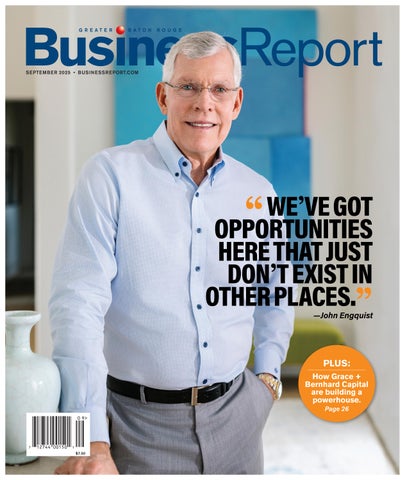
Amazing Grace

Page 1


—John Engquist
“We felt that if we could be market sector diverse and regionally diverse, we would create a company that could live forever.”

Grace Amazing

With private equity backing and a multidimensional strategy, Grace Design Studios is becoming a global force built upon its architectural foundation.

WHAT DO A resort community in Saudi Arabia, the new Epic Universe park at Universal Orlando and a police station in Zachary all have in common? They all have elements designed by architects who are now part of the growing Baton Rouge-based Grace Design Studios.

The firm’s global portfolio is eye-popping evidence of its rapid expansion and evolution since being infused with capital through an investment from private equity management firm Bernhard Capital Partners in 2022.

Known as Grace Hebert Curtis Architecture at the time, the firm proceeded to go on an acquisition spree that eventually led to a rebranding in May of this year. Now with 22 regional offices in 12 states, Grace has become a fully integrated architecture, engineering and consulting, or AEC, firm with projects in sectors ranging from health care and education to civic infrastructure, hospitality and beyond.

The strategy has already begun to pay significant dividends. As No. 5 on Zweig Group’s 2025 Hot Firm List of fastest-growing AEC firms in the U.S. and Canada, Grace reported gross revenue of $137 million in fiscal year 2024, a 242.5% increase over its 2021 gross revenue of $40 million. And more architecture firms around the country are now beginning to follow Grace’s lead by partnering with private equity.

“We felt that if we could be market sector diverse and regionally diverse, we would create a company that could live forever,” says Grace CEO Jerry Hebert. “We really had to rethink how this company lives for the long haul, and how we could take and grow it to a point where we would have more opportunity for our staff to be able to do different types of work throughout the world.”

States of Grace

With its rapid-fire pace of acquisitions and partnerships, Grace Design Studios has expanded across the U.S. map.

turn, adjust the electrical lights accordingly.

As the company settled into its downtown digs, its leaders also set their sights on expansion, first to New Orleans with the acquisition of HMS Architects, and then to Dallas in 2019 with the purchase of the Curtis Group. “Our strategy at that point was really to become regionally diverse,” Hebert says. “So if one economy is not as good as another, it gives us the opportunity to make sure we keep our staff in place, because obviously the lifeblood of our company is the people who work for us every day.”

A

powerful partnership

The pace of company growth really picked up in 2022, when Bernhard Capital Partners announced it had invested in Grace Hebert Curtis, as the firm was then called. While specifics of the transaction were not disclosed, it was noted that Grace would retain “a significant stake in the business.”

Tracing Grace’s roots

The company that would eventually become Grace got its start in Baton Rouge in 1967. Then called Newman and Grace for its founders, Ed Newman and Fred Grace, the firm welcomed Hebert in 1987, two years after he earned his architecture degree from LSU. When Newman retired, the firm became Fred Grace and Associates, and later Grace and Hebert.

In 2009, the firm moved from the Bluebonnet Boulevard area to its current headquarters in a historic building on Government Street downtown. Constructed in the late 1800s, the structure had housed several businesses over the years, including a company that processed moss for mattresses, an armory, a school and an antiques store.

Grace’s $2.4 million renovation of the Government Street building won a Silver Rose Award from the American Institute of Architects. The project was the first in the Baton Rouge area to receive Gold LEED Certification from the U.S. Green Building Council, an award reflecting its use of sustainable materials and a reduction of water and energy consumption.

Today, Hebert’s corner office on the second floor highlights the firm’s commitment to linking local history with modern vision. Glass walls afford just enough privacy without obscuring the exposed original brick walls. The firm’s signature vibrant blue and green colors are incorporated throughout the open central work area, and abundant natural light is tempered by sensors that detect how much sunshine is pouring in at any given time of day and, in

Grace already had an established relationship with BCP before the move, having designed a facility for BCP portfolio company Epic Piping, and even earlier, when BCP founder Jim Bernhard was still at The Shaw Group. “I had sat down with Jim multiple times and had discussions about business strategy,” Hebert says. “Some people just think about surviving. … He was thinking about how do you grow a firm to be the best in the world.”

Grace’s deep experience in civic, health care and education projects made the firm a natural fit for BCP’s focus on growing infrastructure systems and essential services. The firm was also attractive to BCP because of its already established ability to grow through acquisitions, says Bernhard Capital Managing Director Patrick Bernhard.

“They have fantastic talent here in Louisiana and a strong track record of producing high-quality projects,” Bernhard says. “That entrepreneurial spirit and ability to work hard to

build a business with a base in Louisiana across the country in the growth markets was really what differentiated them.”

242.5%

Increase in Grace’s gross revenue from FY 2021 to FY 2024, landing it at No. 5 on Zweig Group’s 2025 Hot Firm List of fastestgrowing AEC firms in the U.S. and Canada.

The vision for BCP’s investment in Grace was simple, Bernhard says, and that was to continue expanding both geographically and from a résumé and services standpoint. The ultimate goal, noted both Hebert and BCP partner Jeff Koonce at the time the investment was announced, was to build a full-service, national AEC platform that would take advantage of what Koonce described as “tail winds within the broader AEC market as businesses, institutions, and local and federal governments dedicate more resources to the development of critical and civil infrastructure.”

Through the investment, Grace became one of only a few institutionally backed architecture firms in the country, notes Bernhard, who says such investments are now more common. “Now there are a handful,” he says. “People invest in engineering groups or different adjacencies, but architecture had largely been an under-invested asset class for private equity.”

The company’s intranet, dubbed MILO for “meet, inspire, learn, optimize,” is essential to connecting team members around the country. An AI component provides instant answers to Grace-related questions.

After BCP’s purchase of a portion of the company, the process began of strategically searching for architecture firms in different locations and with different specialties that could be brought into the fold to complement and expand Grace’s existing range. First came acquisitions of Pensacola, Florida-based Bullock Tice Associates, Fort Worth, Texas-based Hahnfeld Hoffer Stanford, and Fort Myers, Floridabased BSSW in 2023. The next year brought new partnerships with St. Louis-based Hastings+Chivetta and Phoenix-based Orcutt|Winslow. The newest acquisitions, announced this year, are Lakeland, Florida-based Straughn Trout and Baltimore-based CRGA Design.

“Really what we focus on are growth markets,” Bernhard says. “We partner with demographers and do population growth research, because where there are more people, there’s more infrastructure needed—more hospitals, more schools, more fire stations and other things along those lines.”

Each of Grace’s new locations brings its own history of excellence in varied specialties. CRGA was known for designing health care facilities.

“We’ve really exceeded where we thought we’d be in a short period of time. We want to continue to grow it and make Louisiana proud.”

An Orlando office previously acquired by Orcutt|Winslow houses specialists in international master planning. The team formerly known as Hastings+Chivetta aces higher education design assignments. The list goes on.

“Our goal wasn’t to be the biggest,” Hebert says. “It was really to just create a firm where we could not only leverage technology but also leverage quality of staff, leverage knowledge between market sectors, and then to be able to grow experts in each of those fields.”

Scaling smart

As the number of offices grew, Grace continued to round out its services by adding mechanical engineers, forensic consultants and other specialists to a roster of team members that already included interior designers and other complementary fields. Bringing together such a balanced mix of professionals means clients get a seamless experience no matter what nuances their project might involve.

To smooth the company’s rapid growth, Grace’s leadership focused on ensuring that its systems were easily expandable—from essentials like telephones to a company-wide intranet system that became a natural backbone for keeping new Grace team members in farflung locations connected.

BCP assisted the scaling-up process by

THE PORTFOLIO

GRACE

GRACE’S PORTFOLIO NOW stretches from the Gulf Coast to the Persian Gulf. This global reach is the product of a bold expansion strategy—one that’s brought new specialties, new markets and new possibilities into the fold. Here’s a snapshot of the spaces it is shaping here and around the world.

1

3 4 5 2

1. Ochsner Medical Complex-Clearview, Louisiana
2. Jeddah Township, Saudi Arabia
3. LSU women’s basketball locker room, Louisiana
4. Eastmark High School, Arizona
5. Dr. John Ochsner Discovery Health Sciences Academy, Louisiana
6. Ascension Parish Sheriff’s Substation, Louisiana
7. Dr. John Ochsner Discovery Health Sciences Academy, Louisiana
8. Texas Health Orthopedic and Spine Center

Top executives don’t waste time hunting for data—it comes to them. Now, with a Baton Rouge Business Report INSIDER subscription, relevant insights pop up as you read.

Search our data center for real-time business intelligence.

Become an INSIDER now and get the advantage.

businessreport.com/data

facilitating the integration of a robust enterprise resource planning system as well as connecting the firm with a new CFO, Walter Powell, to help manage the increased financial reporting demands.

Powell was formerly with Atlas Technical Consultants, a company that BCP previously backed and later exited.

To better capitalize on the strengths of its numerous experts in different areas around the country, Grace shifted its organizational structure to a studio model earlier this year. Architects focused on health care all work as part of the same studio, even if they are located thousands of miles apart.

Other studios focus on civic projects, hospitality and themed entertainment, K-12 education, higher education, defense and security, sports and recreation, and senior living. But studio team members often share their expertise in other areas, like during a recent project at the Louisiana Correctional Institute for Women for which both the health care group and K-12 group had a hand in the design.

“You probably can’t walk through this office and find a project that has only Baton Rouge people working on it,” Hebert says. “If you ask who’s helping them, they’ll probably say someone in Orlando, or in Pensacola, or somewhere else. Technology obviously enhanced the ability to work across multiple offices collaboratively.”

Cultural alignment

Working from the Pensacola location, Larry Adams has had a close-up view of the company’s expansion and reorganization. As president of the first firm Grace acquired after the equity investment, Adams says the process was seamless and at times unexpected, like when Grace moved his entire 23-member staff from a deteriorating building to a new and fully equipped downtown office.

“Our culture and morale here are just through the roof,” Adams says. “They have treated us so fairly. A lot of people in business will talk about how much they care about their staff and those kinds of things, but they really mean it at Grace.”

“Some people just think about surviving. [Jim Bernhard] was thinking about how do you grow a firm to be the best in the world.”
Grace CEO JERRY HEBERT

Grace notes

As an architecture, engineering and consulting firm, Grace’s AEC services go far beyond basic design.

ARCHITECTURE

MECHANICAL ENGINEERING

INTERIOR DESIGN

INSPECTION AND RESILIENCE

CONSULTING

FORENSIC CONSULTING

PLANNING

SPECIALIZED HEALTH CARE PLANNING AND DESIGN

SUSTAINABILITY

PROGRAM MANAGEMENT

CREATIVE SERVICES

3D VISUALIZATION

The Grace team in Baton Rouge huddles to review progress on a project.

Grace has implemented new activities and programs aimed at fostering a healthy and cohesive company culture. In Pensacola, that has meant weekly catered lunches at the office— something Adams says has built a strong sense of camaraderie. Similarly, each quarter, the team heads out for a fun activity away from the office—think axe throwing or mini golf.

Though unique, each office adheres to the company tagline of “Do good. Be great.”

But Grace’s leaders don’t take a one-size-fits-all approach to building culture. “We have a set vision, values and mission, and we define those clearly to the staff,” Hebert says. “But even though we all have the same destination, we may get there a little differently. I don’t want to overlay crawfish eating on Fridays to my staff in Orlando. We want them all to have their own personality, because connection to community is of utmost importance.”

Even with each office being unique in many ways, they all adhere to the company tagline of “Do good. Be great.” Having a good cultural fit is important, Hebert says, and Grace has stepped away from potential acquisitions multiple times when its leaders felt that such a cultural synergy didn’t exist with the other firm.

“The important thing is treating people with respect,” Hebert says. “That will solve a lot of cultural problems, and I expect everybody here to follow that rule. If you want to be part of our

team, then be part of our team, but there’s no ‘I’ in ‘team.’”

Drawing the future

The firm’s new moniker, Grace Design Studios, reflects its roots but also conveys a refinement that distills its vast network of new components down to a unified essence. Working on the rebranding process with consulting firm Emergent Method, the company’s leaders arrived at the word “Grace” as a stand-in not just for all of its legacy owners but for the vision of the company as a whole.

“Grace is not meant to represent a person,” notes director of business development Rebecca Moses. “It’s meant to represent the future in terms of bringing legacy firms together for something new and innovative. It was a word that we felt was powerful.”

Now with a roster of nearly 500 full- and part-time employees, Grace remains open to future acquisitions and partnerships. “We’ve really exceeded where we thought we’d be in a short period of time,” Bernhard says. “Keeping the momentum is the key. We want to continue to grow it and make Louisiana proud.”

Bernhard adds that future growth will happen in a similar fashion to what’s taken place over the last three years: “Certainly there are some states that we want to grow more in, like Georgia, North Carolina and South Carolina.”

JACKIE
Grace is not meant to represent a person. It’s meant to represent the future in terms of bringing legacy firms together for something new and innovative . It was a word that we felt was powerful.
Business Development Director REBECCA MOSES

Meanwhile, advancements in technology are proving vital to the company’s internal and external ventures. At the Baton Rouge headquarters as well as at several other offices, building information modeling, or BIM, labs employ big screens, high-tech projectors and virtual reality goggles to provide clients with a realistic view of a project even before construction.

The company’s intranet, dubbed MILO for “meet, inspire, learn, optimize,” is essential to connecting team members around the country, with its social media-like posts, resource documents and marketing materials all together in a centrally accessible spot. MILO’s latest addition is an artificial intelligence

component through which employees can get answers to specific Grace-related questions instantly.

AI is something Hebert says is vital to the future of his or any successful architectural firm, and he asserts that by next year, Grace will be one of the leading architectural firms in harnessing its power.

Hebert leads a dedicated group within the company focused on optimizing AI and technology innovations. “We think we can leverage it in a lot of places inside our business model, potentially from quality control and early design to codes—you name it,” he says. “We foresee technology changing everything about the way we work.”

But no matter how far technology moves forward, Grace’s main focus remains on nurturing its people while meeting the needs of the clients it serves. With high morale and a close-knit staff, plus financial backing to incorporate the tools necessary for 21st century success, Grace has its sights on building something special.

More architecture firms around the country are beginning to follow Grace’s lead by partnering with

private equity.

“We want to focus on not only having a great business and drawing great buildings but designing great outcomes for the users of those buildings,” Bernhard says. “So through our design, if we can help someone heal a little faster or learn a little better, that’s really important to us as we build the company and the value that it has for the communities that it serves.”

lcmh.com/cancer

Introducing the newest member of Lake Charles Memorial's Cancer Treatment teamThe Varian Edge Linear Accelerator. This advancement in radiosurgery treatment delivers radiation with millimeter precision, allowing physicians to target tumors while sparing

For patients, it can mean fewer treatments, reduced side effects, and better outcomes, especially for cancers in delicate areas like the brain, spine, or lungs.

Once only available in distant cities, this level of treatment is now accessible in Lake Charles.

Turn static files into dynamic content formats.

Create a flipbook