VOL. 9 ISSUE 4, DEC. 2025
THE MINNESOTA HOUSING INDUSTRY NEWS SOURCE BY HOUSING FIRST MINNESOTA • HOUSINGINDUSTRYNEWS.ORG
Court of Appeals sides with code official in rulemaking case “What does the building code say, and what does it mean?” This question has long had the potential to cause angst with builders, architects, code officials, and trade partners. In October, it resulted in a Court of Appeals ruling that found the Minnesota Department of Labor and Industry (DLI) was enforcing an unpromulgated rule. Under Minnesota law, an administrative rule, like building codes, must follow and be developed under a specific process outlined in state law. The opinion, while binding in this specific matter, is a nonprecedential opinion, meaning it cannot be cited in any future court cases. Background The building official in this case was Todd Geske of MetroWest Inspections, concerning a DLI investigation of a home he inspected. DLI required airflow at each supply register and return in single-family homes to be balanced within ±10% of design airflow—a standard not formally adopted into rule. The dispute arose from an October 2022 State Building Code Appeals Board hearing on whether Geske properly closed a building permit. Geske applied ACCA Standard 5, which allows a ±20% variation in airflow balancing, citing it as the industry standard. DLI argued that Section 309.2.1 of the Minnesota Mechanical Code applied, which limits variation to ±10% at each register in a single-family dwelling. Geske maintained that Section 309.2.1 governs mechanical ventilation systems supplying fresh air, not heating and cooling air distribution systems. An administrative law judge upheld the Appeals Board’s decision in June 2023. Geske appealed, and the Court of Appeals heard arguments in July 2025. From the Experts Chris Boline, who submitted a friend-of-the-court brief on behalf of Housing Industry News Publisher Housing First Minnesota, said, “The decision provides stability for Minnesota’s single-family housing industry at a time when secure and affordable housing is in
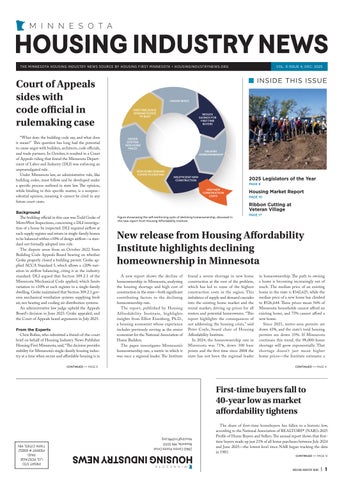
INSIDE THIS ISSUE HIGHER RENTS FIRST-TIME BUYER DEMAND FILTERS TO RENT
REDUCE SAVINGS FOR FIRST-TIME BUYERS
HIGHER EXISTING NEW HOME PRICES
DELAYED HOMEOWNERSHIP
NEW HOME DEMAND FILTERS TO EXISTING
INSUFFICIENT NEW CONSTRUCTION
2025 Legislators of the Year PAGE 8 HIGH NEW CONSTRUCTION COSTS
Housing Market Report PAGE 10
Ribbon Cutting at Veteran Village Figure showcasing the self-reinforcing cycle of declining homeownership, discussed in the new report from Housing Affordability Institute
PAGE 17
New release from Housing Affordability Institute highlights declining homeownership in Minnesota A new report shows the decline of homeownership in Minnesota, analyzing the housing shortage and high cost of construction in the state—both significant contributing factors to the declining homeownership rate. The report, published by Housing Affordability Institute, highlights insights from Elliot Eisenberg, Ph.D., a housing economist whose experience includes previously serving as the senior economist for the National Association of Home Builders. The paper investigates Minnesota’s homeownership rate, a metric in which it was once a regional leader. The Institute
found a severe shortage in new home construction at the root of the problem, which has led to some of the highest construction costs in the region. This imbalance of supply and demand cascades into the existing home market and the rental market, driving up prices for all renters and potential homeowners. “This report highlights the consequences of not addressing the housing crisis,” said Peter Coyle, board chair of Housing Affordability Institute. In 2024, the homeownership rate in Minnesota was 71%, down 300 base points and the first time since 2008 the state has not been the regional leader
CONTINUED >> PAGE 6
in homeownership. The path to owning a home is becoming increasingly out of reach. The median price of an existing home in the state is $342,625, while the median price of a new home has climbed to $526,644. These prices mean 56% of Minnesota households cannot afford an existing home, and 75% cannot afford a new home. Since 2021, metro-area permits are down 43%, and the state’s total housing permits are down 35%. If Minnesota continues this trend, the 98,000-home shortage will grow exponentially. That shortage doesn’t just mean higher home prices—the Institute estimates a CONTINUED >> PAGE 4
First-time buyers fall to 40-year low as market affordability tightens The share of first-time homebuyers has fallen to a historic low, according to the National Association of REALTORS® (NAR)’s 2025 Profile of Home Buyers and Sellers. The annual report shows that firsttime buyers made up just 21% of all home purchases between July 2024 and June 2025—the lowest level since NAR began tracking the data in 1981. CONTINUED >> PAGE 12
HOUSING INDUSTRY NEWS
| 1
2960 Centre Pointe Drive Roseville, MN 55113 HousingFirstMN.org
PRSRT STD U.S. POSTAGE PAID PERMIT # 93652 TWIN CITIES, MN
BOARD CHAIR NOTE
HOUSING INDUSTRY NEWS
Industry comes together to advance homeownership across Minnesota In every corner of Minnesota, the dream of homeownership remains one of the most powerful drivers of community stability and personal opportunity. At Housing First Minnesota, we know that advancing this dream requires more than policy—it requires partnership. This year, we see that spirit of collaboration at its finest through the new Housing First Minnesota – Rochester Area Builders partnership. Together, our groups created a model that represents the best of both organizations, which will deepen local presence while building a unified homeownership message and stronger connection to the community. This partnership is just one example of the coalition-building that continues to define our approach to lifting homeownership and tackling Minnesota’s housing affordability challenges. This work has continued with the convening of a diverse coalition of organizations
committed to housing opportunity and consumer choice in our building and energy code development process. Groups from all over the state have lent their voice in the code development process, including the Minnesota Association of Realtors, the Central Minnesota Builders Association, CenterPoint Energy, the Home Builders Association of the Red River Valley, the Window and Door Manufacturers Association of America, and the Builders Association of Minnesota. Together, these partners better represent every part of the housing ecosystem—from energy and materials to design, construction, and community development. Working collaboratively, we are advancing practical, bipartisan solutions that expand housing supply and make homeownership more attainable for families across the state. The challenges ahead are real, but so is our collective focus and determination. With partnership, technical expertise, and purpose,
Vol. 9 Issue 4, December 2025 PUBLISHER, CHIEF EXECUTIVE OFFICER James Vagle
Minnesota’s housing industry continues to lead the way—building opportunity, community, and a stronger future for all. Let’s build it together.
ART DIRECTOR Mandy Finders GRAPHIC DESIGNER
Art Pratt Pratt Homes 2025 Board Chair
Pa Gar Vang OPERATIONS COORDINATOR Casey Scozzari SENIOR DIRECTOR, MARKETING & COMMUNICATIONS Katelyn Bloomquist SENIOR VICE PRESIDENT, GROWTH & ENGAGEMENT Kate Gunderson SENIOR ACCOUNT EXECUTIVE Devin Lehnhoff
Art Pratt 2025 Board Chair, Housing First Minnesota
ENGAGEMENT ACCOUNT EXECUTIVE Allyson Sample CONTRIBUTING WRITERS Kristen Crossman Nick Erickson
HousingIndustryNews.org
Subscribe
Mark Foster
Stay up to date on the latest housing news. Subscribe to our newsletter at HousingIndustryNews.org.
Advertising For advertising information, rates, editorial calendar, and production specifications, contact: Sales@HousingFirstMN.org
News Tips Have a story idea for our next issue? Contact Grace Greene at Grace@HousingFirstMN.org
Follow Us Go to HousingIndustryNews.org for subscriber exclusives, breaking housing news, and features.
Be a part of the growing housing movement in Minnesota. Follow us @housingindustrynews_mn facebook.com/HousingIndustryNewsMN
Grace Greene Kristi Jorgensen Elizabeth Roubik Kate Wigley HOUSING FIRST MINNESOTA BOARD CHAIR Art Pratt Housing Industry News is a publication of Housing First Minnesota. Housing Industry News is published and distributed four times per year to housing industry professionals and others associated with the homebuilding industry. Neither the advertisers, nor Housing First Minnesota, will be responsible or liable for misinformation, misprints, typographical errors, etc., herein contained. For address change information, contact Housing First Minnesota. Suggestions, ideas, and letters are welcome. HOUSING INDUSTRY NEWS 2960 Centre Pointe Drive Roseville, MN 55113 info@HousingFirstMN.org housingindustrynews.org Housing Industry News is published by Housing First Minnesota.
Housing First Minnesota brings together over 900 builders, remodelers, designers, and industry suppliers. By joining, you don’t just become a member— you gain access to a powerful community. From exclusive networking events and unmatched marketing opportunities to a trusted consumer brand, continuing education, and a strong advocacy voice at the Capitol, membership unlocks the tools and connections you need to grow, lead, and succeed in Minnesota’s homebuilding industry.
JOIN US
2 | HOUSING INDUSTRY NEWS
Discover More Membership Perks
I NTERESTED I N LEARNING MORE? LET ’ S CHAT ! EMAIL MEMBERSHIP@HOUSINGFIRSTMN.O RG .
Entire contents copyright 2025. All rights reserved.
Housing First Minnesota is the voice for homebuilders, remodelers, and all who are dedicated to building safe, durable homes at a price Minnesotans can afford. Housing First Minnesota is dedicated to advancing the American dream of homeownership for Minnesotans and is the leading resource for housing-related issues in Minnesota. This advocacy work has never been more important. The housing industry remains under intense regulatory and political pressures that impact Minnesota homeowners’ ability to buy, build, and remodel their dream home. Housing First Minnesota supports reasonable policies, regulations, and protections, but our call for affordability for families is a voice that must be heard. Learn more at HousingFirstMN.org.
SIGN UP TO BE A PART OF THE HOUSING MOVEMENT • HOUSINGINDUSTRYNEWS.ORG
THE HOUSING BEAT
Across the country, there is much talk about housing. HERE ARE SOME OF THE LATEST QUOTES ON THE STATE OF THE INDUSTRY
We’ve seen the median age of a first-time homebuyer creep up to 38 years old. And so what we’re seeing is, we have a generation of Minnesotans this is getting priced out of part of the American dream, which is homeownership.” STATE SEN. JORDAN RASMUSSON FERGUS FALLS
The share of first-time buyers in the market has contracted by 50% since 2007—right before the Great Recession. The implications for the housing market are staggering. Today’s first-time buyers are building less housing wealth and will likely have fewer moves over a lifetime as a result.” JESSICA LAUTZ NATIONAL ASSOCIATION OF REALTORS® DEPUTY CHIEF ECONOMIST
Our market continues to face a shortage of homes, especially at more affordable price points. If mortgage rates ease, that may help ease affordability concerns, but supply remains a top issue.” JAMES VAGLE CEO OF HOUSING FIRST MINNESOTA
Especially for younger people, they’re giving up on some of those dreams of owning a home and starting a family due to the cost itself. Not because it’s not a priority but because they don’t feel like they can afford it any longer.” SARAH DARR SENIOR VICE PRESIDENT, HEAD OF FINANCIAL PLANNING AT U.S. BANK
CHOOSE LAMPERT. Lampert Lumber offers a wide selection of high-quality cabinetry to meet the needs of professionals in residential, commercial, and multi-family projects. Our expert designers are here to assist you and your customers with product selection, design support, and customization options to ensure the perfect fit for any space. With competitive pricing, top brands, and reliable service, Lampert Lumber is your trusted partner for cabinetry solutions that deliver style, functionality, and durability.
LAMPERTLUMBER.COM SIGN UP TO BE A PART OF THE HOUSING MOVEMENT • HOUSINGINDUSTRYNEWS.ORG
HOUSING INDUSTRY NEWS | 3
REGULATORY AFFAIRS
CONTINUED FROM PAGE 1
New release from Housing Affordability Institute highlights declining homeownership in Minnesota $9 billion loss in statewide economic activity and almost 63,000 jobs not created. At the center of the paper is a selfreinforcing cycle of declining homeownership. High new construction costs lead to insufficient new construction, which pushes new home demand to existing homes and leads first-time buyers to rent instead. This leads to higher rent costs, reduced savings for first-time buyers, and ultimately, a generation of Minnesotans delaying homeownership. The paper also highlights the key issues of senior housing, the minority homeownership gap, and the changing demographics of firsttime buyers. As Minnesota’s population ages, it is crucial to ensure older residents have viable options if they choose to downsize, so they are not left locked into large, single-family homes that younger families desire. Minority populations consistently have lower homeownership rates than non-Hispanic whites. To close this gap in Minnesota, where 77.5% of white households own their home
compared to just 30.5% of Black households, efforts should be focused on assisting minority groups in achieving homeownership. First-time buyers are older than ever before, reaching an all-time high of 38 years old in 2024. This indicates a broader trend of younger households entering the housing market much later in life than previous generations. “Minnesota’s growing housing deficit and high new housing costs are a cautionary tale,” said Eisenberg. “Without action, limited supply and high prices will erode the state’s economic foundation. A responsive housing market—one that encourages new construction and reduces barriers to affordability—is essential to sustaining Minnesota’s growth, competitiveness, and ability to attract the next generation of Minnesotans.” The paper concludes that Minnesota must encourage new construction and remove barriers to homeownership to sustain its growth and remain competitive as a state, appealing to future generations.
The American dream of homeownership is getting further out of reach for Minnesotan families as the state’s housing deficit grows.
Some companies guess. Others know. Access your unfair advantage with the Keystone Report—intel the industry trusts.
Subscribe at keystonereports.com
4 | HOUSING INDUSTRY NEWS
SIGN UP TO BE A PART OF THE HOUSING MOVEMENT • HOUSINGINDUSTRYNEWS.ORG
REGULATORY AFFAIRS
Housing stakeholders urge PUC to protect affordability as state agencies push to end line-extension allowances Minnesota’s Public Utilities Commission (PUC) faces a pivotal decision in its ongoing “Future of Gas” proceeding (G-999/CI-21-565) that could reshape how new homes access essential energy infrastructure. The issue centers on whether utilities should continue offering natural gas line-extension allowances, which are credits that offset the cost of bringing service to new developments. Housing First Minnesota, along with utility providers and builders statewide, has urged regulators to preserve the current policy, warning that eliminating the allowance would add thousands to the cost of each new home. In three formal filings this summer, Housing First Minnesota emphasized how rising construction costs and regulatory burdens have already placed attainable housing out of reach for many Minnesotans. The group cautioned that “further limiting energy access or shifting
infrastructure costs to new homeowners will only deepen the state’s affordability crisis.” Utilities companies, including Xcel Energy, have echoed these concerns, noting the allowances help ensure equitable access to energy and support balanced fuel-choice strategies for consumers. The Minnesota Department of Commerce and the Minnesota Housing Finance Agency (MHFA) have taken a contrasting stance, advocating for an end to the current lineextension system. Commerce downplayed the potential impact on affordability, calling it “minor,” while MHFA described the change as accelerating the state’s climate goals. Industry groups, however, say the assessment ignores the financial realities facing buyers and developers. Rural and suburban projects—which often require longer gas extensions—could
see the steepest cost increases if the policy is repealed. With public comments now closed, attention turns to the PUC, which must weigh competing priorities of affordability, consumer access, and environmental policy. Builders and energy stakeholders hope commissioners will recognize the real-world impact of new infrastructure costs on housing supply. “Housing First Minnesota and our partners remain hopeful that the PUC will chart a balanced path,” the organization said in its latest filing. “Preserving line-extension allowances is a practical step toward ensuring energy reliability and keeping new homes within reach for Minnesota families.” The PUC is expected to issue its next ruling on the matter in the coming weeks, with many members of the legislature closely watching.
Regulatory briefs: Building codes technical reviews completed; cost increase postponed The Minnesota Department of Labor’s Construction Code Advisor y Council (CCAC) met on Nov. 14 to re vie w the technical review reports for several residential codes. Several industry advocacy groups submitted letters opposing many of the amendments put before the Council. “Minnesota’s affordability crisis is real,” a letter from a Rochester Area Builders member stated. “Every new regulation, no matter how well-intentioned, adds up.” A letter from a Central Minnesota Builders Association member also highlighted the State’s growing housing shortage, saying, “As a small builder, I see firsthand how every regulation filters down to the cost of a home. The [Technical Advisory Group (TAG)] report ’s recommendations are well-meaning, but they’d make building, and therefore buying, a home harder than ever in Minnesota.” Much of the cost increase recommended by the TAG estimated at nearly $15,000 for
a two-story home, did not get approved by CCAC. Industry advocacy groups called it a delay but not the end of the conversation. “CCAC’s actions, while commendable on the Energy Code, have only delayed the coming cost increases,” said Nick Erickson, senior director of housing policy for Housing First Minnesota. “With the Mitchell Provisions still in place, we can expect significant cost increases, like the ones proposed by the TAG, every three years through 2036.” Also on the agenda was an amendment to require EV charging capability in new homes, which was previously rejected twice during the TAG process. The proposal was rejected by the Council in a 2-16 vote with two abstentions. Plumbing Code At of its Dec. 1 meeting, the Minnesota Plumbing Board approved the technical review of chapters 1-11 of the 2024 Uniform Plumbing Code (UPC). While the Minnesota Plumbing Board is proceeding with the rest
Feb. 12, 2026
Canterbury Park Expo Center Shakopee, Minnesota Exhibit Hours: 1-6 p.m.
SIGN UP TO BE A PART OF THE HOUSING MOVEMENT • HOUSINGINDUSTRYNEWS.ORG
of the rulemaking for part of the Minnesota Plumbing Code, its 2024 UPC ad hoc Chapter 15 Rulemaking Committee continues to review proposed rules for nonpotable water reclamation. The State of Minnesota has looked at regulations for water reuse for some time, including an interagency working group in 2017. As the Minnesota Department of Health has public health concerns with using what it called “greywater,” there are competing environmental and health interests in this UPC chapter review, which is expected to continue into December. Electrical Code The Minnesota Board of Electricity (BoE) began the technical review of the 2026 National Electrical Code (NEC) in September. The NEC 2026 Adoption Review Committee met twice in October, and the full BoE will meet early next year to discuss any recommendations for significant changes to the code.
Book online at BRSmn.org
HOUSING INDUSTRY NEWS | 5
LEGAL CONTINUED FROM PAGE 1
Court of Appeals sides with code official in rulemaking case
The Court of Appeals decision allows for builders and remodelers to feel confident that the state building code will remain consistent with prior enforcement.
high demand. This decision affirms the industry’s understanding of the code consistent with prior enforcement, allowing builders and remodelers to confidently continue serving Minnesota’s competitive housing market.” Next steps Since the interpretation of the code was specific to this home and investigation, there is no immediate impact on other builders. DLI has not yet said if it will appeal this ruling. Disclosure: Housing First Minnesota, publisher of Housing Industry News, was an amicus partner briefing the court in favor of Geske.
Further legal updates Alex and Lynda Pepin have filed a second lawsuit against the City of Blaine, alleging the City Council again acted unlawfully in denying their application to build an accessory dwelling unit (ADU) on their property. The complaint, filed Oct. 1 in Anoka County District Court, argues the city’s actions were “arbitrary, capricious, and unconstitutional.” This latest suit follows a separate case the Pepins filed in July over the denial of their first ADU application, which proposed renting the unit at an affordable rate to a family in financial hardship. According to the filing, the City Council rejected that proposal after public opposition, then imposed a one-year moratorium on all new ADU permits. Before that moratorium took effect, the Pepins submitted a second, nearly identical permit request—this time limiting the unit’s use to family members only. City staff and the Planning Commission both recommended approval, but the City Council denied the application on Aug. 4 by a 4-3 vote, citing compatibility concerns with single-family zoning. At the time of printing, the case has not yet gone before the judge. The Institute for Justice, a public interest law firm, is supporting the Pepins in both lawsuits. Worker classification law challenges withdrawn from federal court An industry challenge to Minnesota’s worker misclassification case has been withdrawn following a Federal Court of Appeals ruling. On Oct. 24, the Eighth Circuit Court of Appeals upheld a lower court ruling in Minnesota Chapter of Associated Builders & Contractors, et al. v. Blissenbach, a case challenging
Minnesota’s new 14-point independent contractor test for the construction industry. The appellate court agreed the plaintiffs had standing but found they were unlikely to succeed on their constitutional claims, leaving the law in place. The independent contractor requirements, adopted in the final hours of the 2024 legislative session, remain fully enforceable, allowing the state to impose civil and criminal penalties for worker misclassification. Attorneys for the plaintiffs filed paperwork to voluntarily withdraw the case in late October, ending the challenge. Minnesota Court of Appeals to hear building permit case Housing First Minnesota has returned to the Court of Appeals in its ongoing case against the cities of Corcoran and Dayton, alleging both cities overcharged for new construction permits by millions of dollars through inflated building permit fees. The central issue is whether the cities violated Minnesota Rule 1300.0160, which requires building permit fees to be “fair, reasonable, and proportionate to the actual cost of the service,” and whether their ordinances unlawfully converted a fee-for-service system into a revenue source for general operations. The Court of Appeals first reviewed the dispute in 2023, finding Housing First had standing to challenge the cities’ fee structures but sending the case back on procedural grounds. This round focuses on the substance—whether the cities’ fee ordinances violate state law and the State Building Code’s fee limitations. No hearing date has been announced. Disclosure: Housing First Minnesota, publisher of Housing Industry News, is the appellant in the Corcoran and Dayton case.
YOUR LOCAL SOURCE FOR
IN-STOCK DECKING & RAILING
ABC Supply Coon Rapids and Lakeville STOCK the products builders count on: Decking, Railing, and Lumber from the industry’s leading brands. Coon Rapids, MN 10141 Woodcrest Dr NW 763-757-5077
6 | HOUSING INDUSTRY NEWS
Lakeville, MN 21881 Grenada Ave 952-229-1933
SIGN UP TO BE A PART OF THE HOUSING MOVEMENT • HOUSINGINDUSTRYNEWS.ORG
BUILD WITH THE BEST. At Lyman Companies we specialize in what we know and love, which means we understand the roofing business inside and out. Our roofing specialists bring decades of experience to the table and are dedicated to getting material to you correctly and on time to keep your jobs moving. Whether your project is residential, commercial, or multi-family, we have the expertise, products, and services you need to get the job done right.
Contact us today to learn how we can take your roofing business to the next level!
LYMANCOMPANIES.COM
SIGN UP TO BE A PART OF THE HOUSING MOVEMENT • HOUSINGINDUSTRYNEWS.ORG
HOUSING INDUSTRY NEWS | 7
HOUSING ON THE HILL
How tariffs may worsen the housing shortage Tariffs continue to impact homebuilders and remodelers. Since this spring, tariffs have increased the price of imported materials essential to constructing a home. These increased costs for building a home slow construction even further as the housing shortage continues to grow, raising rents and home prices. In October, a 10% tariff on timber and lumber and a 25% duty on cabinets and furniture were implemented. At the start of 2026, these will increase to 30% for wooden furniture and 50% for kitchen cabinets and vanities. According to Realtor.com, the U.S. imports roughly one-third of the lumber used in home construction, 85% of which comes from Canada. This Canadian lumber is already subject to a 35% tariff in addition to the newly imposed 10% tariff. These increasing input costs—combined with local zoning requirements, regulatory mandates, and high interest rates—push homeownership further out of reach. The National Association of Realtors’ 2025 annual survey found the median age of a first-time buyer has reached an all-time high of 40 years old, while the share of first-time homebuyers hit a record low at 21%. These tariffs are aimed at boosting domestic timber production, as U.S. sawmills are operating at 64% of capacity. This has steadily decreased since 2017, according to the National Association of Home Builders (NAHB). At this rate, it would take years to meet current demand, let alone ramp up production enough to make a dent in the housing shortage. An analysis by NAHB broke down the cost of building a single-family home, finding that framing costs averaged just below $50,000 last year, or 12% of
the total cost of building a new home. Cabinets and countertops account for 4.5% of the total cost, around $19,056 on average. Homebuilders can expect these numbers to increase as tariffs are put into effect. Other materials used in homebuilding might also be subject to new tariffs, including gypsum, steel, and aluminum. In February, President Trump reinstated a 25% tariff on steel imports and increased tariffs on aluminum imports to the same level. A tariff on the mineral gypsum, which is used in drywall, may be imposed in the future. This tariff would be imposed under the International Emergency Economic Powers Act (IEEPA), which is currently before the Supreme Court with questions about the constitutionality of its application. Residential building permits have continued to decrease over the past few years, even before tariffs were part of the conversation. The U.S. is short millions of homes, with estimates ranging from a deficit of 3 to 5 million units. This shortage is impacting every corner of the market; multifamily development has slowed as rents and the number of cost-burdened renters are reaching record highs. Although the Trump administration has supported programs that are beneficial to homebuyers and builders, such as expanding the Low-Income Housing Tax Credit and investing in infrastructure to encourage new construction, these efforts are not enough to increase residential construction in a meaningful way, given the sharp rise in building costs. Various costly mandates, local regulations, and high interest rates are already negatively impacting homebuilders. With every added cost, more potential homebuyers are priced out.
Housing First Minnesota honors 2025 Legislators of the Year Sen. Jordan Rasmusson and Rep. Spencer Igo recognized for championing housing affordability and homeownership Housing First Minnesota recently named Sen. Jordan Rasmusson (R–Fergus Falls) and Rep. Spencer Igo (R–Wabana Township) as its 2025 Legislators of the Year, honoring their leadership and advocacy for housing affordability and homeownership across Minnesota. The annual award recognizes lawmakers who demonstrate a strong commitment to advancing policies that make homeownership accessible for Minnesotans of all backgrounds. The awards were presented during Housing First Minnesota’s annual Building Industry Gala (BIG Night) at Mystic Lake Center, which brought together builders, remodelers, and industry leaders from across the state to celebrate excellence in homebuilding and remodeling. Sen. Rasmusson has emerged as a leading voice on housing policy in the Minnesota Senate, advocating for solutions that address affordability challenges and support the next generation of homebuyers. His work has focused on removing barriers to housing development and creating more choices for families seeking to put down roots in Minnesota communities. “I am grateful to the Housing First Minnesota team for their recognition and partnership in addressing our state’s housing challenges,” said Rasmusson. “Families across Minnesota are eager to buy their first home, but too often, government regulations stand in the way. Working together across government and the housing industry is key to helping more Minnesota families achieve the dream of homeownership.” Rep. Igo, co-chair of the Housing Committee in the Minnesota House, has been instrumental in elevating housing issues at the Capitol. He has worked across party lines to promote reforms that grow the housing supply and expand opportunities for homeownership. “Sen. Rasmusson and Rep. Igo have been tireless advocates for solutions that reduce barriers, expand housing supply, and keep the dream of homeownership within reach for Minnesotans,” said Mark Foster, vice president of legislative and political affairs for Housing First Minnesota. “Their results-oriented approach—grounded in affordability, predictability, and common-sense regulation—embodies the leadership Minnesota needs to address our growing housing shortage.” Rep. Igo expressed his appreciation to be recognized for his work to expand housing opportunities across the state. “I’m honored to receive this award and echo the sentiment that homeownership should be attainable,” Igo said. “We need affordable and diverse housing options that fit every stage of life. It is by creating that environment in housing we can create stability for all Minnesotans so they can build a secure future right here at home.”
Sen. Jordan Rasmusson Fergus Falls
On Jan. 1, 2026, tariffs on wooden furniture will increase to 30%.
8 | HOUSING INDUSTRY NEWS
Rep. Spencer Igo Wabana Township
Photo Credit: Spacecrafting Photography | Lake Country Builders
SIGN UP TO BE A PART OF THE HOUSING MOVEMENT • HOUSINGINDUSTRYNEWS.ORG
P OW E R E D BY XC E L E N E R GY
SPONSORED CONTENT
Xcel Energy’s electric space heating rate reduction Making heat pump homes more affordable Minnesota homeowners and builders are increasingly turning to electric solutions to reduce their carbon footprint. To help lead this transition, Xcel Energy offers an innovative electric space heating rate reduction that makes electrification more accessible and affordable. What is the electric space heating rate reduction? This discounted electricity rate cuts the cost of electricity by nearly half for residential customers who use electricity as their primary heating source. This rate is designed to encourage the adoption of electric heating systems such as air-source heat pumps, electric boilers, and electric resistance heating. Signing up for this rate reduction can significantly reduce the cost of heating with a heat pump. Driving electrification and affordability In colder climates like Minnesota, the electric space heating rate reduction helps make heat pumps more affordable to operate, especially when paired with energy-efficient building practices. For builders and developers focused on sustainable construction, this rate structure can be a gamechanger. It allows them to design all-electric homes that are both energy efficient and cost-effective for future homeowners. Combined with incentives for high-efficiency appliances and renewable energy integration, the electric space heating rate reduction
supports a holistic approach to sustainable housing development. Environmental and grid benefits Beyond individual savings, this rate reduction aligns with Xcel Energy’s ambitious vision to deliver 100% carbon-free electricity by 2050. As more homes adopt electric heating under this rate, the cumulative reduction in greenhouse gas emissions can be substantial. According to the U.S. Department of Energy, switching one home to an electric heat pump can cut up to 7.6 tons of carbon emissions each year, depending on the local energy mix.* A win-win for homeowners and the planet Xcel Energy’s electric space heating rate reduction is more than just a pricing tool—it’s a strategic lever for accelerating the clean energy transition. By making electric heating more affordable, it empowers homebuilders and homeowners to make sustainable choices without sacrificing comfort or financial stability. As the building sector continues to evolve, programs like this can be essential in shaping a low-carbon future. Whether you’re helping a client upgrade their heating system or designing the next generation of sustainable homes, the electric space heating rate offers a compelling path forward with electrification. *energy.gov/articles/pump-your-savings-heat-pumps
TRYING TO SAVE FOR A STARTER HOME
SHOULDN’T FEEL LIKE THIS
LEARN MORE AT
YESTOHOME.ORG
SIGN UP TO BE A PART OF THE HOUSING MOVEMENT • HOUSINGINDUSTRYNEWS.ORG
HOUSING INDUSTRY NEWS | 9
MARKET REPORT
Housing market report
State of Minnesota
Moorhead
Fall homebuilding shows positive growth
83
SOURCE: CITY OF MOORHEAD
As the seasons change and autumn rolls in, the demand for new homes in the Twin Cities is not slowing down. Metro builders pulled 628 permits for single-family homes in September, a 22% increase in activity year-over-year. Multifamily construction also saw another month with positive activity. In September, builders reported 291 multifamily units under construction, reflecting a 61% rise in activity compared to September 2024. Multifamily activity accounted for nearly a third of all construction activity for the month.
8,879
Duluth
289
Year-to-Date Single-Family Construction Select Cities Through August 2025 SOURCE: U.S. CENSUS
SOURCE: U.S. CENSUS
St. Cloud
80
SOURCE: CITY OF ST. CLOUD
Twin Cities
6,049
Mankato
161
SOURCE: U.S. CENSUS
Rochester
333
SOURCE: U.S. CENSUS
SOURCE: U.S. CENSUS
HOUSING FIRST MINNESOTA COLLECTED THE ABOVE PERMIT INFORMATION FROM AVAILABLE PUBLIC RESOURCES. (THIS REFLECTS THE MOST RECENT DATA AVAILABLE AT THE TIME OF PUBLICATION. UPDATES ARE DELAYED DUE TO THE IMPACTS OF THE FEDERAL GOVERNMENT SHUTDOWN.)
SEPT. 2025
SEPT. 2025
$390,000 SEPT. 2024
2.8%
$379,999
$357,200
2.1%
Minnesota Construction Employment Past 5 Months SOURCE: DEED
SEPT. 2024
$350,000
Y-Y Change
Y-Y Change
Twin Cities Median Sales Price
Minnesota Median Sales Price
SOURCE: MINNEAPOLIS REALTORS®
SOURCE: MINNESOTA REALTORS®
Twin Cities Construction Employment Past 5 Months SOURCE: DEED
CURRENT
FUTURE
68
52
South - 68
Midwest - 68
Northeast - 63
Regional Remodeling Market Indices, 2025 Q3 SOURCE: NAHB
The Overall Remodeling Market Index is calculated by averaging the Current Marketing Index and the Future Market Indicators Index. Any number over 50 indicates that more remodelers view remodeling market conditions as higher than the previous quarter. Results are seasonally adjusted.
10 | HOUSING INDUSTRY NEWS
Employment Update Minnesota’s non-seasonally adjusted unemployment rate dropped to 3.3% in August, according to the Minnesota Department of Employment and Economic Development. This is compared to the July rate of 3.9%. The national unemployment rate also decreased from 4.6% in July to 4.4% in August. Construction employment in Minnesota recorded a gain of 1,900 jobs in August across all sectors of the industry. (THIS REFLECTS THE MOST RECENT DATA AVAILABLE AT THE TIME OF PUBLICATION. UPDATES ARE DELAYED DUE TO THE IMPACTS OF THE FEDERAL GOVERNMENT SHUTDOWN.)
SIGN UP TO BE A PART OF THE HOUSING MOVEMENT • HOUSINGINDUSTRYNEWS.ORG
AROUND THE STATE
CMBA celebrates events Central Minnesota Builders Association (CMBA) hosted its Annual Membership Celebration on Nov. 6, during which the annual election was conducted. The evening was a wonderful occasion honoring Marty Czech, the 2025 CMBA board president from Premier Real Estate Services, and Rachel Layton of Tri-County Abstract and Title Guaranty, who was recognized as the CMBA 2025 Associate of the Year for her dedicated involvement in the Association’s events and committees. CMBA eagerly anticipates an exciting lineup of events and activities in 2026, led by upcoming president Greg Wensmann, owner of Wensmann Contractors. Preparations for the 2026 Home Show are already in full swing. The event will take place at the River’s Edge Convention Center in St. Cloud on Friday, March 13, and Saturday, March 14. This presents an excellent opportunity for businesses to showcase their products and solutions to nearly 3,000 consumers from central Minnesota. For more details about the Home Show, visit www.cmbaonline.org. Booth spaces are filling up, so sign up today to secure your space and highlight your organization.
Marty Czech (left) and Rachel Layton (right) pose with the 2025 Associate of the Year award.
JeffBelzersChevy.com
The fine art of creating
Exceptional Exteriors
Roofing Siding Windows Gutters Decks Connect with us for your complimentary consultation:
763-373-3445 www.allstartoday.com SIGN UP TO BE A PART OF THE HOUSING MOVEMENT • HOUSINGINDUSTRYNEWS.ORG
License #BC751852
HOUSING INDUSTRY NEWS | 11
INDUSTRY GIVES BACK CONTINUED FROM PAGE 1
First-time buyers fall to 40-year low as market affordability tightens Affordability barriers continue to sideline first-time buyers The report points to limited housing inventory, elevated mortgage rates, and persistently high home prices as key factors keeping first-time buyers out of the market. During the period in which the survey was conducted, the average 30-year mortgage rate was 6.69%, and new listings were often priced well above what typical entry-level buyers could afford. Among those who did manage to purchase their first home, the median age rose to 40, the highest ever recorded. Historically, first-time buyers were typically in their late 20s. The report also found that 59% used personal savings for their down payment, while 26% relied on financial assets, marking a shift away from past reliance on gifts or loans from family and friends. Repeat buyers hold an advantage The market continues to favor repeat buyers with accumulated equity and higher incomes. The median age of repeat buyers reached 62, another record high, and nearly 30% purchased their homes entirely in cash. The typical down payment for repeat buyers was 23%, while first-time buyers averaged 10%, the highest level since 1989. “The data underscores a widening affordability divide in the market,” said Jessica Lautz, NAR’s deputy chief economist and vice president of research. “While firsttime buyers face the highest barriers in decades, repeat buyers are capitalizing on record housing equity and strong cash positions.”
Homeowners also are holding onto their properties longer before selling, with the median tenure hitting 11 years, the longest in the report’s history. As home prices appreciate, many sellers are realizing substantial returns but remain hesitant to list due to low existing mortgage rates—a dynamic often referred to as the “golden handcuff ” effect. Changing demographics and buyer motivations Married couples continue to dominate home purchases, accounting for 61% of all buyers, while single women represented 21% and single men 9%. Among first-time buyers, single women made up 25%, underscoring their increasing presence in the market despite affordability constraints. The report also notes a decline in buyers with children under 18, now at just 24%, an all-time low. Analysts attribute this to demographic shifts, including lower birth rates and the growing share of older repeat buyers, as well as the high cost of childcare, which many cited as a barrier to saving for a down payment. For those entering or reentering the market, proximity to friends and family (47%) has become nearly as important as neighborhood quality (59%), surpassing considerations like commute time. The share of buyers prioritizing convenience for work fell to 31%, down from more than 50% a decade ago—mirroring the flexibility of post-pandemic, hybrid work patterns.
First-time buyers are facing increasingly high barriers to homeownership as the median age of a first-time buyer rises to 40.
Housing market stalls as rates remain stubborn, prices hold The U.S. housing market struggled to gain traction this year, as high mortgage rates and a lack of inventory kept both buyers and sellers primarily on the sidelines. Despite brief flashes of activity, the year was defined by hesitation and affordability pressures that froze movement across much of the market. Mortgage rates fall slightly, still an affordability hurdle Mortgage rates remained the defining obstacle of 2025. The average 30-year fixed mortgage hovered near 6.6% for much of the year, according to Freddie Mac, with only modest relief late in the year as rates edged down to 6.22% in early November. This came after the Federal Reserve announced two separate interest rate cuts in the second half of 2025. The elevated rate environment continued to suppress affordability and discourage move-up purchases, particularly among existing homeowners locked into historically low pandemic-era loans. Even as inflation cooled and the Fed hinted at potential rate cuts in 2026, financing costs remained too high to spark significant buyer demand. While refinance applications picked up in the fall, overall purchase activity stayed subdued. According to the Mortgage Bankers Association, mortgage applications for home purchases were down roughly 20% year over year, reflecting widespread buyer fatigue. Home prices give some stability to the market Home prices were largely stable in 2025, reflecting the ongoing tension between limited supply and reduced affordability. According to data from the Minneapolis Area Realtors®, the median sales price of a Twin Cities home in September was up just 2.6% compared to last year. Price stability was driven mainly by a lack of supply rather than robust demand. Many potential sellers opted to stay put, unwilling to trade a 3% mortgage for one twice as high. This
12 | HOUSING INDUSTRY NEWS
“lock-in effect” kept inventory near historic lows, preventing prices from falling despite sluggish sales. Incontrast,theNationalAssociationofHomeBuilders(NAHB) reported a 2.3% annual decline in new-home prices, as builders adjusted pricing strategies and scaled back square footage to attract rate-sensitive buyers. Builders with standing inventory turned to incentives and buy-down programs to move units, but affordability remained a significant hurdle. New construction activity Despite ongoing challenges, new-home construction gained momentum in the second half of 2025. The U.S. Census Bureau and U.S. Department of Housing and Urban Development reported that new home sales reached an annualized pace of about 800,000 units in August, up 20.5% from July and 15.4% from the year prior. Builder confidence also has improved slightly. The NAHB/ Wells Fargo Housing Market Index rose to 37 in October, its highest reading in six months, although still below the neutral threshold of 50 that signals broad optimism. Custom homebuilding has shown particular resilience, with custom starts up about 4% in the second quarter, according to NAHB. Still, builders continue to face headwinds from high labor and material costs, with construction now representing more than 64% of a home’s average sale price, up from around 61% in 2022. Outlook for 2026 Industry analysts expect the market to remain steady in early 2026, with the potential for modest improvement later in the year if the Fed cuts interest rates further and mortgage rates continue to decline. The National Association of REALTORS® (NAR) and Fannie Mae both forecast rates could fall closer to 6% by midyear, potentially unlocking pent-up demand among first-time
High mortgage rates and lack of supply are leading potential sellers to remain in their homes, contributing to affordability challenges.
buyers. However, supply constraints are likely to persist as many homeowners remain reluctant to sell. “The housing market is gradually finding its footing,” said Lawrence Yun, chief economist at NAR. “Lower mortgage rates will help, but affordability remains the key challenge.” For builders, remodelers, and industry professionals, 2025 was a year of adjustment rather than expansion. As 2026 approaches, the focus shifts to readiness—ensuring capacity and flexibility to respond when buyers reenter the market.
SIGN UP TO BE A PART OF THE HOUSING MOVEMENT • HOUSINGINDUSTRYNEWS.ORG
AROUND THE STATE
Housing First Minnesota and Rochester Area Builders forge partnership to expand advocacy and home tour reach
In a move signaling deeper collaboration and expanded regional impact, Housing First Minnesota (HFM) and the Rochester Area Builders (RAB) have finalized a partnership designed to strengthen advocacy efforts, elevate home tour programming, and deliver greater value to builders, remodelers, and other industry professionals in southeast Minnesota. “This is an exciting time for Housing First and RAB,” said James Vagle, CEO of Housing First Minnesota. “Together, we’re building a clearer path to homeownership and a stronger future for Minnesota’s housing industry.” The agreement—months in the making—brings together two influential builder organizations at a time when the state continues to face housing shortages, affordability pressures, and shifting market dynamics. By strategically combining RAB’s strong local presence with HFM’s statewide platforms and the Parade of Homes brand, the partnership will not only unify messaging but also broaden the reach of homebuilding advocacy across the state. A cornerstone of the partnership is its alignment around Minnesota’s longstanding home tour ecosystem—anchored by the
Parade of Homes, a program with more than 75 years of consumer trust. Beginning with the Spring 2026 season, the agreement introduces adjacent home tours in both the Twin Cities and Rochester areas. “By aligning with the Parade of Homes, one of the best-known and -respected brands in Minnesota, RAB, our members, and the entire community will benefit,” said Patrick Sexton, executive director of Rochester Area Builders. “We are so excited for the increased attention home building and home remodeling will have throughout southeast Minnesota.” Leaders from both organizations emphasize the structure is intentionally built to be durable, innovative, and adaptive. HFM and RAB describe the partnership as a natural extension of their shared mission: advancing homeownership, supporting Minnesota’s builders and remodelers, and strengthening communities statewide. With enhanced tour programming on the horizon and a unified advocacy approach, both organizations say the collaboration will create new opportunities for their members and for the homebuyers they serve.
Spring 2025 Parade of Homes ribbon cutting in Rochester
SIGN UP TO BE A PART OF THE HOUSING MOVEMENT • HOUSINGINDUSTRYNEWS.ORG
HOUSING INDUSTRY NEWS | 13
INDUSTRY IN ACTION
Home No. 11 by Chapman Homes on the Artisan Home Tour
Fall home tours highlighted momentum & craftsmanship across Minnesota This fall, Minnesota’s residential construction and remodeling community opened its doors—literally—to the public through a curated trio of home tours presented by Housing First Minnesota: the Parade of Homes, Remodelers Showcase, and Artisan Home Tour. Together, these events offered a comprehensive look at the latest in new construction, renovation, and high-end custom homebuilding while also serving as important visibility and networking platforms for industry pros. The Fall Parade of Homes, from Sept. 5-28, showcased newly built homes throughout the Twin Cities and surrounding communities, demonstrating the state’s depth of market representation across price points. Builders used the tour to introduce new floor plans, spotlight neighborhood amenities, and connect with comparison-shopping buyers early in their decision-making process. The tour’s scale was part of its strength: More than 315 entries spanned a range of investment levels, architectural styles, geographic areas, and builder specialties. Visitors were able to see trends firsthand, from flexible living layouts and expanded outdoor spaces to energy-efficient systems and evolving kitchen
and bath priorities. Further, a select number of homes was designated as Dream Homes (see page 16), which required a $7 entry ticket. Proceeds benefited the Housing First Minnesota Foundation, extending the impact of the tour to philanthropic housing initiatives statewide. Meanwhile, the Remodelers Showcase, from Sept. 26-28, complemented the Parade with a weekend focused solely on skillfully renovated homes. The Showcase allowed remodeling firms to demonstrate real-world transformations and highlight solutions to common homeowner challenges, such as reconfiguring layouts, increasing accessibility, enhancing curb appeal while maintaining neighborhood character, and more. Because many of the featured homes were lived in, visitors gained insight into practical, functional improvements— not just aesthetics. For remodelers, the Showcase remained a strong business generator, consistently drawing homeowners who intend to remodel and wanted to meet firms in person before beginning planning for their next home project. The very next week, the Artisan Home Tour, from Oct. 3-19, highlighted a stunning collection of 20-plus custom new
homes and luxury whole-home remodels. These residences were built by local homebuilding firms with demonstrated expertise in high-craft execution, architectural prowess, and material quality. Homes on the tour often featured integrated interior-architectural detailing, bespoke millwork and custom fabrication, site design strategies that enhanced the surrounding natural setting, and collaborative planning among builders, designers, architects, remodelers, and landscapers. For Artisan builders and remodelers, the tour served as both a marketing platform and a moment of peer recognition, reinforcing the value of what home tours can bring to the table. Beyond the consumer audience, the fall tours also functioned as visible industry events. Builders and remodelers leveraged participation to generate qualified leads; strengthen brand differentiation; recruit subcontractors, designers, and future employees; and capture professional photography and videography at peak presentation quality. Suppliers, trade professionals, and designers likewise benefited from credited exposure across marketing, media, and professional networks.
Touring for a cause This fall’s Parade of Homes featured five stunning Dream Homes selected for their exemplary design, craftsmanship, and livability, with tour proceeds supporting the Housing First Minnesota Foundation. The lineup included McDonald Construction Partners, LLC in West Lakeland; Hartman Homes, Inc. in Houlton, Wisconsin; Veteran Village in partnership with Lennar and Minnesota Assistance Council for Veterans in Eagan; Murphy Bros. Design | Build | Remodel in Excelsior (as the Remodelers Showcase Dream Home); and Hanson Builders, Inc., in partnership with St. Jude Children’s Research Hospital, in Maple Grove. Each project demonstrated a distinct approach to excellence, attention to detail, and homeowner experience, offering tourgoers a closer look at the industry’s highest standards in residential design and construction—all while giving back. Former Minnesota Viking Ben Leber attends Parade of Homes pop-up event at Hanson Builders’ Dream Home in Maple Grove.
14 | HOUSING INDUSTRY NEWS
SIGN UP TO BE A PART OF THE HOUSING MOVEMENT • HOUSINGINDUSTRYNEWS.ORG
SCHEDULE SAVINGS. COST EFFICIENCIES. Our manufactured components reduce framing time, material costs and waste, while increasing the structural integrity of single and multi-family projects. Visit one of our nearby locations to speak to a trusted expert about the below solutions for your next project. ■ Wall Panels ■ EWP Floor Systems ■ Roof Trusses ■ Floor Trusses
VISIT OUR WEBSITE OR ONE OF OUR NEARBY LOCATIONS TODAY.
BLDR.COM/MINNESOTA
Builders FirstSource and the Builders FirstSource logo are trademarks of Builders FirstSource, Inc. and/or its subsidiaries. © 2025 Builders FirstSource, Inc. All rights reserved. | 2156-25-BFS
SIGN UP TO BE A PART OF THE HOUSING MOVEMENT • HOUSINGINDUSTRYNEWS.ORG
HOUSING INDUSTRY NEWS | 15
INDUSTRY IN ACTION
BIG Night 2025 celebrates industry excellence Nearly 800 members of Minnesota’s homebuilding industry made way to Mystic Lake Center on Oct. 24 for BIG Night, Housing First Minnesota’s annual gala celebrating leadership, craftsmanship, and innovation across residential construction. The evening brought together builders, remodelers, designers, and trade partners for recognition and connection, culminating in an inspiring expression of industry-wide pride. The event’s theme centered on a red-and-black Hollywood glamour vibe, so attendees donned their nicest evening wear while posing for photos, enjoying myriad food and drink options, and applauding the efforts of their peers and own companies.
“We are honored to celebrate this year’s award winners, whose exceptional work represents the very best in homebuilding and remodeling,” said James Vagle, CEO of Housing First Minnesota. “Their talent, dedication, and innovation not only elevate our industry but also advance the cause of homeownership. Each of these honorees plays a vital role in strengthening our communities and a brighter future for our state.” Hosted by WCCO Radio’s Jason DeRusha, the program honored companies and professionals who exemplify the highest standards of business integrity, customer experience, and designbuild excellence. Longstanding awards—Builder of the Year,
Remodeler of the Year, and Associate of the Year—grounded the celebration, joined by myriad categories that recognized achievement across design, sales, marketing, and organizational leadership. The broadened awards program reflects the full ecosystem of people and partnerships required to advance the homebuilding industry in Minnesota. Award recipients are selected through both nominations and a peer- and customer-informed evaluation process, emphasizing trust and consistency in professional practice. Together, the honorees demonstrate how true excellence is achieved not only in the homes built but also in the relationships, standards, and collaborative values that support and uplift our industry.
2025 FALL
INDIVIDUAL AWARDS RECIPIENTS BEST
SHOWROOM
SALES CENTER
ROTH LIVING
HARTMAN HOMES, INC.
Sub-Zero | Wolf | Cove
ARTISAN
OF THE YEAR - NEW HOME
ANDREW ROGERS
BLAKE SWANSON
Pella Windows & Doors
Swanson Homes
ARTISAN
PROJECT MANAGER
ARTISAN
HOME OF THE TOUR
PILLAR HOMES PARTNER, INC.
HENDEL HOMES
LECY BROS. HOMES & REMODELING
MARKETING
MARKETING
OF THE YEAR - PRODUCT
OF THE YEAR - NEW HOME
REMODEL
LAUREN COLVIN
ERIKA DAHL
Spacecrafting Photography & Video
McDonald Construction Partners, LLC
LEGISLATOR OF THE YEAR
REMODEL
Fergus Falls
Wabana Township
DAKOTA COUNTY LUMBER COMPANY
GABE LINDBERG O’Hara Interiors
PILLAR
EXCELLENCE IN
INNOVATIVE SUSTAINABILITY
OF THE OFFICE
JOHN KRAEMER & SONS, INC.
JENNIFER MUJWID-HERRMANN
HENDEL HOMES
BEST
EXPERIENCE
BUILDING HOUSING FIRST MN
ANDREW LEJEUNE GlassArt Design
MINNESOTA
R O BER T L . H A N S O N
RISING STAR
GREEN PATH
LIFETIME
CURTIS JOHNSON
LISA WELCH Pulte Homes of Minnesota, LLC
SUSTAINABLE 9 DESIGN+BUILD
RICH RIEMERSMA
Pulte Homes of Minnesota, LLC
OF THE YEAR
LEADERSHIP AWARD
REMODELER
ASSOCIATE
BUILDER
HIGHMARK BUILDERS, INC.
IN-FOCUS SYSTEMS
CITY HOMES, LLC
OF THE YEAR
16 | HOUSING INDUSTRY NEWS
DIGITAL
CAMPAIGN
ADVOCATE
OF THE YEAR
REPRESENTATIVE SPENCER IGO
EXCELLENCE IN
OF THE YEAR
INTERIOR DESIGN
Pulte Homes of Minnesota, LLC
LEGISLATOR
SENATOR JORDAN RASMUSSON
NEW HOME
JAMESCO. HOMES
MATT ZEIHER
BEST
ARTISAN
HOME OF THE TOUR
JOHN KRAEMER & SONS, INC.
Robert Thomas Homes, Inc.
SOCIAL MEDIA
PROFESSIONAL
CONTRIBUTION
OF THE YEAR - PRODUCT
HOME OF THE TOUR
PROFESSIONAL
PHILANTHROPIC
PROFESSIONAL
PROFESSIONAL
HOME OF THE TOUR NEW HOME
EXCELLENCE IN
SALES
SALES
BEST
OF THE YEAR
ACHIEVEMENT AWARD
Zawadski Homes, Inc.
OF THE YEAR
SIGN UP TO BE A PART OF THE HOUSING MOVEMENT • HOUSINGINDUSTRYNEWS.ORG
INDUSTRY GIVES BACK
How construction partners are building hope, transforming youth futures On Oct. 9, the Housing First Minnesota Foundation reached an important milestone as it gathered with industry partners to celebrate and launch a vital project serving youth in crisis in the southwest metro suburbs. At the center of this initiative is Hope House, a youth crisis shelter, being built in collaboration with Build Partner John Kraemer & Sons, Inc. and Open Hands Foundation. A partnership with purpose From the earliest planning conversations to the groundbreaking celebration, John Kraemer & Sons, Inc. stepped forward to invest its time, expertise, and passion, going above and beyond in its role as a build partner. “As part of the southwest metro business community, I feel this will be a very impactful and positive project that will provide housing and resources for teens in crisis,” said Jeff Kraemer, president of operations at John Kraemer & Sons, Inc. This collaboration among a major Twin Cities builder, the Housing First Minnesota Foundation, and a service organization in need of housing solutions reflects a growing trend in the housing industry: leveraging builder expertise and philanthropic partnerships to deliver supportive housing where it’s needed most.
What this means for builders and transitional housing For builders like John Kraemer & Sons, Inc., Hope House exemplifies a new way of looking at homebuilding—moving beyond traditional home construction to become mission-driven partners in supportive housing initiatives. Across the housing sector, there’s growing opportunity for builders and trade professionals to use their skills to serve those in need while creating meaningful community impact. Projects like Hope House demonstrate how cross-sector collaboration—pairing dedicated builders and trades with nonprofits in need of housing—can produce a partnership that truly responds to community needs. What’s next The first phase of construction at Hope House is underway, with completion anticipated in the summer of 2026. For the housing industry, the Hope House initiative stands as a powerful example of how builders and service organizations can work together to deliver transformative housing solutions and take one step closer to ending homelessness in Minnesota.
What is Hope House? Hope House is a new two-story, trauma-informed shelter in the southwest metro designed to provide a safe, welcoming environment for up to six teens at a time. In addition to comfortable living spaces, the home will feature thoughtfully designed areas—both indoors and outdoors—that promote healing, reflection, and a sense of community. “Our new Hope House represents so much more than a building—it’s a promise to teens in crisis that they are not alone,” said Rod Provart, executive director of the Open Hands Foundation. This project offers more than just shelter—it represents hope, providing young people with the tools and support they need to break the cycle of homelessness and build a brighter future. Key components of the project include: • High-quality, safe housing designed specifically for young people. • On-site integration of supportive services, including education, mental health, and workforce development. • A nurturing environment grounded in dignity and stability, serving as a lifeline rather than just a temporary housing option.
Hope House, a youth crisis shelter, being built in collaboration with John Kraemer & Sons, Inc., and Open Hands Foundation
Ribbon cutting at Veteran Village celebrates the powerful collaboration of the Minnesota housing industry On Dec. 3, over one hundred supporters, donors, housing industry and community members gathered for the ribbon cutting ceremony at Veteran Village in Eagan—a first-ofits-kind supportive housing community for veterans and their families. This milestone event marked the culmination of a project that could not have been achieved without the extraordinary generosity of the housing industry. “The choice was simple—we are choosing to help some of the bravest men and women in the world,” said Jeremy Larson, vice president and part owner of Hampton Companies and the 2025 Housing First Minnesota Foundation President. “They put their lives on the line for us on a daily basis to protect and defend our great nation—we don’t need many more reasons than that. It’s an honor for myself and our company to be part of this great cause [and] to help end veteran homelessness in the state of Minnesota." Led by Housing First Minnesota Foundation, in partnership with Minnesota Assistance Council for Veterans (MACV ), Build Partner Lennar, and the Lennar Foundation, Veteran Village is designed to serve up to 36 veterans and their families in a 22-unit townhome style community. Generosity at the core From the beginning, this project was driven by housing industry support. Through fundraising, a match challenge, and continuous collaboration, more than $1.2 million in in-kind material and labor donations helped offset construction costs, while financial and grant contributions brought the project to completion. Veteran Village became more than a philanthropic effort—it showcased how the housing industry can lead community impact. By donating funds, materials, and labor,
SIGN UP TO BE A PART OF THE HOUSING MOVEMENT • HOUSINGINDUSTRYNEWS.ORG
partners helped keep costs low for MACV and demonstrated how collective resources can address veteran homelessness, creating a lasting community for those who served. “At Lelch, we believe in giving back to those who gave so much,” said Alex Lelchuk, founder and designer at Lelch. “Supporting the Veteran Village project is our way of honoring veterans who upheld the American dream and made it possible for us to help others today.” Celebrating a new chapter for veterans Veteran Village marks a significant step toward seeing veteran homelessness reach its functional end in Minnesota, meaning there are resources in place to house any veteran who becomes homeless. With supportive services on-site from MACV, Veteran Village offers more than housing—it offers the community, stability, and dignity that comes with having a place to call home. “Housing our veterans and providing a safe place for them and their families to call home is the least we can do to thank them for their service,” said Jerry Asmus, territory sales manager, and Chad Gilman, regional sales manager, at LP Building Solutions. “It has been an honor to support MACV and its various partners to provide homes for our veterans. This is LP Building Solutions’ way to say, ‘Thank you for your service!’” At the Dec. 3 ribbon cutting, heartfelt remarks came from key project partners. Time and again, the message was the same: “We couldn’t have done this without you.” But the story doesn’t stop there. Veterans have already begun to move in, marking the next chapter of Veteran Village—a chapter where it is now truly a community for those who have served.
Takeaways for the housing industry To everyone who contributed to Veteran Village through donations, materials, labor, expertise, or encouragement, thank you! This project proves when the housing industry unites behind a cause, the results surpass expectations. The ribbon cutting was a celebration of veterans, community, and an industry driven by purpose and generosity. Through millions in financial and in-kind contributions, builders, suppliers, donors, and supporters turned a vision into reality: a lasting home for our state’s veterans and a powerful step toward ending veteran homelessness in Minnesota.
Veteran Village ribbon cutting
HOUSING INDUSTRY NEWS | 17
INDUSTRY GIVES BACK
Avivo Village - St. Cloud groundbreaking
Building a brighter Minnesota for all in 2026 As 2026 approaches, the Housing First Minnesota Foundation is preparing for another impactful year addressing homelessness through its Community Build Projects. With two projects underway and strong relationships growing among service providers, build partners, and trade partners, the Foundation is set to make a meaningful impact across Minnesota—reaching new communities and serving multiple populations. “As we enter 2026, we are inspired by the progress we’ve made and the hope that lies ahead,” said Sofia Humphries, executive director for the Housing First Minnesota Foundation. “Homelessness continues to challenge communities across Minnesota, but our collective response remains strong. Together, we are meeting this need with collaboration and a commitment to ensuring everyone has a safe place to call home.” The Foundation currently has two projects that will be completed and begin serving those
in need in 2026. Avivo Village – St. Cloud is a newly designed, 48-bed shelter that will feature eight pods of six rooms, providing housing for up to 48 residents at a time and annually serving approximately 120 individuals experiencing homelessness in the St. Cloud area. Construction on the warehouse that will house the living pods is already underway, thanks to Build Partner BCI Construction. Meanwhile, the Foundation recently broke ground on Hope House, a two-story shelter for youth in crisis in the southwest metro suburbs. Built in partnership with Build Partner John Kraemer & Sons, Inc. and Open Hands Foundation/Hope House, the project will provide housing and wraparound services, including education support, mental health resources, and workforce development training for teens. Together, the Avivo Village - St. Cloud and Hope House projects will add 54 new beds for individuals in need. These projects
mark an exciting milestone for the Foundation, expanding its reach beyond the Twin Cities metro and into greater Minnesota while serving new and critical populations experiencing homelessness. In 2026, the Foundation aims to extend its impact even further by serving single mothers
and children, survivors of human trafficking and domestic violence, families experiencing homelessness, and female veterans. Through these efforts, future projects will strengthen families, restore dignity, and transform lives— bringing us closer to a future where everyone has a safe place to call home.
Hope House groundbreaking
Industry leader and former HFM Board Chair Tom Wiener remembered for lasting impact on Minnesota homebuilding Minnesota’s homebuilding communit y is remembering Tom Wiener—veteran builder, past Housing First Minnesota Board Chair, and a defining voice in industry advocacy—following his recent passing. Wiener, of Cardinal Homebuilders, was widely regarded as not only one of the state’s most committed champions of homeownership but also a steady, influential presence in shaping the direction of housing policy. “Tom Wiener was a consummate industry leader and a true champion for homeownership,” said Housing First Minnesota CEO James Vagle. “His contributions were instrumental in building the modern Housing First Minnesota and strengthening our ongoing fight to protect and expand homeownership opportunities. Tom brought spirit, determination, and a deep sense of purpose to every effort he touched. We are profoundly grateful for his leadership and friendship.” For decades, Wiener played a central role in advancing key advocacy priorities for Minnesota builders and remodelers. His leadership spanned the Capitol, the
18 | HOUSING INDUSTRY NEWS
courtroom, and the Housing First Minnesota’s most public-facing programs. Beyond serving as board chair in 2018, his contributions extended across several major initiatives, including the Harstad v. Woodbury outcome, the founding of Housing Affordability Institute, and strategic guidance that helped sharpen the Housing First Minnesota Foundation’s mission in addressing homelessness. Colleagues across the industry remember Wiener as a principled advocate with integrity, a collaborative leadership style, and a commitment to doing right by homebuyers and his fellow building professionals. His legacy continues through the many policies, initiatives, and organizational milestones he helped shape—as well as through the generations of builders he mentored. Housing First Minnesota extends its condolences to Tom’s wife, June, and his children, Laura and Tony, along with the entire Wiener family and the team at Cardinal Homebuilders.
Tom Wiener
SIGN UP TO BE A PART OF THE HOUSING MOVEMENT • HOUSINGINDUSTRYNEWS.ORG
IN THE DIRT
A quick recap of housing news and development updates Housing First Minnesota hosts 2025 Green Path conference
Asian-themed malls give new life to long-vacant retail spaces across the Twin Cities
The 2025 Green Path Building Conference brought industry leaders, energy experts, and Minnesota builders together on Nov. 13 for a full morning of education focused on highperformance homebuilding and evolving state energy standards. Hosted by Housing First Minnesota, the event featured updates on utility rebates from Xcel Energy and CenterPoint Energy, a deep dive into solar applications for builders, and a video profile showcasing a Green Path Master Certified Home. Attendees also received practical guidance on avoiding common ENERGY STAR failures and a forward-looking briefing on upcoming Minnesota residential building and energy code changes. With sessions led by specialists from Cedar Creek Energy, The Energy Network Worldwide, Arcxis, and Sustainable 9 Design + Build, the conference equipped builders with the tools to deliver more efficient, durable, and sustainable homes across the state.
Eden Prairie’s Asia Mall, which opened in late 2022 in a former Gander Mountain store, has become a major regional draw with its two-story marketplace, 35,000-squarefoot grocery anchor, and diverse roster of restaurants. The success of Asia Mall is spurring a broader wave of redevelopment. Pacifica of Burnsville aims to revive the largely vacant Burnsville Center, and the massive 406,500-square-foot Pan Asian Center is planned for Maplewood Mall in the former Macy’s and Sears spaces. Developers behind these projects say they’re committed not only to revitalizing aging retail properties but also to creating community hubs featuring restaurants, small businesses, entertainment, and cultural programming. With momentum growing, the Asian Center Real Estate Fund (ACRE) was launched to expand the model nationally, positioning Asian-centric lifestyle centers as a fresh solution for reimagining shuttered big-box sites across the country.
SOURCE: AXIOS, STAR TRIBUNE, AND BRING ME THE NEWS
STAY INFORMED WITH THE LATEST HOUSING NEWS HOUSINGINDUSTRYNEWS.ORG
SOURCE: FINANCE & COMMERCE | MPR
TURNKEY
WALL PANEL
TRUSS
1:1 CONSULTATION WITH DESIGNER PRECISION MANUFACTURING ON TIME DELIVERY JOB SUPERVISOR ON SITE INSTALLATION SERVICES 651-762-1110 Untitled-1 1
SIGN UP TO BE A PART OF THE HOUSING MOVEMENT • HOUSINGINDUSTRYNEWS.ORG
info@jlschwieters.com
jlschwieters.com 2/12/24 9:54 AM
HOUSING INDUSTRY NEWS | 19
Your Trusted Window and Door Experts. When it comes to windows and doors, no one does it better than the team at Arrow Building Center. With decades of experience and deep product knowledge, our dedicated specialists provide expert guidance to help you find solutions for even the most complex projects. We offer a broad selection of styles, materials, colors, and sizes to achieve the look your customers want. As a trusted supplier of premium brands like Andersen Windows & Doors, we deliver competitive pricing without compromising on quality, ensuring you get the best value for every project.
Need a partner you can count on? Contact us today to experience firsthand the unparalleled service and exceptional results that we’re known for. Andersen® products rated #1 in quality. 2022 Andersen brand surveys of U.S. contractors, builders, architects & homeowners. “Andersen” and all other marks where denoted are trademarks of Andersen Corporation. ©2022 Andersen Corporation. All rights reserved.
ABC-CLC.COM 20 | HOUSING INDUSTRY NEWS
SIGN UP TO BE A PART OF THE HOUSING MOVEMENT • HOUSINGINDUSTRYNEWS.ORG