VOL. 10 ISSUE 3, SEPT. 2026
THE MINNESOTA HOUSING INDUSTRY NEWS SOURCE BY HOUSING FIRST MINNESOTA • HOUSINGINDUSTRYNEWS.ORG
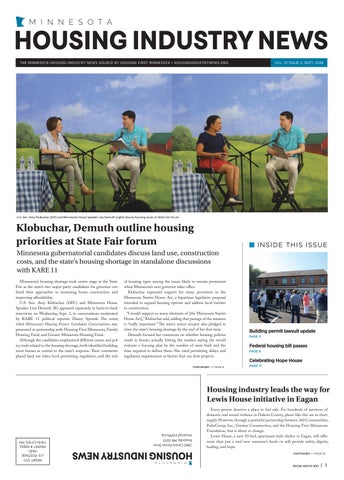
U.S. Sen. Amy Klobuchar (left) and Minnesota House Speaker Lisa Demuth (right) discuss housing issues at State Fair forum.
Klobuchar, Demuth outline housing priorities at State Fair forum
INSIDE THIS ISSUE
Minnesota gubernatorial candidates discuss land use, construction costs, and the state’s housing shortage in standalone discussions with KARE 11 Minnesota’s housing shortage took center stage at the State Fair as the state’s two major-party candidates for governor outlined their approaches to increasing home construction and improving affordability. U.S. Sen. Amy Klobuchar (DFL) and Minnesota House Speaker Lisa Demuth (R) appeared separately in back-to-back interviews on Wednesday, Sept. 2, in conversations moderated by KARE 11 political reporter Danny Spewak. The event, titled Minnesota’s Housing Future: Candidate Conversations, was presented in partnership with Housing First Minnesota, Family Housing Fund, and Greater Minnesota Housing Fund. Although the candidates emphasized different causes and policy tools related to the housing shortage, both identified building more homes as central to the state’s response. Their comments placed land use rules, local permitting, regulation, and the mix
of housing types among the issues likely to remain prominent when Minnesota’s next governor takes office. Klobuchar expressed support for many provisions in the Minnesota Starter Home Act, a bipartisan legislative proposal intended to expand housing options and address local barriers to construction. “I would support so many elements of [the Minnesota Starter Home Act],” Klobuchar said, adding that passage of the measure is “really important.” The state’s senior senator also pledged to close the state’s housing shortage by the end of her first term. Demuth focused her comments on whether housing policies result in homes actually hitting the market, saying she would evaluate a housing plan by the number of units built and the time required to deliver them. She cited permitting delays and regulatory requirements as factors that can slow projects. CONTINUED >> PAGE 6
Building permit lawsuit update PAGE 5
Federal housing bill passes PAGE 8
Celebrating Hope House PAGE 17
Housing industry leads the way for Lewis House initiative in Eagan Every person deserves a place to feel safe. For hundreds of survivors of domestic and sexual violence in Dakota County, places like this are in short supply. However, through a powerful partnership between 360 Communities, PulteGroup, Inc., Greiner Construction, and the Housing First Minnesota Foundation, that is about to change. Lewis House, a new 50-bed, apartment-style shelter in Eagan, will offer more than just a roof over someone’s head—it will provide safety, dignity, healing, and hope. CONTINUED >> PAGE 16
HOUSING INDUSTRY NEWS
| 1
2960 Centre Pointe Drive Roseville, MN 55113 HousingFirstMN.org
PRSRT STD U.S. POSTAGE PAID PERMIT # 93652 TWIN CITIES, MN
BOARD CHAIR NOTE
HOUSING INDUSTRY NEWS
Turning Momentum Into Action At Housing First Minnesota, our work is guided by a simple but powerful belief: Homeownership opportunities should be within reach for all Minnesotans. The challenges facing housing in our state are significant. Families face rising costs, communities lack housing choices, and regulatory and development barriers make it increasingly difficult for our industry to deliver homes at attainable price points. Addressing those challenges will require leadership, collaboration, and a willingness to rethink the policies that shape how and where we build. That is why it was so significant to see housing take center stage at the Minnesota State Fair. Housing First Minnesota, in partnership with Family Housing Fund and Greater Minnesota Housing Fund, recently hosted separate housing conversations with Minnesota’s two major-party candidates for governor—U.S. Sen. Amy Klobuchar and Minnesota House Speaker Lisa Demuth. Moderated by KARE 11 political reporter Danny Spewak, the forum brought the issues our industry works on every day directly into the statewide conversation. With Minnesota facing a shortage of nearly 100,000 homes and apartments, these conversations could not
come at a more important time. Both candidates spoke about the need to expand housing supply, address affordability, and remove barriers that make building harder and more expensive. While policymakers will undoubtedly approach these challenges differently, the growing recognition that Minnesota must build more housing represents meaningful progress. For Housing First Minnesota, hosting this forum was about more than one event—it reflected the work our organization and our members have done for years to establish housing as a fundamental issue for Minnesota’s economic strength, community vitality, and quality of life. When candidates for the state’s highest office discuss housing supply, affordability, land use, and the barriers to homeownership, our industry has an important opportunity—and responsibility—to turn that attention into action. As we look toward the 2027 legislative session, Housing First Minnesota will continue working with leaders across the state and political spectrum to advance practical solutions that increase housing supply, modernize outdated regulations, support responsible growth, and create more attainable paths to homeownership.
Vol. 10 Issue 3, Sept. 2026 PUBLISHER, CHIEF EXECUTIVE OFFICER James Vagle ART DIRECTOR Mandy Finders GRAPHIC DESIGNER Pa Gar Vang OPERATIONS MANAGER Casey Scozzari SENIOR DIRECTOR, MARKETING & COMMUNICATIONS Katelyn Bloomquist
John Kraemer 2026 Board Chair, Housing First Minnesota Onward, John Kraemer Board Chair, Housing First Minnesota
SENIOR DIRECTOR, CLIENT STRATEGY & GROWTH Devin Lehnhoff ENGAGEMENT ACCOUNT EXECUTIVE Allyson Sample CONTRIBUTING WRITERS Kristen Crossman Nick Erickson Mark Foster
HousingIndustryNews.org
Subscribe Stay up to date on the latest housing news. Subscribe to our newsletter at HousingIndustryNews.org.
Advertising For advertising information, rates, editorial calendar, and production specifications, contact: Sales@HousingFirstMN.org
News Tips Have a story idea for our next issue? Contact Kristen Crossman at Kristen@HousingFirstMN.org
Follow Us Go to HousingIndustryNews.org for subscriber exclusives, breaking housing news, and features.
Be a part of the growing housing movement in Minnesota. @housingnews_mn facebook.com/HousingIndustryNewsMN
Kristi Jorgensen Elizabeth Roubik Kate Wigley HOUSING FIRST MINNESOTA BOARD CHAIR John Kraemer Housing Industry News is a publication of Housing First Minnesota. Housing Industry News is published and distributed four times per year to housing industry professionals and others associated with the homebuilding industry. Neither the advertisers, nor Housing First Minnesota, will be responsible or liable for misinformation, misprints, typographical errors, etc., herein contained. For address change information, contact Housing First Minnesota. Suggestions, ideas, and letters are always welcome. HOUSING INDUSTRY NEWS 2960 Centre Pointe Drive Roseville, MN 55113 info@HousingFirstMN.org housingindustrynews.org Housing Industry News is published by Housing First Minnesota. Entire contents copyright 2026.
Housing First Minnesota brings together builders, remodelers, designers, and industry suppliers. By joining, you don’t just become a member— you gain access to a powerful community. From exclusive networking events and unmatched marketing opportunities to a trusted consumer brand, continuing education, and a strong advocacy voice at the Capitol, membership unlocks the tools and connections you need to grow, lead, and succeed in Minnesota’s homebuilding industry.
JOIN US
2 | HOUSING INDUSTRY NEWS
Discover More Membership Perks
I NTERESTED I N LEARNING MORE? LET ’ S CHAT ! EMAIL MEMBERSHIP@HOUSINGFIRSTMN.O RG .
All rights reserved.
Housing First Minnesota is the voice for homebuilders, remodelers, and all who are dedicated to building safe, durable homes at a price Minnesotans can afford. Housing First Minnesota is dedicated to advancing the American dream of homeownership for Minnesotans and is the leading resource for housing-related issues in Minnesota. This advocacy work has never been more important. The housing industry remains under intense regulatory and political pressures that impact Minnesota homeowners’ ability to buy, build, and remodel their dream home. Housing First Minnesota supports reasonable policies, regulations, and protections, but our call for affordability for families is a voice that must be heard. Learn more at HousingFirstMN.org.
SIGN UP TO BE A PART OF THE HOUSING MOVEMENT • HOUSINGINDUSTRYNEWS.ORG
THE HOUSING BEAT
Across the country, there is much talk about housing. HERE ARE SOME OF THE LATEST QUOTES ON THE STATE OF THE INDUSTRY
Housing affordability has improved from a year ago, and recent increases in purchase and refinance applications suggest that borrowers continue to respond to even modest changes in mortgage rates” SAM KHATER CHIEF ECONOMIST AT FREDDIE MAC, ON AUGUST’S MORTGAGE RATE DIP—THE FIRST DROP IN SIX WEEKS
Homeownership is an important part of the American dream, and we should be doing everything we can to make it attainable for more Minnesotans. That means taking a close look at the regulations that make building and buying a home more difficult.” SEN. JORDAN RASMUSSON FOLLOWING A REGIONAL HOUSING ROUND TABLE WITH THE U.S. DEPARTMENT OF HOUSING AND URBAN DEVELOPMENT (HUD) IN JUNE
Housing starts were down sharply from both last [July] and last year, underscoring the need for a stronger policy response. America cannot build its way out of the housing shortage without reforming zoning, speeding up approvals, and reducing regulatory costs that make new housing harder to produce.” NICK ERICKSON EXECUTIVE DIRECTOR OF HOUSING AFFORDABILITY INSTITUTE, ON PERMITTING DATA FROM THE U.S. CENSUS
Pending home sales eased in July as geopolitical tensions resurfaced, pushing oil prices to their highest level since May and putting upward pressure on mortgage rates and inflation. Rates climbed more than 20 basis points throughout the month, eroding some of the year-over-year affordability advantage that had quietly been supporting buyer activity all spring.” HANNAH JONES SENIOR ECONOMIST FOR REALTOR.COM, ON THE SUMMER HOUSING MARKET
CHOOSE LAMPERT. Lampert Lumber offers a wide selection of high-quality cabinetry to meet the needs of professionals in residential, commercial, and multi-family projects. Our expert designers are here to assist you and your customers with product selection, design support, and customization options to ensure the perfect fit for any space. With competitive pricing, top brands, and reliable service, Lampert Lumber is your trusted partner for cabinetry solutions that deliver style, functionality, and durability.
LAMPERTLUMBER.COM SIGN UP TO BE A PART OF THE HOUSING MOVEMENT • HOUSINGINDUSTRYNEWS.ORG
HOUSING INDUSTRY NEWS | 3
REGULATORY AFFAIRS
HVAC arc fault concerns return In 2023, the National Fire Protection Association (NFPA) temporarily suspended enforcement of the 2023 National Electrical Code’s expanded arc-fault circuit interrupter (AFCI) requirements in Section 210.12 after reports that some HVAC equipment was causing nuisance tripping. Manufacturers, contractors, and code officials raised concerns that certain heating and cooling systems were producing electrical signatures that AFCI devices interpreted as arc faults, even when no hazardous condition existed. The temporary enforcement suspension, which expired on Sept. 1, 2026, was intended to give manufacturers and standards organizations time to study the issue, develop testing protocols, and improve compatibility between HVAC equipment and AFCI protection. Industry groups across the country, including Housing First Minnesota, are raising concerns that the suppliers and the code have not been able to meet the requirements to lift the temporary stay on the enforcement of this provision. Water reuse rules reach boiling point A coalition of industry associations, local governments, labor organizations, and environmental groups is urging the Minnesota Plumbing Board to reject the proposed adoption of Chapter 15 of the Uniform Plumbing Code, arguing the changes would significantly expand plumbing regulations beyond their intended scope. Chapter 15 of the UPC governs alternative water sources for non-potable uses, such as stormwater runoff for irrigation. In a joint letter, the organizations contend the proposal would increase construction and compliance costs for homeowners, developers, municipalities, employers, and property owners while creating new permitting, monitoring, and reporting requirements. The coalition also warns the revisions could eliminate longstanding practices by requiring licensed plumbers to perform work currently handled by certified irrigation professionals, threatening thousands of jobs and disrupting Minnesota’s irrigation industry. Chapter 15 rulemaking is ongoing and is being handled separately from the rest of the upcoming Minnesota Plumbing Code update.
Industry advocates are concerned that the proposal would increase costs for homeowners.
Gov. Walz names new DLI commissioner Gov. Tim Walz named Kate Perushek to the post of Commissioner of the Department of Labor and Industry (DLI) in July. Perushek has worked at the department since 2019, where she directed Legislative Services, served as an assistant commissioner, and supervised divisions including Apprenticeship Minnesota and Labor Standards. “Perushek brings deep knowledge of labor policy, workforce development, and state government to this role,” Walz said in a statement. “She has been an integral part of DLI’s leadership team and has helped drive many of the department’s most important initiatives. Her experience and commitment to public service make her exceptionally well-qualified to lead the agency forward.” The announcement came after Walz appointed former DLI Commissioner Nicole Blissenbach to serve as a judge in Minnesota’s Fourth Judicial District in June. Blissenbach had led the DLI since 2023 after previously serving as deputy commissioner and assistant commissioner. Before joining the agency, she practiced labor law and worked as an attorney for Education Minnesota.
4 | HOUSING INDUSTRY NEWS
Perushek testifying before a committee in the Minnesota House of Representatives (Photo: MN House of Representatives)
SIGN UP TO BE A PART OF THE HOUSING MOVEMENT • HOUSINGINDUSTRYNEWS.ORG
LEGAL
Building permit fee lawsuit to be heard by state’s top court A five-justice panel from the Minnesota Supreme Court will hear the case about building permit overcharges. Current Minnesota Supreme Court Associate Justices Gordon Moore III and Karl Procaccini will join retired justices G. Barry Anderson, Chris Dietzen, and Sam Hanson. Housing First Minnesota argues that both cities violated Minnesota Rule 1300.0160 by inflating permit fees far beyond the actual cost of service, turning them into an unlawful revenue source. Under state law, building permit fees must be fair, reasonable, and proportionate to the city’s costs. Earlier this year, in the consolidated matters of Housing First Minnesota v. the Cities of Corcoran and Dayton, a three-judge Court of Appeals upheld a district court ruling. This is not the only legal challenge to building permit fees in Minnesota. A potential class action lawsuit is pending against the City of St. Paul, stemming from a case in which a homeowner alleged overcharging of building permit fees and brought the suit against the city last year. Disclosure: The appellant, Housing First Minnesota, is the publisher of Housing Industry News.
SIGN UP TO BE A PART OF THE HOUSING MOVEMENT • HOUSINGINDUSTRYNEWS.ORG
The Minnesota Supreme Court will hear the lawsuit raised regarding building permit fee overcharges.
HOUSING INDUSTRY NEWS | 5
HOUSING ON THE HILL CONTINUED FROM PAGE 1
Klobuchar, Demuth outline housing priorities at State Fair forum Minnesota gubernatorial candidates discuss land use, construction costs, and the state’s housing shortage in standalone discussions with KARE 11 “We have to make sure we actually are having units built to house people in whatever way is necessary,” Demuth said. She listed single-family homes, townhomes, condominiums, and apartments among the housing types that could contribute to the state’s supply. On affordability, Klobuchar connected additional construction with easing pressure on prices across the market. She said increasing the supply of affordable and market-rate housing could help households that are close to being able to purchase a home. Demuth emphasized how mandates and regulations affect new-construction costs. She said added requirements increase home prices and can cause prospective buyers to postpone homeownership. The forum was held against a backdrop of declining housing production and rising new-home prices. According to figures provided by the event organizers, Minnesota is short nearly 100,000 homes and apartments—almost twice the shortage identified by a state task force in 2018. Organizers also reported that statewide homebuilding and
The forum discussion comes as housing becomes a top-tier issue among voters.
apartment construction has fallen nearly 38% from its 2021 peak, while permitting in the Twin Cities has declined more than 42%. Those figures reflect several overlapping questions for state policymakers: how much authority local governments should retain over development, which building and land use requirements provide public benefits, and how the costs of those requirements affect what can be built and purchased. The candidates’ remarks indicated that housing supply will be a significant issue in the campaign, even as they emphasized different ways state government should respond. The discussion also pointed toward another legislative debate over land use reform in 2027. Proposals involving permitting timelines, zoning flexibility, and starter-home construction have generated bipartisan interest at the State Capitol, but broad changes
have also required negotiations among legislators, cities, housing organizations, and the construction industry. The forum offered an early comparison of the candidates’ housing priorities: Klobuchar highlighted legislation and supply growth across affordable and market-rate housing, while Demuth stressed measurable construction results and reductions in regulatory delays and costs. With the shortage affecting communities across Minnesota, the next governor will enter office facing pressure from housing advocates, builders, and prospective homebuyers to translate campaign proposals into additional homes, with continued resistance from local officials. The direction of that response, and the balance between state action and local control, is expected to remain a central question into the next legislative session.
Audience members listen as both gubernatorial candidates explain how they would address Minnesota’s housing crisis if elected.
6 | HOUSING INDUSTRY NEWS
SIGN UP TO BE A PART OF THE HOUSING MOVEMENT • HOUSINGINDUSTRYNEWS.ORG
HOUSING ON THE HILL
Housing First Minnesota honors 2026 legislative champions
Housing First Minnesota’s annual awards recognize legislators who championed housing policies during the 2026 legislative session.
Housing First Minnesota announced its 2026 Housing Leadership Awards to 24 lawmakers whose work during the legislative session supported Minnesota’s homebuilding industry and efforts to make homeownership more attainable. The recipients include 11 members of the Minnesota House and 13 members of the Minnesota Senate, representing communities across the state and both sides of the political aisle. Housing First Minnesota said the lawmakers distinguished themselves by advancing policies intended to improve housing affordability, expand the supply of homes, and create additional opportunities for homeownership. A central accomplishment of the 2026 session was passing legislation that prevents local governments from requiring developers to create unnecessary homeowners associations (HOAs) as a condition of residential development. For builders, the new policy addresses a local requirement that could add complexity to new projects and impose continuing expenses on homebuyers. Housing First Minnesota said eliminating unnecessary HOA mandates will give housing providers more flexibility while reducing the long-term costs of owning a newly constructed home. “Housing affordability remains one of the most pressing issues facing Minnesota families,” said Mark Foster, vice president of legislative and political affairs at Housing First Minnesota. Foster credited the honorees with working across party lines and engaging with the complex policy questions affecting housing production and homeownership. Their efforts are particularly significant for an industry navigating high construction
and development costs, limited housing inventory, and continued affordability challenges for prospective buyers. The 2026 honorees from the Minnesota House are Reps. Kristin Bahner of Maple Grove, Dave Baker of Willmar, Nathan Coulter of Bloomington, Jeff Dotseth of Kettle River, Mike Howard of Richfield, Spencer Igo of Wabana Township, Liish Kozlowski of Duluth, Larry Kraft of St. Louis Park, Shane Mekeland of Clear Lake, Jim Nash of Waconia, and Kari Rehrauer of Coon Rapids. Senate recipients are Sens. Liz Boldon of Rochester, Gene Dornink of Brownsdale, Rich Draheim of Madison Lake, Steve Drazkowski of Mazeppa, Glenn Gruenhagen of Glencoe, Amanda Hemmingsen-Jaeger of Woodbury, Karin Housley of Stillwater, Jeff Howe of Rockville, Eric Lucero of St. Michael, Susan Pha of Brooklyn Park, Lindsey Port of Burnsville, Jason Rarick of Pine City, and Jordan Rasmusson of Fergus Falls. The geographic and political diversity of the recipients reflects the statewide nature of Minnesota’s housing challenges. Although market conditions and development patterns vary among urban, suburban, and rural communities, builders statewide regularly encounter regulatory costs and other barriers that can limit the types and number of homes they can deliver. Housing First Minnesota presents its Housing Leadership Awards annually to legislators who demonstrate leadership on policies that increase housing opportunities, strengthen the housing market, and improve affordability. The association said it plans to continue working with legislators from both parties on policies that reduce barriers to new-home construction and broaden homeownership opportunities for Minnesota families.
Recipients of the 2025 Housing Leadership Award
Representative Kristin Bahner (Maple Grove)
Representative Dave Baker (Willmar)
Senator Liz Boldon (Rochester)
Representative Nathan Coulter (Bloomington)
Senator Gene Dornink (Brownsdale)
Representative Jeff Dotseth (Kettle River)
Senator Rich Draheim (Madison Lake)
Senator Steve Drazkowski (Mazeppa)
Senator Glenn Gruenhagen (Glencoe)
Senator Amanda Hemmingsen-Jaeger (Woodbury)
Senator Karin Housley (Stillwater)
Senator Jeff Howe (Rockville)
Representative Michael Howard (Richfield)
Representative Spencer Igo (Wabana Township)
Representative Liish Kozlowski (Duluth)
Representative Larry Kraft (St. Louis Park)
Senator Eric Lucero (St. Michael)
Representative Shane Mekeland (Clear Lake)
Representative Jim Nash (Waconia)
Senator Susan Pha (Brooklyn Park)
Senator Lindsey Port (Burnsville)
Senator Jason Rarick (Pine City)
Senator Jordan Rasmusson (Fergus Falls)
Representative Kari Rehrauer (Coon Rapids)
SIGN UP TO BE A PART OF THE HOUSING MOVEMENT • HOUSINGINDUSTRYNEWS.ORG
HOUSING INDUSTRY NEWS | 7
HOUSING ON THE HILL
The 21st Century ROAD to Housing Act was passed into law this summer.
Bipartisan federal housing bill becomes law Congress approved the 21st Century ROAD to Housing Act, the most significant overhaul of federal housing policy in decades, this summer. The bill passed 350-32 in the U.S. House and 85-5 in the U.S. Senate. President Trump allowed the bill to become law without his signature. The overwhelming bipartisan support comes as polling shows the public wants action on housing. The Bipartisan Policy Center found that 79% of voters identify the cost of housing as an extremely important or very important issue, and 63% say they would be more likely to vote for their representative or senator if they helped pass legislation to build more affordable homes and lower housing costs. What’s in the bill The legislation updates federal standards and seeks to improve financing options for manufactured homes, aiming to make them more accessible to buyers. Homeownership is another major component of the package. The legislation updates several Federal Housing Administration programs, expands access to smaller mortgage loans, and makes changes intended to help first-time buyers navigate the home financing process. It also strengthens housing counseling programs and updates several long-standing federal housing initiatives. Among the bill’s most closely watched provisions are new restrictions on institutional ownership of single-family homes. The legislation limits additional purchases by the nation’s largest corporate landlords—an effort supporters say is intended to reduce competition for prospective homebuyers in markets with limited inventory.
8 | HOUSING INDUSTRY NEWS
The package also reauthorizes and updates several existing federal housing programs, including disaster recovery initiatives and housing assistance efforts. While the legislation does not create a sweeping new federal housing program, it makes broad changes to existing policies to improve how those programs operate. “The 21st Century ROAD to Housing Act helps make the American dream a reality for everyday families,” said House Majority Whip Tom Emmer (R-MN). “By lowering costs and cutting red tape, citizens across the country will have more affordable, better access to the housing market.” Minnesota’s senators hands-on in crafting bill Minnesota Sens. Amy Klobuchar and Tina Smith both secured provisions in the final legislation. Smith’s bipartisan Rural Housing Service Reform Act updates U.S. Department of Agriculture rural housing programs for the first time in decades—a change expected to help preserve up to 400,000 affordable homes nationwide, including more than 9,000 units in Minnesota’s rural communities. “The lack of affordable, decent housing in this country has been a major problem for working families for years, but with the 21st Century Road to Housing Act becoming law, we’re choosing a different path: Build more housing and protect the homes we already have from falling into disrepair,” said Smith. Klobuchar’s Housing Supply and Affordability Act establishes a U.S. Department of Housing and Urban Development regional planning grant program to help states and local governments modernize zoning and land use policies to support additional housing development.
“Democrats and Republicans came together to make it easier to afford a home,” said Klobuchar (D-MN). “The 21st Century ROAD to Housing Act will help build more homes, including in rural communities. This bipartisan legislation includes my bill to give state and local governments the tools and zoning flexibility they need to build more homes.” Housing groups respond Housing organizations across the industry have described the legislation as one of the most consequential federal housing reforms in nearly 50 years. “This is the most significant federal housing legislation in a generation, and it arrived the way durable policy should: through commanding bipartisan majorities in both chambers, at a moment when Washington rarely agrees on anything,” said Mike Kingsella, CEO of Up for Growth. Although opinions differ on whether the package goes far enough, there is broad agreement that increasing the nation’s housing supply will require action at every level of government. “The 21st Century ROAD to Housing Act contains several meaningful housing reforms, but no federal bill can solve a housing shortage on its own,” said Nick Erickson, executive director of Housing Affordability Institute. “The greatest obstacles to building homes remain at the local level. What this legislation does is strengthen the foundation for the next generation of state and local reforms.” However, it establishes a new framework to boost supply, improves affordability, and gives tools to state and local communities to address housing concerns.
SIGN UP TO BE A PART OF THE HOUSING MOVEMENT • HOUSINGINDUSTRYNEWS.ORG
Your Trusted Window and Door Experts. When it comes to windows and doors, no one does it better than the team at Arrow Building Center. With decades of experience and deep product knowledge, our dedicated specialists provide expert guidance to help you find solutions for even the most complex projects. We offer a broad selection of styles, materials, colors, and sizes to achieve the look your customers want. As a trusted supplier of premium brands like Andersen Windows & Doors, we deliver competitive pricing without compromising on quality, ensuring you get the best value for every project.
Need a partner you can count on? Contact us today to experience firsthand the unparalleled service and exceptional results that we’re known for. Andersen® products rated #1 in quality. 2022 Andersen brand surveys of U.S. contractors, builders, architects & homeowners. “Andersen” and all other marks where denoted are trademarks of Andersen Corporation. ©2022 Andersen Corporation. All rights reserved.
ABC-CLC.COM SIGN UP TO BE A PART OF THE HOUSING MOVEMENT • HOUSINGINDUSTRYNEWS.ORG
HOUSING INDUSTRY NEWS | 9
AROUND THE STATE
CMBA pushes back on St. Cloud building fees
Housing momentum keeps building in Rochester
Does raising building fees make sense at a time when a city is falling behind in needed development? The answer from the Central Minnesota Builders Association (CMBA) is a firm “no.” This summer, CMBA wrestled with St. Cloud city officials over a proposal to dramatically increase the city’s building fees schedule. The City Council voted on Aug. 31 to raise fees by a total of $800,000 per year, falling heaviest on commercial projects, but also adding significantly to the cost of each new residential unit of housing, even as the city says it needs more homes people can afford to live in. The boost in building fees comes on the heels of major increases in St. Cloud’s SAC/WAC/TAC charges over the last four years. “These new fee increases will have a chilling effect on the development the City of St. Cloud says it needs,” said CMBA Government Affairs Consultant Steve Gottwalt, who testified against the increases at a recent City Council hearing. CMBA also reminded the City of St. Cloud that it must follow Minnesota law. Under Minnesota Rules Part 1300.0160, building fees must be “fair, reasonable, and proportionate to the actual cost of the service for which the fee is imposed.” The city never showed details of the actual costs justifying each building fee and its increases. According to the charter for the city of St. Cloud, 25% of its building fees are directed towards a general development fund, a practice that does not tie back to actual cost. Similar lack of transparency on building fees recently led to a lawsuit against the Minnesota cities of Corcoran and Dayton—a case now before the Minnesota Supreme Court. “CMBA prefers to collaborate with area leaders on development and building issues,” said CMBA Executive Director Wanda Schroeder. “We are partners in helping achieve the development our communities need and want.” CMBA hosts regular roundtable discussions with area mayors and city development directors to share plans and explore ways to spur more development. Schroeder added, “Affordability is an important goal for builders and cities, and we need sustainable solutions that do not include raising the costs of development.”
Rochester’s residential construction surge is still picking up steam, fueled by strong demand and Mayo Clinic’s ongoing “Bold. Forward. Unbound.” strategic expansion plan. Downtown is especially busy. Sherman Associates just closed on a $136.5 million project across the street from the Mayo Civic Center that will bring 349 new housing units—76 of them affordable for senior citizens—right near Mayo Clinic. The project also includes 273 market-rate units, with 52 furnished short-term units geared toward health care workers and visitors. Construction has already started, with an opening date planned for spring 2028. All told, more than 1,600 housing units are in some stage of development in and around downtown. Additionally, sizable single-family and townhome projects are moving ahead on the edges of the city. Lennar is rolling out hundreds of homes at its Pebble Creek community in the northwest, including a dedicated 55-plus community. D.R. Horton also has plans for roughly 580 homes at the Graham Acres community. And Pulte’s Dell Webb brand plans to build at least 300 units for active seniors. Fresh annexations and approvals continue to support more growth, helping close the gap after years of building only around 200 homes per year—a shortage of around 800.
10 | HOUSING INDUSTRY NEWS
Pat Sexton Executive Director, Rochester Area Builders Affordable housing development is steady as well, with projects like DevCo’s 252-unit complex and Commons on Bear Creek adding options for a wider range of incomes. The work is far from finished, but the momentum we’re seeing today is an encouraging step toward a stronger housing future for Rochester. Pat Sexton Executive Director Rochester Area Builders
SIGN UP TO BE A PART OF THE HOUSING MOVEMENT • HOUSINGINDUSTRYNEWS.ORG
THE FUTURE OF FRAMING IS NOW. Stay Ahead of Schedule and the Competition with READY-FRAME® READY-FRAME® is our pre-cut framing package that makes framing better, faster, safer and greener. You give us your plans, and we cut everything you need, just how you need it. The system ships from our offsite manufacturing facility Smart Bundled®, compact, pre-cut and labeled – ready for your framers to assemble on the jobsite.
BLDR.COM/MINNESOTA
VISIT OUR WEBSITE OR ONE OF OUR NEARBY LOCATIONS TODAY. Builders FirstSource and the Builders FirstSource logo are trademarks of Builders FirstSource, Inc. and/or its subsidiaries. © 2026 Builders FirstSource, Inc. All rights reserved. | 67718-26-BFS
MARKET REPORT
Housing market report
State of Minnesota
Moorhead
Metro homebuilding falters in spring
6
SOURCE: CITY OF MOORHEAD
Homebuilding in the Twin Cities metro showed positive signs in July, with activity up 10% from the same period last year. Homebuilders pulled permits for 552 single-family homes in July. Multifamily activity, however, saw a steep drop-off in activity for the first time this summer. Builders reported just 20 multifamily units under construction— accounting for under 5% of all construction activity. The Keystone Report reported 554 permits issued, for a total of 572 housing units during the four comparable weeks in July.
7,727
Duluth
263
Year-to-Date Single-Family Construction in Select Cities Through July 2026 SOURCE: U.S. CENSUS
SOURCE: U.S. CENSUS
St. Cloud
19
SOURCE: CITY OF ST. CLOUD
Twin Cities
5,205
Mankato
134
SOURCE: U.S. CENSUS
Rochester
330
SOURCE: U.S. CENSUS
SOURCE: U.S. CENSUS
HOUSING FIRST MINNESOTA COLLECTED THE ABOVE PERMIT INFORMATION FROM AVAILABLE PUBLIC RESOURCES.
JULY 2026
JULY 2026
$408,000
$375,000
Minnesota Construction Employment Past 5 Months SOURCE: DEED
JULY 2025
3.3%
$395,900
2.7%
JULY 2025
$365,000
Y-Y Change
Y-Y Change
Twin Cities Median Sales Price
Minnesota Median Sales Price
SOURCE: MINNEAPOLIS REALTORS®
SOURCE: MINNESOTA REALTORS®
Twin Cities Construction Employment Past 5 Months SOURCE: DEED
CURRENT
FUTURE
70
52
South - 68
Midwest - 68
Northeast - 63
Regional Remodeling Market Indices, 2026 Q2 SOURCE: NAHB
The Overall Remodeling Market Index is calculated by averaging the Current Marketing Index and the Future Market Indicators Index. Any number over 50 indicates that more remodelers view remodeling market conditions as higher than the previous quarter. Results are seasonally adjusted.
12 | HOUSING INDUSTRY NEWS
Employment Update Minnesota’s non-seasonally adjusted unemployment in July was unchanged from the previous month, according to the Minnesota Department of Employment and Economic Development. The rate remained at 4.6%. The national unemployment rate also remained unchanged during the same time period. Construction employment in Minnesota contracted by 1,000 in July across all sectors of the industry. SIGN UP TO BE A PART OF THE HOUSING MOVEMENT • HOUSINGINDUSTRYNEWS.ORG
MARKET REPORT
New report finds housing market lost ground in 2025 Housing Affordability Institute examines affordability, homeownership, and housing production nationwide The nation’s housing challenges continued to deepen in 2025, according to the latest edition of United States of Housing, Housing Affordability Institute’s annual report on housing and homeownership in America. While median prices for both new and existing homes declined slightly from the previous year, the report found that the broader housing market moved in the wrong direction across several key measures. Housing costs continued to consume more than 30% of median household income, while homeownership and new housing production both declined. The national homeownership rate fell for the second consecutive year to 65.2%. The challenges were especially pronounced for first-time buyers. Their share of the market dropped to a record-low 21%, while the average age of a firsttime buyer climbed to an all-time high of 40. At the same time, the nation continued to fall behind on the housing production needed to address its long-standing shortage. Just over 1.43 million housing units were permitted in 2025, a 3.1% decline from the previous year and the fourth consecutive annual decrease. Since 2021, total permitting has fallen nearly 18%. Housing completions also declined 7.9% as builders worked through projects permitted in previous years.
The report includes a new state-by-state look at housing affordability, homeownership, and production. In Minnesota, the homeownership rate reached 71.2%, ranking 13th nationally. However, the state permitted nearly 38% fewer total housing units in 2025 than it did five years earlier. Single-family permitting fell nearly 23% over that same period. Affordability remains a significant concern as well. In December 2025, the estimated monthly payment on a median-priced new home in Minnesota accounted for 47.2% of the state’s median household income. For an existing home, the share was 31.7%. The report calls for a broader policy approach that goes beyond zoning and land-use reform to address building codes, environmental regulations, labor laws, infrastructure and other factors influencing housing costs and production. “America once valued housing affordability,” said Nick Erickson, executive director of Housing Affordability Institute. “Coming out of the Great Recession, policymakers left the housing industry with little more than low interest rates to support production. Achieving long-term stability in housing production will require deliberate action from policymakers at every level of government.”
A new report finds that housing affordability continues to be a growing concern across the country.
Some companies guess. Others know. Access your unfair advantage with the Keystone Report—intel the industry trusts.
Subscribe at keystonereports.com
SIGN UP TO BE A PART OF THE HOUSING MOVEMENT • HOUSINGINDUSTRYNEWS.ORG
HOUSING INDUSTRY NEWS | 13
INDUSTRY IN ACTION
Barriers to new homeownership opportunities subject of federal housing town hall Three regional HUD administrators meet with industry leaders, legislators Housing First Minnesota convened a federal housing town hall earlier this summer, bringing together leaders from the U.S. Department of Housing and Urban Development (HUD)’s regional offices, state lawmakers, and members of Minnesota’s homebuilding industry to discuss policies that affect new home production and homeownership opportunities. The discussion featured HUD Region 5 Administrator Duey Stroebel, Acting Region 7 Administrator, and Region 8 Administrator Tim Geitner. The officials met with local builders and developers to hear firsthand how state and local regulations influence the cost and availability of new housing across Minnesota. A primary focus of the conversation was local land use policy and the barriers that limit the construction of entry-level homes. Industry participants highlighted zoning requirements, minimum lot sizes, and other local regulations that can restrict the development of smaller, more attainable homes. Those discussions underscored the need for the Minnesota Starter Home Act, legislation aimed at expanding starterhome opportunities by updating local land use standards. The town hall also highlighted the importance of the proposed 2026 Homeowners Association Reform legislation. Sen. Jordan Rasmusson and Rep. Spencer Igo discussed the proposal with federal officials and industry representatives, outlining how updates to Minnesota’s HOA statutes could improve transparency, governance, and predictability for homeowners and developers while supporting continued housing development.
The summer tour opened the doors to 17 luxury homes across the Twin Cities metro.
Summer Artisan Home Tour opened the doors to extraordinary residences The 2026 Summer Artisan Home Tour once again gave Minnesotans a rare opportunity to step inside some of the region’s most distinctive residences, celebrating the craftsmanship, creativity, and innovation that define the Twin Cities’ custom homebuilding and remodeling industry. This summer’s tour featured 17 new and remodeled homes across the metro. Each home offered its own interpretation of exceptional living, with architecture, custom details, and spaces designed around homeowners’ lifestyles. The collection showcased the breadth of talent and expertise in Minnesota’s residential construction industry. Visitors experienced everything from striking new builds to thoughtfully transformed spaces, gathering ideas and inspiration while seeing firsthand the level of detail that distinguishes an Artisan home. The tour also provided an opportunity to connect with the builders, remodelers, and designers whose expertise brought these one-of-a-kind structures to life.
14 | HOUSING INDUSTRY NEWS
Special programming added another layer to the Artisan experience. The sold-out Summer Soirée event welcomed guests to the Swanson Homes project in Medina’s exclusive Deer Hill Preserve neighborhood. Additionally, the Artisan Home Tour hosted its signature Inside the Design event prior to the tour, where attendees heard from a few of the design teams behind the homes. The panel-style discussion offered insights into the thought process and planning that goes into an Artisan-caliber project. For participating builders and remodelers, the tour offered an opportunity to showcase the expertise, creativity, and attention to detail behind their work. For visitors, it offered inspiration, new ideas, and a chance to experience some of Minnesota’s most remarkable homes firsthand. With another successful summer tour complete, the Artisan Home Tour now looks ahead to its fall event, happening Oct. 9–25, when a new collection of exceptional homes will open for tourgoers to explore.
HUD representatives met with local builders, advocates, and state lawmakers to discuss housing issues in the region.
SIGN UP TO BE A PART OF THE HOUSING MOVEMENT • HOUSINGINDUSTRYNEWS.ORG
INDUSTRY IN ACTION
City of Dayton abandons moratorium push Public hearing not held as scheduled In late July, the Dayton City Council removed a proposed six-month housing moratorium from consideration after questions were raised about its legal basis. The proposed moratorium would have temporarily paused residential development while city officials examine staff workload and possible land use ordinance changes. Under Minnesota law, a land use moratorium can be enacted for several reasons—but staff workload is not one of those reasons. In an earlier planning commission meeting, developers raised concerns over the city crafting the moratorium to allow identified developments to proceed. Before the July 28 public hearing, Housing First Minnesota submitted a letter arguing that Minnesota law does not grant cities broad authority to impose development moratoria outside the limited circumstances authorized by state statute, specifically staff workload. The organization argued the proposal lacked a sufficient legal basis and warned that adopting the moratorium could expose the city to legal challenges. The proposal marked the latest example of local governments considering temporary development restrictions amid growth and infrastructure discussions. Housing industry groups and state lawmakers have raised concerns over cities imposing land use moratoriums in the middle of a housing shortage, arguing they delay housing production, increase costs, and worsen existing housing shortages. Earlier this year, the City of Lakeville enacted a one-year moratorium on housing, partly because state lawmakers pushed legislation to remove local barriers to development. As of publishing, the Lakeville moratorium is still in place.
The moratorium would have paused all residential development in the city.
Minnesota Contractors & Remodelers Continuing Education 50+ ONLINE COURSES Available 24/7 • 25+ Top Industry Expert Instructors
• Easy-to-stream videos you can watch from anywhere
• NEW courses added frequently
Providing continuing education since 2004, Contractor University has the largest variety of online courses for MN contractors than any other provider. Whether you are taking courses for credits or just want to learn, discover courses on building and energy codes and the latest in building science. Plus, explore legal, business management, and specialized courses that you won’t find anywhere else. Individual continuing education courses start as low as $18.
CONTRACTORU.COM
PRESENTED BY
ACCREDITED BY
Sponsored by:
Courses Approved by:
®
SIGN UP TO BE A PART OF THE HOUSING MOVEMENT • HOUSINGINDUSTRYNEWS.ORG
HOUSING INDUSTRY NEWS | 15
INDUSTRY GIVES BACK CONTINUED FROM PAGE 1
Housing industry leads the way for Lewis House initiative in Eagan As the only domestic and sexual violence shelter in Dakota County, Lewis House will serve more than 600 survivors each year, with approximately half of those residents being children.
A critical need Across Minnesota, domestic violence programs serve nearly 2,000 adults and children each day, while shelters struggle to meet the overwhelming demand for safe, stable housing—one of the greatest barriers survivors faces as they escape abuse and rebuild their lives. Lewis House will nearly double access to emergency shelter for survivors in Dakota County. Every apartment will serve a family that doesn’t have to choose between homelessness and abuse, a child who can sleep without fear, and a survivor who has the opportunity to begin healing in a safe, supportive environment. An industry-led project Thoughtfully designed by Ewert Studio, Lewis House is being brought to life through the leadership and expertise of Minnesota’s housing industry. PulteGroup, Inc. will lead
residential construction, while Greiner Construction will oversee the project’s commercial components. “At the end of the day, this project brings together everything we believe in—that shelter changes lives, strong communities are built through care and connection, and meaningful partnerships can create impact far beyond what any one of us could do alone,” said Jamie Tharp, president at PulteGroup, Inc.’s Minnesota division. Lewis House will also be the largest community build project in the Housing First Minnesota Foundation’s 31-year history. Throughout the build, members of Minnesota’s construction industry will play a vital role in bringing Lewis House to life through financial support, donated building materials, discounted products, and skilled labor. Because of generous industry donations, construction costs on this project are expected to drop significantly, allowing each dollar contributed to generate more than $2.50 in community impact. “The Housing First Minnesota Foundation was built on the idea that when our industry works together, we can accomplish incredible things,” said Sofia Humphries, executive director of the Housing First Minnesota Foundation. “By harnessing
the industry’s generosity and expertise, we’re able to reduce construction costs and ensure that more of 360 Communities’ funding is dedicated to the services that help survivors rebuild their lives.”
How you can help The Housing First Minnesota Foundation is calling all builders, remodelers, suppliers, trade partners, manufacturers, and industry supporters to help bring this vision to life. Whether through a financial contribution, donated materials, discounted products, or volunteer labor, your support will help provide safe housing for individuals and families escaping domestic and sexual violence.
Learn more about Foundation community build projects and how you can help at HousingFirstMinnesotaFoundation.org.
Lewis House will be the only shelter in Dakota County committed to serving survivors of domestic and sexual violence.
16 | HOUSING INDUSTRY NEWS
SIGN UP TO BE A PART OF THE HOUSING MOVEMENT • HOUSINGINDUSTRYNEWS.ORG
INDUSTRY GIVES BACK
The housing industry gives back on the golf course This summer, Minnesota’s housing industry took to the golf course to give back to its communities with two tournaments benefiting the Housing First Minnesota Foundation and its work to build safe, dignified housing for Minnesotans experiencing homelessness. On July 15, Pulte Homes of Minnesota hosted its 16th Annual Charity Golf Tournament at Dwan Golf Course in Bloomington. Despite the summer heat, golfers, sponsors, and volunteers came together for a day of friendly competition that raised approximately $25,000 for the Foundation. Later that month, Hampton Companies held its inaugural golf tournament at North Oaks Golf Club. Together, Hampton Companies and Suite Living Senior Care launched what promises to become an annual summer tradition benefiting the Foundation’s Community Build Projects. “We’re incredibly proud to have launched Hampton Companies’ first golf tournament this year in support of the Housing First Minnesota Foundation,” said Jeremy Larson, vice president and part owner of Hampton Companies. “As a company, we believe that it is important to always give back, and this event was an opportunity to bring together our partners, clients, and friends to make a difference for those experiencing homelessness.” The two events raised an estimated combined total of $75,000 for the Foundation and its mission.
Golfers enjoyed a day on the course while supporting the mission of the Housing First Minnesota Foundation.
Hope House celebrates a new beginning for youth in need On Aug. 27, community leaders, housing industry partners, donors, and supporters gathered in Chanhassen to celebrate the completion of Hope House, a new teen crisis shelter that will provide safe, stable, and dignified housing for youth experiencing homelessness. Developed in partnership with Open Hands Foundation/Hope House, John Kraemer & Sons, Inc., and the Housing First Minnesota Foundation, Hope House is an eightbed, trauma-informed crisis shelter designed specifically for youth experiencing housing instability. “Being able to partner on the Hope House project has been a huge blessing for our family and business,” said Jeff Kraemer, president of operations for John Kraemer & Sons, Inc. “From day one, the teams at Housing First Minnesota Foundation, Westwood Community Church, and the Open Hands Foundation have been phenomenal teammates to John Kraemer & Sons.” More than just a place to stay, the shelter will provide young people
with a safe environment where they can begin rebuilding their lives while accessing the resources, guidance, and support they need to move toward long-term stability and independence. “Hope House is much more than a beautiful building—it is a place where young people experiencing crisis will find safety, hope, and the opportunity to begin again,” said Rodney Provart, executive director of Open Hands Foundation. “Together, we are creating a place where every teen who walks through our doors will be met with love, served with dignity, and offered hope.” Hope House reflects the Housing First Minnesota Foundation’s mission of partnering to build safe housing for Minnesotans in need. By harnessing the generosity and expertise of the housing industry, this project demonstrates how partnerships can create lasting impact— building not only housing but also a brighter future for Minnesota’s youth. Residents are expected to begin moving into the new Hope House this fall.
SIGN UP TO BE A PART OF THE HOUSING MOVEMENT • HOUSINGINDUSTRYNEWS.ORG
Partners and supporters celebrated the completion of Hope House in Chanhassen this summer.
HOUSING INDUSTRY NEWS | 17
IN THE DIRT
A quick recap of housing news and development updates St. Cloud approves 244-unit apartment development
Maple Grove advances 86-unit townhome development
Sherman Associates breaks ground on $136.5M Rochester housing development
The St. Cloud City Council unanimously approved plans for The Flats on 74th, a new 244-unit apartment development along County Road 74. The project will include five three-story apartment buildings on approximately 17 acres, along with a rental office, playground, sport court, dog run, and nearly 500 parking spaces. The approval rezones a portion of the 45.9-acre property from highway commercial to a planned unit development while preserving nearly 20 acres for future commercial development. Traffic concerns were raised during the public hearing, though the city said the roadway remains well below the threshold that would trigger expansion.
The Maple Grove Planning Commission has recommended approval of a revised plan for M/I Homes’ Maple Creek development, which would bring 86 owner-occupied townhomes across 12 buildings on a 9-acre site near Bass Lake Road and County Road 101. The proposal was previously tabled over pedestrian safety concerns, prompting M/I Homes to add sidewalks along private roads to create a continuous pedestrian route through the neighborhood. The project would add additional ownership opportunities in Maple Grove, where available land for new residential development is increasingly limited.
Sherman Associates has begun construction on a $136.5 million mixed-income housing development in downtown Rochester, which will add 349 homes along the Zumbro River near the Mayo Clinic campus. The project will include a 273-unit, market-rate residential tower—with 52 furnished short-term and monthto-month residences designed in part for health care professionals—and a 76-unit affordable senior housing building, connected by a 350-stall parking structure. “This development will provide more housing options while creating new opportunities for people to live, work, and stay connected to our community,” said Rochester Mayor Kim Norton in a statement. “We are pleased to see this important site moving forward through a strong public-private partnership.”
SOURCE: FINANCE & COMMERCE
SOURCE: FINANCE & COMMERCE
SOURCE: KNSI
STAY INFORMED WITH THE LATEST HOUSING NEWS HOUSINGINDUSTRYNEWS.ORG
P OW E R E D BY XC E L E N E R GY
SPONSORED CONTENT
Exterior insulation: a practical path to higher-performance homes As energy codes continue to evolve, professional builders are looking for practical, repeatable ways to deliver homes that meet higher performance expectations without overcomplicating the construction process. Exterior insulation, often called continuous insulation, is one good strategy for improving wall performance, supporting energy-code compliance, and creating more comfortable homes. Alongside cavity insulation installed between studs, exterior insulation adds an uninterrupted layer of thermal protection outside the wall framing. That continuous layer helps reduce thermal bridging, which occurs when wood framing allows heat to move through the building envelope. Even when walls are filled with insulation, studs can reduce the overall performance of the assembly. Exterior insulation helps address that weak point by wrapping the home in a more complete thermal barrier, like a down coat. For builders, this approach offers a practical way to boost energy performance while using familiar construction methods. A combination of cavity insulation and exterior insulation can help wall assemblies meet more demanding code requirements, including those found in newer editions of the International Energy Conservation Code. For homeowners, the benefits may include lower energy use, fewer temperature swings, and improved comfort throughout the year. Exterior insulation can also influence HVAC design. When the building envelope performs better, heating and cooling loads are reduced. That can allow builders and HVAC contractors to specify smaller-sized equipment while still maintaining comfort. This is especially important as more builders consider heat pumps and all-electric home designs. In cold climates, reducing heat loss through
18 | HOUSING INDUSTRY NEWS
the wall assembly can help heat pumps maintain indoor comfort with less energy demand. A tighter, better-insulated envelope may also help reduce hot and cold spots, improve humidity control, and support quieter HVAC operation. In some homes, smaller mechanical equipment may also help reduce upfront system costs, creating value that extends beyond the wall assembly itself. In cold-climate markets such as Minnesota, exterior insulation offers another important advantage: moisture management. By helping keep wall sheathing warmer during winter conditions, continuous insulation can reduce the risk of condensation within the wall assembly. When paired with proper air sealing, flashing, drainage details, weather-resistive barriers, and high-performance windows and doors, exterior insulation contributes to long-term durability and homeowner satisfaction. For production builders, standardizing these details across plans and product lines can also improve quality control. Repeatable assemblies make it easier to achieve predictable results from one home to the next, helping builders maintain consistency while adapting to changing energy code requirements. As buyers become more focused on comfort, efficiency, and long-term operating costs, exterior insulation gives builders a clear opportunity to differentiate their homes. By reducing thermal bridging, supporting code compliance, improving HVAC performance, and enhancing durability, continuous exterior insulation is a smart investment in the next generation of high-performance residential construction. Learn more about high-performance construction programs at xcelenergy.com/NewHomes.
SIGN UP TO BE A PART OF THE HOUSING MOVEMENT • HOUSINGINDUSTRYNEWS.ORG
O N E I N D UST RY
ONE BIG NIGHT
W HO W ILL TA KE T HE CROWN? MYSTIC LAKE CENTER O C T. 3 0 , 2 0 2 6
T H A N K YO U S P O N S O R S
BUILD WITH THE BEST. At Lyman Companies we specialize in what we know and love, which means we understand the roofing business inside and out. Our roofing specialists bring decades of experience to the table and are dedicated to getting material to you correctly and on time to keep your jobs moving. Whether your project is residential, commercial, or multi-family, we have the expertise, products, and services you need to get the job done right.
Contact us today to learn how we can take your roofing business to the next level!
LYMANCOMPANIES.COM