VOL. 10 ISSUE 2, JUNE 2026
THE MINNESOTA HOUSING INDUSTRY NEWS SOURCE BY HOUSING FIRST MINNESOTA • HOUSINGINDUSTRYNEWS.ORG
INSIDE THIS ISSUE
Twin Cities falls short of key housing goals, Minneapolis Fed reports The Twin Cities region failed to meet all three of its major housing affordability benchmarks in 2025, according to a new report from the Federal Reserve Bank of Minneapolis, raising concerns about the region’s long-term housing supply and affordability outlook. The report, Twin Cities Region Misses Its Housing Marks, found that the seven-county metro continued to fall short of targets for overall housing production, housing affordability, and non-white homeownership rates. The Twin Cities region aims to build 18,000 new housing units annually to keep pace with population growth and address years of underbuilding. While the metro exceeded that target from 2019-22, production has declined sharply over the past three years. According to the report, developers produced 12,161 housing units in 2025, down from more than 18,000 units annually during the previous construction surge. Housing production also declined in 2023 and 2024, signaling a broader slowdown in development activity. Researchers pointed to several factors contributing to the slowdown, including high interest rates, elevated construction costs, labor shortages, and financing challenges for multifamily developments. The region also missed its affordable housing target. The Metropolitan Council established a goal of adding 2,090 affordable housing units annually through 2030. The report found the region added approximately 1,760 affordable units in 2024, below the annual benchmark. While affordable housing production remains above pre-2017 levels, the report noted that construction has slowed considerably since peaking in 2022. The report additionally highlighted continued disparities in homeownership rates. The Twin Cities has set a goal of reaching a 45% Black homeownership rate by 2030, matching the national Black homeownership rate recorded in 2020. However, the report found the regional Black homeownership rate declined from 34.3% to just over 29% in the latest data. Housing experts cited affordability pressures as a major obstacle for first-time buyers, particularly as
Federal government withdraws energy code rule PAGE 9
Housing market report PAGE 12
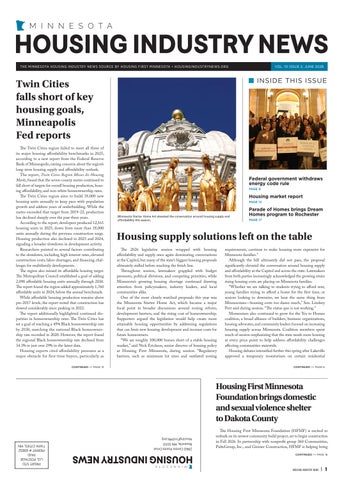
Minnesota Starter Home Act elevated the conversation around housing supply and affordability this session.
Parade of Homes brings Dream Homes program to Rochester PAGE 17
Housing supply solutions left on the table The 2026 legislative session wrapped with housing affordability and supply once again dominating conversations at the Capitol, but many of the state’s biggest housing proposals ultimately stalled before reaching the finish line. Throughout session, lawmakers grappled with budget pressures, political divisions, and competing priorities, while Minnesota’s growing housing shortage continued drawing attention from policymakers, industry leaders, and local communities alike. One of the most closely watched proposals this year was the Minnesota Starter Home Act, which became a major focal point in broader discussions around zoning reform, development barriers, and the rising cost of homeownership. Supporters argued the legislation would help create more attainable housing opportunities by addressing regulations that can limit new housing development and increase costs for future homeowners. “We are roughly 100,000 homes short of a stable housing market,” said Nick Erickson, senior director of housing policy at Housing First Minnesota, during session. “Regulatory barriers, such as minimum lot sizes and outdated zoning
CONTINUED >> PAGE 13
requirements, continue to make housing more expensive for Minnesota families.” Although the bill ultimately did not pass, the proposal significantly elevated the conversation around housing supply and affordability at the Capitol and across the state. Lawmakers from both parties increasingly acknowledged the growing strain rising housing costs are placing on Minnesota families. “Whether we are talking to students trying to afford rent, young families trying to afford a home for the first time, or seniors looking to downsize, we hear the same thing from Minnesotans—housing costs too damn much,” Sen. Lindsey Port said during session. “The status quo is not working.” Momentum also continued to grow for the Yes to Homes coalition, a broad alliance of builders, business organizations, housing advocates, and community leaders focused on increasing housing supply across Minnesota. Coalition members spent much of session emphasizing that the state needs more housing at every price point to help address affordability challenges affecting communities statewide. Housing debates intensified further this spring after Lakeville approved a temporary moratorium on certain residential CONTINUED >> PAGE 6
Housing First Minnesota Foundation brings domestic and sexual violence shelter to Dakota County The Housing First Minnesota Foundation (HFMF) is excited to embark on its newest community build project, set to begin construction in Fall 2026. In partnership with nonprofit group 360 Communities, PulteGroup, Inc., and Greiner Construction, HFMF is helping bring CONTINUED >> PAGE 16
HOUSING INDUSTRY NEWS
| 1
2960 Centre Pointe Drive Roseville, MN 55113 HousingFirstMN.org
PRSRT STD U.S. POSTAGE PAID PERMIT # 93652 TWIN CITIES, MN
BOARD CHAIR NOTE
HOUSING INDUSTRY NEWS
Missed opportunity at the Capitol Another legislative session has come and gone, and with it another missed opportunity to make meaningful progress on Minnesota’s housing shortage. While there were important conversations and growing bipartisan engagement around housing affordability, the reality remains clear: Having too few homes continues driving costs higher for families across our state. Minnesotans are increasingly finding it harder to live near their jobs, their families, and the communities they call home. Yet even amid these challenges, I remain encouraged by the momentum and resolve building across Minnesota. The Yes to Homes coalition continues to grow because people from every corner of our state recognize that housing is not a partisan issue—it is foundational to economic opportunity, workforce stability, and strong communities. More Minnesotans, local leaders, employers, and organizations are joining together around the understanding that
Vol. 10 Issue 2, June 2026 PUBLISHER, CHIEF EXECUTIVE OFFICER James Vagle
we must build more homes and modernize the policies that stand in the way. Housing First Minnesota and our coalition partners remain committed to advancing practical, community-focused solutions that expand housing access while preserving the quality of life Minnesotans value. This work requires persistence, partnership, and a long-term mindset. Real progress rarely happens all at once, but every conversation, coalition, and policy step forward matters. On behalf of Housing First Minnesota, I want to thank you for your continued engagement and leadership on this critical issue. Together, we will continue working toward a Minnesota where homeownership and housing opportunity grows.
ART DIRECTOR Mandy Finders GRAPHIC DESIGNER Pa Gar Vang OPERATIONS MANAGER Casey Scozzari SENIOR DIRECTOR, MARKETING & COMMUNICATIONS Katelyn Bloomquist SENIOR VICE PRESIDENT, GROWTH & ENGAGEMENT Kate Gunderson SENIOR DIRECTOR, CLIENT STRATEGY & GROWTH
John Kraemer 2026 Board Chair, Housing First Minnesota
Onward, John Kraemer Board Chair, Housing First Minnesota
Devin Lehnhoff ENGAGEMENT ACCOUNT EXECUTIVE Allyson Sample CONTRIBUTING WRITERS Kristen Crossman Nick Erickson
HousingIndustryNews.org
Subscribe
Mark Foster Grace Greene
Stay up to date on the latest housing news. Subscribe to our newsletter at HousingIndustryNews.org.
Kristi Jorgensen Elizabeth Roubik Kate Wigley
Advertising For advertising information, rates, editorial calendar, and production specifications, contact: Sales@HousingFirstMN.org
HOUSING FIRST MINNESOTA BOARD CHAIR John Kraemer
News Tips
Housing Industry News is a publication of Housing First Minnesota. Housing Industry News is published and distributed four times per year to housing industry professionals and others associated with the homebuilding industry. Neither the advertisers, nor Housing First Minnesota, will be responsible or liable for misinformation, misprints, typographical errors, etc., herein contained. For address change information, contact Housing First Minnesota. Suggestions, ideas, and letters are always welcome.
Have a story idea for our next issue? Contact Grace Greene at Grace@HousingFirstMN.org
Follow Us Go to HousingIndustryNews.org for subscriber exclusives, breaking housing news, and features.
Be a part of the growing housing movement in Minnesota. @housingnews_mn facebook.com/HousingIndustryNewsMN
HOUSING INDUSTRY NEWS 2960 Centre Pointe Drive Roseville, MN 55113 info@HousingFirstMN.org housingindustrynews.org
GREEN PATH OFFERS THREE CERTIFICATION LEVELS FOR INDIVIDUAL HOME PERFORMANCE.
Housing Industry News is published by Housing First Minnesota.
LEVEL #1: MN GREEN PATH ENERGY TESTED
®
Entire contents copyright 2026. All rights reserved.
Energy-tested homes are evaluated by a third-party, independent RESNET rater to provide a Home Performance Report and HERS Index Score.
LEVEL #2: MN GREEN PATH ADVANCED CERTIFIED
Minnesota’s Green Path is the leading energy efficiency and green building program for the residential construction industry in Minnesota.
The homes that achieve this mid-level certification meet rigorous energy testing standards and incorporate additional green features.
Housing First Minnesota is the voice for homebuilders, remodelers, and all who are dedicated to building safe, durable homes at a price Minnesotans can afford.
LEVEL #3: MN GREEN PATH MASTER CERTIFIED The top level of green building, homes at this level exceed rigorous standards, showcasing the highest commitment to energy efficiency.
THANK YOU 2026 MINNESOTA GREEN PATH SPONSORS PLATINUM SPONSORS
GOLD SPONSOR
ADVANCED & MASTER CERTIFICATION POWERED BY
Housing First Minnesota is dedicated to advancing the American dream of homeownership for Minnesotans and is the leading resource for housing-related issues in Minnesota. This advocacy work has never been more important. The housing industry remains under intense regulatory and political pressures that impact Minnesota homeowners’ ability to buy, build, and remodel their dream home. Housing First Minnesota supports reasonable policies, regulations, and protections, but our call for affordability for families is a voice that must be heard. Learn more at HousingFirstMN.org.
2 | HOUSING INDUSTRY NEWS
SIGN UP TO BE A PART OF THE HOUSING MOVEMENT • HOUSINGINDUSTRYNEWS.ORG
THE HOUSING BEAT
Across the country, there is much talk about housing. HERE ARE SOME OF THE LATEST QUOTES ON THE STATE OF THE INDUSTRY
We are deeply concerned by the recent action taken by the City of Lakeville to ban new home construction in the city. If this becomes a trend, it will have a chilling effect on the growth of our state’s economy and further erode the affordability of housing in Minnesota.” REPS. SPENCER IGO (R-WABANA TOWNSHIP) AND MICHAEL HOWARD (DFL-RICHFIELD) IN A JOINT STATEMENT ON LAKEVILLE’S RESIDENTIAL CONSTRUCTION MORATORIUM
Remodeling companies are less affected by the rise and fall of mortgage rates compared to homebuilding companies, so the remodeling industry has continued to grow despite a series of Federal Reserve rate hikes that have driven up the cost of buying a new home and hindered new construction.” ELLIOT PIKE CHAIR OF NATIONAL ASSOCIATION OF HOME BUILDERS REMODELERS COUNCIL
New construction saw a small dip at the beginning of the spring, but we’re still seeing steady interest from buyers who are ready to move when the timing is right. Builders here are staying focused on delivering the kind of homes people need, and we’re confident in the months ahead.” JOHN KRAEMER 2026 BOARD CHAIR OF HOUSING FIRST MINNESOTA
Multiple offers, though not as intense as a few years ago, are still occurring. At the same time, days on the market are lengthening on average, implying the consumers are taking their time before making decisions.” LAWRENCE YUN CHIEF ECONOMIST OF NATIONAL ASSOCIATION OF REALTORS
CHOOSE LAMPERT. Lampert Lumber offers a wide selection of high-quality cabinetry to meet the needs of professionals in residential, commercial, and multi-family projects. Our expert designers are here to assist you and your customers with product selection, design support, and customization options to ensure the perfect fit for any space. With competitive pricing, top brands, and reliable service, Lampert Lumber is your trusted partner for cabinetry solutions that deliver style, functionality, and durability.
LAMPERTLUMBER.COM SIGN UP TO BE A PART OF THE HOUSING MOVEMENT • HOUSINGINDUSTRYNEWS.ORG
HOUSING INDUSTRY NEWS | 3
REGULATORY AFFAIRS
New energy code will have 270-day implementation period for builders A group of seven homebuilders associations across Minnesota sent a letter to Department of Labor and Industry (DLI) Commissioner Nicole Blissenbach regarding the implementation of the forthcoming residential energy code update. The letter asked that the commissioner utilize the full 270-day implementation period provided in Minnesota statute to ensure comprehensive statewide training before enforcement of the new energy code—the first in over a decade—begins. The associations emphasized that builders, code officials, and other industry professionals will need adequate time to understand and prepare for the significant changes included in the updated code. They noted that consistent training and education across the state will help promote compliance and reduce confusion for the residential construction industry. The letter was sent by Housing First Minnesota on behalf of Rochester Area Builders, Central Minnesota Builders Association, Builders Association of Minnesota, Building Industry Association Red River Valley, Mid-Minnesota Builders Association, and Northern Minnesota Builders Association. Commissioner Blissenbach reviewed the request and confirmed that DLI will plan to utilize the full 270-day statutory implementation period. The decision provides additional certainty for the industry as it prepares for the updated energy code. While the energy code does not have a date set for implementation, it will likely take place in 2028.
Department of Labor and Industry Commissioner confirms 270-day implementation period for new energy code.
Edina tree ordinance replaced, lawsuit withdrawn
Following a repeal and replacement of the City of Edina’s vegetation and tree ordinances, Housing First Minnesota has withdrawn its lawsuit.
4 | HOUSING INDUSTRY NEWS
Housing First Minnesota has withdrawn and earned interest on those funds, which it did not pay out. its lawsuit against the City of Edina following the repeal of the city’s vegetation ordinance On Aug. 25, 2025, Housing First Minnesota and replacement of its tree ordinance. The new filed suit in Hennepin County District Court tree ordinance will apply to subdivisions in a challenging the Tree Replacement Ordinance more limited way. and Vegetation Ordinance after they were not “By these actions, the City of Edina effectively modified by the city. acknowledged that the previous programs were likely to be found invalid under state law,” said Housing First Minnesota to appeal James Vagle, CEO of Housing First Minnesota, permit fee ruling in a statement to members. “This restores an Following oral arguments in January, the important measure of fairness and reinforces a Minnesota Court of Appeals (COA) has issued fundamental principle: Local governments must a ruling in Housing First Minnesota’s cases operate within the authority granted to them against the Cities of Corcoran and Dayton under state law, and homeowners should not regarding building permit fees. be subjected to unlawful fees or requirements.” The court affirmed the previous ruling that Housing First says this outcome is a mean- there is no independent cause of action to ingful win for homeowners in Edina and that support Housing First Minnesota’s claims the team will continue to carefully monitor for declaratory judgment and injunctive relief. implementation of the new ordinance. Housing First Minnesota has appealed the In October 2024, Housing First Minnesota ruling to the State Supreme Court, stating, sent the City of Edina a letter demanding “The rulings of the lower courts have so far that it amend its ordinances to comply with departed from the accepted and usual course of state law. According to city records, Edina justice as to call for an exercise of the Court’s had collected and retained nearly $1 million supervisory powers.” A decision is expected by mid-July. under its tree escrow program in recent years
SIGN UP TO BE A PART OF THE HOUSING MOVEMENT • HOUSINGINDUSTRYNEWS.ORG
BUILD WITH THE BEST. At Lyman Companies we specialize in what we know and love, which means we understand the roofing business inside and out. Our roofing specialists bring decades of experience to the table and are dedicated to getting material to you correctly and on time to keep your jobs moving. Whether your project is residential, commercial, or multi-family, we have the expertise, products, and services you need to get the job done right.
Contact us today to learn how we can take your roofing business to the next level!
LYMANCOMPANIES.COM
HOUSING ON THE HILL CONTINUED FROM PAGE 1
Housing supply solutions left on the table developments, citing concerns related to infrastructure, schools, and rapid population growth. The decision quickly became part of a larger statewide conversation about balancing community growth with the need for additional housing supply during an ongoing shortage. Industry leaders and housing advocates warned that limiting new development could further strain affordability and make it more difficult for future homebuyers to enter the market. “Housing affordability continues getting worse for Minnesota families, yet once again, lawmakers failed to deliver meaningful action that would help increase housing supply and lower costs,” said Mark Foster, vice president of legislative and political affairs at Housing First Minnesota. “At the same time, the Legislature had no problem stepping in to preempt local governments on other major policy issues this session and the sky didn’t fall. That makes it even more frustrating that lawmakers were unwilling to act on local barriers that continue driving up housing costs and limiting supply across Minnesota. Homebuyers will now have to wait at least another year for meaningful solutions.” While many large-scale housing reforms failed to advance this year, the industry did secure progress on HOA reform legislation aimed at improving homeowner protections and reducing unnecessary mandates tied to new developments. Housing First Minnesota and other industry groups argued the reforms could help reduce long-term costs for homeowners while improving governance and transparency within homeowners associations. Builders and housing advocates also continued raising concerns throughout session about additional regulations and mandates that could increase construction costs and place further pressure on housing affordability. Discussions around permitting delays, infrastructure costs, and local development barriers remained common themes during committee hearings and negotiations. With the 2026 election cycle approaching, housing affordability and supply are expected to remain key issues in statewide and legislative races. While lawmakers stopped short of passing many of the session’s most significant housing proposals, momentum around housing reform and supply-side solutions continues to build as Minnesota leaders search for ways to address the state’s ongoing housing shortage.
Housing advocates warn that continued barriers to development could further impact affordability for future homebuyers.
A framework for improved model building codes Housing Affordability Institute released a new report examining the model building code development process. The report, Writing Better Building Codes: Means and Need for Heightened Scrutiny at All Levels, was written by the Institute’s executive director, Nick Erickson. In the report, Erickson provides a framework for model code publishers and state legislatures based on years of observing concerns expressed by builders, industry groups, code officials, and lawmakers regarding the development of the model code. The concerns over model code development analyzed in the paper include nongovernmental organizations functioning as de facto regulators, three-year code cycles, regulatory marketing, and process issues. The State of Minnesota, which has a uniform statewide building code, is highlighted for its amendment process. Amendments to the building code must not be arbitrary and must have a rational basis under the State’s rulemaking requirements and case law. The report also discusses issues with local code adoption, as local jurisdictions make the final decisions in establishing the legal requirements for construction. Local jurisdictions often have amendments that include deletions in the model code, which can sometimes be dangerous. This means certain provisions in the model code are not adopted locally. For example, fire sprinklers have been mandated for single-family dwellings in the model International Residential Code (IRC) since 2009, but only two states and the District of Columbia widely mandate them. To strengthen the process and ensure affordability in the construction code, the report proposes a framework for model codes and local adoption. Proposed local adoption framework
Proposed model code framework • • • •
Create a baseline for safety, affordability, and durability Shift to six-years-plus model codes Heightened scrutiny of proposed changes Prune unadopted provisions
• • • •
Adopt heightened scrutiny of all code changes Limit local adoption to no less than six years Adopt affordability guardrails Single code adoption with interplay review
The report concludes that recent building code changes are largely incremental and serve to justify the threeyear timeframe. The report’s provided framework can ensure that evidence-based decisions guide future building codes at the model code and local adoption levels.
6 | HOUSING INDUSTRY NEWS
A new report from the Housing Affordability Institute examines how building codes are developed and adopted.
SIGN UP TO BE A PART OF THE HOUSING MOVEMENT • HOUSINGINDUSTRYNEWS.ORG
Something
is coming... O C T. 3 0 , 2 0 2 6 MYSTIC LAKE CENTER
THANK YOU SPONSORS
HOUSING ON THE HILL
Less efficient, older homes make up greatest share of housing stock as energy codes focus on new home construction A new report from Housing Affordability Institute, Chasing Perfection: Energy Performance in the Nation’s Aging vs. New Housing Stock, compares model homes built today with those built 30 years ago across five climate zones. The report examines housing efficiency trends against current policy approaches that focus on increasing efficiency requirements for new homes. The study was conducted by an energy code and engineering consultant using data from the Census Bureau, U.S. Department of Energy, and RESNET. The data shows that across all five zones, older homes make up the largest share of the housing stock, and these homes tend to be less efficient than new builds. This suggests the greatest opportunity to improve overall efficiency lies in existing homes rather than new construction. The Minneapolis-St. Paul-Bloomington area was analyzed to represent Climate Zone (CZ) 6. The report found that new homes have a minimum HERS score of 65.83, making them 34% more efficient than a 2006 reference home with a HERS score of 100. Over 68% of the single-family housing stock in the Minneapolis-St. Paul-Bloomington area was built prior to 1996. Homes built 30 years ago are nearly 27% less efficient than the 2006 reference home and 61% less efficient than a new home.
“New homes are delivering measurable gains in energy efficiency, but they make up a small portion of the overall housing stock,” said Nick Erickson, executive director of Housing Affordability Institute. “If policymakers want to meaningfully impact energy use, the data shows the focus must expand to include existing homes. This is especially pronounced in slowergrowth markets.” Other areas analyzed include Phoenix, Arizona (CZ 2); Dallas, Texas (CZ 3); Asheville, North Carolina (CZ 4); and Spokane, Washington (CZ 5). In all areas, at least 41% of the housing stock was built in 1995 or earlier. The highest share of older homes was found in Spokane, where nearly 71% of homes were built in 1995 or earlier. Model energy codes often treat new homes as the primary driver of energy use and natural gas consumption. However, unlike other sectors, residential natural gas consumption has remained relatively flat for about five decades, even as population has grown and housing has expanded. Additionally, the data shows that older homes are the culprits for inefficiency. The paper concludes that policy efforts to reduce overall natural gas consumption may be more effective if focused on sectors outside of new residential construction.
A new report finds that the greatest opportunity for improving overall housing efficiency may be in Minnesota’s aging housing stock.
Minnesota Contractors & Remodelers Continuing Education 50+ ONLINE COURSES Available 24/7 • 25+ Top Industry Expert Instructors
• Easy-to-stream videos you can take from anywhere
• NEW courses added frequently
Providing continuing education since 2004, Contractor University has the largest variety of online courses for MN contractors than any other provider. Whether you are taking courses for credits or just want to learn, discover courses on building and energy codes and the latest in building science. Plus, explore legal, business management, and specialized courses that you won’t find anywhere else. Individual continuing education courses start as low as $18.
CONTRACTORU.COM
PRESENTED BY
ACCREDITED BY
Sponsored by:
Courses Approved by:
®
8 | HOUSING INDUSTRY NEWS
SIGN UP TO BE A PART OF THE HOUSING MOVEMENT • HOUSINGINDUSTRYNEWS.ORG
HOUSING ON THE HILL
Federal government withdraws energy code rule The U.S. Department of Housing and Urban Development (HUD) and the U.S. Department of Agriculture (USDA) have rolled back a Biden-era rule that would have required new homes backed by Federal Housing Administration (FHA) and USDA loans to meet the 2021 International Energy Conservation Code (IECC). The change removes stricter federal energy-efficiency standards tied to new residential construction and restores the previous requirements. The original rule, finalized in 2024, aimed to improve energy efficiency in federally financed housing through updated insulation, windows, HVAC systems, and lighting standards. Supporters said the changes would lower long-term utility costs for homeowners. Builders and housing groups, however, argued the mandate would drive up construction costs during an already difficult affordability crisis. Builder and real estate groups largely praised the decision, saying it could help reduce costs and improve housing access. Critics argue the move weakens energyefficiency efforts and could leave homeowners with higher utility bills over time. The policy change highlights the broader debate between balancing housing affordability and expanding the nation’s housing supply while pursuing long-term energy-efficiency and sustainability goals.
SIGN UP TO BE A PART OF THE HOUSING MOVEMENT • HOUSINGINDUSTRYNEWS.ORG
A Biden-era energy-efficiency rule with stricter standards for new residential construction was removed.
HOUSING INDUSTRY NEWS | 9
AROUND THE STATE
CMBA advances policy discussion through local relationships In the world of housing, advocacy is a contact sport. That is certainly true when it comes to strengthening and advancing our highly regulated building industry. But even while business owners are occupied with day-to-day operations, staying silent and disengaged is simply not a practical option. The Central Minnesota Builders Association (CMBA) realizes many of the regulations, fees, and policies associated
with building are local matters. That is why CMBA cultivates close working relationships with local policymakers and development officials. “It’s one thing to show up and support or oppose a proposal when it’s on a city council’s agenda,” said Wanda Schroeder, CMBA’s executive director. “It’s more important to nurture continuous dialogue and collaboration so those ideas and
Strong relationships and consistent engagement with local leaders are helping CMBA shape policies that support housing growth and affordability across Central Minnesota.
proposals better reflect the realities of the building industry before they come to a vote.” That philosophy has shaped CMBA’s approach to advocacy. The CMBA Government Affairs Committee meets regularly with a panel of mayors from the association’s six area communities—St. Cloud, Sartell, Waite Park, Sauk Rapids, St. Joseph, St. Augusta, and Foley—as well as separately with community development officials from each city. CMBA also frequently invites area legislators to those discussions, giving them an opportunity to hear directly about builders’ concerns and industry needs. “It’s one thing for elected officials and staff to hear from government affairs professionals,” said CMBA Government Affairs Consultant Steve Gottwalt. “They listen with much greater interest and eagerness to learn when they hear from our members who are actually engaged in the business of building. Showing up and speaking up make a big difference.” These regular interactions have yielded real results. Three years ago, the City of St. Cloud proposed large and immediate increases in SAC/WAC/TAC fees to fund infrastructure expansion. Thanks in part to ongoing dialogue and relationship building, CMBA was able to negotiate a one-year delay, followed by a three-year phase-in. In another recent example, the city proposed a broad slate of building fee increases. CMBA helped negotiate a delay in acting on those fees that will come to a vote later this year, alongside a package of reforms and incentives aimed at spurring additional housing and commercial development. Area communities have come to rely on CMBA as the voice of builders, developers, contractors, and associates in the area, viewing the organization as a partner in achieving community goals. Gottwalt also pointed to the positive impacts of members engaging at the state level during Housing Day at the Capitol, hosted in collaboration with Housing First Minnesota, where members had the chance to interact with legislators directly. “Legislators clearly appreciate hearing from our members in person, and they take those interactions into their discussions and policy decisions,” he said. So, take advantage of opportunities to engage in the “contact sport” of governance. It can be as important as any other aspect of running a business in the long run. A few hours invested in building better understanding and relationships among policymakers and city officials can yield real results.
Housing boom gaining speed in Rochester While other areas of the state may be slowing down, Rochester is experiencing a remarkable surge in residential development. For the past three years, the Rochester community has averaged approximately 200 new homes annually. In a town that needs 1,000 housing units a year, every year, for the next 15 years, that pace didn’t cut it. Based on data from the City of Rochester and our members, we project roughly 700 homes will be built this year, next year, and in 2028. This substantial increase marks a turning point for our housing market, driven by rising demand, strategic planning, and collaborative efforts to meet the needs of a growing population. Rochester’s bright outlook stems from Mayo Clinic’s transformative five-year, $5 billion “Bold. Forward. Unbound.” project, currently in its second year. This ambitious work continues
10 | HOUSING INDUSTRY NEWS
to advance on schedule, with a goal of fundamentally changing how health care is delivered everywhere. This will reinforce Rochester’s status as a global medical destination and is already creating additional economic growth here and throughout the region. An important component of Rochester Area Builder’s (RAB) progress has been our excitement to change to meet the new demands of our members. For example, we rebranded and revitalized our Home & Outdoor Show, pivoting from a typical home show to focus more on the attendee experience. With local food, beverages, and music (and even hiring lumberjacks from Wisconsin!), the event was a hit. We nearly tripled attendance and, more importantly, the quality and number of leads surpassed our vendor’s wildest expectations.
We also turned the page on our decadesold home tour to partner with Housing First Minnesota. This spring, the Rochester Parade of Homes made its inaugural run and was a great success. The marketing presence and experience of the event is unequalled, due to the exceptional Housing First staff. With some important tweaks coming to the fall tour, we expect even better results for our residents and members. These are truly exciting times in Rochester. Whether you’re considering building, expanding, buying, or simply exploring what our growing community offers, we invite you to come check us out and discover why so many people and businesses are choosing to call Rochester home. Pat Sexton Rochester Area Builders Executive Director
Pat Sexton Executive Director, Rochester Area Builders
SIGN UP TO BE A PART OF THE HOUSING MOVEMENT • HOUSINGINDUSTRYNEWS.ORG
THE FUTURE OF FRAMING IS NOW. Stay Ahead of Schedule and the Competition with READY-FRAME® READY-FRAME® is our pre-cut framing package that makes framing better, faster, safer and greener. You give us your plans, and we cut everything you need, just how you need it. The system ships from our offsite manufacturing facility Smart Bundled®, compact, pre-cut and labeled – ready for your framers to assemble on the jobsite.
BLDR.COM/MINNESOTA
VISIT OUR WEBSITE OR ONE OF OUR NEARBY LOCATIONS TODAY.
MARKET REPORT
Housing market report
State of Minnesota
Moorhead
Metro homebuilding falters in spring
6
SOURCE: CITY OF MOORHEAD
Homebuilding activity in the Twin Cities metro area eased slightly in April as broader macroeconomic pressures—including slower job growth and market uncertainty tied to geopolitical instability in the Middle East—began to weigh on consumer confidence and homebuying decisions. Homebuilders pulled permits for 559 single-family homes in April, a contraction of 8% compared to the same time last year. Multifamily activity in the metro slowed substantially in April. Builders reported 18 multifamily units under construction. Multifamily activity accounted for just 3% of all construction activity in April.
3,681
Duluth
88
Year-to-Date Single-Family Construction in Select Cities Through April 2026 SOURCE: U.S. CENSUS
SOURCE: U.S. CENSUS
St. Cloud
19
SOURCE: CITY OF ST. CLOUD
Twin Cities
2,689
Mankato
51
SOURCE: U.S. CENSUS
Rochester
161
SOURCE: U.S. CENSUS
SOURCE: U.S. CENSUS
HOUSING FIRST MINNESOTA COLLECTED THE ABOVE PERMIT INFORMATION FROM AVAILABLE PUBLIC RESOURCES.
APRIL 2026
APRIL 2026
$392,000
$360,000
Minnesota Construction Employment Past 5 Months SOURCE: DEED
APRIL 2025
-2%
0%
$399,900
APRIL 2025
$360,000
Y-Y Change
Y-Y Change
Twin Cities Median Sales Price
Minnesota Median Sales Price
SOURCE: MINNEAPOLIS REALTORS®
SOURCE: MINNESOTA REALTORS®
Twin Cities Construction Employment Past 5 Months SOURCE: DEED
CURRENT
FUTURE
70
54
South - 68
Midwest - 68
Northeast - 63
Regional Remodeling Market Indices, 2025 Q4 SOURCE: NAHB
The Overall Remodeling Market Index is calculated by averaging the Current Marketing Index and the Future Market Indicators Index. Any number over 50 indicates that more remodelers view remodeling market conditions as higher than the previous quarter. Results are seasonally adjusted.
12 | HOUSING INDUSTRY NEWS
Employment Update Minnesota’s non-seasonally adjusted unemployment rate dropped to 4% in April, according to the Minnesota Department of Employment and Economic Development. This is compared to the March rate of 4.9%. The national unemployment rate also decreased slightly from 4.3% in March to 4% in December. Construction employment in Minnesota grew by 2,100 jobs in April across all sectors of the industry. SIGN UP TO BE A PART OF THE HOUSING MOVEMENT • HOUSINGINDUSTRYNEWS.ORG
MARKET REPORT CONTINUED FROM PAGE 1
Twin Cities falls short of key housing goals, Minneapolis Fed reports mortgage rates remain elevated and home prices continue rising. The Minneapolis Fed warned that continued underproduction could erode the Twin Cities’ reputation as a relatively affordable metropolitan area compared to peer regions across the country. A lack of available housing can also affect workforce growth, business expansion, and overall economic development by making it more difficult for workers to find homes near jobs. The report suggested that local governments may need to revisit policies affecting housing development, including zoning regulations, permitting requirements, and approval processes, if the region hopes to close its housing gap in the coming years. Researchers emphasized that increasing housing supply across a range of price points will likely be necessary to improve affordability and expand homeownership opportunities. Despite the disappointing results, the report noted that the region has made progress in recent years compared to historical production levels. However, sustaining that progress will require renewed efforts from policymakers, local governments, builders, and housing advocates to ensure the Twin Cities can meet future housing demand and remain an accessible place to live for residents across all income levels.
Housing construction in the Twin Cities continues to lag behind demand, raising concerns about affordability, housing supply, and long-term access to homeownership.
NEW THIS YEAR!
Get Ready to Tee Off!
Hampton Companies Golf
July 27, 2026 North Oaks Golf Club | North Oaks HousingFirstMNFoundation.org/GetInvolved PRESENTING SPONSOR
Housing First Minnesota Golf Open Aug. 6, 2026 Majestic Oaks Golf Course | Ham Lake Two simultaneous afternoon shotguns HousingFirstMN.org/Events PRESENTING SPONSOR
Registration for summer golf with Housing First is open! Limited foursomes remain, so secure yours today! Sponsorship opportunities are available for all tournaments.
SIGN UP TO BE A PART OF THE HOUSING MOVEMENT • HOUSINGINDUSTRYNEWS.ORG
Housing First Minnesota Foundation Building Futures Golf Classic B U IL D
GOLF
IN G F U
TURES
CLASS
IC
Sept. 15, 2026 The Wilds Golf Club | Prior Lake HousingFirstMNFoundation.org PRESENTING SPONSORS
HOUSING INDUSTRY NEWS | 13
INDUSTRY IN ACTION
Spring home tour draws strong attendance The Spring Parade of Homes wrapped in April after five busy weekends of home touring across the Twin Cities metro and Rochester area. The event ran from March 13 through April 12, featuring 302 new homes and 34 remodels in the Twin Cities, along with 25 new homes and two remodels in Rochester. Thousands of visitors explored the latest trends in home design, remodeling, technology, and neighborhood development. Hosted by Housing First Minnesota, the Spring Parade of Homes is a seasonal favorite and tradition for many—whether you’re designing a home, planning a move, or simply looking for inspiration. The organization reported another strong turnout for this year’s tour, with visitors showing heightened interest in sustainable design, flexible living spaces, and homes tailored to
modern lifestyles. Features such as energy efficiency, adaptable floor plans, and indoor-outdoor living drew significant attention from attendees across the state. “The Spring Parade of Homes continues to showcase the innovation and craftsmanship shaping Minnesota’s housing industry,” said James Vagle, CEO of Housing First Minnesota. “Buyers are looking for homes that not only fit their needs today but also can evolve with them in the future. The enthusiasm we saw throughout the tour reflects the strong demand for new construction and the value Minnesotans place on homeownership.” The Fall Parade of Homes will return for four weekends beginning on Sept. 11, offering even more opportunities for Minnesotans to explore homes from some of the state’s best builders and remodelers.
Celebrating women in construction Women from every corner of the housing industry came together in March to celebrate Women in Construction Week and International Women’s Day at Tour & Toast, hosted by Parade of Homes at a Hanson Builders residence featured on the spring tour. The event celebrated the impact and accomplishments of women throughout the industry. Attendees enjoyed drinks and appetizers, listened to inspiring remarks from female leaders, and raised a toast to the women shaping the future of housing.
Jenna Pietrzak, Hanson Builders realtor
THANK YOU SPONSORS The Spring Parade of Homes wrapped up after five busy weekends of tours, showcasing hundreds of new homes and remodels across the Twin Cities and Rochester.
Some companies guess. Others know. Access your unfair advantage with the Keystone Report—intel the industry trusts.
14 | HOUSING INDUSTRY NEWS
Subscribe at keystonereports.com
SIGN UP TO BE A PART OF THE HOUSING MOVEMENT • HOUSINGINDUSTRYNEWS.ORG
INDUSTRY IN ACTION
Minnesota homebuilders honored with 2026 spring awards
Industry voices help shape Minnesota housing policy
The homebuilding industry celebrated standout achievements from the 2026 Spring Parade of Homes, recognizing the best in design, innovation, craftsmanship, and collaboration through Housing First Minnesota’s annual spring awards program. Winners were selected by a panel of industry experts during the Spring Parade of Homes, a statewide event that draws thousands of visitors each year to tour new homes and discover the latest trends in residential construction and design. Eleven of the homes featured on this year’s tour earned the prestigious Reggie Award, a longstanding honor established in 1968 that recognizes superior design, quality, and value in new home construction. In addition, 14 Trillium Awards were presented to suppliers, trade partners, and industry professionals whose behind-the-scenes contributions helped bring the award-winning homes to life. “These awards recognize the creativity, dedication, and professionalism that continue to elevate our industry,” said James Vagle, CEO of Housing First Minnesota. “The 2026 Spring Parade of Homes showcased how today’s builders and trade partners are meeting the evolving needs of homeowners through thoughtful design and strong collaboration.”
On April 30, housing professionals from across the state spoke to legislators to advocate for the industry at Housing Day at the Capitol, hosted by Housing First Minnesota in collaboration with Rochester Area Builders and Central Minnesota Builders Association. The event brought together homebuilders, remodelers, and trade partners, all of whom saw firsthand how their voices can impact state policy. To start the day, Housing First Minnesota CEO James Vagle moderated a panel of three housing champions: Sen. Lindsey Port, Sen. Jordan Rasmusson, and Rep. Spencer Igo. During the discussion, the legislators shared their thoughts on the current legislative environment, challenges facing the industry in Minnesota, and opportunities to advance meaningful solutions. Attendees then heard a market update from Kristen Crossman, media relations manager at Housing First, followed by a legislative overview from Mark Foster, vice president of legislative & political affairs. Using insight from the first portion of the event, Housing First members headed to meetings with lawmakers to discuss issues affecting homebuilding, development, and homeownership. That day, a bill regarding homeowners associations (HOAs) was being heard on the House floor. An amendment was introduced that would have removed a provision prohibiting local governments from requiring the creation of an HOA as a condition for new development permits. That amendment was debated by legislators and was ultimately defeated on an 86-47 vote. This defeat followed years of work by housing industry members to help legislators understand how these barriers can complicate residential development and make homeownership less attainable for Minnesotans.
$300,000 TO $399,999
$900,000 TO $999,999
Price Homes
Lang Builders, Inc.
#98 | Cambridge Trillium Partner: M.J. Lorenz Concrete
$400,000 TO $499,999
#52 | Monticello
$1 MILLION UP TO $1.2 MILLION
Caliber Homes, Inc.
Hanson Builders, Inc.
Trillium Partner: Village Floor & Wall, Inc.
Trillium Partner: Scherer Bros. Lumber Co.
$550,000 TO $599,999
$1.2 MILLION UP TO $1.5 MILLION
#102 | Wyoming
Robert Thomas Homes, Inc. #189 | Lakeville
Trillium Partner: C&J Stoneworks, Inc.
$600,000 TO $699,999
Robert Thomas Homes, Inc. #49 | St. Michael
Trillium Partner: C&J Stoneworks, Inc.
$700,000 TO $799,999
OneTenTen Homes, LLC #208 | Lakeville
$800,000 TO $899,999
Johnson Reiland Builders & Remodelers, Inc. #230 | Northfield
#43 | St. Michael
McDonald Construction Partners, LLC #280 | Eden Prairie
Trillium Partners: Andersen Windows; Teak & Olive Design Co.; Visual Comfort & Co.
“This is a great example of how consistent, thoughtful advocacy makes a difference. Our members have been working on this issue for years, and having those conversations face-to-face with legislators on Housing Day helped reinforce why this provision matters—not just for builders but also for future homeowners across Minnesota.” –Mark Foster, vice president of legislative & political affairs, Housing First Minnesota
$1.5 MILLION UP TO $2 MILLION
Stonegate Builders #30 | Maple Grove
Trillium Partner: Andersen Windows
$2 MILLION AND ABOVE
Gonyea Custom Homes #5 | Independence
Trillium Partners: Andersen Windows; M.J. Lorenz Concrete
Trillium Partners: ABC Supply Co., Inc.; RJA Cabinetry & Design; Scherer Bros. Lumber Co.
2026 Housing Day at the Capitol
THANK YOU SPONSORS CAPITOL SPONSOR
2026 Spring Parade of Homes
SIGN UP TO BE A PART OF THE HOUSING MOVEMENT • HOUSINGINDUSTRYNEWS.ORG
BREAKFAST SPONSOR
ADVOCATE SPONSORS
LP Building Solutions
All, Inc., Lyman Companies, Scherer Bros. Lumber Co.
HOUSING INDUSTRY NEWS | 15
INDUSTRY GIVES BACK CONTINUED FROM PAGE 1
Housing First Minnesota Foundation brings domestic and sexual violence shelter to Dakota County a new 50-bed domestic and sexual violence shelter to Eagan. Known as Lewis House, this apartment-style shelter will serve more than 600 individuals each year—roughly half of whom are children—and will provide safe housing and supportive services for survivors and their families. As the only domestic and sexual violence shelter in Dakota County, the $14 million project will fill a critical need for the community. Through the project—set to become HFMF’s largest in its 31-year history—HFMF and PulteGroup, Inc., will lead the finishing work on the residential apartment units and key interior spaces, helping create a secure, welcoming environment designed to foster healing, stability, and hope. As an industry-led community build project, Lewis House offers Housing First Minnesota members and housing industry businesses an opportunity to support the effort through financial contributions, in-kind labor and material donations, and other partnerships. By mobilizing the Housing First Minnesota network of builders, suppliers, and trade partners, the Foundation can significantly reduce construction costs for 360 Communities while generating more than $2.50 in value for every dollar invested. This collaborative model allows philanthropic dollars to go further—not only offsetting building expenses but also ultimately expanding the care and support available to survivors. The savings created through industry involvement enable 360 Communities to provide more vital resources, reach more individuals and families in need, and sustain long-term, high-quality services that help survivors heal, rebuild stability, and break cycles of violence for generations to come. The 360 Communities Lewis House project represents a transformative step forward in providing safe, dignified, and trauma-informed housing for individuals and families impacted by domestic violence. Together as a housing industry, we will help provide survivors and their families with a safe place to rebuild and move forward. To learn more about the project and how you can get involved, visit housingfirstmnfoundation.org/360-communities-lewis-house.
Photo: Simply Media
2026 Housing First Minnesota Foundation Gala
16 | HOUSING INDUSTRY NEWS
Rendering of 360 Communities Lewis House Living Space
Housing First Minnesota Foundation Gala supports housing needs in the state The 11th Annual Housing First Minnesota Foundation Gala was an inspiring evening centered on building hope, community, and lasting change. More than 475 supporters gathered to celebrate the Foundation’s mission of building safe, dignified housing solutions for those experiencing homelessness across Minnesota. The energy in the room was especially meaningful this year, with more than 200 first-time guests in attendance. Throughout the evening, guests heard powerful stories and learned about several transformative projects launching in 2026. These initiatives represent the Foundation’s continued commitment to addressing homelessness and housing needs through meaningful partnerships and community-driven solutions. One of the featured initiatives, the Avivo Village – St. Cloud project, highlighted efforts to support individuals experiencing homelessness in the St. Cloud area. By expanding access to stable housing and critical support services, the project aims to create long-term pathways toward independence and stability for some of the region’s most vulnerable community members. Attendees also learned about the Hope House initiative, focused on serving youth in crisis in the southwest metro. This
project will provide safe housing and supportive resources for young people facing housing instability—helping them find security, guidance, and opportunities for a brighter future. A highlight of the evening was the announcement of a new collaboration with nonprofit partner 360 Communities to build a 50-bed shelter for survivors of domestic violence in Dakota County. Together, 360 Communities, Housing First Minnesota Foundation, PulteGroup, Inc., and Greiner Construction will work to provide safe and stable housing solutions for individuals and families rebuilding their lives after experiencing domestic and sexual violence. Thanks to the support of attendees, donors, and 58 dedicated sponsors, the Foundation not only exceeded its Fund-aNeed goal of $175,000 but also raised more than $425,000 to advance its mission. The overwhelming support demonstrated the community’s shared commitment to creating safe, stable housing opportunities for Minnesotans in need. As the Foundation looks ahead to another year of impact, the success of the 11th Annual Gala serves as a powerful reminder that lasting change is possible when communities unite to support those most in need.
SIGN UP TO BE A PART OF THE HOUSING MOVEMENT • HOUSINGINDUSTRYNEWS.ORG
INDUSTRY GIVES BACK
Rendering of 360 Communities Lewis House Bedroom
Parade of Homes brings Dream Homes program to Rochester The Dream Homes once again stood out as a major highlight of the Spring Parade of Homes, bringing together beautiful craftsmanship, strong community engagement, and meaningful impact. This season, approximately 8,000 visitors toured the seven featured Dream Homes, helping raise $60,000 to support the Housing First Minnesota Foundation’s mission to end homelessness in the state. Every ticket purchased and every home toured directly contributed to making a difference for families in need. This year also marked the debut of a Rochester Dream Home, accompanying the Parade of Homes’ expansion into the Rochester market. Built by Zen Custom Homes, the featured residence played an especially important role in expanding the reach and visibility of the Dream Homes program. The house saw tremendous traffic and enthusiasm from tourgoers, demonstrating the growing excitement for Dream Homes beyond the Twin Cities. The strong turnout highlighted the value of bringing the Dream Home experience to southeastern Minnesota and
SIGN UP TO BE A PART OF THE HOUSING MOVEMENT • HOUSINGINDUSTRYNEWS.ORG
created an opportunity to connect with new audiences throughout the Rochester community. The success of the Rochester Dream Home also strengthened the Foundation’s partnership with the Rochester Area Builders. Collaborating with local builders and industry leaders helped deepen relationships in the region while showcasing the impact the building industry can have when it comes together to support an important cause. The excitement surrounding the Rochester Dream Home created momentum that will continue to build future opportunities for partnerships, outreach, and community involvement. The Foundation extends its sincerest gratitude to the seven generous builders who made these Dream Homes possible: Swanson Homes; Kootenia Homes; Style & Structure, LLC; Creative Custom Homes; McDonald Construction Partners, LLC; TJB Homes, Inc.; and Zen Custom Homes. Their craftsmanship, creativity, and commitment to giving back are what make Dream Homes on the Parade of Homes so special.
Parade of Homes community pop-up event at Zen Custom Homes, Dream Home #507
HOUSING INDUSTRY NEWS | 17
IN THE DIRT
A quick recap of housing news and development updates Winona City Council eases parking rules to encourage more housing
University of Minnesota Rochester expands
Winona leaders approved two new parking ordinances in May aimed at encouraging more housing development by easing parking requirements for developers. The changes reduce the number of required parking spaces for studio and one-bedroom apartments from two spaces to one, allowing builders to count some on-street parking toward meeting city requirements. Mayor Scott Sherman said the ordinances are part of the city’s long-term strategy under its 2045 Comprehensive Plan to increase housing density through gradual zoning and ordinance updates. City officials said the changes reflect studies showing that smaller apartments typically generate less parking demand and that many parts of the community already have enough parking. The new rules are expected to have the biggest impact in mixed-use districts, where redevelopment and new housing projects are encouraged. The ordinances will create more opportunities for developers to build additional housing units across the city.
The University of Minnesota Rochester has reached capacity and is planning a threephase campus expansion to support continued growth, Chancellor Lori Carrell told the Rochester City Council. The top priority is expanding laboratory and classroom space in Discovery Square to support STEM education, with Carrell warning enrollment may need to be capped without additional lab facilities. The second priority is creating a central academic building with classrooms, faculty offices, gathering space, and a new home for the University’s National Institute for Learning Innovation Research. The third priority includes new student housing and recreation facilities near Soldier Field to support growing athletic programs. Funding for the lab expansion will be considered by Destination Medical Center and the Rochester City Council this spring. If approved, construction could begin this summer, with the facility targeted to open in fall 2027. The latter two projects are expected to enter the request-for-proposals phase later this year. “We are poised to expand our physical footprint to match the scale of our ambition,” said Chancellor Carrell. “These planned investments in learning, living, and innovation spaces will help us welcome more students, deepen our impact, and continue filling the health care workforce needs of Minnesota.”
SOURCE: NEWS 8 NOW
STAY INFORMED WITH THE LATEST HOUSING NEWS HOUSINGINDUSTRYNEWS.ORG SOURCE: FINANCE & COMMERCE, UNIVERSITY OF MINNESOTA ROCHESTER
P OW E R E D BY XC E L E N E R GY
SPONSORED CONTENT
Low-voltage lighting moves from finish to rough-in Residential lighting is undergoing a quiet but major shift. For decades, homes relied on 120-volt alternating current (AC) power delivered directly to each light fixture to feed inefficient tungsten bulbs. Today, advances in LED technology and energy-efficient building design are driving lighting systems toward centralized, low-voltage controllers that function more like building infrastructure than decorative hardware.
allow the use of thinner, higher-gauge wiring with less copper. This simplifies routing through framing, millwork, cabinetry, and exterior assemblies, particularly where space and safety margins are tight. Builders gain flexibility in fixture placement, while designers can specify slimmer profiles, continuous linear lighting, and integrated architectural accents that are difficult to execute with traditional wiring.
LEDs change the equation LEDs are inherently low-voltage devices. In a typical installation, every LED bulb or fixture has electronics that convert 120-volt AC power to low-voltage direct current (DC), resulting in energy loss at each point of use. Low-voltage lighting systems reverse this approach by performing AC to DC conversion once, at a centralized or semicentralized power supply, and distributing DC power to multiple fixtures. According to research shared by the U.S. Department of Energy (DOE) and its Building Benchmarking Research Network (BBRN) in a 2023 report, The Potential of Whole-Home Lighting Systems and Low-Voltage Homes, reducing the amount of these conversions improves overall system efficiency and saves energy.
Built for control in highperformance homes LEDs respond instantly to dimming, scheduling, occupancy sensing, and color temperature changes. In the 2023 report, DOE research emphasizes that these controls are critical to achieving real-world energy savings by reducing wasted lighting in unoccupied or daylit spaces. As homes become more efficient, lighting accounts for a larger share of total electricity use. In net-zero and other high-performance designs, every watt matters. Low-voltage lighting supports efficiency and aligns naturally with solar and battery systems that already operate natively in DC. For builders focused on performance, safety, and futureready construction, low-voltage lighting is no longer a niche option—it’s an emerging standard reshaping how homes are wired. Learn more about high-efficiency homes at xcelenergy.com/newhomes.
Wiring efficiency and safety Operating well below line voltage, lowvoltage lighting can reduce electrical risk and
18 | HOUSING INDUSTRY NEWS
SIGN UP TO BE A PART OF THE HOUSING MOVEMENT • HOUSINGINDUSTRYNEWS.ORG
Your Partner for Minnesota Tough Exteriors Reliable installs, streamlines communication, built for your timelines. 763-373-3445 allstartoday.com
Your Trusted Window and Door Experts. When it comes to windows and doors, no one does it better than the team at Arrow Building Center. With decades of experience and deep product knowledge, our dedicated specialists provide expert guidance to help you find solutions for even the most complex projects. We offer a broad selection of styles, materials, colors, and sizes to achieve the look your customers want. As a trusted supplier of premium brands like Andersen Windows & Doors, we deliver competitive pricing without compromising on quality, ensuring you get the best value for every project.
Need a partner you can count on? Contact us today to experience firsthand the unparalleled service and exceptional results that we’re known for. Andersen® products rated #1 in quality. 2022 Andersen brand surveys of U.S. contractors, builders, architects & homeowners. “Andersen” and all other marks where denoted are trademarks of Andersen Corporation. ©2022 Andersen Corporation. All rights reserved.
ABC-CLC.COM