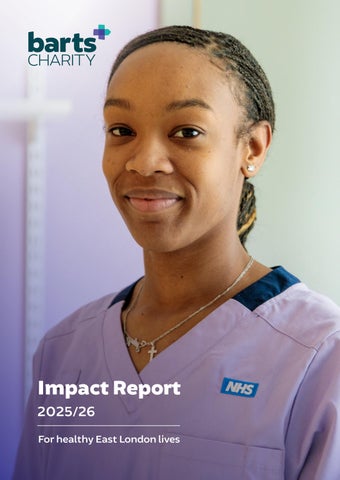
Impact Report 2025/26 For healthy East London lives
2
Contents About Barts Charity.............................................. 5
Improved health outcomes for patients and communities.......................................................... 24
Introduction from the Chief Executive and the Chair............................................................. 6
A new alternative in fibroid treatment......... 26
Our funding strategy............................................ 7
Digitising vital signs data across critical care units in East London....................... 27
Impact highlights................................................... 8 New funding: Breast Cancer Centre............ 9 Advances in medical and scientific knowledge and how this is applied to treatments and healthcare......................... 10 Transforming blood transfusion safety..... 12 Improving quality of life for people with rare blood cancers....................................... 13 Enhanced research-active healthcare environment in East London........................... 14 Ensuring HIV breakthroughs reach the communities who need them................ 16 Transforming heart disease diagnosis with artificial intelligence ................................... 17
Improved wellbeing, recognition, recruitment, and retention of staff at Barts Health............................................................... 30 Reducing burnout risk through art therapy......................................................................... 32 Mental health support for Barts Health staff........................................................................ 34 The impact of philanthropy.................................. 36 Kusuma Trust helping to pioneer cardiac imaging....................................... 38 Qube Research & Technologies and the future of cancer care............................. 39 Bukhman Philanthropies and compassionate neonatal care........................... 41 Thank you........................................................................... 42
Enhanced experience for patients, family and carers....................................................... 18 Reducing hair loss for chemotherapy patients ........................................ 20 A warmer welcome at Newham Hospital...... 21 A gentler option for musculoskeletal physiotherapy at Mile End Hospital................ 22 A quiet space for care and compassion at Whipps Cross.............................. 22 Streamlining care for people with Inflammatory Bowel Disease.............................. 23
3
4
About Barts Charity
Our partners
At Barts Charity, we believe transforming health begins with an idea. Across East London, clinicians, researchers and healthcare teams are developing bold new ways to improve health and tackle some of the biggest health inequalities facing our communities. Our role is to help turn those ideas into reality.
•Barts Health NHS Trust
Between 2022 and 2027, we’re investing £150m into life-changing improvements to health in East London. We support projects through our partners at: •Queen Mary University of London •City St George’s, University of London In doing so we’re helping to transform East London’s healthcare, and funding research that will make a difference locally and globally.
How we create impact We focus our funding where we can create transformational change, backing projects that other funders can’t or don’t already support. This includes investing in early-stage ideas, pioneering technology and innovative research that has the potential to reshape healthcare, and the development and retention of NHS staff delivering care across East London.
Leveraging further support Transformational change doesn’t happen in isolation. Last year alone, our funding helped leverage £76.7m in additional support from other funders, enabling even greater impact for our local community.
Rooted in East London Everything we fund is rooted in the needs of East London. From improving outcomes for patients and communities, to supporting the staff and researchers whose expertise drives healthcare forward. Because of our area’s rich diversity, the research that takes place in East London can have implications for people’s health across the globe. By bringing together healthcare providers, researchers, patients and communities, we are helping to shape a healthier future - where today’s ideas become tomorrow’s breakthroughs.
5
Introduction from the Chief Executive and Chair Across East London, too many people continue to experience poor health and face barriers to care. At Barts Charity, we’re investing in research and healthcare, so our community can live healthier, longer lives.
Fiona Miller Smith Chief Executive Officer
Steve Bonnard Chair of Trustees
This year, thanks to the generosity of our supporters, we invested £36.1m in research and healthcare projects across East London. These investments are helping to improve lives locally, but importantly also shaping healthcare further afield – like the digitisation of blood transfusion services (see page 12) which is shaping national thinking around transfusion practices. One of the most significant milestones this year has been our £16.6m commitment to the new Breast Cancer Centre at St Bartholomew’s Hospital. Breast cancer outcomes in North East London are among the worst in the country. The new centre will bring world-class treatment, research and innovation together in one place - helping more patients access earlier diagnosis, personalised care and better outcomes. Alongside this, we’ve continued to support pioneering work across our hospitals and research institutions, such as internationally recognised HIV research (see page 16), which is helping ensure new treatments are developed and delivered more equitably. We’re also investing in the people, partnerships and infrastructure that make long-term change possible - supporting researchers, accelerating digital transformation and strengthening the connection between research and frontline care. What unites all our work is a commitment to improving health for the people of East London, while generating knowledge and innovation with the power to influence healthcare far beyond our community. None of this would be possible without our supporters, partners and NHS colleagues. Thank you for helping us create healthier East London lives.
6
Our funding strategy Research We fund research that enhances our understanding of health and illness and has the potential to improve and save lives locally.
What we’ll do We will fund and enhance health-related research We will encourage and enhance patient-focused research training We will invest in opportunities that accelerate research and improve healthcare outcomes in our local communities We will support opportunities with a broader range of partners where research could help tackle specific and important local health issues
The impact Advances in medical and scientific knowledge and its application to effective treatments and healthcare
A stronger research-active healthcare environment in East London
Healthcare We want to help transform patient care and support our dedicated NHS staff.
What we’ll do
The impact
We will invest in bold, innovative ways to transform healthcare delivery in East London We will explore and identify potential solutions in out-of-hospital settings to tackle health issues faced in East London
Improved health outcomes for patients and communities
We will encourage and support innovation in healthcare We will fund enhancements to equipment, the hospital environment and clinical service delivery at Barts Health
Enhanced experience for patients, family and carers
We will help support the wellbeing, motivation and recognition of Barts Health staff
Improved wellbeing, recognition, recruitment, and retention of staff
7
Funding highlights By our strategic outcome areas:
£19.3m
awarded to improve health outcomes for patients and communities. See page 10
£11.1m
awarded to advance medical and scientific knowledge and its application to effective treatments and healthcare. See page 14
£4.1m
awarded to support a more research-active healthcare environment. See page 18
£1.2m
awarded to enhance experiences for patients, families and carers. See page 24
£414,733
awarded to support improved wellbeing, recognition, recruitment and retention of staff. See page 30
Through our funding we supported:
8
54
65
441
projects to improve healthcare in East London
projects for world-leading medical research
scientific publications sharing new knowledge
7
29
27
training fellowships so healthcare professionals can start PhD research training
new pieces of vital equipment and technology to improve patient experience and health outcomes
improved spaces for patients and loved ones across our hospitals
New funding: Breast Cancer Centre Breast cancer patients in East London face some of the worst outcomes in the country. They’re often diagnosed younger, in the latter stages of disease and with more aggressive cancer. This needed to change. That’s why, in November 2025, we committed £16.6m to establish the new Breast Cancer Centre at St Bartholomew’s Hospital. This once-in-a-lifetime opportunity brings together research, diagnostics and care into one place to change what a breast cancer diagnosis means for the people of East London. It will mean faster answers, safer surgery and more equitable access to the very best research and care, so that we can save more lives.
To support this investment and continue providing exceptional care and research at the Breast Cancer Centre, we’ll launch our most ambitious fundraising campaign to date in 2026. Please visit bartscharity.org.uk/here-for-it to find out more.
Patient Jasmine
We have a strong track record of creating specialist centres that improve outcomes for more people, such as the Barts Heart Centre. Opened in 2015, it’s been pioneering advances in cardiac care locally. Now we’re doing it for those facing breast cancer in East London. The new Breast Cancer Centre will improve access to innovative clinical trials. And because we have one of the most diverse communities in the world, the breakthroughs we make for our community will change outcomes for people globally. This new Breast Cancer Centre marks an enormous opportunity to change the face of breast cancer care.
“The new centre will be able to provide that amazing level of care for more people across East London. Having more people able to access that kind of care, all in one place, is going to be so important.” Jasmine, who was treated for breast cancer at St Bartholomew’s Hospital
9
Advances in medical and scientific knowledge and how this is applied to treatments and healthcare Research is essential to improve health in our community. It lays the groundwork for breakthroughs in prevention, diagnosis, and treatment. We invest in high–quality, innovative research that enhances our understanding of health and illness and has the potential to improve and save lives in East London.
10
£6.3m awarded to enhance our understanding of health and illnesses affecting local people.
£4.85m awarded to establish the Barts Charity Doctoral Training Programme, strengthening biomedical research capacity focused on health inequalities and areas of need in East London.
441 publications reported in 2025/2026 including scientific journal articles, reviews, manuals, conference proceedings and policy briefings.
£76.7m of further research funding leveraged in 2025/2026, enabling research to advance beyond the initial project and deliver even greater impact.
11
Transforming blood transfusion safety Every blood transfusion must be right, every time. At Barts Health, where around 15,000 patients receive blood each year, even the smallest error can have life-threatening consequences. Up until recently, transfusion has relied on manual processes that are time-consuming and can be vulnerable to human error. With £2.2m of our funding, clinicians have been able to apply digital innovation to one of medicine’s most fundamental practices – and ensure it is evaluated so the learning can be disseminated across the country. The result is the vein-to-vein programme: a fully digitised transfusion system now implemented across four Barts Health hospitals. By introducing barcode scanning and electronic bedside checks, the programme ensures the right blood reaches the right patient, every time. This funding has enabled more than just operational change. It’s created a new understanding about how digital systems can reduce risk, improve efficiency and transform clinical workflows. • Repeat blood samples due to labelling errors have dropped to just 0.5% • Over 95% of transfusions are now delivered using the new system • Administering blood and labelling samples for transfusion is up to 10 minutes faster
12
Crucially, Barts Charity also supported the evaluation of this work, which has helped show that not only does this have a clinical impact, but an economic impact too. The programme is projected to save 16,900 staff hours each year and deliver a return of £3 for every £1 invested. This evidence is now helping to shape national thinking around transfusion practice. By funding both the innovation and the rigorous evaluation behind it, Barts Charity has helped to show how advances in medical knowledge can drive efficiencies across the NHS whilst also providing safer healthcare for patients. Vein-to-vein was enabled with the support of NHS Charities Together.
“What ultimately shifted the conversation was not only the clinical improvement: it was the accompanying economic evaluation, strongly encouraged by colleagues at Barts Charity.” Laura Green, Professor of Haemostasis and Transfusion Medicine at Queen Mary University of London, and a Principal Investigator at NHS Blood and Transplant
Improving quality of life for people with rare blood cancers A blood pack at The Royal London Hospital
Myelodysplastic syndromes (MDS) are a rare type of blood cancer, in which the production of healthy blood cells goes wrong.
For many patients, chronic anaemia is one of the most debilitating aspects of their condition, leading to fatigue, breathlessness and reduced quality of life. While treatments can temporarily boost red blood cell production to combat anaemia, many rely on frequent blood transfusions, which can cause additional complications and impact people’s daily lives. In addition, around half of patients become resistant to treatment within two years, leaving limited options. With our funding, researchers at Queen Mary investigated the mechanisms of MDS to try and identify new treatment options. The team found the enzyme Coenzyme A synthase (COASY) is essential for red blood cell production. In MDS patients, alterations in the COASY enzyme disrupt red blood cell production leading to anaemia.
Building on these findings, the team has been awarded a £1m grant from Cancer Research UK. With this funding they will launch a new Phase II clinical trial to test if a high dose of vitamin B5 can help reduce severe anaemia in patients with MDS. This multi-site Phase II clinical trial will bring together researchers and clinicians across the UK to translate the previous laboratory findings into a potential new treatment approach. If successful, this could improve patients’ quality of life, and offer a low-cost, accessible treatment option for patients in East London and beyond.
Crucially, the team demonstrated that Vitamin B5 can improve red blood cell production by getting the COASY enzyme working properly again, offering a promising new therapeutic option for chronic anaemia. The team have developed strong collaborations with the MDS UK patient support group and have worked closely with patients to help shape their research.
13
Enhanced research-active healthcare environment in East London We’re strengthening clinical trial infrastructure and encouraging participation locally. We invest in research training for healthcare professionals to build academic leadership and increase research capacity focused on local health challenges.
14
£4.1m awarded for fellowship support including 7 Healthcare Professional Clinical Research Training Fellowships funded in 2025/26.
£142,000+ awarded across 32 projects to support Patient and Public Involvement and Engagement activities, enabling local communities to help shape the services they access and the research taking place locally.
37 projects approved to access the charity funded Barts Health Data Platform, enabling data-driven research to improve healthcare.
15
Ensuring HIV breakthroughs reach the communities who need them
The SHARE team
Daily HIV medication can be a constant reminder, and a source of stress, for people living with HIV. Studies show 58% of people living with HIV have hidden their medication to avoid stigma. In 2020, Professor Chloe Orkin led the clinical development of the world’s first two-monthly long-acting injectable HIV treatment. Our funding supported researchers from SHARE (Sexual Health and HIV All East Research) to build capacity to deliver further equity-focused studies concerning longacting injectable therapy and prevention. In a world first, their ILANA (Implementing Long-Acting Novel Antiretrovirals) study tested injectable treatment outside traditional settings. The team wanted to understand who this innovation was really reaching. Historically, women, racially minoritised communities and older adults have been underrepresented in HIV research. With support from Barts Charity, SHARE developed an inclusive, community-led study with ambitious recruitment targets to ensure participants reflected the diversity of people living with HIV in East London and beyond. 16
The study exceeded all its inclusivity goals, with over 70% of participants from racially minoritised backgrounds and 54% women. The findings are now shaping how new HIV treatments are delivered internationally, and the study has been recognised by both the World Health Organization and National Institute for Health and Care Research as an example of best practice in inclusive research design.
“We’re meaningfully involved because we’re consulted on all their work... They do real and meaningful engagement with people living with HIV.” Angelina, a member of SHARE’s Community Advisory Board
At the heart of SHARE is community partnership. By funding research that is both scientifically groundbreaking and deeply rooted in equity, we’re helping to create a more inclusive, research-active healthcare environment for East London. And in doing so, we’re supporting innovation in HIV care across the globe.
Transforming heart disease diagnosis with artificial intelligence Through our Healthcare Professional Research Training Fellowships, we support healthcare professionals to undertake PhD training in health-related research. Dr Vijay Shyam-Sundar, Cardiologist, is one of our Healthcare Professional Fellows. His research explores how artificial intelligence (AI) can better support cardiac MRI analysis, aiming to transform how we diagnose and understand inflammatory heart disease.
Through his Fellowship, Vijay developed a unique dataset to train AI tools that support faster and more accurate interpretation of heart scans. He did this using the Barts BioResource, a database of patient data and a biobank of blood, tissue and imaging data.
Myocarditis is an inflammatory heart disease in which the immune system mistakenly attacks the heart, causing inflammation of the heart muscles.
Early findings suggest AI tools can improve diagnostic accuracy, have the potential to reduce costs and reduce the need for contrast injections. This could improve patient experience, support safer, scalable diagnostic pathways and provide earlier, more targeted treatment.
This can lead to heart failure or abnormal heart rhythms. Diagnosing this condition can be complex - sometimes requiring invasive procedures such as heart biopsies. Cardiac MRI imaging offers a non-invasive and cost-effective alternative to biopsy, providing detailed information about the heart structure and tissue. However, much of this detail isn’t visible to the human eye, requiring contrast injections and computer analysis to capture all the data from the image.
“Barts Charity’s funding has allowed me to do this project and pursue a complete PhD, which is fantastic. Beyond that, it has really enabled me to go one step further to develop collaborations and networks across the city and beyond. My next steps wouldn’t have been possible without the foundational work that I’ve done now.”
Vijay has now been awarded a nationally competitive NHS fellowship in clinical AI. This will help him to develop, deploy and evaluate AI tools in clinical settings, bridging the gap between research and implementation. By combining cutting-edge AI with clinical insight, this project is paving the way for more personalised care in East London.
Cardiologist Dr Vijay Shyam-Sundar
Dr Vijay Shyam-Sundar
17
Enhanced experience for patients, family and carers We enable high-quality healthcare by empowering staff with big ideas to make improvements to our hospitals that directly benefit patients in their care. Through our Everyday Impact scheme we fund practical changes that improve the care, experience and wellbeing of all who come through the doors of our five hospitals.
18
£1.2m awarded including 37 Everyday Impact projects, supporting improvements to the care, experience and wellbeing of patients across the Trust.
27 improved spaces for patients and loved ones across our hospitals.
14 new pieces of vital equipment purchased, supporting improved experience of treatment and care.
3,000+ Christmas, Diwali, Eid, Purim and Yom Kippur presents were funded across the Trust in 2025/26.
19
Reducing hair loss for chemotherapy patients Hair loss can be one of the most visible and distressing effects of chemotherapy, affecting people's emotional wellbeing at an already difficult time. We funded new scalp cooling devices at St Bartholomew’s, Newham and Whipps Cross hospitals. Improved availability has enabled more people to access these devices. Chemotherapy units across Barts Health hospitals are now supporting around 10% more patients to begin treatment sooner, helping to restore their dignity and confidence.
Katisha with her partner, wearing the scalp cooling device.
20
“I didn’t want to go around telling everyone I had breast cancer, so being able to keep my hair was really important to me. I’m a real advocate for cold cap treatment.” Katisha, a breast cancer patient
A warmer welcome at Newham Hospital For many patients and visitors, the main hospital corridor is their first experience of Newham Hospital. This busy space has become much calmer and more welcoming thanks to Barts Charity funding. New artworks, chosen with input from patients and staff, have brought a pop of colour to long corridors, and comfortable seating now gives people a place to rest, wait, or talk. These changes are making Newham more inviting for people in their time of need.
“The works do make a difference and have a positive impact on my wellbeing.” Zoe, Newham Hospital patient
21
A gentler option for musculoskeletal physiotherapy at Mile End Hospital For patients living with ongoing muscle and joint pain, rehabilitation can sometimes be difficult or too painful to continue. Our funding has enabled Mile End Hospital to introduce extracorporeal shockwave therapy (ESWT) within its physiotherapy service. This is a treatment that uses sound waves to repair injured tissues, reduce pain and speed up recovery. Patients at Mile End found that ESWT sessions were helpful and kept them engaged with their recovery. Alongside patient benefits, staff have developed new skills and gained confidence using ESWT.
A quiet space for care and compassion at Whipps Cross Patients on Faraday Ward are often experiencing complex and serious respiratory illness, and some are receiving end-of-life care. Through our investment, staff on the Faraday Ward have been able to create a space for patients and families to be together in private through these difficult times. The refurbished day room space is now being used by patients, visitors and the wider care team, offering a calm setting for sensitive conversations and moments together. Staff and patients have shared positive feedback, highlighting how this room supports more compassionate, dignified and person-centred care at such a sensitive time.
22
Streamlining care for people with Inflammatory Bowel Disease For people living with inflammatory bowel diseases like Crohn’s or ulcerative colitis, timely answers can transform their care. We funded an intestinal ultrasound service at The Royal London Hospital, enabling clinicians to assess patients during their clinic visit.
In its first six months, more than 200 patients were scanned. Combined with a new flare clinic, patients can be assessed, diagnosed and begin treatment in a single visit. Patients are responding well to quicker results, fewer invasive tests and a clearer understanding of their condition, making care more reassuring and responsive.
23
Improved health outcomes for patients and communities We’re driving bold innovation in healthcare to improve the health of our East London communities. By investing in state-of-the-art healthcare facilities, pioneering models of care and the latest technologies, we’re ensuring East London doesn’t just keep pace with medical advances but leads the way.
24
£19.3m awarded to transform healthcare delivery and improve health outcomes for our local community, including our largest ever investment in the new Breast Cancer Centre.
24 pathways and services were introduced this year, supporting improved diagnosis, treatment and care for patients in East London.
15 pieces of equipment and technology were introduced, improving healthcare delivery and health outcomes for our community.
25
A new alternative in fibroid treatment Uterine fibroids are one of the most common gynaecological conditions affecting women of reproductive age, with high rates in women from African and Caribbean backgrounds. In East London, where local communities are disproportionately affected, many women experience debilitating symptoms including severe pain, heavy bleeding and fertility challenges. With our funding, Whipps Cross Hospital launched a pilot, introducing Sonata ® treatment – a minimally invasive alternative to treatments such as hysterectomy and myomectomy. By using radiofrequency ablation (heat generated by radio waves) to target and shrink fibroids, it helps reduce symptoms whilst avoiding major surgery. This means women can recover faster and return to normal life sooner.
Since launching in July 2025, 23 women have already received Sonata® treatment, with early outcomes showing a 36% reduction in symptom severity scores among patients. Whipps Cross became the first hospital in East London to offer this innovative treatment and is now uniquely positioned as a specialist fibroid treatment centre for North East London. Patient feedback has been excellent. Seven out of eight patients surveyed said they’d recommend the procedure to others in a similar situation. Many said they experienced reduced bleeding, and many appreciated the minimally invasive nature of the treatment. The pilot is also helping to transform how fibroid care is delivered in East London. All 12 women who have received Sonata ® treatment also had other gynaecological treatments at the same time, including biopsy and Mirena coil placement. This means that women can get comprehensive care in a single procedure and that theatre use is maximised, helping NHS efficiency. Plans are now underway to expand the service into an outpatient setting under local anaesthetic, improving accessibility for even more women across East London.
The team using the Sonata ® treatment
26
“[Before treatment] I couldn’t leave the house. I was changing pads every 45 minutes. I’ve been singing about Sonata ® to my friends!” A patient who received treatment
Digitising vital signs data across critical care units in East London Patient data on critical care units and theatres at Barts Health used to be recorded on paper. By digitising vital signs data (such as temperature, pulse rate and blood pressure), clinicians are now able to swiftly identify and respond to seriously unwell patients. In 2019, Barts Charity awarded £630,000 to pilot digitising vital signs data in general wards at St Bartholomew’s Hospital. This was supported with a gift from Fidelity. Due to its success, Barts Health expanded the programme across general wards at the Trust. In 2024, we invested a further £4.4m to extend the programme from general wards to intensive care units and operating theatres across the Trust. The system is now also live in paediatric wards across Barts Health and is being rolled out in all intensive care units and theatre wards in North East London. The system now digitally integrates vital signs data with data from ventilators, anaesthetic machines and blood purifying machines.
This is linked to patients’ electronic records, giving real-time patient dashboards. Data is used to automatically calculate the National Early Warning Score 2 (NEWS2), a scoring system used to standardise the assessment of clinical deterioration.
What does this mean for patients? • Unwell patients can be recognised faster • Live alerts for changes in patient NEWS2 scores • Screening triggers for infections such as sepsis and MRSA • Live up-to-date guidance for staff, supporting clinical decision-making • Improved models of care in response to NEWS2 triggers have reduced mortality and length of patient stay at Newham Hospital The patient dashboards have also reduced the documentation burden for staff. This frees up time for patient care and allows for streamlined staff handovers, meaning the sickest patients are easily prioritised. Ward-level dashboards are helping hospitals spot emerging pressures earlier, with work underway to develop advanced, real-time predictive tools. The programme is now being shared internationally, positioning East London at the forefront of data-driven patient care.
27
Patient being treated at St Bartholomew’s Hospital
28
29
Improved wellbeing, recognition, recruitment, and retention of staff at Barts Health We believe that caring for our NHS staff members is a powerful way to improve healthcare for everyone. When staff feel valued, they deliver better care – something research consistently links to improved patient outcomes and staff retention. 30
9 new or improved staff wellbeing services were delivered in 2025/26, helping staff feel valued and able to deliver high-quality care.
5 new or improved spaces for staff were delivered this year.
30,000+ staff have been supported through the Psychological Support Service since 2021.
120,000+ messages of appreciation have been shared through the Barts Hearts scheme since 2024, helping staff to give and receive thanks in a visible and instant way.
31
An artwork developed by one of the Barts Health staff members during their art therapy sessions. 32
Reducing burnout risk through art therapy For Barts Health staff, being there for patients through the ups and downs of hospital life can be very demanding. This can often mean staff are at risk of burnout, which has an impact on mental health and wellbeing. Following a successful pilot in 2016, Megan Tjasink was awarded a Barts Charity Clinical Research Training Fellowship to find out if art therapy sessions could support the wellbeing of Barts Health staff. Participants took part in six weekly 90-minute art therapy sessions, with each workshop having a specific focus and set of aims. In a safe and welcoming space, participants were able to reflect, share, and reconnect exploring emotions that can often be hard to articulate verbally.
The impact of the programme has attracted national attention. In 2025, the trial and its implementation across Barts Health featured on BBC News, BBC London Radio and BBC One, helping shine a spotlight on the growing issue of clinician burnout and the importance of evidence-based wellbeing support for NHS staff. Due to its success, the programme has been embedded within Barts Health’s Psychological Support Service and is available across all five hospitals.
“Making art has helped improve patient interactions. When we are given the chance to explore the full human experience for ourselves, it is easier to remember the humanity in others.” One participant, an ICU anesthetist
Results from the first controlled trial have shown staff see the sessions as transformative, helping them process stress, grief and exhaustion while strengthening relationships with colleagues.
Out of 129 doctors, nurses and allied health professionals that took part from across Barts Health hospitals: • 98% found the sessions helpful • 100% would recommend them to colleagues • Compared to the control group, it was shown to cut the risk of staff burnout by as much as 50%
Members of staff taking part in one of the art therapy sessions.
33
Mental health support for Barts Health staff Across our hospitals, thousands of doctors, nurses, healthcare assistants and support staff work in demanding environments, often supporting patients through illness, trauma and uncertainty. This can take a personal toll. We know that when staff are supported with their mental health, patients benefit too. In 2021, our investment of £1m supported the launch of the Barts Health Psychological Support Service, offering therapeutic mental health care for staff. Initially created in response to the pressures facing healthcare workers during and after the pandemic, we funded an additional £1.7m in 2022 for a further three years. Since its launch five years ago, the service has become an important resource for NHS staff across East London. It now reaches thousands of staff every year through oneto-one support, team interventions, training and wellbeing initiatives, supporting staff to deliver better patient care. In its first five years, the service has: • had more than 60,000 contacts with staff • supported over 2,800 individuals through one-to-one consultations • supported almost 30,000 staff through team-based sessions An independent evaluation by researchers at Queen Mary found significant improvements in staff mental wellbeing, stress, burnout and team connection. 34
“The support I received was invaluable. It helped me rebound after some difficulties and enabled me to stay and thrive at Barts, at a time when I might otherwise have considered leaving for another role or even the profession altogether.” A Barts Health staff member
Based on nurses alone, the evaluation estimated potential annual savings of up to £1.55m through improved retention and wellbeing, with a return of £5.80 for every £1 invested in the service. This research has received international recognition, being published by the American Psychological Association. Staff feedback has also been incredible, with 97% of participants surveyed saying that they both felt supported by the psychologist and would also recommend the service to colleagues. The service is now being offered in collaboration with the art therapy programme (see page 33), providing a more comprehensive service of support across our hospitals.
Staff accessing the Psychological Support Service
35
The impact of philanthropic partnerships 36
37
The 3D ICE Machine in use at St Bartholomew’s Hospital.
Kusuma Trust helping to pioneer cardiac imaging Kusuma Trust is helping Barts Heart Centre introduce pioneering imaging technology to transform care for patients with complex heart conditions. Their funding is introducing 3D intracardiac echocardiography (3D ICE) to St Bartholomew’s Hospital. This is an advanced form of imaging that gives clinicians detailed, real-time images from inside the heart. For some patients, existing scans don’t provide clear enough images, making procedures longer, riskier and sometimes impossible.
By improving imaging precision, 3D ICE could help more patients access lifesaving treatment, shorten procedure times and reduce complications. Barts Heart Centre is one of the world’s leading cardiovascular centres – so the learning from the use of this technology could have implications across the country.
“Our collaboration with Barts Charity enables us to support clinical innovation with the potential for national impact.” Soma Pujari, Co-Founder and Executive Trustee, Kusuma Trust
38
Qube Research & Technologies and the future of cancer care With support from Qube Research & Technologies, researchers at Barts Cancer Institute are looking at quality of life and treatment side effects for people receiving immunotherapy for bladder and kidney cancers. While immunotherapy has transformed cancer care, researchers are increasingly recognising the importance of understanding how treatment affects people’s everyday lives during and after cancer. The team is developing new patient-informed tools to better measure quality of life and treatment toxicity, ensuring future cancer care reflects what matters most to patients. This includes international collaborations, clinical trials and innovative approaches using wearable technology to monitor patient wellbeing during treatment. The research forms part of wider work at Barts Cancer Institute, which recruited 450 patients to cancer clinical trials last year and has helped lead 15 internationally approved cancer treatments over the past decade.
“Qube Research & Technologies is proud to support Barts Charity as part of our broader philanthropic commitment to applying data science in advancing medical research. We are particularly pleased to contribute to the work of Professor Tom Powles and Dr Elizabeth Nally in the field of genitourinary cancers, helping to drive much-needed research in this field.” Qube Research & Technologies
39
A mother and her baby on the Neonatal Ward at Whipps Cross Hospital. 40
Bukhman Philanthropies and compassionate neonatal care Bukhman Philanthropies is helping neonatal teams across Barts Health to improve care and support for babies and their families during challenging moments. At Newham and Whipps Cross, their funding has enabled the introduction of Cerebral Function Monitors, allowing clinicians in neonatal intensive care units a faster way to monitor newborn babies’ brain activity. By identifying potential concerns earlier, these monitors can support quicker diagnosis and treatment at a crucial stage. The monitors also support participation in neonatal research studies. The equipment is already helping clinicians deliver enhanced care for vulnerable newborns, while creating a more supportive and family-centred environment for parents navigating neonatal care. 41
Thank you to our supporters We’re grateful to all who have contributed to our mission over the last year. It’s thanks to your generosity that we’ve made the impact you’re reading about in this report. Anglonordic Life Sciences Conference
Peter Sowerby Foundation
Barts Choir
Qube Research & Technologies
BMO
Squarepoint Foundation
Jackie Brown
Steve Bonnard
Bukhman Philanthropies
The Alamouti Family in memory of Kaveh Alamouti
City Bridge Foundation Clara Gonzalez-Martin Independent Franchise Partners LLP Kusuma Trust UK Nimesh Patel
42
The Bawden Fund The Blyth Watson Charitable Trust The Golden Bottle Trust The Zennor Trust
Thank you to our trustees and advisers The impact seen in this report has been enabled thanks to the guidance and experience of our trustees and advisers. We thank them for volunteering their time, expertise and energy. Trustees
Grants Committee
Steve Bonnard, Chair
Dr Lorna Williamson OBE, Chair
Davoud Amel-Azizpour (from 1 April 2026)
(to 31 March 2026)
Professor Catherine Godson
Professor Sarah Purdy OBE, Chair
Ian Hart, Deputy Chair Dr Richard Lewis Dr Ultan McDermott (from 1 June 2026) Jean Murphy Nimesh Patel (to 31 March 2026)
(from 1 April 2026)
Professor Theodoros Arvanitis (from 1 January 2026)
Dr Shera Chok (from 1 January 2026) Professor Mirela Delibegovic
Frances Prenn (from 1 January 2026)
Professor Catherine Godson
Professor Sarah Purdy OBE
Dr Ultan McDermott
Dr Lorna Williamson OBE (to 31 March 2026)
Professor Elizabeth Sapey
Professor Ian Jacobs
(from 1 January 2026)
(ex officio Trustee, Chair of Barts Health NHS Trust)
Professor Kanchan Rege Thrasher
Appointments and Remuneration Committee
Investment Committee
Steve Bonnard, Chair Ian Hart Nimesh Patel (to 31 March 2026) Professor Sarah Purdy (from 1 May 2026)
Finance and Audit Committee Nimesh Patel, Chair Davoud Amel-Azizpour (Chair Elect, from 1 April 2026)
Ian Hart Dr Richard Lewis
Sally Flanagan, Chair (to 31 May 2025) Ian Hart, Chair (from 1 June 2025) Steve Bonnard Andy Bruce (to 31 March 2025) Philip Glaze (to 30 November 2025) Jean Murphy Nikhil Chandra (from 1 September 2025) Will Riley (from 1 September 2025) Julian Sinclair (from 1 September 2025)
Mohammad Memon Ayo Ajayi (from 1 May 2026) Dr Naila Nielsen (from 1 May 2026)
43
Barts Charity Ground Floor 12 Cock Lane London EC1A 9BU
E: hello@bartscharity.org.uk T: 020 7618 1717 Registered charity no. 212563 Registered company no. 07168381
www.bartscharity.org.uk